Category Archives: Military Analytics

PLA’s Leadership Purges: Impacts on Military Readiness

1. Executive Summary

The People’s Liberation Army (PLA) is currently navigating one of the most tumultuous, contradictory, and consequential periods of institutional restructuring and doctrinal evolution in its modern history. Tasked directly by the Chinese Communist Party (CCP) leadership to achieve the capabilities necessary to win a major regional conflict by the 2027 centennial anniversary of the military, the force finds itself simultaneously accelerating its technological modernization efforts while confronting profound internal friction and structural instability.1 An exhaustive analysis of military developments, force posture, and doctrinal shifts through early 2026 reveals a fundamental paradox at the heart of China’s martial ambitions: the PLA is rapidly advancing its hardware, joint operations frameworks, and synthetic training ecosystems, yet it remains heavily encumbered by a severe leadership vacuum, deeply entrenched bureaucratic inertia, and an absolute absence of modern combat experience.

Between 2022 and January 2026, an unprecedented anti-corruption and political rectification campaign initiated by CCP General Secretary Xi Jinping decimated the PLA’s high command.3 Over 100 senior general officers have been officially dismissed, purged, or have inexplicably disappeared from public view, impacting approximately 52 percent of the military’s senior leadership positions ranging from the Central Military Commission (CMC) down to theater command deputy leader grades.4 This sweeping purge has aggressively removed veteran officers who possessed realistic, unvarnished views of the force’s logistical and operational capabilities, replacing them with a generation of newly promoted, potentially inexperienced commanders who must operate in an environment fraught with political peril.4 Concurrently, the CCP’s unyielding insistence on absolute political loyalty actively centralizes command and control, inhibiting the systemic adoption of a localized “mission command” structure that PLA theorists acknowledge is required for the complex, multi-domain warfare the military expects to fight.6

Compounding these severe structural challenges is the so-called “peace disease” (和平病)—a systemic, recognized institutional malaise born from the fact that the PLA has not engaged in large-scale, kinetic combat operations since its border conflict with Vietnam in 1979.7 The CCP explicitly recognizes that its officer corps lacks an intuitive, visceral understanding of the intensity, attrition, friction, and chaos inherent in contemporary battlefields.9 To systematically mitigate this crippling vulnerability, the PLA has constructed an expansive, technologically advanced ecosystem of simulated combat environments. This includes the establishment of dedicated, highly lethal opposing forces (OPFOR) capable of replicating advanced Western adversaries, the integration of artificial intelligence and virtual reality into tactical simulations, and the institutionalization of rigorous “Fupan” (after-action review) processes designed to extract maximum educational value from peacetime exercises.10 Furthermore, the military is heavily studying the ongoing conflicts in Ukraine and the Middle East to refine its evolving doctrine on unmanned systems, resilient logistics, and electronic warfare.13

However, the absorption and implementation of these critical lessons are often distorted by preexisting doctrinal biases and bureaucratic self-interest.13 While the PLA has successfully internalized tactical lessons regarding resilient energy distribution and contested logistics 15, it has shown a marked institutional resistance to fully embracing the low-cost, attritable drone dynamics witnessed in Eastern Europe, preferring instead to continue funding “exquisite,” highly expensive legacy systems that align with pre-existing modernization benchmarks.13

Despite these glaring internal contradictions, the PLA’s baseline capability to project power, enforce regional deterrence, and execute sophisticated joint campaigns is undeniably expanding at a formidable rate. Recent large-scale exercises, such as Justice Mission 2025, demonstrate an increasing, demonstrable proficiency in multidomain coordination, long-range precision fires, and seamless integration with paramilitary forces like the China Coast Guard (CCG) to enforce blockades.17 The strategic trajectory of the PLA indicates a force that is methodically engineering surrogate experience to overcome its historical deficits. While its command architecture remains brittle and its true resilience in a protracted conflict is entirely untested, the PLA presents a highly capable, asymmetric challenge in the Indo-Pacific theater that is diligently preparing to fight, and win, modern wars.

2. The Scope, Mechanics, and Strategic Fallout of the 2022–2026 Purges

The structural integrity and operational continuity of the PLA’s command hierarchy have been severely tested by a sweeping political and anti-corruption purge that began gaining momentum around 2023 and reached a critical crescendo in early 2026.3 Billed officially by the CCP as a vital anti-corruption drive necessary to clear bureaucratic impediments to the military’s modernization agenda, the campaign also undeniably serves as a mechanism for internal political consolidation, ensuring that the armed forces remain absolutely subservient to the paramount leader.3

2.1 Disruption and Decimation at the Central Military Commission

The Central Military Commission (CMC) represents the supreme, absolute command authority of the PLA. Historically composed of seven elite members, the CMC serves as the vital organizational nexus translating the CCP’s political objectives into the military’s strategic execution.20 By January 2026, the abrupt removal of PLA senior generals Zhang Youxia, who served as the CMC Senior Vice Chairman, and Liu Zhenli, the Chief of the Joint Staff Department, marked an institutional reset of a scale not seen in decades.5

The scale of removals within the CMC is staggering and historically unprecedented in the modern era. Over the preceding years, the leadership orchestrated the downfall of six sitting CMC members.3 This list includes former Ministers of Defense Wei Fenghe and Li Shangfu, CMC Vice Chairman He Weidong, and the Director of the CMC Political Work Department Miao Hua.3 These high-profile removals have resulted in the highest proportion of vacancies on the CMC since the chaotic era of Mao Zedong.20 Following the Fourth Plenum of the 20th CCP Central Committee in October 2025, which sets broader strategic policy via the 15th Five-Year Plan (2026-2030), the only officer promoted to the supreme body was PLA Rocket Force General Zhang Shengmin.20 Notably, General Zhang possesses a career background deeply rooted in discipline inspection and anti-corruption roles rather than operational, warfighting command.20 Consequently, the CMC has been virtually gutted of its seasoned warfighters. Defense analysts assess that this hollowing out drastically reduces the CMC’s capacity to execute strategic-level leadership tasks, manage complex multi-theater crises, and coordinate the large-scale joint operations necessary for an invasion scenario.7

Drilled M92 arm brace adapter with metal shavings

2.2 Cascading Decimation Across Theater Command Echelons

The purge’s destabilizing impact cascades far beyond the localized environment of the CMC in Beijing, severely affecting the entire operational leadership track of the PLA.4 Understanding this impact requires examining the PLA’s unique organizational structure, wherein an officer’s “grade” is often more significant than their “rank.” Grade corresponds directly to the level of the unit they command, oversee, or direct.4 Below the CMC, the highest operational grade an officer can achieve is the theater command leader grade, which encompasses the commanders and political commissars of the five regional theater commands and the heads of the four distinct military services.4 In total, there are approximately 25 theater command leader positions and another 145 theater command deputy leader positions.4

According to exhaustive assessments utilizing the 2026 PLA Military Leadership directories and dedicated databases tracking the purges, 101 senior officers who served in CMC, theater command, or theater deputy command grade positions have been officially dismissed, expelled from the CCP, or have simply vanished from public view.3 This staggering figure equates to approximately 52 percent of all positions within the PLA’s senior leadership being directly impacted.4 Breaking these figures down further indicates that 36 generals and lieutenant generals have been officially purged through state channels, with an additional 65 missing or presumed purged based on unexplained absences from mandatory high-level procedural meetings.3

The command vacuum is particularly acute at the operational levels required to execute complex regional campaigns, such as an amphibious assault, a joint blockade, or an aerospace isolation campaign against Taiwan. A total of 38 officers serving in theater command leader positions have been dismissed, including highly influential figures such as Lin Xiangyang, the commander of the Eastern Theater Command responsible for Taiwan contingencies.1 Historically, institutional voids at this echelon would be systematically filled by promoting competent officers from the theater deputy leader grade. However, the anti-corruption apparatus has removed 56 officers within that very deputy grade, thereby shrinking the pool of viable, experienced candidates available for promotion by more than one-third.1

Leadership Grade / EntityTotal Estimated Purged / MissingEstimated Percentage of Billets ImpactedNotable Figures Removed (2022–2026)
Central Military Commission (CMC)6High (Unprecedented Vacancies)Zhang Youxia, Liu Zhenli, Li Shangfu, Wei Fenghe, He Weidong, Miao Hua 3
Theater Command Leader38~53%Lin Xiangyang (ETC Commander) 1
Theater Deputy Command Leader56~68%Various operational and political officers 1
Total PLA Senior Leadership101~52%3

2.3 The Generational Void and the Risk of Miscalculation

The structural consequence of removing such a vast swath of the high command is a profound generational disruption in military experience and institutional memory.4 In the PLA, rigid promotion protocols dictate that an officer typically must serve three to five years in a specific grade before becoming eligible for advancement to the next tier.1 The mass dismissal of the deputy leadership tier means that the PLA faces an impossible bureaucratic choice: it must either accelerate the promotion of highly inexperienced junior officers—violating established advancement timelines and risking incompetence—or leave vital command billets entirely vacant during a period of intense, unprecedented military buildup.4

Strategic analysts express profound concern that the loss of veteran, “realistic” commanders heightens the danger of catastrophic military miscalculation.5 Combat-experienced peers who might previously have possessed the standing to offer candid, professional military counsel regarding the logistical impossibilities, economic fallout, or operational risks of a near-term invasion are no longer present within the decision-making apparatus.5 Instead, the strategic decision-making architecture has recentered entirely upon Xi Jinping’s personal preferences, potentially isolated from unvarnished military reality 5].

While immediate impacts on the day-to-day readiness of tactical line units appear minimal—as operational units have proactively insulated themselves from the political fallout and taken steps to shield their training schedules—the strategic implications for complex, multi-theater warfighting cannot be ignored.7 These implications will become unavoidable as the newly promoted, politically compliant, but operationally inexperienced generation of general officers attempts to manage large-scale crises and de-escalation scenarios in the coming years.21

3. The Command Paradigm Crisis: Centralization versus Mission Command

As the PLA rapidly modernizes its hardware, its operational doctrine increasingly acknowledges a fundamental truth of 21st-century warfare: emerging technologies, pervasive electronic warfare, and overwhelming floods of battlefield data place mounting, unsustainable cognitive demands on human decision-makers at the top of the command chain.6 To remain agile and resilient, PLA theorists and researchers have openly argued for the adoption of “mission command” (任务式指挥)—a decentralized command philosophy that empowers lower-level tactical commanders to make rapid, independent decisions within the bounds of a broader strategic intent.6

3.1 Political Rectification Against Professional Military Counsel

The implementation of mission command, however, fundamentally clashes with the CCP’s paramount, non-negotiable objective: maintaining absolute political control over the armed forces.6 In April 2026, during an inaugural training program for senior PLA officers held at the National Defense University, Xi Jinping explicitly addressed this tension, demanding that the military greet its 2027 centennial with a “brand-new political outlook”.2 He reiterated forcefully that the military must endure deep, ongoing political rectification to maintain ideological “purity” and that unyielding loyalty to the CCP remains the ultimate metric of military success, taking strict precedence over operational ingenuity or localized autonomy.2 Xi further stressed that there is “no place in the military for those who are disloyal to the Party,” underscoring that anti-corruption and political oversight mechanisms will systematically monitor the exercise of power down to the lowest echelons.23

This top-down ideological mandate forces an inherently centralized command structure. Because the CCP fundamentally fears that empowering frontline officers with independent command authority could lead to ideological drift, the formation of independent power bases, or direct insubordination, the PLA’s adoption of mission command remains highly uneven, incomplete, and theoretically stunted across the joint force.6 The political environment severely discourages the risk-taking and independent thought required for effective decentralized leadership.5

3.2 Forecasting Risks: Paralysis or Unpredictable Escalation

The tension between the operational necessity for mission command and the political demand for centralization generates significant strategic friction, carrying direct implications for adversaries. If the PLA continues to rely on a highly centralized command architecture, coordination and control of frontline forces during a high-intensity conflict will likely degrade rapidly once secure communication links are severed, jammed, or destroyed by enemy action.6 This degradation can lead to highly unpredictable crisis behavior. Paralyzed local commanders may fail to act entirely, awaiting orders that will never arrive; conversely, they may act erratically without situational awareness, drastically increasing the chances of unintentional escalation or friendly fire incidents.6

Conversely, should the PLA leadership overcome its political paranoia, fully trust its officer corps, and successfully embrace mission command, the result would be a highly adaptable, resilient decision-making apparatus.6 Such a doctrinal evolution would severely blunt traditional U.S. concepts of operations that rely heavily on degrading an adversary’s centralized command and control networks to induce operational paralysis.6 While a full embrace of mission command could embolden Beijing to utilize military force by increasing their confidence in operational resilience, the current consensus indicates that the environment of political fear generated by the sweeping 2026 purges renders this outcome highly unlikely in the near term.5

4. Diagnosing the “Peace Disease”: The Absolute Absence of Combat Experience

Arguably the most debated, studied, and internally lamented vulnerability within the PLA is its lack of real-world combat experience. This institutional deficiency is frequently and officially referred to by Xi Jinping, senior commanders, and PLA commentators as the “peace disease” (和平病).8

4.1 Historical Context and the 1979 Benchmark

The PLA has not engaged in sustained, large-scale kinetic combat operations since its brief, bloody, and operationally flawed punitive border conflict with Vietnam in 1979.7 While it is true that the PLA has participated extensively in United Nations Peacekeeping Operations (PKOs), sustained counterpiracy deployments in the Gulf of Aden for over a decade, and executed successful noncombatant evacuation operations (NEOs) in regions like Yemen and Sudan, these activities fundamentally do not replicate the kinetic intensity, high-end electronic warfare, or massive casualty rates of modern multidomain warfare against a peer adversary.24

The military’s official daily newspaper, the PLA Daily, has explicitly and repeatedly warned that decades of uninterrupted peace and unprecedented domestic prosperity have inadvertently exacerbated systemic corruption, degraded unit readiness, and fostered a dangerous, false sense of security among the ranks.8 In a highly publicized and unusually candid statement before his retirement, Chinese Lieutenant General He Lei remarked that his greatest professional regret was never having fought in a war.8 This sentiment reflects deep-seated, pervasive anxieties within the upper echelons of the CCP leadership that the current generation of PLA personnel fundamentally does not possess an intuitive understanding of the psychological trauma and physical intensity of modern combat.9 Writing in the PLA Daily, military commentators Chen Yongyi and Liu Yuanyuan argued forcefully that proximity to a lethal enemy is the only true mechanism for personnel to grasp the responsibilities and acute, life-or-death challenges of the modern battlespace.9

4.2 Human Capital, Attrition, and Demographic Realities

The systemic lack of combat experience is intrinsically linked to broader, complex questions regarding the PLA’s human capital. The military relies heavily on successive generations of soldiers raised under the stringent “one-child policy”.24 While these recruits are generally better educated and more adept at operating sophisticated technological platforms, there are unverified but persistent internal questions regarding the resilience, morale, and willingness of the force to sustain mass casualties in a protracted, brutal war of attrition.8 The CCP worries that the societal fallout from high casualty rates among single-child families could threaten regime stability.24

To combat the “peace disease” and harden its human capital, the PLA has mandated that training must become hyper-realistic, pushing troops to their physical and psychological limits.9 Military theorists acknowledge that while nothing perfectly replaces the crucible of actual war, highly demanding training that closely simulates combat conditions, exhaustion, and friction correlates directly with superior battlefield performance.8 The capability of a highly educated, technologically proficient force to operate complex weaponry can, theoretically, offset a lack of historical combat experience, provided that the training ecosystem rigorously and consistently exposes personnel to the systemic failures and chaos expected in a peer conflict.8

5. Surrogate Experience: Doctrinal Adaptation from Contemporary Conflicts

Lacking its own modern wars to draw empirical data from, the PLA relies heavily on the meticulous observation and analysis of foreign conflicts to shape its modernization trajectory and doctrinal rewrites. The ongoing, protracted wars in Ukraine and the Middle East are currently serving as real-world laboratories, supplying the PLA with terabytes of data on the rapidly changing character of war.13 However, the PLA’s interpretation and institutionalization of these lessons are highly filtered through its preexisting biases, strategic assumptions, and massive, multi-year defense production programs.13

5.1 Information Operations, AI, and the Drive for Intelligentization

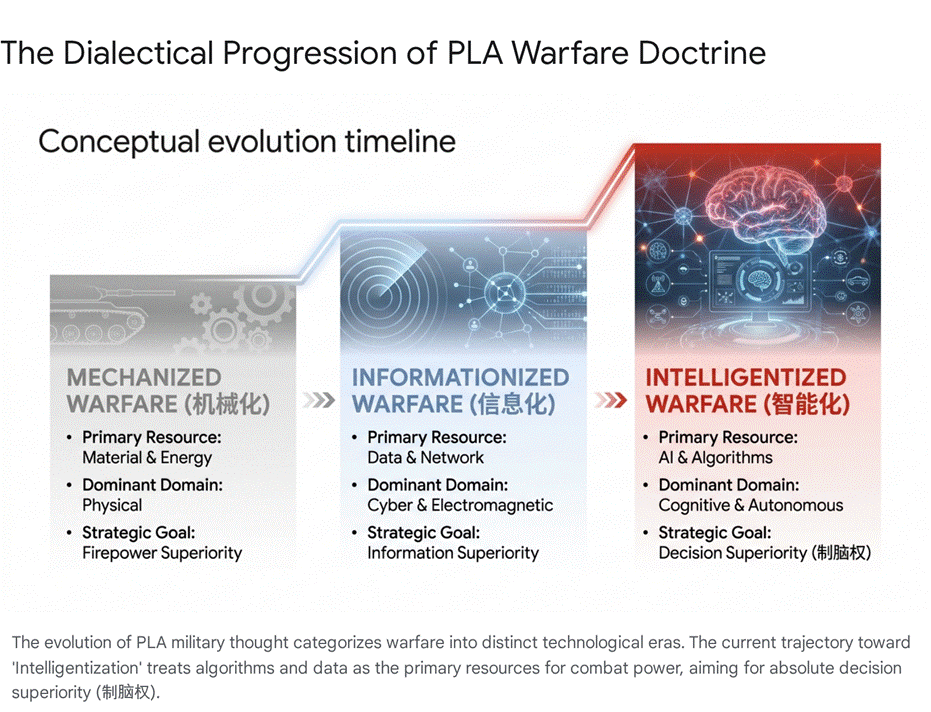
The absolute core modernization priority for the PLA is the concept of “Intelligentization” (智能化)—a strategic goal formalized by Xi Jinping in 2020 that dictates the deep, systemic integration of artificial intelligence into kill chains, logistics networks, and command systems.13 The PLA’s 2020 foundational doctrinal document, The Science of Military Strategy, classifies this AI integration as nothing less than a “new military revolution”.13

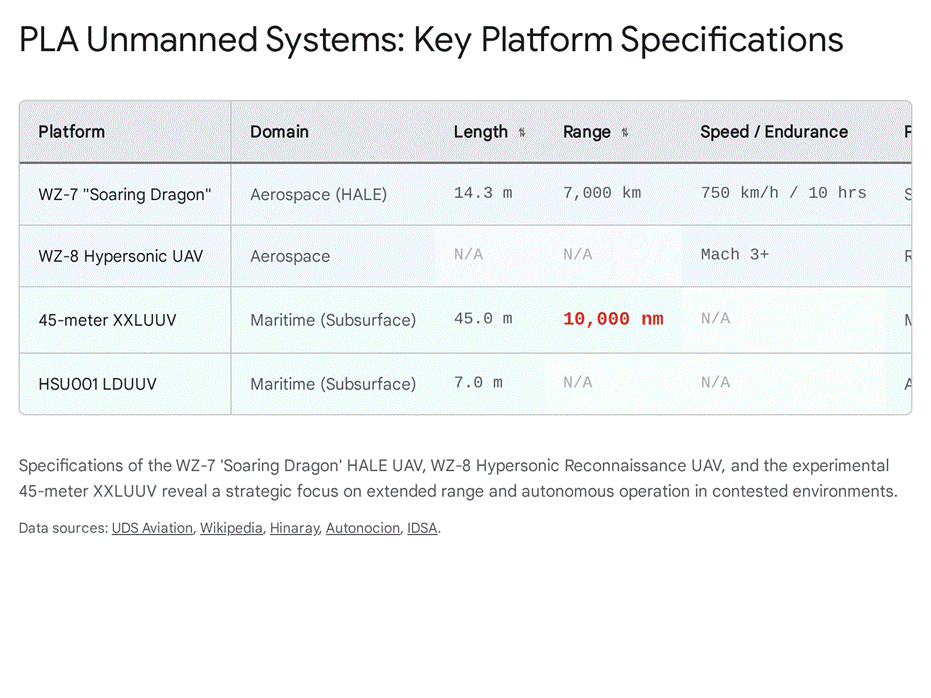
Observations drawn from the battlefields of Ukraine have heavily reinforced the PLA’s belief in the necessity of autonomous AI. Noting that reliance on space-based communications infrastructure (such as the struggles surrounding the Starlink network) is highly vulnerable to pervasive, localized electronic warfare (EW), PLA researchers have concluded that the next evolution of combat belongs to autonomous AI-driven swarms.13 The PLA envisions utilizing AI to enable a single, secure command node to simultaneously direct dozens of autonomous drones that can operate, navigate, and select targets without requiring constant, jam-susceptible pilot contact.13 Strategically, the PLA intends to deploy these intelligent swarms to overwhelm advanced air and missile defenses in Taiwan or target U.S. military infrastructure dispersed across the Indo-Pacific, severely complicating the interception of the PLA’s formidable stockpile of precision guided munitions.13

5.2 Lessons from Ukraine: Energy Management and Contested Logistics

Beyond the realm of AI and kinetic strike, the PLA is actively rewriting its sustainment doctrine based on the harsh logistical realities exposed by the Ukraine conflict. Dedicated analyses highlight the absolute necessity for integrated air defense covering supply lines, the fragility of railway transport for operational sustainment, and the critical need for resilient, decentralized logistics.14

A highly specific takeaway currently being institutionalized is the realization that tactical energy delivery must be revolutionized.16 The PLA recognizes that electricity must now be treated as a consumable class of supply on par with diesel fuel and ammunition.16 Ukrainian experiences clearly demonstrated that the integration of microgrids, solar arrays, and modular energy storage modules (ESMs) allows frontline units to maintain continuous operation of drones, radios, and mission-critical electronics without relying on loud, heat-generating fuel generators.16 By adopting these technologies, units significantly reduce their acoustic and thermal signatures, shielding them from adversary reconnaissance-strike complexes while simultaneously reducing their reliance on highly vulnerable fuel resupply convoys.15 The PLA is actively incorporating these energy management principles into its multidomain and combined-arms coordination manuals.15

5.3 Institutional Inertia and the Preference for “Exquisite” Systems

Despite these acute and highly accurate observations, the PLA’s learning process suffers from a critical, potentially fatal blind spot driven by its own institutional culture.13 A defining feature of the contemporary conflicts in Ukraine and the Middle East is the absolute battlefield dominance of low-cost, “attritable” systems, such as First-Person View (FPV) kamikaze drones and improvised one-way attack munitions.13

However, the PLA’s pre-existing financial and intellectual investments lean heavily toward sophisticated, highly expensive, and large fixed-wing platforms (such as the Wing Loong-2, GJ-11, and CH-4) that closely mirror American design philosophies intended for high-duration reconnaissance and precision strikes in uncontested airspace.13 Defense production inertia, combined with a rigid military culture that severely punishes deviations from high-level CCP modernization directives, creates a climate where it is professionally risky for mid-level officers to advocate for cheap, attritable systems if it contradicts established, multi-billion-dollar procurement programs.13

Consequently, prominent PLA academic publications frequently downplay the role of cheap drones, arguing erroneously that unmanned warfare “does not necessarily reduce the material costs of war,” citing multi-million dollar U.S. systems to justify their own expensive acquisitions.13 While the PLA is experimenting with FPV technology, its broader procurement priorities suggest that elements of the leadership are downplaying the central role of low-cost mass in favor of purpose-built, survivable platforms.13 This severe misalignment suggests the PLA is doctrinally preparing for a highly sterilized, technologically advanced version of unmanned warfare that may not survive the brutal, cost-imposition, attrition-centric dynamics of a real, protracted conflict.13

6. Synthetic Warfare: Constructing Artificial Combat Experience

To directly overcome its deficit in combat experience, safely test new doctrinal concepts, and harden its troops against the “peace disease,” the PLA has aggressively expanded its network of combat training centers (CTCs) and invested massively in synthetic, technology-driven simulation systems.11

6.1 The “Whetstone”: Zhurihe and the 195th OPFOR Brigade

The undisputed epicenter of the PLA’s realistic training ecosystem is the Zhurihe Training Base located in the austere deserts of Inner Mongolia. This sprawling facility serves as the direct, modernized analog to the U.S. Army’s National Training Center (NTC).11 Recognizing the need for expanded realism, Zhurihe underwent massive infrastructural expansion between March 2020 and late 2021.27 During this brief timeframe, the PLA more than doubled the size of its urban combat training centers (MOUT facilities), significantly expanded rail depots to test rapid mobilization, and constructed dedicated energy farms to support continuous, uninterrupted joint operations training.27

At the very heart of Zhurihe’s operations is the 195th Mechanized Infantry Brigade, serving as the PLA’s premier, permanent “Blue Force” (OPFOR).7 The 195th acts as a dedicated “whetstone” for the rest of the military. It meticulously emulates the current equipment, tactical formations, rules of engagement, and command philosophies of the United States military, providing rotating PLA “Red Forces” with a highly lethal, uncooperative, and technologically advanced adversary.18 Precedent suggests that approximately ten brigades drawn from across China’s five theater commands cycle through Zhurihe annually, engaging in high-intensity, multidomain exercises set within incredibly complex electromagnetic and information environments.11

6.2 Virtual Reality and AI-Driven Simulation Systems

The physical, kinetic training conducted at Zhurihe is now heavily augmented by cutting-edge digital simulations that seek to replicate the psychological stress of combat. The PLA is actively deploying and refining advanced systems like the “God of War Simulation Training System” (战神模拟训练系统), which deeply integrates Virtual Reality (VR) and Augmented Reality (AR) to immerse soldiers in highly realistic, customized battlefield environments, ranging from dense urban street fighting to complex mountain warfare.28

Crucially, these next-generation simulation platforms do not rely on static programming; they utilize advanced machine learning algorithms to generate dynamic, reactive multi-agent models.28 Instead of relying on pre-scripted enemy actions that soldiers can quickly memorize, the AI actively adapts to the trainee’s behavior in real-time, punishing predictable flanking maneuvers, adjusting training difficulty, and forcing soldiers to develop agile operational decision-making skills under immense simulated stress.28 This sophisticated technology, often combined with emerging haptic feedback suits that simulate the physical forces of direct fire and environmental interaction, provides a safer, high-repetition environment designed specifically to build the intuitive combat reflexes that the force historically lacks.28 Furthermore, specialized virtual medical simulation systems, similar to the U.S. VALOR program, are utilized to train personnel in combat casualty care and high-consequence triage scenarios, allowing them to practice clinical decision-making until failure is no longer an option.32

6.3 The “Fupan” (After-Action Review) Process and the “Problem Show”

The ultimate efficacy of both physical maneuvers and synthetic simulation training hinges entirely on the PLA’s internal evaluation and learning mechanisms. Following every major training event or simulation cycle, participating units are strictly mandated to conduct rigorous “Fupan” (复盘)—comprehensive after-action reviews intended to summarize and reflect on the operation.10 These structured sessions are designed to systematically detect specific tactical shortcomings, identify capability gaps, highlight successes, and rapidly direct targeted remedial training for the upcoming season.10

However, the hyper-bureaucratic, politically sensitive nature of the PLA often severely undermines this critical learning process. Because higher headquarters explicitly mandated that units must “discover problems” as a metric of command emphasis, a destructive phenomenon known internally as the “problem show” (问题秀) has become deeply endemic across the force.10 Units routinely game the evaluation system by intentionally highlighting the exact same minor, easily solvable problems year after year merely to fulfill bureaucratic quotas and demonstrate false compliance to their superiors.10 In doing so, they actively hide deeper, more systemic combat vulnerabilities to protect their careers.10 While the PLA has published numerous articles and directives attempting to stamp out this performative practice, the culture of fear instilled by the recent purges ensures that the “problem show” remains a persistent, critical barrier to genuine, force-wide learning and adaptation.10

7. Reforming Professional Military Education (PME) to Bridge the Gap

Recognizing the widening, dangerous gap between academic military theory and the harsh, evolving realities of operational units, the PLA is attempting to aggressively reform its Professional Military Education (PME) institutions. The focal point of this effort is the prestigious PLA National Defense University (NDU) in Beijing, tasked with developing the joint operations talent required for future conflicts.34

7.1 The Revival of the NDU Operational Instructor Program

In a tacit, institutional admission that its joint officer education system suffers from a severe lack of practical, warfighting grounding, the PLA revived the “Operational Instructor Program” at the NDU in 2022, expanding its scope significantly through 2026.34 The program selectively pulls “outstanding senior and mid-level leaders”—specifically defined as active commanders, political commissars, and senior staff officers serving at the regiment grade or higher (holding the rank of colonel and above)—directly from operational units across all services.34 These officers are assigned to serve as full-time instructors at the NDU for mandatory two-year rotations.34

These experienced field officers are tasked with directly augmenting the NDU’s permanent faculty, which historically consists almost entirely of non-active-duty, uniformed civilian professors who hold PhDs but lack any recent, practical field experience.34 By leading specialized lectures and directing complex simulation exercises in joint operations, these operational instructors ensure that the academic curriculum accurately reflects the current tactical, logistical, and technological realities of the active force, grounding theoretical doctrine in operational truth.34

7.2 Structuring the Joint Operations Talent Pipeline

The historical context of this program is highly revealing. The PLA attempted to implement a nearly identical instructor exchange program in 2003–2004.34 By 2009, approximately 12 percent of the NDU faculty were sourced from operational units.34 However, the experiment was quietly abandoned in subsequent years because the operational officers who served in these vital teaching positions were subsequently passed over for critical command promotions, viewing the academic assignment as a career-ending diversion.34

The aggressive second iteration and revival of this concept in 2026 indicates a top-down mandate from the CMC to permanently alter the incentive structure within the PLA.34 It signals clearly that PME teaching tours must no longer be viewed as bureaucratic dead-ends, but rather as essential, highly valued steps for advancing within the joint operations hierarchy. Balancing theoretical study with practical application is now viewed as an existential requirement for the PLA’s future command cadre.34

8. Analyzing Theater Command Disparities and Joint Operations Readiness

The ultimate, defining metric of the PLA’s decades-long modernization effort is its ability to seamlessly execute complex joint operations—integrating land, sea, air, space, and cyber domains—across its five regional theater commands. Announced by Xi Jinping in November 2020, the PLA’s foundational military training reform follows a highly structured, sequential path: advancing from basic training, to combined-arms training, and finally culminating in joint operations training.35

8.1 The Joint Training Reform: Stuck in an Exploratory Phase

Despite the high-profile nature of recent military exercises, internal PLA assessments and documentation from early 2026 reveal a critical vulnerability: the final, most crucial stage of this sequence—joint operations training—remains decidedly stuck in an “exploratory phase” across much of the force.35 While the PLA successfully completed its exploratory phases and established formalized models for basic training (concluded June 2023) and combined-arms training (concluded October 2024), it has yet to finalize or mandate a force-wide implementation model for true, integrated joint operations.35

8.2 The Vanguard Role of the Southern Theater Command (STC)

According to an authoritative January 2026 report published on the front page of the Liberation Army Daily, the Southern Theater Command (STC) has emerged as the PLA’s undisputed vanguard and “most model-worthy organization” for institutionalizing joint training.35 The STC has recently implemented a unified, deeply integrated management approach that firmly links actual combat requirements to training content, evaluation standard measurement, and task execution across its assigned services.35

Crucially, the STC routinely establishes formal, trackable lists of weaknesses and gaps in system-level capabilities, assigning specific corrective actions and responsibilities directly to units to force sustained, measurable improvements in both horizontal and vertical command relationships.35 By utilizing actual combat scenarios to lead its training cycles, the STC aims to ensure the steady, reliable operation of a joint-centered mechanism.35

8.3 Comparative Analysis of the Five Theater Commands

The purposeful elevation of the STC as the model for joint operations highlights severe capability disparities and uneven development across the broader PLA. Furthermore, the development of highly capable, technologically advanced Intelligence and Reconnaissance Brigades (IRBs) at the theater army level has given operational ground forces unprecedented ability to collect and exploit intelligence for deep targeting, but the integration of these assets varies wildly.36

Drilled M92 arm brace adapter with metal shavings
  • Northern Theater Command (NTC): Despite bearing the responsibility for highly complex, volatile regional contingencies—including securing weapons of mass destruction (WMD) on the Korean Peninsula, executing massive noncombatant evacuation operations, and managing the Russian border—the NTC is currently assessed as lacking significantly in both equipment modernization and advanced joint training execution.21
  • Western Theater Command (WTC): Tasked with counterterrorism operations in Central and South Asia, managing cooperation with Pakistan, and overseeing the highly contested border with India, the WTC has demonstrated growing capacity.21 However, it remains heavily focused on specialized, high-altitude expeditionary land power rather than holistic joint multidomain operations.21
  • Central Theater Command (CTC): Focused primarily on the defense of the capital and serving as a strategic reserve force to rapidly reinforce other commands during a crisis, the CTC’s capabilities remain stable and tailored to internal defense.21
  • Eastern Theater Command (ETC): As the command bearing primary, direct responsibility for executing any operations against Taiwan (including comprehensive blockades and complex small island seizure campaigns), the ETC has seen massive, prioritized improvements in equipment modernization.21 However, the stark fact that the STC, rather than the ETC, is currently presented as the PLA’s primary model for joint training exploration strongly indicates that the ETC’s preparations for Taiwan still possess substantial room for improvement.35 The PLA internally recognizes that the ETC has not yet perfected joint operations. Therefore, the existing patterns of military activity around the Taiwan Strait represent ongoing capability development and testing, rather than the PLA’s final, intended operational form for an invasion.35
Theater CommandStrategic Focus & Key CampaignsModernization & Capability Status Assessment (2026)
Eastern (ETC)Taiwan contingencies, small island seizures, East China Sea operations.Major improvements in modernization; primary vector for Taiwan operations, yet trails STC in finalizing joint training models.21
Southern (STC)South China Sea, Myanmar stability operations, regional deterrence.High modernization; currently the PLA’s vanguard and model organization for exploring and standardizing joint operations.21
Northern (NTC)Korean Peninsula (WMD securing, NEOs), Russian border.Currently lagging significantly in both equipment modernization and advanced training execution.21
Western (WTC)India border, Central/South Asia counterterrorism, Pakistan cooperation.Growing capacity for specialized terrain operations; improving expeditionary logistics.21
Central (CTC)Capital defense, strategic reserve.Stable; oversees assigned strategic missions and internal defense.21

9. Operationalizing the Threat: Force Posture, Exercises, and Paramilitary Integration

Despite the internal structural friction caused by leadership purges and the ongoing, incomplete exploration of joint doctrine, the PLA continues to rapidly scale the complexity, lethality, and geographic reach of its combat readiness patrols and deterrence exercises, particularly regarding Taiwan and the First Island Chain.18

9.1 Justice Mission 2025 and High-Fidelity Blockade Simulations

In late December 2025, the PLA launched a massive, highly coordinated joint exercise code-named “Justice Mission 2025” (正义使命—2025).17 Far from a routine patrol, this drill served as a comprehensive, high-fidelity rehearsal for a multi-domain campaign specifically designed to isolate Taiwan from external support. The exercise focused explicitly on testing sea-air combat readiness patrols, achieving rapid multidomain superiority, and executing tight blockades of key Taiwanese ports to interdict energy imports.11

The operational scale and aggressive nature of Justice Mission 2025 were unprecedented. Over the course of the opening day, regional defense ministries detected 89 PLA aircraft and 28 naval vessels operating in a highly coordinated, multi-axis encirclement.39 During the critical second phase of the exercise, the PLA Ground Force (PLAGF) demonstrated its integration into maritime interdiction by launching a barrage of long-range rocket artillery from coastal batteries located in Pingtan and Shishi in Fujian Province.40 Likely utilizing the advanced PHL-16/PCL-191 Multiple Rocket Launcher Systems—which are capable of firing guided rockets up to 280 kilometers—the PLAGF fired a total of 27 rockets into defined exclusion zones directly north (targeting the approaches to the port of Keelung) and southwest (targeting the port of Kaohsiung).40 Most notably, 10 of these guided rockets landed deliberately within Taiwan’s contiguous zone (12–24 nautical miles from the coast), marking the closest PLA projectiles to impact near the island to date and signaling a dramatic escalation in risk tolerance.40 The exercise also featured a formation of four amphibious assault ships deployed east of Taiwan, indicating a rehearsal for counter-intervention operations against U.S. forces.40

9.2 China Coast Guard (CCG) Integration as a Strategic Multiplier

A critical, deeply concerning evolution demonstrated during Justice Mission 2025 and subsequent regional operations is the deep, seamless integration of the China Coast Guard (CCG) into PLA military planning and operational execution. Of the 28 vessels deployed during the highly aggressive opening phase of Justice Mission 2025, nearly half—13 vessels—belonged to the CCG, operating in direct coordination with PLAN warships.17

This deployment pattern indicates a solidified doctrinal shift within Beijing’s strategic calculus: in the event of a Taiwan contingency or South China Sea escalation, the PLA will rely heavily on the heavily armed CCG to enforce quarantines, conduct hostile board-and-search operations, and forcefully manage civilian maritime traffic.17 This paramilitary integration acts as a strategic multiplier, freeing heavier PLA Navy (PLAN) combatants to focus entirely on high-end counter-intervention operations against U.S. or allied naval strike groups operating east of Taiwan.17 Throughout 2024 and 2025—originating with the Joint Sword exercises—CCG coordination with the Eastern Theater Command advanced significantly, evolving from disparate, localized patrols to fully integrated, theater-wide law enforcement drills that effectively encircle target islands in concert with PLA naval aviation.18

10. Conclusion: Evaluating True Preparedness for Major Armed Conflict

Evaluating whether the People’s Liberation Army is “truly prepared” for a major, protracted war requires decoupling its impressive, verifiable acquisition metrics from its underlying, highly opaque institutional health. From a purely material, geographic, and kinetic standpoint, the PLA is vastly more capable today than at any point in its history. It possesses a navy that is rapidly gaining blue-water proficiency, an expanding, highly lethal arsenal of long-range precision fires, and a sprawling, highly sophisticated synthetic training infrastructure designed specifically and intentionally to offset its historical lack of combat experience.8 The routine, successful execution of massive, deeply coordinated multidomain exercises like Justice Mission 2025 unequivocally proves that the PLA can reliably project overwhelming force into the First Island Chain and severely challenge U.S. regional hegemony.18

However, the military apparatus is simultaneously hollowed out by severe, self-inflicted political wounds. The massive 2022–2026 political purges have systematically stripped the high command of its most experienced, realistic, and operationally competent leaders.1 This action has created a profound experience vacuum at the exact moment the force is attempting to operationalize highly complex, untried joint doctrine. Furthermore, the CCP’s unyielding demand for absolute political loyalty and highly centralized control fundamentally contradicts the agile, decentralized mission command structure required to survive and adapt in the heavily contested, electronic warfare-saturated environments the PLA fully expects to face.2

While the PLA’s hardware, its advanced AI integrations, and its meticulously designed synthetic training environments suggest a high state of technical readiness, its brittle command architecture, its heavily scripted bureaucratic evaluation processes (such as the “problem show”), and the strategic isolation of its paramount leader dramatically increase the risk of operational paralysis and catastrophic miscalculation in the event of an actual conflict.5 The PLA is diligently, aggressively preparing for war, constructing artificial battlefields to cure its “peace disease.” Yet, its ability to dynamically adapt to the lethal chaos, friction, and staggering attrition of the first shot remains profoundly, dangerously untested.


Please share the link on Facebook, Forums, with colleagues, etc. Your support is much appreciated and if you have any feedback, please email us in**@*********ps.com. If you’d like to request a report or order a reprint, please click here for the corresponding page to open in new tab.


Sources Used

  1. Assessing Xi’s Unprecedented Purges of China’s Military: Key Developments and Potential Implications – CSIS, accessed April 26, 2026, https://www.csis.org/analysis/assessing-xis-unprecedented-purges-chinas-military-key-developments-and-potential
  2. China & Taiwan Update, April 24, 2026 | ISW, accessed April 26, 2026, https://understandingwar.org/research/china-taiwan/china-taiwan-update-april-24-2026/
  3. The Purges Within China’s Military Are Even Deeper Than You Think, accessed April 26, 2026, https://chinapower.csis.org/china-pla-military-purges/
  4. Fravel: Assessing Xi’s Unprecedented Purges of China’s Military: Key Developments and Potential Implications | 2026 | News, accessed April 26, 2026, https://ssp.mit.edu/news/2026/fravel-assessing-xis-unprecedented-purges-of-chinas-military-key-developments-and
  5. The 2026 PLA Leadership Purge and China’s Military Stability – Beyond the Horizon ISSG, accessed April 26, 2026, https://behorizon.org/the-2026-pla-leadership-purge/
  6. How Chinese Military Decisions About Adopting Mission Command Could Affect a Future U.S.-China Conflict – RAND, accessed April 26, 2026, https://www.rand.org/nsrd/news/nsrd-upfront/2026/01/chinese-mission-command.html
  7. CMSR 2026 The PLA Is Intended to Fight and Win Wars – Marine Corps University, accessed April 26, 2026, https://www.usmcu.edu/Outreach/Marine-Corps-University-Press/China-Military-Studies-Review/CMSR-2026-The-PLA-Is-Intended-to-Fight-and-Win-Wars/
  8. China’s Military Has No Combat Experience: Does It Matter? | RAND, accessed April 26, 2026, https://www.rand.org/pubs/commentary/2018/11/chinas-military-has-no-combat-experience-does-it-matter.html
  9. Xi believes a ‘peace disease’ hampers China’s military modernisation | The Strategist, accessed April 26, 2026, https://www.aspistrategist.org.au/xi-believes-a-peace-disease-hampers-chinas-military-modernisation/
  10. 1 “PLA Weaknesses and Xi’s Concerns about PLA Capabilities” Testimony before the U.S.-China Economic and Security Review, accessed April 26, 2026, https://www.uscc.gov/sites/default/files/Blasko_USCC%20Testimony_FINAL.pdf
  11. China Expanding Joint Forces Training Centers and OPFOR, accessed April 26, 2026, https://g2webcontent.z2.web.core.usgovcloudapi.net/OEE/TIP/11FEB2026_T2COM_TiP_CHI_Joint_Forces_Training_Center_a.pdf
  12. Electronics, Volume 14, Issue 24 (December-2 2025) – 200 articles, accessed April 26, 2026, https://www.mdpi.com/2079-9292/14/24
  13. Lessons-learned with Chinese Characteristics | ISW, accessed April 26, 2026, https://understandingwar.org/research/china-taiwan/lessons-learned-with-chinese-characteristics-understanding-the-limits-of-pla-efforts-to-adapt-to-contemporary-warfare/
  14. Lessons from the Ukraine Conflict: Modern Warfare in the Age of Autonomy, Information, and Resilience – CSIS, accessed April 26, 2026, https://www.csis.org/analysis/lessons-ukraine-conflict-modern-warfare-age-autonomy-information-and-resilience
  15. China Accelerates Modernization By Applying Lessons From Russia-Ukraine War | T2COM G2 Operational Environment Enterprise, accessed April 26, 2026, https://oe.t2com.army.mil/product/china-accelerates-modernization-by-applying-lessons-from-russia-ukraine-war/
  16. No. 26-1116, Powering The Front: Tactical Energy Delivery and Management in the Ukraine War – U.S. Army, accessed April 26, 2026, https://api.army.mil/e2/c/downloads/2026/03/30/c260713f/no-26-1116-powering-the-front-tactical-energy-delivery-and-management-in-the-ukraine-war.pdf
  17. Special Report: Surprise PRC Military Exercise Around Taiwan, accessed April 26, 2026, https://understandingwar.org/research/china-taiwan/china-taiwan-special-report-december-31-2025/
  18. Annual Report to Congress: Military and Security Developments Involving the People’s Republic of China 2025 – Department of War, accessed April 26, 2026, https://media.defense.gov/2025/Dec/23/2003849070/-1/-1/1/ANNUAL-REPORT-TO-CONGRESS-MILITARY-AND-SECURITY-DEVELOPMENTS-INVOLVING-THE-PEOPLES-REPUBLIC-OF-CHINA-2025.PDF
  19. Why Is Xi Still Purging His Generals? – Institute for National Strategic Studies, accessed April 26, 2026, https://inss.ndu.edu/Media/News/Article/4418691/why-is-xi-still-purging-his-generals/
  20. Military Purges at China’s Fourth Plenum Have Implications for Readiness – CNA.org., accessed April 26, 2026, https://www.cna.org/our-media/indepth/2025/11/military-purges-at-chinas-fourth-plenum-have-implications-for-readiness
  21. 2026 Carlisle Conference on the PLA: The PLA’s Capability to React …, accessed April 26, 2026, https://ssi.armywarcollege.edu/SSI-Media/Recent-Publications/Article/4461809/2026-carlisle-conference-on-the-pla-the-plas-capability-to-react-to-crises/
  22. Xi stresses deepening political rectification at training session for military officials – Xinhua, accessed April 26, 2026, https://english.news.cn/20260408/8aab5c9793c94cc29c002376478298b5/c.html
  23. Xi stresses enhancing political loyalty in military to advance defense modernization, accessed April 26, 2026, http://en.cppcc.gov.cn/2026-03/07/c_1165743.htm
  24. China’s Incomplete Military Transformation: Assessing the Weaknesses of the People’s Liberation Army (PLA) – DTIC, accessed April 26, 2026, https://apps.dtic.mil/sti/tr/pdf/ADA615374.pdf
  25. the pla is intended to fight and win wars – Marine Corps University, accessed April 26, 2026, https://www.usmcu.edu/Portals/218/CMSR_2026_Tirk_web.pdf
  26. Russia’s Changes in the Conduct of War Based on Lessons from Ukraine – Army University Press, accessed April 26, 2026, https://www.armyupress.army.mil/Journals/Military-Review/English-Edition-Archives/September-October-2025/Lessons-from-Ukraine/
  27. Infrastructure Developments for Training China’s Army – Tearline.mil, accessed April 26, 2026, https://www.tearline.mil/public_page/pla-joint-training
  28. Virtual Reality Technology and Algorithm Application in Intelligent Combat Training Simulation System – IEEE Xplore, accessed April 26, 2026, https://ieeexplore.ieee.org/document/10835936/
  29. AI-Driven Defence Simulations & Military Training Future – Beyond the Horizon ISSG, accessed April 26, 2026, https://behorizon.org/training-tomorrows-leaders-today-the-role-of-ai-driven-simulations-in-modern-defence/
  30. Your next army training session might be in a virtual battlefield and that’s a good thing, accessed April 26, 2026, https://medium.com/@global.himani26/your-next-army-training-session-might-be-in-a-virtual-battlefield-and-thats-a-good-thing-96a31c0b155a
  31. REALITY CHECK – USAASC – U.S. Army, accessed April 26, 2026, https://asc.army.mil/web/reality-check/
  32. Virtual Reality Operational Military Medical Training – SimX, accessed April 26, 2026, https://www.simxvr.com/virtual-reality-medical-simulation-training-for-military/
  33. After Action Review – World Health Organization (WHO), accessed April 26, 2026, https://www.who.int/emergencies/operations/emergency-response-reviews/after-action-review
  34. Theory Meets Practice: The PLA National Defense University Revives the Operational Instructor Program – U.S. Army, accessed April 26, 2026, https://innovation.army.mil/News/Article-View/Article/4390693/theory-meets-practice-the-pla-national-defense-university-revives-the-operation/
  35. The PLA’s Joint Operations Training Reform Remains in an Exploratory Phase, accessed April 26, 2026, https://ssi.armywarcollege.edu/SSI-Media/Recent-Publications/Article/4404986/the-plas-joint-operations-training-reform-remains-in-an-exploratory-phase/
  36. Intelligence And Reconnaissance Brigades Give PLA Theater Commands Unprecedented Reach | T2COM G2 Operational Environment Enterprise, accessed April 26, 2026, https://oe.t2com.army.mil/product/intelligence-and-reconnaissance-brigades-give-pla-theater-commands-unprecedented-reach/
  37. Justice Mission-2025 – Wikipedia, accessed April 26, 2026, https://en.wikipedia.org/wiki/Justice_Mission-2025
  38. PLA conducts ‘Justice Mission 2025’ drills around Taiwan islands, accessed April 26, 2026, http://eng.mod.gov.cn/2025xb/N/T/16429628.html
  39. Creeping Closer: Timeline and Analysis of the Justice Mission-2025 Joint Exercise, accessed April 26, 2026, https://tsm.schar.gmu.edu/creeping-closer-timeline-and-analysis-of-the-justice-mission-2025-joint-exercise/
  40. The PLA’s “Justice Mission-2025” Exercise Around Taiwan, accessed April 26, 2026, https://globaltaiwan.org/2026/01/pla-justice-mission-2025/
  41. China’s Military in 10 Charts – CSIS, accessed April 26, 2026, https://www.csis.org/analysis/chinas-military-10-charts

Balikatan 2026: Shaping Indo-Pacific Security Dynamics

1. Executive Summary

Exercise Balikatan 2026, executed between April 20 and May 8, 2026, represents a fundamental shift in the operational dynamics and security architecture of the Indo-Pacific region.1 Constituting the 41st iteration of the annual military drills between the Armed Forces of the Philippines (AFP) and the United States military, the exercise intentionally coincides with the 75th anniversary of the 1951 U.S.-Philippine Mutual Defense Treaty.3 However, the 2026 iteration diverges significantly from its historical precedents. It has transformed from a localized, bilateral training event focused on internal security into an expansive, multilateral power-projection mechanism designed for high-intensity, multi-domain operations against peer adversaries.2

Involving more than 17,000 personnel, Balikatan 2026 integrates forces from the Philippines, the United States, Australia, Japan, Canada, France, and New Zealand.2 Furthermore, it incorporates an international observer program featuring 17 additional nations, including European partners such as Czechia, Lithuania, the Netherlands, Poland, and the United Kingdom.2 This deliberate expansion reflects a strategic transition toward “alliance density,” wherein Manila and Washington seek to internationalize the defense of the First Island Chain to complicate adversary strategic calculus.

Operationally, the center of gravity for the exercise is distributed across the Philippine archipelago, with a pronounced focus on the northernmost extremities—specifically the Batanes and Babuyan Island Groups adjacent to the Luzon Strait—and the contested West Philippine Sea.5 The training regimen spans air, land, sea, space, and cyber domains, validating complex capabilities such as expeditionary advanced base operations, distributed maritime logistics, integrated air and missile defense (IAMD), and joint combined fires.2

At the doctrinal level, the exercise serves as a primary testing environment for the AFP’s newly operationalized Comprehensive Archipelagic Defense Concept (CADC), a framework dictating a pivot toward forward and seaward territorial defense.10 Through the deployment of advanced kinetic systems—including the U.S. Typhon system, Naval Strike Missiles, Japanese Type 88 surface-to-ship missiles, and Philippine BrahMos cruise missiles—the coalition is actively demonstrating lethal sea-denial capabilities.5 The strategic messaging directed at the People’s Republic of China is unambiguous, emphasizing collective deterrence and a resolute defense of sovereign maritime domains despite warnings from Beijing that the coalition is risking regional stability.13

2. Geopolitical Context and the Evolution of the Alliance

Understanding the scale and scope of Balikatan 2026 requires an analysis of the geopolitical environment that necessitated its expansion. For decades, the Armed Forces of the Philippines focused the majority of its resources and training on internal security operations, primarily combating insurgencies in the southern islands. Early iterations of Exercise Balikatan reflected this orientation, focusing heavily on counter-terrorism, light infantry tactics, and civil-military operations.

However, escalating tensions in the South China Sea—characterized by repeated physical confrontations, gray-zone coercion, and the rapid militarization of artificial island features by the People’s Liberation Army Navy (PLAN) and Chinese Coast Guard—have forced a rapid structural realignment within the Philippine defense establishment. The alliance with the United States, anchored by the Mutual Defense Treaty, has been revitalized to address these external, conventional threats.3

The 75th anniversary of the treaty in 2026 provides a symbolic backdrop for a highly practical modernization effort.4 The United States and the Philippines are utilizing Balikatan 2026 to operationalize agreements made under the Enhanced Defense Cooperation Agreement (EDCA), which grants U.S. forces access to strategic Philippine bases. The exercise is no longer merely a demonstration of friendship; it is a critical mechanism for ensuring tactical proficiency, interoperability, and the development of a combined force capable of sustaining a credible defense posture in a highly contested environment.2 The shift signifies an acknowledgment that regional stability can no longer be maintained solely through diplomatic protest, but requires the physical demonstration of integrated, lethal combat capabilities.

3. Force Generation and the Multilateral Architecture

The defining structural characteristic of Balikatan 2026 is its multilateral force architecture. The Philippines has actively pursued what strategic analysts describe as a “looking for a crowd” strategy.5 By bringing a broad coalition of partner nations into its territorial waters and airspace, the Philippines seeks to deter aggression through the promise of a collective, international response.

3.1 United States and Philippine Contributions

The United States has committed roughly 10,000 service personnel to the exercise, representing a massive deployment of forward-based power into the theater.5 This deployment, executed concurrently with significant U.S. military commitments in the Middle East and Europe, underscores the prioritization of the Indo-Pacific in Washington’s global strategy.5 The U.S. contingent is heavily weighted toward expeditionary and advanced strike capabilities, led by the I Marine Expeditionary Force (I MEF), the 3rd Marine Littoral Regiment (MLR), and Destroyer Squadron (DESRON) 7.4

The Armed Forces of the Philippines, acting as the host and primary partner, integrates its personnel across all exercise phases. The Philippine contribution is focused on validating its ongoing modernization programs, particularly the integration of new command-and-control architectures and coastal defense assets managed by the AFP Education and Training Command.2

3.2 The Integration of Partner Nations

The 2026 iteration features the unprecedented integration of allied forces into active combat scenarios, moving far beyond traditional observer status.

Japan’s participation is a historically significant milestone. For the first time since the end of World War II, Japan has deployed “combat-capable” troops—totaling 1,400 personnel—as active partners in the Philippines.12 Empowered by a recently activated reciprocal access agreement, Japan’s involvement operationalizes Tokyo’s strategic intent to build a secure “southern barrier” along the First Island Chain, linking the defense of its Ryukyu Islands directly to the northern Philippines.5

Australia, a long-standing strategic partner to the Philippines, deployed approximately 400 personnel from the Australian Defence Force (ADF).7 This contingent includes land maneuver forces, tactical air elements, specialized medical teams, and the Anzac-class frigate HMAS Toowoomba.7 Australian participation is explicitly tied to upholding international law, ensuring freedom of navigation, and demonstrating the depth of the bilateral defense relationship in securing a prosperous Indo-Pacific.7

France has similarly solidified its role as a consistent Indo-Pacific security partner. Participating as part of its five-month Jeanne D’Arc mission, the French Navy has integrated amphibious warships and frigates into the exercise.16 This deployment is designed to acclimate French naval officers to long-term operations in the region and to manage the complexities of modern naval warfare, including the integration of drones and advanced data networks.16 France’s involvement in Balikatan complements its broader regional engagement, which includes the provision of maritime security assistance and the construction of patrol vessels for the Philippine Coast Guard.16

Canada and New Zealand, entering the exercise as full participants, reflect the expanding geographic scope of nations invested in Indo-Pacific stability. Canada’s involvement follows recently finalized defense agreements with Manila, further solidifying the presence of Western and NATO-aligned forces operating in the Philippine Sea.5

Drilled M92 arm brace adapter with metal shavings

4. Geographic Optimization and Strategic Choke Points

Geography dictates strategy in the maritime domains of the Indo-Pacific. Balikatan 2026 distinguishes itself by fully utilizing the strategic depth of the Philippine archipelago, positioning forces in direct proximity to the region’s most critical maritime transit routes.2 The exercise is geographically distributed to rehearse defense mechanisms for two primary operational theaters: the northern approaches toward Taiwan and the western maritime domains in the South China Sea.

4.1 The Northern Flank: Batanes, the Babuyan Islands, and the Luzon Strait

A central focus of the exercise involves operations in the northernmost Philippine province of Batanes and the adjacent Babuyan Island Group.8 This territory borders the Luzon Strait and the Bashi Channel, which serve as critical maritime conduits connecting the Philippine Sea to the South China Sea. Control of these waterways is essential for projecting naval power, maintaining commercial shipping lanes, and facilitating military transit in the event of a regional contingency.

The strategic relevance of this geography is closely tied to the defense of Taiwan. The island of Itbayat in the Batanes group lies less than 100 miles from Taiwan’s southern coast.5 By conducting Maritime Key Terrain Security Operations (MKTSO) in this sector, U.S. and Philippine forces are rehearsing the rapid deployment, securement, and defense of strategically vital islands that could serve as choke points or staging areas.8 The MKTSO curriculum focuses on the rapid insertion of troops into remote environments, securing beachheads and ports, establishing temporary defensive fortifications, and coordinating surveillance across the strait.8

Furthermore, the deployment of the U.S. 3rd Marine Littoral Regiment to the Cagayan North International Airport (also known as Lal-lo Airport) highlights the utility of EDCA sites.15 Operating from this airfield in Northern Luzon, American forces can utilize long-range anti-ship missile systems to establish a sea-denial zone extending up to 185 kilometers into the waters separating the Philippines and Taiwan.15 This positioning signals a readiness to contest adversary naval movements through one of the primary passages into the First Island Chain.

4.2 The Western Flank: The West Philippine Sea

Simultaneously, Balikatan 2026 dedicates significant resources to operations along the western coast of the archipelago, focusing on the West Philippine Sea.2 This area remains a highly volatile flashpoint, characterized by competing territorial claims and the persistent presence of foreign maritime militias. The drills conducted in this theater—ranging from multilateral maritime patrols to integrated air and missile defense scenarios—are designed to assert sovereignty, enforce UNCLOS provisions, and demonstrate the coalition’s capability to operate effectively within an adversary’s perceived sphere of influence.7

Drilled M92 arm brace adapter with metal shavings

5. Multinational Maritime Operations and the Capstone SINKEX

The maritime domain serves as the primary theater for validating joint interoperability during the exercise. The operational activities are designed to stress-test the command-and-control linkages required to coordinate complex tactical maneuvers among navies utilizing different communication protocols and operational doctrines.

5.1 Multinational Maritime Exercise (MME)

The maritime component is structured around the Multinational Maritime Exercise (MME), directed by the U.S. Navy’s Destroyer Squadron (DESRON) 7 and Task Force Ashland.4 DESRON 7, acting as the primary tactical and operational commander for deployed ships in Southeast Asia, oversees a combined task group comprising ten surface vessels from the United States, the Philippines, Japan, Australia, Canada, and the U.S. Coast Guard.4

The MME involves high-intensity training evolutions conducted off the west coast of the Philippines over multiple days.2 The curriculum includes coordinated anti-submarine warfare (ASW) tracking, live-fire gunnery engagements, deck-landing qualifications for cross-deck aviation operations, and complex search-and-rescue and medical evacuation procedures.4 By executing these maneuvers as a unified surface action group, the coalition ensures that in a crisis scenario, diverse naval assets can aggregate rapidly and operate under a centralized command structure.

5.2 The Joint Sinking Exercise (SINKEX)

The tactical culmination of the maritime phase is the sinking exercise (SINKEX). This event moves beyond simulated targeting to involve live kinetic strikes against a physical vessel. The target designated for the 2026 exercise is a decommissioned Philippine Navy logistics ship, the BRP Lake Caliraya (PS-70).20 (Note: Subsidiary exercise reports also reference the decommissioned BRP Quezon as a potential target in surrounding drills).21

The SINKEX is designed as a joint maritime strike scenario. According to exercise spokespersons, the objective is not simply to sink the vessel, but to orchestrate a highly synchronized convergence of fires utilizing air, land, and sea-based assets simultaneously.20 This requires aircraft, surface ships, and land-based missile batteries to share targeting telemetry in real-time, effectively creating a unified kill web. The successful execution of the SINKEX serves as the ultimate validation of the coalition’s ability to locate, track, and destroy adversary surface combatants in a contested maritime environment.

6. Integrated Air and Missile Defense (IAMD)

As modern warfare becomes increasingly reliant on advanced aerospace threats—including ballistic missiles, cruise missiles, and unmanned aerial systems (UAS)—the ability to defend critical infrastructure and troop concentrations is paramount. Balikatan 2026 addresses this requirement through dedicated Integrated Air and Missile Defense (IAMD) operations.8

Conducted primarily at Naval Station Leovigildo Gantioqui in Zambales, the IAMD drills test the coalition’s capacity to detect and neutralize complex aerial threats.8 The training involves linking disparate radar sensor networks, command centers, and ground-based air defense platforms into a cohesive architecture.8 This integration is critical; the Philippine military currently possesses limited organic air defense capabilities and must rely on allied systems to protect high-value assets and precision strike batteries during the initial phases of a conflict.23

The scenarios are designed to minimize the sensor-to-shooter timeline, allowing allied forces to rapidly process tracking data and assign interception tasks to the optimal defensive platform.8 By rehearsing these protocols, the coalition enhances its defensive posture against preemptive strikes designed to degrade command nodes or logistics hubs.

7. Advanced Kinetic Assets and Sea Denial Architecture

The operational geography of the Philippines makes it uniquely suited for anti-access/area-denial (A2/AD) strategies. During Balikatan 2026, the allied coalition deployed and tested a suite of advanced kinetic weapons designed explicitly for coastal defense and sea denial, altering the tactical calculus within the First Island Chain.

7.1 The Navy-Marine Expeditionary Ship Interdiction System (NMESIS)

The U.S. 3rd Marine Littoral Regiment deployed the NMESIS platform to the northern Philippines.15 This system consists of an unmanned, remote-controlled Joint Light Tactical Vehicle (JLTV) chassis equipped with the Naval Strike Missile (NSM).15 Staged at austere locations like the Cagayan North International Airport, NMESIS exemplifies the doctrine of Expeditionary Advanced Base Operations (EABO). The system provides a highly mobile, low-signature anti-ship capability that can threaten maritime targets up to 185 kilometers away before rapidly relocating to avoid counter-battery fire.15

7.2 The Typhon Missile System

The exercise also featured the deployment of the U.S. Typhon Missile System. This ground-based launcher represents a significant escalation in regional strike capabilities, as it is capable of firing Standard Missile 6 (SM-6) interceptors—which possess secondary land-attack and anti-ship modes—as well as Tomahawk Land Attack Cruise Missiles.5 The integration of the Typhon system introduces a long-range, deep-strike capability into the theater, providing the coalition with the means to target adversary infrastructure and naval assets at strategic distances.

7.3 Japanese Type 88 and Philippine BrahMos Systems

Allied kinetic contributions further compound the sea-denial architecture. For the first time, the Japan Ground Self-Defense Force executed live-fire operations with the Type 88 surface-to-ship missile outside of Japanese sovereign territory.12 This deployment directly supports the SINKEX and demonstrates Japan’s technical and political readiness to engage in integrated combat operations alongside its partners.12

Simultaneously, the Armed Forces of the Philippines simulated the deployment of its newly acquired BrahMos supersonic cruise missiles.5 Procured from India, the BrahMos system provides the Philippine military with a highly lethal, organic coastal defense capability. Operating at speeds approaching Mach 3, the missile drastically compresses the reaction time available to adversary point-defense systems, creating a formidable deterrent against hostile surface action groups operating within the Philippine exclusive economic zone.

Weapon SystemOperating NationCore Functionality and DesignStrategic Application in Balikatan 2026
NMESIS (Naval Strike Missile)United StatesUnmanned, highly mobile coastal defense missile launcher.Securing maritime choke points in the Luzon Strait; providing survivable, distributed sea-denial.
Typhon System (SM-6, Tomahawk)United StatesMulti-mission ground launcher for air defense and long-range strike.Establishing robust theater-level deterrence via deep strike and extended-range interception.
Type 88 Surface-to-Ship MissileJapanTruck-mounted coastal defense anti-ship cruise missile.First out-of-territory operational deployment; securing the southern flank of the First Island Chain.
BrahMos Supersonic Cruise MissilePhilippinesHigh-speed (Mach 3) anti-ship and land-attack missile.Providing the AFP with an organic, high-tier coastal defense asset to protect archipelagic waters.

8. Expeditionary Logistics and Distributed Sustainment

Military strategy is ultimately constrained by logistics. In archipelagic warfare, the ability to sustain dispersed forces over vast expanses of water—while under the constant threat of interdiction—is the primary determinant of operational endurance. Balikatan 2026 places an unprecedented emphasis on validating dynamic maritime sustainment and distributed logistics.2

Prior to the formal commencement of kinetic drills, U.S. and Philippine forces executed complex rehearsals involving the offload of heavy equipment and supplies from maritime prepositioning force shipping at the Port of Cagayan de Oro.2 Once ashore, this materiel was rapidly transported and distributed across logistical nodes throughout Luzon to support the ensuing training events.2

This emphasis on distribution is critical because traditional, static logistics hubs are highly vulnerable to precision missile strikes. By practicing the rapid offload and dispersed routing of supplies, the coalition is building the resilient supply chains necessary to sustain combat operations in a contested environment. The U.S. Air Force also played a vital role in this phase, with units such as the 317th Airlift Wing arriving in the Philippines to conduct Maximum Endurance Operations (MEO) and provide tactical airlift support across the theater.25 The ability to continuously move munitions, fuel, and provisions to remote island outposts dictates the tempo and survivability of the forward-deployed forces.

9. Space and Cyber Domain Operations

Balikatan 2026 acknowledges that modern multi-domain operations are entirely dependent on the continuous availability of space and cyber assets. The domains of space and cyberspace are no longer viewed as benign support environments; they are congested, contested battlefields critical for navigation, communication, and intelligence gathering.26

U.S. Space Force leadership, including Chief of Space Operations Gen. Chance Saltzman, emphasized during the exercise period that the U.S. military is undergoing sweeping changes to reoptimize its forces for Great Power Competition in the space domain.26 During Balikatan, specialized units, supported by leaders like USSF Brig. Gen. Denaro, engaged with forces on the ground to ensure that satellite communications and orbital surveillance architectures could withstand jamming or degradation attempts.27

Concurrently, the exercise incorporated rigorous cyber defense operations.7 Joint cyber units from allied nations trained shoulder-to-shoulder to identify, isolate, and neutralize simulated digital intrusions.27 The objective of these drills is to protect critical military networks and civilian infrastructure from sophisticated electronic warfare and cyber-attacks, ensuring that the command-and-control linkages governing the kinetic weapons systems remain intact during combat operations.

10. Operationalizing the Comprehensive Archipelagic Defense Concept (CADC)

Beyond the tactical integration of allied forces, Balikatan 2026 functions as the primary operational proving ground for the Philippine government’s Comprehensive Archipelagic Defense Concept (CADC).10 Operationalized by the Marcos Jr. administration in early 2024, the CADC represents a paradigm shift in Philippine military strategy.

For the majority of its history, the AFP was structured and trained for internal security, focusing on counter-insurgency and domestic policing. The CADC reorients the military toward external territorial defense, dictating a posture that projects defensive power outward from the landmass to secure the entirety of the Philippines’ 200-nautical-mile exclusive economic zone and extended continental shelf.10 As Philippine Defense Secretary Gilberto Teodoro Jr. articulated, the CADC is designed to allow the AFP to guarantee the unimpeded exploration and exploitation of natural resources by Philippine nationals within their sovereign jurisdiction.11

Implementing the CADC requires a transition from conventional, unfocused military build-ups to a strategy defined by basing dispersion, the use of archipelagic geography for concealment, and the deployment of ranged strike capabilities.10 The scenarios executed during Balikatan 2026—particularly the remote deployments in Batanes and the integration of BrahMos missiles—are direct physical manifestations of the CADC doctrine.

However, military analysts assess that operationalizing the CADC presents both internal and external challenges. Internally, the Philippine military must overcome historical inter-service rivalries that can hamper the joint cooperation necessary for complex, multi-domain defense.10 Externally, the CADC functions effectively as a “counter” A2/AD strategy directed against China’s maritime posture.10 As Manila expands its military positions along strategic border areas and integrates foreign military partnerships, it inadvertently fosters security dilemma dynamics.10 The hardening of Philippine defense capabilities, while intended for protection, is perceived by adversaries as a threat, thereby increasing the likelihood of sharper military confrontations in the near term.10

11. Strategic Signaling and the Diplomatic Battleground

Military exercises of the magnitude of Balikatan 2026 are inherently political instruments. They serve as a massive signaling apparatus, projecting resolve to allies while issuing a stark deterrent warning to potential adversaries. The diplomatic exchanges surrounding the 2026 drills highlight a deeply polarized regional environment.

11.1 The Rhetoric of the People’s Republic of China

Unsurprisingly, the commencement of the expansive multilateral drills drew immediate and severe condemnation from Beijing. The Chinese Foreign Ministry characterized the involvement of external forces—specifically the United States, Japan, and European nations—as a deliberate attempt to “sow division and confrontation” within the Asia-Pacific region.13 A foreign ministry spokesperson warned that the participating countries were “blindly binding themselves together” and were akin to “playing with fire,” asserting that such actions would ultimately backfire and destabilize the region.14

11.2 The Philippine Posture of Resolve

In stark contrast to the strategic ambivalence that characterized previous administrations, the Philippine defense establishment responded to Beijing’s warnings with resolute defiance. The Armed Forces of the Philippines and the Department of National Defense systematically dismissed the Chinese rhetoric.

Rear Admiral Roy Vincent Trinidad, the AFP spokesperson for the West Philippine Sea, stated unequivocally that the military remains “unfazed” by the threats, characterizing China’s statements as predictable “deceptive messaging”.14 Trinidad emphasized that the joint drills are lawful actions of an independent sovereign state and are purely defensive in nature, designed solely to protect what is legally Philippine territory.14 He further clarified that the CADC and the exercises are not designed against any specific country, but rather to give the AFP the capability to secure its maritime domain.11

Defense Secretary Gilberto Teodoro Jr. delivered an even sharper critique, stating that Beijing’s intentions have always been “sinister and non-transparent” and that there is “no trust at all” in China’s diplomatic overtures.28 Teodoro framed Balikatan as an essential exercise in collective deterrence, arguing that China’s negative reaction is proof that the deterrent effect is working.28 He accused Beijing of utilizing a strategy of “guilt avoidance,” attempting to shift the blame for regional instability onto the Philippines and its allies while ignoring its own aggressive actions in the South China Sea.28

AFP Chief of Staff Gen. Romeo Brawner Jr. reinforced this unified stance, stating during the opening ceremonies that the presence of the multinational coalition sends an “unmistakable message that security is shared and that partnership remains our strongest advantage”.13

12. Long-Term Trajectories and Regional Stability

Exercise Balikatan 2026 establishes a set of operational realities that will profoundly influence the security architecture of the Indo-Pacific moving forward. The exercise confirms that the bilateral U.S.-Philippine alliance has effectively evolved into a multilateral security hub, capable of integrating forces from across the globe into a cohesive combat architecture.

The institutionalization of Japanese combat participation, alongside the formalized integration of forces from Australia, France, Canada, and New Zealand, guarantees that any future regional contingency will not be confined to a bilateral dispute. The “alliance density” demonstrated during the exercise ensures that aggression within the Philippine EEZ or the broader First Island Chain will immediately internationalize, fundamentally altering the risk calculations for any adversary contemplating offensive action.5

Furthermore, the exercise serves as a practical rehearsal for Taiwan contingencies. By developing pre-set logistical channels, testing advanced kinetic systems near the Bashi Channel, and validating the rapid deployment of expeditionary forces, Washington and Manila are laying the necessary groundwork to sustain prolonged combat operations in the region.5

Ultimately, Balikatan 2026 solidifies the irreversible trajectory of the Armed Forces of the Philippines. Through the rigorous testing of the Comprehensive Archipelagic Defense Concept, the Philippines is transitioning from a state reliant on diplomatic protest into an active, capable node within the regional deterrence network. The success of the exercise lies in its ability to seamlessly weave advanced technology, multinational logistics, and aggressive strategic messaging into a unified posture that secures the maritime domains of the Indo-Pacific against territorial coercion.


Please share the link on Facebook, Forums, with colleagues, etc. Your support is much appreciated and if you have any feedback, please email us in**@*********ps.com. If you’d like to request a report or order a reprint, please click here for the corresponding page to open in new tab.


Sources Used

  1. Balikatan 2026 opening ceremony highlights a strong alliance and expanding cooperation, accessed April 26, 2026, https://www.pacom.mil/Media/News/News-Articles/Article/4465146/balikatan-2026-opening-ceremony-highlights-a-strong-alliance-and-expanding-coop/
  2. Philippine, U.S. forces kick off most expansive Balikatan exercise to date, accessed April 26, 2026, https://www.imef.marines.mil/Media-Room/Press-Releases/Announcement/Article/4457714/philippine-us-forces-kick-off-most-expansive-balikatan-exercise-to-date/
  3. Exercise Balikatan – DVIDS, accessed April 26, 2026, https://www.dvidshub.net/feature/Balikatan
  4. Balikatan 2026: DESRON-7, Task Force Ashland Commence …, accessed April 26, 2026, https://www.pacom.mil/Media/News/News-Articles/Article/4468732/balikatan-2026-desron-7-task-force-ashland-commence-multinational-maritime-event/
  5. U.S. and Filipino Forces Launch Expanded Military Drills – FDD, accessed April 26, 2026, https://www.fdd.org/analysis/2026/04/22/u-s-and-filipino-forces-launch-expanded-military-drills/
  6. Balikatan 2026 opening ceremony highlights strong alliance, expanding cooperation, accessed April 26, 2026, https://www.cpf.navy.mil/Newsroom/News/Article/4466071/balikatan-2026-opening-ceremony-highlights-strong-alliance-expanding-cooperation/
  7. Exercise Balikatan 2026 underway | The Australian Naval Institute, accessed April 26, 2026, https://navalinstitute.com.au/exercise-balikatan-2026-underway/
  8. Exercise Balikatan: What drills to expect in ‘most expansive’ version of PH-US annual war games – Manila Bulletin, accessed April 26, 2026, https://mb.com.ph/2026/04/21/exercise-balikatan-what-drills-to-expect-in-most-expansive-version-of-ph-us-annual-war-games
  9. Balikatan 2026 opening ceremony highlights a strong alliance and expanding cooperation, accessed April 26, 2026, https://www.dvidshub.net/news/563062/balikatan-2026-opening-ceremony-highlights-strong-alliance-and-expanding-cooperation
  10. Forward and Seaward: Archipelagic Defence as a Military Strategy for the Philippines, accessed April 26, 2026, https://www.iiss.org/research-paper/2025/12/forward-and-seaward-archipelagic-defence-as-a-military-strategy-for-the-philippines/
  11. PH’s archipelagic defense framework not aimed at China – Navy | Philippine News Agency, accessed April 26, 2026, https://www.pna.gov.ph/articles/1273449
  12. PLA holds exercises in waters east of Luzon Island, ‘a necessary …, accessed April 26, 2026, https://www.globaltimes.cn/page/202604/1359721.shtml
  13. US, Philippines launch largest-ever Balikatan drills as China warns against ‘division and confrontation’ | IRIA News, accessed April 26, 2026, https://www.ir-ia.com/news/us-philippines-launch-largest-ever-balikatan-drills-as-china-warns-against-division-and-confrontation/
  14. AFP unfazed by China’s warning as Balikatan drills push through – Daily Tribune, accessed April 26, 2026, https://tribune.net.ph/2026/04/21/afp-unfazed-by-chinas-warning-as-balikatan-drills-push-through
  15. U.S. Anti-Ship Missiles in the Philippines for Balikatan 2026 – Naval News, accessed April 26, 2026, https://www.navalnews.com/naval-news/2026/04/u-s-anti-ship-missiles-in-the-philippines-for-balikatan-2026/
  16. French Amphibious Warship, Frigate to Join Balikatan 2026 – Naval News, accessed April 26, 2026, https://www.navalnews.com/naval-news/2026/02/french-amphibious-warship-frigate-to-join-balikatan-2026/
  17. Balikatan – Wikipedia, accessed April 26, 2026, https://en.wikipedia.org/wiki/Balikatan
  18. US-Philippine Joint Military Drill Targets “Real-World Conditions” – the deep dive, accessed April 26, 2026, https://thedeepdive.ca/balikatan-2026-taiwan-drills/
  19. Balikatan 2026: DESRON-7, Task Force Ashland commence multinational maritime event, accessed April 26, 2026, https://www.cpf.navy.mil/Newsroom/News/Article/4470529/balikatan-2026-desron-7-task-force-ashland-commence-multinational-maritime-event/
  20. ‘Balikatan’ 2026 to include ship-sinking drill – Global News, accessed April 26, 2026, https://globalnation.inquirer.net/318420/balikatan-2026-to-include-ship-sinking-drill
  21. 10,000 US soldiers to participate in 2026 Balikatan drills | ABS-CBN News – YouTube, accessed April 26, 2026, https://www.youtube.com/watch?v=GdBPDsBHQuw
  22. Balikatan 25 | 3d MLR Participates in Integrated Air and Missile Defense > 3d Marine Littoral Regiment > Article, accessed April 26, 2026, https://www.3rdmlr.marines.mil/Media-Room/Stories/Article/Article/4169265/balikatan-25-3d-mlr-participates-in-integrated-air-and-missile-defense/
  23. Dangers of Delay: US-Philippine Defence Cooperation in 2026 – Fulcrum.sg, accessed April 26, 2026, https://fulcrum.sg/dangers-of-delay-us-philippine-defence-cooperation-in-2026/
  24. 3rd MLR Joins Most Expansive Exercise Balikatan To Date, accessed April 26, 2026, https://www.pacom.mil/Media/News/News-Articles/Article/4468719/3rd-mlr-joins-most-expansive-exercise-balikatan-to-date/
  25. Balikatan 2026: 317th AW conducts MEO, arrives in Philippines > Air Force > Article Display, accessed April 26, 2026, https://www.af.mil/News/Article-Display/Article/4466910/balikatan-2026-317th-aw-conducts-meo-arrives-in-philippines/
  26. Reoptimization for Great Power Competition – Space Force, accessed April 26, 2026, https://www.spaceforce.mil/Reoptimization-for-Great-Power-Competition/?videoid=1003045&dvpmoduleid=1290&dvpTag=Aided
  27. Exercise Balikatan – DVIDS, accessed April 26, 2026, https://www.dvidshub.net/unit/BK
  28. Defense chief criticizes ‘sinister’ China intentions after its remark vs Balikatan exercises, accessed April 26, 2026, https://www.abs-cbn.com/news/nation/2026/4/21/gibo-teodoro-criticizes-china-after-its-remark-vs-balikatan-exercises-1128
  29. Balikatan exercise not directed at China, AFP reiterates | Philstar.com, accessed April 26, 2026, https://www.philstar.com/headlines/2026/04/22/2522690/balikatan-exercise-not-directed-china-afp-reiterates

Lessons from Red Sea Combat for Indo-Pacific Strategy

1. Executive Summary

The period spanning late 2023 through the spring of 2026 has witnessed the most intense, sustained naval and aerospace combat operations undertaken by the United States and its allies since the conclusion of the Cold War. Beginning with the maritime defense operations against Houthi proxy forces in the Red Sea and culminating in the high-intensity, multi-domain strikes of Operation Epic Fury against the Islamic Republic of Iran, the U.S. military has been forced to confront the harsh realities of modern saturation warfare and the proliferation of low-cost precision munitions. For strategic planners and national intelligence analysts, these Middle Eastern operational theaters serve as a vital crucible. They have exposed critical vulnerabilities in the defense industrial base, illuminated the limits of legacy operational doctrines that rely exclusively on exquisite platforms, and forced rapid tactical innovations that are directly transferable to a potential high-end contingency with the People’s Republic of China (PRC) in the Indo-Pacific theater.

The foundational lesson derived from this extended period of conflict is the absolute necessity of inverting the cost-asymmetry equation in modern warfare. Throughout the early phases of the Red Sea conflict, the United States Navy achieved near-flawless tactical interception rates against uncrewed aerial systems (UAS) and anti-ship ballistic missiles (ASBMs). However, these tactical victories translated into a strategic vulnerability due to an unsustainable cost-exchange ratio—expending multi-million-dollar interceptors to neutralize inexpensive attritable drones.1 This dynamic exposed the inherent fragility of an operational framework overly reliant on a limited inventory of expensive, difficult-to-replace defensive munitions. The subsequent strategic pivot toward what the Department of Defense has termed “Algorithmic Warfare” and the mass deployment of low-cost, autonomous systems during Operation Epic Fury demonstrates a structural adaptation.2 The U.S. military has recognized that it must weaponize mass, shifting from absorbing painful asymmetric costs to actively imposing them upon adversaries.

Concurrently, the operational realities of these Middle Eastern conflicts have catalyzed unprecedented advancements in fleet survivability, logistics, and multi-domain integration. The successful development and demonstration of the Transferrable Reload At-sea Method (TRAM), which allows surface combatants to reload their Vertical Launching Systems (VLS) while underway in the open ocean, represents a strategic breakthrough.4 This capability is essential for sustaining high-tempo maritime operations across the vast geographic expanse of the Pacific, where returning to port imposes unacceptable operational penalties. Furthermore, the indispensable role of land-based integrated air and missile defense (IAMD) in protecting joint force maneuver, combined with the rapid acceleration of the Combined Joint All-Domain Command and Control (CJADC2) architecture, has fundamentally redefined the requirements for allied interoperability and decentralized command structures.6

Meanwhile, the PRC has meticulously observed these conflicts, drawing its own doctrinal conclusions. The People’s Liberation Army (PLA) has sought to validate its long-standing investments in saturation warfare, advanced space-based intelligence, surveillance, and reconnaissance (ISR), and deep infrastructure hardening.9 As the U.S. military pivots its strategic posture toward the Indo-Pacific to counter the PRC’s anti-access/area-denial (A2/AD) capabilities, the hard-won lessons forged in the Red Sea and the contested airspace over Iran provide the blueprint for deterring and, if necessary, defeating peer adversaries.

2. Geopolitical Context and Economic Asymmetries in Maritime Chokepoints

2.1 The Red Sea Equilibrium and Commercial Shipping Incentives

To extract accurate lessons for the Indo-Pacific, analysts must first understand the unique geopolitical and economic forces that defined the Red Sea crisis. From late 2023 through early 2025, Operation Prosperity Guardian sought to maintain the free flow of commerce through the Bab el-Mandeb Strait, a vital chokepoint connecting the Mediterranean Sea to the Indian Ocean. Despite the visible deterrent presence of Western naval task forces, the theater settled into a fragile equilibrium where the Houthis maintained readiness and commercial shipping lines engaged in complex risk calculations.11

The operation failed to achieve its strategic objective of fully restoring commercial traffic because it did not account for the divergent financial incentives of the global shipping industry. Many major shipping conglomerates financially benefited from the crisis.1 The mass diversion of vessels around the Cape of Good Hope—adding roughly 11,000 nautical miles and 7 to 10 days to a voyage—helped alleviate a preexisting condition of “overcapacity” within the shipping industry.1 High consumer demand allowed carriers to pass the increased fuel and crew costs (reaching up to $2 million per delayed voyage) directly to consumers via spiked freight rates.1 Consequently, major operators like Maersk significantly upgraded their financial guidance, projecting an underlying EBITDA of $9 to $11 billion due to the robust container market demand combined with the constrained supply chain.1

Furthermore, the insurance market actively disincentivized Red Sea transits for Western-aligned vessels. War risk insurance premiums spiked dramatically, reaching up to 1% of a vessel’s hull value.1 For a brand-new Very Large Crude Carrier (VLCC), a 1% premium added an immediate $1.3 million to the cost of a single transit.1 When underwriters and shipowners weighed these astronomical insurance premiums against the increased operational costs of circumnavigating Africa, the longer, safer route frequently proved to be the more economically rational choice.1

2.2 Chinese Shipping Arbitrage and Geopolitical Signaling

While Western shipping companies absorbed costs and rerouted, Chinese and Russian commercial actors actively capitalized on the geopolitical friction. Houthi leadership explicitly stated that vessels from China and Russia were guaranteed safe passage, allowing smaller Chinese shipping companies to utilize the Red Sea as a lucrative, risk-free trading lane.1 To enforce this protection and signal their identity to targeting networks, Chinese vessels employed overt signaling methods. They updated their Automatic Identification System (AIS) transponders to broadcast phrases such as “All Chinese” or “Chinese Company,” and visibly draped extra-large national flags across their bridge masts during daylight transits.1

This dynamic allowed Chinese-linked tonnage to surge in the region, representing up to 28% of the boxships transiting the chokepoint during early 2024, capitalizing on sky-high regional freight rates left in the vacuum of departing European carriers.1 A significant portion of this Chinese tonnage was directly tied to synergies with Russian trade, moving goods between Asian ports and St. Petersburg.1

The lesson for Indo-Pacific planners is profound: naval superiority and the physical protection of sea lanes do not guarantee economic security if adversaries can successfully manipulate risk perceptions, insurance markets, and non-state proxies. In a conflict scenario, the PRC possesses the capability to artificially inflate global logistics costs for U.S. and allied commercial networks while simultaneously subsidizing its own state-owned enterprises through protected proxy corridors.

2.3 Energy Security and “Strategic Suffocation”

The maritime disruptions directly impact global energy security, a critical vulnerability for the PRC. The U.S. counterblockade on Iranian oil exports highlighted the interconnected nature of the global energy market. Analysts describe this dynamic as a “bathtub” effect; removing Iranian oil from the market lowers the overall supply level for all nations, including the United States, driving up global prices.12 However, the specific targeting of these flows disproportionately affects China, which historically purchases an estimated 90% of Iran’s global oil exports.13

The PRC’s indirect reliance on Iranian proxy networks creates a complex strategic dependency. While China benefits from Iranian support to Houthi militants who disrupt Western shipping, the escalation of the conflict threatens the PRC’s own energy lifelines.13 Consequently, Beijing views the potential disruption of energy and trade at maritime chokepoints—such as the Strait of Hormuz and the Strait of Malacca—as an existential threat of “strategic suffocation” for its highly import-dependent economy.10 This fear is a primary driver behind the PLA Navy’s rapid transition toward “far-seas protection” capabilities and the pursuit of deep-sea basing agreements in the Indian Ocean and the Horn of Africa, designed to secure energy flows beyond the First Island Chain.10

2.4 Geographic Disparities: Red Sea vs. South China Sea

While the Red Sea provides a template for managing non-state actors and proxy threats, the physical and political geography of the South China Sea presents an entirely different strategic environment. The South China Sea is not merely a transit corridor; it is a complex geopolitical space defined by competing territorial claims over islands, rocks, and low-tide elevations.14

In this theater, the PRC utilizes “gray-zone” tactics that operate below the threshold of open warfare to further its territorial ambitions without triggering U.S. mutual defense treaties.15 Much like the Houthis utilized non-state ambiguity to target specific commercial entities, the PRC employs the China Coast Guard (CCG) and a vast maritime militia to exert control.15 For example, the CCG has sustained intense blockades of the Second Thomas Shoal, utilizing aggressive maneuvers and water cannons to prevent Philippine resupply missions.15

The strategic parallel between the two theaters is the manipulation of legal narratives and the exploitation of ambiguity. China justifies its aggressive actions in the South China Sea through expansive domestic laws and the controversial “nine-dash line,” framing legitimate actors operating under the United Nations Convention on the Law of the Sea (UNCLOS) as the aggressors.14 To operate effectively in the Pacific, the U.S. military must recognize that countering the PRC requires not only kinetic readiness but also the ability to decisively counter narrative posturing, misinformation, and the weaponization of domestic legal frameworks designed to legitimize coercion.15

3. The Inversion of the Cost Asymmetry: From Defensive Attrition to Algorithmic Warfare

3.1 The Unsustainable Mathematics of Defensive Sea Control

The most glaring operational vulnerability exposed during the defense of the Red Sea was the fundamental economic asymmetry of the engagements. The U.S. Navy’s surface combatants, primarily Arleigh Burke-class guided-missile destroyers, were subjected to persistent, layered attacks involving uncrewed aerial systems (UAS), anti-ship cruise missiles (ASCMs), and anti-ship ballistic missiles (ASBMs).1 While the Navy achieved tactical perfection—ensuring no American warships were struck during the campaign—the cost of this defense was alarming.

Naval doctrine traditionally dictates launching two interceptors to defeat a single incoming threat to guarantee a high probability of kill.1 To neutralize approximately 380 Houthi threats over a 15-month period, the Navy expended a massive quantity of advanced munitions. This included 120 SM-2 missiles (costing approximately $2.1 million each), 80 SM-6 missiles (costing roughly $5.3 million each), and 20 highly advanced Evolved Sea Sparrow Missiles (ESSM) and SM-3 interceptors, with the SM-3 variants costing between $9.6 million and nearly $28.7 million per unit.1

The expenditure of multi-million-dollar interceptors against drones that cost a fraction of that amount created an untenable cost-exchange ratio. This dynamic forces commanders into uncomfortable risk calculations: maintaining a high state of defense rapidly depletes finite magazines, leaving the fleet vulnerable to subsequent, higher-tier threats. Observers noted that relying on pricey assets to eliminate cheap threats raises profound questions regarding the sustainability of such tactics in a conflict against a peer adversary possessing vastly larger missile inventories.17

Drilled M92 arm brace adapter with metal shavings

3.2 Operation Epic Fury: Weaponizing Asymmetry

The realization that current air defense economic models are flawed led to a profound doctrinal evolution observed during Operation Epic Fury, a major U.S.-Israeli military campaign launched against Iranian nuclear and military infrastructure in early 2026.18 During the first 100 hours of the conflict, the U.S. military incurred an estimated munitions replacement cost of $3.1 billion, highlighting the extreme financial burn rate of high-intensity warfare.20

However, rather than relying exclusively on small inventories of highly exquisite penetrating munitions like the $2.6 million Tomahawk cruise missile, U.S. Central Command intentionally inverted the cost calculus by deploying massed, low-cost drones to overwhelm Iranian defenses.2 At the center of this offensive shift was the Low-cost Unmanned Combat Attack System (LUCAS).21 Procured for approximately $35,000 per unit, the LUCAS drone effectively allowed the U.S. military to reverse-engineer the adversary’s asymmetry.21

By deploying nearly 2,000 LUCAS systems in the opening salvos, the U.S. imposed operational dislocation on Iran’s air-defense network.20 These attritable systems forced Iranian defenders to expend their limited supply of sophisticated surface-to-air missiles against cheap targets, effectively degrading the integrated air defense system (IADS) before the introduction of crewed strike aircraft and multi-million-dollar precision fires. What began as a defensive cost-exchange crisis in the Red Sea evolved into an offensive cost-imposition strategy over Iran.2 The lesson is clear: mass matters, cost can be decisive, and “good enough” precision delivered at scale can generate significant operational advantages over highly exquisite, but numerically limited, systems.21

3.3 The Drone Dominance Program and Replicator Initiatives

To institutionalize this capability, the Department of Defense launched a series of aggressive procurement initiatives aimed at rapidly scaling the defense industrial base for autonomous systems. The Drone Dominance Program (DDP) was established with the ambitious objective of acquiring up to 300,000 low-cost, attritable drones by 2027, with an interim target of 30,000 units slated for delivery by July 2026.23 The DDP is designed to help the commercial industry organize around the urgent need for secure, high-volume manufacturing, injecting $1 billion into the sector through “Gauntlet challenges” and fixed-price prototype orders.23 By utilizing multiple vendors and standardized architectures, the DoD aims to eventually drive the per-unit cost of systems like LUCAS down to as little as $5,000.24

This offensive scaling operates alongside the defensive priorities of the Replicator initiatives. While Replicator 1 focused on fielding thousands of autonomous systems across multiple domains by August 2025 to achieve mass, Replicator 2 shifted focus directly to the counter-UAS (C-UAS) mission.25 Acknowledging the threat posed by small enemy drones to domestic installations and forward bases, Replicator 2 focuses on rapidly acquiring systems like the DroneHunter F700.25 These initiatives bypass traditional, sluggish bureaucratic acquisition cycles, partnering directly with venture capitalists and tech startups to deliver capabilities at the speed of relevance.25

Collectively, the integration of massed attritable systems, autonomous networks, and decentralized command architectures is officially termed “Algorithmic Warfare”.3 For INDOPACOM planners, this represents the foundational doctrine required to dismantle the PRC’s dense A2/AD network in the Western Pacific. By fielding hundreds of thousands of autonomous assets, the U.S. can force the PLA to consume its finite interceptor magazines on low-value targets, clearing the airspace for decisive joint force maneuver.3

4. Tactical and Deckplate Innovations in Air and Missile Defense

4.1 Modifying Legacy Systems: The 5-Inch Gun and the “Murder Hornet”

The unprecedented intensity of the Red Sea combat required the Navy to look beyond its standard missile inventories and innovate at the tactical level, demonstrating the imperative of platform flexibility. Innovation frequently occurred not at the strategic level, but on the deckplates. For example, during a months-long deployment, a fire control sailor assigned to the guided-missile destroyer USS Mason observed the complex flight profiles of incoming Houthi drones.1 Recognizing that utilizing SM-2s against these targets was inefficient, the sailor altered the operational parameters of the ship’s 5-inch automatic artillery gun, developing a novel targeting adaptation that significantly increased the gun’s lethality against unmanned aerial threats.1 This grassroots adaptation was subsequently codified into formal military tactics and distributed fleet-wide, providing destroyers with a critical, low-cost inner-layer defense mechanism.1

Naval aviation demonstrated a similar capacity for rapid adaptation to maximize magazine depth. To counter the high volume of kamikaze drones and preserve the missile inventories of the Carrier Strike Groups, the Navy introduced a specialized weapons configuration for the F/A-18 Super Hornet, officially designated the “Murder Hornet” loadout.1 Bypassing standard ordnance restrictions via a rapid engineering crash program, the Navy cleared the aircraft to carry an unprecedented nine air-to-air missiles—five AIM-120 Advanced Medium-Range Air-to-Air Missiles (AMRAAMs) and four AIM-9X Sidewinders.1 Crucially, the aircraft utilized outboard underwing stations (stations 2 and 10) previously restricted from carrying the AIM-9X, while deliberately leaving other pylons empty to reduce drag and retain the jet’s dash speed and maneuverability.1

This high-capacity configuration was heavily reliant on the integration of the AN/ASQ-228 Advanced Targeting Forward-Looking Infrared (ATFLIR) pod.1 The pod allowed for positive identification (PID) of targets at beyond-visual-range (BVR) and in complex night environments, ensuring that pilots could accurately classify and engage hostile drones before they entered the fleet’s inner defensive perimeter.1 The “Murder Hornet” configuration exemplifies the necessity of maximizing the utility of existing platforms through agile engineering and software integration, a critical requirement for generating sufficient combat power in the Pacific.

4.2 Multi-Domain Synergy and Operational Dislocation

The conflicts also highlighted the limits of relying purely on defensive interception, validating the tactical philosophy of “shooting the archer, not the arrows”.28 Neutralizing the threat before it can be launched requires a highly synergistic application of multi-domain assets. This concept was vividly demonstrated during Israel’s “Operation Rising Lion” in June 2025, which served as a preemptive component against Iranian infrastructure.29

In a highly complex sequence, Israeli special operations commandos reportedly infiltrated Iranian territory months prior to position swarms of small explosive drones near critical air-defense radars and communication nodes.29 When the operation commenced, these pre-positioned swarms were launched simultaneously, saturating early-warning networks and decoying attention away from the primary strike vectors.29 Minutes later, over 200 Israeli fighter aircraft, including F-35 Adirs carrying standoff munitions, exploited the gaps in the blinded radar network to conduct precision strikes against more than 100 military and nuclear targets.29

This operation achieved “operational dislocation.” By pairing unconventional ground-based assets with advanced airpower, the attacking force generated asymmetrical shock, fracturing the adversary’s decision-making channels just as the penetrating fires arrived.29 For INDOPACOM, Operation Rising Lion provides a viable blueprint for penetrating China’s sophisticated A2/AD envelope. Inserting autonomous electronic warfare nodes or loitering munitions deep within contested territory to temporarily blind specific PLA radar sectors could create the fleeting windows of opportunity required for U.S. B-21 Raiders and stealth fighters to execute their strike missions.29

4.3 Countering Uncrewed Surface Vessels (USVs)

The proliferation of uncrewed systems extends beyond the aerospace domain. The U.S. military has observed the devastating impact of uncrewed surface vessels (USVs) in the Black Sea, where Ukrainian forces utilized small, scalable maritime drones to sink or disable a third of the Russian Black Sea Fleet, neutralizing a once-feared force without risking their own personnel.31

The Houthis attempted to replicate this success in the Red Sea, launching explosive-laden USVs against commercial and naval shipping.17 The U.S. Navy adapted its defensive posture, frequently calling upon MH-60S/R Sea Hawk helicopters armed with Hellfire missiles to engage and destroy these small boats before they could impact the hull of a destroyer.27 The lesson is that traditional naval architecture must increasingly incorporate close-in, multi-domain defenses against swarming surface threats, as the PLA possesses the technological and industrial capacity to launch massive USV swarms in the Taiwan Strait or the South China Sea.

5. Logistics, Industrial Capacity, and Sustained Maritime Maneuver

5.1 The Logistics Imperative: VLS Reloading at Sea

While tactical adaptations like the “Murder Hornet” and 5-inch gun modifications can temporarily extend a ship’s operational window, the ultimate limitation on a surface combatant is the hard capacity of its Vertical Launching System (VLS) cells. During the Red Sea operations, guided-missile destroyers that exhausted their interceptor magazines were forced to withdraw from the theater and transit to distant, secure ports for reloading.34 In the context of the Middle East, this occasionally required vessels like the Royal Navy’s HMS Diamond to sail as far as Gibraltar to rearm.34

In a conflict spanning the vast expanse of the Pacific Ocean, forcing an Arleigh Burke-class destroyer to transit thousands of miles to Guam, Hawaii, or Yokosuka for a VLS reload imposes a devastating, perhaps fatal, operational penalty. It removes critical combat power from the Weapons Engagement Zone precisely when it is most needed, validating the PLA’s strategy of outlasting U.S. magazines through massed missile barrages.35

To neutralize this severe logistical vulnerability, the Navy aggressively accelerated the development and deployment of the Transferrable Reload At-sea Method (TRAM).4 Initially conceptualized in the 1990s as a proof of concept, TRAM was revived to enable connected replenishment (CONREP) of heavy missile canisters.4

Drilled M92 arm brace adapter with metal shavings

In October 2024, the Navy achieved a historic breakthrough. Sailors aboard the Ticonderoga-class cruiser USS Chosin successfully utilized a hydraulically powered TRAM device to receive and strike down an empty missile canister from the supply ship USNS Washington Chambers while underway in the open ocean off the coast of San Diego.4 Subsequent demonstrations during Large Scale Exercise 2025 involved the USS Farragut receiving reloads to both its forward and aft MK 41 VLS banks from a ready reserve crane ship, utilizing a frame-style reloader that demonstrated significantly increased reload rates.36

The strategic implications of TRAM for the Indo-Pacific are transformative. By achieving underway replenishment of heavy ordnance, the Navy effectively multiplies the persistent combat power of its existing surface fleet. Warfighters can remain near the fight, receiving fuel, provisions, and multi-million-dollar interceptors simultaneously, fundamentally altering the calculus of naval sustainment in a contested A2/AD environment.5

5.2 Revitalizing the Defense Industrial Base

The extraordinary expenditure of interceptors during the Middle Eastern campaigns highlighted a severe vulnerability within the U.S. defense industrial base. The realization that the Navy expended roughly a year’s worth of RIM-161 (SM-3) production in a mere 12 days during the early phases of the conflict served as a profound wake-up call to strategic planners.9 A protracted war with the PRC would generate munitions demands exponentially higher than those observed against Iranian proxies.

In response, the Department of Defense fundamentally shifted its procurement strategy, moving away from a model optimized for peacetime efficiency and towards a model designed for high-volume surge capacity.38 American defense primes, historically optimized for small numbers of exquisite, expensive systems, were tasked with drastically accelerating output.38

By early 2026, major defense contractors secured long-term agreements to expand output across several high-demand systems crucial for the Indo-Pacific. Lockheed Martin announced a seven-year agreement to scale the production of the Patriot Advanced Capability-3 Missile Segment Enhancement (PAC-3 MSE) interceptor from 600 to 2,000 missiles annually, supported by a $4.7 billion undefinitized contract action.39 Concurrently, RTX secured agreements to dramatically increase the production of offensive and defensive naval fires. Under these frameworks, annual production of Tomahawk cruise missiles is expected to exceed 1,000 units, AIM-120 AMRAAM output will reach at least 1,900 units, and SM-6 production will surpass 500 units annually.39 Furthermore, the highly specialized SM-3 interceptors, central to the Aegis ballistic missile defense architecture, are slated to be manufactured at up to four times their pre-war rate.39

Munition SystemPrimary FunctionEstimated Prewar Inventory (2025)Usage in Epic Fury (First 100 Hrs)Unit Cost (USD)
TomahawkLong-Range Precision Strike3,100850+$2.6M
JASSMAir-Launched Strike4,4001,000+$2.6M
SM-3Ballistic Missile Defense410130-250$28.7M
SM-6Multi-Role Interceptor1,160190-370$5.3M
THAADHigh-Altitude BMD360190-290$15.5M
Patriot (PAC-3)Terminal Air Defense2,3301,060-1,430$3.9M
LUCASAttritable Unmanned StrikeN/A (Surge scaling)~2,000$0.035M

This aggressive industrial pivot ensures that the joint force will possess the necessary magazine depth to sustain a high-end conflict across the Pacific, mitigating the risk of going “Winchester” (depleting critical ammunition reserves) during the decisive opening weeks of a great power war.16 Furthermore, planners recognize that high munition usage necessitates the rapid development and fielding of cheaper alternatives, such as Long Range Anti-Ship Missiles (LRASMs, currently $3 million each) and Joint Air-to-Surface Missile-Extended Range (JASSM-ER, $1.5 million each), to attrit PLA naval forces without bankrupting the procurement budget.30

6. Command, Control, and the Information Environment

6.1 Accelerating the CJADC2 Architecture

The technological sophistication of the joint force is entirely dependent on its ability to rapidly process and disseminate targeting data. The operational experiences of 2024-2026 have proven that legacy command and control (C2) structures are insufficient for modern saturation warfare. Current tactical datalinks, such as the ubiquitous Link 16 (initially developed in 1975), are increasingly vulnerable to jamming and struggle to support the data requirements of low-observable (LO) strike assets.42 Furthermore, large airborne C2 platforms—the traditional “iron triad”—are being pushed further away from the tactical edge by advanced adversary anti-aircraft weapons, limiting their effectiveness.42

To address these vulnerabilities, the DoD is aggressively implementing the Combined Joint All-Domain Command and Control (CJADC2) strategy.6 CJADC2 aims to connect sensors and shooters across all military services and international partners, establishing a resilient, mesh-networked digital nervous system.3 The goal is to eliminate the inefficient “swivel chair” analysis model—where operators must manually transfer data between incompatible, siloed systems—and replace it with an integrated, data-centric security approach.7

However, the implementation of CJADC2 faces significant institutional hurdles. A primary hindrance to achieving seamless data sharing, particularly with coalition partners, is the persistence of overly restrictive data classification policies.7 To successfully operate in the Indo-Pacific, where allied contributions are vital, the U.S. military must resolve these classification barriers and prioritize interoperability, allowing for decentralized C2 that enables forward-deployed units to operate autonomously if communication with higher headquarters is severed by PLA electronic warfare.42

6.2 Coalition Interoperability: Lessons from Operation Iron Shield

The necessity of CJADC2 and seamless data sharing was vividly demonstrated during the April 2024 defense of Israel, an engagement characterized by unprecedented coalition coordination.44 During this event, Iran launched a massive, synchronized barrage consisting of approximately 170 kamikaze drones, 30 cruise missiles, and over 120 ballistic missiles, designed to arrive simultaneously and overwhelm Israeli defenses.45

The limited success of this attack—with a reported 99% interception rate—was not solely due to the technological prowess of Israel’s Iron Dome and Arrow systems.44 It was primarily the result of smoothly functioning, highly effective military cooperation and interoperability among the United States, the United Kingdom, France, and regional Arab partners (such as Jordan, Saudi Arabia, and the UAE), who shared critical early-warning intelligence and coordinated interception sectors in real-time.44

For INDOPACOM planners, Operation Iron Shield serves as the gold standard for coalition air defense. No single nation possesses the interceptor capacity to defeat a massive PLA missile barrage independently. Regional security in the Pacific will depend entirely on the ability to network sensors from allied nations—such as Japan, South Korea, and Australia—into a unified, coherent defensive architecture capable of tracking and prosecuting hypersonic and ballistic threats across thousands of miles.28

6.3 Closing the Kill Chain: Rapid Iteration of TTPs

In the modern information environment, software dominance is as critical as hardware capability. During the Red Sea operations, the Navy’s Information Warfare (IW) community achieved a significant strategic advantage by accelerating the feedback loop and rapidly iterating Tactics, Techniques, and Procedures (TTPs).1

The Navy established a functional “reach-back” apparatus centered around the Naval Information Warfighting Development Center (NIWDC) and the Naval Surface and Mine Warfighting Development Center.1 Combat data regarding Houthi drone flight algorithms, missile trajectories, and radar cross-sections recorded by deployed destroyers was instantly transmitted back to stateside experts.47 These analysts evaluated the engagements and rapidly formulated optimized radar tuning parameters, software updates, and engagement protocols, which were pushed back to the fleet in near real-time.1

This capability to ingest raw battle data, update algorithmic responses, and deploy software patches to the tactical edge continuously increased the proficiency of the Aegis combat system and the commander’s decision space.33 In a conflict with the PRC, where the electromagnetic spectrum will be fiercely contested and new adversary capabilities will emerge daily, this rapid learning cycle will be a decisive asymmetric advantage, ensuring that U.S. systems remain adaptive and lethal.1 Furthermore, analyzing this data allows the Navy to refine its non-kinetic, electronic warfare (EW) “soft kill” capabilities, utilizing directed energy and jamming to neutralize threats without expending kinetic interceptors.17

7. The Indispensability of Landpower in Joint Multi-Domain Operations

A persistent pre-war assumption regarding a potential conflict in the Pacific was the absolute primacy of air and naval forces, relegating ground forces to a peripheral or purely supporting role. However, the operational dynamics of the Middle Eastern campaigns, particularly Operation Epic Fury, definitively shattered this paradigm.8 Despite the campaign being defined publicly by deep-strike aviation and naval dominance, landpower emerged as the critical enabler that made joint operations possible.8

As Iran launched successive waves of ballistic missiles and long-range drones aimed at U.S. forces and regional partners, the U.S. Army’s ground-based integrated air and missile defense (IAMD) architecture formed the indispensable protective backbone of the theater.8 Army units operating Patriot PAC-3 and Terminal High-Altitude Area Defense (THAAD) batteries maintained continuous, high-tempo operations, intercepting incoming threats and shielding vulnerable forward air bases, command nodes, and strategic logistical hubs.8 Without this persistent terrestrial shield, the joint force could not have generated the sortie rates required for the offensive air campaign, nor could naval assets maneuver safely within littoral strike range.8

For INDOPACOM planners, this dictates that the Army’s Multi-Domain Operations (MDO) framework and the Integrated Battle Command System (IBCS) are non-negotiable prerequisites for survival.48 Establishing resilient, localized A2/AD bubbles across the First Island Chain—utilizing robust ground-based air defense to protect Marine Corps stand-in forces, Air Force Agile Combat Employment (ACE) hubs, and critical maritime chokepoints—is the foundation upon which Pacific deterrence rests.48

However, the complexities of multi-domain operations also introduce severe friction points. The chaotic airspace of high-intensity conflict greatly increases the risk of fratricide. During the opening hours of Operation Epic Fury, a tragic friendly-fire incident occurred wherein a single Kuwaiti F-18 fighter shot down three U.S. F-15E strike eagles.51 Similarly, in the Red Sea, the USS Gettysburg inadvertently engaged and downed a U.S. F/A-18 Super Hornet.1 These incidents underscore the urgent need for enhanced Identification Friend or Foe (IFF) systems, rigorous joint and coalition training, and transparent operational debriefs to ensure that the layered defense architectures designed to protect the force do not inadvertently degrade it.51

8. Chinese Strategic Observations and Doctrinal Counter-Adaptations

The U.S. military is not alone in extracting profound lessons from the Middle East. The Chinese People’s Liberation Army (PLA) has intensely scrutinized both the tactical successes and the industrial shortfalls of U.S. and allied operations, generating significant doctrinal adjustments designed to exploit perceived American weaknesses in a future conflict over Taiwan or the South China Sea.9

8.1 Embracing Saturation Warfare

Historically, American military operations in the Persian Gulf have shaped the PLA’s understanding of modern warfare. While the 1990-1991 Gulf War exposed Beijing to the necessity of high-technology precision strikes, the 2026 US-Israel-Iran conflict has reinforced a different operational theme: saturation warfare.9 The PLA observed that inexpensive, slow-moving systems like the Shahed drones successfully degraded high-value U.S. air-defense assets, acting essentially as flying ammunition to overwhelm interceptor algorithms.9

The PLA calculates that mass can reliably offset technological superiority.9 Beijing noted that even advanced layered defenses, such as the Iron Dome and Patriot systems, possess hard saturation limits. When adversaries integrate cluster munitions into their payloads, defenders are forced to expend multi-million-dollar interceptors against significantly cheaper threats, rapidly eroding the efficiency and resilience of the defensive architecture.9 Recognizing the severe strain placed on U.S. interceptor inventories during these conflicts, the PLA intends to leverage China’s massive industrial base and surge manufacturing capacity to sustain prolonged barrages, aiming to physically exhaust U.S. and allied magazines in the opening phases of a Pacific war.9

8.2 Enhancing Infrastructure Resilience and Space-Based ISR

The PLA has carefully analyzed the survivability of Iranian military infrastructure during the massive airstrikes of Operation Epic Fury. Observing that Iranian capabilities largely survived bunker-busting strikes by utilizing deep, hardened underground command facilities, shoot-and-scoot mobile launcher tactics, and decentralized command structures, Beijing is accelerating its own investments in infrastructure resilience.10 The PLA Rocket Force (PLARF) is prioritizing depth, redundancy, strict concealment protocols, and extensive tunneling for its vast inventory of conventional ballistic and cruise missiles located at installations such as Base 51, 52, 53, and 55 (housing systems like the DF-21D anti-ship ballistic missile, DF-21C, DF-16, and CSS-5).10

Furthermore, to counter the U.S. military’s reliance on low-observable (stealth) platforms, the PLA is aggressively leveraging intelligence derived from the Middle Eastern theater. China has reportedly utilized operational data regarding the flight profiles and radar signatures of advanced U.S. platforms (such as the F-35 and B-21) to continually update and refine the algorithms powering its BeiDou-3 and Jilin-1 space-based multi-spectral imaging constellations.10 The PLA’s objective is to achieve “electronic sovereignty”—creating a highly transparent, “glass” battlefield where U.S. stealth advantages are neutralized by pervasive, real-time satellite surveillance.10

8.3 Horizontal Escalation and Institutional Inertia

Strategically, the PLA recognizes the severe toll that high-intensity operations exact on personnel and equipment readiness. Noting how continuous operational tempo led to system fatigue for U.S. platforms and sharp drops in fighter availability due to part cannibalization, Beijing intends to exploit this friction through a strategy of “horizontal escalation”.10 By threatening regional sea lanes and aiming precise missile strikes at highly vulnerable forward logistical bases in Japan (such as Okinawa) and the Philippines (such as Luzon), China aims to alter the political risk calculus of U.S. allies.10 The objective is to make the risks of hosting American forces outweigh the benefits, politically pressuring allies into denying basing access and forcing the U.S. military to operate from extreme distances.10

However, the PLA also faces its own institutional challenges in learning these lessons. Western analysts assess that the PLA’s pre-existing, massive financial investments in highly sophisticated, AI-enabled drone swarms and large, expensive reconnaissance platforms may skew their interpretation of the Middle Eastern conflicts.54 This institutional inertia might lead Beijing to overlook the specific value of cheap, purely attritable drones in favor of exquisite systems that do not align with the cost-imposition dynamics defining modern battlefields.38 This potential misalignment provides a narrow window of opportunity for the U.S. and its partners, such as Taiwan, to develop asymmetric advantages by fully embracing low-cost attritable mass before the PLA fully adjusts its procurement models.54

9. Strategic Implications for Indo-Pacific Posture

The U.S. military’s profound experiences traversing the contested waters of the Red Sea and prosecuting the highly complex, multi-domain airspace during Operation Epic Fury have shattered several foundational pre-war assumptions. The era of relying exclusively on small inventories of hyper-advanced, exquisite platforms to secure maritime and aerospace dominance is definitively over. The mathematical realities of saturation warfare—where adversaries can generate threat volume significantly faster and cheaper than defenders can produce sophisticated interceptors—dictate a fundamental, structural reorganization of military capability.

To effectively deter the PRC in the Indo-Pacific, the United States must finalize its transition to a highly resilient, dual-capability force structure.

First, the military must ruthlessly expand its capacity for attritable mass. The rapid implementation of the Drone Dominance Program, the Replicator initiatives, and the successful operational integration of low-cost systems like the LUCAS drone prove that the U.S. can master and operationalize the cost-imposition strategy.2 Swarming the contested battlespace with hundreds of thousands of autonomous aerial, surface, and sub-surface systems shifts the defensive burden squarely onto the adversary, forcing the PLA to consume its high-end effectors while protecting crewed American platforms and creating the operational dislocation necessary for decisive strikes.

Second, the logistical and industrial backbone of the joint force must be uncompromisingly fortified for high-intensity, protracted combat. The successful development and deployment of the TRAM VLS reload system guarantees that naval surface combatants can sustain pressure within the critical First Island Chain without surrendering strategic momentum or positional advantage to re-arm.5 Simultaneously, the aggressive, multi-year scaling of the defense industrial base to mass-produce critical munitions—ranging from PAC-3 MSEs and SM-6 interceptors to Tomahawk cruise missiles and Long Range Anti-Ship Missiles (LRASMs)—ensures that the joint force possesses the requisite magazine depth to weather the massive initial shocks of a regional conflict and maintain sustained fires.30

Finally, the indispensable role of land-based air and missile defense, coupled with the critical necessity of rapid, secure coalition data-sharing via the CJADC2 architecture, highlights that modern great-power warfare is an inherently integrated, allied endeavor.6 The U.S. military cannot secure the Pacific theater in isolation. The PRC has studied these exact conflicts and is actively accelerating its own robust capabilities to blind U.S. sensors, suffocate regional logistics, and saturate allied defenses.10

Consequently, the true, enduring value of the Middle Eastern conflicts lies not solely in the tactical victories achieved by individual vessels or squadrons, but in the institutional awakening they provoked across the Department of Defense. By fully embracing algorithmic warfare, rapidly revitalizing maritime logistics, and decisively inverting the cost asymmetry of munitions, the U.S. military has fundamentally repositioned itself to manage and defeat the pacing threat in the Indo-Pacific.


Please share the link on Facebook, Forums, with colleagues, etc. Your support is much appreciated and if you have any feedback, please email us in**@*********ps.com. If you’d like to request a report or order a reprint, please click here for the corresponding page to open in new tab.


Sources Used

  1. How the Biden Administration Won Tactically but Failed Strategically …, accessed April 26, 2026, https://warontherocks.com/how-the-biden-administration-won-tactically-but-failed-strategically-in-the-red-sea/
  2. From Red Sea Defense to Epic Fury: How the U.S. Flipped the Drone Cost Equation, accessed April 26, 2026, https://defense.info/re-shaping-defense-security/2026/03/from-red-sea-defense-to-epic-fury-how-the-u-s-flipped-the-drone-cost-equation/
  3. America’s Algorithmic Arsenal: How Drone Dominance, Replicator, and JADC2 Are Rewriting the Rules of War – Foreign Affairs Forum, accessed April 26, 2026, https://www.faf.ae/home/2026/4/22/americas-algorithmic-arsenal-how-drone-dominance-replicator-and-jadc2-are-rewriting-the-rules-of-war
  4. Reloading Vertical Launching Systems at Sea | Johns Hopkins University Applied Physics Laboratory, accessed April 26, 2026, https://www.jhuapl.edu/work/projects-and-missions/reloading-vertical-launching-systems-sea
  5. Navy Demonstrates First At-sea Reloading of Vertical Launching System – Navsea, accessed April 26, 2026, https://www.navsea.navy.mil/Media/News/Article/3935575/navy-demonstrates-first-at-sea-reloading-of-vertical-launching-system/
  6. Summary of the Joint All-Domain Command and Control Strategy – Department of War, accessed April 26, 2026, https://media.defense.gov/2022/Mar/17/2002958406/-1/-1/1/SUMMARY-OF-THE-JOINT-ALL-DOMAIN-COMMAND-AND-CONTROL-STRATEGY.PDF
  7. GAO-25-106454, DEFENSE COMMAND AND CONTROL: Further Progress Hinges on Establishing a Comprehensive Framework, accessed April 26, 2026, https://www.gao.gov/assets/gao-25-106454.pdf
  8. What Does Landpower Bring to an Air and Naval Fight? – Modern War Institute, accessed April 26, 2026, https://mwi.westpoint.edu/what-does-landpower-bring-to-an-air-and-naval-fight/
  9. Chinese Lessons from the US-Israel-Iran War in 2026 | Centre of Excellence for Himalayan Studies – Shiv Nadar University, accessed April 26, 2026, https://snu.edu.in/centres/centre-of-excellence-for-himalayan-studies/research/chinese-lessons-from-the-us-israel-iran-war-in-2026/en/
  10. Chinese Lessons from the US-Israel-Iran War in 2026 | Centre of …, accessed April 26, 2026, https://snu.edu.in/centres/centre-of-excellence-for-himalayan-studies/research/chinese-lessons-from-the-us-israel-iran-war-in-2026/
  11. Red Sea Uncertainty: A 2026 Forecast for the Houthis Actions, accessed April 26, 2026, https://thinkdeterrence.com/red-sea-uncertainty-a-2026-forecast-for-the-houthis-actions/
  12. What the Iran war reveals about U.S. energy security – Defense Priorities, accessed April 26, 2026, https://www.defensepriorities.org/qa/what-the-iran-war-reveals-about-u-s-energy-security/
  13. China & Taiwan Update, March 6, 2026 | ISW, accessed April 26, 2026, https://understandingwar.org/research/china-taiwan/china-taiwan-update-march-6-2026/
  14. The Political Geography of the South China Sea Disputes | RAND, accessed April 26, 2026, https://www.rand.org/content/dam/rand/pubs/perspectives/PEA2000/PEA2021-1/RAND_PEA2021-1.pdf
  15. Comparing Gray-Zone Tactics in the Red Sea and the South China Sea – Dryad Global, accessed April 26, 2026, https://channel16.dryadglobal.com/comparing-gray-zone-tactics-in-the-red-sea-and-the-south-china-sea
  16. Last Rounds? Status of Key Munitions at the Iran War Ceasefire – CSIS, accessed April 26, 2026, https://www.csis.org/analysis/last-rounds-status-key-munitions-iran-war-ceasefire
  17. What the Navy is learning from its fight in the Red Sea – Navy Times, accessed April 26, 2026, https://www.navytimes.com/news/your-navy/2024/01/18/what-the-navy-is-learning-from-its-fight-in-the-red-sea/
  18. Epic Fury: The Campaign Against Iran’s Missile & Nuclear Infrastructure – CSIS, accessed April 26, 2026, https://www.csis.org/analysis/epic-fury-campaign-against-irans-missile-nuclear-infrastructure
  19. Experts React: What the Epic Fury Iran Strikes Signal to the World – Stimson Center, accessed April 26, 2026, https://www.stimson.org/2026/experts-react-what-the-epic-fury-iran-strikes-signal-to-the-world/
  20. $3.7 Billion: Estimated Cost of Epic Fury’s First 100 Hours – CSIS, accessed April 26, 2026, https://www.csis.org/analysis/37-billion-estimated-cost-epic-furys-first-100-hours
  21. What We Know About Drone Use in the Iran War, accessed April 26, 2026, https://carnegieendowment.org/emissary/2026/03/iran-drones-shahed-us-lessons
  22. The Iran conflict exposes the new cost curve of war – Atlantic Council, accessed April 26, 2026, https://www.atlanticcouncil.org/blogs/menasource/the-iran-conflict-exposes-the-new-cost-curve-of-war/
  23. Pentagon unveils Drone Dominance Program with ‘Gauntlets’ to rapidly expand its small UAS arsenal | DefenseScoop, accessed April 26, 2026, https://defensescoop.com/2025/12/02/hegseth-drone-dominance-program-ddp-gauntlets-website-rfi/
  24. LUCAS: Scaling the Drone War – Defense Security Monitor – Forecast International, accessed April 26, 2026, https://dsm.forecastinternational.com/2025/12/22/lucas-scaling-the-drone-war/
  25. Joint Interagency Task Force Announces First Replicator 2 Purchase to Counter Homeland Drone Threats – Department of War, accessed April 26, 2026, https://www.war.gov/News/News-Stories/Article/Article/4377021/joint-interagency-task-force-announces-first-replicator-2-purchase-to-counter-h/
  26. Replicator and beyond: The future of drone warfare – Brookings Institution, accessed April 26, 2026, https://www.brookings.edu/events/replicator-and-beyond-the-future-of-drone-warfare/
  27. CNO Franchetti: ‘We’re continuing to learn’ countering drones, missiles in the Red Sea, accessed April 26, 2026, https://nationalsecuritymedia.gwu.edu/2024/10/04/cno-franchetti-were-continuing-to-learn-countering-drones-missiles-in-the-red-sea/
  28. Lessons from Iran’s attack on Israel | The American Legion, accessed April 26, 2026, https://www.legion.org/information-center/news/landing-zone/2024/may/lessons-from-irans-attack-on-israel
  29. Ungentlemanly Robots: Israel’s Operation Rising Lion and the New Way of War – CSIS, accessed April 26, 2026, https://www.csis.org/analysis/ungentlemanly-robots-israels-operation-rising-lion-and-new-way-war
  30. The Next Offset: Winning the Fight Before It Starts – CSIS, accessed April 26, 2026, https://www.csis.org/analysis/next-offset-winning-fight-it-starts
  31. Lessons from Ukraine and the Red Sea on Autonomous Systems and the Future of the US Navy, accessed April 26, 2026, https://nps.edu/documents/110773463/156219640/EAG_Lessons+from+Ukraine+and+the+Red+Sea+on+Autonomous+Systems+and+the+Future+of+the+US+Navy.pdf/33b910f4-24a4-98d6-f427-6e1ae9426662?t=1744381910002
  32. Lessons from an Unlikely Enemy – Marine Corps Association, accessed April 26, 2026, https://www.mca-marines.org/gazette/lessons-from-an-unlikely-enemy/
  33. Red Sea Shoot-Downs Offer Hugely Valuable Lessons, Also Pose Big Intel Risk, accessed April 26, 2026, https://www.twz.com/red-sea-shoot-downs-offer-key-lessons-for-navy-intel-for-adversaries
  34. Navies and reloads: no silver bullet? – The International Institute for Strategic Studies, accessed April 26, 2026, https://www.iiss.org/online-analysis/military-balance/2024/10/navies-and-reloads-no-silver-bullet/
  35. Sea Control – Marine Corps University, accessed April 26, 2026, https://www.usmcu.edu/Outreach/Marine-Corps-University-Press/MCU-Journal/JAMS-vol-11-no-2/Sea-Control/
  36. U.S. Navy Tests At-Sea VLS Reloading During Command Drills – Naval News, accessed April 26, 2026, https://www.navalnews.com/naval-news/2025/07/u-s-navy-tests-at-sea-vls-reloading-during-command-drills/
  37. Navy Demonstrates ‘Game-Changing’ System to Rearm Warships at Sea – DLA, accessed April 26, 2026, https://www.dla.mil/About-DLA/News/News-Article-View/Article/3861597/navy-demonstrates-game-changing-system-to-rearm-warships-at-sea/
  38. What Recent Wars Mean for U.S.-India Defense Cooperation | The Heritage Foundation, accessed April 26, 2026, https://www.heritage.org/defense/commentary/what-recent-wars-mean-us-india-defense-cooperation
  39. Accelerating U.S. Missile Development and Naval Posture in the Indo-Pacific, accessed April 26, 2026, https://dsm.forecastinternational.com/2026/02/17/accelerating-u-s-missile-development-and-naval-posture-in-the-indo-pacific/
  40. U.S. Army advances accelerated PAC-3 MSE production through contract action | Article, accessed April 26, 2026, https://www.army.mil/article/291670/u_s_army_advances_accelerated_pac_3_mse_production_through_contract_action
  41. (PDF) Surge Capacity Issues for Selected United States Active Missiles – ResearchGate, accessed April 26, 2026, https://www.researchgate.net/publication/399448741_Surge_Capacity_Issues_for_Selected_United_States_Active_Missiles
  42. Optimizing Joint All-Domain C2 in the Indo-Pacific – ASPJ – Special Issue Summer 2021, accessed April 26, 2026, https://www.airuniversity.af.edu/Portals/10/ASPJ/journals/Volume-35_Special_Issue/V-Morrell.pdf
  43. Evaluation of a Line of Effort in the DoD’s Implementation of the Combined Joint All Domain Command and Control (CJADC2) Strategy (Report No. DODIG-2025-126), accessed April 26, 2026, https://www.dodig.mil/Reports/Audits-and-Evaluations/Article/4250222/evaluation-of-a-line-of-effort-in-the-dods-implementation-of-the-combined-joint/
  44. Three Strategic Lessons of the Iran-Israel Escalation – German Marshall Fund, accessed April 26, 2026, https://www.gmfus.org/news/three-strategic-lessons-iran-israel-escalation
  45. What We Can Learn From Iran’s Attack on Israel – FDD, accessed April 26, 2026, https://www.fdd.org/analysis/2024/04/16/what-we-can-learn-from-irans-attack-on-israel/
  46. Naval information forces taking rapid lessons from Red Sea attacks – DefenseScoop, accessed April 26, 2026, https://defensescoop.com/2024/02/15/naval-information-forces-lessons-red-sea-attacks/
  47. US Navy updating tactics for sensors, weapons based on Houthi attacks – Defense News, accessed April 26, 2026, https://www.defensenews.com/newsletters/2024/02/14/us-navy-updating-tactics-for-sensors-weapons-based-on-houthi-attacks/
  48. The Army Is Now Relevant to the Pacific. Congress Should Budget Accordingly., accessed April 26, 2026, https://www.heritage.org/defense/commentary/the-army-now-relevant-the-pacific-congress-should-budget-accordingly
  49. ARMY AIR AND MISSILE DEFENSE 2028, accessed April 26, 2026, https://www.smdc.army.mil/Portals/38/Documents/Publications/Publications/SMDC_0120_AMD-BOOK_Finalv2.pdf
  50. Preparing for Protracted Conflict with China and the Air and Missile Defense Shortfalls, accessed April 26, 2026, https://www.lineofdeparture.army.mil/Journals/Air-Defense-Artillery/ADA-Archive/2025-E-Edition/Protracted-Conflict/
  51. The Iran war’s early lessons | Responsible Statecraft, accessed April 26, 2026, https://responsiblestatecraft.org/iran-war-lessons/
  52. Navy Leaders Say Faster Training Is Key Lesson Learned from Red Sea Conflict, accessed April 26, 2026, https://www.military.com/daily-news/2025/01/14/navy-leaders-say-faster-training-key-lesson-learned-red-sea-conflict.html
  53. China Near Seas Combat Capabilities – U.S. Naval War College Digital Commons, accessed April 26, 2026, https://digital-commons.usnwc.edu/context/cmsi-red-books/article/1010/viewcontent/Web_CMS11__1_.pdf
  54. Lessons-learned with Chinese Characteristics: Understanding the Limits of PLA Efforts to Adapt to Contemporary Warfare – Institute for the Study of War, accessed April 26, 2026, https://understandingwar.org/research/china-taiwan/lessons-learned-with-chinese-characteristics-understanding-the-limits-of-pla-efforts-to-adapt-to-contemporary-warfare/

The Evolution of Rotary-Wing Aviation in Modern Warfare

1. Executive Summary

A prevailing observation in modern military analysis asserts that the contemporary airspace, particularly the low-altitude tier extending from the surface to 10,000 feet, is now saturated with precision-guided interceptors to such a degree that the deployment of traditional close air support via rotary assets is viewed as tactically obsolete against a peer adversary. This assessment is fundamentally correct regarding the specific tactic of close air support (CAS)—defined by fixed-wing or rotary assets flying in immediate proximity to friendly forces to deliver direct, line-of-sight fires. The transparent nature of the modern battlefield, combined with the proliferation of integrated air defense systems (IADS) and unmanned aerial systems (UAS), renders low-altitude penetration highly vulnerable to rapid attrition.1

However, the obsolescence of a singular tactical application does not equate to the obsolescence of the rotary-wing platform itself. While helicopters are no longer the undisputed apex predators of the lower airspace acting as heavily armored aerial brawlers, they have rapidly evolved into specialized, multi-domain integration nodes.4 The future utility and survivability of manned military rotorcraft rely entirely on a triad of adaptations: a transition toward extreme standoff strike capabilities, the implementation of manned-unmanned teaming (MUM-T) utilizing Air-Launched Effects (ALE), and the radical decentralization of their operational and logistical footprints.6 By leveraging these advanced technologies and doctrinal shifts, rotary aviation can generate devastating lethal effects while remaining safely outside the engagement envelopes of modern Short-Range Air Defense (SHORAD) networks.7

Concurrently, the sustainment of ground forces in Large-Scale Combat Operations (LSCO) introduces severe challenges regarding contested logistics and medical evacuation (MEDEVAC). Ground lines of communication are increasingly vulnerable to long-range precision fires, necessitating the unique vertical lift, speed, and terrain-independent capabilities that only rotary assets can provide.9 This report provides an in-depth structural assessment of the evolving threat environment, the tactical lessons extracted from contemporary high-intensity conflicts, the modernization of platform survivability systems, and the doctrinal realignments required to maintain rotary-wing relevance in the multi-domain fight of the near future.

2. The Densification of the Lower Airspace: Defining the Threat Environment

The foundational premise challenging the utility of rotary-wing aviation is the unprecedented densification of anti-access/area denial (A2/AD) capabilities in the lower altitude tier. Against a peer competitor, the localized air overmatch that Western militaries have enjoyed for decades can no longer be assumed as a baseline operational condition.11

2.1. The Proliferation and Layering of SHORAD and MANPADS

Modern land armies have invested heavily in ground-based air defense, pushing defense density to historically significant levels.12 The deployment of these systems is no longer restricted to strategic rear areas; they are organically integrated into frontline maneuver formations. For instance, a typical advancing heavy combined arms battalion in the Chinese People’s Liberation Army (PLA) operates beneath a highly mobile, layered air defense umbrella. This umbrella incorporates radar-controlled antiaircraft artillery (such as the PGZ-07 and PGZ-95), mobile short-range surface-to-air missile systems (like the HQ-17), and dozens of dispersed Man-Portable Air-Defense Systems (MANPADS) teams equipped with modern, dual-band infrared seekers.13

The sheer density of these systems per kilometer of the forward edge of the battle area (FEBA) makes traditional low-altitude penetration a high-risk endeavor.12 Legacy attack helicopter tactics relied heavily on nap-of-the-earth (NOE) flight and terrain masking to evade long-range early warning radars, popping up momentarily over a tree line or ridge to visually acquire targets and fire line-of-sight missiles. In the contemporary environment, popping up exposes the aircraft to a dense, localized web of electro-optical and infrared (EO/IR) sensors and radar-guided interceptors capable of prosecuting a target within seconds.13

Drilled M92 arm brace adapter with metal shavings

2.2. The Democratization of Precision Strike via FPV Drones

Beyond traditional missile systems, the lower airspace has been radically altered by the emergence of First-Person View (FPV) drones and small loitering munitions. Initially utilized as improvised surveillance tools, these systems are now produced in massive industrial quantities, providing infantry squads with organic precision strike capabilities at a fraction of the cost of traditional guided weapons.16

These attritable systems pose a dual threat to rotary assets. First, they operate in the exact same low-altitude airspace, creating severe physical and cognitive congestion for pilots. Second, they have evolved from anti-armor platforms into ad-hoc anti-helicopter weapons. Adversaries have successfully deployed FPV drones to hunt helicopters both in flight and during vulnerable hover phases.18

Furthermore, the introduction of fiber-optic guided FPVs represents a significant tactical escalation. Traditional drones rely on radio frequency (RF) links, which can be disrupted by electronic warfare (EW) jamming. Fiber-optic drones trail a physical data tether, rendering them entirely immune to RF jamming and spoofing.18 This technological shift has stripped away a critical layer of passive defense, rendering airspace within 10 to 20 kilometers of the front lines exceptionally hazardous for any slow-moving or hovering aircraft.18 Adversaries are also utilizing “mothership” unmanned aerial vehicles (UAVs), such as variants of the Orlan and Molniya fixed-wing drones, to carry FPVs deeper into the rear, effectively extending the tactical drone threat range up to 60 kilometers.18

2.3. The Doctrinal Death of High-Threat Close Air Support

The culmination of these factors is the functional cessation of traditional CAS in peer-level conflicts. CAS is doctrinally defined as air action against hostile targets in close proximity to friendly forces, a proximity that demands detailed integration of each air mission with the fire and movement of those forces.1

Historically, this required the pilot to visually acquire the target or fly directly overhead to deliver unguided rockets or autocannon fire. In a transparent battlefield where any exposed asset can be targeted and destroyed by precision-guided munitions, committing a multi-million dollar attack helicopter to strafe a fortified trench line is an untenable tactical calculus.3 As analysts have noted, the concept of a dedicated aircraft surviving in a high-threat CAS environment is fundamentally flawed; the air defenses are simply too lethal, and the sensor-to-shooter latency is too short to allow for traditional loitering.2 Deep Air Support (DAS), which involves striking targets at a distance where detailed integration with friendly ground movement is not required, is rapidly replacing CAS as the primary aerial fire support mechanism.21

3. Case Study: The Russo-Ukrainian War and the Forging of New Rotary Tactics

The ongoing conflict in Ukraine serves as the definitive crucible for modern rotary-wing operations. The war has forcibly transitioned attack helicopter forces from acting as frontline tank hunters to assuming roles as standoff artillery platforms and specialized support nodes. This shift was born out of catastrophic early-war losses and subsequent rapid adaptation.7

3.1. Initial Failures and High-Value Attrition

During the initial phases of the invasion, Russian airborne and rotary forces attempted deep penetrations and traditional air assault maneuvers, most notably the assault on Hostomel airport.23 These operations, conducted without establishing air superiority or fully suppressing the Ukrainian IADS, resulted in extraordinary personnel and material losses.23

The Russian Ka-52 “Alligator,” heavily touted as a premier attack helicopter featuring an armored cockpit and a unique coaxial rotor system, suffered deeply. Analysis of its combat record revealed significant vulnerabilities when forced into traditional CAS roles. Despite its heavy armor and the K-37-800M ejection system—a rarity among helicopters designed to save crews if shot down—the Ka-52’s targeting systems proved inadequate for the modern battlefield.24 Its GOES-451 optical suite struggled to identify targets at medium and long ranges, leading to high-profile misidentifications where crews expended anti-tank guided missiles on civilian agricultural equipment, mistaking them for Leopard tanks.24 Furthermore, the L-370 “Vitebsk” electronic warfare suite, designed to decoy radar and IR missiles, failed to provide consistent protection against dense Ukrainian MANPADS networks.24 The requirement to close the distance for visual identification directly exposed the helicopters to the dense SHORAD threat.

3.2. Doctrinal Shift: From Penetration to Standoff Artillery

Recognizing the unsustainability of traditional operations and the high attrition rates, Russian forces abandoned direct tank-hunting missions.19 Instead, rotary forces adapted to the reality of the saturated airspace by transitioning to extreme standoff tactics.

The primary adaptation was the use of helicopters for “pitch-up” or “lobbing” unguided rockets. By flying at extremely low altitudes, pitching the nose up sharply, and firing rockets in a ballistic arc, helicopters could strike area targets from several kilometers away without ever crossing the forward line of own troops or entering the visual acquisition range of enemy MANPADS.7 While this method is highly inaccurate compared to direct-fire guided missiles, the tactic preserved the platforms, essentially transforming them into highly mobile, hit-and-run rocket artillery.19 This adaptation demonstrates that while the airspace directly above the enemy is denied, the airspace adjacent to the threat ring can still be utilized if tactics are appropriately modified.

3.3. The Enduring Rotary Requirement Amidst Drone Proliferation

The pervasive use of FPVs and strike drones in Ukraine has led some observers to conclude that cheap, attritable drones will entirely replace helicopters.27 However, frontline combat leaders and military strategists emphasize that drones augment, rather than replace, conventional aviation capacity.28 The Ukrainians characterize this evolution as a “new battle triangle,” merging traditional intelligence, conventional operations, and the integration of drones and electronic warfare.28

The fundamental limitation of unmanned platforms is dictated by the laws of physics: a drone’s payload capacity is inversely related to its range and endurance. To carry a payload equivalent to the sixteen Hellfire missiles mounted on an AH-64 Apache or an AH-1Z Viper, a drone must be substantially larger, thereby drastically increasing its radar cross-section, procurement cost, and operational vulnerability.7 Attack helicopters maintain their relevance due to their heavy, reloadable magazines and their ability to sustain high-intensity firepower over prolonged engagements, capabilities that small-scale attritable drones simply cannot replicate.7 A 200 mile-per-hour missile carrier that can utilize complex terrain masking fills a niche that remains unmatched by current uncrewed technology.5

4. The Vulnerability of the Ground: Redefining the Tactical Assembly Area

The threat to rotary assets extends far beyond the airspace. In a multi-domain fight characterized by pervasive intelligence, surveillance, and reconnaissance (ISR), helicopters are arguably at their most vulnerable while parked on the ground undergoing maintenance or refueling.

4.1. The Fallacy of the “Iron Mountain”

A critical vulnerability identified in recent joint readiness exercises is the persistence of the “Iron Mountain” mentality. Conditioned by two decades of counter-insurgency (COIN) operations in uncontested airspace, aviation task forces routinely prioritize logistical convenience over tactical survivability.29

Observations from the Joint Multinational Readiness Center (JMRC) in Germany reveal that units frequently establish large, static Tactical Assembly Areas (TAAs) that resemble exposed flight lines.29 Helicopters are parked in neat rows adjacent to massive fuel bladders and maintenance tents, often entirely devoid of overhead cover or camouflage, operating approximately 50 kilometers behind the FLOT.29 In a modern conflict, this assumption of rear-area sanctuary is fatal. The distinctive visual signatures of helicopter rotor blades and fuselages are easily identifiable by machine learning algorithms analyzing commercial and military satellite imagery, as well as by persistent high-altitude drone surveillance.29

4.2. Sensor-to-Shooter Kill Chains

Once an exposed TAA is identified, peer adversaries possess the capability to close the sensor-to-shooter kill chain within minutes. In simulated combat environments, these static, densely packed aviation nodes are routinely decimated by long-range artillery fires and one-way attack UAS barrages.29 Operating a centralized Forward Arming and Refueling Point (FARP) consolidates high-value targets, simplifying the adversary’s targeting matrix.29

4.3. The Dispersal Imperative

To survive, rotary aviation doctrine must undergo a radical shift toward dispersal, strict signature management, and constant mobility. Survivability must become the foremost priority in TAA planning and execution.29

Aviation brigades must break their combat power into decentralized, semi-autonomous nodes.29 Instead of massing an entire company for maintenance, commanders must assume logistical risk, dispersing aircraft across varied terrain and conducting only minor maintenance (e.g., 50-hour inspections) in austere, camouflaged locations.29 Crucially, to disrupt the enemy’s targeting cycle, helicopters must be relocated continuously—moving every 24 hours, even if the displacement is only a few hundred meters.29

This decentralized operational model is enabled by modernized command and control (C2) architectures. The integration of low-earth orbit (LEO) satellite communications, such as Starlink or Starshield, allows aviation commanders to maintain high-bandwidth C2 over a widely distributed footprint without emitting the massive, easily detectable radio frequency signatures typical of legacy command posts.29 Furthermore, TAAs must incorporate layered defense strategies against UAS, integrating passive concealment with active measures like early warning systems, jammers, and kinetic defeat mechanisms.29

TAA CharacteristicLegacy COIN Posture (The “Iron Mountain”)Modern LSCO Posture (Dispersed Operations)
Operational FootprintCentralized, dense concentrations of assets.Widely dispersed, decentralized autonomous nodes.
Typical LocationOpen airfields, large clearings, hardstands.Forested terrain, urban hide-sites, complex topography.
Movement TempoStatic for weeks or months at a time.Relocating every 12 to 24 hours to break targeting cycles.
Maintenance PostureAll echelons of maintenance conducted centrally.Minor maintenance decentralized; major overhauls sent rearward.
Electromagnetic SignatureHighly visible; massive RF emissions from C2 nodes.Strict emission control (EMCON), utilization of LEO comms.
Defensive MeasuresPerimeter security, assumed air sanctuary.Layered Counter-UAS (kinetic/electronic), scatter plans.

Table 1: The Doctrinal Evolution of Aviation Tactical Assembly Areas (TAAs). 29

5. Manned-Unmanned Teaming (MUM-T) and Air-Launched Effects (ALE)

The most significant doctrinal evolution preserving the utility of the attack helicopter is its transformation from a direct-fire weapons platform into an airborne command and control node for uncrewed systems. The concept of Manned-Unmanned Teaming and the employment of Air-Launched Effects fundamentally alter the geometry of aerial combat.7

5.1. The Helicopter as a Tactical “Mothership”

Instead of breaching an adversary’s A2/AD bubble directly, a modern attack helicopter stands off at a safe distance and launches a swarm of smaller, expendable drones (ALEs).7 A critical tactical evolution involves attack helicopters operating safely behind terrain, acting as “motherships” that launch and control these swarms. These ALEs penetrate the high-threat A2/AD zone to scout targets and jam enemy sensors. By deploying these ALEs, manned rotary assets remain masked behind terrain, extending their sensor reach and disrupting enemy air defenses without entering the lethal engagement zone.

This mothership concept provides a deeply symbiotic relationship.7 The ALEs extend the sensor range of the helicopter by tens of kilometers, mapping air defense radars and transmitting high-definition targeting data back to the pilot via secure data links.7 Experiments such as the Army’s Project Convergence and the Experimentation Demonstration Gateway Event have successfully demonstrated the launch and control of drone swarms operating up to 60 kilometers ahead of the launching aircraft.7

5.2. Cognitive Overload and System Disintegration

ALEs are not solely ISR assets; they are active combatants designed to induce cognitive overload within enemy defense networks. Operating as a networked swarm, these drones force the adversary into a severe tactical dilemma. The enemy must choose between expending highly expensive, limited-stock surface-to-air interceptors on cheap, expendable drones, or allowing the drones to penetrate their airspace.7

Furthermore, specialized ALEs are equipped with electronic warfare payloads. They can fly directly into the radar lobes of enemy IADS, blinding early warning radars, jamming communications, and deploying physical decoys.7 By disintegrating the enemy’s sensory network, the ALE swarm creates temporary, localized corridors of uncontested airspace through which the manned helicopter, or deeper joint strike assets, can safely deploy precision munitions.7

5.3. The Human-in-the-Loop Imperative

A frequent counter-argument suggests that if drones are performing the high-risk penetration tasks, the manned helicopter should be eliminated entirely in favor of ground-controlled drone swarms. However, military strategists highlight the enduring necessity of the human pilot remaining in the tactical loop.7

Remote operations suffer from inherent latency and are highly vulnerable to localized EW and cyber-attacks that sever the data link between the drone and the ground station. A human pilot located forward in the battlespace cannot be “jammed” or cyber-attacked.7 If the ALE swarm is neutralized by enemy EW, the human pilot can seamlessly transition to alternative kill chains—utilizing GPS-guided munitions, laser-guided weapons, or leveraging organic electro-optical sensors to continue the mission autonomously.7 The manned platform provides a resilient, adaptable decision-making node at the very edge of the battlespace, capable of instantaneous tactical adjustments that remote operators cannot replicate.7

6. The Paradigm of Standoff Strike: Outranging the Enemy

If the helicopter must remain outside the enemy’s Weapon Engagement Zone (WEZ) to survive, its organic munitions must be capable of striking across vast distances. The era of the AGM-114 Hellfire missile—which boasts a range of roughly 8 to 11 kilometers and often requires line-of-sight targeting—is sunsetting in the context of peer conflict.7 The future of rotary aviation relies entirely on extreme standoff precision strikes.

6.1. Spike NLOS Integration

To bridge the immediate capability gap, Western militaries are actively integrating the Spike Non-Line-Of-Sight (NLOS) missile system onto existing rotary fleets. The Spike NLOS is a multi-purpose, electro-optical/infrared missile that significantly extends the attack helicopter’s reach to between 32 and 50 kilometers.8

Crucially, the system features a wireless datalink that provides the gunner with real-time video imagery and “man-in-the-loop” control throughout the missile’s flight.8 This capability allows the helicopter to launch the weapon from complete defilade (e.g., hovering securely behind a forest canopy or ridge), guide the missile over the obstacle, and acquire the target mid-flight.8 In recent campaigns, U.S. Army Soldiers of the 12th Combat Aviation Brigade successfully demonstrated the Spike NLOS from an AH-64Ev6 Apache Guardian helicopter in Poland, engaging sea-based targets at distances of up to 25 kilometers.32 This marked a critical milestone for allied long-range precision strike capabilities, validating the platform’s ability to operate safely in contested environments and supporting Poland’s procurement of 96 AH-64E Apache Guardian helicopters.32

6.2. Long Range Attack Missile (LRAM) and Deep Maritime Strike

Looking toward theaters defined by vast geographic expanses, such as the Indo-Pacific, the ranges required for survivability increase exponentially. To address the sophisticated coastal A2/AD networks of adversaries, the U.S. Marine Corps is advancing the Long Range Attack Missile (LRAM) program, specifically utilizing the “Red Wolf” launched-effect vehicle.7

The LRAM is a turbojet-powered, missile-class vehicle capable of being launched from an AH-1Z Viper helicopter, boasting a staggering range exceeding 200 nautical miles (approximately 370 kilometers).7 This revolutionary reach allows rotary assets to strike enemy shipborne SAM systems and coastal defenses from distances that completely negate the adversary’s counter-fire capabilities.7 The munition is versatile, capable of both kinetic precision strikes and non-kinetic roles such as electronic attack, signal detection, or serving as a communications relay.7 With an estimated unit cost of $300,000, it provides a cost-effective standoff solution that transforms the helicopter from a frontline combatant into a deep-strike platform.7

Drilled M92 arm brace adapter with metal shavings
Munition SystemPrimary Platform IntegrationMaximum RangePropulsion / GuidancePrimary Role
AGM-114 HellfireAH-64, AH-1Z, MH-60~11 kmSolid-propellant / Semi-active LaserLegacy line-of-sight anti-armor.
Spike NLOSAH-64E32 – 50 kmSolid-propellant / EO-IR with DatalinkMedium-range standoff, man-in-the-loop.
LRAM (Red Wolf)AH-1Z>370 km (200 nm)Turbojet / Networked TargetingDeep strike, A2/AD network degradation.

Table 2: Comparison of Current and Next-Generation Rotary Munitions. 7

7. Platform Modernization: Next-Generation Survivability Systems

To ensure helicopters can survive both in transit and while executing standoff engagements, their onboard defensive suites are undergoing a rapid evolution. Traditional countermeasures—such as standard flares and chaff—are increasingly inadequate against multispectral seekers and modern radar-guided interceptors. The aerospace industry is responding with a shift toward active, intelligent countermeasures designed to provide a holistic defensive shield.34

7.1. Directed Infrared Countermeasures (DIRCM)

To defeat advanced IR-guided MANPADS, modern rotary assets are being retrofitted with Directed Infrared Countermeasure systems. Systems such as the Common Infrared Countermeasures (CIRCM) and Leonardo’s Miysis DIRCM utilize advanced electro-optical threat detection to identify incoming missile launches.36 Once detected, a precision turret directs a high-energy laser directly into the missile’s seeker head, blinding the optics, disrupting its tracking ability, and causing the missile to fall away harmlessly.36

The CIRCM system, built with an open architecture to allow for rapid technology upgrades against emerging threats, has proven highly effective. It has achieved more than 70,000 operational flight hours on Army AH-64, CH-47, and UH-60 rotary aircraft without a single aircraft loss to targeted IR threats.36 The global demand for this survivability is evident, with nations like Germany actively procuring CIRCM systems to protect their newly ordered CH-47 Chinook fleets, fulfilling NATO combat readiness requirements.36

7.2. Active Expendable Decoys and Electronic Warfare

While DIRCM effectively addresses the infrared threat, radar-guided missiles represent a distinct and highly lethal challenge. To combat sophisticated Radio Frequency threats, defense contractors have developed active expendable decoys, representing a generational technological leap over traditional chaff dispersal.

A prime example is the Leonardo BriteCloud system.38 Originally designed to protect fast jets like the F-35 Lightning II and Eurofighter Typhoon, this technology is actively being adapted across broader platforms, including military transport aircraft and helicopters.39 BriteCloud is a self-contained Digital Radio Frequency Memory (DRFM) jammer housed within a standard flare-sized cartridge.39 When ejected, the decoy detects the incoming radar signal, records the specific waveform, and broadcasts a manipulated “ghost” signal to lure the missile away from the host aircraft, generating significant miss distances.38

The programmable nature of the decoy allows end users to update the software rapidly to counter newly identified enemy radar emitters encountered in a specific theater of operations.42 The U.S. Navy’s recent sole-source contract to equip the F-35 with BriteCloud underscores the critical necessity of active expendable decoys as an outer layer of defense, a technology that seamlessly translates to enhancing rotary-wing survivability.41

8. The Imperative of Contested Logistics and Medical Evacuation (MEDEVAC)

While attack helicopters adapt to specialized strike and reconnaissance roles, the utility of transport and cargo rotary assets is becoming the bedrock of operational sustainability. In LSCO, the ability to sustain forces and evacuate casualties is severely compromised by long-range precision fires targeting ground infrastructure.10

8.1. Sustaining the Force Beyond the GLOC

In geographically fragmented theaters like the Indo-Pacific, or in European environments where bridges, rail lines, and highways are pre-sighted by artillery, relying solely on Ground Lines of Communication (GLOC) for resupply is operationally risky and tactically insufficient.9 Ground transport is predictable and easily interdicted by drone swarms and ballistic missiles.

Military logisticians emphasize the absolute necessity of integrating rotary-wing assets into contested logistics frameworks.9 Transport helicopters (e.g., CH-47 Chinooks, UH-60 Black Hawks, MV-22 Ospreys) offer a parallel distribution method, providing rapid, unpredictable resupply of critical Class III (fuel) and Class V (ammunition) commodities directly to dispersed maneuver forces.9 Assessments from recent exercises, such as Freedom Shield 2024 and Warfighter 2025 involving the 593rd Corps Sustainment Command, revealed that rotary assets were initially underutilized due to a lack of familiarity among sustainment planners.9 However, when logisticians demanded parallel employment of both ground and air assets, resupply speed and operational distribution improved markedly.9

To institutionalize this capability, structural changes through the DOTMLPF framework (Doctrine, Organization, Training, Materiel, Leadership, Personnel, Facilities) are required.9 Current doctrine manuals must be revised to embed air resupply as a core sustainment function, and sustainment brigades must establish permanent aviation coordination elements to ensure seamless integration with Combat Aviation Brigades.9

8.2. The Crisis of Combat Casualty Care and the “Golden Hour”

Perhaps the most sobering reality of peer conflict is the collapse of the “golden hour”—the doctrinal standard dictating that wounded personnel must reach surgical care within 60 minutes of injury.44

In a contested airspace heavily saturated with A2/AD systems, dedicated MEDEVAC helicopters will routinely be denied freedom of movement. Near-peer adversaries will establish anti-access zones that prevent immediate, direct-line evacuation.44 Consequently, initial estimates from warfighter exercises suggest casualty rates could soar to as high as 55 percent, rapidly overwhelming the current military medical system.44 The statistical category of “died of wounds,” largely absent during the last twenty years of conflict due to high survival rates and uncontested air superiority, has already returned in the Ukraine conflict.44

To mitigate this, medical planners are shifting focus to long-range, prolonged field care.45 Transport helicopters will be required to manage critical care patients for flights exceeding two hours, navigating circuitous, terrain-masked routes to avoid threat envelopes.45 The demand for rotary-wing CASEVAC (Casualty Evacuation) platforms of opportunity will vastly outstrip supply, making the heavy lift and rapid transit capacity of surviving helicopters a strategic imperative for force preservation.44

9. Strategic Posture, Force Generation, and Future Vertical Lift (FVL)

The enduring relevance of rotary assets is further supported by the massive institutional investments being made in pilot generation and the development of next-generation platforms engineered specifically to operate in environments where legacy helicopters struggle.

9.1. Pilot Production and Fleet Manning

If rotary assets were viewed as genuinely obsolete by military leadership, one would expect a concurrent divestment in training infrastructure. However, current data indicates the opposite. The U.S. military is aggressively expanding pilot production. The Naval Air Training Command (CNATRA) flew over 265,000 flight hours in 2024, achieving over 100% of required wingers for Fleet Replacement Squadrons.46 By implementing innovative programs like the Contract Operated Pilot Training – Rotary (COPT-R), the Navy is producing highly trained helicopter pilots in two-thirds of the traditional time, intentionally overproducing to ensure first-seat fleet manning in all deployable air wings.46 This massive investment in human capital confirms the long-term strategic reliance on rotary aviation.

9.2. The V-280 Valor and the Speed Imperative

The United States Army’s selection of the Bell V-280 Valor tiltrotor for the Future Long-Range Assault Aircraft (FLRAA) program is a direct, material response to the A2/AD challenge.47 Traditional helicopters suffer from an inherent aerodynamic speed limit caused by retreating blade stall, rendering them relatively slow and vulnerable over long transit routes.49

The V-280 Valor dramatically alters this survivability equation. By combining the vertical takeoff and landing capability of a helicopter with the speed and range of a turboprop airplane, the V-280 can penetrate contested zones faster, significantly reducing the adversary’s engagement window.49 Unlike the legacy V-22 Osprey, the V-280’s engines remain fixed while only the rotors and drive shafts tilt, reducing mechanical complexity and increasing aircraft availability.51 Its extended range allows it to launch from staging bases hundreds of miles outside the enemy’s immediate threat ring, bypass dense defenses, and insert forces or deliver logistics deep into contested territory.49 With range and speed, the military effectively buys back relevance in the lower airspace.49

9.3. Chinese People’s Liberation Army (PLA) Aviation Doctrine

The global utility of rotary assets is perhaps most starkly evidenced by the aggressive investments being made by peer adversaries. The PLA Army Aviation branch has rapidly expanded its helicopter forces, focusing heavily on the Z-10 attack helicopter and the Z-20 medium-lift utility helicopter.52

Notably, since 2017, the PLA has constructed a dense network of new and upgraded heliports along the high-altitude, highly contested Sino-Indian border.52 Operating helicopters in the extreme elevations and harsh environmental conditions of Tibet and Xinjiang is exceptionally taxing on airframes and engines. Yet, the PLA views vertical lift as so critical to modern force projection that they are aggressively pursuing this capability despite the geographical challenges.52

In PLA doctrine, Army Aviation is heavily integrated into the operational level of warfare. During Large-Scale Combat Operations, PLA attack helicopters (like the Z-10 and Z-19) are doctrinally tasked with executing counter-UAS missions and providing deep reconnaissance to support advancing ground forces.13 The PLA’s commitment to expanding its rotary-wing fleet—organizing them comprehensively across all Theater Commands—underscores that America’s primary strategic competitors view helicopters as a central, indispensable pillar of future land warfare.53

PLA Theater CommandAssociated Aviation BrigadePrimary Attack PlatformsPrimary Transport Platforms
Eastern71st, 72nd, 73rdZ-10, Z-19Z-8A, Z-8B, Z-20, Mi-17
Southern74th, 121st Air AssaultZ-10, Z-19Z-8B, Z-8G, Z-20, Mi-17
Western76th, 77th, 84th, 85thZ-10Z-8G, Z-20, Mi-17
Northern78th, 79th, 80thZ-10, Z-19Z-8A, Z-8B, Z-8G, Mi-17
Central81st, 82nd, 161st Air AssaultZ-10, Z-19Z-8A, Z-8B, Z-8G, Z-8L, Z-20, Mi-17

Table 3: Disposition of Chinese PLA Army Aviation Brigades and Primary Platforms. 53

10. Conclusion and Strategic Assessment

The assertion that rotary assets are obsolete in modern airspace relies on a rigid, historically bound definition of their utility. It is highly accurate to conclude that the era of helicopters hovering directly over the battlefield to provide visual Close Air Support against a peer adversary is decisively over. The rapid proliferation of MANPADS, mobile radar-guided SHORAD, and fiber-optic FPV drones has rendered the airspace from the surface to 10,000 feet a lethal, highly saturated environment where slow-moving, exposed platforms cannot survive.

However, rotary-wing aviation has fundamentally adapted to this new reality. Far from becoming obsolete, the military helicopter is transitioning into an indispensable integration node for multi-domain operations. By leveraging Manned-Unmanned Teaming, deploying Air-Launched Effects to blind and degrade enemy sensors, and utilizing extreme standoff munitions like the Spike NLOS and the Long Range Attack Missile, attack helicopters can outrange ground-based air defenses and project power with comparative impunity. Simultaneously, transport and utility fleets remain the only viable, agile solution for contested logistics and long-range casualty evacuation when ground routes are inevitably interdicted.

The integration of advanced survivability suites, coupled with a doctrinal shift toward dispersed, highly mobile Tactical Assembly Areas, provides a viable framework for survivability. Furthermore, the development of high-speed tiltrotor platforms like the V-280 Valor, alongside massive ongoing investments by peer adversaries like China, confirms that vertical lift remains a strategic imperative. The helicopter is not dead; it has evolved from a frontline brawler into a sophisticated, long-range enabler vital to the execution of modern combined arms warfare.


Please share the link on Facebook, Forums, with colleagues, etc. Your support is much appreciated and if you have any feedback, please email us in**@*********ps.com. If you’d like to request a report or order a reprint, please click here for the corresponding page to open in new tab.


Sources Used

  1. Close air support – Wikipedia, accessed April 26, 2026, https://en.wikipedia.org/wiki/Close_air_support
  2. The Myth of High-Threat Close Air Support – War on the Rocks, accessed April 26, 2026, https://warontherocks.com/the-myth-of-high-threat-close-air-support/
  3. Bell v280 “Valor” chosen as successor to the Blackhawk : r/WarplanePorn – Reddit, accessed April 26, 2026, https://www.reddit.com/r/WarplanePorn/comments/zds4kk/bell_v280_valor_chosen_as_successor_to_the/
  4. Are Attack Helicopters Still Relevant in 2025? – YouTube, accessed April 26, 2026, https://www.youtube.com/watch?v=Zo_MTvGMnsU
  5. Are attack helicopters becoming obsolete in modern warfare? : r/WarCollege – Reddit, accessed April 26, 2026, https://www.reddit.com/r/WarCollege/comments/188hpxm/are_attack_helicopters_becoming_obsolete_in/
  6. U.S. Military Rotorcraft 2025: Strong Deliveries & Next-Gen Tech – Defense Security Monitor, accessed April 26, 2026, https://dsm.forecastinternational.com/2026/03/24/us-military-rotorcraft-market-2025-deliveries/
  7. Attack Helicopters Remain Vital to the American Way of War, accessed April 26, 2026, https://smallwarsjournal.com/2026/03/27/attack-helicopters-remain-vital-to-the-american-way-of-war/
  8. Spike NLOS | Lockheed Martin, accessed April 26, 2026, https://www.lockheedmartin.com/en-us/products/Spike-NLOS.html
  9. Planes, Trains, Automobiles … and Now Helicopters: Integrating Air …, accessed April 26, 2026, https://www.armyupress.army.mil/Journals/Military-Review/English-Edition-Archives/January-February-2026/Planes-Trains-Automobiles/
  10. Bridging Sky and Sea: Joint Strategies for Medical Evacuation in the Indo-Pacific, accessed April 26, 2026, https://publications.armywarcollege.edu/News/Display/Article/4129379/bridging-sky-and-sea-joint-strategies-for-medical-evacuation-in-the-indo-pacific/
  11. Lessons and Best Practices – U.S. Army, accessed April 26, 2026, https://api.army.mil/e2/c/downloads/2023/01/19/18849503/18-16-maneuver-leader-s-guide-to-stinger-handbook-apr-18-public.pdf
  12. Defense Density in Modern Air Warfare – Al Habtoor Research Centre, accessed April 26, 2026, https://www.habtoorresearch.com/wp-content/uploads/2026/03/Defense-Density-in-Modern-Air-Warfare.pdf
  13. How China Fights – Against a US Army Brigade Combat Team, accessed April 26, 2026, https://g2webcontent.z2.web.core.usgovcloudapi.net/OEE/China%20Landing%20Zone/2026JAN29_T2COMG2_How_CHI_Fights_LSCO_Assessment1-1.1%202.pdf
  14. feasibility of a realistic air defense experimentation system for evaluating short-range and man-portable weapon systems operators – DTIC, accessed April 26, 2026, https://apps.dtic.mil/sti/tr/pdf/ADA136234.pdf
  15. The Evolution of Air Defense: Adapting to Emerging Threats – Army University Press, accessed April 26, 2026, https://www.armyupress.army.mil/Journals/Military-Review/English-Edition-Archives/September-October-2025/Air-Defense/
  16. Beyond the Gauntlet: Drone Dominance and the Lessons of Ukraine’s FPV War, accessed April 26, 2026, https://insideunmannedsystems.com/beyond-the-gauntlet-drone-dominance-and-the-lessons-of-ukraines-fpv-war/
  17. Russia’s Changes in the Conduct of War Based on Lessons from Ukraine – Army University Press, accessed April 26, 2026, https://www.armyupress.army.mil/Journals/Military-Review/English-Edition-Archives/September-October-2025/Lessons-from-Ukraine/
  18. Russian Force Generation & Technological Adaptations Update, October 9, 2025, accessed April 26, 2026, https://understandingwar.org/research/russia-ukraine/russian-force-generation-technological-adaptations-update-october-9-2025/
  19. How are helicopters performing in Ukraine? Do they still act as tank killers? Photo shows a heavily armed Ka-52 “Alligator” – Reddit, accessed April 26, 2026, https://www.reddit.com/r/Helicopters/comments/1g02smv/how_are_helicopters_performing_in_ukraine_do_they/
  20. Hunting The Hunters: FPV Drone-Killing Devices Emerge On Ukraine’s Front Lines, accessed April 26, 2026, https://www.rferl.org/a/anti-drone-technology-russia-invasion-ukraine-elka-fpv-threat/33737266.html
  21. MCWP 3-23.2 Deep Air Support – Marines.mil, accessed April 26, 2026, https://www.marines.mil/Portals/1/Publications/MCWP%203-23.2%20Deep%20Air%20Support.pdf
  22. The Enduring Role of Fires on the Modern Battlefield – CSIS, accessed April 26, 2026, https://www.csis.org/analysis/chapter-6-enduring-role-fires
  23. Helicopters Remain a Vital Part of the Joint-Force | Royal United …, accessed April 26, 2026, https://my.rusi.org/resource/helicopters-remain-a-vital-part-of-the-joint-force.html
  24. Ka-52 Alligator: The Nearly-Crushed Backbone of Russia’s Attack Helicopter Fleet, accessed April 26, 2026, https://united24media.com/latest-news/ka-52-alligator-the-nearly-crushed-backbone-of-russias-attack-helicopter-fleet-8820
  25. Russian Helicopters Vs. Ukrainian Armor: A Detailed Analysis – Ftp, accessed April 26, 2026, https://ftp.bills.com.au/lunar-tips/russian-helicopters-vs-ukrainian-armor-a-detailed-analysis-1764798226
  26. Russian Ka-52 Alligator has become an ‘Air Force nightmare’ – BulgarianMilitary.com, accessed April 26, 2026, https://bulgarianmilitary.com/2024/09/10/russian-ka-52-alligator-has-become-an-air-force-nightmare/
  27. Are attack helicopters obsolete? : r/WarCollege – Reddit, accessed April 26, 2026, https://www.reddit.com/r/WarCollege/comments/e73quw/are_attack_helicopters_obsolete/
  28. Seven Contemporary Insights on the State of the Ukraine War – CSIS, accessed April 26, 2026, https://www.csis.org/analysis/seven-contemporary-insights-state-ukraine-war
  29. Aviation TAA Survivability in the Multi-Domain Fight | Article | The …, accessed April 26, 2026, https://www.army.mil/article/289112/aviation_taa_survivability_in_the_multi_domain_fight
  30. Forging Ahead Into Rotary-Wing Aviation’s Crewed-Uncrewed Future – Defence Leaders, accessed April 26, 2026, https://defenceleaders.com/news/forging-ahead-into-rotary-wing-aviations-crewed-uncrewed-future/
  31. Helicopters Armament Upgrade & Advanced Attack Systems – Rafael, accessed April 26, 2026, https://www.rafael.co.il/system/spike-for-helicopters/
  32. U.S. Army tests spike missile from AH-64 in Poland, accessed April 26, 2026, https://www.army.mil/article/288130/u_s_army_tests_spike_missile_from_ah_64_in_poland
  33. shownews – Polish APACHE fleet gains extended reach with SPIKE NLOS integration, accessed April 26, 2026, https://www.fw-mag.com/shownews/678/polish-apache-fleet-gains-extended-reach-with-spike-nlos-integration
  34. Future Vertical Lift (FVL) Solutions – BAE Systems, accessed April 26, 2026, https://www.baesystems.com/en-us/product/future-vertical-lift-solutions
  35. Ten Things to Know about the Future of Vertical Lift | Northrop Grumman, accessed April 26, 2026, https://www.northropgrumman.com/what-we-do/aircraft/future-vertical-lift/ten-things-to-know
  36. Northrop Grumman to supply aircraft protection systems to Germany – Investing.com, accessed April 26, 2026, https://www.investing.com/news/stock-market-news/northrop-grumman-to-supply-aircraft-protection-systems-to-germany-93CH-4544537
  37. Electro Optics | Leonardo in the UK, accessed April 26, 2026, https://uk.leonardo.com/en/electronics/electro-optics
  38. Airborne Systems for Electronic Warfare and Self-protection | Leonardo, accessed April 26, 2026, https://electronics.leonardo.com/en/electronic-warfare
  39. BriteCloud | Leonardo in the UK, accessed April 26, 2026, https://uk.leonardo.com/en/innovation/britecloud
  40. U.S. Navy Awards Leonardo UK Contract to Equip F-35 with BriteCloud Active Expendable Decoys – The Aviationist, accessed April 26, 2026, https://theaviationist.com/2025/12/26/us-navy-contract-f-35-britecloud-active-expendable-decoys/
  41. U.S. Navy Orders Leonardo UK BriteCloud Missile Defense Decoys for F-35 Fighter Jet Self-Protection – Army Recognition, accessed April 26, 2026, https://www.armyrecognition.com/news/navy-news/2025/u-s-navy-orders-leonardo-uk-britecloud-missile-defense-decoys-for-f-35-fighter-jet-self-protection
  42. BriteCloud Manufacturing – Leonardo, accessed April 26, 2026, https://www.leonardo.com/en/news-and-stories-detail/-/detail/britecloud-manufacturing
  43. The Value of the V-22 in a Dangerous World – Defense Opinion, accessed April 26, 2026, https://defenseopinion.com/the-value-of-the-v-22-in-a-dangerous-world/1132/
  44. Large-Scale Combat Operations Will Bring New Medical Ethics Challenges, accessed April 26, 2026, https://warontherocks.com/2023/12/large-scale-combat-operations-will-bring-new-medical-ethics-challenges/
  45. A Case Study of Long-Range Rotary Wing Critical Care Transport in the Battlefield Environment – PubMed, accessed April 26, 2026, https://pubmed.ncbi.nlm.nih.gov/34105126/
  46. NAVAL AVIATION 2025, accessed April 26, 2026, https://www.airpac.navy.mil/Portals/53/Playbook%202025.pdf
  47. Future Vertical Lift Cross-Functional – Army Aviation Magazine, accessed April 26, 2026, https://armyaviationmagazine.com/future-vertical-lift-cross-functional/
  48. BELL V-280 VALOR, What do you think? : r/Helicopters – Reddit, accessed April 26, 2026, https://www.reddit.com/r/Helicopters/comments/1qciw12/bell_v280_valor_what_do_you_think/
  49. A Reality Check On The Army Picking V-280 Valor Over SB>1 Defiant – The War Zone, accessed April 26, 2026, https://www.twz.com/a-reality-check-on-the-army-picking-v-280-valor-over-sb1-defiant
  50. We Talk V-280 Valor Versus V-22 Osprey With Bell’s Head Of Tiltrotor Systems, accessed April 26, 2026, https://www.twz.com/21162/we-talk-v-280-valor-versus-v-22-osprey-with-bells-head-of-tiltrotor-systems
  51. did the army make the right choice with the v-280 valor aircraft? – Sandboxx, accessed April 26, 2026, https://www.sandboxx.us/news/did-the-army-make-the-right-choice-with-the-v-280-valor/
  52. China’s High-Altitude Heliports: Examining PLA Helicopter Force Changes – Tearline.mil, accessed April 26, 2026, https://www.tearline.mil/public_page/china-pla-helicopters
  53. PLA Aerospace Power: – Air University, accessed April 26, 2026, https://www.airuniversity.af.edu/Portals/10/CASI/documents/Research/Other-Topics/2024-07-16%20Primer%204th%20ed.pdf
  54. tradoc-g2-how-china-fights-in-lsco-apr-25-public.pdf – U.S. Army, accessed April 26, 2026, https://api.army.mil/e2/c/downloads/2025/05/08/1888a601/tradoc-g2-how-china-fights-in-lsco-apr-25-public.pdf

Operation Epic Fury Weekly SITREP – April 25, 2026

1.0 Executive Summary

During the week ending April 25, 2026, the geopolitical and military landscape of the Middle East underwent a profound and systemic transition. The conflict shifted from a high intensity kinetic air campaign to a protracted period of economic attrition, maritime interdiction, and severe diplomatic polarization. Operation Epic Fury, initiated on February 28 by the United States and Israel, previously resulted in the degradation of over 13,000 Iranian military targets, the functional neutralization of the Iranian Air Force, and the destruction of approximately 90 percent of the regular Iranian naval fleet.1 As the active bombardment phase paused under a fragile, unilaterally extended ceasefire, the conflict evolved into a complex “dual blockade” paradigm centered around the Strait of Hormuz, the Arabian Sea, and the broader Indian Ocean.3

The most critical escalation of the past seven days involved a series of aggressive, tit for tat maritime seizures that effectively shattered the temporary cessation of hostilities. The United States military officially initiated a global naval blockade aimed at enforcing strict economic sanctions, executing the boarding and capture of multiple Iranian linked vessels. This included the high profile interdictions of the M/V Touska and the M/T Majestic X by United States naval forces and Marine Expeditionary Units.5 In direct retaliation, elements of the Islamic Revolutionary Guard Corps (IRGC) utilized asymmetrical “mosquito fleet” tactics to seize two commercial container ships within the Strait of Hormuz, demonstrating their continued capability to disrupt global shipping despite the prior destruction of their primary naval assets.7

Concurrently, diplomatic efforts to secure a permanent cessation of hostilities collapsed entirely this week. Planned negotiations in Islamabad, Pakistan, failed to materialize after the Iranian government refused to send a delegation. Tehran cited the United States maritime seizures as acts of armed piracy and blatant violations of the April 8 ceasefire agreement.5 In response, United States President Donald Trump unilaterally extended the ceasefire while simultaneously intensifying Operation Economic Fury, a comprehensive sanctions and interdiction campaign directed by the Department of the Treasury to suffocate the Iranian economy.10

Systemically, this reporting period revealed profound internal fracturing within the Iranian political establishment. A highly confidential communication addressed to the new Supreme Leader, Mojtaba Khamenei, was leaked to the public. The document, reportedly signed by senior pragmatic officials, warned of an impending economic collapse and urged immediate nuclear negotiations with the United States to secure regime survival.4 This unprecedented leak triggered a severe backlash from ultraconservative factions, exposing a critical power vacuum and a fundamental ideological division regarding the future of the Islamic Republic.4

The spillover effects of this protracted standoff continue to severely impact regional and global systems. Gulf Cooperation Council (GCC) member states remain on high alert, dealing with restricted airspace, targeted energy infrastructure, and the constant threat of proxy militia activity originating from Iraq and Yemen.12 Furthermore, the global economy is absorbing the macroeconomic shockwaves of sustained supply chain disruptions. The United States is experiencing a notable surge in petroleum costs and core inflation indicators directly attributable to the prolonged conflict, indicating that the strategic consequences of Operation Epic Fury will persist well beyond any formal cessation of military operations.14

2.0 Chronological Timeline of Key Events (Last 7 days)

  • April 18, 2026, 09:00 UTC: IRGC Quds Force Commander Brigadier General Esmail Ghaani arrives in Baghdad for high level strategic meetings with Iraqi militia leaders to coordinate Axis of Resistance readiness and discuss regional escalation parameters.16
  • April 18, 2026, 14:00 UTC: Egyptian Foreign Minister Badr Abdelatty formally announces a joint diplomatic effort with Pakistan, Turkey, and Saudi Arabia to draft a comprehensive regional security deal independent of direct United States involvement.19
  • April 19, 2026, 01:00 UTC: The Arleigh Burke class guided missile destroyer USS Spruance fires its 5 inch MK 45 gun to disable the propulsion system of the Iranian flagged container ship M/V Touska in the Arabian Sea after the vessel ignores multiple withdrawal warnings.5
  • April 19, 2026, 03:00 UTC: United States Marines from the 31st Marine Expeditionary Unit aboard the USS Tripoli execute a vertical helicopter boarding operation to successfully seize control of the M/V Touska.5
  • April 20, 2026, 10:00 UTC: Iranian Foreign Ministry Spokesperson Esmaeil Baghaei denounces the Touska seizure as armed piracy and formally withdraws the Iranian diplomatic delegation from the scheduled Islamabad peace negotiations, collapsing the diplomatic track.5
  • April 21, 2026, 13:00 UTC: The United States Department of State issues a comprehensive legal memorandum authored by Legal Adviser Reed Rubinstein, justifying Operation Epic Fury under Article 51 of the UN Charter as collective self defense of Israel and an extension of the June 2025 hostilities.20
  • April 22, 2026, 05:00 UTC: United States President Donald Trump unilaterally announces an indefinite extension of the temporary military ceasefire, while simultaneously ordering the continuation and expansion of the global naval blockade against Iran.6
  • April 22, 2026, 07:00 UTC: IRGC fast attack boats intercept and seize two commercial container ships transiting the Strait of Hormuz. A third commercial vessel is fired upon but manages to evade capture.7
  • April 23, 2026, 02:00 UTC: United States naval forces operating in the Indian Ocean intercept and board the M/T Majestic X, a stateless vessel previously sanctioned for smuggling Iranian crude oil to Chinese refineries.6
  • April 23, 2026, 16:00 UTC: The Nimitz class aircraft carrier USS George H.W. Bush (CVN-77) officially enters the United States Central Command (CENTCOM) Area of Responsibility, significantly bolstering the regional maritime deterrence posture.6
  • April 24, 2026, 11:00 UTC: Details of a highly confidential letter authored by Iranian Parliament Speaker Mohammad Bagher Ghalibaf and other pragmatic officials leak to the public, revealing severe internal divisions over the necessity of nuclear negotiations to stave off economic collapse.4
  • April 24, 2026, 15:00 UTC: Israel and Hezbollah formally agree to extend their localized cessation of hostilities for an additional three weeks, maintaining an uneasy calm on the northern Israeli border to allow for civilian recovery operations.24
  • April 25, 2026, 12:00 UTC: The United States Department of War publicly confirms that the maritime blockade is absolute, declaring that no vessel is permitted to sail from the Strait of Hormuz to any global destination without express permission from the United States Navy.2

3.0 Situation by Primary Country

3.1 Iran

3.1.1 Military Actions & Posture

The Iranian military apparatus remains severely degraded following the initial 38 day kinetic phase of Operation Epic Fury. Pentagon assessments indicate that over 80 percent of Iran’s integrated air defense systems (IADS) have been destroyed, leaving the national airspace heavily compromised and vulnerable to continued exploitation by United States and Israeli aviation assets.2 Furthermore, approximately 90 percent of the regular Iranian naval fleet and half of the Islamic Revolutionary Guard Corps (IRGC) small attack craft were systematically neutralized by early April.2 The destruction of major ballistic missile production facilities and solid rocket motor manufacturing plants has significantly curtailed Tehran’s strategic strike capabilities.2

Despite these catastrophic materiel losses, the IRGC has successfully transitioned to an asymmetric maritime warfare doctrine, utilizing a surviving “mosquito fleet” of highly mobile fast attack boats to project localized power in littoral zones. On April 22, IRGC naval units demonstrated their residual capability by intercepting and seizing two commercial container ships transiting the Strait of Hormuz, while concurrently firing upon a third vessel.7 Tehran justified these actions as legitimate responses to maritime violations and explicitly framed them as proportionate retaliation against the ongoing United States naval blockade.7 This action effectively cemented a “dual blockade” scenario, wherein the United States interdicts Iranian commerce in the broader Indian Ocean while Iran holds global commercial shipping hostage within the geographic choke point of the Strait of Hormuz.3

Concurrently, Iran continues to actively manage and coordinate its regional proxy network. On April 18, IRGC Quds Force Commander Brigadier General Esmail Ghaani arrived in Baghdad for high level strategic meetings with Iraqi militia leaders.16 This visit, representing Ghaani’s first confirmed foreign trip since the temporary ceasefire began, was designed to maintain operational cohesion among the Axis of Resistance. The objective was to prepare proxy forces for a potential resumption of widespread regional hostilities should the ceasefire completely collapse, ensuring that Iraqi territory remains a viable vector for asymmetric strikes against United States regional bases.18

3.1.2 Policy & Diplomacy

The diplomatic posture of the Islamic Republic was marked by a complete and highly publicized withdrawal from international peace negotiations this week. Following the United States seizure of the M/V Touska on April 19, Iranian officials labeled the act as armed piracy. Consequently, the foreign ministry refused to dispatch a diplomatic delegation to Islamabad, effectively terminating the mediation efforts painstakingly organized by the Pakistani government.5

Internally, the Iranian political establishment is experiencing a severe structural crisis driven by economic desperation and succession politics. During the week of April 24, a highly confidential letter addressed to the newly installed Supreme Leader, Mojtaba Khamenei, was leaked to the public sphere.4 The document was reportedly drafted by prominent pragmatic and centrist figures, including Parliament Speaker Mohammad Bagher Ghalibaf, President Masoud Pezeshkian, and Foreign Minister Abbas Araghchi.4 The signatories starkly warned that the Iranian economy is on the brink of total systemic collapse. They asserted that the leadership has no practical alternative but to engage in serious, comprehensive nuclear negotiations with the United States to secure immediate sanctions relief and ensure the survival of the regime.4

This internal dissent directly violated a reported red line established by Mojtaba Khamenei, which strictly forbade government officials from discussing the nuclear portfolio with American representatives under any circumstances.4 The leak, allegedly facilitated by former nuclear negotiator Ali Bagheri Kani to prove his non involvement, triggered a fierce backlash from ultraconservative factions. Hardline parliamentarians, such as Mahmoud Nabavian and Amir Hossein Sabeti, publicly attacked the pragmatic signatories, accusing them of advocating for surrender and compromising national security during a time of war.4 To mitigate the appearance of a fragmented leadership and counteract President Trump’s public assertions that Iranian officials were fighting among themselves, the government subsequently launched a coordinated unity campaign. Senior officials issued synchronized statements affirming their absolute loyalty to the Supreme Leader, though the underlying ideological fracture remains unhealed.4

3.1.3 Civilian Impact

The civilian population of Iran continues to suffer from the compounding, catastrophic effects of destroyed civil infrastructure, global financial sanctions, and the ongoing naval blockade. The systematic destruction of major gas, petrochemical, and steel industrial sites during the primary bombing campaign (such as the strikes on the Asaluyeh petrochemical complex and facilities on Lavan and Siri islands) has resulted in profound energy shortages and widespread industrial paralysis.27

The effective closure of maritime trade routes has drastically reduced the importation of essential goods, medical supplies, and technological components. The economic strain is exacerbating deep seated societal grievances, forcing the state security apparatus to double down on domestic repression to contain potential civil unrest.27 While exact civilian casualty figures from the kinetic phase remain difficult to verify independently, the secondary impacts of the conflict have created a widespread humanitarian crisis. The degradation of power grids and water desalination plants has left millions across the southern coastal provinces without reliable access to basic utilities, compounding the trauma of a war weary populace.27

3.2 Israel

3.2.1 Military Actions & Posture

The Israeli military posture during this reporting period remained largely defensive and consolidatory, focusing on maintaining security along the northern border while supporting United States operations in the Persian Gulf through intelligence sharing and strategic coordination. A significant tactical achievement occurred on April 24, when a temporary ceasefire between the Israel Defense Forces (IDF) and Hezbollah forces in Lebanon was officially extended for an additional three weeks.24 This extension provided essential operational relief for the IDF, allowing them to consolidate defensive positions and rotate personnel after a highly intense period of cross border artillery exchanges and airstrikes earlier in the month.27

Domestically, the IDF Home Front Command continues to manage complex urban recovery operations stemming from the initial Iranian retaliatory barrages. Notably, specialized search and rescue units spent over 18 hours executing a highly complex recovery mission in Haifa following a direct impact from an Iranian ballistic missile equipped with a cluster warhead that struck a residential building earlier in the conflict.28

Concurrently, Israeli military operations in the West Bank and Gaza Strip have resulted in profound infrastructural and societal shifts. According to United Nations monitoring, the IDF has established 925 movement obstacles across the West Bank, representing the highest number recorded in two decades.29 The strategic integration of the IDF with United States regional objectives remains absolute, as Israel continues to view the neutralization of the Iranian nuclear and ballistic missile programs as an existential imperative.27

3.2.2 Policy & Diplomacy

Israel’s diplomatic strategy remains tightly synchronized with Washington, carefully maneuvering to maximize the strategic benefits of Operation Epic Fury while managing international legal scrutiny. The Israeli government has maintained a tactical silence regarding the specific operational parameters of the ongoing naval blockade in the Arabian Sea, allowing the United States to absorb the international diplomatic friction associated with maritime interdictions.

A critical development in bilateral policy emerged on April 21, when the United States Department of State published a detailed legal memorandum outlining the international law justification for the war.20 The document explicitly cited the “collective self defense of its Israeli ally” as a primary legal foundation for the preemptive strikes against Iranian infrastructure.20 This public articulation legally entwines the security architectures of both nations, reinforcing Israel’s diplomatic position that the Iranian military apparatus constitutes an imminent threat requiring multilateral intervention. However, this posture has drawn criticism from international legal scholars who argue the justification stretches the definitions of imminent threat and ongoing armed conflict.21

3.2.3 Civilian Impact

The civilian impact within Israel remains pronounced and systemic. The IDF Home Front Command has mandated that the current “special home front situation” defensive guidelines will remain in effect until at least April 28.31 These guidelines dictate civilian behavior, limit the size of mass gatherings, and ensure proximity to fortified safe rooms across 30 designated geographic zones.

The conflict has also resulted in significant and sustained internal displacement. While the northern border with Lebanon has temporarily stabilized due to the extended ceasefire, tens of thousands of Israeli civilians remain evacuated from their communities due to the persistent, lingering threat of Hezbollah rocket fire and potential border incursions.24 The broader economic indicators within Israel reflect the heavy strain of sustained military mobilization. The national economy is experiencing severe disruptions to the technology, construction, and agricultural sectors, which are further compounded by the logistical challenges of restricted regional airspace and localized labor shortages.32

Regionally, the humanitarian situation in the occupied territories has deteriorated sharply. The United Nations Development Programme estimates that the gross domestic product of the Palestinian territories will contract by 35.1 percent in 2026, with unemployment rising to nearly 50 percent.34 The Human Development Index for Gaza is projected to regress by two decades, driven by the collapse of healthcare infrastructure, restricted aid access, and the widespread destruction of civilian environments.29 The fatalities of humanitarian workers, including United Nations peacekeepers and World Central Kitchen contractors, continue to draw intense international condemnation.35

3.3 United States

3.3.1 Military Actions & Posture

The United States Department of War has fully transitioned its primary operational effort toward enforcing absolute maritime dominance and executing economic interdiction. The military posture in the Middle East is exceptionally robust, anchored by three aircraft carrier strike groups currently operating within the CENTCOM Area of Responsibility. The USS Abraham Lincoln (CVN 72) and a second unnamed carrier were joined by the Nimitz class USS George H.W. Bush (CVN-77) on April 23, providing an overwhelming projection of naval aviation and strategic strike capability.6

The defining military action of the week was the aggressive enforcement of a global maritime blockade targeting Iranian commerce. On April 19, the guided missile destroyer USS Spruance fired upon and disabled the Iranian flagged container ship M/V Touska in the Arabian Sea.5 Following the kinetic disabling of the vessel’s propulsion system, Marines from the 31st Marine Expeditionary Unit executed a complex helicopter borne vertical boarding operation from the USS Tripoli to seize the ship.5 A similar interdiction occurred on April 23 in the Indian Ocean, where United States forces boarded and captured the M/T Majestic X, a stateless tanker previously sanctioned for smuggling Iranian crude oil to Chinese destinations.22

Drilled M92 arm brace adapter with metal shavings

To counter the residual asymmetric threat posed by the IRGC mosquito fleet in littoral waters, the United States has deployed Marine Corps AH-1Z Viper helicopters equipped with Target Sight Systems and Joint Air to Ground Missiles (JAGM), specifically designed to neutralize fast attack swarm tactics.6 Additionally, specialized mine countermeasures are being actively deployed to the Strait of Hormuz. The USS Warrior is currently in transit from Japan to assist the USS Canberra in identifying and clearing naval mines laid by Iranian forces.6

It must be noted that the sustained intensity of Operation Epic Fury has significantly depleted United States precision munition inventories. Analytical models indicate that out of a pre war inventory of 3,100 Tomahawk missiles, approximately 850 have been expended. Furthermore, the joint force has utilized over 1,000 Joint Air to Surface Standoff Missiles (JASSMs) and hundreds of Patriot and THAAD interceptors to defend against incoming ballistic threats.6 While President Trump has publicly asserted that the United States possesses a virtually unlimited supply of ammunition, defense analysts point to a more constrained reality regarding highly advanced, finite interceptor systems.38

3.3.2 Policy & Diplomacy

United States policy regarding the conflict has hardened into a strategy of absolute economic attrition, branded internally by the administration as Operation Economic Fury.10 Following the collapse of the Islamabad negotiations, President Trump unilaterally extended the ceasefire parameters while simultaneously accelerating the enforcement of the global naval blockade.6

The legal framework supporting these actions was formalized on April 21 by State Department Legal Adviser Reed Rubinstein.20 The published memorandum asserted that Operation Epic Fury is not a new conflict, but rather the legal continuation of an ongoing international armed conflict that originated during the June 2025 hostilities.20 By arguing that the previous cessation of hostilities lacked permanence, the administration contends it is acting within the bounds of collective self defense to protect Israel, while simultaneously attempting to bypass the 60 day congressional authorization mandate explicitly outlined in the War Powers Resolution.21 This legal maneuver has drawn intense scrutiny from constitutional scholars and international legal bodies.

Furthermore, the Department of the Treasury implemented sweeping secondary sanctions against 40 shipping firms and vessels, explicitly targeting the shadow fleet networks and Chinese oil refineries that facilitate illicit Iranian petroleum exports.39 This aggressive financial strangulation is designed to completely sever Tehran’s access to foreign currency, compounding the physical blockade enforced by the Navy.

3.3.3 Civilian Impact

The domestic impact of the conflict within the United States is primarily macroeconomic, driven by severe disruptions in global energy markets and supply chains. The functional closure of the Strait of Hormuz has triggered a massive spike in global petroleum prices, resulting in an estimated $8.4 billion increase in aggregate fuel costs for American consumers since the conflict began.14 Industry analysts estimate that between 600 and 700 million barrels of oil production have been lost due to the conflict.40

The national average for gasoline surpassed $4.05 per gallon during this reporting period, directly impacting the disposable income of lower and middle class households.14 Consequently, the Bureau of Labor Statistics reported a sharp increase in core inflation, which jumped to 3.3 percent in March.15 The International Monetary Fund (IMF) subsequently revised its United States inflation forecast upward to 3.2 percent for the year 2026, explicitly warning that the macroeconomic shockwaves of the conflict will persist long after a formal cessation of hostilities is achieved.15 Consumer sentiment has plummeted to a 70 year low, with recent polling indicating that 76 percent of Americans disapprove of how the administration is handling the rising cost of living, reflecting growing domestic anxiety over the economic consequences of the overseas military engagement.41

4.0 Regional and Gulf State Impacts

The strategic spillover from Operation Epic Fury continues to fundamentally destabilize the broader Middle East, particularly the member states of the Gulf Cooperation Council (GCC). These nations (Saudi Arabia, the United Arab Emirates, Qatar, Bahrain, Kuwait, and Oman) find themselves caught in a precarious security dilemma, balancing their reliance on the United States security umbrella with their geographic vulnerability to devastating Iranian retaliation.

Airspace Restrictions and Aviation Logistics The regional aviation network remains severely fractured, forcing global commercial carriers to adopt highly inefficient bypass routing, which drives up operational costs and delays international logistics. The operational picture for GCC airspace as of April 25 demonstrates a complex patchwork of hard closures and tightly managed corridors 12:

StateAirspace (FIR) StatusOperational Impact and Current Guidelines
KuwaitClosedThe Kuwait Flight Information Region (FIR) remains fully closed to commercial traffic. The airport infrastructure sustained damage in previous drone strikes, rendering it unusable for international transit. Short term closure NOTAMs are continually issued.
IranHigh Risk / Partially OpenThe Tehran FIR opened for limited eastbound transit above Flight Level 285 under strict recovery procedures. However, major international carriers continue to avoid the airspace entirely due to acute security risks and unpredictable air defense activity.
QatarRestricted / ControlledThe Doha FIR is open but highly regulated. Arrivals and departures are restricted to specific entry points. Foreign airline rotation caps are structurally limiting regional air cargo uplift, creating significant logistical bottlenecks.
UAEPartially ClosedThe Emirates FIR operates under a strict, non flexible corridor system. Overflights are limited to westbound traffic only via the LUDID waypoint. Operators must expect flow measures and extensive delays.
BahrainApproval-BasedBahraini airspace remains fully open but is strictly approval based. Operators must secure prior authorization from the Civil Aviation Authority and adhere to fixed, predetermined entry and exit parameters.
Saudi ArabiaOpen (Bypass Route)Saudi airspace remains fully open, serving as the primary “southern bypass” for global traffic avoiding the conflict zone. Airports in Jeddah are absorbing massive displaced cargo volumes, leading to severe logistical congestion and delays.

Diplomatic Maneuvering and Security Posture The GCC states have maintained a unified diplomatic front condemning Iranian aggression. In a joint statement, the foreign ministries of Saudi Arabia, the UAE, Bahrain, Kuwait, Qatar, and Jordan explicitly denounced the Iranian missile and drone strikes that targeted their sovereign territory and energy infrastructure during the kinetic phase of the war.13 The coalition cited Article 51 of the UN Charter, formally reserving their inherent right to individual and collective self defense against further proxy or direct attacks.13

Despite this unified public rhetoric, individual states are pursuing varied, pragmatic mitigation strategies to de escalate the situation. Egypt, acting as a regional mediator, has partnered with Saudi Arabia, Pakistan, and Turkey in an attempt to draft a comprehensive security settlement independent of direct United States involvement.19 This diplomatic initiative reflects a growing, palpable anxiety among Gulf capitals that Washington’s current strategy of total economic blockade prioritizes nuclear containment at the unacceptable cost of regional economic stability.19

Furthermore, significant friction has emerged regarding post conflict financial reparations. Qatar, which experienced an estimated 17 percent drop in its critical energy export capacity following a direct Iranian strike on the Pearl GTL facility in Ras Laffan earlier in the conflict, has publicly demanded financial compensation from Tehran, complicating future normalization efforts.27

Internal Security and Domestic Stability The threat of asymmetrical warfare and domestic subversion remains acute across the Arabian Peninsula. Following the publication of an IRGC target list threatening specific, high value oil and gas facilities in Saudi Arabia, Kuwait, Bahrain, Qatar, and the UAE, local security forces have mobilized heavily to protect critical infrastructure from sabotage.11 To preempt internal dissent, multiple Gulf states have initiated sweeping waves of domestic arrests. These crackdowns explicitly target individuals suspected of harboring affiliations with the Axis of Resistance, as well as civilians arrested for filming or disseminating unauthorized footage of military movements and intercepted missile strikes.27 This heightened security posture reflects the deep concern that external kinetic warfare could catalyze internal political instability across the monarchies.

5.0 Appendices

Appendix A: Methodology

The intelligence, statistical data, and qualitative analysis compiled in this situation report were generated through an exhaustive, real time research sweep of open source intelligence (OSINT) networks, military monitor databases, state sponsored broadcasts, and verified diplomatic communications covering the seven day period ending April 25, 2026. The synthesis of this report explicitly prioritizes official, verifiable statements from the United States Department of War, the Department of State, and CENTCOM press releases for primary operational military data.

To balance potential institutional bias and provide a holistic geopolitical view, these official accounts were systematically cross referenced against regional reporting (including Al Jazeera and Iran International), economic assessments from global financial institutions (IMF, OECD), and independent conflict monitors (such as The Institute for the Study of War and ACLED). Where conflicting timelines emerged regarding specific maritime seizures in the Arabian Sea and Indian Ocean, priority was granted to verifiable maritime tracking data cross referenced with corresponding official military confirmations. The temporal overlap was calculated using Coordinated Universal Time (UTC) to ensure chronological accuracy across disparate time zones.

Appendix B: Glossary of Acronyms

  • AOR: Area of Responsibility. The specific geographic region assigned to a military combatant commander for the execution of military operations.
  • CENTCOM: United States Central Command. The unified combatant command responsible for United States security interests in the Middle East, Central Asia, and parts of South Asia.
  • CSG: Carrier Strike Group. A formidable naval operational formation composed of an aircraft carrier, guided missile cruisers, destroyers, and logistical support ships.
  • FIR: Flight Information Region. A specified region of airspace in which a flight information service and an alerting service are provided to civilian and military aviation.
  • GCC: Gulf Cooperation Council. A regional, intergovernmental political and economic union consisting of Bahrain, Kuwait, Oman, Qatar, Saudi Arabia, and the United Arab Emirates.
  • IADS: Integrated Air Defense System. A highly complex network of radars, surface to air missiles, and command centers used to detect, track, and intercept aerial threats.
  • IDF: Israel Defense Forces. The national military of the State of Israel.
  • IRGC: Islamic Revolutionary Guard Corps. A multi service primary branch of the Iranian Armed Forces, distinct from the regular military, responsible for internal security, ballistic missiles, and asymmetric warfare.
  • JAGM: Joint Air to Ground Missile. A precision guided munition utilized by United States rotary wing aircraft to engage high value stationary and moving targets.
  • JASSM: Joint Air to Surface Standoff Missile. A low observable standoff air launched cruise missile used by the United States Air Force.
  • MEU: Marine Expeditionary Unit. A highly mobile, rapid response marine air ground task force capable of executing amphibious and special operations.
  • THAAD: Terminal High Altitude Area Defense. A United States anti ballistic missile defense system designed to intercept short, medium, and intermediate range ballistic missiles.

Appendix C: Glossary of Foreign Words

  • Axis of Resistance: An informal political and military coalition led by the Iranian government, comprising various state and non state actors (including Hezbollah in Lebanon, Shia militias in Iraq and Syria, and the Houthis in Yemen) operating across the Middle East to oppose Western and Israeli influence.
  • Khamenei: A prominent Iranian clerical family name. It refers to Ali Khamenei, the former Supreme Leader of Iran who served until his death in the opening salvos of Operation Epic Fury. His son, Mojtaba Khamenei, subsequently assumed the position of Supreme Leader.
  • Majlis: The Islamic Consultative Assembly, which serves as the national legislative body or Parliament of the Islamic Republic of Iran.
  • Quds Force: One of the five branches of Iran’s Islamic Revolutionary Guard Corps, specifically tasked with conducting unconventional warfare, intelligence gathering, and extraterritorial military operations, often acting as the primary liaison to proxy militias.

Please share the link on Facebook, Forums, with colleagues, etc. Your support is much appreciated and if you have any feedback, please email us in**@*********ps.com. If you’d like to request a report or order a reprint, please click here for the corresponding page to open in new tab.


Sources Used

  1. Peace Through Strength: Operation Epic Fury Crushes Iranian …, accessed April 26, 2026, https://www.whitehouse.gov/releases/2026/04/peace-through-strength-operation-epic-fury-crushes-iranian-threat-as-ceasefire-takes-hold/
  2. Epic Fury Quelled for Now, Objectives Accomplished, U.S. Forces …, accessed April 26, 2026, https://www.war.gov/News/News-Stories/Article/Article/4454276/epic-fury-quelled-for-now-objectives-accomplished-us-forces-remain-ready/
  3. 2026 Iran war – Wikipedia, accessed April 26, 2026, https://en.wikipedia.org/wiki/2026_Iran_war
  4. Behind Tehran’s unity show: The secret letter to the shadow king …, accessed April 26, 2026, https://www.iranintl.com/en/202604244463
  5. US captures Iranian ship Touska amid mediation efforts: All we know …, accessed April 26, 2026, https://www.aljazeera.com/news/2026/4/20/us-captures-iranian-ship-touska-amid-mediation-efforts-all-we-know
  6. Epic Fury Update – April 24, 2026 – SOF News, accessed April 26, 2026, https://sof.news/middle-east/epic-fury-24april2026/
  7. Tehran Says It Has Seized Two Ships in Strait of Hormuz as Iranian Adviser Argues Cease-Fire Means ‘Nothing’, accessed April 26, 2026, https://time.com/article/2026/04/22/strait-of-hormuz-attacks-vessels-seized-iran-us-war-ceasefire/
  8. Iran fast-boat swarms add to Hormuz threats for shipping | The Jerusalem Post, accessed April 26, 2026, https://www.jpost.com/middle-east/article-894036
  9. How Iran raised Hormuz stakes by capturing ships | US-Israel war on Iran News | Al Jazeera, accessed April 26, 2026, https://www.aljazeera.com/news/2026/4/23/how-iran-raised-hormuz-stakes-by-capturing-ships
  10. U.S. launches ‘Operation Economic Fury’ to obstruct Iran’s revenue streams amid blockade, accessed April 26, 2026, https://defensescoop.com/2026/04/16/trump-economic-pressure-iran-blockade/
  11. Gulf States: Situation & Travel Update | 24 APRIL 2026 – Solace Global, accessed April 26, 2026, https://www.solaceglobal.com/news/2026/04/24/gulf-sitrep-2404/
  12. Middle East Airspace – Current Operational Picture – International Ops 2025 – OpsGroup, accessed April 26, 2026, https://ops.group/blog/middle-east-airspace-current-operational-picture/
  13. Joint Statement by UAE, Kuwait, Bahrain, Saudi Arabia, Qatar and Jordan on Iran’s Blatant Attacks, accessed April 26, 2026, https://www.mofa.gov.ae/en/mediahub/news/2026/3/25/uae-kuwait
  14. Higher gas prices have cost U.S. drivers an additional $8.4 billion, Democrats say, accessed April 26, 2026, https://www.cbsnews.com/news/gas-prices-iran-war-8-4-billion-increased-costs/
  15. Impact of Iran war will hurt US even after conflict ends, economists warn, accessed April 26, 2026, https://www.ft.com/content/80436d72-25e1-4a97-be09-3327c2d0af9a?syn-25a6b1a6=1
  16. Iran Update Special Report, April 19, 2026, accessed April 26, 2026, https://understandingwar.org/research/middle-east/iran-update-special-report-april-19-2026/
  17. Iran’s Quds Force chief Qaani visits Iraq: senior official – SpaceWar.com, accessed April 26, 2026, https://www.spacewar.com/afp/260418192600.fi7qg6kf.html
  18. Iran’s Quds Force commander visits Baghdad as factions look to fill PM post | The National, accessed April 26, 2026, https://www.thenationalnews.com/news/mena/2026/04/20/irans-quds-force-commander-visits-baghdad-as-factions-look-to-fill-pm-post/
  19. Egypt and the Gulf: A Relationship under Pressure, accessed April 26, 2026, https://arabcenterdc.org/resource/egypt-and-the-gulf-a-relationship-under-pressure/
  20. Operation Epic Fury and International Law, accessed April 26, 2026, https://www.state.gov/releases/office-of-the-legal-adviser/2026/04/operation-epic-fury-and-international-law
  21. On the State Department Memorandum “Operation Epic Fury and International Law”, accessed April 26, 2026, https://www.justsecurity.org/137097/state-department-epic-fury-international-law/
  22. U.S. Forces Seize Third Iranian-Linked Tanker in Indian Ocean, accessed April 26, 2026, https://www.sofx.com/u-s-forces-seize-third-iranian-linked-tanker-in-indian-ocean/
  23. US forces board VLCC carrying Iranian oil, accessed April 26, 2026, https://www.argusmedia.com/en/news-and-insights/latest-market-news/2818030-us-forces-board-vlcc-carrying-iranian-oil
  24. 2026 Iran war | Explained, United States, Israel, Strait of Hormuz …, accessed April 26, 2026, https://www.britannica.com/event/2026-Iran-war
  25. Joint Force Enforces Maritime Blockade in Gulf of Oman, Globally, accessed April 26, 2026, https://www.war.gov/News/News-Stories/Article/Article/4470128/joint-force-enforces-maritime-blockade-in-gulf-of-oman-globally/
  26. Baghdad, April 18, 2026 (AFP) – Iran’s Quds Force chief Qaani visits Iraq: senior official, accessed April 26, 2026, https://www.nampa.org/text/22912461
  27. Middle East Overview: April 2026 – ACLED, accessed April 26, 2026, https://acleddata.com/update/middle-east-overview-april-2026
  28. Home Front Command officer says Haifa recovery operation one of war’s ‘most complex’, accessed April 26, 2026, https://www.timesofisrael.com/liveblog_entry/home-front-command-officer-says-haifa-recovery-operation-one-of-wars-most-complex/
  29. Humanitarian Situation Report | 23 April 2026 – OCHA oPt, accessed April 26, 2026, https://www.ochaopt.org/content/humanitarian-situation-report-23-april-2026
  30. US memo debunks Trump claims: Iran war launched at ‘Israel’s’ request, accessed April 26, 2026, https://english.almayadeen.net/news/politics/us-memo-debunks-trump-claims–iran-war-launched-at–israel-s
  31. National Emergency Portal | Home Front Command defensive policy – פיקוד העורף, accessed April 26, 2026, https://www.oref.org.il/eng/articles/info/iron-swords/1100/
  32. Operation Roaring Lion: A Special Home Front Situation – The Israel Democracy Institute, accessed April 26, 2026, https://en.idi.org.il/articles/63607
  33. Home Front Command says civilians in most of north can exit bomb shelters, accessed April 26, 2026, https://www.timesofisrael.com/liveblog_entry/home-front-command-says-civilians-in-most-of-north-can-exit-bomb-shelters/
  34. Gaza war: Expected socioeconomic impacts on the State of Palestine – United Nations Development Programme, accessed April 26, 2026, https://www.undp.org/sites/g/files/zskgke326/files/2024-10/gaza-war-expected-socioeconomic-impacts-palestine-policy-brief-english-1.pdf
  35. Reported impact snapshot | Gaza Strip (18 February 2026) – Queensland Parliament, accessed April 26, 2026, https://www.parliament.qld.gov.au/Work-of-the-Assembly/Tabled-Papers/docs/5826T0381/5826t381.pdf
  36. Noon briefing of 24 April 2026 | Secretary-General – the United Nations, accessed April 26, 2026, https://www.un.org/sg/en/content/highlight/2026-04-24.html
  37. Epic Fury Update – 19 April 2026 – SOF News, accessed April 26, 2026, https://sof.news/middle-east/epic-fury-19april2026/
  38. As U.S. re-arms during Iran ceasefire, long-term concerns emerge about advanced munitions supplies, accessed April 26, 2026, https://www.cbsnews.com/news/us-rearms-iran-ceasefire-advanced-munitions-supplies/
  39. U.S. targets China’s shadow trade with Iran in sweeping sanctions, accessed April 26, 2026, https://www.washingtonpost.com/national-security/2026/04/24/china-iran-oil-treasury-sanctions/
  40. Economic impact of the 2026 Iran war – Wikipedia, accessed April 26, 2026, https://en.wikipedia.org/wiki/Economic_impact_of_the_2026_Iran_war
  41. Economists give dire prediction about inflation as no end in sight for Iran war, accessed April 26, 2026, https://www.the-independent.com/news/world/americas/us-politics/economists-inflation-estimates-iran-war-b2964524.html
  42. Pain at the Pump… Are We There Yet?, accessed April 26, 2026, https://www.pennmutualam.com/market-insights-news/blogs/chart-of-the-week/2026-04-23-pain-at-the-pump-are-we-there-yet
  43. S/PV.10119 Security Council – the United Nations, accessed April 26, 2026, https://docs.un.org/en/S/PV.10119
  44. Three Scenarios for the Gulf States After the Iran War, accessed April 26, 2026, https://carnegieendowment.org/emissary/2026/04/gulf-states-gcc-iran-war-three-scenarios

The Strategic Evolution of Mosaic Warfare and Distributed Kill Webs: A Guide to Decentralized Lethality

Key Takeaways

  • Philosophical Shift: Traditional military force design is transitioning from a “puzzle” of high-cost, monolithic platforms to a “mosaic” of low-cost, attritable, and modular “tiles” that can be rapidly recomposed for mission-specific effects.1
  • The Kill Web Advantage: The shift from linear “kill chains” to multi-path “kill webs” creates self-healing mesh networks. This ensures that the destruction of a single node—whether a sensor or a shooter—does not collapse the entire mission.4
  • Asymmetric Adaptation: Iran’s “Mosaic Defense” doctrine serves as a masterclass in resilience, decentralizing command into 31 autonomous provincial corps designed to survive decapitation strikes and maintain high-intensity operations without central coordination.6
  • Software-Defined Warfare: Platforms like Anduril’s Lattice and Ukraine’s Delta system utilize AI and edge computing to fuse data from thousands of sensors, effectively compressing the sensor-to-shooter timeline from hours to minutes.8
  • Localized Manufacturing Revolution: Additive manufacturing (3D printing) and Electrochemical Machining (ECM) are enabling “battlefield foraging” and the production of functional firearms (e.g., FGC-9) and munitions in austere environments, bypassing traditional supply chains.11
  • Democratization of OSINT: Tools like ATAK and Meshtastic are empowering civilian and irregular forces with military-grade situational awareness, turning the local populace into a pervasive “sensor mesh” for total defense.13

Table of Contents

  1. The Death of the Monolith: Defining the Mosaic Paradigm
  2. Evolution of the Kill Chain: From Linear Strings to Distributed Webs
  3. The Iranian Doctrine: Regional Autonomy and Survivability
  4. Software as the Primary Weapon: AI Nodes and Command at the Tactical Edge
  5. Engineering the Resistance: 3D Printing, ECM, and Decentralized Armories
  6. The OSINT Revolution: Civilian Tactical Preparedness and Situational Awareness
  7. Technical Specifications: Attritable Platforms and Edge Computing Hardware
  8. Strategic Synthesis: The Future of Global Conflict

The Death of the Monolith: Defining the Mosaic Paradigm

The historical reliance on “exquisite” military platforms—multibillion-dollar aircraft carriers, stealth fighters, and monolithic satellite constellations—has reached a point of diminishing returns. DARPA’s Strategic Technology Office (STO) recognizes that the global proliferation of high-tech components has eroded the traditional technological asymmetric advantage enjoyed by the United States.2 In this new reality, a small number of expensive systems creates a “brittle” force architecture. If an adversary manages to neutralize a few key assets, the entire strategic framework can collapse. Mosaic Warfare is the doctrinal answer to this fragility.1

The fundamental concept, pioneered by former DARPA STO director Tom Burns and Dan Patt, is to treat military capabilities like tiles in a mosaic rather than pieces of a puzzle.1 In a puzzle, each piece is uniquely engineered to fit into a specific slot; if one piece is missing, the picture is incomplete. In a mosaic, thousands of small, interchangeable tiles can be arranged to create an effect. If a few tiles are destroyed, the overall image remains recognizable and functional.1 This shift demands a move away from multi-role, highly integrated platforms toward “attritable” systems—unmanned units that are inexpensive enough to be lost without strategic impact.1

This evolution is not merely about hardware; it is about complexity as a weapon. By flooding the battlespace with a heterogeneous mix of sensors, decoys, and shooters, a commander can impose a level of cognitive load on an adversary that prevents effective decision-making.2 While the Cold War focused on “massing forces,” Mosaic Warfare focuses on “massing effects” through distributed networks.1 This allows a force to be dispersed and difficult to target while remaining lethal and coordinated.1

FeatureMonolithic Warfare (Traditional)Mosaic Warfare (Emerging)
System CostHigh-cost, multi-role platformsLow-cost, specialized “tiles”
IntegratorSingle prime contractorRapid machine-to-machine composition
InteroperabilityRigid, pre-defined standardsJust-in-time, “loose coupling”
ResilienceLow (Single points of failure)High (Redundancy through numbers)
LifecycleDecades to develop and fieldContinuous rapid acquisition
Force Design“Puzzle” pieces (static)“Mosaic” tiles (fluid)

The transition toward Mosaic Warfare also reshapes the acquisition process. Instead of spending decades building a single “exquisite” system, the military can buy mosaic “tiles” at a rapid, continuous pace, adapting to new threats as they emerge.2 This approach leverages the DARPA program CASCADE (Complex Adaptive System Composition And Design Environment) to address how new and legacy systems can be dynamically integrated into mission-specific packages.2

Evolution of the Kill Chain: From Linear Strings to Distributed Webs

The core of all military operations is the “kill chain,” a process formally defined as Find, Fix, Track, Target, Engage, and Assess (F2T2EA).5 For decades, the U.S. military has relied on its ability to close this chain faster than any adversary. However, traditional kill chains are linear and hierarchical. Information flows up from a sensor to a commander, who then sends an order down to a shooter.4 This sequential process is vulnerable to disruption at every link.5

The Fragility of Linearity

In a linear kill chain, the loss of a single node—such as a specific radar site or a command-and-control (C2) vehicle—breaks the entire process.5 Adversaries have exploited this by targeting the “joints” of the chain, using electronic warfare to jam datalinks or precision strikes to eliminate command nodes.5 As the Department of Defense moves toward Combined Joint All-Domain Command and Control (CJADC2), the objective is to transform these brittle chains into “kill webs”.4

A kill web operates as a self-healing mesh network. Instead of a single path from sensor to shooter, a kill web offers hundreds of redundant pathways.4 If one sensor is jammed, another (perhaps on a different domain like a satellite or a submarine) can provide the necessary data. If a primary communications link is severed, the network automatically reroutes the information.5 This is functionally similar to a “self-healing” mesh network found in civilian IT environments, but it is applied to the delivery of kinetic and non-kinetic effects.5

Mathematical Resilience of the Web

The shift to kill webs can be viewed through a mathematical lens. In a linear model, the probability of mission success (Pm) is the product of the reliability of each individual link (Pl):

Pm = P_find * P_fix * P_track * P_target * P_engage * P_assess

If any single Pl is reduced by enemy action, the overall Pm drops precipitously.22 In a kill web, however, we introduce multiple parallel paths (k). The probability of failure for a specific stage becomes the product of the failure rates of all redundant nodes in that stage:

P(success)_stage = 1 – [ (1 – Pl,1) * (1 – Pl,2) *… * (1 – Pl,k) ]

This redundancy ensures that even if individual “tiles” or nodes have relatively low survivability, the collective web maintains a high probability of mission success.2

Programmatic Enablers: ACK and ABMS

The DARPA program “Adapting Cross-Domain Kill-Webs” (ACK) is a primary driver of this evolution.23 ACK acts as a decision aid for mission commanders, helping them identify and select the best assets across the Army, Navy, Air Force, and Space Force to strike a target.23 It functions as a “Capability Marketplace” where providers (suppliers) offer assets in terms of the effects they can provide, without exposing sensitive technical details to every other node.23

Similarly, the Air Force’s Advanced Battle Management System (ABMS) is designed to connect large numbers of distributed nodes into a resilient network.5 ABMS moves beyond proprietary, siloing standards toward open architectures that allow for rapid sensor-to-shooter integration across all domains—land, air, sea, space, and cyber.5

The Iranian Doctrine: Regional Autonomy and Survivability

While DARPA develops high-tech kill webs, the Islamic Revolutionary Guard Corps (IRGC) has spent decades perfecting a low-tech, asymmetric version known as “Mosaic Defense” (دفاع موزاییکی).6 This doctrine was born from the “historical trauma” of the 2003 U.S. invasion of Iraq.7 Iranian strategists observed that Saddam Hussein’s highly centralized command structure collapsed instantly once communication between the central palace and the generals was severed.6

Structural Decentralization

In 2008, under General Mohammad Ali Jafari, the IRGC restructured its command architecture into 31 separate provincial corps.7 The country was literally “divided into defensive mosaics”.7 Each province operates as a self-contained, semi-autonomous military entity with its own:

  • Intelligence and Counter-Intelligence Units: Tasked with local monitoring and threat detection.7
  • Independent Weapon Stockpiles: Thousands of pre-positioned munitions, including ballistic missiles and rockets, often stored in hardened underground facilities.6
  • Logistics Chains: Designed to sustain prolonged guerrilla warfare even if the national infrastructure is destroyed.7
  • Paramilitary Integration: Each corps manages local Basij units, providing deep human infrastructure for surveillance and population control.7

Pre-Delegated Authority and Decapitation Survival

The defining technical feature of the Iranian Mosaic Defense is “pre-delegated authority.” In the event of a total communications blackout or the loss of senior leadership (a “decapitation strike”), provincial commanders have standing orders to act independently.6 They do not need to check with Tehran to launch retaliatory strikes or initiate insurgent-style ambushes.6

This was rigorously tested in early 2026 during “Operation Epic Fury,” which saw the loss of senior Iranian commanders.6 Rather than collapsing, the provincial commands continued to function, launching “mosquito fleet” naval swarms and localized missile strikes based on pre-set instructions.6 The “Fourth Successor” protocol ensures that every critical leadership position has three to seven pre-identified replacements, preventing any vacuum in command.7

IRGC Unit TypeRole in Mosaic DefenseConfiguration
Imam Ali UnitsInternal SecurityFocused on urban control and counter-insurgency 26
Imam Hossein UnitsDefensive MilitaryConventional military tasks within a province 26
Beit al-MoqaddasRapid ResponseHighly mobile units for sudden threat response 26
Ashura / Al-ZahraReserve FormationsLocally recruited men and women for support 26

Geographic and Tactical Advantages

The Iranian doctrine utilizes the natural geography of the country—the Zagros and Alborz mountains—to create “natural fortresses”.27 Provincial units specialize in the terrain of their specific region, using cave systems and narrow passes to lure invaders into protracted ambushes.27 This “Forward Defense” extends to proxies like Hezbollah and the Houthis, who act as external “tiles” in the broader Iranian mosaic, often making decisions based on local regional calculus rather than direct orders from Tehran.6

Software as the Primary Weapon: AI Nodes and Command at the Tactical Edge

The efficacy of a mosaic force relies entirely on its ability to process information at the “tactical edge.” In modern combat, the environment is often Denied, Disconnected, Intermittent, and Limited (D-DIL).28 Relying on a high-bandwidth connection to a centralized cloud server is a recipe for disaster in a near-peer conflict where electronic warfare (EW) is pervasive.28

Edge AI and Autonomous Decisions

To maintain “decision dominance,” militaries are transitioning to a distributed Edge Artificial Intelligence architecture.29 This requires shifting the “brain” of the operation from the rear headquarters to the frontline sensors and shooters.29

Key demands for Tactical Edge AI:

  1. Autonomous Operation: Storage and processing must function independently for days or weeks without connectivity.28
  2. Model Compression: Algorithmic models must be small enough to run on ruggedized hardware with limited Size, Weight, and Power (SWaP).29
  3. Low Latency: Real-time video feeds from drones must be processed locally to identify threats in seconds.28
  4. Resilience: The system must tolerate the loss of individual computing nodes while maintaining the integrity of the local data mesh.9

Anduril Lattice: The Operating System for Autonomy

Anduril Industries has pioneered the “software-defined weapon” with its Lattice platform.9 Lattice is an AI-powered battle management system that integrates thousands of sensors and effectors into a single common operating picture (COP).9 Unlike legacy systems, Lattice is an open architecture that exposes REST and gRPC APIs, allowing third-party sensors and drones to “plug in” to the mesh.31

In field exercises like “Ivy Sting 5,” Lattice Mesh demonstrated its ability to operate in a totally degraded communications environment.10 Even when satellite and commercial links were eliminated, the local mesh allowed a special operations unit to pass target data to a Marine Corps HIMARS unit entirely digitally, reducing targeting timelines from hours to minutes.10

Ukraine’s Delta System

Ukraine’s “Delta” system is a real-world implementation of the mosaic software logic. Developed by the NGO “Aerorozvidka” and the Ukrainian Ministry of Defense, Delta is a cloud-native situational awareness platform that fuses data from drones, satellite imagery, and human intelligence.33

One of Delta’s most significant subsystems is “Vezha,” which aggregates live drone feeds.8 By September 2024, the “Avengers” AI platform was reportedly analyzing these feeds to identify up to 12,000 pieces of enemy equipment per week.8 This allows Ukrainian units to log sightings and share them in near real-time across a user-friendly digital map, enabling small, decentralized teams to achieve massed effects.8

Engineering the Resistance: 3D Printing, ECM, and Decentralized Armories

One of the most disruptive aspects of Mosaic Warfare is the decentralization of manufacturing. Traditionally, if a unit ran out of spare parts or weapons, they were at the mercy of a long, vulnerable supply chain.11 Additive Manufacturing (AM), or 3D printing, is fundamentally changing this dynamic, enabling “battlefield foraging” and local production.11

Battlefield Foraging and Frontline Repair

The U.S. Marine Corps is actively deploying 3D printers and CNC (Computer Numerical Control) mills to the frontline.11 This allows Marines to manufacture mission-critical components, such as repair parts for the Joint Light Tactical Vehicle or medical casts, directly in the combat zone.11 By printing parts on-demand, units can bypass the “iron mountains” of traditional logistics and remain agile in contested environments like the Indo-Pacific.11

Additive manufacturing is also being used for Maintenance, Repair, and Overhaul (MRO) of legacy systems. If an original equipment manufacturer (OEM) no longer produces a part for a 40-year-old howitzer, AM can be used to produce a one-off replacement in situ.35

The FGC-9 and the Rise of “Ghost” Weaponry

In the asymmetric arena, the FGC-9 (Feed Guidance Control 9mm) has become a symbol of decentralized lethality.12Engineered by a designer known as JStark180, the FGC-9 is a semi-automatic carbine that requires zero regulated firearm parts.12This is a massive leap over early “novelty” prints like the Liberator.

The engineering breakthroughs of the FGC-9 ecosystem include:

  • Electrochemical Machining (ECM): Using a 3D-printed jig, a bucket of saltwater, and a simple power source (like a battery), a user can chemically “etch” rifling into a piece of ordinary hydraulic tubing, creating a high-pressure-capable barrel.12
  • Material Science: Modern builds utilize high-strength polymers like Polylactic Acid Plus (PLA+) and carbon fiber blends, which can withstand thousands of rounds of live fire.12
  • Hybrid Design: The firearm uses 3D-printed receivers paired with easily sourced “hardware store” components like bolts, nuts, and springs.12

This technology has been successfully utilized by the People’s Defence Forces in Myanmar, who have established “jungle workshops” to produce these weapons in significant quantities.12 This digital insurgency model ensures that even if traditional arms markets are interdicted, the resistance can continue to arm itself using only a laptop and a consumer-grade 3D printer.12

The OSINT Revolution: Civilian Tactical Preparedness and Situational Awareness

The mosaic logic is not limited to state actors; it is rapidly being adopted by the civilian OSINT (Open-Source Intelligence) and tactical preparedness communities. This has led to a “democratization of situational awareness” that was previously the sole domain of nation-states.13

ATAK-Civ: The Civilian Tactical Operating System

The Android Team Awareness Kit (ATAK), originally developed for Air Force Special Operations, is now available in a civilian-use variant (ATAK-Civ).14 ATAK-Civ transforms an ordinary smartphone into a sophisticated geospatial tool.15

Civilian capabilities of ATAK-Civ include:

  • Position Location Information (PLI): Real-time tracking of team members on a digital map.15
  • Cursor-on-Target (CoT): A standardized data format that allows for the sharing of target markers and situational alerts.14
  • Offline Mapping: High-resolution imagery and topographical maps can be stored locally for use when the internet is unavailable.15
  • Plugin Architecture: Developers can add features like biometric monitoring or integration with thermal sensors.14

Meshtastic: Off-Grid Resilience

One of the most critical developments for the DIY community is the integration of ATAK-Civ with Meshtastic, an open-source mesh networking system built on low-cost LoRa (Long Range) radio modules.15 Meshtastic allows for the creation of an ad-hoc communication network without any dependence on cellular towers or satellites.15

A LoRa-based mesh network provides:

  • Line-of-Sight Range: 5-10 km between nodes, with messages automatically hopping through the network to reach distant teammates.15
  • Low Electronic Signature: LoRa operates at very low power, making it difficult for adversaries to detect using standard electronic warfare tools.15
  • Encryption: End-to-end encryption ensures that all team awareness data remains secure.15

Total Defense: Turning Citizens into Sensors

The war in Ukraine has highlighted the “Total Defense” framework, where the civilian population is integrated into national defense planning.13 By weaponizing smartphones and social media, Ukraine has essentially turned every citizen into a sensor node in their kill web.13 Citizens use digital tools to report Russian troop movements in real-time, which are then geolocated and mapped within systems like Delta to cue military strikes.13 This creates an environment of “near-total transparency” where the adversary’s movements are constantly exposed.13

Technical Specifications: Attritable Platforms and Edge Computing Hardware

The mosaic concept is brought to life through a diverse array of hardware “tiles.” Below are the technical specifications for representative systems in both the US and asymmetric/civilian contexts.

The Raytheon Coyote Family (US Attritable UAS)

The Coyote is the benchmark for modular, tube-launched “tiles” that can be rapidly recomposed for various missions.44

SpecificationCoyote Block 1 (ISR/Strike)Coyote Block 2 (C-UAS)Coyote Block 3 (Swarm Defeat)
PropulsionElectric motor / Pop-out wingsSolid-fuel booster + TurbojetRocket launch / Jet powered
Cruising Speed102 km/h (55 knots)Up to 555 km/h~555 km/h
Endurance> 1 hour~4 minutes (Loiter)Extended / Recoverable
Weight5.9 kg (13 lb)~22 kg(Larger format)
WarheadKinetic / ISR PayloadProximity-fragmentationNon-kinetic (HPM)
Range (Comms)130 km (80 miles)≥ 15 kmMulti-engagement

Edge Computing Nodes (Software-Defined Command)

To power AI-driven platforms like Lattice and Delta, specialized edge hardware is required to process massive amounts of data in the field.28

ModelApplicationCapabilities
Parsons SN 3100Tactical Backpack NodeFlexible edge workloads in a portable case 46
Parsons SN 5100High-Power Edge Server84 cores, PCIe Gen5 for GPU-accelerated AI 46
Parsons GN 7000Analytics NodeOptimized specifically for AI/ML at the edge 46
Anduril VoyagerDistributed Data LayerVehicle-mounted node for Lattice Mesh 10

3D-Printed Firearm Classification (DIY Engineering)

Firearms engineers in the OSINT community classify 3D-printed weaponry based on the percentage of printed vs. commercial components.39

  • Fully 3D-Printed (F3DP): Almost entirely printed, including the barrel (non-rifled). Usually single-shot or limited-use (e.g., Liberator, Washbear).39
  • Hybrid Firearms: Primarily 3D-printed but integrate “hardware store” materials like steel tubing for barrels and bolts for pins. These can be semi-automatic and are highly durable (e.g., FGC-9, Urutau).12
  • Parts-Kit Completions (PKC): Utilize a 3D-printed receiver/frame but use commercial factory-made slides, barrels, and trigger groups. These are indistinguishable from commercial firearms in performance (e.g., 3D-printed Glock-style frames).39

Strategic Synthesis: The Future of Global Conflict

The strategic evolution of Mosaic Warfare and distributed kill webs represents a move toward “emergence” as a military principle. Advantage no longer belongs to the actor with the most powerful single platform, but to the actor who can most rapidly integrate disparate, low-cost nodes into a cohesive, adaptive whole.2

For the modern warfighter and the tactical enthusiast, the lessons are clear:

  1. Redundancy is Resilience: In both network design and hardware, single points of failure must be eliminated. The kill web philosophy should be applied to communications, supply chains, and power systems.5
  2. Software is the Force Multiplier: The ability to fuse data from thousands of sensors—be they military-grade radars or smartphone cameras—is the decisive factor in modern situational awareness.8
  3. Local Manufacturing is Strategic Depth: The ability to produce replacement parts and defense articles in situ, using 3D printing and ECM, reduces vulnerability to interdiction and ensures continuity of operations.11

As we move toward a future of “near-total transparency” and “algorithmic command,” the mosaic approach allows for a fluid, decentralized, and infinitely adaptable form of warfare that is as effective in the hands of a superpower as it is in the hands of a local resistance.12 The traditional “Air-Land Battle” has given way to a multi-domain, software-defined mosaic of lethality.


Please share the link on Facebook, Forums, with colleagues, etc. Your support is much appreciated and if you have any feedback, please email us in**@*********ps.com. If you’d like to request a report or order a reprint, please click here for the corresponding page to open in new tab.


Works cited

  1. DARPA Tiles Together a Vision of Mosaic Warfare, accessed April 18, 2026, https://www.darpa.mil/news/features/mosaic-warfare
  2. Strategic Technology Office Outlines Vision for “Mosaic Warfare” – DARPA, accessed April 18, 2026, https://www.darpa.mil/news/2017/sto-mosaic-warfare
  3. CHIPS Articles: Strategic Technology Office Outlines Vision for “Mosaic Warfare”, accessed April 18, 2026, https://www.doncio.navy.mil/chips/ArticleDetails.aspx?ID=9305
  4. Sensing: Evolving from Kill Chain to Kill Web in Target Engagement – Sumaria Blog, accessed April 18, 2026, https://blog.sumaria.com/sensing
  5. MITCHELL INSTITUTE Policy Paper – Mitchell Institute for …, accessed April 18, 2026, https://www.mitchellaerospacepower.org/app/uploads/2023/05/Scale_Scope_Speed_Survivability_-KillChain_-Policy_Paper_40-New.pdf
  6. Iran’s ‘Mosaic Defense’ Strategy: Decentralization as Resilience Factor – The Soufan Center, accessed April 18, 2026, https://thesoufancenter.org/intelbrief-2026-march-9a/
  7. Iran’s Mosaic Defense Faces Its Real Test, accessed April 18, 2026, https://jiss.org.il/en/grinberg-irans-mosaic-defense-faces-its-real-test/
  8. The Heart of War: Ukraine’s Key Battlefield System – CEPA, accessed April 18, 2026, https://cepa.org/article/the-heart-of-war-ukraines-key-battlefield-system/
  9. Command & Control – Anduril, accessed April 18, 2026, https://www.anduril.com/lattice/command-and-control
  10. Scaling Next-Generation Command and Control from Prototype to Fight – Anduril, accessed April 18, 2026, https://www.anduril.com/news/scaling-next-generation-command-and-control-from-prototype-to-fight
  11. Forging the Future: How Advanced Manufacturing Is Revolutionizing …, accessed April 18, 2026, https://www.marines.mil/News/News-Display/Article/3549430/forging-the-future-how-advanced-manufacturing-is-revolutionizing-marine-corps-l/
  12. From Filament to Firepower: 3D Printing’s Impact on Warfare, accessed April 18, 2026, https://warontherocks.com/from-filament-to-firepower-3d-printings-impact-on-warfare/
  13. Total Defense and OSINT: The Role of Citizens in Modern Warfare – Small Wars Journal, accessed April 18, 2026, https://smallwarsjournal.com/2026/03/26/total-defense-osint-citizens-modern-warfare/
  14. Android Team Awareness Kit – Wikipedia, accessed April 18, 2026, https://en.wikipedia.org/wiki/Android_Team_Awareness_Kit
  15. ATAK & Meshtastic for Next-Generation Field Intelligence – SpecFive LLC, accessed April 18, 2026, https://specfive.com/blogs/whitepapers/atak-meshtastic-for-next-generation-field-intelligence
  16. Acquiring a Mosaic Force: Issues, Options, and Trade-Offs – RAND, accessed April 18, 2026, https://www.rand.org/content/dam/rand/pubs/research_reports/RRA400/RRA458-3/RAND_RRA458-3.pdf
  17. Mosaic Warfare In Ukraine – The Defence Horizon Journal, accessed April 18, 2026, https://tdhj.org/blog/post/mosaic-warfare-ukraine/
  18. Mosaic Warfare: The March Towards Interconnectivity in US, UK and European Air Power, accessed April 18, 2026, http://theairpowerjournal.com/mosaic-warfare-information-interconnectivity-airpower/
  19. Timothy Grayson – Mosaic Warfare – SPIE, accessed April 18, 2026, https://spie.org/news/dcs-plenary—mosaic-warfare
  20. MITCHELL INSTITUTE Policy Paper, accessed April 18, 2026, http://www.yanwuzhiku.com/userfiles/upload/file/80b54bb66c702b976666b29090b6898c.pdf
  21. Greenland and the High Ground of the Kill Web: Why the Arctic Matters for Fighting at the Speed of Light | Defense.info, accessed April 18, 2026, https://defense.info/defense-decisions/2026/02/greenland-and-the-high-ground-of-the-kill-web-why-the-arctic-matters-for-fighting-at-the-speed-of-light/
  22. Probabilistic Models for Military Kill Chains – MDPI, accessed April 18, 2026, https://www.mdpi.com/2079-8954/13/10/924
  23. ACK: Adapting Cross-Domain Kill-Webs – DARPA, accessed April 18, 2026, https://www.darpa.mil/research/programs/adapting-cross-domain-kill-webs
  24. MOSAIC WARFARE AS A NEW ART OF WAR? – The Review of International Affairs, accessed April 18, 2026, https://thereviewofinternationalaffairs.rs/wp-content/uploads/RI/2025/1195/RI-2025-1195-article-3.pdf
  25. accessed April 18, 2026, https://en.wikipedia.org/wiki/IRGC_Provincial_Corps#:~:text=Under%20Iran’s%20concept%20of%20%22mosaic,the%20loss%20of%20senior%20leadership.
  26. IRGC Provincial Corps – Wikipedia, accessed April 18, 2026, https://en.wikipedia.org/wiki/IRGC_Provincial_Corps
  27. (PDF) Iran’s Mosaic Defence: A New Doctrine in Evolving Warfare – ResearchGate, accessed April 18, 2026, https://www.researchgate.net/publication/402975270_Iran’s_Mosaic_Defence_A_New_Doctrine_in_Evolving_Warfare
  28. From Data to Dominance at the Tactical Edge – MinIO, accessed April 18, 2026, https://www.min.io/blog/from-data-to-dominance-at-the-tactical-edge
  29. ‌Operationalizing AI at the Tactical Edge – Line of Departure – U.S. Army, accessed April 18, 2026, https://www.lineofdeparture.army.mil/Journals/Warrant-Officer-Journal/Archive/March-2026/Operationalizing-AI-at-the-Tactical/
  30. Edge AI in Tactical Defense: Empowering the Future of Military and Aerospace Operations, accessed April 18, 2026, https://dedicatedcomputing.com/edge-ai-in-tactical-defense-empowering-the-future-of-military-and-aerospace-operations/
  31. Anduril Industries — Deep Dive – Medium, accessed April 18, 2026, https://medium.com/buvcg-research/anduril-industries-deep-dive-6949c7dd41c7
  32. Lattice for Command & Control Reviews in 2026 – SourceForge, accessed April 18, 2026, https://sourceforge.net/software/product/Lattice-for-Command-Control/
  33. Delta (situational awareness system) – Wikipedia, accessed April 18, 2026, https://en.wikipedia.org/wiki/Delta_(situational_awareness_system)
  34. Network-centric Warfare in Ukraine: The Delta System – Grey Dynamics, accessed April 18, 2026, https://greydynamics.com/network-centric-warfare-in-ukraine-the-delta-system/
  35. Additive Manufacturing in Warfare – CNTR Monitor, accessed April 18, 2026, https://monitor.cntrarmscontrol.org/en/2024/additive-manufacturing-in-warfare/
  36. Force Protection for Distribution Based-Logistics in Asymmetric Warfare – DTIC, accessed April 18, 2026, https://apps.dtic.mil/sti/tr/pdf/ADA436192.pdf
  37. Additive Manufacturing in the Military Technology Sector: Application and Proliferation of an Emerged Technology, accessed April 18, 2026, https://www.prif.org/fileadmin/Daten/Publikationen/Prif_Reports/2025/PRIF_3_2025_barrierefrei.pdf
  38. The Next Frontier of Conflict: Why 3D-Printed Weapons Will Demand Attention in 2026, accessed April 18, 2026, https://www.forumarmstrade.org/blog/the-next-frontier-of-conflict-why-3d-printed-weapons-will-demand-attention-in-2026
  39. 3D-Printed Firearms and Terrorism: Trends and Analysis Pertinent to Far-Right Use – RSIS, accessed April 18, 2026, https://rsis.edu.sg/ctta-newsarticle/3d-printed-firearms-and-terrorism-trends-and-analysis-pertinent-to-far-right-use/
  40. From Tweets to Tactics: The Transformative Impact of Social Media on Modern Warfare Dynamics – Freeman Spogli Institute for International Studies, accessed April 18, 2026, https://fsi.stanford.edu/sipr/tweets-tactics
  41. ATAK-CIV (Civil Use) – Apps on Google Play, accessed April 18, 2026, https://play.google.com/store/apps/details?id=com.atakmap.app.civ
  42. Download – CivTAK / ATAK, accessed April 18, 2026, https://www.civtak.org/download-atak/
  43. ATAK Plugin – Meshtastic, accessed April 18, 2026, https://meshtastic.org/docs/software/integrations/integrations-atak-plugin/
  44. Coyote UAS | Raytheon – RTX, accessed April 18, 2026, https://www.rtx.com/raytheon/lang/ro/capabilities/products/counter-uas/effectors/coyote
  45. Coyote C-UAS | Raytheon – RTX, accessed April 18, 2026, https://www.rtx.com/raytheon/what-we-do/integrated-air-and-missile-defense/coyote
  46. Tactical Edge Computing Nodes – Parsons Corporation, accessed April 18, 2026, https://www.parsons.com/products/tactical-edge-computing/
  47. Investigating the availability of 3D-printed firearm designs on the clear web – PMC, accessed April 18, 2026, https://pmc.ncbi.nlm.nih.gov/articles/PMC10630772/
  48. Printing Violence: Urgent Policy Actions Are Needed to Combat 3D-Printed Guns, accessed April 18, 2026, https://everytownresearch.org/report/printing-violence-urgent-policy-actions-are-needed-to-combat-3d-printed-guns/

Kinetic Munitions Versus Electronic Warfare in Infantry Counter-UAS Operations

1.0 Executive Summary

The rapid proliferation of Unmanned Aerial Systems on the modern battlefield has fundamentally altered the tactical environment for the dismounted infantryman. Small, highly maneuverable First-Person View drones present a persistent, lethal threat that requires organic, squad-level defensive capabilities. Historically, the immediate response to this threat has relied heavily on man-packable Electronic Warfare systems designed to sever the radio frequency and satellite navigation links that control these aircraft. However, adaptations in drone technology, specifically the deployment of autonomous navigation and fiber-optic control tethers, have increasingly neutralized the effectiveness of radio frequency jammers.

This report evaluates the engineering feasibility, tactical effectiveness, and ballistic performance of small-arms kinetic counter-UAS munitions compared to portable Electronic Warfare jammers. It focuses specifically on the Size, Weight, and Power limitations imposed on dismounted infantry. Advanced 5.56mm and 5.45mm fragmentation cartridges, alongside specialized 12-gauge ammunition, offer immediate kinetic interception capabilities without the electromagnetic signature liabilities associated with active jamming. Furthermore, the integration of artificial intelligence-driven fire control systems provides individual soldiers with target acquisition capabilities that previously required heavy, crew-served platforms. The analysis demonstrates that while Electronic Warfare remains a critical component of layered air defense, the physical realities of the infantry loadout and the evolution of electromagnetically silent drones dictate a necessary shift toward lightweight, organic kinetic solutions.

A final validation pass of current market vendors is included to verify the procurement availability and stock status of these emerging technologies for defense professionals.

2.0 Introduction to the Dismounted Counter-UAS Environment

Unmanned Aerial Systems have evolved from strategic reconnaissance platforms into ubiquitous, low-cost precision strike weapons. In recent high-intensity conflicts, particularly the ongoing war in Ukraine, the mass deployment of First-Person View drones has forced military organizations to rapidly field counter-UAS technologies.1 During early 2025, drones were accounting for a staggering sixty to seventy percent of the damage and destruction caused to equipment on the battlefield, reflecting an unprecedented scale of deployment.2

For armored vehicles and fixed installations, air defenses often involve heavy radars, directed energy weapons, or multi-barrel autocannons integrated into a layered defense architecture.2 The United States Marine Corps, for example, utilizes the Marine Air Defense Integrated System mounted on a Joint Light Tactical Vehicle, combining radar, electronic warfare, and a 30mm autocannon.3 However, the dismounted infantry squad lacks the capacity to transport or power these heavy systems.4

The infantry squad requires a counter-UAS solution that operates within strict physical limits. Every piece of equipment issued to a soldier must be carried on their person, competing for space and weight with ammunition, water, body armor, and medical supplies.5 The fundamental problem lies in bridging the gap between the need for reliable aerial defense and the physiological limits of human endurance. Solutions generally fall into two categories: non-kinetic disruption via Electronic Warfare and kinetic destruction via small arms. Each approach presents distinct engineering challenges, tactical tradeoffs, and physical burdens that must be carefully evaluated by defense planners.

3.0 Engineering Feasibility of Small-Arms Kinetic Munitions

Historically, hitting a small, erratically moving quadcopter traveling at speeds up to 112 kilometers per hour with a single 5.56mm rifle bullet has been statistically improbable.7 Standard ball ammunition is designed for point-target engagement. To increase hit probability, munitions engineers have developed multi-projectile rounds and advanced fire control optics that transform standard infantry small arms into effective anti-aircraft weapons without adding significant logistical weight.

3.1 Internal and External Ballistics of the 5.56x45mm NATO Cartridge

The 5.56x45mm NATO cartridge is a rimless bottlenecked centerfire intermediate cartridge standardized under STANAG 4172.9 Standard projectiles, such as the SS109 or M855, rely on the rifling twist of the rifle barrel, which is typically one rotation in seven inches or one rotation in nine inches, to gyroscopically stabilize the bullet in flight.9 This stabilization ensures the bullet travels point-forward to maximize penetration and accuracy against human-sized targets at extended ranges.9

However, this point-target stability becomes a liability when engaging tiny aerial targets. An FPV drone presents a minimal cross-section, and hitting it with a single, stable projectile is often compared to swatting a hummingbird.7 Consequently, munitions developers realized that counter-drone ammunition must intentionally abandon gyroscopic stability in favor of controlled dispersion.

3.2 Mechanisms of In-Flight Destabilization and Fragmentation

Counter-UAS cartridges are engineered to intentionally lose structural integrity or aerodynamic stability shortly after exiting the muzzle, expanding into a dispersion pattern that compensates for aiming errors against erratic targets.10 Testing of specialized 5.56x45mm cartridges has shown that engineering the projectile to lose stability after ten to fifteen meters creates a wide cone of destruction.10 At distances of forty to fifty meters, this cone expands to between sixty and eighty centimeters in diameter, significantly increasing the mathematical probability of a rotor or chassis strike on a small quadcopter.10

3.3 Development and Deployment of the Drone Round Defense Cartridge

The most operationally seamless approach to infantry counter-UAS involves engineering these standard rifle cartridges to behave as multi-projectile interceptors. This concept maintains the soldier’s primary weapon platform while providing specialized capabilities through a simple ammunition swap.7

A prominent manufacturer in this space is(https://dronerounddefense.com/), which produces a 5.56x45mm NATO cartridge engineered to fragment after leaving the barrel.12 This design effectively turns a standard M4 carbine into a high-velocity precision shotgun without requiring weapon modifications, new optics, or specialized magazines.7 The 5.56mm cartridge exits the muzzle at approximately 2,200 feet per second, which is roughly twice the velocity of a standard 12-gauge shotgun shell.7

The Drone Round Defense ammunition is produced in two distinct variants to address different engagement envelopes. The K-variant splits into eight projectiles with an effective range of approximately fifty meters.12 The L-variant splits into five slightly larger projectiles to maintain necessary kinetic energy out to one hundred meters.12

The tactical utility of this ammunition has moved beyond theoretical development. On April 9, 2026, troops assigned to the United States Army XVIII Airborne Corps Signal Detachment conducted live-fire training with the 5.56mm L-variant Drone Round at the Oak Grove Training Center in North Carolina.7 Soldiers, including Staff Sergeant Dwayne Oxley of the Headquarters and Support Company, loaded the specialized rounds into their standard M4 carbines and successfully engaged FPV drones.7 The selection of Signal Detachment personnel for this testing highlights the vulnerability of troops tasked with setting up fixed communications infrastructure, who often become priority targets for enemy drone operators.7

3.4 Ukrainian and Russian 5.56mm and 5.45mm Anti-Drone Innovations

Similar developments are occurring rapidly in Eastern Europe. Ukraine’s Brave1 defense innovation cluster recently fielded a 5.56mm NATO round nicknamed “Horoshok”, which translates to little pea.11 This cartridge is designed to fragment and cover a wider area, operating from any NATO 5.56mm rifle currently carried by Ukrainian soldiers, such as the M4 or the CZ Bren.14 Ukrainian officials announced plans to produce approximately 400,000 of these rounds monthly, demonstrating a massive industrial commitment to kinetic infantry defense.11

Concurrently, Russian manufacturer Kalashnikov Concern is developing a 5.45mm multi-element projectile specifically designed for the standard AK-12 assault rifle.7 Russian developers have engineered the bullet to release multiple elements immediately after leaving the barrel, and testing has been conducted on both hovering and moving drones.11 Prior to this industrial-scale manufacturing, Russian soldiers frequently resorted to modifying 7.62mm ammunition with steel pellets and heat-shrink tubes to create homemade counter-drone rounds, underscoring the urgent frontline demand for this capability.11

4.0 Advanced 12-Gauge Counter-UAS Ammunition Development

The 12-gauge shotgun has historically served as a reliable tool for close-range defense, but standard birdshot lacks the energy retention required for modern drone warfare.10 The United States Army has recognized the utility of this platform by ordering 25,000 Mossberg M590A1 shotguns specifically for the counter-UAS role.10 However, the ammunition fired from these weapons dictates their actual battlefield utility.

4.1 Limitations of Traditional Birdshot Against Military FPV Drones

Civilian drones often feature fragile plastic components, whereas military FPV drones are constructed from highly durable plastics, carbon fiber housings, and densely packed electronics.15 Ammunition developers originally tested standard #8 lead birdshot, which has a pellet diameter of 2.25mm, commonly used against civilian drones.15 However, testing revealed that these smaller lead pellets often fail to deliver sufficient terminal kinetic energy to destroy robust military platforms.15

4.2 Tungsten Payload Integration: The Norma AD-LER 12-Gauge Cartridge

To address this lethality deficiency, Swedish ammunition manufacturer Norma, a subsidiary of the Beretta holding company, developed the AD-LER 12-gauge cartridge, which stands for Anti-Drone Long Effective Range.8 This specialized shell is engineered for use by defense professionals and is loaded with 34 grams of #6 tungsten pellets.16

Tungsten is significantly denser than lead, allowing the slightly larger pellets to retain their velocity and destructive kinetic energy over much greater distances. The AD-LER round exits the muzzle at a velocity of 405 meters per second and provides effective penetration against carbon fiber drone housings at distances up to one hundred meters.16The ammunition is explicitly recommended for use with tactical platforms such as the Benello M4 AI Drone Guardian, a specialized semi-automatic shotgun designed to manage the high pressures of these defensive rounds.16

4.3 Tethered Capture Net Systems: SkyNet Drone Defense Mechanics

An alternative approach to shotgun-based kinetic defense involves tethered net systems designed to physically entangle the drone rather than penetrate its chassis. The SkyNet Drone Defense round, officially designated as the ALS12SKY-MI5, is an advanced 12-gauge system manufactured by Amtec Less Lethal Systems.19

Distributed by vendors such as Maverick Drone and sporting retailers like BUDK, this system utilizes a two and three-quarter inch 12-gauge shell that deploys five tethered projectiles upon firing.21Constructed from materials such as zinc, lead, or tungsten, these weighted anchors, made of Zuerillium alloy, are connected by high-strength ballistic Spectra fiber tethers.19

Upon leaving the barrel, centrifugal force expands the tethers to create a capture net measuring approximately five feet in diameter.19 When the net impacts the drone, the tethers wrap around the rapidly spinning propellers, causing an immediate catastrophic failure of the aircraft’s lift capability.19 Depending on the specific projectile material utilized, the effective engagement range extends from 320 feet for the zinc option to 420 feet for the denser tungsten and lead variants.23

Furthermore, to mitigate collateral damage when employed in populated urban environments or near sensitive equipment, the SkyNet system features an integrated safety measure. Missed rounds are designed to deploy a small parachute, allowing the tethered weights to return to the ground at a slow, non-ballistic trajectory, significantly reducing the risk of falling debris.19

5.0 Smart Optic Integration for Kinetic Hit Probability Enhancement

While specialized multi-projectile ammunition increases hit probability through wide dispersion patterns, advanced optical systems achieve the same goal through precise computational targeting.

5.1 Physiological Limitations of Human Reaction Time

The category of FPV drones that infantrymen must engage are typically five to seven inches in diameter, referencing the size of the propellers.8 These drones can measure roughly thirty centimeters across and are flown by operators wearing virtual reality goggles at speeds reaching 112 kilometers per hour.8 Engaging a target of this size and velocity pushes the extreme boundaries of human reflex and hand-eye coordination. Even highly trained marksmen struggle to calculate the necessary lead distance for a target moving erratically in three dimensions.

5.2 The SMARTSHOOTER SMASH 3000 Fire Control System

To completely eliminate the variable of human error, the defense industry has developed intelligent targeting optics. The SMASH 2000L, which is also heavily marketed as the SMASH 3000, is manufactured by the Israeli defense firm Smart Shooter.24This system represents a fundamental paradigm shift in small arms fire control, transforming a standard rifle into an automated drone-hunting platform.

The device weighs exactly 740 grams and mounts seamlessly to standard MIL-STD-1913 Picatinny rails, replacing the conventional red dot or holographic sight on weapons such as the M4A1 carbine.25 Internally, the SMASH 3000 utilizes a powerful dual-core computer, advanced electro-optical sensors, and artificial intelligence-driven image processing software.25 The unit operates for up to seventy-two hours on a single rechargeable lithium-ion battery.25

5.3 Algorithmic Target Acquisition and Engagement Calculations

The operational mechanics of the SMASH system remove the burden of ballistics calculation from the infantryman. The operator looks through the display, identifies the drone, and marks the target using a button mechanism.26 The proprietary tracking algorithm then instantly calculates the target’s speed, distance, wind vectors, and humidity.25

Crucially, the system features a hardware integration that interrupts the weapon’s firing mechanism.25 The operator depresses the trigger, but the rifle physically will not discharge until the internal computer calculates that the bullet has a ninety-five percent probability of striking the drone.25 Once the target crosses the precise computed trajectory, the system releases the sear and fires the weapon automatically.26 This “lock and track” capability effectively guarantees a hit on erratic aerial targets, allowing a standard 5.56mm ball projectile to achieve the success rate normally reserved for specialized fragmentation ammunition.26

6.0 Technical Evaluation of Portable Electronic Warfare Jammers

Electronic Warfare has historically remained the primary pillar of counter-UAS strategy. EW systems are designed to exploit the communication and navigation vulnerabilities inherent in remote-controlled platforms.28 Portable, man-packable jammers function by broadcasting powerful radio signals that overwhelm the specific radio frequency bands used for operator control, alongside the Global Navigation Satellite System frequencies used for automated navigation.29

6.1 Principles of Radio Frequency and GNSS Signal Disruption

Most commercial and military drones rely on a predictable spectrum of communication frequencies. Control links and video feeds typically operate on 433 MHz, 868 MHz, 900 MHz, 2.4 GHz, 5.2 GHz, and 5.8 GHz bands.29 Navigation relies on GPS L1 (1570-1620 MHz) and GPS L2/L5 (1160-1290 MHz).29 By transmitting white noise or structured interference on these exact frequencies, an EW jammer severs the connection between the drone and the pilot, usually forcing the aircraft to initiate an automatic landing protocol or return to its launch point.30

6.2 Low SWaP Wearable Systems: MyDefence Pitbull Analysis

Man-packable systems range significantly in size, power, and utility. For dismounted troops prioritizing mobility, manufacturers have developed low Size, Weight, and Power profiles. The Pitbull drone jammer, developed by My Defence, is a wearable, hands-free device designed for continuous operation.30

Weighing only 1,330 grams including its NATO-standard military-grade battery, the Pitbull provides targeted mitigation across 1.6 GHz, 2.4 GHz, 5.2 GHz, and 5.8 GHz frequencies.30 It offers a jamming range of up to 1,000 meters and features a coverage angle of sixty degrees horizontally and vertically.30 The device can operate in a standby mode for twenty hours, providing a continuous active jamming duration of two hours.30 Its integration with the Android Team Awareness Kit allows for real-time sharing of jamming data across the squad, improving team coordination.30

6.3 Medium and High-Power Backpack Platforms: DroneShield and Jammers4u

To achieve greater ranges and broader frequency coverage, manufacturers must utilize larger antennas and larger power supplies. The DroneGun Mk4, manufactured by Drone Shield, is a highly regarded handheld tactical jammer weighing 3.37 kilograms with its lithium-ion battery attached.31It provides an aggregate operational time of greater than one hour per charge and disrupts a wide range of Industrial, Scientific, and Medical bands alongside GNSS signals.31

Conversely, high-power systems designed for maximum coverage incur massive weight penalties. The Man Pack series manufactured by Jammers4u delivers extreme disruption capabilities, achieving a jamming radius of 3,000 to 4,000 meters.29 The top-tier model, the CT-4038-UAV, blasts 235 watts of total jamming power across eight independent bands.29 It directs forty watts to GPS L1, thirty watts to 5.8 GHz video links, and forty watts to 433 MHz control links, effectively neutralizing any RF-dependent drone in the airspace.29 However, this massive power output requires an equally massive internal power supply, resulting in a base unit weight of thirteen kilograms, which does not even account for the heavy directional antennas and accessories.29 Furthermore, despite the heavy battery weight, this system only operates for one to two hours.29

7.0 Tactical Effectiveness and Battlefield Adaptations

The operational reality of recent conflicts has repeatedly demonstrated that neither kinetic weapons nor Electronic Warfare can function as an isolated, perfect shield. The contest between drone operators and air defenders is highly dynamic, adaptive, and marked by rapid technological counter-measures.32

7.1 The “EW Dome” Fallacy and Dynamic Countermeasures

Defense analysts initially assumed that projecting a localized Electronic Warfare dome could create a protective bubble, stopping all drones from penetrating the airspace of an infantry unit.20 Battlefield evidence has thoroughly debunked this assumption.32 Electronic Warfare produces localized, temporary, and system-specific effects rather than comprehensive aerial denial.32

When facing successful jamming operations, drone operators rapidly execute frequency-hopping agility protocols, constantly shifting the control bands to create brief windows of operational opportunity.33 It is a continuous cat-and-mouse game, and achieving permanent electromagnetic dominance is nearly impossible against a peer adversary.8

Close-up of WBP AK receiver with Polish eagle crest and barrel assembly.

7.2 The Advent of Fiber-Optic Tethered Drones

The most significant and lethal disruption to established counter-UAS doctrine has been the introduction of fiber-optic guided drones. To completely circumvent heavily contested electromagnetic environments, combatants have deployed FPV drones that trail up to twenty kilometers of physical optical fiber.34

Because these advanced systems transmit high-definition video feeds and receive flight controls via a physical cable rather than radio waves, they emit absolutely no RF signature and are completely immune to traditional EW jamming, including intense GNSS denial operations.32 Both Ukrainian and Russian forces have explicitly employed fiber-optic drones to bypass EW-heavy sectors, demonstrating that electromagnetic dominance does not equate to drone denial.32 The United States Army has acknowledged this significant capability gap, noting that fiber-optic spool-fed drones enjoy relatively unrestricted access to the battlefield despite adversaries’ best efforts to deploy jamming technology.36

7.3 Autonomous Waypoint Navigation and Inertial Guidance

Beyond physical cables, the integration of machine learning and artificial intelligence allows drones to operate autonomously.35 Long-range drones utilizing inertial navigation, terrain-matching cameras, and optical guidance reduce their reliance on external satellite signals.32 Once these drones are locked onto a target visually, they do not require a constant radio link from an operator.32 Consequently, they are incredibly difficult to disrupt through jamming alone.32

7.4 The Shift Back to Kinetic Interception

When a drone is physically shielded from electromagnetic interference by a fiber-optic cable, or when it operates autonomously without needing remote instructions, the tactical equation shifts entirely to physical interception.32 Against these advanced threats, portable EW systems like the DroneGun Mk4 or the Jammers4u backpack are rendered completely tactically ineffective.20 In these critical scenarios, kinetic solutions, such as the 5.56mm Drone Round, the 12-gauge AD-LER cartridge, or a rifle equipped with the SMASH 3000 optic, serve as the indispensable and only viable line of defense for the infantry squad.8

8.0 Electromagnetic Signature Management and Force Protection

The employment of high-power radio frequency jammers introduces a critical and often deadly vulnerability for the dismounted infantry squad: signature management. Modern warfare is characterized by intense, highly capable signals intelligence operations where electromagnetic emissions are constantly monitored.39

8.1 Signals Intelligence and the Triangulation Vulnerability

Tactical FM radios operating on low power can be detected by enemy radio direction finding units at distances exceeding ten kilometers, while high-power signals can be detected at distances up to forty kilometers.41 When an infantry unit activates a 235-watt backpack jammer to protect against a localized drone threat, the system emits a massive spike of electromagnetic energy.29 This emission effectively acts as a highly visible homing beacon for enemy electronic support measures.39

8.2 Artillery Counter-Fire and the EW Activation Dilemma

Once the jammer’s position is triangulated by enemy signals intelligence, the coordinates are immediately relayed to an integrated fires command.42 This creates a severe tactical dilemma for the squad leader. Activating the EW system successfully protects the squad from immediate drone observation and direct FPV strikes, but it simultaneously exposes the unit to devastating, long-range indirect artillery fire.29 The very shield designed to protect the soldiers often becomes the mechanism that ensures their destruction.

8.3 The Zero-Emission Profile of Kinetic Engagements

Conversely, kinetic weapons possess a zero electromagnetic signature prior to the moment of engagement.43 A soldier equipped with a standard rifle loaded with specialized 5.56mm fragmentation rounds remains electromagnetically dark and invisible to enemy signals intelligence until the trigger is pulled.40 This stealth capability drastically reduces the squad’s overall risk profile during covert maneuver operations, allowing them to counter aerial threats without broadcasting their position to enemy artillery batteries.

9.0 Size, Weight, and Power (SWaP) Loadout Burden Analysis

The theoretical benefits of any military technology must survive the harsh realities of dismounted infantry deployment. Size, Weight, and Power limitations dictate what a soldier can actually utilize in combat.

9.1 Historical Context of the Infantry Combat Load

The modern infantryman carries a combat load unlike anything seen in previous generations.5 Rifles, heavy ceramic armor plates, advanced radios, night-vision equipment, and medical supplies all compete for space on a soldier’s frame.5 Historical data indicates that dismounted ground combat troops routinely carry loads ranging from ninety to one hundred and forty pounds.6 The Improved Outer Tactical Vest body armor system alone can weigh twenty-seven pounds.6 Adding heavy specialized equipment to this existing burden severely degrades mobility, increases fatigue, and mathematically reduces the soldier’s shooting response time and overall mission performance.6

9.2 Battery Chemistry, Weight Penalties, and Operational Endurance

Portable Electronic Warfare jammers impose severe SWaP penalties, and the primary contributor to this weight is the battery requirement.44 High-frequency radio transmission requires substantial power generation.

While the DroneGun Mk4 is considered relatively light at 3.37 kilograms, it only provides a single hour of active aggregate jamming.31 In extended forty-eight-hour combat operations without access to supply vehicles, soldiers must carry multiple spare lithium-ion batteries to keep the system operational.44 Standard military ASIP radio batteries weigh roughly three pounds each.44 To sustain continuous EW operations, multiple batteries must be distributed among the squad members, rapidly increasing the gross weight borne by the operators.44 Heavy backpack systems, weighing thirteen kilograms natively, are nearly impossible to sustain in dynamic infantry assaults without severely compromising the operator’s speed and endurance.29

Close-up of WBP AK receiver with Polish eagle crest and barrel assembly.

9.3 Logistical Efficiencies of Ammunition Interoperability

Kinetic counter-UAS solutions offer exceptional SWaP advantages because they utilize the soldier’s existing weapons platform. A standard thirty-round magazine loaded with 5.56mm Drone Round fragmentation cartridges weighs practically the same as a magazine loaded with standard M855 ball ammunition.14 Transitioning the squad into an air defense posture requires zero additional hardware and zero battery power; the operator simply swaps magazines and engages the aerial target.7

Even when employing advanced computational optics like the SMASH 3000, the weight penalty is highly manageable. At 740 grams, it replaces the standard combat optic, resulting in a marginal net weight increase while providing sophisticated ballistic tracking and seventy-two hours of internal battery life.25

The primary logistical drawback of kinetic solutions involves the 12-gauge shotgun approach. While undeniably lethal against carbon fiber drones, carrying a secondary weapon system like a Benelli M4 or Mossberg 590A1 adds substantial weight and bulk to the loadout.10 Furthermore, 12-gauge shotgun shells are significantly heavier and more voluminous than 5.56mm cartridges, heavily restricting the total number of aerial engagements a single soldier can sustain before requiring a resupply from the company trains.34

10.0 Validation of Counter-UAS Vendor Availability and Stock Status

To ensure the actionable utility of this report, a current validation pass of the mentioned vendors and products was conducted. The following data reflects the procurement availability and stock status of these systems for defense professionals as of April 2026.

10.1 Procurement Status of 5.56mm and Smart Optic Systems

The specialized 5.56x45mm and 7.62x51mm anti-drone ammunition manufactured by Drone Round Defense is actively produced within the United States. The company’s fully integrated facility boasts a production capacity of up to 350 million rounds per year.12However, this product is strictly regulated. It is exclusively available to professional organizations, including the United States military, law enforcement agencies, and authorized private security firms, and is not currently available for civilian purchase.12Authorized entities can initiate procurement inquiries directly through their verified website at Drone Ground Defense.12

The SMASH 3000 fire control optic, manufactured by SMARTSHOOTER, is currently fielded and available for procurement.24While specific real-time inventory counts are not publicly listed, military and defense organizations can contact the manufacturer directly via their official portal at Smart Shooter to establish contracts or request technical datasheets.24

10.2 Availability of 12-Gauge Drone Defense Ammunition

The 12-gauge SkyNet Drone Defense tethered rounds are commercially available through multiple vendors. The primary distributor, Maverick Drone Systems, lists the single-shot zinc variant five-packs and twenty-five-packs as currently in stock and ready to ship.22The heavier lead variants are also actively in stock in limited quantities, while bulk orders of five hundred units are accepted on a backorder fulfillment basis.22Customers can purchase these directly at Maverick Drone22Additionally, sporting retailer BUDK currently has the three-pack variant in stock for $29.99, though shipping is legally restricted in several US states, including New York, Illinois, and California.21Their verified portal is BUDK.21

The Norma AD-LER 12-gauge tungsten ammunition is categorized strictly under the company’s governmental applications.15As military-grade ammunition certified by the Commission Internationale Permanente (CIP), it does not feature an open commercial shopping cart.17Procurement officers must route inquiries through the Beretta Defense Technologies network or contact the manufacturer via Norma Governmental.17Similarly, the Benelli M4 A.I. Drone Guardian shotgun requires procurement through authorized law enforcement and military dealers, which can be located using the manufacturer’s official dealer locator at Benelli Italy or the regional branch at Benelli USA.47

10.3 Procurement Lead Times for Electronic Warfare Systems

The procurement of high-end Electronic Warfare systems currently faces high global demand. DroneShield, manufacturer of the DroneGun Mk4, recently established a European manufacturing footprint to advance sovereign counter-UAS capabilities under the ReArm Europe Plan.48Production at this new facility is underway, with broad European deliveries scheduled for mid-2026.48Concurrently, DroneShield has secured multiple Western military contracts, with existing inventory deliveries slated for Q1 2026.50Official procurement details can be found at Drone Shield.31MyDefence products, including the wearable Pitbull jammer, are similarly available for defense procurement via their official portal at My Defence).30

Product NameManufacturerPrimary FunctionVerified Web PortalCurrent Availability Status
5.56mm Drone RoundDrone Round DefenseKinetic Fragmentationdronerounddefense.comMilitary/LE Only, 350M capacity
SMASH 3000 OpticSMARTSHOOTERAI Fire Controlsmart-shooter.comAvailable via Defense Contract
SkyNet 12-GaugeAmtec / MaverickTethered Capture Netmaverickdrone.comIn Stock (Select Variants)
AD-LER 12-GaugeNorma PrecisionTungsten Kineticnorma-ammunition.comGovernmental Procurement Only
DroneGun Mk4DroneShieldRF/GNSS EW Jammerdroneshield.comDeliveries scheduled Q1/Mid-2026

11.0 Conclusions

The modern battlefield demands a layered, technologically diverse approach to countering Unmanned Aerial Systems. While portable Electronic Warfare jammers provide excellent non-kinetic disruption against commercial and military drones utilizing standard radio frequencies and satellite navigation, their severe SWaP limitations and vulnerability to enemy signal triangulation limit their utility for front-line infantry. Most critically, the advent of fiber-optic tethers and fully autonomous drones has created a tactical environment where electromagnetic dominance no longer guarantees airspace denial.

In this environment, small-arms kinetic munitions are no longer a weapon of last resort, but a primary defensive necessity. Engineered 5.56mm fragmentation rounds and dense tungsten 12-gauge cartridges provide immediate, highly lethal, and electromagnetically silent interception capabilities. By leveraging the infantryman’s existing weapons platforms, these kinetic solutions impose virtually no additional weight or power burden, preserving mobility and combat endurance.

Military procurement commands must recognize that while heavy, vehicle-mounted EW systems are vital for protecting operational hubs, the dismounted squad survives on mobility and low observability. Equipping riflemen with specialized multi-projectile ammunition and smart fire control optics provides the most resilient, SWaP-compliant method for neutralizing the persistent threat of low-altitude drone strikes.


Please share the link on Facebook, Forums, with colleagues, etc. Your support is much appreciated and if you have any feedback, please email us in**@*********ps.com. If you’d like to request a report or order a reprint, please click here for the corresponding page to open in new tab.


Sources Used

  1. The Impact of Drones on the Battlefield: Lessons of the Russia-Ukraine War from a French Perspective | Hudson Institute, accessed April 18, 2026, https://www.hudson.org/missile-defense/impact-drones-battlefield-lessons-russian-ukraine-war-french-perspective-tsiporah-fried
  2. Counter-Drone Systems Comparison: C-UAS Technology Assessment – Norsk luftvern, accessed April 18, 2026, https://norskluftvern.com/2025/07/10/counter-drone-systems-comparison-c-uas-technology-assessment/
  3. Counter-Drone Weapons: How Militaries Are Fighting Back Against the Drone Threat, accessed April 18, 2026, https://militarymachine.com/counter-drone-weapons-military
  4. Small Units Need Protection from Drones—But What Capabilities Should a Light, Maneuverable Counter-UAS Platform Include?, accessed April 18, 2026, https://mwi.westpoint.edu/small-units-need-protection-from-drones-but-what-capabilities-should-a-light-maneuverable-counter-uas-platform-include/
  5. Inside the Modern Infantryman’s Full Battle Load – 24/7 Wall St., accessed April 18, 2026, https://247wallst.com/military/2025/12/13/inside-the-modern-infantrymans-full-battle-load/
  6. The Soldier’s Heavy Load | CNAS, accessed April 18, 2026, https://www.cnas.org/publications/reports/the-soldiers-heavy-load-1
  7. Army Troops Test Anti-Drone Bullets For Standard Rifles, accessed April 18, 2026, https://dronexl.co/2026/04/14/army-troops-anti-drone-bullets-rifles/
  8. Countering FPVs: Norma develops 12 gauge cartridge – Calibre Defence, accessed April 18, 2026, https://www.calibredefence.co.uk/norma-develops-counter-fpv-cartridge/
  9. 5.56×45mm NATO – Wikipedia, accessed April 18, 2026, https://en.wikipedia.org/wiki/5.56%C3%9745mm_NATO
  10. Using Small Arms to Defend against Unmanned Aircraft Systems (UAS) – The Last Line of Defense – The Lightning Press, accessed April 18, 2026, https://www.thelightningpress.com/using-small-arms-defend-unmanned-aircraft-systems-uas/
  11. Russia’s AK-47 maker unveils special bullets designed to take down drones mid-air, accessed April 18, 2026, https://m.economictimes.com/news/international/us/russias-ak-47-maker-unveils-special-bullets-designed-to-take-down-drones-mid-air/articleshow/130171020.cms
  12. Anti-Drone Ammunition | 5.56, 7.62×51 | Drone Round, accessed April 18, 2026, https://dronerounddefense.com/product-information/
  13. Anti-Drone Rounds | Counter Drone Technology | Drone Round, accessed April 18, 2026, https://dronerounddefense.com/
  14. Your standard rifle can now be an anti-drone weapon. Seriously. – We Are The Mighty, accessed April 18, 2026, https://www.wearethemighty.com/tactical/your-rifle-can-now-be-an-anti-drone-weapon-seriously/
  15. Swedish Norma Finds the Best Shotgun Round Against FPV Drones: Which # They Chose and Another Key Factor | Defense Express, accessed April 18, 2026, https://en.defence-ua.com/industries/swedish_norma_finds_the_best_shotgun_round_against_fpv_drones_which_they_chose_and_another_key_factor-12760.html
  16. Enforce Tac 2025: The 12-gauge strikes back: Norma AD-LER and Centanex Breacher ammunition – YouTube, accessed April 18, 2026, https://www.youtube.com/watch?v=YOxe9MqoLCE
  17. AD-LER Anti-Drone Ammunition | Norma Precision, accessed April 18, 2026, https://www.norma-ammunition.com/governmental/products/ad-ler
  18. Investor Relations – DroneShield, accessed April 18, 2026, https://www.droneshield.com/investor-relations
  19. SKYNET™ Mi-5 – lesslethal.com, accessed April 18, 2026, https://lesslethal.com/products/skynet-mi-5
  20. Infantry-Portable Anti-Drone Options – European Security & Defence, accessed April 18, 2026, https://euro-sd.com/2026/03/articles/armed-forces/49834/infantry-portable-anti-drone-options/
  21. 12 Gauge Skynet Drone Defense – 3-Pack – BUDK.com, accessed April 18, 2026, https://www.budk.com/12-Gauge-Skynet-Drone-Defense-3-Pack-35975/35975.html
  22. SKYNET 12GA Drone Defense – 2 3/4” round – Maverick, accessed April 18, 2026, https://www.maverickdrone.com/products/skynet-drone-defense
  23. New frontiers in anti-drone munitions were on display at SHOT Show 2026 | Sandboxx, accessed April 18, 2026, https://www.sandboxx.us/news/new-frontiers-in-anti-drone-munitions-were-on-display-at-shot-show-2026/
  24. SMASH 2000L (3000) – smart-shooter, accessed April 18, 2026, https://www.smart-shooter.com/gun/smash-3000/
  25. SMASH2000: Finally, an AI-powered optic that turns your AR-15 into a drone hunter, accessed April 18, 2026, https://www.wearethemighty.com/tactical/smash2000-finally-an-ai-powered-optic-that-turns-your-ar-15-into-a-drone-hunter/
  26. SMASH Handheld – Wikipedia, accessed April 18, 2026, https://en.wikipedia.org/wiki/SMASH_Handheld
  27. Solutions – Smart Shooter, accessed April 18, 2026, https://www.smart-shooter.com/products/
  28. A Comprehensive Approach to Countering Unmanned Aircraft Systems – Joint Air Power Competence Centre, accessed April 18, 2026, https://www.japcc.org/wp-content/uploads/A-Comprehensive-Approach-to-Countering-Unmanned-Aircraft-Systems.pdf
  29. Man Pack Anti-Drone Jammer up to 8 bands Max 235W up to 4000m – Jammers4u, accessed April 18, 2026, https://jammers4u.com/man-pack-anti-drones-uav-jammer
  30. Pitbull Drone Jammer – Wearable, Portable C-UAS Solution, accessed April 18, 2026, https://mydefence.com/products/pitbull-drone-jammer/
  31. Dismounted Counter-UAS System Products | DroneShield, accessed April 18, 2026, https://www.droneshield.com/products-dismounted
  32. Drone Warfare in Ukraine: From Myths to Operational Reality – Part 1, accessed April 18, 2026, https://researchcentre.army.gov.au/library/land-power-forum/drone-warfare-ukraine-myths-operational-reality-part-1
  33. Lessons from the Ukraine Conflict: Modern Warfare in the Age of Autonomy, Information, and Resilience – CSIS, accessed April 18, 2026, https://www.csis.org/analysis/lessons-ukraine-conflict-modern-warfare-age-autonomy-information-and-resilience
  34. An Old School Solution to a Very Modern Threat: Shotguns vs Drones | thefirearmblog.com, accessed April 18, 2026, https://www.thefirearmblog.com/blog/an-old-school-solution-to-a-very-modern-threat-shotguns-vs-drones-44817970
  35. Mapping the MilTech War: Eight Lessons from Ukraine’s Battlefield – Ifri, accessed April 18, 2026, https://www.ifri.org/en/studies/mapping-miltech-war-eight-lessons-ukraines-battlefield
  36. Fiber Optic Drones: Posing a Significant C-UAS Challenge | Article | The United States Army, accessed April 18, 2026, https://www.army.mil/article/287737/fiber_optic_drones_posing_a_significant_c_uas_challenge
  37. KSE_Institute_Report_Harnessin, accessed April 18, 2026, https://kse.ua/wp-content/uploads/2025/11/KSE_Institute_Report_Harnessing_Ukraines_Drone_Innovations_to_Advance.pdf
  38. Russian Drone Innovations are Likely Achieving Effects of Battlefield Air Interdiction in Ukraine – Institute for the Study of War, accessed April 18, 2026, https://understandingwar.org/research/russia-ukraine/russian-drone-innovations-are-likely-achieving-effects-of-battlefield-air-interdiction-in-ukraine/
  39. Dispersed, Disguised, and Degradable: The Implications of the Fighting in Ukraine for Future U.S.-Involved Conflicts – RAND, accessed April 18, 2026, https://www.rand.org/content/dam/rand/pubs/research_reports/RRA3100/RRA3141-2/RAND_RRA3141-2.pdf
  40. Harnessing SIGINT and EW for Tactical Dominance: A Guide for Combat Arms Leaders, accessed April 18, 2026, https://www.army.mil/article/286341/harnessing_sigint_and_ew_for_tactical_dominance_a_guide_for_combat_arms_leaders
  41. FM 6-50: Tactics, Techniques, and Procedures The Field Artillery Cannon Battery – BITS, accessed April 18, 2026, https://www.bits.de/NRANEU/others/amd-us-archive/FM6-50%281996%29.pdf
  42. Army Counter-UAS 2021–2028, accessed April 18, 2026, https://www.armyupress.army.mil/Journals/Military-Review/English-Edition-Archives/March-April-2021/Scott-Counter-UAS/
  43. Breaking the Shield: Countering Drone Defenses – NDU Press, accessed April 18, 2026, https://ndupress.ndu.edu/Media/News/News-Article-View/Article/3838997/breaking-the-shield-countering-drone-defenses/
  44. Was Afghanistan uniquely bad for combat loads for your average infantryman or are 100+ pound rucks normal? – Reddit, accessed April 18, 2026, https://www.reddit.com/r/WarCollege/comments/vaw0p2/was_afghanistan_uniquely_bad_for_combat_loads_for/
  45. Soldier Load: The Art and Science of ‘Fighting Light’ – Fort Benning, accessed April 18, 2026, https://www.benning.army.mil/infantry/magazine/issues/2024/Fall/pdf/7_Childers-Yost_txt.pdf
  46. National Training Center Exercise Operating Procedures (EXOP) – U.S. Army, accessed April 18, 2026, https://home.army.mil/irwin/application/files/1816/9455/6714/FY23_JUNE_2023_NTC_EXSOP_RELEASEABLE.pdf
  47. Benelli M4 A.I. Drone Guardian: Semi-Automatic Anti-Drone Shotgun, accessed April 18, 2026, https://benelli.it/en/arma/m4-ai-drone-guardian
  48. DroneShield Establishes European Manufacturing Footprint to Advance Sovereign Counter-UAS Capability, accessed April 18, 2026, https://www.droneshield.com/media/press-releases/droneshield-establishes-european-manufacturing-footprint-to-advance-sovereign-counter-uas-capability
  49. DroneShield establishes European manufacturing footprint to advance sovereign counter-UAS capability – EDR Magazine, accessed April 18, 2026, https://www.edrmagazine.eu/droneshield-establishes-european-manufacturing-footprint-to-advance-sovereign-counter-uas-capability
  50. DroneShield Secures $21.7M Western Military Contracts, accessed April 18, 2026, https://euro-sd.com/2026/02/news/industry-news/49600/droneshield-secures-21-7m-western-military-contracts/

Unmanned Surface Vessel Warfare

Executive Summary

Asymmetric naval warfare is fundamentally altering the maritime battlespace in the twenty-first century. While traditional naval doctrine centers on capital ships such as aircraft carriers and guided-missile destroyers, modern operational realities reveal a profound vulnerability within symmetric fleet architectures. The rapid maturation of autonomous systems, specifically Unmanned Surface Vessels (USVs), has introduced a new calculus to sea control and sea denial operations. By leveraging low-cost technologies with high-impact potential, smaller actors and nations operating without conventional navies can now challenge advanced fleets. This dynamic effectively rewrites the established balance of global naval power.

This report provides a detailed evaluation of the engineering, tactical deployment, and strategic implications of modern USV warfare. The analysis utilizes the Ukrainian Magura V5 and Sea Baby platforms as primary case studies to illustrate broader technological trends. The evaluation encompasses the hydrodynamic and low-observable properties of their carbon-composite hulls, the integration of commercial off-the-shelf propulsion systems, and the sophisticated software logic governing autonomous transit and terminal guidance. Furthermore, this document examines the role of Open Source Intelligence (OSINT) in facilitating these distributed strikes. It also provides a validated assessment of the commercial supply chain sustaining these maritime platforms, complete with current market availability for critical navigation, propulsion, and optronic subsystems.

1.0 The Strategic Landscape of Asymmetric Naval Warfare

Historically, naval warfare revolved around symmetrical engagements where dominance was achieved through superior tonnage, advanced kinetic firepower, and massive fleet coordination. Capital ships operated within large formations designed to control vital sea lanes and project power across the global commons. However, the contemporary maritime domain is characterized by distributed networks, high-speed automated platforms, and highly evasive low-profile threats.

1.1 The Shift to Distributed Maritime Operations

The emergence of asymmetric tactics subverts the traditional model of naval engagements. Adversaries no longer need to match a dominant navy hull for hull. Instead, they deploy dispersed, highly maneuverable drone swarms that are designed to overwhelm layered fleet defenses.1 The threat of even a single munition reaching its target creates immense uncertainty, requiring advanced fleets to maintain a constant and highly resource-intensive defensive posture.2 This dynamic shifts the cost-benefit ratio heavily in favor of the asymmetric actor. A single uncrewed surface vessel, costing a fraction of a modern interceptor missile, can inflict catastrophic structural damage on a warship valued in the hundreds of millions of dollars.3

This evolution toward maritime drone swarms represents one of the most destabilizing factors in modern fleet operations. A coordinated naval swarm could theoretically overwhelm a carrier strike group’s layered defenses by saturating tracking radars, rapidly depleting missile interceptor magazines, or striking simultaneously from multiple distinct vectors.4 The fundamental advantage of these systems lies in their expendability. Because they do not carry human operators, the vessels can be deployed on one-way attack missions, navigating directly into heavily contested waters where traditional crewed vessels would face unacceptable risks of high casualties.5

1.2 Blue OSINT and the Transparent Ocean

The success of asymmetric USV campaigns relies heavily on the modern intelligence environment. The movements of colossal military vessels can no longer be shrouded in the fog of war. Through a concept known as “Blue OSINT”, the maritime battlespace has become almost entirely transparent.7 A vast and interconnected network of commercial imagery satellites, synthetic-aperture radar platforms, and automated identification system trackers provide continuous data streams to any motivated actor with internet access.7

Open-source intelligence allows operators to monitor the mobilization, transit routes, and port activities of adversary fleets in near real-time. By analyzing these disparate data points, asymmetric forces can predict the exact coordinates of a target vessel, plan a precise intercept trajectory, and deploy USVs to loiter in transit zones until an operational trigger is activated.5 This intelligence democratization means that capabilities previously requiring billions in state investment are now accessible functions available to non-state actors, proxies, and smaller militaries.8 The vast expanse of the world’s oceans is increasingly illuminated by data streams flowing from space to the seabed, rendering traditional surprise naval maneuvers nearly obsolete.7

1.3 Global Parallels in Asymmetric Doctrine

While the Black Sea serves as the primary modern testing ground, the tactical application of USVs is proliferating globally. In the Middle East, the Iranian Islamic Revolutionary Guard Corps Navy (IRGC-N) has developed a long-term strategy built entirely around asymmetric warfare.9 The IRGC-N operates hundreds of small, fast attack craft and has increasingly integrated unmanned surface and underwater vessels into its coastal defense posture in the Persian Gulf and the Strait of Hormuz.9 These Iranian platforms are designed for swarm tactics, mine countermeasures, and intelligence gathering, highlighting a concerted effort to disrupt established maritime orders without directly competing with Western capital ships.9

Similarly, Houthi forces in Yemen, acting as a component of the broader Axis of Resistance, have deployed explosive-laden USVs alongside aerial drones and ballistic missiles in the Red Sea.2 These operations have severely disrupted commercial shipping and forced advanced navies into intense, continuous defensive engagements.2 The ability of non-state actors to utilize pulsed saturation tactics with relatively inexpensive unmanned systems demonstrates the democratizing effect of this technology on global conflict.2

2.0 Operational Analysis of the Black Sea Campaign

The operational deployment of USVs in the Black Sea theater serves as the definitive blueprint for modern asymmetric naval warfare. Without a traditional fleet of large surface combatants, Ukraine successfully eroded the maritime power of the Russian Black Sea Fleet, securing sea denial capabilities and reopening critical commercial shipping lanes for grain exports.6

2.1 The Transition from Coastal Raids to Open Water Intercepts

The integration of explosive-laden USVs into active combat operations began with a multi-pronged attack on the Sevastopol Naval Base in Crimea on October 29, 2022.10 This initial operation utilized early generation USVs and effectively proved the concept of remotely operated swarm attacks against fortified harbors.6 The early vessels, such as the Magura V1, were essentially cut-down fishing boat hulls equipped with explosives and satellite communications.6 These early strikes demonstrated that coordinated USVs could penetrate defended perimeters, damaging vessels like the frigate Admiral Makarov and the minesweeper Ivan Golubets.3

As harbor defenses adapted with the deployment of physical booms, nets, and concentrated machine gun emplacements, the operational strategy shifted geographically. The transition from coastal harbor attacks to deep-water intercepts demonstrates the extended endurance of modern USVs and their ability to leverage OSINT for open-ocean targeting. The attacks moved away from the fortified anchorages of Sevastopol and Novorossiysk, pushing further out into the open waters of the Black Sea, south of Crimea and near the Kerch Strait.

2.2 Decisive Fleet Engagements

In early 2024, the Main Directorate of Intelligence of Ukraine (HUR), operating through a specialized unit designated as “Group 13”, demonstrated the lethal efficacy of the refined Magura V5 platform.11 On January 31, 2024, multiple Magura V5 drones executed a coordinated swarm attack on the Tarantul-class missile corvette Ivanovets, successfully sinking the vessel.13 This operation was characterized by sequential strikes, where subsequent drones targeted the breaches in the hull created by the initial impacts.

This success was followed closely by the destruction of the Ropucha-class landing ship Caesar Kunikov on February 14, 2024, near Yalta.14 In March 2024, the Sergey Kotov patrol vessel was struck and sunk near Feodosia after a prolonged campaign that included several earlier, unsuccessful interception attempts.11 These operations validated a clear tactical evolution. Operators learned to bypass static harbor defenses by targeting vessels while they were underway, exploiting their limited maneuverability and maximizing the element of surprise.17

2.3 The Economics of Asymmetric Deterrence

The strategic value of USV warfare is deeply rooted in its extreme cost-effectiveness. The unit cost of a Magura V5 is publicly estimated at approximately $273,000.12 In stark contrast, the warships they target represent hundreds of millions of dollars in capital investment, carrying advanced vertical launch systems, close-in weapon systems, and highly trained specialized crews.3

This profound asymmetry forces larger navies into an unfavorable defensive posture. To protect their assets, targeted fleets must expend costly surface-to-air missiles, interceptor rounds, and aviation flight hours to defend against relatively inexpensive fiberglass and epoxy craft.4 Ultimately, the mere presence of long-range, weaponized USVs achieves a state of sea denial, restricting adversary fleet movements to port facilities and neutralizing their broader capacity to project power ashore or enforce maritime blockades.6

3.0 Comparative Analysis of Strike Platforms

The rapid iterative development of unmanned maritime systems has resulted in a diverse array of platforms, each optimized for specific mission profiles ranging from long-endurance surveillance to heavy-impact kinetic strikes. A direct comparison of these platforms highlights the engineering compromises required to balance payload capacity, speed, and radar cross-section.

The historical data demonstrates a consistent upward trend in both the physical size and the payload capabilities of subsequent USV generations. The following table provides a comparative breakdown of the primary uncrewed surface vessels utilized in the Black Sea theater.

Platform DesignationPrimary Operating AgencyLength (meters)Max Speed (knots)Operational Range (km)Payload Capacity (kg)Mission Profile Focus
Magura V5HUR (Intelligence)5.542833320High-speed intercept, swarm tactics, surface-to-air engagements
Sea BabySBU (Security Service)6.0491000850Heavy kinetic strike, infrastructure targeting, thermobaric fire
Katran X1Armed Forces / RVC8.0561200150Long-range patrol, FPV drone carrier, remote weapon station platform
Stalker 5.0Unspecified / Commercial5.040600150Cost-effective reconnaissance, logistics transport

Data sourced from documented specifications and OSINT analysis.6

As indicated in the comparative data, the Sea Baby sacrifices a smaller operational profile for a significantly larger explosive payload, making it ideal for targeting hardened infrastructure such as bridge abutments or heavy amphibious transport ships. Conversely, the Magura V5 optimizes for a balance of range and speed, presenting a minimal target profile suitable for engaging active naval combatants in open waters. The Katran X1 represents a shift toward larger, faster patrol vessels designed to act as motherships for smaller aerial drones or remote weapon stations, extending the operational reach of the force.6

3.1 Flooded Versus Dry Hull Architectures

When designing an autonomous surface vehicle, engineers must decide between a flooded hull or a dry hull concept. In a flooded hull design, the internal volume of the craft is allowed to fill with water, relying on rigid foam blocks to maintain buoyancy and make the vessel unsinkable.23 All electronic components, payloads, and actuators must be individually housed in heavily waterproofed enclosures and connected with specialized marine cabling.23 While this ensures survivability in the event of a breach, the flooded volume adds substantial weight, causing the vessel to sit lower in the water and requiring greater propulsive power to maintain speed.

Modern strike USVs like the Magura V5 generally favor a compartmentalized dry hull architecture. This design relies on the structural integrity of the outer skin to keep water out, allowing for a lighter overall displacement and higher maximum speeds. The internal space is divided by bulkheads, ensuring that a partial breach does not immediately result in the loss of the entire vessel. This approach requires rigorous sealing of the engine compartment and electronics bays, but it maximizes the fuel-to-weight ratio critical for extended offshore missions.23

4.0 Hull Architecture and Low-Observable Engineering

The physical engineering of strike USVs is heavily optimized for stealth, speed, and lethality in hostile environments. The Magura V5, developed by the Ukrainian state-owned enterprise SpetsTechnoExport, exemplifies this specific architectural philosophy through its meticulous attention to material science and hydrodynamic design.25

4.1 Dimensions and Hydrodynamic Profile

The Magura V5 features a highly streamlined, semi-planar hull shape that is carefully designed to minimize hydrodynamic drag while maximizing stability at high cruising speeds.27 The vessel measures exactly 5.5 meters in length and 1.5 meters in width, operating with a shallow draft of 0.4 meters.25 Most crucially for its survival, its height above the waterline is restricted to a mere 0.5 meters.19

This extremely low profile provides two distinct operational advantages in a combat scenario. First, it drastically reduces the vessel’s radar cross-section (RCS). Modern naval targeting radars struggle significantly to differentiate a target of this minimal size from ambient sea clutter, especially when operating in elevated sea states with significant wave action.29 The visual and radar signature is further obscured by the natural curvature of the earth and the presence of atmospheric ducting, a refractive phenomenon that can bend radar energy and complicate surface detection.30 Second, the low silhouette physically limits visual detection by lookouts from the deck of an adversary vessel until the drone has entered its final, rapid terminal attack phase, severely reducing the window of time available for defensive counter-fire.

4.2 Advanced Composite Materials

The material composition of the hull is integral to the vessel’s survivability and its stealth characteristics. The Magura V5 is constructed utilizing a complex matrix of carbon fabric and epoxy resin.24 Carbon fiber composites are renowned in aerospace and marine engineering for their exceptionally high strength-to-weight ratios, allowing the vessel to withstand the physical stresses of high-speed transit through rough seas.

Furthermore, these composite materials possess inherent radar-absorbent properties. Unlike traditional steel or aluminum ship hulls, which reflect radar energy efficiently, advanced composites serve to absorb, deflect, and dissipate incoming electromagnetic waves rather than reflecting them directly back to a hostile radar receiver.31 This material choice is a critical component of the platform’s low-observable design, enabling it to penetrate defensive perimeters that would easily detect a conventional metal-hulled craft.

4.3 Thermal Signature Management

To further enhance its stealth profile, engineers implemented rigorous thermal management techniques within the internal structure. Internal combustion engines generate immense heat, which can easily be detected by the sophisticated electro-optical and infrared (EO/IR) targeting pods mounted on enemy patrol helicopters and warships.

To mitigate this vulnerability, the engine compartment of the Magura V5 is constructed from lightweight aluminum and heavily insulated using thick construction-grade polyurethane mounting foam.24 This internal insulation layer effectively traps the intense heat generated by the propulsion system, preventing the outer skin of the carbon-epoxy hull from heating up. By maintaining an external surface temperature that closely matches the surrounding ocean water, the vessel emits a significantly reduced infrared signature, complicating detection and tracking by thermal imaging sensors.24 Furthermore, the electronic equipment is mounted above the engine, further isolating the compartment from the outer skin and reducing surface heating.24

5.0 Propulsion, Power, and Mechanical Engineering

Speed, maneuverability, and mechanical reliability are the primary survival mechanisms for an unarmored surface vessel operating in contested waters. To achieve the necessary performance metrics without inflating research and development costs, USV designers have successfully adapted commercial off-the-shelf (COTS) personal watercraft propulsion systems to military applications.

5.1 Internal Combustion and Waterjet Integration

The Magura V5 utilizes internal combustion engines sourced directly from high-performance commercial jet skis, specifically the three-cylinder Rotax engines manufactured for Sea-Doo recreational watercraft.33 While experimental variants of the Magura series may utilize different power bands, they rely heavily on the proven Rotax 900 ACE platform or the significantly more powerful supercharged Rotax 1630 ACE engines.6 The top-tier Rotax 1630 ACE engine is capable of producing up to 325 horsepower, providing extraordinary acceleration and top speed for a vessel of this displacement.35

These specific engines are selected for their proven durability in harsh marine environments. A critical feature of the Rotax design is its closed-loop cooling system, which utilizes dedicated engine coolant rather than drawing in corrosive seawater to manage internal operating temperatures.35 This engineering choice significantly extends the lifespan of the engine block and prevents internal fouling during prolonged offshore deployments.

The rotational energy from the internal combustion engine drives a specialized waterjet pump assembly. Unlike traditional exposed marine propellers, waterjets completely enclose the impeller within a protective housing.37 This configuration protects the propulsion mechanism from damage caused by floating debris or shallow water obstructions. Furthermore, waterjets mitigate the effects of cavitation at high speeds and provide exceptional directional thrust for aggressive maneuvering. This propulsion configuration grants the Magura V5 a steady cruising speed of 22 knots and a maximum burst speed of 42 knots, allowing the vessel to rapidly close the distance during the terminal attack phase while actively evading kinetic counter-fire.28

5.2 Endurance and Operational Range

Fuel efficiency and extended autonomy are critical requirements for missions originating hundreds of kilometers away from the intended target zone. The Magura V5 boasts an impressive operational range of 450 nautical miles, or approximately 833 kilometers, and can operate continuously for up to 60 hours without refueling.6

To achieve this level of endurance, the fuel system relies on carefully calibrated Electronic Fuel Injection (EFI) modules native to the Rotax architecture. These modules optimize the air-fuel mixture for steady-state cruising, maximizing range while ensuring immediate throttle response when burst speed is required. For extreme long-range strike operations, larger platforms like the Sea Baby can be equipped with external auxiliary fuel tanks, extending their effective reach to an estimated 1000 kilometers.22

6.0 Command, Control, and Communications Networks

Maintaining reliable command and control over a maritime drone operating hundreds of miles offshore in a hostile electronic warfare environment requires a robust, redundant, and highly secure communications architecture. A severed data link or jammed signal immediately degrades a sophisticated USV from a precision-guided weapon to an unguided navigational hazard.

6.1 Redundant Satellite Architecture

The primary command link for modern asymmetric USVs is facilitated by low-earth orbit (LEO) satellite constellations, which offer high bandwidth and low latency across global coverage areas. Physical analysis of captured Magura V5 units has revealed the integration of specialized satellite hardware, specifically dual Starlink flat high-performance antenna arrays.24 These advanced phased array antennas are explicitly designed for demanding maritime environments, offering wide fields of view and maintaining consistent high-bandwidth connectivity despite the aggressive pitch, roll, and yaw experienced by a small craft navigating through rough seas.38

To effectively counter persistent electronic warfare, deliberate signal interference, and localized GPS spoofing, the communication suite is designed with multiple layers of redundancy. Alongside the primary Starlink arrays, the Magura V5 utilizes Kymeta satellite terminals as a resilient secondary backup link.6

6.2 Terrestrial Networks and Cryptographic Security

For operations conducted closer to the coastline, the vessels integrate commercial cellular hardware. Specifically, the Magura V5 employs Teltonika RUT956 cellular routers equipped with dual SIM card slots.24 This configuration allows the drone to seamlessly transition from satellite communications to terrestrial mobile networks when operating within approximately 40 kilometers of the shore, ensuring continuous connectivity even if the satellite link is compromised.24

To protect the integrity of the mission, all data and video streams transmitted between the USV and the remote operators are secured using advanced 256-bit encryption protocols.19 This stringent cryptographic protection prevents adversary electronic warfare units from intercepting the command signals, hacking the video feeds, or attempting to hijack the vessel’s control systems mid-mission.

7.0 Precision Sensors and Navigation Instruments

Precision Navigation and Timing (PNT) is the foundational requirement for autonomous maritime operations. The USV must accurately determine its position in space, calculate its orientation, and navigate safely to the target zone without continuous manual input.

7.1 GNSS and Inertial Navigation Systems

Primary navigation is managed through military-grade Global Navigation Satellite System (GNSS) receivers tightly coupled with Inertial Navigation Systems (INS). Commercial systems frequently utilized in these applications, such as the NovAtel OEM7700, offer multi-frequency, multi-constellation tracking capabilities, allowing the receiver to simultaneously process signals from GPS, GLONASS, Galileo, and BeiDou networks.39

These advanced receivers feature proprietary interference mitigation algorithms and specialized toolkits designed to filter out deliberate jamming and spoofing attempts.41 However, in environments where all GNSS signals are entirely denied or degraded, the vessel must rely on its internal sensors. The Attitude and Heading Reference System (AHRS), utilizing modules such as the Xsens MTi-630, relies on highly sensitive micro-electromechanical systems (MEMS) accelerometers and gyroscopes.43 These sensors constantly measure the vessel’s linear acceleration and angular velocity to calculate dead-reckoning trajectories. This ensures the USV can maintain its general course toward the target zone even when isolated from external positioning data.

7.2 Electro-Optical and Infrared Targeting

For visual targeting and situational awareness, the USV employs highly stabilized electro-optical and infrared (EO/IR) gimbal systems mounted on a small superstructure above the hull.44 Commercial marine thermal cameras, such as the widely available FLIR M232 or the premium FLIR M364C, are commonly integrated into these platforms.45

These sensor suites provide high-resolution thermal imaging and low-light visible spectrum video across 360 degrees of continuous rotation, allowing operators to detect thermal signatures of enemy vessels through fog, total darkness, or atmospheric haze.45 The Magura V5 is capable of transmitting up to three simultaneous high-definition video streams back to the command center.19 This high-fidelity visual data enables human-in-the-loop target verification, precise damage assessment, and meticulous manual control during the critical final moments of a night engagement.

8.0 Software Logic and Terminal Guidance Automation

The most formidable engineering challenge in asymmetric USV warfare is the development of the software logic required to autonomously intercept a highly evasive, fast-moving naval target. While transit from the launch point to the general engagement zone relies on relatively simple waypoint-based autopilot systems, the terminal attack phase demands highly sophisticated guidance algorithms capable of operating in real-time with minimal latency.

8.1 Flight Controllers and Vision-Based Tracking

Modern USVs often leverage robust open-source or heavily modified commercial flight control software architectures, such as ArduPilot or PX4, running on powerful companion computers like the NVIDIA Jetson series.48 These systems process the raw telemetry from the IMU, GNSS, and visual sensors to continuously compute the vessel’s state estimation.

The control architecture is fundamentally divided into two distinct operational modes: a Rapid Approach Phase, where the vessel navigates at maximum speed via predefined GNSS waypoints, and a Terminal Tracking Phase, which initiates immediately once the target is visually acquired by the onboard sensors.50

During the terminal phase, particularly in deeply contested environments where GNSS is actively jammed and satellite communications experience high latency, the USV must rely entirely on autonomous optical guidance. The onboard companion computer utilizes advanced machine learning and computer vision algorithms to process the live video feed. Algorithms such as YOLO (You Only Look Once) are employed for rapid object detection, while more advanced Transformer-based models like SeqTrack excel in maintaining persistent target locks despite dynamic camera movement, interference from water splashes, and low visibility conditions.51

The vision software isolates the target vessel within the video frame, identifies critical structural vulnerabilities such as the engine room exhaust or the waterline near the stern propulsion systems, and continuously calculates a pixel error rate. This error rate represents the deviation between the center of the camera frame and the designated target point. This pixel error is then translated directly into real-time yaw and thrust commands for the steering nozzles.51

Tap Magic cutting fluid can on a metalworking machine

8.2 Advanced Terminal Guidance Laws

To successfully intercept a maneuvering warship, simple pursuit logic where the USV merely points its nose directly at the target is wholly insufficient. A fast-moving target will constantly shift out of the direct path, forcing the pursuing USV into a trailing position where it must fight through the turbulent wake and expose itself to stern-mounted machine gun fire. Instead, the software logic must employ advanced predictive intercept algorithms.

Proportional Navigation (PN) is widely implemented for dynamic target interception.53 The fundamental principle of the PN algorithm dictates that the USV must maneuver such that the rate of rotation of its heading is directly proportional to the rate of rotation of the line-of-sight (LOS) to the target.53 Mathematically, if the bearing to the target remains constant while the physical range decreases, a collision is guaranteed. The flight controller continuously processes the bearing drift and commands the steering nozzles to pull a calculated “lead” on the target, predicting its future position based on its current velocity vector.53

For mitigating the complex effects of crosswinds and aggressive ocean currents that push the light vessel off course, engineers employ Model Predictive Line-of-Sight (PLOS) guidance.50 The PLOS algorithm calculates the desired heading while actively estimating and compensating for the drift angle caused by these environmental disturbances. The outputs of these sophisticated guidance laws are fed into a low-level Proportional-Integral-Derivative (PID) controller or a Linear Quadratic Regulator (LQR).51 These controllers rapidly regulate the physical servos manipulating the waterjet steering nozzle, ensuring smooth, precise, and aggressive maneuvering without inducing hydrodynamic instability or overcorrection.51

9.0 Payload Integration and Multi-Domain Engagements

While the primary, historical function of a strike USV is to deliver a kinetic payload to a surface target, the ongoing conflict has necessitated rapid iterations in payload design. These adaptations are transforming simple explosive boats into complex, multi-domain combat platforms capable of engaging varied threats.

9.1 Impact Detonation and Decoy Swarms

The terminal lethality of the standard Magura V5 relies entirely on its 320-kilogram high-explosive charge.28 Detonation is generally not managed by complex electronic proximity fuses, which are vulnerable to jamming or failure. Instead, it relies on mechanical reliability. The bow of the vessel is fitted with three distinct contact fuses or physical impact sensors that protrude slightly from the hull.6 Upon aggressively ramming the adversary hull, the physical crushing of these sensors triggers the primary detonator. Hitting a warship precisely at the waterline with hundreds of kilograms of explosives causes massive structural trauma, immediate flooding in critical engineering spaces, and frequently leads to catastrophic secondary detonations within the target’s own munition magazines or fuel stores.55

To ensure the primary strike drone successfully navigates the defensive fire and reaches the target, operators have begun integrating sophisticated swarm tactics involving dedicated decoy USVs. These unarmed or lightly armed decoys surge ahead of the main strike package, intentionally triggering enemy radar systems and drawing the concentrated fire of rotary-wing aircraft and CIWS installations.56 By saturating the defensive processing bandwidth and depleting the ready ammunition of the target, the trailing strike drones can slip through the defensive perimeter largely undetected.56 Furthermore, multi-agent swarm logic allows these groups to operate cohesively, adjusting to failures within the swarm and sharing local perception data without centralized control.57

9.2 Surface-to-Air Defense Capabilities

In a significant evolutionary leap, engineers recognized the critical vulnerability of slow-moving USVs to airborne interdiction, particularly from naval aviation helicopters dispatched to hunt them. This realization led to the rapid development of the Magura V7 and specialized modular variants equipped with improvised air-defense systems.

These advanced platforms feature a modified launch apparatus, commonly referred to as the “Sea Dragon” system, capable of firing heat-seeking air-to-air missiles directly from the deck of the surface drone.12 Specifically, these USVs have been armed with dual Soviet-era R-73 (AA-11 Archer) infrared-homing missiles, or Western AIM-9M Sidewinder missiles.6 The launch rails are mounted at a fixed, steep upward angle.59

When the USV’s thermal camera detects the heat bloom of an incoming helicopter, the remote operator maneuvers the entire boat to align the missile’s sensitive seeker head with the aircraft’s engine exhaust. Once a solid thermal tone is achieved, the missile is launched autonomously.56 This exact configuration was successfully utilized to engage and destroy Russian Mi-8 and Mi-24 helicopters operating over the Black Sea, representing a historic and highly unconventional instance of a surface drone downing a manned military aircraft in combat.59

Additionally, larger platforms like the Sea Baby have been outfitted with unguided RPV-16 thermobaric rocket launchers, firing salvos of 122mm rockets.6 Firing these rockets during the final approach serves to violently suppress enemy deck crews manning heavy machine guns, creating a chaotic environment of fire and pressure that masks the final ramming maneuver.6

10.0 Commercial Supply Chain and Vendor Verification

The rapid prototyping, constant iteration, and mass deployment of asymmetric USVs are made possible by the efficiency of the global commercial supply chain. Rather than relying on slow, rigid, and expensive military procurement processes for every custom component, engineers heavily utilize high-end civilian, industrial, and commercial hardware.

The following table outlines key components identified within systems like the Magura V5, providing verified suppliers and active commercial links to demonstrate the accessibility of this technology in the current market.

Subsystem CategoryComponent / TechnologyPrimary Manufacturer / VendorVerified Availability / Source Link
Propulsion (Engine)Rotax 1630 ACE (325 HP, 3-Cylinder)BRP / Sea-Doo(https://sea-doo.brp.com/us/en/discover/technologies/vehicle-technologies/rotax-engines.html)
Propulsion (Spares)Rebuilt Jet Pumps & Wear RingsSBT / Westside Powersports(https://sbt.com/products/sea-doo-jet-pump-assembly-lrv-rx-xp-gsx-gtxgti-gts)
CommunicationsFlat High Performance Maritime KitSpaceX (Starlink)(https://www.starlink.com/business/maritime)
Navigation (GNSS)OEM7700 Multi-Frequency ReceiverNovAtel (Hexagon)NovAtel OEM7700
Navigation (IMU)MTi-630 AHRS / Inertial SensorXsens (Movella)(https://shop.movella.com/us/product-lines/sensor-modules/products/mti-630-ahrs-development-kit)
Electro-Optical (EO/IR)FLIR M232 / M364C Marine CameraTeledyne FLIR(https://marine.flir.com/en-us/marine-cameras/fixed-mount/flir-m232)

The profound reliance on these commercial networks presents a unique and enduring challenge for traditional arms control frameworks and export restrictions. Components like the Starlink maritime terminal, the FLIR thermal camera, and the Rotax recreational engine are explicitly designed and marketed for civilian maritime, leisure, or industrial applications. Their seamless integration into highly lethal autonomous weapon systems highlights the dual-use nature of modern technology. This reality allows state and non-state actors alike to assemble highly capable military platforms entirely outside the purview of traditional defense manufacturing oversight.

11.0 Conclusion

The strategic deployment of asymmetric Unmanned Surface Vessels has fundamentally disrupted the established paradigms of naval warfare. The engineering philosophy behind systems like the Magura V5, which prioritizes low-observable composite materials, modular commercial propulsion systems, and highly sophisticated vision-based terminal guidance, demonstrates that effective sea denial can be achieved without the massive capital investment historically required to field traditional surface fleets.

By leveraging the transparency of the modern maritime environment via open-source intelligence, and combining that data with the lethal precision of autonomous intercept algorithms, asymmetric forces can project disproportionate power against technologically superior adversaries. As these unmanned platforms continue to evolve rapidly, incorporating robust anti-air capabilities and collaborative swarm logic, naval forces worldwide will be compelled to radically adapt their defensive doctrines, vessel architectures, and operational strategies to survive and operate effectively in an increasingly hostile and autonomous littoral environment.


Please share the link on Facebook, Forums, with colleagues, etc. Your support is much appreciated and if you have any feedback, please email us in**@*********ps.com. If you’d like to request a report or order a reprint, please click here for the corresponding page to open in new tab.


Sources Used

  1. Asymmetric Naval Warfare and the Rise of Maritime Drone Threats, accessed April 19, 2026, https://www.tarideal.com/blog/asymmetric-naval-warfare/
  2. 514. Redefining Asymmetric Warfare – Mad Scientist Laboratory – U.S. Army, accessed April 19, 2026, https://madsciblog.tradoc.army.mil/514-redefining-asymmetric-warfare/
  3. Lessons from Ukraine and the Red Sea on Autonomous Systems and the Future of the US Navy, accessed April 19, 2026, https://nps.edu/documents/110773463/156219640/EAG_Lessons+from+Ukraine+and+the+Red+Sea+on+Autonomous+Systems+and+the+Future+of+the+US+Navy.pdf/33b910f4-24a4-98d6-f427-6e1ae9426662?t=1744381910002
  4. The Future of Unmanned Autonomous Vehicles in the Maritime Battlespace – Small Wars Journal, accessed April 19, 2026, https://smallwarsjournal.com/2025/11/27/unmanned-maritime-warfare/
  5. USV: The Critical Role of Guidance, Navigation and Control in Modern Naval Defense, accessed April 19, 2026, https://www.uavnavigation.com/company/blog/usv-critical-role-guidance-navigation-and-control-modern-naval-defense
  6. Overview Of Ukrainian Maritime Drones (USVs) Of The Russo-Ukrainian War | Covert Shores, accessed April 19, 2026, https://www.hisutton.com/Ukrainian-USVs-Russo-Ukraine-War.html
  7. Sailing through the spyglass: The strategic advantages of blue OSINT, ubiquitous sensor networks, and deception – Atlantic Council, accessed April 19, 2026, https://www.atlanticcouncil.org/in-depth-research-reports/issue-brief/sailing-through-the-spyglass-the-strategic-advantages-of-blue-osint-ubiquitous-sensor-networks-and-deception/
  8. Democratized Intelligence: How Open-Source Intelligence is Reshaping Asymmetric Advantage – Irregular Warfare Initiative, accessed April 19, 2026, https://irregularwarfare.org/articles/democratized-intelligence-how-open-source-intelligence-is-reshaping-asymmetric-advantage?action=genpdf&id=25758
  9. The IRGC Navy’s long-term strategy of asymmetrical warfare | Note de la FRS, accessed April 19, 2026, https://www.frstrategie.org/en/publications/notes/irgc-navy-s-long-term-strategy-asymmetrical-warfare-2024
  10. How Ukraine’s Unmanned Surface Vessels Have Reshaped Modern Naval Warfare in the Black Sea – Rabdan Security and Defence Institute, accessed April 19, 2026, https://rsdi.ae/en/publications/how-ukraines-unmanned-surface-vessels-have-reshaped-modern-naval-warfare-in-the-black-sea
  11. Group 13 (Ukraine) – Wikipedia, accessed April 19, 2026, https://en.wikipedia.org/wiki/Group_13_(Ukraine)
  12. MAGURA V5 – Wikipedia, accessed April 19, 2026, https://en.wikipedia.org/wiki/MAGURA_V5
  13. Sea Denial: The Ukrainian Case Study and the Future of Naval Warfare – Digital Commons @ USF – University of South Florida, accessed April 19, 2026, https://digitalcommons.usf.edu/cgi/viewcontent.cgi?article=2564&context=jss
  14. Seen For First Time: Ukraine’s Original Naval Drone, accessed April 19, 2026, https://www.navalnews.com/naval-news/2025/07/under-wraps-no-more-ukraines-original-naval-drone-revealed/
  15. How Ukrainian Sea Drones Destroyed a Russian Ship Caesar Kunikov – YouTube, accessed April 19, 2026, https://www.youtube.com/watch?v=XlBkeJ75j_s
  16. Magura vs. Sea Baby: Closer look at Ukrainian drone warfare against Russian ships, accessed April 19, 2026, https://newsukraine.rbc.ua/news/magura-vs-sea-baby-closer-look-at-ukrainian-1709831518.html
  17. A History and Analysis of Ukrainian Naval Drones – Carnegie Mellon Policy and Law Review, accessed April 19, 2026, https://cmuplr.org/2025/10/07/a-history-and-analysis-of-ukrainian-naval-drones/
  18. Analysis: An Operational View on the USV Attacks in the Black Sea from an Admiral’s Eyes, accessed April 19, 2026, https://www.navalnews.com/naval-news/2024/02/analysis-an-operational-view-on-the-usv-attacks-in-the-black-sea-from-an-admirals-eyes/
  19. Weapons of Ukrainian Victory: MAGURA V5 Maritime Drones – Root-Nation.com, accessed April 19, 2026, https://root-nation.com/en/articles-en/weapons-en/en-magura-v5-ukraine/
  20. Ukraine’s Magura V5: Military innovation washed up on Turkish coast – Daily Sabah, accessed April 19, 2026, https://www.dailysabah.com/opinion/op-ed/ukraines-magura-v5-military-innovation-washed-up-on-turkish-coast
  21. Sea Baby – Wikipedia, accessed April 19, 2026, https://en.wikipedia.org/wiki/Sea_Baby
  22. Ukraine’s Sea Baby Maritime Drone (USV) | Covert Shores, accessed April 19, 2026, https://www.hisutton.com/Ukraine-Sea-Baby-USV.html
  23. How to Build an ASV/USV: Hull Design – Blue Trail Engineering, accessed April 19, 2026, https://www.bluetrailengineering.com/post/how-to-build-an-asv
  24. Russians showed the design of the Ukrainian Magura V5 USV, accessed April 19, 2026, https://militarnyi.com/en/news/russians-showed-the-design-of-the-ukrainian-magura-v5-usv/
  25. MAGURA V5, accessed April 19, 2026, https://docs.tuyap.online/FDOCS/99368.pdf
  26. Media Reveal Magura V5, the Ukrainian Naval Drone: Features and Specifications, accessed April 19, 2026, https://en.defence-ua.com/weapon_and_tech/media_reveal_magura_v5_the_ukrainian_naval_drone_features_and_specifications-7471.html
  27. AUTONOMOUS MARITIME SYSTEMS IN MODERN WARFARE: OPERATIONAL ANALYSIS OF THE MAGURA NAVAL DRONE IN THE UKRAINIAN CONFLICT – AGIR, accessed April 19, 2026, https://www.agir.ro/buletine/3426.pdf
  28. Analysis: The Magura-V5 Sea Drone – Scourge of Russia’s Black Sea Operations, accessed April 19, 2026, https://www.kyivpost.com/analysis/29068
  29. Adaptive Sea Clutter Suppression for Marine Radar Systems to Enhance USV Autonomy, accessed April 19, 2026, https://www.youtube.com/watch?v=LRHGb4-ReuY
  30. Sensors – Navsea – Navy.mil, accessed April 19, 2026, https://www.navsea.navy.mil/Portals/103/Documents/NSWC_Dahlgren/LeadingEdge/Sensors/Sensors03.pdf
  31. How Aerospace Composites Can Reduce Aircraft Radar Signatures – AXIOM Materials, accessed April 19, 2026, https://axiommaterials.com/aircraft-radar-signatures/
  32. How a Tougher Skin Could Change the Shape of Stealth Aircraft | NC State News, accessed April 19, 2026, https://news.ncsu.edu/2021/05/tougher-skin-for-stealth-aircraft/
  33. Ukraine’s Maritime Drones (USV) What You Need To Know – Covert Shores, accessed April 19, 2026, https://www.hisutton.com/Ukraine-Maritime-Drones.html
  34. 2026 Sea-Doo GTI SE 170 ROTAX 1630 ACE | RideNow Forney, accessed April 19, 2026, https://www.ridenowforney.com/New-Inventory-2026-Sea-Doo-Personal-Watercraft-GTI-SE-170-ROTAX-1630-ACE-RideNow-Burleson-TX-18542599
  35. Rotax Engines for Personal Watercraft & Pontoon Boat – Sea-Doo – BRP, accessed April 19, 2026, https://sea-doo.brp.com/us/en/discover/technologies/vehicle-technologies/rotax-engines.html
  36. 2026 Sea-Doo RXP-X 325 w/ Tech Package & BRP Premium Audio – RIVA Motorsports, accessed April 19, 2026, https://www.rivasuperstore.com/–xInventoryDetail?1=1&fr=xnewinventory&oid=18434518&condition=NEW&year=2026&make=Sea%2DDoo&model=RXP%2DX%E2%84%A2+325+Tech%2C+BRP+Premium+A%2C+iBR+Gulfstream+Blue+Premium&vtype=Personal+Watercraft&trimid=25748681&location=RIVA+Motorsports&stockno=54793C&vin=YDV54793C626&format=print
  37. OEM Used SeaDoo Jet Pumps for Sale, accessed April 19, 2026, https://seadoopartsdepot.com/seadoo-jet-pumps/
  38. STARLINK Flat High Performance Kit White 02541705 – Best Buy, accessed April 19, 2026, https://www.bestbuy.com/product/starlink-flat-high-performance-kit-white/J3R8ZC25S4
  39. NovAtel OEM7600 Dual-Frequency GNSS Receiver – Canal Geomatics, accessed April 19, 2026, https://canalgeomatics.com/products/novatel-oem7600-dual-frequency-gnss-receiver/
  40. NovAtel OEM7700 Multi-Frequency GNSS Receiver – Canal Geomatics, accessed April 19, 2026, https://canalgeomatics.com/products/novatel-multi-frequency-oem7700/
  41. NovAtel OEM7 GNSS Receivers – NavtechGPS, accessed April 19, 2026, https://www.navtechgps.com/novatel_oem7_gnss_receivers/
  42. OEM GNSS GPS Receivers – Teleplan Forsberg Ltd., accessed April 19, 2026, https://teleplanforsberg.com/index.php/products/oem-gps-gnss-receivers-novatel-oem7/
  43. Buy MTi-630 AHRS Development Kit – Movella, accessed April 19, 2026, https://shop.movella.com/us/product-lines/sensor-modules/products/mti-630-ahrs-development-kit
  44. Ukrainian military demonstrated the domestic-made naval kamikaze drone, accessed April 19, 2026, https://militarnyi.com/en/news/ukrainian-military-demonstrated-the-domestic-made-naval-kamikaze-drone/
  45. FLIR M232 Marine Thermal Camera System – E70354, accessed April 19, 2026, https://defender.com/en_us/flir-m232-marine-thermal-camera-system-e70354
  46. FLIR M364C – Fixed Mount Marine Cameras, accessed April 19, 2026, https://marine.flir.com/en-us/marine-cameras/fixed-mount/flir-m364c
  47. FLIR Thermal Imaging Cameras | The GPS Store, Inc., accessed April 19, 2026, https://www.thegpsstore.com/Brands/FLIR-Thermal-Cameras
  48. Mapping the MilTech War: Eight Lessons from Ukraine’s Battlefield – Ifri, accessed April 19, 2026, https://www.ifri.org/en/studies/mapping-miltech-war-eight-lessons-ukraines-battlefield
  49. SBU apparently used ardupilot for the recent attacks on russian airbases. – Reddit, accessed April 19, 2026, https://www.reddit.com/r/ardupilot/comments/1l0pdg9/sbu_apparently_used_ardupilot_for_the_recent/
  50. A Salvage Target Tracking Algorithm for Unmanned Surface Vehicles Combining Improved Line-of-Sight and Key Point Guidance – MDPI, accessed April 19, 2026, https://www.mdpi.com/2077-1312/13/6/1158
  51. Benchmarking Vision-Based Object Tracking for USVs in Complex Maritime Environments, accessed April 19, 2026, https://arxiv.org/html/2412.07392v1
  52. [2412.07392] Benchmarking Vision-Based Object Tracking for USVs in Complex Maritime Environments – arXiv, accessed April 19, 2026, https://arxiv.org/abs/2412.07392
  53. Missile Terminal Guidance and Control Against Evasive Targets – DTIC, accessed April 19, 2026, https://apps.dtic.mil/sti/tr/pdf/ADA378653.pdf
  54. Research and Flight Test on the Terminal Guidance Control Technology for Cruising Unmanned Aerial Vehicles – MDPI, accessed April 19, 2026, https://www.mdpi.com/2226-4310/11/12/975
  55. The Age of Uncrewed Surface Vessels – RAND, accessed April 19, 2026, https://www.rand.org/pubs/commentary/2022/11/the-age-of-uncrewed-surface-vessels.html
  56. Ukrainian Magura V5 Sea Drones Get a Swarm of Decoys, Ready to Pounce · TechUkraine, accessed April 19, 2026, https://techukraine.org/2025/03/19/ukrainian-magura-v5-sea-drones-get-a-swarm-of-decoys-ready-to-pounce/
  57. Multi-Agent Swarm in UAV Operations: The Future of Coordinated Drone Missions, accessed April 19, 2026, https://uavnavigation.com/company/blog/multi-agent-swarm-uav-operations-future-coordinated-drone-missions
  58. New variants of Ukraine’s SEA BABY Unmanned Surface Vessel – Future Warfare Magazine, accessed April 19, 2026, https://www.fw-mag.com/shownews/777/new-variants-of-ukraine-rsquo-s-sea-baby-unmanned-surface-vessel
  59. Ukrainian Surface Drone Equipped with R-73 Air-to-Air Missiles Shot Down Russian Mi-8 Helicopter – The Aviationist, accessed April 19, 2026, https://theaviationist.com/2024/12/31/ukrainian-magura-usv-r-73-vs-mi-8-helicopter/
  60. In A ‘Historic First’, Ukrainian Magura V5 Sea Drone “Downs” Russian Mi-8 Chopper Using SeeDragon Missile – EurAsian Times, accessed April 19, 2026, https://www.eurasiantimes.com/in-a-historic-first-ukrainian-magura-v5-sea/