1. Executive Summary
The law enforcement tactical gear and small arms industry is currently undergoing a systemic evolution driven by empirical ballistics research, biomechanical shootability metrics, and advancements in optical targeting technology. This comprehensive report outlines the core operational challenges facing modern law enforcement agencies regarding duty sidearm selection and evaluates the technological solutions currently dominating the procurement landscape. For decades, the law enforcement community prioritized projectile diameter under the assumption that larger calibers provided superior incapacitation metrics. This paradigm resulted in the widespread adoption of the .40 S&W cartridge. However, a comprehensive reevaluation of terminal ballistics, heavily influenced by the 2014 Federal Bureau of Investigation (FBI) Training Division report, has catalyzed a massive operational shift back to the 9mm Luger cartridge.1
The contemporary operational challenges involve balancing lethality, officer qualification rates, equipment durability, and strict budget constraints. Evaluating the resurgence of the 9mm requires a multi-faceted approach. Based on exhaustive FBI ballistics data, modern 9mm duty ammunition provides terminal tissue disruption and barrier penetration that is statistically indistinguishable from the .40 S&W.1 Furthermore, the 9mm platform offers distinct tactical advantages: reduced recoil impulse, higher magazine capacity, accelerated follow-up shot split times, and enhanced functional reliability over the lifecycle of the firearm.1
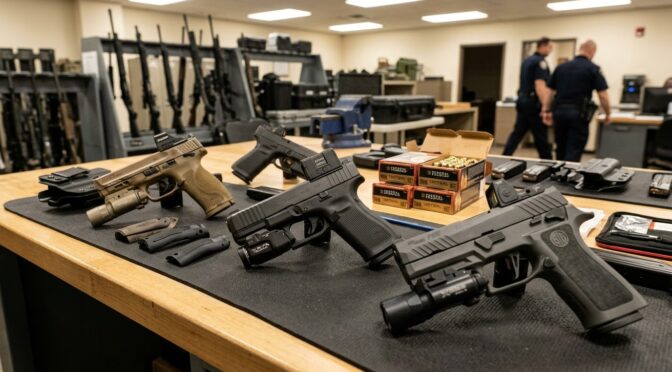
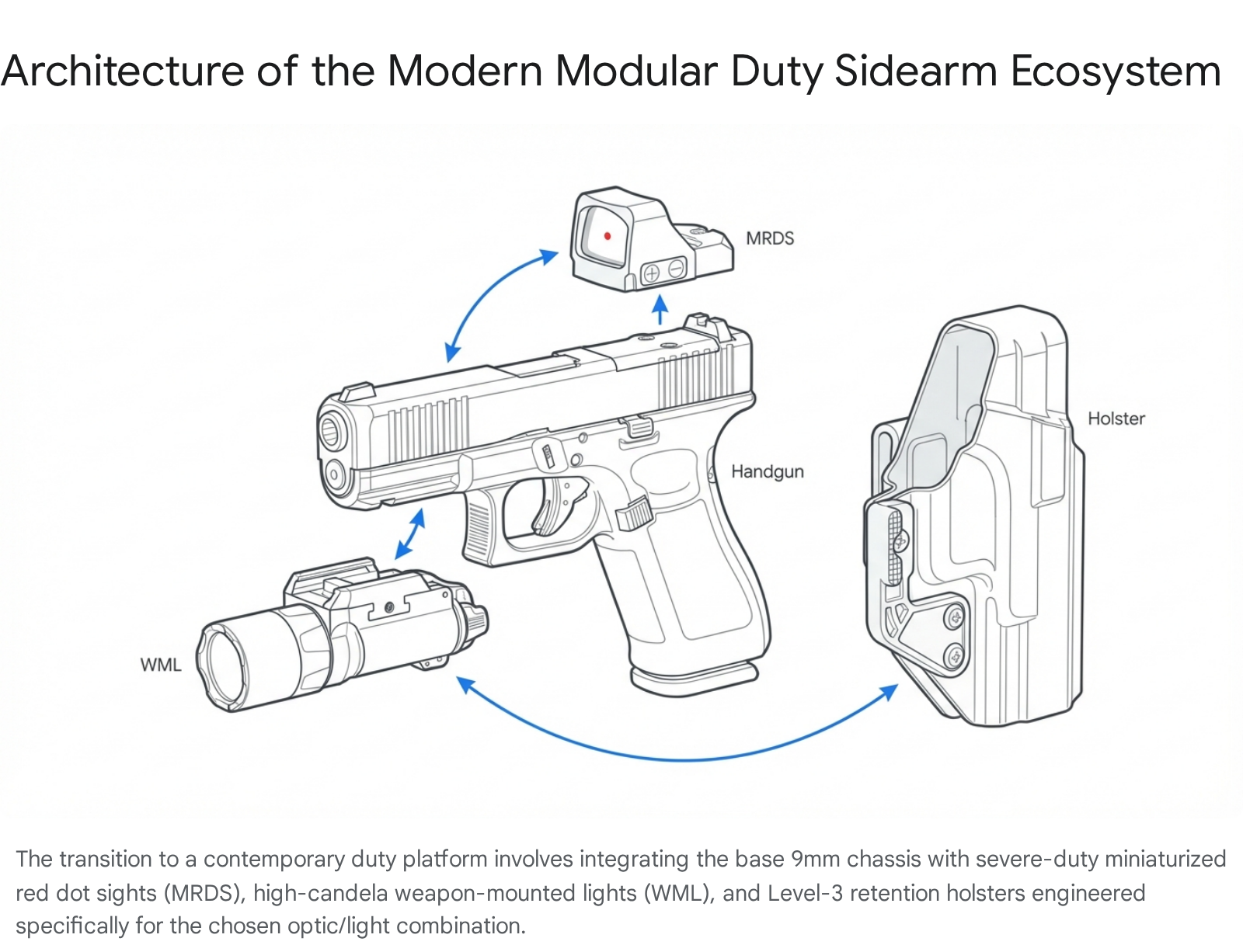
Simultaneously, the modern duty pistol has transformed from a standalone mechanical tool into a complex, modular weapons system. The integration of Miniaturized Red Dot Sights (MRDS), high-candela Weapon-Mounted Lights (WML), and specialized retention holsters requires rigorous procurement analysis.5 This report provides an exhaustive analysis of terminal ballistics, weapon service life, optic durability under recoil stress, and recent operational case studies (such as transitions by the Michigan State Police, the Hartford Police Department, and the St. Joseph County Police Department) to equip procurement officials and firearms industry executives with actionable, data-driven insights.
2. Historical Context and the Evolution of Law Enforcement Sidearms
To comprehend the current dominance of the 9mm cartridge, analysts must trace the historical catalysts that initially drove the law enforcement community toward larger calibers, and eventually back again. Historically, American private citizens modeled their defensive handgun choices after domestic police agencies, while those agencies often took their cues from federal entities like the FBI.7 Through the mid-twentieth century, the standard issue law enforcement sidearm was a double-action revolver chambered in.38 Special or .357 Magnum, typified by the Colt Trooper or the Smith & Wesson Model 27.7 It was not until 1967 that a major domestic agency, the Illinois State Police, adopted a semi-automatic pistol: the 9mm Smith & Wesson Model 39.7
Through the 1980s, agencies across the nation began transitioning to semi-automatic 9mm pistols, driven heavily by the United States Armed Forces’ adoption of the Beretta M9 and the resulting availability of reliable, high-capacity double-action designs.8 However, this initial wave of 9mm adoption was abruptly halted by a singular, pivotal event that fundamentally altered police ammunition doctrine.
2.1 The 1986 Miami Shootout and the Birth of the .40 S&W
On April 11, 1986, a catastrophic gun battle occurred in Miami-Dade County, Florida. Seven FBI agents engaged two heavily armed bank robbery suspects, Michael Lee Platte and William Russell Mattix, who were utilizing a.223 caliber semi-automatic rifle.2 During the protracted, multi-minute engagement, two agents were killed and five were severely wounded.2 Post-incident medical and forensic ballistic analysis revealed that the primary suspect had been struck early in the engagement by a 9mm jacketed hollow point (JHP) projectile fired by an FBI agent. The bullet penetrated the suspect’s right arm, exited, and entered the chest cavity, damaging the lung but coming to rest just short of the heart.2 Although the wound was classified as non-survivable, the lack of immediate physiological incapacitation allowed the suspect to remain mobile and continue returning rifle fire, resulting in the deaths of the agents.2
The FBI attributed this catastrophic failure to a lack of adequate projectile penetration, effectively blaming the 9mm caliber for the outcome rather than the specific, outdated bullet construction of the era.2 This determination initiated a nationwide departure from the 9mm. By the end of the 1980s, the FBI had hosted a series of wound ballistics panels, developed strict ammunition testing protocols, and adopted the 10mm Auto cartridge in an attempt to maximize penetration and terminal energy.2
However, the 10mm Auto produced an excessive recoil impulse. This recoil resulted in severely degraded qualification scores and accelerated weapon wear on the Smith & Wesson 1076 pistols.11 To mitigate this issue, the FBI created a downloaded “FBI load” for the 10mm, reducing its velocity.12 Recognizing that the downloaded 10mm possessed excess, unused case capacity, engineers at Smith & Wesson and Winchester collaborated in 1990 to shorten the 10mm case, creating the .40 Smith & Wesson (.40 S&W).11
The .40 S&W was hailed as the ultimate compromise. It offered a diameter beginning with “4” to satisfy proponents of the.45 ACP, yet it was short enough to fit into medium-frame handguns originally designed for the 9mm, offering magazine capacities of 12 to 15 rounds.13 The popularity of the .40 S&W was further cemented by the 1994 Federal Assault Weapons Ban, which restricted civilian and off-duty police magazines to ten rounds. Because the ban neutralized the primary advantage of the 9mm (its 15 to 19-round capacity), shooters opted for the largest caliber they could fit into a ten-round envelope.15 For over two decades, the .40 S&W dominated American law enforcement.14
2.2 The 2014 FBI Training Division Justification
The tipping point for contemporary sidearm procurement occurred in May 2014 when the FBI Training Division in Quantico, Virginia, released an executive summary justifying a full departmental return to the 9mm Luger.1 This document fundamentally dismantled the prevailing folklore and marketing hyperbole surrounding handgun effectiveness. The report asserted that handgun stopping power is a physiological myth.1 Projectiles fired from service handguns lack the massive kinetic energy required to cause hydrostatic shock or secondary fragmentation; therefore, incapacitation is achieved solely through the mechanical crushing of critical central nervous system structures or rapid exsanguination resulting from strikes to major vascular organs.3
The FBI analysts concluded that the single most important factor in effectively wounding a human target is consistent penetration to a scientifically valid depth of 12 to 18 inches.1 The analysis revealed that advancements in projectile metallurgy since 2007 (specifically the engineering of skived copper jackets and molecularly bonded lead cores) allowed premium 9mm projectiles to consistently pass the stringent FBI barrier testing protocol.1 Under identical testing conditions, select 9mm offerings were actively outperforming premium .40 S&W and.45 Auto projectiles.1 Furthermore, the Bureau determined that law enforcement officers miss between 70 and 80 percent of shots fired during dynamic lethal force encounters.1 This stark statistical reality rendered magazine capacity, weapon control, and recoil management far more critical to officer survival than marginal increases in expanded bullet diameter.1
3. Terminal Ballistics and Tissue Disruption Analysis
Evaluating the physical mechanisms of tissue disruption requires an objective analysis of controlled ballistics testing. The industry standard for evaluating duty ammunition involves firing into 10 percent calibrated organic ordnance gelatin or synthetic equivalents (such as Clear Ballistics synthetic gelatin, which is temperature stable up to 240 degrees Fahrenheit) through a variety of barriers designed to simulate real-world tactical conditions.17
3.1 Penetration and Expansion Metrics
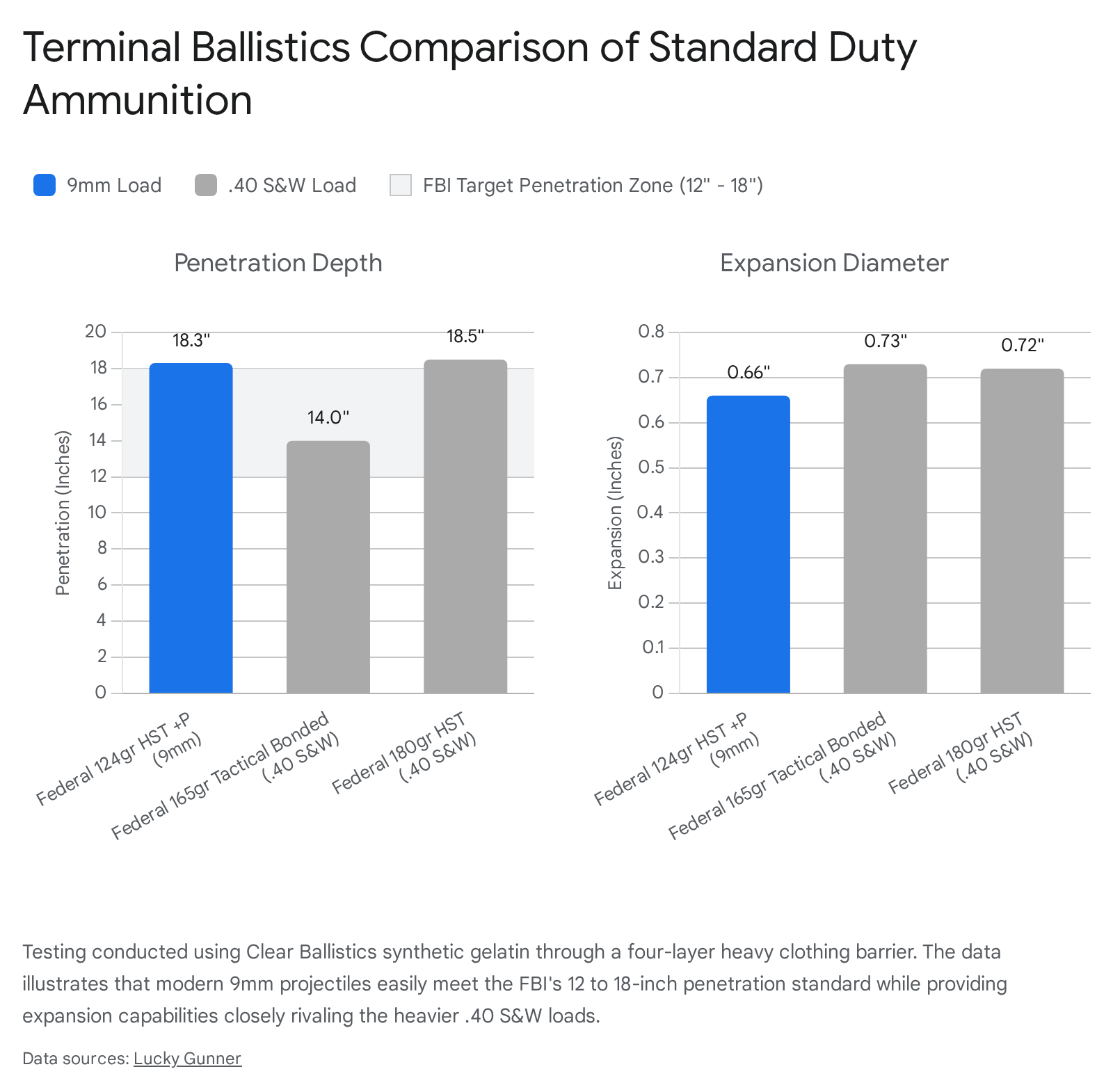
Independent testing of duty-grade ammunition through the four-layer heavy clothing barrier (consisting of denim, fleece, and two types of cotton shirts) illustrates the negligible performance gap between the 9mm and the .40 S&W. The heavy clothing test is notoriously difficult, as fabric fibers frequently clog the hollow point cavity of inferior projectiles, preventing expansion and causing the bullet to act like a full metal jacket round, leading to hazardous over-penetration.17
When analyzing the Federal Premium Law Enforcement HST line, a widely issued duty round featuring a pre-skived bullet tip designed for massive petal expansion and high weight retention, the empirical data is highly instructive. The 9mm Federal 124 grain HST (+P variant fired from a 3.5-inch barrel) achieved an average penetration depth of 18.3 inches with an average expanded diameter of 0.66 inches and a muzzle velocity of 1168 feet per second.17 Conversely, the .40 S&W Federal 180 grain HST achieved an average penetration depth of 18.5 inches, an average expanded diameter of 0.72 inches, and a muzzle velocity of 964 feet per second.17
Another standard law enforcement load, the .40 S&W Federal 165 grain Tactical Bonded JHP, designed with a proprietary bonding process that attaches the lead core to the copper jacket to ensure structural integrity through auto glass, achieved 14.0 inches of penetration and 0.73 inches of expansion.17 To illustrate the parity across modern defensive calibers, independent testing facilities have documented the performance of various duty loads.
| Caliber | Ammunition Load | Penetration Depth (Inches) | Expanded Diameter (Inches) | Muzzle Velocity (FPS) |
| 9mm Luger | Barnes 115 gr TAC-XPD +P (SCHP) | 13.4 | 0.70 | 1043 |
| 9mm Luger | Corbon 115 gr JHP +P | 13.6 | 0.56 | 1221 |
| 9mm Luger | Federal 124 gr HST (Standard Pressure) | 18.3 | 0.61 | 1135 |
| 9mm Luger | Federal 124 gr HST +P | 18.3 | 0.66 | 1168 |
| .40 S&W | Federal 165 gr Tactical Bonded JHP | 14.0 | 0.73 | 978 |
| .40 S&W | Federal 180 gr HST JHP | 18.5 | 0.72 | 964 |
3.2 Volumetric Tissue Disruption versus Anatomical Targeting
Mathematical modeling of expanded projectiles indicates that the average surface area of a fully expanded .40 S&W bullet is approximately 21 percent greater than that of a 9mm bullet.20 Proponents of the .40 S&W argue that this increased surface area provides a 21 percent larger margin of error for striking vital vasculature on an imperfect shot, thereby resulting in greater overall volumetric tissue damage, calculating that a 9mm produces 25 units of damage compared to the .40 S&W producing 34 units.20
However, medical professionals and trauma surgeons note that this mathematical advantage does not translate to the operating room. Distinguishing between the permanent wound tracks caused by premium 9mm, .40 S&W, and .45 ACP projectiles during trauma triage or post-mortem autopsy is virtually impossible.1 The physical disparity in the permanent wound cavity, often a fraction of an inch, does not correlate to faster physiological incapacitation.3 A 9mm projectile that accurately intersects the ascending aorta will yield immediate circulatory collapse, whereas a .40 S&W projectile that strikes peripheral muscle tissue will completely fail to halt a determined adversary.4
Therefore, the metric of paramount importance is not the resting diameter of the bullet, but rather the probability of placing multiple rounds rapidly into the upper thoracic cavity under extreme physiological stress.3 As the FBI laboratory concluded, modern 9mm duty ammunition provides terminal performance potential equal to any other law enforcement pistol caliber while completely mitigating the severe disadvantages present with the larger calibers.21
4. Biomechanical Recoil Kinetics and Marksmanship Under Stress
The operational superiority of the 9mm cartridge manifests most prominently in the biomechanical interaction between the firearm and the shooter. The physical principle of recoil dictates that the heavier the projectile and the higher the chamber pressure, the greater the rearward velocity of the slide and the resulting kinetic transfer to the officer’s hands, wrists, and forearms.
4.1 Slide Velocity, Recoil Impulse, and Split Times
Depending on the specific loads compared, the .40 S&W cartridge generates between 10 and 40 percent more felt recoil than the 9mm Luger, with standard duty loads exhibiting approximately 25 percent more recoil force.4 This elevated recoil impulse creates a sharp, snappy muzzle flip that aggressively drives the sights off the target plane.4 Analysts note that the .40 S&W recoil profile is often perceived as more difficult to manage than even the heavier.45 ACP, which typically presents with a slower, more linear push rather than a sharp snap.14
For the end-user, this physical reality has severe tactical implications. During lethal force encounters, officers experience sympathetic nervous system arousal, which triggers tachycardia, auditory exclusion, and a profound loss of fine motor skills.26 Managing a heavy recoil impulse under these debilitating conditions requires immense grip strength and perfect bio-mechanical skeletal structure, attributes that degrade rapidly under extreme stress.27
Because the 9mm generates a softer, more manageable recoil impulse, the weapon’s slide cycles faster and the muzzle returns to the target plane with significantly less physical exertion.4 This allows for heavily reduced split times (the time elapsed between consecutive shots) and drastically improves the probability of achieving multiple accurate hits on a dynamic, moving target.1 Testing has demonstrated that a reduction in the speed at which accurate follow-up shots can be made is directly proportional to any increase in recoil.15 When an officer’s strong hand is incapacitated or otherwise occupied, requiring support-hand-only shooting, the recoil management of the 9mm becomes a critical survival variable.28
4.2 Academic Studies on Stress and Alternate Qualification Assessments
The impact of psychological stress on marksmanship is well-documented in academic literature. Research indicates that the physical exertion required during foot pursuits or physical altercations does not significantly decrease shooting performance at close ranges (under 10 meters).27 Furthermore, the weight of tactical load carriage, such as plate carriers and duty belts, does not intrinsically decrease shooting accuracy, likely due to training specificity.27 However, anxiety imparted through high-stress, life-threatening scenarios negatively impacts shooting performance to a severe degree.27 Studies utilizing heart rate monitors during simulated combat have shown wide disparities between standard static training results (where officers often hit 97 percent of their targets) and high-stress combat simulations.26
Furthermore, researchers evaluating police marksmanship have questioned the validity of traditional qualification methods. A cross-sectional study of law enforcement officers assessed the difference between a Traditional Pistol Assessment (TPA) and an Alternate Pistol Assessment (APA) that included occupational stressors such as moving, shooting from behind cover, and vocalization.29 The study found that while only 29 percent of officers passed the static TPA, 50 percent passed the complex APA, highlighting that qualification rates and officer confidence are highly influenced by the nature of the marksmanship assessment and the manageability of the weapon platform under simulated operational conditions.29
4.3 Empirical Increases in Officer Qualification Rates
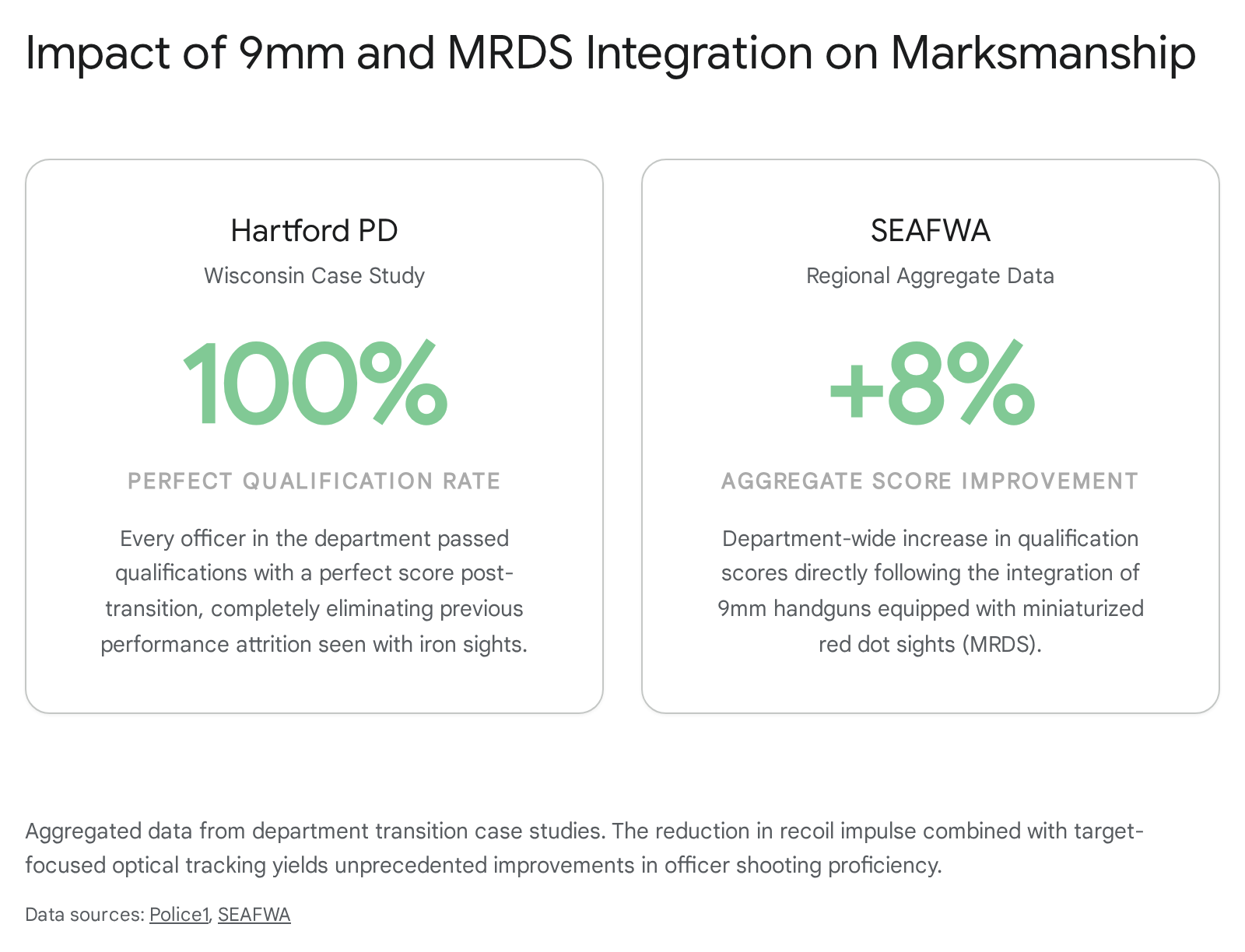
The transition from .40 S&W to 9mm has produced measurable improvements in agency-wide marksmanship metrics across multiple jurisdictions. A notable case study is the Hartford Police Department in Wisconsin, which transitioned from the .40 caliber Glock 22 and 23 Gen4 pistols to the 9mm Glock 17 and 19 Gen5 platforms equipped with MRDS optics.5 Prior to the transition, perfect qualification scores using iron-sighted .40 caliber pistols were exceedingly rare.5 Following the integration of the 9mm platform and red dot optics, every single officer in the department passed their qualifications with a 100 percent perfect score during the transition training phase.5
Similarly, training data compiled by the Law Enforcement Section of the Southeastern Association of Fish and Wildlife Agencies (SEAFWA) demonstrated an aggregate 8 percent increase in qualification scores immediately following their transition from iron-sighted Glock 19s to MRDS-equipped 9mm Glock 45 and 43X pistols.30 This democratization of shooting proficiency is critical; by reducing the requisite grip strength needed to control the firearm, the 9mm platform ensures that a higher percentage of officers can effectively place rounds on target regardless of individual stature or hand size.4
5. Weapon Service Life, Metallurgy, and Armorer Breakage Rates
Beyond terminal ballistics and shooter proficiency, the fiscal reality of maintaining a departmental armory demands a thorough analysis of weapon service life. The mechanical stress exerted on a pistol’s frame and internal components differs vastly depending on the chambering.
5.1 Frame Fatigue and Locking Block Degradation
The .40 S&W cartridge operates at high chamber pressures. Because the .40 S&W was largely retrofitted into existing 9mm pistol architectures during the early 1990s, the polymer frames, slide masses, and recoil spring assemblies were subjected to violent kinematic forces they were not originally optimized to handle.11 For example, the Glock 22 in .40 S&W shares the exact same exterior frame geometry as the Glock 17 in 9mm.31 However, the increased slide velocity of the Glock 22 results in expedited polymer frame fatigue, heightened stress on the steel locking block, and a markedly shorter lifecycle for the recoil spring assembly.8
Industry armorer data consistently reveals that first and second-generation .40 caliber pistols suffered from premature parts breakage, specifically frame rail cracking and locking block shearing, at a rate exponentially higher than their 9mm counterparts.8 While early transitions to the .40 S&W were fraught with these mechanical train wrecks, modern metallurgical processes have fortified contemporary .40 S&W platforms.8 Manufacturers attempted to mitigate these issues through successive design iterations; for instance, the transition to Gen 4 Glock pistols introduced a dual recoil spring assembly to better absorb the snappy recoil, alongside the Universal Glock Rail and rough textured finishes (RTF2).34 Subsequent Gen 5 improvements refined the locking mechanisms, introduced the durable nDLC finish, and removed finger grooves.33
Despite these engineering advancements, the fundamental laws of physics dictate that a firearm absorbing heavier recoil impacts will ultimately experience a shorter operational service life.8 An agency issuing 9mm handguns will experience fewer catastrophic component failures, reduced downtime for armorer maintenance, and a substantially extended interval between mandatory weapon replacement cycles.8
6. The Paradigm Shift to Miniaturized Red Dot Sights (MRDS)
The most significant technological advancement in small arms over the last decade is the integration of the Miniaturized Red Dot Sight onto the reciprocating slide of the duty pistol. This technology has revolutionized training doctrine, but its durability and effectiveness are inextricably linked to the caliber of the host weapon.
6.1 Transitioning to Target-Focused Shooting
Traditional iron sights necessitate a complex focal shift: the officer must observe the threat, shift their visual focus back to the front sight post, align it evenly within the rear sight notch, and intentionally blur the target in the background.5 Under sympathetic nervous system arousal during a lethal encounter, the human eye naturally dilates and fixates binocularly on the threat, making front-sight focus anatomically difficult.5 The MRDS solves this physiological dilemma by allowing the officer to remain entirely threat-focused with both eyes open.5 The illuminated reticle is simply superimposed over the target plane.
This optical advantage is particularly profound for veteran officers experiencing presbyopia, or age-related farsightedness, as it completely eliminates the need to balance three distinct focal planes simultaneously.5 Transition training programs, such as the 8-hour curriculum implemented by the Hartford Police Department, emphasize a refined presentation stroke to consistently bring the dot into the visual window.5 Instructors train officers to align the back plate of the slide with their nose and point the dominant thumb slightly upward to pull the dot into view.5 Advanced drills utilize occluded optics, where tape is placed over the objective lens, forcing the brain to merge the dot from the dominant eye with the target image from the non-dominant eye.5 To ensure departmental uniformity without exhausting duty optics, agencies often utilize lower-cost alternatives like the Vortex Venom MRDS on SIRT, MILO, and Simmunition training platforms.5
6.2 Optic Durability and Recoil Shear
The fragile electronic architecture of an MRDS is subjected to extreme G-forces as the pistol slide reciprocates during the firing cycle. A comprehensive four-year study conducted by Sage Dynamics evaluated the viability of MRDS units for law enforcement duty use.36 The study involved rigorous drop tests, environmental exposure to hot and cold extremes, water submersion, and high-volume live fire. The findings established that specific duty-grade optics, notably the Trijicon RMR and the Leupold DeltaPoint Pro, possess the requisite reliability for patrol deployment.36
Crucially, the Sage Dynamics study highlighted that optical failures are frequently caused by battery connection shear rather than internal circuitry failure.36 The violent recoil impulse of the firearm repeatedly disrupts the battery contacts. The data noted that standard Energizer and Sony batteries failed to withstand the recoil forces reliably, whereas Duracell batteries maintained consistent electronic connectivity.36
This is where the 9mm versus .40 S&W debate intersects directly with optics. The sharp, high-velocity recoil impulse of the .40 S&W exponentially increases the shear forces exerted on the optic’s mounting screws, internal glass retention, and battery contacts.4 Furthermore, the aggressive muzzle flip of the .40 S&W causes the red dot to completely leave the optical window during recoil, forcing the shooter to hunt for the dot before firing a subsequent round.37 Conversely, the softer impulse of the 9mm allows the dot to track predictably within the confines of the glass, facilitating rapid visual recovery and unparalleled target engagement speeds.4
7. Modularity, Illumination, and Duty Gear Integration
Modern procurement demands that a handgun not be purchased in isolation, but as a holistic, integrated tactical ecosystem. The concept of the Modular Handgun System has driven manufacturers to design sidearms that can be rapidly reconfigured to meet diverse mission parameters, necessitating tight integration with illumination tools and retention holsters.38
7.1 Weapon-Mounted Illumination
The ability to positively identify threats in low-light environments is a mandatory operational requirement for law enforcement. Modern weapon-mounted lights have shifted from measuring pure lumens, which dictate overall light output, to prioritizing candela, which measures the directional intensity of the beam. For instance, the Michigan State Police deployment includes the SIG FOXTROT2R, which outputs 700 lumens alongside an intense 20,000 candela rating.6 This high candela allows officers to punch through photonic barriers, such as opposing vehicle headlights or tinted automotive glass, ensuring clear threat identification.6 Similarly, the Hartford Police Department upgraded to the Modlite PL350 PLHv2, substantially expanding their threat identification distance and operational safety margins.5
7.2 Holster Ecosystems and Retention
The adoption of MRDS and WML technologies dictates a complete overhaul of departmental holster inventory. Safariland dominates the duty holster market, producing complex retention systems that accommodate highly specific optic and light combinations.41 Models such as the Safariland 6360RDS, which provides Level 3 retention for patrol, and the 6390RDS or 6378RDS, providing Level 1 and 2 retention for plainclothes or administration, utilize proprietary locking mechanisms.5 The Automatic Locking System (ALS) secures the weapon directly onto the ejection port, while the Self Locking System (SLS) utilizes a rotating hood to prevent unauthorized access.5
Procurement officials must account for the strict compatibility tolerances of these holsters. A change in the handgun frame, the specific WML dimensions, or the optic housing size may render an entire holster inventory obsolete.43 While field modifications, such as utilizing a heat gun to slightly remold the polymer Kydex, are occasionally attempted, they are not recommended for duty gear.45 When transitioning weapons, agencies must verify compatibility charts meticulously, as the slide width differences between a 9mm and a .40 S&W (the latter often featuring more slide mass to counteract recoil) can create significant binding issues in precision holsters.45
8. Procurement Case Studies and Operational Safety Protocols
The theoretical advantages of the 9mm MRDS platform are currently being validated through large-scale departmental transitions. Analyzing these procurement shifts reveals trends in manufacturer dominance and highlights critical operational safety concerns that must be navigated by armorers and executives.
8.1 The Michigan State Police and the Modular Handgun System
The Michigan State Police (MSP) provides a compelling case study in modern procurement strategy. Historically, the agency fielded .40 caliber SIG Sauer P226 and P229 pistols for over a decade.46 Recognizing the ballistic and ergonomic advantages of the 9mm, the MSP eventually completed a comprehensive transition to the SIG Sauer P320/M18 platform as their primary duty weapon, with the micro-compact P365 selected as the secondary, or backup, firearm.6
This selection mirrors the United States Army’s Modular Handgun System competition, which adopted the M17/M18 (military variants of the P320) to replace the aging Beretta M9 fleet.6 The MSP deployment is notable for its fully integrated approach. The pistols are equipped with the SIG ROMEO-M17 red dot optic, an enclosed, fully sealed, and gas-purged unit featuring a 7075 aluminum housing, a 2-MOA dot, and a 32-MOA circle that is assigned an NSN number for military procurement.6 The system is rounded out by the FOXTROT2R light, providing a comprehensive, best-in-class primary handgun solution for the agency’s 1400 sworn personnel.6
8.2 Addressing the Striker-Fired Safety Controversy
Procurement officials must navigate manufacturer liabilities alongside tactical benefits. The SIG Sauer P320 platform has faced intense scrutiny and class action litigation regarding allegations of uncommanded discharges, instances where the firearm discharges while holstered without the trigger being manipulated.47 Investigations, including those following a fatal incident at Warren Air Force Base, have scrutinized the manufacturing tolerances of the internal components.47 Independent armorers and critics suggest that severe deficiencies exist on the striker foot, the sear ledge, and the striker safety due to poorly quality-controlled Metal Injection Molding (MIM) processes.49 They argue that normal movement, such as walking or exiting a patrol vehicle, could cause a deformed striker contact face to slip past the sear and bypass the safety, leading to primer impact.49
While SIG Sauer emphatically maintains that the P320 meets all rigorous safety standards and cannot discharge without a trigger pull, labeling the allegations as attempts to avoid personal responsibility for negligent handling, the controversy has forced some agencies to pivot.43 For example, Grand Blanc Township Police in Michigan actively transitioned away from their inventory of SIG P320s after seven years of use, citing an incident where an MSP officer experienced an accidental discharge with the weapon.43 To mitigate potential liability and ensure officer confidence, the township purchased 50 Glock Gen 6 9mm handguns equipped with Aimpoint optics and Safariland holsters at a cost of over $48,000.43 Other federal entities, including Immigration and Customs Enforcement (ICE) and the Air Force Global Strike Command, have also placed temporary pauses or bans on the P320 platform pending further safety reviews.47 Evaluating the mechanical safety mechanisms remains a paramount duty for departmental armorers prior to authorizing a transition.
8.3 Regional Transitions and Brand Diversity
Other regional departments reinforce the systemic shift away from the .40 S&W toward diverse 9mm platforms. The Berrien County Sheriff’s Office in Michigan transitioned from .40 caliber pistols to the 9mm Walther PPQ M2, citing the improved trigger reset (measuring an exceptionally short 1/10th of an inch) and ergonomic advantages.51 Similarly, the St. Joseph County Police Department in Indiana traded out their 18-year-old SIG .40 caliber weapons for 9mm Smith & Wesson handguns.18 Officers reported the 9mm platforms were significantly lighter, featured superior grip ergonomics, and provided a smoother shooting experience that directly translates to increased accuracy under duress.18
The transition to 9mm is also a critical factor in combating violent crime at the tactical level. Joint task forces, such as the FBI-led operation in Benton Harbor disrupting the distribution of “Glock switches” (devices that convert semi-automatic 9mm pistols into fully automatic machine guns), highlight the ubiquity of the 9mm platform in both law enforcement and criminal circles.52 Standardizing around the 9mm ensures agencies have the technological parity and operational efficiency to address these escalating threats.
9. Economic Impact and Supply Chain Logistics
While tactical superiority and officer safety are the primary drivers of hardware transitions, the economic realities of municipal budgets often dictate the timeline and scope of procurement.
9.1 Ammunition Cost Reductions and Scale Economies
The financial burden of sustaining a department’s annual training and qualification ammunition requirement is massive. The transition from .40 S&W to 9mm results in immediate, quantifiable cost savings. Generally, standard Full Metal Jacket training ammunition in 9mm is significantly cheaper to produce and acquire than its .40 caliber counterpart, largely due to the massive global supply chain supporting the 9mm NATO standard.4
During their transition to the 9mm platform, the St. Joseph County Police Department documented savings of exactly $6.06 per box of ammunition compared to their previous .40 S&W expenditures.18 During transition training, ten officers fired over 3,000 rounds in a single shift.18 When an agency mandates high-volume live-fire training (firing thousands of rounds per officer annually to build muscle memory with new MRDS platforms), these minor per-box savings compound into tens of thousands of dollars in budgetary relief.
9.2 Reallocation of Capital and Armory Efficiency
The logistical benefit of this cost reduction is that the surplus capital can be aggressively reallocated into modernizing the rest of the duty belt. The initial capital expenditure to purchase new 9mm handguns, MRDS optics, Weapon-Mounted Lights, and Level 3 Safariland holsters is substantial.5 However, the return on investment is achieved through the extended service life of the 9mm pistol frames, the drastic reduction in .40 caliber-induced armorer repairs, and the ongoing savings in ammunition procurement.8
Furthermore, standardizing a single caliber across an entire state or regional consortium drastically simplifies armory logistics. Maintaining spare parts, managing inventory, and issuing uniform training protocols becomes highly efficient when an entire force utilizes a single, optimized 9mm architecture.54 This scale ensures that officers are not carrying diverse platforms that require unique magazines or specialized armorer tools, maximizing operational readiness.
10. Strategic Conclusions and Recommendations
The landscape of law enforcement small arms has reached a definitive consensus. Based on forensic ballistics, biomechanical data, and extensive operational case studies, the .40 S&W cartridge has been rendered functionally obsolete for modern policing. Procurement officials and firearms industry executives must adapt to this reality to ensure the safety and effectiveness of active-duty personnel.
First, agencies must prioritize the 9mm ecosystem and abandon the fallacy of handgun stopping power. Given that premium 9mm JHP projectiles meet the strict FBI criteria for 12 to 18 inches of barrier-blind penetration, there is zero tactical justification for accepting the increased recoil, reduced magazine capacity, and accelerated weapon wear associated with the .40 S&W.1 The capacity advantage alone, often providing 17 to 19 rounds per magazine compared to 13 to 15 rounds in .40 caliber variants, is a critical variable during dynamic engagements.15
Second, the integration of Miniaturized Red Dot Sights is no longer a specialized SWAT asset; it must be viewed as a mandatory patrol requirement. The target-focused nature of MRDS shooting objectively increases accuracy, particularly under high-stress conditions and for veteran officers with deteriorating vision.5 Agencies must allocate specific funds for optics with proven law enforcement durability records, such as the enclosed emitter Aimpoint ACRO P2, the SIG ROMEO-M17, or the Trijicon RMR.5
Third, administrators must recognize that the 9mm cartridge is the optimal host for MRDS technology. The softer recoil impulse minimizes sheer stress on battery contacts and allows the optical dot to track cleanly during rapid fire, maximizing the technological advantage of the sight and facilitating faster follow-up shots.4
Fourth, in light of ongoing litigation surrounding unintentional discharges in certain modular platforms, departmental armorers must demand rigorous, independent drop-testing and mechanical sear-engagement validation before selecting a specific striker-fired model.43 Agency liability and officer confidence are paramount; transitions must be predicated on exhaustive mechanical vetting, not merely aggressive manufacturer pricing.
Finally, agencies must view the handgun as an integrated system rather than a standalone tool. Budget proposals must concurrently account for the pistol, the optic, the high-candela weapon-mounted light, the specialized retention holster, and most importantly, the specialized transition training required to rewrite officer muscle memory.5 By aligning procurement strategies with these evidence-based metrics, law enforcement agencies can simultaneously reduce operating costs, mitigate liability, and drastically improve the operational survivability of their personnel.
Please share the link on Facebook, Forums, with colleagues, etc. Your support is much appreciated and if you have any feedback, please email us in**@*********ps.com. If you’d like to request a report or order a reprint, please click here for the corresponding page to open in new tab.
Sources Used
- FBI 9MM Justification, FBI Training Division | Soldier Systems Daily …, accessed March 19, 2026, https://soldiersystems.net/2014/09/25/fbi-9mm-justification-fbi-training-division/
- How the FBI reignited the pistol caliber war – Police1, accessed March 19, 2026, https://www.police1.com/officer-safety/articles/how-the-fbi-reignited-the-pistol-caliber-war-UE2elgGaWrne36vi/
- 9mm vs. .40 Caliber – Police Magazine, accessed March 19, 2026, https://www.policemag.com/articles/9mm-vs-40-caliber
- 9mm vs. 40 S&W: Ending the Concealed Carry Debate – Ammo.com, accessed March 19, 2026, https://ammo.com/comparison/9mm-vs-40
- An agency’s experience transitioning to new duty weapons … – Police1, accessed March 19, 2026, https://www.police1.com/shot-show/an-agencys-experience-transitioning-to-new-duty-weapons-and-miniaturized-red-dot-sights
- Michigan State Police Completes Transition to SIG SAUER Pistol Platform, accessed March 19, 2026, https://blackbasin.com/news/michigan-state-police-completes-transition-to-sig-sauer-pistol-platform/
- WHAT YOUR TROOPERS CARRY | – Backwoods Home Magazine, accessed March 19, 2026, https://www.backwoodshome.com/blogs/MassadAyoob/what-your-troopers-carry/
- A Critical Look at Police Pistol Cartridges, accessed March 19, 2026, https://policeandsecuritynews.com/2020/11/18/a-critical-look-at-police-pistol-cartridges/
- Why Are 9mm Pistols Dominant in Law Enforcement? – American Handgunner, accessed March 19, 2026, https://americanhandgunner.com/our-experts/why-are-9mm-pistols-dominant-in-law-enforcement/
- 9mm vs. 40 — Is the .40 Caliber a Better Handgun Cartridge? – The Armory Life, accessed March 19, 2026, https://www.thearmorylife.com/9mm-vs-40/
- 9mm vs. 40 — Is the .40 Caliber a Better Handgun Cartridge? | The Armory Life Forum, accessed March 19, 2026, https://www.thearmorylife.com/forum/threads/9mm-vs-40-is-the-40-caliber-a-better-handgun-cartridge.19804/
- Is the .40S&W being dropped by police departments everywhere (specially USA)? Why?, accessed March 19, 2026, https://www.reddit.com/r/liberalgunowners/comments/rmbthf/is_the_40sw_being_dropped_by_police_departments/
- 9mm vs .40 S&W: A Comparison – True Shot Ammo, accessed March 19, 2026, https://trueshotammo.com/blogs/true-shot-academy/9mm-vs-40-sw-ammo
- .40 S&W Fading From Police Service? – American Handgunner, accessed March 19, 2026, https://americanhandgunner.com/our-experts/40-sw-fading-from-police-service/
- 9mm vs 40 S&W: Which Is Better? – FieldandStream.com, accessed March 19, 2026, https://fieldandstream.com/outdoor-gear/guns-gear/ammo-gear/handgun-ammo/9mm-vs-40-sw-which-is-better
- Why America’s Finest Left .40 S&W Behind – Inside Safariland, accessed March 19, 2026, https://inside.safariland.com/blog/why-americas-finest-left-40-sw-behind/
- Handgun Self-Defense Ammunition – Ballistic Testing Data, accessed March 19, 2026, https://www.luckygunner.com/labs/self-defense-ammo-ballistic-tests/
- St. Joseph County police department gets new guns after almost two decades – ABC57, accessed March 19, 2026, https://www.abc57.com/news/st-joseph-county-police-department-gets-new-guns-after-almost-two-decades
- Bodycam shows moment Berrien County Sheriff deputy returns fire after suspect fires gun – YouTube, accessed March 19, 2026, https://www.youtube.com/shorts/jRLyQtVBqPY
- Analysis of 9mm vs .40 S&W with numbers : r/guns – Reddit, accessed March 19, 2026, https://www.reddit.com/r/guns/comments/kccpj4/analysis_of_9mm_vs_40_sw_with_numbers/
- 9mm vs. 40 S&W: Help Me Understand : r/guns – Reddit, accessed March 19, 2026, https://www.reddit.com/r/guns/comments/17y7f7d/9mm_vs_40_sw_help_me_understand/
- Why do police use 9mm instead of .45 ACP or .40? Wouldn’t those have higher stopping power and effectiveness than a 9mm? – Quora, accessed March 19, 2026, https://www.quora.com/Why-do-police-use-9mm-instead-of-45-ACP-or-40-Wouldnt-those-have-higher-stopping-power-and-effectiveness-than-a-9mm
- Comparing 9mm and .40 Caliber: What’s Right for You? – The Range 702, accessed March 19, 2026, https://www.therange702.com/blog/9mm-vs-40-sw/
- 9mm vs 40S&W were you stand : r/liberalgunowners – Reddit, accessed March 19, 2026, https://www.reddit.com/r/liberalgunowners/comments/x7jpn9/9mm_vs_40sw_were_you_stand/
- Proof that modern advances in Ballistics DO NOT elevate the 9mm to the same efficacy as 40s&w, and dispelling the myth that 9mm “is more accurate”. 40s&w is more powerful, penetrates better and has almost same accuracy as Paul Harrell showed. : r/Firearms – Reddit, accessed March 19, 2026, https://www.reddit.com/r/Firearms/comments/162uxux/proof_that_modern_advances_in_ballistics_do_not/
- An Analysis of Firearms Training Performance among Active Law Enforcement Officers – ScholarWorks@UARK, accessed March 19, 2026, https://scholarworks.uark.edu/cgi/viewcontent.cgi?article=1696&context=etd
- Factors Influencing Marksmanship in Police Officers: A Narrative Review – PMC, accessed March 19, 2026, https://pmc.ncbi.nlm.nih.gov/articles/PMC9655518/
- 40 vs. 9mm: Weapon Manipulation Trumps Ballistics – Recoil Magazine, accessed March 19, 2026, https://www.recoilweb.com/weapon-manipulation-trumps-ballistics-113994.html
- A comparison of two law enforcement marksmanship assessments – PubMed, accessed March 19, 2026, https://pubmed.ncbi.nlm.nih.gov/39973701/
- 2023 SEAFWA LE Bulletin_ALL STATES.pdf, accessed March 19, 2026, https://seafwa.org/sites/default/files/public-files/2023%20SEAFWA%20LE%20Bulletin_ALL%20STATES.pdf
- Deciding between the G22 or G17! – Glock – Brian Enos’s Forums… Maku mozo!, accessed March 19, 2026, https://forums.brianenos.com/topic/207347-deciding-between-the-g22-or-g17/
- Internal ballistics of polygonal and grooved barrels: A comparative study – PMC – NIH, accessed March 19, 2026, https://pmc.ncbi.nlm.nih.gov/articles/PMC10454876/
- Glock | Military Wiki | Fandom, accessed March 19, 2026, https://military-history.fandom.com/wiki/Glock
- Glock Gen Differences. The Complete Guide to Glock Generations, accessed March 19, 2026, https://aliengearholsters.com/blogs/news/glock-generations
- Gen5 Glock G17 vs Gen5 Glock G22 | An Official Journal Of The NRA – Shooting Illustrated, accessed March 19, 2026, https://www.shootingillustrated.com/content/gen5-glock-g17-vs-gen5-glock-g22/
- Results of a 4 Year Handgun Red Dot Study by Sage Dynamics : r/CCW – Reddit, accessed March 19, 2026, https://www.reddit.com/r/CCW/comments/6uixc5/results_of_a_4_year_handgun_red_dot_study_by_sage/
- 9mm vs .40 S&W: Is Bigger Always Better? – Pew Pew Tactical, accessed March 19, 2026, https://www.pewpewtactical.com/9mm-vs-40sw/
- XM17 Modular Handgun System competition – Wikipedia, accessed March 19, 2026, https://en.wikipedia.org/wiki/XM17_Modular_Handgun_System_competition
- DOD Needs Better Planning to Attain Benefits of Modular Open Systems – GAO.gov, accessed March 19, 2026, https://files.gao.gov/reports/GAO-25-106931/index.html
- Michigan State Police Field SIG Sauer P320/M18 and P365 Pistols | An Official Journal Of The NRA – Shooting Illustrated, accessed March 19, 2026, https://www.shootingillustrated.com/content/michigan-state-police-field-sig-sauer-p320-m18-and-p365-pistols/
- Safariland Holster Compatibly Chart | PDF | Weapon Design | Firearm Components – Scribd, accessed March 19, 2026, https://www.scribd.com/document/439747828/Safariland-Holster-Compatibly-Chart
- WHICH HOLSTER IS BETTER? | Safariland vs US Duty Gear – YouTube, accessed March 19, 2026, https://www.youtube.com/watch?v=amZodR5VTXk
- Mich. PD to switch from Sig P320 to Glock Gen 6, chief cites safety concerns, accessed March 19, 2026, https://www.police1.com/firearms/mich-pd-to-switch-from-sig-p320-to-glock-gen-6-chief-cites-safety-concerns
- DUTY GEAR WILL FIT CHART Part 2 Tactical Holsters – Pistols Revised: 1/04/19 – Galls, accessed March 19, 2026, https://www.galls.com/photos/documents/sizing/Safariland%20Tactical%20-%20Pistols.pdf
- .40 cal sig fit 9mm holster? : r/SigSauer – Reddit, accessed March 19, 2026, https://www.reddit.com/r/SigSauer/comments/r2a544/40_cal_sig_fit_9mm_holster/
- Michigan State Police ditch SIG 40s, go Glock 9mm | laststandonzombieisland, accessed March 19, 2026, https://laststandonzombieisland.com/2015/10/13/michigan-state-police-ditch-sig-40s-go-glock-9mm/
- Federal Agencies Reject SIG Sauer P320 Amid Growing Safety Concerns – The Trace, accessed March 19, 2026, https://www.thetrace.org/2025/07/sig-sauer-p320-pistol-safety-ice-ban/
- SIG Sauer P320 – Wikipedia, accessed March 19, 2026, https://en.wikipedia.org/wiki/SIG_Sauer_P320
- Here’s Proof the P320 is Defective. Sig Sauer Lies Exposed – YouTube, accessed March 19, 2026, https://www.youtube.com/watch?v=1RIvHsZZ9ho
- Question for the Armorers or other relevant folks among us : r/army – Reddit, accessed March 19, 2026, https://www.reddit.com/r/army/comments/1mei3mn/question_for_the_armorers_or_other_relevant_folks/
- Walther Secures PPQ 9mm Pistol Contract with Berrien County SO | The Tactical Wire, accessed March 19, 2026, https://www.thetacticalwire.com/releases/d1d8d7a7-796f-4e73-8c04-7258dc5af19c
- Benton Harbor man sentenced for ‘Glock switch’ scheme – YouTube, accessed March 19, 2026, https://www.youtube.com/watch?v=_kD587Sl2Q4
- ‘An emerging threat’: Benton Harbor men charged in ‘switch’ machine gun conspiracy, accessed March 19, 2026, https://www.wsjm.com/2022/12/15/fbi-leads-bust-of-benton-harbor-based-switch-machine-gun-ring/
- FBI Decides On 9mm As Their #1 Choice And Have Tons Of Science Behind Their Decision – Reddit, accessed March 19, 2026, https://www.reddit.com/r/CCW/comments/32mezx/fbi_decides_on_9mm_as_their_1_choice_and_have/