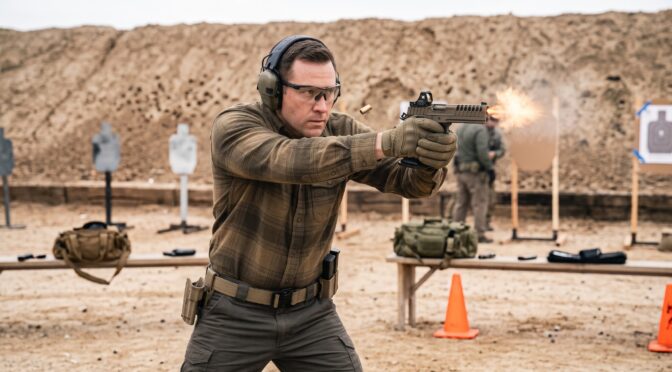
This report provides a comprehensive analysis of the Turkish small arms manufacturer TİSAŞ Trabzon Silah Sanayi A.Ş. (TİSAŞ), charting its origins, strategic evolution, and current market position. TİSAŞ has successfully evolved from a state-supported regional industrial project into a global export powerhouse. This success is built upon a sophisticated and highly effective dual-pronged strategy.
First, the company has aggressively targeted the lucrative United States commercial market by establishing a U.S.-based entity, Tisas USA.1 This entity has successfully neutralized traditional consumer resistance to Turkish firearms by offering a U.S.-based “Lifetime Service Plan” 1 and executing a marketing strategy centered on a high-material-quality, low-price “value” proposition. This is most evident in its 1911-pattern pistol line, which is marketed as featuring forged-steel frames and slides at a price point that directly competes with competitors using cast frames.2
Second, TİSAŞ has simultaneously expanded beyond handguns into a full-spectrum defense manufacturer, producing modern assault rifles, machine guns, and Gatling systems for government and law enforcement contracts.4 This expansion positions TİSAŞ as a NATO-aligned source for both Western-pattern (5.56mm, 7.62mm) and, strategically, Eastern-bloc-pattern (7.62x54mmR) weapon systems, opening a significant global market.6
The company’s primary headwind is not its product quality, which is generally regarded as high for its price, but its vulnerability to geopolitical risk. Its entire U.S. business model is predicated on favorable trade relations, which remain a persistent variable.
I. Corporate Origins and Strategic Evolution
Founding (1993) and Early Production (1994-1998)
TİSAŞ Trabzon Silah Sanayi A.Ş. was founded in 1993 in Trabzon, Turkey.8 Its establishment was not a purely entrepreneurial venture but a component of a deliberate industrial strategy, the “Eastern Black Sea Firearms Project”.4 The company was coordinated by KOSGEB (Small and Medium Industry Development Organization) and M.K.E (Mechanical and Chemical Industry Corporation), indicating significant state-supported backing to develop a domestic arms industry.9
The company’s development followed a classic “crawl-walk-run” industrial model. The “crawl” phase began in 1994 with the production of its first pistol, the 7.65mm Fatih-13.8 This pistol was not an original design but a clone of the Beretta 84 9, a common method for building foundational manufacturing competence, tooling, and know-how without incurring R&D risk.
The “walk” phase commenced in 1998, when TİSAŞ leveraged its acquired expertise to design and register its first original Turkish pistol, the Kanuni-16.8 This step was crucial, transitioning TİSAŞ from a simple copyist to a legitimate firearms designer.
Pivotal Milestones: The Zigana, ISO Certification, and Military Adoption
The “run” phase began in 2001, which stands as the company’s most critical inflection point. TİSAŞ achieved ISO 9001 Quality Certification.8 This was not a passive milestone but a strategic imperative, serving as a “passport” to the global export market. This certification signaled to international buyers, particularly in the West, that TİSAŞ’s quality management systems were compliant with international standards.
This move was synchronized with the 2001 launch of its flagship 9mm pistol, the Zigana, one of the first original-design Turkish pistols to enter mass production.8 The strategic value of the ISO certification was validated in 2004 when the TİSAŞ Zigana T model was accepted into the inventory of the Turkish Armed Forces.8 This domestic military adoption became the company’s ultimate marketing tool, allowing TİSAŞ to enter the global market with a “duty-proven” product, effectively combatting the “cheap Turkish gun” stereotype.
This period was also marked by investment in manufacturing technology. In 2006, TİSAŞ adopted cold hammer forging (CHF) barrel technology.8 This commitment to a high-quality, durable manufacturing process would become a core tenet of its marketing claims, particularly in its successful 1911 line.
II. The U.S. Market Pivot: Analysis of the Tisas USA & SDS Imports Strategy
While TİSAŞ products had been available in the U.S. through various importers since 2004, the brand suffered from fragmentation, inconsistent marketing, and no centralized service.1 This brand dilution was a significant inhibitor to growth.
Consolidating the Brand: The 2022 Launch of Tisas USA
In early 2022, TİSAŞ “recognized the need to take control of their US identity” and announced the formation of Tisas USA.1 This new entity, headquartered in Knoxville, Tennessee, was established as the exclusive importer of TİSAŞ products, operating as a division of SDS Imports, LLC.1
This move was a direct implementation of the successful U.S. operational strategy employed by other foreign giants like Glock, SIG Sauer, and CZ. By creating a single, U.S.-based entity, TİSAŞ centralized its brand narrative, stabilized distribution and pricing, and, most critically, provided a U.S. base for customer service.
Marketing and Service: The “Lifetime Service Plan” Value Proposition
The primary headwind for Turkish firearms in the U.S. market has historically been a consumer perception of inconsistent quality control 16 and non-existent after-sales support.18 Tisas USA was designed to neutralize this objection.
Its mission is to “Provide high-quality firearms at an unrivaled value,” 1 a promise anchored by the “TISAS LIFETIME SERVICE PLAN”.1 This U.S.-based service plan is a tactical masterstroke. It de-risks the purchase for the consumer, who is reassured that any potential issues will be handled by a U.S. company in Tennessee 19, not an office in Trabzon. This service plan is the critical enabler of the TİSAŞ value proposition; the value is not just the low price, but the low risk.
Strategic Partnership: The Civilian Marksmanship Program (CMP) M1911A1
In 2024, Tisas USA executed its most significant strategic move to date: an exclusive partnership with the Civilian Marksmanship Program (CMP).15 Tisas is the first commercial manufacturer to build a 1911 pistol for the CMP.15
The product is a “museum-grade” reproduction of a mid-war (1943-45) Remington-Rand M1911A1, complete with a CMP logo imprint, sold exclusively through CMP stores.15 The significance of this partnership cannot be overstated. The CMP is a Congressionally-chartered, quasi-governmental organization revered by shooters as the definitive custodian of American marksmanship and U.S. military arms history.
By securing this exclusive partnership, Tisas has brilliantly associated its Turkish-made replica with American military heritage. It achieves a level of “authenticity” and validation that no marketing campaign could buy and that no competitor, including Rock Island Armory or Girsan, can claim. This move fundamentally elevates the Tisas 1911 brand from a “cheap clone” to a “CMP-approved historical reproduction.”
III. 2025 Commercial Product Portfolio Analysis: Handguns
The TİSAŞ 1911 strategy is built on a foundation of “forged steel frame and slide” 2 and “hammer-forged” barrels 20, with internals compatible with “Colt® 70-Series” parts.2 This “forged vs. cast” 3 argument is their primary marketing weapon against their main rival, Rock Island Armory.
The 1911 portfolio employs a classic “flank and segment” operation:
“Issued Series” (Historical Replicas): This line targets the purist and collector. It includes the “MODEL 1911A1 U.S. ARMY” 23, the “Armed Services Family” (ASF) 2, and the “Museum-Grade 1911A1”.20 These models are lauded for their fidelity to wartime originals, featuring details like small fixed sights, an arched mainspring housing with a lanyard ring, a spurred hammer, and a Parkerized finish.20
“Duty” & “Carry” Lines (Modernized Single Stack): This line targets the pragmatist and first-time 1911 buyer. It includes “Duty” 22 and “Carry” 22 models. These add modern features like enhanced sights, beavertail grip safeties, skeletonized hammers, and modern Cerakote finishes.25
Double Stack (DS / 2011-Style) Series: This line is a direct assault on the high-end “2011” market. Models like the 1911 Carry B9R 26 and Night Stalker DS 28, along with the Tisas-manufactured MAC 1911 DS 30, offer double-stack capacity (17+ rounds of 9mm) using STI-pattern magazines.26 They come standard with features like optics-ready slides, flared magwells, and accessory rails at a price point that is a fraction of their U.S.-made competitors.
Specialty/Target Models: This line includes the 10mm “D10” 31, the lightweight aluminum-frame “Bantam” 33, and the competition-focused “1911 Match”.21
III.B. The Polymer Front: PX-Series and Clones
TİSAŞ competes directly in the polymer, striker-fired market with its modern PX-series and legacy clones.
PX-9 Series: This is the company’s modern, polymer-framed flagship.35 The 2025 lineup is focused on the “Gen 3” models.38 The strategy for the PX-9 is to win on the spec sheet. For a street price often under $300 39, the package includes the pistol, an optics-ready slide 35, Glock-pattern sights, two or three magazines, an extensive set of interchangeable grip panels 35, a hard case, and often an IWB holster.35 This “all-in-one” package is unmatched in the industry. The line is segmented into models like the PX-9 Gen3 Duty (full-size), Carry (compact), and Tactical (threaded barrel).38
PX-5.7: This new pistol, chambered in 5.7x28mm, demonstrates a sophisticated evolution in TİSAŞ’s strategy.4 It is not a clone but a new product developed to rapidly capitalize on a “hot” U.S. market trend 4 with very few competitors. The fact that Tisas sold 22,000 units in the U.S. in 2024 and aims to double that figure in 2025 4 proves that TİSAŞ possesses an agile, market-aware R&D and marketing operation capable of identifying and exploiting new market niches.
Legacy & Clone Platforms: TİSAŞ continues to produce its “classic” pistols, including the Fatih B380 9 and the TT33.10 The original Zigana line (K, KC, T, F, Sport) is also still listed in the company’s catalog.42
IV. 2025 Defense & Law Enforcement Portfolio Analysis: Rifles & Heavy Weapons
The most significant evolution in TİSAŞ’s corporate profile is its expansion into a full-spectrum defense manufacturer, moving far beyond its pistol-manufacturing origins.9
ZPT-Series Assault Rifles
TİSAŞ now produces a line of short-stroke gas piston, AR-pattern rifles for law enforcement and military contracts.5 This line includes:
ZPT-556: Chambered in 5.56x45mm NATO. Offered in multiple barrel lengths, including a 10.5-inch (K), 14.5-inch, and 16-inch (L) configurations.44
ZPT-762: A 16-inch battle rifle chambered in 7.62x51mm NATO.47
Crew-Served Systems
At the IDEF 2025 defense exposition, TİSAŞ showcased its new heavy weapons capabilities.4 These systems include:
PKM Machine Gun: TİSAŞ has begun production of a 7.62x54mm PKM-pattern General Purpose Machine Gun.4
12.7mm Gatling System: A high-rate-of-fire, platform-mounted 12.7mm (.50 cal) Gatling gun.4 (It should be noted that the Turkish CANiK M2 QCB, a 12.7mm heavy machine gun, is produced by a different Turkish firm, Samsun Yurt Savunma/Canik, and not TİSAŞ 50).
This move into rifles and heavy machine guns represents an exceptionally shrewd geopolitical and economic strategy. By producing a PKM (and a Tokarev pistol clone), TİSAŞ is positioning itself as a reliable, NATO-aligned source for Eastern-bloc-compatible arms and ammunition (7.62x54mmR). Amidst global sanctions on Russia, this opens a massive and lucrative export market to dozens of nations in Africa, the Middle East, and Asia that operate legacy Soviet inventories but can no longer source parts or new weapons from Russia.
V. Market Positioning and Competitive Landscape
TİSAŞ’s strategy is best understood by analyzing its position against its key market rivals.
V.A. Comparative Analysis: Tisas vs. Rock Island Armory (RIA)
This is TİSAŞ’s primary rivalry, fought in the budget 1911 segment.52 While forum users often see them as similar in price and performance 3, TİSAŞ has a clear marketing and material advantage. TİSAŞ’s marketing of “forged frames” 2 is a direct and successful attack on RIA’s “cast frames”.3 For the savvy consumer, this material difference, combined with a perceived edge in “fitment and finish” 3, makes Tisas the clear winner on paper. TİSAŞ is actively displacing RIA as the “default” budget 1911 recommendation.
V.B. Comparative Analysis: Tisas vs. Girsan
In the intra-Turkish rivalry for U.S. 1911 imports 18, TİSAŞ is widely perceived as the superior offering. End-user sentiment indicates Tisas pistols are “tighter” and have better triggers.18 The most significant differentiator, however, is customer service. Girsan’s importer has a “sketchy” reputation, whereas Tisas USA (SDS) is consistently praised for excellent, responsive, U.S.-based service.18 This directly demonstrates the success of the Tisas USA strategy.
V.C. Comparative Analysis: Tisas (PX-9) vs. Canik (TP9)
In the budget polymer, striker-fired category 55, Canik is the established “budget trigger king”.55 TİSAŞ is the challenger. While Canik is often seen as having a superior trigger and, in the case of the Canik METE MC9, a thinner, lighter-to-carry profile 55, TİSAŞ is competing and winning on the overall value package. The PX-9 39 includes the holster, multiple magazines, optics cut, and extensive grip kit for a price that often undercuts Canik. Tisas is the “best value package” while Canik remains the “best budget trigger.”
VI. Consolidated Market & Internet Sentiment Analysis
Analysis of online forums, social media, and publication reviews reveals consistent themes.
VI.A. Primary Positive Sentiment: The “Value King”
The most dominant, universal theme is “value.” This is expressed in phrases like “insane cost to value ratio” 40, “a steal for the money” 60, and “best bang-for-your-buck”.39 Consumers are consistently impressed by the combination of low price 23 and high-quality materials.15 Many users report Tisas products, particularly the PX-9, have replaced their more expensive Glocks and CZs in their regular rotation.40
VI.B. Secondary Positive Sentiment: Materials, Accuracy, and Features
Beyond price, users praise tangible quality. “Forged steel frame, slide, and barrel” 15 and “excellent machining” 15 are common callouts for the 1911s. Both the 1911s and PX-9s are frequently described as “accurate out of the box” 15 and “extremely accurate”.39 The PX-9 is lauded as “feature packed” 40, and the 1911s are seen as “loaded” with features (e.g., optic cuts, ambi safeties) for their price.32
VI.C. Persistent Negative Sentiment & Quality Control Concerns
The “cost” of the low price point manifests as a consistent pattern of minor, but significant, quality control and component issues.
Break-In Period: The most common complaint. Many users report being “hesitant” due to reviews of “failure to feed and jamming issues”.40 Reports of “numerous failure to chamber” 63 or stoppages 24 are common when the guns are new. However, the consensus is that these issues disappear after a “break in” of 200-500 rounds.60
Magazines: The included magazines are a frequent source of failure. 1911 users report the guns “hated 8rd mags” 60, and the common advice is to “deep six all of the magazines and replace them” with reputable aftermarket brands like Wilson Combat or Chip McCormick.65
Small Parts & QC “Lottery”: Some users report receiving guns “broken from the factory” 17 or with cosmetic blemishes.16 The general sentiment is that TİSAŞ’s primary “shortcoming is their springs”.17
This sentiment pattern reveals TİSAŞ’s core manufacturing strategy: spend money on the big, marketable items (forged frames, CHF barrels, optics cuts) but save money on the small, high-failure-rate items (springs, magazines) and final-stage QC tuning (which results in the consumer-led “break-in period”). This creates a “Tisas Lottery”: most guns are flawless, but a significant percentage require new springs/magazines or a 500-round break-in. This entire risk profile is what makes the Tisas USA “Lifetime Service Plan” 1 the most critical pillar of their U.S. strategy, as it acts as the safety net for this “lottery.”
VII. Analyst’s Strategic Outlook and Projections
Projection 1: Continued Dominance in “Value” Segment. TİSAŞ is projected to continue its aggressive “pincer movement” on the U.S. 1911 market. It will use “authenticity” 15 to win over collectors and “hyper-modern” features 26 to win over enthusiasts. This will continue to erode Rock Island Armory’s market share, forcing them to either adopt forged frames (a costly re-tooling) or compete on price alone, a losing battle.
Projection 2: Forcing a Market-Wide “Race to the Bottom” on Features. The Tisas PX-9 “package deal” 39 is unsustainable for competitors. We project that other budget brands (Taurus, Ruger, PSA) will be forced to start including optic cuts, extra magazines, and holsters as standard at the sub-$300 price point to remain competitive on the shelf, reducing profit margins for the entire “budget polymer” category.
Projection 3: The “Two-Engine” Business Model. TİSAŞ is successfully operating a “two-engine” business model. Engine 1 is the high-volume, low-margin, high-visibility U.S. commercial market.1Engine 2 is the low-volume, high-margin, low-visibility defense contract market.4 The stable revenue from Engine 2 will be used to subsidize the aggressive pricing, R&D, and marketing of Engine 1, creating a highly resilient and anti-fragile business model.
Projection 4: Geopolitical Risk is the Primary Headwind. The single greatest threat to TİSAŞ’s U.S. success is geopolitical. The company’s “unrivaled value” proposition 1 is entirely dependent on favorable U.S.-Turkey trade relations. Any future political or military actions by Turkey that result in U.S. sanctions or punitive import tariffs (similar to those on Russian or Chinese goods) would instantly and perhaps permanently destroy the Tisas USA business model.
Appendix
Appendix I: Summary Product Tables
Table 1: TİSAŞ Corporate Milestones, 1993-2025
Year
Milestone
Source(s)
1993
TİSAŞ Trabzon Silah Sanayi A.Ş. founded.
4
1994
First pistol produced: Fatih-13 (7.65mm Beretta 84 clone).
8
1998
First original Turkish pistol design: Kanuni-16.
8
2001
Achieved ISO 9001 Quality Certification.
8
2001
Began production of the original Zigana M16 pistol.
[8, 12]
2004
Zigana T model included in Turkish Armed Forces inventory.
8
2004
First TİSAŞ products imported into the United States.
Poor Magazines: Included magazines are a common failure point.
[15, 60, 65]
Excellent Accuracy: “Accurate out of the box.”
Weak Small Parts: “Shortcoming is their springs.”
[15, 17, 40]
Feature-Packed: PX-9/DS models are “loaded” (optics cuts, etc.).
QC “Lottery”: Most are perfect, but some are “lemons” (cosmetic or factory flaws).
[16, 40, 62]
Good U.S. Customer Service: Tisas USA (SDS) is responsive.
Ergonomics: Some models (PX-9) are “thicker” than rivals (Canik MC9).
[18, 19, 55]
Appendix II: Methodology
This report was compiled by synthesizing open-source intelligence (OSINT) from three primary streams:
Official Corporate Data: Analysis of TİSAŞ Trabzon Silah Sanayi A.Ş. and Tisas USA corporate websites, including 2025 product catalogs (digital PDF), official product pages, and corporate milestone announcements.1
Professional Media Analysis: Review of reports and reviews from established firearms industry publications, defense journals, and news agencies.4
Consumer & End-User Sentiment Analysis: Aggregation and qualitative analysis of end-user feedback from high-traffic online forums (Reddit, Palmetto State Armory Forum) and social media platforms (YouTube influencer reviews and comment sections).3
Data from these streams was then cross-referenced and synthesized to identify persistent strategic themes, product-specific trends, competitive advantages, and market risks.
If you find this post useful, please share the link on Facebook, with your friends, etc. Your support is much appreciated and if you have any feedback, please email me at in**@*********ps.com. Please note that for links to other websites, we are only paid if there is an affiliate program such as Avantlink, Impact, Amazon and eBay and only if you purchase something. If you’d like to directly donate to help fund our continued report, please visit our donations page.
Sources Used
Tisas USA / Proudly a SDS Arms Brand – World renowned 1911 Single & Double Stack Pistols, PX-9 and PX-5.7 Series Pistols, accessed November 2, 2025, https://tisasusa.com/about/
Better Than Canik: The BEST BUDGET Handgun Package On The Market for $320 – Tisas PX9 Carry – YouTube, accessed November 2, 2025, https://www.youtube.com/watch?v=QC1wF9tlWME
The history of Soviet and, subsequently, Russian small arms development over the past century is often dominated by the towering success of the Kalashnikov platform. However, to fully comprehend the reasons for the AK’s enduring dominance, one must study not only its triumphs but also the numerous ambitious, innovative, and sometimes bizarre projects that failed to supplant it. These failures, far from being mere historical footnotes, are crucial for understanding the foundational philosophy that has guided Soviet and Russian weapons procurement for generations. This philosophy can be best described as the “Doctrine of Sufficient Excellence.”
Forged in the crucible of the Second World War and solidified during the Cold War, this doctrine is not a formal written mandate but an ingrained institutional mindset. It prioritizes a specific hierarchy of characteristics for a general-issue infantry weapon. At the apex is absolute reliability under the most adverse conditions imaginable—mud, sand, ice, and neglect.1 Following closely are simplicity of operation, enabling a vast, conscript-based army to achieve basic proficiency with minimal training, and ease of mass production, allowing for rapid armament and replacement during a large-scale conflict.1 Ergonomic refinement, modularity, and even exceptional accuracy, while desirable, are considered secondary attributes. A weapon is deemed “sufficiently excellent” when it perfectly fulfills these primary requirements, even if it is surpassed by competitors in other metrics.
This report will analyze a selection of key Soviet and Russian small arms projects that are considered failures. A project is categorized as a “failure” not necessarily because it was a technically deficient weapon in isolation, but because it violated one or more of the core tenets of this doctrine without offering a sufficiently compelling, game-changing advantage to justify the deviation. Through an examination of these case studies, we will explore projects that were too complex for their time, too radical for their military culture, too expensive for their economy, or doctrinally misaligned with the realities of the Soviet and Russian way of war.
Part I: The Pre-Kalashnikov Era – Forging a Doctrine in Steel and Fire
Before the Kalashnikov became the defining symbol of Soviet military might, the Red Army’s small arms development was characterized by ambitious experimentation. This period produced some of the world’s first examples of modern weapon concepts, but it also provided harsh, formative lessons that would directly shape the stringent requirements for all future infantry arms.
Case Study: The AVS-36 Automatic Rifle
The Avtomaticheskaya Vintovka Simonova obraztsa 1936 goda (AVS-36) stands as a landmark of firearms history, being one of the world’s first select-fire infantry rifles to be formally adopted for military service.3 Designed by Sergei Simonov, it represented a technologically bold leap for the Red Army in the 1930s, promising to equip the individual soldier with the firepower of a machine gun in the form of a standard rifle. However, its service life would prove to be a brief and cautionary tale.
Technical Flaws
The AVS-36 was a gas-operated rifle chambered in the powerful 7.62x54mmR cartridge. Its ambition was matched only by its mechanical complexity. The operating mechanism was intricate, utilizing a short piston stroke and a vertically sliding locking block that was highly susceptible to fouling.3 The very construction of the rifle, with its numerous openings and moving parts, was an invitation for dirt and debris to enter the action, a critical flaw for a weapon intended for frontline infantry use.3 Russian sources note that the rifle suffered from a fragile receiver and a problematic bolt group, further compromising its field-worthiness.4 It was also notoriously “fickle” regarding ammunition quality, a significant liability for an army that prioritized logistical simplicity.3
Operational Failure (The Winter War)
The AVS-36’s baptism by fire came during the Soviet-Japanese border conflicts and, most significantly, the 1939-1940 Winter War against Finland. It was in the brutal, sub-zero conditions of the Karelian Isthmus that the rifle’s design deficiencies became catastrophically apparent. Many rifles were shipped to the front still coated in their thick, cosmoline-like storage grease. In the extreme cold, this grease “froze” solid, rendering the complex actions of the rifles completely inoperable.3 This single issue, born of a combination of poor logistical preparation and a design intolerant of such neglect, crippled the weapon’s effectiveness.
Furthermore, while the rifle’s large muzzle brake was quite effective at mitigating muzzle climb, the sheer, intense recoil impulse of the full-power 7.62x54mmR cartridge made automatic fire wildly impractical.3 The weapon was virtually uncontrollable in full-auto, negating its primary conceptual advantage over bolt-action and semi-automatic rifles. The intended doctrine of using automatic fire to repulse sudden attacks was largely a fantasy, as soldiers could not keep their sights on target.5
Political and Logistical Demise
The AVS-36’s poor performance did not go unnoticed. A competing design by Fedor Tokarev, the SVT-38, was also adopted and, while not without its own initial flaws, was considered a sturdier and more reliable weapon.3 A politicized dispute arose within the Soviet elite, and Simonov’s design, seen as lighter but more fragile, lost out.3 Production of the AVS-36 was terminated in 1940 after a run of approximately 35,000 to 65,000 units, and the rifle was rapidly withdrawn from service, with many captured examples being used by Finnish forces.3
The failure of the AVS-36 was a pivotal moment in the formation of Soviet small arms doctrine. It was a brutal, real-world lesson that advanced features and theoretical advantages are utterly worthless if they come at the expense of fundamental reliability in the hands of a conscript soldier under the worst possible conditions. The Red Army’s experience in Finland, where the simple, crude, but utterly dependable PPSh-41 submachine gun proved devastatingly effective, stood in stark contrast to the failure of the complex AVS-36. The Soviet command learned that the ideal infantry weapon was not the one with the most features, but the one that always worked. This experience directly shaped the non-negotiable requirements for simplicity and reliability in the post-war trials that would ultimately produce the AK-47. The AVS-36 had to fail so the Kalashnikov could succeed.
Part II: The Shadow of the AK – Challenging an Icon
Following the adoption of the AK-47, Soviet small arms design entered a new era. The Kalashnikov was not just a rifle; it was the physical embodiment of the Doctrine of Sufficient Excellence. It became the benchmark against which all future designs would be judged. Any potential replacement would not only have to be better, but so overwhelmingly superior that it could justify the monumental cost of replacing an entire, established ecosystem.
Case Study: The TKB-517 – The Technically Superior Contender
In the mid-1950s, the Soviet military initiated a competition to find a replacement for the original milled-receiver AK-47. The primary objectives were to develop a weapon that was cheaper and faster to produce using modern stamped-steel manufacturing techniques, and to improve upon the AK-47’s notoriously poor controllability during automatic fire.6 The two main finalists in this contest were Mikhail Kalashnikov’s modernized prototype, which would become the AKM, and a highly refined rifle from the Tula design bureau, the TKB-517, designed by the brilliant German A. Korobov.6
Technical Analysis
Externally, the TKB-517 bore a strong resemblance to the Kalashnikov, featuring a similar layout and construction from stamped steel with wood furniture.7 Internally, however, it was a completely different machine. Instead of the AK’s robust and simple long-stroke gas piston and rotating bolt, Korobov employed a sophisticated lever-delayed blowback mechanism based on the principles pioneered by Pál Király.7 This system used mechanical leverage to delay the rearward motion of the bolt, allowing chamber pressure to drop to safe levels before extraction. This method of operation offered several potential advantages, including a smoother recoil impulse and the elimination of the violent impacts characteristic of the AK’s gas system.
Performance in Trials
During extensive competitive trials, the TKB-517 demonstrated clear superiority over the Kalashnikov prototype in several key performance areas. Multiple sources, including Russian-language publications, confirm that Korobov’s rifle was significantly more accurate and controllable, especially during full-automatic fire.7 One report from the 1955 trials explicitly states that even poorly trained soldiers, firing in bursts from a supported position, achieved better results with the TKB-517 than with the proto-AKM.10 Furthermore, the TKB-517 was found to be more reliable, particularly in fine sand conditions where the AK’s open gas system was more vulnerable, and was also lighter and simpler (and therefore cheaper) to manufacture.7 By most objective metrics of the competition, the TKB-517 was the better rifle. One Russian source bluntly states that the AKM was “losing the competition”.10
Reasons for Rejection
Despite its demonstrated superiority, the TKB-517 was not selected. The decision was not based on a failure of the weapon itself, but on powerful institutional and logistical factors. The official justification cited the Soviet military’s existing familiarity and “greater proficiency” with the Kalashnikov’s manual of arms and operating system.7 The selection committee, faced with a choice between a superior but novel design and an evolutionary improvement of a known and trusted system, chose the latter.10 While a potential technical concern may have been the higher extraction pressure common to lever-delayed actions, the primary driver was institutional conservatism and logistical pragmatism.7
The rejection of the TKB-517 is the quintessential example of “procurement inertia.” The failure was not one of engineering, but of the rifle’s inability to overcome the immense industrial, training, and logistical ecosystem already built around the Kalashnikov. The Soviet Union had already invested heavily in the AK platform. Millions of soldiers were trained on its operation and maintenance. Armorers across the armed forces were experts in its service. Factories were tooled for its specific manufacturing processes. Adopting the TKB-517 would have necessitated a complete and costly overhaul of this entire system: new factory tooling, new training manuals and curricula for every soldier and armorer, and a completely separate supply chain for spare parts. The performance advantages offered by Korobov’s rifle, while real, were simply not great enough to justify the astronomical economic and logistical cost of replacing the entire, entrenched Kalashnikov ecosystem. The Soviet system chose the “good enough” evolutionary step (the AKM) over the “better” revolutionary one because the former was exponentially cheaper, faster, and less disruptive to implement on a national scale. This decision cemented the Kalashnikov’s dominance for decades to come.
Met requirements, but less reliable than TKB-517 12
Production Method
Stamped Steel
Stamped Steel
Production Cost
Lower than AKM 9
Higher than TKB-517 9
Part III: The Avant-Garde – When Innovation Outpaces Doctrine
While the mainstream of Soviet arms development flowed conservatively down the path of the Kalashnikov, there were powerful undercurrents of radical innovation. Designers, often working in the relative obscurity of state design bureaus, explored concepts that were decades ahead of their time. These projects, while engineering marvels, almost invariably failed to gain traction, crashing against the rigid wall of Soviet military doctrine and technological readiness.
Case Study: German Korobov and the Bullpup Heresy (TKB-022PM)
German A. Korobov was perhaps the most prolific and visionary of the Soviet Union’s “unknown” weapons designers.14 While none of his designs were ever adopted for mass production, his work consistently pushed the boundaries of conventional firearm engineering.11 His TKB-022PM series of assault rifles, developed in the 1960s as a potential competitor to the AKM, was his most radical and perhaps most brilliant creation.18
Radical Design
The TKB-022PM was a bullpup rifle, a configuration that places the action and magazine behind the trigger group to achieve a shorter overall weapon length without sacrificing barrel length.19 This was already a novel concept for the time, but Korobov’s design went much further. It utilized a vertically moving breechblock and an annular gas piston that encircled the barrel, allowing for an incredibly compact receiver group.18
Its most revolutionary feature, however, was its forward ejection system. A U-shaped rammer/extractor would chamber a round, and after firing, would pull the spent casing back and then push it forward and up into an ejection tube running parallel to and above the barrel. The casing would then exit from a port near the muzzle.18 This ingenious solution completely solved the primary drawback of most bullpup designs—the ejection of hot brass into the face of a left-handed shooter—making the TKB-022PM truly and effortlessly ambidextrous.18 This design gave the TKB-022PM the best barrel-length-to-overall-length ratio of any assault rifle of its era.18
Performance
The rifle’s performance in trials was exceptional. Firing from unstable positions, it demonstrated three times better accuracy than the standard-issue AKM.18 It was also remarkably light, with some variants weighing as little as
2.34 kg, thanks to its extensive use of Bakelite, an early polymer, for its housing.18
Reasons for Rejection
Despite its stellar performance, the TKB-022PM was rejected by the Soviet army for being “too radical”.18 The military establishment, deeply conservative in its approach to infantry weapons, was unwilling to embrace such a dramatic departure from the conventional layout of the Kalashnikov. Specific concerns were raised about the unfamiliar rearward balance of the bullpup design, and, critically, the long-term durability of the plastic housing under the harsh conditions of Soviet military service or during decades of strategic storage.18 One Russian source also suggests a more pragmatic reason for its rejection: at the time, small arms were considered an auxiliary component of the Soviet war machine, and the leadership decided that development funds were better spent on higher-priority systems like missiles and tanks.25
Case Study: The VAG-73 Caseless Pistol – A Technological Mirage
In 1973, a self-taught engineer named Vladimir Gerasimenko presented the authorities with a unique and ambitious project: the VAG-73, a select-fire machine pistol that used caseless ammunition.26 This was not a state-sponsored program but a personal initiative, a testament to the innovative spirit present even within the rigid Soviet system.
Ambitious Technology
The VAG-73 was designed around a revolutionary ammunition concept. It fired a 7.62mm projectile that had no traditional brass or steel cartridge case. Instead, the propellant charge was pressed directly into a recess in the base of the steel bullet itself.26 Upon firing, the propellant was consumed entirely, eliminating the need for an extraction and ejection cycle. This technology is sometimes referred to as a “gyrojet” type, as the projectile is essentially a self-propelled rocket.28 To feed this unique ammunition, Gerasimenko designed a massive tandem magazine system, effectively two double-stack magazines welded together, giving the pistol an unheard-of 48-round capacity.26
Catastrophic Failure
The project was an unmitigated disaster. While conceptually brilliant, the underlying technology was simply not mature enough for a practical weapon. The VAG-73 was plagued with problems. It was extremely unreliable, overly complicated, and excessively heavy, weighing 1.2 kg—one and a half times more than the standard Makarov pistol it was intended to compete against.26 The caseless ammunition itself was the core of the problem. It was prohibitively expensive to manufacture and suffered from all the classic issues of early caseless designs: poor accuracy due to inconsistent propellant burn, low muzzle velocity, and a dangerous propensity for “cook-offs,” where residual heat in the chamber could prematurely ignite the exposed propellant of the next round.26 The weapon comprehensively failed what one analyst called the “Russia test”: it was finicky, demanded constant care, was difficult to disassemble and clean, and proved utterly non-durable.26 Only a single prototype was ever made, and the project led to no further developments.28
These two case studies perfectly illustrate the dual prerequisites for successful innovation within a conservative military structure: a clear doctrinal need and sufficient technological maturity. Korobov’s TKB-022PM was a brilliant solution to a problem—the need for a more compact infantry rifle—that the Soviet army, with its doctrine of massed infantry combat in open terrain, did not believe it had. There was no “doctrinal pull” to justify the risk of adopting a radical new layout. Furthermore, its reliance on polymers, while forward-thinking, was perceived as a liability by a military that trusted only steel and wood.18 The VAG-73, on the other hand, pursued the “holy grail” of caseless ammunition, but the fundamental science was not ready. The resulting weapon was a collection of unworkable compromises that failed to meet even the most basic requirements of a service firearm. Visionary engineering, in isolation, is not enough. Without a clear military requirement to justify the risk and cost of change, and without a mature industrial and material science base to reliably support the new design, even the most brilliant concepts are destined to remain museum pieces. German Korobov was ahead of his time; Vladimir Gerasimenko was ahead of his technology.
Part IV: Project “Abakan” – The Perilous Pursuit of Perfection
By the late 1970s, the Soviet military had adopted the AK-74 and its new 5.45x39mm cartridge. While the new rifle was an effective evolution of the Kalashnikov design, there was a growing concern that the accuracy of the average conscript soldier was insufficient for the modern battlefield. In 1978, the Ministry of Defense launched an ambitious research and development competition, codenamed “Abakan,” with a single, highly specific goal: to develop a new assault rifle with a combat effectiveness—primarily defined as hit probability—1.5 to 2 times greater than the AK-74, especially when firing in bursts from unstable positions.32 This narrow and demanding requirement spurred a wave of some of the most complex and mechanically ingenious rifle designs ever created.
Table 2: Key Finalists of the “Abakan” Competition
Feature
AN-94 (Nikonov)
AO-63 (Simonov & Tkachev)
TKB-0146 (Stechkin)
Core Technical Approach
Blowback Shifted Pulse (BBSP) with recoiling receiver, pulley, and cable 36
Excellent accuracy in 2-round burst, met core requirement 38
Highly accurate, simple, and reliable according to reports 37
Excellent accuracy, very low felt recoil 33
Key Weaknesses
Extreme mechanical complexity, poor ergonomics, high cost 40
Prohibitive production cost and complexity due to dual components 35
High complexity, sensitivity to dirt 34
Case Study: The AO-63 Double-Barreled Rifle
Of all the entries in the Abakan trials, the AO-63, designed by Sergei Simonov and Peter Tkachev, was perhaps the most direct and audacious solution to the accuracy problem.37 Rather than attempting to manage the recoil of a single barrel, the designers simply added a second one.
A Brute-Force Solution
The AO-63 was a twin-barreled assault rifle, with two barrels mounted side-by-side in a single receiver.35 To function, this required a complete duplication of the core operating mechanism: two gas pistons, two rotating bolts, and two hammers, all working in concert.35 Its signature feature was a two-round burst mode that fired the barrels sequentially with a minuscule delay of just 0.01 seconds. This translated to a theoretical rate of fire of an astonishing 6,000 rounds per minute.37 The design philosophy was brutally simple: to land two projectiles on the target in such rapid succession that the shooter’s aim would not be disturbed by the recoil impulse of the first shot. The rifle also featured a unique full-automatic mode that fired the initial hyperburst from both barrels before continuing sustained fire from only the primary (right) barrel at a more conventional 850 RPM.35
Performance and Rejection
According to official reports from the trials, the AO-63 performed remarkably well. It was described as being highly accurate, as well as simple and reliable in its operation—a surprising assessment given its internal complexity.37 Despite this positive evaluation, the rifle was eventually dropped from the competition. While the official records state the reasons are “unknown,” the cause is almost certainly rooted in the practical realities of production.37 The sheer complexity of manufacturing a service rifle with two of every core component would have been an industrial and logistical nightmare, leading to prohibitively high production and maintenance costs.35
Case Study: The AN-94 – Victory in Trials, Failure in Service
The eventual winner of the Abakan competition was Gennadiy Nikonov’s design, which would be formally adopted in 1994 as the AN-94.38 It was a weapon of breathtaking mechanical complexity, often compared to a Swiss watch for its intricate internal workings.
A Watchmaker’s Solution
The AN-94 achieved its accuracy through a system Nikonov called “blowback shifted pulse” (BBSP).36 The entire firing mechanism—barrel, receiver, and bolt group—was a single unit capable of recoiling back and forth within an external polymer housing that the soldier held. This unit was connected to the bolt carrier via a pulley and a short steel cable.36 When fired, this system allowed the rifle to fire two rounds at a rate of 1,800 RPM. The first round fired as normal. As the internal unit recoiled, a mechanism would feed and fire the second round
before the recoiling mass had completed its rearward travel and impacted the housing. The result was that the felt recoil impulse from both shots reached the shooter’s shoulder at roughly the same time, after both bullets had already left the barrel.43 This system worked as advertised, allowing for two rounds to be placed on a target with incredible precision, thus fulfilling the core Abakan requirement.36
Operational Failure
While the AN-94 was a triumph of engineering that won the competition, it was a catastrophic failure as a service rifle. In the hands of ordinary soldiers, its complexity became its downfall.
Ergonomics: The rifle was poorly balanced and noticeably front-heavy, weighing almost 9.5 pounds loaded.40 Its controls were awkward, with a separate safety and fire selector that was difficult to manipulate.40 Most bizarrely, the magazine had to be inserted at a slight angle to the right to accommodate the recoiling mechanism, which made reloading awkward and prevented the use of the magazine as a monopod when firing from the prone position.40
Complexity and Maintenance: The AN-94 was a maintenance nightmare. Its intricate pulley-and-cable system and complex trigger group were far too complicated for a conscript army accustomed to the AK-74’s elegant simplicity. Clearing common malfunctions was an exceedingly difficult and time-consuming process.40
Cost: The rifle was exorbitantly expensive to manufacture, with a level of machining and complexity that far exceeded the simple stampings of the AK-74.
Due to these profound and insurmountable flaws, the AN-94 was never produced in large numbers. It saw very limited service, primarily with special forces and internal ministry troops, but it completely failed in its stated goal of replacing the AK-74 as the standard-issue rifle of the Russian military.35 It was a weapon that won a competition but lost the war of practicality.
The entire Abakan program, culminating in the flawed victory of the AN-94, represents a massive strategic miscalculation and a profound departure from the proven Soviet arms doctrine. It was an attempt to solve a human factors problem—the marksmanship limitations of the average conscript—with an extremely complex and expensive mechanical solution. This occurred at the very time when Western militaries were beginning to address the same problem with far more practical and effective solutions, such as universal adoption of optical sights and improved training regimens. The designers in the Abakan program created mechanically brilliant but baroque and costly weapons to meet a very narrow metric. The AN-94 “won” because it was the best at solving this isolated technical puzzle. In doing so, however, it failed every other practical test of a service rifle: cost, simplicity, ergonomics, and ease of maintenance. It sacrificed the holistic “Sufficient Excellence” of the Kalashnikov for “Perfection” in a single, narrow parameter. The failure of the AN-94 taught the Russian military a costly but vital lesson: over-optimizing for one performance metric at the expense of all others results in an unbalanced and ultimately useless design for a general-issue weapon. Its failure led the Russian military to abandon the pursuit of a “hyperburst” rifle and eventually return to the proven Kalashnikov platform with the modernized AK-12, a tacit admission that the entire Abakan detour was a dead end.
Conclusion: A Century of Lessons Learned
The history of failed Soviet and Russian small arms projects is not a story of engineering incompetence. On the contrary, it is filled with visionary designers and mechanically brilliant concepts. The failures were rarely technical in the purest sense; rather, they stemmed from a fundamental disconnect between engineering possibility and military reality. The road not taken was, in most cases, a road that led away from the fundamental truths of what makes a successful military weapon for a massive land army.
A century of development reveals a recurring conflict between the allure of radical innovation and the powerful inertia of doctrinal conservatism and logistical pragmatism. The AVS-36, with its complex and fragile mechanism, taught the Red Army the brutal lesson that reliability is the paramount virtue of an infantry rifle. The TKB-517, a technically superior weapon, demonstrated that even a better rifle cannot overcome the immense institutional and industrial ecosystem built around an established platform like the Kalashnikov. The avant-garde designs of Korobov and Gerasimenko showed that innovation cannot succeed without a clear doctrinal need and a mature technological base to support it. Finally, the entire Abakan program and its flawed champion, the AN-94, served as the ultimate cautionary tale against the perilous pursuit of perfection in a single metric at the expense of the holistic qualities that define a practical tool of war.
These historical precedents cast a long shadow that directly informs contemporary Russian weapons development. The troubled, iterative design process of the modern AK-12 rifle, with its focus on evolutionary rather than revolutionary improvements, is a direct reflection of the lessons learned from the Abakan fiasco. The ghosts of the AN-94 and TKB-022PM still haunt Russian procurement offices, serving as powerful reminders of the dangers of excessive complexity and radical change. The enduring legacy of these failed projects is the continuous reaffirmation of the Doctrine of Sufficient Excellence—a philosophy that, for better or worse, has kept the simple, rugged, and reliable Kalashnikov at the heart of Russian military power for over seventy years.
Summary of Failed Projects
Project/Weapon
Era/Competition
Primary Reason for Failure
Key Lesson Learned
AVS-36
Pre-WWII (1930s)
Overly complex, unreliable in harsh conditions, uncontrollable in full-auto 3
Absolute reliability and simplicity are paramount over advanced features.
TKB-517
Post-WWII (1950s AKM Trials)
Institutional inertia; military familiarity with the AK platform and high cost of re-tooling outweighed superior performance 7
A “better” weapon is not enough to displace an entrenched, “good enough” system without a game-changing advantage.
TKB-022PM
Cold War (1960s)
“Too radical” design (bullpup), concerns over durability of new materials (polymers), lack of doctrinal need 18
Innovation requires both doctrinal “pull” and technological maturity to be accepted by a conservative military.
Technological ambition must be supported by a mature scientific and industrial base to be viable.
AO-63
Late Cold War (Project Abakan, 1980s)
Prohibitive complexity and production cost due to its double-barreled design 35
A brute-force solution, even if effective, can be logistically and economically impractical for mass issue.
AN-94
Post-Cold War (Project Abakan winner)
Extreme mechanical complexity, poor ergonomics, high cost, and difficult maintenance made it unsuitable for general issue 35
Over-optimizing for a single performance metric at the expense of holistic practicality results in a failed service weapon.
If you find this post useful, please share the link on Facebook, with your friends, etc. Your support is much appreciated and if you have any feedback, please email me at in**@*********ps.com. Please note that for links to other websites, we are only paid if there is an affiliate program such as Avantlink, Impact, Amazon and eBay and only if you purchase something. If you’d like to directly donate to help fund our continued report, please visit our donations page.
Автомат Коробова ТКБ-517 был одним из основных конкурентов АКМ на конкурсе в 1950-х годах. Несмотря на то, что по ряду.. 2025 | ВКонтакте, accessed August 15, 2025, https://m.vk.com/wall-58907206_131072
TKB-022: Keeping with the theme of weird Russian prototype bullpup rifles, this was a forward ejecting 7.62×39 assault rifle. It used a vertically sliding breechblock with a U-shaped ejector/extractor. It ejected the spend casing out from the tube under the front sight assembly. : r/ForgottenWeapons – Reddit, accessed August 15, 2025, https://www.reddit.com/r/ForgottenWeapons/comments/fi0cdd/tkb022_keeping_with_the_theme_of_weird_russian/
This report provides a strategic assessment of the primary operational strategies that a People’s Liberation Army (PLA) commander will employ in a land confrontation with United States forces. It further outlines the corresponding counter-strategies that a US commander must be prepared to execute to seize the initiative and achieve decisive outcomes. The foundational premise of this analysis is that any future conflict with the PLA will not be a traditional war of attrition focused on the destruction of opposing mechanized forces. Instead, it will be a “systems confrontation”. The PLA’s overarching operational doctrine, “Systems Destruction Warfare” (系統破壞戰), is designed not to annihilate but to paralyze the US operational system by disrupting its critical functions and shattering its cohesion. This philosophy permeates every facet of their warfighting doctrine and capability development, transforming the modern battlefield into a contest between opposing operational systems.
The PLA’s doctrinal evolution has been rapid and deliberate. It has transitioned from its historical roots in a “people’s war” concept to a focus on fighting and winning “informatized local wars”. This shift, heavily influenced by observations of US military operations, moved the PLA’s doctrinal focus from being weapon platform-centric to being cyber- and network-centric. The PLA is now aggressively advancing toward “intelligentized warfare,” a future form of conflict supported primarily by artificial intelligence (AI) technologies. This evolution is not merely a technological upgrade; it represents a fundamental change in their theory of victory. The ultimate goal is to achieve decision dominance by disrupting and collapsing the adversary’s Observe, Orient, Decide, and Act (OODA) loop, rendering them unable to respond coherently.
Critically, any assessment of the PLA’s military strategy must begin with an understanding of its political nature. The PLA is not the army of the Chinese state; it is the armed wing of the Chinese Communist Party (CCP). Its primary mission, above all else, is the defense of the Party and its continued rule. This political reality is the bedrock upon which its command structure, doctrine, and battlefield conduct are built. Consequently, political warfare is not an ancillary or supporting effort for the PLA; it is an inseparable and central component of its military operations, fully integrated into its concept of systems destruction.
A surface-level analysis of PLA doctrine reveals a significant degree of imitation. Concepts such as “Multi-Domain Precision Warfare” (MDPW) and “informatized warfare” appear to “mirror,” “replicate,” or “copy” US military concepts like Joint All-Domain Command and Control (JADC2) and net-centric warfare. The PLA is clearly observing and learning from the US military, adopting analogous terminology and pursuing similar technological goals, including networked C4ISR, AI integration, and multi-domain precision strike. However, this mirroring masks a fundamental and exploitable asymmetry. The underlying command philosophies of the two forces are diametrically opposed. The United States is developing JADC2 to empower and accelerate a decentralized Mission Command philosophy, which relies on disciplined initiative at the lowest echelons. The PLA, in contrast, is developing MDPW to enhance and enforce a rigidly centralized, top-down command structure where deviation from the Party’s directives is impermissible.
The PLA is not simply adopting US methods. It is attempting to harness the speed and lethality of a networked force without accepting the political risks associated with decentralized authority, a concept that is anathema to the CCP’s existential need for absolute control. AI and automation are being pursued as a technological solution to a political problem: how to shorten the OODA loop without empowering subordinate commanders. This creates a critical vulnerability. The PLA’s entire operational system is becoming increasingly dependent on a complex, technologically advanced, yet philosophically brittle, centralized architecture. While their system may look like ours on the surface, its “brain” is singular and centralized, making it susceptible to systemic shock. Disrupting their network is not merely a degradation of their command and control (C2); it is a fundamental attack on their entire command philosophy, one that can lead to systemic paralysis. This report will analyze the five key strategies the PLA will employ based on this doctrine and the corresponding US counters designed to exploit these inherent vulnerabilities.
I. Strategy 1: Information Paralysis – Seizing Dominance in the Electro-Cyber Domain
The PLA Commander’s Approach: Integrated Network Electronic Warfare (INEW)
The PLA’s opening salvo in any land confrontation will not be kinetic; it will be an all-out assault on the information domain. PLA doctrine views information as the central resource on the modern battlefield and cyberspace as a primary domain of conflict, co-equal with land, sea, and air. Their primary objective is to achieve information dominance in the earliest phases of a conflict, possibly preemptively, to create “blind spots” and decision-making paralysis within US forces before significant ground combat is joined. This strategy is designed to fragment the US operational system into isolated components, rendering it less than the sum of its parts.
This offensive will be executed by the PLA’s Cyberspace Force, a strategic arm established in April 2024 from the cyberwarfare capabilities of the former Strategic Support Force (SSF). This organization consolidates China’s space, cyber, electronic warfare (EW), and psychological warfare capabilities into a single, integrated force designed to secure the information domain. Their operational approach is “Integrated Network Electronic Warfare” (INEW), which calls for the simultaneous and coordinated application of computer network attacks (CNA) and EW against the entirety of the US C4ISR architecture.
The tactical application of INEW will be multi-faceted and relentless:
Disrupting Sensors and Data Links: The PLA has invested heavily in ground- and air-based jammers and spoofing systems designed to interfere with wireless communications, tactical data links, radar systems, and GPS signals. The goal is to sever the connections between US sensors and shooters, breaking the kill chains that underpin our precision-strike capabilities. This includes jamming low-orbit satellites and degrading SATCOM links that are vital for beyond-line-of-sight communications.
Degrading Command Nodes: The PLA’s Cyberspace Force will conduct offensive cyber operations targeting our command posts, logistics hubs, and critical infrastructure. These attacks will aim to disrupt, degrade, or destroy networks by manipulating or corrupting data, deploying ransomware, and executing distributed denial-of-service attacks to slow our decision-making and erode confidence in our own information systems.
Counter-Space Operations: Recognizing US dependence on space-based assets, the PLA will employ a range of counter-space capabilities. This includes co-orbital anti-satellite (ASAT) weapons, direct-ascent kinetic kill vehicles, and ground-based directed energy weapons and jammers designed to deny US forces access to space-based ISR, communication, and PNT (Positioning, Navigation, and Timing) assets.
A critical element of this strategy is the PLA’s concept of “peacetime-wartime integration”. This doctrine posits that effective cyber warfare is an unending activity that seamlessly transitions across the spectrum of conflict. Therefore, PLA cyber activities—such as intelligence gathering, mapping critical infrastructure, operational preparation of the environment (OPE), and pre-positioning malicious code on vulnerable networks—are not activities that will begin at the onset of hostilities. They are continuous operations that will simply intensify, aiming to achieve decisive effects before the first shot is fired.
The US Commander’s Response: Assured C2 through Network Resilience and Offensive Cyber
The US response to the PLA’s information paralysis strategy is not predicated on building an impenetrable, static network defense. Such a defense is impossible against a peer adversary with the resources and capabilities of the PLA. Instead, our core response is to build and operate a resilient network architecture that can “fight through” sustained attacks and continue to enable effective command and control. This philosophy of resilience is the central technological and doctrinal pillar of our Joint All-Domain Command and Control (JADC2) concept.
Our approach to achieving this resilience is multi-layered:
Technical Resilience: We will execute a robust Primary, Alternate, Contingency, and Emergency (PACE) communications plan built upon the principle of transport diversity. This involves creating and maintaining multiple, redundant communication pathways for data to travel, leveraging a hybrid network of Low Earth Orbit (LEO), Medium Earth Orbit (MEO), and Geostationary Orbit (GEO) SATCOM; high-capacity terrestrial microwave and fiber; and line-of-sight optical communication systems. Automated network management systems will intelligently and seamlessly route data over the best available pathway, automatically switching when a primary link is degraded or jammed, often without the user even noticing. To harden our signals, we will employ advanced techniques such as frequency-hopping waveforms, low probability of intercept/low probability of detection (LPI/LPD) transmissions, advanced encryption standards, and complex modulation schemes to make it more difficult for the adversary to detect, target, and disrupt our communications.
Organizational Resilience: The US Army’s Multi-Domain Task Forces (MDTFs) are the primary organizational tool for this fight. At the heart of each MDTF is the Multi-Domain Effects Battalion (MDEB), a unique formation that integrates cyber, EW, space, intelligence, and information operations capabilities. The MDEB is our maneuver element in the electro-cyber domain. Its mission is not only to defend our own networks but to conduct offensive operations to disrupt the PLA’s C4ISR system. The MDEB will actively sense the electromagnetic environment, identify and locate PLA emitters and network nodes, and then deliver converged non-kinetic effects—jamming, spoofing, and cyber-attacks—to degrade their ability to command their forces.
Doctrinal Resilience (JADC2): JADC2 is fundamentally designed to function in a contested, degraded, and intermittent communications environment. By establishing a data-centric enterprise—where data is uncoupled from specific systems and made available to all authorized users—and employing AI-enabled processing at the edge, JADC2 can rapidly re-route information from any available sensor, fuse data from disparate sources, and provide commanders with a “good enough” common operational picture to continue making timely and effective decisions. JADC2 accepts that some nodes will be lost; its purpose is to ensure that the loss of individual nodes does not lead to the collapse of the entire system.
The PLA’s sophisticated doctrine for EW, which outlines a comprehensive campaign plan for achieving electromagnetic dominance, reveals their strategic calculus. Their “Systems Destruction” doctrine correctly identifies an adversary’s C4ISR network as the primary center of gravity in modern warfare. The electromagnetic spectrum (EMS) is the physical terrain upon which this network operates. Therefore, a PLA commander will not view the fight for control of the EMS as a supporting effort; it will be the main effort in the initial phase of any conflict. Their doctrine is explicit: “Whoever controls the EMS…will retain enormous advantages in securing victory”. This necessitates a paradigm shift in our own thinking. We must treat the EMS as maneuver space, on par with land, sea, and air. Our MDEBs cannot be held in reserve or treated as specialized support assets. They must be deployed forward and postured to compete for and establish pockets of electromagnetic superiority from the very outset of hostilities. Our ability to maneuver and win in the physical domains will be directly contingent on our ability to win, or at a minimum achieve a stalemate, in the EMS. This elevates the role of the EW and Cyber operator from that of a supporting specialist to a primary combatant in the opening hours of a modern conflict.
II. Strategy 2: Political Disintegration – The “Three Warfares” on the Battlefield
The PLA Commander’s Approach: Weaponizing Narrative and Law
A PLA commander will view the cognitive and political domains as a battlefield co-equal to the physical domains. For the PLA, political warfare is not an adjunct to military operations; it is a “central pillar” of their strategy and a “critical component of systems destruction warfare”. The objective of this warfare is to achieve victory before the decisive battle is even fought by weakening our will to fight, fracturing our alliances, shaping our strategic assessments, and undermining the morale of our soldiers. This approach is encapsulated in the doctrine of the “Three Warfares” (三戰), which will be employed directly and continuously against our deployed forces, our leadership, and our home front.
The “Three Warfares” will be integrated into every phase of a PLA operation:
Public Opinion Warfare (輿論戰): The PLA will leverage the CCP’s vast state-controlled media apparatus and its sophisticated social media manipulation capabilities to wage a global information campaign. This will involve disseminating targeted disinformation and propaganda through every available channel to erode US domestic support for the conflict, create and exacerbate rifts between the US and its regional allies, and portray US military actions as aggressive, illegitimate, or incompetent. The goal is to isolate the US politically and create domestic pressure to de-escalate or withdraw.
Psychological Warfare (心理戰): This warfare will be aimed directly at the minds of US soldiers and commanders. The PLA will conduct tailored psychological operations (PSYOP) designed to instill fear, doubt, and a sense of hopelessness. Tactics will likely include the use of AI-generated deepfakes to create false orders or demoralizing messages from supposed US leaders, exploiting any captured US personnel for coerced “confessions” or propaganda statements—a tactic with deep historical roots in PLA operations from the Korean War—and flooding tactical networks and social media with content designed to create a sense of futility and undermine trust in leadership.
Legal Warfare (法律戰 or “Lawfare”): The PLA will weaponize international and domestic legal frameworks to constrain US military action. This involves meticulously crafting operations to appear compliant with international law while simultaneously lodging legal challenges and protests that accuse the US of violations. The objective is to challenge the legality of US deployments and operations, restrict our Rules of Engagement (ROE), create hesitation and delay in our decision-making cycles by bogging down commanders and policymakers in legal reviews, and ultimately achieve strategic paralysis through legal ambiguity.
These three “warfares” are not separate lines of effort; they are a converged, mutually reinforcing campaign. A psychological operation targeting US soldiers might be amplified by a public opinion campaign at home, which is then reinforced by a legal challenge at the United Nations. The cumulative effect is intended to disintegrate the political and psychological cohesion of the US operational system.
The US Commander’s Response: Seizing the Narrative and Hardening the Force
To defeat this strategy, we must recognize that we are engaged in an information and political fight from “Phase 0,” long before any shots are fired. Our response cannot be reactive; it must be a proactive campaign of narrative control and comprehensive force inoculation.
Our counter-strategy will be built on the following pillars:
Proactive Counter-Narrative: We cannot cede the information environment to the adversary. We must develop and articulate a clear, concise, and persistent counter-political warfare strategy. This involves educating our own forces, the American public, and our international partners about the PLA’s methods and objectives. Our Public Affairs elements must be empowered to rapidly deconstruct and expose PLA disinformation. We will “pre-bunk” likely PLA narratives by anticipating their lines of attack and preemptively providing factual context. We must aggressively and transparently highlight the PLA’s coercive, deceptive, and aggressive actions to seize and maintain the initiative in the global narrative.
Force Resilience and Cognitive Hardening: Our training must evolve to prepare soldiers for the cognitive battlefield. This includes mandatory “cognitive hardening” programs that educate every soldier on the nature of PLA PSYOP, including specific training on identifying deepfakes, resisting social media manipulation, and understanding the historical precedent of the PLA’s use of POWs for propaganda purposes. Critically, this requires reinforcing information discipline and operational security (OPSEC) at all levels, from the individual soldier to the command post, to deny the PLA the raw material for their psychological and public opinion campaigns.
Legal Preparation and Integration: Our legal teams (JAG) must be fully integrated into the operational planning process from the very beginning. They will not be consulted merely for review; they will be part of the design of operations. Their role is to anticipate and prepare robust responses to likely PLA lawfare tactics, ensuring that our ROE are clear, legally defensible, and provide commanders with the necessary operational flexibility. We must be prepared to counter their legal arguments swiftly and authoritatively on the international stage, defending the legitimacy of our actions.
Organizational Empowerment: US Army Civil Affairs, Psychological Operations (PSYOP), and Public Affairs units are our primary maneuver arms in this non-physical domain. They must be resourced, trained, and empowered to compete effectively against the PLA’s whole-of-government approach to information warfare. This requires deep integration with the intelligence community and interagency partners to ensure their efforts are synchronized and effective.
The PLA’s long and documented history of using intense indoctrination and psychological coercion on prisoners of war is not merely a historical footnote; it is a window into their strategic mindset. Their doctrine explicitly aims to “weaken the enemy’s will to fight” as a primary line of effort. Western military tradition often treats morale as an outcome of physical combat—if you win the battle, morale will be high. The PLA, however, stemming from its revolutionary and CCP roots, views the psychological state of the enemy as a distinct center of gravity to be actively targeted, degraded, and shattered. The goal of their PSYOP is not simply to demoralize, but to induce “lasting behavioral changes” and create a stream of propaganda that serves their strategic objectives. In the 21st century, this means that every US soldier with a smartphone is a potential target for tailored, AI-driven psychological attacks designed to undermine their trust in their leaders, their faith in their mission, and their connection to their country. This reality demands that our definition of force protection expand beyond the physical domains of armor and fortifications. We must implement and institutionalize robust “cognitive force protection” measures. This requires a paradigm shift in training and leadership, where commanders at every level are held responsible for the psychological and informational resilience of their troops with the same gravity and seriousness they apply to physical security, maintenance, and combat readiness.
III. Strategy 3: Stand-off Strike – The “Multi-Domain Precision Warfare” Kill Web
The PLA Commander’s Approach: Achieving Victory through Fires
The PLA’s core operational concept for the kinetic fight is “Multi-Domain Precision Warfare” (MDPW). This concept is the physical manifestation of their “Systems Destruction Warfare” doctrine. It leverages a vast, networked C4ISR system, increasingly enhanced by big data analytics and AI, to rapidly identify key vulnerabilities and critical nodes in the US operational system and then launch overwhelming, multi-axis precision strikes against them. Instead of seeking to close with and destroy US ground forces in direct combat, the PLA commander will attempt to achieve victory from a distance, using their massive arsenal of Long-Range Precision Fires (LRPF) to attack the nodes that provide our system with its cohesion and lethality—our command posts, logistics hubs, air and missile defense sites, and concentrations of forces.
This strategy is enabled by a formidable and growing suite of capabilities:
Massed Rocket and Cannon Artillery: The PLA has made significant breakthroughs in MRLS (Multiple Rocket Launcher Systems) and self-propelled artillery. Systems like the PHL-03 and the newer PHL-16 are not simply area-fire weapons; they are precision-strike systems capable of launching guided rockets to ranges of 70-130 km and over 220 km, respectively. The PHL-16 is reportedly capable of launching tactical ballistic missiles, blurring the line between conventional artillery and strategic assets. These systems will be used to provide a high volume of precision fires against tactical and operational targets.
Ballistic and Hypersonic Missiles: The PLA Rocket Force (PLARF) is a separate service branch that controls the world’s largest and most diverse arsenal of conventional land-based ballistic and cruise missiles. This includes hundreds of short-range (SRBM), medium-range (MRBM), and intermediate-range (IRBM) ballistic missiles, as well as ground-launched cruise missiles. The introduction of hypersonic glide vehicles, which are highly maneuverable and travel at speeds greater than Mach 5, is designed specifically to defeat advanced air and missile defense systems and hold critical fixed sites like ports, airfields, and command centers at risk from hundreds or thousands of kilometers away.
Integrated Targeting Kill Chain: The lethality of these strike systems is entirely dependent on a robust, multi-domain “system-of-systems” for targeting. The PLA has invested heavily in a network of ISR satellites, over-the-horizon radars, electronic intelligence platforms, and a growing fleet of UAVs to find, fix, track, and target US forces across the theater. This network is designed to provide high-fidelity, real-time targeting information to their shooters, enabling them to strike both static and mobile targets with precision at extended ranges.
The PLA commander’s intent will be to use this kill web to establish an anti-access/area denial (A2/AD) environment, attriting our forces as they deploy into the theater and then systematically dismantling our operational system by destroying its key nodes before we can bring our combined arms capabilities to bear.
The US Commander’s Response: A Multi-Layered Counter-Fire Strategy
Our response to the PLA’s stand-off strike strategy cannot be a single system or a simple tit-for-tat exchange of fires. It must be a comprehensive, multi-layered approach that attacks every link in the PLA’s kill chain—from their sensors to their shooters to their C2 nodes. This is a central tenet of our Multi-Domain Operations (MDO) doctrine, which emphasizes the convergence of effects from all domains to create and exploit windows of superiority.
Our counter-fire strategy comprises three mutually supporting lines of effort:
Passive Defense and Deception: The most effective way to defeat a missile is to ensure it is never fired, and the second most effective is to ensure it has nothing to hit. We must deny the PLA’s ISR systems a clear and static target. This requires a radical commitment to dispersal of forces, hardening of critical assets, constant mobility of command posts and logistics nodes, and the sophisticated use of camouflage, concealment, and deception (CCD). We cannot allow our forces to concentrate in predictable locations that are easily targeted by PLA LRPF.
Active Defense: We will protect our critical assets and maneuver forces with a layered and resilient Integrated Air and Missile Defense (IAMD) architecture. This architecture will integrate sensors and effectors from all services to provide a comprehensive defense against the full spectrum of PLA threats, from UAV swarms and cruise missiles to ballistic and hypersonic weapons. This includes kinetic interceptors like Patriot and THAAD, as well as emerging directed energy and other advanced capabilities.
Offensive Counter-Fire: We will not assume a defensive posture and absorb the PLA’s first punch. The Army’s MDTFs are specifically designed and equipped to penetrate and disintegrate enemy A2/AD networks. The Strategic Fires Battalion within the MDTF will employ its own organic LRPF assets—including the Precision Strike Missile (PrSM) with a range exceeding 500 km, the Mid-Range Capability (MRC) based on the SM-6 and Tomahawk missiles, and the Long-Range Hypersonic Weapon (LRHW)—to hold the PLA’s own sensors, launchers, and C2 nodes at risk. These land-based fires provide a persistent, 24/7 strike capability that is highly survivable and complicates the adversary’s targeting problem.
JADC2-Enabled Dynamic Targeting: The key to defeating the PLA’s numerous and often mobile missile launchers is speed. JADC2’s “any sensor, best shooter” architecture is the doctrinal and technical solution to this problem. By networking all available sensors (from satellites to ground-based radar to special operations forces) with all available shooters across the joint force, and by using AI/ML algorithms to rapidly process data and generate targeting solutions, we can dramatically compress our own OODA loop. This will enable us to find, fix, and finish time-sensitive PLA targets before they can fire and relocate.
The PLA’s MDPW and the US JADC2 are conceptually parallel; both are ambitious efforts to build a “system-of-systems” that links sensors to shooters across all domains. However, their developmental priorities reveal their underlying strategies. The PLA has invested massively in the “shooters”—the long-range missiles themselves. The US, while also developing new LRPF, has placed a primary emphasis on perfecting the network that connects the system. This sets the stage for a duel not of missiles, but of kill chains. A kill chain consists of several links: find, fix, track, target, engage, and assess (F2T2EA). The PLA’s strategy is to overwhelm us at the “engage” link with a massive volume of high-speed, long-range munitions. Our counter-strategy is to dominate the “find, fix, track, and target” links through a superior, more resilient, and faster network (JADC2), and then use our own precision fires to break the PLA’s kill chain at its most vulnerable points—their sensors and their C2 nodes. Victory in the fires duel will go to the side that masters information, not just ballistics. Therefore, our primary effort must be to attack the PLA’s kill chain before they can launch. This means prioritizing our MDEBs to blind their sensors and disrupt their command networks, turning their technologically advanced missiles into inert munitions on the launcher. Our own LRPF will be most effective not when trading salvos with their launchers, but when used to destroy the “eyes” and “brain” of their entire strike system.
IV. Strategy 4: Asymmetric Overwhelm – The Use of Unmanned and Autonomous Swarms
The PLA Commander’s Approach: Manned-Unmanned Teaming and Saturation
The PLA is aggressively pursuing what it terms “intelligentized warfare,” a concept that centers on the integration of AI-enabled unmanned and autonomous systems to create asymmetric advantages and achieve decision dominance. A PLA commander will leverage these emerging capabilities to create tactical and operational dilemmas that are difficult to solve with traditional, platform-centric military forces. The PLA is already testing and fielding drone swarm technology for a wide range of missions, including ISR, ground surveillance, precision strike, and amphibious landing support.
In a land confrontation, a PLA commander will likely employ two primary tactics leveraging unmanned systems:
Saturation Attacks with Drone Swarms: The PLA understands the economic asymmetry of modern air defense. They will use swarms of small, low-cost, expendable drones, potentially numbering in the hundreds, to saturate and overwhelm our sophisticated air defense systems. A single high-value interceptor, such as a Patriot missile, cannot be economically or logistically sustained to defeat a large number of inexpensive drones on a one-for-one basis. This tactic is designed to exhaust our limited supply of advanced interceptors, open gaps in our defensive coverage, and allow their more valuable assets, like cruise missiles or manned aircraft, to penetrate our defenses.
Manned-Unmanned Teaming (MUM-T): The PLA is actively exercising with “human-machine collaborative combat teams,” integrating unmanned ground vehicles (UGVs), often referred to as “robot wolves,” and Unmanned Combat Aerial Vehicles (UCAVs) directly with their conventional combined arms brigades. In complex terrain, such as urban environments, these unmanned systems will be used to lead the advance. They will conduct reconnaissance into high-threat areas, breach obstacles under fire, provide direct fire support for dismounted infantry, and absorb the initial casualties of an engagement, thereby preserving the lives of their own soldiers while increasing the tempo and lethality of their assault. This approach also creates immense psychological pressure on defending forces, who must contend with a relentless, unfeeling mechanical advance.
This strategy of asymmetric overwhelm is designed to invert the traditional strengths of US forces. It targets our reliance on technologically advanced, high-cost platforms by presenting a threat that is too numerous and too cheap to defeat with conventional means, while simultaneously reducing the PLA’s own historical vulnerability to high casualty rates.
The US Commander’s Response: Layered, Integrated Counter-UAS Defense
There is no single “silver bullet” solution to the threat of unmanned and autonomous swarms. An effective response requires a layered, integrated, defense-in-depth that is made organic to all units, not just siloed within specialized air defense formations. Every unit on the battlefield must have the ability to defend itself against small uncrewed aerial systems (UAS).
Our counter-swarm strategy is built on a framework of layered effectors and AI-enabled command and control:
Layered and Diverse Effectors:
Kinetic Systems: For high-volume, short-range defense, we will employ gun-based systems (like the C-RAM) and low-cost, guided rocket interceptors. These systems provide an immediate and proven capability to engage individual drones or small groups.
Electronic Warfare: Our EW systems, organic to the MDEBs and other formations, will provide a non-kinetic option to defeat less sophisticated drones by jamming their command and control links or spoofing their GPS navigation.
Directed Energy (DE): High-energy laser systems offer a critical advantage: a deep magazine with a very low cost-per-shot. These systems are ideal for engaging large numbers of drones and can be mounted on tactical vehicles to provide mobile protection for maneuvering forces.
High-Power Microwave (HPM): HPM weapons are the most promising technology for defeating entire swarms simultaneously. Systems like the Tactical High-power Operational Responder (THOR) can emit a cone of energy that disables the electronics of multiple drones with a single pulse, providing a true area-defense capability against saturation attacks.
AI-Enabled Command and Control: Defeating a drone swarm, which can involve hundreds of targets moving in a coordinated fashion, is a problem that exceeds human cognitive capacity. The response must occur at machine speed. We will use AI-enabled C2 systems that can autonomously fuse data from multiple sensors (radar, electro-optical/infrared, RF detection), classify and prioritize threats, and then recommend or direct the optimal effector for each engagement. This AI-driven C2 is essential to shorten the kill chain and effectively manage a layered defense against a high-volume attack.
Offensive Action: We will not remain purely on the defensive. A key part of our counter-swarm strategy is to attack the system at its source. This involves using our own ISR and strike assets to target the drone operators, their ground control stations, their launch vehicles, and their C2 networks. Furthermore, the US is developing its own autonomous swarm capabilities, which can be employed offensively to counter PLA swarms or to conduct our own saturation attacks against their critical assets.
The PLA correctly assesses that small, expendable drones offer “key offensive and defensive asymmetric advantages”. The US military is rightly concerned about the unsustainable economics of wasting expensive precision munitions on low-cost drones. This dynamic fundamentally alters battlefield geometry and economics. Traditional warfare has often been a contest of exquisite, high-cost platforms against each other, where the side with the qualitatively and quantitatively superior platforms held the advantage. Drone swarms introduce a new paradigm: the triumph of mass over class. A swarm of hundreds of drones, each costing only a few thousand dollars, can potentially disable or destroy a multi-billion-dollar asset, such as an advanced IAMD radar or a theater-level command post. This inverts the traditional cost-imposition curve, making it economically impossible to rely on million-dollar interceptors for defense. This reality forces a strategic shift in our defensive thinking, moving from a focus on platform protection to a broader concept of area defense, and from a model of attrition to one of cost-effective engagement. We must therefore accelerate the development, procurement, and fielding of non-kinetic and low-cost kinetic C-UAS solutions across the entire force. The future of battlefield air defense against this threat will be dominated by directed energy and high-power microwave systems, and our resourcing and acquisition priorities must reflect this fundamental change in the character of war.
V. Strategy 5: Command Decapitation – Exploiting Centralization through Combined Arms Assault
The PLA Commander’s Approach: System Warfare at the Tactical Level
The PLA’s doctrine of system warfare extends down to the tactical level. Here, it translates into a focus on identifying and destroying the high-value battlefield systems that enable the enemy’s operational effectiveness, with a particular emphasis on command and communication nodes. A PLA commander will seek to physically decapitate US command and control on the battlefield, believing that this will induce systemic paralysis and create the conditions for a rapid victory.
Their Combined Arms Brigades (CA-BDEs) are the primary tool for this mission. These are not the infantry-heavy formations of the past; modern PLAA CA-BDEs are powerful, mobile, artillery-heavy formations designed for rapid and violent offensive action, with envelopment and penetration being their primary offensive tactics. PLA guidelines for offensive operations call for achieving overwhelming local superiority, suggesting a four-to-one advantage in maneuver forces and a five-to-one to seven-to-one advantage in artillery firepower at the point of attack.
The likely PLA approach to command decapitation will follow a clear sequence:
Find and Fix: The PLA will dedicate significant ISR assets, including unmanned aerial systems, electronic intelligence, and forward-deployed Special Operations Forces (SOF), to the task of locating and fixing the position of our operational and tactical command posts (CPs).
Isolate and Suppress: Once a CP is fixed, the PLA commander will leverage their overwhelming advantage in organic artillery firepower to suppress and isolate the target. Massed fires from 122mm/155mm self-propelled guns and 122mm rocket artillery will be used to disrupt the CP’s operations, sever its communication links, and prevent reinforcement or withdrawal.
Penetrate and Destroy: With the CP suppressed and isolated, a mechanized CA-BDE will execute a high-speed penetration or envelopment. Using its organic infantry fighting vehicles and assault guns, the brigade will bypass frontline defenses and drive directly to the CP’s location with the singular objective of physically destroying the node.
This tactic is designed to directly attack what the PLA perceives as our critical vulnerability—our reliance on a networked command structure. It is also perfectly suited to their own centralized, prescriptive command philosophy, which excels at executing well-defined, pre-planned operations against a fixed objective and requires less freedom of action and initiative from subordinate commanders.
The US Commander’s Response: Leveraging Mission Command for Asymmetric Advantage
The PLA’s greatest perceived strength—its ability to orchestrate highly centralized, controlled operations—is simultaneously its most profound weakness. Our response to their command decapitation strategy is to turn this strength against them by fully embracing our own unique and powerful command philosophy: Mission Command.
Our counter is not primarily technological, but philosophical and doctrinal, enabled by technology:
Command Post Survivability: We will refuse to present the PLA with a fixed target. Our command posts will not be static, high-signature headquarters. We will employ active survivability measures, including constant mobility and frequent displacement, and passive measures, including dispersal of CP functions across multiple smaller nodes and rigorous signature management (EMCON, thermal, acoustic). Agile, distributed, and low-signature command nodes are significantly harder to find, fix, and target, complicating the PLA’s entire operational sequence.
Decentralized Execution through Mission Command: Mission Command is the conduct of military operations through decentralized execution based upon mission-type orders. By providing subordinate leaders with a clear commander’s intent—the purpose, key tasks, and desired end state of the operation—we empower them to exercise disciplined initiative. They understand why they are fighting, not just what they are supposed to do. This means they are trained and trusted to adapt to the local situation and continue the fight to achieve the commander’s intent even if communications with higher headquarters are severed. The successful destruction of a single brigade or division command post, while a serious blow, will not paralyze our force. Subordinate units will continue to operate based on their understanding of the intent, preventing the systemic collapse the PLA seeks to achieve.
Turning the Tables on the Attacker: A PLA CA-BDE executing a deep, prescriptive penetration against a single objective is a powerful but predictable force. With its focus narrowed on a single goal dictated from a higher headquarters, its flanks, rear area, and logistical tail become exposed and vulnerable. Empowered by Mission Command, our subordinate units, who are not paralyzed by the attack on a single CP, can seize the initiative. They can transition from a defensive posture to launching decisive counter-attacks against the over-extended and exposed PLA force. By exploiting the predictability inherent in the PLA’s centralized system, we can disrupt their timetable, shatter their operational plan, and turn their decapitation strike into a decisive engagement fought on our terms.
The battlefield is a crucible that tests not only technology and tactics but also command philosophies. The PLA employs a strict, top-down command structure where deviation from centrally directed orders is not permitted, and the ever-present political commissar ensures absolute loyalty to the Party’s directives. The US system of Mission Command is built on the foundations of trust, mutual understanding, and the empowerment of subordinate leaders to act—and even to act contrary to the last received order if the situation demands it, as long as their actions remain within the commander’s intent. The PLA’s command system is optimized for planned, deliberate operations in a controlled environment; it is inherently brittle and struggles to adapt to the friction, chaos, and uncertainty of modern combat. The US Mission Command philosophy, in contrast, is designed for chaos and uncertainty. It assumes that plans will fail, communications will be lost, and opportunities will emerge unexpectedly. It empowers leaders at the lowest possible level to adapt, innovate, and win. The PLA’s attempt to decapitate our command structure is a direct attempt to force their preferred style of warfare upon us—to remove our flexible, distributed “brain” and make us as rigid and fragile as they are. Our response—resilient CPs and decentralized execution—is a direct counter that leverages our most powerful asymmetric advantage. We will refuse to fight on their terms. Our single most crucial advantage over the PLA is not a particular weapon system, but our philosophy of command. We must therefore relentlessly train and cultivate Mission Command in our leaders at every echelon. In a chaotic, contested environment where networks are degraded and units are isolated, the side whose junior leaders are best able to understand intent, seize the initiative, and make bold, decisive actions will win. The PLA’s political system makes it structurally incapable of replicating this advantage. Therefore, our leader development programs are as critical to future victory as our weapons modernization programs.
Conclusion: Prevailing in the Contest of Systems
The five core strategies a People’s Liberation Army commander will employ in a land confrontation—Information Paralysis, Political Disintegration, Stand-off Strike, Asymmetric Overwhelm, and Command Decapitation—are not disparate lines of effort. They are the integrated components of a singular, overarching warfighting philosophy: Systems Destruction Warfare. The PLA will not seek a linear, attrition-based fight. It will wage a holistic, multi-domain campaign aimed at finding and exploiting the critical vulnerabilities within the US operational system to induce paralysis and collapse.
To prevail in this contest of systems, US forces must counter with a system that is not only technologically superior but also doctrinally and philosophically more resilient. Our response must be equally integrated, leveraging the technological backbone of Joint All-Domain Command and Control (JADC2) and the profound doctrinal strength of Mission Command. JADC2 provides the means to build a resilient, adaptable, and lethal network that can withstand and fight through the PLA’s initial information onslaught. Mission Command provides the human element—the trained and trusted leader who can adapt, innovate, and seize the initiative in the chaos and uncertainty that JADC2 is designed to endure.
This combination creates a powerful asymmetry. The PLA’s system, for all its technological sophistication and impressive scale, is ultimately constrained by the political imperatives of the Chinese Communist Party. Its reliance on rigid, centralized control makes it powerful when executing a pre-ordained plan but brittle and slow to adapt when confronted with unexpected friction and complexity. The US system, in contrast, is designed for chaos. It embraces decentralized execution and empowers initiative at the edge, creating a more resilient, adaptable, and ultimately more lethal force in the fluid reality of modern combat.
By understanding the PLA’s system-centric approach and its inherent vulnerabilities, we can tailor our operational concepts, training, and capabilities to attack their system at its weakest points. We will win not by fighting their preferred battle of systems—a deliberate, centralized, and predictable contest—but by forcing them to fight ours: a fast-paced, decentralized, and chaotic engagement that their rigid command structure is fundamentally ill-equipped to handle. The key to victory lies in exploiting the philosophical gap between our two armies—a gap that no amount of technology can bridge.
Table 1: PLA Strategy vs. US Counter-Strategy Matrix
All units equipped with organic C-UAS capabilities
AI-enabled C2 / Directed Energy / High-Power Microwave (HPM)
5. Command Decapitation
System Warfare / Combined Arms Brigade (CA-BDE) Assault
Decentralized Execution / Command Post Survivability
All echelons trained in Mission Command
Agile/Mobile Command Posts / Resilient Comms
Works cited
1. PLA Reform and Systems Attack – Capstone – National Defense …, https://capstone.ndu.edu/Portals/83/Wed%20-%20PLA%20Systems%20Attack%20-%20Saunders.pdf 2. Political Warfare against Intervention Forces > Air University (AU …, https://www.airuniversity.af.edu/JIPA/Display/Article/4167178/political-warfare-against-intervention-forces/ 3. Military and Security Developments Involving the People’s Republic of China 2024 – DoD, https://media.defense.gov/2024/Dec/18/2003615520/-1/-1/0/MILITARY-AND-SECURITY-DEVELOPMENTS-INVOLVING-THE-PEOPLES-REPUBLIC-OF-CHINA-2024.PDF 4. China developing own version of JADC2 to counter US – C4ISRNet, https://www.c4isrnet.com/battlefield-tech/it-networks/2023/01/05/china-developing-own-version-of-jadc2-to-counter-us/ 5. Political Warfare against Intervention Forces – DoD, https://media.defense.gov/2025/Apr/28/2003698966/-1/-1/1/FEATURE%20-%20CHAN%20&%20GERSHANECK%20DISCLAIMER.PDF 6. China Military Power Report Examines Changes in Beijing’s Strategy, https://www.war.gov/News/News-Stories/Article/Article/3230682/china-military-power-report-examines-changes-in-beijings-strategy/ 7. Chinese information operations and information warfare – Wikipedia, https://en.wikipedia.org/wiki/Chinese_information_operations_and_information_warfare 8. PLA’s Perception about the Impact of AI on Military Affairs*, https://www.nids.mod.go.jp/english/publication/security/pdf/2022/01/04.pdf 9. Chinese Information Operations and Information Warfare – Encyclopedia.pub, https://encyclopedia.pub/entry/29211 10. The size, scope and sophistication of Chinese military modernization programs is breathtaking.” One of China’s primary strategic objectives is multi-domain precision warfare which seeks to incorporate advances in big data and AI to rapidly identify – Reflections, https://reflections.quora.com/The-size-scope-and-sophistication-of-Chinese-military-modernization-programs-is-breathtaking-One-of-China-s-primary 11. Army Cites China’s AI-Based “Intelligentized Warfare” As Growing Threat – Warrior Maven, https://warriormaven.com/news/land/army-cites-chinas-ai-based-intelligentized-warfare-as-growing-threat 12. Military Artificial Intelligence, the People’s Liberation Army, and US-China Strategic Competition, https://www.uscc.gov/sites/default/files/2024-02/Jacob_Stokes_Testimony.pdf 13. People’s Liberation Army – Wikipedia, https://en.wikipedia.org/wiki/People%27s_Liberation_Army 14. The PLA and Mission Command: Is the Party Control System Too …, https://www.ausa.org/publications/pla-and-mission-command-party-control-system-too-rigid-its-adaptation-china 15. The PLA and Mission Command – AUSA, https://www.ausa.org/sites/default/files/publications/LWP-159-The-PLA-and-Mission-Command-Is-the-Party-Conrol-System-Too-Rigid-for-Its-Adaptation-by-China.pdf 16. China’s New “Multi-Domain Precision Warfare” Operational Concept …, https://warriormaven.com/news/china/chinas-new-multi-domain-precision-warfare-operational-concept-completely-mirrors-us-strategy 17. MISSION COMMAND IN THE 21ST CENTURY – Army University Press, https://www.armyupress.army.mil/Portals/7/Primer-on-Urban-Operation/Documents/mission-command-in-the-21st-century.pdf 18. The People’s Liberation Army’s Command and Control Affects the Future of Out-of-Area Operations > Air University (AU) > Journal of Indo-Pacific Affairs Article Display, https://www.airuniversity.af.edu/JIPA/Display/Article/3371571/the-peoples-liberation-armys-command-and-control-affects-the-future-of-out-of-a/ 19. Informatized Wars: How China Thinks About Cyber | American …, https://www.aei.org/articles/informatized-wars-how-china-thinks-about-cyber/ 20. Commander’s Toolkit: Cyber – Air University, https://www.airuniversity.af.edu/Portals/10/CASI/documents/Toolkit%20presentations/4%20CASI%20Commanders%20Toolkit-%20Cyber.pdf 21. Capability of the People’s Republic of China to Conduct Cyber Warfare and Computer Network Exploitation – The National Security Archive, https://nsarchive2.gwu.edu/NSAEBB/NSAEBB424/docs/Cyber-030.pdf 22. Cyberwarfare and China – Wikipedia, https://en.wikipedia.org/wiki/Cyberwarfare_and_China 23. SECTION 2: CHINA’S CYBER CAPABILITIES: WARFARE, ESPIONAGE, AND IMPLICATIONS FOR THE UNITED STATES Abstract, https://www.uscc.gov/sites/default/files/2022-11/Chapter_3_Section_2–Chinas_Cyber_Capabilities.pdf 24. Catching Up: China’s Developing Military Power – Georgetown Journal of International Affairs, https://gjia.georgetown.edu/2020/01/06/chinas-developing-military-power/ 25. Countering Anti-Access / Area Denial – Joint Air Power Competence Centre, https://www.japcc.org/articles/countering-anti-access-area-denial/ 26. PLA Stratagems for Establishing Wartime Electromagnetic …, https://jamestown.org/program/pla-stratagems-for-establishing-wartime-electromagnetic-dominance-an-analysis-of-the-winning-mechanisms-of-electronic-countermeasures/ 27. Summary of the Joint All-Domain Command and Control Strategy – DoD, https://media.defense.gov/2022/Mar/17/2002958406/-1/-1/1/SUMMARY-OF-THE-JOINT-ALL-DOMAIN-COMMAND-AND-CONTROL-STRATEGY.pdf 28. SPECIAL REPORT: Joint All-Domain Command, Control A Journey, Not a Destination, https://www.nationaldefensemagazine.org/articles/2023/7/10/joint-all-domain-command-control-a-journey-not-a-destination 29. Resilient Communications: Synchronizing the U.S. Army’s Contested …, https://www.l3harris.com/newsroom/editorial/2023/08/resilient-communications-synchronizing-us-armys-contested-logistics 30. Path of greatest resilience – USAASC – Army.mil, https://asc.army.mil/web/path-of-greatest-resilience/ 31. MULTIPLE PATHS LEAD TO NETWORK RESILIENCY | Article | The United States Army, https://www.army.mil/article/281863/multiple_paths_lead_to_network_resiliency 32. Resilient Military Communication – AFWERX Challenge, https://afwerxchallenge.com/resilient-military-communication 33. Reimagining Contested Communications – Modern War Institute -, https://mwi.westpoint.edu/reimagining-contested-communications/ 34. Multi-Domain Task Forces – AUSA, https://www.ausa.org/sites/default/files/publications/SL-22-2-Multi-Domain-Task-Forces-A-Glimpse-at-the-Army-of-2035.pdf 35. Multi-Domain Effects Battalion: Space Integration and Effects in Multidomain Operations – Army University Press, https://www.armyupress.army.mil/Journals/Military-Review/English-Edition-Archives/March-2024/Multi-Domain-Effects-Battalion/ 36. Joint All-Domain Command and Control – Wikipedia, https://en.wikipedia.org/wiki/Joint_All-Domain_Command_and_Control 37. Joint All-Domain Command and Control – JADC2 – SAIC, https://www.saic.com/what-we-do/mission-it/jadc2 38. Chief Digital and Artificial Intelligence Office > Initiatives > CJADC2, https://www.ai.mil/Initiatives/CJADC2/ 39. Political Warfare – Marine Corps University, https://www.usmcu.edu/Outreach/Marine-Corps-University-Press/MCU-Journal/JAMS-vol-11-no-1/Political-Warfare/ 40. PLA Artillery Technology Absorption, Force Levels and Capabilities …, https://seniorstoday.in/history/pla-artillery-technology-absorption-force-levels-and-capabilities 41. People’s Liberation Army Rocket Force – Wikipedia, https://en.wikipedia.org/wiki/People%27s_Liberation_Army_Rocket_Force 42. Long-range precision fires modernization a joint effort, Army tech leader says | Article, https://www.army.mil/article/210198/long_range_precision_fires_modernization_a_joint_effort_army_tech_leader_says 43. Attaining All-domain Control: China’s Anti-Access/Area Denial (A2/AD) Capabilities in the South China Sea – Pacific Forum, https://pacforum.org/publications/issues-insights-issues-and-insights-volume-25-wp-2-attaining-all-domain-control-chinas-anti-access-area-denial-a2-ad-capabilities-in-the-south-china-sea/ 44. Defense Primer: Army Multi-Domain Operations (MDO) | Congress.gov, https://www.congress.gov/crs-product/IF11409 45. TRADOC Pamphlet 525-3-1: The U.S. Army in Multi-Domain Operations 2028, https://adminpubs.tradoc.army.mil/pamphlets/TP525-3-1.pdf 46. What are the steps in dealing with an enemy that has artillery …, https://www.reddit.com/r/WarCollege/comments/us70p3/what_are_the_steps_in_dealing_with_an_enemy_that/ 47. Suppression of enemy air defenses – Wikipedia, https://en.wikipedia.org/wiki/Suppression_of_enemy_air_defenses 48. The Army’s Multi-Domain Task Force (MDTF) – Congress.gov, https://www.congress.gov/crs_external_products/IF/PDF/IF11797/IF11797.16.pdf 49. The Army’s Multi-Domain Task Force (MDTF) – DTIC, https://apps.dtic.mil/sti/trecms/pdf/AD1225403.pdf 50. U.S. Army Long-Range Precision Fires: Background … – Congress.gov, https://www.congress.gov/crs_external_products/R/PDF/R46721/R46721.2.pdf 51. The Impact of Base Politics on Long-Range Precision Fires – Army University Press, https://www.armyupress.army.mil/Journals/Military-Review/English-Edition-Archives/July-August-2021/Pazdzierski-LR-Precision-Fires/ 52. Lockheed Martin’s Long Range Precision Fires Solutions Increase Response Times and Enhance Effectiveness in High Threat Environments, https://www.lockheedmartin.com/en-us/news/features/2022/ausa-lockheed-martins-long-range-precision-fires-solutions.html 53. Army programs promote strength, agility of Long Range Precision Fires | Article – U.S. Army, https://www.army.mil/article/257137/army_programs_promote_strength_agility_of_long_range_precision_fires 54. Fires for Effect: 10 Questions about Army Long-Range Precision Fires in the Joint Fight, https://www.ausa.org/publications/fires-effect-10-questions-about-army-long-range-precision-fires-joint-fight 55. C2-Enabled Long-Range Precision Fires for the Army – Booz Allen, https://www.boozallen.com/insights/defense/c2-command-and-control/c2-enabled-long-range-precision-fires-for-the-army.html 56. China Readies Drone Swarms for Future War | CNA, https://www.cna.org/our-media/indepth/2025/09/china-readies-drone-swarms-for-future-war 57. US Can’t Go for One-for-One Kills in Drone Warfare with China – Air & Space Forces Magazine, https://www.airandspaceforces.com/us-china-drone-warfare-one-for-one-kills/ 58. China’s land-based unmanned combat systems unveiled at V-Day parade, to support amphibious landing, urban warfare: expert – Global Times, https://www.globaltimes.cn/page/202509/1342520.shtml 59. Countering the Swarm | CNAS, https://www.cnas.org/publications/reports/countering-the-swarm 60. CounterUAS | Anduril, https://www.anduril.com/capability/counter-uas/ 61. www.airandspaceforces.com, https://www.airandspaceforces.com/us-china-drone-warfare-one-for-one-kills/#:~:text=The%20Pentagon%20has%20launched%20many,power%20Operational%20Responder%2C%20or%20THOR. 62. (U) CHINA: PLAA COMBINED-ARMS BRIGADE’S OFFENSIVE …, https://g2webcontent.z2.web.core.usgovcloudapi.net/OEE/China%20Landing%20Zone/PLAA-Combined-Arms-Brigade-Offensive-Operations-.pdf 63. People’s Liberation Army Ground Force – Wikipedia, https://en.wikipedia.org/wiki/People%27s_Liberation_Army_Ground_Force 64. Sections of a PLA medium combined arms brigade. [ALBUM] : r/TankPorn – Reddit, https://www.reddit.com/r/TankPorn/comments/1k6o2zb/sections_of_a_pla_medium_combined_arms_brigade/ 65. China Military Studies Review – Marine Corps University, https://www.usmcu.edu/Outreach/Marine-Corps-University-Press/China-Military-Studies-Review/CMSR-2025-Adapting-to-Future-Wars/ 66. Army Publishes New Doctrine for Multi-Domain Operations – National Defense Magazine, https://www.nationaldefensemagazine.org/articles/2022/10/11/army-publishes-new-doctrine-for-multi-domain-operations
The role of the traditional submachine gun (SMG) within United States law enforcement has undergone a significant transformation over the past two decades. Once the exclusive domain of specialized tactical units, the concept of a compact, shoulder-fired, pistol-caliber weapon has broadened to include a new generation of firearms, most notably the Pistol Caliber Carbine (PCC). This evolution has created a diverse market category of “sub-compact weapons” (SCWs) that fulfill a range of tactical and operational needs, from high-risk SWAT entries to patrol-level deployment. This report provides a comprehensive analysis of the top 10 SMG and PCC platforms in service with U.S. federal, state, and local law enforcement agencies, ranked by frequency of use and market penetration. The analysis is based on a synthesis of government procurement data, manufacturer press releases, industry reporting, and qualitative assessment of end-user sentiment.
Key Market Drivers
The contemporary landscape for law enforcement sub-compact weapons is shaped by four primary drivers that influence departmental procurement decisions:
Logistical Simplification: The overwhelming trend in law enforcement is the adoption of platforms that share ammunition and magazines with an agency’s standard-issue sidearm.1 With the vast majority of U.S. agencies issuing 9mm pistols, particularly from Glock, the demand for 9mm carbines that accept Glock magazines has become a dominant market force. This commonality reduces training complexity, simplifies the supply chain, and lowers overall costs, as departments do not need to stock and issue a separate type of ammunition for their long guns.2 This logistical efficiency is a powerful incentive for agencies of all sizes.
Tactical Enhancement: For the patrol officer, a PCC represents a critical enhancement of capability over a standard handgun. A shoulder-fired weapon provides three points of contact, dramatically increasing stability, effective range, and accuracy under stress.1 Compared to the standard 5.56mm patrol rifle, a 9mm carbine offers reduced risk of over-penetration in dense urban environments, a significant concern in police engagements.1 Furthermore, the lower muzzle blast and report of a 9mm carbine is a distinct advantage when operating inside structures or from within vehicles.2
Ergonomic Familiarity: The modern PCC market is heavily populated by designs based on the AR-15 platform.5 For the thousands of agencies that issue the AR-15 as a patrol rifle, an AR-style PCC offers a seamless ergonomic transition for officers. The manual of arms—including the safety selector, magazine release, and charging handle—is identical, which leverages existing muscle memory and significantly reduces the training time required to bring an officer to proficiency on the new system.6
Cost vs. Performance: The market offers a wide spectrum of options, from premium, high-cost systems to affordable yet reliable alternatives. While elite federal and metropolitan tactical teams may procure top-tier platforms like the Heckler & Koch MP5 or the Brügger & Thomet APC9, the availability of cost-effective and dependable carbines such as the CZ Scorpion EVO 3 and the Ruger PC Carbine has democratized the PCC concept.2 This allows smaller departments with more constrained budgets to field a patrol carbine, expanding the overall market.
Defining the Modern SMG/PCC
For the purposes of this analysis, the term “sub-compact weapon” encompasses both traditional select-fire submachine guns and modern semi-automatic pistol-caliber carbines. While technically distinct—an SMG is by definition machine gun capable of automatic fire—in the context of law enforcement procurement and application, they occupy the same niche.10 Both are shoulder-fired weapons chambered in a pistol cartridge, designed for engagements primarily within 100 yards. Modern semi-automatic PCCs are now directly competing for, and winning, contracts that were once the exclusive domain of the SMG.
A crucial factor influencing this market is the validation that comes from adoption by major federal agencies. When a large federal law enforcement body selects a new platform after extensive testing, it serves as a powerful endorsement. This directly influences subsequent acquisitions by state and local agencies who look to federal trials as a proxy for extensive durability and reliability testing. A prime example is the selection of the B&T APC9 by U.S. Customs and Border Protection (CBP) to replace its aging inventory of H&K UMPs.12 This large-scale procurement immediately elevated the APC9’s profile and helped solidify its reputation within the broader law enforcement community.
II. Top 10 Law Enforcement SMG/PCC Platforms: A Definitive Ranking
The following ranking is based on a weighted analysis of major government contracts, widespread adoption by state and local agencies, historical installed base, and overall market presence.
1. Heckler & Koch MP5
Platform Overview and Doctrine:
The Heckler & Koch MP5 is the archetypal submachine gun of the modern era. Since its introduction in the 1960s, it has set the global standard for a compact, accurate, and controllable select-fire weapon.13 For decades, it has been the premier choice for the world’s most elite law enforcement tactical units.14 Its doctrine of use is centered on surgical precision in high-stakes scenarios such as close-quarters battle (CQB) and hostage rescue, where discriminate fire is paramount. Despite its age and the emergence of more modern competitors, the MP5’s deep and enduring presence in the armories of virtually every major federal and metropolitan SWAT team secures its position as the most historically significant and influential sub-compact weapon in U.S. law enforcement history. Its continued use by these elite units, combined with its vast installed base, maintains its number one ranking.
Technical and Engineering Analysis:
The MP5’s legendary performance is a direct result of its sophisticated operating mechanism.
Caliber: The platform is most famously chambered in 9x19mm Parabellum. However, in response to the FBI’s search for a more potent cartridge following the 1986 Miami shootout, H&K developed variants in 10mm Auto and.40 S&W specifically for the Bureau, though these are now largely legacy systems.14
Operating Principle: The MP5’s defining characteristic is its roller-delayed blowback system, a design derived from the G3 battle rifle.13 In this system, the bolt head is not rigidly locked but is held forward by two rollers that engage with recesses in the barrel extension. Upon firing, gas pressure must overcome the mechanical disadvantage of these rollers to push them inward and allow the bolt assembly to move rearward. This mechanical delay ensures that the cartridge case is not extracted until barrel pressure has dropped to a safe level. This complex and costly-to-manufacture system results in a significantly smoother recoil impulse and a higher degree of controllability during automatic fire when compared to simpler blowback designs.13
Bolt System: The MP5 fires from a closed bolt, meaning the bolt and cartridge are fully forward and stationary at the instant of firing.17 This is a key contributor to its exceptional accuracy, as it eliminates the bolt-slam effect inherent in open-bolt SMG designs.
Key Specifications:
Rate of Fire: Approximately 800 rounds per minute.13
Magazine Capacity: Standard capacity is 15 or 30 rounds in proprietary curved steel magazines.17
Barrel Length (MP5A3): 8.85 inches.14
Modes of Fire: Varies by trigger group, but commonly includes safe, semi-automatic, 2 or 3-round burst, and fully automatic options.13
Procurement Rationale and Agency Adoption:
The MP5 was, and in many cases still is, chosen for its unparalleled reputation for accuracy and reliability. In the high-stress environment of a hostage rescue, the ability to place precise shots on demand is a non-negotiable requirement. The smooth recoil of the roller-delayed system facilitates this level of surgical precision. For decades, fielding the MP5 was a statement that an agency had invested in the highest tier of tactical equipment.
Sample User Agencies: The list of MP5 users is a veritable who’s who of elite American law enforcement.
Federal: Federal Bureau of Investigation (FBI) Hostage Rescue Team (HRT) and regional SWAT teams have famously used the 9mm, 10mm, and suppressed SD variants.14 The U.S. Secret Service has also been a long-time user for its protective details.14
State & Local: The Los Angeles Police Department (LAPD) SWAT is one of the most iconic users of the platform.20 It can be found in the armories of the New York Police Department ESU, and countless other major metropolitan tactical teams across the country.
Field Assessment and User Sentiment:
Among current and former tactical officers on social media and professional forums, the MP5 is held in almost reverential regard. It is frequently lauded for its smooth shooting characteristics, often described with phrases like “it shoots like a sewing machine.” Its reliability is considered legendary.14 However, modern critiques are also common. These focus on its significant weight compared to modern polymer designs, its high cost, and its lack of modularity. Mounting optics and other accessories requires specific, often cumbersome, claw-style mounts, a stark contrast to the integrated Picatinny rails of modern designs. The manual of arms, particularly the non-reciprocating charging handle that necessitates the famous “HK slap” to charge the weapon, is also considered dated by some.22
2. Brügger & Thomet (B&T) APC9
Platform Overview and Doctrine:
The Brügger & Thomet Advanced Police Carbine (APC9) is a Swiss-engineered weapon system designed explicitly to be the heir apparent to the H&K MP5.23 It combines modern materials, ergonomics, and modularity with the high-level of quality and performance expected from a top-tier European manufacturer. Its profile in the United States has grown significantly following its adoption by major federal and local police units. The APC9 is doctrinally employed in the same roles as the MP5—CQB, protective details, and tactical team operations—but for agencies seeking MP5-level performance with 21st-century features.
Technical and Engineering Analysis:
The APC9’s design represents a pragmatic evolution of the SMG concept, blending proven ideas with innovative solutions.
Caliber: 9x19mm Parabellum. Variants are also produced in.40 S&W, 10mm Auto, and.45 ACP.23
Operating Principle: The APC9 utilizes a straight blowback action, which is mechanically simpler than the MP5’s roller-delayed system. However, its performance is dramatically enhanced by a proprietary hydraulic buffer system integrated into the receiver end cap.25 This buffer effectively absorbs and dampens the rearward impulse of the bolt, mitigating felt recoil and muzzle rise to a degree that rivals more complex operating systems. This engineering choice provides a highly controllable weapon in a mechanically simple and robust package.
Key Features: The APC9 PRO series, which is the current standard, is replete with modern features. It has fully ambidextrous controls, including dual, non-reciprocating charging handles that can be folded out of the way.25 The upper receiver is a monolithic aerospace-grade alloy with a full-length Picatiny rail for optics. A key feature for the law enforcement market is its system of interchangeable, non-serialized lower receivers, allowing a single upper to be configured to accept B&T’s proprietary magazines, Glock magazines, or SIG Sauer P320 magazines, adapting the weapon to an agency’s existing sidearm logistics.23
Key Specifications (APC9K PRO):
Barrel Length: 4.3 inches (110 mm).23
Weight: Approximately 5.5 lbs.23
Overall Length: Approximately 15.2 inches with stock folded.23
Procurement Rationale and Agency Adoption:
The APC9’s adoption by major federal law enforcement agencies has signaled to the broader LE community that the platform has survived rigorous and competitive testing processes. Beyond this, its modern, fully ambidextrous ergonomics, superior modularity (especially the magazine interchangeability), and the reputation for high-quality Swiss manufacturing make it a compelling choice for well-funded agencies.
Sample User Agencies:
Federal: U.S. Customs and Border Protection (CBP) is in the process of purchasing hundreds of APC9s to replace their H&K UMPs.12 Numerous other federal agencies have also acquired the platform.13
State & Local: The platform is seeing increasing adoption at the local level. The Hillsborough County Sheriff’s Office in Florida has purchased APC9 PRO models with Glock-compatible lowers for its School Resource Officer program and Detective Bureau.28 The Miami Beach Police Department has also adopted the APC9K PRO, notably with SIG P320-compatible lowers.29
Field Assessment and User Sentiment:
Online discourse surrounding the APC9 is overwhelmingly positive. It is frequently hailed as the “modern MP5” or the “MP5 killer”.30 Users consistently praise its exceptional build quality, the soft recoil impulse provided by the hydraulic buffer, and its extensive modularity. The primary, and often only, criticism leveled against the platform is its extremely high price point, which can meet or exceed that of a new MP5, placing it out of reach for many smaller departments.
3. SIG Sauer MPX
Platform Overview and Doctrine:
The SIG Sauer MPX is the company’s flagship entry into the premium SMG/PCC market. It is a ground-up design that uniquely incorporates a rifle-style short-stroke gas piston operating system into a pistol-caliber platform. The MPX is heavily marketed as a complete weapon system for law enforcement, leveraging the ubiquitous ergonomics of the AR-15 to ensure a minimal training curve for officers already familiar with the M4/AR-15 patrol rifle.6 Its doctrinal role is that of a highly reliable, modular, and easily suppressed sub-compact weapon suitable for the full spectrum of law enforcement operations, from patrol to SWAT.
Technical and Engineering Analysis:
The MPX’s engineering sets it apart from nearly all other competitors in the 9mm carbine space.
Caliber: 9x19mm Parabellum. Second-generation models were designed to allow for caliber conversions to.357 SIG or.40 S&W, though the 9mm version remains the standard.31
Operating Principle: Short-Stroke Gas Piston with a closed, rotating bolt.6 This system is a radical departure from the blowback actions that dominate the PCC world. Gas is tapped from the barrel to push a piston, which acts on an operating rod that cycles the bolt carrier group. This mechanism is inherently cleaner and more reliable than direct impingement or blowback systems, as hot, fouling gases are vented at the front of the weapon and do not enter the receiver. This makes the MPX exceptionally reliable, especially when using a wide variety of ammunition types or when a suppressor is attached, as it minimizes gas blowback to the shooter’s face.32
Key Features: The MPX features a full suite of ambidextrous AR-15 style controls, including the charging handle, safety selector, and magazine release.31 It utilizes a monolithic upper receiver for mounting optics and features a system of user-changeable barrels and M-LOK handguards, allowing for field-level modularity.32
Key Specifications (MPX-K):
Rate of Fire: Approximately 850 rounds per minute.31
Barrel Length: Available in various lengths, with 4.5 inch, 6.5 inch, and 8 inch being common for LE/MIL models.31
Weight: Approximately 5 lbs (4.5-inch barrel version).32
Magazine Capacity: 10, 20, 30, and 35-round proprietary polymer magazines.31
Procurement Rationale and Agency Adoption:
The MPX is chosen by agencies that prioritize cutting-edge reliability and have officers trained on the AR-15 platform. The gas piston system is a major selling point for departments that issue suppressors, as it offers a much cleaner and more pleasant shooting experience. SIG Sauer’s robust presence in the law enforcement market gives agencies a high degree of confidence in the company’s products and logistical support.30
Sample User Agencies:
Federal: U.S. Immigration and Customs Enforcement (ICE) has a forecasted requirement for MPX submachine guns.34 The Department of Homeland Security’s (DHS) Special Reaction Teams are also listed as users.31
State & Local: While specific large-scale state or local contracts are less publicized, the weapon’s presence in SIG’s LE catalog and its marketing focus indicate penetration into this market.6 The Springfield, Missouri Police Department’s Special Response Team (SRT) is seeking SIG MCX rifles, demonstrating an existing procurement relationship with the manufacturer that could extend to the MPX.35
Field Assessment and User Sentiment:
The MPX is highly regarded in online communities for its exceptionally low recoil and flat-shooting behavior, a direct result of its gas piston system. The AR-style controls are consistently cited as a major advantage for training and usability. The primary criticisms tend to focus on its weight, which is slightly higher than some competitors, and its cost. A significant point of contention is the use of proprietary magazines, which are more expensive and less common than the Glock magazines used by many other PCCs.
4. CZ Scorpion EVO 3
Platform Overview and Doctrine:
The CZ Scorpion EVO 3 has carved out a substantial portion of the U.S. law enforcement market by offering a modern, reliable, and feature-rich PCC at a highly competitive price point.36 It provides a robust and effective sub-compact weapon for agencies that may not have the budget for premium European or American offerings. Its affordability has made it a popular choice for a wide array of roles, from a primary entry weapon for regional SWAT teams to a patrol carbine for municipal departments, making advanced capabilities accessible to a broader range of users.38
Technical and Engineering Analysis:
The Scorpion is a testament to efficient and effective modern firearm design.
Caliber: 9x19mm Parabellum.37
Operating Principle: The Scorpion utilizes a simple blowback operating system.37 While less sophisticated than delayed or gas-operated systems, CZ’s execution results in a highly reliable firearm. The design incorporates a heavy bolt to safely manage the pressures of the 9mm cartridge.
Key Features: The firearm is constructed primarily from a fiber-reinforced polymer, which contributes to its light weight and durability.39 It features a side-folding and collapsible stock, fully ambidextrous controls, and a non-reciprocating charging handle that can be swapped to either the left or right side of the weapon.37 One of the platform’s greatest strengths is the enormous ecosystem of aftermarket parts available, allowing agencies and officers to easily upgrade components like the pistol grip, safety levers, and trigger to suit their preferences.41
Key Specifications (A1 SMG):
Rate of Fire: Approximately 1150 rounds per minute, which is notably high and requires disciplined fire control.37
Barrel Length: The pistol/SBR variant typically features a 7.7-inch barrel.37
Weight: Approximately 6.1 lbs with a full magazine.37
Magazine Capacity: Standard magazines are 10, 20, or 30-round proprietary polymer box magazines.37
Procurement Rationale and Agency Adoption:
The single greatest factor driving the Scorpion’s adoption is its exceptional value. It delivers approximately 80-90% of the performance and features of its high-end competitors at roughly half the cost. This allows a department to equip two officers with a capable carbine for the price of one premium model, a compelling argument for any budget-conscious administrator. Its proven reliability and modern ergonomics further solidify its position as a smart procurement choice.
Sample User Agencies: The Scorpion is marketed directly to U.S. law enforcement through programs and LE-specific models.9 Its presence is widely observed in social media posts from a diverse range of county sheriff’s offices and municipal police departments across the U.S., indicating strong grassroots adoption even in the absence of major federal contracts. For example, the Utah Highway Patrol is noted as having adopted the platform.79
Field Assessment and User Sentiment:
The CZ Scorpion is immensely popular in the civilian market, which has created a large base of users, including many law enforcement officers who may purchase it personally. It is consistently praised for its rock-solid reliability and for being enjoyable to shoot. The most common criticisms are directed at the factory ergonomics, specifically the steep angle of the pistol grip and the safety selector digging into the user’s hand. However, these complaints are almost invariably followed by praise for the vast and affordable aftermarket that provides numerous solutions to these issues, allowing for easy and effective customization.41
5. AR-9 Platform (Colt SMG & Derivatives)
Platform Overview and Doctrine:
The “AR-9” is not a single model but rather a broad category of pistol-caliber carbines built upon the AR-15 platform. The progenitor of this class is the Colt 9mm SMG (Model 635), which was developed in the 1980s with the specific goal of providing law enforcement SWAT teams with a submachine gun that shared the exact manual of arms as their M16 rifles.7 This concept of ergonomic and training commonality remains the platform’s greatest strength. Today, dozens of manufacturers produce AR-9 variants, making it one of the most prevalent and accessible PCC formats for agencies heavily invested in the AR-15 ecosystem.
Technical and Engineering Analysis:
While visually similar to their rifle-caliber cousins, most AR-9s operate on a fundamentally different principle.
Caliber: Overwhelmingly chambered in 9x19mm Parabellum.
Operating Principle: With very few exceptions, AR-9s utilize a simple blowback operating system.7 Unlike the gas-operated AR-15, there is no gas tube or piston. The bolt is held closed simply by its own mass and the force of the buffer spring. To safely handle the pressure of the 9mm cartridge, this requires a significantly heavier bolt and buffer compared to a 5.56mm AR-15. This heavy reciprocating mass often results in a noticeably harsher and “clunkier” recoil impulse compared to more advanced PCC designs.44
Key Features: The defining feature is the complete duplication of the AR-15’s manual of arms. Modern iterations have largely solved early issues and now commonly feature reliable last-round bolt hold-open mechanisms and lower receivers designed to accept ubiquitous Glock magazines.
Key Specifications (Colt 635):
Rate of Fire: 700-1,000 rounds per minute.20
Barrel Length: 10.5 inches.20
Weight: Approximately 5.75 lbs without magazine.20
Magazine: Originally used modified Uzi-style magazines; modern variants use dedicated Colt-style or Glock magazines.
Procurement Rationale and Agency Adoption:
The primary reason for the AR-9’s adoption is training and logistical efficiency. For an agency that issues the AR-15 patrol rifle, there is virtually no new training required for an officer to become proficient with an AR-9. The controls, disassembly, and maintenance procedures are identical. This drastically reduces implementation costs and simplifies an agency’s armorer program. The competitive market also ensures that reliable options are available at nearly every price point, from basic patrol models to high-end custom builds.
Sample User Agencies: The original Colt 9mm SMG has a long history of service with elite federal and local units.
Federal: The Drug Enforcement Administration (DEA) was a notable user of both standard and integrally suppressed models.7 It has also been used by the U.S. Marshals Service, the Federal Bureau of Prisons, and the Diplomatic Security Service.20
State & Local: The Los Angeles Police Department (LAPD) SWAT used the Colt SMG alongside their MP5s.20 Today, modern AR-9s from a wide range of manufacturers like Rock River Arms 8, Wilson Combat 48, and JP Enterprises 49 are found in service with countless state, county, and municipal agencies.
Field Assessment and User Sentiment:
User sentiment for the AR-9 platform is generally positive but nuanced. The familiar AR controls are universally praised. However, reliability can be a point of concern, as the quality and tuning of the blowback system can vary significantly between manufacturers. Magazine compatibility, feed ramp geometry, and buffer weight are all critical variables, and less reputable brands can be prone to malfunctions. The relatively harsh recoil of the blowback system is a frequent topic of discussion, especially when compared to the softer-shooting MP5, MPX, or CMMG Banshee.
6. Ruger PC Carbine
Platform Overview and Doctrine:
The Ruger PC Carbine is a modern interpretation of the classic patrol carbine concept, engineered from the ground up to serve as a simple, robust, and affordable companion long gun for law enforcement officers.2 It is not designed to compete with high-end SMGs in the SWAT world, but rather to excel in the role of a general-issue patrol carbine. Its key design features—magazine interchangeability, a takedown barrel, and simple operation—make it an exceptionally practical and versatile tool for deployment from a patrol vehicle.51
Technical and Engineering Analysis:
The PC Carbine combines a traditional layout with clever engineering to enhance performance.
Caliber: 9x19mm Parabellum (a.40 S&W version of the original Police Carbine existed but the new model is primarily 9mm).51
Operating Principle: The carbine uses a simple blowback action. However, to mitigate the typically harsh recoil of this system, Ruger has integrated a custom tungsten “dead blow” weight into the bolt.2 This weight is able to slide within the bolt, and its counter-mass action shortens bolt travel and dampens the rearward impulse, resulting in significantly reduced felt recoil and muzzle rise. This makes the PC Carbine far more controllable than a standard blowback AR-9.
Key Features: The standout feature is its system of interchangeable magazine wells, which allows the user to easily switch between accepting Ruger’s own pistol magazines and the far more common Glock magazines.2 This is a major logistical advantage for police departments. Another key feature is its easy takedown mechanism, which allows the barrel and forend to be separated from the receiver in seconds for compact storage and transport. The charging handle and magazine release are also reversible for left-handed shooters.
Key Specifications:
Barrel Length: 16.12 inches, cold hammer-forged, fluted, and threaded.51
Weight: Approximately 6.8 lbs.51
Stock: Available in a traditional synthetic rifle stock or a more tactical chassis system with an adjustable stock and M-LOK handguard.52
Procurement Rationale and Agency Adoption:
The Ruger PC Carbine’s appeal to law enforcement is rooted in its practicality and affordability. The ability to use the same Glock magazines as an officer’s duty pistol is a powerful selling point that simplifies logistics and reduces costs.2 Its simple, intuitive manual of arms, patterned after the ubiquitous Ruger 10/22 rifle, makes it easy to train officers on. The takedown feature is ideal for storage in crowded patrol vehicles. Combined with its modest price tag, these features make it an excellent choice for agencies seeking to equip their patrol divisions with a capable long gun.
Sample User Agencies: While there are no major federal contracts for the PC Carbine, it is marketed heavily towards the law enforcement community, with Ruger offering armorer’s courses and a Test and Evaluation Program for departments.53 Its adoption is most prevalent at the municipal and county level, often through individual officer purchase programs, where its practical features and low cost are highly valued.2
Field Assessment and User Sentiment:
User feedback on the Ruger PC Carbine is exceptionally positive. It is widely praised for its reliability, often being described as a gun that “just runs.” The magazine well system is universally hailed as a brilliant feature, leading many to call it “the Glock carbine that Glock never made”.50 Its accuracy is also considered more than adequate for its intended purpose. Early criticisms sometimes focused on the traditional, non-pistol grip stock, but Ruger has since addressed this by releasing tactical chassis models that offer AR-style ergonomics.52
7. Heckler & Koch UMP
Platform Overview and Doctrine:
The Heckler & Koch UMP (Universale Maschinenpistole, or Universal Machine Pistol) was developed in the 1990s as a modern, lightweight, and more affordable alternative to the legendary MP5.55 It was specifically designed with the American law enforcement market in mind, offering chambers in the then-popular.40 S&W and.45 ACP cartridges, in addition to 9mm.55 The UMP saw significant adoption by agencies looking for a modern H&K product with greater stopping power and a lower price tag than the MP5. However, with the market’s recent shift back to 9mm and the advent of newer, more advanced platforms, the UMP is now often being phased out of service by its primary users.
Technical and Engineering Analysis:
The UMP represented a significant departure from H&K’s previous SMG design philosophy.
Caliber: Available in 9x19mm (UMP9),.40 S&W (UMP40), and.45 ACP (UMP45).55
Operating Principle: The UMP utilizes a simple blowback, closed-bolt operating system.55 The decision to move away from the MP5’s complex and expensive roller-delayed system was a primary cost-saving measure. The trade-off for this simplicity was a firearm with a noticeably harsher recoil impulse and a slower rate of fire. This made the UMP less controllable in full-automatic fire than its predecessor, a compromise agencies accepted in exchange for the larger caliber options and lower unit cost.17
Key Features: The UMP makes extensive use of high-strength polymers in its construction, making it significantly lighter than the steel-receiver MP5. It features a side-folding stock for compact storage and was one of the first SMGs to incorporate integrated Picatinny rails as a standard feature for mounting optics and accessories.55
Key Specifications (UMP45):
Rate of Fire: Approximately 600 rounds per minute.55
When it was introduced, the UMP was an attractive option for U.S. law enforcement. It carried the prestigious H&K brand name, was less expensive than an MP5, and was available in the.40 S&W and.45 ACP calibers that many agencies were transitioning to at the time. Its lightweight construction and built-in modularity were also significant advantages over the older MP5 design.
Sample User Agencies: The most prominent U.S. user of the UMP has been U.S. Customs and Border Protection (CBP). However, CBP is now in the process of replacing its inventory of approximately 2,000 UMPs with the more modern B&T APC9.12 The UMP is also found in the armories of various state and local SWAT teams across the country.21
Field Assessment and User Sentiment:
In online discussions among law enforcement and firearms enthusiasts, the UMP is generally regarded as a reliable and durable workhorse. However, it is almost always compared to the MP5, and rarely favorably in terms of shootability. Users frequently comment on the sharp, “thumpy” recoil of the blowback action, especially in the.45 ACP version, which stands in stark contrast to the smooth push of the MP5. Its blocky, utilitarian aesthetics are also a common point of discussion.
8. CMMG Banshee (MkGs/Mk10)
Platform Overview and Doctrine:
The CMMG Banshee is a family of AR-platform pistols and short-barreled rifles that stands apart from the crowded AR-9 market due to its unique operating system. It is not a simple blowback firearm. CMMG’s proprietary technology provides a shooting experience that rivals the controllability of the MP5 while retaining the complete modularity and ergonomic familiarity of the AR-15. It is gaining a strong reputation among tactical shooters and is being adopted by law enforcement agencies and individual officers who seek the ultimate blend of AR ergonomics and SMG-like performance.
Technical and Engineering Analysis:
The Banshee’s innovative internal mechanism is its key selling point.
Caliber: The Banshee is available in a wide range of calibers. For law enforcement purposes, the most relevant are the 9x19mm (MkGs platform, which uses Glock magazines) and the 10mm Auto (Mk10 platform).56
Operating Principle: Radial Delayed Blowback.56 This patented CMMG system utilizes a bolt carrier group that is visually similar to a standard AR-15 BCG, complete with rotating locking lugs. However, the lugs are tapered and engage with a tapered chamber. Upon firing, the bolt is forced to rotate to unlock before it can travel rearward. This rotational delay allows chamber pressure to drop and eliminates the need for the massive bolt and heavy buffer required by simple blowback systems. The result is a dramatic reduction in reciprocating mass, which translates directly to a softer, smoother recoil impulse and significantly less muzzle rise.60
Key Features: The Banshee incorporates all the standard features of a modern AR-15, including full ambidextrous controls on higher-end models. It is designed to use readily available Glock magazines.56 CMMG’s own RipBrace and RipStock systems allow for rapid, single-motion deployment from a collapsed position.56
Key Specifications (9mm, 8″ Barrel):
Weight: Approximately 4.9 lbs.56
Overall Length: 23.7 inches with brace extended.56
Muzzle Device: CMMG ZEROED Linear Compensator.56
Procurement Rationale and Agency Adoption:
The Banshee is chosen by users who want the best of both worlds: the smooth, controllable performance of a high-end SMG and the familiar, modular, and ergonomic package of an AR-15. Its ability to effectively and controllably chamber powerful cartridges like the 10mm Auto in a compact platform is a unique capability in the market.58 CMMG actively courts the law enforcement market by offering a direct discount program for first responders.61
Sample User Agencies: While the research does not point to any single, large-scale departmental or federal contracts for the Banshee, its immense popularity and stellar reviews within the tactical shooting community strongly suggest its use through individual officer purchase programs and by smaller, more progressive departments that prioritize cutting-edge performance.
Field Assessment and User Sentiment:
User sentiment for the CMMG Banshee is overwhelmingly positive. The Radial Delayed Blowback system is consistently praised for making the gun shoot “flatter” and “softer” than any other AR-9. It is frequently and favorably compared to the H&K MP5, with many calling it the “American MP5” or an “MP5 killer” due to its similar shootability combined with superior AR ergonomics and modularity.60 The use of Glock magazines is another highly praised feature.
9. Angstadt Arms MDP-9
Platform Overview and Doctrine:
The Angstadt Arms MDP-9 is a premium, ultra-compact PCC that brings the revered roller-delayed blowback operating system to a novel, bufferless design. This firearm is engineered for maximum concealability and rapid deployment, targeting professional users such as protective service details, surveillance teams, and plainclothes officers who require the firepower and stability of a long gun in a package that can be easily concealed in a small bag or under a jacket.45
Technical and Engineering Analysis:
The MDP-9’s design prioritizes compactness without sacrificing the performance benefits of a sophisticated operating system.
Caliber: 9x19mm Parabellum.62
Operating Principle: Roller-Delayed Blowback.62 Similar in principle to the H&K MP5, this system uses rollers to delay the bolt’s rearward movement, resulting in a very smooth recoil impulse. The key innovation in the MDP-9 is that the entire action is contained within the upper receiver, completely eliminating the need for an AR-style buffer tube and spring assembly. This bufferless design is what allows for the weapon’s extreme compactness and the ability to fire with a stock or brace folded.45
Key Features: The MDP-9 is exceptionally light and compact. It features a non-reciprocating, ambidextrous forward charging handle, a monolithic upper receiver with M-LOK slots, and a lower receiver that accepts Glock 9mm magazines.62 The barrel comes standard with a 3-lug muzzle device for rapid attachment of suppressors.62
Key Specifications:
Barrel Length: 5.85 inches.62
Weight: A mere 3.7 lbs (unloaded).62
Overall Length: 14 inches.62
Procurement Rationale and Agency Adoption:
The MDP-9 is a specialized tool for niche applications where size and concealability are the absolute top priorities. A standard PCC or SBR, even with a collapsed stock, cannot match the small footprint of the bufferless MDP-9. Law enforcement units involved in executive protection or covert operations would select this platform for its ability to provide rifle-like accuracy and control from a package that is barely larger than a full-sized handgun.
Sample User Agencies: The Anderson County Sheriff’s Office in South Carolina selected the company’s integrally suppressed Vanquish rifle, which indicates an established relationship with the law enforcement community.63 The MDP-9’s adoption is likely limited to specialized, well-funded teams that require its unique capabilities.
Field Assessment and User Sentiment:
The MDP-9 receives high praise in reviews for its innovative engineering, extremely soft recoil, and unparalleled portability. It is often compared to the B&T APC9 and H&K MP5, with reviewers noting that its roller-delayed action provides a similar level of controllability in a much smaller and lighter package.45 The primary barrier to wider adoption mentioned by users and reviewers is its premium price tag, which places it in the same cost bracket as other top-tier European SMGs.65
10. JP Enterprises GMR-15
Platform Overview and Doctrine:
JP Enterprises has a formidable reputation in the competitive shooting world for building exceptionally accurate and reliable AR-platform rifles. The GMR-15 is their entry into the PCC market, and it represents the apex of the direct blowback AR-9 concept.49 While it is the dominant platform in PCC competition shooting, it was also designed with the needs of law enforcement in mind, offering a system with maximum reliability, accuracy, and speed for agencies or officers who demand the highest level of performance from the AR platform.66
Technical and Engineering Analysis:
The GMR-15 elevates the simple blowback system through meticulous engineering and premium components.
Caliber: 9x19mm Parabellum.49
Operating Principle: The GMR-15 uses a blowback operating system, but its performance is defined by the proprietary JP 9mm Silent Captured Spring (SCS).49 This is a self-contained, telescoping buffer system that replaces the traditional buffer and spring. It is precisely tuned to smooth out the harsh recoil impulse of the heavy blowback bolt, eliminating the “grinding” sound and feel of a standard buffer system and resulting in a quieter, more refined, and faster-cycling action than any standard AR-9.
Key Features: The GMR-15 is built with premium components from end to end. It features a machined billet lower receiver with a flared magazine well designed for Glock magazines, a JP Supermatch™ air-gauged and cryogenically treated barrel for exceptional accuracy, and a high-quality JP fire control group for a crisp, precise trigger pull.49 It also features a reliable last-round bolt hold-open mechanism.
Key Specifications (Competition Model):
Barrel Length: Typically 14.5 inches, with a muzzle device permanently pinned and welded to meet the 16-inch legal minimum for a rifle.66
Weight: Approximately 6.9 lbs.66
Trigger: JP Enhanced Reliability Fire Control Package with a 3.5-4 lbs pull weight.49
Procurement Rationale and Agency Adoption:
The GMR-15 is a premium product chosen by those who prioritize performance above all else. An agency or individual officer would select the GMR-15 for its competition-proven reliability and unparalleled accuracy within the blowback AR-9 category. Its dominance on the United States Practical Shooting Association (USPSA) PCC circuit serves as a powerful testament to its speed and effectiveness.66 JP Enterprises explicitly markets to the law enforcement community and offers dedicated law enforcement packages.49
Sample User Agencies: Due to its high cost and competition focus, the GMR-15 is not likely to be adopted as a general-issue carbine. Its use is more probable among individual officers on patrol or SWAT teams who are permitted to purchase their own duty rifles and who are willing to invest in a top-of-the-line system.
Field Assessment and User Sentiment:
Within the firearms community, the JP GMR-15 is widely considered the gold standard for competition-focused PCCs. Owners and reviewers consistently rave about its flawless reliability, laser-like accuracy, and the smooth, quiet action provided by the Silent Captured Spring system. It is viewed as a premium, “buy once, cry once” firearm that represents the highest level of refinement possible for a blowback AR-9.
III. Ammunition Profile: The 9x19mm Law Enforcement Duty Cartridge
The Dominance of 9mm
The selection of a sub-compact weapon platform by a law enforcement agency is inextricably linked to its choice of ammunition. The overwhelming dominance of the 9x19mm Parabellum cartridge in this market is the result of a major doctrinal shift in American law enforcement, led by the FBI. Following the 1986 Miami shootout, the Bureau embarked on extensive ballistic testing that initially led to the adoption of the 10mm Auto and, subsequently, the.40 S&W. However, over time, advancements in bullet technology produced 9mm projectiles that could meet and even exceed the FBI’s stringent terminal performance protocols. Modern 9mm duty ammunition offers a superior balance of effective terminal ballistics, reduced recoil for faster and more accurate follow-up shots, and higher magazine capacity compared to its larger-caliber counterparts. This led the FBI to transition back to 9mm, and the vast majority of state and local agencies have followed suit.
Ballistic Advantages in Carbine Platforms
When a 9mm cartridge is fired from a carbine with a barrel length of 8 to 16 inches, it exhibits a significant increase in performance compared to being fired from a typical 4 to 5-inch pistol barrel. The longer barrel allows for a more complete burn of the propellant, resulting in muzzle velocity gains of 100 to over 200 feet per second, depending on the specific load.68 This velocity increase translates directly to higher kinetic energy at the muzzle and downrange, which can enhance the terminal performance of a hollow-point bullet and improve its ability to penetrate intermediate barriers.1 This ballistic advantage is a key reason why PCCs are considered a significant force multiplier for patrol officers.
Leading Duty Ammunition
Law enforcement agencies do not select duty ammunition lightly. Purchases are almost always limited to rounds that have been proven to perform reliably in the FBI’s rigorous ballistic testing protocol, which evaluates terminal performance after passing through various barriers like heavy clothing, steel, wallboard, and automotive glass. The following loads are consistently awarded major federal, state, and local contracts and are the standard by which all others are judged.
Speer Gold Dot: Widely regarded as the number one choice for law enforcement in the United States, Speer Gold Dot is trusted by over 3,000 agencies.70 Its defining feature is a pressure-formed lead core that is bonded to the copper jacket on a molecular level. This prevents core-jacket separation, ensuring high weight retention and consistent penetration through tough barriers. The newer Gold Dot G2 variant incorporates an elastomer-filled nose cavity to initiate expansion more consistently across a wider range of velocities and barriers.72 Common LE loads include the 124gr +P and 147gr variants.
Federal Premium HST: The HST (Hydra-Shok Two) is renowned for its massive and consistent expansion. Its pre-skived jacket and unique core design allow the bullet to expand into large, sharp petals, creating a very large wound channel while maintaining deep penetration.73 It has a reputation for performing exceptionally well in FBI protocol testing, even after encountering barriers that can clog the hollow points of lesser designs. The 124gr +P and 147gr loads are extremely popular in law enforcement contracts.
Winchester Ranger T-Series: A direct descendant of the legendary Black Talon ammunition, the Ranger T-Series is known for its patented, reverse-taper jacket design. Upon expansion, the jacket peels back into six sharp, talon-like claws that are designed to maximize tissue damage and create a devastating wound channel.74 This round is a trusted duty load for many agencies across the country.
Hornady Critical Duty: This line of ammunition was specifically developed to meet the FBI’s stringent barrier penetration requirements. Its key feature is the FlexLock bullet, which incorporates a polymer Flex Tip in the hollow point cavity.75 This tip prevents the hollow point from becoming clogged with material when passing through barriers and acts as a wedge to initiate reliable, controlled expansion upon impact. Hornady has been awarded major FBI contracts for its 9mm+P 135 gr. Critical Duty ammunition.75
IV. Strategic Outlook and Comparative Data
Comparative Analysis Summary Table
The following table provides a consolidated overview of the key technical and logistical specifications for the top 10 ranked platforms, allowing for a direct, data-driven comparison.
Rank
Platform
Manufacturer
Caliber(s)
Operating System
Weight (lbs)
OAL (in)
Barrel (in)
Magazine Type
Sample LE/Gov Users
1
MP5
Heckler & Koch
9mm, 10mm,.40
Roller-Delayed Blowback
~6.6
21.0
8.85
H&K Proprietary
FBI HRT, USSS, LAPD SWAT 14
2
APC9
Brügger & Thomet
9mm,.40,.45, 10mm
Blowback w/ Hydraulic Buffer
~5.5
15.2
4.3 (K)
B&T, Glock, SIG P320 23
CBP, Hillsborough SO 12
3
MPX
SIG Sauer
9mm,.357,.40
Short-Stroke Gas Piston
~5.0
22.25
4.5 (K)
SIG Proprietary
DHS/ICE 31
4
Scorpion EVO 3
Česká zbrojovka
9mm
Simple Blowback
~6.1
16.0
7.7
CZ Proprietary
Utah Highway Patrol, Various Municipal/County PDs 79
5
AR-9 Platform
Colt, Various
9mm
Simple Blowback
~5.75
25.6
10.5
Colt, Glock
DEA, USMS, LAPD SWAT, Fed. Bureau of Prisons, DSS 20
6
PC Carbine
Sturm, Ruger & Co.
9mm
Blowback w/ Dead Blow Weight
~6.8
34.37
16.12
Ruger, Glock
Various Municipal/County PDs 2
7
UMP
Heckler & Koch
9mm,.40,.45
Simple Blowback
~5.0
17.7
7.87
H&K Proprietary
CBP (being replaced), Various SWAT 12
8
Banshee
CMMG
9mm, 10mm,.45
Radial Delayed Blowback
~4.9
23.7
8.0
Glock
Various Municipal/County PDs 56
9
MDP-9
Angstadt Arms
9mm
Roller-Delayed Blowback
~3.7
14.0
5.85
Glock
Anderson County SO (Vanquish) 63
10
GMR-15
JP Enterprises
9mm
Blowback w/ Silent Captured Spring
~6.9
32.25
14.5
Glock
Various Individual Officers/Teams 49
Emerging Technologies and Market Trends
Analysis of the current market reveals several key trends that will shape the future of law enforcement sub-compact weapons procurement:
The Decline of Simple Blowback: The market is demonstrating a clear preference for platforms that mitigate the harsh recoil of simple blowback actions. The success of advanced systems—such as roller-delayed (H&K, Angstadt), gas piston (SIG), radial-delayed (CMMG), and buffered blowback (B&T, Ruger)—indicates that enhanced controllability and shooter comfort are key differentiators. While simple blowback will persist in the lowest-cost segment of the market, it is no longer considered a competitive operating system for premium or even mid-tier professional platforms.
The “Glock Magazine” Standard: Compatibility with Glock magazines has transitioned from a desirable feature to a near-mandatory requirement for any new PCC seeking to gain traction in the U.S. law enforcement market. The logistical and economic advantages are so significant that manufacturers of even the most premium platforms, like B&T, have engineered their systems to accommodate them. This trend is expected to continue, solidifying the Glock magazine as the de facto standard for the industry.
The Rise of the “Micro-PCC”: Platforms like the B&T APC9K, SIG MPX-K, and Angstadt MDP-9 highlight a growing demand for extremely compact weapons that push the boundaries of the traditional SMG/PDW (Personal Defense Weapon) concept. These “micro-PCCs,” often with barrels under 5 inches and overall lengths under 16 inches when folded, are optimized for concealability and use in confined spaces, such as for protective details or deployment from non-traditional vehicles. This niche is expected to grow as agencies seek to equip specialized units with discreet but potent firepower.
V. Appendix: Report Methodology
Data Sourcing
The findings, rankings, and analysis presented in this report are the result of a comprehensive review of open-source intelligence. No classified or proprietary data was used in its creation. Sources include:
Official government procurement websites and contract announcements, including solicitations and awards from the Department of Homeland Security.12
Official press releases and law enforcement-specific marketing materials from firearms manufacturers announcing sales to federal, state, and local law enforcement agencies.28
Official websites and social media feeds (e.g., Facebook, X/Twitter, Instagram) of police departments and sheriff’s offices, where issued equipment is often displayed in photographs and videos.76
Reporting from reputable, specialized industry publications and news outlets that cover the law enforcement and defense sectors, such as Police1, SWAT Magazine, and Soldier Systems Daily.2
Qualitative analysis of discussions on professional forums and social media platforms where verified law enforcement personnel discuss equipment preferences, performance, and the prevalence of individual officer purchase programs.
Ranking Criteria
The ranking from 1 to 10 is not based on a single metric but is a weighted, holistic assessment based on the following criteria, listed in descending order of importance:
Major Federal Law Enforcement Contracts: A large-scale contract award from a major federal agency such as CBP or ICE is given the highest weight. Such contracts indicate extensive testing, large-volume procurement, and significant influence on the broader LE market.
Widespread State/Local Adoption: Documented, multi-unit purchases by numerous or large state police forces or major metropolitan police departments (e.g., LAPD).
Legacy and Installed Base: The historical and continued presence of a platform in agency armories nationwide. A long-serving weapon like the MP5 maintains a high ranking due to its decades of service and deep integration, even if new purchases are less frequent than for newer models.
Market Presence and Officer Sentiment: The overall visibility of a platform in the market, its popularity in individual officer purchase programs, and the general consensus of its performance and reliability among end-users.
Technical Innovation and Influence: The degree to which a platform’s unique technology (e.g., CMMG’s Radial Delayed Blowback, SIG’s gas piston) has influenced the market and set new standards for performance.
Limitations
It is important to acknowledge the inherent limitations of this analysis. There is no single, public database that tracks the specific firearms issued by the approximately 18,000 distinct law enforcement agencies in the United States. Therefore, a precise, quantitative census of all firearms in service is not possible. This report represents the most accurate and defensible assessment possible based on the aggregation and analysis of available open-source data. The ranking reflects both large-scale institutional procurement and the collective trends of individual officer and smaller agency choices.
Image Source
The base MP5 image was obtained from Wikimedia on October 11, 2025. The original imagre was by Samuli Silvennoinen and then Hic et nunc created the version we used. Gemini was then employed to crreate the final image with the US map, squad cars, etc.
If you find this post useful, please share the link on Facebook, with your friends, etc. Your support is much appreciated and if you have any feedback, please email me at in**@*********ps.com. Please note that for links to other websites, we are only paid if there is an affiliate program such as Avantlink, Impact, Amazon and eBay and only if you purchase something. If you’d like to directly donate to help fund our continued report, please visit our donations page.
Directorate ‘A’ of the Federal Security Service’s (FSB) Special Purpose Center (TsSN), universally known as Alpha Group (Spetsgruppa “A”), stands as the Russian Federation’s premier Tier-One special operations unit with a primary domestic counter-terrorism (CT) mandate.1 The unit embodies a dual nature: it is both a highly specialized force for resolving hostage crises and neutralizing terrorist threats, and a potent, direct-action instrument of state power, employed in politically sensitive operations at the highest sanction of the Kremlin.2
This report provides a comprehensive, 50-year analysis of the unit’s evolution, from its inception within the Committee for State Security (KGB) of the Soviet Union to its present form within the FSB. The analysis is tripartite, examining the interconnected evolution of its operational employment, its tactical doctrine, and its small arms and technology. The methodology relies exclusively on verifiable, open-source information, explicitly excluding rumor, hearsay, and fictional portrayals.
The central argument of this report is that Alpha Group’s evolution is a direct reflection of the political and security crises faced by the Soviet Union and its successor, the Russian Federation. Its transformation from a narrowly focused anti-hijacking team into a versatile and formidable special operations force was forged in the crucibles of foreign intervention in Afghanistan, the internal political collapse of 1991 and 1993, and the brutal counter-insurgency campaigns in Chechnya. This history has produced a technologically sophisticated unit that remains doctrinally distinct from its Western counterparts, serving as the ultimate security tool of the Russian state.
Section 1: Genesis and the Soviet Crucible (1974–1991)
1.1. Forging the ‘Sword and Shield’ of the KGB
Directorate ‘A’ was formally established on July 28/29, 1974, by order of the Chairman of the KGB, Yuri Andropov.1 Its creation was a direct strategic response to the massacre of Israeli athletes by Black September terrorists at the 1972 Munich Olympics, an event that shocked the international community and spurred the formation of elite counter-terrorism units across the West, most notably West Germany’s Grenzschutzgruppe 9 (GSG 9).2 This reactive origin defined the unit’s initial mandate, which was narrowly focused on preventing and responding to high-stakes terrorist acts, with a particular emphasis on aircraft hijackings, which were a growing global concern.1 A critical secondary mission, reflecting the pervasive paranoia of the Cold War, was the protection of the senior Soviet leadership against potential attacks by enemy special forces in times of war or crisis.2
The initial cadre was a small, highly select group of 30 men drawn from existing KGB personnel.3 The selection criteria were exceptionally rigorous, demanding not only peak physical conditioning but also profound psychological stability and absolute fearlessness when confronted with extreme environments such as fire, water, or confined spaces.3 A high level of education was also a prerequisite, indicating that the KGB sought operators with analytical and problem-solving skills that went beyond simple combat prowess.3
The unit’s initial command structure provides a crucial window into its original intended purpose. Alpha was subordinated to the KGB’s Seventh Directorate, the department responsible for surveillance operations against Soviet citizens and foreign nationals within the USSR.7 This placement, rather than within a military-focused directorate like the Third (Armed Forces Counterintelligence) or the Ninth (Leadership Protection), demonstrates that Alpha was not conceived as a military commando unit. Instead, it was designed to be the ultimate enforcement arm of the KGB’s domestic security and surveillance apparatus. Its purpose was to be the surgical, kinetic tool applied when surveillance and political intimidation failed, making its primary function inherently political and internal. It was the final step in a counter-intelligence or state security operation, meant to neutralize threats the state was already monitoring.
This organizational structure, combined with its dual mandate, created a foundational tension within the unit from its inception. The counter-terrorism role, born from the lessons of Munich, demanded surgical precision, restraint, and a focus on hostage preservation. Conversely, the leadership protection mission was a pure “palace guard” function, implying a willingness to use overwhelming and decisive force for the preservation of the state and its leadership, with little regard for collateral concerns. This inherent doctrinal conflict between the imperatives to “rescue” and to “destroy” would later define the unit’s most difficult operational and moral choices during the political death throes of the Soviet Union.
1.2. From Hijackings to Palace Storming: The Afghanistan Proving Ground
While formed for domestic counter-terrorism, Alpha Group’s mission set rapidly expanded to include counter-intelligence support, direct action, and foreign intervention.6 The seminal event that defined this transformation was Operation Storm-333 on December 27, 1979, the opening act of the Soviet-Afghan War.11 A 25-man element from Alpha’s Grom (“Thunder”) unit, operating alongside 30 operators from the KGB’s Zenit group (the precursor to Directorate ‘V’ Vympel), formed the core of a combined-arms force that assaulted the heavily fortified Tajbeg Palace to assassinate the Afghan President, Hafizullah Amin.11
The operation was a textbook military special operation, not a police action. The tactics employed were deception, speed, and overwhelming violence. Alpha operators were disguised in Afghan army uniforms and embedded within a larger force that included a GRU Spetsnaz “Muslim Battalion” to create the illusion of a local military action.2 The assault itself was a brutal, close-quarters fight completed in approximately 40 minutes.11 While a stunning tactical success, it came at a high cost to the elite KGB contingent: five special forces officers were killed, including the overall KGB commander on site, and every surviving KGB participant was wounded.11 The use of early-generation body armor and helmets was noted as a critical factor in preventing even higher casualties.11 Following this decapitation strike, Alpha operators remained in Afghanistan for the next decade, conducting counter-insurgency and direct-action missions against the Mujahideen—a role far removed from their original charter.10
Operation Storm-333 was not counter-terrorism; it was a state-sanctioned assassination and regime-change mission. This event, occurring just five years after the unit’s founding, fundamentally and permanently altered Alpha’s identity and trajectory. It proved to the Soviet leadership that they had forged not just a domestic CT unit, but a versatile instrument of foreign policy and “liquid affairs,” capable of executing the most politically sensitive military special operations.10
The significant casualty rate among the elite KGB operators was a brutal lesson in the realities of direct action against a prepared, numerically superior force. This experience likely served as the catalyst for the first major evolution in their equipment and tactical doctrine. The high cost underscored the absolute necessity for better personal protective equipment (body armor, helmets), heavier organic support weapons, and more deeply integrated planning with conventional military forces (the full assault force included GRU Spetsnaz and VDV paratroopers).11 The Soviet military’s subsequent focus on mass-producing body armor during the Afghan war was a direct lesson learned from such costly early encounters.16 This marked the unit’s definitive shift from a force employing police-style SWAT tactics to one that had to master military special operations doctrine to survive.
1.3. Armament of the Cold War Operator (1974-1991)
During its formative years and through the Soviet-Afghan War, Alpha Group’s armament was largely drawn from the best available standard-issue equipment provided to elite Soviet forces, such as the VDV (Airborne Troops).1
The primary individual weapon was the AKS-74, the 5.45x39mm folding-stock variant of the newly adopted service rifle. Its compactness made it ideal for operations involving vehicles, helicopters, and close-quarters environments.1 The older 7.62x39mm AKMS, the folding-stock version of the AKM, also remained in service, valued for its heavier-hitting round and its compatibility with the effective PBS-1 suppressor for clandestine operations.21
Standard sidearms included the ubiquitous 9x18mm Makarov PM and the select-fire Stechkin APS machine pistol, the latter offering a high volume of fire in a compact package.2 For deep concealment, the ultra-thin 5.45x18mm PSM pistol, introduced in the late 1970s, was available to KGB personnel, though its terminal ballistics were limited.18 Squad-level fire support was provided by the reliable 7.62x54mmR PKM general-purpose machine gun and the SVD Dragunov designated marksman rifle.1
A significant technological and doctrinal leap occurred in the late 1980s with the introduction of specialized weapon systems developed by TsNIITochMash specifically for Spetsnaz clandestine operations. This development was a direct result of operational experience identifying a critical capability gap. While adapting existing weapons like the AKMS with suppressors was a workable solution, the proliferation of modern body armor by the 1980s rendered the subsonic 7.62x39mm round less effective.16 A new requirement emerged: a weapon system capable of defeating NATO body armor at ranges up to 400 meters with minimal acoustic signature.26 This led to the creation of the subsonic 9x39mm family of ammunition and two purpose-built platforms: the
AS Val integrally suppressed assault rifle and the VSS Vintorez integrally suppressed sniper rifle.26 The fielding of these systems marked a crucial maturation in Soviet special operations. It represented a move away from simply adapting standard military hardware to creating bespoke tools for specialized missions, signaling the increasing sophistication and unique requirements of units like Alpha.
Section 2: The Time of Troubles and Rebirth (1991–2000)
2.1. A Crisis of Loyalty: Navigating the Collapse
The political disintegration of the Soviet Union placed Alpha Group at the epicenter of the nation’s existential crises. The unit was deployed in January 1991 to Vilnius, Lithuania, to quell the secessionist movement, where its seizure of a television tower resulted in 14 civilian deaths and hundreds of injuries.6 This operation cast the unit as an instrument of political repression. However, its role was dramatically reversed during the August 1991 Soviet coup attempt. Ordered by the hardline coup plotters to storm the Russian White House and neutralize Boris Yeltsin, the operators of Alpha Group famously refused the order.3 This pivotal act of defiance, along with that of other military units, was a key factor in the coup’s collapse. Two years later, during the 1993 Russian constitutional crisis, the unit found itself in a symmetric but reversed position. This time, it was President Yeltsin ordering them to storm the same White House, now occupied by his parliamentary opponents. After initial refusals and tense negotiations, the unit eventually moved in but focused on securing the surrender of the parliamentarians rather than launching a full-scale, bloody assault, an action credited with preventing a massacre.28
The refusal to act as the armed wing of a political faction in 1991 was more than an act of defiance; it was a calculated decision for institutional self-preservation. Caught between a collapsing Soviet power structure and a rising Russian one, the operators chose to avoid perpetrating a civil massacre over blind obedience to their KGB commanders. This established an unwritten, pragmatic code: they were an instrument of the state, not of a particular political party or leader. This politically astute decision ensured the unit’s survival and relevance in the new Russia; had they obeyed the coup plotters, they would have been branded enemies of the new state and almost certainly disbanded.
This political turmoil was mirrored by organizational chaos. With the dissolution of the KGB in late 1991, its functions were fractured among several new agencies.29 A power struggle immediately ensued among the nascent Russian security services to gain control of the state’s most potent special operations asset. Alpha was shuffled from the new Main Guard Directorate (GUO) between 1991 and 1993, to the Ministry of Internal Affairs (MVD) from 1993 to 1995, before finally being placed under the command of the new Federal Security Service (FSB) in 1995.2 This constant reorganization reflected the political jockeying of the new agency heads. The unit’s eventual placement within the FSB was a decisive move that solidified the FSB’s primacy as the lead agency for internal security and counter-terrorism. It transformed the FSB from a pure intelligence and security service into an agency with its own elite military force, placing it at the apex of the Russian security hierarchy.
2.2. Forging a New Identity in Chechnya
The First Chechen War (1994-1996) was a brutal awakening for the entire Russian security apparatus, which was ill-prepared for a high-intensity counter-insurgency. The June 1995 Budyonnovsk hospital hostage crisis became a defining moment for Alpha Group and a national trauma for Russia. Chechen militants seized a hospital, taking over 1,500 hostages. Alpha Group participated in the disastrously failed attempts to storm the facility, which resulted in a high number of hostage casualties and a humiliating political settlement for Moscow.2
The failure at Budyonnovsk was a tactical and political catastrophe that directly forced Alpha’s institutional restructuring. It proved that the unit’s existing tactics were insufficient against a large, fanatical, and well-armed insurgent group in a complex urban environment. The political fallout led to the firing of the FSB director and the definitive transfer of Alpha Group into the FSB’s command structure.2 This was the catalyst for professionalization. In 1998, Alpha Group was formally integrated with its sister unit, Vympel, into the newly created FSB Special Purpose Center (TsSN), establishing a unified command for the FSB’s top-tier special operations units.2 This move was a direct response to the lessons of Budyonnovsk, an attempt to professionalize and centralize command, control, and training to prevent future failures. The brutal combat experience in Chechnya also validated the utility of specialized weapons like the AS Val and VSS Vintorez, whose effectiveness in urban combat and clandestine operations began to heavily influence the unit’s doctrine and equipment priorities.26
Section 3: The Modern Era – Trial by Fire (2000–Present)
3.1. The Crucible of Counter-Terrorism: Moscow and Beslan
The early 2000s saw Alpha Group confront two of the most horrific mass-hostage crises in modern history. These events would cement its reputation for lethality and reveal a core doctrinal tenet that starkly contrasts with Western approaches.
During the Moscow Theater Siege in October 2002, Chechen terrorists seized a crowded theater, taking over 800 hostages and rigging the main auditorium with explosives.31 After a multi-day standoff, operators from Alpha and Vympel resolved the crisis by pumping an aerosolized fentanyl-derivative chemical agent through the building’s ventilation system to incapacitate everyone inside before launching their assault.31 The tactic was successful in neutralizing the terrorists’ ability to detonate their explosives; all 40 were killed by the assault force. However, the operation resulted in the deaths of 132 hostages, primarily due to the toxic effects of the gas and a poorly coordinated and equipped medical response.31
The Beslan School Siege in September 2004 was an even more traumatic event. Militants took more than 1,100 hostages, including 777 children, in a school gymnasium that was heavily mined with improvised explosive devices (IEDs).24 The siege ended on the third day in a chaotic and apparently unplanned battle, triggered by explosions inside the gym. The responding force, including Alpha and Vympel, used overwhelming firepower to suppress the terrorists, employing heavy weapons such as T-72 tanks, armored personnel carriers, and RPO-A Shmel thermobaric rocket launchers.34 The outcome was catastrophic: 334 hostages, including 186 children, were killed. The special forces also suffered heavy losses, with ten operators killed, including Major Alexander Perov of Alpha Group.2
These two crises reveal a core tenet of Alpha’s modern counter-terrorism doctrine: the absolute prioritization of threat elimination over hostage survivability when faced with a non-negotiable, mass-casualty threat. The use of an incapacitating chemical weapon in one instance and heavy military ordnance in the other demonstrates a willingness to accept extreme collateral damage to guarantee the destruction of the terrorist cell and, crucially, to prevent the detonation of their primary explosive charges. This represents a significant doctrinal departure from the Western “hostage rescue” paradigm, which places a higher premium on minimizing harm to hostages, often accepting greater risk to the assault force. The Russian approach reflects a cold calculation that losing many hostages to friendly fire is a preferable outcome to losing all hostages to a terrorist-detonated bomb.
The traumatic outcomes of these events, despite the “successful” elimination of the terrorists in both cases, triggered the next major phase of Alpha’s evolution. The immense difficulty and high cost of resolving a large-scale, fortified hostage crisis after it has begun became painfully clear. This drove a doctrinal shift away from reactive siege-breaking and toward proactive, intelligence-led operations. The focus moved to identifying and eliminating terrorist cells before they could act, a transition from large-scale hostage rescue to the rapid, targeted raids that characterized Alpha’s operations in the North Caucasus for the next decade.37
3.2. The Post-Chechnya Operator: Modernization and Doctrine
The protracted counter-insurgency in the North Caucasus became the primary operational focus for Alpha Group throughout the 2000s and 2010s. This period involved a constant tempo of raids, ambushes, and targeted killings, providing the unit with invaluable combat experience.37 The hard lessons from the Chechen Wars spurred a broad modernization of Russian special operations forces, with a new emphasis on creating a more professional SOF capability, modeled in part on Western commands like USSOCOM.40
This period saw an acceleration in equipment modernization, with a focus on improving individual operator survivability and lethality. There was a notable adoption of Western-style gear and tactical concepts. Operators began to be seen with high-cut ballistic helmets, modern plate carriers, and a proliferation of Western-made optics (such as EOTech holographic sights and Aimpoint red dots) and laser aiming modules (like the AN/PEQ-15).3 This adoption of foreign technology signaled a tactical convergence with Western SOF doctrine, particularly in Close Quarters Battle (CQB). The use of red dot sights and lasers facilitates faster, more aggressive, and more precise shooting techniques that are the hallmark of modern CQB, suggesting a significant evolution from traditional Soviet marksmanship methods.
This convergence was most evident in their choice of sidearms. The Austrian Glock 17 pistol became a preferred weapon, prized for its reliability, high capacity, and superior ergonomics compared to the legacy Makarov PM.21 In some instances, operators have even been observed using American-made M4-pattern carbines, indicating a pragmatic willingness to adopt the best available tools for the job, regardless of origin.21
Section 4: Contemporary Armament and Technology
4.1. The Modern Operator’s Toolkit: Small Arms
The contemporary Alpha Group operator is equipped with a diverse and highly customized arsenal, blending modernized Russian platforms with Western accessories. This approach leverages the proven reliability of Russian designs while enhancing their performance with modern ergonomics and sighting systems.
Carbines: The primary individual weapon is the AK-105, a carbine-length version of the AK-74M chambered in 5.45x39mm.21 It is valued for its optimal balance of a compact overall length (824 mm extended) and a barrel (314 mm) long enough to maintain effective ballistics, making it a more versatile choice than the much shorter AKS-74U.46 These rifles are almost universally customized with aftermarket furniture (often from Russian manufacturer Zenitco), tactical lights, lasers, and modern optics.45
Submachine Guns (SMGs): For specialized CQB roles, the primary SMG is the PP-19-01 Vityaz-SN.21 Chambered in the common 9x19mm Parabellum, it is based on the AK-105 receiver, offering operators familiar ergonomics, controls, and manual of arms, which simplifies training and cross-platform proficiency.50
Special Purpose Rifles: For missions requiring stealth, the integrally suppressed 9x39mm weapon systems remain critical. The AS Val assault rifle and the more compact SR-3M Vikhr are used for quiet elimination of targets, particularly those wearing body armor, in urban and clandestine environments.21
Pistols: The Austrian Glock 17 and the compact Glock 19 have become the de facto standard sidearms for the unit.2 Their superior reliability, ergonomics, and trigger characteristics compared to Russian-designed pistols like the Yarygin PYa make them the preferred choice for a high-performance combat handgun.21
Sniper & Designated Marksman Rifles: The unit employs a multi-tiered system for precision fire. The 9x39mm VSS Vintorez is used for suppressed, short-to-medium range engagements.26 For standard military sniping, the bolt-action SV-98, chambered in 7.62x54mmR, is a common platform.56 For specialized long-range precision, Alpha Group is also known to utilize high-end Western rifles, such as those from Accuracy International and SAKO.43
Support Weapons: For sustained squad-level firepower, the primary weapon is the PKP Pecheneg general-purpose machine gun.21 A modernization of the venerable PKM, the Pecheneg features a fixed, forced-air-cooled heavy barrel, allowing it to fire hundreds of rounds in sustained bursts without needing a barrel change, a crucial advantage in intense firefights.60
4.2. Technological Integration and Force Multipliers
The modern Alpha operator functions as a systems-integrated soldier. Their effectiveness is derived not just from their individual weapon, but from the combination of their firearm, protective equipment, and electronic accessories. Operators are equipped with advanced Russian-made protective gear, such as FORT Defender 2 plate carriers and Altyn or Rys-T series high-cut ballistic helmets, which are designed to integrate with communications headsets.62
These Russian platforms are then heavily augmented with a mix of domestic and foreign accessories. Russian companies like Zenitco provide a wide range of railed handguards, stocks, and grips that dramatically improve the ergonomics of the AK platform.45 This is combined with the widespread use of Western optics like EOTech holographic sights and Aimpoint red dots, as well as laser aiming modules like the AN/PEQ-15.3 This hybrid approach creates a system that leverages the legendary reliability and simplicity of the Kalashnikov action with the enhanced speed, accuracy, and low-light capability afforded by modern Western accessories.
Table: Current Small Arms of Directorate ‘A’, TsSN FSB
Weapon System
Type
Caliber
Country of Origin
Key Characteristics / Tactical Rationale
AK-105
Carbine
5.45×39mm
Russia
Primary individual weapon. A compact version of the AK-74M, offering a balance of maneuverability for CQB and sufficient barrel length for effective range. Heavily customized with modern optics and accessories.45
PP-19-01 Vityaz-SN
Submachine Gun
9×19mm Parabellum
Russia
Standard SMG for CQB. Based on the AK platform, providing familiar ergonomics and controls. Uses common pistol ammunition, effective for close-range engagements with reduced over-penetration risk.50
AS Val
Suppressed Assault Rifle
9×39mm
Russia
Integrally suppressed weapon for clandestine operations. Fires heavy subsonic ammunition capable of defeating body armor at ranges up to 400m with a minimal sound signature.65
SR-3M Vikhr
Compact Assault Rifle
9×39mm
Russia
A compact version of the AS Val without the integral suppressor (though one can be attached). Designed for concealed carry and rapid deployment by VIP protection details or for CQB.53
Glock 17 / 19
Semi-automatic Pistol
9×19mm Parabellum
Austria
Preferred sidearm. Valued for superior reliability, ergonomics, and higher magazine capacity compared to Russian counterparts. A global standard for elite units.43
VSS Vintorez
Suppressed Sniper Rifle
9×39mm
Russia
Integrally suppressed designated marksman rifle for clandestine operations. Shares 70% parts commonality with the AS Val. Used for precise, silent elimination of targets at medium range.26
SV-98
Bolt-Action Sniper Rifle
7.62×54mmR
Russia
Standard issue precision rifle for engaging targets at ranges up to 1,000 meters. A modern, bolt-action design replacing the semi-automatic SVD in the dedicated sniper role.59
PKP Pecheneg
General Purpose Machine Gun
7.62×54mmR
Russia
Primary squad support weapon. A modernized PKM with a fixed, forced-air-cooled barrel, enabling high volumes of sustained suppressive fire without barrel changes.60
Section 5: The Future of Directorate ‘A’
5.1. Adapting to New Generation Warfare
The future operational environment for Directorate ‘A’ will be shaped by evolving Russian military thought and the hard lessons of modern conflict. Russian military strategists are focused on concepts of “New Generation Warfare,” which blurs the lines between peace and war, prioritizing non-military, information, psychological, and indirect actions to achieve strategic goals before the initiation of open hostilities.70 The war in Ukraine has brutally demonstrated the realities of the “transparent battlefield,” where ubiquitous intelligence, surveillance, and reconnaissance (ISR) capabilities and long-range precision fires make it nearly impossible for forces to concentrate for traditional offensive maneuvers without being detected and destroyed.72
For a direct-action unit like Alpha, this new reality presents a profound challenge. Its future role will likely expand into this “grey zone,” conducting clandestine, deniable, or plausibly deniable operations in support of broader information campaigns or to create disruptive effects during the “threatening period” preceding a conflict. On the transparent battlefield, the classic role of “kicking down the door” becomes increasingly suicidal against a peer or near-peer adversary. Consequently, Alpha’s tactical employment may evolve from being the primary assaulters to being the critical on-the-ground enablers for long-range precision strikes. Small, low-signature teams could be tasked with infiltrating contested areas to provide final target verification, laser designation, or post-strike battle damage assessment for strikes conducted by artillery, aircraft, or naval platforms. In this model, the unit’s value shifts from its own kinetic capacity to its ability to enable the precision effects of the broader combined arms force.
5.2. The Robotic and AI-Enabled Operator
The second major driver of future evolution is technology. Russia is aggressively pursuing military robotics and artificial intelligence (AI), a process massively accelerated by the war in Ukraine, which has become a laboratory for drone warfare and human-machine teaming.73 The current Russian approach emphasizes a “human-in-the-loop” system, where autonomous platforms enhance, rather than replace, the human decision-maker.76
In the near-term, this will manifest as the integration of organic unmanned systems at the squad level within Directorate ‘A’. This will include small reconnaissance unmanned aerial vehicles (UAVs) for immediate ISR and unmanned ground vehicles (UGVs) for high-risk tasks like breaching, route clearance, and initial entry into fortified structures. The use of such systems to conduct assaults and even secure the surrender of enemy troops without direct human involvement has already been demonstrated in Ukraine, providing a clear blueprint for future SOF tactics.78
In the long-term, this trend points toward a fundamental restructuring of the special operations team itself. A future Alpha “squad” may consist of fewer human operators who act as mission commanders for a suite of semi-autonomous aerial and ground systems. This requires a new type of soldier, one who is not only a master of fieldcraft and combat skills but also a skilled systems director capable of managing complex data flows and commanding robotic assets under extreme pressure. This aligns with a global trend in special operations, which sees the ideal operator evolving from the “warrior athlete” of the 20th century to the “cognitive operator” of the 21st, whose primary weapon is their ability to process information and make rapid, effective decisions on a networked battlefield.81
Conclusion
Over its 50-year history, Directorate ‘A’ of the TsSN FSB has evolved from a small, reactive anti-hijacking unit into a sophisticated, battle-hardened special operations force. Its history is a direct reflection of Russia’s own turbulent journey, with each major crisis—Afghanistan, the Soviet collapse, Chechnya, and the rise of global terrorism—acting as a catalyst for doctrinal and technological change. The unit has proven to be a pragmatic and adaptable organization, willing to adopt foreign technology and tactics when necessary, yet retaining a distinct operational doctrine forged in the brutal realities of its most difficult missions. This doctrine, particularly in mass-hostage scenarios, prioritizes the absolute elimination of the threat, accepting a level of collateral damage that is often unpalatable to its Western counterparts.
Today, the unit stands as a hybrid force, fielding the best of Russian and Western technology to create a highly effective operator system. However, Directorate ‘A’ now faces its greatest challenge: adapting its core competency of direct action to a future battlefield dominated by the transparency of persistent ISR, long-range precision fires, and the proliferation of AI-enabled unmanned systems. Its ability to transition from a force that storms the target to one that enables effects across domains, and to evolve its operators from pure warriors into human-machine team leaders, will determine its continued relevance and effectiveness as the Kremlin’s ultimate instrument of security and state power in the 21st century.
If you find this post useful, please share the link on Facebook, with your friends, etc. Your support is much appreciated and if you have any feedback, please email me at in**@*********ps.com. Please note that for links to other websites, we are only paid if there is an affiliate program such as Avantlink, Impact, Amazon and eBay and only if you purchase something. If you’d like to directly donate to help fund our continued report, please visit our donations page.
Ukraine claims first capture of Russian troops with drones, robots; expert underscores unmanned systems’ roles in modern warfare – Global Times, accessed September 6, 2025, https://www.globaltimes.cn/page/202507/1338313.shtml
The .22 Long Rifle ( .22 LR) cartridge holds a unique and unassailable position in the American firearms market. For over a century, its combination of low cost, negligible recoil, and minimal report has made it the world’s most produced and consumed ammunition cartridge.1 It serves as the foundational caliber for the American shooting experience, representing the first trigger pull for millions of new shooters and a cost-effective tool for seasoned experts. This ubiquity has fostered a diverse and highly competitive market for firearms chambered in the cartridge, with models designed to serve a wide spectrum of consumers.
The popularity of any given .22 LR firearm is not a monolithic phenomenon. It is driven by the specific needs and desires of distinct consumer segments, each with its own priorities and values. This report frames its analysis around five key segments that collectively shape the .22 LR landscape:
The Plinker/Recreational Shooter: This constitutes the largest segment, defined by a focus on informal, high-volume, and low-cost shooting. These consumers prioritize reliability and affordability, seeking firearms that function dependably with a wide variety of inexpensive bulk ammunition. The act of “plinking”—informal target shooting at non-standard targets like cans or steel plates—is a cherished American pastime with origins in the early 20th century, and it remains the primary driver for this group.
The Trainer: This is a rapidly expanding segment of the market. These shooters seek .22 LR firearms that are dimensionally and functionally identical to their centerfire counterparts, such as AR-15s or modern striker-fired pistols. The primary motivation is cost-effective practice; training with .22 LR allows for high-repetition drills to build muscle memory and proficiency in weapon manipulation at a fraction of the cost of centerfire ammunition.
The Competitor: A niche but highly influential segment, competitors demand extreme accuracy and precision. They participate in disciplines ranging from the fast-paced Steel Challenge to the long-range precision of NRL22 and traditional bullseye matches. This segment drives innovation at the high end of the market, with a focus on features like match-grade barrels, superior triggers, and stable chassis systems.2
The First-Time Owner/Youth Shooter: This segment represents a critical entry point into the firearms community. For these consumers, paramount importance is placed on safety, simplicity of operation, and ergonomics tailored to smaller statures. Firearms designed for this group often feature manual safeties, single-shot actions, and adjustable stocks.
The Nostalgist/Collector: This segment is motivated by factors beyond pure performance. Purchases are driven by historical significance, classic design aesthetics—most notably Western-style lever-actions—and the tradition of passing firearms down through generations. These consumers value craftsmanship, heritage, and the emotional connection to a firearm’s legacy.
This report provides a definitive analysis of the 25 most popular .22 LR firearms in the United States market. The ranking and accompanying analysis are the result of a comprehensive synthesis of qualitative data, derived from an extensive review of online consumer discussions on social media platforms and forums, and quantitative metrics, including available production figures, product specifications, and overall market presence. The objective is to deliver not merely a list, but a defensible and nuanced examination of why these specific firearms have achieved their positions of popularity and what their success reveals about the broader trends shaping the modern firearms industry.
II. The Uncontested Market Leaders: Ubiquitous Semi-Automatic Rifles
The foundation of the modern .22 LR market is built upon a small number of semi-automatic rifle platforms. These models are not just popular; they are ubiquitous, defining consumer expectations for reliability, affordability, and, increasingly, modularity. Their immense sales volumes have fueled a secondary market for parts and accessories that is a powerful economic force in its own right, creating a virtuous cycle that reinforces their dominance.
1. Ruger 10/22: The King of Customization
The Ruger 10/22 is unequivocally the most popular and influential .22 LR firearm in the U.S. market, a position it has held for the better part of its 60-year production history. Since its introduction in 1964, Sturm, Ruger & Co. has produced over 7 million units, making it one of the most successful rimfire designs ever conceived. Its status transcends that of a mere rifle; it is a cultural icon and the default choice for a vast swath of the shooting public, frequently cited as the “best .22 out there” and a “must own” firearm.4
The 10/22’s popularity is rooted in four key attributes: reliability, affordability, versatility, and, above all, an unparalleled capacity for customization. The heart of its reliability is the patented 10-round rotary magazine (the BX-1), a design that fits flush with the stock and is renowned for its dependable feeding. The base model has always been accessibly priced, providing an inexpensive entry point for new shooters. This combination of reliability and affordability has made it a staple for plinkers, small-game hunters, and first-time rifle owners for decades.
However, the single greatest driver of the 10/22’s enduring dominance is its modular design, which has fostered a massive ecosystem of aftermarket parts and accessories. The rifle’s simple construction, particularly the V-block system that attaches the barrel to the receiver with just two screws, makes it exceptionally easy for hobbyists to modify. This has led to an industry of third-party manufacturers producing everything from high-performance triggers and match-grade barrels to custom stocks and receivers. This has earned it the moniker “the Barbie among carbines,” a platform that can be dressed in a nearly endless wardrobe of upgrades to suit any purpose or aesthetic. A basic, out-of-the-box 10/22 can be transformed into a lightweight survival rifle, a precision competition gun, or a tactical trainer with relative ease.5
This vast aftermarket support creates a powerful network effect that functions as a self-perpetuating competitive moat. New consumers are drawn to the 10/22 not just for the merits of the base rifle, but for the guaranteed and limitless path to future customization. This immense, pre-existing market for parts incentivizes accessory manufacturers to continue developing products for the 10/22 platform, as the return on investment is far greater than for any competing rifle. This, in turn, starves potential rivals of the aftermarket support that modern consumers have come to expect, making it exceedingly difficult for any competitor to challenge the 10/22’s position. The platform’s popularity is, therefore, a self-fulfilling prophecy; it is popular because it is customizable, and it is customizable because it is popular.
2. Marlin Model 60: The Out-of-the-Box Performer
Historically, the primary challenger to the Ruger 10/22 has been the Marlin Model 60. Introduced in 1960, the Model 60 has, by some estimates, sold over 11 million units, making it a strong contender for the best-selling .22 LR rifle of all time. Its popularity was built on a different value proposition than the 10/22: while the Ruger was a platform to be built upon, the Marlin was a performer right out of the box.
The Model 60’s reputation is anchored in its exceptional out-of-the-box accuracy, a trait widely attributed to Marlin’s proprietary Micro-Groove rifling. This system uses 16 shallow grooves, as opposed to the fewer, deeper grooves of traditional rifling, which is claimed to deform the bullet less as it travels down the barrel, resulting in enhanced precision.6 For decades, shooters seeking an affordable semi-automatic rifle for small-game hunting or target shooting would often choose the Model 60 for this perceived accuracy advantage over a standard 10/22.
The rifle’s design features a tubular magazine that sits beneath the barrel, which, depending on the production era, holds between 14 and 18 rounds.6 This design offers a higher standard capacity than the 10/22’s flush-fit magazine, though it is slower to reload. The Model 60 also holds significant nostalgic value for millions of Americans, many of whom learned to shoot on a “Glenfield Model 60,” a branding Marlin used for rifles sold in department stores.
Despite its historical success, the Model 60’s position in the market has waned in recent years. Its integrated, tube-fed design is inherently less modular than the 10/22’s magazine-fed, easily disassembled system. This has resulted in a comparatively minuscule aftermarket, depriving it of the customization potential that now drives a significant portion of the market. While its simplicity contributed to its initial success, it has become a liability in a firearms landscape that increasingly values modularity. Consequently, the Model 60’s popularity is now sustained more by the large number of used rifles in circulation and the nostalgia of older generations than by new sales. This trend was solidified when Ruger, after acquiring Marlin in 2020, announced it had no immediate plans to resume production of the Model 60, effectively ceding the semi-automatic market to its own 10/22.
3. Smith & Wesson M&P 15-22 Sport: The Definitive AR Trainer
The Smith & Wesson M&P 15-22 Sport is the undisputed market leader in the AR-pattern .22 LR rifle category. Its immense popularity is not a standalone phenomenon but is directly tethered to the cultural and market dominance of the AR-15 platform itself. It succeeded where earlier AR-style .22s failed by faithfully replicating the ergonomics and manual of arms of a standard AR-15, establishing itself as the premier training tool for America’s most popular rifle.
The core of the 15-22’s appeal lies in its 1-to-1 replication of AR-15 controls. The safety selector, magazine release, bolt catch, and charging handle are identical in location and function to those on a centerfire AR. This allows for the development and reinforcement of critical muscle memory for weapon manipulation, but with the low cost and minimal recoil of .22 LR ammunition. This makes it an invaluable tool for both new shooters being introduced to the platform and experienced owners looking to practice drills without the expense of 5.56mm ammunition.
The rifle’s polymer construction makes it exceptionally lightweight, typically under 5 pounds, which is ideal for smaller-statured shooters and for long sessions at the range. Despite its light weight, it has earned a strong reputation for reliability, with many users reporting it “eats any kind of cheap ammo” and will run for a thousand rounds before needing to be cleaned.7 Furthermore, the inclusion of standard M-LOK handguards and a full-length Picatinny top rail means the M&P 15-22 can accept the same optics, lights, slings, and other accessories as a full-sized AR-15, further enhancing its utility as a true training surrogate.
The success of the M&P 15-22 provides a clear illustration of a fundamental principle in the modern .22 LR market: the popularity of a “trainer” firearm is directly proportional to how faithfully it mimics a popular centerfire platform. The 15-22 thrives because the AR-15 thrives. This symbiotic relationship means that Smith & Wesson’s dominance in this segment is secure as long as the AR-15 remains “America’s Rifle.” Should market preferences ever shift toward a different centerfire rifle platform, a window of opportunity would open for a new .22 LR trainer to emerge and challenge the 15-22’s position. Until then, it remains the standard by which all other AR-pattern rimfire rifles are judged.
III. The Handgun Arena: A Segmented Battlefield
The .22 LR pistol market is a dynamic and fiercely competitive space, characterized by distinct sub-categories catering to different consumer priorities. Three primary arenas of competition have emerged: the classic, all-metal target pistols valued for their precision; the modern, high-capacity polymer pistols designed for training and plinking; and the ultra-budget single-action revolvers that serve as an entry point for countless new shooters.
The Classic Target Pistol Triumvirate
For decades, the market for dedicated .22 LR target pistols has been dominated by a handful of iconic, all-metal designs. These firearms are prized for their inherent accuracy, excellent triggers, and timeless aesthetics, making them a staple at shooting ranges and in the safes of serious enthusiasts.
4. Ruger Mark IV Series (incl. 22/45)
The Ruger Mark IV series is the modern standard-bearer for the lineage that began with Bill Ruger’s original “Standard” pistol in 1949. It is a dominant force in both casual plinking and formal target shooting disciplines like Steel Challenge. The Mark IV retains the classic look, excellent accuracy, and reliable internal bolt design of its predecessors but introduces one revolutionary improvement: a simple, one-button takedown system. This innovation single-handedly solved the most significant and long-standing complaint against the Mark series—its notoriously difficult and frustrating disassembly process for cleaning.8 The introduction of this feature immediately reset consumer expectations for user-friendliness in the category. The Mark IV line is extensive, but the “22/45” models are particularly popular. These variants feature a polymer grip frame that mimics the grip angle and control layout of the iconic 1911 pistol, making them a favorite among shooters accustomed to that platform.10
5. Browning Buck Mark
The Browning Buck Mark has been the Ruger Mark series’ primary rival since its introduction in 1985. The Buck Mark has cultivated a fiercely loyal following based on two key strengths: its exceptional out-of-the-box trigger and its superb ergonomics.11 Many shooters find the Buck Mark’s grip to be more comfortable than the Ruger’s, and its trigger is widely considered to be superior to the factory trigger on a standard Mark IV.13 While it lacks the one-button takedown of the Ruger and has a smaller aftermarket, its reputation for quality, reliability, and shooting comfort ensures its continued popularity as a top-tier target pistol.14
6. Smith & Wesson SW22 Victory
The Smith & Wesson SW22 Victory is a more recent entrant into the target pistol market but has rapidly gained significant market share by offering a compelling blend of features at a competitive price point. The Victory was clearly designed to challenge the Ruger and Browning offerings directly. It features a simple, single-screw takedown that rivals the Mark IV for ease of maintenance, a feature that immediately made it a strong contender.11 It is also praised for having an excellent factory trigger, modular, interchangeable barrels, and an optics-ready configuration straight from the factory. By combining the best attributes of its competitors—easy takedown, a great trigger, and modularity—the SW22 Victory has established itself as a formidable third option in the classic target pistol space.11
The evolution of this market segment demonstrates a clear shift in consumer priorities. While accuracy and a good trigger remain essential, the convenience of maintenance has become a primary purchasing driver. The difficult disassembly of the older Ruger Mark I, II, and III pistols was a well-known barrier to entry for many casual shooters.9 Ruger’s introduction of the one-button takedown in the Mark IV was a game-changing quality-of-life improvement that forced the market to adapt. Smith & Wesson’s subsequent design of the SW22 Victory with an equally simple takedown method confirms this trend.15 The Browning Buck Mark, with its more involved, tool-required disassembly process, is now at a distinct competitive disadvantage in this specific regard, compelling it to lean more heavily on its ergonomic and trigger-related strengths to attract buyers.12
The Modern Polymer Pistol Race
Mirroring the broader handgun market, recent years have seen a surge in the popularity of polymer-framed, striker-fired (or internal hammer-fired) .22 LR pistols. These models prioritize high capacity, modern ergonomics, and their utility as trainers for popular centerfire duty pistols.
7. Taurus TX22 (Standard & Compact)
The Taurus TX22 is widely regarded as a game-changing firearm that fundamentally disrupted the polymer .22 pistol market upon its release. Prior to the TX22, the standard capacity for most .22 pistols was 10 rounds. Taurus broke this mold by introducing a reliable, flush-fitting 16-round magazine, a feature that was immediately and immensely popular.16 The TX22 is consistently praised in online communities for its excellent ergonomics, surprising reliability with a wide range of ammunition, and a very competitive price point.17 It quickly became the benchmark for what a modern plinking and training pistol should be, and its success is a primary reason for the subsequent innovation in this category.16
8. SIG Sauer P322
SIG Sauer’s P322 was a direct and powerful response to the market shift initiated by the TX22. Recognizing the consumer demand for higher capacity, SIG designed the P322 with a class-leading 20-round standard magazine capacity, immediately leapfrogging the Taurus. The P322 is also packed with modern features, including an optics-ready slide, a threaded barrel adapter for suppressors, and interchangeable flat and curved trigger shoes, all included from the factory. It leverages the popular ergonomics of the P365 series, making it an excellent and feature-rich training tool for owners of SIG’s centerfire pistols.
9. Glock 44
As the manufacturer of the most popular centerfire handguns in the U.S., Glock’s entry into the .22 LR market was highly anticipated. The Glock 44 was designed as a near-exact rimfire replica of the ubiquitous Glock 19, sharing the same dimensions, ergonomics, and control layout. This makes it an ideal training pistol for the millions of Glock owners. However, the G44 has faced significant headwinds in the market. Its most notable disadvantage is its 10-round magazine capacity, which seems dated compared to the 16 and 20-round offerings from Taurus and SIG.18 Additionally, early production models developed a reputation for being sensitive to ammunition, which contrasted with Glock’s legendary reputation for reliability.19 While it remains popular due to the strength of the Glock brand and its utility as a trainer, it has struggled to compete on features with its more innovative rivals.
The intense competition in this segment reveals a clear market truth: capacity is the new king. For decades, a 10-round capacity was the accepted standard for .22 LR handguns, a holdover from the design constraints of single-stack target pistol magazines. The Taurus TX22’s successful introduction of a reliable 16-round magazine proved that consumers in the high-volume plinking and training segments had a strong, unmet desire for more rounds.16 SIG Sauer’s immediate escalation to a 20-round magazine with the P322 confirmed this trend. The Glock 44’s decision to adhere to a 10-round capacity, while perhaps simpler to engineer, is now its single greatest competitive liability and a frequent point of criticism in consumer discussions.18 This demonstrates that for a large and growing portion of the polymer .22 pistol market, high capacity is no longer a bonus feature but a baseline expectation.
The Single-Action Revolution
The single-action revolver, an icon of the American West, has found a new life in the .22 LR market. This resurgence is driven not by cutting-edge technology but by extreme affordability and a powerful appeal to nostalgia, creating a massive market for entry-level handguns.
10. Heritage Rough Rider
The popularity of the Heritage Rough Rider is a masterclass in market disruption through price. With street prices often falling well below $200, and sometimes approaching $100, the Rough Rider is one of the most affordable new handguns available in the United States. This exceptionally low barrier to entry has made it the “first handgun” for an enormous number of new shooters. Its design is a direct homage to the classic Colt Single Action Army, tapping into the powerful cultural nostalgia for “cowboy guns” fueled by Western films and folklore. While it is known to have occasional quality control issues, such as rough finishes, timing problems, or accuracy issues requiring users to bend or file the sights, its rock-bottom price makes these potential flaws an acceptable trade-off for a large segment of the market looking for a simple, fun plinker.20
11. Ruger Wrangler
The Ruger Wrangler is Ruger’s direct and highly successful answer to the market dominance of the Heritage Rough Rider. Instead of trying to compete with more features, Ruger chose to compete directly on price while leveraging its powerful brand reputation for building rugged, reliable firearms. The Wrangler mirrors the Rough Rider’s simple, fixed-sight, single-action design but utilizes more modern manufacturing techniques and materials, such as a durable Cerakote finish instead of traditional bluing and an aluminum alloy frame instead of the zinc alloy used in many Rough Rider models .22 This creates a strong consumer perception that the Wrangler is a more durable and reliable firearm for a similar price.
The dynamic between these two revolvers illustrates the power of brand trust in even the most price-sensitive market segments. The Heritage Rough Rider’s success proved the existence of a massive market for an “good enough” firearm at an ultra-budget price point. Consumers in this segment are highly price-sensitive but are willing to accept potential compromises in fit and finish. Ruger’s strategy with the Wrangler was to meet this price sensitivity while offering the reassurance of a trusted brand name. The Wrangler’s immediate popularity shows that many consumers are willing to pay a slight premium for the perceived quality and durability associated with the Ruger name, positioning it as a “safer” choice within the ultra-budget category.23
IV. Bolt-Actions and Lever-Guns: Precision and Nostalgia
Beyond the high-volume world of semi-automatics, a significant portion of the .22 LR market is dedicated to manually-operated long guns. These firearms appeal to shooters who value a more deliberate and engaging experience, whether it’s the pursuit of pinpoint accuracy with a bolt-action or the romantic appeal of cycling a classic lever-gun.
The Lever-Action Revival
The lever-action rifle, a symbol of the American frontier, continues to hold a special place in the hearts of shooters. In the .22 LR category, this segment is almost entirely defined by one manufacturer that has masterfully blended modern production with classic design.
12. Henry Classic Lever Action .22 (H001)
The Henry Classic Lever Action .22 (model H001) is the quintessential modern rimfire lever-gun and the standard by which all others are judged. Its immense popularity is a result of a carefully crafted formula: an famously smooth action, a reputation for reliability, pride in its “Made in America” status, and a powerful nostalgic appeal. With over one million H001 models sold, Henry has successfully captured the market for shooters seeking the “cowboy gun” experience.
Henry Repeating Arms has achieved this success by marketing the feeling of shooting a lever-action as much as the firearm itself. Their branding and the design of the rifle consistently evoke the mythology of the Old West, a theme that resonates deeply within American gun culture. Social media and forum discussions are filled with owners praising the simple “fun factor” and the tactile satisfaction of working the smooth lever action.24 This emotional connection stands in stark contrast to the purely functional, performance-based marketing of most semi-automatic rifles. The rifle’s ability to cycle a variety of .22 ammunition, including .22 Short and .22 Long, further enhances its versatility and classic appeal. The success of the Henry H001 demonstrates that in a crowded marketplace, an emotional connection rooted in cultural nostalgia can be as potent a driver of popularity as raw technical specifications or a low price point. This appeal is constantly reinforced by the lever-action’s iconic status in Western-themed movies and television shows.
The Bolt-Action Spectrum
The bolt-action .22 rifle market spans a wide spectrum, from affordable, utilitarian plinkers to high-end precision instruments designed for competition. In recent years, this segment has seen significant growth and innovation, driven by the rising popularity of accessible precision shooting disciplines.
13. Savage Mark II Series
For decades, the Savage Mark II has been a leader in the budget-friendly bolt-action category. The Mark II’s reputation is built on providing exceptional accuracy for its modest price. A significant contributor to this is Savage’s proprietary, user-adjustable AccuTrigger, a feature that allows shooters to customize the trigger pull weight and feel—a level of refinement once unheard of in this price bracket. The Mark II series, particularly variants like the FV-SR with its heavy, threaded barrel, is a common choice for shooters seeking an inexpensive but capable rifle for informal target shooting, small-game hunting, or as a host for a suppressor.25
14. CZ 457 Series
The CZ 457 has firmly established itself as the benchmark for mid-tier precision rimfire rifles. Building on the legacy of the popular 452 and 455 models, the 457 series is highly regarded in online enthusiast communities for its superb accuracy, high-quality fit and finish, and a modular design that allows for easy barrel swaps between different .22 LR,.17 HMR, and .22 WMR chamberings. Features like a push-to-fire safety (an improvement over the previous models) and a short 60-degree bolt throw have made it even more user-friendly. The CZ 457, especially in Varmint or MTR (Match Target Rifle) configurations, has become a dominant platform in the rapidly growing sport of NRL22, offering near-custom performance at a factory rifle price.2
15. Ruger Precision Rimfire
The Ruger Precision Rimfire (RPR) was a revolutionary product that successfully “democratized” the features of high-end centerfire precision chassis rifles, making them accessible to the rimfire market at an affordable price. The RPR mimics the ergonomics of a modern precision rifle, with an in-line chassis stock that is fully adjustable for length of pull and comb height, an AR-style pistol grip, and a free-floated M-LOK handguard. Its use of standard Ruger 10/22 magazines is a major selling point, tapping into a vast and affordable magazine supply. The RPR is immensely popular as a training tool for long-range shooters and as a ready-to-compete option for NRL22 matches right out of the box.
16. Bergara BMR & 17. Tikka T1x
The Bergara BMR (Bergara Micro Rimfire) and the Tikka T1x are direct competitors to the CZ 457, occupying the same popular “prosumer” tier of high-performance factory bolt-actions. The Bergara BMR is praised for its high-quality Bergara barrel, an excellent factory trigger, and an action that is compatible with many Remington 700 aftermarket triggers, offering a significant upgrade path. The Tikka T1x leverages the brand’s stellar reputation in the centerfire world, offering an exceptionally smooth bolt action and outstanding accuracy that mirrors the performance of its larger T3x siblings.2 Both rifles are extremely popular choices for competitors and serious enthusiasts who demand a high level of precision without the cost of a full custom build.
The collective popularity of the CZ 457, Ruger Precision Rimfire, Bergara BMR, and Tikka T1x signals a fundamental shift in the bolt-action rimfire market. The rise of accessible competitions like NRL22 has created a new class of consumer who is no longer satisfied with simple “plinking” accuracy.2 This new shooter demands features that were once the exclusive domain of expensive custom rifles, such as user-adjustable triggers, threaded barrels for suppressors, chassis-style stocks, and guaranteed sub-MOA precision. These four platforms have successfully met this demand, creating a new and vibrant market segment for high-performance, factory-produced precision rimfire rifles.
V. Niche Dominators and Enduring Classics
Beyond the mainstream best-sellers, the .22 LR market is populated by a fascinating array of firearms that command significant popularity within specific niches. Some are purpose-built tools that excel at a single task, while others are enduring classics whose legendary status ensures their continued relevance in the cultural conversation.
18. Savage Rascal: The Savage Rascal is the undisputed leader in the youth and first-time shooter market segment. It is a micro-sized, single-shot bolt-action rifle designed from the ground up with safety and ease of use as its primary objectives. Key features include the ability to unload the rifle without pulling the trigger, a manual safety, and an adjustable peep sight to teach the fundamentals of marksmanship. It even includes Savage’s AccuTrigger, providing a quality trigger pull that helps new shooters learn proper technique. Its small size, simple operation, and focus on safety make it the default recommendation for introducing children to shooting.
19. Henry U.S. Survival AR-7: This rifle completely dominates the “survival” or “prepper” niche. Based on the ArmaLite AR-7 designed for downed U.S. Air Force pilots, its singular and most compelling feature is its ability to be completely disassembled and have all of its components—receiver, barrel, and magazines—stored within its own hollow, waterproof stock.26 This creates an incredibly compact and durable package that can be easily stowed in a backpack, boat, or vehicle for emergency situations.
20. Walther P22: The Walther P22 was one of the first polymer-framed, “tactical-style” .22 LR pistols to achieve widespread popularity. For many years, it was the go-to option for those seeking a rimfire handgun that looked and felt like a modern centerfire duty pistol. Despite a mixed reputation for ammunition sensitivity and a heavy double-action trigger pull, its long tenure on the market, comfortable ergonomics, and visual similarity to the larger Walther P99 have cemented its place, particularly in the used market.11
21. Ruger SR22: Ruger’s SR22 was developed as a direct competitor to the Walther P22 and is widely considered to have improved upon the concept. It has earned a reputation for being significantly more reliable, with a better single-action/double-action trigger and a much simpler takedown procedure. Its compact size, ambidextrous controls, and consistent performance have made it an extremely popular choice for general plinking and as a training tool for shooters who carry compact centerfire pistols.
22. Winchester Wildcat: The Winchester Wildcat is a modern semi-automatic rifle that brings significant innovation to a category long dominated by the Ruger 10/22. Its most lauded feature is an easy-to-remove lower receiver assembly; with the push of a single button, the entire trigger group and bolt can be removed from the rear of the rifle for effortless cleaning. It also cleverly stores Allen wrenches for sight adjustment and stock removal within the action housing and is compatible with the vast majority of Ruger 10/22 magazines.30 These user-friendly maintenance features are driving its growing popularity.
23. KelTec P17: The KelTec P17 has carved out a significant cult following by offering a unique and compelling combination of features at an extremely low price. It is incredibly lightweight (under 14 ounces fully loaded), boasts a high 16-round capacity, and comes from the factory with a threaded barrel. This has made it a popular choice as a “kit gun” or “tackle box gun”—a lightweight, high-capacity pistol for outdoor activities. Its primary drawback, frequently noted in user discussions, is its reputation for being picky about ammunition, often requiring high-velocity loads to function reliably.31
24. Marlin Model 39A: Though no longer in production, the Marlin Model 39A remains an icon and is widely regarded as one of the finest .22 LR lever-action rifles ever made. Forged from solid steel with a takedown design for easy cleaning, the 39A is a benchmark for quality craftsmanship. It commands immense respect and popularity within collector and enthusiast circles, and high-quality examples are sought-after heirlooms. Its legendary status ensures it remains a constant and revered topic of discussion in the rimfire community.
25. Smith & Wesson Model 41: For over 60 years, the Smith & Wesson Model 41 has been the gold standard for American-made precision target pistols. It is an aspirational firearm, renowned for its world-class accuracy, impeccable trigger, and flawless fit and finish. While its high price point places it in a specialized, competitive-focused segment of the market, its reputation as one of the best .22 target pistols ever manufactured gives it a cultural impact that far outweighs its sales volume. It is the benchmark against which all other high-end rimfire pistols are measured.
Many of the firearms in this category owe their popularity not to being the best all-around performers, but to being exceptionally good at one specific thing. The AR-7’s packability is unrivaled. The Rascal’s safety features are purpose-built for children. The Wildcat’s lower receiver removal system is a dream for maintenance. The KelTec P17’s combination of light weight and high capacity is unique. This pattern demonstrates a key market dynamic: a firearm can achieve significant popularity and cultivate a dedicated following by solving one specific problem for one specific user group better than any other product, even if it has notable shortcomings in other areas.
VI. Conclusion: Key Drivers of Popularity in the Modern .22 LR Market
The analysis of the 25 most popular .22 LR firearms in the U.S. market reveals a landscape that is both deeply traditional and rapidly evolving. The enduring appeal of the cartridge itself—its low cost, low recoil, and versatility—remains the bedrock of the market. However, the factors that determine the success of a specific firearm have become increasingly complex and segmented. Popularity is no longer driven by a single attribute like accuracy or price alone, but by a firearm’s ability to align with one or more powerful, overarching market currents.
This report identifies five primary currents that are shaping consumer behavior and driving the success of the market’s most popular firearms:
Modularity & Customization (The “Lego” Factor): The modern firearms consumer, heavily influenced by the AR-15, increasingly views a firearm not as a finished product but as a base platform for personalization. The unparalleled success of the Ruger 10/22 is the ultimate testament to this trend. Its popularity is sustained not just by the rifle itself, but by the vast ecosystem of aftermarket components that allows for infinite customization.
Cost-Effective Training (The “Clone” Factor): As centerfire ammunition costs remain a concern, the demand for realistic, rimfire training surrogates has exploded. Firearms like the Smith & Wesson M&P 15-22, Glock 44, and SIG Sauer P322 derive their popularity primarily from their ability to faithfully replicate the ergonomics and manual of arms of their centerfire big brothers, enabling affordable, high-repetition practice.
Extreme Value (The “Price-Point” Factor): A substantial portion of the market is highly sensitive to price, seeking the lowest possible barrier to entry into firearm ownership. The immense popularity of the Heritage Rough Rider and KelTec P17 demonstrates that an exceptionally low price point can create a dominant market position, even with acknowledged trade-offs in fit, finish, or reliability.
Cultural Nostalgia (The “Cowboy” Factor): Firearms are cultural artifacts as well as tools. Henry Repeating Arms, with its Classic Lever Action .22, has masterfully tapped into the deep-seated American nostalgia for the Old West and the “cowboy gun.” This emotional and cultural connection has proven to be as powerful a selling point as any technical feature.
Accessible Precision (The “Competition” Factor): The growth of organized, entry-level shooting sports like NRL22 has created a new class of consumer that demands high performance at a reasonable price. The popularity of rifles from CZ, Ruger (Precision Rimfire), Bergara, and Tikka is a direct result of this trend, as they have successfully brought features once reserved for expensive custom guns to the factory-produced market.
Looking forward, these trends are likely to intensify. The arms race for pistol capacity, which jumped from a standard of 10 rounds to 16 and now 20 rounds in just a few years, is likely to continue. The demand for user-serviceability and modularity, as exemplified by the Winchester Wildcat and the entire 10/22 ecosystem, will become a baseline expectation for new rifle designs. Finally, the “trainer” market will continue to be a powerful force, with new .22 LR models emerging to mimic the next generation of popular centerfire firearms. The .22 LR firearm is more than just a gun; it is a gateway, a tool, and a tradition, and its market will continue to be one of the most vibrant and telling indicators of the American firearm consumer’s evolving priorities.
VII. Summary Ranking Table
The following table summarizes the ranking of the 25 most popular .22 LR firearms in the U.S. market. The ranking is based on a synthesis of qualitative and quantitative analysis, incorporating a proprietary Total Mention Index and consumer sentiment scores derived from the methodology detailed in the appendix.
Rank
Firearm
Type
Action
Primary Driver of Popularity
Total Mention Index (Relative)
% Positive Sentiment
% Negative Sentiment
1
Ruger 10/22
Rifle
Semi-Auto
Unmatched Aftermarket/Customization
100
92%
8%
2
Marlin Model 60
Rifle
Semi-Auto
Historical Volume & Nostalgia
85
88%
12%
3
S&W M&P 15-22 Sport
Rifle
Semi-Auto
AR-15 Training Platform
88
85%
15%
4
Ruger Mark IV Series
Pistol
Semi-Auto
Target Shooting Standard, Easy Takedown
90
90%
10%
5
Heritage Rough Rider
Pistol
Revolver
Extreme Low Price Point
80
65%
35%
6
Henry Classic Lever Action (H001)
Rifle
Lever
Nostalgia & Smooth Action
82
93%
7%
7
Taurus TX22
Pistol
Semi-Auto
High Capacity & Reliability at Value Price
78
80%
20%
8
Browning Buck Mark
Pistol
Semi-Auto
Ergonomics & Superior Factory Trigger
75
87%
13%
9
Savage Mark II Series
Rifle
Bolt
Budget Accuracy & AccuTrigger
70
82%
18%
10
CZ 457 Series
Rifle
Bolt
Mid-Tier Precision & Modularity
72
95%
5%
11
Ruger Wrangler
Pistol
Revolver
Brand Trust in Budget Revolver Segment
68
75%
25%
12
SIG Sauer P322
Pistol
Semi-Auto
Class-Leading Capacity & Features
74
70%
30%
13
Glock 44
Pistol
Semi-Auto
Glock 19 Training Platform
76
60%
40%
14
Ruger Precision Rimfire
Rifle
Bolt
Accessible Long-Range Trainer
65
78%
22%
15
Savage Rascal
Rifle
Bolt
Premier Youth/Beginner Rifle
55
98%
2%
16
Henry U.S. Survival AR-7
Rifle
Semi-Auto
Unique Takedown/Survival Niche
58
75%
25%
17
Ruger SR22
Pistol
Semi-Auto
Reliable & Feature-Rich Compact
60
80%
20%
18
Smith & Wesson SW22 Victory
Pistol
Semi-Auto
Strong Value in Target Pistol Market
62
85%
15%
19
Walther P22
Pistol
Semi-Auto
Long Market Presence, Tactical Styling
64
55%
45%
20
Bergara BMR
Rifle
Bolt
High-Quality Precision Alternative
60
90%
10%
21
Tikka T1x
Rifle
Bolt
Premium Action & Accuracy
61
88%
12%
22
Winchester Wildcat
Rifle
Semi-Auto
Innovative User-Serviceable Design
50
75%
25%
23
KelTec P17
Pistol
Semi-Auto
Ultra-Lightweight, High-Capacity Plinker
52
65%
35%
24
Marlin Model 39A
Rifle
Lever
Iconic Collector & Heirloom Status
45
99%
1%
25
Smith & Wesson Model 41
Pistol
Semi-Auto
Aspirational Target Pistol Standard
48
98%
2%
VIII. Appendix: Methodology
The findings and rankings presented in this report are the result of a multi-faceted analytical approach designed to create a holistic and defensible assessment of firearm popularity in the U.S. .22 LR market. This methodology combines qualitative sentiment analysis of organic consumer discussions with the integration of quantitative market data.
Qualitative Analysis Framework
The core of the analysis involved a systematic review of a wide range of public-facing social media platforms and online forums. These sources provide a rich, unfiltered view of consumer sentiment, user experience, and the cultural context surrounding each firearm.
Source Selection: Primary sources included firearm-centric subreddits (e.g., r/guns, r/22lr, r/longrange), dedicated online forums, and the comments sections of hundreds of YouTube review videos and articles from reputable online publications.
Sentiment and Thematic Analysis: The analysis focused on identifying the frequency and context of recurring keywords and themes associated with each firearm. Positive sentiment was tracked through terms like “reliable,” “accurate,” “fun,” “smooth action,” and “great trigger.” Negative sentiment was tracked through terms like “jam,” “failure to feed/eject (FTE),” “picky with ammo,” and “cheap feel.” The percentage of positive and negative sentiment for each firearm was calculated based on the prevalence of these themes in the aggregate data.
Engagement Metrics & Total Mention Index: The volume of discussion was used as a key proxy for popularity and cultural relevance. The existence of dedicated subreddits, the number of active forum threads, and the view counts and comment volume on YouTube videos for a specific model were all considered indicators of high user engagement. From this, a proprietary “Total Mention Index” was created. This is a relative score, with the most discussed firearm (Ruger 10/22) assigned a baseline score of 100. All other firearms are scored relative to this benchmark, providing a standardized measure of their prominence in online discourse.
Quantitative Data Integration
To ground the qualitative findings in objective data, a range of quantitative metrics were integrated into the analysis. This data served to validate consumer sentiment and provide a concrete measure of market presence and historical significance.
Sales and Production Data: Where publicly available, official production numbers were used as definitive evidence of historical market penetration. The figures of over 7 million for the Ruger 10/22 and over 11 million for the Marlin Model 60 are foundational data points that establish their market dominance. While comprehensive, real-time sales data is not publicly available for all models, these historical figures provide an essential baseline.
Market Presence and Availability: The breadth of a manufacturer’s product line and the availability of a firearm across major online retailers were used as indicators of current market focus. For example, the extensive number of M&P 15-22 variants offered by Smith & Wesson indicates a strong corporate commitment to the platform. Similarly, the widespread availability of firearms like the Taurus TX22 on retail and auction sites reflects strong supply and demand.
Comparative Specifications: Key technical specifications—such as magazine capacity, weight, barrel length, and MSRP—were systematically compared. These objective data points often form the basis of consumer discussions and purchasing decisions. The stark difference in magazine capacity between the SIG P322 (20 rounds) and the Glock 44 (10 rounds) is a critical quantitative factor that directly explains much of the qualitative sentiment observed for those two models.
Ranking Logic
The final ranking is a weighted synthesis of the qualitative and quantitative findings. No single metric determined a firearm’s rank. Instead, a holistic assessment was made based on a model’s overall impact on the market.
Tier 1 (Market Definers): Firearms with massive historical sales, overwhelming online presence (high Total Mention Index), broad market appeal across multiple segments, and a significant cultural impact (e.g., Ruger 10/22, Marlin Model 60, S&W M&P 15-22) were placed at the top of the list.
Tier 2 (Segment Leaders & Disruptors): Firearms that either dominate a significant market segment (e.g., Savage Rascal in the youth market) or have fundamentally disrupted the market with a new value proposition (e.g., Heritage Rough Rider on price, Taurus TX22 on capacity) were ranked in the upper portion of the list.
Tier 3 (Strong Competitors): Well-regarded firearms with strong sales and a dedicated following that compete in established categories (e.g., Browning Buck Mark, CZ 457, Ruger SR22) occupy the middle of the ranking.
Tier 4 (Niche & Aspirational): The lower portion of the list includes firearms that are highly popular within a specific niche (e.g., Henry AR-7), are growing in popularity due to innovative features (e.g., Winchester Wildcat), or are culturally significant, aspirational models whose influence exceeds their sales volume (e.g., S&W Model 41, Marlin 39A).
This multi-faceted methodology ensures that the final ranking is a robust and defensible reflection of a firearm’s true popularity, capturing not only sales figures but also its influence, user engagement, and position within the cultural fabric of the American firearms market.
Image Source
The Ruger 10/22 in the main image was downloaded from Wikimedia on October 11, 2025. It was taken by James Case from Philadelphia, Mississippi, U.S.A. The rest of the image was generated by Gemini.
If you find this post useful, please share the link on Facebook, with your friends, etc. Your support is much appreciated and if you have any feedback, please email me at in**@*********ps.com. Please note that for links to other websites, we are only paid if there is an affiliate program such as Avantlink, Impact, Amazon and eBay and only if you purchase something. If you’d like to directly donate to help fund our continued report, please visit our donations page.
The term “Ranger” occupies a unique and storied place in the lexicon of American military history, evoking images of rugged frontiersmen operating with autonomy and lethality far beyond the conventional battle lines. This legacy traces its origins to the colonial era, with figures like Captain Benjamin Church and Major Robert Rogers forming specialized companies to conduct unconventional warfare against Native American and French forces in the dense forests of North America.1 These early units eschewed rigid European tactics in favor of speed, stealth, and adaptability, principles codified in Rogers’ famed 19 Standing Orders, which continue to resonate within the modern Regiment.2 This tradition of irregular warfare was carried forward by units like Daniel Morgan’s Corps of Rangers during the Revolutionary War and Mosby’s Rangers in the Civil War, each adapting the Ranger ethos to the conflicts of their time.2
However, it is crucial to distinguish these historical antecedents from the direct lineage of the modern 75th Ranger Regiment. While the Regiment honors this deep heritage, its formal, unbroken lineage as a designated U.S. Army special operations force begins in the crucible of the Second World War.6 The activation of the 1st Ranger Battalion in 1942 marked the birth of the modern Ranger: a soldier selected for superior physical and mental toughness, trained for the most hazardous missions, and employed as a decisive tactical and operational asset.
Scope and Purpose of the Analysis
This report will provide a comprehensive analysis of the evolution of the U.S. Army’s 75th Ranger Regiment, from its inception during World War II to its current status as a premier special operations force and its speculative future. The analysis will focus on the critical interplay between three core elements: operational employment, tactical evolution, and technological adoption. It will examine how the demands of specific conflicts—from the beaches of Normandy and the jungles of Burma to the streets of Mogadishu and the mountains of Afghanistan—have shaped the Regiment’s mission set. In turn, it will detail how these evolving missions have driven the refinement of tactics, techniques, and procedures (TTPs) and spurred the adoption of specialized weaponry and equipment. This document is intended to serve as a definitive reference, tracing the doctrinal threads and technological advancements that have defined one of the world’s most elite military formations.
II. World War II: Two Theaters, Two Models of Ranger Warfare (1942-1945)
The Second World War saw the creation of two distinct types of Ranger units, each forged in a different theater of war and designed for a different purpose. In Europe and North Africa, Darby’s Rangers were conceived as elite commando-style assault troops, a spearhead to pry open Fortress Europe. In the Pacific, Merrill’s Marauders were envisioned as a long-range penetration force, operating for months deep behind enemy lines in the harshest jungle terrain on Earth. This doctrinal duality—the direct-action raider versus the deep reconnaissance specialist—established a fundamental tension over the role and purpose of Rangers that would influence the force’s development for decades.
A. Darby’s Rangers: Commando Raids and Spearhead Assaults in North Africa and Europe
Formation and Doctrine
With the United States’ entry into World War II, the U.S. Army lacked a dedicated unit capable of performing the specialized commando missions pioneered by the British.8 To fill this gap, on June 19, 1942, the 1st Ranger Battalion was activated in Carrickfergus, Northern Ireland, under the command of Major William Orlando Darby, a driven artillery officer hand-picked for the task.5 The unit was explicitly modeled on the British Commandos, and volunteers were solicited from the 34th Infantry and 1st Armored Divisions.11
The selection process was intensely rigorous, seeking volunteers of exceptional physical fitness, intelligence, and stamina.11 Those selected were sent to the formidable Commando Training Center at Achnacarry, Scotland, where they underwent a grueling training regimen designed to push them to their absolute limits. Under the tutelage of seasoned British instructors, the American volunteers were immersed in a world of punishing speed marches through the rugged Scottish highlands, amphibious landing drills on coastal islands, and advanced training in hand-to-hand combat, street fighting, and demolitions.11 A key feature of this training, and a radical departure from standard U.S. Army practice at the time, was the extensive use of live ammunition to instill realism and stress-inoculate the soldiers.15 The initial concept was for this highly trained battalion to serve as a temporary organization, a cadre whose members would eventually be dispersed to other units to disseminate their combat experience and commando skills throughout the Army.15
Operational Employment
The operational debut of Darby’s Rangers came swiftly. On August 19, 1942, just two months after activation, 50 Rangers participated in the ill-fated Canadian-led amphibious assault on Dieppe, France, becoming the first American ground soldiers to engage the Germans in occupied Europe.8 Their primary combat employment, however, was as a spearhead force for major Allied invasions. During Operation Torch, the invasion of North Africa in November 1942, the 1st Ranger Battalion conducted a daring night assault on the port of Arzew, Algeria. One force stealthily entered the inner harbor to seize a key fort, while Darby himself led another element to capture coastal batteries overlooking the landing beaches, securing them within 15 minutes.8
The success of the 1st Ranger Battalion led to the activation of the 3rd and 4th Ranger Battalions in North Africa in 1943.5 Together, these three units, known as the Ranger Force or “Darby’s Rangers,” spearheaded the American landings in Sicily during Operation Husky and again in mainland Italy during Operation Avalanche.8 Their tactical signature was the surprise assault on a critical coastal objective—a gun battery, a port, or a strategic pass—seizing it just ahead of the main amphibious landing to pave the way for conventional forces.8
The 2nd and 5th Ranger Battalions, activated in 1943, entered the war on D-Day, June 6, 1944.8 Their mission at Pointe du Hoc is one of the most legendary actions in U.S. military history. Three companies of the 2nd Battalion scaled 100-foot sheer cliffs under intense German fire to destroy a battery of 155mm guns that threatened the landings on Omaha Beach. The 5th Ranger Battalion landed on Omaha Beach itself and, amidst the chaos and carnage, broke through the German defenses. It was here that Brigadier General Norman Cota, seeing the stalled assault, famously turned to the men of the 5th and gave the order that would become the Ranger motto: “Rangers, lead the way!”.5
The Battle of Cisterna
The history of Darby’s Rangers is also marked by a devastating failure that provided a stark lesson on the improper employment of light infantry. During the Anzio campaign in Italy, on January 30, 1944, the 1st and 3rd Ranger Battalions were tasked with a night infiltration and raid on the town of Cisterna. Unbeknownst to Allied intelligence, the Germans had heavily reinforced the area with armored units. The lightly armed Rangers walked into a trap and were surrounded and cut off. Despite a valiant attempt by the 4th Ranger Battalion to break through, the 1st and 3rd Battalions were annihilated. Of the 767 Rangers who went into Cisterna, only six returned.8 The battle was a brutal demonstration of the fact that elite training and courage cannot overcome a fundamental mismatch in firepower. It underscored the critical vulnerability of Ranger units when deployed without adequate intelligence and without sufficient anti-armor and fire support against a prepared, mechanized enemy.
B. Merrill’s Marauders: Long-Range Penetration in the China-Burma-India Theater
Formation and Doctrine
While Darby’s Rangers were fighting in Europe, a different kind of Ranger unit was being formed for service in the jungles of Southeast Asia. At the Quebec Conference in August 1943, Allied leaders approved the creation of a U.S. Army long-range penetration unit modeled on the British “Chindits” led by Orde Wingate.19 The call went out for volunteers for a “dangerous and hazardous mission,” drawing approximately 3,000 soldiers, many of whom were combat veterans from campaigns in the Pacific.19
This unit was officially designated the 5307th Composite Unit (Provisional), codenamed “Galahad”.20 Commanded by Brigadier General Frank D. Merrill, they were quickly dubbed “Merrill’s Marauders” by the press.19 Their doctrine was fundamentally different from that of Darby’s Rangers. They were not a spearhead force for a larger army but a self-contained strategic unit designed to march deep into enemy-held territory, operate for extended periods with no lines of supply other than airdrops, and disrupt Japanese communications and logistics to support a broader offensive by Chinese forces.19 Organized into six combat teams, they relied on mule transport for their heavy equipment and were trained extensively in jungle warfare and survival.20 The modern 75th Ranger Regiment directly traces its lineage to Merrill’s Marauders, adopting the lineage of the 75th Infantry Regiment, which was first organized as the 475th Infantry, the successor unit to the 5307th.5
Operational Employment
In February 1944, the Marauders began an arduous 1,000-mile march over the Patkai mountain range and through the dense Burmese jungle.20 For five months, they engaged the veteran Japanese 18th Division in a series of major battles and countless smaller skirmishes.19 Their ultimate objective was the capture of the all-weather airfield at Myitkyina, the only one in northern Burma.19
The campaign was one of the most difficult fought by any American unit in the war. The Marauders were constantly outnumbered and outgunned, relying on maneuver and surprise to defeat superior Japanese forces.19 They faced not only a determined enemy but also the brutal environment itself. The soldiers were plagued by monsoon rains, leeches, and tropical diseases like malaria, typhus, and amoebic dysentery, which ultimately caused more casualties than the Japanese.19 When Myitkyina finally fell on August 3, 1944, only about 200 of the original 3,000 Marauders were still present and fit for duty. The unit had suffered over 80 percent casualties and was disbanded a week later on August 10.19 Despite its short and costly existence, the unit’s incredible endurance and success in disrupting a numerically superior enemy force cemented its legendary status and established the second archetype of the American Ranger: the deep penetration, special reconnaissance, and unconventional warfare specialist.
C. Initial Armament and Tactical Implications
The Ranger battalions of WWII were organized and equipped as elite light infantry. Their structure prioritized foot and amphibious mobility over administrative and logistical self-sufficiency.15 Their armament consisted of the standard-issue U.S. infantry weapons of the day: the M1 Garand rifle, the M1928/M1 Thompson submachine gun, the M1918 Browning Automatic Rifle (BAR), the M1919 Browning machine gun, and 60mm mortars.
A critical and recurring weakness was their lack of organic heavy firepower, particularly anti-tank weapons. At Gela, Sicily, Rangers were forced to engage an Italian armored column using their small arms and captured 37mm anti-tank guns.17 This experience was so jarring that Colonel Darby took the initiative to acquire four M3 Half-tracks, mounting 75mm guns on them to create a mobile fire support element known as the “Ranger Gun Trucks”.17 This ad-hoc solution highlights a core tactical problem for light infantry: how to defeat armored threats without sacrificing the mobility that is their primary advantage. This problem, tragically illustrated at Cisterna, would remain a central tactical consideration for the Ranger Regiment throughout its history.
III. The Interim Years: Ranger Companies in Korea and Vietnam (1950-1972)
Following the mass demobilization after World War II, all Ranger battalions were inactivated. The U.S. Army once again found itself without a dedicated special operations raiding force. This gap would be filled on an ad-hoc basis during the conflicts in Korea and Vietnam, but this period was marked by significant institutional uncertainty about the proper role and organization of Ranger units. The doctrinal duality of the WWII experience—the direct-action raider versus the long-range reconnaissance patrol—played out as the Army experimented with company-sized Ranger formations attached to larger divisions, a model that proved temporary and ultimately unsustainable. This era represents a critical “identity crisis” for the Rangers, where the Army valued the skills of the individual Ranger but struggled to commit to a permanent doctrine for a Ranger force.
A. The Korean War Experiment: Airborne Companies as a Divisional Asset
Formation and Doctrine
The outbreak of the Korean War in 1950 and the effective use of guerrilla infiltration tactics by the North Korean People’s Army (NKPA) behind U.N. lines created an urgent need for a specialized American counter-guerrilla force.26 In August 1950, the Eighth Army Ranger Company was formed in Japan under Second Lieutenant Ralph Puckett to serve as a prototype.27 Following this, Army Chief of Staff General J. Lawton Collins directed the formation of additional Ranger companies.26
Between 1950 and 1951, a total of 18 Ranger Infantry Companies were activated.29 This was a significant departure from the WWII model. Instead of independent, self-contained battalions, these were smaller, company-sized units (TO&E strength of 5 officers and 107 enlisted men) designed to be attached to conventional infantry divisions to serve as an organic special operations and reconnaissance asset.26 A key innovation of this era was that all Korean War Rangers were required to be airborne-qualified, adding airborne assault to their repertoire of skills.28 This period was also notable for the formation of the 2nd Ranger Infantry Company, the first and only all-black Ranger unit in U.S. history, which was formed before President Truman’s executive order to desegregate the military was fully implemented.29
Operational Employment and Dissolution
The Ranger companies arrived in Korea as the battlefield was highly fluid, a perfect environment for their specialized skills. They conducted daring night raids, deep patrols behind enemy lines, and reconnaissance missions.26 The 1st Rangers destroyed the 12th NKPA Division headquarters, and the 2nd and 4th Ranger Companies conducted a combat parachute assault near Munsan-ni with the 187th Airborne Regimental Combat Team in March 1951.26
However, the utility of these units proved to be tied to the nature of the conflict. When Communist Chinese Forces entered the war in late 1950, the front lines began to harden and eventually stabilize near the 38th Parallel. In this static, trench-warfare environment, opportunities for the deep raids and infiltration missions for which the Rangers were designed became scarce.26 Senior commanders gave mixed reviews on their effectiveness; while some division commanders praised their performance, others argued that suitable targets were lacking and that these elite soldiers would be better utilized as leaders in standard infantry units.26 This, combined with the pressing need to provide a manpower base for the newly forming U.S. Army Special Forces, led to the decision to disband the units. Beginning in March 1951, all Ranger companies were inactivated, with the last one standing down in December 1951.28 Though the units themselves were short-lived, their legacy endured. The rigorous six-week training program established at Fort Benning to train the companies became the foundation for the modern U.S. Army Ranger School, which would continue to train elite leaders for the rest of the Army.26
B. From LRRP to Ranger: Reconnaissance and Direct Action in Vietnam
Formation and Doctrine
The Vietnam War, with its jungle terrain, lack of defined front lines, and guerrilla-style warfare, once again created a demand for soldiers who could operate deep within enemy-controlled territory. Initially, this need was met by the formation of Long Range Reconnaissance Patrol (LRRP) units at the divisional and brigade level.6 These small teams, often just 4-6 men, were the eyes and ears of their parent commands, conducting clandestine reconnaissance, surveillance, and target acquisition missions.33
On February 1, 1969, in an effort to consolidate these elite reconnaissance assets and revive the Ranger lineage, the Department of the Army reflagged all existing LRRP and LRP units as official Ranger companies under the parentage of the 75th Infantry Regiment.24 A total of 15 Ranger companies were formed, 13 of which served in Vietnam.5 While they now carried the prestigious Ranger name, their primary mission remained largely unchanged from their LRRP origins. They were fundamentally a long-range reconnaissance force, echoing the model of Merrill’s Marauders rather than Darby’s Rangers. Their core tasks were trail watching, directing massive amounts of air and artillery fire, performing bomb damage assessments, and conducting selective ambushes.33
Tactics and Equipment
The tactics of the Ranger companies in Vietnam were dictated by their mission and the environment. Insertion was typically done by helicopter, often into small, remote clearings. Once on the ground, the small teams would move stealthily to an observation point overlooking an enemy trail or base area and remain concealed for days, reporting enemy activity via radio.33
Their armament reflected the need for high firepower in a small, lightweight package for sudden, violent close-quarters engagements. While the standard rifle was the M16A1, the shorter XM177E2 (CAR-15) was highly prized for its compactness in the dense jungle.35 To augment their firepower, teams often carried a mix of weapons, including M79 grenade launchers, shotguns, and sometimes even suppressed submachine guns or captured AK-47s for deception.35 As in Korea, the Ranger companies in Vietnam were not a permanent force. As their parent divisions were withdrawn from Vietnam, the corresponding Ranger companies were inactivated, with the last one standing down in August 1972.5 The constant cycle of activation for a specific conflict followed by deactivation demonstrated that while the Army recognized the value of Ranger skills, it had yet to embrace the concept of a permanent, standing Ranger force with a defined strategic purpose. This institutional indecisiveness was the very problem that General Creighton Abrams would decisively solve just two years later.
IV. The Modern Regiment Reborn: Forcible Entry and Special Operations (1974-1989)
The end of the Vietnam War and the transition to an all-volunteer force left the U.S. Army in a period of profound introspection. Out of this “hollow Army” era emerged a revitalized vision for the Rangers, one that would end the cycle of activation and deactivation and establish a permanent, elite force with a clear and vital strategic mission. This period saw the birth of the modern 75th Ranger Regiment, the codification of its forcible entry doctrine, and the validation of that doctrine in combat operations in Grenada and Panama.
A. General Abrams’ Charter: Creating the World’s Premier Light Infantry
In 1974, Army Chief of Staff General Creighton Abrams, a driving force behind the post-Vietnam rebuilding of the Army, made a landmark decision. He directed the activation of the 1st Battalion (Ranger), 75th Infantry, at Fort Stewart, Georgia, followed in October by the 2nd Battalion (Ranger), 75th Infantry, at Fort Lewis, Washington.4 For the first time in American history, Ranger units became a permanent part of the peacetime force structure.6
Abrams’ vision, known as the “Abrams Charter,” was unambiguous. He sought to create “the most proficient light infantry battalion in the world” and a unit that would serve as the standard-bearer of excellence for the entire Army.32 This decision also definitively resolved the doctrinal duality that had characterized the Rangers since World War II. The new Ranger battalions were not to be long-range reconnaissance units like their Vietnam-era predecessors. Instead, their doctrine was firmly rooted in the “Darby’s Rangers” model: large-scale special operations and direct action, with a specific focus on forcible entry.32 Their primary mission was to be the “tip of the spear,” capable of deploying anywhere in the world on short notice to seize key objectives, particularly airfields, thereby enabling the entry of heavier follow-on forces.32 This doctrine demanded a force that was airborne-qualified, highly trained in small-unit tactics, and capable of executing complex, violent operations with speed and precision.
B. Operation Urgent Fury (Grenada, 1983): The First Test
The first combat test of the modern Ranger battalions came on October 25, 1983. In response to a Marxist coup in the Caribbean nation of Grenada and concerns for the safety of American medical students, the 1st and 2nd Ranger Battalions were tasked to spearhead Operation Urgent Fury.37 Their mission was to conduct a parachute assault to seize the Point Salines airfield, rescue the students at the nearby True Blue campus, and neutralize Grenadian and Cuban military forces in the area.38
The operation was a high-risk forcible entry under combat conditions. Intelligence, later confirmed by an MC-130 Combat Talon aircraft, indicated that the runway was blocked by vehicles and construction equipment, precluding a planned airland insertion.40 The mission was changed in-flight to a mass parachute assault from a perilously low altitude of 500 feet to minimize the Rangers’ exposure time under canopy.40 As the Rangers descended, they came under heavy fire from Cuban and Grenadian forces armed with small arms and several ZU-23-2 and ZPU-4 anti-aircraft guns positioned on the high ground overlooking the airfield.38
Immediately upon landing, the lightly armed Rangers were confronted by Soviet-made BTR-60 armored personnel carriers maneuvering on the runway.38 In a validation of their heavy weapons training, Ranger anti-tank teams rapidly engaged and destroyed the BTRs using M67 90mm recoilless rifles, while AC-130 Spectre gunships provided critical fire support, suppressing the anti-aircraft positions.41 The Rangers successfully seized the airfield, secured the students, and conducted follow-on operations to eliminate remaining resistance.38 While the operation exposed significant flaws in joint communications and planning across the U.S. military, for the Ranger battalions, it was a successful, if costly, validation of their core doctrine.42
C. Operation Just Cause (Panama, 1989): Perfecting the Nighttime Airfield Seizure
Six years later, the Regiment was called upon to execute its mission on a much larger and more complex scale. On December 20, 1989, the entire 75th Ranger Regiment—now including the 3rd Ranger Battalion and a Regimental Headquarters, activated in 1984 and 1986, respectively—participated in Operation Just Cause, the invasion of Panama to depose dictator Manuel Noriega.4
The Rangers’ role was decisive. Task Force Red was assigned two primary objectives: a simultaneous nighttime parachute assault by the 1st Ranger Battalion and C Company, 3rd Battalion, onto Torrijos-Tocumen International Airport, and a parallel assault by the 2nd Ranger Battalion and A and B Companies, 3rd Battalion, onto the Rio Hato military airfield, where two of the Panamanian Defense Forces’ (PDF) elite rifle companies were garrisoned.45 The objectives were to neutralize the PDF, secure the airfields for follow-on forces from the 82nd Airborne Division, and prevent Noriega from escaping the country by air.47
The operation was a masterclass in the Regiment’s forcible entry doctrine. The parachute assaults were conducted at 0100 hours from a height of 500 feet, achieving near-total surprise despite the PDF being on a heightened state of alert.44 The low altitude and high speed of the aircraft (170 knots) resulted in a number of jump injuries, but it also drastically reduced the time the Rangers were vulnerable to effective ground fire.46 At both locations, the Rangers were on the ground and engaging the enemy within minutes. The assaults were supported by AC-130H Spectre gunships and AH-6 Little Bird attack helicopters, which suppressed key PDF positions just moments before the first parachutes opened.47 The fighting was intense, involving close-quarters battles to clear the terminal at Torrijos-Tocumen and ferocious room-to-room fighting to secure the barracks at Rio Hato.45 Within five hours, both airfields were secure, hundreds of PDF soldiers were captured, and the Regiment had successfully set the conditions for the success of the wider invasion.46 Operation Just Cause was the largest and most complex Ranger operation since World War II and served as the ultimate proof of concept for the doctrine established by General Abrams fifteen years earlier.
D. Armament of the Cold War Ranger
The equipment of the Ranger Regiment during this period evolved to support its specialized mission. The standard infantry rifle transitioned from the M16A1 of the early 1970s to the M16A2, which was adopted in the 1980s.51 The venerable M1911A1.45 caliber pistol was replaced as the standard sidearm by the 9mm Beretta M9 in the mid-1980s.52
In crew-served weapons, the M60 was the primary general-purpose machine gun.55 A significant enhancement to squad-level firepower came with the adoption of the 5.56mm M249 Squad Automatic Weapon (SAW) in the mid-1980s. The Rangers were among the first units to field the M249, which provided a lightweight, belt-fed machine gun within each rifle squad, a capability that proved invaluable for providing immediate suppressive fire upon landing during an airfield seizure.51 For anti-armor capability, Ranger anti-tank sections were equipped with the M47 Dragon wire-guided missile for engaging heavier threats and the M67 90mm recoilless rifle, a Vietnam-era weapon retained by the Rangers for its versatility and effectiveness against bunkers and light armor, as demonstrated in Grenada.41
V. The Mogadishu Crucible: Operation Gothic Serpent and its Aftermath (1993-2001)
While Grenada and Panama had validated the Ranger Regiment’s core forcible entry doctrine, a single, brutal engagement in 1993 would fundamentally reshape the unit’s tactics, equipment, and training for the next generation. The Battle of Mogadishu, while a tactical success in its initial objectives, devolved into a strategic setback that exposed a critical gap between the Rangers’ elite training and their largely conventional equipment. The lessons learned from this 15-hour firefight became the catalyst that transformed the Cold War-era Ranger into the modern, technologically advanced special operator who would dominate the battlefields of the Global War on Terrorism.
A. Tactical Breakdown of the Battle of Mogadishu (October 3-4, 1993)
In August 1993, elements of B Company, 3rd Battalion, 75th Ranger Regiment, deployed to Mogadishu, Somalia, as part of a joint special operations task force designated Task Force Ranger.58 The task force’s primary mission, under Operation Gothic Serpent, was to capture the Somali warlord Mohamed Farrah Aidid and his key lieutenants.59
On the afternoon of October 3, 1993, the task force launched its seventh raid, targeting two of Aidid’s senior leaders located in a building near the Bakaara Market, a hostile stronghold.58 The mission plan was standard for the task force: an assault element of Delta Force operators would fast-rope from MH-60 Black Hawk helicopters to raid the target building, while Ranger chalks would fast-rope onto the four street corners surrounding the building to establish a security cordon and prevent anyone from entering or leaving the objective area.58 A ground convoy of Humvees and 5-ton trucks was to move to the target building to extract the assault force and any captured personnel.63
The initial raid was executed with precision and speed; the targets were captured within minutes.61 However, the situation deteriorated rapidly. Somali militia, having observed the patterns of previous raids, responded with unexpected speed and ferocity.58 As the ground convoy was loading the prisoners, a Black Hawk helicopter, callsign Super 6-1, was struck by a rocket-propelled grenade (RPG) and crashed deep within the city.60 The mission instantly changed from a capture raid to a desperate rescue. Ranger elements on the ground began moving toward the crash site, while a combat search and rescue (CSAR) team was inserted by helicopter.58 Shortly thereafter, a second Black Hawk, Super 6-4, was also shot down by an RPG.64
Task Force Ranger was now split, with forces defending two separate crash sites, a main element pinned down at the target building, and a ground convoy fighting its way through a city that had erupted into a 360-degree ambush.58 The unarmored Humvees of the ground convoy were unable to withstand the heavy volume of RPG and small arms fire and could not reach the trapped soldiers.58 The Rangers and Delta operators fought for 15 hours, surrounded and outnumbered, until a multinational relief convoy of Malaysian and Pakistani armored personnel carriers, supported by U.S. troops, could finally break through and extract them the following morning.59 The battle resulted in 18 American deaths and 73 wounded, a brutal cost for a mission intended to last less than an hour.60
B. Lessons Learned: A Catalyst for Transformation
The Battle of Mogadishu provided a series of harsh, indelible lessons that triggered a sweeping modernization of the Ranger Regiment and U.S. Special Operations Forces as a whole.
Urban Warfare Readiness: The battle was a stark reminder of the unique complexities of high-intensity urban combat. The narrow streets became deadly funnels for ambushes, communications were difficult, and threats could emerge from any window, rooftop, or alleyway.58 The experience drove a massive new emphasis on Military Operations on Urbanized Terrain (MOUT) training across the special operations community.66
Equipment Deficiencies: The battle painfully exposed the inadequacy of the Rangers’ equipment for this type of fight. The standard-issue Ranger Body Armor (RBA) of the time featured a front ballistic plate but lacked a rear plate, a cost-saving measure that resulted in at least one fatal casualty.68 The PASGT-derived helmets were not designed to stop rifle rounds.69 Most Rangers were equipped with M16A2 rifles with iron sights, which were difficult to use effectively in the chaotic, fast-paced fighting, especially as night fell.70
Revolution in Battlefield Medicine: The high number of casualties, many of whom bled to death while awaiting evacuation, spurred a complete overhaul of military trauma care. The experience of the medics in Mogadishu was instrumental in the development and widespread adoption of Tactical Combat Casualty Care (TCCC). This new doctrine emphasized aggressive use of tourniquets to stop extremity hemorrhage, needle decompression for tension pneumothorax, and other life-saving interventions performed by all soldiers, not just medics, at the point of injury.69
The Need for Armor and Fire Support: The failure of the lightly armored Humvee convoy to punch through the Somali roadblocks demonstrated the absolute necessity of armored vehicles for any ground movement in a hostile urban environment. It also reinforced the value of overwhelming, precision air support, as the AH-6 Little Bird helicopters conducted continuous, danger-close gun runs throughout the night that were critical in preventing the trapped soldiers from being overrun.58
C. The Post-Mogadishu Ranger: A Force Modernized
The impact of these lessons was immediate and profound. The Ranger Regiment embarked on a rapid modernization effort that equipped its soldiers with the tools needed for the modern battlefield.
Equipment Overhaul: The RBA was immediately redesigned to include a rear plate carrier.68 Research and development into lighter, fully ballistic helmets was accelerated, leading directly to the Modular Integrated Communications Helmet (MICH) and its successors.69 The era of the iron-sighted rifle ended for special operations. The M4A1 carbine, with its Picatinny rail system, became the standard, allowing for the routine attachment of optics. The adoption of red dot sights like the Aimpoint CompM2 became widespread, facilitated by the Special Operations Peculiar Modification (SOPMOD) program, which provided a full suite of accessories including lasers, lights, and suppressors.69
Training Transformation: Ranger marksmanship training was completely revamped, evolving into a four-part program that emphasized stress firing, advanced accuracy, and proficiency in close-quarters battle (CQB).69 Explosive and shotgun breaching became a core competency for assault elements.69 The principles of TCCC became a fundamental part of every Ranger’s skill set.
In essence, the Ranger who entered Mogadishu in 1993 was an elite light infantryman. The Ranger who emerged was the prototype for the modern special operator, equipped with the armor, weapons, and medical skills that would become the standard across U.S. Special Operations Command and define the individual soldier for the next two decades of war.
VI. The Global War on Terrorism: The Regiment as a Direct-Action Raid Force (2001-Present)
The terrorist attacks of September 11, 2001, initiated an era of sustained combat unprecedented in the history of the modern Ranger Regiment. For the next two decades, the Regiment would be continuously deployed, transforming from a strategic contingency force designed for large-scale, short-duration operations into an operational-level weapon relentlessly employed in the fight against global terrorist networks. This period saw the perfection of the direct-action raid as the Regiment’s primary mission, which in turn drove significant organizational changes to sustain this high operational tempo.
A. Spearheading Invasions and a Shift in Mission
In the opening phases of the Global War on Terrorism (GWOT), the 75th Ranger Regiment executed its core forcible entry mission with textbook precision.
Operation Enduring Freedom (Afghanistan): On the night of October 19, 2001, elements of the 3rd Ranger Battalion conducted a low-level combat parachute assault onto a desert airstrip in southern Afghanistan, designated Objective Rhino.73 This classic airfield seizure was one of the first major U.S. ground operations of the war, securing a forward staging base for subsequent special operations missions.
Operation Iraqi Freedom (Iraq): In March 2003, the Regiment again led the way. Rangers from the 3rd Battalion conducted two more combat parachute jumps to seize the H1 and H2 airfields in the western Iraqi desert, establishing critical forward operating bases.73 Elements of the 2nd Ranger Battalion were the first American forces to have “boots on the ground” in Baghdad, and the Regiment famously conducted the raid that resulted in the rescue of Private First Class Jessica Lynch.39
While these operations showcased the Regiment’s mastery of its traditional mission, the nature of both conflicts quickly shifted from conventional invasion to protracted counter-insurgency (COIN) and counter-terrorism (CT) campaigns. In this new environment, the primary role of the Ranger Regiment evolved. The large-scale airfield seizure became a rarity, replaced by a new primary mission: the high-tempo, surgical direct-action raid to kill or capture high-value targets (HVTs).1 For nearly two decades, Ranger battalions would rotate continuously through Afghanistan and Iraq, conducting thousands of these raids, often on a nightly basis.39
B. The Evolution of the HVT Raid: Tactics, Techniques, and Procedures
The GWOT became the crucible in which the modern HVT raid was perfected. The typical Ranger mission involved a nighttime helicopter assault on a specific compound or target building to capture or kill a key insurgent or terrorist leader. These operations were characterized by speed, surprise, and violence of action. The tactical model was driven by the F3EAD targeting cycle: Find, Fix, Finish, Exploit, Analyze, and Disseminate.77
Ranger platoons and companies became masters of this cycle. Intelligence, often from signals intelligence (SIGINT) or unmanned aerial vehicle (UAV) surveillance, would “find” and “fix” the target. The Rangers would then “finish” the target through a rapid and violent raid. Immediately following the assault, on-site “exploit” teams would gather any available intelligence—cell phones, laptops, documents—which was then rapidly “analyzed” and “disseminated” to develop intelligence for the next target, often leading to follow-on raids the very next night. This relentless operational cycle became the hallmark of Ranger employment throughout the GWOT.
C. Organizational Maturation for Sustained Combat
The unprecedented demand for continuous combat deployments strained the Regiment’s existing structure, which was still largely designed around the short-term contingency model of the Cold War. To adapt and sustain this new reality, the Regiment underwent its most significant organizational transformation since its reactivation.
Regimental Special Troops Battalion (RSTB): Activated on July 17, 2006, the RSTB was created to provide the Regiment with organic, dedicated support capabilities that were previously cobbled together from small detachments.4 The battalion is comprised of four companies: the Ranger Reconnaissance Company (RRC), the Ranger Communications Company (RCC), the Military Intelligence Company (MICO), and the Ranger Operations Company (ROC), which runs the Ranger Assessment and Selection Program (RASP).78 The activation of the RSTB was a crucial step, transforming the Regiment from a force designed for short-term missions into an agile and sustainable organization capable of conducting continuous combat operations without degradation in lethality or flexibility.4
Regimental Military Intelligence Battalion (RMIB): As the nature of warfare continued to evolve, the Regiment further enhanced its capabilities by activating the RMIB around 2021. This battalion consolidated and expanded upon the MICO’s functions, providing advanced, multi-domain intelligence capabilities. A key component is the Cyber and Electromagnetic Activities (CEMA) Company, designed to integrate non-kinetic effects into Ranger operations, posturing the Regiment for future conflicts against near-peer adversaries in a multi-domain environment.77
D. The Role of the Regimental Reconnaissance Company (RRC)
The Regimental Reconnaissance Company is the 75th Ranger Regiment’s most elite and specialized element. Formerly known as the Regimental Reconnaissance Detachment (RRD), the unit was expanded to company size and, since 2005, has been a component of the secretive Joint Special Operations Command (JSOC).1
The RRC’s primary mission is special reconnaissance in support of the Ranger Regiment and the broader JSOC enterprise.82 Its small, highly trained teams are experts in clandestine insertion deep behind enemy lines via military free-fall (HALO/HAHO), SCUBA, or other means.80 Once in position, they conduct close-target reconnaissance, surveillance, and operational preparation of the environment. This can include emplacing unattended ground sensors, designating targets for precision strikes, and providing real-time intelligence to an assaulting force.82 RRC operators are masters of multiple intelligence disciplines, including Human Intelligence (HUMINT) and Signals Intelligence (SIGINT), making them a critical asset for developing the intelligence that drives the F3EAD cycle.82
VII. Current Armament of the 75th Ranger Regiment: A Technical Analysis
The small arms arsenal of the 75th Ranger Regiment is a reflection of its unique mission set, emphasizing modularity, reliability, and lethality. As a U.S. Special Operations Command (USSOCOM) unit, the Regiment has access to a wider and more advanced selection of weaponry than conventional forces, often serving as a testbed for new technologies. The current inventory is a product of decades of combat experience, with each weapon system filling a specific tactical niche.
A. Primary Carbines: M4A1 and FN SCAR Family
M4A1 Carbine with SOPMOD Kit: The M4A1 remains the standard-issue individual weapon for the majority of Rangers.84 It is a 5.56x45mm NATO, gas-operated carbine prized for its light weight, compact size, and effectiveness in the close-quarters battle (CQB) that has defined Ranger operations for two decades.85 The “A1” designation is critical; it signifies a full-auto trigger group, which provides a more consistent trigger pull and is considered superior for room clearing compared to the 3-round burst of the standard M4.86 The true strength of the Ranger M4A1 lies in its integration with the Special Operations Peculiar Modification (SOPMOD) kit. This kit provides a suite of accessories, allowing each Ranger to customize their weapon to the mission and personal preference. Key components used by the Regiment include the Daniel Defense RIS II free-float handguard, EOTech holographic weapon sights, ELCAN SpecterDR 1-4x variable optics, AN/PEQ-15 infrared aiming lasers/illuminators, Surefire weapon lights, and sound suppressors.85
FN SCAR-H / MK 17 MOD 0: The limitations of the 5.56mm cartridge in the long-range, mountainous terrain of Afghanistan led SOCOM to adopt the FN SCAR family of rifles. While the 5.56mm SCAR-L (MK 16) was trialed and ultimately rejected by the Rangers in favor of the highly refined M4A1 platform, the 7.62x51mm NATO SCAR-H (MK 17) was retained and has been widely used.91 The MK 17 is a short-stroke gas piston rifle known for its reliability, accuracy, and manageable recoil for its caliber.94 It provides Ranger squads with an organic capability to engage targets with greater energy and at ranges beyond the effective reach of the M4A1, making it an ideal weapon for designated marksmen or team leaders who may need to penetrate intermediate barriers or suppress targets at a distance.85
B. Squad Automatic Weapons and Machine Guns
MK 46 MOD 1: This is the primary light machine gun at the fire team level, providing a high volume of suppressive fire.84 The MK 46 is a lightweight, 5.56x45mm machine gun developed specifically for SOCOM as a variant of the M249 SAW. To save weight and increase reliability, it eliminates the M249’s magazine well, making it exclusively belt-fed.85 It also features improved Picatinny rails for mounting optics and accessories.
MK 48 MOD 1: For situations requiring greater power and range, Ranger platoons employ the MK 48. This 7.62x51mm machine gun is essentially a scaled-up version of the MK 46.84 It delivers the firepower and range of the much heavier M240 machine gun but in a lighter, more portable package that is manageable by a dismounted gunner, making it ideal for mobile operations.85
M240 Machine Gun: While largely supplanted by the MK 48 for dismounted patrols, the 7.62x51mm M240 (in both B and L variants) is still retained by the Regiment. It is primarily used in vehicle mounts on the Rangers’ Ground Mobility Vehicles (GMV-R) or for establishing static, planned support-by-fire positions where its heavier construction allows for more sustained, continuous fire.84
C. Sniper and Designated Marksman Systems
Ranger sniper sections employ a tiered system of precision rifles to cover a wide range of engagement scenarios.
MK 20 SSR (Sniper Support Rifle): This is a variant of the SCAR-H (MK 17) featuring a longer 20-inch barrel, an enhanced trigger, and a fixed, precision-adjustable stock.94 Chambered in 7.62x51mm, it serves as the primary semi-automatic sniper system, allowing for rapid follow-up shots.
M110A1 CSASS (Compact Semi-Automatic Sniper System): The Regiment is likely fielding the Army’s newest designated marksman rifle, the M110A1. Based on the Heckler & Koch G28, this 7.62x51mm rifle is lighter and more compact than its predecessor, the M110 SASS.97
MK 13 Mod 7: The primary bolt-action anti-personnel sniper rifle for USSOCOM, the MK 13 is chambered in the powerful.300 Winchester Magnum cartridge. This system provides Ranger snipers with the ability to engage targets with extreme precision at ranges well beyond 1,000 meters, replacing the older M24 and M2010 systems.97
Barrett M107: For anti-materiel and extreme long-range engagements, Ranger snipers utilize the M107, a semi-automatic rifle chambered in.50 BMG (12.7x99mm NATO). It is used to engage and destroy targets such as light vehicles, radar equipment, and enemy personnel behind cover or at distances approaching 2,000 meters.84
D. Sidearms, Anti-Armor, and Crew-Served Weapons
Glock 19: The Glock 19 has become the standard-issue sidearm for the Regiment, largely replacing the Beretta M9. The 9x19mm pistol is favored for its compact size, simple operation, extreme reliability, and higher magazine capacity in a smaller frame.84
Carl Gustaf 84mm Recoilless Rifle (RAAWS): Designated as the Ranger Anti-Armor/Anti-Personnel Weapon System (RAAWS), the 84mm Carl Gustaf is the Regiment’s primary reusable shoulder-fired weapon. It is a highly versatile system capable of firing a wide variety of ammunition, including high-explosive, anti-tank, anti-structure, and illumination rounds.85
M320 Grenade Launcher: The M320 has replaced the venerable M203 as the Regiment’s 40mm grenade launcher. It can be mounted under the barrel of an M4A1 or used in a standalone configuration with its own stock and grip, offering greater flexibility than its predecessor.96
E. Summary Table of Current Ranger Small Arms
The following table summarizes the key technical specifications of the primary small arms currently in service with the 75th Ranger Regiment.
Used against light vehicles, structures, and personnel at extreme range. 84
VIII. The Future Ranger: Great Power Competition and Multi-Domain Operations
After two decades focused almost exclusively on counter-insurgency and counter-terrorism, the U.S. military is undergoing a profound strategic pivot. The 2018 National Defense Strategy officially reoriented the Department of Defense away from the GWOT and toward an era of Great Power Competition (GPC) with near-peer adversaries, primarily China and Russia.77 This shift presents a new and complex set of challenges that will require the 75th Ranger Regiment to adapt its tactics, technology, and even its core mission set once again. The Regiment’s future will be defined by its ability to integrate into the Army’s new operational concept of Multi-Domain Operations (MDO) and to leverage revolutionary new small arms technology.
A. The Next Generation Squad Weapon (NGSW): A Leap in Lethality
At the forefront of the Army’s technological modernization for GPC is the Next Generation Squad Weapon program. The primary driver for this program is the recognition that the 5.56x45mm NATO cartridge, in service for over 60 years, is incapable of defeating the advanced body armor expected to be worn by near-peer adversaries at typical combat ranges.100
The System: In 2022, the Army selected SIG Sauer to produce the NGSW family of weapons. This includes the XM7 Rifle (based on the SIG MCX Spear) to replace the M4A1 carbine, and the XM250 Automatic Rifle (based on the SIG LMG-6.8) to replace the M249 SAW.100 Both weapons are chambered for a new, high-pressure 6.8x51mm common cartridge that delivers significantly greater energy and range than legacy ammunition.103 The system is completed by the XM157 Fire Control optic, an advanced computerized sight that integrates a laser rangefinder, ballistic computer, and environmental sensors to provide a disturbed reticle for drastically increased first-round hit probability.100
Ranger Involvement and Implications: The 75th Ranger Regiment has been a key player in the operational testing and evaluation of the NGSW systems.104 Feedback from Rangers has been positive regarding the system’s marked increase in lethality and effective range. One Ranger noted, “Stopping power with the 6.8 round is a big improvement,” while another stated, “Engaging targets at long distances feels effortless. It’s like having a cheat code”.107 However, this new capability comes with trade-offs. The XM7 rifle, with suppressor and optic, is significantly heavier than a similarly equipped M4A1, and its 20-round magazine represents a 33% reduction in capacity.106 Likewise, the XM250 gunner will carry fewer rounds than an M249 gunner.102
This presents a potential doctrinal paradox for the Regiment. The NGSW is a system optimized for longer-range engagements against well-protected adversaries, a scenario characteristic of a near-peer conflict. However, the Regiment has spent the last 20 years perfecting the art of close-quarters battle, a domain where weapon weight, maneuverability, and ammunition capacity are paramount. The increased weight, recoil, and lower magazine capacity of the XM7 may prove to be disadvantages in the tight confines of a building. This technological shift will force the Regiment to undertake a significant re-evaluation of its CQB tactics, techniques, and procedures, and may lead to a dual-fleet approach where mission dictates the weapon system—5.56mm for urban raids and 6.8mm for operations in more open terrain.
B. The Ranger Role in a Multi-Domain Battlespace
The U.S. Army’s capstone operational concept for confronting a near-peer adversary is Multi-Domain Operations (MDO). MDO posits that future conflicts will be fought simultaneously across all five domains—land, sea, air, space, and cyberspace—and that victory will require the seamless integration of effects across these domains to dis-integrate an enemy’s systems.98
The 75th Ranger Regiment is already at the leading edge of implementing MDO at the tactical level. The activation of the Regimental Military Intelligence Battalion, and specifically its CEMA company, is a clear indicator of this shift.77 The Regiment is actively training to integrate non-kinetic effects into its direct-action missions. For example, a future Ranger raid might be enabled by a CEMA team that conducts a localized electronic attack to jam enemy communications or a cyber-attack to disable a facility’s security systems moments before the assault force arrives.79 The Regiment’s role in MDO will be to serve as a human-in-the-loop sensor and effector, a rapidly deployable force that can penetrate denied areas to create windows of opportunity not just in the physical domain, but in the cyber and electromagnetic domains as well, enabling the wider joint force.77
C. Speculative Future Missions and Structures
In a GPC environment, the Regiment’s core forcible entry mission will remain critical. The ability to seize airfields, ports, or other key infrastructure inside an enemy’s anti-access/area denial (A2/AD) bubble will be an essential prerequisite for deploying larger forces. However, the nature of these missions will be more complex, requiring integration with long-range fires, cyber, and space-based assets.
The relentless pace of the GWOT forced the Regiment to innovate organizationally, leading to the creation of the RSTB and RMIB. The future challenges of MDO will likely spur further evolution. The Regiment’s internal innovation cell, “Project Galahad,” is already tasked with developing novel solutions for future warfighting challenges.113 Future structures could involve the permanent embedding of CEMA, signals intelligence, and human intelligence specialists directly into the rifle platoons and companies, creating truly multi-domain tactical formations. The Regiment will continue to serve as a testbed for new technologies, from small unmanned aerial systems (sUAS) and robotic ground vehicles to advanced networking and individual soldier systems. As it has throughout its history, the 75th Ranger Regiment will adapt, innovate, and continue to “lead the way” in defining the future of special operations warfare.
IX. Conclusion: Constants of an Evolving Force
The history of the 75th Ranger Regiment is a study in evolution, a continuous process of adaptation driven by the unforgiving demands of combat. From its dual origins in World War II as both a commando assault force and a long-range penetration unit, the Regiment has navigated decades of doctrinal uncertainty and institutional change. The interim years of Korea and Vietnam saw Ranger companies employed as temporary, specialized assets before the visionary charter of General Creighton Abrams in 1974 finally established a permanent Ranger force with a clear, strategic purpose: to be the nation’s premier forcible entry unit.
This doctrine was validated in the crucible of combat in Grenada and Panama, but it was the bloody streets of Mogadishu that served as the true catalyst for the Regiment’s transformation into a modern special operations force. The hard-won lessons of Operation Gothic Serpent drove a revolution in equipment, tactics, and medical care that directly prepared the Regiment for its next great challenge. For two decades in the Global War on Terrorism, the Regiment’s primary mission shifted from large-scale contingency operations to a relentless campaign of nightly direct-action raids, a change in operational employment so profound that it forced the Regiment to reorganize itself for sustained, continuous combat.
Today, the 75th Ranger Regiment stands at another inflection point. As the U.S. military pivots to face near-peer adversaries, the Regiment is once again adapting, integrating multi-domain capabilities and preparing to field a revolutionary new generation of small arms. Its missions, tactics, and technology continue to evolve.
Yet, throughout this 80-year journey of transformation, a set of core principles has remained constant. The unwavering commitment to selecting only the most physically and mentally resilient soldiers; the relentless pursuit of excellence in the fundamentals of marksmanship, small-unit tactics, and physical fitness; and the profound ethos of discipline and self-sacrifice embodied in the Ranger Creed. These constants are the bedrock upon which the Regiment is built. They are the reason that, no matter how the character of war may change, the 75th Ranger Regiment will continue to serve as the nation’s most lethal, agile, and responsive special operations force, always ready to answer the call and “lead the way.”
If you find this post useful, please share the link on Facebook, with your friends, etc. Your support is much appreciated and if you have any feedback, please email me at in**@*********ps.com. Please note that for links to other websites, we are only paid if there is an affiliate program such as Avantlink, Impact, Amazon and eBay and only if you purchase something. If you’d like to directly donate to help fund our continued report, please visit our donations page.
Inside Project Galahad: How the 75th Ranger Regiment Used ‘Creative Destruction’ To Prepare for the Modern Battlefield | Coffee or Die, accessed September 6, 2025, https://www.coffeeordie.com/project-galahad
The 2011-style pistol platform is experiencing an unprecedented market renaissance, transforming from a niche, competition-centric design into the dominant force in the premium handgun sector.1 This report analyzes the market drivers, competitive landscape, and future outlook for this ascendant platform. The current market has reached a “high point” 2, with industry consensus from SHOT Show 2025 dubbing it “the year of the 2011”.3
This explosive growth is not spontaneous; it is the result of two primary long-term catalysts. The first was an economic singularity: the 2016 expiration of STI’s foundational patent on the modular 2011 frame.5 This “patent cliff” event, analogous to those in the pharmaceutical industry, simultaneously democratized the platform—enabling the creation of a new “Budget Tier”—while forcing the original patent holder (STI, now Staccato) to innovate and create the “Premium/Duty Tier.”
The second catalyst is a “Trifecta of Demand” that provided market-wide justification and aspiration:
Institutional Validation: High-profile adoption of the Staccato P by elite law enforcement, including the U.S. Marshals SOG, provided definitive proof of the platform’s reliability for duty use.7
Pop-Culture Cachet: The platform’s starring role in the John Wick film franchise via Taran Tactical Innovations (TTI) created a “grail gun” status and massive mainstream aspirational demand.11
Social Media Amplification: A vast ecosystem of high-reach firearms influencers (e.g., Garand Thumb) created a “Justification-Aspiration Funnel,” guiding consumers from $7,000 “movie guns” to $2,500 “duty-proven” pistols 14 and, ultimately, to $1,400 “gateway” models.15
The competitive landscape is now clearly stratified into four tiers: Ultra-Premium/Bespoke ($5k+), Premium/Duty ($2.5k-$4.5k), Mid-Tier/Pro-sumer ($1.5k-$2.5k), and Budget/Entry ($<1.5k).
Looking forward, the next strategic fracture point for the market is emerging: the battle for magazine standardization. New models from major players, such as the Staccato HD (Glock magazines) 3 and the OA Defense 2311 (SIG P320 magazines) 3, signal a strategic assault on the platform’s single greatest remaining barrier to entry: the expensive, proprietary 2011 magazine.
The following ranking identifies the top 20 models currently defining the U.S. market, ranked not by simple unit sales but by a proprietary Total Market Influence (TMI) score. This metric, detailed in the Appendix, quantifies market velocity by synthesizing discussion volume, media engagement, and weighted sentiment.
Summary Table: Top 20 2011-Style Pistols by Total Market Influence (TMI) Score
TMI Rank
Model
Manufacturer
Market Tier
Total Market Influence (TMI) Score
Sentiment % Positive
Sentiment % Negative
Est. MSRP
1
Springfield Prodigy (4.25″)
Springfield Armory
Budget / Entry
98.5
55%
45%
$1,499
2
Staccato P (4.4″)
Staccato 2011
Premium / Duty
95.2
90%
10%
$2,499
3
Staccato CS
Staccato 2011
Premium / Duty
88.7
92%
8%
$2,499
4
Atlas Gunworks Athena
Atlas Gunworks
Ultra-Premium
81.4
98%
2%
$6,000
5
Staccato XL
Staccato 2011
Premium / Duty
79.1
93%
7%
$3,599
6
TTI Pit Viper
Taran Tactical
Ultra-Premium
77.0
65%
35%
$7,000
7
BUL Armory SAS II TAC 4.25″
BUL Armory
Mid-Tier
72.5
96%
4%
$1,800
8
Staccato HD (2025)
Staccato 2011
Mid-Tier
69.9
80%
20%
$2,999
9
MAC 9 DS Comp
Military Armament Corp
Budget / Entry
66.3
70%
30%
$1,119
10
Wilson Combat SFX9
Wilson Combat
Premium / Duty
64.0
95%
5%
$3,000
11
OA Defense 2311
OA Defense (Oracle)
Mid-Tier
61.8
60%
40%
$2,299
12
Girsan Witness 2311 Match X
Girsan (EAA)
Budget / Entry
58.5
75%
25%
$1,069
13
Nighthawk Custom TRS Cmdr
Nighthawk Custom
Ultra-Premium
55.1
85%
15%
$4,000
14
Masterpiece Arms DS9 Hybrid
Masterpiece Arms
Mid-Tier
51.7
94%
6%
$3,599
15
WATCHTOWER Apache
WATCHTOWER Firearms
Mid-Tier
48.0
65%
35%
$3,990
16
Atlas Gunworks Artemis
Atlas Gunworks
Ultra-Premium
44.2
97%
3%
$6,500
17
Vudoo Gunworks Priest
Vudoo Gunworks
Mid-Tier
40.9
90%
10%
$3,000
18
Rock Island Armory TAC Ultra HC
Rock Island Armory
Budget / Entry
37.6
50%
50%
$900
19
Bersa M2 XI (2025)
Bersa USA
Budget / Entry
35.0
70%
30%
$1,479
20
SVI Infinity
SVI / Infinity Firearms
Ultra-Premium
31.3
99%
1%
$9,500+
Part 1: Analysis of the 2011 Platform and Market Drivers
1.1 Defining the 2011 Landscape: A Critical Distinction
The firearms market, media, and consumers frequently and incorrectly use “2011” and “double-stack 1911” interchangeably.6 A clear technical and market distinction is necessary.
True 2011 (Patented Design): The term “2011” is a trademark owned by Staccato 2011, inherited from the original STI patent.19 Its defining technical feature is a modular, two-piece frame.19 This design consists of a steel or aluminum upper frame (the serialized receiver, which contains the slide rails and trigger housing) mated to a separate, detachable polymer or aluminum grip module.19 This modularity is a key feature, allowing for grip customization.22
Double-Stack 1911 (Monolithic Frame): This design, used by manufacturers like Rock Island Armory 23 and Stealth Arms 20, utilizes a traditional one-piece, wide-body frame.19 This is technically a “double-stack 1911,” not a “2011,” as it lacks the modular frame.
For the purpose of this market analysis, “2011-style” will be used as an umbrella term to encompass both designs. This reflects consumer and media behavior, where the terms are used synonymously.1 The defining characteristic for the consumer is not the frame modularity, but rather the combination of a 1911-style single-action-only (SAO) trigger system21 with a high-capacity, double-stack magazine.22
1.2 The “Why”: Anatomy of a Market Renaissance
The 2011’s current market dominance is the result of a “perfect storm” of economic, institutional, and cultural factors that coalesced over the last decade.
1.2.1 The Economic Singularity: STI’s 2016 “Patent Cliff”
The single most important economic driver of the 2011 renaissance was the expiration of the foundational 2011 patent. The design, first patented by Virgil Tripp and Sandy Strayer in 1994 6, gave their company, STI (Strayer-Tripp Inc.), market exclusivity on the modular frame for over two decades.5
In 2016, this critical patent expired, triggering a market event analogous to the “patent cliff” phenomenon in the pharmaceutical industry.25 When a “blockbuster drug” like Lipitor loses its patent, the market is immediately flooded with generic versions, causing a precipitous drop in price and forcing the original manufacturer to pivot to new, high-margin products.27
The 2011’s “Lipitor event” in 2016 had an identical, two-pronged effect:
Creation of the “Budget Tier”: The expiration immediately enabled the creation of “generic” 2011s. This allowed mass-market manufacturers like Springfield Armory (Prodigy) 1, Girsan (Witness 2311) 29, and MAC (MAC 9 DS) 30 to legally produce 2011-pattern pistols. This democratized the platform, introducing it at sub-$1,500 price points for the first time.11
Creation of the “Premium/Duty Tier”: This new low-cost competition forced STI to execute a brilliant strategic pivot. The company rebranded to Staccato 2011 21 and shifted its focus from purely competition guns 6 to high-end, high-margin duty and defensive pistols.10
Thus, the 2016 patent expiration is the catalyst that simultaneously created the market’s new floor (budget guns) and forced the original innovator to create its new ceiling (premium duty guns).
1.2.2 The Trifecta of Demand (I): Institutional Validation
For decades, the 2011 platform was perceived by the defensive market as a “finicky race gun,” unreliable for serious use.36 Staccato’s strategic pivot to law enforcement (LE) was designed to shatter this perception.11
This effort culminated in the high-profile adoption of the Staccato P by several elite LE tactical units, most notably the U.S. Marshals Service Special Operations Group (SOG).7 This was a watershed moment. The USMS SOG, which had previously carried hand-built Springfield 1911s 9, provided a definitive, “end-user” validation of the 2011’s reliability as a modern combat pistol.
This institutional adoption, which has since expanded to over 1,800 agencies by some counts 10 (and 700+ by others 40), created a powerful “halo effect.” It serves as the single most effective marketing tool for the platform, providing undeniable proof of reliability.41 It allows a consumer to justify a $2,500+ purchase not as a “luxury toy,” but as a “duty-proven” defensive weapon.42
1.2.3 The Trifecta of Demand (II): Pop Culture Cachet
Concurrently with the platform’s institutional validation, it was achieving mainstream cultural dominance. The 2011 platform, specifically custom models from Taran Tactical Innovations (TTI), became the signature firearm of the John Wick film franchise.11
Models like the TTI JW3 Combat Master 44 and the JW4 Pit Viper 13 became global cultural icons. This exposure elevated the 2011 from a niche competition item to the mainstream aspirational “it” gun. The TTI Pit Viper’s staggering $7,000+ price tag 45 and its status as a “Mona Lisa showpiece” 13 only cemented the platform’s new status as a “grail gun” for a mass audience.
1.2.4 The Trifecta of Demand (III): Social Media Amplification
Top-tier firearms influencers on platforms like YouTube and Instagram serve as the crucial bridge, connecting the institutional legitimacy of LE adoption with the cultural cachet of “John Wick” and delivering it to the mass-market consumer.
Channels like Garand Thumb (4.46M subscribers) 47 and Honest Outlaw (1.62M subscribers) 48 generate millions of views on reviews of the Staccato P 14, Springfield Prodigy 15, and TTI Pit Viper.48
This content creates a “Justification-Aspiration Funnel”:
Aspiration: A consumer sees the $7,000 TTI Pit Viper in John Wick 4.13
Justification: They cannot afford the TTI, so they watch a Garand Thumb review of the $2,500 Staccato P 14, where he validates its performance and mentions its LE adoption.7
Acquisition: This validates their desire for the platform, and they then discover the $1,400 Springfield Prodigy 1 or $1,100 MAC 9 DS.50 They watch an Honest Outlaw review 16 and make a purchase.
This influencer-driven funnel allows a consumer to enter the market at a low price point while feeling psychologically connected to the pinnacle of the market.
1.2.5 The “Competition-to-Carry” Pipeline
The final driver is the core technical benefit of the 2011: the combination of the 1911’s superior, light, crisp single-action trigger 19 with the 17+ round capacity of a modern double-stack pistol.19
This combination has allowed the platform to dominate competition circuits like the United States Practical Shooting Association (USPSA) for decades 6, particularly in the Open and Limited divisions.51
The recent proliferation of pistol-mounted red dot optics 1 has blurred the line between “race guns” and “carry guns.” The creation of the new USPSA Limited Optics division—which is perfectly suited for models like the Staccato XL 53 and Atlas Athena 1—has accelerated this trend.55 Consumers now demand competition-level performance (e.g., flat shooting, fast trigger) from their everyday carry (EDC) pistols.56 Compact 2011s, such as the Staccato CS 58 and Wilson Combat SFX9 1, are the ultimate expression of this “race-gun-to-carry-gun” trend.40
Part 2: The Top 20 Market Landscape: A Four-Tier Analysis
The 2011-style market is now clearly stratified into four distinct tiers. The following models represent the 20 most influential pistols in the U.S. market, profiled within their competitive tier.
This tier is defined by hand-fitting, a “one gun, one gunsmith” philosophy 11, zero-compromise materials, and status as “grail” guns.59 They set the “aspirational” benchmark for the entire market.
1. Atlas Gunworks Athena: (Est. $6,000).60 The Athena is consistently cited by reviewers as the “Editor’s Choice (All-Around)” pistol.1 It is the benchmark for a non-compensated 2011, renowned for its “Perfect Zero™” return-to-zero characteristics 60 and flawless fit and finish. It is exceptionally popular in the USPSA Limited Optics division 62 and is often seen as the ultimate “all-around” 2011.
2. Nighthawk Custom TRS Commander: (Est. $4,000+).63 Nighthawk’s “one-gun, one-gunsmith” motto 11 is its key market differentiator. The TRS (Tactical Ready Series) Commander is their flagship double-stack, praised as the “pinnacle of craftsmanship, design, reliability and efficiency”.63 While reliability is lauded 64, some user sentiment notes that the grip can feel “blocky” compared to competitors 64 and that some early models had “function-related problems” that required warranty service.65
3. Taran Tactical Innovations (TTI) Pit Viper: (Est. $7,000+).45 The Pit Viper’s market influence is driven almost entirely by the “John Wick” pop-culture halo effect.11 It is marketed as a “Mona Lisa showpiece”.13 Sentiment is highly polarized: owners report it’s “worth every penny” 13, while market analysts question the $7,000 price for a pistol that lacks a factory optics cut and uses a polymer grip.45
4. SVI Infinity: (Est. $8,000 – $12,000+).59 The true “unlimited budget” pistol. SVI (Strayer-Voigt Inc.) does not produce “models” so much as fully bespoke, custom-built firearms.59 They represent the absolute pinnacle of 2011 craftsmanship, often featuring unique “sight tracker” island barrels.66 For the 2011 collector, an SVI is the “endgame”.59
5. Atlas Gunworks Artemis: (Est. $6,500).23 Often cited as the “Best Competition” pistol 23, the Artemis is a step above the Athena for dedicated competitors. It features a sight-block barrel, which keeps the front sight stationary while the slide reciprocates, offering an extremely stable sight picture.
This tier is dominated by Staccato, which sets the “gold standard” for high-quality, mass-produced 2011s.11 These pistols are legitimized by LE adoption 10 and serve as the benchmark against which all Tier 3 and Tier 4 guns are judged.67
6. Staccato P (4.4″): (Est. $2,499).41 This is arguably the most important 2011 on the market. Its adoption by USMS SOG 7 and over 1,800+ other agencies 10 single-handedly defined the reliable “duty 2011” category.32 It is the benchmark for reliability, shootability, and quality.41 Its TMI score is exceptionally high, though some recent forum discussion suggests the platform is “overdue for an update” to Staccato’s newer recoil systems.70
7. Staccato CS: (Est. $2,499).23 The Staccato CS (Concealed Carry) was a massive market mover. It re-engineered the 2011 platform with a new, slimmer grip and compact size, solving the platform’s primary “bulky” concealment complaint.24 It “strikes a nearly perfect balance between concealability and functionality” 71 and, crucially, proved that a sub-4-inch 2011 could be reliable.40
8. Staccato XL: (Est. $3,599).1 This is Staccato’s “ultimate competitor”.53 Its 5.4-inch barrel provides a long sight radius and added weight, making it an “underrated” 72 and exceptionally “gentle” and “flat-shooting” pistol.54 It is a dominant choice in the USPSA Limited Optics division.54 Some competitive shooters find the long, heavy slide “sluggish” compared to a compensated pistol like the Staccato XC.74
9. Wilson Combat SFX9/EDC X9: (Est. $3,000+).1 This is Wilson Combat’s answer to the Staccato CS.76 As a “true double-stack 1911,” it features a monolithic frame rather than a modular 2011 design.1 It is praised for its “pinnacle of craftsmanship” 11 and what many users feel is a superior “fit and finish” to its Staccato competitor.77 It is the primary rival in the premium CCW space.78
This is the “sweet spot” for performance versus price. These brands offer “hand-fitted quality” 68 and advanced features (e.g., compensators, optics-ready) that directly challenge the Tier 2 Staccatos, often for less money.81
10. BUL Armory SAS II TAC 4.25″: (Est. $1,800).84 This is the primary challenger to the Staccato P’s market dominance. It is universally praised by reviewers and owners for its exceptional out-of-the-box performance, aggressive grip texture 86, and “hand-fitted quality at a very reasonable price”.68 A common sentiment in forums is that it shoots “flatter and [with] a better trigger” than the more expensive Staccato P.82
11. Masterpiece Arms DS9 Hybrid: (Est. $3,599).1 Sharing the “Best for Competition” title 1, the MPA DS9 is known for its precision machining, which is leveraged from the company’s dominance in precision rifle chassis. It is seen as a direct competitor to high-end Atlas models, with one user calling it a “half-priced Atlas”.87
12. WATCHTOWER Firearms Apache: (Est. $3,990).88 A new, high-feature entrant, the Apache includes an integrated compensator, aggressive slide cuts, and high-end PVD finishes.88 It is praised for being exceptionally flat-shooting.89 Its high MSRP 37 puts it in a difficult competitive position. Sentiment is mixed: early guns had “issues” 91, but the company’s customer service and warranty response are highly praised.92
13. OA Defense (Oracle Arms) 2311: (Est. $2,299).18 This is a strategically critical pistol. Its key feature is its use of SIG Sauer P320 magazines.3 This move directly attacks the platform’s high cost of ownership and reliance on expensive, proprietary magazines.95 Initial reviews were mixed, noting “teething problems” with reliability 94, but its flat-shooting character and “solid value” (it ships with five magazines) are praised.94
14. Vudoo Gunworks Priest: (Est. $3,000+).1 A high-end offering from a brand best known for its ultra-precision.22LR rifles. The Priest is a direct competitor to the Staccato P and Atlas Athena, and it has been lauded in reviews for its accuracy and smooth shooting performance.1
15. Staccato HD (2025 Release): (Est. $2,999).3 This is Staccato’s “game-changing” 4 2025 release and a direct answer to the threat posed by the OA 2311. The Staccato HD accepts Glock magazines.3 It also features a firing pin safety (making it “drop-safe”) 17 and removes the 1911’s traditional grip safety.100 These features make it a true modern “duty” 2011 aimed squarely at capturing the massive law enforcement market that issues Glocks.17 Its TMI score is massive due to its new-release hype and strategic importance.
2.4 Tier 4: The Budget & Entry-Level Market (<$1,500)
This tier is a direct result of the 2016 patent expiration. These pistols, led by the Prodigy, are the “gateway” 101 for most new 2011 owners.
This tier is defined by the “tinker-factor.” Consumers in this segment, often guided by online communities, expect to encounter issues, such as those from Metal Injection Molded (MIM) parts 50 or minor “teething issues”.67 They plan to upgrade parts (springs, ignition kits).82 The value proposition is in the base platform, not its out-of-the-box perfection.83 Therefore, negative sentiment about reliability often has a lower impact on purchasing decisions, as it is “priced in.”
16. Springfield Armory Prodigy (4.25″ & 5″): (Est. $1,499).11 The Prodigy is the undisputed king of the budget tier and the gun that “shook up the game”.16 It is the “Great Buy” 1 that made the 2011 platform accessible to the masses. It has the highest TMI score due to its massive discussion volume, but its sentiment is highly polarized. Early models were plagued by significant reliability issues.67 Newer “Gen 2” models are reportedly reliable 102, and the Prodigy is now the definitive “tinker platform” for hobbyists.82
17. MAC (Military Armament Corp) 9 DS Comp: (Est. $1,119).3 This Turkish-made pistol (imported by SDS Imports) 3 is a direct “Prodigy killer”.108 Its key marketing feature is its use of “all forged” internals and no MIM parts50, a direct shot at the Prodigy. It is considered a “solid buy” 30 and a “sewing machine” after a simple $10 spring change.50 Like the Prodigy, it is seen as a “tinker project” 103 with some reported QC issues.111
18. Girsan Witness 2311 Series: (Est. $999).1 Imported by EAA 3, this is the true budget-king.31 With an MSRP starting at $999 29, it brought the platform to “the regular folks”.115 The Girsan Witness 2311 Match X model 3 is particularly disruptive, offering an integrated compensator for under $1,100, a feature previously reserved for guns three times its price.114
19. Rock Island Armory (RIA) TAC Ultra HC: (Est. $900).23 As a monolithic-frame “double-stack 1911” 19, this is the original “poor mans 2011” 118 and the “budget” option before the patent expired.23 It is a heavy, all-steel pistol 119 that is widely considered a “project gun.” It can be “as good as STACCATO P,” but only after significant gunsmith work.120
20. Bersa M2 XI: (Est. $1,479).3 This was a major surprise at SHOT Show 2025.3 It is an American-made3, all-stainless-steel 2011 3 that uses Staccato-pattern magazines.123 At its price point, it is “extremely competitively priced” 121 and is positioned to be a major player in the Budget/Mid-Tier space. Its TMI score is based on high launch-day buzz.
Part 3: Strategic Outlook and Market Fractures (2025-2026)
3.1 The Next “Patent Cliff”: The Battle for the Magazine Well
The 2011 platform’s single greatest barrier to entry (after MSRP) and its most significant technical weakness has been its reliance on proprietary, expensive, and historically “finicky” 2011 magazines.95
A new strategic “fracture” 2 is now emerging in the market: the move toward magazine standardization. This is a direct assault on the platform’s total cost of ownership and logistical burden.
Case Study 1: OA Defense 2311 (P320 Mags): The 2311 was the first major “pro-sumer” entrant to abandon the 2011 magazine in favor of the common SIG Sauer P320 magazine.3 This is a direct appeal to the civilian market, as many consumers already own a P320.124 More importantly, it is a strategic play for law enforcement agencies that issue the P320, dramatically lowering the barrier to adoption.18
Case Study 2: Staccato HD (Glock Mags): Staccato’s 2025 release of the HD 3 is a clear acknowledgment of this strategic threat and a defensive counter-move. By releasing a duty-focused 2011 that accepts ubiquitous Glock magazines 3, Staccato is positioning itself to capture the vast law enforcement market that issues Glocks.34 This move simultaneously defends their LE dominance 10 and offens-ively expands their potential market by an order of magnitude. Other manufacturers, such as Stealth Arms 93, have also adopted the Glock magazine.
3.2 Concluding Analysis and Future Projections
The 2011 platform’s renaissance is not a “fad.” It is a fundamental and durable market shift. This analysis leads to the following projections for 2025-2026:
Continued Democratization: The Budget Tier, led by Springfield, MAC, and Girsan 16, will continue to put downward price pressure on the Mid-Tier, forcing brands like BUL Armory and MPA to compete on features versus price.
The “Reliability Squeeze”: As the platform becomes mainstream, the “tinker-factor” 82 will become a less acceptable excuse for poor out-of-the-box performance. Budget brands will be forced to improve QC and move away from MIM parts (as MAC has done 50) to compete with the reliability expectations set by modern polymer guns.
The Magazine Wars Will Define the Market: The “magazine war” will be the defining strategic battle for the next five years. We predict that new, large-scale entrants (like the rumored Kimber 2K11 3) will launch with Glock or P320 mag compatibility. The proprietary 2011 magazine may soon be relegated to the Ultra-Premium and competition tiers, while standardized, common magazines become the de facto standard for the duty, defensive, and budget sectors.
Ultimately, the 2011’s core value proposition—the 1911 trigger and high capacity 19—is now available at every price point.1 This ensures its market relevance and strong growth trajectory for the foreseeable future.
Appendix: Social Media Sentiment Analysis (TMI) Methodology
A.1. Objective
To create a quantitative, data-driven ranking system to serve as a proxy for consumer interest, market velocity, and brand positioning in the 2011-style pistol market. As raw unit sales data is proprietary and unavailable from major retailers 125, this Total Market Influence (TMI) score provides a more accurate measure of a model’s influence and demand velocity within this high-margin niche.
A.2. Data Sourcing and Timeframe
Timeframe: 12-month period (Q4 2024 – Q4 2025). This captures recent product releases 3 and current market sentiment.
YouTube: Analysis of video reviews from high-influence channels (e.g., Garand Thumb, Honest Outlaw, The Humble Marksman, Texas Plinking, Colion Noir, 1911 Syndicate) and manufacturer channels.
Instagram: Post engagement (likes/comments) under primary hashtags (e.g., #2011, #staccato, #springfieldprodigy, #atlasgunworks).
A.3. Metrics Defined
Volume of Discussion (VoD): A raw count of unique posts and top-level comments mentioning the specific model (e.g., “Staccato P,” “Prodigy”). This measures how much people are talking about the gun.
Media Engagement (ME): A weighted sum of engagement on dedicated media.
Calculation: SR = (% Positive Mentions – % Negative Mentions).
Example: A gun with 80% positive and 20% negative sentiment has an SR of $0.60$. A gun with 55% positive and 45% negative has an SR of $0.10$.
Tiered-Sentiment Weighting: The model applies a weighting to negative keywords based on the product’s market tier.
Rationale: A “MIM parts” or “FTF” mention on a Budget Tier gun (e.g., Prodigy) is an expected complaint and carries a lower negative weight (e.g., $0.75\text{x}$).67 The same complaint on an Ultra-Premium Tier gun (e.g., Nighthawk) 65 is a catastrophic failure of its value proposition and carries a higher negative weight (e.g., $1.5\text{x}$). This adjusts the model for market realities.
A.5. Final Ranking Formula: Total Market Influence (TMI)
TMI = (VoD * 0.4 + ME * 0.6) * (1 + SR)
Breakdown:
(VoD * 0.4 + ME * 0.6): This creates a “Buzz Score,” weighting media engagement slightly higher than raw discussion volume.
* (1 + SR): This “Buzz Score” is then modified by the Sentiment Ratio. A gun with high buzz but terrible sentiment (SR = $-0.5$) will have its TMI score halved. A gun with high buzz and great sentiment (SR = $0.8$) will have its TMI score nearly doubled.
A.6. Limitations of the Model
New Release Hype: New models (e.g., Staccato HD 99, Bersa M2 XI 3) will have an artificially inflated VoD and ME score due to launch-day buzz.
Polarization Bias: Highly polarizing models (e.g., Prodigy 67, Pit Viper 45) will have massive VoD, which may offset a neutral or negative SR.
Influencer Sponsorship: Sentiment can be skewed by undisclosed sponsorships or “hype” videos.130 The model attempts to correct for this by analyzing large volumes of organic user comments (Reddit).64
If you find this post useful, please share the link on Facebook, with your friends, etc. Your support is much appreciated and if you have any feedback, please email me at in**@*********ps.com. Please note that for links to other websites, we are only paid if there is an affiliate program such as Avantlink, Impact, Amazon and eBay and only if you purchase something. If you’d like to directly donate to help fund our continued report, please visit our donations page.