1. Introduction: The Structural Mechanics of the Kalashnikov Action
In the architectural framework of the Avtomat Kalashnikova (AK) platform, the front trunnion acts as the foundational pressure vessel and primary structural anchor for the entire weapon system. It is the critical mechanical nexus where the barrel is press-fit and pinned, the stamped sheet-metal receiver is riveted, and the rotating bolt achieves mechanical lock-up prior to cartridge ignition. When a rifle cartridge is fired, the internal chamber pressure—approaching 50,000 psi in both the 5.45x39mm and 7.62x39mm chamberings—exerts a violent and instantaneous rearward thrust against the bolt face. This massive kinetic energy is transferred directly into the front trunnion via the bolt’s primary and secondary locking lugs. The physical survival of the firearm and the operator depends entirely on the metallurgical integrity of this locking interface.
The front trunnion and the bolt must seamlessly interact through a complex helical camming action, enduring extreme cyclic shear stresses, rapid thermodynamic shock, and localized impact fatigue over tens of thousands of firing cycles. If the metallurgy of these specific components is compromised, or if the manufacturing passes utilized to shape them introduce stress risers or compromise the internal grain structure, the locking shoulders will experience rapid plastic deformation. This deformation, known as peening, leads to an immediate and dangerous loss of headspace. In catastrophic scenarios, substandard alloys will shear entirely, resulting in an out-of-battery detonation or an explosive structural failure of the firearm receiver.
As the United States civilian firearms market shifted from utilizing imported military-surplus parts kits to executing complete domestic manufacturing of the AK platform, early attempts to reverse-engineer the AK front trunnion and bolt were plagued by a fundamental misunderstanding of the platform’s material science. Seeking to bypass the massive capital expenditure required for industrial drop-forging, early domestic builders attempted to utilize investment casting, resulting in highly publicized mechanical failures. Over the past decade, however, US manufacturers of AK-74 and AK-100 pattern rifles have undergone a massive industrial evolution. Driven by these early catastrophic failures, highly public endurance testing by independent reviewers, and an influx of advanced multi-axis CNC manufacturing capabilities, domestic builders have fundamentally altered their alloy selections, heat-treatment passes, and precision machining strategies. This exhaustive report provides a granular metallurgical and structural analysis of the alloys currently deployed by leading US manufacturers, the evolution of their manufacturing passes, and the mechanical engineering principles dictating modern domestic Kalashnikov production.
2. The Baseline: Original Soviet Technical Data Package (TDP) Metallurgy
To accurately assess and critique the engineering decisions of contemporary US manufacturers, it is first necessary to establish the operational baseline created by the Soviet Union. The legendary durability of the Russian AKM, AK-74, and modern AK-100 series is not a product of gross over-engineering or excessive mass, but rather highly specific material selection paired with optimized grain-structure alignment achieved through industrial drop forging. The Soviet design philosophy prioritized scalable manufacturing using non-strategic materials wherever possible, relying on mechanical design and thermal processing to achieve the requisite strength.
2.1 The GOST 4543 Standard: Steel 40Kh and 30KhGSA
Forensic metallurgical investigations into original Soviet and Russian Federation Technical Data Packages (TDP) reveal that the front trunnions and bolts were not machined from simple bar stock or low-grade mild carbon steel. The specified material for the trunnion was primarily Сталь 40Х (Steel 40Kh), manufactured in strict accordance with the Russian state standard GOST 4543.
Steel 40Kh is a medium-carbon, chromium-alloyed structural steel. The nominal chemical composition of 40Kh includes 0.38% to 0.45% Carbon and 0.9% to 1.2% Chromium, alongside Silicon (up to 0.40%) and Manganese (0.60% to 0.90%). The chromium addition is the principal alloying element in this matrix. It was specifically chosen to provide deep hardenability and high tensile strength through a relatively simple oil-quench heat-treatment process. By utilizing chromium, Soviet metallurgists circumvented the need for more expensive, strategic elements like molybdenum or high concentrations of nickel, which were tightly rationed and reserved for aerospace and naval applications during the Cold War. In some highly specialized variants or aerospace applications involving similar high-impulse shock loads, more complex alloys such as 30KhGSA (a silicon-manganese-chromium steel) or 50A were also utilized, though 40Kh remained the standard workhorse for infantry small arms.
| Feature | GOST 40Kh (Soviet Baseline) | AISI 4140 (Common US Substitute) | AISI 4340 (Premium US Upgrade) |
| Carbon (C) | 0.38 – 0.45% | 0.38 – 0.43% | 0.38 – 0.43% |
| Chromium (Cr) | 0.90 – 1.20% | 0.80 – 1.10% | 0.70 – 0.90% |
| Molybdenum (Mo) | Nil / Trace | 0.15 – 0.25% | 0.20 – 0.30% |
| Nickel (Ni) | Nil / Trace | Nil / Trace | 1.65 – 2.00% |
| Primary Characteristic | Cost-effective deep hardenability. | Excellent torsional strength, high fatigue life. | Extreme low-temp toughness, deep hardening. |
2.2 Die Forging and Grain Structure Alignment
Crucially, the Soviet manufacturing process did not rely on milling these critical pressure-bearing components from billet blocks or bar stock. Russian state arsenals, most notably the Izhmash plant (now Kalashnikov Concern) and the Molot factory, manufactured the front trunnion and bolt exclusively through closed-die drop forging.
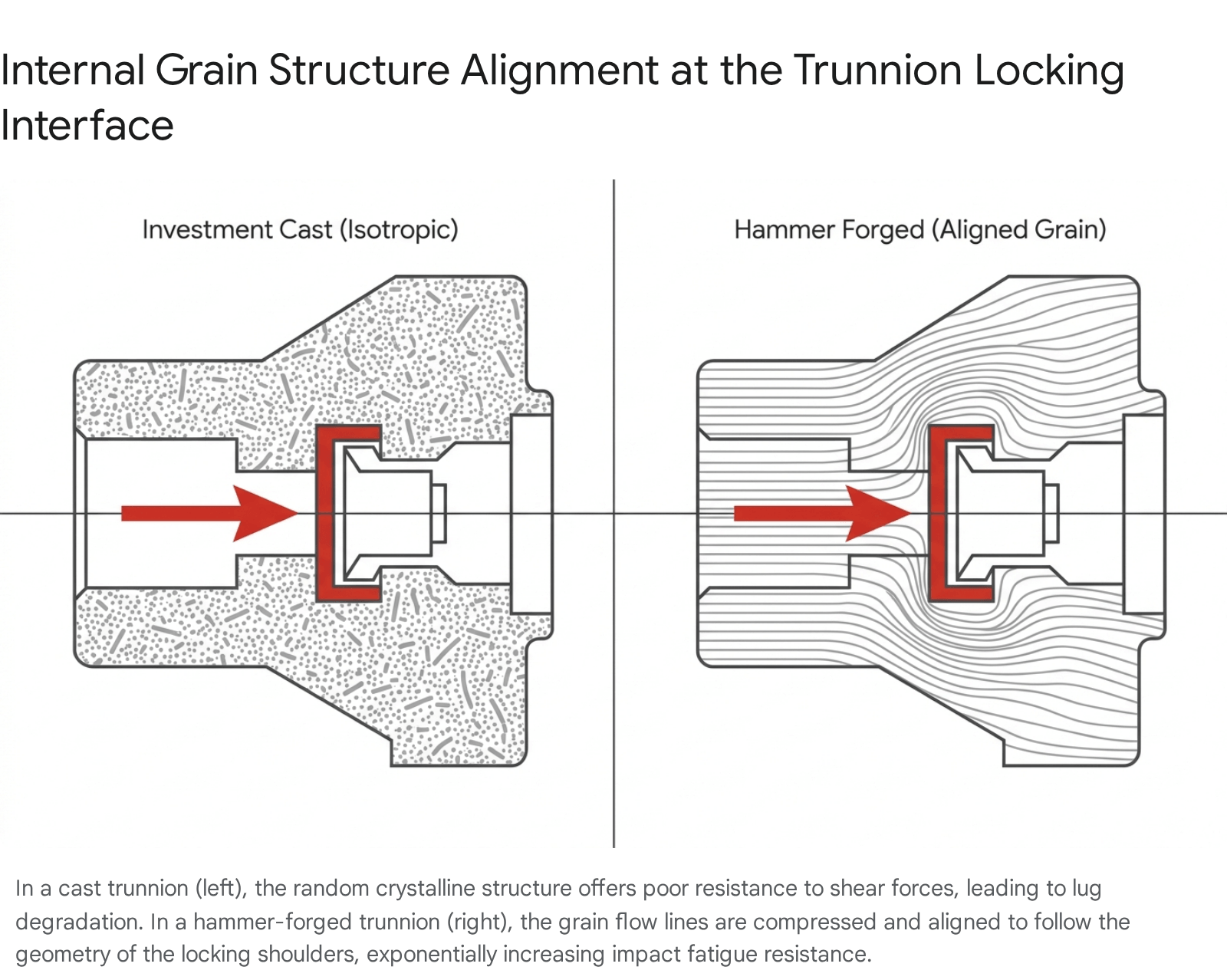
The hammer forging process is an absolute mechanical necessity for the AK design. When heated steel is repeatedly struck by a multi-ton pneumatic hammer into a closed die, the physical process forces the steel’s internal grain structure to flow and align with the external geometric shape of the trunnion. By aligning the microscopic crystalline structure of the metal parallel to the primary vectors of shear stress—specifically forming continuous, unbroken grain lines behind the critical locking shoulders—the die-forging process exponentially increases the component’s resistance to impact fatigue and catastrophic fracture.
After the raw forging is produced, the components are subjected to targeted, high-precision machining passes to cut the helical cam paths, the barrel journals, and the locking recesses. This is followed by a localized heat treatment pass, often utilizing austempering, to achieve a targeted surface hardness generally in the mid-40s to low-50s on the Rockwell C scale (HRC). This specific hardness parameter is vital; it ensures the locking surfaces are hard enough to resist peening from the bolt, while maintaining a softer, highly ductile inner core capable of acting as a shock absorber against the violent cyclic impulse of the bolt carrier group.
3. The U.S. Manufacturing Evolution: Overcoming the “Cast Era”
The early era of 100% US-made AK rifles represents a period of significant mechanical trial and error, characterized by a fundamental underestimation of the structural loads present in the Kalashnikov receiver. As domestic manufacturers sought to establish production lines without the benefit of state-subsidized, heavy-industrial drop forging infrastructure, they sought alternative, lower-cost manufacturing methods.
3.1 The Catastrophic Mechanical Failure of Cast Components
The most profound engineering error of this era was the attempt to utilize investment casting to produce front trunnions and bolts. Investment cast steel inherently lacks the aligned internal grain structure and the dense tensile properties required to survive as a pressure-bearing component in an automatic weapon design. When molten metal is poured into a mold during the casting process, it cools into an isotropic, randomized crystalline structure. Furthermore, the casting process frequently introduces microscopic porosity, voids, and inclusion defects within the steel matrix. While casting is a perfectly acceptable and highly efficient manufacturing pass for low-stress cosmetic components, trigger guards, or rear sight blocks, it is entirely unsuited for the extreme dynamic pressure and violent cyclic battering of the AK locking interface.
Rifles produced during this period, most notably the early generation Century Arms RAS47 and the first-generation Riley Defense rifles, utilized cast steel for both the front trunnion and the bolt. The mechanical results of this material selection were catastrophic. Independent testing organizations and high-volume shooters documented rapid and severe dimensional degradation within just a few hundred rounds of live fire.
As the cast trunnions absorbed the immense impact of the bolt locking and unlocking during the firing cycle, the locking shoulders physically peened, plastically deformed, and eventually sheared off entirely, behaving under high stress more like dense putty than structural steel. This continuous deformation allowed the bolt to lock further back in the receiver over time. This incremental rearward shift increased the critical headspace gap between the bolt face and the chamber. Once headspace exceeds safe tolerances, the brass or steel casing of the cartridge is no longer fully supported upon ignition, leading to case-head separation, explosive out-of-battery detonations, and severe danger to the operator.
3.2 The Billet Intermediary Phase
In immediate response to consumer backlash, documented safety recalls, and plummeting sales, manufacturers attempted a rapid mechanical pivot. The first corrective step was upgrading their trunnions and bolts to billet steel, which is machined directly from solid bars of pre-hardened industrial steel stock. For instance, Palmetto State Armory (PSA) utilized billet steel in their Gen 2 (GB2) models to address the shortcomings of their earliest iterations.
While billet steel is vastly superior to cast metal—as it lacks the microscopic porosity of casting and offers a much higher, consistent baseline tensile strength—it still represents a structural compromise when compared to the optimal, contour-aligned grain structure of a true drop forging. The intense CNC machining passes required to cut a trunnion out of a solid rectangular billet block inherently sever the natural, linear grain lines of the steel bar. This leaves the locking lugs somewhat vulnerable to long-term fatigue life issues, as the shear forces of the bolt act across the severed grain ends rather than being supported by a continuous grain flow. Recognizing that billet was merely an incremental improvement, the leading entities in the domestic industry aggressively pivoted toward developing proprietary drop-forging operations to achieve true mechanical parity with the original Soviet TDP.
4. Deep Dive: Palmetto State Armory (PSA) AK-74 & AK-100 Series
Palmetto State Armory (PSA) has achieved a dominant market position within the contemporary US domestic Kalashnikov sector. They accomplished this through aggressive vertical integration and a highly publicized “Redemption Arc” that focused heavily on radically rectifying the metallurgical shortcomings of their early rifles. Today, the PSA AK-74, AK-103, and the specialized “Soviet Arms” Krinkov lines represent some of the most technologically refined and widely distributed mass-produced domestic AK platforms in existence. To guarantee supreme bore durability alongside pressure integrity, their “Premium” AK-103 lines pair these high-grade forged components directly with proprietary cold hammer-forged (CHF), chrome-lined barrels manufactured exclusively by FN Herstal.5
4.1 The Pivot to 4340 Aircraft Quality (AQ) Steel
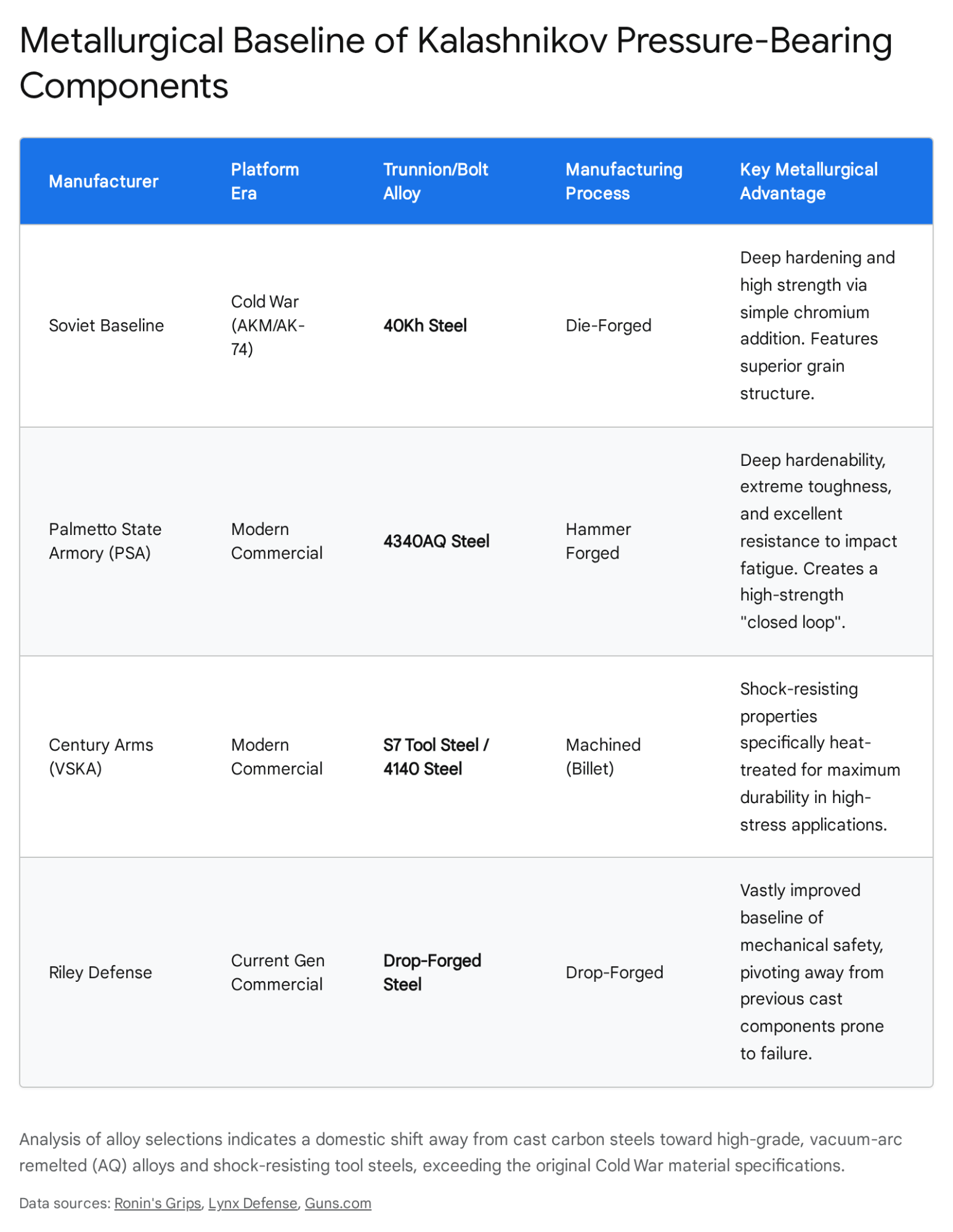
Moving decisively away from both investment casting and billet machining, PSA’s current generation of AK-74 and 100-series clones utilize Hammer Forged 4340 AQ (Aircraft Quality) steel for both the front trunnion and the rotating bolt.1 This specific alloy selection is perhaps the most significant metallurgical departure from the original Soviet GOST 40Kh specification, representing a massive technological upgrade that provides a profound increase in the structural safety margin of the firearm.
AISI 4340 is a high-strength, low-alloy steel containing significant additions of Nickel (1.65–2.00%), Chromium (0.70–0.90%), and Molybdenum (0.20–0.30%). Each of these alloying elements provides a specific mechanical advantage to the trunnion and bolt:
- Nickel: The heavy inclusion of nickel drastically improves the alloy’s extreme-low-temperature impact toughness and overall ductility. This is critical for pressure-bearing firearm components, as it prevents the catastrophic, glass-like shattering seen in over-hardened, high-carbon steels when subjected to sharp impact impulses.
- Chromium: Chromium ensures deep and consistent hardenability across the entire thick, irregular cross-section of the trunnion block during the quenching pass. This guarantees that the steel does not just harden on the surface, but achieves the necessary mechanical properties deep within the lugs.
- Molybdenum: Molybdenum significantly mitigates “temper embrittlement”—a dangerous metallurgical phenomenon where steel loses toughness and becomes brittle during the tempering cycle. It also drastically increases the steel’s high-temperature tensile strength, allowing the trunnion to maintain its structural integrity during rapid, sustained fire that heavily heats the chamber area.
The “AQ” (Aircraft Quality) designation is equally critical. It indicates that the raw steel has undergone Vacuum Arc Remelting (VAR) or similar rigorous refining processes at the steel mill. VAR removes non-metallic inclusions, dissolved gases, and impurities, resulting in an exceptionally pure steel matrix with highly predictable mechanical properties.
By drop-hammer forging this 4340AQ steel, PSA creates a “closed loop” high-strength containment triad consisting of the bolt, carrier, and trunnion.1 This triad easily contains the 50,000 psi chamber pressures and far exceeds the safety factor of the original Cold War-era Soviet carbon steel forgings, which were often subject to varying grades of standard carbon steel based on wartime material availability and relaxed quality control.1 Furthermore, PSA produces these high-stress components entirely in-house through their acquired OEM manufacturer, Toolcraft, ensuring strict control over dimensional tolerances and heat-treatment consistency.1
4.2 Refining the Passes: Trunnion Chamfers and Lightening Cuts
Despite possessing a vastly superior alloy, executing the precise internal geometry and CNC toolpaths for the AK-74 locking matrix is exceptionally difficult, particularly given the higher bolt velocities associated with the 5.45x39mm cartridge. This difficulty was publicly highlighted in 2021 when a highly influential firearms reviewer (Garand Thumb) documented premature, accelerated wear and peening on the locking lugs of a first-generation PSA AK-74 after only 1,800 rounds.
Because PSA manufactures these components in-house, their mechanical engineering team was able to immediately conduct a forensic metallurgical failure analysis on the returned rifle. The analysis indicated that while the baseline 4340AQ alloy was completely sound, the specific machining passes and the microscopic geometry of the locking lug engagement required immediate refinement.
In a rapid iteration cycle, PSA engineers programmed new CNC machining passes to fundamentally alter the engagement geometry. They introduced a specific toolpath to cut a precision chamfer on the right side of the front trunnion, exactly where the primary locking lug engages. This chamfer acts as a pre-wear clearance, strategically reducing the sharp, localized shear stress to prevent the extreme initial peening observed in early models. Concurrently, they added a new lightening cut pass directly to the right lug of the bolt itself, further optimizing how the bolt rotates and bears weight within the trunnion.2 These geometric pass adjustments, paired with a recalibrated heat-treatment furnace cycle to balance surface hardness (HRC) with inner core ductility, effectively solved the accelerated wear issues in subsequent production batches.
5. Deep Dive: Kalashnikov USA (KUSA) 100-Series Metallurgy
Kalashnikov USA (KUSA) originally entered the domestic market with the explicit engineering goal of producing exact, 1-to-1 mechanical clones of the modern Russian 100-series rifles, specifically the KR-103 (AK-103 clone) and the KP-9/104 series. Before their highly publicized corporate bankruptcy, KUSA was widely viewed as the ultimate standard-bearer for technical purity and historical accuracy in the US market.
5.1 Structural Architecture and Alloy Specifications
Unlike PSA’s strategy of adaptive engineering, KUSA heavily marketed their strict adherence to the translated Russian technical data packages. Their flagship KR-103 receiver utilized historically correct 100-series architecture, including the dimpled rear block, a 5.5mm folding rear trunnion mechanism, a 22mm barrel journal, and the critical cam/bump rivet installed on the left side of the front trunnion. The bump rivet acts as a primary mechanical initiator; as the bolt carrier travels rearward, it strikes the bump rivet to force the bolt into its rotational unlocking sequence, drastically reducing total shear stress on the trunnion locking shoulders.
A forensic review of KUSA’s metallurgical supply chain corrects several industry misconceptions regarding their components. While KUSA utilizes a heavy, forged front trunnion and a forged bolt carrier, their bolts are actually precision machined from high-grade gun quality alloy steel billet, rather than being drop-forged. Furthermore, a frequent point of confusion exists regarding KUSA barrel metallurgy: while their side-folding SFS variants feature premium cold hammer-forged (CHF) chrome-lined barrels, the fixed-stock KR-103 models originally shipped with standard 4150 button-rifled barrels.3
5.2 The 2026 Supply Chain Disruption
Despite excellent baseline metallurgy, KUSA’s standing in the market was fundamentally altered by a severe corporate restructuring. In May 2024, the company filed for Chapter 11 bankruptcy amidst mounting reports of declining quality control and financial instability. The bankruptcy filing was subsequently dismissed with prejudice by the court, effectively halting the company’s operations.4 Following this dismissal and a complete buyout by a new ownership group led by Jesse James in early 2026, KUSA underwent a massive brand reinvention.5
This severe corporate upheaval completely shattered KUSA’s supply chain and manufacturing throughput. Consequently, by mid-2026, their highly accurate 100-series clones vanished entirely from primary market retail shelves, shifting consumer trust and market dominance decisively toward Palmetto State Armory’s AK-103 lines.5
6. Alternative Material Approaches: Century Arms and Riley Defense
While PSA and KUSA focused heavily on 4340 and standard alloy structural steels, other major domestic manufacturers explored alternative metallurgical pathways to solve the durability issues inherent in the AK action.
6.1 Century Arms VSKA: The S7 Tool Steel Integration
Century Arms took an entirely unprecedented metallurgical path with their VSKA line in response to the catastrophic failures of their earlier investment-cast RAS47 models. Rather than utilizing traditional 4140 or 4340 structural steels, Century mechanical engineers opted to implement machined S7 Tool Steel for the front trunnion, feed ramps, and bolt carrier group, pairing this matrix with a carburized 4140 steel bolt and a chrome-moly 4150 barrel.66
S7 is a specialized, air-hardening, shock-resisting tool steel characterized by exceptional impact toughness and incredibly high compressive strength.7 In heavy industry, S7 is typically deployed in applications requiring resistance to severe, repetitive battering, such as pneumatic jackhammer bits, cold-heading dies, and heavy shear blades. Metallurgically, applying S7 to an AK front trunnion creates a highly durable locking surface capable of withstanding forces far beyond the 50,000 psi chamber pressure of the 7.62x39mm cartridge. The pairing of the S7 trunnion with a 4140 carburized bolt is a calculated engineering decision concerning tribology; utilizing dissimilar alloys helps prevent adhesive galling during the violent friction of the locking and unlocking cycle.
6.2 Riley Defense: The Forged vs. Billet Trunnion Dynamics
Following the disastrous performance of their early investment-cast models, Riley Defense executed a fundamental, sweeping engineering shift. While early tactical models experimented with cast 4140 carriers, they subsequently pivoted away from casting entirely. Current Gen 3 production models utilize fully forged steel for all front trunnions, bolts, and hammer-forged bolt carriers across their RAK-47 and RAK-74 platforms.
However, within the mechanical engineering and professional gunsmithing community, this terminology has been heavily scrutinized. Industry analysts and company employees have publicly clarified that Riley’s components are actually milled from “forged billets” 8 rather than being traditional, near-net-shape drop hammer forgings.8 Regardless of the specific pass methodology employed during their transition period, the shift to a denser, forged steel matrix has vastly improved the baseline mechanical safety, headspace longevity, and overall market reception of current-generation Riley Defense rifles.
| Manufacturer | Component | Alloy Specification | Manufacturing Process | Key Engineering Attribute |
| Palmetto State Armory | Trunnion / Bolt | AISI 4340 AQ | Drop Forged (In-House) | Vacuum Arc Remelted for extreme purity; high Nickel for cold-weather toughness. |
| Kalashnikov USA | Trunnion / Bolt | High Alloy Steel | Forged Trunnion / Machined Bolt | Historical TDP adherence (cam bump rivet); button-rifled and CHF barrel options. |
| Century Arms (VSKA) | Trunnion / Bolt | S7 Tool Steel / 4140 | Machined from S7 / Carburized Bolt | Unmatched impact and shock resistance; highly resistant to compressive deformation. |
| Riley Defense (Gen 3) | Trunnion / Bolt | 4150/Alloy Steel | Machined from Forged Billet | Massive upgrade over initial cast parts; reliable baseline performance. |
7. Bolt Mechanics: Free-Float vs. Spring-Loaded Firing Pins
Beyond base material selection, US manufacturers have heavily modified the internal machining passes of their bolts, specifically regarding the geometry and function of the firing pin channel. The mechanical interaction between the bolt, the firing pin, and the cartridge primer represents a critical point of safety in the AK-74 and AK-100 platforms, particularly when adapting the design to the commercial US market.
7.1 The Physics of the Slam Fire
The original Soviet AK-74 bolt utilizes a “free-floating” firing pin design. In this configuration, there is no mechanical spring holding the firing pin back; it simply floats freely inside the internal bolt channel. Because Russian military 5.45x39mm and 7.62x39mm ammunition utilizes incredibly hard, military-specification Berdan primers, the inertia of the firing pin sliding forward as the heavy bolt carrier slams closed into battery is entirely insufficient to dent and detonate the primer.
However, the US civilian market utilizes a vastly wider variety of commercial 5.56x45mm,.223 Remington, and commercial 5.45x39mm ammunition. These commercial cartridges often feature highly sensitive, soft Boxer primers designed for precision bolt-action rifles or AR-15s with lightweight firing pins. If an original, heavy, free-floating AK firing pin is used with these soft commercial primers, the massive kinetic energy of the heavy AK bolt carrier group slamming into battery can cause the firing pin to strike the primer with enough inertial force to detonate it before the bolt is fully rotated and mechanically locked.
This phenomenon, known as a “slam fire,” can result in a highly dangerous, uncontrolled discharge of the weapon. Furthermore, if brass shavings, ruptured primer cup debris, or heavy carbon fouling enter the firing pin channel, a free-floating pin can become wedged tightly in the forward, protruding position.9 If a live round is chambered with a jammed, protruding firing pin, an instant slam fire is virtually guaranteed the moment the bolt face contacts the cartridge.
7.2 Machining the Bolt for Spring-Loaded Mitigation
To mitigate this severe mechanical vulnerability and ensure safe operation across all commercial ammunition types, several US manufacturers, including Riley Defense and premium import builders like Arsenal (Bulgaria), have engineered spring-loaded firing pins into their 5.56 NATO and 5.45x39mm bolt designs.
Adding a spring-loaded firing pin is not a simple drop-in replacement; it requires fundamentally changing the CNC machining passes on the internal structure of the bolt. The internal firing pin channel must be precision counter-bored to create a distinct internal ledge for the tiny return spring to seat against, and a precise transverse hole must be drilled laterally through the bolt body to accept a retaining roll pin, which keeps the spring under constant tension.
While this mechanical alteration drastically increases safety when firing soft commercial ammunition by counteracting the forward inertia of the firing pin, it introduces a completely new failure point into the system. If the transverse roll pin utilized is of substandard metallurgy, the constant, violent forward and backward battering of the firing pin against the retaining pin during the firing cycle can cause the roll pin to eventually shatter. This exact failure mode was extensively documented in early Palmetto State Armory models—specifically the AK-V 9mm and Gen 1 AK-74s—where fractured roll pin debris physically jammed the firing pin forward into a fixed, protruding position.10 This mechanical jam re-introduced the exact slam-fire risk the system was designed to prevent. PSA subsequently addressed this design flaw by upgrading the metallurgy, thickness, and dimensional tolerances of their retaining pins to withstand the massive cyclic shear stresses inherent to the platform.
8. Advancements in CNC Machining Passes and Fixturing
The transition from Cold War-era manual machining and rudimentary milling machines to modern US production has completely revolutionized the dimensional accuracy and consistency of the AK platform. This has been achieved primarily through the integration of advanced 4-axis and 5-axis CNC machining centers equipped with high-precision rotary trunnion tables.
8.1 Multi-Axis Trunnion Fixturing and Tolerance Control
In traditional 3-axis machining (which defined early US AK production), producing a geometrically complex part like an AK front trunnion requires the raw forging to be manually un-clamped, physically re-oriented by the operator, and re-clamped (re-fixtured) multiple times. This is necessary to allow the vertical cutting tool to access the top, bottom, left, and right faces of the block. Every single time a part is re-fixtured, microscopic misalignments inevitably occur. This phenomenon is known as “tolerance stacking,” where tiny dimensional errors compound upon one another, potentially leading to a finished trunnion that does not perfectly mate with the bolt locking lugs or receiver shell.
Modern tier-one US manufacturers utilize automated trunnion table fixtures (such as an A/C-axis rotary trunnion) directly inside the CNC mill. This specialized equipment transforms a standard 3-axis vertical machining center (VMC) into a full 5-axis machine capable of rotating and tilting the raw steel forging along multiple axes simultaneously. By clamping the part only once in the trunnion fixture, the cutting tool can execute continuous, uninterrupted machining passes across five different faces of the trunnion block.
This simultaneous multi-face machining mathematically guarantees that the concentricity of the barrel journal is perfectly, axially aligned with the locking shoulder recesses. This drastically reduces costly assembly issues on the factory floor, eliminates tolerance stacking, and ensures perfectly uniform, safe headspace right off the machine, eliminating the need for extensive hand-fitting by gunsmiths.
8.2 Helical Cam Path Interpolation Toolpaths
One of the most complex geometric features of the entire AK bolt mechanism is the helical cam path. As the gas piston pushes the bolt carrier rearward under high-pressure gas, a machined stud on the bolt body rides inside a precise helical groove machined into the interior of the carrier. This interaction physically forces the bolt to rotate upon its axis and unlock its primary lugs from the front trunnion.
Cutting this precise, sweeping, three-dimensional curve manually on older machinery is notoriously difficult and prone to chatter marks. Utilizing continuous 5-axis CNC systems, modern engineers employ a programming technique known as helical interpolation. The CNC controller utilizes Tool Center Point Management (TCPM) to simultaneously drive the X, Y, and Z linear axes while continuously rotating the A or C axis trunnion table. This highly complex mathematical coordination allows a high-speed carbide endmill to trace the exact helical toolpath through the steel in a single, fluid pass. By continuously interpolating the path rather than utilizing rigid, stepped multi-pass cuts, the resulting cam groove exhibits a highly polished, mirror-like surface finish. This drastically reduces mechanical friction during the violent unlocking phase, dramatically smoothing the rifle’s overall operating cycle and reducing perceived recoil.
9. Surface Treatments and Finishing Passes
The final step in US trunnion and bolt manufacturing involves surface finishing treatments. These chemical and thermal treatments are essential not merely for aesthetic purposes or rust prevention, but in some cases, for physically altering the surface hardness of the alloy to prevent microscopic wear over decades of hard use.
9.1 Ferritic Nitrocarburizing (Nitriding) vs. Black Oxide
Historically, Soviet and Eastern European manufacturers relied heavily on deep hot-bluing processes or heavy, baked-on painted enamels applied directly over heavily parkerized (zinc or manganese phosphate) surfaces. Modern US manufacturers have largely abandoned these older techniques in favor of modern equivalents, primarily Black Oxide and Ferritic Nitrocarburizing (commonly referred to in the industry as Nitriding or Melonite).
Nitriding is a highly advanced thermochemical diffusion process extensively utilized by manufacturers like Palmetto State Armory. The machined steel components are submerged in a liquid salt bath or subjected to a nitrogen-rich gaseous environment at sub-critical temperatures (typically between 900°F and 1100°F). During this pass, atomic Nitrogen and Carbon rapidly diffuse directly into the crystalline surface lattice of the steel, creating an extremely hard, wear-resistant compound surface layer backed by a deeper, tougher diffusion zone. This final pass significantly increases the Rockwell hardness of the bolt carrier rails and locking lugs, drastically improving their wear resistance, without altering or embrittling the ductile inner core established during the primary heat-treatment pass.
Alternatively, manufacturers such as Riley Defense utilize standard Black Oxide treatments for their receivers and trunnions, while reserving Nitriding specifically for their barrels. Black Oxide provides a baseline protective layer against ambient moisture and humidity, but it does not physically alter the dimensional thickness or the base surface hardness of the steel to the same structural degree as true nitriding. Black Oxide is primarily a cosmetic and minor anti-corrosion finish, heavily reliant on a continuous coat of oil to maintain efficacy.
10. Analytical Conclusion: The Maturation of Domestic Kalashnikov Engineering
The US-manufactured Kalashnikov has evolved from a deeply flawed, cost-cutting experiment into a highly refined, technologically advanced platform driven by aerospace-grade materials and cutting-edge manufacturing technologies. The metallurgical and structural analysis of contemporary US AK-74 and AK-100 manufacturers reveals a decisive, permanent abandonment of isotropic investment-cast carbon steels in favor of dimensionally dense, drop-forged and billet-machined alloys.
The widespread integration of AISI 4340 Aircraft Quality (AQ) nickel-chromium-molybdenum steel by industry leaders like Palmetto State Armory represents a fundamental structural paradigm shift. By utilizing vacuum arc remelted steel with high nickel content, these manufacturers provide a deep-hardening, cold-weather impact-resistant containment loop that arguably surpasses the metallurgical safety factor of the original Cold War-era Soviet GOST 40Kh specifications. Similarly, Century Arms’ utilization of S7 shock-resisting tool steel paired with 4140 carburized bolts demonstrates the domestic industry’s willingness to experiment with highly specialized, non-traditional industrial alloys to definitively solve historical impact fatigue failures.
Simultaneously, the manufacturing passes themselves have been completely modernized to rival western AR-15 production standards. To optimize wear patterns and prevent extreme peening on locking lugs, manufacturers are actively altering CNC toolpaths—adding precision chamfers to front trunnions and strategic lightening cuts to bolts. The widespread implementation of 5-axis CNC rotary trunnion fixturing has effectively eliminated the dangerous tolerance stacking inherent in legacy multi-setup manual machining. This technological leap allows for the flawless mathematical interpolation of complex helical cam paths and ensures perfectly concentric barrel journals. Furthermore, critical mechanical updates to the bolt assemblies—specifically the widespread transition from free-floating to spring-loaded firing pin architectures—have adapted the rugged Soviet platform to safely digest the highly sensitive commercial ammunition prevalent in the US market, effectively eliminating the risk of catastrophic slam fires.
Ultimately, the synthesis of advanced drop-forging techniques, rigorous heat-treatment calibration, continuous 5-axis CNC machining, and advanced surface treatments ensures that current domestic front trunnions and bolts are engineered to comfortably withstand the extreme ballistic pressures and dynamic shear stresses inherent to the Kalashnikov operating system. The domestic market has not only replicated the legendary durability of the Russian original but, in several distinct metallurgical aspects, fundamentally improved upon it.
Please share the link on Facebook, Forums, with colleagues, etc. Your support is much appreciated and if you have any feedback, please email us in**@*********ps.com. If you’d like to request a report or order a reprint, please click here for the corresponding page to open in new tab.
Sources Used
- Industrial and Technical Assessment: The Palmetto State Armory …, accessed June 8, 2026, https://blog.roninsgrips.com/industrial-and-technical-assessment-the-palmetto-state-armory-soviet-arms-krinkov-platform/
- PSAK 74 10,000 round bolt and trunnion : r/ak47 – Reddit, accessed June 8, 2026, https://www.reddit.com/r/ak47/comments/10m0njt/psak_74_10000_round_bolt_and_trunnion/
- r/gundeals on Reddit: [Rifle] Kalashnikov USA KR-103 SF, accessed June 8, 2026, https://www.reddit.com/r/gundeals/comments/vsxifj/rifle_kalashnikov_usa_kr103_sf_1140/
- 7.62x39mm Ammunition: A Comprehensive Sentiment and Performance Analysis of the U.S. Civilian Market (2024-2025) – Ronin’s Grips, accessed June 8, 2026, https://blog.roninsgrips.com/7-62x39mm-ammunition-a-comprehensive-sentiment-and-performance-analysis-of-the-u-s-civilian-market-2024-2025/
- Top 10 Kalashnikov-Pattern Rifles in the United States (May 2026 …, accessed June 8, 2026, https://blog.roninsgrips.com/top-10-kalashnikov-pattern-rifles-in-the-united-states-may-2026/
- Best AK-47 Rifles in 2026: Top Brands Ranked by Category – Lynx Defense, accessed June 8, 2026, https://lynxdefense.com/best-ak-47/
- We Found The Best AK-47 Rifles You Need To Get Your Hands On – RE Factor Tactical blog, accessed June 8, 2026, https://blog.refactortactical.com/blog/best-ak-47/
- Riley Defense Ak47-C – Reddit, accessed June 8, 2026, https://www.reddit.com/r/ak47/comments/1crkjr4/riley_defense_ak47c/
- F2f issues and this came out pulled the firing pin out it looks like brass any ideas ? Or anyone ever have this problem ? : r/ak47 – Reddit, accessed June 8, 2026, https://www.reddit.com/r/ak47/comments/mkuili/f2f_issues_and_this_came_out_pulled_the_firing/
- This AKV problem could have gone Really Bad! Stuck firing pin on my AK-V, accessed June 8, 2026, https://palmettostatearmory.com/forum/t/this-akv-problem-could-have-gone-really-bad-stuck-firing-pin-on-my-ak-v/38633