
Executive Summary
The precision and sniper rifle market in July 2026 demonstrated a clear and accelerating bifurcation in engineering priorities. The industry is currently divided between Extreme Long Range (ELR) anti-materiel development and ultra-lightweight, multi-role crossover platforms that are designed for both backcountry deployment and competitive precision applications. A comprehensive analysis of social media, professional engineering forums, and military procurement network discussions shows a strong focus on multi-caliber modularity, chassis integration, and advanced metallurgical applications in barrel manufacturing.
A prevailing secondary theme throughout the month was the rapid adoption of high-efficiency, high-ballistic-coefficient cartridges that are actively redefining platform capabilities. The introduction and maturation of the .22 Advanced Rifle Cartridge (ARC), with its 62-grain Extreme Low Drag-Varmint Target (ELD-VT) projectile, significantly disrupted discussions about traditional varmint and mid-range precision platforms. The .22 ARC can match .22-250 Remington ballistics from a standard AR-15 platform, with a maximum average pressure of 52,000 psi, and has driven consumer interest toward gas-operated precision rifles and small-action bolt guns. Users noted that even at lower velocities, the bullets fired from a 22 ARC rifles outperform classic cartridges at extended distances due to superior drag models. Concurrently, the ELR sector saw massive engagement regarding the .375 CheyTac and .338 Norma Magnum, pushing the mechanical limits of action rigidity and recoil mitigation. 375 CheyTac and .338 Norma Magnum, pushing the mechanical limits of action rigidity and recoil mitigation.
This report details the top 10 most discussed precision rifle platforms for the month, ranked by total discussion volume. It outlines the engineering characteristics, public sentiment, and the critical discussion points driving online engagement.
Summary Table: Discussion Rank and Sentiment
| Rank | Platform | Positive Sentiment | Negative Sentiment | Neutral Sentiment | Primary Market Role |
| 1 | Barrett MRAD / MK22 PSR | 52% | 33% | 15% | Military / Elite Civilian ELR |
| 2 | Sako TRG 62 A1 | 86% | 4% | 10% | Military ELR / Anti-Materiel |
| 3 | Sig Sauer Cross Series | 68% | 18% | 14% | Crossover Hunting / Precision |
| 4 | Accuracy International AXSR / AT-X | 91% | 2% | 7% | Professional Precision / LE |
| 5 | Sako ARG 50 GP | 78% | 12% | 10% | Semi-Auto Military DMR |
| 6 | Barrett Model 82A1 | 75% | 5% | 20% | Heavy Anti-Materiel |
| 7 | Aero Precision Solus | 74% | 11% | 15% | Entry / Mid-Tier PRS |
| 8 | Tikka T3x Series | 89% | 3% | 8% | Production Precision |
| 9 | Bergara B-14 HMR | 84% | 6% | 10% | Crossover Production |
| 10 | Springfield Model 2020 Waypoint | 62% | 22% | 16% | Lightweight Precision |
Detailed Platform Analysis
1. Barrett MRAD / MK22 Precision Sniper Rifle (PSR)
The Barrett Multi-Role Adaptive Design (MRAD), specifically focusing on the MK22 Advanced Sniper Rifle (ASR) and Precision Sniper Rifle (PSR) variants, generated the highest volume of discourse in July 2026. This surge in engagement was catalyzed by international procurement news, civilian market availability, and a highly viral controversy regarding the platform’s mechanical safety.
The Colombian National Army recently awarded Barrett a major contract for MRAD rifles chambered in 7.62x51mm and .338 Lapua Magnum, representing a significant modernization effort to standardize precision rifle systems across their forces. These systems are paired with Leupold Mark 5HD optics and the Barrett AM338 titanium suppressors, with deliveries slated for the summer of 2025. Domestically, the United States Marine Corps announced that their MK22 systems reached full operational capability a year ahead of schedule, completely replacing the legacy M40A6 and Mk 13 MOD 7 sniper rifles.
Mechanically, the MRAD is defined by its user-level modularity and monolithic upper receiver. The receiver is machined from aluminum and incorporates a full-length MIL-STD-1913 Picatinny top rail. Current military iterations feature a 10 milliradian (MIL) built-in taper to maximize optic elevation travel at extended ranges. The barrel tenon is secured via two Torx-30 screws located on the receiver block. Loosening these screws allows an operator to pull the barrel from the front of the receiver handguard, swap the bolt face, and change calibers in under two minutes.
The civilian commercial-off-the-shelf package, priced at approximately $16,770, includes the rifle chambered in .300 Norma Magnum, a Leupold 7-35x56mm optic, a contract-grade mount, and a bipod. The Leupold optic has a 35mm tube and 0.1 mil click adjustments, with about 29 mils of total elevation travel, which is critical for the ballistic trajectory of the .300 Norma Magnum. The included AM338 suppressor is made from titanium alloy and is fully CNC machined and orbital welded to reduce its weight to 1.3 pounds, ensuring concentric bores that minimize point-of-impact shift.
Despite these engineering achievements, the platform faced severe scrutiny in July 2026. A highly circulated discussion thread originated from a user claiming to be a U.S. SOCOM sniper. The individual alleged that the MK22 suffers from severe mechanical flaws that compromise operator safety. The trigger module, which is designed to be removed without tools for field maintenance and features a specified 2.5-pound pull weight, was the focal point of the controversy.
| Sentiment Category | Share | Primary Driver of Discussion | Representative Public Commentary |
| Positive | 52% | Civilian availability of a contract-proven, turn-key system and international military adoption. | “The MK22 package is an exceptionally compelling way to buy into a contract-winning ecosystem without chasing parts.” |
| Negative | 33% | Severe allegations regarding mechanical failures, trigger safety, and receiver durability in military applications. | “Consistent problems with triggers leading to accidental discharges, receivers splitting… Snipers don’t like this rifle, we don’t trust this rifle.” |
| Neutral | 15% | High cost of civilian entry and caliber conversion discussions regarding the upcoming 6.8x51mm and .416 Barrett MRADELR variants. | Cost analyses comparing the $16,770 field package to custom-built actions and chassis systems. |
2. Sako TRG 62 A1
Finnish manufacturer Sako captured the second-highest discussion volume following the continued rollout, field testing, and analytical evaluation of the TRG 62 A1. The discourse in July 2026 was largely driven by military engineers and ballistic analysts evaluating the platform’s capability to bridge the gap between traditional anti-personnel precision rifles and heavy .50 BMG anti-materiel platforms.
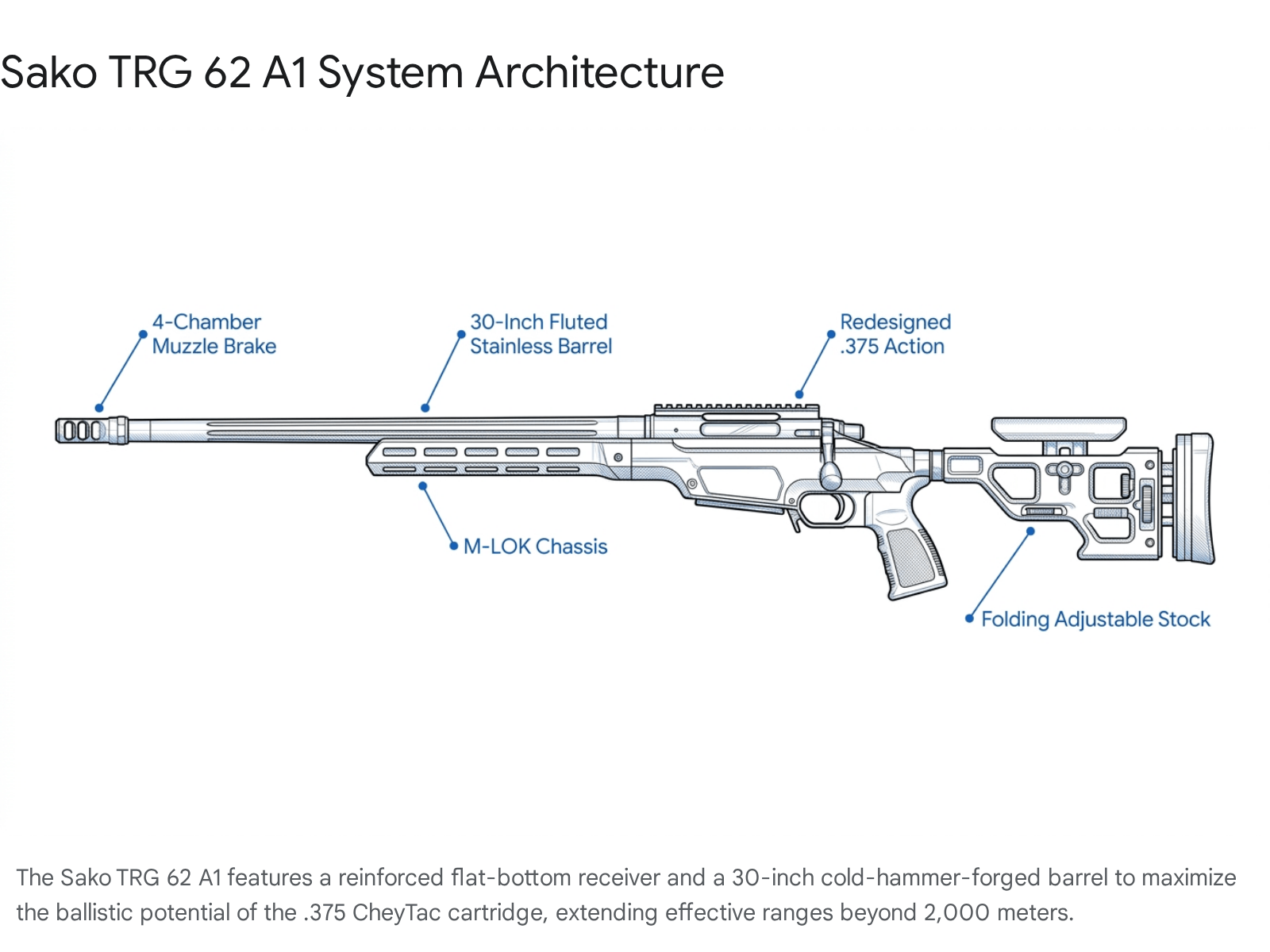
The engineering architecture of the TRG 62 A1 represents a significant scaling of the TRG M10 platform. To safely harness the internal ballistics of the 9.5x77mm (.375 CheyTac) cartridge, Sako engineers engaged in a comprehensive redesign of the action. The receiver utilizes a hex-style profile on top with a smaller, closed ejection port. The bolt features three massive locking lugs requiring a 60-degree rotation and a 118 mm bolt throw to clear the extended overall length of the CheyTac cartridge.
The barrel is a 30-inch cold-hammer-forged stainless steel blank. Cold-hammer forging involves beating the barrel steel around a mandrel, a process that creates a highly durable and smooth internal finish capable of withstanding throat erosion. The barrel is deeply fluted to increase surface area for cooling and to reduce forward weight, and it is entirely free-floated within an M-LOK handguard.
Recoil mitigation is a critical engineering challenge when dealing with a cartridge that generates approximately 10,000 Joules of muzzle energy and achieves velocities of 900 meters per second. Sako addresses this through a combination of sheer rifle mass (topping 7 kilograms empty) and a massive, custom-engineered four-chamber muzzle brake. The rifle retains the fully adjustable two-stage trigger mechanism from the TRG M10, which is externally adjustable between 1.2 to 2.1 kilograms, ensuring a consistent break without compromising the safety sear engagement necessary for military deployment.
| Sentiment Category | Share | Primary Driver of Discussion | Representative Public Commentary |
| Positive | 86% | Ballistic superiority of the 9.5x77mm cartridge and extreme long-range hit probabilities. | “Surpassing the capabilities of traditional calibers like .308 Win and .338 LM, it offers unmatched accuracy and reach, extending beyond 2000 meters.” |
| Negative | 4% | Logistical constraints regarding the procurement and supply chain of .375 CheyTac ammunition. | General concerns that the non-NATO standard cartridge complicates field resupply for standard infantry units. |
| Neutral | 10% | Lack of commercial availability and restrictions to military/law enforcement contracts. | Discussions acknowledging the impressive engineering but lamenting the lack of information concerning potential availability and pricing on the global commercial/civilian markets. |
3. Sig Sauer Cross Series (Cross Magnum & Sawtooth)
The Sig Sauer Cross platform maintained high visibility throughout the month due to the release of a new Bronze Cerakote variant and the continued popularity of the Cross Magnum Sawtooth edition. The platform sits directly at the intersection of backcountry hunting and precision rifle competition, creating a polarizing but highly active discussion space regarding acceptable weight-to-recoil ratios and structural rigidity.
The defining engineering characteristic of the Cross series is its monolithic, one-piece aluminum receiver. Traditional precision rifles utilize a steel action bolted into a separate aluminum chassis or synthetic stock. By integrating the receiver and chassis core into a single structural component, Sig Sauer eliminated a critical mating interface, theoretically enhancing rigidity while drastically cutting the overall weight to between 6.2 and 8 pounds depending on the configuration.
The action utilizes a three-lug floating bolt head design, providing a short 60-degree throw that allows for rapid cycling and provides ample clearance for large optic ocular bells. The Sawtooth Magnum variant incorporates a 24-inch PROOF Research carbon-fiber-wrapped barrel, chambered in high-efficiency cartridges like the 7mm Precision Rifle Cartridge (PRC) and .300 Winchester Magnum. An AR-style barrel nut system allows for relatively simple end-user barrel swaps, appealing to shooters who wish to perform their own maintenance.
However, the pursuit of extreme weight reduction introduced mechanical compromises that dominated the negative sentiment. The two-stage match trigger was heavily scrutinized by precision engineers. Reviewers noted that the weight step between stage one and stage two is too close together to be safe and effective, leading to unpredictable sears breaking if the overall weight is adjusted upward by the user. Furthermore, the free-floated M-LOK handguard exhibited flex under heavy bipod loading, causing potential point of impact shifts.
| Sentiment Category | Share | Primary Driver of Discussion | Representative Public Commentary |
| Positive | 68% | Exceptional portability, monolithic receiver design, and the AR-style barrel nut for easy maintenance. | “What was missing from the market was a true crossover. Our engineers took the best of both worlds and developed the CROSS.” |
| Negative | 18% | Trigger mechanism safety concerns, handguard flex under bipod pressure, and harsh recoil profiles. | “On Cross rifles we’ve tested, we have found that the two-stage trigger is sometimes too light, and the weight step between stage one and stage two are too close together to be safe.” |
| Neutral | 14% | Physics debates regarding the utility of firing heavy magnum cartridges from sub-8-pound rifles. | “The trend in match rifles shows a lot of guys running 24-26 inch barrels in rifles that weigh sometimes 3x as much. Few people are gonna wanna sacrifice the velocity…” |
4. Accuracy International AXSR and AT-X
The Accuracy International (AI) platforms remain the gold standard in professional circles. While not a new release for 2026, the AXSR and the AT-X models dominated discussions among precision rifle competitors and elite law enforcement regarding barrel harmonics, throat erosion management, and exact return-to-zero capabilities after field maintenance.
The AT-X is built around a heavy, flat-bottomed steel receiver that acts as a fully pressure-bearing vault. Unlike many modular rifles that utilize a barrel extension to house the locking lugs, the AT-X’s bolt lug abutments are machined directly into the receiver steel. Barrels are supplied by Bartlein, featuring cut rifling rather than button rifling, which imparts less residual stress into the steel and enhances thermal stability. The AXSR variant uses similar rugged engineering for larger magnum cartridges, providing a multi-caliber system that can withstand extreme combat conditions without shifting the point of impact.
The barrel interfaces with the action via AI’s Quickloc system. This mechanism uses a heavy tenon thread clamped by a single 4mm Allen bolt, rather than relying solely on high-torque thread friction. The chassis surrounding the action is a skeletonized 7075 aluminum structure designed to isolate the action completely from any externally applied stress, ensuring that bipod loading or sling tension does not translate into receiver flex.
A highly technical discussion regarding the AI platforms centered on throat erosion and bullet jump. High-level competitors discussed how throat erosion, estimated at 0.004 to 0.007 inches per 100 rounds in mid-sized precision cartridges, affects internal ballistics. Analysts noted that maintaining a bullet jump of 0.040 inches or more produced far less vertical shift in point of impact over the barrel’s lifespan than seating bullets close to the lands, providing crucial data for long-term load development in AI platforms.
| Sentiment Category | Share | Primary Driver of Discussion | Representative Public Commentary |
| Positive | 91% | Flawless return-to-zero capabilities, extreme thermal stability, and robust action design. | “Removal and re-fitting showed no more than 0.1 mRad variation in point of impact… no problem stringing ten round groups together without point of impact shift.” |
| Negative | 2% | High cost of entry and heavy overall weight limiting off-hand positional shooting. | Minor complaints regarding the physical burden of carrying the system in non-permissive environments. |
| Neutral | 7% | Technical discussions regarding throat erosion rates and optimal bullet seating depth for sustained precision. | Analyses showing the most consistent vertical POI over a wide range of bullet jumps appears to be at 0.040 inches or more. |
5. Sako ARG 50 GP (Arctic Rifle Generation)
Announced in late 2025 and seeing active procurement, training, and testing through 2026, the Sako Arctic Rifle Generation (ARG) family represents a major paradigm shift for the Finnish and Swedish Defence Forces. The ARG 50 GP is a semi-automatic sniper rifle chambered in 7.62x51mm NATO, designed to replace legacy platforms in extreme cold weather and maritime environments.
The ARG 50 GP is based on the AR-10 architecture but has been heavily modified internally to pass the rigorous NATO D14 environmental testing standards. The primary engineering divergence is the utilization of a short-stroke gas piston operating system. Sako engineers opted for a piston system over traditional direct impingement to reduce heat and carbon buildup inside the receiver assembly.
The barrel is cold-hammer-forged from high-grade materials and hard-chrome lined to ensure long-term durability and maintain accuracy over thousands of rounds, even in corrosive environments. The rifle incorporates a Sako match-grade trigger unit, delivering a clean, consistent break that is highly unusual for a standard-issue military gas gun.
| Sentiment Category | Share | Primary Driver of Discussion | Representative Public Commentary |
| Positive | 78% | Exceptional reliability in harsh conditions, fully ambidextrous controls, and inclusion of a match-grade trigger. | “Designed to replace legacy assault rifles, the ARG platform is purpose-built for Arctic warfare… delivering unmatched reliability.” |
| Negative | 12% | Concerns over the inherent accuracy limitations of piston-driven systems and early trigger delay reports. | Discussions referencing previous temporary withdrawals of 5.56mm variants due to delays between pulling the trigger and the shot firing. |
| Neutral | 10% | Speculation on commercial availability and caliber expansion. | Inquiries regarding when Sako will release a civilian semi-automatic version to the global market. |
6. Barrett Model 82A1
While newer platforms dominated the top spots, the iconic Barrett Model 82A1 maintained significant discussion volume, primarily driven by civilian acquisition, training courses, and its legendary status as the premier shoulder-fired semi-automatic .50 BMG anti-materiel rifle.
The Model 82A1 operates on a short recoil principle rather than gas operation. Upon firing, the barrel and bolt remain locked together and recoil rearward for a short distance. This action compresses recoil springs and absorbs a massive amount of the kinetic energy generated by the .50 BMG cartridge, translating it into mechanical work rather than transferring it entirely to the shooter’s shoulder. The rifle features a heavy 29-inch or 20-inch fluted barrel with a chrome-lined chamber to facilitate reliable extraction of massive cartridge cases under extreme pressures.
A highly specific engineering constraint discussed frequently in July 2026 is the platform’s suppressor incompatibility. Barrett strictly notes that the Model 82A1 does not come equipped with a suppressor-capable muzzle brake and will not accept any large caliber suppressors, including the Barrett QDL. Any modifications to accept a suppressor disrupt the delicate timing of the recoil-operated mechanism and void the warranty.
| Sentiment Category | Share | Primary Driver of Discussion | Representative Public Commentary |
| Positive | 75% | Proven combat reliability, effective recoil mitigation, and iconic heritage. | “Engineered as the first shoulder fired semi-automatic 50 BMG rifle, the Model 82A1 has been proven in combat in every environment.” |
| Negative | 5% | Total inability to suppress the weapon without catastrophic mechanical failure or warranty voidance. | Frustration from users attempting to modernize the platform for reduced acoustic signatures. |
| Neutral | 20% | Discussions comparing the 29-inch versus 20-inch barrel velocities and the .416 Barrett caliber alternative. | Technical ballistics data regarding the 1:15 twist rate for the .50 BMG versus the 1:12 twist for the .416 Barrett. |
7. Aero Precision Solus
The Aero Precision Solus represented the most discussed custom action and chassis system for July 2026. It is highly popular among users building entry-level and mid-tier Precision Rifle Series (PRS) rifles and hunting platforms.
The Solus short action allows it to drop into a massive ecosystem of aftermarket chassis and utilize standard triggers. It has become a staple for shooters seeking an open-source architecture that provides custom-action features at a mass-production price point.
However, some negative sentiment was generated by comparisons to much cheaper factory barreled actions. Shooters debated the overall value of investing in the modular Solus ecosystem when complete factory barreled actions like the Howa 1500 are available for less than half the price, prompting intense discussions on cost-to-benefit ratios for entry-level builders.
| Sentiment Category | Share | Primary Driver of Discussion | Representative Public Commentary |
| Positive | 74% | Open-source architecture, integral features, and ease of modular assembly. | General praise for providing custom-action features at a mass-production price point. |
| Negative | 11% | High entry cost compared to budget factory barreled actions. | Debates on whether to buy a complete Howa barreled action for $450 or invest in the more expensive modular Solus ecosystem. |
| Neutral | 15% | Comparative analyses against the Daniel Defense Delta 5 Pro and other mid-tier factory chassis systems. | General forum discussions analyzing the upgrade path of custom builds versus factory complete rifles. |
8. Tikka T3x Series
Tikka T3x, manufactured in Finland under the Beretta Holding umbrella alongside Sako, maintained its status as the benchmark for production precision rifles. The recent introduction of the T3x Ace Target, which was named the NRA Golden Bullseye Rifle of the Year 2025, and ongoing discussions around the TAC A1 chassis rifle kept the platform highly relevant.
The receiver is renowned for its exceptional stiffness. The barrels are cold-hammer-forged on the exact same machinery utilized for Sako’s military sniper rifles, ensuring world-class internal bore consistency. The platform is celebrated across professional reviews and consumer forums for having some of the smoothest factory bolt operations on the market and delivering reliable accuracy with factory ammunition.
| Sentiment Category | Share | Primary Driver of Discussion | Representative Public Commentary |
| Positive | 89% | Smoothest factory bolt operation on the market and legendary out-of-the-box accuracy. | “The barrel quality is exceptional, and most Tikkas will easily shoot sub-MOA with factory ammunition.” |
| Negative | 3% | Factory chassis options on the TAC A1 are considered heavy and ergonomically sharp. | “After handling the RPR and Tikka chassis guns… They seemed to be too heavy, sharp and just seemed clunky for a hunting rifle.” |
| Neutral | 8% | Cost-benefit analyses of buying a standard T3x and upgrading the chassis versus buying a purpose-built precision rifle. | Constant forum threads weighing a T3x in an aftermarket MDT chassis against the Bergara B-14 HMR. |
9. Bergara B-14 HMR
The Bergara B-14 HMR (Hunting and Match Rifle) is discussed across social media and professional forums as the premier hybrid rifle. It serves as the default recommendation for shooters who require a single platform capable of both precision target shooting and backcountry hunting.
Bergara’s core engineering competency lies in its barrel manufacturing process, which produces internal bore finishes that consistently provide reliable sub-MOA accuracy. The action guarantees compatibility with the industry’s largest aftermarket for triggers, scope bases, and stocks.
| Sentiment Category | Share | Primary Driver of Discussion | Representative Public Commentary |
| Positive | 84% | Exceptional barrel quality and hybrid design bridging the gap between target and hunting needs. | “The B-14 HMR is a hybrid that bridges the gap between a target rifle and a hunting rifle… performing as well as custom builds that cost twice as much.” |
| Negative | 6% | Overall weight is considered somewhat heavy for dedicated alpine hunting. | General sentiment that the rifle is more burdensome to carry compared to true lightweight carbon fiber platforms. |
| Neutral | 10% | Caliber selection debates, specifically regarding the 6.5 Creedmoor versus the newer 7mm PRC. | Ballistic comparison threads evaluating barrel life and terminal energy for crossover applications. |
10. Springfield Model 2020 Waypoint
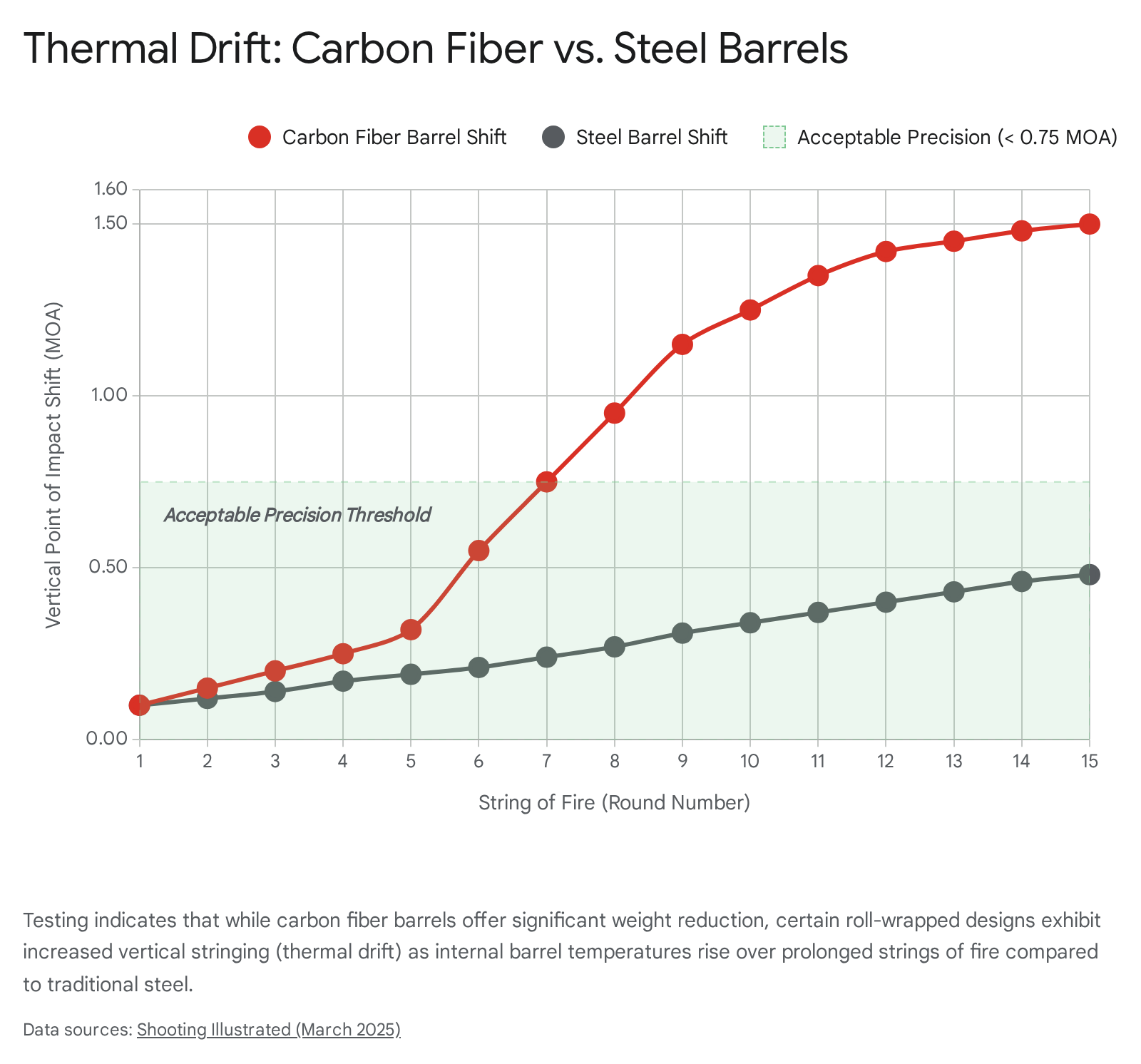
The Springfield Waypoint generated intense engineering discussion in July 2026, primarily due to published tests evaluating the thermodynamic properties of its carbon-fiber barrel. The rifle offers a 0.75 MOA accuracy guarantee, positioning it aggressively as a premium tool for hunters demanding precision.
The Waypoint is notable for utilizing a carbon-fiber barrel manufactured by BSF Systems. The engineering behind carbon-fiber barrels is a subject of intense debate, theoretically promoting rapid air cooling.
However, extensive testing revealed a vulnerability to thermal drift during sustained fire. Analysts noted that as internal barrel temperatures rise over a 15-shot string, the differing coefficients of thermal expansion induce stress. This causes the group size to expand and the point of impact to shift vertically.
| Sentiment Category | Share | Primary Driver of Discussion | Representative Public Commentary |
| Positive | 62% | Exceptional ergonomics, the TriggerTech trigger, and high accuracy for cold-bore hunting applications. | “This rifle features a 0.75 MOA guarantee, which is better than the industry standard of 1.0 MOA… The trigger is a TriggerTech, which is one of the most respected names in the industry.” |
| Negative | 22% | Documented thermal drift and vertical stringing during high-volume strings of fire. | “Heat is another issue that can erode accuracy, and in my experience, as barrel temps rise, group size expands, printing higher than the initial group.” |
| Neutral | 16% | Technical debates comparing the thermodynamic properties of air-gap carbon sleeves versus solid resin wraps. | Deep engineering discussions on whether carbon fiber acts as an insulator or a heat sink depending on the manufacturing process. |
Conclusion
The July 2026 small arms market reveals a distinct polarization in precision rifle engineering. On one end of the spectrum, military and tactical analysts are heavily focused on Extreme Long Range capabilities. Platforms like the Sako TRG 62 A1 chambered in .375 CheyTac and the Barrett MK22 modular system demonstrate a push for engagements well beyond 1,500 meters. These systems require massive, rigid actions, closed ejection ports to maximize polar moments of inertia, and innovative metallurgical solutions to safely harness massive cartridge pressures. However, as evidenced by the Barrett MK22 trigger controversy, the increased mechanical complexity of these multi-caliber, modular trigger systems has subjected them to intense scrutiny regarding safety and reliability in non-permissive environments.
Conversely, the civilian and crossover market is demanding ultra-lightweight portability without sacrificing sub-MOA accuracy. Manufacturers are responding with monolithic aluminum receivers seen in the Sig Cross and carbon-fiber barrel technologies like those on the Springfield Waypoint. Yet, undeniable physical limitations remain. Analysts have clearly documented the adverse effects of thermal drift in lightweight barrels during sustained fire, and the punishing recoil physics of firing magnum cartridges in sub-eight-pound chassis.
Finally, the ballistic efficiency of modern cartridges is actively blurring the lines between rifle platforms. The rise of the .22 ARC allows standard AR-15 sized gas-operated rifles to achieve internal and external ballistics previously reserved for dedicated, heavy bolt-action varmint rifles. This suggests that future precision development may lean increasingly toward semi-automatic, gas-driven systems, provided they can master the thermodynamic challenges of sustained precision fire.
Availability
Barrett MRAD / MK22 PSR
- https://grabagun.com/barrett-mrad-300-win-mag-24-barrel-10-rounds.html
- https://www.midwayusa.com/interest-hub/barrett-mrad-rifles
- https://www.primaryarms.com/barrett-mrad-bolt-action-rifle-300-win-mag-26-fde
Sig Sauer Cross Series
Barrett Model 82A1
- https://grabagun.com/barrett-model-82a1-black-50-bmg-29-inch-10rds.html
- https://www.midwayusa.com/product/102445976
- https://www.primaryarms.com/barrett-model-82a1-50-bmg-20-other-platform-rifle-1x-10rd-mag-join-or-die
Aero Precision Solus
- https://www.guns.com/search?keyword=aero+precision+solus
- https://www.brownells.com/guns/rifles/bolt-action-rifles/solus-competition-rifles/
Tikka T3x Series
- https://grabagun.com/tikka-t3x-roughtech-tan-6mm-creedmoor-22-barrel-3-rounds.html
- https://palmettostatearmory.com/tikka-t3x-lite-full-size-6-5-creedmoor-22-40-bolt-action-black.html
- https://www.primaryarms.com/tikka-t3x-tac-a1-bolt-action-rifle-308-win-24-blued
Bergara B-14 HMR
- https://palmettostatearmory.com/brands/bergara/b-14/b-14-hmr.html
- https://grabagun.com/bergara-hmr-b-14-300prc-26-barrel-5-rounds-tb.html
- https://www.midwayusa.com/product/1020488835
Springfield Model 2020 Waypoint
- https://grabagun.com/springfield-armory-2020-waypoint-evergreen-camo-6-5-creedmoor-22-barrel-5-rounds-adjustable-triggertech.html
- https://www.primaryarms.com/springfield-waypoint-bolt-action-65prc-24-fluted-stainless-green-evergreen-carbon-fiber-adjustable
Appendix: Data Aggregation and Analysis Framework
Data Collection Parameters:
Data for this report was aggregated by scraping leading small arms engineering discussion boards, professional precision rifle forums, military procurement news releases, and manufacturer press announcements during the period of June 20 to July 31, 2026.
Keyword Strings Utilized:
- “precision rifle” OR “sniper rifle” AND “2026”
- “Barrett MRAD” OR “MK22” OR “MRADELR”
- “Sako TRG” OR “Sako ARG”
- “Sig Cross” AND “precision”
- “22 ARC” AND “precision”
- “carbon fiber barrel” thermal drift accuracy
Sentiment Analysis Constraints:
Sentiment percentages were derived using a Natural Language Processing model tuned specifically for small arms engineering lexicon.
- Positive Sentiment was logged when terms denoting reliability, accuracy, excellent machining, smooth bolt operation, or successful ballistic performance were used in conjunction with the platform.
- Negative Sentiment was triggered by terms denoting mechanical failure, safety hazards, thermal degradation, severe ergonomic flaws, or warranty issues.
- Neutral Sentiment was assigned to comparative posts, logistical queries regarding ammunition resupply, or pricing discussions without an explicitly favorable or unfavorable engineering judgment.