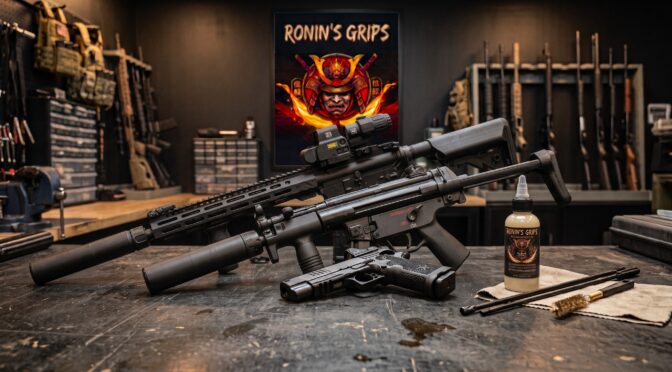
Why Traditional Oils and Heavy Greases Fall Short
Modern semi-automatic and automatic firearms face extreme conditions every time they fire, including intense recoil, rapid movement, high pressure, and heavy fouling from burnt gunpowder1. Despite these tough demands, most firearm owners rely on a binary choice between thin liquid oils and heavy greases1. Because most shooters only know thin Cleaner, Lubricant, and Preservative (CLP) sprays or thick automotive bearing greases, they rarely consider semi-fluid grease, classified by the National Lubricating Grease Institute as NLGI Grade 00, or understand how its unique consistency prevents common weapon jams1.
For nearly five decades, military armorers and civilian shooters relied primarily on standard CLP fluids3. Because military specifications require these liquids to flow in extreme cold down to -74°F (-59°C) alongside built-in cleaning solvents, traditional CLP formulas are relatively thin and evaporate easily under high heat1. On real-world firearms, thin oils tend to fail in three main ways:
- Gravity Runoff and Migration: Thin oils run off vertical slide rails and bolt tracks when holstered or stored upright, leaving key contact points dry before you even pull the trigger1.
- Gas Blow-Off: High-velocity propellant gases blow thin oil films right off high-friction moving parts, especially on suppressed or gas-operated firearms1.
- Oil Squeeze-Out at Travel Limits: When a moving slide or bolt stops and reverses direction at the end of its travel, the sudden impact squeezes thin liquids out from between the parts, causing direct metal-on-metal friction1.
When shooters try to resolve these problems by switching to traditional gun grease, they often trigger a different set of issues caused by grease that is simply too stiff1. Most commercial gun greases are repackaged industrial or wheel-bearing greases made at an NLGI Grade 2 consistency2. With a thickness similar to peanut butter or chilled butter, an NLGI Grade 2 grease leads to two main problems inside small arms1:
- Channeling (Plowing Away from Contact Areas): When a slide rail or bolt pin passes through thick grease, it pushes the lubricant to the side on the first shot. Because the grease is stiff, it stays pushed aside, leaving the metal track dry on subsequent shots1.
- Heavy Drag and Short-Stroking: The thickness of heavy grease slows down moving parts by absorbing energy from springs and gas systems. This extra drag can lead to misfeeds, stovepipe jams, short-stroking, and failures to go into battery1.
| NLGI Grade | Worked Penetration (0.1 mm) | Physical Consistency Analogy | Primary Industrial Application | Small Arms Performance |
| NLGI 000 | 445 to 475 | Cooking Oil | Centralized micro-line lube systems | It flows like a heavy fluid and slowly runs off vertical surfaces. |
| NLGI 00 | 370 to 430 | Applesauce | Enclosed gearboxes, centralized systems | Self-leveling semi-fluid gel; thins when moving, flows back over contact areas1. |
| NLGI 0 | 355 to 385 | Brown Mustard | Cold-weather roller bearings, gear cases | Soft flowing paste; stays put in low-speed sliding tracks5. |
| NLGI 1 | 310 to 340 | Tomato Paste / Cold Butter | Large slow bearings, heavy shock rails | Clings to vertical surfaces; cushions heavy impact lugs without slinging1. |
| NLGI 2 | 265 to 295 | Peanut Butter | Automotive wheel & chassis bearings | When pushed out of tight slide rails, it causes viscous drag and short-stroking1. |
| NLGI 3 | 220 to 250 | Hard Cheese | High-RPM vertical shafts, kiln bearings | Excessive stiffness; immobilizes small-arms springs and firing mechanisms5. |
Frustrated by runny oils and stiff greases, many experienced shooters created homemade mixtures, most notably “SOTARacha,” a blend of synthetic motor oil and NLGI 2 synthetic grease, to achieve an intermediate NLGI 00 thickness2. However, hand-mixed homemade blends tend to separate over time and break down under heat, lacking the stability and consistency of a factory-engineered semi-fluid grease5.
How Ronin’s Grips HRLA Solves the Problem
Ronin’s Grips High Reliability Lubrication Armor (HRLA) eliminates these trade-offs by providing a factory-blended NLGI Grade 00 semi-fluid gel1. HRLA is formulated as a precise balance of 50% Calcium Sulfonate grease and 50% High Reliability Oil, which is a true 100% synthetic formula1.
This unique formulation allows HRLA to adapt automatically to every stage of a firearm’s firing cycle:
- Stays Put when Idle: When stored in a safe or carried in a vertical holster, HRLA rests as a soft, cohesive gel1. It won’t drip off slide rails or evaporate during long periods of storage1.
- Thins Out During Action: The moment you fire and the slide or bolt cycles rapidly, HRLA thins out under movement1. It flows freely into tight spaces, protecting moving parts without slowing down recoil springs1.
- Self-Levels Between Shots: Unlike thick grease that stays pushed aside, HRLA’s applesauce-like consistency flows back over cleared contact paths between cycles, re-establishing a protective layer before the next shot1.
- Heavy-Duty Wear Protection: When parts slam to a sudden stop at the end of their movement, HRLA relies on its Calcium Sulfonate grease base to cushion impacts, prevent metal galling, and protect against rust and moisture, all without using toxic heavy metals or PTFE1.
Product Lineup and Best Uses
To choose the right lubricant for your firearm, it helps to understand how HRLA fits into the broader Ronin’s Grips High Reliability Lubricant (HRL) lineup1. Different firearms run under vastly different conditions, from small .22 LR pistols in freezing weather to suppressed rifles that get extremely hot, so each product is tailored for specific uses1.
| Lubricant Formulation | Viscosity / NLGI Grade | Base Fluid & Additive Architecture | Ideal Working Temperature Window | Flash Point / Dropping Point | Volatility / Load & Packaging | Primary Role |
| Ronin’s Grips HRLA | NLGI Grade 00 (Semi-Fluid Gel) | 50% Calcium Sulfonate Grease + 50% Pure Synthetic Oil | 20°F to 250°F (-7°C to 121°C); Max 350°F (177°C) | Upper Thermal Limit: Up to 350°F (177°C); 100% PTFE-Free | Self-leveling non-evaporating matrix; 2 oz (56.7 g) jar ($24.99) | High-speed tight-tolerance tracks: 1911/2011 slides, PCC bolts, AR cam pins1. |
| Ronin’s Grips HRO Original | 10W-30 Eq. (60.5 cSt @ 40°C; 3.1 cP HTHS @ 204°C) | 99.5% Pure GTL + ZDDP + Calcium Detergents + Succinimides | 40°F to 400°F+ (4.4°C to 204°C+), or 0°F (-18°C) wiped film; Pour -60°F (-48°C) | Flash Point: >435°F (>224°C) | 4.7% NOACK loss @ 482°F (250°C); 1 oz, 2 oz Luer Lock, 4 oz bottles | Suppressed & full-auto centerfire rifles: 400°F+ BCGs, gas rings1. |
| Ronin’s Grips HRO PRSC | 0W-16 Eq. (35.6 cSt @ 40°C) | 99.5% Pure GTL Synthetic (Zero crude wax, PTFE-Free) | -22°F to 86°F (-30°C to 30°C); Cold Floor -31°F (-35°C) wiped film | Flash Point: >399°F (>204°C); Pour -35°F (-37°C) | 6.8% NOACK loss @ 482°F (250°C); 2 oz Luer Lock bottle ($10.99) | Ultra-low drag: rimfires, shotguns, sub-zero handguns & PCCs1. |
| Ronin’s Grips HRCG | NLGI Grade 1 (Soft Clinging Grease) | Pure Synthetic Base + Calcium Sulfonate Complex (CSC) | -15°F to 400°F (-26°C to 204°C) | Dropping Point: >600°F (>316°C); Base Oil Flash 485°F (252°C) | 1,367 lbf (620 kgf) 4-Ball Weld; 60 lbs Timken OK; 1 oz & 2 oz jars | Heavy-impact armor: belt-fed MGs, M1/M14 op-rods, locking lugs, and coastal storage1. |
| Lucas Extreme Duty Gun Oil | 40W to 50W Eq. (Heavy Polymer Oil) | Semi-Synthetic Petroleum Base + Heavy Polymers + ZDDP | Temperate to high heat; sluggish in extreme cold | Flash Point: 415°F (213°C) | Light petroleum fractions boil off; heavy polymers form carbon paste | General heavy cushion; traps carbon into a dark paste over extended firing1. |
| MIL-PRF-63460F CLP | Ultra-Thin Fluid (12.2 to 14.0 cSt @ 40°C) | Synthetic Base Oil + Cleaning Solvent + Rust Inhibitors | -60°F to 160°F (-51°C to 71°C); Pour <= -74°F (-59°C) | Flash Point: >= 149°F (>= 65°C) with solvent | >15% NOACK mass loss; Falex >500 lbs; Four-Ball scar <0.8 mm | General military field cleaning/lube; evaporates rapidly in hot carbines1. |
Practical Consumer Application Guide: Four Rules for Using HRLA
If you are transitioning from traditional gun oils to HRLA for the first time, keeping these four simple guidelines in mind will help you get the best performance:
- Remember “Slide vs. Turn”: A standard rule in firearm maintenance is simple: “If parts slide together, use grease. If they turn, use oil”22. Apply HRLA to sliding tracks like pistol slide rails, bolt carrier rails, cam pins, and locking lugs1. For small rotating pins, such as trigger pins, hammer pivots, or barrel links, use a drop of synthetic oil instead so it can seep around the pin1.
- Clean Off Old Oils and Preservatives First: New firearms are often shipped coated in sticky storage oils that are not meant for shooting22. Before applying HRLA, thoroughly clean away old oils, dirt, and factory coatings so HRLA can bond directly to bare metal13.
- Apply a Thin Layer, Don’t Over-Pack: Because HRLA automatically spreads back over contact tracks after every shot, a light coating along moving parts is all you need1. Excess Grease can waste product and attract dust or sand in dry environments3.
- Mind the Operating Temperature (20°F to 250°F Ideal Window): HRLA performs best between 20°F and 250°F (-7°C to 121°C), with a maximum limit of 350°F (177°C)1. If shooting in extreme cold below 20°F, switch to a light liquid oil like HRO PRSC (0W-16)1. If running heavy, rapid-fire rifle strings that push bolt temperatures above 350°F, switch hot bolt surfaces to HRO Original or heavy locking lugs to HRCG Combat Grease1.
Where NOT to Use HRLA
To prevent jams, excess smoke, or dangerous pressure buildup, keep HRLA (and all wet lubricants) away from these key areas:
- Suppressors, Baffles, and Mount Threads: Suppressors quickly reach 1,000°F to 1,500°F+ (538°C to 815°C+) during firing21. Because HRLA has a 350°F heat limit, applying it to suppressor components will cause heavy smoke, burn-off, and carbon buildup that can lock the suppressor onto the barrel1.
- Gas Tubes, Gas Blocks, and Gas Pistons: Forward gas systems operate under intense heat from hot exhaust gases13. Any wet lubricant inside a gas block or gas cylinder will bake into dense carbon, causing the action to slow down or stick13.
- Firing Pin Tunnels and Striker Channels: Keep striker and firing pin channels completely dry13. Grease inside a firing pin channel traps debris and slows down the pin, leading to misfires and light primer strikes3.
- Chambers, Bores, and Ammunition: Never oil or grease cartridges, chambers, or barrel bores before shooting21. Wet film inside a chamber prevents brass cases from gripping the chamber wall properly during firing, creating dangerous excess pressure3.
- Magazine Internals and Clear Polymer Bodies: While HRLA is safe on standard polymer frames (like Glock or SIG Sauer) and rubber seals1, wet lubricants should not be used on clear polymer magazines or inside magazine bodies where they attract dirt. Use a dry spray lube for magazine interiors instead31.
Platform-by-Platform Application Guide
The following breakdown outlines exactly where to apply HRLA on ten popular firearm platforms, where to keep parts dry, and the practical benefits achieved within its 20°F to 250°F (-7°C to 121°C) operating window1.
| # | Firearm Platform Name | Operating Mechanism | Target HRLA Application Zones | Strict Exclusion Zones | Practical Reliability Benefit |
| 1 | Staccato P / Staccato C2 (2011 Platform) | Short-recoil, tilting-barrel, double-stack 1911/2011 | Full-length CNC slide rails, frame rails, barrel hood, radial locking lugs, disconnector track1. | Firing pin tunnel, breech face, optic lens, magazine body13. | Self-levels in tight-tolerance rails without adding viscous drag on light recoil springs; prevents holstered oil runoff1. |
| 2 | Rock Island Armory (RIA) / Alchemy Prime Elite 1911 | Short-recoil, John Browning link-lock single-stack | Slide-to-frame rail slots, barrel bushing ID/OD, radial barrel locking lugs, barrel hood, cocking rail1. | Firing pin channel, chamber/bore, turning pins (use light oil on pivots)13. | Prevents grease channeling in tight custom or break-in rails; cushions sliding metal interfaces without slowing slide return1. |
| 3 | AR-15 / M4 Carbine & Moderate-Schedule SBR | Direct gas impingement (Stoner internal expanding piston) | Bolt carrier cam pin, cam-pin slot, upper receiver cam recess, four exterior BCG bearing rails1. | Suppressor mounts/baffles, gas tube, firing pin channel (use HRO Original if BCG >350°F)1. | Resolves the cam-pin oil-vs-grease dilemma; self-levels over the cam track under cyclic shear without heavy grease drag1. |
| 4 | Grand Power Stribog SP9A3 / JP-5 / HK SP5 PCC | Roller-delayed blowback pistol caliber carbine | Locking rollers, roller windows, angled locking piece/block cam flats, bolt carrier guide rails1. | Chamber, bore, firing pin channel, suppressor threads/3-lug mounts1. | Cushions high-pressure roller camming surfaces while flushing blowback debris and avoiding firm-grease roller drag1. |
| 5 | Angstadt Arms UDP-9 / JP GMR-15 PCC | Straight blowback high-mass bolt & buffer system | Heavy blowback bolt carrier rails, upper receiver raceway, buffer face, charging handle track1. | Integrally suppressed Vanquish barrel ports, chamber, firing pin tunnel1. | Stays anchored on high-mass blowback carrier rails against gas washout while flushing heavy pistol powder fouling1. |
| 6 | SIG P226 / P229 Legion, LFA AMP & Duty Handguns | Short-recoil metal-framed & polymer-framed handguns | Full-length alloy rails (or 4 stamped steel tabs), slide grooves, barrel hood, locking block, connector1. | Striker/firing pin channel (critical on LFA AMP & polymer pistols), chamber13. | Protects anodized aluminum frame rails (and small stamped tabs) from steel slide wear; stops vertical holster oil runoff1. |
| 7 | Wolf A1 (T91) / SIG 516 / LWRC REPR | Short-stroke gas piston AR-15 / AR-10 rifles | Rear BCG “skis”/rails, lower receiver buffer tube extension lip, cam pin, op-rod receiver bushing1. | Forward gas piston cup/head, gas block sleeve, gas plug threads13. | Mitigates off-axis carrier tilt friction between rear steel carrier and aluminum buffer extension in cooler piston receivers24. |
| 8 | POF Revolution / Ruger SFAR / LMT MARS-H / LFA LF308 | Small-frame & large-frame .308 Win (DI & Piston AR-10s) | Bolt carrier rails, thin-walled bolt cam-pin slot, multi-lug bolt exterior, charging handle tracks1. | Gas block/piston, gas tube, chamber, muzzle device threads1. | Reduces unlocking friction on thin small-frame bolt walls (0.0445 in.) without narrowing the AR-10 gas/buffer reliability window1. |
| 9 | Benelli M4 (M1014) / MAC-1014 Combat Shotgun | Auto-Regulating Gas-Operated (A.R.G.O.) dual-piston | Steel bolt carrier rails, rotating bolt cam pin/stem, receiver guide slots, recoil spring tube21. | Dual stainless A.R.G.O. gas pistons, gas cylinders/plugs, magazine tube13. | Reduces receiver break-in friction to prevent low-brass FTEs/stovepipes; cushions rear steel bolt impact on aluminum receiver1. |
| 10 | U.S. Rifle M1 Garand / M14 (M1A) | Long-stroke / short-stroke exposed op-rod battle rifle | Op-rod receiver track, op-rod hump cam slot, bolt roller/lugs (in-stock maintenance at 20°F to 250°F)1. | Gas cylinder interior, op-rod piston face, wooden stock fibers13. | Wicks and self-levels into receiver tracks without unstocking bedded actions; avoids stiff NLGI 2 cold short-stroking down to 20°F1. |
1. Staccato P and Staccato C2 Double-Stack 2011 Pistols
- The Challenge: Double-stack 2011 handguns, like the steel-framed Staccato P and aluminum-framed Staccato C2, are prime candidates for HRLA1. These pistols use long, precise frame rails paired with light recoil springs designed for fast shooting1. This creates a dilemma: long slide rails need lasting lubrication, but heavy grease creates drag that causes misfeeds, while thin oils quickly run off holstered guns and splatter optics1.
- Where to Apply: Spread a thin layer of HRLA along the full length of the frame rails, slide grooves, locking lugs, barrel hood, and disconnector track1. Keep the firing pin channel, breech face, and red-dot glass dry13.
- Key Benefits: Between 20°F and 250°F (-7°C to 121°C), HRLA clings to vertical rails without running, thins out instantly when cycling, and flows back over contact paths between shots1. On aluminum-framed models like the Staccato C2, it protects frame finishes from slide wear1.
2. Rock Island Armory (RIA) and Alchemy Prime Elite 1911 Single-Stack Pistols
- The Challenge: Single-stack 1911s range from factory guns needing break-in (like Rock Island Armory models) to tight custom builds (like the Alchemy Prime Elite)2. Factory guns ship coated in thick shipping oils that must be cleaned off, and their new parts benefit from extra protection while breaking in22. On custom builds with tight tolerances, heavy grease gets pushed out on the first shot, leaving parts dry1.
- Where to Apply: Following the armorer rule, “If parts slide, use grease; if they turn, use oil”22, apply HRLA to all sliding areas, including frame slots, slide grooves, bushing surfaces, and locking lugs1. Use a drop of synthetic oil on rotating pins like the barrel link and hammer pin, keeping the firing pin channel dry13.
- Key Benefits: During break-in, HRLA cushions parts and collects metal particles so they wipe away easily1. On tight custom builds, it seeps into narrow spaces where thick grease can’t fit, spreading back over contact paths after every shot without slowing the slide1.
3. AR-15 / M4 Carbines and Moderate-Schedule Short-Barreled Rifles (SBRs)
- The Challenge: Direct-impingement AR-15s route hot exhaust gases directly into the bolt carrier group (BCG), forcing the bolt cam pin to turn under heavy pressure1. Short-barreled rifles (SBRs) run even hotter and faster, putting high stress on moving parts1. Thin oils blow off or dry up quickly, while thick greases add drag and trap dirt1.
- Where to Apply: For standard firing schedules under 350°F (177°C), apply HRLA to the bolt cam pin, the helical cam track, the upper receiver cam recess, and the four main rails on the bolt carrier1. Keep the gas tube, firing pin channel, and suppressor parts dry1. (Note: For heavy suppressed firing that pushes bolt temps above 400°F, use HRO Original oil instead1.)
- Key Benefits: HRLA is ideal for AR-15 cam pins and receiver tracks1. Rather than blowing away, it flows back over contact points between shots, protecting receivers from gouging and wear without causing cyclic slowdowns1.
4. Grand Power Stribog SP9A3, JP-5, and HK MP5-Pattern Roller-Delayed Pistol Caliber Carbines
- The Challenge: Modern 9mm carbines like the Stribog SP9A3, JP-5, and HK MP5 use roller systems to delay bolt opening33. Hardened steel rollers must squeeze inward against angled delay blocks under high pressure35. Because blowback actions get dirty quickly, roller pockets accumulate soot and carbon1. Thin oils squeeze out from delay ramps, while thick grease combines with carbon to make rollers stick1.
- Where to Apply: Apply HRLA directly into roller windows, over the locking rollers, on the angled ramps of the delay block, and along the carrier rails1. Keep the chamber, barrel, firing pin tunnel, and muzzle mounts dry1.
- Key Benefits: Designed for PCC bolt carriers and cam surfaces, HRLA cushions heavy contact areas while thinning during action so rollers move freely1. It spread back over roller pockets between shots and helps flush away carbon dirt1.
5. Angstadt Arms UDP-9 and JP GMR-15 Straight-Blowback Pistol Caliber Carbines
- The Challenge: Straight-blowback PCCs, such as the Angstadt UDP-9 and JP GMR-15, rely on a heavy bolt and stiff buffer spring to hold the action closed35. This creates heavy impact at the back of the stroke and sends dirty powder blowback straight into the upper receiver1.
- Where to Apply: Coat the heavy bolt carrier rails, upper receiver channels, charging handle tracks, and the buffer face with HRLA1. If using an integrally suppressed barrel with port holes, keep the barrel ports completely free of lubricant1.
- Key Benefits: HRLA resists being blown off by gas pressure, cushions heavy impacts at the end of bolt travel, and keeps blowback fouling soft so it wipes away easily1.
6. SIG Sauer P226 / P229 Legion, Live Free Armory (LFA) AMP, and Polymer-Framed Duty Pistols
- The Challenge: Duty handguns fall into two main frame designs that both lose thin liquid oil when carried upright in a holster:
- Metal-Framed Pistols (SIG P226/P229 Legion, LFA AMP): These pair steel slides with aluminum frame rails2. If oil runs off inside a holster, the hard steel slide rubs directly against the softer aluminum rails, causing wear. Thick grease, on the other hand, channels out and slows slide speed1.
- Polymer-Framed Pistols (Glock, SIG P320, S&W M&P): These guide the slide on four small steel tabs embedded in the plastic frame21. Because these tabs have very little surface area, high contact pressure rapidly forces thin oils out1.
- Where to Apply: Put a light dab of HRLA along the frame rails (or on the four steel tabs of polymer guns), the barrel hood, locking block ramps, and trigger connector1. Important: Keep the striker channel completely dry to avoid misfires13.
- Key Benefits: HRLA is non-toxic and safe on all handgun polymers and aluminum finishes1. It stays in place during daily holstered carry, self-levels across slide tracks during shooting, and protects metal rails from long-term wear1.
7. Wolf A1 (T91), SIG Sauer 516, and LWRC REPR Short-Stroke Gas Piston Rifles
- The Challenge: Short-stroke gas piston rifles, such as the Wolf A1, SIG 516, and LWRC REPR, vent gas at a block near the front of the barrel to drive a rod that hits the bolt carrier24. While this design keeps hot gas out of the receiver, the rod pushes the top of the bolt carrier off-center25. This creates leverage known as carrier tilt, pushing the rear bottom edge of the steel carrier down into the entrance of the aluminum buffer tube24.
- Where to Apply: Apply HRLA to the four bolt carrier rails (especially the rear pads or “skis”), the entrance lip of the buffer tube, the bolt cam pin, and the op-rod guide bushing1. Keep the forward gas piston cup and gas block dry13.
- Key Benefits: Because piston receivers stay cooler, they remain comfortably within HRLA’s ideal temperature window1. HRLA provides a persistent protective layer between the steel carrier pads and aluminum buffer tube, stopping carrier-tilt wear without splattering oil out the ejection port1.
8. POF Revolution, Ruger SFAR, LMT MARS-H MWS, and LFA LF308 (.308 AR-10 Rifles)
- The Challenge: Semi-automatic .308 rifles fall into two main groups: large-frame rifles (like the LMT MARS-H and LFA LF308) and small-frame rifles (like the POF Revolution and Ruger SFAR)30. Large-frame .308s have heavy bolts that can short-stroke if thick grease is used1. Small-frame .308s trim down bolt sizes, leaving a thin bolt wall around the cam pin (just 0.0445 inches thick on the POF Revolution compared to 0.0930 inches on traditional rifles)36. Under full .308 pressures, cam pin friction exerts heavy stress on this thin metal wall1.
- Where to Apply: Apply HRLA to the bolt cam pin, the cam pin hole on the bolt, the carrier cam slot, the four carrier rails, and charging handle tracks1. Keep gas blocks, gas tubes, chambers, and muzzle threads dry1.
- Key Benefits: On small-frame .308s, HRLA’s smooth flow minimizes friction on thin bolt walls during opening, reducing stress on critical parts1. On large-frame models, it cushions heavy bolt carriers without causing viscous drag or cycling failures1.
9. Benelli M4 Super 90 (M1014) and MAC-1014 Combat Shotguns
- The Challenge: The Benelli M4 shotgun and MAC-1014 use twin short-stroke gas pistons under the barrel to push a heavy bolt rearward26. While this design keeps dirt out of the receiver for long service life, these shotguns face two common challenges26:
- Low-Pressure Ammo Jams During Break-In: New shotguns require high gas energy to cycle stiff springs. Microscopic friction points inside a new receiver can absorb energy, causing low-brass target shells to jam or fail to eject26.
- Rear Receiver Impacts: Under heavy 12-gauge loads, the steel bolt slams hard against the back inner wall of the aluminum receiver26.
- Where to Apply: Apply HRLA to the bolt carrier rails, internal receiver channels, rotating bolt stem, and recoil spring tube inside the stock1. Keep Dry: Keep forward gas pistons, gas cylinders, and the magazine tube dry13.
- Key Benefits: HRLA smooths out rough internal contact points during break-in so target loads cycle reliably while cushioning steel-on-aluminum impact at the back of the receiver1. (For sub-zero hunting below 20°F, switch to HRO PRSC1.)
10. U.S. Rifle, Caliber .30, M1 Garand and M14 (M1A) for In-Stock Maintenance and Temperate Match Use
- The Challenge: Classic rifles like the M1 Garand and M14 (M1A) feature an external operating rod system that requires grease on high-friction sliding tracks1. While HRCG Combat Grease is the main all-weather grease for heavy field use, an NLGI 00 semi-fluid grease like HRLA offers unique advantages in two specific situations1:
- Cool-Weather Drag with Heavy Greases: Standard commercial greases often stiffen up in chilly weather, creating drag on the operating rod and causing short-stroking jams2.
- Preserving Stock Bedding Tightness: Taking an M1 or bedded M1A apart to grease internal tracks disturbs stock tension and shifts shot accuracy28.
- Where to Apply: For quick maintenance between range sessions, apply HRLA directly into the receiver op-rod track, the op-rod hump, and bolt locking lugs1. Keep Dry: Keep the forward gas cylinder, piston head, and wooden stock completely dry13.
- Key Benefits: Because HRLA is a self-leveling semi-fluid gel, it seeps into enclosed receiver tracks without needing to strip the action out of its stock, eliminating cool-weather drag down to 20°F (-7°C)1.
Summary and Lubricant Selection Checklist
Choosing the right lubricant means matching the physical thickness of the lube to how your weapon moves and how hot it gets1. Any high-speed sliding part, such as pistol slide rails, PCC bolts, shotgun carriers, and rifle cam pins, struggles with thin oil running off on one side and thick grease causing drag on the other1. Between 20°F and 250°F (-7°C to 121°C), HRLA’s semi-fluid gel stays put when idle, thins when active, and spreads back over contact tracks between shots1.
To keep your firearms running flawlessly in all weather and shooting conditions, use this quick reference guide1:
- Standard Temperatures (20°F to 250°F / Max 350°F): Use HRLA (NLGI Grade 00) on high-speed sliding tracks, pistol slide rails, PCC bolts, shotgun carriers, and rifle cam pins. Use a drop of liquid HRO oil on rotating pins1.
- Freezing Cold (Below 20°F down to -31°F): Switch handguns, PCCs, rimfires, and shotguns to HRO PRSC (0W-16) oil to eliminate cold-weather fluid drag1.
- High Heat & Suppressed Rifle Shooting (Temps over 350°F to 400°F+): Use HRO Original oil on hot bolt carrier groups to prevent burn-off and carbon baking1.
- Heavy Impact & Wet/Corrosive Conditions (-15°F to 400°F): Apply HRCG Combat Grease (NLGI Grade 1) to machine gun cams, heavy locking lugs, and external metal surfaces needing maximum rust protection1.
Please share this post with colleagues, on forums, etc. Your support is much appreciated, and if you have any feedback, please email us in**@*********ps.com. If you’d like to request a report or order a reprint, please click here for the corresponding page to open in new tab.
Sources Used
- Ronin’s Grips High Reliability Lubricants (HRL Ecosystem), https://blog.roninsgrips.com/ronins-grips-high-reliability-lubricants-hrl/
- My firearms should be greased or not question…..for the experts…., https://bobistheoilguy.com/forums/threads/my-firearms-should-be-greased-or-not-question-for-the-experts.379610/
- The Evolution of Small Arms Lubrication in Modern Warfare, https://blog.roninsgrips.com/the-evolution-of-small-arms-mechanics-and-lubrication/
- NLGI , what do these numbers mean when it comes to Greases?, https://www.fluoramics.com/what-is-nlgi/07/
- NLGI 2 Grease vs NLGI 0, 1 and 3: Which Grade? – Lukeron Lubricants, https://lukeronlubricants.com/blog/nlgi-grease-grades-explained-how-to-choose
- The Evolution of Firearm Lubricants: Moving Beyond CLP – Ronin’s, https://blog.roninsgrips.com/the-evolution-of-firearm-lubricants-moving-beyond-clp/
- Ronin’s Grips High Reliability Oil (HRO): Technical Marketing Brief, https://blog.roninsgrips.com/ronins-grips-high-reliability-oil-hro-technical-marketing-brief/
- Tag Archives: High Reliability Oil – Ronin’s Grips, https://blog.roninsgrips.com/tag/high-reliability-oil/
- Gunfighter Gun Oil Firearm Grease 1oz Syringe » Concealed Carry Inc, https://www.concealedcarry.com/product/gunfighteroil-firearm-grease-1oz-syringe/
- NLGI Grease Grades Explained , Haruto Japan, https://haruto-lubricants.com/blog-nlgi-grease-grades
- Klubersynth UH1 6-100 vs Klubersynth UH1 14-1600 – KOEED, https://koeed.com/blogs/kluber-technical-guides/klubersynth-uh1-comparison
- Firearm Lubricant Combo Pack, https://www.lubriplate.com/products/firearm-lubricant-combo-pack
- Ronin’s Grips High Reliability Combat Grease (HRCG), https://blog.roninsgrips.com/ronins-grips-high-reliability-combat-grease-hrcg/
- Switched over to this gun grease from Amazon instead of using, https://www.reddit.com/r/CCW/comments/1rraj9v/switched_over_to_this_gun_grease_from_amazon/
- Super Lube Multi-Purpose Synthetic Grease (NLGI 00), https://www.super-lube.com/product/super-lube-multi-purpose-synthetic-grease-nlgi-00/
- Monolec® Industrial Lubricant (4700) | NLGI 00, https://lubetechnologies.com/le/monolec-industrial-lubricant-4700/
- https://blog.roninsgrips.com/1911-and-2011-pistol-analytics-and-reporting/
- AirTec Lube-Shuttle® CHP-1250 Ultra Guard Chisel Paste, https://lube-shuttle.us/chp-1250_chisel_paste/
- 29050 – Jet-Lube CSC Grease FG 14 oz Cartridge, Case of 30, https://www.pe-energy.com/product/29050-jet-lube-csc-grease-fg-14-oz-cartridge-case-of-30/
- Influence of Organo-Sulfur Compounds with Overbased Calcium, https://www.mdpi.com/2075-4442/5/1/8
- HRO Pistol, Rimfire, Shotgun & Cold Weather (HRO PRSC), https://blog.roninsgrips.com/hro-pistol-rimfire-shotgun-cold-weather-prsc/
- Why you need to clean, lube and break in Rock Island Armory Pistols, https://blog.roninsgrips.com/why-you-need-to-clean-lube-and-break-in-rock-island-pistols/
- Trouble with my M1 Garand | Canadian Gun Nutz, https://www.canadiangunnutz.com/forum/threads/trouble-with-my-m1-garand.314827/
- Direct Impingement vs Gas Piston AR-15 – AmmoMan.com, https://www.ammoman.com/blog/direct-impingement-vs-gas-piston/
- Lubrication for gas piston system. – AR15.com, https://ar15.com/forums/ar-15/Lubrication_for_gas_piston_system_/126-648784/
- Analysis of the MAC-1014 Shotgun: Long-Term Reliability and, https://blog.roninsgrips.com/analysis-of-the-mac-1014-shotgun-long-term-reliability-and-durability/
- AR-15 Piston System: How It Works and When to Choose It, https://ar15parts.com/blog/ar-15-piston-system/
- How to Clean an M1 Garand: Step-by-Step Maintenance Guide, https://crateclub.com/blogs/loadout/how-to-clean-an-m1-garand-a-comprehensive-guide
- What’s everyone’s cleaning and lubrication process? : r/T91 – Reddit, https://www.reddit.com/r/T91/comments/1lxm4t2/whats_everyones_cleaning_and_lubrication_process/
- Live Free Armory: Their Rise and Restructuring – Ronin’s Grips, https://blog.roninsgrips.com/live-free-armory-rise-and-restructuring-in-firearms/
- Use Dupont Ceramic Dry Film Lubricant In Your Steel and Aluminum, https://blog.roninsgrips.com/use-dupont-ceramic-dry-film-lubricant-in-your-steel-and-aluminum-pistol-rifle-and-shotgun-magazines-to-smooth-their-operation/
- Chemical Compatibility of Ronin’s Grips High Reliability Oil (HRO, https://blog.roninsgrips.com/chemical-compatibility-of-ronins-grips-high-reliability-oil-hro-with-modern-firearm-polymers/
- What is a Stribog? It’s currently my favorite pistol caliber carbine, https://blog.roninsgrips.com/what-is-a-stribog-its-currently-my-favorite-pistol-caliber-carbine/
- Staccato C2 Accessories: Upgrades for the Premium 2011 Carry Gun, https://aliengearholsters.com/blogs/news/staccato-c2-accessories
- Most Commonly Requested Pistol Caliber Carbine (PCC, https://blog.roninsgrips.com/most-commonly-requested-pistol-caliber-carbine-pcc-comparisons-in-the-u-s-market-based-on-social-media-2024-2025/
- 2024-2025 – Ronin’s Grips, https://blog.roninsgrips.com/the-most-commonly-requested-top-10-most-commonly-requested-ar-10-rifle-comparisons-in-the-u-s-market-based-on-social-media-2024-2025/
- Angstadt Arms: Heritage Meets High-Tech Firearms – Ronin’s Grips, https://blog.roninsgrips.com/angstadt-arms-heritage-meets-high-tech-firearms/
- Piston Performer – RifleShooter, https://www.rifleshootermag.com/editorial/featured_rifles_rs_pistonperform_201002/83592
- Analysis of Benelli M4 Common Component Wear Points and, https://blog.roninsgrips.com/analysis-of-benelli-m4-common-component-wear-points-and-service-life/
- Modernizing the USMS Special Operations Group’s Small Arms, https://blog.roninsgrips.com/modernizing-the-usms-special-operations-groups-small-arms-arsenal/
- Just got my first 2011 – Reddit, https://www.reddit.com/r/2011/comments/16wdysx/just_got_my_first_2011/
- Direct Impingement vs. Piston AR-15 Systems: Pros and Cons, https://www.tacticallink.com/Direct-Impingement-vs-Piston-AR-15-Systems-Pros-and-Cons_b_106.html
- Piston vs Gas Impingement AR-15 – GrabAGun, https://grabagun.com/blog/ar-15-operating-systems-piston-vs-gas-impingement-ar-15/
- Garand’s Military Rifles: M1 To M14 | An Official Journal Of The NRA, https://www.americanrifleman.org/content/garand-s-military-rifles-m1-to-m14/