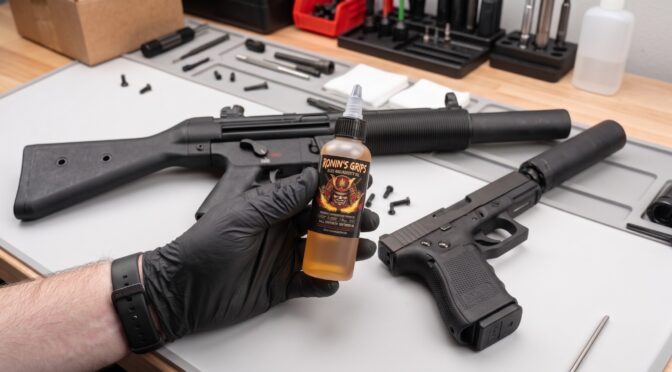
Introduction
Over the last decade, the world of small arms has changed significantly. With the rise of short-barreled rifles (SBRs), high-intensity training, and the common use of suppressors, firearms now face much higher levels of heat and pressure than they used to1. At the same time, manufacturers have moved away from all-steel designs toward polymer-based systems. Today, glass-reinforced nylon is the foundation for everything from modern handgun frames to rifle furniture4.
In these punishing environments, old-fashioned mineral oils and legacy military lubricants are struggling to keep up, often failing both chemically and mechanically1. This has led to the development of advanced lubricants like Ronin’s Grips High Reliability Oil (HRO), which uses ultra-pure Gas-to-Liquid (GTL) synthetic fluids designed for maximum protection1.
This report explores a critical question for modern shooters: Is HRO safe to use on polymer frames and receivers? By looking at the chemistry of these materials, we can confirm that HRO is exceptionally safe for structural polyamides (like PA66-GF30) and avoids the health and safety risks found in older lubricants.
1. The Challenges of Modern Suppression
To understand how a lubricant affects a polymer frame, we first have to look at the environment inside the gun. Using a suppressor keeps gas in the system longer, forcing superheated gases, carbon, and unburned powder back into the action2.
1.1 Extreme Heat and Stress
In a direct-impingement AR-15, this extra pressure makes the bolt carrier group move faster, increasing wear on parts like the cam pin3. Temperatures also skyrocket. A suppressed rifle can reach over 500°F during rapid fire, with the gases entering the action reaching even higher peaks1.
1.2 Why Traditional Oils Fail
Standard military-grade lubricants (CLPs) are often too thin for these conditions. They are designed to act like cleaners, which means they have low flash points—sometimes as low as 149°F2. When things get hot, these oils simply evaporate or break down.
This breakdown creates a “sludge” when mixed with carbon, which acts like sandpaper inside your gun1. Worse, as the oil disappears, more heat and vibration are transferred directly into the polymer frame, which can lead to cracks and mechanical failure over time.
2. The Science Behind Ronin’s Grips HRO
To ensure polymer safety, Ronin’s Grips HRO was built differently. Instead of using refined crude oil, it uses a synthetic Gas-to-Liquid (GTL) base equivalent to a 10W-30 oil1.
2.1 Pure Molecules for Better Performance
Standard oils are refined from crude oil, meaning their molecules are all different sizes and shapes1. They also contain impurities like sulfur and nitrogen that cause the oil to oxidize and break down when it gets hot1.
HRO uses a revolutionary GTL process that builds the oil from scratch using natural gas1. This creates a synthetic fluid that is 99.5% pure1.
Because these molecules are uniform in size, they act like millions of perfect ball bearings1. This reduces friction, stays on vertical surfaces better, and creates a stronger protective layer for your firearm’s parts1.
2.2 Rheological and Thermal Superiority Metrics
The absolute molecular uniformity of HRO gives it extraordinary thermal stability and shear resistance, which means it can protect nearby polymer structures from heat transfer. While conventional mineral-based CLPs experience massive evaporative loss under thermal stress, HRO’s precise engineering offers profound burn-off resistance.

| Technical Metric | Legacy Crude-Derived CLP (MIL-SPEC Base) | Ronin’s Grips HRO (GTL Synthetic Base) | Operational Impact |
| Base Fluid Purity | ~85% (Contains Aromatics, sulfur, and Nitrogen) | 99.5% (Pure Isoparaffin) | Eliminates chemical attack vectors on polymers; prevents sludge polymerization. |
| NOACK Volatility | > 15% Mass Loss | 4.7% Mass Loss | Ensures 95% of fluid remains on hot components, maintaining a thermal boundary. |
| Flash Point | 149°F (65°C) Minimum | >435°F (224°C) | Prevents instant vaporization and toxic aerosolization under suppressed fire. |
| Pour Point | Variable, sluggish due to crude wax | -60°F (-48°C) | Eliminates cold-weather failure-to-return-to-battery malfunctions. |
The difference is clear. When a gun gets hot, HRO’s low volatility ensures it stays liquid and keeps working, while its -60°F pour point means it won’t get sluggish in the cold1.
3. Understanding Firearm Polymers
To evaluate compatibility, we have to look at what modern firearms are actually made of. Manufacturers today use advanced composites designed to handle heavy recoil and high temperatures, not generic plastics6.
Most pistol frames and lower receivers—from Glocks to the FN 509/510 and Springfield Echelon—are made from Polyamide 66, or Nylon 664. To make it strong enough for a firearm, it is reinforced with glass fibers (PA66-GF30)10.
This material has a very high melting point and can handle environments well over 300°F without losing its strength. It is even used for rifle furniture, such as the polymer stocks on a Zastava M70 or durable AK-74 magazines7.
Is HRO safe for these frames? The answer is a scientifically backed yes. Its safety comes down to how its molecules interact with the polymer.
Nylon 66 is famous for resisting chemicals like oils and hydraulic fluids10. Since Ronin’s Grips HRO is an ultra-pure GTL synthetic, it contains no aggressive impurities like toluene or benzene often found in harsh cleaners1, 14. This means it won’t dissolve, swell, or weaken your firearm’s frame, even if it stays on the surface for a long time27.
| Polymer Substrate | GTL Isoparaffins (Ronin’s Grips HRO) | Aromatic Solvents (Aggressive CLPs/Bore Cleaners) | Mineral Oils (Crude-Derived) |
| PA66-GF30 (Standard Frames) | Excellent (Inert) – No swelling or structural degradation. | Fair to Good – General resistance, but susceptible to specific highly concentrated aromatics. | Good – Resists breakdown, but impurities may cause long-term staining. |
| Polycarbonate (Clear Magazines) | Good – Low solvency prevents rapid attack, though caution is advised with any surface-active fluid. | Severe Risk – High probability of inducing crazing and Environmental Stress Cracking (ESC). | Fair – Moderate risk depending on additive packages and impurities. |
| Elastomers (FKM / Viton O-Rings) | Excellent – Maintains dimensional stability when properly balanced with ester seal swell agents. | Severe Risk – Causes aggressive swelling, leading to seal shredding and binding. | Variable – Often causes unpredictable swelling or shrinkage based on sulfur/aromatic content. |
Whether you are using a Polymer80, a Glock, or an FN 510, HRO provides excellent protection without any risk of chemical damage1, 10.
HRO doesn’t just sit on the surface; it actively protects the polymer frame by managing heat and shock. Most polymer frames fail from physical stress long before they fail from chemical exposure.
Take the FN 510 in 10mm Auto. This powerful round creates huge pressure and slide velocity5, 8. That energy is transferred through the steel locking block into the polymer frame. If a thin oil evaporates, the metal runs dry, increasing friction and shock that can cause the frame to crack1.
HRO prevents this by creating a thick, clinging boundary layer that acts like a microscopic shock absorber1. It refuses to vaporize even under high heat, keeping the system lubricated and protecting your frame from the kinetic shock that leads to failure.
While HRO is safe for frames, we must be careful with clear or translucent magazines. These are often made of Polycarbonate (PC), which is more sensitive than the nylon used in frames16, 18.
Polycarbonate can suffer from “stress cracking” when exposed to certain fluids while under tension from a magazine spring19. Although HRO is much safer than aromatic solvents, as a general rule, you should avoid getting any liquid lubricant on clear magazines to prevent the risk of cracking over time.
HRO also includes advanced additives like ZDDP for extreme-pressure protection and cleansing agents to keep carbon from sticking1, 2. These stay dormant against polymer frames, only “activating” when they hit high-heat metal-on-metal areas where they are needed1, 34.

Finally, HRO is completely free of PTFE (Teflon)1. Older lubricants often used Teflon, but when it gets hot—as it does in suppressed firearms—it can break down into toxic gases40. By avoiding Teflon, HRO ensures a safer shooting experience for you and prevents corrosion inside your firearm1, 44.
Ronin’s Grips HRO is an advanced solution for modern shooters. It provides elite protection for metal parts while being completely safe for your polymer frame, helping your firearm last longer and run more reliably in any condition.
In conclusion, Ronin’s Grips HRO is a highly advanced tribological solution that matches the material parameters of modern polymer-framed firearms. By abandoning dirty crude-oil refining methodologies that introduce aggressive aromatic impurities, HRO delivers a bespoke, chemically inert, and thermally superior boundary layer that enhances both the reliability of the weapon and the structural longevity of its polymer substrates.
Please share the link on Facebook, Forums, with colleagues, etc. Your support is much appreciated and if you have any feedback, please email us in**@*********ps.com. If you’d like to request a report or order a reprint, please click here for the corresponding page to open in new tab.
Sources Used
- Ronin’s Grips High Reliability Oil (HRO): Technical Marketing Brief, https://blog.roninsgrips.com/ronins-grips-high-reliability-oil-hro-technical-marketing-brief/
- Revolutionizing Suppressed Firearm Lubrication with HRO – Ronin’s Grips, https://blog.roninsgrips.com/revolutionizing-suppressed-firearm-lubrication-with-hro/
- Comparing Firearm Lubricants: Ronin’s Grips HRO vs. Lucas Extreme Duty Gun Oil, https://blog.roninsgrips.com/comparing-firearm-lubricants-ronins-grips-hro-vs-lucas-extreme-duty-gun-oil/
- Removed
- FN 510 Series Technical Analysis and Market Evaluation Report – Ronin’s Grips, https://blog.roninsgrips.com/fn-510-series-technical-analysis-and-market-evaluation-report/
- Analysis of the Echelon: A Next-Gen Modular Pistol – Ronin’s Grips, https://blog.roninsgrips.com/analysis-of-the-springfield-armory-echelon-a-next-gen-modular-pistol/
- Looking at a ZPAP M70 With Polymer Furniture Out Of The Box – Ronin’s Grips, https://blog.roninsgrips.com/looking-at-a-zpap-m70-with-polymer-furniture-out-of-the-box/
- Revolutionizing Full Auto Machine Gun Lubrication with Ronin’s HRO, https://blog.roninsgrips.com/revolutionizing-full-auto-machine-gun-lubrication-with-ronins-hro/
- Unconventional base oils and their effects on the elastomer compatibility of lubricants, https://www.researchgate.net/publication/298221978_Unconventional_base_oils_and_their_effects_on_the_elastomer_compatibility_of_lubricants
- Nylon 66 Properties and Uses: A Technical Guide for Manufacturing Professionals, https://shanghaiyunshanplastics.goldsupplier.com/blog/37859.html
- Nylon Melting Point: Essential Guide for Manufacturers – Sales Plastics, https://salesplastics.com/nylon-melting-point/
- Types and Classification of Nylon – Hony Engineering Plastics Limited, https://www.honyplastic.com/news/types-and-classification-of-nylon-334244.html
- Glass filled polyamides (PA GF) – Ensinger, https://www.ensingerplastics.com/en-us/thermoplastic-materials/modified-plastics/glass-filled-polyamides
- Glass Fiber Carbon Fiber Nylon – Custom Plastic Manufacturing & Injection Molding, https://ru.nylonplastic.com/glass-fiber-vs-carbon-fiber-nylon-overview/
- Video: Forgotten Weapons Reviews Soviet AK Magazines – Ronin’s Grips, https://blog.roninsgrips.com/video-forgotten-weapons-reviews-soviet-ak-magazines/
- Several magazines cracked : r/Springfield_KUNA – Reddit, https://www.reddit.com/r/Springfield_KUNA/comments/1ruapyb/several_magazines_cracked/
- US10030923B1 – Ammunition magazine – Google Patents, https://patents.google.com/patent/US10030923B1/en
- Polycarbonate – Wikipedia, https://en.wikipedia.org/wiki/Polycarbonate
- Polycarbonate/Titania Composites Incorporating TiO2 with Different Nanoscale Morphologies for Enhanced Environmental Stress Cracking Resistance in Dioctyl Phthalate – PMC, https://pmc.ncbi.nlm.nih.gov/articles/PMC9460384/
- The degradation of mechanical properties in polymer nano-composites exposed to liquid media – a review – The Royal Society of Chemistry, https://pubs.rsc.org/en/content/articlehtml/2016/ra/c5ra22620a
- GLASS FILLED POLYAMIDE 66 – Inference Group, http://www.inference.org.uk/sustainable/LCA/elcd/external_docs/n66g_311147f9-fabd-11da-974d-0800200c9a66.pdf
- Nylon 66 vs PEI: Resistance to Organic Solvents – Patsnap Eureka, https://eureka.patsnap.com/report-comparative-analysis-of-nylon-66-and-pei-resistance-to-organic-solvents
- Polyamide (Nylon): Guide to PA6, PA66, PA11, PA12 Variants – SpecialChem, https://www.specialchem.com/plastics/guide/polyamide-pa-nylon
- Mineral, Silicone, Fluorinated Oils – Chemical Compatibility Chart, https://blog.darwin-microfluidics.com/mineral-silicone-fluorinated-oils-chemical-compatibility-chart/
- Nylon Chemical Compatibility: PA6, PA66, Oils & Solvents – 나일론 플라스틱, https://ko.nylonplastic.com/nylon-chemical-compatibility-chart-pa6-pa66-oils-fuels-solvents/
- GTL Isoparaffins – RenkertOil, https://renkertoil.com/products/gtl-oil-shell-isoparaffins/
- CA2993647A1 – Seal swell agents for lubricating compositions – Google Patents, https://patents.google.com/patent/CA2993647A1/en
- CN108026468B – Seal Swelling Agents for Lubricating Compositions – Google Patents, https://patents.google.com/patent/CN108026468B/en
- Elastomer O-Ring Seal Swell Measurements for Sustainable Aviation Fuel Material Compatibility – eCommons, https://ecommons.udayton.edu/cgi/viewcontent.cgi?article=1380&context=uhp_theses
- Chemical Compatibility Selection Guide- Material Selection, https://www.proautocon.com/media/download/Spartan_Scientific_Chemical_Compatibility_Chart.pdf
- DEVELOPMENT OF LUBRICATING OILS AND THEIR INFLUENCE ON THE SEALS, https://hrcak.srce.hr/file/188896
- Compatibility of Different Automotive Elastomers in Paraffinic Diesel Fuel – MDPI, https://www.mdpi.com/2076-3417/11/23/11312
- Why the Sig P211 Series Redefines Tactical and Competition 2011 Pistols – Ronin’s Grips, https://blog.roninsgrips.com/why-the-sig-p211seriies-redefines-tactical-and-competition-2011-pistols/
- (PDF) Applications of dry film lubricants for polymer gears – ResearchGate, https://www.researchgate.net/publication/256913559_Applications_of_dry_film_lubricants_for_polymer_gears
- Elastomer Fluid & Rubber Chemical Compatibility – Hallite Seals, https://hallite.com/us/knowledge-bank/fluid-compatibility-us/
- Elastomer compatibility in turbine engine oils – Shell Global, https://www.shell.com/business-customers/aviation/aeroshell/knowledge-centre/technical-talk/elastomer-compatibility.html
- Silmid – Elastomer Compatibility, https://www.silmid.com/Documents/SHELL_Aviation_TEO_Elastomer_Compatibility_Whitepaper.pdf
- Base Oil Groups I–V Explained — API 1509, PAO & Esters – Lubechem Consultant, https://lubechemconsultant.in/base-oil-groups-i-to-v/
- Synthetic Ester Base Oils – Zhengzhou Chorus Lubricant Additive Co., Ltd, https://www.cnlubricantadditive.com/synthetic-ester/
- Polytetrafluoroethylene (PTFE) – Wanplas, https://wanplas.com/industry-knowledge/plastic-materials/polytetrafluoroethylene-ptfe/
- Influence of heating temperature and time on mechanical-degradation, microstructures and corrosion performances of Teflon/granite coated aluminum alloys used for non-stick cookware – PMC, https://pmc.ncbi.nlm.nih.gov/articles/PMC11324993/
- PTFE-The Ultimate Guide for Beginner and Expert – Hansa, https://hansaplas.com/de/ptfe-the-ultimate-guide/
- Safety Assessment of Fluoropolymers as Used in Cosmetics, https://www.cir-safety.org/sites/default/files/fluoro032017slr.pdf
- Perfluoroelastomer and Fluoroelastomer Seals for Photovoltaic Cell Manufacturing Processes, https://daemar.com/wp-content/uploads/2019/05/Perfluoroelastomer-and-Fluoroelastomer-Seals-for-Photovoltaic-Cell-Manufacturing-Processes.pdf
- Fluorinated polymers in a low carbon, circular and toxic-free economy Technical report, https://www.eionet.europa.eu/etcs/etc-cm/products/etc-cme-and-etc-wmge-report-9-2021-fluorinated-polymers-in-a-low-carbon-circular-and-toxic-free-economy/@@download/file/EEA%20task%20on%20fluoropolymers_Full%20report_December%2014%202021%20(1).pdf
- Research and Regulatory Advancements on Remediation and Degradation of Fluorinated Polymer Compounds – MDPI, https://www.mdpi.com/2076-3417/10/19/6921