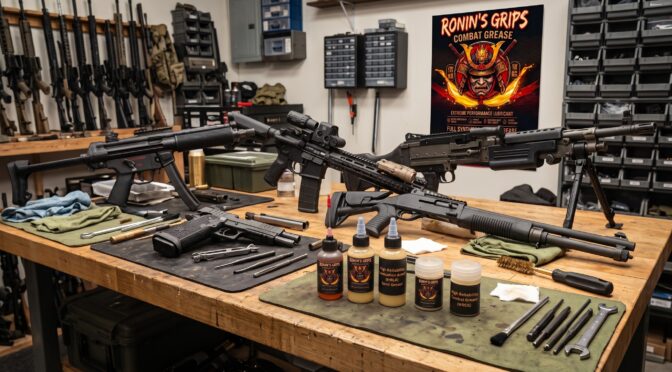
Executive Summary: A Purpose-Built Tribological System
Modern small arms operate under high thermal, pneumatic, and mechanical loads that make legacy military and commercial gun oils chemically outdated. The widespread adoption of sound suppressors, short-barreled rifles, select-fire mechanisms, high-volume training schedules, and tight-tolerance handguns has highlighted a key flaw in traditional “Clean, Lubricate, Protect” (CLP) fluids: a single petroleum-based liquid cannot effectively act as a cleaning solvent while also serving as a high-temperature, extreme-pressure lubricant.
To evaluate whether the Ronin’s Grips High Reliability Oil (HRO) and High Reliability Lubricant (HRL) Product Line solves these failures, this review synthesizes the perspectives of a multidisciplinary team:
- Firearms Engineer: Evaluates firearm operation, suppressed gas backpressure, bolt carrier group motion, lubrication at cycling travel limits, and platform-specific cycling mechanics.
- Lubrication Engineer (Tribologist): Examines synthetic base stock quality, fluid thickness across temperature changes, evaporation rates, protective film formation, particle suspension, and high-pressure grease formulations compared to traditional products.
- Product Marketing Specialist: Analyzes research background, product launch strategy, bottle design, cost per fluid ounce and milliliter or gram, and overall value for shooters.
Rather than repackaging standard mineral oils or unproven additives, Ronin’s Grips developed a four-part synthetic lubrication system: High Reliability Oil (HRO) Original Formulation (10W-30 equivalent rifle oil; 60.5 cSt at 104°F [40°C]), HRO Pistol, Rimfire, Shotgun & Cold Weather (HRO PRSC) (0W-16 equivalent low-drag oil; 35.6 cSt at 104°F [40°C]), High Reliability Combat Grease (HRCG) (NLGI Grade 1 Calcium Sulfonate Complex heavy grease), and High Reliability Lubrication Armor (HRLA) (NLGI Grade 00 semi-fluid grease-oil blend).
R&D Pedigree, AI-Assisted Workflows, and Phased Field Rollout
A key question for firearm owners is whether a specialized lubricant delivers genuine chemical engineering or simple marketing claims. The product line is built on three core pillars: 20 years of firearms manufacturing experience, analytical research methods, and a phased rollout shaped by user feedback.
1. Twenty Years of Precision Small-Arms Manufacturing
Founded in 2006 in Saint Joseph, Michigan, Ronin’s Grips built its reputation over two decades by solving mechanical and compliance problems for firearm platforms8. Starting with handmade Yugo M70 pistol grips in Michigan to satisfy 922r compliance requirements, the company expanded into a comprehensive catalog of Kalashnikov (AK) and IMI Galil grips, custom HK MP5K SEF and Magpul SL grip modules, specialized screws and bolts, and 0.154-inch (3.91 mm) AR-15 trigger slave pins—the latter measuring 0.67 × 0.15 × 0.15 in (17.0 × 3.81 × 3.81 mm) and weighing 0.0036 lbs (1.63 g), sold by the thousands to individual builders and law enforcement departments with a 4.94 out of 5 verified owner rating8. The High Reliability Lubricant line was developed as a direct engineering extension of this hardware business to protect weapons pushed to severe operational limits5.
2. Analytical Research and AI-Integrated Workflows
Unlike legacy gun-care brands that hide behind proprietary secrecy, Ronin’s Grips operates an open technical publication portal—the Ronin’s Grips Analytics and Reporting Blog—alongside its internal analytical arm, Ronin’s Analytics4. The company actively integrates artificial intelligence into small-arms design evaluation, manufacturing workflow optimization, and customer sentiment analysis8.
3. Focused Rollout and Real-World Shooter Feedback Loop
Rather than launching a single “do-it-all” fluid with exaggerated claims, Ronin’s Grips executed a disciplined, multi-stage rollout designed around real-world use cases and shooter feedback2:
- Stage 1 — Severe-Duty Rifle Foundation (August 2026): Following the publication of foundational engineering analyses on suppressed and full-auto lubrication (Revolutionizing Suppressed Firearm Lubrication with HRO on August 7, 2026, and Revolutionizing Full Auto Machine Gun Lubrication with Ronin’s HRO on August 8, 2026), Ronin’s Grips formally launched HRO Original Formulation in 1 fl oz (29.6 mL), 2 fl oz (59.1 mL), and 4 fl oz (118.3 mL) bottles on August 18, 20261. Across its technical briefs, the team addressed the specific failure modes experienced by Special Operations/SWAT personnel, competitive 3-Gun shooters, and high-volume civilian enthusiasts, while embedding direct calls for field feedback (in**@*********ps.com)1.
- Stage 2 — Tribological Education & CLP Benchmarking (Late August–September 2026): The company published follow-up research examining why 50-year-old military CLP specifications fail in modern platforms (The Evolution of Firearm Lubricants: Moving Beyond CLP on August 31, 2026, and How to Identify Lubricant Fluids by Color on September 5, 2026), educating shooters on the mechanical divide between solvent-heavy cleaners and dedicated synthetic lubricants3.
- Stage 3 — Platform-Specific Ecosystem Expansion (October 16, 2026): Recognizing from real-world platform requirements that a 10W-30 equivalent (60.5 cSt [60.5 mm²/s] at 104°F [40°C]) rifle oil is too viscous for low-impulse rimfires, inertia shotguns, and sub-zero handguns—and that vertical pistol rails, rifle locking lugs, M1/M14 operating rods, and high-speed 2011 slide tracks require specialized extreme-pressure greases or self-leveling semi-fluid armor—Ronin’s Grips released HRO PRSC, HRCG Combat Grease, and HRLA Lubrication Armor on October 16, 2026, accompanied by the High Reliability Firearm Lubricant Comparison Guide2.
Firearms Engineer’s Assessment: What Mechanical Problems Do They Solve?
From a firearms engineering perspective, a modern semi-automatic or automatic weapon is an open-system heat engine subjected to violent cyclic impulse, linear deceleration, and particulate fouling1. The Ronin’s Grips ecosystem directly resolves seven distinct mechanical failure modes that plague modern shooters:
1. Suppressed & SBR Backpressure and Accelerated Bolt Velocity
When a suppressor is attached to a rifle—especially a short-barreled rifle or direct-impingement carbine—it traps and delays expanding gases at the muzzle. This increases backpressure in the action, increasing bolt carrier speed and shortening the operating cycle. The bolt unlocks while residual chamber pressure still presses the cartridge casing against the chamber walls, causing high stress and cyclic shock to components like bolt locking lugs, cam pins, and gas rings. Thin oils can quickly evaporate under these conditions, leading to metal wear or part failure. How HRO & HRCG Address It: HRO Original forms a heat-activated zinc polyphosphate protective film on steel surfaces, while HRCG provides a high-pressure physical layer on heavy contact points to reduce galling and surface wear.
2. Hydrodynamic Film Collapse at Zero-Velocity Travel Limits
Unlike engine components that rotate continuously, firearm parts move back and forth in a straight line. The moving parts come to a complete stop twice during each firing cycle: at full rearward movement and when returning to battery. At these stopping points, the fluid layer momentarily thins out, allowing microscopic surface peaks to make direct contact under heat and spring force. How HRO Addresses It: By pairing a pure Gas-to-Liquid (GTL) synthetic base stock with Zinc Dialkyldithiophosphate (ZDDP), frictional heat at these stops triggers a chemical reaction that creates a thin sacrificial protective layer on the steel, helping prevent wear even when liquid coverage thins.
3. Thermal “Burn-Off” and Blinding Ejection-Port Smoke
Sustained firing with suppressed or automatic weapons can heat bolt carrier groups above 400°F (204°C). Traditional military-specification oils require a minimum flash point of 149°F (65°C) and can lose over 15% of their mass to evaporation at 482°F (250°C). When exposed to hot gases, lighter oils burn off quickly, creating excess smoke from the ejection port that can obscure vision and irritate eyes and lungs while leaving internal parts dry. How HRO Addresses It: HRO Original has a flash point above 435°F (224°C) and a low 4.7% evaporation loss rate at 482°F (250°C), allowing it to remain in place and reduce smoke during extended firing.

4. Carbon Sludge Baking and Tolerance Binding
Suppressor backpressure carries carbon, unburnt powder, and metal particles back into the receiver. When this debris mixes with conventional petroleum oils, high heat causes the fluid to break down and form solid deposits. This buildup can tighten moving tolerances, slow the action’s movement, and cause feeding or extraction failures. How HRO Addresses It: Detergent and dispersant additives surround carbon particles and hold them in suspension, preventing thick buildup so fouling can be easily wiped away.
5. Viscous Fluid Drag and Cold-Weather Short-Stroking
Applying heavy oils or thick greases to handguns, .22 LR rimfires, or shotguns can introduce extra drag on moving parts. Thick lubricants absorb energy from lighter slides or lower-power cartridges, which can cause short-stroking or failure to cycle completely. In sub-zero weather, petroleum oils can thicken further and slow operation. How HRO PRSC Addresses It: Formulated as a light 0W-16 equivalent oil (35.6 cSt at 104°F [40°C]), HRO PRSC minimizes fluid resistance across an operational range of -22°F to 86°F (-30°C to 30°C) and remains usable down to -31°F (-35°C) as a thin wiped film. Standard HRO remains functional down to 40°F (4.4°C) in normal use, or 0°F (-18°C) as a thin film.
6. Gravity Runoff, Vertical Storage Starvation, and High-Impact Galling
When firearms are stored vertically in safes or racks for long periods, light oils can run off contact surfaces over time. Additionally, high-impact friction points—such as frame rails, locking lugs, and operating rod tracks—benefit from a thicker lubricant layer that stays in place. How HRCG Addresses It: HRCG Combat Grease uses a thick Calcium Sulfonate Complex base with a high melting point above 600°F (316°C) and an operating range of -15°F to 400°F (-26°C to 204°C), helping it cling to vertical surfaces without slinging off or running.
7. High-Speed Slide and Cam-Pin Track Wear (The Oil-vs.-Grease Dilemma)
Handgun slide tracks and AR cam pin channels require a balance between protection and smooth movement: thin oils can migrate away under high pressure, while heavy greases can add drag or be pushed aside from contact paths. How HRLA Addresses It: HRLA Lubrication Armor is a semi-fluid blend (NLGI Grade 00) combining equal parts synthetic oil and grease, allowing it to self-level back over contact areas while offering enhanced protection across an operating range of 20°F to 250°F (-7°C to 121°C).
Lubrication Engineer’s Assessment: How Do They Improve Upon Past Offerings?
From a chemical perspective, the Ronin’s Grips line offers clear updates over traditional military CLP fluids, oils with suspended PTFE particles, and heavy petroleum-based gun oils.
Five Core Chemical Advancements
- 99.5% Pure Gas-to-Liquid (GTL) Synthetic Base Stock: Synthesized molecule-by-molecule from clean natural gas rather than refined from crude oil, the GTL base stock in HRO and HRO PRSC is completely free of sulfur, nitrogen, crude wax, and aromatic hydrocarbons1. Its uniform molecular structure minimizes internal fluid friction and surface tension while maximizing film adhesion on vertical receiver surfaces against cyclic G-forces1.
- Synergistic ZDDP Efficiency: In conventional petroleum oils, anti-wear additives must expend part of their chemical reserve neutralizing acids formed by base-oil oxidation6. Because HRO’s 99.5% pure GTL base does not thermally fracture or oxidize, 100% of its ZDDP reserve is dedicated to forming the sacrificial zinc polyphosphate glass barrier on steel wear surfaces1.
- PTFE-Free and Heavy-Metal-Free Formula: Some firearm lubricants include suspended PTFE (Teflon) particles. In firearm applications, solid particles can settle out of mixture over time and can decompose at temperatures above 500°F (260°C). All Ronin’s Grips lubricants are formulated without PTFE or heavy metals.
- Verified Polymer & Elastomer Inertness: As detailed in the HRO Polymer Chemical Compatibility Report, the non-polar GTL synthetic base is completely chemically inert on modern PA66-GF30 glass-reinforced nylon pistol frames (including Glock, SIG Sauer, and Smith & Wesson) as well as Viton O-rings and firearm finishes5.
- Clear Application Limits: The manufacturer specifies explicit usage guidelines: because suppressors and mounting threads operate at extreme temperatures, liquid oils and greases should not be applied directly to suppressors, mounting threads, gas tubes, gas blocks, or piston heads where lubricants would burn off and leave residue. Firing pin channels, chambers, bores, and ammunition should also be kept clean and dry.

Quantitative Benchmark: Ronin’s Grips vs. Lucas Extreme Duty vs. Mil-Spec CLP
In its published benchmark study, Comparing Firearm Lubricants: Ronin’s Grips HRO vs. Lucas Extreme Duty Gun Oil, Ronin’s Grips evaluates its GTL synthetic architecture directly against both the military CLP baseline and Lucas Extreme Duty—a respected heavy-duty competitor that also avoids PTFE and uses a large (~15%) ZDDP anti-wear reserve6.
| Tribological Metric / Property | Ronin’s Grips HRO (Original) | Ronin’s Grips HRO PRSC | Ronin’s Grips HRCG Grease | Lucas Extreme Duty Gun Oil | Legacy Mil-Spec CLP (MIL-PRF-63460) |
| Base Fluid / Thickener Architecture | 99.5% Pure Gas-to-Liquid (GTL) Synthetic1 | 99.5% Pure Gas-to-Liquid (GTL) Synthetic5 | Pure Synthetic Base + Calcium Sulfonate Complex (CSC)2 | Petroleum Base + Heavy Polymer Thickener6 | Compromise Solvent + Mineral/Synthetic Blend1 |
| Viscosity / Consistency Profile | 10W-30 Eq. (60.5 cSt [60.5 mm²/s] @ 104°F [40°C]; 3.1 cP [3.1 mPa·s] HTHS @ 400°F [204°C])1 | 0W-16 Eq. (35.6 cSt [35.6 mm²/s] @ 104°F [40°C])5 | NLGI Grade 1 Solid Clinging Grease2 | 40–50 Weight Oil Eq. (~150 cSt [~150 mm²/s] class; exact cSt not published)13 | Thin Solvent/Lubricant Fluid1 |
| Flash Point / Dropping Point | >435°F (>224°C) Flash Point1 | >399°F (>204°C) Flash Point5 | >600°F (>316°C) Drop Point | 485°F (252°C) Base Flash2 | 415°F (213°C) Flash Point6 | 149°F (65°C) Minimum Flash Point1 |
| NOACK Evaporative Volatility Loss | 4.7% Mass Loss @ 482°F (250°C)6 | 6.8% Mass Loss @ 482°F (250°C)5 | Non-Evaporating Grease Matrix2 | Resists via thickness, but light petroleum fractions boil off13 | >15% Mass Loss (Traditional Gun Oils)6 |
| Recommended Operating Temp & Cold Pour Point | Operating: Down to 40°F (4.4°C) or 0°F (-18°C) wiped film, up to 400°F+ (204°C+) | Pour Point: -60°F (-48°C)1 | Ideal Range: -22°F to 86°F (-30°C to 30°C) | Cold Floor: -31°F (-35°C) | Pour Point: -35°F (-37°C)5 | Operating Range: -15°F to 400°F (-26°C to 204°C)2 | Thicker/more sluggish in cold than HRO6 | Thickens/gels in extreme cold if wax impurities are present1 |
| Boundary Anti-Wear & EP Mechanism | Heat-Activated ZDDP Glass Tribofilm1 | Ultra-Slick GTL Boundary Film5 | CSC Matrix: 1,367 lbf (620 kgf) 4-Ball Weld; 60 lbs (27 kg) Timken OK2 | ~15% ZDDP Reserve + Thick Polymer Cushion6 | Minimal Boundary Film; Collapses at Zero-Velocity Points1 |
| Carbon Fouling Behavior | Active Micellar Suspension (Wipes clean with dry cloth)1 | Flushes lead dust & carbon so it wipes clean5 | Seals out grit & neutralizes moisture/salt2 | Sticky polymers attract carbon/dust into a thick dark paste6 | Oxidizes and bakes with carbon into hard lacquer sludge1 |
| PTFE / Heavy Metal Toxicity | 100% Free of PTFE & Heavy Metals1 | 100% Free of PTFE & Heavy Metals5 | 100% Free of PTFE & Heavy Metals2 | 100% PTFE-Free6 | Varies (Many boutique CLPs add PTFE solids)1 |
Engineering Note on Temperature Conversion: In Ronin’s Grips’ published documentation, Original HRO’s ASTM D97 pour point is reported as -60°F (-48°C)1. Mathematically, -48°C converts to -54.4°F (-48°C), whereas -60°F converts to -51.1°C; both published figures confirm extreme sub-arctic fluidity well beyond standard firearm requirements1.
Key Takeaway from the Benchmark: While Lucas Extreme Duty is a strong heavy-duty oil that relies on a thick 40–50 weight (~150 cSt [~150 mm²/s]) polymeric film (and remains a favorite for thick, greasy rust storage when compared solely against liquid HRO), its lighter petroleum fractions still boil off under intense heat—altering how the oil feels mid-session—and its sticky polymer layer traps dust and carbon into a dark paste that requires strong chemical solvents to scrub out6. HRO Original surpasses Lucas’s flash point (>435°F [>224°C] vs. 415°F [213°C]), eliminates carbon paste via succinimide micellar suspension, avoids cold-weather sluggishness, and is complemented by HRCG Combat Grease for shooters who need dedicated marine-grade rust storage and extreme-pressure grease protection2.
Complete Product Ecosystem & Platform Application Matrix
All four formulations are available in the Ronin’s Grips High Reliability Oil (HRO) Online Store Category, with the Original HRO bottles also indexed under the High Reliability Oil Product Tag Archive7. Each product is engineered for a specific mechanical and thermal regime:
| Product Formulation & Direct Links | Rheological & Chemical Profile | Verified Thermal Envelope | Exact Application Protocol & Target Platforms |
| HRO Original Formulation (Guides: Suppressed | Technical Brief | vs. Lucas) | 10W-30 Eq. Liquid Oil (60.5 cSt [60.5 mm²/s] @ 104°F [40°C]; 3.1 cP [3.1 mPa·s] HTHS @ 400°F [204°C]; 4.7% NOACK loss). 99.5% Pure GTL + ZDDP + Calcium Detergents & Succinimide Dispersants1. | Flash: >435°F (>224°C) Operating: Down to 40°F (4.4°C); or down to 0°F (-18°C) as a thin wiped film, up to 400°F+ (204°C+) Pour Point: -60°F (-48°C)1. | Suppressed, Full-Auto & Severe-Duty Centerfire Rifles (AR-15/M4/AR-10/AK): Apply to bolt carrier rails, gas rings, bolt body, and locking lugs to prevent burn-off, stop metal wear, and keep carbon in wipe-clean suspension1. |
| HRO PRSC (Pistol, Rimfire, Shotgun & Cold Weather) (Store: HRL Category) | 0W-16 Eq. Ultra-Low-Drag Oil (35.6 cSt [35.6 mm²/s] @ 104°F [40°C]; 6.8% NOACK loss). 99.5% Pure GTL with zero crude wax; wicks into micro-clearances5. | Flash: >399°F (>204°C) Ideal Window: -22°F to 86°F (-30°C to 30°C) Cold Floor: -31°F (-35°C) wiped film Pour Point: -35°F (-37°C)5. | Handguns (9mm [9×19mm], .40 S&W [10×22mm], .45 ACP [11.43×23mm], 10mm Auto [10×25mm]): 1 drop per slide rail groove, barrel hood, and guide rod. Rimfires (.22 LR [5.6×15mmR], .17 HMR [4.5×27mmR]): 1–2 drops on bolt assembly & guide springs. Gas/Inertia Shotguns (12ga [18.5 mm], 20ga [15.6 mm]): Lightly coat action bars, bolt body, and stock recoil spring tube. PCCs (9mm/.45): 2 drops on blowback carrier rails5. |
| High Reliability Combat Grease (HRCG) (Store: HRL Category) | NLGI Grade 1 Synthetic Grease. Calcium Sulfonate Complex (CSC) matrix. 1,367 lbf (620 kgf) 4-Ball EP Weld Load; 60 lbs (27 kg) Timken OK Load; passes 1% seawater rust test2. | Dropping Point: >600°F (>316°C) Base Oil Flash: 485°F (252°C) Operating Range: -15°F to 400°F (-26°C to 204°C)2. | High-Impact & Vertical Surfaces: Apply a thin dab to handgun frame rails/slide grooves, bolt-action locking lugs/cocking & extraction cams, M1 Garand/M14 op-rod tracks, and belt-fed/open-bolt machine gun rails. Wipe a micro-thin film on exterior steel for humid/coastal storage2. |
| High Reliability Lubrication Armor (HRLA) (Blog: HRLA Overview) | NLGI Grade 00 Semi-Fluid Action Armor. Precision 50/50 blend of 50% Calcium Sulfonate grease and 50% pure synthetic oil; self-leveling flow7. | Ideal Working Window: 20°F to 250°F (-7°C to 121°C) Upper Thermal Limit: Up to 350°F (177°C)7. | High-Speed Tight-Tolerance Tracks: Engineered specifically for AR-15 bolt carrier cam pins, receiver tracks, PCC bolt carriers, and competition 1911/2011 slide rails requiring self-healing boundary armor without heavy grease drag7. |
Product Marketing Specialist’s Assessment: Why Modern Shooters Should Buy Them
From a product marketing and consumer value perspective, shooters are right to be skeptical of boutique gun oils that charge $15 to $25 for a tiny bottle of mystery fluid1. The commercial argument for buying Ronin’s Grips lubricants rests on tangible R&D transparency, targeted shooter benefits, smart dispenser engineering, and honest unit economics1.
1. Tailored Value Across Four Shooter Archetypes
As documented in Ronin’s Grips’ technical briefs, the product line solves high-stakes operational pain points for four distinct buyer segments1:
- Tactical / Law Enforcement (Special Operations & SWAT): Eliminates blinding ejection-port smoke and toxic PTFE hydrofluoric acid off-gassing in indoor/CQB environments, while guaranteeing immediate cold-bore kinetic cycling from a -60°F (-48°C) pour point (0°F [-18°C] wiped film / 40°F [4.4°C] standard operating floor) up to a >435°F (>224°C) flash point1.
- Competitive Shooters (3-Gun, USPSA, 1911/2011, PCC): Keeps rifle bolt carriers and pistol slides gliding through 1,000+ round matches without mid-match cleaning, sluggishness, or short-stroking, using HRO Original for rifles, HRO PRSC for low-drag pistols/shotguns, and HRLA (NLGI 00) for high-speed 2011 slide rails and PCC carriers1.
- High-End Civilian & Suppressed Firearm Enthusiasts: Helps protect significant investments in suppressed rifles and custom handguns by reducing wear on locking lugs, cam pins, and frame rails while making post-range cleaning simpler.
- Cold-Weather Hunters, Rimfire Shooters & Coastal Owners: Prevents wax-gelling and short-stroking on freezing winter hunts or .22 LR (5.6×15mmR) range days with HRO PRSC (-22°F to 86°F [-30°C to 30°C] ideal window; -31°F [-35°C] usable cold floor), and shields heirloom M1 Garands, bolt guns, and coastal firearms against salt-air rust with HRCG Combat Grease (-15°F to 400°F [-26°C to 204°C])2.
2. Complete Store SKU Catalog, Luer Lock Dispenser Utility, and Unit Economics
Every product in the Ronin’s Grips High Reliability Oil (HRO) Store Category is priced clearly, offering a lower per-ounce cost on 4 fl oz (118.3 mL) HRO bottles ($4.00/oz vs. $5.99/oz) and an optional Luer Lock needle-tip applicator bottle ($10.99 vs. $9.99). Because HRO and HRO PRSC require only 1 to 2 drops per friction point and have low evaporation rates, a single bottle provides long service life.
(Note: In the table below, the exact character-for-character product titles from the store catalog are preserved, including the store’s spelling of “Orginal Formulation” on the main category page7; on the Product Tag Archive, those four bottles are titled “High Reliability Oil (HRO)”16.)
| Exact Store Catalog SKU Title & Direct Purchase Link | Dispenser / Container Format (Imperial & Metric) | Retail Price | Unit Cost ($/oz & $/mL or $/g) | Best Buyer Fit & Deployment Role |
| High Reliability Oil (HRO) Orginal Formulation – 1 Ounce | 1 fl oz (29.6 mL) Standard Bottle | $5.997 | $5.99 / fl oz ($0.202 / mL) | Compact range bag, chest rig, or low-cost trial bottle for centerfire rifles7. |
| High Reliability Oil (HRO) Orginal Formulation – 2 Ounce | 2 fl oz (59.1 mL) Standard Bottle | $9.997 | $5.00 / fl oz ($0.169 / mL) | Standard field maintenance kit for suppressed and DI carbines7. |
| High Reliability Oil (HRO) Orginal Formulation – 2 Ounce Premium Bottle With Luer Lock Tip | 2 fl oz (59.1 mL) Bottle w/ Precision Luer Lock Needle Tip | $10.997 | $5.50 / fl oz ($0.186 / mL) | Pinpoint application onto AR cam pins, gas rings, and rails (+$1.00 for Luer Lock tip)7. |
| High Reliability Oil (HRO) Orginal Formulation – 4 Ounce | 4 fl oz (118.3 mL) High-Volume Bench Bottle | $15.997 | $4.00 / fl oz ($0.135 / mL) | Best per-ounce oil value (33% savings over 1 fl oz [29.6 mL]) for high-volume shooters and armorers6. |
| HRO Pistol, Rimfire, Shotgun & Cold Weather (HRO PRSC) – 1 ounce | 1 fl oz (29.6 mL) Standard Bottle | $5.997 | $5.99 / fl oz ($0.202 / mL) | Hunting coat pocket, rimfire kit, or everyday-carry (EDC) pistol range bag5. |
| High Reliability Oil (HRO) Pistol, Rimfire, Shotgun & Cold Weather (PRSC) – 2 Ounce Premium Bottle With Luer Lock Tip | 2 fl oz (59.1 mL) Bottle w/ Precision Luer Lock Needle Tip | $10.997 | $5.50 / fl oz ($0.186 / mL) | Precision 1-drop delivery into micro-clearance pistol slide grooves and trigger pivots5. |
| High Reliability Combat Grease (HRCG) -1 oz | 1 oz (28.3 g) Jar / Container | $14.997 | $14.99 / oz ($0.529 / g) | Multi-year field supply of thin-dab impact armor for locking lugs, op-rods, and frame rails2. |
| High Reliability Combat Grease (HRCG) -2 oz | 2 oz (56.7 g) Jar / Container | $24.997 | $12.50 / oz ($0.441 / g) | Armorer bench jar for heavy-recoil rails, belt-fed MGs, and coastal rust preservation2. |
| High Reliability Lubrication Armor (HRLA) – 2 ounces | 2 oz (56.7 g) Container | $24.997 | $12.50 / oz ($0.441 / g) | Dedicated NLGI 00 semi-fluid armor for 1911/2011 competition slides, PCCs, and AR cam pins7. |
3. Ordering Logistics, Warranty Coverage, and State Compliance
Prospective buyers should note the following store policies verified on the Ronin’s Grips Online Store5:
- Age & Warranty Policy: Buyers must verify they are 18 years or older to access and purchase from the store, and products are backed by a 30-Day Material Defect Coverage policy5.
- Shipping Restrictions: Ronin’s Grips is unable to sell or mail products to California, Connecticut, Illinois, New Jersey, or Washington State (orders placed from these five states are canceled and refunded)5.
- Lead Times & Store Schedule: Standard lead times for pins, screws, and magazines are approximately 1–2 weeks (up to 2 weeks during catch-up periods following scheduled closures, such as the store’s October 6–21, 2026 closure), while custom grips carry a 2–4 week lead time (up to 4 weeks following scheduled closures)5.
Summary Conclusions & Armory Lubrication Protocol
Viewed jointly by a firearms engineer, a lubrication engineer, and a product marketing specialist, the Ronin’s Grips High Reliability Lubricant Ecosystem is an authentic, scientifically rigorous advancement over legacy CLPs, PTFE-laden oils, and heavy polymeric petroleum fluids1. To achieve maximum weapon reliability, shooters should transition from a single “compromise CLP” to the following four-part armory protocol1:
- Suppressed, Short-Barreled, and Full-Auto Centerfire Rifles: Lubricate the BCG rails, bolt body, gas rings, and locking lugs with HRO Original Formulation (10W-30 Eq.; 60.5 cSt [60.5 mm²/s] @ 104°F [40°C]) (operating down to 40°F [4.4°C], or down to 0°F [-18°C] as a thin wiped film, up to a >435°F [>224°C] flash point), and apply HRLA Lubrication Armor (NLGI 00) to the high-friction cam pin and receiver tracks1.
- Everyday-Carry Handguns, .22 LR (5.6×15mmR) Rimfires, Shotguns, and Sub-Zero Hunting: Apply 1 drop of HRO PRSC (0W-16 Eq.; 35.6 cSt [35.6 mm²/s] @ 104°F [40°C]) per handgun slide groove, barrel hood, and guide rod (or 1–2 drops on rimfire bolts and 2 drops on PCC blowback rails) for near-zero fluid drag across an ideal window of -22°F to 86°F (-30°C to 30°C) and a usable cold floor down to -31°F (-35°C)5.
- Competition 1911/2011 Pistols and High-Speed PCCs: Coat tight-tolerance slide rails, receiver tracks, and PCC carriers with HRLA Lubrication Armor (HRLA) NLG 00 for self-leveling 50/50 grease-and-oil boundary protection across an ideal working window of 20°F to 250°F (-7°C to 121°C) and an upper limit up to 350°F (177°C)7.
- Heavy-Recoil Frame Rails, Bolt Lugs, M1/M14 Op-Rods, and Coastal Storage: Apply a thin dab of HRCG Combat Grease (NLGI 1) to high-impact sliding surfaces and locking lugs for 1,367 lbf (620 kgf) weld-load protection across -15°F to 400°F (-26°C to 204°C), and wipe a micro-thin exterior film onto steel surfaces for long-term humid or marine salt-air preservation2.
Please share this post with colleagues, on forums, etc. Your support is much appreciated, and if you have any feedback, please email us in**@*********ps.com. If you’d like to request a report or order a reprint, please click here for the corresponding page to open in new tab.
Sources Used
- Revolutionizing Suppressed Firearm Lubrication with HRO, https://blog.roninsgrips.com/revolutionizing-suppressed-firearm-lubrication-with-hro/
- Ronin’s Grips High Reliability Combat Grease (HRCG), https://blog.roninsgrips.com/ronins-grips-high-reliability-combat-grease-hrcg/
- Ronin’s Grips High Reliability Oil (HRO): Technical Marketing Brief, https://blog.roninsgrips.com/ronins-grips-high-reliability-oil-hro-technical-marketing-brief/
- Firearms Accessories Analytics and Reporting – Ronin’s Grips, https://blog.roninsgrips.com/firearms-accessories-analytics-and-reporting/
- HRO Pistol, Rimfire, Shotgun & Cold Weather (HRO PRSC), https://blog.roninsgrips.com/hro-pistol-rimfire-shotgun-cold-weather-prsc/
- Ronin’s Grips HRO vs. Lucas Extreme Duty Gun Oil, https://blog.roninsgrips.com/comparing-firearm-lubricants-ronins-grips-hro-vs-lucas-extreme-duty-gun-oil/
- High Reliability Oil (HRO) Archives – Ronin’s Grips Online Store, https://shop.roninsgrips.com/product-category/high-reliability-oil-hro/
- About us – Ronin’s Grips Online Store, https://shop.roninsgrips.com/about-us/
- Ronin’s Grips Analytics – Ronin’s Grips, https://blog.roninsgrips.com/
- Welcome to the Ronin’s Grips Store! – Ronin’s Grips Online Store, https://shop.roninsgrips.com/
- The Next Revolution: AI’s Integration into Small Arms Design and, https://blog.roninsgrips.com/the-next-revolution-ais-integration-into-small-arms-design-and-manufacturing/
- AR Trigger Slave Pin – Ronin’s Grips Online Store, https://shop.roninsgrips.com/product/ar15-trigger-slave-pin/
- Tag Archives: High Reliability Oil – Ronin’s Grips, https://blog.roninsgrips.com/tag/high-reliability-oil/
- HRO Archives – Ronin’s Grips – roninsgrips.com, https://blog.roninsgrips.com/tag/hro/
- Chemical Compatibility of Ronin’s Grips High Reliability Oil (HRO, https://blog.roninsgrips.com/chemical-compatibility-of-ronins-grips-high-reliability-oil-hro-with-modern-firearm-polymers/
- High Reliability Oil Archives – Ronin’s Grips Online Store, https://shop.roninsgrips.com/product-tag/high-reliability-oil/