Executive Summary
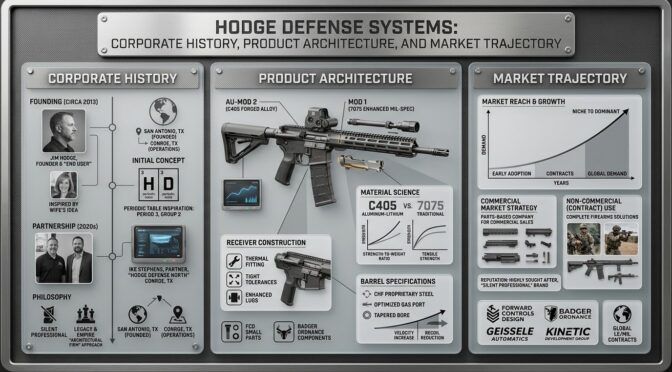
Hodge Defense Systems occupies a specific segment within the modern small arms industry, operating primarily as an architectural design firm rather than a traditional vertically integrated manufacturer. The company was founded by Jim Hodge, whose operational background as a private military contractor directly informed the design parameters of the company’s AR-15 pattern rifles. Rather than competing on production volume or entry-level pricing, Hodge Defense differentiates its products through the utilization of proprietary material alloys, highly specific dimensional tolerances, and targeted internal ballistic optimizations.
This report details the history, technical progression, and market positioning of Hodge Defense Systems. The analysis traces the company’s metallurgical development from the use of standard 7075-T6 aluminum to an aluminum-lithium alloy, and ultimately to the aerospace-grade C405 alloy utilized in its flagship AU-Mod 2 receiver sets. Furthermore, the report examines the brand’s barrel architecture, which leverages proprietary cold hammer-forged steel from FN America. These barrels are engineered to handle the increased chamber pressures of the M855A1 Enhanced Performance Round and the resulting backpressure of sound suppressors.
In the defense sector, the company achieved institutional validation when its AU-Mod 2 was evaluated by the United States Army Special Operations Command (USASOC) within the Soldier Enhancement Program to inform future upper receiver requirements. In the commercial sector, the brand’s low-volume production model and high material costs have created a market dynamic characterized by distinct scarcity and a polarized consumer reputation. The company is actively working to stabilize its commercial availability through strategic partnerships, notably forming a logistics hub dubbed “Hodge Defense North” and licensing its intellectual property to B&T USA for the production of the BT-15 HD rifle series.
1. Industry Context and Company Origins
The architectural philosophy of Hodge Defense Systems is directly linked to the professional background of its founder, Jim Hodge. The company’s origins are rooted in end-user application rather than traditional mechanical engineering or corporate business development.
1.1 The Founder’s Background and Operational Experience
Jim Hodge’s entry into the small arms sector began through his professional reliance on the AR-15 platform. Hodge did not pursue formal engineering education; he describes himself as a “normal guy” who developed an early mechanical aptitude through model building and an interest in technology1. His professional career began as a police officer, a role that required daily interaction with the standard-issue AR-152.
Following the events of September 11, 2001, Hodge transitioned into the private military contracting sector2. Between 2005 and 2013, he worked for several government contractors, including Blackwater, operating in over half a dozen countries with the majority of his deployment time spent in Afghanistan1. This continuous reliance on the AR-15 platform in combative environments exposed the mechanical limitations of standard commercial and military rifles. Over a decade, Hodge dedicated personal resources to testing various component configurations, attempting to isolate the optimal balance of durability, weight, and recoil impulse required for a dedicated operational tool3.
1.2 The Transition to Architectural Manufacturing
During his tenure as an overseas contractor, Hodge developed a reputation within the small arms manufacturing sector as an end-user evaluator. Firearms companies routinely supplied him with prototype products, and he provided operational feedback regarding structural weaknesses and ergonomic deficiencies1. This informal consulting phase provided Hodge with a deep understanding of industry supply chains, manufacturing processes, and product development lifecycles1.
The formal establishment of Hodge Defense Systems was catalyzed by a personal decision to transition away from overseas contracting. Encouraged by his wife to remain stateside, Hodge shifted his focus toward building a proprietary brand centered around his specific vision for the AR-151. His guiding philosophy was to design a platform focused entirely on combative reliability, prioritizing material longevity over mass-market appeal or competitive pricing2. From its inception, the company was structured to operate similarly to an architectural firm. Rather than investing in in-house CNC machining for commodity parts, Hodge Defense designs the specifications, procures the materials, owns the extrusion dies, and manages the final assembly, outsourcing the raw manufacturing to highly specialized machine shops1.
2. Metallurgical Progression and Receiver Architecture
A primary differentiator of Hodge Defense Systems is its avoidance of standard investment cast components and conventional alloys in favor of aerospace-grade materials and tightly controlled manufacturing tolerances2.
2.1 The AU-Mod 1 Platform and Dimensional Tolerances
The introductory rifle platform, the AU-Mod 1, established the baseline for the company’s architectural standards. While utilizing the industry-standard 7075-T6 aluminum forgings for the upper and lower receivers, Hodge classified these components as “enhanced” military specification4.
The primary dimensional deviation from standard military specifications is located in the takedown and pivot lugs, which are machined slightly oversized4. This deliberate over-sizing requires precise hand-fitting during assembly but results in a highly secure mating between the upper and lower receivers. This fit mitigates the mechanical play common in mass-produced AR-15s, contributing to a more consistent recoil impulse3.
Furthermore, the AU-Mod 1 upper receiver is engineered to require the thermal fitting of the barrel extension4. This process involves heating the aluminum upper receiver to expand its inner diameter, inserting the steel barrel extension, and allowing the aluminum to cool and contract around the steel. This interference fit creates a rigid connection between the barrel and the optic mounting surface.
2.2 The Transition to Aluminum-Lithium in the AU-Mod 2
The development of the AU-Mod 2 receiver set represents Hodge’s most significant departure from industry norms. Seeking a material solution that offered superior rigidity to 7075-T6, Hodge leveraged industry relationships to collaborate with executives and engineers at Alcoa Defense (now Arconic)1. This collaboration led to the early use of an aluminum-lithium (Al-Li) alloy in AR-15 receiver forgings1.
The Al-Li alloy provided a distinct strength-to-weight ratio that allowed for a lighter receiver that was reportedly rated as only 7% weaker than titanium6. This offered structural advantages in limiting receiver flex during the firing cycle, thereby reducing bolt wear and increasing the theoretical accuracy potential of the platform6.
2.3 Standardization on C405 Alloy
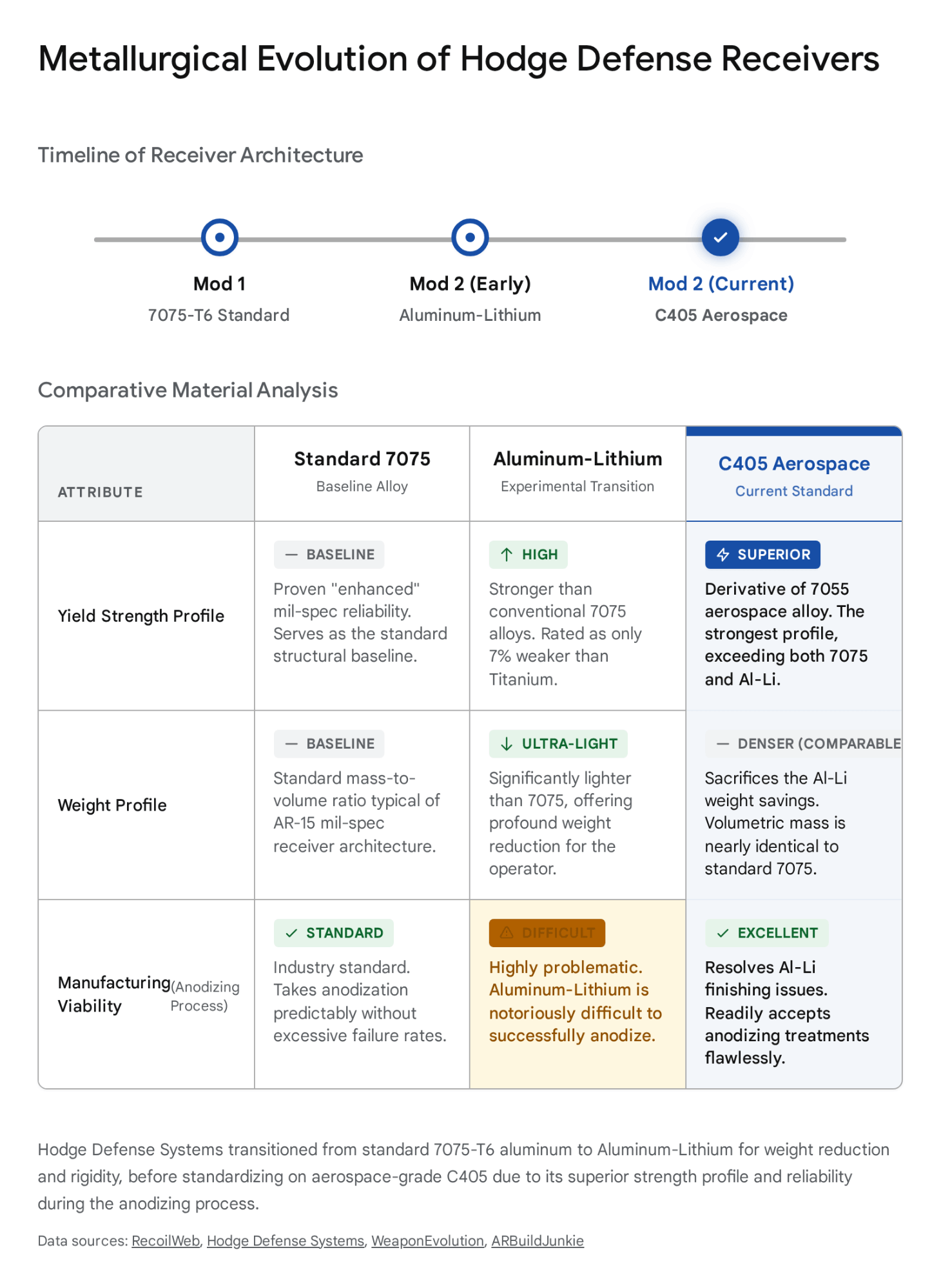
While aluminum-lithium offered excellent mechanical properties, it presented severe manufacturing challenges during the Type III hardcoat anodizing process5. To resolve this supply chain bottleneck while maintaining structural superiority, Hodge Defense invested in proprietary extrusion dies and transitioned the Mod 2 receivers to C405 alloy5.
C405 is an aerospace-grade material—a derivative of the 7055 alloy family—commonly utilized in high-stress applications such as collegiate baseball bat extrusions and high-performance piston rods5.
| Material Parameter | 7075-T6 Aluminum (Industry Standard) | Aluminum-Lithium (Early Mod 2) | C405 Alloy (Current Mod 2) |
| Primary Application | Commercial & Military AR-15s | Aerospace | High-stress aerospace, piston rods |
| Weight Profile | Baseline | Lighter than 7075 | Equal to 7075 (Denser than Al-Li) |
| Tensile Strength | Baseline | Stronger than 7075 | Stronger than 7075 and Al-Li |
| Anodizing Viability | Highly Consistent | Highly Difficult | Highly Consistent |
As demonstrated in the material comparison, while C405 is denser than aluminum-lithium (matching the mass-to-weight ratio of standard 7075), it possesses a higher tensile strength than both 7075 and Al-Li, and accepts the anodizing process with much greater consistency5.
3. Internal Ballistics: Barrel Engineering and Optimization
The AR-15 barrel acts as the primary pressure vessel and dictates the operational envelope of the weapon system. Hodge Defense approached barrel design by identifying demanding variables in modern military logistics—specifically the high-pressure M855A1 cartridge and the widespread use of sound suppressors—and engineering a barrel to accommodate them7.
3.1 FN America Partnership and Steel Composition
Hodge Defense barrels are manufactured through a strategic partnership with FN America, utilizing a cold hammer forging (CHF) process7. The base material is the proprietary steel composition utilized by FN in the M249 Squad Automatic Weapon (SAW)7. This machine-gun-grade steel is selected for its high heat tolerance and ability to withstand aggressive firing schedules9. The bores are finished with a thick chrome lining and a phosphate exterior coating, prioritizing corrosion resistance and throat life8.
3.2 Optimization for the M855A1 EPR
The internal architecture of the Hodge barrel is optimized for the United States military’s M855A1 Enhanced Performance Round7. While legacy M855 ammunition operates at chamber pressures of approximately 55,000 PSI, the M855A1 operates at approximately 62,000 PSI8. This ammunition was designed to provide consistent terminal performance and barrier penetration; however, the significant increase in chamber pressure alters the timing in the direct impingement system.
To mitigate the altered recoil impulse of the M855A1, Hodge Defense engineered a proprietary gas port sizing strategy. By constricting the volume of gas tapped from the barrel, the system forces the high-pressure round to cycle the action at standard velocities.
| Barrel Length | Gas System Length | Gas Port Size | Intended Optimization |
| 11.5 Inch | Carbine-Length | 0.0645″ | M855A1 & Suppressor Use |
| 12.5 Inch | Carbine-Length | 0.0625″ – 0.064″ | M855A1 & Suppressor Use |
| 14.5 Inch | Mid-Length | Proprietary | M855A1 & Suppressor Use |
| 16.0 Inch | Mid-Length | Proprietary | M855A1 & Suppressor Use |
Note: The 12.5-inch barrel has seen minor revisions in port sizing, updating from an original 0.0625 inches up to 0.064 inches in later iterations8.
3.3 Suppressor Integration and Tapered Profiling
This restricted gas port strategy also serves a dual purpose for suppressed operations11. Sound suppressors inherently trap expanding gases, creating backpressure that forces excess gas down the gas tube and into the receiver. By starting with a sub-sized gas port, Hodge barrels remain controllable when paired with modern suppressors, utilizing the suppressor’s backpressure to reach standard operational equilibrium12.
Additionally, the barrels feature a continuous taper profile14. They maintain a thicker, mid-weight diameter near the chamber for heat absorption and gradually thin toward the muzzle7. This profile optimizes the balance of the rifle, preventing the weapon from feeling front-heavy while retaining the thermal mass required to prevent group dispersion under sustained fire2.
4. External Architecture: Handguards and Interface Systems
The interaction between the user, the aiming devices, and the weapon is mediated by the handguard. As military and law enforcement tactics rely heavily on forward-mounted infrared (IR) laser aiming modules, the structural integrity of the handguard is a critical component.
4.1 The Wedge Lock System
In collaboration with Mega Arms (now Zev Technologies), Hodge Defense co-developed the Wedge Lock handguard system2. Standard AR-15 handguards typically utilize pinch-bolts at the 6 o’clock position to clamp the aluminum extrusion onto a steel barrel nut. This design inherently creates an area of least resistance at the bottom of the rail, allowing the rail to flex or spread under tension5.
The Wedge Lock system utilizes a machined wedge mechanism that interfaces with a corresponding groove on the barrel nut. When tightened, the wedge drives the handguard vertically into the top of the extrusion, creating a rigid lockup15. This rigidity prevents the handguard from deflecting when resting on a barricade or when the shooter applies torque via a sling, which is paramount for maintaining the zero of an IR laser module15. The success of this design has influenced other manufacturers, notably Sons of Liberty Gun Works (SOLGW), whose M89 DriveLock rail system utilizes similar mechanical principles for locking rigidity15.
4.2 The Evolution to Pinch Lock and S-Lock (Spine Lock)
Seeking deeper brand identity and internal control over manufacturing, Hodge Defense developed proprietary iterations of the handguard: the Pinch Lock and the S-Lock5. The S-Lock, denoting “Spine Lock,” required two years of development and multiple extrusion die revisions to finalize5.
The defining architectural feature of the S-Lock is a thickening of the aluminum wall located in the internal cavity directly beneath the 12 o’clock picatinny rail—acting as a structural spine5. Hodge theorized that regardless of the clamping mechanism at the bottom of the rail, the top of the rail remained susceptible to micro-deformations because it is not a true bearing surface5. By reinforcing this upper cavity and the bottom of the handguard, the S-Lock further limits flex, ensuring that heavy optic and laser packages remain aligned with the bore under hard use5.
5. Institutional Validation and Defense Procurement
While Hodge Defense systems maintain a high profile in the commercial sector, the company’s underlying foundation includes institutional procurement, defense consulting, and military evaluations.
5.1 The Soldier Enhancement Program (SEP)
Significant institutional validation of the Hodge architecture occurred within the United States Army Special Operations Command (USASOC). In 2014, USASOC initiated a requirement to explore a new Upper Receiver Group (URG) to modernize its fleet of M4A1 SOPMOD carbines17. The objective was to replace aging carbine-length gas systems with mid-length systems optimized for the M855A1 round, alongside integrating M-LOK attachment systems to replace legacy Picatinny rails18.
To inform these future requirements, the military leveraged the Soldier Enhancement Program (SEP). The Army purchased a batch of Hodge Defense AU-Mod 2 rifles for evaluation by Picatinny Arsenal and USASOC17. This marked the first time a carbine had been evaluated under the SEP protocol17. The Mod 2 was voted in by a Council of Colonels to serve as a baseline2. The acquisition and testing phase of the Mod 2 provided USASOC with data on what constituted a “best-in-class” platform, informing the trajectory of subsequent SOF upper receiver programs2.
5.2 Assembly Limitations and Contract Prioritization
Beyond the SEP evaluation, Hodge Defense serves as a supplier for various local, state, and federal law enforcement entities, as well as the Department of Defense19. The labor-intensive nature of the company’s assembly process dictates its output. A technician builds each rifle individually, ensuring every pin and component is precisely configured, actively eschewing traditional assembly line workflows3.
Because of this specific operational model, the majority of complete rifle builds generated by Hodge Defense are routed directly to fulfill government and defense contracts19. This dynamic mandates that the commercial market primarily interacts with the brand through the purchase of stripped receivers, handguards, and individual component parts rather than fully assembled rifle systems5. Furthermore, Jim Hodge acts as a consultant for defense contractors, providing architectural influence on projects that do not necessarily bear the Hodge Defense logo20.
6. Commercial Market Dynamics and Brand Perception
The intersection of high material costs, low production volume, and intense consumer demand has forged a specific commercial market dynamic for Hodge Defense, resulting in a polarized reputation among civilian buyers.
6.1 Product Scarcity and “Drop Culture”
Because Hodge relies on small-batch production runs utilizing proprietary materials and independent machine shops, supply routinely fails to meet aggregate commercial demand20. When parts are released to distributors, they are frequently sold via unannounced online “drops” that sell out in a matter of minutes14.
This scarcity has generated a complex reputation within the broader firearms community. Proponents of the brand view the products as premium equipment, justifying the price—often exceeding $2,850 for a complete platform—as a necessary investment in metallurgical superiority, extended barrel life, and uncompromised quality control9.
Conversely, the extreme scarcity has bred frustration among other segments of the consumer base. Critics characterize the brand as reliant on exclusivity and “hype,” questioning whether the practical value of exotic aerospace alloys and extreme tolerances translates to civilian applications14. Some critics argue that standard commercial offerings from volume manufacturers perform adequately for recreational use, making the premium price of Hodge products difficult to justify for casual shooters14.
Jim Hodge has publicly expressed discomfort with the status-symbol nature of his products, stating a preference that consumers purchase the equipment strictly for its engineering merits and performance attributes rather than utilizing the products for internet prestige5.
7. Strategic Partnerships and Future Trajectory
Recognizing the limitations of a sole-proprietorship acting as an architectural firm, Hodge Defense has implemented strategic shifts aimed at increasing market presence and stabilizing the supply chain.
7.1 Hodge Defense North and Supply Chain Stabilization
In a move designed to alleviate logistical bottlenecks, Jim Hodge partnered with Ike Stephens of Big Texas Ordnance to create an operational hub designated “Hodge Defense North” located in Conroe, Texas19. This organizational delegation allows Stephens to manage commercial forecasting, dealer distribution, and inventory logistics. This operational shift frees Jim Hodge to focus entirely on product development and business-to-business relationship management from his base in San Antonio19. This restructuring is intended to make the brand more reactive to commercial consumer needs, facilitating a slightly higher volume of component parts to the civilian market while ensuring government contracts remain fulfilled19.
7.2 Industry Synergies
To navigate the ecosystem of small arms manufacturing, Hodge Defense relies on alliances with complementary brands. By sharing intellectual property and collaborating on manufacturing, Hodge reduces the burden of in-house logistics. Notable synergies include partnerships with Forward Controls Design (FCD), Badger Ordnance, and SLR Rifleworks (who manufactures the specific 7-pin micro gas block designed for Hodge barrels)11. This interconnected network allows Hodge to maintain a boutique footprint while ensuring its proprietary designs are executed by trusted machine shops.
7.3 The B&T BT-15 HD Partnership
A significant indicator of Hodge’s future trajectory is the licensing and collaborative partnership with B&T USA, the American subsidiary of the Swiss arms manufacturer14. Released in mid-2024, the BT-15 HD series merges B&T’s high-volume, precision manufacturing capabilities with Hodge Defense’s proprietary architectural intellectual property14.
| Product Line | Receiver Material | Handguard System | Barrel Specs | MSRP Estimate |
| BT-15 HD MOD 1 | Standard Aluminum | Pinch Lock (M-LOK) | 16″ Match-Grade | $2,155 – $2,25514 |
| BT-15 HD MOD 2 | C405 Aluminum | S-Lock (Spine Lock) | 11.5″ or 16″ CHF, M855A1 Optimized | $3,350 – $3,45014 |
This partnership is highly strategic. It bypasses Hodge Defense’s internal manufacturing bottlenecks, allowing the commercial market to access complete, factory-built rifles bearing the Hodge architectural DNA14. Simultaneously, it allows B&T to penetrate the premium AR-15 market with validated geometry without having to endure a multi-year internal research and development cycle14.
Conclusion
Hodge Defense Systems represents a highly specialized operational model within the small arms sector. By eschewing mass-market manufacturing in favor of acting as a metallurgical and architectural design firm, Jim Hodge has successfully established the brand at the premium edge of the market. The company’s trajectory—from consulting on end-user ergonomics to introducing an aluminum-lithium alloy to the AR platform, and subsequently having its designs inform U.S. Army Special Operations Command requirements—demonstrates the viability of a product-first, volume-second manufacturing philosophy.
While the resulting scarcity and high pricing have generated friction within the commercial consumer base, the engineering merits of the platform—specifically the thermal-fitted C405 receivers, S-Lock optical zero retention, and M855A1-optimized barrel parameters—remain highly regarded by institutional end-users. Through strategic delegation via Hodge Defense North and high-profile licensing agreements like the B&T BT-15 HD partnership, the company appears positioned to slowly expand its commercial footprint while maintaining the stringent quality controls and material specifications that defined its inception.
Please share the link on Facebook, Forums, with colleagues, etc. Your support is much appreciated and if you have any feedback, please email us in**@*********ps.com. If you’d like to request a report or order a reprint, please click here for the corresponding page to open in new tab.
Sources Used
- Zeroed In: Jim Hodge – Recoil Magazine, https://www.recoilweb.com/zeroed-in-jim-hodge-142389.html
- Hodge Defense – An Overview with Jim Hodge – AR Build Junkie, https://www.arbuildjunkie.com/hodge-defense-interview-jim-hodge/
- SSD Visits Hodge Defense Systems | Soldier Systems Daily, https://soldiersystems.net/2013/10/10/ssd-visits-hodge-defense-systems/
- Hodge Defense Systems Inc., https://hodgedefensesystems.com/
- Hodge Defense Systems – A 2021 Update with Jim Hodge – AR Build Junkie, https://www.arbuildjunkie.com/hodge-defense-systems-a-2021-update-with-jim-hodge/
- NEW Hodge Defense AU Mod 2 – Weapon Evolution, http://www.weaponevolution.com/forum/showthread.php?6483-NEW-Hodge-Defense-AU-Mod-2
- 11.5″ CHF 5.56mm Barrel – Hodge Defense Systems Inc., https://hodgedefensesystems.com/product/11-5-chf-5-56mm-barrel/
- Hodge 12.5″ Carbine Gas Barrel | 5.56-HDSI-12-5-bbl-63202 – d.wilson mfg, https://www.dwilsonmfg.com/Hodge-125-Carbine-Gas-Barrel-556_p_195.html
- Hard-Use AR-15 Buyer’s Guide with Ridgeline, https://www.arbuildjunkie.com/hard-use-ar-15-buyers-guide/
- Hodge Defense HDSI 12.5″ Barrel 5.56 (0.0625 Gas Port) – Simple Man Armory, https://www.simplemanarmory.com/product/hodge-defense-hdsi-12-5-barrel-0-0625-gas-port/
- Hodge Defense 5.56 NATO Stripped Barrel – All Lengths (R) – Operationally Proven Tactical, https://www.optactical.com/product/hodge-defense-5-56-nato-stripped-barrel-all-lengths-r/
- Barrel Assembly: 12.5″ CHF 5.56mm Suppressor Optimized – Hodge Defense Systems Inc., https://hodgedefensesystems.com/product/12-5-chf-5-56mm-suppressor-optimized-barrel-assembly/
- 12.5″ CHF 5.56mm Suppressor Optimized Barrel – Hodge Defense Systems Inc., https://hodgedefensesystems.com/product/12-5-chf-5-56mm-suppressor-optimized-barrel/
- B&T to Release ARs Based on Hodge Defense MOD1 and MOD2 Guns – The Firearm Blog, https://www.thefirearmblog.com/blog/2024/01/08/bt-ars-hodge-defense/
- Hodge defense mlok rail : r/ar15 – Reddit, https://www.reddit.com/r/ar15/comments/swrtqy/hodge_defense_mlok_rail/
- Sons of Liberty Gun Works M89 DriveLock Rail, 13″ MLOK | Rooftop Defense, https://www.rooftopdefense.com/product/sons-of-liberty-gun-works-m89-drivelock-rail-13-mlok/
- Posts Tagged ‘USASOC’ – Soldier Systems, https://soldiersystems.net/tag/usasoc/
- USASOC Envisions Taking SOPMOD Into The 2020s With A New Upper Receiver Group For Its M4A1s – Soldier Systems, https://soldiersystems.net/2017/05/08/usasoc-envisions-taking-sopmod-into-the-2020s-with-a-new-upper-receiver-group-for-its-m4a1s/
- Hodge Defense Systems – A 2023-24 Update with Jim Hodge – AR Build Junkie, https://www.arbuildjunkie.com/hodge-defense-systems-a-2023-24-update-with-jim-hodge/
- Inspiration From Hodge Defense | Soldier Systems Daily, https://soldiersystems.net/2017/05/09/inspiration-from-hodge-defense/
- The Hodge Rifle Build – Magpul Comms, https://comms.magpul.com/the-hodge-rifle-build/
- B&T BT-15 HD MOD 2 – SBR 11.5″ Match-Grade Barrel – Only The Best Firearms, https://otbfirearms.com/b-t-bt-15-hd-mod-2-11-5-sbr-5-56mm/
- B&T BT-15 HD MOD1 16” Semi Auto 5.56 Rifle – Axarms, https://axarms.com/product/bt-bt-15-hd-mod1-16-semi-auto-5-56-rifle/