
The global security architecture of 2026 is undergoing a paradigm shift of historic proportions, catalyzed by the unpredictability of traditional alliance structures, the return to an “America First” posture under the second administration of U.S. President Donald Trump, and the intensifying great-power competition spanning the Indo-Pacific and European theaters. In response to what strategic planners now term the “Iron Reality” of a multi-polar and volatile world, Japan has initiated a profound, irreversible transformation of its post-World War II strategic posture.
Under the leadership of Prime Minister Sanae Takaichi, whose October 2025 ascension marked a watershed moment in Japanese domestic and foreign policy, Tokyo is systematically dismantling the remnants of its pacifist legal framework.1 This transformation is not merely rhetorical; it is backed by historic fiscal allocations, a sweeping liberalization of arms export protocols, and an aggressive mobilization of the domestic defense-industrial base. The strategy, increasingly referred to as the “Takaichi Doctrine,” blends economic nationalism with a rapid military buildup, pivoting Japan from a passive beneficiary of the U.S. security umbrella to an indispensable “Full-Stack” co-developer and primary supplier of advanced military hardware. By establishing a layered deterrence network that connects Indo-Pacific partners like Australia and the Philippines with European allies such as Poland and the United Kingdom, Tokyo aims to create a web of security interdependence that mitigates the risks of a strained Washington and deters an increasingly assertive Beijing.3
Political Consolidation and the Genesis of the Takaichi Doctrine
The velocity and scale of Japan’s 2026 defense initiatives cannot be understood outside the context of the country’s transformed domestic political landscape. In October 2025, eighty years after women gained the right to vote in Japan, Sanae Takaichi shattered the nation’s political “iron ceiling” to become its first female Prime Minister, subsequently leading the ruling Liberal Democratic Party (LDP) to a historic victory in a snap general election.1
The Mandate for Normalization
The electoral mandate secured by Takaichi was unprecedented in modern Japanese history. The LDP secured at least 316 seats in the National Diet’s Lower House, driven by Takaichi’s immensely high personal popularity, particularly among younger demographics; polling indicated that 84% of voters in their 20s and 78% of those in their 30s supported her administration.2 This staggering level of domestic support provided the political capital necessary to execute a neo-conservative turn, effectively marginalizing the cautious incrementalism that had characterized previous administrations.7
Takaichi assembled a cabinet designed for party unity and aggressive policy execution, appointing strategic heavyweights such as Toshimitsu Motegi as Foreign Minister, Yoshimasa Hayashi as Internal Affairs Minister, and Shinjiro Koizumi as Defense Minister.2 The administration immediately set its sights on constitutional revision, establishing a timeline to submit a draft revision to the Diet in 2026, supported by coalition partners such as the Japan Innovation Party led by Osaka Governor Hirofumi Yoshimura.9
Redefining Core Interests and Economic Security
At the heart of the Takaichi Doctrine is a revival of the Meiji-era ethos of Fukoku Kyohei (enrich the country, strengthen the military), modernized for the 21st century.10 The doctrine treats economic resilience, supply chain fortification, and technological sovereignty as direct extensions of national defense.10 Furthermore, the doctrine explicitly shatters decades of strategic ambiguity regarding the Taiwan Strait. Building upon the legacy of her mentor, the late Prime Minister Shinzo Abe, Takaichi’s administration has internalized the concept that a “Taiwan contingency is a Japanese contingency,” framing any potential Chinese blockade or invasion as an existential threat to Japan’s survival and energy security.3
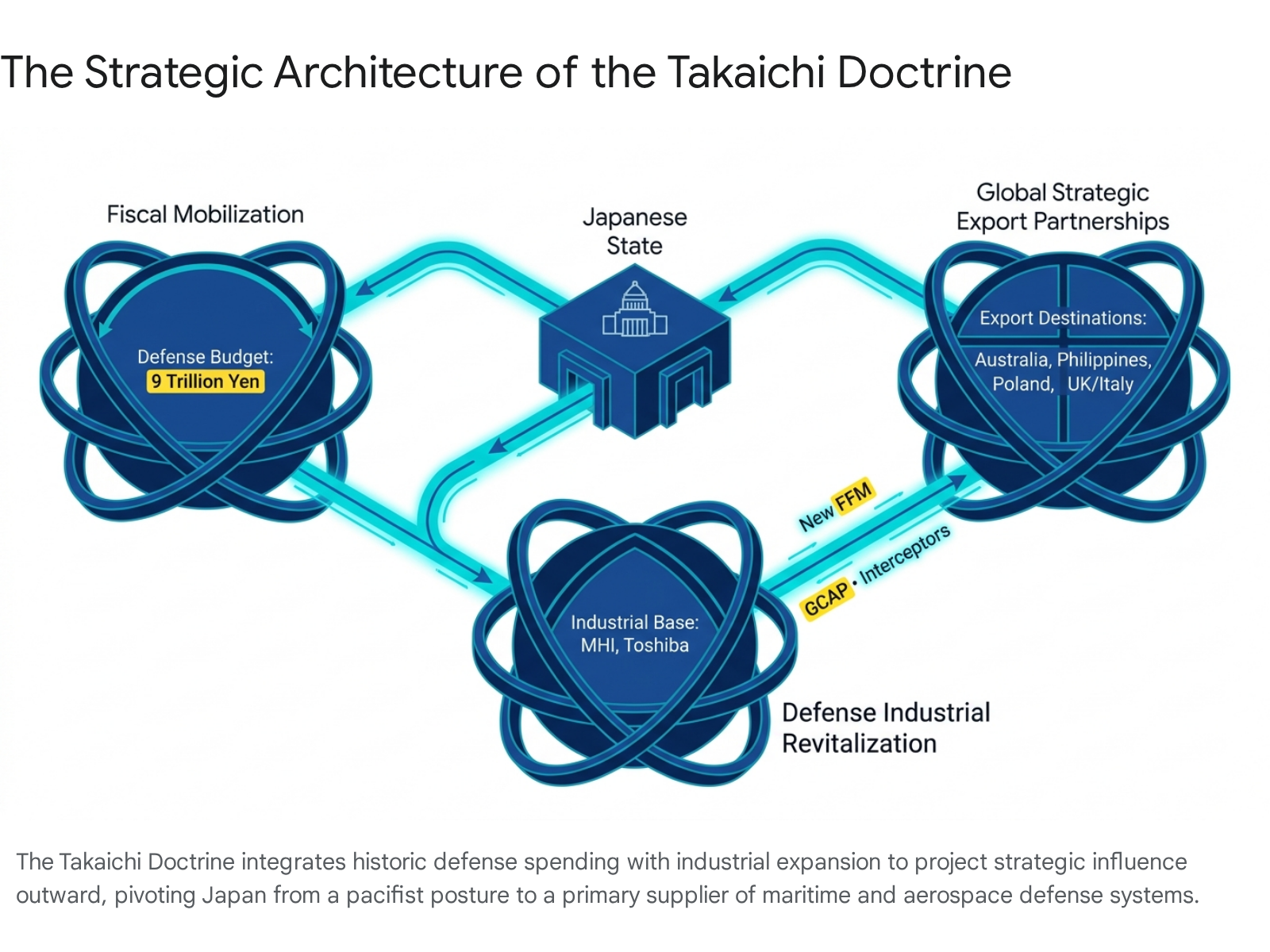
This ideological shift has profound implications. By refusing to operate solely within the constraints of American strategic permission, Japan is signaling to both its allies and adversaries that it is an autonomous actor capable of defending its core interests.3 The resulting policies have drawn sharp diplomatic backlash, notably from Beijing, where the Chinese Defense Ministry has accused Japan of violating international instruments like the Potsdam Proclamation and accelerating a dangerous pace of re-militarization.11
The Trajectory of Normalization: A Decade of Accelerated Shifts
To contextualize the monumental changes enacted in the spring of 2026, intelligence analysts must trace the rapid acceleration of Japan’s defense initiatives over the preceding decade. While the initial reforms occurred gradually, the timeline demonstrates an unprecedented convergence of legislative, fiscal, and industrial milestones in early 2026 that permanently altered the nation’s strategic posture.
The dismantling of the pacifist framework began in earnest in 2014 when then-Prime Minister Shinzo Abe ended the near-blanket ban on arms exports, allowing limited transfers for humanitarian and international cooperation.13 Early efforts yielded mixed results; while the Philippines leased five used TC-90 trainer aircraft in 2016 for maritime patrols, Japan simultaneously suffered a major setback when Australia rejected a $40 billion bid by Mitsubishi Heavy Industries to supply diesel submarines.13
Momentum began to build post-2020. In that year, Mitsubishi Electric executed the first sale of newly manufactured defense equipment overseas by supplying air-surveillance radars to the Philippines.13 The strategic environment darkened significantly following the 2022 Russian invasion of Ukraine, prompting Japan to join the UK and Italy in the Global Combat Air Programme (GCAP) and release a revised National Security Strategy.13 In 2023, Tokyo established the Official Security Assistance (OSA) mechanism to directly arm developing partners.12
However, it was the assumption of office by Prime Minister Takaichi in late 2025 that catalyzed an explosive acceleration. February 2026 saw the official handover of coastal radar systems to the Philippines.17 But April 2026 became the definitive inflection point. In a span of less than three weeks, Japan awarded the first major GCAP design contract, passed a historic 9 trillion yen defense budget, formally eased lethal export rules, and signed a $7 billion warship deal with Australia.18 The density of these structural changes indicates that the Takaichi administration successfully compressed years of planned gradualism into a singular, rapid strategic shock.
Fiscal Mobilization: Breaching the 9 Trillion Yen Threshold
The cornerstone enabling Japan’s geopolitical pivot is an unprecedented infusion of capital into its defense sector. On April 7, 2026, the Japanese House of Councillors approved the government’s fiscal year 2026 budget, within which defense spending definitively breached the 9-trillion-yen mark for the first time in the nation’s history.7
This initial budget allocation totals approximately 10.6 trillion yen (ranging from $56.5 billion to $66.5 billion depending on currency fluctuations), which represents roughly 1.9 percent of Japan’s 2022 Gross Domestic Product.11 This massive fiscal mobilization keeps Tokyo firmly on track to achieve or exceed its long-stated pledge of dedicating 2 percent of GDP to defense-related expenditures by fiscal year 2027, fulfilling a promise made during the 2022 strategic revisions.7
Strategic Procurement Priorities
The fiscal 2026 budget is explicitly designed to advance the “Seven Pillars” of defense reinforcement, shifting the Japan Self-Defense Forces (JSDF) from a strictly defensive “shield” posture toward a comprehensive force capable of multi-domain strike and active deterrence.25
The acquisition strategy outlined in the budget reflects an urgent need to counter the diverse threat matrix presented by a nuclear-armed China, North Korea, and Russia.22 The detailed breakdown of capital allocation illustrates a prioritized focus on long-range strike, integrated missile defense, and naval superiority.
| Capability Domain | Specific Program / Platform | FY2026 Budget Allocation | Strategic Rationale |
| Integrated Air & Missile Defense | “SHIELD” Multi-layered Coastal Defense | $640.6 million 22 | National defense against complex airborne and hypersonic threats. |
| Maritime Superiority | New FFM (Upgraded Mogami-class) | $667.0 million 22 | Enhanced surface combatant fleet for regional power projection. |
| Maritime Superiority | Taigei-class Attack Submarine | $773.0 million 22 | Maintaining subsurface dominance in the East China Sea. |
| Maritime Security | Sakura-class Offshore Patrol Vessels (2) | $182.3 million 22 | Coastal monitoring and gray-zone deterrence. |
| Stand-Off Strike | Upgraded Type-12 SSM / HVGP | Classified / R&D intensive 25 | Indigenous offensive strike capability; Tomahawk integration. |
Beyond these explicit platform costs, the budget aggressively funds research and development into unmanned defense capabilities, combat-supporting multi-purpose Unmanned Surface Vehicles (USVs), and AI-operated drone systems designed to integrate with next-generation fighter networks.25
Domestic Economic Friction and Industrial Beneficiaries
The realization of this budget has generated significant domestic friction. The sheer scale of the defense allocation has squeezed government spending in critical civilian sectors, particularly healthcare and social security.18 To sustain this multi-year buildup program—which aims to pour a combined 43 trillion yen into defense outlays from fiscal 2023 through 2027—the Takaichi government has implemented a controversial funding mechanism involving increases in corporate and tobacco taxes, alongside a planned income tax hike slated to take effect in 2027.7
While the broader populace absorbs the fiscal burden, the domestic defense-industrial base is experiencing an unprecedented financial windfall. Historically starved of high-volume contracts due to self-imposed export bans, Japanese defense giants are now capitalizing on massive Ministry of Defense (MOD) procurements. In fiscal year 2024 alone, Mitsubishi Heavy Industries (MHI) secured contracts totaling 1.4567 trillion yen, encompassing offensive systems like the Type 25 surface-to-ship missile, Hyper Velocity Gliding Projectiles, and Aegis system-equipped warships.18
Similarly, Mitsubishi Electric secured highly lucrative projects involving upgrades to the Type 03 medium-range surface-to-air missile and testing systems for hypersonic platforms.18 Even Kawasaki Heavy Industries (KHI), despite facing severe public scrutiny in 2024 over fraudulent transactions and illegal gift-giving to Maritime Self-Defense Force personnel, secured orders worth 232.5 billion yen in 2025, including the delivery of 17 CH-47 Chinook heavy-lift helicopters.18 This domestic capital injection has elevated five major Japanese firms (MHI, KHI, Fujitsu, Mitsubishi Electric, and NEC) into the global top 100 defense companies by sales, with collective earnings increasing by 40 percent year-on-year in 2024.18
Lethal Liberalization: The April 2026 Regulatory Paradigm Shift
While domestic procurement forms the baseline of Japan’s rearmament, it is the liberalization of its arms export policies that fundamentally alters its role on the global stage. On April 15, 2026, the Takaichi government moved to formally adopt the most expansive easing of arms export rules in Japan’s modern history.20
This regulatory overhaul permanently scraps the rigid “Five Categories” framework that previously restricted Japanese defense exports strictly to non-lethal equipment intended for transport, relief, rescue, early warning, and surveillance.27 The new policy environment replaces this restrictive, case-by-case model with a fundamentally permissive posture.14 Under the revised Three Principles on Transfer of Defense Equipment and Technology, Japanese firms are now authorized, subject to government approval, to export lethal weapons systems—including destroyers, advanced interceptor missiles, and high-end electronic warfare arrays—to a broad coalition of trusted “like-minded” partners.11
Furthermore, the revised regulations establish a pathway for direct commercial sales of defense technologies, such as warning and control radar systems, without requiring explicit government approval for each transaction.27 In a departure from decades of pacifist precedent, the new rules theoretically permit Tokyo to transfer lethal defense equipment directly to active combat zones in the event of a crisis that threatens Japan’s national security—a carve-out heavily influenced by the administration’s stance on Taiwan contingencies.27
The Geopolitical Catalysts: Trump, NATO, and the Capability Gap
This “Lethal Liberalization” was not enacted in a vacuum; it is a direct response to deep structural shifts in global alliances. The return of President Donald Trump to the White House and his renewed “America First” foreign policy have introduced profound volatility into traditional U.S. security guarantees.20
A critical driver of this shift is the Trump administration’s aggressive push for a new global standard in allied defense spending. Building on the 2025 Hague Investment Plan, the U.S. has pressured NATO and other allies to commit to spending 5 percent of their GDP on defense by 2035, with a strict two-tiered formula requiring 3.5 percent dedicated to “hard military capabilities” (equipment, operations, personnel) and 1.5 percent to security-related spending (cyberdefense, innovation).30
Consequently, European NATO members alone are attempting to mobilize upward of $450 billion annually for defense, while facing a severely strained American industrial base that is struggling to meet both its own domestic needs and the demands of prolonged proxy conflicts.20 This dynamic has triggered a “Narrative Crisis” among nations from Warsaw to Manila, forcing a realization that total reliance on U.S. hardware poses unacceptable sovereign risk.29
By easing export restrictions precisely as global demand surges and U.S. supply chains falter, Tokyo is positioning “Industrial Resilience” as its new primary diplomatic export.14 Japan is stepping in to fill the massive “Capability Gap,” offering a highly advanced, stable alternative to American manufacturing, and systematically embedding itself as a foundational supplier in the global defense ecosystem.20
Industrial Warp Speed and Supply Chain Realities
To capitalize on this expanded export mandate, Japan’s defense-industrial base is executing an industrial scale-up of unprecedented velocity. Conglomerates that previously treated defense as a low-margin, prestige-driven subsidiary operation are now aggressively restructuring to capture global market share.28
Defense contractors such as Mitsubishi Heavy Industries, Toshiba, and Mitsubishi Electric have initiated mass hiring surges, establishing entirely new departments dedicated exclusively to international defense business and export compliance.20 Executives at Mitsubishi Electric, for example, are projecting an overall sales increase in their defense unit of 50 percent, targeting 600 billion yen ($3.8 billion) by 2031, driven by anticipated demand across Asia, Europe, and Australia.29
Production Bottlenecks and Interdependence
However, this industrial expansion faces stark realities regarding supply chain interdependence. Despite Japan’s high-tech manufacturing prowess, the scale-up is hindered by bottlenecks in critical components sourced from abroad. A prime example is the production of Patriot Advanced Capability-3 (PAC-3) interceptor missiles.
While MHI holds the license to manufacture PAC-3s domestically, their capacity remains restricted to roughly 30 to 60 units annually.35 A joint U.S.-Japan initiative to rapidly increase this output to alleviate global shortages has been severely delayed by a scarcity of missile seeker components manufactured by Boeing in the United States.35 Industry insiders project that it could take several years for MHI to raise output significantly, as Boeing’s new seeker production lines in the U.S. are not expected to commence operations until 2027.35 This bottleneck vividly demonstrates that while Japan is shattering its export limitations, its ability to act as an autonomous “Arsenal of Democracy” remains inextricably linked to the health of the broader Western supply chain.27
Reshaping the Indo-Pacific: Australia and the First Island Chain
Japan’s newly permissive export framework is already fundamentally altering the strategic geometry of the Indo-Pacific. Rather than relying entirely on the bilateral U.S.-Japan security treaty, Tokyo is actively constructing a web of bilateral and minilateral quasi-alliances, leveraging its defense industry to arm partners along critical maritime choke points.
The $7 Billion Australian Naval Accord (SEA 3000)
The most definitive validation of Japan’s new status as a premier arms exporter occurred on April 18, 2026, when Tokyo and Canberra finalized a landmark contract valued at A$10 billion (approximately $7 billion USD).19 Executed under the Royal Australian Navy’s (RAN) Project SEA 3000, the deal mandates the acquisition of 11 “New FFM” (Upgraded Mogami-class) general-purpose frigates.19
This contract, signed in Melbourne by Japanese Defense Minister Koizumi and Australian Deputy Prime Minister Richard Marles, is the largest military export in Japan’s history and serves to erase the institutional trauma of its failed 2016 submarine bid to Australia.13 The procurement structure is meticulously designed to provide “Industrial Endurance” for both nations. The first three frigates will be constructed by Mitsubishi Heavy Industries in Nagasaki, ensuring rapid initial delivery by 2029.19 Following this, the program will transition to an onshore build, with the remaining eight vessels constructed at the Henderson Defence Precinct in Western Australia, thereby facilitating a massive transfer of Japanese naval engineering technology to the Australian industrial base.19
The selection of the Upgraded Mogami design represents a substantial leap in capability for the RAN, designed specifically to counter expanding Chinese military footprints in the Indian and Pacific Oceans.36
| Platform Specification | Details: Upgraded Mogami-Class (New FFM) |
| Displacement | 4,880 tons (standard) / 6,200 tons (full load) 37 |
| Dimensions | Length: Approx. 142 meters |
| Propulsion System | CODAG (1x Rolls-Royce MT30 Gas Turbine, 2x Diesel Engines) 37 |
| Maximum Speed | Over 30 knots (56 km/h) 37 |
| Operational Range | 10,000 nautical miles at economic speed 19 |
| Crew Complement | 90 personnel (accommodation for up to 138) 19 |
| Primary VLS | 32-cell Mk 41 Vertical Launch System (firing RIM-162 ESSM, SM-2MR, etc.) 37 |
| Secondary Armament | 2x Quad Naval Strike Missile (NSM) launchers, 127mm Mk 45 Main Gun, SeaRAM CIWS, Mk 32 Torpedo launchers 37 |
| Aviation Capacity | Flight deck and hangar supporting 1x MH-60R Seahawk / UAV operations 19 |
The expanded 32-cell VLS array is a crucial upgrade over the baseline Mogami class (which utilized 16 cells), providing the RAN with enhanced air defense and surface strike capabilities necessary for high-intensity conflict environments.43 By securing this contract against fierce European competition, Japan has entrenched itself as the primary naval architect for a critical Indo-Pacific ally.41
Fortifying the Philippines: The OSA Vanguard
Concurrently, Japan is aggressively fortifying the maritime boundaries of the Philippines, a nation occupying the highly contested “Zero Line” in the South China Sea. Manila has become the vanguard for Tokyo’s Official Security Assistance (OSA) framework, a grant-aid mechanism established in 2023 specifically to enhance the deterrence capabilities of developing armed forces in regions critical to Japan’s sea lines of communication.12
Recognizing the escalating pressure on Manila—evidenced by frequent Sino-Philippine maritime confrontations and joint U.S.-Philippine military patrols near the disputed Scarborough Shoal 46—the Takaichi government authorized a 125 percent increase in OSA funding for fiscal 2026. This pushed the program’s budget to a record 18.1 billion yen ($116 million).12 The budget hike signals a shift from providing minor communication gear to financing major strategic assets, utilizing innovative funding mechanisms like Japan Bank for International Cooperation (JBIC) export loans to support larger acquisitions.45
In February 2026, Japan officially handed over coastal surveillance radar systems to the Philippine Department of National Defense, directly enhancing Manila’s maritime domain awareness.13 However, the most consequential development involves advanced negotiations for the transfer of actual warships. Philippine Navy officials recently completed inspections of the Japan Maritime Self-Defense Force’s Abukuma-class destroyer escorts.49 Japan currently operates six of these vessels, which are slated for decommissioning by 2027 to make way for new Mogami-class frigates.49
Transferring these 30-year-old, yet heavily armed, guided-missile destroyer escorts—alongside potential transfers of Beechcraft King Air TC-90 surveillance aircraft—would mark Tokyo’s first export of used naval warships in decades.49 This hardware infusion is backed by deepening operational integration, codified by the Japan-Philippines Reciprocal Access Agreement (enacted in late 2025) which has already facilitated multilateral maritime cooperative activities involving U.S., Japanese, and Philippine forces in the South China Sea.46
The European Pivot: Exploiting the Transatlantic Capability Gap
The strategic ripples of Japan’s defense liberalization extend far beyond the Indo-Pacific, reaching deeply into a European continent unsettled by the war in Ukraine and the unpredictable commitments of the United States. As European nations strive to meet the Trump administration’s 5 percent GDP defense spending mandate, they are simultaneously seeking to reduce their heavy reliance on American weapons systems to build sovereign supply chain resilience.28
Poland, which has dramatically increased its defense expenditure to approach the 5 percent mark, has emerged as the primary vector for Japanese defense technology in Europe.32 Driven by the existential requirement to secure NATO’s Eastern Flank, Warsaw has elevated its diplomatic relationship with Tokyo to a “comprehensive strategic partnership”.51 Polish military and government officials have publicly expressed strong interest in acquiring Japanese high-end electronics, anti-drone systems, and electronic warfare capabilities to diversify their massive, armor-heavy modernization program.20
This strategic alignment is translating directly into industrial cooperation. Poland’s WB Group, one of Europe’s largest private defense contractors, recently signed a tentative agreement with Japanese aircraft manufacturer ShinMaywa to collaborate on drone technologies.20 Furthermore, Poland’s extensive procurement of South Korean armaments presents a unique backdoor for Japanese industry. Poland is slated to begin localized production of up to 820 K2PL tanks and 460 K9PL howitzers starting in 2026.53 Japanese electronic conglomerates like Mitsubishi Electric—already dominant in producing advanced sensors and tank components—are positioning themselves to supply critical sub-systems and optics into these European production lines, mirroring the successful market penetration strategies previously utilized by Turkish defense firms like Aselsan in the region.29 Warsaw and Tokyo recognize that Japanese electronic warfare systems can effectively plug persistent bottlenecks in European domestic production capabilities.20
Sovereign Next-Generation Co-Development
While exporting legacy platforms and electronic sub-components generates immediate geopolitical capital and revenue, Japan’s overarching strategic objective is to embed itself as an irreplaceable partner in the co-development of next-generation, multi-domain weapon systems. Tokyo is ensuring that it transcends its historical role as a mere consumer of U.S. technology to become a foundational architect of global defense platforms.
The Global Combat Air Program (GCAP) and Edgewing
The most advanced manifestation of this strategy is the Global Combat Air Program (GCAP). Launched in 2022, GCAP is a trilateral initiative between Japan, the United Kingdom, and Italy aimed at fielding a sixth-generation stealth combat aircraft by 2035.13 The program is intensely significant as it represents Japan’s first major joint defense development project executed entirely outside the purview of the United States.13
On April 3, 2026, GCAP crossed a vital programmatic threshold when the GCAP Agency—the tri-national government body managing the project—awarded its first joint international design and development contract, valued at £686 million ($905 million), to the newly formed corporate joint venture “Edgewing”.21
| GCAP Industrial Organization: Edgewing Joint Venture |
| Corporate Partners |
| Headquarters & Leadership |
| Primary Responsibilities |
| Manufacturing Plan |
The awarding of this £686 million contract was a critical stopgap measure. It provided the necessary financial momentum to sustain key design and engineering activities amidst growing Japanese concerns over delays stemming from the UK’s uncertain Defense Investment Plan.21 By legally and financially committing to the Edgewing structure, Japan ensures that its domestic aerospace industry, spearheaded by MHI and the JAIEC consortium, will acquire and retain the bleeding-edge systems integration and digital engineering capabilities required to maintain true sovereign air superiority in the mid-21st century.56
The Golden Dome Initiative: Integrating into the U.S. Shield
While GCAP secures offensive air dominance independent of the U.S., Japan is simultaneously integrating itself into the absolute apex of allied defensive networks through its commitment to the “Golden Dome” initiative. Proposed by President Trump shortly after his return to office, Golden Dome is an extraordinarily ambitious, cross-border Integrated Air and Missile Defense (IAMD) system.30
The system is designed to protect the U.S. homeland and key allied territories from the rapidly evolving spectrum of airborne threats, which have surpassed the capabilities of traditional ballistic missile defense (BMD). These new threats include hypersonic glide vehicles (HGVs) deployed by China and Russia, fractional orbital bombardment systems (FOBS), and massive saturation attacks utilizing AI-equipped drone swarms.65 Golden Dome relies on a “System of Systems” architecture that networks ground and sea-based interceptors with experimental space-based sensor constellations, all linked by a near-real-time Space Data Network (SDN).65 The scale of the program is monumental; the U.S. Space Force estimates the cost of the objective architecture at $185 billion, with deployment targeted for the 2035 timeframe and initial major tests slated for late 2028.67
Following a high-profile summit between Prime Minister Takaichi and President Trump in Washington on March 19, 2026, Japan formally committed to participating in the initiative.66 Tokyo’s contribution to Golden Dome is dual-faceted and highly strategic:
- Orbital Sensor Integration: Japan is investing heavily to construct a constellation of low-orbit satellites that will operate in unison with the U.S. military. The Japanese Ministry of Defense plans to invest 283.2 billion yen to establish this satellite network, which will integrate directly with the Pentagon’s Space Data Network (SDN) to provide critical, real-time early warning and tracking data on hypersonic threats traversing the Indo-Pacific.66
- Interceptor Production at Scale: Acknowledging that global conflicts have severely depleted U.S. and allied munition stockpiles, Washington explicitly requested Japan’s industrial assistance. Tokyo has agreed to leverage its newly liberalized export rules to co-develop and produce advanced interceptor missiles at an unprecedented scale of approximately 100 units per year.66
By committing to the Golden Dome architecture, Japan fundamentally alters its defense relationship with the United States. It evolves from a localized client state relying on regional U.S. deployments to a frontline, constituent node in the primary strategic defense shield of the North American continent.66
Digital Sovereignty and Shattering the “Silicon Ceiling”
The modernization of Japan’s defense apparatus extends significantly beyond kinetic platforms like frigates and interceptors into the increasingly vital realm of “Sovereign Digital Defense.” As modern warfare becomes fundamentally algorithmic and data-dependent, Japan is executing a parallel strategy to position itself as an indispensable “Digital Hub” for global security, effectively shattering the pacifist “Silicon Ceiling” that previously constrained its dual-use technology sector.
This digital assertiveness is partly a defensive reaction to U.S. economic and technological policy. Under the Trump administration’s AI Action Plan, the U.S. Department of Commerce launched the “American AI Exports Program” (also referred to contextually as Pax Silica).77 This initiative seeks to export “full-stack” AI technology packages—encompassing cloud infrastructure, data pipelines, and proprietary AI models—to trusted foreign allies.77 While this program offers allies rapid access to cutting-edge computing capabilities, it carries the profound strategic risk of vendor lock-in. Adopting the American full-stack forces partners into long-term, structural reliance on U.S. corporations for maintenance, software updates, and subsystem integration, effectively sacrificing digital sovereignty.81
To combat this vulnerability, Japan is aggressively funding and commercializing indigenous computing infrastructure tailored specifically for the defense, aerospace, and high-tech sectors. A prominent indicator of this strategy’s maturation occurred in March 2026, when SuperX AI Technology Limited completed its first major delivery of high-performance AI servers to Japanese data centers via its Japan Global Supply Center.82 This deployment establishes a secure, domestic hardware backbone capable of processing sensitive national security data without relying on foreign cloud architectures.82
Concurrently, Japanese national champions are advancing sovereign roadmaps in next-generation computing. Fujitsu, for example, is driving an ambitious quantum computing timeline, integrating its hybrid computing platforms with High-Performance Computing (HPC) networks. The company targets the deployment of a 1,024-qubit quantum system by 2026, with plans to scale to a 10,000-qubit machine by 2030.83 Securing quantum supremacy is vital for the development of unbreakable cryptographic protocols and the real-time processing of the immense data streams generated by systems like the Golden Dome Space Data Network and the AI-driven unmanned wingmen planned for the GCAP fighter.26
Furthermore, Japanese strategic planners are already conceptualizing governance architectures for off-world and deep-space AI systems, aiming to establish Tokyo as a global verification hub for AI-weapon ethics and interplanetary data regulation.84 By fostering this robust, sovereign digital base, Tokyo ensures that its advanced weapon systems remain secure, interoperable, and operable completely independent of foreign software constraints or shifting political winds in Washington.
Conclusion: The Finality of Strategic Normalization
The unprecedented convergence of fiscal policy, regulatory liberalization, and industrial mobilization witnessed in the spring of 2026 confirms that Japan’s transition from a post-war pacifist state to a premier global military power is absolute and irreversible. The “Iron Reality” of the contemporary strategic environment—defined by great-power rivalry, strained U.S. capabilities, and the erosion of the post-Cold War order—has necessitated the rapid implementation of the Takaichi Doctrine. This strategic framework successfully synthesizes deep alliance integration with fiercely guarded technological and operational autonomy.
By actively arming front-line states like the Philippines with strategic maritime assets, providing sovereign manufacturing endurance and advanced naval platforms to Australia, and co-developing sixth-generation aerospace architectures with European partners, Japan is fundamentally altering the balance of power across multiple theaters. The historic defense budget surpassing 9 trillion yen is not merely a domestic financial metric; it represents the kinetic energy powering a new, multi-polar security architecture. In an era where traditional superpowers are increasingly strained by internal politics and concurrent global crises, Tokyo has decisively stepped into the strategic vacuum. Through the projection of “Industrial Resilience” and technological sovereignty, Japan has proven that proactive deterrence and defense-industrial collaboration are its paramount exports for the twenty-first century.
Please share the link on Facebook, Forums, with colleagues, etc. Your support is much appreciated and if you have any feedback, please email us in**@*********ps.com. If you’d like to request a report or order a reprint, please click here for the corresponding page to open in new tab.
Sources Used
- Sanae Takaichi Is on the 2026 TIME100 List – Time Magazine, accessed April 18, 2026, https://time.com/collection/100-most-influential-people/2026/sanae-takaichi/
- Sanae Takaichi – Wikipedia, accessed April 18, 2026, https://en.wikipedia.org/wiki/Sanae_Takaichi
- Keeping the Chinese ‘tiger’ and U.S. ‘wolf’ at bay – The Japan Times, accessed April 18, 2026, https://www.japantimes.co.jp/commentary/2026/02/27/japan/keeping-china-us-wolf-at-bay/
- Japan plans $10 billion framework to help Asia secure oil – The Economic Times, accessed April 18, 2026, https://m.economictimes.com/news/international/business/japan-plans-10-billion-framework-to-help-asia-secure-oil/articleshow/130276838.cms
- Donald Trump jitters push US allies toward Japan’s most significant military shift since World War II – The Economic Times, accessed April 18, 2026, https://m.economictimes.com/news/defence/donald-trump-jitters-push-us-allies-toward-japans-most-significant-military-shift-since-world-war-ii/articleshow/130272633.cms
- What’s Next for Japan After Prime Minister Sanae Takaichi’s Historic Election Victory | FSI, accessed April 18, 2026, https://fsi.stanford.edu/news/whats-next-japan-after-prime-minister-sanae-takaichis-historic-election-victory
- Interview: Japan risks losing “peace state” identity amid military buildup, scholar warns, accessed April 18, 2026, https://english.news.cn/asiapacific/20260413/a2a9b7b52620445d9e991f900a8cafa6/c.html
- Japan: What Prime Minister Takaichi’s Victory in the Legislative Elections Tells Us – IRIS, accessed April 18, 2026, https://www.iris-france.org/en/japan-what-prime-minister-takaichis-victory-in-the-legislative-elections-tells-us/
- Japan’s PM Urges Constitution Revision Discussions to Be Sped Up, Shows Favor for Male Adoption for Imperial Succession, accessed April 18, 2026, https://japannews.yomiuri.co.jp/politics/politics-government/20260414-321900/
- The CSPC Dispatch – Nov 14, 2025 – Center for the Study of the Presidency and Congress, accessed April 18, 2026, https://www.thepresidency.org/the-dispatch/the-cspc-dispatch-nov-14-2025
- China urges Japan to make ‘clean break’ with militarism, accessed April 18, 2026, https://www.chinadaily.com.cn/a/202604/17/WS69e1e7afa310d6866eb440d9.html
- Expert warns Japan’s proposed record OSA funding to provide military equipment to allies a move threatens regional peace – Global Times, accessed April 18, 2026, https://www.globaltimes.cn/page/202512/1351385.shtml
- Japan’s decade-long march towards arms exports, accessed April 18, 2026, https://wtaq.com/2026/04/14/japans-decade-long-march-towards-arms-exports/
- Japan moves to expand arms exports as global demand surges – Seeking Alpha, accessed April 18, 2026, https://seekingalpha.com/news/4575345-japan-moves-to-expand-arms-exports-as-global-demand-surges
- Rattled by Trump, US allies eye Japan’s biggest arms opening since WW2 – AsiaOne, accessed April 18, 2026, https://www.asiaone.com/world/rattled-trump-us-allies-eye-japans-biggest-arms-opening-ww2
- Japan to expand military aid as OSA budget more than doubles, accessed April 18, 2026, https://www.japantimes.co.jp/news/2025/12/26/japan/japan-official-security-assistance/
- Ambassador ENDO attends the handover ceremony for coastal radar systems provided through Official Security Assistance (OSA) | Embassy of Japan in the Philippines, accessed April 18, 2026, https://www.ph.emb-japan.go.jp/itpr_en/11_000001_021621.html
- Japan’s defense firms collude with right-wing politicos, accessed April 18, 2026, http://eng.chinamil.com.cn/2025xb/O_251451/16455321.html
- Australia Signs Contract With Japan For Three Upgraded Mogami, accessed April 18, 2026, https://www.navalnews.com/naval-news/2026/04/australia-signs-contract-with-japan-for-three-upgraded-mogami/
- Rattled by Trump, U.S. allies eye Japan’s biggest arms opening since WWII, accessed April 18, 2026, https://www.japantimes.co.jp/news/2026/04/15/japan/politics/us-allies-japan-arms-opening/
- Edgewing receives first GCAP next-gen fighter international contract to boost design activities – Breaking Defense, accessed April 18, 2026, https://breakingdefense.com/2026/04/edgewing-receives-first-gcap-next-gen-fighter-international-contract-to-boost-design-activities/
- Japan Approves Record Defense Budget for Fiscal Year 2026 – Naval News, accessed April 18, 2026, https://www.navalnews.com/naval-news/2025/12/japan-approves-record-defense-budget-for-fiscal-year-2026/
- Japan’s defense budget to reach 1.9% of GDP in fiscal 2026, accessed April 18, 2026, https://japantoday.com/category/politics/japan’s-defense-budget-to-reach-1.9-of-gdp-in-fiscal-2026
- Japan’s Cabinet approves record defense budget aiming to deter China as tensions grow, accessed April 18, 2026, https://www.pbs.org/newshour/world/japans-cabinet-approves-record-defense-budget-aiming-to-deter-china-as-tensions-grow
- Progress and Budget in Fundamental Reinforcement of Defense Capabilities, accessed April 18, 2026, https://www.mod.go.jp/en/d_act/d_budget/pdf/fy2026_20251210a.pdf
- Japan’s Cabinet okays record defence budget that aims to deter China, accessed April 18, 2026, https://m.economictimes.com/news/defence/japans-cabinet-okays-record-defence-budget-that-aims-to-deter-china/articleshow/126181415.cms
- Japan Is Poised To Become Part of America’s Arsenal of Democracy, accessed April 18, 2026, https://www.fdd.org/analysis/2026/04/17/japan-is-poised-to-become-part-of-americas-arsenal-of-democracy/
- Japan Arms Export Shift Draws Global Interest – tovima.com, accessed April 18, 2026, https://www.tovima.com/world/japan-arms-export-shift-draws-global-interest/
- Rattled by Trump, US allies eye Japan’s biggest arms opening since WW2, accessed April 18, 2026, https://www.tbsnews.net/worldbiz/asia/rattled-trump-us-allies-eye-japans-biggest-arms-opening-ww2-1411626
- 2026 National Defense Strategy – Department of War, accessed April 18, 2026, https://media.defense.gov/2026/Jan/23/2003864773/-1/-1/0/2026-NATIONAL-DEFENSE-STRATEGY.PDF
- Agreement on 5% NATO defence spending by 2035 – Wikipedia, accessed April 18, 2026, https://en.wikipedia.org/wiki/Agreement_on_5%25_NATO_defence_spending_by_2035
- What Would Happen if Trump Pulled Out of NATO? – Northeastern Global News, accessed April 18, 2026, https://news.northeastern.edu/2026/04/09/trump-pulling-out-of-nato-explained/
- Mitsubishi Heavy Industries Announces Large Order Intake, Revenue, and Profit Growth in First Three Quarters, Raises Full-Year Guidance, accessed April 18, 2026, https://www.mhi.com/news/26020401.html
- Rattled by Trump, US allies eye Japan’s biggest arms opening since WWII – Military Times, accessed April 18, 2026, https://www.militarytimes.com/industry/2026/04/15/rattled-by-trump-us-allies-eye-japans-biggest-arms-opening-since-wwii/
- Made In Japan Patriot Missiles For Ukraine ‘Fizzles Out’ After Russian Warning? Report Blames Boeing – EurAsian Times, accessed April 18, 2026, https://www.eurasiantimes.com/missiles-in-japan-fail-due-to-a-boeing/
- Australia, Japan sign contracts to start $7 billion warship deal, accessed April 18, 2026, https://wtvbam.com/2026/04/18/australia-japan-sign-contracts-to-start-7-billion-warship-deal/
- Australian general purpose frigate program – Wikipedia, accessed April 18, 2026, https://en.wikipedia.org/wiki/Australian_general_purpose_frigate_program
- Japan, Australia Seal Frigate Development Deal, accessed April 18, 2026, https://www.bernama.com/en/news.php/world/news.php?id=2546330
- Japan, Australia conclude frigate development deal, accessed April 18, 2026, https://english.kyodonews.net/articles/-/74409
- Are Long-Term NATO–South Korea Defense Ties Possible? Transitioning From an Arms Exporter to a Trusted Defense Partner, accessed April 18, 2026, https://carnegieendowment.org/research/2026/02/are-long-term-nato-south-korea-defense-ties-possible-transitioning-from-an-arms-exporter-to-a-trusted-defense-partner
- New General Purpose Mogami Frigate Royal Australian Navy – seaforces.org, accessed April 18, 2026, https://www.seaforces.org/marint/Australian-Navy/Frigate/NEW-GPF-class.htm
- New FFM – Wikipedia, accessed April 18, 2026, https://en.wikipedia.org/wiki/New_FFM
- Mogami-class frigate – Wikipedia, accessed April 18, 2026, https://en.wikipedia.org/wiki/Mogami-class_frigate
- [1286×909] Translated overview of the “New FFM” (improved Mogami-class, or 06FFM) frigate. The Australian government has reportedly confirmed its intention to adopt the 06FFM proposal on August 4, 2025, pending final negotiations, with an expected first delivery date from MHI of 2029. : r/WarshipPorn – Reddit, accessed April 18, 2026, https://www.reddit.com/r/WarshipPorn/comments/1mhsaro/1286909_translated_overview_of_the_new_ffm/
- From Pacifism to Strategic Maturity: The Evolution of Japan’s Security Diplomacy, accessed April 18, 2026, https://www.orfonline.org/research/from-pacifism-to-strategic-maturity-the-evolution-of-japan-s-security-diplomacy
- Japan, Philippine and U.S. forces conduct Multilateral Maritime Cooperative Activity in South China Sea – U.S. Pacific Fleet, accessed April 18, 2026, https://www.cpf.navy.mil/Newsroom/News/Article/4419405/japan-philippine-and-us-forces-conduct-multilateral-maritime-cooperative-activi/
- China in the Indo-Pacific: January 2026, accessed April 18, 2026, https://www.cfr.org/articles/china-in-the-indo-pacific-january-2026
- Japan’s expanding defense partnerships signal strategic shift, accessed April 18, 2026, https://ipdefenseforum.com/2026/04/japans-expanding-defense-partnerships-signal-strategic-shift/
- Philippine bid to acquire used Japanese warships gains steam – The Japan Times, accessed April 18, 2026, https://www.japantimes.co.jp/news/2025/08/26/japan/philippines-japan-abukuma-destroyer-escort/
- Japan in talks to transfer warships, surveillance aircraft to the Philippines – Naval News, accessed April 18, 2026, https://www.navalnews.com/naval-news/2025/07/japan-in-talks-to-transfer-warships-surveillance-aircraft-to-the-philippines/
- Poland and Japan announce comprehensive strategic partnership, accessed April 18, 2026, https://notesfrompoland.com/2026/04/15/poland-and-japan-announce-comprehensive-strategic-partnership/
- Rattled by the US, allies eye Japan’s biggest arms opening since WW2 – Baird Maritime, accessed April 18, 2026, https://www.bairdmaritime.com/amp/story/security/feature-rattled-by-the-us-allies-eye-japans-biggest-arms-opening-since-ww2
- Poland and South Korea Should Further Develop Security Cooperation – pism.pl, accessed April 18, 2026, https://pism.pl/publications/poland-and-south-korea-should-further-develop-security-cooperation
- Hyundai likely to supply $7.7 bn worth of tanks to Poland. : r/europe – Reddit, accessed April 18, 2026, https://www.reddit.com/r/europe/comments/w4bit4/hyundai_likely_to_supply_77_bn_worth_of_tanks_to/
- New Entrants in the European Defense Market: A Study of Korea, Brazil and Turkey | DEFENSE&Industries | Fondation pour la Recherche Stratégique, accessed April 18, 2026, https://www.frstrategie.org/publications/defense-et-industries/new-entrants-european-defense-market-study-korea-brazil-and-turkey-2026
- Global Combat Air Programme – BAE Systems, accessed April 18, 2026, https://www.baesystems.com/en/product/global-combat-air-programme
- Design contract for next-generation British fighter jet – UK Defence Journal, accessed April 18, 2026, https://ukdefencejournal.org.uk/design-contract-for-next-generation-british-fighter-jet/
- Money starts flowing for new GCAP fighter, as Britain sorts out finances – Defense News, accessed April 18, 2026, https://www.defensenews.com/global/europe/2026/04/02/money-starts-flowing-for-new-gcap-fighter-as-britain-sorts-out-finances/
- GCAP Agency Places Contract with Edgewing | Joint Forces News, accessed April 18, 2026, https://www.joint-forces.com/world-news/defence-news/90296-gcap-agency-places-contract-with-edgewing
- Global Combat Air Programme Agency places contract with Edgewing, accessed April 18, 2026, https://www.edgewing.com/article/gcap-contract-edgewing
- GCAP Agency Awards Edgewing Fighter Design Contract – Govly, accessed April 18, 2026, https://app.govly.com/public/signals/81933
- Overview and Implications of the “Golden Dome” Missile Defense Plan for the U.S. Mainland | List of Articles | International Information Network Analysis, accessed April 18, 2026, https://www.spf.org/iina/en/articles/nagashima_22.html
- Japan to Join U.S. Golden Dome Missile Defense System in Summit Talks, accessed April 18, 2026, https://www.chosun.com/english/world-en/2026/03/14/CWCKKDRXBZFZTHDSVUW5WV343Q/
- Golden Dome budget plan gets $10B plus-up to accelerate space capabilities, accessed April 18, 2026, https://defensescoop.com/2026/03/17/golden-dome-budget-plan-increase-space-capabilities-guetlein/
- What to Watch at the Trump-Takaichi Summit | Hudson Institute, accessed April 18, 2026, https://www.hudson.org/foreign-policy/what-to-watch-at-trump-takaichi-summit-william-chou
- Japan eyes role in Trump missile shield – Modern Diplomacy, accessed April 18, 2026, https://moderndiplomacy.eu/2026/03/13/japan-eyes-role-in-trump-missile-shield/
- What is the Pentagon’s ‘Space Data Network,’ and why does it matter for Golden Dome?, accessed April 18, 2026, https://breakingdefense.com/2026/03/what-is-the-pentagons-space-data-network-and-why-does-it-matter-for-golden-dome/
- U.S. Golden Dome homeland defense initiative progresses – Indo-Pacific Defense FORUM, accessed April 18, 2026, https://ipdefenseforum.com/2025/10/u-s-golden-dome-homeland-defense-initiative-progresses/
- Japan to join Trump’s Golden Dome project and expects missile …, accessed April 18, 2026, https://www.japantimes.co.jp/news/2026/03/13/japan/japan-golden-dome/
- Japan Plans to Join US Golden Dome Missile Defense Effort | GovCon Exec International, accessed April 18, 2026, https://www.govconexec.com/2026/03/japan-us-golden-dome-missile-defense/
- The Next Arms Race – Nonproliferation Policy Education Center, accessed April 18, 2026, https://www.npolicy.org/books/Next_Arms_Race/Full_Book.pdf
- Hundred SM-3 Anti-Ballistic Missiles per Year: US and Japan Scaling Up Production, accessed April 18, 2026, https://www.reddit.com/r/LessCredibleDefence/comments/1s2htlw/hundred_sm3_antiballistic_missiles_per_year_us/
- EUROPE INSIGHT: EU-Japan Cooperation in Defence and Security – EDR Magazine, accessed April 18, 2026, https://www.edrmagazine.eu/europe-insight-eu-japan-cooperation-in-defence-and-security
- American AI Exports Program Call for Pre-Set Consortia Proposals – Changeflow, accessed April 18, 2026, https://changeflow.com/govping/trade-sanctions/ita-invites-pre-set-consortia-for-ai-export-proposals-2026-04-10
- March 2026 Export Controls and Compliance Updates | FD Associates, Inc., accessed April 18, 2026, https://fdassociates.net/latest-export-controls-and-compliance-update-march-2026/
- Three elements Trump’s ‘Pax Silica’ needs to succeed – Atlantic Council, accessed April 18, 2026, https://www.atlanticcouncil.org/dispatches/three-elements-trumps-pax-silica-needs-to-succeed/
- Export controls | Emerging Technology Policy Careers, accessed April 18, 2026, https://emergingtechpolicy.org/areas/export-controls/
- JIIA Strategic Comments (2026-6) Racing Ahead, Falling Apart: Middle Powers and the Future of Military AI Governance | Research Findings | The Japan Institute of International Affairs, accessed April 18, 2026, https://www.jiia.or.jp/eng/report/2026/03/strategic_comment_2026-6.html
- SuperX Japan Global Supply Center Completes First Batch Delivery, Marking Strategic Partnership Milestone in Japan – PR Newswire, accessed April 18, 2026, https://www.prnewswire.com/news-releases/superx-japan-global-supply-center-completes-first-batch-delivery-marking-strategic-partnership-milestone-in-japan-302739189.html
- Driving Japan’s digital future: Fujitsu’s full-stack development for sovereign platform, accessed April 18, 2026, https://global.fujitsu/en-benelux/insight/tl-technology-update-20251224
- SAS Rabdan Global Initiatives Handbook, accessed April 18, 2026, https://rabdanglobal.ae/docs/Abu_Dhabi_Rabdan_Global_Initiatives_Handbook.pdf