
1. Executive Summary
During the period of May 16 to May 23, 2026, the operational and geopolitical landscape of the Russia-Ukraine conflict was characterized by a pronounced transition in tactical momentum, an unprecedented intensification of asymmetric deep-strike campaigns, and highly consequential diplomatic realignments involving global superpowers. Following a protracted period of defensive posturing and force conservation, Ukrainian armed forces have ostensibly regained the tactical initiative across multiple localized sectors, most notably in the western Zaporizhia Oblast and the Kupyansk direction. Concurrently, independent geospatial data analysis confirms a net contraction of Russian-held territory over the preceding four-week period, suggesting that the culmination point of Russia’s spring-summer offensive operations may have been reached in several frontline sectors due to compounded attritional pressures.
The most operationally significant development of the reporting period was the scale, penetration, and strategic focus of Ukraine’s unmanned aerial vehicle (UAV) campaign into sovereign Russian territory. Bypassing multiple echelons of integrated air defense systems, Ukrainian forces executed coordinated strikes against high-value military-industrial complexes, logistics nodes, and downstream oil infrastructure deep within the Russian interior, including the Moscow ring, Yaroslavl, and Krasnodar Krai. In response, the Russian Federation launched one of its most expansive combined drone and ballistic missile barrages of the year, targeting Ukrainian energy grids and civilian infrastructure, while simultaneously conducting highly publicized tactical nuclear exercises with Belarus intended to project deterrence against the North Atlantic Treaty Organization (NATO) and the European Union.
Geopolitically, the week was defined by the cementing of Western financial commitments alongside events that explicitly exposed the limitations of the Sino-Russian strategic partnership. The European Union’s formal approval of a historic €90 billion macroeconomic and military loan package effectively secures Ukraine’s fiscal and operational sustainability into the medium term, mitigating risks associated with potential fluctuations in United States support. Conversely, Russian President Vladimir Putin’s state visit to Beijing concluded without a definitive agreement on the critical Power of Siberia-2 gas pipeline, underscoring Beijing’s significant economic leverage over Moscow and highlighting the underlying structural vulnerabilities of a Russian state budget that is increasingly forced to rely on classified outlays and strategic gold reserves to sustain an overheated wartime economy.
2. Detailed Operational and Diplomatic Developments
Macroeconomic Warfare and Indirect Bilateral Interactions
Interactions between the Russian Federation and Ukraine over the past seven days remained exclusively kinetic, with no direct diplomatic backchannels, ceasefire negotiations, or formal prisoner exchange mechanisms activated. Consequently, indirect interactions were primarily defined by comprehensive economic warfare and structural financial maneuvering aimed at degrading the adversary’s long-term operational endurance and industrial capacity.
A primary vector of this indirect conflict manifested through the enforcement and adjustment of international sanctions regimes. On May 16, the United States administration allowed a critical sanctions waiver to lapse, deliberately tightening the economic perimeter around Russian energy revenues.1 This waiver had previously permitted third-party states, specifically India and other non-aligned purchasers, to acquire Russian seaborne oil stored on tankers without facing secondary U.S. Treasury sanctions.1 The expiration of this general license marks a systematic effort to target the logistical workarounds and “shadow fleets” Moscow has utilized to circumvent international price caps and maintain the liquidity necessary for wartime expenditures.
Internally, the macroeconomic strain on the Russian Federation is becoming increasingly pronounced and structurally embedded. To sustain high-intensity, multi-axis operations, the Kremlin has significantly increased classified federal budget outlays to post-Soviet highs, actively masking the true financial cost of the invasion from public scrutiny and international analysts.2 Furthermore, Open Source Intelligence (OSINT) monitoring of Russian financial markets and state statements indicates that the government has begun systematically tapping into its strategic gold reserves to cover a rapidly widening budget deficit.3 This deficit is a direct consequence of the compounding effects of Western sanctions, the permanent loss of premium European energy markets, the immense costs of force generation, and the physical degradation of domestic oil refining capacity resulting from continuous Ukrainian drone strikes.3 In the domestic information space, the Kremlin has simultaneously launched a stringent censorship campaign aimed at downplaying these economic realities, seeking to shield the ruling United Russia Party from public dissatisfaction ahead of the upcoming September 2026 State Duma elections.3
Geospatial Shifts and Tactical Frontline Maneuvers
The terrestrial battlefield underwent localized but highly significant shifts during this reporting period, challenging the previously static nature of the line of contact. Verified spatial data, analyzed by independent research institutions, confirms a continuous degradation of forward Russian positions.
| Reporting Period | Net Territorial Shift (Russian Forces) | Strategic Context | Source |
| April 21 – May 19, 2026 | Net Loss of 69 square miles | Reversal of previous operational gains; signifies failure to consolidate infiltration zones. | 4 |
| May 5 – May 12, 2026 | Net Loss of 12 square miles | Beginning of the Ukrainian tactical initiative reclamation. | 4 |
| May 12 – May 19, 2026 | Net Loss of 29 square miles | Continued contraction of Russian holdings, particularly in the south and east. | 4 |
| May 20, 2025 – May 19, 2026 (One year period) | Net Gain of 1,585 square miles | Represents a marginal 0.7% gain of Ukraine’s total 1991 territory over a 12-month period, highlighting the attritional deadlock. | 4 |
Eastern and Southern Frontlines: Ukrainian forces successfully contested the tactical initiative, transitioning from an active defense posture to conducting localized counter-offensives that achieved verifiable territorial reclamation. In the western Zaporizhia Oblast, Ukrainian infantry and mechanized units liberated the settlements of Mala Tokmachka and Bilohirya.5 Concurrently, Ukrainian formations pushed Russian forces out of the southern tip of the Uspenivka Balka (south of Novodanylivka) and from southern Prymorske, advancing east of Plavni along the critical E-105 highway corridor.5
In the Kupyansk direction and the Kostyantynivka-Druzhkivka tactical areas, Ukrainian counterattacks successfully disrupted Russian assault groupings that were attempting to accumulate reserves at night for dawn assaults.5 A Ukrainian brigade operating northeast of Kostyantynivka near Chasiv Yar reported severe Russian logistical constraints, noting that Russian forces were forced to rely exclusively on vulnerable motor transport for nocturnal resupply due to the destruction of armored logistics carriers.6
Conversely, Russian forces maintained concentrated offensive pressure in the Sumy and Pokrovsk directions. In northern Sumy Oblast, Russian forces continued their stated objective of establishing a defensible buffer zone intended to push Ukrainian tube artillery out of range of the Russian city of Belgorod.5 While isolated ground attacks occurred northwest, northeast, and southeast of Sumy City, verified advances remained highly limited.5 In the Pokrovsk direction, Russian forces attempted mechanized assaults but failed to make confirmed advances as Ukrainian forces reportedly launched immediate and disruptive counterattacks against Russian deployment lines.6
Deep-Strike Operations and Asymmetric Degradation
The operational tempo of deep-strike campaigns reached unprecedented levels this week, characterized by a high degree of asymmetry. Ukrainian forces executed a multi-vector strike strategy targeting Russian critical infrastructure, energy nodes, and command-and-control (C2) facilities at extreme ranges.
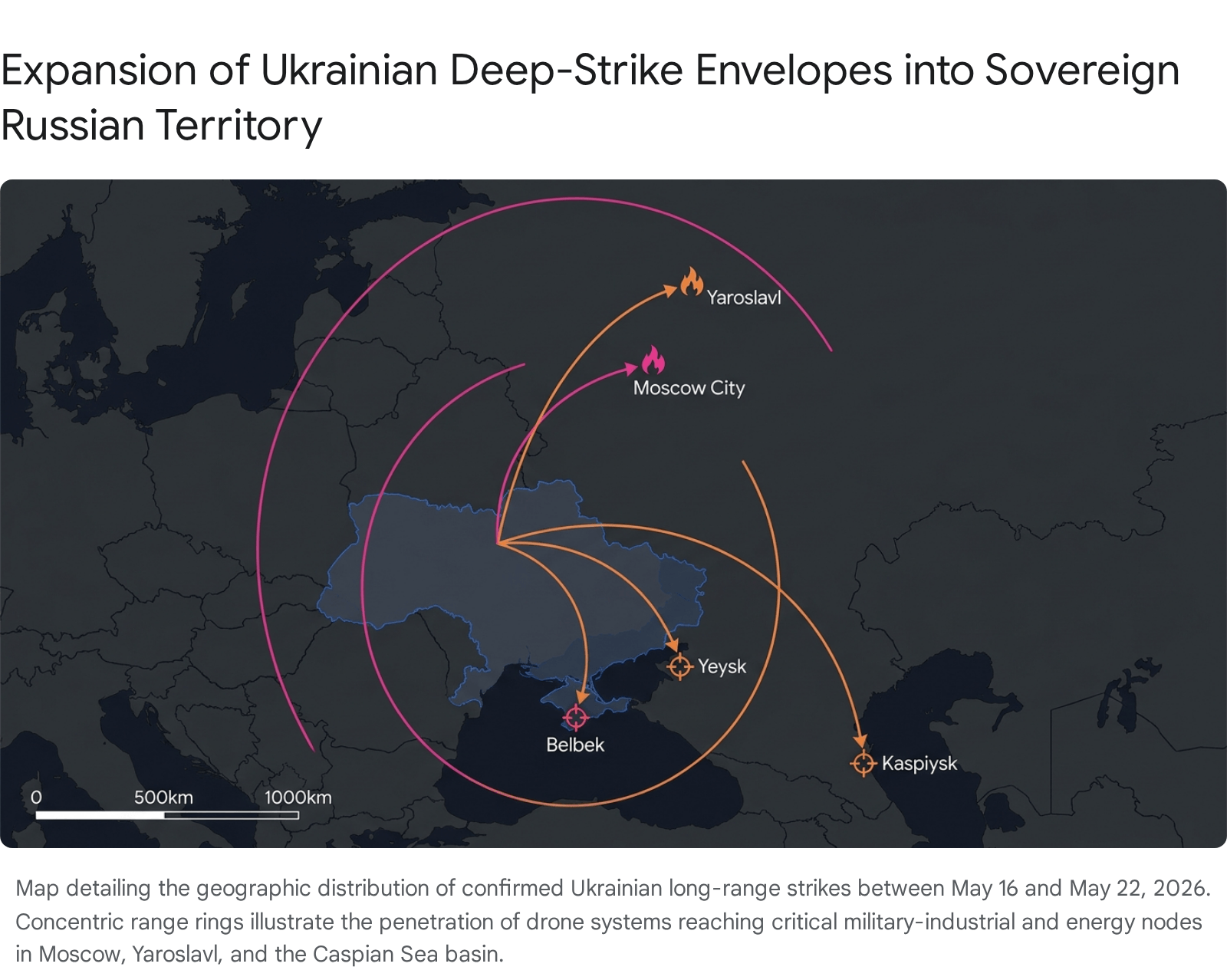
Strikes within the Russian Interior: In the largest and most sophisticated breach of Moscow’s airspace since the war’s inception, over 500 Ukrainian drones targeted the broader Moscow region overnight on May 16-17.1 This operation successfully penetrated multiple echelons of Russian air defense. Confirmed impacts included the Angstrem Semiconductor plant located at the Elma Technopark in Zelenograd—a vital facility specializing in the production of microelectronics and optical systems for high-precision Russian weaponry.7 Additionally, strikes targeted the Solnechnogorsk oil pumping station, a critical node in the ring oil pipeline around Moscow used for pumping and storing military-grade diesel, and the Moscow Oil Refinery in Kapotnya Raion.7
Further extending their reach, Ukrainian drones repeatedly struck the Slavneft-YANOS refinery in Yaroslavl. This facility is Russia’s fourth-largest refinery, possessing an annual processing capacity of approximately 15 million tons of crude oil.10 The verified strike on May 19 marked the third successful attack on this specific facility within a two-week period, indicating a deliberate campaign to permanently sever this node from the Russian energy grid.11 Furthermore, precision strikes forced the partial shutdown of the AVT-6 primary oil refining unit at the Lukoil-Nizhegorodnefteorgsintez Oil Refinery in Nizhny Novgorod, precipitating a sharp decline in the plant’s production of downstream petroleum products.5
Rear Echelon Degradation in Occupied Territories: Within the occupied territories of Ukraine, Ukrainian forces focused on decapitation strikes against command infrastructure. Overnight on May 21-22, Ukrainian munitions struck a Russian drone command center located in occupied Starobilsk, Luhansk Oblast.5 Ukrainian military intelligence identified the target as one of the primary headquarters of the “Rubikon” unit, an elite Russian UAV detachment responsible for coordinating strikes against Ukrainian civilian infrastructure.15 While Russian occupation authorities and President Putin characterized the strike as a terrorist act that hit a civilian college dormitory resulting in six fatalities, the Ukrainian General Staff firmly denied targeting civilians, maintaining that the operation strictly neutralized a verified military installation in accordance with international humanitarian law.17
In Crimea and southern Ukraine, a targeted strike on the Belbek military airfield in occupied Sevastopol destroyed highly valuable air defense and radar assets. SBU reports, corroborated by NASA Fire Information for Resource Management System (FIRMS) data, confirmed the destruction of a Pantsir-S2 system, an S-400 radar installation hangar, and Orion and Forpost ground-based UAV control systems.7 In Kherson Oblast, a complex strike on the Arabat Spit neutralized a Russian Federal Security Service (FSB) command post, resulting in approximately 100 Russian casualties, and simultaneously destroyed a Pantsir-S1 air defense system near occupied Shchaslyvtseve.3
Maritime Security Incidents: Ukrainian Unmanned Surface Vehicles (USVs) and long-range aerial assets continued to project power into distant maritime theaters, fundamentally altering the naval security paradigm. Overnight on May 16-17, Ukrainian forces executed a successful strike against a Project 10410 Svetlyak-class patrol ship belonging to the Russian FSB Border Service.7 Crucially, this vessel was docked in Kaspiysk, Republic of Dagestan, located approximately 1,000 kilometers from the frontline on the Caspian Sea.7 This strike represents a highly significant expansion of the maritime threat envelope, forcing the Russian Navy to reconsider the safety of naval assets previously deemed entirely insulated from the conflict and demonstrating Ukraine’s capability to operate effectively across multiple, non-contiguous bodies of water.
Strategic Realignments and Third-Party Maneuvers
The 7-day reporting period witnessed critical diplomatic maneuvers by global powers, heavily influencing the strategic calculus, military resourcing, and geopolitical posture of both combatants.
The People’s Republic of China (PRC) and the Russian Federation: Russian President Vladimir Putin undertook a highly publicized, two-day state visit to Beijing on May 19-20 to meet with PRC President Xi Jinping.20 The summit was explicitly designed to project unity and resilience in the face of Western sanctions. The leaders signed a joint declaration advocating for a “multipolar world” and finalized agreements to deepen cooperation on satellite internet interoperability (between Russia’s GLONASS and China’s BeiDou systems), artificial intelligence, and open-source cyber technologies—moves intended to reduce reliance on Western technological ecosystems.2
However, the summit notably failed to achieve Russia’s primary economic objective.2 OSINT sources confirm that Putin and Xi failed to reach a final agreement on the Power of Siberia-2 gas pipeline.5 This proposed 2,600-kilometer megaproject is essential for Moscow, designed to redirect up to 50 billion cubic meters of natural gas annually from permanently lost European markets to Asia.24 Negotiations remain stalled due to Beijing’s hardball pricing tactics; China is leveraging its access to alternative global Liquefied Natural Gas (LNG) sources—including from Qatar, Australia, and the US—to demand heavily discounted rates that Moscow is hesitant to accept, knowing it lacks alternative viable customers for this stranded asset.24 This failure to secure long-term, high-volume energy revenue streams significantly limits Russia’s future fiscal runway and underscores the distinctly unequal nature of the bilateral partnership.
The United States, NATO, and the European Union: Western backing for Ukraine saw a major, structural consolidation aimed at ensuring long-term sustainability. Following months of diplomatic deadlock, the European Union formally approved a historic €90 billion ($106 billion) macroeconomic and military loan package for Ukraine.26 This substantial capital injection is designed to sustain Ukraine’s civilian economy and military procurement pipeline through the end of 2027, serving as a critical hedge to mitigate the risks associated with volatile United States domestic political cycles and election outcomes. Concurrently, the U.S. Department of Defense began informing NATO allies of a revised global force posture, updating the numbers of troops available for the alliance’s rapid response forces in Europe, a move monitored closely by both Brussels and Moscow as an indicator of long-term U.S. commitment to the continent’s defense.28
Baltic State Tensions and Belarusian Complicity: Geopolitical friction along NATO’s eastern flank intensified dramatically during this period, characterized by Russian information operations and airspace violations. Following the series of successful Ukrainian drone strikes deep inside Russia, the Russian Ministry of Foreign Affairs launched a coordinated disinformation campaign accusing the Baltic states—specifically highlighting Latvia—of acting as direct “launchpads” for Ukrainian UAVs.29 These claims, entirely unsubstantiated by evidence, were accompanied by direct warnings of “just retribution” against specific, named Baltic military bases.29
Simultaneously, the physical security of Baltic airspace was tested. Latvia and Lithuania reported multiple airspace incursions by unidentified unmanned aerial vehicles, triggering national air alerts.29 Latvia reported its third drone alert in three days, while Estonia summoned the Russian ambassador in formal diplomatic protest against Moscow’s continued intimidation tactics.29 NATO Secretary General Mark Rutte issued a stern warning that any direct attack on NATO allies would face a “devastating” response, dismissing the Russian claims as “totally ridiculous.”.29 EU Defence Commissioner Andrius Kubilius identified the Russian actions as deliberate hybrid intimidation tactics designed to test Western resolve, sow domestic anxiety within the Baltics, and deter ongoing defense investments.29
As part of this broader intimidation matrix, Russia and Belarus concluded a surprise phase of combined tactical nuclear exercises on May 21.3 These high-profile drills involved the simulated transfer of specialized nuclear munitions to Belarusian forces and the test launching of strategic assets including Yars Intercontinental Ballistic Missiles (ICBMs), Zircon hypersonic missiles, and Kinzhal aero-ballistic systems.3 This development underscores Russia’s deepening de facto control over Belarusian military infrastructure, effectively utilizing the territory as a forward operating base for nuclear signaling to distract from conventional battlefield vulnerabilities and project strength toward NATO.3
3. Drone Warfare and Unmanned Systems
The operational environment over the past week has been heavily dictated by rapid technological iteration and the mass deployment of unmanned systems by both belligerents. The airspace over the theater is currently saturated, forcing both sides to innovate continually in targeting methodologies, interception tactics, and Electronic Warfare (EW) resistance.
Strategic Unmanned Deployments and Doctrine
The sheer scale of drone utilization remains unprecedented in modern warfare. According to estimates provided by Ukrainian officials, since May 10, Russian forces have launched over 3,170 long-range strike drones against Ukrainian territory.7 A singular inflection point occurred on the night of May 17-18, when Russia executed a massive, synchronized combined strike utilizing 546 drones and missiles. This specific strike package comprised 524 Shahed-type, Gerbera-type, and Italmas-type strike drones, accompanied by Parodiya decoy drones designed specifically to overwhelm and exhaust Ukrainian air defense interceptor stockpiles.30
Ukraine’s strategic deployment doctrine has evolved significantly, moving from localized, symbolic harassment to systematic economic warfare and infrastructure interdiction. The Ukrainian Unmanned Systems Forces (USF) utilized a suite of newly developed, domestically produced long-range platforms to penetrate the dense Moscow air defense rings. OSINT reporting identified the operational debut and utilization of several advanced models, including the RS-1 “Bars” jet-powered UAV, the Firepoint FP-1 winged drone, and a newly observed, highly capable variant dubbed the “Bars-SM Gladiator”.9 These platforms demonstrate Ukraine’s growing capacity to mass-produce systems capable of autonomous, long-distance navigation.
In the tactical ground domain, Unmanned Ground Vehicles (UGVs) are rapidly transitioning from experimental battlefield assets to standard combat logistics and strike platforms. Ukrainian forces reportedly maintain a definitive technical superiority in strike-capable UGVs, utilizing them primarily for remote area mining and direct infantry engagement, thereby minimizing the exposure of their own personnel in highly contested kill zones.30 Conversely, Russian military units have increasingly integrated UGVs into their frontline logistics chains. Due to the extreme lethality of the airspace caused by Ukrainian First-Person View (FPV) drones, Russian forces are using these ground platforms to resupply forward positions with ammunition and rations, highlighting a necessary adaptation to a battlespace where human-crewed resupply vehicles face near-certain destruction.30
Targeting Matrices and Strike Asymmetry
A clear divergence in the targeting doctrine between the two militaries was evident during the May 16-23 reporting period:
- Ukrainian Targeting Priorities: Kyiv has prioritized the systematic and precise dismantling of the Russian war economy, logistics arteries, and high-level command structures. Drone campaigns explicitly targeted downstream oil processing (e.g., Moscow Oil Refinery, Yaroslavl Slavneft-YANOS), military microelectronics manufacturing (Angstrem plant in Zelenograd), and elite C2 nodes (the FSB base on the Arabat Spit and the Rubikon drone HQ in Starobilsk).3 This strategy is dual-purpose: to degrade the physical materiel available to the Russian military and to force the Kremlin to redeploy scarce air defense systems away from the frontline to protect widely dispersed, high-value rear-echelon economic assets. Furthermore, Ukrainian tactical drone operators claimed exceptional lethality, with USF Commander Major Robert “Magyar” Brovdi reporting that Ukrainian drones struck 19,203 Russian personnel in the first 19 days of May alone.5
- Russian Targeting Priorities: Russian strike packages have predominantly focused on degrading Ukrainian national morale, interdicting civilian supply chains, and crippling civil sustainability. The mass drone and missile barrages heavily targeted energy generation facilities, food storage warehouses, and civilian residential sectors in Dnipro City, Sumy, and Odesa.5 The strikes in the port city of Odesa notably impacted a Chinese-owned commercial vessel, underscoring the indiscriminate nature of the port bombardments and highlighting the inherent risks to third-party shipping in the Black Sea.30
Technological Iteration and Countermeasure Ecosystems
The technological cat-and-mouse game between offense and defense saw major developments in both operational capacity and platform lethality over the past week.
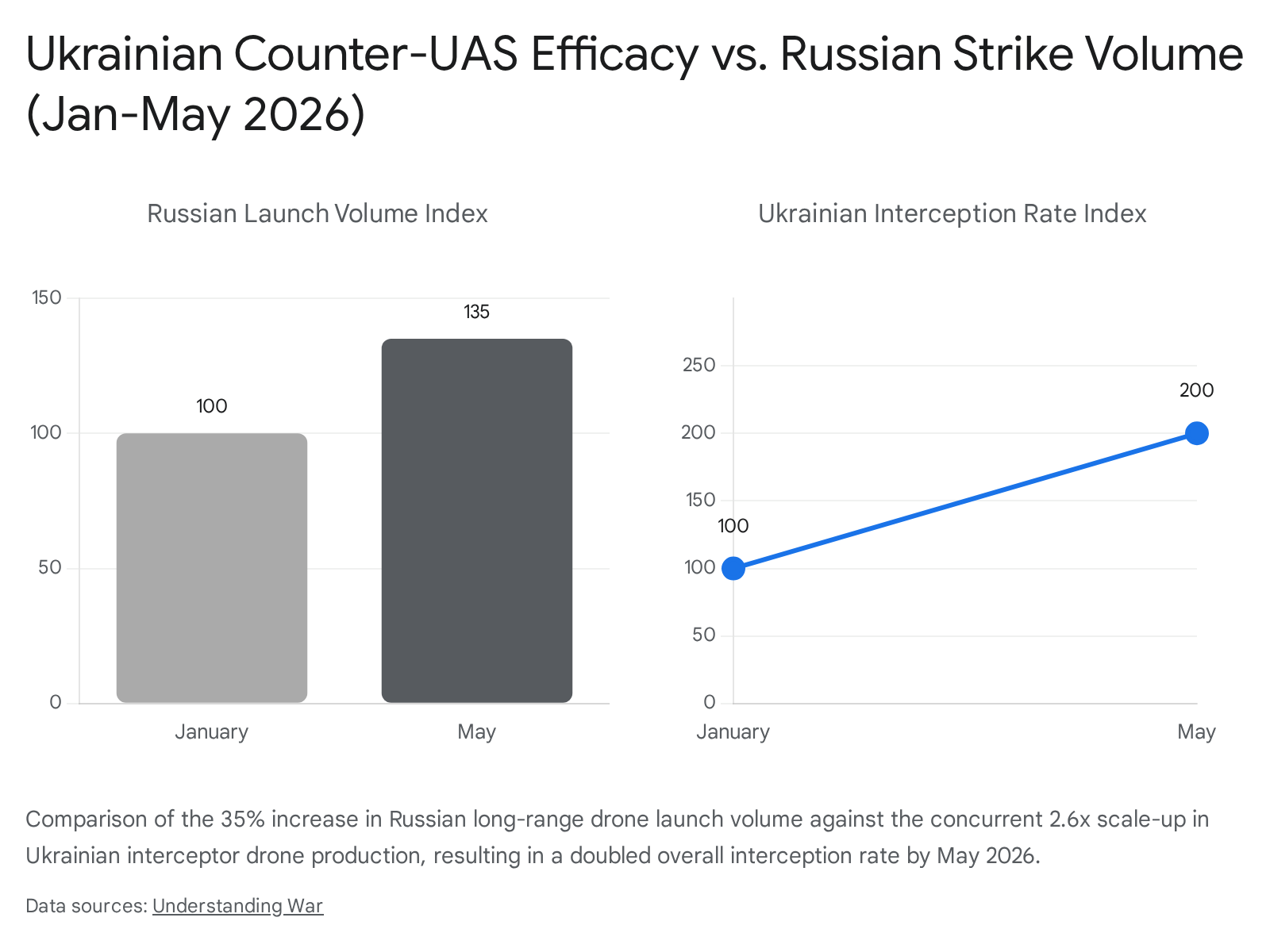
Ukrainian Counter-Drone Infrastructure and Adaptations: Faced with overwhelming incoming volumes, Ukraine has significantly and successfully scaled its domestic counter-UAS capabilities. The Ukrainian Ministry of Defense reported a 2.6-fold increase in the supply of domestically produced interceptor drones between January and May 2026. This industrial surge allowed Ukrainian forces to effectively double their overall interception rate of Russian long-range drones, a remarkable achievement given that Russian forces simultaneously expanded their drone strike packages by approximately 35% during the same timeframe.3
Furthermore, Ukraine has authorized a novel, highly decentralized private air defense initiative, integrating 27 private businesses into the national air defense umbrella. These civilian-corporate formations are authorized to coordinate directly with the Ukrainian Air Force to conduct localized counter-drone operations using their own procured equipment, with operational units already active in Kharkiv and Odesa oblasts.3 On the tactical front, Ukrainian forces are increasingly utilizing advanced fiber-optic drones. By using a physical tether rather than radio frequencies, these drones can completely bypass and operate unimpeded within zones blanketed by Russian Electronic Warfare (EW) jamming, severely restricting Russian mechanized ground assaults in sectors like Kherson by ensuring guaranteed FPV strikes regardless of the EW environment.3
Russian Tech Shifts and Lethality Enhancements: To counter Ukraine’s improving interception rates, the Russian military-industrial complex is escalating the speed and lethality of its platforms. Satellite imagery obtained on May 20 of the Tsimbulova Airfield in Oryol Oblast revealed the active construction of 10 new drone launch ports and specialized concrete storage structures designed explicitly for the newer, jet-powered Geran-4 and Geran-5 variants.3 The transition from propeller-driven to jet-powered systems significantly increases the velocity of the approach, drastically reducing the reaction time available for Ukrainian interceptor drones and ground-based anti-aircraft fire.
Additionally, physical lethality is being augmented. The Ukrainian Security Service (SBU) disclosed forensic analysis of a downed Russian Geran-2 drone, revealing the novel integration of depleted Uranium-235 and Uranium-238 elements within the payload matrix.5 This specific adaptation, detected in a drone armed with an R-60 air-to-air missile, is designed to maximize kinetic fragmentation, density of shrapnel, and structural damage upon impact, indicating a shift toward optimizing the destructive yield of platforms that successfully bypass air defenses.5
4. Resource Utilization, Constraints, and Sustainability Projection
The conflict has entered a phase characterized by severe, industrial-scale attrition of both personnel and physical materiel. Both militaries are operating under extreme logistical constraints, forcing structural, potentially irreversible changes to their respective defense industrial bases and domestic economies.
Demographic Attrition and Manpower Generation
The expenditure of human resources by the Russian Federation remains extraordinarily high, presenting a critical vulnerability. According to data provided by the General Staff of the Armed Forces of Ukraine, estimated total Russian personnel losses (killed and wounded) from the start of the full-scale invasion reached approximately 1,354,810 by May 23, 2026.31 During this specific 7-day reporting period, daily reported Russian casualties averaged between 950 and 1,220 personnel per day.31 Ukrainian President Volodymyr Zelensky publicly corroborated these high attrition rates, stating that Russia has suffered 145,000 casualties thus far in the calendar year 2026, averaging 1,021 losses per day.13
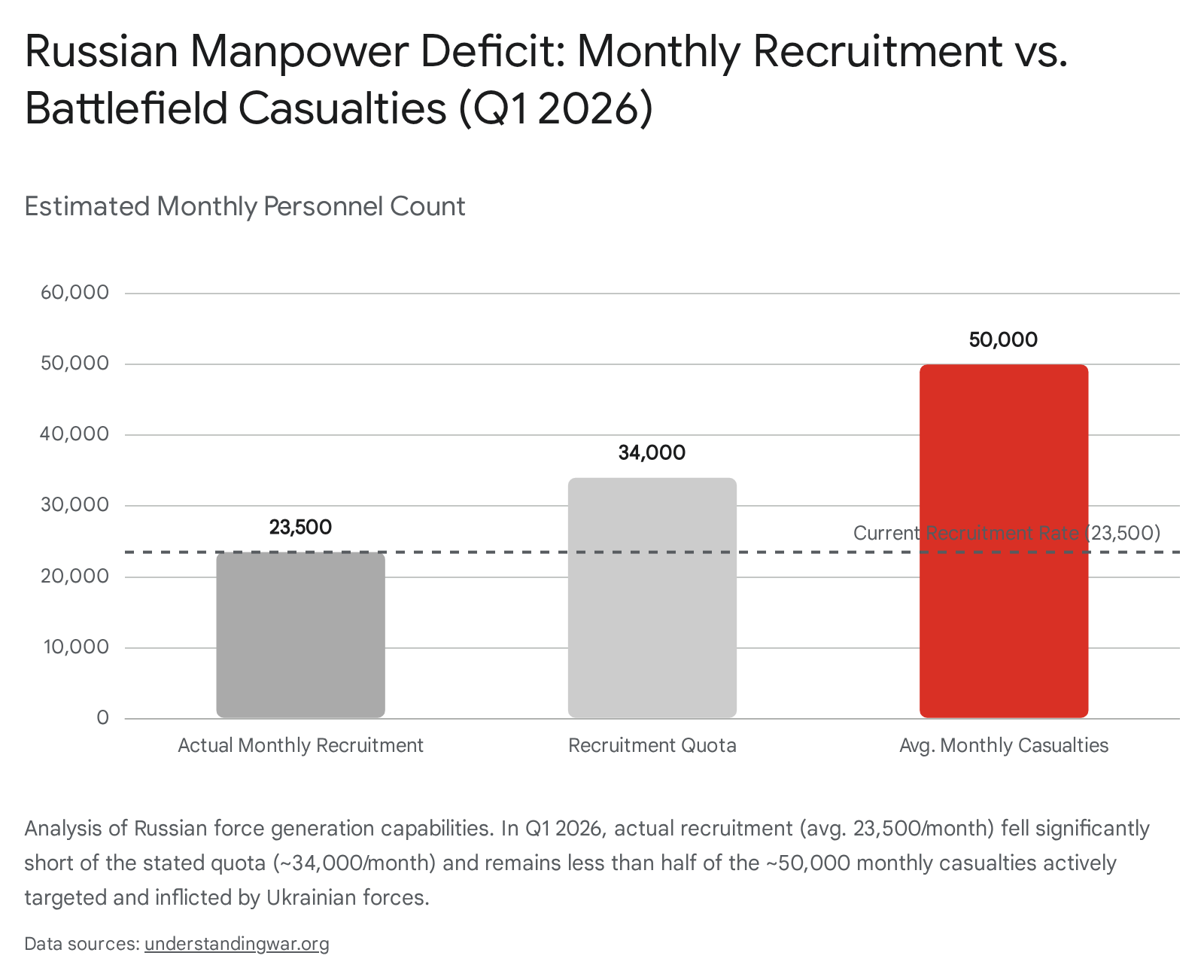
The Russian Ministry of Defense is facing critical manpower bottlenecks that threaten unit cohesion and offensive capability. OSINT analysis indicates that the Russian voluntary contract recruitment rate has definitively dipped below its battlefield replacement rate. In the first quarter of 2026, Russia concluded only 70,500 military service contracts, significantly short of the monthly quota of 33,500 to 34,600 required merely to maintain existing combat effectiveness and replace attrited forces.5 Despite recent, substantial increases in one-time financial signing bonuses, and the increasingly acknowledged integration of foreign fighters (notably North Korean contingents observed in the theater since spring 2026), domestic contract recruitment continues to decline as the realities of battlefield casualty rates permeate the Russian public consciousness.6 To sustain this operational pressure, the Ukrainian Ministry of Defense reported setting a strategic objective to inflict approximately 50,000 Russian casualties per month, aiming to mathematically outpace and break Russia’s ability to regenerate functional combat power.5
Equipment Attrition and Material Burn Rates
The material burn rate mirrors the human toll, reflecting the intensity of the mechanized and artillery-centric combat. Based on official Ukrainian General Staff data over the week, Russian forces are sustaining daily losses that severely impact their ability to generate massed armored assaults or maintain comprehensive air defense coverage.
| Date | Reported Personnel Casualties | UAV Losses | Artillery System Losses | Armored Vehicles / Tanks | Sources |
| May 16, 2026 | 1,170 | 2,131 | 82 | – | 32 |
| May 17, 2026 | 1,220 | 1,603 | 47 | – | 33 |
| May 18, 2026 | 1,140 | 2,142 | 78 | – | 34 |
| May 22, 2026 | 950 | 1,819 | 68 | 5 Tanks / 5 ACVs | 31 |
Note: Daily fluctuations in UAV losses reflect both tactical drone attrition (e.g., FPVs) and the interception of strategic loitering munitions.
Logistical Severance and Industrial Bottlenecks
Logistically, Ukraine’s continuous mid-range strike campaign is severely complicating Russian ground transport and supply chain integrity. Continuous interdiction of supply lines has forced the Russian occupation administration in Kherson Oblast, under Vladimir Saldo, to issue strict decrees restricting the movement of all commercial and civilian freight vehicles on the M-14 (R-280 Novorossiya) highway.13 This administrative action is designed to reserve limited, secure road capacity exclusively for military logistics, but consequently creates severe bottlenecks for civilian and dual-use supply chains in the occupied territories, degrading the overall economic output of the region.13
Medium-Term Sustainability Projections
Objective, forward-looking economic analysis projects that Russia’s current trajectory is economically and demographically unsustainable in the medium term without radical policy shifts. The Russian state is currently operating a volatile “dual economy,” characterized by highly overheated military output that attempts to mask deep, structural civilian economic stagnation.38 Crucially, because the Kremlin has refused to officially declare war—insisting on maintaining the “Special Military Operation” legal framework—it must compete in the open market for labor, technical inputs, and capital.38 This reality makes generating military power exponentially more expensive for Russia today than it was during the centralized, command-economy era of the Cold War.
With the domestic labor market exhausted by conscription, high casualty rates, and brain-drain emigration, and with the industrial base operating near its absolute total productive capacity with diminishing returns on new investments, the Kremlin is approaching a fundamental inflection point. If the manpower deficit and financial drain—exacerbated by the failure to secure the Chinese gas deal and the physical destruction of oil infrastructure by Ukrainian strikes—continue at the current rate through the winter of 2026, the Kremlin will face a stark choice.13 It will likely be forced to impose stringent, command-economy measures and initiate a politically perilous, highly unpopular forced societal mobilization to generate troops, or it will be forced to scale back its maximalist territorial objectives to match its actual resource generation capabilities.13
Conversely, Ukraine’s operational sustainment relies almost entirely on the timely execution and disbursement of the newly approved €90 billion EU aid package.26 If this capital is deployed effectively to scale domestic interceptor production, secure artillery ammunition pipelines, and expand the production of deep-strike UAVs, projections indicate Kyiv can maintain its current strategy of asymmetrical attrition, further exacerbating the structural pressures on the Russian state apparatus.
5. Chronological Timeline of Key Events
The following timeline details the most significant operational, diplomatic, and tactical events recorded over the 7-day reporting period, providing a chronological overview of the conflict’s escalation.
- May 16, 2026:
- The United States administration allows a critical sanctions waiver to lapse, closing a loophole that previously permitted third-party nations to purchase Russian seaborne oil stored on tankers, significantly increasing economic pressure on Moscow.1
- Ukrainian forces conduct a successful strike on the Azot chemical plant in Nevinnomyssk, Stavropol Krai, disrupting a facility critical for the production of nitrogen fertilizers and explosives used by the Russian military.39
- May 17, 2026:
- Overnight, Ukraine launches an unprecedented drone assault utilizing over 500 long-range UAVs. The swarm penetrates the Moscow region air defense rings, striking the Angstrem microelectronics plant in Zelenograd, the Solnechnogorsk oil pumping station, and the Moscow Oil Refinery, prompting widespread flight diversions and airspace closures.7
- Ukrainian forces successfully strike the Belbek military airfield in occupied Sevastopol, Crimea, destroying high-value Russian S-400 radar infrastructure and a Pantsir-S2 air defense system.7
- A coordinated Ukrainian USV and drone strike hits a Russian Federal Security Service (FSB) Project 10410 Svetlyak-class patrol ship docked in Kaspiysk, Dagestan, expanding the threat matrix into the Caspian Sea.7
- May 18, 2026:
- Russian forces conduct a massive, large-scale retaliatory strike against Ukraine, launching 546 drones and missiles (including 14 Iskander-M/S-400 ballistic missiles and 8 cruise missiles). The barrage heavily targets civilian and energy infrastructure in Dnipropetrovsk Oblast and Odesa, where a Chinese-owned commercial ship is damaged.30
- The US Defense Intelligence Agency (DIA) publishes an assessment formally noting Ukraine’s recent territorial gains following temporary Russian communication disruptions.13
- May 19, 2026:
- Russian President Vladimir Putin arrives in Beijing for a highly anticipated two-day state visit with PRC President Xi Jinping. While the leaders sign a multipolar world declaration, they fail to reach a vital agreement on the Power of Siberia-2 gas pipeline, dealing a blow to Russia’s long-term energy strategy.2
- Russia initiates surprise strategic and tactical nuclear exercises, explicitly posturing military strength against NATO and Ukraine’s Western allies to mask conventional battlefield vulnerabilities.6
- Ukrainian drones penetrate deep into Russian territory to strike the Yaroslavl-3 oil pumping station and the Slavneft-YANOS refinery in Yaroslavl, prompting the closure of a major highway and multiple regional airports.5
- May 20, 2026:
- OSINT analysts and military officials report that Ukrainian forces officially regain the tactical initiative in several key sectors, advancing in the Kupyansk direction, Kostyantynivka-Druzhkivka, and successfully liberating the settlements of Mala Tokmachka and Bilohirya in western Zaporizhia Oblast.5
- A Ukrainian drone strike forces the partial shutdown of the AVT-6 primary oil refining unit at the Lukoil-Nizhegorodnefteorgsintez Oil Refinery in Nizhny Novgorod.5
- May 21, 2026:
- Geopolitical tensions spike as Latvia and Lithuania issue multiple emergency air alerts in response to unidentified drone incursions violating Baltic airspace. Russia issues statements accusing the Baltics of hosting Ukrainian drone “launchpads,” prompting firm condemnation from NATO and the EU.29
- Russia and Belarus officially complete the second stage of their combined tactical nuclear exercises, cementing Belarus’s role in Russian nuclear posturing.3
- Kherson Oblast occupation authorities, under Vladimir Saldo, sign decrees severely restricting civilian freight movement on the critical M-14 highway due to intense Ukrainian logistical interdiction.13
- May 22, 2026:
- Ukrainian forces conduct a precision deep-strike on the headquarters of the Russian “Rubikon” elite drone unit in occupied Starobilsk, Luhansk Oblast. While Russia claims the strike hit a civilian dormitory and caused six deaths, Ukraine maintains the target was strictly a military installation coordinating strikes on Ukrainian civilians.14
- Ukrainian President Volodymyr Zelensky confirms a fourth successful strike within a month against the Slavneft-YANOS oil refinery in Yaroslavl, reiterating the strategy of bringing the war’s economic consequences directly to the Russian interior.12
- May 23, 2026:
- The European Union officially clears the path for a historic €90 billion ($106 billion) financial and military loan package for Ukraine, ending months of diplomatic deadlock and securing Ukraine’s medium-term operational funding.26
- The General Staff of the Armed Forces of Ukraine reports daily Russian casualties of 950 personnel, pushing the estimated total Russian losses since the start of the full-scale invasion in 2022 to over 1,354,810.31
Please share the link on Facebook, Forums, with colleagues, etc. Your support is much appreciated and if you have any feedback, please email us in**@*********ps.com. If you’d like to request a report or order a reprint, please click here for the corresponding page to open in new tab.
Works cited
- Ukraine war briefing: more than 500 drones strike at Russia, killing 3; US allows Russian oil sanctions waiver to lapse – The Guardian, accessed May 23, 2026, https://www.theguardian.com/world/2026/may/17/ukraine-war-briefing-us-allows-russian-oil-sanctions-waiver-to-lapse
- Putin and Xi Sign ‘Multipolar World’ Declaration in Beijing, accessed May 23, 2026, https://www.themoscowtimes.com/2026/05/20/putin-and-xi-sign-multipolar-world-declaration-in-beijing-a92796
- Russian Offensive Campaign Assessment, May 21, 2026 | ISW, accessed May 23, 2026, https://understandingwar.org/research/russia-ukraine/russian-offensive-campaign-assessment-may-21-2026/
- The Russia-Ukraine War Report Card, May 20, 2026, accessed May 23, 2026, https://www.russiamatters.org/news/russia-ukraine-war-report-card/russia-ukraine-war-report-card-may-20-2026
- Russian Offensive Campaign Assessment, May 20, 2026 | ISW, accessed May 23, 2026, https://understandingwar.org/research/russia-ukraine/russian-offensive-campaign-assessment-may-20-2026/
- Russian Offensive Campaign Assessment, May 19, 2026 | ISW, accessed May 23, 2026, https://understandingwar.org/research/russia-ukraine/russian-offensive-campaign-assessment-may-19-2026/
- Russian Offensive Campaign Assessment, May 17, 2026 | ISW, accessed May 23, 2026, https://understandingwar.org/research/russia-ukraine/russian-offensive-campaign-assessment-may-17-2026/
- The tide is turning in Russia-Ukraine war, accessed May 23, 2026, https://www.gzeromedia.com/by-ian-bremmer/the-tide-is-turning-in-russia-ukraine-war
- Ukraine war briefing: The drones that bombarded Moscow region – The Guardian, accessed May 23, 2026, https://www.theguardian.com/world/2026/may/18/ukraine-war-briefing-the-drones-that-bombarded-moscow-region
- Explosions rock Russia’s Yaroslavl as authorities report drone strike on industrial facility, accessed May 23, 2026, https://www.pravda.com.ua/eng/news/2026/05/19/8035328/
- Drone hits Yaroslavl refinery for third time in two weeks as Russia’s fourth-largest oil plant burns again – Euromaidan Press, accessed May 23, 2026, https://euromaidanpress.com/2026/05/19/drone-hits-yaroslavl-refinery-for-third-time-in-two-weeks-as-russias-fourth-largest-oil-plant-burns-again/
- Ukraine strikes Russia’s Yaroslavl Oil Refinery 4 times in month, Zelensky confirms, accessed May 23, 2026, https://kyivindependent.com/russias-yaroslavl-oil-refinery-hit-for-4th-time-in-a-month-zelensky-confirms/
- Russian Offensive Campaign Assessment, May 22, 2026 | ISW, accessed May 23, 2026, https://understandingwar.org/research/russia-ukraine/russian-offensive-campaign-assessment-may-22-2026/
- ISW Russian Offensive Campaign Assessment, May 22, 2026 – Kyiv Post, accessed May 23, 2026, https://www.kyivpost.com/post/76700
- Ukraine Says Rubikon Strike Hit Russian Drone Unit, Not Civilian Site, accessed May 23, 2026, https://www.kyivpost.com/post/76698
- General Staff: One of Rubikon unit’s headquarters hit in Starobilsk – Interfax-Ukraine, accessed May 23, 2026, https://en.interfax.com.ua/news/general/1170147.html
- Ukraine war briefing: Putin promises revenge after blaming Kyiv for Luhansk attack he says killed six, accessed May 23, 2026, https://www.theguardian.com/world/2026/may/23/ukraine-war-briefing-putin-promises-revenge-after-blaming-kyiv-for-luhansk-attack-he-says-killed-six
- Ukraine hits college in Russian-occupied town, killing 6: Moscow, accessed May 23, 2026, https://www.bssnews.net/international/389637
- Kyiv Dismisses Russian Accusations Over Dormitory Attack in Occupied Luhansk – Kyiv Post, accessed May 23, 2026, https://www.kyivpost.com/post/76696
- ISW Russian Offensive Campaign Assessment, May 19, 2026 – Kyiv Post, accessed May 23, 2026, https://www.kyivpost.com/post/76475
- China and Russia’s strategic duo endures – but its limits are clear, accessed May 23, 2026, https://www.chathamhouse.org/2026/05/china-and-russias-strategic-duo-endures-its-limits-are-clear
- Xi and Putin pledge closer cooperation on AI, cyberspace and satellite systems, accessed May 23, 2026, https://therecord.media/russia-and-china-pledge-cooperation-2026
- Putin, Xi signal unity but fail to reach deal on pipeline sought by Russia, accessed May 23, 2026, https://www.washingtonpost.com/world/2026/05/20/putin-fails-secure-xi-approval-power-siberia-2-pipeline/
- Putin leaves Beijing without agreement on Power of Siberia 2 gas pipeline, accessed May 23, 2026, https://cryptobriefing.com/putin-power-of-siberia-2-pipeline-stalled/
- Putin Gets Show Of Unity, But No New Pipeline Deal In Beijing Summit – Radio Free Europe, accessed May 23, 2026, https://www.rferl.org/a/putin-xi-power-of-siberia-iran-war-trump-china-russia/33760781.html
- EU’s $106 Billion Lifeline To Ukraine: EU Unblocks Massive Ukraine Loan – YouTube, accessed May 23, 2026, https://www.youtube.com/watch?v=2VvAsiKY-5g
- This is how to defeat Vladimir Putin | Timothy Garton Ash, accessed May 23, 2026, https://www.theguardian.com/commentisfree/2026/may/23/defeat-vladimir-putin-russia-ukraine-nato-eu
- US to unveil revised force posture to NATO allies this week, sources say, accessed May 23, 2026, https://www.euractiv.com/news/us-to-unveil-revised-force-posture-to-nato-allies-this-week-sources-say/
- Many Nato countries not spending enough to support Ukraine, says Rutte – as it happened, accessed May 23, 2026, https://www.theguardian.com/world/live/2026/may/21/czech-republic-petr-pavel-ukraine-baltics-drones-russia-nato-security-latest-news-updates
- Russian Offensive Campaign Assessment, May 18, 2026 | ISW, accessed May 23, 2026, https://understandingwar.org/research/russia-ukraine/russian-offensive-campaign-assessment-may-18-2026/
- Russia loses 950 soldiers over past day, accessed May 23, 2026, https://www.pravda.com.ua/eng/news/2026/05/23/8036041/
- Total russian combat losses in Ukraine as of May 17, 2026, accessed May 23, 2026, https://mod.gov.ua/en/news/total-russian-combat-losses-in-ukraine-as-of-may-17-2026
- Total russian combat losses in Ukraine as of May 18, 2026, accessed May 23, 2026, https://mod.gov.ua/en/news/total-russian-combat-losses-in-ukraine-as-of-may-18-2026
- russian losses in Ukraine as of May 19, 2026 | MoD News, accessed May 23, 2026, https://mod.gov.ua/en/news/total-russian-combat-losses-in-ukraine-as-of-may-19-2026
- Total russian combat losses in Ukraine as of May 23, 2026, accessed May 23, 2026, https://mod.gov.ua/en/news/total-russian-combat-losses-in-ukraine-as-of-may-23-2026
- ISW Russian Offensive Campaign Assessment, May 21, 2026 – Kyiv Post, accessed May 23, 2026, https://www.kyivpost.com/post/76621
- As Russian losses mount in Ukraine, Putin seeks more foreign fighters, accessed May 23, 2026, https://www.atlanticcouncil.org/blogs/ukrainealert/as-russian-losses-mount-in-ukraine-putin-seeks-more-foreign-fighters/
- The Coming Crisis in Russia’s Political Economy, accessed May 23, 2026, https://www.iiss.org/research-paper/2026/05/the-coming-crisis-in-russias-political-economy/
- Russian Offensive Campaign Assessment, May 16, 2026 | ISW, accessed May 23, 2026, https://understandingwar.org/research/russia-ukraine/russian-offensive-campaign-assessment-may-16-2026/