1. Executive Summary
During the reporting period of April 25 to May 2, 2026, the geopolitical and operational landscape of the Russia-Ukraine conflict experienced a profound recalibration. Characterized by a transition into a theater of extreme technological attrition, the conflict has seen territorial control in the eastern provinces remain largely static while the depth, intensity, and collateral impact of the battlefield have expanded exponentially. At the macro level, the diplomatic frameworks previously guiding international mediation have deteriorated significantly, forcing strategic realignments across all operational domains.
At the strategic level, U.S. mediation efforts have executed a pronounced pivot toward a framework that Russian officials refer to as the “Anchorage understanding,” a shift that has severely eroded Ukrainian and European confidence in Western diplomatic reliability.1 Consequently, the Ukrainian government has accelerated the integration of its domestic Defense Industrial Base (DIB) with European partners, seeking sovereign technological overmatch to compensate for the volatility of external financial and material support.2
Militarily, the terrestrial frontline remains a heavily fortified, attritional stalemate. Russian forces continue to control approximately 75% of the Donetsk province, executing localized tactical assaults that yield only marginal gains, such as the occupation of Sukha Balka.1 Unable to achieve rapid operational breakthroughs through mechanized maneuver, both combatants have intensified deep-rear precision strike campaigns. The Russian Federation has fundamentally altered its aerial bombardment doctrine, significantly increasing the volume of daytime unmanned aerial vehicle (UAV) attacks—launching a record 6,583 drones in April alone—to maximize civilian psychological attrition and economic disruption.5
Conversely, the Armed Forces of Ukraine (AFU) have extended their strike radius deep into the Russian Urals, targeting critical aerospace infrastructure over 1,600 kilometers from the international border, while systematically dismantling the Russian hydrocarbon export sector through persistent UAV interdiction.7 This asymmetric capability has simultaneously transformed the maritime domain. Ukrainian naval operations have successfully reduced Russian operational freedom in the Black Sea to a mere 25% of the total battlespace, effectively confining the remnants of the Black Sea Fleet to a narrow coastal corridor.9
The escalation in precision targeting has precipitated severe ecological and infrastructural crises. Repeated Ukrainian UAV strikes on the Tuapse oil refinery have triggered a catastrophic environmental disaster, resulting in massive petroleum spills and toxic atmospheric contamination along the Black Sea coastline.10 Concurrently, Russian flight paths for hypersonic munitions have introduced acute risks of radiological incidents near Ukrainian nuclear facilities.13
Furthermore, the operational environment is rapidly adapting to the weaponization of artificial intelligence in cyberspace. The deployment of advanced large language models capable of autonomously converting software vulnerabilities into weaponized exploits has effectively collapsed the capability gap between state-sponsored advanced persistent threats (APTs) and deniable proxy groups, granting the Russian cyber apparatus a distinct asymmetric advantage in its digital sabotage campaigns against Ukrainian and allied networks.14
2. Strategic and Diplomatic Developments
The reporting period witnessed an accelerated degradation of the established diplomatic structures surrounding the conflict, driven primarily by shifts in United States foreign policy and mediation tactics. The strategic posture of the United States has moved definitively away from the foundational principle of “nothing about Ukraine without Ukraine,” fundamentally altering the risk calculus in Kyiv.1
2.1 The “Anchorage Understanding” and Shifting U.S. Mediation
Diplomatic momentum is increasingly influenced by the “Anchorage understanding,” a tentative framework established during an August 2025 meeting in Alaska between U.S. President Donald Trump and Russian President Vladimir Putin.1 Russian officials have heavily leveraged this understanding as the baseline for their current maximalist demands. While the precise details remain undisclosed, the framework has fostered competing internal U.S. peace proposals. In November 2025, a 28-point plan circulated that would formally recognize Crimea, Luhansk, and Donetsk as de facto Russian territory, alongside a less concessionary 20-point alternative spearheaded by Secretary of State Marco Rubio.1
The operationalization of this new diplomatic approach is evidenced by the travel itinerary of the chief U.S. negotiator, Steve Witkoff, who has traveled to Moscow on eight separate occasions since March 2025 without conducting a single visit to Kyiv.1 This asymmetry in diplomatic engagement has exacerbated tensions. In late March 2026, Ukrainian President Volodymyr Zelenskyy publicly accused U.S. officials of conditioning future security guarantees on Ukraine’s willingness to formally cede the entirety of the Donetsk province.1
These anxieties were compounded in April 2026 when U.S. Vice President JD Vance publicly criticized Ukrainian leadership for “haggling over a few square kilometers,” a statement interpreted broadly as overt U.S. pressure on Ukraine to yield sovereign territory.1 On April 14, 2026, Vance further noted his pride in the administration’s successful termination of direct U.S. financial support for Ukraine, signaling a hardline pivot in material assistance.1 Despite these constraints, the U.S. Department of State did submit a proposed license for defense exports to Ukraine to the U.S. Congress on April 29, and authorized the release of a previously secured $400 million in military funds on April 30, highlighting internal administrative complexities regarding continued aid.15
2.2 Russian Strategic Rhetoric and Cognitive Warfare
The Russian Federation continues to project unwavering commitment to its maximalist objectives, utilizing diplomatic channels and domestic media to wage cognitive warfare aimed at fracturing Western resolve. On April 29, 2026, during a phone call with President Trump, President Putin reiterated his commitment to Russia’s original war aims.17 Intelligence assessments indicate Putin used this engagement to falsely portray Ukrainian defensive lines as collapsing and to frame a Russian military victory as an inevitability, despite overwhelming evidence of a tactical stalemate on the ground.17 Notably, the Kremlin also utilized the call to reprimand the U.S. administration regarding recent U.S.-Israeli operations against Iran, demonstrating Moscow’s intent to link the European and Middle Eastern theaters strategically.17
This diplomatic posturing was amplified domestically on April 30, when Russian Security Council Deputy Chairperson Dmitry Medvedev delivered a highly aggressive address at the Znanie Pervye (Education First) federal educational marathon.19 Medvedev explicitly labeled the United States as Russia’s primary geopolitical adversary and framed the ongoing war in Ukraine as an existential conflict with the West that will persist “within a generation”.19 By rejecting the legitimacy of U.S. mediation efforts, Medvedev’s rhetoric—often utilized to represent the extreme spectrum of Kremlin thought—serves to domesticate the narrative that the war is a necessary, long-term struggle for Russian survival, thereby justifying ongoing economic and human sacrifices.19
2.3 Erosion of Allied Confidence
The confluence of shifting U.S. mediation tactics and aggressive Russian diplomatic posturing has resulted in a severe erosion of trust among international allies. As of late April 2026, polling data indicates a profound collapse in Ukrainian confidence regarding U.S. reliability. Approximately 70% of the Ukrainian populace currently expects U.S.-brokered peace negotiations to fail, and only 28% view the United States as a reliable strategic partner.1
This sentiment is mirrored across the broader European continent. Only 30% of Polish citizens currently consider America a reliable ally, while 51% of the broader European public now views the United States as an “unfriendly country”.1 Within the Ukrainian government, frustration has reached critical levels. Senior diplomatic sources in Kyiv indicate an emerging consensus that Ukraine must operate under the assumption that it is effectively “losing” the United States as a reliable strategic anchor, expecting little future assistance beyond localized intelligence sharing and hoping to avoid coerced participation in an unacceptable territorial settlement.1
3. Military Events and Battles
The operational environment remains deeply fractured across the terrestrial, aerial, and maritime domains. While the ground war is characterized by bloody, localized attrition, the aerial and maritime spaces have seen significant expansions in the range and lethality of automated strike platforms.
3.1 Ground Operations and Territorial Realignments
The terrestrial frontline has solidified into a highly engineered network of trenches, minefields, and fortified urban centers, drastically limiting the operational mobility of mechanized forces. The primary geographic focal point remains the Donetsk province, where the Russian military currently occupies approximately 75% of the territory but faces extreme difficulties in seizing the remaining 5,000 square kilometers.1
This remaining Ukrainian-held sector in Donetsk houses roughly 200,000 civilians and functions as a critical “fortress belt” that has successfully absorbed continuous Russian assaults for years.1 Russian tactical gains in this sector have been agonizingly slow and resource-intensive. For instance, in the week of April 22 to April 29, Russian forces gained a total of only 14 square miles across the entire theater—a significant deceleration from the 40 square miles gained during the previous week.4 The most notable territorial shift in this sector occurred on April 29, when open-source intelligence groups and interactive mapping platforms confirmed that Russian armed forces had successfully occupied the settlement of Sukha Balka.4
Despite this grueling reality, the Russian military command continues to disseminate highly exaggerated reports of success. On April 21, Russian Chief of the General Staff Army General Valery Gerasimov claimed that Russian forces had seized over 1,700 square kilometers and 80 settlements since the beginning of 2026, including the entirety of the Luhansk Oblast.20 Independent battle damage assessments wholly contradict these assertions, indicating that Russian forces have only advanced 381.5 square kilometers and secured 13 settlements in that timeframe, and have actually suffered a net loss of 59.79 square kilometers across the broader theater since March 1.20
In the northern sectors of Sumy and Kharkiv, combat operations are characterized by infiltration attempts and the establishment of gray zones. On April 30, the Russian Ministry of Defense prematurely claimed the seizure of Korchakivka, a settlement situated north of Sumy City.19 The Ukrainian Kursk Grouping of Forces subsequently refuted this claim on May 1, revealing that Russian forward officers had fabricated the operational report out of desperation to demonstrate progress ahead of the May 1 holiday schedule.8
The tactical reality on the ground is far more severe than official Kremlin reports suggest. In the Kupyansk direction, Ukrainian Joint Forces Task Force Spokesperson Colonel Viktor Trehubov reported on April 30 that Russian infantry elements have been reduced to utilizing subterranean gas pipelines running from Holubivka to infiltrate northern Kupyansk.19 These subterranean assaults reflect the extreme lethality of the surface environment, with Russian units reportedly sustaining up to 70 percent casualties during such desperate infiltration maneuvers.19
3.2 Aerial and Missile Strike Campaigns
The reporting period was defined by a massive, sustained escalation in Russian aerial bombardments, demonstrating a tactical evolution aimed at systematically dismantling Ukrainian air defenses and civilian infrastructure. The Russian aerospace forces have refined their strike packages, utilizing highly coordinated waves of long-range drones to exhaust interceptor magazines before deploying difficult-to-intercept ballistic munitions.7
This tactic was brutally demonstrated between the night of April 24 and the morning of April 25, when the Russian military executed one of the most operationally dense bombardments of the conflict, launching a combined package of 666 drones and missiles.7 The primary target of this overwhelming barrage was Dnipro City, alongside targets in Chernihiv, Odesa, and Kharkiv. The strike package was highly complex, consisting of 619 loitering munitions (predominantly Shahed, Gerbera, and Italmas variants) designed to saturate radar arrays, followed by 29 Kh-101 cruise missiles, five Kalibr cruise missiles, one Iskander-K, and 12 Iskander-M or S-300 ballistic missiles.7
Ukrainian air defense networks managed to intercept 30 missiles and 580 drones, demonstrating an 88% interception rate, yet the sheer volume of the attack ensured that 13 missiles and 36 drones successfully struck 23 distinct locations.5 In Dnipro City, the bombardment lasted for over 20 hours. According to Mayor Borys Filatov, Russian forces deliberately employed illegal “double-tap” tactics, intentionally striking residential infrastructure and subsequently targeting the first responders and municipal officials who arrived to assist the wounded.7 This massive strike resulted in at least six civilian fatalities and 47 injuries in Dnipro alone.7
This event followed a devastating strike on the capital city of Kyiv on April 24, where Russian forces utilized North Korean-supplied Hwasong-11A (KN-23) ballistic missiles.21 The attack severely damaged the Sviatoshynskyi District, trapping residents under the rubble of five-story buildings and resulting in 13 fatalities and over 90 injuries, making it one of the deadliest single attacks on the capital since the summer of the previous year.21
A critical operational shift observed throughout April 2026 is the Russian transition from nighttime bombardments to high-volume daytime drone strikes. In April, Russia launched a record-breaking 6,583 long-range drones.5 The explicit pivot to daytime operations—which continued aggressively on May 2 with a daylight attack involving 410 drones striking industrial facilities in Ternopil—is assessed by intelligence analysts as a deliberate strategy to maximize civilian psychological trauma, disrupt economic productivity, and exploit public spaces during peak civilian activity hours.5
3.3 Ukrainian Deep-Rear Asymmetric Strike Campaign
To offset Russian numerical superiority and disrupt the logistical apparatus fueling the invasion, the Armed Forces of Ukraine have executed an unprecedented deep-rear strike campaign, demonstrating the capacity to hold strategic Russian military and energy assets at risk at extreme ranges.
On April 25, Ukrainian Unmanned Systems Forces executed a highly sophisticated strike against the Shagol Airfield in Chelyabinsk Oblast, located a staggering 1,676 kilometers from the international border.8 Satellite battle damage assessments published on May 1 confirmed severe damage to several advanced Su-57 stealth fighters and Su-34 fighter-bombers stationed at the facility.8 Concurrent UAV strikes targeted military-industrial assets in Yekaterinburg and Chelyabinsk, fundamentally altering the strategic depth of the conflict by proving that the Russian Urals—previously considered a secure rear area—are now highly vulnerable to Ukrainian interdiction.7
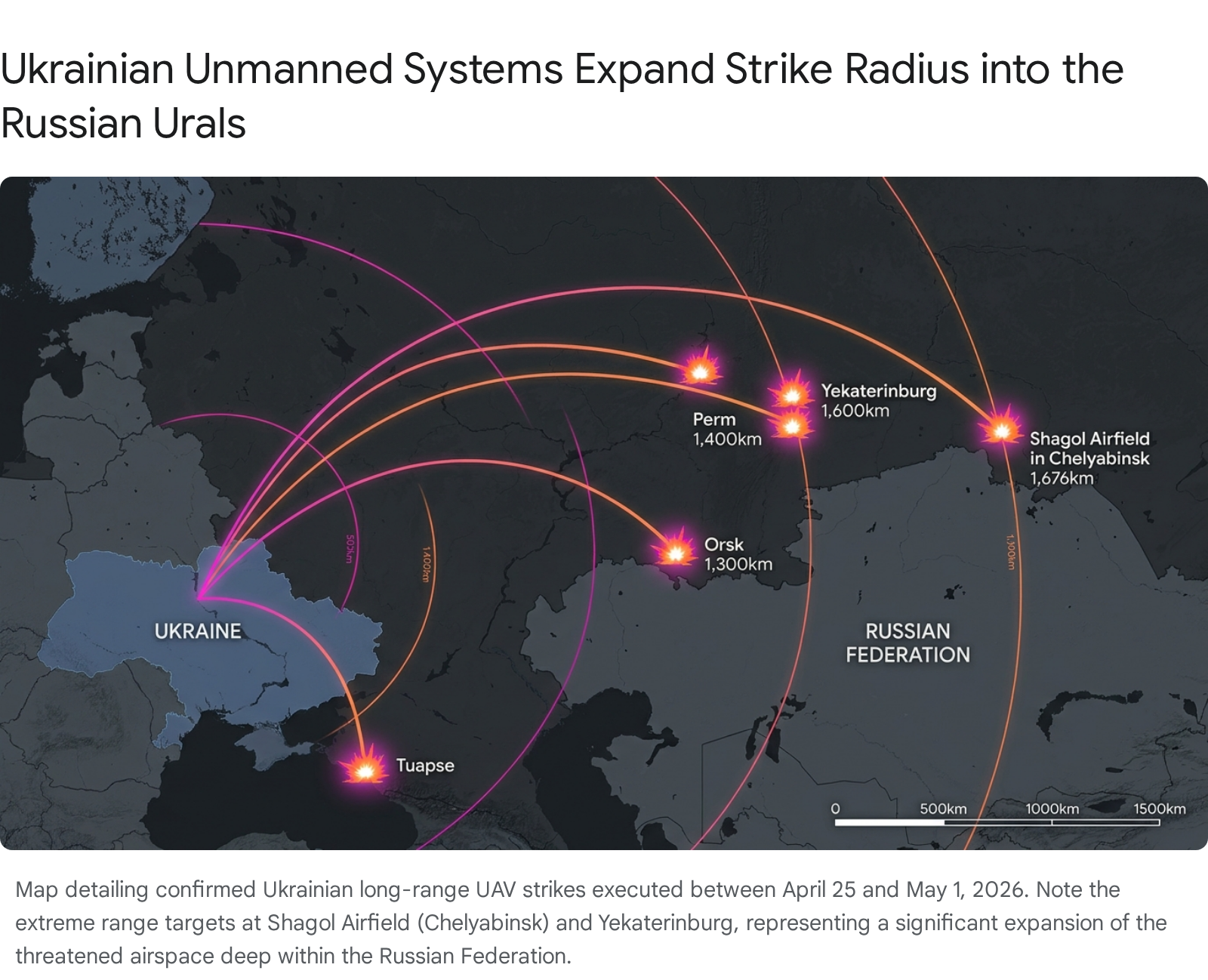
In conjunction with targeting military aviation, Ukraine maintained a relentless operational tempo against Russia’s hydrocarbon export sector. Between April 28 and May 1, Ukrainian UAVs systematically struck the Transeft Perm Linear Production Dispatch Station in Perm Oblast, the Orsknefteorgsintez Oil Refinery in Orenburg Oblast, and the Tuapse Oil Refinery in Krasnodar Krai.8 The strikes on the Perm dispatch station—a strategic hub for Russia’s oil pipeline system—ignited fires across almost all local storage tanks, severely degrading distribution capabilities.18 Cumulatively, these strikes have successfully driven the average output of Russian oil refineries down to 4.69 million barrels a day, marking their lowest daily processing average since December 2009.8
3.4 Maritime Operations and the Contraction of the Black Sea Fleet
The maritime domain in the Black Sea continues to undergo a profound transformation characterized by asymmetric denial. The Russian Black Sea Fleet, historically the dominant power projecting force in the region, has been relegated to a defensive preservation posture. As of early 2026, cumulative Ukrainian strikes have destroyed or critically damaged approximately 30% of the fleet’s combat assets, severely degrading Russia’s amphibious assault potential and long-range naval missile capabilities.9
During this reporting period, analysts assessed that the Armed Forces of Ukraine now dictate the operational tempo across more than 60% of the Black Sea battlespace.9 Conversely, Russian operational freedom has contracted drastically to a mere 25% of the total maritime area, effectively confining the fleet to a narrow, 25-kilometer-wide strip along the Caucasus coast near Novorossiysk.9
Ukrainian intelligence and naval units actively exploit this vulnerability. On the night of April 25 to April 26, the Ukrainian Security Service (SBU) executed a highly coordinated, multi-vector strike on the Sevastopol Naval Base and Belbek Airfield in occupied Crimea.26 Utilizing an estimated 71 drones, this operation successfully inflicted critical damage on two large landing ships—the Yamal (Ropucha-class) and the Filchenkov (Tapir-class)—as well as the Ivan Khurs reconnaissance ship.26 The strike also degraded vital onshore infrastructure, hitting the Lukomka Black Sea Fleet Training Center, a MR-10M1 Mys-M1 coastal radar station, and a MiG-31 interceptor aircraft.26
Expanding their maritime interdiction beyond military vessels, the Ukrainian Navy utilized unmanned surface vehicles (USVs) on April 28 to strike the Marquise, a sanctioned oil tanker operating under a Cameroonian flag.18 The vessel, boasting a carrying capacity of over 37,000 tons, was intercepted 210 kilometers southeast of Tuapse.18 This signifies a strategic expansion of Ukrainian naval targeting to include the shadow fleet and maritime logistics vessels supporting the Russian hydrocarbon export economy, further politicizing and weaponizing global shipping lanes.18
3.5 Major Accidents: Ecological Crisis and Nuclear Near-Misses
The collateral consequences of the precision strike campaigns have precipitated major civilian and ecological hazards. The most severe incident of the reporting period is the catastrophic environmental disaster unfolding in the Russian Black Sea port of Tuapse.
Successive Ukrainian UAV strikes on the Rosneft-operated Tuapse oil terminal—which processes around 12 million metric tons of crude annually—occurred on April 16, April 20, April 28, and May 1.10 These strikes ignited massive fuel storage fires that required over 160 firefighters and dozens of emergency vehicles to contain.11 The structural destruction of the containment infrastructure, compounded by heavy regional rainfall, resulted in a catastrophic overflow of petroleum products into the Tuapse River, which subsequently drained rapidly into the Black Sea.12
The resulting ecological impact has been devastating. The region experienced toxic atmospheric phenomena described by local residents as “black rain,” with airborne benzene, xylene, and soot concentrations radically exceeding safe human exposure levels.29 An immense oil slick extending up to 77 kilometers along the coastline has decimated local marine life and avifauna, effectively ruining the beaches of the popular resort region near Anapa and Sochi.12 By May 2, emergency authorities reported removing over 13,300 cubic meters of contaminated soil and fuel oil, with Russian President Vladimir Putin publicly acknowledging the spill as one of the most serious environmental challenges Russia has faced in recent years.6
Simultaneously, the risk of a radiological disaster has escalated dramatically. Ukrainian intelligence and the Prosecutor General detailed previously unreported Russian military activity, confirming that the Russian military has repeatedly routed drones and hypersonic Kinzhal missiles directly through the airspace over the disused Chernobyl nuclear plant and the active Khmelnytskyi nuclear facility.13 Specifically, tracking data indicates that 35 Kinzhal missiles have been detected within 20 kilometers of these highly sensitive sites, with 18 passing near both sites on a single flight path.13 This routing introduces an extreme, unmitigated risk of a major nuclear accident stemming from navigational failures, mechanical malfunctions, or localized air-defense interceptions.13
3.6 Chronological Timeline of Military Events (April 25 – May 2, 2026)
| Date | Primary Country | Description of Military Event / Battle |
| April 25 | Russia | Executed a massive coordinated strike utilizing 666 drones and missiles, heavily targeting Dnipro City with illegal “double-tap” tactics, resulting in multiple civilian casualties. 7 |
| April 25 | Ukraine | Conducted ultra-long-range UAV strikes deep into the Russian Urals, heavily damaging Su-57 and Su-34 aircraft at the Shagol Airfield in Chelyabinsk Oblast. 8 |
| April 26 | Russia | Continued the active militarization of the Zaporizhzhia Nuclear Power Plant (ZNPP), utilizing the facility’s perimeter to store military hardware and stage drone launches. 27 |
| April 26 | Ukraine | SBU operatives executed a multi-vector strike on the Sevastopol Naval Base, critically damaging the Yamal and Filchenkov landing ships, and the Ivan Khurs reconnaissance vessel. 26 |
| April 27 | Russia | Maintained limited ground assaults in the Kherson direction, specifically targeting the islands within the Dnipro River Delta, without securing territorial gains. 27 |
| April 27 | Ukraine | Conducted mid-range interdiction strikes against Russian troop concentrations near the occupied settlement of Velyka Novosilka in the Donetsk Oblast. 32 |
| April 28 | Russia | Sustained intense aerial bombardment pressure, launching a localized wave of 123 UAVs into Ukrainian airspace overnight. 32 |
| April 28 | Ukraine | Advanced tactical positions in the Kharkiv and Orikhiv directions; naval forces successfully struck the sanctioned oil tanker Marquise in the Black Sea. 18 |
| April 29 | Russia | Occupied the settlement of Sukha Balka in the eastern theater; launched an additional 171 drones across Ukraine. 4 |
| April 29 | Ukraine | Severely degraded Russian oil logistics by striking the Transeft Perm Dispatch Station and the Orsk Oil Refinery, while also destroying Mi-28 helicopters in Voronezh Oblast. 8 |
| April 30 | Russia | Falsely claimed the seizure of Korchakivka in Sumy Oblast; Security Council Deputy Chairperson Dmitry Medvedev delivered a highly aggressive speech reaffirming existential war aims. 8 |
| April 30 | United States | Authorized the release of $400 million in previously secured military funding to support the Ukrainian armed forces amidst broader strategic diplomatic shifts. 16 |
| May 1 | Russia | Deployed 409 drones overnight targeting Ukrainian municipal and energy infrastructure. 8 |
| May 1 | Ukraine | Executed the fourth precision strike in two weeks against the Tuapse Oil Refinery, triggering a massive, uncontrolled environmental disaster along the Black Sea coast. 8 |
| May 2 | Russia | Shifted to intensive daytime bombardment, launching nearly 410 drones that struck industrial facilities and injured civilians in the western city of Ternopil. 6 |
4. Weapon Systems, Technologies, and DIB Shifts
The attritional nature of the conflict has necessitated massive structural shifts in how both nations source, manufacture, and deploy military hardware. The reporting period provided deep technical insights into new munition deployments, sovereign industrial capacity, and the weaponization of commercial space and cyber architecture.
4.1 Ukraine’s Defense Industrial Base (DIB) Integration
The Ukrainian Defense Industrial Base (DIB) is undergoing a rapid metamorphosis from an improvised, survival-oriented network into a highly integrated, export-oriented European security pillar.3 Driven by the systematic destruction of domestic infrastructure—including Russian strikes that have damaged 9 gigawatts of power generation capacity, of which only 3.5 gigawatts have been restored—and fluctuating confidence in U.S. supply chains, Kyiv has prioritized deep European defense integration.1 Further exacerbating this urgency are severe delays in the delivery of U.S. material; for instance, Javelin anti-armor missiles ordered in May 2022 are now not expected to be delivered until mid-2026.34
In response, Ukraine is directing up to 40% of its GDP toward defense and domestic innovation.35 A recent comprehensive survey of the Ukrainian DIB sector revealed that 90% of defense firms received inquiries from foreign nations regarding cooperation during the first quarter of 2026.2 The most significant interest originated from the United States (36%), Germany (29%), and Denmark (21%).2 The strategic focus of the Ukrainian DIB has shifted away from mere raw material acquisition toward the establishment of international joint ventures (supported by 64% of surveyed firms) and the direct export of finished, battle-tested technologies (supported by 79%).2 Ukrainian firms are pioneering a distributed, bottom-up innovation model where research and development are embedded directly within combat formations, allowing for the iterative, real-time refinement of autonomous navigation software and electronic warfare countermeasures at a pace traditional defense contractors cannot match.36
4.2 Aerospace and Missile Systems: The S-71K and FP-9
The reporting period unveiled critical technical intelligence regarding two highly consequential weapon systems recently introduced to the battlefield: the Russian S-71K “Kovyor” and the Ukrainian FP-9 ballistic system.
The Russian S-71K “Kovyor” Cruise Missile Detailed intelligence published by Ukraine’s Main Directorate of Intelligence (HUR) revealed the architecture of the S-71K, a new air-launched cruise missile developed by Russia’s United Aircraft Corporation.24 Designed for seamless integration with the advanced Su-57 stealth fighter (and adaptable for the Su-34), the S-71K represents a strategic shift in Russian munitions manufacturing toward simplified, mass-producible strike assets.24 The missile is explicitly designed to bridge the capability gap between cheap, low-payload Shahed drones and highly expensive, sophisticated traditional cruise missiles like the Kh-101 and Kalibr.24
Constructed from multilayer composite fiberglass and internal aluminum alloys, the missile carries a 250-kilogram OFAB-250-270 high-explosive fragmentation warhead.24 It is powered by an R500 turbojet engine and relies on a relatively basic flight controller and inertial navigation system, allowing it to accurately saturate air defense networks at ranges up to 300 kilometers.24
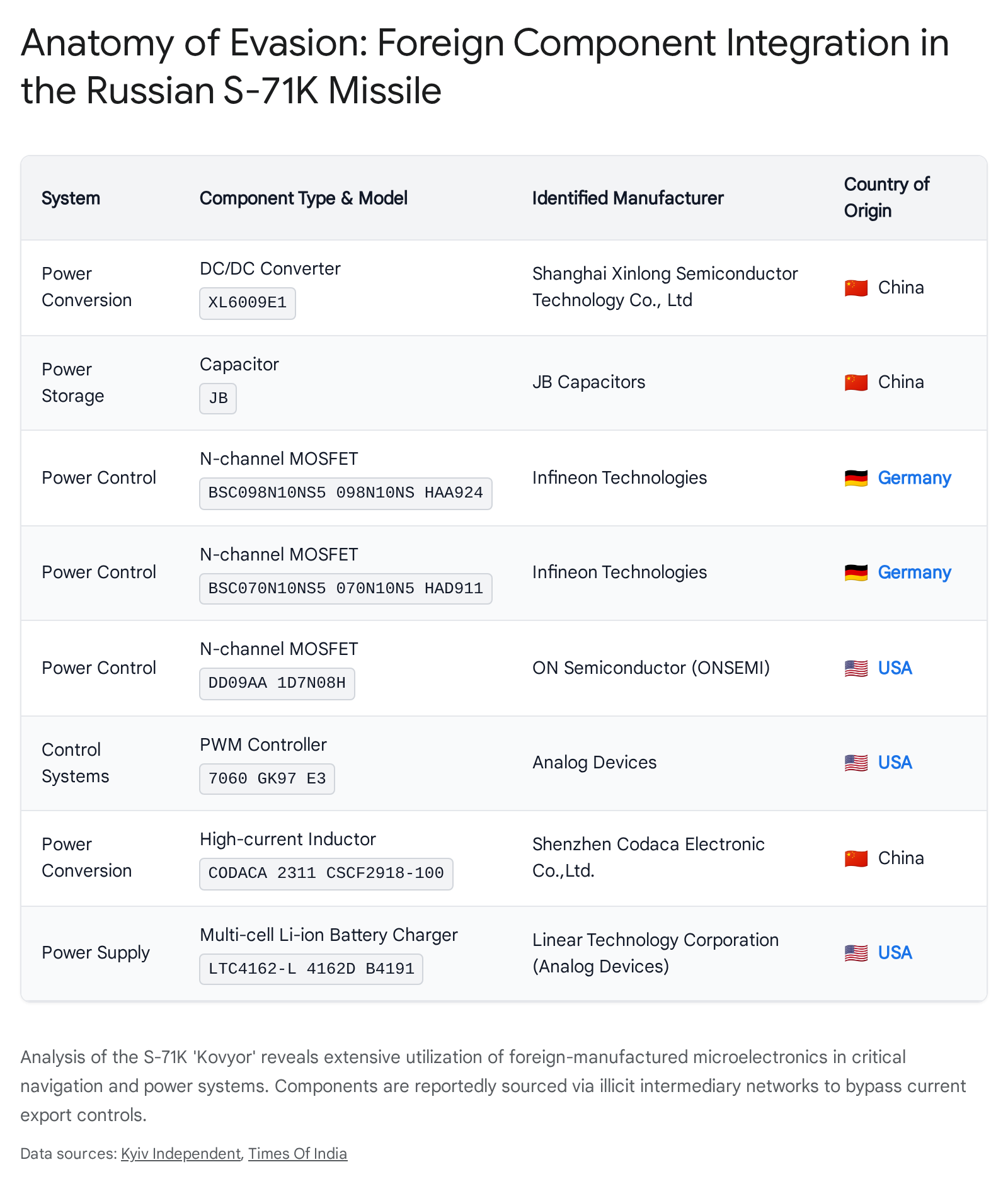
Crucially, the HUR analysis exposed the systemic failure of international export controls. Despite heavy sanctions, the S-71K is overwhelmingly reliant on foreign-sourced microelectronics. The missile incorporates approximately 40 distinct foreign components—including DC-DC converters (XL6009E1), high-current inductors, MOSFETs, and PWM controllers—manufactured by companies such as Analog Devices, Infineon Technologies, ON Semiconductor, and Shanghai Xinlong Semiconductor.24 These critical components are illicitly procured through complex civilian supply chains utilizing intermediary shell companies in China, the United Arab Emirates, and various former Soviet states, demonstrating Russia’s sustained capacity to bypass Western sanctions to fuel its military-industrial complex.24
The Ukrainian FP-9 Ballistic System In a parallel technological leap, Ukraine publicly showcased the FP-9 ballistic system for the first time during this reporting period. The FP-9 represents a massive expansion in sovereign Ukrainian long-range precision strike capabilities, boasting a confirmed operational range of 800 to 850 kilometers.35 Equipped with a heavy, high-speed warhead explicitly designed to penetrate and bypass advanced Russian air defense networks, the FP-9 drastically complicates Russian theater logistics.35 By placing virtually all rear-area staging grounds, strategic command nodes, and Ural-based industrial centers within direct, sovereign strike range, the FP-9 reduces Ukraine’s reliance on Western-supplied long-range munitions, which are frequently subject to restrictive engagement rules.35
4.3 Cyber and Space Domain Escalations
The cyber and space domains have become equally vital to the prosecution of the war, characterized by the rapid weaponization of artificial intelligence and high-stakes infrastructure targeting.
In the space domain, the operational integrity of Russian military satellite communications was severely compromised. Following an initial breach on April 22, the full extent of a highly sophisticated cyberattack executed by pro-Ukrainian hacker units against Russia’s Gonets satellite system became publicly apparent.37 The breach successfully exposed highly sensitive internal communications, intelligence data routing, and infrastructure schematics linked directly to Russian state and military users.37 The Gonets system, functioning similarly to Western commercial satellite constellations, is critical for Russian remote communication and command orchestration; its compromise significantly degrades Russian situational awareness and secure data transmission capabilities across the theater.
In the cyber domain, a paradigm-shifting threat emerged with the full integration of advanced Artificial Intelligence into offensive hacking operations. In early April 2026, the AI firm Anthropic released the Claude Mythos Preview model.14 This model demonstrated an unprecedented capability to autonomously convert software vulnerabilities into fully functional, ready-to-deploy digital exploits, achieving a 72.4% success rate in the Firefox JS shell testbed.14 Cybersecurity analysts assess that this development acts as a “nuclear-analog moment” for cyberspace, effectively collapsing the capability gap between elite state-sponsored hackers and lower-tier criminal proxies.14
The Russian Federation is uniquely positioned to maximize the utility of this AI proliferation. Russian cyber doctrine heavily relies on a “privateer model,” wherein the state outsources aggressive offensive operations to deniable criminal proxies operating under the tacit tolerance and direct tasking of Russian intelligence services.14 By leveraging AI tools like Mythos, these proxy groups can now scale their attacks and weaponize vulnerabilities at an unprecedented volume, directing highly sophisticated ransomware and disruption campaigns against Ukrainian critical infrastructure, as well as penetrating Fortune 500 companies and medical infrastructure within allied Western nations.14 Further evidencing the breadth of Russian digital operations, German intelligence recently attributed a highly sophisticated global cyber campaign targeting Signal and WhatsApp messaging services directly to Russian state actors, who successfully accessed chat histories and internal files to map allied communications networks.40
4.4 Chronological Timeline of DIB and Technological Developments (April 25 – May 2, 2026)
| Date | Primary Country | Description of Technological / DIB Development |
| April 25 | Russia | The structural and architectural details of the S-71K “Kovyor” missile were exposed by intelligence agencies, revealing a strategy to mass-produce simplified, low-cost cruise missiles heavily reliant on smuggled Western microelectronics. 24 |
| April 25 | Ukraine | Publicly showcased the new indigenous FP-9 ballistic system, successfully extending sovereign precision strike capabilities to operational distances of up to 850 kilometers. 35 |
| April 26 | Russia | Operational details regarding the structural compromise of the Gonets satellite communication system were publicized, highlighting deep vulnerabilities in Russian space-based command and data routing. 37 |
| April 27 | Ukraine | Comprehensive DIB reports indicated that 90% of domestic defense firms are now engaged in joint venture and export negotiations with Western partners, marking a transition toward deep structural integration with European defense markets. 2 |
| April 29 | United States | Diplomatic frameworks shifted explicitly as U.S. negotiators signaled reliance on the “Anchorage understanding,” diverging from prior methodologies that prioritized Ukrainian sovereign consent in security arrangements. 1 |
| May 1 | Ukraine | Reached a critical milestone in combat aviation readiness with the receipt and operational integration of the first mobile F-16 fighter jet flight simulators. 16 |
5. Russian Occupation and Sociopolitical Control
Within the occupied territories of Ukraine, the Russian Federation continues to execute a systematic campaign of sociopolitical assimilation, economic extraction, and demographic engineering, aimed at permanently integrating these regions into the Russian state apparatus.
A primary pillar of this strategy is the systematic militarization and indoctrination of Ukrainian youth. Occupation authorities, particularly those operating within the Zaporizhzhia Nuclear Power Plant (ZNPP) administration in Enerhodar, have established extensive military-patriotic youth programs.41 These programs are designed not only to indoctrinate children with Russian state narratives but to actively train them in combat skills, including the operation of first-person-view (FPV) drones.41 Furthermore, authorities are actively channeling Ukrainian youth into Russia’s domestic nuclear sector to address long-term labor shortages.41 In a more severe violation of international law, Russian officials continue the practice of temporarily deporting Ukrainian children from occupied cities such as Mariupol to St. Petersburg under the guise of “cultural indoctrination” programs.41
Economically, the occupation is characterized by aggressive resource extraction and financial instability. Israeli and Ukrainian media corroborated reports during this period that the Russian Federation is actively exporting vast quantities of grain stolen from occupied Ukrainian agricultural hubs to international buyers, including Israel, to circumvent sanctions and fund the occupation administration.41 Meanwhile, the internal economic management of these territories remains highly volatile; a major Russian-operated mine in the occupied Luhansk Oblast recently withheld wages and initiated mass layoffs, underscoring the instability of Russia’s extractive projects.41 To solidify long-term demographic shifts, Russian state-owned entities like VTB Bank are heavily expanding investments in residential construction within occupied Crimea, incentivizing the relocation of Russian citizens to the peninsula.41
6. Lessons Learned
The rapid evolution of combat tactics, autonomous technologies, and geopolitical postures over the past week has generated profound lessons for the future of modern warfare, spanning the strategic, operational, and tactical levels.
6.1 Strategic Lessons
The primary strategic lesson derived from this reporting period revolves around the extreme fragility of international alliance structures and the absolute necessity of sovereign industrial capability in attritional conflicts. The dramatic erosion of Ukrainian confidence in U.S. mediation—plummeting to a mere 28%—and the willingness of U.S. negotiators to consider territorial concessions directly with Moscow over the “Anchorage understanding” demonstrate that client states cannot indefinitely rely on the continuity of external security guarantees.1
Consequently, Ukraine’s rapid strategic pivot to scale its domestic Defense Industrial Base (DIB) and secure co-production agreements with European partners proves that long-term survival requires sovereign technological generation.2 Furthermore, the exposure of the Russian S-71K missile’s supply chain—which utilizes over 40 distinct Western components despite stringent sanctions—underscores the fundamental inadequacy of current global export control regimes.24 The strategic lesson is clear: border-based economic sanctions are highly porous in a globalized, digitized economy. Effective economic warfare requires deep, systemic auditing of corporate supply chains, rigorous enforcement against dual-use technologies, and aggressive interdiction of intermediary trading hubs.
6.2 Operational Lessons
Operationally, the reporting period conclusively solidified the concept of “asymmetric maritime denial.” Ukraine, a nation completely lacking a conventional blue-water navy, has successfully neutralized a significant portion of the Russian Black Sea Fleet, driving it out of the western and central Black Sea and permanently restricting its operations to a 25-kilometer coastal strip.9 The operational lesson is that the rapid proliferation of low-cost, highly maneuverable unmanned surface vehicles (USVs), when integrated with shore-based precision anti-ship missiles and robust ISR (Intelligence, Surveillance, and Reconnaissance), can successfully deny maritime supremacy to a traditionally superior, heavily capitalized naval force.9
Additionally, the sustained campaign against Russian refineries demonstrates the high operational value of targeting dual-use economic infrastructure to degrade enemy combat power. Ukrainian long-range strikes not only constrain the refined fuel supplies available to the Russian military logistics chain but also systematically dismantle the hydrocarbon export revenue required by the state to finance the war.8 However, the catastrophic ecological fallout resulting from the Tuapse refinery strikes serves as a stark operational lesson regarding the severe collateral risks of striking massive industrial complexes, where secondary environmental damage (such as massive marine oil slicks and toxic atmospheric plumes) can quickly spiral out of control and threaten civilian populations.10
6.3 Tactical Lessons
At the tactical level, the total saturation of the airspace by unmanned systems has forced a continuous, grueling cycle of adaptation. The Russian tactical evolution of utilizing massive, highly coordinated swarms of inexpensive loitering munitions (up to 666 in a single night) ahead of ballistic missiles has proven highly successful at intentionally exhausting localized surface-to-air interceptor stockpiles.7 The explicit tactical shift to daytime drone swarms further indicates that unmanned systems are increasingly utilized not just for kinetic destruction, but for psychological attrition and economic paralysis—forcing civilian populations and industrial workers into shelters during peak productive hours.5
On the ground, the extreme lethality of the surface environment has necessitated desperate tactical innovations. The Russian infantry’s reliance on subterranean gas pipelines to infiltrate the heavily defended settlement of Kupyansk, despite suffering casualty rates of up to 70 percent, highlights the impossibility of traditional mechanized maneuver in environments saturated by ISR and FPV drones, forcing combat into highly attritional, close-quarters subterranean and urban domains.19
Finally, the democratization of offensive cyber capabilities via Artificial Intelligence represents a critical, paradigm-shifting tactical lesson. The deployment of generative models like Claude Mythos allows relatively unskilled proxy actors to weaponize software vulnerabilities rapidly and autonomously.14 Cyber defense infrastructure can no longer rely on patching known vulnerabilities at a human pace; to survive, it must rapidly evolve to utilize AI-driven autonomous defense systems capable of matching the speed, volume, and ingenuity of AI-generated attacks.14
6.4 Chronological List of Lessons Learned (April 25 – May 2, 2026)
| Date | Primary Country | Description of Lesson Learned |
| April 25 | Russia | Demonstrated the tactical efficacy of massive, mixed-munition drone waves to intentionally exhaust sophisticated surface-to-air interceptors prior to ballistic missile deployment. 7 |
| April 25 | Ukraine | Validated the operational necessity and psychological impact of executing ultra-long-range UAS strikes against high-value aerospace assets deep within adversarial territory (e.g., the Urals). 7 |
| April 28 | Russia | Confirmed the extreme vulnerability of critical maritime logistics and shadow fleet vessels to autonomous surface vehicle interdiction in contested, asymmetric waters. 18 |
| April 28 | Ukraine | Established that asymmetric maritime denial utilizing USVs and shore-based precision fires can effectively and permanently displace a numerically and technologically superior conventional naval fleet. 9 |
| April 29 | United States | Highlighted the volatility of strategic mediation, demonstrating that shifts in domestic political leadership directly alter the geopolitical risk calculus for allied nations fighting attritional wars. 1 |
| April 30 | Russia | Demonstrated that the lethality of modern ISR-saturated surface combat forces infantry to utilize highly dangerous subterranean infiltration routes (e.g., gas pipelines), accepting massive casualty rates to achieve minor tactical positioning. 19 |
| May 1 | Russia | Highlighted the strategic advantage of integrating advanced LLM Artificial Intelligence into state-sponsored proxy cyber operations, allowing for the rapid, automated weaponization of zero-day vulnerabilities. 14 |
| May 1 | Ukraine | Demonstrated the severe, uncontainable collateral ecological risks associated with kinetic strikes on massive coastal hydrocarbon infrastructure, as evidenced by the devastating Tuapse disaster. 11 |
Please share the link on Facebook, Forums, with colleagues, etc. Your support is much appreciated and if you have any feedback, please email us in**@*********ps.com. If you’d like to request a report or order a reprint, please click here for the corresponding page to open in new tab.
Sources Used
- Ukraine’s falling confidence in US mediation | Brookings, accessed May 2, 2026, https://www.brookings.edu/articles/ukraines-falling-confidence-in-us-mediation/
- Ukrainian defense sector sees surge in international demand for partnerships in 2026, accessed May 2, 2026, https://odessa-journal.com/ukrainian-defense-sector-sees-surge-in-international-demand-for-partnerships-in-2026
- Securing Ukraine’s Future in Europe: Ukraine’s Defense Industrial Base—An Anchor for Economic Renewal and European Security | Council on Foreign Relations, accessed May 2, 2026, https://www.cfr.org/articles/securing-ukraines-future-in-europe-ukraines-defense-industrial-base-an-anchor-for-economic-renewal-and-european-security
- Russia in Review, April 25-May 2, 2025, accessed May 2, 2026, https://www.russiamatters.org/news/russia-review/russia-review-april-25-may-2-2025
- Russia Fired Record Number of Drones at Ukraine in April – AFP Analysis, accessed May 2, 2026, https://www.themoscowtimes.com/2026/05/01/russia-fired-record-number-of-drones-at-ukraine-in-april-afp-analysis-a92664
- Ukraine war briefing: Russian oil hub of Tuapse hit for fourth time as environmental disaster mounts – The Guardian, accessed May 2, 2026, https://www.theguardian.com/world/2026/may/02/ukraine-war-briefing-russian-oil-hub-of-tuapse-hit-for-fourth-time-as-environmental-disaster-mounts
- Russian Offensive Campaign Assessment, April 25, 2026 | ISW, accessed May 2, 2026, https://understandingwar.org/research/russia-ukraine/russian-offensive-campaign-assessment-april-25-2026/
- Russian Offensive Campaign Assessment, May 1, 2026 | ISW, accessed May 2, 2026, https://understandingwar.org/research/russia-ukraine/russian-offensive-campaign-assessment-may-1-2026/
- The Changing Military Balance in the Black Sea: A Ukrainian Perspective, accessed May 2, 2026, https://carnegieendowment.org/research/2026/04/the-changing-military-balance-in-the-black-sea-a-ukrainian-perspective
- accessed May 2, 2026, https://en.wikipedia.org/wiki/2026_Tuapse_oil_terminal_disaster#:~:text=On%2016%20April%202026%2C%20Ukrainian,storage%20areas%20and%20port%20infrastructure.
- 2026 Tuapse oil terminal disaster – Wikipedia, accessed May 2, 2026, https://en.wikipedia.org/wiki/2026_Tuapse_oil_terminal_disaster
- Black Rain, Toxic Air and Bird Deaths: Russian Black Sea Town Reels From Refinery Strike, accessed May 2, 2026, https://www.themoscowtimes.com/2026/04/24/black-rain-toxic-air-and-bird-deaths-russian-black-sea-town-reels-from-refinery-strike-a92581
- Russia accused of risking major accident by flying missiles near Chernobyl, accessed May 2, 2026, https://www.independent.co.uk/bulletin/news/russia-missiles-chernobyl-ukraine-accident-b2962634.html
- Mythos in Moscow: Why Russia Will be the Relative Winner of AI Cyber Proliferation, accessed May 2, 2026, https://www.russiamatters.org/analysis/mythos-moscow-why-russia-will-be-relative-winner-ai-cyber-proliferation
- Russian Offensive Campaign Assessment, May 2, 2025 | ISW, accessed May 2, 2026, https://understandingwar.org/research/russia-ukraine/russian-offensive-campaign-assessment-may-2-2025/
- ISW Russian Offensive Campaign Assessment, April 30, 2026 – Kyiv Post, accessed May 2, 2026, https://www.kyivpost.com/post/75144
- ISW Russian Offensive Campaign Assessment, April 29, 2026, accessed May 2, 2026, https://www.kyivpost.com/post/75060
- Russian Offensive Campaign Assessment, April 29, 2026, accessed May 2, 2026, https://understandingwar.org/research/russia-ukraine/russian-offensive-campaign-assessment-april-29-2026/
- Russian Offensive Campaign Assessment, April 30, 2026, accessed May 2, 2026, https://understandingwar.org/research/russia-ukraine/russian-offensive-campaign-assessment-april-30-2026/
- Russian Offensive Campaign Assessment, April 21, 2026, accessed May 2, 2026, https://understandingwar.org/research/russia-ukraine/russian-offensive-campaign-assessment-april-21-2026/
- April 2025 Russian attack on Kyiv – Wikipedia, accessed May 2, 2026, https://en.wikipedia.org/wiki/April_2025_Russian_attack_on_Kyiv
- Ukraine war situation update 19 – 25 April 2025 – ACLED, accessed May 2, 2026, https://acleddata.com/update/ukraine-war-situation-update-19-25-april-2025
- Ukraine says a strike hit Russian Black Sea oil terminal in Tuapse, accessed May 2, 2026, https://apnews.com/article/russia-ukraine-war-tuapse-strike-2efb9ac87f60bd4ef7f2646240922192
- Russia has a new missile — here’s what we know about the S-71K, accessed May 2, 2026, https://kyivindependent.com/ukraine-reveals-design-foreign-components-of-russias-new-s-71k-missile/
- A sinking fleet: russia’s largest losses in the Black Sea and the Sea of Azov during the war, accessed May 2, 2026, https://mod.gov.ua/en/news/a-sinking-fleet-russia-s-largest-losses-in-the-black-sea-and-the-sea-of-azov-during-the-war
- Russian Offensive Campaign Assessment, April 26, 2026 | ISW, accessed May 2, 2026, https://understandingwar.org/research/russia-ukraine/russian-offensive-campaign-assessment-april-26-2026/
- Russian Offensive Campaign Assessment, April 27, 2026, accessed May 2, 2026, https://understandingwar.org/research/russia-ukraine/russian-offensive-campaign-assessment-april-27-2026/
- ‘Turbulent and dangerous’: How shipping is the new global battleground, accessed May 2, 2026, https://www.aljazeera.com/news/2026/5/1/turbulent-and-dangerous-how-shipping-is-the-new-global-battleground
- Environmental disaster fears follow Ukrainian drone strikes on Russian oil refineries, accessed May 2, 2026, https://www.commonspace.eu/news/environmental-disaster-fears-follow-ukrainian-drone-strikes-russian-oil-refineries
- Fourth Strike in Two Weeks: Tuapse Oil Terminal Hit Again, Fires Reignite – Kyiv Post, accessed May 2, 2026, https://www.kyivpost.com/post/75149
- Ukrainian Drones Hit Tuapse Port Again, Environmental Crisis Deepens, accessed May 2, 2026, https://www.marinelink.com/news/ukrainian-drones-hit-tuapse-port-again-538706
- Russian Offensive Campaign Assessment, April 28, 2026 | ISW, accessed May 2, 2026, https://understandingwar.org/research/russia-ukraine/russian-offensive-campaign-assessment-april-28-2026/
- The Russia-Ukraine War Report Card, April 29, 2026, accessed May 2, 2026, https://www.russiamatters.org/news/russia-ukraine-war-report-card/russia-ukraine-war-report-card-april-29-2026
- Ukraine, the U.S. Defense Industrial Base, and the Elusive Crisis-Era Munitions Production Surge, accessed May 2, 2026, https://www.ndu.edu/News/Article-View/Article/4445408/ukraine-the-us-defense-industrial-base-and-the-elusive-crisis-era-munitions-pro/
- Secret of FP‑9: the mystery of Ukraine’s new strategic weapon is revealed – YouTube, accessed May 2, 2026, https://www.youtube.com/watch?v=Ckl5E0Zil94
- The New Revolution in Military Affairs, accessed May 2, 2026, https://carnegieendowment.org/research/2026/04/ukraine-russia-war-changing-warfare-practice-military-strategy
- Major Cyber Attacks, Data Breaches, Ransomware Attacks in April 2026, accessed May 2, 2026, https://www.cm-alliance.com/cybersecurity-blog/major-cyber-attacks-data-breaches-ransomware-attacks-in-april-2026
- Data Centers, Telecommunications Networks, and Space-Based Systems – FDD, accessed May 2, 2026, https://www.fdd.org/analysis/2026/04/29/data-centers-telecommunications-networks-and-space-based-systems/
- Russian cyberattacks against Ukraine may be considered war crimes – CCD | УНН, accessed May 2, 2026, https://unn.ua/en/amp/russian-cyberattacks-against-ukraine-may-be-considered-war-crimes-ccd
- Germany believes Russia responsible for global cyber campaign on Signal, WhatsApp, media reports – The Kyiv Independent, accessed May 2, 2026, https://kyivindependent.com/germany-believes-russia-responsible-for-global-cyber-campaign-on-signal-whatsapp-media-reports/
- Russian Occupation Update, April 30, 2026 | ISW, accessed May 2, 2026, https://understandingwar.org/research/russia-ukraine/russian-occupation-update-april-30-2026/
- NATO Tech in Russian Missile? Ukraine Shocked As Putin Unveils New S-71K With Western Components, accessed May 2, 2026, https://www.youtube.com/watch?v=sYiCXwF4oPo