
1. Executive Summary
The Department of Defense is currently executing a fundamental transformation in its approach to power projection, characterized by the accelerated acquisition and fielding of autonomous and unmanned systems. Initiatives designed to rapidly deploy All-Domain Attritable Autonomous platforms promise to provide combatant commanders with unprecedented capabilities in reconnaissance, surveillance, target acquisition, and precision strike operations.1 The underlying strategic logic assumes that overwhelming adversaries with thousands of low-cost, expendable systems will neutralize advantages in traditional mass and conventional force structure.3 However, the strategic dialogue surrounding these platforms frequently isolates the technology from its physical sustainment requirements, generating a systemic blind spot. The widespread assumption that unmanned systems inherently reduce the logistics tail of a deployed force is a dangerous oversimplification that ignores the physical realities of global transport and sustainment.2
This report examines the systemic, physical logistics, and basing infrastructure requirements necessary to design, build, transport, operate, and sustain mass unmanned aerial systems in contested theaters. An analysis of the physical characteristics of current platforms indicates that the primary constraint in projecting mass drone operations is not weight, but volume.6 Unmanned aerial systems are exceptionally low-density cargo. They exhaust the volumetric capacity—the “cube”—of strategic airlift platforms long before reaching weight limits, fundamentally altering sortie generation calculations for the existing mobility fleet.6 The operational decision to package fragile airframes in protective shipping containers rather than standard logistics pallets drastically exacerbates this issue, imposing severe tare weight penalties that degrade overall airlift efficiency.7
Furthermore, the proliferation of battery-powered autonomous systems introduces severe hazardous materials storage and handling challenges.8 High-capacity lithium-ion and lithium-polymer batteries require specialized, climate-controlled environments to mitigate the risks of chemical degradation and catastrophic thermal runaway.9 The requirement to transport, store, and simultaneously charge thousands of these batteries at forward operating bases creates a massive, continuous demand for tactical electrical power.11 This dynamic does not eliminate the military’s reliance on fossil fuels; rather, it shifts the logistical burden from aviation fuel to the massive quantities of diesel generation required to sustain tactical microgrids at the edge of the battlefield.11
To ensure that the systems acquired under highly compressed fielding initiatives can physically reach the theater of operations and remain viable in distributed environments, defense leadership must recognize these underlying supply chain realities. Addressing the tyranny of volume, the volatility of lithium-based energy storage, the structural gaps in pre-positioned war reserve materiel, and the electrical demands of forward bases is essential for translating advanced technological potential into credible, sustainable combat power.
2. The Strategic Mandate for Scale and Attritable Autonomy
The strategic imperative driving the rapid procurement of unmanned systems is the necessity to counter the numerical advantages held by pacing threats, particularly the People’s Republic of China, in the Indo-Pacific region.3 The 2022 National Defense Strategy identifies the PRC as the Department’s pacing challenge, noting its rapid military modernization and capability to project power across multiple domains.12 To meet this challenge, the Department of Defense is leveraging domestic private industry to bridge the “valley of death” between prototype development and operational fielding.2
The most prominent manifestation of this shift is the Replicator initiative, managed by the Defense Innovation Unit.1 Announced in August 2023, the first iteration of the initiative, Replicator 1, focuses on fielding thousands of All-Domain Attritable Autonomous systems across aerial, ground, maritime, and space domains within an aggressive 18-to-24-month timeline.1 The second phase, Replicator 2, targets counter-small unmanned aerial systems capabilities, reflecting immediate tactical lessons learned from ongoing conflicts in Eastern Europe.1 The ultimate goal is to field “attritable” capabilities—unmanned platforms built affordably enough that commanders can tolerate a high degree of risk in their employment, utilizing them as expendable assets to penetrate anti-access/area denial networks.1
However, the speed of this acquisition strategy introduces significant risks regarding long-term sustainment. Transitioning fielded systems to full operational capability requires the military services to make extensive modifications across the DOTmLPF-P framework, which dictates the integration of Doctrine, Organization, Training, materiel, Leadership, Personnel, Facilities, and Policy.2 Failure to systematically modify the “Facilities” and “materiel” pillars specifically prevents new technologies from being effectively integrated into the logistics enterprise.2 A formation that relies on thousands of autonomous systems requires an industrial-scale pipeline of replacement airframes, proprietary components, and sensitive batteries to sustain continuous operations.2
Historically, the military has struggled when technological vision outpaces logistical reality. During the Cold War, the rapid integration of atomic artillery was driven by a desire to leverage cutting-edge technology to increase standoff distance and theoretically reduce the logistical burden of conventional ammunition.14 However, this rapid incorporation led to inefficient, impractical systems with massive support requirements that were quickly discontinued.14 Similarly, the assumption that autonomous systems inherently possess “no maintenance tail” because they lack human crews is a critical miscalculation.15 When combat operations transition to a model reliant on mass drone swarms, the consumption rate of these platforms mirrors that of traditional artillery.17 Yet, unlike inert artillery shells, drones are highly complex electronic devices requiring a supply chain optimized for low-density, high-fragility cargo, conflicting directly with traditional military bulk transport mechanisms.
3. The Physical Reality of Airframes: Packaging and Fragility Constraints
The physical footprint of an unmanned aerial system in transit is dictated not merely by the dimensions of the airframe, but by the rigorous packaging standards required to ensure the system survives global military transport. The Department of Defense logistics enterprise subjects cargo to extreme environmental and mechanical stresses, including rapid depressurization, severe temperature fluctuations, and high-impact kinetic shocks during loading and offloading.19
To mitigate these risks, all items entering the military distribution system must adhere to stringent specifications, notably MIL-STD-2073-1C for preservation methods and ASTM D3951 for commercial packaging.19 Under these standards, the Defense Logistics Agency mandates that materiel be protected from physical damage, corrosion, and mechanical malfunction.19 Crucially, standard commercial loose-fill cushioning and dunnage are strictly prohibited for all DoD shipments and aerospace facilities.22 Items classified as fragile, which includes nearly all unmanned aerial systems due to their composite wings, sensitive control surfaces, and precision electro-optical/infrared sensor gimbals, must utilize custom-molded compartmentalization, dense foam wrapping, or robust crating.20
The engineering physics of packaging dictate that adequate protection requires significant volume. The total cushion thickness required to protect a fragile item is calculated as the sum of the deflection requirement for limiting shock, combined with added thickness to prevent the cushion from “bottoming out” under extreme strain.23 For highly sensitive optics and lightweight composite structures, this necessitates thick layers of specialized foam. Consequently, a standard shipping container packed with military drones consists predominantly of protective air and foam rather than the actual munition.
When platforms like loitering munitions are packaged into specialized multi-application shipping containers or multi-tube launchers, the ratio of protective packaging to actual munition weight becomes severely skewed.21 While this packaging is absolutely mandatory to ensure that the systems arrive in operational condition, it vastly expands the physical envelope of the cargo. The defense industrial base optimizes for the performance of the drone in the air, but the logistics enterprise must contend with the volume of the crate on the ground. This disconnect results in massive inefficiencies when calculating cargo loads, as the protective measures required for mass drone shipments consume disproportionate amounts of space inside standard transport vehicles and aircraft.
4. Volumetric Inefficiency and the Tyranny of Cube
The intersection of fragile airframe designs and rigorous military packaging standards yields the single greatest physical barrier to deploying mass unmanned aerial systems: volumetric inefficiency. In the discipline of military logistics, the capacity of any transport asset is defined by two primary metrics: the maximum weight limit (payload) and the maximum volume limit (cube).6 Efficient logistics operations strive to balance these two factors, aiming to maximize the available space without exceeding structural weight restrictions.6
Due to aerodynamic and propulsion requirements, drone airframes consist largely of empty space. Even when wings and control surfaces are folded, detached, or housed within launch tubes, the volumetric footprint remains disproportionately large relative to the mass of the object.25 In logistics terminology, this creates a severe “cube utilization” paradox.26 When shipping mass quantities of these systems, transport aircraft and ground vehicles “cube out”—meaning they fill all available physical space—while utilizing only a small fraction of their maximum weight capacity.26 This low weight-to-volume ratio fundamentally degrades transportation efficiency, leading to wasted payload capacity and the necessity for additional transport assets to move the same amount of combat power.25
An analysis of the leading systems currently selected for accelerated fielding initiatives clearly illustrates this volumetric challenge. The AeroVironment Switchblade 600, an extended-range loitering munition procured for its precision strike capabilities, represents an all-in-one, tube-launched system.30 The munition itself is relatively light, weighing 15 kilograms (33 pounds).31 However, the All-Up Round, which includes the sealed launch tube required for transport and deployment, weighs 29.5 kilograms (65 pounds).31 The dimensions of this single launcher are 1.5 meters (60 inches) in length and 19.2 centimeters (7.5 inches) in diameter.30
Similarly, the Anduril Altius-600, designated as a multi-role autonomous air vehicle for intelligence, surveillance, and reconnaissance missions, features a maximum takeoff weight of only 12.25 kilograms (27 pounds).32 Yet, it possesses a length of 1 meter (3.3 feet) and a deployed wingspan of 2.54 meters (8.3 feet).32 Like the Switchblade, it is typically housed in a launch tube for transport, creating a long, awkward cylindrical profile that is difficult to stack efficiently without specialized external racking systems.
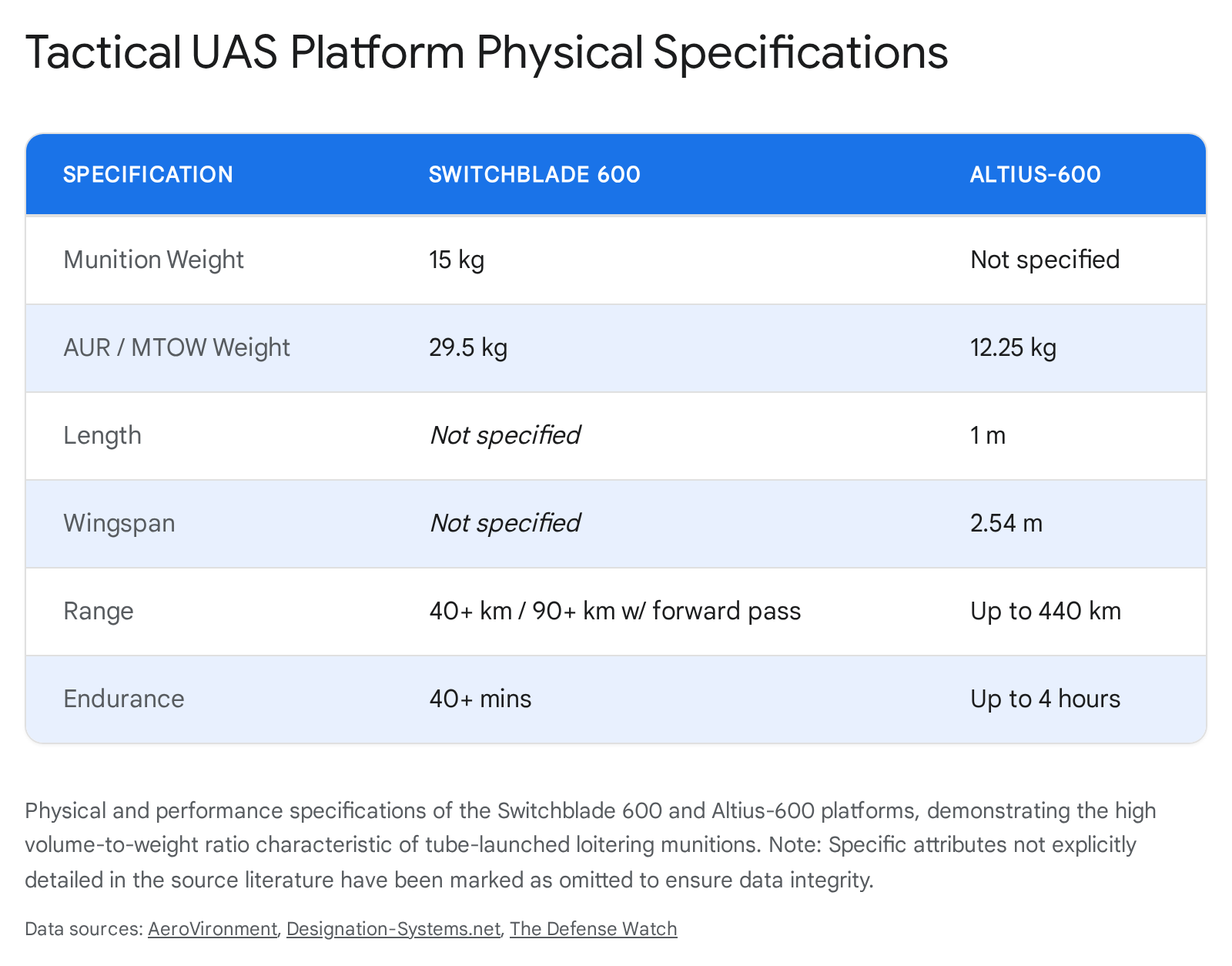
When moving multiple thousands of these systems, as directed by current strategic initiatives, the spatial footprint expands exponentially. If a single shipping crate contains ten Switchblade 600 All-Up Rounds, the vast majority of the volume within that crate is dedicated to the void space between the cylindrical tubes and the required protective padding. This low weight-to-volume ratio dictates that the strategic logistics pipeline must focus almost exclusively on managing volume rather than weight, a reality that directly impacts the utility of the United States’ primary means of global power projection: strategic airlift.
5. Strategic Airlift Strains: The Pallet versus Container Dilemma
The United States relies upon strategic airlift to project power globally, depending primarily on the Lockheed C-5M Super Galaxy for outsized, heavy cargo and the Boeing C-17 Globemaster III for flexible, direct-to-theater delivery.35 The C-17 forms the backbone of rapid strategic delivery, capable of operating from relatively short, austere runways in contested environments.36 As the Air Force explores the Next Generation Airlift program to eventually replace both legacy platforms with a single blended-wing-body design by the 2040s, current operational planning must optimize the existing C-17 fleet.35
The C-17 has a maximum allowable cabin load of 172,200 pounds.7 However, because mass drone operations represent volumetric burdens rather than weight burdens, the aircraft will rarely approach this maximum allowable cabin load when transporting unmanned assets. The methodology utilized to load the aircraft—specifically the choice between utilizing 463L master pallets or standard International Organization for Standardization (ISO) containers—creates drastic differences in throughput efficiency and sortie generation.
The HCU-6/E or 463L Master Pallet is the standardized platform for military air cargo, utilized extensively across the Department of Defense and the Civil Reserve Air Fleet.38 Each pallet measures 88 inches by 108 inches, providing a usable surface area for cargo stacking, with a maximum allowable height profile of 96 inches for standard C-17 positions.38 The tare, or empty, weight of a single 463L pallet is highly efficient at only 354 pounds.7 A C-17 can accommodate up to 18 of these pallets in its standard logistical configuration.7
However, when loading fragile drone crates onto 463L pallets, logistics planners are severely constrained. Protective crates cannot be stacked indefinitely without risking structural damage to the lower tiers or exceeding the pounds-per-square-inch limits of the pallet skin.40 Due to the awkward dimensions of drone launch tubes and their protective casing, the stacking proficiency on 463L pallets generally yields a maximum cube utilization of only 67 to 68 percent.7
To protect sensitive electronics, mitigate the risk of battery fires, and prevent crushing, there is a strong operational preference to ship drones inside rigid 20-foot ISO containers. ISO containers provide environmental sealing, security, and superior internal cube utilization rates—approximately 75 percent—because boxes can be packed tightly against the rigid steel walls.7
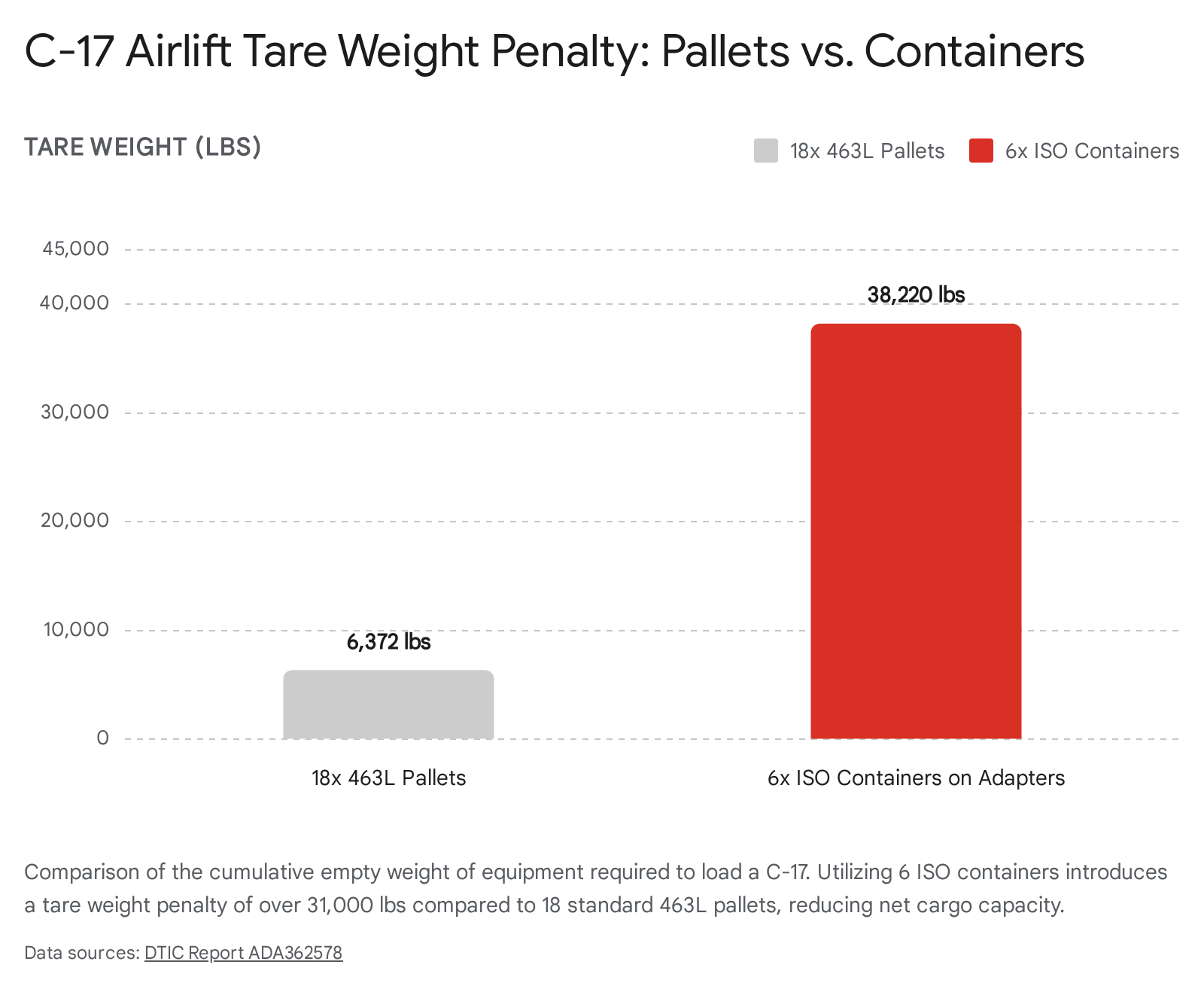
Yet, the decision to utilize ISO containers exacts a devastating toll on strategic airlift capabilities due to tare weight. A single 20-foot ISO container has a tare weight of approximately 4,770 pounds.7 To load these flat-bottomed containers onto the C-17’s internal roller system, they must be mounted on specialized adapter pallets, which add an additional 1,600 pounds. This brings the total empty weight of the containment system to over 6,300 pounds per single unit.7
While a C-17 can carry 18 lightweight 463L pallets, the physical dimensions and floor lock configurations of the aircraft mean it can only accommodate a maximum of 6 to 8 ISO containers.7 The mathematical outcome of this configuration choice is stark:
- Palletized Configuration: 18 empty pallets possess a combined tare weight of 6,372 pounds.
- Containerized Configuration: 6 ISO containers mounted on adapters possess a combined tare weight of 38,220 pounds.7
This indicates that simply choosing to ship fragile drones in standard ISO containers instead of on pallets strips the C-17 of nearly 31,848 pounds of net cargo capacity per sortie before a single drone is loaded.7
The downstream effect of cubing out aircraft and suffering high tare weight penalties is a geometric increase in the number of strategic airlift sorties required to move a given number of drones into a theater of operations. If a Combatant Command requires 5,000 loitering munitions rapidly deployed to repel an advance, and the C-17s are flying largely empty by weight but completely full by volume, the logistics pipeline becomes heavily congested.7
This reality creates severe operational vulnerabilities. The Air Force’s Agile Combat Employment doctrine relies on moving assets swiftly between hub and spoke locations to complicate adversary targeting.43 However, if strategic airlift is forced to conduct multiple, multi-day operations simply to move high-volume drone crates, it fails to get inside the adversary’s targeting cycle.43 The spoke base becomes highly vulnerable to long-range precision fires and anti-access/area denial networks.37 To mitigate ground time and exposure, mobility forces are actively testing experimental offload techniques, such as “Method C,” which allows aircrews to safely winch palletized cargo off the aft ramp of a C-17 at a low angle without relying on ground-based forklifts.44 While innovative, such tactical workarounds do not solve the fundamental volumetric inefficiency of the cargo itself.
6. Hazardous Materials Logistics: The Lithium-Ion Bottleneck
While the fragile airframes dictate the volumetric footprint of the drone swarm, the energy storage mechanisms within the drones dictate the regulatory and safety footprint. The absolute reliance on lithium-ion and lithium-polymer batteries represents the single greatest logistical vulnerability in mass drone operations.
Modern military drones depend on high-density lithium chemistries to satisfy stringent Size, Weight, and Power requirements.45 Lithium-ion remains the standard due to its proven balance of energy density and maturity, while lithium-polymer variants are favored for small tactical platforms where maximum discharge rates are required.46 However, the exact energy density that provides extended loiter times and sprint speeds makes these batteries highly volatile.9 Acute exposure to high ambient temperatures, mechanical damage during transit, or internal cell faults can readily induce thermal runaway.9 This cascading chemical reaction releases extreme heat, toxic gases, and self-sustaining fires that cannot be easily extinguished by conventional means.9
Because fires can spread rapidly from one cell to the next in a densely packed container, thermal management and regulatory compliance during storage and transport are non-negotiable.9 The Department of Defense enforces strict policies regarding the handling, storage, and movement of lithium batteries to mitigate chemical, flammable, and electrical hazards.48 The regulations delineate specific limitations based on the power capacity of the cells.
| Battery Type | Regulated Metric | Maximum Threshold for Limited Quantity Shipping |
| Lithium-ion (Rechargeable) | Watt-hours (Wh) | 100 Wh or less per battery (20 Wh per cell) |
| Lithium-metal (Non-rechargeable) | Lithium Content (grams) | 2 grams or less per battery (1 gram per cell) |
Data derived from DoD policies on lithium battery movement and storage.48
While small lithium batteries found in personal electronics fall under these limited quantity thresholds, military drone batteries routinely exceed these limits, placing them into highly regulated hazardous materials categories.48 The logistical burden is further compounded by strict supply chain requirements. DoD Manual 4140.01 mandates rigorous quality programs, the use of Automated Information Technology for tracking, and mandatory nonconformance reporting to ensure that compromised or counterfeit cells do not enter the supply system.50 Furthermore, recent National Defense Authorization Act compliance guidelines emphasize supply chain transparency and traceable cell manufacturing, requiring battery suppliers to maintain comprehensive provenance documentation.47
Perhaps the most disruptive logistical constraint is the current DoD policy that specifically prohibits all types and sizes of lithium batteries from long-term, non-temporary storage in standard, unmodified facilities.48 This prohibition forces the logistics enterprise to constantly move batteries rather than stockpile them, conflicting directly with the requirement to build up reserves for major combat operations.
7. Pre-Positioned War Reserve Materiel and Storage Deficiencies
To rapidly respond to regional contingencies without overwhelming the global transportation network, the military relies on Pre-positioned War Reserve Materiel (PWRM).12 This materiel is strategically located ashore and afloat to facilitate a timely response during the initial phases of an operation, serving as starter stock until sustainable logistical lines of communication can be established.12
However, the current WRM framework is structurally deficient for the era of electrified warfare. Historically optimized for bulk petroleum, conventional ammunition, and inert repair parts, the WRM framework currently lacks the dedicated infrastructure for storing high volumes of tactical batteries and Tactical Energy Storage systems.12 Storing thousands of high-capacity drone batteries in pre-positioned stocks presents unique risks due to varying shelf-lives based on battery chemistry and the necessity for continuous health monitoring.8
Storing lithium-ion batteries in standard, non-climate-controlled ISO containers or warehouses exposes them to severe solar loading and extreme ambient temperatures, particularly during the summer months in the Middle East or the Indo-Pacific.9 This exposure severely degrades cell health and exponentially increases the risk of spontaneous thermal runaway.9 To safely stockpile these assets forward, the military must invest in specialized, climate-controlled chemical storage buildings or heavily modified ISO containers.10
Industrial solutions, such as DrumLoc buildings, are outfitted with continuous cooling systems designed to maintain internal temperatures below 80°F, ensuring the chemical stability of the lithium cells.10 Furthermore, these containers must be equipped with multi-layered safety features, including advanced early-warning smoke detection, specialized fire suppression systems tailored specifically for lithium fires, and structural reinforcement to isolate potential blasts from the rest of the supply dump.10
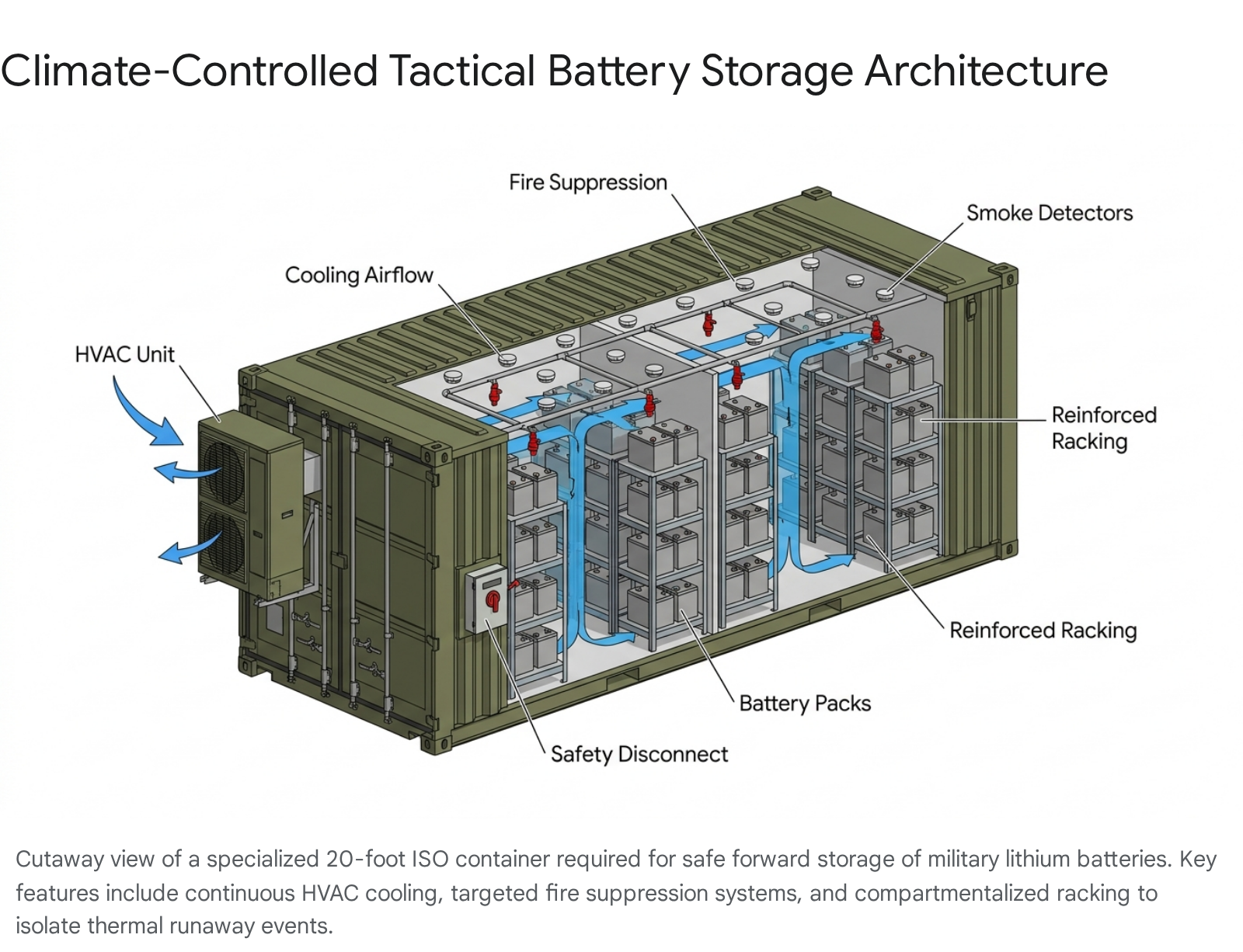
The integration of these heavy, specialized, power-drawing containers into the logistical flow further compounds the airlift and volumetric challenges discussed previously. Moving a climate-controlled container requires continuous auxiliary power during transit, limiting interoperability with standard civilian logistics vessels and demanding specialized handling by military sealift and airlift commands. The logistics tail required to support the batteries is, in many ways, more complex than the tail required to support the airframes.
8. Forward Operating Base Power Generation Constraints
Assuming the platforms and their associated batteries successfully navigate the airlift and hazardous materials transport hurdles, they present a final, massive logistical hurdle upon arriving at the Forward Operating Base: electrical power generation.
The future battlefield relies heavily on continuous data transmission, sensor processing, and the physical recharging of thousands of drone batteries.11 A common assumption among defense technologists is that the proliferation of autonomous platforms will eliminate the military’s reliance on fossil fuels.11 This is fundamentally flawed. While battery-powered drones do not consume aviation fuel during flight, the energy required to charge them and process their data shifts the logistical demand to massive quantities of diesel fuel required to run tactical generators at the edge of the battlefield.11
Recent analytical modeling estimating the energy requirements for a standard Army Brigade Combat Team (BCT) operating in the year 2040 highlights the staggering scale of this burden.11 Based on future force structure projections that incorporate extensive autonomous systems—spanning unmanned aircraft, unmanned ground vehicles, and persistent ground sensors—the daily data volume generated by a single BCT is projected to reach 53,370 gigabytes.11
To calculate the energy required to process, store, and transmit this data securely within tactical edge environments, analysts utilize a nominal factor of 5 kilowatt-hours per gigabyte of data.11 Therefore, the daily energy requirement simply to manage the data architecture for these autonomous systems is estimated at 266,850 kilowatt-hours.11 If unmanned aircraft and ground vehicles are utilized continuously throughout the day, matching the duty cycle of ground sensors, this demand scales up by nearly 47 percent to 394,200 kilowatt-hours daily.11
| Power Generation Method | Infrastructure Required for 266,850 kWh Daily Demand | Fuel/Footprint Requirement |
| Standard Diesel Generators | 185 units of 60-kW generators (12 Megawatt total) | 55,000 liters of diesel fuel per day |
| Biodiesel Generators | 185 units of 60-kW generators (12 Megawatt total) | 60,000 liters of biodiesel fuel per day |
| Solar Power Array | 50-Megawatt solar farm installation | 140,000 square meters of physical space |
| Modular Nuclear Reactors | 3 individual 5-Megawatt modular reactors | Highly complex regulatory/security footprint |
Data derived from estimates of BCT 2040 energy requirements.11
Generating 266,850 kilowatt-hours in an austere, contested environment requires monumental physical infrastructure. Relying solely on conventional diesel power, a BCT would need an array of generators producing 12 megawatts of continuous power, consuming approximately 55,000 liters of diesel fuel every single day.11
This creates a massive logistical tether. Transporting 55,000 liters of fuel daily across contested logistics routes requires continuous convoys of unarmored fuel tankers, which are highly vulnerable to enemy interdiction and long-range fires.12 Historically, the logistical burden of moving liquid fuel has been a primary limiting factor in operational reach; during conflicts in Afghanistan, it was estimated that moving one gallon of fuel to an austere forward location could consume up to seven gallons of fuel in transit.12 Therefore, the deployment of thousands of drones does not severe the logistics tether; it merely replaces the ammunition truck with the diesel tanker.
9. Tactical Energy Storage (TES) and Microgrid Architectures
To alleviate the unsustainable strain on generator arrays and fuel convoys, the Department of Defense is heavily investing in Tactical Energy Storage and intelligent microgrid technologies.12 Programs such as the Defense Innovation Unit’s STEEP (Stable Tactical Expeditionary Electric Power) initiative focus on developing modular, vehicle-transportable microgrids with embedded energy storage and automated power management.54
The primary objective is to couple advanced Battery Energy Storage Systems with the military’s existing fleet of Advanced Medium Mobile Power Source (AMMPS) generators.12 These hybrid architectures provide critical operational flexibility. The BESS absorbs excess power during low-demand periods and discharges it rapidly during peak drone-charging cycles. This concept, known as peak load shaving, ensures that the diesel generators operate at or near their optimum efficiency curves, significantly reducing generator operating hours and overall fuel consumption.12 Furthermore, the stored energy allows the generators to be shut down entirely, enabling silent watch operations that drastically reduce the acoustic and thermal signatures of the forward operating base.12
At the specific level of drone battery management, the proliferation of varied, proprietary charging equipment creates a secondary logistical bottleneck.56 Forward bases cannot support hundreds of incompatible charging units. Instead, logistics planners are transitioning toward universal smart battery chargers and containerized charging stations.57 These rack-mounted stations utilize sophisticated load-balancing algorithms to prioritize battery charging based on mission urgency, ensuring the local microgrid is not overloaded while preparing mass swarms for simultaneous launch.57 For persistent surveillance missions, fully autonomous drone-in-a-box systems integrate the charging station, landing guidance, and power management into a closed-loop system, further reducing the requirement for human intervention.57
10. Deployable Facilities, Maintenance, and Human Factors
The physical footprint of mass drone operations extends beyond the storage of hardware and the generation of power; it encompasses the physical facilities required to conduct maintenance and the personnel required to manage the fleet. While the term “attritable” implies expendability in combat, standard peacetime training, pre-deployment preparations, and staging demand that these systems are kept in working order, requiring a dedicated maintenance and support infrastructure.
Operating thousands of platforms requires substantial ground support. Unlike legacy crewed aircraft that rely on established, permanent depot-level repair facilities, mass drone units must conduct frequent assembly, disassembly, software updates, and firmware synchronization at the tactical edge.13 To support this maintenance tail in austere environments, units rely on highly specialized deployable structures. The Modular Large Area Maintenance Shelter (MLAMS) provides a massive, relocatable fabric structure capable of housing drone assembly and repair operations.59 An 83-foot by 142-foot LAMS, designed specifically for UAV maintenance, provides over 11,000 square feet of environmentally protected workspace.60 However, erecting this facility requires shipping the components in both a 20-foot and 40-foot ISO container and demands hundreds of man-hours and heavy lifting equipment to assemble.60
For smaller, more rapid deployments, tactical logistics shelters built into standard 20-foot ISO containers are utilized.61 These shelters can be transported via C-17 or C-130 and provide climate-controlled, secure environments for sensitive electronics diagnostics, battery health monitoring, and post-mission data analysis.61 Yet, as established, the weight penalty of relying on heavy ISO containers for base infrastructure severely limits the speed at which these capabilities can be airlifted into a contested theater.
Furthermore, human factors research indicates that UAS maintenance personnel face unique challenges compared to traditional aviation mechanics.64 Maintainers must manage the reliability of a complex “system of systems,” comprising not just the air vehicle, but the ground control stations, encrypted communication relays, and the battery management infrastructure.58 The rapid evolution of technology and the frequent introduction of new airframes via accelerated acquisition programs exacerbate the training burden on these technicians, leading to a lack of historical failure data to guide preventative maintenance.58 While some commercial package delivery operations have demonstrated a single pilot controlling up to 24 drones, the ratio of required maintenance personnel to airframes in high-tempo, austere military environments remains a critical operational constraint.64
11. Project Convergence and the Shift to Predictive Logistics
To manage the immense logistical complexity of sustaining mass drone fleets across vast distances, the Department of Defense is aggressively pursuing predictive logistics capabilities. These concepts have been tested extensively during the Army’s Project Convergence exercises, specifically Capstone 5 (PC-C5) held at the National Training Center.66
The current logistics paradigm relies heavily on reactive resupply—ordering a replacement drone, component, or battery only after a failure occurs or inventory is depleted.66 In a contested logistics environment, where adversary forces actively target supply lines and strategic airlift is constrained by volumetric inefficiencies, reactive sustainment results in operational culmination.
Predictive logistics seeks to invert this model by utilizing artificial intelligence, machine learning, and a unified digital backbone known as Next Generation Command and Control (NGC2).66 By continuously analyzing telemetry data from deployed drone swarms, battery degradation metrics from smart chargers, and historical consumption rates, predictive algorithms can forecast supply shortages before they impact the mission.66 This capability provides commanders with a common operating picture that is timely and actionable, allowing logisticians to stage the necessary replacement airframes, batteries, and repair components at the correct forward operating base in anticipation of demand.66 Optimizing the flow of heavy pallets and ISO containers through the contested aerial port network based on AI-driven forecasts is essential to maintaining momentum during large-scale combat operations.
12. Strategic Imperatives for DoD Leadership
The successful execution of strategic initiatives designed to field thousands of autonomous systems rests fundamentally upon the Department of Defense’s ability to overhaul its approach to physical logistics. Viewing the drone solely as a technological marvel, while ignoring the physics of transporting, storing, and powering it, guarantees operational paralysis in a major conflict. To ensure these platforms can reliably reach and operate within contested theaters, leadership must prioritize the following systemic imperatives:
1. Mandate Volumetric Efficiency in Acquisition Criteria The defense acquisition process for unmanned systems must be restructured to heavily weight “logistics footprint” and “cube utilization” as primary evaluation criteria, equal in importance to flight performance and lethality.69 Programs must financially incentivize vendors to design systems with folding, collapsible, or modular architectures that pack densely onto standard 463L pallets. A platform that possesses superior flight characteristics but requires a volumetric footprint that cripples strategic airlift is a net-negative to the Combatant Commander. Furthermore, packaging standards must transition from bulky commercial foam to high-density, stackable, military-grade transit cases that balance delicate shock protection with spatial efficiency.
2. Institutionalize Tactical Energy Storage in War Reserves The current paradigm of Pre-positioned War Reserve Materiel is obsolete for the demands of electrified warfare. The Defense Logistics Agency and the Military Departments must rapidly procure and integrate high-capacity batteries and mobile Tactical Energy Storage systems into pre-positioned stocks globally.12 These energy assets must be managed with the same rigorous shelf-life monitoring and climate-control standards currently applied to sensitive munitions and pharmaceuticals.12
3. Procure Specialized Hazardous Materials Transport Infrastructure The military must rapidly scale its inventory of climate-controlled, structurally reinforced ISO containers designed specifically for the transport and forward storage of Class 9 lithium batteries.9 Relying on general-purpose warehousing or standard shipping containers exposes the fleet to catastrophic thermal runaway events, particularly in the extreme temperatures of the Pacific or Middle Eastern theaters. The acquisition of these containers must be paired with dedicated auxiliary power units to ensure continuous cooling during transit across the global supply chain.
4. Align Force Structure with Power Generation Realities Commanders and force planners must explicitly account for the massive electrical tether associated with mass drone operations. Operational planning must transition away from the false assumption that autonomous drones eliminate fuel requirements; their extensive use directly dictates the requirement for tens of thousands of liters of diesel fuel daily to power tactical generators at the edge.11 Aggressive investments in microgrid automation, solar augmentation, and advanced load-balancing Battery Energy Storage Systems are critical to reducing this daily fuel demand and preserving operational reach.11
The era of mass autonomous warfare will not be won solely by the sophistication of the artificial intelligence algorithms or the aerodynamic speed of the airframes. It will be decided by the industrial and logistical capacity to physically move lightweight, high-volume, highly volatile systems across oceans, sustain their massive power requirements in austere environments, and manage their complex maintenance tails at the tactical edge.
Please share the link on Facebook, Forums, with colleagues, etc. Your support is much appreciated and if you have any feedback, please email us in**@*********ps.com. If you’d like to request a report or order a reprint, please click here for the corresponding page to open in new tab.
Sources Used
- Deep Dive: Pentagon’s Replicator Initiative Raises Questions | Inkstick, accessed April 24, 2026, https://inkstickmedia.com/deep-dive-pentagons-replicator-initiative-raises-questions/
- Is Replicator Replicable? | The Belfer Center for Science and …, accessed April 24, 2026, https://www.belfercenter.org/research-analysis/replicator-replicable
- DOD Innovation Official Discusses Progress on Replicator – Department of War, accessed April 24, 2026, https://www.war.gov/News/News-Stories/Article/Article/3999474/dod-innovation-official-discusses-progress-on-replicator/
- Hicks Discusses Replicator Initiative > Department of Defense Manufacturing Technology Program > News Display – DoD ManTech, accessed April 24, 2026, https://www.dodmantech.mil/News/News-Display/Article/3518827/hicks-discusses-replicator-initiative/
- M W J – Modern War Institute -, accessed April 24, 2026, https://mwi.westpoint.edu/wp-content/uploads/2026/03/Modern-War-Journal-MWJ-second-edition-final-draft-as-of-12MAR26-pdf-1.pdf
- Effects of Alternative Performance Criteria upon Composition of Air Transportable Spare Parts Kits – AFIT Scholar, accessed April 24, 2026, https://scholar.afit.edu/cgi/viewcontent.cgi?article=5589&context=etd
- C-17 Container Study. – DTIC, accessed April 24, 2026, https://apps.dtic.mil/sti/tr/pdf/ADA362578.pdf
- Drone Battery Storage & Safety: The Essential Guide, accessed April 24, 2026, https://terra-drone.com.sa/drone-battery-storage-safety-the-essential-guide/
- “Lithium-Ion Batteries Hazard and Use Assessment Final Report.” – Nuclear Regulatory Commission, accessed April 24, 2026, https://www.nrc.gov/docs/ml1719/ml17191a294.pdf
- Lithium Ion Battery Storage Requirements, accessed April 24, 2026, https://www.uschemicalstorage.com/lithium-ion-battery-storage-requirements/
- The Energy Requirements for Processing Data on the Future …, accessed April 24, 2026, https://www.armyupress.army.mil/Journals/Military-Review/English-Edition-Archives/January-February-2026/Energy-Requirements/
- Incorporating Tactical Energy Storage into War Reserves: DLA’s …, accessed April 24, 2026, https://www.dla.mil/About-DLA/News/News-Article-View/Article/4347210/incorporating-tactical-energy-storage-into-war-reserves-dlas-vital-role-in-sust/
- Security & Defence European, accessed April 24, 2026, https://euro-sd.com/wp-content/uploads/2021/04/ESD_02_2021_WEB.pdf
- Lessons Learned and Unlearned: The Drivers of US Indirect-Fire Innovation Brennan S. Deveraux, Major, US – Army University Press, accessed April 24, 2026, https://www.armyupress.army.mil/Portals/7/Research%20and%20Books/2024/Feb/Deveraux-Lessons-Learned-2024.pdf
- The J ournal of the Unite d S e rvice Institution of India OC T OBER -DEC EMBER 2025 US I, accessed April 24, 2026, https://usiofindia.org/pdf/USI_Journal_%20Oct_Dec_2025_Final.pdf
- Imagining the Drone Air Force – Austin Vernon’s Blog, accessed April 24, 2026, https://www.austinvernon.site/blog/droneairforce.html
- Smart Munitions Market Outlook 2026-2034 – Intel Market Research, accessed April 24, 2026, https://www.intelmarketresearch.com/smart-munitions-2025-2032-582-1916
- AY 2024-2025 A New Arsenal for A New Era: Balancing Affordable Mass with Exquisite Capabilities WEAPONS INDUSTRY STUDY – Eisenhower School, accessed April 24, 2026, https://es.ndu.edu/Portals/75/Documents/Industry%20Study%20Reports/reports/2025/AY25%20Weapons-Cleared.pdf?ver=nyw0s8HSF-gRcQQaCOA7Pg%3D%3D
- Vendor Preservation, Packaging, Packing, and Marking Process – DLA, accessed April 24, 2026, https://www.dla.mil/Logistics-Operations/Packaging/Vendor-Preservation-Packaging-Packing-and-Marking-Process/
- Crating and Packaging Military Assets: A Basic Guide, accessed April 24, 2026, https://www.connerpackaging.com/crating-and-packaging-military-assets/
- Department of Defense: Standard Practice for Military Packaging. – DTIC, accessed April 24, 2026, https://apps.dtic.mil/sti/tr/pdf/ADA327827.pdf
- DLA Packaging, accessed April 24, 2026, https://www.dla.mil/Logistics-Operations/Packaging/
- Features of Effective Packaging and Transport for Artwork – Technical Bulletin 34, accessed April 24, 2026, https://www.canada.ca/en/conservation-institute/services/conservation-preservation-publications/technical-bulletins/effective-packaging-transport-artwork.html
- NAVAL POSTGRADUATE SCHOOL – DTIC, accessed April 24, 2026, https://apps.dtic.mil/sti/pdfs/AD1184798.pdf
- FOOD PACKAGING TECHNOLOGY | Polymer Innovation Blog, accessed April 24, 2026, https://polymerinnovationblog.com/wp-content/uploads/2017/02/Food-Packaging-Technology.pdf
- freight glossary terms and logistics management words, accessed April 24, 2026, https://dcm.com.eg/glossary/
- Environmental, Operational and Financial Sustainability of Packaging Methods in Delivery Businesses – DSpace@MIT, accessed April 24, 2026, https://dspace.mit.edu/bitstream/handle/1721.1/61184/700932931-MIT.pdf?sequence=2&isAllowed=y
- Delivery process-review and improvement proposals – Theseus, accessed April 24, 2026, https://www.theseus.fi/bitstream/handle/10024/111731/Thesis%202016-theseus%20version.pdf?sequence=1
- Ultimate Guide to FTL and LTL Route Optimization – CR Express, accessed April 24, 2026, https://www.crexpressinc.com/blog/ai/ultimate-guide-ftl-ltl-route-optimization
- Switchblade® 600 represents the next generation of extended-range loitering munitions. Featuring high precision optics and ove – AeroVironment, Inc., accessed April 24, 2026, https://www.avinc.com/images/uploads/product_docs/Switchblade600_Datasheet.pdf
- Switchblade® 600 – AeroVironment, accessed April 24, 2026, https://www.avinc.com/solution/switchblade-600/
- Anduril ALTIUS – Designation-Systems.Net, accessed April 24, 2026, https://www.designation-systems.net/dusrm/app4/altius.html
- ALTIUS-600 Small Unmanned Aircraft System, USA – Air Force Technology, accessed April 24, 2026, https://www.airforce-technology.com/projects/altius-600-small-unmanned-aircraft-system/
- ALTIUS-600 Drone – Full Specifications | TheDefenseWatch.com, accessed April 24, 2026, https://thedefensewatch.com/product/altius-600-drone/
- Why The US Air Force Believes 1 Aircraft Can Replace Both The C-17 Globemaster & C-5 Galaxy – Simple Flying, accessed April 24, 2026, https://simpleflying.com/us-air-force-aircraft-replace-both-c-17-globemaster-c-5-galaxy/
- U.S. Air Force Mobility Aircraft 101 – CSIS Aerospace Security, accessed April 24, 2026, https://aerospace.csis.org/aerospace101/u-s-air-force-mobility-aircraft/
- AMC Boss: One Airplane to Replace C-17 and C-5 Transports, accessed April 24, 2026, https://www.airandspaceforces.com/air-mobility-command-c-17-replace/
- 463L master pallet – Wikipedia, accessed April 24, 2026, https://en.wikipedia.org/wiki/463L_master_pallet
- Palletized Systems Cargo Pallets – AAR Corp., accessed April 24, 2026, https://www.aarcorp.com/globalassets/government-solutions/mobility-systems/aar_cargo-pallets-final_2023.pdf
- 463l pallet and dunnage system evaluation – ROSA P, accessed April 24, 2026, https://rosap.ntl.bts.gov/view/dot/49622/dot_49622_DS1.pdf
- Aircraft Load Planning and Documentation, Part III, Appendix V – USTransCOM, accessed April 24, 2026, https://www.ustranscom.mil/dtr/part-iii/dtr_part_iii_app_v.pdf
- System 463L Pallets and Nets, Part VI, Chapter 608 – USTransCOM, accessed April 24, 2026, https://www.ustranscom.mil/dtr/part-vi/dtr_part_vi_609.pdf
- Air and Space Operations Review – Air University, accessed April 24, 2026, https://www.airuniversity.af.edu/Portals/10/ASOR/Journals/Volume-4_Number-2/ASOR_Volume_4_Number_2.pdf
- 3rd AS drives testing of new C-17 combat offload method – DVIDS, accessed April 24, 2026, https://www.dvidshub.net/news/463014/3rd-drives-testing-new-c-17-combat-offload-method
- Drone Battery Packs – UAV, UGV & ROV Power Packs – Unmanned Systems Technology, accessed April 24, 2026, https://www.unmannedsystemstechnology.com/expo/battery-packs/
- Military Drone Battery Suppliers & Manufacturers – Defense Advancement, accessed April 24, 2026, https://www.defenseadvancement.com/suppliers/military-drone-batteries/
- NDAA-Compliant Batteries for Drones & UAS – Unmanned Systems Technology, accessed April 24, 2026, https://www.unmannedsystemstechnology.com/expo/ndaa-compliant-batteries/
- New DOD policy limiting storage, movement of certain lithium …, accessed April 24, 2026, https://www.army.mil/article/266542/new_dod_policy_limiting_storage_movement_of_certain_lithium_batteries_takes_effect_on_monday
- “It’s Your Move” Department of Defense (DOD) Civilian Employees, Part IV A, Attachment A-K2 – USTransCOM, accessed April 24, 2026, https://www.ustranscom.mil/dtr/part-iv/dtr_part_iv_att_A-k_2.pdf
- DoD Manual 4140.01, Volume 3, “DoD Supply Chain Materiel Management Procedures – Executive Services Directorate, accessed April 24, 2026, https://www.esd.whs.mil/Portals/54/Documents/DD/issuances/dodm/414001_vol3.PDF?ver=6FxZP1zDmqytGggDjsGFVw%3D%3D
- DoD Manual 4140.01, Volume 7, February 10, 2014, accessed April 24, 2026, https://www.hsdl.org/c/view?docid=749848
- DoDI 4140.01, “DoD Supply Chain Materiel Management Policy,” March 6, 2019 – Executive Services Directorate, accessed April 24, 2026, https://www.esd.whs.mil/Portals/54/Documents/DD/issuances/dodi/414001p.pdf
- Battery Storage Risks: How to Securely Store BESS Units Pre-Installation, accessed April 24, 2026, https://johnsoncommercialsolutions.com/battery-storage-boom-how-to-securely-store-bess-units-pre-installation/
- Enhanced Energy Storage, Intelligent Power Management Systems …, accessed April 24, 2026, https://www.diu.mil/latest/enhanced-energy-storage-and-intelligent-power-management-systems-for-defense
- Battery Energy Storage Systems in Defense | White Paper – POWR2, accessed April 24, 2026, https://powr2.com/white-paper-powering-mission-readiness/
- The challenges of powering military drones – Galvion, accessed April 24, 2026, https://www.galvion.com/case-study/challenges-of-powering-drones
- Battery Chargers for Drones & Robotics – Unmanned Systems Technology, accessed April 24, 2026, https://www.unmannedsystemstechnology.com/expo/battery-chargers/
- Human Challenges in the Maintenance of Unmanned Aircraft Systems, accessed April 24, 2026, https://human-factors.arc.nasa.gov/publications/UAV_interimreport_Hobbs_Herwitz.pdf
- Large Area Maintenance Shelters (LAMS), accessed April 24, 2026, https://celinamilitaryshelters.com/lams/
- appendix a, shelter product data sheet, revision a – DLA, accessed April 24, 2026, https://www.dla.mil/Portals/104/Documents/TroopSupport/CloTex/shelters/Celina/C23083X142TG-G.pdf
- Standard ISO 20 ft Shelter – Tect, accessed April 24, 2026, https://www.tect.co.il/wp-content/uploads/2021/02/ISO-MIL-SHELTER-ascentech.pdf
- Tactical & Logistics Shelter Systems – Varley Group, accessed April 24, 2026, https://varleygroup.com/defence/land/tactical-logistics-shelter-systems/
- ISO 20 ft – Milshel, accessed April 24, 2026, https://www.milshel.net/iso-shelter/iso-20-ft/
- UAS Air Carrier Operations Survey: Crew and Staffing Requirements – Federal Aviation Administration, accessed April 24, 2026, https://www.faa.gov/sites/faa.gov/files/UAS%20Air%20Carrier%20Operations%20Survey-Crew%20and%20Staffing%20Requirements.pdf
- Considerations for Unmanned Aircraft Systems Maintenance and Reliability, accessed April 24, 2026, https://micronanoeducation.org/journal/volume-1-issue-1/considerations-for-unmanned-aircraft-systems-maintenance-and-reliability/
- NGC2 at the Tactical Edge: Enabling Predictive Logistics for Decision Dominance | Article, accessed April 24, 2026, https://www.army.mil/article/290032/ngc2_at_the_tactical_edge_enabling_predictive_logistics_for_decision_dominance
- Project Convergence Capstone 5 experiments at NTC | Article | The United States Army, accessed April 24, 2026, https://www.army.mil/article/284397/project_convergence_capstone_5_experiments_at_ntc
- Project Convergence | U.S. Department of War, accessed April 24, 2026, https://www.war.gov/Spotlights/Project-Convergence/
- From “Plan and Pray” to “Sense and Respond” – International Cost …, accessed April 24, 2026, https://www.iceaaonline.com/wp-content/uploads/2024/06/STY01-Wekluk-Wargaming-Defense-Acquisition-Paper.pdf
- SERVICEMEMBER QUALITY OF LIFE IMPROVEMENT AND NATIONAL DEFENSE AUTHORIZATION ACT FOR FISCAL YEAR 2025 R E P O R T COMMITTEE ON A, accessed April 24, 2026, https://www.nationalguard.mil/Portals/31/Documents/PersonalStaff/LegislativeLiaison/FY25/FY25%20NDAA%20Report%20(H.R.%208070).pdf
- DoD Manual 4140.01, Volume 5, “DoD Supply Chain Materiel Management Procedures – Executive Services Directorate, accessed April 24, 2026, https://www.esd.whs.mil/Portals/54/Documents/DD/issuances/414001m/414001v5.PDF?ver=-X4KmyoVoWHNUf5PYULJjA%3D%3D