The Evolution of Incident Management at Mega-Events
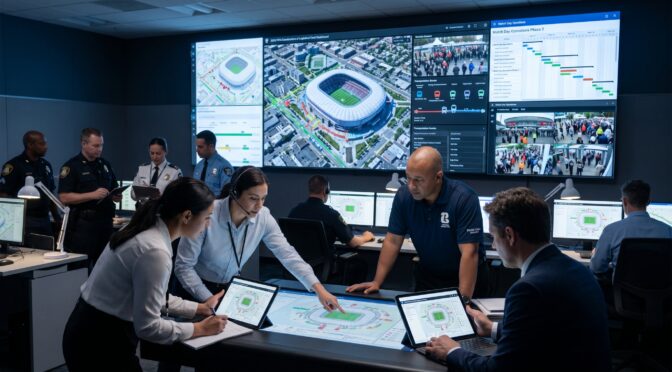
The landscape of public safety, emergency management, and tactical response has undergone a profound transformation over the past two decades. This evolution is driven by the increasing scale, logistical complexity, and elevated threat matrix associated with mass gatherings. Mega-events—characterized by massive, densely packed crowds, sprawling multi-jurisdictional footprints, and intense global media visibility—represent the ultimate stress test for domestic incident management systems.1 Historically, emergency management infrastructure has been specifically geared toward discrete, time-limited events: a singular natural disaster, a localized terrorist attack, or a one-day National Special Security Event (NSSE) such as a presidential inauguration or a major summit.1 However, the contemporary risk environment requires a radically different operational posture. It demands an architecture capable of sustaining high-intensity, multi-agency coordination over extended periods, effectively bridging the operational gap between steady-state civic administration and active, multi-front crisis response.1
The 2026 FIFA World Cup serves as the definitive baseline model for this evolution in public safety architecture. Co-hosted by the United States, Canada, and Mexico, the tournament is an undertaking of unprecedented magnitude, encompassing 104 professional matches across 16 North American cities over a 39-day period.3 Within the United States alone, 11 metropolitan areas will host 78 of these matches, drawing an anticipated influx of over six million international visitors and generating an estimated $40.9 billion in gross economic output, with $17.2 billion in GDP directly impacting the U.S. economy.4
Unlike a traditional discrete event, the 2026 World Cup does not function as a series of isolated local incidents that can be managed independently by municipal authorities. Rather, it operates operationally as a continuous, synchronized national and international campaign environment.1 A sudden surge in resource demand in one host city—such as Los Angeles, Dallas, or the New York/New Jersey complex—does not remain localized. It immediately ripples through the national aviation networks, interstate transportation corridors, mutual aid systems, and federal support apparatuses that countless smaller jurisdictions depend upon for daily operations.1 Managing an event of this duration and magnitude requires the establishment of a flawless Unified Command structure, a deeply integrated Multiagency Coordination System (MACS), seamless telecommunications interoperability, and rigorous, universally understood tactical protocols for mass casualty mitigation.7
The Unified Command and Multiagency Coordination Systems Framework
The foundational bedrock of modern public safety architecture in the United States relies heavily on the National Incident Management System (NIMS). Initiated following Homeland Security Presidential Directive-5 (HSPD-5), NIMS establishes a standardized, all-hazards approach to incident management that enables federal, state, tribal, local, and private sector partners to collaborate seamlessly.7 Within this comprehensive framework, the Incident Command System (ICS) provides the localized tactical structure. However, large-scale mega-events routinely exceed the capacity of a standard ICS deployment, necessitating the immediate elevation of operational control to Unified Command and Area Command structures, fundamentally supported by overarching Multiagency Coordination Systems.7
Navigating Jurisdictional Complexities Through Unified Command
In a large-scale public event that spans multiple political, geographical, and disciplinary boundaries, no single response agency possesses the legal authority, operational capacity, or resource depth to unilaterally manage the environment.12 The traditional singular Incident Commander model becomes obsolete. Unified Command resolves this structural deficiency by allowing designated officials from various agencies—each holding jurisdictional or functional responsibility—to collaboratively establish a common set of incident objectives, shared strategies, and a single, comprehensive Incident Action Plan (IAP).12
A critical principle of Unified Command is that it does not compromise or neglect the individual legal authorities of the participating agencies.13 Instead, it ensures that law enforcement, fire rescue, emergency medical services, and facility management can participate equitably in the decision-making process. The system maintains the vital “Unity of Command” principle, dictating that each field employee still reports to only one immediate supervisor, eliminating contradictory orders while operating under a single, unified command staff.8
For events as expansive as the World Cup, which involve not just stadiums but distributed base camps, sprawling fan zones, and critical transit hubs across a massive metropolitan region, a standard Unified Command may be elevated to an Area Command.12 An Area Command is utilized to oversee the management of multiple separate incidents that are each being handled by their own ICS organizations, or to manage a single massive event characterized by multiple incident management teams.13 The Area Command relinquishes direct tactical execution to the on-scene Incident Commanders and focuses entirely on macro-level strategy, the allocation of critical resources according to overarching priorities, and ensuring that strategic objectives are consistently met across the entire theater of operations.12
The Architecture of Multiagency Coordination Systems (MACS)
When incidents escalate to the point that they exhaust local resources and cross into regional, state, or federal domains, Multiagency Coordination Systems (MACS) provide the necessary architectural framework for high-level integration.12 It is a common misconception that a MACS is a specific physical facility. Rather, a MACS represents an integrated combination of facilities, equipment, personnel, standard operating procedures, and communications frameworks designed explicitly to support policy coordination, resource prioritization, and macro-level information management.8
The operational hub of a MACS is typically the Emergency Operations Center (EOC). EOCs serve as the centralized, physical (or virtual) locations where strategic information is collected, analyzed, and disseminated to establish a Common Operating Picture (COP).12 Furthermore, EOCs handle the complex logistics of resource dispatching, tracking, and allocation.12 However, the policy direction executing these allocations stems from the Multiagency Coordination Group (MAC Group).15 The MAC Group consists of agency administrators, elected officials, or senior executives who possess the inherent authority to make wide-ranging policy decisions, commit significant financial resources, and resolve conflicting priorities among different agencies.15
This structural separation is vital for large-scale events. It ensures that while on-scene tactical commanders remain laser-focused on the immediate physical environment—such as crowd control at a stadium gate—the MAC Group navigates the complex political, legislative, and budgetary ramifications of a sustained multi-jurisdictional deployment.8 Integrating a Joint Information System (JIS) within this structure further guarantees that public messaging regarding traffic, weather threats, or security incidents is consistent, accurate, and timely across all participating agencies.15 Ultimately, the success of a MACS relies heavily on achieving “Unity of Effort”—the coordination of activities among disparate organizations, often possessing differing mandates and operational cultures, to achieve common objectives without requiring a rigid, single chain of command.8
The 2026 World Cup: A Baseline for Interagency Synchronization
The ongoing operational preparations for the 2026 FIFA World Cup illuminate the practical, real-world application of these theoretical NIMS frameworks. The security architecture necessitated by this event demands an extensive, multi-layered approach to threat mitigation and preparedness. It requires seamless synchronization spanning local municipalities, state governments, federal intelligence apparatuses, and international partners.16 The sheer scale of the event—described by federal officials as four times the typical SEAR 1/2 event load, occurring concurrently with the America 250 commemorations—demands a generational leap in logistical planning.5
The Federal and Regional Governance Structure
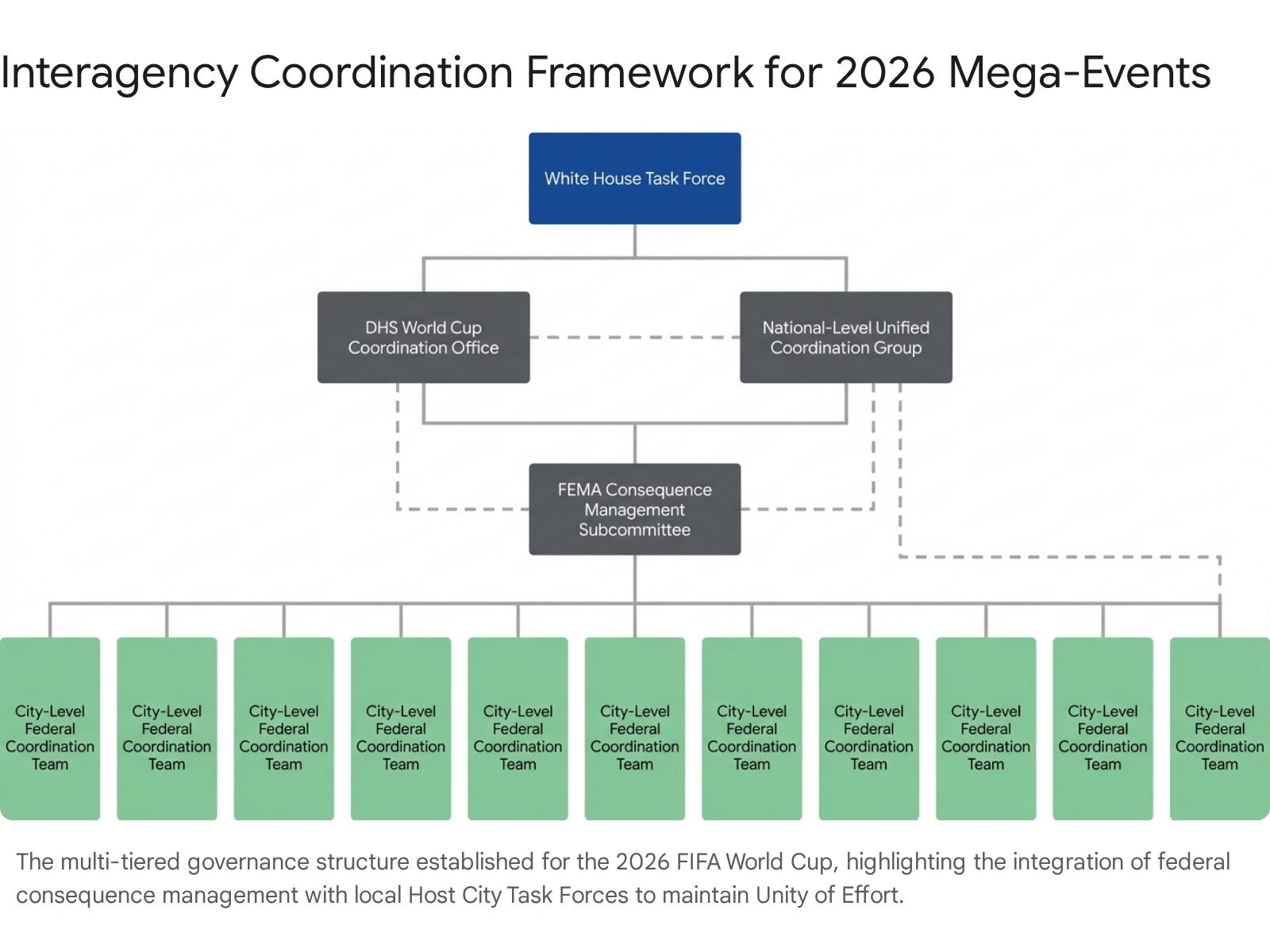
To manage the unprecedented scale of the tournament, coordination is structured through a heavily layered, partner-driven governance model. At the apex of this hierarchy is the White House Task Force on the FIFA World Cup 2026.4 Established by presidential executive order and led by an Executive Director, this task force is dedicated to leading and coordinating all federal efforts, ensuring strong alignment across executive departments and tackling macro-issues ranging from international visa processing and transportation to national safety and security.4
Beneath the White House level, the Department of Homeland Security (DHS) operates a dedicated World Cup Coordination Office.5 This office houses senior DHS component officials and integrates vital intelligence and operational equities from the Department of Justice, the Department of Defense, the FBI, the Office of the Director of National Intelligence (ODNI), and the Department of Health and Human Services.5 The Consequence Management aspect of the tournament is spearheaded by the Federal Emergency Management Agency (FEMA).5 Over eighteen months in advance of the tournament, FEMA established a National-Level Unified Coordination Group and deployed 11 city-level Federal Coordination Teams to interface directly with the local Host City Committee Task Forces.5
The threat matrix dictates stringent security classifications. The Department of Homeland Security has designated the semi-final matches in Dallas and Atlanta, the bronze final in Miami, and the championship final in New York/New Jersey as Special Event Assessment Rating (SEAR) 1 events.3 This rating indicates events of significant national importance requiring extensive federal interagency support. All other 74 U.S. matches are designated as SEAR 2 events.3 Furthermore, it is anticipated that select matches will be elevated to full National Special Security Event (NSSE) status, bringing them under the operational control of the U.S. Secret Service and unlocking the highest levels of federal security resourcing.2
Financial Architecture and Grant Allocations
To support the massive logistical and security requirements mandated by these SEAR classifications, robust financial architectures have been deployed. FEMA’s Grant Programs Directorate established the FIFA World Cup Grant Program (FWCGP), a standalone initiative distributing $625 million in federal funding to the 11 host cities.6 These funds are routed through governor-designated State Administrative Agencies and are explicitly earmarked to enhance physical security, protect critical infrastructure against potential terrorist attacks, and significantly increase police and emergency medical response staffing at venues, hotels, and transportation hubs.6
The distribution of these funds highlights the scale of local investment required to secure urban centers for sustained operations:
| State Administrative Agency | Host City Committee Task Force | FWCGP Grant Allocation ($) |
| Florida | Miami | $73,698,993 |
| Georgia | Atlanta | $73,390,940 |
| New Jersey (for NY/NJ) | New York/New Jersey | $66,205,076 |
| Texas | Houston | $64,676,165 |
| Missouri (for KS/MO) | Kansas City | $59,522,190 |
| California | Los Angeles | $57,934,146 |
| Texas | Dallas | $51,584,327 |
| California | San Francisco | $51,191,244 |
| Pennsylvania | Philadelphia | $48,490,887 |
| Massachusetts | Boston | $46,053,187 |
| Washington | Seattle | $32,252,845 |
Data representing the distribution of the $625 million FWCGP allocations administered by DHS and FEMA to enhance venue and critical infrastructure security across the 11 U.S. Host Cities.18
In addition to physical security staffing, a specialized $250 million grant through the Counter Unmanned Aircraft Systems (C-UAS) program has been released.17 State and local law enforcement will utilize these funds to procure technology to detect, identify, track, and, when necessary, mitigate dangerous drone threats near sensitive airspace surrounding stadiums and base camps.17
Regional Ecosystems and Cross-Border Complexities
The security environment is further complicated by the emergence of regional tournament ecosystems. Evaluating the tournament purely by stadium footprint vastly underestimates the scope of the operation. For example, the Seattle operational cluster functions within a four-city “Western Region” framework alongside Los Angeles, San Francisco, and Vancouver, British Columbia.20 This regional structure dictates highly interdependent security relationships, requiring harmonized cybersecurity protocols, shared threat intelligence, and compatible incident response procedures across federal, state, and provincial jurisdictions.20
Furthermore, the operational footprint extends deep into surrounding municipalities. Visiting national teams occupy designated “Base Camps”—comprising high-end training facilities and resort hotels—for several weeks.3 In the Pacific Northwest, potential base camps and training hubs extend to Renton, Gonzaga University, and the University of Portland, expanding the security perimeter beyond Washington state boundaries.20 Fans follow these teams, establishing massive “Fan Zones” and viewing festivals in cities like Bellingham, Everett, and Yakima, which require extensive crowd management systems, integrated emergency communication networks, and localized security deployments independent of the main stadium operations.20 The sustained protection of these peripheral assets demands a highly elastic, enduring public safety posture capable of absorbing infrastructure stress and public health challenges without faltering.20
Interoperable Communications: Bridging Disparate Architectures
The most pervasive and historically fatal vulnerability in mass casualty responses—from the September 11 attacks to modern natural disasters—has been the inability of disparate public safety agencies to communicate effectively across jurisdictional lines. Traditional Land Mobile Radio (LMR) networks are often heavily siloed, constrained by proprietary technology, restricted frequency bands, and rigidly defined geographic coverage areas.22 The technical requirement for a mega-event is a unified communications architecture that seamlessly integrates law enforcement, fire rescue, emergency medical services, and federal agents into a single, reliable framework capable of withstanding the extreme bandwidth pressure generated by hundreds of thousands of spectators.
The Nationwide Public Safety Broadband Network (NPSBN)
A cornerstone of modern interoperability is the Nationwide Public Safety Broadband Network (NPSBN), managed by the First Responder Network Authority (FirstNet) and constructed under a 25-year contract with AT&T.9 Established in the wake of the 9/11 Commission Report, FirstNet utilizes Band 14—a dedicated block of wireless spectrum exclusively reserved for the public safety community.9
During a massive public event, civilian mobile device usage routinely overloads local cellular towers, crippling standard communication networks. FirstNet resolves this by providing emergency responders with true preemption and priority access, effectively bumping commercial cellular traffic off the network to ensure that police and paramedics maintain high-speed voice, data, and video streaming capabilities.9 Recently, the deployment of FirstNet Fusion has further advanced this capability.25 Fusion acts as a mission-critical communications platform that connects teams across virtually any radio system or U.S. wireless carrier, bringing together push-to-talk applications, NextGen 9-1-1 dispatch, and connected devices to create a more efficient emergency response ecosystem.25
Gateway Solutions and Console Integration
To implement a flawless Unified Command, communication centers require vendor-agnostic dispatch consoles capable of managing these hybrid IP and radio networks. Technologies such as the JPS ACU-M and ACU-T tactical interconnect systems provide highly portable, rapidly deployable Radio Over IP (RoIP) gateways.26 RoIP technology digitizes traditional analog voice and radio control signals—specifically Push-To-Talk (PTT) and Channel Busy indicators—and transmits them over secure internet protocols.27 This eliminates legacy frequency incompatibilities, allowing an officer on a digital P25 radio system to communicate seamlessly with a federal agent using an LTE-based Push-To-Talk over Cellular (PoC) application.25
For centralized dispatch environments and EOCs, IP-based software consoles like Telex C-Soft, Avtec Scout, and the Motorola MCC 7500E offer scalable, highly configurable solutions.26 The Telex C-Soft console, for instance, provides direct IP interfaces for digital radio equipment and allows system administrators to design customized operator screens that integrate SIP telephony, RoIP, and legacy analog traffic.29 This technical architecture enables a dispatcher to initiate immediate crosspatches between disparate agencies during an escalating incident, effectively bridging a municipal fire department with state troopers at the click of a mouse.31
Stadium Data Center Architecture
The physical data architecture inside the host venues must robustly support these advanced networks while handling concurrent civilian demands. Modern high-capacity stadiums utilize dual, physically isolated data center environments to ensure operational integrity.32 One data center is strictly dedicated to general IT operations—ticketing processing, back-office administration, public Wi-Fi access, and facility security cameras.32
A secondary, distinct media data center handles ultra-low latency broadcast workflows. As the broadcast industry advances toward 8K video, live production streams can consume massive bandwidth, reaching up to 100 Gbps.32 Utilizing technologies like Cisco’s IP Fabric for Media (IPFM), this physical and logical isolation ensures that a sudden surge in broadcast bandwidth demand does not choke the network pipelines, thereby compromising the performance of the public safety communications or the venue’s critical lifeline sectors (energy, water, and communications) heavily prioritized by the Cybersecurity and Infrastructure Security Agency (CISA).32
Tactical Data Fusion and the Common Operating Picture
Voice communication, while essential, is insufficient for effective command and control during a complex mega-event; commanders require an accurate, real-time Common Operating Picture (COP).14 A COP is defined as an overview of an incident that fuses disparate data streams—unit locations, incident reports, sensor data, and infrastructure status—into a single, visually intuitive interface, enabling the Unified Command and supporting agencies to make effective, consistent, and timely decisions.14 The rapid fusion of data at the tactical edge has become a fundamental requirement for multi-domain operations, driving the adoption of cloud-native situational awareness software over legacy paper-based tracking.36
Geospatial Intelligence and Mission Software
Platforms such as ArcGIS Mission have become critical to managing event security and executing public safety workflows.34 By integrating an organization’s existing Geographic Information System (GIS) data with live feeds, these platforms allow tactical commanders to define Areas of Interest (AOI), map resource assignments, and visualize the precise geospatial location of field personnel in real time via GPS tracks.34 The software architecture typically includes three components: ArcGIS Mission Server, which brokers activities and stores data; ArcGIS Mission Manager, a web application for command center analysts; and ArcGIS Mission Responder, an application for field personnel.36
A critical feature for mega-events—where commercial cellular networks may experience localized outages or where adversaries may deploy electronic warfare jamming techniques—is the ability of these systems to operate in a network-disconnected environment.36 Advanced platforms can automatically switch over to a peer-to-peer radio mesh network, ensuring that tactical situational awareness and persistent team communication are maintained even under austere, degraded conditions.34 Furthermore, these platforms provide automated logging of all mission data, time-stamping locations, chats, and photographs to facilitate comprehensive after-action reviews and legal compliance.36
AI-Driven Threat Intelligence and the JOC
To achieve a proactive rather than reactive security posture, the COP must be fed by advanced intelligence streams. The sheer complexity of securing the World Cup across multiple cities and countries necessitates the use of AI-powered real-time event and risk intelligence platforms, such as Dataminr.41 By continuously fusing multi-modal, multi-source data—including open-source intelligence, social media activity, local transit feeds, and environmental sensors—AI platforms can detect anomalies at machine speed.41 This predictive and automated response capability is critical for identifying potential bottlenecks, crowd crush risks, coordinated hostile actions, or cyber vulnerabilities before they escalate into uncontrollable crises.41
These fused intelligence streams are monitored within Joint Operations Centers (JOCs). A modern JOC focuses on supporting the direct, monitor, assess, and plan functions for the Unified Command.42 Technical architecture within the JOC typically features a pod structure, bringing together representatives from law enforcement, fire, EMS, intelligence, and transit authorities in a shared physical space to streamline data sharing.42 In advanced scenarios, such as the defense of space and cyber assets, organizations like the Joint Commercial Operations (JCO) cell utilize a “follow-the-sun” approach to crew staffing across geographically diverse global locations, ensuring continuous, 24/7 analysis using a common operations baseline.44
Active Threat Mitigation: Rescue Task Force Deployment
Despite layered security perimeters and advanced intelligence, the risk of an active assailant remains a persistent threat at high-capacity venues. The increasing frequency of Active Shooter and Hostile Events (ASHER) has forced a radical, industry-wide paradigm shift in pre-hospital emergency medical response.45 Historically, Fire and EMS personnel operated under a strict “secure-and-treat” protocol; they staged at a safe distance in the cold zone, waiting for law enforcement to entirely neutralize the threat and definitively secure the building before entering to treat the wounded. This delay often resulted in preventable deaths due to severe hemorrhage and airway compromise.10
The contemporary standard, heavily codified in guidelines such as NFPA 3000 (Standard for an Active Shooter/Hostile Event Response Program) and essential for securing stadium-sized venues, is the rapid deployment of the Rescue Task Force (RTF).10
Defining Operational Threat Zones
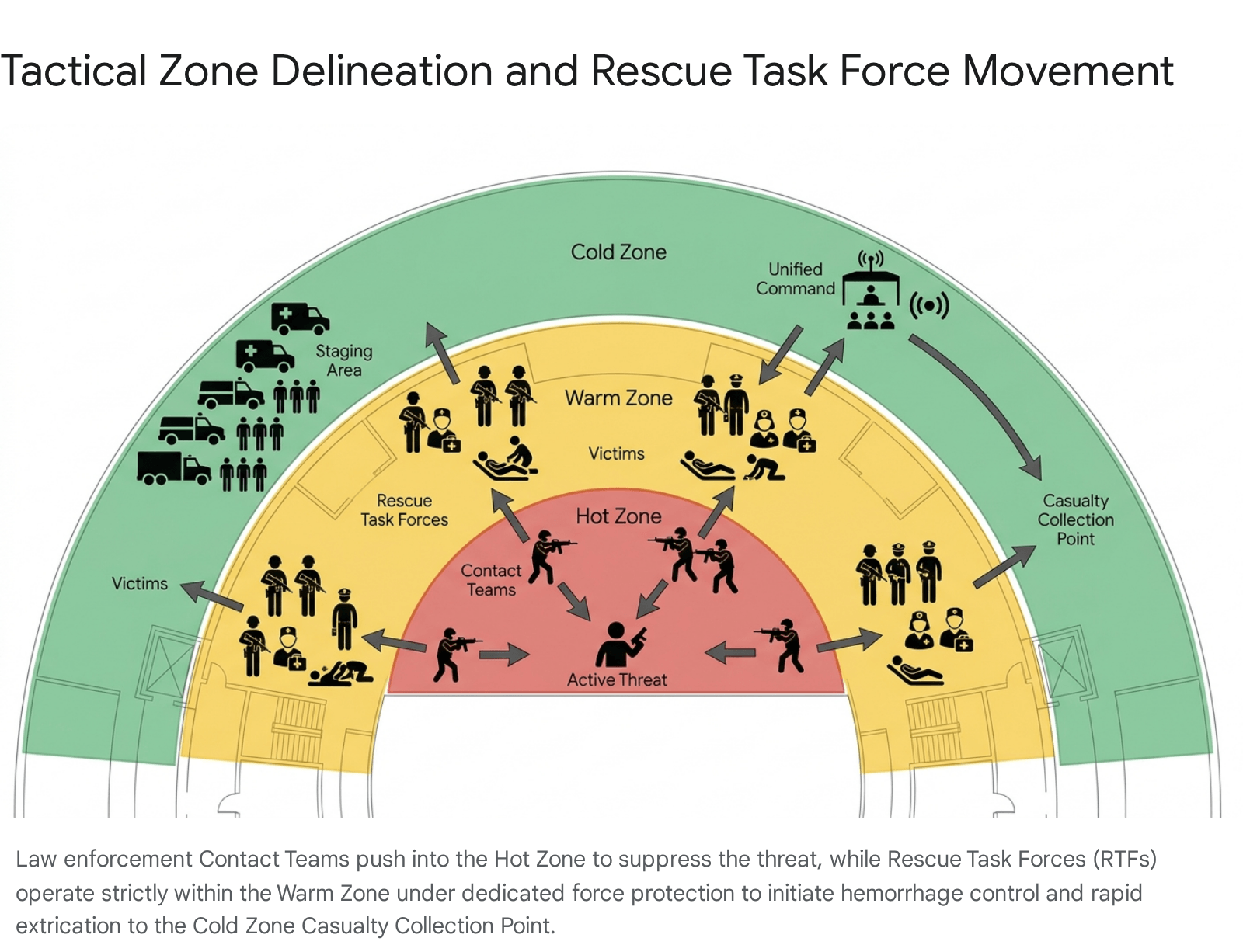
Effective RTF deployment is entirely contingent upon the strict definition, communication, and enforcement of operational threat zones by the Unified Command 10:
- The Hot Zone: An uncontrolled geographic area presenting a direct, immediate, and known hazard or threat to life.10 This is where the active assailant is believed to be operating. RTFs absolutely do not enter the Hot Zone.10 Threat suppression, suspect apprehension, and initial victim extraction in this zone are strictly the purview of heavily armed law enforcement Contact Teams or specialized Special Weapons and Tactics (SWAT) units.52
- The Warm Zone: An area of indirect threat where law enforcement has cleared or isolated the immediate hazard, reducing the risk to a minimal or mitigated level.10 The area is considered cleared but not definitively secure. This is the primary operational environment for the RTF.10
- The Cold Zone: A safe area with little to no threat, fully secured by law enforcement, typically located well outside the venue perimeter.51 This zone houses the Incident Command Post (ICP), primary Staging Areas, and the definitive Triage, Treatment, and Transport areas.51
RTF Composition and Tactical Medicine
An RTF is a purpose-built, cross-disciplinary team comprising Fire/EMS medical personnel partnered directly with Law Enforcement Officers (LEOs).10 The LEOs are assigned exclusively as force protection; their sole duty is to provide a 360-degree security envelope for the medical personnel. They must not separate from the medical team to pursue the threat, even if gunfire is heard elsewhere.48 Under this strict force protection, the RTF enters the Warm Zone to initiate rapid triage and provide immediate, point-of-wounding medical care.10
The clinical protocols utilized by the RTF are derived from Tactical Emergency Casualty Care (TECC) guidelines, which are the civilian, pre-hospital adaptation of military Tactical Combat Casualty Care (TCCC) developed from battlefield injury studies.10 Care in the Warm Zone is austere and strictly limited to life-saving interventions, primarily focused on massive hemorrhage control and rapid airway management.10 The operational priority is guided by the THREAT acronym championed by the Hartford Consensus: Threat suppression, Hemorrhage control, Rapid Extrication to safety, Assessment by medical providers, and Transport to definitive care.10
Pre-Staging and Logistical Preparedness Inside Stadiums
For a stadium event housing upwards of 80,000 spectators, attempting to deploy an RTF from exterior staging areas introduces critical, life-threatening delays.53 Best practices mandate the strategic pre-staging of RTF elements and comprehensive equipment caches deep within the venue infrastructure before the event begins.50
Agencies must establish dedicated medical cache trailers or prepositioned lockers in highly accessible but secure locations, such as wide service tunnels, lower concourses, or dedicated mass casualty staging areas.56 These localized caches must contain bulk supplies of Combat Application Tourniquets (CAT), hemostatic dressings (e.g., QuikClot), chest seals, and soft stretchers designed for the rapid extraction of non-ambulatory victims.54
Furthermore, recognizing the inherent fluidity of active threat environments—where a cleared Warm Zone can rapidly revert to a Hot Zone if the assailant doubles back or a secondary device detonates—all Fire and EMS personnel assigned to an RTF must be equipped with Ballistic Protective Equipment (BPE).48 State guidelines emphasize that providing BPE, including Level IIIA or Level IV body armor and ballistic helmets, to medical personnel is an absolute best practice for operating in areas of direct or indirect threat.54 Integrating comprehensive familiarization training, standardizing the donning and doffing of BPE, and maintaining strict maintenance protocols are essential steps to ensure these assets are rapidly deployable when a crisis initiates.58
Mass Casualty Triage and Logistics at Mega-Events
A Mass Casualty Incident (MCI) at a mega-event fundamentally alters the operational paradigm and ethical framework of emergency medical care. The World Health Organization defines an MCI as an event characterized by a quantity, severity, and diversity of patients that rapidly overwhelms the ability of local medical resources to deliver comprehensive and definitive medical care.59 In daily operations, EMS providers dedicate significant time and resources to securing definitive, individualized care for the most critically injured patient on the scene. Conversely, during an MCI, the operational objective pivots violently to strict utilitarianism: doing the greatest good for the greatest number of people under conditions of severe resource scarcity and time compression.59
The Transition to the SALT Triage Protocol
Historically, first responders across the United States utilized the Simple Triage and Rapid Treatment (START) algorithm to categorize victims.61 However, citing the need for greater accuracy and nationwide standardization, contemporary guidelines developed by a Centers for Disease Control and Prevention-sponsored working group heavily endorse the adoption of the SALT triage protocol.61 Endorsed by the American College of Emergency Physicians and the American College of Surgeons Committee on Trauma, SALT provides improved accuracy, particularly by significantly lowering the rates of undertriage—the dangerous misclassification of critical patients as delayed.61
The SALT algorithm (Sort, Assess, Lifesaving Interventions, Treatment/Transport) operates through a highly dynamic, fluid workflow designed for rapid forward movement 59:
- Sort: Responders initially use global voice commands to sort the crowd. Those who can walk are directed to move to a designated safe area; those who cannot walk but can wave or make purposeful movements are identified next; the remaining immobile or unresponsive victims are assessed first.63
- Assess and Lifesaving Interventions: Responders rapidly evaluate patients in place and perform immediate, critical interventions. This is limited strictly to controlling major hemorrhage, opening airways, needle decompression for tension pneumothorax, and administering auto-injector antidotes if applicable.60
- Categorization (Color Coding): Following intervention, patients are tagged based on their clinical acuity to determine transport priority:
| Triage Category | Color Code | Clinical Definition & Operational Priority |
| Immediate | Red | Patients requiring rapid, life-saving care who have a high probability of survival. Priority 1 for evacuation to Level 1 Trauma Centers. 48 |
| Delayed | Yellow | Patients with serious but stable injuries who can tolerate a delay in care and transport without immediate risk of death. 48 |
| Minimal | Green | The “walking wounded” whose injuries are minor (e.g., abrasions, minor lacerations). Kept clear of the treatment zone until Red/Yellow are evacuated. 48 |
| Expectant | Gray | Patients whose severe injuries exceed the currently available medical resources and are unlikely to survive given the circumstances. They receive palliative care to preserve resources for salvageable patients. 63 |
| Dead | Black | Non-salvageable patients who exhibit no spontaneous breathing even after airway repositioning. 48 |
Data outlining the standardized SALT mass casualty triage categorization system utilized by first responders to optimize resource allocation during overwhelming incidents.48
Digital Patient Tracking and Evacuation Workflows
In the chaotic, high-stress environment of a stadium disaster, analog paper triage tags are highly prone to physical damage, detachment, and human error.64 To establish unassailable patient accountability from the initial point of injury through transport and arrival at the destination facility, jurisdictions are aggressively integrating digital patient tracking solutions.65
Systems utilizing Radio Frequency Identification (RFID) tags allow Incident Commanders to remotely query the location and status of casualties as they are moved through the evacuation pipeline.64 Advanced tagging systems, such as DMS All-Risk Triage Tags, physically integrate military barcodes, removable acuity receipts, and contamination indicators, which can then feed data directly into regional hospital surge management software.65 Cutting-edge wireless technologies, such as those developed under the WIISARD (Wireless Internet Information System for Medical Response in Disasters) project, utilize 802.11 mesh networks to continuously transmit vital signs from wireless pulse oximeters attached to patients directly to the command center, ensuring continuous monitoring over extended periods before transport is available.64
Managing the physical logistics of victim evacuation from a mega-venue requires heavily secured, pre-designated zones. Best practices dictate that stadium venues establish a primary Mass Casualty Staging Area—ideally located inside the structure’s lower levels but physically separate from the field of play—to serve as a primary Casualty Collection Point (CCP).56 A secondary, highly controlled area outside the stadium structure must be secured to establish dedicated ambulance loading zones, preventing traffic bottlenecks that can paralyze extraction.56
For catastrophic incidents, venues must designate pre-planned helipads, utilizing local athletic fields or adjacent parking infrastructure, to facilitate the immediate aeromedical evacuation of “Red” priority patients directly to regional trauma centers.69 Programs like the NFL and FEMA’s “Mission Ready Venues” initiative highlight how stadiums themselves can be repurposed during large-scale emergencies to serve as safe spaces, logistical hubs, and staging grounds for response and recovery missions.71 Because a severe MCI within an 80,000-seat venue will instantaneously exhaust local municipal ambulance and hospital capacity, the Transport Officer and Medical Communication Coordinator must enact pre-established Large Scale Mutual Aid agreements.48 These binding agreements coordinate the rapid dispatch of regional medical task forces, surge mobile medical units, and interstate ambulance deployments, ensuring that the distribution of patients is balanced across the broader geographic region rather than paralyzing the nearest proximate hospital.57
Conclusion
The strategic framework and logistical architecture required to secure a mega-event like the 2026 FIFA World Cup represent the pinnacle of modern public safety planning. The ultimate success of the operation is not solely dependent on the intensity of the initial tactical response; rather, it hinges entirely on the endurance, elasticity, and interoperability of the overarching national incident management system.1 A flawless Unified Command structure demands the seamless fusion of disparate legal authorities under a comprehensive Multiagency Coordination System, prioritizing unity of effort over isolated jurisdictional control and territorial boundaries.
Technological advancements—from FirstNet broadband prioritization and Radio over IP gateways to AI-driven Common Operating Pictures utilizing geospatial mission software—provide the critical nervous system required to maintain situational awareness across millions of data points and dozens of interconnected jurisdictions. However, these digital systems must be inextricably paired with rigorous, aggressive tactical protocols on the ground. The pre-staging of ballistic-equipped Rescue Task Forces deep within venue infrastructure, coupled with the absolute mastery of the SALT mass casualty triage algorithm, ensures that when prevention mechanisms fail, the mitigation of human suffering is executed with rapid, calculated precision. Ultimately, the legacy of emergency management at the 2026 World Cup will be defined by its ability to function not merely as a localized response to a single threat, but as a synchronized, highly resilient, and continuously operating national ecosystem capable of absorbing unprecedented logistical stress.
Please share the link on Facebook, Forums, with colleagues, etc. Your support is much appreciated and if you have any feedback, please email us in**@*********ps.com. If you’d like to request a report or order a reprint, please click here for the corresponding page to open in new tab.
Works cited
- COLUMN: World Cup 2026: A Nationwide Stress Test for Emergency Management Systems, accessed May 10, 2026, https://www.hstoday.us/subject-matter-areas/emergency-preparedness/column-world-cup-2026-a-nationwide-stress-test-for-emergency-management-systems/
- Big Events in 2026: Security Classifications – Domestic Preparedness, accessed May 10, 2026, https://www.domesticpreparedness.com/articles/big-events-in-2026-security-classifications/
- Interim Considerations for Advanced Preparedness for Potential Public Health Threats Connected to FIFA World Cup 2026 March 06, – SETRAC, accessed May 10, 2026, https://www.setrac.org/wp-content/uploads/2026/03/World-Cup-STLT-Interim-Considerations_March-9-2026_508c.pdf
- FIFA World Cup 2026 Task Force – The White House, accessed May 10, 2026, https://www.whitehouse.gov/fifa-2026-task-force/
- FEMA World Cup Briefing for Industry Partners – Report and Key Takeaways, accessed May 10, 2026, https://www.hsdf.org/fema-world-cup-briefing-for-industry-partners-report-and-key-takeaways/
- View PDF – FEMA, accessed May 10, 2026, https://www.fema.gov/ht/print/pdf/node/706313
- Appendix H: Coordination and Command for Mass Evacuations – Catastrophic Hurricane Evacuation Plan Evaluation: A Report to Congress – Federal Highway Administration, accessed May 10, 2026, https://www.fhwa.dot.gov/reports/hurricanevacuation/appendixh.htm
- Multiagency Coordination Groups and How to Create a County ESF 17 Plan Robert King, Blue Skies Professional Services – Florida SART, accessed May 10, 2026, https://flsart.org/EventMeetings/presentationlibrary/documents/2019FloridaSARTPlanningMeetingPresentations/Presentations/Day%201_Blue%20Skies%20Creating%20a%20MAC%20ESF17%20Plan.pdf
- FirstNet Operations Manual – FirstNet Authority, accessed May 10, 2026, https://firstnet.gov/sites/default/files/FirstNet_Operations_Manual_2026_0.pdf
- Model Response Guidance to Active Shooter Hostile Event (ASHE) – Florida Fire Chief’s Association, accessed May 10, 2026, https://www.ffca.org/assets/docs/Model%20Response%20Guidance%20to%20Active%20Shooter%20Hostile%20Event%20revised%20JBD.1.31.17.pdf
- National Incident Management System – FEMA, accessed May 10, 2026, https://www.fema.gov/sites/default/files/2020-07/fema_nims_doctrine-2017.pdf
- Lesson 3: Command and Management Under NIMS—Part 2 – USDA, accessed May 10, 2026, https://www.usda.gov/sites/default/files/documents/NIMLesson03.pdf
- G 0402 NIMS and ICS Overview for Senior Officials (Executives, Elected, and Appointed) – Unit 1 Course Introduction – MT DES, accessed May 10, 2026, https://des.mt.gov/NIMS-Overview-slides.pdf
- CAStatewide Multi-Agency Coordination System(CSMACS)Guide 2013 – California Governor’s Office of Emergency Services, accessed May 10, 2026, https://www.caloes.ca.gov/wp-content/uploads/Preparedness/Documents/CAStatewideMulti-AgencyCoordinationSystemCSMACSGuide2013.pdf
- Emergency Operations Center How-to Quick Reference Guide | FEMA, accessed May 10, 2026, https://www.fema.gov/sites/default/files/documents/fema_eoc-quick-reference-guide.pdf
- Securing the 2026 FIFA World Cup: Risks, Realities, and Mitigation in a Tricontinental Mega Event, accessed May 10, 2026, https://rsdi.ae/en/publications/securing-the-2026-fifa-world-cup-risks-realities-and-mitigation-in-a-tricontinental-mega-event
- FEMA is Actively Coordinating with Federal, State, Local and Private-Sector Partners to Ensure Safety During FIFA World Cup 2026, accessed May 10, 2026, https://www.fema.gov/press-release/20260506/fema-actively-coordinating-federal-state-local-and-private-sector-partners
- FIFA World Cup Grant Program | FEMA.gov, accessed May 10, 2026, https://www.fema.gov/grants/preparedness/fifa-world-cup-grant-program
- World Cup Support – CNA.org., accessed May 10, 2026, https://www.cna.org/quick-looks/2025/12/World-Cup-Support.pdf
- Washington State: Preparing for the 2026 FIFA World Cup | WaTech, accessed May 10, 2026, https://watech.wa.gov/sites/default/files/2025-10/Washington-State-Preparing-for-the-2026-FIFA-World-Cup.pdf
- A Peek Behind the Pitch: Washington Local Governments Prepare for the World Cup – MRSC, accessed May 10, 2026, https://mrsc.org/stay-informed/mrsc-insight/february-2026/peek-at-pitch
- Law Enforcement Tech Guide for Communications Interoperability – Agency Portal, accessed May 10, 2026, https://portal.cops.usdoj.gov/resourcecenter/content.ashx/cops-w0714-pub.pdf
- Critical Connect: Mission Critical Public Safety Interoperability Ecosystem – Motorola Solutions, accessed May 10, 2026, https://www.motorolasolutions.com/content/dam/msi/docs/products/command-center-software/critical-connect/ciritical_connect_e-book.pdf
- Broadband Communications Prioritization and Interoperability Guidance for Law Enforcement: Critical Considerations in the Transi – RAND, accessed May 10, 2026, https://www.rand.org/content/dam/rand/pubs/research_reports/RRA2000/RRA2019-1/RAND_RRA2019-1.pdf
- FirstNet Fusion to Revolutionize Mission-Critical Communications, accessed May 10, 2026, https://www.firstnet.com/community/news/introducing-firstnet-fusion.html
- Console Systems Archives – Continental Wireless Inc, accessed May 10, 2026, https://www.cntlwire.com/product-category/products/console-systems/?product_view=list
- What Is a RoIP Gateway? The Ultimate Guide to Radio Over IP Communication, accessed May 10, 2026, https://www.omnitronicsworld.com/what-is-a-roip-gateway-the-ultimate-guide-to-radio-over-ip-communication/
- 1 Radio Communication Gateway – JPS Interoperability Solutions, accessed May 10, 2026, https://jps.com/solutions/communications-interoperability/
- Radio dispatch – Telex Products, accessed May 10, 2026, https://products.telex.com/na/en/radio-dispatch
- Dispatch Communication Consoles – Motorola Solutions, accessed May 10, 2026, https://www.motorolasolutions.com/en_us/products/dispatch/dispatch-consoles.html
- Telex Radio Dispatch, accessed May 10, 2026, https://telex.com/radio-dispatch/products/
- How Stadium Data Centers Power Fans, Operations, and Broadcast, accessed May 10, 2026, https://www.datacenterknowledge.com/networking/how-stadium-data-centers-power-fans-operations-and-broadcast
- CISA Releases Dynamic New Guide for Stadium and Arena Owners to Fortify Operations, Mitigate Vulnerabilities and Elevate Emergency Preparedness, accessed May 10, 2026, https://www.cisa.gov/news-events/news/cisa-releases-dynamic-new-guide-stadium-and-arena-owners-fortify-operations-mitigate-vulnerabilities
- Situational Awareness & Critical Incident Mapping Software | ArcGIS Mission – Esri, accessed May 10, 2026, https://www.esri.com/en-us/arcgis/products/arcgis-mission/overview
- IOC Product Gallery – ArcGIS Experience Builder, accessed May 10, 2026, https://experience.arcgis.com/experience/258f9ae6cedb4380a51937ddcae360a1
- Incident Management Software for Emergency Response – Homeland Security, accessed May 10, 2026, https://www.dhs.gov/sites/default/files/2022-01/SAVER%20IMS%20MSR_05Jan2022-508.pdf
- Download Smart Data Fusion Hubs for Multi Domain Operations research paper PDF, accessed May 10, 2026, https://www.irisresearch.com/library/public/documents/Smart-Data-Fusion-Hubs-for-Multidomain-Ops.pdf
- Monitor Citywide Operations in Real Time – Esri, accessed May 10, 2026, https://www.esri.com/content/dam/esrisites/en-us/media/ebooks/city-of-chicago-operational-intelligence.pdf
- What’s New in ArcGIS Mission 12.0, accessed May 10, 2026, https://www.esri.com/arcgis-blog/products/arcgis-mission/emergency-management/whats-new-in-arcgis-mission-12-0
- From Seams to Seamless: Unifying Multi-Agency Field Operations – Esri, accessed May 10, 2026, https://www.esri.com/arcgis-blog/products/arcgis-mission/field-mobility/from-seams-to-seamless-unifying-multi-agency-field-operations
- Preparing for the 2026 World Cup: Security Challenges and How to Tackle Them – Dataminr, accessed May 10, 2026, https://www.dataminr.com/resources/blog/preparing-for-the-2026-world-cup-security-challenges-and-how-to-tackle-them/
- Joint Headquarters Organization, Staff Integration, and Battle Rhythm, accessed May 10, 2026, https://www.jcs.mil/Portals/36/Documents/Doctrine/fp/jtf_hq_org_fp.pdf
- CBRNE – Metropolitan Washington Council of Governments, accessed May 10, 2026, https://www.mwcog.org/file.aspx?A=sHKawvgoHknImoec2gop%2F7ikYa4uTjoEQIAWg45%2BHtM%3D
- Joint Commercial Operations (JCO) Introduction and Way Forward Barbara Golf U.S. Space Force Strategic Advisor for Space Domain – AMOS Conference, accessed May 10, 2026, https://amostech.com/TechnicalPapers/2024/Featured/Golf.pdf
- Creating an Active Shooter/Hostile Event Response Guideline for the Unified Fire Authority of, accessed May 10, 2026, https://apps.usfa.fema.gov/pdf/efop/efo247481.pdf
- Implementation of Combined Law Enforcement, Fire, and Emergency Medical Service (EMS) Cross-Disciplinary – DTIC, accessed May 10, 2026, https://apps.dtic.mil/sti/tr/pdf/ADA620912.pdf
- First Responder Guide for Improving Survivability in Improvised Explosive Device and/or Active Shooter Incidents – Homeland Security, accessed May 10, 2026, https://www.dhs.gov/sites/default/files/publications/First%20Responder%20Guidance%20June%202015%20FINAL%202.pdf
- Pre-Hospital Mass Casualty Incident (MCI) Active Shooter/Hostile …, accessed May 10, 2026, https://flfca.memberclicks.net/assets/docs/MCI%20ASHE%20Procedure%207%2010%202025%20with%20FOGs.pdf
- ALERRT Best Practice Policy, accessed May 10, 2026, https://www.lemitonline.org/programs/documents/14TPCLS/ALERRT%20-%20Monday/ALERRT%20Active%20Attack%20Best%20Practice%20Policy.pdf
- ACTIVE SHOOTER/HOSTILE EVENT PREPAREDNESS AND RESPONSE – URMC.Rochester.edu, accessed May 10, 2026, https://www.urmc.rochester.edu/MediaLibraries/URMCMedia/flrtc/documents/NFPA-3000-Fact-Sheet.pdf
- Active Shooter Incidents: The Rescue Task Force Concept – Domestic Preparedness, accessed May 10, 2026, https://www.domesticpreparedness.com/articles/active-shooter-incidents-the-rescue-task-force-concept/
- INCIDENT COMMAND SYSTEM PUBLICATION UNIFIED RESPONSE TO VIOLENCE INCIDENTS ICS 701 January 2023 – Firescope, accessed May 10, 2026, https://firescope.caloes.ca.gov/ICS%20Documents/ICS%20701.pdf
- RESCUE TASK FORCE RESPONSE PLAN STANDARD OPERATING GUIDANCE DOCUMENT – Aurora Health Care, accessed May 10, 2026, https://www.aurorahealthcare.org/-/media/Project/Health-System-Enterprise/AuroraHealthCareOrg/aurorahealthcare/documents/about-aurora/documents/education/walworth-county-rtf-response-plan.pdf?rev=41026f2d01a145ec86fbffabab0bc89b&hash=6EF1BDA1B6D5BF4A8CA3B2CB1F3DB89C
- Mitigating Community Risks of Active Shooter Incidents Through Best Practices – National Fire Academy, accessed May 10, 2026, https://apps.usfa.fema.gov/pdf/efop/efo49581.pdf
- Complex Operating Environment—Stadiums and Arenas, accessed May 10, 2026, https://www.dni.gov/files/NCTC/documents/jcat/firstresponderstoolbox/Complex_Operating_EnvironmentStadiums_and_Arenas.pdf
- 5.4 Safety and security – Inside FIFA, accessed May 10, 2026, https://inside.fifa.com/innovation/stadium-guidelines/technical-guidelines/stadiums-guidelines/safety-and-security
- Mobile Medical Unit Cache Resources – HHS.gov, accessed May 10, 2026, https://files.asprtracie.hhs.gov/documents/aspr-tracie-ta—mobile-medical-unit-cache-resources—8-2-19.pdf
- Ballistic Protective Equipment Guidance & Recommendations for Fire/Rescue/EMS – Maryland Active Assailant Interdisciplinary Work Group (AAIWG), accessed May 10, 2026, https://aaiwg.maryland.gov/wp-content/uploads/sites/35/2024/04/AAIWG-Body_Armor_for_EMS_Guidance_Recommendations-Dec-2023.pdf
- EMS Mass Casualty Triage – StatPearls – NCBI Bookshelf – NIH, accessed May 10, 2026, https://www.ncbi.nlm.nih.gov/books/NBK459369/
- Pre-Hospital Mass Casualty Triage and Trauma Care | ASPR TRACIE – HHS.gov, accessed May 10, 2026, https://asprtracie.hhs.gov/technical-resources/33/pre-hospital-mass-casualty-triage-and-trauma-care/0
- Mass casualty triage guidelines revised – Mayo Clinic, accessed May 10, 2026, https://www.mayoclinic.org/medical-professionals/trauma/news/mass-casualty-triage-guidelines-revised/mac-20512735
- SALT Mass Casualty Triage – National Disaster Life Support Foundation (NDLSF), accessed May 10, 2026, https://www.ndlsf.org/salt
- SALT Mass Casualty Triage – Emergency Medicine, accessed May 10, 2026, https://em.umaryland.edu/files/uploads/ems/salt_2008.pdf
- An Intelligent 802.11 Triage Tag For Medical Response to Disasters – PMC – NIH, accessed May 10, 2026, https://pmc.ncbi.nlm.nih.gov/articles/PMC1560742/
- Disaster Management Systems, Inc, accessed May 10, 2026, https://www.triagetags.com/
- All Risk® Triage Tags by Disaster Management Systems Available for both START and SALT Triage – YouTube, accessed May 10, 2026, https://www.youtube.com/watch?v=epIOsJai2h0
- RFID Triage Tags | Homeland Security, accessed May 10, 2026, https://www.dhs.gov/publication/rfid-triage-tags
- All Risk Triage Tag Overview Video – Life-Assist, accessed May 10, 2026, https://www.life-assist.com/video/175/all-risk-triage-tag-overview-video
- FIFA World Cup Qatar 2022TM stadium patient evacuation: A system testing simulation-based exercise – PMC, accessed May 10, 2026, https://pmc.ncbi.nlm.nih.gov/articles/PMC9810483/
- EMS Mass Gatherings – StatPearls – NCBI Bookshelf – NIH, accessed May 10, 2026, https://www.ncbi.nlm.nih.gov/books/NBK597369/
- NFL, FEMA launch national strategy to build resilience in communities, designate venues as mission ready locations during disasters, accessed May 10, 2026, https://www.nfl.com/news/nfl-fema-launch-national-strategy-to-build-resilience-in-communities-designate-venues-as-mission-ready-locations-during-disasters
- Operational Templates and Guidance for EMS Mass Incident Deployment | USFA.FEMA.gov, accessed May 10, 2026, https://www.usfa.fema.gov/downloads/pdf/publications/templates_guidance_ems_mass_incident_deployment.pdf