1. Executive Summary
The proliferation and sustainment of uncrewed aerial systems (UAS) across the battlefields of Ukraine, supported by the defense industrial bases of the Russian Federation and the Islamic Republic of Iran, represent a structural shift in the character of modern warfare. This shift is definitively characterized by the transition from the artisanal, low-volume deployment of high-end precision-guided munitions to the industrialized mass production of low-cost, high-impact robotic systems.1 The ongoing conflict provides a real-time, unprecedented laboratory for military strategists to observe how state and non-state actors sustain high-intensity drone combat under the immense pressures of international sanctions regimes, constrained global supply chains, and rapidly evolving tactical countermeasures.
The sustainment of these combat systems is no longer solely a function of advanced aerospace engineering or exquisite platform survivability; rather, it is dictated by supply chain agility, the aggressive integration of commercial off-the-shelf (COTS) components, and the ruthless optimization of the cost-to-attrition ratio.3 Extensive analysis of the operational models employed by Ukraine, Russia, and Iran reveals three highly distinct paradigms of sustainment, each reflecting the unique geopolitical constraints and domestic industrial capacities of the respective actor. Ukraine exemplifies a decentralized, networked, and digitally integrated model heavily reliant on civilian crowdfunding, startup ecosystems, and frontline technical adaptation.6 Conversely, Russia demonstrates a state-directed, centralized industrialization model capable of absorbing foreign technology and scaling it through massive capital expenditures and the mobilization of imported labor.8 Iran illustrates an operationally resilient, “decentralized mosaic” production model capable of rapid iteration and sustained manufacturing output despite direct military strikes and severe international economic sanctions.11
Furthermore, the sustainment of drone combat exposes critical and potentially systemic vulnerabilities within the global supply chain. The structural dependency on specific chemical and metallurgical raw materials—such as carbon fiber, lithium, and rare-earth magnets predominantly sourced from or refined in the People’s Republic of China—creates strategic chokepoints that adversaries can, and have, leveraged.12 Simultaneously, the persistent discovery of Western microelectronics in Russian and Iranian weapon platforms underscores the glaring limitations of traditional export control regimes in an era where dual-use commercial technologies dominate the battlespace.3 This report systematically examines the logistics, economics, supply chain dynamics, and organizational doctrines that enable the sustainment of drone combat, providing actionable insights for future force design, defense industrial base (DIB) strategy, and international export control enforcement.
2. The Strategic Landscape and the Axis of Aggressors
Before dissecting the specific mechanics of drone sustainment, it is necessary to contextualize the geopolitical framework that facilitates the flow of technology, capital, and materiel between the belligerent actors. Military strategists must recognize that the sustainment of the Russian war effort is not occurring in a vacuum; it is the product of an interconnected web of strategic threats and alliances.15
The defense industrial cooperation between Russia and Iran, heavily facilitated by Chinese economic and technological infrastructure, represents the operationalization of a rising authoritarian alignment.15 This alignment—frequently characterized by analysts as an “Axis of Aggressors” or an “Axis of Evasion”—consists of Russia, China, North Korea, and Iran.15 These states, while possessing divergent political systems and long-term regional objectives, are unified by a shared strategic intent to contest, complicate, and ultimately roll back the power and influence of the United States and its democratic partners.15
The sustainment of drone combat in Ukraine is a primary vector through which this axis operationalizes its intent. The deployment of Iranian-designed Shahed loitering munitions by Russian forces is not merely a tactical battlefield expedient; it is a calculated effort to utilize low-cost, asymmetric means to degrade a Western-backed military force and exhaust advanced Western air defense infrastructure.11 Furthermore, this cooperation is highly reciprocal. In exchange for the continuous supply of unmanned systems and the establishment of domestic production facilities, Russia provides Iran with advanced military technology, diplomatic cover, and capital, while China facilitates the evasion of Western sanctions by providing a vast market for sanctioned hydrocarbons and serving as the primary conduit for dual-use microelectronics.15
The integration of North Korea into this matrix further solidifies the depth of this logistical alliance. Field investigations by(https://www.conflictarm.com/publications/) have documented the physical presence of North Korean submunitions, which underwent localized modifications to serve as payloads for weaponized First-Person View (FPV) drones utilized by Russian forces in Ukraine.17 This cross-pollination of munitions, platforms, and labor across the axis demonstrates a robust, collective defense industrial depth that significantly complicates efforts to interdict the supply chains sustaining the conflict.17
3. The Attritional Economics of Unmanned Systems
The sustainment of modern drone warfare is fundamentally governed by the economics of attrition. Unlike legacy aerospace platforms—such as manned fighter aircraft or strategic bombers, which prioritize survivability, multi-role capability, and long operational lifespans—the tactical drones defining the Ukraine conflict are explicitly designed for mass deployment, high attrition rates, and single-use lethality.2 The strategic utility of these unmanned systems is derived not from their individual technical sophistication or survivability, but from their collective ability to impose vastly disproportionate economic and material costs on the adversary’s defensive infrastructure.4
3.1 The Interceptor Cost Asymmetry and Saturation Tactics
The introduction of the Iranian-designed Shahed-131 and Shahed-136 loitering munitions (designated Geran-1 and Geran-2 by the Russian military) into the European theater established a highly favorable, asymmetrical cost-exchange ratio for the attacking force.4 The Shahed platform is characterized by its intentional simplicity, utilizing a basic fiberglass body, a commercially available engine (such as the Mado MD550), and an unguided or basic GPS-guided navigation system.22 This simplicity keeps the unit cost exceptionally low, estimated by military analysts at approximately $35,000 per drone.4
Against this low-cost, mass-produced threat, defending forces are frequently compelled to deploy highly sophisticated, low-density, and exquisitely expensive interceptors.23 For example, a single Patriot (PAC-3) interceptor costs over $3 million, while a National Advanced Surface-to-Air Missile System (NASAMS) utilizing the AIM 9-X variant costs over $1 million per missile.4 Even when factoring in the high interception rate historically achieved by Ukrainian integrated air defenses, the economic logic remains undeniably sound for the attacker.
Statistical analysis of Russian strike data indicates that Shahed drones successfully strike their intended targets less than 10 percent of the time.4 However, because of their low unit cost, Russia can afford to launch mass salvos on a near-daily basis. The estimated cost for the Russian military to successfully strike a target utilizing precision bombardment with Shahed-type drones is roughly $350,000 per target struck.4 In stark contrast, a successful strike utilizing a conventional, high-end Russian munition, such as the Kh-22 cruise missile, costs the Russian state approximately $1 million per target struck.4
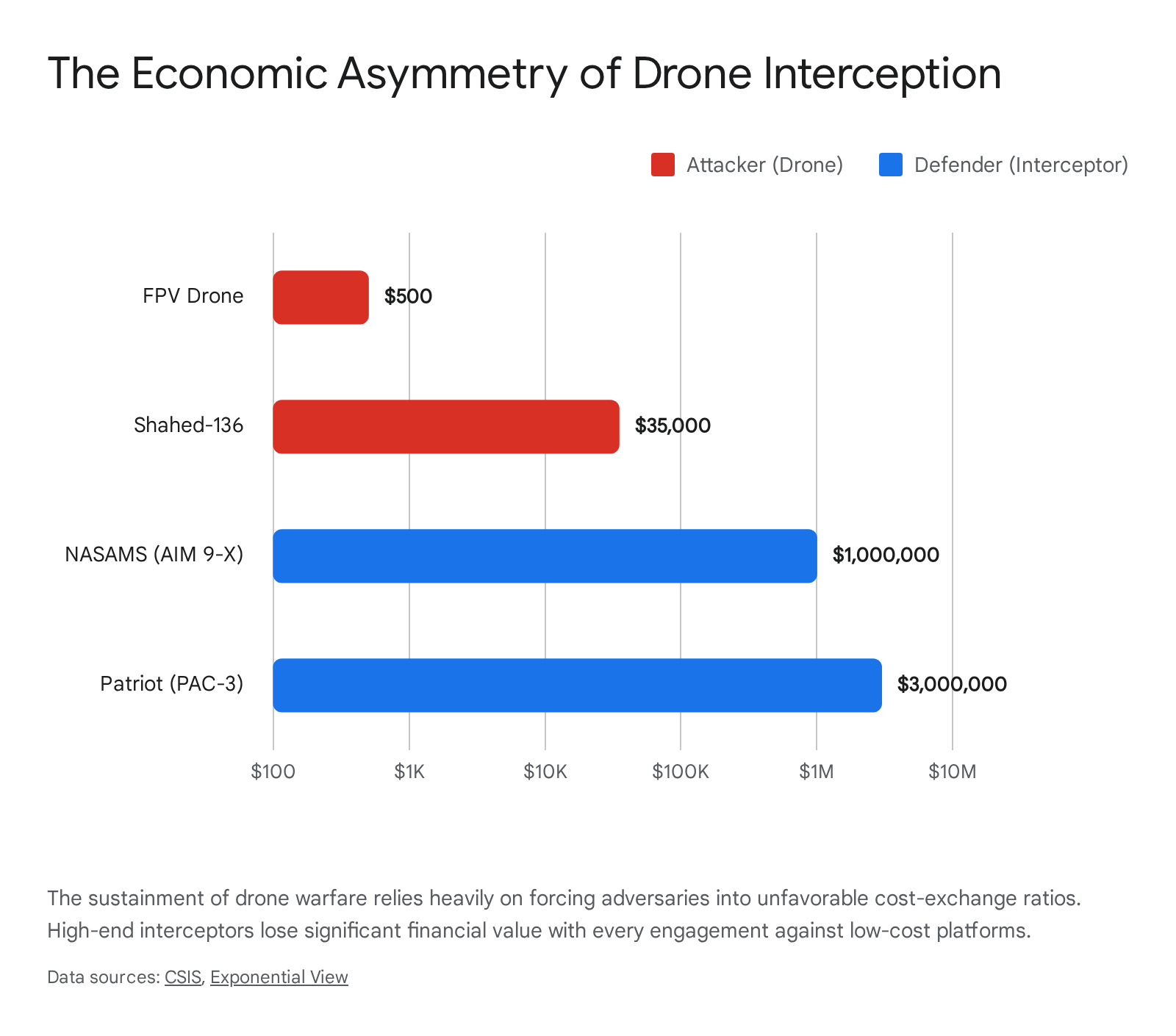
This cost-exchange dilemma constitutes a strategic “tax” imposed on defending forces.4 The mass salvos are deliberately designed to saturate radar screens, exhaust critical interceptor stockpiles, and force command centers to make difficult triage decisions regarding the deployment of limited surface-to-air missile (SAM) assets. By cluttering the airspace, the attacker creates temporal windows of vulnerability, allowing more capable, high-end ballistic and hypersonic missiles to penetrate the defensive umbrellas.4 Furthermore, the introduction of non-kinetic decoys alongside genuine attack drones artificially inflates the number of threats on radar, further diluting the defender’s resources and significantly improving the attacker’s overall operational cost-effectiveness.4
3.2 FPV Drones, Naval Drones, and the Obsolescence of Heavy Platforms
The economic asymmetry observed at the strategic air defense level extends forcefully to the tactical ground and maritime domains through the mass proliferation of First-Person View (FPV) drones and uncrewed surface vessels (USVs). FPV drones represent the ultimate convergence of commercial video gaming technology and lethal military application, transforming the battlefield with highly agile, manually piloted systems.24
The manufacturing costs of FPV drones perfectly illustrate the economic threat to legacy systems. FPV drones are routinely manufactured for approximately $400 to $500, with self-assembled variants utilized by decentralized units occasionally dropping below the $200 threshold.25 Despite this negligible financial footprint, FPVs are capable of delivering specialized warheads—such as repurposed rocket-propelled grenades (RPGs) or custom-built thermobaric charges—with the precision necessary to exploit the top-down vulnerabilities of heavy armor.19
When comparing these costs, the implications for military sustainment are stark. An Excalibur precision-guided artillery round costs approximately $100,000, while a modern Infantry Fighting Vehicle (IFV) costs between $3 million and $4 million, and a Main Battle Tank (MBT) costs between $2 million and $10 million.26 The cost ratio of a $500 drone destroying a multi-million-dollar tank represents an astronomical 2,000-to-1 advantage for the attacker.25 This structural reality suggests a highly durable cost-imposition model where cheap, iterative offensive systems force continuous, expensive defensive adaptations.26 In this environment, raw industrial depth and the capacity to rapidly generate cheap mass become more decisive than the sophistication or armor plating of a single legacy platform.2
This dynamic is equally prevalent in the maritime domain. Ukraine’s naval drone campaign, utilizing platforms such as the Sea Baby and MAGURA uncrewed surface vessels, has demonstrated how relatively inexpensive assets can challenge conventional naval supremacy.5 These USVs have successfully struck at least eleven Russian vessels, including a Kilo-class submarine and multiple tankers operating within Russia’s sanctions-evading shadow fleet.25 The destruction or disablement of oil tankers transporting cargo valued at nearly $70 million, using drones that cost a fraction of that amount, highlights the unsustainable economic burden placed on operators of large, conventional platforms when forced to defend against asymmetric drone swarms.25
To sustainably combat these threats over the long term, defending militaries must fundamentally realign their economic defensive posture. The current reliance on multi-million dollar interceptors must be supplemented by directed-energy weapons. Systems currently in development and early deployment, such as Israel’s Iron Beam (a 100-kilowatt ground-based laser system costing approximately $3 to $5 per shot) or the United Kingdom’s DragonFire (a 50-kilowatt system costing approximately £10 per shot), represent the only economically viable path to defeating the attritional logic of drone warfare.25
| System Comparison | Estimated Unit Cost | Primary Target / Function | Cost-Exchange Implication |
| Shahed-136 (Geran-2) | $35,000 4 | Critical Infrastructure, SAM Radars | Forces defender to expend interceptors costing 30x to 100x more.4 |
| Patriot Interceptor (PAC-3) | $3,000,000 4 | High-Value Aerial Threats | Unsustainable to utilize against massed low-cost drone swarms.4 |
| First-Person View (FPV) Drone | $200 – $500 25 | Infantry, Armored Vehicles, Trenches | 2,000-to-1 cost advantage when destroying Main Battle Tanks.25 |
| Main Battle Tank (MBT) | $2,000,000 – $10,000,000 26 | Ground Maneuver | Highly vulnerable to top-down precision strikes from FPVs.26 |
| Directed Energy (Iron Beam) | $3 – $5 per shot 25 | Drone Swarms, Artillery | The only economically sustainable countermeasure for mass drone defense.25 |
4. The Ukrainian Paradigm: Decentralized Innovation and Digital Logistics
To meet the insatiable demand for unmanned systems, Ukraine has engineered a sustainment model defined by radical decentralization, rapid iterative innovation, and an unparalleled reliance on civilian tech integration.5 Lacking a massive, state-owned defense conglomerate capable of meeting immediate wartime demands at the onset of the conflict, Ukraine fostered a unique “crowdfunding war” dynamic, effectively mobilizing commercial technology sectors, volunteer organizations, and startup ecosystems.2
4.1 Crowdsourced Acquisition and the DOT-Chain Ecosystem
The Ukrainian model relies heavily on non-governmental funding and civil society initiatives to sustain frontline units. Initiatives such as “Operation Unity”—a high-profile collaboration between the state-run(https://u24.gov.ua/operation-unity) fundraising platform, the Come Back Alive foundation, and the digital bank monobank—have successfully crowdsourced hundreds of millions of hryvnias.7 One specific iteration of this initiative established a goal of 220 million UAH to procure 5,000 FPV drones, specifically allocating 157 million UAH for 3,000 drones equipped with thermal imaging cameras for night operations, 34 million UAH for 2,000 drones with daylight cameras, and 29 million UAH for Ukrainian-made cumulative and high-explosive warheads.7 This direct civilian-to-military pipeline bypasses the sluggish, bureaucratic cycles that traditionally plague defense procurement.
To manage this complex, decentralized ecosystem of donors, manufacturers, and end-users, the Ukrainian Ministry of Defense implemented advanced digital command and control tools. The introduction of the DOT-Chain digital system represents a paradigm shift in military logistics. DOT-Chain introduces a needs-based procurement model where individual combat units function as autonomous consumers within a secure digital ecosystem.6 This system provides an aggregated, real-time view of demand across the entire front, linking manufacturers directly with operators and creating a highly responsive supply chain with shared visibility and accountability.6
4.2 Industrial Scaling and the Application of Wright’s Law
The production scaling achieved through this decentralized, software-defined model is staggering. The trajectory of Ukrainian manufacturing exemplifies a remarkable adherence to Wright’s Law, wherein the cost of production steadily declines as cumulative output scales and manufacturing processes are optimized.25
From an initial base of approximately 800,000 systems manufactured in 2023, the domestic industrial apparatus expanded its output to 2.2 million units in 2024.30 Projections for 2025 indicate a baseline production capability of 4 million units, with the Ukrainian Ministry of Defense establishing a strategic, long-term target of an unprecedented 7 million units for 2026.2 To fund this massive scale-up, Ukraine estimates it requires $120 billion, with $60 billion sourced internally and via EU loans, prioritizing 80% of these funds for UAV production, air defense, and artillery.30 By contrast, the United States currently manufactures approximately 100,000 combat drones annually, highlighting the sheer disparity in industrial mobilization.30
[Image: Graph illustrating the exponential scaling of Ukrainian drone production from 2023 to projected 2026 targets alongside cost-reduction curves]
4.3 Tactical Edge Sustainment and Structural Dependencies
Sustaining millions of drones requires more than just manufacturing; it requires robust field maintenance. The attrition rate of tactical drones is exceptionally high. Aside from direct kinetic interception, drones are routinely lost to electronic warfare (EW) jamming, spoofing, battery exhaustion, and mechanical failure.5 Consequently, the ability to rapidly repair and cycle drones back into combat is a critical metric of unit effectiveness.
Ukraine has optimized its field sustainment through the deployment of mobile engineer workshops and electronic laboratories positioned directly behind the forward line of own troops (FLOT).31 Priced at approximately $36,000 each, these highly mobile, decentralized facilities allow drone units to perform emergency repairs, swap damaged motors, and implement software patches in a matter of hours, rather than sending equipment back to centralized depots.31 This agility is essential in an environment where the technological advantage between electronic warfare systems and drone communication frequencies shifts on a weekly basis.31
However, this model possesses inherent structural dependencies. The Ukrainian war effort is deeply tethered to commercial technologies to compensate for material inferiority against the Russian state. Ukrainian operations are structurally dependent on commercial satellite communications (such as Starlink), civilian navigation systems, and Earth-observation networks.5 The combat effectiveness of the Ukrainian forces relies heavily on software integration layers, such as Kropyva and Delta, which evolved from volunteer-driven applications into federated combat management ecosystems linking sensors to shooters.5 This reliance on commercial bearers means that any disruption in civilian service provision immediately degrades military capability.
5. The Russian Paradigm: Centralized Capital, State Absorption, and Labor Mobilization
In stark contrast to Ukraine’s decentralized approach, the Russian Federation operates a highly centralized, state-directed industrial model.2 While the Russian military initially lagged in grassroots tactical innovation—often relying on rigid doctrines that hindered rapid adaptation—its centralized system proved highly capable of identifying successful asymmetric technologies, absorbing them into the formal defense industrial base, and applying massive state capital to achieve overwhelming scale.8
5.1 The Alabuga Special Economic Zone and Institutional Scaling
The Russian paradigm of drone sustainment is best illustrated by the development of the Alabuga Special Economic Zone (SEZ) in the Republic of Tatarstan. Following a franchise and technology transfer agreement with Iran, the Alabuga facility was established to localize the production of Shahed-131 and Shahed-136 loitering munitions.8
The facility rapidly scaled its operations, transitioning from the initial assembly of Iranian-provided knockdown kits to full domestic manufacturing of the drone airframes.34 Demonstrating the depth of the Russian military-industrial complex, Alabuga outsourced the specialized production of warheads to established Russian chemical enterprises. To meet aggressive production goals, the facility contracted with the Scientific Research Institute of Applied Chemistry for 3,000 thermobaric warheads and with JSC NPO Basalt for 5,000 fragmentation-high explosive-incendiary warheads.34 Internal project documentation indicated a long-term production goal of 10,000 Shahed-136 units, significantly higher than the initial 6,000-unit contract negotiated with Tehran.34
5.2 Demographic Engineering and Labor Mobilization
The primary constraint on Russia’s centralized scaling model is not capital or raw materials, but human capital. To staff the massive Alabuga complex amid broad domestic labor shortages—exacerbated by military mobilization and casualties—the Russian state implemented aggressive, non-traditional recruitment strategies.9
The workforce, which expanded to over 25,000 employees by mid-2025, was rapidly augmented by recruiting students (some reportedly underage) from the local Alabuga Polytechnic institute.9 Furthermore, the facility established the “Alabuga Start” program, an international recruitment drive targeting young female migrant workers primarily from Africa, Latin America, and South Asia.9 To further bolster output, Russian commentators have discussed the integration of up to 25,000 highly motivated North Korean workers into the SEZ, a move that would effectively double the workforce and significantly increase the daily production rate of 90 Shahed drones.18
This mobilization of international labor is indicative of a broader shift toward “defense Keynesianism” within the Russian economy, where economic growth is driven almost entirely by military-related production.10 The defense sector has expanded to employ approximately 3.8 million people—roughly 5% of the total Russian workforce—drawn by salaries that often reach 150,000 rubles ($1,870) per month, nearly double the national median wage.10
5.3 The Evolution of the Lancet Munition
Concurrently, established Russian defense firms have evolved their product lines to dominate the tactical airspace. ZALA Aero Group, the manufacturer of the Lancet loitering munition, represents the successful institutionalization of drone warfare within the Russian military.36
Valued at approximately $35,000 to $37,000 per unit, the Lancet has undergone continuous iterative upgrades based on extensive battlefield feedback.36 Recent variants, specifically the Izdeliye 51 and 52 (and the related Chernika-2), have integrated larger payloads. For example, newer Lancets have replaced the standard 3 kg KZ-6 warhead with the 4.9 kg PTM-3 Soviet-designed anti-tank mine, allowing for more effective strikes against armored targets.37 Crucially, to counter intense Ukrainian electronic warfare, ZALA Aero has integrated advanced autonomous target recognition utilizing machine vision and AI algorithms, allowing the munition to track and strike targets even in completely GPS-denied or heavily jammed environments.38 The operational range of these upgraded systems has also been extended from roughly 40 kilometers to over 100 kilometers, allowing Russian forces to strike deep into the Ukrainian tactical rear.38
5.4 Doctrinal Rigidity and the Risks of Centralization
While industrial output is immense, the Russian model struggles with operational doctrine. The integration of mass drone capabilities forced changes in military structure. In 2024, the Russian 2nd Combined Arms Army initiated the “Drone Line” project, establishing specific echelons of drone operators tasked with targeting enemy logistics, allocating up to 560 UAS per day to specific units.32 Russia subsequently established a dedicated branch of the armed forces focused entirely on unmanned systems, seeking to centralize development, training, and operational command.40
However, this drive for absolute centralization presents a distinct operational vulnerability. Analysts consistently note that the extreme effectiveness of drone units stems from their tactical decentralization and operational independence.41 By aggressively disbanding informal volunteer detachments and forcing agile drone operators into rigid, centralized military hierarchies—often assigning highly specialized pilots to traditional infantry assault roles to backfill manpower shortages—the Russian Ministry of Defense risks degrading the very agility that makes drone warfare effective.41 In the rapidly evolving offense-defense race of drone combat, overly rigid command and control structures slow the innovation cycle, limiting the ability of frontline troops to react to sudden shifts in the adversary’s electronic warfare posture.2
6. The Iranian Paradigm: Decentralized Mosaic and Strategic Resilience
The Islamic Republic of Iran plays a critical architectural role in sustaining the drone capabilities of the Axis of Aggressors. Iran’s model of drone sustainment is fundamentally designed around survivability and strategic resilience, characterized by a “decentralized mosaic” production strategy.11
6.1 Institutional Infrastructure and Design Philosophy
The Iranian drone program is overseen by the Ministry of Defense and Armed Forces Logistics (MODAFL) and the Islamic Revolutionary Guard Corps (IRGC) Aerospace Force.11 Within this structure, specialized entities drive development. The Shahed Aviation Industries Research Center (SAIRC), located near Isfahan, functions primarily as a design bureau, developing the blueprints for the Shahed-131, Shahed-136, and Mohajer series.21 The designs are then handed over for series production to the Iran Aircraft Manufacturing Industrial Company (HESA), a state-owned subsidiary of MODAFL that has historically maintained, repaired, and reverse-engineered various military aircraft.45
The fundamental design philosophy of Iranian drones is centered on simplicity and manufacturability.22 By utilizing basic fiberglass bodies, commercially available dual-use engines, and rudimentary guidance systems, Iranian engineers have created platforms that do not require highly specialized aerospace manufacturing environments.22
6.2 The Mosaic Strategy and Operational Survivability
To protect this industrial base from the persistent threat of aerial bombardment and sabotage by the United States and Israel, Iran disperses its command structures, weapon systems, and manufacturing nodes across vast geographic areas and subterranean facilities.11 This “Decentralized Mosaic Defense” strategy ensures that military functions can continue seamlessly even under intense attack.11
Because the drones are relatively simple to construct, they can be assembled in rudimentary, dual-use facilities—such as civilian speedboat repair shops—ensuring that production can continue even when primary, state-owned aerospace facilities like HESA are targeted or disrupted.22 Demonstrating the extreme resilience of this model, senior Iranian military officials reported a tenfold increase in the production rate of attack drones in the months following the intense June 2025 conflict with Israel, signaling a robust and highly adaptable capacity to replenish attrited stockpiles under fire.48
6.3 Proliferation as a Strategic Weapon
The decentralized mosaic model not only protects domestic production but also facilitates the rapid transfer of technology to proxy forces and allied nations. Iran has successfully exported its drone manufacturing methodologies to Russia (via the Alabuga SEZ) and to the Houthi forces in Yemen.8 The ability to package drone designs, commercial component lists, and basic assembly instructions into exportable “franchises” provides Iran with significant geopolitical leverage, allowing it to sustain low-cost, high-impact proxy wars across multiple theaters simultaneously.8
7. The Architecture of Evasion: Global Supply Chains and Microelectronics
The industrialized production of drones across all three paradigms—Ukrainian, Russian, and Iranian—relies upon an incredibly complex global supply chain. Despite unprecedented multilateral sanctions imposed by the Global Export Control Coalition (GECC), both Russia and Iran have successfully maintained their supply lines by systematically exploiting structural gaps in global commerce.3
7.1 Structural Dependencies on Western Technology
A defining feature of the current conflict is the persistent, structural reliance on Western-manufactured commercial off-the-shelf (COTS) technologies. Extensive field investigations and teardowns by organizations such as Conflict Armament Research (CAR) and the Independent Anti-Corruption Commission (NAKO) have repeatedly documented the presence of advanced Western components inside downed Russian and Iranian platforms.14
The “Terror in the Details” report published by NAKO highlighted that the “brains” and “eyes” of systems like the Shahed-136—including microprocessors, Ethernet transceivers, semiconductors, and memory modules—frequently originate from prominent technology corporations headquartered in the United States, Japan, Canada, and Switzerland.14 The discovery of components manufactured by Intel Corporation, AMD, and Texas Instruments within these weapon systems has led to civil lawsuits accusing distributors, such as Mouser Electronics, of “willful ignorance” in allowing restricted chips to reach Russian shell companies.52 Similarly, the Russian Lancet drone relies heavily on the Jetson TX2 module by NVIDIA and the Zynq SoC module by AMD/Xilinx for its onboard control and programmable logic.36
Because these items are widely used in civilian electronics, automotive manufacturing, and telecommunications, they have historically been viewed by export-control regimes as low-risk.3 This ubiquitous commercial availability creates profound information gaps. While Original Equipment Manufacturers (OEMs) may maintain strict compliance protocols, the independent distributors and brokers who facilitate secondary and tertiary market sales rarely possess the capability or the legal mandate to enforce stringent end-user verification.3
7.2 The Mechanics of the Shadow Supply Chain
To acquire these restricted technologies, Russia and Iran rely on a geopolitical “Axis of Evasion,” heavily anchored by China and facilitated by a network of intermediary states.16 Procurement networks construct multi-layered webs of shell companies, utilizing weak enforcement jurisdictions to obscure the ultimate destination of the hardware.3
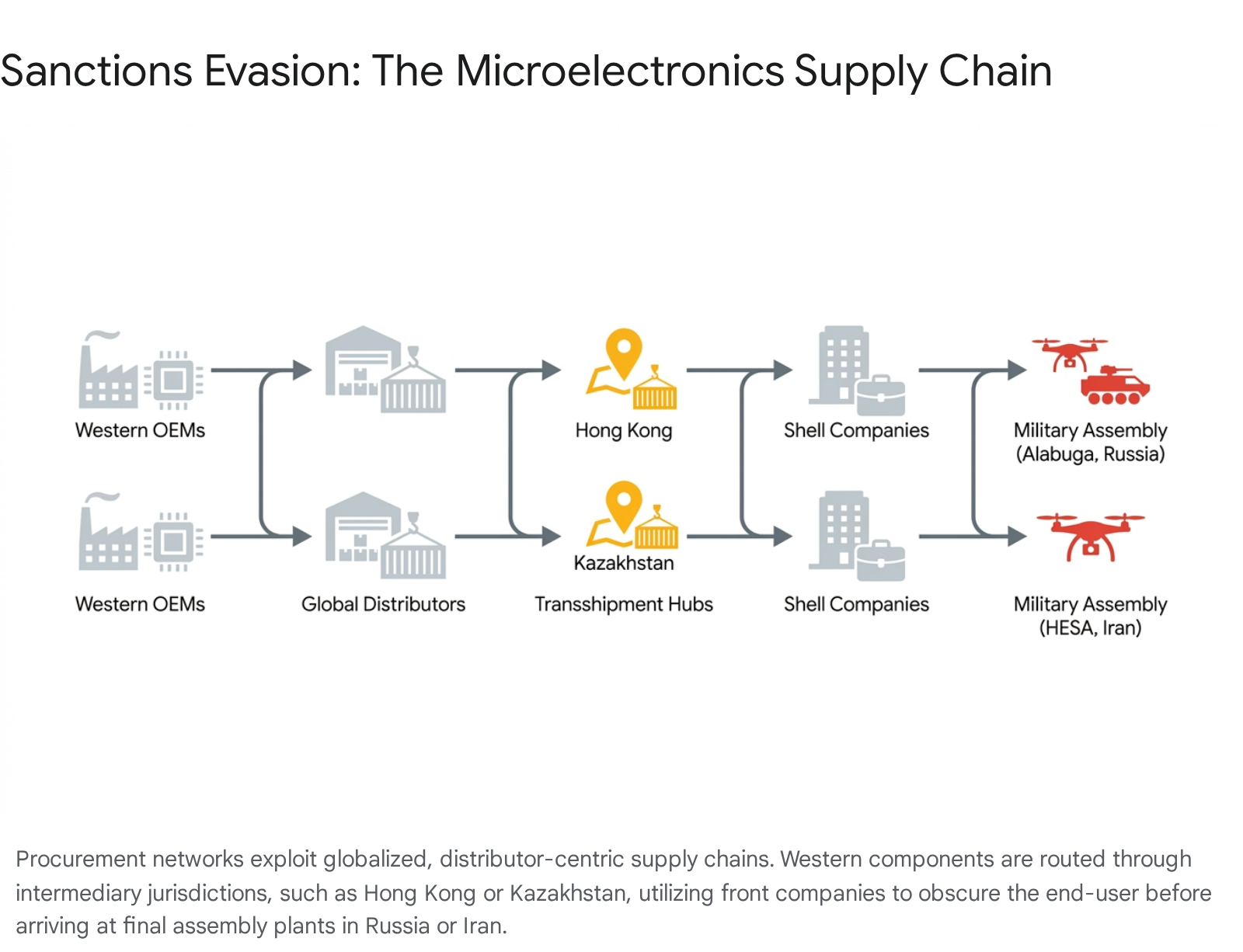
China serves as a primary enabler within this system. In addition to importing sanctioned oil, China provides a vast marketplace for sophisticated dual-use technology, including navigation systems and critical components, facilitating their transfer to Tehran and Moscow.16 For instance, intelligence reports indicate that Iranian companies, such as Pars Aero, manage logistics and external transactions through Hong Kong-registered entities like Foxtech Hobby to purchase critical drone parts under civilian product labels, only to later repurpose them for military applications.53
Similarly, comprehensive trade data analysis reveals that Kazakhstan serves as a critical regional conduit for routing export-restricted semiconductors into the Russian economy.54 Following the imposition of sanctions, Kazakhstan’s exports of microelectronics to Russia surged by over 567%, acting as a strategic bypass for the Russian defense industry.54
These illicit procurement networks operate with astonishing speed and agility. Forensic analysis of an Iranian Shahed-136 recovered in Ukraine in April 2023 revealed a component manufactured in China just three months prior, in January 2023.3 This rapid integration cycle underscores the immense difficulty of interdicting supply chains that operate via commercial courier networks rather than traditional, easily monitored military logistics vessels.
7.3 The “Friction Tax” on the Aggressors
While these evasion efforts are successful in maintaining drone production lines, they impose a severe “friction tax” on the target nations. Rerouting supplies through regional allies and paying premiums to smugglers significantly raises the procurement costs and lead times for components.54 This financial and logistical strain forces the Russian military to strictly prioritize the production and repair of tactically relevant assets—specifically mass-produced drones and armored vehicles—while neglecting the maintenance of more complex, legacy platforms, such as advanced tactical aviation, which suffer from severe spare parts shortages.54
8. The Chemical and Metallurgical Foundation: Critical Raw Materials
Beyond the complex architecture of microelectronics, the sustainment of drone combat is inextricably linked to the physical materials required for their construction. The mass production of affordable unmanned systems demands continuous, uninterrupted access to specialized chemistry and metallurgy.12 In this domain, both the allied defense industrial base and the adversarial networks face severe structural vulnerabilities linked to Chinese supply chain hegemony.
The material dependency of a modern military drone rests on four key pillars 12:
| Critical Material | Primary Application in UAS | Strategic Chokepoint / Dependency |
| Carbon Fiber | Airframe skeletal foundation (Carbon fiber reinforced polymer) | Aerospace-grade fiber capacity is constrained; requires extensive autoclave facilities.12 |
| Lithium & Battery Chemistry | Power supply, endurance limits, structural alloys (Aluminum-lithium) | China processes approximately two-thirds of the world’s lithium supply.12 |
| Rare-Earth Magnets | Propulsion (Neodymium-iron-boron magnets) turning electrical current to torque | China controls ~90% of global sintered-magnet output.12 |
| Gallium-Nitride | Semiconductors, power amplifiers, advanced infrared thermal sensors | Specialized refining processes heavily concentrated in East Asia.12 |
The strategic vulnerability of this material dependency is not theoretical; it has already been actively weaponized. In late 2024, Chinese state entities capitalized on their dominance by holding back vital battery cell shipments intended for major Western drone manufacturers (such as the US firm Skydio), while simultaneously redirecting production capacity to sustain the Russian war effort.13 Furthermore, China has initiated restrictions on the export of germanium, a material crucial for the thermal sensors that allow drones to operate effectively at night, and has heavily scrutinized the flow of permanent magnets into the European theater.13
Unless strategic reserves are significantly expanded and allied refining capabilities are developed domestically or via secure partnerships, the capacity of Western militaries to sustain the “affordable mass” required for modern warfare will remain beholden to adversary-controlled supply chains.12 In a protracted conflict, a shortage of specialized metallurgical inputs could handicap warfighting capacity just as severely as a shortage of finished munitions.
9. Battlefield Ripples: Logistics, Medicine, and Tactical Evolution
The saturation of the airspace with persistent, low-cost surveillance and strike drones has fundamentally altered the physical and cognitive reality of the battlefield. The immediate tactical rear is no longer a sanctuary, and operations previously considered routine now carry extreme risk.
9.1 The Transparent Battlefield and Logistics
The ubiquity of drones has rendered the modern battlefield entirely transparent.1 This transparency has catastrophic implications for traditional logistics and sustainment operations. Wheeled transport columns attempting to supply forward positions are routinely detected and destroyed by FPV swarms before reaching their destinations. In response, both sides have been forced to innovate. Uncrewed ground vehicles (UGVs) and heavy-lift multicopters (such as the Ukrainian “Baba Yaga” drone) are increasingly utilized for vital last-mile resupply, dropping ammunition, batteries, and rations to forward trench lines that are completely inaccessible to manned vehicles due to the omnipresent threat of aerial strikes.2
9.2 Medical Sustainment in the Drone Era
Furthermore, the drone threat has severely compromised traditional medical evacuation (MEDEVAC) protocols. The concept of the “golden hour”—rapidly evacuating wounded personnel to advanced medical facilities—is often impossible when wheeled ambulances and armored medical transports serve as highly visible targets for loitering munitions.55
In response, Ukrainian medical commands have adapted by constructing a decentralized network of underground “stabilization points” located perilously close to the front lines.55 These hardened, subterranean facilities, often utilizing repurposed Cold War infrastructure or rapid new construction, represent a forced shift toward “prolonged field care”.55 Medics must now be trained to sustain critically wounded casualties for extended periods in austere environments, accepting that rapid evacuation is frequently impossible under drone saturation.55 This adaptation underscores how the proliferation of one specific technology forces systemic restructuring across the entire spectrum of military operations, from logistics to combat medicine.
9.3 The EW Arms Race and Cognitive Warfare
The tactical evolution of drones is driven by a continuous, high-speed arms race with electronic warfare (EW) systems. As defenders deploy localized jammers to sever the command links of incoming FPVs, attackers rapidly adapt. This offense-defense cycle led to the emergence of fiber-optic cable drones in 2024, which spool a physical wire behind them as they fly, rendering them entirely immune to radio frequency jamming and spoofing.5 The subsequent integration of machine learning and Artificial Intelligence (AI) for autonomous terminal guidance further reduces the reliance on vulnerable communication links.5
Beyond the physical destruction, analysts emphasize the profound cognitive dimension of drone warfare. The incessant buzzing of loitering munitions, the unpredictability of FPV strikes, and the constant exposure to aerial surveillance create intense psychological strain, shaping morale and decision-making at both the tactical and operational levels.2
10. Strategic Mitigation and Future Force Design
The sustainment models and tactical realities observed in Ukraine, Russia, and Iran provide a definitive blueprint for the character of mid-21st-century warfare. The fusion of mass-produced commercial technology with lethal payloads has fundamentally and irreversibly altered operational planning.2 For strategic planners, military leadership, and defense industrial bases, several urgent lessons must be internalized and actioned:
1. Realigning the Economics of Air Defense: The current paradigm, which relies on multi-million dollar interceptors to defeat highly expendable, low-cost drones, is strategically and economically untenable for long-term sustainment.23 Future force design must ruthlessly prioritize layered, integrated air and missile defense systems that incorporate non-kinetic effectors (such as advanced, portable electronic warfare and microwave disruption) and cost-effective hard-kill solutions (such as directed-energy laser systems and automated gun platforms).20 Establishing a favorable, or at least parity-level, cost-exchange ratio in the defensive sphere is an existential requirement.
2. Cultivating Industrial Agility and Supply Chain Sovereignty: The ability to produce highly sophisticated, exquisite platforms in peacetime must be balanced with the latent capacity to mass-produce “good enough” systems during a protracted conflict.2 Western defense bases must transition away from exclusively artisanal, long-lead-time manufacturing toward modular designs that permit rapid scaling.2 Crucially, this requires securing sovereign or allied access to the critical raw materials—lithium, rare-earth magnets, and specialized composites—that serve as the chemical and metallurgical foundation of modern autonomous systems.12
3. Embracing Hybrid Procurement Architectures: The success of Ukraine’s decentralized, software-defined procurement ecosystem (DOT-Chain) and its reliance on civilian tech integration demonstrates that the modern defense sector can no longer operate in a bureaucratic silo.5 Future conflicts will require militaries to rapidly absorb commercial innovation, shorten acquisition cycles from years to mere weeks, and push maintenance, repair, and modification capabilities directly to the tactical edge.2
The conflict in Ukraine has definitively proven that the denial of airspace, facilitated by the relentless sustainment of cheap, networked autonomous systems, is often more decisive than the pursuit of absolute traditional air superiority.1 Success in future peer-level engagements will favor the actor capable of marrying the agility of commercial innovation with the deep industrial capacity required to sustain mass on the modern battlefield.
Please share the link on Facebook, Forums, with colleagues, etc. Your support is much appreciated and if you have any feedback, please email us in**@*********ps.com. If you’d like to request a report or order a reprint, please click here for the corresponding page to open in new tab.
Sources Used
- Lessons from Ukraine and Iran: Adaptation Remains Key – Observer Research Foundation, accessed April 25, 2026, https://www.orfonline.org/research/lessons-from-ukraine-and-iran-adaptation-remains-key
- The Impact of Drones on the Battlefield: Lessons of the Russia-Ukraine War from a French Perspective | Hudson Institute, accessed April 25, 2026, https://www.hudson.org/missile-defense/impact-drones-battlefield-lessons-russian-ukraine-war-french-perspective-tsiporah-fried
- Tracking the Components of Missiles and UAVs Used by Russia in …, accessed April 25, 2026, https://www.iiss.org/globalassets/media-library—content–migration/files/research-papers/2025/09/pub25-094-tracking-the-components-of-missiles-and-uavs-used-by-russia-in-ukraine.pdf
- Calculating the Cost-Effectiveness of Russia’s Drone Strikes – CSIS, accessed April 25, 2026, https://www.csis.org/analysis/calculating-cost-effectiveness-russias-drone-strikes
- Mapping the MilTech War: Eight Lessons from Ukraine’s Battlefield – Ifri, accessed April 25, 2026, https://www.ifri.org/en/studies/mapping-miltech-war-eight-lessons-ukraines-battlefield
- How and Why Ukraine’s Military Is Going Digital – CSIS, accessed April 25, 2026, https://www.csis.org/analysis/how-and-why-ukraines-military-going-digital
- UNITED24, the Come Back Alive Foundation and monobank are launching a fundraiser towards 5000 FPV drones for the Armed Forces of Ukraine, accessed April 25, 2026, https://u24.gov.ua/news/operationunity2
- How Russia Is Building a Sovereign Drone Ecosystem for AI-Driven Autonomy – CSIS, accessed April 25, 2026, https://www.csis.org/analysis/how-russia-building-sovereign-drone-ecosystem-ai-driven-autonomy
- who is making russia’s drones? – Global Initiative Against Transnational Organized Crime, accessed April 25, 2026, https://globalinitiative.net/wp-content/uploads/2025/05/Who-is-making-Russias-drones_-The-migrant-women-exploited-for-Russias-war-economy-GI-TOC-May-2025.v2.pdf
- Did Russia’s Defense-Sector Boom Peak in 2025? – The Moscow Times, accessed April 25, 2026, https://www.themoscowtimes.com/2025/12/26/did-russias-defense-sector-boom-peak-in-2025-a91555
- How Iran’s massive arsenal of missiles and drones became its last line of defense, accessed April 25, 2026, https://www.arabnews.com/node/2635534/amp
- The Drone Supply Chain War: Identifying the Chokepoints to Making …, accessed April 25, 2026, https://www.csis.org/analysis/drone-supply-chain-war-identifying-chokepoints-making-drone
- Drones: Decoupling Supply Chains from China – RUSI, accessed April 25, 2026, https://static.rusi.org/rp-drone-supply-chains-china-nov-2025_0.pdf
- New report sounds alarm over Russian military’s reliance on Western-made components in its war against Ukraine & urgent need to restrict continued supply – Business and Human Rights Centre, accessed April 25, 2026, https://www.business-humanrights.org/en/latest-news/new-report-sounds-alarm-over-russian-military-reliance-on-western-made-components-in-its-war-against-ukraine–urgent-need-to-restrict-continued-supply-incl-co-responses–non-responses/
- Iran’s Support for Russia and Lessons Learned from Ukraine – FDD, accessed April 25, 2026, https://www.fdd.org/analysis/2026/04/21/irans-support-for-russia-and-lessons-learned-from-ukraine/
- From drones to rocket fuel, China and Russia are helping Iran through supply chains, accessed April 25, 2026, https://www.atlanticcouncil.org/dispatches/from-drones-to-rocket-fuel-china-and-russia-are-helping-iran-through-supply-chains/
- FIELD DISPATCHES – Conflict Armament Research, accessed April 25, 2026, https://www.conflictarm.com/field-dispatches/
- Adversary Entente Task Force Update, June 26, 2025 | ISW, accessed April 25, 2026, https://understandingwar.org/research/adversary-entente/adversary-entente-task-force-update-june-26-2025/
- Red Skies Ahead: Russia Planning for Its Drone-Driven Army of Tomorrow, accessed April 25, 2026, https://www.armyupress.army.mil/Journals/Military-Review/English-Edition-Archives/January-February-2026/Red-Skies-Ahead/
- The war in Ukraine shows the game-changing effect of drones depends on the game, accessed April 25, 2026, https://www.tandfonline.com/doi/full/10.1080/00963402.2023.2178180
- Shahed drones – Wikipedia, accessed April 25, 2026, https://en.wikipedia.org/wiki/Shahed_drones
- Bloomberg evaluates Iran’s capacity to produce Shahed drones – RBC-Ukraine, accessed April 25, 2026, https://newsukraine.rbc.ua/news/bloomberg-evaluates-iran-s-capacity-to-produce-1773252510.html
- Shahed-131 & -136 UAVs: a visual guide – Open Source Munitions Portal, accessed April 25, 2026, https://osmp.ngo/collection/shahed-131-136-uavs-a-visual-guide/
- Lessons from the Ukraine Conflict: Modern Warfare in the Age of Autonomy, Information, and Resilience – CSIS, accessed April 25, 2026, https://www.csis.org/analysis/lessons-ukraine-conflict-modern-warfare-age-autonomy-information-and-resilience
- How Ukraine solved the hardest problem in defense – Exponential View, accessed April 25, 2026, https://www.exponentialview.co/p/ukraine-seven-day-drone-advantage
- Cost asymmetry in Ukraine: Can $800 FPV drones sustainably threaten $2M armored platforms? – Reddit, accessed April 25, 2026, https://www.reddit.com/r/CredibleDefense/comments/1rh2dpq/cost_asymmetry_in_ukraine_can_800_fpv_drones/
- More than Just Drones: Industrial Base Lessons from the Conflict in Ukraine – YouTube, accessed April 25, 2026, https://www.youtube.com/watch?v=OqRdEN5wb20
- Operation Unity Part II: Fireworks! – United24, accessed April 25, 2026, https://u24.gov.ua/operation-unity
- Operation Unity: UNITED24, Come Back Alive and monobank are fundraising 10,000 FPV drones for the Ukrainian Defence Forces, accessed April 25, 2026, https://u24.gov.ua/news/operation_unity
- Ukraine will build 7 million drones in 2026—and it still won’t be enough – Euromaidan Press, accessed April 25, 2026, https://euromaidanpress.com/2026/01/26/ukraine-aims-to-build-7-million-drones-in-2026-70-times-more-than-the-us/
- Innovating Under Fire: Lessons from Ukraine’s Frontline Drone Workshops, accessed April 25, 2026, https://mwi.westpoint.edu/innovating-under-fire-lessons-from-ukraines-frontline-drone-workshops/
- Russia’s Drone Line Experiment – Foreign Policy Research Institute, accessed April 25, 2026, https://www.fpri.org/article/2026/04/russias-drone-line-experiment/
- A Closer Look at the Yelabuga UAV Factory – CSIS Beyond Parallel, accessed April 25, 2026, https://beyondparallel.csis.org/a-closer-look-at-the-yelabuga-uav-factory/
- Alabuga’s Shahed 136 (Geran 2) Warheads: A Dangerous …, accessed April 25, 2026, https://isis-online.org/isis-reports/detail/alabugas-shahed-136-geran-2-warheads-a-dangerous-escalation/
- Russia Recruits Young Migrant Women from Latin America to Build Iranian Drones – FDD, accessed April 25, 2026, https://www.fdd.org/analysis/2026/01/08/russia-recruits-young-migrant-women-from-latin-america-to-build-iranian-drones/
- ZALA Lancet – Wikipedia, accessed April 25, 2026, https://en.wikipedia.org/wiki/ZALA_Lancet
- Russian Zala Lancet Drone Evolved Again With Upgraded Warhead – UNITED24 Media, accessed April 25, 2026, https://united24media.com/latest-news/russian-zalas-lancet-drone-evolved-again-with-upgraded-warhead-10430
- Russian Force Generation and Technological Adaptations Update July 25, 2025 – ISW, accessed April 25, 2026, https://understandingwar.org/research/russia-ukraine/russian-force-generation-and-technological-adaptations-update-july-25-2025/
- The New York Times: ZALA «Lancet» in the global AI arms race, accessed April 25, 2026, https://zala-aero.com/en/news/the-new-york-times-zala-lanczet-v-globalnoj-gonke-ii-vooruzhenij/
- Drone Warfare in Ukraine: From Myths to Operational Reality – Part 1, accessed April 25, 2026, https://researchcentre.army.gov.au/library/land-power-forum/drone-warfare-ukraine-myths-operational-reality-part-1
- Russian Efforts to Centralize Drone Units May Degrade Russian Drone Operations | ISW, accessed April 25, 2026, https://understandingwar.org/research/russia-ukraine/russian-efforts-to-centralize-drone-units-may-degrade-russian-drone-operations-2/
- Russian Force Generation and Technological Adaptations Update June 27, 2025, accessed April 25, 2026, https://understandingwar.org/research/russia-ukraine/russian-force-generation-and-technological-adaptations-update-june-27-2025/
- Shahed Aviation Industries | Iran Watch, accessed April 25, 2026, https://www.iranwatch.org/iranian-entities/shahed-aviation-industries
- Russia’s Iranian-Made UAVs: A Technical Profile | Royal United Services Institute – RUSI, accessed April 25, 2026, https://www.rusi.org/explore-our-research/publications/commentary/russias-iranian-made-uavs-technical-profile
- Airstrikes on Iran’s Defense Industry Company for Aircraft Manufacturing – HESA, accessed April 25, 2026, https://israel-alma.org/airstrikes-on-irans-defense-industry-company-for-aircraft-manufacturing-hesa/
- Iran Aircraft Manufacturing Industries (HESA), accessed April 25, 2026, https://www.iranwatch.org/iranian-entities/iran-aircraft-manufacturing-industries-hesa
- Treasury Sanctions Global Network Supporting Iran’s Military UAV Program, accessed April 25, 2026, https://home.treasury.gov/news/press-releases/sb0217
- Iran says attack drone production increased tenfold after 2025 war | News.az, accessed April 25, 2026, https://news.az/news/iran-says-attack-drone-production-increased-tenfold-after-2025-war
- Iran Increased its Drone Production 10 -Folds Since the June 2025 War with Israel, accessed April 25, 2026, https://defensemirror.com/news/41467/Iran_Increased_its_Drone_Production_10__Folds_Since_the_June_2025_War_with_Israel
- Iran Increased its Drone Production 10 -Folds Since the June 2025 War with Israel, accessed April 25, 2026, https://defensemirror.com/news/41467
- Conflict Armament Research – ArcGIS StoryMaps, accessed April 25, 2026, https://storymaps.arcgis.com/collections/29eb0c63b0444572ab0a8740c9c3b3a8
- Lawsuit filed on behalf of Ukrainians killed and injured by Russian missile strikes using US-made technology | B4Ukraine, accessed April 25, 2026, https://b4ukraine.org/whats-new/intel-amd-accused-of-allowing-chips-in-russian-missiles
- China, Hong Kong Firms Allegedly Help Iran Evade Sanctions for Drones – Vision Times, accessed April 25, 2026, https://www.visiontimes.com/2026/04/03/china-hong-kong-firms-allegedly-help-iran-evade-sanctions-for-drones.html
- The Impact of Sanctions and Alliances on Russian Military Capabilities – RUSI, accessed April 25, 2026, https://www.rusi.org/explore-our-research/publications/commentary/impact-sanctions-and-alliances-russian-military-capabilities
- The Ukrainian Underground: Lessons for MEDCOM Sustainment in LSCO – U.S. Army, accessed April 25, 2026, https://www.army.mil/article/287994/the_ukrainian_underground_lessons_for_medcom_sustainment_in_lsco
- The Russia-Ukraine Drone War: Innovation on the Frontlines and Beyond – CSIS, accessed April 25, 2026, https://www.csis.org/analysis/russia-ukraine-drone-war-innovation-frontlines-and-beyond