1. Executive Summary
The rapid proliferation and tactical integration of unmanned aerial and surface systems have fundamentally rewritten the established doctrines of modern military operations. By observing the protracted, high-attrition environment of the Russia-Ukraine war alongside the acute, high-intensity engagements of the 2026 United States-Iran conflict, a distinct and evolving paradigm of warfare becomes apparent. This report synthesizes operational data, technical specifications, and strategic outcomes from both theaters to outline the top ten lessons learned regarding drone warfare. The analysis indicates that traditional concepts of high-altitude air superiority are increasingly being supplemented, and in some cases replaced, by strategies of air denial within the lower altitudes, commonly referred to as the air littoral.
Financial metrics from these conflicts demonstrate that cost-exchange ratios have inverted dramatically. This inversion allows relatively inexpensive, mass-produced drones to systematically deplete multi-million-dollar interceptor stockpiles, placing severe economic strain on technologically advanced militaries. Legacy platforms, once considered the cornerstone of global power projection, are proving highly vulnerable in contested environments characterized by advanced electronic warfare and dense, layered air defense networks. Consequently, the democratization of precision strike capabilities has allowed non-state actors, proxy groups, and smaller nations to project power previously reserved strictly for global superpowers.
To counter pervasive electronic warfare, artificial intelligence, autonomous swarming algorithms, and resilient satellite communication networks are rapidly replacing traditional human-in-the-loop remote control systems. Force architectures are subsequently shifting toward a model of attritable mass, prioritizing the rapid acquisition and deployment of low-cost, expendable systems over the maintenance of small fleets of exquisite legacy assets. In the maritime domain, the introduction of unmanned surface vehicles has severely disrupted traditional naval operations, forcing major fleet relocations and threatening global supply chains. Finally, the ubiquitous presence of unmanned systems has introduced severe cognitive and psychological burdens on both the targeted ground forces and the remote operators conducting the strikes. This detailed assessment provides a systematic evaluation of these strategic shifts, offering vital insights for future force design, procurement strategies, and tactical execution.
2. Introduction: The Real-World Laboratories of Modern Conflict
Military strategy is routinely refined through the brutal pragmatism of active conflict, where theoretical doctrine is tested against adaptive adversaries. The ongoing war in Ukraine has served as a highly informative proving ground for technological innovation operating under severe combat pressure.1 What began in early 2022 as a conflict expected to conclude in a matter of days has evolved into a grueling war of attrition. By early January 2026, Russia’s war in Ukraine had gone on longer than the Soviet Union’s involvement in the Great Patriotic War, which was waged from the onset of Operation Barbarossa in June 1941 until the capitulation of Nazi Germany in May 1945.2 What began with the improvised employment of commercial quadcopters has rapidly industrialized. Both the Russian Federation and Ukraine are now capable of producing between forty thousand and fifty thousand tactical drones on a weekly basis, effectively transforming the airspace into a saturated tactical zone.3
Conversely, the conflict between the United States and the Islamic Republic of Iran, which escalated significantly in early 2026 with operations such as Operation Epic Fury, provides a different but equally critical dataset.4 This conflict highlights the distinct vulnerabilities of advanced Western militaries when they are forced to operate in heavily contested airspace against an adversary utilizing massed, low-cost drone swarms combined with integrated air defense systems.6 The rapid loss of highly sophisticated American reconnaissance drones over Iranian airspace, coupled with the systemic disruption of global commercial shipping in the Strait of Hormuz and the Red Sea, underscores a fundamental shift in asymmetric warfare dynamics.4
By examining the intersection of these two distinct theaters, military analysts can derive critical, data-driven lessons regarding the future of armed conflict. The Ukrainian theater provides vast data on the sustained industrial production of tactical systems and iterative electronic warfare countermeasures. The Middle Eastern theater provides immediate data on the strategic deployment of long-range loitering munitions against advanced Western defense networks. Together, these conflicts highlight the changing economics of national defense, the vulnerability of legacy platforms, and the urgent necessity for doctrinal adaptation across all domains of warfare.
3. Lesson 1: The Transition from Air Superiority to Air Denial
For several decades, the foundation of Western military doctrine has been the rapid achievement and continuous maintenance of air superiority. However, the operational realities observed in Ukraine and the Middle East demonstrate a definitive transition toward the concept of air denial, particularly within the lower operational altitudes known as the air littoral.6 Air denial is a strategic approach wherein a combatant contests control of the airspace using large numbers of low-cost, mobile, and distributed systems. This approach makes the domain too dangerous and costly for the adversary to operate freely, without the denying force ever needing to achieve outright air superiority themselves.6
In the 2026 US-Iran conflict, American military forces successfully achieved air superiority at high altitudes, allowing strategic platforms such as the B-52 Stratofortress to operate overland without prohibitive interference.6 However, the lower altitudes remained highly contested and exceptionally dangerous. Iran exploited this air littoral above the Strait of Hormuz, deploying decentralized networks of drones and missiles capable of reaching naval vessels in a matter of minutes.6 This distributed threat environment effectively halted commercial shipping traffic through the strait, forced United States naval carriers to operate from greater distances in the Red and Arabian Seas, and pushed domestic gasoline prices up by a dollar per gallon in a single month.6 The barrier to entry for achieving effective air denial is considerably lower than the technological and financial investment required for air superiority, yet it imposes disproportionate strategic and economic costs on the superior force.6
This specific strategy is directly informed by the Houthi proxy operations in the Red Sea between 2024 and 2025, where cheap, distributed drones imposed operational costs that more than 800 United States airstrikes could not eliminate.6 This phenomenon is closely mirrored in the Ukrainian theater, where both Russian and Ukrainian forces utilize thousands of drones daily to prevent the concentration of mechanized forces and infantry.2 The sheer volume of unmanned systems creates an environment where traditional close air support and low-altitude helicopter operations become nearly impossible to execute safely. Modern militaries must recognize that controlling the higher altitudes is strategically insufficient if the airspace from the surface up to 10,000 feet is saturated with hostile, attritable munitions.
4. Lesson 2: The New Economics of Warfare and Cost-Exchange Disruption
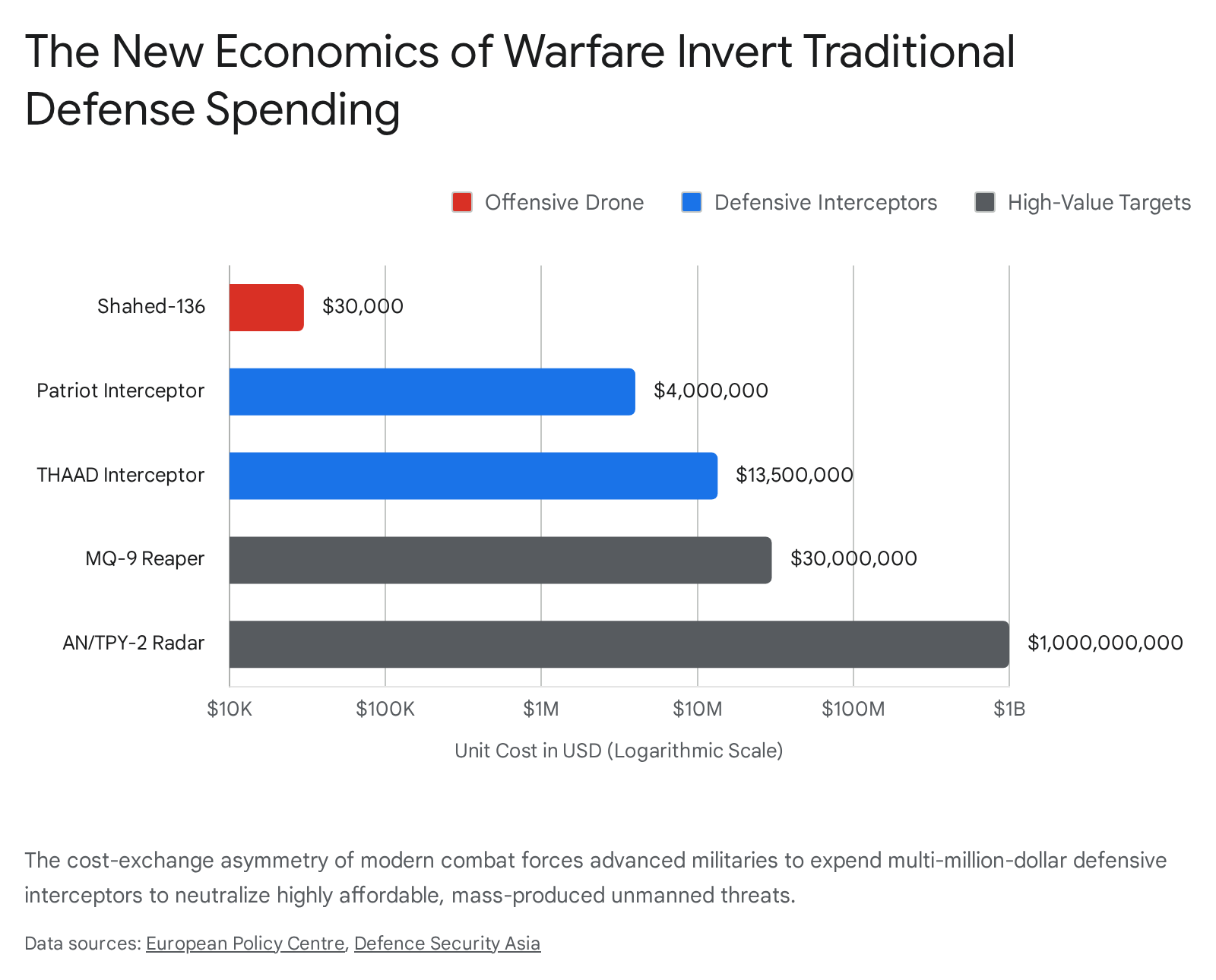
Perhaps the most disruptive lesson derived from these contemporary conflicts is the severe inversion of traditional defense economics. Modern warfare is increasingly defined by extreme cost-exchange asymmetries, where inexpensive offensive systems force the defending military to expend highly sophisticated and financially exorbitant defensive interceptors.8 This dynamic places an unsustainable financial, logistical, and industrial strain on advanced militaries that rely on precision-guided surface-to-air missiles.
The financial data highlights this stark operational reality. Iranian one-way attack drones, such as the Shahed-136, feature an estimated production cost ranging between $20,000 and $50,000 per unit.8 When these platforms are launched in coordinated swarms, they force defenders to utilize advanced surface-to-air missile systems to protect civilian infrastructure and military installations. By comparison, a single Patriot missile interceptor costs approximately $4 million, while a Terminal High Altitude Area Defense interceptor costs between $12 million and $15 million.8
The economic imbalance becomes most evident when analyzing the protection of high-value sensor networks. In a recent engagement documented in early 2026, two AN/TPY-2 radar systems supporting the THAAD network, each valued at over $1 billion, were disabled by Iranian drones costing roughly $30,000 each. This specific engagement represents a staggering cost-exchange ratio of more than 30,000 to one.8
In the Ukrainian theater, similar economic disruptions are consistently evident. According to defense estimates, Ukrainian drones are responsible for over 65 percent of destroyed Russian tanks, representing a fundamental disruption in armored warfare economics.9 First-person view drones costing a few hundred dollars regularly neutralize armored fighting vehicles worth millions of dollars. This new economic reality dictates that future defense procurement must urgently prioritize the mass production of cheap interceptors alongside traditional high-end missile defense systems. Relying solely on legacy interception methods is an economically untenable strategy in a prolonged conflict against an adversary possessing high-volume drone manufacturing capabilities.
Table 1: Cost-Exchange Matrix of Key Military Assets
| Threat Asset | Estimated Unit Cost | Target or Interceptor Asset | Estimated Unit Cost |
| Shahed-136 (Loitering Munition) | $20,000 to $50,000 | Patriot Missile Interceptor | $4,000,000 |
| Shahed-136 (Loitering Munition) | $30,000 | AN/TPY-2 Radar System | $1,000,000,000 |
| Zala Lancet-3 (Loitering Munition) | $35,000 | Western Supplied Artillery System | > $4,000,000 |
| Magura V5 (Unmanned Surface Vehicle) | $273,000 | Sergey Kotov Patrol Ship | $65,000,000 |
| U.S. LUCAS Drone | $35,000 | Advanced Radar Installations | Highly Variable |
Data compiled from defense reporting, cost estimates, and open-source intelligence.5 Costs reflect general procurement estimates and vary based on exact payload and component configurations.
5. Lesson 3: The Obsolescence of Legacy High-Value Platforms in Contested Environments
The widespread proliferation of advanced drone networks and layered air defenses has rendered certain legacy platforms highly vulnerable. This shift is forcing a significant reassessment of their operational viability in near-peer conflicts. Systems explicitly designed during periods of undisputed air superiority, or primarily engineered for counterinsurgency operations in permissive environments, struggle to survive in heavily contested airspaces defined by radar density and surface-to-air missile threats.
The operational history of the MQ-9 Reaper during the 2026 US-Iran conflict serves as a primary example of this vulnerability. During Operation Epic Fury, MQ-9 Reapers were deployed as the backbone of the intelligence apparatus to provide persistent surveillance and targeting across the Persian Gulf, the Strait of Hormuz, and western Iran.4 However, the airspace over strategic locations, notably the heavily defended region of Isfahan, proved highly lethal. Isfahan features a dense concentration of nuclear-related facilities, mobile missile batteries, and radar cueing networks.4 The United States lost at least 16 MQ-9 Reapers in a matter of weeks, resulting in an equipment loss exceeding $480 million.4
The MQ-9 Reaper features a 20-meter wingspan, a maximum takeoff weight of 4,760 kilograms, and a slow cruising speed of approximately 482 kilometers per hour.4 When equipped with satellite communications, synthetic-aperture radar, and precision-strike systems, each unit has a flyaway cost exceeding $30 million.4 The platform’s large radar cross-section and slow operational speed make it highly susceptible to integrated air defense systems.4 The attrition suffered during this operation highlights that utilizing small fleets of expensive, high-endurance platforms is a severe liability against a capable adversary.
Similarly, the Russian Navy’s Black Sea Fleet experienced devastating losses from relatively inexpensive Ukrainian unmanned surface vehicles. The traditional operational model of concentrating naval power in large, expensive, and heavily crewed warships is fundamentally challenged when those ships are continuously hunted by coordinated swarms of low-riding, explosive-laden drones.14 The failure of these legacy platforms highlights the strict necessity for militaries to distribute capabilities across smaller, cheaper, and more numerous nodes to ensure survivability in high-intensity combat zones.
6. Lesson 4: The Democratization of Precision Strike Capabilities
Historically, the ability to execute long-range precision strikes was a strategic capability reserved strictly for global superpowers possessing advanced cruise missiles, sophisticated navigation satellites, and stealth bomber fleets. The advent of long-range loitering munitions has democratized this capability, allowing smaller states, proxy forces, and non-state actors to project power deep into enemy territory.9 Air power is no longer the exclusive domain of wealthy nations with expensive aircraft and highly specialized pilot training programs.9
The Iranian defense industrial base has actively facilitated this democratization by supplying proxy forces with versatile and easily deployed drone platforms. For instance, the Houthi movement in Yemen utilized the Samad-3 drone to execute long-range operations. The Samad-3 features a wingspan of 4.5 meters, a range of up to 1,800 kilometers, and a maximum speed of 250 kilometers per hour, allowing it to strike infrastructure in Saudi Arabia, the United Arab Emirates, and Israel.15 Similarly, the Lebanese Hezbollah organization has employed the Ababil-2 and Ababil-3 platforms for both surveillance and loitering munition operations.16 The Ababil-3 operates at altitudes up to 5,000 meters with a top speed of 200 kilometers per hour, while the newer Saegheh combat variant can reach operational altitudes of 7,620 meters.18
In Eastern Europe, Ukraine transformed its strategic defense posture by establishing a massive domestic drone manufacturing sector.19 Starting with modified commercial drones utilized for artillery correction, Ukrainian forces evolved to utilize long-range platforms capable of flying hundreds of kilometers to strike strategic oil refineries deep within the Russian Federation. This sustained campaign significantly impacted Russian energy logistics, prompting domestic gasoline export bans in early 2026 to stabilize internal consumer markets.20
The ease with which commercial components can be integrated into lethal weapons has permanently lowered the strategic barriers to entry for long-range warfare.9 Essential drone hardware, including batteries, lightweight computing modules, and airframe materials, is readily available through standard commercial supply chains.9 For example, the Shahed-131 relies on a rotary engine reverse-engineered from a commercial civilian model originally developed for aviation enthusiasts.21 This reliance on dual-use commercial technology ensures that production can scale rapidly, bypassing traditional military procurement bottlenecks.
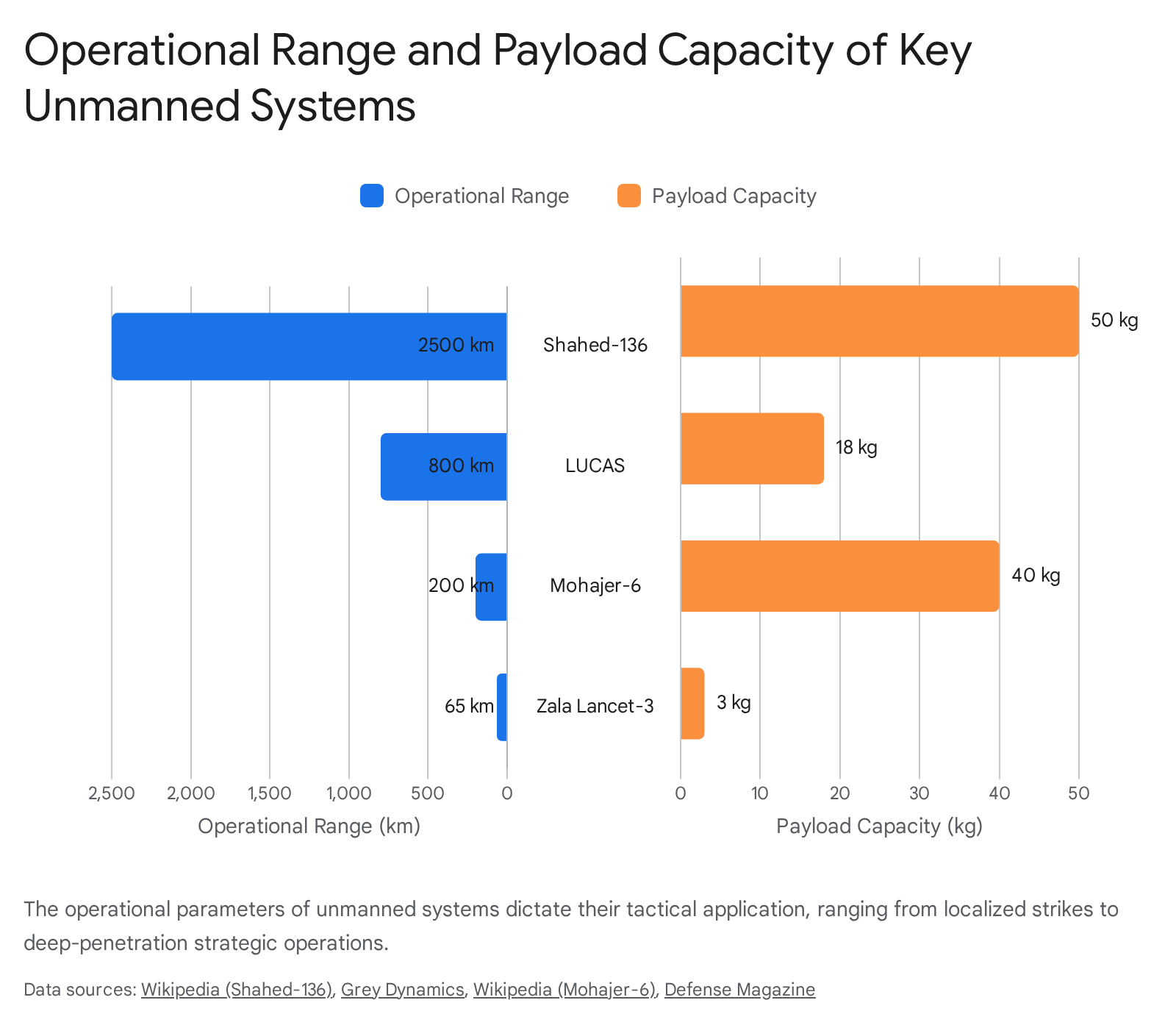
Table 2: Technical Specifications of Key Unmanned Aerial Systems
| System Name | Country of Origin | Primary Role | Service Ceiling / Operational Altitude | Max Speed (km/h) | Operational Range (km) | Payload (kg) |
| Shahed-136 | Iran | OWA Loitering Munition | Low Altitude Profile | 185 | 2,500 | 50 to 90 |
| Orlan-10 | Russia | Reconnaissance & Relay | 5,000 meters | 150 | 120 (Link Range) | 6 to 12 |
| Zala Lancet-3 | Russia | Loitering Munition | Approx. 5,000 meters | 300 (Dive) | 30 to 65 | 3 |
| Mohajer-6 | Iran | Multirole ISR & Strike | 4,876 to 5,486 meters | 200 | 200 to 500 | 40 |
| Ababil-3 | Iran | ISR & Target Designation | 5,000 meters | 200 | 100 | Undisclosed |
| Saegheh | Iran | Combat UCAV | 7,620 meters | 350 | 1,500 | Undisclosed |
Note: Data aggregated from multiple defense analysis reports and technical specifications.17 Range and altitude specifications represent maximum theoretical parameters and may vary significantly based on specific operational configurations, environmental conditions, and payload weights.
7. Lesson 5: Electronic Warfare as the Center of Gravity for Counter-UAS
As the volume of drones deployed on the modern battlefield scales exponentially, kinetic interception using traditional surface-to-air missiles or anti-aircraft artillery becomes mathematically and economically impossible. Consequently, electronic warfare has emerged as the primary, and often most effective, method of neutralizing unmanned threats across all domains.1 The interaction between drone operations and electronic warfare is now the defining characteristic of tactical engagements in both Ukraine and the Middle East.9
The Russian military possesses significant electronic warfare capabilities, deploying highly mobile systems such as the Borisoglebsk-2 to disrupt communications and GPS networks across the front lines.27 The Borisoglebsk-2 is a multi-functional system mounted on MT-LBu tracked vehicles, capable of controlling four types of jamming units from a single centralized point to suppress satellite communications and radio navigation.27 This system is highly responsive, requiring only 15 minutes to deploy upon arriving at a designated site.28 This persistent jamming environment degrades the effectiveness of basic commercial drones, reducing operational success rates drastically. Defense reports note that during periods of intense electronic suppression, sometimes only 20 percent of deployed remote-controlled drones remain operational.29
To counteract this dense electronic suppression, engineers and frontline operators have been forced into a rapid, continuous innovation cycle. Ukrainian forces quickly adopted frequency-hopping radios, redundant communication channels, and mesh networking to evade Russian jamming operations.1 When facing successful jamming, operators utilize frequency agility to create brief windows of operational opportunity.9 Furthermore, the introduction of aerial relay drones, which hover at safe distances between the operator and the strike drone to amplify signal strength, has become a standard tactical procedure.30 The electromagnetic spectrum is now a highly contested domain, and a military’s ability to seamlessly transition between frequencies and operate within spoofing environments strictly dictates its success in utilizing unmanned assets.
8. Lesson 6: The Imperative of Autonomy and Artificial Intelligence
The escalating intensity and sophistication of electronic warfare have exposed the inherent vulnerability of drones that rely heavily on continuous telemetry and communication with a human operator. The logical countermeasure, and the next necessary evolution in drone warfare, is the integration of onboard artificial intelligence and autonomous targeting capabilities.1 As electronic jamming devices are implemented throughout the front lines to interfere with traditional remote-control links, platforms must be capable of completing their missions independently.29
When a drone is subjected to severe GPS spoofing or radio frequency jamming, human-in-the-loop control is effectively severed. To ensure mission success despite this disconnection, modern systems are being equipped with optical-electronic guidance, sensor fusion, and offline-capable predictive navigation.1 Emerging technologies such as the Hivemind AI system allow drones to operate autonomously in GPS-denied and communication-degraded environments.31 By integrating advanced computer vision and localized onboard processing, these drones can independently identify, track, and engage designated targets without requiring continuous telemetric feedback to a remote ground station.1
Moreover, advanced autonomy enables the deployment of coordinated drone swarms. Single human operators can transition from piloting individual first-person view drones to commanding entire networks of interconnected unmanned aerial vehicles.31 These swarms use resilient mesh networks to coordinate attack vectors, share real-time targeting data, and adapt to defensive measures dynamically. Systems like the American LUCAS drone are designed specifically with advanced networking capabilities, utilizing satellite datalinks to support autonomous target hunting and cooperative swarm tactics.32 Satellite networks adapted for military use, such as Starshield, provide encrypted, anti-jam capabilities to facilitate command operations until the final autonomous attack phase is initiated.33 This strategic shift toward autonomy ensures that even if communication links are intentionally severed by electronic warfare, the munitions retain the capability to complete their intended operational objectives with high precision.
9. Lesson 7: The Evolution of Force Architecture Toward Attritable Mass
The traditional categorization of military assets clearly separated expendable ammunition from survivable, high-value platforms.9 The proliferation of drone technology has shattered this binary model, forcing militaries to adopt high-low mix strategies that heavily incorporate a new category known as attritable mass.9 Defense planners universally recognize that relying exclusively on small numbers of exquisite, technologically superior platforms is a severe strategic liability in conflicts where daily attrition rates are extraordinarily high.
The United States Department of Defense has actively adjusted its procurement strategies to reflect this new reality. Following the loss of multiple expensive MQ-9 Reapers, United States Central Command officially activated Task Force Scorpion Strike, marking the military’s first dedicated one-way kamikaze drone squadron deployed in the Middle East.32 The core asset of this specialized task force is the Low-cost Uncrewed Combat Attack System, commonly known by the acronym LUCAS.35 Developed rapidly by SpektreWorks and reverse-engineered from the Iranian Shahed-136, the LUCAS drone measures 3 meters in length with a 2.4-meter wingspan, carries an 18-kilogram explosive payload, and possesses an operational range of approximately 800 kilometers.5
Most crucially, the LUCAS platform is priced at approximately $35,000 per unit, allowing for genuine mass production and high-volume deployment.5 The system is specifically designed to prioritize modularity and sophisticated networking for coordinated swarm operations.32 In December 2025, the United States Navy successfully launched a LUCAS drone from the flight deck of the USS Santa Barbara, demonstrating the platform’s versatile launch capabilities which include catapults, rocket-assisted takeoff, and mobile ground systems.32 This development aligns directly with broader military initiatives, such as the Drone Dominance program, which aims to acquire 300,000 low-cost drones starting in early 2026 by establishing a resilient supply chain utilizing multiple commercial vendors to drive unit costs down further.32 The strategic goal is to overwhelm adversary air defenses through sheer numerical superiority, achieving tactical objectives through expendable, mass-produced systems rather than relying on multi-million-dollar precision cruise missiles like the Tomahawk.
10. Lesson 8: Naval Asymmetry and the Rise of Unmanned Surface Vehicles
While aerial drones have received the majority of public attention, the rapid development and deployment of unmanned surface vehicles has profoundly altered maritime warfare doctrine. The operations in the Black Sea explicitly demonstrate that a nation operating without a functional conventional navy can systematically degrade and neutralize a superior naval fleet using asymmetric tactics heavily reliant on unmanned surface vehicles.12
Ukraine’s deployment of the MAGURA V5 and Sea Baby maritime drones illustrates the devastating potential of these systems. The MAGURA V5 measures 5.5 meters in length, cruises at 22 knots, and can reach a maximum speed of 42 knots while carrying a 320-kilogram explosive payload over an operational range of 833 kilometers.37 These vessels maintain a minimal physical profile, sitting only 0.5 meters above the waterline, making them exceptionally difficult to detect via traditional marine radar systems until they are within close proximity to their targets.37 The vessels utilize resilient mesh radio networks combined with aerial repeaters and satellite communication links, such as Starlink, to maintain connectivity and command authority over vast distances.37 The larger Sea Baby variant boasts an even greater payload capacity, capable of carrying explosive warheads weighing up to 850 kilograms over distances of at least 1,000 kilometers.40
The strategic impact of these unmanned surface vehicles is undeniable. Operating in highly coordinated flocks, these systems systematically targeted Russian warships, landing craft, and intelligence vessels.12 The successful destruction of high-value targets, such as the $65 million Sergey Kotov patrol ship, utilizing USVs costing approximately $273,000, validates the extraordinary return on investment these asymmetric systems offer.11 Consequently, the Russian Black Sea Fleet was forced to relocate from the western Black Sea and the Crimean Peninsula to safer, more distant harbors in Novorossiysk, effectively breaking the naval blockade and allowing critical Ukrainian agricultural exports to resume.12
Table 3: Specifications of Primary Unmanned Surface Vehicles
| Characteristic | MAGURA V5 | Sea Baby |
| Length | 5.5 meters | Undisclosed |
| Height Above Waterline | 0.5 meters | 0.6 meters |
| Maximum Speed | 78 km/h (42 knots) | 90 km/h (56 mph) |
| Operational Range | Up to 833 km (450 nautical miles) | At least 1,000 km |
| Payload / Armament | 320 kg explosive charge | Up to 850 kg explosive charge |
| Guidance System | GNSS, inertial, visual | Satellite, visual |
| Estimated Unit Cost | $273,000 | Approx. $250,000 |
Data aggregated from naval warfare analysis, defense intelligence briefs, and technical reports.11
The success of unmanned surface vehicles extends far beyond targeting military vessels. They are increasingly utilized to strike economic infrastructure, including shadow fleet oil tankers utilized to evade Western sanctions, and coastal energy facilities located deep within hostile territory.12 Navies worldwide must now urgently rethink fleet protection methodologies, realizing that massive, heavily crewed surface combatants face existential threats from low-cost, semi-submersible drone swarms.
11. Lesson 9: The Urgent Need for Layered and Low-Cost Defense Networks
The sheer volume of drone attacks observed in contemporary conflicts proves conclusively that relying solely on high-end surface-to-air missiles is a failing strategy. Adversaries intentionally combine cruise missiles, ballistic missiles, and hundreds of cheap loitering munitions in coordinated waves designed explicitly to probe, saturate, and exhaust advanced air-defense systems.42 To survive this volume of fire, militaries must construct layered, redundant, and economically sustainable defensive networks.
Faced with severe shortages of intercepting tools and operating against an adversary capable of launching waves of over 800 Shahed-type drones in a single night, Ukraine has pioneered several cost-effective defensive paradigms out of sheer necessity.42 Initially, Ukrainian forces integrated highly mobile fire groups utilizing heavy machine guns aided by acoustic detection networks and high-powered searchlights.42 More recently, the rapid development and deployment of first-person view interceptor drones has provided a highly effective kinetic countermeasure. Ukrainian manufacturers produced specialized interceptors designed specifically to hunt reconnaissance UAVs like the Zala series, which provide targeting data for the Lancet loitering munitions. This specific tactic reduced successful Russian Lancet strikes by up to 90 percent.44 Advanced interceptors, such as the Sting system, are quadcopters capable of reaching altitudes up to 3,000 meters to engage high-flying threats like the Shahed series directly in the air littoral.39
In the Middle East, the heavy reliance on multi-million-dollar interceptors to neutralize cheap drones highlighted a critical fragility in Western defense stockpiles, prompting urgent calls for industrial scaling such as the European ASAP program to boost missile manufacturing.9 Consequently, defense contractors and regional partners are actively exploring and deploying integrated counter-UAS solutions. Systems like the MBDA SKY WARDEN offer a comprehensive multi-layered approach, incorporating directed energy weapons such as the CILAS HELMA-P laser system, omni-directional and directional jammers, and hit-to-kill interceptor drones to neutralize threats without depleting strategic missile reserves.45 Establishing these deep, multi-tiered defensive architectures, combining kinetic, electronic, and directed-energy effectors, is strictly mandatory to protect critical military nodes and civilian population centers from saturation attacks.
12. Lesson 10: The Psychological Toll of Persistent Unmanned Surveillance
While technological parameters, payload capacities, and economic cost-exchange ratios dominate professional discussions of drone warfare, the profound psychological impact on the human element of combat must not be ignored. The battlefield ubiquity of unmanned systems has introduced unique, severe mental stressors that differ significantly from previous eras of warfare, resulting in a psychological phenomenon that medical researchers equate to a modern iteration of WWI-era shell shock or WWII-era battle fatigue.46
For soldiers deployed on the ground, the constant acoustic presence of overhead drones creates an environment of intense anticipatory anxiety and perpetual paranoia.46 The definitive knowledge that they are under persistent, high-resolution surveillance, combined with the distinctive, unnerving sounds of loitering munitions, severely impacts routine behavior and overall operational effectiveness. Populations and soldiers subjected to constant drone activity exhibit exaggerated startle responses, chronic insomnia, psychosomatic symptoms, and acute stress reactions resulting in fleeing behaviors at the mere sound of a propeller.46 In Ukraine, military medical personnel report a sharp, drastic increase in psychological trauma directly related to drone warfare, with 70 percent of patients displaying signs of severe burnout, 38 percent suffering from post-traumatic stress disorder, and 11 percent reporting suicidal ideation.47
Conversely, the operators piloting these systems face a different, yet equally damaging, psychological burden. Operating remote systems is mentally taxing due to the continuous cognitive load required for real-time decision-making, target acquisition, and data analysis.48 Furthermore, remote warfare requires an unsettling level of voyeuristic intimacy with the target. Operators may track specific individuals for weeks or months, learning their daily routines and observing their private lives through high-definition optics, only to subsequently receive definitive orders to eliminate them.49 This jarring juxtaposition of long-term observation followed by sudden, remote lethality contributes to high rates of psychiatric symptoms and vicarious trauma among drone crews, frequently exceeding the trauma rates observed in traditional manned aircraft pilots.49 The military medical community must urgently develop specialized training, rotation schedules, and psychological support structures tailored to address the unique mental health challenges associated with both operating and evading unmanned aerial systems.
13. Strategic Outlook and Conclusions
The comparative analysis of the ongoing Russia-Ukraine conflict and the high-intensity United States-Iran conflict reveals that the fundamental character of war has undergone a rapid, technology-driven evolution. The integration of mass-produced unmanned systems across all domains has irrevocably altered tactical planning, disrupted traditional defense economics, and forced an immediate restructuring of military force architecture.
The primary conclusion drawn from these operational environments is that attritable mass and financial affordability now hold equal, if not greater, strategic value than exquisite technological superiority in isolation. Militaries that fail to adapt their procurement systems to match the rapid innovation cycles and low-cost production models observed in these conflicts will find themselves rapidly outpaced and economically exhausted. Defense industrial bases must prioritize the rapid scaling of attritable systems, such as the LUCAS platform and the MAGURA surface vessels, to ensure sufficient volume for sustained, high-intensity operations.
Simultaneously, the development and deployment of robust, layered counter-drone networks is an immediate strategic necessity. Traditional air defense systems, while still necessary for high-altitude threats, must be heavily augmented with directed energy weapons, sophisticated electronic warfare suites, and low-cost interceptor drones to prevent the financial exhaustion of strategic missile stockpiles. Furthermore, as electronic warfare capabilities expand to saturate the electromagnetic spectrum, the integration of artificial intelligence for autonomous navigation, sensor fusion, and target acquisition is no longer merely an enhancement, but an absolute operational prerequisite for mission success.
Finally, strategic planning and force generation models must account for the severe psychological realities of modern combat. The pervasive, unyielding nature of drone warfare subjects both ground forces and remote operators to unprecedented cognitive stress, necessitating modernized approaches to combat readiness, troop rotation, and psychological care. The era of undisputed air and naval dominance defined by a small number of large, highly crewed platforms has concluded. The future of warfare belongs definitively to the forces capable of rapidly fielding, intelligently networking, and economically sustaining vast, distributed arrays of autonomous unmanned systems.
Please share the link on Facebook, Forums, with colleagues, etc. Your support is much appreciated and if you have any feedback, please email us in**@*********ps.com. If you’d like to request a report or order a reprint, please click here for the corresponding page to open in new tab.
Sources Used
- Lessons from Ukraine: Battlefield Drone Innovation Redefines Modern Defense, accessed April 4, 2026, https://defenseopinion.com/lessons-from-ukraine-battlefield-drone-innovation-redefines-modern-defense/1137/
- Four Years On – Ten Lessons from Russia’s War in Ukraine | Royal …, accessed April 4, 2026, https://my.rusi.org/resource/four-years-on-ten-lessons-from-russias-war-in-ukraine.html
- Red Skies Ahead: Russia Planning for Its Drone-Driven Army of Tomorrow, accessed April 4, 2026, https://www.armyupress.army.mil/Journals/Military-Review/English-Edition-Archives/January-February-2026/Red-Skies-Ahead/
- US Loses 16 MQ-9 Reapers Over Iran as USD480 Million Drone …, accessed April 4, 2026, https://defencesecurityasia.com/en/us-mq-9-reaper-losses-iran-operation-epic-fury-isfahan-usd480-million/
- LUCAS: America’s €32,000 Shahed Clone Strikes Back – U.S. Turns Iranian Tech Against Tehran in Epic Fury | DEFENSEMAGAZINE.com – World of defense and security, accessed April 4, 2026, https://www.defensemagazine.com/article/lucas-americas-eur32000-shahed-clone-strikes-back-us-turns-iranian-tech-against-tehran-in-epic-fury
- The Strait of Hormuz offers a lesson in air denial – Defense News, accessed April 4, 2026, https://www.defensenews.com/opinion/2026/04/01/the-strait-of-hormuz-offers-a-lesson-in-air-denial/
- After first combat appearance, LUCAS drones ‘remain ready’ for future Epic Fury strikes against Iran | DefenseScoop, accessed April 4, 2026, https://defensescoop.com/2026/03/02/lucas-drones-operation-epic-fury-iran-strikes/
- The new economics of warfare – European Policy Centre (EPC), accessed April 4, 2026, https://www.epc.eu/publication/the-new-economics-of-warfare/
- Lessons from the Ukraine Conflict: Modern Warfare in the Age of …, accessed April 4, 2026, https://www.csis.org/analysis/lessons-ukraine-conflict-modern-warfare-age-autonomy-information-and-resilience
- ZALA Lancet – Wikipedia, accessed April 4, 2026, https://en.wikipedia.org/wiki/ZALA_Lancet
- MAGURA V5 – Wikipedia, accessed April 4, 2026, https://en.wikipedia.org/wiki/MAGURA_V5
- Ukraine’s $50000 naval drones are hunting Russia’s Black Sea fleet—and winning, accessed April 4, 2026, https://euromaidanpress.com/2025/12/24/ukraine-naval-drones-black-sea-fleet-group-13/
- TRUMP SWEATS? $300 Million MQ-9 Reapers Downed By Iran, US To Deploy LUCAS Drones, Why? – YouTube, accessed April 4, 2026, https://www.youtube.com/watch?v=x1BnYRG20fU
- Small Craft, Big Impact: Ukraine’s War and the Rise of New-Tech Warships, accessed April 4, 2026, https://maritime-executive.com/editorials/small-craft-big-impact-ukraine-s-war-and-the-rise-of-new-tech-warships
- UAVs/UCAVs – MISP galaxy, accessed April 4, 2026, https://misp-galaxy.org/uavs/
- HESA Ababil – Wikipedia, accessed April 4, 2026, https://en.wikipedia.org/wiki/HESA_Ababil
- Iran’s Wide Variety of Unmanned Aerial Vehicle (UAV … – JINSA, accessed April 4, 2026, https://jinsa.org/wp-content/uploads/2024/02/Iran-Drones-9-14-22.pdf
- Ababil-3 vs Saegheh: Specs, Speed & Range Compared – GlobalMilitary.net, accessed April 4, 2026, https://www.globalmilitary.net/compare/aircraft/ababil-3-vs-saegheh/
- Ukraine’s Way of War is Coming to the Persian Gulf | Washington Monthly, accessed April 4, 2026, https://washingtonmonthly.com/2026/04/02/ukraines-way-of-war-is-coming-to-the-persian-gulf/
- Russian Offensive Campaign Assessment, March 28, 2026 | ISW, accessed April 4, 2026, https://understandingwar.org/research/russia-ukraine/russian-offensive-campaign-assessment-march-28-2026/
- Russia’s Iranian-Made UAVs: A Technical Profile | Royal United Services Institute – RUSI, accessed April 4, 2026, https://www.rusi.org/explore-our-research/publications/commentary/russias-iranian-made-uavs-technical-profile
- HESA Shahed 136 – Wikipedia, accessed April 4, 2026, https://en.wikipedia.org/wiki/HESA_Shahed_136
- Lancet 3: Russia’s Spear in the Sky – Grey Dynamics, accessed April 4, 2026, https://greydynamics.com/lancet-3-russias-spear-in-the-sky/
- Russian Orlan-10 Drone – Full Specifications | TheDefenseWatch.com, accessed April 4, 2026, https://thedefensewatch.com/product/russian-orlan-10-drone/
- Qods Mohajer-6 – Wikipedia, accessed April 4, 2026, https://en.wikipedia.org/wiki/Qods_Mohajer-6
- Evolution Not Revolution – CNAS, accessed April 4, 2026, https://www.cnas.org/publications/reports/evolution-not-revolution
- Borisoglebsk-2 – Wikipedia, accessed April 4, 2026, https://en.wikipedia.org/wiki/Borisoglebsk-2
- Analysis: Russia’s Electronic Warfare Equipment – Kyiv Post, accessed April 4, 2026, https://www.kyivpost.com/analysis/32435
- Advancements in Drone Warfare Create New Challenges in Fielding Lethal Autonomous Weapons System – The Federalist Society, accessed April 4, 2026, https://fedsoc.org/commentary/fedsoc-blog/advancements-in-drone-warfare-create-new-challenges-in-fielding-lethal-autonomous-weapons-system
- I Fought in Ukraine and Here’s Why FPV Drones Kind of Suck – War on the Rocks, accessed April 4, 2026, https://warontherocks.com/2025/06/i-fought-in-ukraine-and-heres-why-fpv-drones-kind-of-suck/
- Ukraine Just Flipped Drone Warfare | Russia’s Jamming Doesn’t Matter Anymore – YouTube, accessed April 4, 2026, https://www.youtube.com/watch?v=ABwk3AAyd4g
- LUCAS: Scaling the Drone War – Defense Security Monitor – Forecast International, accessed April 4, 2026, https://dsm.forecastinternational.com/2025/12/22/lucas-scaling-the-drone-war/
- Starlink in the Russo-Ukrainian war – Wikipedia, accessed April 4, 2026, https://en.wikipedia.org/wiki/Starlink_in_the_Russo-Ukrainian_war
- U.S. Launches One-Way-Attack Drone Force in the Middle East – centcom, accessed April 4, 2026, https://www.centcom.mil/MEDIA/PRESS-RELEASES/Press-Release-View/Article/4347030/us-launches-one-way-attack-drone-force-in-the-middle-east/
- US reveals it is using new suicide drone, emulating Iran | The Jerusalem Post, accessed April 4, 2026, https://www.jpost.com/middle-east/iran-news/article-888801
- The LUCAS Drone: The American Response to the Iranian Shahed – AeroMorning, accessed April 4, 2026, https://aeromorning.com/en/the-lucas-drone-the-american-response-to-the-iranian-shahed/
- Overview Of Maritime Drones (USVs) Of The Russo-Ukrainian War, 2022-24 | Covert Shores, accessed April 4, 2026, https://www.hisutton.com/Russia-Ukraine-USVs-2024.html
- Analysis: The Magura-V5 Sea Drone – Scourge of Russia’s Black Sea Operations, accessed April 4, 2026, https://www.kyivpost.com/analysis/29068
- The Russia-Ukraine Drone War: Innovation on the Frontlines and Beyond – CSIS, accessed April 4, 2026, https://www.csis.org/analysis/russia-ukraine-drone-war-innovation-frontlines-and-beyond
- Sea Baby – Wikipedia, accessed April 4, 2026, https://en.wikipedia.org/wiki/Sea_Baby
- Ukraine’s Magura V5: Military innovation washed up on Turkish coast – Daily Sabah, accessed April 4, 2026, https://www.dailysabah.com/opinion/op-ed/ukraines-magura-v5-military-innovation-washed-up-on-turkish-coast
- Lessons from Ukraine for Defending Gulf Airspace from Shaheds – War on the Rocks, accessed April 4, 2026, https://warontherocks.com/2026/03/lessons-from-ukraine-for-defending-gulf-airspace-from-shaheds/
- U.S. and Mideast countries seek Kyiv’s drone expertise as Russia-Ukraine talks delayed, accessed April 4, 2026, https://www.pbs.org/newshour/world/u-s-and-mideast-countries-seek-kyivs-drone-expertise-as-russia-ukraine-talks-delayed
- Analysis of the power of drones and limitations of the anti-drone solutions on the Russian-Ukrainian battlefield – Security and Defence Quarterly, accessed April 4, 2026, https://securityanddefence.pl/Analysis-of-the-power-of-drones-and-limitations-of-the-anti-drone-solutions-on-the,208347,0,2.html
- With War in the Middle East, Counter-Drone Responds – Defense Security Monitor, accessed April 4, 2026, https://dsm.forecastinternational.com/2026/03/27/with-war-in-the-middle-east-counter-drone-responds/
- Drones Having Psychological Impact On Soldiers | T2COM G2 Operational Environment Enterprise, accessed April 4, 2026, https://oe.t2com.army.mil/product/drones-having-psychological-impact-on-soldiers/
- Beyond the battlefield: Drone warfare’s impact on health — from amputations to PTSD, accessed April 4, 2026, https://health.mil/News/Dvids-Articles/2025/09/16/news548331
- The Impact of Drones on the Battlefield: Lessons of the Russia-Ukraine War from a French Perspective | Hudson Institute, accessed April 4, 2026, https://www.hudson.org/missile-defense/impact-drones-battlefield-lessons-russian-ukraine-war-french-perspective-tsiporah-fried
- DOD ordered to study mental health impacts among military drone pilots, accessed April 4, 2026, https://www.militarytimes.com/news/your-military/2026/01/30/dod-ordered-to-study-mental-health-impacts-among-military-drone-pilots/