Executive Summary
The 10mm Auto cartridge occupies a unique and heavily debated position within the firearms industry. Originally conceived to deliver magnum-level terminal ballistics in an autoloading platform, the 10mm Auto offers significant advantages in kinetic energy, barrier penetration, and effective range over traditional service cartridges like the 9x19mm Parabellum. Despite these on-paper ballistic superiorities, the 10mm Auto has never achieved widespread popularity in submachine guns (SMGs) or pistol-caliber carbines (PCCs) for military or law enforcement applications.
The rationale behind the marginalization of the 10mm SMG is not rooted in a single deficiency, but rather an intersection of internal ballistics physics, structural engineering constraints, operational logistics, and the evolution of modern tactical doctrine. While the cartridge generates impressive muzzle energy, it concurrently generates substantial breech pressure and bolt thrust. These forces impose severe mechanical stress on firearm components, demanding heavy, complex, and expensive delayed-blowback operating systems. Furthermore, the geometric footprint of the cartridge prevents it from being easily adapted into modern, miniaturized 9mm SMG platforms.
Tactically, the law enforcement paradigm has shifted entirely. The realization that lightweight, high-velocity 5.56x45mm NATO rifle projectiles offer superior terminal ballistics with vastly reduced risks of residential overpenetration has rendered the heavy, barrier-blind pistol cartridge conceptually obsolete for urban operations. This comprehensive analysis will dissect the historical context, comparative ballistics, mechanical engineering hurdles, acoustic suppression challenges, and logistical realities of the 10mm Auto in shoulder-fired platforms, concluding with an objective assessment of whether modern law enforcement agencies should consider its adoption.
Historical Context: The Quest for Superior Firepower
The Origins of the 10mm Auto
To understand the development of the 10mm submachine gun, one must examine the genesis of the cartridge itself. Designed by Thomas Dornaus and Dixon in collaboration with firearms expert Jeff Cooper in 1983, the 10mm Auto was intended to address perceived inadequacies in existing military and police service cartridges.1 Cooper envisioned a semi-automatic pistol round that possessed the high capacity of a 9mm Luger but delivered terminal ballistics approaching that of the.41 Magnum revolver cartridge.2 The first commercial loadings were produced by the Swedish ammunition manufacturer FFV Norma AB, which established the cartridge’s reputation for massive power and extreme operating pressures.2
While the initial firearm designed for the cartridge, the Bren Ten, was a commercial failure, the ballistic potential of the 10mm Auto secured its survival.3 However, the early full-power loads exhibited a high-pressure curve and generated recoil that caused severe flinch reflexes among standard shooters.4
The 1986 Miami Shootout and FBI Adoption
The catalyst for the 10mm Auto’s integration into law enforcement and the subsequent development of 10mm submachine guns was the Federal Bureau of Investigation’s response to the infamous 1986 Miami shootout. During this incident, eight federal agents armed predominantly with 9mm semi-automatic pistols and.38 Special revolvers engaged two heavily armed suspects.4 Despite scoring multiple hits, the agents were unable to immediately incapacitate one of the suspects, leading to a catastrophic loss of life.5 The subsequent post-incident ballistic analyses concluded that the 9mm projectiles of the era, specifically a 115-grain Winchester Silvertip, failed to penetrate deeply enough to reach the suspect’s heart after passing through a human arm.5
In response, the FBI initiated a comprehensive ammunition testing protocol, ultimately adopting the 10mm Auto cartridge in 1989 to guarantee intermediate barrier penetration and deep tissue disruption.3 Recognizing that their existing inventory of 9mm submachine guns was conceptually mismatched with their new handgun caliber, the FBI sought a shoulder-fired weapon chambered in the same powerful cartridge.6
The Auto-Ordnance Thompson Conversions
The initial phase of this procurement involved the modification of existing weapon systems. In 1990, the FBI commissioned Auto-Ordnance in West Hurley, New York, to convert a limited number of original Thompson submachine guns to 10mm Auto.6 These converted weapons, identifiable by their smooth external barrel profiles—lacking the traditional cooling fins found on the.45 ACP models—and distinctive “10 mm” yellow markings painted on the stock, served primarily as testbeds.6
These modified Thompsons allowed the FBI to evaluate the 10mm cartridge’s cyclic behavior and recoil impulse in an automatic platform.6 Capitalizing on the media attention of the FBI conversions, Auto-Ordnance even produced a 16-inch-barreled, semi-automatic 1927A1 Deluxe for the civilian market from 1991 to 1993.6 However, the Thompson was an antiquated, exceedingly heavy design, and the Bureau rapidly pivoted to modern, ergonomic solutions.
The Heckler & Koch MP5/10 Collaboration
To field a true modern submachine gun, the FBI collaborated with German manufacturer Heckler & Koch (HK) to engineer a 10mm variant of the ubiquitous MP5, resulting in the introduction of the MP5/10 in 1991.6 The development of the MP5/10 required significant deviations from the standard 9mm platform to harness the extreme pressures of the new cartridge.
A primary change was the incorporation of a bolt hold-open mechanism featuring a bolt catch lever, a modification specifically requested by the FBI but previously absent on standard MP5s.6 This addition necessitated physical modifications to the receiver to accommodate the catch, alongside alterations to the trigger group.7 The standard trigger group for the MP5/10 was uniquely configured with a three-round burst mode alongside semi-automatic and fully automatic settings.6 Furthermore, HK replaced the traditional push-button magazine release with a flapper-style release located behind the magazine well, and designed straight, translucent polymer magazines specifically to feed the 10mm Auto cartridge.7
Internally, the MP5/10 required robust fortification. It utilized the heavy recoil spring from the 5.56mm NATO HK53 carbine to manage the violent rearward bolt velocity.7 The bolt head was entirely redesigned; the rollers were shortened, and the center of the bolt head was lowered to ensure greater contact with the larger 10mm case rim, thereby enhancing extraction reliability under high pressure.7 To accommodate the vast ballistic disparity between full-power 10mm Norma loads and the downloaded “FBI Lite” ammunition, HK supplied two distinct locking pieces for the bolt group, designated for high (“HI”) and low (“LO”) impulse configurations.6
Tactical Shift and Withdrawal
Despite delivering the requested firepower, the era of the 10mm submachine gun within the FBI was notably brief. The Bureau soon discovered that the extreme recoil of full-power 10mm handguns was detrimental to agent qualification scores, causing slower follow-up shots and accelerated weapon wear.4 This led to the creation of the downloaded “10mm FBI Lite” load, operating at 950 fps with a 180-grain bullet, which subsequently paved the way for the dimensionally shorter.40 S&W cartridge (essentially an identical ballistic profile that fit into 9mm-sized pistol frames).4
HK subsequently released the MP5/40 in late 1991, mirroring the transition in handgun calibers.6 By the late 1990s, the tactical law enforcement community began widely recognizing the limitations of all pistol-caliber carbines compared to short-barreled rifles. By 2000, production of both the MP5/10 and MP5/40 was entirely discontinued by Heckler & Koch.6 The FBI ultimately withdrew the majority of its 10mm submachine guns, retaining only a few for specialized Hostage Rescue Team (HRT) and regional SWAT applications, completely replacing their primary tactical armaments with 5.56x45mm M4 pattern carbines.6
Comparative Internal and External Ballistics
To understand the tactical utility of a 10mm carbine, one must strictly quantify its ballistic output relative to the platform it seeks to replace (the 9mm SMG) and the platform that ultimately superseded it (the 5.56mm short-barreled rifle).
Dimensional Specifications and Chamber Pressure
The 10mm Auto is a significantly larger and higher-pressure cartridge than the 9mm Luger. According to the Sporting Arms and Ammunition Manufacturers’ Institute (SAAMI) specifications, the 9mm Luger (derived from the 7.65x21mm Parabellum) features a bullet diameter of 0.355 inches, a case length of 0.754 inches, and a maximum Cartridge Overall Length (COAL) of 1.169 inches.10 The 9mm operates at a Maximum Average Pressure (MAP) of 35,000 PSI.10
Conversely, the 10mm Auto utilizes a 0.400-inch diameter projectile, a case length of 0.992 inches, and a maximum COAL of 1.260 inches.10 It operates at a significantly higher SAAMI MAP of 37,500 PSI.10 The internal case capacity of the 10mm is 24.1 grains of water, nearly double the 13.3-grain capacity of the 9mm, allowing for vastly larger propellant charges.12
| Specification | 9x19mm Parabellum | 10mm Auto | 5.56x45mm NATO |
| Bullet Diameter | 0.355 in | 0.400 in | 0.224 in |
| Base Diameter | 0.391 in | 0.425 in | 0.377 in |
| Case Length | 0.754 in | 0.992 in | 1.760 in |
| Overall Length (COAL) | 1.169 in | 1.260 in | 2.260 in |
| Case Capacity (H2O) | 13.3 grains | 24.1 grains | 28.5 grains |
| SAAMI Max Pressure | 35,000 PSI | 37,500 PSI | 55,114 PSI (SCATP) |
| Primer Type | Small Pistol | Large Pistol | Small Rifle |
Velocity and Kinetic Energy Matrix
The expanded case capacity and elevated pressure ceiling of the 10mm Auto translate to a substantial disparity in kinetic energy. When fired from identical barrel lengths, the 10mm Auto demonstrably eclipses the 9x19mm.
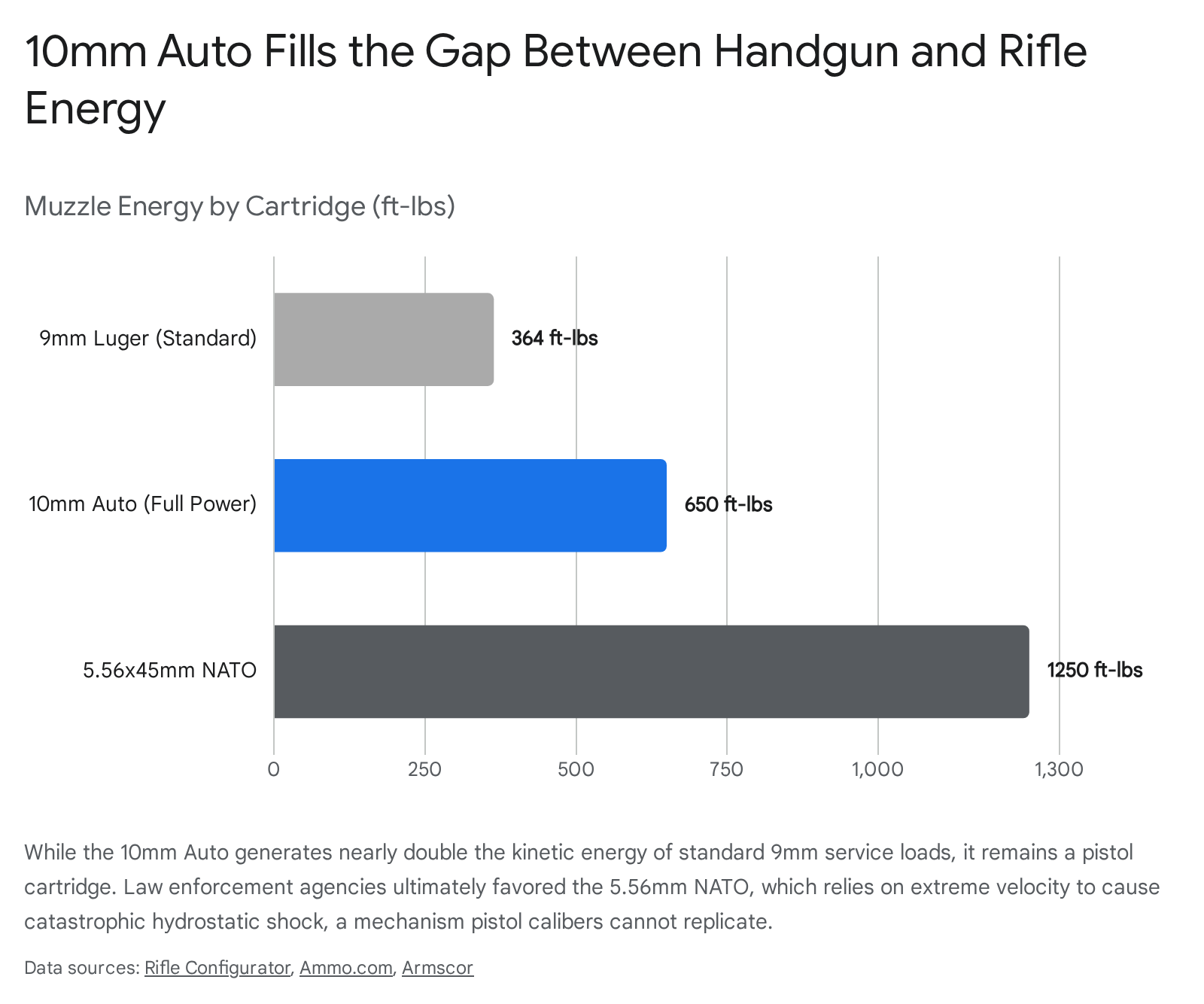
Standard 9mm duty ammunition typically pushes a 115-grain or 124-grain projectile at velocities between 1,070 and 1,200 feet per second (fps), yielding approximately 332 to 364 foot-pounds (ft-lbs) of muzzle energy.10 Even modern +P variants, which operate at higher internal pressures, rarely exceed 440 ft-lbs of energy.10 For example, the Federal American Eagle 9mm 115-grain FMJ produces an advertised muzzle energy of 356 ft-lbs.14
The 10mm Auto utilizes heavier projectile weights, typically ranging from 155 to 200 grains, with 180 grains being the most common duty standard.10 A standard 180-grain 10mm duty load will achieve velocities of 1,200 to 1,300 fps, generating between 600 and 650 ft-lbs of kinetic energy.10 Full-power, unrestricted 10mm loads, akin to the original Norma specifications, can push 200-grain projectiles to velocities that yield in excess of 700 to 750 ft-lbs of energy at the muzzle.10 This constitutes an energy transfer nearly double that of the 9mm Parabellum, effectively closing the performance gap toward magnum revolver cartridges.
When chambered in a carbine with a 10-inch or 16-inch barrel, the 10mm benefits from a complete powder burn. Pistol cartridges typically experience velocity gains when fired from longer barrels due to sustained pressure acting on the projectile base. HK’s own historical documentation advertised that an MP5/10 equipped with an 8.85-inch barrel firing Norma 170-grain ammunition achieved 1,473 fps and 825 ft-lbs of muzzle energy.6 This long-barrel kinetic advantage makes the 10mm PCC highly lethal at extended ranges compared to standard handguns.
The 5.56x45mm NATO Paradigm Shift
While the 10mm Auto heavily outperforms the 9mm, it still falls drastically short of the 5.56x45mm NATO rifle cartridge. The 5.56mm NATO operates at a staggering 55,114 PSI and propels a lightweight 55-grain or 62-grain projectile at velocities exceeding 2,500 to 3,000 fps, depending on barrel length.16 This yields muzzle energies well over 1,200 ft-lbs.
More critically, the physical wounding mechanism of a rifle cartridge fundamentally differs from that of a pistol cartridge. Handgun rounds, regardless of whether they are 9mm or 10mm, incapacitate primarily through the permanent crush cavity—the tissue directly destroyed in the physical path of the bullet.18 Handgun projectiles, even when fired from carbines, are structurally incapable of generating enough velocity to induce severe secondary damage profiles.
By contrast, the 5.56mm NATO projectile impacts at velocities sufficient to generate massive hydrostatic shock and a temporary stretch cavity that drastically exceeds the elastic limits of human tissue.18 This extreme velocity causes remote disruption to blood vessels, nerves, and organs adjacent to the primary wound channel.19 Furthermore, 5.56mm projectiles frequently fragment upon impact with soft tissue, creating multiple secondary wound tracks.19 Consequently, if a tactical unit desires definitive, immediate stopping power to instantly neutralize an armed threat, the physics overwhelmingly favor the 5.56mm rifle over any pistol-caliber carbine.
Terminal Ballistics: The Overpenetration Paradox
A critical factor governing the selection of tactical weaponry in modern policing is intermediate barrier performance and the mitigation of overpenetration. An analysis of modern ballistics testing reveals exactly why the 10mm Auto occupies a highly conflicted space in tactical doctrine.
The FBI Barrier Protocol
The current FBI ammunition testing protocol evaluates handgun ammunition using calibrated 10 percent ballistic gelatin to simulate human soft tissue.5 The protocol requires duty ammunition to penetrate between 12 and 18 inches into the gelatin.5 A minimum of 12 inches guarantees the projectile can reach vital organs after passing through clothing, limbs, or heavy bone, while a maximum of 18 inches reduces the risk of the bullet exiting the suspect and striking innocent bystanders.5
This penetration depth must be maintained not only in bare gelatin but after the projectile defeats various intermediate barriers designed to replicate real-world operational environments. These barriers include heavy clothing, 1/2-inch wallboard (drywall) simulating residential interior walls, 3/4-inch plywood simulating doors and furniture, 20-gauge sheet metal simulating vehicle body panels, and angled, laminated automobile safety glass representing a windshield.5
The 10mm’s Barrier Blindness
The 10mm Auto excels spectacularly in barrier penetration. Its heavy mass (up to 200 grains), dense sectional density, and high velocity allow it to reliably crush through heavy barriers like auto glass and steel vehicle doors without shedding the physical mass required to achieve the minimum 12 inches of physiological penetration.15 This “barrier-blind” capability makes the 10mm exceptionally lethal against subjects utilizing vehicles as cover. By contrast, early generation 9mm hollow points frequently failed to penetrate auto glass, deflecting off the angled lamination or fragmenting entirely before reaching the target.20
The Liability of Urban Overpenetration
However, in residential or urban environments, this barrier penetration transforms into a severe liability. Pistol projectiles—even advanced expanding hollow points—are prone to clogging with gypsum dust and paper when passing through standard drywall, effectively turning them into solid, non-expanding ball ammunition.5
Because the 10mm Auto carries immense kinetic energy and a heavy physical mass, a 180-grain 10mm projectile will easily pass through multiple layers of residential interior walls, retaining lethal energy and endangering bystanders or officers in adjacent rooms.24 In a scenario where an officer misses their intended target inside an apartment complex, the 10mm Auto acts like a freight train, continuing through sheetrock, insulation, and exterior siding with devastating persistence.25
Counter-intuitively, the 5.56x45mm NATO rifle cartridge poses a significantly lower overpenetration risk in residential structures. The high velocity and low mass (e.g., 55 grains) of the 5.56mm projectile cause it to rapidly destabilize, yaw (tumble), and violently fragment upon impacting hard, structural barriers like drywall or plywood.24 By dumping its kinetic energy rapidly upon impact with the barrier, the 5.56mm fragments lose their lethality far sooner than a heavy, monolithic pistol bullet traveling through the same wall structure.24
For example, extensive testing demonstrates that while a 9mm or 10mm full metal jacket (FMJ) will punch through multiple interior and exterior walls, specific 5.56mm rounds, such as frangible training rounds or lightweight jacketed hollow points, will disintegrate upon striking the first or second layer of drywall.25 Consequently, urban SWAT teams and patrol officers transitioned to 5.56mm short-barreled rifles not only for increased lethality against the primary threat, but specifically to limit collateral damage to the surrounding environment—a vital tactical requirement the heavy 10mm SMG inherently fails to meet.
| Cartridge | Wounding Mechanism | FBI Protocol Gelatin Goal | Drywall / Plywood Penetration Risk |
| 9mm Luger | Permanent Crush Cavity | 12 – 18 inches | Moderate to High (Projectiles retain mass/clog) |
| 10mm Auto | Permanent Crush Cavity | 12 – 18 inches | Extremely High (Excess mass punches through structure) |
| 5.56x45mm NATO | Hydrostatic Shock / Fragmentation | 12 – 18 inches | Low (Lightweight projectiles yaw and fragment) |
Engineering Challenges: Physics and Structural Stress
If the ballistics of the 10mm Auto were purely advantageous, the market would logically feature numerous carbines chambered for it. The reality is that adapting the 10mm Auto to an automatic or semi-automatic carbine introduces a cascade of severe mechanical engineering challenges related to extreme pressure.
The Bolt Thrust Dilemma

The foremost engineering hurdle is bolt thrust (also known as breech pressure). Bolt thrust is the rearward force exerted by the expanding propellant gases on the breech face of the firearm’s action during detonation. It is a vector quantity calculated by multiplying the maximum chamber pressure by the internal cross-sectional area of the cartridge case head ().27The foremost engineering hurdle is bolt thrust (also known as breech pressure). Bolt thrust is the rearward force exerted by the expanding propellant gases on the breech face of the firearm’s action during detonation. It is a vector quantity calculated by multiplying the maximum chamber pressure by the internal cross-sectional area of the cartridge case head ().27
The physics of bolt thrust are central to understanding why straight-blowback mechanisms fail with the 10mm Auto. When the cartridge detonates, expanding propellant gases exert immense outward and rearward pressure. The rearward vector, known as bolt thrust, pushes violently against the breech face. In a standard 9mm submachine gun operating on a simple straight-blowback design, the resistance of the recoil spring and the physical inertia of the bolt’s mass are sufficient to contain this vector. A typical 9mm blowback bolt weighs between 1 and 2 pounds.27
However, the 10mm’s 37,500 PSI, combined with a wider 0.425-inch case head, overpowers standard spring resistance and standard bolt mass. To safely contain full-power 10mm bolt thrust without early extraction, a straight blowback bolt must be hazardously heavy, severely unbalancing the weapon and causing a violent, oscillating recoil impulse that disrupts the shooter’s sight picture.27 Without a complex delayed-unlocking mechanism, this overwhelming bolt thrust forces the breech to open prematurely while internal pressures are still at their peak. Because the brass case relies on the chamber walls for support, extracting the case while pressure is high results in catastrophic case rupture, venting high-pressure gas directly into the receiver and the shooter’s face.28
Delayed Blowback Solutions
Consequently, safe 10mm carbines absolutely require complex, delayed-blowback operating systems.
- Roller-Delayed Blowback: Heckler & Koch utilized a roller-delayed blowback system for the MP5/10, where rollers wedge into trunnions to generate a mechanical disadvantage, forcing the high-pressure gas to work harder to push the bolt backward.29
- Radial-Delayed Blowback: Modern implementations include the CMMG Banshee Mk10, which utilizes a patented “radial-delayed” system where the bolt features chamfered locking lugs that rotate and unlock akin to an AR-15 before moving rearward, slowing the bolt carrier group enough for pressures to drop.31
- Super V System: The Kriss Vector utilizes the Super V system, an articulated mechanism that redirects the massive blowback energy downward into a recess behind the magwell.31
- Hydraulic Buffers: The B&T APC10 employs a specialized hydraulic buffer integrated into the rear of the receiver to arrest the violent rearward stroke of the bolt.4
While these delayed systems effectively manage the bolt thrust of the 10mm, they dramatically increase manufacturing complexity, parts count, precision machining requirements, and overall retail cost compared to simplistic straight-blowback 9mm platforms.
Structural Stress and Parts Wear
Even with delayed actions, the sustained, repeated application of extreme 10mm bolt thrust drastically reduces the service life of internal components. Failure due to excessive bolt thrust rarely occurs on the first shot; it is the cumulative result of repeated kinetic hammering against locking lugs, trunnions, and extractors.28
Historical data from the HK MP5/10 illustrates these metallurgical limitations. Early models suffered from accelerated extractor failure. The violent extraction forces caused the rapid development of a “shark teeth” wear pattern on the extractor claw as it ripped the large 10mm rim from the chamber under high pressure.34 HK was forced to revise the extractor geometry and implement a proprietary, thinner, silver-colored extractor spring specifically to maintain tension on the 10mm and.40 S&W models.34 Furthermore, some of the first 600 MP5/10 bolt heads exhibited visible machining fissures along the feed lug due to the structural stress of the cartridge impacting the bolt face.34 While HK deemed these anomalies non-critical, they underscore the violent mechanical reality of operating a 10mm submachine gun.
Geometric Constraints and Platform Modularity
The modern firearms industry relies heavily on modularity and economies of scale. Designing a submachine gun receiver specifically for a niche cartridge is economically unviable. Many modern 9mm SMGs are highly miniaturized to reduce weight and overall footprint, making them impossible to convert to 10mm.
The SIG Sauer MPX serves as a premier example of this geometric constraint. The MPX was designed from the ground up as a dedicated 9x19mm platform, featuring an exceptionally compact closed-bolt, short-stroke gas piston system.35 The 9mm cartridge has a maximum overall length of 1.169 inches.13 The MPX magazine well, bolt travel distance, feed ramps, and ejection port are engineered with extremely tight tolerances around this specific 1.169-inch dimension to ensure compactness and rapid cycling.36
The 10mm Auto, however, possesses a maximum overall length of 1.260 inches.13 It is physically impossible to feed a 1.260-inch cartridge through a magazine well strictly designed for a 1.169-inch limit. Therefore, converting a modular platform like the SIG MPX, the CZ Scorpion, or the B&T APC9 to 10mm Auto cannot be achieved via a simple barrel and bolt swap. It requires re-engineering and expanding the upper receiver, lengthening the lower receiver, extending the bolt carrier group stroke, and redesigning the magazines—essentially creating an entirely new weapon system from scratch.38 Most manufacturers determine that the research, development, and heavy tooling costs required to upscale a 9mm receiver design are not justified by the minimal institutional market demand for a 10mm SMG.
The Suppressor Variable: Backpressure and Acoustics
In contemporary law enforcement and special operations, the deployment of sound suppressors (silencers) on entry weapons is virtually mandatory. Suppressors facilitate team communication, prevent acoustic trauma during confined-space engagements, and reduce muzzle flash. Integrating suppressors onto 10mm carbines, however, presents distinct functional and acoustic difficulties.
Backpressure and “Port Pop”
By design, a traditional suppressor traps, cools, and slows expanding gases at the muzzle. This acoustic trap inherently induces “backpressure,” forcing residual high-pressure gas backwards down the barrel and into the receiver.40 In a 10mm blowback or delayed-blowback system, this increased backpressure disrupts the delicate timing of the action.42
Because the 10mm cartridge contains nearly twice the powder volume of a 9mm (24.1 grains H2O vs 13.3 grains H2O), the volume of trapped gas is immense.12 If the action unlocks prematurely due to the combination of high native bolt thrust and added suppressor backpressure, massive amounts of toxic gas, unburnt powder, and acoustic energy are vented directly out of the ejection port—a phenomenon known as “port pop”.40 Shooters operating suppressed 10mm carbines frequently report severe gas blowback to the face, causing eye irritation, throat discomfort, and breathing difficulty.43
Furthermore, this excess gas velocity can induce feeding malfunctions. Testing on the CMMG Banshee Mk10 revealed that running the system suppressed caused the bolt to travel backward too violently, resulting in failure-to-feed (FTF) malfunctions as the magazine spring struggled to push the next round up fast enough.44 Resolving this requires meticulous tuning of the weapon’s operating system, often involving the installation of heavier H3 buffers, stiffer action springs, and the use of expensive “low back pressure” (LBP) or “flow-through” suppressor technology to vent gas forward rather than backward.43 This tuning completely undermines the “plug-and-play” reliability desired by law enforcement armorers.
Acoustic Limitations
Acoustically, the 10mm Auto is inherently difficult to suppress. Standard 10mm projectiles (e.g., 180-grain at 1,250 fps) are highly supersonic, traveling well past the speed of sound (~1,125 fps at sea level). While a suppressor mitigates the muzzle blast expanding from the barrel, it cannot silence the miniature sonic boom (the ballistic crack) created by the bullet breaking the sound barrier mid-flight.
Testing indicates that unsuppressed 10mm pistols generate roughly 163 decibels (dB) of auditory trauma.45 Attaching a traditional suppressor reduces this to approximately 140 dB.45 While 140 dB is the technical threshold for hearing safety for an instantaneous impulse, it remains quite loud and physically concussive in an indoor setting.
By comparison, the 9mm Luger can be easily loaded with heavy, 147-grain subsonic projectiles traveling at 950 to 1,000 fps.2 Firing subsonic 9mm through a suppressed carbine completely eliminates the ballistic crack, lowering the acoustic signature to an easily manageable 134 dB or less.45 If acoustic stealth and operator comfort are primary operational requirements, the 9mm subsonic platform is vastly superior to the high-velocity 10mm.
| Configuration | 9mm (147gr Subsonic) | 10mm Auto (180gr Supersonic) |
| Unsuppressed dB | ~158 dB | ~163 dB |
| Suppressed dB | ~134 dB | ~140 dB |
| Ballistic Crack | Absent | Present (Loud) |
| Gas Blowback Risk | Low to Moderate | High (Requires H3 Buffer tuning) |
Operational Logistics: Recoil, Fiscal Constraints, and Weight
Beyond ballistics and engineering, the practical logistics of arming, equipping, and training a modern police force present insurmountable barriers to the widespread adoption of 10mm carbines. Procurement officers must weigh recoil dynamics, training costs, and loadout weight against the perceived ballistic advantages.
Recoil Impulse and Training Disadvantages
Newton’s third law dictates that the energy used to accelerate a projectile down the barrel results in an equal and opposite reaction directed back into the shooter. This “free recoil energy” is a function of the projectile mass, velocity, powder charge, and the overall weight of the firearm.46 Recoil velocity determines whether the impulse feels like a slow “push” or a violent “snap.”
Because the 10mm Auto utilizes heavy bullets and large powder charges to achieve high velocities, its recoil energy is severe. A standard 9mm Luger cartridge fired from a pistol generates roughly 4.6 to 7.4 ft-lbs of free recoil energy, producing a fast but highly manageable impulse with a recoil velocity of around 17.5 fps.46
A standard 10mm Auto load generates between 10 to 12 ft-lbs of free recoil energy, nearly double the kinetic impact against the shooter’s shoulder or hands.19 While firing a 10mm from a carbine—which benefits from the stabilization of a shoulder stock and increased physical mass—is significantly more manageable than firing it from a handgun, the recoil impulse remains vastly harsher than a 9mm carbine or a 5.56mm gas-operated rifle.20 For law enforcement agencies, increased recoil directly correlates to slower follow-up shots, degraded accuracy under stress, and the requirement for exponentially more training hours to achieve acceptable qualification standards. The FBI abandoned the 10mm primarily because agents could not shoot it rapidly and accurately; putting it in a carbine mitigates, but does not eliminate, this training hurdle.
Fiscal Logistics and Ammunition Cost
Ammunition procurement consumes a massive portion of any tactical unit’s training budget. The economies of scale heavily favor the globally ubiquitous 9mm Luger and 5.56x45mm NATO. The modern economic landscape, including supply chain constraints and geopolitical events, heavily impacts niche calibers.
For instance, due to fluctuations in chemical precursors, smokeless gunpowder shortages, and raw metal tariffs, the cost of ammunition has seen significant increases.48 In the current market landscape, bulk 9mm full metal jacket (FMJ) training ammunition costs between $0.22 and $0.27 per round.10 Premium 9mm defensive hollow-point ammunition averages $1.20 to $1.50 per round.10
The 10mm Auto, lacking vast military adoption, relies on smaller commercial production runs and more raw materials (heavier lead, more brass, more powder). Bulk 10mm FMJ training ammunition costs between $0.40 and $0.55 per round, effectively double the cost of 9mm.10 Premium 10mm defensive or hunting ammunition ranges from $1.80 to $3.50 per round.10 For an agency conducting high-volume tactical training (e.g., 200 rounds per officer per week), adopting the 10mm effectively doubles the annual ammunition budget from roughly $2,500 per officer to over $5,000 per officer, without providing a reciprocal doubling of operational effectiveness against human threats.10
Ammunition Loadout Weight
Physical loadout weight is a critical constraint for tactical operators. The U.S. military transitioned from the 7.62x51mm NATO to the 5.56x45mm NATO specifically because its lower mass allowed soldiers to carry significantly more ammunition without exceeding weight limits.50 This same dynamic applies to pistol calibers.
A box of fifty 115-grain 9mm cartridges utilizing lightweight aluminum or standard brass casings weighs approximately 18.2 to 21.8 ounces.50 Due to the significantly larger brass casing and the heavy 180-grain to 200-grain projectiles, 10mm ammunition is substantially heavier. A box of fifty.45 ACP cartridges (which shares a similar weight profile to heavy 10mm loads) weighs nearly 37.2 ounces.50 A tactical operator transitioning from a 5.56mm SBR or 9mm SMG to a 10mm carbine must either significantly reduce their overall ammunition payload—carrying fewer magazines—or accept a severe degradation in physical mobility and endurance due to the added weight on their chest rig or plate carrier.26
The Modern 10mm Carbine Landscape
Despite the lack of widespread law enforcement adoption, civilian enthusiasm for the 10mm Auto has spurred a renaissance in firearm development. Several manufacturers currently produce 10mm carbines, addressing the engineering flaws of the past with innovative operating systems.32
- CMMG Banshee Mk10: Utilizing a familiar AR-15 aesthetic and control layout, CMMG solved the bolt thrust issue by designing the aforementioned “radial-delayed” blowback system.31 This allows for a lighter weapon that mitigates the sharp recoil impulse of the 10mm.31 However, as noted, users must be diligent regarding buffer tuning when introducing suppressors to prevent case bulging or ejection port damage.44
- Kriss Vector CRB: The Kriss Vector utilizes the proprietary Super V operating system. As the bolt travels rearward, the action redirects the massive blowback energy downward.31 This non-linear operation effectively negates muzzle climb, allowing for rapid strings of fire even with full-power 10mm loads, though the mechanism adds considerable vertical bulk to the platform.32
- Brügger & Thomet (B&T) APC10: B&T of Switzerland produces the APC10, a highly modernized, military-grade submachine gun. The APC series manages recoil via an internal hydraulic buffer system integrated into the rear of the receiver.4 While exceptionally reliable and currently commanding premium retail prices, the APC10 maintains a small footprint suited for vehicle operations.54
- Grand Power Stribog SP10: A relatively new entrant, the Slovakian Stribog SP10 utilizes a roller-delayed blowback system similar to the original HK MP5, but incorporates modern ergonomics and modularity at a more aggressive commercial price point.55
- Ruger LC Carbine: Ruger adapted their 5.7x28mm and.45 ACP LC Carbine architecture to the 10mm Auto. This platform feeds from standard Glock 10mm magazines inserted through the pistol grip, creating a compact, well-balanced package ideal for outdoor utility, hiking, and backpack transport.3
While these platforms represent incredible engineering achievements, they are overwhelmingly marketed toward civilian sports shooters, outdoor enthusiasts, and hunters, rather than institutional military or police forces.
Strategic Evaluation: Should Law Enforcement Re-Adopt the 10mm?
When assessing whether modern law enforcement agencies should consider adopting 10mm pistol-caliber carbines, an analyst must look at the specific use case of the agency in question. The answer is not uniformly negative, but the application is highly specialized.
Urban SWAT and Patrol (Not Recommended)
For general patrol duties, high-risk warrant service, and urban SWAT operations, the 10mm carbine should absolutely not be adopted. The modern 5.56x45mm short-barreled rifle (equipped with an 11.5-inch or 10.3-inch barrel) firing quality duty ammunition like the Federal XM556FBIT3 62-grain bonded soft point is superior in every measurable tactical metric.22 The 5.56mm SBR provides devastating terminal ballistics via fragmentation and hydrostatic shock, defeats level III-A soft body armor seamlessly, and drastically mitigates the risk of residential overpenetration.19
If an agency specifically requires a pistol-caliber weapon for extreme confined-space operations where acoustic suppression is paramount, a 9mm SMG firing subsonic 147-grain ammunition is superior.58 The 9mm is quieter, exhibits near-zero recoil, holds more ammunition per magazine, and costs half the price to train with.2 The 10mm occupies a dead zone in urban operations: it overpenetrates worse than a rifle, cannot be fully suppressed, and generates excessive recoil.
Rural, Highway Patrol, and Wildlife Agencies (Highly Recommended)
Conversely, there is a distinct and highly valid operational niche for the 10mm carbine: rural policing, highway interdiction, and wildlife defense.
For State Troopers or Highway Patrol units operating on vast interstate systems, vehicle interdiction is a primary concern. The 10mm Auto’s defining characteristic is its “barrier-blind” capability. A 10mm carbine will punch through laminated windshield glass, heavy steel car doors, and automotive structural pillars with devastating reliability, retaining enough mass to neutralize an armed threat barricaded inside a vehicle.5
Furthermore, for agencies operating in regions with dangerous megafauna (e.g., Alaska State Troopers, Game Wardens, National Park Service rangers), the 10mm Auto has proven itself as a premier defense cartridge against bears, feral hogs, and large predators.2 A 200-grain hard-cast 10mm projectile will crush heavy bone and penetrate deep muscle tissue in a manner that lightweight 5.56mm fragmentation rounds simply cannot achieve.2
In these specific scenarios, operators are frequently far from backup, operating in wide-open environments where residential overpenetration is a non-issue. A compact 10mm carbine—such as a folding B&T APC10, CMMG Banshee, or Ruger LC Carbine—that shares ammunition and magazines with the officer’s standard issue Glock 20 sidearm provides a streamlined, lightweight logistical footprint.19 This unified platform approach ensures the officer has enough kinetic energy to solve both vehicular barricade situations and apex-predator threats simultaneously.
Conclusion
The 10mm Auto remains a triumph of cartridge design, representing the absolute upper limit of kinetic energy that can be feasibly housed in an autoloading handgun frame. However, its translation into the submachine gun and carbine space represents a masterclass in the laws of diminishing returns.
The cartridge is fundamentally burdened by physics. Its massive bolt thrust requires heavy, complex, and expensive delayed-blowback engineering to prevent catastrophic failure, while its geometric footprint destroys the economies of scale associated with 9mm receiver dimensions. Logistically, the ammunition is too expensive to sustain high-volume police training regimens, difficult to effectively suppress due to high gas volumes and supersonic velocities, and too heavy for optimal tactical loadouts.
Most importantly, tactical doctrine simply outgrew the concept of the heavy submachine gun. The realization that short-barreled 5.56mm NATO rifles provide superior soft-tissue destruction with vastly decreased risks of collateral wall penetration rendered the pistol-caliber carbine conceptually obsolete for urban combat.
The 10mm submachine gun is not a failure of ballistics, but rather a victim of tactical evolution. While it will never reclaim a place in urban police cruisers, the modern iterations of the 10mm carbine have rightly secured a permanent, highly respected niche as the ultimate close-quarters tool for outdoor utility, wildlife defense, and heavy barrier penetration. For the specialized units that require these specific capabilities, the 10mm carbine remains an unparalleled asset.
Please share the link on Facebook, Forums, with colleagues, etc. Your support is much appreciated and if you have any feedback, please email us in**@*********ps.com. If you’d like to request a report or order a reprint, please click here for the corresponding page to open in new tab.
Sources Used
- 9mm vs. 10mm: Why Are They Different? – BulkMunitions, accessed May 9, 2026, https://bulkmunitions.com/blog/9mm-vs-10mm/
- 9mm vs. 10mm: A Comparison | True Shot Academy, accessed May 9, 2026, https://trueshotammo.com/blogs/true-shot-academy/9mm-vs-10mm
- Ruger’s New LC Carbine Goes 10mm! – Firearms News, accessed May 9, 2026, https://www.firearmsnews.com/editorial/rugers-lc-carbine-10mm/544567
- Review: B&T APC10 – Recoil Magazine, accessed May 9, 2026, https://www.recoilweb.com/bt-brings-10mm-auto-to-its-apc-pro-lineup-160841.html
- FBI Ammunition Testing Protocol: What the Standard Really Means | USCCA, accessed May 9, 2026, https://www.usconcealedcarry.com/blog/fbi-ammo-testing/
- Full Power/Full Auto: The Thompson Goes Metric And the MP5 Goes …, accessed May 9, 2026, https://www.americanrifleman.org/content/full-power-full-auto-the-thompson-goes-metric-and-the-mp5-goes-american/
- The FBI’s Gun History: The Need for Enhanced Firepower, accessed May 9, 2026, https://athlonoutdoors.com/article/fbis-most-wanted-10mms/
- Cartridge Comparison: 9mm vs 10mm – Liberty Safe, accessed May 9, 2026, https://www.libertysafe.com/blogs/the-vault/cartridge-comparison-9mm-vs-10mm
- The United States Military and Law Enforcement relationship with PCCs and SMGs – Reddit, accessed May 9, 2026, https://www.reddit.com/r/WarCollege/comments/1lqao9f/the_united_states_military_and_law_enforcement/
- 10mm vs 9mm 2026: Ballistics, Recoil, Capacity & Use Case Compared | Rifle Configurator, accessed May 9, 2026, https://www.rifleconfigurator.com/guides/9mm-vs-10mm
- 9×19mm Parabellum – Wikipedia, accessed May 9, 2026, https://en.wikipedia.org/wiki/9%C3%9719mm_Parabellum
- 9mm vs 10mm: Comparing Specs, Hunting, & Recoil – Academy Sports, accessed May 9, 2026, https://www.academy.com/expert-advice/9mm-vs-10mm-comparing-specs-hunting-recoil
- SAAMI Pistol Cartridge Catalog – The Ballistic Assistant, accessed May 9, 2026, https://www.theballisticassistant.com/saami-pistol-cartridge-catalog/
- 10mm vs. 9mm – Caliber Comparison – The Broad Side – Target Barn, accessed May 9, 2026, https://www.targetbarn.com/broad-side/10mm-vs-9mm/
- 9mm vs 10mm: Pistol Caliber Comparison | Berry’s Blog, accessed May 9, 2026, https://www.berrysmfg.com/9mm-vs-10mm/
- 5.56 vs. 9mm: Which Carbine Cartridge Is Better For You? – Ammo.com, accessed May 9, 2026, https://ammo.com/comparison/556-vs-9mm
- AMMUNITION & TEST REPORT APPLICATION GUIDE – Hornady.media, accessed May 9, 2026, https://static.hornady.media/presscenter/docs/1410996103-1704221297-TAP-Application-Guide.pdf
- Pistol Caliber Carbines: The Best or Worst of Both Worlds? – Lucky Gunner Lounge, accessed May 9, 2026, https://www.luckygunner.com/lounge/pistol-caliber-carbines-the-best-or-worst-of-both-worlds/
- 10mm vs. 9mm – Self-Defense Caliber Comparison by Ammo.com, accessed May 9, 2026, https://ammo.com/comparison/10mm-vs-9mm
- If 10mm is so powerful and versatile, what’s stopping it from being adopted by more law enforcement agencies or military forces? – Reddit, accessed May 9, 2026, https://www.reddit.com/r/10mm/comments/w3qmpk/if_10mm_is_so_powerful_and_versatile_whats/
- Handgun Self-Defense Ammunition – Ballistic Testing Data – Lucky Gunner, accessed May 9, 2026, https://www.luckygunner.com/labs/self-defense-ammo-ballistic-tests/
- What 5.56 Ammo Does the FBI Use? [Side-by-Side Comparison] – HOP Munitions, accessed May 9, 2026, https://hopmunitions.com/what-5-56-ammo-does-the-fbi-use/
- What Barriers Do To Ammunition – Testing Data – Ammo To Go, accessed May 9, 2026, https://www.ammunitiontogo.com/lodge/barriers-and-ammo/
- Home Defence Wall Penetration : r/liberalgunowners – Reddit, accessed May 9, 2026, https://www.reddit.com/r/liberalgunowners/comments/1p0w02k/home_defence_wall_penetration/
- [Study] Home Defense Overpenetration: Shotgun, Handgun, Rifle : r/liberalgunowners – Reddit, accessed May 9, 2026, https://www.reddit.com/r/liberalgunowners/comments/13fqd39/study_home_defense_overpenetration_shotgun/
- [Study] Home Defense Overpenetration: Shotgun, Handgun, Rifle – Pew Pew Tactical, accessed May 9, 2026, https://www.pewpewtactical.com/home-defense-overpenetration/
- Bolt thrust – Wikipedia, accessed May 9, 2026, https://en.wikipedia.org/wiki/Bolt_thrust
- Bolt thrust | Page 2 | Shooters’ Forum, accessed May 9, 2026, https://forum.accurateshooter.com/threads/bolt-thrust.4088284/page-2
- Has it ever been tested what the max pressure/bolt thrust is on a roller-delayed system?, accessed May 9, 2026, https://www.reddit.com/r/ForgottenWeapons/comments/1i98is5/has_it_ever_been_tested_what_the_max_pressurebolt/
- Troubleshooting the H&K MP5 – Gun Tests, accessed May 9, 2026, https://www.gun-tests.com/rifles/troubleshooting-the-hk-mp5/
- 10mm Battle: Kriss Vector SDP SB Enhanced vs CMMG Banshee 300 – Athlon Outdoors, accessed May 9, 2026, https://athlonoutdoors.com/article/10mm-kriss-vector-vs-cmmg-banshee/
- Best 10mm Carbines [Tested] – Gun Digest, accessed May 9, 2026, https://gundigest.com/rifles/10mm-carbine-what-are-your-options
- Brügger & Thomet APC – Wikipedia, accessed May 9, 2026, https://en.wikipedia.org/wiki/Br%C3%BCgger_%26_Thomet_APC
- Hk Mp5 ARmorers Manual.pdf – Tiropratico.com, accessed May 9, 2026, https://www.tiropratico.com/manuali-pdf/2015-H/Hk%20Mp5%20ARmorers%20Manual.pdf
- SIG MPX – Wikipedia, accessed May 9, 2026, https://en.wikipedia.org/wiki/SIG_MPX
- SIG MPX K, accessed May 9, 2026, https://www.sigsauer.com/sig-mpx-k.html
- advanced weapon systems – Sig Sauer, accessed May 9, 2026, https://www.sigsauer.com/media/sigsauer/resources/WEB-2023_DSG_CATALOG_8-28-23.pdf
- The Sig Sauer MPX – Small Arms Defense Journal, accessed May 9, 2026, https://sadefensejournal.com/the-sig-sauer-mpx/
- Sig MPX in 10mm? – Google Groups, accessed May 9, 2026, https://groups.google.com/g/rec.guns/c/1pwM91GxWV4
- Suppressed AR Gas Blowback: Why It Happens & How to Fix It – red leg guns, accessed May 9, 2026, https://www.redlegguns.com/post/my-eyes-are-burning-suppressed-ar-gas-blowback
- How to Reduce Backpressure When Adding a Silencer — Charging Handles, Gas Tuning &Buffer Setup w Rob – YouTube, accessed May 9, 2026, https://www.youtube.com/watch?v=WJT8E3FXoJ4
- Suppressor Back Pressure | Shooters’ Forum, accessed May 9, 2026, https://forum.accurateshooter.com/threads/suppressor-back-pressure.4136081/
- Tons of blowback on 10mm Banshee suppressed : r/NFA – Reddit, accessed May 9, 2026, https://www.reddit.com/r/NFA/comments/1jdqsfq/tons_of_blowback_on_10mm_banshee_suppressed/
- CMMG Banshee Mk10 Suppressed Reliability Fix – Buffer Upgrade Test – YouTube, accessed May 9, 2026, https://www.youtube.com/watch?v=_5vyFHTFR-k
- Understanding suppressors/silencers and 10mm firearms. – Reddit, accessed May 9, 2026, https://www.reddit.com/r/10mm/comments/4vu60p/understanding_suppressorssilencers_and_10mm/
- Handgun Recoil Chart: Recoil Energy, Velocity and Level | Sportsman’s Warehouse, accessed May 9, 2026, https://www.sportsmans.com/handgun-recoil-chart
- Recoil: A tale of three measurements – Uncle Zo, accessed May 9, 2026, https://unclezo.com/2021/09/29/recoil-a-tale-of-three-measurements/
- Trump’s Tariffs Are Driving Up Ammo Prices – The Trace, accessed May 9, 2026, https://www.thetrace.org/2026/03/trump-tariffs-ammunition-prices/
- Is 10mm actually twice the price of 9mm? – Reddit, accessed May 9, 2026, https://www.reddit.com/r/10mm/comments/1sqx1em/is_10mm_actually_twice_the_price_of_9mm/
- GROSS WEIGHT OF AMMO | – Backwoods Home Magazine, accessed May 9, 2026, https://www.backwoodshome.com/blogs/MassadAyoob/gross-weight-of-ammo/
- A Complete Guide to 5.56 vs 9mm Bullets – Faxon Firearms, accessed May 9, 2026, https://faxonfirearms.com/blog/a-complete-guide-to-five-point-five-six-versus-9-millimeter-bullets
- Anyone have 1st experience with the newer cmmg mk 10 banshees? : r/10mm – Reddit, accessed May 9, 2026, https://www.reddit.com/r/10mm/comments/1l3r164/anyone_have_1st_experience_with_the_newer_cmmg_mk/
- B&T APC10 vs. CMMG Banshee 10mm – Reddit, accessed May 9, 2026, https://www.reddit.com/r/10mm/comments/mfgo7e/bt_apc10_vs_cmmg_banshee_10mm/
- 10mm PCC decisions : r/VAGuns – Reddit, accessed May 9, 2026, https://www.reddit.com/r/VAGuns/comments/1s8tmyn/10mm_pcc_decisions/
- 10mm CMMG Banshee vs. Grand Power Stribog – YouTube, accessed May 9, 2026, https://www.youtube.com/watch?v=A_wGSoV7DIM
- Grand Power’s New Stribog SP10: Full Review – Inside Safariland, accessed May 9, 2026, https://inside.safariland.com/blog/grand-powers-new-stribog-sp10-full-review/
- Is the AR-15 5.56 becoming obsolete for Law Enforcement? Switch to 6.8? : r/AskLE – Reddit, accessed May 9, 2026, https://www.reddit.com/r/AskLE/comments/1knigqv/is_the_ar15_556_becoming_obsolete_for_law/
- 9mm Parabellum Vs. 10mm Auto: Winner Declared? – Recoil Magazine, accessed May 9, 2026, https://www.recoilweb.com/9mm-parabellum-vs-10mm-auto-winner-declared-176945.html
- Is 10mm really more powerful than 5.56mm? : r/Firearms – Reddit, accessed May 9, 2026, https://www.reddit.com/r/Firearms/comments/1mfrbes/is_10mm_really_more_powerful_than_556mm/
- The 10mm Auto PCC: The Next Great Outdoor Carbine? | An Official Journal Of The NRA, accessed May 9, 2026, https://www.americanhunter.org/content/the-10mm-auto-pcc-the-next-great-outdoor-carbine/