1. Executive Summary
During the reporting period, uncrewed and autonomous systems saw continued integration across multiple warfighting domains. Production and fielding of networked autonomous systems are steadily replacing experimental deployments of isolated platforms. Actors are increasingly utilizing these systems to bypass established deterrence frameworks, target economic infrastructure, and maintain persistent domain awareness in contested environments.
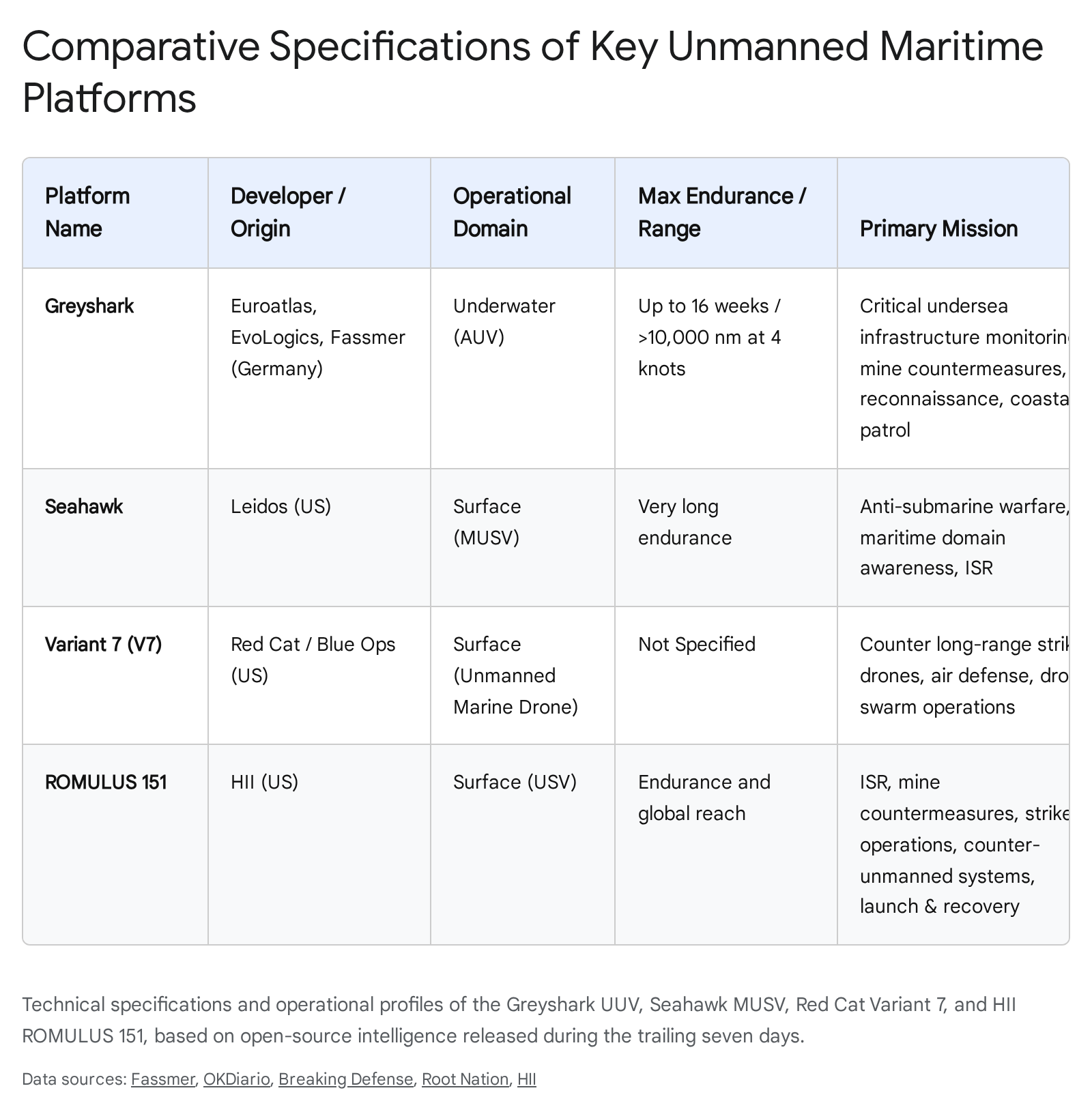
In the maritime domain, unmanned surface vessels (USVs) and unmanned underwater vehicles (UUVs) have expanded into long-range strike and wide-area surveillance roles. This is observed in the continued Ukrainian deployment of surface vessels against Russian naval and refining infrastructure. The United States Navy deployed the Seahawk Medium Unmanned Surface Vessel (MUSV) within a carrier strike group, advancing medium-displacement autonomous vessels toward operational fleet integration. Additionally, the introduction of deep-sea autonomous platforms capable of extended endurance, such as the German Greyshark Foxtrot, indicates growing focus on seabed warfare and critical infrastructure monitoring.
Airspace management remains a primary challenge. Exchanges of loitering munitions and interceptor drones between Russia and Ukraine continue to result in incursions into NATO territory. These incidents highlight constraints in frontier air defense and electronic warfare (EW) coordination. In the Middle East, regional security dynamics are increasingly tested by reciprocal strikes, including an Iranian unmanned aerial vehicle (UAV) assault on civilian aviation infrastructure in Kuwait that bypassed local point defenses.
Technological development cycles continue to compress. Western defense industrial bases are adopting commercial mass-production methodologies to offset volumetric advantages held by adversaries. This is evident in the Pentagon’s procurement of modular counter-UAS (C-UAS) interceptors, the domestic production of foreign-designed USVs, and the deployment of proliferated space-based tracking architectures. Furthermore, the integration of artificial intelligence across command and control (C2) networks is transitioning into operational planning, as demonstrated by the Chinese People’s Liberation Army’s recent joint force exercises.
2. Global Situation Log
The following log details engagements and operational events involving uncrewed and autonomous systems during the reporting period, sorted by date and alphabetically by the primary country involved.
May 29, 2026
Romania: Russian Loitering Munition Breaches Airspace
A Russian Geran-2 one-way attack drone breached Romanian airspace and impacted a residential apartment complex in the eastern Danube port city of Galati. The detonation injured a 14-year-old boy and a 53-year-old woman.1 Military radar systems tracked the projectile as it traversed Romanian airspace for approximately four minutes prior to impact; air defense commanders withheld kinetic interception due to the urban density below the flight path. The incident prompted emergency consultations within the Romanian Supreme Council of National Defence.
May 31, 2026
Kuwait: Iranian Retaliatory Missile Attack Targets U.S. Forces
The Islamic Revolutionary Guard Corps (IRGC) launched ballistic missiles targeting United States military staging areas at Ali Al-Salem Air Base in Kuwait. U.S. Central Command (CENTCOM) reported that multiple projectiles fell apart during transit or were engaged by terminal high-altitude area defense (THAAD) and Patriot missile batteries. The strikes occurred within a 72-hour diplomatic window established to renegotiate regional ceasefire terms.
United States: CENTCOM Conducts Defensive Strikes on Iranian Radar Installations
U.S. forces executed strikes targeting Iranian coastal surveillance radar sites in Goruk and on Qeshm Island.2 The operation was a response to the downing of a U.S. MQ-1 Reaper drone by Iranian forces.3 CENTCOM reported the strikes were intended to degrade IRGC maritime domain awareness and over-the-horizon targeting capabilities along the Strait of Hormuz.
June 1, 2026
Iraq: Unidentified Projectile Strikes Cargo Vessel
The United Kingdom Maritime Trade Operations (UKMTO) recorded an attack on a civilian cargo vessel transiting the northern Persian Gulf, located approximately 40 nautical miles southeast of the Iraqi port of Umm Qasr. While the projectile type remains unspecified, the strike pattern aligns with loitering munitions or anti-ship cruise missiles utilized by regional proxy forces. The incident resulted in unspecified damage to the vessel, impacting regional maritime logistics.
[Image: High-resolution satellite imagery detailing the maritime traffic density near the Umm Qasr port facility, highlighting the vulnerability of commercial shipping lanes to shore-launched loitering munitions.]
June 2, 2026
Russia: Ukrainian UAVs Strike Ilsky Oil Refinery
Ukrainian long-range strike drones penetrated Russian airspace defenses to strike the Ilsky Oil Refinery in Krasnodar Krai. The attack resulted in structural damage to the facility’s primary processing units. This operation is part of a sustained campaign targeting Russian hydrocarbon export infrastructure and domestic fuel supply chains.
June 3, 2026
Israel: IDF Intercepts Houthi UAVs
The Israeli Defense Forces (IDF) engaged two uncrewed aerial vehicles launched by Ansar Allah (Houthi) militants operating from Yemen. The drones, targeting the southern Red Sea city of Eilat, were intercepted by the Israeli Air Force prior to breaching Israeli airspace.
Kuwait: Iranian Drones Strike Kuwait International Airport
Iranian drone swarms targeted Terminal 1 at Kuwait International Airport. The coordinated attack resulted in the death of an Indian national and left at least 63 individuals wounded. The strikes caused localized structural collapses, ignited fires, and forced the suspension of commercial flight operations. Kuwaiti air defense systems and U.S. military personnel successfully destroyed over a dozen incoming munitions, but the volume of the swarm oversaturated local point defenses.
Russia: Ukrainian UAV Campaign Targets Industrial Infrastructure
Ukrainian forces executed a multi-region drone barrage against Russian targets. In Tambov Oblast, strikes ignited a fire covering over 200 square meters at the Michurinsk Progress Plant, a facility that manufactures components for aviation and missile technology. Concurrently, Ukrainian UAVs struck the St. Petersburg Oil Terminal on the Baltic coast, destroying one reservoir and damaging six others along with technical overpasses. Additional strikes were confirmed against the Saratov Oil Refinery, damaging the primary ELOU-AVT-6 oil processing unit.
June 5, 2026
China: Joint Military Exercises Showcase Integrated AI
During the “Steppe Partner 2026” joint military exercises in Inner Mongolia, the Chinese People’s Liberation Army (PLA) deployed armed robotic dogs alongside human infantry, tactical drones, and armored vehicles. The exercise demonstrated the PLA’s integration of autonomous machines and artificial intelligence-assisted command structures into active operational planning, utilizing AI architectures to link sensors and decision-making structures across the chain of command.
Romania: Compromised Ukrainian USV Detonates in Port of Constanta
A Ukrainian Magura-class unmanned surface vessel (USV) self-detonated within the civilian Romanian Black Sea port of Constanta at approximately 10:30 a.m. local time. Authorities had previously secured the area, resulting in no casualties. Three additional compromised surface drones detonated offshore. Investigations confirmed that the Ukrainian military lost navigational control of the USVs due to Russian electronic warfare (EW) jamming operations.
United States: CENTCOM Intercepts Additional Threats
U.S. Central Command forces intercepted four Iranian one-way attack drones launched toward the Strait of Hormuz.4 Officials stated the drones posed an immediate threat to regional maritime traffic.4
June 6, 2026
Russia: Deep Strikes Hit Antipinsky Refinery and Baltic Fleet Assets
Ukrainian forces struck the Antipinsky Oil Refinery in the Siberian region of Tyumen. The drone hit a primary processing unit at the facility, which has a design capacity exceeding 9 million tons of crude oil annually, triggering a structural fire. Concurrently, an 88-drone barrage targeted military infrastructure in the Leningrad region, striking the Kronstadt Marine Plant and a naval ammunition depot located in Lebyazhye.
3. Product Developments, Platform Reveals, and Capability Upgrades
The reporting period featured technological milestones characterized by the transition of autonomous prototypes into mass-produced platforms and capital allocation toward space-based sensing architectures.
May 1, 2026
China: Implementation of Drone Identification Standards
The Civil Aviation Administration of China (CAAC) enacted national standards (GB 46750-2025) mandating hardware and software controls over domestic civilian drones. Newly produced drones must incorporate firmware that automatically severs power to the rotors if the aircraft is not registered with a state database. Existing drones have a transition period until June 2027 to complete back-registration.
May 19, 2026
United States: Perennial Autonomy Secures $500M C-UAS Contract
The Pentagon awarded a $500 million indefinite-delivery/indefinite-quantity (IDIQ) contract to California-based defense technology firm Perennial Autonomy.5 The contract focuses on procuring the Bumblebee quadcopter and the Merops interceptor to defend military bases against drone swarms.5 This award shifts acquisition strategy toward commercial manufacturing scale to achieve cost-symmetry in counter-drone defense.
May 26 – May 29, 2026
United States: SpaceX Awarded Contracts for “Golden Dome” Space Architecture
The U.S. Space Force’s Space Systems Command awarded SpaceX two contracts totaling $6.45 billion to develop the space layer for the “Golden Dome” missile defense shield. A $2.29 billion contract secures the Space Data Network (SDN) Backbone, an encrypted communications architecture linking orbital sensors with terrestrial command centers. A $4.16 billion award funds the Space-Based Airborne Moving Target Indicator (SB-AMTI) program to provide persistent tracking of advanced airborne threats from low Earth orbit.
June 1, 2026
Australia / United Kingdom / United States: AUKUS Initiates Undersea Drone Project
AUKUS announced a trilateral project to develop and deploy unmanned underwater vehicles (UUVs). Governed under Pillar II, the project focuses on integrating payloads and command-and-control systems into existing UUV arsenals. Initial demonstrations involved the Mission Specialist Defender Mark IV remotely-operated vehicle and the IVER4 900 autonomous underwater vehicle.
Germany: Euroatlas Unveils Greyshark Foxtrot Autonomous Submarine
Euroatlas detailed the Greyshark Foxtrot, an autonomous underwater vehicle designed for seabed surveillance. Powered by hydrogen fuel cell technology, the platform has an endurance of 16 weeks submerged and a range of 10,700 nautical miles. It integrates 17 high-resolution sensors capable of mapping the seabed at a resolution of 1.6 inches per pixel.
June 2, 2026
United States: Legislative Push to Regulate Military AI
“The Secure and Accountable Military AI Act” was introduced to restrict the Pentagon’s use of artificial intelligence in specific operational contexts. The bill seeks to impose human accountability requirements and mandate congressional notification for AI applications in nuclear command and control, lethal autonomous weapons systems, and domestic surveillance.
June 3 – June 4, 2026
Turkey: TAI Aksungur Showcases Extended ASW Capabilities
Turkish Aerospace Industries (TAI) highlighted the naval variant of the Aksungur Medium-Altitude Long-Endurance (MALE) unmanned combat aerial vehicle (UCAV). Capable of remaining airborne for up to 49 hours, the platform is equipped to deploy sonobuoys and lightweight torpedoes for active anti-submarine warfare (ASW), offering a persistent surveillance alternative to manned maritime patrol aircraft.
June 4, 2026
United States: USS Theodore Roosevelt Deploys with Seahawk MUSV
The United States Navy deployed the aircraft carrier USS Theodore Roosevelt to the Western Pacific accompanied by the Seahawk Medium Unmanned Surface Vessel (MUSV). The deployment evaluates the Navy’s concepts of operations (CONOPS) for unmanned systems, addressing command and control latency, multi-vessel logistics, and tactical coordination at carrier strike group transit speeds.
June 5, 2026
United Kingdom: Royal Navy Advances Project Vanquish
The UK Ministry of Defence advanced “Project Vanquish,” a program to develop a jet-powered Autonomous Collaborative Platform (ACP) for Queen Elizabeth-class aircraft carriers. Replacing the Ark Royal and Vixen projects, Vanquish seeks to field an uncrewed fixed-wing aircraft capable of short take-off and landing (STOL) without traditional catapults.
United States: Red Cat Holdings Commences Variant 7 USV Production
Red Cat Holdings initiated mass production of the Variant 7 (V7) unmanned marine drone. The V7’s architecture mirrors the Ukrainian Magura V7 series but utilizes NDAA-compliant hardware and software for autonomous control. Red Cat is integrating the “Bullfrog” autonomous intelligent turret and swarm technology from Apium Swarm Robotics to enable the USV to engage aerial threats.
United States: JIATF-401 Expands Drone Defense Marketplace
The Pentagon’s Joint Interagency Task Force 401 (JIATF-401) expanded its Drone Defense Marketplace by signing agreements enabling Australia, Poland, and the Republic of Korea to procure C-UAS technologies directly through the portal. This aggregates international demand to support production scaling within the domestic defense industrial base.
4. Strategic, Operational, and Tactical Lessons Learned
The events of the reporting period offer insights into multi-domain warfare and force design.
May 29, 2026
NATO / Romania: Challenges of Ambiguity in Frontier Airspace
The impact of a Russian Geran-2 drone in Galati, Romania, illustrates the complications of managing frontier airspace. Reluctance to intercept hostile platforms transiting NATO airspace due to collateral damage concerns provides adversaries with operational leeway to test alliance reaction times and radar coverage. This suggests border states may need to transition toward integrated air defense networks that deploy cost-symmetric effectors over unpopulated areas.
June 3, 2026
Kuwait / United States: Infrastructure Vulnerability to Volume
The Iranian drone strike on Kuwait International Airport underscores the vulnerability of civilian infrastructure to high-volume attacks. Despite advanced point defenses, the volumetric saturation of the swarm allowed munitions to penetrate the defensive umbrella. This indicates that protecting large economic hubs requires layered defenses that include non-kinetic electronic warfare and cost-symmetric kinetic interceptors.
June 4, 2026
United States: MUM-T Command and Control Constraints
The deployment of the Seahawk MUSV with the USS Theodore Roosevelt highlights the logistical adjustments required for manned-unmanned teaming (MUM-T). Unmanned surface vessels possess different endurance profiles and speed limitations compared to nuclear-powered carriers. Fleet commanders must develop new station-keeping tactics and resilient communication links to manage the operational tempo of these mixed ecosystems.
June 5, 2026
China: Integrated Command Ecosystems
The PLA’s “Steppe Partner 2026” exercise indicates a shift toward viewing AI and robotics as foundational command architectures rather than isolated assets. By networking disparate sensors and shooters under an AI-assisted command structure, the PLA demonstrated self-synchronizing operational capabilities. This reinforces the premise that processing speed and low-latency decision-making will be critical factors in future engagements.
June 6, 2026
Ukraine / Russia: Long-Range Strike Attrition vs. EW Vulnerability
Ukraine’s campaign against Russian refining infrastructure and naval logistics hubs validates the strategic utility of long-range autonomous platforms for economic attrition. However, the incident involving the compromised Magura USV in Constanta port highlights the risks associated with this approach. When electronic warfare severs command links, autonomous platforms require robust fail-safes to prevent unintended navigational hazards and collateral damage.
Please share the link on Facebook, Forums, with colleagues, etc. Your support is much appreciated and if you have any feedback, please email us in**@*********ps.com. If you’d like to request a report or order a reprint, please click here for the corresponding page to open in new tab.
Sources Used
- Romania confirms Galati drone is Russian-made, dismissing Kremlin denials, accessed June 6, 2026, https://www.turkiyetoday.com/region/romania-confirms-galati-drone-is-russian-made-dismissing-kremlin-denials-3221025
- CENTCOM Struck Qeshm and Goruk Inside the 72-Hour Courier Window – House of Saud, accessed June 6, 2026, https://houseofsaud.com/centcom-strikes-qeshm-goruk-72-hour-courier-window/
- US strikes Iranian targets as Kuwait defends against drones, missiles | The Jerusalem Post, accessed June 6, 2026, https://www.jpost.com/middle-east/iran-news/article-897941
- US struck Iranian radar sites after drone launch toward Strait of Hormuz, accessed June 6, 2026, https://www.iranintl.com/en/202606050401
- Pentagon Hands Perennial Autonomy $500M for Counter-Drone Tech, accessed June 6, 2026, https://migflug.com/jetflights/perennial-autonomy-pentagon-500-million-counter-drone-idiq-may-2026/