Executive Summary
The character of contemporary strategic competition has expanded beyond traditional physical and informational domains, focusing increasingly on the human mind as the primary operational environment. This report provides a detailed analysis of cognitive warfare, defining its theoretical frameworks, offensive doctrines, and defensive countermeasures. Cognitive warfare represents a systematic effort to disrupt, undermine, influence, or modify human decision-making processes. It is not merely the control of information flow, but the targeted manipulation of how individuals and institutions perceive, process, and act upon information. To resolve ongoing doctrinal ambiguity, recent legislative initiatives such as the FY2026 U.S. National Defense Authorization Act (NDAA) have mandated formal definitions of this domain to better align it with existing military operations1.
Analysis of military doctrines, allied joint publications, and psychological research indicates that adversaries utilize cognitive warfare to achieve strategic objectives below the threshold of armed conflict. The operational mechanisms target human cognition across biological, psychological, and social levels, exploiting heuristic vulnerabilities, emotional regulation, and societal trust structures. Key offensive frameworks include the Russian doctrine of reflexive control, which engineers information environments to compel adversaries into making predetermined decisions, and the Chinese doctrine of the Three Warfares, which integrates public opinion, psychological, and legal operations to secure strategic dominance. Advanced technologies, including artificial intelligence, algorithmic amplification, and emerging neurotechnologies, serve as force multipliers, increasing the scale, speed, and precision of these engagements.
Defensive postures focus on cognitive resilience, rapid sensemaking, and the structural hardening of socio-technical systems. Evidence from field evaluations demonstrates varying degrees of efficacy among defensive countermeasures, with prebunking and psychological inoculation showing the most empirical promise. However, a significant measurement crisis exists within defensive planning, as the majority of current assessments measure technological capability rather than real-world behavioral outcomes. To counter these systemic threats, defense requires a multi-layered, whole-of-society approach that integrates tactical military training, neuro-cognitive security frameworks, and the preservation of institutional coherence.
1. The Evolution and Definition of the Cognitive Domain
The evolution of military strategy has necessitated a continuous reevaluation of the domains in which conflict occurs. Historically categorized into land, maritime, air, space, and cyber, modern doctrinal frameworks increasingly recognize the cognitive dimension as a distinct and foundational battlespace2. The advent of this operational domain marks a departure from the Cold War era, where mutually assured destruction deterred direct conventional conflict and funneled competition into proxy warfare and psychological operations4. Today, the proliferation of global digital interconnectivity and artificial intelligence has generated a battlespace where human cognition is simultaneously the primary target and the principal weapon5.
1.1 Doctrinal Definitions and Distinctions
The academic and military communities have proposed multiple definitions of cognitive warfare, reflecting variations in strategic culture and operational focus. Rather than a singular consensus, the domain is defined by an overlapping set of characteristics emphasized differently by various allied and allied-aligned military institutions.
| Institutional Framework | Core Definition and Focus | Doctrinal Nuance |
| NATO Allied Command Transformation (ACT) | An unconventional mode of warfare exploiting psychological biases and technology to manipulate human cognition and alter decision-making6. | Frames cognitive warfare as the fight for cognitive superiority, integrating military and non-military activities across the continuum of competition2. |
| US Department of Defense (Joint Doctrine) | Focuses on “Information Advantage” and “Operations in the Information Environment” (OIE) to affect drivers of behavior. | Currently undergoing doctrinal revision mandated by the FY2026 NDAA to formally define cognitive warfare and integrate narrative intelligence by March 20261. |
| Taiwanese Ministry of National Defense | Information manipulation, propaganda, and psychological operations aimed at human perception and attitudes9. | Emphasizes the effort to sway the adversary’s will to resist and change target mindsets, specifically in response to Chinese operations3. |
| French Military Theorists (e.g., du Cluzel) | The art of using technologies to alter the cognition of human targets, most often without their knowledge or consent6. | Differentiates psychological operations (changing what people think) from cognitive operations (changing how people reason and behave)9. |
1.2 Delineating Cognitive Warfare from Predecessor Concepts
Cognitive warfare is frequently conflated with traditional information operations, psychological operations (PSYOPS), and the broader frameworks of hybrid warfare or Foreign Information Manipulation Interference (FIMI)10. While these disciplines intersect, their primary objectives and operational mechanisms differ fundamentally. Information warfare centers on the flow, denial, and manipulation of data and the electronic systems that process it4. Psychological operations historically aimed to alter specific beliefs, attitudes, or emotional states of a target audience regarding a particular geopolitical issue or state actor, often through overt messaging or subversion4.
Cognitive warfare subsumes and extends beyond these disciplines by militarizing the actual cognitive processes. The primary objective is not merely to alter the target’s belief in a single fact, but to systematically degrade the structural processes of sensemaking and decision-making9. By attacking the methodology of reasoning, cognitive operations seek to induce decision paralysis, distort situational understanding, and constrain the available courses of action for military commanders and civilian populations alike3. The distinction lies in the target substrate: whereas information warfare targets the data pipes, cognitive warfare targets the human processor12.
2. Psychological and Biological Substrates of Conflict
To operationalize the cognitive domain, military analysts and psychologists rely on structured models that map the intersection of human neurobiology, psychological heuristics, and social dynamics. Cognitive warfare is highly effective because it deliberately exploits the evolutionary architecture of the human brain, which is optimized for survival and rapid pattern recognition rather than objective truth verification2.
2.1 The Bio-Psycho-Social Paradigm
The 2026 NATO Chief Scientist Report formally categorizes human cognitive vulnerabilities across three intersecting levels: biological, psychological, and social16.
The biological level directly targets the nervous system, which serves as the foundational substrate of thought, emotion, and behavior16. Human cognition is strictly constrained by physiological factors and metabolic capacity. Under conditions of acute stress, uncertainty, or fear, the human brain is prone to distortions in perception and judgment3. Cognitive warfare exploits these biological bottlenecks by weaponizing cognitive load, flooding the subject with stimuli to exhaust working memory and force reliance on instinctual, rather than reasoned, decision-making11.
At the psychological level, operations focus on manipulating cognitive appraisals, emotional valence, and the structural framing of information16. The human mind processes vast amounts of daily data by relying on heuristic shortcuts, cognitive biases, and stimulus-reward pathways15. Cognitive warfare engineers stimuli that bypass rational deliberation to interact directly with these biases. A primary mechanism is the manipulation of processing costs. According to neuroscientific studies, repeated exposure to false or divergent messages reduces the psychological cost of acceptance; the brain, seeking coherence and cognitive ease, eventually accepts familiar falsehoods over complex, novel truths3. Attackers also hijack emotional salience, utilizing narratives that trigger moral outrage to anchor identity or fear to shut down analytical deliberation12.
The social level encompasses the manipulation of shared narratives, institutional legitimacy, and collective identity, acknowledging that human decision-making is deeply influenced by in-group/out-group dynamics and social proof15. Cognitive engagement at this tier seeks to weaponize identity and fracture societal cohesion2. By amplifying ideological differences and engineering environments of pervasive distrust, attackers induce “epistemic chaos,” a condition wherein a population loses its shared baseline of objective reality and empirical standards16.
2.2 Systemic Invariants and Ontological Vulnerabilities
Beyond individual psychological traits, cognitive warfare targets the ontological foundations of complex socio-technical systems. Analyses by security researchers highlight that systemic vulnerability stems from the degradation of “systemic invariants”—the epistemic, axiological, identificatory, social, and teleological structures that maintain a society’s coherence and identity18.
Viewed through this structural lens, cognitive warfare is a contest over the frameworks of interpretation18. Influence operations operate across the inter-layer linkages of a society’s architecture. The successful disruption of these linkages leads to cognitive decoherence18. In a state of cognitive decoherence, a targeted society or military organization may retain its formal physical structures, infrastructure, and institutions, but the destruction of shared epistemic standards (how truth is collectively verified) and teleological alignment (shared strategic goals) renders it incapable of unified, strategic self-determination or coordinated action18.
3. Conceptual Frameworks for Cognitive Engagement
Strategic planning and defense in the cognitive domain require rigorous architectural models to map how psychological manipulation translates into military and geopolitical advantage.
3.1 The OODA Loop Integration
The integration of cognitive warfare into practical military doctrine relies heavily on the Observe-Orient-Decide-Act (OODA) loop. Cognitive warfare is framed as an interactive, adaptive competition to disrupt, delay, or distort an opponent’s cognitive cycle while safeguarding one’s own7.
The orientation phase is the primary center of gravity in cognitive warfare22. Orientation involves the integration of new information with existing cultural traditions, previous experiences, and analytical processes. Cognitive attacks target biases to force the target to misinterpret observed data15. By degrading orientation, the subsequent decision is inherently flawed, often resulting in rushed, irrational, or paralyzed actions that align with the strategic intent of the attacker12.
The temporal horizon of these disruptions varies significantly. Acute effects manifest rapidly, producing immediate degradation in OODA performance, such as delayed tactical decisions or sudden misperceptions during a crisis. Chronic effects operate over longer horizons, fundamentally altering the target’s analytical framework and standard operating procedures over months or years, creating latent vulnerabilities that can be exploited at a later date21.
3.2 The NATO “House Model”
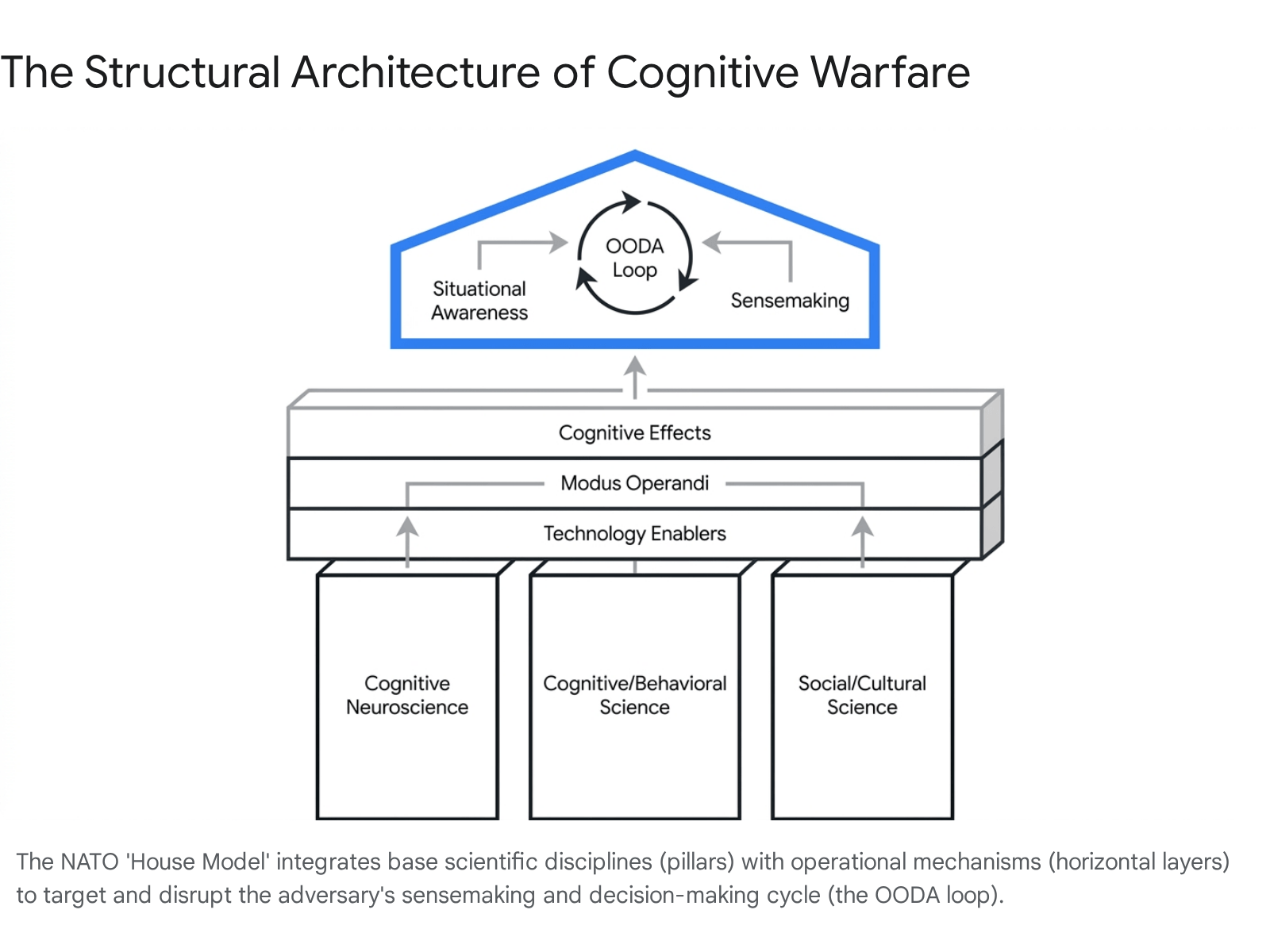
NATO Science and Technology Organization (STO) research has proposed a reference framework known as the “House Model” to categorize the interdisciplinary knowledge required to understand, conduct, and defend against cognitive warfare13. This model acts as a structural blueprint, linking basic scientific research directly to operational military outcomes.
| Structural Component | Knowledge Area | Strategic Function |
| Pillar 1 | Cognitive Neuroscience | Understanding the biological substrates of thought, emotion, neural networks, and physical perception limits13. |
| Pillar 2 | Cognitive and Behavioral Science | Analyzing psychological interventions, decision-making biases, heuristics, and individual behavioral triggers13. |
| Pillar 3 | Social and Cultural Science | Mapping societal trust structures, relational dynamics, in-group behavior, and national centers of gravity13. |
| Operational Floor 1 | Technology Enablers and Force Multipliers | The application of artificial intelligence, algorithms, social media architecture, and neurotechnology to scale the manipulation13. |
| Operational Floor 2 | Modus Operandi | The doctrinal methods, specific tactics, and deployment strategies employed by adversarial actors13. |
| Operational Floor 3 | Cognitive Effects | The specific, measurable psychological impacts desired by the operation, such as attentional saturation, polarization, or demoralization13. |
| The Apex / Roof | Situational Awareness and Sensemaking | The ultimate target of the warfare: corrupting how targets perceive their environment, effectively targeting the OODA decision cycle13. |
4. Offensive Approaches and State-Sponsored Doctrines
State actors employ distinct doctrinal approaches to operationalize cognitive warfare, reflecting their specific strategic cultures, historical precedents, and geopolitical objectives. Analysis of Russian and Chinese military doctrines reveals highly developed, systematic approaches to cognitive subversion designed to modify the balance of international power25.
4.1 Russian Doctrine: Reflexive Control and Social Subversion
Modern Russian cognitive warfare doctrine is deeply rooted in the Soviet-era concept of “Active Measures,” which focused on subversive campaigns designed to alienate adversaries from their allies and attack social cohesion1. The contemporary operationalization of this philosophy is governed by the theory of “Reflexive Control”23. Reflexive control is the systematic practice of transmitting specially prepared information to an adversary to induce them to voluntarily make a predetermined decision that ultimately serves the initiator’s strategic interests23.
Executing reflexive control requires meticulous intelligence gathering to map the target’s internal decision-making architecture. Analysts model how the opposing leadership or population thinks, the institutional constraints they operate under, the ethical norms they are bound by, and the internal factions competing within their socio-political system23. The initiator then injects stimuli into the environment that interact predictably with those pre-existing cognitive filters, shaping the problem frame so that the target’s natural response mechanisms are exploited23.
Reflexive control is executed across multiple operational vectors. In the realm of military command and control, reflexive inputs are utilized to compel an opposing force to misallocate resources, misread strategic intent, or perceive loyal domestic actors as threats23. In the civilian realm, it takes the form of societal subversion. Crucially, Russian operations frequently aim to amplify pre-existing social, ethnic, or political divisions rather than inventing new ideological conflicts27. By exploiting socio-psychological and infrastructural vulnerabilities, the attacker shrinks the moderate center of a society, forcing extreme polarization that paralyzes the target nation’s ability to govern itself or project power abroad25.
4.2 Chinese Doctrine: The Three Warfares and Algorithmic Hegemony
The Chinese approach to cognitive warfare is codified within the People’s Liberation Army (PLA) doctrine of the “Three Warfares,” formally approved by the Central Military Commission in 200328. This doctrine established a triad of political and informational operations designed to secure strategic objectives without direct kinetic engagement, initially focusing on domestic control and expanding to international hegemony28.
The Three Warfares encompass:
- Public Opinion Warfare: The overt and covert manipulation of domestic and international media, utilizing traditional propaganda fused with modern digital perception management to shape global narratives28.
- Psychological Warfare: Operations intended to sway the target’s will, change mindsets, induce fear or compliance, and diminish the adversary’s capacity for sustained resistance28.
- Legal Warfare (Lawfare): The exploitation of domestic and international legal systems to build legal justifications (casus belli) prior to military action, constrain adversary options, and legitimize strategic expansion (e.g., operations in the South China Sea)28.
Chinese theorists view the cognitive domain as the “ultimate warfare domain,” deeply integrated with the PLA’s transition toward “intelligentized warfare”29. This approach leverages massive data collection and algorithmic social media warfare to profile populations, identify psychological biases, and dynamically adjust narratives29. Operations against Taiwan serve as a primary testing ground, demonstrating an effort to influence the island’s future through continuous cognitive dominance, mind control methodologies, and the manipulation of ideological affinities, bypassing the need for direct military conflict29.
4.3 Target Selection and Tactical Execution
Offensive cognitive warfare employs specific tactical mechanisms to manipulate human cognitive infrastructure, heavily focusing on the concept of the median voter and cognitive bottlenecks.
The Median Voter Theorem in Cognitive Warfare A critical tactic in cognitive campaigns targeting democratic societies is the subversion of the median voter theorem27. Adversary analysts recognize that highly polarized individuals on either extreme of an ideological spectrum are heavily committed to their views and are unlikely to alter their core beliefs regardless of new information27. Therefore, offensive operations focus intensely on the “median” population—individuals who are less ideologically committed, uncertain, or politically disengaged27. By flooding the information space with content that induces doubt, emphasizes the human or economic costs of a conflict, or questions institutional legitimacy, the attacker attempts to shift the median opinion. Moving this center of mass creates insurmountable domestic pressure against a target government’s strategic objectives, potentially forcing policy reversals or military withdrawals27.
Exploitation of Epistemic Bottlenecks
Offensive operations actively exploit the architectural limitations of human cognition through distinct tactical vectors:
- Information Saturation and Overload: Attackers flood the environment with contradictory inputs, forcing the target’s analytical capacity to collapse under the volume of data. This generates a false equivalence between options and induces decision paralysis11.
- Emotional Hijacking: Content is engineered to trigger specific high-arousal emotions. Fear shuts down deliberative reasoning, while moral outrage anchors identity and pre-justifies radical action, bypassing logical evaluation12.
- Synthetic Credibility and Trust Erosion: The deployment of ideological camouflage, synthetic experts, forged documents, and deepfakes to mimic credibility. The goal is to erode peer-to-peer belief channels until absolute skepticism and cynicism become the default epistemic state of the population15.
5. Technological Accelerants: AI and Neurotechnology
Advanced technologies act as severe accelerants for cognitive effects, transforming bespoke, artisanal psychological operations into industrialized, mass-produced cognitive warfare2.
5.1 Artificial Intelligence and Algorithmic Amplification
The integration of artificial intelligence represents a paradigm shift in the generation and dissemination of cognitive munitions. Social media algorithms, optimized for engagement, structurally reward emotionally charged, divisive content, exploiting human cognitive vulnerabilities faster than societal norms or legislative bodies can adapt2.
AI enables attackers to micro-segment populations for highly specific psychographic targeting, automate the rapid amplification of narratives via bot swarms, and generate synthetic credibility through hyper-realistic deepfakes and AI-generated audio16. The use of generative AI allows cognitive warfare to move into mass production, significantly lowering the financial and logistical costs of initiating cognitive entropy32. As these models become more adept at natural language generation, the ability to mimic local cultural nuance and linguistic idioms enhances the stealth and penetration of the operation16.
5.2 The Neurotechnological Vector
Neurotechnologies—devices capable of reading, translating, or modulating neural activity—introduce a direct vector into the biological substrate of cognition33. While currently focused in military environments on human performance monitoring (such as tracking a pilot’s cognitive load or interfacing personnel with autonomous weapons systems), the dual-use nature of neurotechnology presents acute strategic risks33.
The extraction of “neurodata” exposes highly sensitive biological and emotional baselines to adversarial profiling, creating vulnerabilities regarding mental privacy and data ownership33. Furthermore, the prospect of targeted neural manipulation—altering cognitive states directly via electrophysiological interference—blurs the boundaries of human agency and intent33. This presents a scenario where the human nervous system itself becomes an exploitable, hackable operational surface, pushing cognitive warfare from the psychological domain directly into the biological domain33.
6. Defensive Approaches and Cognitive Security
Defending against cognitive warfare requires a structural shift from reactive information correction (debunking) to proactive cognitive hardening. Traditional cyber defense protects the infrastructure; cognitive defense must protect the interpretation, trust, and processing that occurs within the human mind and societal institutions18.
6.1 Tactical Mitigation and The Strategic Corporal
At the tactical military level, cognitive defense is complicated by the phenomenon of the “Strategic Corporal.” In modern, globally connected operational environments, the isolated actions of a junior soldier—whether a tactical error, a controversial kinetic engagement, or a momentary lapse in discipline—can be recorded, decontextualized, and broadcast globally in real-time27.
Adversaries proactively hunt for these instances to weaponize perception, leveraging a dynamic known as “mistake magnification”27. To counter this, military training doctrine must evolve. Soldiers are no longer merely kinetic operators; they are vulnerable nodes within a contested information environment27. Defensive training must instill cognitive radar and mental rate limiters. Personnel must be trained to delay reflexive interpretations under high-stress scenarios, perform on-the-fly belief audits, and understand how their physical actions translate into cognitive munitions for the adversary’s propaganda apparatus15.
6.2 Situational Awareness and Narrative Intelligence
The foundational layer of institutional cognitive defense is continuous situational awareness across the information environment35. This requires auditable open-source intelligence (OSINT) fusion and the implementation of automated indicators and warnings workflows that monitor the adversary’s modus operandi35.
A critical component of this awareness is the operationalization of narrative intelligence—a capability formally prioritized in the FY2026 NDAA for its value in tracking how adversaries construct storylines to manipulate public trust1. Defensive systems must track not just isolated messages or keywords, but the overarching narratives that shape salience, interpretation, and public trust7. By identifying anomaly clusters—such as subtle shifts in narrative framing, the introduction of novel causal chains, or sudden emotional saturation in public discourse regarding a specific policy—defenders can anticipate cognitive attacks before they achieve structural penetration or trigger societal decoherence15.
6.3 The Measurement Crisis in Defensive Efficacy
A critical vulnerability in current defensive strategy is the “measurement crisis” identified in recent empirical evaluations of counter-cognitive warfare interventions across democratic societies36. Systematic reviews of major defensive categories—prebunking, AI detection technologies, media literacy programs, and rapid response systems—reveal a significant discrepancy in evidentiary quality and operational reliability36.
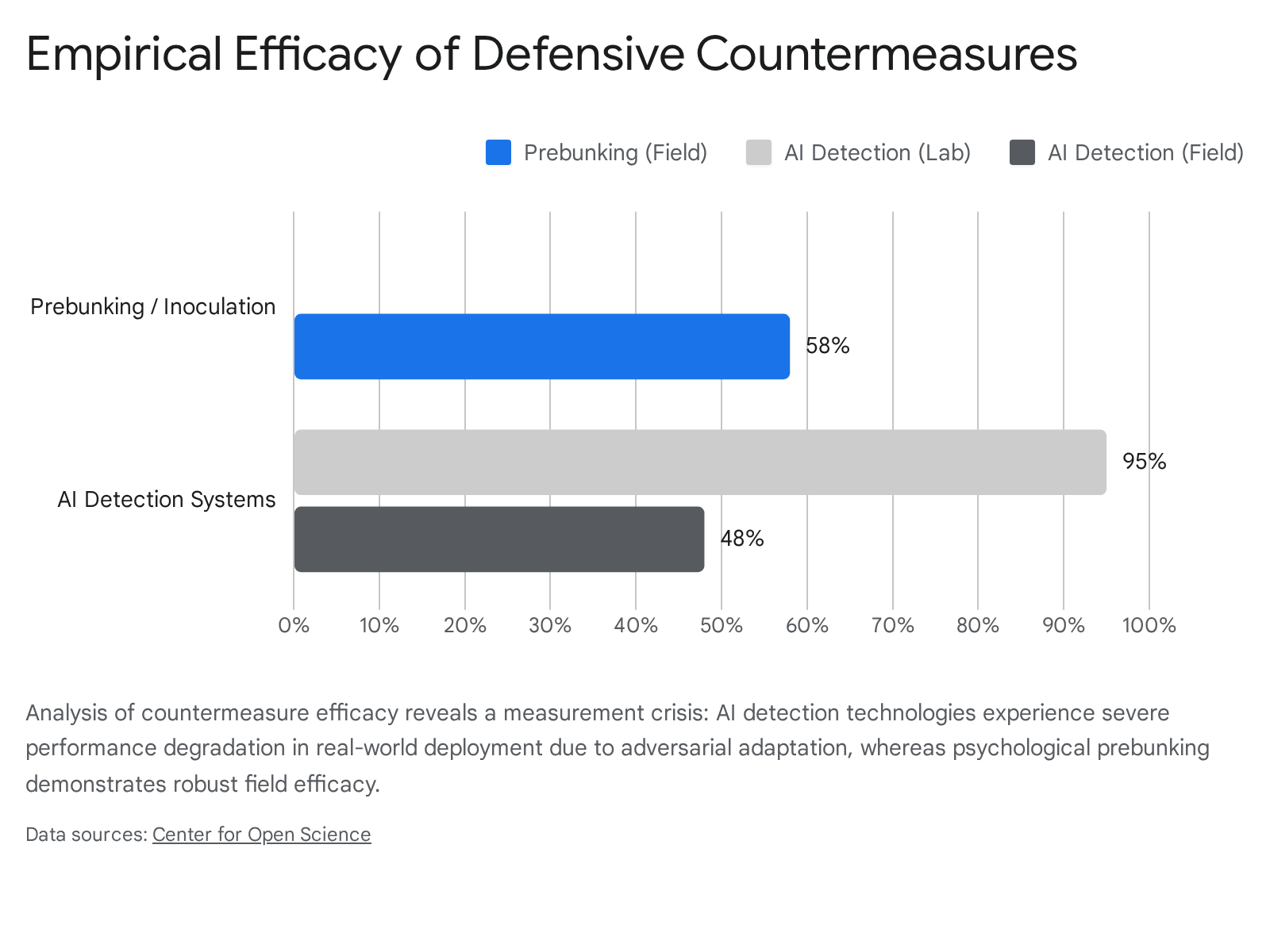
The fundamental flaw in current defensive planning is that over 89% of analyzed studies measure technological or cognitive capabilities rather than actual human behaviors36. This capability-behavior mismatch creates a systemic, dangerous overestimation of a countermeasure’s operational effectiveness36.
For example, AI detection systems designed to identify deepfakes or bot activity exhibit high capabilities in controlled laboratory settings (often reaching ~95% accuracy). However, during real-world deployment, these systems suffer a massive 45% to 50% degradation in accuracy due to rapid adversarial adaptation and the evasion techniques deployed by state actors36. Conversely, psychological inoculation and prebunking—the practice of exposing populations to weakened forms of manipulation techniques to build mental resistance beforehand—demonstrate the strongest empirical evidence base, yielding a highly stable 55% to 60% improvement in actual manipulation detection in large-scale field studies36.
Addressing cognitive warfare effectively requires defense ministries to demand behavioral validation as a strict prerequisite before scaling countermeasure investments, recognizing that technological solutions alone are insufficient if they fail in contested environments36.
6.4 Societal Hardening and Neurotechnology Governance
Because cognitive warfare targets civilian infrastructure, democratic processes, and public trust, defense mandates a whole-of-society approach22. This involves creating “epistemic breathing room,” where individuals are trained to hold incomplete patterns without demanding immediate resolution, mitigating the effectiveness of adversaries offering rapid, false closure during crises15. Furthermore, populations must be educated in frame-switching fluency—the ability to view the same data set through opposing lenses to detect ideological manipulation15.
Strategic deterrence in this domain relies on think tanks and civil institutions to establish deterrence by denial (strengthening domestic mental resilience) and deterrence by punishment (exposing cognitive aggressors and imposing diplomatic or economic costs)26.
Finally, as the biological and technological boundaries of cognition blur, institutional defense must adapt its governance structures. Currently, military alliances exhibit a “threat-recognition lag” regarding neurotechnology34. While the defense sector accurately prioritizes information-centric threats like deepfakes, it frequently frames neurotechnology primarily through a performance-enhancement lens34. This creates a severe strategic asymmetry: adversaries are researching the weaponization of neurotechnology for direct cognitive interference, while defensive institutions treat it largely as an internal human-performance asset34. Defensive governance must establish early guardrails, define acceptable ethical parameters for neural data protection, and advocate for updates to international legal frameworks—such as the Biological and Chemical Weapons Conventions—to explicitly prohibit electrophysiological interference and neural manipulation in modern conflict34.
7. Conclusion
Cognitive warfare represents a permanent shift in the character of strategic competition. It operates on the premise that the most efficient way to defeat an adversary is not to destroy their physical forces or seize their territory, but to systematically corrupt the cognitive architecture that directs those forces and governs that society. By mapping and exploiting the biological constraints, psychological biases, and social dependencies of human decision-making, state actors conduct continuous operations designed to fracture cohesion and enforce strategic paralysis.
Defending the cognitive domain requires moving beyond traditional public affairs, cyber defense, and standard information operations. It demands a rigorous, interdisciplinary approach that integrates neurobiology, behavioral science, systems engineering, and societal resilience programs. Most importantly, it requires an acknowledgment that while advanced technology accelerates the threat and scales the impact, the ultimate vulnerability—and the ultimate defense—resides within the interpretation structures of the human mind. Achieving cognitive resilience is not purely a technological problem to be solved with better algorithms, but a persistent operational and psychological posture that must be maintained across both military formations and the broader civilian society.
Master Summary Table: The Domain of Cognitive Warfare
| Strategic Element | Primary Characteristics and Objectives | Operational Mechanisms and Tactics |
| The Battlespace | The human mind and societal trust structures are the primary contested environments. The goal is decision degradation. | Disruption of the Observe-Orient-Decide-Act (OODA) loop; inducing acute or chronic cognitive decoherence. |
| Biological Vulnerabilities | Targeting the nervous system, physiological capacity, and metabolic limits of attention. | Weaponizing cognitive load; leveraging neurotechnology to extract neurodata or manipulate arousal and stress responses. |
| Psychological Vulnerabilities | Manipulating cognitive appraisals, framing, and emotional valence to bypass rationality. | Exploiting heuristic shortcuts; generating moral outrage or fear; hijacking stimulus-reward pathways. |
| Social Vulnerabilities | Fracturing institutional trust, shared narratives, and societal cohesion. | Weaponizing identity (in-group/out-group dynamics); algorithmic amplification of division; inducing epistemic chaos. |
| Offensive Doctrine (Russia) | Reflexive Control: Compelling a target to voluntarily make a predetermined decision based on manipulated inputs. | Engineering the information environment; command and control interference; targeting the “median voter” to shift policy. |
| Offensive Doctrine (China) | Three Warfares: Securing strategic dominance below the threshold of kinetic conflict. | Integration of Public Opinion, Psychological, and Legal (Lawfare) operations; pursuit of long-term cognitive dominance. |
| Defensive Countermeasures | Building societal resilience, situational awareness, and structural psychological hardening. | Psychological prebunking/inoculation; narrative intelligence monitoring; OSINT fusion; behavioral validation of defenses. |
Please share the link on Facebook, Forums, with colleagues, etc. Your support is much appreciated and if you have any feedback, please email us in**@*********ps.com. If you’d like to request a report or order a reprint, please click here for the corresponding page to open in new tab.
Sources Used
- Cognitive Warfare: The Pentagon’s Race To Define The Narrative Battle – Vinesight, https://blog.vinesight.com/blog/cognitive-warfare-the-pentagons-race-to-define-the-narrative-battle
- Cognitive Warfare: What It Is, How It Works & Why It Matters | Expert Guide – Tanna Krewson, https://www.tannakrewson.com/cognitive-warfare
- Cognitive warfare – Wikipedia, https://en.wikipedia.org/wiki/Cognitive_warfare
- Cognitive Warfare – NATO Innovation Hub, https://innovationhub-act.org/wp-content/uploads/2023/12/Cognitive-Warfare.pdf
- NATO’s Concept of Cognitive Warfare – Puolustusvoimat, https://puolustusvoimat.fi/documents/1951253/2815786/PVTUTKL_Tutkimuskatsaus_2026-2_Kaarkoski_en.pdf/d9b617e8-5e00-2fdf-84c9-730b1a9abd9e?t=1772545283130
- The Cognitive Warfare Concept – NATO Innovation Hub, https://innovationhub-act.org/wp-content/uploads/2023/12/CW-article-Claverie-du-Cluzel-final_0.pdf
- Cognitive Warfare: An Allied Blueprint and a Pentagon Opportunity – Small Wars Journal, https://smallwarsjournal.com/2026/01/16/cognitive-warfare/
- Defining Cognitive Warfare: A NDAA Mandate Response – Small Wars Journal, https://smallwarsjournal.com/2026/05/05/defining-cognitive-warfare/
- Assessing “Cognitive Warfare”, https://www.irregularwarfare.org/assessing-cognitive-warfare/
- The Understanding of Cognitive Warfare in Comparative Perspective Taking Stock and Bridging the Gap to Extant Literatures – NATO, https://publications.sto.nato.int/publications/STO%20Meeting%20Proceedings/STO-MP-HFM-361/MP-HFM-361-P13.pdf
- The Black Box Problem in Cognitive Warfare: Why “Targeting Cognition” Is Not Enough, https://smallwarsjournal.com/2026/07/02/the-black-box-problem-in-cognitive-warfare-why-targeting-cognition-is-not-enough/
- Cognitive Warfare and the Changing Character of Engagement: A Neurostrategic Perspective – Institute for National Strategic Studies, https://inss.ndu.edu/news/Article/4455563/cognitive-warfare-and-the-changing-character-of-engagement-a-neurostrategic-per/
- How Is Cognitive War Waged? The Battle For The Mind | Ozean Media, https://ozeanmedia.com/research/how-is-cognitive-war-waged-the-battle-for-the-mind/
- Cognitive warfare: the new battlefield exploiting our brains – Polytechnique Insights, https://www.polytechnique-insights.com/en/columns/geopolitics/cognitive-warfare-the-new-battlefield-exploiting-our-brains/
- Cognitive Warfare Principles – European Nexus for Strategic Intelligence, https://www.intelligencestrategy.org/blog-posts/cognitive-warfare-principles
- Cognitive Warfare 2026: NATO’s Chief Scientist Report as Sentinel Call for Operational Readiness > Institute for National Strategic Studies > View Publications, https://inss.ndu.edu/Research-and-Commentary/View-Publications/Article/4371195/cognitive-warfare-2026-natos-chief-scientist-report-as-sentinel-call-for-operat/
- Cognitive Warfare 2026: NATO’s Chief Scientist Report as Sentinel Call for Operational Readiness > Institute for National Strategic Studies > News, https://inss.ndu.edu/news/Article/4371195/cognitive-warfare-2026-natos-chief-scientist-report-as-sentinel-call-for-operat/
- New CCDCOE research reconceptualises cognitive warfare, https://ccdcoe.org/news/2026/new-ccdcoe-research-reconceptualises-cognitive-warfare/
- Ontological Foundations of Cognitive Warfare – NATO Cooperative Cyber Defence Centre of Excellence, https://ccdcoe.org/uploads/2026/04/ONTOLOGICAL_FOUNDATIONS_OF_COGNITIVE_WARFARE.pdf
- When Perception Becomes the Battlefield – Small Wars Journal, https://smallwarsjournal.com/2026/07/15/when-perception-becomes-the-battlefield/
- Cognitive Warfare: Definition, Framework, and Case Study – arXiv, https://arxiv.org/html/2603.05222v1
- NATO Chief Scientist Research Report on Cognitive Warfare – NAFO Forum, https://nafoforum.org/magazine/nato-chief-scientist-research-report-on-cognitive-warfare
- Reflexive Control in Cognitive Warfare | by SIMKRA – Medium, https://medium.com/@simone.kraus/reflexive-control-in-cognitive-warfare-9bd4e04c2ec5
- Appreciating the perspective that the trajectories of neuroscience and human evolution place Cognitive Warfare at odds with ideas of a Human Domain – Norwegian Research Information Repository, https://nva.sikt.no/registration/0198cc82f7ee-a10fb3ec-9ccc-4580-9418-cef60e5cd517
- Narrative as a Weapon: Russian, Iranian, and Chinese Approaches to Cognitive Warfare, https://smallwarsjournal.com/2026/03/18/narrative-as-a-weapon/
- From Territory to Thought: Human Minds As Strategic Depth In Cognitive Warfare and Deterrence – The Friday Times, https://www.thefridaytimes.com/14-Jul-2026/territory-thought-human-minds-strategic-depth-cognitive-warfare-deterrence
- Cognitive Warfare: Targeting the Soldier to Shape the Strategy – Army University Press, https://www.armyupress.army.mil/Journals/NCO-Journal/Archives/2026/March/Cognitive-Warfare/
- Three warfares – Wikipedia, https://en.wikipedia.org/wiki/Three_warfares
- Taiwan’s Multidomain Cognitive War – Marine Corps University, https://www.usmcu.edu/Outreach/Marine-Corps-University-Press/Expeditions-with-MCUP-digital-journal/Taiwans-Multidomain-Cognitive-War/
- Cognitive warfare campaigns by China and Russia in Latin America – The Watch, https://thewatch-journal.com/2025/05/21/cognitive-warfare-campaigns-by-china-and-russia-in-latin-america/
- The NATO CogWar “House model”: Required knowledge to achieve Cognitive Warfare strategic goals. – ResearchGate, https://www.researchgate.net/figure/The-NATO-CogWar-House-model-Required-knowledge-to-achieve-Cognitive-Warfare-strategic_fig1_406976343
- Cognitive warfare: an invisible conquest of our minds? – Polytechnique Insights, https://www.polytechnique-insights.com/en/braincamps/geopolitics/cognitive-warfare-the-invisible-conquest-of-minds/
- Neurotechnology and the Transformation of War’s Human Domain, https://smallwarsjournal.com/2026/04/11/neurotechnology-and-the-transformation-of-wars-human-domain/
- Is NATO Ready for the Brain Battlefield? Navigating the Governance Window for Neurotechnology, https://natoassociation.ca/is-nato-ready-for-the-brain-battlefield-navigating-the-governance-window-for-neurotechnology/
- NATO-aligned Cognitive Warfare Defense: How Semantic Visions Supports Cognitive Superiority, Resilience, and Decision Advantage, https://www.semantic-visions.com/insights/nato-aligned-cognitive-warfare-defense
- The Measurement Crisis in Cognitive Warfare Defence: Evaluating Single-Layer Countermeasures across Democratic Societies – IDEAS/RePEc, https://ideas.repec.org/p/osf/socarx/r436y_v1.html
- GCSP Publication | Enhancing Cognitive Security and Societal Resilience to Counter Cognitive Warfare, https://www.gcsp.ch/publications/enhancing-cognitive-security-and-societal-resilience-counter-cognitive-warfare