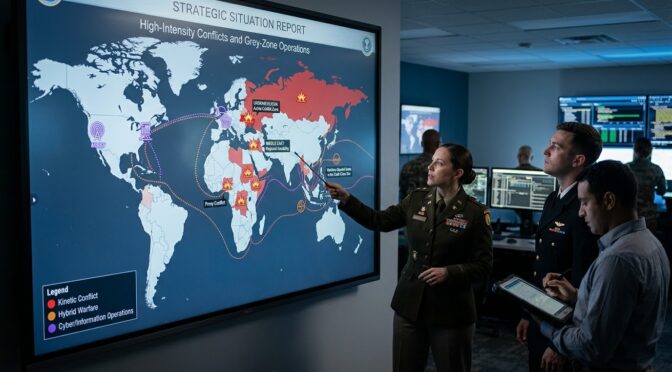
1. Executive Summary
The global threat landscape during the reporting period of July 6 to July 12, 2026, is characterized by a rapid and highly volatile destabilization of the Middle Eastern security architecture, the definitive culminating phase of protracted conventional land warfare in Eastern Europe, and the sophisticated expansion of state-sponsored grey-zone coercion across the Indo-Pacific theater. The most strategically significant development of the reporting week is the total collapse of the June 17 memorandum of understanding (MoU) between the United States and the Islamic Republic of Iran. This collapse has triggered an immediate resumption of high-intensity kinetic strikes across the Persian Gulf, centering specifically on the strategic maritime chokepoint of the Strait of Hormuz.1 This escalation threatens to unravel regional maritime security frameworks entirely, disrupting global hydrocarbon logistics and drawing direct, kinetic military participation from allied Gulf States.3
Simultaneously, in the European theater, the Russia-Ukraine War has transitioned into a phase of extreme tactical attrition, heavily favoring defensive depth and asymmetric maritime operations. Russian offensive ground operations have demonstrably culminated, yielding mathematically negligible territorial gains compared to the preceding year. In response, Ukrainian forces have successfully shifted their operational center of gravity toward maritime area denial and deep-strike logistics interdiction, specifically isolating the Sea of Azov and neutralizing energy infrastructure within occupied Crimea.5 Parallel to these kinetic operations, Russian state-sponsored cyber actors, including elements affiliated with the Main Intelligence Directorate (GRU), have intensified hybrid operations targeting European critical infrastructure, commercial communications, and operational technology (OT) systems, indicating a sustained and asymmetric campaign designed to systematically test the resilience of the North Atlantic Treaty Organization (NATO).7
The Indo-Pacific theater continues to exhibit a highly calibrated, incremental increase in grey-zone provocations initiated by the People’s Republic of China (PRC). Beijing’s strategic deployment of dual-use research vessels, maritime militias, and permanent China Coast Guard (CCG) patrols around both the island of Taiwan and the contested shoals of the South China Sea demonstrates a calculated strategy of normalization through persistence.9 This approach effectively lowers the threshold for escalation and establishes de facto jurisdictional control while remaining deliberately below the threshold of direct conventional military conflict. Concurrent interoperability exercises and diplomatic signaling between the PRC, the Russian Federation, and the Democratic People’s Republic of Korea (DPRK) highlight the consolidation of an authoritarian strategic axis, aimed explicitly at dividing allied defense postures and complicating extended deterrence in Northeast Asia.13
Sub-Saharan Africa continues to face severe, compounding security, political, and epidemiological crises. The civil war in Sudan is experiencing a dangerous phase of complex internationalization, evidenced by the direct kinetic involvement of foreign proxy contingents and the systemic deployment of advanced drone warfare by multiple belligerents.14 Concurrently, the Democratic Republic of the Congo (DRC) is forced to navigate the dual pressures of an expanding, foreign-backed M23 insurgency and an unprecedented, rapidly spreading outbreak of the Bundibugyo Ebola variant.16 Across all monitored theaters, both state and non-state actors are increasingly and seamlessly blending conventional kinetic operations with asymmetric, cyber, and economic warfare, rendering the traditional doctrinal distinction between peace and conflict functionally obsolete.
2. Regional Conflict Breakdowns
Europe/Eurasia
Conflict/Threat Name: Russia-Ukraine War
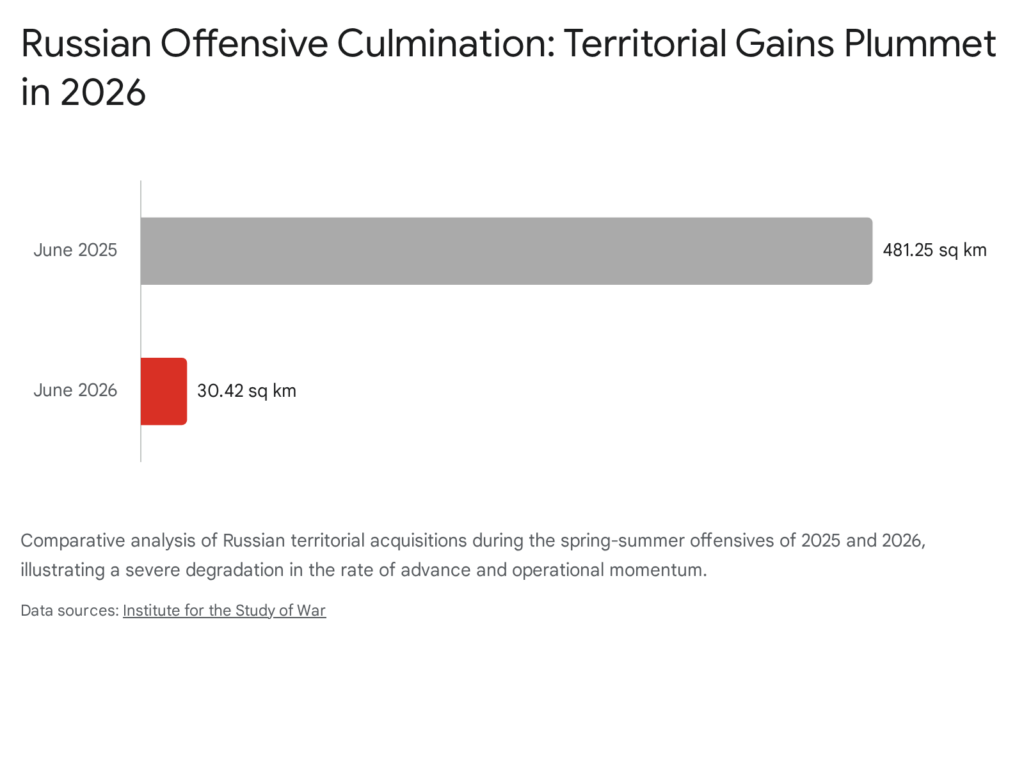
Weekly Key Events: The tactical realities on the ground in Ukraine demonstrate a severe and structural degradation of Russian offensive momentum. Comprehensive analysis of the spring-summer 2026 offensive indicates a systemic failure by Russian forces to achieve operationally significant breakthroughs or exploit tactical successes. Open-source intelligence and geolocated battle damage assessments reveal that during June 2026, Russian forces seized or infiltrated a mere 30.42 square kilometers, advancing at a highly diminished average pace of 1.01 square kilometers per day.18 This represents a fractional output of their operational capacity from the previous year. For comparative context, Russian forces seized 481.25 square kilometers in June 2025 at a rate of 16.04 square kilometers per day.18
The aggregate territorial acquisition for the first half of 2026 stands at 622.60 square kilometers, which constitutes only 28.43 percent of the 2189.87 square kilometers captured during the corresponding six-month period in 2025.18 Current Russian territorial gains are largely restricted to slow, high-cost, and attritional tactical advances in the urban environs near Kostyantynivka in the Donetsk Oblast.18 Additionally, Russian forces have made minor advances north of Kharkiv City in a continued, yet stalled, attempt to push Ukrainian forces back from the international border to create a defensible buffer zone shielding the Belgorod Oblast from tube artillery range.19
| Operational Metric | June 2025 | June 2026 | Year-Over-Year Change |
| Total Territory Seized (sq km) | 481.25 | 30.42 | -93.68% |
| Average Daily Advance (sq km/day) | 16.04 | 1.01 | -93.70% |
| First Half (Jan-June) Cumulative (sq km) | 2189.87 | 622.60 | -71.57% |
The severe deceleration of Russian ground operations is directly correlated with highly targeted Ukrainian counter-logistics and counter-artillery campaigns. According to public statements from Ukrainian Commander-in-Chief General Oleksandr Syrskyi on July 10, Ukrainian forces have actively reduced the Russian advance rate by more than half over the past six months, inflicting an estimated 32,000 casualties.8 Syrskyi also noted that the ratio of Ukrainian to Russian infantry assaults has stabilized at roughly 40 to 60.8 Furthermore, Ukrainian forces completed a highly successful second phase of “Operation Auchan” in June 2026, a specialized operational maneuver specifically designed to dismantle Russian offensive artillery capabilities and disrupt forward ammunition depots.19 The commander of the Ukrainian 1st Separate Assault Regiment, Dmitry “Perun” Filatov, reported a threefold increase in intermediate-range strikes against occupied territories over the past two months.8 This intermediate-range strike campaign continues to successfully strangle Russian ground lines of communication (GLOCs) in the southern Zaporizhia and Kherson oblasts, forcing Russian infantry to increasingly rely on unprotected light vehicles for maneuverability due to mounting armored vehicle shortages.8
In the maritime domain, Ukraine has initiated a highly effective, asymmetric isolation campaign targeting Russian seaborne logistics and energy transport. Intensified Ukrainian strikes against Russian gasoline tankers in the Sea of Azov have reportedly forced the Russian Federation to officially close multiple maritime routes during the reporting week.5 Commercial maritime tracking provided by Starboard Maritime Intelligence detected a massive 55 percent decline in vessels transmitting active automatic identification system (AIS) signals in the Sea of Azov between June 30 and July 11.5 This data strongly indicates significant behavioral alterations by Russian maritime operators, who are likely operating dark to mitigate the severe strike threat posed by Ukrainian unmanned surface vessels (USVs) and coastal defense cruise missiles.5
Parallel to the maritime interdiction, Ukrainian forces conducted deep strikes targeting critical energy and military infrastructure on the occupied Crimean Peninsula and within the Russian Federation proper. On the night of July 8 to 9, the Ukrainian Unmanned Systems Forces (USF) commanded by Major Robert “Magyar” Brovdi reportedly struck 45 distinct military targets in Crimea.6 These targets included the Saky Thermal Power Plant, three separate oil depots, two vehicle maintenance enterprises, a “Zhitel” electronic warfare jamming station, and multiple communications towers.6 These persistent infrastructure strikes are generating cascading domestic impacts within Russia; intelligence suggests that the domestic Russian oil refining industry is currently failing to meet rising internal gasoline demands as the Ukrainian long-range strike campaign continuously degrades operational refining capacity.8 In response to these domestic pressures, Russian state-owned polling institutions have indicated a continued fall in President Vladimir Putin’s approval ratings in early July 2026, following a sharp decline measured at the end of June.8
Russian kinetic responses to these operational setbacks have relied heavily on sustained, long-range missile and drone barrages against Ukrainian rear areas, although interception rates by Western-supplied Ukrainian air defenses remain notably high. Overnight strikes throughout the week utilized a mixed-munitions package designed to overwhelm radar operators. These packages included Iskander-M and S-400 ballistic missiles, Kh-59/69 guided cruise missiles, Kh-31 and Kh-31P anti-radar missiles, and hundreds of loitering munitions.19 The targeting matrix primarily focused on Ukrainian civilian infrastructure and energy distribution nodes, specifically attempting to degrade gas station networks.6 In addition to kinetic strikes, Russia has engaged in sophisticated cognitive warfare operations. The Ukrainian Center for Countering Disinformation reported on July 8 that Russian intelligence is conducting an information operation targeting residents of Sumy Oblast.19 This operation utilizes AI-generated deepfake videos of local officials to propagate false narratives asserting that Ukrainian forces are preparing to surrender Sumy City, an effort strategically designed to undermine societal resilience and induce panic among the civilian populace.19
Conflict/Threat Name: Russian Cyber and Hybrid Operations
Weekly Key Events: Russian state-sponsored cyber operations continue to function as a highly active, parallel front to conventional military activities, posing sustained and escalating risks to NATO allies and European critical infrastructure. The reporting period saw Russian intelligence services conduct a widespread and successful hacking operation targeting civilian camera networks across multiple NATO member states and within Ukraine.5 Furthermore, the United States Cybersecurity and Infrastructure Security Agency (CISA) and the Federal Bureau of Investigation (FBI) issued updated intelligence advisories regarding the Russian General Staff Main Intelligence Directorate (GRU).7 The GRU is currently conducting widespread phishing campaigns targeting commercial messaging applications, focusing explicitly on individuals of high intelligence value, including current and former government officials, military personnel, and journalists.7
Simultaneously, pro-Russian hacktivist syndicates have launched opportunistic cyberattacks targeting critical infrastructure globally. These threat actors systemically exploit minimally secured, internet-facing virtual network computing (VNC) connections to infiltrate operational technology (OT) control devices within critical infrastructure systems.7 This pattern highlights a clear strategy to hold physical infrastructure systems at risk in nations politically or militarily supporting Ukraine. The overarching strategic intent behind these hybrid threats was underscored during the reporting week by Polish Foreign Minister Radoslaw Sikorski, who publicly confirmed recent intelligence warnings from the United States indicating that the Russian Federation is actively planning physical sabotage and cyber provocations against unspecified NATO states in the near term.8
Middle East/North Africa
Conflict/Threat Name: The 2026 Iran-US War and Regional Escalation
Weekly Key Events: The fragile diplomatic framework established to halt the 2026 Iran War collapsed entirely during the reporting week, plunging the Persian Gulf back into a state of high-intensity conflict. The conflict, which was originally initiated on February 28, 2026, following decapitation strikes by the US and Israel that resulted in the death of Iranian Supreme Leader Ali Khamenei, had seen a temporary cessation of hostilities following an April ceasefire and a subsequent June 17 memorandum of understanding (MoU).1 However, this diplomatic architecture unraveled when Iranian naval elements attacked three commercial cargo vessels transiting the southern Omani route of the Strait of Hormuz on July 6 and 7.3 Iranian authorities asserted that these maritime interdictions were a lawful enforcement of their sovereign right to manage and secure traffic through the strait, a position they claim is strictly permitted under Clause 5 of the June MoU, which mandates Iran to facilitate safe passage while negotiating future administration.3
In direct response to the maritime attacks, US President Donald Trump publicly declared the interim ceasefire deal to be “over” via social media and authorized a significant wave of retaliatory airstrikes.2 Speaking on the sidelines of the NATO summit in Ankara, President Trump warned that the US would hit Iran hard in retribution for the bombing of ships, characterizing the Iranian actions as acts of terrorism.20 On July 8, US Central Command (CENTCOM) executed operations targeting Iranian strategic assets and coastal infrastructure. Explosions were reported in the major port city of Bandar Abbas, the southern coastal city of Sirik, and locations within the Bushehr province.2 Notably, while the Bushehr nuclear power plant reportedly sustained no damage, explosions were also reported on Abu Musa Island, a highly contested territory claimed by the United Arab Emirates (UAE) that is central to Iran’s geographic dominance over the Strait of Hormuz.2 Concurrently, the US Treasury formally revoked a temporary sanctions waiver that had previously allowed Tehran to export oil.2
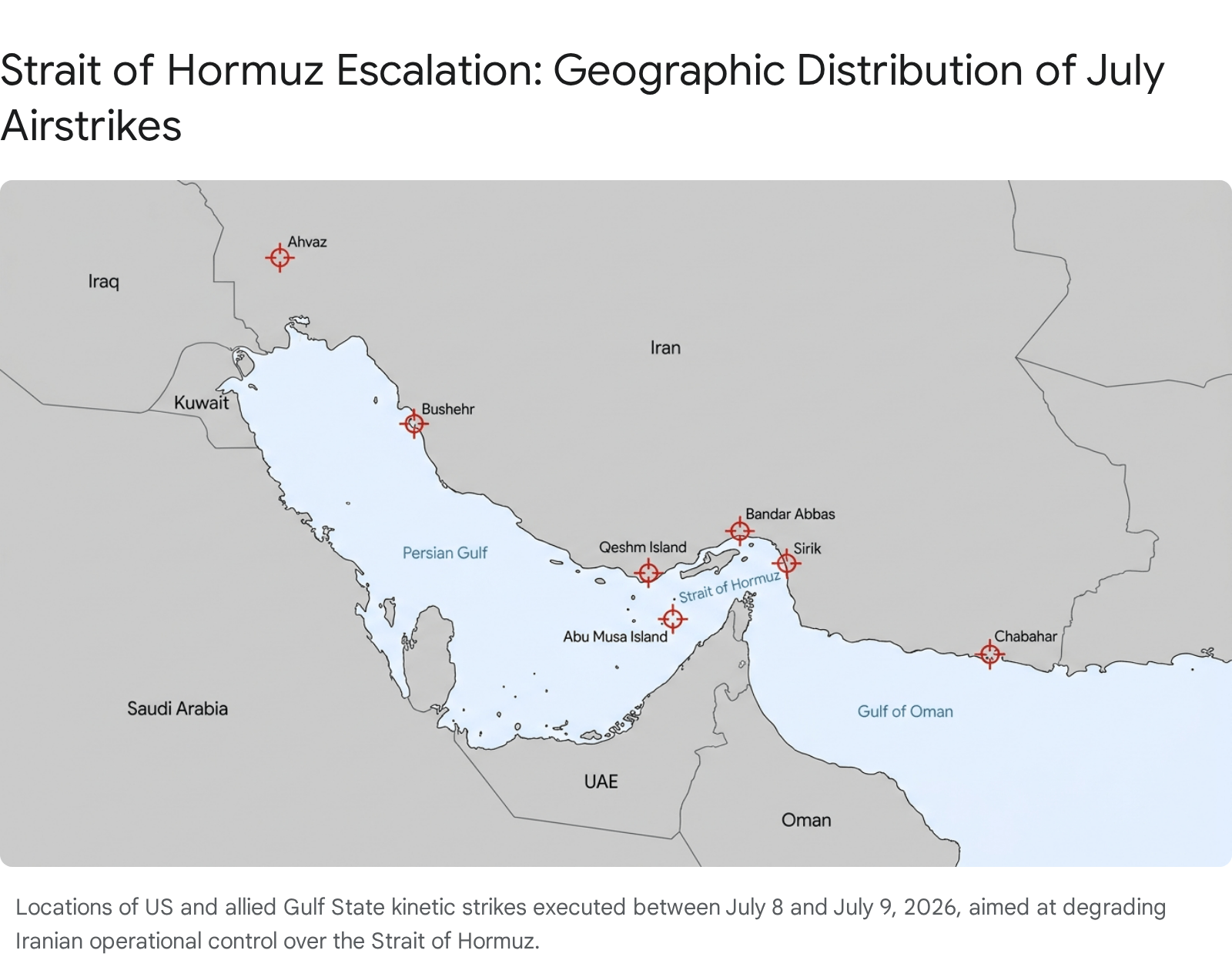
The Iranian regime responded swiftly and kinetically to the US operations. On July 8 and 9, Iranian military forces launched waves of retaliatory drone and ballistic missile strikes targeting US military installations hosted by neighboring Gulf states. Air-defense sirens were activated multiple times in Bahrain, which hosts the headquarters of the US Navy’s 5th Fleet, while the Kuwaiti military reported active and ongoing intercepts of incoming Iranian loitering munitions.2 The conflict further broadened and internationalized on July 9, when regional Gulf states—assessed by Iranian intelligence to be the United Arab Emirates (UAE)—conducted their own independent strikes against unspecified targets in the Iranian cities of Chabahar, Bandar Abbas, Qeshm Island, and Ahvaz.4 In response to this perceived regional betrayal, Iranian Parliamentarian Esmail Kowsari publicly accused the UAE of conducting the strikes and threatened to systematically target the UAE’s maritime, rail, and air transport infrastructure, suggesting the UAE should be added to Iran’s military “target bank”.4
Strategically, the regime in Tehran remains internally fractured regarding tactical execution, though uniformly unified in its overarching geostrategic objectives. Pragmatic Iranian negotiators are actively attempting to preserve backchannel diplomatic communications to prevent a broader, sustained US strike campaign that could definitively cripple the domestic economy and infrastructure.3 Conversely, the senior leadership of the Islamic Revolutionary Guards Corps (IRGC) has explicitly endorsed the use of force to maintain absolute control over the Strait of Hormuz, viewing it as the ultimate guarantor of regime survival.3 The negotiating gap between Washington and Tehran remains vast and seemingly irreconcilable. The US demands the unconditional, public opening of the strait to all commercial traffic and a complete return to the pre-war maritime status quo.3 Iranian officials, however, insist that relinquishing management of the strait equates to national surrender and demand international recognition of Iranian administration over a newly designated traffic separation scheme.3 To further this diplomatic maneuvering and exploit regional anxieties, Iranian Foreign Affairs Minister Abbas Araghchi deployed to Oman on July 11 to negotiate strait administration parameters with Omani officials.3
| Strategic Issue | United States Negotiating Position | Islamic Republic of Iran Negotiating Position |
| Strait of Hormuz Status | Demands public acknowledgment of open commercial traffic and return to pre-war status quo. | Rejects pre-war system; insists on Iranian-designated traffic separation scheme and administrative control. |
| Maritime Interdictions | Views attacks on commercial shipping as acts of terrorism and breaches of the MoU. | Views interdictions as legal enforcement of sovereignty permitted under Clause 5 of the MoU. |
| Nuclear Program | Will not conclude agreements unless Iran relinquishes highly enriched nuclear material. | Refuses to discuss the nuclear program unless the US recognizes full Iranian management of the Strait of Hormuz. |
Conflict/Threat Name: Iraqi Proxy Environment
Weekly Key Events: In a major strategic realignment designed to aggressively curb Iranian proxy influence and secure the withdrawal of international forces, the United States and the Iraqi federal government are finalizing a comprehensive bilateral security and economic agreement. Negotiated between Iraqi Prime Minister Ali al-Zaidi and US Ambassador to Lebanon and Iraq Tom Barrack during a June 15 meeting in Baghdad, the agreement guarantees extensive US financial investment in Iraq’s energy and infrastructure sectors in exchange for the systemic disarmament of Iranian-backed Iraqi militias by the end of September 2026. This highly ambitious timeline aligns precisely with the scheduled departure of US-led international coalition forces.
Furthermore, the pact legally requires Baghdad to execute a political purge, removing militia-affiliated figures from senior government positions and actively dismantling their illicit financial networks.4 The Iraqi government has formed a disarmament committee to restrict weapons exclusively to state security forces. The US has maintained firm, uncompromising opposition to the appointment of any militia-aligned figures to critical governance roles, which has severely complicated ongoing Iraqi negotiations to fill the remaining vacant ministries, including Defense and Interior.4 Specifically, Washington opposes granting ministerial portfolios to parties such as Sadiqoun—the political wing of the Iranian-backed Asaib Ahl al Haq militia—even if such groups publicly announce their disarmament, viewing such declarations as tactically deceptive.4
Conflict/Threat Name: Syrian Transitional Instability
Weekly Key Events: The Syrian interim government, led by President Ahmed al-Sharaa following the December 2024 ouster of Bashar al-Assad, continues to face significant internal security challenges. On July 7, 2026, two explosive devices detonated near the Four Seasons Hotel in Damascus, wounding at least 18 people, including four police officers. The bombings coincided with a landmark visit by French President Emmanuel Macron, who met with al-Sharaa to sign memorandums of understanding aimed at post-war reconstruction. Concurrently, on July 8, the US administration announced its intention to rescind Syria’s designation as a State Sponsor of Terrorism, a major step toward reintegrating the nation into global financial systems following the regime change. Meanwhile, border tensions remain elevated as Israeli forces maintain positions within Syrian territory beyond the 1974 ceasefire line.
Conflict/Threat Name: Israel-Hezbollah War
Weekly Key Events: Hostilities between the Israel Defense Forces (IDF) and Hezbollah persist, rendering the nominal frameworks of the November 2024 and April 2026 ceasefires effectively void.21 The operational environment in southern Lebanon remains highly volatile, characterized by localized skirmishes, artillery duels, and targeted assassinations. On July 8, an Israeli drone strike specifically targeted a civilian vehicle in Nabatieh al-Fawqa, resulting in four fatalities, including a local school principal, her mother, and two foreign domestic workers.23 While heavy, sustained rocket barrages have decreased along the Blue Line compared to the peak of the conflict, precision strikes continue unabated.24
The protracted nature of the conflict, which has resulted in over 4,000 fatalities from Israeli strikes and the displacement of over one million Lebanese civilians, has created a severe humanitarian crisis.1 UNIFIL peacekeepers report significant logistical obstacles and restrictions to operational movement, citing uncleared unexploded ordnance, debris, and temporary detentions by Israeli military checkpoints.24 Despite these challenges, UNIFIL continues to execute its monitoring mandate. The persistent threat of violence and the widespread destruction of civilian property are severely impeding the return of displaced Lebanese communities, who find their homes and infrastructure completely decimated upon attempting repatriation.24
Conflict/Threat Name: Gaza Strip Security and Governance
Weekly Key Events: The governance architecture of the Gaza Strip underwent a significant procedural, though potentially superficial, shift on July 6, when the Hamas militant group publicly announced the dissolution of its governing apparatus.26 According to Ismail al-Thawabta, the general director of the Hamas-run Government Media Office, administrative power is ostensibly being transferred to the National Committee for the Administration of Gaza (NCAG), a UN-backed body comprised of Palestinian technocrats.26 This transition is intended to rhetorically align with the US-brokered comprehensive peace plan endorsed by UN Resolution 2803 in November 2025, which mandated a transitional governance administration overseen by the Board of Peace (BoP), chaired by US President Donald Trump.26
However, the strategic impact and authenticity of this declaration remain highly ambiguous. The BoP has stipulated that the technocratic committee must exercise total and exclusive control over all weapons and security forces in the enclave.26 Hamas has resolutely refused to decommission its militant infrastructure, demobilize its fighters, or relinquish physical security control, citing ongoing Israeli military operations, targeted strikes, and severe restrictions on humanitarian aid as continuous breaches of the ceasefire obligations.27 Consequently, Israeli officials dismissed the Hamas announcement as an irrelevant political spin, noting that Hamas operatives remain deeply embedded within the administrative structures.26 On the ground, the humanitarian environment remains catastrophic. The reporting period saw new waves of civilian displacement along the designated “Yellow Line” amidst persistent, localized military activity.28 Furthermore, external criminal actors and local gangs continue to exploit the chaotic security vacuum to hijack and smuggle high-value items within humanitarian shipments, leading to violent confiscations by de facto authorities and severe delays in the distribution of life-saving aid.28
Conflict/Threat Name: Yemen Civil War and Red Sea Interdiction
Weekly Key Events: The fragile, de facto ceasefire that had largely paused the domestic Yemeni civil war was violently shattered during the reporting week, indicating a resumption of internal hostilities. On the weekend of July 4 and 5, Houthi rebel forces launched a massive, coordinated ground assault against established positions held by the internationally recognized government in the Hays district, located south of the strategic Red Sea port city of Hodeidah.29 Utilizing a combined-arms approach of snipers, heavy mortar salvos, and weaponized drone strikes, the Houthis temporarily overran pro-government defensive lines before a dawn counterattack successfully repelled the advance.29 The intense engagement resulted in 16 pro-government fatalities and 22 wounded, marking the deadliest domestic Houthi assault in several years and threatening a return to full-scale civil war.29
Simultaneously in the maritime domain, the Houthi campaign against international shipping in the Red Sea remains an active, potent threat. On July 5, the bulk carrier Lady Naeima issued a distress call approximately 13 nautical miles off the coast of Al-Durayhimi, a Houthi-controlled area near Hodeidah.31 The vessel was approached by multiple skiffs whose occupants closed within 20 meters and opened fire.31 Embarked private security contractors successfully returned fire, forcing the assailants to abort the boarding attempt and retreat to a larger command vessel operating with its AIS switched off.32 Diplomatic and political tensions also spiked regarding airspace sovereignty; the internationally recognized government formally blocked an Iranian Mahan Air flight from landing at the Houthi-controlled Sanaa airport to retrieve a Houthi delegation that had attended the funeral of Ali Khamenei.33 The government demanded the delegation return via Yemenia Airways, further straining the stalled peace process and demonstrating the deep polarization over sovereign control of Yemeni infrastructure.33
Conflict/Threat Name: West Bank Instability
Weekly Key Events: Security conditions across the West Bank continued to rapidly deteriorate due to expanding military movement restrictions, aggressive Israeli forces’ operations, and recurrent settler violence. During the reporting week, successive Israeli military closures and the installation of new checkpoints effectively isolated approximately 12,000 Palestinians residing in communities west of Ramallah.28 This severe isolation resulted in a critical medical emergency when the transfer of a four-month-old Palestinian infant to a local hospital was fatally delayed at an Israeli-staffed road gate.28 Concurrently, in Hebron’s highly volatile H2 area, Israeli forces installed new security gates, restricting one of the last remaining access routes to the Old City and further entrenching an institutionalized system of movement restrictions affecting roughly 7,000 Palestinian residents.28 These developments are systematically restricting access to essential services and livelihoods, driving localized displacement and increasing reliance on humanitarian interventions that are simultaneously constrained by the security environment.28
Indo-Pacific
Conflict/Threat Name: South China Sea Maritime Disputes
Weekly Key Events: The maritime standoff between the Philippines and the PRC in the South China Sea has metastasized significantly, with a new and highly volatile operational flashpoint emerging at Sabina Shoal.11 Following the severe June 17, 2024, confrontation at Second Thomas Shoal—during which China Coast Guard (CCG) personnel violently interdicted a Philippine Navy resupply mission using axes, machetes, and spears, resulting in a severed thumb for a Filipino sailor—Manila deployed the coast guard vessel BRP Teresa Magbuana to monitor Sabina Shoal against suspected Chinese land reclamation efforts.11 In response to this deployment, the PRC has dramatically escalated its localized force posture, deploying a continuous presence of 24 to 40 maritime militia and CCG vessels to the atoll.11 These Chinese assets have effectively encircled the Philippine vessel, frequently utilizing high-pressure water cannons, firing flares, and executing dangerous ramming maneuvers to assert dominance and force a Philippine withdrawal.11
This tactical escalation at Sabina Shoal coincides directly with the highly symbolic July 12 tenth anniversary of the landmark 2016 Permanent Court of Arbitration ruling. This ruling comprehensively invalidated Beijing’s expansive “nine-dash line” territorial claims and historical rights under the UN Convention on the Law of the Sea (UNCLOS). To mark the anniversary and signal collective deterrence, a coalition of 14 nations, prominently including the United States and the United Kingdom, issued a joint diplomatic communique reaffirming the legally binding and definitive nature of the ruling, while explicitly condemning the PRC’s destabilizing actions in the region. Despite the unified international consensus and the legal clarity provided by UNCLOS, Beijing continues to wholly reject the tribunal’s authority, utilizing its vast asymmetrical maritime superiority and grey-zone tactics to enforce de facto jurisdictional control over the disputed exclusive economic zones (EEZs) of Southeast Asian nations.
| Diplomatic & Legal Vector | International Consensus (US, UK, Philippines, UNCLOS) | People’s Republic of China (PRC) Position |
| 2016 PCA Arbitral Ruling | Legally binding, definitive, and final milestone invalidating expansive historical claims. | Rejects the tribunal’s authority and refuses to recognize the ruling’s validity. |
| Territorial Claims | Claims overlapping EEZs must be resolved peacefully under international maritime law. | Asserts historical right to roughly 85% of the South China Sea via the “nine-dash line.” |
| Maritime Navigation | Freedom of navigation and military intelligence gathering permitted within EEZs without notification. | Asserts foreign militaries cannot conduct intelligence operations in its EEZ. |
Conflict/Threat Name: Taiwan Strait Grey-Zone Operations
Weekly Key Events: The PRC has significantly accelerated and formalized its grey-zone coercion campaign against the island of Taiwan, transitioning from episodic, large-scale military exercises to a continuous, normalized presence designed to incrementally erode Taipei’s sovereignty and exhaust its defense forces.35 Intelligence assessments indicate that the PRC is actively implementing permanent CCG patrols in the waters east of Taiwan, a strategic shift that projects power beyond the immediate strait.12 During June 2026, the PRC conducted an unprecedented “special maritime law enforcement operation” in these eastern waters, wherein Chinese vessels actively hailed passing international cargo ships, attempting to assert jurisdictional authority and conduct quasi-inspections.12 This maneuver fundamentally alters the maritime status quo and theoretically establishes the logistical framework and legal pretext for a rapid-notice quarantine or total blockade of the island on short notice.12
Simultaneously, the PRC is testing calibrated coercion against Taiwan’s remote peripheral territories. The Pratas Islands (Dongsha Islands), located approximately 444 kilometers southwest of Kaohsiung in the northern South China Sea, have become a primary testing ground for this strategy. Throughout June and early July 2026, Chinese coast guard vessel No. 3501 and the hydrographic survey ship Hai Si Lu No. 6 repeatedly penetrated the restricted waters around the atoll.36 This pattern of deployment—comprising 39 distinct incursions by 12 different vessels over the past year—represents a strategic shift toward limited-objective pressure designed to probe the defense parameters of the contiguous zone without triggering a conventional military response.36 In the diplomatic and economic domains, Beijing has systematically obstructed Taiwan’s participation in global forums, successfully pressuring host nations to alter Taiwan’s status at a World Trade Organization ministerial in Cameroon, revoking overflight permissions for the Taiwanese President’s trip to Eswatini, and forcing the cancellation of the RightsCon summit in Zambia.37 Furthermore, Taiwanese authorities are prosecuting individuals for smuggling advanced Nvidia chips into the PRC, highlighting the ongoing technological espionage efforts circumventing US export controls.12
Conflict/Threat Name: Korean Peninsula Tensions
Weekly Key Events: Military posturing and brinkmanship on the Korean Peninsula remain highly elevated, characterized by a rapid expansion of North Korean conventional and asymmetric capabilities alongside increased military interoperability with the PRC and Russia. On July 12, the South Korean Unification Ministry publicly requested humanitarian assistance from Pyongyang to locate a South Korean navy seaman holding the rank of seaman apprentice.38 The sailor went missing while on a security patrol in the East Sea (Sea of Japan) and is believed to have drifted north of the highly sensitive Northern Limit Line (NLL).38 The DPRK has yet to issue a response to the request, a silence consistent with its 2024 constitutional declaration designating South Korea as a “hostile nation” and its persistent rebuffing of dialogue overtures from South Korean President Lee Jae Myung.39
Internally, North Korea continues to aggressively modernize its military infrastructure. State media reported decisions by the ruling party’s central military commission, overseen by Kim Jong Un, to quantitatively and qualitatively expand the national nuclear arsenal.40 Concurrently, Pyongyang is significantly expanding the operational mandate and capabilities of the General Reconnaissance and Intelligence Bureau, clearly indicating an anticipated increase in sophisticated espionage, cyber, and cognitive warfare operations directed against Seoul.40 In the naval domain, North Korea is preparing to commission its second guided-missile destroyer, the Kang Kon, which will expand its green-water surface fleet capabilities on both coasts despite struggling to develop necessary support facilities.13 Recent weapons tests involving the Kang Kon on July 3 utilized complex, multi-vector strike packages specifically designed to confuse US and South Korean launch detection and early warning systems.13 Furthermore, the strategic alignment between Pyongyang, Beijing, and Moscow was demonstrated by combined aerial and naval incursions into South Korea’s Air Defense Identification Zone (ADIZ) and near the NLL on June 27, an explicit signal of joint territorial encroachment and a willingness by authoritarian states to test South Korean resolve.13
Conflict/Threat Name: Myanmar Civil War
Weekly Key Events: The military junta, operating as the State Administration Council (SAC), is suffering unprecedented territorial and operational losses against the Three Brotherhood Alliance and cooperating People’s Defense Forces (PDFs). The civil war has escalated significantly, with the military losing control of two-thirds of the country’s territory, including strategic regional command headquarters, and facing an increasing number of desertions. In response to these structural collapses, the SAC activated a mandatory conscription law, prompting a mass exodus of young civilians and heightening the humanitarian catastrophe. The conflict has internally displaced over 400,000 people in Rakhine and southern Chin States and forced at least 150,000 Rohingya to flee into Bangladesh since late 2023, driving tens of thousands to attempt dangerous maritime crossings to seek refuge.
Sub-Saharan Africa
Conflict/Threat Name: Sudan Civil War
Weekly Key Events: The civil war in Sudan has evolved into a heavily internationalized, multi-front conflict characterized by the deployment of foreign proxy forces, the total breakdown of humanitarian law, and a systemic reliance on advanced drone warfare by all belligerents.14 In the southeastern Blue Nile State, the Sudanese Armed Forces (SAF) successfully recaptured the highly strategic border town of al-Kurmuk on July 8 following a fierce six-hour engagement against a coalition consisting of the Rapid Support Forces (RSF) and the Abdelaziz al-Hilu faction of the Sudan People’s Liberation Movement-North (SPLM-N).15 The town commands the primary highway corridor linking western Ethiopia to Khartoum and guards the approaches to the critical Roseires Dam, which supplies much of Sudan’s electricity.15 The SAF’s operational success, however, was swiftly and lethally countered; on the evening of July 10, a precision drone strike in al-Kurmuk specifically targeted a command gathering of “Army 70″—a contingent of the Tigray People’s Liberation Front fighting as a proxy on behalf of the SAF.15 The strike killed several senior officers and wounded Eritrean soldiers embedded within the unit, exposing the deep regional convergence of forces operating within Sudanese territory.15
In the western theater of Darfur, the RSF is actively massing forces for a major, potentially decisive ground offensive. Following the liberation of the town of Kulbus (West Darfur) by SAF-aligned Joint Forces on June 29, the RSF spent the reporting week deploying massive mechanized reinforcements from El Geneina, Saraf Omra, and Kabkabiya to the outskirts of Kulbus and Tine.42 This military buildup included a scorched-earth campaign that deliberately burned markets and water sources, forcing residents of eight villages to flee across the border into Chadian territory.42 Across all fronts, an independent investigation published by The Reckoning Project documented the systemic use of advanced unmanned aerial vehicles (supplied by foreign sponsors like the UAE) and aerial bombardment by both the SAF and RSF.14 These strikes frequently employ “double tap” tactics aimed intentionally at first responders and have repeatedly struck civilian infrastructure, including a devastating February strike on Cinema Street in Nyala and a September drone attack on a mosque in El Fasher that killed 70 worshippers during dawn prayers.14
Conflict/Threat Name: Eastern DRC Instability and Humanitarian Crisis
Weekly Key Events: The security environment in the eastern Democratic Republic of the Congo (DRC) is rapidly deteriorating due to the converging vectors of a robust M23 insurgency and an escalating, highly lethal epidemiological crisis. Clashes between the Armed Forces of the Democratic Republic of the Congo (FARDC) and the Rwanda-backed M23 armed group remained intense across the North and South Kivu provinces.16 Both belligerents are reportedly utilizing armed drones and heavy explosive weapons in densely populated civilian areas, leading to summary executions and massive displacement.16 Despite diplomatic commitments made in June to de-escalate tensions during the Doha process in Switzerland, the conflict persists unabated, prompting the UN High Commissioner for Human Rights, Volker Türk, to issue an urgent appeal for a cessation of hostilities on July 9.16 In an effort to disrupt the financial networks sustaining the M23, the United States Department of the Treasury imposed targeted sanctions on July 6 against Rwandan businessmen Jean Malic Kalima and Bosco Kayobotsi, as well as several Rwandan entities including the Gasabo Gold Refinery and Bugambira Mines, for facilitating the illicit extraction and trade of conflict minerals.45
The lethality of the kinetic conflict is being catastrophically compounded by an unprecedented outbreak of the Bundibugyo variant of the Ebola virus. Government data released on July 8 confirmed 1,759 cases and 600 fatalities, making it the fastest-growing Ebola outbreak on record for any variant.17 The virus has breached provincial boundaries, spreading from the epicenter in Ituri into the Tshopo and Haut-Uélé provinces, and has already crossed international borders into neighboring Uganda.17 The kinetic environment directly facilitates the spread of the pathogen; active combat, targeted attacks on healthcare workers and treatment centers, and rampant misinformation have paralyzed contact tracing, aid delivery, and quarantine efforts, raising the high probability of a regional pandemic.17
Conflict/Threat Name: Sahel Insurgency
Weekly Key Events: The security apparatus across the Central Sahel is demonstrating severe and systemic vulnerabilities in the face of an highly adaptive, consolidating jihadist insurgency. The strategic landscape in Mali was fundamentally altered following coordinated, multi-front attacks on April 25 by Jama’at Nusrat al-Islam wal-Muslimin (JNIM)—an al-Qaeda affiliate—operating in an unprecedented, pragmatic alliance with Tuareg separatists of the Azawad Liberation Front (FLA).46 This convergence of jihadist and separatist forces allowed them to successfully target critical military installations in Bamako, Kati, Gao, and Kidal, ultimately leading to a full-scale blockade of the capital and the assassination of the Malian Defence Minister, General Sadio Camara, via a suicide vehicle-borne IED.47
The capability of these non-state actors to project sustained combat power into major urban centers has overwhelmed the Malian military junta. Furthermore, the withdrawal of the Russian Africa Corps (the successor to the Wagner Group) from several northern territories underscores the severe limitations of Mali’s external security partnerships.47 Diplomatic postures, however, remain defiantly anti-Western; during a recent panel at the Stimson Center, the ambassadors of the Alliance of Sahel States (Mali, Burkina Faso, and Niger) falsely claimed that regional terrorism was entirely fabricated by Western mercenaries, signaling an entrenched political opposition to any renewed Western military cooperation or UN intervention.49 The expansion of JNIM into neighboring states, including a deadly campaign against Dozo militias and attacks into Nigeria’s Kwara State, confirms the regional spillover of the conflict.48
Conflict/Threat Name: Somalia Al-Shabaab Insurgency
Weekly Key Events: Counterinsurgency operations in Somalia face significant, potentially crippling disruption following a major shift in international support and funding. On July 2, the United States formally notified the African Union that it will unilaterally prevent the United Nations from funding the African Union Support and Stabilization Mission in Somalia (AUSSOM) for the upcoming year.51 The US cited persistent political infighting between the Federal Government of Somalia (FGS) and regional states (such as Jubaland and Puntland), and a fundamental failure to collaborate on basic governance as the primary rationale for the suspension.51 This funding freeze poses a critical threat to the operational viability of AUSSOM, which provides indispensable logistical, air, and combat support to the Somali National Army (SNA) in its ongoing campaign against the Al-Shabaab insurgency.51
Despite the looming logistical constraints and political fragmentation, kinetic operations against the insurgency continued during the reporting week. On June 29, the SNA, operating in close coordination with the Turkish Armed Forces, executed a series of precision airstrikes in southern Somalia. The Ministry of Defense reported that the strikes successfully killed 35 Al-Shabaab militants, injured 20 others, and destroyed multiple caches of explosives and weapons.51 However, Al-Shabaab retains significant offensive capabilities, continues to exact high casualties against Ugandan UPDF troops, and exploits the political fragmentation within Somalia.53 On July 11, insurgent forces launched a direct attack against Ethiopian troops stationed in Wajid.54 The insurgency continues to weaponize the overlapping crises of political violence, climate vulnerability, and environmental fragility, severely impeding agricultural output and humanitarian access across the territories it contests, driving localized famine conditions.54
Western Hemisphere
Conflict/Threat Name: Colombian Internal Conflict
Weekly Key Events: Despite the government’s “total peace” strategy, violence in Colombia has surged due to escalating clashes among armed groups fighting for control over illicit economies. The National Liberation Army (ELN), the “Gulf Clan” (EGC), and FARC dissident factions are systematically employing violent coercion, leading to the severe confinement of over 137,000 civilians between January and August 2025. The political environment was further destabilized by the assassination of congressman and presidential candidate Miguel Uribe Turbay ahead of the 2026 elections. The UN verified hundreds of grave violations against children, noting alarmingly high rates of forced recruitment via social media platforms, which disproportionately impacts Indigenous and Afro-Colombian communities.
Conflict/Threat Name: Venezuela-Guyana Territorial Dispute
Weekly Key Events: The long-standing territorial dispute between the Bolivarian Republic of Venezuela and the Cooperative Republic of Guyana over the oil-rich Essequibo region remains structurally dormant but legally active. The immediate threat of conventional military annexation by Caracas was neutralized following the January 3, 2026, capture of Venezuelan President Nicolás Maduro by United States forces.55 With Maduro transferred to New York to face narco-terrorism charges, the interim government led by Vice President Delcy Rodríguez has adopted a less kinetic posture regarding the border, focusing internally on the aftermath of severe earthquakes.55 However, the fundamental geopolitical dispute remains unresolved, as the claim to the Essequibo territory is a point of rare consensus across both the Maduro-aligned government and the Venezuelan political opposition.55 The International Court of Justice (ICJ) concluded its merits hearings on the boundary case on May 11, 2026, and is expected to deliver a ruling around August 2026.55 Materiality Rule: No material updates this period.
3. Appendix: Methodology
The intelligence synthesized within this Weekly Situation Report is derived from a rigorously structured Open-Source Intelligence (OSINT) collection methodology. The analytical framework is specifically designed to filter the high-volume, highly polluted information environment characteristic of modern conflict zones, isolating verifiable strategic and tactical data from state-sponsored disinformation, psychological operations, and media hyperbole.
The primary collection apparatus continuously monitors a predefined matrix of authoritative sources. These include reputable defense research institutes (e.g., the Institute for the Study of War, Center for Strategic and International Studies), official government and military briefings, verified regional reporting, and non-governmental organization situation reports (e.g., OCHA, WHO, ACLED).
To determine the veracity, credibility, and materiality of an event, the framework employs a multi-tiered verification process:
- Cross-Verification: Claims of territorial changes, kinetic strikes, or significant military maneuvers must be corroborated by at least two independent, high-confidence sources. Where possible, claims must be supported by verifiable visual intelligence (e.g., geolocated combat footage, commercial satellite imagery, or standardized reporting frameworks).
- Data Anomaly Tracking: The framework actively monitors secondary, quantitative indicators of conflict to verify qualitative claims. For example, the assessment of the maritime blockade in the Sea of Azov relied heavily on Starboard Maritime Intelligence data tracking anomalies and total drop-offs in Automatic Identification System (AIS) transponder signals, providing indisputable mathematical proof of maritime behavioral shifts in response to strike threats.5
- Materiality Threshold: An event is deemed material—and thus included in the report—only if it demonstrably alters the operational capabilities of a belligerent, changes territorial control, impacts strategic supply chains, or signals a measurable shift in regional geopolitical posture. Routine border skirmishes, standard patrols, or political rhetoric that do not result in tangible strategic effects are rigorously excluded to maintain analytical density and focus.
A critical component of this report is the tracking and analysis of “grey-zone” activities. For the purposes of this intelligence assessment, grey-zone operations are defined as coercive statecraft actions that deliberately blur the line between war and peace. These operations remain below the threshold that would conventionally trigger a declared military response or invoke mutual defense treaties, yet they achieve strategic objectives traditionally pursued through armed conflict.
The analytical framework distinguishes grey-zone operations from routine diplomatic or military maneuvers through three specific, observable indicators:
- Asymmetry and Plausible Deniability: The systemic use of non-traditional assets, such as maritime militias, state-sponsored hacktivists, or dual-use research vessels (as explicitly observed in the South China Sea and Taiwan Strait) to project power while avoiding direct attribution to uniformed military forces.7
- Incremental Coercion: Operations designed to slowly alter the status quo through persistent, low-level physical presence. Examples include permanent coast guard patrols in contested contiguous zones or continuous hydrographic surveys that individually do not warrant a kinetic response but cumulatively result in de facto annexation or jurisdictional control.12
- Multi-Domain Synchronization: The highly coordinated, simultaneous application of economic coercion, cyber disruption, and cognitive/information warfare designed to degrade an adversary’s societal resilience, operating in tandem with physical pressure campaigns to overwhelm defensive decision-making cycles.37
Please share the link on Facebook, Forums, with colleagues, etc. Your support is much appreciated and if you have any feedback, please email us in**@*********ps.com. If you’d like to request a report or order a reprint, please click here for the corresponding page to open in new tab.
Sources Used
- 2026 Iran war | Deal, Explained, United States, Israel, Strait of Hormuz, Map, & Conflict, accessed July 12, 2026, https://www.britannica.com/event/2026-Iran-war
- US launches strikes on Iran for a second day after Trump says …, accessed July 12, 2026, https://www.theguardian.com/world/2026/jul/08/us-carries-out-another-wave-of-strikes-on-iran
- Iran Update Special Report, July 11, 2026 | ISW, accessed July 12, 2026, https://understandingwar.org/research/middle-east/iran-update-special-report-july-11-2026/
- Iran Update Special Report, July 10, 2026 | ISW, accessed July 12, 2026, https://understandingwar.org/research/middle-east/iran-update-special-report-july-10-2026/
- Russian Offensive Campaign Assessment, July 11, 2026 | ISW, accessed July 12, 2026, https://understandingwar.org/research/russia-ukraine/russian-offensive-campaign-assessment-july-11-2026/
- Russian Offensive Campaign Assessment, July 9, 2026 | ISW, accessed July 12, 2026, https://understandingwar.org/research/russia-ukraine/russian-offensive-campaign-assessment-july-9-2026/
- Russia State-Sponsored Cyber Threat: Advisories – CISA, accessed July 12, 2026, https://www.cisa.gov/topics/cyber-threats-and-advisories/nation-state-cyber-actors/russia/publications
- Russian Offensive Campaign Assessment, July 10, 2026 | ISW, accessed July 12, 2026, https://understandingwar.org/research/russia-ukraine/russian-offensive-campaign-assessment-july-10-2026/
- Navigating the Maritime Gray Zone – Indo-Pacific Defense FORUM, accessed July 12, 2026, https://ipdefenseforum.com/2026/06/navigating-the-maritime-gray-zone/
- Manila’s push for a new rulebook in the South China Sea peters out, accessed July 12, 2026, https://verafiles.org/articles/manilas-push-for-a-new-rulebook-in-the-south-china-sea-peters-out
- A new flashpoint has emerged at Sabina Shoal in the South China Sea – and a new danger, accessed July 12, 2026, https://www.theguardian.com/world/article/2024/sep/05/south-china-sea-sabina-shoal-latest-updates-philippines
- China & Taiwan Update, July 10, 2026 | ISW, accessed July 12, 2026, https://understandingwar.org/research/china-taiwan/china-taiwan-update-july-10-2026/
- Korean Peninsula Update, July 7, 2026, accessed July 12, 2026, https://understandingwar.org/research/china-taiwan/korean-peninsula-update-july-7-2026/
- Sudan’s warring parties deliberately target civilians in Darfur airstrikes, report says, accessed July 12, 2026, https://sudantribune.com/article/316141
- Army 70, Tsimdo, and the Fight for Kurmuk, accessed July 12, 2026, https://hornreview.org/2026/07/12/army-70-tsimdo-and-the-fight-for-kurmuk/
- UN rights chief calls for urgent end to fighting in eastern DR Congo – Anadolu Ajansı, accessed July 12, 2026, https://www.aa.com.tr/en/africa/un-rights-chief-calls-for-urgent-end-to-fighting-in-eastern-dr-congo/3993316
- Visualised: how conflict, aid cuts and health-worker attacks are helping Ebola spread in DRC, accessed July 12, 2026, https://www.theguardian.com/world/2026/jul/10/visualised-how-conflict-aid-cuts-and-health-worker-attacks-are-helping-ebola-spread-in-drc
- Russian Offensive Campaign Assessment, July 1, 2026, accessed July 12, 2026, https://understandingwar.org/research/russia-ukraine/russian-offensive-campaign-assessment-july-1-2026/
- Russian Offensive Campaign Assessment, July 8, 2026 | ISW, accessed July 12, 2026, https://understandingwar.org/research/russia-ukraine/russian-offensive-campaign-assessment-july-8-2026/
- Iran and U.S. ramp up tit-for-tat strikes as Khamenei laid to rest, accessed July 12, 2026, https://www.cbsnews.com/live-updates/iran-us-war-trump-ceasefire-over-strait-of-hormuz-attacks/
- 2026 Lebanon war – Wikipedia, accessed July 12, 2026, https://en.wikipedia.org/wiki/2026_Lebanon_war
- Lebanon: Israeli attacks killing children, wiping out families must be investigated as war crimes, accessed July 12, 2026, https://www.amnesty.org/en/latest/news/2026/07/lebanon-israeli-attacks-killing-children-wiping-out-families-must-be-investigated-as-war-crimes/
- Middle East crisis: Funeral procession for supreme leader Ali Khamenei begins in Iran – as it happened, accessed July 12, 2026, https://www.theguardian.com/world/live/2026/jul/06/iran-middle-east-crisis-funeral-supreme-leader-ali-khamenei-tehran-latest-news-updates
- Grim homecoming: Devastation greets Lebanon’s war-weary returnees, accessed July 12, 2026, https://news.un.org/en/story/2026/07/1167893
- Middle East Overview: July 2026 – Lebanon – ReliefWeb, accessed July 12, 2026, https://reliefweb.int/report/lebanon/middle-east-overview-july-2026
- Hamas dissolves its government in Gaza to transfer power to a UN-backed committee, accessed July 12, 2026, https://www.opb.org/article/2026/07/06/hamas-dissolves-its-government-in-gaza-to-transfer-power-to-a-un-backed-committee/
- The Middle East, including the Palestinian Question, July 2026 Monthly Forecast, accessed July 12, 2026, https://www.securitycouncilreport.org/monthly-forecast/2026-07/the-middle-east-including-the-palestinian-question-25.php
- Humanitarian Situation Report | 10 July 2026 | United Nations Office for the Coordination of Humanitarian Affairs – Occupied Palestinian Territory – OCHA oPt, accessed July 12, 2026, https://www.ochaopt.org/content/humanitarian-situation-report-10-july-2026
- Yemen’s Houthis kill 16 government troops; British agency reports attack on cargo ship in Red Sea, accessed July 12, 2026, https://www.cbsnews.com/news/yemen-houthi-rebels-red-sea-attack-cargo-ship/
- Yemen’s Houthi Rebels Kill 16 Soldiers of Internationally Recognised Government in a Latest Attack – YouTube, accessed July 12, 2026, https://www.youtube.com/watch?v=oeBYRxAO7Gs
- Red Sea security worsens as Hormuz transits rise, accessed July 12, 2026, https://www.seatrade-maritime.com/security/red-sea-security-worsens-as-hormuz-transits-rise
- Cargo ship comes under fire off coast of Houthi-controlled Yemen – The Times of Israel, accessed July 12, 2026, https://www.timesofisrael.com/cargo-ship-comes-under-fire-off-coast-of-houthi-controlled-yemen/
- What is going on in Yemen? | Houthis – Al Jazeera, accessed July 12, 2026, https://www.aljazeera.com/features/2026/7/11/what-is-going-on-in-yemen
- PH arbitral win’s legacy: World’s eyes on China, accessed July 12, 2026, https://www.inquirer.net/480297/ph-arbitral-wins-legacy-worlds-eyes-on-china/
- The Status Quo Cannot Hold?, accessed July 12, 2026, https://dominotheory.com/the-status-quo-cannot-hold/
- China’s Grey-Zone Coercion at Taiwan’s Pratas Islands – Observer Research Foundation, accessed July 12, 2026, https://www.orfonline.org/expert-speak/china-s-grey-zone-coercion-at-taiwan-s-pratas-islands
- Beijing is testing who will stand by Taiwan, accessed July 12, 2026, https://www.aspistrategist.org.au/beijing-is-testing-who-will-stand-by-taiwan/
- South Korea asks North to help search for missing navy sailor, accessed July 12, 2026, https://www.straitstimes.com/asia/east-asia/south-korea-asks-north-to-help-search-for-missing-navy-sailor
- South Korea asks North Korea for help finding missing seaman near border, accessed July 12, 2026, https://www.gmanetwork.com/news/topstories/world/994624/south-korea-asks-north-korea-for-help-finding-missing-seaman-near-border/story/
- North Korea to expand nuclear arsenal, boost military intelligence operations targeting South Korea, accessed July 12, 2026, https://www.newindianexpress.com/world/2026/Jul/10/north-korea-to-expand-nuclear-arsenal-boost-military-intelligence-operations-targeting-south-korea
- Sudanese army recaptures strategic border town of Kurmuk – Sudan Tribune, accessed July 12, 2026, https://sudantribune.com/article/315994
- Sudanese paramilitary sends huge reinforcements to West Darfur town, sources say, accessed July 12, 2026, https://sudantribune.com/article/316030
- Use of explosive weapons ‘must stop’ in eastern DR Congo: Türk | UN News, accessed July 12, 2026, https://news.un.org/en/story/2026/07/1167906
- Democratic Republic of the Congo, June 2026 Monthly Forecast – Security Council Report, accessed July 12, 2026, https://www.securitycouncilreport.org/monthly-forecast/2026-06/democratic-republic-of-the-congo-34.php
- How conflict minerals fuel war in eastern DR Congo amid US sanctions | News | Al Jazeera, accessed July 12, 2026, https://www.aljazeera.com/news/2026/7/6/us-sanctions-target-rwandan-firms-linked-to-conflict-minerals-funding-m23
- Mali Attacks: Aggravating the Sahel Security Crisis – Stimson Center, accessed July 12, 2026, https://www.stimson.org/2026/mali-attacks-aggravating-the-sahel-security-crisis/
- West Africa and the Sahel, July 2026 Monthly Forecast, accessed July 12, 2026, https://www.securitycouncilreport.org/monthly-forecast/2026-07/west-africa-and-the-sahel-17.php
- Deadly Jihadist Groups Gain Momentum Across Continent, accessed July 12, 2026, https://adf-magazine.com/2026/07/deadly-jihadist-groups-gain-momentum-across-continent/
- Sahel collapse, Mali conflict, accessed July 12, 2026, https://www.gisreportsonline.com/r/sahel-collapse-mali-conflict/
- Conflict in the Sahel – ACLED, accessed July 12, 2026, https://acleddata.com/region/conflict-sahel
- Conflict With Al-Shabaab in Somalia | Global Conflict Tracker – Council on Foreign Relations, accessed July 12, 2026, https://www.cfr.org/global-conflict-tracker/conflict/al-shabab-somalia
- Somalia Country Report 2026 – BTI, accessed July 12, 2026, https://bti-project.org/en/reports/country-report/SOM
- New Chapter, Same Stalemate: Somalia’s War with Al-Shabaab, accessed July 12, 2026, https://www.crisisgroup.org/brf/africa/somalia/b212-new-chapter-same-stalemate-somalias-war-al-shabaab
- Somalia’s Conflicts Are Fueling Hunger More Than Drought, accessed July 12, 2026, https://hornobserver.com/articles/3688/Somalias-Conflicts-Are-Fueling-Hunger-More-Than-Drought
- The Caracas Intervention and the Future – Bloomsbury Intelligence and Security Institute, accessed July 12, 2026, https://bisi.org.uk/reports/the-caracas-intervention-and-the-future-gabriel-perkins
- Under guise of relief, Pentagon deploys 2,000 troops to Venezuela, securing semicolonial foothold – World Socialist Web Site, accessed July 12, 2026, https://www.wsws.org/en/articles/2026/07/09/weno-j09.html
- ICJ 2026 Update Brief: Guyana v. Venezuela | IMUNA | NHSMUN | Model UN, accessed July 12, 2026, https://imuna.org/blog/icj-2026-update-brief-guyana-v-venezuela/
- ISACA Now Blog 2026 The Grey Zone Threat to AI Sovereignty Subsea Sabotage Connectivity and National Security, accessed July 12, 2026, https://www.isaca.org/resources/news-and-trends/isaca-now-blog/2026/the-grey-zone-threat-to-ai-sovereignty-subsea-sabotage-connectivity-and-national-security