The Science of Firearm Friction and Wear
The reliability of a firearm depends on its tribology, the study of interacting surfaces in motion, including friction, wear, and lubrication. Modern firearms, especially gas-operated systems, work in harsh environments defined by extreme heat, rapid cycling, and heavy carbon contamination1. When a cartridge fires, propellant gases create intense pressure and heat, driving the bolt carrier group or slide back at high speed3. Critical contact points, such as locking lugs and slide rails, face severe mechanical stress and rely on microscopic layers of lubricant to prevent mechanical failure1.
In these high-stress situations, lubrication must work across different stages. In ideal “hydrodynamic” lubrication, a continuous fluid film separates the metal surfaces to eliminate wear1. However, during rapid firing, immense pressure often squeezes this fluid out of the contact zone, forcing the system into “boundary” lubrication1. At this stage, the fluid alone cannot protect the metal; instead, the weapon relies on chemical additives, extreme pressure and anti-wear agents, to react with the steel and form a protective barrier1.
Firearm lubrication has evolved alongside industrial lubricants. Since the first commercial oil well in 1859, petroleum-based oils replaced animal fats to become the standard for weaponry8. While refined crude oil met needs for decades, modern tactical environments are more demanding. Sound suppressors, high-cadence automatic fire, and very hot or very cold weather have pushed traditional petroleum lubricants past their limits.
This evolution requires an analysis of whether petroleum-based oils are still sufficient and why advanced synthetic formulations, specifically Gas-to-Liquid-synthesized High Reliability Oils, are now seen as the superior solution for modern weapons.
The Chemistry and Utility of Petroleum-Based Lubricants
The American Petroleum Institute divides petroleum base oils into three groups: I, II, and III. Groups I and II are processed to remove basic impurities11. Group III oils undergo “hydrocracking,” where the oil is heated to roughly 1,000°F under high pressure and treated with hydrogen to break down impurities and improve molecular stability12.
Petroleum oils remain useful because of their strong natural solvency13. Since they are refined from a varied mixture of crude oil, their irregular molecular structure gives them an aggressive ability to dissolve and carry away carbon fouling and powder residue13.
Additionally, the industry has developed effective additive packages for petroleum stocks over the last century13. When mixed with corrosion inhibitors and anti-wear agents, petroleum oils provide reliable lubrication and rust protection at a low cost8. For casual shooting, range practice, or bolt-action hunting in moderate weather, a high-quality petroleum oil is a safe and cost-effective choice5.
| Base Oil Type | Source Origin | Molecular Structure | Natural Solvency | Cost Profile |
| Petroleum (Mineral) | Refined Crude Oil | Varied, irregular shapes/sizes | Exceptionally High | Low / Economical |
| PAO (Group IV) | Synthesized Ethylene | Uniform, consistent | Low (Requires Esters) | High / Premium |
| GTL (Group III+) | Synthesized Natural Gas | Highly uniform iso-paraffins | Moderate to High | Premium |
Thermodynamic Limitations and Molecular Variance
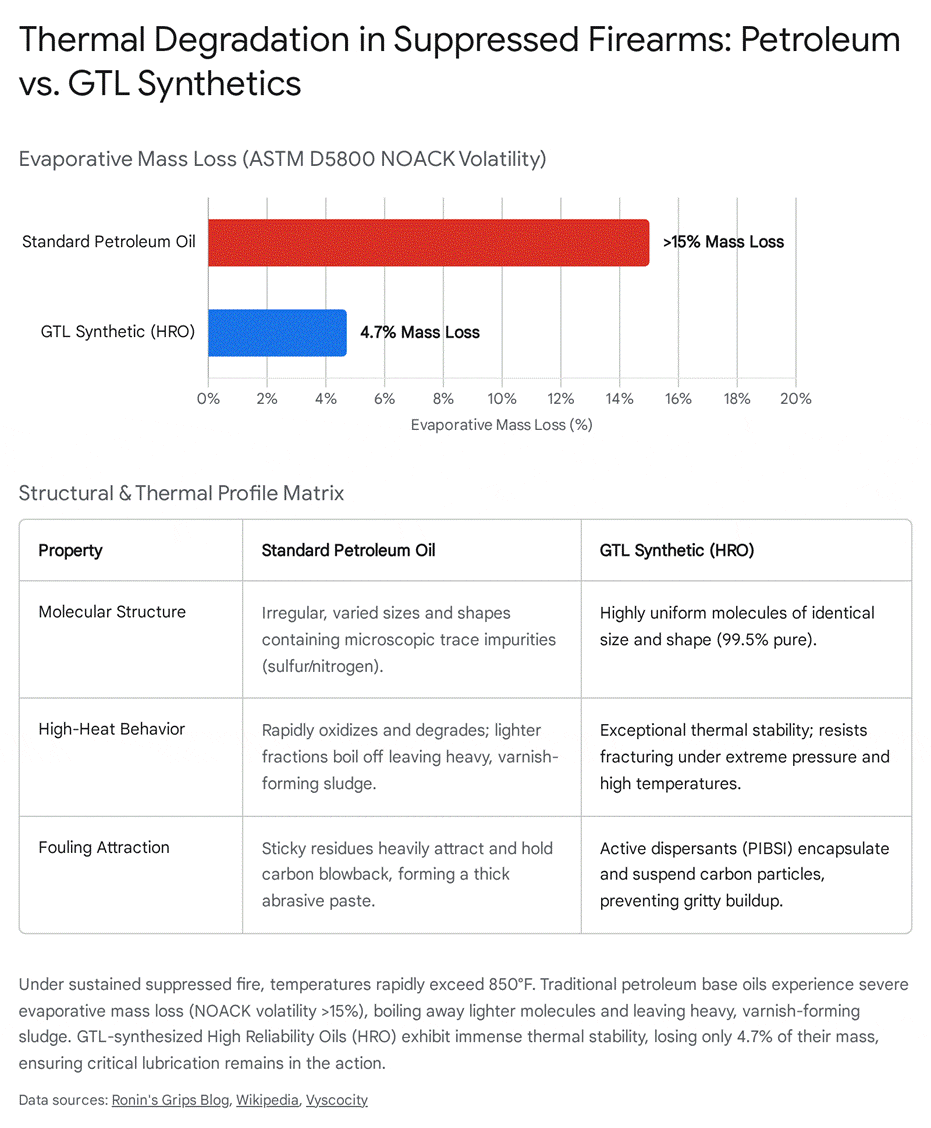
Despite their history, petroleum oils struggle under the intense heat and mechanical stress of modern tactical firearms. This is due to their origin; crude oil is a complex mixture with irregular molecules and contaminants like sulfur, nitrogen, and natural waxes1. Even highly refined mineral oils contain molecules that vary widely in size and structure13.
This lack of uniformity is a vulnerability. Under extreme heat, such as the rapid temperature spikes in a receiver during fast firing, the varied molecular structure begins to break apart14. Smaller molecules evaporate quickly, a trait known as volatility15. As these molecules vanish, the remaining oil thickens uncontrollably, significantly changing its viscosity and effectiveness15.
At the same time, impurities in the oil react with oxygen to form corrosive acids, a process called oxidation18. This combination of evaporation and oxidation causes the oil to bake onto hot metal surfaces, leaving behind sticky sludge and varnish14. This residue attracts dust and carbon, forming an abrasive paste that slows down the action and leads to malfunctions like failure to feed or extract1.
Additionally, natural waxes in petroleum oils can congeal in freezing temperatures, hindering performance in cold climates. While some basic oils fail in the cold, modern, highly refined mineral oils, like GNP Defend, can remain reliable down to -35°C by using advanced refinement to prevent thickening13.
The Catalyst for Change: Suppressed Fire and Extreme Gas Dynamics
The limitations of petroleum oils became more apparent with the widespread use of sound suppressors. Adding a suppressor does not just reduce noise; it drastically changes the weapon’s internal pressure and heat2.
Suppressors work by trapping and cooling propellant gases before they exit the muzzle2. This creates intense backpressure, forcing superheated gas and abrasive carbon fouling back into the receiver2. In rifles like the AR-15, this fouling vents directly onto the bolt carrier group.
This environment is punishing. Internal temperatures can jump from 300°F to over 850°F in minutes, and sustained fire can exceed 1,200°F1. The weapon also cycles faster, increasing mechanical wear3. The combination of heat and fouling causes “carbon lock,” where hardened residue chokes the action until it stops functioning entirely21.
In suppressed weapons, petroleum lubricants often fail. Intense heat vaporizes the oil, creating clouds of toxic smoke that blow into the operator’s face1. The remaining oil turns into a varnish that traps carbon blowback1. Because of this, using standard petroleum oil in suppressed firearms harms reliability and longevity. Modern suppression requires fluids engineered for high thermal stability.
The Synthetic Evolution: From PAO to Gas-to-Liquid (GTL) Technology
To solve these issues, the industry developed synthetic lubricants. Unlike petroleum oils, which are cleaned-up crude, synthetics are built from the ground up13. Polyalphaolefins (PAOs) are the most common synthetics used in firearms8.
Since synthetics are lab-built, their molecular structure is uniform13. This makes them more stable: they thin out less in extreme heat, thicken less in arctic cold, and resist oxidation longer13. One downside of traditional PAOs is weak natural solvency; they struggle to dissolve carbon fouling on their own and often require extra additives to help13.
The Pinnacle of Tribology: Gas-to-Liquid Synthesis
Gas-to-Liquid (GTL) technology represents the latest leap in firearm lubrication. These ultra-pure fluids are a major upgrade over both petroleum and standard synthetics11.
The GTL process avoids liquid crude oil entirely, starting instead with pure natural gas26. Through chemical reactions, the gas is restructured into long-chain, ultra-pure liquid hydrocarbons26.
The resulting GTL fluid is crystal-clear and 99.5% pure1. It contains no sulfur, nitrogen, or waxes, the components that cause sludge and varnish in petroleum oils14. While petroleum oil is like a random pile of sticks, GTL oil is like a perfectly aligned stack of identical bricks1.
High Reliability Oil (HRO): A Comparative Engineering Analysis
For small arms, GTL technology creates High Reliability Oil (HRO). Comparing the metrics of HRO against petroleum oils shows why GTL chemistry is better for modern firearms.
Volatility and Evaporative Mass Loss (ASTM D5800)
The Noack Volatility Test (ASTM D5800) measures how well an oil survives heat15. A sample is held at 482°F for one hour to simulate extreme use17.
Petroleum oils often lose over 15% of their mass to evaporation in this test1. Even “extreme duty” oils like Lucas Extreme Duty can see their base molecules boil away, leaving thick residues that bind with carbon1.
In contrast, GTL-based HRO loses only 4.7% of its mass1. With a flash point often over 435°F, HRO stays where it is applied and produces very little smoke. This protects the operator from the toxic vapor clouds common with legacy lubricants1.
Low-Temperature Viscosity and Pour Point Dynamics
Lubricants must also work in freezing conditions. While mineral oils are generally reliable, heavy petroleum blends can freeze solid below -38°F1. Since GTL synthetics contain no wax, they stay liquid down to -60°F, ensuring the weapon cycles freely in the coldest environments1.
Advanced Additive Chemistry: Mechanochemical Shielding
The base oil provides stability, but the additive package provides real protection. GTL-based HROs use their high purity to make additives more efficient, outperforming petroleum oils that are often hindered by sludge.
Zinc Dialkyldithiophosphate (ZDDP) Activation
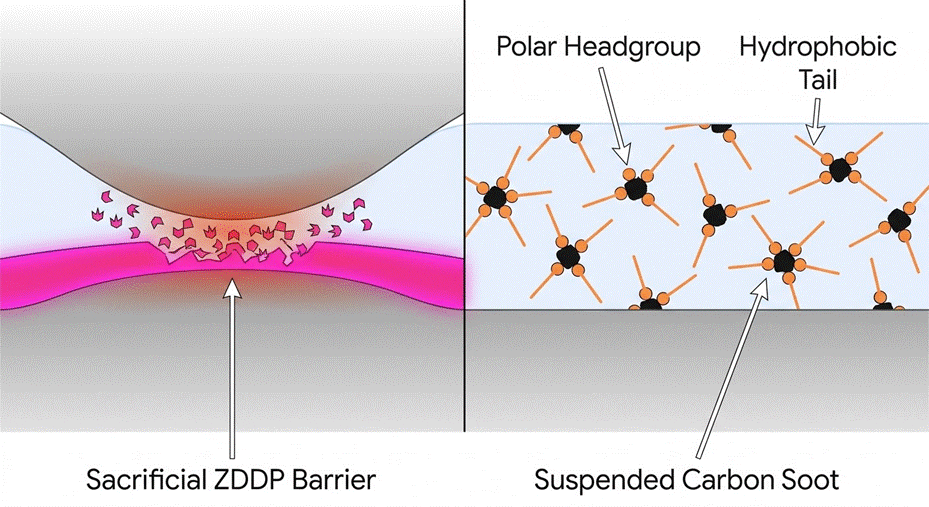
To protect metal under heavy pressure, like on an AR-15 cam pin, HRO uses Zinc Dialkyldithiophosphate (ZDDP)1. ZDDP stays dormant until it senses high friction and heat1.
When parts move rapidly, ZDDP reacts to form a microscopic, sacrificial barrier on the steel1. This shield absorbs wear so the steel stays pristine. In a pure GTL oil, ZDDP works at maximum efficiency, unhindered by the impurities found in petroleum1.
Modern HROs also avoid Polytetrafluoroethylene (PTFE), or Teflon. PTFE breaks down at temperatures over 500°F, easily reached in suppressed fire, releasing toxic gases that cause “polymer fume fever”1. HRO provides elite protection without these health risks1.
Carbon Fouling Management via PIBSI Dispersants
Managing carbon soot is also critical. HRO uses Polyisobutylene Succinimide (PIBSI) dispersants as “cleansing agents”1.
PIBSI molecules have a polar head that bonds to carbon particles and a tail that stays in the oil1. This process, called micellization, keeps carbon particles suspended in the fluid1.
Because soot is suspended, it cannot clump into gritty paste. This makes the firearm “self-cleaning,” as carbon can be easily wiped away without harsh scrubbing1. Petroleum oils lacking these dispersants trap carbon in a sticky sludge that accelerates wear2.
Validation Through Stringent Military Specifications
The benefits of GTL lubricants are proven by U.S. military testing. The governing specification is MIL-PRF-63460G, which sets requirements for Cleaner, Lubricant, and Preservative (CLP)30.
To qualify, a lubricant must pass extreme environmental and live-fire tests31.
The ASTM Tribology Suite
The Four-Ball Wear Test (ASTM D4172) evaluates protection under pressure. Steel balls are rotated under load in the lubricant at high heat for an hour7. The resulting wear scars are measured under a microscope; to pass, the scar must be smaller than 0.8 millimeters31.
| ASTM D4172 Wear Scar Diameter | Lubricant Performance Interpretation |
| 0.30 mm – 0.40 mm | Excellent anti-wear protection |
| 0.40 mm – 0.50 mm | Good anti-wear protection |
| 0.50 mm – 0.60 mm | Moderate protection |
| > 0.60 mm (Up to 0.8 mm max) | Passing military threshold, indicating acceptable boundary film strength |
| > 0.80 mm | Complete failure; poor wear protection leading to rapid part degradation |
Extreme pressure limits are also tested. A qualifying lubricant must sustain a load of 500 pounds without the parts seizing or glowing from friction31.
Environmental and Kinetic Validation
Corrosion protection is tested using the Salt Spray Test (ASTM B117). Coated metal panels are exposed to salt fog for 100 hours35. To pass, there must be almost no visible corrosion35.
Finally, the lubricant is tested in live fire using the M249 Squad Automatic Weapon. It must maintain a firing rate of at least 650 rounds per minute after being frozen at -60°F or exposed to blowing dust31. Advanced GTL formulations easily meet these requirements across the full temperature range needed by the military30.
Strategic Maintenance Applications: The Oil vs. Grease Dichotomy
While GTL/HRO is superior, proper maintenance also requires using the right type of lubricant, oil or grease, on the right parts.
Military manuals once required specific oils for different temperatures40. Today, with synthetic fluids that work in broad temperature ranges, the choice is based on mechanical stress and part geometry.
Synthetic gun oil, like HRO, is best for large surfaces, complex mechanisms, and rust prevention5. Its fluid nature lets it penetrate tight spots and lift fouling away5.
Gun grease is thicker and designed for heavy loads. It should be used on sliding parts that experience high impact, such as locking lugs and slide rails13. Unlike oil, which can be squeezed out under pressure, grease stays in place to provide a cushion under recoil43.
The rule for maintenance is simple: if it slides or slams, use grease; if it spins or just needs rust protection, use oil13. Using HRO for general lubrication and synthetic grease on high-shear points ensures a weapon survives the toughest conditions5.
Conclusion
From an engineering perspective, crude-derived petroleum oils are largely obsolete for high-performance firearms. While they are cost-effective for casual use, their irregular structure makes them unfit for modern tactical environments2. Under the heat and pressure of suppressed fire, petroleum oils evaporate, produce toxic smoke, and degrade into sticky residue that causes malfunctions1.
The future of firearm lubrication is Gas-to-Liquid chemistry. By building a pure, uniform fluid from natural gas, High Reliability Oils offer superior stability and performance that exceeds military standards1. When paired with advanced additives to protect against wear and keep the action clean, the result is a lubricant that not only protects the weapon but actively improves its reliability. For professional operators, shifting to GTL synthetic lubrication is a mandatory step to ensure the longevity of modern weapons systems.
Please share the link on Facebook, Forums, with colleagues, etc. Your support is much appreciated and if you have any feedback, please email us in**@*********ps.com. If you’d like to request a report or order a reprint, please click here for the corresponding page to open in new tab.
Sources Used
- Comparing Firearm Lubricants: Ronin’s Grips HRO vs. Lucas Extreme Duty Gun Oil, https://blog.roninsgrips.com/comparing-firearm-lubricants-ronins-grips-hro-vs-lucas-extreme-duty-gun-oil/
- Best Gun Lube for Firearms with Suppressors – Silent AF, https://silentaf.us/blogs/best-gun-lube-for-firearms-with-suppressors
- Suppressed AR Gas Blowback: Why It Happens & How to Fix It – Redleg Company, https://www.redlegguns.com/post/my-eyes-are-burning-suppressed-ar-gas-blowback
- Direct Impingement vs. Gas Piston: Understanding How They Impact Recoi – Sightmark.com, https://www.sightmark.com/blogs/field-guide/direct-impingement-vs-gas-piston-understanding-how-they-impact-recoil
- Best Gun Lubricant: Oil, Grease & CLP Compared (2026) | GNP Defend, https://gnpdefend.com/blogs/news/best-gun-lubricant-for-everyday-firearm-owners-one-product-for-all-your-guns
- FALEX Four-Ball Extreme Pressure Test Machine, https://eu.falex.com/wp-content/uploads/sites/3/2016/12/FalexFourBallEP.pdf
- Standard Test Method For Wear Preventive Characteristics Of Lubricating Fluid-four-ball Method – Shanghai Minglan Chemical, https://minglanchem.com/standard-test-method-for-wear-preventive-characteristics-of-lubricating-fluid-four-ball-method/
- The Complete Guide to Petroleum-Based vs. Synthetic Lubricants, https://barnespetroleumproducts.com/petroleum-vs-synthetic-lubricants/
- (PDF) The History of Lubricants since Ancient Times – ResearchGate, https://www.researchgate.net/publication/372453408_The_History_of_Lubricants_since_Ancient_Times
- Do Suppressors Wear Out? – Silent AF, https://silentaf.us/blogs/do-suppressors-wear-out/
- Are All Oil Groups the Same? ‘Oil Differences 101’ for Service and Parts Professionals, https://www.motor.com/2022/03/are-all-oil-groups-the-same-oil-differences-101-for-service-and-parts-professionals/
- PAO Vs Hydrocracked both synthetic oil’s but very different, types of Synthetic Engine oil Explained – YouTube, https://www.youtube.com/watch?v=7T9rqkMISWY
- Synthetic vs Petroleum Gun Oil: What Really Matters – GNP Defend, https://gnpdefend.com/blogs/news/synthetic-vs-petroleum-gun-oil
- GTL Synthetic Oil Guide: Gas-to-Liquid Power vs. Crude – Ge for Trading, https://www.getradingeg.com/blog/master-blog-9/unlocking-the-future-of-lubrication-the-power-of-gtl-gas-to-liquid-synthetic-base-oils-287
- Noack volatility test – Wikipedia, https://en.wikipedia.org/wiki/Noack_volatility_test
- ASTM D5800: The Noack Volatility Test – Oil Standards – Vyscocity, https://vyscocity.com/oil-standards/astm-d5800/
- Lab Q&A: NOACK – BG Products, Inc., https://www.bgprod.com/blog/lab-qa-noack/
- Oxidation and thermal degradation: causes, effects and how to control them – Interflon, https://interflon.com/us/news/oxidation-and-thermal-degradation-causes-effects-and-how-to-control-them
- Varnish Formation and Removal in Lubrication Systems: A Review – PMC, https://pmc.ncbi.nlm.nih.gov/articles/PMC10222146/
- Vanquishing varnish | Mobil™, https://www.mobil.com/en/lubricants/for-businesses/industrial/lubricant-expertise/resources/vanquishing-varnish
- Suppressor Maintenance to Prevent Carbon Lock – Bang Butter, https://bangbutter.com/blogs/news/suppressor-maintenance-prevent-carbon-lock
- Do suppressors affect accuracy? – Creedmoor Sports, Inc., https://www.creedmoorsports.com/do-suppressors-affect-accuracy/
- US10458737B2 – Firearm suppressor including thermal energy absorbing elements manufactured from porous metal – Google Patents, https://patents.google.com/patent/US10458737B2/en
- GREVEN INSIGHTS LUBRICANTS: Sealing Compatibility, https://www.peter-greven.de/en/news-details/greven-insights-lubricants-sealing-compatibility
- Energy benefits from GTL base oils – Cerilon, https://www.cerilon.com/energy-transition-benefits-from-gtl-base-oils/
- What’s That: GTL Drilling Fluids – Mansfield Service Partners, https://msp.energy/whats-that-gtl-drilling-fluids/
- Gas To Liquids | Business – Shell, https://www.shell.us/business/fuels-and-lubricants/lubricants-for-business/sector-expertise/power-industry/natural-gas-compression-transmission/gas-to-liquids.html
- Why Shell’s Gas-To-Liquid base oils change the game | techtalk.ie, https://www.techtalk.ie/why-shells-gas-to-liquid-base-oils-change-the-game/
- 871274 : Relation Between Molecular Structure of Succinimide Dispersants and Dispersancy of Soot in a Carbon Black Dispersancy Test – SAE International, https://www.sae.org/papers/relation-molecular-structure-succinimide-dispersants-dispersancy-soot-a-carbon-black-dispersancy-test-871274
- ` MIL-PRF-63460G 30 November 2023 SUPERSEDING MIL-PRF-63460F 26 March 2017 PERFORMANCE SPECIFICATION CLEANER, LUBRICANT, AND PRE, https://img.antpedia.com/standard/files/pdfs_ora/20240203/MIL-PRF-63460G-2023.pdf
- MIL-PRF-63460G – ASSIST Quick Search, https://quicksearch.dla.mil/WMX/Default.aspx?token=5785528
- MIL-PRF-63460 – ASSIST-QuickSearch Document Details, https://quicksearch.dla.mil/qsDocDetails.aspx?ident_number=31359
- MIL-PRF-63460E 15 March 2006 SUPERSEDING MIL-PRF-63460D 5 August 1985 PERFORMANCE SPECIFICATION LUBRICANT, CLEANER AND PRESERVAT, https://img.antpedia.com/standard/files/pdfs_ora/20220402/MIL-PRF-63460E.PDF
- ASTM D4172 – Clark Testing, https://clarktesting.com/testing-standard/astm-d4172/
- MIL-PRF-63460E – ASSIST Quick Search, https://quicksearch.dla.mil/WMX/Default.aspx?token=907358
- Falex Pin & Vee Block, https://www.falex.com/product/falex-pin-vee-block/
- ASTM B-117 Salt Spray / Salt Fog Testing – Keystone Compliance, https://keystonecompliance.com/astm-b-117-salt-spray-salt-fog/
- MIL-PRF-63460 Test Specimens – Metaspec, https://www.metaspec.com/post/mil-prf-63460-test-specimens
- RADCOLUBE® CLP – Volber Pazarlama, https://www.volber.com.tr/product/radcolube-clp/
- M16 and M4 Maintenance Manual | PDF – Scribd, https://www.scribd.com/doc/100878267/TM-9-1005-319-23-p-M16-Organizational-Maint-With-Repair-Parts-and-Special-Tools
- Full text of “OPERATOR’S MANUAL FOR RIFLE, 5.56 MM, M16A2 (NSN 1005-01-128-9936), (EIC – Internet Archive, https://archive.org/stream/operators-manual-for-rifle-5.56-mm/TM_9-1005-319-10_djvu.txt
- M16 Maintenance Manual TM9-1005-319-23.pdf – CombatRifle.net, https://www.yumpu.com/en/document/view/54182473/m16-maintenance-manual-tm9-1005-319-23pdf-combatriflenet
- The Beginner’s Guide to Choosing the Right Gun Lubricant – GritrSports.com, https://gritrsports.com/guides-tutorials/the-beginners-guide-to-choosing-the-right-gun-lubricant/