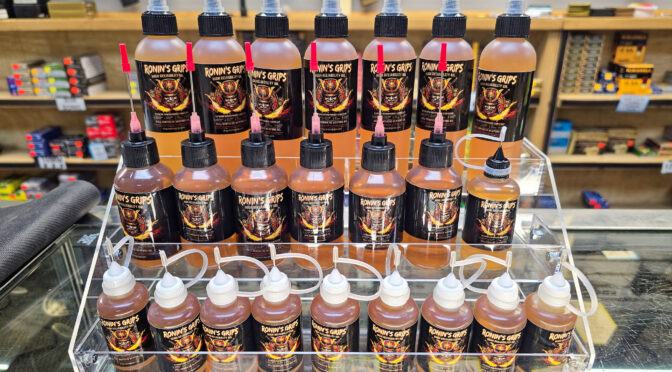
Understanding Modern Firearm Lubrication and Suppressors
The way we use modern firearms has changed dramatically over the last twenty years. The heat and mechanical stress inside these weapons now far exceed what their original designs anticipated, due to the rise of short-barreled rifles (SBRs), intense training schedules, and the common use of suppressors. Older, standard lubricants—like those meeting the military’s MIL-PRF-63460F specification for CLP—often fail to protect a gun under these harsh conditions3. Because today’s shooters deal with high backpressure, extreme heat, and heavy carbon buildup, we need to rethink how we lubricate our weapons1.
To understand why traditional oils fail and how advanced options like Ronin’s Grips High Reliability Oil (HRO) and Lucas Extreme Duty Gun Oil help, we have to look at what happens inside a suppressed firearm. Adding a suppressor does more than just quiet the shot; it changes the gas pressure, heat, and speed of the moving parts2. In a standard AR-15, the suppressor blocks gas from escaping quickly, forcing a much higher volume of hot gas back into the bolt carrier group (BCG)2.
This extra gas creates a domino effect. The BCG is slammed backward much faster than intended, which puts extreme pressure on the bolt as it unlocks1. The cam pin and locking lugs are forced to move while chamber pressures are still very high2. This creates so much friction that the protective layer of oil is often squeezed out, leaving metal to grind against metal2.
At the same time, the weapon gets incredibly hot. A suppressor can heat up from 300°F to over 850°F in just a few minutes of rapid shooting1. After 200 rounds of continuous fire, it can even reach 1,200°F1. This heat, combined with abrasive carbon and unburnt powder being blown back into the receiver, creates a brutal environment2, 4. In these conditions, the quality of your lubricant determines whether your gun keeps running or locks up completely.
The Impact of Suppressors on Lubrication
Using a suppressor makes lubricating a firearm even more difficult. Suppressors are essentially metal cans with internal walls, or baffles, that trap and slow down expanding gases to reduce noise5. Whether they are made of stacked cones or machined from a single block of titanium, they all face the same challenges5.
When you fire that first shot, the oxygen inside the suppressor can cause a mini-explosion of unburnt powder, leading to sudden heat spikes6. This heat and carbon buildup can actually cause the suppressor to “carbon lock” to the barrel, making it almost impossible to remove1. While some designs are easier to clean than others, all are at risk of seizing up if not properly maintained6.
Many shooters try to fix the issue by using heavy grease or anti-seize on the threads7. However, standard oils often evaporate instantly, leaving behind a sticky sludge that makes the problem worse. A truly effective lubricant needs to handle temperatures over 800°F without turning into glue7. The ability to keep carbon from baking onto metal surfaces is what separates modern, purpose-built oils from the older alternatives10.
The Foundation: What’s in the Bottle?
Most of what is in a bottle of gun oil (about 75% to 90%) is the “base stock.” How this base oil handles heat and stress determines how well the lubricant works overall. The differences between Lucas Extreme Duty and Ronin’s Grips HRO start right here at the molecular level.
Lucas Extreme Duty: Petroleum-Based Strength
Lucas Extreme Duty Gun Oil is made from highly refined mineral and petroleum oils11. While modern refining techniques have made these oils much better than they used to be, they still contain tiny amounts of impurities like sulfur and nitrogen1. These mineral bases aren’t perfectly uniform because they are extracted from crude oil.
Because these molecules vary in size and shape, they can break down under the extreme heat of a suppressed weapon2, 3. When the inside of your gun gets hotter than 500°F, the impurities in petroleum oils can oxidize and thicken2. When this process happens and mixes with carbon fouling, it creates a thick, baked-on sludge that slows down the moving parts of your rifle2.
To solve this, Lucas makes their oil exceptionally thick and “tacky” using a special polymer technology9. This high viscosity helps the oil stick to the metal surfaces and resist being blown off by the gas pressure of a suppressed AR-157. Essentially, Lucas uses a thick physical layer to ensure protection remains even if the oil begins to degrade.
Ronin’s Grips HRO: Synthetic Gas-to-Liquid Precision
Ronin’s Grips High Reliability Oil (HRO) takes a different approach by using a Gas-to-Liquid (GTL) synthetic base1. This high-tech chemistry results in a base oil that is 99.5% pure3.
Instead of trying to clean up dirty crude oil, the GTL process takes pure natural gas and builds the oil molecules from scratch4. This means every molecule is exactly the same size and shape3. Imagine the difference between a pile of random sticks (crude oil) versus a stack of identical bricks (GTL synthetic). The uniform “bricks” in HRO stay strong and won’t break down under pressure like petroleum oils do3.
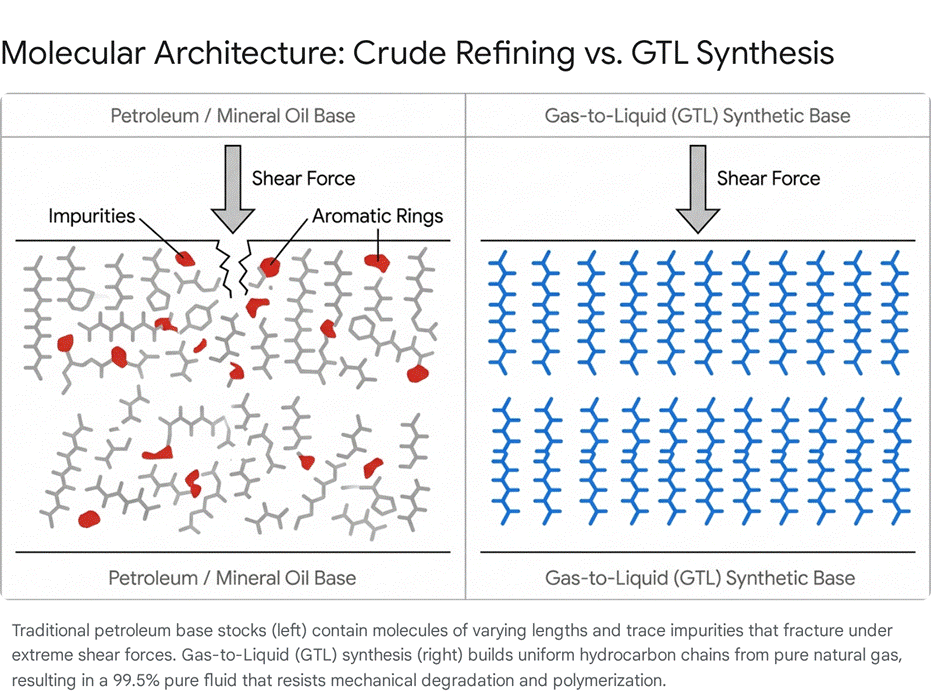
Because these molecules are so uniform, they handle extreme heat and stress exceptionally well4. HRO doesn’t fracture, even when hot gas blasts your bolt carrier during rapid fire. It’s free from the impurities that cause sludge, so the oil stays slick and keeps working long after traditional oils would have failed3.
Thermodynamics, Burn-Off Resistance, and Volatility
The true test of a gun oil is how it handles heat. When your firearm gets hotter than 500°F, cheap oils simply evaporate or “burn off.” This leaves the moving parts dry and unprotected, leading to rapid wear or a jammed gun.
Flash Point and High-Temperature Survival
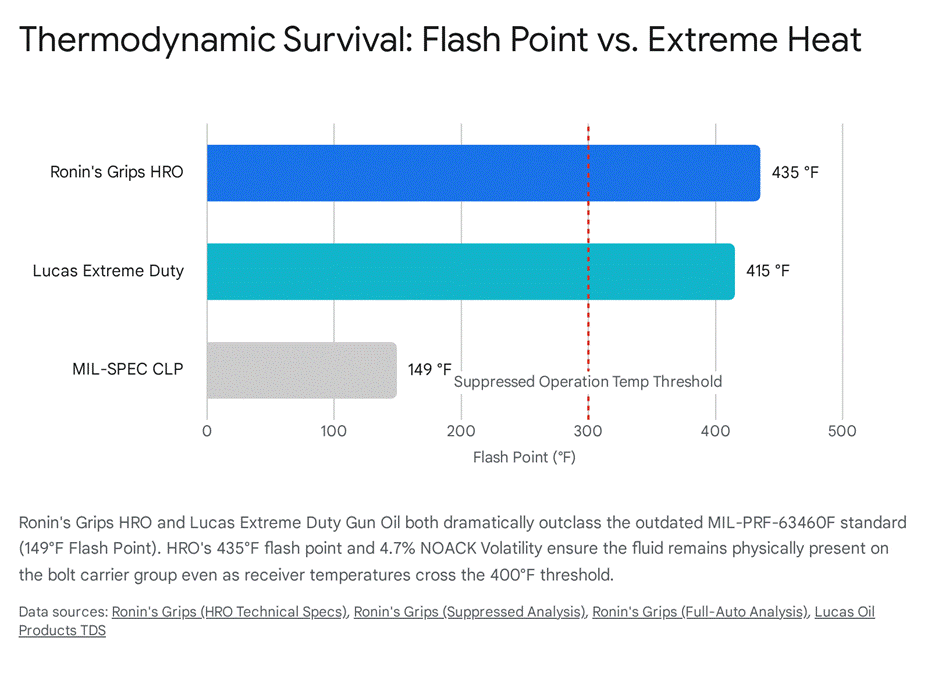
A lubricant’s “flash point” is the temperature at which it starts to turn into a vapor that can catch fire. It’s a useful way to see how much heat an oil can handle. While the military’s minimum standard is only 149°F, both Lucas and Ronin’s Grips HRO far exceed that, offering much better protection1.
Lucas Extreme Duty has a high flash point of 415°F15. This means it won’t smoke or evaporate easily during heavy shooting13. Its thick polymers keep the oil in place on the bolt carrier group even when things get very hot9.
Ronin’s Grips HRO goes even further with a flash point over 435°F3. This high limit makes it very resistant to burning off. HRO is also designed to be “low-smoke.” It won’t create a thick cloud of toxic smoke when you’re shooting with a suppressor, which is a huge advantage if you are shooting in enclosed spaces3.
NOACK Volatility and Evaporative Mass Loss
While flash point is about fire risk, “NOACK Volatility” is the real test of how much oil physically boils away under heat4. In this test, oil is heated to 482°F for an hour, and scientists measure how much of the oil was lost to evaporation4.
Traditional firearm oils often lose more than 15% of their mass in this test4. However, Ronin’s Grips HRO loses only 4.7%3. This means that even when your gun is superheated, the oil stays on the parts to protect them4. It also won’t evaporate while sitting in your safe, so your gun is ready to go even years later3.
Lucas Oil relies on its thickness to stay in place. While its heavy formula resists evaporation better than thin oils, some of the petroleum will still boil away under intense heat. This leaves behind the heavier polymers, which still offer protection but change how the oil feels during long shooting sessions.
Boundary Lubrication and Mechanochemical Shielding
Inside a gun, the parts move back and forth so violently that oil can be physically squeezed out from between them. When this happens, the microscopic bumps on the metal surfaces grind against each other2. To prevent wear and jamming, advanced oils use special chemical additives that bond directly to the steel.
The system instantly enters the boundary lubrication regime, a state where the microscopic peaks and valleys of the metal (asperities) come into direct, violent contact2. To prevent catastrophic metal-to-metal galling, accelerated wear, and mechanical binding, advanced lubricants cannot rely on fluid film thickness alone; they must deploy highly reactive anti-wear (AW) and extreme pressure (EP) chemical additives that bond directly to the steel surface.
The Mechanochemistry of Zinc Dialkyldithiophosphate (ZDDP)
Both HRO and Lucas use Zinc Dialkyldithiophosphate (ZDDP), a highly effective additive that has been around since the 1940s4, 16. ZDDP is unique because it only activates when it feels heat and pressure.
When a suppressed weapon is fired, the extreme contact pressure and localized flash temperatures at the rubbing metal asperities cause the ZDDP molecules suspended in the oil to chemically decompose16. Before the formation of the final protective film, ZDDP decomposes to form intermediate zinc sulfide and iron sulfide species, which are mechanically mixed into the iron oxides on the rubbing steel surfaces19.
When you fire your gun, the friction and heat cause the ZDDP to react and form a thin, glassy protective layer on the metal16, 19. This layer acts as a sacrificial shield. Instead of the steel parts grinding together, these microscopic glassy layers take the hit, slowly wearing away and then reforming from the oil as you keep shooting19, 22.
This means that the more you shoot, the more these oils work to protect your gun’s cam pin, rails, and gas rings. Lucas Oil contains about 15% of this additive, giving it a massive reserve for protection17. HRO uses its pure GTL base to let the ZDDP work even more efficiently, ensuring it doesn’t waste its strength on a degrading base oil3.
The Polytetrafluoroethylene (PTFE) Hazard in High-Heat Environments
Some lubricants use Polytetrafluoroethylene (PTFE), or Teflon, to reduce friction. While this works well for sliding doors or at room temperature, it can be dangerous in a suppressed rifle1.
When Teflon gets hotter than 500°F, it breaks down and releases toxic gases that are harmful to breathe1. This can cause “polymer fume fever,” with symptoms like chest tightness and flu-like aches.
Ronin’s Grips HRO is 100% free of PTFE and other hazardous aerosols3. Lucas Extreme Duty also avoids using PTFE, relying instead on high-quality oil and ZDDP to protect your firearm safely.
Managing Carbon Fouling
Cleaning carbon is one of the most frustrating parts of owning a suppressed firearm. The backpressure from a suppressor drives abrasive soot and lead deep into the gun’s action2. How your oil interacts with this carbon determines how long you can shoot before your gun needs a deep clean.
Polyisobutylene Succinimide (PIBSI) Dispersants in HRO
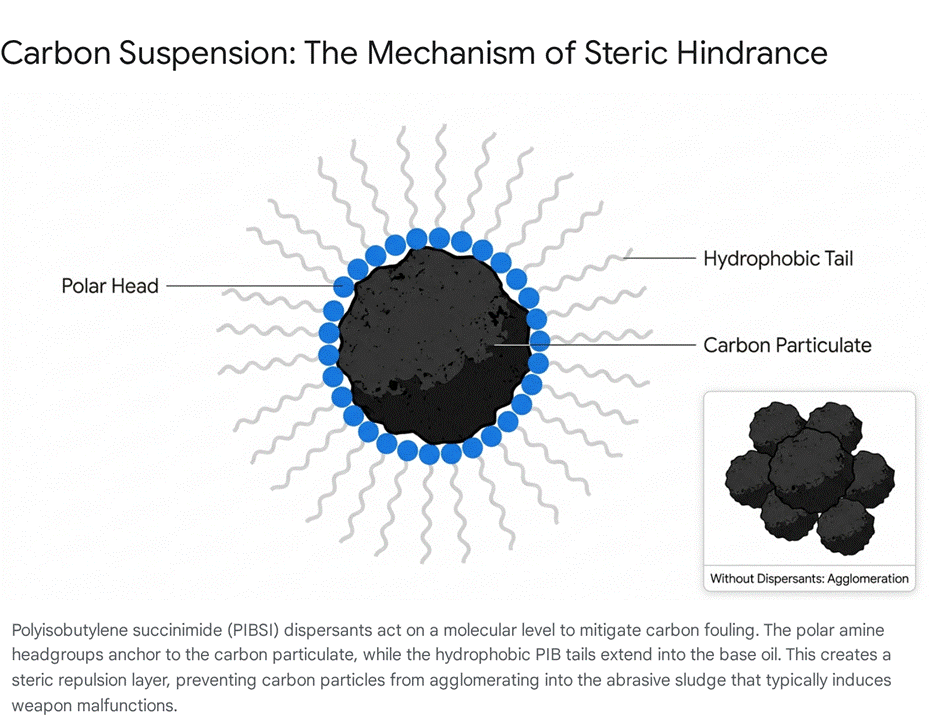
Ronin’s Grips HRO uses specialized “Active Cleansing Agents” to manage carbon1, 3. These agents, called PIBSI dispersants, act like tiny magnets for carbon particles25, 26.
The inclusion of PIBSI represents a masterclass in organic chemistry applied to small arms tribology. PIBSI is made by reacting polyisobutylene succinic anhydride (PIBSA) with polyalkylene polyamines, creating a molecule with very distinct functional zones. It consists of a long, oil-soluble, hydrophobic polyisobutylene (PIB) tail and a highly polar polyamine headgroup26.
When carbon soot enters the receiver, the polar amine headgroup of the PIBSI molecule is immediately attracted to the highly charged surface of the soot particles26. Through strong dipole-dipole and acid-base interactions, the polar heads anchor themselves firmly to the carbon26. The long, hydrophobic PIB chains then extend outward into the surrounding synthetic oil phase27.
When carbon enters the gun, these dispersants surround each particle, keeping them separated so they can’t clump together into a gritty paste24, 26, 27. This keeps the carbon floating in the oil rather than sticking to your gun’s parts2. This makes the weapon essentially “self-cleaning” because you can simply wipe away the dirty oil without having to scrape off baked-on carbon2.
Polymeric Film Technology in Lucas Extreme Duty
Lucas Extreme Duty uses its thick polymer film to protect surfaces13. This sticky film creates a tough physical barrier that blocks out rust and moisture while staying in place even during intense movement7.
This film exhibits incredibly high tackiness and resilience to mechanical shock. In a direct-impingement weapon, expanding gas inevitably attempts to blow the lubricant out of the ejection port. Lucas Oil’s heavy polymeric film resists this violent blowback, keeping the oil exactly where it is applied on the BCG and severely reducing the amount of fluid migrating into the operator’s face or safety glasses9.
However, this stickiness is a trade-off. While it stays on your gun well, it also attracts dust and carbon29. Over many shots, the residue can turn into a thick, dark paste30. While the gun will still cycle reliably, it usually requires a more thorough cleaning with strong solvents to get all that paste out of the action compared to the HRO29.
Rheology, Viscosity Index, and Environmental Operating Windows
Rheology—the study of the deformation and flow of matter—is a critical factor in small arms lubrication. A lubricant must possess low enough viscosity to penetrate microscopic surface pores and flow smoothly into the tight, exacting tolerances of gas rings, yet high enough viscosity (film strength) to form a tenacious, clinging boundary cushion on the highly loaded cam channel and receiver rails3.
Viscosity Profiles and High-Speed Mechanisms
Ronin’s Grips HRO is designed to thicken similar to 10W-30 motor oil3. It has a high “Viscosity Index,” which means it stays stable regardless of the temperature3. It won’t get too thin when hot or too thick when freezing, keeping your gun cycling at the right speed in any environment3.
Lucas Extreme Duty is a much thicker oil, closer to a 40 or 50 weight oil15. This thickness is what keeps it in place and makes it a favorite among gunners9. It provides a massive cushion against wear, though it might feel a bit more “sluggish” than the thinner HRO.
Arctic Operations and Pour Points
The pour point (evaluated via ASTM D97) of a lubricant determines its fundamental viability in extreme cold-weather operations. Standard crude-derived mineral oils contain inherent wax impurities that begin to crystallize and interlock at sub-zero temperatures, causing the entire fluid matrix to congeal. This induces severe cold-weather sluggishness, dramatically reduces cyclic rates, and directly causes failure-to-return-to-battery malfunctions as the buffer spring struggles to overcome the frozen fluid drag3.
Lucas Extreme Duty works down to -38°F, which is plenty for almost anyone shooting in the winter15.
However, Ronin’s Grips HRO is the champion of cold weather. Because it is a pure synthetic with zero wax, it stays liquid down to -60°F3. This makes it the best choice for extreme arctic conditions, where other oils would freeze solid3.
Corrosion Resistance and Long-Term Preservation
Beyond kinematic lubrication, a weapons oil must serve as an impenetrable barrier against oxidation, galvanic corrosion, and pitting. The industry standard for evaluating corrosion resistance is the ASTM B117 salt spray test, which subjects treated steel to a continuous brine fog at elevated temperatures to measure the hours until red rust appears31.
Lucas Extreme Duty is fantastic at preventing rust7, 32. Its thick, tacky film locks out moisture and salt from your hands7. If you are storing a gun for a long time in a humid basement or near the ocean, Lucas is an elite choice for keeping it rust-free12.
HRO also protects against rust and won’t evaporate over time, but it doesn’t have the same thick, “greasy” feel as Lucas3. Most shooters find it excellent for general storage, but Lucas remains the king of heavy-duty rust prevention.
Packaging, Distribution, and Market Economics
You can find Lucas Extreme Duty almost anywhere—sporting goods stores, auto parts stores, and online33. It also comes in a great 1-ounce bottle with a precision needle tip, which makes it easy to put oil exactly where you need it28. It’s also very affordable, usually under $10 for a small bottle34.
Ronin’s Grips HRO is more of a specialty product3. Because it uses expensive synthetic bases and dispersants, it’s mostly bought by professional users and serious shooters who want the best possible performance. You can buy it directly from the Ronin’s Grips store.
Comprehensive Feature Comparison
To distill the engineering data, the following table maps the critical technical properties and operational features of both fluids.
| Technical Metric / Feature | Ronin’s Grips HRO (High Reliability Oil) | Lucas Extreme Duty Gun Oil |
| Base Stock Architecture | 99.5% Pure Gas-to-Liquid (GTL) Synthetic3 | Highly Refined Petroleum/Mineral Oil Blend11 |
| Flash Point (Burn-off Resistance) | > 435°F (224°C)3 | 415°F (212°C)15 |
| Pour Point (Arctic Operation) | -60°F (-48°C)3 | -38°F (-39°C)15 |
| Viscosity Profile | 10W-30 Equivalent (60.5 cSt @ 40°C)3 | Heavy Viscosity (15.0 cSt @ 100°C)15 |
| Anti-Wear Additive Shield | Zinc Dialkyldithiophosphate (ZDDP)4 | Zinc Alkyldithiophosphate (~15%)17 |
| Carbon Management Strategy | Polyisobutylene succinimide (PIBSI) Dispersants1 | Heavy Polymeric Adhesion Film13 |
| Polytetrafluoroethylene (PTFE) | 0% (Eliminates toxic off-gassing)1 | 0% (Uses heavy oil/ZDDP instead)17 |
| Volatility (NOACK Evaporative Loss) | 4.7% (Extreme stability)3 | Unpublished (Mitigated by heavy viscosity)13 |
Synthesis of Pros and Cons
Lucas Extreme Duty Gun Oil The primary advantage of Lucas Extreme Duty is its exceptional film strength. The heavy viscosity and proprietary polymeric film technology ensure the oil clings aggressively to metal, preventing dry starts even after long periods of storage in unconditioned environments12. This heavy weight provides immense blowback resistance; it significantly reduces the amount of fluid migrating off the bolt carrier and into the operator’s face during suppressed fire, maintaining clear vision12. Furthermore, it serves as a tier-one preservative, neutralizing acids from human hands and locking out moisture12. Packaged in an excellent precision needle oiler, it is highly accessible and cost-effective12.
Conversely, the primary drawback of Lucas Extreme Duty is its propensity for debris attraction. The thick, petroleum-based polymeric film is inherently sticky. While it protects the underlying metal flawlessly, it aggressively attracts environmental dust, lint, and heavy carbon blowback29. Over hundreds of suppressed rounds, this forms a thick paste that requires heavier, solvent-intensive cleaning regimens30. Additionally, while a -38°F pour point is highly effective for general use, it cannot match the deep-arctic fluidity of a pure GTL synthetic3.
Ronin’s Grips High Reliability Oil (HRO) The overwhelming advantage of HRO is its unmatched thermal stability and purity. The 99.5% pure GTL base and minimal 4.7% NOACK volatility rating ensure that the fluid refuses to evaporate or burn off under rapid-fire conditions, fundamentally preventing the formation of crude-based sludge3. Its active carbon suspension is unparalleled; the integration of PIBSI dispersants micellizes carbon soot via steric hindrance, keeping it in fluid suspension and rendering the weapon essentially self-cleaning2. Furthermore, the lack of volatile petroleum impurities guarantees a low-smoke profile, preventing blinding, toxic smoke from obscuring the operator’s vision during suppressed mag-dumps1. Finally, the extreme temperature operating window enables flawless kinematic cycling, ranging from -60°F to receiver temperatures exceeding 500°F.
The limitations of HRO lie primarily in its market presence and physical feel. As a specialized, boutique synthetic, it lacks the ubiquitous retail availability of Lucas and requires targeted procurement3. Additionally, while possessing an elite viscosity index for high-speed parts, it operates closer to a 10W-30 equivalent3. Operators accustomed to the ultra-thick, sticky, shock-absorbing feel of heavy polymeric grease or oil may find HRO’s thinner film build to feel less substantial, even though the chemical ZDDP barrier provides equal or superior microscopic protection against wear.
Final Engineering Verdict
Choosing between these two oils depends entirely on how you use your gun.
If you want a reliable, heavy-duty oil that is easy to find and great for preventing rust during storage, Lucas Extreme Duty Gun Oil is a fantastic choice. It sticks to parts well and provides a thick cushion for your gun’s action. It’s perfect for the average shooter who wants great protection at a good price, though it might take a little more work to clean up afterward.
If you shoot suppressed, use full-auto, or shoot in extreme cold, Ronin’s Grips High Reliability Oil (HRO) is the clear winner. Its synthetic formula won’t burn off or turn into sludge under heat. It keeps carbon floating so you can just wipe your gun clean, and it won’t smoke you out of a room. It is a high-end solution for shooters who demand absolute reliability from their gear.
Please share the link on Facebook, Forums, with colleagues, etc. Your support is much appreciated and if you have any feedback, please email us in**@*********ps.com. If you’d like to request a report or order a reprint, please click here for the corresponding page to open in new tab.
Sources Used
- Revolutionizing Suppressed Firearm Lubrication with HRO – Ronin’s Grips, https://blog.roninsgrips.com/revolutionizing-suppressed-firearm-lubrication-with-hro/
- Suppressor Analytics Archives – Ronin’s Grips, https://blog.roninsgrips.com/category/analytics-and-reports/suppressor-analytics/
- Ronin’s Grips High Reliability Oil (HRO): Technical Marketing Brief, https://blog.roninsgrips.com/ronins-grips-high-reliability-oil-hro-technical-marketing-brief/
- Revolutionizing Full Auto Machine Gun Lubrication with Ronin’s HRO, https://blog.roninsgrips.com/revolutionizing-full-auto-machine-gun-lubrication-with-ronins-hro/
- The Suppressor: How It’s Made, How It Works And How To Buy One – Gun Digest, https://gundigest.com/gear-ammo/suppressors/suppressors-work-made
- The Battle of the Baffles | The Best Suppressor Baffle Design – The Gear Bunker, https://www.thegearbunker.com/the-battle-of-the-baffles-the-best-suppressor-baffle-design/
- Extreme Duty Gun Oil – Lucas Oil Products, Inc., https://www.lucasoil.com/product/extreme-duty-gun-oil/
- for all you Banish 30 owners | Long Range Hunting Forum, https://www.longrangehunting.com/threads/for-all-you-banish-30-owners.283763/
- Reviews & Ratings on EXTREME DUTY GUN OIL – Brownells, https://www.brownells.com/product-reviews/?product=extreme-duty-gun-oil
- Shooter Lube Solvent Test. This GM9 has siezed shut multiple times. Already been sent back to gemtech 3x. Today I decided to try and soak and shake it in shooter lube gun cleaning solvent.. ive tried ATF/Mineral spirits mix, Kroil, and Clp before. Ill see how the results are tomorrow evening. : – Reddit, https://www.reddit.com/r/NFA/comments/mtqizr/shooter_lube_solvent_test_this_gm9_has_siezed/
- Cuff Cleaner, https://cuffcleaner.com/
- Lucas Oil® Extreme Duty Gun Oil 1oz. – Springfield Armory, https://store.springfield-armory.com/lucas-oil-extreme-duty-gun-oil-1oz/
- Lucas Oil Products Catalog | PDF | Motor Oil | Gasoline – Scribd, https://www.scribd.com/document/663325986/lucas-oil-products-catalog
- LUCAS Extreme Duty Gun Oil, 1 Ounce (30 ml), Each – VPW Australia, https://www.vpw.com.au/parts/LUS-10875
- Lucas Oil Extreme Duty Gun Oil Technical Data Sheet – OpticsPlanet, https://www.opticsplanet.com/i/pdf/opplanet-lucas-oil-extreme-duty-gun-oil-technical-data-sheet-pdf.pdf
- On the mechanism of ZDDP antiwear film formation – Spiral, https://spiral.imperial.ac.uk/server/api/core/bitstreams/b274eb01-fa68-4a96-92c4-0f02d092eb8c/content
- SAFETY DATA SHEET – Googleapis.com, https://storage.googleapis.com/wilsoncombat/msds/lucas_extreme_duty_gun_oil_10901.pdf
- Ionic liquids as boundary additives in water-based and PAO lubricants – SciOpen, https://www.sciopen.com/article/10.1007/s40544-021-0550-0
- On the Transient Decomposition and Reaction Kinetics of Zinc Dialkyldithiophosphate, https://pubs.acs.org/doi/10.1021/acsami.8b08293
- Experimental Observation of Zinc Dialkyl DithioPhosphate (ZDDP)-Induced Iron Sulphide Formation – White Rose Research Online, https://eprints.whiterose.ac.uk/id/eprint/114858/1/1-s2.0-S0169433217310280-main.pdf
- Nano- and Micro-Tribological Investigations of Boundary Layers on Axial Bearing Washers Tested under WEC Critical Conditions – MDPI, https://www.mdpi.com/2075-4442/10/8/198
- Revealing the interface nature of ZDDP tribofilm by X-ray photoelectron spectroscopy and atom probe tomography | Industrial Lubrication and Tribology – Emerald Insight, https://www.emerald.com/ilt/article-split/72/7/923/171401/Revealing-the-interface-nature-of-ZDDP-tribofilm
- Untitled – ArTS – UniTS, https://arts.units.it/retrieve/e2913fde-66e4-f688-e053-3705fe0a67e0/PhD_Thesis_Matteo%20Cibinel_Definitiva.pdf
- JRM | Free Full-Text | Effect of Polyisobutylene Succinimide on the Physical Stability of an Environmentally Friendly Pesticide Oil Dispersion Suspension – Tech Science Press, https://www.techscience.com/jrm/v11n6/52476/html
- Polyisobutylene Succinic Anhydride (PIBSA) As Engine Oil Additive: Molecular Design, Synthesis Routes, And Performance Optimization For Advanced Lubrication Systems – Patsnap Eureka, https://eureka.patsnap.com/materials/pibsa-engine-oil-additive
- “Adsorption of Polyisobutylene-Based Dispersants onto Carbon Black” by Travis Paul Holbrook – The Aquila Digital Community, https://aquila.usm.edu/dissertations/1718/
- The Role of Polyisobutylene-Bis-Succinimide (PIBSI) Dispersants in Lubricant Oils on the Deposit Control Mechanism – PMC, https://pmc.ncbi.nlm.nih.gov/articles/PMC12030718/
- Lucas Oil 10875 Extreme Duty Gun Oil 1 Ounce | Desertcart Suriname, https://suriname.desertcart.com/products/39411961-extreme-duty-gun-oil-each
- Top 5 Gun Lubricants – Which is the Best? – Slip 2000, https://slip2000.com/blogs/news/top-5-gun-lubricants-which-is-the-best
- What oil are you all running? : r/ar15 – Reddit, https://www.reddit.com/r/ar15/comments/wzgtor/what_oil_are_you_all_running/
- Ultimate Rust Prevention Guide: Best Paints & Coatings to Combat Corrosion (2026 Guide), https://xionlab.com/ultimate-rust-prevention-guide-combat-rust-and-corrosion-with-effective-paints-and-coatings/
- Rust Preventive Oils | VCI Gear Oil Additives, https://vciandlubricants.com/Rust-preventative-oils.html
- Lucas Oil Products 1 Ounce Gun Oil 10875 | O’Reilly Auto Parts, https://www.oreillyauto.com/detail/c/lucas-oil-products/lucas-oil-products-1-ounce-gun-oil/luc0/10875
- Lucas Oil Extreme Duty Gun Oil 1 Oz Needle Oiler Bottle 10875 49807108755| eBay, https://www.ebay.com/itm/273860174599
- Lucas Oil Extreme Duty Gun Oil 4oz Liquid – MidwayUSA, https://www.midwayusa.com/product/1094232227234
- Are You Looking For A Lubricant That Performs Better Than CLP? Check Out Kentuckiana Gun Works – Enhanced Reliability Oil – Ronin’s Grips, https://blog.roninsgrips.com/kentuckiana-gun-works-enhanced-reliability-oil/