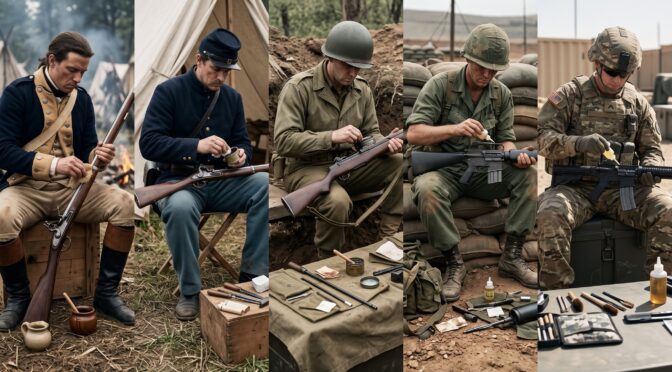
1. Fundamentals of Small Arms Lubrication Engineering
1.1 The Firearm Operating Environment
From the perspective of firearm designers and lubrication engineers, a gun acts as an open heat engine under constant mechanical stress1. Unlike a car engine—where oil circulates inside a sealed, filtered crankcase—a firearm’s moving parts are exposed directly to rain, mud, freezing cold, and dust while absorbing intense heat and residue from burning powder2. During rapid fire, internal parts handle chamber pressures up to 52,000 psi, barrel temperatures above 1,200°F after 200 continuous rounds, gas temperatures over 800°F, and bolt carrier group temperatures around 400°F2.
To evaluate how a lubricant performs under these conditions, engineers measure several physical and chemical properties:
- Fluid-Film Cushion vs. Surface Contact and High-Pressure Protection: When a bolt carrier or pistol slide moves rapidly, liquid oil can form a fluid cushion that keeps metal parts separated2. However, on high-wear parts like cam pins, locking lugs, and trigger sears, extreme pressure squeezes that liquid cushion until microscopic metal points rub against each other2. Under these heavy contact conditions, oil thickness alone cannot prevent wear. Instead, lubricants rely on polar molecules that grip steel (like natural liquid waxes), microscopic solid particles (such as PTFE), or heat-activated anti-wear additives that chemically bond to the metal to prevent scratching, binding, and premature wear2.
- Flow Resistance and Thermal Stability: Kinematic viscosity—measured in centistokes (cSt) or older units like Saybolt Universal Seconds (SUS) and Redwood seconds—rates how easily an oil flows at a given temperature11. A good gun oil must be thin enough to creep into tight gaps and metal pores, yet thick enough under high heat and pressure to cling to vertical receiver rails2. The Viscosity Index (VI) measures how well an oil maintains its thickness across temperature changes; a high VI (around 150 to 180) keeps firing rates steady whether operating in freezing cold or scorching heat12.
- Grease Thickness and Penetration: Greases blend a liquid base oil with a soap or synthetic thickener (such as calcium or lithium soap) to hold the oil in place13. Firmness is rated on the National Lubricating Grease Institute (NLGI) scale based on cone penetration tests13. Firm greases like NLGI Grade 2 to 2.5 stay put on exposed rifle operating rods during heavy rain16. Semi-fluid greases sit like a soft gel at rest but thin out when agitated, allowing them to flow into tight internal mechanisms during firing13.
- Temperature Extremes and Evaporation: In cold weather, the pour point marks the lowest temperature at which oil flows before wax crystals or thickening slow down firing pins and bolts. In high heat, a grease’s melting point determines when its thickener melts and turns liquid16. For liquid oils, flash point and evaporation rate show whether the lubricant will remain on a hot bolt carrier or burn off into smoke, leaving behind baked-on carbon2.
1.2 The Relationship Between Weapon Design, Ammunition, and Lubrication
Throughout military history, small arms reliability has rested on a balance between three elements: firearm mechanics, powder and primer chemistry, and lubricant formulas1. Whenever military logistics updated one part of the equation—switching from black powder to smokeless propellant, replacing manual bolt actions with gas-operated rifles, or adding sound suppressors—without adjusting lubricants and maintenance routines, weapons suffered field failures1. Over the past 250 years, firearm lubricants have evolved from natural animal fats and whale oil to refined petroleum oils and eventually to synthetic fluids and dry film coatings capable of working from -90°F to +450°F10.

| Conflict Era | Primary Weapon Platforms | Dominant Lubricant / Spec | Base Chemistry & Thickener | Key Technical Parameters | Primary Field Failure Mode |
| Revolutionary War (1775–1783) | Muzzleloading flintlock muskets (e.g., Charleville) | Whale (sperm) oil, olive/nut oil, animal tallow, neatsfoot oil | Marine liquid wax esters, vegetable oils, rendered animal fats | Low viscosity in sperm oil; moderate gum/acidity in tallow and vegetable oils | Bore pitting from uncleaned black powder; gumming from oxidized oils12 |
| American Civil War (1861–1865) | M1861 Springfield rifled musket, naval ordnance | Sperm oil (7.12 lb/gal), neatsfoot oil (7.63 lb/gal) | Liquid wax esters (cetyl palmitate, ~66% wax in raw blubber oil) | Viscosity: 21–23 cSt @ 37.5°C; VI: 180; Flash: 260–266°C | Wax crystallization below 86°F (30°C) prior to winter straining; black powder fouling1 |
| World War I (1914–1918) | Bolt-action rifles, recoil and gas-operated machine guns | Mineral lubricating oils, hot soapy water bore flushing | Refined petroleum distillates; alkaline soap-and-water solutions | Water-repellent mineral oil film; zero solvency for chloride salts | Bore pitting within 24 hrs from moisture-attracting KCl primer salts trapped under oil22 |
| World War II (1939–1945) | M1 Garand, Kar98k, s.M.G., SVT-40, T-34 | Light preservative oil (later VV-L-800); Lubriplate 130-A (later MIL-G-46003); German Waffenöl | Calcium-soap grease in mineral oil; paraffinic mineral oils | Lubriplate: NLGI 2.5, 750–800 SUS @ 100°F, drop point 200°F, min +20°F | Oil washout in Pacific rains causing M1 Garand binding; German oil freezing at -40°F3 |
| Vietnam War (1955–1975) | M16 / XM16E1 / M16A1, M14, M60 | LSA (MIL-L-46000A / O-158), RBC (later MIL-PRF-372) | Lithium stearate thickened synthetic semi-fluid grease | Viscosity: 12.2 cSt @ 40°C, 9,100 cSt @ -54°C; Weld: 160 kg (Braycote 646) | WC 846 ball powder calcium carbonate fouling + unplated chamber corrosion6 |
| First Gulf War (1990–1991) | M16A2, M249 SAW, Mk19, British L85 | CLP (MIL-L-63460 / MIL-PRF-63460 / S-758), LSA-T (MIL-L-46150) | Synthetic oil + solvent + corrosion inhibitor + flaky PTFE | Viscosity: >=14.0 cSt @ 40°C; Pour: -74°F; Flash: >=149°F | Wet CLP films trapping desert sand to cause jamming and oiled-cartridge pressure spikes5 |
| Second Gulf War / GWOT (2001–2021) | M4 Carbine, HK416, Mk16 SCAR-L, HK XM8 | CLP (MIL-PRF-63460 Rev D/E/F Type A & B), LAW (MIL-L-14107) | PTFE-free synthetic (Type A) or >=33% biobased (Type B) | Four-ball scar <0.8 mm; Residue removal dropped from 80% to 40% (2014) | Rapid CLP evaporation in dry M4s; heavy lubrication required to halve dust stoppages44 |
| Today & Next-Gen (2020s / NGSW) | Suppressed M4A1, XM7 (M7), XM250 (6.8x51mm) | Mil-Spec CLP, MIL-PRF-46010F, TW25B; Commercial HRO & Lucas | Bonded solid film; PTFE synthetic grease; Commercial 99.5% GTL + ZDDP | TW25B: -90°F to +450°F; Commercial HRO: Flash >435°F, Noack 4.7%, HTHS 3.1 cP | Suppressor backpressure driving 400°F BCG heat and carbon buildup in legacy oils2 |
2. The Black Powder and Natural Oil Era: Revolutionary War and Civil War
2.1 Origins of Small Arms Lubrication and the Revolutionary War (1775–1783)
Small arms maintenance challenges originated with black powder—a mixture of charcoal, sulfur, and potassium nitrate (saltpeter)1. Early European military firearms were smoothbore muzzleloaders that evolved through three main ignition designs: the matchlock (which used a burning cord to ignite priming powder), the wheel-lock (which spun a steel wheel against iron pyrite to throw sparks), and the flintlock27.
On a Revolutionary War flintlock musket (such as the French Charleville 1766), the moving lock parts were mounted on an external side plate27. Pulling the trigger released the hammer, striking flint against a steel frizzen to throw sparks into a pan of priming powder, igniting the main charge through a small vent hole in the barrel27. Firing left heavy potassium salt and carbon fouling inside the barrel and lock crevices1. Leaving a musket dirty or unoiled led to severe barrel pitting, rust, and stiff lock action27.
In the early battles of the Revolutionary War, the Continental Army experienced frequent weapon maintenance problems due to a lack of uniform procedures29. At Valley Forge between 1777 and 1779, Major General Baron Friedrich Wilhelm von Steuben (appointed Army Inspector General by General George Washington) introduced regular weapons inspection and care routines in his 1779 manual, Regulations for the Order and Discipline of the Troops of the United States (known as the “Blue Book”)29. Eighteenth-century soldiers and armorers maintained their muskets using natural cleaning agents and animal or plant oils:
- Water Cleaning and Rust Removal: Because black powder residue dissolves in water, soldiers unmounted the barrel and flushed the bore using hot soapy water pumped with patches and scrapers on a ramrod until the water ran clear1. Lock mechanisms were disassembled and washed in soapy water, while surface rust was scrubbed off using vinegar, fine sand, or brick dust27.
- Natural Lubricants and Application: After drying the metal, soldiers conditioned wooden stocks with linseed oil or tung oil and lubricated internal springs, pivots, and screw threads with sperm whale oil, olive oil, neatsfoot oil (rendered from cattle feet), or animal tallow12.
- Performance Trade-offs: Animal tallow was widely available and offered basic friction protection on heavy springs, while neatsfoot oil resisted thickening fairly well23. However, vegetable oils and unrefined fats oxidized over time, turning into a sticky gum that gummed up lock springs23. By the late 18th century, sperm whale oil became the preferred choice due to its smooth flow and resistance to gumming12.
2.2 The American Civil War (1861–1865): Rifled Muskets and Sperm Whale Oil
By the American Civil War, standard infantry weapons had shifted to percussion rifled muskets (such as the Model 1861 Springfield) along with breech-loading carbines (some using zinc washers on the bullets to scrape fouling from the bore)1. Both the 1861 United States Ordnance Manual and the 1864 Confederate States Navy Ordnance Instructions specified two primary natural lubricants: neatsfoot oil and sperm oil, while the 1866 United States Navy Ordnance Instructions also specified sperm oil for small arms and the threads of artillery fuzes26.
To help ordnance inspectors verify oil purity and prevent suppliers from diluting whale oil with cheaper oils that would turn into gum on small arms, both Union and Confederate manuals listed exact weights per gallon: 7.12 lb/gal for sperm oil and 7.63 lb/gal for neatsfoot oil26.
From a lubrication engineering standpoint, winter-strained sperm oil (taken from the head cavity and blubber of the sperm whale) offered properties well suited to precision mechanisms9:
- Liquid Wax Chemistry: Although commonly called an oil, sperm oil is chemically a liquid wax12. Raw sperm whale blubber oil is about 66% wax; when cooled below 30°C (86°F) in winter, the solid spermaceti wax crystals separated out and were strained off to produce “winter-strained sperm oil” (followed in warmer seasons by “spring-strained sperm oil” and bleached solid spermaceti wax)12. While vegetable oils and land-animal fats are composed entirely of triglycerides, winter-strained sperm oil is roughly two-thirds wax esters—mainly cetyl palmitate along with C10 to C22 unsaturated carbon chains (most commonly 18:1 monounsaturated chains)—and one-third triglycerides11.
- Physical Properties: Sperm oil had a low kinematic viscosity of 21 to 23 cSt at 37.5°C (similar to coconut oil, or 420 to 960 Redwood seconds), a specific gravity of 0.884 at 15.6°C, a saponification value of 120 to 150.3, an unsaponifiable matter of 17.5% to 44.0%, a refractive index of 1.4649 at 15.6°C, an iodine number (Wijs) of 70.4 to 96.4, a flash point of 260°C to 266°C (500°F to 511°F), and a Viscosity Index (VI) of 18011.
- Field Performance: Because its natural wax esters resisted oxidation, pure sperm oil did not go rancid, dry out, or form sticky sludge12. Its polar molecules clung tightly to steel surfaces, providing durable wear protection under heavy friction as well as short-term rust protection9. (While popular lore claims sperm oil was the basis for original Rust-Oleum12, historical records confirm Captain Robert Fergusson formulated Rust-Oleum in 1921 using drying sardine fish oil rather than non-drying sperm whale oil57.)
3. Smokeless Propellants, Automatic Weapons, and the World Wars
3.1 World War I (1914–1918): Smokeless Powder, Machine Guns, and Corrosive Primers
Between the 1840s and 1914, propellant chemistry changed small arms mechanics1. In 1845–1846, chemists produced nitrocellulose (guncotton) by treating cotton cellulose with nitric acid, and soon found that it dissolved in a mixture of alcohol and ether1. In 1884, French chemist Paul Vieille (also spelled Vielle) used residual alcohol-ether solvent as a plasticizer to form nitrocellulose into thin, flexible cut sheets (lamelle), creating the first single-base smokeless propellant1. Soon after, Alfred Nobel used nitroglycerin as a high-energy plasticizer to make Ballistite, and in 1889 a British government commission mixed acetone, nitrocellulose, nitroglycerin, and petroleum jelly into extruded cords called Cordite—establishing double-base smokeless propellants1.
Because smokeless propellants burned cleanly from the outside in without leaving heavy black powder solids, weapon designers could use recoil and tapped barrel gas to cycle World War I machine guns and repeating rifles1. At the same time, the growth of the petroleum industry led militaries to replace expensive sperm whale oil with refined petroleum mineral oils for weapon lubrication and heavy petrolatum (Cosmoline) for long-term arsenal storage and shipping25.
However, combining non-polar petroleum mineral oils with early 20th-century smokeless ammunition created a major maintenance problem during World War I: bore pitting from corrosive primers22:
- Chlorate Primer Chemistry: To provide multi-decade shelf life and reliable ignition in cold weather, WWI military primers used potassium chlorate (or sodium perchlorate) as their oxidizer34. When fired, the primer reaction released oxygen from the chlorate molecule and left behind potassium chloride (or sodium chloride)—a salt very similar to common table salt22:
- Why Mineral Oil Failed: High pressure drove salt residue into microscopic metal pores and under copper jacket fouling in the barrel34. Because petroleum oil cannot dissolve salts, wiping a dirty barrel with oil simply trapped the corrosive salts underneath22. In damp climates, these salts pulled moisture out of the air, causing rapid rust and pitting under the oil layer within 24 hours.
- Hot Soapy Water Cleaning: To prevent bore damage, WWI and interwar doctrine required soldiers to flush the bore, bolt face, and gas system with boiling or hot soapy water before applying oil22. Soldiers placed the barrel muzzle into a bucket of hot soapy water and pumped a snug patch on a cleaning rod up and down from the breech to draw water through the bore22. The water dissolved and flushed out the potassium chloride salts, while the alkaline soap dissolved trace mineral oils that could shield priming salts from plain water22. After rinsing with boiling water, scrubbing with a bronze brush and powder solvent, and drying the metal, soldiers applied mineral oil to prevent rust22.
3.2 World War II (1939–1945): Extreme Climates and Engineered Rifle Grease
World War II exposed automatic and semi-automatic weapons to severe environmental conditions, revealing two major weaknesses in straight petroleum mineral oils: congealing in extreme cold on the Eastern Front and rain washout in the Pacific3.
The Eastern Front (1941–1945): Frozen Mineral Oil vs. Fuel Dilution
During the German advance on Moscow in late 1941, temperatures plummeted to -40°F4. German forces relied on standard petroleum oils (Waffenöl) and heavy greases (Waffenfett) designed for mild European weather4. In extreme winter conditions, these lubricants congealed into solid wax, locking moving weapon actions and turning vehicle motor oils into thick glue4. To keep machine guns firing, German troops had to wipe internal lock assemblies almost dry, while infantrymen slept with their rifles tucked inside their coats to keep them warm enough to operate4.
Soviet forces countered the cold by pairing U.S. Lend-Lease winter oils with a straightforward field trick: thinning oil with fuel4. Mixing a small amount of gasoline or diesel into gun oil prevented it from freezing, lowering its operational limit by 10°F to 20°F20. Additionally, after early semi-automatic SVT-40 rifles proved sensitive to dirt and cold, Soviet engineers intentionally designed future small arms (like the AK-47) with wider internal clearances that required minimal lubrication to run3.
The Pacific Theater (1941–1945): M1 Garand Rain Washout and Lubriplate 130-A (MIL-G-46003)
In the Pacific Theater, the U.S. military relied on the M1 Garand (.30-’06 / 150-grain M2 ball), the only gas-operated semi-automatic rifle fielded as a standard infantry weapon after the Soviet SVT-40 failed3. Having transitioned from an early “gas trap” muzzle cap to a drilled barrel gas port, the M1 routed gas into a cylinder beneath the barrel to drive a long operating rod rearward; a curved cam slot in the operating rod engaged the bolt lug to rotate and unlock the bolt3.
Early in the war, U.S. soldiers lubricated the M1 Garand only with light preservative lubricating oil (later designated Federal Specification VV-L-800 / MIL-L-644)18. During tropical rainstorms in the Pacific, heavy rain washed the light oil off the M1’s exposed parkerized action, causing the sliding surfaces of the operating rod and bolt to bind and the breech mechanism to “freeze”3.
Rather than modifying the rifle’s design (although Springfield Armory tested WWII prototypes including the M1E3 roller-lug bolt, M1E4/M1E9 White cup-piston gas systems, M1E10 direct gas impingement, and M1E12 short-stroke piston67), the U.S. Army solved the rain-washout problem in the summer of 1943 by issuing small plastic containers of a commercial water-repellent grease—Lubriplate 130-A (made by Fiske Brothers Refining Company)—that fit inside the M1’s buttstock compartment3. After the war, the military formalized this requirement in August 1961 under specification MIL-G-46003 (“Grease, Rifle”) and updated it in December 1976 as MIL-G-46003A, with Fiske Brothers’ equivalent military product Lubriplate RG-62-A listed as the sole approved grease on QPL-46003 (Revision 10)17:
- Composition and Water Resistance: Lubriplate 130-A / RG-62-A is an NLGI Grade 2.5 calcium-soap thickened mineral grease with a mineral base oil viscosity of 750 to 800 SUS at 100°F, an ASTM dropping (melting) point of 200°F, a maximum continuous operating temperature of 170°F, and a minimum operating temperature of +20°F (containing rust, oxidation, and anti-wear additives, without PTFE, graphite, or molybdenum disulfide)14. Because calcium-soap thickeners do not dissolve in water, a thin layer of Lubriplate 130-A on the M1 Garand’s wear points passed the MIL-G-46003 Water Spray Test, which sprayed the rifle with 24 +/- 3 inches of water per hour (0.4 inches/minute) from a showerhead 3 feet above the action18.
- Service History and Limits: Used on both the M1 Garand and the post-war M14 rifle (which adopted the M1E3’s bolt roller lug to reduce friction inside the operating rod cam slot16), Lubriplate 130-A established the maintenance rule: “If it slides – Grease it. If it rotates – Oil it.”18. Its main drawback was cold-weather stiffening: because calcium soap stiffens below +20°F (unlike lithium soap), M1 parts and rear sights could freeze in severe Korean War cold3. In January 2009, the military canceled MIL-G-46003A without replacement, as modern NLGI Grade 2 synthetic automotive greases (such as Mobil 1 synthetic grease, which has a 550°F dropping point, operates from -40°F to over 300°F, and loses only 6% of its weight at 175°F in the ASTM D1264 synthetic seawater bearing washout test at 600 RPM) outperform WWII calcium greases18. Meanwhile, because U.S. military small-caliber ammunition used corrosive potassium chlorate primers until 1950–1953 (and until ~1956 in Frankford Arsenal match ammo), WWII and Korean War soldiers also used GI Rifle Bore Cleaner (RBC, later MIL-PRF-372) to remove primer salts and powder fouling21.
4. The Cold War Transition: Internal Gas Systems and Synthetic Greases in Vietnam
4.1 The M16 Gas System and the 1967 Ichord Committee Investigation
During the Vietnam War (1955–1975), the U.S. military transitioned from the open-action 7.62x51mm M14 to Eugene Stoner’s lightweight aluminum-and-plastic AR-15 / M16 / XM16E1 (.223 Remington / 5.56x45mm M193) assault rifle, which entered service in 1964, deployed to Vietnam in 1965, and replaced the M14 as the standard U.S. service rifle in 1969 as the M16A16.
Unlike earlier rifles, the M16 eliminated external operating rods in favor of an enclosed gas system2. High-pressure gas was tapped from the barrel, channeled down a slim tube, and vented directly into an expansion chamber inside the Bolt Carrier Group (BCG)2. While a spring-loaded ejection port door kept outside mud out of the receiver, blowing hot gas and combustion soot straight into the bolt carrier placed severe demands on internal lubricants2.
Early AR-15 rifles used by South Vietnamese (ARVN) units, U.S. Army Green Berets, and military advisers worked reliably6. However, soldiers experienced frequent combat malfunctions after Colt delivered more than 330,000 M16 and XM16E1 rifles to U.S. troops in Vietnam between 1965 and 1967. In 1967, following reports of soldiers dying with jammed rifles—including a documented firefight in which a U.S. Marine was killed while running up and down his squad’s line with the squad’s only cleaning rod to knock stuck cartridge cases out of his fellow Marines’ chambers—the Ichord Special Subcommittee of the House Armed Services Committee (which issued a unanimous 51-page report on October 19, 1967, faulting the Army and DoD on 31 points) and the Army M16 Rifle Review Panel (convened November 9, 1967, reporting June 1, 1968) investigated the failures6. The Ichord Committee concluded that the failure of Army officials to correct deficiencies in the 5.56mm ammunition bordered on criminal negligence6.
The investigations identified several connected causes across propellant chemistry, chamber metallurgy, and maintenance supplies:
- The Propellant Switch (IMR 4475 vs. WC 846): Stoner, ArmaLite, and Remington had designed and tuned the AR-15’s gas port size, buffer spring tension, and bolt carrier weight around DuPont IMR 4475 extruded single-base stick powder6. However, based on tests at Frankford Arsenal, the U.S. Army wrote a specification requiring a muzzle velocity of 3,250 fps (for the 55-grain .22-caliber bullet) at a chamber pressure no higher than 52,000 psi6. Because ammunition makers (Remington, Winchester, and Federal) could not consistently reach 3,250 fps with IMR 4475 without pressures rising to 53,000–54,000 psi—and alternate DuPont stick powders CR 8136 and EX 8208-4 / IMR 8208M also showed lot-to-lot pressure variations—Remington received permission in late 1963 to switch to Olin Mathieson’s WC 846 double-base ball powder to meet a 149-million-round military order, and DuPont stopped making IMR 4475 in 19646. In 1965 and 1966, 5.56mm ammunition was shipped to Vietnam at a 9:1 ratio of WC 846 ball powder to CR 8136 stick powder42.
- Higher Cyclic Speed and Calcium Carbonate Fouling: Switching to WC 846 ball powder raised muzzle velocity by 100 to 150 fps, increased the cyclic rate of fire by more than 200 rounds per minute (to 700–800+ rpm), and wore down the gas port over time, which let even more gas pressure into the action6. In addition, WC 846 contained varying amounts of calcium carbonate (an additive used to reduce acid buildup during storage), which left heavier fouling in the gas tube and action than IMR 4475 or CR 813642. In proving ground tests, M16 rifles firing IMR stick powder averaged 3.2 malfunctions and 0.75 stoppages per 1,000 rounds, while the same rifles firing WC 846 ball powder averaged 18.5 malfunctions and 5.2 stoppages per 1,000 rounds—nearly six times as many malfunctions6.
- Failure to Extract and Unplated Chambers: Because the faster-moving bolt carrier tried to pull the brass cartridge case out before chamber pressure had fully dropped—and because the Army had omitted chrome plating from the XM16E1’s chamber and bore—jungle humidity and fouling corroded and pitted the bare steel chambers6. Expanding brass cases stuck fast in the pitted chambers, causing failures to extract where the bolt pulled back and left the spent case wedged in the barrel6. Other issues included heavy firing pins that could cause unintended “slam-fires” when chambering a round, as well as thin “one-time-use” 20-round aluminum magazines whose feed lips bent when reused6. In 1966, before adequate cleaning kits and military lubricants arrived, U.S. soldiers privately ordered commercial “Dri-Slide” lubricant from family and friends in the United States82.

4.2 The Engineering of LSA (MIL-L-46000): Semifluid Synthetic Lithium Grease
Following the Ichord Committee’s October 1967 recommendations, the Army introduced chrome-plated chambers (and later chrome-lined bores) on the M16A1, reformulated the ball powder in 1970 as WC 844 to reduce fouling, and sped up deliveries of a synthetic lubricant: LSA (Lubricant, Semifluid, Automatic Weapons) under specification MIL-L-46000 (specifically MIL-L-46000A, NATO Code O-158, issued in 2-ounce and 4-ounce white plastic squeeze bottles under FSN 9150-935-6597 and FSN 9150-889-3522 by suppliers such as Bray Oil / Castrol Braycote 646 and Royal Lubricants / Royco 46)6. Troops carried LSA in the camouflage bands of their M1 helmets, and it was featured in the June 28, 1968 issue of the Army’s PS Magazine (“Why do you keep your M16 rifle clean inside and out and lubed with LSA? Because you bet your life on it!!”). LSA became the standard automatic weapon lubricant of the Vietnam War73.
MIL-L-46000 LSA was designed to perform between a thin oil (which washed off in jungle rain) and a stiff NLGI 2.5 grease like Lubriplate 130-A (which was too thick to flow into the M16’s internal gas rings and narrow bolt channels)13:
- Semifluid Lithium-Synthetic Properties: LSA is a light-tan semi-fluid synthetic grease thickened with lithium stearate soap in synthetic hydrocarbon/ester base oils13. (Note: Some reference tables confuse MIL-L-46000 with MIL-PRF-23827C aviation grease, which uses a diester base with molybdenum disulfide84.) In qualified products (Castrol Braycote 646), LSA has a worked penetration of 365 to 385 (0.1 mm-1), requiring soldiers to shake the bottle so it came out thick13. Inside a cycling weapon, its base oil has a kinematic viscosity of 12.2 cSt at 40°C so it can flow into tight clearances while staying on action parts between shots13.
- Temperature Range and Extreme Pressure: Thanks to its synthetic base oil, LSA remained usable down to -65°F up to +260°F with minimal evaporation13. Fortified with extreme-pressure additives, it handled heavy mechanical loads and passed stringent 400-hour humidity rust tests13.
- Field Performance and Limits: In military tests on the M14 and M16, using MIL-L-46000A LSA significantly reduced malfunction rates, and it worked well on belt-fed machine guns such as the M60, M61, M39, and MG42 derivatives13. For the heavy Mk19 40mm Grenade Machine Gun, the military also issued LSA-T (MIL-L-46150), a white semi-fluid lubricant containing PTFE (Teflon) to handle high mechanical stresses without damaging the Mk19’s internal nylon parts (though MIL-L-46150 had no corrosion-prevention requirement and was not intended as a general rifle preservative)19. However, standard LSA had two drawbacks: it could soften some paints and swell natural rubber seals, and during heavy firing with WC 846 ball powder, carbon and calcium carbonate residue mixed with excess LSA in the M16 action to form a “black gummy mud” that slowed the bolt unless cleaned out with Rifle Bore Cleaner (RBC, MIL-PRF-372)13.
5. Multi-Purpose CLP and Desert Warfare: The First and Second Gulf Wars
5.1 The Introduction of CLP (MIL-L-63460 / MIL-PRF-63460)
Around 1979–1980, the U.S. military phased out LSA for the M16 in favor of a single multi-purpose liquid intended to replace four separate products where authorized by weapon manuals: MIL-PRF-372 (RBC) for bore cleaning, MIL-L-46000 (LSA) for automatic weapon lubrication, MIL-PRF-3150 (PL-M) for medium preservation, and MIL-PRF-14107 (LAW) for cold-weather lubrication19. Issued as limited coordination specification MIL-L-0063460C on June 24, 1983 (with Amendment 1 on May 24, 1984) and updated to performance specification MIL-PRF-63460 on August 5, 1985 (NATO Code S-758), this fluid was named CLP (Cleaner, Lubricant, and Preservative)43.
Because MIL-PRF-63460 is a performance specification rather than a fixed government chemical formula, any commercial product that passes the required physical, wear, cleaning, and corrosion tests—such as Break Free CLP Liquid (Safariland), Arpolube 63460E (Chemical Specialists and Development / Nexeo Solutions), Chemlon Synthetic CLP Gun Oil, or G96—can qualify43. Rated for small and large caliber weapons from -51°C to +71°C (-60°F to +160°F), MIL-PRF-63460 combines synthetic base oils with a cleaning solvent and corrosion inhibitors21. Until the mid-1990s (when MIL-PRF-63460D Amendment 6 in 1995 banned ozone-depleting substances and phased out solid fluoropolymers), military Break-Free CLP contained suspended white flaky PTFE (Teflon) particles44. Soldiers in the 1980s and 1990s had to shake their CLP bottles thoroughly before use because clumps of the PTFE mixture settled at the bottom and clogged the nozzle44. Notably, MIL-PRF-63460 prohibits graphite as an ingredient because this substance promotes galvanic corrosion on aluminum weapon receivers24.
5.2 The First Gulf War (1990–1991): Operation Desert Storm and Sand Contamination
When Coalition forces deployed to the Persian Gulf in 1990–1991 for Operation Desert Storm, routine peacetime habits of leaving weapons visibly wet with CLP caused immediate problems in blowing desert sand and fine dust5. Across small arms from 5.56mm rifles (the M16A2, M249 SAW, and British L85, which suffered frequent jamming and failures to fire in Desert Storm until later redesigned by Heckler & Koch) to 40mm grenade launchers (Mk19), sand stuck to wet CLP on exterior surfaces, feed mechanisms, and magazines, forming an abrasive paste that jammed moving parts5.
To address these stoppages, the U.S. Army issued Technical Bulletin TB 9-1000-262-DT, outlining the mechanical problems caused by excess lubricant in sandy environments and setting strict desert maintenance rules5:
- Wiping Exterior Surfaces Dry: Although desert dust required weapons to be cleaned and lubricated twice as often as normal, soldiers were instructed, “Do not leave weapons or the main gun tube wet with CLP after cleaning. To avoid attracting grit and sand, wipe off all excess lubricants with a clean, dry cloth” (using wiping rag NSN 7920-00-205-1711)5. In heavy blowing sand, some U.S. Navy SEALs carrying M14 rifles in Desert Storm ran their weapons completely dry of liquid lubricant or used dry Teflon finishes48.
- Oiled Cartridges and Bolt-Lug Cracking: TB 9-1000-262-DT strictly prohibited oiling or greasing ammunition, ammunition cans, or M16/M4 magazines and required exposed magazines and opened ammo cans to be unloaded and wiped dry daily5. In a dry chamber, firing pressure expands the brass cartridge case against the chamber walls, and friction between the brass and steel absorbs part of the rearward force. When cartridges are oiled or coated with greasy grit, the brass case cannot grip the chamber wall and slides hard against the bolt face; in machine guns, excess lubrication and oiled cartridges caused gun jamming, excessive chamber pressures, cartridge case failure, gas burn-through, and cracking at the base lug of bolts and breeches5.
- Weapon-Specific Desert Measures: On the M249 SAW, sand lodging between the top cover and the cartridge indicator flag created a safety hazard, requiring armorers to remove the indicator flag before operating in sandy conditions; on the Mk19 40mm, crews had to avoid twisting ammo belts or misaligning links and use grounding cables to protect electrically primed cartridges from static electricity caused by blowing dry sand5.
5.3 The Second Gulf War and GWOT (2001–2021): The M4 Carbine and the 2007 Aberdeen Dust Trials
The Desert Storm practice of wiping weapons nearly dry continued into the early years of Operation Enduring Freedom (Afghanistan, 2001) and Operation Iraqi Freedom (Second Gulf War, 2003)48. By that period, the U.S. Army had widely replaced the 20-inch M16A2 in combat units with the shorter M4 Carbine (fielded since the mid-1990s), and military CLP no longer contained PTFE under MIL-PRF-63460D/E43.
When troops in Iraq and Afghanistan ran M4 bolt assemblies bone-dry to avoid attracting fine dust, their rifles suffered frequent feeding and extraction jams48. Because standard military CLP allowed a flash point as low as 149°F7, light coats of oil burned off rapidly under sustained fire, leading some troops to experiment with motor oil or commercial dry lubes48. Field experience also proved the necessity of keeping the M4’s ejection port dust cover closed: in one incident, wind-blown dust jammed 22 out of 24 rifles left open, whereas rifles with closed dust covers cycled reliably through dust storms77.
To test carbine reliability and lubrication in heavy dust, the U.S. Army Test and Evaluation Center (ATEC) at Aberdeen Proving Ground (APG) conducted the Extreme Dust Tests in the summer (Test 2) and fall (Test 3, September–November) of 2007 at the request of Senator Tom Coburn46. Testing 10 rifles of each model for 6,000 rounds per gun (60,000 rounds total per model), testers applied a heavy coat of CLP lubrication, capped the muzzle, closed the dust cover of the ejection port, placed the rifles in a dust chamber for 30 minutes, fired 120 rounds, and repeated the cycle until 600 rounds were fired before wiping down and re-applying heavy lubrication46.
The 2007 Aberdeen trials produced two key findings:
- Heavy Internal Lubrication Cuts M4 Dust Stoppages in Half: Applying a heavy coat of CLP cut the M4 Carbine’s stoppage rate in half compared to light lubrication, showing that while exterior surfaces and magazines should be kept dry, the internal sliding parts and gas rings of an AR-15/M4 Bolt Carrier Group need to be kept well oiled so carbon and dust stay soft and mobile rather than drying into hard deposits48.
- Short-Stroke Gas Pistons vs. Internal Gas Systems: In Fall 2007 Extreme Dust Test 3, the Colt M4 Carbine finished fourth with 882 total stoppages (643 weapon-related and 239 magazine-related), behind three short-stroke gas-piston carbines that kept propellant gas out of the bolt carrier: the HK XM8 (127 stoppages), FN Mk16 SCAR-L (226 stoppages), and HK416 (233 stoppages, with 117 occurring on one rifle)46. However, in a later follow-up test of ten M4 carbines using the same Extreme Dust Test 3 protocol, only 111 stoppages were recorded—showing that with good magazines, closed dust covers, and generous CLP lubrication, the M4 could run reliably in heavy dust91.
5.4 Specification Updates: MIL-PRF-63460E and 63460F (Type A vs. Type B)
In the 2010s, federal environmental policies updated the MIL-PRF-63460 standard44. Under MIL-PRF-63460E Amendment 4 (2014), the military added a 2% biobased content requirement and lowered the mandatory Firing Residue Removal requirement from 80% to 40%. MIL-PRF-63460F (2017) then split the standard into Type A (Traditional non-biobased) and Type B (Biobased, containing at least 33% renewable biobased material)44. While Type B products showed that renewable bio-synthetics could meet military wear, pour point (-74°F), and corrosion standards (backed up in deep arctic cold by LAW, MIL-L-14107 / MIL-PRF-14107), reducing the firing residue removal requirement from 80% to 40% lowered the carbon-cleaning threshold required for modern CLP44.
| MIL-PRF-63460 Parameter | Specification / Test Reference | Specification Requirement | Representative Tested Formulation (Cortec VpCI-340) | Engineering Purpose |
| Operational Temperature Range | MIL-PRF-63460 Scope | -51°C to +71°C (-60°F to +160°F) | -51°C to +71°C | Standard operating window (replaced by LAW MIL-L-14107 in extreme arctic cold)43 |
| Pour Point | MIL-PRF-63460 | -59°C (-74°F) maximum | <-59°C (-74°F) | Prevents oil thickening and slow firing-pin movement in sub-zero cold21 |
| Flash Point (with Solvent) | MIL-PRF-63460 | +65°C (+149°F) minimum | 110°C (230°F) | Low minimum spec threshold allows rapid evaporation in hot suppressed weapons7 |
| Kinematic Viscosity @ +40°C | MIL-PRF-63460 | 14.0 cSt minimum (with solvent) | 14–17 cSt (@ 25°C) | Provides adequate fluid film thickness before solvent evaporates21 |
| Kinematic Viscosity @ -40°C | MIL-PRF-63460 (Sec. 6.7) | 5,000 cSt maximum (solvent-free) | 2,600 cSt | Maintains bolt cycling speed after carrier solvents evaporate in extreme cold21 |
| Four-Ball Wear Scar Diameter | ASTM D4172 | 0.8 mm maximum | 0.5 mm | Measures anti-wear (AW) protection under sliding steel-on-steel contact21 |
| Thin-Film Falex Pin & Vee Block | ASTM D5620B | >500 lbs sustained load | Pass (>500 lbs) | Tests Extreme Pressure (EP) boundary film survival on cam pins and lugs49 |
| Salt Spray & Humidity Resistance | ASTM B117 / ASTM D1748 | 90 hrs Salt / 900 hrs Humidity | 120 hrs / 2,200+ hrs | Provides coastal and humid-climate rust protection49 |
| Multi-Metal Corrosivity Limits | MIL-PRF-63460 | Steel/Al: <=0.2; Mg: <=0.5; Brass: <=1.0; Cu/Zn/Cd: <=1.5 mg/cm2 | -0.011 to +0.011 mg/cm2 | Prevents chemical etching or galvanic corrosion (graphite prohibited)37 |
| Firing Residue Removal | MIL-PRF-63460 | >40% (reduced from 80% in 2014) | >40% | Reflects lower solvent cleaning requirement in post-2014 specs44 |
6. Modern Warfare: Sound Suppressors, Next-Generation Rifles, and Synthetic Lubricants
6.1 Heat and Fouling in Suppressed Firearms and the NGSW (6.8x51mm) Program
In the 2020s, small arms lubrication faces increased heat and fouling from two sources: the widespread use of sound suppressors on Short-Barreled Rifles (SBRs) and the U.S. Army’s April 2022 $4.7 billion adoption of the Next Generation Squad Weapon (NGSW) program—the SIG Sauer MCX SPEAR (initially designated XM5, renamed XM7, and standardized as the M7 rifle) and XM250 automatic rifle—chambered in 6.8x51mm and equipped with a quick-detach Inconel suppressor2.
Attaching a conventional baffle suppressor slows the escape of muzzle gases and creates backpressure, pushing a larger volume of hot propellant gas, carbon soot, unburnt powder, and vaporized lead backward down the barrel and gas tube into the Bolt Carrier Group (BCG)2. During sustained rapid fire (such as 200 continuous rounds), barrel temperatures can reach 1,200°F, gas temperatures exceed 800°F, and BCG temperatures reach 400°F, increasing bolt carrier speed and shear stress on the cam pin, gas rings, and locking lugs2.
When standard CLP or basic oils encounter a 400°F suppressed bolt carrier, lighter oil components quickly burn off into heavy smoke7. At the same time, intense heat breaks down conventional base oils2. These cooking oils mix with heavy carbon soot, forming a hard carbon crust on cam pins, gas rings, and carrier rails that slows bolt movement and triggers jams2.
6.2 Modern Synthetic Lubricants: Military NSN Greases and Commercial High-Heat Oils
To maintain lubrication under high heat and heavy fouling where standard CLP evaporates, military and commercial engineers use three synthetic lubricant types alongside standard CLP:
- NSN-Cataloged PTFE Synthetic Greases and Oils (Mil-Comm TW25B / MC2500): For heavy weapons, aircraft cannon systems (specified for the 20mm Gatling gun on the U.S. Air Force F-22 Raptor and the two gun systems on the F-35 JSF), U.S. Special Forces small arms, and M9 Beretta 9mm pistols, the U.S. defense supply system stocks Mil-Comm TW25B white semi-fluid grease and MC2500 oil under multiple National Stock Numbers (including NSN 9150-01-439-0859, 9150-01-439-1873, 9150-01-439-0858, 9150-01-448-2298, 9150-01-448-2266, 9150-01-439-0857, 9150-01-439-1887, and 9150-01-439-8268)10. Made from a synthetic hydrocarbon base fluid carrying micro-fine PTFE fluoropolymer particles, TW25B is non-flammable, non-toxic, low-vapor, and safe on steel, anodized aluminum, titanium, polymers, and rubber seals, operating from -90°F to +450°F (-68°C to +232°C) and extending firing intervals between cleanings by 6 to 10 times10. Military maintenance instructions for TW25B use a 3-tier Condition Protocol after cleaning parts with non-solvent degreaser or >=90% isopropyl alcohol: Condition 1 applies a very thin film via EP spray (which uses an isopropyl alcohol carrier to spread the lubricant) across all surfaces for rust protection; Condition 2 applies a lightly visible coat of TW25B grease on sliding or meshing parts; and Condition 3 applies a heavier coat on high-load parts (such as pistol locking blocks, bearings, and gears), while wiping off outside excess in dusty conditions101.
- Polymer-Thickened High-Viscosity Oils (Lucas Extreme Duty Gun Oil): In the commercial law enforcement and carbine market, products such as Lucas Extreme Duty Gun Oil use heavy hydrocarbon polymers to increase viscosity and reach a 415°F flash point, forming a thick film that resists being blown off the BCG by suppressor gas pressure7. While this thick layer stays in place under heat, the heavy polymers also trap dust and carbon residue, forming a dark paste over extended firing that requires strong solvents to clean7.
- Gas-to-Liquid (GTL) Synthetics with Anti-Wear and Dispersant Additives (Ronin’s Grips HRO): Another commercial option designed for suppressed rifles—Ronin’s Grips High Reliability Oil (HRO)—uses a 99.5% pure Gas-to-Liquid (GTL) synthetic base oil made of uniform isoparaffin molecules instead of crude-oil distillates or thick polymers2. This GTL base oil provides a Viscosity Index of 150 to 154, a flash point over 435°F, a Noack volatility loss of 4.7%, and a High-Temperature High-Shear (HTHS) viscosity of 3.1 cP to maintain a fluid cushion on a 400°F BCG without heavy smoking2. To protect metal parts under heavy boundary loads, HRO combines Zinc Dialkyldithiophosphate (ZDDP)—a heat-activated anti-wear additive that reacts under friction and heat to form a protective layer of zinc polyphosphate glass on cam pins, gas rings, and locking lugs—with succinimide dispersants that keep carbon particles suspended in the oil so fouling can be wiped off with a dry cloth after 1,000+ round stages without scraping2.
| Modern Lubricant / Coating System | Military Spec / NSN Status | Base Chemistry & Additive Package | Rated Temperature / Volatility Limits | Primary Function & Application |
| MIL-PRF-63460F CLP (Type A & Type B) | Active Mil-Spec (NATO S-758; Type A non-bio, Type B >=33% bio) | Synthetic base oil + cleaning solvent + rust inhibitors (PTFE-free) | -60°F to +160°F service; Pour <=-74°F; Flash >=149°F | General-purpose cleaner, lubricant, and preservative; requires frequent re-oiling in hot or dusty carbines21 |
| Mil-Comm TW25B Grease & MC2500 Oil | Active DoD NSNs (e.g., NSN 9150-01-439-0859, 9150-01-448-2298) | Synthetic hydrocarbon fluid + micro-fine PTFE particles | -90°F to +450°F (-68°C to +232°C); non-flammable, low-vapor | Semi-fluid boundary grease for Special Forces small arms, M9 pistols, and F-22/F-35 cannons (6–10x round intervals)10 |
| Lucas Extreme Duty Gun Oil | Commercial / Law Enforcement Market | Semi-synthetic base oil + heavy hydrocarbon polymers + EP additives | Flash point 415°F | Thick polymer cushion resists suppressor gas blow-off; forms dark paste with carbon over extended firing7 |
| Ronin’s Grips High Reliability Oil (HRO) | Commercial / Suppressed & Competition Market | 99.5% pure GTL isoparaffin + ZDDP anti-wear + succinimide dispersants | Flash >435°F; Noack 4.7%; VI 150–154; HTHS 3.1 cP | Heat-activated zinc polyphosphate glass film on 400°F BCGs; suspends carbon for dry-cloth wipe-off2 |
| MIL-PRF-46010F & MIL-PRF-46147C | Active Mil-Spec (U.S. Army TACOM) | Resin-bonded solid film (>=40% solids heat-cured; >=24% solids air-cured; no graphite) | -68°C to +204°C (+260°C intermittent) for 46010F; -67°C to +93°C for 46147C | Permanent dry boundary coating on abrasive-blasted, phosphated aluminum/steel sliding tracks and cams in dusty environments8 |
6.3 Hardware Solutions: Low-Backpressure Suppressors and Bonded Solid Film Coatings
Alongside improvements in liquid and semi-fluid lubricants, weapon engineers are reducing heat and carbon buildup inside the receiver through suppressor gas-flow design and permanent dry-film coatings8. For the NGSW XM7 (M7) and XM250, the U.S. Department of Defense fields the SIG Sauer Next Gen Spear (SLX) 6.8x51mm Quick-Disconnect Inconel suppressor (6.96 inches long, 1.75 inches in diameter, weighing 1.44 lbs / 23.04 oz, built with a single-piece Inconel core, High Temperature Coyote Cerakote finish, and Clutch-Lok mount), which uses a “LO-TOX” flow design to vent gases forward and reduce toxic gas and soot blowback out of the ejection port51. Similarly, modern pistol and carbine designs increasingly use 3D-printed flow-through suppressors (such as the FLOW 9K Ti) shaped by computer fluid modeling to vent gas out the front and keep actions cleaner99.
Finally, on weapon parts where liquid oils are hard to retain or easily contaminated by desert dust, U.S. Army TACOM and Naval Air Warfare Center standards specify bonded solid film lubricants alongside durable surface finishes such as the coyote-brown hard anodize developed by Silvex and SIG Sauer for the NGSW8. Covered by MIL-PRF-46010F (heat-cured at 204 +/- 15°C for continuous use from -68°C to +204°C and brief exposure to +260°C) and MIL-PRF-46147C / MIL-L-23398D (air-cured within 18 hours at 25°C for use from -67°C to +93°C), these coatings bond a solid lubricant resin onto abrasive-blasted (180–220 grit aluminum oxide), phosphated (16 +/- 5 g/m2) steel or aluminum bearing surfaces8. Under MIL-PRF-46010F, the cured coating thickness is kept between 0.008 and 0.013 mm (0.005 to 0.018 mm overall limits) with at least 40% solids by weight, supporting a 4,450 N Falex load for at least 450 minutes while excluding graphite, lead, powdered metals, and ozone-depleting chemicals to prevent galvanic corrosion on aluminum alloys8. Air-cured coatings under MIL-L-46147A / MIL-PRF-46147C (applied at 0.005 to 0.013 mm with at least 24% solids in non-pressurized cans or 30 grams of solids in aerosol cans) must survive at least 500 rubbing strokes on anodized aluminum when wet with MIL-L-46000 (LSA) or bore cleaner without exposing bare metal8.
7. Summary of Engineering Findings
The 250-year history of small arms lubrication shows that a lubricant functions as an integral working component of a firearm’s mechanical design2:
- The Black Powder and Natural Oil Era (1775–1865): During the Revolutionary War and American Civil War, small arms care evolved from Baron von Steuben’s 1779 Blue Book procedures—washing black powder residue with boiling soapy water and oiling locks with animal tallow, neatsfoot oil, or vegetable oils—to winter-strained spermaceti whale oil (7.12 lb/gal), whose natural liquid wax esters (cetyl palmitate) provided a Viscosity Index of 180, reliable boundary and extreme-pressure lubrication, and resistance to gumming9.
- The Smokeless Powder and Petroleum Era (1914–1945): Switching to petroleum oils in WWI and WWII provided low-cost lubrication and Cosmoline storage protection, but exposed major flaws: petroleum oils trapped corrosive primer salts in steel barrels, congealed at -40°F on the Eastern Front (forcing troops to thin oil with fuel), and washed out of M1 Garand actions in tropical rains until heavy water-resistant greases like Lubriplate 130-A were issued in 19433.
- The Cold War and Desert Warfare Era (1955–2021): High-velocity assault rifles with internal gas systems required synthetic lubricants. In Vietnam, the M16 / XM16E1 extraction failures—caused by switching from IMR 4475 stick powder to WC 846 ball powder (which increased cyclic speed and left heavy calcium carbonate fouling) along with unplated chambers—were corrected by chrome-plating the chambers on the M16A1, introducing WC 844 powder in 1970, and issuing MIL-L-46000A (LSA), a lithium-stearate thickened synthetic semi-fluid grease6. After the military combined cleaning, lubricating, and preserving into MIL-PRF-63460 (CLP), Desert Storm (TB 9-1000-262-DT) showed that exterior surfaces, magazines, and cartridges must be wiped dry to prevent sand buildup and high chamber pressures, while the 2007 Aberdeen Extreme Dust Tests during the Second Gulf War era showed that the internal Bolt Carrier Group of the M4 Carbine must be kept heavily lubricated with CLP (with the ejection port cover closed) to cut dust stoppages in half5.
- The Modern Suppressed Era (Today): The widespread use of sound suppressors and 6.8x51mm NGSW (XM7/M7 and XM250) rifles exposes the thermal limits of standard solvent-cut CLP (with its 149°F minimum flash point and 40% residue removal requirement under MIL-PRF-63460F)2. Modern small arms reliability combines low-backpressure flow-through suppressors (SIG SLX “LO-TOX”), bonded dry-film coatings (MIL-PRF-46010F and MIL-PRF-46147C), and NSN-cataloged PTFE synthetic greases (Mil-Comm TW25B, rated -90°F to +450°F) with high-flash-point commercial Gas-to-Liquid (GTL) synthetic oils fortified with ZDDP anti-wear additives and succinimide dispersants to prevent carbon buildup and wear under sustained high-temperature firing2.
Please share this post with colleagues, on forums, etc. Your support is much appreciated, and if you have any feedback, please email us in**@*********ps.com. If you’d like to request a report or order a reprint, please click here for the corresponding page to open in new tab.
Sources Used
- صناعة الرصاص 1 | PDF | Cartridge (Firearms) – Scribd, https://www.scribd.com/document/829212421/%D8%B5%D9%86%D8%A7%D8%B9%D8%A9-%D8%A7%D9%84%D8%B1%D8%B5%D8%A7%D8%B5-1
- Revolutionizing Suppressed Firearm Lubrication with HRO, https://blog.roninsgrips.com/revolutionizing-suppressed-firearm-lubrication-with-hro/
- The M1 Garand Rifle, What Made It Great? – Firearms News, https://www.firearmsnews.com/editorial/m1-garand-rifle-what-made-it-great/391738
- WWII Winter 1941 Oil Froze, Engines Died, Men Froze – Facebook, https://www.facebook.com/61574431903515/posts/wwii-winter-1941-oil-froze-engines-died-men-froze/122128082810814396/
- Ammunition and Armament in Desert Conditions | PDF – Scribd, https://www.scribd.com/document/50641449/TB-9-1000-262-DT
- How And Why The M16 Failed In Vietnam (And Is It Reliable Today?), https://www.pewpewtactical.com/m16-vietnam-failure/
- Ronin’s Grips HRO vs. Lucas Extreme Duty Gun Oil, https://blog.roninsgrips.com/comparing-firearm-lubricants-ronins-grips-hro-vs-lucas-extreme-duty-gun-oil/
- (PDF) Solid Film Lubricants – Specifications, Properties and Testing, https://www.researchgate.net/publication/275207345_Solid_Film_Lubricants_-_Specifications_Properties_and_Testing
- Engineering Tribology [2 ed.] 9780750673044, 0750673044, https://dokumen.pub/engineering-tribology-2nbsped-9780750673044-0750673044.html
- TW25B Gun Grease Lubricant – 4oz – Aircraft Shop Supply, https://145.aero/products/tw25b
- Lubricating and allied oils; a handbook for chemists, engineers and, https://upload.wikimedia.org/wikipedia/commons/5/5a/Lubricating_and_allied_oils%3B_a_handbook_for_chemists%2C_engineers_and_students_%28IA_lubricatingallie00evanrich%29.pdf?utm_source=commons.wikimedia.org&utm_campaign=index&utm_content=original
- Sperm oil – Wikipedia, https://en.wikipedia.org/wiki/Sperm_oil
- Castrol BRAYCOTE-646(1-QT-CAN) – Aerospheres, https://www.aerospheres.com/products/lubricants/castrol-braycote-646-1usqt-can/
- Model V20F Parts Manual.indd – Wellsaw, https://www.wellsaw.com/wp-content/uploads/2019/10/Model-V20F-Parts-Manual-191007.pdf
- Shooting in General Archives – Ronin’s Grips, https://blog.roninsgrips.com/category/shooting/
- Lubriplate 130-A Mil-Spec Gun Grease 15oz Can – MidwayUSA, https://www.midwayusa.com/product/1017561998
- The M14 and Soft Lubrication > M1 / M14 / M1 Carbine > AR15.COM, https://ar15.com/forums/armory/The_M14_and_Soft_Lubrication/6-217049/
- Greasing the M1 Garand – GarandGear, https://www.garandgear.com/m1-garand-grease/
- LSA. Opinions > Maintenance & Cleaning > AR15.COM, https://ar15.com/forums/ar-15/LSA-Opinions/7-752161/?
- Stalingrad – Breaking Down the German Disaster | War History Online, https://www.warhistoryonline.com/instant-articles/stalingrad-german-disaster.html
- ` MIL-PRF-63460E w/AMENDMENT 4 05 November 2014, https://quicksearch.dla.mil/WMX/Default.aspx?token=5732625
- Corrosive – primer or powder?? – The Firing Line, https://thefiringline.com/forum/threads/corrosive-primer-or-powder.170456/
- Hazardous Chemicals Handbook, http://ccc.chem.pitt.edu/wipf/Web/HCH.pdf
- MIL-PRF-46010F, https://www.atmmicrowave.com/wp-content/uploads/mil-prf-46010.pdf
- Do You know about MIL-Specifications and meaning? – Lubrita.com, https://www.lubrita.com/news/138/671/Do-You-know-about-MIL-Specifications-and-meaning/
- A course of instruction in ordnance and gunnery; compiled for the, https://upload.wikimedia.org/wikipedia/commons/8/8e/A_course_of_instruction_in_ordnance_and_gunnery%3B_compiled_for_the_use_of_the_cadets_of_the_United_States_military_academy_%28IA_courseofinstruct00bentrich%29.pdf
- Charleville Musket Firing and Cleaning, http://www.bahrnoproducts.com/Charleville_Firing_and_Cleaning.htm
- VALLEY FORGE HISTORICAL RESEARCH REPORT, https://npshistory.com/publications/vafo/vfr-3.pdf
- How well were early firearms maintained? : r/AskHistory – Reddit, https://www.reddit.com/r/AskHistory/comments/17vuc0d/how_well_were_early_firearms_maintained/
- Ordnance instructions for the Confederate States Navy relating to, https://civilwarnavy.com/wp-content/uploads/2020/04/Ordnance-Instructions-for-the-Confederate-States-Navy-Richmond-1864.pdf
- field striping a 1861 Springfield rifled musket – Authentic Campaigner, https://www.authentic-campaigner.com/forum/military-forums/camp-of-instruction/19198-field-striping-a-1861-springfield-rifled-musket
- 1861 US Ordnance Manual | PDF – Scribd, https://www.scribd.com/document/672085600/1861-US-Ordnance-Manual
- Weapons and Warfares – Machine Guns An Illustrated History of, https://www.scribd.com/doc/73220163/Weapons-and-Warfares-Machine-Guns-an-Illustrated-History-of-Their-Impact
- What exactly is corrosive priming in old ammo, and how should you, https://www.quora.com/What-exactly-is-corrosive-priming-in-old-ammo-and-how-should-you-clean-your-gun-if-you-use-it
- All About Corrosive Ammunition – The Shooter’s Log, https://blog.cheaperthandirt.com/corrosive-ammunition/
- Aviation Ordnanceman 3,2,&1 – Bullet Picker, https://www.bulletpicker.com/pdf/NAVEDTRA-12309.pdf
- M14 Rifle History and Development.book – Miami Rifle & Pistol Club, https://miamirifle-pistol.org/wp-content/uploads/M14-RHAD-Text-Only-Edition-100815.pdf
- Ostfrontkaempfer – Ostfront 1941/42, https://storage.googleapis.com/wzukusers/user-21564476/documents/5b64984c4665dmj6Sukq/BOOK%2005%20-%20Ostfrontkaempfer.pdf
- LSA Oil Bottle 2oz – Royal Lubricants – Gear of the Vietnam War, https://www.vietnamgear.com/kit.aspx?kit=571
- Royco Aerospace Lubricants Guide | PDF – Scribd, https://www.scribd.com/document/903701151/ROYCO-Lubricants-Reference-Guide
- What Was the Powder Used During Early Vietnam? – The High Road, https://www.thehighroad.org/index.php?threads/what-was-the-powder-used-during-early-vietnam.707472/page-2
- How complicit were Colt Firearms and the US military in the … – Reddit, https://www.reddit.com/r/AskHistorians/comments/5z5lmy/how_complicit_were_colt_firearms_and_the_us/
- MIL-L-63460 – Military Wiki – Fandom, https://military-history.fandom.com/wiki/MIL-L-63460
- Government Formulation of Break Free CLP (MIL-L-63460), https://www.ar15.com/forums/AR-15/Government-Formulation-of-Break-Free-CLP-MIL-L-63460-/7-743306/
- A Green Tech Easy Button – Line of Departure, https://www.lineofdeparture.army.mil/Journals/Army-AL-T/Spring-2024/A-Green-Tech-Easy-Button/
- Colt M4 Carbine Finishes Last in Latest U.S. Army Small Arms, https://defensereview.com/colt-m4-carbine-finishes-last-in-latest-us-army-small-arms-reliability-test/
- P320 – Sig Sauer, https://www.sigsauer.com/media/sigsauer/resources/OPERATOR_MANUAL_M17_M18_COMMERCIAL_UPDATED_5_30_2019.pdf
- Weapons Lube Issued by Army May be Costing Lives in Iraq, https://bobistheoilguy.com/forums/threads/weapons-lube-issued-by-army-may-be-costing-lives-in-iraq.49559/
- 【MIL-PRF-63460】VpCI®-340 CLP – 富強防銹科技有限公司, https://anti-rust.com.tw/product_detail/VpCI-340/
- Summary of Diagrams and Explanations for Those Unfamiliar … – note, https://note.com/doe774/n/n61587f18e918?hl=en
- SIG SAUER, INC. NEXT GEN SPEAR 6.8X51 RIFLE SUPPRESSOR, https://www.brownells.com/guns/suppressors-ae5a8d66/rifle-suppressors/next-gen-spear-6.8×51-rifle-suppressor/
- M16 rifle – Wikipedia, https://en.wikipedia.org/wiki/M16_rifle
- Cincinnati Chapter Color Guard, https://cincinnatisar.org/wp-content/uploads/2019/09/color-guard-manual-volume-1-rev-1.pdf
- FM 100-5 Operations – BITS, https://www.bits.de/NRANEU/others/amd-us-archive/fm100-5%2893%29.pdf
- The Soldier’s Blue Book – Wikimedia Commons, https://upload.wikimedia.org/wikipedia/commons/a/aa/TP600-4_-_The_Soldier%27s_Blue_Book.pdf
- Ordnance Instructions for the United States Navy. 1866., https://civilwarnavy.com/wp-content/uploads/2020/04/Ordnance-Instructions-for-the-United-States-Navy-1866.pdf
- Rust-Oleum – MFA Cameo, https://cameo.mfa.org/wiki/Rust-Oleum
- Robert Fergusson and Rust-Oleum Paint, http://chicagoscots.blogspot.com/2010/01/robert-fergusson-and-rust-oleum-paint.html
- A rich history – Rust-oleum.eu, https://www.rust-oleum.eu/about-us/a-rich-history
- A Comprehensive Exploration of the AK-47 and SKS, https://www.premsvcs.com/post/ak-47-sks
- REMOVING THE MYSTERY FROM CORROSIVE AMMUNITION, https://smallarmsreview.com/removing-the-mystery-from-corrosive-ammunition/
- Corrosive Ammo Explained – Calibre Magazine, https://calibremag.ca/corrosive-ammunition-what-it-is-how-to-spot-it-how-to-clean-it-and-what-to-expect-if-you-dont/
- How corrosive are corrosive primers? – The Original CZ Forum, https://czfirearms.us/index.php?topic=53874.0
- How to Clean Rifles after Using Corrosive Surplus AmmoThe best, https://www.facebook.com/battlefieldcurator/posts/how-to-clean-rifles-after-using-corrosive-surplus-ammothe-best-way-to-clean-a-ri/643156174478797/
- Fact Slap Today in 1941, the weather is very much fighting for the, https://www.facebook.com/FactSlapUK/posts/fact-slap-today-in-1941-the-weather-is-very-much-fighting-for-the-soviets-summer/1159615766193993/
- What strategies did the Soviets use to stop the German advance, https://www.quora.com/What-strategies-did-the-Soviets-use-to-stop-the-German-advance-before-the-Siberian-divisions-and-Lend-Lease-aid-became-significant-in-1941
- Improving The Deadliest Rifle In The World: The M1E Series (Light, https://www.thefirearmblog.com/blog/2015/08/30/improving-the-deadliest-rifle-in-the-world-the-m1e-series-light-rifle-part-iii/
- Mechanic E (AME) rating. The text is based on the profeonal … – ERIC, https://files.eric.ed.gov/fulltext/ED132363.pdf
- What type grease for M1A | The High Road, https://www.thehighroad.org/index.php?threads/what-type-grease-for-m1a.339490/
- MIL-G-46003 A NOTICE-1 GREASE RIFLE – EverySpec, https://everyspec.com/MIL-SPECS/MIL-SPECS-MIL-G/MIL-G-46003A_NOTICE-1_31526/
- TW25B grease equivalent – Northwest Firearms, https://www.northwestfirearms.com/threads/tw25b-grease-equivalent.252332/
- LSA Oil Bottle 4oz – Bray Oil – Vietnam Gear, https://www.vietnamgear.com/kit.aspx?kit=10
- Evolution of the M16 Rifle – Part II: The M16A1 – Small Arms Review, https://smallarmsreview.com/evolution-of-the-m16-rifle-part-ii-the-m16a1/
- U.S. M16: A Half-Century of America’s Combat Rifle, https://www.americanrifleman.org/content/u-s-m16-a-half-century-of-america-s-combat-rifle/
- Full text of “Report of the Special Subcommittee on the M-16 Rifle, https://archive.org/stream/M16IchordReport1/M16%20Ichord%20Report%201_djvu.txt?itid=lk_inline_enhanced-template
- Tag Archives: High Reliability Oil – Ronin’s Grips, https://blog.roninsgrips.com/tag/high-reliability-oil/
- Have you ever been in a situation either as a soldier or civilian, https://www.reddit.com/r/ar15/comments/1otdvyv/have_you_ever_been_in_a_situation_either_as_a/
- 1968 Report of The M16 Rifle Review Panel | PDF – Scribd, https://www.scribd.com/document/391003684/1968-REPORT-OF-THE-M16-RIFLE-REVIEW-PANEL
- Report of the M16 Rifle Review Panel. Volume 1. History … – The Cove, https://cove.army.gov.au/sites/default/files/us_army_study_m16.pdf
- Colt M16: American Legend | Rock Island Auction, https://www.rockislandauction.com/riac-blog/colt-m16
- Colt XM16E1 (603) : r/RetroAR – Reddit, https://www.reddit.com/r/RetroAR/comments/1wklgn7/colt_xm16e1_603/
- Part I – Small Arms by Jim Schatz, https://ndia.dtic.mil/wp-content/uploads/2008/Intl/Schatz.pdf
- LSA Oil Bottle 4oz- Royal Lubricants – Gear of the Vietnam War, https://www.vietnamgear.com/kit.aspx?kit=185
- Aerospace Sealing Systems Product Catalog & Engineering Guide, https://www.trelleborg.com/seals/-/media/tss-media-repository/tss_website/pdf-and-other-literature/catalogs/aerospace_gb_en.pdf?rev=9d9a4484be3d496caba9d599f92d6b35
- The AeroShell Book, https://www.shell.com/business-customers/aviation/aeroshell/knowledge-centre/the-aeroshell-book/_jcr_content/root/main/section/call_to_action/links/item0.stream/1661865089178/532117a417be92af6b0a951a304ada955d588ce5/theaeroshellbook-edition2021.pdf
- Original FG42: A Detailed Comparison of the 1st and 2nd Patterns, https://www.forgottenweapons.com/original-fg42-a-detailed-comparison-of-the-1st-and-2nd-patterns/
- DEPARTMENT OF DEFENSE STANDARD PRACTICE QUALITY, https://quicksearch.dla.mil/WMX/Default.aspx?token=426263
- MIL-PRF-63460 TYPE B 1GL – M6855/1-092069 – part target, https://www.parttarget.com/Military-Specifications_nsn-parts_MIL-PRF-63460-TYPE-B-1GL_M6855-1-092069.html
- HK416, FN SCAR, M-4, XM-8 competition, https://shadowspear.com/threads/hk416-fn-scar-m-4-xm-8-competition.1789/
- MILITEC-1® Lubricant for Firearms, https://www.militec-1.com/fire-arms
- Small Arms… As a Last Resort – IQPC, https://www.iqpc.com/media/7935/8685.pdf
- Colt M4 Carbine Finishes Last in Latest U.S. Army Small Arms, https://bayoushooter.com/threads/colt-m4-carbine-finishes-last-in-latest-u-s-army-small-arms-reliability-test.1559/
- What Really Happened at Wanat | Proceedings – U.S. Naval Institute, https://www.usni.org/magazines/proceedings/2010/july/what-really-happened-wanat
- M-16 е много по-добър от Калашника / Хоби, Развлечения / Оръжия, http://clubs.dir.bg/showflat.php?Board=oryviq&Number=1948287347&part=all
- Increasing Small Arms Lethality in Afghanistan – brushbeater, https://brushbeater.org/wp-content/uploads/2017/12/ada512331.pdf
- PKM Operator’s Manual – The Kalash Connection, https://thekalashconnection.com/pdf/TM-8370-50107-PKM-Oper-Man.pdf
- Q&A: Sig Sauer targets UK growth – Global Defence Technology, https://defence.nridigital.com/global_defence_technology_oct24/q_a_sig_sauer_targets_uk_growth
- Sig Sauer NG68SPEAR-QD – Silencer Central, https://www.silencercentral.com/products/sig-sauer-ng68spear-qd
- 9mm Archives – Ronin’s Grips, https://blog.roninsgrips.com/tag/9mm/
- Tw25b Premium Firearm And Gun Grease 4 Ounce Tapered Tip, https://www.desertcart.com.au/products/5188907-mil-comm-tw25b-premium-firearm-and-gun-grease-4-ounce
- for TW-25B Lubricant/Protectant on the – MIL-COMM, https://mil-comm.com/how-to/m9.pdf
- Mil-Comm TW2500 – Oil 12cc reclosable syringe – Bravo Company, https://bravocompanyusa.com/mil-comm-tw2500-oil-12cc-reclosable-syringe/
- lm.-L-46M7 A – EverySpec, https://everyspec.com/MIL-SPECS/MIL-SPECS-MIL-L/download.php?spec=MIL-L-46147A.031927.PDF
- 6.8×51 Suppressors – Real Street Tactical, https://www.realstreettactical.com/suppressors/6-8×51-suppressors/
- Coyote Brown Hard Anodize for Government Contracts – Silvex Inc., https://www.silvexinc.com/about-us/news/coyote-brown-hard-anodize-for-government-contracts/