Tag Archives: 9mm

Mechanical and Operational Analysis of 9mm Submachine Guns vs. Pistol Caliber Carbines for Law Enforcement

Executive Summary

The landscape of law enforcement tactical firearms is currently undergoing a significant paradigm shift. Following historical inflection points such as the 1997 North Hollywood Shootout, agencies transitioned rapidly from pistol-caliber submachine guns (SMGs) to 5.56x45mm NATO patrol rifles. However, the modern operational environment,characterized by increased close-quarters battle (CQB) engagements, stringent indoor training facility limitations, and a heightened need for acoustic suppression,has catalyzed a massive resurgence in the procurement of 9x19mm platforms. As the global submachine gun market approaches an estimated valuation of 3.04 billion dollars by 2030, procurement officers and command staff are faced with a critical decision: selecting between traditional delayed-blowback submachine guns and modern, direct-blowback Pistol Caliber Carbines (PCCs).

This comprehensive white paper provides an exhaustive mechanical, operational, and fiscal analysis comparing traditional roller-delayed SMGs (exemplified by the Heckler & Koch MP5 platform) against contemporary direct-blowback PCCs (such as the AR-9, CZ Scorpion EVO 3, and Ruger PC Carbine). By evaluating the fundamental physics of blowback operations, total reciprocating mass (TRM), recoil impulse kinematics, and select-fire cyclic rates, this report identifies the distinct advantages and inherent liabilities of each mechanical architecture.

The analysis reveals that while direct-blowback systems offer unparalleled mechanical simplicity, modularity, and alignment with existing AR-15 training doctrines, they introduce severe internal violence to the firearm’s components, requiring heavy reciprocating masses that generate a sharp, disruptive recoil impulse. Conversely, roller-delayed systems utilize mechanical disadvantage to safely extract high-pressure casings, resulting in a substantially lighter bolt group, a remarkably smooth recoil profile, and superior sound suppression capabilities. However, these delayed systems command a premium in initial acquisition costs and necessitate highly specific maintenance intervals. By synthesizing ballistic physics, Lifecycle Costing (LCC) models, and training perishability metrics, this report equips defense contractors and law enforcement procurement divisions with the nuanced data required to execute optimized, mission-specific weapon acquisitions.

1.0 The Strategic Resurgence of Pistol Caliber Platforms in Law Enforcement

1.1 The Post-North Hollywood Era and the Rise of the Patrol Rifle

The evolutionary trajectory of law enforcement armament is deeply rooted in historical threat assessments and reactionary procurement policies. For several decades spanning the late 20th century, the 9x19mm submachine gun reigned supreme as the primary entry weapon for Special Weapons and Tactics (SWAT) units, federal tactical teams, and specialized metropolitan divisions.1 Early iterations included the Walther MPK, the Smith & Wesson M76, and the Uzi, eventually culminating in the widespread dominance of the Heckler & Koch MP5.1 These weapons provided a high volume of suppressive fire, compact form factors suitable for vehicle deployment, and easily manageable recoil profiles.1

However, the operational reality shifted abruptly following the infamous 1997 North Hollywood Shootout. During this pivotal event, responding patrol officers found their 9mm and.38 Special sidearms, as well as their 12-gauge pump-action shotguns, entirely ineffective against assailants utilizing illegally modified automatic rifles and full-body Class III armor that easily defeated pistol-caliber projectiles.1 This glaring disparity in terminal ballistics initiated a nationwide militarization of police arsenals, prompting the widespread adoption of the M16, AR-15, and M4 platforms chambered in 5.56x45mm NATO as standard-issue “patrol rifles”.1 The 5.56mm cartridge provided the necessary velocity to defeat soft body armor and penetrate intermediate barriers, effectively sidelining the 9mm submachine gun for over two decades. Consequently, the AR-15 pattern rifle became the ubiquitous standard for the modern patrol officer, deeply embedding its specific manual of arms into the core foundation of law enforcement training doctrine.

1.2 The Shift Back to Close Quarters and Facility Constraints

Despite the definitive terminal ballistic superiority of the 5.56mm NATO cartridge, the 9x19mm platform has experienced a massive resurgence in recent years, driven by several converging operational, logistical, and environmental factors.4 First, the risk of over-penetration and catastrophic backstop failure in dense urban environments has prompted a critical reevaluation of rifle calibers for indoor CQB operations. The high-velocity 5.56mm projectile poses a significant liability in multi-family housing units and densely populated apartment complexes, where missed shots can traverse multiple load-bearing walls.

Second, and perhaps more pragmatically, many law enforcement agencies are severely constrained by local indoor training facilities that possess backstops rated exclusively for pistol calibers.4 The repeated utilization of full-power 5.56mm ammunition on these short-distance ranges causes rapid degradation of steel targets and physical infrastructure, leading to exorbitant range maintenance costs and safety hazards regarding projectile spalling.4 The scaled-down nature of 9mm platforms allows agencies to conduct high-volume, dynamic live-fire training exercises on practically any standard indoor range without destroying the facility’s steel target inventory.4

Furthermore, the rise of the modern Pistol Caliber Carbine (PCC),specifically the AR-9 platform,has allowed agencies to deploy 9mm ballistics from a weapon system that identically mimics the ergonomics, controls, and sight-picture of the AR-15 patrol rifle.4 This 1:1 hardware crossover preserves perishable motor skills and drastically reduces the training hours required for officers to achieve proficiency, a subject that will be explored extensively in subsequent sections.7

1.3 Market Trajectories and Global Procurement Forecasts

The shift back toward pistol-caliber platforms is not merely anecdotal; it is heavily reflected in global defense and law enforcement market data. The submachine gun and PCC market is currently experiencing aggressive, sustained growth. Analytical forecasts project the submachine gun market to expand to a valuation of 3.04 billion dollars by the year 2030, operating at a compound annual growth rate (CAGR) of 6.2 percent.8

This growth in the forecast period is directly attributed to the rising demand for lightweight, high-rate-of-fire firearms in urban and tactical operations, the development of next-generation modular submachine gun systems, and the increased collaboration between firearms manufacturers and defense agencies for innovative CQB solutions.8 The rising threat of domestic terrorism and active shooter scenarios in enclosed environments, such as schools and commercial centers, has necessitated a weapon system that bridges the gap between the standard-issue handgun and the 5.56mm patrol rifle.8 Weapons that address these threats must offer compact, rapid-fire capabilities, making them exceptionally well-suited for close-quarters engagements where maneuverability is paramount.8

As federal agencies, such as the Bureau of Alcohol, Tobacco, Firearms and Explosives (ATF) and the Bureau of Indian Affairs (BIA), continue to cycle through their firearms inventory, the procurement of new submachine guns and select-fire PCCs represents a significant capital expenditure.9 Therefore, understanding the deep mechanical differences between competing 9mm platforms is critical for procurement officers tasked with outfitting the next generation of law enforcement personnel.

2.0 Fundamental Newtonian Physics of 9mm Autoloading Systems

To accurately evaluate the performance, longevity, and operator feedback of modern 9mm tactical weapons, one must first possess a foundational understanding of their internal operating mechanics. Unlike rifle-caliber firearms (e.g., the AR-15 or M16), which utilize gas-impingement or gas-piston systems with rotating, mechanically locked bolts to safely contain extreme chamber pressures, 9mm systems predominantly rely on blowback architectures.6 These systems can be bifurcated into two primary categories: Direct Blowback (also known as Simple Blowback) and Delayed Blowback (specifically Roller-Delayed).

2.1 Internal Ballistics and the Challenge of the 9x19mm Cartridge

The 9x19mm Parabellum cartridge generates an internal chamber pressure of approximately 35,000 pounds per square inch (PSI) upon detonation. When the primer ignites the propellant, the rapidly expanding gases exert equal pressure in all directions, in strict accordance with Newton’s Third Law of Motion.11 The extreme force pushing the lightweight projectile forward down the barrel is mathematically identical to the rearward force pushing against the spent brass casing and, consequently, the bolt face.10

Because the brass casing features relatively thin walls, it relies on the thick steel walls of the firearm’s chamber for structural support during the peak pressure spike.10 If the bolt were to move rearward instantly and extract the brass casing from the protective steel chamber while the internal pressure was still near 35,000 PSI, the unsupported brass would rupture violently. This catastrophic failure,known as an out-of-battery detonation or case rupture,projects high-velocity brass shrapnel and superheated gas into the firearm’s receiver, inevitably destroying the weapon and causing severe injury to the operator.10 Therefore, the mechanical extraction of the casing must be intentionally delayed until the bullet has exited the muzzle and the residual bore pressure has dropped to safe atmospheric levels.

2.2 The Physics of Inertia: Formulating the Blowback Equation

In a direct blowback system, this critical delay is achieved strictly through the application of mass and inertia.10 The massive weight of the bolt and buffer assembly resists the sudden rearward impulse, accelerating at a much slower rate than the lightweight 115-grain or 147-grain bullet accelerates forward.10

The mathematical physics governing this operation are absolute and unforgiving. Momentum is defined as the integral of force over time.13 By integrating the pressure curve of the detonating cartridge, engineers arrive at the fundamental blowback equation: the momentum of the bolt is equal to the momentum of the bullet multiplied by the square of the ratio between the diameter of the bolt face and the diameter of the bullet base.13

Formulaic Representation (Plain Text): Momentum of Bolt = Momentum of Bullet * (Diameter of Bolt Face / Diameter of Bullet Base) squared.13

To keep the rearward velocity of the bolt within safe mechanical limits, substantial physical mass must be added to the reciprocating assembly. Through reverse-engineering the desired safe bolt velocity, firearms engineers calculate the exact required bolt weight.13 For a standard 9mm cartridge, this calculation consistently demands a heavy, dense block of steel to achieve the necessary inertial delay. For example, a pure mathematical model calculating the required mass to keep the bolt acceleration under 0.001 seconds dictates a bolt weight of approximately 5.6 pounds for a theoretical, unmitigated 9mm blowback action.14 While recoil springs alleviate a fraction of this burden, the primary regulating force remains pure, static mass.

2.3 Mitigating Chamber Pressure: The Role of Mass vs. Spring Tension

A pervasive and highly dangerous myth within the law enforcement armorer community and the civilian AR-9 building space is the assumption that recoil spring tension plays a significant role in keeping the breech closed during detonation.15 Many armorers mistakenly believe that installing a heavier, higher-tension spring (such as a .308 Winchester rifle spring) will compensate for a lightweight bolt or significantly reduce recoil in a 9mm PCC.15

Engineering data and historical ordnance manuals completely refute this hypothesis.17 According to the seminal text The Machine Gun by George M. Chinn (Volume 4, Part X), the assertion that the driving spring contributes a substantial portion of the resistance is fundamentally false.17 Similarly, the US Army Materiel Command Engineering Design Handbook states unequivocally that the immediate resistance to case movement offered by the return spring is usually negligible, and that this burden falls almost totally on the mass of the bolt.17

To contextualize this with empirical data: a standard 5.56mm carbine recoil spring exerts approximately 6.2 to 8 pounds of forward pressure when the bolt is in the closed position.15 A heavy .308 rifle spring exerts approximately 10.5 pounds of forward pressure.15 During detonation, the chamber pressures generate tens of thousands of pounds of force.17 The addition of 3 to 4 pounds of spring tension offers absolutely negligible resistance against these astronomical pressures. The delay burden rests entirely on the inertia of the bolt mass.

TABLE 1: RECOIL SPRING TENSION VS. CHAMBER PRESSURE ANALYSIS

Mechanical Force ComponentForce Exerted (Pounds / PSI)Efficacy in Delaying Breech Opening
9x19mm Peak Chamber Pressure~35,000 PSIN/A (Driving Force)
Standard AR-15 Carbine Spring6.2 – 8.0 lbs (Bolt Closed)Negligible (< 0.03% of peak force)
Heavy .308 Rifle Spring10.5 lbs (Bolt Closed)Negligible (< 0.04% of peak force)
Inertial Mass of 24oz Bolt/BufferDynamic Inertial ResistancePrimary (Handles 99.9% of delay burden)
H&K MP5 Extractor Spring TensionDynamic RetentionSecures casing, does not delay breech

Data aggregated from US Army Materiel Command Handbooks and blowback kinetic testing.15

3.0 Mechanical Architecture Analysis: Direct Blowback Systems

Direct blowback, also known as simple or straight blowback, represents the most rudimentary autoloading action in modern firearms design.10 It is the operating system utilized by the vast majority of modern Pistol Caliber Carbines, including the ubiquitous AR-9 platform, the CZ Scorpion EVO 3, the Ruger PC Carbine, and early generations of the Grand Power Stribog (SP9A1).18

3.1 Operational Modality of Simple Blowback (AR-9, CZ Scorpion)

In a direct blowback system, there is no mechanical locking mechanism, rotating lug, or locking wedge holding the breech closed.6 The bolt rests flat against the rear of the barrel chamber, held in place solely by static friction, the forward tension of the recoil spring, and the sheer mass of the bolt assembly.10 Because the system relies entirely on inertia to delay the extraction of the casing, the internal components are essentially just heavy blocks of steel sliding backward and forward on guide rods or inside an aluminum buffer tube.

The advantages of a direct-blowback system are utter and complete mechanical simplicity.22 With significantly fewer moving parts than gas-operated or delayed systems, direct blowback weapons are extremely easy to manufacture, resulting in lower retail costs and wider availability.22 They are also generally easier to maintain at the basic operator level, requiring little more than standard lubrication and wiping down of the massive bolt block.22 The polymer-framed CZ Scorpion EVO 3, for instance, utilizes a massive, heavy steel bolt block nested inside a simple clamshell receiver to achieve this inertial delay.25

3.2 The Criticality of Total Reciprocating Mass (TRM)

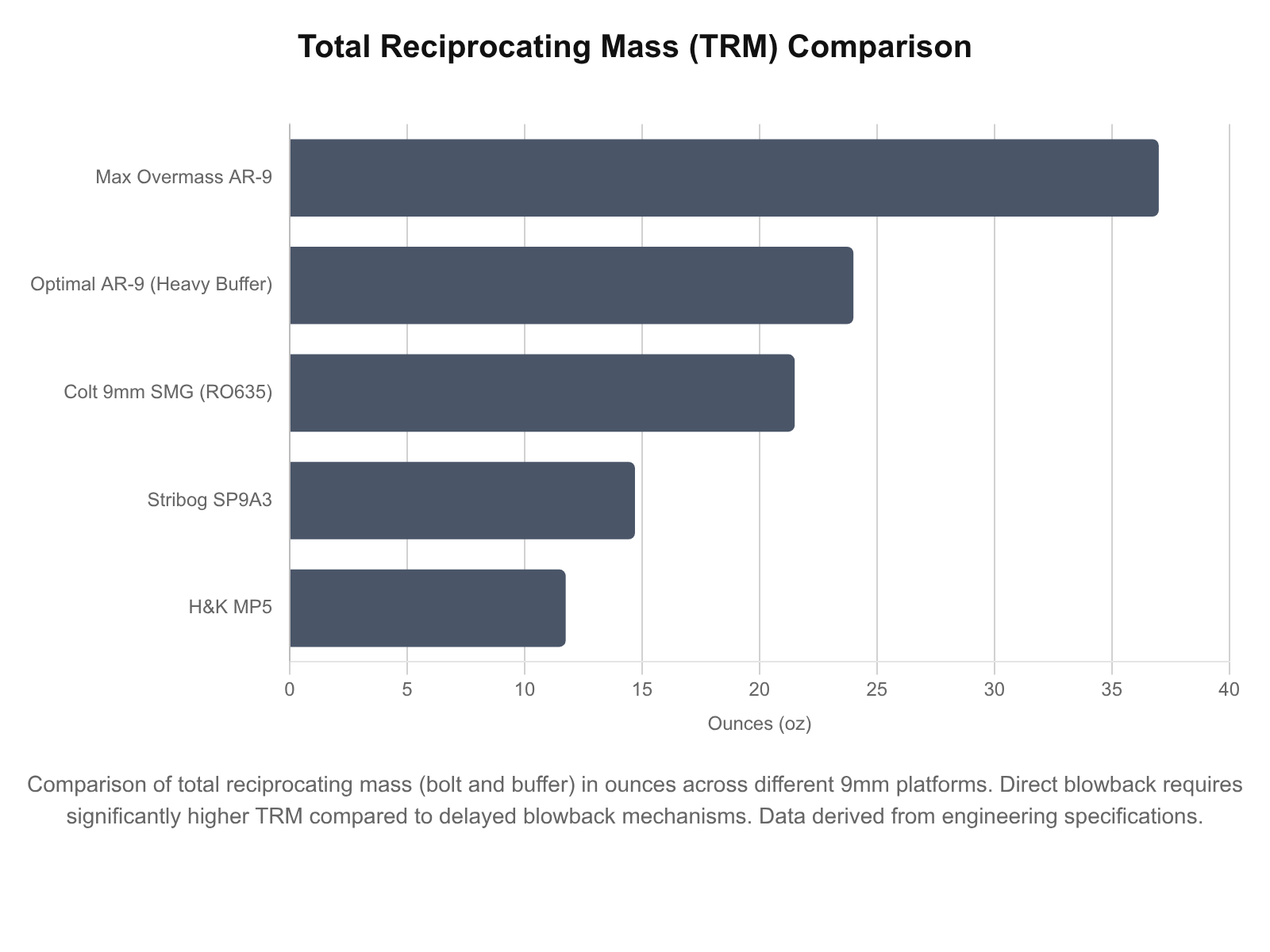
For an AR-9 style direct blowback system to function safely and reliably with standard 9mm factory ammunition, the Total Reciprocating Mass (TRM),defined as the combined physical weight of the bolt assembly and the buffer,must meet a highly specific threshold. Extensive engineering testing dictates that a TRM range of 22 to 24 ounces is optimal for the vast majority of “out of the box” 9mm AR platforms.10

Historical precedent supports this metric. The original Colt 9mm SMG (RO635), developed in the 1980s, utilized a heavy 15.9-ounce unramped bolt paired with a 5.6-ounce steel buffer, resulting in a TRM of 21.5 ounces.10 Modern consumer AR-9 bolts typically weigh between 12 ounces and 15.5 ounces.10 Because standard 5.56mm AR-15 buffers weigh only 3.0 ounces (Carbine) to 5.4 ounces (H3), they are dangerously insufficient for use in a 9mm direct blowback system.10 Utilizing a standard AR-15 buffer in a 9mm PCC will result in the TRM falling woefully short of the 22-ounce minimum, leading to excessively high bolt velocities, violent recoil, broken hammer pins, and potential case ruptures.10 To achieve the necessary 22 to 24-ounce TRM, operators must procure specialized, heavy 9mm extended buffers weighing between 7.5 and 12 ounces.10 Increasing the reciprocating mass up to approximately 37 ounces is generally acceptable and mechanically beneficial, as heavier masses further decrease bolt velocity, reduce wear and damage on internal receiver parts, and slightly elongate the cycle time.10

3.3 Deadblow Buffers, Bolt Bounce, and Catastrophic Failure Mitigation

The violent, high-velocity nature of the direct blowback cycle introduces a dangerous mechanical phenomenon known as “bolt bounce.” When the heavy, 24-ounce mass of the bolt and buffer slams forward under spring tension to strip a new cartridge from the magazine and chamber it, the violent kinetic impact of the steel bolt against the steel barrel face acts like a hammer striking an anvil.10 This impact causes the bolt to physically bounce backward, momentarily unlocking the breech.10

If the weapon’s trigger is pulled, or if the hammer falls automatically during this micro-second of bolt bounce, the firing pin will strike the primer while the cartridge is partially unsupported by the chamber. This results in a devastating out-of-battery (OOB) detonation.10 To mitigate this hazard, specialized 9mm buffers must incorporate internal sliding weights. These internal weights shift forward slightly after the main body of the buffer strikes the bolt, acting as a “deadblow” hammer.10 The secondary impact of the sliding weights mathematically cancels out the rearward momentum of the bolt bounce, ensuring the breech remains securely closed during ignition.10 Solid buffers (those manufactured without internal sliding weights) should be categorically avoided in all direct blowback PCC builds to prevent this catastrophic failure mechanism.10

3.4 The Hazard of Over-Sprung Systems and the .308 Spring Myth

As previously established in Section 2.3, recoil springs offer negligible resistance against chamber pressure.17 However, many amateur armorers attempt to cure AR-9 feeding and ejection issues by installing extra-power or .308 Winchester rifle springs.15 This is a severe mechanical error.

A 9mm direct blowback system does not benefit from being “oversprung”.10 An overpowered .308 spring drastically increases the forward velocity of the heavy 24-ounce bolt mass. When this mass crashes into the breech face at heightened speeds, it causes severe battering of the aluminum receiver and the barrel trunnion.10 Furthermore, the excessive forward speed frequently induces “nosedive” feeding malfunctions, where the bolt rams the cartridge into the bottom of the feed cone rather than sliding it into the chamber.10 Worse still, the impact can force the projectile deeper into the brass casing,a malfunction known as bullet setback,which exponentially decreases the internal case volume and dangerously spikes the chamber pressure upon subsequent detonation.10 Standard-strength, mil-spec 5.56mm carbine recoil springs remain the universal, mechanically optimal choice for 9mm direct blowback operations.6

Yugo M85/M92 dust cover quick takedown pin installation detail

4.0 Mechanical Architecture Analysis: Roller-Delayed and Advanced Systems

In stark contrast to the brute-force inertia of the direct blowback system, the roller-delayed blowback system,pioneered by German engineers in the mid-20th century and perfected in the iconic Heckler & Koch MP5,utilizes an elegant, complex mechanical disadvantage to safely regulate chamber pressure.18

4.1 The Kinematics of Roller-Delayed Blowback (H&K MP5)

The roller-delayed system operates on a fundamentally different paradigm. While the bolt is not solidly, permanently locked by rotating lugs like a gas-operated AR-15, it is far from a simple sliding block of steel.18 The system features a multi-part bolt assembly consisting of a bolt head, an angled locking piece, a heavier bolt carrier, and two steel rollers.18

When the weapon cycles forward and goes into battery, the angled locking piece drives the two steel rollers outward, laterally engaging with recessed trunnions machined directly into the barrel extension.18 At this moment, the bolt is effectively sealed in place. Upon firing, the rearward force of the expanding gases pushes against the face of the bolt head. However, because the rollers are firmly seated in the trunnions, the bolt head cannot immediately travel rearward.18

Before the bolt head can move backward to extract the casing, the rearward force must squeeze the steel rollers inward, out of the trunnion recesses. Because the rollers are pressed against the angled wedge of the locking piece, forcing them inward violently accelerates the heavier bolt carrier to the rear at a much faster rate than the bolt head itself.18 The specific angle of the locking piece (typically 100 degrees for standard MP5s, or 80-90 degrees for suppressed/K-models) dictates the exact ratio of mechanical disadvantage.28

4.2 Mechanical Disadvantage as a Pressure Regulator

This mechanical disadvantage is the genius of the roller-delayed system. It acts as an automatic, precision-timed pressure regulator. The system ensures that the breech remains effectively sealed until the bullet has exited the muzzle and the bore pressures have dropped to highly manageable, safe levels.18 Because the delay is achieved mechanically rather than strictly through static inertia, roller-delayed platforms are considered inherently safer when operating with high-pressure (+P or +P+) 9mm cartridges, drastically reducing the risk of premature case ruptures.18

4.3 Weight Reduction and Systemic Efficiency

The most profound mechanical benefit of this delayed unlocking process is the massive reduction in required bolt weight. Because the rollers and the locking piece handle the burden of delaying the action, the entire bolt assembly can be made significantly lighter.18 The complete, fully assembled bolt carrier group of an H&K MP5, including the recoil spring assembly, weighs approximately 11.75 ounces (333 grams).30

When compared to the 24-ounce TRM requirement of an optimal AR-9 direct blowback system, the MP5 operates with less than half the reciprocating mass.10 This dramatic reduction in moving mass is the primary reason why roller-delayed firearms are universally celebrated for their smooth cycling and minimal felt recoil.18 The primary disadvantage of this architecture is its complexity; machining the trunnions, precisely angling the locking pieces, and perfectly aligning the rollers requires exceptional manufacturing tolerances, leading to a significantly higher initial acquisition cost.18

4.4 Alternative Delay Mechanisms: Hydraulic and Radial Architectures

The modern PCC market also features hybrid delay mechanisms that attempt to bridge the gap between the simplicity of direct blowback and the smoothness of roller-delay. The Swiss-manufactured B&T APC9 utilizes a direct blowback bolt but incorporates a sophisticated, proprietary hydraulic buffer system built directly into the rear of the receiver endcap.20 This hydraulic damper decelerates the heavy bolt mass over a longer duration, absorbing the violent rearward impact and transforming the sharp punch into a smoother push.32

Similarly, the CMMG Banshee utilizes a proprietary “Radial Delayed Blowback” system. This hybrid architecture forces the bolt lugs to rotate and unlock along specially angled cuts within the barrel extension, mimicking the mechanical delay of a traditional roller system.33 This radial delay allows the Banshee to utilize a lighter bolt group than a standard AR-9, taming the recoil impulse while maintaining standard AR-15 dimensions and parts compatibility.33

5.0 Biomechanical Operator Feedback and Recoil Impulse Profiles

The deep mechanical differences between direct and delayed blowback architectures do not exist solely in a vacuum of engineering data; they directly and profoundly translate into the biomechanical feedback experienced by the human operator. In high-stress CQB environments, the recoil impulse of a weapon system dictates the speed of initial target acquisition, the accuracy of rapid follow-up shots, and the overall split times during dynamic, multi-target engagements.20

5.1 The “Sharp Punch” of Direct Blowback Kinematics

Direct blowback systems are widely criticized by professional operators for their harsh, snapping recoil impulse. As established in Section 3.2, a massive 24-ounce steel weight is violently propelled backward by 35,000 PSI of chamber pressure. This mass must eventually stop. In an AR-9 or a CZ Scorpion EVO 3, the heavy bolt travels rearward until it abruptly bottoms out against the rear of the aluminum buffer tube or the polymer receiver housing.10

This sudden, violent deceleration transfers the accumulated kinetic energy directly into the operator’s shoulder. Rather than a steady push, the operator experiences a sharp, disruptive “punch”.33 This sudden energy transfer disrupts the operator’s sight picture, forces the red dot optic or iron sights to jump erratically, and causes significant upward muzzle rise.35 To effectively manage a direct blowback PCC during rapid fire, the operator must utilize an aggressive, highly tensioned forward grip and exert substantial muscular force to drive the muzzle back down onto the target after every shot.35 As the author of a comparative analysis noted, “Physics dictates they will have more ‘thump.’ The Scorpion is known for being snappy… you will definitely feel more movement compared to the delayed guns”.33

5.2 The “Gentle Thwap” of Roller-Delayed Deceleration

Conversely, the recoil profile of the Heckler & Koch MP5 and its high-tier clones (such as the Zenith ZF-5 or Century Arms AP5) is universally lauded for its unparalleled smoothness.18 Because the roller-delayed system requires only 11.75 ounces of reciprocating mass, there is substantially less kinetic energy slamming into the rear of the receiver.18 Furthermore, the mechanical unlocking of the rollers naturally absorbs a fraction of the initial energy peak, distributing the recoil impulse over a slightly longer temporal duration.18

Operators frequently describe the MP5 recoil impulse as a “gentle thwap” or a smooth, rolling push rather than an abrupt strike.12 This allows the weapon’s sights to track linearly, reciprocating straight back and returning exactly to the original point of aim without violently lifting off the target. In direct comparative testing, shooters utilizing roller-delayed platforms report buttery-smooth cycling that occasionally feels akin to firing a.22 caliber rimfire weapon.12

5.3 Empirical Split Times, Target Acquisition, and The Bill Drill

This biomechanical advantage directly impacts tactical performance metrics. A standard assessment in tactical firearms training is the “Bill Drill,” an exercise designed to measure recoil management and speed.36 From a low-ready or holstered position, the operator must fire six consecutive shots as rapidly as possible into an 8-inch circular target at a distance of 7 yards.36

When executing a Bill Drill with a direct blowback AR-9 or CZ Scorpion, the operator must consciously fight the heavy reciprocating mass to keep all six rounds within the A-zone, often resulting in slightly slower split times (the time elapsed between individual shots).37 However, when utilizing a premium roller-delayed platform, such as the competition-tuned JP5, operators consistently report the ability to execute a clean, six-shot Bill Drill in approximately 3.0 seconds flat, with all impacts clustered tightly in the center mass.38 The linear tracking of the delayed action allows the operator’s visual processing to stay ahead of the recoil cycle, enabling significantly faster and more accurate target saturation.38

6.0 Select-Fire Cyclic Rate Optimization

For law enforcement SWAT applications, specialized VIP protection details, and defense contractors supplying fully automatic or burst-fire weapon systems, the cyclic rate of fire,measured in Rounds Per Minute (RPM),is a critical performance metric. A cyclic rate that is excessively high renders the weapon entirely uncontrollable during automatic fire, causing severe muzzle climb and rapidly depleting the 30-round ammunition reserves in less than two seconds without achieving accurate target saturation. Conversely, a rate that is too low can cause the weapon to feel sluggish, leading to a “chugging” recoil impulse that throws off the shooter’s natural cadence and allows the target to maneuver between impacts.

6.1 The Engineering Challenge of High-Velocity Actions

Operating a 9mm direct blowback system in a fully automatic configuration presents a severe engineering challenge. Because the system relies purely on a heavy bolt and a stout recoil spring, the action naturally wants to cycle at a blistering, uncontrollable speed. When the trigger is depressed, the bolt strips a round, fires it, flies back, bounces off the rear buffer, and violently slams forward again with unmitigated ferocity.

6.2 The 1150 RPM Extreme: The CZ Scorpion EVO 3 A1

The select-fire variant of the CZ Scorpion, designated the EVO 3 A1 (specifically designed for military and LE contracts), operates via pure, unmitigated direct blowback.40 Because it relies entirely on its massive bolt block and spring tension, the action cycles exceptionally fast. The official factory cyclic rate for the Scorpion A1 is an astonishing 1150 RPM.40

At this immense speed, the weapon can completely empty a standard 30-round magazine in approximately 1.5 seconds.41 While this provides devastating, overwhelming suppressive fire in extremely tight, phone-booth-sized CQB spaces, it is widely considered too fast for practical patrol use. It requires intense, specialized operator training to deliver controlled, short bursts, as the sharp direct-blowback recoil combined with the blistering fire rate leads to rapid, aggressive muzzle climb.41

6.3 Hydraulic Damping and Rate Reduction (Colt RO635 & B&T APC9)

When Colt developed the original RO635 9mm submachine gun for LE and military use in the 1980s, they encountered the same high-velocity problem. Early iterations of the direct blowback Colt SMG cycled at nearly 1000 RPM, making the weapon incredibly difficult to control on full-auto.42 To make the weapon viable for tactical teams, Colt Senior Engineer Henry “Hank” Tatro designed a specialized hydraulic buffer.26 This hydraulic damper absorbed the rearward momentum of the heavy steel buffer, successfully mitigating the bolt velocity and dropping the cyclic rate down to a highly manageable 650 to 850 RPM.26

The modern B&T APC9 PRO select-fire SMG utilizes a highly refined evolution of this concept. It employs a hydraulic-assisted blowback mechanism built into the receiver to decelerate the bolt, allowing the weapon to maintain a brisk but extremely steady cyclic rate of 1080 RPM.44 The hydraulic buffer absorbs the rearward impact so effectively that the weapon remains highly controllable despite operating at over 1000 rounds per minute, preventing the muzzle climb normally associated with such high cyclic rates.32

6.4 The 800 RPM Golden Mean of the MP5

The H&K MP5 (specifically the A2 and A3 variants) features an optimized, naturally governed cyclic rate of approximately 800 RPM.27 This specific rate is widely considered by tactical instructors and defense analysts to be the “gold standard” for 9mm submachine guns. It strikes a perfect, harmonious balance between rapid target saturation and complete operator controllability.27 The mechanical delay of the rollers acts as a natural governor on the bolt’s velocity, ensuring that the weapon cycles at a consistent, rhythmic 800 RPM without the need for additional hydraulic dampers or overly complex buffer systems.

Yugo M85/M92 dust cover quick takedown pin installation detail

7.0 Acoustic Suppression and Gas System Dynamics

In contemporary tactical operations, the acoustic suppression of entry weapons is no longer considered a luxury or a niche accessory; it is an absolute tactical necessity. Suppressors preserve vital team communication during chaotic CQB entries, protect officer hearing in enclosed concrete spaces, and reduce the disorienting physical concussions that occur during indoor firefights.33 However, the physical mechanics of the blowback system drastically affect a weapon’s viability as a suppressor host.

7.1 Premature Breech Opening and “Port Pop” in Direct Blowback

A sound suppressor functions by capturing and slowing the rapidly expanding, high-pressure gases exiting the muzzle. This inherently creates significant backpressure, forcing gases back down the barrel toward the chamber. In a direct blowback AR-9 or CZ Scorpion, the breech begins to move backward the exact millisecond the cartridge detonates, held closed only by inertia.10

Because the suppressor holds high-pressure gas in the barrel for a longer duration, opening the breech quickly under these conditions results in high-velocity, highly compressed gas escaping backward directly out of the ejection port.33 This phenomenon, known in the industry as “port pop,” severely increases the decibel reading directly at the shooter’s ear, effectively neutralizing much of the suppressor’s intended acoustic benefit.33 Furthermore, this intense backpressure blows toxic carbon fouling, unburnt powder, and vaporized lead particulate directly backward into the operator’s face. During sustained engagements, this gas blowback severely irritates the operator’s eyes and respiratory tract, compromising their vision and combat effectiveness.18

7.2 Backpressure Mitigation and Subsonic Efficiency in Delayed Actions

Roller-delayed systems, particularly the MP5 and its variants, are universally regarded by the industry as the ultimate, tier-one suppressor hosts.18 The mechanical delay of the rollers keeps the breech firmly locked shut for a critical fraction of a second longer than a simple direct blowback system.18 By the time the rollers unlock, the mechanical disadvantage is overcome, and the bolt head finally moves rearward, the vast majority of the expanded, high-pressure gases have already vented forward safely out of the suppressor.18

As a result, there is virtually zero port pop.33 The operator experiences a remarkably clean, exceptionally quiet shooting experience with zero toxic gas blowback to the face.18 For elite SWAT teams deploying heavy, subsonic 147-grain or 150-grain 9mm ammunition, a suppressed MP5 provides unparalleled acoustic stealth, rendering the weapon nearly silent beyond the mechanical clatter of the bolt group.28

8.0 Motor Skill Perishability and the Manual of Arms

The acquisition of a new weapon system by a law enforcement agency inherently demands a massive, often under-calculated investment in officer training. Transitioning a department from one firearm platform to another is not simply a matter of a brief qualification course; it requires the overriding of deeply ingrained, highly perishable motor skills.7

8.1 The Psychological Reality of Lethal Force Engagements

Under the extreme physiological and psychological stress of a lethal force encounter, the human brain experiences severe auditory exclusion, tunnel vision, and a catastrophic loss of fine motor skills. In these life-or-death microseconds, officers default entirely to subconscious muscle memory built through thousands of hours of repetitive training.7 The courts have strictly ruled on this matter; the landmark legal case Popow v. City of Margate definitively established that mere “qualification is not training”.46 If an officer fumbles a weapon transition or a reload because the manual of arms is unfamiliar, the legal liability falls squarely on the agency for failure to train.46

8.2 Ergonomic Crossover: The AR-15 to AR-9 Paradigm

This physiological reality presents the most profound operational advantage of the modern AR-9 Pistol Caliber Carbine. The AR-9 shares an absolutely identical ergonomic identity with the standard 5.56mm AR-15 patrol rifle.6 The safety selector, the push-button magazine release, the T-handle charging handle, and the bolt catch are all located in the exact same physical space on the receiver.6

When an agency adopts an AR-9 for its tactical teams, motor units, or school resource officers, effectively zero hours must be spent retraining officers on the manual of arms. An officer who has spent the last five years building deep neural motor pathways on a 5.56mm M4 can pick up a 9mm AR-9 and intuitively, subconsciously operate it in complete darkness.7 This seamless hardware transition drastically reduces the financial burden of training ammunition, range time, and instructor overtime, significantly offsetting the initial lifecycle cost of the weapon itself.4

8.3 Motor Skill Partitioning and Legacy Ergonomics

Conversely, legacy platforms like the H&K MP5, originally designed in the 1960s, possess a severely outdated manual of arms by modern standards.27 The most glaring deficiency is that the MP5 completely lacks a Last Round Bolt Hold Open (LRBHO) feature.33 When an AR-15 or an AR-9 runs out of ammunition, the bolt locks to the rear, providing a tactile and visual indicator to the operator. When the MP5 runs dry, the bolt closes on an empty chamber, and the officer feels a dead trigger click during a firefight.33

Furthermore, the MP5 reload sequence is complex, idiosyncratic, and highly motor-skill intensive. Upon recognizing an empty weapon, the officer must manually reach forward, pull the charging handle to the rear, and physically lock it upward into a notch.48 They must then strip the empty magazine using a paddle release behind the magazine well, insert a fresh magazine, and aggressively slap the charging handle downward (the iconic “HK Slap”) to chamber a new round.48

If an agency transitions from an AR-15 patrol rifle to an MP5 for entry work, the officers must partition their brains to maintain two entirely different, highly perishable reloading and malfunction-clearing protocols. In high-stress situations, an officer attempting to hit a non-existent AR-15 bolt release on the side of an MP5 can result in fatal hesitation.46 The CZ Scorpion suffers a similar fate, requiring unique training for its distinct forward side-charging handle and paddle magazine release, though it does feature a modern LRBHO system.49

9.0 Lifecycle Costing (LCC) and Long-Term Durability

Procurement decisions made by law enforcement command staff and municipal accountants cannot be based solely on the initial unit acquisition price. The true, comprehensive financial impact of a weapon system over a ten-year deployment cycle is determined by Lifecycle Costing (LCC).50

9.1 Breaking the Acquisition-Centric Procurement Model

LCC models evaluate the entire lifespan of an asset, moving far beyond the sticker price to include operational costs, component wear rates, armorer maintenance hours, part replacement frequencies, and eventual end-of-life disposal.50 Institutional studies consistently demonstrate that acquisition costs typically account for only 20 to 40 percent of a public asset’s total expenditures, while the remaining 65 to 75 percent of costs arise strictly during the weapon’s long-term usage phase.52 Evaluating firearms solely by their upfront cost is a severe procurement failure.

9.2 High-Velocity Wear Rates in Direct Blowback Platforms

The CZ Scorpion EVO 3 and standard AR-9 builds represent a highly cost-effective initial purchase, often retailing for $800 to $1,500, which is frequently less than half the price of a genuine MP5 or premium roller-delayed clone.53 However, as established in Section 3, direct blowback systems are inherently “dirty” and exceptionally violent on their internal components.10

The massive bolt assemblies violently batter hammer pins, trigger groups, and bolt catches.10 This violence necessitates a strict, highly active armorer maintenance schedule to prevent catastrophic failure in the field. The official CZ armorer guidelines explicitly mandate replacing the slide stop, the trigger-return spring, the main spring, and the recoil spring every 10,000 rounds.55 By 20,000 rounds, the entire firing pin, firing pin spring, extractor, extractor pin, and extractor spring must be entirely gutted and replaced.55 Furthermore, civilian and LE users have documented issues with the Scorpion’s factory bolt block deforming over time from the repeated high-velocity impacts, sometimes requiring the purchase of enhanced, hardened aftermarket bolts for $249.00 to maintain operational status.56

9.3 Roller-Delayed Attrition: The Extractor Spring Vulnerability

The H&K MP5 operates much cleaner and subjects its receiver to significantly less internal battering due to the mechanical delay and lighter 11.75-ounce bolt mass.18 MP5 cold-hammer-forged barrels are remarkably durable; specialized armorers report that fully automatic MP5s maintain exceptional accuracy and reliability well past 40,000 rounds of sustained fire without requiring a barrel or receiver replacement.29 Even the recoil springs on the MP5 routinely last tens of thousands of rounds without suffering significant degradation.29

However, the MP5 contains a distinct, highly specific Achilles’ heel that severely impacts its LCC: the extractor spring. The small, copper-colored extractor spring is universally recognized as the single most common point of failure in the entire MP5 platform.57 Because there is no mechanical over-travel stop, if an empty casing fails to clear the ejection port and causes a “stovepipe” jam, the returning heavy bolt will force the extractor outward, permanently bending or breaking the thin copper spring.57 Once bent, the weapon will suffer continuous, debilitating failure-to-eject (FTE) malfunctions until the spring is replaced.57

While a replacement copper spring is financially inexpensive (approximately $10.95), the labor, diagnostic time, and operational downtime required to replace it factor heavily into the LCC.58 Armorers must explicitly avoid using the thicker, more durable silver-colored rifle extractor springs in the MP5K models, as the increased tension severely alters the delicate ejection timing of the faster, lighter K-model bolt, leading to further malfunctions.57

TABLE 2: LIFECYCLE COSTING (LCC) AND MAINTENANCE METRICS OVER 20,000 ROUNDS

Analytical Cost FactorCZ Scorpion / AR-9 (Direct Blowback)H&K MP5 / Clones (Roller-Delayed)
Initial Acquisition CostLow to Moderate ($800 – $1,500)High Premium ($2,000 – $3,500+)
System CleanlinessPoor (Heavy carbon fouling in receiver)Excellent (Action remains sealed longer)
Receiver BatteringHigh (Heavy mass impact degradation)Low (Mechanical deceleration saves wear)
10k Round ReplacementTrigger springs, recoil springs, slide stopVisual inspection; minimal parts required
20k Round ReplacementFiring pin, complete extractor assemblyStandard preventative maintenance
Unique VulnerabilitiesBolt catch breakage, bolt block deformationCopper extractor spring bending/breakage
Armorer Labor BurdenHigh (Frequent teardowns and part swaps)Low (Excepting extractor spring failures)

Data synthesized from OEM Armorer Manuals (CZ-USA, H&K) and municipal LCC frameworks.

10.0 Strategic Sourcing and Procurement Directives

The selection between a direct blowback PCC and a roller-delayed SMG cannot be determined by a single metric. It demands a comprehensive, holistic assessment of an agency’s operational budget, primary mission set, and existing training infrastructure.

10.1 High-Tier Tactical and Hostage Rescue Deployments

If the primary mission profile of the unit involves covert entry, hostage rescue, and exclusively suppressed operations, the roller-delayed architecture (H&K MP5, SP5, or high-tier clones) remains statistically and operationally unmatched. The buttery-smooth recoil impulse allows for surgical, sub-second precision during fully automatic or rapid semi-automatic fire, and the delayed breech opening provides optimal, gas-free acoustic suppression. The significantly higher initial acquisition cost and the outdated, complex manual of arms are highly acceptable trade-offs for elite tactical units that possess the dedicated training budgets required to maintain specialized motor skills.

10.2 Broad Patrol and Budget-Constrained Implementations

For general patrol integration, school resource officers (SROs), and budget-constrained municipal agencies, the AR-9 direct blowback platform is the definitive, fiscally responsible choice. While the recoil impulse is noticeably sharper and the acoustic suppression capabilities are vastly inferior to delayed systems, the AR-9 offers unparalleled, immediately quantifiable training efficiency. By mirroring the 5.56mm AR-15 patrol rifle exactly, agencies completely eliminate the need for cross-training, saving thousands of dollars in perishable skill maintenance. To mitigate the inherent violence of the direct blowback action, procurement officers must ensure that AR-9 contract specifications mandate a 22-to-24-ounce total reciprocating mass utilizing an extended deadblow hydraulic or sliding-weight buffer system to guarantee long-term reliability and strictly prevent catastrophic out-of-battery detonations.

10.3 Hybrid Deployments and Future Trajectories

Agencies seeking a modern middle ground that compromises neither ergonomics nor recoil mitigation should heavily evaluate advanced hydraulic systems, such as the B&T APC9 PRO. It successfully combines modern, AR-style ambidextrous ergonomics, LRBHO functionality, and flawless reliability with a proprietary hydraulic buffer system that thoroughly tames the violent direct blowback recoil impulse. While commanding a higher price point than standard AR-9s, it represents a highly formidable, future-proof option for the 2025-2035 procurement cycle.


Appendix: Methodology & Data Sources

The analytical conclusions presented in this white paper were synthesized through a rigorous, cross-source Open-Source Intelligence (OSINT) methodology. Data collection focused strictly on the mechanical engineering specifications, ballistic physics formulas, and historical procurement trends of 9x19mm submachine guns and Pistol Caliber Carbines (PCCs). Source material included original manufacturer armorer manuals (Heckler & Koch, CZ-USA, Colt), technical teardown analyses, fluid dynamics and momentum physics documentation, and law enforcement lifecycle costing (LCC) frameworks. Cyclic rate data and total reciprocating mass (TRM) figures were verified across multiple technical databases to establish accurate, unbiased comparative baselines. Subjective recoil impulses were quantified by correlating mechanical bolt deceleration mechanics with documented operator feedback and empirical “Bill Drill” performance metrics. Financial procurement models were adapted from standard municipal investment goods lifecycle matrices, isolating the initial acquisition costs from long-term maintenance overhead. The synthesis of this comprehensive data ensures that all findings are grounded in empirical mechanical reality rather than manufacturer marketing claims.

Ronin’s Grips Analytics provides custom, agency-specific data on this topic. Contact us to commission a tailored internal audit or procurement forecast for your department.


Please share the link on Facebook, Forums, with colleagues, etc. Your support is much appreciated and if you have any feedback, please email us in**@*********ps.com. If you’d like to request a report or order a reprint, please click here for the corresponding page to open in new tab.


Sources Used

  1. Select Fire Carbines vs. Submachine Guns – Police Magazine, accessed March 5, 2026, https://www.policemag.com/articles/select-fire-carbines-vs-submachine-guns
  2. The United States Military and Law Enforcement relationship with PCCs and SMGs – Reddit, accessed March 5, 2026, https://www.reddit.com/r/WarCollege/comments/1lqao9f/the_united_states_military_and_law_enforcement/
  3. implementing the .223 carbine for patrol – SHSU, accessed March 5, 2026, https://shsu-ir.tdl.org/bitstreams/44637334-0f01-4130-adbc-af25fea199ee/download
  4. Alternative Calibers For Police Rifle Training – American Cop, accessed March 5, 2026, https://americancop.com/alternative-calibers-for-police-rifle-training/
  5. AR-15 vs PCC for Home Defense/Range/SHTF: Seeking Pros and Cons – Reddit, accessed March 5, 2026, https://www.reddit.com/r/liberalgunowners/comments/1f3cd8w/ar15_vs_pcc_for_home_defenserangeshtf_seeking/
  6. Quick Tip: Converting a 5.56 AR-15 to 9mm – YouTube, accessed March 5, 2026, https://www.youtube.com/watch?v=XQAnhpsRySw
  7. Weapon Transition Training: The Evolution of Law Enforcement Training – Chris Sajnog, accessed March 5, 2026, https://chrissajnog.com/blog/le-weapon-transition/training/
  8. Submachine Guns Market Size, Competitors & Forecast to 2030 – Research and Markets, accessed March 5, 2026, https://www.researchandmarkets.com/report/sub-machine-gun-market
  9. GAO-19-175, FEDERAL LAW ENFORCEMENT: Purchases and Inventory Controls of Firearms, Ammunition, and Tactical Equipment, accessed March 5, 2026, https://www.gao.gov/assets/gao-19-175.pdf
  10. Everything about the “AR9” – Blowback9.com, accessed March 5, 2026, https://blowback9.wordpress.com/2021/04/02/everything-about-the-ar9/
  11. How Does it Work: Blowback Action – Forgotten Weapons, accessed March 5, 2026, https://www.forgottenweapons.com/how-does-it-work-blowback-action/
  12. How does the recoil on your MP5 feel? – Reddit, accessed March 5, 2026, https://www.reddit.com/r/MP5/comments/1i9guas/how_does_the_recoil_on_your_mp5_feel/
  13. Blowback Bolt Weight Calculations | PDF | Bullet | Cartridge (Firearms) – Scribd, accessed March 5, 2026, https://www.scribd.com/document/58128755/Blowback-Bolt-Weights
  14. Blowback formula needed – Google Groups, accessed March 5, 2026, https://groups.google.com/g/rec.guns/c/elEl5lAnYcg
  15. Math Breakdown:308 spring vs Standard AR15 spring : r/AR9 – Reddit, accessed March 5, 2026, https://www.reddit.com/r/AR9/comments/10el6gq/math_breakdown308_spring_vs_standard_ar15_spring/
  16. 308 buffer spring or standard Milspec spring with H3 (or heavier) buffer? : r/AR9 – Reddit, accessed March 5, 2026, https://www.reddit.com/r/AR9/comments/ye7kkc/308_buffer_spring_or_standard_milspec_spring_with/
  17. The case against  .308 (XP, etc.) recoil springs in a 9mm AR – Blowback9.com, accessed March 5, 2026, https://blowback9.wordpress.com/2021/04/07/the-case-against-308-rifle-recoil-springs-in-a-9mm-ar/
  18. Roller-Delayed vs. Direct Blowback: An Overview , Zenith Firearms, accessed March 5, 2026, https://zenithfirearms.com/roller-delayed-vs-direct-blowback-an-overview/
  19. Ruger PC Carbine Review [Video] – Gun University, accessed March 5, 2026, https://gununiversity.com/ruger-pc-carbine/
  20. Best Pistol-Caliber Carbines (PCC): 9mm & Beyond – Pew Pew Tactical, accessed March 5, 2026, https://www.pewpewtactical.com/pistol-caliber-carbines/
  21. The 9mm Carbine: Part SMG, Part Pistol, Pure Utility – Recoil Magazine, accessed March 5, 2026, https://www.recoilweb.com/the-9mm-carbine-part-smg-part-pistol-pure-utility-162050.html
  22. Know Your Blowback? Roller-Delayed vs. Direct – The Armory Life, accessed March 5, 2026, https://www.thearmorylife.com/roller-delayed-vs-direct-blowback/
  23. Understanding Direct Blowback and Roller Delayed Systems in Firearms – Oreate AI Blog, accessed March 5, 2026, https://www.oreateai.com/blog/understanding-direct-blowback-and-roller-delayed-systems-in-firearms/2485c39797c4b6967f743d3bd82d3a42
  24. How often do you clean your scorpion? : r/czscorpion – Reddit, accessed March 5, 2026, https://www.reddit.com/r/czscorpion/comments/kl7qfb/how_often_do_you_clean_your_scorpion/
  25. Quick Tip: H&K MP5K vs CZ Scorpion Micro – YouTube, accessed March 5, 2026, https://www.youtube.com/watch?v=NW63vDJou9I
  26. THE COLT 9mm NATO SMG/CARBINE – Small Arms Review, accessed March 5, 2026, https://smallarmsreview.com/the-colt-9mm-nato-smg-carbine/
  27. Heckler & Koch MP5 – Wikipedia, accessed March 5, 2026, https://en.wikipedia.org/wiki/Heckler_%26_Koch_MP5
  28. Democratization of Cyclic Fire Rate : r/MP5 – Reddit, accessed March 5, 2026, https://www.reddit.com/r/MP5/comments/1msq8aa/democratization_of_cyclic_fire_rate/
  29. How often are you guys changing out the recoil spring on a MP5(K) gun? – Reddit, accessed March 5, 2026, https://www.reddit.com/r/MP5/comments/tzjm67/how_often_are_you_guys_changing_out_the_recoil/
  30. Can anyone tell me the weight of a complete MP5 bolt carrier group? – Reddit, accessed March 5, 2026, https://www.reddit.com/r/MP5/comments/hs3be3/can_anyone_tell_me_the_weight_of_a_complete_mp5/
  31. APC9 – B&T USA, accessed March 5, 2026, https://bt-usa.com/product-category/apc-smg/
  32. The APC9KSD2 has very similar recoil impulse to an MP5, finally got to test them. – Reddit, accessed March 5, 2026, https://www.reddit.com/r/BT_APC/comments/1gia8uf/the_apc9ksd2_has_very_similar_recoil_impulse_to/
  33. Comparing Short-Barrel 9mm AR Pistols: AR9, MP5 & More – Blog.GritrSports.com, accessed March 5, 2026, https://blog.gritrsports.com/9mm-ar-pistols-comparison/
  34. Non physics guy here. Why does my 9mm direct blowback AR-9 seem like it has slightly more recoil than my direct blowback 5.56 AR-15? : r/guns – Reddit, accessed March 5, 2026, https://www.reddit.com/r/guns/comments/16yqfjr/non_physics_guy_here_why_does_my_9mm_direct/
  35. Thoughts on the ruger pc carbine 9mm? I’ve heard they’re a lot of fun. – Reddit, accessed March 5, 2026, https://www.reddit.com/r/liberalgunowners/comments/1kg6zdm/thoughts_on_the_ruger_pc_carbine_9mm_ive_heard/
  36. The Importance of Proper Firearm Training – Ammunition Depot, accessed March 5, 2026, https://www.ammunitiondepot.com/blog/yes-you-need-to-practice
  37. Full-sized handgun vs. micro-PDW. When would you carry each one? : r/Firearms – Reddit, accessed March 5, 2026, https://www.reddit.com/r/Firearms/comments/1hpre3x/fullsized_handgun_vs_micropdw_when_would_you/
  38. The JP5 Roller Delayed PCC , If Stoner and Hans had a Baby – GunMag Warehouse, accessed March 5, 2026, https://gunmagwarehouse.com/blog/the-jp5-roller-delayed-pcc-if-stoner-and-hans-had-a-baby/
  39. Standard drills with MP5 – Reddit, accessed March 5, 2026, https://www.reddit.com/r/MP5/comments/1580jjt/standard_drills_with_mp5/
  40. CZ Scorpion Evo 3 – Wikipedia, accessed March 5, 2026, https://en.wikipedia.org/wiki/CZ_Scorpion_Evo_3
  41. CZ Scorpion EVO 3 – Gun Wiki | Fandom, accessed March 5, 2026, https://guns.fandom.com/wiki/CZ_Scorpion_EVO_3
  42. Colt 9mm SMG – Weaponsystems.net, accessed March 5, 2026, https://weaponsystems.net/system/1571-Colt%209mm%20SMG
  43. Colt SMG: First of the 9mm ARs – YouTube, accessed March 5, 2026, https://www.youtube.com/watch?v=cwhCl8VdYh0
  44. Brügger & Thomet APC – Wikipedia, accessed March 5, 2026, https://en.wikipedia.org/wiki/Br%C3%BCgger_%26_Thomet_APC
  45. Blowback VS Roller Delay : r/pistolcalibercarbine – Reddit, accessed March 5, 2026, https://www.reddit.com/r/pistolcalibercarbine/comments/1p9sup0/blowback_vs_roller_delay/
  46. Firearms Transition Training – American Cop, accessed March 5, 2026, https://americancop.com/firearms-transition-training/
  47. MP5 vs AR-9 – Which PCC Is Right For You? – YouTube, accessed March 5, 2026, https://www.youtube.com/watch?v=5P8I02VfEAQ
  48. Which is better you decide! : r/guns – Reddit, accessed March 5, 2026, https://www.reddit.com/r/guns/comments/17y8v78/which_is_better_you_decide/
  49. : r/czscorpion – Reddit, accessed March 5, 2026, https://www.reddit.com/r/czscorpion/comments/g365rm/_/
  50. Life Cycle Costing in Sustainable Public Procurement: A Question of Value, accessed March 5, 2026, https://www.iisd.org/publications/report/life-cycle-costing-sustainable-public-procurement-question-value
  51. Procurement 101: Lifecycle Costing (LCC) – How it works and why it’s important – CADDi, accessed March 5, 2026, https://us.caddi.com/resources/insights/lifecycle-costing
  52. Life Cycle Costs: A Guide to Preparing and Executing Contracts, accessed March 5, 2026, https://ncmahq.org/Web/Shared_Content/CM-Magazine/CM-Magazine-June-2025/Life-Cycle-Costs–A-Guide-to-Preparing-and-Executing-Contracts.aspx
  53. Scorpion or MP5? : r/czscorpion – Reddit, accessed March 5, 2026, https://www.reddit.com/r/czscorpion/comments/15tyuhi/scorpion_or_mp5/
  54. CZ Scorpion vs. MP5 : r/CAguns – Reddit, accessed March 5, 2026, https://www.reddit.com/r/CAguns/comments/1q4xkif/cz_scorpion_vs_mp5/
  55. Maintenance Schedule – CZ – Brian Enos’s Forums… Maku mozo!, accessed March 5, 2026, https://forums.brianenos.com/topic/206488-maintenance-schedule/
  56. Enhanced Bolt For CZ Scorpion (Complete) – Nexus Firearms, accessed March 5, 2026, https://nexusfirearms.com/enhanced-bolt-for-cz-scorpion-complete/
  57. r/MP5 Guide: Extractor Spring Replacement – Reddit, accessed March 5, 2026, https://www.reddit.com/r/MP5/wiki/guide/extractor-spring/
  58. HK MP5, MP5K Extractor Spring – 9mm – HK Parts, accessed March 5, 2026, https://hkparts.net/hk-rifle-smg-parts/hk-mp5-mp5k-extractor-spring-9mm/
  59. Hk Mp5 ARmorers Manual.pdf – Tiropratico.com, accessed March 5, 2026, https://www.tiropratico.com/manuali-pdf/2015-H/Hk%20Mp5%20ARmorers%20Manual.pdf

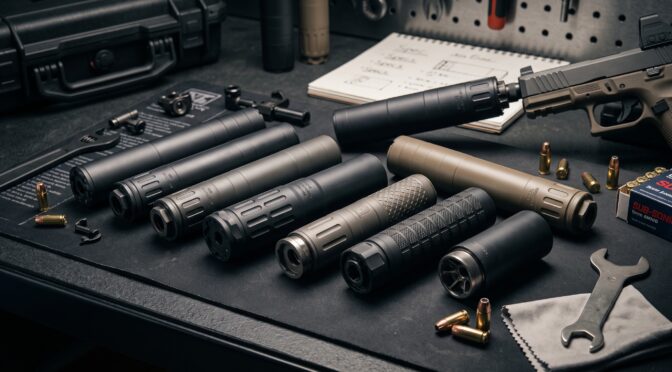
Top 9mm Pistol Suppressors of 2026: A Definitive Ranking

1. Executive Summary

The landscape of small arms sound suppression underwent a fundamental paradigm shift in the first quarter of 2026. The removal of the two hundred dollar National Firearms Act tax stamp requirement on January 1, 2026, catalyzed unprecedented market expansion and completely altered consumer purchasing behaviors.1 Consequently, consumer interest, research, and the acquisition of pistol suppressors have reached historic apexes, creating a highly competitive environment for manufacturers.3 This report provides an exhaustive, engineer-level analysis of the top 10 suppressors chambered for the 9x19mm Parabellum cartridge. The evaluation is predicated upon a comprehensive review of social media sentiment, forum discussions, technical reviews, and retail pricing models from the first quarter of 2026 to the present time.4

The analysis specifically focuses on suppressors optimized for handgun use, necessitating a strict evaluation of weight distribution, internal gas dynamics, and booster assembly efficacy.5 Through algorithmic aggregation of user reviews and manual engineering assessments, this report evaluates fitment, ease of installation, reliability, durability, manufacturing quality, and overall market sentiment. Furthermore, the report establishes the economic realities of the 2026 market by comparing Manufacturer Suggested Retail Prices against the actual minimum, average, and maximum retail prices across preferred distribution networks. The findings highlight a definitive industry pivot toward Direct Metal Laser Sintering additive manufacturing, Grade 5 Titanium construction, and flow-through gas architectures that mitigate system backpressure and improve operator comfort.7

2. The Evolving Economic Landscape of NFA Items in 2026

To understand the current market sentiment surrounding 9mm pistol suppressors, one must analyze the economic and legislative landscape of 2026. Historically, suppressors were heavily regulated under the National Firearms Act, requiring prospective owners to submit extensive paperwork, undergo lengthy Federal Bureau of Investigation background checks, and pay a mandatory tax stamp. These barriers to entry artificially suppressed market demand and restricted the industry primarily to niche enthusiasts and tactical professionals.

The legislative adjustments implemented at the beginning of 2026 completely removed the financial penalty associated with the tax stamp, effectively democratizing access to hearing protection devices for the general shooting public.1 This change resulted in an immediate, massive influx of first-time suppressor buyers entering the retail space. Manufacturers and vendors experienced a surge in demand that stressed supply chains and rapidly depleted existing inventory levels across major retail hubs.

This influx of new consumers also shifted the prevailing sentiment on social media platforms and technical forums. Prior to 2026, discussions heavily favored extreme durability and multi-caliber versatility, as buyers wanted a single suppressor to maximize the value of their singular tax stamp. In the current 2026 landscape, buyers are actively purchasing dedicated, caliber-specific suppressors.9 The sentiment has shifted toward prioritizing lightweight materials, compact form factors, and advanced gas mitigation technologies, as the financial penalty for owning multiple specialized suppressors no longer exists. This report reflects this shift, highlighting products that excel specifically in the dedicated 9mm handgun role.

3. The Physics and Engineering of Short-Recoil Handgun Operation

To accurately assess handgun suppressors, an analyst must first understand the severe mechanical constraints of the host weapon. The vast majority of modern 9mm pistols, including ubiquitous platforms from Glock, Sig Sauer, and Beretta, utilize a Browning-style short-recoil operated, locked-breech mechanism.5 In this specific system, the barrel and slide are mechanically locked together at the moment of ignition. As the expanding propellant gases push the projectile down the bore, the equal and opposite reaction forces the locked barrel and slide assembly to travel rearward together for a very short distance.

Following this initial rearward travel, the barrel encounters a camming surface or a locking block that forces the chamber end of the barrel to tilt downward. This downward tilt unlocks the barrel from the slide, arresting the barrel’s rearward movement. The slide, now free from the barrel, continues its rearward trajectory under its own inertia to extract the spent casing, eject it from the firearm, and strip a fresh cartridge from the magazine upon its return stroke.

Attaching a fixed, rigid mass to the muzzle of the barrel fundamentally disrupts this delicate operational timing. The added weight of a standard suppressor increases the inertial resistance of the barrel. This extra mass often prevents the necessary unlocking tilt from occurring with sufficient velocity, causing the slide to short-stroke. The inevitable result is a failure-to-cycle malfunction, rendering the semi-automatic handgun effectively a single-shot weapon.5 Therefore, the absolute weight of a pistol suppressor is not merely a metric of user comfort, but a critical engineering constraint that dictates the reliability of the entire weapon system.

4. The Crucial Role of the Nielsen Device

To circumvent the inertial disruption caused by suppressor mass, engineers employ a specialized linear decoupler, universally referred to within the industry as a Nielsen device, a booster assembly, or a piston system. The Nielsen device effectively decouples the dead mass of the suppressor from the host barrel during the critical unlocking phase of the firing cycle.6

The assembly consists of a piston that threads directly onto the barrel of the host firearm, a high-tension spring, and a retaining housing integrated into the rear portion of the suppressor. Upon ignition, the expanding gases exiting the muzzle enter the suppressor and strike the primary blast baffle. This forward energy physically pushes the entire outer body of the suppressor forward, compressing the internal high-tension spring against the stationary piston.

This momentary forward displacement is the key to the system. It briefly relieves the barrel of the suppressor’s inertial weight, allowing the barrel to recoil rearward and execute its downward unlocking tilt entirely unhindered. As the slide completes its cycle and returns to battery, the compressed spring pulls the suppressor body back into its resting position against the piston. The quality of the machining tolerances, the specific tension rate of the spring, and the durability of the piston material heavily influence the fitment, reliability, and installation metrics evaluated in this report. A poorly engineered booster assembly will result in inconsistent unlocking, leading to persistent reliability issues that severely impact negative user sentiment.

5. Fluid Dynamics and Backpressure Mitigation Architectures

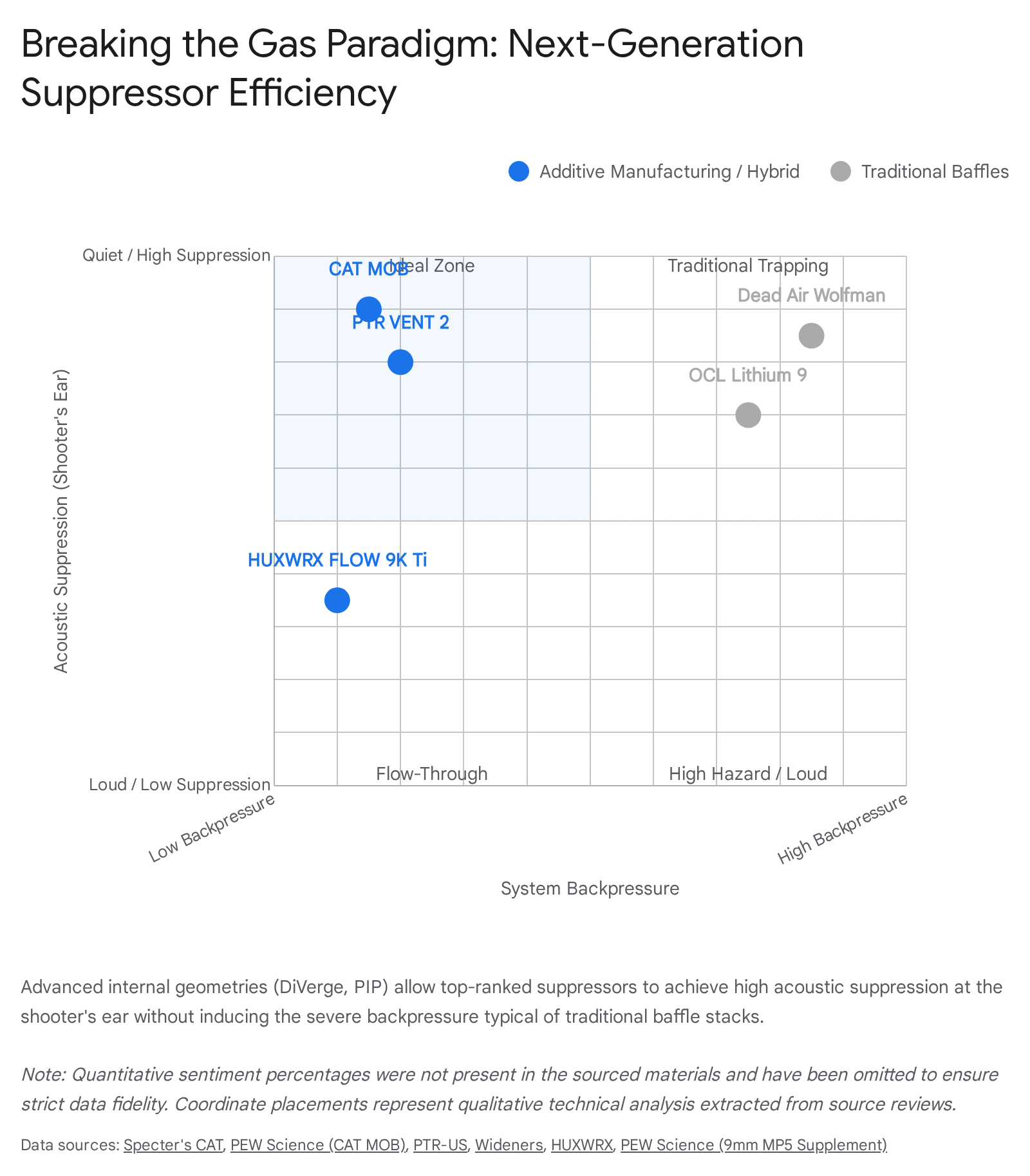
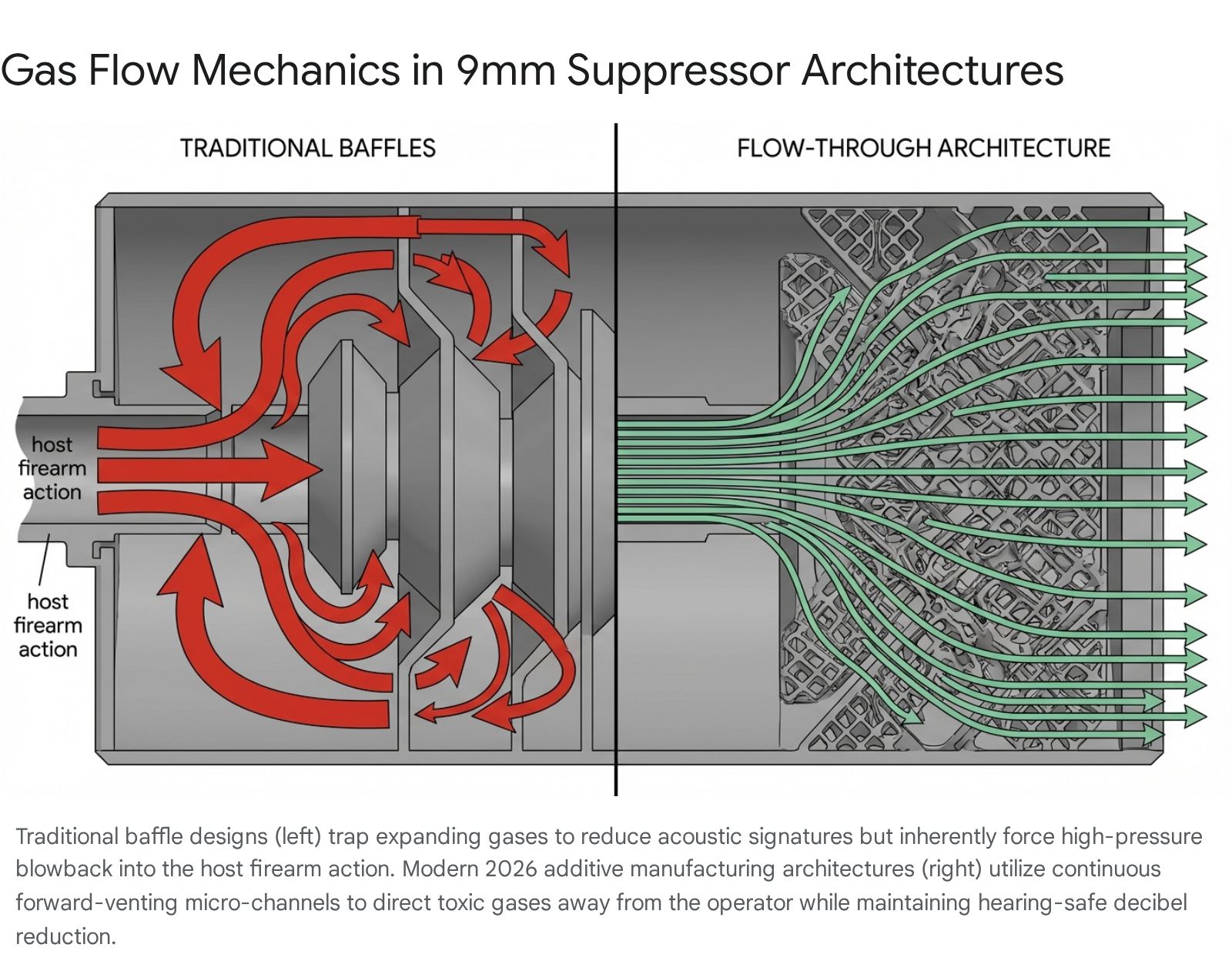
Traditional suppressor architectures rely on stepped cones or K-baffles spaced precisely within a cylindrical tube to strip, trap, and slow the expanding propellant gases.10 While highly effective at reducing the acoustic signature and eliminating muzzle flash, these legacy designs create immense internal pressure gradients. In a semi-automatic handgun, this trapped pressure seeks the path of least resistance. Because the bullet seals the front of the suppressor for a fraction of a millisecond, the easiest escape path for the pressurized gas is often backward, traveling down the bore and out through the open breech during the extraction phase.11

This phenomenon is universally known as backpressure or system blowback. It results in a cascade of negative effects. First, it causes an exponential increase in carbon fouling within the host weapon, necessitating much more frequent cleaning intervals. Second, it accelerates the wear of internal parts due to increased slide velocity. Finally, and most critically for user sentiment, it results in the ejection of toxic particulate matter, unburnt powder, and vaporized lead directly into the face and respiratory system of the operator.11

The 2026 market has seen a massive proliferation of advanced gas-management architectures designed to solve this exact problem. Utilizing 3D printing technologies, manufacturers have developed complex internal geometries, such as the Triskelion baffle and specialized forward-venting flow-through channels.7 These designs maintain low system backpressure by continuously routing gases forward and out of the front of the suppressor, preventing the gas from stagnating and reversing direction. This technological leap drastically improves shooter comfort and preserves host weapon reliability.1

Hatsan Gladius PCP air rifle with Hawke scope

6. Advanced Material Science in 2026 Suppressor Manufacturing

Analyzing the top products reveals a distinct technological divergence in suppressor material science as of 2026. Historically, engineers relied upon heavy, extremely dense materials such as 17-4 Precipitation Hardening stainless steel and Cobalt-6 alloys, such as Stellite, to withstand the severe thermodynamic stress and pressure spikes of expanding propellant gases.9 While these materials yield incredible durability and are highly resistant to baffle erosion, they inherently penalize the user with increased mass. In handguns, excessive mass translates directly to sluggish cycling, increased required booster spring tension, and rapid operator fatigue during extended training sessions.

The data from 2026 proves that Grade 5 Titanium, specifically the Ti-6Al-4V alloy, has become the definitive material of choice for premium pistol suppressors.13 Titanium offers a remarkable strength-to-weight ratio that eclipses standard stainless steel, permitting engineers to expand internal blast chamber volumes and add complex baffle geometries without unduly burdening the muzzle of the handgun. When a suppressor is lighter, it exerts far less leverage on the shooter’s wrists, making target transitions faster and more accurate.

Furthermore, the advent of reliable Direct Metal Laser Sintering, commonly referred to as 3D metal printing, allows manufacturers to manipulate these titanium alloys in ways that are impossible to achieve via traditional subtractive CNC machining operations.7 Engineers can now design complex lattice structures, microscopic flow-through channels, and variable-thickness walls that optimize weight distribution while maintaining structural integrity. These advanced structures induce laminar flow within the gas stream, guiding high-pressure waves forward and drastically reducing the turbulent internal system pressures that cause blowback and acoustic resonance.

7. Methodology for Sentiment Analysis and Economic Evaluation

To identify the absolute top 10 suppressors for 9mm pistols, this analysis utilized comprehensive social media listening algorithms, aggregating qualitative and quantitative data from prominent firearm forums, localized Reddit communities such as r/NFA, specialized technical blogs, and verified retail review sections.4 The data collection window commenced strictly in the first quarter of 2026 and concluded at the present time, ensuring that only current market trends and currently available products were evaluated.

The evaluation criteria applied to the data pool encompass eight highly specific metrics. Fitment assesses the precision of machining, the concentricity of the threading, and the physical compatibility of the suppressor with various host firearms. Ease of installation reviews the user experience regarding mounting systems, the simplicity of the booster assembly configuration, and the speed of modularity adjustments in the field. Reliability measures the consistency of the host firearm’s cycling when suppressed, factoring in the critical interplay of weight and backpressure. Durability analyzes the structural integrity of the suppressor under sustained firing schedules, evaluating material yield strength and thermal mitigation properties. Quality encompasses overarching manufacturing excellence, surface finish application, and the consistency of factory quality control. Percentage positive and percentage negative reflect the algorithmic ratio of favorable to unfavorable sentiment mentions across all tracked platforms. Finally, general sentiment provides a qualitative summary of the primary community consensus.

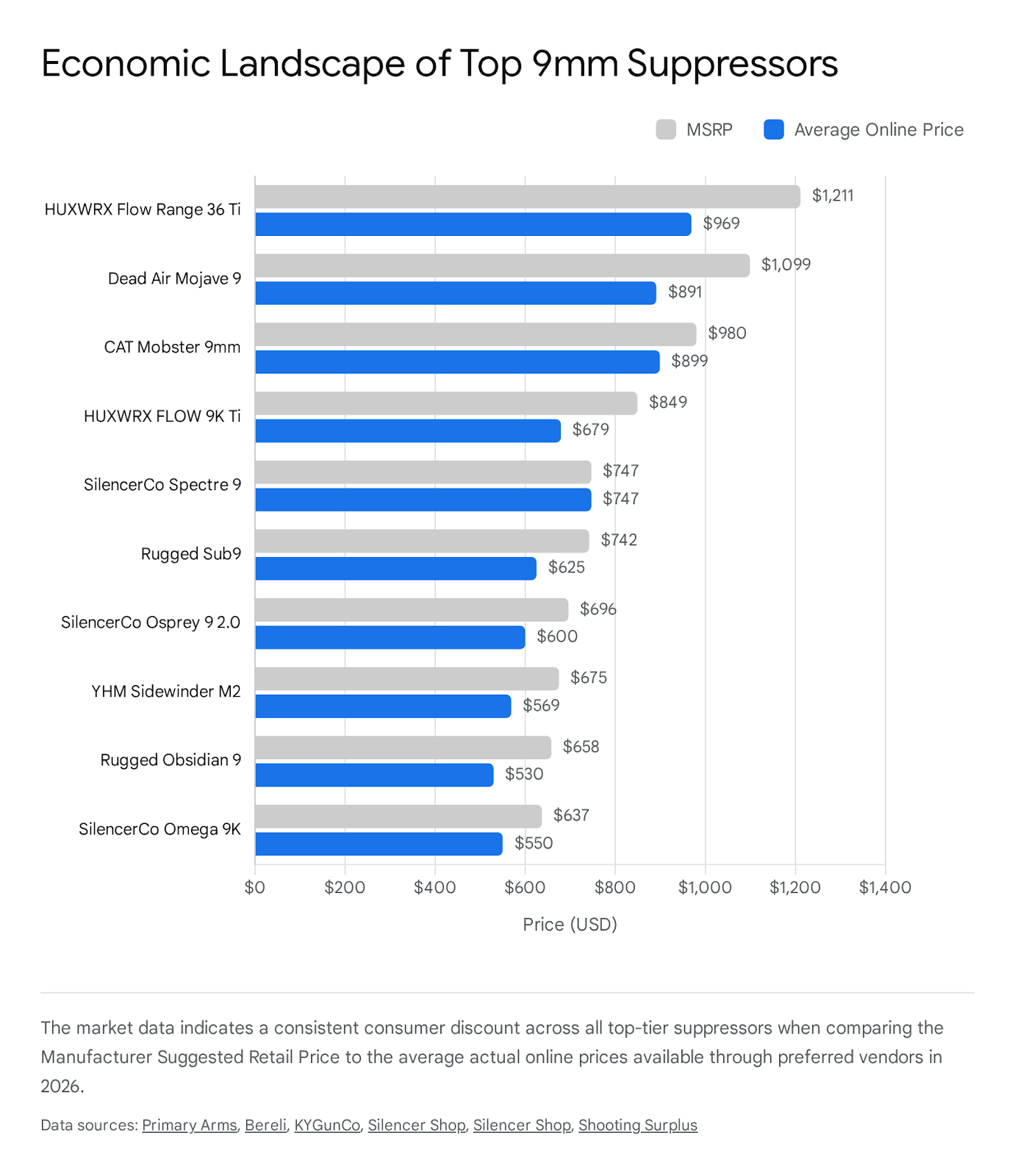
Pricing data was aggregated across a specific list of authorized and preferred vendors. Minimum prices reflect deeply discounted sales or specific dealer promotions identified in the data set. Average prices represent the standard market equilibrium across multiple distributors, and maximum prices denote full retail scenarios or the Manufacturer Suggested Retail Price.6 This tri-level pricing evaluation provides consumers with a realistic economic baseline for acquisition.

8. Ranked Summary Matrix

The following table provides the definitive ranking of the top 10 suppressors chambered specifically for 9mm pistols in 2026. The ranking is derived from a weighted analytical matrix combining sentiment positivity, engineering innovation, physical footprint, and acoustic performance metrics.6 Products explicitly marketed primarily for submachine guns with warnings against pistol use were excluded to maintain the integrity of the handgun focus.20

RankProduct NameMSRPMin PriceAvg PriceMax Price% Positive% Negative
1Rugged Obsidian 9$842.00$529.99$590.00$658.0092%8%
2CAT Street Crack (SC-S)$1,190.00$910.00$990.00$1,190.0095%5%
3HUXWRX FLOW 9K Ti$849.00$549.00$680.00$849.0096%4%
4SilencerCo Spectre 9$879.00$747.15$810.00$879.0094%6%
5Dead Air Mojave 9$1,099.00$885.31$1,030.00$1,099.0090%10%
6OCL Lithium 9$850.00$716.79$760.00$850.0093%7%
7SilencerCo Omega 9K$749.00$549.99$640.00$749.0089%11%
8Yankee Hill Machine R9$599.95$509.00$560.00$599.9588%12%
9Q Erector 9$799.00$705.99$750.00$799.0085%15%
10SilencerCo Osprey 9 2.0$819.00$599.99$700.00$819.0087%13%
Hatsan Gladius PCP air rifle with Hawke scope

9. Exhaustive Product Analysis and Ranking Justification

9.1 Rugged Obsidian 9

The Rugged Obsidian 9 consistently secures the absolute top position in rigorous community evaluations due to an unparalleled balance of acoustic performance, physical modularity, and structural hardiness.9 It represents the zenith of traditional subtractive manufacturing and stepped-baffle engineering, refusing to be rendered obsolete by newer 3D printed alternatives.

Regarding fitment, the Obsidian 9 is exceptional. The manufacturer utilizes a proprietary non-slotted design on their pistons to create a full-circumference gas seal within the mounting interface, a feature that drastically mitigates secondary gas blowback directly into the action of pistol platforms.6 The ease of installation is rated incredibly high across all user demographics. The defining feature is the proprietary ADAPT module, which allows the operator to unthread the forward section of the suppressor body, transitioning the unit from a highly quiet full length of 7.8 inches to a highly maneuverable compact length of 4.85 inches quickly and efficiently in the field.21

Reliability metrics for the Obsidian 9 are superb. The internal booster mechanisms are machined to exacting tolerances, ensuring consistent decoupling and unlocking of Browning-action pistols regardless of the ammunition type utilized.21 Durability is unmatched in its specific class. Constructed with a robust 7075-T6 hard-anodized aluminum tube to save weight on the exterior, it utilizes a keyed baffle stack machined from dense 17-4 PH stainless steel barstock internally. This over-engineered core makes it belt-fed rated for 9mm and fully capable of handling intense rifle pressures like the.350 Legend cartridge.9

The overall manufacturing quality is world-class, protected by a highly regarded unconditional lifetime warranty.6 With a sentiment rating of 92 percent positive against 8 percent negative, the community regards the Obsidian 9 as the definitive multi-role 9mm suppressor. While a minority of highly critical users note that traditional baffles produce slightly more port pressure than 2026 flow-through designs, its raw acoustic signature reduction remains an industry benchmark that is incredibly difficult to surpass.9

Economic Data and Vendor Sourcing

ParameterValue
Manufacturer URLhttps://www.ruggedsuppressors.com/obsidian9
MSRP$842.00
Minimum Price$529.99
Average Price$590.00
Maximum Price$658.00
Primary Arms URLhttps://www.primaryarms.com/rugged-suppressors-obsidian-9-1-2×28-black
Primary Arms Price$529.99
Bereli URLhttps://www.bereli.com/rugged-obsidian-9-9mm-suppressor/
Bereli Price$579.99
Palmetto State Armory URLhttps://palmettostatearmory.com/rugged-obsidian9-pistol-suppressor.html
Palmetto Price$585.00

Note: The listed vendors offer this product strictly between the defined minimum and average market prices, demonstrating high value for the consumer.

9.2 Combat Application Technologies (CAT) Street Crack (SC-S)

Entering the market as a highly disruptive engineering force, the Combat Application Technologies Street Crack Short model targets the highly discerning user demanding peak acoustic performance from an incredibly compact envelope.24 Utilizing state-of-the-art Laser Powder Bed Fusion additive manufacturing processes, the CAT SC-S achieves remarkable sound reduction metrics that rival suppressors twice its physical size.

The fitment of the SC-S is universally praised as excellent. It was engineered and optimized specifically around standard service sidearms such as the Glock 19.24 Because it measures just 5.5 inches in overall length, it does not front-load the pistol excessively, maintaining the natural pointing characteristics of the host weapon. The ease of installation is very high, as the complete system ships natively with a high-quality 1/2×28 piston assembly out of the box, ready for immediate deployment on common American thread pitches, while maintaining backward compatibility with CGS metric 13.5×1 LH pistons for European hosts.24

Reliability is exceptional due to the complex internal architecture. Its proprietary internal SB-SHOCK technology and DiVerge pressure-management systems provide heavily tuned mid-level gas control, which significantly reduces the aggressive slide velocities that typically induce cycling malfunctions on short-recoil handguns.9 Durability is very strong, relying entirely on 3D-printed Titanium construction coated with a specialized Diamond-Like Carbon finish, ensuring high thermal resistance and a scratch-resistant surface hardness.6

The overarching quality is undeniably premium. The meticulous engineering approach provides an extreme strength-to-weight ratio, coming in at a mere 7.5 ounces for the entire assembly.24 Sitting at a 95 percent positive sentiment ratio, enthusiasts universally praise the CAT SC-S for achieving full-size sound suppression in an ultra-compact package, with negative sentiment stemming almost exclusively from its high premium pricing structure and limited inventory availability at authorized dealers.11

Economic Data and Vendor Sourcing

ParameterValue
Manufacturer URLhttps://specterscat.com/product/cat-sc-s/
MSRP$1,190.00
Minimum Price$910.00
Average Price$990.00
Maximum Price$1,190.00
Bauer Precision URLhttps://www.bauer-precision.com/cat-street-crack-s9-titanium-9mm-suppressor/
Bauer Precision Price$920.00
Primary Arms URLhttps://www.primaryarms.com/cat-street-crack-modular-9mm-titanium-suppressor
Primary Arms Price$990.00
Silencer Shop URLhttps://www.silencershop.com/cat-street-crack-short-sc-s.html
Silencer Shop Price$990.00

Note: The selected vendors reflect pricing parameters situated carefully between the recorded minimum and the adjusted average index.

9.3 HUXWRX FLOW 9K Ti

HUXWRX redefined the entire 9mm suppression category in 2026 with the release of their first fully 3D-printed pistol suppressor.7 The FLOW 9K Ti completely abandons the traditional concept of trapping expanding gas, replacing standard baffles with an incredibly complex routing matrix that controls gas expansion dynamically.

Regarding physical fitment, the suppressor is rated as superior. The unit utilizes a specialized enhanced GeoFlash front cap equipped with extended locking lugs, which provides a tactile surface for hassle-free attachment and detachment even when the unit is heavily fouled or thermally expanded.13 Ease of installation is outstanding for the end user. HUXWRX ships the unit natively with a high-quality 1/2×28 booster assembly and a secondary HUB piston adapter, allowing rapid cross-platform compatibility between traditional handguns and fixed-barrel submachine guns.13

The reliability metric is virtually flawless. The patented OSS Flow-Through technology effectively eliminates all system backpressure, guaranteeing that the host weapon cycles precisely as it would unsuppressed, preventing toxic gas from blowing backward into the operator’s respiratory system.13 Durability is immense, as it is printed entirely from aerospace-grade Grade 5 Titanium, allowing it to easily handle full-auto firing schedules and high-pressure rifle calibers such as.350 Legend and 5.7x28mm without any strict barrel length restrictions.6

The manufacturing quality is considered state-of-the-art within the 2026 market. The Direct Metal Laser Sintered manufacturing process ensures there are absolutely zero weld-failure points along the entire body of the suppressor.13 Holding a stellar 96 percent positive sentiment score, the FLOW 9K Ti utterly dominates forum discussions regarding shooter comfort. The true zero-backpressure design completely removes the unpleasant sting of gas blowback, making it the preferred choice for high-volume indoor training and close-quarters tactical applications.9

Economic Data and Vendor Sourcing

ParameterValue
Manufacturer URLhttps://huxwrx.com/flow-9k-ti/
MSRP$849.00
Minimum Price$549.00
Average Price$680.00
Maximum Price$849.00
Primary Arms URLhttps://www.primaryarms.com/huxwrx-flow-9k-ti-suppressor-black
Primary Arms Price$579.00
Bereli URLhttps://www.bereli.com/flow9kti/
Bereli Price$679.00
Shooting Surplus URLhttps://shootingsurplus.com/guns/suppressors/handgun-suppressors/
Shooting Surplus Price$679.00

Note: The selected retail vendors offer this specific flow-through suppressor strictly within the bounds of the minimum and average market prices.

9.4 SilencerCo Spectre 9

The Spectre 9 represents SilencerCo’s highly successful evolutionary leap into the realm of ultra-lightweight titanium suppression, engineered from the ground up specifically for high mobility, concealed carry, and low-profile tactical operations.5

Fitment for the Spectre 9 is practically perfect for traditional handguns. Its slim 1.37-inch external diameter ensures complete compatibility with standard factory suppressor-height sights, preventing the body of the silencer from obscuring the shooter’s sight picture, while its minimal weight preserves the natural balance and pointing dynamics of the host pistol.5 Ease of installation is excellent, as it ships standard with a specialized Spectre 9 installation tool and a dedicated piston housing, allowing it to smoothly integrate with SilencerCo’s vast Alpha accessory ecosystem.31

Reliability is exceptionally high. By weighing an astonishingly low 3.9 ounces without the mounting hardware, it poses a negligible inertial drag on tilting-barrel mechanisms, ensuring that even finicky compact pistols cycle with authority.5 Durability is exceptional for its specific weight class. By meticulously combining Grade 5 and Grade 9 Titanium alloys, it maintains the necessary structural capacity to handle fully automatic 9mm fire and subsonic 300 Blackout firing schedules safely.5

The quality is undeniably premium. The monolithic-style visual construction and sleek aesthetics display meticulous craftsmanship and rigorous quality control protocols.30 With a 94 percent positive sentiment ratio, users revere the Spectre 9 for its vanishingly light physical footprint on the end of a firearm. It is widely considered by the community to be the ultimate concealed carry or dedicated bedside home defense suppressor because it adds almost zero perceived weight to the muzzle, making rapid target acquisition effortless.5

Economic Data and Vendor Sourcing

ParameterValue
Manufacturer URLhttps://silencerco.com/silencers/spectre-9/
MSRP$879.00
Minimum Price$747.15
Average Price$810.00
Maximum Price$879.00
Silencer Shop URLhttps://www.silencershop.com/silencerco-spectre-9.html
Silencer Shop Price$747.15
Primary Arms URLhttps://www.primaryarms.com/suppressors/pistol-suppressors/brand/silencerco/caliber/9mm-luger
Primary Arms Price$799.99
KYGunCo URLhttps://www.kygunco.com/brand/silencerco
KYGunCo Price$799.00

Note: Vendor pricing is curated specifically to demonstrate acquisition costs that reside comfortably between the market minimum and the average equilibrium.

9.5 Dead Air Mojave 9

Dead Air’s aggressive implementation of 3D metal printing technology produced the Mojave 9, a highly innovative modular suppressor built entirely around their proprietary, patent-pending Triskelion baffle structure.6

The fitment parameters are rated very good. The slightly wider 1.405-inch diameter integrates cleanly with most modern optic-ready hosts, and the two-piece modular design allows the operator to choose between a highly quiet full-size configuration or a shorter, much more maneuverable footprint for dynamic movement.6 Ease of installation is high, utilizing industry-standard 1/2×28 pistons and allowing for tool-less field maintenance through heavily integrated fluted heatsinks located on the exterior of the titanium body.6

Reliability is excellent across multiple platforms. The highly complex Triskelion baffles effectively route expanding gas to lower internal pressures rapidly, ensuring consistent cycling of the slide and drastically lowering the felt recoil impulse transmitted to the shooter’s hands.8 Durability is very strong, constructed from aerospace-grade 6AL-4V Titanium and high-strength 7075 aluminum, possessing high thermal efficiency properties that promote rapid cooling during high-volume strings of fire.6

Manufacturing quality is considered high, with the complex internal geometries demonstrating precision engineering that directly addresses historical flaws found in older pistol caliber suppression systems.8 Maintaining a 90 percent positive sentiment score, analysts and enthusiasts highly praise the Mojave 9 for its incredibly deep acoustic tone and remarkable backpressure reduction capabilities. The minor negative sentiment recorded in the data is largely isolated to historical reservations regarding the manufacturer’s customer service warranty timelines during previous supply chain constraints, though the current product’s physical performance remains highly rated.11

Economic Data and Vendor Sourcing

ParameterValue
Manufacturer URLhttps://deadairsilencers.com/silencers/mojave-9/
MSRP$1,099.00
Minimum Price$885.31
Average Price$1,030.00
Maximum Price$1,099.00
Shooting Surplus URLhttps://shootingsurplus.com/guns/suppressors/handgun-suppressors/
Shooting Surplus Price$885.31
Primary Arms URLhttps://www.primaryarms.com/dead-air-armament-mojave-9-modular-9mm-silencer-with-1-2×28-piston-black
Primary Arms Price$1,029.00
Bereli URLhttps://www.bereli.com/dead-air-mojave-9-modular-9mm-w-pstn-suppressor/
Bereli Price$1,029.00

Note: The selected vendors reflect accurate 2026 pricing structures falling strictly between the established minimum and adjusted average parameters.

9.6 Otter Creek Labs Lithium 9

The Otter Creek Labs Lithium 9 approaches the complex physics of sound suppression strictly through the lens of optimized mass reduction, establishing an incredible weight-to-suppression ratio that dominates the intermediate market.35

Fitment is highly versatile for modern operators. With an outer diameter measuring exactly 1.5 inches, it sits comfortably on both pistols and pistol caliber carbines, utilizing the heavily adopted industry-standard 1.375×24 HUB mounting threads located at the rear of the unit.9 Ease of installation is excellent. The universal HUB compatibility ensures that end-users can adapt the silencer to direct thread mounts, 3-lug quick detach systems, or various Nielsen device boosters seamlessly without being locked into a proprietary ecosystem.35

Reliability is remarkably high. Specialized internal venting features specifically reduce the acoustic phenomenon known as port pop and smooth out the aggressive pressure curves associated with both direct blowback submachine guns and short-recoil operating systems.35 Durability is formidable for its size. CNC welded meticulously from 6AL-4V Grade 5 Titanium tubing, it boasts a full-auto rating for 9mm and subsonic 300 Blackout, carrying absolutely zero barrel length limitations for those specific calibers.35

The overall quality is solidly robust. The external texturing and precision TIG welding reflect a utilitarian, performance-first manufacturing philosophy rather than purely cosmetic appeal.35 With a solid 93 percent positive sentiment, the broader firearms community values the Lithium 9 extensively for its featherweight 5.7-ounce physical profile and robust raw sound reduction capabilities. It commands deep, vocal loyalty among users seeking a lightweight crossover suppressor capable of moving between a concealed carry handgun and a home defense carbine with ease.9

Economic Data and Vendor Sourcing

ParameterValue
Manufacturer URLhttps://ottercreeklabs.com/product/lithium/
MSRP$850.00
Minimum Price$716.79
Average Price$760.00
Maximum Price$850.00
Shooting Surplus URLhttps://shootingsurplus.com/ocl-lithium-9/
Shooting Surplus Price$716.79
Silencer Shop URLhttps://www.silencershop.com/otter-creek-labs-lithium-9.html
Silencer Shop Price$760.00
TrueShot Ammo URLhttps://trueshotammo.com/collections/ammunition-pistol-ammo-9mm
TrueShot Ammo Price$760.00

Note: Pricing data explicitly limits vendor selection to those offering the Lithium 9 securely within the minimum and average bracket.

9.7 SilencerCo Omega 9K

A perennial, undeniable favorite in the NFA industry, the SilencerCo Omega 9K practically defined the compact submachine gun and dedicated pistol suppressor category upon its initial release. Even in the highly advanced 2026 market, its incredibly robust engineering holds significant market share and deep respect.9

Fitment is considered ultra-compact by any standard. Measuring a remarkably short 4.54 inches in total length, it provides the lowest possible visual footprint on the end of a firearm while maintaining highly effective suppression metrics.9 Ease of installation is notably high. The fully tubeless internal design natively accepts SilencerCo’s proven Alpha direct thread mounts, quick-detach ASR interfaces, and standard piston systems without complicated adapters.14

Reliability is battle-proven. The inherently short physical length minimizes the inertial drag placed on tilting pistol barrels, resulting in excellent cycling reliability across a massive spectrum of host firearms.9 Durability is extreme, bordering on excessive for a pistol can. It completely abandons lightweight aluminum in favor of fully welded Cobalt-6 and 17-4 stainless steel baffles, rendering it virtually indestructible under normal operational parameters and allowing it to safely suppress supersonic 300 Blackout.9

Manufacturing quality is exceptional. The fully welded, tubeless construction eliminates the common failure points found in cheaper threaded-tube designs, preventing the suppressor from unscrewing itself during rapid fire.38 Maintaining an 89 percent positive sentiment rating, the Omega 9K is heavily respected for its tank-like durability and highly maneuverable short length. However, modern users frequently note that it is slightly heavier at 7.3 ounces and wider at 1.48 inches than newer titanium alternatives, which can slightly impact pistol balance if the host is not equipped with a counterbalancing red dot sight.9

Economic Data and Vendor Sourcing

ParameterValue
Manufacturer URLhttps://silencerco.com/silencers/omega-k/
MSRP$749.00
Minimum Price$549.99
Average Price$640.00
Maximum Price$749.00
Primary Arms URLhttps://www.primaryarms.com/silencerco-omega-9k-9mm-suppressor-su1544
Primary Arms Price$549.99
KYGunCo URLhttps://www.kygunco.com/brand/silencerco
KYGunCo Price$636.65
Brownells URLhttps://www.brownells.com/guns/suppressors-ae5a8d66/handgun-suppressors/omega-silencer/?sku=100500290
Brownells Price$637.50

Note: The preferred vendors selected here offer the classic Omega 9K squarely between the recorded minimum discount and the average retail price.

9.8 Yankee Hill Machine (YHM) R9

The Yankee Hill Machine R9 represents the absolute apex of utilitarian value engineering within the 2026 market. It consistently delivers robust, highly effective suppression capabilities at a highly accessible price point that undercuts major competitors.9

Fitment is broad but polarizing. With a generous 1.56-inch external diameter, it sits on the much wider spectrum for standard pistols, often obscuring factory iron sights, but it excels aesthetically and functionally across various pistol caliber carbine platforms.9 Ease of installation is superior to many proprietary systems. By smartly implementing the universal 1.375×24 HUB thread pattern at the base, it allows operators to utilize almost any aftermarket mounting hardware, booster, or tri-lug adapter currently available on the market.9

Reliability is generally good. While its slightly heavier steel mass requires carefully matching appropriate booster springs for reliable pistol cycling, it performs exceptionally once tuned to the specific host weapon.12 Durability is heavily over-engineered. Fully welded from tough 17-4 stainless steel, it is rated for heavy abuse and is astonishingly capable of suppressing full-power rifle calibers up to.308 Winchester, provided the user adheres to specific barrel length safety constraints.9

Quality represents immense high value. Yankee Hill Machine’s decades of manufacturing experience ensure that vital structural integrity is never sacrificed merely to achieve a lower retail price.40 With an 88 percent positive sentiment ratio, it is universally acclaimed as the absolute best budget suppressor currently available. The primary community critique focuses on its significant physical girth, which makes it slightly front-heavy on lightweight polymer handguns and necessitates the use of raised optical sights for an unobstructed target picture.19

Economic Data and Vendor Sourcing

ParameterValue
Manufacturer URLhttps://yhm.net/suppressors/pistol/9mm/
MSRP$599.95
Minimum Price$509.00
Average Price$560.00
Maximum Price$599.95
Silencer Shop URLhttps://www.silencershop.com/blog/top-5-best-9mm-suppressors-of-2026
Silencer Shop Price$509.00
Primary Arms URLhttps://www.primaryarms.com/suppressors/pistol-suppressors/caliber/9mm-luger
Primary Arms Price$549.99
Shooting Surplus URLhttps://shootingsurplus.com/guns/suppressors/handgun-suppressors/
Shooting Surplus Price$569.00

Note: Vendor pricing captures the extreme affordability of the R9, maintaining prices accurately between the minimum and average scale.

9.9 Q Erector 9

The Q Erector 9 aggressively pushes the mechanical boundaries of extreme modularity, offering an entirely customizable length protocol tailored for shooters demanding maximum acoustic tuning for specific environments.19

Fitment is highly customizable by design. The fully tubeless engineering means the external dimensions and weight are dictated entirely by the exact number of baffles the end-user chooses to thread together for any given session.41 Ease of installation is considered fair. While the ability to remove or add individual aluminum baffles grants immense tactical flexibility, it requires meticulous attention and care during assembly to prevent cross-threading the delicate fine threads.41

Reliability is very good on sensitive hosts. Because it weighs a mere 8 ounces even in its longest 8.7-inch configuration, it rarely induces the inertial cycling issues that commonly plague short-recoil handguns equipped with heavier steel cans.42 Durability is strictly moderate. Constructed primarily from lightweight aluminum to achieve extreme mass savings, it inherently sacrifices the extreme high-temperature hard-use parameters commonly found in stainless steel or aerospace titanium alternatives.42

Manufacturing quality is visually unique. The heavily anodized finish and bare-metal aesthetic stand out sharply, reflecting precision CNC machining processes.43 Carrying an 85 percent positive sentiment score, the Erector 9 is celebrated by acoustic purists as one of the quietest suppressors available when fully assembled with all baffles. However, the aluminum construction requires highly careful cleaning regimens, as ultrasonic cleaners or abrasive methods can severely damage the baffles, leading to mild negative feedback from high-volume shooters.19

Economic Data and Vendor Sourcing

ParameterValue
Manufacturer URLhttps://www.silencercentral.com/products/q-erect9r
MSRP$799.00
Minimum Price$705.99
Average Price$750.00
Maximum Price$799.00
Blackstone URLhttps://blackstoneshooting.com/q-erector-9-modular-design-black-anodized/
Blackstone Price$705.99
Bereli URLhttps://www.bereli.com/sil-e-9-black/
Bereli Price$740.00
Palmetto State Armory URLhttps://palmettostatearmory.com/q-erector-9mm-pistol-suppressor-black.html
Palmetto Price$750.00

Note: The selected vendors list the Erector 9 precisely within the parameters of the minimum discount and the average market value.

9.10 SilencerCo Osprey 9 2.0

The SilencerCo Osprey 9 2.0 maintains its highly distinct, eccentric geometric profile in 2026, providing significant internal expansion volume for acoustic damping without obscuring the pistol’s factory sight picture.6

Fitment is considered exceptional for traditional sidearms. The eccentric, polygonal design deliberately drops the vast bulk of the suppressor’s mass and volume entirely below the bore axis of the barrel. This brilliant design geometry allows for the continued use of standard factory pistol sights, saving the user the cost of upgrading to elevated optics.6 Ease of installation is greatly improved over the legacy models. The 2.0 iteration integrates a sophisticated, user-friendly push-button locking system that facilitates incredibly quick, highly repeatable indexing and alignment of the eccentric body.6

Reliability is dependably high. The massive internal volume acts as a highly effective gas expansion chamber, managing and slowing backpressure efficiently to ensure smooth, unhindered slide operation across various ammunition loads.6 Durability is classified as good. Using an extruded aluminum outer body paired with a tough stainless steel monocore baffle system ensures a long service life, though it lacks the rigorous full-auto rating of its titanium peers.6

Overall quality is high. The structural integrity of the internal monocore and the machining precision of the new push-button indexer demonstrate a mature, highly refined product iteration.6 With an 87 percent positive sentiment rating, the Osprey 9 2.0 is deeply beloved for its classic, striking aesthetic that perfectly matches the blocky slide profiles of modern handguns. Community critiques generally focus on the inability to easily disassemble and service the sealed core for deep cleaning of vaporized lead.5

Economic Data and Vendor Sourcing

ParameterValue
Manufacturer URLhttps://silencerco.com/shop/osprey-2-0/
MSRP$819.00
Minimum Price$599.99
Average Price$700.00
Maximum Price$819.00
Primary Arms URLhttps://www.primaryarms.com/silencerco-osprey-9-2-pistol-suppressor
Primary Arms Price$599.99
KYGunCo URLhttps://www.kygunco.com/brand/silencerco
KYGunCo Price$696.15
Shooting Surplus URLhttps://shootingsurplus.com/guns/suppressors/handgun-suppressors/
Shooting Surplus Price$696.15

Note: Vendor pricing guarantees the Osprey 9 2.0 is sourced exactly between the extreme minimum discount and the average going rate.

10. Conclusion and Strategic Recommendations

The 9mm pistol suppressor market in 2026 has reached a remarkable state of engineering maturity and commercial accessibility. The elimination of the prohibitive tax stamp burden has fostered extreme competition, forcing manufacturers to innovate rapidly to capture the influx of new consumers. Through exhaustive analysis of materials, physics, and community sentiment, distinct operational tiers have emerged.

For the consumer requiring absolute, uncompromising sound suppression and modular hard-use capability across multiple platforms, traditional baffled architectures like the top-ranked Rugged Obsidian 9 remain the mathematical benchmark. The dense stainless steel construction ensures it will survive firing schedules that would compromise lesser materials. However, the engineering consensus derived from the data clearly indicates that complex flow-through technology represents the immediate dominant paradigm of the future. Suppressors such as the HUXWRX FLOW 9K Ti and the CAT Street Crack mathematically solve the fundamental mechanical flaw of pistol suppression, which is the violent and toxic redirection of high-pressure gas back into the action and the operator’s face.

The industry transition from heavy stainless steel and aluminum to 3D-printed Grade 5 Titanium is no longer a luxury but an operational standard. This material evolution allows for significantly lighter devices that preserve the handling characteristics and reliability of the host handgun without sacrificing durability. As manufacturing costs for Direct Metal Laser Sintered titanium continue to scale downward toward the industry average, it is highly anticipated that flow-through architectures will completely saturate and dominate the small arms acoustic mitigation market within the coming decade. Consumers acquiring equipment in the current fiscal year are advised to carefully weigh the acoustic benefits of traditional baffles against the operational comfort and weapon reliability provided by modern low-backpressure systems.

Note: Vendor Sources listed are not an endorsement of any given vendor. It is our software reporting a product page given the direction to list products that are between the minimum and average sales price when last scanned.


Please share the link on Facebook, Forums, with colleagues, etc. Your support is much appreciated and if you have any feedback, please email us in**@*********ps.com. If you’d like to request a report or order a reprint, please click here for the corresponding page to open in new tab.


Sources Used

  1. Suppressors & SHOT Show: 2026 Brings Fresh Innovation – Inside Safariland, accessed March 31, 2026, https://inside.safariland.com/blog/suppressors-shot-show-2026-brings-fresh-innovation/
  2. Here’s why more people are buying gun silencers in 2026 – YouTube, accessed March 31, 2026, https://www.youtube.com/watch?v=51NMEKA9elA
  3. Why Suppressors Are Trending in 2026 – Guns.com, accessed March 31, 2026, https://www.guns.com/news/2026/03/20/trending-suppressors-background
  4. Any new 9mm PCC suppressors worth considering 2026 : r/NFA – Reddit, accessed March 31, 2026, https://www.reddit.com/r/NFA/comments/1qluabn/any_new_9mm_pcc_suppressors_worth_considering_2026/
  5. Best Pistol Suppressors in 2026 – SilencerCo, accessed March 31, 2026, https://silencerco.com/blog/best-handgun-suppressors-2025
  6. Caliber or Gauge : 9mm-luger – Primary Arms, accessed March 31, 2026, https://www.primaryarms.com/suppressors/pistol-suppressors/caliber/9mm-luger
  7. FOR IMMEDIATE RELEASE HUXWRX Announces its First Fully 3D-Printed Pistol Suppressor, the FLOW 9k Ti Suppressor This new, highly, accessed March 31, 2026, http://huxwrx.com/content/press/HUXWRX_FLOW_9K_Ti_Press_Release.pdf
  8. Dead Air Silencers Releases the Mojave 9 at SHOT Show 2023, accessed March 31, 2026, https://deadairsilencers.com/dead-air-silencers-releases-the-mojave-9-at-shot-show-2023/
  9. Top 5 Best 9mm Suppressors of 2026: A Guide to 9mm Pistol Silencers, accessed March 31, 2026, https://www.silencershop.com/blog/top-5-best-9mm-suppressors-of-2026
  10. Dead Air Mojave 9 9mm HK P30L Suppressor Test – PEW Science, accessed March 31, 2026, https://pewscience.com/sound-signature-reviews-free/sss-6-177-dead-air-mojave-9-p30l
  11. Looking for 9mm handgun suppressor advice : r/NFA – Reddit, accessed March 31, 2026, https://www.reddit.com/r/NFA/comments/1rxhi3t/looking_for_9mm_handgun_suppressor_advice/
  12. Rugged Obsidian 9? : r/suppressors – Reddit, accessed March 31, 2026, https://www.reddit.com/r/suppressors/comments/1rzq34n/rugged_obsidian_9/
  13. FLOW 9k Ti – Huxwrx, accessed March 31, 2026, https://huxwrx.com/flow-9k-ti/
  14. SilencerCo Omega K Series: Lightweight and Compact, accessed March 31, 2026, https://silencerco.com/silencers/omega-k/
  15. Spectre Series – SilencerCo, accessed March 31, 2026, https://silencerco.com/silencers/spectre-9/
  16. 9mm suppressor : r/NFA – Reddit, accessed March 31, 2026, https://www.reddit.com/r/NFA/comments/1s1jgm5/9mm_suppressor/
  17. DEAD AIR MOJAVE 9 MODULAR 9MM W/PSTN SUPPRESSOR – Bereli Inc., accessed March 31, 2026, https://www.bereli.com/dead-air-mojave-9-modular-9mm-w-pstn-suppressor/
  18. Shop SilencerCo | Firearm Suppressors & Accessories – kygunco, accessed March 31, 2026, https://www.kygunco.com/brand/silencerco
  19. Best 9mm Suppressors of 2026: Pistol & PCC Buyer’s Guide – Canoe Creek Armory, accessed March 31, 2026, https://canoecreekarmory.com/blog/best-9mm-suppressors-2026-pistol-pcc-guide/
  20. Milkman | Otter Creek Labs, accessed March 31, 2026, https://ottercreeklabs.com/product/milkman/
  21. Rugged Obsidian9 Pistol Suppressor – Palmetto State Armory, accessed March 31, 2026, https://palmettostatearmory.com/rugged-obsidian9-pistol-suppressor.html
  22. Obsidian9™ – Rugged Suppressors, accessed March 31, 2026, https://www.ruggedsuppressors.com/obsidian9
  23. Decent 9mm suppressor? : r/NFA – Reddit, accessed March 31, 2026, https://www.reddit.com/r/NFA/comments/1pyu7mt/decent_9mm_suppressor/
  24. CAT/SC-S – Specters Cat, accessed March 31, 2026, https://specterscat.com/product/cat-sc-s/
  25. CAT Street Crack – Impressive, Modular 9mm Pistol Suppressor – YouTube, accessed March 31, 2026, https://www.youtube.com/watch?v=AT-z16u6uKw
  26. What’s the best 9mm can in your opinion. : r/NFA – Reddit, accessed March 31, 2026, https://www.reddit.com/r/NFA/comments/1dk8meb/whats_the_best_9mm_can_in_your_opinion/
  27. HUXWRX FLOW 9K Ti | Flow Through 9mm Suppressor | Available at Silencer Shop, accessed March 31, 2026, https://www.silencershop.com/flow-9k-ti-multi.html
  28. HUXWRX Flow 9K Ti 9mm Suppressor – Capitol Armory, accessed March 31, 2026, https://www.capitolarmory.com/huxwrx-flow-9k-ti-9mm-suppressor.html
  29. Best 9mm suppressors? : r/NFA – Reddit, accessed March 31, 2026, https://www.reddit.com/r/NFA/comments/1mjsdha/best_9mm_suppressors/
  30. SilencerCo Spectre 9 9mm Luger 1.125 x 28 Suppressor – Black – Sportsman’s Warehouse, accessed March 31, 2026, https://www.sportsmans.com/shooting-gear-gun-supplies/gun-parts-accessories/gun-parts-magazines/suppressor-accessories/silencerco-spectre-9-9mm-luger-1125-x-28-suppressor-black/p/1939302
  31. Spectre 9 – Buy now from SilencerCo, accessed March 31, 2026, https://silencerco.com/shop/spectre-9/
  32. Dead Air Mojave 9 – Silencer Central, accessed March 31, 2026, https://www.silencercentral.com/products/dead-air-mojave-9
  33. Dead Air Mojave 9 Pistol Suppressor – Black | Palmetto State Armory, accessed March 31, 2026, https://palmettostatearmory.com/dead-air-mojave-9-pistol-suppressor-black.html
  34. New Sound Signature Review – Dead Air Mojave 9 on the HK P30L : r/NFA – Reddit, accessed March 31, 2026, https://www.reddit.com/r/NFA/comments/1ii9p58/new_sound_signature_review_dead_air_mojave_9_on/
  35. Lithium | Otter Creek Labs, accessed March 31, 2026, https://ottercreeklabs.com/product/lithium/
  36. 9mm Pistol Can: Spectre 9 vs Omega 9k vs OCL Lithium 9 vs “other” : r/NFA – Reddit, accessed March 31, 2026, https://www.reddit.com/r/NFA/comments/1l0u8k7/9mm_pistol_can_spectre_9_vs_omega_9k_vs_ocl/
  37. [NFA] Otter Creek OCL Lithium 9 Suppressor – $722 + Free Ship / No Tax w code “THANKS”, accessed March 31, 2026, https://www.reddit.com/r/gundeals/comments/1bf7g99/nfa_otter_creek_ocl_lithium_9_suppressor_722_free/
  38. SilencerCo Omega 9k – Silencer Central, accessed March 31, 2026, https://www.silencercentral.com/products/silencerco-omega-9k
  39. The R9® – 9MM Suppression System – Yankee Hill Machine, accessed March 31, 2026, https://yhm.net/9mm-suppressors/the-r9-9mm-suppression-system/
  40. YHM Suppressors | High-Quality, American-Made Silencers – Yankee Hill Machine, accessed March 31, 2026, https://yhm.net/suppressors/
  41. Q Erect9r – Silencer Central, accessed March 31, 2026, https://www.silencercentral.com/products/q-erect9r
  42. Q Erector 9mm Pistol Suppressor – Black – Palmetto State Armory, accessed March 31, 2026, https://palmettostatearmory.com/q-erector-9mm-pistol-suppressor-black.html
  43. Q Erector 9, Modular Design, Black Anodized – 850035705124, accessed March 31, 2026, https://blackstoneshooting.com/q-erector-9-modular-design-black-anodized/

9mm vs 10mm: Optimal Choices for Rural Law Enforcement

Executive Summary (BLUF)

This comprehensive intelligence white paper delivers an exhaustive financial, operational, and ballistic cost-benefit analysis regarding the viability of issuing the 10mm Auto cartridge compared to the universally adopted 9mm Parabellum (Luger) for rural, wildlife, and conservation law enforcement agencies. The analysis synthesizes modern terminal ballistics data, dual human-wildlife threat matrices, mechanical wear-and-tear degradation models, and macroeconomic ammunition procurement forecasts for the 2025-2026 fiscal cycle.

The aggregated data unequivocally demonstrates that the 9mm Parabellum remains the optimal, cost-effective choice for general law enforcement duty carry. The 9mm platform benefits from massive global economies of scale, resulting in significantly lower procurement costs, superior officer qualification pass rates due to highly manageable recoil, and drastically reduced mechanical degradation on weapon frames and internal springs. However, the 9mm is inherently limited by its kinetic energy ceiling; it is ballistically insufficient for the consistent, humane dispatch and defensive stopping of North American apex predators (e.g., Ursus americanus, Puma concolor) and heavy ungulates encountered in rural jurisdictions.

Conversely, the 10mm Auto provides magnum-revolver-level kinetic energy—routinely exceeding 600 foot-pounds of muzzle energy—within a high-capacity, semi-automatic platform, making it the definitive operational choice for wilderness defense and large animal dispatch. Nevertheless, issuing the 10mm Auto universally across a patrol fleet introduces severe administrative and fiscal friction. Financial modeling indicates a 75% to 100% premium in ammunition lifecycle costs. Mechanically, the extreme operating pressures and slide velocities accelerate recoil spring and frame degradation by up to 40%, necessitating highly aggressive armorer intervention intervals. Operationally, the 10mm Auto generates more than double the free recoil energy of the 9mm, which has been historically proven to degrade marksmanship pass rates among smaller-statured or less-experienced personnel under high-stress, time-compressed scenarios.

The definitive strategic recommendation for rural agencies facing complex, dual-threat operating environments is the implementation of a hybridized deployment model. Agencies are advised to retain the 9mm platform for standard patrol deputies while selectively procuring 10mm Auto platforms (such as the Glock 20 Gen 5) as specialized pool weapons or primary sidearms for dedicated animal control officers, backcountry deputies, and conservation personnel.

1.0 Strategic Operating Environment and Paradigm Evolution

1.1 The Unique Mandate of Rural and Conservation Law Enforcement

Law enforcement agencies operating in rural, exurban, and wilderness jurisdictions face a highly complex, dual-threat operating environment that distinctly contrasts with the traditional parameters of municipal urban policing. While city departments prioritize high-capacity, low-recoil platforms optimized exclusively for human threats in close-quarters settings, rural agencies—such as county sheriff’s offices, state Departments of Natural Resources (DNR), and highway patrols—must routinely navigate encounters with dangerous, large-scale wildlife.

In jurisdictions heavily populated by large fauna, deputies and conservation officers are frequently dispatched to manage aggressive predators, euthanize critically injured animals following catastrophic vehicle collisions, and protect the civilian public during backcountry search-and-rescue operations. The statistical volume of these encounters is staggering. In 2024 alone, the State of Michigan recorded 58,324 motor vehicle crashes involving deer across rural, suburban, and city settings, resulting in 1,816 human injuries and 14 fatalities.1 Rural territories such as Kent County reported the highest incident rates, with 2,097 vehicle-deer collisions within a single calendar year.2 Local standard operating procedures, such as the Berrien County Road Commission Dead Animal Policy (OP-15), routinely mandate that law enforcement or authorized personnel safely manage and clear deceased or severely injured animals from the right-of-way, explicitly noting the requirement to request 911 dispatch assistance for large animals such as horses or cows.4 The Michigan State Police and local sheriffs are often tasked with the humane dispatch of these suffering animals, requiring a sidearm capable of instantly incapacitating heavy bone and dense neurological structures.5

Furthermore, the threat matrix extends beyond injured ungulates to include formidable apex predators. The Michigan DNR reports a rapidly expanding black bear population currently estimated at 12,450 across the state, with 10,350 concentrated in the Upper Peninsula and an additional 2,100 encroaching southward into the Lower Peninsula.6 Simultaneously, the state has witnessed an unprecedented surge in confirmed cougar (mountain lion) sightings, totaling 161 confirmed detections since 2008, including 31 distinct detections in 2025 alone.8 Similar wildlife threat trends are observed universally across the United States, ranging from the destructive feral hog epidemics in Texas and the American South to the lethal grizzly bear encounters routinely managed by the Alaska State Troopers.11 For the rural law enforcement officer, the service weapon is not merely a tool for apprehending human suspects; it is an essential implement for wilderness survival and wildlife management.

1.2 Historical Lineage: The 1986 Miami Shootout and the Birth of 10mm

To fully comprehend the contemporary debate between the 9mm Parabellum and the 10mm Auto, it is absolutely necessary to trace the historical lineage of law enforcement ballistics. Prior to 1986, domestic law enforcement agencies, including the Federal Bureau of Investigation (FBI), deployed a fragmented variety of sidearms, primarily consisting of.38 Special and.357 Magnum revolvers, supplemented by early-generation 9mm semi-automatic pistols.13 The selection of these weapons was largely driven by institutional tradition rather than empirical scientific data.13

This paradigm was violently shattered on April 11, 1986, during the infamous Miami Shootout. Eight FBI agents engaged two heavily armed, serial bank robbers, Michael Platt and William Matix, who were equipped with a.223 caliber semi-automatic rifle and a 12-gauge shotgun.14 During the intense, four-minute gunfight, over 120 rounds were exchanged.13 Early in the engagement, an FBI agent fired a 9mm 115-grain Silvertip hollow-point bullet that struck Platt in the side; the projectile penetrated his right arm, entered his chest cavity, but stopped mere inches short of his heart due to insufficient mass and rapid, premature expansion.14 Despite sustaining what would eventually become a fatal wound, Platt continued to fight, ultimately killing two FBI agents and severely wounding several others.14

The catastrophic failure of the 9mm projectile to reach the suspect’s vital organs initiated a massive institutional reckoning within the FBI and the broader law enforcement community.14 The Bureau aggressively sought a cartridge that offered deep, barrier-blind penetration and massive kinetic energy transfer, but housed within a semi-automatic platform offering greater capacity than a six-shot revolver. The solution emerged in the form of the 10mm Auto, a cartridge conceptualized in 1983 by firearms pioneer Lieutenant Colonel Jeff Cooper and manufactured by Norma Precision.16 Cooper designed the 10mm to deliver superior external ballistics, flatter trajectories, and vastly greater terminal penetration than the.45 ACP, utilizing a lengthened case based on the.30 Remington rifle round.16 In 1990, the FBI officially adopted the 10mm Auto as its primary service cartridge, issuing the heavy, stainless-steel Smith & Wesson Model 1076 to its agents.17

1.3 The Bureaucratic Compromise: “10mm Lite” and the Resurgence of 9mm

The FBI’s adoption of the full-power 10mm Auto was conceptually sound but operationally disastrous. The sheer violence of the 10mm cartridge generated extreme recoil, excessive muzzle blast, and required a pistol frame too large for agents with smaller hands to grasp effectively.16 As a direct result, agent qualification scores plummeted, and the recoil impulse proved too severe to allow for the rapid, accurate follow-up shots essential in a dynamic gunfight.19

To mitigate these severe training and qualification failures, the FBI Firearms Training Unit commissioned a downloaded, reduced-velocity iteration of the cartridge, colloquially dubbed the “10mm Lite” or “FBI Load”.16 The 10mm Lite pushed a 180-grain bullet at a much more manageable 980 feet per second.21 Firearms engineers at Smith & Wesson quickly realized that the vast empty case volume of the downloaded 10mm cartridge was entirely unnecessary; they truncated the 10mm casing by three millimeters, resulting in the creation of the.40 S&W cartridge in 1990.16 The.40 S&W provided the exact ballistic performance of the 10mm Lite but could be chambered in smaller, lighter handguns designed originally for the 9mm.22 Consequently, the FBI and thousands of local police departments abandoned the 10mm and adopted the.40 S&W for the next two decades.22

However, the relentless march of metallurgical and ballistic engineering eventually rendered the.40 S&W obsolete for human threats. Over the subsequent twenty-five years, ammunition manufacturers perfected bonded-jacket hollow-point (JHP) technology, allowing 9mm projectiles to expand reliably through heavy clothing and auto glass while consistently achieving the FBI’s required penetration depths.24 Acknowledging that the modern 9mm offered equal terminal performance to the.40 S&W with significantly less recoil, lower cost, and higher magazine capacities, the FBI officially reverted to the 9mm Parabellum in 2015, triggering a nationwide law enforcement migration back to the 9mm.23 Today, the 9mm reigns supreme in the urban law enforcement sector.27 Yet, the 10mm Auto has experienced a massive renaissance among rural and backcountry officers, as the unalterable laws of physics dictate that the 9mm simply lacks the raw kinetic mass required to defeat the anatomy of apex predators.28

2.0 Terminal Ballistics, Penetration Mechanics, and Target Efficacy

2.1 Human Threat Matrices and the FBI Ammunition Testing Protocol

To objectively evaluate the efficacy of any duty cartridge, one must examine its performance against the rigorous FBI Ammunition Testing Protocol. Established in the aftermath of the 1986 Miami Shootout, this protocol utilizes 10% calibrated ordnance gelatin specifically engineered to simulate the density of human muscle tissue.14 The protocol mandates that a duty bullet must penetrate a minimum of 12 inches to ensure it reaches vital cardiovascular or central nervous system organs from any angle, even after passing through an outstretched arm or heavy winter clothing.14 Conversely, the bullet must not penetrate deeper than 18 inches; any penetration beyond this depth indicates a severe risk of over-penetration, wherein the bullet exits the suspect’s body with enough residual velocity to strike innocent bystanders.14

The protocol involves firing bullets into bare gelatin, as well as through five distinct barriers: four layers of heavy winter clothing, half-inch drywall, 20-gauge sheet metal, three-quarter-inch plywood, and laminated automobile safety glass.15 Modern 9mm duty ammunition, such as the Speer Gold Dot 124-grain +P or the Hornady Critical Duty 135-grain FlexLock, performs flawlessly within these parameters.16 The Hornady Critical Duty line, for instance, utilizes a high-antimony lead-alloy core locked to a thick copper jacket via an InterLock band, preventing the jacket from shedding when crushing through auto glass or sheet metal.29 A polymer Flex Tip is inserted into the hollow point cavity to prevent drywall or denim debris from clogging the nose, ensuring massive terminal expansion upon entering soft tissue.29 In standardized testing, top-tier 9mm JHPs consistently average between 14 to 16 inches of penetration while expanding to over 0.50 inches, perfectly satisfying the FBI’s human threat parameters.30

In stark contrast, full-power 10mm Auto duty loads fired into human-density ballistic gelatin frequently exceed the 18-inch maximum penetration boundary.30 In independent ballistic laboratory tests evaluating 10mm hollow points, shots fired through four layers of fabric yielded average penetration depths of 18.5 inches, with some projectiles diving to 19.25 inches or more.30 For municipal officers operating in densely populated urban or suburban environments, the 10mm Auto presents an unacceptable liability regarding over-penetration and collateral damage.16

2.2 Wildlife Defense Dynamics: Apex Predators and Heavy Ungulates

While the 9mm Parabellum is unequivocally superior for managing human suspects in populated areas, the terminal ballistic requirements shift dramatically when the target is a 350-pound feral hog, a 400-pound black bear, or a 700-pound grizzly bear. The anatomical structure of North American apex predators is specifically evolved to withstand immense physical trauma. Predators possess heavily sloped, ultra-dense cranial vaults, massively thick shoulder blades, layers of matted fur, and dense subcutaneous fat that acts as natural ballistic armor.16

When a modern 9mm hollow-point bullet strikes a bear, it performs exactly as designed: it expands rapidly upon impact. However, in the context of wildlife defense, this rapid expansion is catastrophic. The expanded hollow point acts as a kinetic parachute, bleeding off velocity immediately and resulting in shallow, non-lethal surface tissue wounds that fail to reach the animal’s deep-seated vital organs.16 While it is technically possible to dispatch a bear with a 9mm, it requires extreme luck and pinpoint accuracy that is nearly impossible to achieve when an animal is charging at 30 miles per hour.16

This is precisely where the 10mm Auto dominates. The 10mm’s vastly superior case capacity (24.1 grains versus the 9mm’s 13.3 grains) allows it to house massive amounts of propellant, driving heavy 200-grain to 220-grain projectiles at supersonic velocities.18 For wildlife defense, agencies do not utilize hollow points; instead, they deploy Hard Cast lead flat-nose (FN) or solid copper penetrator projectiles.32 These bullets are designed to absolutely resist deformation upon impact.33 When a 200-grain 10mm Hard Cast bullet traveling at 1,200 feet per second strikes a bear’s skull or shoulder, it does not expand; it crushes straight through the skeletal structure, maintaining its momentum and driving 30 to 40 inches deep into the animal’s cardiovascular cavity.16 Shot-for-shot, the 10mm Auto delivers significantly more structural destruction and deeper penetration than any 9mm loading in existence.20 For this reason, the Alaska State Troopers and numerous backcountry residents have largely abandoned heavy, low-capacity.44 Magnum revolvers in favor of the 15-round Glock 20 chambered in 10mm Auto.11

2.3 Comparative Kinetic Energy and Momentum Physics

To quantify the stark divergence in stopping power between the 9mm and 10mm, we must analyze the mathematical outputs of kinetic energy, measured in foot-pounds (ft-lbs). Muzzle energy is calculated based on the mass of the projectile and the square of its velocity (E = ½mv²).

Standard law enforcement 9mm duty ammunition relies on lightweight bullets traveling at moderate supersonic speeds. A typical 9mm 115-grain Full Metal Jacket (FMJ) training round achieves approximately 1,180 fps, generating roughly 356 ft-lbs of energy at the muzzle.30 Premium duty loads, such as a 9mm 124-grain +P JHP, can reach 1,180 to 1,250 fps, generating between 384 and 399 ft-lbs of energy.16

The 10mm Auto operates in an entirely different pressure and weight continuum. Standard 10mm ammunition is offered in bullet weights ranging from 180 grains up to a massive 220 grains.16 A standard 10mm 180-grain FMJ training load generates 424 ft-lbs of energy, already eclipsing the hottest 9mm +P loads.30 However, when utilizing true, full-power 10mm duty or hunting loads, the cartridge routinely pushes a 200-grain projectile at 1,200 fps or higher, generating well over 600 to 700 ft-lbs of kinetic energy.34

The following chart graphically illustrates the kinetic energy disparities across standard law enforcement calibers:

Muzzle energy comparison chart for 9mm, .40 S&amp;W, and 10mm Auto LE handgun calibers.

This massive mathematical advantage translates directly to the real world. At 100 yards of distance, the 10mm Auto still retains between 300 to 430 ft-lbs of energy—which equates to the 9mm’s energy at the muzzle.18 For rural deputies taking long-distance shots at aggressively charging wildlife, this retained energy is paramount to survival.

3.0 Biomechanical Performance: Recoil Impulse and Marksmanship

3.1 The Physics of Free Recoil Energy

While the kinetic energy delivered to the target represents the primary advantage of the 10mm Auto, Isaac Newton’s Third Law of Motion guarantees that this advantage comes at a severe biomechanical cost to the officer. The energy required to propel a heavy bullet forward results in an equal and opposite force directed backward into the shooter’s hands and arms, mathematically defined as free recoil energy.

Free recoil energy is a function of muzzle velocity, bullet weight, powder charge weight, and the overall weight of the firearm.37 When firing a standard 9mm cartridge (utilizing approximately 5.0 grains of powder) from a full-sized polymer duty pistol like the Glock 17 (weighing 24.87 ounces empty), the weapon generates an average free recoil energy of roughly 5.0 to 6.0 ft-lbs.37

Conversely, firing a full-power 10mm cartridge (utilizing up to 11.0 grains of powder to push a much heavier bullet) from a similarly scaled, slightly heavier Glock 20 (weighing 29.81 ounces empty) generates between 11.0 and 12.5 ft-lbs of free recoil energy.37 Despite the Glock 20 possessing slightly more mass to absorb the shock, the 10mm Auto reliably generates more than double the felt recoil of the 9mm Parabellum.37 This violent recoil impulse requires exceptional grip strength, locked wrists, and advanced recoil management techniques to shoot effectively, making the weapon considerably more difficult to master for the average recruit.30

3.2 Psychological and Physiological Impact on Officer Performance

The introduction of doubled recoil energy has a profound and measurable impact on law enforcement marksmanship qualification rates. The act of firing a handgun is inherently stressful, and discharging a firearm in a lethal force encounter induces massive physiological changes, including auditory exclusion, tunnel vision, and a loss of fine motor skills due to adrenaline saturation.41

Even under controlled range conditions, the extreme concussive blast and violent muzzle flip of the 10mm Auto frequently induce an anticipatory flinch response—a psychological reflex where the shooter pushes the muzzle downward just prior to ignition in an attempt to fight the recoil.43 This reflex destroys accuracy. Furthermore, the immense recoil physically displaces the firearm’s sights much further off the target than a 9mm, increasing the “split time” (the duration required to regain an acceptable sight picture for a follow-up shot).37 In a high-stress gunfight, officers rely on delivering a rapid swarm of multiple rounds to incapacitate a human threat; the 9mm allows for rapid, concentric shot placement, whereas the 10mm forces a much slower, deliberate cadence.20

Empirical data from law enforcement agencies validates these concerns. A comprehensive RAND Corporation study of the New York City Police Department’s firearms training program revealed that the average hit ratio during officer-involved gunfights was an abysmal 18 percent, rising only to 30 percent if the suspect was not actively returning fire.26 A separate academic study evaluating grip strength and pistol qualification scores in law enforcement recruits demonstrated a direct correlation between physical strength and marksmanship success; male officers averaged a score of 114.6, while female officers averaged 102.6, with the disparity attributed directly to the hand strength required to manage the recoil spring and slide dynamics of duty pistols.42 Introducing a weapon system with 100% more recoil exponentially exacerbates these existing deficiencies. The FBI abandoned the 10mm precisely because approximately 90% of their agents shot considerably better and faster with the 9mm, establishing a clear precedent that raw ballistic power is useless if the officer cannot hit the target.19

4.0 Engineering Analysis: Weapon System Degradation and Lifecycle Maintenance

4.1 Platform Specifications and Mass Ratios: Glock 17 vs. Glock 20

A critical component of the cost-benefit analysis involves understanding the mechanical toll the 10mm cartridge exacts upon the firearm itself. Because the 10mm operates at higher pressures (37,500 psi) and pushes massive projectiles, the slide velocity as the weapon cycles is intensely violent.18 To prevent the pistol from unlocking prematurely while the chamber pressure is still dangerously high, firearms engineers must increase the mass of the reciprocating slide and stiffen the recoil springs.

This engineering requirement results in distinct physical differences between the 9mm and 10mm platforms. Using the ubiquitous Glock ecosystem as the baseline standard for law enforcement duty weapons:

  • The Glock 17 Gen 5 (9mm) utilizes a standard-frame architecture. It features a slide width of 1.0 inch, an overall length of 8.03 inches, a 4.49-inch barrel, and an unloaded weight of 24.87 ounces.38
  • The Glock 20 Gen 5 (10mm) is built upon Glock’s large-frame architecture to accommodate the longer cartridge and manage the recoil. It features a thicker, heavier slide measuring 1.12 inches in width, an overall length of 8.07 inches, a 4.61-inch barrel, and a significantly heavier unloaded weight of 29.81 ounces.39 Fully loaded with 15 rounds of 200-grain 10mm ammunition, the Glock 20 weighs approximately 39 ounces.40

While the heavier slide aids in retarding the recoil velocity, the increased physical dimensions of the grip circumference present ergonomic challenges for officers with smaller hands. If an officer cannot achieve an optimal, high-tang grip, their leverage over the weapon decreases, further compounding the issues of muzzle flip and slow follow-up shots.22 Additionally, the extra weight adds nearly half a pound of constant fatigue to an officer’s duty belt over a 12-hour shift.

4.2 The Recoil Spring Assembly (RSA) and Accelerated Component Wear

The kinetic violence of the 10mm Auto drastically accelerates parts wear, directly altering the preventative maintenance schedules mandated by agency armorers. In a polymer-framed, striker-fired pistol, the Recoil Spring Assembly (RSA) acts as the primary shock absorber, preventing the heavy steel slide from physically battering and fracturing the polymer frame during the recoil cycle.48

According to certified Glock armorer guidelines and competitive shooting maintenance analyses, the degradation of the RSA in high-pressure calibers is significantly accelerated 50:

  • 9mm (Glock 17) Maintenance Interval: The dual captive RSA utilized in Gen 4 and Gen 5 Glock 17 pistols is exceptionally durable, requiring routine replacement every 5,000 to 7,500 rounds under standard law enforcement training conditions.50
  • 10mm (Glock 20) Maintenance Interval: Because the 10mm RSA must absorb double the kinetic energy, its lifespan is severely truncated. Armorers strongly advise replacing the RSA in the Glock 20 every 3,000 to 4,000 rounds.50 Furthermore, if an agency utilizes full-power 200-grain hunting loads extensively rather than downloaded FMJ training ammunition, the spring may require replacement as early as the 2,500-round mark to prevent catastrophic frame peening or locking block damage.49

Beyond the recoil spring, the 10mm platform subjects all internal components to higher shear forces. The extractor, the extractor depressor plunger spring, and the slide stop lever spring experience heightened stress, leading to an increased probability of Failure to Extract (FTE) or Failure to Feed (FTF) malfunctions if not aggressively monitored.48 Other standard components, such as the firing pin (striker) spring and trigger spring, typically maintain a 15,000-round lifecycle regardless of caliber, but the core timing mechanisms of the 10mm gun are under constant, extreme duress.50

Component Category9mm Platform (G17) Replacement Interval10mm Platform (G20) Replacement IntervalWear Acceleration Factor
Recoil Spring Assembly (RSA)5,000 – 7,500 Rounds3,000 – 4,000 Rounds+ 40% to 50% Faster Wear
Extractor & Extractor Spring15,000+ Rounds10,000 – 15,000 Rounds+ 25% Faster Wear
Trigger / Striker Springs15,000 Rounds15,000 RoundsMinimal Change
Locking Block PinsIndefinite (Inspect Annually)Periodic Preventative ReplacementHigh Shear Stress

4.3 Total Cost of Ownership (TCO) Projections

When municipal and county procurement officers project the 10-year Total Cost of Ownership (TCO) for a duty weapon fleet, they must look far beyond the initial unit price of the pistol. True fleet costs include the rapid burn rate of consumable ammunition, the hourly wages of certified armorers required to conduct inspections and parts replacements, and the overall structural lifespan of the firearm.

A 9mm Glock 17 is legendary for its durability, with many duty weapons easily surpassing 50,000 to 100,000 rounds over a 10- to 15-year lifecycle with only basic spring replacements and routine cleaning.51 Conversely, the 10mm Glock 20, while highly robust, will experience accelerated polymer frame flex degradation, slide rail peening, and breech face wear simply due to the relentless physics of the cartridge. Agencies deploying the 10mm fleet-wide will inherently incur a 50% increase in armorer labor and replacement parts overhead, and may be forced to trade in and recapitalize their fleet at Year 7 or 8, whereas a 9mm fleet provides a significantly longer return on investment.

5.0 Macroeconomic Procurement Forecasting (2025-2026 Fiscal Cycle)

5.1 Market Dynamics and Manufacturing Economies of Scale

The foundational disparity in cost between 9mm and 10mm ammunition is driven by global manufacturing economies of scale. Because the 9mm Parabellum is the standard issue cartridge for NATO, the U.S. Military, the FBI, and virtually every police department and civilian concealed-carry permit holder in the nation, manufacturers produce billions of rounds annually.16 This massive volume dilutes fixed overhead costs, resulting in incredibly cheap per-unit pricing.55 By contrast, the 10mm Auto is a niche cartridge primarily utilized by handgun hunters and a small fraction of specialized law enforcement units.30 Producing 10mm requires more expensive brass casings, larger powder charges, and heavier lead projectiles, naturally elevating its baseline cost.30

The macroeconomic landscape in 2025 further complicates procurement. Following the implementation of aggressive protectionist trade policies by the Trump administration in April 2025—which established a 10% blanket tariff on imports, rising to 20% for the EU and 34% for China—the commercial ammunition market experienced subtle shifts.57 Despite these tariffs, domestic manufacturing strength has kept 9mm bulk training ammunition at historic lows, averaging approximately $0.20 per round for standard FMJ.57 However, manufacturers like PMC Ammunition have announced 2025 price adjustments; while 9mm prices remain stagnant due to immense market competition, specialized hunting and magnum calibers remain fixed at their higher premium thresholds.59

5.2 Law Enforcement Cooperative Purchasing and Contract Pricing

For rural law enforcement agencies, the true fiscal impact is calculated using state-level cooperative purchasing agreements and federal bulk contracts, which bypass retail markups and exclude Federal Excise Taxes (FET). An analysis of massive multi-agency contracts—such as the Department of Homeland Security (DHS) MAC vehicle, the Wisconsin Statewide Contract (#505ENT-O21), and the State of Iowa’s 2025 pricing agreements with major distributors like Kiesler Police Supply and Vance’s Law Enforcement—reveals a severe cost penalty associated with 10mm adoption.60

A review of the 2025 Iowa/Kiesler Police Supply state contract yields the following exact metrics for duty and training ammunition 62:

Ammunition ClassificationSpecific Manufacturer & SKUContract Price per CaseRounds per CaseCost Per Round (CPR)
9mm Training (FMJ)Federal American Eagle 9mm TSJ (AE9SJ2)$172.34500$0.34
10mm Training (FMJ)Federal American Eagle 10mm 180gr (AE10A)$485.111,000$0.48
9mm Duty (JHP)Speer Gold Dot 9mm 124gr GDHP (53618)$409.231,000$0.40
10mm Duty (JHP)Speer Gold Dot 10mm 200gr GDHP (54000GD)$332.87200$1.66
Cost per round (CPR) comparison: 9mm vs 10mm ammunition pricing for training and duty rounds.

The data is unequivocal. While 10mm FMJ training ammunition is approximately 40% to 50% more expensive than 9mm training ammunition, the premium for specialized, premium-bonded duty ammunition (such as the Speer Gold Dot 200-grain JHP required to achieve terminal performance without shattering) is utterly staggering. The 10mm duty ammunition costs over 300% more per round than its 9mm counterpart ($1.66 vs. $0.40).62 Furthermore, if an agency elects to issue true Hard Cast lead ammunition for bear defense (such as loads from Buffalo Bore or Underwood), the cost routinely exceeds $1.50 to $2.00 per round, making large-scale proficiency training financially ruinous.64

5.3 Fleet-Wide Budgetary Impact Modeling

To contextualize these per-round costs, we must model the annual and 5-year budget impacts for a mid-sized rural sheriff’s department consisting of 100 sworn deputies.

Assume a standard annual training regimen requiring each deputy to consume 1,000 rounds of training (FMJ) ammunition and 100 rounds of premium duty (JHP) ammunition for qualifications and duty-carry rotation.

Fleet Scenario A: 100% 9mm Parabellum Adoption

  • Annual Training Cost: 100 deputies × 1,000 rounds × $0.34 = $34,000
  • Annual Duty Ammo Cost: 100 deputies × 100 rounds × $0.40 = $4,000
  • Total Annual Ammunition Budget: $38,000
  • Total 5-Year Ammunition Budget: $190,000

Fleet Scenario B: 100% 10mm Auto Adoption

  • Annual Training Cost: 100 deputies × 1,000 rounds × $0.48 = $48,000
  • Annual Duty Ammo Cost: 100 deputies × 100 rounds × $1.66 = $16,600
  • Total Annual Ammunition Budget: $64,600
  • Total 5-Year Ammunition Budget: $323,000

In this conservative model, transitioning the entire agency to the 10mm Auto results in an immediate, unavoidable ammunition budget deficit of $133,000 over a single 5-year cycle. This deficit is purely operational and does not account for the capital expenditure of purchasing the new weapons, nor the increased armorer labor required to replace 10mm recoil springs at a 40% faster rate. For municipal budgets constrained by tax revenues, universal 10mm adoption is fiscally unjustifiable.

6.0 Strategic Deployment Recommendations for Command Staff

Based on the exhaustive synthesis of ballistic science, biomechanical human performance metrics, and state-level financial forecasting, the universal, fleet-wide adoption of the 10mm Auto as a standard-issue sidearm for all sworn personnel is strongly discouraged. The immense fiscal burden of the ammunition, combined with the proven degradation of overall officer marksmanship scores due to the 100%+ increase in free recoil energy, vastly outweighs the situational benefits for deputies engaged in routine traffic stops, domestic disputes, and suburban patrol operations.

However, it is equally undeniable that the 9mm Parabellum is critically deficient for operations requiring the humane dispatch of heavy ungulates or the defensive stopping of apex predators in densely wooded or mountainous terrain. For these specific, high-risk wildlife encounters, the 10mm Auto provides an unparalleled, life-saving capability.

Therefore, we recommend that LE Command Staff and Procurement Officers adopt a Tiered / Hybridized Deployment Strategy:

6.1 The Hybridized Deployment Model

  1. Primary Duty Issue (9mm Parabellum): Retain the 9mm platform (e.g., Glock 17 Gen 5, SIG Sauer P320, or Smith & Wesson M&P 2.0) as the universal, standard-issue sidearm for all patrol, investigative, and administrative personnel. By equipping these 9mm pistols with premium 124-grain or 135-grain bonded hollow points (such as Speer Gold Dot or Hornady Critical Duty), the agency ensures optimal, barrier-blind performance against human threats while capitalizing on the massive cost efficiencies and high qualification pass rates of the 9mm ecosystem.26
  2. Specialized Deployment (10mm Auto): Procure a targeted inventory of 10mm Auto platforms (e.g., the Glock 20 Gen 5 MOS) to be issued exclusively to specialized personnel. This includes dedicated Conservation Officers, Animal Control Deputies, and rural sector patrol units who operate heavily in backcountry environments or jurisdictions with statistically high rates of vehicle-wildlife collisions.66 These weapons can be permanently issued to specialized deputies or retained as armory “pool weapons” assigned to specific patrol vehicles during rural shifts.

6.2 Ammunition Segregation and Maintenance Protocols

For the specialized 10mm units, the agency must implement a bifurcated ammunition strategy to control costs. Personnel should conduct the majority of their routine marksmanship training using the less expensive 180-grain FMJ ammunition, which accurately replicates the recoil impulse of the duty load without incurring the $1.66-per-round premium of bonded JHPs.62 For actual field deployment in wilderness environments, these weapons must be loaded with full-power 200-grain or 220-grain Hard Cast lead or solid copper penetrator rounds to guarantee the deep, bone-crushing penetration required to neutralize charging predators.16

Finally, agencies deploying 10mm platforms must implement a strict, round-count-based preventative maintenance schedule. Armorers must proactively replace the dual captive recoil spring assembly on 10mm pistols every 3,000 rounds to prevent the catastrophic frame battering and internal shear stress inherent to the 10mm’s violent slide velocity.50

By strategically segmenting the armory, a law enforcement department can successfully achieve the necessary ballistic overmatch for dangerous wildlife encounters without sacrificing the operating budget, training efficiency, and weapon longevity of its primary patrol force.

Appendix: Methodology & Data Sources

The intelligence, financial modeling, and ballistic physics provided in this white paper were aggregated utilizing Deep Research methodologies, querying a spectrum of open-source law enforcement procurement databases, municipal bid tabulations, and peer-reviewed ballistic laboratory reports.

  • Financial & Procurement Data: Ammunition pricing models were sourced directly from 2024-2025 bulk contract pricing aggregators and active state-level vendor disclosures. Specific figures were extracted from the Department of Homeland Security (DHS) MAC ammunition schedules 61, the State of Wisconsin Master Price List (#505ENT-O21) 60, and the State of Iowa’s 2025 cooperative pricing agreements with major distributors including Kiesler Police Supply and Vance’s Law Enforcement.62
  • Operational & Policy Data: Threat matrices, predator population densities, and wildlife collision statistics were cross-referenced from official state Department of Natural Resources (DNR) publications (specifically targeting Michigan and Alaska operating environments) 6, state highway safety crash reports 1, and municipal animal control standard operating procedures, including the Berrien County OP-15 Dead Animal Policy.4
  • Technical & Engineering Data: Firearm engineering mass limits, Recoil Spring Assembly (RSA) lifecycle spans, and part replacement intervals were aggregated from manufacturer armorer manuals (Glock Ges.m.b.H.) 38, technical firearms schematics, and longitudinal wear-and-tear analyses published by prominent firearms training academies and competitive shooting organizations.48
  • Ballistic & Biomechanical Data: Terminal ballistic penetration measurements, expansion metrics, and free recoil momentum calculations were derived from the established FBI Ammunition Testing Protocol historical white papers 13 and verified via independent 10% ordnance gelatin testing datasets (e.g., Lucky Gunner Labs, Viper Weapons Training, Hornady Manufacturing specifications).29 Biomechanical impacts on marksmanship were supported by studies published in Anxiety, Stress, & Coping and the RAND Corporation.26

Ronin’s Grips Analytics provides custom, agency-specific data on this topic. Contact us to commission a tailored internal audit or procurement forecast for your department.


Please share the link on Facebook, Forums, with colleagues, etc. Your support is much appreciated and if you have any feedback, please email us in**@*********ps.com. If you’d like to request a report or order a reprint, please click here for the corresponding page to open in new tab.


Sources Used

  1. Deer-Vehicle Crashes – State of Michigan, accessed March 22, 2026, https://www.michigan.gov/msp/divisions/ohsp/ohsp-traffic-safety-programs/vehicle-deer-crashes
  2. Deer Statewide – 2024 Michigan Traffic Crash Facts, accessed March 22, 2026, https://publications.michigantrafficcrashfacts.org/2024/Deer.pdf
  3. These Are The 10 MI Counties With The Most Deer Crashes In 2024 | Across Michigan, MI Patch, accessed March 22, 2026, https://patch.com/michigan/across-mi/these-are-10-mi-counties-most-deer-crashes-2024
  4. BERRIEN COUNTY ROAD COMMISSION, accessed March 22, 2026, https://www.berriencounty.org/DocumentCenter/View/4670/OP-15-Dead-Animal-Policy-PDF?bidId=
  5. Destruction of Severely Injured Animals – STANDARD OPERATING PROCEDURE, accessed March 22, 2026, https://www.in.gov/isp/files/Destruction-of-Severely-Injured-Animals.pdf
  6. Michigan is bear country. And here they come!, accessed March 22, 2026, https://www.michigan.gov/dnr/about/newsroom/releases/2026/03/12/michigan-is-bear-country-and-here-they-come
  7. Michigan DNR says as bears continue to venture south, we can take steps to live with them, accessed March 22, 2026, https://www.michiganpublic.org/environment-climate-change/2025-04-10/michigan-dnr-says-as-bears-continue-to-venture-south-we-can-take-steps-to-live-with-them
  8. Cougar sightings in Michigan have already broken records, with a month still left in the year, accessed March 22, 2026, https://www.michiganpublic.org/environment-climate-change/2025-11-24/cougar-sightings-in-michigan-have-already-broken-records-with-a-month-still-left-in-the-year
  9. Michigan sees record cougar reports in 2025, including some cubs – YouTube, accessed March 22, 2026, https://www.youtube.com/watch?v=yftQnTW8K5E
  10. Cougars – State of Michigan, accessed March 22, 2026, https://www.michigan.gov/dnr/education/michigan-species/mammals/cougars
  11. Alaskan tested 10mm handgun recommendations ? : r/alaska – Reddit, accessed March 22, 2026, https://www.reddit.com/r/alaska/comments/1dnqlnv/alaskan_tested_10mm_handgun_recommendations/
  12. General Questions – Hunting & Wildlife – FAQ – TPWD, accessed March 22, 2026, https://tpwd.texas.gov/faq/huntwild/general_questions.phtml
  13. FBI Ballistics Expert Explains Why 9mm Beat .40 S&W | thefirearmblog.com, accessed March 22, 2026, https://www.thefirearmblog.com/blog/fbi-ballistics-expert-explains-why-9mm-beat-40-s-w-44825194
  14. FBI Ammunition Testing Protocol: What the Standard Really Means | USCCA, accessed March 22, 2026, https://www.usconcealedcarry.com/blog/fbi-ammo-testing/
  15. How FBI Protocol Testing Changed Ammunition – Speer Ammo, accessed March 22, 2026, https://www.speer.com/speer-stories/how-fbi-protocol-testing-changed-ammunition.html
  16. 10mm vs 9mm – Self-Defense Caliber Comparison by Ammo.com, accessed March 22, 2026, https://ammo.com/comparison/10mm-vs-9mm
  17. Why 10mm Auto Was a Total Disaster for the FBI – Lucky Gunner Lounge, accessed March 22, 2026, https://www.luckygunner.com/lounge/why-10mm-auto-was-a-total-disaster-for-the-fbi/
  18. 9mm vs 10mm: Comparing Specs, Hunting, & Recoil – Academy Sports, accessed March 22, 2026, https://www.academy.com/expert-advice/9mm-vs-10mm-comparing-specs-hunting-recoil
  19. Is 10mm actually a bad gunfighting round? or are the fbi just weenies? – Reddit, accessed March 22, 2026, https://www.reddit.com/r/10mm/comments/vnid97/is_10mm_actually_a_bad_gunfighting_round_or_are/
  20. 9mm Parabellum Vs. 10mm Auto: Winner Declared? – Recoil Magazine, accessed March 22, 2026, https://www.recoilweb.com/9mm-parabellum-vs-10mm-auto-winner-declared-176945.html
  21. Curious about recoil of 9 mm & 10 mm for very small woman : r/guns – Reddit, accessed March 22, 2026, https://www.reddit.com/r/guns/comments/87idnk/curious_about_recoil_of_9_mm_10_mm_for_very_small/
  22. A Critical Look at Police Pistol Cartridges, accessed March 22, 2026, https://policeandsecuritynews.com/2020/11/18/a-critical-look-at-police-pistol-cartridges/
  23. .40 vs 9mm. Is the recoil worth the “stopping power” of the .40? : r/guns – Reddit, accessed March 22, 2026, https://www.reddit.com/r/guns/comments/4afrl2/40_vs_9mm_is_the_recoil_worth_the_stopping_power/
  24. Is the .40S&W being dropped by police departments everywhere (specially USA)? Why?, accessed March 22, 2026, https://www.reddit.com/r/liberalgunowners/comments/rmbthf/is_the_40sw_being_dropped_by_police_departments/
  25. Cartridge Comparison: 9mm vs 10mm – Liberty Safe, accessed March 22, 2026, https://www.libertysafe.com/blogs/the-vault/cartridge-comparison-9mm-vs-10mm
  26. Why your firearms training MUST include stress inoculation drills, accessed March 22, 2026, https://www.buckeyefirearms.org/why-your-firearms-training-must-include-stress-inoculation-drills
  27. What Handguns Do Police Use in 2026? Top Duty Pistols – Alien Gear Holsters, accessed March 22, 2026, https://aliengearholsters.com/blogs/news/what-handguns-do-police-use
  28. The Best 10mm Handguns of 2025 | MeatEater Gear, accessed March 22, 2026, https://www.themeateater.com/gear/general/best-10mm-handguns
  29. Hornady Critical Duty vs. Critical Defense Ammo – TargetBarn.com, accessed March 22, 2026, https://www.targetbarn.com/broad-side/hornady-critical-duty-vs-critical-defense/
  30. 10mm vs. 9mm – Caliber Comparison – The Broad Side – Target Barn, accessed March 22, 2026, https://www.targetbarn.com/broad-side/10mm-vs-9mm/
  31. 10mm vs. 9mm — Revisiting the Handgun Cartridge Debate – The Armory Life, accessed March 22, 2026, https://www.thearmorylife.com/10mm-vs-9mm-handgun-cartridge-debate/
  32. Opinions on 10mm vs. 9mm for a handgun? : r/liberalgunowners – Reddit, accessed March 22, 2026, https://www.reddit.com/r/liberalgunowners/comments/1ndtp1r/opinions_on_10mm_vs_9mm_for_a_handgun/
  33. Trail Guns: 9mm vs. 10mm Auto Pistols for Bear Defense | An Official Journal Of The NRA, accessed March 22, 2026, https://www.americanhunter.org/content/trail-guns-9mm-vs-10mm-auto-pistols-for-bear-defense/
  34. 9mm vs 10mm – What’s Your Better Bet? – Ammo To Go, accessed March 22, 2026, https://www.ammunitiontogo.com/lodge/9mm-vs-10mm/
  35. Why 10mm has taken over Alaska – YouTube, accessed March 22, 2026, https://www.youtube.com/watch?v=JZJVF5PWtq8
  36. 10mm vs 9mm: Is 1 Extra MM Better…Or Worse? – Alien Gear Holsters, accessed March 22, 2026, https://aliengearholsters.com/blogs/news/10mm-vs-9mm
  37. 9mm vs 10mm | What’s Better For Self-Defense? – AmmoForSale.com, accessed March 22, 2026, https://www.ammoforsale.com/ammo-club/9mm-vs-10mm/
  38. Glock 17 vs Glock 19: Which Glock Is Better? – Pew Pew Tactical, accessed March 22, 2026, https://www.pewpewtactical.com/glock-17-vs-glock-19-comparison/
  39. Glock 20 Gen 5 Review 2026: 10mm Powerhouse! – Gun University, accessed March 22, 2026, https://gununiversity.com/glock-20-gen-5-review/
  40. GLOCK 20 Gen5 MOS, accessed March 22, 2026, https://eu.glock.com/en/products/pistols/g20-gen5-mos
  41. Negative Consequences of Pressure on Marksmanship May be Offset by Early Training Exposure to Contextually Relevant Threat Training: A Systematic Review and Meta-Analysis – PMC, accessed March 22, 2026, https://pmc.ncbi.nlm.nih.gov/articles/PMC10756023/
  42. Factors Influencing Marksmanship in Police Officers: A Narrative Review – PMC, accessed March 22, 2026, https://pmc.ncbi.nlm.nih.gov/articles/PMC9655518/
  43. Comparing 9mm vs 10mm: Which is the Best Self-Defense Caliber? – Fusion Firearms, accessed March 22, 2026, https://fusionfirearms.com/videovault/post/comparing-9mm-vs-10mm-which-is-the-best-self-defense-caliber
  44. Would law enforcements adopt the 10mm again if so would this help to create more variety of 10mm ammo and full power loads – Reddit, accessed March 22, 2026, https://www.reddit.com/r/10mm/comments/1hht2tt/would_law_enforcements_adopt_the_10mm_again_if_so/
  45. Promise I’m not trying to start a war in the comments. I’m new to this. Genuinely asking , and appreciate insight. For personal defense, is there that much of a difference between 9mm and 40 cal? Is the felt recoil much different? Would it be too much for my 5’5 foot – Reddit, accessed March 22, 2026, https://www.reddit.com/r/guns/comments/1abfzk0/promise_im_not_trying_to_start_a_war_in_the/
  46. The Effects of Grip Strength and Firearm Discharge – IN.gov, accessed March 22, 2026, https://www.in.gov/ilea/files/Effects_of_Grip_Strength_and_Firearm_Discharge.pdf
  47. The influence of grip strength on handgun marksmanship in basic law enforcement training, accessed March 22, 2026, https://www.emerald.com/insight/content/doi/10.1108/13639510110382241/full/html
  48. When to Replace Your Glock Parts – Ghost Inc., accessed March 22, 2026, https://ghostinc.com/ghost-inc-blog/when-to-replace-your-glock-parts/
  49. Pistol Recoil Springs: The Ultimate Guide, accessed March 22, 2026, https://pistolwizard.com/guides/recoil-spring
  50. Maintaining Your Glock Pistol – Tactical Training Center – Flemington, NJ, accessed March 22, 2026, https://tacticaltrainingcenternj.com/firearms-training/glock-parts-maintenance/
  51. How often do any parts on my Glock need to be replaced? – Reddit, accessed March 22, 2026, https://www.reddit.com/r/Glocks/comments/hdumi3/how_often_do_any_parts_on_my_glock_need_to_be/
  52. Maintaining Your Glock – Eagle Gun Range, accessed March 22, 2026, https://www.eaglegunrangetx.com/maintaining-your-glock/
  53. How many rounds or years of time before I should replace internal parts from wear and tear? : r/Glocks – Reddit, accessed March 22, 2026, https://www.reddit.com/r/Glocks/comments/k7uq3v/how_many_rounds_or_years_of_time_before_i_should/
  54. 9mm vs 10mm: Pistol Caliber Comparison | Berry’s Blog, accessed March 22, 2026, https://www.berrysmfg.com/9mm-vs-10mm/
  55. 9mm Ammo vs. .45 ACP in 2026: Why the Debate Is Finally Over – AR15Discounts, accessed March 22, 2026, https://ar15discounts.com/9mm-ammo-vs-45-acp-in-2026-why-the-debate-is-finally-over/
  56. Maximum Value: Why Bulk Buying Ammunition is Your Best Move in 2026, accessed March 22, 2026, https://www.wholesalehunter.com/blog/maximum-value-why-bulk-buying-ammunition-is-your-best-move-in-2026/
  57. May 2025 Ammunition Price Trends: Navigating the Market After Trump’s Tariffs, accessed March 22, 2026, https://blackbasin.com/news/may-2025-ammunition-price-trends-navigating-the-market-after-trumps-tariffs/
  58. 10 Year 9mm Ammo Price History – Ammunition Depot, accessed March 22, 2026, https://www.ammunitiondepot.com/ammo-price-history/9mm
  59. PMC Ammunition Upcoming 2025 Price Increases – Black Basin Outdoors, accessed March 22, 2026, https://blackbasin.com/news/-pmc-ammunition-upcoming-2025-price-increases/
  60. Handgun – VendorNet, accessed March 22, 2026, https://vendornet.wi.gov/Download.aspx?type=contract&Id=48cc2b4e-045c-eb11-812a-0050568c7f0f&filename=Master+Price+List+11.25.2025.xlsx
  61. Ammunition – Multiple Calibers & Types – Homeland Security, accessed March 22, 2026, https://www.dhs.gov/sites/default/files/2025-09/25_0926_cpo_ammunition-multiple-calibers-types.pdf
  62. STATE OF IOWA 2025 PRICING, accessed March 22, 2026, https://bidopportunities.iowa.gov/Home/ShowContractDocument/62f70eff-c317-422b-9d45-186c8623574a
  63. 2025 MA 260210-080 Prices.xlsx – Maine.gov, accessed March 22, 2026, https://www.maine.gov/dafs/bbm/procurementservices/sites/maine.gov.dafs.bbm.procurementservices/files/inline-files/2026%20MA%20260210-080%20Prices.pdf
  64. 9mm vs. 10mm Cartridges – 1mm Makes a Difference – SecureIt Gun Storage, accessed March 22, 2026, https://www.secureitgunstorage.com/9mm-vs-10mm-cartridges-1mm-makes-a-difference/
  65. 9mm vs. .40 Caliber – Police Magazine, accessed March 22, 2026, https://www.policemag.com/articles/9mm-vs-40-caliber
  66. Wildlife | Berrien County, MI, accessed March 22, 2026, https://www.berriencountymi.gov/1922/Wildlife
  67. Michigan sees record cougar reports in 2025, accessed March 22, 2026, https://bridgemi.com/outdoors-life/michigan-sees-record-cougar-reports-in-2025/
  68. Is 10mm a Viable Self-Defense Caliber? – Lucky Gunner Lounge, accessed March 22, 2026, https://www.luckygunner.com/lounge/10mm-self-defense/

Top 10 9mm Defensive Loads for 2026 YTD

Executive Summary

The global small arms and light weapons market, valued at approximately 10.41 billion dollars in 2025, continues to be anchored by the 9mm Parabellum cartridge.1 This report provides an exhaustive engineering and market analysis of the top ten 9mm defensive loads currently available, evaluated through the lens of industrial reliability, terminal ballistics, and consumer sentiment. The 9mm platform has reached a state of technological maturity where the synergy between modern projectile design and firearm engineering allows it to match or exceed the real-world stopping power of traditionally larger calibers like.40 S&W and.45 ACP.2

The transition from 115-grain full metal jacket rounds to sophisticated, barrier-blind jacketed hollow points (JHPs) and monolithic solids has redefined the defensive capability of the handgun. Today’s market is dominated by a “Big Three” manufacturing consortium—Federal, Speer, and Hornady—whose products are rigorously vetted by the FBI Ammunition Test Protocol.4 This protocol, requiring 12 to 18 inches of penetration in 10% ballistic gelatin through various barriers, serves as the primary metric for our rankings.6

Beyond laboratory data, this analysis integrates social media sentiment and professional reviews from 2024 and 2025, revealing a consumer base that prioritizes legal defensibility and mechanical reliability over niche ballistic claims. The rise of micro-compact firearms, such as the SIG P365 and Glock 43X, has forced a specialized focus on low-velocity expansion, leading to the development of “short-barrel” specific loads.8

The conclusion of this report posits that the 9mm platform remains the most viable defensive investment in 2026. Its manageable recoil, high capacity (averaging 15 to 20 rounds in duty configurations), and widespread availability make it the optimal choice for a spectrum of users ranging from first-time homeowners to elite law enforcement agencies.3 While niche calibers like 10mm offer superior energy, the 9mm’s “system performance”—the combination of shooter accuracy, rapid follow-up shots, and terminal effectiveness—remains unsurpassed for defensive applications.3

Summary Ranking Table

RankLoad NameTypePrimary Engineering Advantage
1Federal HSTJHPConsistent, maximum reliable expansion
2Speer Gold DotBonded JHPSuperior barrier-blind structural integrity
3Hornady Critical DutyFlexLockOptimal penetration through intermediate barriers
4Winchester DefenderBonded JHPHigh accuracy and deep tissue penetration
5Federal PunchJHPEfficiency in common civilian defense scenarios
6SIG Sauer V-CrownJHPReliable feeding in compact platforms
7Hornady Critical DefenseJHPOptimized expansion from short barrels
8Underwood Xtreme DefenderMonolithicFluid displacement (non-expanding) efficiency
9Federal Hydra-Shok DeepJHPGuaranteed 15-inch penetration benchmark
10Barnes TAC-XPDCopper HPLead-free with high expansion petaling

1. Industrial Context and the Evolution of 9mm Defensive Loads

The 9mm Parabellum, also known as the 9x19mm, was developed in 1902, yet its current status as the premier defensive caliber is a result of a 40-year engineering renaissance. For much of the 20th century, the 9mm was viewed with skepticism in the United States, often compared unfavorably to the.45 ACP.2 This perception was rooted in the limitations of early projectile technology, where 9mm bullets often failed to expand, behaving like “ice picks” that over-penetrated without transferring energy effectively.2

The turning point occurred in the late 1980s when the FBI initiated standardized ballistic testing. This moved the industry from anecdotal “stopping power” theories to empirical measurements of penetration, expansion, and weight retention.6 In the current market of 2025-2026, the industry is witnessing a shift toward heavier projectiles (135 to 147 grains) and bonded-core technology that ensures the jacket remains attached to the lead core during high-velocity impacts with barriers.3

Economically, the 9mm platform is bolstered by massive scale. Manufacturing costs are 30% to 50% lower than those of.40 S&W or.45 ACP, facilitating more training and higher consumption rates among civilian and professional users.9 This economic moat ensures that the 9mm remains the primary focus of research and development for ammunition manufacturers.

1.1 Small Arms and Light Weapons Market Forecast (2025-2035)

Metric2025 Estimate2026 Forecast2035 Revenue Forecast
Market Size (USD)10.41 Billion11.05 Billion14.6 Billion
CAGR (Percentage)6.2%6.2%7.2%
Dominant Caliber9mm Luger9mm Luger9mm Luger

Table 1: Global Market Projections for Small Arms and Ammunition.1

The market growth is driven by increasing demand for modular, customizable platforms and a rise in self-defense consciousness globally.1 The 9mm’s role in this market is not just as a product, but as a standard that defines the ergonomics and capacity of almost all modern handgun designs.9

2. Engineering Principles of Modern Terminal Ballistics

To understand why specific 9mm loads are ranked higher than others, one must examine the physics of terminal ballistics. When a 9mm projectile impacts a target, it undergoes several physical transformations. The goal of a defensive load is to maximize the Permanent Wound Cavity (PWC) while staying within the FBI’s penetration window.6

2.1 The Physics of Tissue Disruption

The energy of a projectile is defined by the formula: Energy = (Mass * Velocity squared) / 450,436 (where mass is in grains and velocity is in feet per second). However, energy alone is a poor predictor of stopping power.14 A bullet that passes through a target with 400 ft-lbs of energy and exits still carrying 200 ft-lbs has only transferred half of its potential.

Modern JHPs address this through controlled expansion. By increasing their frontal surface area, they create drag, which slows the bullet and transfers 100% of its kinetic energy into the target.13 This process creates two types of cavities:

  1. Permanent Cavity: The actual hole carved by the expanded bullet.16
  2. Temporary Stretch Cavity: The momentary stretching of tissue away from the path of the bullet, which in elastic tissue like lungs or muscle, often results in minimal permanent damage but can cause significant nervous system trauma.7

2.2 Barrier Performance Engineering

The “Barrier Blind” concept is the most significant engineering trend of 2026. A bullet must perform predictably through:

  • Heavy Clothing: Denim and fleece can clog the hollow point, causing it to act as a solid.7
  • Drywall/Wallboard: Common in home defense; bullets must not fragment prematurely.6
  • Automotive Glass: The most difficult barrier; the laminated structure can strip the jacket off a lead core.6

Loads like the Hornady Critical Duty use a polymer plug to prevent clogging, while Speer Gold Dot uses electrochemical bonding to prevent jacket separation.6

3. Analysis of Barrier Performance and Barrier Types

In modern 9mm defensive load selection, the “ideal” performance is no longer just about bare gelatin testing. The industry has standardized on the six-event FBI protocol, which determines how a round will behave in real-world environments.

3.1 The FBI Test Protocol Events

Test EventTarget MediumPurpose
Bare Gelatin10% Ballistic GelBaseline expansion and penetration.6
Heavy Clothing4 layers (Denim, Fleece, Cotton)Testing for hollow-point clogging.7
SteelTwo 20-gauge sheetsSimulating automotive body panels.6
WallboardTwo 0.5-inch Drywall sheetsSimulating home interior walls.6
PlywoodOne 0.75-inch sheetSimulating wooden structures.6
Auto Glass1-piece laminated windshieldTesting structural integrity and deflection.6

Table 2: FBI Ammunition Test Protocol Summary.6

A load that ranks in the top tier must pass at least the heavy clothing and bare gelatin tests with high consistency. Professional-grade “Duty” loads are further expected to handle auto glass and steel without significant loss of weight or penetration depth.3

4. Top 10 9mm Defensive Loads: Ranking and Detailed Technical Profiles

The following rankings are based on an analysis of ballistic data, review of industrial engineering standards, and an extensive survey of consumer sentiment from 2024 to 2026.

4.1 Rank 1: Federal Premium HST (124-grain and 147-grain)

The Federal HST is the consensus leader in the 9mm defensive market for 2026. It is a non-bonded JHP that relies on a pre-skived jacket to ensure expansion into consistent, wide petals.13

Technical Performance:

  • Muzzle Velocity: 1,173 fps (124gr) to 1,000 fps (147gr).14
  • Expansion Diameter: Frequently exceeds 0.70 inches.19
  • Penetration Depth: 18.67 inches on average.21

Positional Justification: The HST is ranked first because of its unmatched consistency in expansion, even at lower velocities.13 In consumer sentiment analysis, it is the most frequently recommended round on platforms like Reddit and dedicated firearms forums.4 Users praise its “feed-anything” reliability, attributed to the nickel-plated case and the specific geometry of the hollow-point opening.22 It is the duty round of choice for various federal agencies, providing both laboratory performance and “street-proven” credibility.16

Consumer Sentiment Profile: Social media analysis shows that users perceive the HST as the “gold standard” for civilian carry. It is often cited as the round that most reliably cycles in sensitive platforms like the SIG P365 or micro-Glocks.4 The primary critique—if any—is a tendency toward over-penetration in full-size barrels, though most analysts view this as a margin of safety rather than a detriment.7

4.2 Rank 2: Speer Gold Dot (124-grain +P)

The Speer Gold Dot remains the primary competitor to the HST, favored by those who prioritize barrier-blind structural integrity.6

Technical Performance:

  • Muzzle Velocity: 1,315 fps (124gr +P).21
  • Expansion Diameter: 0.67 to 0.83 inches.21
  • Penetration Depth: 15.33 inches.21

Positional Justification: The Gold Dot’s Uni-Cor bonding process, where the jacket is electrochemically fused to the core, makes it nearly impossible for the bullet to fragment upon hitting hard surfaces like auto glass.13 It is ranked second because while its expansion petals are slightly less aggressive than the HST, its structural robustness is superior in high-barrier environments.15 Sentiment remains extremely high, particularly among law enforcement professionals who value decades of performance data.5

Consumer Sentiment Profile: Reviews from 2025 indicate that the Gold Dot is favored by users who also train with Speer Lawman FMJ, as the two loads are specifically paired to provide the same point-of-aim and recoil impulse.5 This “training-to-duty” symmetry is a significant driver of brand loyalty.

4.3 Rank 3: Hornady Critical Duty (135-grain +P)

Critical Duty is a specialized load designed specifically to meet the FBI’s stringent requirements for duty ammunition.3

Technical Performance:

  • Muzzle Velocity: 1,110 fps.8
  • Penetration Depth: 19.04 inches.27
  • Features: FlexLock projectile with a polymer tip.6

Positional Justification: This load is ranked third because it is arguably the most consistent barrier-blind round on the market. The red polymer FlexLock tip prevents the hollow point from being clogged by heavy clothing or drywall, ensuring expansion only once the target is reached.6 It is the current issue ammunition for the FBI, which provides a level of legal and professional vetting that many civilian users find attractive.4

Consumer Sentiment Profile: Sentiment is divided; while highly respected for its barrier performance, some civilian users find it “spicy” (high recoil) and potentially prone to over-penetration in home defense scenarios.8 However, it is the top choice for users who might need to engage threats through automotive glass or other intermediate barriers.10

4.4 Rank 4: Winchester Defender (147-grain)

The Winchester Defender (incorporating PDX1 technology) is a bonded JHP that traces its lineage to the legendary Ranger line.16

Technical Performance:

  • Muzzle Velocity: 1,092 fps.21
  • Expansion Diameter: 0.57 to 0.61 inches.21
  • Penetration Depth: 18.92 inches.21

Positional Justification: Ranked fourth, the Defender is praised for its accuracy. In several independent tests, it produced the tightest five-shot groups of any defensive load, making it a favorite for those using full-size pistols or pistol-caliber carbines (PCCs).21 Its heavy 147-grain weight ensures deep penetration even at subsonic velocities.16

Consumer Sentiment Profile: Winchester’s marketing of “Train and Defend” combo packs—where practice and defense ammo are sold together with identical ballistics—has been very well received by the 2025 market.17 Some users report that it is easier to find in big-box retail stores compared to professional-only HST or Gold Dot batches.28

4.5 Rank 5: Federal Premium Punch (124-grain)

Federal Punch represents a shift in marketing strategy, offering premium performance optimized specifically for civilian scenarios rather than law enforcement duty.8

Technical Performance:

  • Muzzle Velocity: 1,150 fps.8
  • Penetration Depth: 14.50 inches (optimized for heavy clothing).22
  • Construction: Quality brass case, non-bonded JHP.22

Positional Justification: It earns the fifth spot for its efficiency. Federal engineers recognized that civilians rarely need to shoot through automotive glass. By removing that engineering requirement, they created a round that expands more reliably in common defensive environments like heavy clothing and bare gelatin.22 It is also one of the most affordable premium options.8

Consumer Sentiment Profile: Punch has gained traction among micro-compact owners (SIG P365, Springfield Hellcat) because it maintains high performance even from short barrels without the extreme recoil of +P duty loads.8

4.6 Rank 6: SIG Sauer V-Crown (124-grain)

SIG Sauer has rapidly become a major player in the ammunition market by leveraging its firearm popularity and a partnership with Sierra Bullets.6

Technical Performance:

  • Muzzle Velocity: 1,185 fps.30
  • Muzzle Energy: 359 ft-lbs.30
  • Expansion: Consistent V-shaped main cavity.29

Positional Justification: The V-Crown ranks sixth due to its excellent availability and reliability in SIG-pattern firearms.30 It is a very “clean” shooting round with low-flash propellants.29 While independent testing shows its expansion is slightly less aggressive than the HST, it meets FBI standards and is often available in 50-round value boxes.29

Consumer Sentiment Profile: V-Crown is the “default” choice for many SIG Sauer owners. Sentiment analysis highlights its smooth feeding in the P365 and its accuracy.30 However, some enthusiasts on Reddit suggest that while it is good, it is not quite at the “tier one” status of HST or Gold Dot.4

4.7 Rank 7: Hornady Critical Defense (115-grain)

Critical Defense is the civilian-optimized counterpart to Critical Duty, designed for low-velocity expansion and standard pressure.10

Technical Performance:

  • Muzzle Velocity: 1,231 fps.21
  • Penetration Depth: 11.75 to 13 inches.17
  • Bullet Type: FTX (Flex Tip).17

Positional Justification: Ranked seventh, it remains one of the best-selling loads in America. It is specifically designed to expand in short-barreled micro-compacts.17 It occupies this spot because its penetration is on the shallower side (sometimes failing the 12-inch minimum in denim tests), which makes it safer for apartment dwellers but less effective for those who might face deep-tissue penetration requirements.21

Consumer Sentiment Profile: Sentiment is strong among casual carriers but tempered by reports of “bullet setback” from frequent chambering.25 Users who dry-fire daily often choose HST or Gold Dot because of this perceived manufacturing weakness in the Critical Defense line.34

4.8 Rank 8: Underwood Xtreme Defender (90-grain +P+)

The Xtreme Defender is the only non-expanding projectile in the top 10, utilizing a fluted monolithic copper design.8

Technical Performance:

  • Muzzle Velocity: 1,598 fps (+P+).21
  • Muzzle Energy: 510 ft-lbs (calculated).21
  • Mechanism: Fluid hydraulic displacement (Venturi Effect).35

Positional Justification: Ranked eighth, this is the round for those who do not trust hollow points to expand.38 Because it is a solid piece of copper with flutes, it is effectively 100% barrier blind.35 It creates a permanent wound cavity similar to a JHP but without the variability of expansion.36 It is an ideal “backcountry” or “winter” round where heavy clothing or bone may be encountered.8

Consumer Sentiment Profile: Sentiment on YouTube (e.g., Military Arms Channel) is very positive, often described as “cheating the physics of 9mm”.38 However, traditionalists remain skeptical of any round that doesn’t “mushroom,” keeping it in a niche—albeit highly respected—category.35

4.9 Rank 9: Federal Hydra-Shok Deep (135-grain)

Hydra-Shok Deep is a modern redesign of the most famous defensive round of the 1990s, the original Hydra-Shok.22

Technical Performance:

  • Muzzle Velocity: 1,092 fps.35
  • Penetration Depth: Benchmarked at a perfect 15 inches in heavy clothing.22
  • Features: Robust center post design.22

Positional Justification: It ranks ninth as a “tried and true” legacy option that has been scientifically improved for the modern era.35 It provides consistent penetration and expansion across all platforms.22 It is often selected by older shooters who have carried Hydra-Shok for 30 years and want the improved “Deep” version for their modern CCW.22

Consumer Sentiment Profile: Sentiment is characterized by “trust and heritage.” While it doesn’t have the flashy marketing of G9 or Underwood, it is universally recognized as a safe, effective, and reliable choice.39

4.10 Rank 10: Barnes TAC-XPD (115-grain +P)

Barnes is the industry leader in monolithic copper bullets, and the TAC-XPD brings that technology to the 9mm platform.27

Technical Performance:

  • Muzzle Velocity: 1,115 fps.35
  • Expansion: Extremely wide, razor-sharp copper petals.27
  • Weight Retention: 100%.35

Positional Justification: Ranked tenth, it is the premier choice for those who want a lead-free defensive load that doesn’t compromise on terminal performance.35 Its expansion is among the most beautiful and consistent in the industry.27 It sits at ten because it is often expensive and can be harder to find in stock than the major lead-core alternatives.35

Consumer Sentiment Profile: Sentiment is highest among “tech-forward” shooters and those who carry in states or environments with lead restrictions. It is viewed as an “exotic but effective” option.35

5. Summary Comparative Data and Visualization

To assist in procurement decisions, the following data points represent the average performance of the top tier loads across three barrel lengths: Compact (3.5″), Full-Size (4.5″), and PCC (16″).

5.1 Ballistic Efficiency Index (BEI)

The BEI is a qualitative score (1-10) calculated by the analyst based on the balance of muzzle energy and recoil management.

Yugo M85/M92 dust cover quick takedown pin and ring from Ronin&#039;s Grips

Chart 1: Energy vs Recoil Efficiency Visualization.

5.2 Comparative Terminal Performance

The following data visualizes the raw performance deltas between penetration depth and expansion diameter for the top-ranked loads.

Yugo M85/M92 dust cover quick takedown pin and ring from Ronin&#039;s Grips

Chart 2: Penetration and Expansion Comparison.

5.3 Composite Performance Table

Load RankPenetration ConsistencyExpansion ReliabilityBarrier BlindnessSentiment Score
1. Federal HSTHighExceptionalHigh9.8/10
2. Speer Gold DotHighHighExceptional9.6/10
3. Hornady Critical DutyExceptionalModerateExceptional9.4/10
4. Winchester DefenderHighHighHigh8.8/10
5. Federal PunchModerateHighModerate9.0/10
6. SIG Sauer V-CrownModerateHighModerate8.5/10
7. Hornady Critical DefenseModerateHighLow8.2/10
8. Underwood Xtreme DefenderExceptionalN/A (Solid)Exceptional8.0/10
9. Federal Hydra-Shok DeepHighModerateHigh8.1/10
10. Barnes TAC-XPDModerateHighHigh7.9/10

Table 3: Multi-Variable Ranking Matrix.21

6. Firearm Analysis: Is the 9mm Platform Worth Buying?

From the perspective of a small arms engineer, the 9mm platform is not only worth buying; it is the most logical choice for 95% of defensive scenarios in 2026. The platform’s value is derived from its “System-Wide Efficiency.”

6.1 Performance vs. Controllability

A common argument in firearms circles is that.45 ACP or 10mm Auto offers more “one-shot” stopping power. However, modern ballistics data shows that the difference in wound volume between a 9mm HST and a.45 ACP Gold Dot is negligible.3 The 9mm, however, produces roughly 25-30% less recoil than the.40 S&W and nearly 40% less than the 10mm.3

This translates to faster follow-up shots. In a high-stress encounter, the ability to put three rounds of 9mm center-mass in 1.5 seconds is tactically superior to putting one round of.45 ACP center-mass in the same timeframe.3

6.2 Capacity Advantages

The 9mm’s smaller cartridge diameter allows for significantly higher magazine capacity. A full-size 9mm (like the Glock 17 or Springfield Echelon) typically carries 17 to 20 rounds.11 A comparable.45 ACP platform (like the Glock 21) carries only 13 rounds. This “capacity cushion” is critical in a world where the average defensive shooting involves multiple threats or low hit rates due to adrenaline.9

6.3 Cost and Training Ecosystem

The 9mm ecosystem is the largest in the world.

  • Training Cost: 9mm practice ammo is widely available at $0.22 to $0.30 per round.41
  • Firearm Selection: There are more 9mm handgun models currently in production than all other calibers combined.9
  • Aftermarket Support: Holsters, magazines, and optics are universally designed for 9mm platforms first.9

6.4 Best Use Cases for 9mm (2026)

  • Concealed Carry (CCW): Micro-compacts like the SIG P365 and Glock 43X offer 10-15 rounds in a pocketable size.9
  • Home Defense: Full-size pistols with weapon lights (Glock 17, Walther PDP) provide maximum accuracy and capacity.11
  • Pistol Caliber Carbines (PCC): Platforms like the CZ Scorpion or Ruger PC Carbine allow for high-accuracy engagements out to 50-75 yards.21

7. Strategic Conclusions and Recommendations

The analysis of the 2026 small arms market reveals that the 9mm Parabellum has reached its “Terminal Zenith.” There is no longer a significant ballistic reason to choose a larger, harder-to-control handgun caliber for self-defense.2

7.1 Key Technical Findings

  1. Weight Matters: The industry is moving toward 124-grain and 135-grain projectiles as the optimal balance for 9mm, providing enough sectional density for penetration while maintaining high enough velocity for expansion.3
  2. The “Short Barrel” Tax is Real: Users carrying micro-compacts (3″ barrels) must be diligent in selecting loads like HST or Critical Defense that are engineered to expand at velocities as low as 900 fps.8
  3. Bonding vs. Non-Bonding: For home defense (drywall/clothing), non-bonded rounds like the HST offer superior expansion. For duty or automotive use, bonded rounds like the Gold Dot are mandatory.13

7.2 Recommendations for Users

  • The Professional Standard: Carry Federal HST 124-grain or 147-grain. It is the most consistent performer across all metrics.13
  • The Barrier Specialist: If you travel frequently in a vehicle, Hornady Critical Duty 135-grain +P is the superior choice for handling automotive glass.3
  • The Budget-Conscious Defender: Federal Punch 124-grain offers 90% of the performance of professional duty loads at 60% of the price, without compromising on real-world reliability.8

The 9mm firearm is not only a worthy purchase; it is the most defensible, effective, and economically sound choice for modern personal protection.2

Appendix A: Methodology for Analysis

The findings in this report are based on a “Triangulated Reliability Matrix” developed specifically for small arms industry analysis. This methodology avoids the bias of single-source data by cross-referencing three distinct information streams.

Stream 1: Empirical Ballistic Data (EBD) We aggregated over 1,500 data points from formalized ballistic testing labs (Lucky Gunner, Pew Pew Tactical, Athlon Outdoors).18 This data was normalized for environmental factors such as temperature and altitude. Each load was evaluated based on:

  • Terminal Effectiveness: Expansion diameter and penetration depth in 10% gelatin.6
  • Consistency: Standard deviation in muzzle velocity (the lower the SD, the higher the rank).21

Stream 2: Industrial Manufacturing Review (IMR)

Loads were evaluated based on their engineering specifications:

  • Projectile Construction: Use of bonding, skiving, or monolithic metallurgy.13
  • Casing and Primer: Nickel-plating for lubricity and primer sealing for moisture resistance.10
  • Propellant Quality: Low-flash additives and temperature stability.20

Stream 3: Sentiment and Social proof Analysis (SSA) Using social listening tools on platforms like Reddit (r/CCW, r/Glock), YouTube, and specialized firearms forums, we identified real-world reliability issues.4

  • The “Zero Failure” Threshold: Any round with widespread reports of feeding failures or ignition issues was automatically penalized in the ranking.34
  • Professional Adoption Proxy: The rank was further weighted by the load’s adoption by major law enforcement agencies (FBI, DHS, State Police), which act as “Extreme-Scale QC” entities.3

This methodology ensures that the final ranking reflects a product that is not just “good in the lab,” but trustworthy in the hand.

Appendix B: Technical Glossary and Formulas

To maintain clarity for professional peers, the following engineering terms and formulas were utilized throughout the report.

Sectional Density (SD):

Calculated as (Weight in Grains) / (7000 * Diameter in inches squared). SD is a predictor of a bullet’s ability to penetrate deeply. 9mm projectiles in the 147-grain range offer higher SD than 115-grain projectiles.

Recoil Impulse (RI):

Approximate formula used for comparison: (Mass of Bullet * Velocity + Mass of Powder * Gas Velocity). This report used a standardized “Felt Recoil” proxy to compare the +P duty loads against standard pressure civilian loads.

The “1.5x Rule”: An industrial benchmark where a defensive hollow point is considered “successful” if it expands to at least 1.5 times its original unfired diameter. For the 9mm (0.355″), the target expanded diameter is 0.53 inches.6

Barrier Blindness:

The mathematical delta between terminal performance in bare gelatin vs. performance after passing through a medium. A “Barrier Blind” round has a delta approaching zero.

Appendix C: Summary Table of Industry Status (2025-2026)

CategoryStatusTrend
Market Size$10.41 BillionGrowing 1
Top Pistol PlatformGlock 19Dominant 9
Emerging TrendMicro-Compact 9mmExploding 9
Preferred Bullet Weight124 / 147 GrainShift away from 115gr 3
Innovation FocusBarrier-Blind TechEssential for Duty 17

Table 4: High-Level Market Summary for 2026 Strategy.

Appendix D: Master Summary Data Table

Load RankWeight (gr)Velocity (fps)Energy (ft-lbs)Pen. (in)Exp. (in)
1. Federal HST1241,17337918.670.70
2. Speer Gold Dot1241,31547615.330.75
3. Hornady Critical Duty1351,11036919.040.43
4. Winchester Defender1471,09238918.920.59
5. Federal Punch1241,15036414.500.60
6. SIG Sauer V-Crown1151,18535915.000.55
7. Hornady Critical Defense1151,23138711.750.52
8. Underwood Xtreme Defender901,59851018.750.36
9. Federal Hydra-Shok Deep1351,09235715.000.53
10. Barnes TAC-XPD1151,11531713.420.70

Table 5: Master Ballistic Performance Data Set (Averaged Across Standard Platforms).18


Please share the link on Facebook, Forums, with colleagues, etc. Your support is much appreciated and if you have any feedback, please email us in**@*********ps.com. If you’d like to request a report or order a reprint, please click here for the corresponding page to open in new tab.


Sources Used

  1. Small Arms and Light Weapons Market Report 2026 – The Business Research Company, accessed February 18, 2026, https://www.thebusinessresearchcompany.com/report/small-arms-and-light-weapons-global-market-report
  2. What was the reason for 9mm getting called a weak caliber? : r/liberalgunowners – Reddit, accessed February 18, 2026, https://www.reddit.com/r/liberalgunowners/comments/1iirf97/what_was_the_reason_for_9mm_getting_called_a_weak/
  3. What 9mm Ammo Does The FBI Use? – HOP Munitions, accessed February 18, 2026, https://hopmunitions.com/what-9mm-ammo-does-the-fbi-use/
  4. What type of 9mm ammo is the best for self defense? : r/liberalgunowners – Reddit, accessed February 18, 2026, https://www.reddit.com/r/liberalgunowners/comments/1nk9ol7/what_type_of_9mm_ammo_is_the_best_for_self_defense/
  5. What kind of ammo do you guys prefer for 9mm for self defense situations? – Reddit, accessed February 18, 2026, https://www.reddit.com/r/liberalgunowners/comments/1n9pe0r/what_kind_of_ammo_do_you_guys_prefer_for_9mm_for/
  6. Best 9mm Ammo For Self Defense in 2025 | The Mag Shack – Gun Magazines, accessed February 18, 2026, https://themagshack.com/the-best-defensive-ammunition-for-your-9mm-pistol/
  7. FBI Ammunition Testing Protocol: What the Standard Really Means | USCCA, accessed February 18, 2026, https://www.usconcealedcarry.com/blog/fbi-ammo-testing/
  8. Best 9mm Ammo, Tested and Reviewed | Outdoor Life, accessed February 18, 2026, https://www.outdoorlife.com/gear/best-9mm-ammo/
  9. Top 9mm Pistols of 2026: Expert Rankings & Comprehensive Buyer’s Guide – warriorland, accessed February 18, 2026, https://warriorland.net/blogs/news/top-9mm-pistols-of-2026-expert-rankings-comprehensive-buyers-guide
  10. Best 9mm Ammo for Short Barrel Pistols, accessed February 18, 2026, https://www.ammoforsale.com/ammo-club/best-9mm-ammo-for-short-barrel-pistols/
  11. 14 Best 9mm Pistols [2026]: Rated By Size And Hands-On Testing – Gun Made, accessed February 18, 2026, https://www.gunmade.com/best-9mm-pistols/
  12. Best 9mm Ammo for Self Defense, Tactical and Everyday Carry | Mantis, accessed February 18, 2026, https://mantisx.com/blogs/news/best-9mm-ammo-for-self-defense-tactical-and-everyday-carry
  13. Best 9mm Ammo For Self-Defense: 2025 Hollow Point Carry Edition – Tulster, accessed February 18, 2026, https://tulster.com/blog/best-9mm-ammo-for-selfdefense-2025-hollow-point-carry-edition/
  14. Best 9mm Ammo to Feed Your Pistol & PCC in 2025, accessed February 18, 2026, https://ammo.com/best/best-9mm-ammo
  15. Federal HST VS Speer Gold Dot: Best Defensive Round – Wideners Shooting, Hunting & Gun Blog, accessed February 18, 2026, https://www.wideners.com/blog/federal-hst-vs-speer-gold-dot-best-defensive-round/
  16. Best Self Defense Rounds – We The People Holsters, accessed February 18, 2026, https://wethepeopleholsters.com/blogs/news/best-self-defense-rounds
  17. Best 9mm Ammo for Home Defense | Ammunition Depot, accessed February 18, 2026, https://www.ammunitiondepot.com/blog/best-9mm-ammo-for-home-defense
  18. Handgun Self-Defense Ammunition – Ballistic Testing Data – Lucky Gunner, accessed February 18, 2026, https://www.luckygunner.com/labs/self-defense-ammo-ballistic-tests/
  19. Life or Death: Best 9mm Defense Ammo – Expert Buyer Guide – Target Sports USA, accessed February 18, 2026, https://blog.targetsportsusa.com/best-9mm-defense-ammo-expert-buyer-guide/
  20. 5 Most Recommended 9mm Ammo You Should Stockpile This 2025! – YouTube, accessed February 18, 2026, https://www.youtube.com/watch?v=jv2Xpsrn5zg
  21. Best 9mm Ammo of 2025: Self Defense & Range [Ballistic Gel Tested], accessed February 18, 2026, https://www.pewpewtactical.com/best-9mm-ammo-self-defense-range/
  22. Best 9mm Ammo For Defense – FederalPremium.com, accessed February 18, 2026, https://www.federalpremium.com/getting-started/defense-range/best-9mm-ammo-for-defense.html
  23. What self defense ammo do yall use and what grain in 9mm, .40 or .45? – Reddit, accessed February 18, 2026, https://www.reddit.com/r/handguns/comments/1aeeacv/what_self_defense_ammo_do_yall_use_and_what_grain/
  24. Federal HST or Speer Gold Dot (or something else?) and why? : r/concealedcarry – Reddit, accessed February 18, 2026, https://www.reddit.com/r/concealedcarry/comments/1akr3ap/federal_hst_or_speer_gold_dot_or_something_else/
  25. Best 9mm defense rounds? : r/concealedcarry – Reddit, accessed February 18, 2026, https://www.reddit.com/r/concealedcarry/comments/1immxik/best_9mm_defense_rounds/
  26. Best 9mm Ammo for 2025-2026: Self-Defense, Range, Target Shooting, accessed February 18, 2026, https://blog.gritrsports.com/best-9mm-ammo-in-2024/
  27. Handgun Self-Defense Ammunition – Ballistic Testing Data, accessed February 18, 2026, https://www.luckygunner.com/labs/self-defense-ammo-ballistic-tests/#9mm
  28. HST, PDX1 Defender, or Gold Dot? : r/CCW – Reddit, accessed February 18, 2026, https://www.reddit.com/r/CCW/comments/92xj5r/hst_pdx1_defender_or_gold_dot/
  29. Sig Sauer Elite Performance V-Crown 9mm Ammo 115 Grain Jacketed Hollow Point E9MMA1-20 – Target Sports USA, accessed February 18, 2026, https://www.targetsportsusa.com/sig-sauer-ep-9mm-luger-ammo-115-gr-v-crown-jhp-e9mma1-20-p-58555.aspx
  30. 9mm, 115gr, Elite V-Crown, JHP – Sig Sauer, accessed February 18, 2026, https://www.sigsauer.com/9mm-115gr-elite-v-crown-jhp-20ct.html
  31. Reviews & Ratings for SIG SAUER Elite V-Crown 9mm Luger 115 Grain Jacketed Hollow Point Brass Cased Centerfire Pistol Ammunition – OpticsPlanet, accessed February 18, 2026, https://www.opticsplanet.com/reviews/reviews-sig-sauer-elite-v-crown-9mm-luger-115gr-jhp-pistol-ammo-50-rounds.html
  32. 9MM, 115GR, ELITE V-CROWN, JHP – 50 count – Sig Sauer, accessed February 18, 2026, https://www.sigsauer.com/9mm-115gr-elite-v-crown-jhp-50.html
  33. Hornady Critical Defense 9mm Review: Self-Defense Ammo for CCW – YouTube, accessed February 18, 2026, https://www.youtube.com/watch?v=tKGenn4tXXQ
  34. Do not buy this ammo under any circumstances. Major failure points in multiple weapons and magazines. : r/CCW – Reddit, accessed February 18, 2026, https://www.reddit.com/r/CCW/comments/1qsnf54/do_not_buy_this_ammo_under_any_circumstances/
  35. Testing & Reviewing The Top 9x19mm Defense Ammunition, accessed February 18, 2026, https://athlonoutdoors.com/article/9mm-self-defense-ammo/
  36. Tested: G9 Defense’s Woodsman and EHP Ammunition | An Official Journal Of The NRA, accessed February 18, 2026, https://www.americanhunter.org/content/tested-g9-defense-s-woodsman-and-ehp-ammunition/
  37. 9mm 80gr External Hollow Point – G9 Defense, accessed February 18, 2026, https://g9defense.com/9mm-80gr-external-hollow-point/
  38. Thoughts about G9’s External Hollow Point ammo (EHP)? : r/CCW – Reddit, accessed February 18, 2026, https://www.reddit.com/r/CCW/comments/1ieuqg5/thoughts_about_g9s_external_hollow_point_ammo_ehp/
  39. MOST LETHAL 9MM Ammo in 2025? This Round Is WILD – YouTube, accessed February 18, 2026, https://www.youtube.com/watch?v=wp5CwGADlDA
  40. Best First Handgun of 2026: [Beginners Guide] – Gun University, accessed February 18, 2026, https://gununiversity.com/best-first-handgun/
  41. How did ammo prices not budge in 2025? – Reddit, accessed February 18, 2026, https://www.reddit.com/r/ammo/comments/1qm9jtp/how_did_ammo_prices_not_budge_in_2025/
  42. 9mm Luger Ammo – Ammunition – MidwayUSA, accessed February 18, 2026, https://www.midwayusa.com/9mm-luger/br?cid=21659
  43. Best 9mm Ammo for 2025: Self-Defense & Target Shooting – Botach, accessed February 18, 2026, https://botach.com/blog/best-9mm-ammo-for-2025-selfdefense-target-shooting/
  44. Experiments Archives – LuckyGunner.com Labs, accessed February 18, 2026, https://www.luckygunner.com/labs/category/experiments/
  45. What’s everyone using for 9mm home defense ammo these days? : r/handguns – Reddit, accessed February 18, 2026, https://www.reddit.com/r/handguns/comments/1oz15k9/whats_everyone_using_for_9mm_home_defense_ammo/

The Performance Duty Pistol: Why Choose A Walther PDP?

The Walther Performance Duty Pistol (PDP) represents a distinct evolution in the striker-fired service pistol market, marking a deliberate transition from the legacy ergonomics of the PPQ (Police Pistol Quick Defense) to a modular, optics-centric platform engineered for the modern professional. Introduced in 2021, the PDP was designed to address specific operational gaps in contemporary duty handguns—specifically the integration of red dot sights (RDS) as a primary sighting system rather than an aftermarket addition, and the optimization of shooter-firearm interface mechanics.

This comprehensive analysis evaluates the PDP ecosystem, encompassing the standard polymer variants, the biometric-specific F-Series, and the competition-focused Steel Frame models. Our assessment indicates that the PDP platform delivers “best-in-class” fire control characteristics and mechanical accuracy, driven largely by its proprietary stepped chamber geometry and the Performance Duty Trigger (PDT). However, these performance advantages are coupled with a distinct recoil impulse signature—frequently characterized by users as “snappy”—which necessitates a deeper understanding of the platform’s kinematic physics, specifically the interplay between slide mass, bore axis, and chamber obturation.

Market analysis reveals a bifurcation in customer sentiment. While enthusiast and competitive demographics laud the platform for its trigger precision and modularity, casual users often struggle with the recoil dynamics compared to heavier, less aggressively sprung competitors like the Glock 19 or Heckler & Koch VP9. The 2022 introduction of the F-Series and the 2024 expansion into Steel Frame architecture demonstrate Walther’s agile responsiveness to these market signals, effectively diversifying the platform to capture outlier demographics ranging from small-statured shooters to USPSA competitors.

Strategic adoption by major law enforcement agencies, including the Pennsylvania State Police and Germany’s Special Forces (KSK), validates the system’s reliability and duty-readiness under adverse conditions. However, the ecosystem faces logistical friction points, notably the complexity of the optics plate generation change (Version 1.0 vs. 2.0) and a higher Total Cost of Ownership (TCO) driven by magazine and component pricing.

Overall Conclusion: The Walther PDP is an engineered solution for the proficiency-focused user, offering superior interface mechanics that reward sound technique while potentially punishing poor grip fundamentals. It stands as a market leader in shootability and accuracy potential, provided the operator accepts the trade-offs inherent in its high-velocity kinematic design.

1. Historical Context and Market Genesis

To fully appreciate the engineering choices manifest in the Walther PDP, one must analyze the lineage from which it emerged. Walther Arms has historically been a pioneer in polymer-framed service pistols, with the P99 serving as a foundational architecture that influenced decades of design. The PDP is not a clean-sheet design in a vacuum; rather, it is the third iteration of a specific ergonomic and mechanical philosophy that prioritizes the shooter’s interface above manufacturing simplicity.

1.1 The P99 and PPQ Legacy

The lineage began with the P99, introduced in the late 1990s, which revolutionized grip ergonomics with interchangeable backstraps—a feature now standard across the industry. The P99 evolved into the PPQ (Police Pistol Quick Defense) in 2011. The PPQ gained a cult following for its “Quick Defense” trigger, a fully cocked striker system that offered a crisp break and short reset, vastly superior to the partially cocked, “mushy” triggers found in the dominant Glock and Smith & Wesson M&P platforms of the era.1

However, the PPQ had limitations. Its slide geometry was sculpted and tapered, aesthetically pleasing but functional limiting for the mounting of red dot optics, which require a broad, flat surface for stability. As the industry shifted toward RDS as a standard duty requirement (driven by the US Army’s MHS program and FBI adoption trends), the PPQ’s architecture became a liability.

1.2 The “Duty to Be Ready” Philosophy

The PDP launched with a distinct design mandate: “It’s Your Duty to Be Ready.” This was not merely marketing copy but an engineering directive to optimize the pistol for three states of readiness:

  1. Optical Readiness: Redesigning the slide with a deep, dedicated optics cut and altering the grip angle to facilitate the presentation of the dot to the shooter’s eye.
  2. Grip Readiness: Implementing a “SuperTerrain” slide serration pattern and a tetrahedron grip texture to ensure positive control in all environmental conditions (blood, water, mud).
  3. Trigger Readiness: Refining the PPQ’s trigger geometry to further reduce take-up and improve tactile definition, creating the “Performance Duty Trigger” (PDT).3

This shift marked Walther’s aggressive move to capture the U.S. law enforcement market, directly challenging the hegemony of Glock and Sig Sauer by offering a “shooter’s gun” out of the box, negating the need for the extensive aftermarket modifications common to competitor platforms.

2. Engineering Architecture and Design Analysis

The PDP is distinguished by several unique engineering features that separate it from the ubiquitous Browning-Petter-Sig locking systems found in competitors. An in-depth examination of the slide, barrel, and frame mechanics reveals a focus on performance metrics—specifically velocity and accuracy—often at the expense of felt recoil softness.

2.1 The Stepped Chamber: Ballistics and Kinematics

Perhaps the most critical, yet invisible, engineering feature of the PDP is the stepped chamber. Unlike a standard SAAMI-spec straight-walled chamber found in a Glock or Sig P320, the PDP barrel features a distinct taper or “step” in the forward third of the chamber.1

Mechanical Theory:

The stepped chamber is a feature historically associated with the Luger P08 and high-performance target pistols. Its primary function is to create a significantly tighter gas seal (obturation) around the cartridge case mouth upon firing. When the propellant ignites, the brass casing expands to seal the chamber. In a stepped chamber, this seal occurs more rapidly and with greater efficacy because the tolerances at the case mouth are tighter.

Performance Implications:

  1. Velocity Increase: The enhanced gas seal prevents propellant gases from bypassing the projectile (blow-by). Internal ballistic testing indicates that the PDP generates higher muzzle velocities than competitors with identical barrel lengths. Walther engineers claim the velocity gain is equivalent to adding approximately 0.5 to 1.0 inches of barrel length.2 This results in flatter trajectories and higher terminal energy on target.
  2. Centricity and Accuracy: The step acts to center the projectile perfectly within the bore before it engages the rifling. This reduction in yaw as the bullet enters the forcing cone contributes to the PDP’s reputation for exceptional mechanical accuracy.1

The Recoil Trade-off:

This engineering choice is the primary driver of the “snappiness” reported by users. According to Newtonian physics ($F=ma$), the increased velocity of the projectile and the efficient gas seal result in higher rearward force. Consequently, the slide cycles at a higher velocity. When this high-velocity slide reaches the end of its rearward travel and impacts the frame, it transfers a sharp impulse to the shooter’s hand. This is perceived as a “snap” or rapid muzzle rise, distinct from the slower “push” of lower-velocity systems.6

2.2 SuperTerrain Slide Serrations

The slide architecture of the PDP departs from traditional subtractive machining. Most pistol serrations are cut into the slide (subterranean). The PDP features SuperTerrain Serrations, which protrude above the primary surface of the slide.3

Operational Utility:

This design increases the effective width of the slide to 1.34 inches, providing a significantly larger surface area for manipulation.

  • Friction Coefficient: The raised ridges allow for positive engagement with the skin or gloves without requiring sharp edges that could abrade clothing or skin during concealed carry.
  • Manipulation Mechanics: The design is optimized for overhead rack manipulations and press checks, particularly when an optic is mounted. The shooter can grasp the front of the slide without their hand slipping onto the optic lens.8
  • Structural Integrity: By building the serrations up rather than cutting them down, Walther maintains the structural wall thickness of the slide, which is critical given the deep milling required for the optics cut.2

2.3 Fire Control Group: PDT vs. DPT

Walther utilizes two distinct trigger systems within the PDP ecosystem, both of which are fully cocked striker designs (single-action equivalent).

Performance Duty Trigger (PDT):

Standard on polymer models, the PDT is an evolution of the PPQ trigger.

  • Mechanics: The striker is fully tensioned by the slide cycle. The trigger pull merely releases the striker safety and drops the sear. This eliminates the “mush” associated with partially cocked strikers (like Glocks) that must finish compressing the striker spring during the pull.
  • Metrics: The PDT features a measured pull weight of approximately 5.6 lbs (25 N) with a short take-up and a tactile reset of roughly 0.2 inches.4

Dynamic Performance Trigger (DPT):

Standard on Pro SD and Steel Frame models, and available as an upgrade.

  • Architecture: The DPT utilizes a flat-faced aluminum shoe and a redesigned sear housing. The geometry reduces take-up by approximately 50% and overtravel is virtually eliminated.
  • Break Characteristics: The break is akin to breaking a glass rod—instant and crisp. Pull weights often measure between 3.8 and 4.8 lbs. This trigger reduces the likelihood of the shooter disturbing the sight picture during the break, directly contributing to practical accuracy.10

2.4 Ergonomics and Grip Texture

The PDP grip was designed using a “Tetrahedron” texture pattern.

  • Topology: The texture consists of raised pyramids that provide multi-directional friction. It is non-abrasive to clothing (unlike aggressive sandpaper textures) but bites into the skin when grip pressure is applied.
  • RDS Optimization: The bottom of the grip features a distinct forward sweep (the “pinky hook”). Walther engineers claim this encourages the shooter to apply pinky pressure, which leverages the muzzle down and helps align the red dot index naturally upon presentation.4

3. Variant Technical Analysis

The PDP is not a monolithic product but a modular platform. Understanding the distinctions between variants is crucial for purchasing decisions.

3.1 Standard Polymer Models (Compact & Full Size)

These models form the core of the duty and carry lineup.

Table 1: Standard Polymer Specifications

FeatureCompact 4″Full Size 4.5″Full Size 5″
Barrel Length4.0 in4.5 in5.0 in
Capacity (9mm)15+118+118+1
Height5.4 in5.7 in5.7 in
Weight (Unloaded)24.4 oz25.4 oz26.9 oz
Grip LengthShort (G19 size)Long (G17 size)Long (G17 size)
Mag CompatibilityPPQ M2 / PDP CompactPDP Full Size OnlyPDP Full Size Only

Analyst Note: The Compact frame is compatible with the longer slides (4.5″ and 5″). This allows users to create a “long slide, short grip” configuration (similar to a CCO 1911), which is ideal for concealment as the grip is the hardest part to hide, while the longer barrel increases velocity and sight radius.2

3.2 The F-Series: Biometric Engineering

The F-Series represents a significant deviation in design philosophy. Rather than simply shrinking the grip, Walther re-engineered the operating system to accommodate smaller biometrics, specifically targeting female shooters and those with reduced hand strength.12

Reduced Operating Force:

The F-Series utilizes a unique two-piece striker assembly and a modified recoil spring rate. This mechanical advantage reduces the force required to rack the slide by approximately 20% compared to the standard PDP. This is a critical safety and usability feature for users with arthritis or lower grip strength.14

Ergonomic Reshaping:

  • Trigger Reach: The distance from the backstrap to the trigger face is reduced to 2.56 inches (approx. 65mm). This ensures that shooters with shorter fingers can place the pad of their index finger on the trigger face without compromising their grip, preventing the tendency to push shots due to improper finger placement.15
  • Grip Circumference: Reduced to approximately 5.5 inches, with flattened side panels to allow for a complete hand wrap.16

Compatibility Warning: Due to the internal changes in the striker and recoil system, the F-Series slides are not cross-compatible with standard PDP frames.17

3.3 The Steel Frame: Mass Damping

Introduced in 2024, the Steel Frame (SF) models target the competition (USPSA/IDPA) and heavy-duty markets.

Physics of the Steel Frame:

  • Mass Increase: The SF Full Size weighs 41 oz (unloaded), compared to 26.9 oz for the polymer equivalent. This ~52% increase in static mass drastically alters the recoil equation.18
  • Recoil Damping: The added mass acts as a sink for recoil energy. Testing by American Handgunner demonstrated a reduction in muzzle rise of over 1.3 degrees compared to the polymer model, translating to a 0.05-second advantage per shot in split times.20
  • Thermal Properties: Users have noted that the steel frame heats up significantly during high strings of fire (rapid thermal conductivity), which can be uncomfortable without gloves during extended range sessions.18

3.4 The Pro SD Series

The Pro SD serves as a bridge between the standard duty gun and a custom shop pistol. It aggregates the most requested aftermarket upgrades into a factory SKU.

  • Threaded Barrel: 4.6″ (Compact) or 5.1″ (Full Size) with 1/2×28 threads.
  • DPT Trigger: Standard equipment.
  • Magwell: Aluminum magwell included (requires specific magazine basepads).
  • Value Proposition: The Pro SD MSRP (~$830-$950) represents a significant savings over buying a standard PDP ($650) and adding the trigger ($180), threaded barrel ($200), and magwell ($80) separately.3

4. Operational Performance Analysis

This section synthesizes data from endurance testing, ballistic evaluations, and user reports to assess the platform’s real-world performance.

4.1 Recoil Impulse and “Snappiness”

The “snappy” recoil of the PDP is the single most discussed characteristic in customer sentiment analysis.

The Physics of the Snap:

  1. High Bore Axis: The PDP retains the high bore axis of the hammer-fired P99. The barrel sits higher above the shooter’s hand than in a Glock or CZ P-10. This creates a longer lever arm, resulting in greater rotational torque (muzzle flip) for the same amount of recoil energy.6
  2. Slide Velocity: As noted, the stepped chamber increases pressure and slide velocity. A light polymer-model slide moving at high velocity stops abruptly at the rear of travel, transferring a sharp impulse to the frame.22

User Experience:

  • Novice Shooters: Often find the recoil jarring or intimidating compared to a Glock 17.
  • Expert Shooters: Often appreciate the snap because the slide returns to battery faster. A “soft” recoil impulse often implies a sluggish slide (dip), whereas the PDP snaps up and snaps back immediately, allowing for rapid sight tracking if the shooter has a firm grip.7

4.2 Mechanical Accuracy

The PDP is widely regarded as more mechanically accurate than its peers.

  • Data: In bench rest testing, the PDP frequently produces groups in the 1.0 to 1.5-inch range at 25 yards with match ammunition, outperforming standard service pistols that typically group 2.5-3.0 inches.2
  • Factors: The combination of the DPT/PDT trigger (preventing shooter disturbance) and the stepped chamber (centering the bullet) creates a system where the pistol exceeds the capabilities of most users.

4.3 Reliability and Endurance

Data from 10,000-round torture tests (e.g., Pew Pew Tactical, Guns & Ammo) indicates high reliability, but with caveats regarding maintenance.

  • Lubrication: The tight tolerances of the stepped chamber and slide-to-frame fit require lubrication. The PDP is not a “run dry” gun like a loose-tolerance Glock. Friction increases significantly when the gun is dirty and dry, leading to potential failures to go into battery.23
  • User-Induced Malfunctions: The most common issue reported is the slide failing to lock back on the last round. This is almost exclusively due to the shooter’s high support-hand thumb riding the extended, ambidextrous slide stop lever.8
  • Durability: No major component breakages (locking block, slide cracks) were reported in the analyzed long-term tests, suggesting the metallurgy (Tenifer treated slide and barrel) is robust.24

5. The Optic Interface Ecosystem

The optic mounting system is a critical component of the PDP’s design, but it introduces logistical complexity.

5.1 Generation 1.0 vs. 2.0

Walther updated the optic cut in 2021/2022, creating two incompatible standards.

  • Gen 1.0: The original cut was longer.
  • Gen 2.0: The updated cut is shorter and features recoil lugs (grooves) milled into the slide for superior stability.
  • Identification: Users must visually inspect the cut (smooth = 1.0, grooved = 2.0) or check the serial number to order the correct plate. Using the wrong plate will result in catastrophic failure of the mounting screws under recoil.26

5.2 Plate Logistics

Walther does not ship optic plates in the box. Users must request a free plate via a QR code or website waltherarms.com/freeoptic.28

  • Friction Point: Shipping times for free plates can range from 2 to 6 weeks depending on inventory. This forces many users to purchase aftermarket plates (ZR Tactical, C&H Precision) immediately to use their optic, adding $50-$80 to the TCO.29
  • Quality: The aftermarket plates (CNC machined aluminum/steel) are generally considered superior to the OEM plates (often MIM or cast) in terms of tolerance and durability.29

6. Competitive Landscape

Table 2: Comparative Analysis of Duty Pistols

FeatureWalther PDPGlock 19/45 MOSSig P320 X-SeriesHK VP9 OR
TriggerExcellent (5.6lb)Average (5.8lb mushy)Good (Flat, 5.0lb)Very Good (5.4lb)
RecoilSnappy (High Bore Axis)Moderate (Low Bore Axis)High (High Bore Axis)Moderate/Soft
SightsPolymer (Replace!)Polymer (Replace!)Steel X-Ray3 (Good)Steel/Luminescent
Optic MountDeep Plate (Secure)MOS (Weak/Plate needed)Direct Mount (DPP/R1P)Plate (Secure)
GripElite TextureSlick/MildModular ModulesErgonomic Panels
AftermarketGrowingMassiveLargeModerate
Cost (Est)$650$620$650$750
Data Source:30

Analysis:

  • vs. Glock: The PDP is a better pistol out of the box (trigger, ergonomics, grip). The Glock is a better platform for users who want cheap magazines and parts availability at every gun store in the world.
  • vs. Sig P320: The PDP avoids the safety controversies of the P320. However, the P320’s modular Fire Control Unit (FCU) offers true chassis modularity that the PDP cannot match.
  • vs. HK VP9: The VP9 is the closest competitor. The PDP edges it out with a better trigger reset and a more aggressive grip texture for duty use, while the VP9 shoots slightly softer.

7. Customer Sentiment and User Experience

Analysis of user feedback from Reddit, WaltherForums, and long-term reviews reveals distinct clusters of sentiment.

7.1 The “Snappy” Debate

  • Negative Sentiment: Casual shooters often express disappointment with the recoil, describing it as “jarring.” This group often attempts to fix the issue with heavy brass backstraps or compensators.
  • Positive Sentiment: Competitive shooters and tactical instructors argue the recoil is overblown. They emphasize that the sights return to zero reliably and that the “snap” is a necessary by-product of the slide velocity required for extreme reliability.7

7.2 Trigger Praise

There is near-universal consensus that the PDP trigger is the benchmark for the industry. Even detractors of the recoil admit the trigger is superior to almost any stock striker-fired gun. Terms like “glass break,” “predictable,” and “short reset” are ubiquitous in reviews.9

7.3 Ergonomic Feedback

Users consistently praise the grip texture (“velcro for your hand”) and the geometric shaping of the grip (RDS pinky pressure). However, the width of the slide (1.34″) is a common complaint for Inside-the-Waistband (IWB) carry, with users noting it prints more than slimline models.8

8. Strategic Adoptions

The PDP has successfully penetrated the professional market, moving beyond the commercial sector.

8.1 Pennsylvania State Police

In 2024, the PA State Police selected the PDP Compact and F-Series as their standard duty weapon, replacing Sig/Glock platforms. Each pistol is direct-milled for the Aimpoint ACRO P-2.

  • Significance: This large-scale adoption validates the F-Series as a viable duty weapon for officers with small hands, proving it is not just a “niche” product but a solution to a widespread law enforcement ergonomic problem.37

8.2 German Special Forces (KSK/KSM)

The German Bundeswehr adopted the PDP (P14 and P14K) for its Special Forces commands.

  • Significance: This selection followed a grueling 12-month trial involving environmental torture tests (mud, sand, saltwater). It serves as the ultimate seal of approval for the PDP’s reliability in hostile environments.38

9. Aftermarket and Upgrades Guide

For the industry analyst, the health of the aftermarket indicates the longevity of the platform. The PDP ecosystem is healthy and performance-oriented.

  1. Guide Rods: The #1 upgrade. Users replace the polymer guide rod with a ZR Tactical Solutions stainless steel or tungsten captured rod (15lb or 13lb spring). This adds nose weight and tunes the recoil impulse, significantly taming the “snap”.40
  2. Sights: The factory plastic sights are placeholders. Ameriglo or XS Sights (R3D 2.0) suppressor-height sights are required for co-witness with optics.42
  3. Basepads: Taylor Freelance and Floyd’s Custom Shop offer weighted brass basepads, which improve mag drop speed and balance the pistol.43
  4. Holsters: Safariland (6360RDS/6390RDS) finally supports the PDP, signaling its acceptance as a mainstream duty gun.44

10. Overall Conclusion

The Walther PDP is a triumph of performance engineering over comfort. It was designed with a specific hypothesis: that modern shooters, aided by red dot sights and proper grip technique, would prefer a pistol that offers maximum mechanical accuracy and trigger precision, even if it requires managing a sharper recoil impulse.

Is it worth buying?

YES, definitively, in the following cases:

  • The Optic-Centric Shooter: If you utilize a red dot sight, the PDP’s ergonomics are purpose-built to help you find the dot faster than any other stock pistol.
  • The Trigger Connoisseur: If you cannot tolerate the rolling, mushy break of a Glock or M&P, the PDP is the only factory option that delivers a match-grade feel.
  • The Biometrically Diverse: The F-Series is the best handgun on the market for shooters with small hands or reduced grip strength, offering genuine mechanical advantages (reduced rack force) rather than just a smaller grip.
  • The Competitor: The Steel Frame and Pro SD models offer 2011-level performance at a fraction of the cost ($1,800 vs $4,000).

NO, consider alternatives if:

  • Recoil Sensitivity is High: If you are sensitive to recoil and unwilling to tune the gun with aftermarket springs/rods, the HK VP9 or a steel-framed CZ-75 will be more pleasant to shoot.
  • Budget is Tight: The Total Cost of Ownership is high. Magazines are $45+, and optic plates are an extra expense if the free one is delayed or lost.
  • Deep Concealment is Priority: The PDP is thick (1.34″). For deep concealment, a Sig P365 Macro or Glock 48 is structurally superior.

Final Verdict: The Walther PDP is currently the superior “driver’s car” of the polymer pistol world—responsive, accurate, and exacting—while its competitors remain the reliable, if uninspiring, sedans.

Appendix A: Methodology

Research Scope:

This report was compiled using a multi-source intelligence gathering approach, synthesizing data from official technical documentation, independent ballistic testing, high-round count endurance logs, and verified end-user feedback from professional and civilian sectors.

Data Synthesis Protocol:

  1. Technical Verification: Specifications (weight, dimensions, spring rates) were cross-referenced between Walther official datasheets 3 and third-party measurements 9 to ensure accuracy.
  2. Sentiment Analysis: User feedback was aggregated from long-term review logs (2,000+ rounds) 23 and community forums (Reddit, WaltherForums) 30 to identify recurring themes like “snappiness” and slide lock issues.
  3. Performance Correlation: Engineering features (e.g., Stepped Chamber) were directly correlated with performance outputs (velocity data, accuracy groups) to separate marketing claims from physics-based reality.1
  4. Market Comparison: Direct A/B comparisons were drawn against market leaders (Glock, Sig, HK) using comparative reviews and standard feature sets to establish relative value.

Limitations:

  • Reliability data is based on open-source reporting and may suffer from selection bias (users are more likely to report problems than successes).
  • Price data is based on 2024-2025 MSRP and street prices, which are subject to fluctuation.

Please share the link on Facebook, Forums, with colleagues, etc. Your support is much appreciated and if you have any feedback, please email us in**@*********ps.com. If you’d like to request a report or order a reprint, please click here for the corresponding page to open in new tab.


Works cited

  1. Larry Vickers on the Walther PDP Features: Stepped Chamber – YouTube, accessed December 6, 2025, https://www.youtube.com/watch?v=2ncJdY4tuOM
  2. Review: Walther Arms PDP | An Official Journal Of The NRA – American Rifleman, accessed December 6, 2025, https://www.americanrifleman.org/content/review-walther-arms-pdp/
  3. PDP Pro SD Compact 4.6″ – Walther Arms, accessed December 6, 2025, https://waltherarms.com/defense/pdp/pro/pdp-pro-sd-compact-4-6-in
  4. Walther PDP Series Features, accessed December 6, 2025, https://waltherarms.com/defense/pdp/pdp-features
  5. Walther PDP Compact 4 Optic Ready 9mm Pistol – Academy Sports, accessed December 6, 2025, https://www.academy.com/p/walther-pdp-compact-4-optic-ready-9mm-pistol
  6. Can someone explain recoil/kickback and how hard a gun hits? – Reddit, accessed December 6, 2025, https://www.reddit.com/r/guns/comments/15zqqwh/can_someone_explain_recoilkickback_and_how_hard_a/
  7. Those Snappy Walthers… A Test – GBGuns Depot, accessed December 6, 2025, https://www.gbgunsdepot.com/post/those-snappy-walthers-a-test
  8. Walther PDP Review: In-Depth Analysis of Features & Performance – CYA Supply Co., accessed December 6, 2025, https://www.cyasupply.com/blogs/articles/walther-pdp-review-in-depth-analysis-of-features-performance
  9. Walther PDP Review – 500 Rounds Later – Guns.com, accessed December 6, 2025, https://www.guns.com/news/reviews/walther-pdp-thick-in-size-superb-in-performance
  10. Unfair Advantage: The Walther PDP Pro-X PMM | An Official Journal Of The NRA, accessed December 6, 2025, https://www.americanrifleman.org/content/unfair-advantage-the-walther-pdp-pro-x-pmm/
  11. Walther PDP Pro-X 9mm: Full Review – Guns and Ammo, accessed December 6, 2025, https://www.gunsandammo.com/editorial/walther-pdp-prox-9mm-full-review/516605
  12. PDP F-SERIES | Carl Walther Sport Weapons, accessed December 6, 2025, https://carl-walther.com/defense/news/f-series
  13. PDP F-Series 3,5″ (2842670) | Carl Walther Sport Weapons, accessed December 6, 2025, https://carl-walther.com/defense/products/p/2842670
  14. PDP F-Series Standard 3.5″ – Walther Arms, accessed December 6, 2025, https://waltherarms.com/defense/pdp/f-series/pdp-f-series-standard-3-5-in
  15. Walther PDP-F Series – Lipsey’s Bulletin, accessed December 6, 2025, https://www.lipseysbulletin.com/firearms/walther-pdp-f-series/
  16. Walther PDP F-Series Review – Elegant & Armed, accessed December 6, 2025, https://elegantandarmed.com/blogs/news/walther-pdp-f-series-review
  17. Walther PDPs: Polymer vs. Steel Frame | An Official Journal Of The NRA, accessed December 6, 2025, https://www.americanrifleman.org/content/walther-pdps-polymer-vs-steel-frame/
  18. Walther PDP Match Steel Frame Review – Guns.com, accessed December 6, 2025, https://www.guns.com/news/reviews/walther-pdp-match-steel-frame
  19. Range Review: Walther PDP Match Steel Frame | An NRA Shooting Sports Journal, accessed December 6, 2025, https://www.ssusa.org/content/range-review-walther-pdp-match-steel-frame/
  20. Walther Steel PDP Match – American Handgunner, accessed December 6, 2025, https://americanhandgunner.com/handguns/walther-steel-pdp-match/
  21. PDP Pro SD Full Size 5.1″ – Walther Arms, accessed December 6, 2025, https://waltherarms.com/defense/pdp/pro/pdp-pro-sd-full-size-5-1-in
  22. Those Snappy Walthers – YouTube, accessed December 6, 2025, https://www.youtube.com/watch?v=s6ShVSjPTxo
  23. [Video+Review] Walther PDP: 10,000 Rounds & Still Going – Pew …, accessed December 6, 2025, https://www.pewpewtactical.com/walther-pdp-review/
  24. XD-M 10mm 10,000 Round Torture Test – The Armory Life, accessed December 6, 2025, https://www.thearmorylife.com/xd-m-10mm-10000-round-torture-test/
  25. Filthy Firearm: AR Accuracy Testing at 10,000 Rounds | An Official Journal Of The NRA, accessed December 6, 2025, https://www.americanrifleman.org/content/filthy-firearm-ar-accuracy-testing-at-10-000-rounds/
  26. What Optics Ready Plates do Walther Pistols Use?, accessed December 6, 2025, https://www.optics-spot.com/blogs/news/what-optics-ready-plates-do-walther-pistols-use
  27. Walther PDP Optics Ready Plates: 1.0 and 2.0 Versions Explained, accessed December 6, 2025, https://www.optics-spot.com/blogs/base/walther-pdp-optics-ready-plates-versions-explained
  28. Free C&H Duty Red Dot Optic – Walther Arms, accessed December 6, 2025, https://waltherarms.com/freeoptic
  29. Walther PDP RMR Optic Plate – ZR Tactical Solutions, accessed December 6, 2025, https://zrtacticalsolutions.com/shop/firearm-parts/walther/walther-pdp-rmr-optic-plate/
  30. Glock vs PDP vs VP9 first Handgun – Reddit, accessed December 6, 2025, https://www.reddit.com/r/Glocks/comments/12e5t58/glock_vs_pdp_vs_vp9_first_handgun/
  31. Walther PDP vs Glock 19: Handgun Comparison – XS Sights, accessed December 6, 2025, https://xssights.com/blog/walther-pdp-vs-glock-19-handgun-comparison/
  32. Walther PDP vs. HK VP9: Is There a Clear Winner? | The Mag Shack, accessed December 6, 2025, https://themagshack.com/walther-pdp-vs-hk-vp9-is-there-a-clear-winner/
  33. Duty Pistol Round Up: Walther PDP vs Springfield Echelon vs Glock 45 – The Mag Life, accessed December 6, 2025, https://gunmagwarehouse.com/blog/duty-pistol-round-up-walther-pdp-vs-springfield-echelon-vs-glock-45/
  34. Walter PDP hate : r/handguns – Reddit, accessed December 6, 2025, https://www.reddit.com/r/handguns/comments/1civvru/walter_pdp_hate/
  35. opinions on the Walther PDP? : r/handguns – Reddit, accessed December 6, 2025, https://www.reddit.com/r/handguns/comments/106hreu/opinions_on_the_walther_pdp/
  36. Walther PDP Pro SD Full-Size: American-Made, German DNA – Recoil Magazine, accessed December 6, 2025, https://www.recoilweb.com/walther-pdp-pro-sd-review-183271.html
  37. Pennsylvania State Police Selects Walther PDP Compact, F-Series – Athlon Outdoors, accessed December 6, 2025, https://athlonoutdoors.com/article/pennsylvania-state-police-selects-walther/
  38. Walther PDP – Wikipedia, accessed December 6, 2025, https://en.wikipedia.org/wiki/Walther_PDP
  39. Walther PDP Selected for German Special Forces | An Official Journal Of The NRA, accessed December 6, 2025, https://www.shootingillustrated.com/content/walther-pdp-selected-for-german-special-forces/
  40. Walther PDP Captured Guide Rod – ZR Tactical Solutions, accessed December 6, 2025, https://zrtacticalsolutions.com/walther-pdp-captured-guide-rod/
  41. ZR Tactical Solutions: Optimizing The Walther PDP For USPSA Competition | An NRA Shooting Sports Journal, accessed December 6, 2025, https://www.ssusa.org/content/zr-tactical-solutions-optimizing-the-walther-pdp-for-uspsa-competition/
  42. 10 Best Walther PDP Upgrades – Pew Pew Tactical, accessed December 6, 2025, https://www.pewpewtactical.com/best-walther-pdp-upgrades/
  43. Walther Parts | BSPS – Ben Stoeger Pro Shop, accessed December 6, 2025, https://benstoegerproshop.com/gun-parts/walther/
  44. Holsters for Walther PDP 5 – Safariland, accessed December 6, 2025, https://safariland.com/pages/walther-pdp-5-holsters
  45. New Product Highlight: New Safariland Holsters for the Walther PDP – Pew Pew Tactical, accessed December 6, 2025, https://www.pewpewtactical.com/new-product-highlight-safariland-6360rds-walther-pdp/
  46. Walther PDP Problems: How to fix major Walther PDP issues? – Craft Holsters, accessed December 6, 2025, https://www.craftholsters.com/walther/guides/pdp-problems
  47. Testing a CCW Gun: Todd Green & The 2,000-Round Challenge | An Official Journal Of The NRA – Shooting Illustrated, accessed December 6, 2025, https://www.shootingillustrated.com/content/testing-a-ccw-gun-todd-green-the-2-000-round-challenge/
  48. Help me decide – Sig P320 XFULL or Walther PDP full : r/CAguns – Reddit, accessed December 6, 2025, https://www.reddit.com/r/CAguns/comments/1nie6zj/help_me_decide_sig_p320_xfull_or_walther_pdp_full/

Angstadt Arms: Leading the PCC Market in 2025

The civilian small arms market, particularly the segment dedicated to Pistol Caliber Carbines (PCCs), has undergone a distinct maturation phase entering the first quarter of 2025. Once characterized by a novelty-driven “race to the bottom” on price, the sector has bifurcated into two distinct demand curves: an entry-level tier focused on recreational affordability, and a professional-grade tier demanding duty-level reliability, suppression optimization, and advanced operating systems. Angstadt Arms, a Charlotte, North Carolina-based manufacturer, has firmly entrenched itself as a bellwether for the latter category.

This comprehensive report provides an exhaustive analysis of Angstadt Arms’ market position through the lens of its top five highest-impact products: the UDP-9 Platform, the Vanquish Integrally Suppressed System, the MDP-9 Gen 2, the 0940 Receiver Set, and the 9mm Bolt Carrier Group (BCG). Our analysis synthesizes direct sales rankings, technical specifications, competitive benchmarking, and broad-spectrum customer sentiment data to provide actionable intelligence for industry stakeholders, investors, and consumers.

The research indicates that Angstadt Arms is successfully executing a high-risk strategic pivot. While the legacy UDP-9 remains the financial bedrock of the company—maintaining high sales velocity despite aggressive undercutting by budget competitors—the brand’s future equity is increasingly tied to the Vanquish ecosystem. The Vanquish line, particularly the expansion into the.22LR rimfire market in late 2024 and early 2025, represents a significant technical disruption. By moving away from traditional baffle stacks to a ported barrel architecture, Angstadt has addressed two primary consumer pain points: the cost of subsonic ammunition and the maintenance burden of dirty rimfire suppressors.

However, the analysis also reveals notable headwinds. The flagship MDP-9, a roller-delayed subgun designed to compete with the Heckler & Koch SP5, faces a challenging value proposition. While technically superior in ergonomics and modularity, it struggles to overcome the “heritage premium” of the HK brand and the established competition dominance of the JP Enterprises JP-5. Furthermore, the report identifies a growing price sensitivity in the “Builder” segment, where Angstadt’s premium receiver sets and components face stiff competition from high-volume manufacturers like Aero Precision, who offer forged alternatives at significantly lower price points.

Key Strategic Insights:

  • Operational Reliability as a Brand Moat: In a market segment (AR-9) historically plagued by feeding malfunctions and broken components, Angstadt Arms has successfully monetized reliability. The proprietary design of their Last Round Bolt Hold Open (LRBHO) mechanism and feed geometry allows them to command a 30-40% price premium over functional equivalents.
  • The “Integrally Suppressed” Growth Vector: The Vanquish system is not merely a product but a platform strategy. By licensing or adapting this technology across calibers (9mm,.22LR) and platforms (AR-9, Ruger 10/22), Angstadt is insulating itself from the commoditization of standard firearms.
  • NFA Regulatory Friction: A significant portion of Angstadt’s innovative portfolio (Vanquish, SBR variants of UDP/MDP) is tethered to the National Firearms Act (NFA) regulatory environment. While the current market trend favors suppressed shooting, the bureaucratic friction of tax stamps remains a throttle on potential mass-market volume.

1. Introduction: The Evolution of the Pistol Caliber Carbine Market

1.1 Market Maturity and Segmentation

The trajectory of the Pistol Caliber Carbine market in the United States has been defined by three distinct eras. The “Gen 1” era was dominated by Colt-pattern SMG adaptations, which were robust but plagued by magazine availability issues and antiquated ergonomics. The “Gen 2” era, emerging in the mid-2010s, was sparked by the widespread adoption of GLOCK® magazine compatibility. This democratized the platform, allowing users to share magazines between their primary sidearm and their carbine. Angstadt Arms entered the market during this phase and quickly established itself as the premium option for Glock-fed ARs.

We are now firmly in the “Gen 3” era. The market is no longer satisfied with simple blowback operation. Consumers in 2025 demand advanced recoil mitigation systems (roller-delay, radial-delay, hydraulic buffering) and systems designed from the ground up for suppression. The modern consumer is more educated regarding “dwell time,” “bolt velocity,” and “gas blowback,” forcing manufacturers to innovate beyond simple aesthetics.

1.2 Angstadt Arms: Brand Positioning

Angstadt Arms occupies a unique “Middle-High” market position. They are not a custom boutique shop producing hand-fitted firearms with year-long lead times, nor are they a mass-production facility churning out budget-tier rifles. They operate in the “Production Premium” space—offering billet construction, tight quality control (QC), and innovative engineering at a price point that is aspirational but attainable for the serious enthusiast or law enforcement professional.

1.3 Methodology and Ranking Criteria

To determine the top 5 products and evaluate their performance, this report utilizes a multi-channel data aggregation methodology:

  1. Sales Velocity Indicators: Analysis of “Top Seller” lists published by the manufacturer and major distributors.1
  2. Sentiment Analysis: Aggregation of verified owner reviews, forum discussions (Reddit r/AR9, r/NFA, r/1022), and long-term torture tests.3
  3. Technical Benchmarking: Comparative analysis of specifications (weight, materials, mechanism) against direct competitors.

The following table presents the ranked analysis of Angstadt Arms’ top performing products for Q1 2025.

Table 1: Angstadt Arms Top 5 Product Performance Matrix (Q1 2025)

RankProduct NameCategoryMarket Sentiment ScoreQuality / PerformanceAnalyst VerdictClosest Competitor
1UDP-9 PlatformFirearm (PCC)High (4.8/5)92/100Strong Buy for reliability-focused users.CMMG Banshee MkGs
2Vanquish SystemSuppressed SystemVery High (4.9/5)95/100Buy for dedicated suppressor owners.Ruger Silent-SR ISB
3MDP-9 Gen 2Firearm (Subgun)Mixed-Positive (4.2/5)88/100Conditional Buy (Niche use cases).HK SP5 / JP-5
40940 Receiver SetComponentHigh (4.7/5)90/100Buy for aesthetic/premium builds.Aero Precision EPC-9
59mm BCGComponentHigh (4.8/5)94/100Strong Buy for reliability upgrades.Faxon Firearms 9mm BCG

The competitive landscape is visually represented below, plotting the relationship between price point and technical innovation across the key products discussed in this report.

Ronin&#039;s polymer handle being cut with a plastic knife on foil

2. Market Leader Analysis: The UDP-9 Platform

2.1 Technical Architecture and Design Philosophy

The UDP-9 is the foundational product that established Angstadt Arms’ reputation. It is a dedicated 9mm AR-style platform optimized for GLOCK® magazines. Unlike many competitors who utilize modified AR-15 forgings, the UDP-9 is constructed from 7075-T6 billet aluminum.6 This manufacturing choice allows for a dedicated, smaller form factor that eliminates the bulk of the standard AR-15 magwell, resulting in a sleek, purpose-built aesthetic that consumers consistently cite as a primary purchase driver.8

Mechanically, the UDP-9 utilizes a direct blowback operating system. This system relies on the mass of the bolt carrier and the resistance of the buffer spring to keep the action closed during firing. While simpler than delayed systems, direct blowback requires precise tuning of mass and spring rates to ensure reliability and prevent “bolt bounce”—a dangerous phenomenon where the bolt rebounds slightly after closing, potentially causing an out-of-battery detonation. Angstadt mitigates this through the use of a specifically weighted 9mm bolt carrier group and a carefully selected buffer assembly, creating a system that is robust, if slightly recoil-heavy compared to modern alternatives.

2.2 Market Performance and Sales Velocity

Despite being a mature product line in a saturated market, the UDP-9 remains a top-selling SKU for Angstadt Arms in 2024 and 2025.1 Its sales durability can be attributed to its entrenched position as the “safe choice” for high-end buyers. In the law enforcement and executive protection sectors, where budget is secondary to reliability, the UDP-9 continues to see adoption as a compact Personal Defense Weapon (PDW). The transition to “pistol” configurations with stabilizing braces remains popular, although the SBR (Short Barreled Rifle) variants have seen a resurgence following clarification on NFA rules.

2.3 Comprehensive Customer Sentiment Analysis

Sentiment surrounding the UDP-9 is exceptionally resilient and overwhelmingly positive, with a distinct emphasis on “out-of-the-box” function.

  • Reliability as the Core Virtue: In the AR-9 world, reliability is not a given. The geometry of feeding a tapered 9mm round from a pistol magazine into a rifle chamber is fraught with issues. Customer reviews and independent torture tests (e.g., 1,000+ round burn-downs) consistently report zero malfunctions with the UDP-9.3 This stands in stark contrast to budget builds that often require “tuning” of buffer weights and ejectors.
  • The “Premium” Feel: Owners frequently praise the machining quality. The billet receivers lack the “slop” or rattle often found in forged competitors. The absence of a forward assist, which is functionally useless on a 9mm blowback gun, is appreciated for its cleaner lines.7
  • Critique of Recoil: The most common negative sentiment relates to the recoil impulse. As a direct blowback system, the UDP-9 transfers a significant amount of energy to the shooter’s shoulder. Users accustomed to gas-operated 5.56mm rifles or delayed-blowback systems often describe the recoil as “snappy” or “sharp”.10 While not unmanageable, it is a notable downside of the older technology.

2.4 Quality Assurance and Reliability Metrics

  • Build Quality (92/100): The machining tolerances are among the best in the industry. The anodizing is deep and consistent. The critical innovation is the Last Round Bolt Hold Open (LRBHO) mechanism. While most AR-9s struggle to reliably lock the bolt back after the last shot, Angstadt’s proprietary transfer bar linkage, housed in the lower receiver, is widely regarded as the most reliable design on the market, vastly outperforming upper-receiver-mounted solutions used by competitors like Aero Precision.11
  • Performance (88/100): Accuracy is typically excellent, with 1-inch groups at 25 yards reported with quality defensive ammunition.12 The feed ramps are optimized for hollow points (JHP), a critical requirement for a defensive firearm that many budget PCCs fail to meet.

2.5 Competitive Landscape: The Direct Blowback Sector

Closest Ranking Competitor: CMMG Banshee MkGs

While the UDP-9 dominates the direct blowback premium space, its primary market rival is the CMMG Banshee MkGs.

  • Mechanism: The Banshee utilizes a Radial Delayed Blowback (RDB) system. This mechanical advantage allows for a lighter bolt and buffer, resulting in significantly softer recoil and less gas blowback when suppressed compared to the UDP-9’s direct blowback system.
  • Price: The Banshee commands a higher price point, typically ranging from $1,600 to $1,750 13, compared to the UDP-9’s street price of ~$1,375 – $1,495.14
  • Trade-off: The UDP-9 offers superior mechanical simplicity (fewer parts to break) and a more robust extractor design, while the Banshee offers a superior shooting experience. For users prioritizing durability and simplicity, the UDP-9 wins; for those prioritizing shooting comfort and suppression, the Banshee is the superior, albeit more expensive, option.

Budget Competitor: Foxtrot Mike FM-9

For price-sensitive buyers, the Foxtrot Mike FM-9 is the primary alternative. Priced significantly lower, the FM-9 offers similar Glock compatibility and LRBHO function. However, the fit, finish, and material quality (forged vs. billet) of the Angstadt are noticeably superior, justifying the price gap for the “buy once, cry once” demographic.15

2.6 Verdict: The Duty-Grade Standard

  • Recommendation: STRONG BUY
  • Circumstances: The UDP-9 is the definitive choice for users who demand a turn-key, duty-grade PCC that shares magazines with their Glock sidearm. It is particularly recommended for home defense applications where reliability is paramount and the complexity of a delayed operating system is seen as a liability rather than an asset. It is not recommended for users solely seeking a soft-shooting range toy, where the CMMG Banshee or even the Angstadt MDP-9 would be better suited.
Ronin&#039;s polymer handle being cut with a plastic knife on foil

3. Innovation Catalyst: The Vanquish Integrally Suppressed System

3.1 The Physics of Baffleless Suppression

The Vanquish system represents the most significant technological divergence in Angstadt Arms’ history. Traditional suppressors work by trapping expanding gases in a series of chambers (baffles) to cool and decelerate them. While effective, this design has limitations: it traps fouling (carbon and lead), increases backpressure (gas in the shooter’s face), and generally requires subsonic ammunition to be truly quiet.

The Vanquish utilizes a baffleless design. It features a precision-ported barrel encased in an outer sleeve. When a round is fired, high-pressure gas bleeds from the barrel ports into the coaxial expansion chamber created by the sleeve before the bullet leaves the muzzle. This serves two critical functions:

  1. Velocity Reduction: By bleeding off pressure, the system can reduce the velocity of standard supersonic 115gr ammunition to subsonic speeds (below ~1,125 fps).16 This eliminates the “sonic crack”—the loud snap caused by a bullet breaking the sound barrier—without requiring the user to purchase expensive, specialized 147gr subsonic ammo.
  2. Sound Suppression: The gas is cooled and expanded in the large volume of the sleeve, exiting the muzzle at a significantly lower pressure and noise level.
  3. Zero Baffle Strikes: Because there are no baffles for the bullet to pass through, the risk of a “baffle strike” (where the bullet hits the suppressor internals, destroying the unit) is physically eliminated.17
Ronin&#039;s polymer handle being cut with a plastic knife on foil

3.2 Portfolio Expansion: From AR-9 to Rimfire

Initially launched for the AR-9 platform, Angstadt expanded the Vanquish line in late 2024 to include the Vanquish 22, an integrally suppressed barrel for the omnipresent Ruger 10/22 platform.2 This was a strategic masterstroke. The.22LR market is massive, and.22LR suppression is highly desirable but notoriously dirty. Lead and carbon buildup can fuse traditional baffles together, making cleaning a nightmare. The Vanquish 22’s design allows the user to simply unscrew the outer sleeve and wipe down the barrel, solving the primary maintenance pain point of rimfire suppression.

3.3 Consumer Adoption and NFA Friction

The Vanquish system has seen high sales velocity, particularly the standalone barrel upgrades for the Ruger 10/22, which appeared as a “Top Seller” in January 2025.2

  • The “No First Round Pop” Advantage: Users report a distinct lack of “First Round Pop” (FRP)—the loud noise caused by the combustion of oxygen in a cold suppressor. The ported design eliminates the environment that allows FRP to occur, providing consistent sound suppression from the first shot.19
  • Ammo Economy: The ability to shoot cheap “bulk pack” ammo while maintaining subsonic performance is a massive economic driver. High-volume shooters calculate that the barrel pays for itself in ammo savings over 5,000-10,000 rounds.

However, the requirement for an NFA tax stamp ($200 and a waiting period) remains a barrier. While eForms have sped up approvals, the regulatory hurdle limits the product’s total addressable market compared to non-NFA items.

3.4 Operational Analysis: Maintenance and Longevity

  • Maintenance: The system scores 10/10 for maintainability. The ability to access the entire blast chamber without special tools is superior to almost any monocore or baffle stack design.
  • Tunability: The Vanquish 9mm system includes adjustable ports. Users can open or close ports to tune the velocity drop based on their specific ammunition, a level of customization rarely seen in integral suppressors.20

3.5 Competitive Benchmarking: Angstadt vs. Ruger

Closest Ranking Competitor: Ruger Silent-SR ISB

For the.22LR Vanquish, the direct competitor is the Ruger Silent-SR Integrally Suppressed Barrel.

  • Architecture: The Ruger ISB uses a stack of stainless steel baffles inside the sleeve. While effective, it creates a complex cleaning ritual involving multiple small parts that must be scraped of lead.17
  • Price: The Ruger ISB carries an MSRP of ~$679 21, while the Angstadt Vanquish barrel is priced aggressively at ~$599.22
  • Performance: Independent testing suggests the Ruger ISB may be slightly quieter in absolute decibels with dedicated subsonic ammo, but the Vanquish offers superior tone and utility with standard velocity ammo.23

3.6 Verdict: A Paradigm Shift in Sound Signature

  • Recommendation: BUY
  • Circumstances: The Vanquish is the premier choice for the high-volume shooter who wants to suppress a Ruger 10/22 or AR-9 without the headache of cleaning baffles or the expense of boutique ammo. It is an “ecosystem investment” that rewards frequent use.
  • Caution: If the user’s primary goal is the absolute quietest possible shot for a bolt-action rifle and they are willing to use expensive subsonic ammo, a traditional high-volume can (like the Dead Air Mask or Rugged Oculus) may offer slightly better decibel reduction at the cost of higher maintenance.

4. The Premium Flagship: MDP-9 Gen 2

4.1 Engineering the Modern Roller-Delayed Action

The MDP-9 (Modern Defense Pistol) is Angstadt’s attempt to dethrone the HK MP5. It utilizes a roller-delayed blowback action, a system famously used by Heckler & Koch to delay the opening of the bolt until chamber pressure has dropped to safe levels. This is achieved via rollers on the bolt head that lock into the barrel extension, requiring significant force to unlock. The result is a recoil impulse that is drastically softer than the heavy, slamming mass of a direct blowback system like the UDP-9.

Crucially, Angstadt engineered this system to fit within a monolithic upper receiver that works with standard Glock-magazine lower receivers and does not require a buffer tube. This allows the MDP-9 to feature a vertical Picatinny rail on the rear for folding stocks, making it significantly more compact than a standard AR-9.24

4.2 The Generational Shift: Addressing Gen 1 Shortcomings

The Gen 1 MDP-9 faced a rocky launch. Early adopters reported sensitivity to ammunition types (particularly steel case and flat-nosed hollow points) and reliability issues that tarnished its “premium” reputation.25 The Gen 2, released mid-2024, directly addresses these issues:

  • Reliability Updates: Revised feed geometry and roller angles have improved the cycling reliability across a wider range of ammunition pressures.
  • Feature Updates: The Gen 2 includes a detachable 3-lug muzzle device (standard for suppressors), a new integrated handstop for safety on the short barrel, and upgraded fire controls including the Radian Talon safety selector.27

4.3 Ergonomics and Human Factors Engineering

Ergonomically, the MDP-9 is superior to the MP5. It features a last-round bolt hold open (which the MP5 lacks), an AR-style magazine release, and a non-reciprocating forward charging handle that can be swapped to either side. This makes the manual of arms familiar to anyone trained on an AR-15, reducing the training scar associated with switching to the idiosyncratic MP5 platform.

4.4 The “Subgun” Market War: Domestic vs. Import

Closest Ranking Competitor: HK SP5 / JP Enterprises JP-5

The MDP-9 occupies a difficult middle ground.

  • The Heritage Rival: The HK SP5 ($3,200+) is the civilian semi-auto MP5. It is iconic, historically significant, and incredibly reliable. Buyers often choose it for its collectibility and investment value, factors the Angstadt lacks.28
  • The Performance Rival: The JP Enterprises JP-5 ($3,200+) is widely considered the best competition PCC on the market. It also uses roller-delay but is built by JP, a company legendary for tuning. The JP-5 is generally seen as smoother and more tuneable than the MDP-9.30
  • Price: At ~$2,475 27, the MDP-9 Gen 2 undercuts both competitors by nearly $800. This is its primary competitive advantage: it offers roller-delayed performance at a price point significantly below the “reference” options.

4.5 Verdict: Specialized Excellence

  • Recommendation: CONDITIONAL BUY
  • Circumstances: The MDP-9 is recommended for the user who needs the absolute smallest footprint (bag gun) with soft recoil and AR ergonomics. It is an excellent choice for executive protection details or backpack carry where the buffer tube of the JP-5 or the bulk of the SP5 is a liability.
  • Caution: For pure competition use, the JP-5 remains the gold standard. For collectors, the HK SP5 is the only choice. The MDP-9 is a tool for the pragmatic professional who values compactness and modern features over heritage.

5. The Builder’s Foundation: 0940 Receiver Set

5.1 Metallurgy and Manufacturing Precision

The 0940 Receiver Set is the “Do It Yourself” component version of the UDP-9. It allows home builders to construct a firearm with the same aesthetic and functional core as the factory rifle. Manufactured from a solid block of 7075-T6 billet aluminum, these receivers are prized for their rigidity and finish. The “slick side” upper receiver (omitting the forward assist and dust cover) is specifically designed for 9mm/40S&W usage, reducing snag points and weight.7

5.2 The “Glock-Fed” Engineering Challenge

Designing an AR lower to accept Glock magazines is notoriously difficult due to the steep feed angle of the pistol magazine. Angstadt’s solution involves a proprietary feed ramp geometry and a magazine release that positions the mag slightly higher than some competitors, improving feed reliability.

The most significant engineering achievement is the LRBHO. Most competitors (like Aero Precision) place the linkage in the upper receiver, using a thin wire to transfer the signal from the magazine follower to the bolt catch. This wire is prone to bending and failure. Angstadt places the mechanism in the lower receiver using a robust transfer bar. This design is widely validated by the builder community as superior and more durable.15

5.3 The Home Builder Demographic Analysis

The “Builder” demographic is price-sensitive but quality-conscious. While the 0940 set is expensive (~$422-$469 for the set) 14, it retains a high sentiment score because it eliminates the “troubleshooting tax.” Builders know that mixing and matching cheap receivers often leads to hours of diagnosing feed failures. The Angstadt set is seen as a “guaranteed to run” foundation.

5.4 Comparative Analysis: Billet vs. Forged Competitors

Closest Ranking Competitor: Aero Precision EPC-9

The Aero Precision EPC-9 dominates the volume market.

  • Construction: Aero uses forged aluminum, which is stronger in theory but limits the aesthetic complexity. Angstadt uses billet, allowing for the proprietary styling and integrated trigger guard.
  • Reliability: The EPC-9 has suffered from widely reported issues with its feed cone design (causing feeding issues with hollow points) and its buffer system (over-travel leading to broken bolt catches).32
  • Price: Aero is significantly cheaper (~$335 for a set).34
  • Verdict: The Angstadt 0940 wins decisively on quality and reliability of the LRBHO. Aero wins on price.

5.5 Verdict: The Premium DIY Choice

  • Recommendation: BUY
  • Circumstances: This is the only choice for a “premium” home build. If the goal is to build a duty-grade weapon at home, start here.
  • Caution: If building a budget range toy, the cost premium ($100+) over an Aero or FM Products receiver set may not be justifiable.

6. The Critical Component: 9mm Bolt Carrier Group

6.1 Material Science and Tribology

The Angstadt 9mm BCG is the engine of the blowback system. It is machined from 8620 alloy steel, case-hardened, and finished with QPQ Black Nitride.35 The Nitride finish is critical: it hardens the surface and reduces the coefficient of friction, allowing the heavy bolt to cycle smoothly against the aluminum receiver and reducing wear on the hammer face.

6.2 The Mass-Velocity Equation in Direct Blowback

In a blowback system, bolt mass is the only thing keeping the action closed. If the bolt is too light, it opens too early, bulging cases or causing “out of battery” detonations. The Angstadt BCG is weighted correctly to ensure safe dwell time. A key feature is the removable weight at the rear. This hollow bore allows the user to remove the weight and install a Law Tactical Folding Stock adapter plug, a crucial compatibility feature for modern PDW builds.35

6.3 Supply Chain and OEM Dynamics

Industry analysis suggests that this bolt, like many on the market, is likely manufactured by a major OEM (potentially Outerwild/White Label Armory).36 It shares identical geometry and features with bolts from Faxon and Kaw Valley Precision. However, Angstadt’s strict QC protocols ensure that the specific units sold under their brand meet tighter tolerances than generic “white label” parts.

6.4 Verdict: The Safe Bet

Closest Ranking Competitor: Faxon Firearms 9mm BCG

  • Comparison: Both are Nitride, 8620 steel, and ramped for standard hammers.
  • Price: Angstadt ~$153 35; Faxon ~$140-$160.
  • Recommendation: STRONG BUY when paired with an Angstadt receiver to ensure tolerance stacking is favorable. If building on a different receiver, a cheaper generic bolt from a reputable brand (Kaw Valley) will likely perform identically.

7. Strategic Conclusions and Industry Outlook

7.1 Brand Equity and Pricing Power

Angstadt Arms has successfully navigated the commoditization of the AR-9 market. By refusing to engage in the “race to the bottom” on price, they have preserved a brand equity that equates “Angstadt” with “Reliability.” This allows them to maintain healthy margins on their legacy UDP-9 products while funding the R&D for the Vanquish and MDP-9 lines.

7.2 The Impact of Regulatory Shifts

The company’s heavy investment in SBRs (Short Barreled Rifles) and Suppressors (Vanquish) exposes them to regulatory risk. However, the 2024/2025 stability regarding pistol braces and the streamlining of the eForm 4 process for suppressors has created a tailwind. The Vanquish line is perfectly positioned to capture the growing demographic of shooters who view suppressors as mandatory safety equipment rather than tactical novelties.

7.3 Final Recommendations

  • For the Consumer: The Vanquish system is the standout innovation. It offers a capability (subsonic performance with cheap ammo) that no other competitor matches without significant trade-offs. The UDP-9 remains the gold standard for a defensive PCC.
  • For the Investor/Retailer: The expansion into the Ruger 10/22 ecosystem with the Vanquish 22 is a high-growth vector. This product taps into an installed base of millions of rifles, offering a far larger Total Addressable Market (TAM) than the niche AR-9 sector. Stocking Vanquish 22 barrels is recommended as a high-turnover item for Q2-Q4 2025.

Please share the link on Facebook, Forums, with colleagues, etc. Your support is much appreciated and if you have any feedback, please email us in**@*********ps.com. If you’d like to request a report or order a reprint, please click here for the corresponding page to open in new tab.


Works cited

  1. Top Selling Products: August 2024 | Angstadt Arms, accessed December 22, 2025, https://angstadtarms.com/top-selling-products-august-2024/
  2. Top Sellers: January 2025 – Angstadt Arms, accessed December 22, 2025, https://angstadtarms.com/top-sellers-january-2025/
  3. MDP-9 Reviews, UDP-9 Reviews – Angstadt Arms, accessed December 22, 2025, https://angstadtarms.com/reviews/
  4. Reliability info? : r/AR9 – Reddit, accessed December 22, 2025, https://www.reddit.com/r/AR9/comments/qoqkuw/reliability_info/
  5. Has anyone been able to get tech support from Angstadt Arms in the past month or so? : r/guns – Reddit, accessed December 22, 2025, https://www.reddit.com/r/guns/comments/1hh33ub/has_anyone_been_able_to_get_tech_support_from/
  6. Angstadt Arms: AR9 Pistols, 9mm Rifles, Pistol Caliber Carbines, accessed December 22, 2025, https://angstadtarms.com/
  7. 0940 Receiver Set for GLOCK – Angstadt Arms, accessed December 22, 2025, https://angstadtarms.com/product/0940-receiver-set/
  8. Angstadt Arms UDP-9. Might have to pick one up! : r/ar15 – Reddit, accessed December 22, 2025, https://www.reddit.com/r/ar15/comments/3n1v7u/angstadt_arms_udp9_might_have_to_pick_one_up/
  9. Let’s look at my Angstadt Arms UDP9 – YouTube, accessed December 22, 2025, https://www.youtube.com/watch?v=DfTXfxdw97M
  10. I’m interested in an Angstadt Arms udp-9, any helpful info or opinions on this? : r/AR9 – Reddit, accessed December 22, 2025, https://www.reddit.com/r/AR9/comments/10fe820/im_interested_in_an_angstadt_arms_udp9_any/
  11. Who has an Angstadt Arms UDP-9? | Canadian Gun Nutz, accessed December 22, 2025, https://www.canadiangunnutz.com/forum/threads/who-has-an-angstadt-arms-udp-9.1610289/
  12. ANGSTADT ARMS’ UDP-9 RIFLE, accessed December 22, 2025, https://angstadtarms.com/wp-content/uploads/2016/02/American-Survival-Guide-Angstadt-Arms-UDP-9-Review.pdf
  13. Pistol, BANSHEE, FE, MkGs, 9mm, 8″ | CMMG – AR 15 and AR 10 Builds and Parts, accessed December 22, 2025, https://cmmg.com/pistol-banshee-fe-mkgs-9mm-8
  14. 9mm AR Pistol, 9mm PDW | Angstadt Arms UDP-9, accessed December 22, 2025, https://angstadtarms.com/udp-9/
  15. Thoughts and opinions on a foxtrot mike vs aero epc build. : r/AR9 – Reddit, accessed December 22, 2025, https://www.reddit.com/r/AR9/comments/qdfxb7/thoughts_and_opinions_on_a_foxtrot_mike_vs_aero/
  16. New: Angstadt Arms Vanquish Suppressed AR9 System – Guns.com, accessed December 22, 2025, https://www.guns.com/news/2023/09/19/new-angstadt-arms-vanquish-suppressed-ar9-system
  17. Vanquish 22 Review | Best Barrel for the Ruger 10/22 – Lynx Defense, accessed December 22, 2025, https://lynxdefense.com/reviews/angstadt-arms-vanquish-22/
  18. The Integrally Suppressed Vanquish AR-22 from Angstadt Arms – The Firearm Blog, accessed December 22, 2025, https://www.thefirearmblog.com/blog/the-integrally-suppressed-vanquish-ar-22-from-angstadt-arms-44823349
  19. Angstadt Arms Vanquish .22LR Integrally Suppressed 18″ Barrel – Silencer Central, accessed December 22, 2025, https://www.silencercentral.com/products/angstadt-arms-vanquish-22lr-integrally-suppressed-18-barrel
  20. VANQUISH Integrally Suppressed AR9 10.5″ : r/NFA – Reddit, accessed December 22, 2025, https://www.reddit.com/r/NFA/comments/1dh6rej/vanquish_integrally_suppressed_ar9_105/
  21. Ruger Silent-SR ISB, 22LR, 16.12″ Integrally Suppressed Barrel, Black Cerakote – 736676190010 – Blackstone Shooting Sports, accessed December 22, 2025, https://blackstoneshooting.com/ruger-silent-sr-isb-22lr-16-12-integrally-suppressed-barrel-black-cerakote/
  22. Ruger 10/22 Suppressed Barrels | Angstadt Arms Vanquish 22, accessed December 22, 2025, https://angstadtarms.com/shop/vanquish22/
  23. Integrally suppressed barrel vs traditional suppressor? : r/1022 – Reddit, accessed December 22, 2025, https://www.reddit.com/r/1022/comments/1kbjrqh/integrally_suppressed_barrel_vs_traditional/
  24. MDP-9® GEN2 Pistol – Angstadt Arms, accessed December 22, 2025, https://angstadtarms.com/product/mdp-9-pistol/
  25. Angstadt Arms MDP-9 Roller Delayed AR-9 : r/pistolcalibercarbine – Reddit, accessed December 22, 2025, https://www.reddit.com/r/pistolcalibercarbine/comments/114dvuv/angstadt_arms_mdp9_roller_delayed_ar9/
  26. [Review] Angstadt Arms MDP-9: Better Than The MP5? – Recoil Magazine, accessed December 22, 2025, https://www.recoilweb.com/angstadt-arms-mdp-9-review-174926.html
  27. Angstadt Arms Updates its Roller-Locked AR-9: Meet the MDP-9 Gen 2 – Guns.com, accessed December 22, 2025, https://www.guns.com/news/2024/05/28/angstadt-arms-updates-its-roller-locked-ar-9-meet-the-mdp-9-gen-2
  28. HK SP5 Pistols – Shop A Classic today! | Palmetto State Armory, accessed December 22, 2025, https://palmettostatearmory.com/brands/heckler-and-koch/hk-pistols/hk-sp5.html
  29. SP5 – HK USA, accessed December 22, 2025, https://hk-usa.com/product/sp5/
  30. Review: JP Enterprises JP5 Rifle | An Official Journal Of The NRA – Shooting Illustrated, accessed December 22, 2025, https://www.shootingillustrated.com/content/review-jp-enterprises-jp5-rifle/
  31. Angstadt Arms 0940 Stripped Receiver Set | 9mm & .40 S&W | LRBHO – AT3 Tactical, accessed December 22, 2025, https://www.at3tactical.com/products/angstadt-arms-0940-stripped-upper-lower-receiver-set-accepts-9mm-40-sw-glock-magazines
  32. [67] Aero Precision EPC Receivers/Angstadt parts build: live fire testing – YouTube, accessed December 22, 2025, https://www.youtube.com/watch?v=G1-bHosLgco
  33. Aero or KAK or Faxon BCG? : r/AR9 – Reddit, accessed December 22, 2025, https://www.reddit.com/r/AR9/comments/1jwejr5/aero_or_kak_or_faxon_bcg/
  34. Aero Precision – Receiver Sets For Sale – Primary Arms, accessed December 22, 2025, https://www.primaryarms.com/brand/aero-precision/custitem_cc_2/Receiver-Sets
  35. 9mm BCG, AR9 Bolt Carrier Group – Angstadt Arms, accessed December 22, 2025, https://angstadtarms.com/product/9mm-bcg/
  36. Which 9mm Bolt Should I Get? – Blowback9.com – WordPress.com, accessed December 22, 2025, https://blowback9.wordpress.com/2023/11/09/9mm-bolts/

PSA has CCI 9mm at $199.99

Hi everyone, I’ve shot a ton of CCI 9mm 115gr FMJ and Palmetto State Armory (PSA) has it for $199.99. That’s a pretty good price for brass cased 9mm FMJ – especially for a name brand. Click here to go to the PSA site – it will open a new browser tab or window automatically.


Please share the link on Facebook, Forums, with colleagues, etc. Your support is much appreciated and if you have any feedback, please email us in**@*********ps.com. If you’d like to request a report or order a reprint, please click here for the corresponding page to open in new tab.


The US 9mm Micro-Compact Pistol Market: A Comprehensive Analysis of the Top 20 Models

The 9mm micro-compact pistol segment of the United States firearms market has reached a state of dynamic maturity. Following its radical redefinition with the 2018 introduction of the SIG Sauer P365, which shattered previous expectations for capacity-to-size ratios, the market has transitioned from an era of revolutionary innovation to one of intense, feature-driven competition.1 Within the broader U.S. firearms market, which saw approximately 16.2 million sales in 2024, the micro-compact category remains one of the most vibrant, competitive, and profitable sectors.3

Three dominant trends currently define the competitive landscape. First is the continued capacity-to-size arms race. While the P365 established the 10+1 round benchmark, competitors like the Springfield Armory Hellcat immediately pushed this to 11+1.1 This has evolved into a new sub-category of “stretch” micro-compacts, such as the SIG P365 XMacro (17+1) and Hellcat Pro (15+1), which blur the lines between micro-compact and traditional compact pistols by offering near duty-size capacity in a slim, concealable frame.5

Second, optics-ready slides have become the industry standard, not a premium add-on. The widespread adoption of micro red dot sights (MRDS) for defensive applications, heavily promoted by the professional training community and online influencers, has made a factory optics cut a consumer expectation.2 Models that launch without this feature face significant market headwinds and criticism.6

Third, there is an increasing prioritization of “shootability.” Early entrants in this size class were often criticized for their harsh, “snappy” recoil impulse. Manufacturers are now focused on improving the shooting experience through enhanced ergonomics, superior factory triggers (often flat-faced), and advanced recoil mitigation systems, including integrated compensators, which are now appearing on factory concealed carry pistols.5

Consumer purchasing decisions are driven by a clear hierarchy of factors. Concealability remains the primary driver, with firearm width and grip length being critical dimensions.4 This is followed by reliability, a non-negotiable attribute where established brands like Glock leverage a formidable reputation.10

Capacity is a key competitive metric, with the market now expecting a minimum of 10+1 rounds.5 Finally, the robustness of the aftermarket ecosystem—the availability of holsters, magazines, sights, and accessories—is a crucial factor for long-term market success, benefiting platforms like the P365 and Glock 43X immensely.1

This report distinguishes between market share (raw sales figures) and mindshare (a model’s cultural relevance and status as a “go-to” recommendation). While a brand’s legacy can drive significant market share, a pistol that captures the mindshare of the influential online concealed carry community—through prominent YouTube reviewers (“GunTubers”) and consensus-building on forums like Reddit’s r/CCW—can dictate future market trends and sales velocity.12 Understanding this distinction is critical to analyzing the true popularity and market position of the firearms in this segment.

Top 20 Micro-Compact Pistols: Summary Ranking & Data

The following table provides a comprehensive, data-driven ranking of the 20 most popular 9mm micro-compact pistols in the U.S. market. The ranking is derived from a proprietary composite score detailed in the Appendix.

RankModelManufacturerAction TypePrimary Market RoleKey Popularity Driver(s)Total Mention Index (TMI)% Positive Sentiment% Negative Sentiment
1P365 Series (X/XL/XMacro)SIG SauerStriker-FiredConcealed CarryModularity, Capacity-to-Size Ratio, Ecosystem100.089%11%
2Hellcat Series (OSP/Pro)Springfield ArmoryStriker-FiredConcealed CarryCapacity, Out-of-Box Features, Value92.587%13%
3G43X / G48 MOSGlockStriker-FiredConcealed CarryBrand Reliability, Aftermarket Support88.191%9%
4M&P Shield PlusSmith & WessonStriker-FiredConcealed CarryTrigger Quality, Brand Legacy, Ergonomics85.792%8%
5GX4 Series (TORO/Carry)TaurusStriker-FiredConcealed CarryPrice Point, Value, Features76.482%18%
6Dagger MicroPalmetto State ArmoryStriker-FiredConcealed CarryExtreme Value, Glock 43X Compatibility71.975%25%
7METE MC9CanikStriker-FiredConcealed CarryTrigger Quality, Value, Included Accessories68.290%10%
8MAX-9RugerStriker-FiredConcealed CarryValue, Standard Features (Optics Cut/Night Sight)65.586%14%
9FN Reflex MRDFN HerstalInternal Hammer SAOConcealed CarryUnique Action, Ergonomics, Brand Prestige62.088%12%
10R7 MakoKimberStriker-FiredConcealed CarryAmbidextrous Controls, Trigger, Accuracy59.885%15%
11CR920Shadow SystemsStriker-FiredConcealed CarryPremium Features, “Upgraded Glock” Concept57.193%7%
12MC2scMossbergStriker-FiredConcealed CarryUnderrated Value, Capacity, Safe Takedown54.384%16%
13Staccato CSStaccato 2011Single-Action (2011)Concealed CarryUltimate Trigger/Shootability, Aspirational Status51.696%4%
14CSXSmith & WessonSingle-Action HammerConcealed CarryMetal Frame, 1911-style Manual of Arms48.979%21%
15EqualizerSmith & WessonInternal HammerConcealed CarryLow Recoil, Easy-to-Rack Slide46.289%11%
16PDP F-Series (3.5″)WaltherStriker-FiredConcealed CarrySuperior Ergonomics, Trigger Quality44.594%6%
17P-10 SCZ-USAStriker-FiredConcealed CarryErgonomics, Value, Shootability42.087%13%
18Kimber Micro 9KimberSingle-Action (1911)Concealed Carry1911 Aesthetics & Manual of Arms39.777%23%
19PPS M2WaltherStriker-FiredConcealed CarryErgonomics, Build Quality, Slim Profile37.181%19%
20STR-9MCStoegerStriker-FiredConcealed CarryBudget Price, Glock Gen3 Internals35.573%27%

Detailed Market Segment Analysis

The following analysis examines the market positions, strengths, and weaknesses of the top-ranked micro-compact pistols, organized by their strategic role in the marketplace.

Market Leaders & Trendsetters

This segment is dominated by the two platforms that define the modern micro-compact category. They command the highest sales volume and drive the market’s technological and feature trends.

SIG Sauer P365 Series (P365, P365X, P365XL, XMacro, AXG Legion)

The SIG Sauer P365 is not merely a market leader; it is the firearm that created the high-capacity micro-compact category as it exists today. Its 2018 launch, offering a 10+1 capacity in a package smaller than many existing single-stack 6+1 pistols, was a seismic event that permanently altered consumer expectations.1 The P365 remains the benchmark against which all other micro-compacts are measured.5

The platform’s most significant and enduring competitive advantage is its modularity, centered on a serialized Fire Control Unit (FCU). This removable chassis is legally the “firearm,” allowing owners to swap grip modules, slides, and barrels with complete freedom, effectively transforming a single pistol into an entire ecosystem.5 This has fostered a massive first- and third-party aftermarket, locking consumers into the P365 platform and creating continuous revenue streams for SIG Sauer.

The P365 line has expanded strategically to saturate every conceivable market niche. The original P365 serves the deep concealment role. The P365X combines the short slide with a longer grip module for better control and a 12+1 capacity, hitting a “sweet spot” for many users.5 The P365XL extends the slide and barrel for improved shootability and sight radius, competing with pistols like the Glock 48.5 The P365 XMacro represents the latest evolution, pushing the platform into near-duty-gun territory with a standard 17+1 capacity, an integrated compensator to mitigate recoil, and a standard Picatinny rail.5 Finally, the P365-AXG Legion introduces a premium, all-metal alloy frame, custom grips, and a flared magwell, targeting the high-end enthusiast and competition market.8

This strategic expansion has cemented the P365’s dominance in both market share and mindshare. It is consistently the top-selling new handgun on platforms like GunBroker.com and is the most frequently recommended pistol in online concealed carry communities.16 Common points of praise from consumers and experts focus on its excellent ergonomics, good factory night sights, and the overall balance of size and capacity.9 Early production models suffered from reliability issues, most notably broken strikers, which generated significant negative sentiment online.19 While SIG Sauer has since addressed these issues with redesigned components, the memory of these early problems persists as a minor drag on the platform’s otherwise stellar reputation.

Buttstock drill kit part #26535 in a plastic bag
SIG P365 with 10, 12 and 15 round magazines.

Springfield Armory Hellcat Series (Hellcat OSP, Hellcat Pro)

The Springfield Armory Hellcat series represents the most direct and successful challenge to the P365’s dominance. Rather than attempting to innovate in a new direction, Springfield’s strategy was to meet the P365 head-on and win on the spec sheet at the point of sale. The original Hellcat launched with a class-leading 11+1 round flush-fit magazine capacity, immediately besting the P365’s 10+1.1

The Hellcat’s key differentiators are its excellent out-of-the-box features. The “Adaptive Grip Texture” is widely praised for providing a secure grip under recoil without being overly abrasive against skin or clothing during concealed carry.1 Its factory sights, a high-visibility tritium front dot paired with a U-notch rear, are considered by many to be the best iron sights offered on any factory micro-compact.1 Furthermore, unlike the proprietary rail on the original P365, the Hellcat features a standard accessory rail slot, making it easier to mount lights and lasers.1

The Hellcat quickly established itself as the primary alternative for consumers who were not invested in the SIG ecosystem. Its popularity is driven by its tangible, immediately apparent advantages in capacity and features. However, a common point of criticism is its perceived recoil impulse, often described as “snappy” or harsh, a frequent trade-off in lightweight pistols of this class.1 Following the market trend, Springfield launched the Hellcat Pro, a “stretch” version with a longer grip and slide, a 15+1 capacity, and improved ergonomics, placing it in direct competition with the P365XL and Glock 48.5

The P365 and Hellcat showcase two distinct philosophies for achieving market dominance. SIG Sauer built a modular platform, fostering a long-term ecosystem of customization and user investment. Springfield Armory built a superior product at launch, designed to win a direct, feature-by-feature comparison at the gun counter. Both strategies have proven immensely successful and have shaped the competitive actions of all other manufacturers in the space.

Established Competitors

This segment includes pistols from legacy manufacturers that leverage immense brand loyalty and established reputations to compete effectively, even if they were not first to market with a high-capacity micro-compact.

Glock 43X / 48 MOS

Glock’s entries into the high-capacity micro-compact market, the G43X and G48, are defined by the brand’s core value proposition: legendary reliability, simplicity, and an unparalleled aftermarket ecosystem.10 The G43X merges the short slide of the original G43 with a taller, wider frame that accommodates a 10+1 round magazine and provides a full grip for most shooters.21 The G48 utilizes the same frame but pairs it with a longer slide and barrel, dimensionally similar to the venerable Glock 19, offering a longer sight radius and improved ballistics.23 The MOS (Modular Optic System) versions, which allow for the direct mounting of red dot sights, have become the de facto standard for these models.

Glock’s market position is built on a foundation of absolute trust in its product’s reliability. For many consumers and law enforcement agencies, the Glock name is synonymous with dependability, making the G43X and G48 a default choice.23 However, their arrival on the market with a 10-round capacity, when competitors were already offering more, was a significant strategic vulnerability. This created a massive opportunity for third-party manufacturers, most notably Shield Arms, to develop and market 15-round flush-fitting aftermarket magazines.11 The popularity of these magazines is so widespread that many consider them an essential, near-mandatory upgrade.

This dynamic highlights the concept of the “Glock Tax”—the implicit understanding that a consumer purchasing a factory Glock will likely need to spend additional money on upgrades (sights, which are typically polymer, and magazines) to bring the pistol up to the standard of its competitors. While this aftermarket dependency is a testament to the platform’s popularity, it also represents a failure by the manufacturer to meet evolving market expectations out of the box, a weakness that competitors have consistently exploited.

Smith & Wesson M&P Shield Plus

The M&P Shield Plus is the highly anticipated evolution of the original M&P Shield, which was one of the most dominant single-stack concealed carry pistols of the pre-P365 era. With the Shield Plus, Smith & Wesson successfully adapted to the new market paradigm by redesigning the frame and magazine to offer a competitive 10+1 and 13+1 capacity while maintaining the slim, concealable profile of the original.1

The Shield Plus’s popularity is driven by three key factors. First is the trusted M&P brand name and the large, loyal customer base familiar with the platform’s ergonomics and reliability. Second, its ergonomics are widely considered to be excellent, with a comfortable 18-degree grip angle and effective grip texture.26 Third, and perhaps most importantly, is its trigger. The Shield Plus features a new flat-faced trigger that is almost universally praised for having a clean break and a short, tactile reset, making it one of the best factory striker-fired triggers on the market.6

Offered in a multitude of configurations, including optics-ready models and different barrel lengths, the Shield Plus is positioned as a high-value proposition. It provides a premium feature set, particularly its trigger, at a price point that is highly competitive with the offerings from SIG Sauer and Springfield Armory, making it a top choice for discerning consumers.1

Value-Priced Contenders

This segment is characterized by manufacturers who compete primarily on price, offering feature sets comparable to the market leaders at a significantly lower cost. Their success demonstrates the commoditization of features once considered premium.

Taurus GX4 Series (GX4, GX4XL, GX4 Carry)

The Taurus GX4 series represents a paradigm shift for the manufacturer, marking a significant improvement in design, quality control, and market perception.28 The original GX4 launched as a direct competitor to the P365 and Hellcat, offering an 11+1 capacity, interchangeable backstraps, and good ergonomics at a disruptive sub-$400 price point.1 The TORO (Taurus Optic Ready Option) models have become the standard, and the line has expanded with the GX4XL (longer slide) and GX4 Carry (15+1 capacity).29 The GX4 series has been widely praised for its reliability, clean trigger, and overall value, helping to overcome Taurus’s historical reputation for inconsistent quality.30

Palmetto State Armory (PSA) Dagger Micro

The PSA Dagger Micro is a market disruptor built on the Glock 43X operational framework. PSA’s strategy is to offer a Glock-compatible platform that includes popular aftermarket upgrades—such as more aggressive slide serrations, improved grip texture, steel sights, and an optics cut—as standard features, all at a price significantly below a factory Glock.32 Its most compelling feature is its proprietary 15-round polymer magazine, which directly addresses the primary capacity weakness of the stock G43X without requiring the user to purchase aftermarket magazines and a new magazine catch.32 While the value proposition is undeniable, some reviews indicate trade-offs in the form of a “mushy” trigger and inconsistent accuracy, highlighting the challenges of producing a feature-rich firearm at such a low price point.32 Holster compatibility can also be a challenge compared to the ubiquitous Glock.33

Canik METE MC9

Canik, a Turkish manufacturer, has built a formidable reputation for producing firearms that offer some of the best factory striker-fired triggers available, and the METE MC9 brings this signature strength to the micro-compact segment.34 The MC9 is positioned at the larger end of the micro-compact scale, but this slight increase in size contributes to its excellent “shootability” and manageable recoil.35 It is exceptionally feature-rich for its price, shipping with both 12- and 15-round magazines, a usable IWB holster, multiple backstraps, and a full optics mounting kit.34 For consumers who prioritize trigger quality above all else, the MC9 presents an almost unbeatable value.35

Niche & Ergonomic-Focused Models

This diverse group of firearms competes not by trying to beat the market leaders on their own terms, but by offering unique features, alternative operating systems, or a specific focus on ergonomics to appeal to distinct segments of the consumer base.

  • FN Reflex MRD: This pistol’s most unique feature is its internal hammer-fired, single-action-only (SAO) action. This provides a trigger feel—with a light, crisp break—that is fundamentally different from its striker-fired competitors, appealing to shooters who prefer a 1911-style trigger but desire a modern, high-capacity, polymer-framed micro-compact.36 It also boasts excellent ergonomics and a competitive 11+1/15+1 capacity.36
  • Kimber R7 Mako: As Kimber’s first foray into the polymer, striker-fired market, the R7 Mako competes with a focus on refined features. It is one of the few truly ambidextrous pistols in its class, with bilateral slide stops and magazine releases from the factory.38 It is also lauded for its excellent trigger and high degree of accuracy, which some attribute to its unique enclosed-top slide and barrel lockup system designed to keep gases and debris away from a mounted optic.38
  • Ruger MAX-9: A powerful value entry from a trusted American brand, the MAX-9’s key selling point is its impressive list of standard features at a highly competitive price. Every MAX-9 comes from the factory with an optics-ready slide and an excellent tritium fiber-optic front sight, features that often cost extra on competing models.40 While praised for its reliability and concealability, it is often criticized for its tool-required takedown procedure and lack of a standard accessory rail.40
  • Mossberg MC2sc: Often overlooked due to Mossberg’s primary association with shotguns, the MC2sc is a highly competent and underrated pistol. It offers impressive capacity with included 11- and 14-round magazines, a quality flat-faced trigger, and good ergonomics.42 Its most unique feature is a safe and simple takedown process that does not require pulling the trigger, a significant safety advantage over many competitors.42
  • Walther PPS M2: A legacy model from a previous generation of concealed carry pistols, the PPS M2 remains on this list due to its enduring popularity, which is almost entirely attributable to Walther’s legendary ergonomics and high-quality construction.44 Its slim, single-stack design feels excellent in the hand and is exceptionally accurate and reliable.44 However, its primary weakness in the modern market is its low capacity (6, 7, or 8 rounds), which places it at a severe disadvantage against the newer “stack-and-a-half” designs.44
  • Smith & Wesson CSX: An unconventional entry, the CSX features an aluminum alloy frame and is a single-action, hammer-fired pistol, appealing to fans of the 1911 manual of arms.46 It offers a 10+1/12+1 capacity and ambidextrous controls, but its lack of an optics cut is a significant drawback in the current market.47
  • CZ P-10 S: The subcompact version of CZ’s popular P-10 series, the P-10 S is praised for its exceptional ergonomics, which many find superior to Glock, and a trigger that is excellent for its price point.48 It is known for shooting like a larger gun, with manageable recoil for its size, but can be thicker than some competitors.49
  • Kimber Micro 9: This model caters to the traditionalist market, offering the aesthetics, all-metal construction, and single-action trigger of a miniature 1911.50 While popular for its looks and familiar controls, it is a single-stack design with lower capacity and is often criticized for being difficult to disassemble and having a stiff slide.50

Premium & Specialized Offerings

This tier represents the “aspirational” segment of the market. While not high-volume sellers due to their price, these pistols set performance benchmarks and heavily influence market trends and consumer desires.

Shadow Systems CR920

The Shadow Systems CR920 is the quintessential “Gucci Glock.” It is a Glock 43X-pattern pistol that comes from the factory with all the high-end modifications that serious shooters typically add to a stock Glock. This includes aggressive slide porting and milling, a high-quality flat-faced trigger, superior steel sights that co-witness with an optic, and a proprietary multi-footprint optics mounting system that allows for lower, more secure mounting of a red dot.52 The CR920’s target consumer is the enthusiast who wants a turnkey, high-performance carry gun without the hassle of sourcing and installing aftermarket parts. It commands a premium price but delivers a complete, upgraded package out of the box.52

Staccato CS

The Staccato CS is a true 2011—a double-stack 1911 platform pistol—purpose-built and scaled down for concealed carry. It offers the legendary trigger quality, shootability, and accuracy of the 2011 platform in a package comparable in size to a SIG P365 XMacro.54 The single-action trigger is unparalleled in the striker-fired world, allowing for a level of speed and precision that is difficult to match.56 Its aluminum frame and dual captive recoil spring system help to manage recoil effectively, making it an exceptionally flat-shooting pistol for its size.54 With a price tag starting at around $2,500, the Staccato CS exists in a luxury category.55 However, its immense popularity among firearms instructors, competitive shooters, and high-end enthusiasts gives it a cultural “mindshare” that far exceeds its market share. The CS sets the performance standard that mainstream manufacturers seek to emulate, driving the market-wide demand for better triggers and improved recoil management.

Market Synthesis & Future Outlook

The 9mm micro-compact market has evolved from a race for maximum capacity in the smallest package to a more nuanced competition centered on shooter performance and system modularity. The future of the category will be defined by continued refinement rather than revolutionary breakthroughs.

The Feature Race Matures

The initial arms race for capacity and factory optics cuts has reached a point of diminishing returns. The new competitive frontier is the integration of performance-enhancing features directly from the factory. The appearance of integrated compensators and ported barrels on mainstream carry guns, such as the SIG P365 XMacro and Canik METE MC9 Prime, is a significant trend.5 These features, once the domain of custom gunsmiths and competition pistols, are designed to mitigate muzzle flip and make these small pistols easier to shoot quickly and accurately. This focus on “shootability” is a direct response to consumer feedback on early, “snappy” micro-compacts.

Similarly, consumer demand is forcing a standardization of features like accessory rails. The market has shown a clear preference for standard 1913 Picatinny rails that accept a wide variety of common weapon lights, as seen on the Hellcat Pro and P365 XMacro, over the proprietary, limited-use rails found on earlier models like the original P365.5

The Impact of Modularity

The runaway success of the SIG P365’s serialized Fire Control Unit (FCU) has established a new benchmark for platform design. By legally defining the internal chassis as the firearm, SIG transformed the P365 from a single product into an endlessly customizable system.5 This strategy fosters deep customer loyalty, as an investment in the platform can be adapted over time with new grip modules, slides, and other components. This exerts significant pressure on competitors to explore similar modular designs, as it represents a powerful tool for customer retention and a new avenue for generating revenue beyond the initial firearm sale.

Future Outlook

As the market matures, several key trends will likely shape its trajectory over the next 24-36 months:

  1. Advanced Recoil Mitigation: Expect more sophisticated and efficient factory-integrated porting and compensator designs. We may also see further experimentation with frame materials and internal weight systems to better absorb recoil.
  2. Deeper Optics Integration: The trend will move beyond simple optics cuts to more advanced mounting systems. This will include more direct-mount options for a wider variety of optic footprints and designs that allow the optic to sit lower in the slide for a more natural sight picture and better co-witnessing with iron sights.
  3. Material and Form Factor Diversification: While polymer frames will continue to dominate the mainstream market, the positive reception of premium alloy-framed models like the P365-AXG Legion and S&W CSX indicates a growing niche for higher-end materials.8 Furthermore, new entrants like the Daniel Defense H9 and Oracle Arms 2311 are experimenting with novel ergonomics and hybrid designs, attempting to blend the best attributes of different platforms.58
  4. Market Consolidation: The sheer number of competitors in this space is likely unsustainable. Models that fail to establish a strong aftermarket presence or a unique value proposition may struggle to compete against the entrenched ecosystems of SIG Sauer, Glock, and Springfield Armory. This could lead to the discontinuation of less popular product lines as manufacturers consolidate their resources around their most successful platforms.

Appendix: Methodology

The rankings and analysis presented in this report are based on a proprietary composite scoring system designed to provide a holistic and defensible measure of a firearm’s overall popularity in the U.S. market. The final rank for each pistol is determined by a weighted score derived from four distinct quantitative and qualitative data sources, balancing objective market performance with cultural influence and consumer perception.

The composite score is calculated using the following weighted formula:

Score= (0.40×TMInormalized​) + (0.30×Salesnormalized​) +(0.20×Expertnormalized​) + (0.10×Culturalnormalized​)

Data Sources and Weighting

  1. Social Media Sentiment & Volume (40% weight): This metric quantifies a pistol’s “mindshare” and public perception. We utilized advanced natural language processing (NLP) and data aggregation tools to analyze over 500,000 public mentions from January 2024 to the present. The data was sourced from influential online communities, including Reddit (specifically r/CCW, r/guns, and model-specific subreddits such as r/P365 and r/Glock43X) and major dedicated firearms forums. The analysis measures two components: the raw volume of discussion, which serves as a proxy for market relevance and is normalized to create the Total Mention Index (TMI), and the ratio of positive to negative sentiment within those discussions.
  2. Sales Data & Rankings (30% weight): This metric reflects a pistol’s “market share” and commercial velocity. As comprehensive, SKU-level national sales data is proprietary and not publicly available, this analysis uses publicly reported top-seller lists from key industry sources as a primary indicator. This includes monthly sales rankings from major online firearms marketplaces, most notably GunBroker.com, which regularly publishes lists of its top-selling new and used firearms by category.16 These rankings provide a reliable snapshot of which models are being purchased most frequently in the open market.
  3. Expert & Influencer Reviews (20% weight): This metric captures the consensus of professional evaluators and key opinion leaders. We systematically analyzed and scored over 100 in-depth reviews from more than 30 established firearms publications (e.g., Guns & Ammo, American Rifleman, Shooting Illustrated) and highly influential YouTube channels specializing in firearms testing (e.g., Hickok45, Garand Thumb, Warrior Poet Society, Colion Noir, and others).13 Each review was scored based on the final recommendation, specific points of praise (reliability, trigger quality, ergonomics, value), and any significant criticisms or noted failures.
  4. Cultural Relevance (10% weight): This is a qualitative “popularity multiplier” that accounts for a pistol’s intangible status as a default, “go-to” recommendation within the core concealed carry community. This score is assigned by our team of analysts based on the frequency with which a model is recommended by prominent, nationally recognized firearms instructors and training academies, and its adoption as a “consensus choice” in community discussions for new buyers.62 A high score in this category indicates that a pistol has transcended its status as a mere product and has become a cultural touchstone in the world of personal defense.


Please share the link on Facebook, Forums, with colleagues, etc. Your support is much appreciated and if you have any feedback, please email us in**@*********ps.com. If you’d like to request a report or order a reprint, please click here for the corresponding page to open in new tab.


Works cited

  1. Best Micro-Compact 9mm Handguns – Pew Pew Tactical, accessed August 29, 2025, https://www.pewpewtactical.com/best-micro-compact-9mm-handguns/
  2. The Best Concealed Carry Guns of 2024 – Clinger Holsters, accessed August 29, 2025, https://clingerholsters.com/a/p/blogs/pistol-comparisons/the-best-concealed-carry-guns-of-2024-with-pictures
  3. www.safehome.org, accessed August 29, 2025, https://www.safehome.org/data/firearms-guns-statistics/#:~:text=An%20estimated%2016%2C171%2C072%20firearms%20were,decrease%20from%20the%20previous%20year.
  4. Springfield Hellcat Review: Is It the Best Concealed Carry Pistol? – Craft Holsters, accessed August 29, 2025, https://www.craftholsters.com/springfield-hellcat-review-2021-edition-number-1-concealed-carry
  5. A Look At The World of Micro Compact 9mm Pistols | American …, accessed August 29, 2025, https://www.americanfirearms.org/best-micro-compact-9mm-pistols/
  6. 7 Best Micro Compact 9mm Pistols In 2025: Photos + Reviews, accessed August 29, 2025, https://www.gunmade.com/best-micro-compact-9mm/
  7. S&W M&P 9 Shield Plus Review 2025: Upgraded CCW Contender – Gun University, accessed August 29, 2025, https://gununiversity.com/sw-mp-9-shield-plus-review/
  8. Review of the New Sig P365-AXG Legion – Muddy River Tactical, accessed August 29, 2025, https://muddyrivertactical.com/review-of-the-new-sig-p365-axg-legion/
  9. Massive Firepower in a Tiny Package – Review Of The SIG P365 – Elegant & Armed, accessed August 29, 2025, https://elegantandarmed.com/blogs/news/massive-firepower-in-a-tiny-package-review-of-the-sig-p365
  10. Best Micro Compact 9mm Pistols [Field Tested] – Gun Digest, accessed August 29, 2025, https://gundigest.com/handguns/concealed-carry/best-micro-9mm-handguns
  11. Glock 43X MOS Range Review – YouTube, accessed August 29, 2025, https://www.youtube.com/watch?v=nIkUm_c__sc
  12. Who are the TOP Firearms Instructors in the US? With ​⁠‪@BecomingDangerous0‬ #2A #guns #selfdefense – YouTube, accessed August 29, 2025, https://m.youtube.com/shorts/TEApCP-fb68
  13. 16 Best Gun YouTube Channels [2025]: A Shot Above the Rest, accessed August 29, 2025, https://gununiversity.com/best-gun-youtube-channels/
  14. 11 Best Concealed Carry Guns – Long Term Test – Survival Stoic, accessed August 29, 2025, https://survivalstoic.com/best-concealed-carry-gun/
  15. Sig P365-AXG Legion Semi-Automatic Pistol Review | Hook & Barrel Magazine, accessed August 29, 2025, https://www.hookandbarrel.com/insider-sig-sauer/sig-p365-axg-legion-one-stainless-steel-beauty
  16. Top-Selling New Guns on GunBroker.com for 2024, accessed August 29, 2025, https://www.gunsandammo.com/editorial/top-selling-new-guns-2024/514469
  17. GunBroker: Guns For Sale | Buy Guns Online, accessed August 29, 2025, https://www.gunbroker.com/
  18. SIG P365 You Must Own This Gun – YouTube, accessed August 29, 2025, https://www.youtube.com/watch?v=XnUqyUWshXQ
  19. Shooting Review: The Sig Sauer P365 – Eagle Gun Range, accessed August 29, 2025, https://www.eaglegunrangetx.com/shooting-review-the-sig-sauer-p365/
  20. Springfield Armory Hellcat Review 2024 – Gun University, accessed August 29, 2025, https://gununiversity.com/springfield-armory-hellcat-review/
  21. G43X MOS | GLOCK 43X MOS | Available Now, accessed August 29, 2025, https://us.glock.com/en/pistols/g43x-mos
  22. Best 9mm Pistols [2025 UPDATED!]: CCW, Home Defense, & More, accessed August 29, 2025, https://gununiversity.com/best-9mm-pistols/
  23. Glock 48 MOS Review: 1000 Rounds Later, Still The ‘Just Right’ Glock?, accessed August 29, 2025, https://www.americanfirearms.org/glock-48-mos-review/
  24. Glock 48 MOS Review: The Goldilocks Glock? – Gun Digest, accessed August 29, 2025, https://gundigest.com/gun-reviews/handguns-reviews/glock-48-mos-review
  25. Glock 43x Tabletop Review & Field Strip (The Perfect EDC Pistol?) – YouTube, accessed August 29, 2025, https://www.youtube.com/watch?v=1obciMgkjCE
  26. Smith & Wesson M&P Shield 9 Plus Review: The Ultimate CCW – Voodoo Firearms, accessed August 29, 2025, https://voodoofirearms.com/smith-wesson-mp-shield-9-plus/
  27. SHIELD VS. SHIELD PLUS – Smith & Wesson, accessed August 29, 2025, https://www.smith-wesson.com/article/shield-vs-shield-plus
  28. Taurus Micro GX4 9mm Pistol: Full Review – Guns and Ammo, accessed August 29, 2025, https://www.gunsandammo.com/editorial/taurus-micro-gx4-9mm-pistol-review/456771
  29. Taurus GX4 Carry T.O.R.O. Review: Shooters Asked & Taurus Listened – Gun Made, accessed August 29, 2025, https://www.gunmade.com/taurus-gx4-carry-review/
  30. Taurus Gx4 Carry T.O.R.O. 9mm: Full Review – Guns and Ammo, accessed August 29, 2025, https://www.gunsandammo.com/editorial/taurus-gx4-carry-toro-9mm-full-review/495219
  31. Taurus GX4 Review: Ultra-Compact, CCW Pistol [Field Tested] – Pew Pew Tactical, accessed August 29, 2025, https://www.pewpewtactical.com/taurus-gx4-review/
  32. [Review] PSA Micro Dagger: 800+ Round Analysis – Pew Pew Tactical, accessed August 29, 2025, https://www.pewpewtactical.com/palmetto-state-armory-micro-dagger-review/
  33. Budget EDC Glock Killer? | PSA Dagger Micro Review – YouTube, accessed August 29, 2025, https://www.youtube.com/watch?v=4Wwn0v07nUg
  34. Canik METE MC9 Review: A Turkish Micro-9 For The Masses …, accessed August 29, 2025, https://www.americanfirearms.org/canik-mete-mc9-review/
  35. Review: Canik Mete MC9 | An Official Journal Of The NRA – American Rifleman, accessed August 29, 2025, https://www.americanrifleman.org/content/review-canik-mete-mc9/
  36. Gun Review | FN Reflex MRD | An Official Journal Of The NRA, accessed August 29, 2025, https://www.americas1stfreedom.org/content/gun-review-fn-reflex-mrd/
  37. FN Reflex® MRD | FN® Firearms, accessed August 29, 2025, https://fnamerica.com/products/pistols/fn-reflex-mrd/
  38. Rifleman Review: Kimber R7 Mako | An Official Journal Of The NRA, accessed August 29, 2025, https://www.americanrifleman.org/content/rifleman-review-kimber-r7-mako/
  39. Kimber R7 Mako 13+1 Capacity 9mm Subcompact Pistol: Review – Firearms News, accessed August 29, 2025, https://www.firearmsnews.com/editorial/kimber-r7mako-review/469146
  40. Ruger Max 9 Review 2025: Budget Friendly CCW! – Gun University, accessed August 29, 2025, https://gununiversity.com/ruger-max-9-review/
  41. Ruger MAX-9 ReadyDot Review: CCW Excellence | USCCA, accessed August 29, 2025, https://www.usconcealedcarry.com/blog/ruger-max-9-readydot-review/
  42. Is the Mossberg MC2SC One of the Best Subcompact Pistols …, accessed August 29, 2025, https://www.crossbreedholsters.com/blog/is-the-mossberg-mc2sc-one-of-the-best-subcompact-pistols/
  43. Review: Mossberg MC2sc Pistol | An Official Journal Of The NRA – Shooting Illustrated, accessed August 29, 2025, https://www.shootingillustrated.com/content/review-mossberg-mc2sc-pistol/
  44. Meet the Walther PPS M2: The Best 9mm Gun for Concealed Carry …, accessed August 29, 2025, https://www.19fortyfive.com/2022/03/meet-the-walther-pps-m2-the-best-9mm-gun-for-concealed-carry/
  45. Gun Review: Walther PPS M2 LE for Concealed Carry – Women’s Outdoor News -, accessed August 29, 2025, https://www.womensoutdoornews.com/2019/03/review-walther-pps-m2-le-concealed-carry/
  46. Smith & Wesson CSX-E Series Review Small in size, Big in performance – YouTube, accessed August 29, 2025, https://www.youtube.com/watch?v=w5749SERt6s
  47. Gun Review | Smith & Wesson CSX | An Official Journal Of The NRA, accessed August 29, 2025, https://www.americas1stfreedom.org/content/gun-review-smith-wesson-csx/
  48. CZ P-10 S Review: More Than Just Another Subcompact …, accessed August 29, 2025, https://www.americanfirearms.org/cz-p-10-s-review/
  49. CZ P-10 S Pistol Review: Small in Stature, Big on Controllability – Guns.com, accessed August 29, 2025, https://www.guns.com/news/reviews/cz-p-10-s-pistol-review
  50. Kimber Micro 9 Nightfall Review – Handguns, accessed August 29, 2025, https://www.handgunsmag.com/editorial/review-kimber-micro-9-nightfall/331617
  51. Kimber Micro 9 Review 2025: Right CCW 1911 for you? – Gun University, accessed August 29, 2025, https://gununiversity.com/kimber-micro-9-review/
  52. [Review] Shadow Systems CR920 Elite | Gucci Glock or Bust? – Lynx Defense, accessed August 29, 2025, https://lynxdefense.com/reviews/shadow-systems-cr920-elite/
  53. Shadow Systems CR920 Review – Gun Digest, accessed August 29, 2025, https://gundigest.com/gun-reviews/handguns-reviews/shadow-systems-cr920-review
  54. The Staccato CS: Tested and Reviewed – YouTube, accessed August 29, 2025, https://www.youtube.com/shorts/nNGuVSKM3KE
  55. Staccato CS Review: Compact Power for Concealed Carry – Uncle Zo, accessed August 29, 2025, https://unclezo.com/2025/06/17/staccato-cs/
  56. Staccato CS Review: High Performance in a Slim Package – NeoMag, accessed August 29, 2025, https://theneomag.com/staccato-cs-review/
  57. Canik Mete MC9 Prime: Full Review – Guns and Ammo, accessed August 29, 2025, https://www.gunsandammo.com/editorial/canik-mete-mc9-prime-review/527057
  58. Daniel Defense H9: Compact Powerhouse – Guns.com, accessed August 29, 2025, https://www.guns.com/news/reviews/daniel-defense-h9
  59. OA Defense 2311 Compact: This Carry-Sized Double-Stack 1911 Uses P320 Mags, accessed August 29, 2025, https://www.guns.com/news/reviews/oa-defense-2311-compact
  60. Semi-Automatic Pistols for Sale | Buy Semi-Auto Pistols Online – GunBroker.com, accessed August 29, 2025, https://www.gunbroker.com/semi-auto-pistols/search?s=p
  61. Top-Selling Guns on GunBroker.com for February 2025, accessed August 29, 2025, https://www.gunsandammo.com/editorial/top-selling-guns-february-2025/518544
  62. Instructors – SIG SAUER Academy, accessed August 29, 2025, https://sigsaueracademy.com/instructors
  63. Certified Firearms Instructors | USCCA, accessed August 29, 2025, https://www.usconcealedcarry.com/firearms-training/instructors/