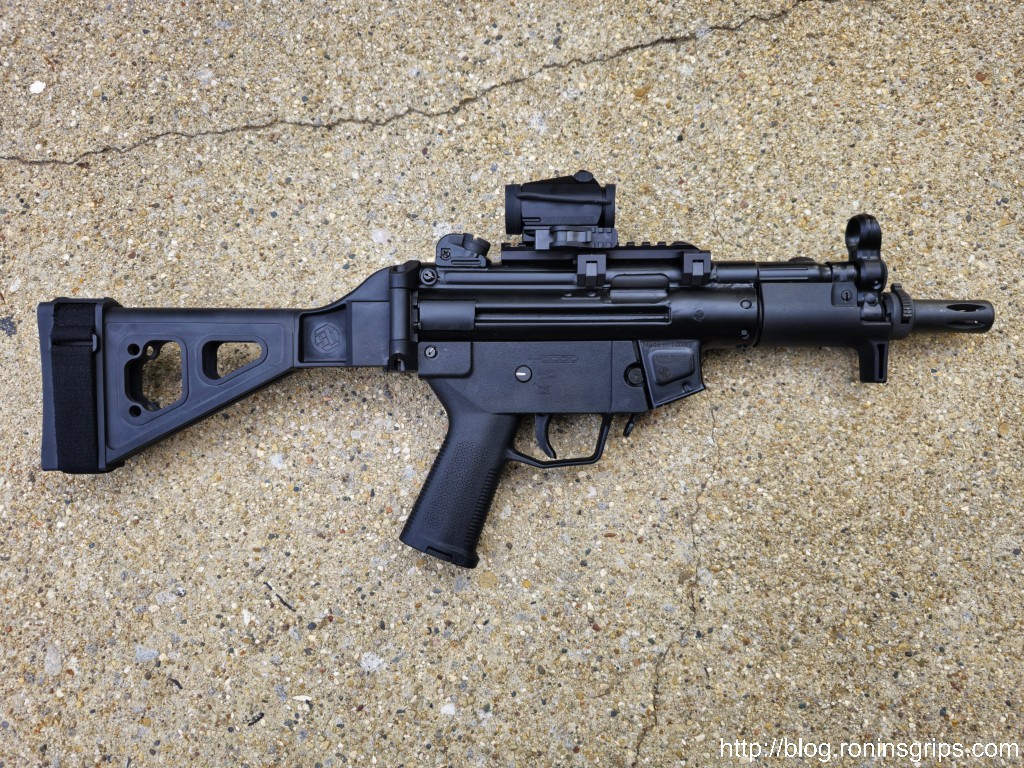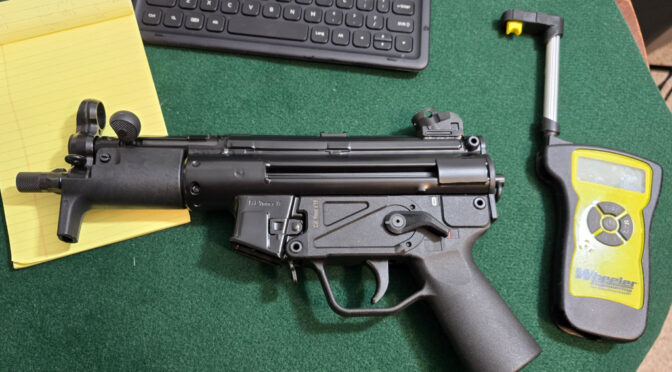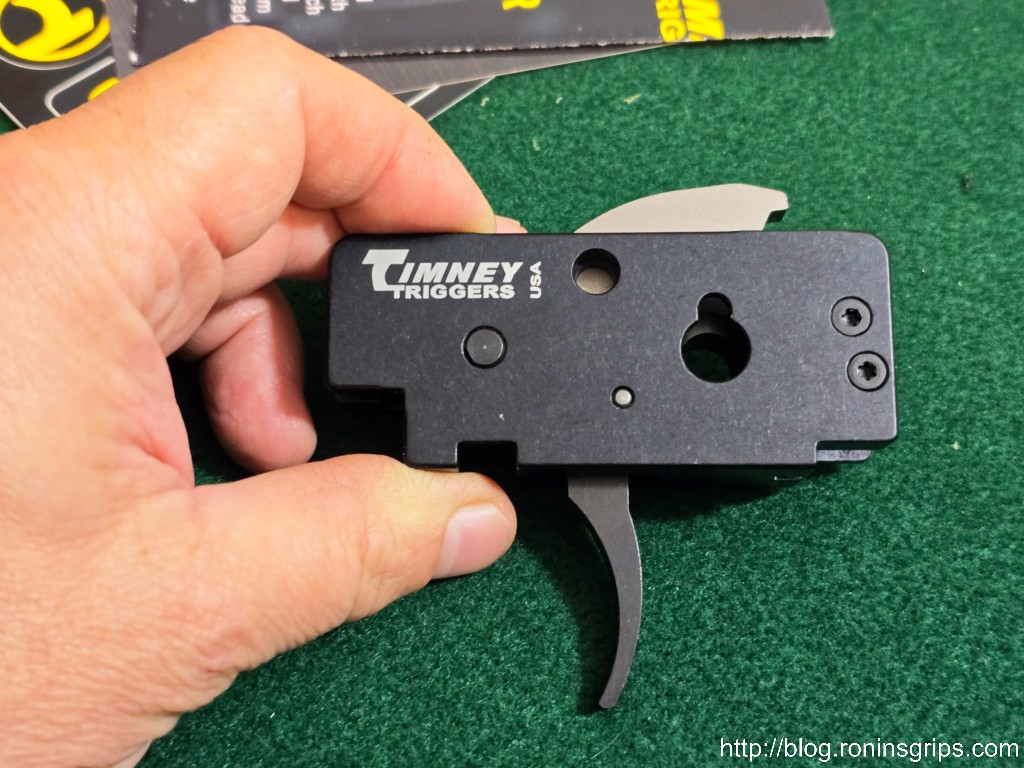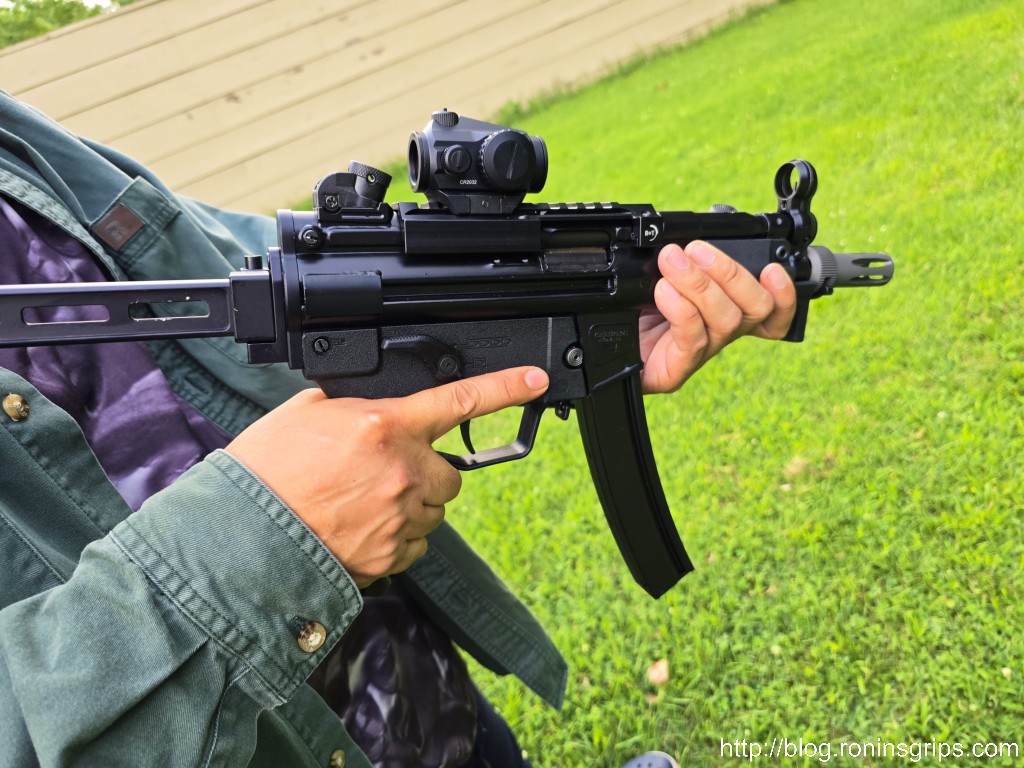
Tag Archives: MP5K

Top 10 MP5 and MP5K Variants in the U.S. Consumer Market (2025–2026) Based on Reported Performance

1. Executive Summary

The United States consumer market for MP5 and MP5K-patterned firearms has exploded in recent years, providing shooters with more variety than ever before. Since its debut by Heckler & Koch in the ’60s, the iconic roller-delayed blowback design has remained a favorite in the pistol-caliber carbine (PCC) world. Today, thanks to expiring patents and new domestic production, the market is filled with everything from high-end, hand-built masterpieces to budget-friendly imports made on original military machinery.

In this analysis, we take a close look at the top 10 MP5 and MP5K clones available today. We have combined deep-dive engineering, checking things like manufacturing tolerances and metal quality, with a quantitative and qualitative analysis of social media sentiment. This helps us see how these guns perform in practice, from out-of-the-box reliability to how well the manufacturers support their customers.

What we found is a market split in two. At the top end, premium U.S. builds and original German imports offer beautiful welds and perfect specs right from the factory. In contrast, the more affordable imports provide a solid foundation but may require some adjustments to address minor issues with components such as locking pieces or magazine fit.

Table 1.1: Top 10 MP5/MP5K Variants Summary Ranking

RankManufacturer & ModelOriginCategoryTotal Score (Max 60)
1Heckler & Koch SP5 / SP5K-PDWGermanyPremium Original58
2Dakota Tactical D54 SeriesUSAPremium Custom56
3Zenith Firearms ZF-5USAMid-to-High Tier52
4PTR Industries 9CT / 9KTUSAMid-Tier Utility51
5Century Arms AP5 (MKE)TurkeyValue / Import48
6Military Armament Corp (MAC-5)TurkeyBudget / Import41
7HK MP5 .22LR (Umarex)GermanyRimfire Trainer41
8POF-5 (Pakistan Ordnance Factories)PakistanBudget / Import39
9Hitec Arms HP5SDUSANiche / Suppressed38
10ATI GSG-16GermanyRimfire Plinker27

2. Engineering Architecture of the Roller-Delayed System

To properly analyze and rank these platforms, it is necessary to establish the mechanical baselines and historical development of the roller-delayed blowback operating system. The quality of a clone is directly proportional to its adherence to these precise geometric principles.

2.1 The Roller-Delayed Mechanism and Historical Lineage

The roller-delayed blowback system traces its origins directly to late-World War II German engineering, specifically the Mauser StG 45 project. At a time when traditional locked-breech rifles required extensive and expensive machining, engineers sought a simpler, stamped-steel alternative that could manage rifle-caliber pressures without utilizing a gas piston. The resulting mechanism utilizes a mechanical disadvantage rather than a rigid locked breech.

Upon firing, the rearward thrust of the expanding cartridge case pushes directly against the bolt head. However, the bolt head is restricted from moving rearward freely because cylindrical steel rollers are wedged outward into specific recesses in the barrel extension (the trunnion) by an angled steel component known as the locking piece. The geometry of this locking piece dictates the duration of the mechanical delay. The bolt head can only move rearward by squeezing the rollers inward against the angles of the locking piece, which in turn forces the locking piece and the heavier bolt carrier to accelerate rearward at a multiple of the bolt head’s velocity. This mechanical delay lets the pressures in the chamber drop to safe levels before the breech is fully open. Heckler & Koch refined this system for the 9x19mm cartridge in the 1960s, prioritizing predictability and smooth cycling in a compact submachine gun format.

2.2 Bolt Gap Tolerances and Locking Piece Geometry

The operational health and longevity of an MP5-patterned firearm are mathematically measured via the “bolt gap”. The bolt gap is defined as the distance between the rear of the bolt head and the front of the bolt carrier when the bolt assembly is fully in battery and the hammer is dropped1. The factory specification for an optimal bolt gap ranges from 0.25mm to 0.45mm (0.010 to 0.018 inches), with an absolute maximum of 0.50mm (0.020 inches)1.

Measuring this gap requires precision feeler gauges. The armorer procedure involves clearing the weapon, dropping the bolt on an empty chamber, pulling the trigger to drop the hammer, inverting the weapon, and inserting a feeler gauge through the magazine well between the bolt head and carrier until a firm drag is felt. Over time, as the rollers, trunnion recesses, and locking piece shoulders wear down, the locking piece seats deeper into the bolt head, causing the bolt gap to shrink. Manufacturers correct this standard wear by offering oversized rollers in increments of +2, +4, +6, and +8 (where each step changes the gap by approximately 0.1mm) to restore the required geometric tolerances1.

The locking piece angle is relevant to the evaluation of modern civilian clones, particularly regarding suppressor usage. A standard 9mm full-size MP5 utilizes a 100-degree locking piece1. Compact (K) models, or variants utilizing high-backpressure sound suppressors, often require an 80-degree or 90-degree locking piece2. A lower angle increases the mechanical resistance, delaying the unlocking sequence further to counteract the increased backpressure3.

If a firearm is operated with an incorrect, excessively steep locking piece (e.g., 115-degree or 120-degree) while suppressed, over-cycling occurs1. Over-cycling means the bolt carrier group accelerates rearward with excessive kinetic energy, violently bottoming out against the rear of the receiver1. Prolonged over-cycling leads to severe structural damage known as “roller dents,” outward protrusions on the stamped sheet metal receiver caused by the rollers being forced outward at the rear of their travel path1. Several Turkish imports evaluated in this report ship with 115-degree or 120-degree locking pieces, necessitating immediate aftermarket modification by the end-user to prevent structural failure when firing suppressed or utilizing 147-grain high-impulse ammunition1.

2.3 The Fluted Chamber and Extraction Mechanics

The roller-delayed breech opens while residual chamber pressure is still relatively high, causing standard brass cases to swell and adhere to the chamber walls, which can lead to catastrophic extraction failures. The platform mitigates this physical limitation via a fluted chamber. Longitudinal grooves (typically 12 to 16 flutes) are precision-cut into the chamber walls. Upon ignition, these flutes allow combustion gases to flow backward toward the breech face, equalizing the pressure on the inside and outside of the cartridge case. This essentially floats the spent casing on a layer of gas, allowing the extractor to pull the casing rearward with no resistance. The manufacturing execution of these flutes, specifically the depth and uniformity achieved during the cold hammer forging process, directly impacts a clone’s reliability across different ammunition brands, casing materials, and projectile weights.

3. Methodology for Evaluation and Ranking

The ranking of the top 10 platforms is determined through a systematic combination of engineering specifications and aggregated consumer sentiment. The methodology relies on a 60-point scale across six distinct categories, each weighted equally for a maximum of 10 points.

3.1 Scoring Metrics

  1. Accuracy (10 pts): Evaluated based on barrel manufacturing processes. Cold Hammer Forged (CHF) barrels generally receive higher scoring for longevity and concentricity compared to standard button-rifled alternatives. Trunnion alignment and sight picture consistency are also factored into this metric.
  2. Reliability (10 pts): Assessed through mechanical function, susceptibility to tolerance stacking, out-of-the-box performance, and performance across various ammunition weights (115gr standard pressure, 124gr NATO, 147gr subsonic, and jacketed hollow points).
  3. Finish (10 pts): Analyzed based on welding aesthetics. Original German platforms feature uniform, visually appealing TIG welds, whereas high-volume imports often display rough, porous welding. Surface treatments, such as traditional Lacquer over Manganese Phosphate versus modern Nitride or Powder Coat, and the dimensional uniformity of the stamped sheet metal receiver are also evaluated.
  4. Overall Quality (10 pts): A holistic metric encompassing ergonomic fitment, component metallurgy, trigger pack assembly, and adherence to original technical data specifications.
  5. Customer Service (10 pts): Evaluated via sentiment regarding warranty claims, RMA turnaround times, manufacturer communication, and willingness to correct out-of-spec components. Domestic manufacturers typically score higher in this category due to logistical advantages.
  6. Availability of Parts (10 pts): Measured by the platform’s geometric compatibility with original HK (OEM) components, aftermarket handguards, optics mounts, and the ease of sourcing replacement wear parts (such as extractor springs, ejector levers, locking pieces, and rollers).

3.2 Social Media Sentiment Framework

Sentiment data was systematically aggregated from specialized online communities, including dedicated firearm forums and armorer evaluation platforms. Mentions and reviews were categorized into three tiers to establish a quantifiable representation of consumer trust:

  • % Positive: The end-user reported flawless functional success, satisfaction with the value proposition, or the seamless integration of aftermarket parts without the need for custom fitting.
  • % Neutral: The end-user reported minor functional anomalies that were easily corrected by the user (e.g., swapping an extractor spring, clearing a minor malfunction during a stated break-in period) or noted cosmetic blemishes (rough welds, uneven paint) that did not impede mechanical function.
  • % Negative: The end-user reported catastrophic failures, uncorrectable out-of-spec dimensions (e.g., a magazine well sized incorrectly preventing standard magazine insertion), structural damage (roller dents), or prolonged customer service disputes.
Consumer sentiment stacked analysis of firearms, showing positive, neutral, and negative percentages.
Firearm comparison chart: Platform, positive, neutral, negative ratings, and primary complaints.

4. Market Evaluation of the Top 10 Platforms

4.1 Heckler & Koch SP5 / SP5K-PDW

Program Link: https://hk-usa.com/product/sp5/

Specifications & Scores:

  • Caliber: 9x19mm | Barrel: 8.86″ / CHF | Operating System: Roller-Delayed | Factory Locking Piece: 100°
  • Scores (Out of 10): Accuracy: 10 | Reliability: 10 | Finish: 10 | Quality: 10 | Customer Service: 9 | Parts: 9 | Total: 58/60

Table 4.1.1: Sentiment and Characteristics – HK SP5 Series

Sentiment CategoryPercentagePrimary Characteristics Mentioned by Consumers
Positive95%Impeccable fit and finish, authentic paddle release, exceptionally reliable, perfectly smooth recoil impulse, genuine German manufacturing.
Neutral3%Slight stiffness in the safety selector switch when new, heavy trigger pull typical of factory defense setups.
Negative2%Exorbitant pricing (MSRP and dealer markups), lack of availability, lack of a threaded barrel on early SP5K models.

Engineering & Analyst Review:

The Heckler & Koch SP5, alongside its compact variant the SP5K-PDW, represents the civilian-legal, semi-automatic evolution of the original military submachine gun. Manufactured in Oberndorf, Germany, on the exact same assembly lines and tooling utilizing the same workforce that produces the military variants, the SP5 acts as the dimensional, metallurgical, and aesthetic benchmark against which all subsequent clones are evaluated.

The receiver is made from precision-stamped steel, and the TIG welding on the trunnion block, cocking tube, and rear receiver cap is very uniform and completely free of the porosity often seen in lesser clones. The 8.86-inch barrel features a 6-groove, right-hand twist (1:10) and is equipped with the authentic Navy-style threaded tri-lug adapter (1/2×28). The fluted chamber is flawlessly executed, guaranteeing extraction across a vast spectrum of casing materials and powder loads.

Mechanically, the SP5 ships with a verified 100-degree locking piece, ensuring proper bolt velocity and optimal bolt gap measurements (routinely checked at 0.015 inches straight from the factory)1. Social media sentiment shows near-absolute reliability, with users reporting flawless cycling across 115gr target loads, 124gr NATO pressure, and 147gr subsonic jacketed hollow points (JHP). The negligible negative sentiment correlates strictly with the financial barrier to entry; with MSRPs set at $3,679 and street prices routinely exceeding $4,000 due to demand, the platform demands a substantial premium for the original roll mark. Because of its German origin, it maintains 100% parts compatibility with the broader HK ecosystem, allowing for seamless integration of specialized trigger packs, aftermarket handguards, and optical mounts.

4.2 Dakota Tactical D54 Series

Program Link: https://www.dakotatactical.com/product/dakota-tactical-d54-n-semi-automatic-9mm/

Specifications & Scores:

  • Caliber: 9x19mm | Barrel: 8.85″ / CHF | Operating System: Roller-Delayed | Factory Locking Piece: 100° (or 80° for SD)
  • Scores (Out of 10): Accuracy: 10 | Reliability: 10 | Finish: 10 | Quality: 10 | Customer Service: 8 | Parts: 8 | Total: 56/60

Table 4.2.1: Sentiment and Characteristics – Dakota Tactical D54

Sentiment CategoryPercentagePrimary Characteristics Mentioned by Consumers
Positive90%Master-class welding, hand-crafted attention to detail, highly accurate, bespoke boutique status, excellent suppressor hosts.
Neutral8%Stiff initial break-in period for the precision-fitted components.
Negative2%Extreme lead times (estimated at 24 months), highly prohibitive cost.

Engineering & Analyst Review:

Dakota Tactical operates exclusively in the boutique, ultra-premium sector of the roller-delayed market. The D54 series is not mass-produced in a factory setting; rather, each unit is hand-crafted in the United States by specialized armorers utilizing a blend of premium domestic parts and demilitarized German components.

From a metallurgical and fabrication perspective, Dakota Tactical is arguably superior to mass-produced HK variants. They utilize properly rolled and welded upper receivers, with welds that are meticulously ground and finished to exceed original military aesthetics. The D54-N has a free-floating B&T (Brügger & Thomet) 16-flute cold hammer-forged barrel and a tungsten-filled, sear-ready bolt group to reduce bolt bounce. Dakota Tactical understands modern consumer needs and builds modularity into the design by welding an integral 1913 Picatinny rail to the top of the receiver and providing proprietary M-LOK aluminum handguards. The final finish features a strong Parkerization layer, topped with an HK Black Duracoat layer for maximum corrosion resistance.

The firm strictly follows advanced engineering geometry, ensuring that a 100-degree locking piece is installed for standard 9mm operation, with 80-degree options specifically provided for dedicated suppressed variants like the D54SD or the compact reverse-stretch models. Sentiment is overwhelmingly positive regarding the mechanical quality and precision accuracy of the firearms. However, the business model restricts availability. The negative and neutral comments focus entirely on the extensive wait times, currently estimated at up to 24 months from the date of order, and the high acquisition cost starting at $3,899.

4.3 Zenith Firearms ZF-5

Program Link: https://zenithfirearms.com/product/zf-5/

Specifications & Scores:

  • Caliber: 9x19mm | Barrel: 8.9″ / CHF | Operating System: Roller-Delayed | Factory Locking Piece: 100°
  • Scores (Out of 10): Accuracy: 9 | Reliability: 8 | Finish: 9 | Quality: 9 | Customer Service: 9 | Parts: 8 | Total: 52/60

Table 4.3.1: Sentiment and Characteristics – Zenith ZF-5

Sentiment CategoryPercentagePrimary Characteristics Mentioned by Consumers
Positive82%Excellent domestic quality, beautiful finish, complete accessory package included in the box, and highly reliable customer service.
Neutral12%Heavier overall weight compared to standard clones requires thorough initial cleaning of factory preservatives.
Negative6%Occasional magazine drop anomalies on early production models, minor tolerance stacking on optical mounts.

Engineering & Analyst Review:

Zenith Firearms transitioned from acting as the primary U.S. importer for Turkish MKE firearms to establishing full domestic manufacturing capabilities within the United States. The ZF-5 platform is built around an 8.9-inch cold hammer-forged barrel and utilizes the authentic roller-delayed blowback operating system.

Engineering analysis of the ZF-5 shows that the platform is highly robust and slightly overbuilt. It weighs between 5.5 and 6.8 pounds depending on the specific model configuration, which is heavier than military-spec clones. However, this additional mass mathematically aids in mitigating the already low recoil impulse of the 9mm cartridge, resulting in an exceptionally flat-shooting platform. Zenith’s surface finish is notably superior to military-contract imports, presenting a cleaner aesthetic without the excessive gloss of budget models. The platform demonstrates strong accuracy and mechanical reliability across various ammunition types, easily transitioning between subsonic and supersonic loads.

Early domestic production models exhibited minor tolerance stacking issues within the magazine catch interface, which occasionally resulted in magazines vibrating loose or unseating during rapid firing. However, Zenith’s domestic customer service operations rapidly addressed these anomalies under their lifetime warranty program, retrofitting improved magazine catches. The ZF-5 commands a mid-to-high-tier price point (frequently found under $2,000) and ships with a full set of accessories, including multiple magazines, a claw optics rail, and a custom case, securing its position as a premier mass-produced American alternative.

4.4 PTR Industries 9CT / 9KT

Program Link: https://www.ptr-us.com/product/9ct/

Specifications & Scores:

  • Caliber: 9x19mm | Barrel: 9.0″ / Nitride | Operating System: Roller-Delayed | Factory Locking Piece: 100°
  • Scores (Out of 10): Accuracy: 9 | Reliability: 8 | Finish: 7 | Quality: 8 | Customer Service: 10 | Parts: 9 | Total: 51/60

Table 4.4.1: Sentiment and Characteristics – PTR 9CT / 9KT

Sentiment CategoryPercentagePrimary Characteristics Mentioned by Consumers
Positive80%Outstanding, rapid U.S.-based customer service, reliable function, heavy barrel profile, modern MLOK layout, lifetime warranty.
Neutral15%A powder coat finish can be excessively thick in pinholes, have non-standard threading on early models, and be heavier than HK specifications.
Negative5%Over-cycling and roller denting on the 9KT model when fired are suppressed without changing the factory locking piece.

Engineering & Analyst Review:

PTR Industries leveraged their extensive, decades-long experience manufacturing G3-pattern (HK91) 7.62x51mm roller-delayed rifles to produce the 9CT (full size) and 9KT (compact) 9mm pistols. These firearms are entirely manufactured in the U.S. and depart from certain historical orthodoxies to favor modern production techniques.

PTR abandons the traditional cold hammer-forged barrel in favor of a 9-inch Nitride heat-treated barrel (1:10 right-hand twist). While this change alters historical authenticity, nitride processing provides exceptional surface hardness, extended barrel life, and excellent corrosion resistance. The receiver is modernized out of the box, utilizing a welded steel 4.5-inch Picatinny optic rail, which eliminates the need for expensive and often finicky claw mounts. It also ships with an aluminum M-LOK handguard. The surface finish is a rugged powder coat applied over Parkerizing, which provides extreme durability but lacks the refined look of HK’s lacquer finishes and can occasionally make pushpins tight during initial disassembly.

Mechanically, the 9CT is a reliable workhorse. However, deep sentiment analysis reveals that consumers utilizing the compact 9KT variant with sound suppressors frequently experience over-cycling3. Over-cycling (also known as excessive bolt velocity) occurs when added backpressure from a suppressor causes the bolt to unlock too early and accelerate backward with too much kinetic energy, causing the bolt carrier group to violently slam into the rear of the receiver3. Because the K-models feature shorter cocking tubes and less mass in the bolt carrier, they are particularly susceptible to this rapid acceleration3. PTR’s highly responsive customer service actively advises end-users to swap the factory locking piece for an 80-degree or 90-degree unit when running suppressed subsonic ammunition, preventing receiver damage and maintaining correct bolt gap integrity3. PTR’s U.S.-based support and lifetime warranty strongly offset these minor tuning requirements, making the platform a favorite among practical shooters.

4.5 Century Arms AP5 (MKE Import)

Program Link: https://www.centuryarms.com/ap5-hg6034.html

Specifications & Scores:

  • Caliber: 9x19mm | Barrel: 8.9″ / CHF | Operating System: Roller-Delayed | Factory Locking Piece: 115° – 120°
  • Scores (Out of 10): Accuracy: 9 | Reliability: 7 | Finish: 6 | Quality: 7 | Customer Service: 9 | Parts: 10 | Total: 48/60

Table 4.5.1: Sentiment and Characteristics – Century Arms AP5

Sentiment CategoryPercentagePrimary Characteristics Mentioned by Consumers
Positive75%Best value proposition on the market, built on authentic licensed tooling, excellent core reliability, and high compatibility with HK parts.
Neutral15%Rough, aesthetically unpleasing welds; occasional failure to extract during the 500-round break-in period; thin paint finish.
Negative10%Ships with incorrect locking piece angle (115/120 degree) causing over-cycling, requires aftermarket extractor spring swaps for peak reliability.

Engineering & Analyst Review:

Makina ve Kimya Endüstrisi (MKE) manufactures the Century Arms AP5, AP5-P, and AP5-M in Turkey and imports them to the U.S. consumer market. MKE historically produced MP5s under an official technical data package license from HK, utilizing identical military-grade tooling. Consequently, the core metallurgy, including a cold hammer-forged chrome-molybdenum-vanadium barrel with a 1:9.8 twist, closely mirrors original military specifications.

Despite the pedigree of the tooling, the AP5 exhibits the realities of budget-focused, high-volume military production. The sheet metal stamping and TIG welds are visibly rougher. More critically, engineering teardowns, feeler gauge measurements, and consumer sentiment confirm that MKE ships many full-size AP5s with 115-degree locking pieces1. When coupled with modern 147gr subsonic ammunition or sound suppressors, this aggressive geometry causes the bolt to unlock too rapidly, decreasing the bolt gap temporarily during firing, resulting in extraction failures and, in extreme cases, permanent roller dents in the receiver1.

To optimize reliability and protect the receiver, knowledgeable end-users immediately replace the factory locking piece with an HK OEM 100-degree unit and swap the Turkish extractor and extractor spring for German variants1. Despite these necessary technical interventions, the AP5’s street price routinely falls below $1,200, making it drastically cheaper than the SP5. This aggressive pricing structure allows the consumer to easily absorb the $100-$150 cost of minor aftermarket tuning, solidifying the AP5 as the most dominant value proposition in the current market.

4.6 Military Armament Corp MAC-5 / MAC-5K

Program Link: https://milarmamentcorp.com/

Specifications & Scores:

  • Caliber: 9x19mm | Barrel: 8.9″ / Button or CHF | Operating System: Roller-Delayed | Factory Locking Piece: 120°
  • Scores (Out of 10): Accuracy: 8 | Reliability: 5 | Finish: 5 | Quality: 6 | Customer Service: 7 | Parts: 10 | Total: 41/60

Table 4.6.1: Sentiment and Characteristics – MAC-5 / MAC-5K

Sentiment CategoryPercentagePrimary Characteristics Mentioned by Consumers
Positive60%Highly affordable entry price, fun range toy, reliable once extensive parts swapping is completed.
Neutral20%The finish is thick and glossy, the component fitment is extremely tight, and the safety selector is stiff.
Negative20%Out-of-spec magazine wells preventing standard mag insertion, double feeds, FTE, requiring immediate 500-round NATO break-in, and poor locking piece selection.

Engineering & Analyst Review:

The MAC-5 and MAC-5K are imported by SDS Imports and manufactured by Mertsav in Turkey. While Mertsav is a significant subcontractor in the Turkish defense industry, this distinction manifests directly in the platform’s severe tolerance stacking and dimensional variations.

The most prevalent engineering failure point noted in the sentiment data is the non-conforming magazine well geometry. Users frequently report that standard HK, KCI, or MKE magazines cannot insert or lock properly without aggressive physical force2. Furthermore, when seated, the magazine feed lips may drag on the bottom of the bolt carrier, causing kinetic friction that robs the carrier of energy and induces failures to feed and eject2. The surface finish utilizes a thick, glossy lacquer paint that is prone to chipping and exacerbates the dimensional tightness of the push-pins and magazine well.

Internally, the MAC-5 is heavily reliant on a mandatory 500-round break-in period using high-pressure 124gr NATO ammunition to mate the rough surfaces. Like the AP5, it frequently ships with an incorrect 120-degree locking piece2. To achieve baseline suppressed reliability, end-users routinely must perform light gunsmithing: swapping the extractor, ejector lever (to a 3rd Gen HK lever), and their respective springs to HK OEM specifications, and installing an 80, 90, or 100-degree locking piece depending on the specific backpressure of their suppressor2. While the base weapon is remarkably inexpensive (frequently retailing around $900), the requirement for end-user dimensional correction and parts replacement results in a high negative sentiment score.

4.7 HK MP5 .22LR (Umarex)

Program Link: https://hk-usa.com/product/mp5-22-lr-rifle/

Specifications & Scores:

  • Caliber: .22LR | Barrel: 16.1″ / Sleeved | Operating System: Direct Blowback | Factory Locking Piece: N/A
  • Scores (Out of 10): Accuracy: 8 | Reliability: 8 | Finish: 8 | Quality: 8 | Customer Service: 7 | Parts: 2 | Total: 41/60

Table 4.7.1: Sentiment and Characteristics – HK MP5 .22LR

Sentiment CategoryPercentagePrimary Characteristics Mentioned by Consumers
Positive85%Exceptional training platform, remarkably high reliability for a rimfire firearm, economical ammunition costs, and identical ergonomics to 9mm.
Neutral10%25-round magazines deplete quickly, primarily a recreational tool rather than a defensive weapon.
Negative5%A direct blowback design means zero internal parts compatibility with 9mm MP5s.

Engineering & Analyst Review:

Licensed by Heckler & Koch and manufactured in Germany by Walther/Umarex, the MP5 .22LR serves strictly as a sub-caliber trainer and recreational plinker. From a mechanical engineering standpoint, this platform does not utilize the roller-delayed blowback system. Given the low chamber pressures generated by the .22 Long Rifle cartridge, the complex roller mechanism is unnecessary; the firearm operates via a simple, direct blowback action utilizing spring tension and bolt mass.

Despite this internal mechanical deviation, the external ergonomics, manual of arms, weight distribution, and visual dimensions are practically a 1:1 replica of the 9mm platform. The rifle variant utilizes a sleeved 16.1-inch barrel designed to accurately mimic the aesthetics of an integrally suppressed MP5SD, while the pistol variants emulate the standard SP5. Consumer sentiment is highly positive; end-users praise its reliability, a notoriously difficult metric to achieve in semi-automatic rimfire platforms due to the rimmed cartridge design, and its virtually non-existent recoil, making it ideal for cost-effective training and novice shooters. Because it relies on proprietary internal geometry, parts availability is strictly limited to Umarex/HK channels, and it cannot accept standard 9mm trigger packs or bolt groups.

4.8 POF-5 (Pakistan Ordnance Factories)

Program Link: Imported via FSAAP (FedArm)

Specifications & Scores:

  • Caliber: 9x19mm | Barrel: 8.9″ / Standard | Operating System: Roller-Delayed | Factory Locking Piece: 100°
  • Scores (Out of 10): Accuracy: 7 | Reliability: 8 | Finish: 4 | Quality: 6 | Customer Service: 6 | Parts: 8 | Total: 39/60

Table 4.8.1: Sentiment and Characteristics – POF-5

Sentiment CategoryPercentagePrimary Characteristics Mentioned by Consumers
Positive65%Authentic military tooling, functionally reliable, and a highly affordable entry point into the roller-delayed market.
Neutral25%Extremely rough exterior paint finish, heavy trigger pull, and utilitarian aesthetic.
Negative10%Loose magazine well fitment causing lateral wobble and poor visual quality control compared to modern domestic clones.

Engineering & Analyst Review:

The POF-5 is manufactured by the Pakistan Ordnance Factories and is imported into the U.S. consumer market primarily by FSAAP. Similar to the Turkish MKE, POF utilizes original HK tooling acquired during military technology transfers decades ago. As a result, the internal geometry of the trunnion, bolt carrier group, and locking recesses are dimensionally accurate to legacy military standards.

However, the POF-5 is characterized by extreme, unrefined utilitarianism. The metallurgical surface finish is poor; the paint is thinly applied, prone to rapid flaking, and offers minimal aesthetic appeal compared to the modern finishes utilized by PTR or Zenith. The stamping processes leave the magazine well slightly oversized, resulting in loose magazine fitment and lateral wobble, which, while generally not inducing malfunctions, creates a perception of low quality. Furthermore, the fire control group is notoriously heavy, featuring a gritty trigger pull exceeding 6 pounds and a stiff selector switch that requires significant thumb pressure.

Despite these cosmetic and ergonomic detriments, the core roller-delayed mechanism functions exactly as designed. Independent testing and sentiment indicate that the POF-5 cycles reliably even with low-quality, steel-cased ammunition and serves as an excellent, affordable host for sound suppressors without the immediate need for locking piece swaps. It is the archetypal “function over form” variant, retailing near $1,099.

4.9 Hitec Arms HP5SD

Program Link: Available through standard distributor networks

Specifications & Scores:

  • Caliber: 9x19mm | Barrel: 5.75″ / Ported CHF | Operating System: Roller-Delayed | Factory Locking Piece: Unknown (Likely 115°)
  • Scores (Out of 10): Accuracy: 8 | Reliability: 7 | Finish: 7 | Quality: 7 | Customer Service: 5 | Parts: 4 | Total: 38/60

Table 4.9.1: Sentiment and Characteristics – Hitec Arms HP5SD

Sentiment CategoryPercentagePrimary Characteristics Mentioned by Consumers
Positive70%Authentic SD integration, exceptionally quiet, eliminates the need for expensive subsonic ammunition.
Neutral20%The very heavy platform (8 lbs) shifts the balance point far forward, making it a niche application.
Negative10%Difficult to clean the ported barrel, specialized parts are difficult to source, and there is a high cost of entry.

Engineering & Analyst Review:

The Hitec Arms HP5SD represents a highly specialized segment of the clone market, focusing specifically on recreating the legendary MP5SD (Schalldämpfer) configuration. The defining engineering feature of an SD platform is its ported barrel. Small holes are precision-drilled into the barrel near the chamber, allowing expanding gases to bleed off rapidly into a large expansion chamber that surrounds the barrel. This mechanical gas bleed reduces the velocity of standard supersonic 115gr and 124gr ammunition down to subsonic speeds before the projectile exits the muzzle, ensuring the bullet does not break the sound barrier.

The Hitec features a 5.75-inch cold hammer-forged barrel housed within the integral suppressor structure and integrates an optics-ready layout. Weighing a substantial 8 pounds, it is significantly heavier than standard models, which alters the balance point forward. Due to its highly specialized nature, long-term reliability and parts compatibility (specifically regarding the ported barrel, the proprietary rubberized handguard, and the silencer interface) represent minor analytical concerns compared to standardized platforms.

4.10 ATI GSG-16

Program Link: https://americantactical.us/product/german-sport-guns-gsg-16-carbine-ria-22lr-16.25-syn-22-rd

Specifications & Scores:

  • Caliber: .22LR | Barrel: 16.25″ / Standard | Operating System: Direct Blowback | Factory Locking Piece: N/A
  • Scores (Out of 10): Accuracy: 5 | Reliability: 4 | Finish: 4 | Quality: 4 | Customer Service: 6 | Parts: 4 | Total: 27/60

Table 4.10.1: Sentiment and Characteristics – ATI GSG-16

Sentiment CategoryPercentagePrimary Characteristics Mentioned by Consumers
Positive40%Very inexpensive, high magazine capacity (110-round drums available), lightweight, and fun for novice shooters.
Neutral20%It feels like a plastic toy, has poor factory iron sights, and requires high-velocity ammunition exclusively.
Negative40%Extremely difficult to disassemble and clean, polymer screws strip easily, are highly prone to jamming, and degrade rapidly over time.

Engineering & Analyst Review:

The German Sport Guns (GSG) 16, imported by American Tactical Imports (ATI), is a .22LR rifle designed to visually mimic the MP5 silhouette while heavily modifying the exterior to avoid HK trademark infringements. Like the Umarex model, it operates on a standard blowback rimfire mechanism, completely devoid of roller-delayed architecture.

From an engineering perspective, the GSG-16 utilizes a polymer clamshell receiver design. The polymer housing and self-tapping screws used for assembly cause serious durability and maintenance problems; the screws strip easily during routine maintenance, and the polymer flexes under tension, which reduces long-term accuracy and optical zero retention. The rifle attempts to add value by including extensive Picatinny and M-LOK railing, a faux suppressor, and a collapsible stock with magazine storage, but these components lack structural rigidity.

Social media sentiment is heavily negative compared to all other platforms evaluated. The platform is notoriously difficult to disassemble and clean, requiring multiple tools to navigate a complex array of springs, weights, and fragile screws. Functionally, it is highly sensitive to ammunition, requiring premium high-velocity copper-plated rounds (e.g., CCI Mini-Mags at 1260fps) to generate enough energy to cycle the heavy bolt carrier reliably. Given the exceptionally low price point (often retailing between $300 and $400), it is strictly categorized as a recreational plinker and cannot be recommended as a durable training apparatus or defensive tool.

5. Master Data Summary Table

Table 5.1: Technical and Evaluative Matrix of Top 10 MP5/MP5K Variants

RankModelCaliberBarrel (Length/Type)Op SystemLocking Piece (Factory)Accuracy (10)Reliability (10)Finish (10)Quality (10)CS (10)Parts (10)Total
1HK SP59x19mm8.86″ / CHFRoller-Delayed100°101010109958
2Dakota D549x19mm8.85″ / CHFRoller-Delayed100° (or 80° for SD)101010108856
3Zenith ZF-59x19mm8.9″ / CHFRoller-Delayed100°98999852
4PTR 9CT9x19mm9.0″ / NitrideRoller-Delayed100°987810951
5Century AP59x19mm8.9″ / CHFRoller-Delayed115° – 120°976791048
6MAC-59x19mm8.9″ / Button or CHFRoller-Delayed120°855671041
7HK MP5 .22LR.22LR16.1″ / SleevedDirect BlowbackN/A88887241
8POF-59x19mm8.9″ / StandardRoller-Delayed100°78466839
9Hitec HP5SD9x19mm5.75″ / Ported CHFRoller-DelayedUnknown (Likely 115°)87775438
10ATI GSG-16.22LR16.25″ / StandardDirect BlowbackN/A54446427

6. Conclusion

The United States consumer market for the MP5 platform successfully accommodates two distinct consumer archetypes: the purist seeking uncompromised mechanical quality and the enthusiast prioritizing financial accessibility.

The Heckler & Koch SP5 and the Dakota Tactical D54 occupy the absolute pinnacle of this evaluation. Their market dominance stems from strict adherence to dimensional tolerances, metallurgical superiority, and the precise calibration of locking piece geometry and bolt gap from the outset. These platforms provide guaranteed function and historical authenticity, but they demand a prohibitive financial premium that excludes a large segment of the consumer base.

Conversely, the influx of Turkish imports, specifically the Century Arms AP5, offers the most compelling value proposition currently available. While the AP5 suffers from cosmetic welding deficiencies and often ships with incorrect 115-to-120-degree locking pieces that threaten structural integrity through over-cycling during suppressed fire, its integration of authentic licensed tooling provides a reliable core. With minimal end-user mechanical intervention (specifically, swapping the factory locking piece to a 100-degree unit and upgrading the extractor springs to German OEM parts), the AP5 replicates 95% of the performance of an authentic HK for roughly a third of the cost.

Platforms such as the MAC-5 serve as a cautionary tale, highlighting the dangers of tolerance stacking in budget manufacturing, particularly regarding receiver stampings and magazine well geometry. Meanwhile, domestic builders like PTR Industries and Zenith Firearms have successfully bridged the gap between premium and budget tiers, offering robust warranties, localized customer support, and modernized features (e.g., welded optics rails and M-LOK interfaces) that bypass the need to rely on foreign import quality control.

Ultimately, the roller-delayed blowback system remains a highly relevant, soft-shooting mechanism that outperforms many modern direct-blowback PCCs. Consumers must simply align their mechanical aptitude, willingness to tune the platform, and budget with the appropriate tier of manufacturing execution.

7. Availability

Heckler & Koch SP5 / SP5K-PDW

Dakota Tactical D54 Series

No active listings found from specified vendors.

Zenith Firearms ZF-5

PTR Industries 9CT / 9KT

Century Arms AP5 (MKE Import)

Military Armament Corp MAC-5 / MAC-5K

HK MP5 .22LR (Umarex)

POF-5 (Pakistan Ordnance Factories)

Hitec Arms HP5SD

No active listings found from specified vendors.

ATI GSG-16

8. Appendix: Methodology and Data Sources

Data Sourcing Methodology: The technical specifications, dimensional measurements, and historical lineages referenced in this report were derived from manufacturer technical data sheets (Heckler & Koch, PTR Industries, Dakota Tactical, Century Arms, Zenith Firearms, and Military Armament Corp) alongside authoritative small arms historical documentation regarding the Mauser StG 45 development. Data concerning fluted chamber mechanics, bolt gap specifications (0.25mm – 0.45mm), and locking piece angles were cross-referenced against factory armorer manuals1.

Sentiment Analysis Methodology: Social media sentiment was quantified by aggregating and analyzing discussions, troubleshooting threads, and long-term ownership reports from specialized forums, including Reddit (r/MP5, r/guns, r/liberalgunowners, r/canadaguns, r/Firearms) and HKPro2. A sample of post-purchase reviews and armorer teardowns (including bolt gap feeler gauge data and locking piece angle verification) was assessed to ensure qualitative feedback matched engineering reality1.

  • Positive indicates flawless function or a highly satisfactory value-to-performance ratio.
  • Neutral denotes acceptable performance following a required break-in period or the application of minor aftermarket parts (e.g., extractor springs).
  • Negative highlights systemic manufacturing defects requiring warranty return (RMA) or significant gunsmithing intervention.

Scoring Methodology:

The 60-point scale was designed to equally weigh mechanical performance (Accuracy, Reliability), manufacturing execution (Finish, Quality), and long-term ownership viability (Customer Service, Parts Availability). Scores were assigned based on the synthesis of technical data and verified consumer failure rates. Each category was scored out of a maximum of 10 points to provide a granular differentiation between platforms.


Note: Vendor Sources listed are not an endorsement of any given vendor. It is our software reporting a product page given the direction to list products that are between the minimum and average sales price when last scanned.


Please share the link on Facebook, Forums, with colleagues, etc. Your support is much appreciated and if you have any feedback, please email us in**@*********ps.com. If you’d like to request a report or order a reprint, please click here for the corresponding page to open in new tab.


Sources Used

  1. Photo proof: Century MKE AP5 Fullsize (115 deg) vs HK SP5 Fullsize (100 deg) OEM locking piece angles : r/MP5 – Reddit, https://www.reddit.com/r/MP5/comments/1fu3twa/photo_proof_century_mke_ap5_fullsize_115_deg_vs/
  2. r/MP5 – MAC 5K – Double Stamped and ready to roll [Reliability Improvements inside], https://www.reddit.com/r/MP5/comments/1r4v9yq/mac_5k_double_stamped_and_ready_to_roll/
  3. Does a 90 Degree LP allow flexibility when choosing to run suppressed or not? : r/MP5, https://www.reddit.com/r/MP5/comments/1j0g9ba/does_a_90_degree_lp_allow_flexibility_when/

Market Analysis and Consumer Sentiment: Ronin’s Grips MP5K Offerings

1. Executive Summary

The civilian market for roller-delayed firearms, especially the iconic MP5K and its modern clones, is seeing a major comeback. This resurgence is fueled by high-quality imports, easier access to short-barreled rifle (SBR) registrations, and a healthy dose of pop-culture nostalgia. For many owners, the first step in customizing these firearms is upgrading the pistol grip to fix old-school ergonomics and help meet federal compliance rules.

This report takes a close look at Ronin’s Grips, a specialized manufacturer known for adapting classic firearm furniture for the MP5K platform. By looking at consumer feedback, market prices, and regulatory needs, we can see how the brand has found its place. Even though they only entered the MP5K market about two years ago, Ronin’s Grips has already earned a stellar reputation. This success comes from using high-grade materials, being remarkably transparent with customers, and building genuine trust. The brand has carved out a niche by blending the historical look of military surplus with the comfort and performance of modern tactical grips.

One important aside is that Ronin’s Grips started making replica AK grips beginning with the Yugo M70 in 2006. While they are relatively new to the HK space, they are an old name with an excellent reputation in the AK-world.

2. The Kinematic Evolution of the MP5 Architecture

To understand why these upgrades matter, we have to look at the history of the weapon itself. The MP5 and its compact “Kurz” (K) version were developed by Heckler & Koch in the 1960s under the name “Project 65”1. The design DNA came from Mauser engineers Edmund Heckler, Theodor Koch, and Alex Seidel, who perfected a revolutionary way for the gun to operate2.

The secret to the MP5’s success is the roller-delayed blowback system. Unlike simpler systems that use a heavy bolt and a stiff spring to handle recoil, this mechanism uses mechanical timing1. When a round is fired, the bolt is held in place by two small rollers until the pressure drops to a safe level1.

For the gun to open safely, these rollers must be pushed inward, which accelerates the bolt carrier backward to bleed off energy1. To prevent the brass casing from getting stuck during this process, engineers added tiny grooves—flutes—to the chamber walls. These flutes allow gas to “float” the casing, making extraction smooth and reliable4.

This clever engineering makes the MP5K famous for its smooth shooting. Instead of the sharp kick found in many submachine guns, it provides a gentle push1. Also, because it fires from a closed bolt, it stays much more stable than open-bolt designs like the Uzi. This legendary smoothness is exactly what modern civilian buyers are looking for today.

3. The Stratification of the Civilian Roller-Delayed Market

For a long time, owning an MP5 was out of reach for most people. Original fully automatic models are incredibly rare and cost as much as a luxury car3. Even semi-auto versions from Heckler & Koch, like the SP5K-PDW, are very expensive. These German-made models are the gold standard, but with street prices often exceeding $3,500, they are mostly for serious collectors who want absolute authenticity.

The market has changed recently as more manufacturers have gained access to the original military tooling. Now, there are many affordable MP5K clones available, making the platform accessible to a much wider audience. These clones have created a huge demand for accessories as owners look to upgrade their firearms with better ergonomic parts.

Looking at current pricing and consumer feedback, it’s clear the market is split between high-end originals and high-value clones. The data shows that many of the clones are actually very well-received by owners who appreciate the balance of performance and price.

RankManufacturer & ModelConfigurationOriginAverage Street PricePositive Consumer Sentiment
1Heckler & Koch SP5Full-SizeGermany$3,100.0098%
2Century Arms AP5Full-SizeTurkey$1,450.0095%
3Zenith ZF-5Full-SizeUSA$1,700.0092%
4Military Armament Corp MAC-5Full-SizeTurkey$1,250.0089%
5PTR 9CTFull-SizeUSA$1,750.0087%
6Century Arms AP5-PCompact (K-Style)Turkey$1,550.0085%
7Heckler & Koch SP5K-PDWCompact (K-Style)Germany$3,300.0084%
8Military Armament Corp MAC-5KCompact (K-Style)Turkey$1,150.0082%
9PTR 9KTCompact (K-Style)USA$1,770.0080%
10Zenith ZF-5TCompact (K-Style)USA$1,400.0080%

As the table above shows, firearms like the Century Arms AP5-P, Zenith ZF-5T, and MAC-5K offer the authentic shooting experience for a fraction of the cost. Since these are built using original HK specifications, they work perfectly with aftermarket parts. This active, budget-conscious market is the perfect place for companies like Ronin’s Grips to thrive.

4. The Ergonomic Imperative and the Ronin’s Grips Catalog

Despite its reputation, the factory grip on the MP5K is often a major complaint. The original 1960s design is fairly straight and blocky, which doesn’t feel natural by today’s standards for comfort or control5. Additionally, many clones have very heavy trigger pulls. While some people install new trigger packs, upgrading the grip itself is one of the best ways to improve how the gun handles.

Ronin’s Grips solves this by adapting high-quality grips from other HK platforms to fit the compact MP5K perfectly. Their catalog offers two main paths for owners:

  • The Magpul SL Adaptation: Ronin’s adapts the Magpul SL grip to work on the MP5K. This is a favorite for those who want a modern feel, better texture, and a more comfortable grip angle.
  • Navy-Style SEF Grips: These are made from authentic military surplus. They provide that classic “special ops” look that collectors and purists love for their replica builds.
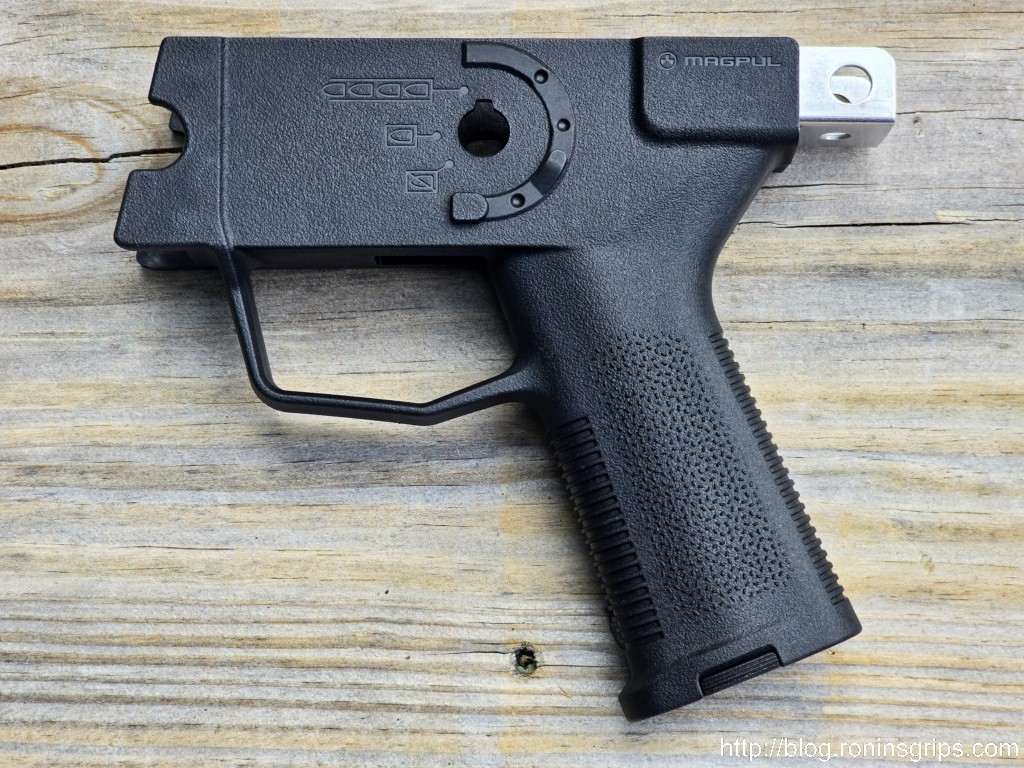
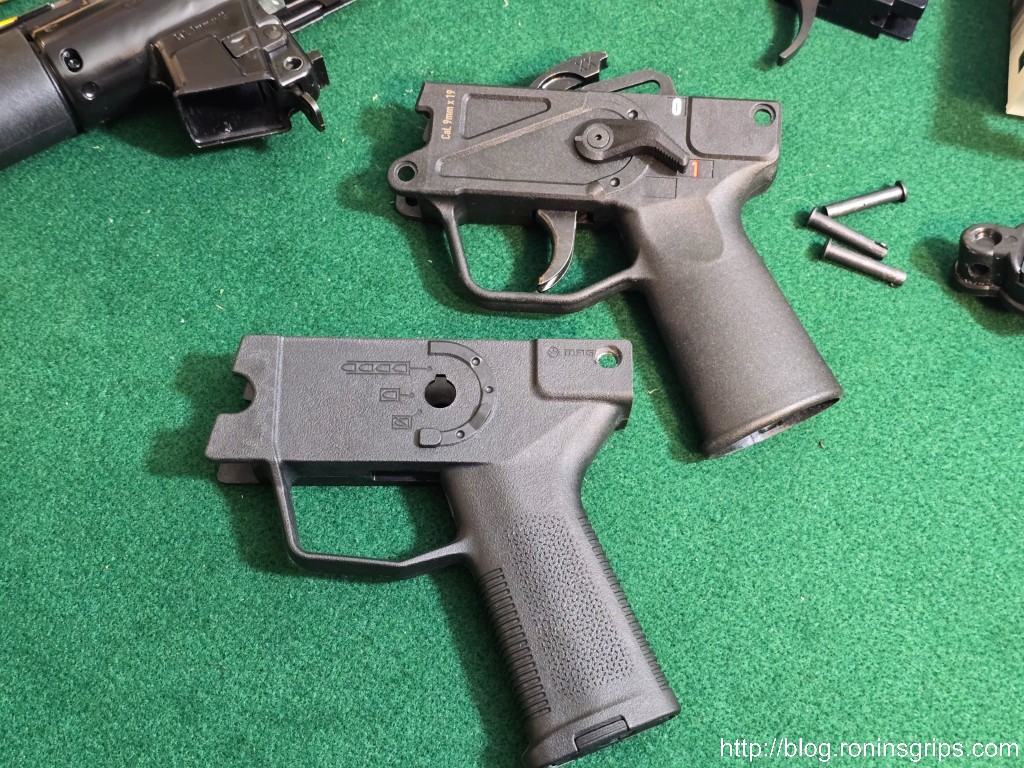
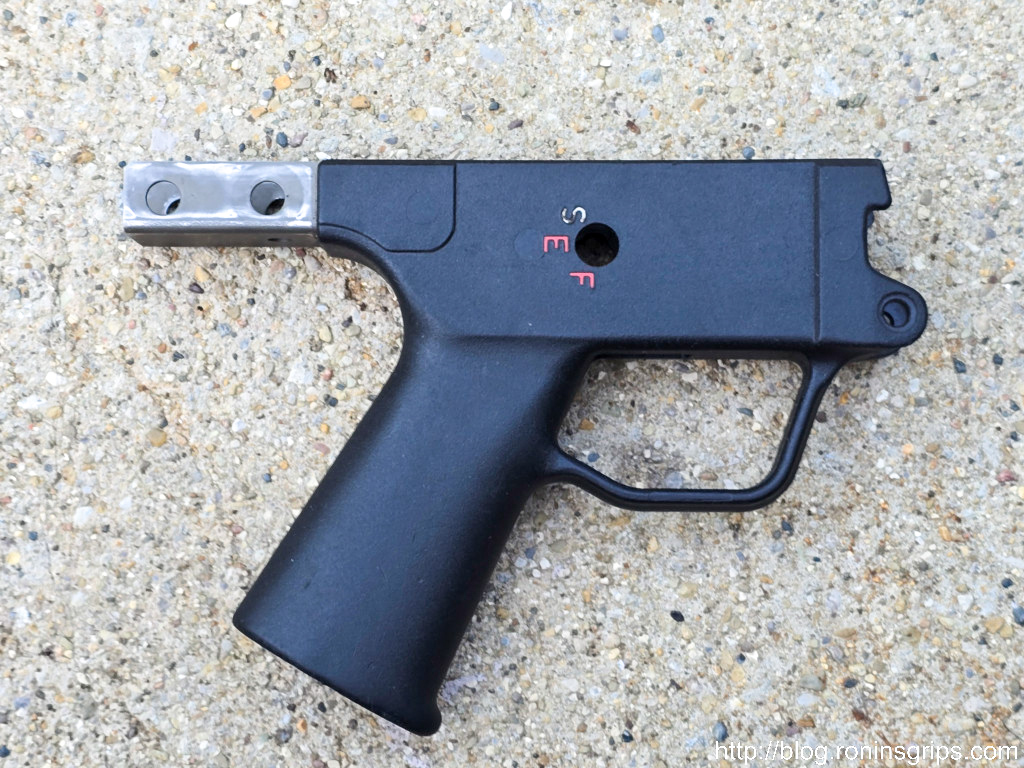
Disassembled firearm trigger group and receiver housing on a green surface
Modified Magpul SL grips. Standard SEF trigger packs will go right in. There is not an “AMBI” model.
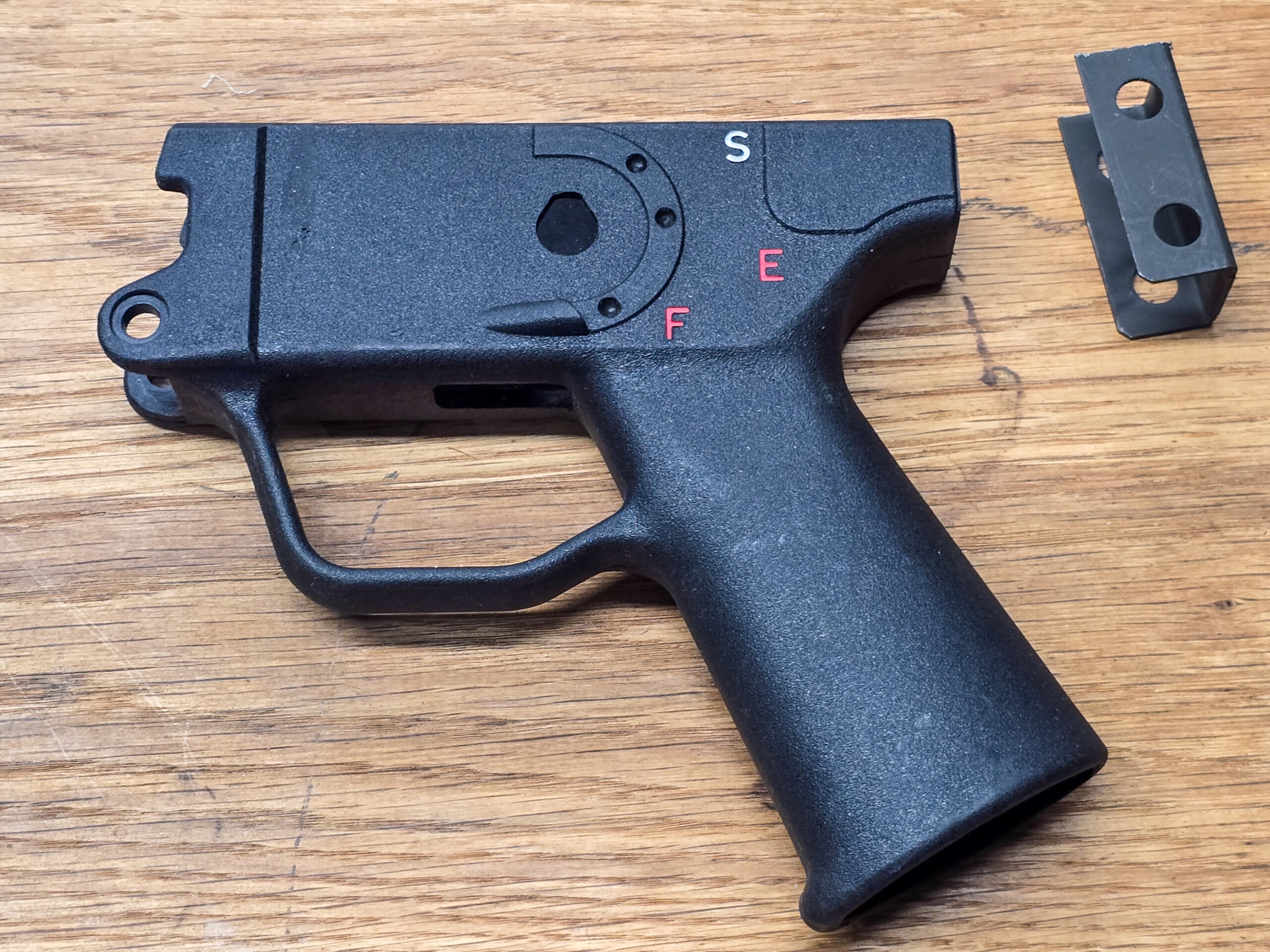
Black polymer firearm receiver with "S E F" markings on a wooden surface.
Restored Navy SEF grip- in “good” condtion.

5. Exhaustive Consumer Sentiment Analysis and Voice of the Customer

In just a short time, Ronin’s Grips has built an incredible amount of trust in a community that is usually very skeptical of new vendors. This rapid success is a direct result of the quality of their work and their dedication to their customers.

The brand has earned a “top-tier” status on specialized forums like the AK Files and various Reddit gun communities6.

Tangible Manufacturing Quality and Reliability

Customers often point out that these grips feel more like a premium tool than a cheap piece of plastic. Some have even compared the texture and weight to the high-end G-10 material used on expensive knives6. Words like “superb” and “best-built” are common in user reviews across the web.

For many, Ronin’s is the “go-to” for fixing poor factory furniture. For instance, owners of JRA Gallant rifles often say that a Ronin’s grip is a mandatory upgrade7. This reputation has easily carried over to the MP5K community, where new owners often order a Ronin’s grip the same day they buy their gun.

Close-up of a Galil rifle, showing the receiver, trigger, and grip. Text reads "GALIL CAL. 5.56".
A JRA Gallant with one of the Ronin’s Grips IMI Galil grips.

The “George Factor” and Building Rapid Trust

A big part of the brand’s popularity is the founder, George. While many small shops struggle with communication, George is known for being direct and helpful. This personal touch has helped build deep trust very quickly.

There are legendary stories of his customer service. In one case, a customer missed out on a 20% discount by just a few days. George not only applied the discount retroactively but refunded the difference so the customer could “buy some beer,” noting that “beer is good.”

This kind of honesty and community involvement builds massive loyalty. George frequently interacts with his customers and rewards them for sharing their builds. To the community, Ronin’s isn’t just a store—it’s a partner that truly cares about the product.

6. The Regulatory Labyrinth of 18 U.S.C. § 922(r)

You can’t talk about upgrading imported guns without mentioning 18 U.S.C. § 922(r). This is a complex federal law that basically says you can’t have too many imported parts in a rifle assembled in the U.S.

Specifically, if you want to turn an imported pistol (like an AP5-P) into an SBR by adding a stock, you have to make sure it contains no more than ten imported parts from a specific list of twenty regulated components8.

For most MP5K clones, this means you need to replace six foreign parts with U.S.-made equivalents10. People usually swap out things like triggers, hammers, or magazines to hit this number8.

The Strategic Value of the Magpul SL Grip

The pistol grip is one of those regulated parts10. This makes Ronin’s catalog even more important for owners:

If you buy the surplus German Navy SEF grip, it’s still a foreign part, so it doesn’t help with your 922(r) count.

However, if you buy Ronin’s adapted Magpul SL Grip, you’re getting a part made in the USA. This is a huge win: you get much better ergonomics and you get one step closer to legal compliance. For many owners, this makes the Magpul SL grip an incredibly smart buy.

7. Value Proposition and Economic Assessment: Are They “Worth It”?

So, are these grips worth the money? When you look at what you get for the price, the answer is a resounding yes. Ronin’s Grips offers something for every type of owner.

We see two main groups of happy customers:

1. The Modern Shooter: For about $75, the Magpul SL configuration is a total game-changer. It fixes the outdated ergonomics of the original and helps with federal compliance. Compared to the cost of the gun itself, $75 is a small price to pay for a much better shooting experience3.

2. The Historical Purist:

The “Like-New” Navy SEF grips are the most expensive at $120. While it’s a premium price, it’s simply the best way to get that iconic, special ops look. People are happy to pay for Ronin’s expert fit and finish, knowing they are getting a top-quality, historically accurate part from a brand they trust. Note, the “Good” condition Navy SEF grips are $79.99.

8. Conclusion

Our analysis shows that Ronin’s Grips is a perfect example of a brand that cares about both craftsmanship and technical performance. By solving common ergonomic issues with high-quality, perfectly fitted parts, they’ve become an essential part of the MP5K community.

In just one year, the brand has built a powerful reputation. By listening to customers and delivering durable, easy-to-install solutions, Ronin’s Grips has stood out from the crowd. The combination of bomb-proof quality and great customer service has created a very loyal following.

Whether you want a classic look or modern performance and legal compliance, Ronin’s Grips delivers. Given the cost of these firearms, an upgrade from Ronin’s is a smart and worthwhile investment for any MP5K owner.


Please share the link on Facebook, Forums, with colleagues, etc. Your support is much appreciated and if you have any feedback, please email us in**@*********ps.com. If you’d like to request a report or order a reprint, please click here for the corresponding page to open in new tab.


Sources Used

  1. The Lifecycle of the H&K MP5: Engineering, Tactical Evolution, and Market Resurgence, https://blog.roninsgrips.com/the-lifecycle-of-the-hk-mp5-engineering-tactical-evolution-and-market-resurgence/
  2. An Analytical Report: The Heckler & Koch MP5 vs. MP7 – A Study in Evolution and Application – Ronin’s Grips, https://blog.roninsgrips.com/an-analytical-report-the-heckler-koch-mp5-vs-mp7-a-study-in-evolution-and-application/
  3. The Civilian MP5K Market: A Definitive Analysis and Ranking of Modern Roller-Delayed Firearms – Ronin’s Grips, https://blog.roninsgrips.com/the-civilian-mp5k-market-a-definitive-analysis-and-ranking-of-modern-roller-delayed-firearms/
  4. Top 10 MP5 and MP5K Variants by Consumer Sentiment (June 2026) – Ronin’s Grips, https://blog.roninsgrips.com/top-10-mp5-and-mp5k-variants-by-consumer-sentiment-june-2026/
  5. How to Convert a Magpul SL Grip For Use On A MP5K, https://blog.roninsgrips.com/how-to-convert-a-magpul-sl-grip-for-use-on-a-mp5k/
  6. Ronin’s Grips : r/ak47 – Reddit, https://www.reddit.com/r/ak47/comments/335s3a/ronins_grips/
  7. Talk me into/out of a JRA Gallant : r/Galil – Reddit, https://www.reddit.com/r/Galil/comments/1gsxv4o/talk_me_intoout_of_a_jra_gallant/
  8. Understanding 922r Compliance – Gun University, https://gununiversity.com/922r-compliance/
  9. 922r Compliance: How to Comply in 2 Easy Steps, https://www.pewpewtactical.com/922r-compliance/
  10. Sp5 SBR and 922r compliance : r/MP5 – Reddit, https://www.reddit.com/r/MP5/comments/tye342/sp5_sbr_and_922r_compliance/
  11. 922r Compliance – Imported Firearms – RocketFFL, https://rocketffl.com/922r-compliance/

We Now Have Contour, Navy SEF and Magpul SL Grips For HK MP5K Weapons and Clones

It’s taken a while to work out the processes and tooling but now we have a variety of grips converted for HK MP5K weapons and their clones including:

  • Century / MKE AP5-P and AP5-M pistols
  • HK MP5K, SP5K – for the SP5K, slight trimming of the front locking plate on the grip will be required
  • POF 5PK
  • PTR 9KT
  • Zenith ZF5-P, ZF5-T, and ZF5-K

There are three required features for these to fit:

  1. It must be an MP5K pattern weapon and not an MP5 or other variety of roller lock.
  2. It must have an HK MP5K patterned top rear hole.
  3. It must have a front shelf that the grip’s front locking plate rests on.

Technically, our Contract Contour and Navy SEF grips do support the front lower pin that some MP5Ks use. However, our converted Magpul SL grip does not have a front lower pin and does not need it because it is pushed forward against the weapon’s shelf and can’t slide out of position.

How They Are Made

Interestingly enough HK33, HK91/G3, HK93, HK94, MP5, and MP5K grips all have the same size polymer core grip albeit with different metal “tails” sticking out of the rear to accomodate whatever weapon they are meant for. Now there may be other models out there as well – but those are the ones that I know of so far.
Extech IR thermometer and Ronin's polymer grips for heat testing.
This is a used HK G3/91 Navy SEF grip. The core black polymer shape is the same size as what we need for an MP5K.

The first step if you have one of these model grips is to removed the “tail” so the length will be correct for a MP5K, I would recommend cutting off the tail and then deburring it. Do not remove any polymer so you can get a firm fit when you install whatever stock, brace or end cap you plan to use.
Extech IR thermometer and Ronin's polymer grips for heat testing.
This is a new HK 91/G3 Navy SEF grip with the tail cut off. I use a bandsaw to cut them with a fine tooth blade.

Measure the Existing Rear Hole Centers and Countersink Depths

To cut the rear holes is a bit more involved. First, you need to locate the centers of your existing MP5K grip’s rear holes. I’d recommend using quality calipers but you can do whatever you are comfortable with as long as the method is relatively accurate.

I would also recommend you measure from the front of the steel plate inside the front of the grip back to the center of the hole on your existing grip. That gives you the horizontal distance. To get the vertical distance, measure down from the top.
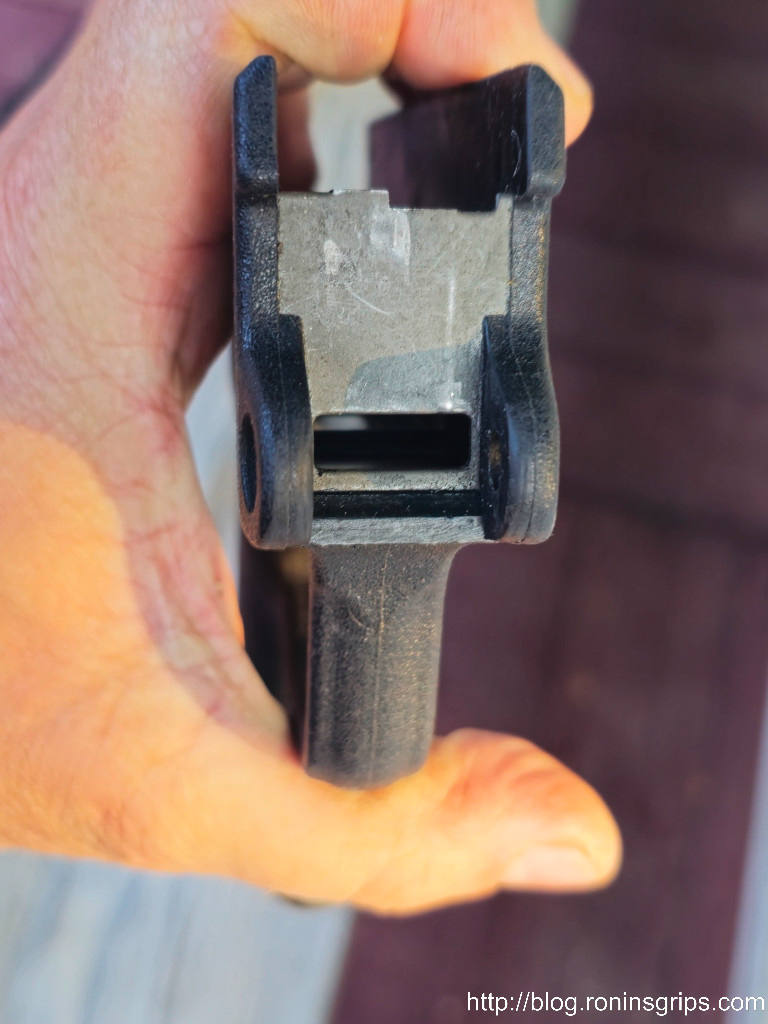
Extech IR thermometer and Ronin's polymer grips for heat testing.
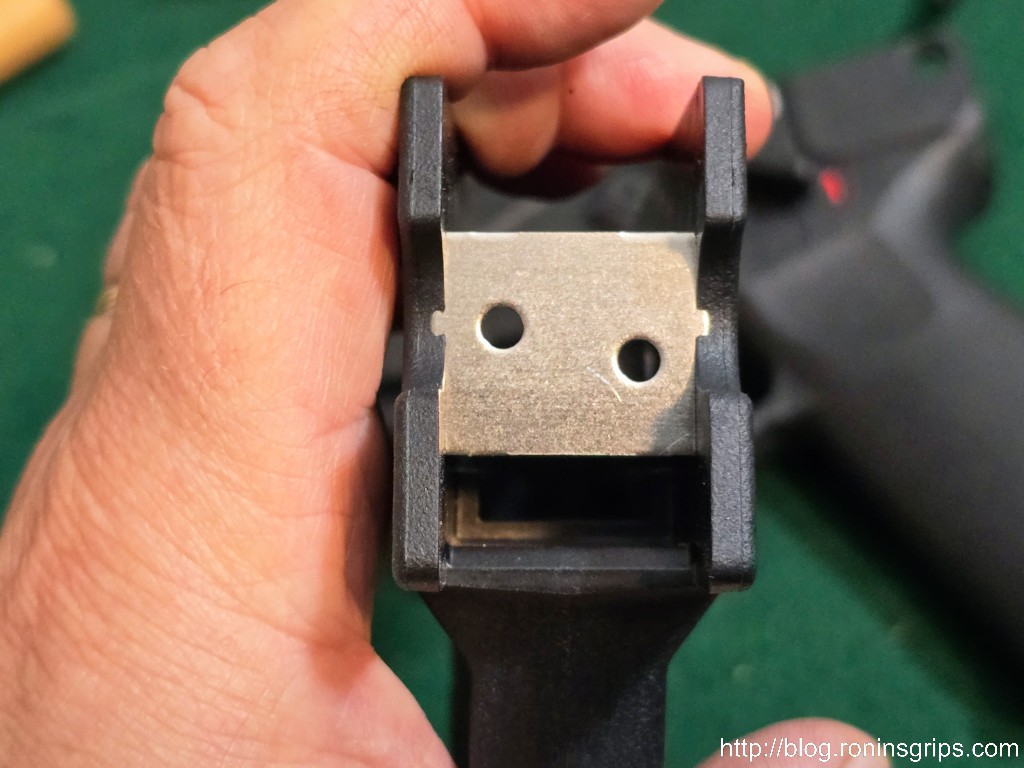
Measure from the front of this plate (the surface facing you in this photo) back to the center of the hole.

You should measure this on both sides of the grip. You may find they are not exactly the same. Regardless, double and triple check the horizontal and vertical measures on both sides.

The other measurement you need to find out is how deep to drill the countersink hole – the recession in the grip where the head sits on the left side (looking down) and the end with the wire retainer protrudes on the right. You may well find that the two measures are different again.

What you need to ensure is that the rear takedown pin’s working distance can span from the left side to the right side. The working distance of a takedown pin is the measured length from just under the head to just before the retaining wire comes out of it. The pin that sticks out of the other end of your calpers is for measuring depth. There are also far more accurate tools purpose-built for measuring depth also.

When you do you plan your countersinks, you need the distance the pin spans to look something like this:

Minimum depth of countersink = outside grip dimension – takedown pin working length

Now how you make that happen is up to you. For example, if you need to remove 3mm and want to split it to 1.5-1.6mm per side – that’s fine. Ideally, you want the pin to stick out far enough on the right side so the wire retainer can pop up and help hold the pin in place.

Milling the Countersink & Pin Holes

These operations require end mills that can make plunge cuts – meaning the end mil has cutting surfaces at the bottom and not just the sides. These are sometimes called “center cutting” end mills also. I would also recommend four flutes for a smooth finish.

The actual countersink diameter is 9.5mm but if you don’t have access to that, a 10mm end mill will work also. The takedown pin hole is 6mm. How much you want to spend on the quality of the mills is up to you. The polymer will not wear the 9.5-10mm bit much but the 6mm bit will need to keep its edge long enought to cut through the steel reinforcement on both sides. I’d recommend the6mm be either cobalt or carbide and not just high speed steel – or at least not cheap high speed steel.
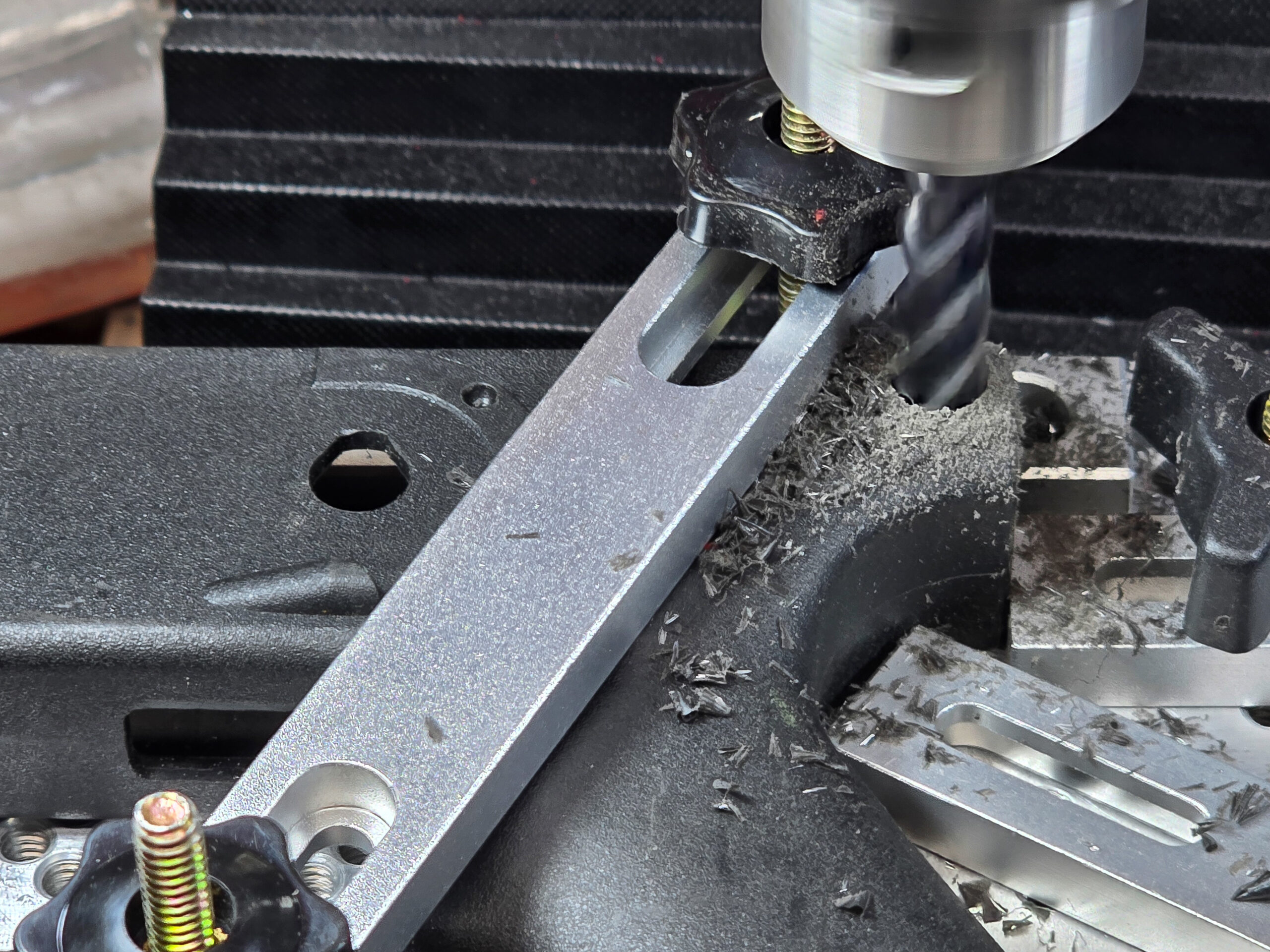
Extech IR thermometer and Ronin's polymer grips for heat testing.
Milling the 10mm countersink. My mill has a Digital Read Out (DRO) so I know how deep to go.

If you are wondering why not use a 6mm drill bit, it is because you will likely encounter a hole in the reinforcing plate that was cast into the grip during injection molding. A drill bit will hit that hole and want to yank the workpiece upwards as the edge of the opened hole rides up the flute and makes a mess. An end mill doing a plunge cut will not have this problem as it will cut off the open circle’s ends.
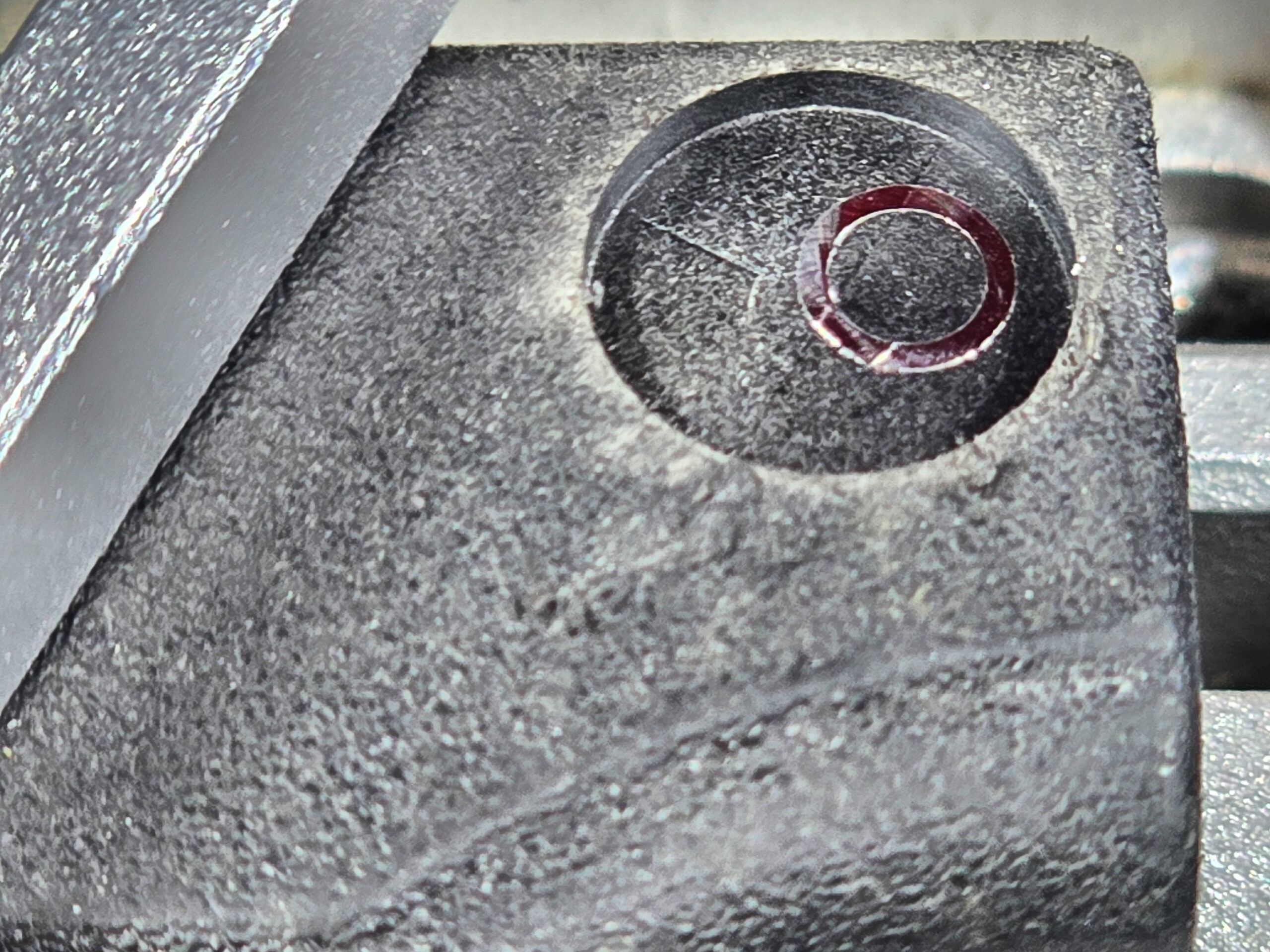
Extech IR thermometer and Ronin's polymer grips for heat testing.
That slightly offset circle is exposed when you do the countersink. A drill bit will cut open the circle and then the grip will want to ridge the bit up.

So, yes, you can use a drill press but what is incredibly important is that you have the workpiece held firmly so you need to clamp it down.

Make a wood or plastic insert that you can put in the top of the grip to keep it from deforming when clamped and then milledd/drilled. If the grip moves at all, your new grip will be ruined.

Honestly, 99% of my challenge was figuring out how to securely hold the grips so they wouldn’t move and also not introduce angles/canting, etc. I’m still working on improving this as the overwhelming amount of my defects are caused by unintended workpiece movement.

You need to locate your new hole centers and then set up your milling machine or drill press to do the cuts. You need to figure out what works best for you. If you have digital read outs (DROs) then you probably didn’t need to read this blog post. If you are new to this, locate the hole center and mark the hole with a very fine point then use either a small drill bit or hole finder to center your machine on the hole.

To get the depth you need on the countersink, either use the features of your machine if it has some form of depth indicator or wrap a piece of tape at whatever limit you need and stop when you reach it.

I would highly recommend you do the countersink cut and then the hole cut on each side before you move on to the next. In other words, do a side at a time before you move the workpiece.

If you are wondering why I am not mentioning how to locate and cut the front pin holes, it’s because you don’t really need them if your weapon uses a shelf, which most current HK grips do. For example, the Magpul SL grip does not have the front holes. The way the polymer is formed, you would likely need a longer pin and it’s not going to give you a better connection. The front plate of the grip is shoved against the shelf by whatever you have on the end of the weapon and the top rear pin keeps the grip from swinging down – that’s really all that you need.
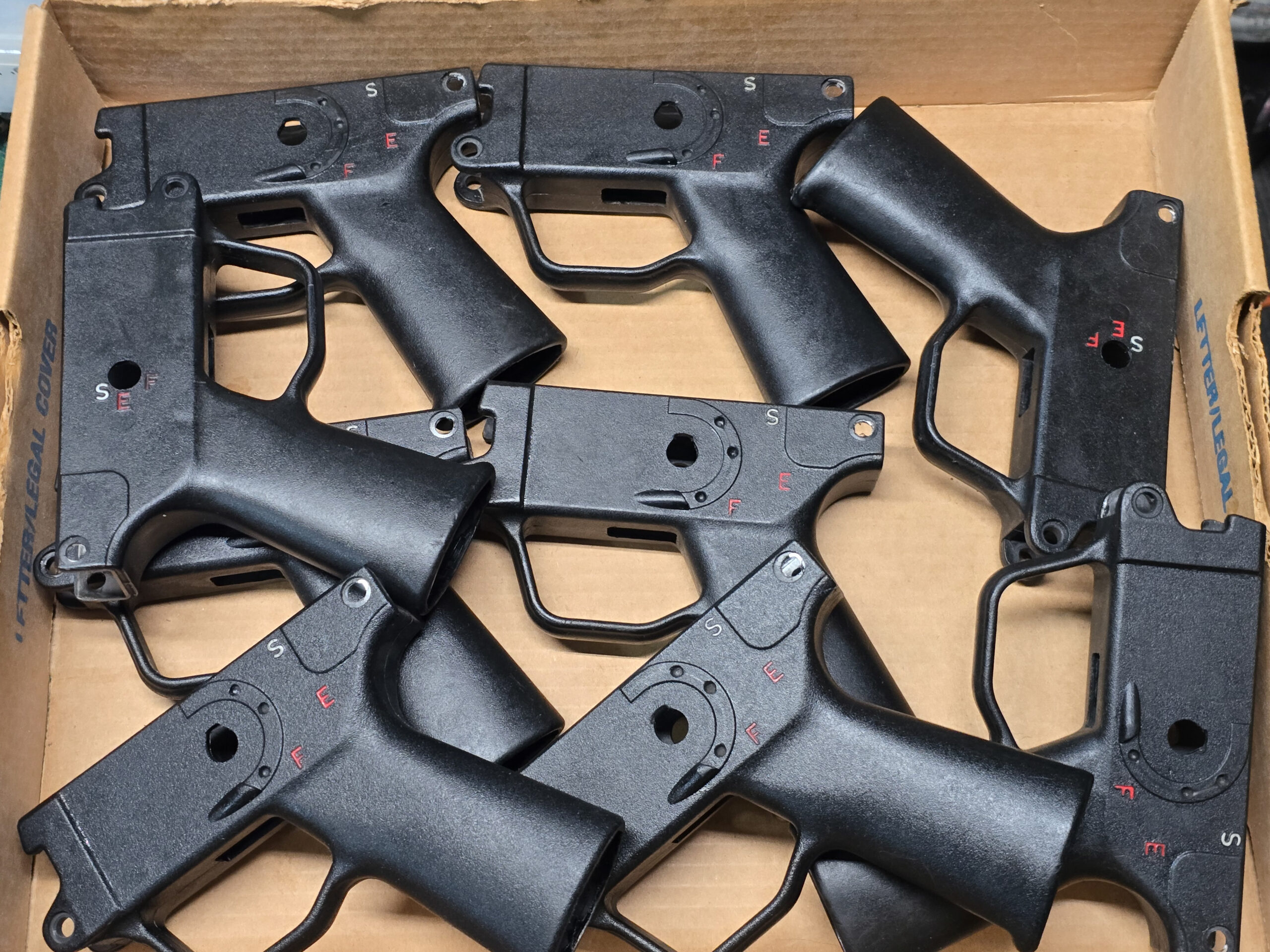
Extech IR thermometer and Ronin's polymer grips for heat testing.
Here is a batch of converted “good condition” real HK Navy SEF grips getting ready to go to their new owners. We do repair any minor gouges and apply a restorative finish to make them look good. That’s the original HK paint by the way. Click here if you are interested.

Summary

You can do the conversion or buy our ready to go grips. You may need to do some final fitting but we’ve done the hard parts. If you’re interested, click here to go to our HK Grips page.

I hope this helps you out,


Please share the link on Facebook, Forums, with colleagues, etc. Your support is much appreciated and if you have any feedback, please email us in**@*********ps.com. If you’d like to request a report or order a reprint, please click here for the corresponding page to open in new tab.
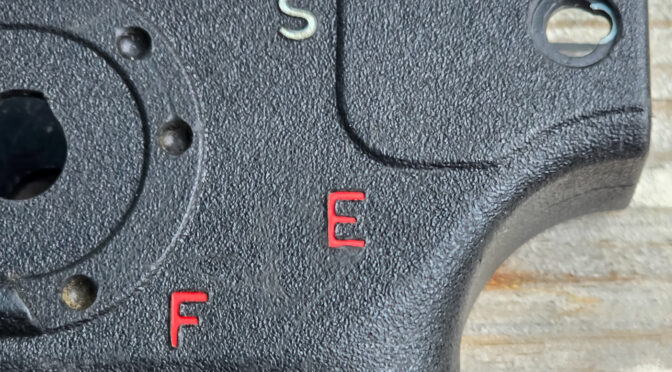
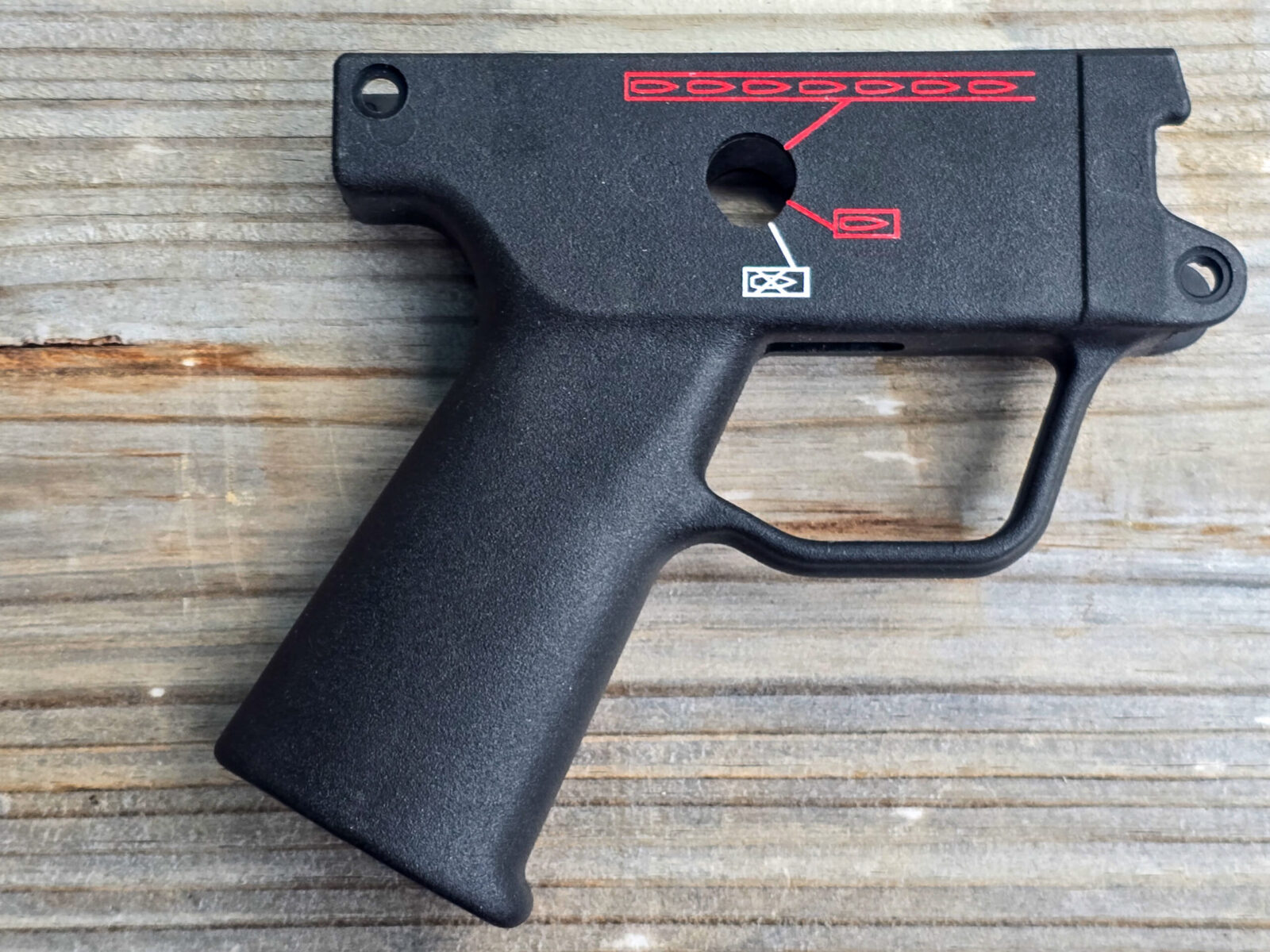
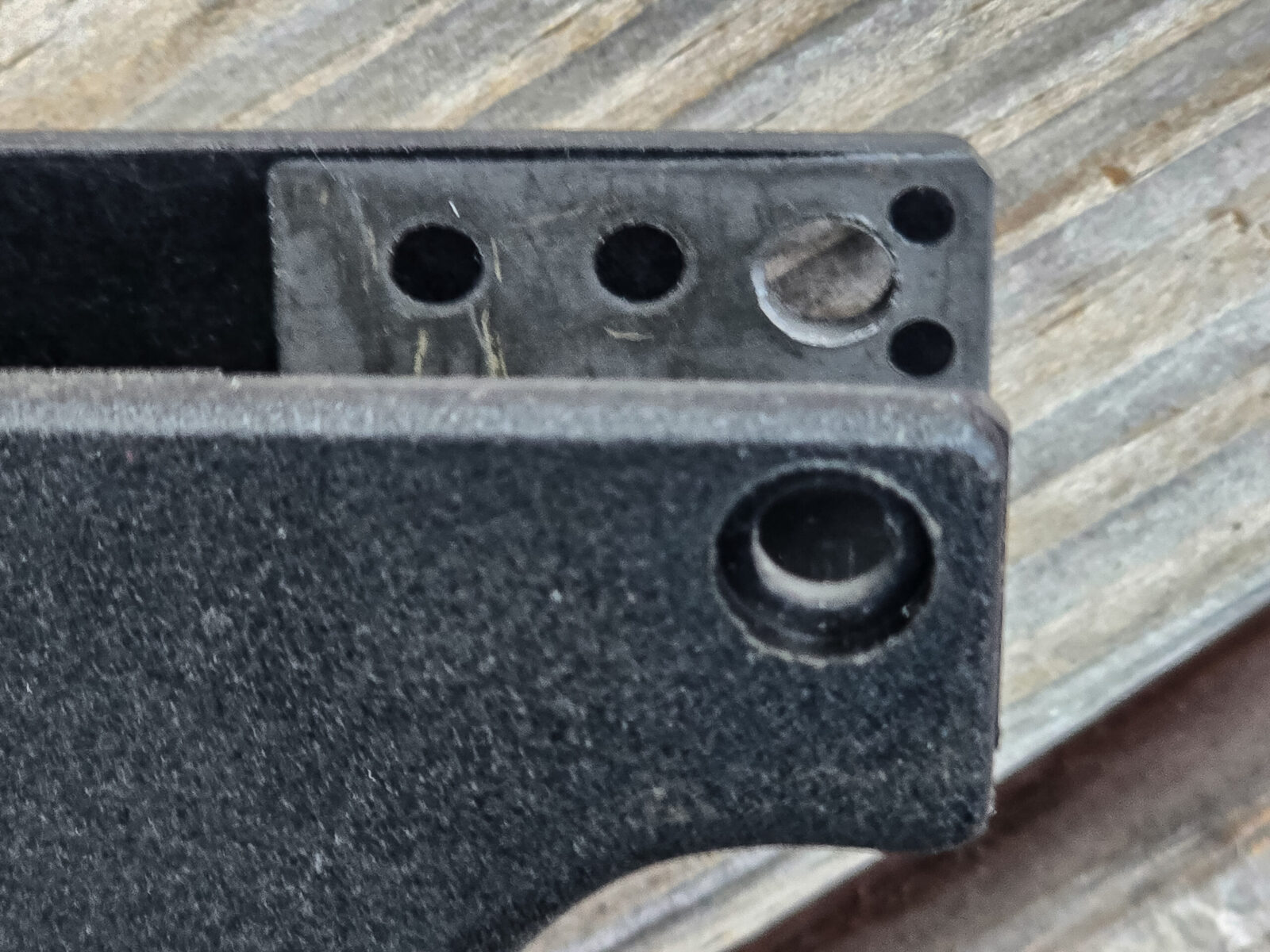
Why grips converted for MP5Ks have a weirdly shaped rear pin hole

Grips for the MP5/HK33 and HK91/G3 rifles can be converted for use on MP5K-type weapons. As you can see in the photo above, a small circle appears at about 2:30 position on the larger hole for the pin when this is done. I used to wonder why and since I started offering converted grips for sale, I’ve had a few guys also ask me why this is the case.

Well, the short answer is that the steel reinforcing that is cast into the rear of the grip has different holes when an MP5K grip is made vs. the others. This allows the hole for the pin and the countersink for the head to not encounter another hole.

MP5K grip with unusual rear pin hole shape, black polymer.
This is a real German H&K MP5K grip. The top rear hole doesn’t have that telltale circle of conversion because it was purpose built to be mounted on a MP5K.
Close-up of MP5K grip conversion rear pin hole detail.
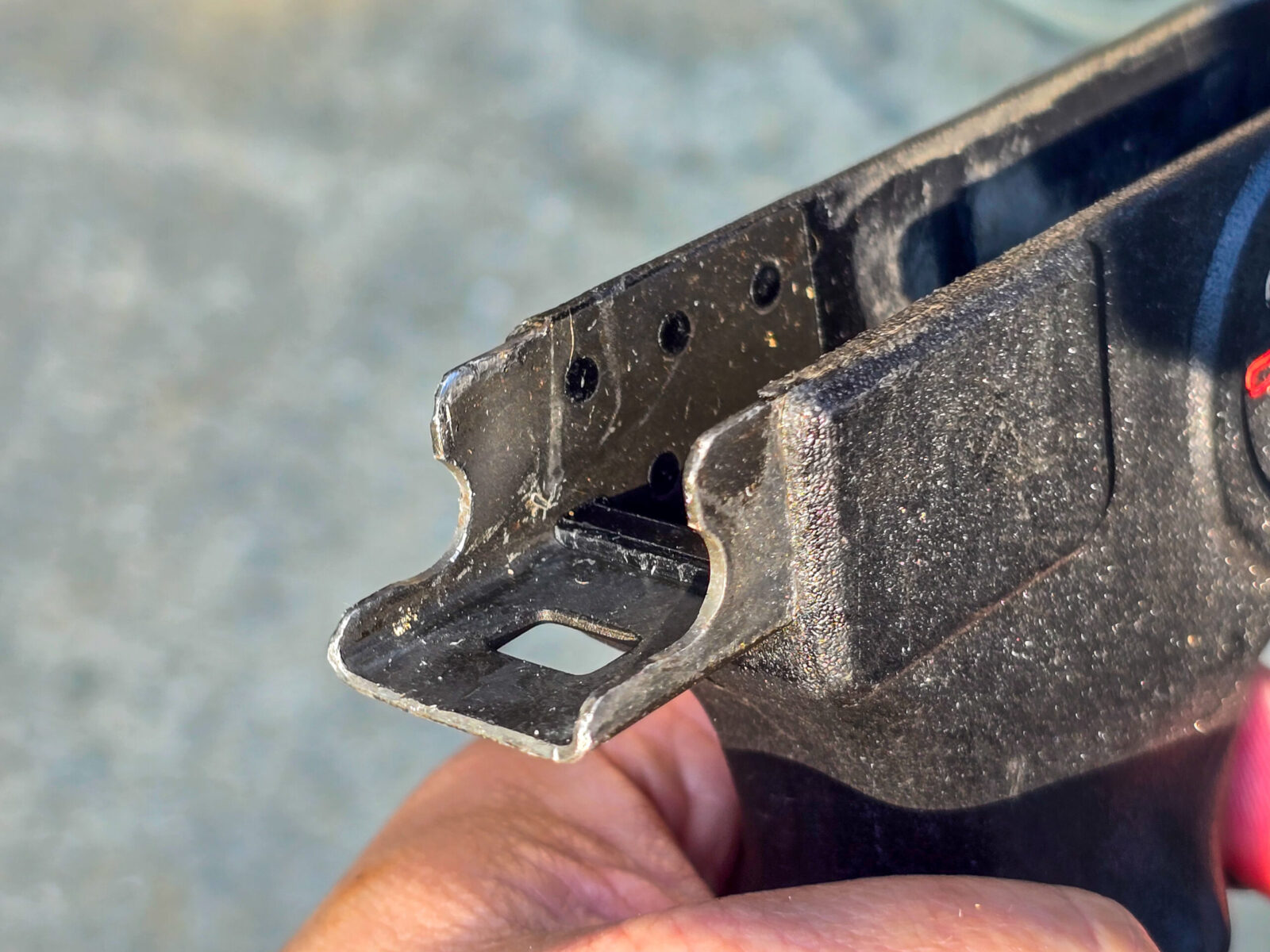
Not one of my better photos but you can see the pin hole on the far side. The anchor holes to secure the metal strap are to the left and right of it are filled in with plastic during injection molding. Notably at the rear right there are two anchor holes to help compensate and secure the strap.

With the MP5/HK33 and HK91/G3 grips, the designers never planned for a hole to be made in that location and as a result, the newly drilled hole runs right into an anchor hole they have in the metal to allow the injection molding to adequate bond to it.

If you try to drill into one of these grips, the smaller hole will get cut open and then ride the flute of the drill upwards and make a mess. To compensate for this, an end mill must be used to do a plunge cut straight down. There must be careful workholding fixtures to keep the grip from moving. Trust me, I’ve trashed a bunch of grips by not making sure the grip was completely secure.

MP5K grip conversion rear pin hole detail, showing unique shape.
This HK33 contract grip has anchor holes that go evenly across. There isn’t enough spacing between those holes for a new 6mm pin hole and 9.5mm countersink to be milled without hitting the rear anchor hole.
MP5K grip conversion: Close-up of rear pin hole shape.
This is a Malaysian contract grip that has the rear steel “tail” cut off. Both pin holes and countersinks have been milled. Look at the hole on the right. The pin hole ran right into the anchor hole and tore out the plastic that would have filled it. By the way, the orange paint was from me tracking early prototypes. It’s not something someone would normally see.

Despite those rear anchor holes being removed, the steel reinforcing is still held in place. While theoretically weaker, I have not heard of any real world cases where the the steel (it’s folded sheet metal really) has come lose due to separation from the surrounding polymer.

For people using converted grips, just insert your rear pin such that the retaining wire is on the shoulder and not in the hole. That’s really the only difference. Of course, like most grips, some final fitting may be required – by using a circular file to adjust the rear hole, filing the front locking plate or removing a bit of material off the back with a file or by sanding.

Summary

In short, purpose built MP5K grips have enough spacing between the rear metal strap’s anchor holes for the 6mm pin hole and 9.5mm countersink to be drilled. Other HK models do not use that same spacing so the tell tale partial hole appears at the 2:30 position. It’s purely cosmetic and just requires the user to insert the rear pin such that the locking wire rests on the normal shoulder of the hole and not the newly formed void.

I hope this helps you out.

If you are interested, our online store has a number of HK grips available – both converted and not. Click here.


Please share the link on Facebook, Forums, with colleagues, etc. Your support is much appreciated and if you have any feedback, please email us in**@*********ps.com. If you’d like to request a report or order a reprint, please click here for the corresponding page to open in new tab.

How to Convert a Magpul SL Grip For Use On A MP5K

There are some things I like on MP5Ks and some things I don’t.  I usually dislike the triggers but my MKE AP5-P has a fairly decent trigger as MP5 and MP5Ks go.  My MKE also had a factory contoured grip.  Of all the HK grips out there, the contoured is the one I like best but there is one I like even more – the “Magpul SL Grip for HK94, HK93, 91 and Semi Shelf Clones”.  That one heck of a long product name – just remember the model – MAG1070-BLK.

Magpul SL grip module for MP5K conversion, black polymer. Close-up view.
This is the Magpul “SL Grip Module for HK94/93/91/MP5 & Semi Shelf HK Clones” – Model MAG1070-BLK
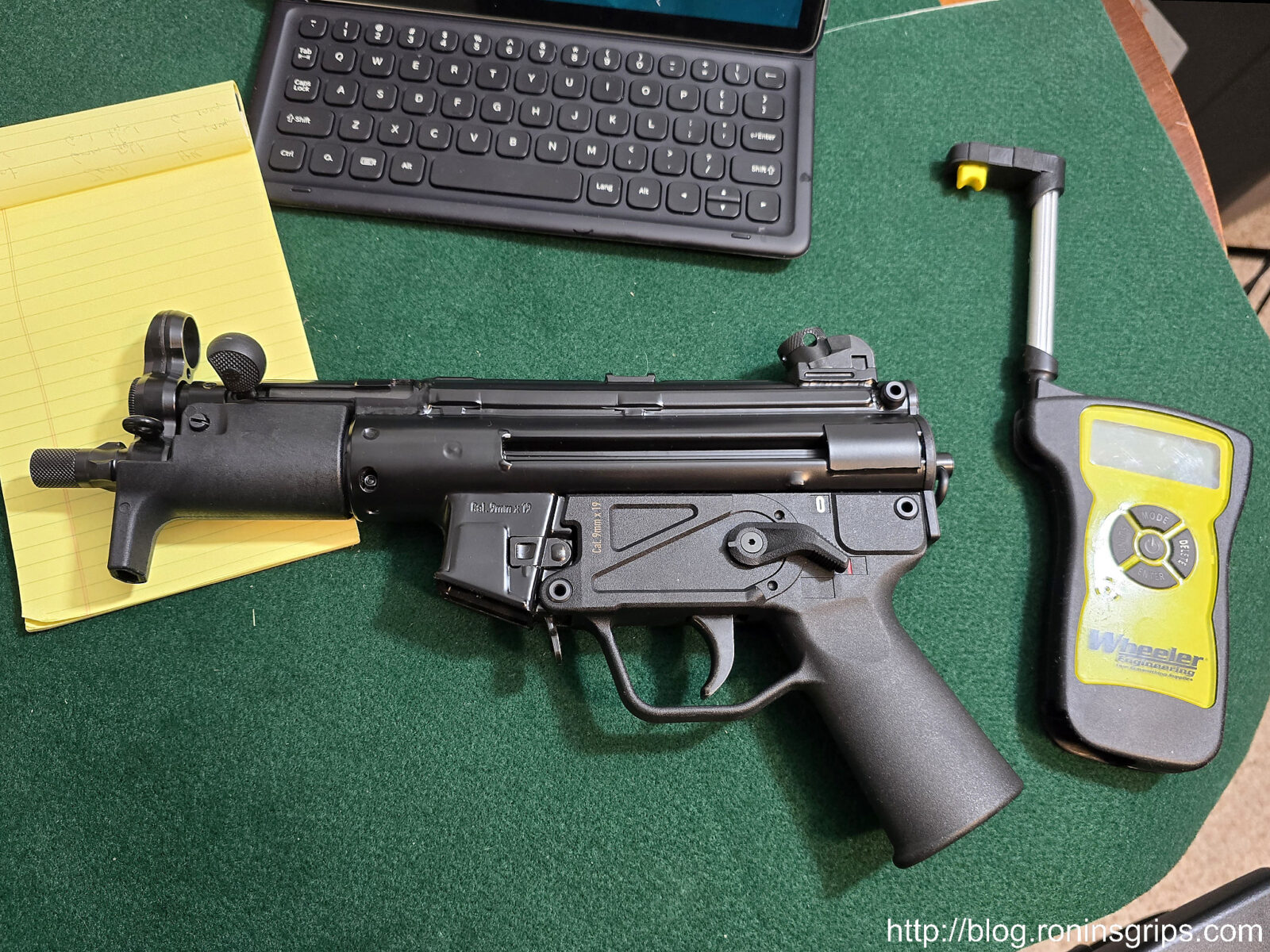
MP5K pistol on a green surface with a tablet, notepad, and Wheeler Engineering tool.
Zenith ZF5-P. Very nicely made pistol. Relatively bland grip.
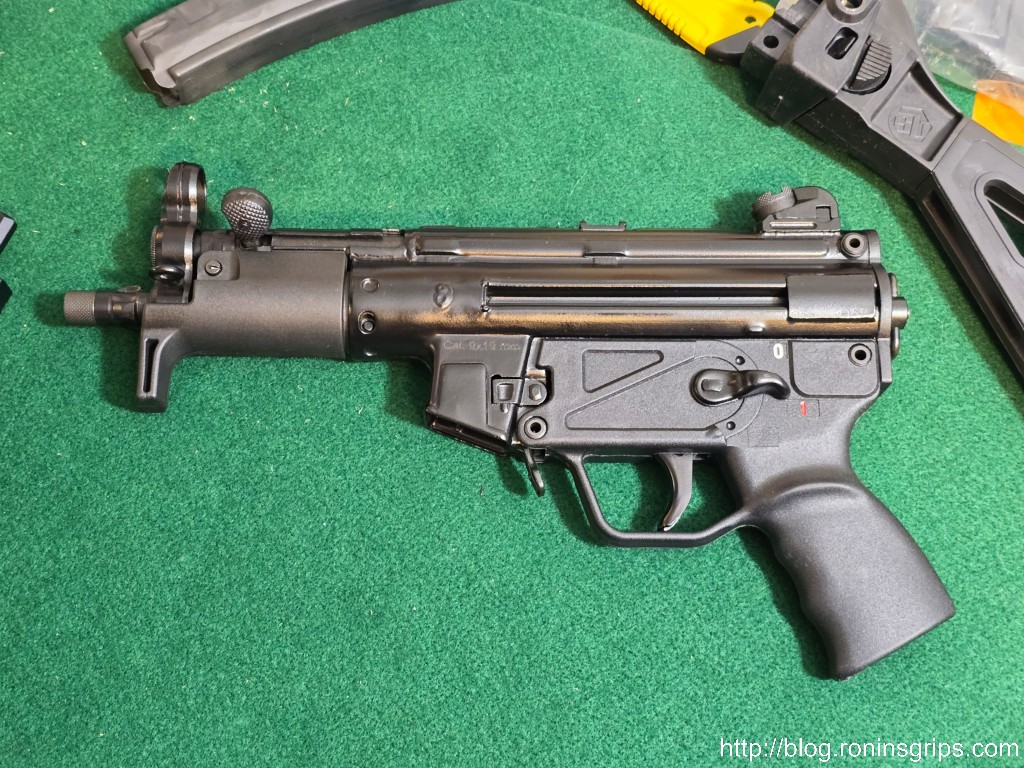
MP5K pistol with a Magpul SL grip conversion, showcasing its compact design.
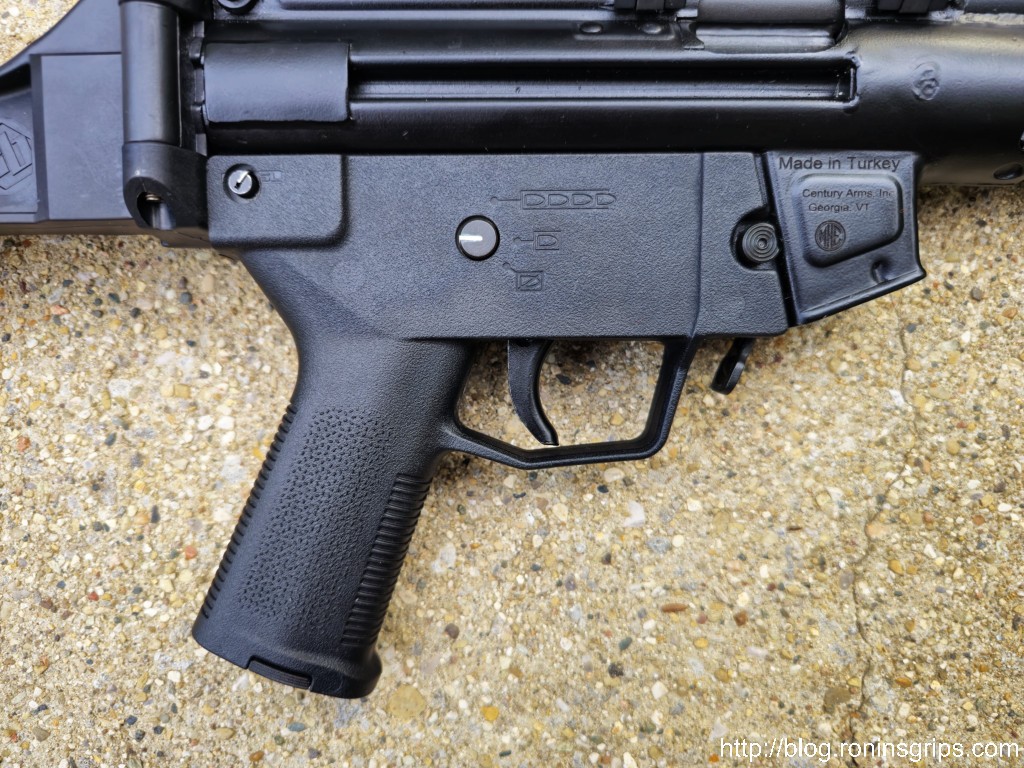
Century Imports’ MKE AP5-P. It’s excellent. I like the contour grip more but that’s a personal preference.

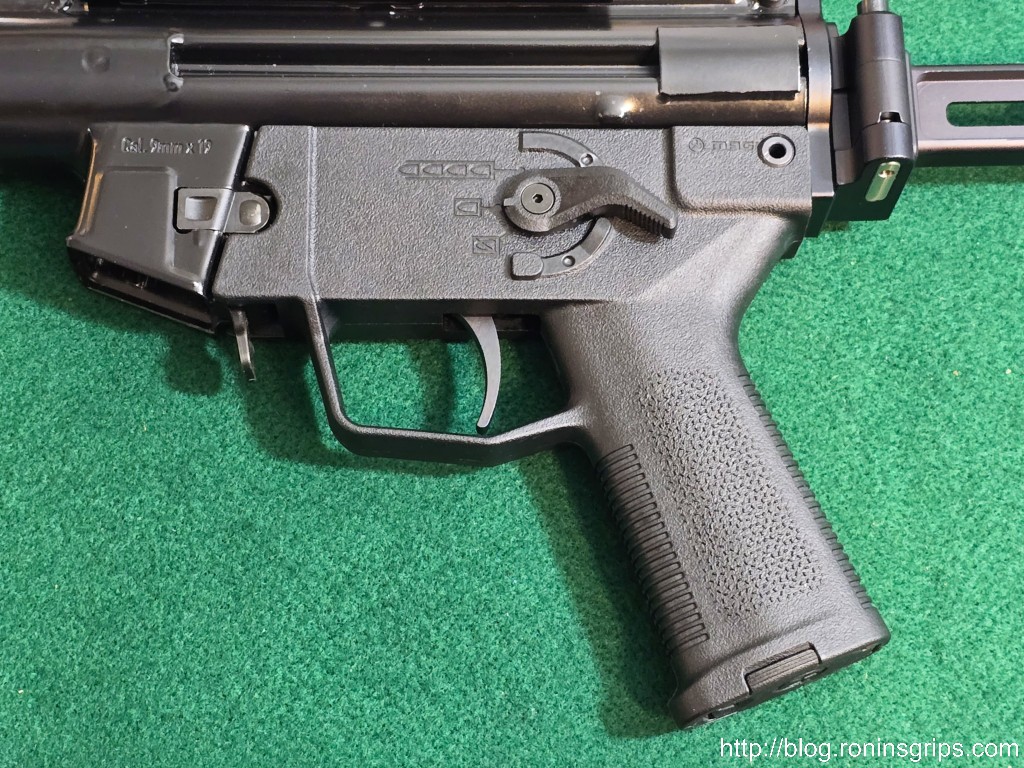
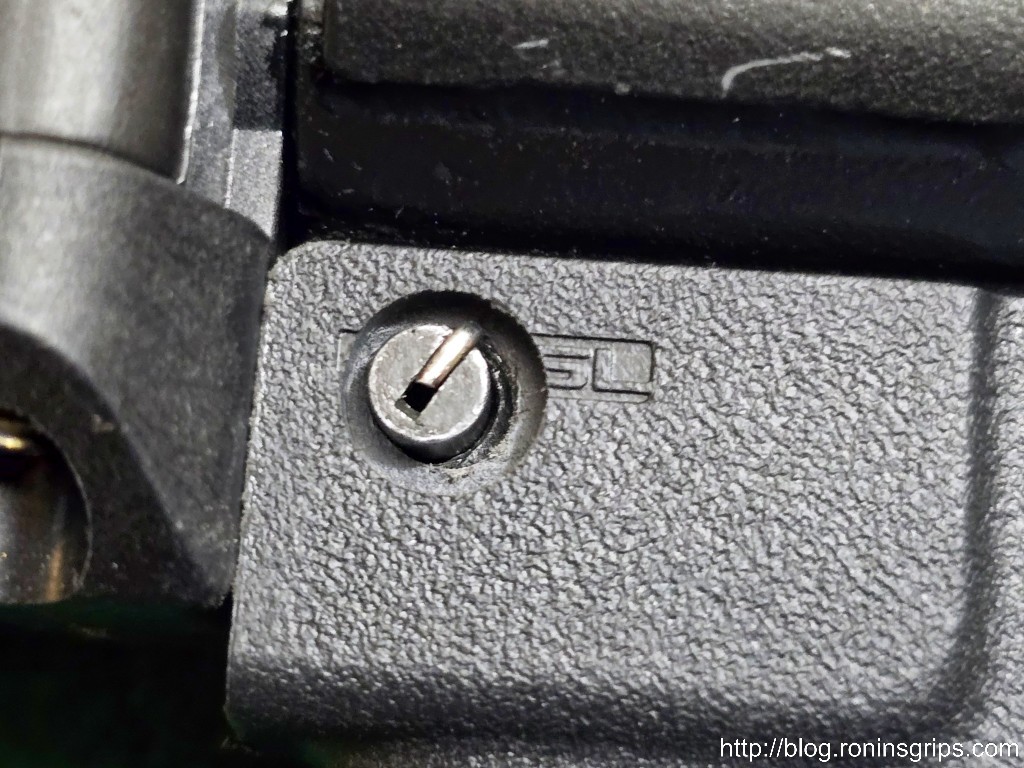
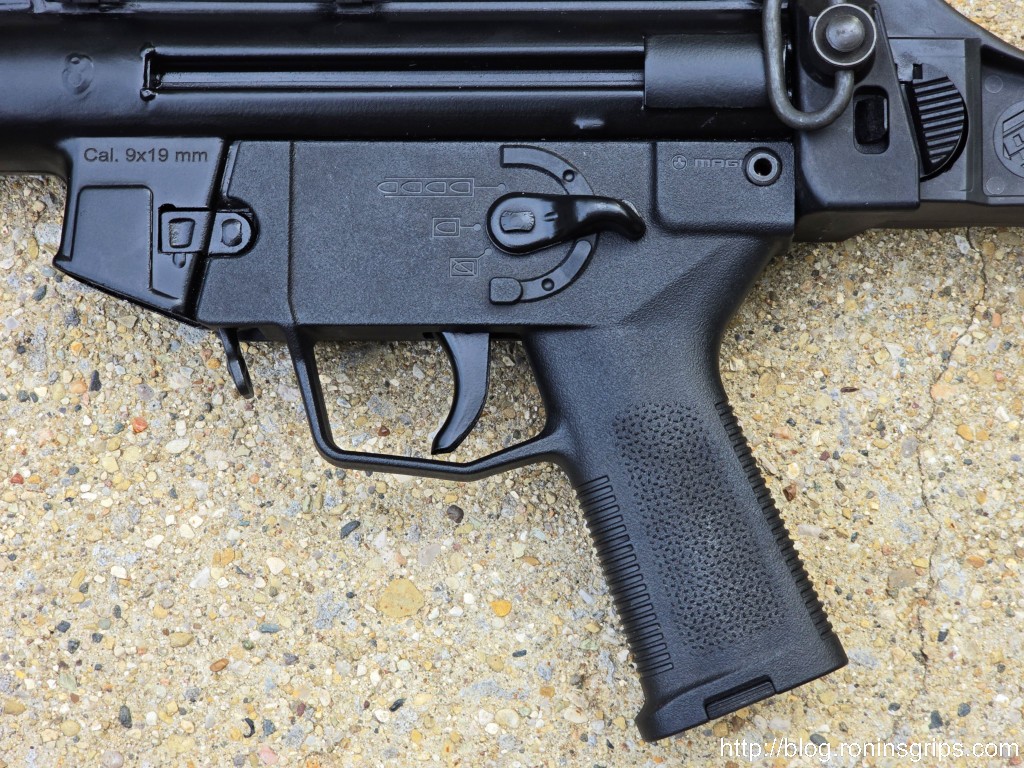
A few months ago, I installed one on my Zenith ZF5-P and really liked it.  Whereas the MKE has a contoured grip, the Zenith has a basic straight grip that is only slightly more ergonomic than a rounded rectangle.  I’d read a few posts about guys converting over the Magpul grip, so I did the same.  You know what? I realy like it.

MP5K pistol grip with Magpul SL grip conversion.
Here it is on the Zenith. By the way, that is Magpul’s cool ESK Extended Selector Lever. I have links to them at the bottom of the post.
MP5K pistol with an optic, showcasing a Magpul SL grip conversion.
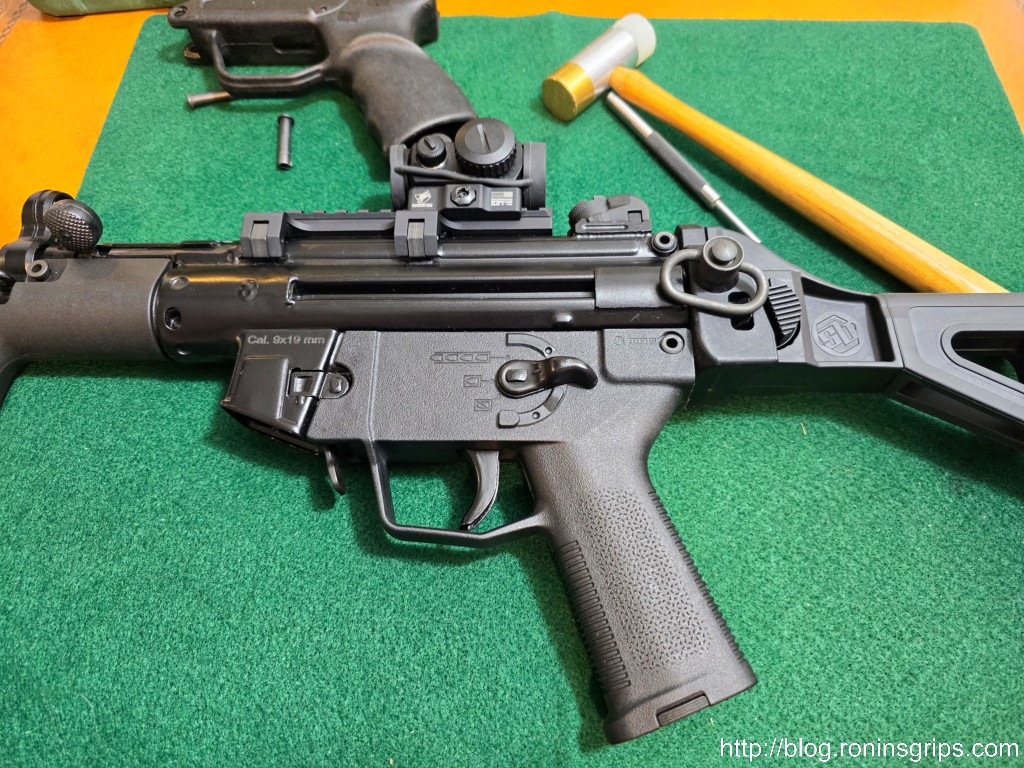
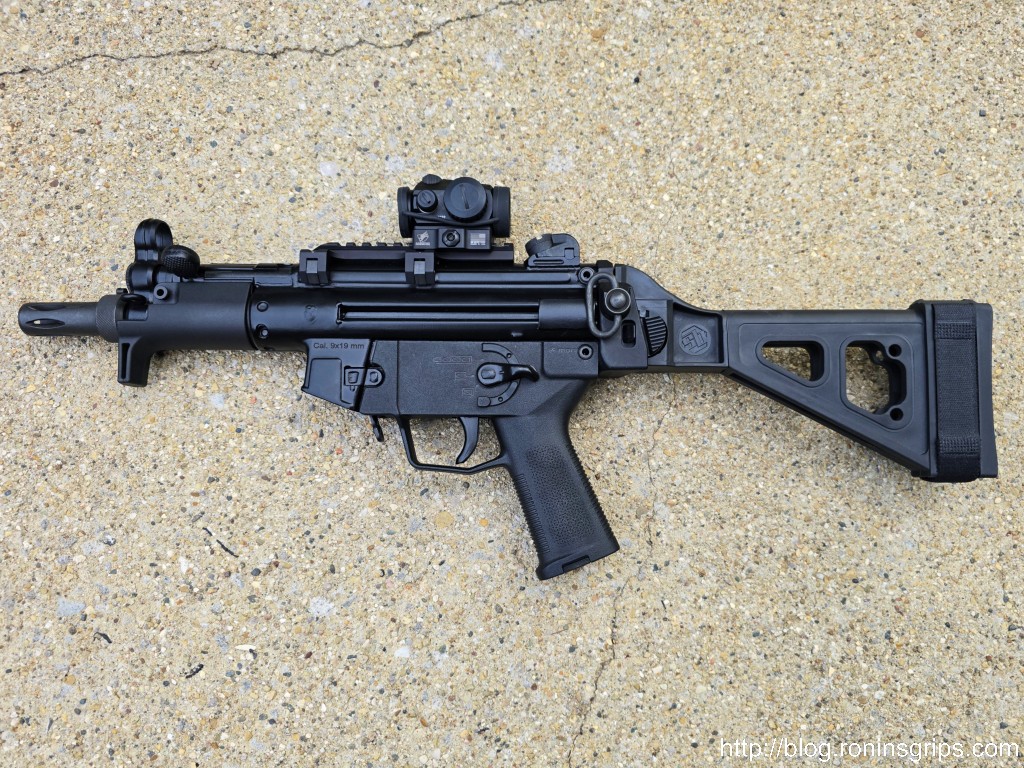
Here’s the second one on my MKE AP5-P.

Doing the Conversion

The Magpul SL grip wasn’t designed for use on a MP5K but what you need to do is pretty straight forward if you have the tools and at least some basic knowledge of locating holes to be drilled.

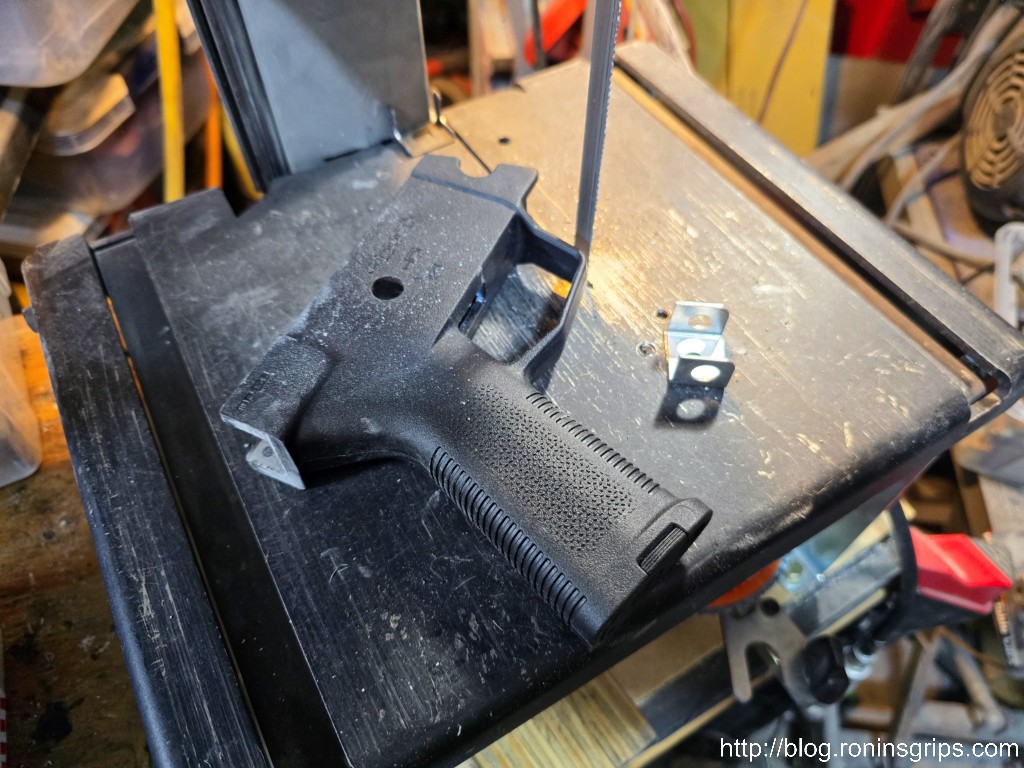
Let’s go over some basics – first off, the steel “tail” that sticks out of the Magpul will need to be cut off.  I’d recommend using something like a hacksaw, reciprocating saw or a bandsaw.  I have a metal cutting bandsaw so I used that. Please notice I did not list a Dremel or similar rotary tool with an abrasive wheel.  They risk making the steel so hot that the plastic could be damaged.

Magpul SL grip being modified with a bandsaw for MP5K conversion.
The first step was to cut off the tail. I did it flush with the end of the plastic and cleaned it up with a belt sander.

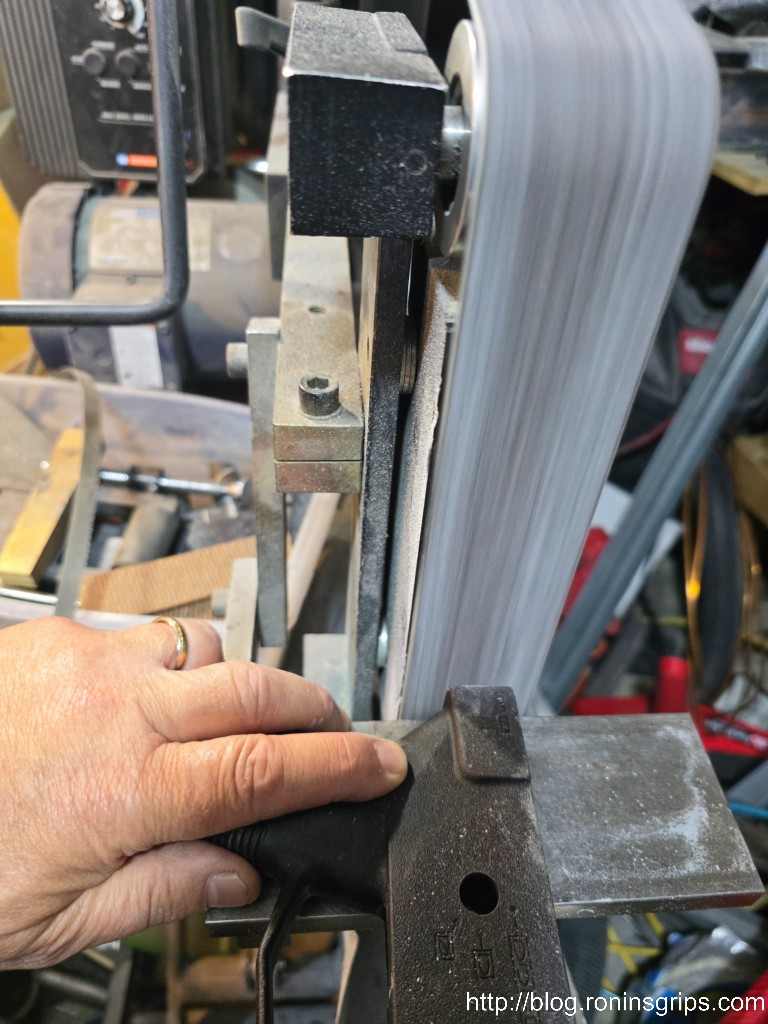
Next, sand the tail end smooth.  Take off as little material as possible as it will help you get a solid lockup.

Hand modifying a Magpul SL grip on a belt sander for MP5K use.
Take off as little material as you can until the grip fits and the end cap, brace or stock can fully seat. By the way, I should have cleaned up a bit more before this photo – the dust you see if from me sanding Hungarian Grey-Blue AMD grips that we make. The dust is not from the Magpul grip – it will be black flecks of plastic and a bit of metal from the steel reinforcing channel inside the rear.

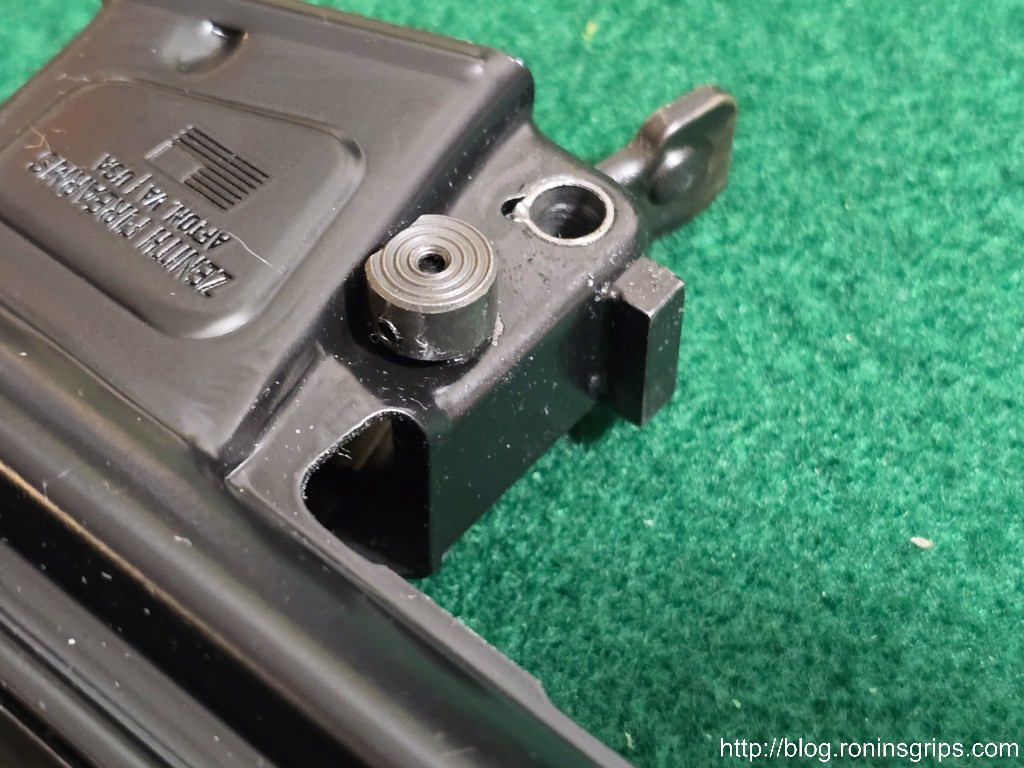
As you may have noticed, many MP5K-type weapons, such as those from MKE and Zenith, use two small pins to retain the grip assembly – one in the front at the bottom and one in the top rear.  With the semi shelf and a snug fit, you just need the single rear pin to hold the grip’s rear end up and in place.

The front of the grip has a plate that interfaces with the semi shelf on your MP5K.  Magpul includes instructions for SP5 owners that they may need to remove a little material for a good fit and I would assume this extends to the SP5K but I don’t know this for sure.  With both my MKE and Zenith, no adustment was needed.

MP5K receiver close-up showing the selector switch and lower receiver.
That little rectangle welded just to the right of the front grip pin hole is the semi shelf.
Magpul SL grip conversion plate for MP5K, showing two mounting holes.
This is the locking plate for the grip that interfaces with the semi shelf at the bottom slot in the photo (if the weapon were held upside down, it would be the slot at the top .)

In terms of locating the hole, take your current grip and measure backwards from the front locking plate to the center of the hole.  Then, measure down from the top of the grip.  Use these two measures to locate where you need to do your cutting and then setup your mill accordingly or at least a good drill press because all you are doing is plunge cuts.

MP5K Magpul SL grip conversion: Lower receiver comparison.
Measure the hole from the locking plate to where the center of the hole is on your existing grip – this is the horizontal measure. I’d recommend using calipers to do this. You then need to do the vertical location by measuring from the top of the grip to the center of the existing hole. The more precise you can be, the better your results will be.

Cutting the rear hole. 

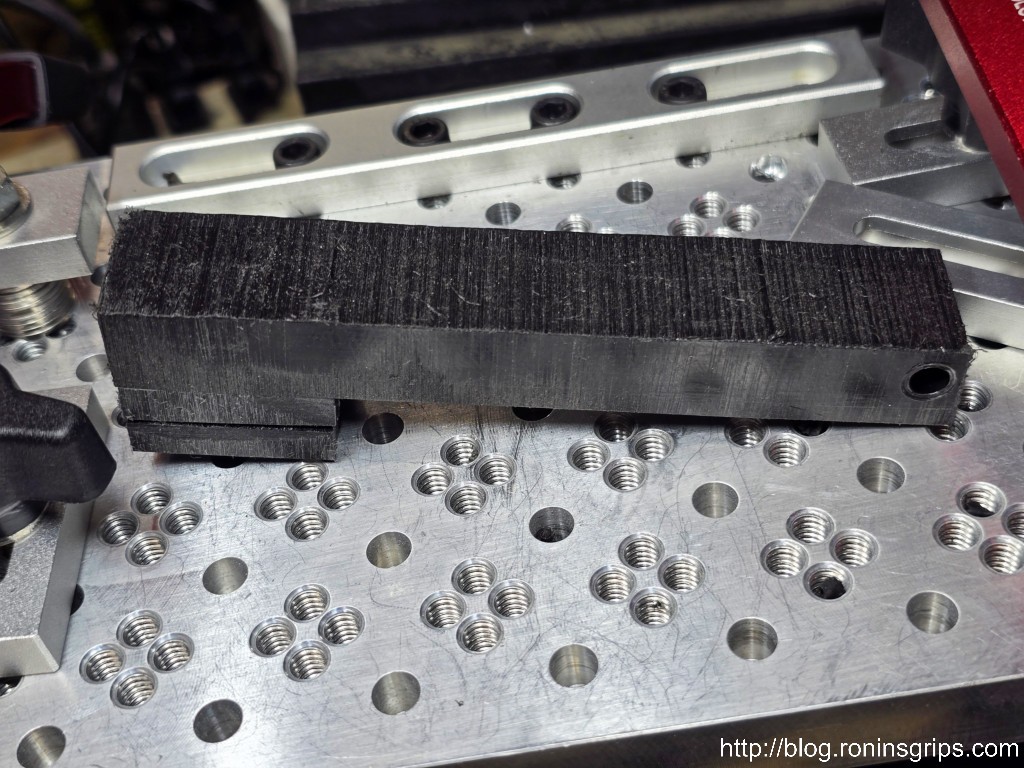
Critical: You must make an insert from hard wood, plastic, or aluminum. If you don’t, the walls of the grip will flex and your holes are going to be a mess. I learned this the hard way. The width left to right is about 7/8″ and then you can decide how you want to handle the vertical. I’d recommend surrounding the area where you want to make the cut. I run my insert the whole length of the inside top to provide a firm support both for the clamps and the plunge cuts. You don’t wany anything to flex.
Magpul SL grip conversion for MP5K on a precision workstation.
If you don’t have an insert to keep the grip open, they will flex as you attempt to cut them and you’ll make a mess. This is 7/8″ left to right. I then made it the length I wanted. The “leg” on the left bottom is to help it stay in position in the grip. The hole on the right shows you where the 6mm end mill plunges into it.

The first step is to cut the reliefs where the pin goes. The head of the takedown pin is about 9-9.1mm wide. A 9.5mm cut doesn’t give you much room to adjust.  10mm is just a tad wider and gives you more room to adjust your cuts later with a circular file and not have the head unable to sit down in the recess. The reliefs need to be cut about 3mm deep.

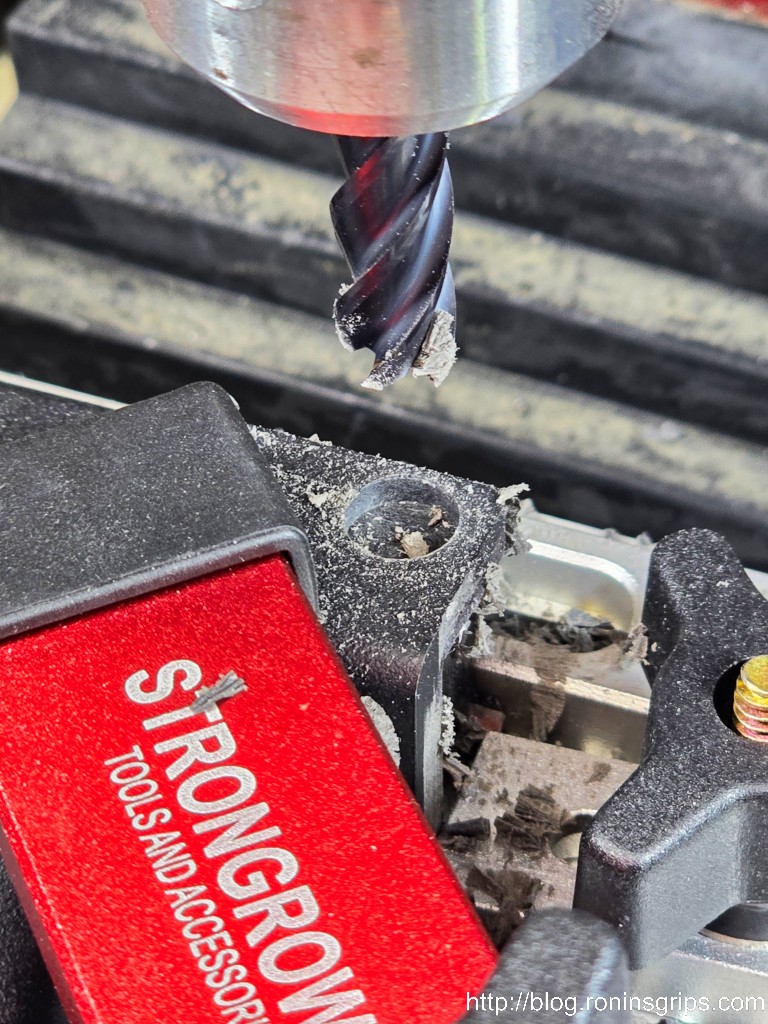
Close-up of a drill bit machining a Magpul SL Grip, Strongrow Tools
That is a 10mm end mill and I just finished a 3mm deep cut. A 9.5mm head would give you a tighter fit around the head of the pin but 10mm gives you some adjustment room.

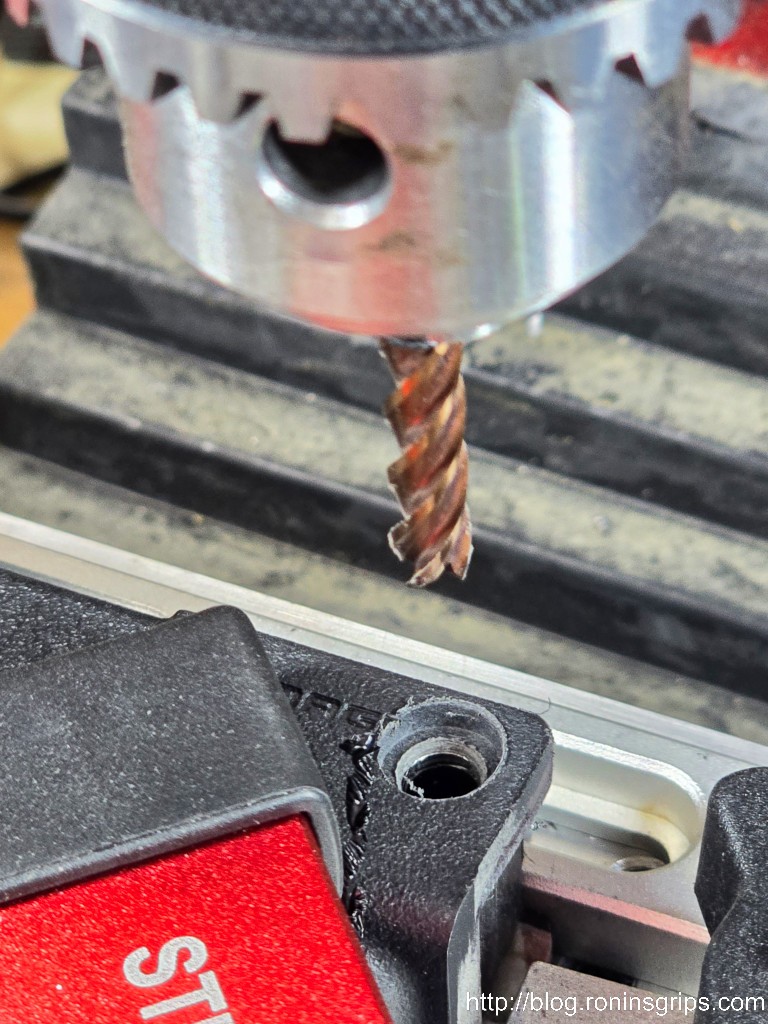
Next is to cut the 6mm holes for the pins. I’d recommend against a drill bit as it might get squirrely on you – both in terms of deflection or the bit getting caught on one of the holes in the steel reinforcement.  Get a 6mm carbide end mill, make sure your grip is held securely and do a plunge cut.

End mill cutting into Magpul SL grip for MP5K conversion.
A 6mm end mill was used to plunge cut the center hole for the pin.
Magpul SL grip module detail with logo and mounting point.
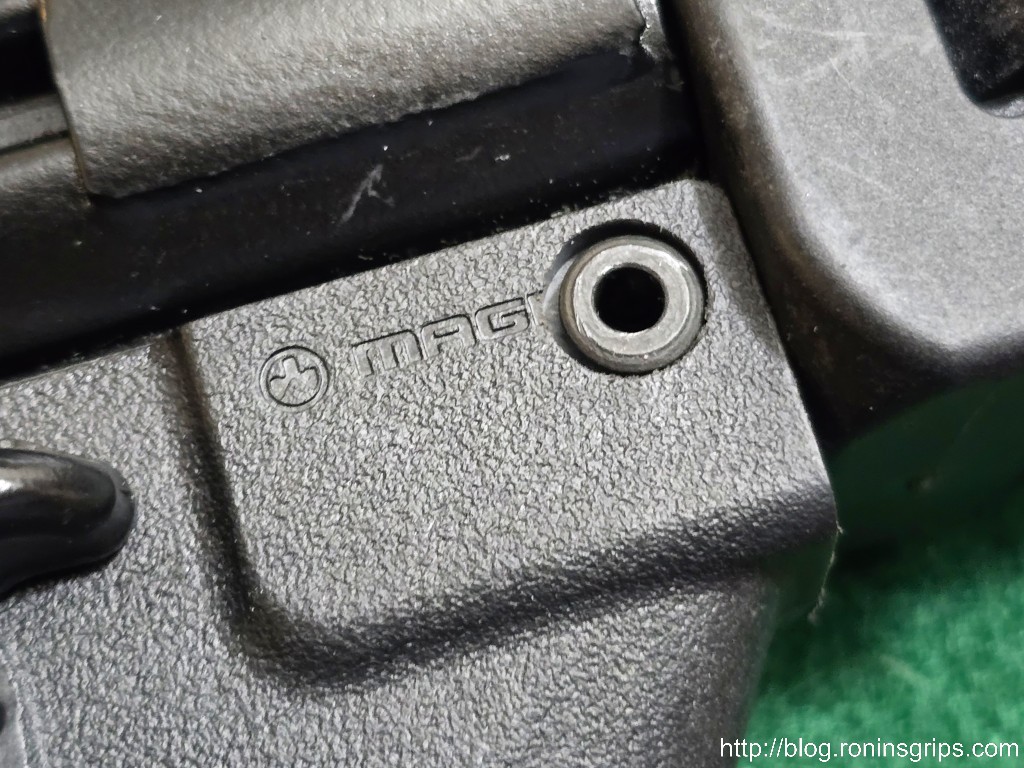
Here is the MKE Pin with an OD head diameter of 9.1mm. The countersink was cut 10mm wide and 3mm deep. This gives a bit more room for adjustments.

If you do use a drill press, check your runout.  If you have more than 0.5mm on one side, you risk cutting to big of a hole.  You want to be somewhere between 6.0 and 6.1mm.  If you go too wide, the retaining wire may not get a good enough hold to keep the pin in place.

Cleaning Up

Use a fine file or diamond abrasive stick to remove all material left over from cutting inside the grip so you have a smooth surface.

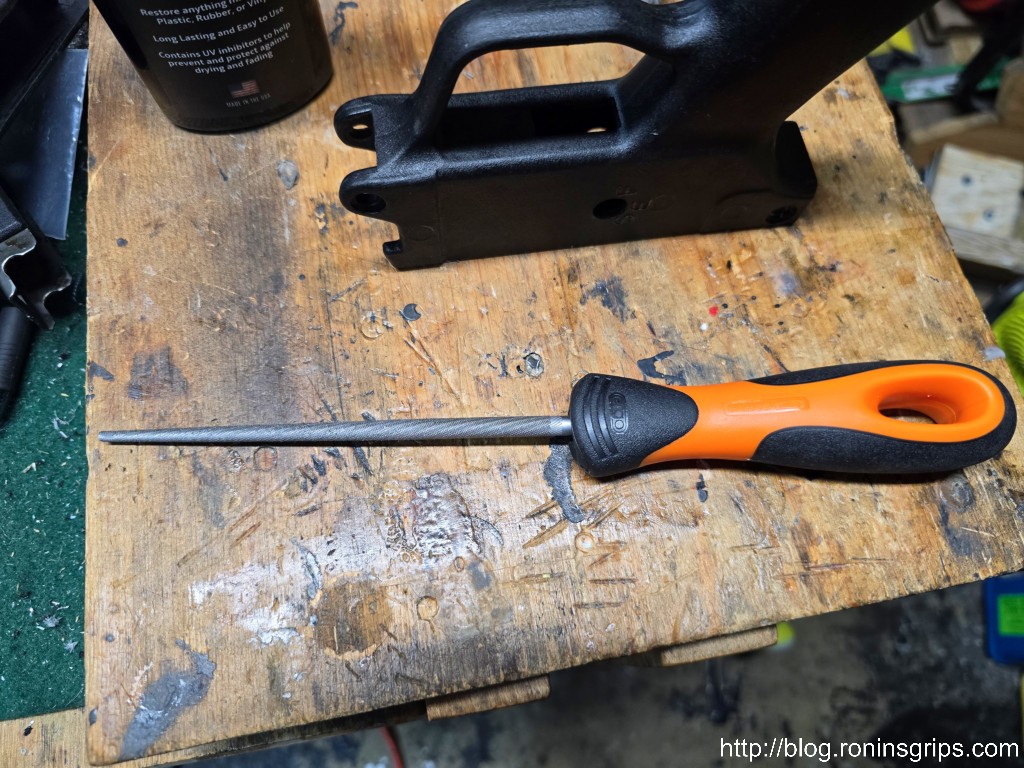
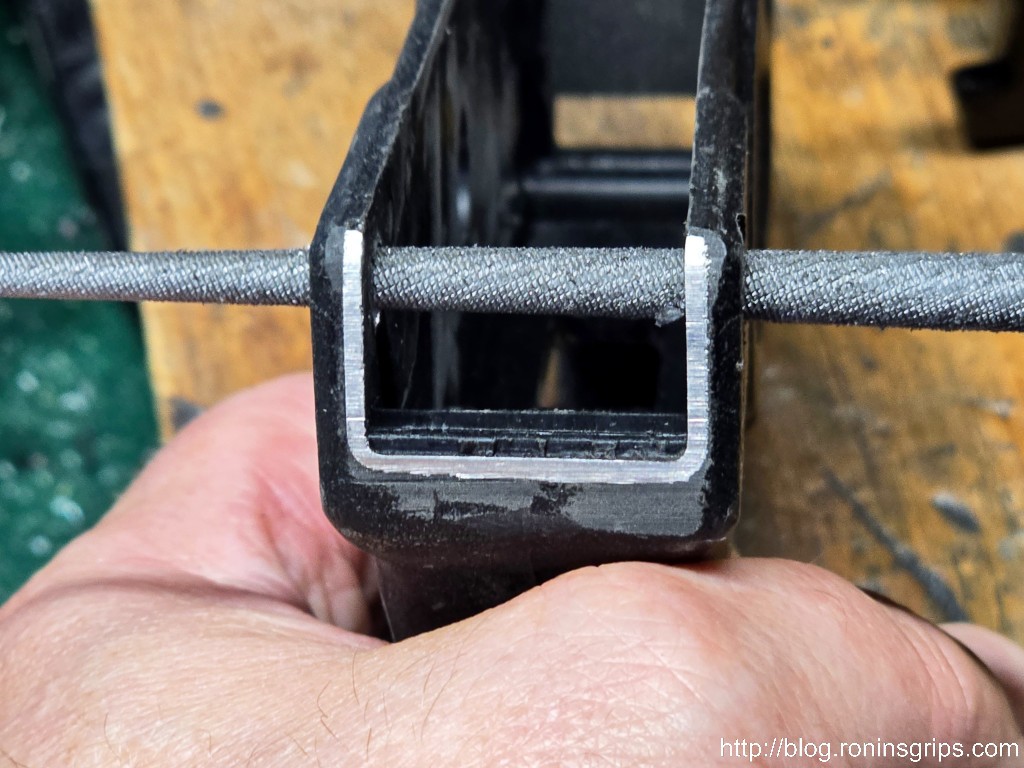
It’s time to test fit the grip.  It may go in great all by itself or you may need to adjust it just a tad with a circular file.  I’d recommend a 6mm tapered circular file so you have a lot of control. 

MP5K grip conversion: A file and Magpul SL grip on a workbench.
This 6mm tapered Bahco file is great for adjusting holes. Click here to see it on Amazon.
Magpul SL grip modification: Filing the MP5K lower receiver.
Use a circular file to adjust the grip until it fits. Don’t rush – take off a bit and test, take off a bit and test until it fits. That is the Bahco 6mm file I mentioned earlier. It’s great for this kind of work.

Note, test fitting the grip by itself is one thing.  Doing it with the stock, brace or endcap in place is another.  You may find further adjustments with the circular file are required.  Also, you can make things fit sometimes by moving or tapping the grip or whatever is on the end around.  The sheet metal of the receiver can flex and sometimes it gives you just enough alignment to push the pin on through.  I often tap (not bang) them in with a small hammer with a non-marring head.

You want everything to be snug. You’ll find the front pin doesn’t matter if everything is tight.  If you really want a front pin, you would need to make a custom pin given the width of the Magul’s front lower “ears”.  It would also only be cosmetic because you would be inserting a steel pin into soft plastic that does not have a reinforcing plate. 

The moral of the story is to keep the front-to-back length of the grip long so it is snug – again, don’t cut or sand off more of the black plastic than you must.  Also, try to be as close as you can with the pin holes at least vertically.  Because of how the grip is sandwiched between the mag well and whatever is on the rear, it’s not going anywhere.  The rear pin is the final part to limit movement.

Magpul SL grip conversion on MP5K, showing set screw and "SL" marking.
I used the file to slot the hole backward just a bit. Note how tight the grip is up against my SB Tactical brace. It’s not going to wiggle.

The Results

The MKE feels great. I will upgrade the selector the Magpul ESK but even with the stock MKE selector I like the feel more.

MP5K pistol grip showing the Magpul SL Grip conversion.
MP5K-style firearm made in Turkey, showing the grip and Century Arms markings.
MP5K pistol with Magpul SL grip, red dot sight, and brace. "Cal. 9x19 mm" is visible on the receiver.
MP5K pistol with brace, red dot sight, and Magpul SL grip.

Summary

I hope this helps you out if you want to do this yourself.  For folks who just want to do the final filing adjustments, we will converted Magpul grips for sale. Please click here to go to our store.

Here are the original Magpul grips in case you are looking for them:

Production Grip Comment

For our production grips. the holes are based on a new unissued German MP5K grip. Depending on a bunch of factors, the exact holes in the grip you get will vary a bit. Fitting will be required – front to back and the hole locations.


Please share the link on Facebook, Forums, with colleagues, etc. Your support is much appreciated and if you have any feedback, please email us in**@*********ps.com. If you’d like to request a report or order a reprint, please click here for the corresponding page to open in new tab.
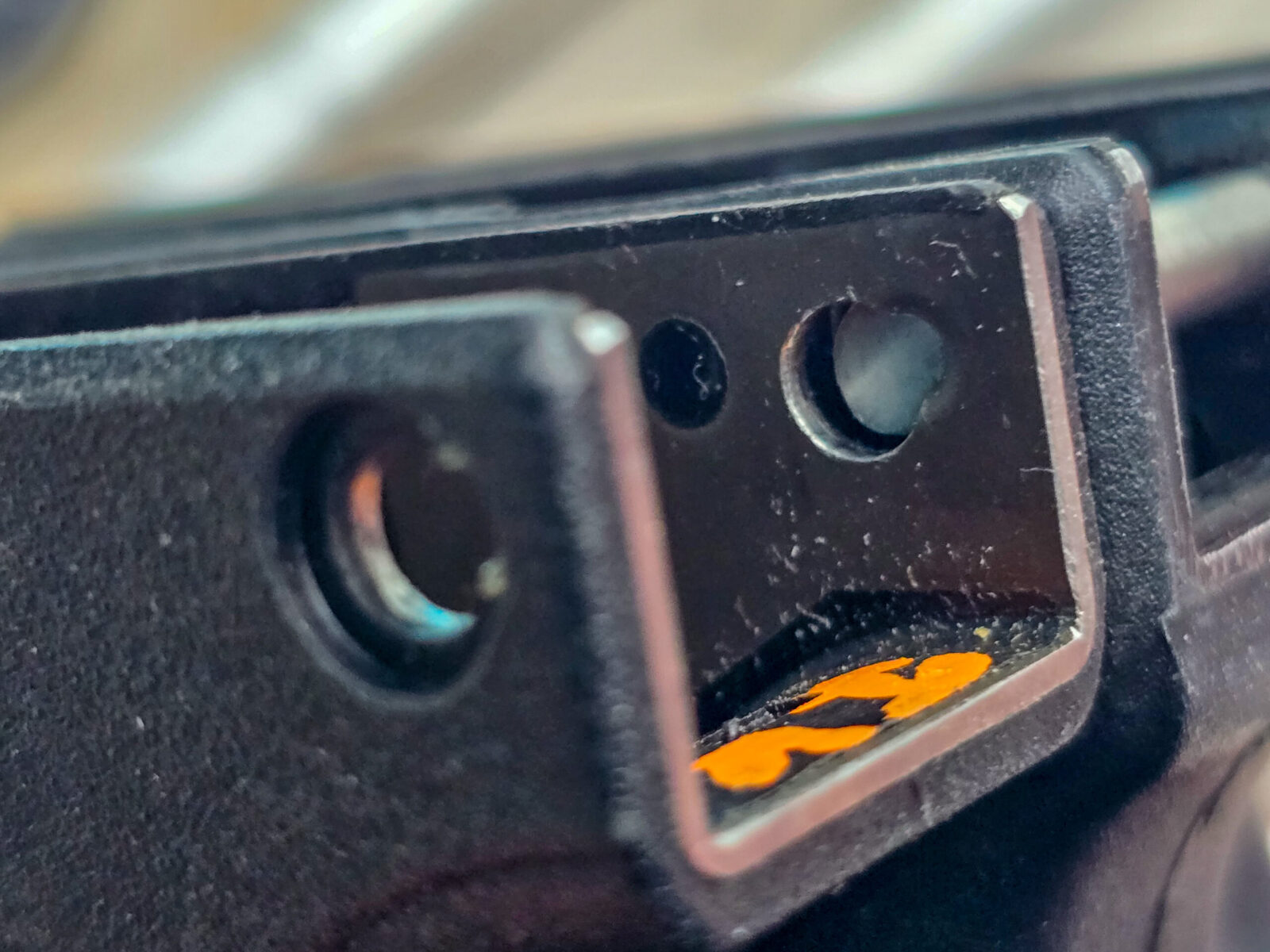

If you are looking for an extended selector lever for your MP5 or MP5K, these are really nice.

Best MP5/MP5K Upgrade Ever – The Timney MP5 2-Stage Trigger

I hate bad triggers and the worst triggers I have ever used were on HK MP5 and MP5K weapons. I have no idea of the design intent – maybe a real strong emphasis on avoiding an accidental discharge by having a long spongy pull and then a break somewhere around eight pounds. For someone who likes crisp triggers and a lighter pull, the HK triggers in general can be a rude awakening.

I recently picked up Zenith Firearms ZF5-P, which is a MP5K clone. Zenith Firearms is based in Afton, VA, and make their various rifles and pistols there. They used to import MKE clones from Turkey but severed ties and are actually making them here in the US.

I bought the ZF5-P for a few reasons – First, I got a good deal on it. That always helps. Second, I no longer had any form of an MP5 and kind of wanted to get back in. Third, and the subject of this story, I knew Timney made a well-regarded trigger pack for the MP5/MP5K. Fourth, I had an urge to tinker and needed a test platform.

Now Zenith makes a big deal that they machine their cartridge walls vs. bending sheet metal resulting in a better trigger. I was kind of curious to check that out as well.

For the rest of the article, I’ll just refer to the trigger as an MP5 trigger because the MP5 and MP5K share the same trigger pack. It’s the grip that differs.

The Zenith’s Original Trigger

Well, I was hoping for a good trigger out of the box because of Zenith machining the walls of their trigger pack but to be honest, it was just another MP5 trigger. I bought a new Century MKE AP5-P and its trigger was better than the Zenith’s also. It’s not that the Zenith’s trigger is bad – my point is that the unit I received was no better than any other MP5 trigger I’ve used.

I used a Wheeler “Professional Digital Trigger Pull Gauge” and did 10 pulls of the trigger after lubrication plus I had pulled the trigger maybe two dozen times since I bought it so there was a tad bit of wear in before testing. At any rate, the lightest pull was 7 pounds 5.9oz. The heaviest was 7 pounds 13.5 ounces and the average came in at 7 pounds 11.3 ounces. So, just shy of 7.75 or seven and three quarter pounds. Still long, creepy, spongy … pick the bad discriptor you like.

The Timney MP5 2-Stage Trigger

Timney MP5 2-Stage Trigger held in hand. Close-up view.
It’s nicely machined and ready to go. You just need to move the ejector, ejector axle and ejector spring from your old trigger to this one. It’s easy to do.

These triggers are compatible with SEF/ Semi-Auto trigger packs and their style of safety selector levers.

These triggers are NOT compatible with Ambi/Navy/FBI trigger packs or .22 clones, as they are different internally.

Timney provides clear installation instructions in the package plus they have the following video to help with the install.

Folks, that trigger is amazing. Here are pull test results: Minimum pull weight was 3 pounds 2.7 oz. Maximum was 4 pounds 0.1 ounce. The average was 3 pounds 10.3 oz.

I’d call it crisp and clean. Night and day better than the original Zenith trigger.

Range Time

My brother-in-law, nephew and I took the Zenith ZF5-P and a Century MKE AP5-P to the range. For an MP5, the MKE’s trigger is fairly decent but was seriously beaten by the Timney.

MP5 with red dot sight and Timney 2-Stage Trigger being held. Ronin's Grips logo in corner.
My nephew really liked the Timney trigger – we all did. By the way, one thing I really like is that a B&T low profile optics mount enables you to cowitness a Vortex Crossfire red dot with the iron sights.

Summary

I have never hid my dislike of MP5 triggers – I genuinely don’t like them and the only good things I can say are that they are reliable and you’ll probably never have an accidental discharge.

The Timney trigger ranks as one of the best upgrades I have done to a firearm. If you want a better trigger for your MP5/MP5K, or a clone of them, then get the Timney trigger.


Note, I have to buy all of my parts – nothing here was paid for by sponsors, etc. I do make a small amount if you click on an ad and buy something but that is it. You’re getting my real opinion on stuff.


Please share the link on Facebook, Forums, with colleagues, etc. Your support is much appreciated and if you have any feedback, please email us in**@*********ps.com. If you’d like to request a report or order a reprint, please click here for the corresponding page to open in new tab.
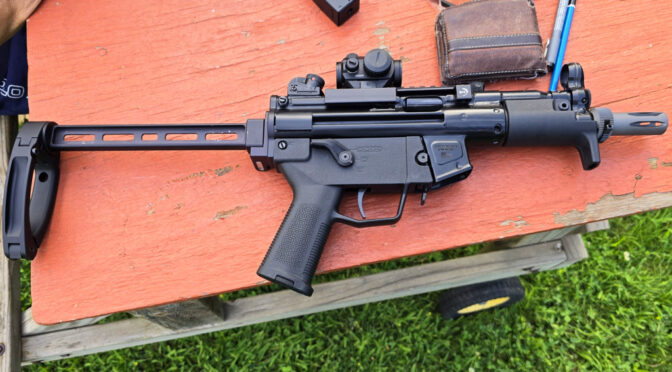

Brace Options for the HK SP5K

In the last post, I told you I bought an HK SP5K.  It’s relatively heavy and begging for a brace.  I don’t really feel the need to spend the money and wait to register it to be a Short Barreled Rifle (SBR) and there are actually a ton of arm brace options out there. 

Option 1:  The SBT5KA Brace

I have a SB Tactical SBT5A Brace on my POF-5 and really like it.    I knew they made a version for the SP5K known as the SBT5KA but I was hoping for something different. Please note they are two different models of braces reflecting the different receiver end caps.

HK SP5K pistol with brace, red dot sight, and foregrip in a black case.

Option 2:  The SOB Brace

Every time I write this product name – the “SOB” – down, I smile.  SB Tactical has a ton of braces for the AR/M4 weapons family and they have evolved a ton away from the ugly original.  The SOB has clean lines and I run one on my PTR PDWR.  I think it looks good and has handled the .308 rounds from the PDWR just fine and feels solid too.

Black Heckler & Koch SP5K pistol with Vortex scope and brace

Option 3:  The SBPDW

I thought I had found just what I wanted with the SBPDW – a collapsing stock that looked really slick and it would be easy enough to add an M4 adapter to the SP5K.  So, I ordered a very well made adapter and the expensive SBPDW stock and guess what?  It would not fit.

HK SP5K pistol with SB Tactical brace attachment

Needless to say, I was bummed.  I had it completely installed only to find out that the guide rods on the SBPDW run right into the sides of the SP5K.  Crud.  I didn’t feel like figuring out all the changes that would be needed.

Purely for reference, here’s the same PDW brace now installed on a 10.5″ AR Pistol but that is a story for another day. It is a rock solid brace.

HK SP5K with brace, red dot sight, and light on a black bag

The Winner?  The SBT5KA

Well, I was bumming from the strike out with the SBPDW so I went with my second pick – the SBT5KA.  I felt it was most true to the lines of the MP5K and ordered one. As with their other braces, SB Tactical did a great job.

Installation was a breeze.  Pull out the two small pins at the back, swap the old end-cap for the brace, push them together and reinsert the pins.  I did make sure the recoil rod lined up and nothing was binding as I reassembled the unit.

SIG SAUER MPX telescoping brace for HK SP5K
HK SP5K with a brace attachment, showcasing aftermarket brace options.

I Did Clean and Lube The Internals

I should point out that when I removed the end cap, I went ahead and slid out the bolt group and lubricated everything.  I applied Super Lube grease to the bolt body and Mobil 1 Synthetic 10w30 via a precision oiler to the rollers of the bolt and rotating surfaces.  I also oiled the pins on the trigger pack while greasing the hammer face with Super Lube.

Letter from ATF stating Magpul AFG legal for AR pistols
HK SP5K trigger mechanism with installed brace
HK SP5K receiver being cleaned with a Tipton brush.

Summary

So you see I went with the SBT5KA brace.  In the next post I will discuss handguards.


Note, I have to buy all of my parts – nothing here was paid for by sponsors, etc. I do make a small amount if you click on an ad and buy something but that is it. You’re getting my real opinion on stuff.


Please share the link on Facebook, Forums, with colleagues, etc. Your support is much appreciated and if you have any feedback, please email us in**@*********ps.com. If you’d like to request a report or order a reprint, please click here for the corresponding page to open in new tab.