
1. Executive Summary
Over the past two decades, the People’s Liberation Army (PLA) has executed an unprecedented and sweeping modernization campaign, transforming itself from a massive, technologically inferior ground force into a formidable regional power capable of projecting influence across the Indo-Pacific. Backed by the unrivaled industrial capacity of the Chinese Communist Party (CCP) and directed by Chairman Xi Jinping’s Centennial Military Building Goal of 2027, the PLA has rapidly expanded its nuclear arsenal, deployed advanced naval surface combatants at an unmatched shipbuilding pace, and reorganized its command structures to facilitate multi-domain operations. According to assessments such as the The Center for Strategic and International Studies recent “A Discussion on the Defense Department’s 2024 China Military Power Report” 1, Beijing is rapidly fielding conventionally armed intercontinental ballistic missiles (ICBMs) such as the DF-27, proliferating advanced hypersonic glide vehicles, and fundamentally altering the strategic balance in the Western Pacific.
However, evaluating the PLA exclusively through the lens of its accelerating acquisition of advanced hardware and expanding order of battle obscures profound institutional, structural, and operational vulnerabilities. A holistic intelligence assessment requires looking beyond the sheer volume of newly commissioned missile silos, stealth fighters, and amphibious assault ships. When subjected to rigorous analysis, the PLA reveals critical fault lines in its “software”—the human capital, command architecture, organizational culture, and logistical frameworks required to sustain complex, high-intensity, joint military campaigns against a peer or near-peer adversary.
This comprehensive report identifies and analyzes the top ten weaknesses currently undermining the combat readiness and operational effectiveness of the Chinese military. Chief among these vulnerabilities is an endemic culture of corruption that continues to plague the highest echelons of military leadership. Despite years of aggressive anti-graft campaigns, the 2023–2026 timeframe has witnessed the most severe and disruptive purges of senior flag officers in modern PLA history, paralyzing high-level decision-making and raising serious questions regarding the reliability of the defense industrial base. Furthermore, the PLA is fundamentally constrained by a dual-command structure that mandates co-equal authority between military commanders and political commissars. This systemic prioritization of ideological loyalty and regime survival over tactical agility introduces severe friction into the operational decision-making cycle.
Compounding these institutional rigidities is the PLA’s absolute lack of modern combat experience, an institutional pathology internally diagnosed by the CCP as the “Peace Disease.” Decades of peacetime administration have bred a culture of scripted exercises and risk aversion. Operationally, the PLA’s transition to a truly integrated joint force remains in an exploratory phase, struggling to overcome deep-seated inter-service rivalries and the technical challenges of multi-domain command and control.
In terms of power projection and expeditionary capability, the PLA suffers from acute quantitative and qualitative gaps. Amphibious lift requirements for a large-scale, cross-strait invasion of Taiwan vastly exceed the PLA Navy’s (PLAN) organic military inventory, forcing a highly vulnerable reliance on civilian roll-on/roll-off (RO-RO) ferries and civilian landing craft. Critical supporting domains, including anti-submarine warfare (ASW), strategic airlift, and aerial refueling, remain highly immature compared to Western equivalents. Finally, while China’s defense industrial base has achieved remarkable strides in self-sufficiency, it remains tethered to critical technological chokepoints, particularly concerning advanced microelectronics, semiconductor manufacturing, and high-performance turbofan jet engines.
Ultimately, this analysis concludes that while the PLA presents a highly capable anti-access/area-denial (A2/AD) challenge within the First Island Chain, its capacity to synchronize, execute, and sustain a protracted, multi-domain conflict is severely compromised by internal friction, rigid command hierarchies, untested operational architectures, and enduring technological dependencies.
2. Endemic Corruption and Leadership Instability
The foremost institutional vulnerability of the PLA is the pervasive, systemic corruption that remains deeply entrenched within its highest command echelons and defense procurement networks. Since assuming power in 2012, Xi Jinping has prioritized sweeping anti-corruption campaigns to ensure the CCP’s absolute control over the armed forces. Yet, despite over a decade of disciplinary actions, graft and political disloyalty continue to necessitate ongoing, highly disruptive, and publicly humiliating purges. The scale of the purges executed between 2023 and 2026 represents the most significant decapitation of PLA senior leadership in modern history, critically undermining the continuity of strategic command.
The PLA Rocket Force (PLARF), the strategic branch responsible for managing China’s rapidly expanding conventional and nuclear missile arsenal, has been the epicenter of this institutional instability. According to an analysis done by Andrew S. Erickson2, the PLARF is currently overseeing a massive nuclear buildup, expanding from roughly 500 operational warheads to a projected 1,000 by 2030, alongside the implementation of an Early-Warning Counterstrike (EWCS) posture. Managing this highly sensitive portfolio requires immense technical expertise and command continuity. However, between 2023 and 2025, the PLARF witnessed the removal and investigation of multiple consecutive commanders, effectively hollowing out the organization’s institutional knowledge base.
The instability extends far beyond the Rocket Force, reaching the absolute zenith of the defense apparatus. Table 1 outlines the high-profile casualties of these recent purges, illustrating a systemic crisis of leadership.
| Name | Highest Position Held | Status/Outcome (as of 2026) |
| Wei Fenghe | Minister of National Defense / PLARF Commander (2012-2017) | Sentenced to death with a two-year reprieve (May 2026); no commutation to parole allowed.3 |
| Li Shangfu | Minister of National Defense / CMC Member | Sentenced to death with a two-year reprieve (May 2026); no commutation to parole allowed.3 |
| Dong Jun | Minister of National Defense | Placed under investigation for corruption (Late 2024), becoming the third consecutive defense minister implicated.5 |
| He Weidong | CMC Vice-Chairman / Politburo Member | Expelled; highest-profile casualty of the October 2025 purges, effectively removing the PLA’s operational No. 2.6 |
| Miao Hua | Director, CMC Political Work Department | Suspended and investigated for “serious discipline violations” (Late 2024); ran the PLA’s ideological apparatus.5 |
| Li Yuchao | PLARF Commander (2022-2023) | Removed, investigated, and purged (July 2024).3 |
| Zhou Yaning | PLARF Commander (2017-2022) | Removed, investigated, and purged alongside his successors.3 |
| Wang Houbin | PLARF Commander (2023-2025) | Expelled during the 2025 purges; notably a Navy officer appointed to clean up the PLARF, who himself fell to corruption.4 |
The second-order and third-order effects of this leadership volatility severely degrade PLA readiness. First, the purges create a profound chilling effect on operational initiative. When career advancement—and physical survival—depends strictly on demonstrating unquestioning political reliability rather than tactical proficiency or bold military innovation, flag officers become deeply risk-averse. Commanders are highly hesitant to authorize realistic, unscripted training exercises or report genuine operational deficiencies to their superiors, fearing that any failure or negative metric will invite political scrutiny and disciplinary action.
Second, the anti-corruption campaign has actively diminished the military’s representation and influence at the highest levels of the CCP. Following the Third Plenum in July 2024 and subsequent expulsions, the number of military officers sitting as full members of the powerful Central Committee dropped from 44 to 34.7 This dilution of military influence within the state’s paramount policymaking body suggests a widening civil-military divide and a potential lack of realistic military counsel during strategic crises.
Furthermore, the corruption directly impacts the defense industrial base and the reliability of fielded equipment. Investigations have revealed systemic bid-rigging and collusion in military procurement. In August 2024, the CMC’s Logistics Support Department banned multiple top-tier research institutions, including Xi’an University of Technology and Southwest Jiaotong University, from participating in PLARF procurement activities due to fraudulent bidding practices.3 This procurement rot indicates that despite massive financial investments and the rapid fielding of advanced platforms, the actual quality control, combat readiness, and interoperability of these systems may be significantly lower than official inventories and paper specifications suggest.
3. The “Peace Disease” and Lack of Modern Combat Experience
A defining structural weakness that categorically separates the PLA from its peer competitors—most notably the United States Armed Forces—is its absolute lack of modern combat experience. The PLA has not engaged in a major, high-intensity kinetic conflict since the conclusion of the Sino-Vietnamese War in 1979. Consequently, no active-duty enlisted personnel, no non-commissioned officers, and only a rapidly dwindling handful of the most senior flag officers possess any real-world battlefield experience.
The CCP leadership is acutely aware of this vulnerability and views it as a critical threat to national security. The military’s internal literature officially diagnoses this institutional malaise as the “Peace Disease” (和平病, heping ping).8 Decades of uninterrupted peacetime administration have fostered bureaucratic complacency, a deeply ingrained culture of scripted “training for show,” and an alarming failure to comprehend the true friction, intensity, lethality, and unpredictability of modern, multi-domain warfare. While the PLA frequently highlights its participation in United Nations peacekeeping operations, disaster relief missions, and maritime escort counter-piracy activities in the Gulf of Aden, these low-intensity constabulary actions do not replicate the logistical, cognitive, and physiological demands of high-end conventional conflict against a technologically advanced near-peer adversary.10
To manage internal anxiety over this experience gap and to exhort the force to improve, the PLA utilizes standardized diagnostic slogans to rigorously critique its own officer corps. These generalized appraisals are ubiquitous in internal military media and serve as explicit acknowledgments of the PLA’s perceived shortcomings.
Table 2 details the primary self-assessment slogans utilized by the CCP to critique military readiness.
| Slogan | Translation / Definition | Implication for Combat Readiness |
| Two Incompatibles | Perceived gaps between current PLA capabilities and the demands of winning a local war under informatized conditions, as well as successfully executing other missions.11 | Acknowledges that the PLA’s modernization has not kept pace with the evolving character of high-tech, information-centric warfare. |
| Two Inabilities | (1) The PLA’s ability to fight a modern war is not sufficient; (2) The ability of cadres (officers) at all levels to command modern war is insufficient.13 | Highlights systemic doubts regarding the intellectual and tactical capacity of the officer corps to lead complex operations. |
| Five Incapables | Commanders are incapable of: (1) judging the situation, (2) understanding the intention of higher authorities, (3) making operational decisions, (4) deploying forces, and (5) managing unexpected situations.14 | Represents a devastating critique of command agility. Suggests that leaders freeze under pressure and cannot manage the OODA loop effectively. |
| Two Big Gaps | There are big gaps between the PLA’s military modernization level and (1) the requirements for national security, and (2) the level of the world’s advanced militaries.13 | An explicit admission that the PLA continues to lag behind peer adversaries (namely the U.S.) in overall capability. |
| Three Whethers | (1) Whether our armed forces can constantly maintain absolute leadership; (2) Whether they can successfully fight when needed; (3) Whether commanders are competent.13 | Questions the fundamental reliability, loyalty, and basic competence of the military apparatus in a crisis scenario. |
These slogans are not merely rhetorical flourishes; they represent genuine, data-driven anxieties among PRC leaders. According to analysis of Chinese military publications, these specific phrases appear with remarkable frequency.
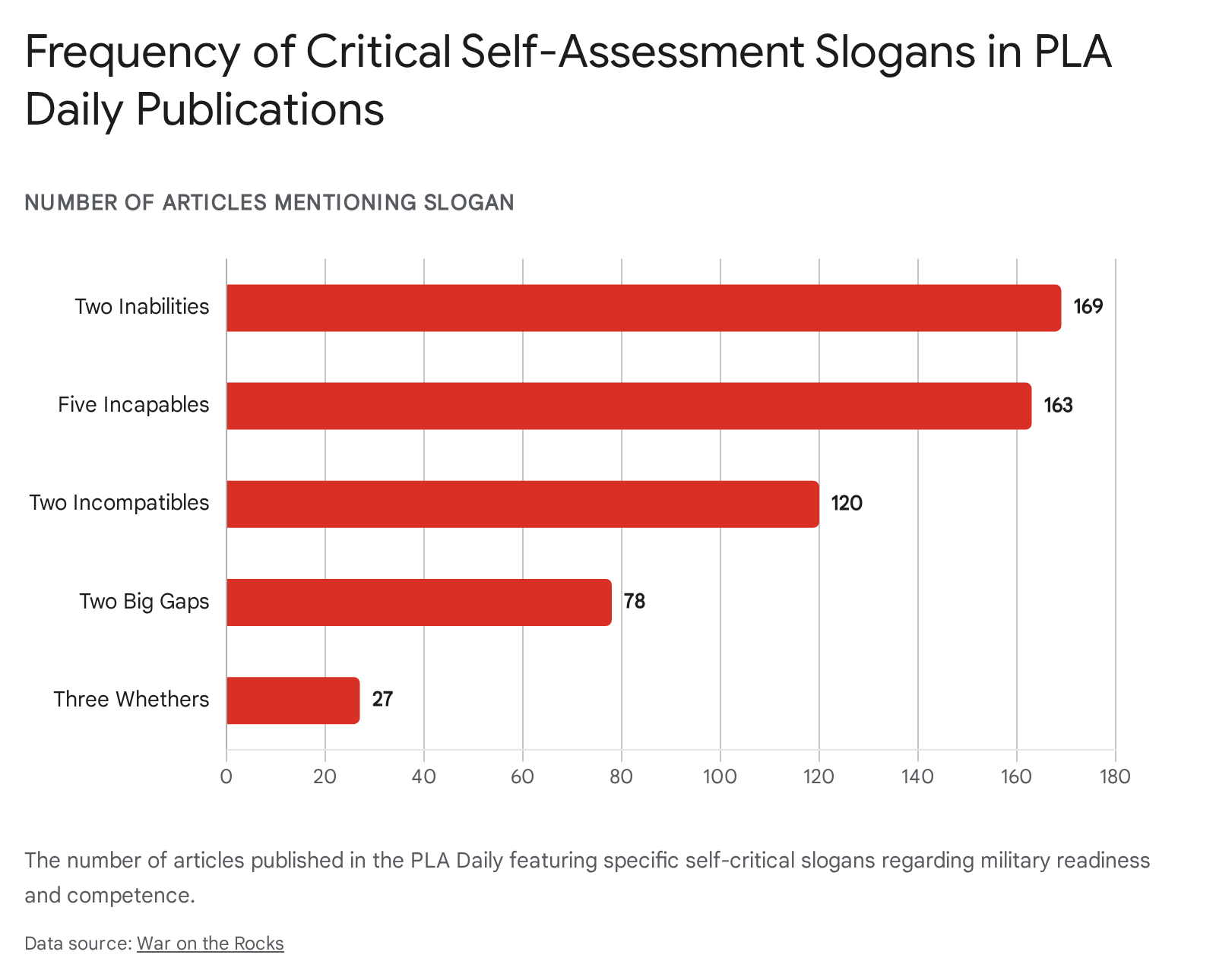
The implications of these self-assessments are profound. Because the PLA lacks the natural filtering mechanism of actual combat to weed out incompetent leaders and empirically validate tactical doctrine, it must rely entirely on artificial exercises. While Xi Jinping has consistently ordered a shift toward highly realistic, unscripted, and joint confrontational training—including the establishment of dedicated “professional blue forces” to act as sophisticated adversaries—the execution remains deeply flawed.8 Western observers and internal PLA critics alike note that training frequently devolves into “formalism.” In an environment where political survival is paramount, commanders engineer exercises to ensure choreographed, successful outcomes rather than pushing their units to the point of failure to genuinely test stress thresholds, logistical networks, and command adaptability.10 Consequently, the true combat effectiveness of the PLA remains an unknown variable, even to its highest commanders.
4. Deficiencies in Joint Operations and Command Structures
Modern warfare demands the seamless, real-time integration of land, sea, air, space, and cyber domains. Despite explicitly identifying “integrated joint operations” as the paramount requirement for fighting under “informatized conditions,” the PLA’s actual joint warfare capabilities remain in an immature, exploratory phase.18
Historically, the PLA was an overwhelmingly ground-centric force. The PLA Army dominated the command structure and budget allocations, while the naval and air forces were largely relegated to subordinate, supporting roles.21 The command architecture was fragmented across seven geographically defined Military Regions, which were optimized for peacetime administration and territorial defense rather than complex, expeditionary joint operations.21
To rectify this structural anachronism, the sweeping 2016 military reforms abolished the seven Military Regions and established five joint Theater Commands. This reorganization theoretically removed the individual service headquarters from the direct operational chain of command, ostensibly empowering the newly minted theater commanders to direct joint operations across all domains.21 Concurrently, the four corruption-prone, Cold War-era general departments were broken up into 15 smaller organizations reporting directly to the CMC.21
However, institutionalizing true jointness has proven exceedingly difficult. The PLA’s internal training doctrine dictates a strict, hierarchical progression: forces must master basic training, advance to combined-arms training within their own services, and finally graduate to joint training across different services. According to analysis of the PLA’s joint operations training reform 18, as of 2026, the PLA has convened major on-site conferences to declare the exploratory phases for basic and combined training complete. Crucially, it has not yet convened an equivalent milestone conference for joint training, indicating that the development of a standardized joint training model remains incomplete.
Authoritative internal military publications confirm this lag. The Southern Theater Command (STC) is currently heralded by the CCP as the premier, model-worthy organization among all theater commands for joint training. Yet, recent reports indicate that even the STC is only just beginning to explore how to standardize joint operational requirements, training plans, and evaluation metrics.18 Routine cross-regional and cross-unit joint training is only now becoming institutionalized to identify operational challenges.
If the PLA’s most advanced model—the STC—is still in the nascent stages of exploring joint standardization, it indicates that the broader force is far from achieving deep integration. This is particularly relevant for the Eastern Theater Command, which holds primary responsibility for operations against Taiwan. Although the Eastern Theater Command has conducted massive, highly publicized exercises around the island, internal PLA assessments continue to conclude that its joint operations have not reached the desired end-state, and its existing military activity patterns are not yet perfected.18
Command and control (C2) at the highest strategic levels also presents vulnerabilities. The Central Military Commission remains highly centralized. Xi Jinping operates as a part-time CMC chairman with vast domestic economic and diplomatic portfolios, limiting his ability to deeply manage military affairs. Furthermore, the CMC lacks a deep bench of personnel with high-tech and information warfare expertise. This raises significant questions regarding the CMC’s ability to effectively command and synchronize the operations of newly minted, highly technical branches—such as the Information Support Force, Aerospace Force, and Cyberspace Force—in a fast-paced, multi-domain conflict.23
5. Structural Vulnerabilities in the Dual-Command System
A unique and deeply ingrained institutional vulnerability within the PLA is its absolute reliance on the Political Commissar system. In Western militaries, the principle of “unity of command” dictates that a single commanding officer possesses absolute, undivided authority over a unit, allowing for rapid, decisive action. The PLA, conversely, operates under a rigid dual-leadership model. At every echelon of the military hierarchy—from theater commands down to individual companies and ships—a military commander shares co-equal authority with a political officer (commissar).24
This system, a legacy of the PLA’s Soviet roots, is explicitly designed to ensure the CCP’s absolute control “over the gun.” It heavily prioritizes ideological purity, political loyalty, and regime survival over maximum combat efficiency.16 Peacetime decisions, operational planning, personnel management, and disciplinary actions are not executed by the unilateral directive of the military commander. Instead, they are routed through consensus-based Party Committee meetings held within the unit, which are co-chaired by the commander and the commissar.16
[Image: Conceptual Flowchart illustrating the dual-command structure]
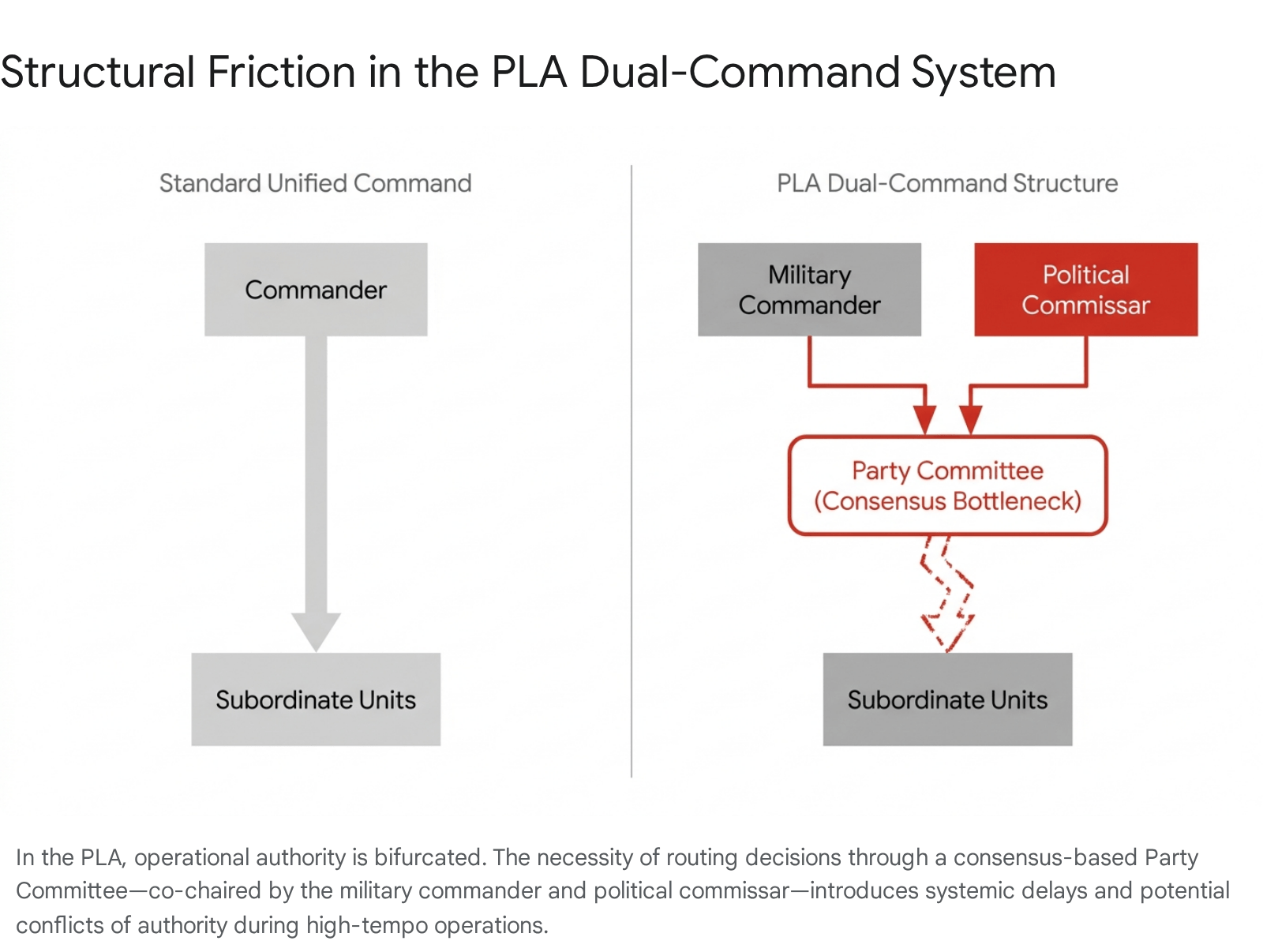
This bifurcated command structure introduces critical operational friction that could prove fatal in modern warfare:
- Decision-Making Bottlenecks in the OODA Loop: In a high-intensity, peer-level conflict, the speed of decision-making—frequently conceptualized as the Observe, Orient, Decide, Act (OODA) loop—is paramount. The structural necessity of consulting political officers and reaching a consensus before executing major tactical shifts threatens to paralyze real-time decision-making, allowing a more agile adversary to outmaneuver PLA forces.24
- Conflict of Authority: In the chaos of combat, disagreements between the military commander and the political officer are highly probable. Conflicts over prioritizing aggressive tactical maneuvers versus maintaining safe political optics or adhering rigidly to pre-approved plans can severely undermine unity of command and unit cohesion.25
- Dilution of Professional Expertise: Political officers frequently lack deep, domain-specific operational knowledge. Historically, to assert control over the more technical branches, the CCP frequently transplanted political commissars from the PLA Army into the Navy and Air Force. This practice exacerbated inter-service friction and failed to adequately support complex naval and aerospace doctrine, as the commissars did not understand the unique operational realities of those domains.19
While the CCP explicitly recognizes this vulnerability and has initiated efforts to cross-train political officers to improve their operational knowledge—seeking to transform them into assets rather than liabilities in the command tent—the fundamental design of the system remains unchanged.16 It structurally guarantees that ideological correctness will continue to siphon vital time, attention, and energy away from warfighting proficiency.
6. Human Capital Deficits and NCO Professionalization Bottlenecks
The PLA’s ongoing transition from a massive, labor-intensive, ground-centric force to a modern, highly technical military relies entirely on the quality and proficiency of its human capital. Currently, the PLA suffers from a severe, acknowledged deficit in technically proficient, experienced personnel, particularly within its non-commissioned officer (NCO) corps.16
In advanced Western militaries, the NCO corps serves as the professional, experienced backbone of the armed forces. They provide decentralized tactical leadership, deep technical expertise, and continuity that outlasts the rotation of commissioned officers. Guidelines established by NATO 28emphasize that a competent, adaptive NCO corps that operates with delegated authority is a vital force multiplier.
The PLA, conversely, has traditionally viewed NCOs not as independent leaders, but merely as senior enlisted conscripts acting as a rudimentary administrative link between commissioned officers and junior soldiers.27 Recognizing this crippling vulnerability in the face of modern warfare, the PLA has aggressively attempted to professionalize its NCO ranks. The 2009 reform plan sought to significantly expand the NCO corps, increasing its numbers from 800,000 to 900,000.29 More recently, the PLA shifted toward a “targeted training NCO program,” allowing the military to recruit educated civilians directly and utilize civilian higher education institutions for technical training, thereby reducing the burden on internal military training pipelines.27 Furthermore, the CMC revised conscription regulations in 2023 to target recruits with STEM backgrounds.16
Despite these structural efforts, profound barriers continue to inhibit the cultivation of a robust NCO corps:
- Retention and Promotion Bottlenecks: The PLA struggles acutely to retain highly trained personnel. Because the proportion of NCOs within the enlisted ranks has grown to exceed 50%, the establishment slots for mid-level and senior NCOs are mathematically saturated. Consequently, highly capable junior NCOs face severe promotion bottlenecks. Unable to advance, they leave the service, leading to excessive turnover and the continuous hemorrhage of institutional memory and hard-earned technical skill.16
- The Competency Gap in New Domains: The PLA is rapidly establishing highly technical branches, such as the Information Support Force, Aerospace Force, and Cyberspace Force, to prepare for “intelligentized,” multi-domain warfare.27 However, the influx of advanced hardware—including complex radar arrays, electronic warfare suites, and autonomous systems—has vastly outpaced the educational baseline and technical proficiency of the conscripts and junior NCOs tasked with operating them.11
- Conscription Limitations: Although the PLA has attempted to attract better talent, it still relies heavily on a two-year conscription cycle. By the time a conscript becomes marginally proficient in operating a complex missile platform or interpreting acoustic sonar data, their mandatory service period expires, forcing the military to constantly restart the costly training cycle from zero.30
This persistent human capital deficit empirically validates the internal “Two Inabilities” assessment. A military simply cannot effectively execute decentralized joint operations if its frontline supervisors lack the technical mastery, experience, and delegated authority required to operate semi-autonomously on a highly lethal, electromagnetically contested battlefield.13
7. Amphibious Lift Deficits and Civilian Fleet Reliance
A paramount strategic objective for the PLA is developing the capability to execute a successful, large-scale cross-strait invasion of Taiwan. However, a critical logistical vulnerability severely undermines this ambition: the PLAN lacks the organic military amphibious lift capacity required to execute and sustain such a massive undertaking.31
The PLAN has made significant investments in purpose-built expeditionary platforms. According to analyses of PLAN inventories 33, the active amphibious fleet currently features eight Type 071 amphibious transport docks (LPDs) and four Type 075 amphibious assault ships (LHAs), with the highly anticipated Type 076 drone carrier/assault ship currently undergoing sea trials. While these platforms are modern and highly capable of conducting regional expeditionary missions and vertical envelopment, they provide only a fraction of the maritime logistics and lift capacity necessary. Transporting hundreds of thousands of troops, heavy armored brigades, artillery, and the requisite logistical tail across the Taiwan Strait against a well-defended, heavily mined shore requires a volume of lift that the PLAN simply does not possess.31
To bridge this massive capacity shortfall, the PLA relies heavily on a strategy of civil-military integration, planning to mobilize its massive civilian maritime sector. This involves requisitioning civilian roll-on/roll-off (RO-RO) ferries and civilian landing craft (LCTs).38 However, integrating civilian shipping into a high-intensity combat environment introduces extreme, potentially catastrophic operational vulnerabilities:
- Deep Draft Restrictions: Large civilian RO-RO ferries (such as the Bang Chui Dao and Zhong Hua Fu Zing, observed in PLA exercises) possess deep drafts, rendering them physically incapable of landing forces directly onto an unimproved beach. They are forced to either loiter dangerously offshore to launch amphibious assault vehicles into the water or wait until a major deep-water port is captured intact—an objective that Taiwanese defenders are explicitly prepared to deny through sabotage and heavy interdiction.31 The PLA has experimented with “offshore mobile debarkation platforms,” but establishing these complex floating piers under constant enemy fire is highly precarious.38
- Civilian LCT Vulnerabilities: To conduct direct over-the-shore logistics, the PLA utilizes civilian LCTs. These vessels present a highly problematic operational profile for an opposed landing. With maximum design speeds limited to a sluggish 7 to 13 knots, they are exceptionally exposed during the transit phase across the strait. Furthermore, unlike hardened military transport vessels, civilian LCTs lack organic defensive systems and compartmentalized damage control. Their open cargo decks leave high-value logistical assets entirely exposed to indirect artillery fire, loitering munitions, and precision drone strikes.31
- The Single-Point-of-Failure Risk: The architectural design of the LCT introduces a critical vulnerability: the single forward bow ramp. Should defending forces successfully disable this ramp, or destroy the lead vehicle immediately upon the ramp’s deployment, the entire column of vehicles secured on the deck is effectively trapped, neutralizing the payload without requiring the destruction of the vessel itself.31
- Traffic Management and Grounding Hazards: Taiwan possesses very few suitable landing beaches, and those that exist are geographically constrained. The ultimate limiting factor in a cross-strait operation is not just the volume of sealift, but the physical limits of how many ships can simultaneously land. Inserting hundreds of clumsy civilian LCTs into tight, contested landing zones presents a severe traffic management challenge. Moreover, LCT operations are restricted by narrow tidal windows. A civilian ship that grounds out as the tide recedes becomes a stationary target and acts as a massive physical obstacle, impeding subsequent waves of landing craft and choking the logistical beachhead.31
Table 3 highlights the stark disparity between modern, purpose-built military assets and the improvised civilian alternatives the PLA must rely upon.
| Platform Type | Primary Function | Key Vulnerabilities in a Contested Environment |
| Type 075 LHA (4 Active) | Vertical envelopment, aviation support, hovercraft launch.35 | High-value target; relatively low total inventory restricts massive simultaneous deployment.34 |
| Type 071 LPD (8 Active) | Heavy armor transport, hovercraft deployment.33 | Same as Type 075; insufficient capacity for a theater-level invasion force.31 |
| Civilian RO-RO Ferries | Mass transit of vehicles and logistics.38 | Deep draft prevents beach landing; entirely reliant on captured ports or highly vulnerable offshore platforms.31 |
| Civilian LCTs | Over-the-shore beach delivery.31 | Extremely low speed (7-13 knots); no organic defenses; open cargo decks; bow ramp single-point-of-failure; severe grounding risk.31 |
8. Anti-Submarine Warfare (ASW) Immaturity
Anti-Submarine Warfare (ASW) remains one of the PLAN’s most enduring, complex, and widely acknowledged operational weaknesses.40 While the PLAN surface fleet has expanded dramatically—commissioning 72 Type 056/056A corvettes between 2013 and 2021, and expanding its Type 054A frigate fleet to 39 vessels by 2024 35—the ability to reliably locate, track, and neutralize quiet adversarial submarines lags significantly behind.41 This is a critical vulnerability given that U.S. and allied nuclear-powered attack submarines (SSNs) are designed to exploit exactly this weakness.
The PLAN correctly views airborne ASW—utilizing fixed-wing maritime patrol and reconnaissance aircraft (MPRA) and rotary-wing helicopters—as an indispensable component of a combined-arms naval strategy.41 These aviation assets are tasked with “sanitizing” operational areas, providing early warning, and escorting high-value targets such as aircraft carriers and amphibious assault groups.41 To address deep quantitative shortfalls, the PLAN has aggressively expanded its fleet of MPRA and introduced approximately six Type 927 ocean surveillance ships. Similar in function to the U.S. Navy’s T-AGOS vessels, these ships utilize highly sensitive towed array sonars to collect acoustic data on foreign submarines.41
Despite these substantial hardware acquisitions, profound qualitative and doctrinal vulnerabilities persist:
- Sensor and Network Inferiority: Publicly available intelligence assessments indicate that despite recent progress, the PLAN’s overall sonar networks, acoustic data processing algorithms, and sensor reliability likely remain behind those of the United States and key allies.41 The physical science of ASW is incredibly demanding, requiring vast acoustic intelligence libraries and sophisticated software to filter biological noise and thermocline distortions from actual submarine signatures.
- Operator Proficiency and Training Deficits: ASW is an inherently complex discipline where operator intuition and experience are just as critical as the hardware itself. The PLAN has historically suffered from low-quality, highly scripted ASW training.40 Furthermore, rigid administrative barriers have often prevented ASW units from deploying to diverse hydrographic environments to gain real-world acoustic experience. While the PLAN is increasing its use of simulators, operator proficiency remains a critical point of failure.41
- Platform Survivability in Contested Airspace: In a high-end conflict scenario, the airspace above the First Island Chain will be violently contested. Crucial ASW platforms, including uncrewed surface vessels, slow-moving helicopters, and specialized Type 927 acoustic surveillance ships, lack robust organic self-defense capabilities. They are highly vulnerable to adversarial air superiority fighters and long-range anti-ship missiles.41
If the PLAN’s vulnerable ASW assets are neutralized early in a conflict, the fleet will be rapidly blinded to subsurface threats. Without absolute subsurface dominance, the PLAN’s entire surface fleet—especially its concentrated, slow-moving amphibious invasion force—remains exposed to catastrophic attrition from stealthy adversarial submarines.40
9. Constraints in Strategic Airlift and Aerial Refueling
To be considered a genuine “world-class military” capable of projecting global power, a force must possess robust, high-capacity strategic airlift and extensive aerial refueling capabilities. The PLA Air Force (PLAAF) currently lacks the capacity to project and sustain significant combat power far beyond China’s immediate periphery, severely limiting its expeditionary options.
The backbone of the PLAAF’s strategic airlift modernization is the indigenous Y-20 heavy transport aircraft. While production rates have accelerated rapidly in recent years, the overall fleet size remains highly modest, with current estimates placing the inventory between 50 and 67 active airframes.43 By contrast, the United States Air Force operates hundreds of equivalent strategic airlifters (such as the C-17 Globemaster III and C-5 Galaxy). This quantitative gap restricts the PLA’s ability to rapidly deploy massive volumes of troops and heavy armor across intercontinental distances.
Furthermore, a modern, high-tempo air campaign relies fundamentally on aerial refueling to extend the combat radius, payload capacity, and loiter time of tactical fighter jets and strategic bombers. The PLAAF has historically relied on a small fleet of obsolescent H-6U tankers, which possess limited fuel offload capacity.43 It was only in 2022 that the YY-20—a dedicated, modern aerial tanker variant based on the Y-20 airframe—formally entered PLAAF service.43
The YY-20 represents a significant qualitative leap. It has demonstrated advanced capabilities, such as concurrently refueling J-20 stealth fighters and J-16 strike aircraft, and supporting long-range power projection, such as the deployment of J-10 fighters to Saudi Arabia without relying on foreign ground infrastructure.44 However, the current inventory of YY-20 tankers is dangerously low, estimated at approximately eight airframes in active service, with long-term projections aiming for roughly 75 airframes by 2032.43
In a regional conflict over Taiwan or the South China Sea, aerial tankers represent massive, high-value, non-stealthy targets. High attrition rates would quickly deplete this small YY-20 fleet.44 Without adequate aerial refueling capacity, the PLAAF’s tactical fighters are rigidly tethered to mainland bases. This drastically reduces their operational radius, severely complicates efforts to maintain continuous air superiority over contested zones within the First Island Chain, and renders true global power projection impossible in the near term.44
10. Defense Industrial Base Chokepoints and Technological Dependencies
Recognizing the strategic danger of relying on foreign suppliers, Beijing has enacted a grand strategy of civil-military integration and selective modernization to achieve technological self-sufficiency. This has successfully reduced the PLA’s historical reliance on arms imports from Russia.47 Yet, despite achieving unmatched shipbuilding and missile production scales, the Chinese defense industrial base harbors critical vulnerabilities, primarily manifesting as high-tech chokepoints that Western nations actively monitor and restrict.
The most glaring vulnerability is China’s ongoing reliance on foreign microelectronics, advanced semiconductors, and the precision machine tools required to manufacture them.33 High-end microchips are the foundational building blocks of the PLA’s overarching doctrine of “intelligentized” warfare. They are essential for powering artificial intelligence applications, advanced C4ISR networks, hypersonic glide vehicle guidance systems, and autonomous platforms.2 Chinese strategists explicitly acknowledge that if stringent Western export controls and investment restrictions successfully isolate China from next-generation semiconductor access, the military will face diminished prospects on the modern battlefield, particularly concerning automated decision-making, advanced sensing, and secure communications.47
A secondary, long-standing weakness is indigenous jet engine manufacturing. For decades, the PLAAF was forced to rely on Russian-supplied engines because the domestic aerospace industry suffered from severe metallurgical deficits and quality control issues, rendering them unable to produce reliable single-crystal turbine blades.11 The successful fielding of the indigenous WS-10, the new high-bypass WS-20 (for the Y-20B airlifter), and the high-performance WS-15 turbofan (for the J-20 stealth fighter) marks significant engineering progress.33 However, gaps remain. For instance, the chief designer of the WS-20 has publicly acknowledged that the engine’s thrust performance still falls short of desired benchmarks, specifically trailing the capabilities of the U.S. C-17’s engines.49
Moreover, China’s defense industry continues to battle internal systemic inefficiencies. PLA publications highlight concerns regarding a lack of genuine market competition among state-owned defense conglomerates, widespread corruption, project delays, cost overruns, and persistent quality control issues.11 Finally, cyber vulnerabilities present an ongoing risk. While China is a formidable cyber actor (evidenced by campaigns like Volt Typhoon targeting U.S. critical infrastructure), its own defense software relies on architectures that harbor memory-based vulnerabilities (e.g., buffer overflows, use-after-free exploits) that sophisticated adversaries could target to disrupt C2 networks.50
11. Escalation Risks and the Deficit in Crisis Communication
The final critical weakness of the Chinese military apparatus does not lie in a specific weapon system, but in its brittle command philosophy regarding crisis management, logistics in austere environments, and strategic communication.
First, the PLA’s lack of combat experience directly translates into an untested and highly vulnerable logistical network. In peacetime, moving troops internally via China’s high-speed rail and robust highway infrastructure is highly efficient. However, maritime logistics in austere environments—such as sustaining an invasion force across the Taiwan Strait under heavy interdiction fire without the use of established ports—is an entirely different operational paradigm. As noted previously, 2021 PLA internal assessments concluded that the military and its civilian merchant reserve fleet are currently unable to provide the maritime logistics necessary to support a large-scale, cross-strait invasion.32
Furthermore, as the PLA fields cutting-edge hardware, the maintenance burden increases exponentially. High-tech sensors, stealth coatings, and advanced propulsion systems require specialized diagnostic equipment and highly trained technicians—resources that the PLA currently lacks due to its NCO human capital deficits.11 Without a robust combat service support infrastructure capable of conducting rapid battle damage assessment and repair in the field, PLA combat units risk rapid degradation of combat power shortly after initial kinetic engagements.
Second, the geographical realities of the Indo-Pacific impose severe limitations on Chinese power projection. Analysis of regional security architectures debunks the “trampoline theory”—the idea that conquering Taiwan would easily allow China to exert hegemony across the entire Pacific.51 In reality, the PLA’s military power and logistical tether dissipate quickly beyond the First Island Chain due to unfavorable geography, the sheer vastness of the Pacific Ocean, and the deep, resilient defensive networks maintained by the U.S. and its regional allies.51
Finally, the PLA exhibits a highly dangerous institutional rigidity regarding military-to-military communication. Throughout recent years, including tense periods in 2023, the PLA has persistently refused to engage in routine operational communications with the U.S. Department of Defense.52 Combined with the PLA’s increasingly coercive and aggressive intercept maneuvers against foreign aircraft and vessels in international airspace and waters, this refusal to utilize crisis de-escalation hotlines drastically raises the risk of an operational incident or tactical miscalculation spiraling uncontrollably into a major crisis or conflict.2 This indicates a command culture that views communication not as a safety mechanism, but as a political concession, representing a severe structural vulnerability in managing the escalation ladder.
12. Conclusion
The People’s Liberation Army is undeniably a formidable military organization. Benefiting from decades of double-digit budget growth and the focused political will of the Chinese Communist Party, it has fielded an impressive array of advanced hardware, built the world’s largest navy by hull count, and established highly lethal, overlapping missile networks designed to deter intervention in its immediate periphery. However, as this intelligence analysis demonstrates, military capability cannot be accurately assessed by order-of-battle spreadsheets, missile counts, and paper specifications alone.
When subjected to holistic scrutiny, the PLA is revealed to be burdened by a web of intersecting institutional, structural, and operational vulnerabilities. Endemic corruption and continuous, debilitating purges fracture the high command, fundamentally undermining strategic continuity and procurement reliability. The institutional “Peace Disease” leaves the force entirely untested under the brutal realities of modern conflict, fostering a culture of scripted exercises and command hesitation. The dual-command system, empowering political commissars over tactical imperatives, prioritizes ideological purity over operational speed, creating systemic friction that is worsened by profound deficits in NCO quality and joint training standards.
Materially, while the PLA excels in A2/AD localized warfare, it remains profoundly constrained by massive shortfalls in amphibious lift capacity, ASW proficiency, and global strategic airlift. Its reliance on civilian shipping for invasion logistics introduces catastrophic points of failure, and its defense industrial base remains vulnerable to Western semiconductor supply chain interdiction.
These ten critical weaknesses suggest that while the PLA is highly capable of projecting coercive power and executing localized, short-duration actions within the First Island Chain, its ability to successfully synchronize, execute, and sustain a protracted, multi-domain, high-intensity campaign against a technologically advanced, combat-tested adversary remains highly suspect. The CCP’s drive toward its 2027 Centennial Military Building Goal will undoubtedly yield further technological advancements, but resolving the deep-rooted human, cultural, and organizational pathologies outlined in this report will prove a far more elusive and challenging objective.
Please share the link on Facebook, Forums, with colleagues, etc. Your support is much appreciated and if you have any feedback, please email us in**@*********ps.com. If you’d like to request a report or order a reprint, please click here for the corresponding page to open in new tab.
Sources Used
- A Discussion on the Defense Department’s 2024 China Military Power Report – CSIS, accessed May 25, 2026, https://www.csis.org/analysis/discussion-defense-departments-2024-china-military-power-report
- U.S. Department of Defense/War Annual Reports to Congress on China’s Military Power—2000 to 2025—Download Complete Set + Read Highlights Here – Andrew Erickson, accessed May 25, 2026, https://www.andrewerickson.com/2025/12/u-s-department-of-defense-war-annual-reports-to-congress-on-chinas-military-power-2000-to-2025-download-complete-set-read-highlights-here/
- 2023 People’s Liberation Army Rocket Force corruption case – Wikipedia, accessed May 25, 2026, https://en.wikipedia.org/wiki/2023_Rocket_Force_corruption_case
- The Purges Within China’s Military Are Even Deeper Than You Think | ChinaPower Project, accessed May 25, 2026, https://chinapower.csis.org/china-pla-military-purges/
- Xi’s second purge of China’s military | Merics, accessed May 25, 2026, https://merics.org/en/comment/xis-second-purge-chinas-military
- Power, Purges, and the PLA: Xi Jinping’s Campaign to Command the Gun – Beyond the Horizon ISSG, accessed May 25, 2026, https://behorizon.org/power-purges-and-the-pla-xi-jinpings-campaign-to-command-the-gun/
- Military Purges at China’s Fourth Plenum Have Implications for Readiness – CNA.org., accessed May 25, 2026, https://www.cna.org/our-media/indepth/2025/11/military-purges-at-chinas-fourth-plenum-have-implications-for-readiness
- Xi believes a ‘peace disease’ hampers China’s military modernisation | The Strategist, accessed May 25, 2026, https://www.aspistrategist.org.au/xi-believes-a-peace-disease-hampers-chinas-military-modernisation/
- Assessing Xi’s Unprecedented Purges of China’s Military: Key …, accessed May 25, 2026, https://www.csis.org/analysis/assessing-xis-unprecedented-purges-chinas-military-key-developments-and-potential
- Ten Reasons Why China Will Have Trouble Fighting a Modern War, accessed May 25, 2026, https://warontherocks.com/ten-reasons-why-china-will-have-trouble-fighting-a-modern-war/
- China’s Incomplete Military Transformation: Assessing the Weaknesses of the People’s Liberation Army (PLA) | RAND, accessed May 25, 2026, https://www.rand.org/pubs/research_reports/RR893.html
- China’s Incomplete Military Transformation: Assessing the Weaknesses of the People’s Liberation Army (PLA) | Andrew S. Erickson, accessed May 25, 2026, https://www.andrewerickson.com/2015/02/chinas-incomplete-military-transformation-assessing-the-weaknesses-of-the-peoples-liberation-army-pla/
- 1 “PLA Weaknesses and Xi’s Concerns about PLA Capabilities” Testimony before the U.S.-China Economic and Security Review, accessed May 25, 2026, https://www.uscc.gov/sites/default/files/Blasko_USCC%20Testimony_FINAL.pdf
- DOD: Military and Security Developments in China 2022 – OCR of the Document | National Security Archive – The George Washington University, accessed May 25, 2026, https://nsarchive.gwu.edu/media/32126/ocr
- The Transformation of the Chinese People’s Liberation Army into a ‘World-class Military’, accessed May 25, 2026, https://www.swp-berlin.org/publikation/the-transformation-of-the-chinese-peoples-liberation-army-into-a-world-class-military
- Personnel of the People’s Liberation Army | U.S.- CHINA, accessed May 25, 2026, https://www.uscc.gov/research/personnel-peoples-liberation-army
- Gaining Victory in Systems Warfare: China’s Perspective on the U.S.-China Military Balance – RAND, accessed May 25, 2026, https://www.rand.org/content/dam/rand/pubs/research_reports/RRA1500/RRA1535-1/RAND_RRA1535-1.pdf
- The PLA’s Joint Operations Training Reform Remains in an …, accessed May 25, 2026, https://ssi.armywarcollege.edu/SSI-Media/Recent-Publications/Article/4404986/the-plas-joint-operations-training-reform-remains-in-an-exploratory-phase/
- China’s Incomplete Military Transformation: Assessing the Weaknesses of the People’s Liberation Army (PLA) – RAND, accessed May 25, 2026, https://www.rand.org/content/dam/rand/pubs/research_reports/RR800/RR893/RAND_RR893.pdf
- China’s Military Modernization Efforts Fall Short; Significant Weaknesses Remain – RAND, accessed May 25, 2026, https://www.rand.org/news/press/2015/02/16.html
- People’s Liberation Army Reforms and Their Ramifications – RAND, accessed May 25, 2026, https://www.rand.org/pubs/commentary/2016/09/pla-reforms-and-their-ramifications.html
- China’s Incomplete Military Transformation – RAND, accessed May 25, 2026, https://www.rand.org/pubs/commentary/2015/03/chinas-incomplete-military-transformation.html
- A New Step in China’s Military Reform – NDU Press, accessed May 25, 2026, https://ndupress.ndu.edu/Media/News/News-Article-View/Article/4157257/a-new-step-in-chinas-military-reform/
- China Maritime Report #49—“The PLAN Corruption Paradox: Insights from the 1st Destroyer Flotilla” | Andrew S. Erickson, accessed May 25, 2026, https://www.andrewerickson.com/2025/08/china-maritime-report-49-the-plan-corruption-paradox-insights-from-the-1st-destroyer-flotilla/
- PLA Army Political Officer System Presents Vulnerabilities, accessed May 25, 2026, https://g2webcontent.z2.web.core.usgovcloudapi.net/OEE/TIP/11DEC2025_T2COM_TiP_PLAA_Political_Officers_A_anonymous.pdf
- China’s Incomplete Military Transformation: Assessing the Weaknesses of the People’s Liberation Army (PLA) – DTIC, accessed May 25, 2026, https://apps.dtic.mil/sti/tr/pdf/ADA615374.pdf
- The Technical Backbone: Analyzing the 2025 Targeted Training NCO Recruitment Plan – Air University, accessed May 25, 2026, https://www.airuniversity.af.edu/Portals/10/CASI/documents/Research/Other-Topics/2026-01-05%20NCO%20Recruitment%20PLA.pdf?ver=iqpSBD2WTjMWzBsJ0_jxag%3D%3D
- Non-Commissioned Officer Corps Professional Development Reference Guidance – NATO, accessed May 25, 2026, https://www.nato.int/content/dam/nato/webready/documents/deep/deep-nco-proD-curr-en.pdf
- Institute for National Defense and Security Research-Newsletter, accessed May 25, 2026, https://indsr.org.tw/en/respublicationcon?uid=18&resid=1904&pid=2964
- With Soldiers Like These? Challenges of Conscription in China and Taiwan – Istituto Affari Internazionali (IAI), accessed May 25, 2026, https://www.iai.it/sites/default/files/iaip2604.pdf
- CMSI Note 18: Flooding the Zone: The Use of Civilian Landing Craft …, accessed May 25, 2026, https://digital-commons.usnwc.edu/cgi/viewcontent.cgi?article=1017&context=cmsi-notes
- CMSI China Maritime Report #16: “Chinese Ferry Tales: The PLA’s Use of Civilian Shipping in Support of Over-the-Shore Logistics” | Andrew S. Erickson, accessed May 25, 2026, https://www.andrewerickson.com/2021/11/cmsi-china-maritime-report-16-chinese-ferry-tales-the-plas-use-of-civilian-shipping-in-support-of-over-the-shore-logistics/
- Military and Security Developments Involving the People’s Republic of China 2024 – Department of War, accessed May 25, 2026, https://media.defense.gov/2024/dec/18/2003615520/-1/-1/0/military-and-security-developments-involving-the-peoples-republic-of-china-2024.pdf
- US DoD’s 2021 China Military Power Report: PLAN is the Largest Navy in the World, accessed May 25, 2026, https://www.navalnews.com/naval-news/2021/11/us-dods-2021-china-military-power-report-plan-is-the-largest-navy-in-the-world/
- Mapping the Recent Trends in China’s Military Modernisation – 2025, accessed May 25, 2026, https://www.orfonline.org/research/mapping-the-recent-trends-in-china-s-military-modernisation-2025
- List of ships of the People’s Liberation Army Navy – Wikipedia, accessed May 25, 2026, https://en.wikipedia.org/wiki/List_of_ships_of_the_People%27s_Liberation_Army_Navy
- Chinese RoRo ferries and Amphibious Vehicles – The Dupuy Institute, accessed May 25, 2026, https://dupuyinstitute.org/2024/12/19/chinese-roro-ferries-and-amphibious-vehicles/
- Civilian Shipping: Ferrying the People’s Liberation Army Ashore | Center for International Maritime Security, accessed May 25, 2026, https://cimsec.org/civilian-shipping-ferrying-the-peoples-liberation-army-ashore/
- TOPIC: THE USE OF ROLL-ON / ROLL-OFF (RORO) FERRIES IN MILITARY OPERATIONS – PACOM, accessed May 25, 2026, https://www.pacom.mil/Portals/55/Roll-On%20Roll-Off%20%28RORO%29%20Ferries%20in%20Military%20Operations.pdf
- The Unraveling and Revitalization of U.S. NavyAntisubmarine Warfare, accessed May 25, 2026, https://digital-commons.usnwc.edu/cgi/viewcontent.cgi?article=2206&context=nwc-review
- China Maritime Report #38: “PLAN Anti-Submarine Warfare Aircraft …, accessed May 25, 2026, https://www.andrewerickson.com/2024/05/china-maritime-report-38-plan-anti-submarine-warfare-aircraft-sensors-weapons-operational-concepts/
- Feedback Loops and Fundamental Flaws in Autonomous Warships – War on the Rocks, accessed May 25, 2026, https://warontherocks.com/feedback-loops-and-fundamental-flaws-in-autonomous-warships/
- شيآن Y-20 – المعرفة, accessed May 25, 2026, https://www.marefa.org/%D8%B4%D9%8A%E2%80%8C%D8%A2%D9%86_Y-20
- Issue 18, February 20, 2024 – CNA Corporation, accessed May 25, 2026, https://www.cna.org/our-media/newsletters/pla-update/issue-18
- China’s YY-20, J-20 and J-16 aircraft shown in picture for first time – CGTN, accessed May 25, 2026, https://news.cgtn.com/news/2022-08-24/YY-20-J-20-and-J-16-are-shown-to-the-public-for-the-first-time-1cL9OTHYsvu/index.html
- China and Egypt Kick Off First Joint Aerial Drills – The Aviationist, accessed May 25, 2026, https://theaviationist.com/2025/04/22/china-egypt-first-joint-aerial-drills/
- Getting to World Class: Can China’s Military Persevere?, accessed May 25, 2026, https://www.prcleader.org/post/getting-to-world-class-can-china-s-military-persevere
- A New Direction for China’s Defense Industry – DTIC, accessed May 25, 2026, https://apps.dtic.mil/sti/tr/pdf/ADA449324.pdf
- The PLA’s Long March toward a World-Class Military: Progress, Obstacles, and Ambitions – U.S. Naval War College, accessed May 25, 2026, https://usnwc.edu/_images/portals/0/NWCDepartments/China-Maritime-Studies-Institute/the-plas-long-march-toward-a-world-class-military-october-2025.pdf
- Volt Typhoon and the Risk to Critical Infrastructure | RunSafe Podcast, accessed May 25, 2026, https://runsafesecurity.com/podcast/volt-typhoon-critical-infrastructure/
- Target Taiwan: Military risk from Chinese conquest – Defense Priorities, accessed May 25, 2026, https://www.defensepriorities.org/explainers/target-taiwan-military-risk-from-chinese-conquest/
- 2023 Report on the Military and Security Developments Involving the People’s Republic of China (CMPR) – Department of War, accessed May 25, 2026, https://media.defense.gov/2023/Oct/19/2003323409/-1/-1/1/2023-MILITARY-AND-SECURITY-DEVELOPMENTS-INVOLVING-THE-PEOPLES-REPUBLIC-OF-CHINA.PDF