
1.0 Executive Summary
The global military and defense industrial landscape observed during the week of June 14 to June 20, 2026, reflects a period of profound operational and technological recalibration. Data aggregated from the world’s premier land defense exhibition and a series of highly integrated multilateral military exercises indicates that allied forces and defense contractors are fundamentally restructuring their paradigms to address the realities of high-intensity, peer-level conflict. The overarching strategic theme dominating this period is the urgent transition from conceptual modernization toward the immediate scaling of production, the distribution of operational command, and the integration of asymmetric technologies into conventional force structures.
Technologically, the defense industrial base has pivoted decisively away from exquisite, low-volume legacy platforms toward modular, open-architecture, and highly attritable systems. Observations from Eurosatory 2026 demonstrate that artificial intelligence, unmanned systems, and Manned-Unmanned Teaming concepts have transitioned from experimental prototypes to mature, deployable, and mass-producible assets. The exponential proliferation of highly lethal, low-cost autonomous and remotely piloted systems—specifically First-Person View drones and loitering munitions—has forced a rapid evolution in ground-based air defense. The industry is currently prioritizing the rapid development of layered, sensor-agnostic counter-unmanned aerial systems that integrate kinetic interceptors, high-energy lasers, and wideband electronic warfare effectors into single, highly mobile platforms. Furthermore, the defense supply chain is undergoing a strategic realignment aimed at localized, resilient mass production to fulfill the requirements of the Eastern Flank Deterrence Initiative, recognizing that credible deterrence relies as much on industrial reconstitution capacity as on frontline combat power.
Operationally, the military exercises conducted over the past week demonstrate a comprehensive effort to harden allied interoperability and adapt to contested multi-domain environments. Naval exercises in the Baltic Sea and the Atlantic Ocean highlight an elevated prioritization of protecting critical undersea infrastructure and securing vulnerable Sea Lines of Communication against asymmetric subsea threats, while simultaneously validating the ability of decentralized NATO operational headquarters to command multinational maritime forces. In the air domain, the successful execution of Agile Combat Employment by fifth-generation stealth fighters operating from civilian highway infrastructure underscores a doctrinal recognition that traditional, fixed airbases are highly vulnerable to advanced long-range precision fires. Concurrently, exercises like Vigorous Warrior and Eagle Partner 2026 reveal that allied forces are actively expanding multinational interoperability to prepare for severe logistical realities, emphasizing that standardized procedural frameworks and the inclusion of non-traditional partners are critical force multipliers.
1.1 Summary Table of Key Events and Lessons Learned
| Event Name | Event Type | Location & Dates | Key Lessons Learned |
| Eurosatory 2026 | Tradeshow / Expo | Paris, France (June 15–19, 2026) | Manned-Unmanned Teaming architectures and hybrid-propulsion autonomous ground vehicles have reached operational maturity. Counter-drone defense requires multi-layered, modular systems incorporating drone-on-drone kinetic interception. Defense supply chains must pivot to localized mass production to sustain protracted high-intensity conflicts. Geopolitical disputes can heavily restrict international market access for major defense contractors. |
| BALTOPS 2026 | Multilateral Exercise | Baltic Sea Region (June 4–19, 2026) | The transition of command and control to Joint Force Command Brunssum enhances NATO’s operational cohesion. Protecting undersea infrastructure and integrating unmanned underwater vehicles for harbor defense are critical for maintaining maritime logistics and deterring subsea sabotage. |
| Ramstein Flag 26 | Multilateral Exercise | Northern & Southern Europe (June 8–19, 2026) | Agile Combat Employment is operationally viable for fifth-generation assets utilizing austere civilian infrastructure. Dispersed air operations require highly synchronized, multi-domain command networks to overcome Anti-Access/Area Denial environments. |
| Vigorous Warrior 2026 | Multilateral Exercise | Estonia (June 2026) | Peer-level conflict scenarios demand highly interoperable Role 2 field hospitals capable of managing severe mass casualties, rapid pathogen identification, and logistical interruptions under contested environmental conditions. |
| Fleet Exercise (FLEETEX) 250 | Multilateral Exercise | United States East Coast & Atlantic (June 14–29, 2026) | Rapid forward-deployed coalition aggregation is essential for layered homeland defense. Multi-domain training integration among allied marine forces sharpens collective maritime security and amphibious response capabilities. |
| Combat Power 26 | Joint Military Exercise | Croatia (June 15–July 3, 2026) | The integration of newly acquired fourth-generation Western fighter aircraft alongside modern unmanned aerial systems signals a definitive break from legacy Soviet-era equipment, enhancing NATO’s southeastern flank deterrence posture. |
| Eagle Partner 2026 | Multilateral Exercise | Armenia (June 17–25, 2026) | The inclusion of French and Greek forces alongside U.S. and Armenian troops highlights a strategic shift toward broader Western interoperability and the diversification of regional defense partnerships. |
2.0 Details: Military Tradeshows and Defense Expos
2.1 Eurosatory 2026
Participating Nations and Major Defense Contractors Eurosatory 2026, officially recognized as the world’s premier land and air-land defense and security tradeshow, was held from June 15 to June 19, 2026, at the Paris Nord Villepinte Exhibition Centre in Villepinte, France.1 Organized by Coges Events, the biennial exhibition drew a massive global presence, featuring over two thousand international exhibitors representing sixty-one distinct sovereign nations.4 The event served as a critical convergence point for government defense procurement officials, military leadership, and the global defense industrial base. Major multinational defense conglomerates maintained expansive footprints, including Rheinmetall, General Dynamics European Land Systems, Thales, L3Harris Technologies, MBDA, IDV (a dedicated defense entity within the Leonardo corporate structure), and ST Engineering.5
A highly notable shift in international defense trade dynamics was the significantly expanded presence of the Indian defense industry. India deployed a unified national pavilion featuring thirty-one separate entities, heavily supported by the Indian Ministry of Defence.4 This aggressive posturing at a European tradeshow signals a strategic effort by New Delhi to pivot from its historical position as a primary importer of Russian military hardware toward establishing itself as a competitive exporter of indigenous defense technologies in the global arms market.4
However, the geopolitical environment surrounding the ongoing conflict in the Middle East severely disrupted the exhibition’s international inclusivity. The French government mandated strict limitations on the participation of Israeli defense firms, driven by political responses to the humanitarian situation resulting from Israeli military operations in Gaza.11 Initially, the French Ministry of Defense decreed that Israeli defense firms were prohibited from displaying any offensive weaponry, restricting their exhibitions exclusively to air defense products and anti-ballistic missile capacities.11 Furthermore, in a highly unprecedented move for an international trade exhibition, organizers physically boarded up and blocked access to the pavilions of several prominent Israeli defense contractors, including Elbit Systems, Rafael Advanced Defense Systems, and Israel Aerospace Industries, during the overnight hours preceding the exhibition.11
The Israeli Ministry of Defense issued formal condemnations of these actions, labeling the physical blockades as cynical, discriminatory, and unjustified, particularly asserting that the affected companies had fully complied with the French government’s demands to strictly display defensive systems.11 Senior executives from Israeli defense firms publicly suggested that the French government’s actions were motivated less by humanitarian concerns and more by commercial protectionism, arguing that the highly successful and combat-proven Israeli defense sector poses a significant market threat to domestic French and European defense conglomerates.11 This ongoing dispute highlights the increasing vulnerability of the global defense trade to host-nation geopolitical interference and the weaponization of trade exhibition access.
Key Technological Debuts, Systems Emphasized, and Capabilities Demonstrated The technological demonstrations at Eurosatory 2026 reflected a defense industry that has fully internalized the tactical lessons observed in recent high-intensity conflicts, specifically the ongoing war in Ukraine. The exhibition floor was dominated by the maturation of Manned-Unmanned Teaming architectures, the rapid advancement of hybrid-propulsion uncrewed ground vehicles, and the urgent prioritization of layered, highly mobile counter-drone systems.
Manned-Unmanned Teaming (MUM-T) and Autonomous Ground Platforms The integration of autonomous robotic systems with traditional armored cavalry units has transitioned from conceptual theory to tangible combat hardware. General Dynamics European Land Systems presented highly integrated Manned-Unmanned Teaming configurations designed to project lethal force forward while keeping human operators shielded in defilade.9 The company showcased an eight-by-eight wheeled PIRANHA Ground Based Air Defense vehicle equipped with Elbit Systems’ new UT-30 Mk.3 thirty-millimeter unmanned turret.9 Operating under a flexible command structure, this manned PIRANHA functions simultaneously as a tactical mother ship and a localized command node, networking with independent small-caliber effectors mounted on the autonomous BULLFROG eight-by-eight wheeled uncrewed ground vehicle.9 Furthermore, the General Dynamics EAGLE six-by-six Vehicle Control Unit was demonstrated networking seamlessly with a suite of unmanned ground and aerial vehicles from Alpha Robotics, including the highly mobile WOLF G1 tracked uncrewed ground vehicle equipped with a Valhalla Loki stabilized weapon station, the WOLF C1 surveillance platform, the HAWK fixed-wing drone, and the HUMMINGBIRD tethered quadcopter.9
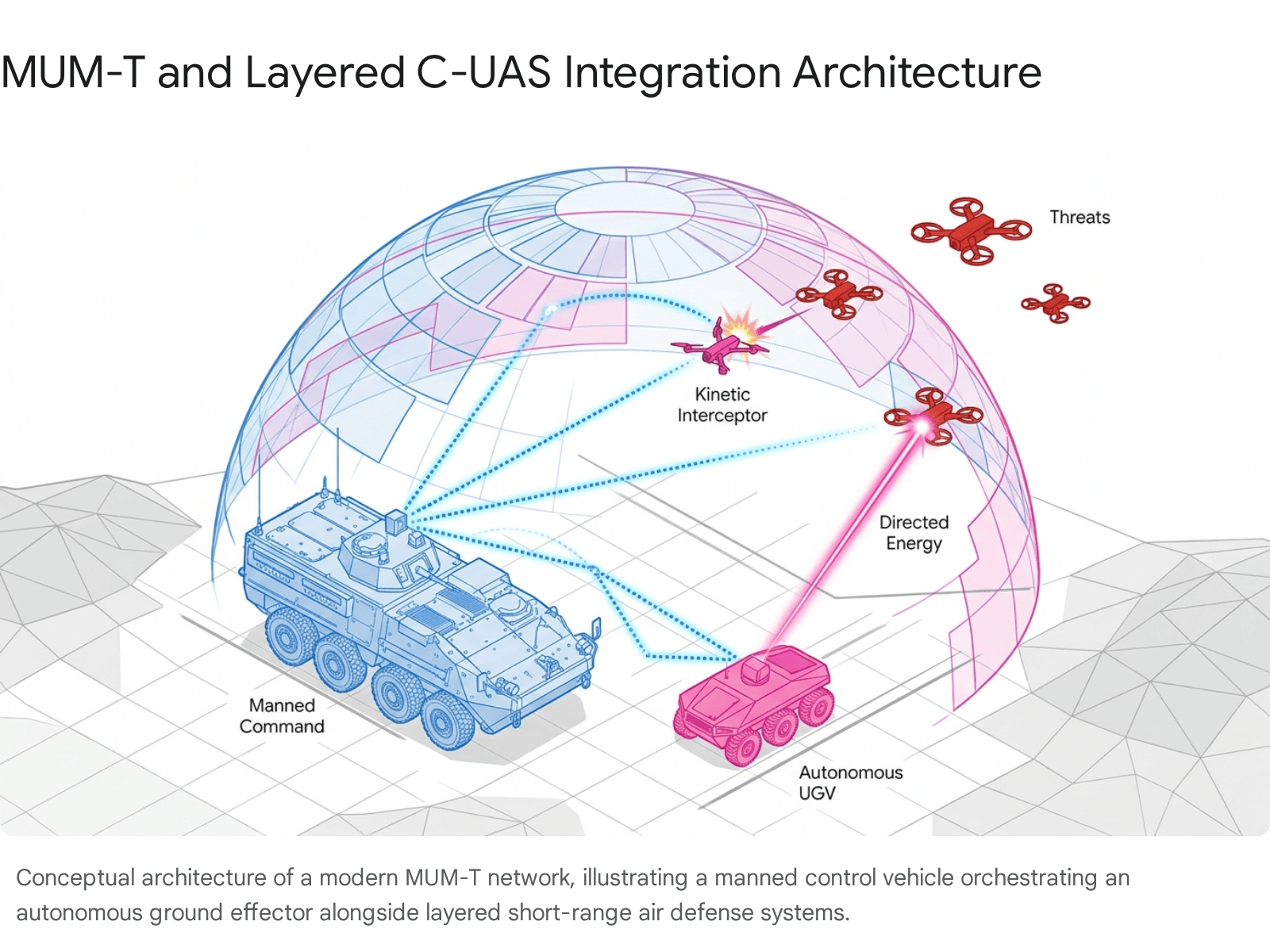
In parallel, IDV, a subsidiary of the Leonardo corporate group, introduced the next generation of its VIKING uncrewed ground vehicle and debuted the highly anticipated CL2X.6 The CL2X is a hybrid uncrewed light tank platform running on a tracked chassis.6 It utilizes an advanced series-hybrid propulsion system that allows the vehicle to achieve a maximum speed of seventy kilometers per hour and an operational range of five hundred kilometers.12 Crucially, the hybrid architecture enables a dedicated silent mode, permitting the vehicle to conduct low acoustic signature operations.12 This feature is a direct engineering response to the proliferation of acoustic ground sensors and the heightened multi-spectral sensor density of the modern battlefield, where noise emissions frequently invite rapid artillery suppression. Furthermore, VisionWave Holdings presented the VARAN Autonomous Ground System alongside the STRATUM AI operational management platform.13 This architecture utilizes a passive battlefield perception framework, processing raw data through a sophisticated optical and thermal computer vision sensing layer to navigate and identify targets without emitting active, detectable radar signatures.13
Layered Counter-Unmanned Aerial Systems (C-UAS) The absolute necessity of defending ground maneuver forces against the ubiquitous threat of First-Person View drones, loitering munitions, and quadcopter grenade-droppers has catalyzed a massive industrial effort toward layered Counter-Unmanned Aerial Systems. Defense contractors are recognizing that single-sensor or single-effector systems are insufficient; survival requires multi-layered architectures that combine electronic warfare, directed energy, and kinetic interception.
To this end, General Dynamics European Land Systems unveiled the PANDUR GBAD in a layered air defense configuration.9 The platform integrates a Valhalla Mangart 25 turret equipped with a high-velocity automatic cannon and missile launchers for medium-range threats, combined with a Cilas HELMA-P high-energy laser weapon designed for the instantaneous neutralization of small, short-range targets.9 The entire platform is networked through the company’s proprietary NEVA electronic architecture, allowing seamless integration into broader multi-domain sensor webs.9 Similarly, the technology conglomerate Rohde & Schwarz introduced the THORIS suite, a highly scalable multi-sensor counter-drone system.15 THORIS orchestrates active radar, electro-optical and infrared targeting, and radio-frequency sensors through a unified command and control layer to deliver continuous tracking and wideband electronic jamming.15
Perhaps the most significant strategic shift in the counter-drone sector is the acknowledgment that the most cost-effective method for neutralizing a hostile drone is often the deployment of a friendly interceptor drone. At Eurosatory, L3Harris Technologies signed a formal Memorandum of Understanding with the Turkish drone manufacturer Skydagger Technologies to co-produce First-Person View drone interceptors in the United States.8 These low-cost kinetic interceptors will be natively integrated into the L3Harris VAMPIRE system, an affordable, palletized intelligence, surveillance, reconnaissance, and strike platform currently in high-volume production in Huntsville, Alabama.8 The VAMPIRE system utilizes WESCAM MX-10D stabilized targeting sensors and an artificial intelligence-driven Mission Management System to quickly detect and classify small, evasive threats.17 By incorporating Skydagger’s interceptors, L3Harris aims to significantly reduce the cost-per-effect ratio for allied militaries, allowing them to defeat incoming drones without expending million-dollar surface-to-air missiles on targets that cost only a few thousand dollars.16
Loitering Munitions and Networked Strike Architectures The offensive counterpart to the counter-drone systems was heavily represented by advancements in loitering munitions. Rheinmetall hosted the global premiere of its Containerized Missile Launcher, a multi-launch platform specifically engineered for the FV-014 loitering munition system.19 The launcher is housed within a logistically flexible, standardized twenty-foot shipping container format, allowing it to be covertly transported and deployed via civilian logistics chains, including commercial trucks, trains, and maritime cargo vessels.19 The autonomous launcher can hold up to eighteen FV-014 uncrewed aerial vehicles, which boast an operational range of up to one hundred kilometers and a flight endurance of seventy minutes.19
Crucially, the system utilizes advanced swarm technology, enabling a single human operator to launch and manage a coordinated salvo of multiple vehicles simultaneously.19 The entire apparatus is unified by the Rheinmetall Battlesuite, an open-architecture digital foundation that digitalizes platforms, sensors, and weapons, allowing commanders to network existing and future systems through standardized military interfaces.19 This approach to digitized firepower minimizes reaction times and significantly enhances the transparency of the operational area, bridging the historical gap between reconnaissance elements and artillery strike complexes.19 The strategic relevance of this capability was underscored by the announcement that the German Armed Forces recently executed a framework agreement to procure tens of thousands of FV-014 munitions, with initial deliveries scheduled to commence in the first half of the year 2027.21
Lessons Learned and Intelligence Takeaways The intelligence derived from the Eurosatory 2026 defense exhibition points toward several fundamental shifts in defense industry trends, supply chain management, and military procurement priorities.
First, the overarching theme among allied defense planners is the imperative to achieve “production at speed and scale”.24 Transatlantic military leadership and industry executives utilized the exhibition to emphasize that modern deterrence is not predicated solely on the technical superiority of frontline weapons systems, but equally on the resilience of the supporting industrial base.24 The intense focus on initiatives like the Eastern Flank Deterrence Initiative requires allied nations to rapidly rebuild stockpiles depleted by current conflicts and establish localized, highly redundant manufacturing capacity.24 Militaries are moving away from the procurement of exquisite, highly complex platforms that take years to manufacture, favoring systems that are affordable, modular, and capable of being mass-produced in the tens of thousands.
Second, the structural balance of the global arms trade is fragmenting. The robust presence of the Indian defense sector and the controversies surrounding the exclusion of Israeli firms demonstrate that nations are increasingly leveraging defense exhibitions as instruments of geopolitical statecraft.4 Sovereign nations are recognizing the immense strategic risk of relying on foreign supply chains that can be severed by sudden diplomatic shifts or unilateral trade restrictions. Consequently, intelligence indicates an accelerating trend toward domestic defense industrialization and the aggressive pursuit of technological sovereignty among both major powers and smaller regional actors.
Finally, the era of proprietary, closed-architecture military hardware is functionally ending. Procurement officers are demanding software-defined systems built on open standards, allowing for rapid field updates and the seamless integration of third-party capabilities. The tactical environment is evolving too rapidly for decade-long acquisition cycles; survival on the modern battlefield dictates that algorithms, sensor libraries, and threat signatures must be updated and deployed to frontline units in a matter of days or weeks.
3.0 Details: Military Exercises
3.1 Baltic Operations (BALTOPS) 2026
Participating Forces, Geographic Focus, and Stated Objectives The fifty-fifth iteration of the premier annual maritime exercise known as Baltic Operations, or BALTOPS 2026, was conducted from June 4 through June 19, 2026, across the geographically critical expanse of the Baltic Sea.26 The massive multilateral exercise mobilized approximately six thousand military personnel and a flotilla of twenty allied warships representing fifteen NATO allied and partner nations.27 Participating nations included the United States, the United Kingdom, France, Germany, Poland, Turkey, and the newly integrated Nordic alliance members, Sweden and Finland.28 The stated strategic objectives of the exercise were to demonstrate unwavering European leadership in defending the Baltic body of water, enhance multi-domain interoperability, and project a highly visible, credible deterrence posture against potential Russian aggression on NATO’s Eastern Flank.27
A profound structural milestone was achieved during this iteration of the exercise. For the first time since the year 1972, the command and control of the operation was not held exclusively by the United States 6th Fleet; instead, the exercise was commanded and controlled by the Allied Joint Force Command Brunssum.27 Operating out of the Netherlands, Joint Force Command Brunssum serves as one of NATO’s three operational-level headquarters, responsible for planning and conducting multinational military operations to ensure force readiness across the European theater.28
Tactical Maneuvers, Multi-Domain Integration, and Doctrinal Concepts Over the course of two weeks, the multinational force executed a rigorous spectrum of tactical maneuvers, including amphibious assault operations, coordinated air defense drills, and complex anti-submarine warfare tracking exercises.27 However, a paramount and highly elevated focus was placed on mine countermeasures and the physical protection of critical undersea infrastructure.29 The participating forces conducted extensive operations designed to safeguard vital power grids, subsea telecommunication data cables, and the broader Sea Lines of Communication that form the backbone of economic prosperity and energy security throughout the Baltic region.29
To achieve these objectives, the exercise leaned heavily into the experimentation and operational integration of advanced unmanned systems. The United States Navy’s Unmanned Undersea Vehicle Group One, supported by the Naval Surface Warfare Center Panama City, executed complex multinational harbor protection demonstrations.30 Operating out of the port of Liepaja, Latvia, the group deployed sophisticated Iver3 Unmanned Underwater Vehicles to conduct detailed subsea reconnaissance, route clearance, and anomaly detection.33 These operations were conducted in close tactical coordination with Netherlands Explosive Ordnance Disposal units, Latvian boat crews, and the United States Underwater Construction Team One, demonstrating the capability to rapidly identify and neutralize subsurface explosive threats.30
Lessons Learned and Intelligence Takeaways The successful execution of BALTOPS 2026 under the direct command of Joint Force Command Brunssum represents a highly significant validation of NATO’s evolving command architecture. By shifting the operational control from a national fleet command to an integrated NATO operational-level headquarters, the Alliance has proven its capability to seamlessly absorb, coordinate, and command massive multinational force packages in a highly localized theater of operations. This structural flexibility is an absolute prerequisite for managing the complex logistics and force deployments required in a potential Article 5 collective defense scenario.
Furthermore, the intense operational focus on mine countermeasures and the deployment of unmanned underwater vehicles highlights a sobering intelligence assessment regarding modern maritime vulnerabilities. The destruction of the Nord Stream pipelines in recent years fundamentally altered the threat calculus in the Baltic Sea, demonstrating that strategic sabotage of undersea infrastructure is a highly effective asymmetric warfare tactic. The lessons derived from the harbor protection drills in Latvia indicate that allied navies must aggressively scale their deployment of autonomous subsea sensors and mine-hunting drones. Securing the maritime logistical nodes and the Sea Lines of Communication is essential for enabling the resupply of land forces operating on NATO’s Eastern Flank; without uninterrupted maritime logistics, forward-deployed combat power cannot be sustained.
3.2 Ramstein Flag 26
Participating Forces, Geographic Focus, and Stated Objectives Ramstein Flag 26, characterized as NATO Allied Air Command’s premier live-fly exercise, took place from June 8 to June 19, 2026.35 The exercise constituted the largest and most ambitious air operation in the Alliance’s history, bringing together more than two hundred combat aircraft and support assets from eighteen allied nations.35 Generating over one thousand daily and cumulative sorties, the operational footprint was massive, spanning three distinct Joint Operations Areas that extended from the austere environments of northern Norway and Finland down to the southern reaches of Spain.35 The primary objective was to strengthen collective defense across NATO’s northern flank by executing Integrated Air and Missile Defense operations, testing rapid information sharing, and systematically dismantling simulated Counter Anti-Access/Area Denial networks.35 Command and control of this vast airspace was entrusted to the Combined Air Operations Centre Bodø, located in Norway, which oversaw mission planning and synchronized the daily Air Tasking Orders.35
Tactical Maneuvers, Multi-Domain Integration, and Doctrinal Concepts The defining doctrinal concept tested during Ramstein Flag 26 was Agile Combat Employment, a strategic framework designed to increase the survivability of air assets by dispersing them away from large, centralized airbases toward austere, unpredictable operating locations.35 The most critical manifestation of this doctrine occurred in the municipality of Tervo, Finland, where allied forces utilized a standard civilian highway strip as a forward operating base.35 In a historic milestone, United States Marine Corps F-35B Lightning II fifth-generation stealth fighters successfully executed vertical and short take-offs and landings from the Finnish highway, operating alongside conventional Spanish F/A-18 Hornets and Polish F-16 Fighting Falcons.35 Ground crews conducted rapid “hot-pit” refueling procedures, servicing the aircraft while their engines remained running to minimize turnaround times and maintain high sortie generation rates.40
The exercise also achieved unprecedented levels of multi-domain and airborne command integration. Advanced fifth-generation fighters from Denmark, Italy, Norway, and the United States operated in heavily contested synthetic and live environments, supported by an extensive intelligence and battle management network.35 A NATO E-3A Airborne Warning and Control System aircraft landed in Sweden for the first time in the Alliance’s history, marking a major integration milestone for operations in the High North.35 Concurrently, unmanned intelligence was provided by RQ-4D Phoenix high-altitude remotely piloted aircraft operating from Pirkkala Air Base in Finland, while the United Kingdom’s Carrier Strike Group, centered on the aircraft carrier HMS Prince of Wales, projected maritime-based combat air power into the operational theater.35
Lessons Learned and Intelligence Takeaways The successful execution of highway operations during Ramstein Flag 26 proves that the Agile Combat Employment doctrine is viable for highly complex fifth-generation assets. However, intelligence observations drawn from the exercise indicate that while dispersing aircraft significantly complicates an adversary’s ballistic missile targeting calculus, it simultaneously creates immense logistical vulnerabilities. Sustaining continuous combat sorties from a civilian highway requires a highly agile, vulnerable logistical tail capable of moving aviation fuel, complex munitions, and secure communications infrastructure across contested terrain. The exercise demonstrated that the primary limiting factor for distributed air operations is not the capability of the aircraft, but the survivability and speed of the ground-based resupply networks.
Additionally, the performance of the Combined Air Operations Centre Bodø validates NATO’s decentralized command architecture. Operating less than a year after its formal activation, the command center successfully managed the integration of live combat aircraft, airborne early warning platforms, air-to-air refueling tankers, and synthetic training crews operating in simulators.35 The ability to maintain a common operational picture and seamlessly direct complex kill webs across thousands of miles of airspace—regardless of distance, harsh climate, or domain—proves that the Alliance possesses the command maturity required to fight and win in a severely degraded electronic warfare environment.
3.3 Vigorous Warrior 2026
Participating Forces, Geographic Focus, and Stated Objectives Throughout the month of June 2026, the Baltic nation of Estonia hosted Vigorous Warrior 2026, officially recognized as NATO’s largest and most comprehensive multinational military medical exercise.43 Organized biennially by the NATO Centre of Excellence for Military Medicine in close coordination with the Estonian Defence Forces, the exercise mobilized approximately two thousand military medical professionals, specialized troops, and civilian experts representing thirty-two allied and partner nations.43 The core activities were physically dispersed across the heavily forested terrain of the Harju and Lääne-Viru counties.44 The overarching objective of the operation was to exhaustively test and evaluate the full spectrum of military medical support within a highly realistic, severe-attrition conflict scenario, focusing intensely on multi-national interoperability, medical readiness, and the seamless integration of civilian and military healthcare systems during a regional crisis.43
Tactical Maneuvers, Multi-Domain Integration, and Doctrinal Concepts Vigorous Warrior 2026 discarded the relatively secure medical evacuation models optimized during decades of counter-insurgency operations, instead plunging participants into the grim realities of high-intensity, large-scale combat operations. Operating under extremely variable weather conditions characterized by temperatures dropping to thirteen degrees Celsius and persistent rain, medical personnel were forced to establish and sustain complex Role 2 field hospitals in austere, muddy forest environments.46 For contingents such as the Hungarian Defense Forces Medical Center, the primary mission was to successfully navigate the rigorous evaluation protocols of the NATO MEDEVAL committee to obtain formalized NATO MEDEVAC certification for their Role 2 capabilities.46
The exercise subjected the medical teams to relentless waves of simulated frontline casualties requiring immediate surgical intervention. Personnel were required to rapidly triage, stabilize, and treat an array of devastating combat traumas, including severe hemorrhaging, complex amputations, penetrating abdominal wounds, and chemical poisonings.46 The operational tempo was intentionally chaotic, requiring field surgeons to operate highly realistic anatomical injury simulators while simultaneously managing the rapid transfer of stabilized patients to higher echelons of care via heavily contested evacuation routes.46 Furthermore, the exercise integrated advanced asymmetric threats; specialized Mobile Biological Laboratories were deployed and repeatedly alerted to suspected epidemic outbreaks, requiring teams to conduct rapid environmental sampling, execute complex pathogen identification, and implement strict quarantine protocols in the midst of simulated combat operations.46
Lessons Learned and Intelligence Takeaways The intelligence derived from Vigorous Warrior 2026 highlights a critical, often overlooked vulnerability within modern coalition warfare: the logistical and bureaucratic fragility of multinational medical supply chains. The exercise demonstrated that in a peer-conflict scenario characterized by contested airspace, the “golden hour” for medical evacuation by helicopter is largely obsolete. Forward-deployed Role 2 medical facilities must be prepared to hold, sustain, and treat critically wounded personnel for extended durations, necessitating significantly larger localized stockpiles of blood, oxygen, and surgical supplies.
Furthermore, the rigorous certification process revealed that the primary barriers to effective multinational medical response are not clinical competencies, but procedural discrepancies. Interoperability bottlenecks—specifically the standardization of digital medical documentation, the harmonization of patient hand-over protocols between different national militaries, and the maintenance of secure communications during severe electronic jamming—must be aggressively resolved. The ability to rapidly identify biological agents and manage mass-casualty events without collapsing the localized command structure is a critical force multiplier. Ultimately, the exercise underscores that standardizing battlefield medicine across the Alliance is paramount for sustaining combat power and preserving the morale of frontline combatants during protracted, high-attrition warfare.
3.4 Fleet Exercise (FLEETEX) 250
Participating Forces, Geographic Focus, and Stated Objectives Commencing with allied ship arrivals on June 14 and 15, 2026, and moving into a structured harbor integration phase from June 16 to June 21, Fleet Exercise 250—commonly designated as FLEETEX 250—represented a massive convergence of maritime combat power.49 Following the harbor phase, the exercise extended into an intense at-sea execution phase spanning June 22 through June 29.49 Concentrated primarily around Naval Station Norfolk in Virginia and the expansive operational waters of the Atlantic Ocean, the exercise was commanded by the United States 2nd Fleet.47 The operation brought together a formidable coalition force comprising thirty-one advanced warships, numerous multinational aircraft squadrons, and thousands of personnel representing seventeen allied and partner nations.47 Participating maritime forces included assets from Belgium, Brazil, Canada, Denmark, France, Germany, Mexico, Morocco, the Netherlands, Norway, and the United Kingdom, among others.48 The stated objectives of the exercise were to test integrated forces in a dynamic, multidomain training environment, build operational cohesiveness, and validate the tactical procedures required to maintain maritime security and stability in the critical Atlantic theater.48
Tactical Maneuvers, Multi-Domain Integration, and Doctrinal Concepts Following the initial harbor phase dedicated to complex planning, pre-sail briefings, and systems integration, the combined fleets deployed into the Atlantic to execute a full spectrum of multidomain naval warfare operations.48 The at-sea execution phase required the multinational armada to conduct synchronized anti-air defense tracking, sophisticated anti-submarine warfare hunting patterns, and large-scale fleet formation maneuvering, all of which culminated in a highly unpredictable, scenario-driven free-play battle problem against a simulated dynamic adversary.48
Simultaneously, the exercise projected significant combat power into the littoral and ground domains, focusing heavily on coalition amphibious operations. At United States Marine Corps Base Camp Lejeune in North Carolina, forward-deployed elements executed rigorous integration training. United States Marines from the 1st Battalion, 2nd Marine Regiment, and the 2nd Reconnaissance Battalion conducted complex military operations on urban terrain, live-fire demolition range clearing, and rapid aerial insertion exercises shoulder-to-shoulder with specialized marine infantry units from Spain and France.50
Lessons Learned and Intelligence Takeaways FLEETEX 250 served as a critical operational validation of the “Atlantic Bridge” concept, underscoring the strategic necessity of maintaining an unbroken maritime logistical and combat corridor between North America and Europe. By seamlessly aggregating seventeen diverse national navies under the unified command structure of the United States 2nd Fleet, the exercise proved the Alliance’s capability to rapidly assemble and deploy a lethal, cohesive maritime force in response to emergent threats.
Intelligence observations indicate that as peer adversaries increasingly attempt to contest the Atlantic and threaten the North American homeland with advanced long-range cruise missiles and quiet attack submarines, the ability to rapidly integrate international naval assets into a layered defensive shield serves as a primary strategic deterrent. Furthermore, the ground-level integration of multinational marine forces at Camp Lejeune highlights a continued doctrinal emphasis on contested littoral environments. The seamless execution of urban combat and aerial insertions by a blended force of American, Spanish, and French marines demonstrates that allied amphibious infantry units possess the procedural and linguistic interoperability required to conduct rapid, coordinated expeditionary strikes against fortified coastal objectives.
3.5 Combat Power 26
Participating Forces, Geographic Focus, and Stated Objectives Beginning its initial integration phases on June 15, 2026, and officially scheduled to conduct high-intensity live-fire maneuvers from June 22 through July 3, 2026, the Republic of Croatia is executing Combat Power 26 (Borbena moć 26). This event marks one of the most comprehensive joint military exercises undertaken by the Croatian Armed Forces in recent history. Operations are physically dispersed across several strategic locations, notably the Eugen Kvaternik Training Area near Slunj, the Josip Markić polygon in Knin, airbases in Zemunik and Udbina, and simultaneous maritime operations at the Žirje naval training range. The exercise mobilizes forces from the Croatian Army, Navy, Air Force, and Special Forces Command. The central objective is to validate the combat readiness of Croatia’s newly acquired weapon systems alongside allied and partner forces, demonstrating the military’s capability to execute highly lethal joint operations across the land, air, sea, and cyber domains.
Tactical Maneuvers, Multi-Domain Integration, and Doctrinal ConceptsCombat Power 26 serves as a critical operational testbed for several of Croatia’s most advanced strategic acquisitions. In a historic milestone for the nation’s aviation and precision strike capabilities, the exercise is slated to feature the first coordinated live-fire combat employment of newly acquired Bayraktar uncrewed aerial systems alongside modernized rotary-wing combat support from Kiowa Warrior helicopters and the recently delivered French-manufactured Dassault Rafale multi-role fighter jets.
In the ground domain, mechanized infantry and armored cavalry elements are integrating these aerial fires while utilizing modern, NATO-standard platforms to conduct aggressive maneuvers.53 Building on tactical concepts refined during previous iterations of the exercise, formations equipped with Patria thirty-millimeter Infantry Fighting Vehicles, Bradley Infantry Fighting Vehicles, and self-propelled howitzers are engaging targets to demonstrate overwhelming kinetic effectiveness across a heavily layered, multi-domain airspace.
Lessons Learned and Intelligence Takeaways The ongoing execution of Combat Power 26 signifies a major strategic milestone in the defense revival of the Western Balkans and the broader modernization efforts of NATO’s newer member states.53 The active integration of highly sophisticated fourth-generation Western fighter aircraft alongside modern unmanned strike systems marks a definitive, irreversible break from the region’s historical reliance on legacy Soviet-era equipment.53
The intelligence takeaway is profound: European militaries are not merely acquiring new hardware; they are actively absorbing and operationalizing advanced Western doctrine at an accelerated pace. By bypassing traditional, decades-long procurement timelines to equip their forces with highly effective, asymmetric capabilities like the Bayraktar and advanced fighter platforms, the Croatian military has fundamentally altered its combat potential. Consequently, the execution of this joint exercise signals a substantially enhanced regional deterrence posture, proving that modernized, medium-sized militaries are projecting highly credible, multi-domain combat power in defense of the Alliance’s southeastern flank.
3.6 Eagle Partner 2026
Participating Forces, Geographic Focus, and Stated Objectives From June 17 through June 25, 2026, the Republic of Armenia hosted the Eagle Partner 2026 military exercise. The nine-day operation was primarily conducted at the Zar peacekeeping training center in Armenia. The multilateral exercise brought together personnel from the Armenian Armed Forces Peacekeeping Brigade, the United States Army Europe and Africa, and the Kansas National Guard. Significantly, for the first time in the history of the Eagle Partner series, the exercise expanded its multinational scope to include participating forces from the military branches of France and Greece. The stated objectives of the exercise were to bolster the readiness of Armenia’s peacekeeping unit, increase the level of interoperability among units participating in international peacekeeping missions, and facilitate the exchange of best practices in tactical communication and management.
Tactical Maneuvers, Multi-Domain Integration, and Doctrinal Concepts The exercise heavily emphasized the procedural and tactical alignment necessary for seamless integration into international coalition operations. Operating under the framework of preparing for multinational peacekeeping deployments, Armenian troops trained alongside their American, French, and Greek counterparts in standardized tactical responses, command and control methodologies, and cross-communication protocols. The integration of newly participating European forces required the harmonization of distinct operational doctrines to ensure that diverse units could operate cohesively in complex, stability-focused environments.
Lessons Learned and Intelligence Takeaways The primary intelligence takeaway from Eagle Partner 2026 is rooted in the geopolitical signaling of its participant list. The inclusion of French and Greek armed forces alongside the United States and Armenia marks a deliberate and highly visible expansion of Armenia’s multilateral defense partnerships.
By successfully executing integrated exercises with multiple NATO member states, Armenia is demonstrating a sustained strategic shift toward western military interoperability. This action actively dilutes the nation’s historical reliance on singular regional security architectures and proves that smaller states are prioritizing diversified, broad-based military partnerships to enhance their strategic resilience and capability to participate effectively in global peacekeeping coalitions.
Please share the link on Facebook, Forums, with colleagues, etc. Your support is much appreciated and if you have any feedback, please email us in**@*********ps.com. If you’d like to request a report or order a reprint, please click here for the corresponding page to open in new tab.
Sources Used
- Eurosatory 2026 – 6/15/26 – MVG World, accessed June 20, 2026, https://www.mvg-world.com/en/agenda/eurosatory-2026
- Eurosatory 2026 | June 15-19 | Paris – Unmanned Systems Technology, accessed June 20, 2026, https://www.unmannedsystemstechnology.com/events/eurosatory/
- Eurosatory 2026 | 15-19 June | Paris, France – Defense Advancement, accessed June 20, 2026, https://www.defenseadvancement.com/events/eurosatory/
- India puts up strong show at Eurosatory, the world’s largest defence exhibition, accessed June 20, 2026, https://timesofindia.indiatimes.com/defence/international/india-puts-up-strong-show-at-eurosatory-the-worlds-largest-defence-exhibition/articleshow/131737520.cms
- The sights of Eurosatory 2026, from the show floor – Breaking Defense, accessed June 20, 2026, https://breakingdefense.com/2026/06/the-sights-of-eurosatory-2026-from-the-show-floor/
- IDV showcases its latest innovations in uncrewed land vehicles and autonomous systems at Eurosatory 2026, accessed June 20, 2026, https://www.idvgroup.com/2026/06/16/idv-showcases-its-latest-innovations-in-uncrewed-land-vehicles-and-autonomous-systems-at-eurosatory-2026/
- Eurosatory 2026: Thales launches new RapidStriker mobile C-UAS system – EDR Magazine, accessed June 20, 2026, https://www.edrmagazine.eu/eurosatory-2026-thales-launches-new-rapidstriker-mobile-c-uas-system
- Eurosatory 2026 – L3Harris and Skydagger partner to develop C-UAS interceptors, accessed June 20, 2026, https://www.unmannedairspace.info/counter-uas-systems-and-policies/eurosatory-2026-l3harris-and-skydagger-partner-to-develop-c-uas-interceptors/
- GDELS en Eurosatory 2026: Preparados para el Cambio – Entrega …, accessed June 20, 2026, https://tedae.org/en/defensa/gdels-en-eurosatory-2026-preparados-para-el-cambio-entrega-a-gran-escala/
- EUROSATORY 2026: India’s Mind-Blowing Military Hardware Leaves Rivals In Panic, accessed June 20, 2026, https://www.youtube.com/watch?v=w18fxG707xM
- Israeli MoD cries foul as Israeli booths ‘boarded up’ at Eurosatory …, accessed June 20, 2026, https://breakingdefense.com/2026/06/israeli-mod-cries-foul-as-israeli-booths-boarded-up-at-eurosatory-defense-show/
- IDV showcases the SUPERAV-based VBA and the hybrid-powered CL2X unmanned vehicle at Eurosatory 2026 – Zona Militar, accessed June 20, 2026, https://www.zona-militar.com/en/2026/06/19/idv-showcases-the-superav-based-vba-and-the-hybrid-powered-cl2x-unmanned-vehicle-at-eurosatory-2026/
- VisionWave Holdings Makes International Defense Debut at Eurosatory 2026, Unveiling VARAN™ Autonomous Ground System to the World’s Defense Community for the First Time, accessed June 20, 2026, https://www.nasdaq.com/press-release/visionwave-holdings-makes-international-defense-debut-eurosatory-2026-unveiling
- GDELS is showcasing new drone defense solutions at Eurosatory, accessed June 20, 2026, https://militaeraktuell.at/en/gdels-is-showcasing-new-drone-defense-solutions-at-eurosatory/
- Eurosatory 2026 | Rohde & Schwarz, accessed June 20, 2026, https://www.rohde-schwarz.com/ca/about-us/trade-shows/eurosatory-2026_229402-1611929.html
- Skydagger partners with L3Harris to integrate interceptors into VAMPIRE C-UAS system, accessed June 20, 2026, https://www.turkiyetoday.com/nation/skydagger-partners-with-l3harris-to-integrate-interceptors-into-vampire-c-uas-system-3222318
- VAMPIRE™ | L3Harris® Fast. Forward., accessed June 20, 2026, https://www.l3harris.com/all-capabilities/vampire
- L3Harris Delivering Counter-Drone Systems to US Army, accessed June 20, 2026, https://www.l3harris.com/newsroom/press-release/2026/06/l3harris-delivering-counter-drone-systems-us-army
- Rheinmetall unveils CML multi launcher for FV-014 loitering …, accessed June 20, 2026, https://defence-industry.eu/rheinmetall-unveils-cml-multi-launcher-for-fv-014-loitering-munition-with-networked-reconnaissance-and-strike-capability/
- Containerised Missile Launcher makes its debut at Eurosatory – Rheinmetall, accessed June 20, 2026, https://www.rheinmetall.com/en/media/news-watch/news/2026/06/2026-06-15-world-premiere-at-eurosatory-rheinmetall-presents-cml-multi-launcher-for-fv-014-loitering-munition
- Eurosatory 2026: FV-014 loitering munition system – Rheinmetall, accessed June 20, 2026, https://www.rheinmetall.com/en/media/news-watch/news/2026/06/2026-06-15-rheinmetall-at-eurosatory-fv-014-loitering-munition-system
- shownews – Eurosatory 2026: Rheinmetall Unveils Containerized Launcher for the FV-014 Loitering Munition – FW-MAG Future Warfare Magazine, accessed June 20, 2026, https://www.fw-mag.com/shownews/1125/eurosatory-2026-rheinmetall-unveils-containerized-launcher-for-the-fv-014-loitering-munition
- Eurosatory 2026: Battlesuite – digital reconnaissance and strike network, accessed June 20, 2026, https://www.rheinmetall.com/en/media/news-watch/news/2026/06/2026-06-15-rheinmetall-battlesuite-the-digital-foundation-for-reconnaissance-and-strike-network-new-at-eurosatory
- US Army Europe and Africa leader emphasizes production at speed and scale at Eurosatory 2026, accessed June 20, 2026, https://www.army.mil/article-amp/293325/us_army_europe_and_africa_leader_emphasizes_production_at_speed_and_scale_at_eurosatory_2026
- U.S. Army air defenders in Europe highlight the Eastern Flank Deterrence Initiative and innovation at Eurosatory 2026, accessed June 20, 2026, https://www.army.mil/article/293253/u_s_army_air_defenders_in_europe_highlight_the_eastern_flank_deterrence_initiative_and_innovation_at_eurosatory_2026
- National Exercises and Activities – Supreme Headquarters Allied Powers Europe (SHAPE) – NATO, accessed June 20, 2026, https://shape.nato.int/exercises/allied-national-exercises
- BALTOPS 2026 Takes Sail from Gdynia, Poland – US Naval Forces Europe, accessed June 20, 2026, https://www.c6f.navy.mil/Press-Room/News/Article/4508924/baltops-2026-takes-sail-from-gdynia-poland/
- BALTOPS 2026 Takes Sail from Gdynia, Poland – Navy.mil, accessed June 20, 2026, https://www.navy.mil/Press-Office/News-Stories/display-news/Article/4509758/baltops-2026-takes-sail-from-gdynia-poland/
- BALTOPS 2026 KICKS OFF: WHAT MAKES THE 55TH EDITION DIFFERENT?, accessed June 20, 2026, https://jfcbs.nato.int/page5964943/2026/baltops-2026-kicks-off-what-makes-the-55th-edition-different
- Technology plays a Crucial Role in Harbor Defense during BALTOPS 2026 – DVIDS, accessed June 20, 2026, https://www.dvidshub.net/news/printable/567534
- Department-Level Exercise (DLE) Series – Air Force, accessed June 20, 2026, https://www.af.mil/DLE/?videoid=1009950&dvpmoduleid=5710&dvpTag=1
- Unmanned Undersea Vehicle Group (UUVGRU) 1 conducts UUV operations during BALTOPS 2026 – DVIDS, accessed June 20, 2026, https://www.dvidshub.net/video/1010187/unmanned-undersea-vehicle-group-uuvgru-1-conducts-uuv-operations-during-baltops-2026
- Unmanned Undersea Vehicle Group (UUVGRU) 1 conducts UUV operations during BALTOPS 2026 [Image 1 of 7] – DVIDS, accessed June 20, 2026, https://www.dvidshub.net/image/9736153/unmanned-undersea-vehicle-group-uuvgru-1-conducts-uuv-operations-during-baltops-2026
- Unmanned Undersea Vehicle Group (UUVGRU) 1 conducts UUV operations during BALTOPS 2026 [Image 4 of 6] – DVIDS, accessed June 20, 2026, https://www.dvidshub.net/image/9745075/unmanned-undersea-vehicle-group-uuvgru-1-conducts-uuv-operations-during-baltops-2026
- NATO’s Ramstein Flag 26 ends after testing Allied air power across …, accessed June 20, 2026, https://defence-industry.eu/natos-ramstein-flag-26-ends-after-testing-allied-air-power-across-europe-from-northern-norway-to-southern-spain-over-two-weeks/
- Ramstein Flag 2026: NATO Launches Its Biggest Air Exercise Ever, accessed June 20, 2026, https://migflug.com/jetflights/ramstein-flag-2026-nato-biggest-air-exercise/
- Ramstein Flag 26 Demonstrates Agile Combat Employment Across NATO’s Northern Flank, accessed June 20, 2026, https://ac.nato.int/archive/2026/ramstein-flag-26-demonstrates-agile-combat-employment-across-northern-flank.aspx
- U.S. Air National Guard brings tactical airlift, bilateral training to NATO’s Ramstein Flag 2026, accessed June 20, 2026, https://ac.nato.int/archive/2026/us-air-national-guard-brings-tactical-airlift–bilateral-training-to-natos-ramstein-flag-26.aspx
- CAOC Bodø Leads NATO’s Most Ambitious Ramstein Flag, accessed June 20, 2026, https://ac.nato.int/archive/2026/caoc–leads-nato-ramstein-flag.aspx
- Ramstein Flag 26 strengthened Nordic Air Power as part of NATO – Ilmavoimat, accessed June 20, 2026, https://ilmavoimat.fi/en/-/ramstein-flag-26-strengthened-nordic-air-power-as-part-of-nato
- News – Liberty Wing strengthens NATO Alliance at Ramstein Flag 26, accessed June 20, 2026, https://www.dvidshub.net/news/568242/liberty-wing-strengthens-nato-alliance-ramstein-flag-26
- Stronger Together: RAF Personnel Deliver NATO Air Power from Land and Sea, accessed June 20, 2026, https://www.raf.mod.uk/news/articles/stronger-together-raf-personnel-deliver-nato-air-power-from-land-and-sea/
- NATO’s Largest Military Medical Exercise Vigorous Warrior 2026 Concludes in Estonia – Estonian Defence Forces, accessed June 20, 2026, https://mil.ee/en/news/natos-largest-military-medical-exercise-vigorous-warrior-2026-concludes-in-estonia/
- Estonia to host large-scale NATO medical exercise this month – news | ERR, accessed June 20, 2026, https://news.err.ee/1610047807/estonia-to-host-large-scale-nato-medical-exercise-this-month
- One of NATO’s largest medical exercises, Vigorous Warrior 2026, to take place in Estonia, accessed June 20, 2026, https://mil.ee/en/news/one-of-natos-largest-medical-exercises-vigorous-warrior-2026-to-take-place-in-estonia/
- Military Medics Put to the Test in Major NATO Exercise, accessed June 20, 2026, https://hungarytoday.hu/military-medics-put-to-the-test-in-major-nato-exercise/
- U.S. 2nd Fleet, International Partners Commence Fleet Exercise 250 – Department of War, accessed June 20, 2026, https://www.war.gov/News/News-Stories/Article/Article/4518474/us-2nd-fleet-international-partners-commence-fleet-exercise-250/
- International partners join U.S. 2nd fleet for maritime exercises, accessed June 20, 2026, https://homelandprepnews.com/stories/84389-international-partners-join-u-s-2nd-fleet-for-maritime-exercises/
- U.S. 2nd Fleet and International Partners Commence Fleet Exercise 250 – Navy.mil, accessed June 20, 2026, https://www.navy.mil/Press-Office/News-Stories/display-news/Article/4517023/us-2nd-fleet-and-international-partners-commence-fleet-exercise-250/
- Fleet Exercise 250 | Spanish and French marines conduct aerial insert [Image 5 of 9] – DVIDS, accessed June 20, 2026, https://www.dvidshub.net/image/9761891/fleet-exercise-250-spanish-and-french-marines-conduct-aerial-insert
- Fleet Exercise 250 | Demolition Range [Image 6 of 11], accessed June 20, 2026, https://www.dvidshub.net/image/9760311/fleet-exercise-250-demolition-range
- Fleet Exercise 250 | Marines with V1/2 conduct urban terrain training with Spanish and French marines, accessed June 20, 2026, https://www.dvidshub.net/image/9760277/fleet-exercise-250-marines-with-v1-2-conduct-urban-terrain-training-with-spanish-and-french-marines
- Legacy factories, new tech: the Western Balkans defence revival | DSEI Gateway, accessed June 20, 2026, https://dsei-gateway.com/en/news/features/legacy-factories-new-tech-the-western-balkans-defence-revival/