1.0 Executive Summary
During the observation period of mid-to-late June 2026, the global strategic military landscape demonstrated an accelerated transition toward multi-domain integration, the proliferation of autonomous systems, and the rapid hardening of both Western and non-Western alliance structures. As observed through a convergence of international defense exhibitions and high-tempo military exercises, traditional operational doctrines are undergoing aggressive revision. Armed forces globally are restructuring to accommodate the exigencies of high-intensity, peer-level conflict, decentralized command and control (C2), and expeditionary operations within highly contested logistical environments.
In the defense industrial sector, the Eurosatory 2026 exhibition in Paris served as the primary indicator of shifting market priorities. The event highlighted a profound paradigm shift toward “Multi-domain Superiority,” prioritizing advanced counter-unmanned aerial systems (C-UAS), the integration of artificial intelligence (AI) for accelerated decision-making, and the urgent necessity for sovereign manufacturing capabilities.1 Eurosatory also functioned as a critical litmus test for European mobilization under the “ReArm Europe” initiative, which aims to inject approximately 800 billion euros into continental modernization over the next four years.1 Simultaneously, the exhibition exposed deepening fractures in global supply chains, evidenced by the French government’s politicized ban on Israeli defense contractors.2 This friction underscores a growing trend where geopolitical considerations interdict allied procurement, driving nations toward strategic autonomy. Conversely, Ukrainian and South Korean contractors achieved unprecedented market penetration, capitalizing on combat-proven, rapidly deployable asymmetric technologies.4
Complementing these industrial shifts, the global tempo of military exercises indicates a unified strategic pivot toward interoperability and distributed maritime operations. In the Indo-Pacific theater, the 30th iteration of the multilateral RIMPAC 2026 and the U.S.-Japan bilateral Resolute Dragon 26 showcased focused efforts to operationalize expeditionary advanced base operations (EABO), sub-surface autonomous integration, and long-range anti-access/area denial (A2/AD) capabilities.7 These drills function as direct rehearsals for distributed lethality and sea denial in complex archipelagic geographies.
Concurrently, exercises in Europe, Africa, and the Caucasus reflect a dual imperative: securing geographical vulnerabilities while reorienting non-aligned states toward NATO standards. Training events such as Gallant Boar-2026 in the Suwałki Corridor, Borbena moć 26 in Croatia, and African Lion 26 demonstrate an intense focus on Reception, Staging, and Onward Movement (RSOM) logistics.9 These stress tests confirm that planners view the supply chain as a primary center of gravity. Furthermore, the expansion of Eagle Partner 2026 in Armenia to include French and Greek forces indicates a systemic effort to dilute the Russian Federation’s security monopoly in the South Caucasus.12 In opposition, strategic rivals executed their own drills, including China-Russia-Iran naval maneuvers in the Gulf of Oman, signaling a competing architecture of non-Western cooperation.13
Overall, the intelligence takeaways from this observation period reveal a global military apparatus that is simultaneously racing to integrate autonomous AI technologies for tactical overmatch, while struggling to secure the vulnerable logistical frameworks and political supply chains required to sustain them.
1.1 Summary Table of Key Events and Lessons Learned
The following table provides a comprehensive overview of the defense exhibitions and military exercises analyzed during the mid-to-late June 2026 observation window, outlining the event type, geographical location, and primary intelligence takeaways.
| Event Name | Event Type | Location & Dates | Key Lessons Learned |
| Eurosatory 2026 | Tradeshow/Expo | Paris, France (June 15–19, 2026) | AI-driven C-UAS and network-centric warfare dominate procurement; geopolitical friction restricts market access; combat-proven asymmetric technologies see high demand. |
| ILA Berlin 2026 | Tradeshow/Expo | Berlin, Germany (Early-to-Mid June 2026) | Israeli defense exports pivot toward reliable European partners (Germany) emphasizing aerospace, Arrow 3 interceptors, and AI-driven command and control to bypass unreliable political markets. |
| Ventennale CTR (Industry Day) | Tradeshow/Expo | Fiumicino, Italy (June 24, 2026) | AI, digitalization, and sustainability are paramount for modern military logistics; public-private partnerships are critical for maintaining operational readiness and minimizing downtime. |
| Naval Defense Philippines 2026 | Tradeshow/Expo | Manila, Philippines (June 17–19, 2026) | Growing regional demand for coastal security, maritime domain awareness, and asymmetric littoral defense in the Indo-Pacific to counter gray-zone maritime coercion. |
| TACS Expo 2026 | Tradeshow/Expo | Manila, Philippines (June 18–21, 2026) | Integration of tactical defense with emergency disaster preparedness; a focused regional market on individual survival, small arms modernization, and domestic security. |
| RIMPAC 2026 | Multilateral Exercise | Hawaii, USA (June 24–July 31, 2026) | Unmanned undersea vehicles (UUVs) act as critical force multipliers for ISR; long-range submarine fires (UGM-84 Harpoon) are essential for sea denial in contested environments. |
| Resolute Dragon 26 | Bilateral Exercise | Kyushu & Okinawa, Japan (June 20–30, 2026) | Rapid island defense requires seamless V-22 Osprey MEDEVAC logistics and decentralized Type 12 surface-to-ship missile (SSM) deployment; civil-military logistical friction remains a vulnerability. |
| African Lion 26 | Multilateral Exercise | Morocco, Ghana, Senegal, Tunisia (April 20–May 8, 2026)* | Sustained AFRICOM capability building; critical focus on medical readiness, joint air rigging, and countering expanding Russian/insurgent influence in the Sahel and North Africa. |
| Borbena Moć 26 | Multilateral Exercise | Croatia / Adriatic Sea (June 20–25, 2026) | Reception, Staging, and Onward Movement (RSOM) logistics are critical for allied reinforcement; successful execution of airborne infiltration drops and the enforcement of strict naval exclusion zones. |
| Eagle Partner 2026 | Multilateral Exercise | Zar, Armenia (June 17–25, 2026) | Armenian shift toward NATO interoperability accelerates; French and Greek inclusion expands the multinational scope of peacekeeping readiness in the Caucasus, diminishing Russian leverage. |
| Khaan Quest 2026 | Multilateral Exercise | Ulaanbaatar, Mongolia (June 20–July 3, 2026) | Continued viability of UN Chapter VII stability operations; Mongolia acts as a critical strategic buffer facilitating US-Indian military collaboration in Central Asia. |
| Gallant Boar-2026 | Multilateral Exercise | Suwałki Corridor, Poland/Lithuania (June 16–26, 2026) | Multinational (France, Poland, Lithuania) rapid deployment and defensive maneuverability are essential to secure NATO’s most geographically vulnerable land bridge against conventional isolation. |
| BALTOPS 26 | Multilateral Exercise | Baltic Sea (June 4–19, 2026) | Enhanced allied naval integration demonstrates the Baltic Sea’s transition into a highly contested but allied-dominated maritime theater; focus on freedom of navigation. |
| Laros-2026 | Bilateral Exercise | Kommadam, Laos (June 4–13, 2026) | Russian cultivation of Southeast Asian defense ties; emphasis on joint combat scenarios, FPV drone integration, and the demonstration of advanced Russian weaponry. |
| Joint Gulf of Oman Exercises | Multilateral Exercise | Gulf of Oman / Strait of Hormuz (June 2026) | Naval coordination (China, Russia, Iran) focused on protecting vulnerable trade routes; serves as strategic messaging against Western containment policies. |
(Note: African Lion 26 concluded prior to the primary reporting window but remained highly referenced in ongoing strategic defense publications during mid-June regarding post-exercise lessons learned).
2.0 Details: Military Tradeshows and Defense Expos
The defense exhibition circuit in June 2026 provided profound insights into the procurement priorities of global militaries. The overarching theme across all events was a distinct movement away from exquisite, low-volume, highly expensive platforms toward scalable, attritable, and network-centric autonomous systems. Furthermore, the weaponization of the defense trade for political signaling has forced nations to reevaluate their reliance on foreign military sales (FMS) and prioritize domestic industrial capacity.
2.1 Eurosatory 2026
The Eurosatory 2026 exhibition, held from June 15 to 19 at the Paris Nord Villepinte exhibition center in France, served as the absolute center of gravity for the global land and air-land defense industry.15 Hosting innovations from more than 2,000 companies representing over 60 countries, the event was heavily defined by the strategic realities of the ongoing high-intensity conflict in Eastern Europe.1 Specifically, Eurosatory 2026 served as the first major industry gathering since the European Union officially adopted the “ReArm Europe” plan.1 This ambitious legislative and financial initiative is designed to mobilize approximately 800 billion euros over four years to drive the development, modernization, and sovereign expansion of European defense manufacturing.1 Consequently, procurement priorities at the exhibition were structurally shifted toward high-tech battlefield solutions, satellite communications resilience, critical infrastructure protection, and the deep integration of artificial intelligence.1
Participating Nations and Geopolitical Friction
A highly significant strategic takeaway from Eurosatory 2026 was the weaponization of defense trade access for geopolitical signaling. The French government executed a controversial, selective ban targeting the Israeli defense contractors.2 Initially, the French government informed Israel that it was entirely barred from official participation.2 This initial directive prohibited government representatives from attending, banned the establishment of an official Israeli national pavilion, and explicitly excluded all offensive military systems from display.2
Following a series of intense legal appeals and diplomatic escalations (mirroring a similar ban and subsequent court reversal that occurred prior to Eurosatory 2024), the policy was marginally amended.2 The French authorities permitted a restricted presence, allowing Israeli defense industries to display only air and missile defense products—such as components of the Arrow and David’s Sling systems, which are currently in high demand by European nations like Germany and Finland.2 However, on the opening day of the exhibition, the physical stands for these permitted systems were walled off, severely restricting visibility and commercial access.18
The Israeli Ministry of Defense vehemently condemned the move as a discriminatory violation of the established norms governing international defense exhibitions, asserting that France was applying political policies selectively.2 In retaliation, the IMOD suspended all defense procurement from France, citing an ongoing pattern of policies that compromised Israel’s national defense.3 This incident exposes a severe and growing vulnerability in Western allied defense supply chains: the increasing willingness of host nations to disrupt defense industrial cooperation over localized geopolitical or human rights disagreements. This unpredictability is likely to drive both importing and exporting nations to pursue absolute sovereign defense manufacturing capabilities to avoid future export controls or exhibition embargos. Despite the ban on official government participation, major Israeli contractors such as Elbit Systems and Rafael Advanced Defense Systems navigated the restrictions to maintain a presence, highlighting the commercial resilience of these major firms.17
Technological Debuts and Demonstrated Capabilities
The overarching technological theme of Eurosatory 2026 was “Multi-domain Superiority”.1 This doctrine dictates that modern militaries must achieve simultaneous control and tactical advantage across land, air, space, and cyberspace environments.1 A major focal point was the integration of AI to accelerate the sensor-to-shooter kill chain. Artificial intelligence systems were showcased that fundamentally alter military decision-making by improving real-time intelligence gathering, processing massive datasets from disparate sources, and increasing the accuracy of strikes against strategic targets.1
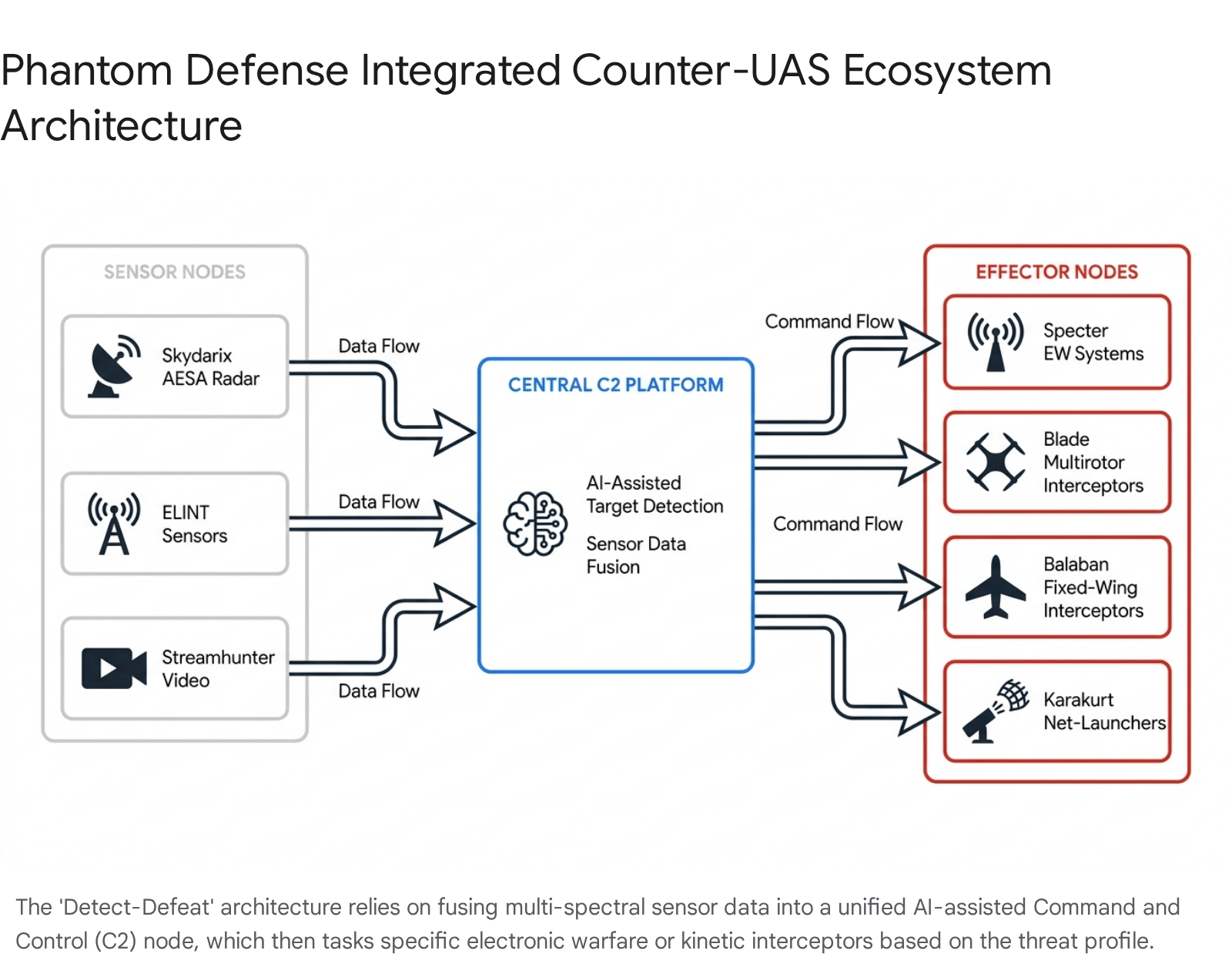
Ukrainian defense technology, highly refined and iterated by ongoing high-intensity combat, garnered unprecedented market attention. The Ukrainian defense technology company Phantom Defense debuted an integrated counter-drone ecosystem built entirely on a “Detect–Defeat” architecture.4 Rather than offering standalone point-defense jammers, the company demonstrated a fully networked Command and Control (C2) platform that fuses multi-spectral intelligence.4
The following table details the specific components of the Phantom Defense C-UAS ecosystem demonstrated at Eurosatory 2026:
| Sub-System Name | Classification | Operational Capability |
| Skydarix | Sensor | Active Electronically Scanned Array (AESA) radar utilizing AI-assisted target detection for 360-degree airspace surveillance. |
| Streamhunter | Sensor | Video interception system designed to tap into and disrupt hostile drone video transmission links. |
| Specter Family | Effector (EW) | Electronic warfare systems engineered to disrupt drone navigation, telemetry, and control links. |
| Blade | Effector (Kinetic) | Multirotor interceptor drones designed for physical collision or close-proximity neutralization. |
| Balaban | Effector (Kinetic) | Fixed-wing interceptor platform for longer-range or higher-altitude threat neutralization. |
| Karakurt | Effector (Kinetic) | Net-launching systems for non-destructive or localized drone capture. |
The C2 platform processes data from these sensors to create a unified operational picture, subsequently guiding operators to deploy the optimal effector.4 According to battlefield data presented at the expo, iterations of this specific network have successfully neutralized over 7,000 hostile UAVs in urban environments.4
Additionally, the Ukrainian uncrewed ground vehicle (UGV) sector demonstrated deep market penetration. The Ravlyk UGV, heavily utilized by Ukrainian intelligence services for frontline logistics, mine clearance, and fire support, was licensed to the French construction firm Haulotte.5 Furthermore, the developers entered into strategic negotiations with the European defense conglomerate KNDS and demonstrated the platform to representatives from a dozen NATO countries.5 This represents a significant industry shift wherein frontline combat data is rapidly dictating NATO-standard procurement, bypassing traditional, decades-long defense acquisition cycles.
South Korean industry also demonstrated expanding global reach at the exhibition. The Hyundai Motor Group pavilion featured Hyundai Rotem and Kia showcasing AI-driven C-UAS systems capable of detecting, identifying, and neutralizing hostile drones.6 Hyundai also displayed the combat-proven K808 wheeled armored vehicle—a system recently selected by the Polish military as a new standard vehicle platform—highlighting its utility across Europe, the Middle East, and the Asia-Pacific.6 Kia highlighted its next-generation medium tactical vehicle (designed to carry 25 personnel or 10 tons of cargo) and its heavy tactical truck platform for logistics.6 This underscores South Korea’s aggressive strategy to fulfill European and global capability gaps with cost-effective, rapidly deployable platforms, cementing its status as one of the world’s fastest-growing arms exporters.
Intelligence Takeaways
Eurosatory 2026 confirmed that the defense industry is transitioning away from platform-centric warfare toward network-centric autonomous warfare. The United States Army underscored this priority at the exhibition by dispatching Secretary of the Army Dan Driscoll to sign a joint statement of intent with allied nations.19 This agreement dramatically expands the Unmanned Aircraft Systems (UAS) and Counter-UAS Marketplaces, facilitating a unified, allied procurement pipeline for drone and anti-drone technologies.19 This signals a recognition that no single nation can produce the volume of autonomous systems required for modern conflict, necessitating a federated, allied supply chain.
2.2 ILA Berlin 2026
Occurring slightly prior to Eurosatory, the ILA Berlin trade fair served as a strategic counterbalance for Israeli defense exports.20 The Israel Ministry of Defense opened a prominent national pavilion, leading a 15-company delegation to one of the world’s largest aerospace and defense exhibitions.20
Participating Nations and Capabilities
The delegation, led by the International Defense Cooperation Directorate (SIBAT), included major defense contractors such as Elbit Systems, Israel Aerospace Industries (IAI), Rafael, BIRD Aerosystems, and Uvision.20 The Israeli delegation showcased advanced capabilities across aerospace systems, unmanned platforms, counter-UAS solutions, radar, electronic warfare, AI-driven command and control, and homeland security.20
Intelligence Takeaways
The robust participation in Berlin starkly contrasts with the friction experienced in Paris. SIBAT Director Brig. Gen. (Res.) Yair Kulas noted that Israel arrived at the exhibition supported by an all-time record in Israeli defense exports, which surpassed the $19 billion threshold in the previous year.20 A significant driver of this export success was the expansion of the Arrow 3 exoatmospheric hypersonic anti-ballistic missile defense deal with Germany.20 The intelligence takeaway is clear: facing political hostility in certain Western European markets, the Israeli defense establishment is aggressively pivoting to deepen defense and strategic cooperation with Germany, utilizing Berlin as a primary vector to expand business partnerships across Europe.20
2.3 Ventennale CTR (Industry Day)
On June 24, 2026, the Italian Air Force hosted the VENTENNALE CTR – Industry day at the Centro Tecnico Rifornimenti (Technical Supply Center) in Fiumicino, Rome.15 The event celebrated the 70th anniversary of the first Fiumicino Air Show (June 24, 1956) and the 20th anniversary of the CTR, but structurally functioned as a critical intersection between military stakeholders and the defense logistics industry.21
Technological Focus and Capabilities
The central doctrine explored at this event was that operational readiness and combat lethality are entirely dependent on resilient, modern supply chains. The technical-operational demonstrations focused intensely on the application of Artificial Intelligence, digitalization, and sustainability in military logistics.21 Military and industry partners engaged in specialized focus areas demonstrating how AI predictive maintenance, digital supply chain tracking, and sustainable green logistics frameworks can minimize downtime and reduce the logistical footprint of forward-deployed forces.21 The event featured a dynamic program, including an exhibition area where leading defense industry partners presented specialized logistical solutions, offering behind-the-scenes access to the base’s core supply operations.21 Recognizing the strategic value of the installation, local authorities proposed conferring honorary citizenship to the Air Force barracks.22
Intelligence Takeaways
The emphasis on logistics at the Ventennale CTR reflects a growing recognition within NATO that peer-level conflict will immediately target rear-echelon supply lines. The integration of AI into the Centro Tecnico Rifornimenti’s operational protocols suggests a doctrinal shift toward predictive, automated logistics. The goal is to replace reactive supply chains—which wait for components to fail before ordering replacements—with intelligent systems capable of anticipating materiel degradation before it impacts combat readiness, thereby ensuring sustained operational tempo.
2.4 Indo-Pacific Security Expos: Naval Defense Philippines and TACS Expo 2026
The Southeast Asian defense market demonstrated distinct regional priorities by hosting two concurrent events in Manila, Philippines: the 9th Naval Defense Expo 2026 expo (June 17–19) and the 26th Tactical, Survival and Arms Expo (Tactical, Survival and Arms Expo) (June 18–21).23
Focus and Capabilities
Naval Defense Philippines brought together global naval and coastal security leaders, expecting upwards of 9,000 attendees, to address innovations in maritime domain awareness, naval technology, and coastal defense.23 This directly aligns with the strategic requirements of archipelagic states facing increasing gray-zone pressure and territorial disputes in contested littoral zones, particularly the South China Sea.
Concurrently, the TACS Expo, organized by Armscor Global Defense Inc. and held at the SM Megamall, showcased tactical firearms, security solutions, and emergency disaster preparedness equipment.24 The expo catered to a broad demographic, including internal security forces, industry professionals, competitive shooters, and civilian survivalists, featuring extensive displays of pistols, pistol-caliber carbines (PCCs), and shotguns.25
Intelligence Takeaways
These concurrent events highlight the dual-track security concerns of Indo-Pacific nations. On a macro level, there is a strict requirement for advanced, state-level naval deterrence capabilities to protect exclusive economic zones (EEZs). On a micro level, there is a massive regional demand for decentralized, localized survival readiness and tactical small arms. The robust attendance at these expos indicates a regional realization that asymmetric, dispersed defense postures are essential for both national sovereignty and internal disaster resilience.
2.5 Defense Expo Future Planning and Market Expansion
While the June events dominated the immediate news cycle, defense ministries globally utilized this period to announce future procurement fairs, indicating where the defense market is expanding. Senior Lieutenant General Phung Si Tan of the Vietnam Ministry of National Defense chaired a working session regarding the planning for the Vietnam Defense Expo 2026, signaling Vietnam’s intent to modernize its forces and diversify its arms suppliers away from traditional reliance on Russian hardware.28 Similarly, industry analysts highlighted the upcoming DIMDEX 2026 (Doha International Maritime Defence Exhibition and Conference) in Qatar, expected to draw 13,000 visitors and 180 exhibitors, and the massive Singapore Airshow 2026, projected to host over 1,000 exhibitors and 139,000 visitors.29 These upcoming events confirm that the Middle East and the Asia-Pacific remain the most lucrative and rapidly expanding defense markets globally.
3.0 Details: Military Exercises
The global tempo of military exercises in June 2026 demonstrated a clear escalation in scale and complexity. Militaries are moving beyond simple diplomatic interoperability drills and are now actively testing complex, multi-domain combat scenarios designed to stress-test logistics, long-range fires, and decentralized command structures under simulated combat conditions.
3.1 Exercise Rim of the Pacific (RIMPAC) 2026
The 30th iteration of the biennial RIMPAC (Rim of the Pacific) commenced on June 24, 2026, in and around the Hawaiian Islands, and is scheduled to run through July 31.30 As the world’s largest international maritime exercise, RIMPAC 2026 represents a massive projection of allied maritime power. The exercise involves an unprecedented assembly of forces: approximately 30 to 31 participating nations, over 40 surface combatant ships, 5 submarines, 14 to 15 national land forces, more than 206 aircraft, and between 25,000 to 30,000 personnel, including 1,100 Marines.31
Participating Forces and Command Structure
The leadership architecture of RIMPAC 2026 serves as a deliberate strategic message regarding the depth and maturity of Indo-Pacific alliances. Hosted by the Commander of the U.S. Pacific Fleet, the exercise is tactically directed by a highly integrated Combined Task Force (CTF).
The following table details the multinational command structure of RIMPAC 2026:
| Command Role | Nation | Representing Officer/Entity |
| Commander, Combined Task Force (CTF) | United States | Commander, U.S. 3rd Fleet (Vice Adm. Jeffrey T. Jablon) |
| Deputy Commander, CTF | Chile | Commodore Andres Howard (Chilean Navy) |
| Vice Commander, CTF | Japan | Rear Adm. Takuo Kobayashi (Japan Maritime Self-Defense Force) |
| Combined Forces Maritime Component Commander | South Korea | Rear Adm. In-Ho Kim (Republic of Korea Navy) |
| Combined Forces Air Component Commander | Canada | Brig. Gen. J.S. Davis (Royal Canadian Air Force) |
(Data sourced from 33)
This integrated command structure proves that allied forces are capable of executing complex, multi-axis naval operations under non-U.S. tactical control. The U.S. contingent provides the backbone of the exercise, deploying major assets including the aircraft carrier USS Theodore Roosevelt, as well as the guided-missile destroyers USS Paul Hamilton, USS Decatur, USS Wayne E. Meyer, and USS Carl M. Levin.34
Tactical Maneuvers and Multi-Domain Integration
RIMPAC 2026 is aggressively testing capabilities designed for high-end, peer-level maritime conflict. Vice Adm. Jeffrey Jablon outlined that participants are conducting anti-submarine and air defense operations, amphibious landing drills, coastal mine-clearing missions, humanitarian assistance activities, disaster response exercises, and search-and-rescue operations.34
A primary technological focus is the integration of advanced unmanned undersea vehicles (UUVs) with the U.S. Pacific Submarine Force.8 Between 30 and 35 experiments involving unmanned systems are scheduled throughout the exercise.34 The UUV platforms are acting as organic force multipliers, simulating autonomous intelligence, surveillance, and reconnaissance (ISR) operations in highly denied areas.8 By extending the sensor reach of the submarine force, these unmanned systems provide critical targeting data, allowing manned submarines to maintain stealth while tracking and holding adversary assets at risk.8
Furthermore, the submarine force is conducting precision, long-range fires testing utilizing UGM-84 Harpoon anti-ship cruise missiles.8 These strikes demonstrate the capacity of the subsurface fleet to deliver lethal kinetic effects against surface combatants from standoff ranges, keeping critical assets protected.8 This validates a doctrine of rapid sea denial and the creation of localized operational windows for follow-on joint forces to exploit.8
Lessons Learned and Intelligence Takeaways
The integration of UUVs and long-range submarine fires indicates a definitive doctrinal shift toward Distributed Maritime Operations (DMO). By relying on autonomous sensors pushed forward into contested zones, the allied fleet is simultaneously reducing the risk to exquisite, highly manned platforms while expanding its lethal strike radius. The extensive participation and complex command sharing further suggest that the United States and its partners are actively operationalizing a unified containment architecture in the Pacific. As Adm. Jablon noted, the exercise puts 250 years of shared values and trust into practice, transitioning alliances from mere diplomatic partnerships to fully interoperable combat coalitions capable of securing sea lanes against peer competitors.34
3.2 Resolute Dragon 26
Concurrent with the naval operations of RIMPAC, the Japan Ground Self-Defense Force (GSDF) and the United States Marine Corps (specifically elements of the III Marine Expeditionary Force) executed the bilateral field training exercise Military drills by US, Japan fan tensions.7 Running from June 20 to June 30, 2026, the exercise took place across the southwestern Kyushu region and Okinawa Prefecture.7 Involving approximately 9,600 personnel, the exercise focused explicitly on the defense of remote islands, simulating a rapid response to an amphibious or airborne assault on the Japanese archipelago.7
Tactical Maneuvers and Multi-Domain Integration
Resolute Dragon 26 achieved several historical milestones in U.S.-Japanese interoperability and logistical coordination. The exercise simulated island defense across the Ryukyu arc. Key logistical and tactical operations included the inaugural deployment of a GSDF V-22 Osprey from Camp Saga in Kyushu to Miyako Island, followed by casualty evacuation simulations to Marine Corps Air Station Futenma in Okinawa. Furthermore, the exercise saw the forward deployment of Type 12 Surface-to-Ship Missile units.
The utilization of the V-22 Osprey to execute critical simulated casualty evacuation (MEDEVAC) training across vast ocean distances tests the highly vulnerable medical logistics chain required during contested Expeditionary Advanced Base Operations (EABO).7
The exercise also marked the inaugural participation of a newly established GSDF unit operating long-range missiles.7 This unit, deployed from Camp Kengun in Kumamoto, integrated the Type 12 Surface-to-Ship Missile (SSM) and the Type 03 Medium-Range Surface-to-Air Missile systems into the operational framework.7 The Type 12 SSM is currently undergoing upgrades to extend its range to approximately 1,000 kilometers, a massive increase from its legacy 200-kilometer range.44 The deployment of these systems alongside U.S. Marine Corps assets allows the joint force to establish potent A2/AD bubbles, capable of projecting kinetic effects deep into the maritime domain to deny adversary naval maneuvers. The exercise also featured the deployment of Type 88 launch systems and Type 10 tanks at the Hijudai training range (though the tanks refrained from live-fire main gun drills due to a prior safety incident).41
Furthermore, the logistical backbone of the exercise tested civil-military integration. For the first time, the SDF transport ships Nihonbare and Yoko—vessels belonging to a specialized unit focused on enhancing maritime logistics—were actively used in the military drills to move heavy materiel across the island chains.7
Lessons Learned and Intelligence Takeaways
Resolute Dragon 26 proves that Japan is aggressively shifting away from a strictly defensive, home-island posture toward a forward-deployed, expeditionary deterrence model. By pushing Type 12 SSMs and rapid Osprey logistics out to the Ryukyu island chain, the U.S. and Japan are operationalizing a strategy to interdict adversary naval forces operating within the first island chain.
However, the exercise also generated significant geopolitical friction. Chinese state media and military experts heavily criticized the drills, interpreting them—alongside reports of U.S. plans to deploy Typhon midrange missile systems to Japan—as provocative efforts aimed at countering China under the guise of the “China threat” narrative.46 Observers in Beijing noted that Tokyo is using these exercises to promote domestic political consolidation, advance constitutional revision, and justify its goal of increasing defense spending to 2% of GDP by 2027.44
Additionally, intelligence highlights domestic friction within Japan: the low-altitude Osprey flights triggered civilian protests and the submission of protest letters by residents in Yamato Town, Kumamoto Prefecture.7 This demonstrates that civil-military relations and domestic political sensitivities remain a critical vulnerability in Japan’s defense posture, potentially complicating rapid deployment in a crisis scenario.
3.3 Borbena Moć 26 (Combat Power 26)
In the Adriatic theater, the Armed Forces of the Republic of Croatia (OSRH), alongside allied forces including the Minnesota National Guard, executed the joint international military exercise Borbena moć 26 – vrhunske logističke sposobnosti OSRH i zračni desant padobranaca u Udbini (Combat Power 26) from June 20 to 25, 2026.10 The exercise was strategically bifurcated into complex logistical operations at the “Josip Jović” barracks in Udbina and intensive multi-domain combat operations in the central Adriatic Sea, specifically around the island of Žirje and the Šibenik Archipelago.10
Tactical Maneuvers and Multi-Domain Integration
Logistically, the exercise at Udbina functioned as a massive stress test for Croatia’s Reception, Staging, and Onward Movement (RSOM) capabilities.10 Operating under the “Host Nation Support” concept, multiple Croatian state ministries (Defense, Internal Affairs, Finance/Customs, and Transport) coordinated seamlessly to receive allied forces at ports of debarkation.10 These forces were processed through staging areas and Convoy Support Centers, where they received technical inspections and medical support, before being integrated into the battlespace.10
Additionally, the exercise featured a complex airborne infiltration. Croatian Armed Forces paratroopers, working in close coordination with the Minnesota National Guard, executed tactical jumps from a C-130 Hercules transport aircraft.10 This evolution demonstrated the capability of allied forces to rapidly deploy behind simulated enemy lines and immediately transition to assigned combat tasks upon landing.10 Concurrently, intensive multi-domain naval operations were held in the central Adriatic Sea, specifically around the island of Žirje and the Šibenik Archipelago, necessitating the implementation of strict maritime exclusion zones.47
Lessons Learned and Intelligence Takeaways
The flawless execution of complex RSOM operations validates Croatia’s strategic utility as a highly secure, efficient logistical hub for NATO reinforcements entering Southeastern Europe. The successful, coordinated airborne drops alongside U.S. National Guard elements demonstrate a high level of tactical interoperability.10 Furthermore, the strict maritime exclusion zones enforced around Žirje during the naval phase underscore the growing requirement to secure littoral waters against localized naval and subsurface threats, temporarily disrupting civilian nautical tourism to ensure operational readiness and safety during live evolutions.47
3.4 African Lion 26
While formally concluding prior to the immediate mid-June observation window (running from April 20 to May 8, 2026), the strategic ramifications and post-exercise analyses of African Lion 26 dominated military planning discussions during the week.9 Co-led by the U.S. Army Southern European Task Force, Africa (SETAF-AF), African Lion is U.S. Africa Command’s (AFRICOM) largest annual joint exercise.9
Participating Forces and Objectives
The 2026 iteration involved over 5,600 personnel from more than 40 nations, hosted across four primary nations: Morocco, Ghana, Senegal, and Tunisia.9 The exercise focused heavily on innovation, interoperability, and partner-led regional security, testing capabilities across land, air, maritime, space, and cyberspace domains.48 Specific maneuvers included U.S. Air Force Airmen from the 153rd Airlift Wing conducting air rigging training with Tunisian forces, and joint medical teams refining rapid, adaptable medical care in Senegal to increase readiness for large-scale combat operations.48
Lessons Learned and Intelligence Takeaways
African Lion 26 serves as the primary strategic counterbalance to expanding Russian and insurgent influence across the continent. Military analysts note that as the Russian Africa Corps shifts tactics in Mali and conflicts simmer in Sudan and Ethiopia, the U.S. must rely heavily on capable regional partners like Morocco and Senegal to maintain stability.49 The exercise’s focus on high-tech future warfare and resource-efficient medical care highlights the necessity of preparing African partners to operate autonomously in resource-constrained, high-threat environments.
3.5 Exercise Khaan Quest 2026
The 23rd iteration of Exercise Khaan Quest, a major multinational peacekeeping exercise, commenced on June 20, 2026, and is scheduled to conclude on July 3 at the Five Hills Training Area outside Ulaanbaatar, Mongolia.51 Hosted by the Mongolian Armed Forces and co-sponsored by the U.S. Indo-Pacific Command, the exercise serves as a critical nexus for international military collaboration in Central Asia.51
Tactical Maneuvers and Objectives
Evolving from a bilateral U.S.-Mongolia exercise in 2003 into a premier multilateral event, Khaan Quest trains armies to execute United Nations (UN) peacekeeping and humanitarian operations.51 The exercise is strictly focused on preparing forces for UN Chapter VII mandates—the operational rules governing the maintenance of international peace.51 The drills are divided into a Command Post Exercise (CPX) focusing on decision-making and command coordination, and a Field Training Exercise (FTX) involving on-ground tactical drills.51 These FTX evolutions include checkpoint operations, perimeter security, counter-improvised explosive device (C-IED) clearance, cordon and search tactics, patrolling, and complex casualty extraction lanes under simulated pressure.51
The Indian Army deployed a specialized contingent from the JAT Regiment to train directly alongside U.S., Mongolian, and other international forces.51 This follows India’s participation with the Kumano regiment in the previous year and complements the dedicated India-Mongolia bilateral exercise “Nomadic Elephant”.51
Lessons Learned and Intelligence Takeaways
Khaan Quest remains one of the few global military forums that successfully bridges diverse geopolitical alignments under the banner of UN peacekeeping. For the United States, co-sponsoring a major exercise in landlocked Mongolia—wedged squarely between the strategic competitors of Russia and China—is a masterclass in defense diplomacy, maintaining a vital foothold and access point in a highly contested region. For India, participation enhances its stature as a premier contributor to UN operations and global peace while strengthening its strategic defense ties with Ulaanbaatar.55 This supports Mongolia’s “third neighbor” policy, which is designed to cultivate robust diplomatic and military relationships with democracies to resist total geopolitical reliance on Beijing or Moscow.
3.6 Eagle Partner 2026
From June 17 to 25, 2026, the Eagle Partner 2026 exercise was held at the Zar Training Center in Armenia.12 Originally established in 2023 as a bilateral U.S.-Armenian event, the fourth annual iteration expanded its multinational scope significantly.58 The exercise integrated 250 personnel from the Armenian Armed Forces Peacekeeping Brigade, 58 personnel from the U.S. Army Europe and Africa and the Kansas National Guard, 24 personnel from the French Armed Forces, and 11 personnel from the Hellenic (Greek) Armed Forces.12
Participating Forces and Stated Objectives
The primary stated objective of Eagle Partner 2026 was to support preparation for international peacekeeping operations and enhance interoperability among the multinational forces.12 Personnel engaged in the exchange of best practices in command and tactical communication, attempting to bridge the gap between legacy post-Soviet operational doctrines and modern NATO standards.12 The Armenian Ministry of Defense emphasized that the drill aimed to improve coordination in joint operations and deepen defense cooperation between participating nations.58
Lessons Learned and Intelligence Takeaways
While ostensibly framed as a peacekeeping readiness drill, the strategic and intelligence implications of Eagle Partner 2026 are profound. Armenia’s continued hosting of U.S. forces, now augmented by French and Greek military elements, solidifies a distinct and deliberate geopolitical reorientation away from the Russian Federation’s security umbrella (historically represented by the CSTO). The presence of NATO member forces in the South Caucasus is a direct effort to build institutional interoperability and defense capacity within the Armenian military. This signals a long-term strategic shift that will alter the balance of power in the region, providing Western nations a collaborative foothold in the Caucasus while diminishing Russian leverage.
3.7 Strategic Rival Drills: Will for Peace 2026 & Laros-2026
In response to expanding Western military integration, strategic competitors conducted their own coordination exercises during this period to signal alternative security architectures.
Joint Gulf of Oman Exercises & Maritime Security Belt: Defense analysts highlighted the ongoing strategic implications of recent joint naval exercises in the Gulf of Oman and the Strait of Hormuz, involving the naval forces of China, Russia, and Iran.14 Russian officials have explicitly noted that these participating navies practiced coordinating efforts to protect trade routes, which are becoming increasingly vulnerable, building on previous coordination drills such as the “Maritime Security Belt” and the BRICS “Will for Peace” exercise held earlier in the year in the South Atlantic.63 For China, these joint exercises support blue-water reach and normalize its presence along key sea lanes; for Russia, they signal relevance and reach amid Western diplomatic isolation; and for Iran, they demonstrate long-range capability and resistance to U.S. containment policies.14
Laros-2026: Similarly, joint Russian and Lao forces carried out the active phase of the Laros-2026 military exercise at the Kommadam training ground in central Laos from June 4 to 13.13 The drills featured coordinated combat scenarios including artillery strikes, FPV drone attacks, helicopter-borne assaults, and special operations missions against simulated armed groups.13 The exercise highlighted growing interoperability between Moscow and Vientiane, and functioned as a commercial showcase, demonstrating advanced Russian weapons—reportedly utilized in recent European conflicts—to prospective Southeast Asian buyers.13
3.8 European Eastern Flank Exercises: BALTOPS 26 and Gallant Boar-2026
NATO force posture along its Eastern Flank was heavily tested during the past week through the conclusion of the massive naval exercise BALTOPS 2026 concludes in Kiel, Germany and the initiation of the land-based Lithuania, Poland, and France began exercises in the Suwalki Gap.11 These exercises occurred against a backdrop of heightened Russian strategic signaling, including suddenly announced exercises of Russia’s strategic nuclear forces in May 2026, which were intended to rehearse responses to hypothetical external attacks following successful Ukrainian drone strikes on Moscow.65
BALTOPS 26: The 55th iteration of the premier maritime-focused exercise in the Baltic Region, BALTOPS 26, concluded in Kiel, Germany on June 19, 2026.64 Led by the U.S. Naval Forces Europe-Africa/Sixth Fleet, the exercise involved major flotillas, including 20 NATO Ally ships that originally departed from Gdynia, Poland.66 The exercise aimed to secure freedom of navigation, enhance allied response capabilities in the Baltic Sea, and coordinate with ongoing NATO enhanced vigilance activities (eVAs) such as Baltic Sentry.66 Intelligence Takeaway: The sheer scale of BALTOPS 26 reinforces the reality that the Baltic Sea is now effectively a “NATO lake,” especially following the accession of Finland and Sweden. The integration of naval assets ensures that maritime supply lines to the Baltic States remain open during a crisis, denying Russia localized maritime dominance from its Kaliningrad exclave.68
Gallant Boar-2026: Simultaneously, NATO ground forces addressed the alliance’s most critical geographic vulnerability. Organized by the Lithuanian and Polish Armed Forces, and featuring elements of the French military and the Lithuanian Butigeidis Dragoon Battalion, Gallant Boar-2026 took place on the Polish side of the Suwałki Gap.11 Running until June 26, the exercise focused purely on the protection and defense of the Suwałki Corridor—the narrow, 60-mile land border connecting Poland to Lithuania, situated precariously between the highly militarized Russian exclave of Kaliningrad and the Russian-aligned state of Belarus.11 Forces practiced joint operations, rapid interoperability, and the rapid movement of military equipment through this contested chokepoint, requiring the movement of materiel from Klaipėda toward Poland.11 Intelligence Takeaway: The Suwałki Gap represents a single point of failure for NATO ground reinforcement to the Baltic states. Exercises like Gallant Boar are critical deterrents, designed to prove to pacing threats that rapid, multinational mechanized forces can hold and secure the corridor against preemptive closure attempts, ensuring the territorial integrity of the alliance’s easternmost members.
3.9 Bilateral Naval Integration: Israeli-German PASSEX
Further cementing the growing defense relationship highlighted at the ILA Berlin expo, the Israeli Navy hosted a German Navy vessel for a port visit in Haifa, Israel, in late June 2026.70 During the visit, the navies conducted a joint sailing exercise, known as a PASSEX, aimed at enhancing operational coordination and knowledge-sharing.70 Professional meetings were held between Haifa Naval Base commander Rear Adm. Erez Ben Zion and German 4th Frigate Squadron commander Capt. Volker Kübsch to focus on expanding bilateral cooperation.70 This maritime engagement underscores that the political friction Israel experiences with certain European nations (e.g., France) is not universal, and strategic military-to-military cooperation with key partners like Germany remains robust and actively expanding.
4.0 Strategic Synthesis and Conclusion
The global military activity observed during mid-June 2026 presents a clear, overarching narrative: the era of uncontested logistical supremacy and unchallenged technological overmatch has ended. Across all observed tradeshows and exercises, armed forces and defense contractors are urgently adapting to a battlespace defined by pervasive multi-spectral surveillance, autonomous lethality, and highly contested supply lines.
First, the integration of Artificial Intelligence and autonomous systems is no longer conceptual; it is fully operational. The deployment of AI-driven C-UAS networks like the Phantom Defense ecosystem at Eurosatory, the integration of FPV drones into combined arms maneuvers in Croatia, and the utilization of UUVs for sub-surface intelligence gathering and targeting in RIMPAC demonstrate that the sensor-to-shooter loop is being aggressively shortened. Military forces are actively seeking capabilities that remove the human from the immediate data processing loop to achieve decision superiority in environments where reaction times are measured in seconds.
Second, the strategic importance of logistics and expeditionary sustainability has been elevated to the level of kinetic operations. Exercises like Resolute Dragon in Japan, Borbena Moć in Croatia, and African Lion across the African continent placed massive emphasis on moving heavy materiel, establishing Reception, Staging, and Onward Movement (RSOM) frameworks, and evacuating casualties over vast distances under simulated pressure. The recognition that rear-echelon support will be immediately targeted in a peer conflict requires highly distributed, resilient, and civilian-integrated supply chains, as evidenced by the focus of the Italian Ventennale CTR Industry Day.
Finally, the political dimension of defense procurement is increasingly volatile. The fracturing of defense market access seen at Eurosatory—where sovereign governments dictate market access based on political alignments—contrasted against the aggressive multinational interoperability witnessed in Armenia, Mongolia, the Suwałki Gap, and the Indo-Pacific, indicates a complex global environment. Alliances are simultaneously hardening militarily through complex joint exercises while facing severe stress tests politically regarding hardware supply chains. Future capability overmatch will ultimately belong to the nations that can successfully secure resilient, sovereign defense supply chains while seamlessly plugging their autonomous platforms into a unified, allied, multi-domain network.
Please share the link on Facebook, Forums, with colleagues, etc. Your support is much appreciated and if you have any feedback, please email us in**@*********ps.com. If you’d like to request a report or order a reprint, please click here for the corresponding page to open in new tab.
Sources Used
- From weaponry to cyber defense: the largest defense exhibition, Eurosatory-2026, kicks off tomorrow, accessed June 27, 2026, https://unn.ua/en/news/from-armaments-to-cyber-defense-the-largest-defense-exhibition-eurosatory-2026-kicks-off-tomorrow
- BREAKING: France Bars Israel from Europe’s Largest Defense Show, accessed June 27, 2026, https://www.nationaldefensemagazine.org/articles/2026/6/1/breaking-france-bars-israel-from-europes-largest-defense-show
- France restricts Israeli presence at Europe’s biggest defense show, accessed June 27, 2026, https://www.defensenews.com/global/europe/2026/06/02/france-restricts-israeli-presence-at-europes-biggest-defense-show/
- Ukraine Showcases Complete Counter-Drone Network After …, accessed June 27, 2026, https://united24media.com/defense-tech/ukraine-showcases-complete-counter-drone-network-after-neutralizing-7000-enemy-uavs-20131
- This Ukrainian UGV is winning over NATO countries and global …, accessed June 27, 2026, https://euromaidanpress.com/2026/06/27/this-ukrainian-ugv-beloved-by-ukrainian-intel-is-now-winning-over-nato-countries-and-global-defense-giants/
- Hyundai Rotem, Kia at Global Defense Expo – AzerNews, accessed June 27, 2026, https://www.azernews.az/region/259783.html
- Military drills by US, Japan fan tensions – China Daily, accessed June 27, 2026, https://www.chinadailyasia.com/article/635564
- RIMPAC 2026: U.S. Pacific submarine force to test unmanned …, accessed June 27, 2026, https://defence-industry.eu/rimpac-2026-u-s-pacific-submarine-force-to-test-unmanned-undersea-vehicles-and-harpoon-missile-strikes/
- US, Royal Moroccan Armed Forces launch African Lion 26 in Morocco | Article – Army.mil, accessed June 27, 2026, https://www.army.mil/article/291986/us_royal_moroccan_armed_forces_launch_african_lion_26_in_morocco
- Borbena moć 26 – vrhunske logističke sposobnosti OSRH i zračni …, accessed June 27, 2026, https://www.morh.hr/borbena-moc-26-vrhunske-logisticke-sposobnosti-osrh-i-zracni-desant-padobranaca-u-udbini/
- Lithuania, Poland, and France began exercises in the Suwalki Gap, accessed June 27, 2026, https://nashaniva.com/en/397717
- Armenia Hosts Military Exercises With U.S., French and Greek …, accessed June 27, 2026, https://asbarez.com/armenia-hosts-military-exercises-with-u-s-french-and-greek-troops/
- WATCH | Russian And Lao Troops Unleash FPV Drones In High Intensity Laros-2026 Drills | APT, accessed June 27, 2026, https://www.youtube.com/watch?v=hk59hR0ellE
- Mosi-3 (“Will for Peace 2026”) — Strategic Implications for African Security and Geopolitics, accessed June 27, 2026, https://www.africansecurityanalysis.com/reports/mosi-3-will-for-peace-2026-strategic-implications-for-african-security-and-geopolitics
- Defence tradeshows around the world – Integris, accessed June 27, 2026, https://integriscomposites.com/events/
- 2026 Global Small Arms & Defense Trade Show Schedule – Ronin’s Grips, accessed June 27, 2026, https://blog.roninsgrips.com/2026-global-small-arms-defense-trade-show-schedule/
- Eurosatory ban on Israeli officials may hurt smaller firms, but majors still going to show, accessed June 27, 2026, https://breakingdefense.com/2026/06/eurosatory-ban-on-israeli-officials-may-hurt-smaller-firms-but-majors-still-going-to-show/
- Eurosatory Bars Israeli Offensive Systems, Permits Only Air and Missile Defence – Großwald, accessed June 27, 2026, https://www.grosswald.org/eurosatory-2026-bars-israeli-offensive-systems-air-missile-defence-permitted-stands-walled-off/
- News – U.S. Army, Allies and Partners to Expand Drone and Counter-Drone Marketplaces at Eurosatory Defense Exhibition, accessed June 27, 2026, https://www.europeafrica.army.mil/ArticleViewPressRelease/Article/4519491/news-us-army-allies-and-partners-to-expand-drone-and-counter-drone-marketplaces/
- Israel MoD Leads 15-company Delegation To The ILA Berlin 2026 Defense Exhibition, accessed June 27, 2026, https://www.i24news.tv/en/news/israel/defense/artc-israel-mod-leads-15-company-delegation-to-the-ila-berlin-2026-defense-exhibition
- VENTENNALE CTR – Industry day – Aeronautica Militare, accessed June 27, 2026, https://www.aeronautica.difesa.it/event/ctr-fiumicino-ventennale/
- Fiumicino, l’Aeronautica Militare celebra 20 anni del Centro Tecnico Rifornimenti, accessed June 27, 2026, https://www.ilfaroonline.it/2026/06/25/fiumicino-laeronautica-militare-celebra-20-anni-del-centro-tecnico-rifornimenti/641074/
- 9th Naval Defense Expo 2026 | Jun 2026 | Pasay – WebMobi, accessed June 27, 2026, https://www.webmobi.com/discovery/events/9th-naval-defense-expo-2026-20260617-qzvu
- TACTICAL, SURVIVAL AND ARMS EXPO – CENTREX Corporation, accessed June 27, 2026, https://centrex.ph/blog/tactical-survival-and-arms-expo
- Gun Shows Philippines 2026: Topspot guns Event Schedule, accessed June 27, 2026, https://www.topspotguns.ph/news/2026/2/27/gun-shows-philippines-2026-topspot-guns-event-schedule-amp-locations
- At the Tactical, Survival and Arms Expo 2026 – YouTube, accessed June 27, 2026, https://www.youtube.com/shorts/BfWwS1aTjFc
- TACS GUN EXPO 2026 – SHOOTERS ARMS – YouTube, accessed June 27, 2026, https://www.youtube.com/watch?v=jJl8Y9tp4-Y
- More information about Vietnam Defense Expo 2026 to be published, accessed June 27, 2026, https://en.qdnd.vn/military/intl-relations-and-cooperation/more-information-about-vietnam-defense-expo-2026-to-be-published-592212
- Defense Expo in 2026 – Calendar, Tickets, All dates on Expomap.ru, accessed June 27, 2026, https://expomap.ru/en/expo/tag/bezopasnost-defense/2026/
- RIMPAC (Rim of the Pacific) – U.S. Pacific Fleet – Navy, accessed June 27, 2026, https://www.cpf.navy.mil/rimpac/
- accessed June 27, 2026, https://www.dvidshub.net/news/568627/rimpac-26-pacific-submarine-force-efforts-preserve-undersea-domain-advantage#:~:text=Thirty%2Done%20nations%2C%20over%2030,June%2024%20to%20July%2031.
- U.S. Pacific Fleet announces 30th RIMPAC Exercise, accessed June 27, 2026, https://www.cpf.navy.mil/Newsroom/News/Article/4465055/us-pacific-fleet-announces-30th-rimpac-exercise/
- RIMPAC 2026 Kicks Off in Hawaii > U.S. Pacific Command > News Articles – PACOM, accessed June 27, 2026, https://www.pacom.mil/Media/News/News-Articles/Article/4527435/rimpac-2026-kicks-off-in-hawaii/
- World’s largest international naval exercise RIMPAC 2026 kicks off, accessed June 27, 2026, https://caliber.az/en/post/world-s-largest-international-naval-exercise-rimpac-2026-begins-in-pacific-ocean
- RIMPAC 2026 Kicks Off in Hawaii – 3rd Fleet – Navy, accessed June 27, 2026, https://www.c3f.navy.mil/News/Article/4527380/rimpac-2026-kicks-off-in-hawaii/
- accessed June 27, 2026, https://www.pacom.mil/Media/News/News-Articles/Article/4527435/rimpac-2026-kicks-off-in-hawaii/#:~:text=Hosted%20by%20Commander%2C%20U.S.%20Pacific,Ho%20Kim%2C%20Republic%20of%20Korea
- U.S. Pacific Fleet Announces 30th RIMPAC Exercise – PACOM, accessed June 27, 2026, https://www.pacom.mil/Media/News/News-Articles/Article/4463903/us-pacific-fleet-announces-30th-rimpac-exercise/
- RIMPAC 2026 kicks off in Hawaii – U.S. Pacific Fleet – Navy, accessed June 27, 2026, https://www.cpf.navy.mil/Newsroom/News/Article/4527411/rimpac-2026-kicks-off-in-hawaii/
- 30th Rimpac Kicks Off in Hawaii – War.gov, accessed June 27, 2026, https://www.war.gov/News/Feature-Stories/Story/Article/4525360/30th-rimpac-kicks-off-in-hawaii/
- RIMPAC 2026 Opening Statements [Image 2 of 4], accessed June 27, 2026, https://www.dvidshub.net/image/9771614/rimpac-2026-opening-statements
- Japan, US launch joint island defense exercise in Kyushu, Okinawa, accessed June 27, 2026, https://www.anews.com.tr/asia/2026/06/20/japan-us-launch-joint-island-defense-exercise-in-kyushu-okinawa
- 12th MLR Executes Resolute Dragon 25 – III Marine Expeditionary Force, accessed June 27, 2026, https://www.iiimef.marines.mil/Media-Room/Videos/?videoid=988462&dvpmoduleid=146437&dvpTag=LCT
- Japan, U.S. commence joint island defense drill in Kyushu, Okinawa, accessed June 27, 2026, https://japantoday.com/category/national/japan-u.s.-commence-joint-island-defense-drill-in-kyushu-okinawa
- Resolute Dragon sees inaugural deployment of U.S. defense systems to Japan, accessed June 27, 2026, https://ipdefenseforum.com/2025/09/resolute-dragon-sees-inaugural-deployment-of-u-s-defense-systems-to-japan/
- US, Japan launch large-scale exercises to defend remote islands – Ukrinform, accessed June 27, 2026, https://www.ukrinform.net/rubric-ato/4135933-us-japan-launch-largescale-exercises-to-defend-remote-islands.html
- US-Japan drills, planned Typhon missile deployments trigger Japanese domestic opposition, stir regional security concerns – Global Times, accessed June 27, 2026, https://www.globaltimes.cn/page/202606/1364050.shtml
- Military Exercise Žirje: Restricted Areas for Skippers in June 2026, accessed June 27, 2026, https://www.sea-help.eu/en/news-general/military-exercise-2026-adriatic-croatia/
- African Lion 26: Airmen participate in largest Joint military exercise in Africa – Air Force, accessed June 27, 2026, https://www.af.mil/News/Article-Display/Article/4469937/african-lion-26-airmen-participate-in-largest-joint-military-exercise-in-africa/
- African Lion 26 Showcases High-Tech Future Warfare – Africa Defense Forum, accessed June 27, 2026, https://adf-magazine.com/2026/05/african-lion-26-showcases-high-tech-future-warfare/
- B-Roll: US Army physical therapists build readiness during MEDREX in Senegal – Test Page, accessed June 27, 2026, https://innovation.army.mil/Test-Page/?videoid=1005917&dvpmoduleid=93238
- Exercise KHAAN QUEST 2026: Indian Army Joins Drill in Mongolia, accessed June 27, 2026, https://utkarsh.com/current-affairs/national/defence/exercise-khaan-quest-2026-indian-army-joins-drill-in-mongolia
- Khaan Quest 2026: Extraction Under Pressure [Image 1 of 12] – DVIDS, accessed June 27, 2026, https://www.dvidshub.net/image/9769317/khaan-quest-2026-extraction-under-pressure
- Video – Khaan Quest 2026 – DVIDS, accessed June 27, 2026, https://www.dvidshub.net/video/1012076/khaan-quest-2026
- Video – Khaan Quest 2026 Training Lanes – DVIDS, accessed June 27, 2026, https://www.dvidshub.net/video/1011960/khaan-quest-2026-training-lanes
- Jat Regiment troops participate in a joint exercise with soldiers from 18 countries including US in Mongolia, accessed June 27, 2026, https://timesofindia.indiatimes.com/defence/international/jat-regiment-troops-participate-in-a-joint-exercise-with-soldiers-from-18-countries-including-us-in-mongolia/articleshow/131936681.cms
- Indian Army contingent participates in Exercise Khaan Quest 2026 in Mongolia, accessed June 27, 2026, https://www.aninews.in/news/world/asia/indian-army-contingent-participates-in-exercise-khaan-quest-2026-in-mongolia20260625123019
- Eagle Partner 2026 Kicks Off, Bringing Together Armenian, U.S., French, and Greek Forces, accessed June 27, 2026, https://massispost.com/2026/06/eagle-partner-2026-kicks-off-bringing-together-armenian-u-s-french-and-greek-forces/
- Armenia Concludes Eagle Partner 2026 Military Drills with US, France and Greece, accessed June 27, 2026, https://caspianpost.com/armenia/armenia-concludes-eagle-partner-2026-military-drills-with-us-france-and-greece
- Armenia hosts military exercise involving US, French, Greek personnel – Anadolu Ajansı, accessed June 27, 2026, https://www.aa.com.tr/en/eurasia/armenia-hosts-military-exercise-involving-us-french-greek-personnel/3969924
- Eagle Partner 2026 Military Exercise to Be Held in Armenia on June 17–25 – MassisPost, accessed June 27, 2026, https://massispost.com/2026/06/eagle-partner-2026-military-exercise-to-be-held-in-armenia-on-june-17-25/
- Eagle Partner 2026 military exercise officially kicks off – 1Lurer, accessed June 27, 2026, https://www.1lurer.am/en/2026/06/17/Eagle-Partner-2026-military-exercise-officially-kicks-off/1531594
- China, Russia, and Iran to Hold Joint Exercises in the Gulf of Oman, accessed June 27, 2026, https://militarnyi.com/en/news/china-russia-and-iran-to-hold-joint-exercises-in-the-gulf-of-oman/
- Russia, China, Iran deploy ships for joint exercises in Strait of Hormuz – Anadolu Ajansı, accessed June 27, 2026, https://www.aa.com.tr/en/asia-pacific/russia-china-iran-deploy-ships-for-joint-exercises-in-strait-of-hormuz/3832330
- BALTOPS 2026 concludes in Kiel, Germany, accessed June 27, 2026, https://www.c6f.navy.mil/Press-Room/News/Article/4522166/baltops-2026-concludes-in-kiel-germany/
- Russia’s Nuclear Signaling in 2026 and Implications for European Security, accessed June 27, 2026, https://dgap.org/en/research/publications/russias-nuclear-signaling-2026-and-implications-european-security
- BALTOPS 2026 Takes Sail from Gdynia, Poland – Navy.mil, accessed June 27, 2026, https://www.navy.mil/Press-Office/News-Stories/display-news/Article/4509758/baltops-2026-takes-sail-from-gdynia-poland/
- NATO Exercises 2026: The Complete Guide to Allied Readiness – Großwald, accessed June 27, 2026, https://www.grosswald.org/nato-exercises-2026/
- Russia holds naval drills in Baltic Sea during major NATO exercises, accessed June 27, 2026, https://english.alarabiya.net/News/world/2026/06/09/russia-holds-naval-drills-in-baltic-sea-during-major-nato-exercises-
- KALININGRAD WAR GAMES: France, Poland & Lithuania Launch Strategic Military Exercise Near Suwałki – YouTube, accessed June 27, 2026, https://www.youtube.com/watch?v=eS3kKDO_R00
- Israeli, German navies deepen cooperation in Haifa, accessed June 27, 2026, https://www.jns.org/news/israel-news/israeli-german-navies-deepen-cooperation-in-haifa