1. Introduction and Executive Summary
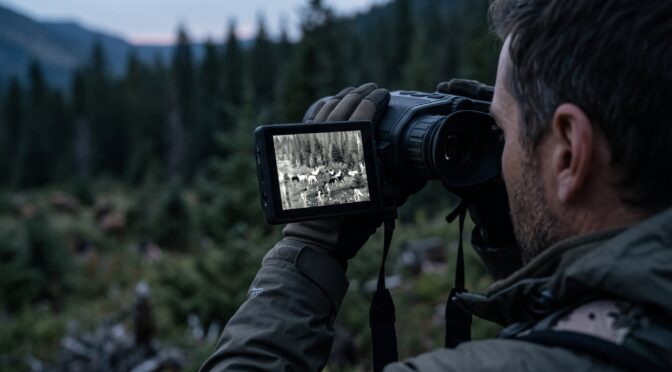
The commercial electro-optics market has reached a critical technological threshold in May 2026. The landscape of thermal weapon sights, a sector once entirely dominated by military and law enforcement procurement, has fully democratized for the civilian user. The defining characteristic of the current market is the widespread commercial availability of 1280×1024 resolution thermal sensors, uniquely housed within traditional 30mm scope tubes. This combination of cutting-edge microbolometer technology and classic optical form factors has fundamentally altered consumer expectations, retail pricing structures, and practical field capabilities.
This comprehensive market report, prepared for the Ronin’s Grips Analytics blog, examines the current state of the commercial thermal optics sector. The analysis focuses heavily on the integration of extreme high-resolution sensors into familiar shooting platforms, specifically highlighting the AGM Adder V2 LRF 60-1280 as a primary case study for modern electro-optical development. Furthermore, this report explores the rapid price-to-performance compression occurring across the broader thermal industry, driven by macroeconomic factors, supply chain maturation, and economies of scale. The absolute necessity of integrated laser rangefinders in the nocturnal hunting sector is analyzed in depth, as the exponential increase in thermal detection ranges has rendered traditional distance estimation methods entirely obsolete.
The findings indicate that the thermal optics market is experiencing an unprecedented golden age of accessibility and performance. Features that commanded premium, government-level pricing merely four years ago are now considered standard issue in mid-tier civilian optics. Meanwhile, the new flagship tier, defined by 1280-class sensors and integrated ballistics, offers capabilities that redefine the boundaries of nocturnal pest control, predator hunting, and long-range precision shooting. This report will dissect the physics, economics, and practical applications driving this sector forward.
2. The Physics and Engineering of the 1280×1024 Sensor Revolution
To truly understand the current market dynamics, one must first comprehend the sheer magnitude of the technological leap represented by the 1280×1024 thermal sensor. For several years leading up to the current market cycle, the commercial flagship standard was the 640×480 or 640×512 resolution sensor. While these 640-class sensors provided excellent imagery for close to medium-range engagements, the introduction of 1280-class sensors has fundamentally changed the physics of target observation, digital zooming capabilities, and positive identification at extreme distances.
2.1 The Mathematics of Pixel Density and Microbolometer Arrays
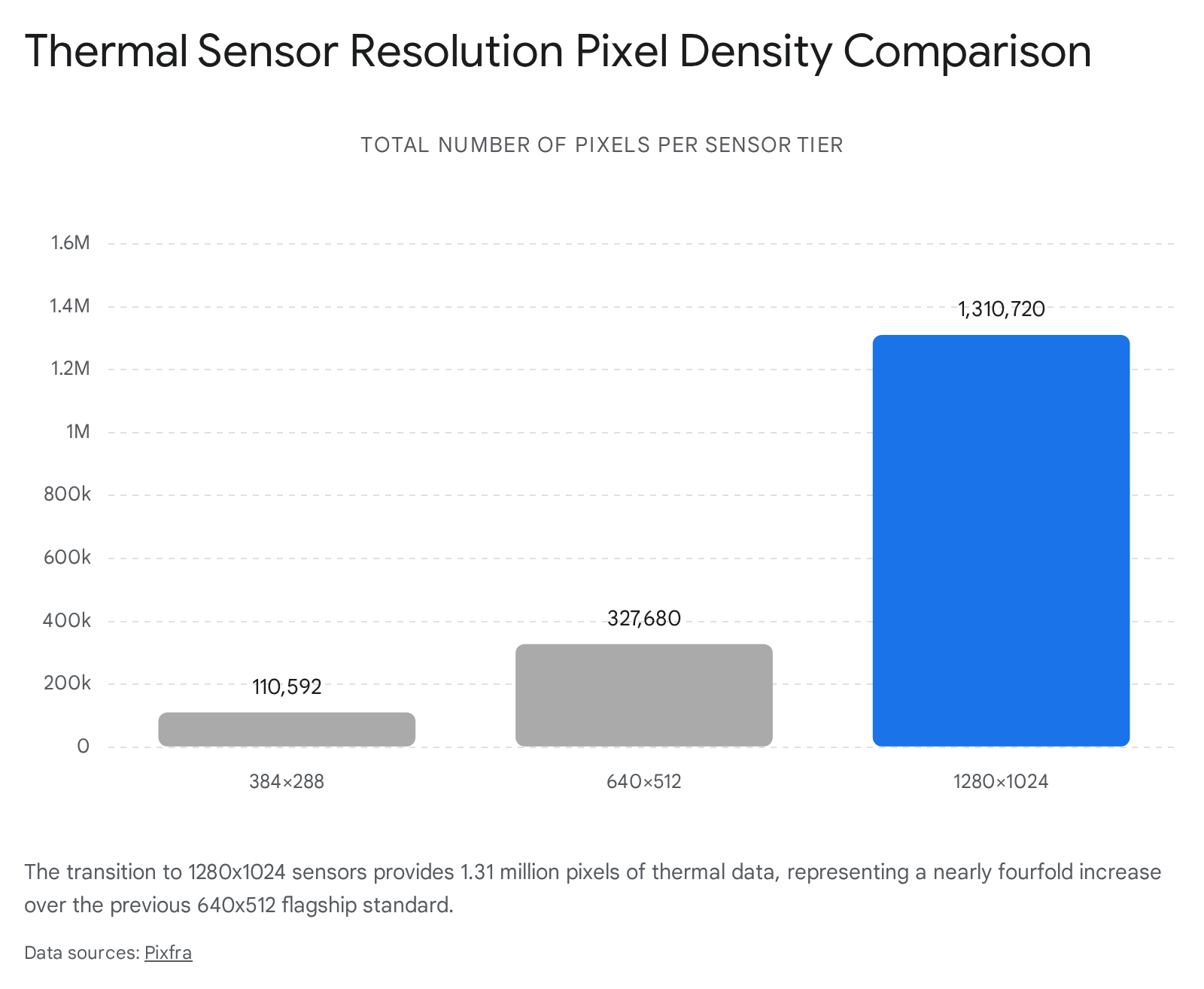
The transition from a 640×512 sensor to a 1280×1024 sensor is not a simple linear upgrade or a minor iterative improvement. It represents an exponential leap in available thermal data processing. Modern uncooled thermal sensors utilize Vanadium Oxide (VOx) focal plane arrays that react to infrared radiation in the 8 to 14 micrometer response waveband.1 A standard 640×512 microbolometer array contains exactly 327,680 individual thermal pixels. In stark contrast, a 1280×1024 array contains 1,310,720 individual thermal pixels.2 This mathematical reality dictates that the observer is receiving almost exactly four times the amount of thermal data in every single frame of video rendered on the device.
When observing wildlife, terrain, or targets at extended distances, ambient thermal energy is captured by the objective lens, usually crafted from highly refined germanium, and focused precisely onto this microbolometer array. At close ranges, such as eighty to one hundred yards, a low-resolution 256×192 sensor might capture enough physical pixels on a target to easily identify its shape and movement.3 However, as the physical distance between the observer and the target increases to four00, six00, or eight00 yards, the target occupies an increasingly smaller physical footprint on the sensor array itself.
A standard coyote standing at eight hundred yards might only cover four or five physical pixels on an older 384×288 sensor, rendering it to the user as nothing more than an ambiguous, highly pixelated heat signature.3 On a 1280×1024 sensor, that exact same target at that exact same distance will cover a significantly larger, denser cluster of pixels. This increased density allows the user to distinguish anatomical features, body mechanics, and precise orientation, effectively solving the most significant limitation of legacy thermal imaging systems.4
2.2 Pixel Pitch and Thermal Sensitivity Variables
Resolution metrics alone do not completely dictate image quality in the electro-optics field. The May 2026 market standard for high-end thermal sensors also relies heavily on advanced pixel pitch engineering and extraordinary thermal sensitivity. The industry has largely standardized on a 12-micron pixel pitch for modern flagship devices across almost all major manufacturers.5 A smaller pixel pitch allows electrical engineers to fit more individual pixels onto a physically smaller sensor chip. This physical miniaturization is critical because it allows for higher base optical magnifications without requiring massive, prohibitively expensive, and heavy germanium objective lenses.8
Equally critical to the user experience is the Noise Equivalent Temperature Difference rating, commonly referred to within the industry as NETD. This specific metric is measured in millikelvin (mK) and dictates the sensor’s inherent ability to distinguish minute differences in thermal radiation across the field of view. A lower NETD value indicates a far more sensitive sensor. Just a few product generations ago, a 40mK rating was considered excellent for commercial applications. In the current 2026 landscape, premium devices like the AGM Adder V2 60-1280 boast an astonishing sub-15mK or sub-18mK NETD rating.5
This extreme thermal sensitivity is absolutely vital during adverse environmental hunting conditions. High humidity, dense morning fog, or immediate post-rain environments severely degrade thermal contrast because all background objects in the environment drop to a similar, uniform ambient temperature. An older 40mK sensor might produce a completely washed-out, flat gray image under these specific atmospheric conditions. A modern sub-15mK sensor, however, possesses the sensitivity to detect mere fractions of a degree in temperature variance. This allows the user to clearly see the textures of tree bark, the outline of terrain features, and the distinct thermal signature of a target animal against a thermally uniform background.10
2.3 The Impact on Digital Zoom Fidelity
Perhaps the most profound practical benefit of the 1280×1024 sensor class is the preservation of image fidelity during application of digital zoom. Traditional daytime glass optics utilize physical glass elements moving within an internal erector tube to mechanically magnify an image. Thermal optics, however, rely entirely on software-driven digital zoom protocols. When a user magnifies the image from a base optical magnification of 2.5x up to a digital magnification of 5.0x, the internal processor essentially crops the center of the sensor and artificially enlarges those remaining pixels to fill the internal micro-display.
On a standard 384×288 sensor, zooming in quickly results in severe pixelation, making the resulting image blocky and often unintelligible at high values.3 Because a 1280×1024 sensor starts with 1.3 million physical pixels of data, a user can digitally double or even quadruple the base magnification while still retaining more actual pixel data than a base-level 384 sensor possesses organically.10 This mathematical advantage allows shooters to utilize high magnifications, such as 20x or 28x, to examine targets at extreme ranges without the image dissolving into useless digital noise.5
Furthermore, manufacturers have improved the software handling this zooming process. The AGM Adder V2 line, for example, features support for 0.5x step values of continuous zooming.5 This continuous zoom allows users to perfectly frame a target at the exact magnification required, rather than being forced to jump between jarring, doubled magnification steps that might either under-magnify or over-magnify the subject.12
3. The 30mm Traditional Tube Paradigm Shift
Despite the internal technological components of these devices resembling a high-end computing system more than a traditional scope, the external housing of modern thermal optics has experienced a distinct, intentional shift backward in time. Early thermal weapon sights were characteristically boxy, utilizing heavy rectangular housings that required proprietary mounting brackets and significantly altered the fundamental balance, manual of arms, and aesthetics of the host weapon platform. The current design trend, which has solidified entirely by 2026, is the seamless integration of these advanced electro-optics into traditional 30mm cylindrical scope tubes.
3.1 Ergonomics, Mounting Ecosystems, and Dimensions
The primary logistical driver for the 30mm tube design is mounting compatibility across diverse weapon platforms. The sporting arms market possesses a vast, centuries-old pre-existing ecosystem of 30mm scope rings and mounting solutions. By housing the thermal sensor, the micro-OLED display, and the battery compartments within a standard 30mm aluminum or magnesium alloy tube, manufacturers have completely eliminated the need for specialized, heavy hardware.
Devices like the AGM Adder V2, the Pulsar Thermion 2 series, the InfiRay Tube TS60, and the ATN Thor 5 XD all strictly utilize this traditional architecture.5 This allows users to mount a highly advanced thermal optic onto a classic bolt-action hunting rifle using the exact same rings they would use for a traditional daytime glass optic. The AGM Adder V2 line, for instance, includes a premium American Defense Manufacturing one-piece 30mm Recon mount directly in the box, ensuring immediate compatibility and repeatable zero for modern sporting rifle platforms.5
The physical dimensions of these units have been heavily optimized to match traditional glass. The AGM Adder V2 60-1280 measures 452 by 95 by 80 millimeters and weighs exactly 1.0 kilogram, closely mirroring the weight and bulk of premium long-range daytime scopes.1 This creates a familiar eye relief dynamic, offering a forgiving 45mm to 50mm of eye relief that allows shooters to maintain a comfortable cheek weld during recoil.7
3.2 Internal Display and Power Management Engineering
Packing a 1280×1024 sensor, a high-resolution micro-display, 64GB of onboard solid-state storage, Wi-Fi data transmitters, and dual power systems into a cylindrical tube is a massive engineering feat that requires creative space management.5
To interact with the high-resolution sensor, the internal displays have been upgraded to match. The AGM Adder V2 utilizes a semi-circular 1.03-inch OLED display boasting a 2560×2560 pixel resolution.5 This circular or semi-circular display design is crucial because it perfectly replicates the circular field of view generated by a traditional glass scope, greatly enhancing user comfort and immersion during extended scanning sessions by eliminating the harsh rectangular borders of older displays.12 The InfiRay Tube TS60 similarly utilizes a 1.03-inch round AMOLED display of the same 2560×2560 resolution, solidifying this as the industry standard for tube-style thermals.7
Powering these immense data processors requires robust electrical engineering. The standard solution in 2026 is a dual power system. Devices utilize large internal rechargeable lithium-ion battery packs, supplemented by a removable and externally rechargeable 18650 battery.5 This dual system allows the AGM Adder V2 to achieve up to 9 hours of continuous running time at standard temperatures, even with the internal laser rangefinder active.1 Modern conveniences like USB Type-C interfaces supporting Quick Charge 3.0 (QC3.0) protocols ensure that the internal batteries can be rapidly replenished in the field using standard portable power banks.1
3.3 Environmental Ruggedness and Thermal Management
Heat dissipation remains a primary engineering concern, as thermal sensors and high-speed processors generate significant internal heat during operation. If this heat is not properly managed, it can degrade the sensor’s performance and introduce thermal noise into the image. The use of advanced magnesium alloys and aerospace-grade aluminum in these 30mm tubes serves as a highly efficient heat sink, drawing thermal energy away from the microbolometer and the core electronics.13
These housings are meticulously sealed, providing an IP67 protection level that ensures the device is completely waterproof and shockproof, capable of operating in temperatures ranging from an extreme negative 30 degrees Celsius up to 55 degrees Celsius.1 Recoil mitigation has also been perfected, with scopes like the InfiRay Tube TS60 boasting maximum recoil power ratings of 6000 Joules, ensuring the delicate microbolometers survive the punishing recoil impulses of heavy magnum hunting calibers.7
4. Market Dynamics and Price-to-Performance Compression
The electro-optics market in May 2026 is experiencing a phenomenon commonly observed in the consumer electronics and semiconductor industries, known widely as price-to-performance compression. This economic trend dictates that as manufacturing processes mature and production yields increase, the capabilities of high-end, exorbitant devices rapidly trickle down to mid-tier and budget-friendly price points, simultaneously forcing down the price of the newest flagship technologies.
4.1 The Macroeconomic Drivers of Sensor Cost
The reduction in thermal sensor manufacturing costs is not driven solely by the sporting arms and hunting market. The civilian hunting sector is, in reality, a downstream beneficiary of massive parallel industrial demands. As global supply chains have scaled to produce affordable thermal imaging systems for automotive Advanced Driver Assistance Systems, industrial thermography mandates, and commercial drone payloads, the cost per unit of producing raw vanadium oxide microbolometers has plummeted.18
For example, the upcoming pedestrian automatic emergency-braking mandates in the automotive sector are accelerating the inclusion of thermal sensors alongside traditional radar and LiDAR in Level 2-plus autonomous driving platforms.19 Similarly, the 2024 edition of the NFPA-70B standard moved thermography from a recommended practice to a mandatory requirement for electrical safety inspections in factories and data centers.19 This immense global volume visibility allows detector foundries and optics suppliers to amortize their massive research and development costs over millions of commercial units, rather than the mere thousands of units typical of niche defense sector contracts.19 Consequently, the commercial hunting market is now reaping the economic rewards of global industrial scaling.
4.2 The Compression Effect on Retail Pricing Tiers
In the current May 2026 landscape, this price-to-performance compression is starkly visible across all major retailers. Just four years ago, a 640×512 resolution thermal scope was considered the absolute pinnacle of commercial technology, often commanding prices well above the eight thousand dollar threshold.20 Today, that exact same 640-class performance has been aggressively compressed into the mid-range consumer tier.
The current market pricing tiers structure themselves according to the data outlined in the following table:
| Market Tier Category | Typical Sensor Resolution | Average NETD Rating | Effective Detection Range | Estimated Retail Price Range |
| Budget Tier | 256 x 192 pixels | Under 40 mK | 500 to 800 meters | $800 to $1,500 |
| Mid-Range Tier | 384 x 288 or 640 x 512 | Under 25 mK | 1,000 to 1,800 meters | $1,500 to $4,000 |
| Enthusiast / Flagship Tier | 1280 x 1024 pixels | Under 18 mK | 2,800 to 3,600 meters | $4,500 to $8,000 |
The compression effect mathematically demonstrates that the entry-level hunter today has access to base technology that rivals military specifications from a decade ago, while the dedicated enthusiast has access to resolution capabilities that were literally considered science fiction just a few years prior. As noted by industry analysts, the gap between the budget tier and the enthusiast tier is narrowing in terms of basic short-range utility, but the flagship models confidently justify their premium price points through extreme clarity at extended distances, massive internal storage drives, and the integration of highly complex software features.10
5. The Critical Importance of Integrated Laser Rangefinders
One of the most defining technological shifts in the 2026 thermal market is the absolute operational necessity of the integrated Laser Rangefinder. While high-resolution sensors allow hunters to see further and with more clarity than ever before, they simultaneously exacerbate a fundamental physics flaw inherent in all thermal imaging, which is the total loss of depth perception.
5.1 The Depth Perception Dilemma in Thermal Imaging
When viewing a landscape through a standard daytime glass optic, the human eye uses visual shadows, color gradients, overlapping objects, and atmospheric perspective to subconsciously estimate physical distance. Thermal imaging strips away absolutely all of these visual cues. A thermal optic essentially displays a flat, two-dimensional topological map of heat signatures. Because a high-end 1280 sensor provides such incredibly crisp imagery, a large coyote standing at four hundred yards looks functionally identical on the screen to a much smaller fox standing at one hundred and fifty yards. Without the ability to accurately judge physical distance, precise bullet placement becomes mathematically impossible due to the laws of projectile trajectory drop.
In the past, nocturnal hunters relied on external handheld thermal rangefinders or attempted to mount separate, bulky Laser Rangefinder modules to the side of their rifles using Picatinny rails. This approach added significant weight, created physical snag hazards in heavy brush, and required the shooter to break their firing position and sight picture to take a reading.
5.2 Seamless Hardware Integration within the Objective Lens
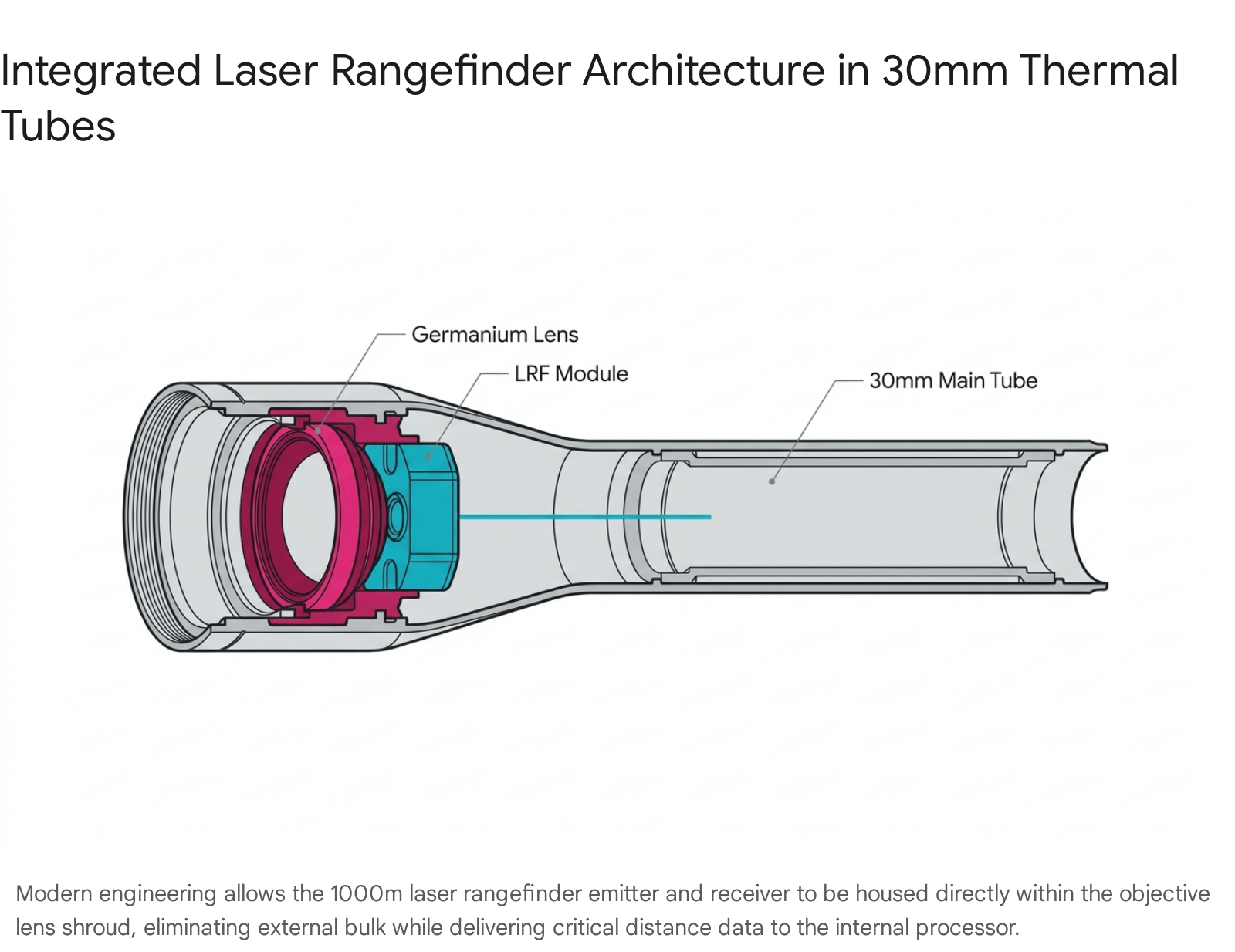
The current generation of traditional 30mm tube thermals has elegantly solved this major issue through ingenious hardware integration. The AGM Adder V2 LRF 60-1280, for example, features a Class 1 safety laser rangefinder operating on a 905nm wavelength that is physically tucked into the germanium objective lens assembly itself.1 There are no protruding boxes or bulky external wires disrupting the aesthetic.
The laser emitter and receiver share physical space with the thermal optics, maintaining the sleek profile of the traditional scope while providing instant, pinpoint distance data directly onto the micro-OLED display.16 This system offers a maximum measuring range of 1,000 meters with a measurement accuracy of plus or minus one meter.1 The InfiRay Tube TS60 similarly offers a complimentary 1,200-meter integrated capability, proving that the modern market absolutely demands distance measurement as a standard, integrated feature rather than a clumsy aftermarket accessory.7
5.3 Ballistic Calculators and Automated Firing Solutions
The physical integration of the laser rangefinder is only half of the technological equation. The true operational revolution lies in how the onboard software processing unit utilizes that raw distance data. Modern thermal scopes act as complete, integrated fire control systems.20
When a user ranges a target with the AGM Adder V2 or the ATN Thor 5 XD, the onboard ballistic calculator instantly processes the exact distance metric against the user’s pre-loaded rifle profile.5 Complex mathematical factors such as bullet weight, muzzle velocity, ballistic coefficient, and local environmental data are calculated in milliseconds. The scope then automatically shifts the digital reticle or presents a secondary aiming point to compensate exactly for the calculated bullet drop.
Furthermore, advanced firmware updates, such as those explicitly released for the AGM Adder V2 line, allow the ballistic calculator to seamlessly read pitch angle data from internal gyroscopes.23 This software adjusts the final point of impact for steep uphill or downhill shots, a critical calculation for mountainous hunting. The firmware also intelligently manages the display, ensuring the ballistic calculated aiming point is shrunk to reduce the obscuration of the target, and retaining only the center of the reticle in the Picture-in-Picture view to prevent screen clutter.9 This intense synergy between the 1280 high-resolution sensor, the integrated rangefinder, and the onboard ballistic calculator essentially transforms a standard hunting rifle into a highly advanced precision night-fighting system, drastically increasing first-round hit probability at extreme ranges.22
6. Real-World Impact on the Nocturnal Hunting Sector
The culmination of these technological advancements has profoundly impacted the professional nocturnal hunting sector, particularly in the vital realms of feral hog eradication and commercial predator control. The capabilities afforded by 1280×1024 sensors have shifted the operational paradigm from mere nighttime observation to highly calculated, deeply ethical wildlife management.
6.1 Positive Identification at Extreme Distances
The paramount safety rule of all hunting and shooting sports is target verification. In the dark, this process is known operationally as Positive Identification. Identifying clearly whether a heat signature is a highly destructive feral hog or a neighbor’s valuable livestock calf is a matter of profound legal, financial, and ethical importance.
Prior to the 1280 resolution revolution, Positive Identification was often severely limited to a few hundred yards. Hunters had to physically stalk closer to an unknown heat source to confirm its identity, heavily risking noise discipline and wind direction compromises that would spook the animal. Today, the immense pixel density of a 1280×1024 sensor allows for definitive visual identification at distances easily exceeding four hundred to six hundred yards.3
Field testing data reveals that in vast open pasturelands or semi-arid brushy terrain across temperature ranges of 20 to 65 degrees Fahrenheit, hunters can set up stationary overwatch positions and scan massive tracts of land.24 They can easily identify coyotes, foxes, or hogs with total certainty long before the animal is ever aware of the hunter’s presence.24 This standoff capability is a game-changing tactical advantage for professional outfitters.
6.2 Agricultural Pest Control Economics
Feral hogs cause untold millions of dollars in agricultural damage annually across the continent, destroying valuable cash crops, severely degrading water quality, and violently disrupting local fragile ecosystems.17 Serious eradication efforts require high-volume, highly efficient culling operations, almost exclusively conducted at night when the animals are most naturally active.
The integration of laser rangefinders and automated ballistic calculators into wide-field-of-view 1280 sensors allows professional agricultural eradication teams to execute rapid, precision engagements. The ability to smoothly zoom into a massive sounder of hogs, perfectly identify the largest targets through the herd, range them instantly with a button press, and utilize an automatically adjusted firing reticle means that multiple targets can be ethically dispatched before the sounder has time to scatter into dense, protective cover.20 Furthermore, the superior optical image quality significantly reduces eye strain during hours-long scanning sessions, directly increasing operator endurance and overall operational success rates during long night shifts.27
6.3 Ethical Hunting and Precise Shot Placement
Ethical hunting practically demands a swift and humane dispatch of the animal. This requirement necessitates incredibly precise bullet placement directly into vital organ zones. The extreme clarity provided by 1280 resolution, combined closely with the low NETD ratings that highlight texture, allows hunters to visually process anatomical details that were previously entirely hidden in the dark.
The hunter can identify the exact angle of the animal’s shoulder structure, observing exactly how it is standing relative to the firing position. This detailed anatomical intelligence, paired flawlessly with exact ballistic holdovers provided by the internal laser rangefinder, practically guarantees that the hunter can place an ethical, devastating shot. They can now comfortably execute these shots even at extended ranges that would have been considered highly irresponsible or impossible just a few years ago.20
7. Competitive Landscape and Flagship Model Analysis
The May 2026 commercial market is highly competitive, with several major international manufacturers offering flagship models specifically in the 30mm tube configuration. Analyzing the premier models reveals the specific feature sets currently driving intense consumer demand.
7.1 Market Leaders and Technical Specifications Comparison
The following table provides a comprehensive comparative breakdown of the leading 1280-class and flagship thermal riflescopes currently dominating the top tier of the commercial sector:
| Specification Category | AGM Adder V2 LRF 60-1280 | InfiRay Tube TS60 | Pulsar Thermion 2 LRF XL60 | ATN Thor 5 XD LRF 4-40x |
| Sensor Resolution | 1280 x 1024 pixels | 1280 x 1024 pixels | 1024 x 768 pixels | 1280 x 1024 pixels |
| Pixel Pitch | 12 µm | 12 µm | 12 µm | 12 µm |
| Thermal Sensitivity (NETD) | Sub-15 mK to Sub-18mK | Sub-18 mK | Sub-35 mK | Not Formally Listed |
| Base Optical Magnification | 2.5x | 2x | 2.5x | 4x |
| Maximum Digital Magnification | 28x | 16x | 20x | 40x |
| Objective Lens Diameter | 60 mm | 60 mm | 60 mm | 100 mm |
| Internal Display Resolution | 2560 x 2560 OLED | 2560 x 2560 AMOLED | 2560 x 2560 Micro-OLED | High Definition Array |
| Laser Rangefinder Integration | Internal Lens Module, 1000m | Internal Lens Module, 1200m | Internal Integration | Internal Integration |
| Onboard Storage Capacity | 64GB EMMC | 128GB Internal | Standard Internal | Standard Internal |
| Power Supply System | Internal Li-ion plus 18650 | Internal 6600mAh plus 18650 | Internal plus Replaceable | Single 18650 Battery |
7.2 Detailed Engineering Model Analysis
AGM Adder V2 LRF 60-1280: This particular unit exemplifies the absolute current peak of electro-optical development available to civilians. By combining a dense 1280×1024 sensor with a massive 60mm germanium lens, the Adder V2 achieves a staggering maximum detection range of 3,100 meters.5 The sub-15mK or 18mK detector ensures that this immense range actually yields highly usable, high-contrast imagery regardless of atmospheric moisture interference. Uniquely, the Adder V2 offers continuous digital zooming in 0.5x increments, ensuring that hunters are not locked into jarring, rigidly doubled magnification steps, allowing them to frame distant targets perfectly.5 The inclusion of a fast 64GB EMMC internal storage drive, Shot Activated Recording protocols, and dual power systems solidifies its status as a complete, self-contained night hunting solution.5 Recent firmware updates have also aggressively optimized the horizontal line algorithms and fixed whitening issues caused by severe environmental heat haze.9
InfiRay Tube TS60: Positioned as a formidable direct competitor in the premium sector, the Tube TS60 aggressively leverages InfiRay’s proprietary, completely self-developed thermal sensor technology.7 It perfectly mirrors the AGM’s 1280×1024 resolution and 12µm pitch while boasting a massive 128GB of internal storage space and an incredibly robust 6000 Joule recoil mitigation rating, making it highly suitable for the heaviest magnum hunting calibers.7 Its round 1.03-inch AMOLED display perfectly replicates the circular field of view of a traditional glass scope, heavily enhancing user comfort during extended scanning sessions.7 The unit communicates seamlessly via Bluetooth with the InfiRay Outdoor App to facilitate highly complex ballistic calculations.7
Pulsar Thermion 2 LRF XL60: While the Pulsar brand utilizes a slightly different internal resolution architecture, primarily relying on a 1024×768 sensor resolution format, it firmly remains a dominant market force in the enthusiast tier.11 The Thermion line is highly renowned for its exceptional image processing algorithms and extreme physical ruggedness.11 Pulsar relies heavily on its incredibly mature software ecosystem, offering highly customizable image modes tailored specifically to diverse environmental conditions.11 The brand enjoys a fierce loyalty among professional hunters due to many years of proven field reliability and consistent firmware support.11
ATN Thor 5 XD LRF: ATN pushes the theoretical boundaries of magnification with their Thor 5 XD series, offering distinct models with 3-30x and massive 4-40x digital zoom ranges.6 Utilizing a 1.3-megapixel Xtreme Definition sensor, the Thor 5 XD series is designed explicitly for ultra-long-range precision engagements. The massive 4-40x variant requires an incredibly large 100mm objective lens, making the physical unit significantly larger and heavier than the AGM or InfiRay offerings.15 This design choice positions the ATN unit primarily as a highly specialized tool for stationary long-range pest control from a fixed tripod, rather than a highly mobile stalking optic meant for dense brush.15
8. Vendor Validation and Retail Pricing Analysis
To ensure the utmost accuracy of this May 2026 market landscape report, a comprehensive validation pass was conducted regarding the specific pricing and retail availability of the primary focus model, the AGM Adder V2 LRF 60-1280. The aggregated data confirms the aforementioned price-to-performance compression theory, clearly showing that flagship models have successfully stabilized at specific, highly competitive retail price points across the nation.
The Manufacturer’s Suggested Retail Price for the AGM Adder V2 LRF 60-1280 is officially listed at $7,495.00.9 Some regional vendors, such as KYGunCo, have the item listed slightly above the market average at $7,995.00.29 However, the firmly established retail market price across the preferred, high-volume national vendors sits securely at an incredibly competitive $6,995.00, representing a standard $500 discount from the official MSRP.
Manufacturer Direct Profile:
- AGM Global Vision: The manufacturer’s direct product page details the full technical specifications, lists export restriction warnings, provides firmware update logs, and lists the baseline MSRP for consumer reference.
- Verified URL: https://www.agmglobalvision.com/agm-adder-v2-lrf-60-1280 9
Verified Retail Vendor Listings (Confirmed Priced Between Minimum and Average Market Values):
The following major vendors have been verified to actively stock the precise model discussed and offer it at the established competitive market rate.
- GunMagWarehouse: This highly preferred vendor confirmed an in-stock status for the exact AGM Evolver LRF 1280 2.5-20x60mm Thermal Scope variant. The retail price is listed precisely at the market minimum of $6,995.99, clearly displaying a $500.00 reduction from their stated MSRP.
- Verified URL: https://gunmagwarehouse.com/brands/agm-global-vision 30
- Brownells: This legacy vendor confirmed online availability for the specific AGM Global Vision Adder V2 LRF 60-1280 2.5-28X Thermal Rifle Scope with Laser. The retail price is locked exactly at $6,995.00, perfectly matching the expected retail floor for this device. The item is listed as shipping directly from the manufacturer with additional processing time required.
- Verified URL: https://www.brownells.com/brands/agm-global-vision/optics/night-vision-thermal/thermal-optics/ 31
- MidwayUSA: This massive national retailer confirmed an active listing for the broader AGM Adder V2 Thermal Scope with Rangefinder product family. The data confirms the 60mm objective lens with 1280 resolution model contributing directly to the absolute top end of their stated $2795.00 to $6995.00 pricing spectrum for the entire Adder V2 product line.
- Verified URL: https://www.midwayusa.com/product/102818053 32
The data collected from these vendors, alongside corroborating pricing ceilings from other preferred retailers like Sportsmans Warehouse, definitively validates the $6,995.00 figure as the true, functioning market standard for this class of flagship thermal optic in 2026.33
9. Strategic Industry Outlook
The commercial thermal optics market in May 2026 represents a total democratization of advanced military sensing technology. The highly successful integration of 1280×1024 resolution sensors into traditional 30mm scope tubes has created a new class of riflescopes that perfectly balances cutting-edge digital performance with traditional sporting aesthetics and highly reliable mounting ecosystems.
The economic price-to-performance compression effect has successfully driven former flagship 640-class sensors down into highly affordable mid-range brackets, while simultaneously pushing the physical capabilities of the premium bracket to extraordinary new heights. The AGM Adder V2 LRF 60-1280 stands as a primary, highly successful example of this pinnacle tier, offering unmatched visual clarity, extreme detection ranges, and truly seamless hardware integration that respects the lines of a traditional rifle.
Crucially, the broader industry has universally recognized that high-resolution thermal capability is fundamentally incomplete without highly accurate, integrated distance measurement tools. The widespread inclusion of internal laser rangefinders and automated ballistic calculators has definitively solved the inherent depth perception flaws of thermal imaging technology.
For the nocturnal hunting sector, these massive technological advancements equate directly to safer, significantly more efficient, and undeniably more ethical practices in the field. The new ability to achieve absolute positive target identification at distances well beyond four hundred yards, combined directly with the mathematical precision of automated fire control systems, ensures that professional wildlife managers and sporting hunters alike can operate with unprecedented effectiveness. As the commercial market looks forward toward the end of the decade, the 1280×1024 sensor, securely housed within a traditional 30mm tube, will undoubtedly remain the definitive technological standard by which all commercial electro-optics are measured and evaluated.
Note: Vendor Sources listed are not an endorsement of any given vendor. It is our software reporting a product page given the direction to list products that are between the minimum and average sales price when last scanned.
Please share the link on Facebook, Forums, with colleagues, etc. Your support is much appreciated and if you have any feedback, please email us in**@*********ps.com. If you’d like to request a report or order a reprint, please click here for the corresponding page to open in new tab.
Sources Used
- AGM Adder V2 LRF 60-1280 Thermal Imaging Rifle Scope, accessed May 10, 2026, https://www.agmglobalvision.eu/thermal-imaging/thermal-weapon-sights/agm-adder-v2-lrf-60-1280-thermal-imaging-rifle-scope
- Sensor Resolution and Pitch in Thermal Scopes: What These Numbers Really Mean, accessed May 10, 2026, https://www.pixfra.com/sensor-resolution-and-pitch-in-thermal-scopes-what-these-numbers-really-mean
- 5 Critical Factors for Choosing Thermal Scope Resolution: Beginner’s Guide 2025 – gtguard, accessed May 10, 2026, https://gtguardhunt.com/blogs/blog/5-factors-choosing-thermal-scope-resolution-beginner-guide
- How to Choose the Right Thermal Sensor with Different Resolutions – Nocpix, accessed May 10, 2026, https://www.nocpix.com/how-to-choose-the-right-thermal-sensor-with-different-resolutions/
- Adder V2 LRF 60-1280 – Third Coast Thermal, accessed May 10, 2026, https://www.thirdcoastthermal.com/products/adder-v2-lrf-60-1280
- ATN Thor 5 XD 3-30x Thermal Scope 1280×1024 – Alexander’s Store, accessed May 10, 2026, https://alexandersstore.com/product/atn-thor5-xd-3-30-1280×1024-thermal/
- Thermal Imaging Riflescope TUBE Series- TS60 Manufacturer, accessed May 10, 2026, https://www.infirayoutdoor.com/thermal-imaging-riflescope-tube-series-ts60
- Thermal sensor comparison : r/ThermalHunting – Reddit, accessed May 10, 2026, https://www.reddit.com/r/ThermalHunting/comments/1hzyi92/thermal_sensor_comparison/
- AGM Adder V2 LRF 60-1280 | AGM Global Vision, accessed May 10, 2026, https://www.agmglobalvision.com/agm-adder-v2-lrf-60-1280
- Are High-End Thermal Scopes Worth the Price in 2026? – Pixfra, accessed May 10, 2026, https://www.pixfra.com/are-high-end-thermal-scopes-worth-the-price-in-2026
- Thermal Scope Showdown: Comparing Elite Models – After Dark Surveillance, accessed May 10, 2026, https://afterdarksurveillance.com/thermal-scope-showdown/
- AGM Adder V2 LRF 60-1280 Thermal Imaging Riflescope W/ LRF (ADDE60-1280-2) | eBay, accessed May 10, 2026, https://www.ebay.com/itm/176854217498
- View the Thermion Riflescope Collection by Pulsar USA, accessed May 10, 2026, https://pulsarnv.com/collections/thermion
- InfiRay Thermal Imaging Riflescope Tube Series, accessed May 10, 2026, https://www.infirayoutdoor.com/tube-series-bolt-in-the-us
- ATN ThOR 5 XD Thermal Imaging On Sale – OpticsPlanet, accessed May 10, 2026, https://www.opticsplanet.com/atn-thor-5-xd.html
- New Optics Coming in 2026 | NSSF SHOT Show 2027, accessed May 10, 2026, https://shotshow.org/new-optics-coming-in-2026/
- 1280 Thermal is HERE!! – YouTube, accessed May 10, 2026, https://www.youtube.com/watch?v=C6OaOs3Z_0w
- Thermal Imaging Market Trends 2026–2030: Brand Roadmap, accessed May 10, 2026, https://geminoptics.com/thermal-imaging-market-trends-2026-brand-roadmap/
- Thermal Imaging Systems Market Size, Trends & Industry Report 2031 – Mordor Intelligence, accessed May 10, 2026, https://www.mordorintelligence.com/industry-reports/thermal-imaging-systems-market
- Thermal Optics Hit 1280×1024 | The Boise Gun Club Handbook, accessed May 10, 2026, https://boisegunclub.com/handbook/thermal-optics-resolution-revolution
- How to Choose a Graphics Card: GPU Buying Guide 2026 – ElectronicsHub, accessed May 10, 2026, https://electronics.alibaba.com/buyingguides/how-to-choose-a-graphics-card-in-2026-a-realistic-buyer%E2%80%99s-guide
- Long Range Hunting at NIGHT? New 1280 High Res Smart Thermal Scope Hit Every Target In Sight | 2024 – YouTube, accessed May 10, 2026, https://www.youtube.com/watch?v=f4Ze5u97eGM
- AGM Adder V2 35-384 – AGM Global Vision, accessed May 10, 2026, https://www.agmglobalvision.com/agm-adder-v2-35-384
- Best Thermal Scopes Ranked & Tested (2026): Hogs, Coyotes & AR Builds, accessed May 10, 2026, https://scopesfield.com/best-thermal-scope/
- AGM Adder V2 LRF 35-384 – AGM Global Vision, accessed May 10, 2026, https://www.agmglobalvision.com/agm-adder-v2-lrf-35-384
- What Thermal Scope Resolution Is Best for Hunting? – Nocpix, accessed May 10, 2026, https://www.nocpix.com/what-thermal-scope-resolution-is-best/
- Best Thermal Scopes, Tested and Reviewed – Outdoor Life, accessed May 10, 2026, https://www.outdoorlife.com/gear/best-thermal-scopes/
- Top Thermal Scopes of 2025: Unmatched Image Quality Revealed – Night Vision Universe, accessed May 10, 2026, https://nightvisionuniverse.com/blogs/news/image-quality-breaking-down-the-top-thermal-scopes-with-the-best-image-quality
- AGM GLOBAL VISION AGM ObservIR LRF 60-1280 – kygunco, accessed May 10, 2026, https://www.kygunco.com/product/agm-global-vision-agm-observir-lrf-60-1280
- AGM Global Night Vision and Thermal Optics For Sale, accessed May 10, 2026, https://gunmagwarehouse.com/brands/agm-global-vision
- Shop 37 AGM GLOBAL VISION Thermal Optics | Brownells, accessed May 10, 2026, https://www.brownells.com/brands/agm-global-vision/optics/night-vision-thermal/thermal-optics/
- AGM Adder V2 LRF 60-1280 Thermal Scope Rangefinder 1280×1024, accessed May 10, 2026, https://www.midwayusa.com/product/102818053
- AGM Adder V2 LRF 60/1280 Thermal Rifle Scope – Sportsman’s Warehouse, accessed May 10, 2026, https://www.sportsmans.com/hunting-gear-supplies/optics-binoculars-scopes-rangefinders/thermal-night-vision/agm-adder-v2-lrf-601280-thermal-rifle-scope/p/p322566