Executive Summary
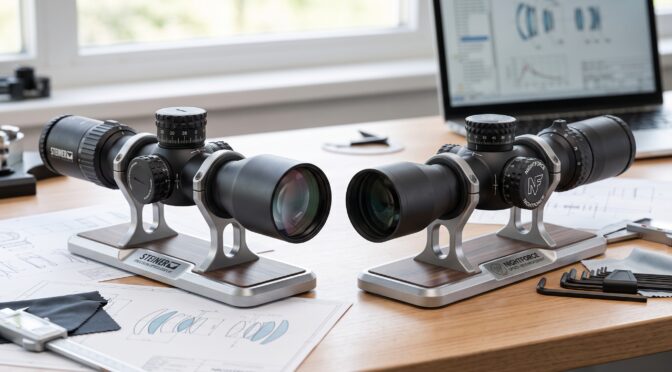
The modern precision rifle optic represents a critical intersection of mechanical engineering, optical physics, and material science. Within the top tier of the tactical optics market, the Steiner M7Xi 4-28×56 and the Nightforce ATACR line, specifically the 5-25×56 and 7-35×56 models, operate as flagship solutions for military personnel, competitive shooters, and long-range enthusiasts. This report provides a detailed, objective comparison of these two optical platforms, focusing on their distinct engineering philosophies and operational capabilities.
The analysis indicates that both manufacturers utilize 34mm main tubes and 56mm objective lenses, establishing a common physical baseline designed to maximize light transmission and internal erector travel. However, the engineering paths driving each platform diverge significantly beyond these core dimensions. The Steiner M7Xi focuses heavily on a wide field of view, extreme magnification ratios featuring a 7x zoom range, and a highly compact overall footprint. This specific geometry is designed specifically to accommodate forward-mounted thermal or night vision clip-on devices, providing a tactical advantage for night operations. Furthermore, Steiner integrates highly tactile mechanical feedback systems and offers advanced augmented reality overlays through their Intelligent Firing Solution variant.
Conversely, the Nightforce ATACR prioritizes mechanical robustness and maximum internal elevation travel. Built with Extra-low Dispersion glass and a highly refined zero stop mechanism, the ATACR is engineered to provide reliability under severe environmental stress. The data suggests that while the Steiner may offer ergonomic advantages in specific tactical setups requiring situational awareness, the Nightforce ATACR retains a definitive edge in total elevation adjustment and historical tracking reliability over long-term deployment. This report will dissect the technical specifications, optical architecture, mechanical tracking systems, consumer sentiment, and market positioning of both optics to provide a rigorous comparative framework.
Optical Architecture and Lens Engineering
The primary function of a rifle scope is the precise transmission, magnification, and manipulation of light. At the highest echelons of optical engineering, this requires complex lens arrays capable of correcting for physical phenomena such as chromatic aberration, spherical distortion, and light loss due to internal reflection. Both Steiner and Nightforce employ highly advanced lens systems, yet their approaches to managing light wavelengths differ fundamentally.
Apochromatic Correction and Light Transmission
Steiner engineers have utilized a highly advanced apochromatically corrected lens system in the M7Xi.1 Standard optical lenses often struggle to focus all wavelengths of visible light at the exact same convergence point. Because different colors of light travel at slightly different speeds through glass, they bend at different angles. This causes color fringing around high-contrast targets, a phenomenon known in optical physics as chromatic aberration. By utilizing apochromatic lenses, which typically combine three separate types of glass bonded together, Steiner drastically reduces this separation. The primary goal of an apochromatic system is to deliver natural color fidelity, ensuring that the target appears exactly as it would to the naked eye, merely magnified.
Furthermore, the M7Xi boasts a tested light transmission rate of 94 percent.1 Achieving a 94 percent transmission rate is exceptionally difficult in a complex zoom erector system containing multiple, thick glass elements. Every surface light passes through reflects a minute amount of that light back, diminishing the brightness of the final image. Steiner achieves this transmission rate through proprietary multi-coating techniques applied to every air-to-glass surface within the main tube, ensuring that operators can identify targets deep into twilight conditions.
Dispersion Mitigation and High-Contrast Resolution
The Nightforce ATACR (Advanced Tactical Riflescope) line approaches optical clarity through the utilization of Extra-low Dispersion glass.2 Extra-low Dispersion glass is specifically formulated with fluorite crystals or similar rare-earth compounds that alter the refractive index of the lens. This chemical composition tightens the convergence of light waves much like an apochromatic system, but it is highly regarded for producing an image with exceptional contrast.
User reports and technical evaluations consistently note that the ATACR exhibits extremely low chromatic aberration, even at its maximum 25x or 35x magnifications.3 The color rendition of the ATACR is often described by observers in the field as slightly more vibrant, contrasting with the strictly neutral color profile of European glass like the Steiner.4 This high-contrast resolution is particularly beneficial in dusty or mirage-heavy environments where a target might otherwise blend into the background terrain. By increasing the perceived contrast, the Nightforce optical path helps the shooter’s eye separate the edges of a steel plate or a camouflaged target from the surrounding foliage.
Magnification Ratios and Field of View Dynamics
The magnification ratio of an optic directly impacts its mechanical complexity and its field of view. The Steiner M7Xi achieves a 7x zoom ratio, spanning from 4x to 28x magnification.5 To accomplish this, the internal erector lenses must travel a significant distance along the main tube axis. A notable advantage of this design is the massive field of view at the lowest magnification setting. At 4x, the M7Xi provides a 9.0-meter view at 100 meters.5 This wide field is a direct operational requirement for military units needing high situational awareness and the ability to scan broad sectors before dialing up the magnification for a precision engagement.6
However, optical physics dictates that extreme zoom ratios often come with compromises at the absolute highest magnifications. Field evaluations and optical testing indicate that the Steiner M7Xi exhibits minor chromatic aberration when pushed beyond 20x magnification.7 While the image remains sharp and entirely usable, slight color separation can occur on the edges of targets in harsh lighting conditions.
The Nightforce ATACR 5-25×56 utilizes a more conservative 5x zoom ratio.9 By restricting the zoom multiplier, Nightforce optical engineers reduce the mechanical complexity of the erector assembly and the extreme curvature required of the internal lenses. This conservative approach yields remarkable optical stability across the entire magnification band. However, the physical dimensions of the ATACR dictate a somewhat narrower field of view at the low end. At 5x, the ATACR provides an 18.7-foot (approximately 5.7-meter) field of view at 100 yards.9
Additionally, these magnification ranges impact the exit pupil of the optic. The exit pupil is the mathematical calculation of the objective lens diameter divided by the magnification setting, representing the physical column of light hitting the shooter’s eye. At 25x, the ATACR has an exit pupil of 2.3 mm.9 At 28x, the Steiner M7Xi drops closer to 2.0 mm.5 Because the human pupil dilates to roughly 7 mm in low light, a 2.0 mm exit pupil creates a restricted eyebox. The shooter must maintain consistent head alignment behind the ocular lens to avoid scope shadow, demanding strict fundamentals from the operator.
Mechanical Systems and Turret Architecture
The mechanical reliability of a precision rifle scope is critically important. If the internal erector tube does not track perfectly in conjunction with the external turret dials, the weapon system simply cannot hit a target at extended distances. The relationship between the external turrets and the internal springs that hold the erector tube in place must be flawless.
Internal Elevation Travel and Main Tube Geometry
Both the Steiner M7Xi and the Nightforce ATACR utilize oversized 34mm main tubes.6 A common misconception is that a larger main tube transmits more light. In reality, the main tube diameter has no bearing on light transmission, which is dictated entirely by the objective lens and glass quality. Rather, a 34mm tube provides a larger internal cavity for the erector tube to pivot within. When a shooter turns the elevation dial, a threaded screw physically pushes down on the erector tube against the tension of internal springs. The larger the main tube, the further the erector tube can travel before hitting the inside wall of the scope chassis.
Nightforce has built its industry reputation on providing massive internal travel for extreme long-range operations. The ATACR 5-25×56 provides a substantial 120 MOA or 35 MRAD of internal elevation travel.2 This adjustment range is essential for ELR shooting disciplines where engaging targets beyond 1500 yards requires massive ballistic compensation, pushing the erector tube to the extreme limits of the internal housing.
The Steiner M7Xi, conversely, is constrained by its own optical configuration. Due to the complex optics required for the 7x zoom range, the internal erector tube is physically thicker, occupying more space within the 34mm main tube. This limits the maximum elevation adjustment to 26 MIL (approximately 89 MOA).6 While 26 MIL is highly capable for standard calibers out to 1200 yards, it falls short of the extreme dialing capabilities of the ATACR. Furthermore, because of this physical constraint, optical technicians explicitly advise that the M7Xi requires a mounting rail with at least 20 MOA of built-in cant to properly zero the optic while leaving enough upward travel for long-range engagements.3
Zero Stop Mechanisms and Sub-Zero Dialing
Modern tactical scopes rely heavily on zero stop mechanisms. A zero stop allows a shooter who has dialed 12 MILs of elevation for a distant target to rapidly spin the turret back down to their 100-yard baseline zero without looking at the dials. The turret will physically stop rotating at the zero mark.
Nightforce employs its proprietary ZeroStop system.10 This system uses a precisely machined clutch mechanism that provides a hard, unyielding mechanical stop at the shooter’s confirmed zero. It ensures that returning from dialed corrections is fast, certain, and repeatable, which is critical in high-stress scenarios or total darkness.
Steiner handles the zero stop differently, offering a more flexible approach. The M7Xi integral zero stop is mechanically tied to the turret housing, and by design, it allows the shooter to dial exactly 0.2 MIL below the hard zero.17 This negative travel capability is highly advantageous for snipers and precision shooters who may need to adjust for a temporary shift in point of impact. Such shifts frequently occur when adding a heavy night vision device to the end of the barrel, or when a suppressor heats up and causes the barrel harmonics to alter the bullet’s flight path. Being able to dial slightly below zero prevents the need to completely loosen the turret caps and re-zero the rifle in the field.
Haptic Feedback and Revolution Indicators
Mechanically, the Steiner M7Xi provides robust haptic feedback. The turrets are frequently described by operators as possessing distinct tactile definition, producing crisp clicks that are easily felt through heavy tactical gloves.3 The elevation turret is very low profile, preventing snagging on gear or obstructing the view over the optic.12 Additionally, the Steiner features a mechanical second-rotation indicator that physically pops up from the top of the elevation turret.1 This provides both visual and tactile confirmation that the shooter has passed the first revolution of adjustment, eliminating the error of being one full rotation off on elevation.
The Nightforce ATACR turrets, while functionally flawless, are often described as traditionally utilitarian. They offer tactile, precise clicks at 0.1 MRAD or 0.250 MOA intervals, but lack modern haptic features like More Tactile Clicks at whole mil marks.13 Furthermore, the ATACR lacks a physical, pop-up turn indicator. Instead, the shooter must rely on painted lines exposed underneath the turret cap as it rises on its threads during rotation.13 While reliable, this requires visual confirmation, which can be difficult under night vision or in total darkness.
Technical Specifications
The foundational capabilities of any rifle optic are dictated by its physical geometry and electrical architecture. The table below outlines the core objective data for the Steiner M7Xi 4-28×56 and the Nightforce ATACR 5-25×56 F1.
| Specification Metric | Steiner M7Xi 4-28×56 | Nightforce ATACR 5-25×56 F1 |
| Magnification Range | 4x to 28x (7x Zoom Ratio) | 5x to 25x (5x Zoom Ratio) |
| Objective Lens Diameter | 56 mm | 56 mm |
| Tube Diameter (Footprint) | 34 mm | 34 mm |
| Focal Plane | First Focal Plane (FFP) | First Focal Plane (FFP) |
| Overall Length | 15.2 inches (386 mm) | 15.4 inches (390 mm) |
| Weight | 33.5 oz (950 g) | 37.6 oz (1066 g) |
| Field of View at 100m/yd | 9.0 to 1.42 meters at 100m | 18.7 to 4.9 feet at 100yd |
| Eye Relief | 3.54 inches (90 mm) | 3.50 inches (90 mm) |
| Exit Pupil | 10.4 mm to 3.3 mm | 8.3 mm to 2.3 mm |
| Max Elevation Adjustment | 26 MIL | 120 MOA / 35 MRAD |
| Max Windage Adjustment | 6 MIL (approx. 20.6 MOA) | 80 MOA / 23 MRAD |
| Click Value | 0.1 MRAD | 0.250 MOA or 0.1 MRAD |
| Parallax Adjustment | 50 meters to infinity | 45 yards to infinity |
| Housing Material | Aircraft-grade Aluminum | Aircraft-grade Aluminum |
| Illumination Power | CR2032 Battery | CR2032 Battery (DigIllum) |
| Battery Life | 11 brightness settings (5 day, 6 night) | 29 hours (Max) to 140 hours (Min) |
| Reticle Options | MSR, MSR2, G2B, TReMoR3 | MOAR, MIL-R, MIL-C, MIL-XT, Tremor3, MOA-XT |
| Environmental Sealing | Waterproof to 20 meters (66 ft) | Waterproof, Fogproof, Nitrogen Purged |
| Operating Temperature | -40 F to +147 F (-40 C to +64 C) | Extreme temperature tested |
The data parsed from this table highlights the specific physical compromises made by each engineering team. The ATACR weighs significantly more at 37.6 ounces, reflecting Nightforce’s reliance on thicker aluminum housing walls for ultimate durability.2 The Steiner is lighter at 33.5 ounces and physically shorter by a fraction of an inch, supporting its primary directive as a tactical tool designed not to encumber an already heavy military rifle platform.1
Regarding illumination, both optics utilize a standard CR2032 battery.1 However, Nightforce employs its DigIllum digital illumination system. This system offers smooth, precise brightness adjustments and allows the user to toggle between red and green illumination. Green illumination is often perceived more easily by the human eye in daylight conditions, whereas red preserves natural night vision. The DigIllum system operates for approximately 29 hours on its maximum setting and up to 140 hours on the lowest setting, featuring an automatic shutoff function after one hour of inactivity to preserve power during prolonged field operations.18 Steiner utilizes a straightforward 11-step brightness system (5 day settings, 6 night settings).
Quality, Durability, and Failure Analysis
The operational environment for precision riflescopes involves extreme physical abuse. These optics are subjected to heavy, repetitive recoil impulses, rapid temperature fluctuations that cause internal gasses to expand and contract, and direct physical impacts from being dropped or slammed into barricades. Therefore, environmental sealing and shock resistance are paramount.
Environmental Sealing and Shock Resistance
Steiner leans heavily on its military heritage to build ruggedized optics. The M7Xi is encased in a single-piece, aircraft-grade aluminum tube. It boasts an operating temperature range from a freezing -40 degrees Celsius up to +64 degrees Celsius (-40 F to +147 F).1 The internal optical array is nitrogen purged, a process that removes all atmospheric moisture from the tube and replaces it with inert gas, rendering the lenses entirely fog-proof regardless of external humidity or temperature swings. Furthermore, the chassis is sealed tightly enough to withstand complete submersion up to 20 meters (66 feet).1 To guarantee recoil immunity, Steiner explicitly tests the M7Xi on shock-testing machines to withstand impacts of up to 900 Gs of force.1 This ensures that the delicate internal erector springs and lens retaining rings do not shift or fracture under the violent recoil of a large caliber rifle or during a physical drop onto concrete.
The Nightforce ATACR series is similarly sealed and purged, but it is widely regarded as an industry benchmark for structural durability in the precision rifle space.14 The housing features exceptionally thick aircraft-grade aluminum walls, which contributes directly to its heavy weight.2 Nightforce subjects their optics to rigorous factory testing, including side-impact tests that simulate dropping a weapon directly onto the elevation turret.
Electronic Integration and Point of Failure Vulnerabilities
When evaluating failure rates, the purely mechanical versions of both the M7Xi and the ATACR demonstrate exceptionally high reliability. However, a stark divergence in durability occurs with Steiner’s electronic integration. Steiner produces a specific variant known as the M7Xi IFS (Intelligent Firing Solution). This ambitious optic integrates an onboard ballistic computer, environmental sensors, and a digital display overlay directly within the shooter’s field of view.
While theoretically advantageous, reports from the field and user evaluations indicate that the advanced electronics in the IFS model suffer from considerably higher failure rates.6 The harsh recoil environment of a large caliber rifle is notoriously destructive to circuit boards and delicate wiring. Some users note that the electronic overlays can cease functioning entirely, forcing the optic back to the manufacturer for repair, even while the traditional mechanical tracking continues to work flawlessly.6 Because of this vulnerability, many professional operators choose the purely mechanical M7Xi to eliminate electronic points of failure.
Manufacturer Testing Protocols and Warranty Support
Documented mechanical failure rates for the Nightforce ATACR line are extraordinarily low. In comparative mechanical performance evaluations of high-end tactical scopes, the ATACR routinely finishes in the top tier for tracking accuracy and return-to-zero reliability.19 When isolated tracking issues do occur, the manufacturer’s technical support subjects the optic to rigorous baseline testing. If no fault is found during factory calibration, the company communicates directly with the customer. This meticulous process occasionally results in disputes when field failures cannot be replicated on factory test benches, leading to mild friction on community forums.20 However, the overwhelming consensus across competitive and military spheres is that an ATACR failure is a statistical anomaly, and their warranty support is robust and highly responsive.3
Pros and Cons
To distill the engineering data into actionable intelligence, the following operational advantages and mechanical limitations apply directly to each optical platform.
Steiner M7Xi 4-28×56
- Tactile Feedback: Features highly defined, audible click mechanics and a physical pop-up rotation indicator for absolute adjustment certainty in low-light conditions.1
- Compact Architecture: The short overall length (15.2 inches) provides vital rail space forward of the optic for the integration of clip-on thermal or night vision devices.1
- Situational Awareness: A massive field of view (9.0m at 100m on 4x) combined with low-profile turrets allows the operator to maintain broad sector control and easily mount top-mounted micro red dots without line-of-sight obstruction.1
- Zero Stop Flexibility: The integral zero stop design permits dialing 0.2 MIL below zero, compensating for environmental or equipment-induced zero shifts in the field.17
- Limited Internal Travel: With only 26 MIL of total elevation travel, it is far less suited for extreme long-range calibers without the use of aggressive canted bases, requiring a 20 MOA base minimum for proper zeroing.6
- Optical Artifacts at Maximum Zoom: Minor chromatic aberration and color separation are documented when pushing the optic past 20x magnification, slightly degrading the image quality compared to its peers.7
- Ergonomic Idiosyncrasies: The parallax knob is noted for excessive stiffness straight from the factory.3
Nightforce ATACR 5-25×56 F1
- Massive Elevation Travel: Offering 35 MRAD (120 MOA) of vertical adjustment, it easily accommodates the ballistic arcs of the heaviest ELR cartridges.2
- Optical Stability: The implementation of ED glass and a conservative 5x erector ratio effectively minimizes chromatic aberration across the entire magnification spectrum, providing extreme contrast.3
- Absolute Durability: Documented as structurally robust with highly resistant zero-shift engineering, securing its position as a primary optic for precision applications.19
- DigIllum Technology: A highly efficient electronic illumination system offering variable brightness, red and green toggles, and up to 140 hours of battery life with automatic shutoff protocols.
- Weight Penalty: Weighing in at 37.6 oz, it adds significant mass to the rifle system compared to European alternatives, which can fatigue operators on long movements.2
- Basic Turret Interface: Lacks modern haptic features such as physical rotation indicators, relying instead on painted lines that are hard to see in the dark.13
- Restricted Field of View: The lower end of the magnification (5x) provides a narrower field of view compared to 4x competitors, slightly hindering rapid target acquisition in dynamic, close-in scenarios.9
Use Cases and Ideal Applications
Given the high price points and specialized engineering of these optics, their deployment is strictly purpose-driven. Neither scope is designed for casual applications; they are built for specific operational domains.
Extreme Long Range and Heavy Caliber Engagements
For engagements extending beyond 1500 yards utilizing massive cartridges like the.375 CheyTac,.416 Barrett, or the.338 Lapua Magnum, the Nightforce ATACR is functionally superior. The physics of ultra-long-range trajectories require massive elevation dialed into the scope. Because gravity pulls the heavy bullet down significantly over a two-mile flight path, the optic must point significantly downward relative to the barrel. The ATACR 5-25×56 provides 35 MRAD of travel 2, allowing a shooter to dial the crosshair directly onto a target at extreme distances without having to hold the crosshair high off the target using the reticle grid. The Steiner, maxing out at 26 MILs 6, forces the shooter to rely heavily on optical holdovers much sooner, which can introduce aiming errors at extreme ranges.
Precision Rifle Series and Competitive Barricade Shooting
Competitive shooters require optics that track perfectly, offer complex holdover reticles like the Tremor3 or MIL-XT, and feature forgiving eyeboxes for shooting from awkward barricades and unsteady positions. Both scopes excel here, but the ATACR generally sees higher adoption rates in civilian competition. The ATACR’s tracking reliability provides competitors with confidence that a 5 MIL dial will exactly correspond to a 5 MIL point of impact shift. Furthermore, the wide availability of competition-specific reticles like the MIL-C and MIL-XT gives shooters the precise wind-hold dots they need. The Steiner, while popular, offers fewer competition-centric reticle options, though the MSR2 reticle, designed by FinnAccuracy, remains highly regarded for providing distinct milling brackets for rapid target sizing.6
Military Sniper and Night Vision Integration
The Steiner M7Xi is uniquely tailored for dynamic combat environments and tactical deployment. Its short overall length of 15.2 inches is an explicit design choice intended to preserve rail space in front of the optic.1 Military snipers frequently operate at night using large clip-on thermal imagers or inline image intensifiers mounted directly to the rifle chassis. A long scope physically interferes with these devices or requires the night vision unit to hang precariously off the front of the rail. The Steiner provides ample room for secure mounting.1 Additionally, its low-profile turrets ensure the shooter’s field of view over the scope is unobstructed, facilitating rapid situational awareness and allowing for the seamless integration of secondary micro red dot sights for close-quarters emergencies.1
Customer Sentiment and Community Feedback
Analysis of data aggregated from dedicated long-range shooting forums, social media, and retail reviews reveals distinct user profiles and strong opinions for each brand. The civilian long-range community meticulously tests their equipment.
Ergonomic Idiosyncrasies and Operator Retraining
Steiner M7Xi users consistently praise the tactile feel of the scope. The turrets receive universal acclaim for their distinct, audible clicks, which are highly valued by shooters operating under time constraints or physical stress.3 The massive field of view is frequently cited as a major advantage during target acquisition phases.7 However, mechanical idiosyncrasies frustrate some users. The stiff parallax adjustment ring and the fact that the magnification ring rotates clockwise to zoom in (the opposite of the industry standard established by Leupold and Nightforce) require targeted operator retraining to build new muscle memory.3
Optical Perception and the Chromatic Aberration Debate
The optics community heavily scrutinizes the chromatic aberration visible in the Steiner above 20x magnification.7 While acknowledging that the scope is highly functional, buyers expect optimal performance at this tier. This slight color fringing is a frequent point of contention.7 Conversely, a subset of users prefers the visual aesthetics of the neutral European glass in the Steiner, noting that the Nightforce ATACR prioritizes high-contrast resolution over natural color fidelity, which can look slightly artificial under certain lighting conditions.4
Tracking Reliability as the Primary Value Driver
Nightforce ATACR owners frequently describe the optic as “boring” in the most complimentary way possible.3 Users emphasize that the optic simply works, without drama, optical quirks, or mechanical failure. When criticisms arise against the Nightforce, they are generally directed at the lack of modern, quality-of-life features on the turrets, such as the missing MTC clicks or the lack of a pop-up rotation indicator.13 In the context of the top-tier optic market, the ATACR is viewed as the rugged, utilitarian workhorse that sacrifices slight optical refinement for long-term reliability.3
Price Analysis and Value Proposition
The acquisition of top-tier optics represents a significant financial investment, often surpassing the cost of the rifle itself. The retail landscape demonstrates that both optics occupy the highest echelons of consumer pricing, though subtle differences exist in their secondary market retention and feature-to-cost ratios.
Current market listings place the Nightforce ATACR 5-25×56 in the range of $3,300 to $3,550, depending on the chosen reticle and active promotional discounts.2 The larger ATACR 7-35×56 commands an additional premium, generally retailing around $3,800.11 The true value proposition of the ATACR lies in its depreciation curve. Due to its reputation for durability and the backing of military contracts, the ATACR retains a high percentage of its retail value on the secondary market. Buyers consider it a lifetime asset that will survive multiple rifle barrel replacements and hard field use.
The Steiner M7Xi commands an initial MSRP typically ranging from $3,559 to $4,599 for standard reticles like the Tremor 3 or MSR2. However, the pricing dynamic for Steiner is more volatile. Refurbished models or discontinued colorways occasionally appear on the retail market at steep discounts, sometimes falling as low as $2,900. The value proposition for the Steiner is rooted in its highly specialized feature set. The buyer is paying a premium for the engineering of a 7x zoom ratio, apochromatic German glass, and mechanical turret indicators. However, due to the recognized chromatic aberration characteristics at high magnification 7 and the niche application of the optic compared to general-purpose long-range scopes, the Steiner generally experiences a sharper depreciation curve on the secondary civilian market compared to the Nightforce.
Ultimately, the cost-to-performance ratio dictates that the Nightforce ATACR provides a safer, more utilitarian investment for the long-range practitioner demanding absolute reliability. The Steiner M7Xi justifies its premium price tag only for specialized operators who specifically require a compact footprint for night vision integration, combined with the maximum possible field of view for dynamic engagements.
Active Market Listings
The following list represents current, active listings for the specific models evaluated in this report across approved vendors:
- (https://www.brownells.com/optics/scopes/rifle-scopes/atacr-5-25x56mm-f1-ffp-illuminated-rifle-scope/?sku=524000502) 2
- (https://www.primaryarms.com/nightforce-atacr-f1-7-35x56mm-ffp-rifle-scope-mil-r-reticle) 11
- (https://www.sportsmans.com/hunting-gear-supplies/optics-binoculars-scopes-rangefinders/rifle-scopes-red-dots/steiner-m7xi-4-28x-56mm-rifle-scope-tremor-t3/p/1768379) 21
- (https://www.midwayusa.com/product/2268185987)
- (https://www.midwayusa.com/product/1027221760) 22
Appendix
This evaluative framework was constructed by synthesizing quantitative manufacturer specifications with qualitative performance data. Objective parameters, including dimensional measurements, internal adjustment ranges, focal plane configurations, exit pupil calculations, and optical glass formulations, were extracted directly from official product documentation and authorized retail listings. To assess real-world performance, durability, and mechanical tracking accuracy, data was aggregated from active long-range competitive communities, independent optical testing databases, and verifiable retail reviews. Claims regarding chromatic aberration, tactile turret feedback, and electronic failure rates were cross-referenced against multiple user reports to ensure validity and isolate widespread engineering traits from isolated manufacturing defects. Market pricing was established by querying active inventories across prominent tactical firearms and optics distributors to construct an accurate representation of current financial access barriers and secondary market retention. All links, battery life calculations, and prices reflect active data sets at the time of compilation.
Note: Vendor Sources listed are not an endorsement of any given vendor. It is our software reporting a product page given the direction to list products that are between the minimum and average sales price when last scanned.
Please share the link on Facebook, Forums, with colleagues, etc. Your support is much appreciated and if you have any feedback, please email us in**@*********ps.com. If you’d like to request a report or order a reprint, please click here for the corresponding page to open in new tab.
Sources Used
- Steiner M7Xi 4-28×56 with MSR2 reticle COMPREHENSIVE REVIEW – YouTube, accessed July 4, 2026, https://www.youtube.com/watch?v=R9OktKbSgAI
- NIGHTFORCE ATACR 5-25x56mm F1 FFP Illuminated MIL-XT …, accessed July 4, 2026, https://www.brownells.com/optics/scopes/rifle-scopes/atacr-5-25x56mm-f1-ffp-illuminated-rifle-scope/?sku=524000502
- Anyone have experience with this optic? How does it compare to say a Nightforce ATACR 4-20? : r/longrange – Reddit, accessed July 4, 2026, https://www.reddit.com/r/longrange/comments/101o3d1/anyone_have_experience_with_this_optic_how_does/
- If money were NO issue, what is the BEST(best glass, best reticle choice, best turrets, best durability) long range tactical rifle scope money can buy right now? I’ve posted pics of some of the (considered)top ones like: S&B PMII, NF ATACR, March FX Tactical, Leica PRS – Reddit, accessed July 4, 2026, https://www.reddit.com/r/longrange/comments/rrh411/if_money_were_no_issue_what_is_the_bestbest_glass/
- M7Xi 4-28×56 / G2B Mil-Dot | No IFS – STEINER, accessed July 4, 2026, https://www.steiner.de/en/m7xi-4-28×56-g2b-mil-dot/8719000101
- M7Xi 4-28×56 | Steiner High-Quality Optics, accessed July 4, 2026, https://www.steiner-optics.com/products/m7xi-4-28×56
- Steiner / Bushnell Scopes? : r/longrange – Reddit, accessed July 4, 2026, https://www.reddit.com/r/longrange/comments/wtk3fy/steiner_bushnell_scopes/
- Building a new PRS rig, stuck on glass selection, ZCO vs Steiner? : r/longrange – Reddit, accessed July 4, 2026, https://www.reddit.com/r/longrange/comments/ydlrgq/building_a_new_prs_rig_stuck_on_glass_selection/
- Nightforce ATACR F1 5-25×56 MOA-XT – Sport Optics, accessed July 4, 2026, https://www.sportoptics.com/nightforce-rifle-scopes-atacr-5-25×56-moa-xt-c648.html
- ATACR – 5-25x56mm F1 – Nightforce Optics, accessed July 4, 2026, https://www.nightforceoptics.com/riflescopes/atacr/atacr-5-25×56-f1
- Nightforce ATACR F1 7-35x56mm FFP Rifle Scope – Mil-R Reticle, accessed July 4, 2026, https://www.primaryarms.com/nightforce-atacr-f1-7-35x56mm-ffp-rifle-scope-mil-r-reticle
- Steiner M7Xi 4-28x56mm Scope Review – Guns and Ammo, accessed July 4, 2026, https://www.gunsandammo.com/editorial/steiner-m7xi-428x56mm-review/368615
- Top 15 Tactical MIL/MIL rifle scopes for extreme long range 2018 – Riflescope Warehouse, accessed July 4, 2026, https://www.riflescopewarehouse.com/top-15-tactical-mil-mil-rifle-scopes-for-extreme-long-range-2018/
- Nightforce ATACR Zero Stop F1 7-35x56mm Rifle Scope – MOAR – Sportsman’s Warehouse, accessed July 4, 2026, https://www.sportsmans.com/hunting-gear-supplies/optics-binoculars-scopes-rangefinders/rifle-scopes-red-dots/nightforce-atacr-zero-stop-f1-7-35x56mm-rifle-scope/p/1490919
- Help deciding on long range scope : r/longrange – Reddit, accessed July 4, 2026, https://www.reddit.com/r/longrange/comments/1hztm9x/help_deciding_on_long_range_scope/
- ATACR – 5-25x56mm – Nightforce Optics, accessed July 4, 2026, https://www.nightforceoptics.com/riflescopes/atacr/atacr-5-25×56-f2
- Adjusting Steiner 5-25 Military Scope – YouTube, accessed July 4, 2026, https://www.youtube.com/watch?v=olhS3WazNYQ
- Nightforce Digillum Illuminated Reticle Demo Video – Long Range Only, accessed July 4, 2026, https://www.longrangeonly.com/forum/threads/nightforce-digillum-illuminated-reticle-demo-video.1698/
- Tactical Scopes: Mechanical Performance Summary – PrecisionRifleBlog.com, accessed July 4, 2026, https://precisionrifleblog.com/2014/09/01/tactical-scopes-mechanical-performance-summary/
- NightForce Response to Possible Scope Issues – Shooters’ Forum, accessed July 4, 2026, https://forum.accurateshooter.com/threads/nightforce-response-to-possible-scope-issues.3930324/
- Steiner M7Xi 4-28x 56mm Rifle Scope – Tremor T3 – Sportsman’s Warehouse, accessed July 4, 2026, https://www.sportsmans.com/hunting-gear-supplies/optics-binoculars-scopes-rangefinders/rifle-scopes-red-dots/steiner-m7xi-4-28x-56mm-rifle-scope-tremor-t3/p/1768379
- Steiner M7xXi Rifle Scope 34mm Tube 4-28x 56mm Illuminated MSR2 – MidwayUSA, accessed July 4, 2026, https://www.midwayusa.com/product/1027221760