
Executive Summary and Analytical Framework
This intelligence estimate provides a comprehensive assessment of the Russian Federation’s systemic weaknesses as of the third quarter of 2026. Rather than focusing solely on public political statements, this analysis examines the deep structural cracks within the Russian government, its war economy, its defense industry, and its society.
Overall Fragility Score: 8.2 / 10.0
The Russian Federation receives a fragility score of 8.2, reflecting a severely compromised government. Key features include weak institutional resilience, highly centralized decision-making, and deep economic imbalances that are unsustainable over the medium to long term. Although the state can still enforce compliance at home and gather forces on the battlefield, its core foundations remain vulnerable to combined internal and external shocks.
Lifecycle Stage Assessment: Crisis
The Russian state has officially moved from a “Stressed” stage into a systemic “Crisis” stage. In this phase, the government is sacrificing its long-term stability to meet immediate, short-term survival needs. Core reserves, including financial wealth funds, Soviet-era military stockpiles, and skilled workers, are being depleted faster than they can be replaced.
Core Drivers of Fragility The first main driver is the breakdown of the broader economy. The shift to a wartime economy has created a heavy dependence on defense spending that is crowding out private industry, creating severe labor shortages, and forcing the government to spend down its sovereign wealth reserves1. The second driver is the weakening of official institutions and public governance. Replacing formal institutions with personal patronage networks has removed checks and balances, creating major single points of failure at the top of the federal government and within key regions, particularly the North Caucasus4. The third driver is logistical and infrastructure decay. The trade shift toward Asian markets, combined with shortages of foreign components due to sanctions, has weakened major state enterprises like Russian Railways, cutting off essential routes for the civilian economy and military supply lines7. The final driver is social and demographic strain. A declining birth rate, combined with battlefield losses and high emigration, has caused a lasting labor shortage that limits both military recruitment and industrial production10.
1. Military and Security Architecture
Russia’s military and security structure is under intense strain from a prolonged conflict. Although the military has shown an ability to adapt tactically and field large numbers of troops, its underlying structure suffers from internal divisions, major industrial bottlenecks, and rigid command chains that struggle on a modern, highly monitored battlefield.
1.1 The State Monopoly on Violence and Elite Fragmentation
The state’s exclusive control over force has significantly eroded. The government’s reliance on irregular forces, private security groups, and competing state agencies has created a divided security system designed more to protect the political leadership than to operate efficiently14.
Following the 2023 mutiny by the Wagner Group, the Kremlin launched a broad cleanup of the Ministry of Defense14. Led by the Federal Security Service (FSB), specifically its Military Counterintelligence Department, this campaign led to the arrest of several top generals and defense officials on charges including bribery and official misconduct14. While presented publicly as an anti-corruption effort, it reflects a push by intelligence agencies to reassert control over a military leadership that had gained political influence through large wartime budgets. This internal friction weakens trust between intelligence agencies and military commanders, leading to isolated operations and a hesitancy among officers to take initiative out of fear of investigation. Relations between civilian and military leaders are further complicated by influential pro-war commentators who openly criticize military leadership, weakening the standing of defense officials among regime supporters14.
At the same time, the National Guard (Rosgvardia), headed by Viktor Zolotov, has expanded its role. Originally formed as an internal security and riot control force, Rosgvardia has increasingly taken on heavy military hardware, including tanks and artillery18. In the summer of 2026, Rosgvardia units were stationed at gas stations in the Moscow region to manage unrest over fuel shortages, highlighting the leadership’s reliance on internal security forces to address public discontent20. Expanding Rosgvardia into a heavily armed internal force indicates that the regime expects further domestic instability, which further divides unified military command.
1.2 Defense Industrial Base Bottlenecks and Capability Attrition
Russia’s defense industry has shifted to full wartime production to replace heavy battlefield losses. However, output relies heavily on refurbishing older Soviet-era equipment and accessing foreign supply chains rather than building new, advanced hardware. This lack of modern manufacturing capability was visible during the scaled-back Zapad 2025 military exercises, which focused on smaller, lower-visibility operations to conserve resources for active combat21.
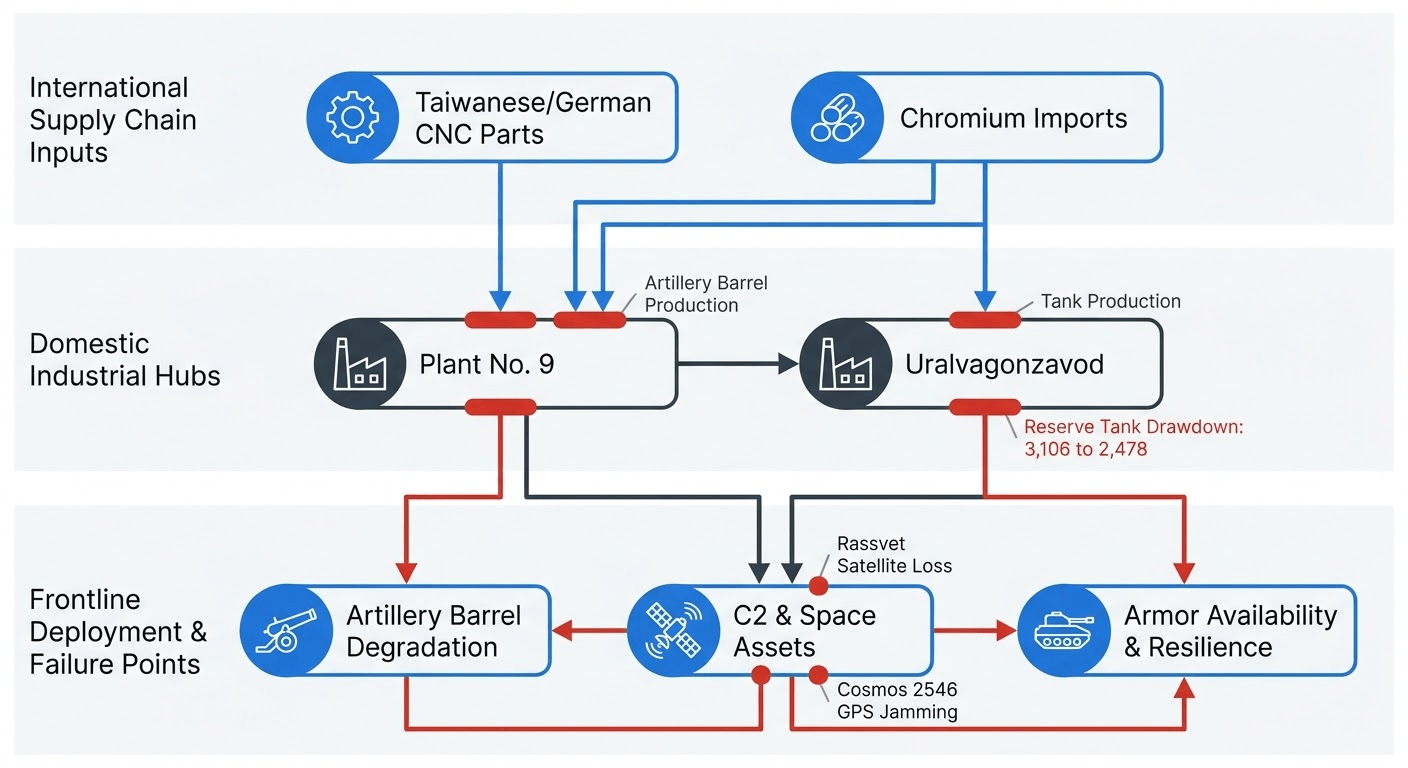
In armored vehicle production, facilities such as Uralvagonzavod (UVZ) have increased production of T-90M tanks. Internal documents from UVZ show plans to increase T-90 production by 80 percent by 2028 compared to 2024 levels, targeting a total of 428 T-90M and T-90M2 tanks in 2028, and 1,118 new or updated tanks between 2027 and 202922. Current estimates indicate UVZ builds 230 to 250 T-90Ms annually, along with updated T-72B3M models24. Meanwhile, older T-72 and T-80 tanks are being retrieved from storage facilities and updated at sites like Omsktransmash with defensive systems and electronic countermeasures to protect against drone attacks25.
Satellite imagery shows that storage sites are emptying quickly. Reserves of usable tanks fell from 3,106 to 2,478 over a few months in mid-2025, with viable T-72A hulls dropping from 900 to 46123. Independent estimates suggest Russia has lost more than 11,000 tanks and 24,000 armored vehicles since February 2022, putting it on track to exhaust recoverable Soviet-era reserves by late 2026 or early 202727. Once these older hulls are gone, factories lack the capacity to manufacture new chassis fast enough to replace combat losses. To offset these shortages, the Ministry of Defense has expanded production of unmanned aerial systems, producing up to 19,000 small attack drones per day28.
Artillery production faces similar limits. Estonian intelligence estimates Russian factories produced around seven million artillery, mortar, tank, and rocket rounds in 202529. While this supports daily firing rates of 10,000 to 15,000 rounds, replacing worn artillery barrels remains a critical bottleneck29. Continuous firing wears out barrels quickly, causing loss of accuracy and structural failures after 2,000 to 6,000 rounds30. The primary manufacturer, Plant No. 9 in Yekaterinburg, has expanded production, but relies heavily on imported precision machinery from European and Taiwanese suppliers31. Procurement records show the acquisition of specialized milling, grinding, and turning equipment that is subject to Western trade restrictions31. Russia also depends on imported chromium from Kazakhstan and South Africa to coat barrel interiors, adding another vulnerability to the supply chain30.
In the aerospace sector, Russia’s position in global titanium production through state manufacturer VSMPO-AVISMA is declining. Although Western companies initially avoided sanctioning Russian titanium to protect their supply chains, many have shifted to other suppliers. VSMPO’s annual raw titanium production has dropped from 32,000 metric tons before the war to roughly 17,000 metric tons in 202633. Major aerospace companies like Boeing have stopped purchasing Russian titanium, while Airbus has reduced its share from 60 percent to around 20 percent34. Lower export revenue reduces the funding available to support domestic aircraft and missile manufacturing.
1.3 Sensor-to-Shooter Networks and C2 Vulnerabilities
Russia’s military command structure struggles in modern combat conditions, where battlefield activity is easily detected. The widespread use of reconnaissance drones and real-time surveillance has reduced the time between identifying a target and firing on it from hours to minutes36.
Ukrainian forces have adopted decentralized, networked combat systems, using artificial intelligence and field data to strike targets within minutes37. In contrast, Russian forces remain constrained by a rigid, top-down hierarchy. Because local initiative is rarely encouraged, target authorization often moves slowly through multiple command levels, delaying strikes and missing opportunities39.
Due to high losses among junior officers and experienced leaders, Russian forces struggle to coordinate complex maneuvers and have turned to drone-heavy attrition tactics40. Reliance on remote control systems leaves command posts vulnerable to signal jamming and targeted strikes.
Military communications in space show similar signs of strain. The failure of Russia’s satellite constellation, intended to provide satellite internet for military communications, became clear in mid-2026 when its initial satellite failed to reach its planned orbit and re-entered the atmosphere41. To offset ground communication issues, military operators have used early-warning missile detection satellites to transmit signal-jamming frequencies across parts of Europe42. Re-purposing strategic space assets in this manner reduces their main effectiveness and highlights vulnerabilities in military satellite support.
2. Political and Governance Systems
Russia’s political leadership relies on a centralized system that has replaced institutional checks with a tight chain of command4. While this structure enables fast decision-making at the top, it creates significant long-term vulnerability. Without independent courts, an active legislature, or open media to absorb public dissatisfaction, local problems can quickly become challenges to the leadership’s authority.
2.1 Hyper-Centralization and Institutional Paralysis
Decision-making remains focused in the Executive Office and among a small group of security officials5. This setup limits the independence of local and regional bodies. Professional competence is often valued less than political loyalty, making it difficult to address complex local issues. When problems arise, such as heating failures or economic stress, regional leaders frequently lack the resources and authority to act independently, waiting instead for directions from Moscow.
The political system lacks a formal process for leadership transition. Power sits with competing factions whose influence depends directly on their standing with the president. In the event of a sudden change at the top, there is no established constitutional mechanism to manage the transition smoothly. External geopolitical pressure further stresses this structure, prompting tighter domestic controls and increased caution within government ranks.
2.2 Internal Fault Lines: The Chechen Succession Risk
A major point of instability in the country lies in the North Caucasus, particularly in the Republic of Chechnya. For two decades, federal authorities have maintained stability in the region by providing substantial funding (officially around 121 billion rubles in 2024) and wide operational freedom to regional leader Ramzan Kadyrov44. Kadyrov built a tightly controlled local government, commanding security forces that answer directly to him outside standard military lines45.
Intelligence reports indicate Kadyrov’s health has declined due to serious medical issues, including severe kidney and pancreatic conditions that require regular treatment44. His eventual replacement creates a significant challenge for regional stability. Kadyrov has promoted his sons to government posts, including 20-year-old Akhmat as Acting Deputy Prime Minister and 18-year-old Adam48. However, they remain below the legal age requirement of 30 for the regional presidency and lack the standing needed to command support among regional security groups.
| Chechen Succession Candidates | Current Affiliation / Role | Strengths and Kremlin Viability |
| Akhmat Kadyrov | Acting Deputy PM (Age 20) | Family heir; protects family leadership. Below the legal age limit and lacks government experience. |
| Adam Delimkhanov | State Duma Deputy | Strong connections to federal security agencies; active in Moscow. Positioned as a potential interim leader. |
| Magomed Daudov | Prime Minister of Chechnya | Deeply embedded in the regional bureaucratic and security apparatus. Viable candidate for internal stability. |
| Apti Alaudinov | Cmdr. of Akhmat Special Forces | Military standing from service in Ukraine; strong background aligned with federal priorities. |
Transferring authority in a region organized around family and group ties presents clear risks. Unrest in Chechnya would immediately affect security across southern Russia. If regional security forces fracture into competing groups, federal authorities might need to redirect military personnel from other areas to maintain control, potentially reopening broader regional instability6.
2.3 Regional Fiscal Strangulation and State Capacity
Beyond Moscow, regional administration is under growing strain. Federal demands to fund military priorities have shifted social spending burdens onto local governments. By 2026, the combined deficit for regional and municipal budgets reached 1.5 trillion rubles, five times higher than in 2024, with forecasts suggesting it could rise to 1.9 trillion rubles50.
Regional administrations are taking on significant debt to maintain public utilities and services while tax revenues flow toward central priorities. Reduced local funding strains public services, increasing the likelihood of discontent when municipal systems experience failures. As central support decreases, public expectations in outer regions become harder to meet, worsening regional disparities.
3. Economy and Infrastructure
The domestic economy has maintained surface-level stability through heavy state spending and increased military manufacturing. However, this growth relies on deficit spending that is difficult to sustain over time. Financial reserves are decreasing, public infrastructure is aging, and access to international trade remains constrained.
3.1 Exhaustion of Macroeconomic Buffers and Defense Spending
Government financial reserves are under increasing pressure. Defense spending reached 10.7 trillion rubles ($125 billion) in the first half of 2026, accounting for roughly 44 percent of the federal budget and 10.5 percent of GDP over that timeframe2. Total defense spending for 2025 reached an estimated 15.5 to 16 trillion rubles, a substantial increase compared to 2021 levels3. Defense expenditures now exceed 9 percent of annual GDP, a higher share than during the war in Afghanistan27. At the same time, oil and gas revenues dropped 34 percent year-over-year in late 2025, adding further fiscal strain27.
To fund this staggering outlay, the state has ruthlessly drained the National Wealth Fund (NWF)—Russia’s primary sovereign wealth reserve.
| Macroeconomic Indicator | Pre-War Baseline (2021/Early 2022) | Current Assessment (2025/2026) | Trajectory Impact |
| NWF Liquid Assets | ~$113.5 Billion | ~$37.4 Billion to $51.6 Billion | Over 66% decline; reduced capacity to handle financial shocks56. |
| Federal Defense Spending | ~3.1 to 4.9 Trillion Rubles | 15.5 to 16 Trillion Rubles | Accounts for ~44% of federal budget; limits resources for private industry2. |
| CBR Key Interest Rate | ~4.25% to 8.5% | 21% (Peak), currently 14% | High borrowing costs create challenges for non-military businesses59. |
To meet budget shortfalls, the Ministry of Finance has drawn heavily on the National Wealth Fund, selling portioned gold reserves. Fund holdings dropped by 57 percent, falling from 405.7 metric tons to 173.1 metric tons57. Domestic bond sales have also faced headwinds, as commercial banks demand higher interest yields to offset risk and liquidity pressures62.
The Central Bank of Russia, led by Elvira Nabiullina, faces balancing inflation against political pressures. To control rising prices, the Central Bank raised interest rates to 21 percent59. Official annual inflation is reported around 6 to 7 percent, though price increases for daily household goods and medicines are estimated much higher by consumer groups66. High interest rates increased borrowing costs for commercial businesses, leading to calls from corporate leaders for relief and a subsequent rate reduction to 14 percent60. Managing interest rates under heavy political input risks further price instability.
3.2 Collapse of Logistics and Critical Infrastructure
Transportation systems rely heavily on state rail operator Russian Railways (RZD) to move goods and military materials. Freight volumes handled by RZD dropped nearly 7 percent (60 million metric tons) during the first nine months of 2025, with overall volume down 13 percent by early 2026 compared to 2021 levels7.
Rerouting trade toward Asian partners has put heavy strain on Eastern transit routes. Key lines, including the Trans-Siberian Railway, face capacity limits of around 180 million metric tons and struggle to manage the increased cargo volume7.
International trade restrictions have affected rail maintenance. Shortages of imported bearings, electronic assemblies, and replacement engine parts have slowed average freight movement to 36–40 km/h, leaving large numbers of train cars parked9. High prices for industrial diesel fuel have raised operating costs, adding to regional shipping delays68. At the same time, staff recruitment challenges have contributed to rising operating debt for RZD, estimated between 3.3 and 4 trillion rubles ($44 billion)7. Given the military’s reliance on rail logistics, ongoing transport delays directly affect frontline supply schedules.
3.3 Resource Sector Vulnerabilities and Energy Volatility
Energy export earnings remain a primary source of state revenue, but face ongoing trade limits. Unflagged and non-standard oil tankers used to move crude exports have encountered increased scrutiny. European regulations have targeted over 105 associated vessels, restricted maritime registrations, and limited Western marine insurance coverage required for global transport69.
Natural gas sales have fallen significantly following reduced pipeline exports to Europe. State energy firm Gazprom reported an annual net loss of $6.8 billion in 202373. Plans to redirect gas exports through the proposed “Power of Siberia 2” pipeline to China remain stalled over pricing negotiations and financing arrangements, leaving a large share of export capacity unused73.
4. People and Social Cohesion
The unspoken agreement of the post-2000 era, where citizens accepted limited political involvement in exchange for personal stability and steady income growth, has been disrupted. The population faces lower living standards, deteriorating municipal services, and ongoing demographic decline.
4.1 Demographic Implosion and Labor Shortages
The country faces a long-term population decline that impacts future economic activity. In early 2025, monthly birth figures reached their lowest recorded levels in decades13. The national fertility rate dropped to 1.37 births per woman, marking ten consecutive years of decline12. Several regions experienced sharp drops in birth numbers, including Smolensk and Leningrad Oblast13. Official population data collection has been delayed, with national census publications postponed until 202913.
Demographic pressures are intensified by battlefield casualties and working-age men leaving the country10. By early 2026, total military casualties (killed, severely injured, and missing) were estimated to exceed 1.2 million66. Monthly recruitment figures struggle to match casualties, leading authorities to offer high sign-on bonuses and debt relief packages to attract enlistees without issuing a formal mobilization order78. At the same time, medical and support expenses for injured personnel have led to reallocations within social welfare funds, affecting broader public assistance programs66.
The shrinking labor force has created a nationwide shortage of workers. Labor Ministry forecasts estimate a deficit of 11 million workers by 203011. These workforce constraints affect civilian industries and limit the growth of defense manufacturing, as factories face ongoing shortages of skilled technicians and engineers11.
4.2 Communal Infrastructure and Social Fissures
Reallocating public funds away from local maintenance toward defense priorities has accelerated the wear of urban infrastructure. During recent winter seasons, heating and power grid failures caused widespread outages in several regions, including areas near Moscow79.
Service interruptions highlight differences between rural areas, which supply a large share of military enlistees, and major urban centers. While public tolerance for economic difficulty remains relatively high, persistent disruptions to heating, water, and fuel supply often lead to localized community complaints20. In response to potential public unrest, legislative proposals introduced in mid-2026 expand the authority of emergency response personnel to maintain order during municipal disruptions20. Public opinion surveys indicate that over 60 percent of citizens favor diplomatic negotiations to end the war81.
Synthesis and Advanced Analysis
Cascading Failure Vectors
In a systems-dynamic analysis, fragility is determined by the likelihood of cascading failures across interconnected domains. In the Russian context, these vectors operate in a distinct sequence:
- Macroeconomic to Industrial: High interest rates set by the Central Bank to curb inflation have raised borrowing costs across non-military sectors59. Restricted access to credit slows maintenance for civilian infrastructure, particularly the national rail network67.
- Industrial to Logistical: Lower freight movement and fuel cost increases create bottlenecks across transport routes37. Raw materials face shipping delays, slowing delivery of manufactured goods to end users.
- Logistical to Military: Delays in equipment production and transport constraints lead military units to rely more on infantry operations and drone strikes22. This tactical shift leads to higher casualty rates among frontline personnel.
- Military to Social to Political: High casualty rates exacerbate labor shortages, while infrastructure disruptions affect local communities10. To maintain public order, authorities rely increasingly on internal security forces, expanding their role in domestic governance20.
Shock Simulation
Scenario: A sudden leadership transition in Chechnya occurring alongside significant depletion of liquid sovereign wealth reserves.
In the event of Ramzan Kadyrov’s departure from office, competing regional factions and security leaders would likely seek control45. Historically, federal authorities maintained stability through direct subsidies. However, with lower reserve levels and tight federal budgets58, central authorities would have fewer financial resources to support a new leadership structure. Without consistent funding, regional security groups could turn to unofficial local revenue sources. With military forces committed elsewhere, federal authorities would face challenges managing local security crises, potentially prompting greater administrative decentralization in peripheral regions.
Early Warning Indicators (EWIs)
Intelligence analysts should monitor the following measurable data points over the next 12 to 18 months to determine if systemic decay is accelerating:
- Government Bond Auction Unsold Rates: Cancellation or failure of multiple consecutive government bond sales due to low bank demand, reflecting hesitation to absorb government debt62.
- Central Bank Rate Reductions: Unscheduled reductions in the central interest rate despite elevated inflation, signaling that policy decisions are being guided by short-term industry demands60.
- Internal Security Redeployments: Movement of specialized internal security forces away from active combat zones toward major cities or regional capitals to maintain order20.
- Major Infrastructure Disruptions: Extended winter heating or power grid failures in major cities lasting more than 72 hours, triggering public discontent79.
- Freight Transit Restrictions: Directives limiting commercial freight movement along main rail corridors to prioritize military cargo transport67.
Five-Year Trajectory Forecast (2026–2031)
Core Outlook: By 2031, the Russian Federation is unlikely to experience a sudden central government collapse. Instead, the state will likely undergo a gradual decentralization of authority.
The central government in Moscow will have fewer resources to project authority across all regions. The combination of lower financial reserves, labor shortages, and depleted equipment reserves means the state will operate with reduced capacity compared to 2021.
To manage regional needs, central authorities may delegate additional responsibilities to local governors, state corporations, and regional security heads. Moscow will likely retain primary control over strategic priorities, including nuclear defense capabilities and core resource revenues, while local leadership handles routine administration and regional economic management. Although Russia will remain an active international actor capable of applying diplomatic and cyber pressure, its capacity to maintain long-term conventional military operations will remain constrained for years to come.
Please share the link on Facebook, Forums, with colleagues, etc. Your support is much appreciated and if you have any feedback, please email us in**@*********ps.com. If you’d like to request a report or order a reprint, please click here for the corresponding page to open in new tab.
Sources Used
- Russia’s Sanctions Have Failed, but Buffers Are Wearing Thin – IIF, https://www.iif.com/LinkClick.aspx?fileticket=7sDfzSW8jV8%3D&portalid&_cldee=W6aw5qh_539ZOgmNeHM8xJ2YenvgMF4xU79HWAR5UjY&recipientid=contact-c8c50ae1e6f0e81180d102bfc0a80172-5867fb9b3c164636bb54eaf8af44054d&utm_source=ClickDimensions&utm_medium=email&utm_campaign=Press%20Emails&esid=6341bea4-356e-f011-bec2-7ced8d1cd64f
- Russia Spends Record $125 Billion on Military in First Half of 2026, https://united24media.com/war-in-ukraine/russia-spends-record-125-billion-on-military-in-first-half-of-2026-nearly-44-of-federal-budget-22422
- Military Spending in Russia’s Budget for 2026 | SIPRI, https://www.sipri.org/publications/2026/sipri-insights-peace-and-security/budget-fifth-year-war-military-spending-russias-budget-2026
- The Power Vertical Under Siege: Repressions, Nationalizations, and, https://ridl.io/the-power-vertical-under-siege-repressions-nationalizations-and-the-erosion-of-loyalty-guarantees/
- Russia Country Report 2026 – Bti-project.org, https://bti-project.org/en/reports/country-report/RUS
- The Kadyrov question: Who rules Chechnya next? – Atlantic Council, https://www.atlanticcouncil.org/content-series/russia-tomorrow/the-kadyrov-question-who-rules-chechnya-next/
- True State of Russian Economy Revealed by Collapsing Railway, https://united24media.com/latest-news/true-state-of-russian-economy-revealed-by-collapsing-railway-cargo-data-18266
- Russia’s rail freight collapse exposes a deeper industrial crisis, https://theins.press/en/economics/286555
- The Crisis of Russian Railroads Amid Sanctions and War: 2022-2025, https://defense.info/highlight-of-the-week/the-crisis-of-russian-railroads-amid-sanctions-and-war-2022-2025/
- Russia weaponises traditional family values to boost its ‘catastrophic, https://www.independent.co.uk/news/world/europe/russia-population-birth-rate-war-marriage-b3010382.html
- Russia’s population crisis is so dire, it’s staring down a labor, https://africa.businessinsider.com/politics/russias-population-crisis-is-so-dire-its-staring-down-a-labor-shortage-of-11-million/gzlf1t2
- Demographics of Russia – Wikipedia, https://en.wikipedia.org/wiki/Demographics_of_Russia
- Russia’s Demographic Collapse – YouTube, https://www.youtube.com/shorts/LIKvIhVBI6Q
- (PDF) Wartime Russian Civil-Military Relations: Dimensions, https://www.researchgate.net/publication/388724429_Wartime_Russian_Civil-Military_Relations_Dimensions_Tensions_and_Disruptions
- Purges in the Russian Ministry of Defense in 2024 – Wikipedia, https://en.wikipedia.org/wiki/Purges_in_the_Russian_Ministry_of_Defense_in_2024
- FSB Launches Sweeping Purge of Military Elites With Kremlin’s, https://www.themoscowtimes.com/2024/05/24/fsb-launches-sweeping-purge-of-military-elites-with-kremlins-approval-a85213
- Anatomy of a purge: Cleanup at the Ministry of Defense and the, https://russian-election-monitor.org/anatomy-of-a-purge-cleanup-at-the-ministry-of-defense-and-the-future-of-putinism/
- Russian Offensive Campaign Assessment, Sept. 11, 2026 | ISW, https://understandingwar.org/research/russia-ukraine/russian-offensive-campaign-assessment-september-11-2026/
- Russian Offensive Campaign Assessment, September 19, 2026, https://understandingwar.org/research/russia-ukraine/russian-offensive-campaign-assessment-september-19-2026/
- Russian Offensive Campaign Assessment, August 19, 2026 | ISW, https://understandingwar.org/research/russia-ukraine/russian-offensive-campaign-assessment-august-19-2026/
- Wartime Zapad 2025 Exercise: Russia’s Strategic Adaptation and, https://www.rusi.org/explore-our-research/publications/commentary/wartime-zapad-2025-exercise-russias-strategic-adaptation-and-nato
- Russia Ramps Up Tank Production Amid NATO Tensions, https://evrimagaci.org/gpt/russia-ramps-up-tank-production-amid-nato-tensions-509149
- Institute for the Study of War: Russia to step up tank refurbishment, https://bcfausa.org/institute-for-the-study-of-war-russia-to-step-up-tank-refurbishment-and-production/
- Production Volume of T-90M Tanks at Uralvagonzavod Announced, https://www1.ru/en/news/2026/04/12/nazvan-obieem-proizvodstva-tankov-t-90m-na-uralvagonzavode.html
- [Analysis] T-90M, T-80BVM: Russian tank production undergoing, https://meta-defense.fr/en/2025/11/18/t-90m-t-80bvm-production-russie-evolut/
- Russian Army Receives new T-90M and T-72B3M Tanks with Latest, https://militarywatchmagazine.com/article/russian-army-t90m-t72b3m-tanks
- Russia 2026: Economic Crisis and Military Overextension, https://blog.roninsgrips.com/russia-2026-economic-crisis-and-military-overextension-compared-to-the-ussr-collapse/
- SITREP Russia – Week Ending March 14, 2026 – Ronin’s Grips, https://blog.roninsgrips.com/sitrep-russia-week-ending-march-14-2026/
- The Industrial Window of War: How to Measure Russia’s Munitions, https://mwi.westpoint.edu/the-industrial-window-of-war-how-to-measure-russias-munitions-throughput-and-how-to-disrupt-it/
- Artillery Barrel Production in russia: Structure, Importance, and Weak, https://en.defence-ua.com/industries/artillery_barrel_production_in_russia_structure_importance_and_weak_points-12151.html
- Russia upgrades artillery plant with European machinery, https://defence-blog.com/russia-upgrades-artillery-plant-with-european-machinery/
- Russia Expanded the Production of Artillery Barrels at Plant No. 9, https://militarnyi.com/en/news/russia-expanded-the-production-of-artillery-barrels-at-plant-no-9-thanks-to-european-machine-tools/
- VSMPO-AVISMA – Wikipedia, https://en.wikipedia.org/wiki/VSMPO-AVISMA
- Calls growing for tougher sanctions on Russia’s titanium trade, https://www.eureporter.co/world/ukraine/2025/09/16/calls-growing-for-tougher-sanctions-on-russias-titanium-trade/
- Pressure for Sanctions on Russian Titanium – EU Political Report, https://eupoliticalreport.com/pressure-for-sanctions-on-russian-titanium/
- An Analysis of the 2024 Kursk Campaign of the Russo-Ukrainian War, https://www.militaryhistoryonline.com/modern/kurskcampaign2024
- How Low-Cost Drones Are Rewriting Tactical Warfare in Ukraine, https://www.researchgate.net/publication/414389649_Flying_Cheap_Hitting_Hard_How_Low-Cost_Drones_Are_Rewriting_Tactical_Warfare_in_Ukraine
- Human-AI Teaming Under Fire: Lessons from Ukraineâ, https://digitalcommons.usf.edu/cgi/viewcontent.cgi?article=2583&context=jss
- Mosaic Warfare In Ukraine – The Defence Horizon Journal, https://tdhj.org/blog/post/mosaic-warfare-ukraine/
- The Drone Paradox and Institutional Decay in Modern Conflict – Debug, https://debuglies.com/2026/02/06/the-drone-paradox-and-institutional-decay-in-modern-conflict/
- Russia’s answer to Starlink just lost its first satellite – The Defence Blog, https://defence-blog.com/russias-answer-to-starlink-just-lost-its-first-satellite/
- Mystery GPS outages traced to Russian satellite – Defense One, https://www.defenseone.com/threats/2026/06/mystery-gps-outages-russian-satellite/414110/
- Russian Military Interventions after the Cold War – OAPEN Library, https://library.oapen.org/bitstream/20.500.12657/117439/1/9781040571767.pdf
- Ukrainian Intelligence Claims Chechen Leader Was Hospitalized, https://www.fdd.org/analysis/2026/01/14/ukrainian-intelligence-claims-chechen-leader-was-hospitalized-creating-risk-of-destabilizing-succession/
- More than life at stake: the uncertain future of the Kadyrov regime in, https://www.osw.waw.pl/en/publikacje/osw-commentary/2026-03-19/more-life-stake-uncertain-future-kadyrov-regime-chechnya
- Moscow and Grozny Reportedly Draft Chechnya Succession Plans, https://united24media.com/latest-news/moscow-and-grozny-reportedly-draft-chechnya-succession-plans-amid-kadyrov-health-problems-15291
- Caucasus Geopolitical Risk 2026 – SpecialEurasia, https://www.specialeurasia.com/2026/01/16/caucasus-geopolitical-risk-2026/
- Ramzan Kadyrov: The Kremlin’s Messenger to the Islamic World, https://my.rusi.org/resource/ramzan-kadyrov-the-kremlins-messenger-to-the-islamic-world.html
- The Twilight of the Kadyrov Era: Chechnya’s Leader is on the Brink, https://blogs.timesofisrael.com/the-twilight-of-the-kadyrov-era-chechnyas-leader-is-on-the-brink-of-death/
- Russian regions sink deeper into budget crisis after record deficits, https://english.nv.ua/business/russian-regions-sink-deeper-into-budget-crisis-after-record-deficits-50603465.html
- No place to hide a deficit – Riddle Russia, https://ridl.io/no-place-to-hide-a-deficit/
- Russian regions plan record budget deficit of 1.9 trillion roubles, https://www.thebarentsobserver.com/news/russian-regions-plan-record-budget-deficit-of-19-trillion-roubles/449729
- Joint Disclosure | BND – Bundesnachrichtendienst, https://www.bnd.bund.de/EN/Public-Intelligence/joint-disclosure/2026-02-04-military-expences-russia-node.html
- Claim in January 2026: “Russia’s total military spending in 2025 has, https://www.russiamatters.org/node/41725
- Putin’s Power Struggle: The 2026 Dilemma – Ronin’s Grips, https://blog.roninsgrips.com/putins-power-struggle-the-2026-dilemma/
- Russian National Wealth Fund – Wikipedia, https://en.wikipedia.org/wiki/Russian_National_Wealth_Fund
- Russia’s central bank forced to sell gold reserves to cover budget, https://www.kitco.com/news/article/2025-11-28/russias-central-bank-forced-sell-gold-reserves-cover-budget-support-ruble
- Russia’s reserves decrease threefold, but potential to finance war, https://www.pravda.com.ua/eng/news/2025/06/27/7519033/
- Russia Interest Rate – Trading Economics, https://tradingeconomics.com/russia/interest-rate
- Russian central bank head under pressure to slash key interest rate, https://kyivindependent.com/russian-central-bank-head-under-pressure-to-slash-key-interest-rate-bloomberg-reports/
- Russia’s central bank cuts interest rates to 14% – BNN Bloomberg, https://www.bnnbloomberg.ca/business/international/2026/07/24/russias-central-bank-gingerly-cuts-rates-caught-between-business-complaints-and-inflation/
- Russian Ministry of Finance fails state bond auction for the third time, https://unn.ua/en/news/russian-ministry-of-finance-fails-state-bond-auction-for-the-third-time-in-a-month-due-to-lack-of-buyers-intelligence
- Russia Halts OFZ Auctions as Rate Outlook Uncertain – Briefs Finance, https://www.briefs.co/news/russia-halts-ofz-auctions-as-rate-outlook-uncertain/
- Russia Halts Bond Auctions as Government Debt Selloff … – Reddit, https://www.reddit.com/r/UkrainianConflict/comments/1vbq7io/russia_halts_bond_auctions_as_government_debt/
- Putin forces Central Bank to cut key rate – Bloomberg, https://www.pravda.com.ua/eng/news/2026/08/06/8047583/
- Russia’s Military Attrition: A Deep Dive into Casualties – Ronin’s Grips, https://blog.roninsgrips.com/russias-military-attrition-a-deep-dive-into-casualties/
- Russian Rail Freight Challenges and Global Supply Chain Risks, https://www.inboundlogistics.com/articles/rusting-russian-rail-link/
- russia’s Railways, Backbone of Its War Logistics, Are Sliding Into Crisis, https://en.defence-ua.com/industries/russias_railways_backbone_of_its_war_logistics_are_sliding_into_crisis-19334.html
- The European Union has approved its 21st sanctions package, https://www.facebook.com/anewztv/posts/the-european-union-has-approved-its-21st-sanctions-package-against-russia-expand/122194384532397875/
- The threats posed by the global shadow fleet—and how to stop it, https://www.atlanticcouncil.org/in-depth-research-reports/report/the-threats-posed-by-the-global-shadow-fleet-and-how-to-stop-it/
- No.1 2025/26 – EU adopts 16th Sanctions Package against Russia, https://www.westpandi.com/News-and-Resources/Notice-To-Members/2025-2026/no-1-2025-26-eu-adopts-16th-sanctions-package-agai/
- The US is taking action against Russia’s shadow fleet. In the Baltic, https://www.atlanticcouncil.org/dispatches/the-us-is-taking-action-against-russias-shadow-fleet-in-the-baltic-sea-europe-should-follow-suit/
- The Future of the Power of Siberia 2 Pipeline, https://www.energypolicy.columbia.edu/publications/the-future-of-the-power-of-siberia-2-pipeline/
- Russia’s Gas Export Strategy: Adapting to the New Reality, https://www.energypolicy.columbia.edu/publications/russias-gas-export-strategy-adapting-to-the-new-reality/
- Climate Change | Carnegie Endowment for International Peace, https://carnegieendowment.org/russia-eurasia/topics/climate-change
- Putin says the war isn’t driving Russia’s falling birth rate – Meduza, https://meduza.io/en/news/2026/09/03/putin-says-the-war-isn-t-driving-russia-s-falling-birth-rate
- Russia’s Fertility Rate Falls for 10th Straight Year, Reaching New Low, https://united24media.com/latest-news/russias-fertility-rate-falls-for-10th-straight-year-reaching-new-low-15285
- Putin’s Strategic Dilemmas: The Fallout of War and Domestic, https://blog.roninsgrips.com/putins-strategic-dilemmas-the-fallout-of-war-and-domestic-challenges/
- Ukraine civilians face rough winter amid Russian infrastructure attacks, https://www.straitstimes.com/world/europe/ukraine-civilians-face-rough-winter-amid-russian-infrastructure-attacks-un-probe
- Attacks against Ukraine’s energy infrastructure and update on the, https://ukraine.un.org/en/318327-attacks-against-ukraine%E2%80%99s-energy-infrastructure-and-update-human-rights-situation-ukraine-1
- Russian & Soviet Analytics Archives – Ronin’s Grips, https://blog.roninsgrips.com/category/analytics-and-reports/soviet-russian-analytics/
- Why Russia’s economic model no longer delivers – Bruegel, https://www.bruegel.org/analysis/why-russias-economic-model-no-longer-delivers