1. Executive Summary
As the Russian Federation’s invasion of Ukraine advances through its fifth year in mid-2026, the Kremlin is navigating an increasingly precarious convergence of acute military attrition, macroeconomic distortion, and underlying domestic fragility. Despite projecting an aura of strategic patience and sustaining a war of attrition that Moscow fundamentally believes it can win through mass and the eventual exhaustion of Western political will, the mechanical foundations of the Russian state are exhibiting severe structural strain. The Russian economy is currently operating at the absolute limit of its productive capacity, resulting in a highly dysfunctional “dual economy” wherein a heavily subsidized, overheated military-industrial complex cannibalizes the capital and labor required to sustain the civilian sector.1
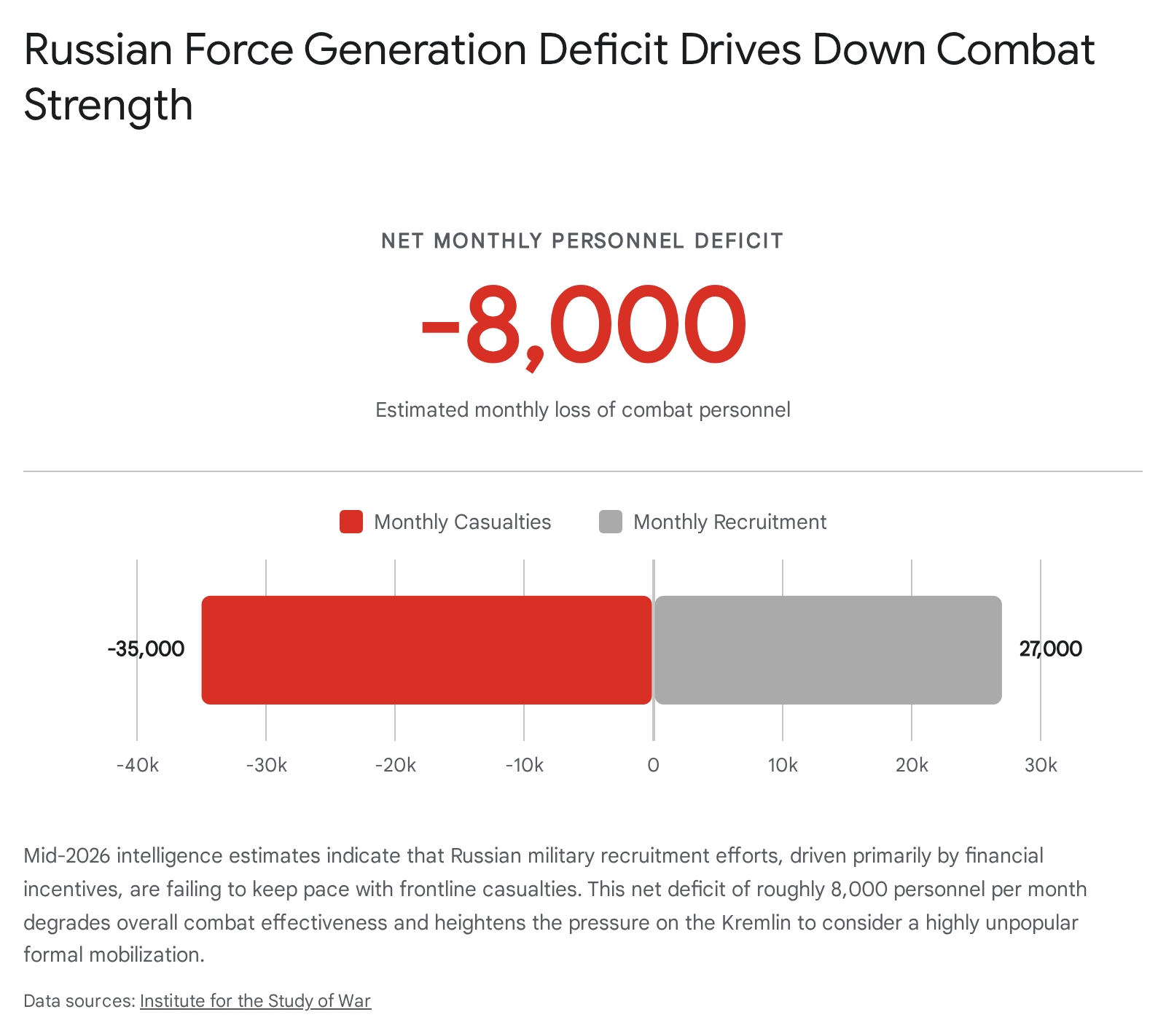
Militarily, the Russian Armed Forces are suffering a highly unsustainable rate of personnel attrition that threatens to hollow out their operational capabilities. Mid-2026 intelligence assessments indicate that Russian forces are sustaining approximately 35,000 casualties per month. Concurrently, ongoing state recruitment efforts—which rely entirely on increasingly exorbitant financial incentives and debt relief programs rather than forced mobilization—are yielding only 27,000 new personnel monthly.3 Furthermore, a definitive shift in tactical drone overmatch in favor of Ukrainian forces, combined with devastating deep-strike campaigns against Russian operational rear logistics, has severely degraded Russia’s ability to project conventional mechanized power, forcing a reliance on costly infantry infiltration tactics.3
However, the Kremlin’s immediate timeline for a systemic crisis has been fundamentally altered and artificially extended by an exogenous geopolitical shock: the early 2026 U.S.-Israeli military engagement with Iran. The resulting spike in global energy prices, compounded by the temporary easing of U.S. sanctions on Russian oil to stabilize markets, has provided Moscow with a critical financial windfall. This event generated an estimated 3 to 4 trillion additional rubles in state revenue.7 This unexpected financial lifeline has allowed the Kremlin to abandon planned domestic spending cuts and temporarily bridge a rapidly widening federal budget deficit, which had reached an alarming 6 trillion rubles in just the first five months of the year.7
Faced with a restive domestic population showing distinct signs of war fatigue and a fractured elite divided between security hardliners (“siloviki”) and economic technocrats, President Vladimir Putin is navigating a narrowing decision matrix.10 His strategic choices are broadly defined by a tension between initiating a highly unpopular formal societal mobilization to rectify the military manpower deficit, or scaling back maximalist war aims to secure a negotiated ceasefire.
This assessment concludes that Putin is most likely to select a hybrid “status quo sustenance” strategy, deferring definitive action until the strategic environment forces his hand. Empowered by the temporary energy windfall and the recent centralization of the defense-industrial apparatus under new Defense Minister Andrey Belousov, the Kremlin will likely delay mass mobilization. Instead, Russia will rely on a combination of intensified “grey-zone” sabotage operations against NATO allies to fracture Western resolve, coupled with persistent, low-intensity attritional warfare in Ukraine. The Kremlin aims to leverage the upcoming U.S. political landscape and mounting European anxieties to force a capitulation on Russian terms by late 2026 or early 2027, avoiding the domestic hazards of full state mobilization while securing its territorial and geopolitical objectives.13
2. Evolution of the Strategic and Operational Battlespace
The operational realities on the ground in Ukraine and along the international borders of the Russian Federation have calcified into a highly lethal, technology-dominated stalemate that heavily penalizes massed conventional maneuver. As of mid-2026, the Russian military command continues to pursue its objective of pushing Ukrainian forces back from international borders to create defensible buffer zones, particularly in the Belgorod and Sumy Oblasts, aiming to protect its staging grounds and logistical nodes from constant artillery and drone strikes.16
However, the battlespace has evolved significantly since the grinding offensives of 2024 and 2025. Russia’s traditional doctrinal advantages—vast reserves of Soviet-era armor and overwhelming, unguided artillery fires—have been heavily mitigated by the proliferation of precision strike capabilities and unmanned aerial systems (UAS).18 Ukraine has effectively reintroduced elements of maneuver to the battlefield not through traditional armored thrusts, but by achieving tactical drone supremacy in space and time, allowing them to systematically dismantle Russian assault columns before they reach their lines of departure.3
2.1 The Ascendancy of Glide Bomb Tactics and Infiltration
To counter the Ukrainian drone threat and the density of defensive fortifications, Russian territorial gains throughout early to mid-2026 have relied heavily on the localized application of highly destructive aerial munitions. The Russian Aerospace Forces (VKS) routinely deploy FAB-500 and FAB-1000 guided glide bombs against Ukrainian positions in contested areas such as Krasnopillya, Serhiivka, and Mykolaivka.17 While these stand-off munitions are highly effective at leveling physical fortifications and reducing localized Ukrainian defensive capacity, the subsequent ground assaults routinely fail to secure rapid operational breakthroughs.
Because massed armored columns are immediately detected and destroyed by Ukrainian first-person view (FPV) drones, Russian forces are forced to rely on dismounted infantry infiltration tactics. Geolocated footage from areas like Ryasne in the Sumy Oblast demonstrates that Russian advances are measured in mere meters, achieved by sending small, poorly supported infantry squads into contested zones.6 This persistent, grinding methodology results in a horrific rate of personnel attrition, eroding the combat effectiveness of Russian frontline formations without delivering decisive strategic victories.13
2.2 Deep Strikes and the Vulnerability of the Russian Rear
Furthermore, the immense geographical scale of the Russian Federation—historically its greatest defensive asset against foreign invasion—has been transformed into a strategic vulnerability. The proliferation of Ukrainian long-range unmanned systems has extended the active battlespace hundreds of kilometers into the Russian operational rear.18
Strategic strikes targeting oil refineries, pumping stations, and military logistics hubs have severely degraded Russian sustainment capabilities. Notable examples in mid-2026 include the Ukrainian strike against the Palkino Oil Pumping Station in Yaroslavl Oblast—located roughly 660 kilometers from the international border—which destroyed seven tanks containing 95,000 cubic meters of fuel, and the strike on the Kotovsky oil facility in Volgograd Oblast.17 These long-range operations not only constrain the supply of refined petroleum products to the front lines but also pierce the illusion of domestic security, bringing the psychological reality of the conflict directly to the Russian populace and forcing the Russian military to redeploy scarce air defense assets away from the tactical front to protect deep-rear infrastructure.18
(Note: While Russia’s economy absorbs these strikes, Ukraine’s economy is also suffering severely under reciprocal bombardment. Energy blackouts caused by relentless Russian strikes on civilian infrastructure have cut Ukraine’s economic growth by an estimated 2.5 percentage points so far in 2026, underlining the attritional nature of the conflict for both sides.19)
3. The Crisis of Force Generation and Asymmetric Attrition
The most critical operational constraint facing the Russian Armed Forces in mid-2026 is an increasingly insurmountable deficit in manpower replacement. The Russian leadership has thus far avoided ordering a second wave of formal, involuntary mobilization. This hesitancy is deeply rooted in the political trauma of the September 2022 “partial mobilization,” which exposed severe dysfunction within the state administrative apparatus and triggered a mass exodus of hundreds of thousands of working-age Russian men, severely damaging the domestic economy.20
To avoid repeating this domestic shock, the Kremlin has relied entirely on a “crypto-mobilization” strategy, leveraging the wealth of the state to offer exorbitant financial incentives, signing bonuses, and substantial debt relief—recently offering up to 10 million rubles to new recruits and their spouses—to attract voluntary contract soldiers.4
3.1 The Casualty to Recruitment Deficit
This financial incentive structure is demonstrating severe diminishing returns, signaling that the pool of economically desperate volunteers is drying up. According to verified intelligence data provided by Finnish President Alexander Stubb and corroborated by the Ukrainian Commander-in-Chief General Oleksandr Syrskyi, Russian forces in mid-2026 are suffering approximately 35,000 casualties (killed and wounded) per month.3 Conversely, the Russian Ministry of Defense’s recruitment apparatus is only managing to induct approximately 27,000 new soldiers per month over the same period.3
Furthermore, the lethality ratio is shifting heavily against Moscow. President Stubb noted that the ratio of killed Russian soldiers to Ukrainian soldiers had escalated to eight to one by mid-2026, up from the previous three to one ratio.3 This net loss of roughly 8,000 personnel monthly creates a compounding crisis. A deficit of this scale slowly hollows out Russian combat units, forcing the military to deploy understrength battalions, reducing the capacity for unit rotation, and exponentially increasing combat fatigue among surviving troops. Ukrainian officials are increasingly focused on the possibility that this personnel decay will force the Kremlin into launching a formal, mass mobilization campaign to avert systemic frontline failure.20
The scale of Russian losses since the initiation of the full-scale invasion is historically unprecedented for the modern Russian state. Western intelligence and independent open-source reporting converge on catastrophic figures that highlight the sheer human cost of Putin’s attritional strategy.
Table 1: Mid-2026 Estimates of Aggregate Russian Military Casualties
| Source / Intelligence Agency | Date of Estimate | Casualty Category | Estimated Figure |
| Western Intelligence (Aggregate) | Feb – May 2026 | Total Casualties (Killed & Wounded) | 1,000,000 – 1,500,000 19 |
| UK Intelligence (GCHQ) | May 2026 | Killed in Action (KIA) | ~500,000 19 |
| Netherlands Military Intelligence | April 2026 | “Permanent Losses” | ~1,200,000 19 |
| Meduza / Mediazona (OSINT) | May 2026 | Confirmed Identified KIA | 352,000 19 |
| Wall Street Journal | Feb 2026 | Killed in Action (KIA) | 325,000 19 |
(Note: Ukrainian military casualties are also exceptionally high. Western estimates place Ukrainian military casualties between 500,000 and 600,000, with KIA estimates ranging from President Zelenskyy’s stated 55,000 up to Western estimates of 140,000 fatalities.19)
3.2 Tactical Drone Overmatch and its Implications
Compounding the manpower crisis is Ukraine’s definitive mid-2026 achievement of tactical overmatch in unmanned systems. General Syrskyi reported that Ukrainian first-person view (FPV) drones currently outnumber Russian FPV deployments by a ratio of 1.5 to 1, a gap that continues to widen due to decentralized Ukrainian procurement and localized production scaling.3
The sheer volume of Ukrainian drone activity is staggering. In May 2026 alone, Ukraine’s Unmanned Systems Forces struck almost 180,000 verified targets—a 27% increase from the previous month.3 Furthermore, Ukraine executed approximately 2,000 mid-range strikes targeting Russian command centers, logistical nodes, and personnel concentrations, alongside 12,500 frontline tasks utilizing unmanned ground vehicles (UGVs) for resupply and casualty evacuation.3 The Russian military-industrial complex is currently unable to scale its production of counter-UAS systems or frontline FPVs at a rate sufficient to match the highly adaptive Ukrainian innovation ecosystem.
4. Macroeconomic Constraints: The Limits of Military Keynesianism
The Russian state has managed to forestall total economic collapse over the past four years through a massive, unprecedented injection of fiscal stimulus, essentially turbocharging wartime production in a strategy broadly characterized by economists as “Military Keynesianism.” In 2025, this strategy resulted in a marginal GDP growth of 1.1%, contributing to a cumulative economic growth of 8% between 2022 and 2025 despite crushing Western sanctions.19
However, by mid-2026, the underlying structural rot of this approach has become starkly apparent. The Russian economy is locked in a “negative equilibrium.” Previous buffers—such as surplus financial capital, excess industrial capacity, and, most crucially, available labor—are almost entirely depleted.23
4.1 The Dual Economy and the Demographic Labor Crisis
Russia is currently experiencing a profound macroeconomic paradox, characterized by the emergence of a disjointed “dual economy.” This system features a rapidly expanding, heavily state-subsidized military-industrial sector operating directly alongside a starved, stagnating civilian sector.2 The foundational cause of this divergence is a severe, structural labor shortage.
The military sector’s insatiable demand for industrial workers, combined with the continuous extraction of hundreds of thousands of able-bodied men for the armed forces and the permanent emigration of educated professionals, has completely hollowed out the civilian labor pool.2 To attract and retain workers to meet Kremlin-mandated production quotas, defense enterprises have drastically raised wages. Civilian businesses, operating on tight margins and unable to match these inflated salaries, are forced to scale back operations entirely or raise prices dramatically, fueling widespread economic inefficiency.
This dynamic has triggered persistent, systemic inflation. As of mid-June 2026, annual inflation remained stubbornly high at 5.6%, well above the state’s target.24 The Central Bank of Russia (CBR) has attempted to cool the overheating economy by maintaining punishingly high interest rates. While the CBR recently implemented a minor cut to 14.25%, policymakers explicitly signaled that persistent budget deficits will lock the country into a “higher-for-longer” interest rate environment.24 Because defense contractors operate primarily on guaranteed state orders and are thus insulated from commercial borrowing costs, the CBR’s high interest rates disproportionately punish the civilian sector.
4.2 Fiscal Strains, Deficits, and Debt Servicing
The financial cost of circumventing formal mobilization by paying exorbitant market wages to military recruits and defense workers is staggering. The Russian government is essentially purchasing military power at a premium far higher than during the Soviet era, when conscription and a total command economy artificially suppressed costs.2
The federal budget for 2026 originally allocated 14.9 trillion rubles (approximately 6.3% of GDP) strictly for defense.25 However, the real cost of prosecuting the war of attrition has vastly exceeded these projections. By the end of May 2026, the federal budget deficit had already reached 6 trillion rubles—exceeding the government’s target for the entire year in just five months and representing 2.6% of the country’s GDP.9
To sustain the war effort, Bloomberg reports that Russia plans to increase its war spending by an additional 4 to 5 trillion rubles in 2026.9 To plug this massive fiscal hole, the Ministry of Finance has been forced to aggressively borrow on the domestic market, planning an additional 2 to 3 trillion rubles in debt issuance.9 The compounding effect of this borrowing is severe: the cost of simply servicing Russia’s existing domestic debt has ballooned to 4 trillion rubles annually. Debt servicing now consumes 9% of total federal spending, making it the fifth-largest line item in the national budget behind defense, national security, social policy, and the broader economy.9
Table 2: Key Russian Macroeconomic Indicators and Strategic Implications (Mid-2026)
| Economic Indicator | Value / Status | Strategic Implication for the War Effort |
| CBR Key Interest Rate | 14.25% (Down from 14.5%) 24 | Chokes civilian investment; state defense sector remains insulated. |
| Annual Inflation Rate | 5.6% (Target: 4%) 24 | Erodes civilian purchasing power; drives an unsustainable wage-price spiral. |
| Federal Deficit (Jan-May 2026) | 6 Trillion Rubles (2.6% of GDP) 9 | Massive budget overshoot; necessitates emergency state borrowing. |
| Domestic Debt Servicing Cost | 4 Trillion Rubles (9% of budget) 9 | Represents an unproductive capital drain, severely limiting future state investment. |
| Added 2026 War Spending | 4 to 5 Trillion Rubles 9 | Demonstrates the rapidly escalating capital requirements of the attritional strategy. |
The International Institute for Strategic Studies (IISS) assesses that without a systemic correction, this trajectory is “economically unsustainable”.1 The state must eventually curtail remaining post-Soviet market freedoms and forcibly mobilize both capital and labor if it wishes to sustain the war machine at its current scale and intensity.2
5. The Exogenous Buffer: Geopolitical Windfalls from the Middle East
While the structural economic indicators unequivocally point toward an eventual crisis, the Kremlin’s immediate timeline for a fiscal reckoning was unexpectedly extended by an exogenous geopolitical event in early 2026. The outbreak of a major conflict involving Israel, the United States, and Iran effectively resulted in the near-closure of the Strait of Hormuz, triggering a massive shock to global energy supply chains.8
This Middle Eastern conflict provided President Putin with an immensely fortunate, albeit temporary, economic windfall. Prior to the Iran conflict, Western tactics of economic containment were showing tangible signs of success. The tightening of secondary sanctions, stricter enforcement of the G7 oil price cap (which had been lowered to $46 a barrel), and aggressive crackdowns on Russian shadow fleet tankers had severely depressed Russian export revenues.8 In early 2026, the price of Russia’s Urals crude had dropped to roughly $40 per barrel, forcing Kremlin officials to seriously weigh a mandatory 10% cut to “non-sensitive” domestic spending to avoid a fiscal collapse.7
The Iran war reversed this trend entirely. The global supply disruption drove the price of Urals crude back up to an average of $75 to $80 per barrel.7 Furthermore, in a desperate bid to stabilize global markets and prevent domestic energy crises, the United States and its allies temporarily eased some sanctions on Russian oil exports.8
The financial impact on the Russian state was immediate and profound:
- Massive Revenue Injection: The price surge is projected to deliver an additional 3 to 4 trillion rubles ($36.6 to $48.8 billion) in oil and gas revenues to Moscow throughout 2026.7
- Deficit Mitigation: If these elevated prices hold, the sudden influx of capital will narrow the ballooning budget deficit to approximately 1% of GDP, drastically outperforming the pre-crisis internal government estimates that projected a crippling 3.5% to 4.4% deficit.7
- Export Surge: Bloomberg calculations indicated that Russian oil export revenues reached $2.48 billion in a single week in March 2026, marking their highest level since April 2022 and representing a 120% increase from late February.7
- Spending Cuts Abandoned: Empowered by this revenue, the Kremlin immediately scrapped its plans for domestic budget cuts. Instead, it preserved the option to channel these windfall revenues directly into military procurement and operational sustainment.7
This sequence of events demonstrates a critical vulnerability in the Western strategy of economic containment: Russia’s economic endurance remains highly tethered to volatile global commodity cycles. The Iran war windfall has provided the Kremlin with the necessary fiscal runway to delay difficult domestic political choices, explicitly empowering Putin to continue the war of attrition in Ukraine without immediately resorting to deeply unpopular economic mobilization measures.8
6. Domestic Sentiment and the Erosion of the “Winner Effect”
Despite the veneer of absolute autocratic control, the Kremlin closely monitors domestic sentiment, recognizing that regime survival is predicated on managing public apathy and ensuring elite cohesion. By mid-2026, cracks are becoming increasingly visible in the domestic domain.
Independent polling conducted by the Levada Center indicates a genuine, measurable shift in Russian public opinion. While a large majority (72.2%) still express generalized support for the actions of the Russian armed forces, this figure represents a decline from the 74-78% averages seen in previous years.27 More tellingly, support for peace negotiations has reached its highest level to date.27
Crucially, the Russian public is exhibiting severe war fatigue. The percentage of Russians who believe the country is moving in the right direction dropped sharply from a 2025 average of 71% to just 55% in April 2026.28 When asked an open-ended question about the main events of the month, only 8% of respondents cited the war or military advances, while a rising proportion (9%) pointed to Ukrainian drone strikes on Russian territory, and 15% focused on the situation in the Middle East.10 Furthermore, 20% of respondents stated they were not following the war at all, illustrating a societal desire to distance themselves from the conflict.10
The psychological “winner effect” that historically rallies populations during the initial phases of wartime is exhausting itself.10 Reports of marginal territorial captures in the Donbas hold little psychological weight compared to the tangible anxieties generated by inflation, crippling labor shortages, and the piercing of the domestic security illusion by Ukrainian long-range drones.18 The fact that Ukrainian strikes rattled the establishment enough to truncate the annual May 9 Victory Day parade in 2026 to just 45 minutes—omitting the traditional display of heavy tanks—was a significant blow to regime prestige.18
Consequently, Russian authorities have increasingly restricted internet access and censored civilian flight tracking (restricting flights in the Moscow air zone below 5,100 meters) to mitigate panic and suppress grassroots political organization that might capitalize on this growing unease.1
7. Intra-Elite Dynamics and the Restructuring of the Defense Apparatus
Within the opaque halls of Kremlin power, the prolonged conflict is intensifying friction between Russia’s two dominant elite factions: the “siloviki” (the security, intelligence, and military hardliners) and the “technocrats” (the economic, banking, and administrative managers).11
The siloviki demand a total, unyielding commitment to the war effort, prioritizing military victory, the assertion of Russian primacy in the near abroad, and the ruthless suppression of domestic dissent regardless of the long-term economic cost.11 Conversely, the technocrats—led by figures such as Prime Minister Mikhail Mishustin and the leadership of the Central Bank—are tasked with the pragmatic reality of keeping the wartime economy afloat. They advocate for risk-averse policies, emphasizing the absolute necessity of maintaining global trade portfolios, stabilizing inflation, and avoiding the total isolation and collapse of the Russian state.11
7.1 The Rise of Andrey Belousov
President Putin’s management of this intra-elite friction was best exemplified by his highly consequential May 2026 cabinet reshuffle. In a move that surprised many observers, Putin removed long-serving Sergei Shoigu as Defense Minister and replaced him with First Deputy Prime Minister Andrey Belousov.31
Belousov is a civilian economist with no prior military experience, having served as Putin’s economic assistant from 2013 to 2020.33 A devout state planner, an orthodox believer, and an advocate of centralized economic control, his appointment signals a profound strategic shift in how the Kremlin views the conflict.33 The Kremlin has recognized that the war in Ukraine is no longer a localized military operation to be managed by battlefield generals, but a totalizing, multi-year industrial conflict.33
Belousov’s mandate is not to design battlefield maneuver tactics, but to ruthlessly optimize the defense-industrial base, streamline bloated state budgets, and aggressively manage the nationalization of private assets to fund the war effort.34 Backed by allies such as Prime Minister Mishustin and Putin’s niece, Deputy Defense Minister Anna Tsivileva, Belousov has centralized power rapidly.34 Under his tenure, the Ministry of Defense has become the primary initiator of requests for property nationalization, consolidating control over roughly 5 trillion rubles ($61 billion) worth of assets stripped from private owners since the invasion began.34
Belousov’s ascent reflects a calculated synthesis by Putin: blending the extractive, maximalist demands of the siloviki with the administrative competence of the technocrats to prepare Russia for a protracted, generational confrontation with the West.
8. Grey-Zone Escalation: Asymmetric Offensives Against NATO
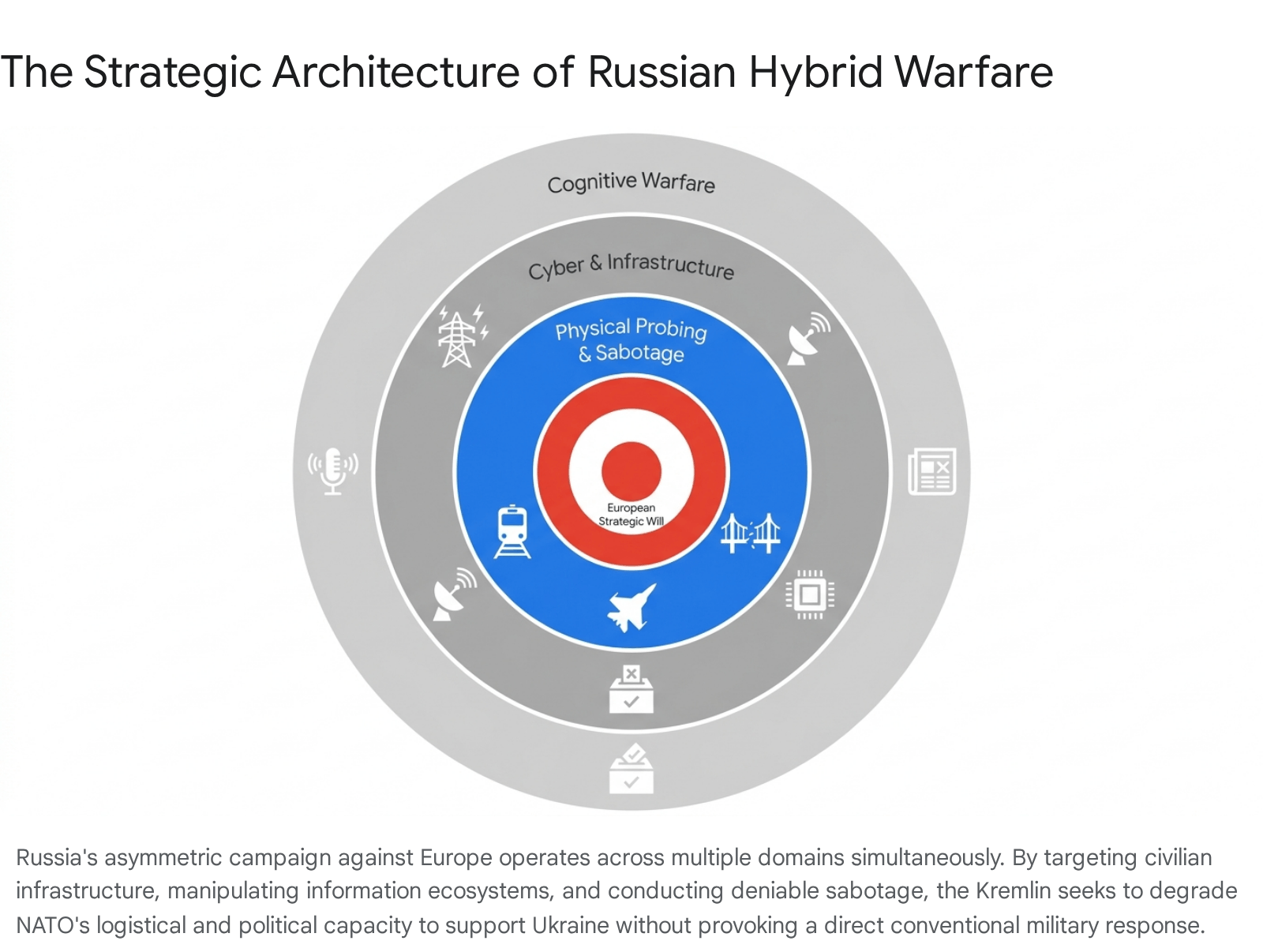
Recognizing its absolute inability to match the combined conventional industrial and military capacity of the NATO alliance, and heavily bogged down in the grinding attrition of Ukraine, the Russian state has pivoted heavily toward asymmetric, “grey-zone” warfare against Europe. This strategy is precisely designed to degrade European societal resilience, disrupt military logistics, and wage cognitive warfare without crossing the threshold that would trigger an Article 5 collective defense response.18
For the Kremlin, grey-zone activity is not preparation for conflict; it is the conflict itself.36 Across mid-2026, European intelligence agencies and defense ministries have documented a sharp, coordinated escalation in Russian-sponsored hybrid activities targeting multiple rings of societal vulnerability:
- Infrastructure Sabotage and Physical Probing: Russian intelligence services have orchestrated a series of physical sabotage plots targeting critical European infrastructure. This includes devastating cyberattacks on power distribution networks in the Baltics, and physical sabotage plots uncovered in the UK and Germany aimed explicitly at railway lines and military logistics hubs designed to disrupt the flow of vital materiel to Ukraine.36
- Airspace Probing and the Polish Incursion: On September 9, 2025, Russia executed a highly provocative probing operation. Up to 23 Russian-origin unmanned aerial vehicles—including decoy systems like the Gerbera—penetrated Polish airspace from Belarus.14 While these specific UAVs lacked warheads, the incursion successfully mapped NATO air defense response times, exposed gaps in the Alliance’s Eastern Flank radar coverage, and prompted Poland to invoke NATO Article 4 consultations, leading to the implementation of Operation Eastern Sentry.14
- Electronic Warfare and Navigation Interference: Widespread and persistent Russian GPS jamming, originating primarily from Kaliningrad and the Kola Peninsula, has routinely disrupted civilian aviation and maritime navigation across Scandinavia and the Baltic Sea, increasing the risk of accidents and demonstrating Russia’s ability to interfere with civilian daily life.36
- Cognitive and Information Warfare: The Kremlin has amplified its sophisticated disinformation campaigns aimed at European populations. These campaigns exploit existing domestic political divisions, amplify narratives of “civilizational decline” in the West, and promote the inevitability of a Russian victory. The ultimate goal is to induce “escalation fatigue” and erode public support for continued financial and military assistance to Kyiv.18
These operations serve as a low-cost, high-impact mechanism for Putin to exact a direct toll on the societies supporting Ukraine. By keeping European governments perpetually off-balance, reacting to domestic crises, and forcing them to invest heavily in “total defense” and resilience concepts, Russia aims to create a political environment highly conducive to a settlement on Moscow’s terms.38
9. Strategic Options Analysis: The Kremlin’s Decision Matrix
Entering the latter half of 2026, President Putin faces a stark and narrowing decision matrix. The systemic degradation of the Russian civilian economy, the unsustainable rate of frontline military attrition, and the looming exhaustion of the volunteer manpower pool cannot be managed indefinitely through short-term fiscal borrowing and grey-zone delays.2 The intelligence community assesses that Putin has three primary strategic options moving forward.
Option A: Scale Back War Aims and Seek Immediate Negotiation
This option entails abandoning the maximalist goals of regime change and total subjugation of the Ukrainian state, instead accepting a frozen conflict along the current line of contact.
- Mechanics: Russia would actively engage with U.S.-mediated ceasefire proposals. Moscow would utilize the threat of further global energy disruptions to force Ukraine into yielding territory. Crucially, Putin’s current absolute precondition for negotiations is that Ukraine must fully withdraw from all of the Donbas, well beyond the territory Russia currently occupies.40
- Benefits: This halts the unsustainable rate of military attrition, preserves the remaining combat power of the Russian army, provides the technocrats an opportunity to stabilize the domestic economy and curb inflation, and reopens vital avenues for European trade and technology transfer.
- Drawbacks: For Putin, accepting a ceasefire without the total capitulation of Kyiv is viewed as a severe strategic defeat. It leaves a highly militarized, deeply hostile, and Western-aligned Ukraine on Russia’s border, fundamentally undermining the original geopolitical justification for the war.18 Furthermore, any demobilization risks returning hundreds of thousands of traumatized, disgruntled soldiers to a depressed civilian economy.
Option B: Status Quo Sustenance (Muddling Through)
This option involves delaying major systemic decisions, relying heavily on the recent Iran War oil windfall to fund the deficit, and continuing the current combination of incremental frontline attrition in Ukraine and intensified hybrid warfare against the West.
- Mechanics: Maintain high financial incentives (debt relief, signing bonuses) for military recruitment to avoid forced mobilization. Rely on Andrey Belousov’s optimization of the defense-industrial base to produce just enough materiel to keep the Ukrainian military under relentless pressure. Simultaneously, ramp up sabotage and disinformation in Europe and the U.S. to break Western political will.7
- Benefits: Avoids the immediate, severe domestic political shock of a mass mobilization. Maximizes the utility of the unexpected oil revenue windfall. Most importantly, it allows the Kremlin to exploit potential political shifts in Western capitals, banking heavily on the outcomes of the U.S. presidential election cycle to fracture the transatlantic consensus.13
- Drawbacks: This strategy is fundamentally a massive gamble on time. If global oil prices fall, or if Western support for Ukraine proves more resilient than anticipated, the Russian economy will hit a hard wall of labor and capital exhaustion. This could potentially trigger a sudden, catastrophic collapse of state capacity to fund the war.2
Option C: Radical Escalation and Full State Mobilization
This option represents a total, unequivocal commitment to the war effort, transitioning Russia from a state fighting a contained “special military operation” to a state fighting a total war for national survival.
- Mechanics: Implement a widespread, involuntary draft to instantly resolve the 8,000-man monthly deficit and generate overwhelming mass. Impose strict command-economy measures across the board, closing borders to prevent capital and labor flight, dictating labor allocation, and formally subordinating all civilian industry to the Ministry of Defense.2
- Benefits: Solves the immediate military manpower crisis and potentially generates enough combat mass to overwhelm degraded Ukrainian defensive lines, forcing a decisive operational breakthrough.
- Drawbacks: Carries extreme, potentially fatal risks to regime stability. The limits of the Russian population’s tolerance for state violence and economic deprivation are unknown but finite.2 Forced mobilization would shatter the passive social contract Putin maintains with the urban middle class, likely sparking severe domestic unrest, mass protests, and significantly increasing the probability of a siloviki-led internal coup against Putin’s leadership.
Table 3: Evaluation of the Kremlin’s Strategic Decision Matrix
| Strategic Option | Primary Mechanism | Domestic Risk Level | Military Outlook | Probability of Selection |
| A: Negotiation / Ceasefire | Freeze the conflict; secure current territorial gains. | Moderate (Risk of right-wing nationalist backlash). | Tactical pause; fails to achieve maximalist goals. | Low |
| B: Status Quo Sustenance | Rely on oil windfall; hybrid warfare; financial recruitment. | Low to Moderate (Gradual economic decay). | Continued high attrition; reliance on Western collapse. | High |
| C: Radical Mobilization | Involuntary draft; command economy implementation. | Extreme (High potential for mass unrest/regime threat). | Generates mass, but requires massive logistical support. | Moderate |
10. Analytical Forecast: Anticipated Kremlin Course of Action
Based on an exhaustive assessment of the converging military, economic, and political data streams, President Vladimir Putin is most likely to select Option B: Status Quo Sustenance, utilizing it as a bridge strategy through the end of 2026 and into early 2027.
The determining factor in this calculus is the fiscal lifeline provided by the Iran war.8 Prior to the spike in global oil prices, the rapid depletion of the National Wealth Fund, the failure of financial recruitment incentives to keep pace with casualties, and the ballooning deficit would have forced the Kremlin into a corner, requiring a choice between capitulatory negotiation and total mobilization much sooner—likely by mid-2026. However, the projected influx of 3 to 4 trillion rubles provides the Russian state with the capital necessary to artificially sustain the “dual economy” and continue funding the exorbitant salaries required for volunteer military recruitment, thereby delaying the political crisis.2
Putin operates on the fundamental, enduring belief that Western democratic societies are inherently fragile, casualty-averse, and lack the strategic stamina for a protracted, multi-year conflict. He views the current US-imposed negotiation efforts not as a genuine off-ramp for peace, but as a wedge to drive between the White House—which seeks a rapid ceasefire to pave the way for renewed economic engagement and a pivot to other global priorities—and European nations, who rightfully fear a prematurely frozen conflict will leave a rearming Russia permanently on their doorstep.13
Therefore, Putin will utilize the remainder of 2026 to “string along” diplomatic backchannels while maintaining a maximalist public posture.13 On the battlefield, Defense Minister Belousov will focus intensely on stabilizing the defense-industrial base to ensure a steady supply of basic munitions, glide bombs, and unmanned systems. The military will prioritize the defense of the current lines of control and incremental tactical advances over highly costly, large-scale mechanized offensives that they currently lack the combat power to execute.33
Simultaneously, the West should expect a severe escalation in Option B’s external component: grey-zone warfare. Because Russia lacks the conventional capacity to decisively defeat Ukraine on the battlefield without full mobilization, the Kremlin will attempt to win the war in the capitals of Europe and North America. Sabotage of military production facilities in NATO countries, aggressive cyber operations against critical infrastructure, and highly targeted disinformation campaigns will be the primary vectors of Russian offensive action in the latter half of 2026.36
The Inflection Point: Option B is a delaying tactic with a definitive expiration date. It remains highly vulnerable to fluctuations in the global energy market. If the Middle Eastern conflict stabilizes and the price of Urals crude falls back below $60 per barrel, the Russian budget will instantly face an unmanageable crisis.42 Even if high oil prices persist, the structural labor shortage will eventually choke defense production regardless of how much capital is injected into the system.
Consequently, Putin is likely delaying the catastrophic decision on full mobilization (Option C) until after the U.S. political landscape solidifies in late 2026.15 If Western support for Ukraine remains resilient into early 2027, the Kremlin will have exhausted both its financial windfalls and its volunteer manpower pool. At that juncture, facing undeniable strategic defeat and the collapse of the front lines, the intelligence indicates that Putin—for whom regime survival is entirely synonymous with geopolitical victory in Ukraine—will likely view radical societal mobilization and command economy measures not as a choice, but as an absolute existential necessity.
11. Strategic Implications for Allied and Partner Security Architecture
The Russian state in mid-2026 is a highly dangerous entity precisely because it is operating under profound structural strain while possessing a temporary financial reprieve. The appointment of a technocratic economist to manage the Ministry of Defense signals a regime that is actively preparing for a generational confrontation with the West, seeking to extract maximum utility from a deeply imbalanced and degrading economy.33
For NATO and partner nations, the intelligence indicates that seeking a rapid, negotiated settlement under current conditions is a profound strategic miscalculation. Moscow perceives current diplomatic overtures as evidence of Western weakness, a lack of resolve, and a validation of its attritional, wait-it-out strategy.13
The most effective counter-strategy must aggressively target the foundation of Putin’s current lifeline. Continuing to restrict Russia’s hydrocarbon revenues, maintaining robust support for Ukraine’s long-range deep-strike capabilities to systematically degrade Russian logistics and command nodes, and rapidly hardening European societies against grey-zone infrastructure sabotage are essential. Only by unequivocally demonstrating that the transatlantic alliance can sustain the economic, political, and military costs of the conflict longer than the structurally compromised Russian state will the Kremlin be forced to abandon its maximalist objectives and confront its internal vulnerabilities.
Please share the link on Facebook, Forums, with colleagues, etc. Your support is much appreciated and if you have any feedback, please email us in**@*********ps.com. If you’d like to request a report or order a reprint, please click here for the corresponding page to open in new tab.
Sources Used
- The Coming Crisis in Russia’s Political Economy, accessed June 20, 2026, https://www.iiss.org/globalassets/media-library—content–migration/files/research-papers/2026/05/executive-summary-7.pdf
- The Coming Crisis in Russia’s Political Economy – The International Institute for Strategic Studies, accessed June 20, 2026, https://www.iiss.org/research-paper/2026/05/the-coming-crisis-in-russias-political-economy/
- Russian Offensive Campaign Assessment, June 11, 2026, accessed June 20, 2026, https://understandingwar.org/research/russia-ukraine/russian-offensive-campaign-assessment-june-11-2026/
- Russian Offensive Campaign Assessment Updates March – May 2026 – Institute for the Study of War, accessed June 20, 2026, https://understandingwar.org/research/russia-ukraine/russian-offensive-campaign-assessment-updates-3/
- Ukraine’s Strike Campaign Marks a New Phase of the War | ISW Briefing Room – YouTube, accessed June 20, 2026, https://www.youtube.com/watch?v=24CuE-K0uTQ
- Russian Offensive Campaign Assessment, June 17, 2026 | ISW, accessed June 20, 2026, https://understandingwar.org/research/russia-ukraine/russian-offensive-campaign-assessment-june-17-2026/
- Russia Drops Budget Cut Plans as Oil Price Surge Boosts …, accessed June 20, 2026, https://www.themoscowtimes.com/2026/03/27/russia-drops-budget-cut-plans-as-oil-price-surge-boosts-revenues-bloomberg-a92361
- The Iran war has been an economic gift for Putin | Chatham House, accessed June 20, 2026, https://www.chathamhouse.org/2026/04/iran-war-has-been-economic-gift-putin
- Bloomberg: Russia to increase war spending by an additional 4–5 …, accessed June 20, 2026, https://meduza.io/en/news/2026/06/18/bloomberg-russia-to-increase-war-spending-by-an-additional-4-5-trillion-rubles-in-2026
- Russians Are Paying Less Attention to the War as Fatigue Starts to Show, Levada Poll Finds, accessed June 20, 2026, https://briefly-news.com/en/russians-are-paying-less-attention-to-the-war-as-fatigue-starts-to-show-levada-poll-finds/
- Azerbaijan’s Northern Question: How the War in Ukraine Has Changed Relations Between Azerbaijan and Russia | Georgetown Journal of International Affairs, accessed June 20, 2026, https://gjia.georgetown.edu/conflict-security/azerbaijans-northern-question-how-the-war-in-ukraine-has-changed-relations-between-azerbaijan-and-russia/
- Russia Futures: Three Trajectories – CSIS, accessed June 20, 2026, https://www.csis.org/analysis/russia-futures-three-trajectories
- Russia’s Aggression in Ukraine Will Persist Through 2026 | Royal …, accessed June 20, 2026, https://my.rusi.org/resource/russias-aggression-in-ukraine-will-persist-through-2026.html
- The Military Balance 2026: Fortifying NATO’s eastern flank, accessed June 20, 2026, https://www.iiss.org/publications/the-military-balance/2026/the-military-balance-2026/fortifying-natos-eastern-flank/
- NATO-Russia dynamics: Prospects for reconstitution of Russian military power, accessed June 20, 2026, https://www.atlanticcouncil.org/in-depth-research-reports/report/nato-russia-dynamics-prospects-for-reconstitution-of-russian-military-power/
- Russian Offensive Campaign Assessment, June 19, 2026 | ISW, accessed June 20, 2026, https://understandingwar.org/research/russia-ukraine/russian-offensive-campaign-assessment-june-19-2026/
- Russian Offensive Campaign Assessment, June 18, 2026 | ISW, accessed June 20, 2026, https://understandingwar.org/research/russia-ukraine/russian-offensive-campaign-assessment-june-18-2026/
- Ukraine’s War Effort in Mid-2026: International Opportunities and …, accessed June 20, 2026, https://ssi.armywarcollege.edu/SSI-Media/Recent-Publications/Article/4509097/ukraines-war-effort-in-mid-2026-international-opportunities-and-domestic-challe/
- The Russia-Ukraine War Report Card, June 17, 2026 | Russia Matters, accessed June 20, 2026, https://www.russiamatters.org/news/russia-ukraine-war-report-card/russia-ukraine-war-report-card-june-17-2026
- Ending ‘hot phase’ of Russia-Ukraine war before winter? Here’s what Kyiv is saying, accessed June 20, 2026, https://kyivindependent.com/why-ukraine-is-talking-about-ending-hot-phase-of-russias-war-before-winter/
- 2022 Russian mobilization – Wikipedia, accessed June 20, 2026, https://en.wikipedia.org/wiki/2022_Russian_mobilization
- The Russia-Ukraine War Report Card, April 8, 2026, accessed June 20, 2026, https://www.russiamatters.org/news/russia-ukraine-war-report-card/russia-ukraine-war-report-card-april-8-2026
- What to Expect From the Russian Economy in 2026 | Carnegie …, accessed June 20, 2026, https://carnegieendowment.org/russia-eurasia/podcasts/carnegie-politika-podcast/russia-economy-predictions
- Russian Central Bank Slashes Key Rate to 14.25%, accessed June 20, 2026, https://www.themoscowtimes.com/2026/06/19/russian-central-bank-slashes-key-rate-to-1425-a93053
- A Budget for a Fifth Year of War: Military Spending in Russia’s Budget for 2026 | SIPRI, accessed June 20, 2026, https://www.sipri.org/publications/2026/sipri-insights-peace-and-security/budget-fifth-year-war-military-spending-russias-budget-2026
- Russia may raise military spending by 40% despite budget hole | Ukrainska Pravda, accessed June 20, 2026, https://www.pravda.com.ua/eng/news/2026/06/18/8039951/
- Levada Poll Shows Rising Support for Peace Talks, But Devil In Details – Russia Matters, accessed June 20, 2026, https://www.russiamatters.org/blog/levada-poll-shows-rising-support-peace-talks-devil-details
- Russia’s Elite Conflict Over Internet Restrictions Does Not Herald Regime Collapse, accessed June 20, 2026, https://carnegieendowment.org/russia-eurasia/politika/2026/06/russia-internet-blockade-dispute
- The Kremlin’s Loyal Praetorians | OSW Centre for Eastern Studies, accessed June 20, 2026, https://www.osw.waw.pl/en/publikacje/point-view/2026-02-27/kremlins-loyal-praetorians
- Transition without a successor: The transformation of Putin’s regime, accessed June 20, 2026, https://nestcentre.org/transition-without-a-successor/
- Mikhail Mishustin – Wikipedia, accessed June 20, 2026, https://en.wikipedia.org/wiki/Mikhail_Mishustin
- Andrey Belousov – Wikipedia, accessed June 20, 2026, https://en.wikipedia.org/wiki/Andrey_Belousov
- The Defense Industrial Implications of Putin’s Appointment of Andrey Belousov as Minister of Defense – CSIS, accessed June 20, 2026, https://www.csis.org/analysis/defense-industrial-implications-putins-appointment-andrey-belousov-minister-defense
- Russia’s Gray Man Makes His Move – CEPA, accessed June 20, 2026, https://cepa.org/article/russias-gray-man-makes-his-move/
- Putin appoints economist as defense minister as Russia plans for long war – Atlantic Council, accessed June 20, 2026, https://www.atlanticcouncil.org/blogs/ukrainealert/putin-appoints-economist-as-defense-minister-as-russia-plans-for-long-war/
- Are We at War with Russia? How Warden’s Rings Map Russia’s Hybrid Strategy – RUSI, accessed June 20, 2026, https://www.rusi.org/explore-our-research/publications/commentary/are-we-war-russia-how-wardens-rings-map-russias-hybrid-strategy
- What price for peace in Ukraine? – Brookings Institution, accessed June 20, 2026, https://www.brookings.edu/articles/what-price-for-peace-in-ukraine/
- Intelligence Wars: Sabotage in the Shadows of Conflict – Lieber Institute – West Point, accessed June 20, 2026, https://lieber.westpoint.edu/intelligence-wars-sabotage-shadows-conflict/
- Russian Threats to NATO’s Eastern Flank: Scenarios, Strategy, and Policy for European Security | The Belfer Center for Science and International Affairs, accessed June 20, 2026, https://www.belfercenter.org/research-analysis/russia-nato-baltics-scenarios-europe-security
- Russian Offensive Campaign Assessment, May 13, 2026 | ISW, accessed June 20, 2026, https://understandingwar.org/research/russia-ukraine/russian-offensive-campaign-assessment-may-13-2026/
- Deterring Hybrid Warfare: NATO Approaches to Russian Sabotage | connections-qj.org, accessed June 20, 2026, https://connections-qj.org/article/deterring-hybrid-warfare-nato-approaches-russian-sabotage
- Oil Prices Have Fallen: Next year, Russia is very likely to have to live with oil prices in the range of $40–45 per barrel – Re: Russia, accessed June 20, 2026, https://re-russia.net/en/analytics/0368/