
Executive Summary
This comprehensive intelligence assessment addresses the critical operational query regarding the veracity of recent reports indicating that the internet in Moscow has been intentionally severed due to the highest echelons of the Russian leadership fearing an imminent coup d’état. Open-source intelligence (OSINT), global network telemetry, legislative tracking, and recent geopolitical developments verify that unprecedented, systematic, and highly sophisticated internet disruptions are currently active in the Russian capital and expanding outward. Furthermore, intelligence confirms that these extreme telecommunications blackouts are inextricably linked to acute regime paranoia regarding internal destabilization, assassination plots, and the imminent threat of a kinetic coup orchestrated by domestic elite factions.
The current situation in Moscow as of late June 2026 is exceptionally dynamic and highly volatile. The internet blackouts observed across the capital are not technical anomalies, civilian infrastructural failures, or standard wartime censorship measures. Rather, they represent the overt weaponization of “disconnective power” by the Russian security apparatus. While official state channels routinely attribute these telecommunications blackouts to defensive electronic warfare measures designed to thwart Ukrainian mobile-guided drone strikes—specifically following the devastating June 18, 2026, mass drone attack on the Moscow Oil Refinery in the Kapotnya district—the underlying operational reality is fundamentally driven by internal regime preservation.
The Federal Protective Service (FSO), the elite praetorian guard tasked exclusively with the physical security of President Vladimir Putin, has effectively usurped digital control from standard civilian telecommunications ministries. The FSO is directly ordering the disabling of mobile base stations across the capital. This extreme digital quarantine protocol is paired with unprecedented physical isolation measures for the President, who is currently operating out of remote, reinforced bunkers in the Krasnodar region. The catalyst for this internal panic stems from a lethal combination of the total failure of Moscow’s layered air defenses to protect the capital’s perimeter, combined with a severely fractured elite power dynamic following the unprecedented arrests of former Defense Minister Sergei Shoigu’s inner circle.
The immediate operational environment is characterized by the rapid deployment of a domestic “Whitelist” intranet, the forced adoption of the state-monitored “Max” messenger application, and the systematic eradication of virtual private networks (VPNs) and independent internet service providers. While there is no definitive OSINT visual confirmation that an active military coup is currently unfolding in the streets of the capital, the Kremlin is operating under the strict, actionable assumption that an internal kinetic threat—potentially utilizing mobile-guided drone technology orchestrated by disgruntled domestic military actors—is highly probable.
The Operational Environment: Verifying the Digital Blackout
The primary investigative question concerns the empirical veracity of the internet shutdown in Moscow. Network telemetry from multiple global internet monitors unequivocally confirms that severe, targeted disruptions of mobile internet traffic and broad connectivity are occurring in the Russian capital, representing a severe escalation in state-mandated digital isolation.
OSINT Telemetry and Network Data Analysis: A Year-Long Escalation
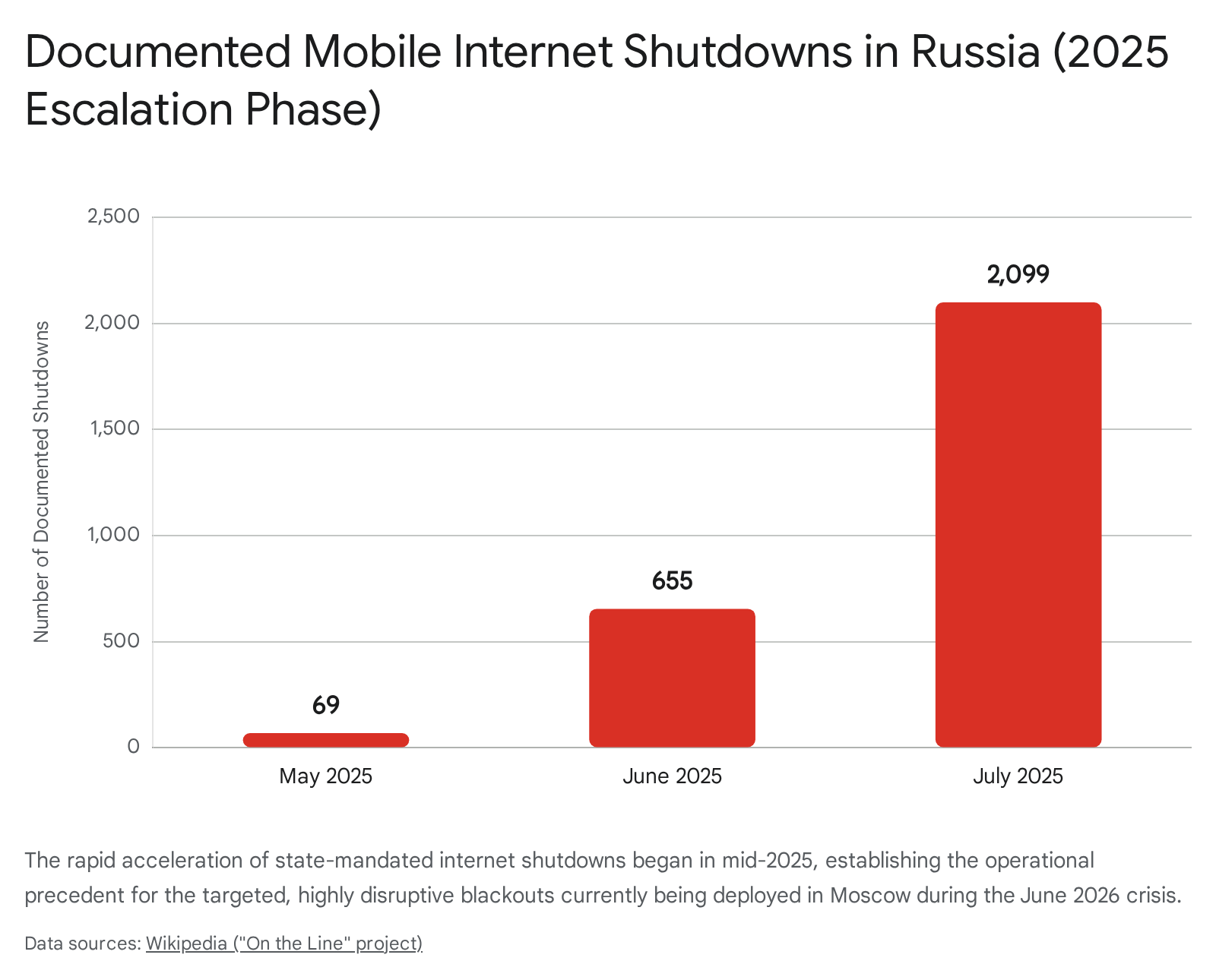
Data synthesized from the Internet Outage Detection and Analysis (IODA) project, Cloudflare Radar, and the NetBlocks observatory provides a clear, empirical baseline for the ongoing digital isolation of the Russian Federation. The state’s weaponization of telecommunications has been an escalating process ongoing for over a year. It began as a series of localized, regional shutdowns in May 2025, primarily focused on areas bordering Ukraine and justified under the pretext of public safety during Victory Day celebrations.1 During this initial phase in May 2025, there were only 69 documented cases of mobile internet outages.1 However, the scope and frequency of these disruptions expanded at an exponential rate. By June 2025, 655 internet shutdowns were recorded, and by July 2025, this figure had exploded to 2,099 distinct shutdown events, exceeding the global total of internet shutdowns recorded worldwide for the entire preceding year.1
In early 2026, this localized tactic was elevated to a strategic, capital-level security protocol. Central Moscow and St. Petersburg experienced a massive, unprecedented mobile internet blackout that lasted for nearly three weeks in March 2026.2 This blackout effectively degraded the basic operations of a modern megacity, neutralizing civilian navigation systems, digital payment infrastructure, and essential logistical services overnight.3 Telemetry alerts from IODA during the spring of 2026 recorded numerous “critical severity” connectivity drops across vast swathes of the Russian Federation, indicating that the state was aggressively testing its nationwide kill-switch capabilities.5
The extreme digital quarantine currently active in June 2026 represents the apex of this year-long escalation, triggered directly by the massive drone strikes on the Kapotnya refinery on June 16 and 18. Anticipating the necessity of these severe, prolonged outages, President Putin had already issued a formal directive on June 1, 2026, accelerating the deployment of the state “whitelist” infrastructure.7 The disruptions actively occurring now have taken on a highly refined character. Rather than blanket outages caused by crude infrastructure damage or power grid failures—such as those observed in Ukraine due to Russian kinetic strikes 8—the current telecommunications environment in Moscow is characterized by sophisticated, selective degradation.9 Users uniformly report a widespread inability to access foreign networks, utilize standard virtual private networks (VPNs), or connect to global communication applications like Telegram, WhatsApp, and Signal.7 The OSINT data confirms that these outages are not technical anomalies; they are deliberate, state-directed operations designed to fundamentally alter the digital landscape of the capital.3
The Technological Architecture of the Sovereign Internet
To fully comprehend the Kremlin’s current ability to sever connectivity in Moscow during a crisis, it is necessary to analyze the evolution of Russia’s digital censorship apparatus, often referred to colloquially as the “Cheburnet” or the Sovereign Internet.1 The foundation of this regime relies on highly advanced hardware and deep network integration that was completely absent during previous, failed attempts at digital control.
Overcoming the Failures of the Past
The Russian state’s first major attempt to assert dominance over digital communications occurred in 2018 with the highly publicized, yet spectacularly unsuccessful, attempt to block the Telegram messenger application.12 At that time, the state censorship agency, Roskomnadzor, relied on crude, blacklist-based approaches, which required individual internet service providers (ISPs) to manually enforce blocks on specific IP addresses.12 Telegram easily evaded this censorship by rapidly cycling IP addresses and distributing server locations across major international cloud infrastructure providers.12 Roskomnadzor was forced into an embarrassing technical chase, ultimately blacklisting millions of IP addresses belonging to global giants like Amazon and Hetzner, which caused massive collateral damage to the domestic economy—famously breaking internet-connected appliances like water boilers—before the agency abandoned the effort entirely.12
The Implementation of TSPU and DPI
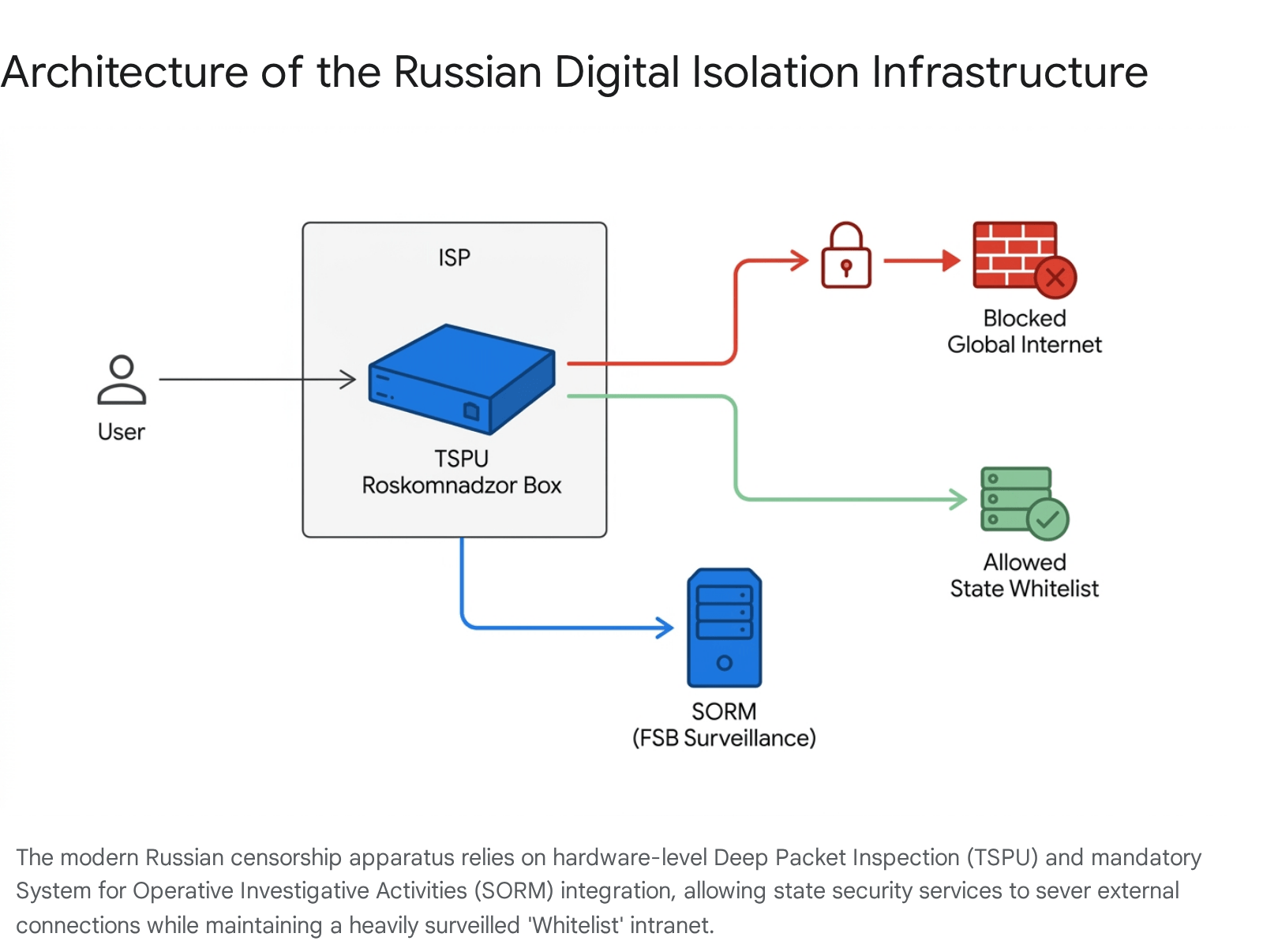
Learning from the 2018 debacle, Moscow enacted the 2019 “Sovereign Internet” law, which mandated a total overhaul of the nation’s digital architecture.12 The cornerstone of this modern censorship regime is the deployment of TSPU (Technical Means of Countering Threats) infrastructure.12 TSPU consists of specialized hardware “boxes” installed directly onto the network nodes of every single internet service provider operating within the Russian Federation.9 Crucially, individual ISPs have absolutely no operational control over these filtering devices; they are commanded exclusively by Roskomnadzor and state security services.12
The TSPU framework represents a paradigm shift in digital authoritarianism. Unlike older blacklist methods, TSPU utilizes Deep Packet Inspection (DPI) technology.9 DPI hardware does not merely look at the destination IP address of a connection; it analyzes packet signatures, behavioral connection patterns, and Transport Layer Security (TLS) fingerprints in real time, reading traffic in milliseconds.9
This hardware enables the state to deploy three distinct blocking mechanisms, each escalating in severity:
| Censorship Mechanism | Technical Execution | Operational Impact |
| Classic Blacklisting | Roskomnadzor maintains a centralized registry of banned IPs and domains. | Easily bypassed by users changing IP addresses or utilizing basic proxy servers. |
| Active Jamming (DPI) | TSPU hardware selectively corrupts traffic rather than blocking it outright. | Injects errors into TCP connections, interrupts TLS handshakes mid-way, and poisons DNS responses. Causes VPN connections to hang indefinitely at “connecting.” |
| Default Whitelisting | Mobile operators allow traffic only to pre-approved resources, blocking all other connections by default. | Domestic sites load normally, while all foreign sites and unauthorized applications fail to resolve entirely. |
Due to the sophisticated nature of the DPI active jamming, classic VPN protocols such as OpenVPN, WireGuard, and standard VLESS ceased functioning reliably in Russia between 2024 and 2025.9 The DPI systems identify these protocols in milliseconds by their distinct traffic signatures and immediately drop the connection.9 Currently, in 2026, the only circumvention methods demonstrating any viability are highly advanced protocols like VLESS combined with the Reality protocol, which was developed by the Xray project specifically to combat TSPU.9 Instead of attempting to hide VPN traffic, the Reality protocol actively impersonates a legitimate HTTPS connection to a permitted site, such as Microsoft or VK, confusing the DPI sensors.9 Furthermore, major mobile operators such as MTS, Beeline, Megafon, and Tele2 each run slightly varied DPI algorithms on top of the baseline Roskomnadzor requirements, meaning a circumvention tool that works on one network may fail instantly on another.9
State Surveillance and the Eradication of Independent ISPs
Beyond censorship, the network architecture is designed for absolute surveillance. All digital services, major banks, and communication platforms operating in Russia are legally mandated to install and integrate with the System for Operative Investigative Activities (SORM).12 SORM is the state’s longstanding lawful interception framework, controlled directly by the Federal Security Service (FSB).12 This infrastructure allows the FSB to intercept, monitor, and record digital communications, metadata, and financial transactions in real time.13 Banks or digital services that fail to comply with these SORM installation demands are systematically excluded from the state’s operational whitelists, effectively destroying their ability to conduct business during a network shutdown.12
To ensure this isolation bubble remains completely airtight, the Russian state has initiated a massive regulatory overhaul of the telecommunications market designed to eliminate independent ISPs. A recent licensing reform introduced in June 2026 established exorbitant financial requirements and updated operational rules that are completely prohibitive for small and regional telecom operators.14 Market analysts project that this reform threatens to force the closure of approximately 93% of all internet service providers currently operating in Russia.14 This sweeping legislative purge will effectively monopolize the telecommunications market, handing total infrastructural control over to a few massive, Kremlin-loyal telecom giants.14 This consolidation makes future, nationwide digital shutdowns practically effortless for the central government to execute, removing any remaining localized resistance.
The Immediate Catalyst: The June 18 Kapotnya Refinery Assault
To understand the intense wave of panic currently gripping the Kremlin and the subsequent digital lockdown protocols enacted in Moscow, one must analyze the immediate tactical catalyst: the massive Ukrainian drone strike on the capital on June 18, 2026.15 While the internet infrastructure was fully built out, it required an existential shock to trigger its current draconian deployment.
The Penetration of the Capital’s Airspace
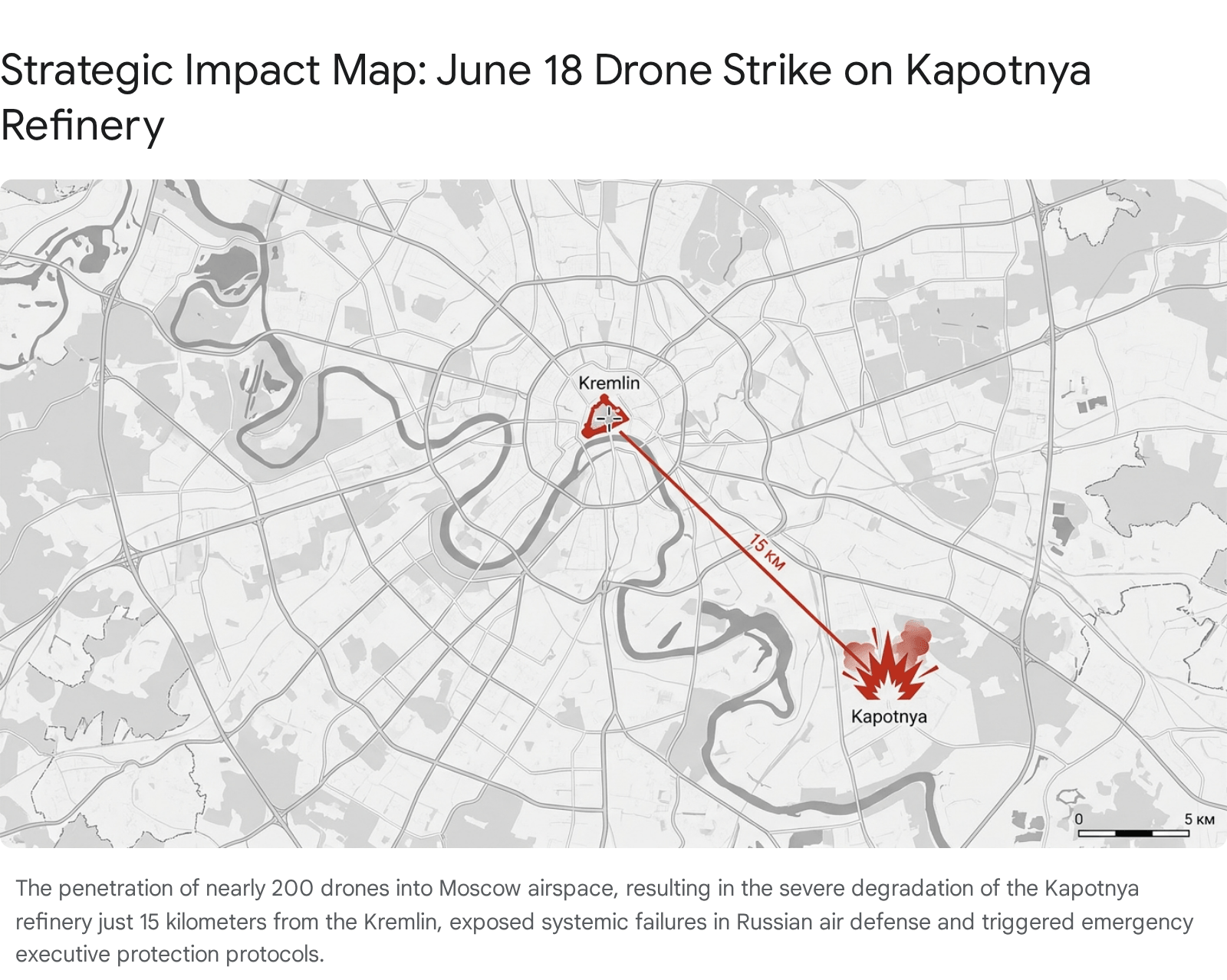
On the night of June 17 to June 18, 2026, Ukrainian forces launched the largest, most sophisticated drone swarm against the Russian capital since the inception of the full-scale war over four years prior.18 Nearly 200 long-range strike drones breached the supposedly impenetrable, deeply layered air defenses surrounding Moscow with virtually no resistance.20 The strike package heavily utilized Ukrainian-manufactured FP-1 drones, produced by the domestic defense company Fire Point.23
The Russian military’s Pantsir air defense systems, which the command heavily relied upon to protect the capital’s perimeter and strategic assets, proved entirely incapable of countering the low-altitude, massed drone threat.22 Military analysts noted that the specific flight altitude and routing of the incoming drones made them exceedingly difficult for the outdated Russian radar configurations to detect and intercept effectively.22
The primary target of the swarm was the Moscow Oil Refinery, located in the Kapotnya district on the southeastern edge of the city, a mere 15 kilometers (9 miles) from the walls of the Kremlin.18 This facility is not merely an industrial site; it is a critical strategic node in Russia’s domestic energy infrastructure, historically supplying approximately 40% of the capital’s petrol and up to 50% of its diesel fuel requirements.21
Operational Damage and the Paralysis of the Energy Sector
The June 18 strike was actually the second highly successful attack on the Kapotnya facility in a span of just two days, following an initial, highly destructive strike on June 16.16 OSINT satellite imagery and corroborated local reports confirmed that the successive drone strikes yielded catastrophic results for the Russian energy sector.16
| Strike Date | Primary Unit Damaged | Operational Capacity Impact | Consequence |
| June 16, 2026 | AVT-6 Unit | 53% of refinery’s total primary capacity. | Forced initial suspension of major refining operations. |
| June 18, 2026 | Euro+ Combined Unit | 47% of refinery’s total primary capacity (approx. 140,000 barrels per day). | Complete paralysis of the facility. Destruction of crude distillation, catalytic reformers, and diesel hydrotreating units. |
The June 18 blast was particularly devastating. The impact blew the heavy lids off massive fuel storage tanks, completely immolating at least two massive reservoirs and heavily damaging auxiliary equipment and bitumen loading trestles.16 The facility has been forced offline indefinitely for serious repairs, paralyzing an estimated 35% of the capital’s total fuel market and creating an immediate, severe logistics crisis within the city.16
The psychological impact of the strike on the Moscow populace and the military command was profound. Due to the state’s systematic censorship protocols, residents received no SMS warnings and no air raid sirens were activated prior to the impacts.17 The majority of the population only learned of the massive attack when they physically saw drones flying overhead, observed thick, black smoke billowing over the southern skyline, or experienced soot and black rain falling on their vehicles.17 Videos rapidly circulated on uncontrolled local chat groups showing Russian air defense missiles wildly missing their targets as the drones struck the refinery.22 This total failure deeply embarrassed the military command, exposing the absolute vulnerability of the state and proving that the capital could not be defended against long-range, precision strikes.15 It is in the immediate aftermath of this profound, highly visible security failure that the extreme internet restrictions in Moscow escalated from technical censorship to desperate survival mechanisms.
Internal Dynamics: Regime Paranoia and the Veracity of the Coup Threat
The central query of this intelligence assessment requires a definitive evaluation of the prevalent rumors suggesting that Vladimir Putin is intentionally shutting down the internet in Moscow due to an active fear of a coup. Intelligence analysis of the current command structures, internal security realignments, and leadership behaviors confirms that this fear is highly active, grounded in recent internal power shifts, and is currently dictating absolute state policy, even if an overt, kinetic military coup is not visibly occurring in the streets at this exact moment.
The FSO’s Usurpation of Digital Control
The most critical intelligence indicator verifying the regime’s acute internal paranoia is the rapid and highly irregular shifting of the chain of command regarding the execution of the internet shutdowns. Historically, internet censorship and infrastructure management in Russia were handled by civilian entities, specifically the Ministry of Digital Development and the state regulator Roskomnadzor.1 However, during the severe Moscow blackouts initiated in 2026, the orders to sever connectivity bypassed these civilian ministries entirely.12
Although early reporting indicated that the FSB’s research and technical department initiated the central Moscow blackouts by supplying telecommunications operators with exact lists of specific base stations to disable, subsequent European intelligence assessments and leaks from a former FSB officer confirm that the Federal Protective Service (FSO) is the primary entity executing the large-scale internet outages.12 Government insiders leaked that security officials “hinted in every way” that the decision to shut down the capital’s internet had been “passed down from above,” bypassing standard regulatory channels.12
Furthermore, in February 2026, the State Duma quietly approved a highly consequential bill that formally empowered the FSB to legally demand—rather than merely request—that mobile operators shut down cellular communications entirely.12 A critical amendment to this bill explicitly removed “security threats” as a necessary precondition for these demands, making a direct presidential decree the sole regulatory document governing this immense power.12
The FSO is the elite, highly secretive praetorian guard solely responsible for the physical protection of the President and the highest-ranking state officials.26 When the FSO overrides the Ministry of Digital Development to mandate infrastructure blackouts, the objective is no longer public censorship or information control; the objective is executive protection and regime survival. The FSO operates on the actionable intelligence assumption that mobile internet signals can, and will, be used by internal actors to guide drone strikes or coordinate rapid assassination plots against the President and his inner circle.1
Vladimir Putin’s Extreme Physical Isolation Protocols
A recent, highly credible intelligence report compiled by a European agency, further supported by leaks from active FSB officers, paints a stark picture of a national leader consumed by the fear of a palace coup.26 Since early March 2026, Putin has been highly alarmed by potential leaks of sensitive operational information and the distinct, escalating risk of an assassination attempt orchestrated by members of the Russian political and military elite utilizing drone technology.26
In response to this perceived internal threat, the FSO has implemented extreme security measures that border on complete physical quarantine of the executive branch:
- Bunker Refuges: Intelligence indicators strongly suggest that the Russian President has largely abandoned his traditional centers of power, including the Valdai and Moscow region residences.26 Seeking physical distance from the immediate threat environment of the capital, he has established a continuous operational presence within deeply fortified, renovated subterranean command centers located in the Krasnodar region, often remaining there for weeks at a time.26
- Media Manipulation: To mask his prolonged absence from the capital and project an illusion of stability to the public, Russian state media continuously broadcasts pre-recorded (“canned”) footage of the President ostensibly conducting routine meetings and state business.26 Guided by a secret presidential decree, the FSO now rigidly controls and approves all media publications involving the president.26
- Communication Blackout Zones: Personnel permitted to work in close proximity to the President are strictly barred from possessing mobile phones with internet access.26 They are banned from using public transportation and must exclusively travel using heavily monitored FSO transport vehicles.26
- Internal Wiretapping and Surveillance: The state’s surveillance apparatus has been quietly redirected inward. Intelligence indicates that monitoring equipment previously dedicated to non-political criminal investigations has been actively re-tasked to wiretap and monitor members of the government, the military, and other state bodies.26 The FSO has even installed extensive surveillance systems inside the private homes of the President’s bodyguards, cooks, and personal photographers to detect any signs of compromised loyalty or external coercion.26
- Physical Search Protocols: Anyone visiting the Presidential Administration faces intense, multi-level security screenings, including invasive full-body searches conducted personally by FSO officers.26 The FSO has actively deployed canine units and conducts large-scale patrols along the Moscow River, prepared to respond to drone attacks.26
- Political Exclusion: In an extreme display of caution and profound mistrust, not a single deputy of the State Duma was invited to the 2026 Victory Day parade on Red Square, underscoring the total breakdown of trust between the executive and the broader political elite.26
The Sidelining of Sergei Shoigu and Elite Fractures
The fear of a coup is not an amorphous, generalized paranoia; it has a specific focal point within the Russian military and defense establishment. Intelligence assessments explicitly identify the network of officials loyal to Sergei Shoigu, the former Minister of Defense and the current Secretary of the Security Council (since May 2024), as a key potential destabilizing factor.26
Despite his reassignment from the Ministry of Defense, Shoigu historically retained immense, deep-rooted influence and vast patronage networks within the upper echelons of the military command structure.26 However, a sweeping purge has systematically dismantled his faction. The precarious balance of power within the Kremlin was severely disrupted on March 5, 2026, with the sudden and highly publicized arrest of Ruslan Tsalikov, Shoigu’s former first deputy.26 This occurred amidst a broader purge that included the arrests of several other key Shoigu deputies—including Timur Ivanov, Pavel Popov, and Dmitry Bulgakov—effectively gutting his power base.
In the highly complex ecosystem of Russian elite politics, the arrest of a highly placed loyalist and key node like Tsalikov represents a direct, aggressive violation of the informal safety guarantees traditionally granted to members of the ruling class.26 This action critically weakened Shoigu’s political standing and signaled unequivocally that he himself could face imminent criminal prosecution.26 Consequently, many intelligence analysts conclude that a coup orchestrated by Shoigu himself is currently highly improbable, as he lacks independent support within the broader military apparatus.
Instead, the Kremlin’s paranoia is directed at the broader military apparatus reacting to these purges. If a kinetic coup were to occur, structural analysis suggests the only forces practically capable of executing it would be the elite military divisions stationed just outside the capital, specifically the 4th Guards “Kantemirovskaya” Tank Division, the 2nd Guards “Tamanskaya” Mechanized Division, and nearby Spetsnaz special forces units. To preemptively counter this threat, the FSB and the heavily armed regime-protection forces of Rosgvardia (the National Guard), operating under Viktor Zolotov, actively monitor the regular military command to prevent any internal coordination.
By backing the military elite into a corner and violating the unwritten rules of elite immunity, the Kremlin has drastically increased the risk that disgruntled military factions might attempt a pre-emptive kinetic coup to ensure their own survival. The internet shutdowns in Moscow are the technological manifestation of this exact fear—a blunt-force mechanism to blind potential conspirators, sever their communications, and prevent the rapid, horizontal coordination required to launch a successful mutiny against the state apparatus.
The Mechanics of Digital Quarantine: Whitelists and the Max Super-App
The ongoing dynamic situation in Moscow is not simply a matter of the state turning the internet “off” in a panic. The Kremlin is actively attempting to transition the entire nation onto a deeply controlled, sovereign intranet designed to function seamlessly even when global connectivity is entirely severed by the TSPU hardware.
The State “Whitelist”
In the event of a national emergency, severe drone strike, or active coup attempt, the state intends to maintain basic economic and administrative functions while eliminating the ability of citizens or conspirators to access unauthorized information or coordinate resistance. To achieve this, President Putin signed a sweeping directive on June 1, 2026, ordering the Russian government and the FSB to ensure that “critical online services” remain fully accessible to the public during broader mobile internet outages.7
Prime Minister Mikhail Mishustin and FSB Director Alexander Bortnikov were specifically instructed to lead this effort and mandated to submit progress reports directly to Putin by July 1, 2026.7 When the TSPU boxes drop all external and unauthorized traffic during an outage, this specialized infrastructure ensures that only state-vetted IP addresses continue to function.12
This registry of approved services, known as the “Whitelist,” was first conceptualized in September 2025 as a “registry of socially significant services”.12 The Whitelist creates a closed, tightly controlled digital ecosystem that includes:
- The Gosuslugi government public services portal.7
- Major state-compliant banking and electronic payment networks.7
- State-controlled news agencies (e.g., RIA Novosti).7
- Domestic social networks and web services like VKontakte, Odnoklassniki, Mail.ru, and Yandex.12
- Essential domestic commerce platforms such as Ozon, Wildberries, Avito, and the Maxim taxi service.12
- Critical healthcare platforms.7
This system is essentially a highly refined Russian equivalent to China’s “Great Firewall,” transitioning the internet from a globally connected web to a highly monitored, closed-loop domestic network.11 During cabinet sessions, Putin defended these web disruptions and the creation of the Whitelist as a critical security defense against “terrorist attacks”.7
The “Max” Super-App: A Tool for Total Surveillance
A cornerstone of the Whitelist strategy, and a critical component of the regime’s attempt to monitor internal dissent, is the aggressive promotion—and increasingly, the enforcement—of the state-backed messenger application called “Max” (Макс).7 Developed by the Russian technology giant VK and officially released in March 2025, Max is explicitly designed to function as a universal “super-app” akin to China’s WeChat.28
Max seamlessly integrates personal and group messaging, digital ID verification, electronic document signing, fast banking transfers via the Bank of Russia, cloud document editing, and direct access to online government services.28 Registration strictly requires a valid mobile phone number from Russia, Belarus, Armenia, Azerbaijan, Kazakhstan, Kyrgyzstan, Moldova, or Uzbekistan.28 As of September 1, 2025, the Russian government legally mandated that the Max app be pre-installed on every single new smartphone sold within the country’s borders.13
The application is functionally a massive surveillance Trojan horse designed to centralize digital communications. Under Russian law, Max is fully integrated with the FSB’s SORM infrastructure.13 The application’s user interface mimics Telegram, but crucially, its privacy policy openly states that user data, behavioral metrics, IP addresses, financial transactions, and highly sensitive geolocation data are shared with state agencies and third parties.13 Security experts universally assess that any data passing through the Max application is immediately visible and accessible to the FSB, granting state authorities broad visibility into the communications of the populace.13
To forcefully herd citizens onto the monitored platform, authorities have actively degraded access to foreign alternatives like WhatsApp, Discord, YouTube, Facebook, and Telegram.11 The Ministry of Digital Development ordered banks to cease communicating with clients via foreign apps, and state employees, schools, and universities have been coerced into using Max for official correspondence and class registrations.12 Interestingly, deep resistance to the Max app has emerged directly from the Russian military officer corps, who actively refuse to utilize the platform out of fear that the FSB will continuously monitor their tactical, logistical, and internal communications 28—a fact that further highlights the deep-seated mistrust, paranoia, and fracturing existing within the state’s sprawling security apparatus. Despite state pressure, public opinion polls from May 2026 indicated that 68% of Russians reported not using Max at all, demonstrating significant civilian resistance to the surveillance tool.31
The War on VPNs and Market Consolidation
To ensure the digital isolation bubble remains completely airtight and to prevent citizens from bypassing the Whitelist, the Ministry of Digital Development launched a severe, highly publicized crackdown on virtual private networks (VPNs).7 In March 2026, Digital Development Minister Maksut Shadayev declared in a chat for IT professionals on the Max messenger that the government’s explicit mandate was to drastically reduce VPN usage across the population.33
Following orders from President Putin to explore new methods to limit circumvention tools, Shadayev instructed mobile internet operators to begin charging customers who exceed 15 gigabytes of international data traffic per month, starting May 1.33 Because VPNs inherently function by routing a user’s internet connection through servers located outside of Russia, this financial penalty effectively makes VPN usage prohibitively expensive for the average citizen.33 Furthermore, Shadayev reportedly pressured massive domestic tech companies like Yandex and Wildberries to voluntarily restrict access to their platforms if users attempted to connect via VPNs.33
Economic, Social, and Geopolitical Ramifications
The deployment of disconnective power as a blunt tool of wartime governance and extreme executive protection carries catastrophic secondary effects for the Russian state, severely impacting the domestic economy and generating immense friction within society.
Economic Paralysis
The decision to shut down the internet in a highly globalized, digitized capital like Moscow fundamentally breaks the local economy. The nearly three-week blackout in March 2026 caused massive, cascading disruptions to cashless payment systems, digital courier logistics, online pharmacies, and ride-hailing applications like Yandex Taxi, which are vital to the city’s functioning.11
Economic analysts calculate that the prolonged Moscow blackout cost local businesses an estimated 1 billion rubles (approximately £9.4 million) per day in lost revenue and operational friction.11 This severe economic degradation led to a sharp contraction in the Bank of Russia’s business climate indicator, which dropped to a negative reading of -0.1 points in March.11 Concurrently, on June 19, 2026, the Russian Central Bank lowered its key interest rate from 14.5 to 14.25 percent, marking the lowest rate since October 2023, as its leadership continued to advocate for a more cautious monetary policy.35 While not officially tied to the drone strikes, this measure occurred against the backdrop of the economic strain from digital restrictions and the physical destruction of the Kapotnya refinery. Foreign investment and multinational business activities within Russia are projected to decline even further as communications with overseas teams remain highly disrupted and access to standard foreign software continues to narrow.32
Public Discontent and Corporate Friction
The Kremlin’s strategy consciously accepts diffuse public dissatisfaction as the necessary, acceptable price for mitigating what it perceives as existential regime threats.4 However, the societal friction is palpable and escalating. Even highly influential Kremlin loyalists, such as tech manager Natalya Kaspersky, who sits on numerous government advisory boards and chairs the Association of Russian Software Developers, have publicly warned the state about the consequences of these actions.10 Kaspersky sent a formal letter to Prime Minister Mishustin on April 22 and posted on Telegram that the incessant network restrictions are “causing massive public dissatisfaction with the authorities” and leading to a fundamental breakdown of the internet.10 She noted that the aggressive targeting of VPN traffic is inadvertently catching and blocking legitimate, critical traffic, including banking infrastructure.10
Citizens, suddenly deprived of the basic navigational and communication tools required to navigate a modern metropolis, have been forced to resort to utilizing paper maps, pagers, and walkie-talkies to coordinate daily life and business in the capital.11
The Illusion of Geopolitical Normalcy
Despite the intense domestic volatility, the crippled energy infrastructure, and the capital operating under severe digital quarantine, the Kremlin continues to project an aura of absolute control and stability on the international stage.
In the immediate aftermath of the June 18 drone strikes, President Putin hosted Southeast Asian leaders at an ASEAN summit in Kazan, meeting with figures like the Sultan of Brunei and the President of the Philippines to discuss deepening economic and energy ties, attempting to project an image of a leader unfazed by domestic crises.36 Simultaneously, on June 19, 2026, Russian Foreign Minister Sergei Lavrov published an extensive essay titled “Ukraine, Europe, and Global Security,” in which he flatly rejected the peace conditions proposed by Ukraine, France, the UK, and Germany on June 7.35 Lavrov reiterated Russia’s maximalist demands, demanding Ukraine’s absolute capitulation and insisting on the formal European recognition of Russia’s borders, while accusing European leaders of geopolitical expansionism.35 This aggressive, uncompromising diplomatic posturing stands in stark, almost surreal contrast to the domestic reality of a regime that is actively blinding its own capital out of profound fear of its own military elite and an inability to defend its airspace.
Strategic Conclusions
Based on the exhaustive analysis of OSINT network telemetry, the evolution of state censorship infrastructure, and the highly erratic geopolitical and internal movements observed as of late June 2026, the following strategic intelligence conclusions are drawn regarding the dynamic situation in Moscow:
- Veracity of the Shutdown: The reports of severe, targeted internet shutdowns in Moscow are entirely accurate and empirically verified by multiple global network monitors. These disruptions are not temporary technical glitches or standard wartime censorship; they are the deliberate, state-mandated deployment of deep packet inspection (TSPU) hardware and Whitelist infrastructure designed to completely isolate the capital from the global internet.
- Veracity of the Coup Rumors: The pervasive rumors that Vladimir Putin is operating under the acute fear of a coup and assassination are accurate and verified by the extreme, non-standard behaviors of the Federal Protective Service (FSO). The FSO’s unprecedented usurpation of digital control from civilian telecommunications ministries, combined with Putin’s deep bunker isolation in Krasnodar and the aggressive sidelining and arrest of Sergei Shoigu’s inner circle, confirms that the Kremlin views internal military factions as a premier, existential threat.
- The Immediate Catalyst: While the Sovereign Internet architecture has been in development for years, the immediate trigger for the current wave of panic and the activation of the digital lockdown in Moscow was the catastrophic failure of Russian air defenses to stop the June 18, 2026, Ukrainian drone swarm, which severely crippled the Kapotnya oil refinery just 15 kilometers from the Kremlin. This event proved the state’s ultimate vulnerability to both the populace and the internal elite.
- Current Status and Outlook: The operational environment in Moscow is highly volatile and precarious. While there is no visual or operational OSINT evidence of military units actively revolting or engaging in kinetic combat in the streets of the capital, the state is behaving exactly as if a violent coup is imminent. The Kremlin is utilizing “disconnective power” as a blunt, preemptive weapon, willingly accepting massive domestic economic losses, fuel shortages, and widespread public anger in exchange for neutralizing the ability of internal dissidents, disgruntled military factions, or external actors to coordinate a strike against the regime’s leadership.
The Russian state has effectively transitioned into a fully fortified, digitally isolated bunker state, managed through intense paranoia, absolute infrastructural control, and an ever-shrinking circle of trust.
Please share the link on Facebook, Forums, with colleagues, etc. Your support is much appreciated and if you have any feedback, please email us in**@*********ps.com. If you’d like to request a report or order a reprint, please click here for the corresponding page to open in new tab.
Sources Used
- Wartime internet restrictions in Russia (2025–present) – Wikipedia, accessed June 21, 2026, https://en.wikipedia.org/wiki/Wartime_internet_restrictions_in_Russia_(2025%E2%80%93present)
- Russia: Internet Shutdowns Escalate – Human Rights Watch, accessed June 21, 2026, https://www.hrw.org/news/2026/03/31/russia-internet-shutdowns-escalate
- Why Moscow Just SHUT ITSELF Down… And Ukraine Didn’t Fire A Single Shot. – YouTube, accessed June 21, 2026, https://www.youtube.com/watch?v=deZkGFgZXYg&vl=en
- The Paradox of Russia’s Internet Shutdowns, accessed June 21, 2026, https://www.zois-berlin.de/en/publications/zois-spotlight/the-paradox-of-russias-internet-shutdowns
- Confirmed: internet outage in Russia – Voidly, accessed June 21, 2026, https://voidly.ai/incident/RU-2026-0231
- Internet outage in Russia | Voidly, accessed June 21, 2026, https://voidly.ai/incident/RU-2026-0193
- Putin Orders FSB and Government to Make ‘Critical Services’ Available During Internet Outages – The Moscow Times, accessed June 21, 2026, https://www.themoscowtimes.com/2026/06/01/putin-orders-fsb-and-government-to-make-critical-services-available-during-internet-outages-a92890
- Shutdowns, power outages, and conflict: a review of Q1 2026 Internet disruptions, accessed June 21, 2026, https://blog.cloudflare.com/q1-2026-internet-disruption-summary/
- How Russia’s internet censorship actually works in 2026 – a technical breakdown : r/VPN, accessed June 21, 2026, https://www.reddit.com/r/VPN/comments/1tfpxdq/how_russias_internet_censorship_actually_works_in/
- The Kremlin has been throttling the internet and blaming security threats. Many Russians aren’t buying it | CBC News, accessed June 21, 2026, https://www.cbc.ca/news/world/russia-internet-vpn-9.7188353
- Moscow internet blackouts: the Kremlin tightens its grip on Russia’s digital space, accessed June 21, 2026, https://www.chathamhouse.org/2026/03/moscow-internet-blackouts-kremlin-tightens-its-grip-russias-digital-space
- Behind the curtain. A comprehensive guide to Russia’s internet censorship in 2026—and what life feels like inside it – Mediazona, accessed June 21, 2026, https://en.zona.media/article/2026/04/07/russian_internet_censorship_2026
- The domestic Russian ‘super-app’ that could create cross-border security risks – DFRLab, accessed June 21, 2026, https://dfrlab.org/2026/05/21/the-domestic-russian-super-app-that-could-create-cross-border-security-risks/
- In Russia, licensing reform threatens to force 93% of internet service providers to shut down, accessed June 21, 2026, https://ua.news/en/war-vs-rf/u-rf-reforma-litsenzuvannia-stavit-pid-zagrozu-zakrittia-93-internet-provaideriv
- Russian Offensive Campaign Assessment, June 18, 2026 | ISW, accessed June 21, 2026, https://understandingwar.org/research/russia-ukraine/russian-offensive-campaign-assessment-june-18-2026/
- Ukraine’s second drone strike in two days knocks Moscow’s main oil refinery completely offline, accessed June 21, 2026, https://meduza.io/en/news/2026/06/18/ukraine-s-second-drone-strike-in-two-days-knocks-moscow-s-main-oil-refinery-completely-offline
- Moscow oil refinery struck in Ukraine’s biggest air raid on city since start of war | Russia, accessed June 21, 2026, https://www.theguardian.com/world/2026/jun/18/moscow-oil-refinery-on-fire-ukraine-drone-stikes
- Ukrainian drones set a Moscow refinery ablaze in a major attack on the Russian capital, accessed June 21, 2026, https://www.ctvnews.ca/world/russia-ukraine-war/article/ukraine-hits-moscow-oil-refinery-and-disrupts-commercial-flights-with-major-drone-attack/
- Ukraine sets Moscow refinery ablaze in biggest attack in years, accessed June 21, 2026, https://courthousenews.com/ukraine-sets-moscow-refinery-ablaze-in-biggest-attack-in-years/
- How Ukraine’s drone attacks on Moscow have escalated — a timeline – Meduza, accessed June 21, 2026, https://meduza.io/amp/en/feature/2026/06/18/how-ukraine-s-drone-attacks-on-moscow-have-escalated-a-timeline
- What did Ukraine target in Moscow and how significant was the drone attack?, accessed June 21, 2026, https://www.theguardian.com/world/2026/jun/18/what-did-ukraine-target-in-moscow-and-how-significant-was-the-drone-attack
- Ukrainian drones expose Moscow air defense gaps in major refinery strike, accessed June 21, 2026, https://english.nv.ua/nation/how-ukrainian-drones-breached-moscow-s-air-defenses-per-the-telegraph-50618023.html
- Satellite images of the Moscow oil refinery in Kapotnya after the Ukrainian FP-1 drone strike have been shown online, accessed June 21, 2026, https://unn.ua/en/news/satellite-images-of-the-moscow-oil-refinery-in-kapotnya-after-the-ukrainian-fp-1-drone-strike-have-been-shown-online
- ALL OF MOSCOW SAW IT: Ukraine hits TWICE Putinʼs capital! – YouTube, accessed June 21, 2026, https://www.youtube.com/watch?v=yoyiwDMDd60
- Attack on Moscow oil refinery: Putin under pressure?, accessed June 21, 2026, https://www.eurotopics.net/en/359547/attack-on-moscow-oil-refinery-putin-under-pressure
- Vladimir Putin Fears an Assassination Attempt and a Coup, an EU …, accessed June 21, 2026, https://istories.media/en/stories/2026/05/04/vladimir-putin-fear/
- Mobile Internet Outages Reported in Moscow and St. Petersburg Amid ‘Security Concerns’, accessed June 21, 2026, https://www.themoscowtimes.com/2026/05/05/mobile-internet-outages-reported-in-moscow-and-st-petersburg-amid-security-concerns-a92682
- Max (app) – Wikipedia, accessed June 21, 2026, https://en.wikipedia.org/wiki/Max_(app)
- Apple removes Russian Max messaging app from App Store due to sanctions, accessed June 21, 2026, https://www.pravda.com.ua/eng/news/2026/06/05/8037888/
- Max Messenger: A fake data breach with genuine consequences? – Barracuda Blog, accessed June 21, 2026, https://blog.barracuda.com/2026/02/13/max-messenger-fake-data-breach-genuine-consequences
- The Kremlin Really Wants Russians To Switch To A New State-Backed Messenger App. Russians Really Don’t Want To., accessed June 21, 2026, https://www.rferl.org/a/russia-tech-internet-max-messenger-app/33626673.html
- Russia’s Expanding Internet Restrictions Likely to Disrupt Business Operations and Deepen Public Distrust | Crisis24, accessed June 21, 2026, https://www.crisis24.com/articles/russias-expanding-internet-restrictions-likely-to-disrupt-business-operations-and-deepen-public-distrust
- Russia’s Digital Ministry Declares War on VPNs – The Moscow Times, accessed June 21, 2026, https://www.themoscowtimes.com/2026/03/31/russias-digital-ministry-declares-war-on-vpns-a92384
- Unexplained Moscow internet blackouts spark fears of web censorship plan – The Guardian, accessed June 21, 2026, https://www.theguardian.com/world/2026/mar/12/russia-internet-blackouts-walkie-talkies-moscow
- Russian Offensive Campaign Assessment, June 19, 2026, accessed June 21, 2026, https://understandingwar.org/research/russia-ukraine/russian-offensive-campaign-assessment-june-19-2026/
- Putin hosts ASEAN leaders amid G7 pressure on Ukraine war, accessed June 21, 2026, https://www.courthousenews.com/putin-hosts-asean-leaders-amid-g7-pressure-on-ukraine-war/
- Article by Sergey Lavrov «Ukraine, Europe and Global Security», 19 June 2026, accessed June 21, 2026, https://mid.ru/en/foreign_policy/news/2120138/