
1. Executive Summary
During the period of June 13 to June 20, 2026, the strategic parameters of the Russia-Ukraine conflict experienced a definitive shift toward asymmetric, deep-rear industrial attrition, fundamentally altering the logistical foundations of the Russian war effort. Over the past seven days, Ukrainian forces executed their most extensive and concentrated long-range unmanned aerial vehicle (UAV) and intermediate-range missile campaigns to date, penetrating deep into the Russian interior to systematically degrade critical nodes of the Russian energy and defense-industrial base. The primary tactical achievement of this period was the successful, repeated strikes against the Moscow Oil Refinery (Kapotnya), which severely disrupted the domestic Russian fuel supply and forced widespread, unprecedented energy rationing across multiple Russian federal districts. This campaign demonstrates a maturing Ukrainian capacity to bypass highly saturated Russian air defense networks, leveraging domestically produced systems like the FP-5 Flamingo cruise missile to impose unsustainable economic friction on the Russian state.
Conversely, the ground war along the primary lines of contact in the Donbas, Zaporizhia, and Kharkiv axes remained characterized by relatively static, highly attritional positional engagements. Russian offensive operations continued to apply relentless pressure across the frontlines, prioritizing slow, resource-intensive infantry and motorized assaults. Despite enduring exceptionally high casualty rates and catastrophic equipment losses, these localized assaults yielded negligible territorial shifts, highlighting a culmination point in Russian maneuver warfare capabilities where mass is continually substituted for operational ingenuity.
On the diplomatic and geopolitical fronts, the operational week was defined by the convergence of world leaders at the Group of Seven (G7) Summit in Evian-les-Bains, France. The summit served as a catalyst for significant shifts in international military support, culminating in $4 billion in immediate military pledges from Western allies during parallel meetings in Belgium. While Ukraine secured vital Patriot air defense interceptors, long-range artillery, and advanced unmanned systems to sustain its defensive posture, the diplomatic sphere remained entirely frozen. Russian leadership explicitly rejected newly proposed European peace conditions, aggressively reaffirming the Kremlin’s maximalist demands for total Ukrainian capitulation and dismantling any near-term prospects for a negotiated settlement. Furthermore, the theater’s geopolitical complexity deepened significantly, with verified open-source intelligence confirming direct Chinese military training of Russian personnel within the People’s Republic of China, the continued integration of North Korean combat assets, an unprecedented British maritime interdiction of the Russian shadow fleet in the English Channel, and an escalating border dispute regarding Russian drone operations launched from within Belarus.
2. Detailed Operational and Diplomatic Developments
Direct Bilateral and Indirect Interactions
Diplomatic engagement between the Russian Federation and Ukraine remains entirely frozen, characterized by rigid, maximalist posturing and the categorical rejection of multilateral compromise frameworks. On June 19, 2026, Russian Foreign Minister Sergei Lavrov published an expansive, highly critical essay titled “Ukraine, Europe, and Global Security”. This document explicitly rejected a comprehensive five-point peace framework that had been formally proposed by Ukraine, France, Germany, and the United Kingdom on June 7. The European proposal sought to establish a preliminary foundation for negotiations through an immediate ceasefire and the freezing of the current frontlines. Lavrov systematically dismissed the initiative, asserting that Europe acts as a “third-party observer” disqualified from any mediation role due to its ongoing provision of lethal military assistance to Kyiv. Lavrov framed the European proposal as a Western “ultimatum” designed merely to facilitate future geopolitical expansion toward Russia’s borders. He reiterated that the Kremlin’s negotiating position remains stubbornly tethered to its original maximalist demands, which mandate the complete capitulation of Ukraine, the recognition of all annexed territories, and the fulfillment of undefined security guarantees regarding Russia’s western borders, including the protection of the Russian language and the Orthodox faith.
In contrast, Ukrainian President Volodymyr Zelensky repeatedly signaled a willingness to establish a leader-level dialogue to explore diplomatic off-ramps. Following discussions with US President Donald Trump—who has consistently emphasized his desire to force a rapid settlement—Zelensky proposed holding direct peace talks with Russian President Vladimir Putin in a neutral third-party country, such as the United States, prior to the winter of 2026-2027. Furthermore, Zelensky offered to meet Putin on the sidelines of the G7 summit in France on June 15. The Kremlin, operating through Spokesperson Dmitry Peskov and Presidential Aide Yuriy Ushakov, categorically denied receiving these invitations and rejected the premise of the meetings, indicating zero political will to engage in negotiations outside the rigid parameters of total Ukrainian surrender.
A localized, yet highly significant, diplomatic rift emerged between Ukraine and the Republic of Poland during this reporting period. Polish President Karol Nawrocki announced his official intent to strip President Zelensky of the Order of the White Eagle—Poland’s highest state honor, which had been bestowed upon the Ukrainian leader in 2023 for his resilience and defense of human rights. The revocation stems from a controversial May 26 decree issued by Zelensky, which designated a Ukrainian Special Operations Forces military unit after the Ukrainian Insurgent Army (UPA). For the majority of Polish society, the UPA remains a highly contentious historical paramilitary organization accused of orchestrating mass killings of Polish citizens during World War II. In a 13-minute address, Nawrocki defended the decision as a moral imperative, though he simultaneously asserted that Poland’s vital military and logistical support for Ukraine would remain unaffected. Ukrainian officials reacted swiftly and with visible frustration. Presidential Office Chief Kyrylo Budanov characterized Nawrocki’s decision as an “unfriendly act” and a “gift to the Moscow aggressor,” while Foreign Minister Andrii Sybiha condemned it as a “strategic mistake” that solely benefits the Kremlin’s objective to fracture the solidarity of the Western alliance. Despite this diplomatic friction, the broader institutional integration of Ukraine into the European architecture progressed significantly. On June 15, the European Union officially launched the first phase of substantive membership negotiations for Ukraine and Moldova in Luxembourg, formally opening “Cluster 1,” which focuses on the alignment of domestic legislation regarding the rule of law and democratic institutions.
Frontline Combat Updates, Territorial Shifts, and Maritime Security
Frontline combat operations over the past seven days were defined by high-intensity, localized positional engagements that resulted in negligible territorial changes, highlighting a static environment defined by extreme attrition rather than operational maneuver. Data aggregation from the DeepState OSINT group indicates that for the preceding four-week period leading up to June 16, 2026, Russian forces gained a net total of merely 10 square miles of Ukrainian territory. Within the strict 7-day reporting window (June 9 to June 16), Russian armed forces achieved a net territorial gain of only 7 square miles, advancing marginally in or near eight distinct settlements, primarily focused along the Pokrovsk and Hulyaipole directions.
Russian ground offensives have increasingly adopted a tactical reliance on reduced company-sized motorized assaults. Facing heavily entrenched Ukrainian defensive lines and continuous overhead surveillance, Russian motorized rifle units have heavily integrated highly vulnerable civilian motorcycles and all-terrain vehicles (ATVs) to rapidly cross open “no man’s land” terrain. A Ukrainian brigade operating in western Zaporizhia Oblast reported successfully repelling a concentrated motorized assault consisting of over 30 vehicles—primarily motorcycles—directed toward Mala Tokmachka, southeast of Orikhiv, resulting in the destruction of over 20 motorcycles, 12 ATVs, and significant troop casualties. In northern Sumy Oblast, Russian forces conducted small-scale, infantry-heavy infiltration missions near Ryasne to force Ukrainian redeployments and attempt to carve out a defensible buffer zone along the international border, while Ukrainian forces concurrently repelled similar Russian advances near Vovchansk in the Kharkiv sector.
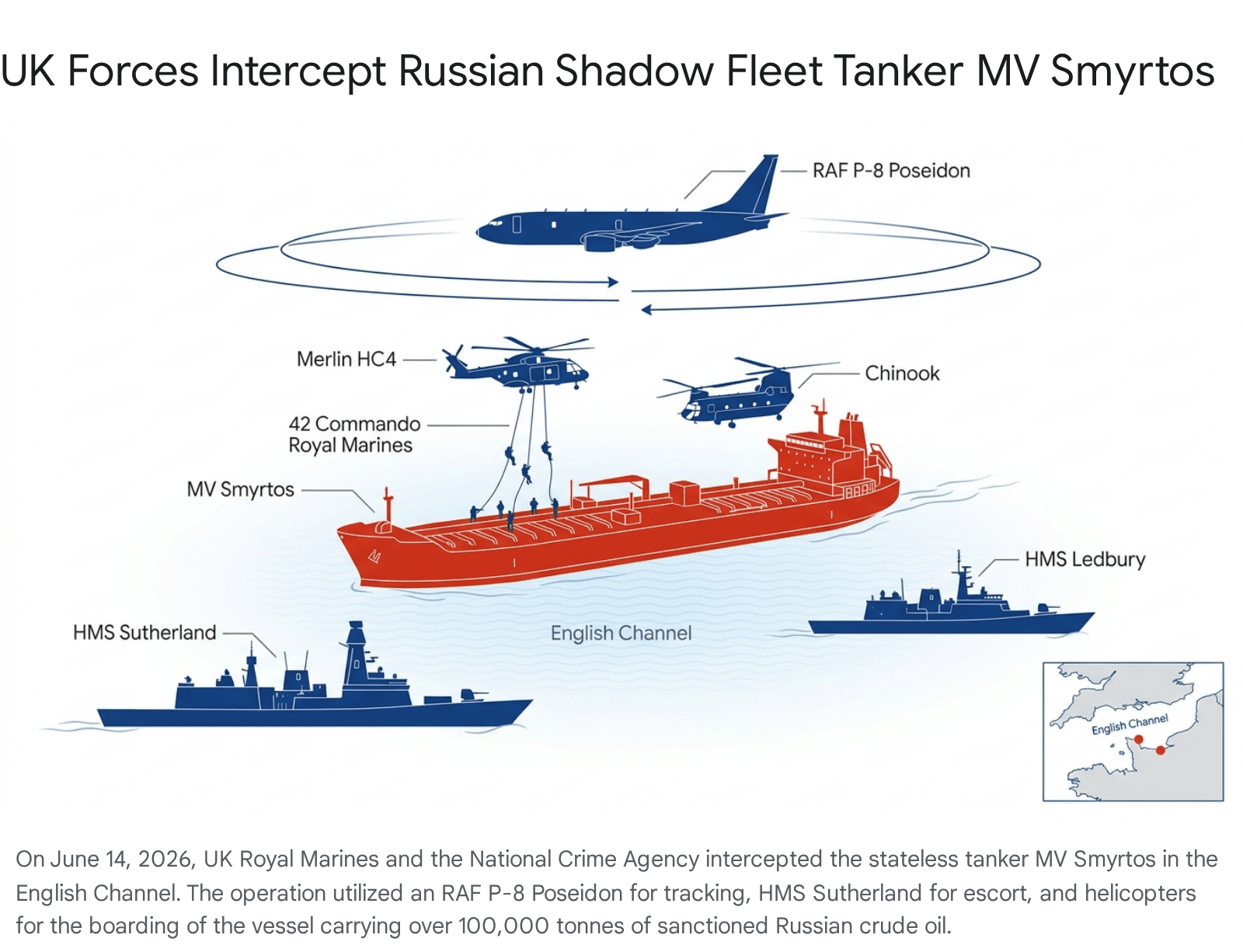
Maritime security and logistical interdiction operations witnessed unprecedented and highly escalatory developments in the European theater. On June 14, 2026, British military and law enforcement elements executed a complex maritime interdiction of the Russian shadow fleet crude oil tanker MV Smyrtos as it transited the English Channel. This action marked the first time the United Kingdom has physically boarded and seized a shadow fleet vessel, signaling a dramatic escalation in Western efforts to curtail illicit Russian hydrocarbon exports. The operation was conducted in the early morning hours by Royal Marine commandos from 42 Commando (functioning as the Special Operations Maritime Task Group) operating in tandem with officers from the National Crime Agency (NCA). Supported by a Royal Air Force P-8 Poseidon maritime patrol aircraft, Chinook and Merlin Mk4 helicopters, and escorted by the Type 23 frigate HMS Sutherland and the mine countermeasures vessel HMS Ledbury, the boarding force fast-roped onto the deck of the 244-meter Aframax tanker.
The Smyrtos was transporting 101,400 tonnes of Urals crude oil loaded at Ust-Luga, Russia, and was destined for Port Said, Egypt. The legal justification for the physical seizure relied upon the vessel’s compromised registry status. Days prior to the interception, the government of Cameroon revoked the Smyrtos‘s flag, rendering the tanker legally stateless. Under Article 110 of the United Nations Convention on the Law of the Sea (UNCLOS), any sovereign warship is authorized to board a stateless vessel in international waters. Following the unopposed boarding, the 25-member crew of Georgian and Indian nationals was detained, and the captain, Ajay Pant, was formally remanded into custody by the NCA for directly contravening Regulation 46Z9B of the Russia (Sanctions) (EU Exit) Regulations 2019. The vessel was subsequently redirected to an anchorage off Portland, England, where it remains under the armed guard of the Royal Navy.
This British operation follows similar actions by French commandos, who previously utilized flag-check protocols to board the sanctioned tankers Tagor and Grinch. The immediate strategic impact of the Smyrtos seizure was profound; maritime intelligence platforms reported that multiple other Russian shadow fleet tankers bound for the English Channel abruptly altered their navigational courses to avoid interception, demonstrating a highly effective disruption of Moscow’s maritime logistics network.
Within the Black Sea theater and occupied Crimea, Ukraine’s intermediate-range strike campaign has severely compromised Russian logistics. Over the reporting period, Ukrainian Unmanned Systems Forces (USF) systematically struck critical supply nodes, including a vital railway bridge over the North Crimean Canal near Rozdolne (110 kilometers from the frontline) and the Vladyslavivka-Feodosia railway junction. The persistent threat environment has fundamentally degraded the operational viability of the Crimean peninsula as a secure rear area. Consequently, the Russian military command has initiated intelligence-verified plans to completely withdraw and relocate its remaining Black Sea Fleet (BSF) command structures from occupied Sevastopol, transferring them to the relative safety of Novorossiysk in Russia’s Krasnodar Krai. Furthermore, the continuous kinetic degradation of transport infrastructure forced the command of the Russian Eastern Grouping of Forces to enact sweeping restrictions on military cargo traffic, explicitly banning heavy transport from utilizing the critical M-14 Rostov-Crimea and A-291 Kerch-Simferopol highways, thereby critically bottlenecking the flow of materiel to the southern front.
Third-Party Involvement and Geopolitical Shifts
The broader geopolitical landscape of the conflict was heavily influenced by the Group of Seven (G7) Summit held in Evian-les-Bains, France, from June 15 to 17, 2026. The summit concluded with a unified leaders’ statement pledging “unwavering support” for Ukraine, committing to heightened systemic pressure on the Russian war economy through the imminent tightening of sanctions specifically targeting the Russian oil and gas sectors. US President Donald Trump, actively promoting himself as the primary broker of global security architecture, held separate telephone discussions with both Zelensky and Putin during the summit, pushing aggressively for an immediate negotiated settlement. Trump’s newly secured preliminary agreement to end the US-Iran war and reopen the Strait of Hormuz provided Washington with the geopolitical flexibility to threaten the reimposition of lapsed sanctions on Russian oil exports.8 Despite Trump’s earlier public skepticism regarding Ukraine’s strategic leverage and his calls for territorial concessions, the G7 alliance successfully secured his endorsement for a joint declaration. This declaration formally recognized Ukraine’s improved battlefield position and committed the G7 to increase the rapid delivery of air defense systems and interceptors.
Concurrently, Western defense ministers utilized the Ukraine Defense Contact Group (Ramstein format) meetings in Belgium to pledge a collective $4 billion in new military aid. This massive procurement package heavily targets the rapid acquisition of Patriot air defense interceptor missiles, long-range artillery ammunition, and vast quantities of unmanned aerial systems.
| Donor Nation / Entity | Financial Value | Primary Military Asset Pledged / Mechanism |
| United Kingdom | £752 Million ($1 Billion) | 150,000 UAVs, >350 air defense missiles, and advanced radar systems |
| Netherlands | €500 Million ($573 Million) | General military aid, including €250 million dedicated to drone capabilities |
| Germany | $400 Million | Fast-track “Jumpstart” procurement: $200M for air defense ammunition, $200M for Patriot PAC-3 missiles |
| Australia | 100 Million AUD ($70 Million) | Procurement of US-made weapons via the Prioritized Ukraine Requirements List (PURL) initiative |
| Multinational Coalition | $1 Billion | Pooled funds through PURL for Patriot air defense interceptor missiles (Germany, Norway, Netherlands, Sweden) |
| Multinational Coalition | $540 Million | Long-range artillery ammunition (Norway, Denmark, Spain, Lithuania, Luxembourg) |
In Washington, legislative maneuvers aimed at financially outflanking the Russian Federation gained significant traction. A bipartisan coalition of US Senators—including Tim Kaine, John Cornyn, and Chris Coons—introduced the Seized Assets for Battlefield Equipment and Readiness (SABER) Act. Expanding upon the foundational legal framework of the April 2024 REPO Act, the SABER Act aims to establish a direct mechanism to utilize frozen Russian sovereign central bank assets explicitly for the procurement of lethal military equipment for Ukraine, effectively forcing the Kremlin to involuntarily finance its adversary’s defense.
Simultaneously, the involvement of autocratic third-party actors has demonstrably deepened, transforming the conflict into a proxy arena for global multipolar competition. European intelligence services and senior European Union officials officially confirmed that the People’s Republic of China is actively training Russian military personnel on sovereign Chinese territory. Intelligence indicates that hundreds of Russian soldiers are currently undergoing specialized instruction focused on the deployment of advanced drone swarms and electronic countermeasures (EW), directly contradicting Beijing’s official stance of strict military neutrality. Furthermore, Chinese commercial entities are facilitating the economic normalization of Russia’s territorial annexations. Investigations reveal that state-linked Chinese companies, including Amma Construction Machinery and Zhongxin Heavy Industry, have initiated long-term industrial infrastructure investments in Russian-occupied regions of Ukraine. Notably, these entities have supplied heavy machinery and technical specialists to relaunch operations at the Karansky Quarry in occupied Donetsk, establishing concrete production plants and crushing facilities to support local occupation logistics.
Tensions have also escalated significantly with neighboring Belarus regarding drone warfare complicity and Russian false-flag operations.11 On June 17, Russian and Belarusian officials falsely claimed that a Ukrainian drone struck a passenger bus carrying a Belarusian children’s soccer team in Bryansk Oblast, which Belarusian President Alexander Lukashenko cited as a provocation to drag Minsk into the war.11 However, on June 18, the Security Service of Ukraine (SBU) intercepted internal documents from the Bryansk ‘Safe Region’ authority confirming no Ukrainian drones were present, exposing the event as a fabricated pretext designed to legitimize future missile strikes.11 Ukrainian President Zelenskyy subsequently issued a formal ultimatum to Belarusian leader Alexander Lukashenko, giving him one week to dismantle Russian signal repeaters and relay stations located on Belarusian border towers.1 This diplomatic friction follows a reported 20 percent increase in Russian intelligence drones utilizing Belarusian airspace to launch incursions into northern Ukraine, alongside intelligence that Russia recently constructed five new drone bases near the shared border to utilize Minsk’s airspace as an attack corridor.3
Concurrently, the integration of North Korean forces into the Russian military apparatus was overtly celebrated in Pyongyang. Demonstrating a brazen disregard for international sanctions, North Korean leader Kim Jong Un inaugurated the “Memorial Museum of Combat Feats at the Overseas Military Operations” in April 2026, officially confirming the deployment of North Korean troops on behalf of Russia. During the opening ceremony, Kim publicly commended North Korean infantry elements who actively chose to “self-blast” with grenades rather than face capture by advancing Ukrainian forces, cementing the depth of the strategic military alliance between Moscow and Pyongyang.
3. Drone Warfare and Unmanned Systems
Tactical & Strategic Deployments
The preceding seven days have underscored a profound strategic evolution in unmanned systems deployment, transitioning from localized tactical battlefield surveillance to continental-scale strategic bombardment. On the consecutive nights of June 17 to 18 and June 18 to 19, Ukraine launched its largest and most devastating deep-rear drone swarms to date, explicitly and successfully targeting the airspace directly over Moscow City. The strikes, executed in massive waves to overwhelm radar tracking capabilities, successfully penetrated the highly saturated, multi-layered air defense networks surrounding the Russian capital. The sheer volume of incoming fixed-wing UAVs triggered widespread panic and forced civil aviation authorities to indefinitely ground all commercial and cargo flights at the four major Moscow airport hubs: Vnukovo, Domodedovo, Zhukovsky, and Sheremetyevo. Moscow Mayor Sergey Sobyanin reported the interception of 37 UAVs in a narrow two-hour daytime window alone on June 19, indicating an unprecedented operational tempo.
The Ukrainian deep-strike arsenal has been significantly augmented by the successful integration of the domestically engineered Fire Point “Flamingo” (FP-5) cruise missile. Operating at a highly efficient unit cost of approximately $500,000—roughly one-fifth the procurement price of a comparable US Tomahawk missile—the Flamingo boasts an operational range of 3,000 kilometers and delivers a one-ton high-explosive warhead. The system’s efficacy has drawn international attention, with German missile manufacturer Diehl Defence (producer of the IRIS-T system) actively engaging in negotiations to co-produce the Flamingo on German territory to modernize European arsenals as an alternative to American Tomahawks.4 This initiative is notably supported by members of German Chancellor Friedrich Merz’s party.5 The deployment of the Flamingo, alongside long-range fixed-wing drones, has allowed Ukrainian forces to consistently and accurately strike critical industrial targets up to 900 kilometers from the frontline, including the VNIIR-Progress military factory in the remote Chuvashiya region and major refineries in the Samara oblast.
Conversely, Russian tactical deployments of unmanned systems have increasingly prioritized the psychological and physical terrorization of the Ukrainian civilian populace, integrating intentional civilian harm into their wider operational battlefield air interdiction (BAI) campaigns. The Russian military has routinized what open-source intelligence and prosecutorial bodies describe as “human safari” operations. Utilizing maneuverable FPV drones, Russian operators actively hunt and strike individual civilians and civilian infrastructure across frontline oblasts. A stark manifestation of this tactic occurred in the Oskil Hromada of the Kharkiv Oblast. Following the successful evacuation of civilians from the central settlement by Ukrainian authorities, Russian forces maliciously redirected their Lancet loitering munitions to target civilian transport vehicles attempting to traverse the O211437 Oskil-Izyum highway. Concurrently, Russian forces continued to deploy remote-controlled Geran-type drones in synchronized, large-scale nightly barrages alongside Iskander-M ballistic missiles, routinely launching swarms of over 100 UAVs designed to overwhelm Ukrainian interceptor stocks and target critical power generation facilities.
Targeting Priorities
Ukrainian targeting priorities have exhibited a disciplined, systematic focus on dismantling the Russian hydrocarbon supply chain and its associated defense-industrial base, seeking to sever the economic arteries that sustain the war effort. The paramount success of the reporting period was the repeated, highly precise strikes on the Moscow Oil Refinery, located in the Kapotnya district. The Kapotnya facility represents a critical node in Russian energy infrastructure; it boasts an annual crude processing capacity exceeding 12 million tons, supplies 40 percent of Moscow City’s total gasoline demand, and provides 50 percent of the region’s diesel, including the specialized aviation fuel required by the capital’s airports. The Ukrainian strikes systematically dismantled the facility, igniting massive fires across five separate locations that resulted in localized “oil rain”. The General Staff confirmed the destruction of a primary combined oil refining unit and multiple high-capacity storage tanks (including three RVS-10000 and one RVS-30000 tank), forcing plant management to announce an indefinite suspension of all oil processing operations.
Simultaneously, within the theater of occupied Crimea, Ukrainian drone campaigns prioritized the eradication of the energy infrastructure essential for sustaining the Russian military garrison. On the nights of June 19 and 20, coordinated drone strikes targeted the Tavriiska Thermal Power Plant (a major 470-megawatt combined-cycle facility near Simferopol commissioned by Russia in 2019), a large-scale TES fuel and liquefied gas storage terminal, and the critical Zhuravlivka gas distribution station. NASA’s FIRMS satellite monitoring system detected widespread thermal anomalies consistent with catastrophic fires at these sites, which subsequently triggered extensive regional power outages across the Dzhankoi, Saky, and Simferopol districts. Further exacerbating the energy crisis, the Ukrainian 413th USF “Raid” Regiment successfully struck the Hlibivske underground gas storage facility on the Tarkhankut Peninsula.
In contrast, Russian targeting priorities remained aggressively focused on the systematic destruction of the Ukrainian national energy grid and cultural infrastructure, employing a strategy of punitive societal attrition. Retaliatory strike packages heavily targeted civilian, commercial, and energy infrastructure across Dnipropetrovsk, Mykolaiv, Sumy, and Kharkiv oblasts. Specifically, Ukraine’s largest private energy company, DTEK, reported that sustained Russian strikes against energy facilities in the Dnipropetrovsk Oblast left over 19,400 consumers entirely without power. Additionally, Russian strikes during the week damaged significant, UNESCO-listed cultural and religious sites, including the historic Kyiv-Pechersk Lavra, prompting severe condemnation from European officials.
Countermeasures & Tech Shifts
As both belligerents adapt to the pervasive ubiquity of unmanned systems, technological countermeasures, electronic warfare (EW), and partisan sabotage operations have become paramount to operational survival. The Ukrainian partisan resistance network “ATESH” executed a highly effective sabotage operation deep within the Russian city of Taganrog, Rostov Oblast. By physically infiltrating and disabling a critical electrical substation, ATESH agents successfully severed the power supply to the Atlant-Aero defense plant. This specific facility is critical to the Russian drone industry, responsible for the full production cycle of Molniya strike-reconnaissance drones, and manufactures the essential control systems and electronic components required for Orion UAVs and frontline FPV drones. The sudden, catastrophic loss of stable electricity forced an emergency shutdown of all active assembly and testing lines, completely halting the production of new unmanned batches intended for the occupation forces.
In a desperate effort to mitigate the escalating threat of Ukrainian deep-strike and intermediate-range drones, Russian military authorities have implemented increasingly unconventional countermeasures. The Kremlin authorized the emergency redeployment of elite drone operators belonging to the “Rubikon Center for Advanced Unmanned Technologies”. Previously instrumental in offensive operations in Pokrovsk, these highly trained units were pulled from the frontlines to conduct anti-drone air defense operations and secure highly vulnerable rear logistics routes, notably the M-14 Rostov-Crimea highway. However, Ukrainian forces actively tracked these redeployments, successfully striking a Rubikon operational headquarters near occupied Starobilsk in Luhansk Oblast. Inside occupied Crimea, Russian occupation authorities resorted to introducing a bizarre “moped ban” for local youths. Officials explicitly cited that the acoustic signatures of two-stroke moped engines closely mimic the low-frequency drone of Ukrainian long-range loitering munitions, thereby confusing localized acoustic drone-detection sensors and triggering panics and false air defense alarms across the peninsula.
A critical, systemic technological failure has also emerged within Russia’s strategic missile forces, profoundly undermining the credibility of its nuclear-capable deterrents. The highly publicized Oreshnik intermediate-range ballistic missile (IRBM)—touted by Putin as a symbol of Russian technological supremacy—suffers from a severe, foundational design vulnerability. Following its debut in November 2024, Russia launched three additional Oreshnik missiles in 2026—striking the Lviv region in January, Bila Tserkva in May, and suffering a catastrophic failure later in May when a warhead package crashed prematurely in occupied Donetsk.6 An intelligence investigation by Dallas Analytics revealed that in a frantic bid to expedite production and meet Kremlin deadlines, Russian defense contractors completely bypassed modern quality-assurance protocols. Instead of engineering modern guidance systems, the manufacturers relied on obsolete 1970s Soviet-era technology, specifically integrating the GU-503 aviation gyroscope. Internal correspondence from the Michurinsk Plant ‘Progress’, which produces the component, confirms that the facility lacks the modern calibration equipment necessary for the rigorous “burn-in” testing of these obsolete gyroscopes. Because the gyroscope fails to accurately correct the pitch, roll, and yaw deviations encountered at hypersonic speeds, the Oreshnik is inherently unstable, causing the missile to deviate erratically by tens of kilometers from its intended military targets and inadvertently strike civilian infrastructure. With only one operational Oreshnik missile reportedly remaining in the Russian arsenal from the original contract, this technological bottleneck represents a massive strategic vulnerability.
4. Resource Utilization, Constraints, and Sustainability Projection
Resource Utilization
The unrelenting intensity of the conflict is driving military resource consumption to unsustainable extremes, fundamentally straining the force generation and industrial base capacities of both nations. Personnel attrition remains catastrophic and highly asymmetric for the Russian Federation. According to daily data released by the General Staff of the Armed Forces of Ukraine, the cumulative total of Russian military casualties (including both killed and severely wounded personnel) reached approximately 1,390,660 by June 20, 2026. The burn rate of Russian infantry is staggering, with an estimated 1,240 casualties occurring in a single 24-hour reporting period at the close of the week.
Equipment losses mirror this degradation. The Russian military is suffering from severe mechanical and armored vehicle attrition, forcing a reliance on unarmored transport for frontline assaults.
| Category of Russian Military Asset | Total Verified Losses (as of June 20, 2026) |
| Personnel (Killed & Wounded) | ~1,390,660 |
| Main Battle Tanks | 12,041 |
| Armored Combat Vehicles | 24,787 |
| Artillery Systems | 44,386 |
| Multiple Launch Rocket Systems (MLRS) | 1,883 |
| Air Defense Systems | 1,433 |
| Operational-Tactical UAVs | 361,803 |
| Vehicles and Fuel Tankers | 109,342 |
Ammunition and interceptor utilization rates are critically stretched across both defensive lines. Russia is currently facing a severe, verified shortage of S-300 air defense missiles and essential guidance components (such as control modules and seekers) due to the compounding efficacy of Western technological sanctions. Because Russian commanders previously repurposed vast quantities of S-300 missiles for indiscriminate, high-volume surface-to-surface strikes against Ukrainian cities, they have critically depleted their strategic reserves. Consequently, Russian air defense networks are now forced into an untenable position: they must utilize highly sophisticated, expensive, and limited advanced interceptor missiles to engage cheap, mass-produced Ukrainian deep-strike drones. This dynamic creates an asymmetric cost-exchange ratio that heavily favors Kyiv, rapidly depleting Russia’s ability to protect its airspace. Ukraine, however, faces its own interceptor crisis. Confronting a Russian strategy that is projected to launch roughly 900 ballistic missiles annually, the Ukrainian military is burning through Western-supplied Patriot interceptors at a rate that currently outpaces foreign delivery schedules, leaving critical infrastructure highly vulnerable to penetration.
Logistical Constraints
Ukraine’s strategy of systematic energy interdiction has induced verified, cascading logistical constraints across the domestic Russian economy, achieving strategic effects that traditional frontline maneuvers cannot. By successfully striking 16 major refineries—including the crippling of Tatarstan’s massive facilities and the indefinite suspension of operations at the Moscow Oil Refinery—Ukraine has reduced Russia’s total national crude refining capacity by a staggering 30 percent. Gasoline production has subsequently plummeted to a 16-year low, forcing overall domestic oil production down to approximately nine million barrels per day.
The resulting domestic fuel shortages are acute, forcing the Kremlin to implement crisis-level economic interventions. State-owned and regional energy conglomerates have instituted draconian rationing measures across multiple federal subjects.
| Energy Conglomerate / Region | Specific Rationing Measures Implemented |
| Rosneft, Bashneft, TNK | Total ban on the sale of gasoline in fuel canisters across all federal subjects |
| Tatneft (Chelyabinsk City) | Strict limit of 30 liters (7.9 gallons) of gasoline per passenger car; 60 liters diesel per car, 300 liters per truck; Cash-only transactions |
| Tatneft (Moscow, St. Petersburg) | Unspecified volume limits implemented daily; transition to cash-only payments |
| General Gas Station Operators | Daily shifting limits, capping purchases at roughly 90 liters (23.7 gallons) per customer |
| TES Network (Occupied Crimea) | Mandated use of a digital QR code to purchase a maximum of 20 liters (5 gallons) of gasoline; codes sell out within seconds |

To mitigate these shortages, the Kremlin has been forced into the humiliating position of extending authorizations that allow refineries to release substandard, low-grade fuel directly to the domestic market. Furthermore, industry sources verified that Russia has initiated the emergency importation of gasoline via sea routes from unspecified Asian nations, and increased overland imports from Belarus, to stabilize a domestic market that is fundamentally fracturing under the pressure of war.
Logistical bottlenecks within the operational theater are equally severe and compounding. The interdiction of the M-14 and A-291 highways has heavily choked the land bridge connecting the Russian mainland to occupied Crimea, forcing the military to prioritize limited corridors while enduring persistent drone harassment from ATESH and USF elements. The United Kingdom’s physical interdiction of the shadow fleet vessel MV Smyrtos further exacerbates these macroeconomic constraints. By proving that European naval forces are willing to leverage international law (specifically the revocation of flags of convenience) to board, seize, and hold vessels transporting sanctioned Russian crude, Western allies are directly threatening the illicit maritime revenue streams that serve as the financial lifeblood of the Russian war machine.
Sustainability Projection
Forward-looking assessments indicate an extremely fragile sustainability dynamic for both belligerents, pivoting the conflict toward a pure industrial endurance test. The Russian Federation cannot sustain its current rate of refinery degradation without precipitating a massive domestic economic crisis. If Ukraine maintains the operational tempo of its long-range drone and Flamingo missile strikes, the Kremlin will inevitably be forced to make a zero-sum choice: adequately fuel its frontline mechanized units to sustain offensive momentum or supply its domestic civilian and commercial sectors to prevent internal unrest. The emerging reliance on imported fuel from Asian markets underscores a severe, ironic vulnerability in a petrostate that traditionally relies on energy exports for its geopolitical survival. Furthermore, the exposure of the Oreshnik IRBM program’s technical failures, coupled with the rapid depletion of S-300 interceptors, suggests that Russia’s deep-strike and air defense capabilities are structurally deteriorating, becoming increasingly reliant on foreign procurement (e.g., Iranian loitering munitions and North Korean artillery) and unverified, mass-produced low-tech solutions that lack precision.
Conversely, Ukraine’s operational sustainability remains critically, and precariously, dependent on the continued, uninterrupted influx of Western military aid. The $4 billion package pledged at the Ramstein summit, specifically the infusion of Patriot interceptors and long-range artillery, provides a critical short-term lifeline against Russia’s relentless ballistic missile barrages. However, Ukraine’s domestic production of the Flamingo cruise missile and the rapidly expanding capacity of its Unmanned Systems Forces demonstrate a growing indigenous defense capability that provides a necessary degree of strategic autonomy. In the medium term, Ukraine’s ability to hold the frontlines and protect its grid will depend entirely on Western delivery schedules matching the extreme burn rate of the artillery and interceptors currently being consumed on the battlefield.
5. Chronological Timeline of Key Events
- June 13, 2026:
- Ukrainian forces successfully strike a Russian heavy drone ammunition workshop near occupied Sokolohirsk, Luhansk Oblast.
- June 14, 2026:
- British Royal Marine commandos (42 Commando) and the National Crime Agency execute the first-ever physical seizure of a Russian shadow fleet vessel, boarding the stateless crude oil tanker MV Smyrtos in the English Channel and arresting its captain.
- US President Donald Trump holds separate diplomatic phone calls with Ukrainian President Zelensky and Russian President Putin, pushing for an immediate, negotiated end to the conflict.
- June 15, 2026:
- The European Union officially opens “Cluster 1” membership negotiations with Ukraine and Moldova in Luxembourg, advancing integration regarding the rule of law.
- The G7 Summit opens in Evian-les-Bains, France, featuring high-level discussions on Ukraine, geopolitical security, and global economic alignment involving President Trump and President Macron.
- June 16, 2026:
- OSINT analytical group DeepState reports that Russian forces achieved a net territorial gain of merely 7 square miles between June 9 and June 16, highlighting the slow, attritional nature of the ground war.12
- Private intelligence firm Dallas Analytics publishes a detailed report exposing critical guidance failures in Russia’s Oreshnik IRBM program, tracing the defect to obsolete Soviet-era GU-503 gyroscopes manufactured by the Michurinsk Plant ‘Progress’.
- Major Russian energy conglomerates (Rosneft, Tatneft, Bashneft) impose severe, widespread gasoline rationing and canister sale bans across the Russian Federation due to acute, strike-induced fuel shortages.
- June 17, 2026:
- The G7 Summit concludes with a joint leaders’ statement pledging unwavering military support for Ukraine and committing to tightened sanctions against the Russian energy sector.
- Russian and Belarusian officials claim a Ukrainian drone struck a passenger bus carrying Belarusian children in Bryansk Oblast, an allegation later exposed as a false-flag operation.11
- During the night, Ukrainian forces launch a massive, unprecedented drone strike against Moscow City and heavily damage the Moscow Oil Refinery.
- Industry sources verify that Russia is arranging emergency gasoline imports from Asian countries via sea routes to combat severe domestic shortages.
- June 18, 2026:
- The Security Service of Ukraine (SBU) intercepts internal Russian documents proving no drones were detected during the alleged Bryansk bus strike, refuting the Kremlin’s narrative.11
- A bipartisan group of US Senators introduces the SABER Act, legislation designed to allow the legal utilization of frozen Russian sovereign assets to purchase military equipment for Ukraine.
- Western allies pledge an additional $4 billion in military aid for Ukraine during the Ramstein summit in Belgium, heavily prioritizing Patriot interceptors.
- Overnight, Ukraine conducts a second consecutive, highly destructive drone attack on the Moscow Oil Refinery, destroying primary refining units and storage tanks, forcing the facility to suspend operations indefinitely.
- June 19, 2026:
- Russian Foreign Minister Sergei Lavrov publishes the essay “Ukraine, Europe, and Global Security,” formally rejecting the European peace plan proposed on June 7 and reiterating demands for Ukraine’s full capitulation.
- The Australian government pledges $70 million (AUD 100 million) to Ukraine via the PURL mechanism to purchase US-made weaponry.
- Polish President Karol Nawrocki announces the revocation of Ukraine’s President Zelensky’s Order of the White Eagle, citing Zelensky’s decision to name a military unit after the controversial Ukrainian Insurgent Army (UPA).
- Ukrainian President Zelenskyy issues a one-week ultimatum to Belarus, demanding the removal of Russian drone relay stations from border towers following a sharp increase in Russian intelligence drone incursions.1
- June 20, 2026:
- The pro-Ukrainian partisan movement ATESH successfully sabotages a critical electrical substation in Taganrog, Russia, causing an emergency shutdown of the Atlant-Aero defense plant and halting the production of military drones.
- Ukrainian Unmanned Systems Forces execute coordinated overnight strikes in occupied Crimea, hitting the Tavriiska Thermal Power Plant, TES fuel storage terminals, and the Zhuravlivka gas distribution station.
- The General Staff of the Armed Forces of Ukraine reports the cumulative total of Russian military casualties has reached 1,390,660.
Please share the link on Facebook, Forums, with colleagues, etc. Your support is much appreciated and if you have any feedback, please email us in**@*********ps.com. If you’d like to request a report or order a reprint, please click here for the corresponding page to open in new tab.
Sources Used
- Volodymyr Zelenskyy | The Guardian, accessed June 20, 2026, https://www.theguardian.com/world/volodymyr-zelenskiy
- Zelenskyy gives Lukashenka one week to remove drone relay stations from the border: “If he doesn’t, we will” – Belsat, accessed June 20, 2026, https://en.belsat.eu/93905030/zelenskyy-gives-lukashenka-one-week-to-remove-drone-relay-stations-from-the-border-if-he-doesnt-we-will
- Ukraine bolsters its northern defences amid fears Belarus is being dragged into war, accessed June 20, 2026, https://www.theguardian.com/world/2026/jun/18/ukraine-bolsters-its-northern-defences-amid-fears-belarus-is-being-dragged-into-war
- Ukrainian missiles competing for major European defense contract for first time – Politico, accessed June 20, 2026, https://newsukraine.rbc.ua/news/ukrainian-missiles-competing-for-major-european-1781875456.html
- German Defence Ministry interested in missiles from two Ukrainian manufacturers – Politico, accessed June 20, 2026, https://www.pravda.com.ua/eng/news/2026/06/19/8040179/
- Russian Offensive Campaign Assessment, June 16, 2026, accessed June 20, 2026, https://understandingwar.org/research/russia-ukraine/russian-offensive-campaign-assessment-june-16-2026/
- Leaked Papers Show Why Putin’s Oreshnik Missile Might Be Missing the Mark – Kyiv Post, accessed June 20, 2026, https://www.kyivpost.com/post/78364
- ‘I’m the boss’, Trump tells G7, as he warms to Ukraine’s war position, accessed June 20, 2026, https://www.timesofisrael.com/im-the-boss-trump-tells-g7-as-he-warms-to-ukraines-war-position/
- Macron’s Evian summit shows the limits Trump places on the G7, accessed June 20, 2026, https://www.chathamhouse.org/2026/06/macrons-evian-summit-shows-limits-trump-places-g7
- Trump signals swift return of sanctions on Russian oil as G7 refocuses on Ukraine, accessed June 20, 2026, https://apnews.com/article/g7-iran-ukraine-trump-macron-zelenskyy-e7fad4eabaae8181f70fa5a0b9e499b2
- Russian Offensive Campaign Assessment, June 18, 2026, accessed June 20, 2026, https://understandingwar.org/research/russia-ukraine/russian-offensive-campaign-assessment-june-18-2026/
- The Russia-Ukraine War Report Card, June 17, 2026, accessed June 20, 2026, https://www.russiamatters.org/news/russia-ukraine-war-report-card/russia-ukraine-war-report-card-june-17-2026