
1. Executive Summary
The operational and strategic environment between the Armed Forces of Ukraine and the Russian Federation during the reporting period of June 6 to June 13, 2026, has been characterized by the stabilization of ground maneuver fronts and a corresponding escalation in asymmetric, long-range interdiction campaigns.1 Following the culmination of the Russian Spring-Summer 2026 offensive in northern Kharkiv Oblast, the line of contact has largely rigidified into localized, attritional engagements with minimal territorial exchange.3 Consequently, the strategic center of gravity for both belligerents has decisively shifted toward the systematic degradation of deep-rear logistics, defense industrial bases, and critical energy infrastructure.4 Ukraine has demonstrated a pronounced maturation in its indigenous long-range strike capabilities, heavily leveraging the deployment of the FP-5 “Flamingo” cruise missile and advanced unmanned aerial vehicles to prosecute targets up to 1,100 kilometers inside the Russian Federation.4 Concurrently, a highly synchronized Ukrainian interdiction campaign has systematically dismantled key bridge infrastructure connecting occupied Kherson to the Crimean Peninsula, inducing severe logistical bottlenecks and forcing Russian resupply columns into highly vulnerable, predictable corridors.7
In response to these deep-strike capabilities and the resulting infrastructural degradation, the Russian Federation has maintained a high-volume unmanned aerial vehicle (UAV) and ballistic missile campaign aimed at overwhelming Ukrainian air defenses and striking energy grids.5 This campaign has included deliberate strikes on sensitive civilian and dual-use infrastructure, most notably a drone strike that impacted a spent nuclear fuel storage facility near the Chornobyl Nuclear Power Plant, prompting urgent warnings from the International Atomic Energy Agency.9 Furthermore, the Kremlin has escalated its strategic posturing, with verified intelligence vectors indicating the high-probability preparation for an Oreshnik intermediate-range ballistic missile (IRBM) launch from the Kapustin Yar testing facility, signaling a willingness to leverage coercive strategic assets following the June 12 Russia Day holiday.3
Diplomatically and geopolitically, the conflict’s parameters continue to internationalize, engaging third-party actors in increasingly direct capacities. The physical spillover of the conflict materialized sharply when a Russian drone, reportedly diverted by electromagnetic warfare, violated NATO airspace and was subsequently intercepted by a French fighter jet over Latvia.11 Simultaneously, a convergence of Western military and financial support has crystallized. This is evidenced by the passage of an $8 billion United States military finance loan package, the convening of a high-level European summit in London dedicated to co-developing anti-ballistic and deep-strike capabilities, and Ukraine’s own historic UAH 1.56 trillion defense budget expansion. These geopolitical maneuvers, juxtaposed against Russia’s reliance on military material from North Korea and Iran, underscore a protracted war of industrial and economic attrition where the sustainability of operational tempo is increasingly dependent on international supply chains and defense-industrial mobilization.12
2. Detailed Operational and Diplomatic Developments
Direct Bilateral and Indirect Interactions
Bilateral interactions during this reporting period have remained overtly hostile, with diplomatic and economic channels functioning primarily as platforms for geopolitical signaling, psychological operations, and economic warfare rather than avenues for conflict resolution. The interplay between diplomatic posturing and kinetic action was distinctly visible during the 29th St. Petersburg International Economic Forum (SPIEF), a premier venue historically utilized by the Kremlin to project economic resilience and solicit foreign investment.14 The 2026 iteration of the forum, themed “Pragmatic Dialogue: the Path to a Stable Future,” was systematically disrupted by Ukrainian signaling.14 On June 4, immediately preceding the forum’s core events, Ukrainian President Volodymyr Zelensky published an open letter proposing direct peace talks.14 This maneuver was assessed as a strategic information operation designed to force a public response from the Russian leadership on a global stage. Russian President Vladimir Putin subsequently dismissed the offer, stating he had only read it briefly, thereby publicly reinforcing the Kremlin’s continued rejection of peace negotiations on terms acceptable to Kyiv.14
The diplomatic maneuvering at SPIEF was coupled with direct kinetic strikes aimed at undermining the narrative of Russian domestic security.14 Ukrainian forces executed deep-strikes on the St. Petersburg Oil Terminal and the Kronstadt Naval Base—located approximately 1,100 kilometers from the Ukrainian border—deliberately timed to coincide with the forum’s opening.14 The strike successfully hit the Baltic Fleet corvette Boiky at the Kronstadt shipyard, explicitly demonstrating that Russian economic and military centers are no longer insulated from the conflict’s reach.14 Internally, the economic realities of a protracted war were candidly discussed by Russian elites at the forum. Andrei Bezrukov, a retired SVR colonel and Rosneft adviser, delivered a stark baseline forecast indicating that Russia must prepare for a permanent war economy, acknowledging the severe tactical difficulties posed by satellite-guided Ukrainian drones that have proven highly resilient against standard Russian electronic warfare.14
In a corresponding maneuver to sustain its own war economy, Ukraine enacted sweeping internal fiscal adjustments. On June 10, the Verkhovna Rada approved significant amendments to the 2026 state budget, a move made possible by sustained financial support from the European Union.16 This legislative action systematically restructures the national budget to prioritize defense expenditures, reflecting the economic mobilization required to counter the Russian military-industrial complex.16
| Budgetary Allocation Category | Approved Additional Funding (UAH) | Operational Purpose |
| Ministry of Defence (incl. Special Transport Service) | 1.52 Trillion | Procurement of weapons, military vehicles, and core defense operations. |
| Ministry of Internal Affairs (Border Guard & National Guard) | 16.7 Billion | Internal security, border defense, and rear-area stabilization. |
| State Security and Intelligence (SBU & GUR) | 4.3 Billion (Combined) | Advanced intelligence gathering, deep-strike coordination, and counter-espionage. |
| State Service of Special Communications | 4.8 Billion | Information protection, cyber defense, and secure military communications. |
| Security and Defense Sector Reserve Fund | 14.6 Billion | Emergency contingencies and rapid-response military financing. |
The integration of these funds brings Ukraine’s total security and defense spending in 2026 to a record UAH 4.4 trillion, with UAH 2.3 trillion strictly earmarked for the procurement of weapons and military vehicles, and UAH 1.45 trillion allocated for the remuneration of service members.16 This financial architecture is a critical indicator of Ukraine’s intent to sustain high-intensity operations well into the medium term.
Frontline Combat Updates and Territorial Shifts
The tactical geometry of the frontline has largely stagnated, indicative of a mature, highly attritional phase of warfare where neither combatant possesses the localized combat power, armor concentration, or air superiority necessary for decisive operational breakthroughs.2 Following the initial surges of the Russian Spring-Summer 2026 offensive, operations aimed at establishing a “buffer zone” in northern Kharkiv Oblast and pushing Ukrainian forces out of tube artillery range of Belgorod have culminated.3 On June 11 and 12, both Russian and Ukrainian sources confirmed that while offensive operations continued in northern Kharkiv, Russian forces failed to advance, and no significant ground activity was reported in the Velykyi Burluk direction.3
Open-source mapping and territorial data aggregators (DeepState) provide a highly granular view of the static nature of the front. During the tracking period of June 2 to June 9, 2026, Russian forces secured a net gain of merely 6 square miles of Ukrainian territory.17 This marginal gain followed a 10-square-mile net loss during the preceding week of May 26 to June 2.17 To provide a macro-strategic context, from June 10, 2025, to June 9, 2026, the Russian military made a net total gain of 1,369 square miles—an area slightly smaller than the U.S. state of Rhode Island, representing approximately 0.6% of Ukraine’s total sovereign territory.17
| Date of Advance (June 2026) | Settlement/Location | Advancing Force | Tactical Context |
| June 2 | Pryvillia | Russian Armed Forces | Incremental push in the eastern sector. |
| June 3 | Illinivka | Russian Armed Forces | Marginal consolidation of forward positions. |
| June 4 | Rodynske | Russian Armed Forces | Urban/suburban combat with slow block-by-block progression. |
| June 5 | Markove | Russian Armed Forces | Consolidation of gray-zone territory. |
| June 6 | Predtechyne | Russian Armed Forces | Small-scale infantry assault success. |
| June 7 | Kryva Luka | Russian Armed Forces | Forest and tree-line clearance operations. |
| June 8 | Zelene and Gulyaypole | Russian Armed Forces | Pressure applied to the southern Zaporizhzhia axis. |
| June 10 – 12 | Kostyantynivka-Druzhkivka Tactical Area | Ukrainian Armed Forces | Successful counter-attacks reclaiming forward tree lines. |
| June 10 – 12 | Oleksandrivka Direction | Ukrainian Armed Forces | Tactical localized advances pushing back Russian reconnaissance elements. |
The overarching dynamic on the ground is dictated by intermediate-range strikes rendering forward defensive positions untenable. A prominent example of this operational effect is the Kinburn Spit in Mykolaiv Oblast. Intelligence assessments indicate that the Russian military command has initiated a withdrawal of forces from the peninsula.15 Ukraine’s persistent intermediate-range strike campaign against Russian supply lines in occupied southern Ukraine has effectively severed the logistical arteries required to sustain a garrison on the Kinburn Spit, demonstrating how long-range precision fires can compel territorial abandonment without the necessity of direct ground assaults.15
Maritime Security and Deep-Strike Campaigns
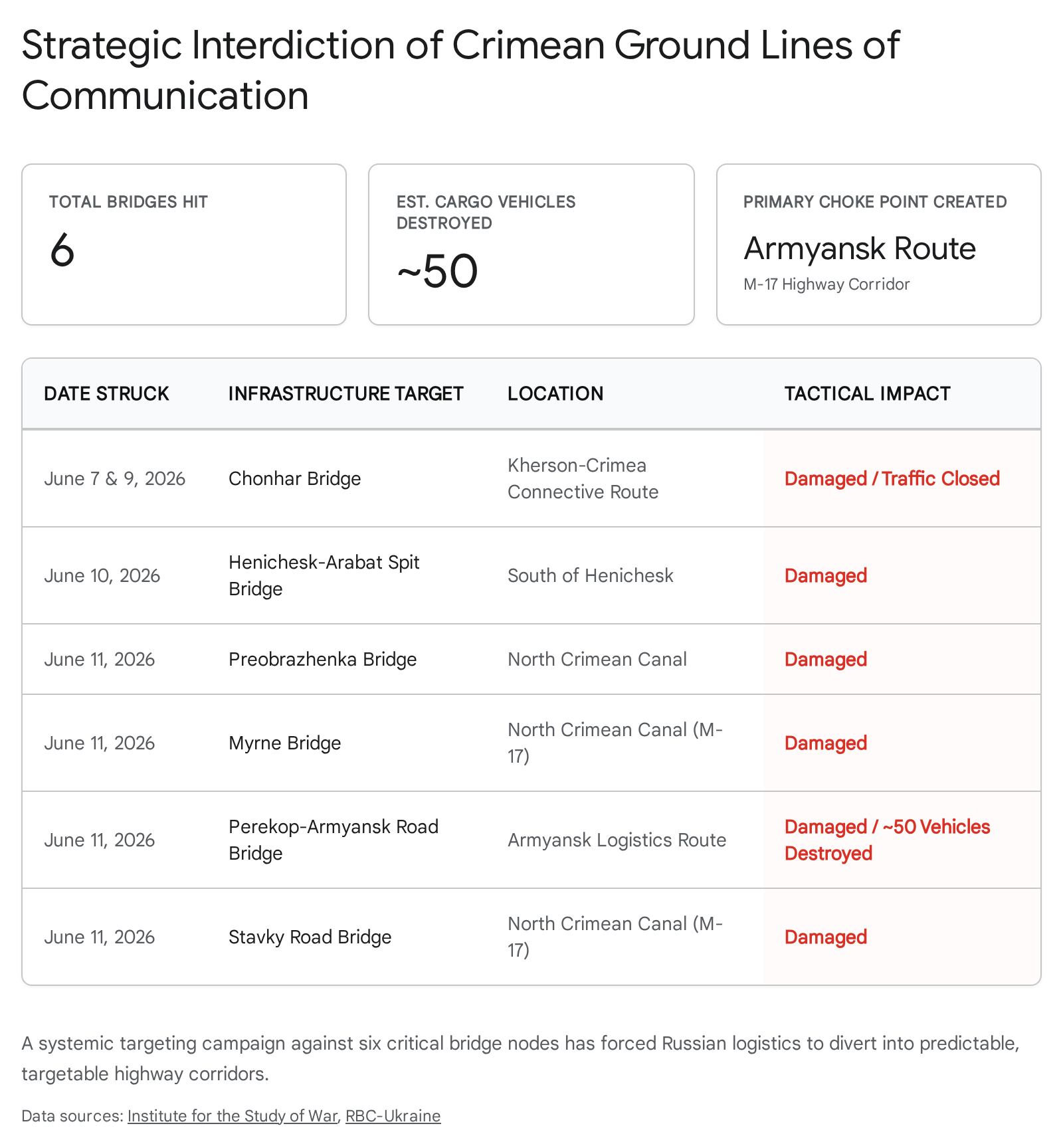
The most consequential strategic developments of the reporting period occurred beyond the line of contact, characterizing a definitive shift toward strategic interdiction, infrastructural degradation, and the systematic dismantling of enemy logistics.8 A primary operational objective for Ukrainian forces has been the isolation of the Crimean Peninsula. Over the past week, Ukraine executed a highly coordinated, multi-vector interdiction campaign specifically targeting the Ground Lines of Communication (GLOCs) connecting occupied Kherson Oblast to Crimea.7
The operational design of this campaign was to sever redundant logistics routes, thereby funneling Russian resupply efforts into singular, highly vulnerable geographical choke points. Between June 7 and June 11, Ukrainian precision strikes systematically damaged or disabled six primary transit bridges.7 The campaign commenced with strikes on the vital Chonhar Bridge on June 7, followed by a secondary strike on June 9, which forced Kherson Oblast occupation head Vladimir Saldo to temporarily close traffic across the span. Subsequently, on June 10, the bridge between Henichesk and the Arabat Spit was severely damaged.8 The culmination of this shaping operation occurred on the night of June 11, when Ukrainian forces struck four critical bridges spanning the North Crimean Canal: the Preobrazhenka bridge, the Myrne bridge, the Perekop-Armyansk road bridge, and the Stavky road bridge.7
The systemic destruction of these infrastructure nodes successfully diverted massive volumes of Russian military logistics onto the M-17 Armyansk-Oleshky highway.7 Having successfully engineered this logistical bottleneck, a Ukrainian regiment operating in the Kherson direction executed a devastating strike on the concentrated, slow-moving Russian columns navigating the Armyansk route, destroying an estimated 50 Russian military cargo vehicles carrying aviation fuel, diesel, and high-explosive ammunition.7 This cascading logistical failure has profound implications for the frontline, as Russian forces are now forced to supply the distant Hulyaipole direction using GLOCs from Crimea rather than the more direct routes stemming from occupied Donetsk Oblast, vastly increasing transit times and exposure to Ukrainian interdiction.7
Simultaneously, Ukraine’s deep-strike campaign within the recognized borders of the Russian Federation has escalated in both scope and precision.4 Utilizing newly developed long-range effectors, Ukrainian forces targeted multiple nodes of the Russian oil processing and petrochemical industry. On the night of June 7-8, Ukrainian attack drones struck the Gryshovaya oil depot in Novorossiysk, a massive complex linked to the Sheskharis oil terminal via a tunnel through the Markotkh Ridge.20 The strike destroyed 4 to 5 fuel storage tanks at Tank Farm No. 4, degrading a facility with a total capacity of over 1.2 million cubic meters.20 Subsequent strikes on June 10 targeted the Kuibyshev refinery in the Samara region—part of Rosneft’s massive Samara refining hub—forcing a halt to oil processing.21 Additional successful strikes were recorded against the Afipsky refinery in southern Krasnodar, causing significant fires and pipeline damage, and against two oil infrastructure facilities in the Vladimir region, located approximately 700 kilometers from the frontline.21
In retaliation, the Russian Federation has maintained a high tempo of ballistic missile and drone attacks aimed at Ukrainian urban centers and infrastructure.5 The most severe escalation in Russian strategic posturing involves the imminent threat of an Oreshnik intermediate-range ballistic missile (IRBM) launch. On June 12, both the Ukrainian Air Force and informed sources citing United States intelligence warnings stated there was a “high probability” that Russian forces would launch an Oreshnik missile from the Kapustin Yar testing site in Astrakhan Oblast within the subsequent 24 to 48 hours.3 The Kremlin has previously utilized the Oreshnik system as an instrument of coercive signaling—striking the Yuzhmash factory in Dnipro, the Lviv region, and the Bila Tserkva area—to demonstrate escalatory dominance.10 The anticipated deployment of this specific asset is assessed as a concerted effort by the Russian leadership to project strength following the June 12 Russia Day holiday and to compensate for the demonstrated inability of Russian air defenses to protect domestic strategic targets from Ukrainian incursions.3
Third-Party Country Involvement
The geopolitical ramifications of the conflict have continuously engaged third-party state actors, blurring the lines of regional containment. A critical incident underscoring this dynamic occurred on June 8, when the physical spillover of the conflict violated NATO airspace. A Russian drone veered into the sovereign airspace of Latvia, prompting NATO command to order a kinetic interception.11 A French fighter jet, operating under NATO’s Baltic Air Policing mission, successfully shot down the unmanned vehicle near the village of Berzgale, approximately 20 miles from the Russian border.11 Latvian Defense Minister Raivis Melnis confirmed that NATO analysis determined the drone had been inadvertently knocked off its pre-programmed course by the dense deployment of Russian electromagnetic warfare (EW) systems in the region.11 This incident highlights the growing systemic risk that the indiscriminate use of strategic electronic countermeasures poses to the airspace integrity of NATO’s eastern flank states.11
In the diplomatic and military aid spheres, a profound convergence of Western support materialized during the reporting period. In the United States, a rare moment of bipartisan consensus resulted in the House of Representatives passing the Ukraine Support Act by a vote of 226-195.23 This pivotal legislation authorizes $8 billion in military finance loans to Ukraine and officially extends the Ukraine Security Assistance Initiative through the fiscal year 2027, effectively establishing a long-term, insulated acquisition pipeline for the Ukrainian Ministry of Defense despite domestic political headwinds.23 Concurrently in Europe, a high-level strategic summit convened in London on June 7. Ukrainian President Zelensky met with UK Prime Minister Keir Starmer, French President Emmanuel Macron, and German Chancellor Friedrich Merz. The explicit focus of this summit was addressing the “urgent need to scale up the production of interceptors and co-develop anti-ballistic missile and deep strike capabilities,” directly responding to Russia’s deployment of hypersonic effectors and Oreshnik weapons. Leaders from the London summit explicitly stated they will utilize the upcoming G7 Summit in Evian-les-Bains, France (scheduled for June 15-17, 2026), to push for further economic sanctions and increased military pledges ahead of the July NATO summit. European financial solidarity was further demonstrated by Norway, which allocated €9.1 million through the European Bank for Reconstruction and Development’s International Chornobyl Cooperation Account to repair the protective sarcophagus at the Chornobyl Nuclear Power Plant following damage sustained from a Russian drone strike.24
Conversely, the Russian war effort continues to be sustained by a network of aligned third-party states. Intelligence analysis indicates that the Kremlin has tacitly accepted North Korea’s status as a de facto nuclear state.12 In exchange for North Korea’s provision of artillery shells, ballistic missiles, and military personnel to the Ukrainian theater, Russia has provided vital financial support, economic integration, and implicit geopolitical protection.12 On June 12, North Korean leader Kim Jong Un reaffirmed this alliance, sending a congratulatory message to President Putin on Russia Day and expressing full support for Moscow’s domestic and foreign policies.13 Additionally, despite waning demand and American blockades, Iranian oil shipments to China continue to provide Tehran with the economic lifeline necessary to sustain its own defense industrial base, which in turn supplies the Russian military with vast quantities of loitering munitions.13 However, back-channel geopolitical maneuvers suggest potential shifts; senior U.S. administration officials indicated that negotiations to end the ongoing war between the United States and Iran are 80-85% complete.25 A peace agreement, building upon a U.S.-backed ceasefire brokered in April, would dismantle Iran’s nuclear program and formally end hostilities across multiple fronts, potentially impacting the supply of Iranian loitering munitions to the Russian military.25 Meanwhile, China’s material support for Russia’s defense industrial base remains highly robust, severely complicating European diplomatic efforts to sever the Moscow-Beijing trade axis and end the war.26
3. Drone Warfare and Unmanned Systems
The operational tempo, tactical engagement parameters, and strategic targeting doctrines of the conflict are now overwhelmingly dictated by the deployment of unmanned systems and the corresponding evolution of electronic warfare countermeasures.5 Recognizing this fundamental shift in modern combat, Ukrainian President Zelensky officially designated June 11, 2026, as the inaugural “Day of the Unmanned Systems Forces,” institutionalizing this new branch within the broader architecture of the Armed Forces of Ukraine.21
Tactical and Strategic Deployments
On the tactical level, comprehensive OSINT reporting indicates that Ukrainian forces have successfully achieved a localized “tactical drone overmatch” across several highly contested sectors of the frontline.7 Utilizing highly maneuverable First-Person View (FPV) platforms, Ukrainian operators have systematically inflicted severe vehicular and personnel attrition on advancing Russian mechanized columns. This drone overmatch is a primary driver of the escalating Russian casualty rates on the battlefield, exacerbating the Kremlin’s difficulties in sustaining combat power amidst declining domestic volunteer recruitment figures.7
In the strategic realm, Ukraine has revolutionized its deep-strike capacity through the deployment of the domestically engineered FP-5 “Flamingo” cruise missile.28 The FP-5 represents a paradigm shift in indigenous capability; it is powered by an Ivchenko AI-25 low-bypass ratio turbojet engine and boasts an operational range of up to 3,000 kilometers.28 Designed specifically for deep-penetration strikes against high-value targets, the missile features a warhead capable of piercing thick concrete, with ground penetration capabilities of up to 10 meters, and utilizes advanced seeker technologies co-developed with German firm Diehl Defence.6
In response to Ukraine’s growing strategic reach, the Russian Ministry of Defense is actively adapting its own unmanned strategic posture.3 Surveillance and intelligence reporting indicate the active construction of at least five new long-range drone launch sites in western Russia, situated at existing airfields or entirely new complexes in the Bryansk, Oryol, and Smolensk oblasts.3 These sites—including the Shatalovo Military Airfield, the Tsymbulova drone port, and facilities near Navlya and Osavitsa—are located precisely 45 to 200 kilometers from the international border with Belarus.3 This deliberate geographic positioning is assessed as a highly calculated effort to exploit sovereign Belarusian airspace, allowing Russian drones to approach Ukrainian targets from unexpected vectors and severely compressing the engagement windows for Ukrainian air defense operators.3 Furthermore, Russian President Putin, during his June 12 address, explicitly lauded Russian military-technological innovations aimed at countering Ukrainian overmatch, specifically citing efforts to integrate artificial intelligence (AI) targeting algorithms into FPV drones and the rapid scaling of tactical electronic warfare systems.3
Targeting Priorities
The divergence in targeting matrices between the two belligerents underscores fundamentally differing strategic theories of victory. The Russian Federation utilizes its unmanned systems—often deployed in massive nightly swarms of 100 to 250 units—primarily to overwhelm Ukrainian air defense interceptor stockpiles, degrade national energy grids, and strike high-visibility dual-use infrastructure.4 A grave manifestation of this targeting doctrine occurred on June 7, when a Russian drone deliberately struck the Centralised Spent Nuclear Fuel Storage Facility located within the Chornobyl exclusion zone, approximately 15 kilometers from the disused power plant.9 The strike caused a fire covering 40 square meters and inflicted significant structural damage upon the facility’s container-receiving building, which notably houses the IAEA safeguards office.9 While a catastrophic radiological event was avoided—as the spent nuclear fuel from Ukraine’s VVER-1000 and VVER-440 reactors was securely stored in dry casks designed by Holtec International a few hundred meters away—IAEA Director General Rafael Mariano Grossi issued a stern condemnation, warning that “attacking a facility with large amounts of nuclear material is extremely dangerous. It must not happen.”.9
Conversely, Ukraine’s targeting matrix is highly empirical, focusing exclusively on systemic military degradation and the disruption of the Russian defense industrial base.22 A prime example of this precision targeting is the June 10 strike utilizing the FP-5 Flamingo missile against the AO “VNIIR-Progress” plant in Cheboksary. This specific facility is the primary manufacturer of the “Kometa” jamming-resistant navigation modules.6 The Kometa antenna is the foundational navigation component integrated into Russian reconnaissance UAVs, Shahed-variant loitering munitions, and the highly destructive glide bombs that have devastated Ukrainian frontline positions.6 By striking this facility, Ukrainian forces are executing a strategic interdiction, attempting to blind the Russian military and halt the production of precision-guided munitions at their origin point. Additionally, Ukrainian drones prioritize the destruction of high-value tactical assets, such as the confirmed strike on a Russian Buk-M3 air defense system near Shevchenko, and the continuous targeting of naval infrastructure in Sevastopol.3
Countermeasures and Technological Shifts
The escalating density and lethality of UAVs have precipitated a rapid, iterative evolution in electronic warfare (EW) and counter-UAS technologies, creating a highly dynamic technological battlespace.2 Russian tactical EW has proven exceptionally potent at disrupting GPS-reliant navigation systems. The intensity of Russian electromagnetic warfare is such that it frequently causes severe signal spillage, inadvertently knocking both Ukrainian maritime Unmanned Surface Vehicles (USVs) and aerial drones off their programmed courses.11 This exact phenomenon was responsible for the aforementioned drone violation into Latvian airspace and a separate incident where a Ukrainian sea drone was diverted and eventually washed ashore near the Greek island of Lefkada.11 To counteract this pervasive radio-frequency jamming, Ukrainian forces have adopted a hybrid approach blending high-tech and low-tech solutions. Most notably, they have begun deploying one-way attack drones guided by physical, unspooled fiber-optic cables, rendering them entirely immune to electronic interference, while simultaneously deploying physical nets to ensnare Russian drones approaching critical supply roads.31
The most significant technological countermeasure development, however, is the accelerated engineering of the Ukrainian FP-7.x “Freyja” interceptor missile.32 Recognizing the unsustainable economic asymmetry of expending $3.8 million United States Patriot PAC-3 interceptors against $50,000 mass-produced drones and ballistic targets, the Ukrainian defense firm Fire Point successfully flight-tested the FP-7.x.33 The FP-7.x is designed to provide comparable ballistic interception capabilities at a fraction of the cost, estimated at approximately $700,000 per unit.32 During recent tests, the interceptor successfully reached an altitude of 25 kilometers, a performance metric on par with the Patriot system.33 A key technical feature of the FP-7.x is its dual-guidance capability: the missile utilizes radar guidance during its mid-course flight before transitioning to an advanced infrared (IR) thermal homing head for terminal engagement.33 The realization of the overarching “Freyja” air defense system relies heavily on a collaborative European defense consortium, with active development talks ongoing with Thales and Hensoldt (radars), Leonardo (tracking systems), and Kongsberg (command and control).33 The successful integration and mass production of this system represent a critical pivot point in Ukraine’s ability to maintain a sustainable, sovereign air defense architecture.33
4. Resource Utilization, Constraints, and Sustainability Projection
Resource Utilization and Attrition
The physical consumption of military hardware and the attrition of human capital on both sides of the conflict remain staggering, defining the fundamental parameters of operational sustainability. Open-source assessments and verified reports from the General Staff of the Armed Forces of Ukraine indicate that the Russian military is sustaining an extraordinarily high daily casualty rate. Estimates place Russian personnel losses (killed and wounded) at approximately 1,300 to 1,310 soldiers per day.19
| Asset Category | Estimated Daily Russian Loss Rate | Strategic Implication |
| Military Personnel | 1,300 – 1,310 | Necessitates continuous, politically sensitive recruitment drives and reliance on undertrained contract personnel. |
| Artillery Systems | 78 – 88 | Degrades Russian indirect fire superiority, allowing Ukrainian infantry greater operational freedom. |
| Armored Combat Vehicles | 11+ | Severely limits the capacity for large-scale, mechanized maneuver warfare. |
| Tactical UAVs / Loitering Munitions | 2,100+ | Indicates massive expenditure of disposable assets to maintain constant pressure on Ukrainian lines. |
| Soft-Skin Logistical Vehicles | 400+ | Exacerbates frontline supply shortages, particularly in areas reliant on long-distance truck transport. |
Data derived from daily aggregations provided by the Ukrainian General Staff for the period ending June 13, 2026.19
Conversely, Ukraine’s critical vulnerability lies in the rapid burn rate of highly advanced, irreplaceable Western munitions. The persistent, high-volume Russian ballistic missile and glide-bomb campaigns have severely depleted Ukraine’s stockpiles of high-end air defense effectors, specifically the United States-supplied Patriot PAC-3 and the European SAMP-T interceptors. Because the Patriot system currently remains the only effective option for intercepting hypersonic and ballistic threats, Russia continuously exploits these shortages by launching systematic, large-scale strikes.5 This unsustainable utilization rate is the primary catalyst driving the expedited development of the indigenous FP-7.x interceptor.34
Logistical Constraints
The logistical architectures sustaining both militaries are demonstrating acute signs of strain under the pressure of continuous interdiction. For the Russian Federation, the cumulative, cascading effects of Ukraine’s intermediate and deep-strike campaigns have severely fractured critical supply chains in the southern theater. The severing of the Chonhar Bridge and the systematic destruction of the bridges over the North Crimean Canal have forced the Russian military logistics command to reroute vital supplies—destined for the heavily contested Hulyaipole front—away from the more secure, direct routes in occupied Donetsk.7 Supplies must now transit the highly vulnerable Crimean peninsula, resulting in massive bottlenecks at the Armyansk choke point and exposing slow-moving convoys to devastating strikes. Furthermore, the successful Ukrainian drone strikes on the Kuibyshev, Afipsky, and Gryshovaya oil processing facilities have precipitated acute gasoline and basic goods shortages throughout occupied Sevastopol and the broader Crimean territory.7 These fuel shortages directly hinder both civilian economic stability and the mechanized mobility of Russian forces operating in the southern sectors.7
Ukraine faces its own profound logistical challenges, primarily centered around the delayed realization and physical delivery of pledged foreign military aid. While the United States House of Representatives’ authorization of an $8 billion military finance package provides vital long-term financial certainty 23, the physical delivery of complex air defense architectures, precision-guided munitions, and 155mm artillery shells remains entirely subject to the severe production constraints of the Western defense industrial base. For instance, while Lockheed Martin executives have indicated ongoing efforts to expand PAC-3 interceptor production facilities, they have explicitly noted that global supply crunches—intensified by concurrent demands from other global conflicts—heavily limit immediate availability for the Ukrainian theater.36
Sustainability Projection
The objective interplay of these resource constraints, daily attrition rates, and emerging technological capabilities yields a clear, forward-looking sustainability projection for the short-to-medium term.
- Russian Operational Culmination and Strategic Posturing: Based on the current, verified daily casualty rates exceeding 1,300 personnel and the systemic degradation of their southern Ground Lines of Communication, it is highly assessed that Russian forces do not possess the massed materiel, intact armored reserves, or logistical throughput required to launch a successful theater-level ground offensive in the near term.27 Consequently, the Russian military will increasingly rely on asymmetric capabilities—such as the threatened deployment of Oreshnik intermediate-range ballistic missiles and the continuous launch of massive Shahed drone swarms—to project power, achieve political signaling, and attempt to deter further Ukrainian infrastructure attacks.3 The gasoline shortages currently plaguing Crimea are projected to cascade northward into the Kherson and Zaporizhzhia oblasts, severely degrading Russian mechanized mobility and defensive response times by the late summer of 2026.7
- Ukrainian Defensive Resilience and the Imperative of Indigenous Production: Ukraine’s capacity to hold the current line of contact is highly sustainable, provided that the newly approved Western financial streams (including the EU-backed UAH 1.56 trillion budget expansion) translate rapidly into material deliveries.16 However, the ultimate strategic variable is the deployment timeline of the FP-7.x interceptor and the mass production of the FP-5 Flamingo missile. Denys Shtilerman, chief designer at Fire Point, indicates that mass production of the FP-7.x—yielding a projected output of three missiles per day—could commence as early as August 2026, contingent upon the timely delivery of infrared seeker components from the German firm Diehl Defence, though full operational deployment across the country is slated for 2027.32 Until this indigenous, cost-effective architecture is fully online, Ukraine will remain highly vulnerable to massed Russian ballistic strikes. Therefore, Ukrainian forces must maintain a proactive, aggressive operational posture, relying heavily on preemptive deep strikes against Russian airfields, defense manufacturing plants, and logistical hubs to degrade the threat before it can be launched.5
5. Chronological Timeline of Key Events
The following timeline details the most significant verified military, diplomatic, and geopolitical events of the past seven days, presented in chronologically ascending order.
- June 6, 2026: Russian forces execute a strike against two civilian search and rescue Ukrainian vessels operating in the Black Sea, utilizing remote-controlled Shahed-type loitering munitions to hit dynamic maritime targets.18
- June 7, 2026: A Russian unmanned aerial vehicle strikes the Centralised Spent Nuclear Fuel Storage Facility located within the Chornobyl exclusion zone, causing significant structural damage to the reception building but failing to breach the Holtec dry casks, preventing a radiological release.9
- June 7, 2026: In a highly coordinated operation, Ukrainian forces successfully strike the critical Chonhar bridge connecting occupied Kherson Oblast to the Crimean Peninsula, initiating a wide-scale logistical interdiction campaign.
- June 7, 2026: Utilizing advanced capabilities, the Ukrainian Special Operations Forces (SSO) strike the Semikolodezyanska oil depot and a major marine oil terminal located in occupied Feodosia, eastern Crimea.18
- June 7, 2026: A high-level strategic summit convenes in London; Ukrainian President Volodymyr Zelensky, UK Prime Minister Keir Starmer, French President Emmanuel Macron, and German Chancellor Friedrich Merz meet to negotiate the scaling up of Ukrainian deep-strike and anti-ballistic missile capabilities ahead of the upcoming G7 Summit in Evian-les-Bains.
- June 8, 2026: Deep inside Russian territory, Ukrainian attack drones strike the Gryshovaya oil depot in Novorossiysk, successfully destroying 4 to 5 massive fuel storage tanks at Tank Farm No. 4.20
- June 8, 2026: A severe geopolitical incident occurs as a French fighter jet, operating under NATO command, shoots down a Russian drone over the airspace of Latvia near the village of Berzgale; the drone had been inadvertently diverted by Russian electronic warfare systems.11
- June 9, 2026: Ukrainian forces conduct a secondary, follow-up strike on the already damaged Chonhar bridge, forcing Russian occupation head Vladimir Saldo to mandate the temporary closure of all traffic across the vital span.
- June 10, 2026: The Ukrainian Verkhovna Rada officially approves an amendment to the 2026 state budget, increasing critical defense and security expenditures by a massive UAH 1.56 trillion, backed by EU financial support.16
- June 10, 2026: Continuing the Crimean isolation campaign, Ukrainian forces strike and severely damage the bridge connecting Henichesk and the Arabat Spit.8
- June 10, 2026: Demonstrating unprecedented reach, Ukrainian forces launch an indigenous FP-5 Flamingo cruise missile, successfully striking the VNIIR-Progress military-industrial plant in Cheboksary, Russia—over 900 kilometers from the frontline—disrupting the production of drone navigation antennas.
- June 10, 2026: The Financial Times publicly reports that the Ukrainian defense firm Fire Point has successfully test-fired the FP-7.x anti-missile interceptor, demonstrating a viable, low-cost ($700,000) alternative to the Patriot system capable of reaching a 25-kilometer altitude.5
- June 11, 2026: President Volodymyr Zelensky officially inaugurates the “Day of the Unmanned Systems Forces,” recognizing the structural integration of drone operators into the military hierarchy.21
- June 11, 2026: In a devastating blow to Russian logistics, Ukrainian forces simultaneously strike four critical bridges spanning the North Crimean Canal (Preobrazhenka, Myrne, Perekop-Armyansk, and Stavky).7
- June 11, 2026: Capitalizing on the newly created logistical bottleneck resulting from the bridge interdictions, a Ukrainian regiment destroys a massive Russian convoy consisting of approximately 50 military cargo vehicles carrying aviation fuel and ammunition on the Armyansk highway route.7
- June 12, 2026: During the Russia Day holiday, Russian President Vladimir Putin meets with military personnel, publicly praising domestic advancements in FPV drones and tactical electronic warfare while acknowledging the severe tactical difficulties Russian forces currently face.3
- June 12, 2026: The Ukrainian Air Force, corroborated by United States intelligence warnings, issues a high-probability alert indicating that Russian forces are actively preparing to launch an Oreshnik intermediate-range ballistic missile (IRBM) from the Kapustin Yar testing site within 24 to 48 hours.3
- June 13, 2026: Verified tracking aggregates confirm that Russian daily casualty rates have reached an estimated 1,310 personnel and the destruction of 88 artillery systems over the preceding 24-hour period, highlighting the extreme attritional nature of the ongoing conflict.19
Please share the link on Facebook, Forums, with colleagues, etc. Your support is much appreciated and if you have any feedback, please email us in**@*********ps.com. If you’d like to request a report or order a reprint, please click here for the corresponding page to open in new tab.
Sources Used
- Russian Offensive Campaign Assessment, June 1, 2026, accessed June 13, 2026, https://understandingwar.org/research/russia-ukraine/russian-offensive-campaign-assessment-june-1-2026/
- Europe and Central Asia Overview: June 2026 – ACLED, accessed June 13, 2026, https://acleddata.com/update/europe-and-central-asia-overview-june-2026
- Russian Offensive Campaign Assessment, June 12, 2026 | ISW, accessed June 13, 2026, https://understandingwar.org/research/russia-ukraine/russian-offensive-campaign-assessment-june-12-2026/
- June Risk Barometer: Update on Cuba, the Russia–Ukraine War, and Southeast Asia, accessed June 13, 2026, https://www.globalguardian.com/newsroom/risk-barometer-june-2026
- Russian Offensive Campaign Assessment, June 10, 2026, accessed June 13, 2026, https://understandingwar.org/research/russia-ukraine/russian-offensive-campaign-assessment-june-10-2026/
- FP-5 Flamingo – Wikipedia, accessed June 13, 2026, https://en.wikipedia.org/wiki/FP-5_Flamingo
- Russian Offensive Campaign Assessment, June 11, 2026 | ISW, accessed June 13, 2026, https://understandingwar.org/research/russia-ukraine/russian-offensive-campaign-assessment-june-11-2026/
- Key bridges hit: Ukraine squeezes Russian logistics to Crimea, ISW says, accessed June 13, 2026, https://newsukraine.rbc.ua/news/key-bridges-hit-ukraine-squeezes-russian-1781250295.html
- IAEA warning after drone hits Chernobyl used fuel facility – World …, accessed June 13, 2026, https://www.world-nuclear-news.org/articles/iaea-warning-after-drone-hits-chernobyl-used-fuel-facility
- Ukraine warns of another Oreshnik strike within 24 hours after U.S. passes on Russian warning, accessed June 13, 2026, https://meduza.io/en/news/2026/06/13/ukraine-warns-of-another-oreshnik-strike-within-24-hours-after-u-s-passes-on-russian-warning
- NATO shoots down drone over Latvia as concern about Ukraine war’s spread grows, accessed June 13, 2026, https://www.washingtonpost.com/world/2026/06/08/nato-shoots-down-drone-over-latvia-concern-about-ukraine-wars-spread-grows/
- Russia Analytical Report, June 1–8, 2026, accessed June 13, 2026, https://www.russiamatters.org/news/russia-analytical-report/russia-analytical-report-june-1-8-2026
- June 12, 2026 – FDD, accessed June 13, 2026, https://www.fdd.org/overnight-brief/june-12-2026/
- Putin’s Davos, under drones: What SPIEF 2026 revealed about Russia’s war economy, accessed June 13, 2026, https://www.washingtonexaminer.com/op-eds/4598052/putin-spief-2026-russia-war-economy/
- Russian Offensive Campaign Assessment, June 8, 2026 | ISW, accessed June 13, 2026, https://understandingwar.org/research/russia-ukraine/russian-offensive-campaign-assessment-june-8-2026/
- Defense and security expenditures increased by UAH 1.56 trillion | MoD News, accessed June 13, 2026, https://mod.gov.ua/en/news/defense-and-security-expenditures-increased-by-uah-1-56-trillion
- The Russia-Ukraine War Report Card, June 10, 2026, accessed June 13, 2026, https://www.russiamatters.org/news/russia-ukraine-war-report-card/russia-ukraine-war-report-card-june-10-2026
- Russian Offensive Campaign Assessment, June 7, 2026 | ISW, accessed June 13, 2026, https://understandingwar.org/research/russia-ukraine/russian-offensive-campaign-assessment-june-7-2026/
- Russia loses 1,310 soldiers and 88 artillery systems over past day, accessed June 13, 2026, https://www.pravda.com.ua/eng/news/2026/06/13/8039105/
- June 8 Drone Strike Destroys 4–5 Tanks at Gryshovaya Oil Depot, accessed June 13, 2026, https://militarnyi.com/en/news/june-8-drone-strike-destroys-4-5-tanks-at-gryshovaya-oil-depot/
- Ukraine war briefing: Flamingo missiles hit more far-flung Russian targets, accessed June 13, 2026, https://www.theguardian.com/world/2026/jun/11/ukraine-war-briefing-flamingo-missiles-hit-more-far-flung-russian-targets
- Ukraine launches long-range strikes on military and energy sites in Russia, accessed June 13, 2026, https://apnews.com/article/russia-ukraine-war-military-strikes-4a158f6273807683d48692dedb4121b8
- House passes Ukraine aid bill with new sanctions for Russia, accessed June 13, 2026, https://breakingdefense.com/2026/06/house-passes-ukraine-aid-bill-with-new-sanctions-for-russia/
- Norway allocates over €9 million for repair of Chornobyl protective sarcophagus, accessed June 13, 2026, https://www.pravda.com.ua/eng/news/2026/06/11/8038892/
- Morning Briefing: June 13, 2026 – Anadolu Ajansı, accessed June 13, 2026, https://aa.com.tr/en/world/morning-briefing-june-13-2026/3965741
- China’s Position on Russia’s Invasion of Ukraine | U.S., accessed June 13, 2026, https://www.uscc.gov/research/chinas-position-russias-invasion-ukraine
- ISW Russian Offensive Campaign Assessment, June 11, 2026, accessed June 13, 2026, https://www.kyivpost.com/post/78006
- Ukrainian FP-5 Flamingo Missile Destroys Russian Factory Behind Navigation Systems for Drones and Kalibr Missiles – UNITED24 Media, accessed June 13, 2026, https://united24media.com/war-in-ukraine/ukrainian-fp-5-flamingo-missile-destroys-russian-factory-behind-navigation-systems-for-drones-and-kalibr-missiles-19685
- Chernobyl fuel facility hit: Nuclear fears resurface, Kyiv says Russian attack ‘deliberate’, accessed June 13, 2026, https://timesofindia.indiatimes.com/world/europe/chernobyl-fuel-facility-hit-nuclear-fears-resurface-kyiv-says-russian-attack-deliberate/articleshow/131564882.cms
- Russian drone hit nuclear fuel storage facility near Chornobyl, Ukraine says, accessed June 13, 2026, https://www.cbc.ca/news/world/russian-drone-chornobyl-9.7226511
- How Ukraine’s Drone Innovation Reversed Russia’s Momentum, accessed June 13, 2026, https://www.cfr.org/articles/how-ukraines-drone-innovation-reversed-russias-momentum
- Ukraine successfully tests new interceptor at one-fifth the price of a Patriot. Developer says mass production could begin as soon as August, if German supplier can deliver key component., accessed June 13, 2026, https://meduza.io/en/news/2026/06/10/ukraine-successfully-tests-new-interceptor-at-one-fifth-the-price-of-a-patriot-developer-says-mass-production-could-begin-as-soon-as-august-if-german-supplier-can-deliver-key-component
- Flight altitude of 25 kilometers: Financial Times reveals new details …, accessed June 13, 2026, https://unn.ua/en/news/flight-altitude-of-25-kilometers-financial-times-reveals-new-details-about-the-ukrainian-patriot-equivalent
- Ukraine builds cheap alternative to US Patriot missiles, accessed June 13, 2026, https://www.ft.com/content/c5839dd4-c4e9-4503-a605-67dcef053845?syn-25a6b1a6=1
- russian losses in Ukraine as of June 12, 2026 | MoD News, accessed June 13, 2026, https://mod.gov.ua/en/news/total-russian-combat-losses-in-ukraine-as-of-june-12-2026
- Patriot Missile Delays Loom as Lockheed Plans Output Surge to 2,000 PAC-3s by 2033, accessed June 13, 2026, https://www.kyivpost.com/post/77956
- Arms maker Diehl in talks to build Ukrainian missile in Germany, accessed June 13, 2026, https://www.ft.com/content/812b56ff-eb05-4294-9ad2-c9a1b8f1d343?syn-25a6b1a6=1
- Russia may launch Oreshnik missile to project strength after Russia Day – The New Voice of Ukraine, accessed June 13, 2026, https://english.nv.ua/nation/isw-warns-russia-may-launch-oreshnik-missile-at-ukraine-50615952.html