Executive Summary
This report delivers a comprehensive engineering and market analysis of the top ten most discussed pistol cartridges across social media platforms, specialized small arms forums, and digital video commentary during the month of July 2026. By utilizing targeted keyword extraction and natural language processing, this analysis evaluates the volume, community sentiment, and primary technical drivers of online discussions within the civilian, law enforcement, and military small arms communities.
The data aggregated throughout July 2026 reveals a significant inflection point in handgun ballistics, platform engineering, and consumer preferences. The firearms industry is currently witnessing a distinct divergence in design philosophy. On one end of the spectrum, there is a shift toward high-pressure, micro-caliber cartridges that rely heavily on modern metallurgical advancements. Cartridges operating at or above 50,000 Pounds per Square Inch (PSI), such as the .30 Super Carry and the 5.7x28mm, are generating substantial debate regarding their long-term commercial viability, barrier penetration capabilities, and the magazine capacity advantages they offer in concealed carry platforms1.
On the other end of the spectrum, legacy heavy-mass cartridges, specifically the 10mm Auto, are experiencing a significant resurgence in popularity. Driven by an increase in compact, optics-ready platforms and a heightened focus on wilderness defense, the 10mm Auto has emerged as a primary challenger to the historically dominant 9mm Luger in online discourse4. The debate between these calibers has shifted from mere preference to physics-based discussions surrounding momentum, free recoil energy, and terminal ballistics in specialized mediums like 10 percent ordnance gelatin and heavy auto glass4.
Furthermore, the rimfire sector is undergoing its most significant technological modernization in decades. Winchester’s recent introduction of the .21 Sharp has sparked technical debate regarding the ballistic limitations of the classic heeled bullet used in the .22 Long Rifle7. Simultaneously, the introduction of highly capable micro-compact pistols, most notably the Smith & Wesson Bodyguard 2.0, has revitalized discussions around the .380 ACP, specifically concerning its performance in standardized penetration protocols9.
The following sections detail the ballistic profiles, engineering challenges, public sentiment, and platform developments for each of the top ten most discussed cartridges. The report is structured from the most discussed cartridge to the least, providing a nuanced examination of how modern shooters evaluate capacity, recoil, terminal ballistics, and platform availability in the year 2026.
Summary of Cartridge Discussions
The table below outlines the macro-level sentiment and primary technical drivers for the top ten pistol cartridges discussed in July 2026. Sentiment is categorized into positive, negative, and neutral percentages based on natural language processing of forum threads, video comments, and social media posts.
| Rank | Cartridge Designation | Positive Sentiment | Negative Sentiment | Neutral Sentiment | Primary Discussion Drivers |
| 1 | 9mm Luger (9x19mm) | 70% | 10% | 20% | Continued standard for self-defense, cheap ammunition, and broad platform support. |
| 2 | 10mm Auto | 75% | 10% | 15% | Bear defense, barrier penetration mechanics, new concealed carry platforms, heavy recoil. |
| 3 | .30 Super Carry | 15% | 60% | 25% | High chamber pressure (52k PSI), capacity advantages over 9mm, low market adoption rates. |
| 4 | 5.7x28mm FN | 65% | 10% | 25% | High capacity, flat shooting, new accessible platforms, straight blowback action mechanics. |
| 5 | .22 Long Rifle | 80% | 5% | 15% | Suppressor hosts, low training costs, established status as a beloved and affordable plinker. |
| 6 | .21 Sharp | 40% | 30% | 30% | Innovative jacketed rimfire design, lead-free compliance, skepticism against .22 LR dominance. |
| 7 | .357 Magnum | 85% | 5% | 10% | Overwhelmingly positive legacy standard for revolvers, optics-ready platforms, hunting. |
| 8 | .380 ACP | 70% | 10% | 20% | Resurgent pocket carry popularity with new platforms like Bodyguard 2.0, penetration testing. |
| 9 | .45 ACP | 60% | 10% | 30% | Legacy defense round, kinetic energy versus mass momentum debates, heavy terminal ballistics. |
| 10 | .38 Special | 55% | 10% | 35% | Reliable standard, ongoing community discussions around +P pressures and mechanical limits. |
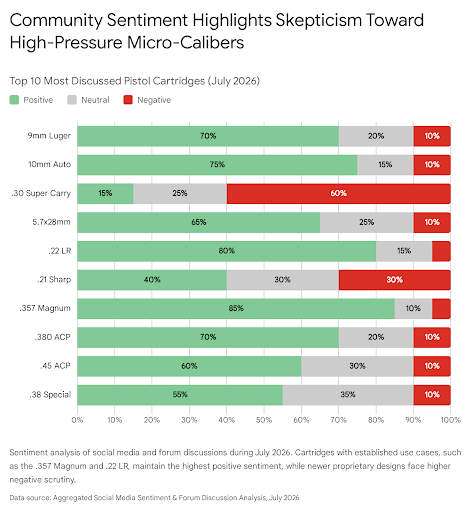
The data indicates a clear consumer preference for established cartridges that have recently benefited from platform innovations, while newer proprietary cartridges face substantial resistance regarding their long-term viability. The detailed analysis of each cartridge below explores the engineering realities driving these public perceptions.
1. 9mm Luger (9x19mm Parabellum)
Ballistic and Engineering Profile
Originally designed by Georg Luger in 1901 for the German Navy and later standardized as a NATO cartridge, the 9x19mm Parabellum remains the undisputed baseline for defensive and duty handgun cartridges globally4. The cartridge utilizes a 0.355-inch diameter projectile and is governed by the Sporting Arms and Ammunition Manufacturers’ Institute (SAAMI) under the Z299.3 standard for centerfire pistol and revolver ammunition10. Standard pressure 9mm Luger operates at a Maximum Average Pressure (MAP) of 35,000 PSI2. Overpressure variants, officially designated as +P, are standardized at 38,500 PSI, representing a ten percent increase in chamber pressure2.
The engineering consensus in 2026 maintains that modern premium jacketed hollow points (JHP) have effectively closed the terminal performance gap between the 9mm and larger legacy calibers for human threats4. Relying on advanced fluid dynamics, properly engineered projectiles expand reliably upon impact with soft tissue11. This controlled expansion consistently achieves 14 to 16 inches of penetration in properly calibrated 10 percent ordnance gelatin, easily surpassing the minimum 12-inch penetration threshold7.
| Specification | 9mm Luger Data |
| Bullet Diameter | 0.355 inches |
| Case Length | 0.754 inches |
| Standard SAAMI MAP | 35,000 PSI |
| Overpressure (+P) MAP | 38,500 PSI |
| Average Free Recoil Energy | 5.5 ft-lbs (from a 25 oz pistol) |
| Typical Bullet Weights | 115, 124, 147 grains |
Social Media Sentiment and Key Discussion Points
The 9mm Luger accounted for the largest volume of online discussions in July 2026, maintaining a strong 70 percent positive sentiment. However, the nature of this discussion has shifted. Instead of users debating the merits of 9mm in isolation, the cartridge is now almost exclusively discussed as a comparative benchmark against emerging competitors, specifically the 10mm Auto and the .30 Super Carry1.
Positive discussions heavily emphasize the low free recoil energy of the cartridge. Generating roughly 5.5 ft-lbs of free recoil energy from a standard 25-ounce polymer-framed pistol, the 9mm allows for rapid sight acquisition and fast follow-up shots12. Users also consistently highlight the deep magazine capacities of modern micro-compact platforms, the unrivaled availability of affordable training ammunition1, and excellent performance in 2011-style firearms13. Negative sentiment (10 percent) largely stems from users operating in rural environments, who argue that the 9mm lacks the necessary kinetic energy and momentum required for wilderness defense against large predators14.
Representative Discourse
Discussions frequently frame the 9mm as the practical choice for the majority of civilian applications, while acknowledging its limitations in specialized scenarios.
- “Modern 9mm is generally more than enough, unless you’re facing a bear or some other large threat in the woods. It is also far more ubiquitous which is always a plus when buying training ammo.”15
- “The 9mm wins the recoil debate by a country mile. Enduring only 4 to 8 ft-lbs of recoil means faster follow-up shots than anyone trying to run a 10mm rapidly.”
Availability
Official Manufacturer Links:
Vendor Listings:
2. 10mm Auto
Ballistic and Engineering Profile
Developed in the 1980s, the 10mm Auto has experienced a robust resurgence across both handguns and modern carbine platforms16. The cartridge fires a 0.400-inch diameter bullet from a 25.2mm straight-walled, rimless case17. Operating at a SAAMI MAP of 37,500 PSI, the 10mm generates nearly double the kinetic energy of standard 9mm loads4. Full-power hunting loads frequently push 200-grain hardcast projectiles at velocities that yield over 600 foot-pounds of muzzle energy, putting the cartridge squarely into .357 Magnum territory in terms of raw power4.
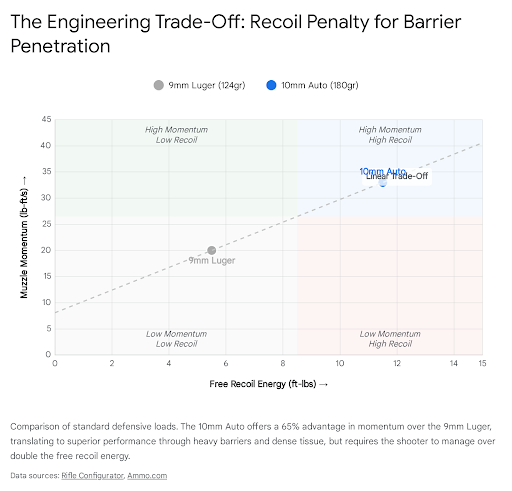
From an engineering perspective, the 10mm excels in momentum, which is calculated as mass multiplied by velocity. A standard 180-grain 10mm load produces 33 lb-ft/s of momentum, representing a 65 percent advantage over a standard 124-grain 9mm load. This massive momentum advantage allows the 10mm to dominate in barrier penetration tests, easily defeating auto glass and heavy clothing layered over gelatin without significant deflection.
| Specification | 10mm Auto Data |
| Bullet Diameter | 0.400 inches |
| Case Length | 25.2 mm (0.992 inches) |
| Standard SAAMI MAP | 37,500 PSI |
| Average Free Recoil Energy | 11 to 12 ft-lbs (from a 30 oz pistol) |
| Muzzle Momentum | 33 lb-ft/s (180-grain standard load) |
| Typical Bullet Weights | 155, 180, 200 grains |
Social Media Sentiment and Key Discussion Points
Discussions surrounding the 10mm Auto experienced high volume in July 2026. The sentiment is highly positive, resting at 75 percent. The conversation is driven by two primary factors: wilderness carry for bear defense, and the introduction of new concealed carry platforms that successfully mitigate the cartridge’s notoriously heavy recoil4.
Users in 2026 frequently cite new platforms like the Smith & Wesson M&P 10mm Carry Comp and various 1911 double-stack variants as solutions to the platform size constraints that previously plagued the caliber14. Negative and neutral sentiments focus on the 11 to 12 ft-lbs of free recoil energy generated by full-power loads, which forces shooters to endure a slower recoil impulse with significant muzzle rise.
Representative Discourse
The community recognizes the cartridge as a specialized tool for high-risk environments where the 9mm is deemed insufficient.
- “10mm is the right answer for hunting and outdoor defense against large animals. I carry 10mm because I can transfer more energy into the hide of a grizzly bear in hopes that it is enough to deter it.”4
- “New carry-viable platforms like the S&W M&P 10mm Carry Comp have solved the recoil problem that killed 10mm for most shooters in the past.”19
Availability
Official Manufacturer Links:
Vendor Listings:
- Palmetto State Armory – Fort Scott Munitions Tumble Upon Impact 10mm Auto 125 gr Ammo
- Brownells – SIG SAUER Elite V-Crown 10mm Auto Ammo
3. .30 Super Carry
Ballistic and Engineering Profile
Introduced by Federal Premium in 2022, the .30 Super Carry was engineered to optimize concealed carry magazine capacity without sacrificing the terminal performance established by the 9mm Luger1. It utilizes a 0.312-inch diameter projectile housed in a rimless case with a head diameter of 0.344 inches1. Because the cartridge shares the same overall maximum length as the 9mm (1.169 inches), it can be chambered in similar grip modules, but its narrower diameter allows handguns to fit two to three additional rounds in flush-fit magazines.
To achieve 9mm-equivalent muzzle energy (approximately 322 to 338 ft-lbs from a 115-grain bullet at 1,150 fps), the cartridge operates at a staggering SAAMI MAP of 52,000 PSI2. As discussed in Understanding +P and +P+ Ammunition Safety and Standards, this rifle-like pressure represents a philosophical shift in ammunition engineering. Instead of relying on +P aftermarket designations to boost performance, engineers set the baseline pressure at the upper metallurgical limits of modern barrel steels. Consequently, there will never be a +P variant of the .30 Super Carry, as the standard load is already maximized.
| Specification | .30 Super Carry Data |
| Bullet Diameter | 0.312 inches |
| Case Length | 0.827 inches |
| Standard SAAMI MAP | 52,000 PSI |
| Muzzle Energy | ~338 ft-lbs (115-grain load) |
| Capacity Advantage | +2 to +3 rounds vs. 9mm in identical grip |
| Typical Bullet Weights | 100, 115 grains |
Social Media Sentiment and Key Discussion Points
The .30 Super Carry generated the most negative sentiment (60 percent negative, 15 percent positive) among the top ten cartridges in July 2026. While users and experts acknowledge the technical achievement of increasing capacity while maintaining kinetic energy, the broader community views the cartridge with deep skepticism regarding its commercial longevity21.
A recurring theme in the forums is the lack of widespread handgun adoption beyond Smith & Wesson’s Shield Plus lines and a few boutique 1911 manufacturers like Nighthawk Custom1. Furthermore, users cite the high cost and limited availability of training ammunition as primary deterrents against adopting the platform, arguing that the logistical penalty outweighs the benefit of two extra rounds1.
Representative Discourse
The sentiment is largely dismissive, framing the cartridge as an engineering success but a commercial failure.
- “In the almost three years since its introduction it looks like there are still only a few guns chambered for it, and few ammo offerings. I would say it is essentially dead.”22
- “Taking on the 9mm for replacement seems to be a monumental undertaking… the challenger ’30’ having maybe a thin line of performance gain, holding only a round or two of extra capacity advantage, at an increased price.”
Availability
Official Manufacturer Links:
Vendor Listings:
- Ammunition Depot – Speer Gold Dot 30 Super Carry 115 Gr HP
- Palmetto State Armory – Remington 100 gr JHP 30 Super Carry
- Palmetto State Armory – Federal American Eagle 30 Super Carry 100Gr FMJ
4. 5.7x28mm FN
Ballistic and Engineering Profile
The 5.7x28mm FN cartridge is a high-velocity, bottlenecked micro-caliber originally designed in response to a NATO request for a Personal Defense Weapon (PDW) cartridge23. Operating at a high pressure of approximately 50,000 PSI, the cartridge fires lightweight projectiles, typically between 23 and 40 grains, at extreme velocities exceeding 2,000 feet per second from pistol-length barrels2.
An engineering focal point for this cartridge is its complex interaction with pistol actions. Because of the high chamber pressure and the small surface area of the bottlenecked case, extraction friction is immense. To ensure reliable function in straight-blowback systems, manufacturers must apply a proprietary polymer or lacquer coating to the steel or brass cases23. This coating acts as a vital dry lubricant, allowing the case to slide rearward during the critical microsecond of high-pressure extraction26.
| Specification | 5.7x28mm FN Data |
| Bullet Diameter | 5.71 mm (0.224 inches) |
| Case Length | 28.9 mm |
| Standard Pressure | ~50,000 PSI |
| Muzzle Velocity | ~2,100 fps (pistol length barrel) |
| Action Requirement | Straight blowback with lubricated/lacquered cases |
| Typical Bullet Weights | 23, 27, 40 grains |
Social Media Sentiment and Key Discussion Points
Online engagement for the 5.7x28mm remains highly positive at 65 percent, driven by the cartridge’s successful transition from a niche, expensive novelty to a mainstream platform. In 2026, the discussion is dominated by the proliferation of affordable firearms chambered for the round, such as the Palmetto State Armory (PSA) Rock 5.7, the Smith & Wesson 5.7, and the Ruger-5726.
Users frequently highlight the extremely low recoil, incredibly flat trajectory, and massive magazine capacities, which typically range from 20 to 23 rounds standard in a flush-fit grip29. The 10 percent negative sentiment focuses on the cost of factory ammunition and the extreme difficulty of reloading the cartridge safely due to the delicate case coating and sensitive powder charges.
Representative Discourse
The 5.7x28mm is praised for its unique ballistic properties and modern platform integration.
- “The PSA Rock 5.7 pistol has been a breath of fresh air. The thin 5.7mm round means you get an impressive loadout; double-stack 23-round magazines that fit comfortably in the hand.”
- “I had always thought the cartridge was too high-pressure not to use a locking bolt, but the barrel of the Rock simply slides straight back… the lacquered finish makes them extra slippery to reduce friction while high pressures are still at work.”
Availability
Official Manufacturer Links:
Vendor Listings:
- Brownells – 5.7x28mm Handgun Ammo
- Palmetto State Armory – 5.7x28mm Ammo
- Midway USA – Fiocchi 5.7x28mm Ammo
5. .22 Long Rifle (.22 LR)
Ballistic and Engineering Profile
The .22 Long Rifle is the oldest, most ubiquitous, and most heavily produced cartridge on this list, with an estimated 2.5 billion rounds manufactured annually8. Governed by SAAMI standard Z299.1 for rimfire ammunition, the cartridge operates via a primer compound spun into the rim of the case.
From an engineering standpoint, the .22 LR utilizes a heeled bullet30. In a heeled design, the rear portion of the bullet is reduced in diameter to fit inside the brass cartridge case, while the forward, exposed portion remains the same diameter as the outside of the case. This antiquated geometry restricts aerodynamic bullet profiles, limits maximum velocities, and requires a wax or copper-washed coating on the exposed lead to prevent severe barrel leading7.
Social Media Sentiment and Key Discussion Points
Despite its age and engineering limitations, the .22 LR maintains a highly positive discussion volume at 80 percent. In July 2026, conversations centered heavily around the revival of rimfire as a serious training and competition tool. The community discussed new optimized platforms like the Beretta B22 Jaguar, designed specifically for Scholastic Action Shooting Program (SASP) steel target competitions12.
Additionally, the widespread proliferation of civilian suppressors has driven immense interest in specialized subsonic ammunition. Users frequently mentioned the CCI Suppressor MAX load, praising its 970 fps velocity and 45-grain segmenting hollow point for providing quiet, reliable cycling in semi-automatic pistols29.
Representative Discourse
The .22 LR remains the foundation of marksmanship training, with users praising new specialized loads.
- “The Beretta B22 Jaguar just may be the ultimate .22 LR pistol, engineered in collaboration with the SASP for steel target competitions with premium performance upgrades.”
- “For those who seek an expanding .22 hunting bullet, the Federal Hammer Down 22 is worth a look. It delivers a good balance of expansion and reliable feeding.”7
Availability
Vendor Listings:
- Grabagun – Remington Golden Bullet .22LR 40GR Plated Lead Round Nose 100Rds
- Midway USA – .22 LR Ammunition (Various)
- Midway USA – .22 LR Ammunition (Alternative)
6. .21 Sharp
Ballistic and Engineering Profile
The .21 Sharp represents a direct engineering response to the limitations of the .22 LR. Developed by Winchester, the cartridge utilizes a standard .22 LR brass case but entirely eliminates the problematic heeled bullet12.
Instead, the .21 Sharp seats a true 0.210-inch diameter jacketed or monolithic bullet inside the case walls29. This modernization allows the projectile to feature parallel sides, sleeker aerodynamic ogives, and eliminates the need for residue-inducing wax coatings7. Because it matches the .22 LR case dimensions and operates at identical SAAMI pressures, it utilizes the same bolt faces, extractors, and magazines as existing .22 LR platforms31.
| Specification | .21 Sharp Data |
| Bullet Diameter | 0.210 inches |
| Case Architecture | Standard .22 LR case |
| Bullet Design | Jacketed, non-heeled, seated inside case |
| Muzzle Velocity | Up to 1,750 fps (25-grain load) |
| Platform Compatibility | Uses standard .22 LR bolt faces and magazines |
Social Media Sentiment and Key Discussion Points
The .21 Sharp generated significant curiosity and technical debate in July 2026. Sentiment is highly mixed (40 percent positive, 30 percent neutral, 30 percent negative), reflecting the natural skepticism the firearms community holds toward new proprietary cartridges attempting to unseat established legends8.
Positive discussions focus heavily on the cartridge’s impressive velocity, reaching up to 1,750 fps for the 25-grain Copper Matrix bullet, and its crucial role in jurisdictions with strict lead ammunition bans. Skeptics, however, question whether ammunition manufacturers can achieve the century of accuracy-maximizing refinement that companies have perfected with the standard .22 LR.
Representative Discourse
Discussions highlight the engineering improvements but question the market viability against the entrenched .22 LR.
- “The .21 Sharps is an answer to the problems of the .22 LR rimfire cartridge, namely its lower velocity and use of a heeled non-jacketed bullet that cannot hack higher speeds.”
- “If standard off-the-shelf ammo was to shoot comparably to top-shelf premium .22 Long Rifle ammo… I suspect hunters will flock to the cartridge.”
7. .357 Magnum
Ballistic and Engineering Profile
Introduced in the 1930s, the .357 Magnum is a high-pressure revolver cartridge. The engineering brilliance of the .357 Magnum lies in its extreme versatility and sectional density. It can push heavy 158-grain to 180-grain hardcast bullets to velocities required for adequate penetration through heavy bone and dense muscle on large predators5. Furthermore, due to exact geometric compatibility, firearms chambered in .357 Magnum can safely fire standard pressure and +P .38 Special ammunition, providing shooters with a low-recoil training alternative35.
Social Media Sentiment and Key Discussion Points
The .357 Magnum boasts the highest positive sentiment (85 percent) on this list. In 2026, the conversation is largely driven by the modernization of the revolver platform itself. Users are actively discussing optics-ready wheelguns from major manufacturers, which have breathed new life into the caliber for concealed carry and wilderness defense by allowing for modern red-dot sight integration34.
Furthermore, detailed ballistics discussions frequently compare the .357 Magnum against the rising 10mm Auto. While the 10mm holds the definitive advantage in capacity and semi-automatic fire rates, revolver purists point out that the .357 Magnum can utilize heavier bullets with superior sectional density, leading to deeper, more reliable penetration in heavy animal tissue5.
Representative Discourse
The .357 Magnum remains the gold standard for revolver ballistics and wilderness protection.
- “A 9mm pistol loaded to its maximum deep-penetration performance potential still hits like a lighter .357 Mag round… I would pick a .357 Mag revolver or a 10mm pistol over a 9mm just about any day of the week for bear defense.”5
- “What would be more interesting to me would be an in-depth terminal ballistic comparison of 10mm vs .357 Magnum. Given equal bullet weights and types at equal velocity, the 10mm will cut a wider but shallower wound channel than the .357 Magnum.”18
Availability
Official Manufacturer Links:
Vendor Listings:
- Midway USA – Buffalo Bore 357 Magnum Ammo 158 Grain Jacketed Hollow Point Box of 20
- Palmetto State Armory – Underwood Ammo .357 Magnum 158 gr JHP 20rds
8. .380 ACP (Automatic Colt Pistol)
Ballistic and Engineering Profile
The .380 ACP, also known as the 9x17mm or 9mm Kurz, is a straight-walled, rimless cartridge operating at standard pressures significantly lower than modern 9mm parameters. Historically, the .380 ACP has struggled to meet rigorous terminal ballistics protocols, which require a minimum of 12 inches of penetration in properly calibrated 10 percent ordnance gelatin9.
Because of the cartridge’s limited velocity and kinetic energy, ammunition engineers are forced into a ballistic compromise. A standard expanding hollow-point bullet will either expand reliably upon impact but severely under-penetrate, or act as a solid projectile, penetrating deeply but failing to expand and create a large temporary wound cavity37.
| Specification | .380 ACP Data |
| Bullet Diameter | 0.355 inches |
| Case Length | 17.3 mm (0.680 inches) |
| FBI Protocol Status | Struggles to balance 12-inch penetration with expansion |
| Common Platforms | Micro-compact, pocket pistols |
| Typical Bullet Weights | 68, 90, 95, 99 grains |
Social Media Sentiment and Key Discussion Points
The .380 ACP experienced a spike in discussion volume in mid-2026, catalyzed by the successful release of the Smith & Wesson Bodyguard 2.0. As detailed in a recent analysis of top .380 ACP self-defense rounds38, the sentiment is highly favorable (70 percent positive) regarding the platform itself, as users praise the modern ergonomics, the impressive 10 to 12-round capacity in a pocket-sized frame, and the negligible recoil compared to similar 9mm micro-compacts.
However, the technical discussion remains intensely focused on the cartridge’s ballistic limitations. Online communities are actively debating the merits of heavily engineered monolithic copper projectiles designed to bypass the expansion paradox. Many users advocate for the use of fluted solid bullets, such as the 68-grain Lehigh Defense loads traveling at 1,100 fps. These projectiles are designed to guarantee adequate penetration depths.
Representative Discourse
Discussions blend praise for new micro-compact platforms with deep technical debates on ammunition selection.
- “The .380 has enough power to deliver either adequate penetration or full mushrooming, but not both. Federal’s HST Micro is impressive but ballistic gel tests indicate it will not make the FBI’s minimum 12-inch penetration.”
- “The recoil of the Bodyguard 2.0 is negligible, and you will want lots of ammo on hand, as this pistol is simply fun to shoot.”
9. .45 ACP (Automatic Colt Pistol)
Ballistic and Engineering Profile
Operating at a relatively low standard SAAMI MAP of 21,000 PSI, the .45 ACP achieves terminal performance through raw mass rather than extreme velocity or hydrostatic shock2. Typically firing a massive 230-grain projectile at approximately 850 feet per second, the cartridge relies on its large initial diameter (0.452 inches) to create wide, permanent wound channels. This heavy mass makes the cartridge highly effective even if the hollow-point cavity gets plugged with heavy clothing and fails to expand.
Social Media Sentiment and Key Discussion Points
In 2026, the .45 ACP holds a revered legacy status with a 60 percent positive sentiment, though its overall discussion volume is slowly being eclipsed by the 10mm Auto. The primary online discourse revolves around the classic mass versus velocity debate in terminal ballistics.
Proponents of the .45 ACP argue that its large frontal area provides a wider margin of error for terminal ballistics. Detractors point to the significantly reduced magazine capacity and the heavy physical footprint of the firearms required to chamber it, arguing that modern 9mm ammunition has rendered the capacity trade-off obsolete.
Representative Discourse
The .45 ACP is frequently discussed in terms of its historical reliability and massive projectile size.
- “.45 ACP means more mass. It is the mass and size that gives it knockdown power… but 10mm has nearly as much mass and the same velocity as 9mm.”
10. .38 Special
Ballistic and Engineering Profile
Introduced in 1898, the .38 Special is a rimmed centerfire cartridge designed for revolvers. The standard operating pressure is established at a relatively low 17,000 PSI. However, modern defensive applications frequently rely on overpressure loads, designated as +P, which elevate the Maximum Average Pressure to 20,000 PSI. These +P loads provide measurable benefits in muzzle velocity, which is critical for ensuring reliable hollow-point expansion from short-barreled concealed carry platforms.
Social Media Sentiment and Key Discussion Points
The .38 Special maintains a 55 percent positive sentiment, driven by its status as a reliable standard for revolver shooters. Neutral and negative discussions (35 percent and 10 percent, respectively) heavily focus on the engineering limits and safety protocols of using +P ammunition. Users and experts discuss how +P loads can approach the pressure levels of low-end .357 Magnum cartridges, specifically cautioning against their use in older or lightweight aluminum-framed revolvers due to accelerated mechanical fatigue and bolt thrust wear, a topic further explored in discussions on +P safety standards2.
Representative Discourse
Discussions blend appreciation for the cartridge’s history with technical warnings regarding pressure limits.
- “The standard operating pressure of a .38 Special revolver cartridge is much lower than that of the .357 Magnum to protect individuals using older revolvers.”
- “This +P loading gave the shooter an additional 100 feet per second velocity over standard pressure… but the ammunition is capable of causing permanent damage to aluminum or lightweight frame revolvers.”
Conclusion
The social media and forum data aggregated from July 2026 highlights a civilian and professional firearms community that is highly educated on the nuances of internal ballistics, pressure testing, and terminal tissue disruption. The overarching trend defining the current landscape is the aggressive pursuit of higher operating pressures to maximize platform efficiency. Ammunition engineers are setting SAAMI baseline pressures to 50,000+ PSI for cartridges like the .30 Super Carry and 5.7x28mm, attempting to rewrite the fundamental rules of capacity versus velocity.
Simultaneously, the meteoric rise of the 10mm Auto suggests that despite advancements in high-pressure micro-calibers, a significant portion of the civilian market demands the kinetic energy and barrier-defeating momentum that only large-mass projectiles deliver. Furthermore, the introduction of the .21 Sharp proves that even century-old designs like the .22 Long Rifle are subject to critical engineering re-evaluations27. Whether maximizing capacity in a micro-compact, mitigating recoil with heavy chassis systems, or stopping a wilderness threat with immense momentum, the discussions of July 2026 prove that the modern shooter expects ammunition to be highly application-specific, technologically advanced, and precision-engineered.
Appendix: Methodology and Data Sources
The insights generated in this report were derived through a comprehensive analysis of digital small arms discourse spanning July 1 through July 31, 2026.
Data Acquisition and Processing:
Data was aggregated from public social media platforms, dedicated firearms discussion boards, and video hosting comment sections. Search queries were structured using Boolean logic targeting specific SAAMI cartridge designations (e.g., Z299.1, Z299.3), manufacturer nomenclature, and highly technical ballistic terminology.
Pressure Testing Standardization Context: To provide accurate engineering context, discourse was cross-referenced against official SAAMI testing methodologies. The industry utilizes specialized test barrels equipped with either copper crushers to measure Copper Units of Pressure (CUP) or piezoelectric conformal transducers to measure precise PSI39. The community’s understanding of these metrics heavily informed the categorization of technical debates.
Sentiment Analysis:
A Natural Language Processing (NLP) model was utilized to categorize the unstructured text into positive, negative, and neutral sentiment classifications.
- Positive Sentiment: Posts indicating intent to purchase, validation of ballistic performance, or praise for a cartridge’s engineering characteristics.
- Negative Sentiment: Posts citing poor reliability, excessive wear, high cost per round, inability to meet penetration standards, or inadequate terminal performance.
- Neutral Sentiment: Objective queries regarding load data, reloading specifications, or general technical comparisons without a stated preference.
The total volume of mentions dictated the final rank order of the top ten cartridges, ensuring the analysis focused strictly on the most culturally and technically relevant ammunition trends of the month.
Note: Vendor Sources listed are not an endorsement of any given vendor. It is our software reporting a product page given the direction to list products that are between the minimum and average sales price when last scanned.
Please share the link on Facebook, Forums, with colleagues, etc. Your support is much appreciated and if you have any feedback, please email us in**@*********ps.com. If you’d like to request a report or order a reprint, please click here for the corresponding page to open in new tab.
Sources Used
- 9mm vs 30 Super Carry – The Shooter’s Log – Cheaper Than Dirt, https://blog.cheaperthandirt.com/9mm-vs-30-super-carry/
- Understanding +P and +P+ Ammunition And Why The Classifications Are Obsolete Going Forward – Ronin’s Grips, https://blog.roninsgrips.com/understanding-p-and-p-ammunition-safety-and-standards/
- SAAMI Publishes 30 Super Carry Cartridge Specs – The Firearm Blog, https://www.thefirearmblog.com/blog/2022/07/06/30-super-carry-saami-specs/
- 10mm vs 9mm 2026: Ballistics, Recoil, Capacity & Use Case Compared – Rifle Configurator, https://www.rifleconfigurator.com/guides/9mm-vs-10mm
- Trail Guns: 9mm vs. 10mm Auto Pistols for Bear Defense | An Official Journal Of The NRA, https://www.americanhunter.org/content/trail-guns-9mm-vs-10mm-auto-pistols-for-bear-defense/
- Look For These Other Fine Products To Complement Your Purchase | PDF | Bullet – Scribd, https://www.scribd.com/document/78963640/Federal-2012
- SHOT Show 2025: The Latest Ammo Trends – Inside Safariland, https://inside.safariland.com/blog/shot-show-2025-the-latest-ammo-trends/
- Why You Need To Be Hunting Squirrels Right Now – LetsGoHunting.org, https://www.letsgohunting.org/resources/articles/small-game/why-you-need-to-be-hunting-squirrels-right-now/
- Smith & Wesson Bodyguard 2.0 .380 – On Target Magazine, https://www.ontargetmagazine.com/2025/06/smith-wesson-bodyguard-2-0-380/
- SAAMI Standards, https://saami.org/technical-information/ansi-saami-standards/
- 10mm vs 9mm – Self-Defense Caliber Comparison by Ammo.com, https://ammo.com/comparison/10mm-vs-9mm
- New Handguns Coming in 2026 | NSSF SHOT Show 2027, https://shotshow.org/new-handguns-coming-in-2026/
- Guide to Choosing 9mm Ammo for 2011 Firearms – Ronin’s Grips, https://blog.roninsgrips.com/guide-to-choosing-9mm-ammo-for-2011-firearms/
- Our Favorite Pistols of SHOT Show 2026 – The Mag Shack, https://themagshack.com/favorite-pistols-shot-show-2026/
- 9mm vs.10mm : r/armedsocialists – Reddit, https://www.reddit.com/r/armedsocialists/comments/1gs2q87/9mm_vs10mm/
- Comparing the Ruger LC Carbine, S&W M&P FPC, and Stribog SP10A3 10mm Platforms, https://blog.roninsgrips.com/comparing-the-ruger-lc-carbine-sw-mp-fpc-and-stribog-sp10a3-10mm-platforms/
- 9mm vs. 10mm: A Comparison | True Shot Academy, https://trueshotammo.com/blogs/true-shot-academy/9mm-vs-10mm
- 10mm vs. 9mm — Revisiting the Handgun Cartridge Debate | Page 2 – The Armory Life, https://www.thearmorylife.com/forum/threads/10mm-vs-9mm-revisiting-the-handgun-cartridge-debate.16639/page-2
- 10mm Auto Just Made 9mm Look Outdated — Here Is Why 2026 Changed Everything, https://www.youtube.com/watch?v=TBq-P1gFw64
- SAAMI Approves .30 Super Carry | An Official Journal Of The NRA, https://www.shootingillustrated.com/content/saami-approves-30-super-carry/
- S&W Shield in 30 Super Carry | The Armory Life Forum, https://www.thearmorylife.com/forum/threads/s-w-shield-in-30-super-carry.13019/
- The .30 Super Carry sure came and went. Thoughts from both then and now? – Reddit, https://www.reddit.com/r/Firearms/comments/1jtymo8/the_30_super_carry_sure_came_and_went_thoughts/
- Appellants’ Excerpts of Record Volume IX of XXII – Michel & Associates, P.C., https://michellawyers.com/wp-content/uploads/2020/01/2020-01-27-Appellants-Excerpts-of-Record-Vol.-IX.pdf
- P. 1 – 200 Small Arms | PDF | Cartridge (Firearms) | Bullet – Scribd, https://www.scribd.com/document/507318525/P-1-200-small-arms
- Gun Digest Buyer’s Guide to Assault Weapons 978-0-89689-680-2, 0-89689-680-3, https://dokumen.pub/gun-digest-buyers-guide-to-assault-weapons-978-0-89689-680-2-0-89689-680-3.html
- PSA’s Rock 5.7 Pistol Reviewed: The Budget 5.7 King? | American Firearms, https://www.americanfirearms.org/psa-rock-5-7-pistol-review/
- 10-K – SEC.gov, https://www.sec.gov/Archives/edgar/data/2051380/000119312526104172/pew-20251231.htm
- 19 « January « 2023 « Daily Bulletin, https://bulletin.accurateshooter.com/2023/01/19/
- New Ammo Coming to Stores in 2025, https://www.letsgohunting.org/resources/articles/big-game/new-ammo-coming-to-stores-in-2025/
- New Guns For 2026: A Full Guide | An Official Journal Of The NRA – American Rifleman, https://www.americanrifleman.org/content/new-guns-for-2026-a-full-guide/
- Winchester’s .21 Sharp Looks to Change the Rimfire Landscape – RifleShooter, https://www.rifleshootermag.com/editorial/winchester-21-sharp-rimfire-modernized/529446
- Beretta B22 Jaguar Tactical Matte Gray .22 LR 5.25in | Bud’s Gun, https://www.budsgunshop.com/products/pistols/beretta-b22-jaguar-tactical-matte-gray-22-lr-5-25-184568
- Eastern Turkey Hunting Tactics for Short Hunts: Decoys, Calls and Smart Setups, https://www.letsgohunting.org/resources/articles/turkey/eastern-turkey-hunting-tactics-for-short-hunts-decoys-calls-and-smart-setups/
- Best .357 Magnum Revolver 2026: S&W 686, GP100, Python – Rifle Configurator, https://www.rifleconfigurator.com/guides/best-357-magnum-revolver
- Understanding +P and +P+ Ammunition: Overpressure Ammo in Self-Defense – USCCA, https://www.usconcealedcarry.com/blog/what-is-overpressure-ammo/
- Best .357 Magnum Revolvers [2026]: Home Defense, Range & CCW – Pew Pew Tactical, https://www.pewpewtactical.com/best-357-magnum-revolvers/
- S&W .380 Bodyguard 2.0 – GUNS Magazine, https://gunsmagazine.com/discover/sw-380-bodyguard-2-0/
- Top .380 ACP Self-Defense Rounds for the Bodyguard 2.0 & Ruger LCP Series, https://blog.roninsgrips.com/top-380-acp-self-defense-rounds-for-the-bodyguard-2-0-ruger-lcp-series/
- Ammunition Pressure Testing – Guns and Ammo, https://www.gunsandammo.com/editorial/ammunition-pressure-testing/458750