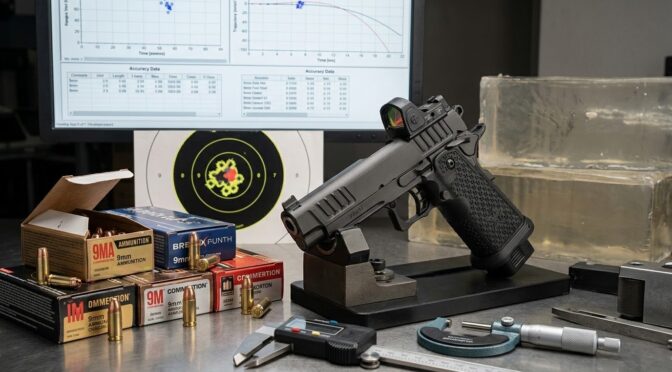
Executive Summary
The proliferation of the 2011-style double-stack handgun platform within both the commercial self-defense and competitive shooting markets has necessitated a rigorous, engineering-focused evaluation of 9x19mm Parabellum ammunition. Historically chambered in.38 Super or.45 ACP for competitive divisions, the modern 2011 platform has widely transitioned to the 9mm cartridge, leveraging the round’s optimal balance of high magazine capacity, manageable recoil, and modern terminal ballistics. Based on an exhaustive analysis of mechanical accuracy testing, ballistic chronography, internal chamber dimensions, and crowd-sourced operational data from high-volume shooters across digital forums, several clear paradigms emerge regarding the selection of commercial 9mm loads for these highly tuned, precision-machined instruments.
The data indicates a distinct and uncompromising bifurcation in ammunition requirements based entirely on the presence or absence of a barrel compensator or porting system. For uncompensated, traditional bull-barrel or bushing-barrel 2011s—such as the Atlas Gunworks Artemis or Nighthawk Custom Tactical Ready Series—heavyweight subsonic loads, specifically 147-grain configurations, yield the most favorable recoil impulse and sight tracking behaviors. Commercial offerings from Excaliber Ammunition, Atlanta Arms, and Super Vel dominate social media range reports for their low perceived recoil and highly reliable return-to-zero characteristics. Conversely, compensated platforms—such as the Atlas Gunworks Erebus and Staccato XC—mechanically require higher-pressure, lighter-weight projectiles to generate the requisite gas volume necessary to activate the compensator baffles. In these specialized fluid-dynamic systems, 124-grain NATO-specification loads, such as those from Sellier & Bellot, provide superior muzzle neutrality compared to their heavier counterparts.
In terms of absolute mechanical accuracy, projectiles featuring a hollow point, flat-base open-tip, or total-copper jacket design vastly outperform traditional Full Metal Jacket (FMJ) configurations. The Hornady Action Pistol (HAP) projectile and the eXtreme Terminal Performance (XTP) projectile structurally shift the center of gravity rearward, significantly enhancing gyroscopic stability during external flight. Factory match ammunition utilizing these projectiles—specifically the Staccato Match 125-grain and Wilson Combat 147-grain loads—consistently produce sub-inch to 1.25-inch five-shot groups at 25 yards. Furthermore, Federal Gold Medal Action Pistol 147-grain ammunition has demonstrated 0.8-inch group capabilities in premium 2011 platforms.
Engineers and end-users must also account for critical variables such as barrel twist rates and internal chamber tolerances. Standard 1:16 twist rates are highly versatile but can occasionally fail to stabilize 147-grain projectiles at lower velocities, leading to aerodynamic yaw or terminal tumbling. Match-grade chambers with aggressively short leades require careful consideration of bullet ogive geometry to prevent the projectile from prematurely engaging the rifling. Ultimately, maximizing the accuracy and performance of the 2011 platform requires treating the firearm and the cartridge not as separate entities, but as a unified, tightly toleranced kinematic system.
1. The Evolution and Kinematic Architecture of the 9mm 2011 Platform
The 2011 platform represents a sophisticated modernization of the classic Browning short-recoil, locked-breech, tilting-barrel design originally pioneered in the 1911. By incorporating a modular two-piece frame—typically a stainless steel or carbon steel dust cover mated to a secondary aluminum, steel, or polymer grip module—the 2011 platform offers a high-capacity double-stack magazine while resolutely maintaining the inherently crisp, straight-pull, single-action trigger mechanism that made the original 1911 legendary. As the platform has matured through manufacturers like Atlas Gunworks, Nighthawk Custom, and Staccato, the 9x19mm Parabellum has become the dominant chambering, prized for its low recoil signature and high magazine capacity.1 However, extracting maximum mechanical accuracy and optimal handling characteristics from a 9mm 2011 requires a nuanced understanding of its internal architecture and its interaction with specific ammunition profiles.
1.1 The Mechanics of Barrel Lock-Up and Tolerance Stacking
In any 2011 pistol, mechanical accuracy is fundamentally dictated by the consistency and repeatability of the barrel lock-up sequence. When the slide is forward in battery, the radial locking lugs machined into the top of the barrel are intimately engaged with the reciprocal recesses milled into the interior roof of the slide. Simultaneously, the lower lug (the barrel foot) rides on the cross-pin of the slide stop. In premium, hand-fitted 2011s manufactured by companies such as Atlas Gunworks and Nighthawk Custom, this engagement is machined to exacting, microscopic tolerances. The “one gun, one gunsmith” philosophy employed by Nighthawk ensures that the barrel returns to the exact same spatial orientation relative to the slide and the optical sight after every single firing cycle.2
When a cartridge is ignited, the expanding propellant gases push the bullet forward down the bore while simultaneously driving the cartridge case rearward against the breech face. The slide and barrel travel rearward locked together for a short, predetermined distance. This critical “dwell time” allows the bullet to completely exit the muzzle and chamber pressures to drop to safe atmospheric levels before the barrel link or the lower lug camming surface pulls the barrel downward. This downward tilt disengages the upper radial lugs, allowing the slide to decouple and continue its rearward stroke to extract and eject the spent brass casing. The specific ammunition chosen directly influences this precise kinematic sequence. The combination of bullet weight and powder charge dictates the rearward slide velocity, the recoil impulse transferred into the shooter’s hands, and the exact timing of the unlocking phase.
1.2 Barrel Profiling: Bull Barrels vs. Bushing Barrels
A critical architectural element in the 2011 that heavily influences ammunition preference is the choice of barrel profile. Traditional 1911s utilize a relatively thin-profile barrel supported at the muzzle end by a removable, closely fitted barrel bushing. While capable of exceptional accuracy when painstakingly hand-fitted—such as utilizing an oversized Evolution Gun Works (EGW) bushing to reduce a loose barrel’s group sizes from 5 inches down to 2 inches at 20 meters—the modern 2011 market heavily favors the thick, flared bull barrel.1
A bull barrel features a heavy, tapered muzzle that interfaces directly with the inside diameter of the slide, omitting the traditional bushing entirely. This design choice adds significant non-reciprocating mass directly to the front of the firearm, altering the overall balance point and actively counteracting muzzle flip during the recoil cycle. Bull barrels generally measure around 0.690 inches to 0.700 inches at the muzzle crown. The added rigidity and structural mass of the heavy barrel contour minimizes barrel whip and dampens harmonic oscillation during the high-pressure internal ballistic event, theoretically enhancing accuracy. However, engineering data indicates that bull barrels exhibit specific harmonic preferences for certain bullet weights. In 9mm 2011 configurations, bull barrels often require more extensive ammunition testing to discover a specific load that harmonizes perfectly with the barrel’s unique vibratory nodes, whereas heavy.45 ACP projectiles are often more forgiving in standard bushing configurations.4
2. Internal Chamber Dimensions and Leade Geometry
The absolute precision of a 2011 is not solely reliant on the barrel’s external locking lugs and internal rifling; it is deeply dependent on the microscopic internal dimensions of the chamber and the throat. Factory mass-produced striker-fired pistols generally feature slightly oversized chambers with long leades to ensure the reliable feeding, chambering, and extraction of all possible commercial ammunition varieties, regardless of environmental fouling, manufacturing variations, or extreme dirt ingress. In stark contrast, custom 2011s utilize extremely tight “match-grade” chambers.5
2.1 Match-Grade Chambers and the Plunk Test
A match-grade chamber is reamed to the absolute minimum specifications allowed by the Sporting Arms and Ammunition Manufacturers’ Institute (SAAMI). The chamber is tight by design, meant to hold the brass casing rigidly in the exact center of the bore axis to ensure the projectile enters the rifling perfectly straight and concentric. However, while this tightness drastically improves mechanical accuracy, it severely limits the geometric types of commercial ammunition that will reliably function in the firearm.5
Beyond the raw chamber diameter, the most critical dimension for ammunition selection is the “leade” or “freebore”—the unrifled, smooth portion of the barrel throat located exactly between the chamber and the point where the lands and grooves of the rifling begin. High-end match barrels utilized in 2011s frequently feature extremely short leades.5
2.2 Ogive Conflict and Out-of-Battery Malfunctions
This short leade creates a severe geometric conflict with heavy, 147-grain bullets. Because all 9mm 147-grain bullets must fit inside the standard maximum overall length (OAL) of a 9mm Luger cartridge (maximum 1.169 inches), the extra lead and copper mass must be accommodated somehow. Manufacturers can either seat the bullet deeper into the brass case—which dangerously reduces internal case capacity and drastically spikes chamber pressure—or they can push the ogive (the curved forward profile of the bullet) further out toward the tip of the projectile.
When a 147-grain bullet with a blunt, forward-placed ogive or a wide Truncated Cone (TC) profile is chambered into a match barrel possessing a short leade, the bullet’s ogive will crash directly into the lands of the rifling before the slide is fully in battery. This failure results in the gun locking slightly out of battery, rendering it unable to fire. Alternatively, if the slide forces the cartridge into battery, the bullet is jammed directly into the lands prior to powder ignition, which can cause dangerous pressure spikes.5
Shooters utilizing custom 2011s must perform a physical “plunk test”—dropping a live cartridge into the completely disassembled barrel—to ensure the specific ogive geometry of their chosen commercial load will freely drop in with a satisfying “plunk” and spin without contacting the rifling. Ammunition that runs flawlessly in a standard mass-produced polymer handgun may fail entirely to chamber in a tightly toleranced Atlas Gunworks or Nighthawk 2011 due to these exacting internal dimensions.5
3. Internal Ballistics: The 124-Grain vs. 147-Grain Paradigm
The primary debate among 2011 operators, competitive shooters, and ballistics engineers revolves around the selection of projectile mass: specifically, the 124-grain mid-weight projectile versus the 147-grain heavyweight projectile. The choice between these two distinct masses dramatically alters the behavior of the pistol, largely due to the physical laws of momentum conservation, chamber pressure curves, and the resulting velocity of the reciprocating slide.
3.1 Understanding Power Factor and Momentum
In competitive shooting circuits such as the United States Practical Shooting Association (USPSA), International Defensive Pistol Association (IDPA), and Steel Challenge, ammunition is rigorously categorized by Power Factor. Power Factor is an arbitrary, standardized calculation of physical momentum, defined as the Bullet Weight (in grains) multiplied by the Muzzle Velocity (in feet per second), divided by 1,000. For Minor Power Factor scoring in USPSA, the ammunition must achieve a minimum rating of 125. Most factory commercial training ammunition sits comfortably between a 130 and 145 Power Factor.7
Consider two hypothetical, standard-pressure commercial loads. A standard 124-grain projectile traveling at 1,050 feet per second yields a Power Factor of 130.2. A heavier 147-grain projectile traveling at a subsonic 885 feet per second yields an almost identical Power Factor of 130.0. Despite generating the exact same mathematical total momentum, the perceived recoil impulse—the physical way the kinetic energy is transmitted into the bones and tissues of the shooter’s hands—is entirely different.8
3.2 Pressure Curves and Recoil Duration
Lighter bullets require larger charges of faster-burning propellants and generate significantly higher peak chamber pressures to achieve their requisite velocity. This internal ballistic event results in a sharper, more abrupt pressure spike and a faster resultant slide cycle rate. The gun cycles rapidly and violently, which many shooters describe subjectively as “snappy” or “flippy”.11
Conversely, heavier 147-grain bullets require smaller amounts of powder and slower-burning propellants to achieve their lower, subsonic velocities. For example, reloading data for a 147-grain bullet using Titegroup powder often requires a mere 3.5 grains to achieve 953 feet per second.12 The pressure curve inside the chamber is broader, and the peak pressure is lower. Consequently, the slide velocity is slightly reduced, and the physical recoil impulse is spread over a longer duration in milliseconds. High-volume shooters utilizing uncompensated 2011s overwhelmingly report that 147-grain ammunition feels significantly “softer” and allows the slide-mounted optical red dot to track more smoothly and predictably back to the zero position.13
However, engineers and shooters note a point of diminishing returns. Pushing a highly specialized 147-grain or 160-grain projectile at very low velocities (e.g., 830 fps for a 160-grain bullet yielding a 132.8 PF) can result in a cycle rate that feels distinctively “sluggish.” In these extreme cases, the slide moves so slowly that elite competitive shooters find themselves physically waiting for the slide to return to battery before they can break the next shot.8 Finding the exact balance of softness and slide velocity is the core objective of ammunition selection for uncompensated pistols.
4. Fluid Dynamics of Compensated and Ported Architectures
The 124-grain versus 147-grain debate is entirely inverted when evaluating compensated or ported 2011 pistols, such as the Atlas Gunworks Erebus, the Staccato XC, or the Bul Armory Tac Pro. A compensator is a specialized muzzle device featuring upward-facing vertical ports and complex internal expansion baffles. As the bullet passes through the baffles, the high-pressure, rapidly expanding propellant gases are aggressively diverted upward. By Newton’s Third Law of Motion, this upward diversion of high-velocity gas mass exerts an equal and opposite downward reactive force on the muzzle, actively counteracting the natural upward rotational moment of recoil.11
4.1 Gas Volume Dependency
Compensators are fluid dynamic devices that operate strictly on gas volume and pressure. Subsonic 147-grain loads, as previously noted, utilize very small charges of fast-burning powder. Because the charge is so small and burns so quickly, almost all the powder is completely combusted early in the barrel’s length, leaving very little residual gas pressure by the time the bullet reaches the muzzle. Firing a 147-grain load through a heavily compensated pistol provides virtually no gas to activate the baffles, rendering the compensator essentially ineffective and turning it into nothing more than a non-reciprocating barrel weight.11
Conversely, a 124-grain load—particularly those loaded to European CIP, military NATO, or SAAMI +P specifications—utilizes a much larger charge of slower-burning powder. This generates a massive, sustained volume of high-pressure gas that exits the muzzle immediately behind the base of the bullet. This high-velocity gas slams into the compensator baffles and is jetted upward at extreme speeds, driving the muzzle down flat. Range reports unequivocally confirm that “spicier,” higher-pressure 124-grain ammunition causes compensated 2011s to track flatter and cycle faster than low-pressure 147-grain ammunition.11 The mechanical synergy between high-pressure, lighter-weight 9mm ammunition and a multi-port compensator is the entire foundational physics principle behind modern Open Division race guns.11
5. Barrel Twist Rates and Gyroscopic Stabilization Physics
Accuracy in any firearm is entirely dependent on the gyroscopic stabilization of the projectile during its external ballistic flight path. The rifling cut into the interior of the barrel imparts spin to the bullet as it travels down the bore, creating a gyroscopic effect that actively resists aerodynamic yaw and pitch. The specific rate of this spin is determined by the barrel’s twist rate, expressed as a ratio of one complete revolution per a specified number of inches of barrel length.
5.1 Standard Twist Rates vs. Slow Twist Rates
The industry-standard twist rate for a commercial 9mm pistol barrel is 1:10 or 1:16. Premium manufacturers like Nighthawk Custom utilize a 1:16 left-hand twist in their match-grade 416R stainless steel barrels.1 This 1:16 twist rate provides a highly versatile, middle-of-the-road stabilization profile, generally capable of stabilizing a wide spectrum of common bullet weights ranging from 90 grains up to 147 grains.
However, highly specialized custom barrels, such as the National Match (NM) 9mm barrels manufactured by KKM Precision—frequently utilized in custom 2011 builds and by manufacturers like Atlas Gunworks for their Nemesis models—can feature significantly slower twist rates, such as 1:32.4 A 1:32 twist rate means the bullet revolves only once every 32 inches, resulting in exactly half the rotational velocity of a standard 1:16 barrel.
5.2 The Greenhill Formula and Projectile Length
The engineering physics of bullet stabilization dictate that stability is mathematically dependent more on the physical length of the bullet than its sheer weight, though the two are inextricably linked in a single fixed caliber like 9mm. The foundational Greenhill formula for bullet stability establishes that longer bullets require much faster twist rates to stabilize properly. Because a 147-grain 9mm bullet is physically much longer than a 115-grain bullet, it is exponentially harder to stabilize in flight.
Testing data reveals that standard 1:16 twist barrels with six lands and grooves generally provide excellent accuracy with short 115-grain and 124-grain bullets.4 However, engineers and reloaders note a critical failure point: when attempting to fire long, heavy 147-grain bullets (especially polymer-coated variants) at lower velocities around 1,000 feet per second through a 1:16 barrel, the bullets can completely fail to stabilize. This failure manifests on the target as bullet “tumbling” or “keyholing,” where the projectile yawns severely and impacts the paper target entirely sideways.4
Slow twist rates like 1:32 are designed specifically to optimize the extreme accuracy of short, light projectiles (such as 115-grain competition bullets). Spinning a very light, short bullet faster than mathematically necessary in a 1:10 barrel can heavily magnify minor concentricity flaws or imperfections in the bullet’s copper jacket. This over-stabilization pushes the bullet off its perfect axis of rotation and degrades raw accuracy. By utilizing a 1:32 twist, competitive shooters matching their KKM barrel specifically to 115-grain match bullets minimize this over-stabilization dispersion. However, they completely forfeit the ability to shoot 147-grain ammunition accurately, as a 1:32 twist is mathematically incapable of stabilizing a long 147-grain projectile.4
6. Projectile Geometry: Jacketed Hollow Point (JHP) vs. Full Metal Jacket (FMJ)
A widespread misconception within the general shooting public is that Full Metal Jacket (FMJ) “ball” ammunition is mechanically equivalent to Jacketed Hollow Point (JHP) ammunition in terms of pure target accuracy. Engineering principles and empirical 25-yard machine-rest testing universally prove otherwise. For maximum mechanical precision in 2011 pistols, projectiles featuring a hollow cavity or a flat-base open-tip design are unequivocally superior to standard FMJ designs.24
6.1 Center of Gravity and Aerodynamic Form
The superior accuracy of hollow point designs stems from their internal weight distribution and the precise manufacturing processes used to draw their jackets. In a standard commercial FMJ projectile, the bullet features a solid lead core swaged into a copper jacket from the base up. The base of the FMJ is left as exposed lead, which can be slightly uneven from the swaging process, and the bullet’s center of gravity sits relatively far forward, near the middle of the projectile’s length.25
In an Open Tip Match (OTM) or Jacketed Hollow Point (JHP) projectile, the jacket is drawn from the base upward, leaving a small opening at the tip.27 This reversed manufacturing process creates a perfectly uniform, completely enclosed copper base. Because the base of the bullet is the very last part to interface with the high-pressure expanding gases at the muzzle crown, a perfectly uniform base ensures that the gas escapes evenly in all directions at the exact millisecond the bullet exits. If an FMJ base is even microscopically deformed, gas will vent asymmetrically, pushing the bullet off its intended axis the instant it leaves the barrel, severely degrading accuracy at distance.28
Furthermore, the physical void in the nose of a JHP bullet actively shifts the center of gravity rearward toward the base of the projectile. In external ballistics, pushing the center of gravity further behind the aerodynamic center of pressure significantly increases the projectile’s inherent gyroscopic stability in flight.28
6.2 The Hornady XTP and HAP Ecosystem
The apex of 9mm commercial accuracy is currently dominated by ammunition loaded with Hornady manufacturing projectiles. The eXtreme Terminal Performance (XTP) bullet is a defense-oriented JHP known globally for deep penetration, excellent weight retention, and, most importantly, exceptional accuracy. The XTP is an older generation hollow point, but its accuracy has kept it highly relevant in both defense and competition circles.29
Recognizing that competitive shooters were buying highly expensive XTP hollow points merely to shoot paper targets at matches, Hornady engineered the Hornady Action Pistol (HAP) projectile. The HAP bullet is structurally modeled entirely after the legendary XTP, maintaining the uniform enclosed base, the rearward center of gravity, and the optimized bearing surface.31 However, the HAP purposefully eliminates the pre-cut expansion skives inside the hollow cavity and does not feature an exposed lead tip, as terminal expansion in ballistic gelatin is entirely irrelevant for target shooting. The HAP is a pure accuracy projectile, stripped of its self-defense features to optimize aerodynamics and lower costs.19 Commercial ammunition loaded with HAP or XTP projectiles consistently represents the most accurate factory ammunition available for the 2011 platform.29
Other notable Hornady projectiles include the Critical Duty line, which utilizes the FlexLock (FTX) bullet. This bullet features a red polymer insert in the hollow cavity to prevent the nose from clogging with heavy clothing.34 While excellent for law enforcement duty use (specifically the 135-grain +P load adopted by the FBI), the polymer tip alters the aerodynamic profile, making the pure open-cavity HAP and XTP generally superior for strict paper-punching accuracy out of 2011s.30
7. Empirical Mechanical Accuracy Analysis of Commercial Loads
Synthesizing empirical Ransom Rest testing data allows for a definitive ranking of commercial 9mm loads based purely on the raw mechanical capability of the ammunition. A Ransom Multi-Caliber Steady Rest securely clamps the pistol frame, entirely eliminating human shooter error, flinching, and sight picture degradation, revealing the true dispersion of the ammunition.
7.1 Staccato Match and Range Series Performance
Staccato, a premier manufacturer of 2011 pistols, recently engineered their own proprietary line of ammunition explicitly optimized for their barrel geometry, feed ramp angles, and spring rates.
The Staccato Range Series features a 124-grain FMJ bullet rated at 1,030 feet per second. Independent chronography out of a 4.4-inch Staccato P barrel yielded an average velocity of 1,131.2 feet per second with an astonishingly low extreme spread (the difference between the highest and lowest recorded velocities) of only 29.3 feet per second. In accuracy testing from a Ransom Rest at 25 yards, the Range Series achieved an impressive average five-shot group size of 1.77 inches center-to-center.32
The Staccato Match Series represents a significant, measurable upgrade, utilizing the precision 125-grain Hornady HAP projectile. Rated at 1,050 feet per second, actual chronography demonstrated 1,077.9 feet per second with a similarly tight 32.2 feet per second extreme spread. When fired from a Ransom Rest at 25 yards, the Staccato Match ammunition produced a staggering average group size of 0.93 inches, with the single tightest recorded group measuring a phenomenal 0.76 inches.32 This data firmly establishes the Staccato Match ammunition as one of the most mechanically accurate factory loads available on the global market.
7.2 Federal Gold Medal Action Pistol and Wilson Combat
Federal Premium’s Gold Medal line has long been the gold standard in precision rifle accuracy, and their Action Pistol iteration aggressively brings this pedigree to the 9mm competitive platform. The Gold Medal Action Pistol 9mm utilizes a 147-grain Flat Nose (FN) Full Metal Jacket or Total Metal Jacket (TMJ) projectile. The flat nose profile acts similarly to a traditional semi-wadcutter, cutting exceptionally clean, visible holes in paper targets and efficiently transferring blunt kinetic energy to knock down reactive steel plates.
Loaded to a subsonic velocity of 885 feet per second (yielding a competitive Power Factor of approximately 130), this ammunition is explicitly designed for the rigorous power floor demands of USPSA and IDPA competition.7 When rigorously tested from a Kimber 2K11 double-stack race gun featuring a match-grade barrel, the Federal Gold Medal 147-grain ammunition printed five-shot groups measuring between 0.8 and 1.0 inches at 25 yards.37 This demonstrates absolute mechanical parity with the Staccato Match HAP load.
Wilson Combat, another titan of the 1911/2011 industry, offers highly refined commercial loadings optimized for their firearms. Utilizing a brand-new Wilson Experior Commander Double Stack 1911, testing of the Wilson Combat Subsonic 147-grain XTP load—factory rated at 1,050 fps out of a 5-inch barrel—yielded remarkably consistent standard deviations and a smallest five-shot, 25-yard group measuring 1.25 inches.29
| Ammunition Brand & Load Profile | Projectile Type | Empirical 25-Yard Group Size (Inches) | Primary Application Focus |
| Staccato Match 125gr | Hornady HAP (JHP Profile) | 0.93″ Average (Best: 0.76″) | Uncompromised Target Precision |
| Federal Gold Medal 147gr | Flat Nose (FN) TMJ | 0.80″ – 1.00″ Range | USPSA/Action Pistol Competition |
| Wilson Combat Subsonic 147gr | Hornady XTP (JHP Profile) | 1.25″ Best Group | Suppressed & High-Accuracy Target |
| Staccato Range 124gr | Round Nose FMJ | 1.77″ Average | High-Quality Volume Training |
The empirical data across these premium manufacturers unequivocally demonstrates that sub-inch to 1.5-inch 25-yard accuracy is readily achievable in 2011 handguns, provided the ammunition utilizes match-grade projectiles (HAP, XTP, or Flat Nose profiles) with extremely tight standard velocity deviations. Standard FMJ “ball” ammunition, while highly functional, is mechanically incapable of matching the precision of these specialized profiles.
8. Practical Accuracy and Social Media Sentiment Analysis
While mechanical accuracy testing in a Ransom Rest successfully eliminates human error, “practical accuracy” in the field is dictated entirely by how the gun feels in the hand, how the recoil impulse is transmitted, and how quickly the sights return to zero during rapid fire. In the realm of high-end 2011 social media discourse—heavily concentrated on platforms like Reddit’s r/2011 community, Brian Enos forums, and Sniper’s Hide—several specific commercial loads have emerged as overwhelming practical favorites based on thousands of rounds of user testing.
8.1 Excaliber Ammunition: The 147-Grain Uncompensated Champion
For operators utilizing uncompensated 2011s, Excaliber Ammunition’s 147-grain load has achieved almost legendary status in social media range reports.13 Excaliber’s 147-grain Competition Gold load utilizes a Full Metal Jacket projectile driven at approximately 890 feet per second, yielding a highly consistent 130 Power Factor.9
Social media range reports from operators of ultra-premium, uncompensated or minimally ported pistols like the Nighthawk Sandhawk, Atlas Athena, and Atlas Artemis consistently cite Excaliber as the “softest” and “flattest” ammunition available.13 Shooters report that the low, rolling recoil impulse allows the red dot sight to remain exceptionally close to the center of the optic window throughout the recoil cycle, facilitating incredibly rapid follow-up shots at speed. While an FMJ may not possess the absolute 0.8-inch mechanical grouping capability of a Hornady HAP bullet, Excaliber’s kinematic benefits provide unmatched practical accuracy for dynamic shooting.13
Other notable heavy-bullet brands frequently praised in the community include Boaz Ammo (specifically their 147-grain copper-jacketed load, noted for being an extremely accurate powder-puff load) and Badlands Jello Shots, which cater directly to the competitive market seeking the absolute minimum legal recoil impulse.16 Atlanta Arms is also heavily utilized; their 147-grain Select load provides identical Power Factor parameters to the Federal Gold Medal line, with shooters praising its smooth feeding profile and a notable 13 percent reduction in muzzle flip compared to standard 124-grain ball ammunition.4
8.2 Sellier & Bellot 124-Grain: The Compensated Fuel
For high-volume practice and training—especially for operators of compensated pistols—Sellier & Bellot (S&B) 124-grain FMJ is universally recommended across almost all 2011 forums.11 Manufactured in the Czech Republic, S&B ammunition is known for incredibly consistent, high-quality brass, sealed primers, and clean-burning propellants.
Crucially for the 2011 market, S&B 124-grain is loaded to European CIP specifications, which closely mirror military NATO pressure specifications. Chronograph data indicates it yields a Power Factor of 146, making it significantly “spicier” than standard American commercial 115-grain loads (which often hover around a 130 PF).18 As analyzed in the fluid dynamics section, this elevated pressure and massively increased gas volume make S&B 124-grain the ideal budget-friendly fuel for compensated pistols like the Atlas Erebus and Staccato XC, generating more than enough gas to aggressively drive the compensator baffles downward and keep the gun tracking flat.11
8.3 Manufacturer Warnings on Cleanliness: Polymer and Lead
Platform-specific ammunition synergies extend beyond velocity and into metallurgy and chemistry. Compensator maintenance is a serious engineering concern for high-volume 2011 shooters. Lead buildup on the baffles can severely degrade accuracy, alter barrel harmonics, and cause dangerous baffle strikes.
Atlas Gunworks technical support explicitly advises operators of the compensated Erebus to utilize quality Jacketed Hollow Point (JHP) or premium FMJ ammunition to prevent lead fouling.41 Most importantly, Atlas technical support issues a strict warning against utilizing Federal Syntech ammunition (which utilizes synthetic polymer-coated projectiles) or “Blue Bullets” (another popular polymer-coated cast lead bullet). Atlas states that these coated loads run exceptionally dirty in their tightly toleranced compensators, risking severe synthetic and lead fouling that can degrade the mechanical performance of the compensator baffles.41 Therefore, traditional copper-jacketed ammunition remains the strict standard for maintaining peak accuracy and reliability in ultra-premium compensated platforms.
9. Conclusion and Strategic Recommendations
The pursuit of absolute accuracy and perfect kinematic handling in the 2011 platform reveals a fundamental truth: ammunition is not merely a passive consumable, but rather an active, mechanical component of the firearm’s dynamic operating system.
From a strictly empirical engineering perspective, the most mechanically accurate 9mm commercial loads are those utilizing precision-drawn, rearward-weighted projectiles such as the Hornady HAP, the Hornady XTP, or flat-nose total metal jackets. Factory match loadings like the Staccato Match 125-grain, Federal Gold Medal Action Pistol 147-grain, and Wilson Combat Subsonic 147-grain reliably and consistently deliver sub-inch to 1.25-inch groupings at 25 yards out of mechanical machine rests. These specific loads represent the absolute ceiling of commercial 9mm precision, constrained only by the mechanical tolerances of the pistol’s lock-up and the shooter’s capability.
However, practical accuracy—the ability to deliver rapid, consecutive impacts on target during dynamic movement—is heavily dictated by recoil impulse and platform synergy. For operators of uncompensated pistols featuring heavy bull barrels or sight blocks (like the Atlas Artemis or Nighthawk TRS), heavy 147-grain commercial loads from Excaliber, Atlanta Arms, and Boaz Ammo provide the softest kinematic impulse and the fastest sight return. Conversely, for operators of compensated race guns (like the Atlas Erebus or Staccato XC), mid-weight 124-grain ammunition loaded to higher NATO pressure specifications, such as Sellier & Bellot, is strictly required to generate the requisite gas volume to engage the compensator and flatten muzzle rise.
As the 2011 platform continues to aggressively dominate both tactical environments and competitive circuits, shooters and industry analysts alike must abandon the notion of a single, universally superior 9mm cartridge. Instead, maximum platform efficacy and accuracy are achieved only through the deliberate, engineered pairing of bullet geometry, precise powder volume, and specific barrel architecture.
Please share the link on Facebook, Forums, with colleagues, etc. Your support is much appreciated and if you have any feedback, please email us in**@*********ps.com. If you’d like to request a report or order a reprint, please click here for the corresponding page to open in new tab.
Sources Used
- Nighthawk Custom 1911 Match Grade Barrel – 9mm – 5″ – Primary Arms, accessed February 22, 2026, https://www.primaryarms.com/nighthawk-custom-1911-barrel-govt-9mm-ramped-stainless-fully-machined
- Nighthawk Custom Tactical Ready Series 9mm Luger – Gun Tests, accessed February 22, 2026, https://www.gun-tests.com/handguns/pistols/nighthawk-custom-tactical-ready-series-9mm-luger/
- Atlas Gunworks 2011 EDC 3.5: $5000 Carry Gun – Recoil Magazine, accessed February 22, 2026, https://www.recoilweb.com/atlas-2011-edc-review-141439.html
- 2011 9mm accuracy – 1911-style Pistols – Brian Enos’s Forums… Maku mozo!, accessed February 22, 2026, https://forums.brianenos.com/topic/243412-2011-9mm-accuracy/
- Chamber Dimensions for 9MM and 45 ACP Pistols – Buffalo Bore, accessed February 22, 2026, https://www.buffalobore.com/index.php?l=product_list&c=235
- Advice for O.A.L. for multiple guns? – 9mm/38 Caliber – Enos Forums, accessed February 22, 2026, https://forums.brianenos.com/topic/267805-advice-for-oal-for-multiple-guns/
- Review: Federal Gold Medal Action Pistol | An NRA Shooting Sports Journal, accessed February 22, 2026, https://www.ssusa.org/content/review-federal-gold-medal-action-pistol/
- USPSA Certified Ammunition List, accessed February 22, 2026, https://uspsa.org/ammunition
- 9mm 147 Grain Minor Power Factor – Excaliber Ammunition, accessed February 22, 2026, https://excaliber-ammo.com/product/9mm-147-grain-competition-gold/
- 124 vs 147 Grain – 9mm Bullet Weights Compared – The Lodge at AmmoToGo.com, accessed February 22, 2026, https://www.ammunitiontogo.com/lodge/124-vs-147-grain/
- What Ammo works best in your comped 2011s : r/2011 – Reddit, accessed February 22, 2026, https://www.reddit.com/r/2011/comments/141fuhf/what_ammo_works_best_in_your_comped_2011s/
- Load data for 147g coated bullet with titegroup – 9mm/38 Caliber – Forums, accessed February 22, 2026, https://forums.brianenos.com/topic/258273-load-data-for-147g-coated-bullet-with-titegroup/
- The Ammo Debate : r/2011 – Reddit, accessed February 22, 2026, https://www.reddit.com/r/2011/comments/1fnx63p/the_ammo_debate/
- Ammo grain difference : r/2011 – Reddit, accessed February 22, 2026, https://www.reddit.com/r/2011/comments/1k07lnp/ammo_grain_difference/
- What’s the final word? 124gr vs 147gr – CZ – Forums, accessed February 22, 2026, https://forums.brianenos.com/topic/303254-whats-the-final-word-124gr-vs-147gr/
- The Softest Ammo : r/2011 – Reddit, accessed February 22, 2026, https://www.reddit.com/r/2011/comments/1nuuu5n/the_softest_ammo/
- 115 vs 124 vs 147 Grain 9mm Ammo | A Detailed Comparison – Velocity Ammunition, accessed February 22, 2026, https://www.velocityammosales.com/blog/115-vs-124-vs-147-grain-9mm-ammo-a-detailed-comparison/
- Range Day: Atlas Erebus, Apollo, Artemis and Nighthawk … – Reddit, accessed February 22, 2026, https://www.reddit.com/r/2011/comments/1fovo6c/range_day_atlas_erebus_apollo_artemis_and/
- Accuracy Of 9 Major Handloads | An NRA Shooting Sports Journal, accessed February 22, 2026, https://www.ssusa.org/content/accuracy-of-9-major-handloads/
- Bullpup9 Review – 9mm – Athlon Outdoors, accessed February 22, 2026, https://defense2716.rssing.com/chan-47904025/all_p10.html
- New Competitive Shooting Gun: Atlas Gunworks Nemesis Pistol – Athlon Outdoors, accessed February 22, 2026, https://athlonoutdoors.com/article/atlas-gunworks-nemesis-pistol/
- Which is more accurate: heavy or light bullets? – 9mm/38 Caliber – Enos Forums, accessed February 22, 2026, https://forums.brianenos.com/topic/102415-which-is-more-accurate-heavy-or-light-bullets/
- How many bullets do you have to fire before you’re accurate with handgun at 20 yards?, accessed February 22, 2026, https://www.quora.com/How-many-bullets-do-you-have-to-fire-before-you-re-accurate-with-handgun-at-20-yards
- Need 9mm factory ammo recommendations | Sniper’s Hide Forum, accessed February 22, 2026, https://www.snipershide.com/shooting/threads/need-9mm-factory-ammo-recommendations.7276552/
- FMJ vs. JHP – What Bullet & Ammo Is Best For You?, accessed February 22, 2026, https://www.ammunitiontogo.com/lodge/fmj-vs-jhp/
- For handguns, are FMJ bullets more or less accurate than JHP bullets, all else being equal? – Quora, accessed February 22, 2026, https://www.quora.com/For-handguns-are-FMJ-bullets-more-or-less-accurate-than-JHP-bullets-all-else-being-equal
- How Bullet Types Impact Shooting Performance – Savage Arms, accessed February 22, 2026, https://savagearms.com/blog/post/how-bullet-types-impact-shooting-performance
- Hollow Point vs Non hollow Point accuracy? : r/guns – Reddit, accessed February 22, 2026, https://www.reddit.com/r/guns/comments/dh308/hollow_point_vs_non_hollow_point_accuracy/
- Wilson Combat 9mm Ammo: Tested – Shooting Times, accessed February 22, 2026, https://www.shootingtimes.com/editorial/wilson-combat-9mm-ammunition/393785
- Differences between the two? : r/CCW – Reddit, accessed February 22, 2026, https://www.reddit.com/r/CCW/comments/t9ik5e/differences_between_the_two/
- Hornady® Bullets ‑ Hornady Manufacturing, Inc, accessed February 22, 2026, https://www.hornady.com/bullets/
- Ammo Testing: Staccato Range and Match 9mm – American …, accessed February 22, 2026, https://americanhandgunner.com/ammo/ammo-testing-staccato-range-and-match-9mm/
- Are 9mm JHP more accurate than fmj? – Enos Forums, accessed February 22, 2026, https://forums.brianenos.com/topic/153467-are-9mm-jhp-more-accurate-than-fmj/
- Hornady Critical Duty 9mm Ammo Review: Stop the Threat, accessed February 22, 2026, https://ammo.com/ammo-review/hornady-critical-duty-9mm-review
- Hornady Critical Duty 9mm 135-grain JHP +P Ammunition: Review – Firearms News, accessed February 22, 2026, https://www.firearmsnews.com/editorial/hornady-critical-duty-9mm-135-grain-jhp-p-review/467414
- 9mm Ballistics From Every Major Ammo Maker, accessed February 22, 2026, https://ammo.com/ballistics/9mm-ballistics
- Kimber 2K11: Double-Stack Race Gun – Recoil Magazine, accessed February 22, 2026, https://www.recoilweb.com/kimber-2k11-double-stack-race-gun-188516.html
- Wilson Combat DS guns don’t get credit for fancy 2011 status, but if you want the best balance between carry and function they deserve serious consideration – Reddit, accessed February 22, 2026, https://www.reddit.com/r/2011/comments/1ray2cq/wilson_combat_ds_guns_dont_get_credit_for_fancy/
- Ammo for 2011s : r/2011 – Reddit, accessed February 22, 2026, https://www.reddit.com/r/2011/comments/11u34s3/ammo_for_2011s/
- What range ammo are you running in your ported / comp’d pistols? : r/2011 – Reddit, accessed February 22, 2026, https://www.reddit.com/r/2011/comments/1eqnqqt/what_range_ammo_are_you_running_in_your_ported/
- Atlas Gunworks support gave an interesting opinion on ammo. Any …, accessed February 22, 2026, https://www.reddit.com/r/2011/comments/1kdekmv/atlas_gunworks_support_gave_an_interesting/