1. Executive Summary
The global security architecture is undergoing a rapid, profound, and highly destabilizing transformation, driven by the aggressive proliferation of advanced precision-guided munitions, the democratization and mass production of autonomous uncrewed systems, and the undeniable return of industrial-scale attrition warfare to the modern battlefield. Empirical observations and intelligence gathered from the ongoing, protracted conflict in Ukraine, alongside the intense, high-volume ballistic and cruise missile engagements between Israel and Iran throughout 2024 and 2025, have conclusively demonstrated that traditional, legacy paradigms of air superiority and missile defense are increasingly strained by the sheer volume, speed, and varied trajectories of contemporary threat vectors. In direct response to these shifting operational realities and the acute geostrategic pressures emanating from the People’s Republic of China (PRC) and the Democratic People’s Republic of Korea (DPRK), the Government of Japan is currently executing a historic and comprehensive realignment of its national defense posture.
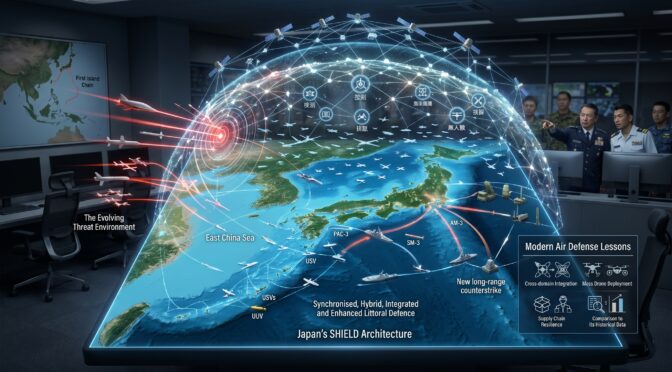
Central to this strategic realignment is the rapid development and deployment of the Synchronised, Hybrid, Integrated and Enhanced Littoral Defense (SHIELD) architecture. Designed fundamentally as an asymmetric, cost-effective counter-force, the SHIELD initiative relies heavily on a distributed network of uncrewed aerial, surface, and underwater vehicles specifically tailored to secure Japan’s southwestern maritime geography against numerically superior power projection forces. Concurrently, recognizing that low-cost volume must be matched by high-end capability, Japan is significantly modernizing its top-tier Integrated Air and Missile Defense (IAMD) capabilities to counter sophisticated ballistic and hypersonic threats. This modernization encompasses the procurement of massive, 14,000-ton Aegis System Equipped Vessels (ASEV) featuring unprecedented magazine depth, the transition to mass production of the hypersonic-capable Type 03 Chu-SAM Kai surface-to-air missile system, and the fielding of a next-generation, cloud-based, artificial intelligence-assisted command and control network known as JADGE.
This intelligence report provides an exhaustive analysis of Japan’s emerging SHIELD concept and its broader, multi-layered IAMD modernization efforts. This analysis is meticulously contextualized against the critical operational and strategic lessons derived from the battlefields of Eastern Europe and the Middle East. The report focuses heavily on the new operational imperatives dictating modern defense: the absolute necessity of magazine depth, the unsustainable fiscal and logistical limits of pure kinetic interception against drone swarms, the vital requirement for highly resilient and decentralized command and control infrastructure, and the inevitable strategic shift toward counter-industrial targeting to sustain credible deterrence across the Indo-Pacific theater.
2. The Evolving Threat Landscape and Japan’s Strategic Reorientation
For the entirety of the Cold War and the immediate post-Cold War decades, Japan’s defense posture was heavily and deliberately oriented toward its northern territories, particularly Hokkaido. This alignment was a direct legacy of strategic concerns regarding potential Soviet incursions and conventional armored threats. However, the rapid, unprecedented expansion of the PRC’s People’s Liberation Army Navy (PLAN), the maturation of China’s anti-access/area-denial (A2/AD) capabilities, and the continuous refinement of North Korea’s ballistic missile programs have necessitated a dramatic geographic and doctrinal pivot within Tokyo’s strategic planning echelons.
2.1 The Pivot to the Southwest and the Island Shield
Japan has fundamentally revised its national defense strategy, transitioning to a posture that explicitly prioritizes the “southern shield”—the defense of the island of Kyushu, the expansive Nansei Island chain, and the critical maritime transit routes adjacent to Taiwan.1 This strategic shift acknowledges that the balance of power in the region is rapidly changing, rendering the northern theaters significantly less prioritized in modern contingency planning.1 The operational logic underpinning this reorientation is clear: to deter a potential Chinese invasion of Taiwan or incursions into Japanese territorial waters, Japan must possess the physical and electronic capability to inflict disproportionate, asymmetric costs on a numerically superior adversary while simultaneously defending its own military and civilian infrastructure from saturation missile strikes.1
To solidify this new defensive perimeter, the Japan Self-Defense Forces (JSDF) are rapidly establishing new operational hubs along the southwestern archipelago. For example, by fiscal year 2030, the Japan Ground Self-Defense Force (JGSDF) plans to deploy advanced missile systems to Yonaguni Island, which is located a mere 110 kilometers from the Taiwanese coast.2 While Yonaguni already hosts critical coastal surveillance units, a new, dedicated air-defense electronic warfare unit is scheduled to be established by fiscal year 2026, transforming the remote island into a highly fortified hub for signals intelligence gathering and spectrum dominance.2 Similar deployments of long-range surface-to-ship missiles have been directed toward Kumamoto Prefecture on Kyushu’s southwest coast.1 These installations represent a profound shift, as their operational ranges theoretically permit strikes against mainland Chinese staging areas, reflecting Tokyo’s recognition of Beijing as its primary national security threat, superseding historical concerns regarding North Korea and Russia.1
2.2 Budgetary Expansion and the Uncrewed Imperative
This geographic and strategic shift is supported by historic and unprecedented financial commitments. Following the landslide political victory of Prime Minister Sanae Takaichi, the Ministry of Defense was placed on notice for significant reform, particularly concerning the integration of autonomous weapons systems.3 The Japanese government has authorized a massive 9 trillion yen overall defense budget.3 Within this expanded fiscal framework, the most notable allocation is the aggressive funding directed toward uncrewed defense capabilities. Current five-year projections mandate that funding for autonomous and uncrewed systems will increase tenfold, surging from a baseline of 100 billion yen to a staggering 1 trillion yen.3
This budgetary reallocation is not merely a modernization effort; it is a fundamental acknowledgment of the changing character of war. The lessons observed from external conflicts have accelerated this transition, demonstrating that high-end, exquisite defense systems—while vital for national survival against strategic weapons—are highly inefficient and logistically vulnerable when deployed against massed, low-cost drone and loitering munition threats. Consequently, Japan is fully embracing a bifurcated procurement strategy. The MoD is sustaining investments in ultra-capable, high-end interceptors required for complex ballistic and hypersonic threat mitigation, while simultaneously and rapidly scaling up the deployment of low-cost, expendable uncrewed systems designed to maintain localized deterrence, assert sea control in the littorals, and preserve the deep interceptor magazines of the fleet.4
3. The SHIELD Architecture: Re-engineering Littoral Defense
In December 2025, the Japanese government initiated a major doctrinal and operational shift with the formal announcement of the Synchronised, Hybrid, Integrated and Enhanced Littoral Defense (SHIELD) network.3 Earmarking an initial US$640 million (approximately 100 billion yen) specifically for this coastal defense system, SHIELD represents a massive, centralized investment in uncrewed, autonomous warfighting capabilities designed specifically for the unique geography of the Japanese archipelago.3
3.1 The Doctrinal Philosophy of Asymmetric Mass
The SHIELD concept recognizes a stark reality of modern defense economics: matching a peer or near-peer adversary like China ship-for-ship, or defending against a massive missile inventory strictly on a missile-for-missile basis, is industrially and fiscally unsustainable. Instead of pursuing symmetrical parity, the SHIELD architecture leverages Japan’s island geography to create a layered, multi-domain, and highly attritional defensive web. The architecture is deliberately designed to deliver a rapid replacement capability, ensuring that forward defensive lines can absorb initial kinetic losses and rapidly reconstitute their combat power using cheap, locally mass-produced uncrewed systems.3 To execute this vision, the Japanese Ministry of Defense has identified ten distinct types of uncrewed equipment to be fielded across the maritime, aerial, and ground domains by the end of the current procurement cycle.5
3.2 Aerial Denial and Anti-Ship Uncrewed Aerial Vehicles (UAVs)
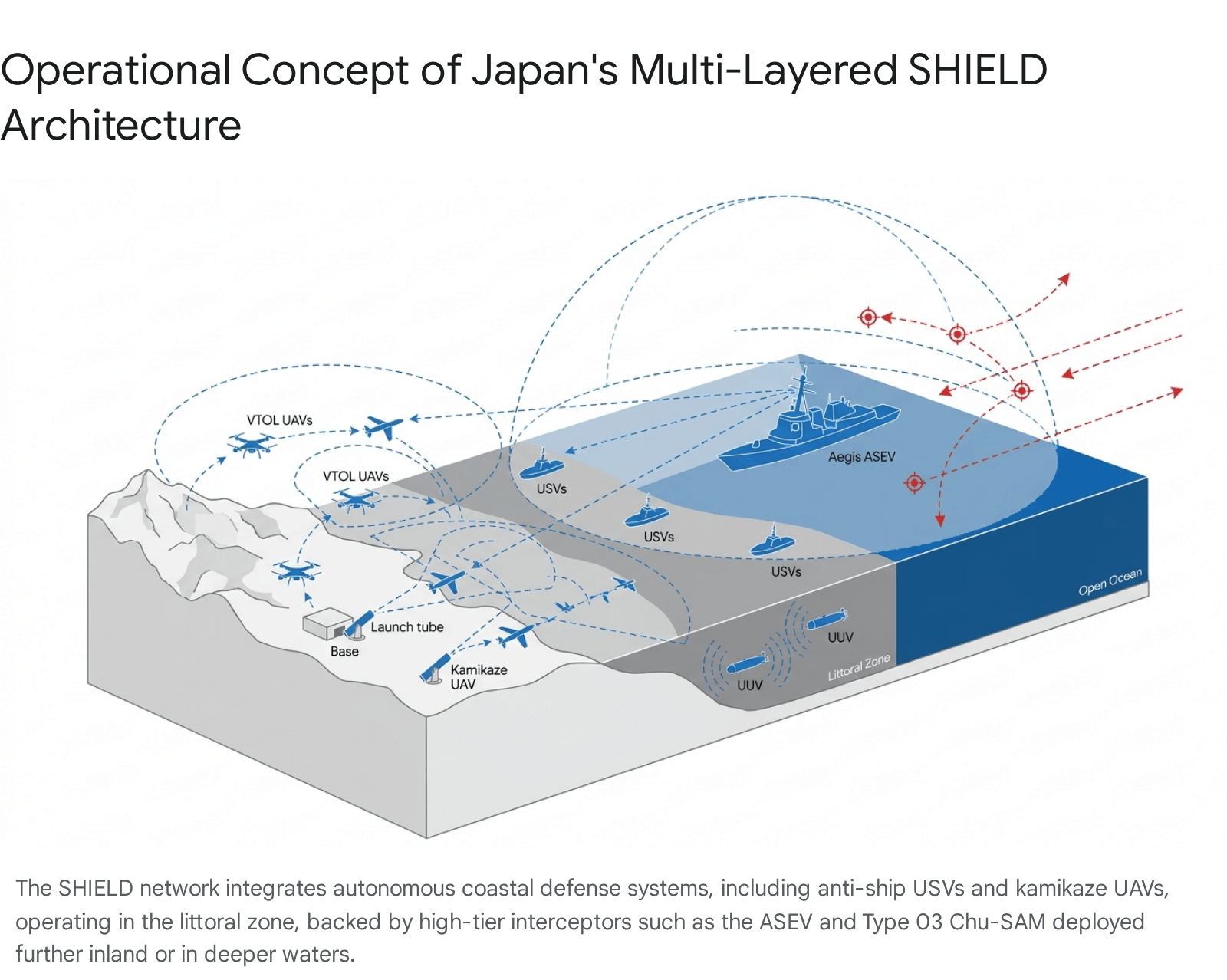
A core and highly visible component of the SHIELD framework is its diverse and specialized fleet of Uncrewed Aerial Vehicles (UAVs). These assets are specifically tailored for anti-ship, counter-landing, and localized air defense missions, moving away from multi-role platforms in favor of highly specialized, single-mission effectors. The procurement strategy currently encompasses at least five specific variants of anti-ship UAVs, designed to overwhelm enemy naval air defenses through saturation attacks and highly varied flight profiles.4
The first of these variants includes large, land-launched kamikaze UAVs designed for long-range, one-way kinetic strikes against approaching naval task forces or logistical convoys operating far from the Japanese coast.4 The second variant comprises highly flexible, catapult-launched kamikaze UAVs capable of being deployed from both established shore batteries and forward-deployed surface vessels, expanding the launch envelope.4 The third variant, designated as the “Type 2” Kamikaze UAV, is optimized specifically for engaging and neutralizing enemy amphibious landing craft and shallow-water transport vessels operating in the highly contested littoral zone.4 The fourth system is the “Type 3” Kamikaze UAV, functioning as a generalized, land-launched loitering munition capable of holding holding holding areas at risk and striking targets of opportunity.4 Finally, the MoD is procuring Vertical Take-Off and Landing (VTOL) armed UAVs, possessing design characteristics reminiscent of the U.S.-made V-BAT system. These VTOL platforms are highly prized for their ability to launch from and recover to confined helipads, small surface combatants, or entirely unprepared forward operating bases hidden within island jungles, allowing for rapid redeployment and high survivability.4
Beyond these primary anti-ship operations, SHIELD introduces specialized capabilities for localized, tactical defense. The architecture integrates “Type 1” kamikaze multicopter UAVs specifically tasked with directly engaging hostile marine infantry and mechanized elements attempting amphibious landings on Japanese soil.4 Furthermore, addressing a critical vulnerability exposed in recent global conflicts, Japan is fielding specialized, high-speed “Radar Site Defence” kamikaze UAVs. These systems are designed specifically to intercept incoming adversary loitering munitions and low-cost drones targeting Japan’s critical, high-value early warning radar infrastructure.4 By delegating the interception of cheap adversary drones to equally cheap defensive drones, traditional air defense systems can conserve their highly expensive surface-to-air missiles for higher-end, faster threats like cruise or ballistic missiles, fundamentally improving the cost-exchange ratio of the defense.4
3.3 Surface and Subsurface Autonomous Systems (USVs and UUVs)
In the maritime surface domain, the SHIELD architecture relies on heavily armed Uncrewed Surface Vessels (USVs). These autonomous or semi-autonomous boats will be employed primarily in anti-ship missions, functioning in two distinct operational modes. They will either act as explosive-laden kamikaze interceptors themselves, detonating against the hulls of adversary combatants, or they will serve as distributed, floating launch platforms for the aforementioned kamikaze UAVs, effectively pushing the engagement and launch zone far beyond the physical shoreline and complicating the adversary’s targeting matrix.4
The subsurface component of SHIELD focuses heavily on persistent, covert Intelligence, Surveillance, and Reconnaissance (ISR). Small Uncrewed Underwater Vehicles (UUVs) will be deployed from surface ships and potentially shore facilities to create a distributed, highly sensitive acoustic sensor network.4 This network is critical for detecting adversary submarines attempting to navigate the complex bathymetry and acoustic environment of the East China Sea and the straits surrounding the Nansei Islands.4 Currently, the operational scope of the SHIELD UUVs does not include direct kinetic engagement capabilities; rather, they act as the sensory vanguard. The actual prosecution and destruction of submarine targets remain the responsibility of crewed warships and anti-submarine warfare (ASW) helicopters utilizing heavy-weight torpedoes, cued by the data collected by the autonomous underwater network.4
3.4 Cost-Exchange Optimization and Industrial Resilience
The overarching strategic and operational value of the SHIELD network lies in its potential to reverse the highly unfavorable cost-exchange calculus that has plagued modern air and coastal defenders globally. As vividly observed in recent conflicts, utilizing a $3 million advanced interceptor missile to destroy a $50,000 off-the-shelf drone is a mathematically and fiscally unsustainable strategy over the course of a protracted, attritional campaign.6 By designing and deploying thousands of low-cost, autonomous, and expendable effectors, Japan is deliberately building a defensive architecture capable of absorbing massed preemptive strikes and inflicting severe, continuous attrition on adversary power projection forces, all without immediately drawing down its critical, high-end interceptor stockpiles required for national survival.4 This approach not only provides tactical depth but also aligns with the realities of Japan’s domestic industrial capacity, favoring the rapid, continuous production of uncrewed systems over the slow, meticulous assembly of exquisite weaponry.
4. Integrated Air and Missile Defense (IAMD): The High-Tier Modernization
While the SHIELD architecture provides an innovative, asymmetric deterrent in the littorals against volume attacks, the proliferation of advanced, maneuverable, and hypersonic threats from peer adversaries necessitates a parallel, highly capitalized modernization of Japan’s high-tier Integrated Air and Missile Defense (IAMD) architecture. This upper tier is essential to intercept threats that SHIELD is simply not designed to engage, forming a comprehensive, multi-layered defensive shield over the home islands.
4.1 The Evolution of JADGE and Next-Generation Command and Control
The technological and operational nervous system of Japan’s entire air defense apparatus is the Japan Aerospace Defense Ground Environment (JADGE). Originally designed and implemented to coordinate Japan’s early warning radars, Patriot Advanced Capability-3 (PAC-3) point-defense batteries, and Aegis-equipped maritime destroyers against traditional, highly predictable ballistic missile trajectories, the JADGE network is currently undergoing a massive and necessary transformation to handle the unprecedented speed, volume, and complexity of multi-domain warfare.8
With a substantial budget allocation ranging from 54.7 billion to 56.5 billion yen, the Ministry of Defense is aggressively developing the “Next-Generation JADGE” system.10 This upgrade represents a fundamental, architectural shift from a rigid, highly centralized node structure to a decentralized, highly resilient, cloud-based network. The integration of the “MOD Cloud” alongside localized edge computing nodes ensures high usability and network resiliency in a contested environment.10 This cloud migration allows critical command and control functions to be executed dynamically from remote, mobile terminals located outside of traditional, heavily targeted Air Defense Direction Centers (DCs), vastly increasing the survivability of the command staff.13
Furthermore, the Next-Generation JADGE architecture relies heavily on the integration of Artificial Intelligence (AI) to facilitate rapid, automated, and highly accurate decision-making.11 In a theoretical saturation attack scenario involving a complex mix of exo-atmospheric ballistic missiles, low-flying cruise missiles, and loitering munitions, human operators are subject to severe cognitive overload. AI-assisted algorithms are essential for rapid threat discrimination, target prioritization, and the optimal, automated allocation of the most appropriate kinetic interceptor, thereby preventing the catastrophic exhaustion of high-end magazines against decoy or lower-tier threats.
This advanced command and control network continuously ingests and synthesizes data from Japan’s extensive ground-based radar infrastructure. Japan operates a continuous network of 28 early warning radar stations strategically positioned across the country, creating an unbroken sensor barrier stretching the length of Japan’s west coast facing North Korea and the PRC.14 This network includes highly advanced FPS-5 radars stationed at critical nodes such as Ominato, Sado, Shimo-koshiki island, and Yozadake in Okinawa.15 Furthermore, older FPS-3 systems have been significantly upgraded to the FPS-3UG/FPS-4 standard and are stationed at locations including Tobetsu, Kamo, Otakineyama, Wajima, Kyogamisaki, Kasatoriyama, and Sefuriyama.15 The MoD continues to pour billions of yen into upgrading these specific arrays and replacing legacy systems with modern FPS-7 phased-array radars, ensuring that Next-Generation JADGE possesses the highest fidelity sensor data possible to counter stealth and hypersonic threats.10
4.2 Aegis System Equipped Vessels (ASEV) and the Imperative of Deep Magazines
Following the politically driven cancellation of the land-based Aegis Ashore program in 2020, Japan’s defense planners swiftly pivoted to an ambitious maritime alternative: the procurement of two massive Aegis System Equipped Vessels (ASEV) at an estimated, highly capitalized cost of 1 trillion yen (approximately $7.1 billion USD).16 These vessels represent a quantum leap in maritime ballistic missile defense and regional strategic deterrence, operating as mobile fortresses dedicated almost entirely to the IAMD mission.
With a standard displacement of 14,000 tons, a staggering length of 190 meters, and a beam of 25 meters, the ASEVs are significantly larger than any preceding surface combatant in the Japan Maritime Self-Defense Force (JMSDF), dwarfing the modern 8,200-ton Maya-class destroyers.17 To propel these massive platforms, the ASEVs utilize an advanced COGLAG (Combined Gas turbine eLectric And Gas turbine) propulsion system, featuring two highly powerful Rolls-Royce MT30 gas turbines generating approximately 35.4 MW (47,500 hp) each, allowing the massive vessels to maintain speeds of 30 knots.17 The strategic rationale for their immense physical size is singular and uncompromising: magazine depth and sensor power.
| Vessel Class | Standard Displacement | Length | Primary Radar System | Total VLS Cells |
| Maya-class (Japan) | 8,200 tons | 170 m | AN/SPY-1D(V) | 96 (64 fwd, 32 aft) |
| ASEV (Japan) | 14,000 tons | 190 m | SPY-7(V)1 | 128 (64 fwd, 64 aft) |
| Sejong the Great (ROK) | 8,500 tons | 166 m | AN/SPY-1D(V) | 128 |
| Type 055 (PRC) | 12,000 tons | 180 m | Type 346B | 112 |
Table 1: Strategic comparison of primary Indo-Pacific Aegis and advanced guided-missile platforms, illustrating the JMSDF’s drive toward maximizing payload capacity and radar capability.17
The ASEVs will feature a staggering 128 Vertical Launch System (VLS) cells, split evenly between the forward and aft decks (64 cells forward, 64 cells aft).19 This massive capacity surpasses the heavily armed Chinese Type 055 cruiser by 16 cells and joins the Republic of Korea’s Sejong the Great-class as possessing the highest number of VLS cells on any active surface combatant globally.19
These exceptionally deep magazines are absolutely required to house a diverse, multi-mission suite of effectors without compromising capabilities in any single domain. The ASEVs will carry Standard Missile-3 (SM-3) Block IIA interceptors for exo-atmospheric ballistic missile defense, advanced SM-6 missiles for terminal phase interception against complex aerodynamic targets and fleet defense, Tomahawk cruise missiles for long-range offensive counter-strike capabilities against inland enemy staging areas, and the forthcoming Glide Phase Interceptor (GPI) designed specifically for hypersonic threats.9 The integration of the latest-generation, solid-state SPY-7(V)1 multi-function radar, operating in conjunction with the J7.B Aegis Combat System, provides the continuous, highly precise, and computationally immense tracking required to engage advanced, highly maneuvering threats while serving as a node in continuous homeland defense operations.17
4.3 Type 03 Chu-SAM Kai and Terminal Hypersonic Interception
To effectively bridge the operational gap between the upper-tier, exo-atmospheric interception provided by Aegis destroyers and the localized, point-defense provided by PAC-3 systems, the Japan Ground Self-Defense Force (JGSDF) has aggressively accelerated the modernization of its medium-range air defenses. In a major milestone, the Ministry of Defense formally approved the mass production of the highly upgraded Type 03 Chu-SAM Kai surface-to-air missile system in late 2025.22
The original Type 03 system, designed to replace the legacy Improved Hawk systems, possessed formidable capabilities, including an active phased array antenna capable of tracking up to 100 targets and engaging 12 simultaneously.24 However, the “Kai” (improved) upgrade transforms the system from a traditional anti-aircraft and anti-cruise missile platform into a highly critical terminal-phase defense against short-range ballistic missiles and, crucially, emerging hypersonic glide vehicles (HGVs).23 Operating via a high-mobility truck-based platform, the Type 03 Chu-SAM Kai features an advanced Active Electronically Scanned Array (AESA) radar capable of detecting and tracking targets at extended ranges of 120–150 kilometers in highly contested electronic environments.23
The system’s active radar-homing interceptors feature vastly improved guidance algorithms and kinematic performance, achieving speeds exceeding Mach 3+.23 These interceptors are capable of engaging fast-moving, highly maneuverable threats out to operational ranges of 60 to 70 kilometers, and at altitudes up to 20 kilometers.23 The MoD has allocated significant funding for this program, including a 5.1 billion yen early buy allocation in the draft FY2026 budget, with total battery costs estimated between $300 million and $450 million.23 By fielding this advanced system at scale, Japan joins a highly exclusive, strategically significant cadre of nations possessing indigenous ground-based defenses demonstrably capable of intercepting hypersonic gliders during their complex terminal flight phase.23
5. U.S.-Japan Bilateral Integration and Command Resiliency
The technological modernization of Japan’s defensive architecture is heavily augmented by, and deeply intertwined with, the operational integration of the United States armed forces. The alliance between Washington and Tokyo remains the cornerstone of Indo-Pacific security, and recent geopolitical pressures have forced both nations to fundamentally upgrade their bilateral coordination mechanisms to deter peer aggression effectively.
5.1 The Reconstitution of U.S. Forces Japan and the JJOC
Recognizing that synchronized command and control is paramount during high-intensity conflict, the United States and Japan are currently undertaking historic, structural reforms to their military architecture. By the end of March 2025, Japan will formally launch the Japan Joint Operations Command (JJOC), a revolutionary new headquarters element that will centralize the command and control of all joint operations across the Japan Self-Defense Forces (JSDF), eliminating legacy inter-service friction.26
To align precisely with this new Japanese command structure and facilitate deeper interoperability, the United States announced during the recent Defense and Foreign Ministerial “2+2” Meeting its intention to reconstitute U.S. Forces Japan (USFJ).26 Historically an administrative headquarters, the reconstituted USFJ will be elevated to a joint force headquarters (JFHQ) reporting directly to the Commander of U.S. Indo-Pacific Command (USINDOPACOM).26 This vital structural change ensures that USFJ serves as the direct, operational counterpart to the JJOC. Through this parallel development, allied forces can achieve real-time, shared understanding of operational processes from peacetime strategic competition through high-end contingencies, fundamentally upgrading Alliance coordination and allowing for seamless joint bilateral operations.26
This structural integration is continuously validated and refined through intensive, realistic bilateral training exercises. Exercises such as Resilient Shield—an annual, computer-based Fleet Synthetic Training-Joint (FST-J) exercise heavily focused on Ballistic Missile Defense (BMD)—ensure that U.S. and Japanese naval, air, and ground forces are meticulously rehearsed in executing highly complex tactical procedures against regional missile threats.29 Additional comprehensive exercises, including Orient Shield, Keen Edge, and Keen Sword, continually test the resilience and smooth deployment of allied forces across all warfighting domains.31
5.2 Joint Development of the Glide Phase Interceptor (GPI)
While terminal interception capabilities like the Type 03 Chu-SAM Kai are critical, the optimal and safest point to engage a hypersonic weapon is during its glide phase—the period after the booster rocket detaches and before the vehicle initiates its highly erratic, maneuvering atmospheric reentry. Engaging during this phase significantly reduces the complexity of the intercept and mitigates the risk of debris falling on populated areas. To achieve this demanding capability, Japan and the United States are heavily invested in the joint technological development of the Glide Phase Interceptor (GPI).33
Aimed at achieving initial operational capability (IOC) by 2031, the GPI program recently received a massive $475 million funding injection from the U.S. Congress, accelerating development timelines that had previously slipped to 2035.34 Awarded to Northrop Grumman under the purview of the Missile Defense Agency, the GPI is designed specifically for integration into Aegis BMD platforms—including the forthcoming Japanese ASEVs—and relies heavily on next-generation tracking networks to target advanced threats like China’s DF-17 hypersonic glide vehicles.34 This collaborative engineering effort mirrors the highly successful past joint development of the SM-3 Block IIA interceptor, highlighting the deep, enduring technological symbiosis that underpins the credibility of the U.S.-Japan security alliance.33
6. Operational Lessons from the Ukraine Conflict
The massive modernization of Japan’s SHIELD and IAMD architectures does not occur in a theoretical vacuum; it is deeply and continuously informed by empirical data gathered from contemporary, high-intensity conflicts. The ongoing war in Ukraine following the 2022 Russian invasion has systematically shattered long-held Western military assumptions regarding the ease of achieving air superiority, the static survivability of ground forces, and the fundamentally contested nature of the electromagnetic spectrum.
6.1 Mobility, Dispersion, and the Survivability of Ground-Based Air Defense (GBAD)
During the initial, chaotic phases of the Russian invasion, the Russian Aerospace Forces (VKS) conducted extensive, aggressive fixed-wing strike operations explicitly intended to suppress and destroy Ukrainian Ground-Based Air Defenses (GBAD).37 Ukraine’s remarkable ability to deny Russia total air superiority over the course of the protracted conflict was largely contingent upon the mobility, tactical discipline, and wide dispersion of its legacy air defense assets.38
The enduring, overriding lesson for modern conventional warfighting is that there is absolutely no sanctuary on the contemporary battlefield.39 Pervasive Intelligence, Surveillance, Target Acquisition, and Reconnaissance (ISTAR) sensors, combined with the layering of multiple detection assets at the tactical level, make concealment exceedingly difficult.39 When these sensors are coupled with long-range precision strike capabilities, static, heavily fortified positions become highly vulnerable death traps rather than defensive strongholds.39 Survivability now dictates an absolute reliance on rapid mobility, frequent displacement (often referred to as “shoot-and-scoot” tactics), and the continuous, disciplined use of camouflage and deception. Japan’s emphasis on mounting advanced systems like the Type 03 Chu-SAM Kai on highly mobile, cross-country truck platforms reflects the direct absorption of this absolute requirement for continuous relocation to avoid counter-battery and anti-radiation fires.23
6.2 The Electromagnetic Spectrum and Cognitive Electronic Warfare
Furthermore, operations in Ukraine have unequivocally demonstrated that the electromagnetic spectrum is no longer merely a supporting environment; it is a primary, highly contested domain of maneuver and lethal action. Both Russian and Ukrainian forces have systematically and continuously employed electronic warfare (EW) to jam vital communications networks, degrade adversary command and control nodes, and neutralize the effectiveness of unmanned aerial systems.40
The proliferation of cheap, commercial-off-the-shelf drones has fundamentally altered tactical planning, allowing forces to project lethal power across operational planes while minimizing personnel risk.40 However, operating effectively in a highly contested electromagnetic environment requires systems to possess profound frequency agility and localized, machine-driven autonomy.40 As Ukrainian jamming techniques evolved and became more effective against small UAV operations, Russian drone operators were forced to adopt rapid frequency-hopping techniques to create brief windows of operational control.40
For Japan’s emerging SHIELD architecture, this dynamic underscores the absolute necessity of outfitting its massive uncrewed fleets with resilient, encrypted data links, autonomous target recognition capabilities, and advanced cognitive EW platforms. Driven by AI, these future electronic warfare architectures must be capable of sensing the environment, analyzing jamming patterns, and responding autonomously at speeds vastly beyond human cognitive capabilities, ensuring the uncrewed swarms remain lethal even when disconnected from central command.40
6.3 Air Superiority Reassessed in Contested Environments
Western military doctrine, heavily influenced by the decisive technological overmatch demonstrated during the 1991 Gulf War, historically presumed that air superiority could be rapidly achieved and permanently maintained, permitting ground and naval forces to maneuver with relative impunity.40 Ukraine has proven unequivocally that against a peer or near-peer adversary fielding dense, layered, and highly mobile air defenses, air superiority is fleeting, strictly localized, and continuously contested.41
Defenders in this environment face extreme cognitive, technical, and logistical burdens. Operators manning radar consoles must rapidly and continuously discriminate between swarms of cheap decoy drones, low-flying cruise missiles, and high-velocity ballistic warheads. They must simultaneously assign the correct kinetic or non-kinetic effector to each specific target type while agonizingly managing constrained munition supplies and constantly prioritizing the defense of military forces versus critical civilian infrastructure.42 The Next-Generation JADGE system’s profound reliance on cloud-computed AI and edge processing is a direct, technological response to this specific lesson, aiming to automate the target discrimination and assignment loop to prevent the defense from being overwhelmed by complexity.11
7. Operational Lessons from the 2024-2025 Iran-Israel Engagements
While the conflict in Ukraine vividly highlighted the tactical challenges of the electromagnetic spectrum and the necessity of GBAD survivability, the unprecedented, direct missile exchanges between the Islamic Republic of Iran and the State of Israel in 2024 and 2025 provided global military planners with a sobering masterclass in the brutal logistics of modern attrition warfare and the highly perilous reality of interceptor depletion.
7.1 The “12-Day War” and the Calculus of Mass Salvos
The conflict dynamics shifted radically when Iran abandoned proxy operations in favor of direct, highly structured, and complex salvos against Israeli territory. In April and October 2024, Iran launched coordinated strikes combining hundreds of loitering drones, land-attack cruise missiles, and medium-range ballistic missiles against Israeli infrastructure and military targets.7 While these initial attacks were largely blunted by the highly integrated efforts of Israeli, U.S., and regional allied air defenses, the conflict escalated dramatically in June 2025 into an intense period of high-volume exchanges that military analysts have termed the “12-Day War”.43
Over the course of this highly intense, condensed 12-day period, the Israel Defense Forces estimated that Iranian strategic forces launched a staggering total of approximately 550 ballistic missiles and 1,000 drones.7 While Israel successfully achieved tactical air superiority over portions of Iranian airspace and conducted deep, highly damaging strikes into Iranian territory to degrade launch capabilities, the sheer, unrelenting volume of incoming Iranian fires placed immense, unprecedented strain on the allied defensive architecture.38
7.2 Magazine Depth, Interceptor Depletion, and Strategic Vulnerability
The most critical strategic vulnerability exposed during the defense of Israel in the 12-Day War was the rapid, terrifying exhaustion of advanced, highly expensive interceptor stockpiles. The defense was, from a purely tactical perspective, highly successful—functioning exactly as engineered. For example, during an Iranian strike directed at Al Udeid Air Base in Qatar, U.S. soldiers manning Patriot batteries fired PAC-3 interceptors with remarkable accuracy, successfully intercepting 13 out of 14 incoming Iranian ballistic missiles.7 However, this tactical success came at a highly unsustainable logistical and strategic cost.
The data surrounding U.S. interceptor expenditures during the June 2025 engagements is stark. Over the course of the 12-day conflict, U.S. air defenders reportedly fired more than 150 Terminal High-Altitude Area Defense (THAAD) interceptor missiles. This massive, condensed expenditure represented nearly 25%—a full quarter—of the entire historical inventory of THAAD missiles ever purchased and stockpiled by the United States military since the program’s inception.7 The simultaneous, high-rate expenditure of THAAD, PAC-3, and Standard Missile variants in the defense of Israel, compounded significantly by ongoing, simultaneous maritime defense operations countering Houthi attacks in the Red Sea, triggered severe, global inventory shortfalls across the U.S. military.7
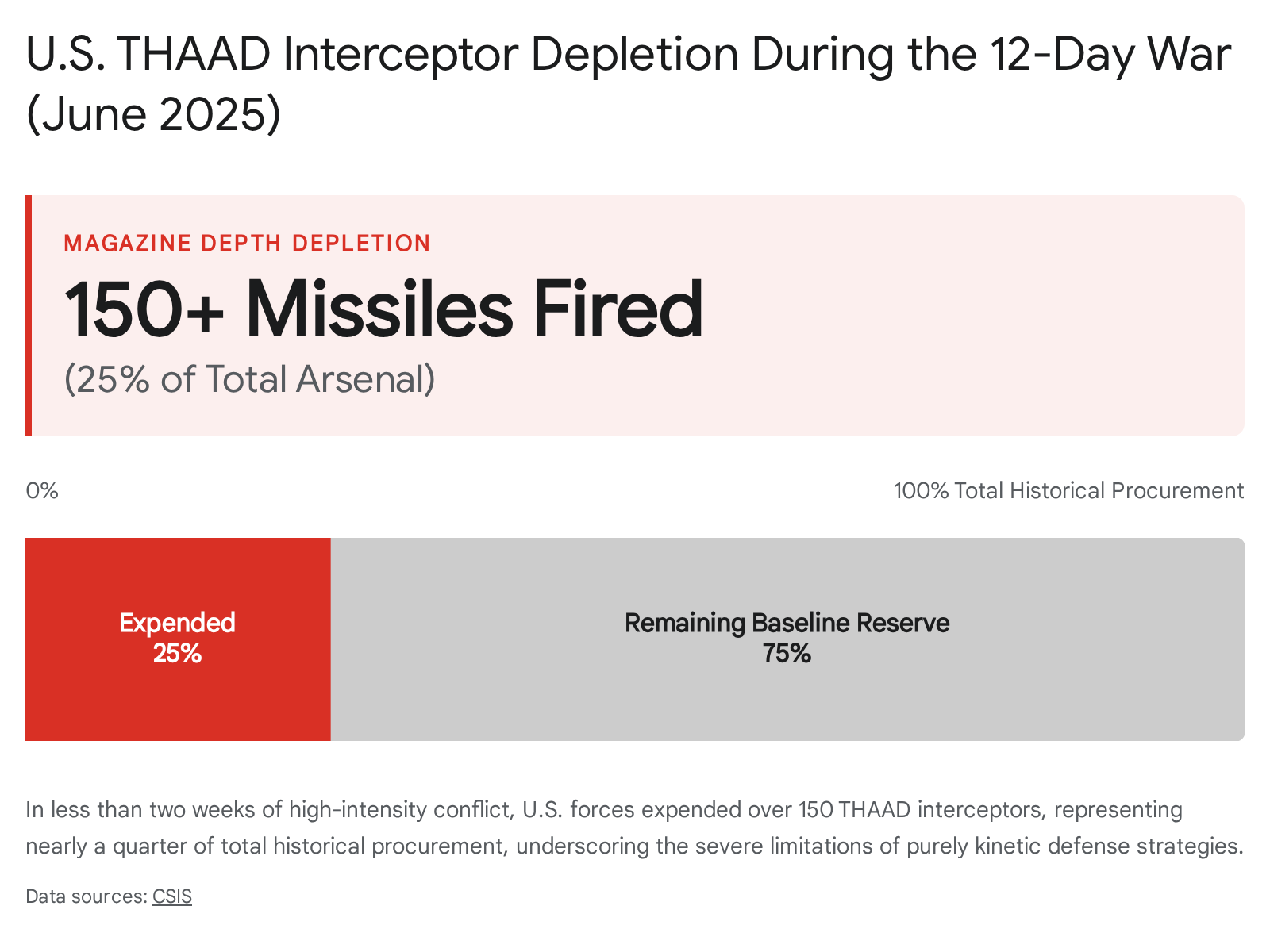
The analytical lessons derived from this severe depletion fundamentally alter the calculus of missile defense: Firstly, the efficacy of layered defenses degrades significantly over time, not due to mechanical or technical failure of the systems themselves, but strictly due to ammunition exhaustion as the protracted conflict outpaces resupply.7 Secondly, dwindling stockpiles force allied commanders into agonizing triage situations, where they must deliberately abandon the defense of secondary assets, allowing them to be destroyed, in order to preserve the remaining few interceptors for the most critical, high-value strategic targets.7 Finally, the reality of empty magazines forces air defenders to revise their shot doctrine. The standard, reliable doctrine of firing two interceptors per incoming threat to guarantee a high kill probability must often be abandoned in favor of highly risky single-shot engagements, drastically increasing the risk of lethal leakage through the defensive shield.7
As noted extensively by military analysts and government officials, peacetime-lean defense industrial bases in both the United States and allied nations are fundamentally unequipped to replenish these massive expenditures in the short term, with replacements for complex systems like THAAD projected to take years to manufacture and deliver.7
7.3 The Strategic Imperative for Counter-Industrial Targeting
The ultimate, unavoidable strategic lesson from the 12-Day War is that relying solely on a posture of defensive interception is a mathematically losing proposition against any adversary possessing a robust, deep industrial base.46 Recognizing the futility of trying to catch every arrow, allied strategy must inevitably shift toward counter-industrial targeting—treating the adversary’s manufacturing base, supply chains, and logistics networks as the primary battlefield.
To prevent adversaries from generating the overwhelming mass required to saturate and defeat defenses, intelligence gathering and offensive strike capabilities must focus relentlessly on degrading the capacity to produce, assemble, and transport missiles before they reach the launch pad.47 In this paradigm, the primary intelligence burden shifts significantly from merely finding and tracking mobile, dispersed launchers in the field to gaining an in-depth, granular familiarity with the deep web of suppliers, chemical factories, specialized tooling facilities, and transportation networks that produce the adversary’s weapons.48 By striking the industrial source or disrupting key supply chain nodes, defenders can preemptively neutralize hundreds of potential missile threats before they are ever built, circumventing the need for multi-million-dollar interceptors altogether. Japan’s aggressive pursuit of long-range counter-strike capabilities, including the procurement of Tomahawk cruise missiles for the ASEVs and the development of indigenous stand-off weapons, is a direct, operational manifestation of this requirement to strike the archer rather than exhaustively attempting to shoot down the arrows.8
8. Strategic Synthesis and Implications for Indo-Pacific Deterrence
The synthesis of Japan’s strategic and technological modernization efforts, evaluated through the harsh empirical lens of the lessons of 2024 and 2025, paints a sobering but highly focused picture of the precise requirements for maintaining credible deterrence in the Indo-Pacific theater.
If a regional, heavily sanctioned power like Iran can successfully and severely deplete the global U.S. interceptor inventory in a mere 12 days of high-intensity operations, the implications for a potential, large-scale conflict with the PRC are exceedingly dire.45 The PRC possesses the world’s largest, most robust defense industrial base, coupled with an exponentially deeper, highly diverse magazine of ballistic, land-attack cruise, anti-ship, and hypersonic missiles.45 The sheer industrial capacity of China to rapidly replace expended munitions and sustain high-volume barrages would put overwhelming, potentially catastrophic pressure on the combined U.S. and Japanese alliance during the initial phases of any protracted conflict.48
Therefore, Japan’s SHIELD architecture must not be viewed merely as an auxiliary coastal defense program; it is an absolute strategic necessity for national survival. By fielding thousands of low-cost, asymmetrical, and expendable effectors, Japan is deliberately attempting to establish the crucial “magazine breadth” required to weather the initial, massive salvos of a high-intensity conflict.49 SHIELD absorbs the cheap volume, intentionally preserving the exquisite, highly limited interceptors housed within the ASEVs and Type 03 Chu-SAM Kai batteries for the absolute highest-tier, existential threats.49 Furthermore, the necessity of possessing highly accurate sensors—proven critical in Israel to precisely determine threat trajectories and prevent wasting precious interceptors on missiles destined for empty terrain—validates Japan’s aggressive, expensive modernization of its FPS-series radar network and the integration of the SPY-7 radar on the ASEV platforms.7
In conclusion, Japan’s defense posture is currently executing a highly calculated, necessary evolution from a passive, northern-oriented shield into an active, multi-domain, highly integrated deterrence network anchored securely in the southwest. The development of the SHIELD architecture, characterized by its heavy reliance on expendable, autonomous systems, represents a profound acknowledgment of the unyielding cost-exchange realities defining modern attrition warfare. Simultaneously, the procurement of the massive ASEV super-destroyers and the transition to mass production of the Type 03 Chu-SAM Kai ensure that Japan retains the vital, high-end kinetic capabilities required to counter emerging, highly maneuverable hypersonic vectors. As interceptor depletion rates reach globally unsustainable levels in modern saturation attacks, the survival of allied ground and maritime forces relies absolutely upon rapid mobility, highly resilient cloud-based command and control networks, decentralized uncrewed mass, and the offensive capability to strike deep into an adversary’s industrial base. By aggressively adopting and integrating these lessons into its joint C2 structures with the United States, Japan is forging an asymmetric, highly lethal defense architecture that is absolutely essential for maintaining stability and deterring aggression in an increasingly volatile and highly contested Indo-Pacific.
Please share the link on Facebook, Forums, with colleagues, etc. Your support is much appreciated and if you have any feedback, please email us in**@*********ps.com. If you’d like to request a report or order a reprint, please click here for the corresponding page to open in new tab.
Sources Used
- Japan builds up its ‘southern shield’ as faith in US security cover falters | Military News, accessed May 26, 2026, https://www.aljazeera.com/news/2026/4/24/japan-builds-up-its-southern-shield-as-faith-in-us-security-cover-falters
- How Japan’s Southwest Shift Is Building an ‘Island Shield’ | JAPAN Forward, accessed May 26, 2026, https://japan-forward.com/how-japans-southwest-shift-is-building-an-island-shield/
- Japan is pushing hard on autonomous weapons | The Strategist, accessed May 26, 2026, https://www.aspistrategist.org.au/japan-is-pushing-hard-on-autonomous-weapons/
- Japan Announces SHIELD Coastal Defence System with UxVs …, accessed May 26, 2026, https://turdef.com/article/japan-announces-shield-coastal-defence-system-with-uxvs
- Japan to Deploy Thousands of Drones for Coastal Defense System, accessed May 26, 2026, https://www.chosun.com/english/world-en/2026/05/22/BMKDFAKTAJEGXBTWR7T7MXP4PA/
- The Indispensable Interceptor: Air Defense and the Problem of Cost-Exchange Logic, accessed May 26, 2026, https://mwi.westpoint.edu/the-indispensable-interceptor-air-defense-and-the-problem-of-cost-exchange-logic/
- The Enduring Role of Fires on the Modern Battlefield – CSIS, accessed May 26, 2026, https://www.csis.org/analysis/chapter-6-enduring-role-fires
- Integrated Air and Missile Defense, accessed May 26, 2026, https://www.mod.go.jp/en/d_architecture/missile_defense/index.html
- Shield of the Pacific: Japan as a Giant Aegis Destroyer – CSIS, accessed May 26, 2026, https://www.csis.org/analysis/shield-pacific-japan-giant-aegis-destroyer
- Progress and Budget in Fundamental Reinforcement of Defense Capabilities, accessed May 26, 2026, https://www.mod.go.jp/en/d_act/d_budget/pdf/fy2026_20260302a.pdf
- Progress and Budget in Fundamental Reinforcement of Defense Capabilities, accessed May 26, 2026, https://www.mod.go.jp/en/d_act/d_budget/pdf/fy2026_20251226a.pdf
- Progress and Budget in Fundamental Reinforcement of Defense Capabilities, accessed May 26, 2026, https://www.mod.go.jp/en/d_act/d_budget/pdf/fy2026_20251210a.pdf
- Progress and Budget in Fundamental Reinforcement of Defense Capabilities, accessed May 26, 2026, https://www.mod.go.jp/en/d_act/d_budget/pdf/fy2025_20250411a.pdf
- Samurai Shield: Japan’s Air and Missile Defence – PISM, accessed May 26, 2026, https://pism.pl/upload/images/artykuly/legacy/files/17829.pdf
- U.S. and Allied Ballistic Missile Defenses in the Asia-Pacific Region, accessed May 26, 2026, https://www.armscontrol.org/factsheets/us-and-allied-ballistic-missile-defenses-asia-pacific-region
- Japan Cancels Aegis Ashore: Reasons, Consequences, and International Implications, accessed May 26, 2026, https://www.airuniversity.af.edu/JIPA/Display/Article/2361398/japan-cancels-aegis-ashore-reasons-consequences-and-international-implications/
- Aegis system equipped vessels (ASEV) – Wikipedia, accessed May 26, 2026, https://en.wikipedia.org/wiki/Aegis_system_equipped_vessels_(ASEV)
- First official concept image of Japans 20000 ton AEGIS warship (897×600) – Reddit, accessed May 26, 2026, https://www.reddit.com/r/WarshipPorn/comments/zx7a83/first_official_concept_image_of_japans_20000_ton/
- Japan’s ASEV Super Destroyer: Fresh Details Unveiled – Naval News, accessed May 26, 2026, https://www.navalnews.com/naval-news/2025/03/japans-asev-super-destroyer-fresh-details-unveiled/
- Japan’s MoD Unveils New Image of ASEV – Naval News, accessed May 26, 2026, https://www.navalnews.com/naval-news/2023/07/japans-mod-unveils-new-image-of-asev/
- Aegis Combat System | Lockheed Martin, accessed May 26, 2026, https://www.lockheedmartin.com/en-us/products/aegis-combat-system.html
- Japan enters hypersonic missile defense era with mass production of Improved Type 03 Chu-SAM Kai – DSA and NATSEC Asia, accessed May 26, 2026, https://www.dsaexhibition.com/japan-enters-hypersonic-missile-defense-era-with-mass-production-of-type-03-chu-sam-kai
- Japan Begins Mass Production of Type 03 Chu SAM Kai for …, accessed May 26, 2026, https://thedefensewatch.com/military-ordnance/japan-mass-produces-type-03-chu-sam-kai-hypersonic-missile-defense/
- Type 03 – Missile Defense Advocacy Alliance, accessed May 26, 2026, https://www.missiledefenseadvocacy.org/defense-systems/type-03/
- Type 03 Chū-SAM – Wikipedia, accessed May 26, 2026, https://en.wikipedia.org/wiki/Type_03_Ch%C5%AB-SAM
- Joint Statement of the Security Consultative Committee (“2+2”) – State Department, accessed May 26, 2026, https://2021-2025.state.gov/joint-statement-of-the-security-consultative-committee-22-2/
- Beyond Policy Limits: Rethinking U.S.-Japan Command and Control – Stimson Center, accessed May 26, 2026, https://www.stimson.org/2025/beyond-policy-limits-rethinking-u-s-japan-command-and-control/
- Joint Statement of the Security Consultative Committee (“2+2”) – U.S. Department of War, accessed May 26, 2026, https://www.war.gov/News/Releases/Release/Article/3852169/joint-statement-of-the-security-consultative-committee-22/
- US Forces, Japan Maritime Self-Defense Force Participate in Resilient Shield 2022, accessed May 26, 2026, https://www.navy.mil/Press-Office/News-Stories/Article/2941964/us-forces-japan-maritime-self-defense-force-participate-in-resilient-shield-2022/
- News – Page 265 – PACOM, accessed May 26, 2026, https://www.pacom.mil/Media/News/?Page=265
- Orient Shield 21-2 Prompts Camp Amani Integrated Bilateral Air Defense Training, accessed May 26, 2026, https://www.army.mil/article/249622/orient_shield_21_2_prompts_camp_amani_integrated_bilateral_air_defense_training
- Contents, accessed May 26, 2026, https://www.mod.go.jp/j/press/wp/wp2025/pdf/DOJ2025_EN_Reference.pdf
- Overview and Implications of the “Golden Dome” Missile Defense Plan for the U.S. Mainland | List of Articles | International Information Network Analysis, accessed May 26, 2026, https://www.spf.org/iina/en/articles/nagashima_22.html
- Extra Funding Puts Hypersonic Interceptor Program Back on Track, accessed May 26, 2026, https://www.airandspaceforces.com/hypersonic-interceptor-program-back-on-track-gpi/
- A Timeline of Hypersonic Missile Defense Breakthroughs and the Systems Reshaping Modern Air & Missile Warfare | TheDefenseWatch.com, accessed May 26, 2026, https://thedefensewatch.com/cyber-space-defense/timeline-of-hypersonic-missile-defense-breakthroughs-and-the-systems/
- Current U.S. Missile Defense Programs at a Glance | Arms Control Association, accessed May 26, 2026, https://www.armscontrol.org/factsheets/current-us-missile-defense-programs-glance
- The Russian Air War and Ukrainian Requirements for Air Defence – RUSI, accessed May 26, 2026, https://www.rusi.org/explore-our-research/publications/special-resources/russian-air-war-and-ukrainian-requirements-air-defence
- Air Superiority in the Twenty-First Century: Lessons from Iran and Ukraine – CSIS, accessed May 26, 2026, https://www.csis.org/analysis/air-superiority-twenty-first-century-lessons-iran-and-ukraine
- Preliminary Lessons in Conventional Warfighting from Russia’s Invasion of Ukraine: February–July 2022 | Royal United Services Institute – RUSI, accessed May 26, 2026, https://www.rusi.org/explore-our-research/publications/special-resources/preliminary-lessons-conventional-warfighting-russias-invasion-ukraine-february-july-2022
- Lessons from the Ukraine Conflict: Modern Warfare in the Age of Autonomy, Information, and Resilience – CSIS, accessed May 26, 2026, https://www.csis.org/analysis/lessons-ukraine-conflict-modern-warfare-age-autonomy-information-and-resilience
- Allied Air Command Lessons from Ukraine – Joint Air Power Competence Centre, accessed May 26, 2026, https://www.japcc.org/articles/allied-air-command-lessons-from-ukraine/
- Air Defence Insights From the Ukraine-Russia Conflict | Published in Contemporary Issues in Air and Space Power, accessed May 26, 2026, https://ciasp.scholasticahq.com/article/141276-air-defence-insights-from-the-ukraine-russia-conflict
- From Proxy Warfare to Direct Confrontation: The Evolving Landscape of the Israel–Iran Conflict 2024–2025 | Chinese Journal of International Review, accessed May 26, 2026, https://www.worldscientific.com/doi/10.1142/S2630531325500179
- Israel and Iran at War: What Comes Next? – CSIS, accessed May 26, 2026, https://www.csis.org/analysis/israel-and-iran-war-what-comes-next
- Magazine depth: Rapid depletion of missile stockpiles in Iran raises concerns about US readiness, accessed May 26, 2026, https://smallwarsjournal.com/2026/03/27/magazine-depth-iran-missiles-stockpile-readiness/
- Composite Air Defense Artillery Formations: Converging Non-Kinetic and Kinetic Capabilities – Line of Departure, accessed May 26, 2026, https://www.lineofdeparture.army.mil/Journals/Air-Defense-Artillery/ADA-Archive/2026-E-Edition/Composite-Air-Defense/
- Applying US Air Warfare Theory and Doctrine to Evaluate the Campaign against Iran, Part II: Iranian Missile Forces, accessed May 26, 2026, https://understandingwar.org/research/middle-east/applying-us-air-warfare-theory-and-doctrine-to-evaluate-the-campaign-against-iran-part-ii-iranian-missile-forces/
- The Arsenal as the Battlefield: The War on Iran and the Return of Counter-Industrial Targeting, accessed May 26, 2026, https://warontherocks.com/the-arsenal-as-the-battlefield-the-war-on-iran-and-the-return-of-counter-industrial-targeting/
- Missile Defense Project | Defense and Security | CSIS, accessed May 26, 2026, https://www.csis.org/programs/missile-defense-project