1. Executive Summary
During the reporting period of June 27 through July 4, 2026, global military doctrine regarding unmanned and autonomous systems (UxS) crossed a critical, irreversible threshold. The global posture has definitively transitioned from the ad-hoc, experimental procurement of commercial off-the-shelf (COTS) platforms into the permanent, industrialized structuring of autonomous forces. Across all major operational theaters—encompassing the air, land, sea, and space domains—the integration of artificial intelligence into the kinetic “kill chain,” the fielding of autonomous contested logistics, and the establishment of dedicated autonomous command structures demonstrate that algorithmic warfare is no longer an emerging concept. It is now the baseline reality of multi-domain operations. This reporting period reveals a synchronized, global realization that conventional symmetric warfare, relying on small fleets of exquisite, highly expensive crewed platforms, is mathematically unsustainable against the attritable mass generated by autonomous systems.
The most consequential institutional shift occurred within the United States Department of War (DoW). Following the issuance of National Security Presidential Memorandum 11 (NSPM-11) earlier in the month, which mandated the accelerated adoption of artificial intelligence to overcome bureaucratic delays, the formal establishment of a Direct Reporting Portfolio Manager for Unmanned Systems (DRPM-UxS) and a proposed $54.6 billion budget surge for the Defense Autonomous Warfare Group (DAWG) signaled the end of iterative pilot programs.1 By explicitly absorbing the Replicator initiative into a permanently funded, high-level bureaucratic structure, the Pentagon is executing a hyper-scaled acquisition pipeline intended to override traditional service-level bottlenecks.4 Concurrently, legislative efforts by the Senate Armed Services Committee (SASC) to create a Robotic and Autonomous Systems Combatant Command (RASCOM) reflect a profound doctrinal realization: autonomy is increasingly viewed not merely as a tool operating within physical domains, but as a cross-domain maneuver space requiring specialized operational command and joint integration.6
In the European theater, the ongoing conflict in Ukraine continues to serve as the primary incubator and testing ground for autonomous warfare technologies, heavily supported by international financial mechanisms such as the European Commission’s €3.9 billion disbursement for advanced drone procurement.8 The operationalization of Ukraine’s Defense AI Center A1 marks a definitive shift toward “machine-speed warfare.” Specifically, the implementation of AI-driven terminal guidance systems removes the human pilot from the final seconds of engagement, countering the pervasive electronic warfare (EW) environments that have traditionally severed command-and-control (C2) links.9 Concurrently, the maritime domain is witnessing a revolution in asymmetric denial. Ukraine’s unveiling of the 10-ton Sea Trident underwater drone and the multi-role Mobidik surface vessel platform illustrates the maturation of naval drones from improvised explosive boats into serialized, multi-mission combatant craft capable of deep-strike, air defense, and autonomous interception.11
Strategically, allied nations are aggressively restructuring their command hierarchies and operational doctrines to accommodate these technologies and counter peer adversaries. The United Kingdom’s £5 billion Defence Investment Plan and the activation of Taiwan’s Littoral Combat Command (LCC) both reflect a doctrinal embrace of “attritable mass”.14 By pairing expendable, autonomous platforms—such as the Royal Air Force’s StormShroud electronic warfare drones or Taiwan’s decentralized USV strike nodes—with exquisite, crewed assets, militaries are expanding their sensor and strike ranges while deliberately complicating adversary targeting algorithms.16 This “kill web” approach ensures that even under severe communications degradation or pre-emptive strikes, distributed autonomous nodes can maintain operational resilience. Furthermore, space-based architectures are advancing rapidly; the domain is shifting from passive satellite constellations to active, autonomous orbital maneuvering, highlighted by missions like VICTUS HAZE, which demonstrated AI-driven interception and imaging of uncooperative satellites.
Finally, the tactical utility of low-cost drones for geopolitical coercion was starkly demonstrated in the Central Command (CENTCOM) area of responsibility. State-sponsored drone attacks on commercial shipping in the Strait of Hormuz, and the subsequent US retaliatory strikes against Iranian drone infrastructure, underscore a persistent strategic vulnerability.18 The asymmetric cost-exchange ratio—where inexpensive one-way attack unmanned aerial vehicles (OWA-UAVs) can paralyze global maritime trade and force the expenditure of multi-million-dollar interceptors—remains a dominant operational challenge.20 This dynamic is driving urgent investments in directed energy, such as the LOCUST laser system, and automated counter-UAS (C-UAS) networks to rebalance the economic calculus of defense.
2. Global Situation Log
2.1 North American Theater: United States Department of War (DoW)
Event & Development: Establishment of DRPM-UxS and the Escalation of DAWG
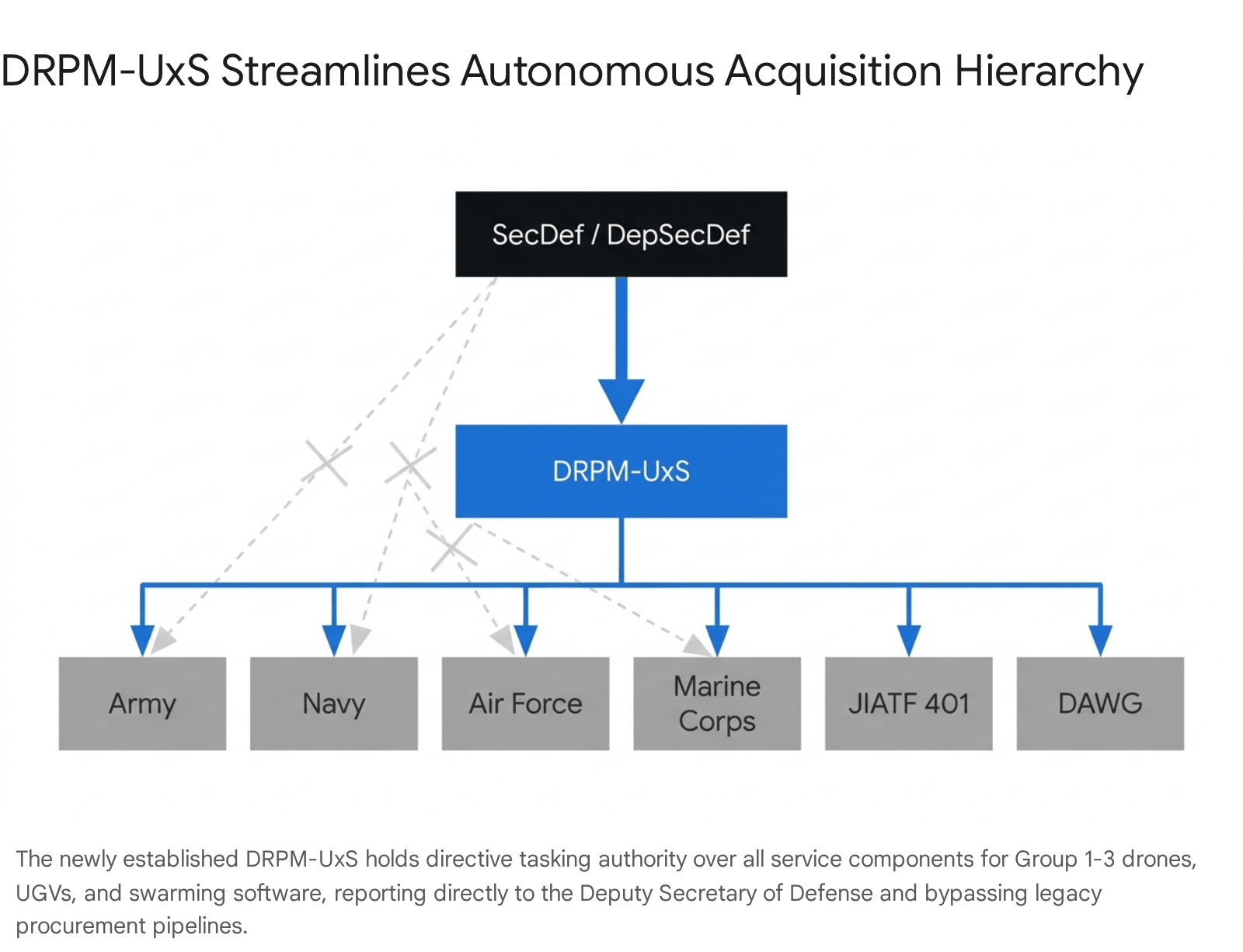
On June 29, 2026, Secretary of War Pete Hegseth issued an official memorandum establishing the Direct Reporting Portfolio Manager for Unmanned Offensive and Defensive Systems (DRPM-UxS).1 Reporting directly to Deputy Secretary Stephen Feinberg, this newly created office serves as the single joint integrator for the Pentagon’s autonomous assets. It effectively subsumes the Defense Autonomous Warfare Group (DAWG)—a division under Special Operations Command that absorbed the Replicator 1 initiative in August 2025—and the Joint Interagency Task Force 401 (JIATF 401), which managed Replicator 2.4 Concurrently, the administration’s FY27 budget request allocated an unprecedented $54.6 billion for DAWG, representing a 24,000% increase over its initial FY26 allocation. To further support these efforts, Congress is advancing a $350 billion mandatory budget request that includes $20.6 billion dedicated to cUAS and $16.9 billion for the procurement of uncrewed systems across all physical domains.21 This funding surge officially absorbs the highly publicized but struggling Replicator initiative into a permanently funded, institutionalized structure.22 The DRPM-UxS is granted directive authority over Group 1-3 UAS, unmanned ground vehicles (UGVs), unmanned underwater vehicles (UUVs), counter-unmanned systems, and AI swarming software, allowing it to bypass traditional service-level acquisition processes.2
Tactical & Operational Lessons
The consolidation of autonomous warfare programs under the DRPM-UxS resolves the persistent “integration friction” that severely hampered earlier rapid-acquisition initiatives like Replicator. Engineering analysis of the Replicator program’s initial phases reveals that while the military successfully procured massive quantities of attritable commercial airframes, it failed to anticipate the systems engineering challenges of integrating these disparate platforms with existing joint command-and-control (C2) software architectures.5 Many of the commercial systems selected were technically immature, possessed closed-source proprietary software, or lacked the Application Programming Interfaces (APIs) necessary to communicate with military battle management systems.5 Consequently, operators were forced to use distinct, non-interoperable control stations for different drone models, severely degrading operational tempo and preventing multi-domain swarming.
By centralizing both the hardware procurement pipeline (the physical airframes and chassis) and the software procurement pipeline (autonomy stacks, swarming logic, and AI targeting) under a single, supreme authority, the DRPM-UxS ensures strict adherence to open architecture standards across the joint force.2 Tactically, this guarantees that a Marine Corps autonomous ground vehicle, an Air Force Group 3 ISR drone, and a Navy unmanned surface vessel can operate simultaneously on a shared mesh network. This allows target telemetry acquired by a drone to be passed seamlessly and autonomously to a ground-based effector without requiring human operators to manually translate data formats between disparate, service-specific C2 systems. The directive authority of the DRPM-UxS allows it to mandate common data links, standardized encryption protocols, and universal swarming algorithms, effectively transforming heterogeneous fleets of cheap drones into a unified, lethal hive-mind capable of overwhelming localized defenses.
Strategic Lessons
This bureaucratic reorganization represents a fundamental, generational shift in how the United States military calculates the value of combat mass versus exquisite capability. The unprecedented $54.6 billion requested for the DAWG clearly indicates that the Pentagon has stopped treating autonomous warfare as an experimental, adjunct capability and is now funding it as a permanent, central pillar of American force generation.22 This is arguably the largest single commitment to autonomous warfare in history. The DRPM-UxS’s ability to supersede traditional Service-level acquisition authorities ensures that the US defense industrial base can scale production to match the massive manufacturing output of peer adversaries.
For decades, US strategic doctrine relied on maintaining a technological edge through small fleets of highly advanced, extremely expensive, and difficult-to-replace platforms (e.g., fifth-generation fighters, nuclear-powered aircraft carriers, and complex armored vehicles). However, wargaming simulations of Indo-Pacific conflicts have consistently demonstrated that exquisite platforms are highly vulnerable to saturation attacks by thousands of cheap, autonomous munitions. By institutionalizing the DAWG and empowering the DRPM-UxS, the Pentagon is officially pivoting toward a strategy of “attritable mass.” The strategic objective is no longer solely to build the most survivable individual platform, but to field autonomous systems in such overwhelming numbers that the loss of hundreds, or even thousands, of units in a single engagement becomes operationally and economically insignificant. This paradigm shift forces adversaries to expend their finite, expensive interceptors against inexpensive drones, thereby inverting the cost-exchange ratio in favor of the United States and creating a more robust, resilient deterrent posture.
Event & Development: Legislative Push for Robotic and Autonomous Systems Command (RASCOM)
Complementing the executive actions within the Pentagon, the legislative branch has initiated parallel structural reforms. The Senate Armed Services Committee (SASC) advanced the FY27 National Defense Authorization Act (NDAA), which includes explicit provisions encouraging the Defense Department to establish a Robotic and Autonomous Systems Combatant Command (RASCOM).6 If authorized and signed into law, this four-star combatant command would be the first entirely new COCOM established since the re-formation of SPACECOM in 2019.7 According to committee summaries, RASCOM would be granted special test and evaluation authorities, as well as limited, streamlined acquisition authorities designed specifically to procure commercial off-the-shelf (COTS) drone technologies from global marketplaces at an accelerated pace.6
Tactical & Operational Lessons
Structurally, the United States military divides responsibilities between the military services (Army, Navy, Air Force, Marines), which “organize, train, and equip” forces, and the Combatant Commands (COCOMs), which “fight” the force in designated geographic or functional areas. By proposing a functional COCOM dedicated entirely to robotics and autonomy, legislators are aiming to centralize the operational doctrine and battlefield integration of these systems at the highest tactical level.6
Currently, tactical deployment of autonomous systems is highly fragmented. Each service branch develops and employs its own drones using bespoke tactics, techniques, and procedures (TTPs), often resulting in overlapping efforts, inefficient resource allocation, and interoperability failures during joint operations. A dedicated RASCOM would function as the supreme tactical authority for integrating uncrewed systems into complex, multi-domain battle plans. Tactically, this means standardizing the deployment playbook. For example, a joint-force commander planning an amphibious assault would rely on RASCOM to orchestrate the initial wave of autonomous systems—coordinating Air Force SEAD drones, Navy unmanned mine-clearing vessels, and Marine Corps autonomous ground reconnaissance vehicles—ensuring they operate synergistically to degrade enemy anti-access/area denial (A2/AD) networks before human personnel enter the battlespace.
Strategic Lessons
The legislative push to create RASCOM signifies a profound doctrinal realization among US policymakers: autonomy and robotics are no longer merely tools or platforms operating within existing physical domains (air, land, sea), but are increasingly viewed as a discrete, cross-domain maneuver space requiring specialized operational command.7 Just as the establishment of Cyber Command recognized the unique physics and strategic imperatives of the digital domain, the proposed RASCOM acknowledges that algorithmic combat requires a unique command philosophy.
Strategically, the centralization of command under a four-star general ensures that autonomous warfare is institutionalized at the highest levels of military strategy, effectively forcing the Department of War to treat robotic combat as a core competency. This centralization prevents autonomous systems from being marginalized by legacy service cultures that naturally favor traditional crewed platforms (e.g., the Air Force’s historical preference for piloted fighters or the Navy’s preference for crewed ships). By establishing RASCOM, the US signals to adversaries that it is preparing for a future where wars are initiated, fought, and potentially concluded by autonomous systems long before crewed elements engage in direct kinetic conflict.
Event & Development: CCA Increment 1 and Advanced Counter-UAS Procurements
In the aviation domain, the US Air Force announced engineering-and-manufacturing development and production contracts for Increment 1 of the Collaborative Combat Aircraft (CCA) program.23 The Air Force selected Anduril and General Atomics for the physical airframes, bypassing several legacy defense contractors. This accelerated timeline aims to field at least 150 CCA systems by the end of the decade.23 Crucially, the Air Force explicitly separated the hardware and software procurement tracks, selecting Anduril, Shield AI, and Collins Aerospace to compete for the CCA primary mission autonomy software provider contract.23 Concurrently, addressing the defensive side of autonomous warfare, the DoD awarded a $500 million firm-fixed-price contract to AeroVironment to procure commercial counter-unmanned aerial systems (C-UAS) over the next three years.[44]
Tactical & Operational Lessons
The CCA program represents the operational zenith of Manned-Unmanned Teaming (MUM-T) in modern aviation.23 Tactically, these autonomous, jet-powered drones will act as force multipliers and loyal wingmen for crewed fifth-generation fighters like the F-35, or the future Next Generation Air Dominance (NGAD) platform. A single crewed fighter will control a “flight” of multiple CCAs. These drones can be pushed far ahead of the human pilot into highly contested airspace to conduct Suppression of Enemy Air Defenses (SEAD), extend radar and infrared sensor ranges, and act as remote weapon bays. If a CCA detects an enemy surface-to-air missile (SAM) site, it can instantly relay the targeting data back to the crewed fighter, or it can be authorized to engage the target autonomously using its own payload.
The systems engineering decision to decouple the airframe procurement from the autonomy software procurement is tactically brilliant. It allows the Air Force to continually upgrade the cognitive capabilities, threat libraries, and swarming logic of the drone fleet via over-the-air software updates, without needing to modify or replace the physical jet chassis.23 On the defensive spectrum, the AeroVironment C-UAS contract highlights the urgent tactical necessity of layered defense. Modern drone swarms require a multi-tiered defeat mechanism. AeroVironment’s portfolio, which includes systems like the LOCUST directed energy laser, provides tactical commanders with scalable response options. Lasers provide a practically infinite magazine depth and a low cost-per-shot to burn through the optical sensors or flight control surfaces of incoming Group 1 and 2 drones, preserving expensive kinetic interceptors for larger, more heavily armored Group 3 threats.
Strategic Lessons
The dual emphasis on offensive autonomous swarms (represented by the CCA program) and comprehensive, scalable defense (represented by the C-UAS procurements) illustrates the strategic imperative of rebalancing the cost-exchange ratio of modern warfare. The proliferation of cheap, precision-guided drones has democratized air power, allowing non-state actors and smaller nations to challenge the airspace dominance of major powers. Traditional air defense systems, such as Patriot missile batteries firing interceptors that cost millions of dollars each, are economically unsustainable against swarms of $20,000 asymmetric drone threats. By investing heavily in attritable autonomous fighters and high-capacity C-UAS technologies, the United States is fundamentally restructuring its defense industrial base to win long-term battles of industrial attrition. The strategic goal is to ensure that the economic cost of defending friendly airspace never exceeds the economic cost the adversary pays to launch the offensive threat.
Event & Development: Tactically Responsive Space (TacRS) and Autonomous Orbital Maneuvering
The space domain is rapidly evolving from a passive communications relay to an active maneuver space for autonomous platforms. On July 2, 2026, True Anomaly announced that its Jackal spacecraft successfully approached, circled, and imaged a Rocket Lab spacecraft as part of the Space Systems Command (SSC) VICTUS HAZE mission. This milestone demonstrated tactically responsive space (TacRS) capabilities, with Rocket Lab launching just 17 hours after receiving orders, and True Anomaly tracking the non-cooperative target in orbit within hours. Simultaneously, the US launched the LINK robotic spacecraft on July 3, developed by Katalyst Space Technologies, designed to autonomously dock with and relocate the aging SWIFT observatory—a historic first for US in-orbit servicing. In parallel, the US Naval Research Laboratory is advancing its “Autosat” prototype, a fully autonomous satellite capable of recognizing objects on Earth without ground control.
Tactical & Operational Lessons
From a systems engineering perspective, the VICTUS HAZE mission radically accelerates the space kill chain. Historically, tracking uncooperative or adversarial satellites required painstaking analysis and coordination with ground-based radar and optical telescopes. By deploying autonomous “inspector” satellites capable of independently navigating toward, circling, and visually identifying target spacecraft, the US military gains real-time intelligence on adversarial space assets. The ability to launch and rendezvous within 24 hours drastically reduces an adversary’s window to deploy surprise orbital weapons. Furthermore, the LINK mission’s success in autonomous docking proves that robotic spacecraft can actively physically interact with other objects in orbit, paving the way for autonomous refueling, repair, or kinetic de-orbiting of enemy platforms.
Strategic Lessons
These developments indicate a shift to active orbital defense, driven by rapid advancements from peer adversaries. China is actively deploying its Three-Body Computing Constellation, a network designed to process data on orbit using AI models, effectively turning space into an autonomous cloud network. The People’s Liberation Army (PLA) already benefits from an expanding architecture of over 1,353 satellites, including more than 510 ISR-capable platforms. The absolute reliance of modern autonomous military doctrine on space architecture establishes space as the ultimate strategic center of gravity. If an adversary can deny access to space-based communications, the operational capability of terrestrial drone swarms would be catastrophically degraded. As AI integrates into satellite operations, the race for space superiority is transitioning from building the most complex sensor to fielding the fastest, most autonomous orbital cognitive network.
2.2 Global Contested Logistics and Autonomous Resupply
Event & Development: TRANSCOM MASS CRADA and Ground Resupply via Overland AI
Addressing the severe vulnerabilities inherent in moving supplies across contested environments, US Transportation Command (TRANSCOM) issued a solicitation for Cooperative Research and Development Agreements (CRADAs) to evaluate Maritime Autonomous Surface Ships (MASS).24 With a submission deadline of July 6, 2026, TRANSCOM aims to partner with industry to integrate autonomous cargo-moving drone boats into global military supply chains.26 Concurrently, in the land domain, Overland AI secured a $19.7 million production contract spurred by the APFIT initiative, marking a historic milestone as the first ground autonomy company to serve as the prime contractor on a military production deal. Overland AI will deliver “more than a dozen” autonomous ground vehicles (AGVs) to the Marine Corps. These AGVs will utilize the company’s proprietary OverDrive autonomy stack and OverWatch C2 system to provide autonomous resupply for the Marine Air Defense Integrated System (MADIS).27
Tactical & Operational Lessons
Both developments address the critical vulnerability of “contested logistics”—the reality that adversaries will target supply lines long before they target combat forces. In the land domain, Overland AI’s AGVs are engineered to operate with full autonomy, complementing rather than replacing the existing Joint Light Tactical Vehicles (JLTVs) in the MADIS architecture.27 Tactically, the MADIS system utilizes mobile platforms to detect and defeat hostile drones and aircraft using 30mm cannons and Stinger missiles. Supplying these frontline air defense units under fire is extremely hazardous. Overland AI’s vehicles solve this by processing all perception, environmental representation, and path-planning computations entirely on-board the vehicle’s edge processors.27 This allows the AGVs to navigate treacherous terrain and deliver ammunition or power supplies even under severe electronic warfare (EW) conditions where GPS is jammed and communications networks are denied.27
In the maritime domain, MASS systems fulfill a parallel tactical role. Large sealift vessels are slow, highly visible targets easily tracked by enemy satellites and vulnerable to long-range anti-ship missiles. By shifting cargo to fleets of smaller, autonomous surface ships, TRANSCOM can disaggregate the logistical footprint.25 MASS systems utilize AI-enabled navigation and sensor fusion to autonomously ferry cargo through complex littoral environments and Anti-Access/Area Denial (A2/AD) zones without putting human crews at risk.25
Strategic Lessons
The “tyranny of distance,” particularly in vast theaters like the Indo-Pacific, necessitates a logistical architecture that is highly resilient and highly distributed. Large, crewed logistics ships and vulnerable ground supply convoys represent high-value targets; an adversary can effectively neutralize a forward-deployed combat force simply by starving it of fuel, ammunition, and parts. By integrating MASS and AGVs into the mobility network, the DoD is transitioning from a vulnerable, centralized logistical chain to a resilient, attritable logistics web.
If an autonomous resupply drone—whether on land or at sea—is destroyed by enemy fire, the strategic loss is limited strictly to the immediate cargo and the relatively low cost of the autonomous hull. No human lives are lost, and the political fallout of casualties is avoided. This ensures that a high volume of distributed logistics can continuously penetrate contested zones to sustain high-intensity combat operations, vastly complicating the adversary’s targeting calculus and rendering attempts to blockade allied forces economically inefficient.
2.3 European Theater: Ukraine, Russia, and NATO’s Autonomous Crucible
Event & Development: Defense AI Center A1 and Terminal Kill Chain Autonomy
The conflict in Ukraine continues to accelerate the evolution of autonomous warfare at an unprecedented rate. Ukraine’s Ministry of Defense has formalized the operationalization of its Defense AI Center A1, led by Danylo Tsvok, explicitly established to integrate artificial intelligence directly into the military “kill chain”.9 The center is actively deploying computer vision models for “last-mile guidance.” This technology enables First-Person View (FPV) and strike drones to autonomously steer onto targets in their final moments of flight, even if the connection to the human pilot is severed.9 Demonstrating the tactical maturation of these systems, Ukraine’s Unmanned Systems Forces (USF) conducted a deep-strike drone operation against the St. Petersburg Oil Terminal on July 4, 2026, showcasing the expanding strategic reach of their autonomous platforms. Furthermore, these computer vision algorithms are being deployed on interceptor drones programmed to autonomously lock onto and destroy incoming Shahed kamikaze drones in mid-air.9 This technological push is heavily subsidized by the European Commission, which disbursed the first €3.9 billion tranche of a larger €6 billion fund specifically dedicated to advancing Ukraine’s drone procurement and defense industrial capacity.8 Concurrently, Russian forces are deploying their own AI adaptations, such as the V2U strike drone equipped with Chinese Leetop A203 minicomputers and NVIDIA Jetson Orin modules for autonomous target recognition.28
Tactical & Operational Lessons
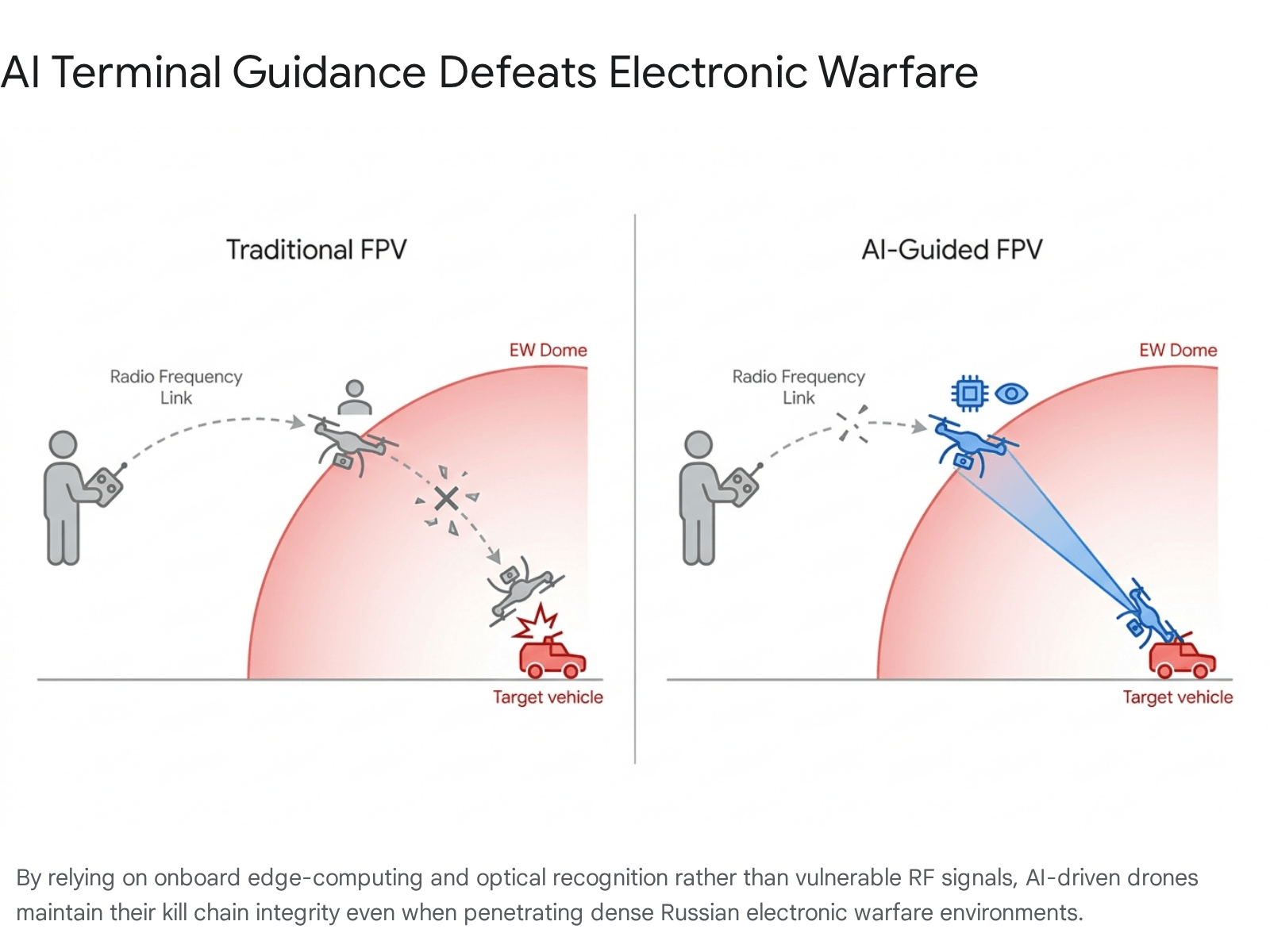
The implementation of AI in the terminal phase of the kill chain is a direct, hard-engineered countermeasure to pervasive electronic warfare (EW).9 Throughout the conflict, traditional FPV drones have relied on a continuous, high-bandwidth radio frequency (RF) link between the human operator and the drone to transmit video feeds and receive steering commands. Russian tactical EW systems project intense electromagnetic jamming “bubbles” around high-value targets like tanks and artillery pieces. As the traditional FPV drone enters the final hundred meters of its attack run, it penetrates this jamming bubble, the RF link is severed, the video feed turns to static, and the drone inevitably misses the target or crashes harmlessly into the dirt.10
The Defense AI Center A1 circumvents this physics problem entirely. By equipping the drone with advanced edge-computing processors and lightweight optical neural networks, the human operator is only required to fly the drone near the target and designate the target profile on their screen from a safe distance outside the jamming range. Once the operator issues the “lock” command, the drone’s operational state transitions to “fire-and-forget.” As the drone plunges into the EW bubble and loses its RF connection to the operator, the onboard AI assumes complete control of the flight surfaces, utilizing purely optical data from the camera sensor to dynamically track the target and execute the terminal strike with devastating precision.9 This fundamentally alters the tactical geometry of the battlefield, rendering localized jamming systems largely obsolete against terminal-phase munitions and transitioning the operator’s role from “human-in-the-loop” (actively manually flying) to “human-on-the-loop” (authorizing the machine to kill).10
Strategic Lessons
This development heralds the permanent arrival of “machine-speed warfare”.28 As both sides rapidly scale their drone production—with Ukraine deploying tens of thousands of drones monthly—and enhance their EW capabilities, the cognitive limits and reaction times of human operators have become the primary bottleneck in combat effectiveness. Automating the kill chain not only bypasses technological defenses but allows a single human operator to manage multiple, simultaneous engagements, drastically increasing operational tempo and overall force lethality.28
However, this algorithmic acceleration carries profound consequences for the civilian populace and the post-war recovery of the region. As noted by the UN Development Programme (UNDP), the proliferation of autonomous sensors and drones has made the battlespace vastly deeper, wider, and exponentially more lethal.30 Unlike early static trench warfare, drones now continuously monitor vast areas, identifying movement and authorizing strikes with terrifying efficiency. This pervasive surveillance and automated lethality create highly complex dangers for civilians, threatening long-term agricultural recovery and global food security long after active kinetic fighting concludes.30 Furthermore, the introduction of systems like the “digital twin of the front”—an AI operating system being developed by Center A1 that analyzes aggregate, multi-modal battlefield data to synthesize optimal theater-level deployment strategies—demonstrates that AI is rapidly migrating from individual platform guidance up the chain of command into the realm of strategic theater planning.9
Event & Development: Industrialization of Asymmetric Naval Warfare (Sea Trident & Mobidik)
At the Eurosatory 2026 exhibition in Paris, the Ukrainian defense industry formally unveiled highly advanced, serialized maritime autonomous platforms, signaling a shift from improvised prototypes to mature, industrial-scale naval systems. Foremost among these is the Sea Trident ST-1000, developed by the defense company Global Mark.31 It is a massive 10-meter, 10-ton heavy unmanned underwater vehicle (UUV) boasting a 2,000 nautical mile range, a 60-meter operating depth, and a devastating 1,000 kg payload capacity.13 The Sea Trident is engineered not only for offensive strikes against surface vessels and infrastructure but is specifically designed to intercept and neutralize other UUVs, creating a new paradigm of underwater drone-on-drone combat.13 Concurrently, details emerged regarding the Mobidik deep-strike Unmanned Surface Vehicle (USV). Developed by Avarid, the Mobidik features an impressive 1,400 km range, 120 hours of autonomy, and is built around six distinct, modular configurations (MD-1 through MD-6) capable of executing air defense, medium strike, and armed assault profiles.12
Table 1: Operational Configurations of the Ukrainian Mobidik Deep-Strike USV 12
| Configuration | Mission Profile | Payload / Armament Integration | Tactical Application |
| MD-1 | Air Defense | Five fixed-wing interceptor drones | Maritime air-defense line establishment |
| MD-2 | Air Defense | Eight quadcopter interceptor drones | Close-in swarm interception |
| MD-3 | Medium Strike | MORRIGAN middle-strike drones | Targeting coastal assets and shipping |
| MD-4 | Strategic Strike | Strategic-range strike payloads | Deep-water denial and strategic targeting |
| MD-5 | Armed Assault | Two R-73/AIM-9 missiles, Browning M2 | Direct anti-aircraft / surface combat |
| MD-6 | Armed Assault | Modular heavy assault weapons | Direct kinetic engagement |
Tactical & Operational Lessons
The engineering specifications of the Sea Trident ST-1000 represent a masterclass in low-observability maritime operations.13 By operating at a sustained depth of 60 meters, the UUV can navigate effectively below the upper thermal layers and sonic channels of the Black Sea. This depth profile severely degrades the effectiveness of surface-based anti-submarine warfare (ASW) sonar systems and renders the drone entirely invisible to visual or infrared detection by maritime patrol aircraft.32 The massive 1,000 kg payload is not merely an explosive charge; it is specifically calibrated to detonate directly beneath a target’s keel, inducing a catastrophic bubble pulse effect that breaks the back of major combatant ships, ensuring total destruction rather than mere superficial damage.13
The Mobidik USV, conversely, demonstrates the immense tactical value of platform modularity.12 Historically, the primary vulnerability of USVs has been their inability to defend themselves against rotary-wing and fixed-wing aircraft hunting them from above. By deploying configurations actively armed with R-73 or AIM-9 heat-seeking anti-aircraft missiles (Configuration MD-5), Ukraine is neutralizing this threat.12 A Russian Ka-52 attack helicopter attempting to strafe a Mobidik swarm now faces the immediate, lethal threat of return fire from autonomous surface-to-air missiles. This capability forces enemy aviation to operate at higher altitudes, reducing their effectiveness and granting the USV fleets greater freedom of maneuver across the Black Sea.
Strategic Lessons
These platforms signal a decisive strategic transition for Kyiv. The Ukrainian military has moved beyond utilizing ad-hoc, intelligence-service-operated explosive boats for sensational, isolated attacks; they are now fielding a commercialized, serialized, and highly diversified autonomous navy.12 This industrialization ensures long-term sea denial against the Russian Black Sea Fleet, pushing Russian naval assets completely out of operational relevance and securing vital commercial shipping lanes without Ukraine possessing a single traditional, crewed frigate or destroyer. Furthermore, by debuting platforms like Sea Trident and Mobidik at international defense exhibitions like Eurosatory, Ukraine is positioning itself as a premier global exporter of battle-tested autonomous maritime systems, fundamentally altering the dynamics of the global naval arms market for decades to come.
Event & Development: UK & NATO Hybrid Force Structures and SEAD Drones
Recognizing the shifting character of warfare, the United Kingdom published its long-awaited Defence Investment Plan (DIP), allocating a massive £5 billion surge dedicated to acquiring and fielding autonomous systems across all physical domains.14 A centerpiece of this investment is the deployment of the StormShroud Autonomous Collaborative Platform (ACP), utilizing the Tekever AR3 airframe equipped with Leonardo’s highly advanced BriteStorm electronic warfare payload.17 Additionally, £220 million is earmarked for Project NYX, an initiative to build armed autonomous drones designed to fly in close tactical tandem with AH-64E Apache attack helicopters.14 In a parallel development within NATO, the German Navy announced plans to pair its newly procured P-8A Poseidon maritime surveillance aircraft with MQ-9B SeaGuardian drones to monitor and counter rising Russian submarine activity in northern European waters.33
Tactical & Operational Lessons
The integration of the Leonardo BriteStorm EW payload onto the StormShroud drone is a highly sophisticated evolution of SEAD (Suppression of Enemy Air Defenses) tactics.17 The BriteStorm system utilizes advanced Digital Radio Frequency Memory (DRFM) technology.17 Mechanically, DRFM works by capturing the specific incoming radio frequency pulse from an enemy air defense radar system, storing it digitally, and instantly modifying the phase, timing, and Doppler shift characteristics of that pulse before transmitting it back to the enemy receiver. This technique creates incredibly convincing “ghost” targets on the enemy’s radar screens, generating false range data, erroneous velocity readings, and complete cognitive overload for the radar operators.
By placing this exquisite electronic warfare capability onto a small, low-cost, attritable Tekever AR3 drone, the Royal Air Force can deploy “stand-in jammers” deep within an enemy’s A2/AD bubble. Operating with a maximum range of 100km, these drones are deployed from the ground, with their arrival precisely timed to coincide with the overhead transit of high-value, crewed 5th-generation assets like the F-35B Lightning or Typhoon.34 This ground-launched synchronization blinds and confuses enemy radar networks without risking a £100 million fighter aircraft or the life of its highly trained pilot.17 Similarly, the German Navy’s MUM-T pairing leverages the unique strengths of both platforms for submarine hunting. The MQ-9B SeaGuardian can remain on station for over 30 hours, autonomously deploying sonobuoys and using surface search radar to detect subtle anomalies like periscopes or snorkel masts.33 When the drone detects a potential threat, it instantly data-links the precise coordinates to the crewed P-8A Poseidon. The P-8A can then rapidly maneuver to the location, deploy advanced acoustic analysis algorithms, and prosecute the target with high-speed torpedoes, vastly expanding the sensor net without exhausting the limited flight hours of the crewed aircraft fleet.
Strategic Lessons
The UK’s £5 billion pivot toward autonomy and Germany’s embrace of MUM-T reflect a stark, unavoidable geopolitical reality: Western militaries lack the conventional industrial mass and personnel reserves to sustain prolonged, symmetric, high-attrition conflicts against near-peer adversaries. By investing heavily in “hybrid” force structures—pairing a small core of expensive, exquisite platforms with massive swarms of autonomous collaborative platforms—NATO forces are rapidly regenerating their combat mass.14 This hybrid doctrine ensures that allied forces can continue to penetrate highly contested, lethal airspace and maritime environments while preserving their most critical human capital and strategic assets.
2.4 Indo-Pacific Theater: Asymmetric Deterrence & Kill Webs
Event & Development: Activation of Taiwan’s Littoral Combat Command (LCC)
In direct response to increasing maritime coercion from the People’s Republic of China (PRC), Taiwan officially commissioned its new Littoral Combat Command (LCC) on July 1, 2026.16 The LCC fundamentally restructures the island’s naval architecture by unifying coastal radar systems, mobile anti-ship missile batteries (such as the Harpoon and domestic Hsiung Feng II/III systems managed by the Hai Feng Group), drone formations, and unmanned surface vessels (USVs) into a single, highly integrated maritime defense command. Notably, despite earlier reporting, the LCC will explicitly exclude the integration of the ROCN’s 131st Fleet and its fast-attack missile boats.15 The LCC is commanded by newly promoted Lieutenant General Chien Shih-yuan, chosen for his hands-on experience countering PRC maritime coercion.36 The command’s primary mandate is to secure the contested maritime space within 24 nautical miles of Taiwan’s coast.36 In parallel, US Envoy and American Institute in Taiwan (AIT) Director Raymond Greene publicly emphasized the necessity of this approach, stating that Taiwan must rapidly transform itself into a “hornet’s nest” of air, surface, and subsurface drones to deter a Chinese invasion effectively.37 Meanwhile, intelligence reports indicate that China has deployed over 200 outdated J-6 fighter jets, heavily modified and converted into supersonic attack drones, at airbases near the Taiwan Strait to overwhelm Taiwan’s air defenses.39
Tactical & Operational Lessons
The engineering and tactical core of the newly established LCC is the implementation of a distributed “littoral kill web”.16 Traditional military C2 architecture relies on linear kill chains, where sensor data flows vertically up to centralized command nodes, is processed, and firing orders flow back down to shooters. This linear model is highly vulnerable; if a centralized C2 node is destroyed by a preemptive PRC ballistic missile strike, the chain is broken, rendering surviving missile batteries useless.
The LCC’s kill web is explicitly designed to be highly decentralized, resilient, and mesh-networked.16 Persistent unmanned aerial systems provide real-time, high-fidelity tracking data of approaching People’s Liberation Army Navy (PLAN) amphibious fleets.16 Because of the mesh network, this targeting telemetry can be passed laterally to any surviving mobile anti-ship missile battery hidden along Taiwan’s jagged coastline, bypassing the need for a central command node.16 This network design radically compresses the “sensor-to-shooter” timeline, allowing for near-instantaneous, coordinated salvos against incoming ships.16 Furthermore, the integration of USVs allows Taiwan to project sensor nodes further out into the Strait, providing early warning and targeting data without risking crewed naval vessels to China’s overwhelming numerical superiority. Conversely, China’s deployment of J-6 supersonic drones demonstrates a brutal tactical application of mass; by launching hundreds of these unmanned jets simultaneously, the PLAN aims to rapidly deplete Taiwan’s finite stockpile of Patriot and Tien Kung interceptor missiles, clearing the airspace for crewed bombers and amphibious landing craft.39
Strategic Lessons
The establishment of the LCC is arguably the most significant organizational restructuring in Taiwan’s modern naval history.16 It codifies a complete and final doctrinal shift away from traditional, symmetric territorial defense—which relied on large, vulnerable frigates and destroyers engaging in Mahanian fleet battles—toward a survivable, asymmetric denial strategy, frequently referred to in strategic circles as the “porcupine” or “hornet’s nest” strategy.37 By dispersing thousands of mobile, independent strike nodes and integrating persistent autonomous sensors, Taiwan intends to impose mathematically unsustainable attrition on any invading fleet. For Chinese military planners, neutralizing this decentralized kill web is exponentially more difficult than sinking a conventional navy. It requires locating and destroying thousands of small, camouflaged, highly mobile targets across varied terrain, vastly increasing the operational risk, time requirements, and friction of a cross-strait invasion, thereby enhancing overall deterrence.16
Event & Development: US Naval Drone Proliferation and Fleet Re-Architecture
To counter the massive shipbuilding capacity of the PRC in the Indo-Pacific, the United States Navy and its defense contractors have accelerated the testing and delivery of diverse unmanned naval platforms. Huntington Ingalls Industries (HII) announced the delivery of its newest REMUS 130 unmanned underwater vehicle to a US ally and commenced sea trials for the ROMULUS medium unmanned surface vessel.40 Concurrently, Blue Water Autonomy unveiled the Liberty-class, a 190-foot steel autonomous ship designed in partnership with Damen, boasting a 10,000 nautical mile range and over 150 metric tons of payload capacity.42 Furthermore, Saildrone and Lockheed Martin announced a partnership to equip the 20-meter Surveyor high-endurance USV with the proven JAGM (Joint Air-to-Ground Missile) launcher, bringing lethal strike capabilities to autonomous ocean-mapping vessels.43
Tactical & Operational Lessons
These developments highlight a deliberate diversification of the US Navy’s autonomous portfolio across different size, weight, and power (SWaP) categories. The Blue Water Autonomy Liberty-class represents heavy logistical and sensor transport.42 By utilizing the proven Damen Stan Patrol 6009 hull design, which features a distinctive vertical “Axe Bow” that slices through waves to minimize slamming, the vessel ensures structural integrity and payload safety during months-long autonomous deployments across the rough waters of the Pacific.42 This allows the Navy to autonomously pre-position massive sensor arrays or missile magazines (up to 150 tons) far forward of the main fleet.
Conversely, the arming of the Saildrone Surveyor with the JAGM launcher represents the operationalization of “distributed lethality”.43 Traditionally, Saildrones were purely passive ISR (Intelligence, Surveillance, and Reconnaissance) and oceanographic mapping platforms, capable of remaining at sea for months utilizing wind and solar power. By integrating a lethal kinetic effector like the JAGM, the Navy transforms a passive sensor node into an active threat. If a Saildrone detects an enemy fast-attack craft or a surfacing submarine periscope, it no longer needs to wait for a crewed destroyer to arrive; it can prosecute the target autonomously.
Strategic Lessons
The rapid maturation and armament of vessels like the Liberty-class and the Saildrone Surveyor demonstrate a strategic imperative to re-architect US Navy fleet capacity. Facing acute shortages in domestic shipbuilding capacity and an inability to match the sheer tonnage output of Chinese shipyards, the US Navy is pivoting toward a hybrid fleet model. By rapidly iterating and serially producing autonomous vessels using existing commercial supply chains (such as Damen hulls), the Navy can quickly generate forward presence, expand its sensor networks, and distribute its missile magazines across thousands of miles of ocean, complicating adversary targeting without requiring decades to build complex, crewed warships.
2.5 Central Command (CENTCOM): Middle East Coercion and Sea Control
Event & Development: OWA-UAV Coercion in the Strait of Hormuz and US Retaliation
Following the breakdown of a brief and fragile ceasefire agreement, high-intensity hostilities resumed in the strategic chokepoint of the Strait of Hormuz. On June 25, 2026, an Iranian one-way attack drone (OWA-UAV) struck the Singapore-flagged cargo ship M/V Ever Lovely as it transited the waterway.18 In direct retaliation, US Central Command (CENTCOM) launched precise airstrikes on June 26 against Iranian missile and drone storage locations and coastal radar sites.20 Uneterred, Iran launched another drone attack early on June 27 against the Panama-flagged oil tanker M/T Kiku.19 US forces immediately conducted additional punitive strikes targeting a broader array of Iran’s military surveillance infrastructure, communication systems, air defense sites, and drone storage facilities.19 On June 28, 2026, Iran’s Islamic Revolutionary Guard Corps (IRGC) subsequently launched a retaliatory joint missile and drone operation targeting US military sites in Kuwait and Bahrain, resulting in severe regional destabilization.
Tactical & Operational Lessons
The events in the Strait of Hormuz underscore the extreme tactical difficulty of defending commercial maritime traffic against low-flying OWA-UAVs in confined littoral spaces.19 The Strait is an incredibly narrow geographical chokepoint, providing large, slow-moving commercial vessels with virtually zero maneuverability to evade incoming threats. Furthermore, the surrounding mountainous terrain and the proximity to the shoreline grant US and allied air defense destroyers extremely short reaction windows to detect, track, and intercept sea-skimming drones utilizing the radar horizon to mask their approach.
The specific target selection of the US retaliatory strikes provides deep insight into the systems engineering of Iranian drone operations. By explicitly targeting coastal radar sites and surveillance infrastructure, CENTCOM executed a localized “blinding” operation against the Iranian kill chain. While OWA-UAVs (like the Shahed variants) possess onboard autonomous guidance systems, they rely heavily on accurate initial targeting coordinates and mid-course updates provided by powerful ground-based or coastal radar stations to hit moving targets like ships at sea. Without the highly accurate surface tracking data provided by these destroyed coastal radars, Iran’s ability to vector OWA-UAVs into the precise flight paths of moving commercial vessels is severely degraded. The drones are forced to rely entirely on less sophisticated, onboard autonomous terminal seekers, which possess narrow fields of view and are significantly easier for allied ships to spoof, jam, or physically evade.
Strategic Lessons
These intense kinetic engagements highlight the profound strategic leverage that cheap, mass-produced autonomous systems provide to state and non-state actors operating in strategic chokepoints. Simple, propeller-driven drones costing tens of thousands of dollars are capable of paralyzing global energy shipping routes, inflicting massive, disproportionate economic damage on global markets, and forcing global superpowers into costly, escalatory military engagements.
The repeated failure of military deterrence in this theater—evidenced by Iran’s willingness to launch the M/T Kiku strike immediately following the first round of severe US retaliation—suggests a deeply troubling strategic reality: the current cost-exchange ratio heavily favors the asymmetric aggressor.19 Defending against these strikes requires the US to keep multi-billion-dollar aircraft carriers on station and expend millions of dollars in interceptor missiles and precision-guided munitions to destroy drone storage sheds and radar arrays. Until the US and allied navies can field ubiquitous, low-cost defensive capabilities (such as megawatt-class directed energy weapons or highly advanced ship-board EW systems) that make drone intercepts economically negligible, adversaries will continue to use OWA-UAVs as a primary, highly effective tool of geopolitical and economic coercion. The democratization of autonomous lethality means that control of the sea is no longer the exclusive purview of nations with large, blue-water navies.
Please share the link on Facebook, Forums, with colleagues, etc. Your support is much appreciated and if you have any feedback, please email us in**@*********ps.com. If you’d like to request a report or order a reprint, please click here for the corresponding page to open in new tab.
Sources Used
- EXCLUSIVE: Hegseth creates autonomy czar to manage almost all …, accessed July 4, 2026, https://breakingdefense.com/2026/07/hehegseth-memo-drone-czar-autonomy-exclusive/
- Hegseth realigning DOD’s scattered unmanned and autonomy work …, accessed July 4, 2026, https://defensescoop.com/2026/07/01/hegseth-realigning-unmanned-systems-programs-under-new-drone-boss/
- Hegseth creates powerful new drone office, pulling authority from the military services, accessed July 4, 2026, https://www.militarytimes.com/news/pentagon-congress/2026/07/02/hegseth-creates-powerful-new-drone-office-pulling-authority-from-the-military-services/
- Move Fast and Scale: A Brief Insiders’ History of the Replicator Initiative – Belfer Center, accessed July 4, 2026, https://www.belfercenter.org/research-analysis/move-fast-and-scale-brief-insiders-history-replicator-initiative
- DoD promised a ‘swarm’ of attack drones. We’re still waiting. – Responsible Statecraft, accessed July 4, 2026, https://responsiblestatecraft.org/replicator/
- Senate pushes DOD to create new combatant command for unmanned systems, accessed July 4, 2026, https://defensescoop.com/2026/06/11/senate-pushes-dod-to-create-new-combatant-command-for-unmanned-systems/
- ICYMI: SASC Pushes for New Drone Combatant Command, accessed July 4, 2026, https://www.tectonicdefense.com/icymi-sasc-pushes-for-new-drone-combatant-command/
- Commission disburses €3.9 billion for drones under the €90 billion Ukraine Support Loan, accessed July 4, 2026, https://defence-industry-space.ec.europa.eu/commission-disburses-eur39-billion-drones-under-eur90-billion-ukraine-support-loan-2026-06-30_en
- Ukraine wants an AI-driven army. Its new defense center is already …, accessed July 4, 2026, https://euromaidanpress.com/2026/06/25/ukraine-wants-an-ai-driven-army-its-new-defense-center-is-already-putting-ai-inside-kill-chain-steering-drones-onto-target-in-final-seconds/
- The $3,500 Drone That Kills Shaheds Without a Pilot, accessed July 4, 2026, https://migflug.com/jetflights/autonomous-drone-on-drone-interception-ukraine-maxon/
- Video: Ukraine’s Massive New Underwater Drone – Sea Trident ST …, accessed July 4, 2026, https://www.navalnews.com/naval-news/2026/06/video-ukraines-massive-new-underwater-drone-sea-trident-st-1000/
- 1,400 kilometers of range, six configurations, one armed with …, accessed July 4, 2026, https://euromaidanpress.com/2026/06/30/1400-kilometers-of-range-six-configurations-one-armed-with-missiles-ukraines-mobidik-covers-entire-black-sea/
- Ukraine Developed Sea Trident Heavy Underwater Drone to Destroy Strategic Targets, accessed July 4, 2026, https://militarnyi.com/en/news/ukraine-sea-trident-drone-strategic-targets/
- Drones, fighters, armored vehicles: Highlights from the UK’s Defence …, accessed July 4, 2026, https://breakingdefense.com/2026/06/drones-fighters-armored-vehicles-highlights-from-the-uks-defence-investment-plan/
- Author: Chris Dayton – Taiwan Security Monitor – George Mason University, accessed July 4, 2026, https://tsm.schar.gmu.edu/author/cdayton2/
- Taiwan’s 1,800-Missile “Kill Zone” Could Turn the Taiwan Strait Into …, accessed July 4, 2026, https://defencesecurityasia.com/en/taiwan-1800-missile-kill-zone-china-invasion-fleet-taiwan-strait/
- Royal Air Force StormShroud equipped with Leonardo BriteStorm …, accessed July 4, 2026, https://uk.leonardo.com/en/news-and-stories-detail/-/detail/raf-stormshroud-equipped-with-leonardo-britestorm-ew-payload
- U.S. Strikes Iran in Response to Attack on Commercial Vessel, accessed July 4, 2026, https://www.centcom.mil/MEDIA/PUBLIC-RELEASES/Article/4528341/us-strikes-iran-in-response-to-attack-on-commercial-vessel/
- U.S. Forces Conduct Additional Strikes After Iran’s Latest Commercial Ship Attack, accessed July 4, 2026, https://www.centcom.mil/MEDIA/PUBLIC-RELEASES/Article/4528488/us-forces-conduct-additional-strikes-after-irans-latest-commercial-ship-attack/
- US and Iran trade strikes as both sides accuse the other of …, accessed July 4, 2026, https://www.theguardian.com/us-news/2026/jun/27/us-iran-strikes
- Drones and National Security: What to Expect from Congress and Federal Agencies | Insights | Holland & Knight, accessed July 4, 2026, https://www.hklaw.com/en/insights/publications/2026/07/drones-and-national-security-what-to-expect-from-congress
- The Pentagon’s $54 billion bet on autonomous warfare – Defense One, accessed July 4, 2026, https://www.defenseone.com/ideas/2026/05/pentagons-54-billion-bet-autonomous-warfare/413735/
- Air Force picks Anduril, General Atomics to build first operational CCA drones, accessed July 4, 2026, https://defensescoop.com/2026/06/17/air-force-picks-anduril-general-atomics-to-build-first-operational-cca-drones/
- Transcom seeks partners to study autonomous, cargo-moving drone boats for future ops, accessed July 4, 2026, https://defensescoop.com/2026/06/29/autonomous-cargo-moving-drone-boats-us-transportation-command/
- TRANSCOM Seeks Maritime Autonomous Surface Ship Studies – ExecutiveGov, accessed July 4, 2026, https://www.executivegov.com/articles/maritime-autonomous-surface-ships-transcom-unmanned-uxs-rfi-crada
- Transcom Seeks Partners for Autonomous Drone Boats | Govly, accessed July 4, 2026, https://app.govly.com/public/signals/126041
- Overland AI lands Pentagon contract to produce autonomous …, accessed July 4, 2026, https://defensescoop.com/2026/06/29/autonomous-ground-vehicle-marine-corps-overland-ai-contract/
- Ukraine’s Drone War: The Rise Of Machine-Speed Adaptive Hyperwar – Analysis, accessed July 4, 2026, https://www.eurasiareview.com/03072026-ukraines-drone-war-the-rise-of-machine-speed-adaptive-hyperwar-analysis/
- Ukraine’s Drone War: The Rise of Machine-Speed Adaptive Hyperwar, accessed July 4, 2026, https://www.hudson.org/technology/ukraines-drone-war-rise-machine-speed-adaptive-hyperwar-can-kasapoglu
- Civilian dangers multiply as drones transform Ukraine’s battlefield – UN News, accessed July 4, 2026, https://news.un.org/en/story/2026/07/1167854
- Ukraine Unveils Sea Trident Underwater Drone at Eurosatory 2026 – YouTube, accessed July 4, 2026, https://www.youtube.com/shorts/R-s8v2Pj1oU
- Sea Trident SL-1000: New Ukrainian Underwater Drone (UUV) | Covert Shores, accessed July 4, 2026, https://www.hisutton.com/Ukraine-UUV-Sea-Trident-SL1000.html
- ‘The threat is there’: Germany to pair P-8s with MQ-9 drones to keep an eye on Russian subs, accessed July 4, 2026, https://breakingdefense.com/2026/06/the-threat-is-there-germany-to-pair-p-8s-with-mq-9-drones-to-keep-an-eye-on-russian-subs/
- An overview of Britain’s military drones and drone development projects, accessed July 4, 2026, https://dronewars.net/british-drones-an-overview/
- UK Unveils ‘StormShroud’ Combat Drones in Major Defence Tech Leap, accessed July 4, 2026, https://botsanddrones.uk/best-commercial-drones-1/f/uk-unveils-stormshroud-combat-drones-in-major-defence-tech-leap
- China & Taiwan Update, July 2, 2026 | ISW, accessed July 4, 2026, https://understandingwar.org/research/china-taiwan/china-taiwan-update-july-2-2026/
- Taiwan needs a ‘hornet’s nest’ of drones: US envoy, accessed July 4, 2026, https://www.taipeitimes.com/News/front/archives/2026/07/03/2003860149
- US Envoy Urges Taiwan to Build ‘Hornet’s Nest’ of Drones to Deter China, accessed July 4, 2026, https://moderndiplomacy.eu/2026/07/02/us-envoy-urges-taiwan-to-build-hornets-nest-of-drones-to-deter-china/
- China’s truck drone launcher hides airpower in civilian traffic, accessed July 4, 2026, https://asiatimes.com/2026/07/chinas-truck-drone-launcher-hides-airpower-in-civilian-traffic/
- HII Delivers First of the Newest REMUS Variant: 130 – Naval News, accessed July 4, 2026, https://www.navalnews.com/naval-news/2026/06/hii-delivers-first-of-the-newest-remus-variant-130/
- HII’s ROMULUS USV Advances to U.S. Navy Medium USV At-Sea Testing Phase, accessed July 4, 2026, https://www.navalnews.com/naval-news/2026/06/hiis-romulus-usv-advances-to-u-s-navy-medium-usv-at-sea-testing-phase/
- Video: Blue Water Autonomy Introduces Liberty-class Autonomous Ship – Naval News, accessed July 4, 2026, https://www.navalnews.com/naval-news/2026/02/video-blue-water-autonomy-introduces-liberty-class-autonomous-ship/
- Video: Saildrone, Lockheed Martin to Integrate Proven Surveyor USV with JAGM, accessed July 4, 2026, https://www.navalnews.com/naval-news/2026/01/video-saildrone-lockheed-martin-to-integrate-proven-surveyor-usv-with-jagm/
- Pentagon awards $500M contract for counter-drone tech to AeroVironment, accessed July 4, 2026, https://defensescoop.com/2026/07/02/pentagon-awards-500m-contract-aerovironment-counter-drone-technology/