1. Executive Summary
The modern theater of warfare is frequently characterized by a doctrine of extended operational distances and high-kinetic-energy engagements. This operational reality has driven the global development of large-caliber precision weapon systems capable of defeating advanced body armor and fortified material at ranges exceeding one thousand meters. Against this prevailing international trend, the Russian SV-99 (GRAU Index: 6S10) stands as a highly specialized and deliberate anomaly within the realm of military small arms. Chambered in the diminutive.22 Long Rifle (.22 LR) rimfire cartridge, the SV-99 was conceptualized not for theater-level overmatch, but for surgical, hyper-concealed engagements within the dense, multi-layered environments of urban combat and counter-terrorism operations.1
Developed in the late 1990s by the Izhevsk Machine-Building Plant (Izhmash, now integrated into Kalashnikov Concern), the platform achieves its unique performance profile by leveraging the high-speed kinematic advantages originally engineered for Olympic biathlon sporting rifles.2 By integrating a straight-pull toggle-lock action with a free-floating, cold hammer-forged barrel, the SV-99 delivers exceptional close-range mechanical accuracy alongside a cyclic rate that traditional bolt-action sniper rifles cannot replicate.2 The utilization of a low-velocity, low-recoil cartridge, paired inextricably with an integrated acoustic and flash suppression system, creates a specialized weapon capable of neutralizing high-value targets, perimeter guard sentries, and surveillance infrastructure with near-zero acoustic, visual, or environmental signature.2
This document provides a technical analysis of the SV-99 sniper rifle. It examines the operational history and asymmetrical warfare requirements that necessitated its creation, the mechanical engineering and material science that govern its functionality, and the tactical doctrine surrounding its deployment. Furthermore, it evaluates how a caliber conventionally dismissed by ordnance engineers as entirely inadequate for military application was successfully weaponized to serve the highly specific requirements of Russian internal security apparatuses and special operations forces.1
2. Historical Context and the Urban Warfare Paradigm
To comprehend the existence and operational viability of the SV-99, it is necessary to examine the tactical landscape of the late 20th century, specifically focusing on the brutal realities of the First and Second Chechen Wars, as well as the evolving counter-terrorism mandates of Russian internal security forces.
2.1 The Limitations of Traditional Precision Weaponry
During the conflicts in the Caucasus region, particularly within the dense, concrete-heavy environment of Grozny, Russian federal forces found themselves engaged in close-quarters urban combat where traditional sniper doctrine and equipment were heavily challenged.5 Russian snipers operating in these urban centers were typically equipped with the standard-issue SVD (Snayperskaya Vintovka Dragunova) chambered in the powerful 7.62x54mmR cartridge.8 While the SVD is a highly effective designated marksman rifle at standoff distances, it presented significant, sometimes fatal, liabilities in the confines of a ruined city.8
Firing a high-power, full-caliber rifle from deep within an internal room, a narrow hallway, or a ventilation shaft generates a massive overpressure blast.5 This concussive force disrupts the operator, kicks up localized dust and debris, and creates an immense acoustic signature that instantly compromises the sniper’s hideout, inviting devastating counter-fire from rocket-propelled grenades or heavy machine guns.5 Furthermore, the high-velocity 7.62x54mmR round possesses immense penetrative power. In a chaotic urban environment filled with irregular combatants, hostages, non-combatants, and allied forces operating in adjacent structures, overpenetration posed a severe risk of fratricide and collateral damage.2
2.2 The Special Operations Requirement
The evolution of Russian special operations forces—collectively referred to as Spetsnaz—further necessitated highly specialized tooling. While the Main Intelligence Directorate (GRU) managed deep-reconnaissance military Spetsnaz, the Ministry of Internal Affairs (MVD) and the Federal Security Service (FSB) managed elite units tasked specifically with domestic counter-terrorism, hostage rescue, and internal security.6 These units required a precision weapon that could be fired from enclosed spaces without inducing concussive trauma to the operator, without generating a visual dust signature, and critically, without penetrating multiple concrete walls after passing through a primary target.5
The direct impetus for the SV-99 was a localized request originating from the Udmurtia regional directorate of the FSB.10 The internal security forces articulated a requirement for a tool capable of “jewelry work”—highly precise, surgically applied force at distances primarily spanning 50 to 70 meters, where the absolute minimization of collateral risk was paramount.2
3. Genesis of the SV-99: The Biathlon Pedigree
The task of developing this specialized urban platform was undertaken in the late 1990s by Vladimir Fyodorovich Susloparov, a highly decorated veteran designer at the Izhevsk Machine-Building Plant.3 Susloparov, an Honored Armorer and Quality Leader of the Izhmash Association, was uniquely positioned for this task due to his extensive career developing precision sporting arms, specifically the Biathlon-7 series of rifles.12
3.1 The Olympic Sporting Heritage
In the highly competitive world of Olympic biathlon, athletes require rifles that are lightweight, extremely accurate, and capable of being reloaded with minimal disruption to the shooter’s stance and cardiovascular rhythm.13 For decades, international biathlon rules restricted competitors to traditional bolt-action mechanisms.14 However, when these restrictions were lifted in the late 1970s, a rapid period of mechanical innovation occurred. Finnish engineers introduced the first rimfire toggle action in 1976.14
Izhmash immediately responded, taking a definitive lead in international competition by introducing the Izhmash Bi-7 side-toggle rifle in 1979.14 This architecture was further refined into the Bi-7-2, which featured a new barrel locking system that allowed for an unprecedented rate of fire.13 Soviet athletes utilizing the Bi-7-2 straight-pull rifles dominated the biathlon events at the 1980 Winter Olympics in Lake Placid, securing a legacy of performance for the toggle-lock design.13
3.2 Adapting the Sporting Action for Combat
Faced with the FSB’s request for a specialized urban sniper rifle, Susloparov recognized that engineering a new action from scratch was an inefficient use of resources when a mechanical foundation already existed.3 He utilized the proven architecture of the BI-7-2 sporting rifle—originally designed by Evgeny Dragunov—and its commercial hunting derivative, the “Sobol” (Sable) carbine, as the baseline for the new military platform.2
By militarizing this Olympic-grade sporting action, Izhmash was able to rapidly prototype, test, and field a platform that met the exacting demands of the Spetsnaz.3 The transition from sporting good to military hardware required significant modifications to the stock, the integration of sound suppression, and the addition of tactical mounting solutions, but the core kinematic heart of the rifle remained the biathlon toggle-lock.2
4. Mechanical Engineering and Kinematics
The mechanical success of the SV-99 relies on a strict engineering prioritization of accuracy, acoustic discipline, and cyclic speed over raw terminal kinetic energy.13 The synergy between the unique action, high-precision barrel manufacturing, and refined fire control group allows the operator to maximize the potential of the.22 LR cartridge.
4.1 The Straight-Pull Toggle-Lock Action
The defining mechanical and operational feature of the SV-99 is its straight-pull, toggle-lock action, which forms a crank-and-rod locking mechanism.1
Traditional bolt-action sniper rifles require a minimum of four distinct gross motor movements to cycle a cartridge: rotating the bolt handle upward to unlock the locking lugs, pulling the bolt backward to extract the spent casing, pushing the bolt forward to strip and chamber a fresh cartridge, and rotating the bolt handle downward to lock the breech.14 This multi-axis operation requires considerable physical effort, breaks the shooter’s cheek weld against the stock, forces the dominant eye out of alignment with the optical sight, and disrupts the natural point of aim.
Conversely, the SV-99’s crank-and-rod linkage allows the operator to cycle the weapon with a single, short rearward pull and forward push of the bolt handle.2 The mechanical linkage operates on a distinct hinge point located on the right side of the receiver.16 When the bolt is pushed fully forward, the connecting rod and the locking lever fall into a straight line—or slightly over-center—structurally resisting any rearward pressure generated by the cartridge’s ignition.15 Because the.22 LR rimfire cartridge produces relatively low chamber pressures compared to centerfire military ammunition, the toggle mechanism entirely omits locking lugs; the geometric lock of the toggle joint provides complete safety and pressure containment.4
When the shooter pulls the bolt handle, the over-center hinge point breaks.2 The locking levers fold outward to the right side of the receiver, drawing the bolt face backward in a smooth, linear motion.2
4.2 Tactical Implications of the Toggle Action
The biathlon-derived toggle action provides two profound tactical advantages for the urban sniper:
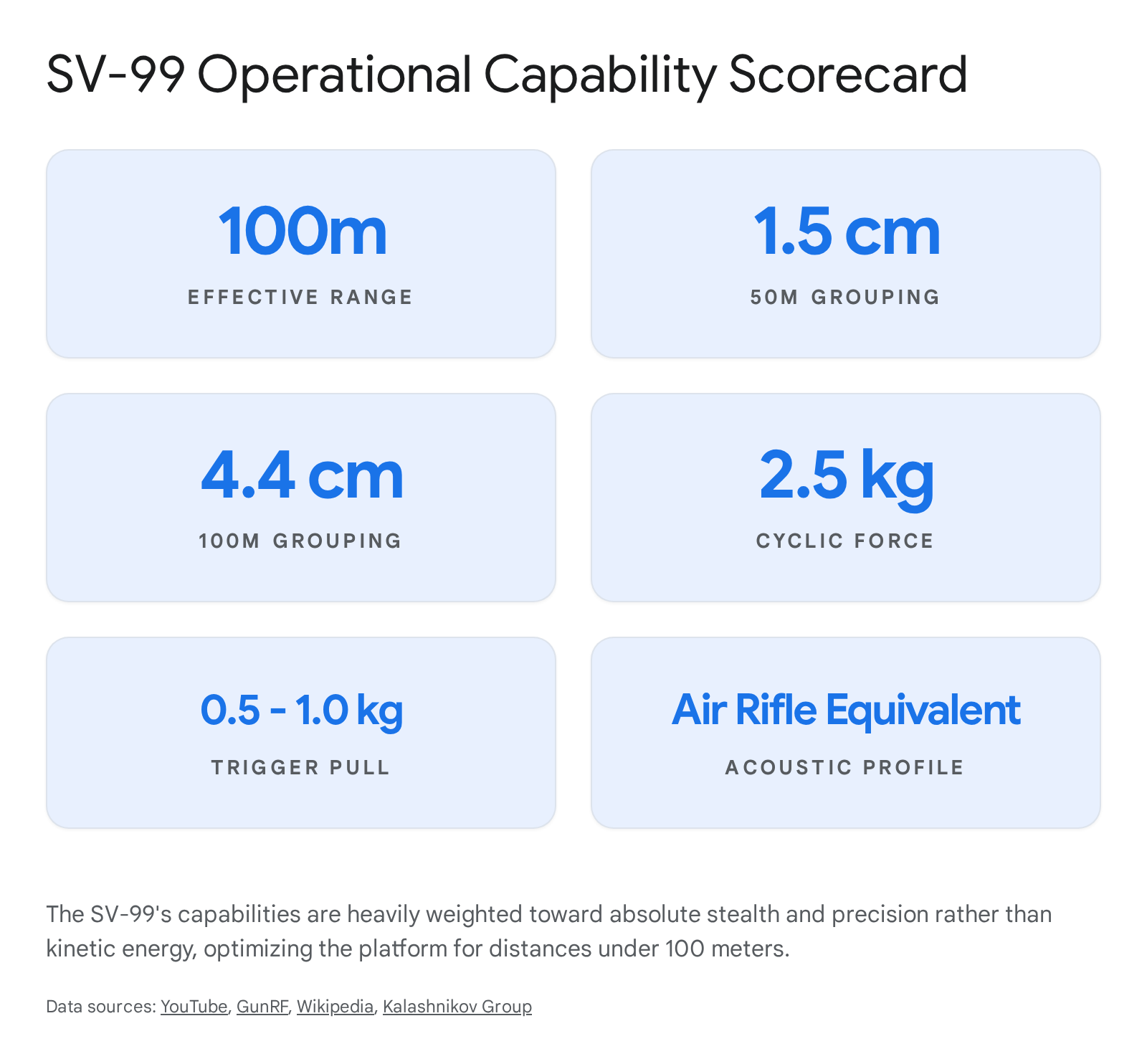
- Accelerated Cyclic Rate: The toggle action requires a minimal cycling force of approximately 2.5 kilograms.13 An experienced operator can cycle the action in less than one second.13 The hinge point creates a significantly shorter throw than a standard bolt, allowing the shooter to maintain their trigger finger position and optic alignment while chambering the next round.16 This facilitates rapid follow-up shots on multiple targets, a critical capability when engaging a group of sentries or exploiting a narrow window of visibility.
- Acoustic Signature Reduction: The short, smooth travel of the crank-and-rod mechanism generates significantly less mechanical noise than the grinding rotation of a traditional heavy steel bolt.2 When operating in close proximity to enemy forces, the metallic clatter of a standard bolt being racked can compromise a position just as easily as the muzzle blast. The SV-99 minimizes this secondary acoustic footprint.2
5. Barrel Dynamics, Metallurgy, and Internal Ballistics
The SV-99 features a relatively short, 350 mm (13.7 inch) heavy-profile barrel.1 In precision rifle engineering, separating the barrel from the stock structure—a technique known as free-floating—is paramount. A free-floating barrel is attached to the receiver but does not touch the stock at any point along its length.4 This prevents variable external pressures—caused by bipod loading, sling tension, or environmental warping of the stock material—from altering the barrel’s natural vibrational harmonics during the firing sequence, ensuring consistent shot-to-shot point of impact.4
5.1 Cold Radial Hammer Forging
The barrel is manufactured using an advanced industrial process known as cold radial hammer forging.2 In this manufacturing method, a short, thick steel blank is placed over a hardened tungsten carbide mandrel that contains the precise reverse impression of the desired rifling configuration—in the case of the SV-99, 6 grooves with a 420 mm (approximately 1:16.5 inch) twist rate.2
Massive rotary hammers systematically strike the exterior of the unheated steel blank, exerting immense pressure that physically compresses and elongates the steel onto the mandrel. This extreme compression realigns the crystalline grain structure of the metal, resulting in a dense, highly durable barrel with exceptional internal dimensional consistency and a highly polished bore.10
5.2 The Absence of Chrome Plating
Crucially, the bore of the SV-99 is intentionally left un-chromed.2 While hard chrome lining is a ubiquitous standard on military assault rifles and machine guns to resist corrosion and mitigate the extreme bore wear caused by high-velocity jacketed ammunition and sustained automatic fire, the electroplating process inherently leaves microscopic inconsistencies in bore thickness.
For a dedicated precision rifle where mechanical accuracy is the paramount metric, chrome plating acts as a variable that degrades precision. Because the SV-99 fires low-velocity, soft lead.22 LR projectiles that cause virtually zero friction-induced barrel wear, the protective benefits of chrome lining are unnecessary. The exclusion of this plating maximizes the mechanical accuracy potential derived directly from the cold hammer forging process.2
6. Fire Control Group and Ammunition Feed Systems
The interface between the operator and the weapon’s firing mechanism is critical to achieving maximum accuracy. The SV-99 features a highly refined, single-action, hammer-fired mechanism.4 It utilizes a helical mainspring and a separate firing pin assembly located within the bolt, a distinct divergence from dedicated striker-fired systems.15
6.1 Trigger Mechanics
The trigger unit is assembled in a discrete, self-contained housing.10 Safety is achieved via an ambidextrous, non-automatic manual safety switch conveniently positioned at the front portion of the trigger guard.4
The trigger mechanism itself provides a distinct “wall” or warning stage before the sear breaks.2 This two-stage operation allows the sniper to pull through the initial slack, hit the precise point of resistance, verify the crosshairs on the target, and apply the final pressure required to discharge the weapon.
The trigger pull weight is mechanically adjustable by the operator or unit armorer, ranging from a highly sensitive 0.5 kg (1.1 lbs) up to 1.0 kg (2.2 lbs).17 A light, crisp trigger facilitates precision fire by reducing the physical biomechanical force required to break the shot. Heavy triggers often induce “sympathetic movement” or flinching, where the effort of pulling the trigger pulls the entire rifle off target during the critical millisecond of the striker falling.15 The SV-99’s finely tuned, adjustable trigger entirely mitigates this risk.
6.2 Feed Architecture and Rim-Lock Prevention
Ammunition is fed via a detachable polymer box magazine, available in capacities of either 5 or 10 rounds.1 Feeding rimmed cartridges like the.22 LR in a semi-automatic or fast-cycling manual action presents unique engineering challenges. The prominent rim at the base of the cartridge is notoriously prone to a malfunction known as “rim lock,” wherein the rim of the top cartridge catches behind the rim of the cartridge positioned beneath it in the magazine stack, halting the forward movement of the bolt.
To ensure absolute reliability, the SV-99’s magazine architecture is designed to seat the uppermost round in a specifically elevated angle.15 This internal geometry ensures that the bolt face cleanly engages the rim of the top cartridge, stripping it forward into the chamber without snagging the underlying ammunition stack. The magazine fits completely flush within the stock, ensuring it does not snag on clothing or environmental debris during close-quarters maneuverability.10
7. Material Science: The Ergonomic Interface
The physical interface of the SV-99 has undergone an evolutionary process, adapting sporting ergonomics for brutal tactical utility. The selection of materials for the rifle’s stock dictates its durability, weight, and consistency in diverse operational environments.
7.1 Stock Evolution: The Transition from Walnut to Polymer
Reflecting its sporting biathlon and hunting lineage, early iterations of the SV-99 featured stocks milled from high-quality walnut.10 While aesthetically pleasing, traditional, and structurally rigid under ideal, climate-controlled conditions, wood is an inherently hygroscopic material. When exposed to rain, high humidity, snow, or extreme temperature fluctuations—conditions ubiquitous in military operations—wood absorbs ambient moisture.18
This moisture absorption causes the cellular structure of the wood to swell, warp, and alter its physical dimensions.18 If a wooden stock warps sufficiently to press against the free-floating barrel, it will immediately disrupt the barrel’s vibrational harmonics, dramatically shifting the rifle’s point of impact and negating its accuracy.19
To rectify this severe tactical vulnerability, modern production variants of the SV-99 are equipped with stocks manufactured from high-impact composite polymers.4 The proliferation of synthetic stocks in the firearms industry began in the 1960s with bench-rest shooters seeking absolute stability, evolving into military and tactical mainstays by the late 20th century.18 Modern polymer stocks—often utilizing mixtures of fiberglass, urethane, and advanced plastics—are completely impervious to moisture absorption.18 They maintain dimensional stability regardless of environmental conditions and display superior resistance to impact trauma, cracking, and structural failure compared to wood, making them vastly superior for the rigors of modern combat.18
7.2 Modularity and Confined Space Operations
The architecture of the SV-99’s polymer stock is highly adjustable and modular. It features an ambidextrous, symmetrical profile, accommodating both right- and left-handed operators seamlessly.1 The skeletonized buttstock offers an adjustable length of pull (providing up to 20mm or 26mm of adjustment via the buttpad depending on the variant) and a multi-axis adjustable cheek riser (capable of ±22mm vertical and ±7mm horizontal adjustments).1 This high degree of articulation allows the operator to precisely tailor the rifle’s geometry to their specific body morphology, accounting for the added bulk of heavy ballistic body armor and varying optical heights.
Furthermore, the stock is designed with tactical sustainment in mind. The lower section of the buttstock houses a specialized integrated cassette designed to securely hold two spare 5-round magazines, ensuring the operator has immediate access to reloads without breaking visual contact with the operational environment to reach into a chest rig.10
Perhaps the most unique tactical feature of the SV-99 is its quick-release hinge joint, which allows the entire buttstock to be completely removed from the forearm assembly.4 Once the stock is detached, it can be replaced with a simple wooden or polymer pistol grip.15 This modularity drastically reduces the overall length of the weapon system—from a maximum of 1030 mm down to a highly compact 720 mm (with suppressor attached).1 This truncated configuration allows a Spetsnaz operator to conceal the weapon entirely inside a standard backpack or heavy coat during clandestine insertions, or to deploy the rifle in extremely cramped settings such as vehicles, stairwells, or ventilation shafts where a full-length stock would impede maneuverability.15
8. Acoustic and Visual Signature Reduction
Stealth is the primary defense mechanism of the urban sniper. In close-quarters engagements, compromising one’s position results in immediate and lethal retaliation. Therefore, the SV-99 was designed holistically around the principle of absolute signature reduction—eliminating the visual muzzle flash, the acoustic report, and the environmental disturbance typically associated with rifle fire.4
8.1 Suppressor Fluid Dynamics
The SV-99 is issued standard with a highly effective, detachable sound and flash suppressor.1 When a conventional firearm discharges, the primary acoustic report is generated by high-pressure, super-heated propellant gases violently expanding into the cooler, lower-pressure atmosphere at the muzzle.23
The SV-99’s suppressor functions as a series of controlled expansion chambers. As the bullet exits the crown of the barrel and passes through the central bore of the suppressor tube, the trailing column of expanding gases is stripped away by a precisely engineered stack of internal baffles.23 These baffles act as metal dividers that force the high-velocity gas to change direction repeatedly, creating intense turbulent flow and forcing the gas to expand within the enclosed volume of the cylinder.23 Furthermore, the metal baffles absorb a significant amount of the thermal energy from the gas.23 By the time the propellant gas finally exits the front end cap of the suppressor, it has been drastically cooled, depressurized, and decelerated, vastly reducing the amplitude of the resulting acoustic wave.23
8.2 The Physics of Subsonic Ammunition and Cold Weather Limitations
While a suppressor is highly effective at managing propellant gas expansion, it cannot eliminate the ballistic “crack” of a bullet breaking the sound barrier. To achieve true acoustic stealth, the SV-99 operates synergistically with subsonic ammunition. The standard minimum muzzle velocity of the SV-99 is listed at 320 meters per second, ensuring the projectile remains strictly below the supersonic threshold (approximately 343 meters per second at sea level).4 Because there is no sonic boom, the only noise generated by the system is the mechanical click of the firing pin striking the rim, and the muffled hiss of the suppressed gases. According to operational reports, the SV-99’s suppressor reduces the shot noise level to that of a pneumatic air rifle.2
However, operators must account for environmental variables. The speed of sound is not constant; it drops alongside ambient temperature. In freezing environments at or below 0°C (32°F), the speed of sound decreases to roughly 331.5 meters per second. Under extreme cold conditions, ammunition that is normally subsonic may inadvertently cross the sound barrier or enter the transonic flight regime, risking a louder acoustic signature and severely degrading aerodynamic stability and accuracy. Therefore, careful ammunition selection and environmental awareness are critical to the platform’s reliability.
9. Terminal Ballistics of the.22 Long Rifle in Combat
The conceptualization of a dedicated military sniper rifle chambered in.22 Long Rifle initially met with considerable skepticism. Within the Russian arms design community, engineers accustomed to developing heavy machine guns or large-caliber sniper systems jokingly referred to.22 LR platforms as “fly killers,” suggesting the caliber was fundamentally underpowered and unacceptable for modern combat applications.5 However, empirical evidence from previous asymmetrical conflicts, combined with the immediate operational realities of the Chechen campaigns, proved the caliber to be devastatingly effective within its specific, niche parameters.5
9.1 Historical Precedents and the “Fly Killer” Reality
The tactical deployment of.22 LR rifles is not without historical precedent in guerilla and urban warfare. During the Vietnam War, Viet Cong irregulars successfully utilized obsolete TOZ 5.6mm civilian plinking rifles for close-quarters assassinations and urban sniping.5
Similar tactics were observed during the intense urban combat of the Chechen campaigns in the 1990s. Combatants on both sides utilized standard.22LR “Sobol” civilian hunting rifles, frequently outfitted with improvised suppressors crafted from drilled plastic bottles. Operating in ruined city blocks, snipers found that these small-caliber weapons were incredibly compact and highly accurate at close range, proving that lethality is relative to distance, precision, and shot placement. The fundamental truth recognized by these operators, and later formalized by the creation of the SV-99, is that at ranges under 100 meters, defeating ballistic body armor is unnecessary if the sniper can reliably target the unprotected head or neck.5
9.2 Physics of Soft Lead Deformation
Standard.22 LR ammunition utilizes a soft, non-jacketed lead projectile, typically weighing between 30 and 40 grains. Because the bullet lacks a rigid copper jacket, it does not maintain its aerodynamic shape upon impact. Instead, it undergoes rapid, chaotic deformation and expansion upon striking fluid-dense targets.2
While this soft, lightweight bullet completely lacks the kinetic energy and structural integrity required to defeat even soft Level IIA Kevlar body armor, its terminal performance on unprotected biological tissue is severe.2 At ranges under 100 meters, the.22 LR retains sufficient velocity to penetrate the human cranium.4 Furthermore, due to its low velocity and mass, the projectile tends to expend 100% of kinetic energy within the target. Rather than passing cleanly through the body, a.22 LR bullet will often ricochet off internal skeletal structures, tumbling and creating a disproportionately damaging permanent wound cavity relative to its size.2
9.3 Mitigation of Overpenetration
The perceived “weakness” of the.22 LR—its lack of penetrative power—is exactly what makes the SV-99 highly suitable for complex urban operations. In hostage rescue scenarios, room clearing, or operations in densely populated settlements, the sniper must have absolute certainty that their projectile will not pass entirely through the intended target and strike an innocent bystander, a hostage, or a wall concealing allied troops.2 The SV-99 provides lethal force that terminates entirely within the primary target, eliminating the risk of collateral overpenetration.2
10. Optical Integration and Targeting Systems
The forward section of the SV-99’s stock features an integrated metal guide rail embedded in the fore-end, allowing for the attachment of an adjustable, folding bipod or a customized hand-stop.10 Standard-issue packages for the modern variants also include these folding bipods, alongside a specialized cleaning kit and a single-piece cleaning rod to maintain the precision bore.4 These accessories provide the operator with maximum stability during prolonged observation and firing periods, anchoring the weapon to windowsills, barricades, or the floor.17
Regarding optical integration, the platform has evolved alongside international standards. Originally, the receiver utilized a standard Russian dovetail base for mounting optical sights.10 During this era, the rifle was commonly paired with domestic optics such as the PO 4×34 or the PO 6×42 fixed-magnification telescopic sights, which provided sufficient clarity and reticle subtensions for engagements inside 100 meters.10
Recognizing the global standardization of tactical accessory mounts and the need for greater modularity, modern Kalashnikov Concern iterations have upgraded the receiver with a MIL-STD-1913 Picatinny rail.4 This allows operators to seamlessly mount a wide variety of modern day scopes, variable power optics, and standalone thermal imaging systems.4 However, it is noted that the platform’s compact receiver geometry does not natively support the installation of inline clip-on night vision or telescopic sights, requiring dedicated, single-unit optics to be mounted directly to the rail.4
11. Tactical Deployment and Operational Effectiveness
The deployment of the SV-99 is limited strictly to specialized units. It is not issued as a general infantry weapon, nor does it serve the role of a standard designated marksman rifle for regular army squads. It occupies a specialized niche within the armories of Russian special purpose units (Spetsnaz), tactical units of the Ministry of Internal Affairs (MVD), and the Federal Security Service (FSB).1
11.1 The Urban “Sniper’s War” and Utility Operations
Within the Spetsnaz arsenal, the SV-99 serves a highly specialized role distinct from other suppressed platforms like the 9x39mm VSS Vintorez. While the VSS is intended for general covert special operations and engagements up to 400 meters, the SV-99 is reserved exclusively for extreme close-range applications.
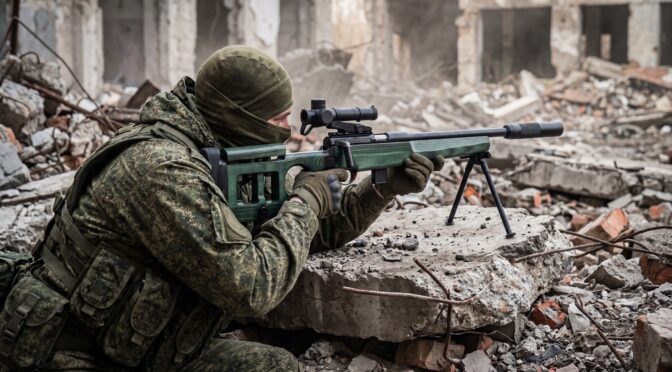
The SV-99 saw active and highly effective fielding during the intense urban combat of the Chechen campaigns.5 In the ruins of Grozny, MVD and Spetsnaz snipers engaged in a distinct “snipers war” where survival depended entirely on remaining undetected while navigating structurally compromised buildings.5
The SV-99 proved exceptionally lethal when fired from the interior depths of enclosed rooms.5 Because the.22 LR cartridge requires a minuscule powder charge, the resulting muzzle blast is negligible. When a sniper fired the SV-99 through a small loophole in a wall or a broken window from the back of a shadowed room, the suppressor virtually eliminated any chance of the enemy visually locating a muzzle flash or acoustically triangulating the origin of the shot.5 The lack of overpressure meant the sniper’s hearing was preserved, and importantly, no settled dust or plaster was kicked up from the floor to obscure the optic or visually broadcast the hideout’s location.5
Beyond anti-personnel engagements, Spetsnaz operators frequently require a precision weapon to neutralize perimeter security quietly during clandestine infiltrations. The SV-99 is heavily utilized as a utility tool to silently eliminate aggressive guard dogs, shoot out searchlights, and destroy closed-circuit camera systems without triggering alarms or alerting the broader enemy force. The virtually non-existent recoil impulse of the heavy, suppressed rifle allows the operator’s sight picture to remain perfectly still during the shot, enabling instant visual assessment of the impact and immediate follow-up shots if the initial target is not neutralized.15
11.2 Performance Metrics and Accuracy Validation
Extensive testing and operational deployment validate the SV-99’s classification as a true sniper weapon system. When firing match-grade.22 LR ammunition with the suppressor attached, the platform produces highly consistent, sub-minute of angle (MOA) shot groups.2
- At a range of 50 meters, the rifle consistently groups hits within a circle of 1.5 cm diameter.2
- At its maximum effective range of 100 meters, the rifle groups hits within a circle of 4.0 to 4.4 cm diameter.2
This level of mechanical precision allows an operator to reliably target the brain stem or ocular cavity of an adversary, guaranteeing instantaneous neutralization and preventing any reflex actions from the target.
The following table summarizes the dimensional and technical specifications of the modern SV-99 4:
| Technical Parameter | Specification Data |
| Caliber | 5.6 mm (.22 LR Rimfire) |
| Action Type | Straight-pull, Toggle-lock (Manual) |
| Locking Lugs | None (Geometric Toggle-Lock) |
| Barrel Length | 350 mm (13.7 inches) |
| Rifling Characteristics | 6 grooves, Right-hand twist, 420 mm step |
| Weight (Unloaded, Base Rifle) | 3.4 kg (Early Wood) / 4.0 kg (Modern Polymer) |
| Weight (Loaded, Suppressed, Optic) | 4.5 kg |
| Overall Length (Stock Unfolded, Suppressed) | 1030 mm |
| Overall Length (Stock Unfolded, Unsuppressed) | 890 mm |
| Overall Length (Pistol Grip, Suppressed) | 720 mm |
| Magazine Feed System | 5 or 10 rounds (Detachable Box) |
| Trigger Mechanism & Safety | Single-Action, Ambidextrous safety (front of trigger guard) |
| Maximum Effective Sighting Range | 100 meters |
11.3 Economic Viability and Training Utility
Beyond active combat deployments, the SV-99 serves a highly critical and economically advantageous role as a surrogate training platform.4 The fundamental biomechanics and mental processes of precision marksmanship—trigger control, respiratory discipline, optic alignment, and environmental observation—are identical regardless of the caliber being fired.
Training snipers exclusively on primary large-caliber combat systems, such as the 7.62mm SVD, the bolt-action SV-98, or the massive 9.3x64mm SVDK, incurs significant financial costs per round.8 Furthermore, high-volume training with magnum cartridges rapidly accelerates bore erosion and barrel wear, degrading the accuracy of expensive frontline assets.8 The SV-99 allows Spetsnaz snipers to conduct virtually unlimited, high-volume precision training using inexpensive.22 LR rimfire ammunition.4 Because the SV-99 successfully mimics the weight, ergonomic geometry, and trigger feel of a full-size sniper system, operators can maintain their highly perishable marksmanship skills safely at standard 100-meter firing ranges without the logistical burden of heavy ammunition or the rapid degradation of primary weapon barrels.4
12. Modern Production and Industrial Landscape
Despite being conceptualized and developed over two decades ago during the late 1990s, the SV-99 remains a highly relevant, actively produced, and aggressively marketed platform within the modern Russian defense industry.
The industrial landscape surrounding the rifle has evolved significantly. In 2013, the historic Izhevsk Machine-Building Plant (Izhmash), alongside other state-owned defense entities, was restructured and consolidated into the modern JSC Kalashnikov Concern.26 Today, Kalashnikov Concern operates as the powerhouse of Russia’s small arms industry, functioning as a massive corporate group that not only manufactures civilian and military firearms but also produces unmanned aerial vehicles (UAVs), precision guided artillery projectiles, and military robotics, exporting its diverse portfolio of products to more than 27 countries worldwide.26
Within this modernized corporate structure, the SV-99 retains its position. It is actively listed in the Kalashnikov catalog of non-automatic defense products, marketed directly alongside contemporary mainstays such as the SV-98 bolt-action rifle and the highly advanced, high-precision Chukavin rifle (SVCh).8
Furthermore, the SV-99’s historical significance and ongoing operational relevance are recognized internally by the Russian military apparatus. At the recent “One Man Is An Army” exhibition—an event held at the Izhmash Museum in Izhevsk to celebrate the 95th anniversary of Russian-made sniper weapons, scheduled to run through 2026—the SV-99 was prominently displayed alongside the experimental 1930 Degtyaryov designs, the legendary World War II Mosin-Nagant PU, and the modern SVDM.8 This inclusion cements the SV-99’s status as an integral, respected component of the Russian sniper lineage.8 Current operational footage emerging from the Russian Southern Military District indicates that intensive sniper training, focusing on stealth movement and precise engagement, remains a high priority.29 While the exact current battlefield prevalence of the SV-99 is subject to operational security, its continued production and integration into training regimens ensure that the specialized skills required to operate such niche platforms are actively maintained by contemporary federal forces.
13. Conclusions
The Russian SV-99 sniper rifle represents a profound triumph of highly specialized mechanical engineering over generalized military doctrine. By deliberately eschewing the traditional pursuit of raw kinetic energy, extreme muzzle velocity, and maximum effective range, the engineers at Izhmash successfully created a surgical tool tailored specifically for the geometry, acoustics, and collateral risks inherent to modern urban combat.
The ingenuity of the SV-99 lies in its synthesis of seemingly disparate mechanical and tactical elements. By mating the hyper-fast, reliable, straight-pull toggle-lock action of an Olympic biathlon rifle with the suppressed, low-velocity lethality of the.22 LR rimfire cartridge, the design achieved a unique synergy. The resulting weapon system allows internal security forces, counter-terrorism units, and Spetsnaz operators to neutralize sentries, destroy infrastructure, and engage point targets with near-absolute acoustic and visual stealth.
While its inherent lack of penetrative power and strict 100-meter effective range limit its application in conventional, wide-front mechanized warfare, these limitations are the exact parameters that make it safe and effective in dense urban and hostage scenarios. The SV-99’s ability to deliver rapid, surgical precision in confined spaces, coupled with its immense utility as an economical surrogate training platform, ensures its continued relevance and production. It stands as a testament to asymmetrical weapon design, proving that in specific operational contexts, absolute stealth and mechanical precision can be vastly more lethal than raw ballistic power.
Please share the link on Facebook, Forums, with colleagues, etc. Your support is much appreciated and if you have any feedback, please email us in**@*********ps.com. If you’d like to request a report or order a reprint, please click here for the corresponding page to open in new tab.
Sources Used
- SV-99 | FirearmCentral Wiki | Fandom, accessed June 28, 2026, https://firearmcentral.fandom.com/wiki/SV-99
- SV-99 sniper rifle – GunRF, accessed June 28, 2026, https://gunrf.ru/rg_spesial_sv-99_eng.html
- .22LR Sniper Rifle #review #shorts #short #shortvideo #army #top #weapon #shorts – YouTube, accessed June 28, 2026, https://www.youtube.com/shorts/ZWbOWDb1HeI
- SV-99 Sniper Rifle – Kalashnikov Group, accessed June 28, 2026, https://en.kalashnikovgroup.ru/catalog/boevoe-strelkovoe-oruzhie/neavtomaticheskie-vintovki/snayperskaya-vintovka-sv-99
- Russian SV-99 Urban “Sniper Rifle” in .22LR [1250×762] : r/GunPorn – Reddit, accessed June 28, 2026, https://www.reddit.com/r/GunPorn/comments/4xth17/russian_sv99_urban_sniper_rifle_in_22lr_1250x762/
- Spetsnaz – Wikipedia, accessed June 28, 2026, https://en.wikipedia.org/wiki/Spetsnaz
- Spetsnaz: Operational Intelligence, Political Warfare, and Battlefield Role, accessed June 28, 2026, https://www.marshallcenter.org/en/publications/security-insights/spetsnaz-operational-intelligence-political-warfare-and-battlefield-role-0
- Kalashnikov Presents Unique Designs at Exhibition Dedicated to 95th Anniversary of Russian-Made Sniper Weapons, accessed June 28, 2026, https://en.kalashnikovgroup.ru/news/kalashnikov-presents-unique-designs-at-exhibition-dedicated-to-95th-anniversary-of-russian-made-snip
- Parker-Hale M82 – Modern Firearms, accessed June 28, 2026, https://modernfirearms.net/en/sniper-rifles/standart-caliber-rifles/great-britain-standart-caliber-rifles/parker-hale-m82-eng/
- Снайперская винтовка СВ-99 (Россия) | DogsWar.ru – Всё о …, accessed June 28, 2026, http://www.dogswar.ru/strelkovoe-oryjie/snaiperskie-vintovki/1402-snaiperskaia-vintovk.html
- Суслопаров Владимир Фёдорович — Рувики: Интернет-энциклопедия, accessed June 28, 2026, https://ru.ruwiki.ru/wiki/%D0%A1%D1%83%D1%81%D0%BB%D0%BE%D0%BF%D0%B0%D1%80%D0%BE%D0%B2,_%D0%92%D0%BB%D0%B0%D0%B4%D0%B8%D0%BC%D0%B8%D1%80_%D0%A4%D1%91%D0%B4%D0%BE%D1%80%D0%BE%D0%B2%D0%B8%D1%87
- Biathlon Rifle Designer Vladimir Susloparov Turns 80 – Kalashnikov Group, accessed June 28, 2026, https://en.kalashnikovgroup.ru/news/biathlon-rifle-designer-vladimir-susloparov-turns-80
- Biathlon rifle – Wikipedia, accessed June 28, 2026, https://en.wikipedia.org/wiki/Biathlon_rifle
- Biathlon – mixed relay, US 7th place – SASS Wire Forum, accessed June 28, 2026, https://forums.sassnet.com/index.php?/topic/329085-biathlon-mixed-relay-us-7th-place/
- Снайперская винтовка СВ-99 – GunRF, accessed June 28, 2026, https://gunrf.ru/rg_spesial_sv-99_ru.html
- From My Collection #7:The Izhmash Biathlon Basic 7-2-KO (my current favorite rifle) – Reddit, accessed June 28, 2026, https://www.reddit.com/r/guns/comments/1vc0mo/from_my_collection_7the_izhmash_biathlon_basic/
- Sniper rifle SV 99 – YouTube, accessed June 28, 2026, https://www.youtube.com/watch?v=cgGjc7UEEa0
- Stocks: Synthetic vs. Wood | An Official Journal Of The NRA – American Hunter, accessed June 28, 2026, https://www.americanhunter.org/content/stocks-synthetic-vs-wood/
- Quick Tip: Wood vs Synthetic Stocks – YouTube, accessed June 28, 2026, https://www.youtube.com/watch?v=Rye6F5QqAbU
- Wood vs Synthetic Stocks: What’s Best for Your Rifle? Introduction – Silencer Central, accessed June 28, 2026, https://www.silencercentral.com/blog/wood-vs-synthetic-stocks-whats-best-for-your-rifle-introduction/
- Wood VS Plastic : r/liberalgunowners – Reddit, accessed June 28, 2026, https://www.reddit.com/r/liberalgunowners/comments/1g43nwn/wood_vs_plastic/
- Снайперская малокалиберная винтовка СВ-99, accessed June 28, 2026, https://club.guns.ru/sv99.html
- Suppressor Baffle Design: How It Affects Performance and Sound, accessed June 28, 2026, https://libertycans.net/2025/07/06/suppressor-baffle-design/
- How Silencers Work: Suppressor Designs Types – YouTube, accessed June 28, 2026, https://www.youtube.com/watch?v=UkFLu-RXn78
- The First All-Russian Convention of SPETSNAZ – Small Arms Review, accessed June 28, 2026, https://smallarmsreview.com/the-first-all-russian-convention-of-spetsnaz/
- Kalashnikov Concern – Wikipedia, accessed June 28, 2026, https://en.wikipedia.org/wiki/Kalashnikov_Concern
- Kalashnikov Group, accessed June 28, 2026, https://en.kalashnikovgroup.ru/
- Manually Loaded Rifles – Kalashnikov Group, accessed June 28, 2026, https://en.kalashnikovgroup.ru/catalog/boevoe-strelkovoe-oruzhie/neavtomaticheskie-vintovki
- Inside Russia’s Elite Marksman Training – YouTube, accessed June 28, 2026, https://www.youtube.com/shorts/Hl47VSxDklQ