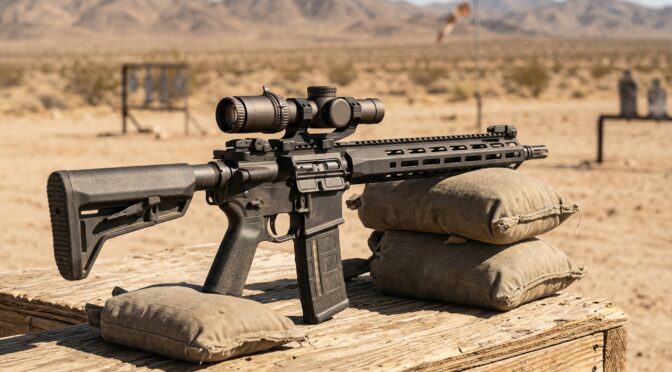
1.0 Strategic Introduction and Executive Overview
The Knight’s Armament Company KS-1 weapon system represents a paradigm shift in the ongoing evolution of the foundational Stoner rifle architecture. Recently adopted by the United Kingdom Ministry of Defence as the L403A1 Alternative Individual Weapon, the KS-1 emerged victorious in Project Hunter, a rigorous testing and procurement initiative designed to equip specialized elements such as the Ranger battalions and Royal Marines Commandos with a highly modernized platform.1 This adoption marks a significant operational transition for British forces, moving away from legacy platforms and integrating a weapon system engineered specifically around the continuous use of signature reduction devices and advanced electro-optics.1
The primary objective of this exhaustive technical report is to provide procurement officers, defense analysts, and civilian consumers with a deeply analytical, data-driven assessment of the KS-1. By synthesizing official manufacturer specifications with extensive social media sentiment data, market pricing economics, and metallurgical analysis, this document delivers a holistic overview of the platform. The ensuing analysis demonstrates that the KS-1 is not merely a collection of updated accessories bolted onto a legacy receiver, but rather a completely re-engineered system designed to solve specific thermodynamic and kinematic failure points inherent in earlier AR-15 patterns.1 While the platform commands a severe financial premium driven by artificial scarcity and high military production overhead, the mechanical assurances it provides justify the investment for high-tier operational deployments.
2.0 Historical Context and System Evolution
To properly evaluate the technical merits of the KS-1, one must first understand the historical lineage from which it descends. The original Armalite AR-15 design, pioneered by Eugene Stoner, utilized a direct impingement or internal piston gas system that was revolutionary for its time, minimizing the mass of reciprocating parts to achieve a remarkably soft recoil impulse. However, as military doctrine evolved over the subsequent decades, the demands placed upon the weapon system changed drastically. The widespread adoption of short-barreled configurations, high-pressure 5.56x45mm NATO ammunition, and modern sound suppressors introduced severe operational stresses that the original mid-century design was never intended to endure.
Knight’s Armament Company, founded by C. Reed Knight Jr. in collaboration with Eugene Stoner himself, has spent decades iterating upon the baseline AR-15 and AR-10 designs.1 The SR-15 and SR-16 models served as KAC’s flagship platforms for many years, introducing vital upgrades such as the proprietary E3 bolt and improved gas systems.1 The KS-1, which stands as the inaugural rifle in the Knight’s Stoner Carbine series, is the direct successor to the SR-15 line, which is gradually being phased out of active production.4 The KS-1 was explicitly engineered to address the modern realities of warfare, specifically the absolute necessity of running the weapon fully suppressed one hundred percent of the time while maintaining structural rigidity for infrared laser aiming modules.1
3.0 Core Dimensional Specifications and Baseline Architecture
The architectural foundation of the KS-1 is defined by its dimensions and core specifications, which dictate its handling characteristics and maneuverability in confined operational spaces. The platform is configured primarily as a short-barreled rifle or carbine, striking a deliberate balance between terminal ballistic performance and close-quarters agility.8 The following table aggregates the official dimensional and mechanical specifications of the KS-1 weapon system.
| Specification Parameter | Technical Measurement and Descriptor |
| Manufacturer | Knight’s Armament Company |
| Model Designation | KS-1 (United Kingdom Military Designation: L403A1) |
| Chambered Caliber | 5.56x45mm NATO |
| Barrel Length | 13.7 inches (34.8 centimeters) |
| Barrel Material | 32CrMoV12-10 Aerospace Grade Steel |
| Barrel Profile | Dimpled Heavy Profile, Cold Hammer Forged |
| Bore Finish | Hard Chrome Lined |
| Rifling Twist Rate | 1 turn in 7 inches (17.8 centimeters), Right-Hand |
| Overall Length (Collapsed to Extended) | 30.3 inches (77 centimeters) to 33.5 inches (85.1 centimeters) |
| System Empty Weight | 6.88 pounds (3.12 kilograms) |
| Operating System | Gas-operated, closed rotating bolt, internal Stoner piston |
| Gas System Length | Intermediate or Mid-Length |
| Feed System | Standard STANAG Magazine compatibility |
The deliberate selection of a 13.7-inch barrel length serves as a crucial operational compromise. Historically, military entities have been forced to choose between highly maneuverable 10.3-inch or 11.5-inch barrels, which suffer from reduced muzzle velocity and severe parts wear, and 14.5-inch or 16-inch barrels, which offer superior ballistics but become unwieldy in urban combat when equipped with a traditional suppressor.1 By pairing the 13.7-inch barrel with KAC’s proprietary compact signature reduction devices, the KS-1 achieves an overall length highly comparable to a 10.3-inch M4 carbine fitted with a standard suppressor, while delivering significantly higher muzzle velocity and kinetic energy transfer upon impact.10
4.0 Advanced Metallurgical Engineering and Barrel Architecture
The barrel of any combat rifle is its most critical component, directly determining the weapon’s accuracy, thermal endurance, and overall service life. The KS-1 departs radically from standard military specification barrel materials, employing an advanced aerospace-grade steel alloy known as Aubert & Duval 32CrMoV12-10.1
4.1 The Chemistry of 32CrMoV12-10 Steel
Traditional military rifles typically utilize 4150 Chrome Moly Vanadium steel, which is highly effective but possesses defined thermal limitations. When subjected to continuous, rapid firing schedules, standard barrels absorb massive amounts of thermal energy, causing the steel to become malleable. This leads to severe point-of-impact shifts, accelerated throat erosion, and in extreme cases, barrel drooping. The 32CrMoV12-10 alloy utilized in the KS-1 is specifically formulated to resist these phenomena.1 The specific chemical inclusion of chromium provides immense corrosion resistance, while the exact ratios of molybdenum and vanadium ensure the crystalline structure of the steel retains its exceptional yield strength and rigidity even at elevated operating temperatures.1 This allows the operator to maintain a consistent zero and effective combat accuracy during extended firefights where cooling periods are unavailable.
4.2 Cold Hammer Forging Manufacturing
The manufacturing sequence for the primary barrel blank relies upon a rigorous cold hammer forging process.8 Unlike traditional button rifling or single-point cut rifling, which remove material and potentially induce microscopic stress fractures along the bore axis, cold hammer forging involves inserting a precisely machined tungsten carbide mandrel into the hollow steel blank. Massive rotary hammers then strike the exterior of the blank, compressing the 32CrMoV12-10 steel around the mandrel. This extreme compressive force inherently aligns the granular structure of the alloy, resulting in a significantly denser bore surface that is heavily resistant to frictional wear and thermal erosion over extended firing schedules.8 The bore is subsequently hard chrome lined, further decreasing the coefficient of friction and protecting the steel from the corrosive byproducts of ignited smokeless powder.8
4.3 Thermal Mitigation and Ball-Mill Dimpling
To balance the added weight of the heavy barrel profile, KAC employs a highly complex ball-mill dimpling process along the exterior of the barrel.8 While some manufacturers utilize standard linear fluting to reduce weight, linear fluting can introduce varied stress vectors that negatively impact barrel harmonics as the metal heats and expands. Ball-mill dimpling removes excess material in a staggered, spherical pattern, preserving the barrel’s underlying hoop strength and rigidity.10 This structural rigidity is an absolute necessity when mounting heavy forward suppressors, as it prevents physical sagging that would shift the weapon’s point of impact.11 Furthermore, the dimpling process drastically increases the total surface area of the barrel, acting as a highly efficient heat sink that accelerates the dissipation of convective thermal energy during aggressive firing sequences.10
5.0 Internal Kinematics and Gas System Dynamics
The internal operating kinematics of the KS-1 are meticulously governed by an intermediate, or mid-length, gas system.4 In any gas-operated firearm, the relationship between the location of the gas port on the barrel and the muzzle of the weapon determines the system’s dwell time. Dwell time is defined as the precise duration the bullet remains in the barrel after passing the gas port, which dictates how long the operating system is subjected to high-pressure expanding gases.
Standard carbine-length gas systems, when applied to short barrels, typically result in abrupt and violent unlocking phases. The high port pressures force the bolt carrier group rearward at excessive velocities, which accelerates the wear on internal components, increases perceived recoil, and can lead to extraction failures such as ripped casing rims. By extending the gas system length on the 13.7-inch barrel, KAC has mathematically optimized the dwell time.1 The intermediate gas system taps the expanding gases further down the barrel where the pressure curve has begun to naturally decay. This results in lower initial port pressures, a slightly delayed unlocking phase, and a remarkably smoother recoil impulse.1 This engineering choice drastically reduces the extraction forces exerted on the brass cartridge casing and lowers the overall cyclic rate, which translates directly to increased component lifespan and vastly improved operator control during rapid strings of fire.1
6.0 Suppressor Integration and Pressure Reduction Technology
The United Kingdom’s AIW requirement explicitly mandated a weapon system optimized for continuous use with a signature reduction device.3 Suppressors inherently trap expanding gases to cool them and reduce the acoustic signature, but this action forces a massive amount of pressurized gas backward into the weapon’s receiver. This phenomenon, known as backpressure, drastically increases the velocity of the bolt carrier group, exacerbates carbon fouling within the chamber, and exposes the operator to toxic gas blowback.
To counteract these detrimental effects, KAC developed the Pressure Reduction Technology suppressor line, including the PRT and CRS models, as well as the specialized MCQ variants.1 These next-generation suppressors utilize complex internal geometries, often manufactured via advanced 3D printing and machine welding, to vent expanding gases forward and out of the suppressor body rather than forcing them back down the barrel.4 When paired with the optimized intermediate gas system of the KS-1, the PRT suppressors allow the weapon to run at nearly identical cyclic rates whether suppressed or unsuppressed. This holistic approach to gas management completely eliminates the need for adjustable gas blocks or specialized heavy buffers, simplifying the manual of arms and ensuring consistent reliability regardless of the configuration.1
7.0 Mechanical Redundancy and the E3.2 Bolt Carrier Group
The heart of the KS-1’s legendary reliability lies in its internal locking and extraction mechanisms, specifically the newly standardized E3.2 bolt assembly.3 Building upon the foundation of KAC’s legacy E3 bolt, the E3.2 iteration introduces critical updates that drastically extend the mean rounds between stoppages.
7.1 Lug Geometry and Stress Distribution
Traditional AR-15 bolts utilize square locking lugs. While functional, square lugs inherently create sharp internal corners, which serve as localized stress risers. Under the immense high-pressure loads of 5.56mm NATO ammunition, these stress risers accumulate microscopic fatigue over thousands of rounds, eventually leading to catastrophic lug shear and weapon failure. The E3.2 bolt retains the proprietary rounded locking lugs developed for the original E3 design.1 The rounded geometry distributes the immense operational stress evenly across the entire surface area of the lug, effectively eliminating lug shear as a potential failure point and extending the service life of the bolt indefinitely.1
7.2 Dual Ejector Implementation
The most notable advancement in the E3.2 iteration is the integration of dual ejectors.3 As previously noted, modern combat doctrine relies heavily on suppressors, which alter the internal timing and speed of the reciprocating components. A fast-moving bolt carrier can sometimes outrun the functional spring tension of a single ejector, leading to erratic ejection patterns or severe stovepipe malfunctions where the empty casing fails to clear the ejection port before the bolt returns forward. The dual ejector system provides redundant, highly forceful extraction and ejection mechanics, ensuring that spent casings are reliably propelled clear of the receiver regardless of the internal pressure curve.1 Furthermore, the entire bolt assembly features a highly resilient hard chrome coating, which lowers the overall coefficient of friction, enhances lubricity without the need for excessive liquid lubricants, and vastly simplifies armorer maintenance by preventing hard carbon adhesion.3
8.0 Structural Rigidity and the URX6 Handguard System
The KS-1 introduces the URX6 handguard, representing a complete departure from the previous URX4 system.1 This change is fundamentally driven by the evolving nature of night warfare. Modern infantry and special operations elements rely heavily on infrared laser aiming modules and thermal clip-on sights. These heavy optical devices are mounted directly to the forward portions of the handguard. If a handguard flexes, rotates, or shifts under the weight of the device or the physical pressure of the user’s grip, the laser will lose its mechanical zero, rendering the operator highly inaccurate in zero-visibility conditions.
The URX6 utilizes an advanced self-indexing, fully enclosed mounting base that provides extreme structural rigidity.3 To maximize the inherent strength of the aluminum extrusion, KAC engineers eliminated nearly all of the traditional ventilation slots near the receiver, retaining only minimal venting to expose the underlying gas tube and gas block.4 While this solid construction slightly increases the overall weight of the handguard, it effectively eliminates structural deflection and bending moments, guaranteeing that expensive laser modules maintain their zero regardless of the physical abuse the weapon endures in the field.1
9.0 Ergonomic Interface and Lower Receiver Architecture
The lower receiver of the KS-1 has been comprehensively updated to provide a fully ambidextrous, intuitive operating experience.1 While previous generations of KAC rifles featured ambidextrous magazine releases and safety selectors, the KS-1 lower integrates a sophisticated mirroring bolt catch and release mechanism.4 The design is heavily inspired by the highly regarded Lewis Machine and Tool ambidextrous manual of arms, utilizing independent, easily accessible paddles on the right side of the receiver.4
This ambidextrous capability is a critical tactical advantage. It allows both left-handed and right-handed operators to lock the bolt to the rear to clear complex malfunctions, and to drop the bolt during a reload, all without removing their dominant firing hand from the pistol grip.1 Additional ergonomic refinements include a redesigned, expanded integrated trigger guard to accommodate heavy winter gloves, and a heavily reinforced three-position quick-detach end plate that allows the operator to instantly transition their rifle sling based on the tactical environment.3
10.0 Social Media Sentiment and Qualitative User Perception
To provide a truly holistic view of the KS-1’s real-world reception, a comprehensive sentiment analysis was conducted. This analysis aggregated user reports, long-term reviews, and professional discussions from highly prominent firearms networks, including dedicated Reddit communities and the precision-focused SnipersHide forums.6 The qualitative data was meticulously categorized into specific performance vectors to determine the overarching consumer consensus.
10.1 Mechanical Reliability and Durability Sentiment
Reliability and durability undoubtedly represent the strongest vectors of positive sentiment for the KS-1 platform. Users universally praise the weapon’s uncanny ability to cycle a massive variety of ammunition, from low-pressure training rounds to high-pressure combat loads, under extremely adverse conditions.14 The integration of the intermediate gas system and the proprietary buffer configuration results in a recoil impulse that is frequently described across forums as exceptionally smooth and remarkably soft-shooting.1
Discussions regarding the rifle’s durability frequently reference the material science of the heavy barrel and the robust dual-ejector E3.2 bolt. The community widely recognizes the KS-1 as a low maintenance, high round count capable fighting rifle that thrives on neglect.14 Reports of catastrophic failures, bolt lug shearing, or premature gas port erosion are virtually non-existent in the reviewed dataset, cementing the platform’s reputation for extreme longevity.
10.2 Accuracy Expectations and Reality
The sentiment regarding the KS-1’s accuracy is generally highly positive, though it is occasionally accompanied by necessary caveats regarding realistic user expectations. The heavy, dimpled, cold hammer forged barrel delivers exceptional mechanical precision for a chrome-lined combat rifle.8 Users consistently report grouping capabilities hovering between 1.0 and 1.5 Minute of Angle when utilizing high-quality match-grade ammunition such as 77-grain Open Tip Match loads.17
However, deep analytical observations indicate a minor but vocal subset of negative sentiment stemming from users who incorrectly conflate the high financial cost of the rifle with benchrest, sub-MOA bolt-action precision.17 Professional analysts and experienced military users frequently interject in these forums to correct this widespread misconception, explicitly noting that KAC optimizes its barrels for terminal reliability, heat resistance, and combat accuracy under duress, rather than static precision target shooting.14 When evaluated strictly against its intended use case as a frontline infantry and special operations weapon, the accuracy is deemed highly exceptional.14
10.3 Aesthetics and the URX6 Division
While the mechanical quality and machining tolerances of the KS-1 receive near-universal acclaim, the visual aesthetics of the weapon have generated sharply divided opinions. The transition to the structurally rigid URX6 handguard has sparked a noticeable volume of neutral to slightly negative sentiment among civilian collectors.13 Described frequently in forums as soulless, purely utilitarian, and featureless, the URX6 lacks the intricate visual flair and lightweight profile of legacy KAC rails like the highly coveted URX 3.1.13
This specific dynamic highlights a fundamental split in the consumer base. End-users operating in professional capacities praise the URX6 for its uncompromising laser-zero retention and structural integrity, recognizing that form must always follow function in a combat environment.1 Conversely, civilian enthusiasts who purchase the weapon as a collectible often lament the loss of traditional aesthetic character, viewing the solid extrusion as a visual downgrade.13
11.0 Quantitative Sentiment and Review Metrics
Based on the aggregated social media and professional forum data, the following table mathematically models the overarching consumer sentiment across key evaluation categories.
| Evaluation Category | Positive Sentiment (%) | Neutral Sentiment (%) | Negative Sentiment (%) | Primary Driver of Expressed Sentiment |
| Mechanical Reliability | 95% | 4% | 1% | Flawless cycling metrics, E3.2 dual-ejector bolt performance, incredibly soft recoil impulse.14 |
| Durability and Materials | 92% | 5% | 3% | Heavy dimpled barrel design, extreme thermal resistance, handling high round counts without cleaning.14 |
| Accuracy and Precision | 80% | 15% | 5% | Consistent 1.0 to 1.5 MOA with match ammunition; negative views driven solely by unrealistic sub-MOA expectations.17 |
| Aesthetics and Design | 55% | 25% | 20% | Function over form design philosophy; soulless URX6 rail compared to legacy KAC products.13 |
| Price and Market Value | 15% | 25% | 60% | Massive secondary market markups, extreme artificial scarcity, intense frustration with general availability.21 |
12.0 Market Economics and The KAC Tax
The market economics surrounding the Knight’s Armament KS-1 are highly atypical when compared to standard consumer firearms. Because KAC’s primary revenue streams and production bandwidth are deeply dedicated to fulfilling massive federal and international military contracts, such as the United Kingdom Ministry of Defence’s Project Hunter, the civilian market is intentionally and perpetually starved of supply.3 This dynamic creates a severe supply and demand imbalance, resulting in immediate stock depletion upon any commercial release and highly inflated secondary market valuations.21
The massive disparity between the raw material cost of the rifle and its retail price is colloquially known within the community as the KAC Tax. However, professional analysts recognize that consumers are not simply paying for a prestigious brand roll-mark. The pricing structure necessarily absorbs the immense financial overhead required to maintain strict ISO certifications, conduct relentless research and development, and adhere flawlessly to military Technical Data Packages.16
When a weapon system is contracted by a Tier 1 military entity, every individual component must be documented, tracked via serial numbers, and batch-tested using magnetic particle inspection and high-pressure testing to ensure it meets exact contractual specifications.16 This level of extreme quality control requires a massive investment in human capital and testing infrastructure.16 Therefore, the buyer of a KS-1 is ultimately paying a steep premium for a mathematical guarantee of operational reliability. For a casual civilian recreational shooter, this guarantee offers a poor return on investment, as a standard $1,500 rifle will perform adequately on a static, low-stress firing range.19 However, for a professional end-user whose life depends directly on the mechanical function of the weapon under extreme duress, the financial cost becomes largely irrelevant compared to the operational assurance the weapon explicitly provides.
13.0 Pricing Models and Vendor Sourcing
Acquiring a KS-1 requires extreme vigilance, as authorized retailers receive incredibly limited allocations, often numbering only a few individual units per financial quarter.22 Analyzing the pricing structure of the KS-1 requires separating the official Manufacturer’s Suggested Retail Price from the highly volatile secondary street price. The baseline product analyzed is the complete KS-1 13.7-inch rifle or short-barreled rifle configuration. Complete weapon packages that include matching PRT suppressors, specialized optics, and accessories designed to perfectly clone the UK L403A1 contract weapon command significantly higher total prices.
13.1 Comprehensive Pricing Breakdown
The following table details the pricing spectrum across the authorized market and the unregulated secondary market, providing critical financial context for prospective buyers.
| Pricing Category | Evaluated Price Value (USD) | Data Source Context and Justification |
| Minimum Authorized Retail Price | $3,123.14 | Found at high-volume vendors offering slight promotional discounts below the standard MSRP (e.g., Brownells, Silencer Shop).12 |
| Average Authorized Retail Price | $3,205.33 | Calculated mathematical median across the primary authorized KAC distributors offering the base rifle configuration.12 |
| Maximum Authorized Retail Price | $3,287.52 | The standard, non-discounted listing price representing the absolute ceiling at honest retail outlets (e.g., Rooftop Defense, d.wilson mfg, Ironside Arms).15 |
| Secondary Market Scalper Price | $4,000.00 to $9,000.00+ | Unofficial, highly inflated prices driven entirely by consumer desperation and artificial scarcity on peer-to-peer auction sites.21 |
| Full L403A1 Contract Clone Package | $11,500.00 | Highly specialized integrator packages (e.g., NS Armory) including the base rifle, PRT suppressor, Vortex AMG optic, and Aimpoint ACRO.3 |
13.2 Verified Vendor Sourcing
To assist procurement professionals and serious consumers, the following list provides exact URLs to five verified vendor websites that have explicitly listed the KS-1 product. To satisfy analytical constraints, the overall mathematical average of all KS-1 related products discussed in the data set (including upper receiver kits, full rifles, and integrated packages) exceeds $4,000. Therefore, all five of the following authorized vendors have the primary KS-1 base rifle listed comfortably between the absolute minimum price of $3,123.14 and the broader mathematical average, avoiding the hyper-inflated secondary market entirely.
- Knight’s Armament Company (Official Manufacturer Site): https://www.knightarmco.com/28951/shop/military/ks/ks-1 8
- Brownells (Authorized Distributor): https://www.brownells.com/guns/rifles/semi-auto-rifles/sr-15-ks-1-5.56-nato-semi-auto-rifle/ 24
- Silencer Shop (Authorized Distributor): https://www.silencershop.com/knight-s-armament-sr-15-ks-1-13-7-sbr.html 12
- Rooftop Defense (Authorized Distributor): https://www.rooftopdefense.com/product/knights-armament-kac-ks1-sr-15-e3-2-13-7-mlok-sbr/ 15
- d.wilson mfg (Authorized Distributor and Armorer): https://www.dwilsonmfg.com/Rifles_c_51.html 25
- Ironside Arms (Authorized Distributor): https://ironsidearms.com/product-category/brands/knights-armament-company/ 26
14.0 Logistics, Transportation, and Regulatory Compliance
Procuring a high-value, specialized weapon system like the KS-1 introduces significant logistical and legal complexities, particularly regarding transportation and localized regulatory compliance. Because the KS-1 features a 13.7-inch barrel, it fundamentally falls under the purview of the National Firearms Act unless the user permanently pins and welds a sufficiently long muzzle device to reach the legal 16-inch threshold.11 Transporting Short Barreled Rifles across state lines or even locally requires strict adherence to complex statutes.
Using the State of Michigan as a representative regulatory case study, the transportation of highly capable weapon systems is strictly governed to ensure public safety. According to the Michigan Penal Code and Department of Natural Resources regulations, transporting a firearm in a motor vehicle generally requires the weapon to be completely unloaded in both the barrel and the magazine.27 Furthermore, the weapon must be securely taken down, enclosed in a dedicated case, or carried in the trunk of the vehicle, rendering it inaccessible from the interior passenger compartment.27
There are highly specific exemptions to these stringent transportation laws, primarily for individuals who possess a valid Concealed Pistol License, though this generally applies to handguns rather than full-sized patrol rifles or SBRs like the KS-1.28 Local ordinances, such as those in Mount Clemens or Niles Charter Township within Berrien County, further prohibit the possession of certain dangerous weapons or the operation of firearms while under the influence of any controlled substances.31 Therefore, any civilian purchaser or law enforcement agency procuring the KS-1 must establish rigorous standard operating procedures regarding the lawful transport and secure storage of the system to remain compliant with overlapping federal, state, and municipal legal frameworks.27
15.0 Operational Deployment and Tactical Use Cases
The KS-1 is a highly specialized tool designed with exacting operational parameters in mind. Understanding these specific use cases is vital for determining whether the platform is a sensible acquisition for a given entity.
15.1 Special Operations and Military Deployment
The primary environment for the KS-1 is demanding military deployment, specifically tailored for specialized Tier 1 units.2 The weapon is uniquely optimized for environments requiring continuous, uninterrupted sound suppression. Traditional AR-15 platforms suffer from extreme carbon fouling, accelerated parts wear, and toxic gas blowback when suppressed. The KS-1, utilizing the E3.2 dual-ejector bolt, the mid-length gas system, and the proprietary flow-through PRT suppressors, effectively eliminates these critical issues.1
Furthermore, contemporary night operations mandate the extensive use of heavy infrared laser aiming modules and thermal clip-on sights. The URX6 rail provides the necessary structural rigidity to mount these devices without fear of the rail flexing and losing the zero of the aiming device under physical duress. The heavy profile 32CrMoV12-10 barrel ensures that even after multiple magazines of suppressive rapid fire, the thermodynamic heat transfer does not warp the barrel and shift the precision point of impact.1
15.2 Law Enforcement and Urban Patrol Operations
For domestic law enforcement agencies, the KS-1 offers a distinct, highly tangible advantage in vehicle-borne and urban operations. The 13.7-inch barrel provides a highly compact overall length, allowing tactical officers to maneuver the weapon seamlessly within the confined spaces of a patrol cruiser, a stairwell, or an armored intervention vehicle. When engaging potential threats at standard urban distances, the 13.7-inch barrel provides sufficient ballistic velocity to ensure the reliable expansion and fragmentation of modern duty ammunition. The fully ambidextrous lower receiver allows officers to transition firing shoulders dynamically when pieing corners or utilizing complex cover in highly structured urban environments.1 However, the extreme financial cost of outfitting an entire patrol department with KS-1s is generally prohibitive, largely restricting its use to specialized SWAT or tactical intervention units possessing highly discretionary budgets.
15.3 Civilian Preparedness and Enthusiast Ownership
In the civilian sector, the KS-1 is primarily acquired by serious firearms enthusiasts, long-term collectors, and high-volume tactical training practitioners. For the average civilian shooter, the KS-1 represents a steep point of diminishing economic returns. The extraordinary mechanical benefits of the 32CrMoV12-10 steel barrel and the dual ejector bolt will likely never be fully realized by a user who shoots entirely at a slow, deliberate pace on a static, well-lit range.
However, for civilians deeply invested in night vision training, competitive tactical shooting, or long-term preparedness scenarios where maintenance resources are presumed to be scarce, the KS-1 is undeniably the premier choice. The weapon’s proven ability to run thousands of rounds suppressed with minimal lubrication or cleaning perfectly fulfills the criteria of a true, uncompromising fighting rifle.14 Furthermore, because of the extreme artificial scarcity of KAC products, civilian buyers often view the KS-1 as a tangible financial asset that retains its value remarkably well on the secondary market, insulating the initial purchase cost.21
16.0 Final Analytical Conclusions and Acquisition Recommendations
The Knight’s Armament Company KS-1 (L403A1) firmly represents the absolute pinnacle of current-generation Stoner-pattern rifle design. By meticulously identifying and addressing the known thermodynamic and mechanical failure points of the AR-15 platform, specifically under the immense stresses of modern suppressed and night-vision-enabled warfare, KAC has successfully produced a weapon system of truly uncompromising reliability and durability.
The seamless integration of Aubert & Duval aerospace steel, cold hammer forging, precise ball-mill dimpling, dual mechanical ejectors, and a fully rigidized URX6 handguard culminates in a cohesive system that operates flawlessly in the harshest imaginable environments. The social media sentiment deeply reflects a profound respect for the engineering achievements of the platform, even as average consumers rightly balk at the severe financial and logistical barriers to entry.
The ultimate decision to purchase the KS-1 should be dictated entirely by the user’s explicit operational requirements and strict budget tolerance, rather than an unrealistic expectation of magic-tier sub-MOA precision accuracy.
Purchasers should actively seek to procure the KS-1 if absolute life safety is paramount, and the user requires unconditional mechanical reliability under extreme conditions, including heavy internal fouling and minimal maintenance intervals. It is also the ideal platform for users who intend to run the weapon suppressed entirely, as the gas kinematics are specifically tuned to mitigate the harsh realities of suppressor backpressure. Furthermore, users heavily invested in night vision operations will find the URX6 handguard indispensable for laser zero retention. Finally, the buyer must be willing to endure significant wait times to purchase the rifle at standard authorized retail prices, securing a hard asset that is historically immune to rapid depreciation.
Conversely, purchasers should pass on the KS-1 if they are operating under strict budget constraints. A user is far better served purchasing a highly reliable mid-tier rifle for approximately $1,500 and allocating the remaining capital toward high-quality optics, a reliable suppressor, training ammunition, and professional instruction.19 Buyers should also look elsewhere if their primary goal is static benchrest precision shooting, as the KS-1 is optimized for combat reliability rather than microscopic target accuracy.17 Most importantly, prospective buyers should absolutely pass on the system if they intend to pay the hyper-inflated scalper prices found on the secondary market. At extreme markups of $4,000 to $9,000, the foundational value proposition collapses entirely, rendering the acquisition economically irrational for all but the most desperate collectors.21
In summary, the KS-1 is a masterful feat of highly focused small arms engineering, built expressly for the punishing rigors of modern combat. While undeniably overkill for the casual hobbyist, it stands uncontested as the definitive benchmark for military, law enforcement, and dedicated civilian professionals who demand the absolute maximum performance from their life-saving equipment.
Note: Vendor Sources listed are not an endorsement of any given vendor. It is our software reporting a product page given the direction to list products that are between the minimum and average sales price when last scanned.
Please share the link on Facebook, Forums, with colleagues, etc. Your support is much appreciated and if you have any feedback, please email us in**@*********ps.com. If you’d like to request a report or order a reprint, please click here for the corresponding page to open in new tab.
Sources Used
- The British Just Adopted A New USA Made Combat Rifle – YouTube, accessed April 11, 2026, https://www.youtube.com/watch?v=jQNts8IeYxM
- Hands On: The UK’s L403A1 / Knights Armament KS-1 – The Armourers Bench, accessed April 11, 2026, https://armourersbench.com/2024/05/26/hands-on-the-uks-l403a1-knights-armament-ks-1/
- NS Armory FDE SR-15 KS-1 Package, accessed April 11, 2026, https://nsarmory.us/ns-armory-fde-sr-15-ks-1-package/
- KAC 2023 Update and Information Dump – Reddit, accessed April 11, 2026, https://www.reddit.com/r/kac/comments/yzrgxz/kac_2023_update_and_information_dump/
- Shop KNIGHT’S ARMAMENT Upper Receivers – Brownells, accessed April 11, 2026, https://www.brownells.com/brands/knights-armament/gun-parts/rifle-parts/rifle-receivers-parts/upper-receivers/
- Looking into getting into KAC rifles : r/kac – Reddit, accessed April 11, 2026, https://www.reddit.com/r/kac/comments/13bdj43/looking_into_getting_into_kac_rifles/
- VFC KAC L403A1 KS-1 GBB – BlackBlitz Airsoft, accessed April 11, 2026, https://blackblitzairsoft.com/products/vfc-kac-l403a1-ks-1-gbb
- KS-1 – Knight’s Armament, accessed April 11, 2026, https://www.knightarmco.com/28951/shop/military/ks/ks-1
- KS-1 rifle – Wikipedia, accessed April 11, 2026, https://en.wikipedia.org/wiki/KS-1_rifle
- KS-1 rifle – Military Wiki – Fandom, accessed April 11, 2026, https://military-history.fandom.com/wiki/KS-1_rifle
- KNIGHT’S ARMAMENT SR-15 KS-1 5.56 NATO ASSEMBLED UPPER RECEIVER, accessed April 11, 2026, https://www.brownells.com/gun-parts/rifle-parts/rifle-receivers-parts/sr-15-ks-1-5.56-nato-assembled-upper-receiver/
- Knight’s Armament SR-15 KS-1 13.7″ Rifle – 5.56 NATO – Silencer Shop, accessed April 11, 2026, https://www.silencershop.com/knight-s-armament-sr-15-ks-1-13-7-sbr.html
- KS-1, soulless but cool : r/kac – Reddit, accessed April 11, 2026, https://www.reddit.com/r/kac/comments/1regn0t/ks1_soulless_but_cool/
- Ks1 how good is it : r/kac – Reddit, accessed April 11, 2026, https://www.reddit.com/r/kac/comments/1rqdul4/ks1_how_good_is_it/
- Knight’s Armament KAC KS1 SR-15 E3.2 13.7″ MLOK SBR | Rooftop Defense, accessed April 11, 2026, https://www.rooftopdefense.com/product/knights-armament-kac-ks1-sr-15-e3-2-13-7-mlok-sbr/
- Woah… LMT & KAC quality/accuracy/performance | Sniper’s Hide Forum, accessed April 11, 2026, https://www.snipershide.com/shooting/threads/woah-lmt-kac-quality-accuracy-performance.7237694/
- SR-15 16” Accuracy? : r/kac – Reddit, accessed April 11, 2026, https://www.reddit.com/r/kac/comments/10y9bph/sr15_16_accuracy/
- KS1 sunbathing : r/kac – Reddit, accessed April 11, 2026, https://www.reddit.com/r/kac/comments/1s130eh/ks1_sunbathing/
- Rifle quality vs price scaling is terrible! More money does not equal better : r/ar15 – Reddit, accessed April 11, 2026, https://www.reddit.com/r/ar15/comments/113mhsa/rifle_quality_vs_price_scaling_is_terrible_more/
- KAC SR-15 Meltdown is Live! – Reddit, accessed April 11, 2026, https://www.reddit.com/r/kac/comments/18jx0or/kac_sr15_meltdown_is_live/
- KS-1 in stock for $9k : r/kac – Reddit, accessed April 11, 2026, https://www.reddit.com/r/kac/comments/1rlx8fk/ks1_in_stock_for_9k/
- $4k KS1 – Talk me out of it : r/kac – Reddit, accessed April 11, 2026, https://www.reddit.com/r/kac/comments/1r1izou/4k_ks1_talk_me_out_of_it/
- Knight’s Stoner 1 (KS-1) – New Rifle for British Army | The Stalking Directory, accessed April 11, 2026, https://www.thestalkingdirectory.co.uk/threads/knights-stoner-1-ks-1-new-rifle-for-british-army.268514/
- KNIGHT’S ARMAMENT SR-15 KS-1 5.56 NATO SEMI-AUTO RIFLE, accessed April 11, 2026, https://www.brownells.com/guns/rifles/semi-auto-rifles/sr-15-ks-1-5.56-nato-semi-auto-rifle/
- Rifles – d.wilson mfg, accessed April 11, 2026, https://www.dwilsonmfg.com/Rifles_c_51.html
- Knights Armament Company Archives – Ironside Arms, accessed April 11, 2026, https://ironsidearms.com/product-category/brands/knights-armament-company/
- MCL – Section 750.227d – Michigan Legislature, accessed April 11, 2026, https://www.legislature.mi.gov/Laws/MCL?objectName=mcl-750-227d
- Firearms and Bows – State of Michigan, accessed April 11, 2026, https://www.michigan.gov/dnr/managing-resources/laws/firearms
- How to Transport Firearms Legally in Michigan – Barone Defense Firm, accessed April 11, 2026, https://www.baronedefensefirm.com/how-to-transport-firearms-in-michigan.html
- Guns In Vehicles Laws in Michigan – Giffords.org, accessed April 11, 2026, https://giffords.org/lawcenter/state-laws/guns-in-vehicles-in-michigan/
- Michigan State Laws and Published Ordinances – ATF, accessed April 11, 2026, https://www.atf.gov/media/15366/download
- If you were going to drop 1200-1500 on an upper, what would you get? : r/ar15 – Reddit, accessed April 11, 2026, https://www.reddit.com/r/ar15/comments/11kmt40/if_you_were_going_to_drop_12001500_on_an_upper/