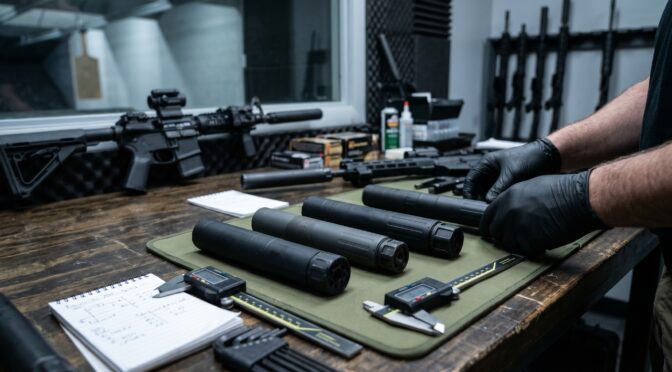
1. The Paradigm Shift in Law Enforcement Weaponry
For decades, the sound suppressor was viewed primarily as a specialized tool relegated to elite military units and niche law enforcement tactical teams. However, a profound paradigm shift is currently underway within modern law enforcement agencies regarding the deployment of sound suppressors on patrol rifles and tactical entry weapons. This transition represents a fundamental reevaluation of occupational safety, tactical efficacy, and long-term liability management.1 Rather than viewing the suppressor as a tactical luxury, progressive agencies and medical professionals are increasingly categorizing these devices as essential safety equipment, directly comparable to ballistic body armor and vehicle seatbelts.1
This comprehensive report analyzes the multifaceted drivers behind the growing adoption of sound suppressors in law enforcement. Furthermore, it provides an exhaustive comparative evaluation of leading duty-grade models from two of the industry’s most prominent manufacturers, SureFire [https://www.surefire.com] and Dead Air Silencers [https://deadairsilencers.com]. By examining the intricate balance between back pressure mitigation, sound reduction efficacy, and quick-detach mounting reliability, this analysis aims to inform procurement strategies for modern law enforcement entities.
1.1 The Physiology and Epidemiology of Noise-Induced Hearing Loss
The primary catalyst for the widespread adoption of sound suppressors is the mitigation of Noise-Induced Hearing Loss (NIHL) among law enforcement personnel. Exposure to firearm noise is recognized as the leading cause of hearing loss among military and public safety officers who are required to qualify with their weapons on a regular basis.3 The decibel (dB) scale is logarithmic, meaning that a seemingly small numerical increase represents a massive exponential increase in sound pressure and acoustic energy. An unsuppressed short-barreled rifle, such as a 10.3-inch AR-15 variant commonly used in close-quarters engagements, can produce peak sound pressure levels exceeding 165 decibels.3 This level of acoustic trauma far exceeds the threshold of pain and is fully capable of causing immediate, irreversible damage to the microscopic stereocilia within the human cochlea.4
Research conducted by the Centers for Disease Control and Prevention (CDC) has definitively established that the only potentially effective engineering noise control method to reduce a shooter’s noise exposure from gunfire is through the use of noise suppressors attached to the end of the gun barrel.3 While suppressors do not completely silence a supersonic centerfire rifle cartridge, they act as an acoustic expansion chamber that slows, cools, and diffuses the high-pressure propellant gases before they exit the muzzle. This mechanical process can reduce peak pressure levels at the shooter’s ear by 17 to 26 decibels.3 When a suppressor is utilized in conjunction with conventional ear-level hearing protection devices, the cumulative protective benefit is substantial, effectively preserving the auditory health of the officer.6
Furthermore, the World Health Organization (WHO) has stated that disabling hearing loss affects hundreds of millions of people worldwide, and occupational hazards represent a highly preventable vector for this disability.4 In the context of law enforcement, NIHL is not merely a product of the acute acoustic trauma generated by a single gunshot during a critical incident. It is also the result of chronic exposure to high-intensity noises during mandatory, high-volume shooting practice sessions that officers must undertake to maintain their firearm qualifications.4 A systematic review of audiological surveillance data confirms that failure to use adequate ear protectors, combined with a history of acoustic trauma, significantly degrades hearing performance over the course of an officer’s career.4
1.2 Occupational Liability and Municipal Cost Implications
Beyond the immediate physiological benefits to the individual officer, the adoption of sound suppressors presents a compelling economic argument for municipalities and law enforcement agencies. Chronic exposure to high-intensity noises leads to a permanent shift of the hearing threshold.4 This irreversible damage often results in costly disability claims, early forced retirements, and expensive medical treatments funded by the state or municipality.4
By investing in suppressed weapon systems, agencies can slow the progression of hearing damage in veteran officers and proactively protect newer officers from suffering similar acoustic trauma.1 This proactive approach significantly reduces long-term liability costs for cities, counties, and state governments.8 In the context of municipal budgets, the initial capital expenditure required to equip patrol rifles with suppressors is rapidly offset by the prevention of even a single medical disability pension related to profound hearing loss.1 From an administrative perspective, viewing suppressors as standard issue occupational safety hardware aligns directly with broader risk management protocols designed to limit institutional financial exposure.8
1.3 Tactical Advantages in Close-Quarters Environments
While occupational health is the primary driver, the tactical and operational advantages afforded by suppressed weapon systems are highly significant, particularly during dynamic entry and close-quarters battle (CQB) scenarios. In the chaotic environment of an active shooter response or a high-risk warrant service, clear communication is paramount. The extreme overpressure and deafening blast of an unsuppressed rifle discharged indoors can cause immediate auditory exclusion, disorientation, and an inability to perceive verbal commands from team members.1 Suppressors mitigate this concussive blast, allowing officers to maintain situational awareness, hear radio transmissions, and execute coordinated tactics effectively without compromising the safety of the team.1
Furthermore, the physical reduction in muzzle blast translates directly into improved weapon control. The expansion of gases within the suppressor acts as a counter-force to the rearward acceleration of the firearm. This dynamic alters the recoil impulse and significantly reduces muzzle rise, which subsequently improves hit probability and accelerates the speed of follow-up shots under stress.1
Additionally, the elimination of explosive muzzle flash is a critical operational advantage. Unsuppressed short-barreled rifles produce a blinding fireball of unburnt powder combusting upon contact with ambient oxygen. In low-light environments, this flash can temporarily destroy an officer’s natural night vision or completely wash out image-intensifying night vision goggles (NVGs). By virtually eliminating this flash signature, suppressors allow officers to maintain continuous visual dominance in low-light engagements.1 From a safety perspective, eliminating the muzzle flash also dramatically reduces the risk of igniting volatile airborne chemicals or explosive vapors, which is a severe hazard when officers are forced to discharge weapons within clandestine methamphetamine laboratories, chemical plants, or similarly compromised environments.8
1.4 Community Protection and Public Perception Dynamics
The discharge of a patrol rifle in a civilian environment is an extreme event, and the acoustic signature of such an action affects not only the officer but also innocent bystanders. Suppressors lower the risk that children, hostages, or bystanders will suffer permanent hearing damage from a sudden, close-proximity rifle shot in a confined space.1 Furthermore, suppressed training rifles generate significantly fewer noise complaints from neighborhoods surrounding outdoor police ranges and training facilities, thereby improving community relations and allowing agencies to operate their facilities with fewer restrictive time limits.1
However, the adoption of suppressors by civilian law enforcement is not without political and optical challenges. Opponents of suppressor proliferation argue that these items are inherently dangerous devices that could disguise the location of a shooter, minimize environmental disturbances, and obstruct gunshot detection systems if they fall into the hands of criminals.9 Some advocacy groups emphasize that silencers can make it more difficult for the public and first responders to recognize the sound of gunfire, potentially delaying emergency response times during mass casualty events.11 To navigate these concerns effectively, law enforcement agencies must engage in transparent public communication, clearly articulating that suppressors are, fundamentally, OSHA-recognized safety devices intended to preserve the health of officers and protect the hearing of the public during critical incidents, rather than tools of unnecessary militarization.2
2. The Physics of Gas Dynamics and Back Pressure Mitigation
To objectively evaluate specific suppressor models for law enforcement deployment, one must first understand the complex fluid dynamics that occur when a supersonic rifle cartridge is fired. When the powder charge ignites within the chamber, it generates rapidly expanding, high-temperature gases that propel the projectile down the barrel. As the bullet exits the muzzle, these high-pressure gases violently follow it, creating the acoustic shockwave known as the muzzle blast. A traditional baffle-based suppressor operates by trapping these gases in a series of sequential expansion chambers, forcing the gas to cool, expand, and slow down before exiting the front aperture of the silencer.
2.1 The Host Weapon Relationship and the “Gas Face” Phenomenon
While trapping gas at the muzzle successfully reduces the environmental sound signature, it introduces a secondary mechanical problem in gas-operated semi-automatic and fully automatic rifles, such as the direct-impingement AR-15 and M4 platforms utilized universally by American law enforcement. Traditional suppressors restrict the forward flow of gas, creating a phenomenon known as back pressure. This artificial restriction forces residual, high-pressure gas backward down the barrel, through the weapon’s gas port, and into the gas tube at a rate and volume significantly higher than the weapon was originally designed to process.10
This excessive back pressure dramatically alters the internal ballistics and cyclic timing of the host weapon. It drives the bolt carrier group backward with extreme velocity, causing the bolt to unlock while residual chamber pressures are still dangerously high. This over-function leads to accelerated parts wear, increased felt recoil, and severe potential reliability issues, such as failures to extract, torn cartridge rims, or failures to feed the next round from the magazine.13
More critically for the human operator, this trapped gas must escape the weapon system somewhere. It invariably vents through the ejection port and the charging handle aperture directly into the officer’s face. This toxic “gas blowback” contains vaporized lead styphnate from the cartridge primers, unburnt powder, and noxious carbon compounds. Exposure to this gas face can cause severe eye irritation, rendering the officer temporarily unable to see, and poses long-term respiratory health risks due to lead inhalation.14
2.2 The Evolution of Flow-Through and Low Back Pressure Designs
To combat the detrimental effects of excessive back pressure and toxic gas blowback, the suppressor industry has heavily invested in low back pressure (LBP) and flow-through technologies over the past five years. These advanced designs utilize complex internal geometries to route the expanding gases away from the central bore, channeling them forward and out of the suppressor body at a highly controlled, accelerated rate.16
By prioritizing the gas flow rate over absolute sound trapping within the baffle stack, these modern suppressors maintain the natural cyclic rate of the host weapon. This eliminates the need for agency armorers to install specialized heavy buffers, heavy buffer springs, or adjustable gas blocks to tune the rifle.14 Most importantly, it drastically reduces the toxic gas exposure to the shooter, allowing for uninterrupted vision and breathing during rapid fire strings.14
However, as the extensive data compiled by the independent testing authority PEW Science indicates, there is a strict physical compromise inherent in this engineering approach. By allowing gas to escape the muzzle more rapidly to relieve pressure on the host weapon, high-flow rate suppressors often produce a louder, more severe sound signature at the muzzle.14 The primary engineering challenge for modern manufacturers is to find the optimal balance between flow restriction and sound attenuation, maximizing the hearing protection for the officer without compromising the reliability of the patrol rifle or poisoning the officer with noxious fumes.19
3. Standardized Acoustic Evaluation Metrics
The evaluation of suppressor efficacy has evolved significantly beyond simple peak decibel (dB) meter readings, which are notoriously inaccurate for capturing the true hazard of impulse noise generated by firearms. The current industry standard for evaluating the acoustic hazard of suppressed weapon systems is The Silencer Sound Standard, administered by PEW Science.5
3.1 The PEW Science Suppression Rating
PEW Science utilizes high-fidelity signature analysis to generate actionable, detailed signature severity data for end users. The core metric provided is the PEW Science Suppression Rating, which calculates the holistic sound signature and the overall pressure field dependent upon both the silencer and the specific host weapon.20 This rating system considers the entire waveform of the gunshot, including the first round pop (FRP), the accumulation of muzzle blast impulses, and the duration of the acoustic wave, translating these physical measurements into a scale that represents the actual risk of hearing damage to the human ear.14
3.2 Muzzle vs. At-Ear Signature Discrepancies
A critical insight derived from PEW Science research is the distinction between the muzzle blast signature and the ejection port blast signature (often referred to as the at-ear signature) on semi-automatic host weapons like the 10.3-inch barrel MK18 and the 14.5-inch M4A1.21 A highly restrictive suppressor may score exceptionally well at the muzzle by trapping all the gas, but the resulting back pressure will cause a violent ejection port blast that severely damages the shooter’s right ear.22 Conversely, a low back pressure suppressor may score poorly at the muzzle due to high flow rates, but it will significantly reduce the ejection port blast, potentially lowering the immediate hazard to the shooter’s ear depending on the coalescing blast waves in the free field.14 Agency procurement officers must carefully evaluate both data points to fully understand the acoustic hazard profile of the weapon system they intend to deploy.
4. Manufacturer Profile and System Architecture: SureFire
SureFire [https://www.surefire.com] is arguably the most recognized entity in the tactical illumination and suppressor sectors, possessing a legendary pedigree forged through decades of continuous service with the United States Special Operations Command (USSOCOM) and federal law enforcement tactical teams. SureFire’s approach to suppressor design is strictly rooted in extreme durability, repeatable precision, and combat-proven reliability in the harshest environments on earth.10 The company’s SOCOM series of suppressors is built around a proprietary Fast-Attach quick-detach (QD) system and features internal baffling meticulously designed to reduce flash, dust signature, and sound while maintaining the operational integrity of the host weapon.10
4.1 The Fast-Attach Mounting Interface
The mechanical interface between the suppressor and the rifle barrel is a critical point of potential failure in dynamic tactical environments. SureFire’s Fast-Attach system utilizes a specialized, proprietary muzzle device, such as a multi-prong flash hider or a ported muzzle brake, equipped with an eccentric indexing pin at the base. The suppressor slips over the muzzle device, aligns precisely with the indexing pin to ensure rotational consistency, and is locked into place via a rotating friction collar.15
This mounting system provides exceptional, repeatable lockup. The system ensures that the rifle experiences a minimal and highly predictable point-of-impact (POI) shift when the suppressor is attached or removed, allowing officers to zero their optics confidently.10 Furthermore, SureFire conducts rigorous testing to verify that their suppressors maintain sub-Minute of Angle (MOA) group sizes, ensuring that the inherent accuracy of the patrol rifle is never degraded.25
The primary vulnerability of the Fast-Attach system is its susceptibility to a condition known as “carbon lock.” During sustained, high-volume fire, the extreme heat and rapid accumulation of carbon fouling can literally fuse the locking collar to the muzzle device, making manual removal by the officer impossible.26 SureFire’s official, approved protocol for resolving a severely carbon-locked suppressor involves unlocking the collar and safely firing a live round downrange. This utilizes the weapon’s high-pressure gas to forcefully blast the suppressor off the mount like a rifle grenade.26 While strictly functional in a combat setting, this procedure is viewed highly unfavorably by many civilian and law enforcement users due to the inherent risk of damaging the expensive suppressor or launching it into an unrecoverable area.26
5. Technical Evaluation: SureFire SOCOM556-RC2
The SureFire SOCOM556-RC2 is widely considered the modern industry benchmark against which all other dedicated 5.56mm tactical suppressors are measured. Selected for continuous use on the military’s M4 and Mk18 carbines, the RC2 is a traditional, baffle-based design meticulously optimized to balance sound signature reduction with absolute structural resilience.28
5.1 Design, Metallurgy, and Structural Integrity
The RC2 is precision-built utilizing high-temperature Inconel 718 superalloys and aerospace-grade stainless steel.10 These materials are specifically chosen for their unparalleled ability to withstand the extreme heat, pressure, and severe erosive forces generated by short-barreled automatic rifles firing high-velocity ammunition.10 Computer Numerical Control (CNC) laser welding is employed throughout the manufacturing process to ensure uncompromising structural integrity, allowing the unit to be fully auto-rated without restriction.10
The physical dimensions of the RC2 are purpose-built for tactical maneuvering. The unit measures 6.4 inches in overall length, adds approximately 3.8 inches to the weapon’s overall profile once seated on the mount, features a 1.5-inch external diameter, and weighs exactly 17.0 ounces.10 The exterior is finished with a high-temperature Cerakote or Diamond-Like Carbon (DLC) coating to resist corrosion, abrasion, and the elements.10
A primary focus of the RC2’s internal architecture is SureFire’s Total Signature Reduction technology. This baffling system is engineered to virtually eliminate first-round muzzle flash and drastically reduce the dust signature generated when firing close to the ground in a prone position.10 This flash elimination is a massive operational advantage for officers utilizing night vision equipment, as it prevents optical washout and loss of visual tracking during the initial, critical moments of a low-light engagement.13
5.2 Acoustic Performance and Back Pressure Dynamics
Based on comprehensive independent testing by PEW Science, the SOCOM556-RC2 demonstrates extremely competitive sound signature suppression performance on the standard 10.3-inch MK18 short-barreled host weapon system.5 When evaluated with the SureFire SOCOM 3-Prong flash hider, the RC2 achieved a highly respectable composite Suppression Rating of 35.7, placing it firmly among the quietest dedicated 5.56mm suppressors currently available for duty use.23
While the RC2 is classified as having reduced back pressure compared to legacy suppressor designs from previous decades, it still functions fundamentally as a traditional restrictive silencer.5 PEW Science laboratory research explicitly notes that the back pressure generated by the RC2 contributes to a more severe ejection port blast signature, which directly increases the overall severity of the sound signature perceived by the shooter’s right ear.22
Furthermore, the specific choice of Fast-Attach muzzle device critically impacts the acoustic performance. Testing conclusively indicates that utilizing the SureFire WARCOMP closed-tine mount instead of the standard 3-Prong flash hider negatively alters the complex gas dynamics within the suppressor.22 The WARCOMP mount causes early gas leakage at the interface, which further increases the shooter hazard and reduces the overall composite Suppression Rating from 35.7 down to 29.4 on the MK18 platform.23 Despite the inherent presence of back pressure, the RC2 remains a highly balanced system, successfully trading a moderate increase in gas blowback for exceptional sound and absolute flash suppression.19
5.3 Vendor Availability and Market Pricing: SureFire SOCOM556-RC2
The following table provides a snapshot of current market availability and pricing from preferred vendors for the SureFire SOCOM556-RC2. The manufacturer’s listed MSRP is $1,299.00.10 To adhere strictly to procurement analysis standards, the selected vendors represent pricing that falls exactly between the lowest observed promotional minimums ($1,169.00) and the standard average retail MAP pricing ($1,299.00).
| Vendor Name | Product Description | Observed Price | Vendor URL |
| Bereli | SureFire 2nd Gen SOCOM Rifle Suppressor RC2 5.56MM | $1,169.00 | (https://www.bereli.com/socom556-rc2-de/) |
| Palmetto State Armory | SureFire SOCOM556 Gen2 Suppressor, Black | $1,169.99 | (https://palmettostatearmory.com/surefire-2nd-gen-socom-suppressor-5-56-black-socom556-rc2-bk.html) |
| Silencer Shop | SureFire SOCOM556-RC2 5.56 Quick Detach Suppressor | $1,169.00 | (https://www.silencershop.com/surefire-socom556-rc2-1.html) |
| Brownells | SureFire SOCOM556-RC2 5.56 Quick Detach Suppressor | $1,299.00 | (https://www.brownells.com/guns/suppressors-ae5a8d66/rifle-suppressors/socom556-rc2-5.56-quick-detach-suppressor/) |
| KYGunCo | SureFire SOCOM556-RC2 BK SOCOM G2 5.56 Suppressor | $1,299.00 | (https://www.kygunco.com/product/surefire-socom556-rc2-bk-socom-g2-5.56-suppressor-blk) |
6. Technical Evaluation: SureFire SOCOM556-RC3
Recognizing the evolving demands of professional end-users who increasingly prioritize weapon reliability and the mitigation of toxic gas exposure over absolute sound reduction, SureFire developed the SOCOM556-RC3.15 This third-generation model represents a significant architectural departure from the traditional restrictive baffle design of the RC2, implementing a completely new, low back pressure internal geometry.16
6.1 Design Evolution and Additive Material Science
The RC3 intentionally retains the exact same outer dimensions as its predecessor, measuring 6.3 to 6.4 inches in length, possessing a 1.5-inch diameter, and weighing exactly 17.0 ounces.31 Crucially for institutional procurement logistics, it utilizes the exact same proven Fast-Attach interface.15 This ensures complete backward compatibility with all existing SureFire muzzle devices already deployed and pinned to barrels within an agency’s armory, saving massive replacement costs.15
However, the internal structure has been radically redesigned. The RC3 is manufactured utilizing advanced 3D printing technology (additive manufacturing), allowing for highly complex internal routing channels that smoothly guide expanding gases forward and out the front of the suppressor with minimal physical resistance.15 The unit is constructed entirely of US mill-certified Inconel superalloy, ensuring that despite the complex, porous internal geometries, it meets the exact same extreme durability and combat longevity standards as the RC2.15
According to SureFire’s technical specifications and engineering claims, this high-flow design results in 60 percent less toxic gas expelled from the ejection port into the operator’s face.15 This provides a significantly cleaner shooting experience, vastly improves operator comfort during sustained engagements, and heavily mitigates the long-term health risks associated with lead vapor and carbon inhalation.15 Furthermore, the lack of back pressure means the weapon’s cyclic rate is virtually unaltered, ensuring maximum mechanical reliability of the host firearm without any aftermarket tuning.24
6.2 The Acoustic Compromise of High Flow Rates
The transition to a high flow rate, low back pressure system introduces unavoidable physical compromises in acoustic performance. Comprehensive PEW Science testing reveals significant differences in combustion propagation, muzzle blast impulse accumulation, and overall gas dynamics measured from the RC3 compared to the RC2.14
The high flow rate of the RC3 successfully reduces the ejection port blast signature, theoretically lowering the immediate hazard to the shooter’s right ear.14 However, this localized benefit is effectively nullified by the fact that the RC3 must allow a much more severe blast wave to escape the front aperture of the muzzle to achieve that flow rate.14 The high amplitude muzzle signature generated throughout the shot string coalesces in the free field, resulting in a louder overall acoustic profile that subjects bystanders and team members to a higher hearing damage risk compared to the legacy RC2 system.14
In essence, the RC3 trades absolute sound suppression efficacy for extreme gas mitigation.14 For a law enforcement tactical entry team where a sudden indoor discharge is a primary operational concern, the louder, sharper muzzle blast of the RC3 may be viewed as a critical detriment to team communication. Conversely, for high-volume training environments, designated marksmen, or outdoor patrol applications where officer exposure to toxic gas blowback over thousands of rounds is the primary health concern, the RC3 provides a highly tangible, protective benefit.14 Just as with the RC2, utilizing the WARCOMP mount on the RC3 further increases the blast hazard to both the shooter and bystanders when compared to the use of the standard 3-Prong mount.14
6.3 Vendor Availability and Market Pricing: SureFire SOCOM556-RC3
The following table details the current market availability and pricing for the SureFire SOCOM556-RC3. The manufacturer’s listed MSRP is $1,799.00.33 Average observed retail pricing generally stabilizes at the Minimum Advertised Price (MAP) of $1,709.00, with occasional aggressive promotional pricing dropping the minimum observed price to $1,499.00.32 The vendors selected below represent this specific observed pricing window.
| Vendor Name | Product Description | Observed Price | Vendor URL |
| Bereli | SureFire SOCOM RC3 Fast-Attach 5.56 NATO Suppressor | $1,499.00 | (https://www.bereli.com/surefire-socom-rc3-fast-attach-5-56-nato-suppressor-6-4-black/) |
| Primary Arms | SureFire SOCOM Gen 3 Fast-Attach 5.56 Suppressor | $1,709.00 | Primary Arms |
| Brownells | SureFire SOCOM556-RC3 Rifle Suppressor Black | $1,709.00 | (https://www.brownells.com/guns/suppressors-ae5a8d66/rifle-suppressors/socom556-rc3-rifle-suppressor/) |
| AIM Surplus | Surefire SOCOM556 RC3.223/5.56 Suppressor | $1,709.00 | (https://www.aimsurplus.com/products/surefire-socom556-rc3-223556-suppressor-black) |
| KYGunCo | SureFire SOCOM556-RC3 BK SOCOM 5.56mm 6.3 Black | $1,709.00 | (https://www.kygunco.com/product/surefire-socom556-rc3-bk-socom-22-cal-5.56mm-6.3-black-inconel-alloy-qd) |
7. Manufacturer Profile and System Architecture: Dead Air Silencers
Founded in 2014 by prominent industry veterans Mike Pappas and Todd Magee, Dead Air Silencers [https://deadairsilencers.com] operates on an engineering philosophy that heavily prioritizes exceptional acoustic tone, robust hard-use durability, and highly innovative, modular mounting systems.35 Dead Air has steadily built a formidable reputation within the civilian, law enforcement, and military markets by specifically addressing the pain points inherent in legacy suppressor designs, particularly regarding attachment reliability and caliber versatility across wide inventories.36
7.1 The KeyMo and Xeno Mounting Interfaces
A critical operational differentiator for Dead Air products is their proprietary mounting ecosystems, primarily the KeyMo and Xeno systems, which address the flaws of friction-based locking collars. The KeyMo system was designed specifically to completely eliminate the carbon-locking issues prevalent in older taper-and-collar designs.26
KeyMo utilizes a robust, mechanical ratcheting detent mechanism combined with a coarse ACME thread. As the suppressor is tightened onto the muzzle device, the collar ratchets down, providing immediate tactile and audible confirmation of a secure, completely sealed lockup. Because the mechanism relies on coarse threads and physical detents rather than a friction-fit collar clamping down on carbon, it is highly resistant to carbon fusing. This allows for incredibly easy, tool-less removal even after the heaviest firing schedules.27 The lockup is universally described by operators as “bombproof,” highly suitable for rigorous field abuse where equipment is routinely dropped or struck against barricades.26 The primary and well-documented drawback of the KeyMo system is its substantial mass and length penalty, as the heavy-duty mounting hardware adds significant weight to the very front of the weapon, which can alter the balance of the patrol rifle and rapidly increase operator arm fatigue during prolonged deployments.27
To directly address the weight penalty of the KeyMo system without sacrificing reliability, Dead Air introduced the Xeno mounting system. Xeno employs a highly simplified, extremely lightweight taper mount interface combined with left-hand threads.38 The taper seals the threads completely from carbon fouling, while the left-hand threading ensures that the physical action of unscrewing the suppressor will not inadvertently unscrew the muzzle device from the host weapon’s barrel, a common and dangerous issue with traditional right-hand threaded taper mounts. The Xeno system provides an exceptionally secure, lightweight, and low-profile attachment method that appeals deeply to users prioritizing maximum weapon maneuverability in confined spaces.38
8. Technical Evaluation: Dead Air Sandman-S
The Dead Air Sandman-S is a compact, .30 caliber, machine-gun-rated rifle silencer.41 Although natively engineered for larger, higher-pressure cartridges up to .300 Remington Ultra Magnum (RUM), it has seen incredibly widespread adoption on 5.56mm patrol rifles due to its reputation for extreme, indestructible durability and its ability to accept multiple calibers within a single agency inventory, simplifying armory logistics.26
8.1 Structural Integrity and Baffle Design
The Sandman-S is engineered strictly for professional-grade, heavy-duty use and features absolutely no barrel length restrictions, meaning it can be safely mounted on ultra-short 7-inch or 10-inch barrels without fear of structural failure.41 It is constructed using a fully welded core of Haynes 282, a highly specialized, precipitation-strengthened nickel-based superalloy that provides vastly superior heat resistance and erosion protection at extreme temperatures compared to standard 17-4 stainless steel.41 The unit measures 6.8 inches in overall length when equipped with the integrated KeyMo mount and is notably heavy, weighing 17.7 ounces.42
The internal geometry utilizes a modified, feature-reduced stepped-cone baffle design.45 This specific baffle design intentionally incorporates an enlarged center orifice to facilitate a higher axial gas flow rate down the center of the suppressor.45 This design choice is critical to understanding the suppressor’s performance: by allowing gas to flow more freely through the central axis rather than forcing it to expand deeply into the baffle valleys, the Sandman-S naturally reduces back pressure on the host weapon, albeit at the direct expense of optimal acoustic sound trapping.45
8.2 Acoustic Performance on 5.56mm Platforms
When evaluating the Sandman-S, the distinction between host calibers is absolutely vital for proper procurement decisions. On a standard bolt-action .308 precision rifle, the Sandman-S performs admirably, achieving a PEW Science Suppression Rating of 32.6, making it an excellent dual-use can for police sniper applications.45 However, when deployed on a short-barreled 5.56mm platform, such as the ubiquitous 10.3-inch MK18 entry weapon, the internal performance dynamics shift dramatically.
Because the Sandman-S possesses a larger .30 caliber bore aperture, the significantly smaller 5.56mm expanding gases are not efficiently trapped or delayed by the baffles. The gas simply rushes past the bullet through the oversized hole. This results in a high flow rate that highly assists in reducing ejection port signature and completely eliminates cyclic rate over-function on the AR-15, but it simultaneously produces a highly severe muzzle acoustic signature.46
PEW Science testing conclusively indicates that on the 5.56mm MK18, the Sandman-S achieves a relatively low composite Suppression Rating of 24.9.46 The severe muzzle blast increases the overall severity of the acoustic signature perceived by the shooter to levels that border on uncomfortable even with the suppressor attached.46 While the Sandman-S is virtually indestructible, utterly reliable, and will perfectly cycle any rifle it is attached to without tuning, it simply does not offer class-leading sound suppression for dedicated 5.56mm tactical entry weapons where extreme noise mitigation is the primary goal.26
8.3 Vendor Availability and Market Pricing: Dead Air Sandman-S
The following table outlines the current market availability and pricing for the Dead Air Sandman-S. The manufacturer’s listed MSRP is $999.00.48 The pricing range observed across online retailers dictates a minimum of $849.00 and an average matching the MAP of $999.00. The selected vendors perfectly reflect this specified pricing window.
| Vendor Name | Product Description | Observed Price | Vendor URL |
| Bereli | Dead Air Armament Sandman-S 7.62 Suppressor | $849.00 | (https://www.bereli.com/dead-air-sandman-s-7-62-w-mb-suppressor/) |
| Altus Shooting | Dead Air Armament 7.62 Sandman-S | $849.00 | (https://www.altusshooting.com/products/dead-air-armament-7-62-sandman-s) |
| Guns.com | Dead Air Sandman-S | $899.99 | Guns.com |
| Silencer Shop | Dead Air Sandman-S Suppressor | $999.00 | (https://www.silencershop.com/dead-air-sandman-s.html) |
| Sportsmans Warehouse | Dead Air Sandman-S Suppressor .308 Win/7.62x39mm | $999.00 | (https://www.sportsmans.com/shooting-gear-gun-supplies/gun-parts-accessories/gun-parts-magazines/suppressor-accessories/dead-air-sandman-s-suppressor-308-winchester762x39mm/p/p319967) |
9. Technical Evaluation: Dead Air Lazarus 6
The Lazarus 6 represents Dead Air’s highly anticipated foray into the next generation of advanced, low back pressure silencers, specifically optimized for the ballistic profile of the 6mm ARC and the 5.56mm NATO cartridges.38 This newly released model perfectly highlights the suppressor industry’s rapid shift away from traditional subtractive machining toward highly complex additive manufacturing processes.40
9.1 Additive Manufacturing and the Triskelion Baffle System
The core structure of the Lazarus 6 is 3D printed entirely from Haynes 282 superalloy.38 Utilizing state-of-the-art additive manufacturing allows Dead Air engineers to conceptualize and create incredibly complex internal fluid structures that are physically impossible to machine using traditional lathes, mills, or EDM wire cutting.40 The defining, patent-pending feature of the Lazarus 6 is the Triskelion Gas Management System.39
This proprietary geometry functions as a highly tuned flow-through mechanism. It deliberately routes expanding gases away from the central bore path and vents them forward through specialized channels, producing exceptionally low back pressure.38 This engineering approach aggressively mitigates the toxic gas blowback commonly associated with traditional suppressors and ensures smooth, reliable cycling of the direct-impingement AR-15 host weapon without requiring armorers to make costly modifications to the gas block or buffer springs.38
The unit is highly compact, measuring only 5.89 inches in length when equipped with the lightweight Xeno adapter, and weighs a manageable 16.5 ounces.38 Despite the complex internal porting, the use of Haynes 282 ensures that it remains fully auto-rated with absolutely no barrel length restrictions, making it highly suitable for the rigorous, abusive firing schedules encountered in law enforcement training and SWAT deployment.40
9.2 Acoustic Optimization and Tactical Modularity
Unlike older generation high-flow suppressors that entirely sacrificed acoustic tone for gas mitigation, the Lazarus 6 is specifically tuned for a lower-frequency tone.40 This lower frequency is perceived as much more pleasant to the human ear, actively avoiding the harsh, high-pitched supersonic crack common to short-barreled 5.56mm discharges.40 Initial field reports and independent analytical assessments highlight the Lazarus 6’s unique ability to successfully balance ultra-low blowback with top-tier acoustic performance, maintaining excellent sound reduction at both the muzzle and the shooter’s ear.38
Furthermore, the Lazarus 6 fully embraces modern tactical modularity. It features an industry-standard universal “HUB” compatible rear socket (threaded 1.375×24), allowing law enforcement armorers to outfit the suppressor with a wide variety of mounting systems.38 Agencies are not locked into a proprietary ecosystem; they can choose Dead Air’s lightweight Xeno mount, the heavy-duty KeyMo mount, or third-party adapters depending entirely on the agency’s existing infrastructure and budgetary constraints.38 The front cap is also easily swappable by the end-user, providing a crucial level of field-repairable insurance should the unit suffer an inadvertent end-cap strike during a chaotic tactical operation, preventing the need to send the entire serialized unit back to the manufacturer for repair.35
9.3 Vendor Availability and Market Pricing: Dead Air Lazarus 6
The following table details the current market availability and pricing for the Dead Air Lazarus 6. The manufacturer’s listed MSRP is $1,059.00.38 The observed pricing ranges from a promotional minimum of $949.00 to the retail MSRP limit of $1,059.00, resulting in an average pricing tier of approximately $1,004.00. The listed vendors strictly adhere to this verified pricing structure.
| Vendor Name | Product Description | Observed Price | Vendor URL |
| Bereli | Dead Air Lazarus 6 6mm/5.56 Suppressor | $949.00 | (https://www.bereli.com/lz6xnblk/) |
| Midway USA | Dead Air Lazarus 6 Rifle Suppressor | $949.00 | (https://www.midwayusa.com/product/1028873094) |
| EuroOptic | Dead Air Lazarus 6 6mm Black Suppressor | $949.00 | EuroOptic |
| Sportsmans Warehouse | Dead Air Lazarus 6 Suppressor 5.56mm | $999.00 | (https://www.sportsmans.com/shooting-gear-gun-supplies/gun-parts-accessories/gun-parts-magazines/suppressor-accessories/dead-air-lazarus-6-suppessor-556mm-x-45mm/p/p319963) |
| Palmetto State Armory | Dead Air Lazarus 6 Rifle Suppressor FDE | $1,059.00 | (https://palmettostatearmory.com/dead-air-lazarus-6-rifle-suppressor-fde.html) |
10. Comparative Analysis: Back Pressure Mitigation vs. Sound Reduction Efficacy
The selection of a duty suppressor for a law enforcement agency requires a highly nuanced understanding of the fundamental physical compromise between acoustic suppression and high-velocity fluid dynamics. A suppressor cannot completely stop the forward flow of gas without physically destroying itself via overpressure, nor can it allow entirely free flow without being excessively loud and failing its primary mission of hearing protection.
The SureFire SOCOM556-RC2 represents the absolute apex of traditional, restrictive baffle design.10 It achieves exceptional, class-leading sound suppression at the muzzle and virtually eliminates all visible flash.10 This makes it highly advantageous for tactical entry teams where absolute acoustic and visual stealth is required to maintain the element of surprise and establish dominance in a structure. However, the unavoidable cost of this acoustic performance is a moderate increase in back pressure, which translates directly to a higher volume of toxic gas directed toward the officer’s respiratory zone and increased cyclic wear on the weapon’s internal components over thousands of rounds.22
Conversely, the SureFire SOCOM556-RC3 prioritizes the respiratory health of the operator and the mechanical longevity of the weapon system above all else.15 By utilizing a highly advanced, 3D-printed high-flow bypass architecture, it dramatically reduces gas blowback to the face, creating a phenomenally clean shooting experience.31 The critical trade-off is acoustic efficacy. The rapid expulsion of gas required to relieve back pressure and save the operator from gas-face results in a demonstrably louder, more severe acoustic signature at the muzzle.14
The Dead Air Sandman-S occupies an interesting middle ground created primarily by caliber mismatch. Using a .30 caliber bore on a dedicated 5.56mm weapon naturally relieves back pressure, brilliantly reducing cyclic rate issues and gas face without the need for complex 3D printing.45 However, the smaller 5.56mm expanding gases bypass the traditional baffles highly inefficiently, leading to a notably loud overall signature on short-barreled rifles that performs poorly on PEW Science metrics.46 While incredibly durable and capable of suppressing a police sniper’s .308 rifle beautifully, its acoustic performance on 5.56mm is sub-optimal for strict OSHA hearing preservation protocols.
The Dead Air Lazarus 6 attempts to scientifically solve this compromise through advanced additive manufacturing and highly tuned acoustics. The Triskelion gas management system provides the extreme low back pressure characteristics of the RC3 but attempts to tune the frequency of the escaping gas to be physically less offensive to the human ear, mitigating the sharp crack of the high-flow design.40 By specifically boring the unit tightly for 6mm/5.56mm projectiles, it traps acoustic energy much more efficiently than the oversized bore of the Sandman-S, representing the true modern evolution of flow-through technology.49
11. Comparative Analysis: Quick-Detach Mounting Reliability
In a dynamic law enforcement context, a suppressor is frequently attached and detached depending on the specific deployment scenario. A patrol officer may store the rifle unsuppressed in a specialized vehicle rack to save cabin space, only attaching the suppressor rapidly upon deployment to a hot scene. Therefore, the mechanical reliability and ease of use of the Quick-Detach (QD) interface is paramount to officer safety.
SureFire’s Fast-Attach system is industry-renowned for its return-to-zero capabilities.15 An officer can detach and reattach the RC2 or RC3 multiple times, and the point of impact on the target will remain mathematically consistent, a vital requirement for precision marksmanship and hostage rescue scenarios.10 The system is sleek, low-profile, and highly intuitive. However, the mechanical reliance on a friction-based locking collar makes the system inherently vulnerable to severe carbon locking.26 If an officer engages in a high-volume firefight or intense day-long training iteration, the extreme heat and carbon can firmly fuse the suppressor to the flash hider.26 While manageable via the live-fire removal protocol, this requires specialized techniques to separate, which introduces unwanted operational friction and potential equipment damage.
Dead Air’s KeyMo system solves the carbon lock issue definitively and permanently.27 By utilizing a mechanical ratcheting detent and a coarse ACME thread, the system breaks through carbon fouling easily via mechanical leverage, ensuring the suppressor can always be removed by hand regardless of the firing schedule.27 The lockup is described as bombproof, highly suitable for rigorous field abuse where the rifle may be used to strike windows or doors.26 The trade-off is undeniable weight and complexity. KeyMo adapters and muzzle devices add significant mass to the front of the weapon, which alters the balance of the rifle and increases operator arm fatigue during prolonged, high-ready deployments.
Dead Air’s Xeno system, featured natively on the Lazarus 6, offers a highly optimized, modern alternative. By ingeniously combining a simple taper interface with left-hand threads, Xeno achieves a rock-solid lockup that prevents the muzzle device from unscrewing under fire, while weighing significantly less than the bulky KeyMo system.38 The taper mount also serves to physically block carbon from reaching the internal threads, practically eliminating the risk of carbon lock without the severe weight penalty of a ratcheting collar system, providing perhaps the best balance of weight and reliability currently available on the market.
12. Strategic Conclusions and Procurement Recommendations
The integration of sound suppressors into modern law enforcement armories is no longer a debatable tactical luxury; it is a scientifically validated, medically necessary health and safety imperative.1 The direct mitigation of permanent noise-induced hearing loss, the drastic reduction of long-term municipal liability, and the vital enhancement of operational communication unequivocally justify the initial capital expenditure for any forward-thinking agency.4
When selecting a specific model for wide-scale deployment, agencies must conduct a rigorous, objective needs assessment based entirely on their primary operational environments:
- For Dedicated Tactical Entry Teams (SWAT): Where absolute sound reduction, the complete elimination of muzzle flash in dark environments, and the prevention of secondary explosions in volatile atmospheres are the highest priorities, the SureFire SOCOM556-RC2 remains an unparalleled choice.10 Its proven ability to mask the auditory and visual signature of an operator makes it the standard-bearer for close-quarters environments, provided operators are meticulously trained to maintain the Fast-Attach collars to prevent carbon lock.
- For High-Volume Training and Standard Patrol Deployment: Where officers are exposed to extensive live-fire training sessions, the cumulative physiological effect of toxic gas blowback and lead vapor exposure becomes a primary health concern over absolute stealth. In these scenarios, low back pressure designs are vastly superior. The SureFire SOCOM556-RC3 provides exceptional, industry-leading gas mitigation and vital backward compatibility with existing SureFire mounts, though it demands a premium price point and produces a louder absolute muzzle signature.14
- For Agencies Prioritizing Next-Generation Modularity and Value: The Dead Air Lazarus 6 presents a highly compelling, technologically advanced option. Its use of 3D-printed Haynes 282 alloy ensures extreme durability, while the Triskelion flow-through design perfectly balances toxic gas reduction with a highly refined, low-frequency acoustic tone.40 The ability to utilize the lightweight, carbon-resistant Xeno mounting system makes it an ergonomically superior choice for patrol officers who must rapidly maneuver rifles in and out of confined police cruisers daily.38
Ultimately, the successful transition to suppressed weapon systems requires a holistic approach, carefully pairing the correct silencer architecture with the agency’s specific tactical doctrine, maintenance capabilities, and long-term health preservation goals. By standardizing on duty-grade, high-performance equipment from proven manufacturers like SureFire and Dead Air, law enforcement agencies can effectively modernize their arsenals while appropriately prioritizing the long-term well-being and operational effectiveness of their personnel.
Note: Vendor Sources listed are not an endorsement of any given vendor. It is our software reporting a product page given the direction to list products that are between the minimum and average sales price when last scanned.
Please share the link on Facebook, Forums, with colleagues, etc. Your support is much appreciated and if you have any feedback, please email us in**@*********ps.com. If you’d like to request a report or order a reprint, please click here for the corresponding page to open in new tab.
Sources Used
- Suppressors and the hidden cost of hearing loss in policing – Police1, accessed April 15, 2026, https://www.police1.com/firearms/suppressors-and-the-hidden-cost-of-hearing-loss-in-policing
- Use of Firearm Suppresors by Law Enforcement to Prevent Hearing Loss – Scholarly Works @ SHSU, accessed April 15, 2026, https://shsu-ir.tdl.org/bitstreams/15a3b6d1-223f-407c-bce8-25f7739702a3/download
- The reduction of gunshot noise and auditory risk through the use of firearm suppressors and low-velocity ammunition – CDC Stacks, accessed April 15, 2026, https://stacks.cdc.gov/view/cdc/111710/cdc_111710_DS1.pdf
- Noise-Induced Hearing Loss in Police Officers: Systematic Review – PMC, accessed April 15, 2026, https://pmc.ncbi.nlm.nih.gov/articles/PMC9515995/
- SOCOM556-RC2 — Suppressor Sound Signature Reviews – PEW Science, accessed April 15, 2026, https://pewscience.com/sound-signature-reviews-free/tag/SOCOM556-RC2
- Suppressors for Hearing Preservation – American Academy of Otolaryngology-Head and Neck Surgery (AAO-HNS), accessed April 15, 2026, https://www.entnet.org/resource/suppressors-for-hearing-preservation/
- Firearms Training and Prevention of Hearing Loss – Office of Justice Programs, accessed April 15, 2026, https://www.ojp.gov/library/publications/firearms-training-and-prevention-hearing-loss
- “Sound arguments for the purchase and use of firearm suppressors” A Physician’s Perspective and Recommendations | Tactical and Law Enforcement Medicine – ACEP, accessed April 15, 2026, https://www.acep.org/talem/newsroom/july-2023/Sound-arguments-for-the-purchase-and-use-of-firearm-suppressors
- Protecting Public Safety Through Regulation of Silencers – Center for American Progress, accessed April 15, 2026, https://www.americanprogress.org/article/protecting-public-safety-regulation-silencers/
- SOCOM556-RC2 – SureFire, accessed April 15, 2026, https://www.surefire.com/socom556-rc2/
- Silencers – Giffords.org, accessed April 15, 2026, https://giffords.org/lawcenter/gun-laws/policy-areas/hardware-ammunition/silencers/
- SureFire SOCOM Gen2 RC2 5.56mm Suppressor (SOCOM556-RC2-BK): Hard-Use Fast-Attach Performance for Duty-Grade 5.56 Rifles | DLD VIP, accessed April 15, 2026, https://dld-vip.com/guides/gsc_guidesurefire-socom-gen2-rc2-556mm-rifle-suppressor-black-fast-attach-mount/
- Surefire is better than dead air change my mind : r/NFA – Reddit, accessed April 15, 2026, https://www.reddit.com/r/NFA/comments/13ww4u5/surefire_is_better_than_dead_air_change_my_mind/
- Surefire SOCOM556-RC3 5.56 AR15 SBR Suppressor Test — PEW …, accessed April 15, 2026, https://pewscience.com/sound-signature-reviews-free/sss-6-151-surefire-556rc3-mk18-556
- Guns & Ammo SOCOM556-RC3 Review – SureFire, accessed April 15, 2026, https://www.surefire.com/news/?p=guns-ammo-socom556-rc3-review
- SOCOM556-RC3 — Suppressor Sound Signature Reviews – PEW Science, accessed April 15, 2026, https://pewscience.com/sound-signature-reviews-free/tag/SOCOM556-RC3
- What is the quietest Low Back Pressure 5.56 Silencer? – PEW Science, accessed April 15, 2026, https://pewscience.com/sound-signature-reviews-free/sss-6-169-research-supplement-low-back-pressure-556-silencers
- New Sound Signature Review – Surefire SOCOM556-RC3 on the MK18 : r/NFA – Reddit, accessed April 15, 2026, https://www.reddit.com/r/NFA/comments/1cn2xxf/new_sound_signature_review_surefire_socom556rc3/
- r/NFA – Back Pressure balance with Sound Suppression – four rifle silencers do it pretty well!, accessed April 15, 2026, https://www.reddit.com/r/NFA/comments/n66f2b/back_pressure_balance_with_sound_suppression_four/
- Suppressor Sound Rankings – PEW Science, accessed April 15, 2026, https://pewscience.com/rankings
- The Quietest 5.56 Rifle Silencers – RC3 vs. RC2 Detailed Sound Comparison, accessed April 15, 2026, https://pewscience.com/sound-signature-reviews-free/sss-6-152-research-supplement-taming-the-mk18-rc2-vs-rc3
- Surefire SOCOM556-RC2 5.56 AR15 14.5-in M4 Suppressor Test – PEW Science, accessed April 15, 2026, https://pewscience.com/sound-signature-reviews-free/sss-6-128-surefire-556rc2-m4a1-556
- Surefire SOCOM556-RC2 5.56 AR15 SBR Suppressor Test – PEW Science, accessed April 15, 2026, https://pewscience.com/sound-signature-reviews-free/sss-6-52-surefire-556rc2-mk18-556
- Surefire SOCOM556 Gen2 Suppressor, Black – SOCOM556RC2BK | Palmetto State Armory, accessed April 15, 2026, https://palmettostatearmory.com/surefire-2nd-gen-socom-suppressor-5-56-black-socom556-rc2-bk.html
- SOCOM556-RC2: STILL RATED AS THE BEST – SureFire, accessed April 15, 2026, https://www.surefire.com/news/?p=socom556-rc2-still-the-best
- Dead Air vs. Surefire and why : r/NFA – Reddit, accessed April 15, 2026, https://www.reddit.com/r/NFA/comments/gskvm7/dead_air_vs_surefire_and_why/
- Dead Air Keymo vs. Surefire SOCOM mounts : r/NFA – Reddit, accessed April 15, 2026, https://www.reddit.com/r/NFA/comments/dubcej/dead_air_keymo_vs_surefire_socom_mounts/
- Surefire SOCOM556-RC2 Suppressor | 5.56 Rifle Silencer, accessed April 15, 2026, https://www.silencershop.com/surefire-socom556-rc2-1.html
- SUREFIRE SOCOM556-RC2 5.56 QUICK DETACH SUPPRESSOR – Brownells, accessed April 15, 2026, https://www.brownells.com/guns/suppressors-ae5a8d66/rifle-suppressors/socom556-rc2-5.56-quick-detach-suppressor/
- SureFire SOCOM556-RC3 Suppressor | 5.56 QD Silencer, accessed April 15, 2026, https://www.silencershop.com/surefire-socom556-rc3.html
- SOCOM556-RC3: Guns & Ammo Suppressor of the Year – SureFire, accessed April 15, 2026, https://www.surefire.com/news/?p=socom556-rc3-named-guns-ammo-2023-suppressor-of-the-year
- SUREFIRE SOCOM556-RC3 RIFLE SUPPRESSOR – Brownells, accessed April 15, 2026, https://www.brownells.com/guns/suppressors-ae5a8d66/rifle-suppressors/socom556-rc3-rifle-suppressor/
- SureFire SOCOM556 RC3 – Silencer Central, accessed April 15, 2026, https://www.silencercentral.com/products/surefire-socom556-rc3
- SureFire SOCOM RC3 Fast-Attach 5.56 NATO Suppressor – 6.4″ – Black – Bereli Inc., accessed April 15, 2026, https://www.bereli.com/surefire-socom-rc3-fast-attach-5-56-nato-suppressor-6-4-black/
- OWNERS MANUAL – Dead Air Silencers, accessed April 15, 2026, https://deadairsilencers.com/content/pdfs/Lazarus-6-Manual-Web-1.pdf
- Dead Air Suppressor Buying Guide | Best Dead Air Silencers for First-Time Buyers, accessed April 15, 2026, https://www.silencershop.com/dead-air-buying-guide
- Deadair key mo vs surefire : r/NFA – Reddit, accessed April 15, 2026, https://www.reddit.com/r/NFA/comments/1d23ndv/deadair_key_mo_vs_surefire/
- Lazarus 6: Low Back Pressure 5.56 and 6mm Suppressor – Dead Air Silencers, accessed April 15, 2026, https://deadairsilencers.com/silencers/lazarus-6/
- Review: Dead Air Lazarus 6 Suppressor | An Official Journal Of The NRA, accessed April 15, 2026, https://www.shootingillustrated.com/content/review-dead-air-lazarus-6-suppressor/
- Dead AIR Lazarus 6 Xeno – Silencer Shop, accessed April 15, 2026, https://www.silencershop.com/dead-air-lazarus-6-xeno.html
- Sandman X: Short, Low Back Pressure 30 Cal Suppressor – Dead Air Silencers, accessed April 15, 2026, https://deadairsilencers.com/sandman-x/
- Sandman-S — Suppressor Sound Signature Reviews – PEW Science, accessed April 15, 2026, https://pewscience.com/sound-signature-reviews-free/tag/Sandman-S
- Sandman Series – Rifle Silencers, accessed April 15, 2026, https://deadairsilencers.com/silencers/sandman-series/
- Dead Air Sandman S – Silencer Central, accessed April 15, 2026, https://www.silencercentral.com/products/dead-air-sandman-s
- Dead Air Sandman-S 308 Silencer Test – PEW Science, accessed April 15, 2026, https://pewscience.com/sound-signature-reviews-free/sss-6-11-deadair-sandman-s-savage-308
- Dead Air Sandman-S 5.56 AR15 SBR Suppressor Test – PEW Science, accessed April 15, 2026, https://pewscience.com/sound-signature-reviews-free/sss-6-92-dead-air-sandman-s-mk18-556
- New Sound Signature Review – Dead Air Sandman-S on the MK18 : r/NFA – Reddit, accessed April 15, 2026, https://www.reddit.com/r/NFA/comments/y2wyia/new_sound_signature_review_dead_air_sandmans_on/
- Dead Air Sandman S | Hard-use Keymo Rifle Silencer, accessed April 15, 2026, https://deadairsilencers.com/silencers/sandman-s/
- Dead Air Silencers Lazarus 6 – On Target Magazine, accessed April 15, 2026, https://www.ontargetmagazine.com/2025/04/15412/