1. Executive Summary
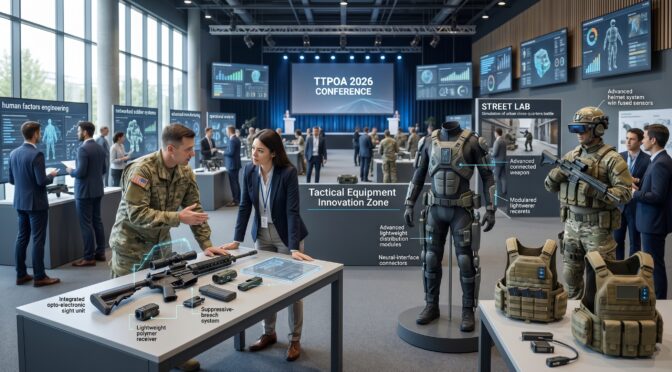
The Texas Tactical Police Officers Association (TTPOA) Annual Training Conference, held in Round Rock, Texas, from April 22 through April 26, 2026, served as a critical nexus for the evaluation of emerging law enforcement technologies, tactical methodologies, and specialized equipment.1 As law enforcement agencies increasingly operate within highly scrutinized and dynamic urban environments, the demands placed upon individual patrol officers and specialized tactical units have necessitated a fundamental evolution in equipment procurement and doctrinal training. The 2026 conference highlighted several key industry shifts, most notably the integration of additive manufacturing in sound suppression, the transition toward direct-mount optical systems, the rapid advancement of non-lethal scenario-based training platforms, and the highly specialized optimization of duty-ready firearms.
Analysis of the exhibition floor and accompanying training seminars reveals a distinct industry focus on mitigating operator fatigue, enhancing situational awareness under high-stress conditions, and reducing agency liability through refined terminal ballistics and superior training apparatuses. Manufacturers are actively moving away from one-size-fits-all commercial solutions, opting instead for highly specialized, modular systems tailored to the specific operational environment of the end-user. This report synthesizes the technological announcements, product specifications, and training doctrines presented at the conference, providing a thorough examination of how these advancements will influence strategic procurement, fleet management, and operational readiness for law enforcement agencies in the coming years.
2. Strategic Context of the 2026 Tactical Equipment Landscape
The broader context of the 2026 TTPOA conference is defined by a stabilization in the global supply chain, a factor that has allowed firearms and tactical gear manufacturers to shift their focus away from mere production volume and return to iterative innovation and specialized engineering.4 During previous years, the industry was characterized by severe ammunition shortages, delayed equipment deliveries, and a scramble to fulfill basic backorders. In contrast, the current landscape allows for a more discerning approach to procurement on the part of law enforcement agencies.4 Departments are no longer forced to accept adequate or broadly acceptable solutions; rather, they are actively seeking systems that offer compounding operational advantages and address specific tactical deficits identified in after-action reports.
This environment has facilitated the entrance of niche, high-performance manufacturers into the broader law enforcement market. Historically, the law enforcement sector has relied heavily on commercial-off-the-shelf (COTS) products designed for the civilian market or the broader military apparatus, which subsequently required secondary modifications by agency armorers to meet the rigorous demands of domestic duty use. The presentations at TTPOA 2026 demonstrate a distinct paradigm shift. Manufacturers are now engineering products from the ground up explicitly for the patrol officer and the domestic tactical operator.
This maturation is evidenced by the introduction of specialized law enforcement programs from historically competition-focused entities, the development of duty-specific ammunition that prioritizes controlled tissue penetration over sheer kinetic energy transfer, and the design of tactical apparel that integrates biomechanical load distribution principles to ensure long-term operator physical health. Furthermore, the interplay between military research and domestic policing continues to shape the market. The persistent efforts by the military enterprise, including Project Manager Soldier Lethality and the Cross Functional Teams, to refine capabilities and conduct extensive government testing on small arms, create a halo effect.5 The rigorous standards for performance, reliability, and effectiveness demanded by these federal contracts heavily influence the expectations of local and state law enforcement agencies evaluating equipment on the TTPOA exhibition floor.
3. Optic Integration and the Mechanical Evolution of Duty Pistols
A central technological theme of the 2026 exhibition was the continued evolution of handgun optics, specifically addressing the mechanical vulnerabilities historically associated with adapter plate mounting systems. For nearly a decade, the integration of miniature red dot optics onto duty pistols relied heavily on intermediary mounting plates to accommodate the myriad of competing optic footprints across the industry. This reliance introduced a critical failure point in the weapon system. The sheer stress exerted on mounting screws during the violent acceleration and deceleration of the pistol slide during the recoil cycle frequently led to metal fatigue, screw shearing, and the subsequent loss of zero or catastrophic optic detachment in field conditions.
The industry is now experiencing a decisive, irreversible move toward direct-mount solutions, significantly improving the durability and consistency of optic-equipped duty weapons.4 At the forefront of this shift is the Aimpoint COA optic and its accompanying A-CUT system.4 Initially introduced as a factory-installed exclusive arrangement with Glock, the system proved highly successful, effectively solving the vulnerability of the intermediary plate by milling the slide to perfectly accept the optic’s footprint without secondary hardware.4
By the end of 2025, agency demand for this highly durable setup exceeded the available supply.4 The expiration of this exclusivity agreement marks a significant turning point for the industry at large. Aimpoint has now licensed the A-CUT integrated mounting system to other firearms and accessory manufacturers.4 This mechanical locking interface entirely removes the intermediary plate, which fundamentally changes the geometry of the weapon. By lowering the bore axis of the optic, the shooter benefits from a more natural point of aim that closely mimics traditional iron sights. Furthermore, it allows standard-height iron sights to be utilized as a backup, eliminating the need for agencies to purchase and install aftermarket suppressor-height sights. For agency procurement officers and fleet managers, the standardization of direct-mount interfaces like the A-CUT represents a critical reduction in armorer maintenance hours, a decrease in required spare parts inventory, and a substantial increase in overall fleet reliability under duty conditions.
4. Advancements in Sound Suppression and Signature Reduction Mechanics
The deployment of sound suppressors on patrol rifles and entry weapons has transitioned from a highly specialized tactical asset reserved for SWAT units to a standard occupational health and safety consideration for all patrol officers. The acoustic trauma associated with discharging a short-barreled 5.56 NATO rifle in a confined space—such as a residential hallway, a stairwell, or the interior of a patrol vehicle—can cause immediate physiological disorientation, loss of situational awareness, and permanent auditory damage. Simultaneously, the unmitigated muzzle flash from these weapon systems severely degrades night vision capabilities and instantly identifies the officer’s position to hostile threats.
Dead Air Silencers utilized the TTPOA conference to showcase their CT5P suppressor, a system explicitly engineered to address these specific vulnerabilities for AR-15 patrol rifles chambered in 5.56 NATO and 6mm ARC.1 The design architecture of the CT5P addresses the primary complaints associated with legacy suppressor systems: excessive added length, unnecessary weight at the muzzle end, and the induction of toxic backpressure into the operator’s breathing zone.1
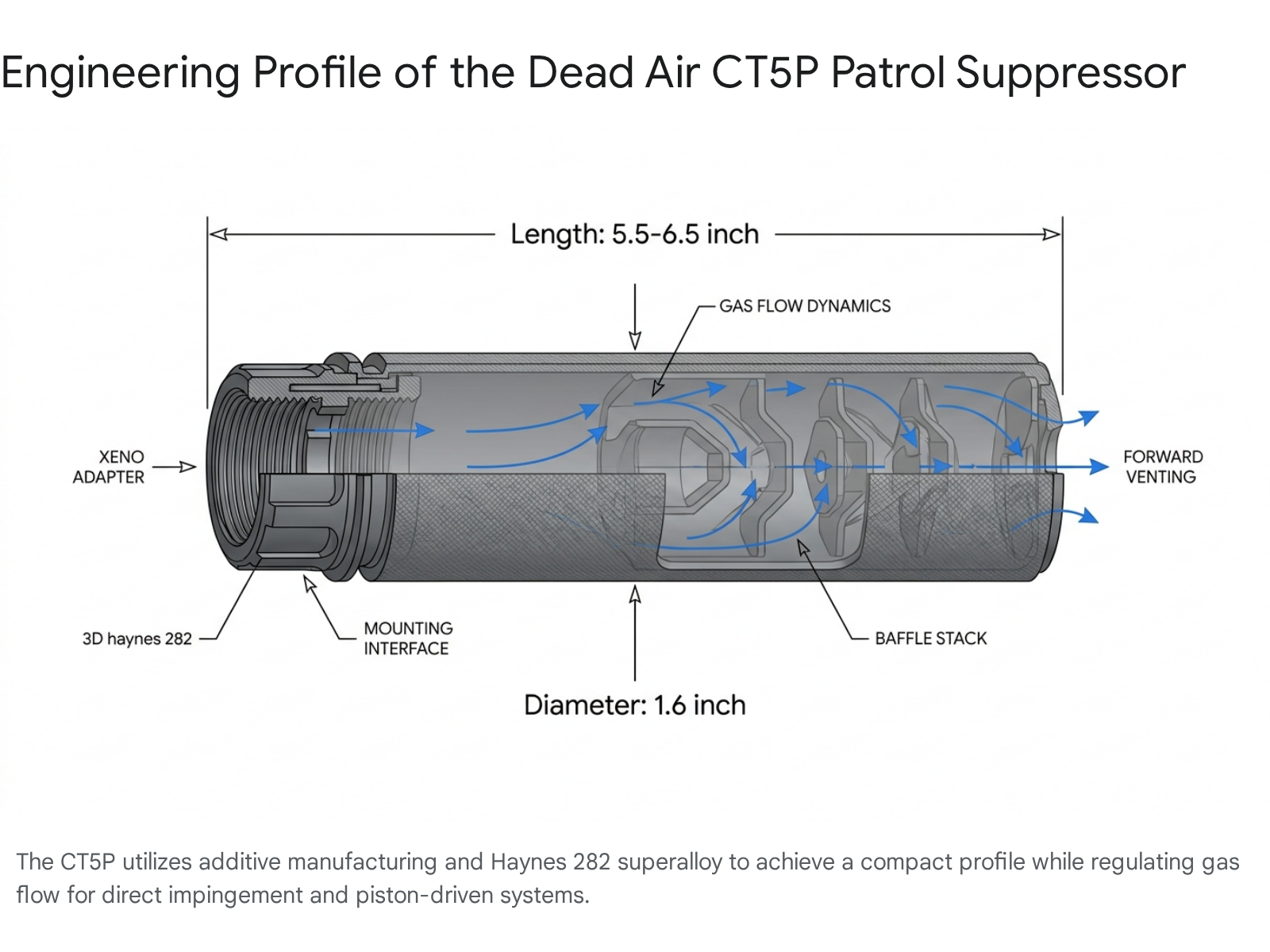
The manufacturing process of the CT5P represents a significant leap in industrial production. The suppressor utilizes additive manufacturing (3D printing) to construct its core from Haynes® 282®, a high-temperature superalloy renowned in the aerospace industry for its exceptional creep strength, thermal stability, and resistance to oxidation at extreme temperatures.1 Traditional subtractive manufacturing (machining away metal from a solid billet) places severe limitations on internal baffle geometries. Additive manufacturing allows Dead Air to create complex, non-linear internal gas flow paths that are physically impossible to machine conventionally.
These advanced internal flow paths are critical for regulating gas expansion within the suppressor body.1 In a traditional sealed suppressor, gas is trapped and forced back down the barrel into the action of the firearm. This backpressure drastically increases the cyclic rate of the weapon, accelerating parts wear, and causes hot, toxic gases (including vaporized lead and carbon) to vent directly out of the ejection port into the face of the shooter. The CT5P’s internal geometry mitigates this phenomenon, ensuring highly reliable firearm function across both direct impingement and piston-driven operating systems, while vastly improving operator comfort and long-term respiratory health.1
The physical dimensions of the CT5P reflect a careful engineering balance. A suppressor must have sufficient internal volume to trap gas, but cannot be so long or heavy that it degrades the maneuverability of the weapon in close-quarters battle (CQB) environments, such as threshold evaluations or room clearing operations. Dead Air offers the system in various mounting configurations to suit individual agency preferences.
| Mounting Configuration | Overall Length | System Weight | Outer Diameter | Mount Interface | Full Auto Rated |
| Direct Thread | 5.49 inches | 13.7 ounces | 1.6 inches | 1/2×28 or 5/8×24 | Yes |
| XENO™ Adapter | 5.89 inches | 14.3 ounces | 1.6 inches | 1/2-28 w/ Xeno | Yes |
| KEYMO® System | 6.55 inches | 14.9 ounces | 1.6 inches | Keymo Interface | Yes |
Table 1: Dead Air CT5P Dimensional Variations by Mounting Architecture 6
Finished in high-temperature black or Flat Dark Earth (FDE) Cerakote, the unit possesses no minimum barrel length restrictions and is rated for sustained full-auto use, underscoring its extreme durability in high-volume fire scenarios.6 In addition to Dead Air, EchoCore Suppressors co-exhibited alongside the major distributor Silencer Shop, further signaling the expanding market penetration and institutional acceptance of specialized sound suppression systems in the modern law enforcement sector.1
5. Re-evaluating Terminal Ballistics and Duty Ammunition Procurement
The selection of duty ammunition carries immense legal, ethical, and operational weight for any law enforcement entity. Agencies must continuously balance the fundamental requirement for rapid threat incapacitation against the severe liability associated with over-penetration—a scenario wherein a bullet passes entirely through a target and strikes an unintended bystander or travels through residential walls. The physics of terminal ballistics dictate how a projectile behaves upon entering soft tissue, and the 2026 conference revealed a pronounced shift away from historical ballistic dogmas.
For decades, the law enforcement standard relied heavily on traditional, heavy-for-caliber jacketed hollow point (JHP) designs, such as the 147-grain or 135-grain 9mm projectile. These designs rely on momentum and controlled expansion (the “mushrooming” effect) to achieve the penetration depths outlined by strict FBI terminal ballistic testing protocols, which generally mandate 12 to 18 inches of penetration in calibrated ordnance gelatin. However, heavy lead projectiles carry an inherent risk of passing completely through a target, particularly when striking an extremity or a target lacking dense bone structure.
At the TTPOA conference, Liberty Ammunition showcased its new “Pro Series” ammunition, specifically engineered for Law Enforcement and Military applications.1 According to CEO Gary Ramey, the Pro Series is actively replacing outdated 147-grain and 135-grain traditional lead bullets in various departments across the country.1
The underlying physics of Liberty Ammunition’s approach fundamentally diverges from traditional heavy-and-slow ballistic theory. Liberty focuses on producing significantly lighter monolithic projectiles that travel at vastly higher velocities. Kinetic energy is calculated by the formula KE-1/2MV^2, where velocity is squared. By drastically increasing velocity, Liberty achieves massive kinetic energy transfer despite the low mass of the projectile. This design philosophy yields several compounding operational benefits 1:
- Liability Mitigation via Energy Transfer: The structural integrity of the high-velocity, lightweight projectile is designed to dump its kinetic energy rapidly upon entering soft tissue. This creates a massive permanent wound channel due to hydrostatic shock, effectively stopping the threat while practically eliminating the risk of over-penetrating the target and exiting into the background environment.
- Recoil Management and Split Times: By firing a lighter projectile, the reciprocating mass energy transferred backward into the shooter’s hand and wrist is significantly reduced. This translates directly to less muzzle flip during the recoil cycle. The operational result is that officers can track their sights more effectively during rapid strings of fire, delivering highly accurate follow-up shots in compressed, life-or-death timeframes.
- Load Carriage Portability: The aggregate weight of ammunition is a frequently overlooked factor in human performance. Lighter projectiles measurably reduce the overall weight of a fully loaded duty belt or plate carrier. While the weight savings per cartridge is measured in fractions of an ounce, when multiplied across multiple 17-round pistol magazines and 30-round rifle magazines, the reduction in carried load mitigates physical fatigue over a grueling 12-hour patrol shift.
Furthermore, the emphasis on replacing traditional lead core bullets intersects with growing occupational health concerns regarding airborne lead exposure at indoor firing ranges. Monolithic or lead-free training equivalents to these duty rounds provide a dual-purpose benefit, protecting the neurological health of the officers during mandatory qualification cycles.
6. The Institutionalization of Precision Gunsmithing in Law Enforcement
Historically, law enforcement agencies procured standard-issue, mass-produced firearms and relied heavily on extensive, taxpayer-funded subsequent training to overcome the platform’s ergonomic or mechanical shortcomings. Issues such as heavy, gritty trigger pulls, subpar control layouts, or excessively stiff manipulation points were viewed as inherent characteristics of duty weapons that an officer simply had to “train through.” The 2026 conference demonstrated a strategic shift toward procuring firearms that are optimized for peak performance immediately out of the box, or utilizing specialized armorer services to elevate standard factory models to match-grade, duty-ready standards.
Langdon Tactical Technology (LTT), an organization historically renowned for its best-in-class custom gunsmithing in the civilian and competition spheres, utilized the TTPOA event to mark its official entry into the law enforcement market.1 Operating under their foundational standard of “Precision Built Confidence,” LTT formally introduced its dedicated Law Enforcement Program, aimed at providing duty-ready solutions directly to agencies and individual officers.10
LTT’s offerings focus on meticulously improving how factory firearms function under the extreme stress of a lethal force encounter. The physiological effects of the sympathetic nervous system during combat—such as vasoconstriction and the loss of fine motor skills—make manipulating a poorly tuned firearm exceedingly difficult. LTT addresses this through signature trigger jobs that smooth the sear engagement, reduce overtravel, and provide a crisp reset, drastically improving the officer’s practical accuracy.10
Additionally, the company offers extensive shotgun performance work.10 The patrol shotgun remains a devastatingly effective close-quarters tool, but factory models often suffer from stiff actions and rough forcing cones that inhibit reliable feeding and extraction. LTT’s tuning ensures the weapon cycles reliably even when operated by an officer experiencing extreme auditory exclusion and tunnel vision. Finally, their rigorous Red Dot Optic (RDO) integration services allow agencies to modernize legacy firearm platforms that were not originally manufactured with optic cuts, thereby extending the lifecycle of existing armory inventory.10 By treating the firearm as a fine-tuned instrument requiring peak mechanical reliability rather than a disposable tool, LTT addresses the crucial micro-seconds required for accurate target acquisition in critical incidents.
7. Platform Diversification: The Resurgence of the Double-Stack 1911 and Piston Rifles
As the rigid adherence to standard striker-fired polymer handguns begins to fracture in specialized tactical units, alternative mechanical platforms are experiencing a significant resurgence. At the TTPOA vendor exhibition, VKTR Industries presented their solutions, emphasizing high-end, purpose-built platforms that blend historical ergonomics with modern capacity.3
VKTR officially introduced their Law Enforcement Program centered around the VKP Pro DS 1911.3 The double-stack (DS) 1911, often referred to in the industry as the 2011 platform, provides the superior ergonomics and highly desirable straight-pull, single-action trigger characteristics of the traditional John Moses Browning 1911 design. However, it abandons the outdated 7-round or 8-round single-stack magazines in favor of modern, high-capacity magazines that hold 17 to 20 rounds of 9mm ammunition. The primary advantage of this platform is the trigger interface; a striker-fired weapon requires the trigger to complete the cocking of the internal striker before releasing it, resulting in a heavier, longer pull. A single-action 1911 trigger merely drops the sear, resulting in a glass-like break that severely reduces the likelihood of the officer pulling the weapon off-target during the shot execution. For SWAT teams and specialized entry units, this precision is paramount.
Additionally, VKTR displayed their premier piston-driven AR-15 rifles.3 The debate between direct impingement (DI) and short-stroke gas piston operating systems in the AR platform is long-standing. While DI systems are inherently lighter and theoretically more accurate due to fewer moving parts above the barrel, they vent hot, dirty gas directly into the bolt carrier group to cycle the action. Piston systems, while generally slightly heavier at the front end, use the gas to strike an operating rod that cycles the bolt. This mechanism keeps the internal receiver of the rifle vastly cooler and drastically reduces carbon fouling. When a rifle is run heavily suppressed—which, as noted in the suppressor analysis, is becoming standard practice—a DI system becomes exponentially dirtier faster. The piston system presented by VKTR offers distinct reliability advantages for tactical teams conducting high-volume fire or operating in austere environments without immediate access to armorer cleaning stations.
8. Pedagogical Shifts in Force-on-Force Training Protocols
The pedagogical gap between static marksmanship on a flat, controlled range and the dynamic, chaotic realities of an actual lethal force encounter is vast. To bridge this divide, law enforcement training doctrines have increasingly relied on stress inoculation—exposing officers to high-stress, decision-making scenarios that closely mimic real-world conditions. These scenarios force the officer to process complex environmental data, navigate the OODA loop (Observe, Orient, Decide, Act), and execute appropriate force responses while their heart rate elevates to combat levels.
Historically, force-on-force training relied heavily on specialized marking cartridges, commonly referred to by the trade name Simunition, which are fired from modified duty weapons. While highly effective at inducing stress due to the pain penalty of a projectile strike, these combustion-based systems present severe logistical hurdles. They require extensive, fail-safe safety protocols to ensure no live ammunition enters the training environment. They are expensive per round, draining agency training budgets rapidly. Most critically, because they utilize gunpowder to fire a high-velocity plastic and wax projectile, they frequently require dedicated shoot-houses or specialized ballistic facilities. They cannot easily be used in standard municipal buildings without causing property damage.
The T4E brand, a specialized division operating under Umarex, demonstrated a comprehensive suite of high-performance training markers and less-lethal platforms at the conference that fundamentally alter this logistical paradigm.2 T4E systems utilize compressed air (CO2 or HPA) to fire paint or powder marker rounds, completely severing the logistical chain from traditional firearms and gunpowder.2
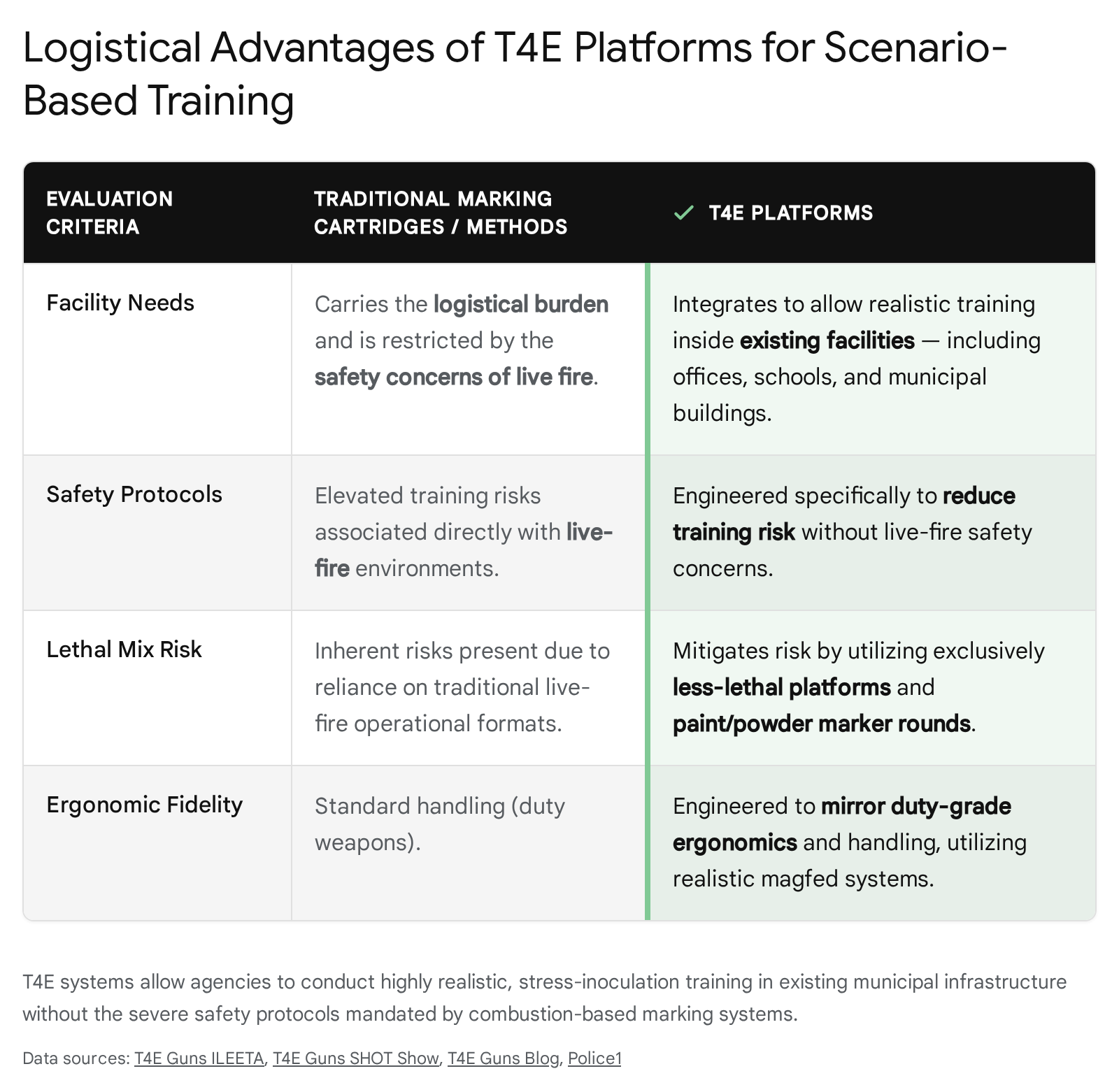
The introduction of the T4E TC 68 Caliber Rifle—a modular, M4-style training platform—highlights the industry’s commitment to ergonomic fidelity.13 These platforms are engineered to directly mirror duty-grade handling, control layouts, and weight distribution.12 This allows instructors to train officers to build correct, subconscious muscle memory regarding weapon manipulation, safety engagement, and reloading procedures, without negative training scars caused by using dissimilar replica weapons.
Crucially, T4E platforms allow agencies to conduct realistic integration strategies inside existing, non-specialized facilities—such as actual schools, corporate office spaces, and municipal buildings—without the severe safety concerns or property damage risks associated with live fire.11 This capability is critical for tactical teams conducting site-specific rehearsals for active shooter response or hostage rescue. Furthermore, the systems support modern training priorities by providing immediate pedagogical feedback and accountability during exercises specifically focused on de-escalation, communication under extreme stress, and close-quarters battle (CQB) decision-making.11 By significantly lowering the cost per repetition and eliminating the logistical barrier of renting dedicated shoot houses, agencies can vastly increase the frequency of force-on-force training cycles for standard patrol officers.
9. Biomechanical Load Carriage and Operator Longevity
The physical toll of carrying extensive tactical equipment—often exceeding 30 pounds of body armor, ammunition, less-lethal munitions, communication gear, and medical supplies—over a 12-hour patrol shift or during a prolonged barricade situation directly impacts an officer’s cognitive function and physical readiness. The 2026 conference placed a significant emphasis on addressing these human performance factors, bridging the gap between traditional tactical gear design and modern sports medicine.
The medical reality for many long-term law enforcement officers involves chronic musculoskeletal injuries, particularly lumbar spine degradation, herniated discs, and hip dysplasia, directly caused by the continuous wear of poorly designed duty belts and plate carriers. Companies such as UF PRO and Lindnerhof presented their latest tactical clothing and load-carrying solutions at the event, directly addressing these physiological failure points.3 The modern approach to tactical apparel moves far beyond simple abrasion resistance, rip-stop fabrics, and camouflage patterns. These highly engineered systems are designed for real operational environments, focusing intently on dynamic weight distribution and thermal regulation.3
Advanced load-carrying solutions presented at TTPOA utilize semi-rigid structural elements—similar to those found in high-end mountaineering backpacks—to transfer the weight of ballistic plates and ammunition away from the vulnerable lumbar spine and distribute it evenly across the stronger pelvic skeletal structure. Furthermore, these systems address the thermal burden placed on the operator. Wearing Level IV ceramic body armor traps body heat, creating a microclimate that rapidly accelerates dehydration and heat exhaustion during foot pursuits or extended perimeter holds. The resulting physiological stress degrades cognitive processing speed, impairing the officer’s ability to make sound use-of-force decisions. Modern tactical apparel incorporates advanced moisture-wicking fabrics and passive venting channels to actively regulate core temperature, thereby preserving the officer’s mental acuity.
10. Physiological Monitoring and the Tactical Athlete Concept
The hardware and load carriage advancements displayed at the conference are closely tied to a broader doctrinal shift regarding human performance in the law enforcement sector. This focus directly aligns with the methodologies presented by the NCSA Tactical Annual Training protocols, which emphasize interdisciplinary education for public safety professionals.14
The industry is rapidly adopting the concept of the “tactical athlete.” Unlike traditional sports athletes who peak for specific, scheduled events, the law enforcement operator must maintain a baseline of extreme physical readiness constantly, while simultaneously managing the detrimental effects of shift work, disrupted circadian rhythms, and chronic psychological stress. Tactical environments require operators to utilize methods that hold up under immense pressure.14 The NSCA frameworks presented emphasize the integration of scientifically designed performance systems, data monitoring to guide administrative decisions, and protocols specifically designed to increase physical durability.14
By monitoring physical data and applying sports science principles, agencies can strengthen shift-work resilience and improve overall mobility and mental readiness.14 This includes collaborating across disciplines to optimize nutrition, cognitive performance under fatigue, and structured return-to-duty protocols following an injury.14 By viewing the officer as a highly trained human weapon system, agencies are recognizing that investment in ergonomic equipment and physiological monitoring is not a luxury, but a fundamental component of institutional risk management, liability reduction, and long-term force preservation.
11. Doctrinal Evolution: Lessons Learned from TTPOA Training Seminars
The hardware and technological advancements displayed on the vendor exhibition floor were contextualized and stress-tested by a rigorous schedule of training courses and tactical seminars. The TTPOA functions fundamentally as an educational body, and the annual conference serves as the primary conduit for the dissemination of evolving tactical doctrines to regional teams and local agencies across the state and the nation.2
The curriculum offered during the 2026 event reflects the increasingly complex threat matrix facing modern law enforcement. The courses go far beyond basic flat-range marksmanship, emphasizing highly specialized skill sets required for asymmetric urban threats. An analysis of the training catalog reveals several critical areas of doctrinal focus:
| Training Module | Duration | Core Tactical Focus and Doctrinal Objective |
| Basic SWAT School | 60 Hours (6 Days) | Provides a comprehensive baseline for newly assigned tactical operators. Focuses on physical selection testing, fundamental entry techniques, cohesive team movements, and initial crisis resolution strategies. |
| Basic Precision Marksman | 50 Hours (5 Days) | Instructed by specialized personnel, focusing on the critical role of the sniper/observer element. Emphasizes intelligence gathering, hide construction, and the precise application of lethal force in hostage or barricaded suspect scenarios. |
| Casualty Care and Rescue Tactics | Specialized | Integrates Tactical Combat Casualty Care (TCCC) principles directly into the operational timeline. Ensures officers can provide life-saving interventions (tourniquet application, wound packing) under active fire before civilian EMS can secure the scene. |
| Patrol Rifle Instructor | 40 Hours (5 Days) | Designed to create internal agency subject matter experts. Ensures the nuances of rifle marksmanship, optic zeroing, and weapon maintenance are effectively pushed out from the tactical teams down to the daily patrol level. |
| LEBA Instructor | 48+ Hours | A demanding instructor development course for police mountain biking. Highlights the enduring value of highly mobile, low-signature platforms in dense urban environments and crowd control situations. |
Table 2: Analysis of Specialized Tactical Training Modules Offered at TTPOA 15
The simultaneous presence of these demanding training modules alongside the vendor exhibition creates a vital, closed-loop feedback mechanism. Operators physically test new equipment during range days and scenario training, immediately identifying ergonomic flaws or mechanical failures. This allows them to provide real-world, highly specific feedback directly to the engineering teams of manufacturers like Dead Air, Langdon Tactical, and T4E.1 This direct interaction ensures that subsequent iterations of tactical equipment are forged by the explicit, unforgiving needs of the end-user operating in extremis, rather than theoretical engineering derived in a vacuum.
12. Strategic Implications for Agency Procurement
The technological developments and doctrinal shifts unveiled at the TTPOA 2026 conference necessitate a strategic, top-down reevaluation of agency procurement methodologies. The era of acquiring disparate, lowest-bidder equipment and forcing it into a cohesive tactical system via sheer willpower and excessive training is ending. The industry is inexorably moving toward highly integrated, purpose-built ecosystems that prioritize operator capability and liability reduction.
- Prioritization of System Integration: Agencies must evaluate firearms not as standalone items, but as holistic platforms. The procurement of a duty pistol must simultaneously account for direct-mount optic capabilities (such as the widespread adoption of Aimpoint’s A-CUT standard) and specialized performance enhancements (such as those offered by LTT) to ensure the weapon operates reliably as a unified, optimized system from the moment of issuance.4
- Mandatory Acoustic and Environmental Mitigation: The adoption of compact, flow-through suppressor technology, exemplified by the Dead Air CT5P, should no longer be viewed as an optional tactical accessory. It must be recognized as a mandatory occupational safety upgrade for all patrol rifles.1 The reduction in weapon backpressure, combined with the mitigation of acoustic trauma and toxic gas exposure, fundamentally preserves officer health and effectiveness during critical incidents.
- Expansion of Non-Lethal Simulation Methodologies: The fiscal limitations and severe logistical constraints of live-fire force-on-force training can be effectively bypassed by integrating advanced air-powered systems like the T4E TC 68 platform.13 The procurement of these systems allows for high-frequency, localized training within actual community infrastructure. This directly improves stress decision-making and de-escalation capabilities, which are paramount in modern policing.
- Continuous Reevaluation of Terminal Ballistics: Agencies must continually review their duty ammunition inventories against modern metallurgical and engineering advancements. The shift toward lightweight, high-velocity monolithic projectiles, such as Liberty Ammunition’s Pro Series, offers a quantifiable, scientific reduction in the liability associated with over-penetration, while maintaining, or exceeding, optimal threat incapacitation standards.1
Ultimately, the TTPOA 2026 conference illustrates a profound maturation of the tactical equipment industry. Manufacturers are delivering highly specialized, scientifically backed tools designed to mitigate physical fatigue, enhance cognitive processing under immense stress, and ensure flawless mechanical reliability in the most demanding environments on earth. Agencies that proactively align their procurement strategies and training doctrines with these evidence-based, ergonomically focused solutions will secure a definitive operational advantage for their personnel, directly translating to increased safety for both the officers and the communities they are sworn to protect.
Please share the link on Facebook, Forums, with colleagues, etc. Your support is much appreciated and if you have any feedback, please email us in**@*********ps.com. If you’d like to request a report or order a reprint, please click here for the corresponding page to open in new tab.
Sources Used
- Shows – The Outdoor Wire | The Outdoor Wire, accessed May 1, 2026, https://theoutdoorwire.com/category/Shows
- T4E set to showcase at two major tactical events – Police1, accessed May 1, 2026, https://www.police1.com/police-training/t4e-set-to-showcase-at-two-major-tactical-events
- Tradeshow | Soldier Systems Daily, accessed May 1, 2026, https://soldiersystems.net/category/tradeshow/
- New Guns and Gear for 2026 – Police and Security News, accessed May 1, 2026, https://policeandsecuritynews.com/2026/03/26/new-guns-and-gear-for-2026/
- Soldier Systems Daily Soldier Systems Daily, accessed May 1, 2026, https://soldiersystems.net/page/21/
- Dead Air CT5P Patrol Direct Thread Rifle Suppressor | 5.56 NATO / 6mm ARC, accessed May 1, 2026, https://www.silencershop.com/dead-air-ct5p-patrol-direct-thread.html
- Dead Air CT5P 5.56/6mm ARC Suppressor w/ integrated Xeno Mount 1/2-28, FDE – Palmetto State Armory, accessed May 1, 2026, https://palmettostatearmory.com/dead-air-ct5p-5-56-6mm-arc-suppressor-w-integrated-xeno-mount-1-2-28-fde-ct5pxnfde.html
- Dead Air CT5P Suppressor: Reviewed – Guns and Ammo, accessed May 1, 2026, https://www.gunsandammo.com/editorial/dead-air-ct5p-suppressor/548049
- Dead Air Defense CT5P – 6mm Patrol Suppressor – Silencer Central, accessed May 1, 2026, https://www.silencercentral.com/products/dead-air-defense-ct5p
- Langdon Tactical to Attend the 2026 TTPOA – The Outdoor Wire, accessed May 1, 2026, https://www.theoutdoorwire.com/releases/2026/04/langdon-tactical-to-attend-the-2026-ttpoa
- T4E to Showcase Advanced Training Solutions at the 2026 ILEETA Conference & Expo in St. Louis, MO, accessed May 1, 2026, https://training.t4eguns.com/t4e-to-showcase-advanced-training-solutions-at-the-2026-ileeta-conference-expo-in-st-louis-mo
- T4E to Showcase Advanced Training Solutions at SHOT Show 2026, accessed May 1, 2026, https://sport.t4eguns.com/t4e-to-showcase-advanced-training-solutions-at-shot-show-2026
- Blog – T4E Training, accessed May 1, 2026, https://training.t4eguns.com/blog
- 2026 NSCA Tactical Annual Training, accessed May 1, 2026, https://www.nsca.com/events/conferences/tactical-training/
- TTPOA, accessed May 1, 2026, https://ttpoa.training/
- TTPOA Training / Event Calendar, accessed May 1, 2026, https://ttpoa.training/events/