The operational landscape of modern public safety, law enforcement, and emergency response requires a highly sophisticated, multifaceted approach to the deployment and maintenance of critical assets. In contemporary operational theaters, the maximization of field efficacy necessitates an uncompromising focus on two primary domains: the physiological and psychological preservation of human first responders, and the modernization of non-human asset utilization, specifically military and law enforcement working dogs. This report delivers an exhaustive, evidence-based review of these two pillars. The analysis evaluates the physiological degradation associated with prolonged shift work, the clinical efficacy of formalized mental health interventions, the strategic deployment of organizational wellness models, the integration of wearable biometric technology in canine operations, and the behavioral and psychological mechanics dictating modern canine detection methodologies.
Part I: The Law Enforcement Human Infrastructure
The foundational element of any public safety apparatus is the human operator. However, the occupational reality of modern law enforcement dictates continuous, twenty-four-hour operational readiness. This continuous demand structure inherently conflicts with the biological limitations of human operators, specifically regarding circadian rhythms, cognitive maintenance, and long-term psychological resilience. The resulting physiological and psychological degradation jeopardizes the individual officer, compromises tactical decision-making, and creates substantial organizational liability.
1.1 The Operational and Physiological Impact of Extended Patrol Shifts
Unlike the heavily regulated commercial aviation and commercial trucking industries, which operate under strict federal work-hour limitations to ensure operator alertness, law enforcement agencies historically operate with relatively few strict work-hour restrictions.1 Consequently, police personnel frequently execute consecutive twelve-hour patrol shifts, which are routinely compounded by mandatory court appearances, administrative duties, and secondary employment.1 The compounding, cumulative effect of this scheduling architecture creates a state of chronic cognitive depletion.
Circadian Misalignment and the Science of Cognitive Fatigue
The biological toll of extended shift work and circadian misalignment manifests rapidly and measurably. Human fatigue science demonstrates that remaining awake for seventeen consecutive hours impairs cognitive and motor performance to a level functionally equivalent to a blood alcohol concentration (BAC) of 0.05 percent.1 Extending this period of wakefulness to twenty-four hours produces a level of cognitive degradation comparable to a 0.10 percent BAC, effectively rendering the officer legally intoxicated by civilian motor vehicle operation standards.1
Finnish occupational health researchers have further quantified this decline, determining that extended shift durations correlate with an increase in self-reported levels of sleepiness by fifteen percent for every additional hour worked.2 The transition from traditional eight-hour shifts to twelve-hour shifts has been widely debated across municipal and federal agencies. While some administrative models favor the twelve-hour schedule to maximize personnel coverage and grant officers more consecutive days off to theoretically aid recovery, empirical evidence indicates significant drawbacks. Workers subjected to twelve-hour schedules display consistently poorer performance on complex perceptual, cognitive, and motor skill assessments compared to their counterparts working standard eight-hour rotations.3
Furthermore, the structure of the shift rotation plays a critical role in mitigating or exacerbating fatigue. Different combinations of rotating schedules influence biological misalignment. Research evaluating hospital-based shift workers demonstrated that those working rotating shifts experienced more severe sleep disruption, were more prone to involuntary sleep episodes while on duty, and had a higher likelihood of being involved in reportable vehicle collisions compared to fixed-shift personnel.4 However, the direction of the rotation is highly influential; studies indicate that rapid forward-rotating shift patterns (e.g., mornings to afternoons to nights) actually yield positive physiological effects, improving overall well-being and alertness while reducing complaints related to sleep deprivation, as opposed to traditional backward-rotating systems.4 Within intensive care units, personnel working twelve-hour shifts demonstrated an increased risk of medication errors and critical incidents classified as “near misses,” providing an alarming corollary for law enforcement personnel entrusted with lethal force decision-making.2 Additionally, officers deployed on night shifts suffer from pronounced memory retention issues compared to those operating on day shifts.2
Degradation of Situational Awareness and Reaction Time Metrics
Situational awareness is the foundational element of tactical decision-making and survival in law enforcement environments. Incomplete early-stage situational awareness—specifically the failure to visually and cognitively perceive relevant environmental stimuli—leads directly to subsequent errors in judgment, decision-making, and use of force.5 Cognitive fatigue systematically erodes the high-level visual processing required for optimal situational awareness, effectively reverting highly experienced officers to novice-level scanning and threat-assessment behaviors.
Eye-tracking studies evaluating police situational awareness have demonstrated that visual fixation patterns differ significantly based on experience levels.5 When engaging with typical, high-stress encounters, all personnel tend to fixate longer on active targets compared to the operational periphery. However, experts in tactical response fixate significantly earlier on a suspect’s hands and spend proportionally less time scanning irrelevant environmental features, allowing for rapid threat identification.5 Conversely, early novices are slower to identify primary threat vectors, focusing instead on faces or broader physical bodies.5 Under the stress of chronic fatigue, the executive functioning required to maintain these expert scanning patterns deteriorates.
This deterioration is highly measurable in controlled simulation environments. In high-fidelity driving simulator studies, experienced patrol officers were evaluated immediately following the completion of five consecutive ten-hour and forty-minute shifts (the fatigued condition) and subsequently evaluated seventy-two hours after completing a shift cycle (the rested condition).6 When subjected to cognitive distraction tasks intended to replicate interaction with a mobile data computer, fatigued officers demonstrated significantly greater lane deviation metrics and prolonged braking reaction times.6 These distraction effects mirror civilian accident statistics, wherein inattention is cited as a major causal factor in forty-six percent of emergency vehicle accidents.7
The impact of fatigue extends to lethal force scenarios. Across comprehensive performance metrics evaluating split-second decision-making in use-of-force shooting simulators, officers operating under physiological stress frequently yield average performance scores ranging between fifty and sixty-six percent, indicating highly suboptimal operational capability.8 The physiological markers associated with this performance, including cardiovascular reactivity, resting heart rate during shifts, and intra-individual variability in vagal control, all point toward a workforce operating under severe biological strain.8
Behavioral Divergence: Reactive Force Versus Proactive Policing
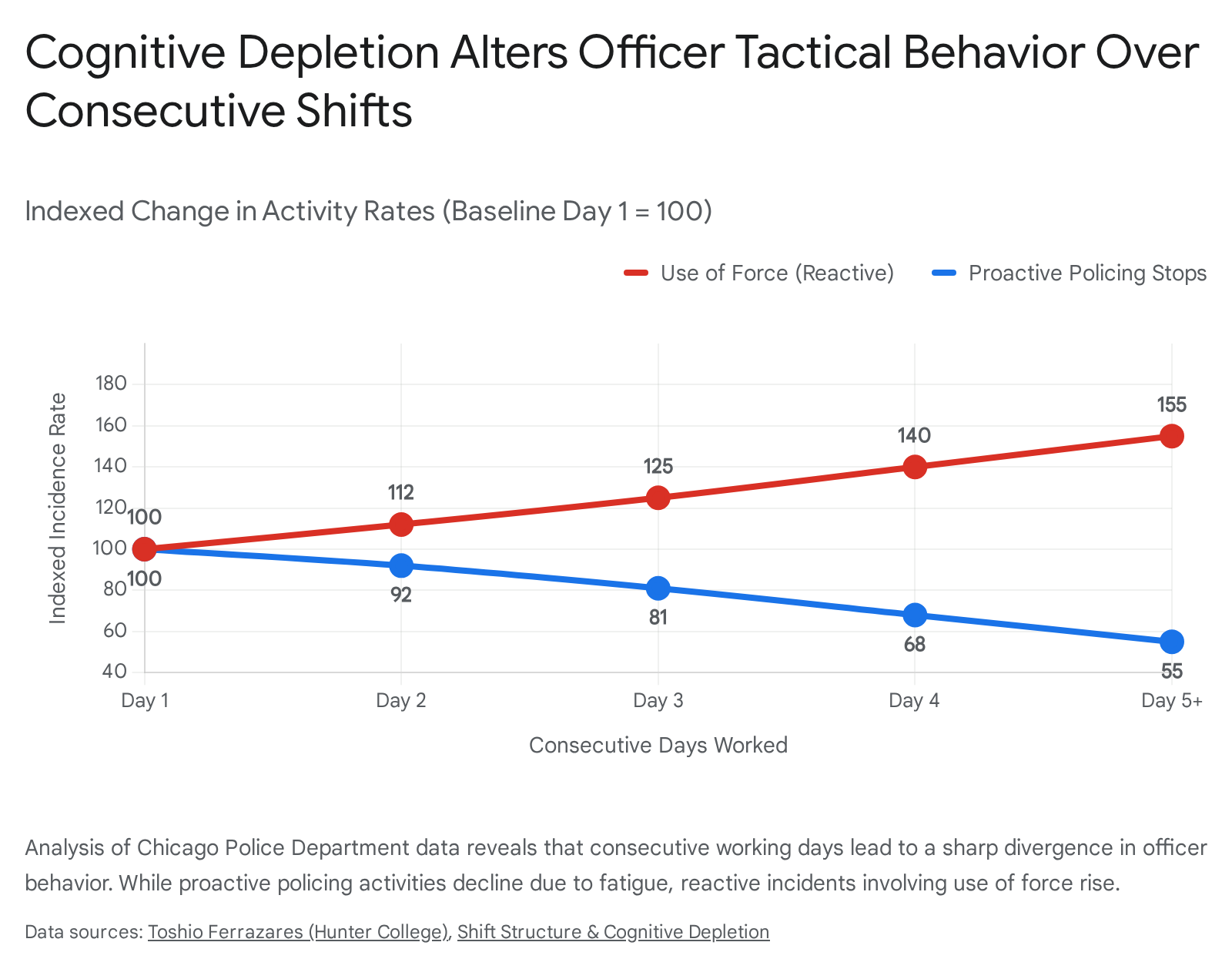
The accumulation of cognitive stress directly influences discretionary actions in the field. An extensive longitudinal analysis of the Chicago Police Department—conducted by Toshio Ferrazares—evaluated the evolution of officer behavior, decision-making, risk-taking, and situational awareness over consecutive working days.11 By utilizing fixed-effect models to overcome the endogenous selection of working days, the research revealed a stark behavioral divergence driven primarily by cumulative cognitive depletion.11
The data clearly demonstrated that as officers accumulate more consecutive working days, their approach to policing shifts from proactive engagement to reactive, and frequently aggressive, responses. Officers utilize physical force more frequently, execute a higher volume of judgment-based discretionary arrests, and suffer a statistically higher probability of occupational injury.14 Simultaneously, the data illustrates a sharp decline in proactive, community-oriented policing measures. As consecutive workdays increase, officers initiate fewer self-directed stops, issue fewer citations, make fewer overall arrests, and spend considerably less time engaged in active patrol activities.14
This behavioral shift is not correlated with external administrative factors, such as changes in specific arrest types, altered shift assignments, or varying officer roles.14 Rather, the data points exclusively to internal cognitive mechanisms: officers are fundamentally changing their operational behavior as they work more days, defaulting to lower-effort reactive responses due to fatigue.14
1.2 Clinical Efficacy of Mental Health Interventions and Screening
The continuous exposure of public safety personnel to potentially psychologically traumatic events yields rates of mental illness that far exceed civilian baselines. Epidemiological data indicates that one in every seven police officers globally suffers from post-traumatic stress disorder or clinical depression, while one in ten struggles with other mental illnesses.15 When compared to the general adult population, law enforcement personnel experience PTSD and depression at approximately twice the prevalence rate, sitting between twenty percent versus the civilian baseline of seven to nine percent.15
The etiology of these conditions is tied directly to acute trauma events and cumulative operational stress. For example, law enforcement personnel experienced significant increases in psychological distress following mass casualty events such as the September 11th attacks, and officers responding to Hurricane Katrina exhibited highly elevated levels of coexisting PTSD and depression.16 Individuals diagnosed with occupational PTSD frequently struggle with comorbid conditions, including generalized anxiety, sleep disorders, substance abuse, elevated suicide risk, and severe family or relationship discord.16 Traditional therapeutic interventions face substantial cultural, logistical, and systemic barriers within emergency services, necessitating an evidence-based review of what modalities actually produce clinical efficacy.
Efficacy and Limitations of Psychological Interventions
A rigorous systematic review and meta-analysis evaluating the effectiveness of psychological interventions specifically tailored for first responders demonstrated significant clinical efficacy in reducing specific psychiatric symptoms.18 The data, analyzed utilizing standardized mean differences, reveals specific areas of therapeutic success and failure.
Table 1: Clinical Efficacy of First Responder Psychological Interventions
| Psychiatric Symptom | Standardized Mean Difference (SDM) | Confidence Interval (95% CI) | Statistical Significance |
| Post-Traumatic Stress Disorder | -0.86 | -1.34 to -0.39 | Significant reduction observed.18 |
| Clinical Depression | -0.63 | -0.94 to -0.32 | Significant reduction observed.18 |
| Generalized Anxiety | -0.38 | -0.71 to -0.05 | Moderate reduction observed.18 |
| Occupational Stress | -0.13 | -0.51 to 0.25 | No significant reduction observed.18 |
The analysis identified that Cognitive Behavioral Therapy methodologies and clinician-delivered interventions were associated with significantly greater reductions in PTSD compared to non-clinician interventions, though no corresponding difference was found for the treatment of depression.18 However, the most critical finding from the systematic review is the lack of statistical significance in reducing generalized occupational stress. The data suggests that while acute psychiatric conditions resulting from trauma can be successfully treated, the ambient, daily operational stress of the law enforcement profession remains highly pervasive and resistant to traditional psychological interventions.18
The Paradox of Mandatory Mental Health Screenings
In an effort to proactively identify personnel suffering from psychological trauma and to mitigate institutional liability, many municipal and state agencies have instituted mandatory, employer-administered mental health screenings. However, the operational efficacy of these mandatory screenings is deeply compromised by systemic institutional paranoia, stigma, and the fear of severe occupational repercussions.
Research evaluating matched self-report scores reveals a profound under-reporting phenomenon among law enforcement personnel.21 When completing mental health screenings administered directly by their employer, police officers reported only 76.3 percent of the symptoms they simultaneously declared on independent, confidential research screenings.21 This active suppression of symptoms occurred consistently across all genders and symptom types.21
Critically, the suppression of psychological symptoms was not distributed evenly across the workforce. Less senior staff members, who likely perceive a higher vulnerability to termination or reassignment, were significantly more likely to under-report symptoms.21 More alarmingly, officers suffering from the most severe manifestations of post-traumatic stress disorder and common mental disorders were the most likely demographic to falsify their employer-administered screenings, actively hiding their condition.21 Officers reported significantly lower levels of anxiety and PTSD on official forms compared to confidential surveys, utilizing the employer screening merely as a bureaucratic hurdle rather than a diagnostic tool.21
The primary driver of this under-reporting is the stigma associated with mental health care in emergency services. Sociological frameworks, such as labeling theory, suggest that officers actively avoid treatment to prevent being labeled as unfit, unstable, or unreliable within the hyper-masculine culture often referred to as the “Blue Wall of Silence”.22 Officers are continuously presented with high-stress encounters, yet the minimization of their psychological toll leads directly to burnout and heightened anxiety.22 The deployment of clinical interventions is frequently hampered by a lack of trust, limited access to culturally competent medical providers, and a profound preference for support originating from individuals who possess shared operational experiences.17
Formalized Peer-Counseling Infrastructure
To bypass the severe limitations of employer-mandated screenings and the cultural resistance to traditional clinical avenues, formalized peer support programs have emerged as a vital adjunct strategy.23 Society relies on first responders to perform effectively in highly stressful, life-threatening situations.24 Peer support programs address the unique needs of this population by training active-duty individuals within the workplace to provide emotional, social, and highly practical support to their colleagues.23
Since these programs typically provide support at no cost and are delivered with extreme flexibility—allowing interventions to be offered while on duty or at times highly convenient for the officer—they significantly reduce the impact of several barriers to care.23 The most effective peer programs involve personnel formally trained in Critical Incident Stress Management protocols, establishing a culturally competent first line of defense that socializes officers to the counseling process, tailors information regarding stress management, and acts as a trusted bridge to specialized clinical care.17 However, challenges remain, specifically regarding the lack of legislative confidentiality protections for peer supporters who are not formally licensed clinicians, creating legal ambiguities that some agencies struggle to navigate.17
1.3 Organizational Models and Leadership Destigmatization
The mitigation of the mental health crisis within law enforcement cannot be isolated to individual interventions or passive policies; it requires systemic, top-down cultural reform. Agencies must architect administrative environments where executive leadership actively participates in, funds, and publicly champions wellness initiatives. Programs that rely solely on passive availability typically fail due to the aforementioned cultural stigmas.
The Berrien County Case Study
The law enforcement and public safety infrastructure within Berrien County, Michigan, provides a highly effective, comprehensive organizational model for integrated mental health support. The Berrien County Sheriff’s Office, in deep coordination with the local judicial system, the health department, and the Michigan Department of Corrections (MDOC), has deployed a multi-tiered approach to destigmatization and officer wellness that directly impacts retention, performance, and public safety.26
The success of the Berrien County model is rooted in its visibility and its integration into the broader community infrastructure. The county operates a specialized Mental Health Wellness Court, a 12-to-24 month, four-phase collaborative probation program designed specifically for justice-involved individuals with mental health diagnoses.26 By creating a system focused on rehabilitation rather than strict punitive incarceration, the county structurally aligns its justice system with modern mental health practices.26 This external focus on mental health is mirrored internally within the Sheriff’s Office.
Through the utilization of state funding, such as the Juvenile Justice and Delinquency Prevention Act Title II Grant, the court system provided specialized, evidence-based behavioral health and de-escalation training to law enforcement officers in the Benton Harbor community.27 Over the course of the project, personnel completed rigorous Crisis Intervention Team and Mental Health First Aid training protocols.27 This training facilitates the early identification of behavioral health crises, aiming to reduce the disproportionate number of delinquency petitions originating from the area.27
Furthermore, the agency has actively normalized mental health discourse by moving internal peer support initiatives into the public domain. The Berrien County Sheriff’s Office Peer Support team actively organizes public events, such as the Peer Support 5K, which is formally permitted by the City Commission.29 This visible, community-facing action serves to destigmatize psychological maintenance, demonstrating to both the public and the rank-and-file officers that mental health is a prioritized, standardized component of tactical readiness.
To ensure continuous engagement, the region utilizes dedicated Wellness Units. For example, the Michigan Department of Corrections deploys Wellness Coordinators—many of whom possess extensive backgrounds as mental health professionals previously embedded within the Berrien County Sheriff’s Department—to conduct active facility visits, engage with officers during leadership retreats, and integrate wellness discussions directly into recruit family orientations and graduations.30 This persistent presence builds profound trust and confidence among the staff, proving vital for early intervention.30
Finally, the agency addresses the root causes of cognitive fatigue and stress by actively securing operational funding. The utilization of state Secondary Road Patrol grants provides crucial financial support to the Sheriff’s operational budget, directly mitigating understaffing and reducing the per-officer operational burden.31 By addressing both the symptoms of mental health degradation through peer support and the root causes through strategic staffing models, Berrien County exemplifies a holistic approach to first responder wellness.
Part II: Advanced Canine Security Detection and Deployment
While the optimization of the human first responder is vital, modern security apparatuses rely heavily on the unique physiological capabilities of non-human assets. Military Working Dogs and Law Enforcement K9s represent a critical layer of defense. However, the methodology of deploying these assets has undergone a technological and tactical renaissance. The integration of biometric monitoring, a deeper understanding of olfactory physics, and the psychological engineering of breed selection have fundamentally altered how canines operate in public spaces.
2.1 The Integration of Wearable Biometric Technology
Working dogs operate in highly austere, physically demanding environments, facing many of the same operational hazards as their human handlers. Historically, handlers were forced to rely exclusively on visual behavioral cues to assess a dog’s physical state, fatigue level, or distress. Today, the integration of wearable biometric technology provides real-time, empirical physiological data, drastically reducing the incidence of preventable casualties and enhancing tactical coordination.
Mitigating Exertional Heat Illness and Biological Monitoring
Canines are highly susceptible to exertional heat illness, hyperthermia, and rapid dehydration. This risk is profoundly magnified when dogs are deployed in extreme environments, such as tracking suspects near the southern border, or when outfitted in heavy, heat-retaining tactical ballistic vests. Heatstroke is a primary cause of non-combat canine casualties, which can result in rapid fatality if not immediately mitigated.33
To combat this, federal agencies have aggressively pursued biometric telemetry. The Department of Homeland Security Science and Technology Directorate, in conjunction with Orlando-based HaloLights LLC, initiated the development of the Canine Health Analytics Monitoring Platform.34 This advanced tactical harness continuously monitors the canine’s core body temperature, heart rate, and GPS location in real-time.34
Similarly, the U.S. Army Medical Department Board (USAMEDDBD) conducted comprehensive operational assessments of the Canine Thermal Monitor mobile application and collar.36 Deployed with the 802d Security Force Squadron Military Working Dog Kennel at Joint Base San Antonio-Lackland, the system was evaluated for its effectiveness in reducing heat injury risks.36 In active field operations, the telemetry is communicated directly to the handler’s smartphone via secure tactical applications.33 The system instantly triggers an alert if the canine’s internal temperature exceeds predetermined safe biological limits.33 This continuous data stream allows handlers, trainers, and military veterinarians to predict safe work durations, mandate rest periods, and optimize recovery times based on hard physiological data rather than subjective estimation, entirely removing the guesswork from heatstroke prevention.36 Beyond temperature, specialized platforms are also being researched to evaluate core cognitive function, hydration, electrolyte balance, and even bite performance metrics, including bite pressure and grip stability.37
Tactical Tracking and Remote Deployment Mechanics
Beyond the realm of biological preservation, wearable technology profoundly enhances tactical execution. Handlers frequently utilize long-line deployments for complex tracking operations or specialized weapons and tactics building searches. However, these deployments present significant entanglement risks, limiting options and increasing the danger to both the handler and the canine.38
To address this vulnerability, specialized biometric and hardware integrations, such as the Tactical Deployment System (TDS-K9), offer remotely releasable deployment mechanisms.38 Developed by canine professionals, these systems allow handlers to safely back-tie their dog, maintain a secure position of cover during high-risk operations, and release the canine instantly via a remote device.38 This prevents dogs from becoming entangled during dynamic room entries and allows an instant release if a dog becomes hung up on environmental debris, instantly turning a potential rescue situation back into a mission focus.38
Furthermore, integrated GPS tracking severely reduces handler stress by maintaining constant location updates in complex, multi-story environments or dense foliage.40 This technology enables highly synchronized movements between K9 units and accompanying law enforcement teams, ensuring a safer and more organized response.40 The implementation of detailed tracking and performance logging has demonstrable operational benefits; research published in the Journal of Police and Criminal Psychology found that K9 units utilizing structured performance tracking systems experienced a twenty-seven percent increase in successful real-world outcomes compared to units operating without detailed data logging.41
2.2 The Scientific Mechanics of Kinetic Detection and Vapor Wake
Traditional explosives detection methodology relies predominantly on static searches. In this historical model, a canine is directed by a handler to sniff specific, stationary objects—such as abandoned luggage, vehicles, or cargo pallets.42 However, the evolution of global terrorism and the rise of person-borne explosives required a fundamental paradigm shift in olfactory mechanics, leading to the development of “Kinetic Detection” or “Vapor Wake” technology.
Fluid Dynamics and the Aerodynamics of Thermal Plumes
Developed extensively by researchers at Auburn University’s Canine Performance Sciences program, Vapor Wake technology capitalizes on human thermodynamics and aerodynamic fluid dynamics.43 The mechanics of Vapor Wake detection rely on the physical phenomena of human thermodynamics, aerodynamic plumes, and concentration gradients. As an individual moves, they leave behind an aerodynamic thermal wake.43
The human body continuously emits a thermal heat plume. When an individual moves through an environment, this heat plume trails behind them, acting similarly to the physical wake left by a boat moving through water.43 If an individual is carrying explosive materials, illicit narcotics, or concealed firearms, microscopic particulates and volatile organic compounds become trapped and suspended within this invisible thermal plume.43
Vapor Wake canines undergo specific and rigorous training programs designed to reliably detect these odorants within the aerodynamic wakes of moving individuals in dense crowds of people.45 These dogs are conditioned to continuously sample the ambient air currents. Upon detecting a target volatile organic compound within the aerodynamic wake, the canine initiates pursuit, tracking the concentration gradient of the plume directly back to the moving source, effectively leading the handler through chaotic environments to intercept the threat.44
Odor Availability and Advanced Chemical Training Methodology
The threshold of detection for a working dog is governed not merely by the physical weight of the explosive material, but by the complex principle of odor availability. Odor availability is deeply influenced by environmental factors including the target’s surface area, confinement status, ambient temperature, and humidity.44 For example, the vapor profile of pure cocaine differs entirely from the degradation products found in complex plastic explosives.
Training these canines to recognize a vast library of volatile compounds presents severe logistical and safety challenges. Utilizing live, real-world hazardous materials for daily training is highly expensive and exceptionally dangerous, requiring specialized storage bunkers, highly trained explosives technicians, costly transport protocols, and meticulous chains of custody.42 However, commercially available non-explosive training aids historically failed to gain widespread acceptance due to documented ineffectiveness.42
To safely condition kinetic detection dogs for modern threats, scientists at the National Institute of Standards and Technology executed groundbreaking work in canine olfaction chemistry.42 They developed advanced, non-explosive reference materials utilizing a highly absorbent, jelly-like polymer called polydimethylsiloxane.48
Using an innovative two-temperature method, scientists gently warm a target explosive compound (for instance, dinitrotoluene, which is the primary low-level contaminant and main odorant in TNT explosives) to rapidly release its vapors.48 These vapors are then efficiently captured by the polydimethylsiloxane polymer, which is maintained at a cooler temperature to absorb the vapors more readily.48 This process drastically reduces the time required to “charge” training aids from several weeks to merely a few days.48 This allows handlers to rapidly deploy chemically accurate, slow-releasing odor profiles in civilian training environments without any risk of accidental detonation, ensuring that if a new type of explosive is identified globally, training aids can be manufactured and distributed to K9 units in days rather than months.48
2.3 The Strategic and Psychological Shift to Non-Traditional Breeds
As the operational theater for detection canines has expanded significantly over the past decade—moving from hardened military bases and restricted perimeters to highly populated “soft targets” such as elementary schools, hospitals, mass transit hubs, and commercial sporting stadiums—the psychological impact of the canine on the general public has become a primary strategic consideration.
Pointy-Eared Versus Floppy-Eared Security Profiles
Historically, security elements utilized what the industry refers to as “pointy-eared” guardian breeds—predominantly the German Shepherd, the Belgian Malinois, and the Dutch Shepherd.49 These breeds possess incredibly high drive, extreme physical capability, immense bite force, and a deeply ingrained public perception of aggression and intimidation.49 While highly effective for perimeter deterrence, suspect apprehension, and military patrol, the deployment of these guardian breeds in sensitive, civilian-heavy environments often proves counterproductive.
The public is psychologically conditioned by media and historical context to fear these breeds, which can easily put hospital patients, young students, and event guests severely on edge.49 Furthermore, the extreme arousal, enthusiasm, and “nervy” drive inherent to military-line working dogs can result in the animal itself becoming highly stressed when forced to navigate dense, chaotic crowds of sixty thousand people at major sporting events or concerts.49
Consequently, there has been a massive strategic shift toward deploying “floppy-eared” sporting and hunting breeds—predominantly Labrador Retrievers and German Shorthaired Pointers—for interior crowd screening and kinetic detection.49 These sporting breeds possess exceptional olfactory capabilities and are highly resilient to chaotic environmental stimuli, but crucially, they lack the intimidating reputation of guardian breeds.49 They are viewed by the general public as docile, friendly, and approachable.49 Deploying a sporting breed allows security personnel to conduct high-level, constant kinetic detection for firearms and explosives seamlessly within a dense crowd without triggering any psychological distress among the civilian population.49
Table 2: Comparative Deployment Profiles of Security Canine Breeds
| Breed Classification | Representative Breeds | Psychological Profile & Public Perception | Optimal Deployment Environment |
| Pointy-Eared (Guardian/Military) | German Shepherd, Belgian Malinois, Dutch Shepherd, Cane Corso | High drive, intense focus, perceived as highly aggressive or intimidating by civilians. High bite force capabilities.49 | Hardened perimeter security, border checkpoints, military operations, active suspect apprehension, crowd control.49 |
| Floppy-Eared (Sporting/Hunting) | Labrador Retriever, German Shorthaired Pointer | Exceptional olfactory stamina, resilient to crowded stimuli, perceived as docile, friendly, and highly approachable.49 | Interior patrols, public schools, hospitals, mass transit hubs, large public event venues, stadiums.49 |
The Psychology of Deterrence and De-escalation in Soft Targets
The deployment of these non-traditional detection breeds yields an unexpected but highly effective psychological benefit in public spaces: invisible deterrence and de-escalation. Security professionals estimate that up to eighty percent of a K9 unit’s success in a civilian environment is rooted entirely in altering human behavior simply through their presence, regardless of the breed.49
When individuals approach a facility and observe a detection canine, they frequently undergo an involuntary behavioral response termed the “fake pat down” phenomenon.49 Subjects subconsciously touch their pockets, waistbands, or bags containing illicit narcotics, weapons, or unprescribed medications, visually telegraphing their guilt to observing handlers.49 This psychological priming often prompts individuals to voluntarily return contraband to their vehicles before attempting to enter a venue, effectively neutralizing a threat without a physical confrontation or formal search.49
This dynamic is particularly critical in modern educational and medical environments. Since 1970, there have been over 1,360 school shootings across various grade levels, prompting schools to implement metal detectors, cameras, and armed school resource officers.53 The integration of trained protection and detection dogs into campus security measures offers a non-intimidating method to detect illegal contraband like drugs and weapons, thereby lowering sales and possession on school grounds while minimizing the traumatic exposure of students to aggressive security posturing.54
Furthermore, in highly volatile and emotionally charged environments like hospital emergency rooms, the arrival of a K9 unit immediately disrupts aggressive behavior. Escalated individuals—who may be screaming or acting out violently—typically cease their physical outbursts out of an innate, psychological respect for the canine.49 This phenomenon allows security personnel and medical staff to de-escalate incredibly tense situations and retrieve highly dangerous contraband—such as unprescribed fentanyl—without executing physical force, ensuring the safety of the medical staff, the patient, and the security officers.49
By leveraging the specific psychological reactions of the public to varying canine morphologies, security apparatuses can seamlessly integrate highly capable detection assets into the most sensitive environments. This strategic fusion of advanced olfactory science, wearable biometric technology, and behavioral psychology represents the current zenith of non-human security deployment.
Please share the link on Facebook, Forums, with colleagues, etc. Your support is much appreciated and if you have any feedback, please email us in**@*********ps.com. If you’d like to request a report or order a reprint, please click here for the corresponding page to open in new tab.
Sources Used
- Shift Work, Fatigue, and Overtime in Policing: Balancing Officer Wellness and Public Safety, accessed May 10, 2026, https://www.policinginstitute.org/infocus/infocus-shift-work-fatigue-and-overtime-in-policing-balancing-officer-wellness-and-public-safety/
- Human Fatigue in 24/7 Operations: Law Enforcement Considerations and Strategies for Improved Performance – Police Chief Magazine, accessed May 10, 2026, https://www.policechiefmagazine.org/human-fatigue-in-247-operations/
- The Impact of Shift Length in Policing on Performance, Health …, accessed May 10, 2026, https://www.ojp.gov/pdffiles1/nij/grants/237330.pdf
- The Effects of Fatigue on Cognitive Performance in Police Officers …, accessed May 10, 2026, https://pmc.ncbi.nlm.nih.gov/articles/PMC6429037/
- Experience-Dependent Effects to Situational Awareness in Police Officers: An Eye Tracking Study – PMC, accessed May 10, 2026, https://pmc.ncbi.nlm.nih.gov/articles/PMC9105864/
- Distracted driving impairs police patrol officer driving performance – Emerald Publishing, accessed May 10, 2026, https://www.emerald.com/pijpsm/article-split/38/3/505/321178/Distracted-driving-impairs-police-patrol-officer
- Attention and Situational Awareness in First Responder Operations – Pacific Northwest National Laboratory, accessed May 10, 2026, https://www.pnnl.gov/sites/default/files/media/file/RTA_Situational_Awareness.pdf
- A Reasonable Officer: Examining the Relationships Among Stress, Training, and Performance in a Highly Realistic Lethal Force Scenario – PMC, accessed May 10, 2026, https://pmc.ncbi.nlm.nih.gov/articles/PMC8803048/
- Stress-Activity Mapping: Physiological Responses During General Duty Police Encounters, accessed May 10, 2026, https://www.frontiersin.org/journals/psychology/articles/10.3389/fpsyg.2019.02216/full
- Full article: Assessing between-officer variability in responses to a live-acted deadly force encounter as a window to the effectiveness of training and experience – Taylor & Francis, accessed May 10, 2026, https://www.tandfonline.com/doi/full/10.1080/00140139.2023.2278416
- Shift Structure and Cognitive Depletion … – Toshio Ferrazares, accessed May 10, 2026, https://ferrazares.github.io/assets/FERRAZARESjmp.pdf
- Essays in the Economics of Policing and Public Safety – eScholarship.org, accessed May 10, 2026, https://escholarship.org/uc/item/4wj3p880
- UC Santa Barbara – eScholarship.org, accessed May 10, 2026, https://escholarship.org/content/qt4wj3p880/qt4wj3p880.pdf
- Toshio Ferrazares, accessed May 10, 2026, https://ferrazares.github.io/
- Mental Disorders and Mental Health Promotion in Police Officers – PMC – NIH, accessed May 10, 2026, https://pmc.ncbi.nlm.nih.gov/articles/PMC10875161/
- Behavioral Health Training for Police Officers: A Prevention Program | FBI – LEB, accessed May 10, 2026, https://leb.fbi.gov/articles/featured-articles/behavioral-health-training-for-police-officers-a-prevention-program
- Ensuring Optimal Mental Health Programs and Policies for First Responders: Opportunities and Challenges in One U.S. State – PMC, accessed May 10, 2026, https://pmc.ncbi.nlm.nih.gov/articles/PMC10031720/
- The effectiveness of psychological interventions for reducing PTSD and psychological distress in first responders: A systematic review and meta-analysis – PMC, accessed May 10, 2026, https://pmc.ncbi.nlm.nih.gov/articles/PMC9401173/
- The effectiveness of psychological interventions for reducing PTSD and psychological distress in first responders: A systematic review and meta-analysis – PubMed, accessed May 10, 2026, https://pubmed.ncbi.nlm.nih.gov/36001612/
- (PDF) The effectiveness of psychological interventions for reducing PTSD and psychological distress in first responders: A systematic review and meta-analysis – ResearchGate, accessed May 10, 2026, https://www.researchgate.net/publication/362921927_The_effectiveness_of_psychological_interventions_for_reducing_PTSD_and_psychological_distress_in_first_responders_A_systematic_review_and_meta-analysis
- Mental health screening amongst police officers: factors associated with under-reporting of symptoms – PMC, accessed May 10, 2026, https://pmc.ncbi.nlm.nih.gov/articles/PMC7938555/
- Destigmatizing Mental Health Treatment Among Law Enforcement Officers Amidst the Blue Wall of Silence – ScholarWorks, accessed May 10, 2026, https://scholarworks.waldenu.edu/cgi/viewcontent.cgi?article=16854&context=dissertations
- Peer Support Programs for First Responders: A Critical Review and Research Roadmap – PMC, accessed May 10, 2026, https://pmc.ncbi.nlm.nih.gov/articles/PMC12562525/
- First Responder Peer Support Programs | FBI – LEB, accessed May 10, 2026, https://leb.fbi.gov/articles/featured-articles/first-responder-peer-support-programs
- View of Safeguard programs and mandatory mental health checks in Canadian police agencies: history, trends, and future directions, accessed May 10, 2026, https://www.journalcswb.ca/index.php/cswb/article/view/414/1208
- Mental Health / Wellness Court | Berrien County, MI, accessed May 10, 2026, https://www.berriencounty.org/1859/Mental-Health-Wellness-Court
- Berrien County Final Evaluation Report MDHHS Title II_Final Report – Michigan Committee on Juvenile Justice, accessed May 10, 2026, https://michigancommitteeonjuvenilejustice.com/wp-content/uploads/Berrien-County-Final-Evaluation-Report-MDHHS-Title-II-Final-Report.pdf
- BERRIEN COUNTY PUBLIC POSTING, accessed May 10, 2026, https://www.berriencounty.org/DocumentCenter/View/1129/Job-Postings-PDF
- Agenda – Monday, June 23, 2025 – City of St. Joseph Michigan, accessed May 10, 2026, https://www.sjcity.com/sites/default/files/fileattachments/community/page/3667/2025-06-23_city_commission_-_full_agenda-2606.pdf
- A Focus on Well-being. New Wellness Program provides support… | by MI Dept. of Corrections | Medium, accessed May 10, 2026, https://medium.com/@MichiganDOC/a-focus-on-well-being-a2f18838526c
- Fiscal Year 2024 Annual Report – State of Michigan, accessed May 10, 2026, https://www.michigan.gov/msp/-/media/Project/Websites/msp/ohsp/May-2025/PDFs/2024-SRP-Annual-Report_.pdf?rev=167dd90aed7149a5a6a8a6510116acde&hash=BD6086AC52B183AFE955A51E78BB19D7
- Agenda – Monday, June 9, 2025 – City of St. Joseph Michigan, accessed May 10, 2026, https://www.sjcity.com/sites/default/files/fileattachments/community/page/3666/city_commission_agenda_packet.9.25_0.pdf
- Sensors, wireless tech protect police dogs from heat stroke – Route Fifty, accessed May 10, 2026, https://www.route-fifty.com/management/2014/03/sensors-wireless-tech-protect-police-dogs-from-heat-stroke/319063/
- Police Dogs Get Wearable Tech to Stay Healthy – YouTube, accessed May 10, 2026, https://www.youtube.com/watch?v=ggN_1Pv5ARw
- K9 Wearables Technologies | Homeland Security, accessed May 10, 2026, https://www.dhs.gov/science-and-technology/k9-wearables-technologies
- Canine Thermal Monitor mobile application and collar Operational Assessment – U.S. Army, accessed May 10, 2026, https://www.army.mil/article/238740/canine_thermal_monitor_mobile_application_and_collar_operational_assessment
- Canine Readiness and Performance Open Topic – Army SBIR|STTR Program, accessed May 10, 2026, https://armysbir.army.mil/topics/canine-readiness-performance/
- Tactical Deployment Systems – YouTube, accessed May 10, 2026, https://www.youtube.com/watch?v=nKRB3rm8XZg
- Tactical Deployment System demo at Police K9 Conference fast, clean, reliable release. #workingdog – YouTube, accessed May 10, 2026, https://www.youtube.com/shorts/IrF8b3HsGc8
- Safeguard K9 Officers with K9 Tracking – TactiTrack GPS, accessed May 10, 2026, https://www.tactitrack.com/blog/safeguard-k9-officers-with-k9-tracking
- Tracking Success: How K9 Units Use Logging for Better Performance | DogBase Blog, accessed May 10, 2026, https://www.dogbase.co/blog/tracking-success-how-k9-units-use-logging-for-better-performance
- Metrology and Standards for Canine Olfactory Detection of Explosives | NIST, accessed May 10, 2026, https://www.nist.gov/programs-projects/metrology-and-standards-canine-olfactory-detection-explosives
- What Are Vapor Wake Dogs? – PetMD, accessed May 10, 2026, https://www.petmd.com/dog/training/what-are-vapor-wake-dogs
- The manipulation of odor availability of training aids used in detection canine training – PMC, accessed May 10, 2026, https://pmc.ncbi.nlm.nih.gov/articles/PMC11758185/
- Expert considerations and consensus for using dogs to detect human SARS-CoV-2-infections – Frontiers, accessed May 10, 2026, https://www.frontiersin.org/journals/medicine/articles/10.3389/fmed.2022.1015620/full
- US20120111285A1 – Dynamic canine tracking method for …, accessed May 10, 2026, https://patents.google.com/patent/US20120111285A1/en
- Canine detection of explosives under adverse environmental conditions with and without acclimation training | PLOS One, accessed May 10, 2026, https://journals.plos.org/plosone/article?id=10.1371/journal.pone.0297538
- K9 Chemistry: A Safer Way to Train Detection Dogs | NIST, accessed May 10, 2026, https://www.nist.gov/news-events/news/2020/12/k9-chemistry-safer-way-train-detection-dogs
- Security’s Best Friend: How K9s Detect, Deter, and De-escalate, accessed May 10, 2026, https://www.asisonline.org/security-management-magazine/articles/2024/01/k9/k9-security-detect-deter-deescalate/
- 6 Dog Breeds That Excel in Protection Work (And Why) – Continental Kennel Club, accessed May 10, 2026, https://ckcusa.com/blog/2025/march/6-dog-breeds-that-excel-in-protection-work-and-why/
- 10 Most Protective Dog Breeds to Lovingly Guard Your Family – Animals | HowStuffWorks, accessed May 10, 2026, https://animals.howstuffworks.com/pets/most-protective-dog-breeds.htm
- Explosive Detection Dogs: A Perspective from the Personality Profile, Selection, Training Methods, Employment, and Performance to Mitigate a Real Threat – MDPI, accessed May 10, 2026, https://www.mdpi.com/2076-2615/13/24/3773
- Bring in the Dogs: Using Canines to Improve School Safety and Security, accessed May 10, 2026, https://www.hsaj.org/articles/15582
- Trained Protection Dogs to Combat School Violence, accessed May 10, 2026, https://israelprotectionk9.com/trained-protection-dogs-to-combat-school-violence/