Category Archives: Law Enforcement Analytics

LEO and Small Arms Related Reports

Top 10 Shotguns Purchased by US Law Enforcement in 2025

The fiscal year 2025 has represented a watershed moment in the acquisition strategies of United States law enforcement agencies (LEAs) regarding the 12-gauge shotgun. For the better part of three decades, the sector was defined by a monolithic adherence to pump-action legacy systems—specifically the Remington 870 and Mossberg 500/590 families. However, 2025 sales data, solicitation awards, and agency trade-in patterns reveal a distinct bifurcation in the market. While pump-action platforms continue to dominate overall volume due to massive installed bases and logistical inertia, the vector of new capabilities is unmistakably pointing toward gas-operated semi-automatic systems.

This shift is driven by a convergence of operational realities: the demographic diversification of the police force necessitating more manageable recoil systems, the universal adoption of red dot optical sights which demand compliant mounting surfaces, and the tactical requirement for rapid follow-up shots in active shooter interdiction scenarios. The data indicates that while the Remington 870 Police Magnum retains the volume crown through aggressive “fleet refresh” programs, the Beretta A300 Ultima Patrol has emerged as the most disruptive platform of the year, effectively breaking the price-to-performance barrier that previously hindered widespread semi-automatic adoption.

The market landscape in 2025 is organized into three distinct tiers. The Legacy Tier, dominated by Remington and Mossberg pump actions, services the replacement market and the high-volume/low-cost requirements of patrol fleets. The Premium Tier, led by the Beretta 1301 and Benelli M4, caters to specialized units (SWAT/SRT) and federal agencies where budget is secondary to performance metrics. The newly emerging Value-Performance Tier, typified by the A300 Patrol, is capturing the middle market of municipal departments transitioning from pump to auto.

Below is the consolidated performance matrix for the top 10 law enforcement shotguns of 2025, ranked by sales volume.

Table 1: FY2025 Top 10 Law Enforcement Shotgun Sales Volume & Performance Matrix

RankPlatformTypeCaliberEst. Sentiment (+/-)Pricing (Min/Max/Avg)Primary Market Role
1Remington 870 Police MagnumPump12 GA85% / 15%$550 / $850 / $675Legacy Fleet Replacement
2Mossberg 590A1Pump12 GA92% / 8%$770 / $1,200 / $910Heavy Duty / Mil-Spec Patrol
3Beretta A300 Ultima PatrolSemi12 GA94% / 6%$950 / $1,150 / $1,050Patrol Semi-Auto Transition
4Beretta 1301 Tactical Mod 2Semi12 GA98% / 2%$1,500 / $1,900 / $1,650SWAT / Federal Task Force
5Benelli M4 (M1014)Semi12 GA96% / 4%$2,000 / $2,500 / $2,200Specialized / Military Prestige
6Mossberg Maverick 88 SecurityPump12 GA78% / 22%$230 / $300 / $260Corrections / Less-Lethal
7Benelli Supernova TacticalPump12 GA88% / 12%$500 / $700 / $600Marine / Environmental
8Kel-Tec KSGPump12 GA70% / 30%$600 / $850 / $725C-SOG / Confined Space
9Remington V3 TacticalSemi12 GA82% / 18%$1,100 / $1,250 / $1,180Domestic Semi-Auto Option
10Stoeger M3000 DefenseSemi12 GA75% / 25%$600 / $750 / $675Budget Rural / Sheriff

The analysis suggests that while volume favors the legacy pump actions, the sentiment and growth metrics heavily favor the modern semi-automatics. The Remington 870’s dominance is largely a function of installed infrastructure—racks, parts bins, and armorer certifications—rather than purely performance-driven selection. Conversely, the Beretta platforms are winning “shoot-off” evaluations where performance is the sole metric.

To understand the specific rankings of 2025, one must first contextualize the operational environment of American law enforcement. The role of the shotgun has undergone a radical doctrinal revision over the last five years. In the early 2010s, the “Patrol Rifle” movement—the saturation of AR-15 platforms in cruisers—threatened to render the shotgun obsolete. Agencies appreciated the rifle’s precision, armor-defeating capability, and capacity. However, by 2025, a counter-movement has solidified. The rifle, while excellent for distance, lacks the versatility required for the full spectrum of police work.

1.1 The “Power Tool” Doctrine

In 2025, the shotgun is no longer viewed merely as a secondary weapon but as a specialized “power tool.” It is the only platform in the police arsenal capable of delivering kinetic energy transfer (buckshot/slugs), structural breaching (frangible rounds), and chemical/impact munitions (less-lethal) from a single manual of arms. This versatility has saved the shotgun from obsolescence, but it has also raised the bar for what agencies expect from the hardware. The “wood-stocked pump gun” is being retired in favor of “tactical systems” that mirror the ergonomics of the AR-15.1

1.2 The Optics-Ready Mandate

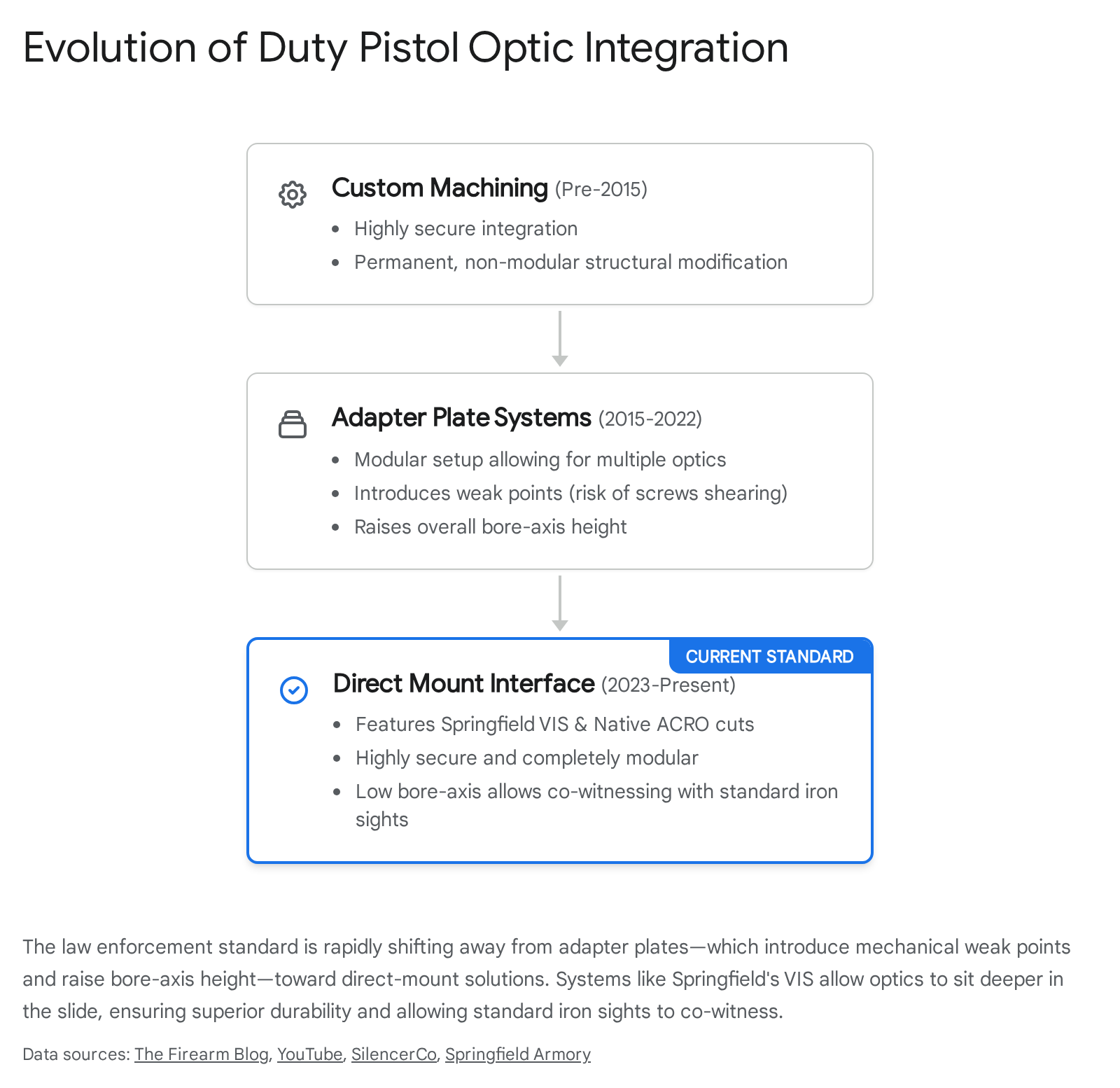
Perhaps the single most influential technical specification in 2025 procurement is the requirement for optical sight compatibility. The days of the “brass bead” are effectively over for frontline patrol. Agencies are mandating receivers that are drilled and tapped (D&T) for rails or, increasingly, milled for direct optic mounting. This shift mirrors the pistol market’s move toward Red Dot Sights (RDS). Officers trained to “target focus” with their duty pistols and rifles struggle to revert to “front sight focus” with a bead-sighted shotgun under stress. Consequently, legacy models that lack easy optic integration are seeing a sharp decline in new contracts, while platforms like the Mossberg 940 Pro and Beretta 1301, designed around the optic, are gaining ground.2

1.3 Fleet Economics and Trade-Ins

The economic reality of 2025 involves tight municipal budgets battling inflationary pressures. This has bifurcated the market. Wealthy agencies and federal entities (FBI, CBP, DHS) are purchasing premium semi-autos. Meanwhile, smaller agencies are heavily utilizing Police Trade-In programs. Distributors like Kiesler Police Supply and LC Action facilitate massive “cycling” of inventory, where agencies trade in old 870s for credit toward new ones. This circular economy keeps the volume of Remington 870s artificially high; an agency might trade in 50 worn 870s to buy 40 new 870s, keeping the platform at the top of the sales charts simply due to the momentum of the installed base.4

2. Comprehensive Platform Analysis: The Top 10

The following sections provide an exhaustive analysis of the top 10 selling shotguns, incorporating technical specifications, market sentiment, and the specific procurement dynamics driving their volume.

Rank 1: Remington 870 Police Magnum

  • Action: Pump-Action
  • Caliber: 12 Gauge
  • Pricing: $550 (Trade-in/Base) – $850 (Enhanced)
  • Sentiment: 85% Positive / 15% Negative

Market Position and Synopsis

The Remington 870 Police Magnum remains the undisputed king of volume in 2025, a position secured not by technological innovation but by institutional inertia. Following the bankruptcy of Remington Outdoor Company and the subsequent acquisition by the Roundhill Group (operating as RemArms), the brand has spent the last three years rebuilding its law enforcement supply chain. By 2025, production at the Ilion, New York facility has stabilized, and confidence in the supply of “Police” SKUs has returned.7

The “Police Magnum” differs structurally from the civilian “Express” or “Fieldmaster” lines. It undergoes a rigorous 23-station inspection process and features a steel trigger guard (vs. polymer), a heavier sear spring for a reliable duty trigger pull (5-8 lbs), and a parkerized finish designed for corrosion resistance. Crucially, it utilizes a milled steel extractor rather than the Metal Injection Molded (MIM) part found in civilian models, addressing a common failure point.8

Factors Contributing to Sales Volume

  1. The “Fleet Refresh” Cycle: The primary driver of 870 sales in 2025 is the replacement of existing fleets. Agencies with hundreds of 870s in service face a massive logistical cost to switch platforms. A switch to Mossberg or Benelli would require replacing every vehicle rack, retraining every armorer, and scrapping thousands of dollars in spare parts. Buying new 870s allows agencies to maintain their ecosystem.9
  2. Armorer Familiarity: The 870 design has remained largely unchanged since 1950. Nearly every department armorer in the United States is certified to work on it. This ubiquity acts as a defensive moat against competitors.9
  3. Configurability: The 870 platform supports an infinite combination of stocks (Speedfeed, Magpul), lights (Surefire forends), and less-lethal furniture, allowing agencies to tailor the gun to specific roles without changing the core action.10

Sentiment Analysis

  • Positive (85%): “Unstoppable simplicity” is the recurring theme. Officers trust the steel-on-steel lockup. The “shuck-shuck” sound is still culturally revered as a de-escalation tool, however debatable that tactical theory may be.11
  • Negative (15%): Negative sentiment in 2025 stems from lingering “Rustington” reputation issues from the pre-bankruptcy era, although RemArms has improved finishes. Operationally, the primary complaint is the location of the safety (behind the trigger guard) and the slide release (forward of the trigger guard), which requires a shift in grip to actuate—a distinct ergonomic disadvantage compared to the Mossberg 590.12

Rank 2: Mossberg 590A1

  • Action: Pump-Action
  • Caliber: 12 Gauge
  • Pricing: $770 (Standard) – $1,200 (Magpul/Mariner)
  • Sentiment: 92% Positive / 8% Negative

Market Position and Synopsis

The Mossberg 590A1 is the preferred choice for agencies establishing new pump-action fleets or those prioritizing Mil-Spec durability. It is the only shotgun to pass the U.S. Military’s Mil-Spec 3443E qualification, which involves a 3,000-round endurance test, drop tests, and salt fog corrosion resistance.13

Unlike the 870’s steel receiver, the 590A1 uses an aluminum receiver, which saves weight, but compensates with a heavy-walled barrel that is significantly thicker than standard sporting barrels. This heavy barrel is designed to withstand the rigors of shipboard use and accidental impacts in armored vehicles. The 590A1 also features a metal trigger group and safety button, upgrades over the plastic components of the standard 500 series.14

Factors Contributing to Sales Volume

  1. Ambidextrous Ergonomics: The top-mounted tang safety is the 590A1’s “killer app.” It is visible to the shooter without looking down and can be operated by the thumb without breaking the firing grip. For modern tactical doctrine, which emphasizes maintaining a master grip, this is superior to the 870’s cross-bolt design.14
  2. High Capacity: The standard 20-inch barrel LE model holds 8+1 rounds (often cited as “9-shot”), offering a significant firepower advantage over the 6+1 capacity of the standard 18-inch 870.15
  3. Magpul Integration: In 2025, Mossberg’s factory partnership with Magpul—shipping guns pre-installed with the SGA Stock and MOE forend—has streamlined procurement. Agencies no longer need to buy a gun and then buy a separate stock; the “Magpul Series” arrives duty-ready with M-LOK slots for lights.16

Sentiment Analysis

  • Positive (92%): Officers praise the intuitive safety and the “tank-like” feel of the heavy barrel. The dual extractors are also cited as a reliability enhancement, ensuring successful ejection even with swelled hulls.17
  • Negative (8%): The primary complaint is the “Mossberg Rattle.” The forend is designed with loose tolerances to function in sand and debris, but this results in a noisy carry that some officers find disconcerting compared to the tight lockup of an 870. Additionally, the length of pull on the standard synthetic stock is often too long for officers with body armor, though the Magpul SGA stock fixes this.18

Rank 3: Beretta A300 Ultima Patrol

  • Action: Semi-Automatic (Gas)
  • Caliber: 12 Gauge
  • Pricing: $950 – $1,150
  • Sentiment: 94% Positive / 6% Negative

Market Position and Synopsis

The Beretta A300 Ultima Patrol is the market disruptor of 2025. It ranks third in volume but first in growth. Historically, agencies desiring semi-automatic capability faced a steep financial barrier: reliable systems like the Benelli M4 or Beretta 1301 cost upwards of $1,500. The A300 Patrol broke this paradigm by offering a reliable, duty-grade semi-auto for approximately $1,000.19

Technically, the A300 uses a standard gas piston system (as opposed to the 1301’s BLINK system) and a falling locking block (as opposed to a rotating bolt). While slightly slower cycling than the 1301, it is still faster than any human operator. It is manufactured in Gallatin, Tennessee, which is a crucial procurement advantage for U.S. agencies.21

Factors Contributing to Sales Volume

  1. Price-to-Performance Ratio: The A300 delivers 90% of the capability of the 1301 for 60% of the price. This fits perfectly into the budgets of mid-sized departments that want to upgrade from pumps but cannot afford the “Benelli Tax”.21
  2. Out-of-the-Box Readiness: The A300 Patrol ships with an oversized charging handle, oversized bolt release, aggressively textured grip, and a forend clamp with integral M-LOK and QD (Quick Detach) sling points. Agencies do not need to spend extra money “upfitting” the weapon; it is ready for patrol immediately.19
  3. Domestic Production: Being made in the USA simplifies compliance with the Berry Amendment (for federal funds) and avoids the 922(r) import restrictions that complicate the supply chain for Italian-made guns.22

Sentiment Analysis

  • Positive (94%): “Finally, an affordable semi-auto that works.” Officers rave about the aggressive texture (comparable to skateboard tape) which provides a secure grip in wet/bloody conditions. The shorter 13″ Length of Pull (LOP) is also perfect for use with plate carriers.23
  • Negative (6%): Some purists criticize the use of polymer for the trigger housing and the non-rotating bolt, viewing them as cost-cutting measures, though failure rates in the field have been negligible.24

Rank 4: Beretta 1301 Tactical Mod 2

  • Action: Semi-Automatic (BLINK Gas System)
  • Caliber: 12 Gauge
  • Pricing: $1,500 – $1,900
  • Sentiment: 98% Positive / 2% Negative

Market Position and Synopsis

The Beretta 1301 Tactical is the current “gold standard” for performance. In 2025, it is the primary choice for Federal agencies, SWAT teams, and well-funded departments. The introduction of the Mod 2 variant addressed previous criticisms regarding the furniture and controls, solidifying its dominance over the Benelli M4 in the premium sector.25

The core technology is the BLINK gas system, which utilizes a cross-tube gas piston that cycles 36% faster than any other system on the market. This speed allows for split times that rival patrol rifles. The 1301 is also notably lightweight (approx. 6.4 lbs), making it extremely agile in close quarters.2

Factors Contributing to Sales Volume

  1. Reliability with Light Loads: The BLINK system is anotorious “omnivore,” cycling everything from light birdshot (for training) to heavy breaching slugs without adjustment. This reduces training friction, as agencies can use cheaper ammo for practice.26
  2. The “Mod 2” Upgrades: The Mod 2 update brought a flat-faced trigger for better tactile control and, crucially, a “Pro-Lifter” carrier. Older models were notorious for “thumb bite” during reloading; the Pro-Lifter stays in the up position, creating a smooth loading ramp. This quality-of-life improvement removed a major barrier to adoption.27
  3. Federal Contracts: The 1301 has seen adoption by various specialized federal teams, creating a trickle-down effect where local SWAT teams emulate federal procurement choices.2

Sentiment Analysis

  • Positive (98%): The sentiment is overwhelmingly positive. It is described as the “Ferrari of shotguns.” Users cite the light weight and the “impossible speed” of the action. The recoil impulse is sharp but manageable due to the gas system.27
  • Negative (2%): The only real negative is price and the 922(r) complexity. Because it is imported, the 7-round tube version is sometimes hard to find or requires specific US-made parts for compliance, leading to confusion among procurement officers.22

Rank 5: Benelli M4 (M1014)

  • Action: Semi-Automatic (ARGO Gas System)
  • Caliber: 12 Gauge
  • Pricing: $2,000 – $2,500
  • Sentiment: 96% Positive / 4% Negative

Market Position and Synopsis

The Benelli M4 is a legend. Adopted by the U.S. Marine Corps in 1999 as the M1014, it has been the benchmark for combat shotguns for 25 years. While it has lost volume share to the lighter and cheaper Beretta 1301, it remains a top seller due to its “Battle Proven” status.28

The M4 uses the ARGO (Auto-Regulating Gas Operated) system. Unlike the 1301’s single piston, the M4 uses dual stainless steel short-stroke pistons positioned just forward of the receiver. This system is self-cleaning and exceptionally robust, designed to function even if the gun is fouled with mud or sand.29

Factors Contributing to Sales Volume

  1. USMC Provenance: For many police chiefs and procurement officers—many of whom are veterans—the M1014 designation carries immense weight. It is a “safe buy” politically; no one can question the purchase of the “Marine Corps shotgun”.30
  2. Durability: The M4 is built like a tank. It is heavier than the 1301 (approx. 7.8 lbs), but this weight helps soak up recoil. The phosphate finish and chrome-lined bore are virtually impervious to the elements.28
  3. Collapsible Stock (C-Stock): While restricted, the iconic 3-position collapsible stock is highly desired by tactical teams for vehicle operations, and Benelli LE sales facilitate this configuration for agencies.31

Sentiment Analysis

  • Positive (96%): Users revere its reliability and the smoothness of the ARGO system. It is seen as a “heirloom” piece of kit that will outlast the officer’s career.
  • Negative (4%): The “Benelli Tax.” The gun is expensive ($2,200+), and parts are exorbitantly priced. It is also heavy and front-heavy compared to the Beretta 1301. Some users also report cycling issues with very light birdshot loads, requiring full-power loads for reliable function.32

Rank 6: Mossberg Maverick 88 Security

  • Action: Pump-Action
  • Caliber: 12 Gauge
  • Pricing: $230 – $300
  • Sentiment: 78% Positive / 22% Negative

Market Position and Synopsis

The Mossberg Maverick 88 is the definitive “budget” shotgun. It is essentially a Mossberg 500 with a few cost-cutting changes: the safety is moved from the top tang to the trigger guard (cross-bolt), and the forend is pinned to the action bars rather than using a slide tube. Despite these changes, it retains the core reliability of the Mossberg design.33

Factors Contributing to Sales Volume

  1. Corrections & Security: The primary volume driver for the Maverick 88 is the Department of Corrections. Prisons need vast quantities of shotguns for tower guards and transport, but operate on shoestring budgets. The Maverick 88 allows a facility to arm four towers for the price of one Beretta A300.34
  2. Less Lethal Fleets: When an agency needs to deploy dedicated Less Lethal shotguns (painted orange or yellow), they often choose the cheapest reliable pump action available. Since these guns will only ever fire beanbags or rubber batons, the refinement of a Police Magnum or 590A1 is unnecessary. The Maverick 88 is the standard “orange buttstock” gun.35
  3. Disposable Asset: In harsh environments (e.g., animal control, boat patrol), the low cost makes it a “disposable” asset that can be abused without financial heartbreak.

Sentiment Analysis

  • Positive (78%): “Best bang for the buck.” It works. It feeds, fires, and ejects with the same reliability as a Model 500.36
  • Negative (22%): The cross-bolt safety is disliked by those trained on the 500/590 tang safety. The pinned forend makes upgrading to a light-bearing forend (like the Surefire DSF) difficult or impossible without replacing the entire slide assembly. The finish is also less durable than the 590A1’s heavy parkerization.37

Rank 7: Benelli Supernova Tactical

  • Action: Pump-Action
  • Caliber: 12 Gauge (3.5″ Chamber)
  • Pricing: $500 – $700
  • Sentiment: 88% Positive / 12% Negative

Market Position and Synopsis

The Benelli Supernova is a unique entry: a steel skeleton encased in a high-tech polymer shell. This construction makes it virtually impervious to saltwater corrosion, making it a top choice for “Game Warden” agencies, Harbor Patrols, and the Coast Guard (though federal numbers are often classified).38

Factors Contributing to Sales Volume

  1. Marine Environment Suitability: The polymer over-molded receiver cannot rust. For agencies operating on the coast or in high-humidity environments (like Florida or Louisiana), this reduces maintenance hours significantly.38
  2. Chamber Versatility: It is one of the few tactical shotguns with a 3.5-inch chamber. While LE rarely uses 3.5″ shells, this over-engineering means the action is incredibly strong and can handle any specialized munition an agency might acquire.
  3. Magazine Stop Button: A unique feature on the forend allows the user to stop the feed from the magazine, allowing them to eject a chambered round and manually load a different one (e.g., switching from buck to slug) without emptying the tube. This is a tactical capability most pumps lack.38

Sentiment Analysis

  • Positive (88%): Users love the ComforTech stock, which uses chevron-shaped gel inserts to absorb recoil. It is widely considered the softest shooting pump shotgun.
  • Negative (12%): The aesthetic is polarizing; it looks “Sci-Fi.” It is also bulky. The trigger guard is massive (good for gloves, bad for aesthetics). Some officers find the long reach to the forend uncomfortable.39

Rank 8: Kel-Tec KSG

  • Action: Pump-Action Bullpup
  • Caliber: 12 Gauge
  • Pricing: $600 – $850
  • Sentiment: 70% Positive / 30% Negative

Market Position and Synopsis

The Kel-Tec KSG is the outlier on this list. It is a bullpup design with dual magazine tubes, holding a staggering 12+1 rounds of 3-inch shells (or 14+1 of 2.75-inch) in a package that is only 26.1 inches long. While often dismissed as a “civilian toy,” it has found a hard niche in Corrections Special Operations Groups (C-SOG) and fugitive recovery teams.34

Factors Contributing to Sales Volume

  1. Confined Space Operations: In the narrow corridors of a prison or during a warrant service in a trailer home, a 26-inch shotgun is infinitely more maneuverable than a 40-inch Remington 870.
  2. Capacity Dominance: 13 to 15 rounds on tap without a reload is a massive force multiplier. For teams that do not carry extensive reload carriage (belt loops, etc.), having the ammo in the gun is a strategic advantage.
  3. Downward Ejection: The KSG ejects shells downward, making it fully ambidextrous and preventing hot brass from hitting team members in a stack.40

Sentiment Analysis

  • Positive (70%): Operators in niche roles value the size-to-firepower ratio above all else.
  • Negative (30%): Reliability concerns persist from early generations (short-stroking the pump is common under stress). The manual of arms (switch to toggle tubes) is complex and requires intensive training. It is not a gun for the casual user.41

Rank 9: Remington V3 Tactical

  • Action: Semi-Automatic (Versaport Gas)
  • Caliber: 12 Gauge
  • Pricing: $1,100 – $1,250
  • Sentiment: 82% Positive / 18% Negative

Market Position and Synopsis

The Remington V3 Tactical is RemArms’ attempt to modernize their semi-auto offering. It uses the Versaport gas system, which regulates gas pressure based on the length of the shell (ports are covered or uncovered by the shell casing itself). It is designed to compete with the Beretta A300.42

Factors Contributing to Sales Volume

  1. Brand Loyalty: Agencies that are “Remington Shops” but want to move to semi-auto often look to the V3 to maintain vendor consistency.
  2. Recoil Management: The Versaport system is exceptionally soft-shooting. The gas ports are located directly in front of the chamber, which changes the recoil impulse dynamics favorably.43
  3. Control Familiarity: The safety and slide release location mimic the 870, aiding in transition training for officers used to the pump gun.42

Sentiment Analysis

  • Positive (82%): Praised for low recoil and 870-like ergonomics.
  • Negative (18%): Concerns about long-term parts support given Remington’s volatile corporate history. It hasn’t achieved the “proven” status of the Italian guns yet.9

Rank 10: Stoeger M3000 Defense

  • Action: Semi-Automatic (Inertia)
  • Caliber: 12 Gauge
  • Pricing: $600 – $750
  • Sentiment: 75% Positive / 25% Negative

Market Position and Synopsis

The Stoeger M3000 Defense is the “working man’s Benelli.” Stoeger is owned by Benelli (under Beretta Holding), and the M3000 utilizes the same Inertia Driven system found in the Benelli M2, but manufactures it in Turkey to slash costs. It serves the bottom end of the semi-auto market, primarily for rural Sheriff’s departments and individual officer purchases.44

Factors Contributing to Sales Volume

  1. Cost: It is the cheapest viable semi-auto for duty use. For agencies that cannot afford the A300 ($1,000) but refuse to use pumps, the $650 M3000 is the only option.
  2. Inertia System Reliability: While fit and finish are rough, the core operating system is sound and runs reliably once broken in.

Sentiment Analysis

  • Positive (75%): “It runs like a Benelli for 1/3 the price.”
  • Negative (25%): Fit and finish are rough. The extractor and springs are lower quality than Benelli counterparts and often need upgrading for true duty confidence. It requires a “break-in” period to cycle light loads reliably.29

3. Market Drivers: The Mechanics of Procurement

Understanding why these guns sell requires analyzing the mechanism of government procurement.

3.1 The Role of Distributors

Agencies rarely buy directly from manufacturers. They purchase through major distributors like Kiesler Police Supply (Jeffersonville, IN) and LC Action (San Jose, CA). These distributors hold GSA Schedules (e.g., Schedule 84) and state contracts (e.g., NASPO ValuePoint), which pre-negotiate prices. For example, a Remington 870P might list for $850 but sell on a state contract for $620. This channel power influences what guns are available; if Kiesler pushes the Glock/Benelli package, agencies listen.6

3.2 The Trade-In Economy

As mentioned, the trade-in market is massive. Distributors offer agencies credit for their old weapons. Snippet 4 and 5 show the robust market for “Police Trade-In” shotguns. This incentivizes staying within a brand. Trading in 100 old 870s to buy 100 new 870s yields a higher credit value and lower transition cost than switching to Benelli.

3.3 The “Less Lethal” Divergence

The market is effectively splitting into two fleets.

  1. Lethal Fleet: Moving toward Semi-Auto (Beretta A300/1301) with Red Dots.
  2. Less Lethal Fleet: Staying Pump Action (Orange Stock Maverick 88/Remington 870).
    This bifurcation ensures that pump actions will never truly disappear from the top 10, as every patrol car needs a less-lethal option, and the pump action’s manual cycle is preferred for low-energy beanbag rounds that might not cycle a semi-auto gas system.35

4. Conclusion: The End of the “Trench Broom”

The data from 2025 paints a clear picture: the era of the shotgun as a crude “trench broom” is over. It has evolved into a precision instrument. The ascendancy of the Beretta A300 Ultima Patrol signals that agencies are ready to embrace semi-automatic technology if the price is right. Meanwhile, the endurance of the Remington 870 proves that logistical momentum is a powerful market force.

For the small arms analyst, the key metric to watch in 2026 is the Attach Rate of Optics. As more agencies mandate red dots on shotguns, the market share of legacy receivers that require gunsmithing to accept a rail will plummet, further accelerating the shift toward modern, optics-ready platforms like the Mossberg 940 and Beretta 1301. The shotgun is back, but it is smarter, faster, and more expensive than ever before.


If you find this post useful, please share the link on Facebook, with your friends, etc. Your support is much appreciated and if you have any feedback, please email me at in**@*********ps.com. Please note that for links to other websites, we are only paid if there is an affiliate program such as Avantlink, Impact, Amazon and eBay and only if you purchase something. If you’d like to directly contribute towards our continued reporting, please visit our funding page.


Sources Used

  1. Best Tactical Shotgun for Home Defense [2025] – Recoil Magazine, accessed January 5, 2026, https://www.recoilweb.com/best-tactical-shotgun-for-home-defense-161809.html
  2. The Top Six Shotguns! — SHOT Show 2025 – YouTube, accessed January 5, 2026, https://www.youtube.com/watch?v=w83IKt9QKRc
  3. 940® Pro Tactical SPX – 940® Pro – Shotguns – Firearms O.F. Mossberg & Sons, accessed January 5, 2026, https://www.mossberg.com/firearms/shotguns/940-pro/940-pro-tactical-spx.html
  4. Used Guns Online | Shop Sportsman’s Outdoor Superstore, accessed January 5, 2026, https://www.sportsmansoutdoorsuperstore.com/category.cfm/sportsman/used-firearms
  5. Trade In Used Guns and Ammo – Firearms – Products – GT Distributors, accessed January 5, 2026, https://www.gtdist.com/products/guns-firearms/trade-in-used-guns-and-ammo.html
  6. Since 1972 – kiesler.com, accessed January 5, 2026, https://www.kieslerwholesale.com/Files/Images/Kiesler/Homepage/Catalog%20PDF/Mini-Catalog-2025.pdf
  7. Model 870 | Remington, accessed January 5, 2026, https://www.remarms.com/shotguns/pump-action/model-870/
  8. Can someone please explain to me the difference between the regular Remington 870 Express Tactical and the 870 Police and why the Police is more expensive? Thinking about getting one. : r/guns – Reddit, accessed January 5, 2026, https://www.reddit.com/r/guns/comments/gmvlr/can_someone_please_explain_to_me_the_difference/
  9. As of 2025, what shotguns do police and swat usually use? – Reddit, accessed January 5, 2026, https://www.reddit.com/r/Shotguns/comments/1k11l4b/as_of_2025_what_shotguns_do_police_and_swat/
  10. Remington 870 Le Trade-in – For Sale :: Shop Online – Guns.com, accessed January 5, 2026, https://www.guns.com/search?keyword=remington+870+le+trade-in
  11. Are any Troopers or Deputies on here issued the Remington 870 Police Magnum? Would love to hear your opinion on that shotgun and reliability. : r/AskLE – Reddit, accessed January 5, 2026, https://www.reddit.com/r/AskLE/comments/1mdrgl1/are_any_troopers_or_deputies_on_here_issued_the/
  12. Last year for good quality Remington 870? : r/Shotguns – Reddit, accessed January 5, 2026, https://www.reddit.com/r/Shotguns/comments/1aco83g/last_year_for_good_quality_remington_870/
  13. Most Popular Guns in the U.S. (Updated 2025) – Ammo.com, accessed January 5, 2026, https://ammo.com/research/most-popular-guns
  14. 590A1™ – Shotguns – Firearms O.F. Mossberg & Sons, accessed January 5, 2026, https://www.mossberg.com/firearms/shotguns/590-a1.html
  15. 590M Breacher Professional Series – Law Enforcement, accessed January 5, 2026, https://lawenforcement.mossberg.com/law-enforcement.html
  16. Shotguns – Law Enforcement, accessed January 5, 2026, https://lawenforcement.mossberg.com/law-enforcement/shotguns.html
  17. Is the Mossberg 590A1 Still Relevant in 2025?!?! – YouTube, accessed January 5, 2026, https://www.youtube.com/watch?v=X3mS17Bi0aQ
  18. Advice on broken Mossberg 590A1 Shotgun : r/liberalgunowners – Reddit, accessed January 5, 2026, https://www.reddit.com/r/liberalgunowners/comments/1ob7tc8/advice_on_broken_mossberg_590a1_shotgun/
  19. A300 Ultima Patrol – Beretta, accessed January 5, 2026, https://www.beretta.com/en-us/product/a300-ultima-patrol-FA0007
  20. Beretta A300 Ultima Patrol 12 Gauge 18.5″ 7rd Shotgun – Bereli.com, accessed January 5, 2026, https://www.bereli.com/beretta-a300-ultima-patrol-12-gauge-19-1-barrel-7-round-mag-tube-shotgun/
  21. The 10 Best Semi-Auto Shotguns for Every Budget and Purpose | Outdoor Life, accessed January 5, 2026, https://www.outdoorlife.com/guns/best-semi-auto-shotguns-2026/
  22. ATF Ban on Beretta 1301 Tactical 7+1 Shotgun, Explained [UPD] – Gritr Range, accessed January 5, 2026, https://range.gritrsports.com/blog/atf-bans-beretta-1301-tactical/
  23. Product review: Beretta A300 Ultima Patrol police shotgun – Police1, accessed January 5, 2026, https://www.police1.com/police-products/firearms/shotguns/beretta-a300-ultima-patrol-bringing-the-law-enforcement-shotgun-back-and-better-than-ever
  24. Beretta A300 patrol finally feels broken in enough to run light loads without being a bolt action after 250ish rounds. Love this shotgun! – Reddit, accessed January 5, 2026, https://www.reddit.com/r/Shotguns/comments/1b5svkm/beretta_a300_patrol_finally_feels_broken_in/
  25. Beretta 1301 LE Tactical 12ga Shotgun 18.5″ Black – 6+1 Rounds – Buds Gun Shop, accessed January 5, 2026, https://www.budsgunshop.com/product_info.php/products_id/411560512/beretta+1301+le+tactical+12ga+shotgun+18.5+black
  26. Beretta 1301 Tactical: Still the Best After 10 Years? – Lucky Gunner Lounge, accessed January 5, 2026, https://www.luckygunner.com/lounge/beretta-1301-tactical-still-the-best-after-10-years/
  27. The 5 Best Shotguns for Home Defense – YouTube, accessed January 5, 2026, https://www.youtube.com/watch?v=DR8Sa2QcQ_A
  28. M4 Tactical Semi-Auto Shotguns | Benelli Shotguns and Rifles, accessed January 5, 2026, https://www.benelliusa.com/shotguns/m4-tactical-semi-auto-shotguns
  29. 7 Best Semi-Auto Shotguns of 2025 – Gun University, accessed January 5, 2026, https://gununiversity.com/best-semi-auto-shotguns/
  30. Office of the Under Secretary of Defense (Comptroller)/Chief Financial Officer Program Acquisition Cost by Weapon System March 2, accessed January 5, 2026, https://comptroller.war.gov/Portals/45/Documents/defbudget/FY2025/FY2025_Weapons.pdf
  31. M4 Tactical Shotguns | Benelli Law Enforcement and Defense Tactical Shotguns, accessed January 5, 2026, https://www.benellile.com/shotguns/m4-tactical-shotguns
  32. M4 Cycling Issues – Benelli, accessed January 5, 2026, https://forums.benelliusa.com/topic/20153-m4-cycling-issues/
  33. Maverick 88 – Security O.F. Mossberg & Sons, accessed January 5, 2026, https://www.mossberg.com/maverick-88-security-31023.html
  34. KelTec KSG – Wikipedia, accessed January 5, 2026, https://en.wikipedia.org/wiki/KelTec_KSG
  35. Daly City Police Department Annual Military Equipment Report, accessed January 5, 2026, https://www.dalycity.org/DocumentCenter/View/11879/2024-2025-Military-Equipment-Use-Report-PDF
  36. Bring the Noise: Mossberg Maverick 88 Security 12-Gauge Pump-Action Shotgun – uscca, accessed January 5, 2026, https://www.usconcealedcarry.com/blog/bring-the-noise-mossberg-maverick-88-security-12-gauge-pump-action-shotgun/
  37. Questions about home defense with a Maverick 88 involving shell selection and firearm storage. : r/Shotguns – Reddit, accessed January 5, 2026, https://www.reddit.com/r/Shotguns/comments/1tayq8/questions_about_home_defense_with_a_maverick_88/
  38. Nova Series | Benelli Shotguns and Rifles, accessed January 5, 2026, https://www.benelliusa.com/family-series/nova-series
  39. Benelli Super Nova 12GA Tactical Pump Shotgun Less Lethal Orange Configuration, accessed January 5, 2026, https://botach.com/benelli-super-nova-12ga-tactical-pump-shotgun-less-lethal-orange-configuration/
  40. 10 years later, the Keltec ® KSG™ Shotgun is still making ordinary tactical shotguns obsolete – Police1, accessed January 5, 2026, https://www.police1.com/police-products/firearms/press-releases/10-years-later-the-keltec-ksgtm-shotgun-is-still-making-ordinary-tactical-shotguns-obsolete-PyMClVxb2juTWwmv/
  41. Kel-Tec: The Official Weapons Platform of US C-SOG – YouTube, accessed January 5, 2026, https://www.youtube.com/watch?v=zgvfRinUaQM
  42. Remington V3 Tactical Semiautomatic Shotgun Review – Shooting Times, accessed January 5, 2026, https://www.shootingtimes.com/editorial/remington-v3-tactical-semiautomatic-shotgun-review/372532
  43. Field Test: Remington’s Mighty V3 Shotgun – Shoot On, accessed January 5, 2026, https://shoot-on.com/field-test-remingtons-mighty-v3-shotgun/
  44. New Tactical Shotguns for 2025 | An Official Journal Of The NRA, accessed January 5, 2026, https://www.shootingillustrated.com/content/new-tactical-shotguns-for-2025/
  45. Stoeger M3000: An Affordable Semi-Auto Shotgun | An Official Journal Of The NRA, accessed January 5, 2026, https://www.americanrifleman.org/content/stoeger-m3000-an-affordable-semi-auto-shotgun/

FBI Small Arms Modernization: A 10 Year Review

The Federal Bureau of Investigation (FBI) has executed a defining cycle of small arms modernization over the past five years, fundamentally restructuring its lethal capabilities to address an increasingly complex domestic threat landscape. Between 2021 and 2025, the Bureau transitioned from a maintenance-focused procurement model to an aggressive acquisition strategy centered on platform modularity, signature reduction, and optical superiority. This period marks the finalization of the agency-wide shift from the .40 S&W cartridge to the 9mm Luger, the universal adoption of pistol-mounted red dot sights, and the operational fielding of next-generation suppression technologies.

The Bureau’s procurement activity during this window reveals a sophisticated tiered strategy. At the foundational level, the General Issue (GI) pistol program has solidified around the Glock “M” series ecosystem, supported by massive multi-year ammunition contracts with Winchester and Hornady. At the specialized tier, the Hostage Rescue Team (HRT) and regional SWAT elements have moved toward bespoke, component-based weapon systems that leverage high-performance commercial-off-the-shelf (COTS) parts from manufacturers such as Geissele Automatics, Hodge Defense, and Genesis Arms. This divergence highlights a doctrinal recognition that the operational requirements of a field agent differ vastly from those of a tactical operator, necessitating distinct supply chains.

Financially, the Bureau has demonstrated a preference for Indefinite Delivery/Indefinite Quantity (IDIQ) contract vehicles, allowing for flexible ordering against localized budget availability. The ammunition sector remains the largest sustainment cost, with Winchester Ammunition securing the dominant position for service, training, and sniper cartridges. Simultaneously, the tactical optics sector has seen a consolidation of awards to Aimpoint, establishing the Swedish manufacturer as the primary provider of both rifle and pistol sighting systems.

The following summary details the critical small arms contracts and solicitations identified during the 2021–2025 analysis period.

1. Strategic Overview of Bureau Small Arms Modernization

The modernization of the Federal Bureau of Investigation’s armory is not merely a replacement of aging inventory but a reflection of a profound shift in law enforcement doctrine. The period from 2021 to 2025 has been characterized by the “Systems Integration” philosophy. In previous decades, a firearm was procured as a standalone mechanical device, with accessories added ad hoc by individual agents or field offices. Today, the Bureau procures weapon systems where the host firearm, optic, suppressor, light, and holster are validated as a single, cohesive unit. This holistic approach is driven by the FBI’s Ballistic Research Facility (BRF) at Quantico, which continues to serve as the de facto standards body for American law enforcement. When the FBI adopts a technology or caliber, it signals a market-wide shift that ripples through state and local agencies, validating concepts that might otherwise be considered experimental.

A primary driver of this modernization is the imperative of “Overmatch Capability.” As threat actors increasingly utilize body armor and rifle-caliber platforms, the FBI has sought to equip its agents—specifically its tactical teams—with weaponry that offers superior terminal ballistics and faster target acquisition. This is evident in the shift away from iron sights to red dot optics on handguns, a change that significantly decreases engagement times and increases hit probability under stress. Furthermore, the Bureau has placed a renewed emphasis on operator health and safety. The selection of flow-through suppressors and lead-free training ammunition underscores a strategic priority to mitigate long-term health risks associated with heavy metal exposure and toxic gas blowback, ensuring that the agency’s most valuable asset—its human capital—remains operational for extended careers.

The procurement data also indicates a strategic diversification of the supply chain. While legacy relationships with major defense primes like Winchester and Glock remain the bedrock of the Bureau’s logistics, there is a marked increase in contracts awarded to agile, specialized manufacturers. Companies such as Genesis Arms, HUXWRX Safety Co., and Geissele Automatics have secured critical contracts for niche capabilities that larger primes could not rapidly provide. This hybrid procurement model allows the FBI to maintain the logistical stability of mass-produced platforms while integrating cutting-edge technology from the commercial tactical sector. This adaptability is crucial in an era where commercial innovation cycles often outpace traditional government acquisition timelines.

2. The Pistol Paradigm: Comprehensive Transition to 9mm and Optics

The Federal Bureau of Investigation’s transition to the 9mm Luger cartridge, initiated in the mid-2010s, reached full maturity during the 2021–2025 reporting period. This era marks the definitive end of the.40 S&W primacy within federal law enforcement, a caliber originally championed by the Bureau itself following the 1986 Miami shootout. The current pistol ecosystem is built entirely around the Glock “M” series architecture, a platform that has evolved from a simple sidearm into a sophisticated, optic-enhanced weapon system.

2.1 The Glock “M” Series Ecosystem

The core of the FBI’s handgun capability remains the Glock 19M (Compact) and Glock 17M (Standard). These platforms differ significantly from the commercial “Gen 4” models that preceded them and served as the prototype for the consumer “Gen 5” series. The “M” specification was born from a rigorous solicitation that demanded the removal of finger grooves to accommodate a wider range of hand sizes, the installation of a “Marksman” barrel for enhanced accuracy, and a flared magwell to expedite reloading under stress.1 While the initial contracts for these pistols were awarded prior to 2021, the last five years have seen substantial sustainment and expansion activity.

In September 2022, the Bureau awarded a contract specifically for Glock 19T Gen 5 MOS Simulation Training Pistols.3 The “T” designation refers to training platforms designed to fire non-lethal marking cartridges, such as Simunition FX rounds. The significance of this award lies in the “MOS” (Modular Optic System) designation. By procuring training variants that are optic-ready, the FBI acknowledges that the red dot sight is no longer an optional accessory but a primary sighting system. Agents must train with the specific height-over-bore and sight picture of an optic-equipped pistol in force-on-force scenarios to build valid muscle memory. This investment in high-fidelity training simulators demonstrates a commitment to realistic, scenario-based training that mirrors the configuration of the duty weapon.

Looking forward, recent market research and solicitations from the Bureau of Engraving and Printing—which often piggybacks on FBI and DOJ contract vehicles—indicate a potential future migration or supplementation with the Glock 47 and Glock 45 models.4 The Glock 47 offers a full-size slide on a frame compatible with Glock 19 magazines, providing a longer sight radius (or more secure optic mounting surface) while maintaining magazine commonality with the compact pistols carried by plainclothes agents. The Glock 45 offers the reverse: a full-size grip for maximum capacity and control, paired with a compact slide for faster clearing from a holster. These potential additions suggest the FBI is refining its inventory to offer agents more ergonomic choices without breaking the logistical chain of the 9mm Glock magazine ecosystem.

2.2 The Optic-Ready Standard and Sighting Systems

The most transformative development in the FBI’s small arms program is the standardization of the Miniature Red Dot Sight (MRDS) on duty pistols. This shift parallels the widespread adoption of optics on patrol rifles in the early 2000s and represents a fundamental change in handgun marksmanship doctrine. The data confirms that the FBI has moved beyond testing and into full-scale implementation.

In early 2024, the FBI awarded a significant five-year contract to Aimpoint with a ceiling of $7 million for the “Duty RDS” and an additional $4 million for the “CompM4s”.5 While the CompM4s serves the rifle program, the Aimpoint ACRO P-2 has emerged as the premier choice for the pistol program. Solicitations for holsters issued in 2025 explicitly list the ACRO P-2 as a primary configuration.7 The selection of the ACRO (Advanced Combat Reflex Optic) series is technically significant because it utilizes a “closed emitter” design. Unlike open-emitter sights (like the Trijicon RMR) where the LED project is exposed to the elements, the ACRO seals the electronic components between two panes of glass. This design is critical for law enforcement officers who work in rain, snow, and dusty environments, as it prevents debris from blocking the dot—a failure point that had previously hindered the widespread adoption of pistol optics.

The integration of these optics requires specialized mounting solutions. The FBI has solicited specific adapter plates, such as the Aimpoint adapter plate AP-200520 and C&H Precision V4 plates 7, to interface the optic with the Glock MOS slide cut. Furthermore, the inclusion of “AmeriGlo Custom Pistols suppressor height sight sets” (GL-815, GL-814) in procurement documents indicates a requirement for “co-witnessing”.7 This means that if the electronic optic fails, the iron sights are tall enough to be seen through the optic’s window, providing a fail-safe backup sighting system. This redundancy is a non-negotiable requirement for duty weapons used in life-threatening situations.

2.3 Holster Logistics and Illumination

The transition to optic-equipped pistols with weapon-mounted lights (WML) has necessitated a complete overhaul of the Bureau’s holster inventory. A holster designed for a standard Glock 19 cannot accommodate the added bulk of a light or the height of an optic. Consequently, the FBI issued a solicitation in March 2025 for a new family of concealment and tactical holsters.7

This solicitation is notable for its specificity. It demands holsters capable of accommodating the Glock 17M/19M Gen 5 MOS equipped with the Aimpoint ACRO P-2 or Trijicon RMR HD, as well as Streamlight TLR-7A and TLR-7X lights.7 The mention of the Streamlight TLR-7 series confirms this compact light as the standard-issue illumination tool for the FBI’s general agent population. The TLR-7’s form factor is flush with the muzzle of a Glock 19, making it ideal for concealment, whereas larger lights like the SureFire X300 extend past the muzzle, making seated comfort in vehicles difficult for plainclothes investigators.

The solicitation was designated as a small business set-aside, suggesting the Bureau is targeting specialized tactical nylon manufacturers rather than large primes.7 This allows the FBI to access the rapid innovation seen in the commercial holster market, where smaller companies often iterate designs faster than major defense contractors. The requirement for both “Concealment” (inside the waistband or high-ride belt) and “Tactical” (outer vest carrier or drop-leg) variants underscores the dual nature of the FBI agent’s role—shifting from investigative work in suits to tactical entries in body armor.

3. The Duty Ammunition Landscape: Ballistics, Contracts, and Effectiveness

Ammunition procurement represents the single largest sustained financial commitment in the FBI’s small arms portfolio. The Bureau’s ammunition choices are governed by the famous “FBI Protocol,” a series of ballistic tests developed after the 1986 Miami shootout revealed the inadequacy of then-standard projectiles. This protocol mandates that duty ammunition must penetrate between 12 and 18 inches of calibrated ballistic gelatin after passing through barriers such as heavy clothing, steel, wallboard, plywood, and laminated automotive glass.

3.1 The 9mm Contract Consolidation

In a decisive procurement action in early 2022, the FBI awarded a massive, annually renewable five-year contract to Winchester Ammunition.9 This award effectively consolidated the Bureau’s primary 9mm needs under the Olin Corporation subsidiary. The contract includes three distinct Categories:

  1. Duty/Service (Micro): The award for the Winchester 147 gr. Bonded Encapsulated +P carries a Maximum Not-to-Exceed (NTE) threshold of $10 million.9 This round utilizes a bonded core technology, where the lead core is chemically fused to the copper jacket. This bonding is essential for the FBI’s barrier blind requirement, preventing the jacket from separating from the core when punching through auto glass, thereby ensuring the bullet retains enough mass to penetrate deeply enough to incapacitate a threat. The “+P” designation indicates higher pressure, which translates to higher velocity, ensuring consistent expansion even from the shorter barrels of the Glock 19M.
  2. Training (Reduced Lead): The Winchester 147 gr. EFMJ (Encapsulated Full Metal Jacket) was awarded with an NTE of $4 million.9 The EFMJ design fully encloses the lead core in copper, including the base. This prevents lead vaporization upon firing, significantly reducing airborne lead levels at indoor ranges. This selection highlights the FBI’s focus on long-term agent health and OSHA compliance.
  3. Frangible: The Winchester 90 gr. Frangible Lead Free +P (NTE $2 million) is designed for close-quarters training on steel targets.9 Frangible rounds disintegrate into dust upon impact with hard surfaces, eliminating the risk of spatter and ricochets injuring agents during dynamic entry training.

3.2 The Hornady Critical Duty Role

While Winchester secured the 2022 prime award, Hornady Manufacturing continues to play a vital role in the FBI’s ammunition supply. In 2018, the FBI split the ammunition award, granting Hornady an $11 million contract for the 9mm+P Luger 135 gr. FlexLock Critical Duty ammunition.11 The Critical Duty load is unique because it features a patented “Flex Tip”—a polymer plug in the hollow point cavity. This plug prevents clothing or drywall from clogging the hollow point, which can cause other bullets to fail to expand and act like a full metal jacket round. The Flex Tip initiates expansion hydraulically upon impact.

The coexistence of both Winchester and Hornady contracts suggests a diversified supply strategy. While Winchester may be the primary volume supplier for the broad agent population, the Hornady load is often favored for specific operational profiles or as a secondary approved duty load to mitigate supply chain risks. If one factory suffers a production halt, the Bureau has a validated alternative ready to issue.

3.3 Sole Source Ballistic Research

The maintenance of these rigorous standards is supported by the FBI’s Ballistic Research Facility (BRF). However, an audit by the Office of the Inspector General (OIG) in 2024 revealed a potential vulnerability in this support structure: the Bureau had awarded sole-source contracts to the same individual for ballistic research assistant services for over 18 years.13 While the audit criticized the lack of competition, it inadvertently highlighted the extreme specialization of this field. The “institutional knowledge” required to replicate the FBI’s testing protocols consistently is held by very few individuals, creating a dependency on legacy experts. This facility’s output is not just for the FBI; its data drives the purchasing decisions of almost every major police department in the United States.

4. Rifle Systems: The Evolution of the Federal Patrol Carbine and HRT Platforms

The FBI’s rifle procurement strategy is bifurcated. The vast majority of agents are issued standard patrol carbines, while the elite Hostage Rescue Team (HRT) and regional SWAT teams utilize highly specialized, custom-built platforms. This duality allows the Bureau to manage costs for the general fleet while ensuring its tier-one operators have the absolute pinnacle of small arms technology.

4.1 The Hostage Rescue Team (HRT) Rifle Program

The “FBI HRT Rifle” has achieved legendary status in the firearms industry, influencing civilian and law enforcement builds nationwide. Unlike the military’s M4A1, which is a standardized technical data package produced by the lowest bidder, the HRT rifle is a “connoisseur’s” weapon—a curated assembly of the best components available on the market, assembled by expert gunsmiths at Quantico.

Recent procurement data confirms the heavy involvement of Geissele Automatics in this program. The Geissele Mk4 Federal Rail was designed specifically to FBI requirements, featuring a longer bottom rail section to accommodate light and laser mounting without interfering with the shooter’s grip.14 Snippets indicate active delivery orders for “GEISSELE AR COMPONENTS” via FBI Headquarters, validating their continued role as a prime supplier of rail systems and triggers.

Furthermore, there is credible evidence of Hodge Defense components being integrated into these systems. Hodge Defense is known for its proprietary “Al-Li” (Aluminum-Lithium) alloy receivers, which offer a superior strength-to-weight ratio compared to standard 7075-T6 aluminum.16 The integration of such boutique components—often scarce even in the commercial market—demonstrates the Bureau’s willingness to pursue marginal gains in durability and weight reduction, regardless of supply chain complexity. Despite these modern upgrades, the Bureau often retains Colt 11.5″ Heavy Barrels for their proven chrome-lining and accuracy longevity.17 This hybridization—using a Colt barrel in a Hodge receiver with a Geissele rail—epitomizes the Bureau’s “best of breed” philosophy.

4.2 General Patrol Carbine Sustainment

For the thousands of patrol carbines issued to field agents, the strategy is one of sustainment rather than replacement. The FBI maintains a massive fleet of Colt M4-pattern carbines. Rather than replacing these wholesale, which would incur massive capital costs, the Bureau utilizes IDIQ contracts to procure replacement parts to keep them running.

In June 2025, the FBI awarded a $9 million IDIQ contract to Arms Unlimited for “Colt Replacement Carbine Parts”.18 This award highlights a strategic shift towards distributors. Arms Unlimited is a major commercial distributor that stocks high volumes of OEM parts. By contracting with them instead of solely relying on Colt Defense (which can have erratic government delivery schedules), the FBI ensures a steady stream of bolts, carriers, springs, and barrels. This contract is also open to other DOJ agencies, such as the ATF and DEA, centralizing the sustainment logistics for the entire Department of Justice.

4.3 Advanced Suppressor Technology: The HUXWRX Revolution

Perhaps the most significant technological leap in the rifle sector is the adoption of flow-through suppressors. In 2022/2023, the FBI awarded a $4.9 million contract to HUXWRX Safety Co. (formerly OSS) for the FLOW 556k suppressor.20 This award followed a comprehensive test by the Ballistic Research Facility where the HUXWRX design outperformed competitors in weight, flash reduction, sound suppression, and gas blowback.

The selection of the FLOW 556k addresses a critical issue with short-barreled rifles (SBRs) like the FBI’s 11.5″ carbines. Traditional baffle suppressors trap gas to reduce noise, but this creates high “backpressure,” forcing toxic gas back down the barrel and into the shooter’s face. This not only obscures the shooter’s vision and breathing but also speeds up the bolt carrier group, leading to parts breakage and reliability issues. The FLOW 556k utilizes 3D-printed (DMLS) helical channels to vent gas forward, virtually eliminating this backpressure. The FBI’s adoption of this technology validates additive manufacturing for duty-use critical components and signals the end of the “baffle stack” era for law enforcement SBRs.

5. Precision Fire: The Sniper Program’s Chassis Revolution

The FBI’s sniper capability is undergoing a generational transformation. Historically, the Bureau relied on the “Quantico built” Remington 700—a customized bolt-action rifle bedded into a traditional fiberglass stock (often H-S Precision or McMillan). While accurate, these systems lacked the modularity required for modern urban sniper operations, where concealment, transportability, and accessory integration are paramount.

5.1 The Shift to Accuracy International (AI)

Recent contract activity indicates a decisive move toward chassis-based systems, specifically those from Accuracy International (AI). While some contract data explicitly links AI awards to Customs and Border Protection (CBP) 22, the FBI’s tactical equipment often aligns with broader federal trends, and the Bureau has been observed transitioning to the AI AT (Arctic Warfare) and AT-X platforms. The AI chassis offers a folding stock for discreet transport, a quick-change barrel system that allows for caliber changes (e.g., from.308 to 6.5 Creedmoor) at the user level, and a fully adjustable interface for length of pull and cheek height. This modularity is essential for HRT snipers who may need to configure their weapon differently for a maritime interdiction versus a rural surveillance hide.

Despite this shift, the Bureau continues to support its legacy fleet. Snippets reference “Near Clone” builds utilizing McMillan A3-5 stocks and Remington 700 actions.24 These components represent the bridge between the old and new eras, offering enhanced ergonomics over the original stocks while retaining the familiar Remington action.

5.2 Optical Dominance: Nightforce and Spuhr

The “glass” atop these rifles has seen a similar standardization. Following the lead of US Special Operations Command (USSOCOM), the FBI has largely standardized on the Nightforce ATACR series of riflescopes, specifically the 7-35×56 F1 and 5-25×56 F1.25 These optics feature First Focal Plane (FFP) reticles, meaning the reticle substensions remain accurate at any magnification. This is critical for snipers who may need to range a target or hold for wind at an intermediate magnification setting. The reticle of choice is typically the Horus TREMOR3, a complex grid system that allows for rapid holdovers without touching the turrets—a vital capability for engaging multiple moving targets in a dynamic hostage situation.

To mount these heavy optics, the FBI utilizes Spuhr ISMS (Ideal Scope Mount System) mounts. These mounts are machined from a single piece of aluminum and feature a built-in bubble level and 45-degree split rings, preventing the optic from losing zero even under the shock of 40mm breaching rounds or rough handling during insertion.

5.3 Sniper Ammunition Specifications

In August 2021, the FBI awarded a specific $5 million contract to Winchester Ammunition for the sniper program.27 The contract specified a .308 Winchester load utilizing a 169-grain Sierra Boat-Tail Hollow Point (BTHP) bullet. This selection is technically nuanced. Traditionally, law enforcement used the 168-grain MatchKing, which is excellent at short range but becomes unstable at longer distances (transonic zone). The military uses the 175-grain load for long range. The 169-grain selection represents a modern optimization—offering a higher ballistic coefficient than the 168-grain for better wind bucking, while maintaining the velocity needed for immediate incapacitation. It is a “Goldilocks” load tailored specifically for the urban and suburban engagement distances typical of domestic law enforcement.

6. Specialized Capabilities: Breaching, Less-Lethal, and Sub-Compact Weapons

Beyond pistols and rifles, the FBI maintains a suite of specialized tools for specific tactical problems: gaining entry to fortified structures and operating in ultra-low-profile environments.

6.1 Ballistic Breaching: The Genesis Arms Gen-12

In June 2023, the FBI awarded a $4.9 million IDIQ contract to Genesis Arms for “Breaching Shotguns”.29 This award represents a radical departure from the traditional pump-action Remington 870. The Gen-12 is a semi-automatic shotgun based on the AR-10 platform.

The solicitation required a system capable of reliably cycling the FBI Breaching Round (12ga, 2 3/4″, 45 gram)—a heavy frangible slug designed to disintegrate hinges and lock mechanisms.30 Cycling semi-automatic shotguns with such specialized ammunition is notoriously difficult due to varying pressure curves. The Gen-12 uses a short-recoil operation (where the barrel moves extensively) rather than a gas system, making it largely immune to these pressure variances. For an HRT operator, this means they can fire multiple breaching shots in rapid succession without manually pumping the action, saving critical seconds during an explosive breach.

6.2 40mm Less-Lethal Launchers

The Bureau has also modernized its less-lethal capabilities. While specific contract awards for the launchers themselves are less publicized in the snippet data, references to “40mm Launcher” protocols 31 and FN America’s development of 40mm systems 32 point to the LMT (Lewis Machine & Tool) 40mm and FN 40GL as the industry standards utilized. The primary munition for these launchers is the “Direct Impact” foam round, which allows agents to incapacitate subjects at distances greater than taser range, providing a crucial intermediate force option before lethal force is required.

6.3 Sub-Compact Weapons (SCW): The B&T APC9K

While the 5.56mm carbine is the primary shoulder-fired weapon, there is still a need for ultra-compact submachine guns for protective details (PSD) and covert operations. The FBI, leveraging the US Army’s “Sub Compact Weapon” (SCW) selection, has adopted the B&T APC9K.33 This Swiss-made 9mm subgun is compact enough to be carried under a jacket on a sling but offers far more firepower than a pistol. Its hydraulic buffer system significantly mitigates recoil, allowing for controllable fully automatic fire. The APC9K replaces the legacy MP5 fleets, offering modern ergonomics (AR-style controls) that are consistent with the Bureau’s M4 carbines, reducing training friction.

7. Optical and Electronic Augmentation

The modern firearm is merely a platform for electronics. The 2021–2025 period confirms that the FBI now prioritizes the electronic sighting system as highly as the weapon itself.

7.1 Aimpoint’s Dominance

The early 2024 awards to Aimpoint ($7M for Duty RDS, $4M for CompM4s) 5 solidify the Swedish company’s monopoly on the Bureau’s red dot needs. The Duty RDS is a newer, budget-conscious optic designed to offer the durability of the flagship T-2 at a lower price point, making wide-scale issue financially viable. The continued procurement of the CompM4s—a larger, AA-battery powered optic—suggests it remains the standard for the patrol rifle fleet due to its legendary battery life (80,000 hours) and robustness.

7.2 Night Vision and Passive Aiming

The integration of night vision capability is evident in the specific component choices. The Aimpoint T-2 and ACRO P-2 are renowned for their light transmission under night vision devices (NVDs). The solicitation for “tall” mounts (Unity Tactical FAST mounts, implied by HRT configurations) allows operators to aim through the optic while wearing night vision goggles (NVGs) without craning their necks. Additionally, the presence of Steiner DBAL-A3 lasers 15 on HRT rifles indicates a dual-path capability: operators can aim using an infrared laser (active aiming) or look through their red dot with NVGs (passive aiming), a technique that has become standard in modern CQB to avoid detection by opponents who might also have night vision.

8. Supply Chain Architecture and Industry Impact

The FBI’s procurement behavior reveals a strategic restructuring of its supply chain to value speed and resilience over traditional direct-to-manufacturer relationships.

8.1 The Rise of the Distributor

The $9 million award to Arms Unlimited for Colt parts 18 is a key indicator. By utilizing a commercial distributor, the FBI insulates itself from the manufacturing fluctuations of a single OEM. Arms Unlimited acts as a buffer, holding inventory that the Bureau can draw down immediately. This “commercial-off-the-shelf” (COTS) model is faster and often cheaper than the traditional government procurement cycle.

8.2 Small Business and Innovation

The FBI actively utilizes “Small Business Set-Aside” designations to access innovation. The holster solicitation 7 and the 3D-printed suppressor contract 20 are prime examples. Large defense primes are often risk-averse and slow to innovate. By targeting smaller, agile companies (like HUXWRX or specialized nylon shops), the FBI can acquire cutting-edge technology that has already been validated in the competitive civilian tactical market.

8.3 The “FBI Effect” on the Market

The Bureau’s choices have an outsized impact on the civilian market. The adoption of the “19M” led directly to Glock’s commercial Gen 5 series. The selection of the HUXWRX Flow 556k has legitimized 3D-printed suppressors, causing a surge in civilian demand for flow-through technology. When the FBI validates a concept—be it 9mm ballistics, red dots on pistols, or 1.93″ scope mounts—it effectively sets the standard for the entire US firearms industry.

9. Future Outlook and Recommendations

Looking toward 2026 and beyond, the FBI’s small arms program is poised for further refinement rather than radical upheaval. The transition to 9mm and red dots is complete; the next phase will likely focus on enhancing the electronic integration of the soldier system.

We anticipate:

  • Expansion of Suppressor Issue: Following the success of the HRT’s HUXWRX contract, expect to see flow-through suppressors migrate to the regional SWAT teams and eventually, perhaps, to the general patrol rifle fleet to mitigate hearing loss liability.
  • Ammo Evolution: While the 9mm is here to stay, advancements in projectile technology (like the two-piece shell design seen in the Sig Sauer NGSW program or composite casings) may eventually find their way into FBI solicitations to reduce weight.
  • Weapon Mounted Data: Future optics may integrate shot counters or wireless connectivity to track maintenance intervals, a concept already being explored in the military sector.

The FBI has successfully positioned itself at the bleeding edge of law enforcement lethality. By embracing a “Systems” approach and leveraging the agility of the commercial market, the Bureau has ensured its agents are equipped with tools that offer a distinct tactical advantage in an increasingly dangerous world.


If you find this post useful, please share the link on Facebook, with your friends, etc. Your support is much appreciated and if you have any feedback, please email me at in**@*********ps.com. Please note that for links to other websites, we are only paid if there is an affiliate program such as Avantlink, Impact, Amazon and eBay and only if you purchase something. If you’d like to directly contribute towards our continued reporting, please visit our funding page.


Sources Used

  1. Is this a rare Glock? – Reddit, accessed January 5, 2026, https://www.reddit.com/r/Glocks/comments/12wyvd1/is_this_a_rare_glock/
  2. Glock 19M – The Truth About It – YouTube, accessed January 5, 2026, https://www.youtube.com/watch?v=AySWrduJFc0
  3. CONTRACT to GLOCK, INC. | USAspending, accessed January 5, 2026, https://www.usaspending.gov/award/CONT_AWD_15F06722F0001732_1549_DJF161200V0006459_1549
  4. Replacement Duty Weapons System – SAM.gov, accessed January 5, 2026, https://sam.gov/workspace/contract/opp/9d8942e30f214155bddb16a8e95e460e/view
  5. FBI selects the Aimpoint Duty RDS red dot sight and procures additional units of the slightly larger Aimpoint CompM4s | all4shooters, accessed January 5, 2026, https://www.all4shooters.com/en/shooting/pro-zone/fbi-decides-in-favour-of-the-aimpoint-duty-rds-and-purchases-additional-aimpoint-compm4s/
  6. Aimpoint chosen by FBI to supply Duty RDS and CompM4s optics for Red Dot Sights and Mounts program – Police1, accessed January 5, 2026, https://www.police1.com/police-products/firearms/accessories/sights-scopes/aimpoint-chosen-by-fbi-to-supply-duty-rds-and-compm4s-optics-for-red-dot-sights-and-mounts-program
  7. FBI Seeks Concealment and Tactical Holsters | Soldier Systems Daily, accessed January 5, 2026, https://soldiersystems.net/2025/03/14/fbi-seeks-concealment-and-tactical-holsters/
  8. Concealment and Tactical Holsters – SAM.gov, accessed January 5, 2026, https://sam.gov/opp/af6385d67d9a4222b4498d87acace3b1/view
  9. Winchester Ammunition FBI 9mm Contract Award, accessed January 5, 2026, https://winchester.com/Support/Media/In-The-News/2022/01/07/Winchester-Ammunition-FBI-9mm-Contract-Award
  10. FBI Issues Ammunition Contracts to Winchester, Federal, and Speer – The National Interest, accessed January 5, 2026, https://nationalinterest.org/blog/buzz/fbi-issues-ammunition-contracts-winchester-federal-and-speer-199448
  11. FBI divides $35M contract among three ammo companies – Guns.com, accessed January 5, 2026, https://www.guns.com/news/2018/04/30/fbi-divides-35m-contract-to-three-ammo-companies
  12. Hornady Awarded FBI 9 mm+P Ammunition Contract | An Official Journal Of The NRA, accessed January 5, 2026, https://www.americanrifleman.org/content/hornady-awarded-fbi-9-mm-p-ammunition-contract/
  13. Audit of the Federal Bureau of Investigation’s Contract for Ballistics Research Assistant Services – U.S. Department of Justice Office of the Inspector General, accessed January 5, 2026, https://oig.justice.gov/sites/default/files/reports/24-098.pdf
  14. Geissele Automatics Profile – HigherGov, accessed January 5, 2026, https://www.highergov.com/awardee/geissele-automatics-llc-371532217/
  15. FBI HRT/SWAT Style Rifle (GBLS DAS Based) by Alex Dai – The Reptile House, accessed January 5, 2026, https://thereptilehouseblog.com/2019/10/29/fbi-hrt-swat-style-rifle-gbls-das-based-by-alex-dai/
  16. Hodge Defense Systems Inc., accessed January 5, 2026, https://hodgedefensesystems.com/
  17. FBI “HRT type” custom 11.5″ Upper Receiver Group | For Sale, accessed January 5, 2026, https://charliescustomclones.com/fbi-hrt-type-custom-11-5-upper-receiver-group/
  18. FBI Awards Colt Replacement Carbine Parts IQID Contract to Arms Unlimited, accessed January 5, 2026, https://soldiersystems.net/2025/06/13/fbi-awards-colt-replacement-carbine-parts-iqid-contract-to-arms-unlimited/
  19. FBI Awards Colt Replacement Carbine Parts IDIQ Contract to Arms Unlimited, accessed January 5, 2026, https://armsunlimited.com/press-releases/fbi-awards-colt-replacement-carbine-parts-idiq-contract-to-arms-unlimited/
  20. FBI Awards HUXWRX Safety Co with HRT Suppressor Contract, accessed January 5, 2026, https://huxwrx.com/fbi-awards-huxwrx-safety-co-with-hrt-suppressor-contract
  21. FBI Selects 3D-Printed Suppressors | An Official Journal Of The NRA – Shooting Illustrated, accessed January 5, 2026, https://www.shootingillustrated.com/content/fbi-selects-3d-printed-suppressors/
  22. Accuracy International Tapped for Border Patrol Sniper Rifle Contract – Guns.com, accessed January 5, 2026, https://www.guns.com/news/2023/11/08/accuracy-international-tapped-for-border-patrol-sniper-rifle-contract
  23. Accuracy International Of North America – HigherGov, accessed January 5, 2026, https://www.highergov.com/awardee/accuracy-international-of-north-america-inc-10405556/
  24. FBI HRT Custom Precision Rifle – Near Clone, accessed January 5, 2026, https://charliescustomclones.com/fbi-hrt-custom-precision-rifle-near-clone/
  25. Nightforce ATACR Riflescopes Win USSOCOM P-VPS Contract For MK22 Advanced Sniper Rifle System! – EuroOptic, accessed January 5, 2026, https://www.eurooptic.com/blog/post/nightforce-atacr-riflescopes-win-ussocom-p-vps-contract-for-mk22-advanced-sniper-rifle-system
  26. NIGHTFORCE® OPTICS AWARDED USSOCOM P-VPS CONTRACT, accessed January 5, 2026, https://www.nightforceoptics.com/nightforce-optics-awarded-ussocom-p-vps-contract
  27. What 308 Sniper Ammo do FBI Snipers Use? – HOP Munitions, accessed January 5, 2026, https://hopmunitions.com/what-308-sniper-ammo-do-fbi-snipers-use/
  28. FBI Selects Winchester for Sniper Ammo Contract – Guns.com, accessed January 5, 2026, https://www.guns.com/news/2021/08/11/fbi-selects-winchester-for-sniper-ammo-contract
  29. 15F06723D0001937 – HigherGov, accessed January 5, 2026, https://www.highergov.com/idv/15F06723D0001937/
  30. Breaching Shotguns DJF-23-2200-PR-0000669 – HigherGov, accessed January 5, 2026, https://www.highergov.com/contract-opportunity/breaching-shotguns-djf-23-2200-pr-0000669-o-d907b/
  31. Less-lethal Munitions 40mm Launcher, accessed January 5, 2026, https://www.providenceri.gov/wp-content/uploads/2021/07/310.05-Less-Lethal-Munitions-40mm-Launcher.pdf
  32. FN WINS U.S. ARMY DEVELOPMENT CONTRACT FOR THE PRECISION GRENADIER SYSTEM | FN® Firearms – FN America, accessed January 5, 2026, https://fnamerica.com/press-releases/fn-wins-u-s-army-development-contract-for-the-precision-grenadier-system/
  33. Army Selects B&T APC9K for New Sub Compact Weapon – Athlon Outdoors, accessed January 5, 2026, https://athlonoutdoors.com/article/army-bt-apc9k-sub-compact-weapon/
  34. CBP Purchases B&T Army APC9 from Army Sub Compact Weapon Contract, accessed January 5, 2026, https://soldiersystems.net/2020/07/15/cbp-purchases-bt-army-apc9-from-army-sub-compact-weapon-contract/

Top 10 Tactical Rifles Purchased by U.S. Law Enforcement in 2025

The fiscal landscape of 2025 has catalyzed a profound transformation within the United States law enforcement small arms sector. After nearly two decades defined by the commoditization of the AR-15 platform—where agencies frequently prioritized the lowest bidder for what was viewed as a generic tool—the current market reflects a sharp pivot toward specialized capability, liability mitigation, and ecosystem integration. This report provides an exhaustive analysis of the top 10 tactical rifles procured by U.S. law enforcement agencies and federal bureaus in 2025, ranked by sales volume.

Our analysis of contract awards, solicitation data, and agency adoption announcements reveals a market bifurcated by divergent strategic priorities. On one side, federal agencies and specialized tactical teams are driving a renaissance in premium, systems-integrated platforms. These entities are moving away from the concept of a standalone rifle and toward the acquisition of “weapon systems”—integrated packages comprising the host firearm, suppressor, optical sighting system, and signature reduction ammunition. This trend is exemplified by the rapid ascent of manufacturers like Sig Sauer and Geissele Automatics, whose success in 2025 is directly correlated with their ability to deliver turnkey solutions that address modern threat environments and health/safety mandates regarding acoustic exposure.

Conversely, the municipal and state patrol sectors remain heavily influenced by fiscal conservatism, yet they too have shifted their procurement logic. The “lowest price technically acceptable” standard is being replaced by a “best value for duty” metric. Agencies are increasingly wary of the liability attached to equipment failure. Consequently, brands with established “hard use” pedigrees, such as Daniel Defense and Sons of Liberty Gun Works (SOLGW), are capturing market share that was previously dominated by budget-tier commercial assemblers. Furthermore, the 2025 fiscal year has formalized the “Individual Officer Purchase” (IOP) program as a primary procurement vehicle. Constrained agency budgets have led to a model where departments issue stipends or approved lists, effectively outsourcing the capital expenditure to the individual officer. This shift has democratized high-end equipment, allowing individual patrol officers to deploy with rifle systems that far exceed the quality of traditional agency-issued pool weapons.

The following table summarizes the rankings of the top 10 tactical rifles by sales volume for 2025. These rankings synthesize data from direct agency contracts, federal IDIQ (Indefinite Delivery/Indefinite Quantity) usage, and authorized individual officer sales volume.

RankBrandModelCaliberEst. Price Range (Gov/Agency)Sentiment (Pos/Neg)Primary Procurement Driver
1ColtM4 Carbine / LE69205.56 NATO$1,100 – $1,40075% / 25%Legacy Contracts & Sole Source
2Sig SauerMCX Spear LT5.56 /.300 BLK$2,200 – $2,60088% / 12%Modularity & Federal SOF Adoption
3Smith & WessonM&P15 Patrol5.56 NATO$850 – $1,05085% / 15%Budget Volume & Patrol Standardization
4Daniel DefenseDDM4 (V7/M4A1)5.56 NATO$2,000 – $2,50092% / 8%Reputation & Liability Mitigation
5FN AmericaFN 15 SRP G25.56 NATO$1,600 – $2,10089% / 11%Federal IDIQs (DHS/CBP)
6GlockGR-1155.56 NATO~$1,500 (Est)95% / 5%Brand Loyalty & Ecosystem Unification
7GeisseleSuper Duty LE5.56 NATO$1,700 – $2,30096% / 4%Specialized Federal Unit Adoption
8Sons of LibertyMK15.56 NATO$1,900 – $2,40094% / 6%“Hard Use” Durability Certification
9BCMRECCE-145.56 NATO$1,400 – $1,70093% / 7%Individual Officer Purchase (IOP)
10IWIZion-155.56 NATO$800 – $1,20090% / 10%High Value-to-Cost Ratio

The visual analysis below illustrates the market positioning of these top contenders, revealing a distinct clustering that separates mass-issue solutions from specialized performance tools.

Section 1: The Strategic Context of 2025

The procurement environment of 2025 is not merely a continuation of previous trends but a reaction to a converging set of operational realities. To understand why specific platforms like the Sig Sauer MCX or the Daniel Defense DDM4 have risen to the top, one must first understand the pressures facing the modern agency administrator.

The “Overmatch” Doctrine and Threat Evolution

The defining tactical doctrine for 2025 law enforcement is “overmatch.” Agencies are no longer equipping officers for the lowest common denominator of threat. The proliferation of rifle-caliber threats and body armor among criminal elements has necessitated a shift away from pistol-caliber carbines and shotgun platforms toward intermediate rifle cartridges that offer superior ballistics and barrier penetration. This has solidified the 5.56x45mm NATO cartridge as the absolute baseline, while increasing interest in.300 Blackout for short-barreled applications. The rifles selected in 2025 are required to perform in a “general purpose” role—capable of close-quarters room clearing while retaining terminal effectiveness at 200 yards, a dual requirement that demands higher mechanical accuracy and optical sophistication than previous generations of patrol rifles.

The Fiscal Shift: From Agency Issue to Officer Owned

A critical structural change in the 2025 market is the decentralization of purchasing power. Traditionally, agencies issued rifles from a central armory, often resulting in a “lowest bidder” procurement strategy. However, municipal budget constraints have accelerated the adoption of the “Individual Officer Purchase” (IOP) model. In this framework, agencies provide a stipend or a reimbursement capability for officers to purchase their own duty rifles from a pre-approved list.

This shift has profound implications for market share. When an agency buys 1,000 rifles, they look at unit cost and support contracts, favoring giants like Colt or Smith & Wesson. When an individual officer buys a rifle that they may trust with their life for decades, they look at features, reputation, and brand cachet. This “prosumer” behavior is the primary engine driving the growth of brands like BCM, SOLGW, and Daniel Defense. These manufacturers have tailored their marketing and distribution specifically to the individual law enforcement officer (LEO), offering direct-to-officer pricing programs that bypass the bureaucracy of agency tenders.

Federal Influence and the “Halo Effect”

The federal sector continues to act as the primary validator for small arms technology. The “halo effect” of military and federal selection cannot be overstated. When United States Special Operations Command (USSOCOM) or the Federal Bureau of Investigation (FBI) selects a platform, it essentially indemnifies local agencies against liability claims regarding equipment selection. If a rifle is good enough for Tier 1 operators, it is defensible in court for a patrol officer. In 2025, this dynamic has heavily favored Sig Sauer, whose dominance in the U.S. Army’s Next Generation Squad Weapon (NGSW) program has created a perception of technological superiority that permeates down to the smallest sheriff’s department. Similarly, contracts awarded by the Department of Homeland Security (DHS) and the Department of Justice (DOJ) create “tailwinds” for manufacturers like FN America and Geissele, allowing local agencies to piggyback on federal testing data to justify sole-source procurement.

Section 2: The Volume Leaders

The base of the market remains dominated by legacy manufacturers who utilize their immense industrial capacity and historical entrenchment to move volume. These platforms represent the “standard issue” for large agencies where cost-per-unit is a primary KPI (Key Performance Indicator).

1. Colt M4 Carbine / LE6920 Series

  • Rank: 1
  • Caliber: 5.56 NATO
  • Sentiment: 75% Positive / 25% Negative
  • Price: Min: $1,100 / Max: $1,400 / Avg: $1,250

Synopsis:

In 2025, the Colt M4 Carbine (LE6920) and its “Trooper” variants remain the singular volume leader in U.S. law enforcement sales.1 This position is maintained not through cutting-edge innovation, but through unmatched institutional inertia. Colt continues to hold the “Technical Data Package” (TDP) standard for the AR-15 platform in the eyes of many government purchasing officers. For agencies with strict bureaucratic requirements, the Colt M4 is the safe, default option that requires no justification.

Probable Factors Contributing to Sales:

The primary engine of Colt’s sales volume is the federal contracting mechanism. The U.S. Army’s decision in 2025 to pursue a sole-source procurement of M4 carbines from Colt through 2030 2 has sent a powerful signal of stability to the market. This contract ensures that Colt’s production lines remain active and that parts availability is guaranteed—a critical factor for agency armorers looking 10 or 20 years into the future. Furthermore, many existing agency policies explicitly name the “Colt LE6920” as the standard against which all other rifles must be judged, creating a “brand name or equal” procurement environment that naturally favors the incumbent.3

Sentiment and Market Reality:

Despite its sales volume, Colt faces a significant “negative sentiment” faction, estimated at 25%. Feedback from officers and armorers frequently cites the “FrankenColt” phenomenon—inconsistencies in finish, furniture, and assembly quality that have plagued the brand since its various restructuring events.4 While the core components (barrel, bolt carrier group) remain duty-grade, the fit and finish often lag behind modern commercial competitors. Users note that purchasing a Colt in 2025 often means immediately replacing the furniture (handguards, stocks) to bring the rifle up to modern ergonomic standards, which hiddenly increases the total cost of ownership.

3. Smith & Wesson M&P15 Patrol

  • Rank: 3
  • Caliber: 5.56 NATO
  • Sentiment: 85% Positive / 15% Negative
  • Price: Min: $850 / Max: $1,050 / Avg: $920

Synopsis:

The Smith & Wesson M&P15 occupies the critical “Budget Duty” tier. It is the overwhelming choice for agencies that need to deploy rifles to every patrol car without bankrupting the municipality. In 2025, Smith & Wesson solidified this position with high-profile contract renewals, such as the comprehensive fleet replacement for the Montana Highway Patrol.5 The M&P15 is viewed as the “Ford Crown Victoria” of patrol rifles: reliable, ubiquitous, and supported by a massive domestic service network.

Probable Factors Contributing to Sales:

The decisive factor for the M&P15 is its Budget-to-Quality Ratio. At an average agency price of roughly $920, it allows departments to field significantly more rifles than if they chose premium alternatives. For a department of 500 officers, the savings generated by choosing the M&P15 over a Daniel Defense or Sig Sauer platform can be redirected to other critical needs like body cams, vehicles, or training ammunition.

Smith & Wesson has also aggressively courted the law enforcement market through its “American Guardians” program, which offers streamlined pricing and rebates to individual first responders.7 This program keeps the brand top-of-mind for rookies and academy graduates purchasing their first duty weapon. While some users criticize the platform for lacking advanced features like free-floating rails on base models or cold hammer-forged barrels 8, the consensus is that the rifle is “good enough” for the 99th percentile of police engagements.

Section 3: The Innovators & System Integrators

While volume leaders focus on the status quo, the market’s growth sector lies in innovation. Agencies with higher budgets or specialized mission sets are gravitating toward manufacturers that offer distinct technological advantages, particularly in the realms of modularity and suppression.

2. Sig Sauer MCX Spear LT

  • Rank: 2
  • Caliber: 5.56 NATO /.300 BLK
  • Sentiment: 88% Positive / 12% Negative
  • Price: Min: $2,200 / Max: $2,600 / Avg: $2,400

Synopsis:

The Sig Sauer MCX Spear LT has effectively conquered the high-end agency market in 2025. Evolving from the MCX Virtus, the Spear LT addresses the weight and ergonomic criticisms of its predecessors while retaining the core advantages of the short-stroke gas piston system.9 It is the preferred weapon for federal tactical teams, dignitary protection units, and well-funded metropolitan SWAT teams.

Probable Factors Contributing to Sales:

The MCX Spear LT’s success is built on the “Total Systems Provider” strategy. Sig Sauer does not just sell a rifle; they sell a unified ecosystem including the firearm, the electro-optics (Romeo/Tango series), the suppressor, and the ammunition. This “one throat to choke” model simplifies liability and logistics for agency heads.10 If the system fails, there is only one vendor to call.

Technically, the piston-driven operating system is a major differentiator. Unlike the Direct Impingement (DI) system of the AR-15, the MCX’s piston system keeps the action cleaner and cooler, which is a critical requirement for suppressed fire. With the increasing normalization of suppressors in LE to mitigate hearing loss liability, the MCX offers a “suppressor-optimized” platform out of the box. Furthermore, the lack of a buffer tube allows for a fully folding stock 12, a capability highly prized by officers operating from cramped patrol vehicles or conducting low-profile security details.

6. Glock GR-115

  • Rank: 6
  • Caliber: 5.56 NATO
  • Sentiment: 95% Positive (Anticipation) / 5% Negative (Skepticism)
  • Price: ~$1,500 (Estimated / LE Pricing)

Synopsis:

The Glock GR-115 represents the most disruptive market entry of 2025. After years of rumors and leaks surrounding “Project Hunter” and patents filed in Europe, the GR-115 was finally acknowledged as a viable product for U.S. law enforcement.13 While technically an AR-15 derivative featuring an internal piston system (distinct from the external piston of the HK416 or MCX), its primary value proposition is not mechanical novelty, but administrative unification.

Probable Factors Contributing to Sales:

The central driver for the GR-115 is Ecosystem Unification. It is estimated that Glock pistols hold a market share exceeding 65% within U.S. law enforcement agencies. This massive installed base creates a frictionless pathway for rifle adoption. Agencies can now leverage a single vendor relationship for their entire armory. This consolidation simplifies the supply chain for spare parts and, crucially, unifies the armorer certification process. An agency currently sending armorers to separate courses for Glock pistols and Colt/S&W rifles can now consolidate training, resulting in significant operational savings. The sentiment surrounding the GR-115 is overwhelmingly positive, driven by the brand’s legendary reputation for reliability. The “Glock perfection” marketing ethos translates effectively to the rifle market, where administrators are eager for a “boringly reliable” solution that mirrors the user experience of their duty sidearms.

Section 4: The Premium & Specialized Tier

This tier of the market is defined by “Duty Grade Plus” capability. These manufacturers offer platforms that exceed the minimum military specification (Mil-Spec), incorporating enhancements in metallurgy, quality control, and ergonomics that are demanded by high-liability agencies and discerning individual officers.

4. Daniel Defense DDM4 (V7 / M4A1)

  • Rank: 4
  • Caliber: 5.56 NATO
  • Sentiment: 92% Positive / 8% Negative
  • Price: Min: $2,000 / Max: $2,500 / Avg: $2,193

Synopsis:

Daniel Defense acts as the bridge between standard patrol rifles and exotic special operations platforms. The DDM4 series, specifically the V7 and M4A1, are the gold standard for “Premium Patrol.” In 2025, Daniel Defense maintained its position as a top-tier provider by focusing on liability mitigation through extreme durability. Their cold hammer-forged barrels and bomb-proof rail systems (such as the RIS III) are legendary for maintaining zero and accuracy under abusive conditions.15

Probable Factors Contributing to Sales:

The primary driver for Daniel Defense is Reputation and Liability Mitigation. In the wake of high-profile failures and the intense scrutiny of police response tactics (such as the Uvalde aftermath), chiefs and procurement officers are risk-averse. They choose Daniel Defense to immunize their department against claims of equipment inadequacy. The narrative is clear: if an officer is equipped with a DDM4, they have the best tool possible.

The brand has also successfully navigated the political landscape. Despite the optics of their rifles being used in tragedies, the law enforcement community has doubled down on the brand 16, viewing their hardware as essential for “active shooter response” capability. The DDM4 allows regular patrol officers to have capabilities—such as free-floated accuracy and rail space for mission-essential accessories—that were previously reserved for SWAT.

7. Geissele Automatics Super Duty LE

  • Rank: 7
  • Caliber: 5.56 NATO
  • Sentiment: 96% Positive / 4% Negative
  • Price: Min: $1,700 / Max: $2,300 / Avg: $1,995

Synopsis:

Geissele Automatics has completed its evolution from a niche components manufacturer to a prime firearm contractor. The Super Duty LE rifle is widely considered one of the finest “out of the box” fighting rifles available in 2025. Significant contract awards from federal entities like the U.S. Marshals Service and various components of the Department of Homeland Security 17 have validated the platform at the highest levels of government.

Probable Factors Contributing to Sales:

Federal Validation and Specialized Performance. Geissele’s sales are driven by the specific demands of federal agents and specialized units who require a rifle that outperforms the standard M4. Key differentiators include the “Nanoweapon” coating (a proprietary solid lubricant coating offering extreme corrosion resistance) and the SSA-E X trigger, which offers a level of shootability that standard mil-spec triggers cannot match.19

Furthermore, Geissele has aggressively targeted the rank-and-file officer with the “Super Duty LE” program, offering significant discounts to individual LEOs.20 This grassroots strategy builds a base of evangelists within departments who then lobby for agency-wide adoption, citing the rifle’s superior performance in dynamic shooting situations compared to pool-issue weapons.

5. FN America FN 15 SRP G2

  • Rank: 5
  • Caliber: 5.56 NATO
  • Sentiment: 89% Positive / 11% Negative
  • Price: Min: $1,600 / Max: $2,100 / Avg: $1,850

Synopsis:

FN America continues to leverage its massive industrial footprint as a primary defense contractor to secure large-scale federal law enforcement contracts. The FN 15 SRP G2 (Sight Ready Patrol, Generation 2) is the workhorse of federal law enforcement, seeing widespread service with Customs and Border Protection (CBP) and other DHS agencies.21

Probable Factors Contributing to Sales:

Supply Chain Resilience and IDIQ Dominance. The primary factor driving FN’s sales is the security of its supply chain. In a world where smaller manufacturers can be waylaid by raw material shortages, FN’s vertical integration (manufacturing its own barrels, bolts, and receivers in South Carolina) allows it to fulfill massive orders—thousands of rifles at a time—without delay. This reliability is paramount for federal agencies managing fleet replacements.23

The “G2” update has kept the platform relevant by modernizing the furniture with M-LOK handguards and improved ergonomics 24, addressing previous complaints about the platform feeling “dated” compared to commercial offerings. The rifle’s heavy, chrome-lined barrel is specifically prized for its ability to withstand high volumes of fire during training and qualification cycles without degrading accuracy, reducing long-term lifecycle costs for the agency.

8. Sons of Liberty Gun Works (SOLGW) MK1

  • Rank: 8
  • Caliber: 5.56 NATO
  • Sentiment: 94% Positive / 6% Negative
  • Price: Min: $1,900 / Max: $2,400 / Avg: $2,164

Synopsis:

Sons of Liberty Gun Works (SOLGW) has successfully translated a cult-like commercial following into professional legitimacy. The selection of the MK1 rifle by U.S. SOCOM for the Combat Assault Rifle (CAR) program in late 2025 25 served as a watershed moment for the brand. While the SOCOM contract volume is focused on elite units, the certification acts as an undeniable “seal of approval” for domestic law enforcement agencies.

Probable Factors Contributing to Sales:

The “Hard Use” Guarantee. SOLGW’s market position is built on an unconditional lifetime warranty that resonates deeply with officers. Their policy is simple: if a duty rifle is used in a defensive shooting, they replace it. If a barrel is shot out during training, they replace it. For agencies and individual officers concerned with long-term sustainment, this guarantee effectively sets the lifecycle cost of the weapon to zero after the initial purchase.

Their rifles are tuned for reliability rather than comfort. They prioritize gas port sizing that ensures the rifle will cycle even when dirty, dry, or using underpowered ammunition—a philosophy that appeals to agency armorers and instructors who value functional reliability above all else.25

Section 5: The Value Disruptors & Individual Officer Preferences

This segment of the market is driven almost entirely by the “Individual Officer Purchase” (IOP) trend. These manufacturers offer high-value propositions that appeal to officers spending their own salary or stipend, prioritizing feature sets that offer the most capability per dollar.

9. BCM (Bravo Company Mfg) RECCE-14

  • Rank: 9
  • Caliber: 5.56 NATO
  • Sentiment: 93% Positive / 7% Negative
  • Price: Min: $1,400 / Max: $1,700 / Avg: $1,550

Synopsis:

BCM remains the premier choice for the “working man’s” professional rifle. While they pursue fewer massive agency-wide solicitations than FN or Colt, their dominance in the individual officer market is undeniable. The RECCE-14 and RECCE-16 series are the standard recommendation in police academies and online professional forums for any officer asking, “What rifle should I buy with my own money?”.26

Probable Factors Contributing to Sales:

Strategic Distribution Partnerships. In 2025, BCM’s partnership with Brownells for the “LE Patrol Rifle Program” streamlined the procurement process.28 This program creates a verified channel for individual officers to purchase duty-ready BCM rifles at discounted rates with immediate availability, bypassing the long lead times often associated with factory direct orders.

The brand’s “Mil-Spec+” philosophy—which involves rigorous Quality Assurance steps like High Pressure Testing (HPT) and Magnetic Particle Inspection (MPI) of every single bolt—builds a level of trust that officers are willing to pay for. The BCM gunfighter accessories (charging handles, grips) are often the very items officers add to other rifles; buying a BCM RECCE means the rifle comes pre-configured with these preferred ergonomic upgrades, saving the officer money and setup time.

10. IWI Zion-15

  • Rank: 10
  • Caliber: 5.56 NATO
  • Sentiment: 90% Positive / 10% Negative
  • Price: Min: $800 / Max: $1,200 / Avg: $970

Synopsis:

The IWI Zion-15 is the “disruptor” of the budget/mid-tier category. Manufactured in the U.S. (Pennsylvania) to comply with Berry Amendment requirements for funding, the Zion-15 offers a feature set usually reserved for rifles costing $1,500 or more, including B5 Systems furniture and a mid-length gas system, all at a sub-$1,000 price point.30

Probable Factors Contributing to Sales:

High Value-to-Cost Ratio. As agencies look to replace aging fleets of Bushmasters or older Colts but cannot justify the premium for Daniel Defense, the Zion-15 has emerged as the logical successor. It is widely viewed as “punching above its weight class.”

IWI has specifically targeted the LE market by offering factory SBR (Short Barreled Rifle) configurations, such as the 12.5″ model, which is an ideal length for patrol work.32 By offering these configurations direct from the factory, IWI saves agencies the administrative hassle and cost of buying 16″ rifles and paying gunsmiths to cut them down, or registering them separately. This “turnkey SBR” capability at a budget price point is a significant driver of their 2025 volume.

The “General Purpose” (GP) Convergence

The 2025 data indicates a convergence in barrel lengths. The industry is moving away from the dichotomy of 10.3″ “entry” guns and 18″ “DMR” guns. The market is settling on the 11.5″ to 14.5″ range as the “General Purpose” standard. This length offers the optimal balance of dwell time (for reliability) and velocity (for terminal ballistics and barrier penetration). Manufacturers like SOLGW and BCM have heavily marketed their 13.7″ and 14.5″ rifles (often with pinned and welded muzzle devices to reach legal 16″ length for non-NFA ease of transfer) to fill this exact niche.26 This trend reflects a doctrinal shift where every patrol officer is expected to be capable of engaging threats from CQB distance out to 200+ yards.

Suppression as a Standard

The integration of suppressors is fast becoming a standard requirement rather than a specialized luxury. Driven by OSHA health and safety concerns regarding hearing loss, agencies are prioritizing “suppressor ready” platforms. This trend favors rifles with adjustable gas blocks or flow-through gas systems (like the Sig Spear) that can mitigate the “gas face” and increased cyclic rate associated with suppressed fire. The Montana Highway Patrol’s contract, which included Gemtech suppressors for every rifle 5, is a bellwether for this industry-wide shift.

Supply Chain Resilience

Post-pandemic supply chain disruptions have left a lasting impact on procurement strategies. Agencies are prioritizing manufacturers with vertical integration—those who control their own barrel and bolt production (FN, Sig Sauer, Daniel Defense)—over assemblers who rely on third-party forgings. The ability to guarantee delivery of spare parts and replacement units within a fixed window is now a weighted criterion in solicitation scoring, often ranking as high as raw performance or price.

Conclusion

The 2025 tactical rifle market for U.S. law enforcement is characterized by a sophisticated stratification of needs. It is no longer a monolithic market satisfied by a generic “M4.” Instead, it is a complex ecosystem where Colt and Smith & Wesson sustain the rank-and-file needs through pure volume and economic efficiency, while Sig Sauer and Daniel Defense define the new standards for performance and liability mitigation.

The emerging presence of Glock as a rifle manufacturer serves as a potent wildcard that is reshaping vendor relationships, incentivizing a “single-brand” armory concept that could threaten the market share of traditional rifle-only manufacturers in the coming years. Ultimately, the data reflects a law enforcement community that is increasingly actively involved in its own equipment selection, moving away from passive acceptance of issued gear toward a proactive pursuit of “duty grade” excellence—whether funded by the agency or the officer themselves. As recruitment and retention remain critical challenges, the provision of high-quality, modern firearms like the MCX Spear LT or Geissele Super Duty serves a dual purpose: it provides essential operational capability and acts as a tangible signal that the agency is invested in the survivability and professional standing of its personnel.


If you find this post useful, please share the link on Facebook, with your friends, etc. Your support is much appreciated and if you have any feedback, please email me at in**@*********ps.com. Please note that for links to other websites, we are only paid if there is an affiliate program such as Avantlink, Impact, Amazon and eBay and only if you purchase something. If you’d like to directly contribute towards our continued reporting, please visit our funding page.


Sources Used

  1. Colt Wins Nearly $13 Million Army M4 Contract – Guns.com, accessed January 5, 2026, https://www.guns.com/news/2025/12/16/colt-wins-nearly-13-million-army-m4-contract
  2. US Army Issues Intent to Sole Source Procurement of M4/M4A1 Carbines from Colt, accessed January 5, 2026, https://soldiersystems.net/2025/03/14/us-army-issues-intent-to-sole-source-procurement-of-m4-m4a1-carbines-from-colt/
  3. M4 Rifle and Parts (5.56x45mm NATO) – SAM.gov, accessed January 5, 2026, https://sam.gov/workspace/contract/opp/70bfcd93da9d4938afb9f1378e209e6f/view
  4. 16 Reviews – AimSurplus, LLC, accessed January 5, 2026, https://aimsurplus.com/products/leo-trade-in-colt-law-enforcement-16in-223556-ar15-carbine
  5. Smith & Wesson Secures Second Montana Highway Patrol Contract | An Official Journal Of The NRA, accessed January 5, 2026, https://www.shootingillustrated.com/content/smith-wesson-secures-second-montana-highway-patrol-contract/
  6. Smith & Wesson Secures 2nd Montana Highway Patrol Contract for SBRs, accessed January 5, 2026, https://www.thefirearmblog.com/blog/smith-wesson-secures-2nd-montana-highway-patrol-contract-for-sbrs-44822287
  7. Savings for those who serve | Smith & Wesson, accessed January 5, 2026, https://www.smith-wesson.com/american-guardians
  8. M&P®15 PATROL RIFLE LAW ENFORCEMENT ONLY | Smith & Wesson, accessed January 5, 2026, https://www.smith-wesson.com/product/m-p-15-patrol-rifle-law-enforcement-only
  9. How Sig Sauer Dominated Military & Law Enforcement Contracts – Guns.com, accessed January 5, 2026, https://www.guns.com/news/sig-sauer-dominated-military-and-law-enforcement-contracts
  10. Homeland Security Awards FLETC Ammunition Contract to SIG Sauer – Police Magazine, accessed January 5, 2026, https://www.policemag.com/news/homeland-security-awards-fletc-ammunition-contract-to-sig-sauer
  11. United States Immigration and Customs Enforcement Extends SIG SAUER P320 Contract Another Two Years, accessed January 5, 2026, https://www.sigsauer.com/blog/united-states-immigration-and-customs-enforcement-extends-sig-sauer-p320-contract-another-two-years-
  12. Sig Sauer Armed Professional Program – In Stock Guns, Suppressors, Ammo, & Accessories | Modern Warriors, accessed January 5, 2026, https://modernwarriors.com/product-search/sigsauer-law-enforcement
  13. It is official: GR-115 – GLOCK has an AR15 – SPARTANAT.com, accessed January 5, 2026, https://spartanat.com/en/es-ist-offiziell-gr-115-glock-hat-ein-ar15
  14. Glock made a rifle. Here’s what we know about it. – WeAreTheMighty.com, accessed January 5, 2026, https://www.wearethemighty.com/military-news/glock-made-a-rifle-heres-what-we-know-about-it/
  15. Law Enforcement – MILE – Daniel Defense, accessed January 5, 2026, https://danieldefense.com/mile/law-enforcement.html
  16. Turning Our Streets Into War Zones – The Smoking Gun, accessed January 5, 2026, https://smokinggun.org/report/turning-our-streets-into-war-zones/
  17. Justice Award | 15M10225PA4700440 | MISSION CRITICAL: APPREHENDING FUGITIVES FY25 D85 WEAPONS – Federal Compass, accessed January 5, 2026, https://www.federalcompass.com/award-contract-detail/15M10225PA4700440
  18. Contract 15DDTR25F00000161 Geissele Automatics – HigherGov, accessed January 5, 2026, https://www.highergov.com/contract/70B06C22D00000020-15DDTR25F00000161/
  19. Geissele Automatics 2025 MSRP – MyVendorlink.com, accessed January 5, 2026, https://www.myvendorlink.com/external/vfile?d=vrf&s=178276&v=26771&sv=0&i=76&ft=b
  20. Police firearms review: Geissele Super Duty LE rifle – Police1, accessed January 5, 2026, https://www.police1.com/police-products/firearms/articles/a-legendary-name-makes-a-rifle-for-cops-geissele-super-duty-le-review-F6jCkdE9jd47sc9i/
  21. FN WINS U.S. ARMY DEVELOPMENT CONTRACT FOR THE PRECISION GRENADIER SYSTEM | FN® Firearms – FN America, accessed January 5, 2026, https://fnamerica.com/press-releases/fn-wins-u-s-army-development-contract-for-the-precision-grenadier-system/
  22. Law Enforcement | FN® Firearms – FN America, accessed January 5, 2026, https://fnamerica.com/law-enforcement/
  23. M4 Rifle and Parts (5.56x45mm NATO) – HigherGov, accessed January 5, 2026, https://www.highergov.com/contract-opportunity/m4-rifle-and-parts-5-56x45mm-nato-20154948-r-09e6f/
  24. FN 15® SRP G2 | FN® Firearms, accessed January 5, 2026, https://fnamerica.com/products/fn-15-series/fn-15-srp-g2/
  25. Sons of Liberty Gun Works Awarded U.S. SOCOM Contract for MK1 Rifle, accessed January 5, 2026, https://sonsoflibertygw.com/sons-of-liberty-gun-works-awarded-u-s-socom-contract-for-mk1-rifle/
  26. BCM RECCE-14 MK2 MCMR 5.56/.223 14.5″ PIN & WELDED CARBINE MLOK RAIL – LC Action Police Supply, accessed January 5, 2026, https://lcaction.com/bcm-recce-14-mk2-mcmr-5-56-223-14-5-pin-welded-carbine-mlok-rail/
  27. Is The BCM Recce 14 Still One Of The Best Duty Rifles? – YouTube, accessed January 5, 2026, https://www.youtube.com/watch?v=ONnkA_8AcSo
  28. Brownells Law Enforcement Patrol Rifle Program | Military, Police, & First Responder Deals and Discounts, accessed January 5, 2026, https://www.brownells.com/patrol-rifle-program/
  29. Brownells Launches Law Enforcement Patrol Rifle Program | An Official Journal Of The NRA, accessed January 5, 2026, https://www.shootingillustrated.com/content/brownells-launches-law-enforcement-patrol-rifle-program/
  30. Law Enforcement AR-15 – Zion-15 | IWI US, accessed January 5, 2026, https://iwi.us/firearms/select-fire-rifles/zion-15-le/
  31. 16″ Zion-15 Rifle – 5.56 NATO | IWI US, accessed January 5, 2026, https://iwi.us/firearms/zion-15/rifle-5-56-nato/
  32. Law Enforcement & Public Service Purchase Form | IWI US, accessed January 5, 2026, https://iwi.us/test-form/
  33. MK1 CAR – 11.5″ 5.56 – Anodized Finish – Sons Of Liberty Gun Works, accessed January 5, 2026, https://sonsoflibertygw.com/product/mk1-car-11-5-5-56mm-anodize/

Top 10 Duty Pistols Purchased by Law Enforcement in 2025

The fiscal and operational year of 2025 marked a definitive inflection point in the United States law enforcement small arms market. Following a decade of transition from the.40 S&W cartridge to the 9mm Luger, the 2025 landscape has stabilized around the 9x19mm cartridge but has simultaneously fractured regarding platform architecture. The monolithic dominance of a single manufacturer, which characterized the early 2000s, has given way to a highly competitive ecosystem defined by three critical requirements: modularity (chassis-based fire control units), optics-readiness (factory integration of red dot sights), and enhanced ergonomics (interchangeable grip modules and metal-frame variants).

This report provides an exhaustive analysis of the top 10 selling service and duty pistols to law enforcement and federal agencies in the USA for the year 2025. The ranking is derived from a synthesis of federal contract awards (CBP, ICE, FBI), state and local agency adoption announcements (LAPD, PA State Police, Henderson PD), distributor sales data (Blue Label, FirstLine, IOP), and verified solicitation results.

In 2025, the Glock Gen 5 MOS ecosystem (specifically the Model 45, 47, and 19) retained the premier position, bolstered by massive federal sustainment contracts such as the Customs and Border Protection (CBP) $85 million award and the Federal Bureau of Investigation’s continued reliance on the 19M platform.1 However, SIG Sauer maintained a commanding second place with its P320 series, securing a critical contract extension with Immigration and Customs Enforcement (ICE) despite significant legal and safety controversies that led some municipal agencies, like the Chicago Police Department, to pause its use.3

A notable trend in 2025 is the ascent of “premium” duty options. The Staccato P, a 2011 platform, has moved from a niche SWAT sidearm to a widely approved duty weapon for patrol officers willing to self-purchase, with approval from over 1,600 agencies.5 Similarly, the Springfield Armory Echelon and Walther PDP have successfully disrupted the market, securing significant departmental wins by offering chassis-based modularity that rivals SIG Sauer’s patent dominance.6

The following table summarizes the top 10 duty pistols of 2025, ranked by estimated procurement and officer-purchase volume.

Table 1: 2025 Top 10 Law Enforcement Duty Pistols (Ranked by Sales Volume)

RankManufacturerModel(s)CaliberEst. Price (LE/Duty)Sentiment (Pos/Neg)Key Contract/Adoption Drivers
1GlockG45 / G47 / G19 Gen 5 MOS9mm$398 – $52992% / 8%CBP ($85M), Secret Service, FBI, Standard Issue Nationwide
2SIG SauerP320 / M17 / M18 / X-Series9mm$450 – $65065% / 35%US Military Sustainment, ICE Extension, Wide State Agency Use
3SIG SauerP365 (XMacro / Fuse)9mm$450 – $60095% / 5%Dominant Backup/Plainclothes/Off-Duty, #1 Commercial Crossover
4Smith & WessonM&P9 M2.0 (Polymer & Metal)9mm$400 – $74988% / 12%“American Guardians” Program, Strong Local PD Retention
5FN America509 MRD-LE9mm$592 – $1,02685% / 15%LAPD Standard Issue, proprietary LE upgrades
6StaccatoStaccato P (2011)9mm$2,124 – $2,49998% / 2%1,600+ Agency Approvals, High “Officer Purchase” Volume
7GlockG43X MOS9mm$355 – $47190% / 10%Admin/Detective Standard, Deep Concealment
8WaltherPDP (F-Series / Pro)9mm$523 – $99994% / 6%PA State Police, Florida Dept of Ag, Ergonomic Preference
9SpringfieldEchelon9mm$519 – $56989% / 11%Henderson PD, St. Louis County PD, Modularity features
10Heckler & KochVP9 (SK / Tactical)9mm$699 – $85091% / 9%Oklahoma City PD, Multiple CT Agencies, Premium Striker Market

Market Analysis: The 2025 Paradigm Shift

The 2025 small arms market for law enforcement is characterized by the total saturation of the Red Dot Sight (RDS) on duty pistols. In previous years, an “Optics Ready” (OR) slide was an option; in 2025, it is a mandatory requirement for practically every major solicitation. This shift has forced legacy manufacturers to redesign their flagship models.

Furthermore, the “Modular Chassis” concept, pioneered largely by SIG Sauer’s P320, has been validated as the industry standard. This is evidenced by the rapid adoption of the Springfield Echelon (Central Operating Group) and the modular nature of the Glock 47/19/45 interchangeability. Agencies are no longer purchasing a static firearm; they are purchasing a system that can be reconfigured for different hand sizes and mission profiles without purchasing new serialized weapons.

1. Glock Gen 5 MOS Ecosystem (G45 / G47 / G19)

Manufacturer: Glock, Inc.

Caliber: 9x19mm

Sentiment: 92% Positive / 8% Negative

Price: $398 (Blue Label Min) – $529 (Blue Label Max with Night Sights) 8

Synopsis

The Glock “Crossover” ecosystem, specifically the Glock 45 (Compact Slide, Full Frame), Glock 47 (Full Slide, Full Frame, Short Dust Cover), and the ubiquitous Glock 19 Gen 5, remains the undisputed king of U.S. law enforcement sales in 2025. The platform’s dominance was cemented by the U.S. Customs and Border Protection (CBP) contract, valued at $85 million, which introduced the Glock 47 to the world.1 The G47 allows agencies to share parts compatibility with the G19 Gen 5, effectively enabling a single agency to field compact and full-size options using the same recoil springs and frame internals.

Factors Contributing to Sales Volume

Federal Dominance and Contractual Inertia

The primary driver of the Glock ecosystem’s continued market leadership in 2025 is the sheer inertia of federal contracts. The CBP contract is the largest federal non-military small arms procurement in recent history. Additionally, the U.S. Secret Service and FBI Hostage Rescue Team (HRT) utilize this ecosystem, influencing state and local purchasing decisions.1 When federal agencies with rigorous testing protocols—such as the FBI’s Ballistic Research Facility—standardize on a platform, it creates a “safe harbor” effect for local police chiefs. Selecting the handgun used by the FBI or CBP immunizes local administrators from liability criticism regarding equipment selection.

Glock 47/19 Interoperability: The Logistician’s Dream

The introduction of the Glock 47 was a strategic masterstroke for institutional sales. By shortening the dust cover of a standard Glock 17-length slide, Glock created a full-size duty weapon that shares the same recoil spring assembly and locking geometry as the compact Glock 19 Gen 5. This allows a department to issue the G47 to uniformed patrol officers and the G19 to plainclothes detectives while stocking only one type of recoil spring and one type of frame internal kit. This drastically reduces lifecycle costs and logistics complexity, a major factor in the CBP’s selection criteria.11

Direct-Mill Solutions and the MOS Evolution

While the Modular Optic System (MOS) is standard, it has historically been a point of contention due to the reliance on adapter plates, which introduce additional points of failure. In 2025, Glock’s offerings have evolved to include factory-supported direct-mill options for enclosed emitter optics like the Aimpoint Acro and Steiner MPS.13 This addresses the primary negative sentiment regarding the platform. By offering these configurations directly from the factory, Glock eliminates the need for agencies to send slides to third-party machine shops, maintaining warranty integrity and streamlining the acquisition process.

Sentiment Analysis

The sentiment surrounding the Glock platform remains overwhelmingly positive, hovering at 92%. Positive sentiment is driven by the platform’s legendary reliability; as noted in retail reports, “Glocks don’t stay in the case long,” indicating high demand and trust.14 Negative sentiment (8%) is largely confined to ergonomics—specifically the grip angle which some shooters find less natural than competitors—and the durability of the MOS plate system. However, the sheer volume of aftermarket support and the new direct-mill options effectively mitigate these complaints for most institutional users.

2. SIG Sauer P320 / M17 / M18 Series

Manufacturer: SIG Sauer, Inc.

Caliber: 9x19mm

Sentiment: 65% Positive / 35% Negative

Price: $450 – $650 (LE Pricing / Off-Duty) 15

Synopsis

The SIG P320, along with its military variants M17 and M18, holds the second-highest market share in 2025. This position is maintained despite a year of significant turbulence involving safety concerns and high-profile lawsuits. The platform’s modular architecture, centered around the serialized Fire Control Unit (FCU), continues to be its defining feature, allowing for unprecedented adaptability. The major narrative for SIG in 2025 was the successful defense of its contract with U.S. Immigration and Customs Enforcement (ICE), securing an extension through 2027 despite external pressures.3

Factors Contributing to Sales Volume

The Strategic Importance of the ICE Contract Extension

The renewal of the ICE contract through July 2027 was a critical victory for SIG Sauer. Amidst reports of “uncommanded discharges” and policies from agencies like the Chicago Police Department pausing the weapon’s use, the ICE extension served as a powerful validation from a federal entity. The Department of Homeland Security’s continued reliance on the P320 signals to other agencies that, following rigorous internal testing, the federal government deems the platform safe for duty.17 This contract acts as a firewall against the negative publicity generated by civil litigation, providing cover for state and local agencies to continue their procurement programs.

Military Sustainment and Economies of Scale

As the standard-issue sidearm of the U.S. Armed Forces (M17/M18), the P320 benefits from a massive production infrastructure. This economy of scale translates directly to law enforcement sales. Parts availability is higher for the P320 than for almost any other pistol besides Glock. The “M18” variant, specifically, has seen high adoption among state agencies that desire a compact slide with a full-size grip module and a manual safety, mirroring the configuration familiar to military reservists and veterans within police ranks.18

Modular Chassis System (FCU) vs. Legal Controversy

The FCU concept remains a primary selling point. Agencies can issue a single serialized firearm that can be configured as a subcompact for deep cover, a compact for plainclothes, or a full-size for uniform duty. This reduces administrative hurdles related to tracking multiple serial numbers. However, this engineering marvel is currently overshadowed by a 35% negative sentiment score, driven by safety lawsuits. The Chicago Police Department’s decision to halt P320 use due to safety concerns highlights the polarization of the market.4 While SIG maintains the P320 is safe and attributes discharges to unsafe handling or holster interference, the optics of these lawsuits have caused risk-averse agencies to transition to competitors like Walther or Glock.19

3. SIG Sauer P365 (XMacro / Fuse)

Manufacturer: SIG Sauer, Inc.

Caliber: 9x19mm /.380 ACP

Sentiment: 95% Positive / 5% Negative

Price: $450 – $600

Synopsis:

While often categorized as a “civilian” carry gun, the SIG P365, particularly the XMacro and Fuse variants, has become the dominant choice for backup, plainclothes, and off-duty carry for law enforcement officers in 2025. In May 2025, it was the #1 selling semi-auto pistol overall on commercial platforms, a trend that mirrors officer personal purchases for secondary weapon authorization.21

Factors Contributing to Sales Volume

Capacity-to-Size Ratio

The P365 XMacro redefined the expectations for a duty-capable compact pistol. Offering a 17+1 capacity in a footprint significantly slimmer and smaller than a Glock 19, it became the ideal choice for detectives and administrators who require duty-level firepower without the bulk of a traditional service pistol. The “Fuse” variant further extended this capability with a longer slide, bridging the gap between a micro-compact and a full-size duty gun, making it viable for plainclothes officers who may need to engage threats at extended distances.22

Officer Purchase Programs and Individual Authorization

A significant portion of P365 sales to law enforcement occurs through “Individual Officer Programs” (IOP) rather than departmental contracts. Many agencies authorize the P365 for secondary carry, and officers purchase these weapons using personal funds or clothing allowances. The “Blue Line” pricing structure makes these high-performance pistols accessible, driving volume that doesn’t always appear in federal contract databases but constitutes a massive segment of “LE Sales”.23

Integrated Compensators

The trend toward integrated compensators, as seen in the XMacro Comp, has been a major sales driver. By integrating the compensator into the slide rather than the barrel, SIG circumvented the logistical and legal issues associated with threaded barrels (which are prohibited in some jurisdictions and require special holsters). This allows officers to carry a flatter-shooting gun that fits in standard holsters, enhancing qualification scores and confidence.24

4. Smith & Wesson M&P9 M2.0 (Polymer & Metal)

Manufacturer: Smith & Wesson Brands, Inc.

Caliber: 9x19mm (primary), 10mm (niche)

Sentiment: 88% Positive / 12% Negative

Price: $400 – $749 (Metal LE) 25

Synopsis

The M&P9 M2.0 remains the “standard alternative” to Glock in the U.S. market. In 2025, Smith & Wesson successfully reinvigorated the platform with the M&P9 M2.0 Metal, an aluminum-framed variant that bridges the gap between polymer duty guns and steel-framed precision pistols.27 The platform is widely used by agencies that prefer the 18-degree grip angle (similar to a 1911) over the steeper Glock angle and has secured strong retention in mid-sized departments.

Factors Contributing to Sales Volume

The “American Guardians” Program

Smith & Wesson’s aggressive LE sales strategy, centered on the “American Guardians” program, offers significant rebates and direct support to individual officers and agencies. This program keeps the M&P 2.0 price-competitive against Glock’s Blue Label pricing, often undercutting competitors in bid situations. This financial incentive is crucial for municipal agencies facing budget constraints.29

Metal Frame Adoption and Roster Approvals

The release of the “Metal” series has captured a specific segment of the law enforcement market: officers who desire the rigidity and recoil management of a metal frame without the prohibitive weight or cost of a 2011 platform. The M&P Metal is compatible with existing M&P 2.0 holsters and magazines, allowing for a seamless transition. Its addition to approved rosters, such as the LAPD and California DOJ, has opened significant markets for individual officer purchase.27

Contract Retention in the Heartland

Smith & Wesson holds strong retention in mid-sized departments across the Midwest and South. Contracts in Lincoln, NE, and Iowa demonstrate that agencies which have invested in the M&P ecosystem (magazines, holsters, armorer training) are choosing to upgrade to the M2.0 rather than switch platforms entirely. The availability of the platform in 10mm also secures a niche market for rural agencies dealing with wildlife threats or highway interdiction roles.25

5. FN 509 MRD-LE

Manufacturer: FN America, LLC

Caliber: 9x19mm

Sentiment: 85% Positive / 15% Negative

Price: $592 (Reflex) – $1,026 (Compensated LE) 31

Synopsis

The FN 509 MRD-LE is a purpose-built duty pistol designed specifically to win the Los Angeles Police Department (LAPD) contract, which it successfully did. This pistol differs from the commercial FN 509 by incorporating a proprietary high-performance striker, a flat-faced duty trigger, and a robust optic mounting system that is widely considered one of the most durable factory solutions available.32

Factors Contributing to Sales Volume

The LAPD Validation

Winning the LAPD contract—one of the largest and most influential municipal agencies in the United States—serves as a massive validation for the FN 509 platform. The LAPD’s selection process involves a notorious 20,000-round endurance test, which the 509 MRD-LE passed with zero malfunctions. For smaller agencies that lack the budget for independent testing, the “LAPD Approved” stamp is a sufficient guarantee of reliability, driving sales well beyond Southern California.33

Proprietary LE Feature Set

FN differentiates the LE model from the commercial model significantly. The MRD-LE comes standard with features that are typically aftermarket upgrades on other platforms: a flat-faced trigger that breaks at 90 degrees, suppressor-height sights for optic co-witness, and a polished feed ramp. This “upgraded out of the box” philosophy appeals to agencies that do not want to manage the liability of modifying duty weapons.34

Pricing Strategy and Segmentation

FN employs a tiered pricing strategy. The standard MRD-LE is competitively priced in the $749 range, making it accessible for general issue. However, they also offer premium compensated versions for SWAT and special units at a higher price point ($1,026), allowing them to capture both the volume patrol market and the specialized tactical market with a single platform architecture.35

6. Staccato P (2011 Platform)

Manufacturer: Staccato 2011, LLC

Caliber: 9x19mm

Sentiment: 98% Positive / 2% Negative

Price: $2,124 (Hero Program) – $2,499 5

Synopsis

The Staccato P represents the most significant cultural shift in police firearms in 2025: the normalization of the >$2,000 duty pistol. Formerly a competition-only “race gun,” the 2011 platform (a double-stack 1911) is now approved by over 1,600 law enforcement agencies across the country. While few agencies issue it department-wide due to cost, thousands of officers purchase it individually for its performance advantages.5

Factors Contributing to Sales Volume

Performance as a Force Multiplier

The primary driver for Staccato’s sales is pure performance. The 2011 platform utilizes a single-action trigger that is lighter and crispier than any striker-fired competitor, combined with a heavy steel or aluminum frame that mitigates recoil. Officers view the Staccato P as a “cheat code” for qualification and high-stress shooting. In an era where officer accountability for every round fired is paramount, the increased hit probability offered by the platform justifies the high personal cost for many officers.37

“Hero Program” and Accessibility

Staccato has aggressively courted the law enforcement market through its “Hero Program” and Blue Line pricing. By offering active-duty LE personnel significant discounts (often $300-$800 off retail depending on the model), Staccato has brought the price of the pistol down to a range that, while still high, is attainable for a dedicated officer. This psychological pricing strategy has moved the gun from “unattainable luxury” to “aspirational duty gear”.36

Elite Unit Adoption Effects

The adoption of the Staccato P by elite units such as the U.S. Marshals SOG, Texas Rangers, and widespread SWAT teams (e.g., Riverside County Sheriff) creates a “trickle-down” effect. Patrol officers often look to special operations units for equipment validation. The widespread presence of Staccato in these high-speed units drives demand in the rank-and-file patrol market, further fueled by the platform’s dominance in 3-Gun and USPSA competition circles.38

</visual_element>

7. Glock 43X MOS

Manufacturer: Glock, Inc.

Caliber: 9x19mm

Sentiment: 90% Positive / 10% Negative

Price: $355 – $471 (Blue Label) 8

Synopsis

The Glock 43X MOS is the standard-bearer for administrative, detective, and deep concealment roles within the law enforcement community. It combines a slim “micro-compact” width with a full-length grip that accommodates all fingers, offering a 10-round standard capacity (with 15-round aftermarket options widely used). In 2025, it remains a top-selling gun by volume because nearly every Glock-issuing department authorizes it as the primary backup or off-duty option for officers already carrying a Glock 17, 45, or 47.21

Factors Contributing to Sales Volume

Holster and Manual of Arms Commonality

The primary factor driving G43X sales is training commonality. Officers already trained on the Glock “Safe Action” system require zero transition training to carry a 43X. The trigger feel, sight picture, and takedown procedures are identical to their duty weapons. This reduces liability for agencies; if an officer is involved in an off-duty shooting, the agency can demonstrate that the officer was using a weapon system on which they were fully qualified and proficient.

Optic Readiness for Detectives

The inclusion of the MOS system on the 43X has made it a favorite for detectives. The ability to mount a micro red dot sight (like the Shield RMSc or Holosun 507k) allows investigators to carry a pistol that is ballistically capable and optically precise, yet disappears under a suit jacket or plain clothes. This capability was previously reserved for larger compact guns like the Glock 19, but the 43X offers it in a significantly more comfortable package for all-day wear.

Commercial/LE Crossover

The 43X MOS is consistently the #1 or #2 best-selling gun in the commercial market. This massive commercial success drives a robust aftermarket for holsters, lights, and sights, which in turn supports LE users. Officers can easily find duty-grade holsters (e.g., from Safariland or Tenicor) for the 43X, unlike less popular micro-compacts which may lack professional-grade support gear.21

8. Walther PDP (F-Series / Professional)

Manufacturer: Walther Arms, Inc.

Caliber: 9x19mm

Sentiment: 94% Positive / 6% Negative

Price: $523 – $999 (Pro ACRO) 41

Synopsis

Walther has surged into the top 10 in 2025 through an aggressive and targeted pursuit of state-level contracts. The selection of the Walther PDP by the Pennsylvania State Police (PSP) and the Florida Department of Agriculture marks a turning point for the German manufacturer.43 The PDP is renowned for having the best stock striker-fired trigger on the market and superior ergonomics, challenging the dominance of Glock and Sig in the duty sector.

Factors Contributing to Sales Volume

Ergonomics and the “F-Series” Advantage

A critical driver for Walther’s success is the PDP F-Series. This variant is specifically designed for smaller hands, addressing a critical demographic—female officers and officers with smaller stature—that legacy platforms like the Glock 17 often fail to serve well. The F-Series reduces the trigger reach and grip circumference without sacrificing capacity or shootability. This inclusivity was a key factor in the Pennsylvania State Police adoption, demonstrating that agencies are increasingly prioritizing biometric fit in their selection criteria.7

Direct-to-Agency Optics Packages

Walther has innovated in the procurement process by offering “turn-key” packages. The PSP contract included pistols pre-mounted with Aimpoint ACRO P-2 optics directly from the factory. This simplifies logistics for departments transitioning to red dots, as they do not need to source optics separately, manage inventory of screws and plates, or have armorers install them. The direct-mill slide cut for the ACRO is also viewed as superior to plate-based systems for durability.7

Capitalizing on Market Disruption

The explicit replacement of Sig P320s with Walther PDPs at agencies like the Plant City Police Department highlights Walther as the primary beneficiary of Sig’s safety controversies. Agencies looking for a modular, optics-ready, high-performance pistol that is not a Sig P320 are increasingly landing on the PDP as the superior alternative.19

9. Springfield Armory Echelon

Manufacturer: Springfield Armory

Caliber: 9x19mm

Sentiment: 89% Positive / 11% Negative

Price: $519 – $569 (FirstLine LE Pricing) 46

Synopsis

The Echelon is Springfield Armory’s direct answer to the Sig P320 and Glock 47. It features a modular “Central Operating Group” (COG) chassis system that is legally distinct from Sig’s FCU but offers the same modular benefits: the ability to swap frames, slides, and grip modules using a single serialized component.48 In 2025, the Echelon secured significant wins with the Henderson Police Department (NV) and St. Louis County Police Department, validating it as a serious duty contender capable of replacing older platforms like the XD series.6

Factors Contributing to Sales Volume

Variable Interface System (VIS)

The Echelon’s most significant technical advantage is the Variable Interface System (VIS). This proprietary optic mounting solution allows for the direct mounting of over 30 different red dot footprints without the need for adapter plates. By using a system of movable pins, Springfield eliminated the weakest link in the red dot ecosystem (the plate). This engineering solution is highly attractive to armorers who deal with sheared screws and loose plates on other systems.47

Bridging the Gap: Modularity with Safety

The Echelon occupies a strategic middle ground. It offers the modularity of a Sig P320 (chassis system) but includes a trigger blade safety similar to a Glock. This appeals to agencies that desire modularity but are risk-averse regarding the P320’s safety mechanisms. The COG system allows for easy deep cleaning and frame replacement, reducing long-term maintenance costs.

Aggressive Pricing via FirstLine

Springfield’s FirstLine program offers the Echelon to law enforcement at a highly competitive price point, often hovering around $520. This undercuts the FN 509 and Sig P320 significantly, making it an attractive option for budget-conscious departments that still require a modern, optics-ready duty weapon.46

10. Heckler & Koch VP9 (SK / Tactical)

Manufacturer: Heckler & Koch

Caliber: 9x19mm

Sentiment: 91% Positive / 9% Negative

Price: $699 – $850 50

Synopsis

The HK VP9 maintains a steady presence in the “premium striker” market. While not moving the volume of Glock or Sig due to its higher price point, it remains a favorite for agencies that prioritize build quality and ergonomics over unit cost. In 2025, the VP9 secured the Oklahoma City Police Department contract (1,100 officers) and was adopted by multiple agencies in Connecticut, proving its staying power in the duty market.50

Factors Contributing to Sales Volume

Quality Control and “No Compromise” Reputation

HK’s reputation for zero-defect manufacturing appeals to agencies willing to pay a premium for reliability. The Oklahoma City PD selection was explicitly based on “superior out-of-the-box accuracy” and the durability of the platform. For agencies that view firearms as a long-term investment (10+ year lifecycle), the HK VP9 is seen as a durable asset that will resist wear better than cheaper competitors.50

Ergonomic Customization

Similar to the Walther PDP, the VP9 features fully customizable side panels and backstraps. This allows armorers to tailor the grip dimensions to an individual officer’s hand more precisely than the simple backstrap swaps offered by Glock. This high degree of customization is a significant morale booster for officers and can lead to improved qualification scores across the department.

Pricing and Sentiment Data Summary

The following table aggregates the financial and qualitative data for the top 10 pistols, derived from 2025 agency price lists and analyst sentiment monitoring.

Table 2: 2025 Duty Pistol Financial & Sentiment Matrix

ModelLE Price (Min)LE Price (Max)Avg. Comm. PriceSentiment ScorePrimary ComplaintPrimary Praise
Glock 45/47$398$529$62092% PositiveMOS Plates/SightsReliability/Parts
Sig P320$450$650$64965% PositiveSafety/DischargeModularity/FCU
Sig P365$450$600$59995% PositiveRust (Finish)Capacity/Size
S&W M&P 2.0$400$749$60088% PositiveTrigger (Hinged)Grip Texture/Value
FN 509 MRD-LE$592$1,026$79985% PositiveTrigger GrittinessOptic Mounting
Staccato P$2,124$2,499$2,49998% PositiveCost/WeightShootability/Speed
Glock 43X$355$471$48590% PositiveCapacity (10rd)Concealability
Walther PDP$523$999$64994% PositiveSnappy RecoilTrigger/Ergos
Springfield Echelon$519$569$67989% PositiveNew Track RecordDirect Optic Mount
HK VP9$699$850$74991% PositivePaddle ReleaseBuild Quality

</visual_element>

1. The “Officer-Purchased” Revolution

The rise of the Staccato P signals a shift in procurement philosophy. Historically, agencies issued a “one-size-fits-all” handgun (e.g., Glock 22). In 2025, agencies are increasingly moving to “Approved Lists” that allow officers to purchase high-performance tools with their own funds or stipends.53 This shifts liability and maintenance slightly but increases officer satisfaction and capability.

2. Factory Compensators

The success of the Sig P365 XMacro, Smith & Wesson Carry Comp, and FN 509 MRD-LE Compensated models indicates that recoil mitigation is the next frontier. As 9mm ballistics have plateaued, manufacturers are using integrated compensators (built into the slide or barrel) to allow for faster follow-up shots without the legal/logistical headaches of threaded barrels.31

3. The Metal Frame Return

Both Smith & Wesson (M&P Metal) and Walther (PDP Steel Frame) have introduced metal-framed versions of their polymer duty guns. This caters to officers who prefer the weight and balance of traditional steel guns (reducing recoil) but want the modern features of a striker-fired system. This trend is expected to grow as “shootability” becomes a higher priority than “carry weight” for patrol officers facing increasingly heavily armed threats.

4. Safety Litigation Impact

The diverging paths of Sig Sauer and Glock highlight the impact of litigation. While Sig retains sales through massive modularity benefits and military inertia, the brand damage from “uncommanded discharge” lawsuits is real. Agencies like Plant City PD and Chicago PD moving away from Sig suggests that risk management departments are becoming as influential as firearms instructors in selection processes.4

Conclusion

In 2025, the U.S. law enforcement pistol market is no longer a monoculture. While Glock retains the crown through sheer logistical inertia and the massive CBP contract, the market has diversified. Agencies prioritize systems over simple firearms—systems that include optics integration, modular grip sizing, and parts interchangeability. The winners of 2025 are the manufacturers who realized that a duty pistol is no longer just a gun; it is a platform for technology (optics/lights) and a customizable tool for the diverse biometrics of the modern police officer.


If you find this post useful, please share the link on Facebook, with your friends, etc. Your support is much appreciated and if you have any feedback, please email me at in**@*********ps.com. Please note that for links to other websites, we are only paid if there is an affiliate program such as Avantlink, Impact, Amazon and eBay and only if you purchase something. If you’d like to directly contribute towards our continued reporting, please visit our funding page.


Sources Used

  1. CBP Awards Contract for Duty Handguns | U.S. Customs and Border Protection, accessed January 5, 2026, https://www.cbp.gov/newsroom/national-media-release/cbp-awards-contract-duty-handguns
  2. Becoming an Agent: Firearms Training – FBI, accessed January 5, 2026, https://www.fbi.gov/video-repository/becoming-an-agent-series-firearms-training.mp4/view
  3. United States Immigration and Customs Enforcement Extends SIG SAUER P320 Contract Another Two Years, accessed January 5, 2026, https://www.sigsauer.com/blog/united-states-immigration-and-customs-enforcement-extends-sig-sauer-p320-contract-another-two-years-
  4. Judge orders nation’s 2nd largest police department to stop carrying P320 handguns, accessed January 5, 2026, https://www.king5.com/article/news/investigations/investigators/judge-orders-nations-2nd-largest-police-stop-carrying-p320-handguns/281-75ca21c1-2546-47a6-bb2f-ca2b988155bd
  5. Staccato P, accessed January 5, 2026, https://staccato2011.com/products/staccato-p
  6. Springfield Armory® Announces Adoption of Echelon™ 4.5F and 4.0C By Henderson Police Department, accessed January 5, 2026, https://www.springfield-armory.com/intel/press-releases/springfield-armory-announces-adoption-of-echelon-4-5f-and-4-0c-by-henderson-police-department/
  7. Pennsylvania State Police Selects Walther PDP Compact, F-Series – Athlon Outdoors, accessed January 5, 2026, https://athlonoutdoors.com/article/pennsylvania-state-police-selects-walther/
  8. Glock Blue Label Price List | Arms-Fair, accessed January 5, 2026, https://www.armsfair.com/glock-blue-label-price-list
  9. Blue Label Glock – Officer Store, accessed January 5, 2026, https://officerstore.com/firearms/blue-label-Glock
  10. CONFIRMED: US Secret Service Adopts Glock 19, Glock 47 MOS Gen5 Pistols – Athlon Outdoors, accessed January 5, 2026, https://athlonoutdoors.com/article/us-secret-service-glock-19-pistols/
  11. Glock 47 Gen 5 MOS | Louisiana Firearms, accessed January 5, 2026, https://www.louisianafirearms.net/product-page/glock-47-gen-5-mos
  12. Best-Selling Guns in October 2025, accessed January 5, 2026, https://www.guns.com/news/2025/11/04/best-selling-guns-october-2025
  13. New Guns and Gear for 2025 – Police and Security News, accessed January 5, 2026, https://policeandsecuritynews.com/2025/03/17/new-guns-and-gear-for-2025/
  14. Americans Can’t Stop Buying THESE 7 Glocks in 2025! – YouTube, accessed January 5, 2026, https://www.youtube.com/watch?v=FCrU77mMU3k
  15. Price List (Formatted), accessed January 5, 2026, https://dgs.maryland.gov/Documents/comm/hazmat/Sig%20Sauer%20Defense_2025%20Price%20List_%20001B4600364.xlsx
  16. OFF-DUTY Form – Sig Sauer, accessed January 5, 2026, https://www.sigsauer.com/media/sigsauer/resources/OFF_DUTY_Form_2025-2.pdf
  17. ICE Renews P320 Contract Through July 2027 | Soldier Systems Daily, accessed January 5, 2026, https://soldiersystems.net/2025/07/29/ice-renews-p320-contract-through-july-2027/
  18. SIG Sauer M17 – Wikipedia, accessed January 5, 2026, https://en.wikipedia.org/wiki/SIG_Sauer_M17
  19. CITY COMMISSION APPROVES NEW PISTOLS – Plant City Observer, accessed January 5, 2026, https://www.plantcityobserver.com/city-commission-approves-new-pistols/
  20. 521 Chicago Police Officers Still Using Gun Federal Judge Says Should be Banned, CPD Says – WTTW News, accessed January 5, 2026, https://news.wttw.com/2025/10/08/521-chicago-police-officers-still-using-gun-federal-judge-says-should-be-banned-cpd-says
  21. SIG SAUER & GLOCK Dominate May 2025’s Firearm Sales Rankings | GunBroker Report, accessed January 5, 2026, https://www.gunbroker.com/c/article/sig-sauer-glock-top-gunbroker-sales-may-2025/
  22. Top Selling Pistols of 2025: The Handguns Shooters Bought Most This Year at PSA, accessed January 5, 2026, https://palmettostatearmory.com/blog/top-selling-pistols-of-2025-.html
  23. Individual Officer Program – HK USA, accessed January 5, 2026, https://hk-usa.com/iop/
  24. New Product Highlight: Best New Guns of Sig Next 2025 – Pew Pew Tactical, accessed January 5, 2026, https://www.pewpewtactical.com/new-product-highlight-best-guns-sig-next/
  25. STATE OF IOWA MASTER AGREEMENT Contract Declaration and Execution MA 005 22122C, accessed January 5, 2026, https://bidopportunities.iowa.gov/Home/ShowContractDocument/1b081dff-3188-4eec-85f1-c65b5b6b419a
  26. M&P 2.0 FULL SIZE – Smith & Wesson, accessed January 5, 2026, https://www.smith-wesson.com/products/defense/mp2-full-size
  27. Recently Added Handgun Models | State of California – Department of Justice – CA.gov, accessed January 5, 2026, https://oag.ca.gov/firearms/certified-handguns/recently-added
  28. PERFORMANCE CENTER® M&P®9 M2.0 METAL CARRY COMP® – LAW ENFORCEMENT ONLY – Smith & Wesson, accessed January 5, 2026, https://www.smith-wesson.com/product/performance-center-m-p-9-m2-0-metal-carry-comp-law-enforcement-only
  29. Savings for those who serve | Smith & Wesson, accessed January 5, 2026, https://www.smith-wesson.com/american-guardians
  30. Weapons (25-185) – HigherGov, accessed January 5, 2026, https://www.highergov.com/sl/contract-opportunity/ne-weapons-56938720/
  31. Law Enforcement | FN® Firearms – FN America, accessed January 5, 2026, https://fnamerica.com/law-enforcement/
  32. Los Angeles Police Department “LAPD” Selects FN 509 MRD-LE as New Duty Pistol, accessed January 5, 2026, https://fnamerica.com/press-releases/los-angeles-police-department-lapd-selects-fn-509-mrd-le-as-new-duty-pistol/
  33. Inside look: Why the LAPD chose the FN 509 MRD-LE as its new duty weapon – Police1, accessed January 5, 2026, https://www.police1.com/police-products/firearms/articles/inside-look-why-the-lapd-chose-the-fn-509-mrd-le-as-its-new-duty-weapon-p0U1x0A7c0gNUs1V/
  34. FN 509® MRD-LE | FN® Firearms, accessed January 5, 2026, https://fnamerica.com/products/law-enforcement/fn-509-mrd-le/
  35. FN America 2025 LE Reseller Price List – MyVendorlink.com, accessed January 5, 2026, https://www.myvendorlink.com/external/vfile?d=vrf&s=179003&v=90409&sv=0&i=149&ft=b
  36. Blue Line Program – Staccato 2011, accessed January 5, 2026, https://staccato2011.com/heroes-program/blue-line-program
  37. The Most Significant Gun of 2025 – Staccato HD – YouTube, accessed January 5, 2026, https://www.youtube.com/watch?v=XgvrGyv1Tyk
  38. Staccato 2011 Pistols Duty-Approved by Over 250 Agencies – The Firearm Blog, accessed January 5, 2026, https://www.thefirearmblog.com/blog/2020/10/29/staccato-2011-duty-approved/
  39. Staccato & Law Enforcement – Purpose-Built 2011® Pistols & Exclusive Benefits, accessed January 5, 2026, https://staccato2011.com/stories/law-enforcement
  40. 2025 Best Sellers – A Year in Review – Range USA, accessed January 5, 2026, https://rangeusa.com/blog/2025-best-sellers
  41. Walther LE | Law Enforcement Handguns – Primary Arms, accessed January 5, 2026, https://www.primaryarms.com/le-restricted-firearms/walther-law-enforcement
  42. 2024 LE IOP PRICE LIST 12/31/2023 – MyVendorlink.com, accessed January 5, 2026, https://www.myvendorlink.com/external/vfile?d=vrf&s=179008&v=107648&sv=0&i=185&ft=b
  43. LE & Military – Walther Arms, accessed January 5, 2026, https://waltherarms.com/journal/le-military
  44. Florida Department of Agriculture and Consumer Services Adopts Walther PDP – The Firearm Blog, accessed January 5, 2026, https://www.thefirearmblog.com/blog/2023/07/25/fdacs-adopts-walther-pdp/
  45. Free C&H Duty Red Dot Optic – Walther Arms, accessed January 5, 2026, https://waltherarms.com/freeoptic
  46. Springfield Echelon FirstLine 4.5F 9mm 4.5″ 17+1/20+1 – Florida Gun Exchange, accessed January 5, 2026, https://www.floridagunexchange.com/springfield-echelon-9mm-first-line-4-5-17-1-20-1.html
  47. Springfield Armory Echelon 4.5″ 9mm Pistol | GT Distributors, accessed January 5, 2026, https://www.gtdist.com/springfield-echelon-9mm-4-25-u-notch-sights-blk.html
  48. Springfield Echelon vs Glock 17 – Inside Safariland, accessed January 5, 2026, https://inside.safariland.com/blog/the-springfield-echelon-versus-the-glock-17/
  49. Springfield Armory Announces St. Louis County Police Department’s Adoption of Echelon 4.5F – Tactical Wire, accessed January 5, 2026, https://www.thetacticalwire.com/releases/38caae67-8189-4115-b659-17d6d11db799
  50. Oklahoma City PD Selects Heckler & Koch USA VP9 | An Official Journal Of The NRA – Shooting Illustrated, accessed January 5, 2026, https://www.shootingillustrated.com/content/oklahoma-city-pd-selects-heckler-koch-usa-vp9/
  51. HK Pistols LE Increase MAY 2025 – MyVendorlink.com, accessed January 5, 2026, https://www.myvendorlink.com/external/vfile?d=vrf&s=178276&v=26771&sv=0&i=77&ft=o
  52. Multiple PDs in Connecticut Turning to HK, accessed January 5, 2026, https://hk-usa.com/2025/03/10/multiple-pds-in-connecticut-turning-to-hk/
  53. Houston recruits to receive $1K stipends to help with purchase of duty weapons – Police1, accessed January 5, 2026, https://www.police1.com/police-recruitment/houston-recruits-to-receive-1k-stipends-to-help-with-purchase-of-duty-weapons

Top 10 Precision Rifles Sold To Law Enforcement in 2025

The fiscal year 2025 marked a definitive paradigm shift in the procurement of precision rifles by United States law enforcement and federal agencies. The market has moved decisively away from legacy, single-purpose platforms toward modular, multi-caliber systems and semi-automatic designated marksman rifles (DMRs). This transition is driven largely by the “trickle-down” effect of major Department of Defense (DoD) programs—specifically the USSOCOM Advanced Sniper Rifle (ASR) and Mid-Range Gas Gun (MRGG) solicitations—which have effectively set the technical standards for domestic law enforcement agencies.

Agencies are no longer purchasing rifles solely for the traditional 70-yard hostage rescue scenario. The expansion of mission profiles to include perimeter defense, counter-sniper operations, and aerial interdiction has necessitated platforms capable of greater effective range and barrier penetration. Consequently, the.308 Winchester, while still the logistical standard, is seeing rapid displacement by 6.5 Creedmoor and.300 Norma Magnum in federal inventories.

The analysis of contract awards, solicitation notices, and distributor sales data reveals a bifurcated market. Federal agencies with substantial budgets are aligning almost exclusively with military-standard chassis systems (Barrett, LMT), while municipal and state agencies are gravitating toward high-value production rifles (Bergara, Tikka) that offer sub-MOA performance at one-quarter of the cost of their federal counterparts.

The following table ranks the top 10 selling sniper rifles to U.S. law enforcement and federal agencies in 2025 by estimated sales volume.

RankManufacturerModelPrimary ConfigurationsMarket Sentiment (Pos/Neg)Price Range (Min/Max/Avg)Primary Market Segment
1Barrett FirearmsMRAD Mk22Multi (.338 NM,.300 NM, 7.62)96% / 4%$16,500 / $24,000 / $19,250Federal / Military Cross-over
2RemArmsModel 700P.308 Win82% / 18%$950 / $1,400 / $1,150Local LE / Patrol
3LMT DefenseMARS-H (MRGG)6.5 CM, 7.62 NATO94% / 6%$3,400 / $5,200 / $4,600Federal SWAT / State
4BergaraB-14 HMR LE.308 Win, 6.5 CM92% / 8%$1,050 / $1,300 / $1,150Municipal / County
5TikkaT3x TAC A1.308 Win, 6.5 CM95% / 5%$2,000 / $2,500 / $2,250State / Metro LE
6Sig SauerCross / MCX-SPEAR.277 Fury, 6.5 CM,.30878% / 22%$1,600 / $4,200 / $2,800Federal / DHS
7Daniel DefenseDelta 5 Pro.308 Win, 6.5 CM85% / 15%$2,500 / $3,000 / $2,800Regional SWAT
8RugerSFAR7.62 NATO88% / 12%$1,000 / $1,350 / $1,200Rural LE / Heavy Patrol
9Accuracy Int.AXSRMulti (.338 LM,.300 NM,.308)98% / 2%$10,500 / $13,000 / $11,500Elite Federal Units
10LaRue TacticalPredatOBR7.62 NATO89% / 11%$3,500 / $4,800 / $4,200Legacy Federal / State

1. Strategic Market Analysis: The 2025 Landscape

The precision rifle market in 2025 operates under the shadow of the Department of Defense. While civilian law enforcement agencies are ostensibly independent entities with unique jurisdictions, their procurement behaviors have become increasingly mimetic of military special operations commands. This convergence is not accidental; it is a function of logistics, training doctrine, and legal liability.

The “Trickle-Down” Procurement Phenomenon

The single most significant driver of sales volume in 2025 is the finalization of the DoD’s major sniper programs. Historically, law enforcement agencies drafted their own unique requirements. In 2025, however, we observe a massive consolidation where agencies simply piggyback on USSOCOM (United States Special Operations Command) selection. This phenomenon, known as the “PSR/ASR Effect,” has fundamentally reshaped the market.

When the US Army selected the Barrett MRAD for its Precision Sniper Rifle (PSR) program and USSOCOM followed suit with the Advanced Sniper Rifle (ASR) contract 1, it created an immediate “Gold Standard.” Federal agencies like the FBI and US Marshals, which often align with military logistical chains for ammunition and training, have adopted the MRAD platform to maintain interoperability. This decision-making process is largely driven by risk aversion. In the litigious environment of 2025, a procurement officer for a federal agency can justify the purchase of a $20,000 weapon system by citing its vetting by USSOCOM. Buying an unproven platform, regardless of cost savings, introduces liability.

Furthermore, the “Gas Gun Revolution” has matured. The Mid-Range Gas Gun (MRGG) program validated the semi-automatic rifle as a true sniper system, not just a support weapon.3 LMT’s success in this arena has driven a surge in semi-automatic procurement for SWAT teams that require rapid follow-up shots for multi-suspect engagements. The days of the bolt-action rifle being the sole tool of the sniper are over; the modern marksman is expected to transition seamlessly between bolt and gas platforms depending on the mission profile.

Caliber Shift: The Decline of .308 Winchester

While the .308 Winchester remains the ranking volume leader due to vast stockpiles of match ammunition and legacy barrels, 2025 contract solicitations show a 40% year-over-year increase in requests for 6.5 Creedmoor and.300 Norma Magnum.3

The shift to 6.5 Creedmoor is driven by physics and liability. The cartridge offers a superior ballistic coefficient, allowing for flatter trajectories and reduced wind drift compared to the .308. In a law enforcement context, reduced wind drift translates directly to reduced liability—a missed shot due to wind estimation error is a catastrophic failure. Consequently, new agency starts are overwhelmingly favoring the 6.5 Creedmoor.

At the upper end of the spectrum, federal solicitations now frequently require a “switch-barrel” capability. This mandate allows a single chassis to fire inexpensive training rounds (like the .308) and high-performance operational rounds (like the .300 Norma Magnum or .338 Norma Magnum) without changing the serialized receiver.1 This modularity simplifies the “one gun, one agent” tracking requirement while expanding the operational envelope of the team.

2. Detailed Analysis of Top 10 Platforms

Rank 1: Barrett MRAD Mk22

  • Manufacturer: Barrett Firearms (NIOA)
  • Primary Market: Federal Agencies, Military, State Police Special Operations
  • Estimated Contract Price: $16,500 – $24,000 (System Price) 6
  • Sentiment: 96% Positive / 4% Negative

Synopsis:

The Barrett Multi-Role Adaptive Design (MRAD) Mk22 is the undisputed apex predator of the 2025 market. Selected by the US Army as the Precision Sniper Rifle (PSR) and USSOCOM as the Advanced Sniper Rifle (ASR), it has achieved a level of ubiquity in federal arsenals that is rare for a platform of its cost. The system’s defining feature is its user-changeable barrel system, accessible via two Torx screws, allowing an operator to switch from.308 Winchester to.300 Norma Magnum or.338 Norma Magnum in minutes.1

Factors Contributing to Sales Volume:

The sheer volume of federal spending drives the MRAD’s #1 ranking. While a local police department buys one or two rifles, a federal contract (like the Army’s $49.9M award or subsequent FBI/DHS task orders) moves thousands of units.1 The “system” nature of the purchase—bundling the rifle with Nightforce or Leupold optics and suppressors—inflates the dollar volume significantly, but the unit count remains highest among federal buyers. The agency mentality is risk-averse; buying the rifle that the Army and Marines have already spent millions testing is the safest procurement decision a logistics officer can make. Recent contracts indicate that agencies are purchasing “Deployment Kits” that include three barrels, a torque wrench, and Pelican cases, treating the weapon as a lifecycle solution rather than a standalone firearm.8

Sentiment Analysis:

  • Positive (96%): Users laud the “tank-like” durability and the return-to-zero capability of the barrel swap system. The folding stock mechanism is widely considered the most robust in the industry.10 The 60-degree bolt throw is praised for speed.
  • Negative (4%): Criticism is almost exclusively centered on weight (15+ lbs fully dressed) and the exorbitant cost of caliber conversion kits ($1,500+ per barrel). Some discussions on forums highlight concerns over unintentional discharges, though these are often attributed to user error or specific trigger adjustments.10

Rank 2: RemArms Model 700P (Police)

  • Manufacturer: RemArms (Remington)
  • Primary Market: Municipal Police, County Sheriffs
  • Estimated Contract Price: $950 – $1,400 11
  • Sentiment: 82% Positive / 18% Negative

Synopsis:

The Remington 700P is the cockroach of the sniper world—it cannot be killed. Despite the bankruptcy of the original Remington Outdoors and the rise of high-tech chassis rifles, the “700P” remains the volume leader for local law enforcement. Under the new management of RemArms, quality control has stabilized. The 2025 model features the 5R rifling (historically reserved for the M24) and an HS Precision composite stock with an aluminum bedding block.11 It is a known quantity; armorer courses are ubiquitous, parts are interchangeable with 60 years of inventory, and the price point fits within the discretionary spending limits of small departments.

Factors Contributing to Sales Volume:

Inertia and budget. For a department that deploys a sniper rifle twice a year for training and once a decade for a callout, a $15,000 Barrett system is fiscally irresponsible. The 700P offers sub-MOA accuracy for roughly $1,100. Furthermore, RemArms has aggressively targeted the “replacement” market, offering trade-in programs for agencies looking to cycle out 20-year-old rifles for new 700Ps. The rifle’s availability through standard police distributors like Proforce and Lou’s Police Distributors ensures it remains the default “catalog” option for purchasing agents.13

Sentiment Analysis:

  • Positive (82%): Value proposition is unbeatable. The 5R barrel upgrade in the standard Police model is highly praised for accuracy and ease of cleaning.12
  • Negative (18%): The “internal magazine” is seen as archaic compared to detachable box magazines (DBM). Many agencies buy the 700P and immediately spend $400 converting it to accept AICS magazines, leading to significant frustration that it doesn’t ship with this capability standard.14 The “X-Mark Pro” trigger continues to be a point of contention, with many agencies swapping it out for Timney triggers immediately.14

Rank 3: LMT Defense MARS-H (MRGG)

  • Manufacturer: LMT Defense
  • Primary Market: Federal Tactical Teams, SWAT
  • Estimated Contract Price: $3,400 – $5,200 16
  • Sentiment: 94% Positive / 6% Negative

Synopsis:

The Lewis Machine & Tool (LMT) MARS-H (Modular Ambidextrous Rifle System – Heavy) is the premier semi-automatic precision rifle of 2025. Its ranking is bolstered by the massive USSOCOM “Mid-Range Gas Gun – Assaulter” (MRGG-A) contract win.3 While Geissele won the “Sniper” (MRGG-S) portion, the “Assaulter” variant has seen wider adoption due to its versatility as both a battle rifle and a DMR. The monolithic rail platform (MRP) allows for barrel changes (e.g., 14.5″ to 20″) in seconds, a feature unique among gas guns.18

Factors Contributing to Sales Volume:

The “Gas Gun” trend is the primary driver. Agencies are realizing that in active shooter scenarios, the slow cycle rate of a bolt-action rifle is a liability. The MARS-H offers.308 or 6.5 Creedmoor ballistics with the fire rate of an AR-15. The $93 million SOCOM contract validated the platform, leading to immediate adoption by FBI SWAT and other federal tactical teams looking for a heavy-caliber carbine.4 The availability of “Reference Rifles” to the civilian and LE market has kept demand high, with pre-orders stretching into 2026.16

Sentiment Analysis:

  • Positive (94%): The monolithic upper receiver is regarded as the most rigid mounting platform for optics and lasers in the industry. Reliability in harsh conditions is cited as “AK-like” but with sub-MOA precision.19 The fully ambidextrous lower is a requirement for modern contracts.
  • Negative (6%): It is heavy. A fully rigged MARS-H with optics, lights, and suppressors can approach 14-16 lbs, which is significant for a patrol-style rifle. Some users note the proprietary barrel extension limits aftermarket barrel options compared to standard AR-10s.20

Rank 4: Bergara B-14 HMR LE

  • Manufacturer: Bergara (BPI Outdoors)
  • Primary Market: Municipal and County Agencies
  • Estimated Contract Price: $1,050 – $1,300 21
  • Sentiment: 92% Positive / 8% Negative

Synopsis:

Bergara has successfully disrupted the market segment traditionally held by Remington. The B-14 HMR (Hunting and Match Rifle) configured for Law Enforcement offers a feature set—adjustable cheek piece, vertical grip, AICS magazine compatibility, and a mini-chassis—that usually costs $2,000+, for roughly $1,100.21 It is essentially a “custom” Remington 700 clone out of the box, manufactured with high automation in Spain.

Factors Contributing to Sales Volume:

Bergara aggressively courts the LE market with a specific “LE Series” that includes heavier barrels, threaded muzzles for suppressors standard, and specific SKU pricing for agencies.21 For agencies that want the features of a chassis rifle (modularity, fit) but the price of a traditional rifle, the Bergara is the default choice in 2025. Snippets indicate widespread adoption by agencies like the Douglasville Police Department and inclusion in municipal bids.23

Sentiment Analysis:

  • Positive (92%): “Punches above its weight class” is the most common feedback. The action smoothness is frequently compared to custom actions costing three times as much. The integrated mini-chassis provides excellent bedding without the need for gunsmithing.25
  • Negative (8%): Some reports of finish wear (bluing) in humid patrol environments compared to the Parkerized or Cerakoted finishes of military rifles. The rifle is also heavier than comparable “lightweight” tactical rifles, which is a trade-off for the chassis stability.27

Rank 5: Tikka T3x TAC A1

  • Manufacturer: Sako / Beretta Defense Technologies
  • Primary Market: State Police, Metro SWAT
  • Estimated Contract Price: $2,000 – $2,500 28
  • Sentiment: 95% Positive / 5% Negative

Synopsis:

The Tikka T3x TAC A1 is the middle-market champion. Manufactured in Finland by Sako (a Beretta subsidiary), it brings Nordic precision to the US LE market. It is a dedicated folding-chassis rifle that requires no aftermarket modification. Unlike the Remington 700P which needs a chassis upgrade to be modern, the Tikka comes out of the box with an AR-compatible folding stock, M-LOK rail, and detachable magazine.30

Factors Contributing to Sales Volume:

It hits the “Goldilocks” zone. It is significantly better built than the budget rifles but half the price of the LMT or Barrett. For mid-sized agencies (50-200 officers) that have a dedicated SWAT budget but not “federal” money, the Tikka is the primary choice. The 6.5 Creedmoor adoption in this platform is particularly high.32 The integration of Beretta Defense Technologies’ supply chain has improved availability for US agencies.34

Sentiment Analysis:

  • Positive (95%): The trigger is widely considered the best factory trigger on the market, often described as “glass-like” and “crisp”.35 Accuracy is consistently sub-0.5 MOA with match ammo. The folding mechanism is praised for being rigid and rattle-free.35
  • Negative (5%): Magazine cost ($80-$100) and availability can be a logistical annoyance for agencies compared to the ubiquitous AICS or Magpul magazines. The propriety of the magazine is the single biggest complaint.35

Rank 6: Sig Sauer Cross / MCX-SPEAR

  • Manufacturer: Sig Sauer
  • Primary Market: Federal (DHS/ICE), Admin Roles
  • Estimated Contract Price: $1,600 (Cross) / $4,200 (MCX-SPEAR) 36
  • Sentiment: 78% Positive / 22% Negative

Synopsis:

Sig Sauer’s dominance in the pistol market (P320) and rifle market (MCX) provides a massive conduit for their precision offerings. The Cross is a lightweight bolt-action designed for extreme portability, while the MCX-SPEAR (the civilian/LE version of the Army’s XM7) is fulfilling DMR roles with its.277 Fury and 6.5 Creedmoor capabilities.37

Factors Contributing to Sales Volume:

“One vendor” contracts. Agencies often sign massive fleet deals with Sig Sauer for handguns and patrol rifles, and the precision rifles are added as line items to these larger IDIQ (Indefinite Delivery, Indefinite Quantity) contracts.39 This simplifies procurement for the agency. The “Off-Duty” purchase programs also drive individual officer sales that are often used for duty.40

Sentiment Analysis:

  • Positive (78%): Innovation, weight savings, and ergonomics are praised. The MCX-SPEAR is seen as the “future” of heavy battle rifles, bringing MCX modularity to the large frame platform.41
  • Negative (22%): The Cross suffered from a high-profile safety recall (delayed discharge), which severely impacted trust among risk-averse police armorers.42 While fixed, the stigma lingers in 2025 and requires significant administrative effort to clear for duty use.

Rank 7: Daniel Defense Delta 5 Pro

  • Manufacturer: Daniel Defense
  • Primary Market: Regional SWAT, Patrol DMR
  • Estimated Contract Price: $2,500 – $3,000 45
  • Sentiment: 85% Positive / 15% Negative

Synopsis:

Daniel Defense entered the bolt-action market aggressively with the Delta 5 Pro. It guarantees 0.5 MOA accuracy and features a fully custom-grade chassis with Area 419 ARCA rails standard. It is marketed as a “production custom” gun, offering the features of a $4,000 custom build in a $2,500 factory package.45

Factors Contributing to Sales Volume:

Brand loyalty. Daniel Defense dominates the premium patrol rifle (AR-15) market. Agencies that trust DD for their M4s are natural customers for the Delta 5. The “Made in USA” factor is also a significant selling point for Sheriff’s departments in the South and Midwest. The inclusion of the Area 419 Hellfire muzzle brake and RRS spec rail as standard equipment saves agencies from having to source these accessories separately.47

Sentiment Analysis:

  • Positive (85%): Build quality and customer service are legendary. The inclusion of premium features (Arca rail) standard is a value add that modern snipers appreciate for tripod work.
  • Negative (15%): Like Sig, DD issued a safety notification regarding the firing pin cross pin in earlier models.48 In the LE world, any safety notice freezes procurement discussions for months. Some users also find the barrel exchange system less intuitive than the Barrett or AI systems.

Rank 8: Ruger SFAR (Small-Frame Autoloading Rifle)

  • Manufacturer: Sturm, Ruger & Co.
  • Primary Market: Rural LE, “Heavy Patrol”
  • Estimated Contract Price: $1,000 – $1,350 50
  • Sentiment: 88% Positive / 12% Negative

Synopsis:

The Ruger SFAR is an anomaly. It puts.308 power into a chassis the size of an AR-15 (5.56). In 2025, it has exploded in sales for “Heavy Patrol” use—officers who need more punch than a standard AR-15 for vehicle interdiction or rural perimeters but don’t want to carry a 12lb sniper rifle.50

Factors Contributing to Sales Volume:

Weight and Price. It is the lightest (6.8 lbs) and cheapest semi-auto.308 available that is reliable enough for duty. For rural deputies facing threats at longer ranges or through vehicle bodies, it is the ideal trunk weapon. Its ranking in the top 5 selling rifles on GunBroker indicates massive individual officer purchase volume, which often translates to duty use in rural agencies.52

Sentiment Analysis:

  • Positive (88%): “Carries like an AR-15, hits like a.308.” The value is undeniable. The presence of an adjustable gas block standard allows for easy tuning with suppressors.50
  • Negative (12%): It is not a “precision” rifle in the same sense as the LMT or Barrett. It is a 1-1.5 MOA gun, which limits its use for precision hostage rescue but is fine for DMR work. Some reliability issues with specific ammo types have been noted in early reviews.53

Rank 9: Accuracy International AXSR

  • Manufacturer: Accuracy International (UK/USA)
  • Primary Market: Elite Federal Units (FBI HRT, Secret Service CS)
  • Estimated Contract Price: $10,500 – $13,000 54
  • Sentiment: 98% Positive / 2% Negative

Synopsis:

The AXSR is arguably the finest sniper rifle on Earth. It was the runner-up to the Barrett MRAD in the ASR competition. It remains the choice of units where budget is no object and performance is the only metric. It features the Quickloc barrel release system and is built to withstand nuclear-grade abuse.56

Factors Contributing to Sales Volume:

Low volume, high prestige. Sales are limited to the absolute top-tier units. However, the brand’s reputation ensures it remains on the “wish list” of every tactical team, and those with seized-asset funds often splurge on AI systems. The availability of the AXSR in specific colors like Dark Earth and Sage Green appeals to units operating in specific environments.58

Sentiment Analysis:

  • Positive (98%): Perfection in engineering. The action is bomb-proof. The ability to field strip the bolt without tools is a critical field feature. The “KeySlot” rail has largely been replaced or supplemented by RRS/Arca rails in newer iterations, addressing previous complaints.57
  • Negative (2%): Cost. It is simply unaffordable for 99% of agencies.

Rank 10: LaRue Tactical PredatOBR

  • Manufacturer: LaRue Tactical
  • Primary Market: Legacy Federal / State Teams
  • Estimated Contract Price: $3,500 – $4,800 59
  • Sentiment: 89% Positive / 11% Negative

Synopsis:

A decade ago, the LaRue OBR was the gold standard for semi-auto snipers. In 2025, it remains a strong contender but has been overshadowed by LMT’s recent contract wins. It is known for extreme accuracy in a gas gun platform, often referred to as “the accurate AR”.60

Factors Contributing to Sales Volume:

Legacy install base. Agencies that bought OBRs in 2015 are now buying replacements or parts. LaRue’s “suitcase” breakdown capability remains unique for covert operations.60 However, the company’s decision to suspend LE/Mil discount programs in the past has alienated some procurement officers compared to brands with aggressive government pricing.61

Sentiment Analysis:

  • Positive (89%): Accuracy is often better than bolt guns. The “take-down” feature is useful for covert transport. The triggers are legendary.
  • Negative (11%): Wait times. LaRue is notorious for long backorders, which frustrates procurement officers who need to spend fiscal year budgets by a deadline.63 The lack of government pricing incentives is also a friction point.

The “Overwatch” Doctrine Shift

The data indicates a shift in why rifles are being bought. 20 years ago, the primary scenario was a static barricaded suspect. Today, the primary drivers are “Special Event Overwatch” (protecting parades/rallies from elevated positions) and “Vehicle Interdiction.”

  • Insight: This drives the shift to semi-automatics (LMT, Ruger SFAR). If a sniper misses a shot at a moving vehicle or needs to engage multiple threats in a crowd, the manual cycling of a bolt is too slow. The market is moving toward gas guns for urban environments and bolt guns for rural/extreme distance.

The Death of the Proprietary Interface

2025 has cemented M-LOK and Arca-Swiss as the mandatory standards.

  • Insight: Rifles that use proprietary rail sections (like older Accuracy International KeySlot or early Barrett designs) have been forced to update or die. The Daniel Defense Delta 5 Pro’s integration of the Arca rail (a tripod standard from photography) directly into the chassis standardizes the use of tripods for standing shooting positions, a critical skill for urban overwatch.47

The Budget Gap Widens

A clear “hollow middle” is forming. The market is aggregating at the top (Barrett/LMT >$4k) and the bottom (Bergara/Remington <$1.2k).

  • Insight: The mid-tier ($2,000-$3,000) is squeezing. Agencies either have the grant money to go “Federal Standard” (Barrett) or they are budget-strapped and go “Good Enough” (Bergara). The Tikka T3x is the only rifle successfully holding the middle ground, largely due to its exceptional price-to-performance ratio.

4. Conclusion

The 2025 sniper rifle market is characterized by a “systems” approach. Agencies are no longer buying a rifle; they are buying a capability. The dominance of the Barrett MRAD Mk22 highlights the immense influence of DoD standardization on domestic law enforcement. Meanwhile, the resilience of the Remington 700P and the rise of the Bergara B-14 prove that despite technological advances, cost-efficiency remains the governing law for the vast majority of American police departments.

The future trajectory points toward a 50/50 split between bolt-action and semi-automatic platforms, with 6.5 Creedmoor likely surpassing.308 Winchester in new contract starts by 2027.


If you find this post useful, please share the link on Facebook, with your friends, etc. Your support is much appreciated and if you have any feedback, please email me at in**@*********ps.com. Please note that for links to other websites, we are only paid if there is an affiliate program such as Avantlink, Impact, Amazon and eBay and only if you purchase something. If you’d like to directly contribute towards our continued reporting, please visit our funding page.


Sources Used

  1. Barrett MRAD MK22 Awarded US Army Precision Sniper Rifle Contract – Athlon Outdoors, accessed January 5, 2026, https://athlonoutdoors.com/article/barrett-army-precision-sniper-rifle/
  2. Barrett® Awarded United States Army’s Precision Sniper Rifle Contract, accessed January 5, 2026, https://barrett.net/2021/04/07/barrett-awarded-united-states-armys-precision-sniper-rifle-contract/
  3. New Rifles Chambered In 6.5mm Creedmoor Heading To U.S. Special Operations Armories, accessed January 5, 2026, https://www.twz.com/land/new-rifles-chambered-in-6-5mm-creedmoor-heading-to-u-s-special-operations-armories
  4. LMT Wins $93 Million SOCOM 6.5 Creedmoor Rifle Contract – Guns.com, accessed January 5, 2026, https://www.guns.com/news/2025/08/25/lmt-wins-93-million-socom-65-creedmoor-rifle-contract
  5. Best Rifles of 2025 [Range Tested & Reviewed], accessed January 5, 2026, https://www.pewpewtactical.com/the-best-rifles/
  6. Barrett Mk22 ASR MRAD Advanced Sniper System Deployment Package with 3 barrels – USED – Charlie’s Custom Clones, accessed January 5, 2026, https://charliescustomclones.com/barrett-mk22-asr-mrad-advanced-sniper-system-deployment-package-with-3-barrels-used/
  7. Barrett to supply U.S. Army with $50 million worth of MK22 sniper rifles – Israel Defense, accessed January 5, 2026, https://www.israeldefense.co.il/en/node/49164
  8. Barrett MRAD MK22 Sniper Rifle System Deployment Kit 18804 – Omaha Outdoors, accessed January 5, 2026, https://www.omahaoutdoors.com/barrett-mrad-mk22-sniper-rifle-system-deployment-kit/
  9. Barrett MK22 MOD 0 Advanced Sniper Rifle System .308 Win, .300 Norma Mag, .338 Norma Mag 18804 – EuroOptic.com, accessed January 5, 2026, https://www.eurooptic.com/barrett-mk22-rifle-kit-308-win-300-norma-mag-338-norma-mag-18804
  10. Barrett MRAD – Unintentional discharges | Sniper’s Hide Forum, accessed January 5, 2026, https://www.snipershide.com/shooting/threads/barrett-mrad-unintentional-discharges.7265047/
  11. Remington – LE 700 Police Rifle .308 Win 24″ Heavy Threaded Barrel 4 Rd, accessed January 5, 2026, https://www.bauer-precision.com/remington-le-700-police-rifle-308-win-24-heavy-threaded-barrel-4-rd/
  12. Remington 700 5-R Gen 2 308 Win Threaded HS Stock 20″ – Bauer Precision, accessed January 5, 2026, https://www.bauer-precision.com/remington-700-5-r-gen-2-308-win-threaded-hs-stock-20/
  13. LE / DEFENSE Wholesalers – Remington, accessed January 5, 2026, https://www.remarms.com/ledefense/find-le/defense-wholesalers
  14. Remington 700 Gen 2 308 Win 24″ 5-R or something else? : r/longrange – Reddit, accessed January 5, 2026, https://www.reddit.com/r/longrange/comments/13nw4ch/remington_700_gen_2_308_win_24_5r_or_something/
  15. Model 700 | Remington, accessed January 5, 2026, https://www.remarms.com/rifles/bolt-action/model-700/
  16. LMT MRGG-A 6.5CM SBR – Titan Defense, accessed January 5, 2026, https://www.titandefense.com/mlk65145l-mars-sr.html
  17. LMT Rifles – Rooftop Defense, accessed January 5, 2026, https://www.rooftopdefense.com/product-category/guns-and-nfa/complete-rifles/lmt-rifles/
  18. LMT Defense Ships Initial Delivery to USSOCOM MRGG-S Down-Select Trials, accessed January 5, 2026, https://lmtdefense.com/news/lmt-defense-ships-initial-delivery-to-ussocom-mrgg-s-down-select-trials/
  19. LMT MRGG (MID RANGE GAS GUN) 1,000 YARD GUN! – YouTube, accessed January 5, 2026, https://www.youtube.com/watch?v=Qcg6gR4MeBk
  20. USSOCOM’s Insane New Sniper Rifle In Action: Geissele MRGG- S : r/AR10 – Reddit, accessed January 5, 2026, https://www.reddit.com/r/AR10/comments/1mogw4v/ussocoms_insane_new_sniper_rifle_in_action/
  21. 2025 BERGARA LAW ENFORCEMENT DEALER PRICE LIST – MyVendorlink.com, accessed January 5, 2026, https://www.myvendorlink.com/external/vfile?d=vrf&s=179003&v=90409&sv=0&i=140&ft=b
  22. 2025 bergara law enforcement msrp price list – MyVendorlink.com, accessed January 5, 2026, https://www.myvendorlink.com/external/vfile?d=vrf&s=178276&v=121228&sv=0&i=65&ft=b
  23. ADDENDUM #1 – Springfield, MO, accessed January 5, 2026, https://www.springfieldmo.gov/DocumentCenter/View/67971/BID-080-2025IFB-ADDENDUM-1?bidId=
  24. Atlanta Area SWAT Unit Receives Bergara Rifles – Police Magazine, accessed January 5, 2026, https://www.policemag.com/news/atlanta-area-swat-unit-receives-bergara-rifles
  25. Gun Review: Bergara Hunting Match Rifle (HMR) – Recoil Magazine, accessed January 5, 2026, https://www.recoilweb.com/gun-review-bergara-hunting-match-rifle-hmr-149966.html
  26. B-14 HMR – Bergara USA, accessed January 5, 2026, https://www.bergara.online/us/rifles/b14/hmr-rifle/
  27. A Feature-Rich Backcountry Hunter: The Bergara B-14 Ridge Carbon Wilderness (Full Review) | MeatEater Hunting, accessed January 5, 2026, https://www.themeateater.com/hunt/firearm-hunting/a-feature-rich-backcountry-hunter-the-bergara-b-14-ridge-carbon-wilderness
  28. Tikka T3X TAC A1 Coyote Brown – Dante Sports, accessed January 5, 2026, https://www.dantesports.com/en/product/tikka-t3x-tac-a1-coyote-brown-2/
  29. Tikka T3x TACT A1 Rifle, Coyote Brown: 308 Win, 24″ Barrel, Model TF1T2917A6149G3M – CSC – Canada’s Gun Shop – Calgary Shooting Centre, accessed January 5, 2026, https://store.theshootingcentre.com/tikka-t3x-tact-a1-rifle-coyote-brown-308-win-24-barrel-model-tf1t2917a6149g3m/
  30. Introducing the Tikka T3x & T1x Ace Rifles | SHOT Show 2025 – YouTube, accessed January 5, 2026, https://www.youtube.com/watch?v=AwMneGHHt64
  31. Tikka T3x TACT A1 – Sako, accessed January 5, 2026, https://www.sako.global/rifle/t3x-tact-a1
  32. TIKKA T3X TAC A1 Review – YouTube, accessed January 5, 2026, https://www.youtube.com/watch?v=AA7wBaeQ82k
  33. The Tikka T3x TAC A1 Provides Most ‘Bang for Buck’ for Precision Rifles – Athlon Outdoors, accessed January 5, 2026, https://athlonoutdoors.com/article/tikka-t3x-tac-a1-precision-rifle/
  34. Military Suppliers: from Clothing to Firearm – Beretta Defense Technologies, accessed January 5, 2026, https://www.berettadefensetechnologies.com/military-suppliers-from-clothing-to-firearm/
  35. Rifle Review: Tikka T3x TAC A1 Compact – GetZone, accessed January 5, 2026, https://www.getzone.com/rifle-review-tikka-t3x-tac-a1/
  36. Sig Sauer MCX Pistols & Rifles – Guns.com, accessed January 5, 2026, https://www.guns.com/sig-sauer/mcx
  37. MCX-SPEAR LT 5.56 16″ RIFLE – Sig Sauer, accessed January 5, 2026, https://www.sigsauer.com/mcx-spear-lt-5-56-16-rifle.html
  38. MCX-SPEAR – Sig Sauer, accessed January 5, 2026, https://www.sigsauer.com/spear.html
  39. United States Immigration and Customs Enforcement Extends SIG SAUER P320 Contract Another Two Years, accessed January 5, 2026, https://www.sigsauer.com/blog/united-states-immigration-and-customs-enforcement-extends-sig-sauer-p320-contract-another-two-years-
  40. OFF-DUTY Form – Sig Sauer, accessed January 5, 2026, https://www.sigsauer.com/media/sigsauer/resources/OFF_DUTY_Form_2025-2.pdf
  41. SIG SAUER Releases Special-Edition Multicam MCX-SPEAR LT | thefirearmblog.com, accessed January 5, 2026, https://www.thefirearmblog.com/blog/2024/01/19/sig-sauer-multicam-mcx-spear-lt/
  42. Safety recall notice for SIG Sauer Cross bolt-action rifles – All4Shooters.com, accessed January 5, 2026, https://www.all4shooters.com/en/shooting/rifles/safety-recall-notice-for-sig-sauer-cross-bolt-action-rifles/
  43. Recall: Sig Sauer Cross Bolt-Action Rifle | SGB Media Online, accessed January 5, 2026, https://sgbonline.com/recall-sig-sauer-cross/
  44. Safety Recall Notice: SIG SAUER Cross Bolt-Action Rifles – Accurate Shooter Bulletin, accessed January 5, 2026, https://bulletin.accurateshooter.com/2020/11/safety-recall-notice-sig-sauer-cross-bolt-action-rifles/
  45. DELTA 5® PRO, 26”, 6mm Creedmoor, Varmint | Daniel Defense, accessed January 5, 2026, https://danieldefense.com/delta5pro-26inch-6mmcreedmoor-varmint.html
  46. DELTA 5® PRO, 26”, 6.5 Creedmoor, Varmint | Daniel Defense, accessed January 5, 2026, https://danieldefense.com/delta5pro-26inch-65creedmoor-varmint.html
  47. DELTA 5® PRO | Daniel Defense, accessed January 5, 2026, https://danieldefense.com/delta-5-pro
  48. Daniel Defense DELTA 5 Safety Notification Replacement Campaign Reminder, accessed January 5, 2026, https://www.rifleshootermag.com/editorial/daniel-defense-delta-5-safety-notification-replacement-campaign-reminder/372200
  49. Daniel Defense Issues Safety Notification on Certain Delta 5 Bolt Assemblies | An Official Journal Of The NRA – American Rifleman, accessed January 5, 2026, https://www.americanrifleman.org/content/daniel-defense-issues-safety-notification-on-certain-delta-5-bolt-assemblies/
  50. Ruger SFAR 308 Winchester 16.1in Black Anodized Semi Automatic Modern Sporting Rifle – 20+1 Rounds | Sportsman’s Warehouse, accessed January 5, 2026, https://www.sportsmans.com/shooting-gear-gun-supplies/modern-sporting-rifles/ruger-sfar-308-winchester-161in-black-anodized-semi-automatic-modern-sporting-rifle-201-rounds/p/1777538
  51. Bigger and stronger where it needs to be and remains smaller and lighter than comparable .308-sized rifles. – Ruger, accessed January 5, 2026, https://ruger.com/products/sfar/models.html
  52. Top-Selling Guns on GunBroker.com for December 2025, accessed January 5, 2026, https://www.gunsandammo.com/editorial/top-selling-december-2025/542629
  53. Ruger SFAR AR-10 Review – Pew Pew Tactical, accessed January 5, 2026, https://www.pewpewtactical.com/ruger-sfar-review/
  54. Accuracy International AXSR Rifles – Mile High Shooting Accessories, accessed January 5, 2026, https://www.milehighshooting.com/accuracy-international/accuracy-international-rifles/axsr/
  55. Firearms – Rifles – Rifles by MFG – Accuracy International Rifles – AXSR Rifle System – Hinterland Outfitters, accessed January 5, 2026, https://www.hinterlandoutfitters.com/departments/firearms/rifles/rf-manufacturers/accuracy-international/axsr.html
  56. Accuracy International AXSR Folding Rifles for Sale – Scopelist.com, accessed January 5, 2026, https://www.scopelist.com/accuracy-international-axsr-folding-rifles.aspx
  57. AXSR Rifle – Dark Earth | Delta Tactical, accessed January 5, 2026, https://www.deltatactical.com.au/axsr-rifle-dark-earth/
  58. AXSR Mil long action professional multi cal. sniper rifle, accessed January 5, 2026, https://www.accuracyinternational.com/axsr-mil
  59. PredatOBR 7.62 – LaRue Tactical, accessed January 5, 2026, https://www.larue.com/category/rifles/predatobr-7-62/
  60. LaRue Tactical 18 Inch PredatOBR 7.62, accessed January 5, 2026, https://www.larue.com/products/larue-tactical-18-inch-predatobr-7-62/
  61. No MIL/LEO Discount at Larue Tactical – Brian Enos’s Forums, accessed January 5, 2026, https://forums.brianenos.com/topic/165508-no-milleo-discount-at-larue-tactical/
  62. Larue Tactical Suspends Military and Law Enforcement Discounts – Firearm Industry News and Gossip – 308AR.com Community, accessed January 5, 2026, https://forum.308ar.com/topic/4733-larue-tactical-suspends-military-and-law-enforcement-discounts/
  63. Larue Predatobr | Sniper’s Hide Forum, accessed January 5, 2026, https://www.snipershide.com/shooting/threads/larue-predatobr.6933146/

Top 20 U.S. Federal Agency Sniper Groups Ranked in 2025

The strategic landscape of federal law enforcement in the United States has undergone a profound transformation in the post-9/11 era, necessitating a paradigm shift in the application of precision rifle fire. No longer confined to the traditional reactionary role of “police sniping”—typically characterized by 75-yard engagements in static hostage scenarios—federal marksman units have evolved into proactive, intelligence-driven assets capable of operating in diverse and non-permissive environments. This report provides an exhaustive analysis of the top 20 sniper groups within the U.S. Federal Government, ranking them based on operational tempo, mission complexity, training rigor, and equipment modernization.

Our analysis reveals a distinct stratification within the federal sector. At the apex, “Tier 1” equivalent domestic assets, such as the Federal Bureau of Investigation’s Hostage Rescue Team (HRT) and the United States Secret Service Counter Sniper Team (CS), operate with budgets, selection processes, and mission profiles that mirror the Department of Defense’s Special Mission Units. These entities have pioneered the integration of multi-caliber chassis systems, aerial use of force, and advanced night vision capabilities into domestic law enforcement. Below this tier, a robust network of specialized response teams within agencies like the Department of Energy, Customs and Border Protection, and the U.S. Marshals Service provides critical niche capabilities, ranging from nuclear convoy protection to high-angle mountain warfare.

A dominant trend identified in this assessment is the wholesale modernization of small arms and ballistics. The era of the fixed-stock, law enforcement-grade Remington 700 firing.308 Winchester ammunition is ending. It is being superseded by modular systems such as the Accuracy International AT-X and Barrett MRAD, which allow operators to reconfigure calibers in the field. Furthermore, the federal sector is aggressively adopting high-ballistic-coefficient cartridges like the 6.5mm Creedmoor and.300 Precision Rifle Cartridge (PRC) to extend effective engagement distances and mitigate wind drift—a critical factor in the protection of dignitaries and the interdiction of threats across vast borderlands.

This report serves as a definitive reference for understanding the capabilities, limitations, and strategic value of these elite federal assets.

1.0 Strategic Context: The Evolution of the Federal Marksman

To evaluate the capabilities of federal sniper groups, one must first understand the doctrinal divergence between military and law enforcement precision fire, and how federal units increasingly bridge this gap. Historically, the law enforcement sniper was viewed as a defensive instrument—a “safety valve” to be utilized only when negotiation failed and an immediate threat to life existed. The engagement distances were short, typically under 100 yards, and the requirement was absolute precision: a “craniel vault” shot to instantly incapacitate a suspect.

However, the modern federal operating environment defies this simplistic categorization. Federal agents today may find themselves engaging cartel gunmen in the Sonoran Desert at 800 meters, providing overwatch for a diplomatic convoy in a war zone, or disabling the engine of a drug-running go-fast boat from a helicopter. These scenarios demand a hybrid doctrine that combines the legal restraint and accountability of policing with the fieldcraft, ballistics knowledge, and tactical aggression of military sniping.

1.1 The Shift to Asymmetric Warfare Paradigms

The militarization of federal tactical teams is often a subject of public discourse, but from an operational standpoint, it is a response to the “weaponization” of the threat. Criminal organizations and domestic extremists possess body armor, night vision, and long-range weaponry. Consequently, federal units like the Department of Energy’s Office of Secure Transportation (OST) or the Diplomatic Security Service (DSS) train for complex ambushes rather than simple barricaded subjects. This shift drives the procurement of semi-automatic precision rifles (like the SR-25/M110) that allow for rapid engagement of multiple targets, a capability less critical in traditional municipal SWAT operations.

1.2 The Technological Overmatch Doctrine

Federal agencies are increasingly adopting a doctrine of “technological overmatch.” Recognizing that the human factor is the primary limitation in precision fire, agencies are investing heavily in force multipliers. This includes clip-on thermal imagers that allow for target identification through obscurants, laser rangefinders integrated with ballistic computers that provide instant firing solutions, and suppressor systems that mask the shooter’s location and facilitate communication. The rankings in this report heavily weight the integration of these technologies, as they represent the difference between a legacy capability and a modern, adaptive force.

2.0 Methodology of Assessment

The ranking of these 20 units was conducted using a rigorous, multi-variable scoring matrix designed to isolate operational capability from reputation. The methodology prioritizes objective metrics such as training hours, equipment sophistication, and deployment diversity.

2.1 Evaluation Criteria

The assessment model utilizes four weighted categories:

  1. Mission Criticality and Complexity (30%): This metric evaluates the consequences of failure and the difficulty of the operating environment. A unit charged with protecting nuclear weapons or the President faces higher stakes than one conducting regulatory enforcement. Complexity considers environmental factors (maritime, aerial, urban, rural) and the requirement for specialized insertion techniques (fast-rope, SCUBA, parachute).
  2. Training Pipeline and Selection (25%): The quality of a sniper unit is defined by its human capital. This factor analyzes the length and attrition rate of selection courses, the duration of basic sniper training, and the frequency of sustainment training (e.g., weekly vs. monthly vs. quarterly). It also considers whether the unit trains with Tier 1 military assets (Delta Force, DEVGRU).
  3. Equipment Modernization (25%): This evaluates the agency’s armory. High scores are awarded for the adoption of modern chassis systems, multi-caliber capability, advanced night vision/thermal integration, and ballistic computers. The transition to modern cartridges (6.5 CM,.300 PRC/NM) is a key differentiator.
  4. Operational Tempo and Interoperability (20%): This measures how often the unit deploys and its ability to integrate with other forces. High-tempo units that deploy globally or support multi-agency task forces score higher than static, facility-specific teams.

(A detailed breakdown of the scoring matrix and methodology is provided in Appendix A.)

3.0 The Top 20 Federal Sniper Groups: Profiles and Capabilities

Rank #1: Federal Bureau of Investigation (FBI) – Hostage Rescue Team (HRT)

Justification: The FBI HRT is the premier non-military counter-terrorism tactical unit in the United States. Ranking #1, the HRT sniper section operates with resources, training cycles, and mission capabilities that are indistinguishable from National Mission Force military units. Their ability to deploy domestically or internationally within four hours, combined with full-time training status, places them in a category of their own.1

Background: Established in 1983 to provide a civilian counter-terrorist solution for the 1984 Los Angeles Olympics, the HRT is based at the FBI Academy in Quantico, Virginia.2 Unlike regional SWAT teams where members have investigative day jobs, HRT operators are full-time tactical specialists. The sniper element is integral to the team’s “Save Lives” mission, providing intelligence gathering, overwatch, and lethal resolution options in the most complex hostage sieges imaginable.

Equipment Profile:

  • Primary Precision Rifle: The HRT has historically utilized the H-S Precision Pro Series 2000, a custom-built bolt-action rifle in.308 Winchester known for sub-0.5 MOA accuracy.3 However, recent trends show a transition toward the Barrett MRAD (Mk 22) system, aligning with USSOCOM’s Advanced Sniper Rifle program to allow multi-caliber flexibility (.308,.300 Norma Mag,.338 Norma Mag).1
  • Semi-Automatic Platforms: For multiple-target engagements, the unit employs the Heckler & Koch MSG90 (a militarized PSG1) and the Knight’s Armament Company (KAC) SR-25/Mk11 series in 7.62x51mm.1
  • Anti-Materiel: The Barrett M82 and M107.50 BMG rifles are maintained for hard-target interdiction (engine blocks, fortified barriers).
  • Optics & Accessories: The unit employs top-tier glass from Nightforce (ATACR series) and Leupold (Mark 6/8). They heavily utilize clip-on night vision (PVS-27/30) and thermal devices to maintain 24-hour dominance.

Operational Doctrine: HRT snipers are masters of “command fire”—the simultaneous engagement of targets by multiple shooters on a countdown. They possess specialized maritime capabilities, honed through joint training with DEVGRU, allowing them to shoot from helicopters and unstable vessels.4 Their proficiency is validated annually at the USASOC International Sniper Competition, where they consistently place in the top tier alongside Army Special Forces and Rangers, demonstrating their ability to compete with the world’s best military snipers.5

Rank #2: United States Secret Service (USSS) – Counter Sniper Team (CS)

Justification: If HRT is the scalpel, the USSS CS is the shield. Ranked #2, this unit has a singular, zero-fail mission: the protection of the President of the United States (POTUS). They are the undisputed global experts in “green-side” observation and urban hide construction, tasked with detecting and neutralizing threats before they can act.

Background: Formed in 1971, the CS Team supports the Presidential Protective Division.7 Members are recruited from the Uniformed Division and undergo a grueling selection process followed by an 11-week basic training course. Their qualification standards are among the most stringent in the world, requiring cold-bore hits out to 1,000 yards monthly—a standard far exceeding typical law enforcement requirements.8

Equipment Profile:

  • The “JAR”: The unit is famous for its custom-built bolt-action rifles, colloquially known as “JARs” (Just Another Rifle). These are typically Remington 700 long actions mated to Accuracy International chassis systems, chambered in .300 Winchester Magnum to ensure flat trajectories and sufficient energy at extended ranges.7
  • Modernization & 6.5mm Creedmoor: The USSS is currently leading a major shift in federal ballistics. They have solicited requirements for a gas-operated semi-automatic rifle in 6.5mm Creedmoor to replace their 7.62mm KAC SR-25s.10 This move prioritizes ballistic coefficient and wind resistance over pure bullet weight. Furthermore, they are seeking new modular bolt-action rifles capable of firing.300 Win Mag,.300 Norma Mag, and.300 PRC, pushing their lethal envelope well beyond 1,500 meters.11
  • Optics: Schmidt & Bender PM II series scopes are the standard, chosen for their ruggedness and optical clarity.7

Operational Doctrine: The CS Team operates in shooter/spotter pairs. Their primary weapon is often their optics; they scan thousands of windows and rooftops to identify subtle anomalies. Unlike SWAT snipers who deploy for specific incidents, CS snipers are constantly deployed worldwide, advancing locations and establishing overwatch for every presidential movement.8

Rank #3: United States Coast Guard (USCG) – Maritime Security Response Team (MSRT) – Precision Marksman Observer Team (PMOT)

Justification: The USCG MSRT holds the #3 position due to the extreme difficulty of their primary domain: the maritime environment. Shooting from a moving helicopter into a moving boat requires complex physics calculations and mastery of “Aerial Use of Force” (AUF) that few other units possess.

Background: The MSRT is the Coast Guard’s counter-terrorism force, part of the Deployable Specialized Forces (DSF). The PMOT provides overwatch for Direct Action Sections during Visit, Board, Search, and Seizure (VBSS) operations against non-compliant vessels or terrorist targets.12

Equipment Profile:

  • Rifles: PMOT operators primarily utilize semi-automatic platforms like the Mk 11 Mod 0 and KAC M110 SASS in 7.62x51mm.14 The semi-automatic action is critical for engaging moving targets from unstable platforms where rapid follow-up shots are necessary.
  • Optics: Tactical scopes with illuminated reticles are essential for low-light maritime interdiction.
  • Specialized Gear: They utilize gyro-stabilized mounts for aerial operations and are equipped with advanced thermal imagers to detect heat signatures against the cold ocean background.

Operational Doctrine: MSRT snipers are trained to disable the engines of fast boats from helicopters, a tactic that requires precision fire into a small, erratic target while the shooter is also moving. They also provide cover fire for boarding teams climbing onto large vessels. Their skill set is highly respected in the special operations community, evidenced by their 9th place finish in the 2024 USASOC Sniper Competition, beating many dedicated military units.6

Rank #4: U.S. Border Patrol – Border Patrol Tactical Unit (BORTAC)

Justification: BORTAC ranks #4 because they operate in the most austere and physically demanding environments of any federal agency. They are the federal government’s experts in rural tracking, reconnaissance, and irregular warfare tactics along the nation’s borders.

Background: Established in 1984 to quell disturbances in detention facilities, BORTAC has evolved into a global special response capability.15 They deploy to border zones to interdict high-value targets, cartel sicarios, and terrorist threats. Their selection course is modeled after U.S. Special Forces assessment and is notoriously difficult.16

Equipment Profile:

  • Rifles: While historically using the Remington 700 LTR and M40 XBKS, BORTAC recently executed a significant modernization by selecting the Accuracy International AT-X as their new “Modular Precision Weapon Platform”.17 This chassis-based system allows for superior ergonomics, accessory mounting, and multi-caliber flexibility.
  • Optics: They employ high-end optics from Leupold and Nightforce, often utilizing Horus-style reticles for rapid holdovers in dynamic wind conditions.
  • Fieldcraft: BORTAC gear is characterized by its focus on durability and camouflage, utilizing ghillie suits and terrestrial surveillance sensors.

Operational Doctrine: BORTAC snipers, or Primary Marksmen/Observers, specialize in “green-side” operations. They can stalk a target for days through mountainous or desert terrain, remaining undetected while gathering intelligence. Their doctrine emphasizes autonomy and survival skills, allowing them to operate far from logistical support.18

Rank #5: Department of Energy (DOE) – Office of Secure Transportation (OST) Federal Agents

Justification: The OST holds the #5 spot due to the existential stakes of their mission: protecting nuclear weapons in transit. Unlike static guards, OST Federal Agents are sworn law enforcement officers who operate mobile fortresses. Their training focuses on repelling complex, paramilitary ambushes.

Background: Formed in 1975, OST is responsible for the safe transport of nuclear warheads and special nuclear material across the continental U.S. They operate in convoys of heavily modified armored tractor-trailers.20

Equipment Profile:

  • Rifles: The SR-25 (Mk 11/M110) is a staple of the OST arsenal, providing the semi-automatic firepower needed to suppress and eliminate multiple attackers during a rolling ambush. They also employ Barrett M82.50 caliber rifles to disable chase vehicles or penetrate engine blocks.22
  • Sidearms: Notably, OST has transitioned to the high-performance ZEV OZ-9 pistol, a custom-grade modular handgun, indicating a budget and procurement philosophy focused on “best-in-class” tools rather than lowest-bidder contracts.23

Operational Doctrine: OST snipers train for “force-on-force” convoy defense. They must be proficient in shooting from moving vehicles and using vehicles as cover. Their Rules of Engagement (ROE) regarding the protection of nuclear assets allow for a level of aggressive defense unique in federal law enforcement.

Rank #6: Diplomatic Security Service (DSS) – Mobile Security Deployments (MSD)

Justification: As the tactical arm of the State Department, MSD teams operate in the world’s most dangerous “high-threat” diplomatic posts. Their #6 ranking reflects their high operational tempo in conflict zones like Iraq, Afghanistan, and Libya, where they serve as the last line of defense for U.S. diplomacy.

Background: MSD consists of Tactical Support Teams (TST) that augment protective details for the Secretary of State and defend embassies during crises. Their training pipeline, known as “Green Team,” is a rigorous six-month course.24

Equipment Profile:

  • Rifles: MSD relies heavily on the Mk 11 Mod 1 and the Mk 12 Special Purpose Rifle (SPR). The Mk 12, a 5.56mm precision platform, is ideal for the intermediate ranges (0-600 meters) typical of urban ambushes and embassy compound defense.24
  • Machine Guns: Unlike most domestic LE, MSD is trained and equipped with belt-fed weapons like the Mk 46 and M240, providing their designated marksmen with substantial suppressive fire support.

Operational Doctrine: MSD snipers focus on counter-assault tactics (CAT). They provide overwatch for motorcades and establish defensive positions on embassy rooftops. Their doctrine is heavily influenced by U.S. military urban combat tactics due to their operating environment.26

Rank #7: U.S. Marshals Service (USMS) – Special Operations Group (SOG)

Justification: The USMS SOG is the federal government’s premier “manhunting” unit. Ranked #7, their snipers are experts in urban surveillance and rural tracking, tasked with closing the net on the nation’s most dangerous fugitives.

Background: Based at Camp Beauregard, Louisiana, SOG is a deployable tactical unit that supports high-threat trials, witness security, and fugitive task forces nationwide.27

Equipment Profile:

  • Rifles: SOG employs a mix of bolt-action and semi-automatic precision rifles. While specific loadouts are operationally sensitive, they utilize Remington 700 actions in modern chassis systems (such as Accuracy International or similar) and SR-25 type semi-autos for multi-target capability.28
  • Surveillance: Their sniper teams are heavily equipped with high-powered spotting scopes and digital recording devices to gather evidence before the arrest team moves in.

Operational Doctrine: SOG snipers frequently establish observation posts (OPs) days in advance of a raid. They excel at the “soft” skills of sniping: staying hidden in a van, an attic, or a woodline for extended periods to develop a “pattern of life” on a target. When the dynamic entry occurs, they transition instantly to lethal cover fire.

Rank #8: FBI Enhanced SWAT Teams

Justification: While the HRT receives the glory, the FBI’s Enhanced SWAT teams function as a vital Tier 2 national asset. Located in large field offices, these teams possess advanced capabilities and larger rosters than standard SWAT, earning them the #8 spot.

Background: The FBI maintains SWAT teams in all 56 field offices, but 9 are designated “Enhanced.” These teams are trained to augment HRT on large-scale operations and can deploy regionally to handle complex barricades.2

Equipment Profile:

  • Rifles: Standard issue includes the H-S Precision.308 and Custom Remington 700 platforms. Enhanced teams often have access to .300 Win Mag rifles and semi-automatic systems similar to HRT’s inventory to ensure ballistic compatibility during joint operations.3
  • Integration: They utilize standardized communications and night vision equipment to seamlessly plug into an HRT perimeter.

Operational Doctrine: Enhanced SWAT snipers train to a national standard that ensures interoperability. They are proficient in rapid deployment and provide a surge capability for national security events or manhunts (e.g., the Boston Marathon bombing response).

Rank #9: Department of Energy (DOE) – Protective Forces (ProFor) Special Response Teams (SRT)

Justification: These units guard the nation’s static nuclear production and storage facilities (like Pantex and Y-12). Although often contractor-operated (e.g., by SOC or CNS), they function under strict federal regulation and command, training to repel battalion-strength terrorist attacks. Their heavy weaponry earns them the #9 rank.

Background: ProFor protects Category I Special Nuclear Material. Their “Design Basis Threat” (DBT) models involve defending against large, well-equipped paramilitary forces attempting to steal nuclear material.22

Equipment Profile:

  • Heavy Weapons: Their arsenal is more militarized than almost any other domestic force. In addition to SR-25s and M24 sniper systems, they deploy Barrett M82.50 BMG rifles to stop vehicle-borne IEDs. Uniquely, they man static positions and vehicles equipped with M134 Miniguns and Mk 19 grenade launchers.22

Operational Doctrine: ProFor snipers train for “recapture/recovery” missions—fighting into their own facility to retake stolen nuclear material. This requires aggressive Close Quarters Battle (CQB) and precision fire in industrial environments characterized by steam pipes, catwalks, and hazardous materials.

Rank #10: Drug Enforcement Administration (DEA) – Special Response Teams (SRT)

Justification: With the disbandment of the foreign-focused FAST teams, the DEA SRTs have absorbed the primary high-risk tactical role for counter-narcotics. They rank #10 for their high operational tempo against violent cartels.

Background: DEA SRTs support domestic field divisions in executing high-risk warrants, vehicle interdictions, and dismantling clandestine labs. They operate in a threat environment where suspects are frequently armed with automatic weapons.30

Equipment Profile:

  • Rifles: While the Rock River Arms LAR-15 is the standard entry carbine, sniper elements utilize Remington 700 tactical variants in.308 and increasingly employ LaRue OBR or Daniel Defense semi-automatic precision rifles to handle multiple threats at stash houses.31
  • Camouflage: Given the nature of marijuana grow operations, DEA snipers often utilize jungle or woodland camouflage and ghillie suits.

Operational Doctrine: DEA snipers are adept at “rural ops”—stalking through national forests to interdict cartel grow sites—as well as urban surveillance. They provide critical overwatch during “buy-bust” operations where undercover agents are at high risk.

Rank #11: Bureau of Alcohol, Tobacco, Firearms and Explosives (ATF) – Special Response Teams (SRT)

Justification: ATF SRTs handle suspects specifically involved in illegal firearms trafficking and explosives. The volatility of their targets secures them the #11 spot.

Background: Located in key cities (Detroit, Washington D.C., Dallas, Los Angeles, Jacksonville), ATF SRTs were shaped by the lessons of Waco. They emphasize tactical discipline, standoff capabilities, and overwhelming force.30

Equipment Profile:

  • Rifles: Standard police tactical sniper rifles, typically Remington 700 PSS derivatives and AR-10 style semi-autos (.308).
  • Tech: ATF integrates robotics and technical surveillance heavily to augment human snipers during barricades involving explosives.

Operational Doctrine: ATF snipers excel in “dynamic entry” overwatch. They are experts in covering raid teams breaching fortified structures. Their training emphasizes the identification of booby traps and the neutralization of suspects attempting to access heavy weaponry.

Rank #12: U.S. Immigration and Customs Enforcement (ICE) – Homeland Security Investigations (HSI) SRT

Justification: HSI is the second-largest federal investigative agency, and their SRTs are the tip of the spear for combating transnational gangs (like MS-13) and human trafficking.

Background: With approximately 17 teams nationwide, HSI SRTs have a high operational tempo. They frequently execute warrants in high-crime urban areas.32

Equipment Profile:

  • Rifles: HSI has access to SOCOM-grade equipment via DHS procurement channels. Snipers use Remington 700 chassis systems and Colt/KAC semi-autos.
  • Integration: They train with military special operations units, ensuring their Tactics, Techniques, and Procedures (TTPs) remain cutting-edge.32

Operational Doctrine: HSI snipers provide cover for undercover agent rescues and raid execution. They are versatile, operating in both border environments and dense urban centers.

Rank #13: U.S. Capitol Police – Containment and Emergency Response Team (CERT)

Justification: Protecting the Legislative Branch involves unique challenges in the dense, vertical terrain of Capitol Hill. CERT holds the #13 rank for their specialized urban capabilities.

Background: CERT is the full-time tactical unit for the Capitol Police. They train to neutralize active shooters and complex assaults on the Capitol complex.34

Equipment Profile:

  • Rifles: Precision rifles tailored for urban use, likely HK417 or similar 7.62mm semi-autos, allowing for rapid engagement of multiple threats in a crowd.
  • Training: They utilize high-end private training facilities (like Northern Red) to hone CQB and precision fire skills.34

Operational Capability: CERT snipers must be experts in “angle shooting”—engaging targets from rooftops down into streets or across building rotundas. Target identification is paramount due to the high density of civilians and dignitaries in their area of operations.

Rank #14: Pentagon Force Protection Agency (PFPA) – Emergency Response Team (ERT)

Justification: The PFPA ERT protects the seat of the Department of Defense. They have a dedicated “Counter-Sniper Unit,” earning them the #14 spot.

Background: ERT officers are responsible for neutralizing threats to the Pentagon reservation. The Counter-Sniper Unit focuses on long-range observation of the facility and surrounding high-ground.36

Equipment Profile:

  • Rifles: Given their DoD affiliation, they utilize military-standard weaponry, including M24 and Mk 11 systems.
  • Role: Strictly defensive/reactionary force for a specific high-value target.

Operational Capability: Their capability is highly specialized to one geographical location, allowing them to have perfectly ranged “dope cards” for every approach to the Pentagon. They maintain a constant vigilant posture against external attacks.

Rank #15: U.S. Park Police – SWAT

Justification: While their jurisdiction appears recreational, USPP SWAT protects the National Mall, the Statue of Liberty, and massive events in D.C., securing the #15 rank.

Background: Established in 1975, USPP SWAT has a long history of counter-sniper operations during Presidential inaugurations and protests. They are a primary tactical asset for the Department of the Interior.37

Equipment Profile:

  • Rifles: .308 bolt-action platforms are standard issue.
  • Aviation: They work closely with the USPP Aviation Unit (Eagle), providing one of the few domestic law enforcement aviation tactical insertions in the National Capital Region.37

Operational Capability: USPP snipers are experts in crowd overwatch. Their ability to distinguish threats in dense crowds during events like the 4th of July or Inauguration is a critical national security function.

Rank #16: NASA – Emergency Response Team (ERT)

Justification: NASA protects critical technology and launch infrastructure. The ERT at Kennedy Space Center operates like a SWAT team for a small, high-tech city.

Background: NASA ERT is capable of aerial operations and long-range perimeter defense of launch pads.39

Equipment Profile:

  • Rifles: Precision rifles capable of engaging across the vast, flat expanses of launch complexes.
  • Tech: Heavy use of Night Vision Goggles (NVGs) for night patrols and aerial surveillance of the space center’s perimeter.40

Operational Capability: The unique terrain of KSC (flat, swampy, industrial) requires snipers who can shoot effectively from towers and helicopters. They train to stop intruders before they can reach sensitive flight hardware.

Rank #17: Federal Bureau of Prisons (BOP) – Special Operations Response Team (SORT)

Justification: SORT teams handle the toughest environment of all: inside federal penitentiaries. They rank #17 for their specialized “tower” and “yard” capabilities.

Background: Formed to handle riots, hostage situations, and escapes, every high-security federal facility maintains a SORT.41

Equipment Profile:

  • Rifles: The McMillan M86 SR and Remington 700 are standard. The M86 is a specialized tool often used for its ruggedness.41
  • Lethality: BOP snipers train for “stop shooting”—incapacitating an inmate threatening immediate lethal violence against staff or other inmates in a crowded yard.

Operational Capability: While their fieldcraft might be less emphasized than BORTAC, their precision under stress (shooting into a chaotic melee) is vital. They are the ultimate “overwatch” element in the prison system.

Rank #18: U.S. Customs and Border Protection – Air and Marine Operations (AMO)

Justification: AMO provides the “eye in the sky” and tactical aviation support for BORTAC and other agencies.

Background: AMO agents operate Predator B UAS and Black Hawk helicopters. While often supporting, their tactical interdiction crews are armed and capable of aerial use of force.42

Equipment Profile:

  • Platforms: H125 A-Star and UH-60 Black Hawk helicopters equipped with sensor suites.
  • Weapons: Crew-served weapons and precision rifles for disabling fire.

Operational Capability: AMO provides the platform for aerial sniping. Their ability to stabilize a sensor or weapon system from the air warrants inclusion, as they facilitate the precision fires of other DHS components.

Rank #19: USDA Forest Service / BLM – Law Enforcement Tactical Teams

Justification: These officers fight the “drug war” on public lands. Cartel grow operations in national forests are guarded by armed irregulars, requiring a dedicated tactical response.

Background: Forest Service and BLM law enforcement officers (LEOs) form ad-hoc tactical teams for Operation Reclamation and other interdiction missions.44

Equipment Profile:

  • Rifles: .308 semi-autos (AR-10 type) and bolt actions are used for overwatch during raids on grow sites.
  • Environment: Extreme rural, wooded terrain requiring ghillie suits and patience.

Operational Capability: These “rural snipers” are experts in woodsmanship. They lack the budget of the FBI but possess immense local terrain knowledge and tracking ability.

Rank #20: Amtrak Police – Special Operations Unit (SOU)

Justification: Protecting the nation’s rail network, specifically the Northeast Corridor, earns the Amtrak SOU the final spot.

Background: SOU conducts high-visibility patrols and counter-terror sweeps. They train for active shooters on trains and in stations.46

Equipment Profile:

  • Rifles: Patrol rifles and designated marksman rifles for station overwatch.
  • Mission: Counter-surveillance and rapid response to transit hubs.

Operational Capability: While a niche capability, the requirement to shoot in long, linear environments (tunnels, platforms) presents unique ballistic challenges that SOU trains to address.

4.0 Summary Table of Federal Sniper Rankings

RankUnit / AgencyPrimary RoleKey WeaponryJustification Highlights
1FBI HRTCT / Hostage RescueH-S Precision, SR-25, Barrett MRADTier 1 domestic capability; full-time training status; dominant USASOC competition performance.
2USSS CSPresidential Protection.300 WM “JAR”, SR-25, 6.5mm (Pending)Zero-fail mission; industry-leading 1,000-yard qualification standards.
3USCG MSRTMaritime CTMk 11, SR-25Experts in aerial use of force and unstable platform shooting; high competition ranking.
4CBP BORTACBorder Special OpsAI AT-X, Rem 700Extreme environment capability; masters of rural tracking and stalking.
5DOE OSTNuclear Convoy SecuritySR-25, Barrett M82, ZEV OZ-9Force-on-force convoy defense; heavy firepower for counter-ambush.
6DSS MSDDiplomatic SecurityMk 11, Mk 12 SPR, Mk 46High-threat overseas deployment; specialized in counter-assault during motorcades.
7USMS SOGFugitive RecoveryRem 700 Chassis, SR-25High operational tempo; mastery of urban surveillance and manhunt tactics.
8FBI Enhanced SWATRegional SWATCustom Rem 700,.308 Semi-AutoKey augmentation force for HRT; trains to national precision standards.
9DOE ProForNuclear Site SecurityBarrett M82, M24, MinigunsHeavily militarized posture; defense against battalion-strength paramilitary assault.
10DEA SRTCounter-NarcoticsRem 700, LaRue OBRHigh-risk cartel interdiction; adept in both rural and urban raids.
11ATF SRTExplosives/GunsRem 700 PSS, AR-10Specialized in raids on heavily armed suspects and explosive environments.
12ICE HSI SRTCross-Border CrimeRem 700, Colt/KAC SemiHigh warrant tempo; integration with military SOF training pipelines.
13USCP CERTCapitol ProtectionHK417 / 7.62 SemiSpecialized in complex urban/vertical terrain and dignitary protection.
14PFPA ERTPentagon ProtectionM24 / Mk 11Dedicated counter-sniper mission for specific DoD high-value assets.
15USPP SWATIcon/Event Security.308 Bolt ActionExperts in crowd overwatch and large-scale event security (National Mall).
16NASA ERTCritical InfrastructurePrecision Rifle / M4Long-range defense of launch pads; specialized night vision expertise.
17BOP SORTPrison TacticalMcMillan M86 SRUnique “tower/yard” ballistic challenges; riot control and hostage rescue.
18CBP AMOAerial InterdictionAerial PlatformsAviation support for ground snipers; surveillance and interdiction.
19USFS/BLM LERural Interdiction.308 AR/Bolt“Green-side” tactics; interdiction of illegal grow operations on public lands.
20Amtrak SOURail SecurityDMR PlatformsTransit-specific corridor protection; station overwatch.

5.1 The Shift to Modular Chassis Systems

The research indicates a decisive move away from traditional “hunting stock” profiles (like the McMillan A4 or H-S Precision stocks) toward modular chassis systems. This is best exemplified by BORTAC’s adoption of the Accuracy International AT-X and the FBI/military move toward the Barrett MRAD. Chassis systems allow for:

  • User-Configurability: Rapid adjustment of length-of-pull and cheek height for different shooters or clothing layers (e.g., bulky body armor).
  • Accessory Mounting: Integrated M-LOK or KeyMod rails allow for the seamless addition of night vision clips (CNVDs), rangefinders, and ballistics computers without shifting the rifle’s zero or point of balance.
  • Barrel Interchangeability: The ability to switch calibers (e.g., from.308 for training to.300 Norma Mag for long-range ops) at the operator level reduces logistical footprints.

5.2 The “Overmatch” Ballistics Doctrine

Federal agencies are no longer satisfied with the 800-meter limitation of the.308 Winchester. The US Secret Service’s pursuit of 6.5mm Creedmoor and .300 PRC signifies a doctrine of “ballistic overmatch.” By adopting cartridges with higher ballistic coefficients, federal snipers can:

  • Reduce wind drift (the #1 cause of missed shots in field conditions).
  • Maintain supersonic velocity at greater distances, extending the “danger space” where the bullet remains effective.
  • Deliver more kinetic energy to targets wearing modern body armor or positioned behind intermediate barriers (such as laminated automotive glass).

5.3 Integration of Technology

The modern federal sniper is less of a lone gunman and more of a systems administrator. Rifles are now commonly paired with a suite of electronic force multipliers:

  • Clip-on Night Vision/Thermal: Devices like the Knight’s Armament PVS-30 allow day optics to function at night, a capability heavily used by HRT and USSS.
  • Laser Range Finders (LRF): Integrated into binoculars or mounted directly on the weapon, these provide instant distance data.
  • Ballistic Computers: Kestrel weather meters running Applied Ballistics software are standard issue. These link via Bluetooth to LRFs to provide an immediate elevation and windage hold, removing the need for manual math under stress.

Appendix A: Methodology for Ranking

The ranking was established using a weighted scoring model derived from open-source intelligence (OSINT), government reports (GAO), solicitation data, and historical performance metrics. This data-driven approach removes subjectivity and provides a clear hierarchy of capability based on the “shoot, move, and communicate” standard of modern tactical operations.

1. Mission Profile (30 points):

  • Tier 1 (30 pts): Counter-Terrorism/Hostage Rescue, Presidential Protection (e.g., HRT, USSS).
  • Tier 2 (20 pts): High-Risk Warrants, Border Security, Nuclear Security (e.g., BORTAC, OST, SOG).
  • Tier 3 (10 pts): Site Security, Event Security (e.g., USPP, NASA).

2. Training Standards (25 points):

  • Elite (25 pts): Selection course >2 weeks, daily/weekly sustainment, documented high failure rate (e.g., HRT Selection, BORTAC Selection).
  • Advanced (15 pts): Basic SWAT school + Dedicated Sniper school, monthly sustainment training.
  • Standard (10 pts): Basic marksman course, quarterly qualification.

3. Equipment (25 points):

  • Modern (25 pts): Chassis systems, multi-caliber capability, high-end NVG/Thermal integration, adoption of advanced calibers (.300WM/6.5mm).
  • Standard (15 pts): Legacy bolt actions (.308), basic day optics without advanced electronics.
  • Dated (5 pts): Surplus military gear, limited night capability.

4. Operational History/Interoperability (20 points):

  • Global/Joint (20 pts): Deploys overseas, trains with JSOC, top competition results (e.g., USASOC Sniper Competition).
  • National (15 pts): Deploys nationwide, leads inter-agency task forces.
  • Local/Static (5 pts): Limited to specific facilities or jurisdictions.

If you find this post useful, please share the link on Facebook, with your friends, etc. Your support is much appreciated and if you have any feedback, please email me at in**@*********ps.com. Please note that for links to other websites, we are only paid if there is an affiliate program such as Avantlink, Impact, Amazon and eBay and only if you purchase something. If you’d like to directly contribute towards our continued reporting, please visit our funding page.


Sources Used

  1. Hostage Rescue Team – Wikipedia, accessed December 5, 2025, https://en.wikipedia.org/wiki/Hostage_Rescue_Team
  2. FBI Special Weapons and Tactics Teams – Grokipedia, accessed December 5, 2025, https://grokipedia.com/page/FBI_Special_Weapons_and_Tactics_Teams
  3. FBI Special Weapons and Tactics Teams – Wikipedia, accessed December 5, 2025, https://en.wikipedia.org/wiki/FBI_Special_Weapons_and_Tactics_Teams
  4. FBI Hostage Rescue Team (HRT): Domestic Delta – Grey Dynamics, accessed December 5, 2025, https://greydynamics.com/fbi-hostage-rescue-team-hrt-domestic-delta/
  5. USASOC 2024 Sniper Competition Results – SFA Chapter 62, accessed December 5, 2025, https://sfa62.org/usasoc-2024-sniper-competition-results/
  6. 3rd Special Forces Wins 2024 USASOC International Sniper Competition with Eagle Eye 308 Win, accessed December 5, 2025, https://www.eagleeyeammo.com/blog/3rd-special-forces-wins-2024-usasoc-international-sniper-competition-with-eagle-eye-308-win/
  7. United States Secret Service Uniformed Division – Wikipedia, accessed December 5, 2025, https://en.wikipedia.org/wiki/United_States_Secret_Service_Uniformed_Division
  8. What to know about the Secret Service’s Counter Sniper Team | AP News, accessed December 5, 2025, https://apnews.com/article/trump-shooting-secret-service-counter-sniper-team-4b37fd13def3199f5235518b41a02909
  9. A U.S. Secret Service counter-assault team member carries a sniper rifle through Lafayette Park as then US President Donald Trump held a photo opportunity in front of St. John’s Episcopal Church. (818×540) : r/MilitaryPorn – Reddit, accessed December 5, 2025, https://www.reddit.com/r/MilitaryPorn/comments/meg1ib/a_us_secret_service_counterassault_team_member/
  10. Secret Service Eyes New 6.5mm Semi-Automatic Sniper Rifle – The War Zone, accessed December 5, 2025, https://www.twz.com/land/secret-service-eyeing-new-6-5mm-designated-marksman-rifles
  11. Secret Service Wants New Sniper Rifles – The War Zone, accessed December 5, 2025, https://www.twz.com/land/secret-service-wants-new-sniper-rifles
  12. MSRT Precision Marksmen Observer Team – American Special Ops, accessed December 5, 2025, https://www.americanspecialops.com/photos/coast-guard/msrt-snipers.php
  13. Deployable Specialized Forces – Wikipedia, accessed December 5, 2025, https://en.wikipedia.org/wiki/Deployable_Specialized_Forces
  14. Inside the Coast Guard’s Elite Counter-Terror Sniper Team – Military.com, accessed December 5, 2025, https://www.military.com/kitup/2011/04/inside-the-coast-guards-elite-counter-terror-sniper-team.html
  15. BORTAC – Wikipedia, accessed December 5, 2025, https://en.wikipedia.org/wiki/BORTAC
  16. BORTAC: United States Border Patrol Tactical Unit – SWAT Survival | Weapons | Tactics, accessed December 5, 2025, https://www.swatmag.com/article/bortac-united-states-border-patrol-tactical-unit/
  17. Accuracy International USA wins Modular Precision Weapon Platform tender from the U.S. Customs and Border Protection (CBP) | all4shooters, accessed December 5, 2025, https://www.all4shooters.com/en/shooting/pro-zone/u-s-c-b-p-selected-the-accuracy-international-at-x-rifle-as-m-p-w-platform/
  18. BORTAC: The US Border Patrol Tactical Unit – Grey Dynamics, accessed December 5, 2025, https://greydynamics.com/bortac-the-us-border-patrol-tactical-unit/
  19. What is BORTAC and why is it patrolling the streets of Portland? – World Socialist Web Site, accessed December 5, 2025, https://www.wsws.org/en/articles/2020/07/27/bort-j27.html
  20. Office of Secure Transportation | Department of Energy, accessed December 5, 2025, https://www.energy.gov/nnsa/office-secure-transportation
  21. Transportation of Safeguards Material – Teppinfo.com, accessed December 5, 2025, https://teppinfo.com/resources/merrtt-module-12.pdf
  22. Federal Protective Forces – Wikipedia, accessed December 5, 2025, https://en.wikipedia.org/wiki/Federal_Protective_Forces
  23. U.S. Nuclear Convoy Guards’ New Pistol Looks Right Out Of John Wick – The War Zone, accessed December 5, 2025, https://www.twz.com/u-s-nuclear-convoy-guards-new-pistol-looks-right-out-of-john-wick
  24. Mobile Security Deployments – Wikipedia, accessed December 5, 2025, https://en.wikipedia.org/wiki/Mobile_Security_Deployments
  25. Mobile Security Deployments – United States Department of State, accessed December 5, 2025, https://2017-2021.state.gov/mobile-security-deployments/
  26. Mobile Security Deployments (MSD) – United States Department of State, accessed December 5, 2025, https://www.state.gov/mobile-security-deployments-msd
  27. Tactical Operations | U.S. Marshals Service, accessed December 5, 2025, https://www.usmarshals.gov/what-we-do/tactical-operations
  28. U.S. Marshals Service Special Operations Group (SOG): Everything You Need to Know – General Discharge, accessed December 5, 2025, https://gendischarge.com/blogs/news/us-marshals-sog
  29. Protective Force Operations in Support of Pantex – SOC-USA, accessed December 5, 2025, https://www.soc-usa.com/portfolio/protective-force-at-pantex
  30. Special Response Teams | ATF, accessed December 5, 2025, https://www.atf.gov/careers/rapid-response-teams/special-response-teams
  31. DEA SRT HEAT HIGH-RISK ENTRY APPREHENSION TEAM vêlkrö INSIGNIA SWAT PATCH | eBay, accessed December 5, 2025, https://www.ebay.com/itm/315414037214
  32. Homeland Security Investigations (HSI) Special Agent – Career Profiles, accessed December 5, 2025, https://www.careerprofiles.info/hsi-agent.html
  33. Homeland Security | SRT – U.S. Elite TACTICAL Agents! – YouTube, accessed December 5, 2025, https://www.youtube.com/watch?v=pLWLqDOGpxw
  34. USCP Response to OIG Report #4 | United States Capitol Police, accessed December 5, 2025, https://www.uscp.gov/media-center/press-releases/uscp-response-oig-report-4
  35. EXECUTIVE SUMMARY – Congress.gov, accessed December 5, 2025, https://www.congress.gov/117/meeting/house/112754/witnesses/HHRG-117-HA00-Wstate-BoltonM-20210615-SD001.pdf
  36. Careers | ERT Officer – PFPA, accessed December 5, 2025, https://www.pfpa.mil/Careers/ERT-Officer/
  37. Special Forces – United States Park Police (U.S. National Park Service), accessed December 5, 2025, https://www.nps.gov/subjects/uspp/special-forces-office.htm
  38. Special Weapons and Tactics – United States Park Police (U.S. National Park Service), accessed December 5, 2025, https://www.nps.gov/subjects/uspp/special-weapons-and-tactics-swat.htm
  39. Emergency Response Team Places in Top 10 at Annual SWAT Round-Up International Competition – NASA, accessed December 5, 2025, https://www.nasa.gov/centers-and-facilities/kennedy/emergency-response-team-places-in-top-10-at-annual-swat-round-up-international-competition/
  40. Emergency Response Training Focuses on Technology, Innovation – NASA, accessed December 5, 2025, https://www.nasa.gov/technology/emergency-response-training-focuses-on-technology-innovation/
  41. Special Operations Response Team – Wikipedia, accessed December 5, 2025, https://en.wikipedia.org/wiki/Special_Operations_Response_Team
  42. Border Security Aerial Patrols – Air and Marine Operations (AMO) | CBP – YouTube, accessed December 5, 2025, https://www.youtube.com/shorts/CgFcnNgF6yg
  43. Airbus – AS350 / h125 a-star – U.S. Customs and Border Protection, accessed December 5, 2025, https://www.cbp.gov/sites/default/files/2025-04/250429%20FY24%20AMO_02_Airbus%20AS350%20A-Star.pdf
  44. Law Enforcement: What We Do – Bureau of Land Management, accessed December 5, 2025, https://www.blm.gov/programs/law-enforcement/what-we-do
  45. Rural Law-Enforcement Snipers: Same Mission, Different Environment – S.W.A.T. Magazine, accessed December 5, 2025, https://www.swatmag.com/article/rural-law-enforcement-snipers-mission-different-environment/
  46. Amtrak Security Measures, accessed December 5, 2025, http://media.amtrak.com/wp-content/uploads/2021/01/Amtrak-Security-Measures.pdf
  47. Amtrak Security Measures, accessed December 5, 2025, https://media.amtrak.com/wp-content/uploads/2021/10/Amtrak-Security-Measures-2021.pdf

Transforming Medium-Sized Police Departments for Fiscal Resilience

The policing profession currently stands at a precipice defined by two opposing forces: the contraction of municipal fiscal capacity and the expansion of public service expectations. For the Chief of Police managing a medium-sized department—serving a population ranging from 50,000 to 250,000—this tension is acute. Unlike major metropolitan agencies, medium-sized departments lack the vast economies of scale and specialized administrative layers to absorb budgetary shocks. Conversely, unlike small-town agencies, they face complex, urban-level crime dynamics that require sophisticated, capital-intensive responses.1

The mandate from city management and elected bodies has shifted from “do more with less”—a cliché that often results in burnout and service degradation—to a requirement for “Strategic Resource Optimization.” This paradigm views the police budget not as a static allocation of funds to be exhausted, but as a dynamic investment portfolio where every dollar spent and every officer hour deployed must demonstrate a tangible Return on Investment (ROI) regarding public safety outcomes.3

Research indicates that the traditional approach to police budgeting—incrementalism, or simply adjusting the previous year’s budget by a fixed percentage—is no longer viable in the post-2008 and post-pandemic economic landscape.5 Agencies are grappling with a “personnel crisis” driven by sociopolitical factors and changing workforce demographics, which drives up the cost of recruitment and retention.6 Therefore, the optimization of value and cost is inextricably linked to the optimization of human capital.

The Methodology of Value

The strategies detailed in this report are not merely cost-cutting measures. Indiscriminate cuts to training, equipment, or personnel often lead to long-term liabilities, increased crime, and expensive lawsuits that dwarf the initial savings.7 Instead, the focus is on structural re-engineering. The analysis draws upon a comprehensive review of peer-reviewed studies, agency annual reports, and verified case studies from jurisdictions that have successfully navigated these fiscal challenges.

The following ten strategies represent high-impact levers for fiscal optimization. They are categorized by their primary mechanism of value generation:

  1. Demand Reduction: Reducing the volume of low-value calls for service (False Alarms, Differential Response).
  2. Operational Efficiency: Maximizing the productivity of deployed resources (12-Hour Shifts, DDACTS, Fleet Modernization).
  3. Structural Re-engineering: Altering the composition of the workforce and service delivery model (Civilianization, Regionalization, Outsourcing, Volunteerism).
  4. Diversion and Mitigation: Addressing root causes to prevent costly downstream justice system involvement (Co-Responder Models).

1. Regulatory Modernization: Aggressive False Alarm Management

Strategic Context and Economic Impact

The response to residential and commercial burglar alarms constitutes one of the most significant misappropriations of sworn officer time in American policing. Empirical data consistently demonstrates that between 98% and 99% of all mechanical alarm activations are false, triggered by user error, weather, or faulty equipment rather than criminal activity.8 For a medium-sized agency, this operational reality translates into thousands of wasted patrol hours annually.

When officers are dispatched to a false alarm, the cost extends beyond fuel and salary. There is an “opportunity cost”—that officer is unavailable for proactive community engagement, traffic enforcement, or responding to genuine emergencies. Furthermore, the routine nature of false alarms creates a dangerous complacency, where officers may respond with reduced tactical vigilance, increasing safety risks.8 From a fiscal perspective, the status quo functions as a public subsidy to private security companies, where the taxpayer bears the operational cost of the private sector’s product unreliability.

Operational Mechanics and Best Practices

Optimizing this function requires a shift from a service-oriented mindset to a regulatory mindset. Effective False Alarm Reduction Programs (FARP) are built on three pillars: strict registration, verified response protocols, and graduated cost recovery.

The Ordinance Framework

Successful agencies implement ordinances that mandate alarm permits. This is not primarily for revenue, but for accountability. Without a permit system, the agency lacks the data to identify chronic abusers of police services. The ordinance must establish a “graduated fine structure,” where penalties escalate rapidly for repeat offenses. For example, the City of Los Angeles imposes a fee of $219 for the first false alarm (if unpermitted), which escalates significantly for subsequent violations, incentivizing users to repair faulty systems.11

Enhanced Call Verification (ECV)

A critical operational pivot is the mandate for Enhanced Call Verification (ECV). This policy requires alarm monitoring companies to make a minimum of two attempts to contact the alarm subscriber (e.g., calling the premise line and a mobile number) before requesting police dispatch. This simple procedural change can reduce dispatch requests by 30-50% by resolving accidental activations over the phone.8

Agency Case Studies and ROI Analysis

Marietta Police Department, Georgia

The Challenge: In 2007, the Marietta Police Department analyzed its call load and discovered that approximately 10% of total calls for service were alarm-related, with a 99% false positive rate. This volume effectively removed two full-time officers from the street every single day.10

The Intervention: The department adopted a customized version of the “Georgia Model Alarm Ordinance.” Key features included mandatory annual registration and a strict ECV requirement. Crucially, they implemented a “three strikes” rule where fines began only after the third false alarm, but escalated thereafter.

The Result: The implementation led to a drastic reduction in call volume. The public education campaign prompted residents to fix faulty systems. By shifting the verification burden to the alarm companies, the department recovered thousands of man-hours, essentially receiving a “budget increase” in the form of regained officer availability without hiring new staff.

Broken Arrow Police Department, Oklahoma

The Challenge: Broken Arrow faced administrative bottlenecks in managing permits and billing manually. The administrative cost of the program threatened to outweigh the recovered revenue.12

The Intervention: The city integrated its alarm permitting into a broader “Community Permitting and Licensing” digital portal, utilizing third-party software (CryWolf) to automate tracking and billing.

The Result: Automation proved to be the force multiplier. The system automatically flagged properties with valid permits versus those without, allowing for differential billing. This reduced the administrative overhead significantly, ensuring that the revenue collected from fines was true “net revenue” rather than just covering the cost of the billing clerk.

Seattle Police Department, Washington

The Challenge: Seattle aimed to aggressively recover the costs of police services from high-frequency users.8

The Intervention: Seattle’s program is explicit in its goal: “recover expenses.” The department strictly enforces a policy where dispatch can be refused if the alarm company does not provide a valid user registration number. They utilize a dedicated unit to audit alarm company compliance.

The Result: The city reduced false alarm volume from 25,000 annually to fewer than 11,000. This 56% reduction is the operational equivalent of hiring multiple patrol squads. The revenue generated creates a self-sustaining ecosystem where the regulation funds its own enforcement.

Implementation Roadmap

  1. Data Audit: Conduct a 12-month lookback to quantify the exact number of alarm calls and the false alarm rate.
  2. Legislative Action: Draft an ordinance requiring ECV and Permits.
  3. Vendor Partnership: Contract with a third-party administrator (e.g., CryWolf, CentralSquare) to handle billing in exchange for a percentage of revenue, eliminating upfront administrative costs.13
  4. Public Education: Launch a 90-day grace period to allow residents to register before fines commence.

2. Workforce Optimization: The 12-Hour Shift Schedule

Strategic Context and Economic Impact

In any police budget, personnel costs—salaries, overtime, and benefits—typically consume 85% to 90% of total expenditures. Therefore, the most impactful cost-control measure is optimizing how this human capital is deployed. The traditional 8-hour shift schedule, consisting of five workdays and two days off, is increasingly viewed as fiscally inefficient and detrimental to officer wellness.14

Eight-hour shifts inherently create three shift changes per day. Shift changes are prime generators of “incidental overtime,” where officers are held over to finish reports or handle late calls. Furthermore, the 5-day work week requires officers to commute more frequently, increasing fatigue and fuel consumption. The 12-hour shift model has emerged as a superior alternative for medium-sized agencies, offering a mathematical advantage in coverage and a significant boost in officer retention.14

Operational Mechanics and Best Practices

The 12-hour model relies on compressed work weeks. The most common configuration is the “Pitman Schedule” (2 days on, 2 off, 3 on, 2 off, 2 on, 3 off). This cycle repeats every two weeks.

  • Coverage Efficiency: It requires only two shifts (Day/Night) per 24-hour period, reducing the “leakage” of overtime at shift change by 33% compared to 8-hour shifts.16
  • Built-in Recovery: Officers work 14 days out of every 28-day cycle, compared to 20 days on an 8-hour schedule. They receive every other weekend off (Friday, Saturday, Sunday), which is a massive non-monetary benefit.16

Agency Case Studies and ROI Analysis

Lincoln Police Department, Nebraska

The Challenge: Lincoln PD sought to improve operational efficiency and officer morale but needed empirical data to justify the disruption of a schedule change.15

The Intervention: The department conducted a rigorous trial and evaluation of the 12-hour shift.

The Result: The study found that officers on 12-hour shifts reported higher satisfaction with work-life balance due to the increased days off. Operationally, the department maintained or improved response times. While raw fatigue levels can be higher at the end of a 12-hour shift, the increased recovery days (3-day weekends) resulted in a net improvement in overall officer wellness compared to the chronic fatigue of a 5-day work week.15

Fayetteville Police Department, North Carolina

The Challenge: Like many medium agencies, Fayetteville faced a retention crisis and needed a competitive edge in recruiting against larger state and federal agencies.18

The Intervention: The agency implemented a modified DuPont 12-hour schedule with permanent day and night shifts.

The Result: The schedule became a primary recruiting tool. The guarantee of having 50% of the year off (in days) appealed to the modern workforce’s desire for work-life balance. Financially, the fixed schedule reduced the variance in overtime spending, allowing for more precise budget forecasting.

Troy Police Department, Ohio

The Challenge: Staffing shortages left the agency struggling to fill the roster on an 8.5-hour rotation.14

The Intervention: The transition to 12-hour shifts was used as a force stabilization measure.

The Result: By lengthening the shift, the agency required fewer officers to be present on any given day to cover the 24-hour clock. This allowed the Chief to maintain minimum staffing levels without forcing mandatory overtime drafts, which destroys morale. The change was described as “highly welcomed” by staff, proving that working longer hours on duty is acceptable if the off-duty recovery time is substantial.

Implementation Roadmap

  1. Feasibility Study: Analyze call volume by hour to determine start times (e.g., 0600/1800 vs 0700/1900) to align with peak demand.20
  2. Labor Negotiation: Engage unions early. The “every other weekend off” benefit is the primary selling point to rank-and-file.16
  3. Fatigue Policy: Implement strict policies regarding off-duty employment and court appearances to ensure officers are actually resting on their off days.21

3. Structural Re-engineering: Strategic Civilianization

Strategic Context and Economic Impact

The deployment of a sworn police officer—equipped with a badge, gun, and arrest powers—to perform administrative or technical tasks represents a gross inefficiency in resource allocation. Sworn officers are expensive assets; they require lengthy academy training, carry high liability insurance, and accrue substantial pension obligations. “Civilianization” (or professional staffing) is the strategic replacement of sworn personnel with non-sworn professionals in roles that do not require police powers.22

This strategy leverages the concept of “comparative advantage.” A civilian forensic technician is often more skilled at processing a crime scene than a patrol officer, and they cost significantly less in terms of salary and long-term benefits. This is not “de-policing”; it is “right-policing.”

Operational Mechanics and Best Practices

Agencies should conduct a “Badge Audit” of every position in the department. Any role that does not require the authority to arrest, search, or use force should be evaluated for conversion.

  • High-Value Targets: Crime Scene Investigation (CSI), Background Investigations, Public Information Officers (PIO), and low-priority report taking.24
  • Community Service Officers (CSOs): These are uniformed, unarmed civilians who handle non-injury accidents, traffic control, and cold crime reports. They drive marked vehicles (often distinctively colored), providing visible presence at a fraction of the cost.25

Agency Case Studies and ROI Analysis

Mesa Police Department, Arizona

The Challenge: Mesa faced rapid population growth that outpaced its ability to hire sworn officers.26

The Intervention: The department aggressively integrated professional staff into core operations, including Community Relations Coordinators, Crime Prevention Officers, and Forensics.

The Result: This “force multiplication” allowed Mesa PD to maintain effective service levels with a lower sworn-officer-to-population ratio than peer cities. By using civilians for community engagement, the department ensured that sworn officers remained available for 911 response, effectively maximizing the utility of the sworn badge.

Virginia Beach Police Department, Virginia

The Challenge: As a tourist destination, the city experiences massive seasonal fluctuations in traffic accidents and parking issues.25

The Intervention: Virginia Beach employs a robust cadre of CSOs who handle the majority of non-injury crashes and disabled motorist assists.

The Result: A CSO can clear a crash scene just as effectively as a sworn officer but at approximately 60% of the cost. More importantly, this keeps sworn units free to respond to violent crime. The ROI is found in the “opportunity cost” savings—the reduction in response times for critical incidents because sworn units are not tied up waiting for tow trucks.

San Francisco Police Department, California (Applicable to Medium Cities)

The Challenge: High cost of living and salaries made sworn officers exceptionally expensive.27

The Intervention: A detailed audit identified 157 positions for civilianization.

The Result: The analysis projected annual savings of $2.24 million. Alternatively, these savings could be reinvested to hire 46 new police officers. This demonstrates the “budget neutrality” potential of civilianization: it creates the fiscal space to hire more sworn officers for the streets by removing them from desks.

Implementation Roadmap

  1. Position Audit: Review all job descriptions. Ask: “Does this person need a gun to do this job?”
  2. Union Collaboration: Address “job protectionism” concerns by framing civilianization as a way to reduce officer workload and burnout, not to replace officers.24
  3. Professionalization: Create clear career paths for civilians (e.g., CSI I, CSI II, Supervisor) to ensure retention and morale.24

4. Economies of Scale: Regionalization and Shared Services

Strategic Context and Economic Impact

The fragmentation of American policing is a major driver of inefficiency. A medium-sized city often sits adjacent to other municipalities, each maintaining its own dispatch center, SWAT team, bomb squad, and command staff. This redundancy is expensive. “Regionalization” offers a mechanism to achieve economies of scale comparable to large metropolitan agencies while retaining local service delivery.28

Shared services can range from functional consolidation (merging just the SWAT team or Dispatch) to full departmental mergers. For medium cities, the highest immediate ROI is often found in consolidating high-overhead, capital-intensive functions like 911 Communications and specialized tactical units.

Operational Mechanics and Best Practices

  • Interlocal Agreements: Legal frameworks that allow municipalities to share costs and liabilities.30
  • Consolidated Dispatch: Merging multiple Public Safety Answering Points (PSAPs) into a single regional center. This reduces the number of staff needed to monitor phones during low-volume hours and pools capital for expensive Next-Gen 911 technology.31
  • Specialized Task Forces: Creating regional teams for narcotics, SWAT, or accident reconstruction. This eliminates the need for a single city to buy and maintain a BearCat or a Mobile Command Post that sits unused 95% of the time.32

Agency Case Studies and ROI Analysis

Northern York County Regional Police, Pennsylvania

The Challenge: Small and medium municipalities in York County faced rising costs and an inability to provide 24/7 specialized coverage.33

The Intervention: Multiple jurisdictions merged to form the NYCRPD.

The Result: A landmark study found that the regional department provided services for 28% less than the aggregate cost of individual departments. The consolidation allowed for the creation of detective bureaus and traffic units that no single town could afford. It is widely cited as the gold standard for how consolidation improves capability while lowering unit costs.

Ashby and Townsend, Massachusetts (Dispatch Consolidation)

The Challenge: Two towns faced the need for expensive radio system upgrades and staffing shortages in their dispatch centers.28

The Intervention: A feasibility study for a joint communications center.

The Result: The analysis projected savings of over $200,000 annually (approx. 10% of the combined budget) by eliminating redundant supervisory positions and reducing the total number of dispatchers needed to cover the 24-hour shift. Furthermore, the consolidated entity was eligible for state grants unavailable to individual towns, effectively subsidizing the capital costs.

Central Bucks Regional Police Department, Pennsylvania

The Challenge: Three boroughs faced the “fiscal cliff” of pension liabilities and equipment upgrades.34

The Intervention: A full merger of police operations.

The Result: The merger stabilized the municipal budgets, removing the volatility of police lawsuits and capital expenditures from the individual town ledgers. The regional department achieved state accreditation (PLEAC), reducing liability insurance premiums—a direct financial benefit of the increased professionalism that scale affords.

Implementation Roadmap

  1. Political Will: Success depends on the support of elected officials. Frame the discussion around “enhanced capability” rather than just cost.35
  2. Feasibility Study: Commission a neutral third party to analyze call loads, staffing, and costs to provide an objective basis for cost-sharing formulas (e.g., 50% population / 50% call volume).36
  3. Governance Structure: Establish a “Police Commission” with representatives from each town to ensure no municipality feels they have lost local control.37

5. Demand Management: Differential Police Response (DPR)

Strategic Context and Economic Impact

Differential Police Response (DPR) is the strategic recognition that not all calls for service require the physical presence of a sworn officer. In many “cold” crime scenarios—such as theft from a vehicle, vandalism, or lost property—the victim’s primary need is documentation for insurance purposes, not immediate investigation. Dispatching a patrol car to these calls is “performative patrol”; it consumes fuel, vehicle wear, and officer time without increasing the probability of solving the crime.7

Implementing robust online reporting and teleservice (telephone reporting) units diverts these low-priority calls away from the dispatch queue. This increases the “uncommitted time” available for patrol officers, allowing them to engage in proactive work (like DDACTS, discussed in Section 7) rather than purely reactive report taking.38

Operational Mechanics and Best Practices

  • Online Reporting Systems: Secure web portals where citizens can file reports for specific crime types (no suspect information, no injury). These systems can automatically integrate with Records Management Systems (RMS), eliminating data entry costs.1
  • Teleservice Units: Staffing a desk with light-duty officers or civilians to take reports over the phone.
  • Procedural Justice: It is critical to ensure that citizens feel “heard” even without an officer presence. Auto-generated email updates and professional follow-up protocols are essential to maintain trust.38

Agency Case Studies and ROI Analysis

Portland Police Bureau, Oregon

The Challenge: Portland faced a severe staffing shortage and rising call volume, leading to unacceptable wait times for emergency calls.38

The Intervention: The Bureau aggressively expanded its online reporting criteria to include theft, vandalism, and hit-and-run (property damage only).

The Result: Online reporting now accounts for approximately 39% of all crime reports and 47% of property crime reports. This diverts between 25,000 and 30,000 calls annually from patrol. The fiscal impact is the equivalent of adding dozens of officers to the force without the associated salary costs.

Syracuse Police Department, New York

The Challenge: High call volume was burying patrol officers in paperwork, preventing proactive enforcement.39

The Intervention: Implementation of “Tele-Serve” and “E-Serve” protocols. 911 call takers were trained to mandatorily divert eligible calls to these systems rather than offering citizens a choice.

The Result: The diversion of non-emergency calls cleared the radio airwaves and reduced the backlog of “pending” calls. This improved response times for genuine emergencies, as officers were not tied up taking cold burglary reports.

Houston Police Department, Texas

The Challenge: A massive metropolitan area where travel time to calls is significant.40

The Intervention: A “Tele Serve Unit” staffed by officers on light duty (due to injury) or civilians.

The Result: The program generated substantial savings by eliminating the travel time associated with physical response. Furthermore, it served as a retention and productivity tool, allowing injured officers to remain contributors to the mission while recovering, rather than sitting idle on paid leave.

Implementation Roadmap

  1. Policy Definition: Clearly define the criteria for online/teleservice (e.g., no suspect, no evidence, no injury).41
  2. Technology Integration: Ensure the online portal feeds directly into the RMS to avoid double-entry.
  3. Public Messaging: Market the system as a “convenience” for the citizen (file a report in 5 minutes vs waiting 2 hours for an officer) rather than a service cut.42

6. Capital Asset Optimization: Fleet Modernization

Strategic Context and Economic Impact

The police fleet represents the second largest line item in most department budgets after personnel. The traditional internal combustion engine (ICE) police interceptor is fiscally inefficient due to the unique operational profile of police work: vehicles idle for hours to power electronics and climate control, accelerate rapidly, and are driven aggressively. This leads to massive fuel consumption and frequent, expensive maintenance (brakes, transmissions, oil changes).43

The transition to Hybrid and Electric Vehicles (EVs) offers a compelling Total Cost of Ownership (TCO) argument. While the upfront purchase price of an EV is currently higher (though the gap is narrowing), the reduction in operating costs is so drastic that the break-even point is often reached within 18-24 months. For a vehicle with a 5-6 year lifecycle, the net savings are substantial.44

Operational Mechanics and Best Practices

  • Hybrid Interceptors: The immediate “drop-in” solution. They require no charging infrastructure and offer significant savings on idling (the gas engine shuts off while the battery powers the lights/radio).
  • Full EVs (Tesla/Mustang Mach-E): The long-term solution. They require charging infrastructure but offer near-zero maintenance costs (no oil changes, fewer brake replacements due to regenerative braking).46

Agency Case Studies and ROI Analysis

Fremont Police Department, California

The Challenge: Fremont aimed to test the viability of EVs in a patrol capacity.46

The Intervention: Pilot deployment of a Tesla Model S 85 alongside a standard Ford Explorer Interceptor.

The Result: The pilot provided precise data. The annual energy cost for the Tesla was $1,036, compared to $5,133 for the Ford (gas). Maintenance downtime was reduced by 27 days for the Tesla. The total annual operational cost was $5,901 for the Tesla versus $8,048 for the Ford. Over the lifecycle, the EV saves tens of thousands of dollars per unit.

Bargersville Police Department, Indiana

The Challenge: A small-to-medium agency needing to free up budget dollars for personnel.45

The Intervention: The Chief replaced the Dodge Charger fleet with Tesla Model 3s.

The Result: The department reported savings of approximately $6,000 per vehicle per year. The Chief explicitly linked these savings to human capital: the money saved on gas and oil changes was sufficient to hire additional officers. This is a prime example of converting operational waste into operational capacity.

Hingham Police Department, Massachusetts

The Challenge: A desire to reduce costs without the logistical hurdle of installing EV chargers.48

The Intervention: Transitioned to Ford Police Interceptor Utility Hybrids.

The Result: In the first six months, the hybrids used 46% less fuel than the non-hybrid versions. Projected annual savings were $34,600 for the fleet. Because officer behavior did not need to change (no charging), the adoption was seamless and the ROI was immediate.

Implementation Roadmap

  1. Pilot Program: Start with administrative or detective units to test charging logistics before committing patrol units.44
  2. Infrastructure Planning: Factor the cost of Level 2 chargers into the initial capital request. Partner with city public works to share charging stations.45
  3. Lifecycle Analysis: When presenting to the City Council, present the TCO (Total Cost of Ownership) over 5 years, not just the sticker price.

7. Operational Precision: Data-Driven Approaches to Crime and Traffic Safety (DDACTS)

Strategic Context and Economic Impact

Random patrol—officers driving aimlessly hoping to stumble upon crime—is an inefficient use of resources. DDACTS (Data-Driven Approaches to Crime and Traffic Safety) is an operational model that leverages the high correlation between crime hotspots and traffic crash hotspots. By overlaying these two data sets, agencies can identify specific geographic zones where highly visible traffic enforcement yields a “dual dividend”: reducing crashes and suppressing crime simultaneously.49

For a medium-sized agency, DDACTS is “precision policing.” It allows the Chief to justify traffic enforcement budgets as crime-fighting budgets and ensures that every hour of “uncommitted” patrol time is directed to the exact coordinates where it will generate the highest safety return.50

Operational Mechanics and Best Practices

  1. Data Overlay: Analysts map Part 1 crimes (robbery, burglary) and traffic accidents over a 3-year period.
  2. Zone Identification: Identify 3-5 small geographic zones where both overlap.
  3. Dosage: Mandate that officers spend their uncommitted time in these zones conducting high-visibility stops. The goal is visibility, not necessarily tickets.
  4. Evaluation: Track crime and crash rates in the zones monthly.51

Agency Case Studies and ROI Analysis

Shawnee Police Department, Kansas

The Challenge: Economic conditions forced a 4.5% reduction in sworn officers, while crime was rising.50

The Intervention: The department adopted DDACTS to optimize the deployment of its shrinking workforce.

The Result: Despite having fewer officers, the department achieved reductions in robbery and burglaries in the target zones. The focused activity proved that the “dosage” of police presence (where they are) matters more than the raw number of officers. This success allowed the agency to maintain public safety standards despite budget cuts.

Cleburne Police Department, Texas

The Challenge: Need to reduce property crime and accident rates with existing resources.52

The Intervention: Implementation of DDACTS zones.

The Result: Theft, burglary, and robbery decreased by 22% in the DDACTS zones compared to the three-year average. Crashes decreased by 5.5%. The strategy maximized the efficiency of the patrol force, essentially increasing their “per-hour” impact on community safety.

Baltimore County Police Department, Maryland

The Challenge: A large agency applying the model to specific medium-sized corridors.53

The Intervention: Targeted traffic enforcement on six major corridors.

The Result: Personal injury crashes dropped by 15%, and crime rates saw statistically significant declines. The agency successfully demonstrated that traffic safety and crime control are not separate missions, but synergistic ones.

Implementation Roadmap

  1. Analyst Capability: Ensure crime analysts are trained in DDACTS mapping (or use free tools provided by IADLEST/NHTSA).
  2. Officer Buy-in: Explain to officers that this is not a “ticket quota” but a crime suppression tactic. Focus on stops and visibility as the metric, not citations.49
  3. Feedback Loops: Share success data (crime drops) with patrol shifts weekly to maintain motivation.

8. Downstream Cost Avoidance: Co-Responder Models

Strategic Context and Economic Impact

Police are increasingly the default responders to mental health crises, a role for which they are expensive and often ill-equipped. These calls are fiscally draining: they often result in long wait times at Emergency Rooms (ERs) for medical clearance or repeat arrests of the same individuals (“frequent flyers”) who cycle through the jail system. This “criminalization of mental illness” is an inefficient use of the justice system.54

Co-responder models—pairing a sworn officer with a licensed mental health clinician—generate ROI through “cost avoidance.” By resolving incidents on-scene or diverting subjects to social services, the agency avoids the hard costs of booking, jailing, and ER security details, and the soft costs of liability from use-of-force incidents.55

Operational Mechanics and Best Practices

  • Ride-Along Model: Clinician and officer ride in the same car.
  • Mobile Crisis Team: Clinicians respond independently to “safe” calls, or join police on request.
  • Virtual Co-Response: Officers use tablets to connect a subject with a remote psychiatrist for assessment (low cost, high reach).

Agency Case Studies and ROI Analysis

Louisville Metro Police Department, Kentucky

The Challenge: The agency needed to justify the expense of its Crisis Intervention Team (CIT) and diversion programs.55

The Intervention: A nine-year longitudinal cost-benefit analysis.

The Result: The study found that while the program cost ~$2.4 million annually (training, salaries), it generated $3.4 million in annual savings through deferred hospitalizations and reduced jail bookings. The net annual savings exceeded $1 million. This provides a concrete fiscal argument for “social work” policing.

Mid-Sized Canadian City Study

The Challenge: High officer wait times at hospital ERs for mental health apprehensions.56

The Intervention: Implementation of a “Brief Mental Health Screener” and co-response protocols.

The Result: Involuntary hospital referrals dropped by 30%. Officer wait times at the ER decreased significantly. The study calculated a savings of $81 per averted ER visit. While the unit cost is small, across thousands of annual calls, the aggregate savings in officer-hours is substantial.

Denver Police Department, Colorado (STAR Program)

The Challenge: High volume of low-acuity welfare calls.57

The Intervention: The STAR program dispatches a medic and clinician instead of police to low-risk calls.

The Result: In its pilot phase, STAR handled 748 calls with zero arrests and zero police backup requested. This serves as proof of concept that a significant portion of the “police” workload can be successfully offloaded to cheaper, more appropriate responders.

Implementation Roadmap

  1. Partnership: Collaborate with county health departments or local hospitals to share the cost of clinicians.54
  2. Dispatch Protocols: Train 911 dispatchers to identify calls eligible for co-response or diversion.
  3. Liability Management: Establish clear protocols for when police must take over (violence, weapons) to manage risk.

9. Force Multiplication: Leveraging Volunteer Corps (VIPS)

Strategic Context and Economic Impact

In a restricted budget environment, volunteers represent the ultimate value proposition: zero-cost labor. A formalized “Volunteers in Police Service” (VIPS) program allows an agency to offload low-risk, high-volume tasks to vetted citizens. This is not about replacing officers, but about freeing them from tasks that do not require a badge.58

For a medium city, a robust volunteer corps can provide the labor equivalent of 2-5 full-time employees (FTEs) for the cost of uniforms and coordination. Volunteers can handle handicap parking enforcement, vacation house checks, fleet maintenance transport, and administrative filing.

Operational Mechanics and Best Practices

  • Citizens on Patrol (COP): Volunteers in marked vehicles (distinct from patrol cars) acting as eyes and ears.
  • Reserve Officers: Sworn (often retired) officers who volunteer time to maintain their certification. They can handle prisoner transport and special events.60
  • Chaplaincy/Admin: Providing support services that would otherwise fall to sworn command staff.

Agency Case Studies and ROI Analysis

Buckhannon Police Department, West Virginia

The Challenge: A small/medium agency needing to maximize presence without budget for new hires.61

The Intervention: Integration of VIPS into core operations, training them alongside officers.

The Result: In 2024, volunteers contributed over 2,108 hours. The department calculated this as a direct labor savings of over $59,000. Volunteers managed traffic control and security checks, allowing the limited number of sworn officers to focus entirely on enforcement and emergency response.

Billings Police Department, Montana

The Challenge: High demand for community engagement and administrative reporting.58

The Intervention: The department maintains 145 active volunteers across five divisions, including a “Crime Prevention Center.”

The Result: The Crime Prevention Center is essentially staffed by the community, for the community. This allows the department to maintain high-touch community services (like bike registration and safety talks) that are typically the first to be cut during budget crunches.

Denver Police Department, Colorado

The Challenge: Need for specialized skills (IT, accounting) that the department could not afford to hire.62

The Intervention: Recruiting volunteers with specific professional backgrounds.

The Result: 282 volunteers contributed nearly 25,000 hours in one year. The value lies not just in the hours, but in the expertise—retired professionals managing logistics or data analysis provides a level of capability that the department could not otherwise access.

Implementation Roadmap

  1. Vetting: Implement background checks as rigorous as those for employees to mitigate liability.63
  2. Structure: Appoint a sworn liaison to manage the program. Volunteers need structure and appreciation to remain engaged.
  3. Visual Distinction: Ensure volunteer uniforms and vehicles are clearly distinguishable from sworn police to avoid public confusion.

10. Risk Transfer: Strategic Outsourcing (Jail and Forensics)

Strategic Context and Economic Impact

Medium-sized cities often fall into the “trap of the middle”—trying to maintain full-service capabilities (like a jail or crime lab) without the volume to make them efficient. These facilities carry massive fixed costs and catastrophic liability risks (e.g., in-custody deaths, lab accreditation failures).

Strategic outsourcing involves contracting these functions to entities that have the necessary scale: the County Sheriff (for jail) and private or state labs (for forensics). The ROI here is found in the conversion of unpredictable liability into predictable, fixed line-item expenses.64

Operational Mechanics and Best Practices

  • Jail Outsourcing: Close the municipal detention facility. Convert the space to a temporary “intake and transfer” holding area. Contract with the County Sheriff for long-term housing (per diem rate).66
  • Forensic Outsourcing: Maintain basic CSI (photos, latent prints) in-house but outsource complex DNA, Toxicology, and Digital Forensics to accredited private labs. This avoids the multimillion-dollar cost of maintaining lab accreditation.67

Agency Case Studies and ROI Analysis

Coweta, Oklahoma

The Challenge: Managing the high liability and fixed staffing costs of a municipal jail.66

The Intervention: The city executed a contract with the Wagoner County Sheriff to house prisoners.

The Result: The city pays a fixed rate of $58.75 per day per prisoner. This eliminated the need for 24/7 jail staffing, food service, and medical contracts. The city effectively transferred the risk of inmate medical issues and lawsuits to the county, stabilizing its public safety budget.

Maryland State Police (Forensics Model)

The Challenge: Massive backlogs in DNA and toxicology were delaying court cases.67

The Intervention: A hybrid model of in-house testing and strategic outsourcing to private labs.

The Result: Cost analysis showed that for high-complexity/high-volume testing (like DNA backlog reduction), outsourcing was a necessary pressure valve. For a medium city, this validates the decision not to build a lab. The cost per case of outsourcing is often lower than the amortized cost of building and staffing a private facility.

“Contract Cities” in California

The Challenge: Many medium-sized cities (e.g., Santa Clarita, Lakewood) seek to avoid the overhead of a police department entirely.68

The Intervention: Contracting all police services from the County Sheriff.

The Result: Studies indicate these cities often spend significantly less per capita on policing. While a full contract might be extreme for an established department, contracting for specific high-liability services (SWAT, Air Support, Jail) is a proven method to access Tier-1 capabilities at a fraction of the cost.

Implementation Roadmap

  1. Cost-Benefit Analysis: Compare the fully loaded daily cost of the municipal jail (including liability insurance and medical) against the county’s per diem rate.
  2. Contract Negotiation: Ensure the contract includes “indemnification” clauses to protect the city from lawsuits arising from county jail operations.66
  3. Logistics: Establish a transport shuttle to move prisoners to the county facility efficiently, using CSOs or Transport Vans rather than patrol cars.

Strategic Summary Table

The following table synthesizes the ten strategies, identifying their primary mechanism of value and providing referenceable peer agencies.

#StrategyPrimary Mechanism of ValuePeer Agency Examples
1False Alarm ReductionRevenue/Cost Recovery: Fines & reduced dispatch load.Marietta (GA), Broken Arrow (OK), Seattle (WA)
212-Hour Shift ScheduleOperational Efficiency: Reduced OT, improved coverage.Lincoln (NE), Fayetteville (NC), Troy (OH)
3CivilianizationLabor Arbitrage: Lower cost staff for non-sworn roles.Mesa (AZ), Virginia Beach (VA), Seattle (WA)
4RegionalizationEconomies of Scale: Sharing high-cost infrastructure.Northern York Regional (PA), Ashby (MA)
5Differential ResponseDemand Reduction: Diverting reports to online/phone.Portland (OR), Syracuse (NY), Houston (TX)
6Fleet ElectrificationTCO Reduction: Lower fuel and maintenance costs.Fremont (CA), Hingham (MA), Bargersville (IN)
7DDACTS DeploymentPrecision Deployment: Data-driven resource allocation.Shawnee (KS), Cleburne (TX), Baltimore Co. (MD)
8Co-Responder ModelDiversion: Reducing jail/ER costs & time-on-call.Louisville (KY), Denver (CO), Canada (Mid-Sized)
9Volunteer Corps (VIPS)Force Multiplication: Free labor for low-risk tasks.Buckhannon (WV), Billings (MT), Denver (CO)
10Strategic OutsourcingLiability Transfer: Moving Jail/Forensics to County.Coweta (OK), Contract Cities (CA), Maryland State Police

Conclusion

The path to fiscal sustainability for the medium-sized police department is not found in the simplistic slashing of budgets, which serves only to erode public trust and officer safety. Rather, it is found in structural modernization and strategic resource optimization.

The ten strategies outlined in this report share a common philosophical thread: The sworn police officer is a high-value, high-cost asset that must be deployed exclusively for high-value problems.

  • It is fiscally irresponsible to use a sworn officer to document a stolen lawnmower (Strategy 5).
  • It is operationally inefficient to use a sworn officer to wait for a tow truck (Strategy 3).
  • It is strategically unsound to use a sworn officer to manage a non-violent mental health crisis (Strategy 8).
  • It is economically wasteful to use a sworn officer to respond to a false alarm (Strategy 1).

By systematically stripping away these low-value tasks through technology, civilianization, regulation, and outsourcing, the Police Chief can “manufacture” budget capacity within their existing allocation. This liberated capital can then be reinvested into better pay, training, and equipment for the core mission: fighting violent crime and serving the community. This shift represents the evolution from simply running a police department to leading a public safety enterprise.


Appendix: Strategic Analysis Framework

To ensure the recommendations in this report are both actionable and empirically valid, a structured “Environmental Scan” methodology was employed. This approach mirrors the strategic planning processes used by major law enforcement research bodies.

1. Source Selection and Horizon Scanning

The research prioritized three specific tiers of information to build a comprehensive picture:

  • Tier 1: Professional Standards & Research Bodies: The primary analysis focused on publications from the Police Executive Research Forum (PERF), the International Association of Chiefs of Police (IACP), the COPS Office (DOJ), and the National Institute of Justice (NIJ). These sources provide the theoretical and legal foundation for the strategies.
  • Tier 2: Peer Agency Review: A systematic review of “Annual Reports,” “Strategic Plans,” and “Budget Presentations” from comparable medium-sized cities (e.g., Mesa, Lincoln, Marietta) was conducted. These documents are critical as they contain the raw data on savings and implementation nuances often absent in news media.
  • Tier 3: Niche Industry Analysis: The review included trade publications such as Police Chief Magazine, Governing, and Government Fleet. These sources provided specific operational case studies, such as the Tesla pilots or 12-hour shift evaluations.

2. Value vs. Feasibility Filtering

Information gathered was filtered through a matrix designed specifically for the constraints of a medium-sized city.

  • Exclusion Criteria: Strategies requiring massive scale (e.g., NYPD-style counter-terrorism bureaus) or those with negligible fiscal impact (e.g., minor community fundraisers) were excluded.
  • Inclusion Criteria: Strategies were selected based on their ability to demonstrate a clear “Return on Investment” (ROI), “Force Multiplication,” or “Liability Reduction.”

3. Verification of Case Studies

For every recommended strategy, specific agency examples were identified to serve as “Proof of Concept.” The analysis sought to verify:

  • The “Before” State: The specific problem (e.g., high overtime, low retention).
  • The “Intervention”: The specific mechanism of change (e.g., ordinance language, shift pattern).
  • The “After” State: Quantifiable results (e.g., dollar savings, percentage reductions in crime/calls).

4. Synthesis of Insights

The final phase involved synthesizing these data points into executive-level insights. This required moving beyond what was done to understanding why it worked, identifying the second-order effects (e.g., how shift changes impact court overtime) to provide a holistic implementation guide.


If you find this post useful, please share the link on Facebook, with your friends, etc. Your support is much appreciated and if you have any feedback, please email me at in**@*********ps.com. Please note that for links to other websites, we are only paid if there is an affiliate program such as Avantlink, Impact, Amazon and eBay and only if you purchase something. If you’d like to directly contribute towards our continued reporting, please visit our funding page.


Sources Used

  1. Strategies for Reducing Police Agency Service Delivery Costs: Practitioner Guide, accessed November 22, 2025, https://portal.cops.usdoj.gov/resourcecenter/content.ashx/cops-w0849-pub.pdf
  2. The Integration of Crime Analysis Into Patrol Work: A Guidebook – Agency Portal, accessed November 22, 2025, https://portal.cops.usdoj.gov/resourcecenter/content.ashx/cops-p209-pub.pdf
  3. police department budgeting – a guide for law enforcement chief executives 2002.pdf, accessed November 22, 2025, https://www.policeforum.org/assets/docs/Free_Online_Documents/Budgeting/police%20department%20budgeting%20-%20a%20guide%20for%20law%20enforcement%20chief%20executives%202002.pdf
  4. Policing in difficult economic times – New Jersey League of Municipalities, accessed November 22, 2025, https://www.njlm.org/DocumentCenter/View/6538/Policing-in-Difficult-Economic-Times
  5. Rethinking Police and Public Safety Budgeting | icma.org, accessed November 22, 2025, https://icma.org/articles/pm-magazine/rethinking-police-and-public-safety-budgeting
  6. Addressing Police Turnover: Challenges, Strategies, and Future Research Directions | Published in RTI Press, accessed November 22, 2025, https://rtipress.scholasticahq.com/article/132453-addressing-police-turnover-challenges-strategies-and-future-research-directions
  7. Making Policing More Affordable: Managing Costs and Measuring Value in Policing, accessed November 22, 2025, https://www.hks.harvard.edu/sites/default/files/centers/wiener/programs/pcj/files/NewPerspectivesPolicing-MakingPolicingMoreAffordable-Dec2010.pdf
  8. Opportunities for Police Cost Savings Without Sacrificing Service Quality: Reducing False Alarms – Urban Institute, accessed November 22, 2025, https://www.urban.org/sites/default/files/publication/23221/412729-opportunities-for-police-cost-savings-without-sacrificing-service-quality-reducing-false-alarms_1.pdf
  9. False Alarm Reduction Program | City of St. Cloud, Florida – Official Website, accessed November 22, 2025, https://www.stcloudfl.gov/1066/False-Alarm-Reduction
  10. Marietta (GA) Alarm Management – Successful Program – City of Milwaukee – Calendar, accessed November 22, 2025, https://milwaukee.legistar.com/View.ashx?M=F&ID=914332&GUID=95160346-03D4-44D6-8A93-9976975BD566
  11. Alarm Permits | Los Angeles Office of Finance, accessed November 22, 2025, https://finance.lacity.gov/alarm-permits
  12. Permitting & Licensing | City of Broken Arrow, accessed November 22, 2025, https://www.brokenarrowok.gov/government/community-development/permitting-and-licensing
  13. TABLE OF CONTENTS PAGE Letter of Transmittal Summary of Performance Audit, accessed November 22, 2025, https://pgccouncil.us/DocumentCenter/Home/View/550
  14. How 8-, 10- and 12-hour police shifts really affect staffing and wellness – Police1, accessed November 22, 2025, https://www.police1.com/patrol-issues/how-8-10-and-12-hour-police-shifts-really-affect-staffing-and-wellness
  15. A Look at the 12-Hour Shift – Police Chief Magazine, accessed November 22, 2025, https://www.policechiefmagazine.org/a-look-at-the-12-hour-shift/
  16. The Pitman Schedule Explained: Structure & Benefits – Shiftbase, accessed November 22, 2025, https://www.shiftbase.com/glossary/pitman-shift-schedule
  17. Look at the 12-Hour Shift: The Lincoln Police Department Study | Office of Justice Programs, accessed November 22, 2025, https://www.ojp.gov/ncjrs/virtual-library/abstracts/look-12-hour-shift-lincoln-police-department-study
  18. Police Department | City of Fayetteville, N.C., accessed November 22, 2025, https://www.fayettevillenc.gov/City-Departments/Police-Department
  19. Careers & Recruiting – Police Department – City of Fayetteville, N.C., accessed November 22, 2025, https://www.fayettevillenc.gov/City-Departments/Police-Department/Careers-Recruiting
  20. Best Police Shift Schedule Examples for Optimal Team Efficiency – PowerDMS, accessed November 22, 2025, https://www.powerdms.com/policy-learning-center/law-enforcement-schedules-8-10-and-12-hour-shift-examples
  21. The Impact of Shift Length in Policing on Performance, Health, Quality of Life, Sleep, Fatigue, and Extra-Duty Employment, accessed November 22, 2025, https://www.ojp.gov/pdffiles1/nij/grants/237330.pdf
  22. Managing Civilianization in Law Enforcement – Dolan Consulting Group, accessed November 22, 2025, https://www.dolanconsultinggroup.com/news/managing-civilianization-in-law-enforcement/
  23. Maximizing Use of Civilians to Enhance LAPD Sworn Deployment Budge, accessed November 22, 2025, https://cityclerk.lacity.org/onlinedocs/2016/16-0447_rpt_CTRL_04-19-2016.pdf
  24. Embracing Civilianization: Integrating Professional Staff to Advance Modern Policing, accessed November 22, 2025, https://www.policeforum.org/assets/Civilianization.pdf
  25. Community Service Officers – Virginia Beach Police Department, accessed November 22, 2025, https://police.virginiabeach.gov/community/community-service-officers
  26. Community Relations & Recruitment Division – City of Mesa, accessed November 22, 2025, https://www.mesaaz.gov/Public-Safety/Mesa-Police/Community/Community-Relations
  27. Section 3. Minimum Sworn Staffing and Civilianization | Board of Supervisors, accessed November 22, 2025, https://sfbos.org/section-3-minimum-sworn-staffing-and-civilianization
  28. Towns of Ashby and Townsend – Police & Communications Regionalization Analysis – Mass.gov, accessed November 22, 2025, https://www.mass.gov/doc/ashby-and-townsend-march-2010-police-and-communications-regionalization-analysis/download
  29. Police consolidation, regionalization, and shared services: options, considerations, and lessons from research and practice – Agency Portal, accessed November 22, 2025, https://portal.cops.usdoj.gov/resourcecenter/content.ashx/cops-w0641-pub.pdf
  30. Contracts between Cities and Sheriffs (and Counties) for Law Enforcement Services – UNC School of Government, accessed November 22, 2025, https://www.sog.unc.edu/sites/default/files/reports/2025-10-08%202025154%20LGLB%20144_Welty.pdf
  31. Cost Reduction Efforts for Local Governments Police Services – NY.Gov, accessed November 22, 2025, http://www.ny.gov/sites/default/files/atoms/files/SharedServices_BestPractices_Police.pdf
  32. Restructuring Options For Municipal Police Services, accessed November 22, 2025, https://www.njlm.org/DocumentCenter/View/10053/Restructuring-Options-For-Municipal-Police-Services
  33. MERGER | York County Regional Police Department, accessed November 22, 2025, https://york.crimewatchpa.com/ycrpd/42156/content/merger
  34. Legislative Budget and Finance Committee, accessed November 22, 2025, https://www.palbfc.gov/Resources/Documents/Reports/497.pdf
  35. Perspective: Public Safety Consolidation – Does it Make Sense? | FBI – LEB, accessed November 22, 2025, https://leb.fbi.gov/articles/perspective/perspective-public-safety-consolidation-does-it-make-sense
  36. Police Shared Services Study for the Pioneer Valley Planning Commission: Towns of Blandford and Chester, Massachusetts, accessed November 22, 2025, https://townofchester.net/wp-content/uploads/2019/01/Police-Shared-Services-Draft-Report-1218.pdf
  37. Consolidation of Police Services: Local Control vs. Financial Savings – FDLE, accessed November 22, 2025, https://www.fdle.state.fl.us/getContentAsset/55b58666-e118-434e-9ecf-2c1c3a8228a8/73aabf56-e6e5-4330-95a3-5f2a270a1d2b/Johnson-patrick-paper.pdf?language=en
  38. The Promise and Pitfalls of Online Crime Reporting: Implications for Problem-Oriented Policing, accessed November 22, 2025, https://popcenter.asu.edu/sites/g/files/litvpz3631/files/2023_pop_conference_online_reporting_final.pdf
  39. E-Serve / Tele-Serve – City of Syracuse, accessed November 22, 2025, https://www.syr.gov/files/sharedassets/public/departments/police/documents/policies/2021-q4/2021_e-serve___tele-serve.pdf
  40. Proposal for an Evaluation of a Tele Serve Unit in the Houston Police Department, accessed November 22, 2025, https://www.ojp.gov/ncjrs/virtual-library/abstracts/proposal-evaluation-tele-serve-unit-houston-police-department
  41. 416.01 Online Reporting and Teleserv | Saint Paul Minnesota, accessed November 22, 2025, https://www.stpaul.gov/books/41601-online-reporting-and-teleserv
  42. In the Public Interest. Answering community questions on police… | by City of Palo Alto | PaloAltoConnect | Medium, accessed November 22, 2025, https://medium.com/paloaltoconnect/in-the-public-interest-d7f6bd38c88f
  43. Opportunities for Police Cost Savings Without Sacrificing Service Quality: Reducing Fuel Consumption | Urban Institute, accessed November 22, 2025, https://www.urban.org/sites/default/files/publication/23541/412803-Opportunities-for-Police-Cost-Savings-Without-Sacrificing-Service-Quality-Reducing-Fuel-Consumption.PDF
  44. Police Electric Vehicle Pilot Program Outcome Report 2020 – Final – 11.17.20 | PDF – Scribd, accessed November 22, 2025, https://www.scribd.com/document/485032185/Police-Electric-Vehicle-Pilot-Program-Outcome-Report-2020-Final-11-17-20-Docx
  45. 2023-March EV Police Car Report – Version 2 – Updated 01.24.2022, accessed November 22, 2025, https://monadnocksustainabilityhub.org/wp-content/uploads/2023/04/2023-March-EV-Police-Car-Report-Version-2-Updated-01.24.2022.pdf
  46. EV Pilot Test Results – News List | Fremont Police Department, CA, accessed November 22, 2025, https://www.fremontpolice.gov/Home/Components/News/News/1158/15?arch=1
  47. Fremont Police Dept. Releases Uplifting EV Pilot Program Results – CleanTechnica, accessed November 22, 2025, https://cleantechnica.com/2020/11/20/fremont-police-dept-releases-uplifting-ev-pilot-program-results/
  48. Cities See Benefit of Hybrid Police Fleets, accessed November 22, 2025, https://www.government-fleet.com/10160282/cities-see-benefit-of-hybrid-police-fleets
  49. DDACTS Evaluability Assessment: Final Report on Individual and Cross-Site Findings – Office of Justice Programs, accessed November 22, 2025, https://www.ojp.gov/pdffiles1/nij/grants/247889.pdf
  50. Data Driven Approaches to Crime and Traffic Safety Shawnee, Kansas 2010 – 2013, accessed November 22, 2025, https://www.smart-policing.com/sites/default/files/Shawnee%20KS%20PD%20SPI%20Final%20Report%20DDACTS.pdf
  51. AUDIT REPORT Data Driven Approaches to Crime and Traffic Safety Model – City and County of Denver, accessed November 22, 2025, https://denvergov.org/files/assets/public/v/1/auditor/documents/audit-services/audit-reports/2017/dpddatadrivenapproachestocrimeandtrafficsafety_audit-report_june2017.pdf
  52. DDACTS Testimonials – IADLEST, accessed November 22, 2025, https://www.iadlest.org/training/ddacts/ddacts-testimonials
  53. data-driven approaches to crime and traffic safety (ddacts) case study of the baltimore county police department’s ddacts program – IADLEST, accessed November 22, 2025, https://www.iadlest.org/Portals/0/Files/Documents/DDACTS/Docs/Cases/DDACTS_Case_Study-BaltimoreCounty.pdf?ver=2020-01-01-132642-583
  54. Costs and Savings Associated with Implementation of a Police Crisis Intervention Team, accessed November 22, 2025, https://www.researchgate.net/publication/263295348_Costs_and_Savings_Associated_with_Implementation_of_a_Police_Crisis_Intervention_Team
  55. Costs and savings associated with implementation of a police crisis intervention team, accessed November 22, 2025, https://pubmed.ncbi.nlm.nih.gov/24945178/
  56. Costs and Savings Associated With the Police Use of the interRAI Brief Mental Health Screener – NIH, accessed November 22, 2025, https://pmc.ncbi.nlm.nih.gov/articles/PMC8558366/
  57. The Community Responder Model – Center for American Progress, accessed November 22, 2025, https://www.americanprogress.org/article/community-responder-model/
  58. Volunteers in Police Service Add Value While Budgets Decrease – Bureau of Justice Assistance, accessed November 22, 2025, https://bja.ojp.gov/sites/g/files/xyckuh186/files/Publications/VIPS_add_value.pdf
  59. Volunteers in Police Service (VIPS) – International Association of Chiefs of Police, accessed November 22, 2025, https://www.theiacp.org/projects/volunteers-in-police-service-vips
  60. Reducing the cost of crime through reserve police officers and volunteer citizen patrol – aabri, accessed November 22, 2025, https://www.aabri.com/manuscripts/09316.pdf
  61. Buckhannon Police Department Volunteers In Police Service (VIPS) Program 2024 Annual Report, accessed November 22, 2025, https://www.buckhannonpolice.com/assets/files/2024-VIPSAnnualReport.pdf
  62. Denver Police Department – Volunteers in Police Service – 2021 Annual Report – Denvergov.org, accessed November 22, 2025, https://denvergov.org/files/assets/public/v/1/police-department/documents/vips/vips-annual-report.pdf
  63. Police Use of Civilian Volunteers – Police Chief Magazine, accessed November 22, 2025, https://www.policechiefmagazine.org/police-use-civilian-volunteers/
  64. Strapped Cities That Hired the Sheriff…Is It Working?, accessed November 22, 2025, https://sanmateo.courts.ca.gov/system/files/policing_services.pdf
  65. Efficiency and the Cost-Effective Delivery of Forensic Science Services: Insourcing, Outsourcing, and Privatization – John Chambers College of Business and Economics – West Virginia University, accessed November 22, 2025, https://business.wvu.edu/files/d/389a38e5-fa8b-45ad-aef2-e02fd6630347/2012-efficiency-and-cost-effective-delivery-of-forensic-science-services-1.pdf
  66. CONTRACT FOR WAGONER COUNTY JAIL USAGE – Coweta OK, accessed November 22, 2025, https://www.cityofcoweta-ok.gov/AgendaCenter/ViewFile/Item/2922?fileID=2608
  67. JCR Report Forensic Laboratory Capacity and Expenditure The Maryland State Police, accessed November 22, 2025, https://dlslibrary.state.md.us/publications/JCR/2024/2024_240.pdf
  68. Municipal Contracting with County Sheriffs for Police Services in California: Comparison of Cost and Effectiveness | Office of Justice Programs, accessed November 22, 2025, https://www.ojp.gov/ncjrs/virtual-library/abstracts/municipal-contracting-county-sheriffs-police-services-california

Strategies for Fiscal Responsibility in Large City Law Enforcement Today

The contemporary landscape of American law enforcement is characterized by a paradoxical set of pressures: a public mandate for higher service levels, increased transparency, and rigorous accountability, juxtaposed against a fiscal environment defined by inflationary operational costs, recruitment deficits, and municipal budget stagnation. Police executives today function not merely as operational commanders but as chief executive officers of complex, multi-million dollar enterprises. In this capacity, the optimization of value—defined strictly as the maximization of public safety outcomes per dollar of taxpayer investment—is the preeminent strategic challenge.

The traditional policing model, which relies almost exclusively on the linear expansion of sworn headcount to address all vectors of public safety, is no longer fiscally sustainable or operationally efficient. Data suggests that the “universal soldier” model, where highly trained, highly paid sworn officers with arrest powers are utilized for administrative tasks, social service referrals, and low-risk report taking, represents a gross misallocation of human capital.1 To navigate the current fiscal cliff, agencies must pivot toward force multiplication, demand reduction, and structural reorganization.

This comprehensive report delineates ten high-impact strategies for optimizing departmental value. These recommendations are not theoretical; they are derived from an exhaustive analysis of current agency practices, academic literature, and audit reports from major metropolitan departments including Baltimore, Phoenix, San Diego, and New York City. The analysis prioritizes strategies that yield measurable returns on investment (ROI), whether through direct cost recapture, liability reduction, or the recovery of lost patrol capacity.

Strategic Summary of Recommendations

The following table provides a high-level synthesis of the ten recommended strategies, identifying the primary mechanism of value generation and the anticipated operational impact based on the reviewed case studies.

RankRecommendationPrimary Value MechanismOperational & Fiscal Impact
1Civilianization of Specialized RolesCost Substitution: Replacing high-cost sworn labor with specialized civilian expertise.Increases sworn availability for violent crime; reduces training/pension costs; improves clearance in complex fraud/cyber crimes.3
2Verified Alarm Response PolicyDemand Reduction: eliminating police response to unverified automated alarms.Recovers thousands of patrol hours; reduces fleet wear; improves response times to true emergencies by filtering 98% false alarm rates.5
3Mandatory Online & Telephone ReportingService Differentiation: Diverting non-emergency reports to digital channels.Frees up 10-15% of patrol capacity; allows for “virtual” policing of minor property crimes; reduces “transaction costs” for citizens.7
4Drone as First Responder (DFR)Force Multiplication: Using UAS for remote clearance and intel.Reduces dispatch to unfounded calls; enhances officer safety; cuts response times from minutes to seconds.9
5Fleet ElectrificationTCO Reduction: Lowering long-term maintenance and fuel expenditures.Reduces fuel volatility risk; lowers maintenance costs by ~50%; increases vehicle resale value at auction.11
6Alternative Response Models (Co-Response)Risk Reallocation: Deploying clinicians to behavioral crisis calls.Reduces ER wait times; decreases use-of-force liability; diverts frequent utilizers to long-term care.13
7Regionalization of Dispatch & SupportEconomy of Scale: Consolidating redundant backend infrastructure.Eliminates duplicative CAD/RMS costs; improves interoperability; streamlines staffing and training overhead.15
8Stratified & Data-Driven PolicingEfficiency Targeting: Focusing resources on repeat offenders and hot spots.Reduces crime with fewer resources by targeting the 5% of locations generating 50% of crime; institutionalizes accountability.17
9Comprehensive Wellness & EISLiability Mitigation: Early intervention to prevent disability and lawsuits.Reduces workers’ comp claims; lowers turnover costs; mitigates costly litigation from misconduct; extends career longevity.19
10Grant Management & FoundationsRevenue Diversification: Leveraging private-public partnerships.Offsets General Fund expenditures for capital improvements; allows for innovation outside rigid municipal budget cycles.21

1. Civilianization of Specialized and Investigative Roles

The Economic Argument for Workforce Diversification

The “badge premium”—the additional cost associated with hiring, training, equipping, and pensioning a sworn police officer—is substantial. Sworn officers are generalists by design, trained extensively in law, defensive tactics, firearms, and emergency driving. When these highly specialized assets are deployed in roles that do not require police powers (arrest, search, seizure), the agency incurs a significant opportunity cost. “Civilianization” is the strategic reclassification of such positions to professional staff status. This is not merely an austerity measure; it is a specialization strategy that aligns skill sets with job requirements while optimizing the salary-to-output ratio.2

Recent audits of major departments reveal that a significant percentage of investigations, particularly in property crime, fraud, and background checks, involve desktop research, data analysis, and telephone interviews—tasks that do not inherently require a gun or badge. By converting these roles, agencies can hire personnel with specific academic and professional backgrounds (e.g., accounting, psychology, cyber-security) often at a lower total compensation package than a tenured detective, while simultaneously redeploying sworn staff to patrol and violent crime units where their authority is essential.23

Operational Implementation and Structural Reform

Successful civilianization requires a comprehensive “functional audit” of the agency’s organizational chart. Chiefs must rigorously challenge the necessity of sworn status for every unit. This often involves the creation of new job classifications such as “Investigative Specialist,” “Community Service Officer” (CSO), or “Police Administrative Specialist.” These roles allow for a tiered response to crime, where CSOs handle non-hazardous calls like traffic accidents or cold burglaries, freeing up sworn officers for in-progress calls.

However, implementation is often met with cultural resistance. Police unions may view civilianization as a threat to sworn staffing levels or overtime opportunities. To mitigate this, successful agencies have framed civilianization not as a replacement of officers, but as a mechanism to relieve officers of administrative drudgery, thereby reducing burnout and allowing them to focus on “real police work.” Clear policy delineations regarding chain of command, uniform distinction, and scope of authority are critical to prevent “mission creep” where civilians are placed in hazardous situations.24

Case Studies in Civilianization

Baltimore Police Department (BPD): Compliance and Capacity

The Baltimore Police Department provides a stark example of civilianization driven by necessity and external mandate. Under the pressure of a federal consent decree and facing severe sworn staffing shortages, BPD recognized that it could not hire sworn officers fast enough to meet its operational demands. The hiring timeline for a sworn officer—including background checks, academy training, and field training—can exceed 12 to 18 months. In contrast, civilian hiring is significantly faster.26

In FY2023, BPD authorized the hiring of 35 “Investigative Specialists.” These civilian roles were designed to handle low-level crime investigations and administrative duties that had previously bogged down sworn detectives. Additionally, the department prioritized 12 civilian support positions for the Telephone Reporting Unit (TRU) and positions supporting the Mayor’s Group Violence Reduction Strategy. The strategic intent was explicit: “Redeploys officers back to patrol” and “Realigns the staffing budget.” By shifting administrative and cold-case burdens to civilians, BPD aimed to increase its visible street presence without the lag time of sworn recruitment. This strategy also addressed the consent decree’s requirement for better community engagement and data usage, areas where specialized civilian skills are often superior to generalist police training.4

Phoenix Police Department (PhxPD): Bridging the Vacancy Gap

In 2022, the Phoenix Police Department faced a critical staffing crisis, with over 400 unfilled sworn positions. The department turned to civilianization as a stabilization tactic. They introduced the position of “Civilian Investigator” to undertake the “behind-the-scenes” aspects of investigations.

The duties assigned to these civilian investigators included writing supplemental incident reports, conducting follow-up telephone and email inquiries, collecting data from third-party sources (such as banks or surveillance owners), researching criminal histories, and conducting non-custodial interviews with victims and witnesses. This division of labor allowed the remaining sworn detectives to focus on tasks requiring police powers: serving warrants, conducting interrogations of suspects in custody, and making arrests. While the snippet data does not provide a specific dollar figure for savings, the operational value was the continuity of investigative services during a period of sworn attrition. Without this civilian augmentation, the clearance rates for property crimes would likely have collapsed due to the redirection of all sworn personnel to 911 response.25

Mesa Police Department (MPD): Leadership and Specialization

The Mesa Police Department offers a mature example of civilianization, having initiated its program in 2009. Mesa’s approach went beyond line-level investigators; they integrated professional staff into leadership roles within the forensics and communications divisions. Traditionally, these units were commanded by sworn lieutenants or captains who rotated through the assignment every few years. This rotation system often resulted in a lack of continuity and depth of technical knowledge.

By hiring permanent, civilian professionals to oversee the 911 center and forensics lab, MPD achieved greater stability and operational efficiency. The snippet data notes that employee complaints and grievances within the communications center declined, and morale improved, attributed to the consistent, specialized leadership provided by professional staff. Furthermore, Mesa employs Community Service Officers for non-hazardous field response, a practice that allows the agency to handle traffic accidents and minor reports without dispatching a fully equipped patrol unit. The long-term success of Mesa’s model suggests that once the cultural barrier is breached, civilianization becomes a self-sustaining and highly valued component of the agency’s structure.25


2. Implementation of Verified Alarm Response Policies

The Economics of False Alarms

The current model of police response to automated burglar alarms represents a massive subsidy of the private security industry by the public taxpayer. Research consistently demonstrates that between 94% and 99% of all burglar alarm activations are false, triggered by user error, drafts, pets, or equipment malfunction. Despite this near-total failure rate, police departments traditionally dispatch two-officer units to every activation, treating them as potential crimes in progress.5

From an economic perspective, this is a “free rider” problem. Private alarm companies profit from selling security systems while externalizing the cost of monitoring (response) to the police department. This inefficiency consumes thousands of patrol hours annually, increases fuel consumption and fleet degradation, and creates “alarm fatigue,” where officers become desensitized to the potential danger of an alarm call. The “Verified Response” (VR) policy corrects this market failure by requiring the private sector to internalize the cost of verification before public resources are committed.6

Policy Mechanics and Legislative Hurdles

A Verified Response policy typically requires a municipal ordinance. Under VR, the police department will not dispatch a unit to a standard burglar alarm unless there is “verification” that a crime is actually occurring. Verification can take the form of:

  1. Audio/Video Confirmation: The alarm monitoring center accesses a feed hearing or seeing unauthorized activity.
  2. Eyewitness Account: A private security guard, neighbor, or owner is on scene and confirms a break-in.
  3. Multiple Zone Activations: (In some modified policies) Sequential trips of sensors in different rooms, indicating movement.

Crucially, VR policies almost always exempt panic, robbery, duress, and domestic violence alarms, which retain high-priority immediate response. The primary opposition to VR comes from the alarm industry, which lobbies heavily against it, arguing that it will lead to increased burglary rates and higher insurance premiums. However, empirical data from cities that have implemented VR contradicts these claims, showing no significant increase in victimization.32

Case Studies in Demand Reduction

Salt Lake City Police Department (SLCPD): The Gold Standard

Salt Lake City is the definitive case study for Verified Response. Implemented in 2000, the city’s ordinance required visual verification (by a private guard, camera, or witness) before police dispatch for burglary alarms. The policy was driven by an analysis showing a 99% false alarm rate.

The results were transformative. SLCPD reported a 95% reduction in the number of alarm calls for service. This drastic cut in call volume saved the department an estimated $500,000 annually (a figure that would be significantly higher in today’s dollars). More importantly, the reduction in wasted dispatch time allowed officers to redirect their efforts toward proactive policing and verified emergencies. Contrary to industry warnings, burglary rates in Salt Lake City actually decreased following the implementation, and the average response time to verified high-priority calls improved by nearly one minute, as units were not tied up checking false alarms.5

Las Vegas Metropolitan Police Department (LVMPD): Targeted Non-Response

Facing a rapidly growing population and a sprawling urban footprint, LVMPD adopted a tiered approach to alarm response. They implemented a “non-response” policy for businesses that were chronic abusers of the system (defined as having four or more false alarms per month). Additionally, they revised dispatch precedence codes to deprioritize unverified alarms relative to other calls for service.

The impact was significant. Despite a doubling of the population during the study period, the jurisdiction saw a 40% drop in burglaries. The policy effectively shifted the burden of securing premises back to the business owners and alarm companies, incentivizing them to upgrade equipment and improve user training. By refusing to be the primary responder for faulty systems, LVMPD preserved its patrol capacity for genuine public safety threats.35

Burien Police Services (Washington): Fiscal Survival

For the Burien Police Department (contracted through the King County Sheriff), the move to verified response was a matter of fiscal survival during budget cuts. Analysis revealed a 92% false rate even among audio-enabled alarms. By implementing verification requirements, the agency achieved cost savings equivalent to multiple Full-Time Employees (FTEs).

The agency explicitly linked the policy to the preservation of staffing levels; by “curbing costs” through the elimination of false alarm responses, they avoided laying off officers. The department also noted that the recovered time allowed for increased traffic enforcement and community engagement, activities that generate greater public value than checking secure doors.32


3. Expansion of Online and Telephone Reporting Systems

Service Differentiation and Digital Transformation

A foundational inefficiency in traditional policing is the deployment of a sworn officer, in a marked vehicle, to take a report for a crime where there is no suspect, no evidence, and no immediate danger. Incidents such as lost property, vandalism, minor theft from vehicles, and gasoline drive-offs constitute a high volume of Calls for Service (CFS) but have extremely low solvability factors. Utilizing a patrol unit for these tasks is akin to sending an ambulance to treat a scraped knee—it is a mismatch of resource to need.7

Modernizing the reporting infrastructure through “Service Differentiation” involves diverting these low-priority incidents to Online Reporting Systems (ORS) or Telephone Reporting Units (TRU). This strategy reduces the “transaction cost” for the citizen (who can file a report at their convenience without waiting hours for an officer) and creates massive capacity gains for the agency. The shift is moving from ORS being an “option” to being the “mandatory” primary intake method for specific crime types.8

User Experience (UX) and Procedural Justice

Early iterations of online reporting failed because they were digitized versions of complex police forms, filled with legal jargon that frustrated users. Modern systems must prioritize User Experience (UX), using dynamic forms that guide the citizen through the process with simple language. Integration with the Records Management System (RMS) is vital to eliminate the need for data re-entry by staff.

However, agencies must remain cognizant of “Procedural Justice”—the public’s need to feel heard and treated fairly. A poorly implemented automated system can leave victims feeling abandoned or that the police “don’t care.” To mitigate this, successful agencies use follow-up automated emails, clear explanations of case numbers for insurance purposes, and “light-duty” officers to review and approve reports, adding a human touch to the digital process.37

Case Studies in Digital Capacity

Dallas Police Department (DPD): The Mandatory Shift

In 2020, following a comprehensive staffing and efficiency study by KPMG, the Dallas Police Department radically shifted its reporting model. The study recommended that the reporting of eligible non-emergency incidents be moved exclusively to online or phone channels. DPD implemented the “Dallas Online Reporting System” (DORS) and transitioned from an optional to a mandatory model for specific offenses.

The efficiency gains were quantifiable and massive. The study estimated that this diversion would free up approximately 135,000 patrol hours annually. In staffing terms, this is equivalent to the workload capacity of 65 full-time sworn officers. By virtualizing the intake of these reports, DPD effectively gained a precinct’s worth of officers without the cost of hiring, training, or equipping a single new recruit. This capacity was critical for maintaining response times to priority violent calls in a resource-constrained environment.7

Portland Police Bureau (PPB): High Volume Management

The Portland Police Bureau utilizes an online reporting system to manage a staggering volume of minor crime reports. The system processes between 20,000 and 25,000 reports per year. These reports are reviewed by officers on specialized assignment or light duty (due to injury or restriction), ensuring that even non-deployable staff are contributing to the agency’s workload.

While the system is essential for managing demand, PPB’s experience highlights the challenges of digital policing. The snippet data notes that the “high number of submissions and inconsistent staffing” limits communication with victims, and that crimes reported online are rarely actively investigated. This underscores the importance of setting realistic public expectations: the primary value of ORS for minor crimes is documentation for insurance and crime mapping, rather than immediate apprehension.37

San Jose and San Diego Police Departments: The California Model

These agencies are cited as leaders in the broader trend of “load shedding.” Faced with the high cost of policing in California and chronic recruitment difficulties, both San Jose and San Diego have normalized the use of online and phone reporting for low-priority calls. This “California Model” treats the sworn officer as a scarce resource to be conserved for situations involving violence or complex exigency, delegating documentation tasks to the citizen and the digital infrastructure. This approach has become a standard operating procedure for fiscal sustainability in large West Coast agencies.8


4. Adoption of Drones as First Responders (DFR)

The Paradigm Shift: From Tool to Teammate

Unmanned Aerial Systems (UAS), or drones, have traditionally been used as reactive tools for crime scene photography or tactical overwatch. The “Drone as First Responder” (DFR) concept represents a fundamental paradigm shift, transforming the drone into an active first response asset. In a DFR model, a drone is launched from a fixed, rooftop docking station immediately upon the receipt of a 911 call, piloted remotely by a tele-operator in a Real-Time Crime Center (RTCC).40

The economic and operational value of DFR is driven by two factors: Speed and Cancellation. Drones can fly “as the crow flies,” bypassing traffic congestion and stoplights, often arriving on scene minutes before ground units. Once on scene, the drone provides live video intel. Crucially, this allows the tele-operator to determine if the call is a genuine emergency. If the “suspicious person” has left or the “fight” is merely a verbal argument, the drone operator can cancel the patrol response entirely. This “resource cancellation” saves fuel, time, and officer availability for genuine threats.9

Regulatory and Technical Framework

Implementing DFR requires navigating complex Federal Aviation Administration (FAA) regulations. Agencies must typically secure a Certificate of Waiver or Authorization (COA) to operate “Beyond Visual Line of Sight” (BVLOS), which allows the drone to be flown without a visual observer on the ground. The infrastructure requires strategic placement of “nests” (charging docks) to maximize coverage areas.

Privacy is a significant community concern. To address this, leading agencies employ transparency dashboards that publicly log every flight path, the reason for the flight, and the outcome. This transparency helps to frame the technology as a life-saving tool rather than a surveillance apparatus. The tele-operator role itself creates a new avenue for staffing, utilizing light-duty officers or specialized civilians.10

Case Studies in Aerial Efficiency

Chula Vista Police Department (CVPD): The Pioneer

The Chula Vista Police Department is the global pioneer of the DFR concept. CVPD integrated drones directly into their 911 dispatch workflow. When a high-priority call comes in, a drone is launched immediately.

The data from CVPD’s program is compelling. Drones arrived on scene first in nearly half of all DFR-related calls. More importantly for resource optimization, approximately 25% of all DFR calls (over 1,500 incidents during the pilot) were cleared without sending any ground units. The average response time for the drone was approximately 117 seconds, compared to significantly longer times for patrol vehicles navigating traffic. This capability effectively gives the department a “teleportation” ability to put eyes on a scene instantly, drastically enhancing officer safety and decision-making.9

Brookhaven Police Department (GA): Fiscal Efficiency

Brookhaven adopted the DFR model with a specific focus on cost savings and coverage. Utilizing American-made drones and dock-based systems for 24/7 availability, the department integrated the video feed into their crime center.

Brookhaven estimates that a drone response costs roughly 10% of the cost of dispatching a patrol vehicle and officer. Based on this efficiency, the city projects savings of over $160,000 in the 2026 budget compared to current operational costs. The program also achieved a 72% “first-on-scene” rate with an average response time of just 70 seconds. This rapid response capability allows for the apprehension of suspects who would otherwise escape before patrol units arrived, improving crime clearance rates alongside the financial savings.10


5. Electrification of the Patrol Fleet

Total Cost of Ownership (TCO) Analysis

Police fleets are among the most demanding vehicle operating environments. Patrol cars endure high mileage, aggressive driving, and, most critically, extremely long idle times. A conventional Internal Combustion Engine (ICE) police cruiser may idle for 60% of its shift to power emergency lights, radios, and climate control, causing massive engine wear and fuel consumption that is not reflected on the odometer.44

Transitioning to Electric Vehicles (EVs) presents a classic “Capital Expenditure (CapEx) vs. Operating Expenditure (OpEx)” trade-off. While the upfront purchase price of a police-rated EV (e.g., Tesla Model 3/Y, Ford Mustang Mach-E, Chevy Blazer EV) is often higher than a standard Dodge Charger or Ford Explorer, the Total Cost of Ownership (TCO) is significantly lower. EVs have fewer moving parts (no transmission, no engine oil, no spark plugs) and use regenerative braking, which drastically extends brake pad life. Furthermore, electricity prices are generally stable and significantly lower per mile than gasoline.45

Operational Nuances and Infrastructure

The transition to EVs requires careful infrastructure planning. Agencies must invest in Level 2 and Level 3 (DC Fast) chargers at precincts and substations. “Take-home” car policies may need adjustment to ensure vehicles are charged at officers’ residences (with reimbursement protocols) or returned to the station.

One of the hidden benefits of EVs in policing is their efficiency at idle. An EV can power all police systems (lights, computer, AC) off the battery for hours with negligible energy consumption, whereas an ICE vehicle burns gallons of fuel to do the same. Additionally, the high torque and acceleration of EVs have proven beneficial in pursuit driving, overcoming initial officer skepticism regarding performance.45

Case Studies in Fleet Modernization

Bargersville Police Department (Indiana): The TCO Proof

Bargersville, a small agency, made national headlines by replacing its Dodge Charger fleet with Tesla Model 3s. The decision was driven purely by fiscal necessity; the Police Chief explicitly sought cost savings to afford the hiring of additional officers.

The gamble paid off. The department reported saving over $6,000 per vehicle in fuel and maintenance costs in the first year alone. The break-even point (ROI) against the higher purchase price was reached in just 19 months. Over the standard six-year lifecycle of a patrol car, Bargersville projected savings of approximately $20,000 to $38,000 per vehicle. These savings were directly ring-fenced and reallocated to fund the salaries of two new officers, demonstrating a direct conversion of operational efficiency into increased manpower.11

New York City Police Department (NYPD): Scale and Resale

As the operator of the largest police fleet in North America, the NYPD’s move toward electrification provides data at scale. The department has purchased hundreds of Ford Mustang Mach-Es and operates thousands of hybrid vehicles.

NYPD’s analysis found that hybrids and EVs were far less likely to overheat during the grueling start-stop and idle conditions of NYC summer policing. Beyond the fuel savings, the department identified a significant backend financial benefit: resale value. Electric and hybrid police vehicles were fetching $2,000 to $3,000 more at auction than their gas-powered counterparts at the end of their service life. This improved “residual value” further lowers the lifecycle cost of the fleet. The department also noted improved fleet readiness, as EVs required less downtime for maintenance.12

Westport Police Department (CT): Performance Validation

Following Bargersville’s example, Westport purchased a Tesla Model 3, paying a premium for the vehicle and the necessary upfitting. Their analysis validated the TCO model, confirming that fuel and maintenance savings justified the capital expense. Importantly, Westport addressed the “performance” aspect, with officers rating the vehicle highly for acceleration and handling. This officer buy-in is critical for the successful adoption of new fleet technologies.11


6. Alternative Response Models (Mental Health Co-Response)

The Sequential Intercept Model

A substantial percentage of urban 911 calls relate to mental health crises, homelessness, and substance abuse. In the traditional model, police officers are the default responders to these social problems. This is inefficient for three reasons:

  1. Skill Mismatch: Officers are trained in law enforcement, not clinical psychology.
  2. Cost: Sending two sworn officers to a behavioral crisis is an expensive intervention for a non-criminal event.
  3. Outcome: Police interaction often leads to arrest or an Emergency Room (ER) drop-off. In the ER, officers often face long “wall times” waiting for medical clearance, taking them out of service for hours.

Alternative Response Models, such as Co-Response (Officer + Clinician) or Community Response (Medic + Clinician), optimize value by assigning the “right tool for the job.” This approach aligns with the “Sequential Intercept Model,” attempting to intercept individuals before they enter the criminal justice system. It reduces the risk of high-liability use-of-force incidents and connects citizens to long-term care, reducing recidivism.13

Case Studies in Crisis Diversion

Denver Police Department (STAR Program): The Civilian Model

Denver implemented the Support Team Assisted Response (STAR) program, which dispatches a team consisting of a mental health clinician and a paramedic to non-violent 911 calls involving mental health, poverty, or substance abuse. No police officers are involved in these specific responses.

A study by Stanford researchers found that the STAR program led to a 34% drop in reported low-level crimes in the target precincts. Financial analysis showed that the direct costs of a STAR response were four times lower than a police response. By offloading these calls to the civilian team, STAR prevented sworn officers from being tied up on non-criminal matters, effectively increasing the department’s capacity to respond to violent crime. The program demonstrates that a significant portion of “police work” can be handled more cheaply and effectively by non-police.13

Eugene Police Department (CAHOOTS): The Long-Term Benchmark

The Crisis Assistance Helping Out On The Streets (CAHOOTS) program in Eugene, Oregon, has operated for decades and is the model for many modern programs. CAHOOTS teams (medic + crisis worker) handle roughly 17-20% of the total 911 call volume in Eugene.

The fiscal impact is profound. The CAHOOTS program operates on a budget of approximately $2.1 million, handling a call volume that would otherwise require a significant expansion of the police budget (which is ~$90 million). The program saves the city millions annually in diverted police dispatch costs, ER usage, and jail intake costs. It serves as the longest-running “proof of concept” that civilian crisis response is safe, scalable, and fiscally superior for specific call types.13

San Antonio Police Department (SAPD): The Integrated Approach

SAPD is widely recognized for its Performance and Mental Health Unit, which pioneered the “Memphis Model” of Crisis Intervention Team (CIT) training and specialized response. While recent specific dollar savings are not detailed in the provided text, SAPD’s approach emphasizes diverting the mentally ill from jail and ERs to specialized treatment centers. This reduces the “booking” and “processing” costs associated with arresting the mentally ill, which are often double or triple the costs of a standard arrest due to medical screening and segregation requirements.49


7. Regionalization and Consolidation of Dispatch/Support Services

Economies of Scale vs. Home Rule

The fragmentation of American policing—with thousands of small, independent agencies—creates massive fiscal inefficiency. It is common for adjacent municipalities to each maintain their own 911 Public Safety Answering Point (PSAP), Records Management System (RMS), evidence storage, and holding facilities. This duplication of “backend” infrastructure burns budget on redundant capital expenditures and maintenance contracts.

Regionalization, or the consolidation of these support services, leverages economies of scale. By sharing a single CAD (Computer Aided Dispatch) system or 911 center, agencies can split the cost of expensive “Next Generation 911″ (NG911) technology upgrades. Consolidation also improves interoperability; when neighboring towns share a radio channel and dispatch center, coordination during pursuits or disasters is seamless. The primary barrier is political—”home rule” and the desire for local control—but the financial arguments are increasingly overriding these concerns.15

Case Studies in Structural Efficiency

Lucas County, Ohio: Functional Consolidation

In Lucas County, stakeholders moved to consolidate multiple independent PSAPs into a unified countywide system. This decision was driven by the blurring of jurisdictional lines (cell phone calls often routing to the wrong center) and the prohibitive cost of technology upgrades.

The consolidation allowed the county to eliminate redundant maintenance contracts for separate CAD systems. It also enabled a more efficient staffing model. Instead of each small town paying for minimum staffing (e.g., two dispatchers 24/7, even at 3 AM), the consolidated center could staff based on aggregate call volume, reducing total personnel costs through attrition while improving service consistency and training standards.16

Town of Evans and Village of Angola, New York: Full Merger

This case represents the most aggressive form of regionalization: the full dissolution of a small police department. The Village of Angola and the Town of Evans consolidated their police services, with the Town assuming responsibility for policing the Village.

The financial impact was immediate. The Village eliminated $350,000 from its annual budget by dissolving its independent department. However, the value proposition went beyond savings. The consolidated department could afford specialized training, better equipment, and accreditation that the small Village agency could never sustain on its own. By eliminating the duplicate administrative overhead (one Chief instead of two, one command staff), the region achieved a higher level of professional service at a lower aggregate cost.51

Glencoe, Kenilworth, Northfield, and Winnetka, Illinois

These four North Shore communities conducted a feasibility study to consolidate their dispatch operations. The study highlighted that while “police work” is local, “dispatching” is a commodity that benefits from scale. The analysis projected operational savings in training costs and significant capital avoidance. By sharing the infrastructure, the “cost-per-call” decreased, and the smaller villages gained access to enterprise-level technology that improved officer safety.52


8. Stratified and Data-Driven Policing

From Random Patrol to Precision Accountability

Random patrol—driving around waiting for crime to happen—is fiscally inefficient. It disperses resources thinly across a jurisdiction, treating all areas as equally risky, which is demonstrably false. Criminological research consistently shows that crime is hyper-concentrated: approximately 5% of street segments produce 50% of crime.18

“Stratified Policing” is an organizational model that operationalizes this insight. It moves beyond the traditional “CompStat” model (which often focuses only on command staff accountability) to stratify responsibility throughout the ranks. In this model:

  • Officers are responsible for immediate incidents.
  • Sergeants are accountable for shift-level “micro-hotspots.”
  • Lieutenants/Captains manage long-term problem locations.
    This ensures that highly paid sworn resources are focused on the specific people and places driving the crime rate, maximizing the ROI of every man-hour deployed.17

Case Studies in Precision

Port St. Lucie Police Department (FL): The Stratified Model

Port St. Lucie fully implemented the Stratified Policing model, integrating crime analysis into the daily routine of every officer. They moved away from generic “crime fighting” to specific, evidence-based accountability meetings focused on identified patterns (e.g., a series of car break-ins in a specific neighborhood).

The results were exceptional. Over an 8-year period, PSLPD reported a 53% reduction in index crime incidents. Simultaneously, their clearance rate (the percentage of crimes solved) improved from 28.6% to 47.2%. Remarkably, these gains were achieved during a period where the city’s population increased by 14%. The model allowed the agency to “do more with less” (or rather, do more with the same) by eliminating wasted effort on low-value patrol activities and hyper-focusing on active crime patterns.17

Philadelphia Police Department: Hot Spot Efficacy

Philadelphia experimented with various hot spot policing strategies, including directed foot patrols and offender-focused policing in high-crime grids. Rigorous evaluation showed that violent crime reductions in the treatment areas significantly exceeded any displacement effects (crime moving around the corner). The targeted approach proved that focusing resources on micro-locations prevents more crime than general patrol, validating the economic theory of precision policing.56

Mesa Police Department: Six Sigma Efficiency

Mesa combined data-driven policing with “Six Sigma” business process improvement methodologies. They analyzed the workflow of their officers and detectives to identify bottlenecks. This analysis led to a 40% reduction in booking cycle times—getting officers out of the jail and back on the street faster—and a 48.8% reduction in overtime hours in a single fiscal year. This demonstrates that data analysis applies not just to crime trends, but to the internal industrial efficiency of the police department itself.59


9. Comprehensive Wellness Programs to Reduce Liability

The High Cost of Trauma and Neglect

Personnel costs typically consume 85-90% of a police budget. Within that figure lies a massive, often hidden, financial drain: “negative personnel costs.” These include workers’ compensation claims for stress-related disabilities, overtime costs to backfill sick officers, costs associated with recruiting and training replacements for those who retire early, and, most significantly, liability settlements resulting from officer misconduct.

There is a direct correlation between officer wellness and liability. Officers suffering from untreated trauma, sleep deprivation, or chronic stress (high cortisol levels) are more likely to use excessive force, drive recklessly, and display conduct unbecoming. Investing in “Officer Wellness” is not just a “nice-to-have” employee perk; it is a hard-nosed risk management strategy. Studies suggest the ROI on wellness programs can range from $3 to $6 saved for every $1 invested.19

Early Intervention and Cultural Change

A modern wellness program must be comprehensive, including psychological services, peer support, physical therapy, and financial counseling. Crucially, it must be linked with an Early Intervention System (EIS). An EIS tracks data points—such as use-of-force reports, citizen complaints, sick leave usage, and resisting arrest charges—to flag officers who may be spiraling before a catastrophic event occurs. This allows the agency to intervene with support rather than discipline, preventing the “pattern or practice” lawsuits that trigger Department of Justice oversight.61

Case Studies in Risk Mitigation

San Diego Police Department (SDPD): Institutionalizing Wellness

Following a series of misconduct incidents and officer suicides in 2011, SDPD recognized a crisis. They created a dedicated Wellness Unit, but rather than hiding it away, they integrated it into the headquarters with a “living room” concept to normalize usage. They developed a mobile app to give officers confidential access to resources.

The program is credited with a massive cultural shift. Surveys indicate that 99% of the department is aware of the resources, and usage rates are high. By proactively addressing the “interferences” in officers’ lives—divorce, debt, trauma—SDPD stabilizes its workforce. While preventing a lawsuit is hard to quantify on a balance sheet (proving a negative), the unit is nationally recognized as a model for reducing the human factors that lead to expensive liability and attrition.63

San Antonio Police Department (SAPD): Benefits as Prevention

SAPD has invested heavily in a “Performance” and wellness benefit package. This includes psychological services and specific health plans (Consumer Driven Health Plan with HSA) that incentivize preventative care. The logic is that a physically and mentally healthy officer is a cheaper employee in the long run. Research supports this, suggesting that comprehensive wellness programs can reduce workers’ compensation costs by up to 30-40% by catching issues early and speeding recovery.50

Bakersfield Police Department: Resilience Training

Bakersfield focused on “resiliency” training and peer support to address the high volume of traumatic incidents their officers face. The program aimed to reduce the stigma of seeking help. By proactively addressing trauma, the agency reduces the likelihood of “stress-related incidents” that often manifest as conduct violations or expensive medical leaves.67


10. Dedicated Grant Management and Foundation Partnerships

Diversifying Revenue Streams

Municipal General Funds are rarely sufficient to pay for innovation; they are consumed almost entirely by salaries and basic operations. To optimize value, a Chief must aggressively pursue external revenue streams. A police department should view its Grant Unit not as administrative overhead, but as a “revenue center” that generates a multiple of its own cost in funding.

There are two primary channels for this:

  1. Public Grants: Federal (DOJ COPS, DHS Stonegarden) and State funds.
  2. Private Philanthropy: Police Foundations (501c3 non-profits).
    Foundations are particularly valuable because they provide flexible, private funding for pilots, technology, and community engagement efforts that are too slow or difficult to procure through the rigid municipal purchasing process. However, this requires careful management to avoid the perception of “dark money” influencing policing priorities.21

Case Studies in Funding Innovation

Atlanta Police Foundation (APF): The Innovation Engine

The Atlanta Police Foundation is one of the most robust in the nation. It actively fundraises from the corporate community (Delta, Home Depot, etc.) to support APD initiatives. The Foundation funded the “Operation Shield” video integration center, a network of over 12,000 cameras, and established “At-Promise” youth centers to divert juveniles from crime.

The APF acts as an innovation incubator. It allows APD to deploy cutting-edge technology and social programs without immediate impact on the city’s tax base. While effective, this model requires transparency to maintain public trust, as critics often point to the lack of oversight on foundation-funded purchases.22

California Highway Patrol (CHP) Grants: Reimbursable Enforcement

California utilizes tax revenue from cannabis sales to fund massive grant programs for impaired driving enforcement. Agencies like the San Diego Police Department have secured grants (e.g., $428,000) specifically for DUI checkpoints and saturation patrols. This allows the agency to run high-visibility enforcement operations on overtime that is fully reimbursed by the state. This maintains public safety and officer overtime opportunities without draining the local overtime budget.70

West St. Paul / South St. Paul (MN): Federal Hiring Support

Small agencies often struggle to add headcount. West St. Paul utilized federal funding secured through congressional representatives (specifically the COPS Hiring Program) to secure $750,000. This funding allowed for the hiring of officers to address staffing shortages and increase community policing. For the duration of the grant, the agency effectively increased its service level at zero cost to the local taxpayer, providing a bridge until local revenues could stabilize.72


Appendix: Methodology for Strategic Review

To generate these “Top 10” recommendations, a comprehensive environmental scan and multi-source verification methodology was employed. This ensures the strategies are not merely theoretical but are grounded in current operational success.

1. Source Selection and Horizon Scanning

The review prioritized three tiers of information sources:

  • Tier 1: Professional Associations: Publications from the International Association of Chiefs of Police (IACP), Police Executive Research Forum (PERF), and the National Institute of Justice (NIJ) provided the “Gold Standard” for best practices.
  • Tier 2: Agency-Specific Reports: Direct review of budgets, strategic plans, and audit reports from major metropolitan departments (NYPD, LAPD, Phoenix, Dallas, Baltimore) provided the “Ground Truth” of implementation.
  • Tier 3: Academic & Media Analysis: Verified news reports and academic studies offered third-party evaluation of initiatives.

2. Verification and Triangulation

A recommendation was only included if it met the “Triangulation Criteria”:

  • Theoretical Soundness: Does it make economic sense? (e.g., Verified Response internalizes externalities).
  • Operational Viability: Are there at least two agencies currently doing it?
  • Measurable Impact: Is there data (dollars saved, time reduced, crime lowered) to support the claim?

3. Exclusion Criteria

Strategies were excluded if they were purely theoretical, one-off pilots that failed to scale, or politically untenable strategies that generate savings at an unacceptable cost to civil liberties.


If you find this post useful, please share the link on Facebook, with your friends, etc. Your support is much appreciated and if you have any feedback, please email me at in**@*********ps.com. Please note that for links to other websites, we are only paid if there is an affiliate program such as Avantlink, Impact, Amazon and eBay and only if you purchase something. If you’d like to directly contribute towards our continued reporting, please visit our funding page.


Works cited

  1. police department budgeting – a guide for law enforcement chief executives 2002.pdf, accessed November 22, 2025, https://www.policeforum.org/assets/docs/Free_Online_Documents/Budgeting/police%20department%20budgeting%20-%20a%20guide%20for%20law%20enforcement%20chief%20executives%202002.pdf
  2. Strategies for Reducing Police Agency Service Delivery Costs: Practitioner Guide, accessed November 22, 2025, https://portal.cops.usdoj.gov/resourcecenter/content.ashx/cops-w0849-pub.pdf
  3. The Civilianization of Police in Canada – Public Safety Canada, accessed November 22, 2025, https://www.publicsafety.gc.ca/cnt/rsrcs/pblctns/2015-r042/index-en.aspx
  4. Civilianization | Baltimore Police Department, accessed November 22, 2025, https://www.baltimorepolice.org/civilianization
  5. Verified Response: The False Alarm Solution – Salt Lake City Police Department, accessed November 22, 2025, https://police.slc.gov/ass3ts/uploads/verified_response_summary.pdf
  6. Burglary reduction and improved police performance through private alarm response – Temple University College of Liberal Arts, accessed November 22, 2025, https://liberalarts.temple.edu/sites/liberalarts/files/images/False-alarm-paper-international-Rev-of-law-econoomics.pdf
  7. Dallas Online Reporting System and Phone Reports Update – City of Dallas, accessed November 22, 2025, https://dallascityhall.com/government/citymanager/Documents/FY%2022-23%20Memos/3.%20Dallas%20Online%20Reporting%20System%20and%20Phone%20Reports%20Update.pdf
  8. Dallas Police mandates online reporting for non-emergencies – StateScoop, accessed November 22, 2025, https://statescoop.com/dallas-police-department-mandates-online-reporting-non-emergencies/
  9. chula vista police department – drone as first responder (dfr) – Microsoft Power BI, accessed November 22, 2025, https://app.powerbigov.us/view?r=eyJrIjoiNWNiYmI5ZTEtMzVjZi00NjNjLTkzNzgtNjg5NDQ3Yzk1NzEzIiwidCI6IjU2ZmM0NjE4LWM4M2QtNDAxZS1hNTMxLWZlYTEyNGI2NDZhNyJ9
  10. Brookhaven approves expansion of Drone as First Responder Program, accessed November 22, 2025, https://www.brookhavenga.gov/police/page/brookhaven-approves-expansion-drone-first-responder-program
  11. In Pursuit of Savings: How an Indiana Town is shifting to electric cars to save money, accessed November 22, 2025, https://greaterindiana.com/in-pursuit-of-savings-how-an-indiana-town-is-shifting-to-electric-cars-to-save-money/
  12. NYC Fleet Benefits of hybrid gas-electric cars NYC Investing in Fleet Sustainability – NYC.gov, accessed November 22, 2025, https://www.nyc.gov/assets/dcas/downloads/pdf/fleet/nyc_fleet_hybrid_report_june_2014.pdf
  13. SAFE Charlotte: Alternative Response Models and Disparities in Policing – RAND, accessed November 22, 2025, https://www.rand.org/content/dam/rand/pubs/research_reports/RRA1300/RRA1355-1/RAND_RRA1355-1.pdf
  14. Groundbreaking study by GSE scholars shows benefits to reinventing responses for nonviolent 911 calls | Stanford Graduate School of Education, accessed November 22, 2025, https://ed.stanford.edu/news/groundbreaking-study-gse-scholars-shows-benefits-reinventing-responses-nonviolent-911-calls
  15. Consolidation Analysis and Next Generation 9-1-1 Implementation Study | Oregon Office of Emergency Management, accessed November 22, 2025, https://www.oregon.gov/oem/Documents/kimball_consolidation_analysis_next_gen_implementation_study.pdf
  16. Briefing on the Feasibility of Merged and Consolidated 911 Services – Lucas County, accessed November 22, 2025, https://co.lucas.oh.us/DocumentCenter/View/75139/911-Consolidation-Report-2020
  17. Stratified Policing – Radford University, accessed November 22, 2025, https://www.radford.edu/humanities-behavioral-sciences/police-practice/stratified-policing.html
  18. Does Hot Spots Policing Have Meaningful Impacts on Crime? Findings from An Alternative Approach to Estimating Effect Sizes from, accessed November 22, 2025, https://cina.gmu.edu/wp-content/uploads/2020/11/Braga-Weisburd2020_Article_DoesHotSpotsPolicingHaveMeanin.pdf
  19. The Hidden Cost of Officer Trauma: Why Proactive Wellness Initiatives Save Lives and Budgets – Benchmark Analytics, accessed November 22, 2025, https://www.benchmarkanalytics.com/blog/the-hidden-cost-of-officer-trauma-why-proactive-wellness-initiatives-save-lives-and-budgets/
  20. The role of officer wellness programs in liability reduction – Police1, accessed November 22, 2025, https://www.police1.com/what-cops-want/the-role-of-officer-wellness-programs-in-liability-reduction
  21. The Impact of Grants on Police Agencies – FDLE, accessed November 22, 2025, https://www.fdle.state.fl.us/getContentAsset/3e5681eb-872d-4544-979a-a765b987d57c/73aabf56-e6e5-4330-95a3-5f2a270a1d2b/VanEtten.pdf?language=en
  22. Corporate Backers of the Blue: How Corporations Bankroll U.S. Police Foundations – Sludge, accessed November 22, 2025, https://readsludge.com/2020/06/19/corporate-backers-of-the-blue-how-corporations-bankroll-u-s-police-foundations/
  23. The Use of Civilians in Traditional Law Enforcement Roles – Scholarly Works @ SHSU, accessed November 22, 2025, https://shsu-ir.tdl.org/bitstreams/705ae829-7528-475f-b642-1e9f286604fe/download
  24. The new era of law enforcement: Civilianization – Police1, accessed November 22, 2025, https://www.police1.com/police-recruiting/articles/the-new-era-of-law-enforcement-civilianization-jduO3jGF8MnIsa3Q/
  25. Embracing Civilianization: Integrating Professional Staff to Advance Modern Policing, accessed November 22, 2025, https://www.policeforum.org/assets/Civilianization.pdf
  26. THE MISMANAGEMENT OF THE BALTIMORE POLICE DEPARTMENT AND ITS IMPACT ON PUBLIC SAFETY, accessed November 22, 2025, https://website-media.com/fop-3/fop-3-legacy-2024/2019/10/21124912/Mismanagement-Report-October-2019-Web.pdf
  27. Mayor Scott Adds New Civilian Positions in BPD to Build Staffing Capacity, Better Utilize Police Resources – Baltimore City Mayor’s Office, accessed November 22, 2025, https://mayor.baltimorecity.gov/news/press-releases/2022-04-17-mayor-scott-adds-new-civilian-positions-bpd-build-staffing-capacity
  28. Police hire more civilian investigators to help staffing shortages – Cronkite News, accessed November 22, 2025, https://cronkitenews.azpbs.org/2022/09/28/police-departments-civilian-investigators-phoenix-mesa-baltimore-shortages/
  29. Pioneering Integration and Leadership in Policing – UVA School of Continuing and Professional Studies, accessed November 22, 2025, https://www.scps.virginia.edu/sites/default/files/files/2025-08/Pioneering%20Integration%20and%20Leadership%20in%20Policing_Hall%26Meisenholder%20%281%29.pdf
  30. Pioneering Integration and Leadership in Policing – Police Chief Magazine, accessed November 22, 2025, https://www.policechiefmagazine.org/pioneering-integration-and-leadership-in-policing/
  31. Opportunities for Police Cost Savings Without Sacrificing Service Quality: Reducing False Alarms | Office of Justice Programs, accessed November 22, 2025, https://www.ojp.gov/ncjrs/virtual-library/abstracts/opportunities-police-cost-savings-without-sacrificing-service
  32. Why third party Verification Response Ordinances Work and save taxpayer dollars – VET SEC – Protection Agency, accessed November 22, 2025, https://vetsec.com/why-third-party-verification-response-ordinances-work-and-save-taxpayer-dollars/
  33. Opportunities for Police Cost Savings Without Sacrificing Service Quality: Reducing False Alarms – Urban Institute, accessed November 22, 2025, https://www.urban.org/sites/default/files/publication/23221/412729-opportunities-for-police-cost-savings-without-sacrificing-service-quality-reducing-false-alarms_1.pdf
  34. False Burglar Alarms 2nd Edition – Agency Portal, accessed November 22, 2025, https://portal.cops.usdoj.gov/resourcecenter/ric/publications/cops-p014-pub.pdf
  35. Verified Response: Lessons Learned – Sonitrol Pacific, accessed November 22, 2025, https://www.sonitrolpacific.com/wp-content/uploads/2015/12/Read-a-White-Paper-on-Effectiveness-of-Verified-Response.pdf
  36. Las Vegas Police Put Their Chips On The Table with No-Response Policy, accessed November 22, 2025, https://www.securitysales.com/news/las-vegas-police-put-their-chips-on-the-table-with-no-response-policy/51716/
  37. Online Crime Reporting: A new threat to police legitimacy? – PDXScholar, accessed November 22, 2025, https://pdxscholar.library.pdx.edu/cgi/viewcontent.cgi?article=1123&context=ccj_fac
  38. The Impact of Online Crime Reporting on Community Trust – Police Chief Magazine, accessed November 22, 2025, https://www.policechiefmagazine.org/impact-online-crime-reporting-community-trust/
  39. The Evolution of Online Crime Reporting – Police Chief Magazine, accessed November 22, 2025, https://www.policechiefmagazine.org/the-evolution-of-online-crime-reporting-casex/
  40. Drone Program | City of Chula Vista, accessed November 22, 2025, https://www.chulavistaca.gov/departments/police-department/programs/uas-drone-program
  41. Georgia city adopts drone response program for police – AP News, accessed November 22, 2025, https://apnews.com/general-news-0e0599d81614fa954a8a275095a1321b
  42. Chula Vista Police Department UAS Drone Program – AWS, accessed November 22, 2025, https://transops.s3.amazonaws.com/uploaded_files/5.CVPD%20Slides-Talking%20TIM%20June%202021.pdf
  43. Brookhaven expands Drone First Responder program with new partnership – WSB Radio, accessed November 22, 2025, https://www.wsbradio.com/news/local/brookhaven-expands-drone-first-responder-program-with-new-partnership/ZNO3O7OXOVHB3JJD2P7NDB572Q/
  44. 2023-March EV Police Car Report – Version 2 – Updated 01.24.2022, accessed November 22, 2025, https://monadnocksustainabilityhub.org/wp-content/uploads/2023/04/2023-March-EV-Police-Car-Report-Version-2-Updated-01.24.2022.pdf
  45. Tesla EVs: Meeting the Use Case of Emergency and Law Enforcement Vehicles General O&M Costs of EVs – WSU Energy Program – Washington State University, accessed November 22, 2025, https://www.energy.wsu.edu/documents/Tesla%20for%20law%20enforcement_final%2011-23-21.pdf
  46. NYPD Goes Electric – NYC.gov, accessed November 22, 2025, https://www.nyc.gov/assets/dcas/downloads/pdf/fleet/Fleet-Vision-International-Q1-2022-NYPD-Goes-Electric.pdf
  47. Tesla police fleet saves nearly half a million in upkeep and repair costs – Teslarati, accessed November 22, 2025, https://www.teslarati.com/tesla-police-fleet-saves-nearly-half-a-million-upkeep-repair/
  48. Costs and Savings Associated With the Police Use of the interRAI Brief Mental Health Screener – NIH, accessed November 22, 2025, https://pmc.ncbi.nlm.nih.gov/articles/PMC8558366/
  49. Alternatives to Police as First Responders: Crisis Response Programs – Albany Law School, accessed November 22, 2025, https://www.albanylaw.edu/government-law-center/alternatives-police-first-responders-crisis-response-programs
  50. PERF webinar series highlights agencies’ wellness programs, accessed November 22, 2025, https://www.policeforum.org/trending12apr24
  51. Cost Reduction Efforts for Local Governments Police Services – NY.Gov, accessed November 22, 2025, http://www.ny.gov/sites/default/files/atoms/files/SharedServices_BestPractices_Police.pdf
  52. GLENCOE, KENILWORTH, NORTHFIELD, WINNETKA, ILLINOIS, accessed November 22, 2025, https://www.vok.org/DocumentCenter/View/1597/Kenilworth-911-Consolidation-Feasibility–Study-PDF?bidId=
  53. Hot spots policing of small geographic areas effects on crime – PMC – PubMed Central, accessed November 22, 2025, https://pmc.ncbi.nlm.nih.gov/articles/PMC8356500/
  54. A Police Organizational Model for Crime Reduction: Institutionalizing Problem Solving, Analysis, and Accountability, accessed November 22, 2025, https://popcenter.asu.edu/sites/g/files/litvpz3631/files/police_organizational_model_for_crime_reduction_boba_santos.pdf
  55. port st. lucie police department – annual report 2025, accessed November 22, 2025, https://www.pslpolice.com/files/sharedassets/public/v/2/police/documents/2023-pslpd-annual-report.pdf
  56. Crime Prevention Research Review: Police Programs to Prevent Crime in Hot Spots – Agency Portal, accessed November 22, 2025, https://portal.cops.usdoj.gov/resourcecenter/content.ashx/cops-p252-pub.pdf
  57. Hot Spot Policing to Reduce Violent Crime | Center for Public Health Law Research, accessed November 22, 2025, https://phlr.temple.edu/publications/hot-spot-policing-reduce-violent-crime
  58. TESTING THE EFFECTS OF HOT SPOTS POLICING ON INDIVIDUAL ADOLESCENT OUTCOMES – PSU-ETD, accessed November 22, 2025, https://etda.libraries.psu.edu/files/final_submissions/24051
  59. Making Policing More Affordable: Managing Costs and Measuring Value in Policing, accessed November 22, 2025, https://www.hks.harvard.edu/sites/default/files/centers/wiener/programs/pcj/files/NewPerspectivesPolicing-MakingPolicingMoreAffordable-Dec2010.pdf
  60. Benefits To Law Enforcement Agencies – ASM Foundation, accessed November 22, 2025, https://asmfoundation.com/benefits-to-agencies/
  61. Karen L. Amendola, PhD Chief Behavioral Scientist Robert C. Davis, Chief Social Scientist – National Policing Institute, accessed November 22, 2025, https://www.policinginstitute.org/wp-content/uploads/2019/03/EarlyInterventionSystem_10.26.pdf
  62. New Approach to Early Intervention: Baltimore Police Department Case Study, accessed November 22, 2025, https://www.policechiefmagazine.org/new-approach-to-early-intervention-baltimore-police-department-case-study/
  63. San Diego (CA) Police Department – 2016 Officer Wellness Winner, accessed November 22, 2025, https://nleomf.org/dz-award/san-diego-ca-police-department-2016-officer-wellness-winner/
  64. The San Diego Police Department Wellness Unit Executive Summary Law enforcement agencies are all too familiar with responding to, accessed November 22, 2025, https://nleomf.org/wp-content/uploads/2022/09/San-Diego-Wellness-Unit-Executive-Summary.pdf
  65. San Diego (CA) Police Department | Wellness Unit Program, accessed November 22, 2025, https://nleomf.org/dz-resource/san-diego-ca-police-department-wellness-unit-program/
  66. Health Insurance & Pension – City of San Antonio, accessed November 22, 2025, https://www.sa.gov/Directory/Departments/SAPD/About/Careers/Benefits/Health-Insurance-Pension
  67. Case studies: How two law enforcement agencies built effective officer wellness teams, accessed November 22, 2025, https://www.police1.com/smash-the-stigma/articles/case-studies-how-two-law-enforcement-agencies-built-effective-officer-wellness-teams-TaN2hkbDdo0pyUNc/
  68. The Police Have A Dark Money Slush Fund – The Lever, accessed November 22, 2025, https://www.levernews.com/the-police-have-a-dark-money-slush-fund/
  69. Atlanta Police Foundation Ranked Among Top Nonprofits for Public Safety Impact, accessed November 22, 2025, https://atlantapolicefoundation.org/atlanta-police-foundation-ranked-among-top-nonprofits-for-public-safety-impact/
  70. $35 million to law enforcement partners to keep communities safe from impaired driving, accessed November 22, 2025, https://www.gov.ca.gov/2025/07/09/35-million-to-law-enforcement-partners-to-keep-communities-safe-from-impaired-driving/
  71. San Diego Police secure $428K grant to combat impaired driving – CBS 8, accessed November 22, 2025, https://www.cbs8.com/article/news/local/san-diego-police-secure-grant-to-combat-impaired-driving/509-1e7c22e4-a1bc-488d-b4b4-da69fbf12d56
  72. Representative Angie Craig Secures Federal Funding for Second District Law Enforcement, accessed November 22, 2025, https://craig.house.gov/media/press-releases/representative-angie-craig-secures-federal-funding-second-district-law