1. Executive Summary
The Department of Defense is currently undergoing a structural transformation in its approach to force projection, characterized most prominently by rapid acquisition strategies such as https://www.defense.gov/. By aiming to field attritable, autonomous systems at the scale of multiple thousands across multiple domains, the military is transitioning from a reliance on small numbers of exquisite, highly survivable platforms to a posture that leverages mass, autonomy, and expendability.1This strategic pivot is designed to impose operational dilemmas on pacing threats, providing commanders with thousands of sensing and striking nodes that can be deployed with a high tolerance for battlefield loss.4However, the acceleration of system acquisition and forward deployment has vastly outpaced the logistical, environmental, and doctrinal frameworks required to manage the end-of-life phases of these very systems.
While the defense industrial base focuses intensely on mass production techniques modeled after the commercial automotive sector 4, a critical oversight remains unaddressed by policymakers and tacticians alike: the systemic demilitarization, data sanitization, and hazardous waste disposal of massed drone fleets. The concept of attritable systems, by definition, implies that thousands of units will be lost in combat, degraded by environmental wear, or rendered obsolete at unprecedented rates. The current Department of Defense disposal architecture is engineered for low-volume, high-value assets. Attempting to force thousands of toxic, degraded, and highly classified unmanned aerial systems through legacy reverse-logistics pipelines will inevitably create critical bottlenecks, severe in-theater safety hazards, and profound operational security vulnerabilities.6
This report provides a strategic analysis of the unaddressed tail-end of the unmanned aerial system lifecycle. It focuses on the dual imperatives of the disposal process: physical hazard mitigation and intelligence protection. First, the report examines the massive logistical burden and environmental danger posed by lithium-ion battery stockpiles, which present severe thermal runaway and toxic gas hazards in forward operating environments.8 Second, it addresses the critical requirement for automated data sanitization and physical anti-tamper mechanisms to prevent adversarial reverse-engineering of downed systems—a threat historically validated by the capture of advanced platforms in hostile territory.10
To sustain the operational advantages of massed drone fleets without generating crippling logistical liabilities or intelligence hemorrhages, Department leadership must elevate the demilitarization and disposal lifecycle to the same priority level as initial acquisition. This requires establishing standardized protocols for field-expedient battery inerting, mandating cryptographically secure zeroization architectures within flight controllers, scaling the Defense Logistics Agency’s expeditionary disposal capabilities, and integrating sustainable remediation practices into all theater planning.12
2. The Operational Realities of Massed Attritable Systems
The strategic logic underpinning the procurement of massed unmanned systems is unassailable in the context of modern great-power competition. Legacy drone platforms, such as the RQ-4 Global Hawk or the MQ-9 Reaper, require extensive logistical footprints, large maintenance crews, and specialized airport infrastructure.16 They represent exquisite capabilities that cannot be easily replaced if lost to enemy air defenses. In contrast, the current trajectory favors systems that are small, smart, cheap, and numerous.3 This philosophy seeks to overwhelm adversary targeting systems, forcing them to expend expensive kinetic interceptors on inexpensive platforms, thereby creating a favorable cost-exchange ratio.
The scale of the disposal challenge, however, scales linearly with the volume of deployment. The mandate to field systems in the thousands within tight eighteen-to-twenty-four-month operational windows forces a fundamental reevaluation of what happens when these systems fail, degrade, or are superseded by iterative software and hardware upgrades.1 Unlike traditional aircraft, which undergo decades of sustainment, depot-level maintenance, and carefully managed lifecycles, attritable drones will experience rapid, almost disposable lifecycles. A fleet of thousands of tactical drones with an average operational lifespan of twelve to eighteen months will result in hundreds of units entering the disposal pipeline every single month.
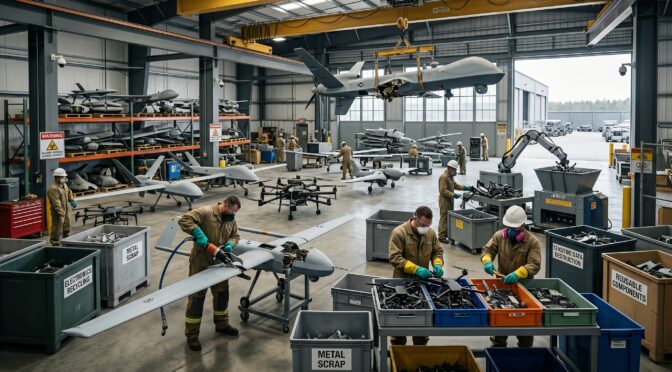
The term “attritable” creates a dangerous semantic hazard within logistics planning. It implies that these systems can simply be abandoned on the battlefield, written off the property books, or discarded in standard waste streams once they fulfill their mission. This is a profound operational fallacy. Even the most inexpensive tactical drone contains specific elements that strictly prohibit casual abandonment. They utilize high-energy density power sources, specifically lithium-ion or lithium-polymer batteries, that pose acute fire, explosion, and chemical hazards if damaged or improperly stored.9 They possess sensitive digital storage media, including flight controllers, telemetry logs, and optical payloads, that contain precise operational data, base locations, command frequencies, and network authentication keys.13 Furthermore, they are assembled using controlled hardware components, such as specialized sensors, anti-jam antennas, and encryption modules, that require formal trade security controls and worldwide mutilation under specific Controlled Inventory Item Codes.6
When operating in contested logistical environments, the assumption that frontline units can seamlessly retrograde these hazardous and classified materials back to safe havens or continental United States processing facilities is deeply flawed. The modern battlefield features contested supply lines, anti-access/area denial networks, and constant surveillance, meaning forward-deployed units must manage their own waste and wreckage under severe duress.21 Therefore, the disposal architecture must be pushed as far forward to the tactical edge as possible, requiring entirely new paradigms for field-expedient demilitarization.
3. Regulatory Frameworks Governing Demilitarization and Disposal
To understand the systemic risk posed by the rapid influx of unmanned systems, it is necessary to examine the regulatory architecture that governs military property disposal. The overarching guidance is provided by the(https://www.esd.whs.mil/Portals/54/Documents/DD/issuances/dodm/416028m_vol1.pdf), which stipulates that demilitarization is an inherent life-cycle requirement, not an afterthought confined merely to the end of a system’s utility.6 The Defense Acquisition System requires that Department of Defense Components generate programmatic demilitarization plans prior to developmental test and evaluation, and certainly before releasing any new system or item to a non-military activity.6
These Demilitarization Plans are bifurcated into two distinct categories. Programmatic Demilitarization Plans are tailored to each acquisition program and addressed early in the process, outlining what tasks need to be performed and formulating the overarching strategies for disposition processing. Procedural Demilitarization Plans provide the actual, granular “how-to” instructions for performing physical demilitarization, developed using existing technical data, operating manuals, and technical drawings.6 The Department utilizes specific demilitarization codes to identify requirements for processing excess materiel, indicating whether items require physical destruction, mutilation, or trade security control measures.6
However, the speed of modern commercial-off-the-shelf procurement and rapid fielding initiatives often marginalizes this rigid requirement. When rapid acquisition strategies push prototypes and commercially derived drones directly to end-users to meet urgent operational needs, the corresponding procedural plans are frequently delayed, under-developed, or entirely absent. This creates a scenario where frontline troops are issued advanced hardware without clear instructions or the necessary equipment to safely and legally dispose of it when it breaks or becomes obsolete.
Furthermore,(https://www.esd.whs.mil/Portals/54/Documents/DD/issuances/dodm/416021_vol1.pdf) governs the disposal of personal property, including the stringent requirements for managing hazardous waste and materials requiring special handling.22 This manual mandates that hazardous waste disposal comply with the Resource Conservation and Recovery Act, managed through a worldwide network of hazardous waste management contracts.24 The intersection of these two regulatory bodies—one demanding the physical destruction of sensitive components and the other demanding the careful containment of hazardous chemical waste—creates a complex operational dilemma when dealing with an integrated unit like a drone, where the classified circuit board is inextricably linked to the volatile lithium battery.
4. Intelligence Exploitation Vectors and Mitigation Strategies
The most immediate strategic risk associated with massed drone operations is the unintentional transfer of technology, cryptographic material, and operational intelligence to pacing threats. By saturating an airspace with thousands of sensors and communication nodes, the military statistically guarantees that a certain percentage of these systems will experience mechanical failure, electronic warfare disruption, or kinetic interception, resulting in relatively intact airframes falling into hostile territory.26
Adversaries possess highly organized, state-sponsored programs dedicated entirely to the recovery and exploitation of Western military technology. The loss of a United States RQ-170 Sentinel drone in Iranian territory in December 2011 serves as the foundational case study for this specific vulnerability.10 The aircraft, which landed largely intact due to alleged electronic spoofing, was subjected to intense scrutiny by Iranian aerospace engineers. Despite initial assumptions by American officials that the internal software was heavily encrypted and structurally secure from intrusion, the capture allowed adversarial engineers to decode flight data, reverse-engineer the physical aerodynamic design, and eventually mass-produce indigenous replicas of the stealth platform.11 Similarly, the capture and exploitation of smaller, less exquisite systems, such as the ScanEagle, provided adversaries with advanced aerodynamic and sensor insights that allowed them to bypass decades of organic research and development.27
More recently, the ongoing conflict in Ukraine has demonstrated the speed at which tactical drone wreckage is exploited on the modern battlefield. Recovered printed circuit boards, telemetry modules, and optical sensors are immediately analyzed by specialized cyber units, such as the Russian military intelligence-connected group Sandworm, to identify supply chains, uncover frequency hopping algorithms, and develop counter-electronic warfare profiles.29 If thousands of American attritable drones are deployed without absolute data destruction fail-safes, they will serve as an involuntary technology transfer program, providing adversaries with the exact specifications needed to defeat American swarms.
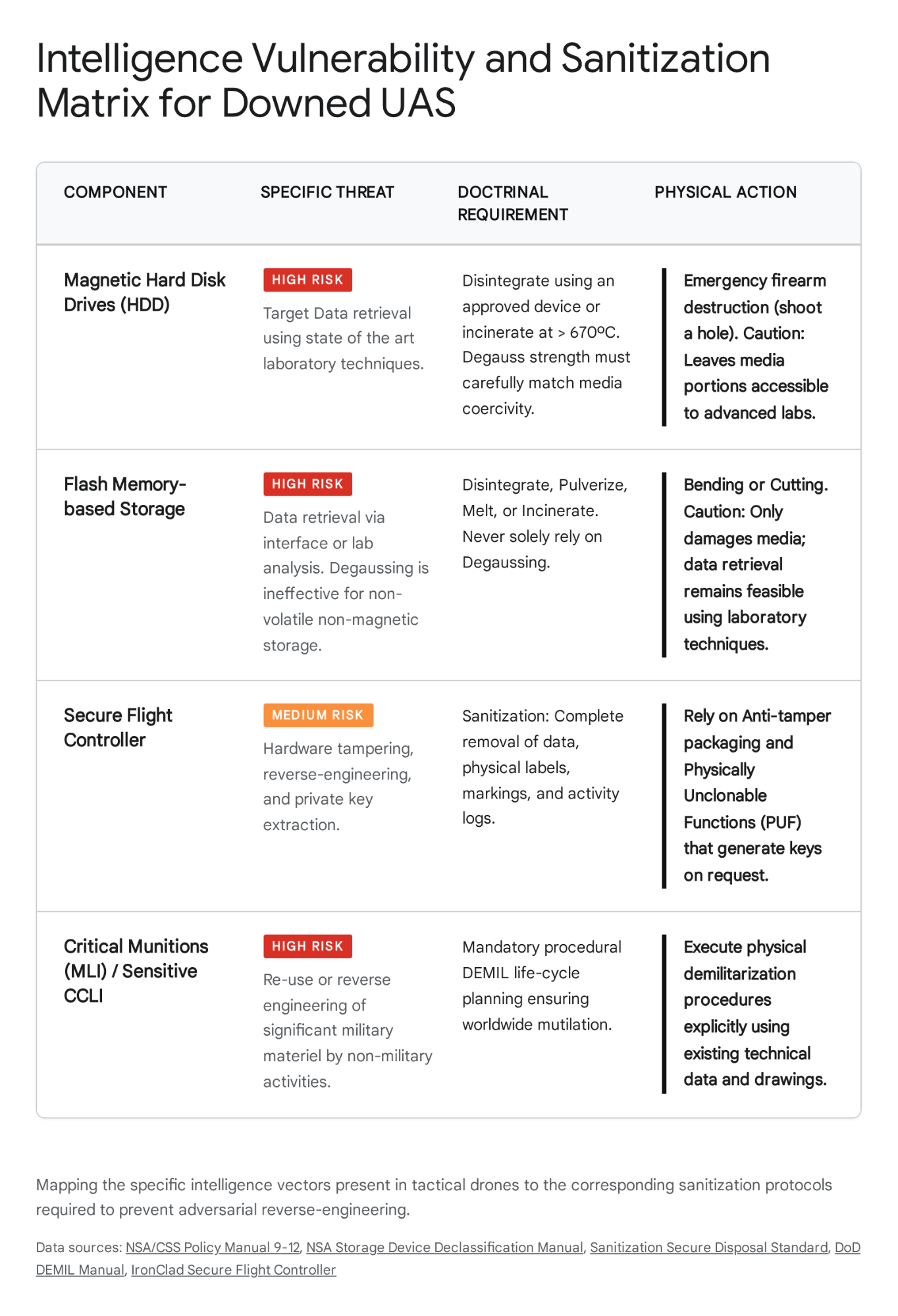
The intelligence vectors present in a downed drone are multifaceted. Telemetry and flight logs map friendly base locations, patrol routes, and operational tempo. Optical and sensor payloads reveal collection capabilities, resolution limits, and targeting algorithms. Command and control transceivers expose frequency hopping schemes and allow adversaries to develop targeted jamming or spoofing profiles. Finally, the airframe aerodynamics and materials provide blueprints for reverse-engineering lift, stealth, and propulsion metrics for indigenous production. Each of these vectors requires a dedicated, distinct approach to sanitization and destruction to assure operational security.
5. Doctrinal Data Sanitization: Bridging the Gap to the Tactical Edge
The National Security Agency and Central Security Service maintain rigorous standards governing the sanitization and destruction of information system storage devices, detailed comprehensively in Policy Manual 9-12.31 The manual defines sanitization as the removal of information from a storage device such that data recovery using any known technique or analysis is definitively prevented.33 Approved methods for achieving this standard include degaussing, high-temperature incineration, mechanical shredding, and disintegration.33
However, translating these facility-based, industrial requirements to a lightweight tactical drone operating beyond the forward line of own troops presents severe engineering and operational challenges. National Security Agency guidelines explicitly note that rudimentary techniques such as bending, cutting, or using field-expedient emergency procedures—such as firing a weapon into a storage device—may leave portions of the media undamaged and fully accessible using advanced laboratory forensics.13 Therefore, kinetic destruction via bullet or crash impact is wholly insufficient for sanitizing highly classified cryptographic keys, mission profiles, or collected intelligence logs.
To effectively manage this risk without burdening the operator, Department of Defense leadership must require automated, zero-trust architectures integrated directly into the flight controllers and hardware of attritable fleets.35
Cryptographic Erase and Logical Sanitization
Software-based wiping methods, such as the legacy DoD 5220.22-M standard involving multiple overwrite passes, are obsolete and no longer approved for highly sensitive data by modern intelligence agencies.36 Furthermore, they require time that a plummeting drone does not possess. Modern attritable systems must instead utilize Cryptographic Erase functionality. This mechanism involves the instantaneous destruction of the encryption key that protects the data on the device, rendering the remaining cipher text permanently unreadable regardless of physical recovery.13 This logical sanitization must be designed to trigger automatically upon detecting specific conditions: unauthorized hardware access, sustained loss of connection with the ground station, or the initiation of a forced landing or crash sequence.37
Anti-Tamper Hardware and Physically Unclonable Functions
To prevent sophisticated adversaries from cloning microchips or bypassing software-based wipes, defense contractors must integrate anti-tamper packaging and Physically Unclonable Functions into the drone’s architecture.38 Physically Unclonable Functions leverage microscopic, atomic-level manufacturing variations inherent in silicon wafers to generate private encryption keys on demand, rather than storing them statically within the drone’s memory. If the physical structure of the chip is altered, probed, or subjected to electron microscopy by an adversary attempting to extract data, the unique physical characteristics change irreversibly, and the key can no longer be generated.38 This provides a robust, hardware-level defense against reverse engineering.
Emergency Destruct Mechanisms
For highly sensitive intelligence payloads where logical sanitization is deemed insufficient, it must be paired with guaranteed physical destruction. Autonomous self-destruct circuits utilizing small thermite charges or high-power micro-incinerators can ensure that the internal electronics are subjected to temperatures exceeding the National Security Agency requirement of 670 degrees Celsius for magnetic drives, or 233 degrees Celsius for solid-state and composite equivalents.31 While the inclusion of incendiary devices inherently complicates the peacetime transportation, storage, and handling of the drones, it is an unavoidable necessity for operating classified sensors in highly contested airspace where recovery is impossible.39
The Forensics of Friendly Recovery
When drones are recovered by friendly or allied forces, the chain of custody must be impeccably maintained to preserve forensic data and prevent accidental triggering of security protocols. Law enforcement, explosive ordnance disposal, and intelligence units frequently recover downed systems, both friendly and hostile.20 Recovered drones must be immediately shielded using Radio Frequency isolation techniques, such as portable Faraday enclosures or specialized transport sacks, to prevent remote detonation, data exfiltration, or adversarial triggering of zeroize mechanisms during transport to exploitation laboratories.20 Standardizing these recovery protocols across international partners is governed by agreements such as NATO STANAG 3531, which dictates combined investigation parameters and wreckage recovery procedures.40 Ensuring all allied partners understand how to handle these systems without compromising the intelligence or triggering the emergency destruct mechanisms is a critical component of coalition interoperability.
| Data Security Requirement | Adversarial Threat Model | Approved Mitigation Strategy | Compliance Standard |
| Telemetry & Flight Logs Protection | Mapping base locations, patrol routes, and unit operational tempo. | Automated Cryptographic Erase upon loss of datalink or catastrophic impact. | Logical Purge via standardized device commands.13 |
| Sensor Payload Security | Analyzing sensor resolution, algorithms, and intelligence capabilities. | Physical anti-tamper casing, rapid on-site data destruction protocols.42 | Disintegration or Pulverization of storage media.13 |
| Transceiver Encryption | Exploiting frequency hopping schemes and C2 vulnerabilities. | Physically Unclonable Functions (PUFs) to prevent key extraction.38 | Hardware-based key generation and invalidation.38 |
| Airframe Architecture | Reverse-engineering stealth, lift, and propulsion metrics. | Incorporation of self-consuming or highly frangible composite materials. | Physical Destruction (shredding/grinding).34 |
6. The Kinetic and Chemical Hazards of Lithium-Ion Power Sources
While data exploitation poses a severe non-kinetic threat to operational security, the physical batteries powering these drone fleets present an immediate, lethal, and compounding kinetic hazard to logistics personnel and combat troops. Massed drones rely almost exclusively on lithium-ion and lithium-polymer batteries due to their exceptional energy density, low self-discharge rate, and overall operational performance.43 However, as the Department of Defense transitions to scaled drone procurement, the logistics system must absorb millions of pounds of highly volatile chemical energy storage.
The Mechanics of Thermal Runaway
Lithium batteries are inherently unstable when subjected to mechanical damage such as crushing or puncturing, electrical abuse such as overcharging or short circuits, or extreme ambient temperatures—all of which are exceedingly common occurrences in rugged tactical environments.19 The primary danger is thermal runaway, an uncontrollable, self-heating state initiated when internal cell temperatures reach a critical threshold, often due to an internal short circuit.8
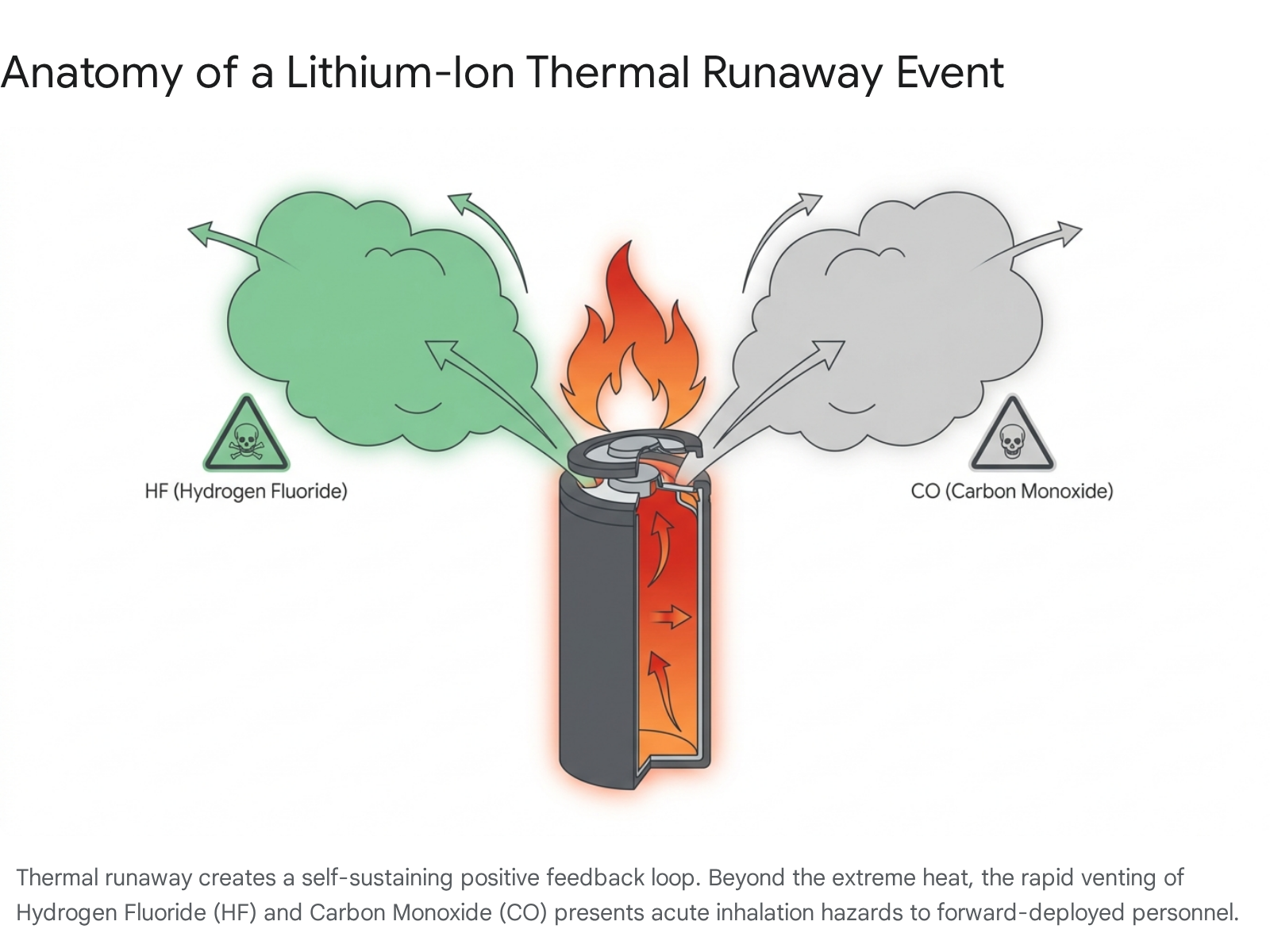
During a thermal runaway event, the internal chemical reactions generate tremendous heat, often rapidly exceeding 1,000 degrees Fahrenheit, which in turn accelerates the reaction in adjacent cells, creating a highly destructive positive feedback loop.8 The resulting fires are notoriously difficult for military firefighters and damage control personnel to extinguish. Standard halon suppression systems and conventional fire retardants only extinguish the open flame; they do not halt the internal chemical reaction, which creates its own fuel and oxygen byproducts as the electrolyte breaks down.19 Consequently, lithium batteries frequently reignite hours or even days after the initial fire appears to be fully extinguished, vastly complicating post-incident transport, cleanup, and disposal.45
Toxic Gas Emissions and Battlefield Health Risks
The visible flames and extreme heat are only a secondary hazard. The primary danger to personnel operating in forward operating bases, vehicle convoys, or enclosed spaces such as ship decks or storage bunkers is the catastrophic release of toxic gases. During a failure event, the battery casing ruptures and vents a complex, highly pressurized mixture of volatile organic compounds, particulate matter, heavy metals, and lethal gases into the immediate environment.44
The most concerning emission generated during lithium-ion thermal runaway is Hydrogen Fluoride.9 Hydrogen Fluoride is highly corrosive and extremely toxic. When inhaled by personnel in the vicinity, it reacts violently with the natural moisture in the respiratory tract and lungs to form hydrofluoric acid, causing deep tissue damage, severe pulmonary edema, and often fatal respiratory failure.9 Furthermore, massive volumes of Carbon Monoxide are released alongside the Hydrogen Fluoride. In close proximity to a thermal runaway event, Hydrogen Fluoride concentrations can rapidly reach hundreds of parts per million, vastly exceeding all permissible occupational exposure limits and creating an immediately deadly atmosphere for logisticians and first responders who may not be equipped with self-contained breathing apparatuses.48
7. In-Theater Battery Management and Neutralization Technologies
When a tactical drone fleet reaches the end of its operational life, or when batteries naturally degrade through standard charge and discharge cycles, units are left holding thousands of volatile hazardous waste items. Under the Resource Conservation and Recovery Act administered by the Environmental Protection Agency, these specific types of batteries are classified as hazardous waste and require highly regulated handling procedures, specialized protective packaging, and specific, documented disposal pathways.25
Currently, the physical transport of these end-of-life batteries out of a combat theater is prohibitively expensive and logistically dangerous. Transporting unstable, degraded lithium batteries on military cargo aircraft or naval vessels introduces unacceptable, catastrophic risks to the transport platform itself.19 The Department of the Navy’s Lithium Battery Safety Program strictly regulates these transport mechanisms, emphasizing the grave danger of latent defects causing mid-flight thermal events that could result in the loss of major fleet assets.43
To decrease the financial cost and mitigate the physical risk to the Department of Defense, the Defense Logistics Agency Research and Development team, operating through specialized programs like the Battery Network, is actively collaborating with industry partners to develop cutting-edge technologies designed to render lithium batteries inert directly in the field.12
The strategic goal of these initiatives is to develop reliable chemical or mechanical processes that can safely discharge and permanently neutralize the reactive internal elements of the battery at the forward operating base, without requiring transport to a specialized facility. If a battery can be reliably inerted, it removes the immediate, localized threat of thermal runaway, officially reclassifies the component from a hazardous explosive risk to standard solid waste, and drastically reduces the financial and logistical burden of retrograding the material back to the continental United States for final processing.23 Until this specific inerting technology is fully matured, manufactured, and distributed to frontline units, commanders will be forced to stockpile dangerous, highly reactive waste in active war zones. This creates soft, high-value targets for adversarial kinetic strikes or sabotage, which could easily trigger massive secondary explosions and toxic gas clouds within friendly perimeters.
| Hazard Classification | Underlying Cause | Tactical Implication | Mitigation Requirement |
| Thermal Runaway | Internal short circuit, physical damage, extreme heat.8 | Sustained Class D fires that are resistant to standard suppression and reignite over time.19 | Specialized containment units; immediate isolation from munition stores. |
| Toxic Gas Venting | Electrolyte decomposition during thermal events.44 | Release of lethal Hydrogen Fluoride (HF) and Carbon Monoxide (CO), causing severe respiratory damage.9 | Prohibition of indoor or subterranean storage without industrial-grade ventilation. |
| Logistical Bottleneck | RCRA hazardous waste classification.25 | Inability to legally or safely load degraded batteries onto standard airlift.50 | Implementation of field-expedient chemical inerting technologies.12 |
8. Environmental Compliance, Remediation, and the DERP Parallel
The intersection of massed drone disposal and environmental compliance represents a severe regulatory and geopolitical challenge that extends far beyond the immediate battlefield. The extraction and processing of materials inherent to drone manufacturing—such as lithium, cobalt, and titanium—already cause significant global ecological degradation.54 Discarding thousands of drones in theater not only wastes these critical, increasingly scarce resources and heightens dependence on foreign supply chains, but it also creates lasting environmental contamination that will inevitably require remediation.54
In extreme combat environments where retrograde logistics are contested or impossible, units may be forced to dispose of drones and batteries on-site. Military doctrine permits the burial or burning of certain wastes, provided it strictly aligns with Host Nation environmental laws and established theater standard operating procedures.57 However, these traditional waste management methods are heavily restricted when applied to modern electronic components.
The incineration of hardware containing hazardous materials, heavy metals, and reactive lithium batteries is strictly prohibited due to the acute risk of explosions and the lofting of highly toxic dioxins and corrosive gases into the atmosphere.47 Open-air burn pits, which have caused massive, well-documented historical health crises for United States veterans, absolutely cannot be utilized to dispose of attritable unmanned aerial system fleets.
Burial presents similar, though less immediate, long-term risks. Government-approved landfills must feature secure perimeter fencing, restricted access, and formally witnessed burial procedures.23 When lithium batteries are buried without the use of a complete discharge device, they remain chemically reactive and can leach heavy metals and toxic compounds into the host nation’s groundwater. This leads to long-term ecological damage and severe diplomatic friction with allied partners who must deal with the contamination long after combat operations have ceased.23
The Department of Defense must view the disposal of massed drone fleets through the historical lens of the Defense Environmental Restoration Program.14 Currently, the Department is expending billions of dollars and immense political capital to remediate sites contaminated by per- and polyfluoroalkyl substances found in legacy firefighting foams.60 If the disposal of lithium batteries and toxic drone components is not managed proactively and systemically today, the Department risks creating thousands of new micro-contamination sites across allied host nations. This will lead to future financial liabilities and remediation requirements that dwarf the initial, seemingly low acquisition costs of the drones themselves. Green and sustainable remediation practices must be integrated into the Replicator program’s lifecycle planning from inception, utilizing advanced modeling tools to optimize waste allocation, balance recycling capabilities, and minimize final disposal footprints.14
9. Forward-Deployed Reverse Logistics and Expeditionary Operations
To manage the overwhelming influx of end-of-life systems and hazardous materials, the Department of Defense relies heavily on the capabilities of Defense Logistics Agency Disposition Services.62 The Defense Logistics Agency manages the highly complex worldwide network responsible for the reutilization, transfer, demilitarization, and hazardous waste disposal of military property.24
Recognizing that modern conflicts occur in austere, heavily contested environments, Defense Logistics Agency Distribution Expeditionary teams are specifically designed to deploy rapidly—often within a twenty-four to forty-eight-hour window—to establish scalable, end-to-end distribution and disposal processes directly in the theater of operations.15 These highly trained, multidisciplinary teams utilize portable Expeditionary Site Sets to provide combatant commands with immediate, robust disposal operations that comply with all regulatory frameworks.65
However, the sheer volume of property handled by Disposition Services requires complex, commodity-based sorting procedures and heavily relies on automated electronic data transfer systems to maintain strict accountability and legal compliance.24 When tasked with handling thousands of serialized drone components and simultaneously managing stockpiles of hazardous lithium batteries, the administrative and physical burden alone can overwhelm expeditionary capabilities and crash tactical supply networks. The system must be streamlined to handle mass rather than bespoke items.
A critical, yet historically underutilized, aspect of the Defense Logistics Agency’s mission is reutilization. Historically, only a small fraction of the property turned into the agency is successfully reutilized by other Military Services.7 For massed drone fleets, this paradigm must undergo a radical shift toward a circular economy model. Drones that are damaged in combat or grounded due to structural failure often contain fully functional, highly expensive sub-components, such as optical gimbals, secure transponders, encrypted communication modules, or specialized motors.
Disposition Services must establish rapid triage and harvesting protocols in-theater. Instead of grinding an entire damaged drone into scrap or burying it, expeditionary teams should be equipped and trained to extract high-value, high-scarcity components—particularly those utilizing rare-earth magnets and aerospace-grade materials—and immediately route them back into the active supply chain.54 This approach directly supports the warfighter by mitigating acute supply chain disruptions, reducing the financial cost of replacement parts, and addressing the inherent vulnerability of relying on critical minerals sourced from geopolitically unstable regions.7
Furthermore, the proliferation of drones dictates that adversarial systems will also saturate the airspace, requiring robust counter-drone strategies and the subsequent management of hostile wreckage.26 Technologies ranging from directed energy microwave weapons to cyber-takeover tools are employed to neutralize these threats.66 When these hostile systems are brought down, they present the exact same toxic battery hazards and unique intelligence-gathering opportunities as friendly drones. Expeditionary teams and allied explosive ordnance disposal units must be equally prepared to process vast quantities of hostile wreckage, safely extracting digital forensics for intelligence analysis while meticulously managing the physical and chemical hazards.20
10. Strategic Directives for Department Leadership
The Department of Defense cannot achieve sustainable lethality through mass without mastering the logistics of disposal. The rapid procurement of thousands of attritable systems solves the immediate tactical problem of magazine depth, but it creates a massive, trailing vulnerability in the form of hazardous waste and intelligence exposure. To close the critical vulnerabilities exposed by the rapid acquisition of these fleets, Department leadership must establish and enforce the following strategic disposal protocols:
1. Mandate Integrated Demilitarization Engineering in Acquisition The Defense Innovation Unit and all primary acquisition authorities must require vendors to include comprehensive, automated demilitarization capabilities as a core, non-negotiable performance metric. Drones procured under the Replicator initiative must possess hardware-level anti-tamper mechanisms and automated Cryptographic Erase functions that activate upon connection loss or catastrophic impact.13 Systems lacking these capabilities should be disqualified from procurement, as they represent unacceptable intelligence risks that negate their tactical value.
2. Accelerate and Fund Field-Expedient Battery Neutralization The Defense Logistics Agency Research and Development Battery Network program must receive prioritized, expedited funding to rapidly field battery-inerting technology.51 The ability to chemically or mechanically neutralize lithium-ion batteries at the tactical edge is the single most effective way to eliminate thermal runaway hazards, reduce toxic gas exposure to personnel, and bypass the crippling logistical costs of shipping reactive hazardous waste out of theater.9 This technology must become standard issue at all forward operating bases.
3. Expand Expeditionary Disposal Capabilities Defense Logistics Agency Distribution Expeditionary teams must be scaled, resourced, and specifically trained to handle the unique, high-volume demands of autonomous system disposal.15 This includes equipping Expeditionary Site Sets with industrial-grade media disintegrators capable of meeting National Security Agency standards for classified storage destruction in the field 13, as well as providing portable hazardous waste processing units designed specifically for lithium and heavy metal containment.
4. Establish a Circular “Harvesting” Doctrine Update disposal manuals to explicitly prioritize component harvesting over wholesale destruction for damaged drones. Establish forward-deployed triage centers where functional, high-value components can be quickly extracted, digitally sanitized of specific mission data, and reinserted into the supply chain to maintain operational readiness and reduce reliance on fragile commercial supply chains.7
5. Prohibit Unregulated In-Theater Disposal Strictly enforce prohibitions against the open-pit burning or unregulated burial of drones and lithium batteries.23 Combatant Commanders must be provided with the logistical support necessary to manage these materials properly to prevent the creation of highly toxic environmental hazard sites that will inevitably incur billions in future remediation costs and severely damage host-nation relations.14
By proactively addressing the entirety of the end-of-life lifecycle of massed unmanned systems, the Department of Defense can ensure that the logistical and environmental burdens of these advanced technologies do not offset their intended tactical advantages. True operational mass is only achieved when the entire spectrum of the capability—from the commercial assembly line to ultimate, secure demilitarization—is comprehensively managed.
Please share the link on Facebook, Forums, with colleagues, etc. Your support is much appreciated and if you have any feedback, please email us in**@*********ps.com. If you’d like to request a report or order a reprint, please click here for the corresponding page to open in new tab.
Sources Used
- DOD Innovation Official Discusses Progress on Replicator > Department of Defense Manufacturing Technology Program > News Display, accessed April 24, 2026, https://www.dodmantech.mil/News/News-Display/Article/3999474/dod-innovation-official-discusses-progress-on-replicator/
- DOD’s Replicator Program:, accessed April 24, 2026, https://docs.house.gov/meetings/AS/AS35/20231019/116484/HHRG-118-AS35-Wstate-GreenwaltW-20231019.pdf
- Replicator: A Bold New Path for DoD | Center for Security and Emerging Technology %, accessed April 24, 2026, https://cset.georgetown.edu/article/replicator-a-bold-new-path-for-dod/
- The Pentagon’s New Replicator Program: What You Need To Know – Oliver Wyman, accessed April 24, 2026, https://www.oliverwyman.com/our-expertise/insights/2023/sep/pentagons-new-replicator-program.html
- Bringing the Swarm to Life: Roles, Missions, and Campaigns for the Replicator Initiative, accessed April 24, 2026, https://warontherocks.com/bringing-the-swarm-to-life-roles-missions-and-campaigns-for-the-replicator-initiative/
- DoDM 4160.28 Volume 1, August 9, 2017; Incorporating Change 3 …, accessed April 24, 2026, https://www.esd.whs.mil/Portals/54/Documents/DD/issuances/dodm/416028m_vol1.pdf?ver=2019-07-17-083913-820
- DLA Disposition Services: Reutilization as a source of supply, accessed April 24, 2026, https://www.dla.mil/About-DLA/News/News-Article-View/Article/4345735/dla-disposition-services-reutilization-as-a-source-of-supply/
- Fighting Fire with Knowledge on Lithium-ion Battery Hazards – Homeland Security, accessed April 24, 2026, https://www.dhs.gov/science-and-technology/news/2024/12/13/fighting-fire-knowledge-lithium-ion-battery-hazards
- Toxic Gas in Lithium-Ion Battery Fires: Risks and Solutions – EticaAG, accessed April 24, 2026, https://eticaag.com/toxic-gas-in-lithium-battery-fires-risks-and-solutions/
- The Lost Drone That Changed the Future of War | Eliezer Avraham – The Blogs, accessed April 24, 2026, https://blogs.timesofisrael.com/the-lost-drone-that-changed-the-future-of-war/
- Iran claims to have reverse-engineered US spy drone – The Guardian, accessed April 24, 2026, https://www.theguardian.com/world/2012/apr/22/iran-reverse-engineer-spy-drone
- DLA Research & Development: Innovating Safe Lithium Battery Disposal – YouTube, accessed April 24, 2026, https://www.youtube.com/watch?v=yTVgQzDM_yM
- Sanitization Secure Disposal Standard, accessed April 24, 2026, https://www.cisecurity.org/-/media/project/cisecurity/cisecurity/data/media/files/uploads/2020/06/Sanitization-Secure-Disposal-Standard.docx
- DoDM 4715.20, March 9, 2012, Incorporating Change 1, August 31, 2018 – Executive Services Directorate, accessed April 24, 2026, https://www.esd.whs.mil/Portals/54/Documents/DD/issuances/dodm/471520m.pdf
- DLA Distribution Expeditionary Always on call > Defense Logistics Agency > News Article View, accessed April 24, 2026, https://www.dla.mil/About-DLA/News/News-Article-View/Article/3368871/dla-distribution-expeditionary-always-on-call/
- Proper Cleaning Keeps Drone Aircraft (UAS / UAV) Flying High | Techspray, accessed April 24, 2026, https://www.techsprayeu.com/proper-cleaning-keeps-drone-aircraft-uas-uav-flying-high
- One Operator, Many Platforms: Unlocking the Full Potential of Attritable Mass – RUSI, accessed April 24, 2026, https://my.rusi.org/resource/one-operator-many-platforms-unlocking-the-full-potential-of-attritable-mass.html
- Replicator and beyond: The future of drone warfare – Brookings Institution, accessed April 24, 2026, https://www.brookings.edu/events/replicator-and-beyond-the-future-of-drone-warfare/
- The Dangers of Lithium Battery Fires – And What to Do in Flight | NBAA, accessed April 24, 2026, https://nbaa.org/aircraft-operations/safety/in-flight-safety/handling-of-hazardous-materials/lithium-batteries/dangers-lithium-battery-fires-flight/
- Drone Handling Solutions – MOS Equipment, accessed April 24, 2026, https://mosequipment.com/collections/drone-handling-solutions
- Contested Logistical Resupply to the Zero Line: How Drones and …, accessed April 24, 2026, https://smallwarsjournal.com/2025/11/24/contested-logistical-resupply-to-the-zero-line-how-drones-and-signals-require-a-change-in-standard-operating-procedures/
- Department of Defense MANUAL – Navy MWR, accessed April 24, 2026, https://www.navymwr.org/modules/media/?do=download&id=fc696cd6-e116-4e9b-bb1d-bf796e22a496
- DoDM 4160.21, Volume 4, “Defense Materiel Disposition: Instructions for Hazardous Property and Other Special Processing Mat, accessed April 24, 2026, https://www.esd.whs.mil/portals/54/documents/dd/issuances/dodm/416021_vol4.pdf
- Hazardous Waste Disposal – DLA, accessed April 24, 2026, https://www.dla.mil/Disposition-Services/Offers/Hazardous-Waste-Disposal/
- Disposal – U.S. Army Batteries, accessed April 24, 2026, https://battery.army.mil/safety/disposal/
- The Vulnerabilities of the Drone Age Established Threats and Emerging Issues out to 2035 – CSS ETH Zürich, accessed April 24, 2026, https://css.ethz.ch/content/dam/ethz/special-interest/gess/cis/center-for-securities-studies/pdfs/NATO_VDA_Policy_Report.pdf
- Iran: Replica of U.S. stealth RQ-170 Sentinel drone flying in video – CBS News, accessed April 24, 2026, https://www.cbsnews.com/news/iran-replica-of-us-stealth-rq170-sentinel-drone-flying-in-video/
- What is the story behind Iranian reverse engineering of Western military equipment? : r/WarCollege – Reddit, accessed April 24, 2026, https://www.reddit.com/r/WarCollege/comments/vxnb7e/what_is_the_story_behind_iranian_reverse/
- Cyber Vault Ukraine Timeline – OCR of the Document | National Security Archive, accessed April 24, 2026, https://nsarchive.gwu.edu/media/29562/ocr
- A Case Study of Russian Cyber-Attacks on the Ukrainian Power Grid: Implications and Best Practices for the United States – Pepperdine Digital Commons, accessed April 24, 2026, https://digitalcommons.pepperdine.edu/cgi/viewcontent.cgi?article=1216&context=ppr
- NSA/CSS POLICY MANUAL 9-12, accessed April 24, 2026, https://media.defense.gov/2026/Mar/10/2003897016/-1/-1/0/PM%209-12%2020260219.PDF
- nsa/css policy manual 9-12 storage device sanitization – National Security Agency, accessed April 24, 2026, https://www.nsa.gov/portals/75/documents/resources/everyone/media-destruction/PM_9-12_20201204_Storage%20Device%20Sanitization%20and%20Destruction%20Manual.pdf?ver=zx7StOLhG4LC6sXArMYiHQ%3D%3D/PM_9-12_20201204_Storage%20Device%20Sanitization%20and%20Destruction%20Manual.pdf
- NSA/CSS POLICY 6-22 – National Security Agency, accessed April 24, 2026, https://www.nsa.gov/portals/75/documents/news-features/declassified-documents/nsa-css-policies/nsacss%20p%206-22%2020191121.pdf?ver=2019-12-04-145750-543
- devices for disposal or recycling in accordance with NSA/CSS Policy Statement 9-12 – National Security Agency, accessed April 24, 2026, https://www.nsa.gov/portals/75/documents/resources/everyone/media-destruction/storage-device-declassification-manual.pdf
- The Digital Battlefield: Safeguarding Military Drones Against Cyberattacks – Digital Commons @ USF – University of South Florida, accessed April 24, 2026, https://digitalcommons.usf.edu/cgi/viewcontent.cgi?article=1129&context=mca
- 3 data sanitization methods from the DoD, NSA, accessed April 24, 2026, https://www.protondata.com/blog/data-security/3-data-sanitization-methods-dod-nsa/amp/
- Electronic Warfare Cyberattacks, Countermeasures and Modern Defensive Strategies of UAV Avionics: A Survey – arXiv, accessed April 24, 2026, https://arxiv.org/html/2504.07358v1
- Physics’ Dan Gauthier creates ‘tamper-proof’ encryption for drones | College of Arts and Sciences – The Ohio State University, accessed April 24, 2026, https://artsandsciences.osu.edu/news/physics-dan-gauthier-creates-tamper-proof-encryption-drones
- Drone Swarms Are Here. This Technology Could Stop Them. – YouTube, accessed April 24, 2026, https://www.youtube.com/watch?v=unraT22a4zY
- NAVAL AVIATION SAFETY PROGRAM – secnav.navy.mil, accessed April 24, 2026, https://www.secnav.navy.mil/doni/SECNAV%20Manuals1/3750.6.pdf
- Recover the air base: 18 NATO countries participate in multinational CBRN exercise – Secretary of the Air Force International Affairs, accessed April 24, 2026, https://www.safia.hq.af.mil/IA-News/Article/3551433/recover-the-air-base-18-nato-countries-participate-in-multinational-cbrn-exerci/
- From Cyber Threats to Tactical Countermeasures: The New Era of Military Data Protection, accessed April 24, 2026, https://store.veritysystems.com/2025/02/26/from-cyber-threats-to-tactical-countermeasures-the-new-era-of-military-data-protection/
- Safety Testing of Lithium-Ion Batteries for Military Applications, accessed April 24, 2026, https://railroads.dot.gov/sites/fra.dot.gov/files/2023-06/Safety%20Testing%20of%20Lithium-Ion%20Batteries%20for%20Military%20Applications.pdf
- The Emissions and Hazards of Lithium-Ion Battery Thermal Runaway | TRANSCAER, accessed April 24, 2026, https://www.transcaer.com/connect/blog/emissions-and-hazards-lithium-ion-battery-thermal-runaway
- Risks and response strategies for lithium-ion battery fires – USFA.FEMA.gov, accessed April 24, 2026, https://www.usfa.fema.gov/a-z/lithium-ion-batteries/risks-and-response-strategies/
- Harmful effects of lithium-ion battery thermal runaway: scale-up tests from cell to second-life modules – PMC, accessed April 24, 2026, https://pmc.ncbi.nlm.nih.gov/articles/PMC10332131/
- Flammable and Toxic Gases from Batteries in Thermal Runaway: Consequences and mitigation – Lund University Publications, accessed April 24, 2026, https://lup.lub.lu.se/search/files/220474262/Battery_review-v7.pdf
- What is thermal runaway in lithium-ion batteries – Gasmet Technologies, accessed April 24, 2026, https://www.gasmet.com/blog/what-is-thermal-runaway-in-lithium-ion-batteries-risks-and-causes/
- EPA On-Scene Coordinator Lithium-Ion Battery Response Guide – astswmo, accessed April 24, 2026, https://astswmo.org/files/Policies_and_Publications/EPA-OSC-Lithium-Ion-Battery-Response-Guide.pdf
- On the Case: Preventing Lithium Battery Hazards – Federal Aviation Administration, accessed April 24, 2026, https://www.faa.gov/blog/clearedfortakeoff/case-preventing-lithium-battery-hazards
- DLA Research and Development, accessed April 24, 2026, https://www.dla.mil/Information-Operations/Research-And-Development/
- DLA Research & Development: Innovating Safe Lithium Battery Disposal – SAF/IE, accessed April 24, 2026, https://www.safie.hq.af.mil/News/Video/mod/61713/player/0/video/954389/DLA%20Research%20and%20Development
- DLA Strategic Materials Partners with Research and Development – DoD ManTech, accessed April 24, 2026, https://www.dodmantech.mil/News/News-Display/Article/1674904/dla-strategic-materials-partners-with-research-and-development/
- Where Do Drones Go When They Die? Building Sustainable Futures in Aerospace and Engineering – JAKTOOL, accessed April 24, 2026, https://www.jaktool.com/drone-disposal-and-parts-recovery/
- Eco-Friendly Drone Usage: The Matrice 4T Perspective – Covert Drones, accessed April 24, 2026, https://covertdrones.com/blogs/covert-drones-blog/eco-friendly-drone-usage-matrice-4t
- The Harmful Effects of our Lithium Batteries – Greenly, accessed April 24, 2026, https://greenly.earth/en-gb/blog/industries/the-harmful-effects-of-our-lithium-batteries
- WASTE MANAGEMENT FOR DEPLOYED FORCES – Marines.mil, accessed April 24, 2026, https://www.marines.mil/portals/1/Publications/MCIP%203-40G.2i.pdf
- Analysis of the Impact of Skywalker Drone Battery Waste Management on the Environment Using Linear Programming Method – Tecno Scientifica Publishing, accessed April 24, 2026, https://tecnoscientifica.com/journal/idwm/article/view/757
- Defense Environmental Restoration Program – DOD DENIX, accessed April 24, 2026, https://www.denix.osd.mil/derp/
- DoD’s ESTCP, DIU Partner To Advance Remediation of PFAS – Defense Innovation Unit, accessed April 24, 2026, https://www.diu.mil/pfas
- DOD-funded PFAS demo projects show promise for remediation and destruction, accessed April 24, 2026, https://www.wastedive.com/news/dod-pfas-destruction-disposal-demos-waste/805991/
- Excess DOD Property Disposal – DLA, accessed April 24, 2026, https://www.dla.mil/What-DLA-Offers/Excess-Property-Disposal/
- DLA Disposition Services, accessed April 24, 2026, https://www.dla.mil/Disposition-Services/
- Agile and adaptable: DLA Distribution Expeditionary capabilities adapt, excel in 2025, accessed April 24, 2026, https://www.dla.mil/About-DLA/News/News-Article-View/Article/4342707/agile-and-adaptable-dla-distribution-expeditionary-capabilities-adapt-excel-in/
- Request ESS as Contingency or Theater Support – DLA Agency Synchronization and Operations Center (ASOC), accessed April 24, 2026, https://d34w7g4gy10iej.cloudfront.net/pubs/pdf_60014.pdf
- Asymmetric Advantage — NPS Innovators Develop Low-Cost Counter-Drone Technology, accessed April 24, 2026, https://www.navy.mil/Press-Office/News-Stories/display-news/Article/4465052/asymmetric-advantage-nps-innovators-develop-low-cost-counter-drone-technology/
- The US Army’s new answer to drone swarms: LEONIDAS – YouTube, accessed April 24, 2026, https://www.youtube.com/watch?v=GSETxYGrxVw
- Protecting Critical Infrastructure From Weaponized Drones – Domestic Preparedness, accessed April 24, 2026, https://domesticpreparedness.com/articles/protecting-critical-infrastructure-from-weaponized-drones/