1. Executive Summary
The operational period from May 10 to May 16, 2026, represents a critical juncture in the Russia-Ukraine war, characterized by the immediate structural failure of a nominally observed, United States-brokered Victory Day ceasefire and the rapid resumption of high-intensity, asymmetric deep-strike campaigns. The strategic environment is presently defined by a profound paradox: while high-level diplomatic posturing suggests an appetite for negotiated settlements, battlefield realities demonstrate an entrenched, increasingly mechanized war of industrial attrition where territorial boundaries have largely stagnated. Open Source Intelligence (OSINT) and geospatial data confirm that Russian forces have culminated along the primary axes of the Donetsk “Fortress Belt,” suffering a net territorial loss of 45 square miles over the preceding month while simultaneously enduring historically severe manpower attrition that currently outpaces domestic recruitment capabilities.1
In direct response to this localized tactical stagnation and the closing of their “industrial window of war,” the Russian Federation shifted its operational focus toward overwhelming Ukraine’s strategic depth. Following the expiration of the May 9–11 ceasefire, Russian aerospace and drone forces executed a massive, multi-day aerial bombardment, launching over 1,560 unmanned aerial vehicles (UAVs) and dozens of ballistic and cruise missiles.4 This campaign was explicitly designed to oversaturate Ukrainian air defense umbrellas, resulting in high civilian casualties in Kyiv and targeted infrastructural degradation across multiple oblasts.5 Conversely, the Ukrainian Armed Forces (AFU) launched a highly coordinated, asymmetric deep-strike campaign targeting the core of Russia’s military-industrial complex and fossil-fuel logistics.7 These precision strikes successfully damaged critical nodes up to 1,000 kilometers deep into Russian territory, including the Ryazan oil refinery, the Tamanneftegaz export terminal, naval assets at the Kaspiysk base in the Caspian Sea, and the Nevinnomyssky Azot chemical plant—a primary supplier of explosive precursors for the Russian defense industry.10
Geopolitically, the conflict’s center of gravity continues to expand outward, deeply entangling third-party actors in an increasingly formalized Eurasian defense industrial network. The reporting period witnessed unprecedented levels of military integration between the Russian Federation and the Democratic People’s Republic of Korea (DPRK). With over 14,000 North Korean regular troops deployed to the theater and Pyongyang receiving advanced Russian aerospace, ballistic, and potentially naval nuclear technologies in return, the bilateral relationship has transitioned into a formalized operational alliance.14 Concurrently, high-level diplomatic maneuvers, including a summit between United States President Donald Trump and Chinese President Xi Jinping in Beijing, highlighted the growing limitations of bilateral US-Russia negotiations.16 The European Union’s adoption of its 20th sanctions package, heavily targeting third-country circumvention, and Ukraine’s novel “Airport Ceasefire” proposal further underscore a strategic environment where economic strangulation and asymmetric attrition have largely superseded large-scale mechanized maneuver warfare.19
2. Detailed Operational and Diplomatic Developments
Diplomatic Maneuvers, Ceasefire Violations, and Prisoner Exchanges
The reporting period commenced under the auspices of a three-day Victory Day ceasefire (May 9–11), reportedly brokered by US President Donald Trump.21 However, verifiable OSINT data, NASA Fire Information for Resource Management System (FIRMS) thermal anomalies, and official statements from both combatants confirm that the ceasefire existed almost entirely in name only.23 While theater-wide, large-scale mechanized offensives paused briefly, both Russian and Ukrainian forces utilized the tactical lull to conduct critical troop rotations, logistics resupply, and persistent localized strikes.23 Ukrainian military intelligence reported that Russian forces utilized the period to pull forward operational reserves and aggressively stockpile Molniya fixed-wing drones, setting the logistical stage for the massive bombardments that immediately followed the ceasefire’s expiration.23 The failure of the cessation of hostilities highlights the structural inability of externally brokered ceasefires to hold without explicit enforcement mechanisms, credible third-party monitoring, and defined dispute resolution processes.23
Despite the failure of the broader cessation of hostilities, the diplomatic backchannels linked to the initiative yielded a localized operational success regarding the repatriation of captured personnel. On May 15, 2026, the Russian Federation and Ukraine successfully executed a 205-for-205 prisoner of war (POW) swap, mediated directly by the United Arab Emirates.25 Ukrainian President Volodymyr Zelensky confirmed that this exchange represents the preliminary phase of a broader “1,000-for-1,000” formula previously agreed upon during the ceasefire negotiations.25 The returned Ukrainian personnel included long-term detainees captured in 2022, notably veterans of the Mariupol and Azovstal sieges, alongside defenders from the Chornobyl nuclear power plant, indicating a breakthrough in releasing high-value combatants.25 The released Russian personnel were immediately transported to allied Belarus for psychological and medical evaluation before repatriation to the Russian Federation.26
Concurrently, Ukrainian Foreign Minister Andrii Sybiha introduced a novel diplomatic mechanism termed the “Airport Ceasefire” during a meeting of EU foreign ministers in Brussels.19 This proposal suggests a mutual agreement to halt deep-strike attacks exclusively against civil and military aviation infrastructure. Ukraine seeks to bypass stalled US-led negotiations by directly involving European allies in a fragmented, sector-by-sector de-escalation approach.19 The proposal is strategically timed; Ukraine’s expanding autonomous drone capabilities have increasingly threatened major Russian aviation hubs, such as Sheremetyevo (Moscow) and Pulkovo (St. Petersburg), providing Kyiv with newfound leverage to force localized concessions from the Kremlin.19 Sybiha emphasized that this European-led track is designed to be complementary to US efforts, rather than an alternative, demonstrating Kyiv’s intent to diversify its diplomatic guarantors.29
Frontline Dynamics and Territorial Shifts
The tactical situation on the ground reflects a distinct exhaustion of Russian offensive momentum, particularly in the highly fortified Donbas region. OSINT mapping data and analyses by the Institute for the Study of War (ISW) and the Russia-Ukraine War Report Card indicate that rather than advancing, Russian forces experienced a net loss of 45 square miles of occupied Ukrainian territory between mid-April and mid-May 2026, with 12 square miles lost directly in the week preceding this reporting period.1
The primary theater of stagnation remains the Donetsk “Fortress Belt.” Russian forces initially infiltrated the outskirts of Kostyantynivka—the southernmost anchor of the defensive belt—in October 2025. Over the subsequent six months, they have failed to register any significant tactical gains within the urban boundaries.2 Since the start of 2026, Russian forces have advanced a mere 349.89 square kilometers across the entire Donetsk Oblast, translating to a fractional daily advance rate of approximately 2.63 square kilometers. At this operational tempo, it would take decades to capture the remainder of the region.2 Persistent Ukrainian counterattacks in the southern sectors have successfully forced the Russian high command to divert manpower away from priority axes, actively collapsing the Kremlin’s narrative of an imminent Ukrainian frontline fracture.2
To sustain the integrity of Ukrainian defensive lines against continuous Russian “meat assaults,” AFU Commander-in-Chief Oleksandr Syrskyi signed a mandatory rotation order on May 13.33 Acknowledging that the “logic of warfare is changing” due to overarching drone dominance, Syrskyi’s directive mandates that frontline personnel serve a maximum of two continuous months in combat positions, followed by a mandatory rotation within one month for physical recovery and medical evaluation.33 This institutionalization of troop rotation signals a strategic shift toward ultra-long-term defensive sustainability, adapting to a battlefield where the traditional delineations of front line, rear, and depth of combat formations have been erased by persistent aerial surveillance and precision strike capabilities.33
The Expanding Eurasian Defense Network: Third-Party Geopolitics
The conflict’s trajectory is increasingly dictated by the actions of external state actors, solidifying an entrenched proxy dynamic that extends far beyond Eastern Europe. Diplomatic attention during the reporting period centered on US President Donald Trump’s summit with Chinese President Xi Jinping in Beijing on May 14–15.16 While Trump stated publicly that an end to the Ukraine war is “very close” and explicitly denied agreeing to Russian President Vladimir Putin’s demands for the total annexation of the Donbas, the summit yielded few tangible breakthroughs regarding the conflict.2 Chinese President Xi Jinping issued warnings regarding Taiwan but reportedly pledged not to provide direct lethal weaponry to Iran, despite China maintaining robust purchases of Iranian oil to sustain its energy needs.17 However, geopolitical analysts assess that Beijing is quietly providing geopolitical cover and economic resilience for North Korea’s rapidly expanding nuclear and conventional military integration with Russia.14
North Korean involvement has escalated from material supply to direct troop deployments and formal military integration. On May 9, troops and generals from the North Korean People’s Army (NKPA) marched in Moscow’s Red Square Victory Day parade for the first time in history, brandishing silver-adorned weapons.14 OSINT and intelligence reports confirm that over 14,000 North Korean soldiers are currently operating in Russia, primarily in the Kursk Oblast, having already suffered an estimated 7,000 casualties.14
The bilateral exchange between Moscow and Pyongyang represents a massive strategic realignment. In exchange for troop deployments and an estimated 15 million artillery shells delivered via the Tumangang Rail Facility and vessels like the Lady R and Angara, Pyongyang is reaping strategic dividends valued at up to $14.4 billion.14 Russia is actively transferring advanced military technology to North Korea, significantly altering the security dynamics of the Korean Peninsula. Verified transfers and upgrades include:
- Ballistic Missile Enhancement: Combat testing in Ukraine has allowed Russia to help North Korea improve the circular error probable (CEP) of its KN-23 short-range ballistic missiles from 500–1,500 meters down to 50–100 meters, enabling precise counterforce targeting.14
- Naval Air Defense Integration: North Korea’s Choe Hyon guided missile destroyer has been equipped with the Russian Pantsir-M air defense system.14
- UAV Production: Russia is providing technology to establish domestic North Korean manufacturing of Shahed-136/Geran autonomous loitering munitions.14
- Nuclear Technology Proliferation: Intelligence sources indicate that the Russian cargo vessel Ursa Major, which mysteriously sank off the coast of Spain following a series of explosions, was covertly transporting nuclear submarine reactors destined for North Korea. Analysts suggest the sinking may represent a highly classified Western military interdiction to halt the proliferation of naval nuclear technology.15
| Origin State | Destination State | Strategic Assets / Technology Transferred | Estimated Volume / Value |
| North Korea | Russia | Artillery Shells (152mm, 122mm), KN-23 SRBMs, Frontline Troops | 15 Million Shells, 14,000+ Personnel, up to $14.4 Billion Value |
| Russia | North Korea | Pantsir-M Naval AD Systems, Shahed UAV Tech, Nuclear Submarine Reactors, SRBM CEP Upgrades | Strategic technological shift; specific volumes classified |
| Iran | Russia | Shahed/UAV Components, Military Hardware | Continuous flow via Il-76 flights |
| Russia / Belarus | Iran | Military-Technical Cargo, Financial Assets (Gold) | Multiple Il-76 sorties evading NATO airspace |
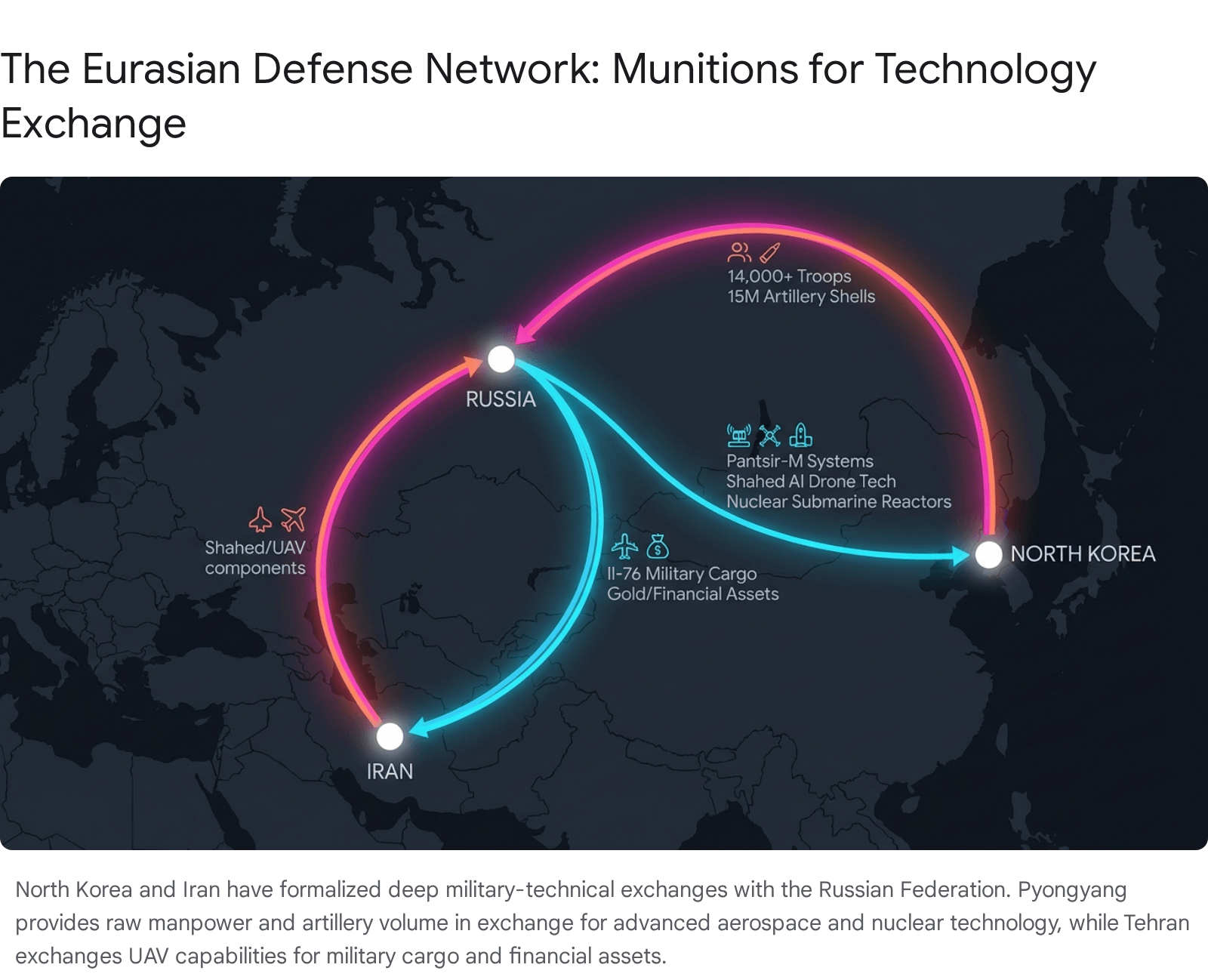
Iran also maintained its logistics pipeline to Moscow. OSINT flight tracking confirmed that at least four Belarusian Il-76 heavy military transport aircraft landed in Tehran over a 48-hour period carrying Russian and Chinese military-technical cargo.39 These flights, utilizing aircraft operated by Rubystar Airways and Aviacon Zitotrans—entities historically linked to government defense tasks—bypass standard NATO airspace restrictions via the Caucasus to maintain the steady flow of drone components and potentially extract high-value assets (such as gold) amid domestic Iranian instability.40
International Economic Sanctions and Financial Statecraft
To offset potential wavering in US bilateral support and counter the expanding autocratic logistics networks, European institutions accelerated their financial and legal commitments. NATO officially pledged $60 billion in military aid to Ukraine for 2026, supplementary to a €90 billion loan package approved by the EU following the withdrawal of Hungary’s veto.41
Concurrently, the EU Council adopted its 20th sanctions package on April 23, 2026, which came into full effect during this reporting period.20 Crucially, this package introduces the EU’s first anti-circumvention mechanism directed explicitly against a third country, officially designating the Kyrgyz Republic as a hub for funneling dual-use goods to Russia.20 Intelligence indicated that imports of controlled EU goods into Kyrgyzstan had risen by approximately 800% compared to pre-war levels, while re-exports to Russia spiked by 1,200%.20 These goods primarily included machining centers and data transmission equipment vital for Russian drone and missile production.20
The 20th package also introduces aggressive legal protections for EU operators. New “anti-suit injunctions” allow Member State courts to order Russian parties to halt proceedings in Russian courts that breach agreed jurisdiction clauses, with financial penalties for non-compliance payable to the EU company.20 Furthermore, the package bans transactions with 20 additional Russian banks, heavily restricts Russian crypto-asset service providers (specifically targeting A7A5, RUBx, and the digital rouble), and expands export bans to include laboratory glassware, specific high-performance lubricants, energetic materials, and industrial tractors.44
3. Drone Warfare and Unmanned Systems
The character of the war has fundamentally shifted to a drone-dominant battlefield, rendering traditional massed maneuver warfare near-obsolete and driving extraordinarily rapid cycles of technological adaptation. Both combatants rely on unmanned systems not merely for tactical reconnaissance, but for strategic bombardment, maritime interdiction, and deep-logistics degradation.
Tactical and Strategic Deployments
Immediately following the expiration of the ceasefire, the Russian Federation initiated a massive strategic drone deployment. Between May 13 and May 14, Russian forces fired over 1,560 drones and 56 ballistic and cruise missiles (including Iskander-M/S-400, Kh-101, and Kinzhal variants) targeting Ukraine.4 Russia utilized the ceasefire window to stockpile Molniya fixed-wing drones, deploying them heavily alongside hundreds of loitering munitions (Shahed/Geran variants).6 General intelligence estimates indicate that Russia’s overall drone production has surged, adding an estimated 28,000 units to their active inventory over the course of the year, heavily subsidized by component smuggling through Central Asia and Chinese tech transfers.7
Ukraine has heavily leaned into advanced autonomous capabilities and artificial intelligence-driven swarm tactics to offset Russian volume superiority. AFU units are currently deploying US-supplied “Hivemind” AI software and the indigenous “Swarmer” control system. This architecture allows a single human operator to command an interconnected swarm of drones capable of executing autonomous targeting, navigation, and obstacle avoidance without relying on GPS or continuous radio communication links.47 This capability was operationally proven during Ukrainian incursions in the Kursk region, where drone swarms effectively isolated thousands of Russian troops by systematically identifying and destroying pontoon crossings and stationary bridges over the Seim River in coordination with HIMARS strikes.48
In the maritime domain, Ukraine utilized explosive-laden V3 unmanned surface vehicles (USVs). Capable of carrying up to 300 kilograms of explosives over a 60-hour operational window at speeds of 50 mph, these USVs have been instrumental in pushing the Russian Black Sea Fleet out of its traditional staging areas and are increasingly targeting the “shadow fleet” of illicit tankers circumventing international oil sanctions.49
Targeting Priorities and Infrastructure Attrition
Targeting matrices for both combatants rely heavily on unmanned systems but diverge sharply in their strategic objectives. Russia’s May bombardments prioritized oversaturating Ukrainian air defense networks in civilian hubs (Kyiv, Kharkiv, Odesa) and degrading the national energy grid and railway infrastructure.4 A strike on a power substation and a high-voltage line in Kyiv caused significant disruptions, while a direct hit on a 9-story apartment building in the Darnytskyi district killed 24 civilians.4 The overarching strategic objective is to force Ukraine to expend valuable, highly limited Patriot interceptors on relatively cheap drones, exhausting the defensive umbrella ahead of potential fixed-wing aviation sorties.
Conversely, Ukraine’s deep-strike targeting strictly prioritizes the economic and logistical pillars of the Russian war machine. Between May 13 and May 16, Ukrainian UAVs successfully executed a synchronized campaign against high-value targets up to 1,000 kilometers inside Russian territory.7 By striking the highly vulnerable fractionating columns of oil refineries repeatedly—before extended repair cycles can conclude—Ukraine aims to physically dismantle Russia’s fuel export capacity, effectively establishing “long-range sanctions” via kinetic action.12
| Date of Strike | Target Name & Location | Target Type & Strategic Significance | Confirmed Damage / Result |
| May 13, 2026 | Tamanneftegaz Terminal (Krasnodar Krai) | Oil & Gas Export Terminal (Black Sea) | Major fires; disruption of tanker loading 9 |
| May 13, 2026 | Yaroslavl Oil Refinery | Major Fuel Producer (Logistics) | Primary refining units severely damaged 9 |
| May 13, 2026 | Astrakhan Gas Processing Plant | Gazprom Facility (Caspian Basin) | Ongoing fire confirmed via NASA FIRMS 9 |
| May 14-15, 2026 | Ryazan Oil Refinery | Top-Tier Oil Processor (17.1M tons/year) | Massive sustained fires; operational halt 7 |
| May 15, 2026 | Kaspiysk Naval Base (Dagestan) | Russian Caspian Flotilla Hub | Missile boat and minesweeper damaged 13 |
| May 16, 2026 | Nevinnomyssky Azot (Stavropol Krai) | Military-Industrial Chemical Plant | Large-scale industrial fire; disruption of nitric/acetic acid supply for artillery shells 10 |
Beyond economic targets, Ukraine also targeted sophisticated military hardware. In Yeysk, drone strikes reportedly damaged a Beriev Be-200 amphibious aircraft and a Kamov Ka-27 helicopter.7 Radar and air defense installations were also degraded, including a Tor-M2 system in Luhansk, a Pantsir-S1 system in occupied Crimea, and an MR-232 ‘Bussol-S’ radar station in occupied Mariupol.7
Countermeasures, Electronic Warfare, and Technological Shifts
The electronic warfare (EW) environment has become highly saturated, leading to the introduction of novel, unjammable systems by both sides. Traditional EW jamming is effective only at short-to-medium ranges and cannot effectively screen against simultaneous, multi-vector swarm attacks that arrive from various altitudes and azimuths.57
To counter Ukraine’s robust EW advantages and localized jamming perimeters, the Russian military has rapidly introduced fiber-optic controlled First-Person View (FPV) drones. These systems trail up to 25 kilometers of physical fiber-optic cable, ensuring a perfectly secure, unjammable command link and a high-definition video feed devoid of latency.14 Intercepting these drones via EW is physically impossible; OSINT combat footage and tactical reports indicate that the most viable countermeasure currently employed by Ukrainian infantry is physical interception using rapid-fire shotguns, requiring split-second reaction times.14 Furthermore, Russia is integrating Nvidia Jetson Orin AI processors into newer Shahed variants, enabling advanced optical terrain-matching for terminal guidance when GPS signals are completely spoofed or denied by Ukrainian defenders.14
To protect their vulnerable strategic assets from the persistent Ukrainian UAV and USV threat, Russian naval bases thousands of miles from the frontline, such as the Rybachiy nuclear submarine base in the Pacific and fleet assets in Novorossiysk on the Black Sea, have been observed retrofitting vessels with extensive metal cages and netting. While these nets provide a rudimentary physical screen against small, slow-moving FPV quadcopters and loitering munitions, they severely limit operational efficiency, increase radar cross-sections, and pose entanglement hazards to the crew.59
4. Resource Utilization, Constraints, and Sustainability Projection
The conflict has fully transitioned into a war of industrial attrition, where the consumption of material resources heavily dictates the operational tempo. The concept of an “industrial window of war”—the period where domestic production, augmented by foreign imports, outpaces daily battlefield consumption—is actively compressing for the Russian military apparatus.60
Resource Utilization: Artillery and Depletion
Russian forces are currently operating under extreme material burn rates. In 2025, the Russian defense industrial base, heavily subsidized by North Korean imports, supplied roughly seven million artillery rounds, equating to an average daily consumption rate of approximately 19,000 shells.60 However, OSINT tracking of Russian military storage depots reveals a massive, unsustainable outflow of towed artillery systems necessary to fire these munitions. Observers note the rapid depletion and active cannibalization of systems such as the 2A36 (Hyacinth-B), 2A65 (Msta-B), D-30, and the older M-46 howitzers.61
The removal of M-46 barrels is particularly illustrative; it is the only Russian gun capable of firing legacy 130mm shells, indicating that standard 152mm and 122mm ammunition stocks and compatible barrels are under severe strain.61 Older D-1 howitzers and 100mm anti-tank guns (such as the MT-12) have practically disappeared from the battlefield entirely due to exhausted ammunition stockpiles, while self-propelled guns (SPGs) are rarely restored from storage, serving instead as donor vehicles for replacement barrels.61
Manpower Attrition and Recruitment Deficits
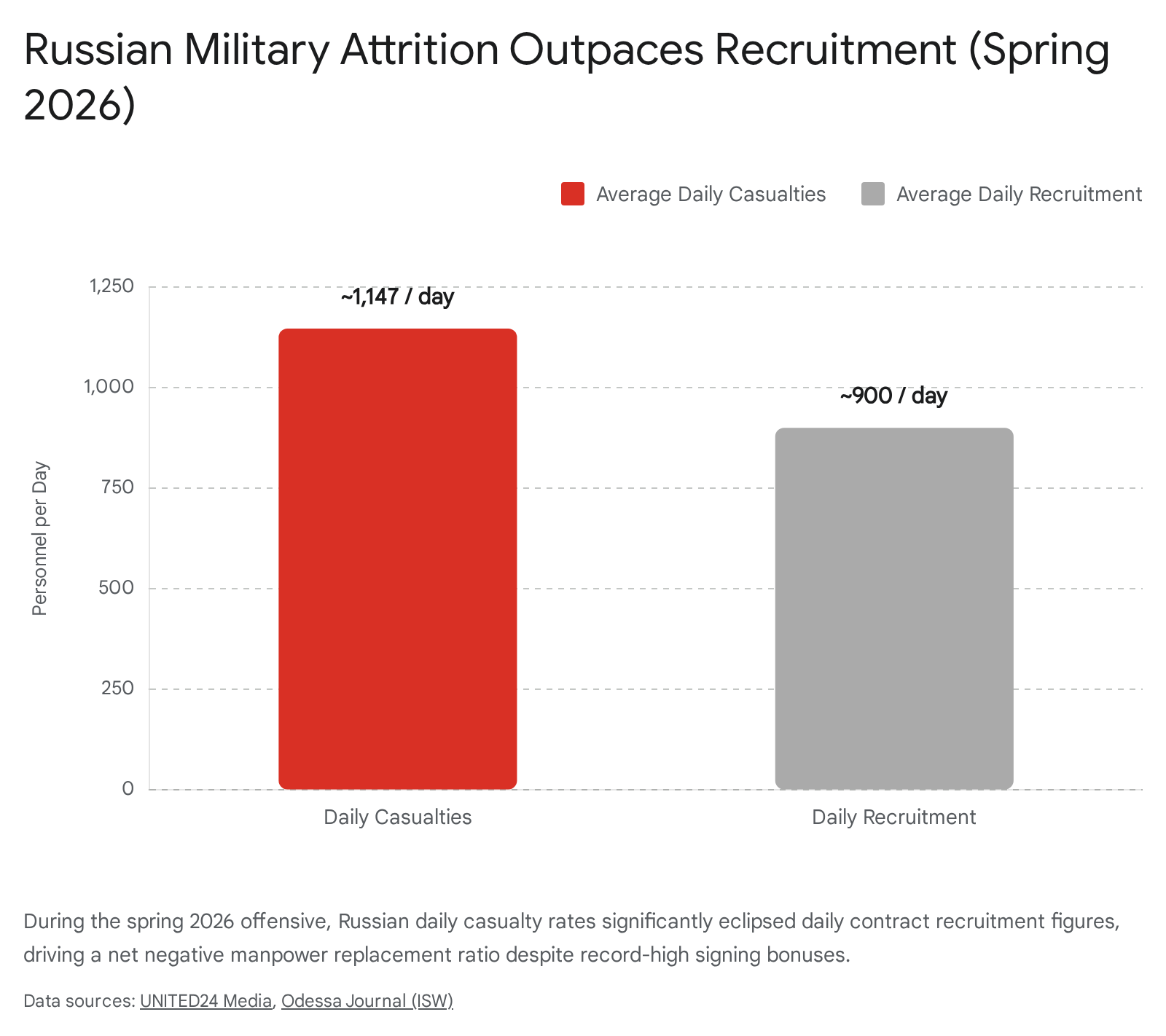
Manpower utilization has reached unprecedented levels of attrition. According to leaked Defense Ministry statistics, Russian forces suffered nearly 130,000 killed and wounded personnel in the first four months of 2026. March and April alone accounted for 70,000 casualties.3 In April, Russia lost an estimated 25,000 troops along the Donetsk axis while advancing only 53 square kilometers—an unsustainable exchange rate of nearly 470 casualties per single square kilometer gained.3
Crucially, for the first time in the conflict, Russian casualties are visibly outpacing domestic recruitment. Daily contract recruitment in early 2026 dropped by 20% year-over-year to roughly 800–1,000 soldiers per day.62 This decline persists despite federal and regional authorities increasing one-time signing bonuses to a record 1.47 million rubles (approximately $19,300).62 The inability to recruit replacements quickly enough shatters the historical precedent of Russia utilizing inexhaustible mobilization resources, pointing toward deep demographic exhaustion and the limits of covert mobilization.3
Logistical Constraints and Macroeconomic Strain
The logistical pipelines supporting this attrition are showing severe signs of stress. Russia is experiencing a genuine military airlift capacity crisis. Due to heavy Western sanctions and an inability to procure essential spare parts, the Russian Air Force’s maintenance backbone is failing.63 Consequently, the Kremlin is increasingly utilizing civilian-registered aircraft, such as commercial Il-76TDs operated by shell companies, to transport high-value military gear worldwide to circumvent international aviation regulations and mask military movements.63
Simultaneously, the North Korean ammunition pipeline is reportedly tailing off. Satellite imagery of the Tumangang Rail Facility on the North Korean border, as well as tracking of sanctioned vessels like the Angara, Lady R, Maria, and Maia-1, indicates a recent slowdown in transit volume.37 To counter this, Russia has vastly expanded massive domestic munitions storage revetments at Tikhoretsk and Mozdok in southern Russia to stockpile the estimated 15 million shells already received, ensuring a short-term buffer.64
Macroeconomic indicators reveal deep instability despite official Kremlin framing. On May 15, President Putin claimed positive economic results, citing a 1.8% GDP growth in March and low unemployment.66 In direct contrast to these claims, Ukrainian intelligence (SZRU) and the Russian Ministry of Economic Development indicate that Russia’s budget deficit reached $78.4 billion in the first four months of 2026—more than 150% of Russia’s planned deficit for the entire year.66 Government spending surged by 15.7%, forcing the government to raise Value Added Tax (VAT) rates and increase domestic borrowing heavily to subsidize the war economy.66
Sustainability Projection
An objective assessment of resource realities projects a bleak medium-term outlook for Russia’s maximalist territorial ambitions. The current operational tempo cannot be sustained indefinitely. To seize the entirety of the Donbas at the current fractional rate of advance, it would require decades of continuous fighting and potentially millions of casualties.2 As the industrial window compresses due to artillery barrel degradation, failing domestic recruitment, spiraling budget deficits, and targeted Ukrainian deep strikes on chemical precursors and vital fuel revenue, the Russian military will likely be forced to culminate its widespread offensive operations by late 2026 or early 2027. A transition to active defense will be required to preserve remaining mechanized and human assets.
Conversely, Ukraine’s sustainability is almost entirely contingent on the continuous delivery of Western interceptors and financial aid. While the AFU currently boasts an 88% interception rate against Russian cruise missiles, their ability to intercept ballistic threats is solely reliant on highly expensive, limited supplies of US-made Patriot interceptors.66 If the “Airport Ceasefire” diplomacy fails and the Russian bombardment of the civilian energy grid continues unchecked, Ukraine risks severe economic and civil degradation heading into the winter of 2026. However, Ukraine’s asymmetric drone strategy—which costs a fraction of traditional munitions—has proven highly effective at generating disproportionate economic damage to the Russian state. By systematically dismantling refineries and naval assets, Kyiv has secured a sustainable mechanism to project strategic threat regardless of overarching artillery or manpower disparities.
5. Chronological Timeline of Key Events
- May 10, 2026:
- The second day of the US-brokered Victory Day ceasefire occurs; however, objective telemetry and ground reports indicate that limited localized combat operations, FPV drone strikes, and artillery exchanges continue across the theater.23
- Ukrainian OSINT forces note a significant buildup of Russian Molniya fixed-wing drones, indicating active stockpiling by Russian forces during the ceasefire window for imminent strikes.23
- May 11, 2026:
- The Victory Day ceasefire officially concludes amid mutual accusations of widespread violations from both the Russian Ministry of Defense and the Ukrainian General Staff.23
- OSINT flight tracking confirms that at least four Belarusian Il-76 heavy military transport aircraft landed in Tehran, maintaining the illicit flow of military-technical cargo between the Russian/Belarusian defense sectors and Iran.39
- May 12, 2026:
- Ukrainian Foreign Minister Andrii Sybiha proposes the “Airport Ceasefire” during EU ministerial meetings in Brussels. The proposal seeks European mediation to halt deep strikes on aviation infrastructure, leveraging Ukraine’s expanding drone threat to major Russian hubs like Sheremetyevo.19
- Intelligence reports verify that Russia’s budget deficit reached $78.4 billion in the first four months of 2026, blowing past 150% of the planned annual deficit and straining macroeconomic stability.66
- May 13, 2026:
- AFU Commander-in-Chief Oleksandr Syrskyi formally signs a mandatory rotation order, limiting frontline troop deployments to a maximum of two continuous months to preserve personnel amid intense drone warfare.33
- Ukrainian drones execute coordinated deep strikes against the Tamanneftegaz oil terminal, the Yaroslavl oil refinery, and the Astrakhan gas processing plant deep inside Russian territory.9
- Beginning at 18:00 local time, the Russian Federation initiates a massive retaliatory deep-strike package, launching nearly 900 drones and missiles overnight.6
- May 14, 2026:
- Russian bombardments against Ukraine continue into a second day. A ballistic missile strike on Kyiv’s Darnytskyi district collapses a nine-story residential building, killing 24 civilians. Total Russian munitions launched over 48 hours exceeds 1,560 drones and 56 missiles.4
- US President Donald Trump meets with Chinese President Xi Jinping in Beijing. Xi issues warnings regarding Taiwan, while Trump publicly denies agreeing to Russian annexation of the Donbas.2
- May 15, 2026:
- Russia and Ukraine successfully execute a 205-for-205 prisoner of war exchange mediated by the UAE. Released Ukrainian troops include Azovstal defenders, while Russian troops are staged in Belarus.25
- Ukrainian Unmanned Systems Forces execute highly successful overnight strikes targeting the Ryazan oil refinery (causing a massive fire), the Kaspiysk naval base in the Caspian Sea (damaging a missile boat and a minesweeper), and the Belbek airfield in Crimea.7
- May 16, 2026:
- In the early morning hours, a coordinated Ukrainian drone strike successfully hits the Nevinnomyssky Azot chemical facility in Russia’s Stavropol Krai, igniting a severe fire at a plant critical to Russian artillery explosive production.10
- President Zelensky declares a national day of mourning for the victims of the Kyiv apartment strike and confirms that long-range retaliatory “sanctions” (kinetic drone strikes) will continue against Russian infrastructure.8
Please share the link on Facebook, Forums, with colleagues, etc. Your support is much appreciated and if you have any feedback, please email us in**@*********ps.com. If you’d like to request a report or order a reprint, please click here for the corresponding page to open in new tab.
Sources Used
- The Russia-Ukraine War Report Card, May 13, 2026, accessed May 16, 2026, https://www.russiamatters.org/news/russia-ukraine-war-report-card/russia-ukraine-war-report-card-may-13-2026
- Russian Offensive Campaign Assessment, May 13, 2026 | ISW, accessed May 16, 2026, https://understandingwar.org/research/russia-ukraine/russian-offensive-campaign-assessment-may-13-2026/
- Russia Breaks New Records in Losing Troops and Can’t Replace Them Fast Enough, accessed May 16, 2026, https://united24media.com/war-in-ukraine/russia-breaks-new-records-in-losing-troops-and-cant-replace-them-fast-enough-18783
- Russia hammers Ukraine in biggest prolonged drone attack since war began – KVIA, accessed May 16, 2026, https://kvia.com/news/us-world/cnn-world/2026/05/14/russia-hammers-ukraine-in-biggest-prolonged-drone-attack-since-war-began/
- Russia hammers Ukraine for a 3rd straight day, flattening a Kyiv apartment block and killing 9, accessed May 16, 2026, https://apnews.com/article/russia-ukraine-drones-missiles-zelenskyy-putin-12b12a7694b6f7df0e1ba971068efc86
- Russian Offensive Campaign Assessment, May 14, 2026, accessed May 16, 2026, https://understandingwar.org/research/russia-ukraine/russian-offensive-campaign-assessment-may-14-2026/
- Massive fire erupts at Russia’s Ryazan oil refinery as Ukrainian …, accessed May 16, 2026, https://kyivindependent.com/ukrainian-drones-reportedly-strike-oil-refinery-military-airfield-in-multiple-russian-regions/
- Ukraine attacks Russia with drones after suffering three days of massive strikes, accessed May 16, 2026, https://www.theguardian.com/world/2026/may/15/ukraine-attacks-russia-with-drones-after-suffering-three-days-of-strikes
- Russian oil, gas facilities ablaze from Black Sea to the Caspian following Ukrainian drone attacks – The Kyiv Independent, accessed May 16, 2026, https://kyivindependent.com/ukrainian-drones-reportedly-strike-port-infrastructure-in-russias-krasnodar-krai/
- Asymmetry in the Rear: Zelensky Confirms Deep Strikes on Strategic Russian Oil and Naval Assets, accessed May 16, 2026, https://www.kyivpost.com/post/76274
- Russia Resumes Military Cargo Shipments to Syria for First Time Since Assad’s Ouster – Kyiv Post, accessed May 16, 2026, https://www.kyivpost.com/post/76265
- Strategic Russian Chemical Plant ‘Azot’ Hit by Drones in Stavropol Krai – Kyiv Post, accessed May 16, 2026, https://www.kyivpost.com/post/76258
- Ukrainian Strikes Hit Russian Missile Boat, Minesweeper and Major Oil Refinery Overnight, accessed May 16, 2026, https://united24media.com/war-in-ukraine/ukrainian-strikes-hit-russian-missile-boat-minesweeper-and-major-oil-refinery-overnight-18856
- North Korea’s battlefield dividend | Lowy Institute, accessed May 16, 2026, https://www.lowyinstitute.org/the-interpreter/north-korea-s-battlefield-dividend
- Russian ship that sank near Spain may have been carrying nuclear reactors to North Korea, accessed May 16, 2026, https://www.theguardian.com/world/2026/may/12/russian-ship-ursa-major-sank-spain-nuclear-reactors-north-korea
- Trump-Xi Summit in Beijing: Managing the World’s Most Important Relationship – CSIS, accessed May 16, 2026, https://www.csis.org/analysis/trump-xi-summit-beijing-managing-worlds-most-important-relationship
- Xi warns Trump of ‘clashes and even conflicts’ with US over Taiwan, accessed May 16, 2026, https://www.theguardian.com/world/2026/may/14/trump-xi-jinping-meet-beijing-ahead-of-summit-trade-iran-war-ai-talks
- Trump leaves China without breakthroughs on Iran, Taiwan or AI, accessed May 16, 2026, https://www.theguardian.com/world/2026/may/15/trump-china-visit-iran-agreement-xi-jinping-elusive
- Ukraine Proposes “Airport Truce” with Russia… – Jordan News, accessed May 16, 2026, https://www.jordannews.jo/Section-24/Europe/Ukraine-Proposes-Airport-Truce-with-Russia-51382
- EU’s 20th Russia Sanctions Package: Key Changes and Compliance Implications, accessed May 16, 2026, https://natlawreview.com/article/eus-20th-russia-sanctions-package-key-changes-and-compliance-implications
- Russia and Ukraine swap 205 prisoners of war each • FRANCE 24 English – YouTube, accessed May 16, 2026, https://www.youtube.com/watch?v=issKoDB75-w
- Russia and Ukraine accuse each other of violating US-brokered 3-day truce, accessed May 16, 2026, https://apnews.com/article/russia-ukraine-war-ceasefire-beabe2b017b868e99408e227c403789b
- Russian Offensive Campaign Assessment, May 11, 2026 | ISW, accessed May 16, 2026, https://understandingwar.org/research/russia-ukraine/russian-offensive-campaign-assessment-may-11-2026/
- Russian Offensive Campaign Assessment, May 9, 2026 | ISW, accessed May 16, 2026, https://understandingwar.org/research/russia-ukraine/russian-offensive-campaign-assessment-may-9-2026/
- Zelenskyy: 205 Ukrainians released in prisoner exchange with Russia – PHOTO, accessed May 16, 2026, https://caliber.az/en/post/zelenskyy-205-ukrainians-released-in-prisoner-exchange-with-russia
- Russia and Ukraine Begin First Phase of Large POW Exchange, accessed May 16, 2026, https://www.themoscowtimes.com/2026/05/15/russia-and-ukraine-begin-first-phase-of-large-pow-exchange-a92761
- Russia, Ukraine conduct 205-for-205 prisoner swap, accessed May 16, 2026, https://caliber.az/en/post/russia-ukraine-conduct-205-for-205-prisoner-swap
- Kyiv mourns as death toll from Russian attack in the Ukrainian capital rises to 24, accessed May 16, 2026, https://apnews.com/article/russia-ukraine-war-kyiv-attack-58db0cf78615952f3f090c19e104387f
- Ukraine proposes “airport ceasefire” with Russia and counts on EU help, accessed May 16, 2026, https://babel.ua/en/news/126897-ukraine-proposes-airport-ceasefire-with-russia-and-counts-on-eu-help
- Ukraine asks Europe to mediate “airport ceasefire” with Russia, accessed May 16, 2026, https://www.pravda.com.ua/eng/news/2026/05/12/8034257/
- Ukraine asks Europe to join talks on “airport ceasefire” with Russia, accessed May 16, 2026, https://www.ukrinform.net/rubric-polytics/4122218-ukraine-asks-europe-to-join-talks-on-airport-ceasefire-with-russia.html
- Russia in Review, May 8–15, 2026, accessed May 16, 2026, https://www.russiamatters.org/news/russia-review/russia-review-may-8-15-2026
- CinC Syrskyi signs order on mandatory rotation of frontline troops, accessed May 16, 2026, https://www.ukrinform.net/rubric-ato/4118108-cinc-syrskyi-signs-order-on-mandatory-rotation-of-frontline-troops.html
- RUSSIA–UKRAINE WAR SHOCK! “Donbas Is Not Yours” Trump Statement Goes Viral | ET Now | Latest News, accessed May 16, 2026, https://www.youtube.com/watch?v=_bsTWuRbT4Q
- Global Hotspots: Trump Meets Xi in Beijing – New Lines Institute, accessed May 16, 2026, https://newlinesinstitute.org/forecast/global-hotspots-trump-meets-xi-in-beijing/
- Trump Says End of Russia’s War in Ukraine Is ‘Very Close’, accessed May 16, 2026, https://www.kyivpost.com/post/75985
- North Korean Shipments of Shells to Russia Tail Off – The Maritime Executive, accessed May 16, 2026, https://maritime-executive.com/article/north-korean-shipments-of-shells-to-russia-tail-off
- DPRK increases rail traffic with Russia, accessed May 16, 2026, https://militarnyi.com/en/news/dprk-increases-rail-traffic-with-russia/
- Four Belarusian Il-76s Landed in Tehran, accessed May 16, 2026, https://militarnyi.com/en/news/four-belarusian-il-76s-landed-in-tehran/
- Reports link Russia–Iran cargo flights to unrest and claims of asset transfers, accessed May 16, 2026, https://defencematters.eu/russia-iran-cargo-flights-linked-to-asset-transfers/
- EU Assistance to Ukraine (in U.S. Dollars) – EEAS – European Union, accessed May 16, 2026, https://www.eeas.europa.eu/delegations/united-states-america/eu-assistance-ukraine-us-dollars_en?s=253
- NATO Allies Pledge $60 Billion in Military Aid to Ukraine for 2026 – Kyiv Post, accessed May 16, 2026, https://www.kyivpost.com/post/74017
- EU approves massive loan to help Ukraine after Hungary lifts its veto • FRANCE 24 English, accessed May 16, 2026, https://www.youtube.com/watch?v=qNMzJcidljo
- Deadlock Broken: EU Adopts 20th Russia Sanctions Package | Crowell & Moring LLP, accessed May 16, 2026, https://www.crowell.com/en/insights/client-alerts/deadlock-broken-eu-adopts-20th-russia-sanctions-package
- The EU’s evolving Russian sanctions framework: What the 20th sanctions package means for international arbitration, accessed May 16, 2026, https://www.freshfields.com/en/our-thinking/blogs/risk-and-compliance/the-eus-evolving-russian-sanctions-framework-what-the-20th-sanctions-package-me-102ms8k
- UK, EU and US sanctions on Russia – Fieldfisher, accessed May 16, 2026, https://www.fieldfisher.com/en/services/international-trade/trade-sanctions-blog/uk-eu-and-us-sanctions-on-russia
- Ukraine Just Flipped Drone Warfare | Russia’s Jamming Doesn’t Matter Anymore – YouTube, accessed May 16, 2026, https://www.youtube.com/watch?v=ABwk3AAyd4g
- Drone swarms play key role in Ukraine’s Kursk incursion, Times reports, accessed May 16, 2026, https://kyivindependent.com/drone-swarms-play-key-role-in-ukraines-kursk-incursion-times-reports/
- Greece scrambles to explain how explosive-packed drone landed in its waters, accessed May 16, 2026, https://www.theguardian.com/world/2026/may/11/greece-explosive-packed-drone-lefkada-western-coast
- Russia pounds Ukraine in heaviest wartime drone attack over two days, accessed May 16, 2026, https://cyprus-mail.com/2026/05/14/russia-pounds-ukraine-in-massive-air-attack
- Ukraine war briefing: Zelenskyy vows retribution over deadly Russian bombardments, accessed May 16, 2026, https://www.theguardian.com/world/2026/may/16/ukraine-war-briefing-zelenskyy-vows-retribution-over-deadly-russian-bombardments
- Tuapse: Ukraine Continues to Take the Drone War to Russia – Small Wars Journal, accessed May 16, 2026, https://smallwarsjournal.com/2026/05/11/tuapse-ukraine-continues-to-take-the-drone-war-o-russia/
- Ukraine Strikes Black Sea Oil Terminals as Russia Unleashes Drone Barrage, accessed May 16, 2026, https://maritime-executive.com/article/ukraine-strikes-black-sea-oil-terminals-as-russia-unleashes-drone-barrage
- Ukraine Ignites Major Russian Refinery, Hits Warships – Kyiv Post, accessed May 16, 2026, https://www.kyivpost.com/post/76227
- Ukraine reports strikes on Russian naval vessels in Caspian Sea | Caliber.Az, accessed May 16, 2026, https://caliber.az/en/post/ukraine-reports-strikes-on-russian-naval-vessels-in-caspian-sea
- Ukraine carried out 55 strikes on Russian targets – Твоє місто, accessed May 16, 2026, https://tvoemisto.tv/en/news/3179-ukrayina-zavdala-55-udariv-po-rosiyskykh-tsilyakh
- Why Russia’s Drone Swarms Are Getting Deadlier by Flying Higher – UNITED24 Media, accessed May 16, 2026, https://united24media.com/war-in-ukraine/why-russias-drone-swarms-are-getting-deadlier-by-flying-higher-9305
- Russia Deploys Fiber‑Optic Jamming‑Resistant Drones, Ukraine Develops Countermeasures – Oj – Odessa Journal, accessed May 16, 2026, https://odessa-journal.com/russia-has-begun-using-fiber-optic-drones-against-ukraine-with-a-range-of-up-to-50-km
- Russian Nuclear Submarines, Thousands of Miles From Ukraine, Get Anti-Drone Defenses, accessed May 16, 2026, https://www.navalnews.com/naval-news/2026/05/russian-nuclear-submarines-thousands-of-miles-from-ukraine-get-anti-drone-defenses/
- The Industrial Window of War: How to Measure Russia’s Munitions Throughput—and How to Disrupt It – Modern War Institute, accessed May 16, 2026, https://mwi.westpoint.edu/the-industrial-window-of-war-how-to-measure-russias-munitions-throughput-and-how-to-disrupt-it/
- OSINT researcher reports significant outflow of Russian artillery from military depots, accessed May 16, 2026, https://odessa-journal.com/public/osint-researcher-reports-significant-outflow-of-russian-artillery-from-military-depots
- ISW: Russian contract recruitment declines as battlefield casualties rise – Odessa Journal, accessed May 16, 2026, https://odessa-journal.com/isw-russian-contract-recruitment-declines-as-battlefield-casualties-rise
- Russia mimics Iran by shipping military cargo on planes disguised as civilian flights, accessed May 16, 2026, https://aerospaceglobalnews.com/news/russia-civilian-military-flights-airlift-crisis/
- Report: The Orient Express: North Korea’s Clandestine Supply Route to Russia – RUSI, accessed May 16, 2026, https://www.rusi.org/explore-our-research/publications/commentary/report-orient-express-north-koreas-clandestine-supply-route-russia
- Major Munitions Transfers from North Korea to Russia – CSIS Beyond Parallel, accessed May 16, 2026, https://beyondparallel.csis.org/major-munitions-transfers-from-north-korea-to-russia/
- Russian Offensive Campaign Assessment, May 15, 2026 | ISW, accessed May 16, 2026, https://understandingwar.org/research/russia-ukraine/russian-offensive-campaign-assessment-may-15-2026/
- Russian Offensive Campaign Assessment, May 10, 2026 | ISW, accessed May 16, 2026, https://understandingwar.org/research/russia-ukraine/russian-offensive-campaign-assessment-may-10-2026/
- ISW Russian Offensive Campaign Assessment, May 10, 2026 – Kyiv Post, accessed May 16, 2026, https://www.kyivpost.com/post/75831
- Where’s the beef? Trump’s underwhelming meeting with Xi., accessed May 16, 2026, https://www.atlanticcouncil.org/dispatches/wheres-the-beef-trumps-underwhelming-meeting-with-xi/
- Ukraine Bombers Launch Waves of French-British Cruise Missiles, Russian Air Base in Crimea Pounded – Kyiv Post, accessed May 16, 2026, https://www.kyivpost.com/post/27481
- Drones Hit One of Russia’s Largest Chemical Plants Overnight in …, accessed May 16, 2026, https://united24media.com/war-in-ukraine/drones-hit-one-of-russias-largest-chemical-plants-overnight-in-stavropol-region-18874