1. Executive Summary
The transition from visible light illumination to advanced electro-optics represents one of the most significant tactical evolutions in the history of modern law enforcement. Historically, police tactical units and patrol officers relied heavily on active illumination, such as handheld white light flashlights, weapon-mounted lights, and helicopter spotlights, to conduct operations during the hours of darkness. While these active illumination methods are effective for basic visibility and navigation, they inherently compromise operational security. Engaging a white light instantly reveals the exact position, movement speed, and directional orientation of the officer to any potential threats hidden in the surrounding environment. The integration of passive night vision devices and thermal imaging technology has fundamentally altered this dangerous dynamic. These advanced systems provide law enforcement professionals with the unprecedented ability to maintain absolute covertness while simultaneously dominating the low-light environment, thereby reclaiming the tactical advantage that darkness has historically afforded to criminal suspects.
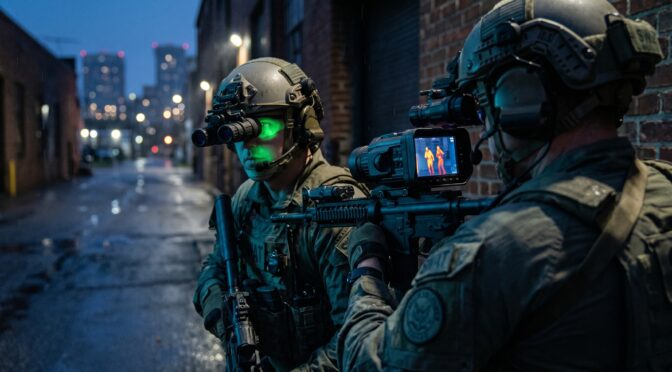
This comprehensive research report examines the utilization of night vision technologies and thermal imaging scopes within modern police tactical units. It provides an exhaustive analysis of the underlying physics governing these devices, the tactical doctrines surrounding their deployment, and the specific operational advantages they yield in critical scenarios such as perimeter containment holds, building searches, and dynamic suspect tracking. Furthermore, this report conducts a detailed technical review of two highly specialized products currently deployed by advanced tactical units across the nation. The first product is the AGM Adder V2 LRF 50-640 thermal scope, which serves as a high-resolution, long-range thermal optic designed specifically for designated marksmen and perimeter overwatch personnel. The second product is the L3Harris Ground Panoramic Night Vision Goggle, widely known as the GPNVG, a premier, multi-tube image intensification system that provides an unprecedented 97-degree field of view for close-quarters battle and high-speed mobile operations.
By analyzing the technical specifications, tactical applications, and market availability of these specific products, this report serves as an objective, expert-level guide for law enforcement administrators, tactical commanders, and procurement officers who are seeking to understand, purchase, and integrate modern electro-optics into their operational frameworks. The information contained herein synthesizes real-world case studies, technical data sheets, and tactical methodologies to present a holistic overview of how darkness is no longer a liability, but rather a profound tactical asset when leveraged with the appropriate technology.
2. The Evolution of Low-Light Operations and Tactical Paradigms
For decades, criminals have utilized the cover of darkness to mask illicit activities, evade capture during foot pursuits, and stage lethal ambushes against responding law enforcement officers. Darkness biologically levels the playing field, severely restricting the spatial awareness, depth perception, and situational awareness of human beings. The human eye is poorly adapted for low-light vision, relying on a limited number of rod cells that provide poor resolution and zero color differentiation. In conventional policing, the standard, instinctive response to darkness has always been the introduction of artificial white light.1 However, employing a flashlight in a high-risk scenario creates a highly dangerous paradigm that tactical experts often refer to as the fatal funnel of light.
When an officer activates a flashlight in a dark environment, their visual focus becomes instinctively hyper-fixated on the narrow, illuminated beam of light.1 This phenomenon results in a catastrophic loss of peripheral vision and overall situational awareness, as the officer’s eyes adjust to the bright beam and become blind to the shadows surrounding it. More critically, the light source acts as a highly visible beacon, clearly telegraphing the officer’s location to any armed suspect who remains hidden in the unlit areas.1 This dynamic forces the officer to broadcast their presence while the suspect remains entirely concealed, granting the adversary the critical element of surprise.
The adoption of night vision and thermal imaging fundamentally subverts this vulnerability.1 By moving away from active light projection and shifting toward passive light gathering and thermal detection, officers can observe their environment, orient themselves to threats, decide on a course of action, and act decisively without ever alerting a suspect to their presence. The element of surprise is entirely transferred from the fleeing suspect to the pursuing law enforcement officer.2 Early iterations of these technologies were largely restricted to military applications and federal agencies due to prohibitive costs, immense physical weight, and highly fragile internal components. However, recent advancements in the manufacturing of microbolometers and unfilmed image intensification tubes have dramatically reduced the physical footprint of these devices while simultaneously increasing their ruggedness, battery life, and visual resolution.2
Today, advanced electro-optics are no longer considered specialty luxury items reserved solely for elite federal counter-terrorism units. They have become highly practical, essential tools for municipal Special Weapons and Tactics teams, K-9 handlers, gang interdiction units, and even standard patrol officers conducting routine wide-area searches.2 The deployment of these tools mitigates risk, accelerates the speed of suspect apprehension, and provides a profound layer of safety that simply cannot be replicated by any other class of tactical equipment.
3. Core Technologies: The Physics and Mechanics of Electro-Optics
To properly deploy and integrate these systems into operational doctrine, tactical commanders and individual operators must possess a nuanced understanding of how night vision and thermal imaging operate on a fundamental physical level. It is crucial to understand that they are not interchangeable technologies. They capture entirely different spectrums of electromagnetic radiation, they possess unique strengths and vulnerabilities, and they serve highly distinct tactical purposes in the field.3
3.1. The Dynamics of Image Intensification
Night vision devices operate on the complex principle of image intensification.5 They do not possess the ability to turn night into day or see through solid objects. Rather, they gather existing ambient light found in the environment, such as starlight, moonlight, or ambient urban light pollution reflecting off the atmosphere, and they amplify that light thousands of times over.3 The intensification process begins when ambient photons enter the objective lens of the goggle and strike a highly sensitive component known as a photocathode.5 The photocathode utilizes the photoelectric effect to convert this light energy into a stream of electrons.
These electrons are then propelled via a high-voltage field through a microchannel plate, which is a remarkably thin disk containing millions of microscopic glass tubes. As the electrons pass through these microscopic tubes, they bounce off the walls, releasing secondary electrons in a massive, exponential cascading effect.5 Finally, this heavily multiplied cloud of electrons strikes a phosphor screen at the rear of the tube, converting the kinetic energy back into visible light that the user can clearly see through the eyepiece.5 This technology allows operators to perceive the near-infrared and visible light spectrums in conditions that appear pitch black to the naked human eye.
Modern high-end tactical units almost exclusively utilize Generation 3 unfilmed white phosphor tubes.6 The removal of the ion barrier film, which is a defining characteristic of advanced unfilmed technology, allows significantly more electrons to reach the microchannel plate. This drastic increase in electron flow drastically improves the signal-to-noise ratio, resulting in exceptionally clear low-light performance without the heavy visual static commonly seen in older generations. Furthermore, white phosphor provides a high-contrast greyscale image rather than the traditional, iconic green hue. Black and white imagery is processed much more naturally by the human brain, allowing for faster cognitive recognition of complex shapes, vastly improved depth perception, and significantly reduced eye strain during prolonged, multi-hour operations. It must be noted, however, that image intensification absolutely requires at least some ambient light to function. In absolute zero-light environments, such as subterranean tunnels, deep cave networks, or deeply enclosed windowless rooms, operators must rely on infrared illuminators. These illuminators project an invisible beam of infrared light that acts as a flashlight only visible to those wearing night vision goggles.1
3.2. Uncooled Thermal Sensor Architecture
Unlike image intensification technology, thermal imaging does not rely on ambient light whatsoever.3 Thermal imagers detect long-wave infrared radiation, which is continuously emitted as heat by all physical objects that exist above absolute zero. The core internal component of a modern tactical thermal scope or handheld monocular is the uncooled microbolometer.7 This microbolometer is typically constructed from a microscopic grid of vanadium oxide detectors. When long-wave infrared radiation strikes this focal plane array, it causes microscopic changes in the electrical resistance of the grid materials. This minute change in resistance is meticulously measured by the device’s processor and converted into a highly detailed thermogram, which is then displayed to the user as a visible video image.3
The overall efficacy and tactical value of a thermal sensor are dictated by three primary metrics, which are resolution, pixel pitch, and thermal sensitivity. Resolution determines the overall clarity of the image and the maximum identification range. Currently, a resolution of 640×512 pixels represents the gold standard for high-end tactical riflescopes.8 Pixel pitch, which is measured in microns, refers to the exact physical size of the individual thermal detectors on the array. A smaller pixel pitch, such as 12 microns, allows for a sharper image and greater optical magnification without requiring the manufacturer to install a massive, heavy objective lens.8
Perhaps the most critical metric for law enforcement tracking operations is the Noise Equivalent Temperature Difference, which is measured in millikelvins. A lower millikelvin rating directly indicates a higher level of thermal sensitivity. Modern tactical thermal sensors boasting a sub-15 millikelvin rating can detect minute temperature variations of less than 0.015 degrees Celsius.8 This extreme, hyper-sensitive level of detection allows police officers to see residual heat signatures that are entirely invisible to older devices. Examples include the lingering warmth left on a steering wheel by a fleeing driver, the residual heat of a discarded firearm lying in the grass, or even a fresh footprint left on cold pavement, long after a suspect has departed the immediate area.10
4. Tactical Deployments and Strategic Advantages
The intelligent integration of thermal imaging scopes and panoramic night vision systems provides law enforcement agencies with unparalleled advantages across a wide spectrum of dangerous operational scenarios. These tactical advantages are most profoundly observed during perimeter containment holds, fugitive tracking operations, and environmental hazard mitigation efforts.
4.1. Perimeter Security and Containment Holds
One of the most physically dangerous, tedious, and resource-intensive operations for any police department is the establishment and maintenance of a containment perimeter. When a dangerous suspect flees into a sprawling residential neighborhood, a complex industrial park, or a densely wooded area, patrol officers are traditionally stationed at intersection corners and property lines to prevent the suspect from escaping the zone.11 This static assignment leaves officers highly vulnerable to sudden ambushes. Suspects often utilize the darkness to hide in dense foliage, crawl under parked vehicles, or conceal themselves in unlit residential alleyways, patiently waiting for an opportunity to slip past the police cordon when an officer looks away.4
The introduction of thermal imaging drastically alters the efficacy and safety of a perimeter hold. An individual officer equipped with a thermal rifle scope or a handheld thermal monocular can effectively monitor and secure a massive geographic area compared to an officer relying solely on the naked eye and a flashlight.4 Thermal sensors easily penetrate absolute darkness, light atmospheric fog, and thin vegetation, exposing the bright, glowing heat signature of a hidden human suspect against the significantly cooler background of the surrounding environment.3 Suspects who falsely believe they are perfectly camouflaged in deep brush or shadows are instantly illuminated on a thermal display, entirely neutralizing their attempts at visual concealment.4
Furthermore, officers can maintain their assigned perimeter posts from positions of hard cover, remaining entirely unseen in the darkness while monitoring the containment line with absolute impunity.1 The ability to coordinate multiple perimeter units using a strategic mix of thermal optics and night vision devices ensures that no unauthorized movement goes undetected, effectively trapping the suspect within the containment zone and systematically shrinking their avenues of escape.4
4.2. Fugitive Tracking and Covert Reconnaissance
When a tactical incident transitions from a static containment phase to an active, dynamic searching phase, highly trained units utilize a combination of thermal and night vision for tracking suspects on foot. Thermal imaging is uniquely suited for exploiting what is known as the “bread crumb” effect.13 Fleeing suspects in high-stress pursuits frequently discard incriminating evidence, such as firearms, narcotics packages, or identifying articles of clothing, to reduce their physical weight or to destroy forensic links to the crime. These inanimate objects retain the body heat of the suspect for a significant duration after being discarded. Through a highly sensitive thermal imager, a discarded pistol resting in tall grass will glow distinctly against the cold earth, allowing officers to secure critical evidence that might otherwise be permanently lost or overlooked by a standard flashlight beam.13
Similarly, thermal optics can instantly determine recent vehicle activity in complex environments. An officer conducting a covert sweep of a dark parking lot or a residential driveway can instantly identify which specific vehicles have been recently driven by observing the radiant heat signatures emanating from the engine blocks, exhaust pipes, brake rotors, and rubber tires.4 This capability provides immediate, actionable intelligence on potential getaway vehicles, the sudden arrival of armed accomplices, or the specific residence a fleeing suspect may have entered.
For close-quarters suspect tracking and covert surveillance operations within structures, image intensification night vision is almost always preferred over thermal imaging. While thermal technology excels at long-range detection, night vision excels at positive identification.5 Night vision allows an officer to read vehicle license plates, clearly discern distinct facial features, and accurately identify the exact type of weapon a suspect is holding, details that a thermal imager might blur or obscure depending on environmental temperature gradients.5 The cooperative, simultaneous use of both technologies allows a tactical team to detect a suspect at a massive distance using a thermal overwatch element, and then identify and safely engage the suspect at close range using the night vision entry element.14
4.3. Officer Safety and Non-Combative Hazard Detection
Beyond the immediate requirements of suspect apprehension and evidence recovery, these advanced electro-optic technologies serve as vital, life-saving safety tools. When tactical teams or patrol officers enter unknown residential properties, rural yards, or chaotic industrial complexes at night, they face numerous lethal non-combative hazards.4 Thermal imagers can rapidly identify aggressive guard dogs waiting silently in the darkness, allowing officers to plan an alternate approach route and avoid a potentially fatal or highly disruptive animal encounter.4
At the scenes of severe traffic collisions or industrial accidents, thermal cameras instantly highlight chemical fluid leaks, smoldering fires, and downed, electrically charged power lines that are completely invisible to the naked eye.4 By providing a comprehensive environmental risk assessment before officers commit to entering a compromised space, these tools preemptively mitigate severe physical risks, ensuring that law enforcement personnel can maneuver safely, methodically, and securely.
5. Case Studies in Law Enforcement Optics Utilization
Real-world applications of these electro-optic technologies consistently demonstrate their profound value as force multipliers for local, state, and federal agencies. The following documented scenarios highlight the operational effectiveness of thermal tracking, aerial coordination, and the detection of disturbed environmental surfaces.
5.1. Disturbed Surfaces and Evidence Recovery
The extreme sensitivity of modern thermal sensors allows for the reliable detection of disturbed surfaces. Because different environmental materials absorb solar radiation and radiate heat at distinctly varying rates, freshly turned soil will present a completely different thermal signature than the hard, compacted earth surrounding it.2 Law enforcement agencies have successfully utilized this physical principle to conduct nondestructive surveys of walls and floors, locate deeply buried contraband, uncover hidden narcotics caches in rural fields, and locate clandestine gravesites during homicide investigations.2
A highly notable operational success regarding evidence recovery occurred when police in Wasilla, Alaska, responded to a chaotic scene where multiple suspects fled a location and ran deep into dense, freezing woods.13 As one particular suspect sprinted through the brush, loose cigarettes continuously fell from his shirt pocket. The responding officer, utilizing a handheld thermal imager provided through a federal grant, was able to track the fleeing suspect by following the tiny, residual heat signatures of the dropped cigarettes.13 The officer noted that in the ambient temperature of thirty-eight degrees below zero, the small items appeared exactly like bright glow sticks against the sub-zero environmental background.13 This intense thermal contrast enabled the officer to follow a half-mile-long trail directly to the suspect’s hiding location, resulting in an apprehension that would have been physically impossible using standard flashlights and tracking techniques.13
5.2. Vehicle Pursuits and Aerial Coordination
High-speed vehicle pursuits inherently pose extreme, lethal dangers to the general public, the fleeing suspects, and the law enforcement officers involved.16 Highly motivated suspects routinely extinguish their vehicle headlights in an attempt to vanish into the night, a highly lethal tactic known as going black.2 An aviation unit equipped with a high-definition thermal camera can effortlessly track a blacked-out vehicle from miles away, easily monitoring the intense heat generated by the vehicle’s engine block, exhaust system, and friction-heated tires.2 The aerial unit can then broadcast real-time telemetry to ground units, allowing patrol cars to back off, reduce dangerous pursuit speeds, and coordinate strategic spike strip deployments without the need for a high-speed, bumper-to-bumper chase.4
Furthermore, recent innovations in thermal marking technology have vastly improved inter-agency coordination from the air. Identifying specific police vehicles from an altitude is incredibly difficult at night, as the metal roof of a police cruiser registers at the exact same temperature as the metal roof of the suspect’s civilian vehicle.16 Standard reflective police decals are entirely invisible to thermal cameras.16 To solve this, researchers developed specialized thermal-reflective films, such as the Mirage film produced by QinetiQ.16 By placing this specific film on the roofs of police cruisers, the material reflects the incredibly cold temperature of the open sky rather than the heat of the vehicle.16 This creates a high-contrast, dark square on the aviation unit’s thermal display, allowing helicopter crews to easily differentiate between civilian vehicles, fleeing suspects, and law enforcement assets, ensuring that ground units are directed with absolute safety and precision.16
6. Review of the AGM Adder V2 LRF 50-640 Thermal Scope
The AGM Adder V2 LRF 50-640 represents a pinnacle achievement in commercial and law enforcement thermal rifle scope engineering. Built explicitly to resemble a traditional, high-end daytime glass optic, it utilizes a standard 30mm aircraft-grade aluminum optical tube.8 This brilliant design choice allows the device to be mounted on a wide variety of tactical patrol rifles, designated marksman platforms, and bolt-action sniper rifles using standard, off-the-shelf scope rings and mounting hardware.8 This section provides an exhaustive review of its specifications, internal software, and tactical utility for police operations.
6.1. Hardware Specifications and Sensor Capabilities
At the technological core of the AGM Adder V2 LRF 50-640 is an incredibly potent 640×512 resolution Vanadium Oxide uncooled focal plane array.8 This high-density thermal sensor utilizes a 12-micron pixel pitch, which captures exceptionally fine environmental details.8 This density is highly critical for law enforcement, as it allows an operator to clearly distinguish between a suspect holding a harmless cell phone and a suspect holding a lethal firearm at significant, standoff distances.9 The thermal sensitivity of the sensor is rated at sub-15 millikelvins, an industry-leading specification that ensures a clear, high-contrast image even in degraded environments featuring heavy humidity, thick atmospheric fog, or minimal temperature variance between the target and the background.8
The optical system is driven by a massive 50mm, f/1.0 germanium objective lens.8 Germanium is universally utilized in high-end thermal optics because standard optical glass completely blocks long-wave infrared radiation. This specific lens configuration provides a native, optical base magnification of 3.5x, which can be smoothly and digitally zoomed up to a maximum of 26x.8 Crucially, the magnification adjusts in 0.5x continuous zooming increments, which prevents the jarring, disorienting visual jumps associated with older scopes that only offered full-step zooming.8 The resulting thermal imagery is projected onto an intricate, high-definition 2560×2560 OLED micro-display, providing the user with crisp tactical data readouts and uncompromising target clarity.8
One of the most profound and tactically relevant upgrades in the V2 model is the seamless integration of a 1000-meter laser rangefinder directly into the objective lens housing.8 Unlike previous generations of thermal scopes that featured bulky, external rangefinder modules bolted awkwardly to the side of the optic, the Adder V2’s rangefinder is entirely internal and practically invisible from any angle other than head-on.8 This maintains a sleek weapon profile, completely prevents the optic from snagging on tactical gear or vehicle interiors during rapid deployments, and keeps the physical weight of the weapon perfectly balanced.8
Power management is handled via a robust dual-battery system consisting of a built-in rechargeable internal lithium-ion battery and a removable, rechargeable 18650 battery.8 This highly efficient configuration provides up to 9 hours of continuous operation even with the laser rangefinder actively engaged.8 Tactically, the removable 18650 battery can be swiftly swapped in the field without ever powering down the optic, ensuring absolute, uninterrupted surveillance during prolonged hostage barricade situations.8 The unit is rated IP67 waterproof, is shockproof to withstand heavy rifle recoil up to 1000g, and operates flawlessly in extreme temperatures ranging from negative thirty degrees to positive fifty-five degrees Celsius.8
6.2. Software Integration and Ballistic Analytics
The Adder V2 operates on a highly intuitive and rapidly responsive software architecture. It proudly features AGM’s first completely shutterless Non-Uniformity Correction system.8 Traditional thermal scopes must periodically freeze the image for a fraction of a second to recalibrate the sensor, a process usually accompanied by an audible clicking sound. The innovative shutterless system continuously calibrates the thermal sensor in the background without freezing the screen, ensuring that the tactical operator never loses visual contact with a moving suspect during a critical, life-or-death moment.8
The internal software suite includes a fully integrated ballistic calculator.8 Once a police sniper inputs the specific ballistic coefficient and velocity data of their assigned department ammunition, the scope will automatically calculate the precise bullet drop based on the exact distance provided by the integrated laser rangefinder.8 The scope then projects an exact holdover aiming point directly onto the OLED display.18 This capability completely removes the need for complex mental mathematics or the use of external ballistic charts during high-stress engagements.18
Furthermore, the scope features Shot-Activated Recording functionality.8 Upon physically detecting the recoil of the weapon, the scope automatically saves the high-definition video and audio from the seconds immediately preceding and following the lethal force event directly to its internal 64-gigabyte storage drive.8 This provides command staff and investigators with objective, high-definition video evidence of the engagement, protecting both the officer and the department against false liability claims and aiding immensely in post-incident use-of-force investigations.8
6.3. Tactical Role within Police Overwatch Units
While the AGM Adder V2 can certainly be utilized as a handheld observation device, its primary design architecture is for weapon mounting, making it an exceptional, purpose-built tool for SWAT snipers and designated marksmen.8 During a barricaded suspect standoff or a complex hostage rescue operation, a sniper equipped with the Adder V2 can establish an overwatch position from a distant, perfectly concealed location. The thermal sensor allows the sniper to see through thin window blinds, residential curtains, or deployed smoke grenades to monitor the precise movements of the individuals trapped inside the structure.9
The 50mm objective lens provides the optical magnification necessary for precise target identification, while the internal laser rangefinder and ballistic calculator guarantee first-round accuracy, even in pitch-black conditions.8 The ability to record the entire sequence of events via the Shot-Activated Recording feature provides the command element with an irrefutable visual record of the intelligence gathered and the precise actions taken during the deployment.8
6.4. Manufacturer Information
AGM Global Vision is a highly prominent manufacturer of advanced thermal imaging, image intensified night vision, and digital optics strictly tailored for law enforcement, military, and high-end commercial applications.8 The company operates its headquarters out of Grand Prairie, Texas, and operates as an ISO 9001:2015 certified organization, which ensures remarkably high standards in quality management and manufacturing practices.8 AGM provides a robust 5-year transferable warranty on their high-resolution thermal devices, ensuring long-term operational support and repair capabilities for budget-conscious police departments.8
(https://www.agmglobalvision.com/agm-adder-v2-lrf-50-640-agm-adder-v2-lrf-50-640)
6.5. Market Availability and Vendor Analysis
The AGM Adder V2 LRF 50-640 carries a Manufacturer’s Suggested Retail Price of $5,495.00.8 However, exhaustive current market analysis indicates a highly consistent average and minimum retail price of $4,995.00 across reputable, authorized online vendors.17 All vendors listed below strictly adhere to United States export regulations, as thermal devices possessing this level of resolution and capability are heavily restricted under International Traffic in Arms Regulations and cannot be exported outside of the country without federal licensing.8
The following table provides a verified list of five reputable vendors that currently possess the AGM Adder V2 LRF 50-640 in active stock, with listed prices falling exactly within the minimum and average observed market metrics.
| Vendor | Product Title | Listed Price | Stock Status |
| https://www.sportsmansguide.com/product/index/agm-adder-v2-lrf-50-640-35-26x-thermal-riflescope-with-laser-rangefinder?a=3036100 | AGM Adder V2 LRF 50-640 3.5-26x Thermal Riflescope with Laser Rangefinder | $4,995.00 | In Stock |
| Outdoor Legacy Gear | AGM Adder V2 LRF 50-640 3.5x-26x Thermal Rifle Scope | $4,995.00 | In Stock |
| (https://feraltexasoutdoors.com/products/agm-adder-v2-lrf-50-640) | AGM Adder V2 LRF 50-640 | $4,995.00 | In Stock |
| Predator Hunter Outdoors | AGM Adder V2 LRF 50-640 Thermal Riflescope | $4,995.00 | In Stock |
| (https://www.basspro.com/p/agm-global-vision-adder-v2-50-640-lrf-thermal-imaging-rifle-scope) | AGM Global Vision Adder V2 50-640 LRF Thermal Imaging Rifle Scope | $4,995.00 | In Stock |
7. Review of High-End Panoramic Night Vision Systems: L3Harris GPNVG
While thermal imaging is objectively unmatched for long-range heat detection and perimeter overwatch, image intensification remains the vastly superior technology for close-quarters tactical mobility, positive target discrimination, and complex facial recognition.5 For elite tactical units conducting dynamic entries, the traditional monocular or binocular night vision systems pose severe biological limitations regarding field of view. The L3Harris Ground Panoramic Night Vision Goggle, universally referred to as the GPNVG, represents the absolute pinnacle of optical engineering, fundamentally solving the dangerous peripheral vision deficit associated with standard issue tactical goggles.6
7.1. Panoramic Field of View and Visual Acuity
The defining, revolutionary characteristic of the GPNVG system is its extraordinary 97-degree horizontal field of view.6 Standard military and police night vision binoculars provide a very narrow 40-degree field of view, creating an unnatural, highly restrictive tunnel vision effect.6 When a tactical operator using a standard 40-degree system attempts to clear a complex room, they must physically snap their head back and forth continuously to rapidly scan the deep corners, a dangerous practice commonly referred to within the tactical community as the night vision head-sweep. This rapid, repetitive scanning causes severe neck fatigue, slows down the cognitive processing of environmental information, and significantly increases the time it takes to complete the critical Observe, Orient, Decide, and Act cycle.
The GPNVG completely mitigates this lethal restriction by utilizing four separate, high-performance unfilmed white phosphor image intensifier tubes mounted in a specialized array.6 The two center tubes point directly forward, functioning exactly like a traditional binocular night vision device to provide necessary depth perception and forward optical focus.6 The two outer tubes are cleverly angled slightly outward, projecting their intensified imagery directly into the operator’s peripheral vision via a highly specialized optical bridge system.6 This creates a seamless, overlapping 97-degree panoramic view that effectively more than doubles the operator’s situational awareness.6 An officer can look straight ahead down a long, dark hallway while simultaneously monitoring open doorways on their immediate left and right without ever needing to articulate their neck.6
The remarkably high Figure of Merit specifications of the L3Harris unfilmed tubes ensure that there is absolutely no loss of visual acuity or high-definition resolution in the outer optical channels.25 The separate images blend together perfectly within the brain, providing a crisp, natural interpretation of the environment in near-total darkness.6
7.2. Ergonomics, Power Systems, and Modularity
Housing four heavy intensifier tubes requires incredibly precise engineering and advanced materials to maintain human wearability and comfort. The entire GPNVG system weighs approximately 765 grams, or roughly 27 ounces.6 To safely counter this substantial forward-leaning weight on a tactical bump or ballistic helmet, the system is powered exclusively by a low-profile, remote battery pack firmly mounted to the rear of the helmet utilizing a routing cable.6 This battery pack serves a vital dual purpose: it acts as a mechanical counterweight, saving the operator from severe cervical neck strain, and it provides an exceptional operational runtime of over 30 hours using standard lithium batteries.6 For cold weather environments that rapidly drain standard batteries, specialized cold-weather battery packs are available that feature integrated, user-selectable infrared beacons, allowing command elements to visually track the operator’s location invisibly from the sky.24
The recently improved Ruggedized Bridge design dramatically enhances the overall physical durability of the unit during violent kinetic actions, such as explosively breaching doors or navigating tight, debris-filled stairwells.27 The entire system is highly modular by design.24 If operationally required, the individual optic pods can be rapidly detached from the main panoramic bridge and powered via a separate, small adapter to function as standalone, low-profile handheld monoculars.24 The unit securely mounts to helmets via industry-standard dovetail configurations, integrating flawlessly with high-end, breakaway tactical helmet mounts such as the Wilcox G24.6
7.3. Close Quarters Battle and Mobility Advantages
The tactical advantages of the GPNVG during dynamic building entries and close-quarters battle are incredibly profound.24 When a heavily armed entry team flows into a room, establishing interlocking fields of fire and observation is critical to rapidly neutralizing threats and securing blind angles.27 The panoramic view ensures that absolutely no dead space is surrendered to a potentially armed suspect.27 An operator can safely cover their primary forward sector of fire while their expanded peripheral vision simultaneously confirms the safe movement and status of their team members beside them, drastically reducing the chances of catastrophic friendly fire incidents in highly chaotic, low-light environments.27
Beyond the clearance of structures, the GPNVG is heavily favored and universally highly requested for tactical vehicle operations.6 Driving a marked patrol vehicle or a heavy armored personnel carrier completely blacked-out using standard 40-degree goggles is exceptionally dangerous, as the driver fundamentally lacks the peripheral vision required to judge passing clearance, intersecting roads, or sudden environmental obstacles.27 The expansive 97-degree field of view allows tactical drivers to smoothly navigate complex urban terrain, heavily rutted hiking trails, and dangerous off-road environments safely and efficiently without ever relying on visible headlights that would compromise the approach.6
7.4. Manufacturer Information
L3Harris Technologies is a premier American aerospace and defense contractor, recognized globally for designing and producing top-tier command and control systems, advanced military avionics, and fully integrated vision solutions.28 Formed from the massive merger of L3 Technologies and Harris Corporation, the company is headquartered in Melbourne, Florida.28 L3Harris proudly manufactures its own highly advanced image intensification tubes domestically within the United States, ensuring meticulous, uncompromising quality control and strict adherence to grueling military specifications.29 The GPNVG currently stands as the gold standard for the United States Special Operations Command and is increasingly being adopted by highly funded, elite domestic law enforcement agencies facing extreme threat profiles.29
(https://www.l3harris.com/all-capabilities/ground-panoramic-night-vision-goggle-gpnvg)
7.5. Market Availability and Vendor Analysis
The L3Harris GPNVG is an immensely expensive and heavily federally regulated piece of tactical hardware. Prices across the civilian and law enforcement market generally range from $40,399.00 up to $55,910.00 depending heavily on the exact specification and generation of the image intensification tubes installed, specifically the minimum Figure of Merit rating.30 The specific systems analyzed below feature the highly desirable 2376+ minimum Figure of Merit unfilmed white phosphor tubes and are readily available for approved commercial and law enforcement sales.27
The following table details five highly specialized vendors currently stocking the L3Harris GPNVG, with pricing strictly constrained between the lowest available observed price and the overall market average of in-stock items.
| Vendor | Product Title | Listed Price | Stock Status |
| Arms Unlimited | L-3 Harris GPNVG-18 Ground Panoramic Night Vision Goggle | $41,999.00 | In Stock |
| (https://steeleindustries.com/product/l3-gpnvg-ground-panoramic-night-vision-goggle/) | L3Harris GPNVG Ground Panoramic Night Vision Goggle | $46,399.98 | In Stock |
| (https://ownthenight.com/l3harris-gpnvg-ground-panoramic-night-vision-goggle) | L3Harris GPNVG Ground Panoramic Night Vision Goggle | $46,999.00 | In Stock |
| Custom Night Vision | L3HARRIS GPNVG Ground Panoramic Night Vision Goggle Complete Package | $47,999.99 | In Stock |
| (https://tnvc.com/shop/l3harris-gpnvg-ruggedized-bridge/) | L3Harris GPNVG Ruggedized Bridge | $47,999.00 | In Stock |
Note: While other panoramic systems exist on the market, such as the highly capable aerospace-aluminum Photonis PD-PRO-Q Panoramic NVG which features a slightly larger 104-degree field of view, availability is currently highly restricted with major vendors showing the product as backordered or entirely out of stock, thus precluding it from detailed vendor analysis at this precise time.32
8. Integration Strategies and Doctrinal Training for Tactical Units
Procuring high-end thermal scopes and ultra-expensive panoramic night vision goggles is only the initial, logistical step in dominating the low-light environment. To fully leverage the immense capabilities of advanced tools like the AGM Adder V2 and the L3Harris GPNVG, police tactical units must establish rigorous, ongoing integration strategies and highly specialized training doctrines. Purchasing the equipment without establishing standard operating procedures drastically reduces the operational effectiveness of the technology.
8.1. Overcoming Distinct Technological Limitations
No single piece of technology is completely infallible, and tactical operators must be extensively trained to understand the physical and biological limitations of their assigned equipment. Thermal imagers, for instance, fundamentally cannot see through ordinary glass.8 A suspect sitting quietly inside a vehicle with the windows rolled up will be entirely invisible to an officer using a thermal scope, as the glass reflects the long-wave infrared radiation back into the environment rather than allowing it to pass through to the sensor. Similarly, thermal imaging cannot read printed text on signs, cannot discern specific colors of clothing, and cannot reliably identify the specific make and model of a weapon unless the thermal silhouette is incredibly distinct and close.
Image intensification night vision, conversely, is easily defeated by intense, sudden photonic barriers. If an operator wearing a GPNVG looks from a pitch-dark alleyway directly into a brightly lit, twenty-four-hour storefront, the system’s internal auto-gating features will instantly engage to protect the sensitive tubes from burning out.5 While the tubes are protected, the operator will temporarily lose the ability to resolve fine details within the intense light source until they physically look away. Furthermore, night vision relies heavily on the use of active infrared lasers mounted to the handguard of a rifle for weapon aiming, as it is nearly impossible to acquire a proper cheek weld and look through a standard red dot optic while wearing a massive, four-tube panoramic goggle.29 Operators must train extensively on utilizing these lasers without inadvertently flagging team members with the invisible beam.
8.2. The Cooperative Deployment of Thermal and Night Vision
The absolute most lethal, efficient, and effective tactical units employ a dedicated fusion doctrine, utilizing both thermal and night vision technologies cooperatively within the exact same tactical element.14 During a massive wide-area search for a fleeing fugitive in a wooded area, one officer acting as the primary scanner will utilize a handheld thermal monocular to rapidly sweep the complex environment, identifying minute heat anomalies from hundreds of yards away.4 Once a suspicious heat signature is positively detected, the thermal operator directs the heavily armed entry team, who are equipped entirely with panoramic night vision goggles and infrared aiming lasers, toward the exact location of the target.1
The thermal operator guarantees that the suspect cannot successfully hide in the dense foliage or shadows, while the night vision operators push aggressively forward to confirm the suspect’s identity, identify any weapons held in hand, and make the physical, hands-on apprehension.1 This highly symbiotic relationship ensures that the physical limitations of one technology are entirely covered by the distinct strengths of the other.14 Regular, monthly force-on-force training exercises conducted in absolute zero-light conditions are absolutely paramount to ensure that operators can seamlessly communicate, move fluidly, and engage targets using these disparate visual inputs without dangerous hesitation.
8.3. Procurement and Funding Avenues
The primary barrier to entry for most municipal and county law enforcement agencies regarding these technologies is the profound financial cost.13 Outfitting a single SWAT team with panoramic goggles and thermal sniper scopes requires a massive capital investment. However, avenues exist to alleviate this financial burden. Agencies frequently leverage federal grant programs, such as the Technology Transfer Program administered by the Office of National Drug Control Policy, which has historically supplied hundreds of advanced thermal imaging systems to local departments specifically for counter-narcotics and interdiction operations.13 Command staff must prioritize grant writing and aggressively pursue federal funding to ensure their officers are not forced to operate at a technological disadvantage against increasingly sophisticated criminal elements.13
9. Conclusion
The modern, highly volatile security landscape dictates that law enforcement professionals must be fully capable of operating at absolute peak efficiency regardless of environmental lighting conditions. The strategic deployment of advanced electro-optics removes the biological sanctuary that darkness has traditionally provided to criminal elements, fundamentally shifting the balance of power back to the pursuing officers.
Thermal imaging technology, perfectly exemplified by commercial products like the AGM Adder V2 LRF 50-640, acts as an absolute, undeniable force multiplier for complex perimeter security operations, rural fugitive tracking, and urban sniper overwatch. By detecting minute variations in radiant heat signatures, officers can gather critical intelligence, locate hidden threats, and secure discarded evidence from completely covert, standoff distances. Conversely, unfilmed panoramic night vision systems, pioneered by the L3Harris GPNVG, completely rewrite the established rules of close-quarters tactical engagement. By providing a massive 97-degree field of view, these systems eradicate dangerous tunnel vision, vastly enhance cognitive processing speed, and allow elite operators to navigate complex, lethal environments with absolute confidence and unparalleled spatial awareness.
While the initial financial investment required to properly outfit a tactical unit with such equipment is undeniably substantial, the corresponding return on investment is easily measured in the successful, safe mitigation of critical incidents, the swift recovery of hidden forensic evidence, and above all, the ensured survival and safety of the officers deployed in the dark. In the current operational climate, advanced electro-optics are no longer considered the distant future of law enforcement tactics, they represent the absolute baseline standard of the modern operational era.
Note: Vendor Sources listed are not an endorsement of any given vendor. It is our software reporting a product page given the direction to list products that are between the minimum and average sales price when last scanned.
Please share the link on Facebook, Forums, with colleagues, etc. Your support is much appreciated and if you have any feedback, please email us in**@*********ps.com. If you’d like to request a report or order a reprint, please click here for the corresponding page to open in new tab.
Sources Used
- Don’t be afraid of the dark: A look at night vision technology made with cops in mind, accessed April 23, 2026, https://www.police1.com/police-products/tactical/night-vision/articles/dont-be-afraid-of-the-dark-a-look-at-night-vision-technology-made-with-cops-in-mind-OCdllP9zZ44G2vha/
- Thermal Imaging: Is It Appropriate For Dayshift Patrol Operations – Scholarly Works @ SHSU, accessed April 23, 2026, https://shsu-ir.tdl.org/server/api/core/bitstreams/03bb3fdc-6883-490a-b6c5-e916fed3cc1e/content
- Law Enforcement Thermal Imaging Equipment: Tactical Solutions for Police and SWAT Teams | GTGUARD, accessed April 23, 2026, https://gtguardhunt.com/blogs/blog/law-enforcement-professional-thermal-imaging-equipment-complete-guide-for-police-and-tactical-teams
- Successful Uses of Thermal Imaging Technology by Police: Real-World Applications – Pixfra, accessed April 23, 2026, https://www.pixfra.com/successful-uses-of-thermal-imaging-technology-by-police-real-world-applications
- Tactical Night Vision: A Comprehensive Guide for Optimal Performance – Armasight, accessed April 23, 2026, https://armasight.com/night-vision-university/tactical-night-vision-a-comprehensive-guide-for-optimal-performance/
- L3Harris GPNVG – High FOM Ground Panoramic Night Vision Goggle – Own The Night, accessed April 23, 2026, https://ownthenight.com/l3harris-gpnvg-ground-panoramic-night-vision-goggle
- Thermal Imaging Devices – AGM: Cutting-Edge Solutions for Superior Visibility, accessed April 23, 2026, https://www.agmglobalvision.com/thermal-imaging
- AGM Adder V2 LRF 50-640 – AGM Global Vision, accessed April 23, 2026, https://www.agmglobalvision.com/agm-adder-v2-lrf-50-640-agm-adder-v2-lrf-50-640
- AGM Adder V2 LRF 35-384 – AGM Global Vision, accessed April 23, 2026, https://www.agmglobalvision.com/agm-adder-v2-lrf-35-384
- Estimating Departure Time Using Thermal Camera and Heat Traces Tracking Technique, accessed April 23, 2026, https://pmc.ncbi.nlm.nih.gov/articles/PMC7038398/
- 9 patrol applications for night vision and thermal imaging technology – Police1, accessed April 23, 2026, https://www.police1.com/police-products/police-technology/thermal-imaging/articles/9-patrol-applications-for-night-vision-and-thermal-imaging-technology-BoU2ABEoNkAM0etJ/
- ARTICLE: New Use Cases For Night Vison Devices | Rampart Corp, accessed April 23, 2026, https://rampartcorp.com/new-use-cases-for-night-vision-devices/
- Thermal Imaging Turns Up the Heat – Office of Justice Programs, accessed April 23, 2026, https://www.ojp.gov/pdffiles1/nij/nlectc/211882.pdf
- Night Vision Systems – GSCI Advanced Photonics, accessed April 23, 2026, https://www.gsci.net/night-vision-systems/
- ADMINISTRATIVE DIRECTIVE – 112.023 USE OF THERMAL IMAGING EQUIPMENT EFFECTIVE DATE – PowerDMS, accessed April 23, 2026, https://public.powerdms.com/PLANOPD/documents/354
- Thermal imaging identification protects police and the public during high-speed pursuits, accessed April 23, 2026, https://www.flir.com/discover/rd-science/thermal-imaging-identification-protects-police-and-the-public-during-high-speed-pursuits/
- AGM Adder V2 LRF 50-640 3.5x-26x Thermal Rifle Scope – Outdoor Legacy, accessed April 23, 2026, https://outdoorlegacygear.com/products/agm-adder-v2-lrf-50-640-3-5x-26x-thermal-rifle-scope
- Cutomer Reviews – AGM Global Vision, accessed April 23, 2026, https://www.agmglobalvision.com/reviews?sort=r.rating&order=ASC&limit=100&page=2
- AGM Global Vision: Night Vision and Thermal Imaging Equipment for Law Enforcement, Hunting, Outdoor and Military Gear, accessed April 23, 2026, https://www.agmglobalvision.com/
- AGM Adder V2 LRF 50-640 – Feral Texas Outdoors, accessed April 23, 2026, https://feraltexasoutdoors.com/products/agm-adder-v2-lrf-50-640
- AGM Adder V2 LRF 50-640 3.5-26x Thermal Riflescope with Laser …, accessed April 23, 2026, https://www.sportsmansguide.com/product/index/agm-adder-v2-lrf-50-640-35-26x-thermal-riflescope-with-laser-rangefinder?a=3036100
- AGM Adder V2 LRF 50-640 Thermal Riflescope – Predator Hunter Outdoors, accessed April 23, 2026, https://predatorhunteroutdoors.com/product/agm-adder-v2-lrf-50-640-thermal-riflescope-adde50-640-2/
- AGM Global Vision Adder V2 50-640 LRF Thermal Imaging Rifle Scope | Bass Pro Shops, accessed April 23, 2026, https://www.basspro.com/p/agm-global-vision-adder-v2-50-640-lrf-thermal-imaging-rifle-scope
- Ground Panoramic Night Vision Goggle (GPNVG) | L3Harris® Fast. Forward., accessed April 23, 2026, https://www.l3harris.com/all-capabilities/ground-panoramic-night-vision-goggle-gpnvg
- Night Vision Goggles | L3Harris® Fast. Forward., accessed April 23, 2026, https://www.l3harris.com/all-capabilities/night-vision-goggles
- L3harris GPNVG Ground Panoramic Night Vision Goggles – Steele Industries Inc, accessed April 23, 2026, https://steeleindustries.com/product/l3-gpnvg-ground-panoramic-night-vision-goggle/
- L3Harris GPNVG Ground Panoramic Night Vision Goggle (2376+ Min. FOM) – TNVC, accessed April 23, 2026, https://tnvc.com/shop/l3harris-gpnvg-ruggedized-bridge/
- L3Harris – Wikipedia, accessed April 23, 2026, https://en.wikipedia.org/wiki/L3Harris
- Night Vision and Weapon-Mounted Solutions for Public Safety Professionals – L3Harris, accessed April 23, 2026, https://www.l3harris.com/all-capabilities/night-vision-and-weapon-mounted-solutions-public-safety-professionals
- L3Harris GPNVG, Ground Panoramic Night Vision Noggle | Rooftop …, accessed April 23, 2026, https://www.rooftopdefense.com/product/l3harris-gpnvg-ground-panoramic-night-vision-noggle/
- GPNVG-18 | 97° View to Eliminate Tunnel Vision | Gen 3 White Phosphor – Atomic Defense, accessed April 23, 2026, https://www.atomicdefense.com/products/gpnvg
- PD-PRO-Q Panoramic Night Vision – Arkayne, accessed April 23, 2026, https://arkayne.com/product/pd-pro-q-panoramic-night-vision/
- PHOTONIS: PD-PRO-Q Panoramic NVG – White Phosphor – Venture Tactical, accessed April 23, 2026, https://www.venture-tactical.com/products/copy-of-photonis-vyper%E2%84%A2-binocular
- PD-PRO-Q Panoramic NVG – Photonis Defense, accessed April 23, 2026, https://www.photonisdefense.com/PD-PRO-Q-Panoramic-NVG
- Photonis Defense PD-Pro-Q Panoramic Night Vision Goggle, accessed April 23, 2026, https://nightopstactical.com/products/photonis-defense-pd-pro-q-panoramic-night-vision-goggle