1. Executive Summary
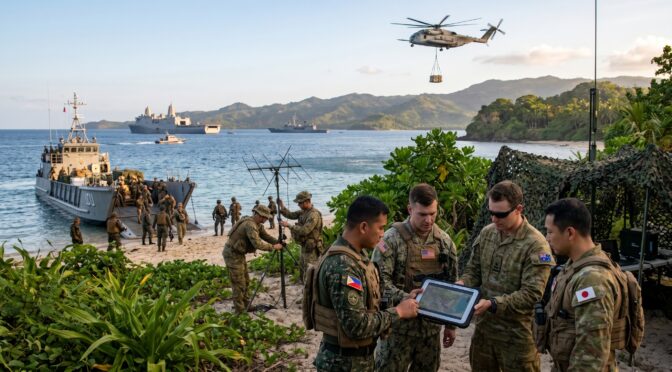
The 41st iteration of Exercise Balikatan, conducted from April 20 to May 8, 2026, represented a defining inflection point in the security architecture of the Indo-Pacific region. Originating as a bilateral training mechanism between the Armed Forces of the Philippines and the United States military, the exercise has fundamentally transformed into a massive, multilateral deterrence operation.1 The 2026 iteration mobilized an unprecedented 17,000 personnel, incorporating active combat forces from Australia, Japan, Canada, France, and New Zealand, while hosting observers from 17 additional nations.1 This expansion signals a definitive transition from localized partnership-building toward the operationalization of a broad, multi-domain coalition designed to secure the first island chain and deter unilateral alterations to the regional status quo.1
The operational tempo of Balikatan 2026 yielded critical lessons in modern expeditionary warfare, particularly regarding coalition command and control, data-centric combat operations in austere environments, and the absolute necessity of distributed maritime logistics.5 A primary technological milestone was the debut of a groundbreaking Common Operating Picture that allowed eight disparate national militaries to deconflict assets, synchronize multidomain fires, and operate under a unified tactical understanding.5 Tactically, the exercise validated the doctrine of “see, sense, strike, and protect,” utilizing advanced kinetic platforms—including the Typhon Mid-Range Capability missile system, the Navy-Marine Expeditionary Ship Interdiction System, and the Vehicle-Agnostic Modular Palletized ISR Rocket Equipment—against simulated amphibious and maritime threats.4
Geopolitically, the exercise illuminated the continued transition of the Armed Forces of the Philippines from internal counter-insurgency operations toward a robust external territorial defense posture.4 Furthermore, it formalized Japan’s emergence as a consequential hard-power actor, highlighted by the nation’s first deployment of combat troops to the region since the conclusion of World War II.1 The resulting operational data and the strategic messaging derived from Balikatan 2026 will profoundly influence regional defense postures, driving further interoperability and pragmatic multi-alignment strategies among Indo-Pacific middle powers for the foreseeable future.
2. The Geopolitical Context and the Deterrence Paradigm
The strategic environment surrounding Exercise Balikatan 2026 reflects a fundamental realignment of Indo-Pacific security dynamics. The exercise explicitly tested the capacity of a United States-led coalition to maintain a free and open operational corridor along the first island chain, a critical geographic and strategic threshold that encompasses Japan, Taiwan, and the Philippine archipelago.4 The massive scale of the exercise was a direct response to a security environment that participating nations view as increasingly severe and complex, necessitating immediate advancements in collective deterrence mechanisms.1
2.1 The Asian NATO Debate Versus Pragmatic Multi-Alignment
Japan’s unprecedented deployment of 1,400 combat personnel to the Philippines catalyzed intense debate among regional defense analysts regarding the future design of Indo-Pacific security architectures.1 Two distinct strategic visions framed the diplomatic context of the military maneuvers. The first vision, heavily promoted by figures such as former Japanese Prime Minister Shigeru Ishiba, advocates for the transformation of existing United States-led bilateral alliances into a formal, treaty-based multilateral collective defense organization.1 Proponents of this “Asian NATO” model argue that the absence of a formalized collective self-defense system in Asia significantly increases the probability of conflict. Pointing to the defense collaboration between China, Russia, and North Korea, Ishiba starkly warned that “Ukraine today is Asia tomorrow,” asserting that a formalized collective deterrent is essential to stabilize the region.1
Conversely, a parallel school of strategic thought—dominant among middle-power nations—favors pragmatic multi-alignment and strategic autonomy over rigid military blocs.1 Scholars such as Kuik Cheng-Chwee argue that a formal collective defense pact would alienate potential regional partners who are necessary to pursue broader diplomatic and economic interests.1 Instead, this approach advocates for an “alliance-plus” posture, wherein core security alliances are maintained but are heavily complemented by flexible, issue-specific partnerships.1 This sentiment was echoed in a 2026 World Economic Forum speech by Canadian Prime Minister Mark Carney, who called on middle powers to assert themselves collaboratively within a ruptured world order.1
Balikatan 2026 functionally served as a highly successful stress test for this pragmatic multi-alignment strategy. The seamless tactical integration of Canadian, French, and New Zealand forces alongside the core United States-Philippine-Australian-Japanese framework demonstrated that flexible alignments can produce credible, combat-ready coalitions without the bureaucratic inertia and geopolitical polarization inherent to a formal treaty organization.1 The exercise proved that an alliance-plus architecture can deliver the deterrence benefits of an Asian NATO without demanding the same level of absolute geopolitical commitment from participating states.1
2.2 The Strategic Pivot of the Armed Forces of the Philippines
Domestically, Exercise Balikatan 2026 served as a catalyst for the Armed Forces of the Philippines to accelerate its pivot toward external border defense. For decades, the Philippine military was primarily optimized for internal security and counter-insurgency operations, heavily focused on combating domestic groups such as the New People’s Army.4 Recent intelligence reports indicate that incidents linked to the communist insurgency fell steadily from 2019 to 2025, a decline attributed to intensified military campaigns, inter-agency coordination, and localized peace efforts.4 With the domestic insurgency severely weakened and largely relegated to isolated, small-scale extortion efforts for survival, the Philippine military has gained the operational bandwidth required to focus outward.4
The drills provided the Armed Forces of the Philippines with the necessary environment to acquire and master new capabilities for external defense, specifically focusing on anti-access and area-denial strategies along its archipelagic borders.4 Philippine Defense Secretary Gilberto Teodoro Jr. emphasized the critical nature of this transition, noting that while the activities tested in 2026 were robust, they remained geographically limited.10 He indicated that future iterations of the exercise will likely expand beyond the West Philippine Sea to include operations on the eastern seaboard, aiming to establish a comprehensive, 360-degree territorial defense posture.10 This shift highlights a national recognition that the defense of Philippine sovereignty now relies on securing the maritime and aerospace domains that surround the archipelago, requiring seamless integration with allied forces.11
3. Next-Generation Command and Control Architectures
The capacity to share data securely and instantaneously among multinational partners is historically the most significant hurdle in coalition warfare. Incompatible communication hardware, disparate national security classifications, and language barriers routinely degrade the operational tempo of allied forces. Exercise Balikatan 2026 confronted this challenge directly through the implementation of next-generation digital architectures designed to shorten the decision-making cycle across multiple domains.5
3.1 The Multilateral Common Operating Picture
A crowning technical achievement of the 2026 exercise was the successful deployment of a Common Operating Picture accessible to eight distinct national militaries.5 Developed over eight years by the United States Indo-Pacific Command J7 Pacific Multi-Domain Training and Experimentation Capability, alongside joint interface control officers, the system fundamentally altered how allied forces perceive the modern battlespace.5 The architecture was built upon the Indo-Pacific Command Mission Network, which provided a secure “Sandbox” platform where approved coalition partners could operate seamlessly.5
The Common Operating Picture solved the historic challenge of coalition data sharing through advanced multi-level classification tagging.5 This architecture allowed raw data from various sensor networks to pass through cross-domain solutions, filtering information so that each participating nation could view the exact tactical intelligence it required without compromising highly classified source parameters.5 This enabled the synchronization of data from live military assets, constructive virtual assets, and simulated training environments into a unified, real-time battlespace visualization.5 Leaders involved in the network’s deployment noted that managing this multi-level classification while maintaining a steady flow of contextual information was a primary logistical challenge, yet its success proved vital for building coalition confidence.5
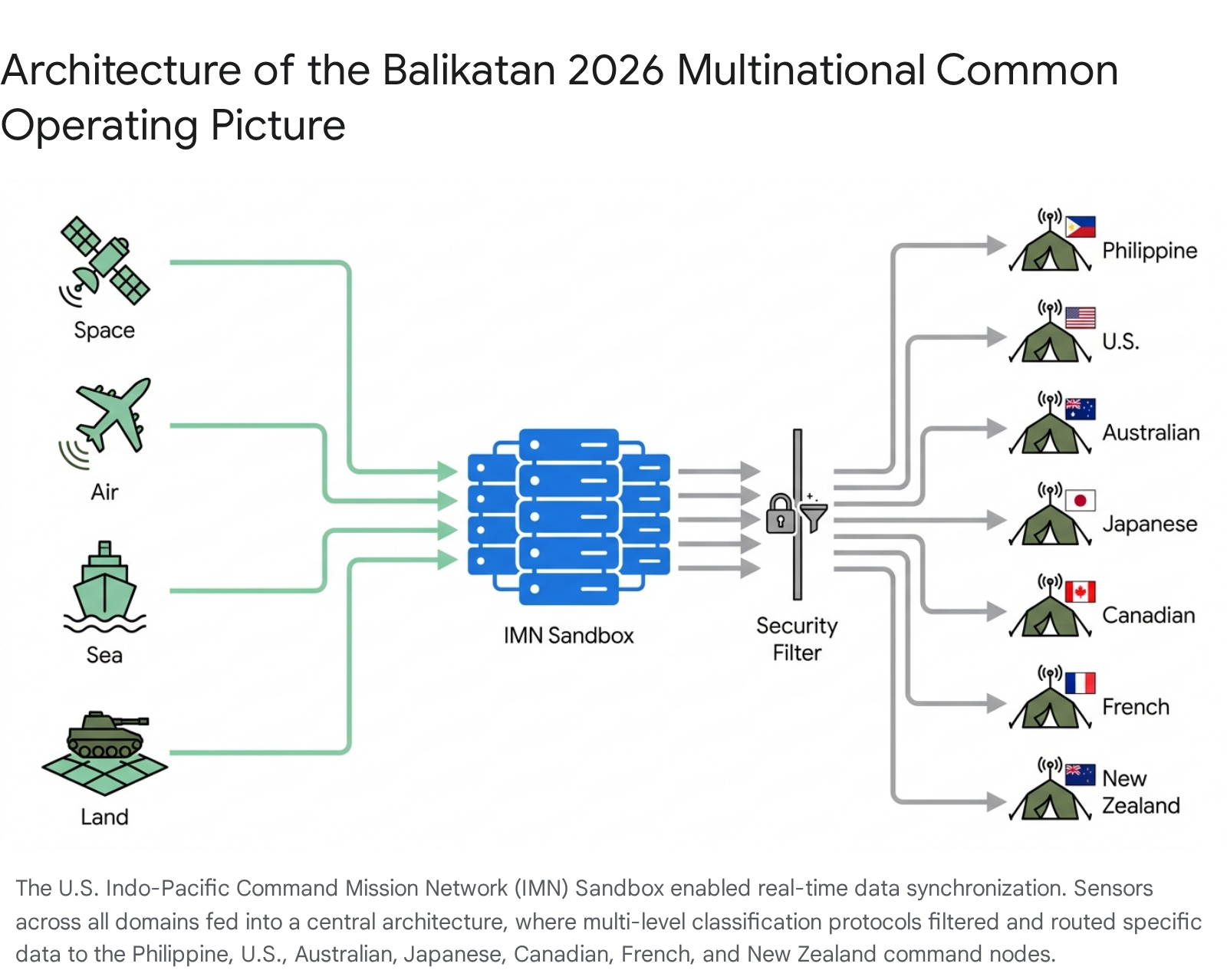
The primary lesson derived from the implementation of this Common Operating Picture was the absolute necessity of interoperability under combat duress.5 During intense live-fire events, the network successfully deconflicted air, ground, and surface assets, ensuring that rapid force deployment did not result in friendly fire incidents or operational bottlenecks.5 By tailoring the Common Operating Picture to provide real-time information sharing across all domains, commanders achieved a significantly faster response to emerging threats, reinforcing the necessity of systems that are ready for a real-world “fight tonight” scenario.5
3.2 Artificial Intelligence and Data-Centric Operations at the Tactical Edge
Complementing the theater-wide Common Operating Picture, the United States Army’s 25th Infantry Division, operating alongside its Philippine counterparts, conducted rigorous operational demonstrations of data-centric warfare at the tactical edge.12 Over a three-day period in early May, these forces deployed into the austere, jungle environments of the Indo-Pacific to refine next-generation digital architectures under realistic, harsh conditions.12 The primary objective was to push fielded command and control systems to their limits, proving that advanced networks remain resilient, secure, and lethal regardless of the operational terrain.12
A critical takeaway from this operational demonstration was the successful refinement of Artificial Intelligence as a battlefield decision aid.12 By establishing a unified data network that linked remote threat-detection sensors directly to effector weapons systems, the coalition drastically shortened the decision-making cycle.12 Artificial Intelligence applications processed vast amounts of incoming data, identifying targets and suggesting engagement matrices faster than human analysts could parse the information.12 However, as emphasized by Colonel Daniel VonBenken, commander of the 25th Infantry Division Artillery, the technology served solely as a powerful decision aid; human commanders retained full authority over every kinetic engagement, ensuring ethical oversight while maintaining a decisive information advantage.12
Furthermore, the integration of electromagnetic warfare capabilities proved essential to maintaining this digital lethality.12 Specialized personnel utilized electromagnetic warfare tools to verify the lines of bearing between sensors, ensuring that data flow remained accurate and untampered with despite simulated adversarial jamming efforts.12 Signal support system specialists successfully established and maintained the necessary connectivity, proving that a digitally synchronized force can operate effectively outside of pristine garrison environments.12
4. Tactical Execution: Coastal Defense and Multi-Domain Fires
The tactical execution of Exercise Balikatan 2026 was anchored in the seamless integration of lethal firepower with advanced intelligence, surveillance, and reconnaissance capabilities. The overarching doctrine governing these maneuvers was explicitly articulated by General Ronald Clark, commander of the United States Army Pacific, as the imperative to “see, sense, strike, and protect”.4 This doctrine emphasizes the necessity of detecting adversarial movements long before they reach the littorals, allowing allied forces to initiate defensive strikes well over the horizon.4
4.1 Coastal Defense and Counter-Landing Operations
The most complex and heavily scrutinized tactical event of the exercise was the counter-landing live-fire training held at the La Paz sand dunes in Laoag City.4 This operation brought together over 500 service members from the United States, the Philippines, Australia, and New Zealand, tasking them with repelling a highly dynamic simulated amphibious assault.11 The defenders included United States Marines from the Marine Rotational Force – Darwin, soldiers from the 7th Infantry Division, Philippine marines from the 3rd Marine Brigade, soldiers from the Royal Australian Regiment’s 5th/7th Battalion, and, for the first time, infantry from the Royal New Zealand Infantry Regiment’s 2nd/1st Battalion.11
The engagement sequence provided a masterclass in layered coastal defense.4 The operation commenced with intelligence, surveillance, and reconnaissance assets—including silver drone boats scanning the azure waters—detecting a notional enemy flotilla.4 This intelligence was fed immediately into the combined command and control node.11 As the simulated enemy approached the coastline, allied fighter aircraft, missile patrol boats, and attack helicopters initiated the engagement, winnowing the number of enemy landing craft at sea.9 For the amphibious assault vehicles that survived the initial barrage and reached the searingly hot beachhead, they were met by a devastating wall of integrated ground fire.9 High Mobility Artillery Rocket Systems positioned directly on the beach delivered precision strikes, supported by overlapping fields of fire from mortars, machine guns, and Stinger surface-to-air missiles.4
The operation culminated with a final defensive line of direct-fire weapons from all four participating nations engaging the last wave of targets simultaneously, effectively neutralizing the threat.11 Philippine Marine Corps Colonel Dennis Hernandez summarized the core lesson of the event, stating that beach defense is no longer the responsibility of a single unit or domain; it requires seamless, real-time integration across services and allied nations.11 The successful coordination of these multidomain fires proved that coalition forces can think, decide, and act as a singular combat entity under extreme pressure.11
4.2 Autonomous Systems and Mid-Range Capabilities in the Littorals
Balikatan 2026 also served as a proving ground for the deployment of highly advanced, autonomous strike platforms in remote archipelagic environments. In the northernmost Philippine province of Batanes, situated along the strategic Luzon Strait, United States and Philippine forces showcased the Navy-Marine Expeditionary Ship Interdiction System.8 Flown into the austere location via a United States Air Force C-130 transport aircraft, this coastal anti-ship missile system demonstrated the operational feasibility of rapidly inserting lethal area-denial weapons into remote maritime corridors.8
The Navy-Marine Expeditionary Ship Interdiction System is uniquely designed for remote operation. As explained by United States Marine Corps Staff Sergeant Darren Gibbs, the platform is fully autonomous, requiring no human driver or passenger inside the vehicle.8 Operators program the system’s destination and engagement parameters remotely, allowing it to navigate independently and target surface vessels at ranges up to 185 kilometers.8 Philippine Army Major General Francisco Lorenzo Jr. noted that testing such autonomous assets in Batanes is critical for rehearsing rapid deployment scenarios where immediate territorial defense is required.8
Beyond autonomous platforms, the exercise featured the highly controversial deployment of the Typhon Mid-Range Capability missile system.4 Deployed by the United States military from a civilian airport into a military reservation in the Philippines, the Typhon system successfully fired a Tomahawk cruise missile carrying a dummy warhead during the drills.4 This deployment validated the coalition’s ability to project strategic strike capabilities capable of hitting targets deep within adversarial mainland territory from mobile, land-based launchers.4 The presence of the Typhon system represents a profound escalation in regional deterrence mechanics, utilizing land power to assert control over sea lanes and maritime choke points.4
4.3 Integrated Air and Missile Defense and Counter-UAS Operations
Recognizing the rapid proliferation and lethal efficacy of uncrewed aerial systems in modern conflict, Exercise Balikatan 2026 placed a heavy emphasis on Integrated Air and Missile Defense.7 At Naval Station Leovigildo Gantioqui, United States Army and Marine Corps air defense units stood shoulder-to-shoulder with the Philippine Air Force and the Japanese Air Self-Defense Force to conduct exhaustive live-fire and dry-fire exercises focused on Counter-Unmanned Aircraft Systems weaponry.7
The primary asset tested during these evolutions was the Vehicle-Agnostic Modular Palletized ISR Rocket Equipment, commonly referred to as VAMPIRE.7 VAMPIRE is a self-contained, precision-guided weapons platform explicitly designed to defeat small uncrewed aerial systems and execute precision strikes against surface targets.7 Carrying a payload of four 70mm laser-guided rockets equipped with proximity fuzes, the system provides highly lethal, rapid-response air defense.7 United States Army Lieutenant Colonel Kenneth Collins, commander of the 1st Battalion, 51st Air Defense Artillery Regiment, articulated the strategic value of the system, noting that bringing rapid, palletized capabilities like VAMPIRE to the shorelines provides a decisive, precision-strike capability that fills a vital gap in the coastal air defense network.7 The successful integration of these systems alongside the Fixed Site-Low, Slow, Small Unmanned Aerial System Integrated Defeat System dramatically enhanced the bilateral knowledge and operational readiness of Philippine and United States air defenders.7
4.4 Space Force Integration and Cyber Operations
Modern multidomain operations are entirely reliant on the invisible infrastructure of space and cyber capabilities. Marking a significant historical milestone, Balikatan 2026 featured the unprecedented inclusion of United States Space Force personnel directly integrated into the Joint Task Force.13 Brigadier General Brian Denaro, commander of United States Space Forces Indo-Pacific, emphasized that this integration proves the alliance is adapting to modern warfare.13 Space Force Guardians provided tactical units with critical enablers, including secure satellite communication, precise navigation data, early missile warning telemetry, and comprehensive situational awareness.14 By bringing these space-based capabilities directly into the tactical exercise environment, the coalition strengthened its ability to respond quickly and operate with extreme precision.14
Simultaneously, the exercise tested the cyber resilience of the participating nations. Cyber operations events held at Camp General Emilio Aguinaldo involved specialized personnel, such as host analysts from the New Zealand Army’s 1st Command Support Regiment, working alongside multinational peers to defend command and control networks against simulated digital intrusions.3 This comprehensive approach to training ensured that the coalition forces were prepared to protect their digital command structures while executing kinetic strikes in the physical domains.
5. Maritime Strike and Naval Integration
Given the archipelagic geography of the Indo-Pacific, naval supremacy and maritime strike capabilities remain central to any deterrence strategy. The maritime component of Balikatan 2026 included the largest multinational anti-submarine warfare exercise ever hosted by the Philippines, alongside highly coordinated surface strike events.16
A centerpiece of the naval maneuvers was a multidomain maritime strike drill conducted off the western coast of Northern Luzon, which culminated in the sinking of two decommissioned vessels, including the Philippine Navy corvette BRP Magat Salamat.12 Multinational forces from the Philippines, the United States, Japan, and Canada integrated land, sea, and air platforms to sense, strike, and destroy the targets.12 The strike utilized AGM-65 Maverick missiles, United States Army High Mobility Artillery Rocket Systems, and, notably, a Type 88 anti-ship missile fired by the Japanese Amphibious Rapid Deployment Brigade.4 This coordinated destruction of surface targets demonstrated the coalition’s ability to seamlessly pass targeting data between disparate national platforms to execute a decisive kill chain.18
The naval integration extended deep beneath the surface during comprehensive anti-submarine warfare exercises.16 For two days, a united fleet comprising ships from the Royal Australian Navy, the Philippine Navy, the United States Navy, the Royal Canadian Navy, and the Japan Maritime Self-Defense Force worked to sharpen their sub-surface hunting skills.16 Directed by the United States Navy’s Destroyer Squadron 7, which served as the multinational maritime event Task Group commander, the ten-ship surface action group operated as a single tactical entity.20 Royal Australian Navy Lieutenant Commander Matthew Driml of the HMAS Toowoomba highlighted the strategic value of this integration, noting that while the participating navies possessed vastly different capabilities, those differences created a robust force multiplier effect when combined.16 Operating as one comprehensive anti-submarine force, the coalition proved that deep interoperability can overcome individual platform limitations.16
6. Component Dependencies: Archipelagic Logistics and Distributed Sustainment
Military logisticians frequently assert that logistics is the pacing function of expeditionary operations; without resilient sustainment, tactical proficiency is easily neutralized.6 Before an infantry company can secure an objective or an artillery battery can provide suppressive fire, equipment and supplies must be positioned accurately across vast distances.6 Exercise Balikatan 2026 exposed both the inherent vulnerabilities and the recent advancements in archipelagic logistics.
6.1 Maritime Prepositioning and the Mindanao Offload
A historic logistical milestone was achieved weeks before the kinetic exercises began, featuring the first-ever Maritime Prepositioning Force offload on the southern Philippine island of Mindanao.6 Conducted in March 2026, the operation involved months of intricate planning between United States Marine Corps commands, the Armed Forces of the Philippines, local port authorities, and civilian transportation contractors.6 The evolution culminated with the arrival of the USNS Sgt. William W. Seay at the Cagayan de Oro port, carrying heavy equipment and sustainment vital to supporting the subsequent tactical drills.6
Following the rapid offload of the maritime prepositioning vessel, the equipment was seamlessly transferred onto contracted host-nation barges for northbound distribution through the archipelago to Subic Bay, where it was issued to participating combat units.6 This operation provided several vital strategic lessons regarding distributed sustainment. First, it demonstrated the necessity of geographic flexibility.6 Relying solely on major, centralized port facilities in Luzon creates a single point of failure vulnerable to preemptive adversarial strikes. Expanding the logistical network to southern islands like Mindanao provides Marine Air-Ground Task Force commanders with decentralized supply nodes, complicating adversary targeting efforts.6
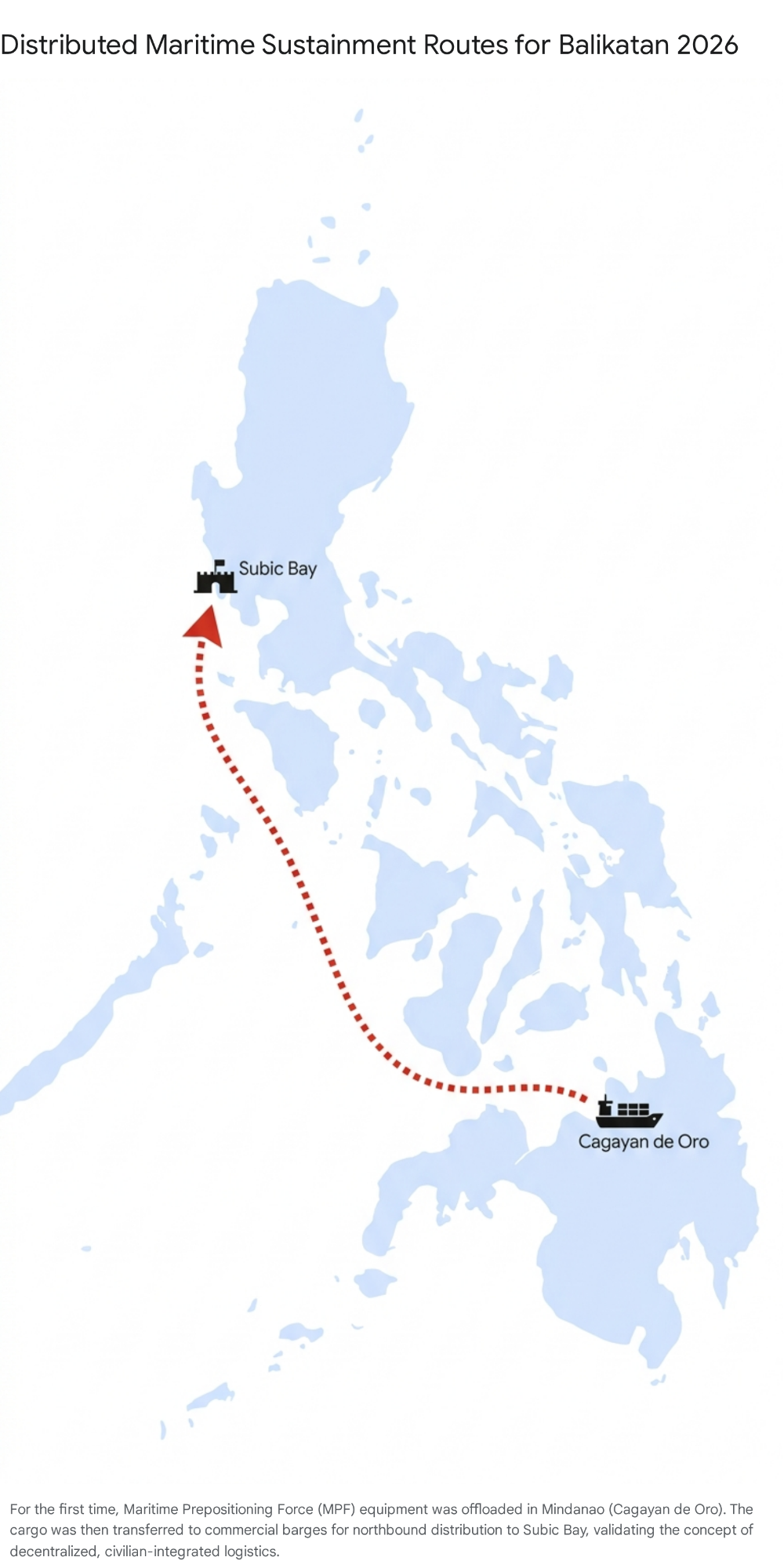
Second, the operation showcased the absolute necessity of military-to-civilian collaboration.6 The successful northbound movement of heavy armor and munitions relied heavily on local commercial infrastructure, proving that civilian economic integration is a critical component of military sustainment in the Philippines.6 Finally, as noted by Colonel Coby Moran, the officer in charge of the offload, the evolution served as a practical, large-scale rehearsal for rapidly surging combat power during an unexpected real-world crisis, validating the Marine Corps’ unique ability to operationalize distributed logistics across complex maritime terrain.6
7. Review of Participating Militaries: Strategic Motivations and Leadership Commentary
Exercise Balikatan 2026 required the complex diplomatic and operational alignment of a massive coalition force. Table 1 provides a comprehensive overview of the participating nations, highlighting their primary asset contributions and distinct operational focuses during the drills.
| Nation | Estimated Personnel | Key Assets & Units Deployed | Operational Focus during Balikatan 2026 |
| United States | ~10,000 | 25th Infantry Division, Space Force, HIMARS, Typhon MRC, VAMPIRE C-UAS, USNS Sgt. William W. Seay | Command and control architecture, strategic long-range strike, multidomain sensor integration, distributed maritime logistics.4 |
| Philippines | ~5,000 | 3rd Marine Brigade, Philippine Air Force (FA-50, A-29), Naval Patrol Gunboats | Coastal defense integration, transition toward external territorial security, civil-military inter-agency coordination.4 |
| Japan | 1,400 | Amphibious Rapid Deployment Brigade, Type 88 Anti-ship Missile Systems, ShinMaywa US-2 | Amphibious assault repelling, live-fire coastal defense, operationalizing constitutional defense expansion.1 |
| Australia | ~400 | HMAS Toowoomba (Anzac-class frigate), 5th/7th Battalion Royal Australian Regiment | Fleet anti-submarine warfare (ASW), ground-level counter-landing interoperability, cyber defense.3 |
| Canada | ~240+ | HMCS Charlottetown (Halifax-class frigate), CH-148 Cyclone, 3rd Battalion PPCLI | Operation HORIZON mandate, multi-platform maritime strike, aerial defense, combat logistics.16 |
| France | Small Contingent | FS Vendémiaire, FS Dixmude, FS Aconit | Multinational naval task group integration, maritime security patrols, asserting European commitment to the Indo-Pacific.1 |
| New Zealand | Element | 2nd/1st Battalion Royal New Zealand Infantry Regiment, Cyber Operations personnel | Tactical ground-level interoperability, combined arms beachhead defense, network defense operations.11 |
7.1 The United States
The presence of the United States military served as the foundational bedrock of the exercise, providing the overarching logistical, technological, and command scaffolding necessary to manage a multinational event of this magnitude.5 By deploying roughly 10,000 service members alongside advanced platforms like the Typhon missile system and Space Force detachments, Washington signaled an unwavering commitment to the 1951 Mutual Defense Treaty.4 General Ronald Clark summarized the operational philosophy driving U.S. participation, stating, “It’s really about ‘see, sense, strike and protect.’ We want to see the enemy first,” reflecting the doctrinal shift toward deep-sensing and long-range precision fires in archipelagic defense.4 Beyond the hardware, United States Marine Corps Colonel G.J. Flynn III highlighted the human element of coalition building, noting that while capabilities are important, the true cornerstone of readiness is found in “the friendships that we made being in the dirt in defensive positions alongside each other”.11
7.2 The Philippines
Serving as the host nation, the Armed Forces of the Philippines utilized Balikatan 2026 to rapidly mature its conventional, multidomain warfare capabilities. Moving past its historical focus on internal counter-insurgency, Philippine units acquired hands-on proficiency with anti-access and area-denial platforms.4 Defense Secretary Gilberto Teodoro Jr. maintained a forward-looking perspective on the drills, asserting, “What we tested now is still limited. We can increase the scope, but not necessarily the scale,” suggesting that future exercises will focus on broader geographic coverage across the archipelago rather than simply accumulating larger troop numbers.10 The tactical success of this transition was echoed by Colonel Dennis Hernandez, who proudly noted that the live-fire exercises decisively demonstrated the nation’s “growing capability to defend our shores through a multilayered, joint and combined approach”.9
7.3 Japan
Japan’s deployment to Balikatan 2026 was deeply historic, marking the operational realization of its evolving defense posture.1 By deploying 1,400 combat troops from the Amphibious Rapid Deployment Brigade and firing Type 88 anti-ship missiles on Philippine soil, Tokyo decisively broke from decades of strictly domestic military posturing.1 This action represents the culmination of policy shifts beginning with the 2014 constitutional reinterpretation under Shinzo Abe and advancing through the 2022 National Security Strategy under Fumio Kishida.1 Driven by a profound threat perception regarding regional stability, Japanese strategic elites like Shigeru Ishiba explicitly linked European conflicts to Asian security, warning that without robust, collective deterrents, “Ukraine today is Asia tomorrow”.1
7.4 Australia
The Australian Defence Force leveraged the exercise to deeply integrate its naval and ground forces into large-scale, allied task groups.3 Contributing roughly 400 personnel, medical teams, tactical air support, and the frigate HMAS Toowoomba, Australia focused heavily on complex mission sets including maritime security, targeting, and anti-submarine warfare.3 The primary operational takeaway for Australia was the validation of diverse, complementary capabilities. As Royal Australian Navy Lieutenant Commander Matthew Driml observed during the sub-hunting drills, the vastly different capabilities of the participating ships “proved to create a robust force multiplier effect,” proving that allied navies do not need identical equipment to dominate the maritime domain.16 Vice Admiral Justin Jones reaffirmed that this high level of integration reflects Australia’s shared commitment to maintaining absolute peace and stability in the region.3
7.5 Canada and France
Balikatan 2026 served as the inaugural active participation platform for the Canadian Armed Forces, executing their mandate under Operation HORIZON to promote security in the Indo-Pacific.23 Deploying the HMCS Charlottetown, a CH-148 Cyclone helicopter, and specialized infantry from the 3rd Battalion, Princess Patricia’s Canadian Light Infantry, Canada actively engaged in coastal defense, maritime strikes, and multinational coordination.23
Similarly, the French Navy contributed a significant maritime presence, deploying an amphibious assault ship and frigates, including the FS Dixmude and FS Aconit.25 The involvement of these Western nations signifies a broadening of the Indo-Pacific security architecture, demonstrating that European and North American middle powers are willing to project naval power to uphold freedom of navigation and support the Philippine deterrence posture.1
7.6 New Zealand
The New Zealand Defence Force utilized the exercise to test command integration at the absolute tactical edge, deploying cyber operations specialists and infantry from the 2nd/1st Battalion, Royal New Zealand Infantry Regiment.11 Participating for the first time in a counter-landing live-fire event, New Zealand troops validated their ability to seamlessly coordinate multidomain fires with foreign partners.11 Captain Will Hutchinson framed the deployment as a strategic imperative to “strengthen interoperability with partner nations and our ally, Australia”.11 His remarks emphasize the cascading nature of modern alliances, wherein secondary partners achieve regional integration by plugging directly into the operational frameworks established by primary regional allies.11
8. Adversarial Responses and Geopolitical Fallout
The unprecedented scale, technological sophistication, and multinational integration displayed during Exercise Balikatan 2026 did not occur in a geopolitical vacuum; the maneuvers triggered immediate and forceful reactions from regional adversaries.
The deployment of the Typhon Mid-Range Capability missile system by the United States elicited explicit and severe condemnation from the Chinese government.4 Chinese Ministry of Foreign Affairs officials characterized the deployment as both “ridiculous but also extremely dangerous”.4 Beijing vehemently argued that the introduction of strategic offensive weapons into the Philippines severely disrupts regional peace, introduces an unwarranted arms race, and inherently harms the legitimate security interests of neighboring nations.4 Furthermore, China accused the Philippine government of breaching prior commitments to remove the system, claiming that Manila is recklessly outsourcing its national security and defense to foreign powers, thereby inviting geopolitical confrontation directly into the region.4
Operationally, the People’s Liberation Army Navy responded to the coalition’s maneuvers by surging its own military presence in adjacent waters.19 Concurrently with the commencement of Balikatan, the Chinese aircraft carrier Liaoning was observed transiting south through the Taiwan Strait.19 Furthermore, unverified satellite imagery and reports from state-owned media indicated that the Type 076 landing helicopter dock departed Shanghai to conduct sea trials in the South China Sea.19 The People’s Liberation Army Southern Theater Command explicitly announced that it was conducting military exercises in the South China Sea in direct response to what it termed Philippine attempts to “stir trouble”.19
This synchronized counter-deployment aligns perfectly with Beijing’s overarching strategy to frame United States-Philippine defense cooperation as inherently escalatory and provocative.19 By deploying major naval assets around the Philippines during the drills, China sought to visually demonstrate its capability to contest freedom of maneuver across the region and intimidate the participating middle powers.4 However, the primary strategic implication derived from Balikatan 2026 is that such coercive actions by adversaries are generating the exact opposite of their intended effect; the ongoing friction in the South China Sea has rapidly catalyzed the precise multilateral, heavily armed defense architecture that competing powers actively sought to prevent.1
9. Strategic Mitigation and Future Operational Outlook
The conclusion of Exercise Balikatan 2026 provides the participating nations with a wealth of actionable data required to refine future operations, address identified vulnerabilities, and permanently institutionalize the coalition’s deterrence capabilities. Based on post-exercise assessments, technological performance data, and leadership commentary, several forward-looking strategic mitigation pathways have emerged.
First, to establish a truly comprehensive territorial defense, future iterations of the exercise must undergo significant geographic expansion.10 As articulated by Philippine Defense Secretary Teodoro, planners must test logistics, command and control, and multi-domain fires across a wider geographical area.10 Shifting operational focus toward the Philippine eastern seaboard and deeper into the strategic corridors of the Luzon Strait will ensure that allied forces are prepared to respond to multi-axis contingencies, rather than focusing solely on the heavily contested West Philippine Sea.8
Second, while the Indo-Pacific Command Mission Network successfully provided a groundbreaking Common Operating Picture, the coalition must focus on the continuous refinement and hardening of this digital architecture.5 Maintaining real-time, multi-level classification data streams requires persistent network defense against rapidly evolving cyber and electromagnetic threats.5 Future exercises must increasingly simulate heavily degraded communication environments, forcing tactical units to rely on decentralized Artificial Intelligence decision aids and localized command initiatives when higher headquarters connectivity is severed.5
Third, the coalition must prioritize the permanent institutionalization of archipelagic logistics.6 The operational success of the Maritime Prepositioning Force offload in Mindanao dictates that the United States and the Armed Forces of the Philippines should formalize decentralized logistics nodes outside of the primary threat envelopes.6 By expanding pre-existing contracts with local maritime and ground transportation providers, the coalition can build resilient, deeply integrated sustainment webs capable of surviving initial kinetic strikes and rapidly surging combat power during a crisis.6
Finally, the exercise highlighted the absolute necessity of standardizing anti-access and area-denial capabilities among allied nations.4 As the Philippine military fully adopts external defense strategies, allied partners must facilitate the transfer and integration of compatible coastal defense systems.4 Ensuring that Philippine platforms can seamlessly plug into the broader allied sensor-to-shooter kill chain—sharing targeting data with United States HIMARS, Japanese Type 88s, and Canadian maritime strike assets—is critical to maintaining an impenetrable defensive perimeter.12
Ultimately, Exercise Balikatan 2026 conclusively proved that the Indo-Pacific security paradigm has irrevocably shifted. Through the tactical integration of Space Force enablers, AI-driven command architectures, historic combat deployments from emerging hard-power nations, and geographically distributed logistics, the multilateral coalition demonstrated a highly lethal, highly credible deterrent force. The lessons learned on the beaches of Luzon and the shores of Batanes will dictate the trajectory of military modernization and pragmatic multi-alignment strategies across the region for the remainder of the decade.
Please share the link on Facebook, Forums, with colleagues, etc. Your support is much appreciated and if you have any feedback, please email us in**@*********ps.com. If you’d like to request a report or order a reprint, please click here for the corresponding page to open in new tab.
Sources Used
- Asian NATO Debate Reignites After Japan’s Landmark Participation …, accessed May 9, 2026, https://www.eurasiantimes.com/asian-nato-debate-reignites-after-japan/
- AFP, US military conclude Balikatan drills with warning: ‘This is warfighting in the 21st century’ – Manila Bulletin, accessed May 9, 2026, https://mb.com.ph/2026/05/08/afp-us-military-conclude-balikatan-drills-with-warning-this-is-warfighting-in-the-21st-century
- ADF joins partners in Exercise Balikatan – Defence, accessed May 9, 2026, https://www.defence.gov.au/news-events/news/2026-04-24/adf-joins-partners-exercise-balikatan
- Military drills on the edge: U.S. and allies test capabilities near Asia’s …, accessed May 9, 2026, https://www.nprillinois.org/2026-05-08/military-drills-on-the-edge-u-s-and-allies-test-capabilities-near-asias-flash-points
- News – Balikatan 2026 Debuts Groundbreaking Common … – DVIDS, accessed May 9, 2026, https://www.dvidshub.net/news/564756/balikatan-2026-debuts-groundbreaking-common-operating-picture
- Balikatan 26: U.S. Marines, Sailors Conduct Distributed Maritime …, accessed May 9, 2026, https://www.marines.mil/News/News-Display/Article/4457656/balikatan-26-us-marines-sailors-conduct-distributed-maritime-logistics-in-the-p/
- Balikatan 2026: US Army, Philippines Enhance Bilateral Knowledge of Air and Missile Defense | Article, accessed May 9, 2026, https://www.army.mil/article/292123/balikatan_2026_us_army_philippines_enhance_bilateral_knowledge_of_air_and_missile_defense
- Philippine, U.S. forces drill with anti-ship missile system during Balikatan, accessed May 9, 2026, https://ipdefenseforum.com/2026/05/philippine-u-s-forces-drill-with-anti-ship-missile-system-during-balikatan/
- Exercise Balikatan 2026: 17,000 troops rehearse “territorial defence …, accessed May 9, 2026, https://www.tribuneindia.com/news/world/exercise-balikatan-2026-17000-troops-rehearse-territorial-defence-amid-taiwan-contingency-concerns/
- West PH Sea: Balikatan drills may expand, include more allies, accessed May 9, 2026, https://www.inquirer.net/474625/balikatan-drills-may-expand-beyond-wps-include-more-allies-teodoro/
- Multinational Forces Validate Defensive … – Department of War, accessed May 9, 2026, https://www.war.gov/News/News-Stories/Article/Article/4472230/multinational-forces-validate-defensive-readiness-during-exercise-balikatan-2026/
- Balikatan 2026: Tropic Lightning Division, Philippine Army …, accessed May 9, 2026, https://www.army.mil/article-amp/292300/balikatan_2026_tropic_lightning_division_philippine_army_demonstrated_advanced_data_centric_warfare_capabilities
- Balikatan 2026: Space Force strengthens U.S.-Philippine combined readiness – PACOM, accessed May 9, 2026, https://www.pacom.mil/Media/News/News-Articles/Article/4479573/balikatan-2026-space-force-strengthens-us-philippine-combined-readiness/
- Balikatan 2026: Space Force strengthens U.S.-Philippine combined readiness, accessed May 9, 2026, https://www.pacaf.af.mil/News/Article-Display/Article/4477418/balikatan-2026-space-force-strengthens-us-philippine-combined-readiness/
- Balikatan 2026: New Zealand Defence Forces Participate in Cyber Operations Exercise [Image 1 of 5] – DVIDS, accessed May 9, 2026, https://www.dvidshub.net/image/9655622/balikatan-2026-new-zealand-defence-forces-participate-cyber-operations-exercise
- Many navies make light work – Defence, accessed May 9, 2026, https://www.defence.gov.au/news-events/news/2026-05-08/many-navies-make-light-work
- Multinational forces sink decommissioned ships in Maritime Strike during Balikatan 2026, accessed May 9, 2026, https://www.cpf.navy.mil/Newsroom/News/Article/4482489/multinational-forces-sink-decommissioned-ships-in-maritime-strike-during-balika/
- Missiles Clobber Target Ship In Highly Strategic Luzon Strait, accessed May 9, 2026, https://www.twz.com/news-features/missiles-clobber-target-ship-in-highly-strategic-luzon-strait
- China & Taiwan Update, May 1, 2026 | ISW, accessed May 9, 2026, https://understandingwar.org/research/china-taiwan/china-taiwan-update-may-1-2026/
- Balikatan 2026: DESRON-7, Task Force Ashland Commence Multinational Maritime Event, accessed May 9, 2026, https://www.navy.mil/Press-Office/News-Stories/display-news/Article/4471124/balikatan-2026-desron-7-task-force-ashland-commence-multinational-maritime-event/
- Balikatan 26 Timelapse: Distributed maritime logistics in Subic Bay, Philippines – DVIDS, accessed May 9, 2026, https://www.dvidshub.net/video/1002000/balikatan-26-timelapse-distributed-maritime-logistics-subic-bay-philippines
- Defence joins partners for Exercise Balikatan in the Philippines, accessed May 9, 2026, https://www.defence.gov.au/news-events/releases/2026-04-20/defence-joins-partners-exercise-balikatan-philippines
- Canadian Armed Forces to conduct inaugural active participation in …, accessed May 9, 2026, https://www.canada.ca/en/department-national-defence/news/2026/04/canadian-armed-forces-to-conduct-inaugural-active-participation-in-exercise-balikatan.html
- Multinational forces exercise coastal defense in Northern Luzon during Balikatan 2026, accessed May 9, 2026, https://www.army.mil/article/292241/multinational_forces_exercise_coastal_defense_in_northern_luzon_during_balikatan_2026
- France Deploys FS Dixmude and FS Aconit to Join Balikatan 2026 – YouTube, accessed May 9, 2026, https://www.youtube.com/shorts/QlraK-f-LzM
- French Navy helicopter carrier, frigate to participate in Philippines’ Balikatan joint exercises, accessed May 9, 2026, https://www.bairdmaritime.com/security/naval/naval-ships/french-navy-helicopter-carrier-frigate-to-participate-in-philippines-balikatan-joint-exercises