1. Executive Summary
Exercise Balikatan 2026, executed between April 20 and May 8, 2026, represents a fundamental shift in the operational dynamics and security architecture of the Indo-Pacific region.1 Constituting the 41st iteration of the annual military drills between the Armed Forces of the Philippines (AFP) and the United States military, the exercise intentionally coincides with the 75th anniversary of the 1951 U.S.-Philippine Mutual Defense Treaty.3 However, the 2026 iteration diverges significantly from its historical precedents. It has transformed from a localized, bilateral training event focused on internal security into an expansive, multilateral power-projection mechanism designed for high-intensity, multi-domain operations against peer adversaries.2
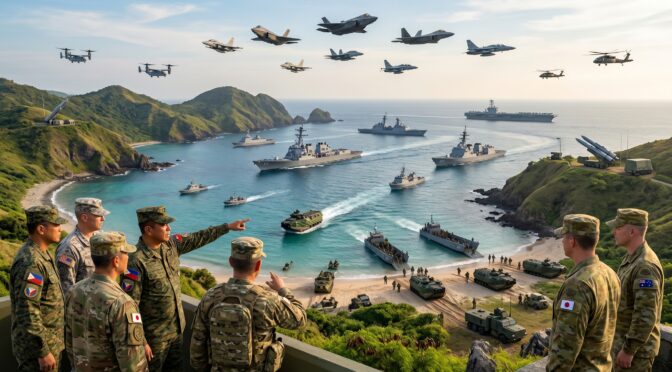
Involving more than 17,000 personnel, Balikatan 2026 integrates forces from the Philippines, the United States, Australia, Japan, Canada, France, and New Zealand.2 Furthermore, it incorporates an international observer program featuring 17 additional nations, including European partners such as Czechia, Lithuania, the Netherlands, Poland, and the United Kingdom.2 This deliberate expansion reflects a strategic transition toward “alliance density,” wherein Manila and Washington seek to internationalize the defense of the First Island Chain to complicate adversary strategic calculus.
Operationally, the center of gravity for the exercise is distributed across the Philippine archipelago, with a pronounced focus on the northernmost extremities—specifically the Batanes and Babuyan Island Groups adjacent to the Luzon Strait—and the contested West Philippine Sea.5 The training regimen spans air, land, sea, space, and cyber domains, validating complex capabilities such as expeditionary advanced base operations, distributed maritime logistics, integrated air and missile defense (IAMD), and joint combined fires.2
At the doctrinal level, the exercise serves as a primary testing environment for the AFP’s newly operationalized Comprehensive Archipelagic Defense Concept (CADC), a framework dictating a pivot toward forward and seaward territorial defense.10 Through the deployment of advanced kinetic systems—including the U.S. Typhon system, Naval Strike Missiles, Japanese Type 88 surface-to-ship missiles, and Philippine BrahMos cruise missiles—the coalition is actively demonstrating lethal sea-denial capabilities.5 The strategic messaging directed at the People’s Republic of China is unambiguous, emphasizing collective deterrence and a resolute defense of sovereign maritime domains despite warnings from Beijing that the coalition is risking regional stability.13
2. Geopolitical Context and the Evolution of the Alliance
Understanding the scale and scope of Balikatan 2026 requires an analysis of the geopolitical environment that necessitated its expansion. For decades, the Armed Forces of the Philippines focused the majority of its resources and training on internal security operations, primarily combating insurgencies in the southern islands. Early iterations of Exercise Balikatan reflected this orientation, focusing heavily on counter-terrorism, light infantry tactics, and civil-military operations.
However, escalating tensions in the South China Sea—characterized by repeated physical confrontations, gray-zone coercion, and the rapid militarization of artificial island features by the People’s Liberation Army Navy (PLAN) and Chinese Coast Guard—have forced a rapid structural realignment within the Philippine defense establishment. The alliance with the United States, anchored by the Mutual Defense Treaty, has been revitalized to address these external, conventional threats.3
The 75th anniversary of the treaty in 2026 provides a symbolic backdrop for a highly practical modernization effort.4 The United States and the Philippines are utilizing Balikatan 2026 to operationalize agreements made under the Enhanced Defense Cooperation Agreement (EDCA), which grants U.S. forces access to strategic Philippine bases. The exercise is no longer merely a demonstration of friendship; it is a critical mechanism for ensuring tactical proficiency, interoperability, and the development of a combined force capable of sustaining a credible defense posture in a highly contested environment.2 The shift signifies an acknowledgment that regional stability can no longer be maintained solely through diplomatic protest, but requires the physical demonstration of integrated, lethal combat capabilities.
3. Force Generation and the Multilateral Architecture
The defining structural characteristic of Balikatan 2026 is its multilateral force architecture. The Philippines has actively pursued what strategic analysts describe as a “looking for a crowd” strategy.5 By bringing a broad coalition of partner nations into its territorial waters and airspace, the Philippines seeks to deter aggression through the promise of a collective, international response.
3.1 United States and Philippine Contributions
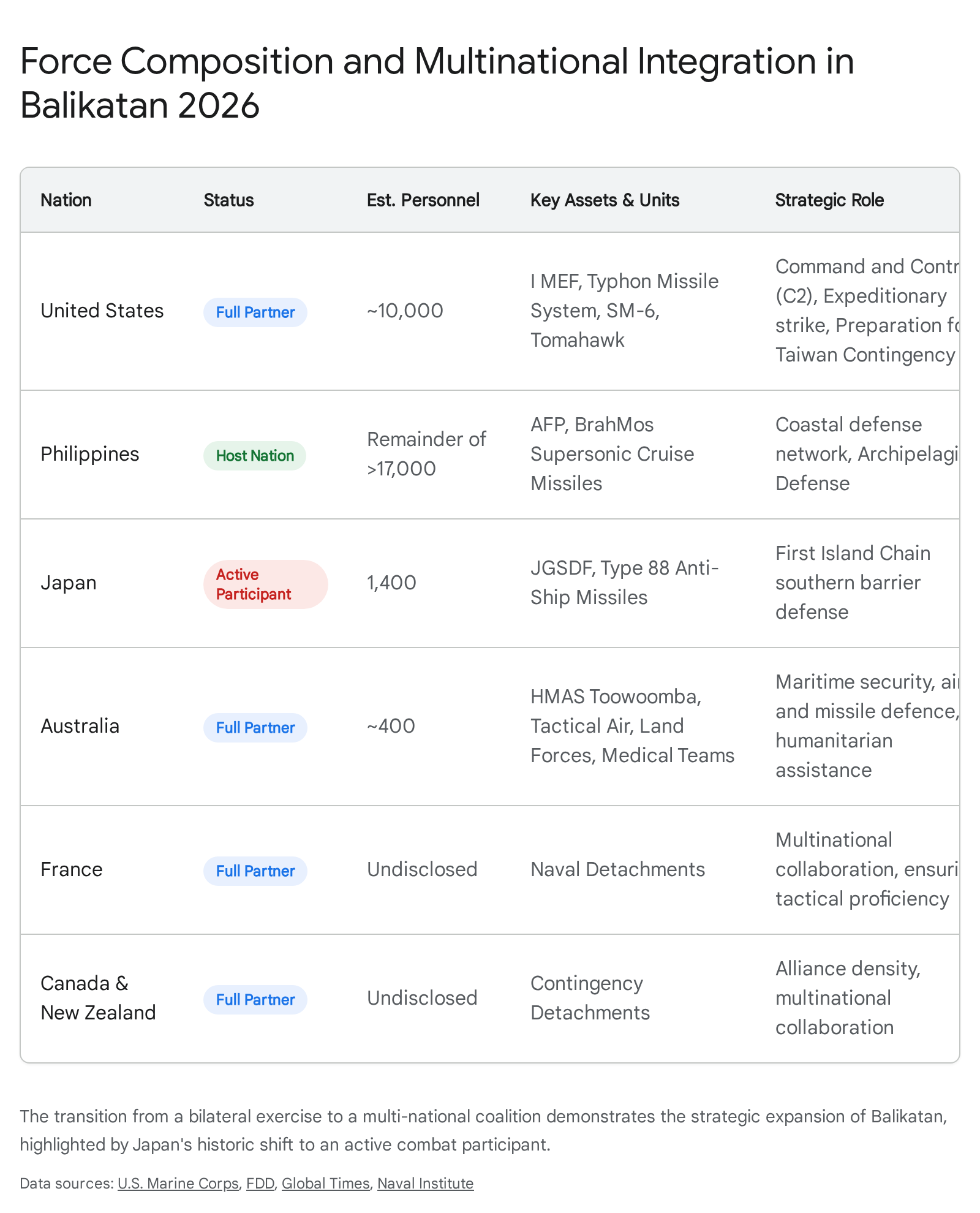
The United States has committed roughly 10,000 service personnel to the exercise, representing a massive deployment of forward-based power into the theater.5 This deployment, executed concurrently with significant U.S. military commitments in the Middle East and Europe, underscores the prioritization of the Indo-Pacific in Washington’s global strategy.5 The U.S. contingent is heavily weighted toward expeditionary and advanced strike capabilities, led by the I Marine Expeditionary Force (I MEF), the 3rd Marine Littoral Regiment (MLR), and Destroyer Squadron (DESRON) 7.4
The Armed Forces of the Philippines, acting as the host and primary partner, integrates its personnel across all exercise phases. The Philippine contribution is focused on validating its ongoing modernization programs, particularly the integration of new command-and-control architectures and coastal defense assets managed by the AFP Education and Training Command.2
3.2 The Integration of Partner Nations
The 2026 iteration features the unprecedented integration of allied forces into active combat scenarios, moving far beyond traditional observer status.
Japan’s participation is a historically significant milestone. For the first time since the end of World War II, Japan has deployed “combat-capable” troops—totaling 1,400 personnel—as active partners in the Philippines.12 Empowered by a recently activated reciprocal access agreement, Japan’s involvement operationalizes Tokyo’s strategic intent to build a secure “southern barrier” along the First Island Chain, linking the defense of its Ryukyu Islands directly to the northern Philippines.5
Australia, a long-standing strategic partner to the Philippines, deployed approximately 400 personnel from the Australian Defence Force (ADF).7 This contingent includes land maneuver forces, tactical air elements, specialized medical teams, and the Anzac-class frigate HMAS Toowoomba.7 Australian participation is explicitly tied to upholding international law, ensuring freedom of navigation, and demonstrating the depth of the bilateral defense relationship in securing a prosperous Indo-Pacific.7
France has similarly solidified its role as a consistent Indo-Pacific security partner. Participating as part of its five-month Jeanne D’Arc mission, the French Navy has integrated amphibious warships and frigates into the exercise.16 This deployment is designed to acclimate French naval officers to long-term operations in the region and to manage the complexities of modern naval warfare, including the integration of drones and advanced data networks.16 France’s involvement in Balikatan complements its broader regional engagement, which includes the provision of maritime security assistance and the construction of patrol vessels for the Philippine Coast Guard.16
Canada and New Zealand, entering the exercise as full participants, reflect the expanding geographic scope of nations invested in Indo-Pacific stability. Canada’s involvement follows recently finalized defense agreements with Manila, further solidifying the presence of Western and NATO-aligned forces operating in the Philippine Sea.5
4. Geographic Optimization and Strategic Choke Points
Geography dictates strategy in the maritime domains of the Indo-Pacific. Balikatan 2026 distinguishes itself by fully utilizing the strategic depth of the Philippine archipelago, positioning forces in direct proximity to the region’s most critical maritime transit routes.2 The exercise is geographically distributed to rehearse defense mechanisms for two primary operational theaters: the northern approaches toward Taiwan and the western maritime domains in the South China Sea.
4.1 The Northern Flank: Batanes, the Babuyan Islands, and the Luzon Strait
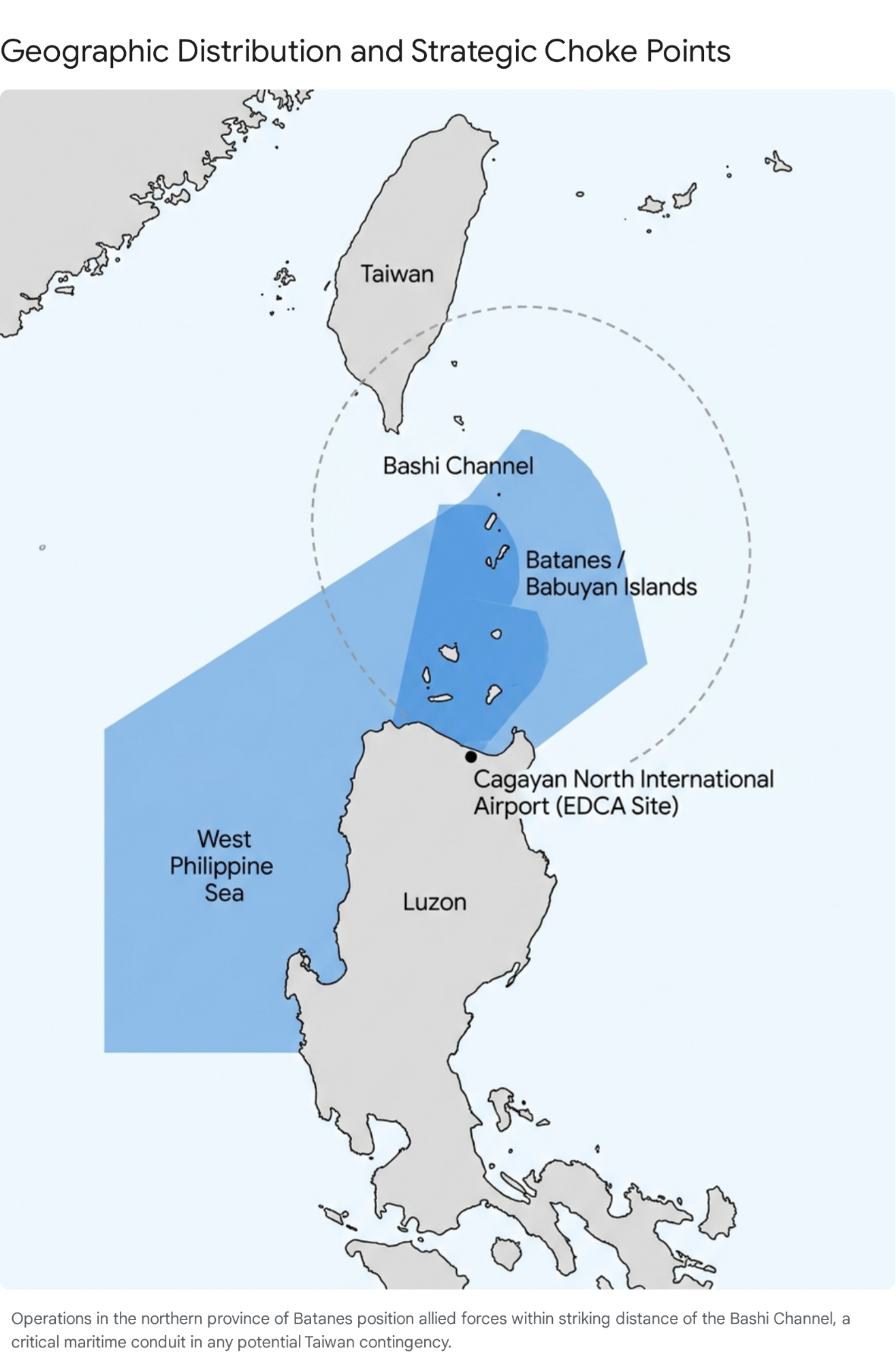
A central focus of the exercise involves operations in the northernmost Philippine province of Batanes and the adjacent Babuyan Island Group.8 This territory borders the Luzon Strait and the Bashi Channel, which serve as critical maritime conduits connecting the Philippine Sea to the South China Sea. Control of these waterways is essential for projecting naval power, maintaining commercial shipping lanes, and facilitating military transit in the event of a regional contingency.
The strategic relevance of this geography is closely tied to the defense of Taiwan. The island of Itbayat in the Batanes group lies less than 100 miles from Taiwan’s southern coast.5 By conducting Maritime Key Terrain Security Operations (MKTSO) in this sector, U.S. and Philippine forces are rehearsing the rapid deployment, securement, and defense of strategically vital islands that could serve as choke points or staging areas.8 The MKTSO curriculum focuses on the rapid insertion of troops into remote environments, securing beachheads and ports, establishing temporary defensive fortifications, and coordinating surveillance across the strait.8
Furthermore, the deployment of the U.S. 3rd Marine Littoral Regiment to the Cagayan North International Airport (also known as Lal-lo Airport) highlights the utility of EDCA sites.15 Operating from this airfield in Northern Luzon, American forces can utilize long-range anti-ship missile systems to establish a sea-denial zone extending up to 185 kilometers into the waters separating the Philippines and Taiwan.15 This positioning signals a readiness to contest adversary naval movements through one of the primary passages into the First Island Chain.
4.2 The Western Flank: The West Philippine Sea
Simultaneously, Balikatan 2026 dedicates significant resources to operations along the western coast of the archipelago, focusing on the West Philippine Sea.2 This area remains a highly volatile flashpoint, characterized by competing territorial claims and the persistent presence of foreign maritime militias. The drills conducted in this theater—ranging from multilateral maritime patrols to integrated air and missile defense scenarios—are designed to assert sovereignty, enforce UNCLOS provisions, and demonstrate the coalition’s capability to operate effectively within an adversary’s perceived sphere of influence.7
5. Multinational Maritime Operations and the Capstone SINKEX
The maritime domain serves as the primary theater for validating joint interoperability during the exercise. The operational activities are designed to stress-test the command-and-control linkages required to coordinate complex tactical maneuvers among navies utilizing different communication protocols and operational doctrines.
5.1 Multinational Maritime Exercise (MME)
The maritime component is structured around the Multinational Maritime Exercise (MME), directed by the U.S. Navy’s Destroyer Squadron (DESRON) 7 and Task Force Ashland.4 DESRON 7, acting as the primary tactical and operational commander for deployed ships in Southeast Asia, oversees a combined task group comprising ten surface vessels from the United States, the Philippines, Japan, Australia, Canada, and the U.S. Coast Guard.4
The MME involves high-intensity training evolutions conducted off the west coast of the Philippines over multiple days.2 The curriculum includes coordinated anti-submarine warfare (ASW) tracking, live-fire gunnery engagements, deck-landing qualifications for cross-deck aviation operations, and complex search-and-rescue and medical evacuation procedures.4 By executing these maneuvers as a unified surface action group, the coalition ensures that in a crisis scenario, diverse naval assets can aggregate rapidly and operate under a centralized command structure.
5.2 The Joint Sinking Exercise (SINKEX)
The tactical culmination of the maritime phase is the sinking exercise (SINKEX). This event moves beyond simulated targeting to involve live kinetic strikes against a physical vessel. The target designated for the 2026 exercise is a decommissioned Philippine Navy logistics ship, the BRP Lake Caliraya (PS-70).20 (Note: Subsidiary exercise reports also reference the decommissioned BRP Quezon as a potential target in surrounding drills).21
The SINKEX is designed as a joint maritime strike scenario. According to exercise spokespersons, the objective is not simply to sink the vessel, but to orchestrate a highly synchronized convergence of fires utilizing air, land, and sea-based assets simultaneously.20 This requires aircraft, surface ships, and land-based missile batteries to share targeting telemetry in real-time, effectively creating a unified kill web. The successful execution of the SINKEX serves as the ultimate validation of the coalition’s ability to locate, track, and destroy adversary surface combatants in a contested maritime environment.
6. Integrated Air and Missile Defense (IAMD)
As modern warfare becomes increasingly reliant on advanced aerospace threats—including ballistic missiles, cruise missiles, and unmanned aerial systems (UAS)—the ability to defend critical infrastructure and troop concentrations is paramount. Balikatan 2026 addresses this requirement through dedicated Integrated Air and Missile Defense (IAMD) operations.8
Conducted primarily at Naval Station Leovigildo Gantioqui in Zambales, the IAMD drills test the coalition’s capacity to detect and neutralize complex aerial threats.8 The training involves linking disparate radar sensor networks, command centers, and ground-based air defense platforms into a cohesive architecture.8 This integration is critical; the Philippine military currently possesses limited organic air defense capabilities and must rely on allied systems to protect high-value assets and precision strike batteries during the initial phases of a conflict.23
The scenarios are designed to minimize the sensor-to-shooter timeline, allowing allied forces to rapidly process tracking data and assign interception tasks to the optimal defensive platform.8 By rehearsing these protocols, the coalition enhances its defensive posture against preemptive strikes designed to degrade command nodes or logistics hubs.
7. Advanced Kinetic Assets and Sea Denial Architecture
The operational geography of the Philippines makes it uniquely suited for anti-access/area-denial (A2/AD) strategies. During Balikatan 2026, the allied coalition deployed and tested a suite of advanced kinetic weapons designed explicitly for coastal defense and sea denial, altering the tactical calculus within the First Island Chain.
7.1 The Navy-Marine Expeditionary Ship Interdiction System (NMESIS)
The U.S. 3rd Marine Littoral Regiment deployed the NMESIS platform to the northern Philippines.15 This system consists of an unmanned, remote-controlled Joint Light Tactical Vehicle (JLTV) chassis equipped with the Naval Strike Missile (NSM).15 Staged at austere locations like the Cagayan North International Airport, NMESIS exemplifies the doctrine of Expeditionary Advanced Base Operations (EABO). The system provides a highly mobile, low-signature anti-ship capability that can threaten maritime targets up to 185 kilometers away before rapidly relocating to avoid counter-battery fire.15
7.2 The Typhon Missile System
The exercise also featured the deployment of the U.S. Typhon Missile System. This ground-based launcher represents a significant escalation in regional strike capabilities, as it is capable of firing Standard Missile 6 (SM-6) interceptors—which possess secondary land-attack and anti-ship modes—as well as Tomahawk Land Attack Cruise Missiles.5 The integration of the Typhon system introduces a long-range, deep-strike capability into the theater, providing the coalition with the means to target adversary infrastructure and naval assets at strategic distances.
7.3 Japanese Type 88 and Philippine BrahMos Systems
Allied kinetic contributions further compound the sea-denial architecture. For the first time, the Japan Ground Self-Defense Force executed live-fire operations with the Type 88 surface-to-ship missile outside of Japanese sovereign territory.12 This deployment directly supports the SINKEX and demonstrates Japan’s technical and political readiness to engage in integrated combat operations alongside its partners.12
Simultaneously, the Armed Forces of the Philippines simulated the deployment of its newly acquired BrahMos supersonic cruise missiles.5 Procured from India, the BrahMos system provides the Philippine military with a highly lethal, organic coastal defense capability. Operating at speeds approaching Mach 3, the missile drastically compresses the reaction time available to adversary point-defense systems, creating a formidable deterrent against hostile surface action groups operating within the Philippine exclusive economic zone.
| Weapon System | Operating Nation | Core Functionality and Design | Strategic Application in Balikatan 2026 |
| NMESIS (Naval Strike Missile) | United States | Unmanned, highly mobile coastal defense missile launcher. | Securing maritime choke points in the Luzon Strait; providing survivable, distributed sea-denial. |
| Typhon System (SM-6, Tomahawk) | United States | Multi-mission ground launcher for air defense and long-range strike. | Establishing robust theater-level deterrence via deep strike and extended-range interception. |
| Type 88 Surface-to-Ship Missile | Japan | Truck-mounted coastal defense anti-ship cruise missile. | First out-of-territory operational deployment; securing the southern flank of the First Island Chain. |
| BrahMos Supersonic Cruise Missile | Philippines | High-speed (Mach 3) anti-ship and land-attack missile. | Providing the AFP with an organic, high-tier coastal defense asset to protect archipelagic waters. |
8. Expeditionary Logistics and Distributed Sustainment
Military strategy is ultimately constrained by logistics. In archipelagic warfare, the ability to sustain dispersed forces over vast expanses of water—while under the constant threat of interdiction—is the primary determinant of operational endurance. Balikatan 2026 places an unprecedented emphasis on validating dynamic maritime sustainment and distributed logistics.2
Prior to the formal commencement of kinetic drills, U.S. and Philippine forces executed complex rehearsals involving the offload of heavy equipment and supplies from maritime prepositioning force shipping at the Port of Cagayan de Oro.2 Once ashore, this materiel was rapidly transported and distributed across logistical nodes throughout Luzon to support the ensuing training events.2
This emphasis on distribution is critical because traditional, static logistics hubs are highly vulnerable to precision missile strikes. By practicing the rapid offload and dispersed routing of supplies, the coalition is building the resilient supply chains necessary to sustain combat operations in a contested environment. The U.S. Air Force also played a vital role in this phase, with units such as the 317th Airlift Wing arriving in the Philippines to conduct Maximum Endurance Operations (MEO) and provide tactical airlift support across the theater.25 The ability to continuously move munitions, fuel, and provisions to remote island outposts dictates the tempo and survivability of the forward-deployed forces.
9. Space and Cyber Domain Operations
Balikatan 2026 acknowledges that modern multi-domain operations are entirely dependent on the continuous availability of space and cyber assets. The domains of space and cyberspace are no longer viewed as benign support environments; they are congested, contested battlefields critical for navigation, communication, and intelligence gathering.26
U.S. Space Force leadership, including Chief of Space Operations Gen. Chance Saltzman, emphasized during the exercise period that the U.S. military is undergoing sweeping changes to reoptimize its forces for Great Power Competition in the space domain.26 During Balikatan, specialized units, supported by leaders like USSF Brig. Gen. Denaro, engaged with forces on the ground to ensure that satellite communications and orbital surveillance architectures could withstand jamming or degradation attempts.27
Concurrently, the exercise incorporated rigorous cyber defense operations.7 Joint cyber units from allied nations trained shoulder-to-shoulder to identify, isolate, and neutralize simulated digital intrusions.27 The objective of these drills is to protect critical military networks and civilian infrastructure from sophisticated electronic warfare and cyber-attacks, ensuring that the command-and-control linkages governing the kinetic weapons systems remain intact during combat operations.
10. Operationalizing the Comprehensive Archipelagic Defense Concept (CADC)
Beyond the tactical integration of allied forces, Balikatan 2026 functions as the primary operational proving ground for the Philippine government’s Comprehensive Archipelagic Defense Concept (CADC).10 Operationalized by the Marcos Jr. administration in early 2024, the CADC represents a paradigm shift in Philippine military strategy.
For the majority of its history, the AFP was structured and trained for internal security, focusing on counter-insurgency and domestic policing. The CADC reorients the military toward external territorial defense, dictating a posture that projects defensive power outward from the landmass to secure the entirety of the Philippines’ 200-nautical-mile exclusive economic zone and extended continental shelf.10 As Philippine Defense Secretary Gilberto Teodoro Jr. articulated, the CADC is designed to allow the AFP to guarantee the unimpeded exploration and exploitation of natural resources by Philippine nationals within their sovereign jurisdiction.11
Implementing the CADC requires a transition from conventional, unfocused military build-ups to a strategy defined by basing dispersion, the use of archipelagic geography for concealment, and the deployment of ranged strike capabilities.10 The scenarios executed during Balikatan 2026—particularly the remote deployments in Batanes and the integration of BrahMos missiles—are direct physical manifestations of the CADC doctrine.
However, military analysts assess that operationalizing the CADC presents both internal and external challenges. Internally, the Philippine military must overcome historical inter-service rivalries that can hamper the joint cooperation necessary for complex, multi-domain defense.10 Externally, the CADC functions effectively as a “counter” A2/AD strategy directed against China’s maritime posture.10 As Manila expands its military positions along strategic border areas and integrates foreign military partnerships, it inadvertently fosters security dilemma dynamics.10 The hardening of Philippine defense capabilities, while intended for protection, is perceived by adversaries as a threat, thereby increasing the likelihood of sharper military confrontations in the near term.10
11. Strategic Signaling and the Diplomatic Battleground
Military exercises of the magnitude of Balikatan 2026 are inherently political instruments. They serve as a massive signaling apparatus, projecting resolve to allies while issuing a stark deterrent warning to potential adversaries. The diplomatic exchanges surrounding the 2026 drills highlight a deeply polarized regional environment.
11.1 The Rhetoric of the People’s Republic of China
Unsurprisingly, the commencement of the expansive multilateral drills drew immediate and severe condemnation from Beijing. The Chinese Foreign Ministry characterized the involvement of external forces—specifically the United States, Japan, and European nations—as a deliberate attempt to “sow division and confrontation” within the Asia-Pacific region.13 A foreign ministry spokesperson warned that the participating countries were “blindly binding themselves together” and were akin to “playing with fire,” asserting that such actions would ultimately backfire and destabilize the region.14
11.2 The Philippine Posture of Resolve
In stark contrast to the strategic ambivalence that characterized previous administrations, the Philippine defense establishment responded to Beijing’s warnings with resolute defiance. The Armed Forces of the Philippines and the Department of National Defense systematically dismissed the Chinese rhetoric.
Rear Admiral Roy Vincent Trinidad, the AFP spokesperson for the West Philippine Sea, stated unequivocally that the military remains “unfazed” by the threats, characterizing China’s statements as predictable “deceptive messaging”.14 Trinidad emphasized that the joint drills are lawful actions of an independent sovereign state and are purely defensive in nature, designed solely to protect what is legally Philippine territory.14 He further clarified that the CADC and the exercises are not designed against any specific country, but rather to give the AFP the capability to secure its maritime domain.11
Defense Secretary Gilberto Teodoro Jr. delivered an even sharper critique, stating that Beijing’s intentions have always been “sinister and non-transparent” and that there is “no trust at all” in China’s diplomatic overtures.28 Teodoro framed Balikatan as an essential exercise in collective deterrence, arguing that China’s negative reaction is proof that the deterrent effect is working.28 He accused Beijing of utilizing a strategy of “guilt avoidance,” attempting to shift the blame for regional instability onto the Philippines and its allies while ignoring its own aggressive actions in the South China Sea.28
AFP Chief of Staff Gen. Romeo Brawner Jr. reinforced this unified stance, stating during the opening ceremonies that the presence of the multinational coalition sends an “unmistakable message that security is shared and that partnership remains our strongest advantage”.13
12. Long-Term Trajectories and Regional Stability
Exercise Balikatan 2026 establishes a set of operational realities that will profoundly influence the security architecture of the Indo-Pacific moving forward. The exercise confirms that the bilateral U.S.-Philippine alliance has effectively evolved into a multilateral security hub, capable of integrating forces from across the globe into a cohesive combat architecture.
The institutionalization of Japanese combat participation, alongside the formalized integration of forces from Australia, France, Canada, and New Zealand, guarantees that any future regional contingency will not be confined to a bilateral dispute. The “alliance density” demonstrated during the exercise ensures that aggression within the Philippine EEZ or the broader First Island Chain will immediately internationalize, fundamentally altering the risk calculations for any adversary contemplating offensive action.5
Furthermore, the exercise serves as a practical rehearsal for Taiwan contingencies. By developing pre-set logistical channels, testing advanced kinetic systems near the Bashi Channel, and validating the rapid deployment of expeditionary forces, Washington and Manila are laying the necessary groundwork to sustain prolonged combat operations in the region.5
Ultimately, Balikatan 2026 solidifies the irreversible trajectory of the Armed Forces of the Philippines. Through the rigorous testing of the Comprehensive Archipelagic Defense Concept, the Philippines is transitioning from a state reliant on diplomatic protest into an active, capable node within the regional deterrence network. The success of the exercise lies in its ability to seamlessly weave advanced technology, multinational logistics, and aggressive strategic messaging into a unified posture that secures the maritime domains of the Indo-Pacific against territorial coercion.
Please share the link on Facebook, Forums, with colleagues, etc. Your support is much appreciated and if you have any feedback, please email us in**@*********ps.com. If you’d like to request a report or order a reprint, please click here for the corresponding page to open in new tab.
Sources Used
- Balikatan 2026 opening ceremony highlights a strong alliance and expanding cooperation, accessed April 26, 2026, https://www.pacom.mil/Media/News/News-Articles/Article/4465146/balikatan-2026-opening-ceremony-highlights-a-strong-alliance-and-expanding-coop/
- Philippine, U.S. forces kick off most expansive Balikatan exercise to date, accessed April 26, 2026, https://www.imef.marines.mil/Media-Room/Press-Releases/Announcement/Article/4457714/philippine-us-forces-kick-off-most-expansive-balikatan-exercise-to-date/
- Exercise Balikatan – DVIDS, accessed April 26, 2026, https://www.dvidshub.net/feature/Balikatan
- Balikatan 2026: DESRON-7, Task Force Ashland Commence …, accessed April 26, 2026, https://www.pacom.mil/Media/News/News-Articles/Article/4468732/balikatan-2026-desron-7-task-force-ashland-commence-multinational-maritime-event/
- U.S. and Filipino Forces Launch Expanded Military Drills – FDD, accessed April 26, 2026, https://www.fdd.org/analysis/2026/04/22/u-s-and-filipino-forces-launch-expanded-military-drills/
- Balikatan 2026 opening ceremony highlights strong alliance, expanding cooperation, accessed April 26, 2026, https://www.cpf.navy.mil/Newsroom/News/Article/4466071/balikatan-2026-opening-ceremony-highlights-strong-alliance-expanding-cooperation/
- Exercise Balikatan 2026 underway | The Australian Naval Institute, accessed April 26, 2026, https://navalinstitute.com.au/exercise-balikatan-2026-underway/
- Exercise Balikatan: What drills to expect in ‘most expansive’ version of PH-US annual war games – Manila Bulletin, accessed April 26, 2026, https://mb.com.ph/2026/04/21/exercise-balikatan-what-drills-to-expect-in-most-expansive-version-of-ph-us-annual-war-games
- Balikatan 2026 opening ceremony highlights a strong alliance and expanding cooperation, accessed April 26, 2026, https://www.dvidshub.net/news/563062/balikatan-2026-opening-ceremony-highlights-strong-alliance-and-expanding-cooperation
- Forward and Seaward: Archipelagic Defence as a Military Strategy for the Philippines, accessed April 26, 2026, https://www.iiss.org/research-paper/2025/12/forward-and-seaward-archipelagic-defence-as-a-military-strategy-for-the-philippines/
- PH’s archipelagic defense framework not aimed at China – Navy | Philippine News Agency, accessed April 26, 2026, https://www.pna.gov.ph/articles/1273449
- PLA holds exercises in waters east of Luzon Island, ‘a necessary …, accessed April 26, 2026, https://www.globaltimes.cn/page/202604/1359721.shtml
- US, Philippines launch largest-ever Balikatan drills as China warns against ‘division and confrontation’ | IRIA News, accessed April 26, 2026, https://www.ir-ia.com/news/us-philippines-launch-largest-ever-balikatan-drills-as-china-warns-against-division-and-confrontation/
- AFP unfazed by China’s warning as Balikatan drills push through – Daily Tribune, accessed April 26, 2026, https://tribune.net.ph/2026/04/21/afp-unfazed-by-chinas-warning-as-balikatan-drills-push-through
- U.S. Anti-Ship Missiles in the Philippines for Balikatan 2026 – Naval News, accessed April 26, 2026, https://www.navalnews.com/naval-news/2026/04/u-s-anti-ship-missiles-in-the-philippines-for-balikatan-2026/
- French Amphibious Warship, Frigate to Join Balikatan 2026 – Naval News, accessed April 26, 2026, https://www.navalnews.com/naval-news/2026/02/french-amphibious-warship-frigate-to-join-balikatan-2026/
- Balikatan – Wikipedia, accessed April 26, 2026, https://en.wikipedia.org/wiki/Balikatan
- US-Philippine Joint Military Drill Targets “Real-World Conditions” – the deep dive, accessed April 26, 2026, https://thedeepdive.ca/balikatan-2026-taiwan-drills/
- Balikatan 2026: DESRON-7, Task Force Ashland commence multinational maritime event, accessed April 26, 2026, https://www.cpf.navy.mil/Newsroom/News/Article/4470529/balikatan-2026-desron-7-task-force-ashland-commence-multinational-maritime-event/
- ‘Balikatan’ 2026 to include ship-sinking drill – Global News, accessed April 26, 2026, https://globalnation.inquirer.net/318420/balikatan-2026-to-include-ship-sinking-drill
- 10,000 US soldiers to participate in 2026 Balikatan drills | ABS-CBN News – YouTube, accessed April 26, 2026, https://www.youtube.com/watch?v=GdBPDsBHQuw
- Balikatan 25 | 3d MLR Participates in Integrated Air and Missile Defense > 3d Marine Littoral Regiment > Article, accessed April 26, 2026, https://www.3rdmlr.marines.mil/Media-Room/Stories/Article/Article/4169265/balikatan-25-3d-mlr-participates-in-integrated-air-and-missile-defense/
- Dangers of Delay: US-Philippine Defence Cooperation in 2026 – Fulcrum.sg, accessed April 26, 2026, https://fulcrum.sg/dangers-of-delay-us-philippine-defence-cooperation-in-2026/
- 3rd MLR Joins Most Expansive Exercise Balikatan To Date, accessed April 26, 2026, https://www.pacom.mil/Media/News/News-Articles/Article/4468719/3rd-mlr-joins-most-expansive-exercise-balikatan-to-date/
- Balikatan 2026: 317th AW conducts MEO, arrives in Philippines > Air Force > Article Display, accessed April 26, 2026, https://www.af.mil/News/Article-Display/Article/4466910/balikatan-2026-317th-aw-conducts-meo-arrives-in-philippines/
- Reoptimization for Great Power Competition – Space Force, accessed April 26, 2026, https://www.spaceforce.mil/Reoptimization-for-Great-Power-Competition/?videoid=1003045&dvpmoduleid=1290&dvpTag=Aided
- Exercise Balikatan – DVIDS, accessed April 26, 2026, https://www.dvidshub.net/unit/BK
- Defense chief criticizes ‘sinister’ China intentions after its remark vs Balikatan exercises, accessed April 26, 2026, https://www.abs-cbn.com/news/nation/2026/4/21/gibo-teodoro-criticizes-china-after-its-remark-vs-balikatan-exercises-1128
- Balikatan exercise not directed at China, AFP reiterates | Philstar.com, accessed April 26, 2026, https://www.philstar.com/headlines/2026/04/22/2522690/balikatan-exercise-not-directed-china-afp-reiterates